Finding the Derivatives of Tangent, Cotangent, Secant, and Cosecant Functions
Introduced 7:53
Defining the Derivative
Picture a car's journey as a curve. Over a whole interval, we can measure its average speed — the slope of the straight line joining two points on the curve.…
English narration · English and 中文 subtitles you can switch
In this lesson
| English | Meaning |
|---|---|
| trigonometric/ˌtrɪɡənəʊˈmetrɪk/ | Relating to functions such as sine, cosine and tangent and their relationships with angles. |
The other four trig functions
- We know $\sin'=\cos$ and $\cos'=-\sin$. The other four trig functions are quotients of these: $\tan x=\dfrac{\sin x}{\cos x}$, $\cot x=\dfrac{\cos x}{\sin x}$, $\sec x=\dfrac1{\cos x}$, $\csc x=\dfrac1{\sin x}$.
- So the Quotient Rule gives all four derivatives. Learn the results, but know where they come from.
These four derivatives are all obtained using the...
Difficulty 1/5 · 100 coins + a small bonus on first completion today
Each of $\tan,\cot,\sec,\csc$ is a quotient of $\sin$/$\cos$.
Deriving $\tan x$
- Quotient Rule on $\dfrac{\sin x}{\cos x}$: $\dfrac{\cos x\cos x-\sin x(-\sin x)}{\cos^2 x}=\dfrac{\cos^2 x+\sin^2 x}{\cos^2 x}=\dfrac{1}{\cos^2 x}$.
- So $\boxed{\dfrac{d}{dx}[\tan x]=\sec^2 x}$. The same steps on $\dfrac{\cos x}{\sin x}$ give $\dfrac{d}{dx}[\cot x]=-\csc^2 x$.
The sine wave whose ratio makes tan
$\tan x=\sin x/\cos x$; its derivative $\sec^2 x$ is always positive — tan is increasing wherever it is defined.
What is $\dfrac{d}{dx}[\tan x]$?
Difficulty 1/5 · 100 coins + a small bonus on first completion today
From the Quotient Rule on $\sin/\cos$: $\sec^2 x$.
$\dfrac{d}{dx}[\cot x]=$ ____ $\csc^2 x$.
Difficulty 1/5 · 100 coins + a small bonus on first completion today
It is $-\csc^2 x$.
The secant and cosecant pair
- $\dfrac{d}{dx}[\sec x]=\sec x\tan x$ and $\dfrac{d}{dx}[\csc x]=-\csc x\cot x$. Both come from the Quotient Rule on $\tfrac1{\cos x}$ or $\tfrac1{\sin x}$ (see the example below).
- Pattern: the "co-" functions ($\cos$, $\cot$, $\csc$) all carry a minus sign in their derivative.
What is $\dfrac{d}{dx}[\sec x]$?
Difficulty 1/5 · 100 coins + a small bonus on first completion today
$\frac{d}{dx}[\sec x]=\sec x\tan x$.
The derivatives of $\cot x$ and $\csc x$ both carry a minus sign.
Difficulty 1/5 · 100 coins + a small bonus on first completion today
$-\csc^2 x$ and $-\csc x\cot x$ — the "co-" functions carry a minus.
Using them with other rules
- These trigonometric derivatives combine with the other rules like any others: $\dfrac{d}{dx}[x\tan x]=\tan x+x\sec^2 x$ (Product Rule).
- $\dfrac{d}{dx}[3\sec x-\cot x]=3\sec x\tan x+\csc^2 x$: the minus from $\cot$ and the minus in front make a plus.
Select all correct derivatives.
Difficulty 2/5 · 140 coins + a small bonus on first completion today
The last is wrong: $\frac{d}{dx}[\sec x]=\sec x\tan x$, not $\sec^2 x$.
Differentiate $y=x^2\sec x$.
- Product Rule with $f=x^2$, $g=\sec x$: $f'=2x$, $g'=\sec x\tan x$.
- $y'=f'g+fg'=2x\sec x+x^2\sec x\tan x$.
- Factor: $y'=x\sec x\,(2+x\tan x)$.
Where $\sec'$ comes from. Differentiate $\sec x=\dfrac{1}{\cos x}$.
- Quotient Rule with top $1$ (derivative $0$) and bottom $\cos x$: $\dfrac{\cos x\cdot0-1\cdot(-\sin x)}{\cos^2x}=\dfrac{\sin x}{\cos^2x}$.
- Split it: $\dfrac{1}{\cos x}\cdot\dfrac{\sin x}{\cos x}=\sec x\tan x$.
Find the slope of $y=\sec x$ at $x=\dfrac{\pi}{3}$. Give 2 decimal places.
Difficulty 2/5 · 140 coins + a small bonus on first completion today
$y'=\sec x\tan x$. At $\tfrac{\pi}{3}$: $\sec=2$, $\tan=\sqrt3$, so $y'=2\sqrt3\approx3.46$.
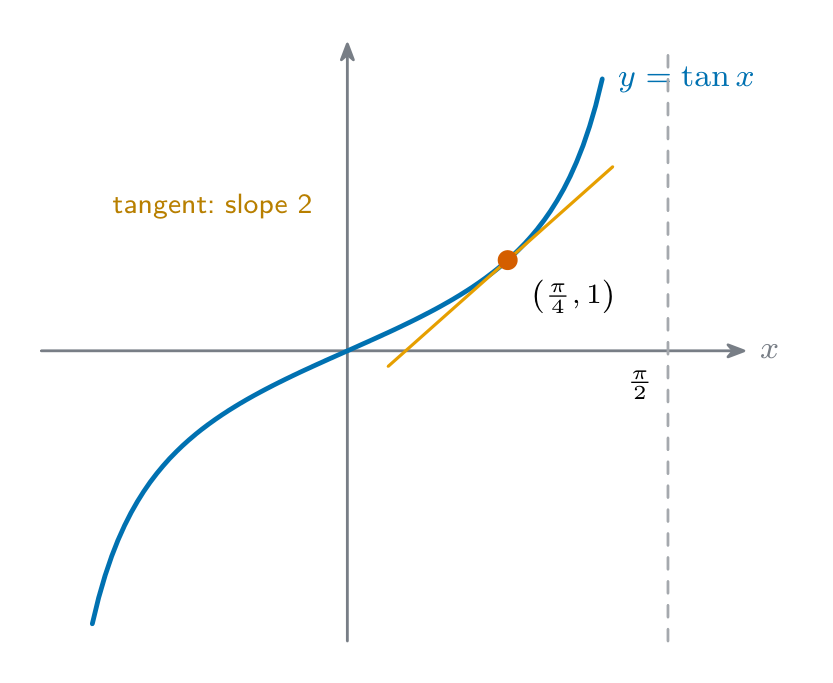
A tangent line. Find the tangent to $y=\tan x$ at $x=\dfrac{\pi}{4}$.
- Point: $\tan\dfrac{\pi}{4}=1$. Slope: $\sec^2\dfrac{\pi}{4}=\left(\sqrt2\right)^2=2$.
- Tangent: $y-1=2\left(x-\dfrac{\pi}{4}\right)$.
What is the slope of the tangent to $y=\tan x$ at $x=0$?
Difficulty 1/5 · 100 coins + a small bonus on first completion today
$\sec^2 0=\dfrac{1}{\cos^2 0}=1$.
Watch the minus signs on the "co-" functions: $\frac{d}{dx}[\cot x]=-\csc^2 x$ and $\frac{d}{dx}[\csc x]=-\csc x\cot x$ both carry a minus, matching $\cos'=-\sin$. Mixing up $\sec^2 x$ (from $\tan$) with $\csc^2 x$ (from $\cot$) is another frequent slip — pair each derivative with its source.
For $f(x)=\tan x$, find $f'(0)$. Which of the six trig derivatives carry a minus sign?
For $f(x)=\tan x$, $f'(x)=\sec^2x$; since $\cos0=1$, $f'(0)=1/\cos^20=1$.
For $f(x)=\tan x$, what is $f'(0)$?
Difficulty 1/5 · 100 coins + a small bonus on first completion today
Secant of 0 squared is 1.
The four extra trigonometric derivatives all follow from the Quotient Rule: $\frac{d}{dx}[\tan x]=\sec^2 x$, $\frac{d}{dx}[\cot x]=-\csc^2 x$, $\frac{d}{dx}[\sec x]=\sec x\tan x$, $\frac{d}{dx}[\csc x]=-\csc x\cot x$. The "co-" functions carry a minus. Combine them freely with the product and quotient rules.
What went wrong? Only the site team sees this.