Skip to content · ⁨ข้ามไปยังเนื้อหา⁩

Cell Structure and Function · ⁨โครงสร้างและหน้าที่ของเซลล์⁩

AP Biology · Topic 2 · ⁨หัวข้อ 2⁩

Video lesson for this topic · ⁨บทเรียนวิดีโอสำหรับหัวข้อนี้⁩ Open the video page · ⁨เปิดหน้าวิดีโอ⁩
9:48

โครงสร้างและหน้าที่ของเซลล์

quan sátใบไม้ภายใต้กล้องจุลทรรศน์ คุณเห็นแถวของกล่องสีเขียว และแต่ละกล่องเต็มไปด้วยแผ่นวงกลมสีเขียวขนาดเล็ก ตอนนี้ดูชิ้นบางๆ ของหัวหอม…

English narration · English + 中文 subtitles burned in · ⁨การบรรยายภาษาอังกฤษ · คำบรรยายภาษาอังกฤษ + 中文 ลอยตัวบนภาพ⁩

2.1

Organelles and the Endomembrane System · ⁨ออร์แกเนลล์และระบบเอนโดเมมเบรน⁩

Syllabus · ⁨หลักสูตร⁩
English

Big Idea 4 — Systems Interactions (SYI): Biological systems interact, and these systems and their interactions exhibit complex properties.

Learning Objective 2.1.A: Explain how the structure and function of subcellular components and organelles contribute to the function of cells.

  • 2.1.A.1 Ribosomes are comprised of ribosomal RNA (rRNA) and protein. These non-membrane, subcellular structures are found in cells in all forms of life and reflect the common ancestry in all known life. Ribosomes synthesize proteins according to messenger RNA (mRNA) sequences.
  • 2.1.A.2 The endomembrane system consists of a group of membrane-bound organelles and subcellular components (endoplasmic reticulum (ER), Golgi complex, lysosomes, vacuoles and transport vesicles, the nuclear envelope, and the plasma membrane) that work together to modify, package, and transport polysaccharides, lipids, and proteins intercellularly.
  • 2.1.A.3 Endoplasmic reticulum provides mechanical support by helping cells maintain shape and plays a role in intracellular transport.
    • i. Rough ER is associated with membrane-bound ribosomes, allows for the compartmentalization of cells, and helps carry out protein synthesis.
    • ii. Smooth ER functions include the detoxification of cells and lipid synthesis.
    • Exclusion statement: Knowledge of the specific functions of smooth ER in specialized cells is beyond the scope of the AP Exam.
  • 2.1.A.4 The Golgi complex is a membrane-bound structure that consists of a series of flattened membrane sacs. Functions of the Golgi include:
    • i. Correctly folding and chemically modifying newly synthesized cellular products
    • ii. Packaging proteins for trafficking
    • Exclusion statement: Knowledge of the role of Golgi in the synthesis of specific phospholipids and packaging of specific enzymes for lysosomes, peroxisomes, and secretory vesicles is beyond the scope of the AP Exam.
    • Illustrative examples for 2.1.A.4:
      • Glycosylation and other chemical modifications of proteins that take place within the Golgi and determine protein function or targeting
  • 2.1.A.5 Mitochondria have a double membrane that provides compartments for different metabolic reactions involved in aerobic cellular respiration. The outer membrane is smooth, while the inner membrane is highly convoluted, forming folds that enable ATP to be synthesized more efficiently.
  • 2.1.A.6 Lysosomes are membrane-enclosed sacs that contain hydrolytic enzymes that digest material. Lysosomes also play a role in programmed cell death (apoptosis).
  • 2.1.A.7 Vacuoles are membrane-bound sacs that play many different roles.
    • i. In plant cells, a specialized large vacuole maintains turgor pressure through nutrient and water storage.
    • ii. In animal cells, vacuoles are smaller in size, are more plentiful than in plant cells, and store cellular materials.
  • 2.1.A.8 Chloroplasts are specialized organelles that are found in plants and photosynthetic algae. Chloroplasts contain a double membrane and serve as the location for photosynthesis.
ไทย

แนวคิดหลักที่ 4 — การแลกเปลี่ยนระบบ (SYI): ระบบชีวภาพมีการแลกเปลี่ยนกัน และระบบเหล่านี้และการแลกเปลี่ยน将它们แสดงถึงคุณสมบัติที่ซับซ้อน

จุดประสงค์การเรียนรู้ 2.1.A: อธิบายว่าโครงสร้างและหน้าที่ของส่วนประกอบภายในเซลล์และออร์แกเนลล์มีผลต่อการทำงานของเซลล์อย่างไร

  • 2.1.A.1 Ribosomes (ไรโบโซม) ประกอบด้วย ribosomal RNA (rRNA) และโปรตีน โครงสร้างระดับย่อยเซลล์ที่ไม่มีเยื่อหุ้มเหล่านี้พบได้ในเซลล์ของสิ่งมีชีวิตทุกรูปแบบ สะท้อนถึงบรรพบุรุษร่วมกันในสิ่งมีชีวิตที่รู้จักทั้งหมด ไรโบโซมสังเคราะห์โปรตีนตามลำดับของ messenger RNA (mRNA)
  • 2.1.A.2 ระบบเอนโดเมมเบรน (endomembrane system) ประกอบด้วยกลุ่มออร์แกเนลล์และส่วนประกอบภายในเซลล์ที่มีเยื่อหุ้ม (เอนโดพลาสมิกเรติคูลัม (ER), โกลจิกคอมเพล็กซ์, ลัยโซโซม, วาคูโอล, แวคิวโอเลียมขนส่ง, เยื่อหุ้มนิวเคลียส และเยื่อหุ้มเซลล์) ที่ทำงานร่วมกันเพื่อปรับแต่ง บรรจุ และขนส่งโพลีแซคคาไรด์.train脂质 และโปรตีนระหว่างเซลล์
  • 2.1.A.3 เอนโดพลาสมิกเรติคูลัมช่วยในการรองรับทางกลโดยช่วยให้เซลล์รักษารูปทรง และมีบทบาทในการขนส่งภายในเซลล์
    • i. Rough ER (เอนโดพลาสมิกเรติคูลัมขรุขระ) เชื่อมโยงกับไรโบโซมที่มีเยื่อหุ้ม ช่วยแบ่งพื้นที่ภายในเซลล์ และช่วยดำเนินการสังเคราะห์โปรตีน
    • ii. Smooth ER (เอนโดพลาสมิกเรติคูลัมเรียบ) มีหน้าที่包括การกำจัดสารพิษในเซลล์และการสังเคราะห์.train脂质
    • ข้อควรระวัง: ความรู้เกี่ยวกับหน้าที่เฉพาะของ Smooth ER ในเซลล์ที่มีลักษณะพิเศษอยู่นอกขอบเขตของการสอบ AP Exam
  • 2.1.A.4 โกลจิกคอมเพล็กซ์เป็นโครงสร้างที่มีเยื่อหุ้มประกอบด้วยชุดของถุงเยื่อแบนเรียงซ้อนกัน หน้าที่ของโกลจิกได้แก่:
    • i. การพับตัวให้ถูกต้องและดัดแปลงทางเคมีผลิตภัณฑ์เซลล์ที่สังเคราะห์ขึ้นใหม่
    • ii. การบรรจุโปรตีนสำหรับการขนส่ง
    • ข้อควรระวัง: ความรู้เกี่ยวกับบทบาทของโกลจิกในการสังเคราะห์train lipid เฉพาะชนิด และการบรรจุเอนไซม์เฉพาะชนิดสำหรับไลโซโซม, เพอร์ออกซิโซม และแวคิวโอเลียมหลั่ง=out之外超出了AP考试的范围。
    • ตัวอย่างประกอบสำหรับ 2.1.A.4:
      • การเพิ่มหมู่คาร์โบไฮเดรต (Glycosylation) และการดัดแปลงทางเคมีอื่นๆ ของโปรตีนที่เกิดขึ้นภายในโกลจิก ซึ่งกำหนดฟังก์ชันหรือเป้าหมายของโปรตีนนั้นๆ
  • 2.1.A.5 Mitochondria (ไมโทคอนเดรีย) มีเยื่อหุ้มสองชั้นซึ่งจัดแบ่งพื้นที่สำหรับปฏิกิริยาเมตาบอลิซึมต่างๆ ที่เกี่ยวข้องกับการหายใจระดับเซลล์แบบใช้ออกซิเจน เยื่อหุ้มภายนอกเรียบ ในขณะที่เยื่อหุ้มภายในมีการพับซับซ้อนมาก สร้างรอยย่นที่ช่วยให้สามารถสังเคราะห์ ATP ได้มีประสิทธิภาพมากขึ้น
  • 2.1.A.6 Lysosomes (ไลโซโซม) เป็นถุงที่มีเยื่อหุ้มล้อมรอบซึ่งมีเอนไซม์ไฮโดรไลติกที่ทำหน้าที่ย่อยสลายวัสดุ ไลโซโซมยังมีบทบาทในการตายตามโปรแกรมของเซลล์ (apoptosis)
  • 2.1.A.7 Vacuoles (วาคิวโอเลียม) เป็นถุงที่มีเยื่อหุ้มล้อมรอบและมีบทบาทหลากหลาย
    • i. ในเซลล์พืช วาคิวโอเลียมขนาดใหญ่ที่มีลักษณะเฉพาะช่วยรักษาแรงดันเต็ง (turgor pressure) ผ่านการจัดเก็บสารอาหารและน้ำ
    • ii. ในเซลล์สัตว์ Vacuole มีขนาดเล็กกว่า มีจำนวนมากกว่าในเซลล์พืช และเก็บสารภายในเซลล์
  • 2.1.A.8 คลอโรพลาสต์เป็นออร์แกเนลล์ที่มีลักษณะเฉพาะ พบได้ในพืชและสาหร่ายที่ทำปฏิกิริยาสังเคราะห์แสง คลอโรพลาสต์มีเยื่อหุ้มคู่และเป็นสถานที่发生的ของกระบวนการสังเคราะห์แสง
Source: College Board AP Course and Exam Description · ⁨แหล่งที่มา: คำอธิบายหลักสูตรและข้อสอบ College Board AP⁩

English

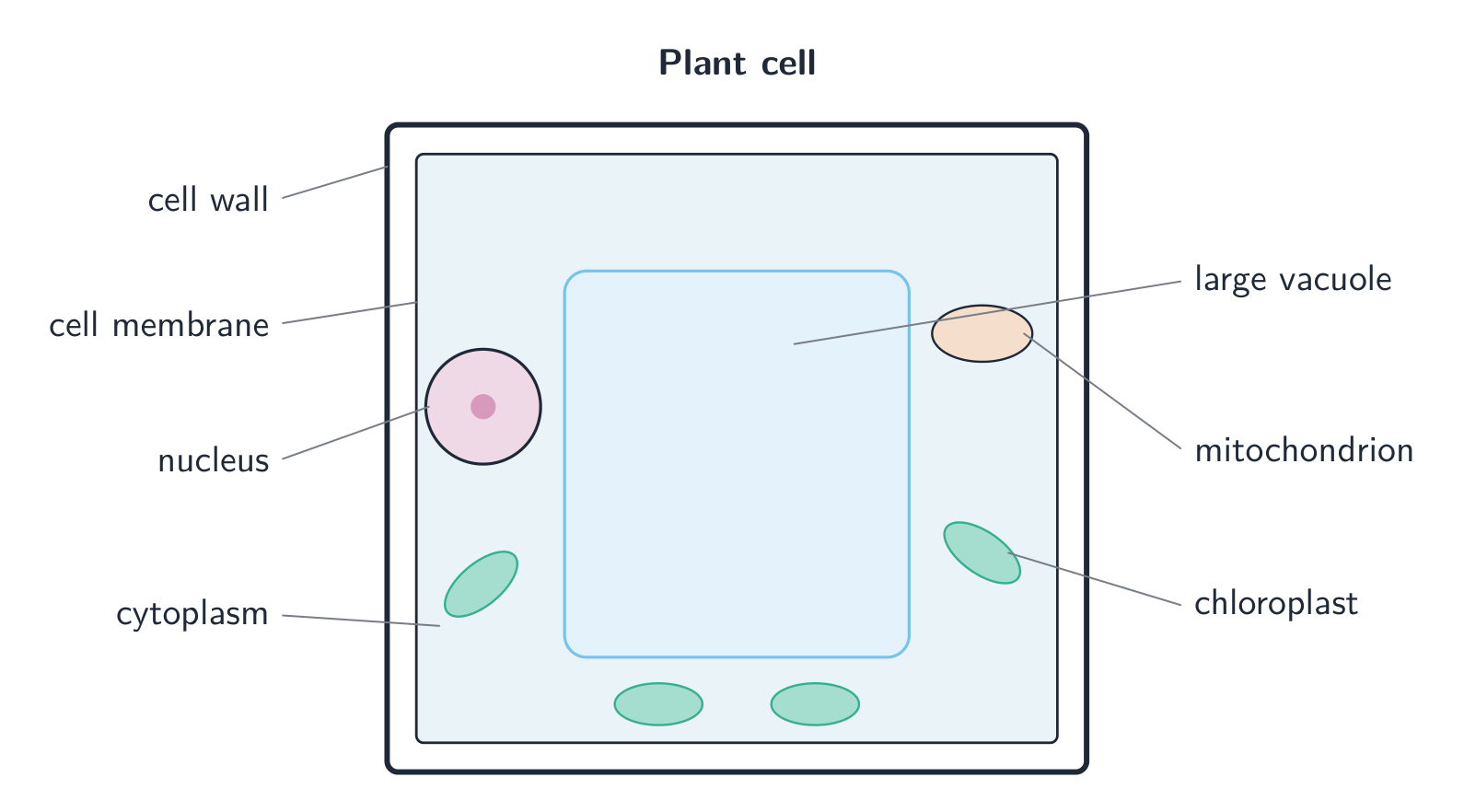
A eukaryotic cell divides its work among organelles 细胞器. The endomembrane system 内膜系统 is a connected set that makes, modifies, and ships molecules: the nucleus 细胞核 (holds DNA), rough and smooth endoplasmic reticulum 内质网 (protein and lipid synthesis), the Golgi 高尔基体 (modifies and packages), lysosomes 溶酶体 (digestion), and vesicles that carry material between them. Mitochondria 线粒体 (respiration) and chloroplasts 叶绿体 (photosynthesis) have their own membranes.

What each organelle actually does

The exam asks you to name a structure and say what it does, so learn them as pairs.

Ribosomes 核糖体 are made of ribosomal RNA 核糖体核糖核酸 (rRNA) and protein. They have no membrane, and they are found in every form of life — bacteria, archaea and eukaryotes alike. That shared presence is evidence of common ancestry: a structure this central was already present in the last common ancestor of all living things. A ribosome reads messenger RNA 信使核糖核酸 (mRNA) and builds the protein it codes for. Free ribosomes make proteins for use inside the cell; ribosomes bound to the rough endoplasmic reticulum make proteins for export or for the membrane.

The Golgi complex 高尔基复合体 is a series of flattened, membrane-bound sacs. A protein arriving from the endoplasmic reticulum is passed through them, and three things happen to it:

  • it is folded correctly and chemically modified — most often by glycosylation 糖基化, the attachment of short sugar chains;
  • it is sorted and targeted, so the modified sugar or phosphate tag decides which compartment the protein is sent to;
  • it is packaged into a vesicle for transport.

So the Golgi is not storage: it is the cell's finishing and dispatch department, and its modifications determine what a protein does and where it ends up.

Lysosomes are membrane-enclosed sacs of hydrolytic enzymes 水解酶 that digest material — worn-out organelles, engulfed bacteria, and food particles taken in by the cell. Their enzymes work best at a low pH, which the lysosome maintains inside itself; keeping them enclosed protects the rest of the cell. Lysosomes also take part in apoptosis 细胞凋亡, programmed cell death, in which a cell is dismantled deliberately, for example to sculpt fingers from a webbed embryonic hand.

Vacuoles 液泡 are membrane-bound sacs with many different roles: storing water, ions, nutrients or waste, and in a plant cell the large central vacuole also presses outwards on the cell wall to keep the cell firm.

Mitochondria and chloroplasts each have a double membrane and their own circular DNA and ribosomes — the evidence behind endosymbiotic theory below.

ไทย
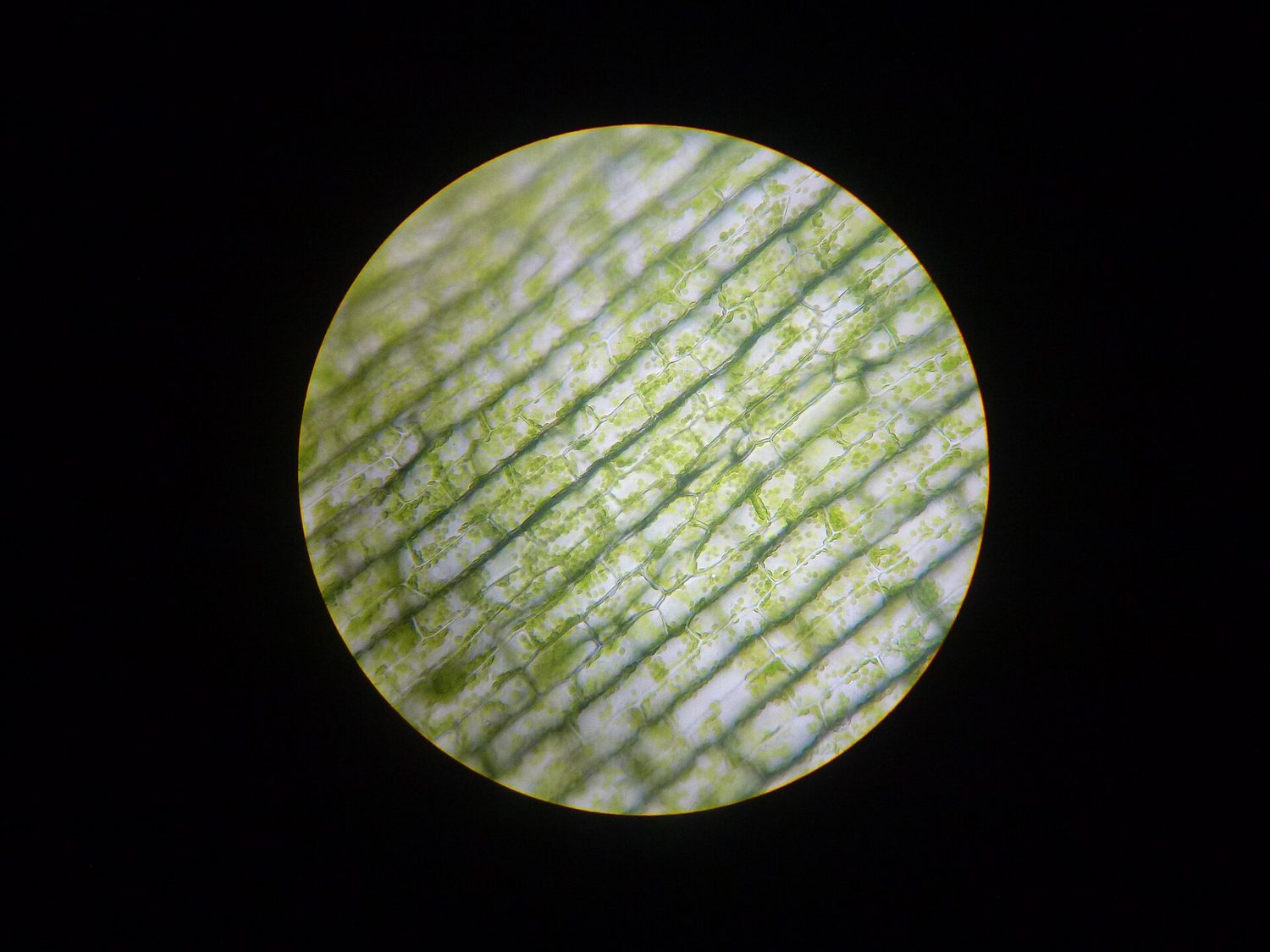
เซลล์ใบ Elodea บรรจุด้วยคลอโรพลาสต์สีเขียว (ภาพกล้องจุลทรรศน์แสง)
เซลล์ใบเอโลดีอาที่บรรจุคลอโรพลาสต์สีเขียวแน่นหนา (ภาพจุลทรรศน์แสง)
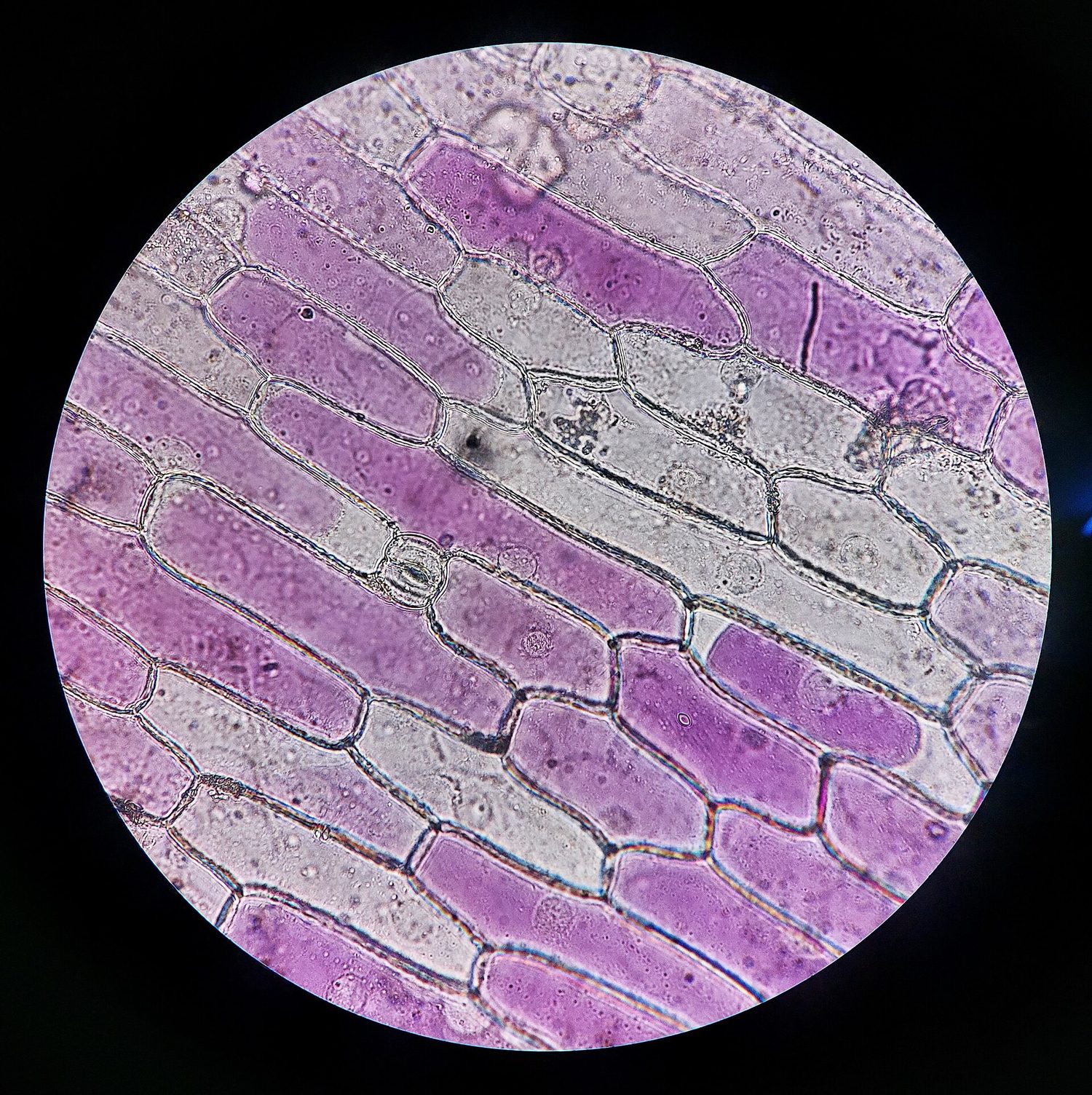
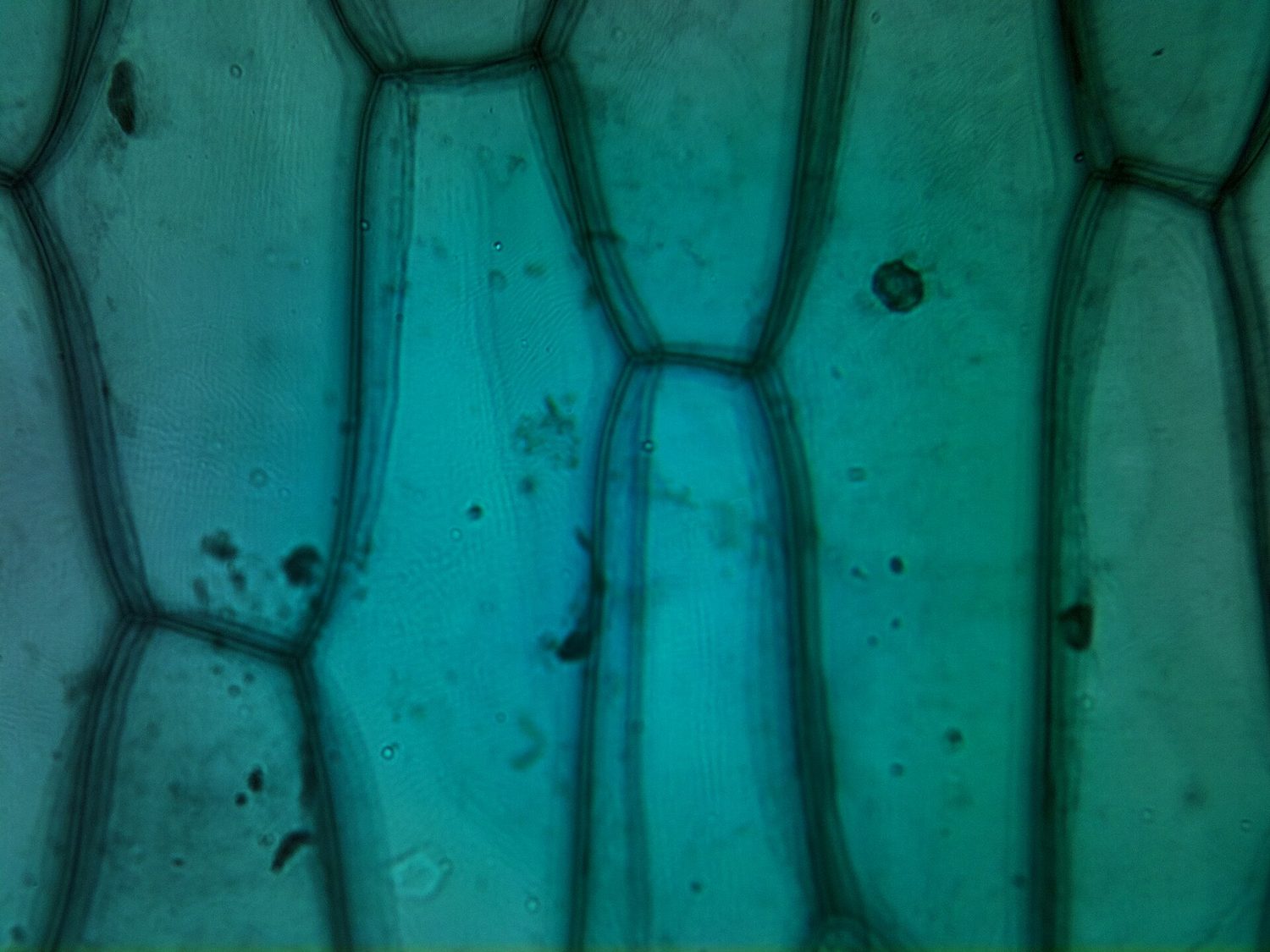
เซลล์เยื่อบุผิวหัวหอมภายใต้กล้องจุลทรรศน์แสง —ผนังเซลล์และนิวเคลียสมองเห็นได้อย่างชัดเจน
เซลล์เยื่อบุผิวหัวหอมภายใต้กล้องจุลทรรศน์แสง — ผนังเซลล์และนิวเคลียสมองเห็นได้อย่างชัดเจน

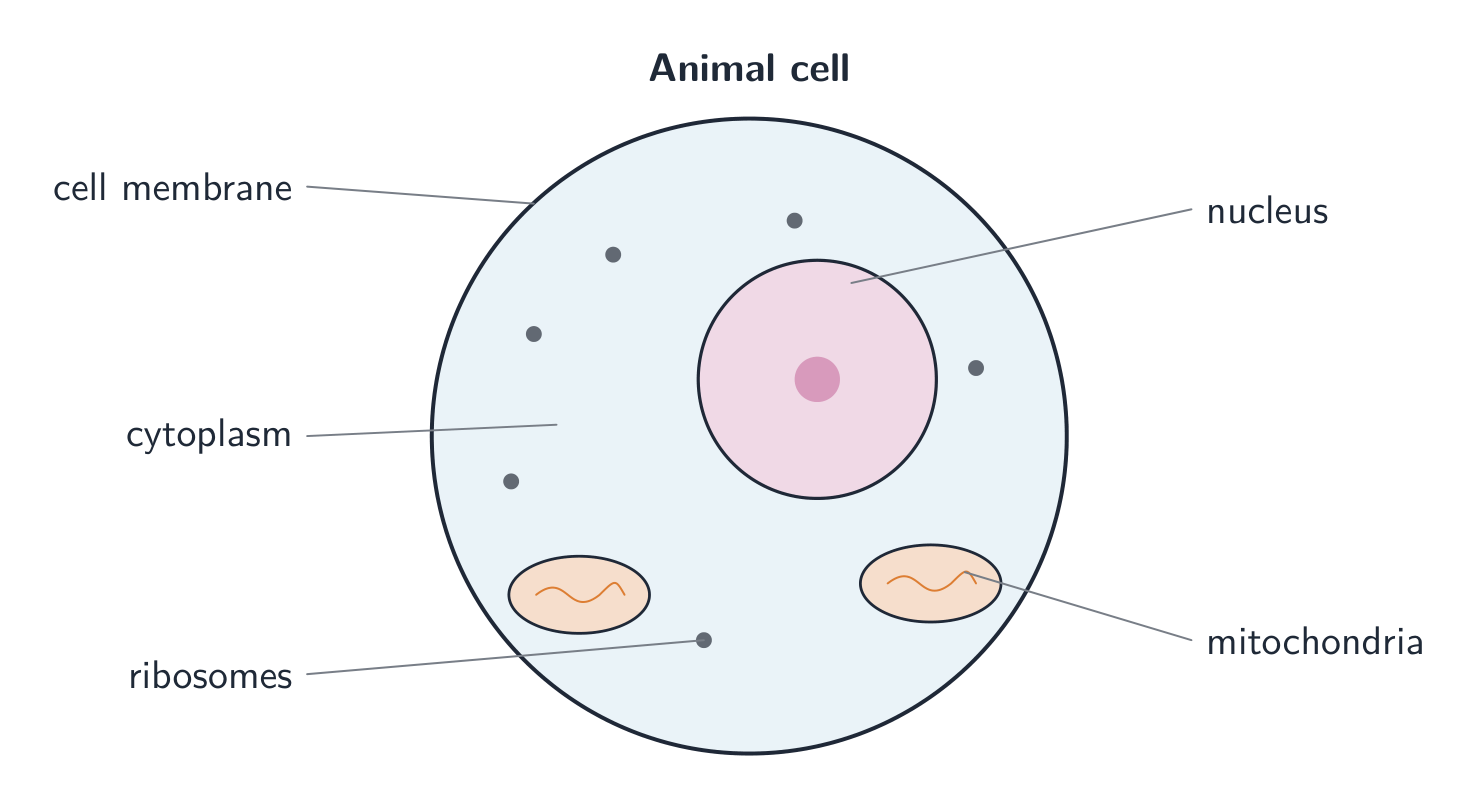
เซลล์ยูคาริโอตแบ่งหน้าที่การทำงานระหว่าง ออร์แกเนลล์ ต่างๆ ระบบเมมเบรนภายในเซลล์ เป็นกลุ่มโครงสร้างที่เชื่อมโยงกัน ทำหน้าที่สร้าง ปรับเปลี่ยน และจัดส่งโมเลกุล ได้แก่ นิวเคลียส (เก็บรักษา DNA), เอนโดพลาสมิกเรติคูลัม แบบหยาบและแบบเรียบ (สังเคราะห์โปรตีนและไขมัน), กอลจิ (ปรับแต่งและบรรจุ), ไลโซโซม (ย่อยสลาย), และเวสิเคิลที่ขนส่งวัสดุระหว่างกัน ไมโทคอนเดรีย (หายใจ) และ คลอโรพลาสต์ (สังเคราะห์ด้วยแสง) มีเมมเบรนของตัวเอง

เซลล์พืชยังมีผนังเซลล์ วacuole ขนาดใหญ่ และคลอโรพลาสต์
เซลล์สัตว์ทั่วไปและออร์แกเนลล์ของมัน

สิ่งที่ทำจริงของแต่ละออร์แกเนลล์

ข้อสอบต้องการให้คุณระบุชื่อโครงสร้าง และ อธิบายหน้าที่ของมัน ดังนั้นให้จดจำเป็นคู่

ไรโบโซม สร้างจาก RNA ไรโบโซม (rRNA) และโปรตีน ไม่มีเยื่อหุ้ม และพบได้ในทุก dạngชีวิต — ทั้งแบคทีเรีย อาร์เคีย และยูคาริโอต ความมีอยู่ร่วมกันนี้คือหลักฐานของบรรพบุรุษร่วม: โครงสร้างสำคัญระดับนี้เคยมีอยู่ในบรรพบุรุษร่วมสุดท้ายของสิ่งมีชีวิตทั้งหมด ไรโบโซมอ่าน mRNA และสร้างโปรตีนที่รหัสนั้นกำหนด ไรโบโซมอิสระผลิตโปรตีนเพื่อใช้ภายในเซลล์ ส่วนไรโบโซมที่ติดกับเอนโดพลาสมิกเรติคูลัมแบบหยาบจะผลิตโปรตีนเพื่อส่งออกหรือสำหรับเยื่อหุ้มเซลล์

กอลจิบอดี เป็นชุดของถุงแบนๆ ที่มีเยื่อหุ้มล้อมรอบ โปรตีนที่มาจากเอนโดพลาสมิกเรติคูลัมจะถูกส่งผ่าน囊เหล่านี้ แล้วเกิดสามสิ่งขึ้นกับมัน:

  • มันพับตัวได้ถูกต้องและถูกดัดแปลงทางเคมี — มักเป็นการ ไกลโคซิลเลชัน คือการเชื่อมต่อสายน้ำตาลสั้นๆ เข้าไป;
  • มันถูก คัดแยกและกำหนดเป้าหมาย โดยป้ายน้ำตาลหรือฟอสเฟตที่ถูกดัดแปลงแล้วจะตัดสินใจว่าโปรตีนนั้นจะถูกส่งไปยังช่องใด;
  • มันถูกบรรจุในเวสิเคิลเพื่อการขนส่ง

ดังนั้น กอลจิบอดีจึงไม่ใช่ที่เก็บของ แต่เป็นแผนกจัดเตรียมและส่งต่อของเซลล์ และการดัดแปลงของ它就 กำหนด ว่าโปรตีนจะทำอะไรและจบลงที่ไหน

ไลโซโซม เป็นถุงที่มีเยื่อหุ้มล้อมรอบซึ่งประกอบด้วย เอนไซม์ไฮโดรไลติก ที่ย่อยสลายวัสดุต่างๆ เช่น ออร์แกเนลล์เสื่อมสภาพ แบคทีเรียที่ถูกกลืนกิน และอนุภาคอาหารที่เซลล์ดูดซึม เอนไซม์ทำงานได้ดีที่สุดที่ pH ต่ำ ซึ่งไลโซโซมจะรักษาไว้ภายในตัวเอง การคงการปิดผนึกไว้ช่วยปกป้องส่วนอื่นของเซลล์ ไลโซโซมยังมีส่วนร่วมใน อะพอพโทซิส หรือการตายตามโปรแกรมของเซลล์ ซึ่งเซลล์จะถูกถอดประกอบอย่างมีจุดประสงค์ เช่น เพื่อปั้นนิ้วมือออกจากมืออ่อนวัยที่มีผิวหนังเชื่อมกัน

แวคิวโอล เป็นถุงที่มีเยื่อหุ้มล้อมรอบและมีบทบาทหลากหลาย: เก็บน้ำ ไอออน สารอาหารหรือของเสีย และในเซลล์พืช แวคิวโอลกลางขนาดใหญ่จะดันออกสู่ผนังเซลล์เพื่อให้เซลล์มีความแข็งกระชับ

ไมโทคอนเดรีย และ คลอโรพลาสต์ แต่ละชนิดมี เยื่อหุ้มสองชั้น และมี DNA แบบวงกลมและไรโบโซมของตัวเอง — ซึ่งเป็นหลักฐานของทฤษฎีเอนโดซิมไบโอซิสด้านล่าง

2.2

Why Cells Stay Small · ⁨ทำไมเซลล์ต้องเล็ก⁩

Syllabus · ⁨หลักสูตร⁩
English

Big Idea 2 — Energetics (ENE): Biological systems use energy and molecular building blocks to grow, reproduce, and maintain dynamic homeostasis.

Learning Objective 2.2.A: Explain the effect of surface area-to-volume ratios on the exchange of materials between cells or organisms and the environment.

  • 2.2.A.1 Surface area-to-volume ratios affect the ability of a biological system to obtain necessary nutrients, eliminate waste products, acquire or dissipate thermal energy, and otherwise exchange chemicals and energy with the environment.
    • Relevant equations:
      • Volume of a Sphere: $V = \dfrac{4}{3}\pi r^3$
      • Volume of a Cube: $V = s^3$
      • Volume of a Rectangular Solid: $V = lwh$
      • Volume of a Cylinder: $V = \pi r^2 h$
      • Surface Area of a Sphere: $SA = 4\pi r^2$
      • Surface Area of a Cube: $SA = 6s^2$
      • Surface Area of a Rectangular Solid: $SA = 2lh + 2lw + 2wh$
      • Surface Area of a Cylinder: $SA = 2\pi rh + 2\pi r^2$
      • $r$ = radius
      • $l$ = length
      • $h$ = height
      • $w$ = width
      • $s$ = length of one side of a cube
    • Illustrative examples for 2.2.A.1:
      • SA/V Ratios and Exchanges
        • Root hairs
        • Guard cells
        • Gut epithelial cells
      • Cilia
      • Stomata
  • 2.2.A.2 The surface area of the plasma membrane must be large enough to adequately exchange materials.
    • i. The surface area-to-volume ratio can restrict cell size and shape. Smaller cells typically have a higher surface area-to-volume ratio as well as a more efficient exchange of materials with the environment than do larger cells.
    • ii. As cells increase in volume, the surface area-to-volume ratio decreases and the demand for internal resources increases.
    • iii. More complex cellular structures (e.g., membrane folds) are necessary to adequately exchange materials with the environment.
    • iv. As organisms increase in size, their surface area-to-volume ratio decreases, affecting properties like rate of heat exchange with the environment. Smaller amounts of mass exchange proportionally more heat with the ambient environment than do larger masses. As mass increases, both the surface area-to-volume ratio and the rate of heat exchange decrease.
    • v. There is a relationship between metabolic rate per unit body mass and the size of multicellular organisms; typically, the smaller the organism, the higher the metabolic rate per unit body mass.
ไทย

แนวคิดหลัก 2 — พลังงาน (ENE): ระบบชีวภาพใช้พลังงานและหน่วยสร้างโมเลกุลเพื่อเติบโต สืบพันธุ์ และรักษาสมดุลพลวัตภายใน

วัตถุประสงค์การเรียนรู้ 2.2.A: อธิบายผลของอัตราส่วนพื้นที่ผิวต่อปริมาตรต่อการแลกเปลี่ยนสารระหว่างเซลล์หรือสิ่งมีชีวิตกับสิ่งแวดล้อม

  • 2.2.A.1 อัตราส่วนพื้นที่ผิวต่อปริมาตรส่งผลต่อความสามารถของระบบชีวภาพในการได้รับสารอาหารที่จำเป็น กำจัดของเสีย获取หรือระบายความร้อน และแลกเปลี่ยนสารเคมีและพลังงานกับสิ่งแวดล้อมอื่นๆ
    • สมการที่เกี่ยวข้อง:
      • ปริมาตรทรงกลม: $V = \dfrac{4}{3}\pi r^3$
      • ปริมาตรลูกบาศก์: $V = s^3$
      • ปริมาตรสี่เหลี่ยมผืนผ้า: $V = lwh$
      • ปริมาตรของทรงกระบอก: $V = \pi r^2 h$
      • พื้นที่ผิวของทรงกลม: $SA = 4\pi r^2$
      • พื้นที่ผิวของลูกบาศก์: $SA = 6s^2$
      • พื้นที่ผิวของสี่เหลี่ยมผืนผ้า (ทรงสี่เหลี่ยมมุมฉาก): $SA = 2lh + 2lw + 2wh$
      • พื้นที่ผิวของทรงกระบอก: $SA = 2\pi rh + 2\pi r^2$
      • $r$ = รังสี
      • $l$ = ความยาว
      • $h$ = ความสูง
      • $w$ = ความกว้าง
      • $s$ = ความยาวด้านหนึ่งของลูกบาศก์
    • ตัวอย่างประกอบสำหรับ 2.2.A.1:
      • อัตราส่วนพื้นที่ผิวต่อปริมาตรและการแลกเปลี่ยนสาร
        • รากขน
        • เซลล์คุ้มกัน
        • เซลล์เยื่อบุลำไส้
      • ขนสั่น
      • ปากใบ
  • 2.2.A.2 พื้นที่ผิวของเยื่อหุ้มเซลล์ต้องมีขนาดใหญ่พอที่จะแลกเปลี่ยนสารได้อย่างเพียงพอ
    • i. อัตราส่วนพื้นที่ผิวต่อปริมาตรสามารถจำกัดขนาดและรูปร่างของเซลล์ได้ เซลล์ขนาดเล็กมักมีอัตราส่วนพื้นที่ผิวต่อปริมาตรที่สูงกว่า และมีการแลกเปลี่ยนสารกับสิ่งแวดล้อมที่มีประสิทธิภาพมากกว่าเซลล์ขนาดใหญ่
    • ii. เมื่อเซลล์มีปริมาตรเพิ่มขึ้น อัตราส่วนพื้นที่ผิวต่อปริมาตรจะลดลงและความต้องการทรัพยากรภายในเซลล์จะเพิ่มขึ้น
    • iii. โครงสร้างเซลล์ที่ซับซ้อนขึ้น (เช่น การพับของเยื่อหุ้ม) จำเป็นสำหรับการแลกเปลี่ยนวัสดุกับสิ่งแวดล้อมได้อย่างเพียงพอ
    • iv. เมื่อสิ่งมีชีวิตมีขนาดเพิ่มขึ้น อัตราส่วนพื้นที่ผิวต่อปริมาตรจะลดลง ส่งผลต่อคุณสมบัติต่างๆ เช่น อัตราการแลกเปลี่ยนความร้อนกับสิ่งแวดล้อม ปริมาณมวลขนาดเล็กจะแลกเปลี่ยนความร้อนกับสิ่งแวดล้อมรอบข้างในสัดส่วนที่มากกว่าปริมาณมวลขนาดใหญ่ เมื่อมวลเพิ่มขึ้น ทั้งอัตราส่วนพื้นที่ผิวต่อปริมาตรและอัตราการแลกเปลี่ยนความร้อนจะลดลง
    • v. มีความสัมพันธ์ระหว่างอัตราการเผาผลาญต่อหน่วยมวลร่างกายกับขนาดของสิ่งมีชีวิตมัลติเซลล์ โดยทั่วไป สิ่งมีชีวิตที่มีขนาดเล็กกว่าจะมีอัตราการเผาผลาญต่อหน่วยมวลร่างกายที่สูงกว่า

Source: College Board AP Course and Exam Description · ⁨แหล่งที่มา: คำอธิบายหลักสูตรและข้อสอบ College Board AP⁩

English

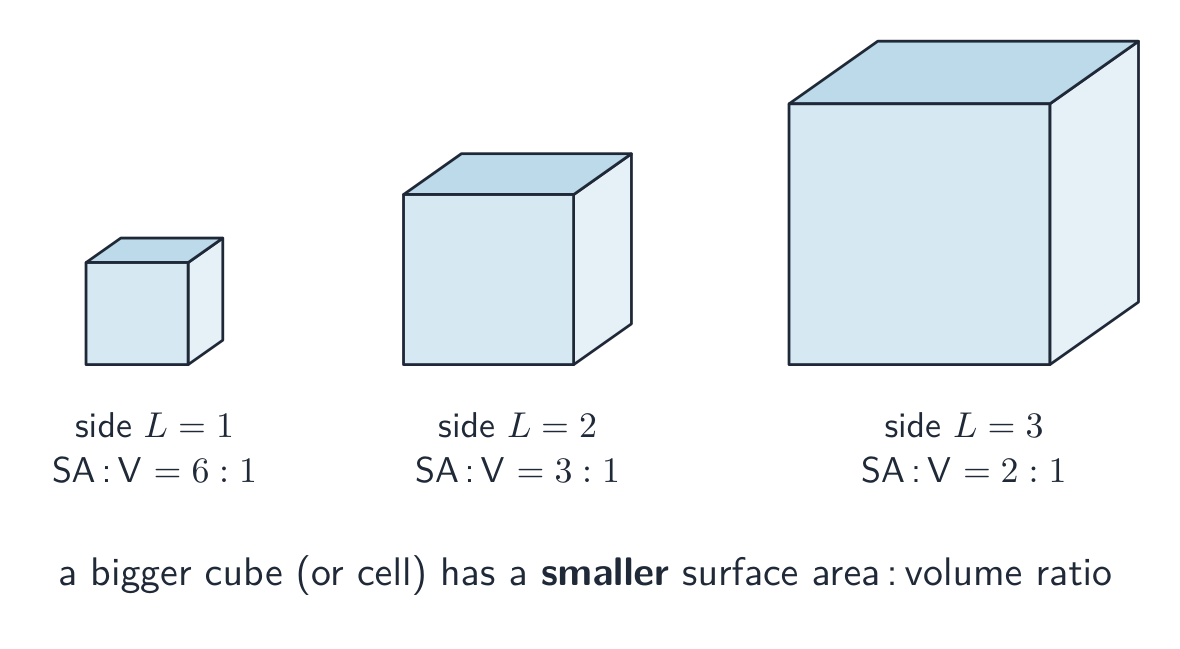
Cells stay small because of the surface-area-to-volume ratio 表面积与体积比. As a cell grows, its volume rises faster than its surface area, so its membrane cannot exchange materials fast enough for the interior. Staying small (or being flat or folded) keeps enough surface to serve the volume.

Worked example. A cube-shaped cell $2\ \mu\text{m}$ on a side has surface area $6\times2^2=24\ \mu\text{m}^2$ and volume $2^3=8\ \mu\text{m}^3$, so its surface-area-to-volume ratio is $\tfrac{24}{8}=3$. Double the side to $4\ \mu\text{m}$: surface area $=6\times4^2=96$, volume $=4^3=64$, ratio $=\tfrac{96}{64}=1.5$. Doubling the size halved the ratio – the larger cell has far less membrane per unit of interior, which is why cells stay small.

ไทย
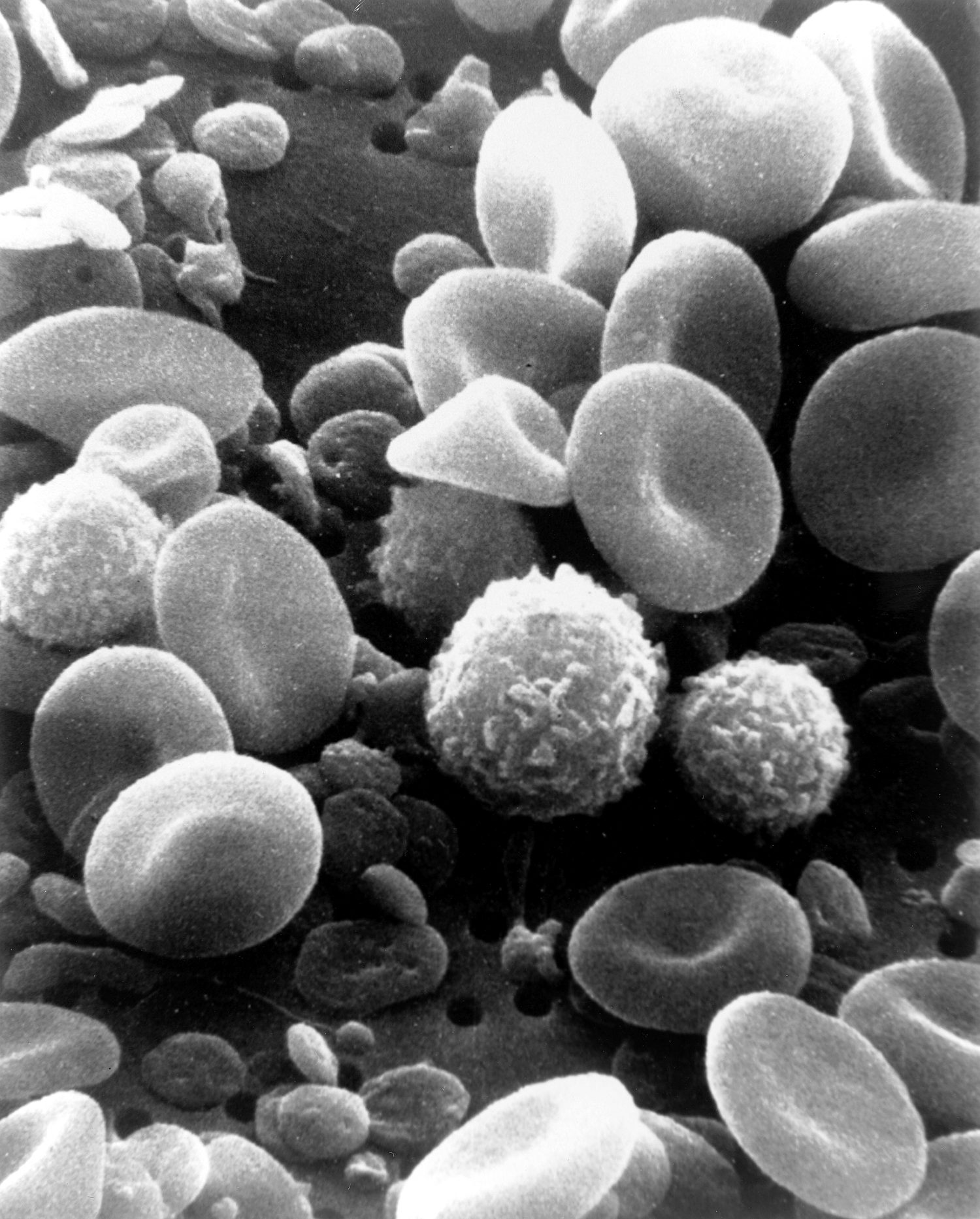
ภาพจุลทรรศน์อิเล็กตรอนแบบสแกนของเซลล์เม็ดเลือดแดง — ไม่มีนิวเคลียส, พื้นที่ผิวสูงสำหรับการแลกเปลี่ยนก๊าซ

เซลล์มีขนาดเล็กเพราะ อัตราส่วนพื้นที่ผิวต่อปริมาตร เมื่อเซลล์โตขึ้น ปริมาตรจะเพิ่มขึ้นเร็วกว่าพื้นที่ผิว ทำให้เยื่อหุ้มไม่สามารถแลกเปลี่ยนสารได้เร็วพอสำหรับภายใน การรักษาสภาพเล็ก (หรือการแบนหรือพับ) ช่วยรักษาพื้นที่ผิวให้เพียงพอต่อการรองรับปริมาตร

อัตราส่วนพื้นที่ผิวต่อปริมาตรลดลงเมื่อเซลล์ใหญ่ขึ้น

ตัวอย่างคำนวณ. เซลล์รูปร่างลูกบาศก์ $2\ \mu\text{m}$ ต่อด้าน มีพื้นที่ผิว $6\times2^2=24\ \mu\text{m}^2$ และปริมาตร $2^3=8\ \mu\text{m}^3$ ดังนั้นอัตราส่วนพื้นที่ผิวต่อปริมาตรจึงเป็น $\tfrac{24}{8}=3$ เพิ่มด้านเป็น $4\ \mu\text{m}$: พื้นที่ผิว $=6\times4^2=96$, ปริมาตร $=4^3=64$, อัตราส่วน $=\tfrac{96}{64}=1.5$. การเพิ่มขนาดเป็นสองเท่าทำให้ อัตราส่วนลดลงครึ่งหนึ่ง — เซลล์ที่ใหญ่กว่ามีเยื่อหุ้มต่อหน่วยปริมาตรภายในน้อยกว่ามาก นี่คือเหตุผลที่เซลล์ต้องมีขนาดเล็ก

Explore · ⁨สำรวจ⁩

See surface area vs volume as a cube grows · ⁨观察立方体生长时的表面积与体积比⁩

As a cell grows, volume rises faster than surface area, so the surface-area-to-volume ratio falls. A small cell keeps enough membrane to exchange materials fast enough. · ⁨随着细胞生长,体积的增长速度快于表面积,因此表面积与体积之比下降。小细胞保持足够的膜以快速交换物质。⁩

2.3

The Fluid Mosaic Model of the Membrane · ⁨โมเดลโมเสกเหลวของเยื่อหุ้มเซลล์⁩

Syllabus · ⁨หลักสูตร⁩
English

Big Idea 2 — Energetics (ENE): Biological systems use energy and molecular building blocks to grow, reproduce, and maintain dynamic homeostasis.

Learning Objective 2.3.A: Describe the roles of each of the components of the cell membrane in maintaining the internal environment of the cell.

  • 2.3.A.1 Phospholipids have both hydrophilic and hydrophobic regions. The polar hydrophilic phosphate regions of the phospholipids are oriented toward the aqueous external or internal environment, while the nonpolar hydrophobic fatty acid regions face each other within the interior of the membrane.
  • 2.3.A.2 Embedded proteins can be hydrophilic (with charged and polar side groups), hydrophobic (with nonpolar side groups), or both.
    • i. Hydrophilic regions of the proteins are either inside the interior of the protein or exposed to the cytosol (cytoplasm).
    • ii. Hydrophobic regions of proteins make up the protein surface that interacts with the fatty acids in the interior membrane.

Learning Objective 2.3.B: Describe the fluid mosaic model of cell membranes.

  • 2.3.B.1 Plasma membranes consist of a structural framework of phospholipid molecules embedded with proteins, steroids (such as cholesterol in vertebrate animals), glycoproteins, and glycolipids. All of these can move around the surface of the cell within the membrane, as illustrated by the fluid mosaic model.
ไทย

แนวคิดหลัก 2 — พลังงาน (ENE): ระบบชีวภาพใช้พลังงานและหน่วยสร้างโมเลกุลเพื่อเติบโต สืบพันธุ์ และรักษาสมดุลพลวัตภายใน

จุดประสงค์การเรียนรู้ 2.3.A: อธิบายบทบาทขององค์ประกอบแต่ละชนิดในเยื่อหุ้มเซลล์ในการรักษาสภาพแวดล้อมภายในเซลล์

  • 2.3.A.1 ฟอสโฟลิพิดมีทั้งบริเวณที่ละลายน้ำได้ (hydrophilic) และบริเวณที่ไม่ละลายน้ำ (hydrophobic) บริเวณฟอสเฟตที่มีขั้วและละลายน้ำได้ของฟอสโฟลิพิดจะหันออกสู่สภาพแวดล้อมภายนอกหรือภายในที่เป็นสารละลาย ในขณะที่บริเวณกรดไขมันที่ไม่มีขั้วและไม่ละลายน้ำจะหันเข้าหากันภายในเยื่อหุ้ม
  • 2.3.A.2 โปรตีนฝังตัวอาจเป็นแบบละลายน้ำได้ (มีหมู่ข้างที่มีประจุและมีขั้ว), ไม่ละลายน้ำ (มีหมู่ข้างที่ไม่มีขั้ว), หรือทั้งสองอย่างรวมกัน
    • i. บริเวณที่ละลายน้ำได้ของโปรตีนจะอยู่ภายในโครงสร้างของโปรตีนเอง หรือถูก exposed ต่อไซโทโซล (ไซโตพลาสม)
    • ii. บริเวณที่ไม่ละลายน้ำของโปรตีนจะสร้างพื้นผิวของโปรตีนที่ทำปฏิกิริยากับกรดไขมันภายในเยื่อหุ้ม

จุดประสงค์การเรียนรู้ 2.3.B: อธิบายโมเดลฟลูอิดโมเสก (fluid mosaic model) ของเยื่อหุ้มเซลล์

  • 2.3.B.1 เยื่อหุ้มเซลล์ประกอบด้วยโครงสร้างหลักจากโมเลกุลฟอสโฟลิพิดที่มีโปรตีน, สเตียรอยด์ (เช่น คอลสเตอรอลในสัตว์มีกระดูกสันหลัง), ไกลโคโปรตีน และไกลколиพิด嵌入อยู่ องค์ประกอบทั้งหมดเหล่านี้สามารถเคลื่อนที่ได้บนพื้นผิวเซลล์ภายในเยื่อหุ้ม ตามที่แสดงโดยโมเดลฟลูอิดโมเสก

Source: College Board AP Course and Exam Description · ⁨แหล่งที่มา: คำอธิบายหลักสูตรและข้อสอบ College Board AP⁩

English

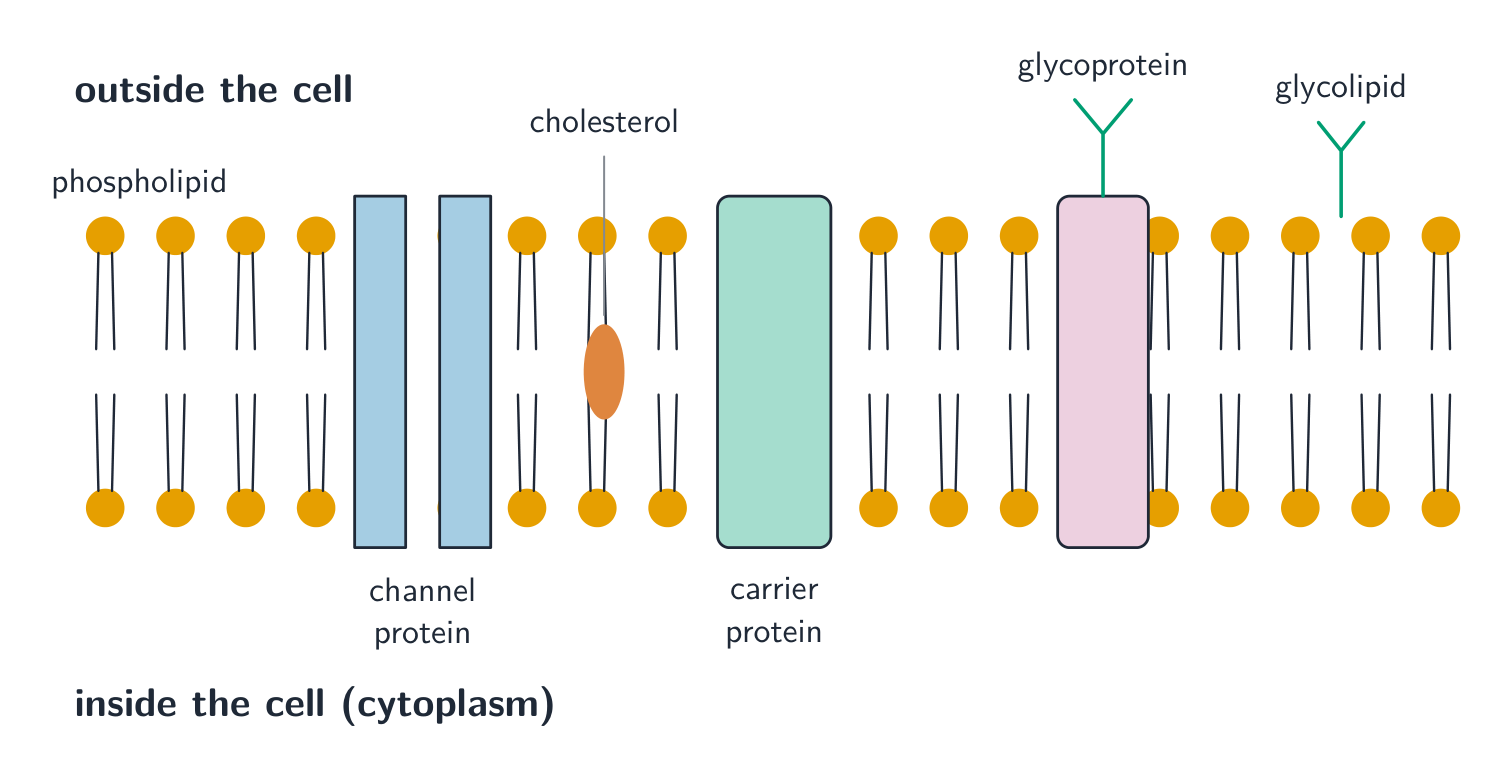
The cell membrane is a phospholipid bilayer 磷脂双分子层 – polar heads facing the water, nonpolar tails inside – studded with proteins. The fluid mosaic model 流动镶嵌模型 pictures it as a fluid sheet in which lipids and proteins drift. Cholesterol and the degree of unsaturation tune its fluidity.

ไทย

เยื่อหุ้มเซลล์เป็น ชั้นไขมันฟอสโฟลิพิ드 – หัวขั้วหันเข้าหาสารละลายน้ำ, หางไม่ขั้วอยู่ภายใน – ฝังด้วยโปรตีน โมเดลโมเสกเหลว จำแนกให้เป็นแผ่นเหลวที่ไขมันและโปรตีนลอยตัว คอเลสเตอรอล และระดับความไม่อิ่มตัวปรับความเหลวของเยื่อ

โมเดลโมเสกเหลวของเยื่อหุ้มเซลล์
แบบโมเสกของเยื่อหุ้มเซลล์
2.4

What Can Cross the Membrane · ⁨สิ่งที่สามารถผ่านเยื่อหุ้มได้⁩

Syllabus · ⁨หลักสูตร⁩
English

Big Idea 2 — Energetics (ENE): Biological systems use energy and molecular building blocks to grow, reproduce, and maintain dynamic homeostasis.

Learning Objective 2.4.A: Explain how the structure of biological membranes influences selective permeability.

  • 2.4.A.1 Plasma membranes separate the internal environment of the cell from the external environment. Selective permeability is the result of the plasma membrane having a hydrophobic interior.
  • 2.4.A.2 Small nonpolar molecules, including $\mathrm{N_2}$, $\mathrm{O_2}$, and $\mathrm{CO_2}$, freely pass across the membrane. Hydrophilic substances, such as large polar molecules and ions, move across the membrane through embedded channels and transport proteins.
  • 2.4.A.3 The nonpolar hydrocarbon tails of phospholipids prevent the movement of ions and polar molecules across the membrane. Small polar, uncharged molecules, like $\mathrm{H_2O}$ or $\mathrm{NH_3}$ (ammonia), pass through the membrane in small amounts.

Learning Objective 2.4.B: Describe the role of the cell wall in maintaining cell structure and function.

  • 2.4.B.1 Cell walls of Bacteria, Archaea, Fungi, and plants provide a structural boundary as well as a permeability barrier for some substances to the internal or external cellular environments and protection from osmotic lysis.
ไทย

แนวคิดหลัก 2 — พลังงาน (ENE): ระบบชีวภาพใช้พลังงานและหน่วยสร้างโมเลกุลเพื่อเติบโต สืบพันธุ์ และรักษาสมดุลพลวัตภายใน

จุดประสงค์การเรียนรู้ 2.4.A: อธิบายว่าโครงสร้างของเยื่อหุ้มชีวภาพมีอิทธิพลต่อการเลือกผ่านอย่างไร

  • 2.4.A.1 เยื่อหุ้มเซลล์ทำหน้าที่แยกสภาพแวดล้อมภายในเซลล์ออกจากสภาพแวดล้อมภายนอก ความสามารถในการเลือกผ่านเกิดจากเยื่อหุ้มเซลล์ที่มีด้านในที่ไม่ละลายน้ำ
  • 2.4.A.2 โมเลกุลไม่มีขั้วขนาดเล็ก เช่น $\mathrm{N_2}$, $\mathrm{O_2}$ และ $\mathrm{CO_2}$ สามารถผ่านเยื่อหุ้มได้อย่างอิสระ สารละลายน้ำ เช่น โมเลกุลมีขั้วขนาดใหญ่และไอออน จะเคลื่อนที่ผ่านเยื่อหุ้มทางช่องและโปรตีนขนส่ง
  • 2.4.A.3 หางไฮโดรคาร์บอนที่ไม่มีขั้วของฟอสโฟลิพิดขัดขวางการเคลื่อนที่ของไอออนและโมเลกุลมีขั้วผ่านเยื่อหุ้ม โมเลกุลมีขั้วขนาดเล็กที่ไม่มีประจุ เช่น $\mathrm{H_2O}$ หรือ $\mathrm{NH_3}$ (แอมโมเนีย) สามารถผ่านเยื่อหุ้มได้ในปริมาณน้อย

จุดประสงค์การเรียนรู้ 2.4.B: อธิบายบทบาทของผนังเซลล์ในการรักษารูปทรงและหน้าที่ของเซลล์

  • 2.4.B.1 ผนังเซลล์ของแบคทีเรีย, อาร์คีอา, เชื้อรา และพืช ทำหน้าที่เป็นขอบเขตเชิงโครงสร้างและเป็นตัวกั้นการผ่านของบางสารเข้าสู่หรือออกจากสภาพแวดล้อมภายในหรือภายนอกเซลล์ รวมถึงปกป้องจากการแตก due to osmotic lysis

Source: College Board AP Course and Exam Description · ⁨แหล่งที่มา: คำอธิบายหลักสูตรและข้อสอบ College Board AP⁩

English

The membrane is selectively permeable 选择透过性. Small nonpolar molecules ($\text{O}_2$, $\text{CO}_2$) and water cross easily; large or charged/polar particles (ions, glucose) cannot pass the nonpolar core without help. This selectivity lets the cell control its internal environment.

ไทย

เยื่อหุ้มมี การเลือกเจาะผ่าน (selectively permeable) โมเลกุลขั้วเล็กที่ไม่เป็นขั้ว ($\text{O}_2$, $\text{CO}_2$) และน้ำ สามารถผ่านได้ง่าย ส่วนอนุภาคขนาดใหญ่หรือมีประจุ/เป็นขั้ว (ไอออน, กลูโคส) ไม่สามารถผ่านแกนที่ไม่เป็นขั้วได้โดยไม่ได้รับการช่วยเหลือ การเลือกเจาะผ่านนี้ช่วยให้เซลล์ควบคุมสภาพแวดล้อมภายในตัวเองได้

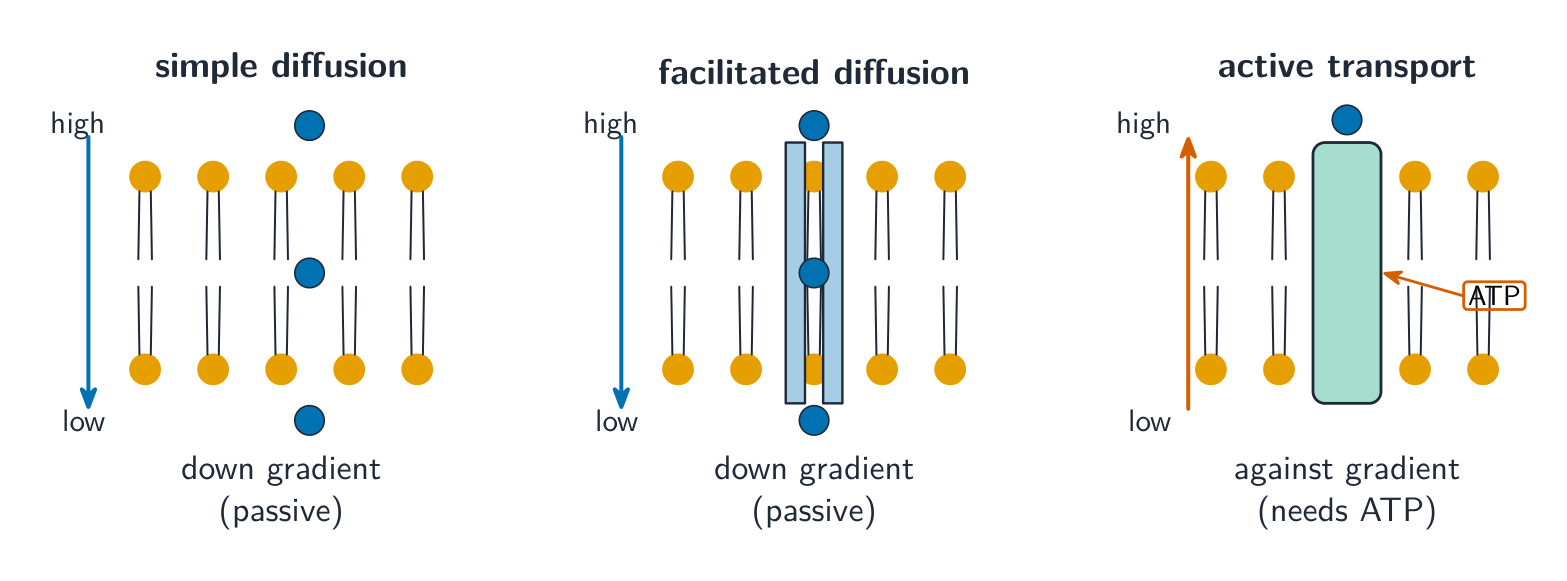
สามวิธีที่สารผ่านเยื่อหุ้ม
Vocabulary · ⁨คำศัพท์⁩ Train · ⁨ฝึกฝน⁩
English ไทย
selectively permeable/sɪˈlektɪvli ˈpɜːməbl/ แบบเลือกผ่าน
2.5

Passive and Active Transport · ⁨การลำเลียงแบบพาสซีฟและแอคทีฟ⁩

Syllabus · ⁨หลักสูตร⁩
English

Big Idea 2 — Energetics (ENE): Biological systems use energy and molecular building blocks to grow, reproduce, and maintain dynamic homeostasis.

Learning Objective 2.5.A: Describe the mechanisms that organisms use to maintain solute and water balance.

  • 2.5.A.1 The selective permeability of membranes allows for the formation of concentration gradients of solutes across the membrane.
  • 2.5.A.2 Passive transport is the net movement of molecules from regions of high concentration to regions of low concentration without the direct input of metabolic energy.
  • 2.5.A.3 Active transport requires the direct input of energy to move molecules. In some cases, active transport is utilized to move molecules from regions of low concentration to regions of high concentration.

Learning Objective 2.5.B: Describe the mechanisms that organisms use to transport large molecules across the plasma membrane.

  • 2.5.B.1 The processes of endocytosis and exocytosis require energy to move large substances or large amounts of substances into and out of cells.
    • i. In endocytosis, the cell takes in large molecules and particulate matter by folding the plasma membrane in on itself and forming new (small) vesicles that engulf material from the external environment.
    • ii. In exocytosis, internal vesicles release material from cells by fusing with the plasma membrane and secreting large molecules from the cell.
ไทย

แนวคิดหลัก 2 — พลังงาน (ENE): ระบบชีวภาพใช้พลังงานและหน่วยสร้างโมเลกุลเพื่อเติบโต สืบพันธุ์ และรักษาสมดุลพลวัตภายใน

จุดประสงค์การเรียนรู้ 2.5.A: อธิบายกลไกที่สิ่งมีชีวิตใช้เพื่อรักษาสมดุลของสารละลายและน้ำ

  • 2.5.A.1 ความสามารถในการเลือกผ่านของเยื่อหุ้มช่วยให้เกิดการสร้าง gradien ความเข้มข้นของสารละลายข้ามเยื่อหุ้มได้
  • 2.5.A.2 การแพร่แบบพาสซีฟคือการเคลื่อนที่สุทธิของโมเลกุลจากบริเวณที่มีความเข้มข้นสูงไปยังบริเวณที่มีความเข้มข้นต่ำโดยไม่มีการใช้พลังงานเมตาบอลิซึมโดยตรง
  • 2.5.A.3 การแพร่แบบแอคทีฟต้องการการใช้พลังงานโดยตรงในการเคลื่อนย้ายโมเลกุล ในบางกรณี การแพร่แบบแอคทีฟจะถูกใช้เพื่อเคลื่อนย้ายโมเลกุลจากบริเวณที่มีความเข้มข้นต่ำไปยังบริเวณที่มีความเข้มข้นสูง

จุดประสงค์การเรียนรู้ 2.5.B: อธิบายกลไกที่สิ่งมีชีวิตใช้เพื่อขนส่งโมเลกุลขนาดใหญ่ข้ามเยื่อหุ้มเซลล์

  • 2.5.B.1 กระบวนการเอนโดไซโทซิสและเอกซोไซโทซิสต้องใช้พลังงานในการเคลื่อนย้ายสารขนาดใหญ่หรือปริมาณมากเข้าสู่และออกจากเซลล์
    • i. ในเอนโดไซโทซิส เซลล์จะดูดซับโมเลกุลขนาดใหญ่และอนุภาคโดยการพับเยื่อหุ้มเซลล์เข้าไปในตัวเองและสร้างเวสิเคิลใหม่ (ขนาดเล็ก) ที่ห่อหุ้มวัสดุนั้นจากสภาพแวดล้อมภายนอก
    • ii. ในเอกซোไซโทซิส เวสิเคิลภายในจะปล่อยสารออกจากเซลล์โดยการหลอมรวมกับเยื่อหุ้มเซลล์และหลั่งโมเลกุลขนาดใหญ่ออกจากเซลล์

Source: College Board AP Course and Exam Description · ⁨แหล่งที่มา: คำอธิบายหลักสูตรและข้อสอบ College Board AP⁩

English
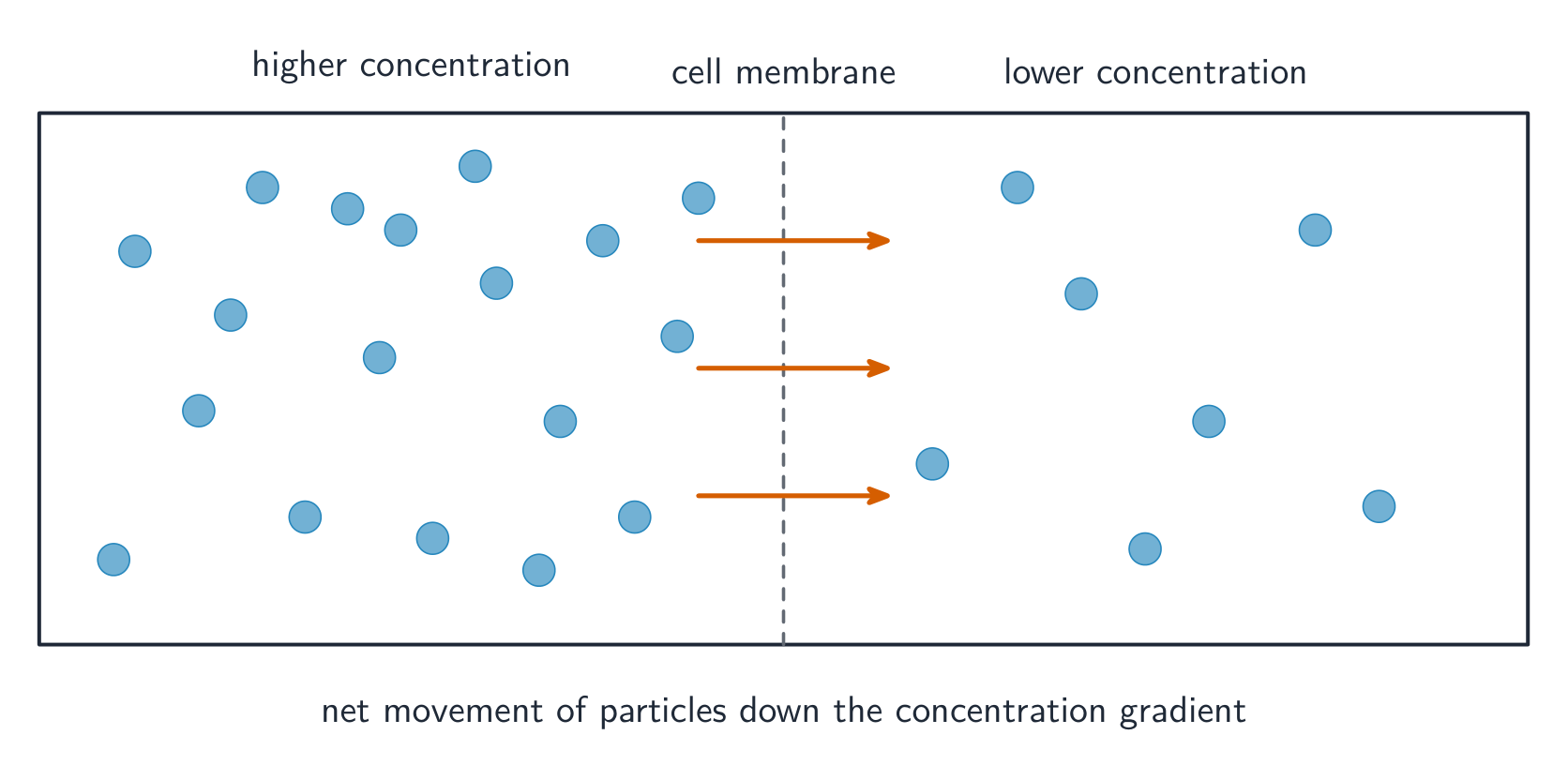
  • Passive transport 被动运输 moves substances down their concentration gradient (high → low) with no energy – diffusion 扩散.
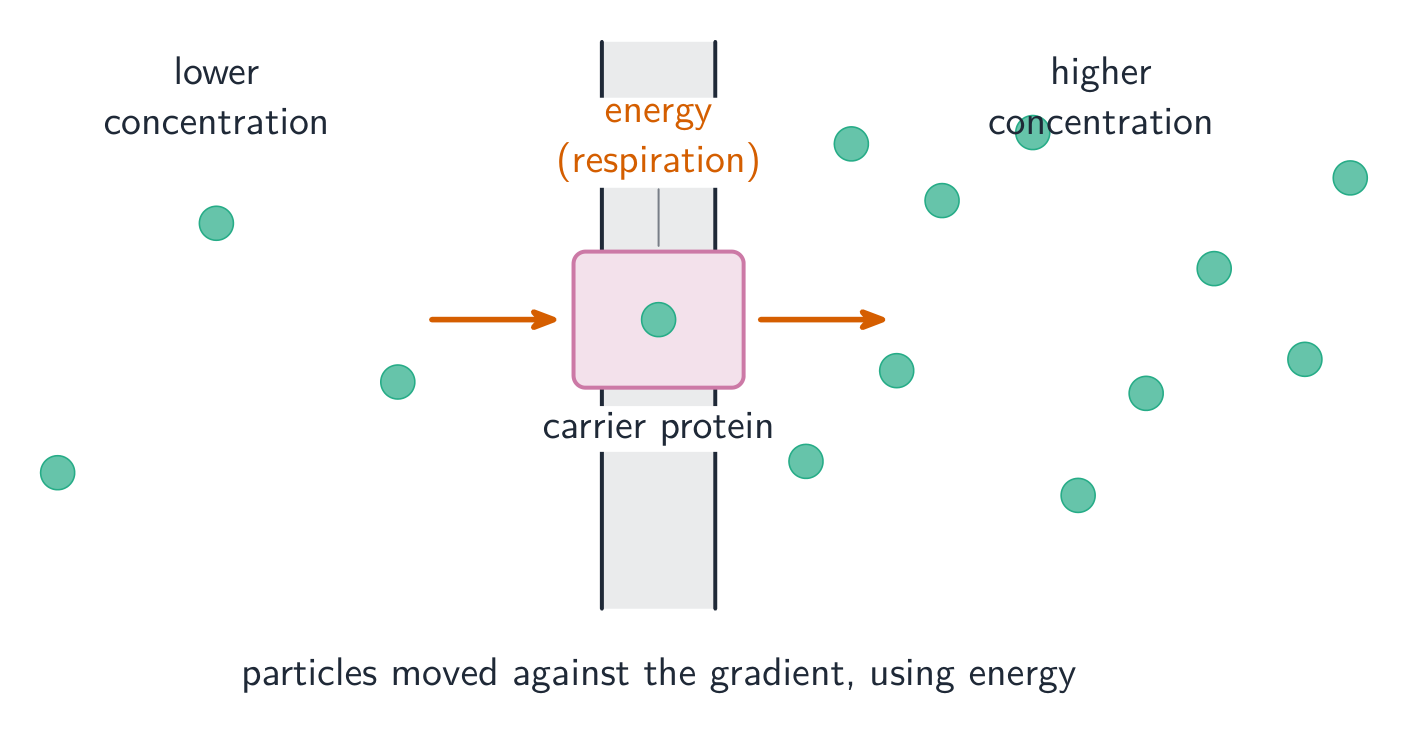
  • Active transport 主动运输 moves substances against the gradient (low → high), requiring energy (ATP), via protein pumps like the sodium–potassium pump.
ไทย
  • การลำเลียงแบบพาสซีฟ (Passive transport) เคลื่อนย้ายสาร ตาม ความแตกต่างของความเข้มข้น (สูง → ต่ำ) โดย ไม่ต้องใช้พลังงาน – ซึ่งเรียกว่า การแพร่ (diffusion)
  • การลำเลียงแบบแอคทีฟ (Active transport) เคลื่อนย้ายสาร สวน กับความแตกต่างของความเข้มข้น (ต่ำ → สูง) ต้องใช้พลังงาน (ATP) ผ่านโปรตีนปั๊ม เช่น ปั๊มโซเดียม-โพแทสเซียม
การลำเลียงแบบแอคทีฟเคลื่อนย้ายอนุภาคสวนกับความแตกต่างของความเข้มข้น โดยใช้ ATP และโปรตีนพาหนะ
Explore · ⁨สำรวจ⁩

Pump a solute against its gradient · ⁨逆浓度梯度泵送溶质⁩

Passive transport moves solutes down their gradient for free; active transport uses ATP to pump them the other way, from low to high concentration. · ⁨被动运输顺着浓度梯度自由移动溶质;主动运输利用ATP将它们从低浓度向高浓度反向泵送。⁩

Vocabulary · ⁨คำศัพท์⁩ Train · ⁨ฝึกฝน⁩
English ไทย
Passive transport/ˈpæsɪv ˈtrænspɔːt/ การขนส่งแบบพาสซีฟ
diffusion/dɪˈfjuːʒn/ การแพร่
Active transport/ˈæktɪv ˈtrænspɔːt/ การขนส่งแบบ نشัน (Active transport)
2.6

Facilitated Diffusion · ⁨การแพร่แบบช่วย (Facilitated Diffusion)⁩

Syllabus · ⁨หลักสูตร⁩
English

Big Idea 2 — Energetics (ENE): Biological systems use energy and molecular building blocks to grow, reproduce, and maintain dynamic homeostasis.

Learning Objective 2.6.A: Explain how the structure of a molecule affects its ability to pass through the plasma membrane.

  • 2.6.A.1 Facilitated diffusion requires transport or channel proteins to enable the movement of charged ions across the membrane.
    • i. Membranes may become polarized by the movement of ions across the membrane.
    • ii. Charged ions, including $\mathrm{Na^+}$ (sodium) and $\mathrm{K^+}$ (potassium), require channel proteins to move through the membrane.
  • 2.6.A.2 Facilitated diffusion enables the movement of large polar molecules through membranes with no energy input. In this type of diffusion, substances move down the concentration gradient.
  • 2.6.A.3 Aquaporins transport large quantities of water across membranes.
ไทย

แนวคิดหลัก 2 — พลังงาน (ENE): ระบบชีวภาพใช้พลังงานและหน่วยสร้างโมเลกุลเพื่อเติบโต สืบพันธุ์ และรักษาสมดุลพลวัตภายใน

จุดประสงค์การเรียนรู้ 2.6.A: อธิบายว่าโครงสร้างของโมเลกุลส่งผลต่อความสามารถในการผ่านเยื่อหุ้มเซลล์ได้อย่างไร

  • 2.6.A.1 การแพร่แบบช่วยต้องการโปรตีนขนส่งหรือโปรตีนช่องเพื่อให้ไอออนที่มีประจุเคลื่อนที่ผ่านเยื่อหุ้มได้
    • i. เยื่อหุ้มอาจเกิด polarized ขึ้นจากการเคลื่อนที่ของไอออนข้ามเยื่อหุ้ม
    • ii. ไอออนที่มีประจุ เช่น $\mathrm{Na^+}$ (โซเดียม) และ $\mathrm{K^+}$ (โพแทสเซียม) จำเป็นต้องใช้โปรตีนช่องในการเคลื่อนที่ผ่านเยื่อหุ้ม
  • 2.6.A.2 การแพร่แบบช่วยทำให้โมเลกุลมีขั้วขนาดใหญ่เคลื่อนที่ผ่านเยื่อหุ้มได้โดยไม่ต้องใช้พลังงาน ในประเภทนี้ สารจะเคลื่อนที่ตาม gradien ความเข้มข้น
  • 2.6.A.3 อะควaporin ขนส่งน้ำในปริมาณมากข้ามเยื่อหุ้ม

Source: College Board AP Course and Exam Description · ⁨แหล่งที่มา: คำอธิบายหลักสูตรและข้อสอบ College Board AP⁩

English

Facilitated diffusion 易化扩散 is passive transport through a membrane protein – a channel or carrier 载体 – for particles that cannot cross the lipid alone. It still goes down the gradient and needs no energy, but its rate can saturate when all the proteins are busy.

ไทย

การแพร่แบบช่วย (Facilitated diffusion) คือการขนส่งแบบพาสซีฟผ่านโปรตีนในเยื่อหุ้มเซลล์ – ทั้ง ช่อง (channel) หรือ ตัวพา (carrier) – สำหรับอนุภาคที่ไม่สามารถทะลุผ่านชั้นไขมันเพียงอย่างเดียวได้ การเคลื่อนที่ยังคงตามความแตกต่างของความเข้มข้นและไม่ต้องใช้พลังงาน แต่อัตราการแพร่อาจเกิดภาวะอิ่มตัวเมื่อโปรตีนทั้งหมดถูกใช้งานหมดแล้ว

การแพร่: อนุภาคกระจายจากจุดเข้มข้นสูงไปยังจุดเข้มข้นต่ำ ตาม gradien
Vocabulary · ⁨คำศัพท์⁩ Train · ⁨ฝึกฝน⁩
English ไทย
Facilitated diffusion/fəˈsɪlɪteɪtɪd dɪˈfjuːʒn/ การแพร่ช่วย (Facilitated diffusion)
carrier/ˈkærɪə/ พาหะ
2.7

Tonicity, Water Potential, and Osmoregulation · ⁨ความดันออสโมติก, ศักยภาพน้ำ และการควบคุมสมดุลน้ำ⁩

Syllabus · ⁨หลักสูตร⁩
English

Big Idea 2 — Energetics (ENE): Biological systems use energy and molecular building blocks to grow, reproduce, and maintain dynamic homeostasis.

Learning Objective 2.7.A: Explain how concentration gradients affect the movement of molecules across membranes.

  • 2.7.A.1 External environments can be hypotonic, hypertonic, or isotonic to internal environments of cells. Movement of water can also be described as moving from hypotonic to hypertonic regions. Water moves by osmosis from regions of high water potential to regions of low water potential.
    • Equation (Water Potential): $\psi = \psi_p + \psi_s$
      • where:
      • $\psi_p$ = pressure potential
      • $\psi_s$ = solute potential
    • Illustrative examples for 2.7.A.1:
      • Contractile vacuole in protists
      • Central vacuole in plant cells

Learning Objective 2.7.B: Explain how osmoregulatory mechanisms contribute to the health and survival of organisms.

  • 2.7.B.1 Growth and homeostasis are maintained by the constant movement of molecules across membranes.
  • 2.7.B.2 Osmoregulation maintains water balance and allows organisms to control their internal solute composition and water potential. Water moves from regions of low osmolarity or solute concentration to regions of high osmolarity or solute concentration.
    • Equation (Solute Potential of a Solution): $\psi_s = -iCRT$
      • where:
      • $i$ = ionization constant
      • $C$ = molar concentration
      • $R$ = pressure constant $\left(R = 0.0831 \dfrac{L \cdot bars}{mol \cdot K}\right)$
      • $T$ = temperature in Kelvin (°C + 273)
ไทย

แนวคิดหลัก 2 — พลังงาน (ENE): ระบบชีวภาพใช้พลังงานและหน่วยสร้างโมเลกุลเพื่อเติบโต สืบพันธุ์ และรักษาสมดุลพลวัตภายใน

จุดประสงค์การเรียนรู้ 2.7.A: อธิบายว่า gradien ความเข้มข้นมีผลต่อการเคลื่อนที่ของโมเลกุลข้ามเยื่อหุ้มอย่างไร

  • 2.7.A.1 สภาพแวดล้อมภายนอกอาจเป็น hypotonic, hypertonic หรือ isotonic เทียบกับสภาพแวดล้อมภายในของเซลล์ การเคลื่อนที่ของน้ำยังสามารถอธิบายได้ว่าเคลื่อนที่จากบริเวณ hypotonic ไปยังบริเวณ hypertonic น้ำเคลื่อนที่ด้วยการออสโมซิสจากบริเวณที่มีศักย์น้ำสูงไปยังบริเวณที่มีศักย์น้ำต่ำ
    • สมการ (ศักย์น้ำ): $\psi = \psi_p + \psi_s$
      • โดยที่:
      • $\psi_p$ = แรงดันศักย์ (pressure potential)
      • $\psi_s$ = ศักย์สารละลาย (solute potential)
    • ตัวอย่างประกอบสำหรับ 2.7.A.1:
      • วacuole กระชับในโปรติสต์
      • Vacuole กลางในเซลล์พืช

จุดประสงค์การเรียนรู้ 2.7.B: อธิบายว่ากลไกการปรับสมดุลน้ำมีผลต่อสุขภาพและการอยู่รอดของสิ่งมีชีวิตอย่างไร

  • 2.7.B.1 การเติบโตและภาวะสมดุลภายในร่างกาย (homeostasis) ถูกรักษาไว้โดยการเคลื่อนที่ของโมเลกุลผ่านเยื่อหุ้มเซลล์อย่างต่อเนื่อง
  • 2.7.B.2 การปรับสมดุลน้ำช่วยรักษาปริมาณน้ำให้คงที่และทำให้สิ่งมีชีวิตสามารถควบคุมองค์ประกอบของสารละลายและความ potensial ของน้ำภายในได้ น้ำจะเคลื่อนที่จากบริเวณที่มีความเข้มข้นของสารละลายต่ำหรือความหนาแน่นของสารละลายต่ำไปยังบริเวณที่มีความเข้มข้นสูงหรือความหนาแน่นสูง
    • สมการ (ศักย์สารละลายของสารละลาย): $\psi_s = -iCRT$
      • โดยที่:
      • $i$ = ค่าคงที่การแตกตัวเป็นไอออน
      • $C$ = ความเข้มข้นโมลาร์
      • $R$ = ค่าคงที่แรงดัน $\left(R = 0.0831 \dfrac{L \cdot bars}{mol \cdot K}\right)$
      • $T$ = อุณหภูมิในสเกลเคลวิน (°C + 273)

Source: College Board AP Course and Exam Description · ⁨แหล่งที่มา: คำอธิบายหลักสูตรและข้อสอบ College Board AP⁩

English

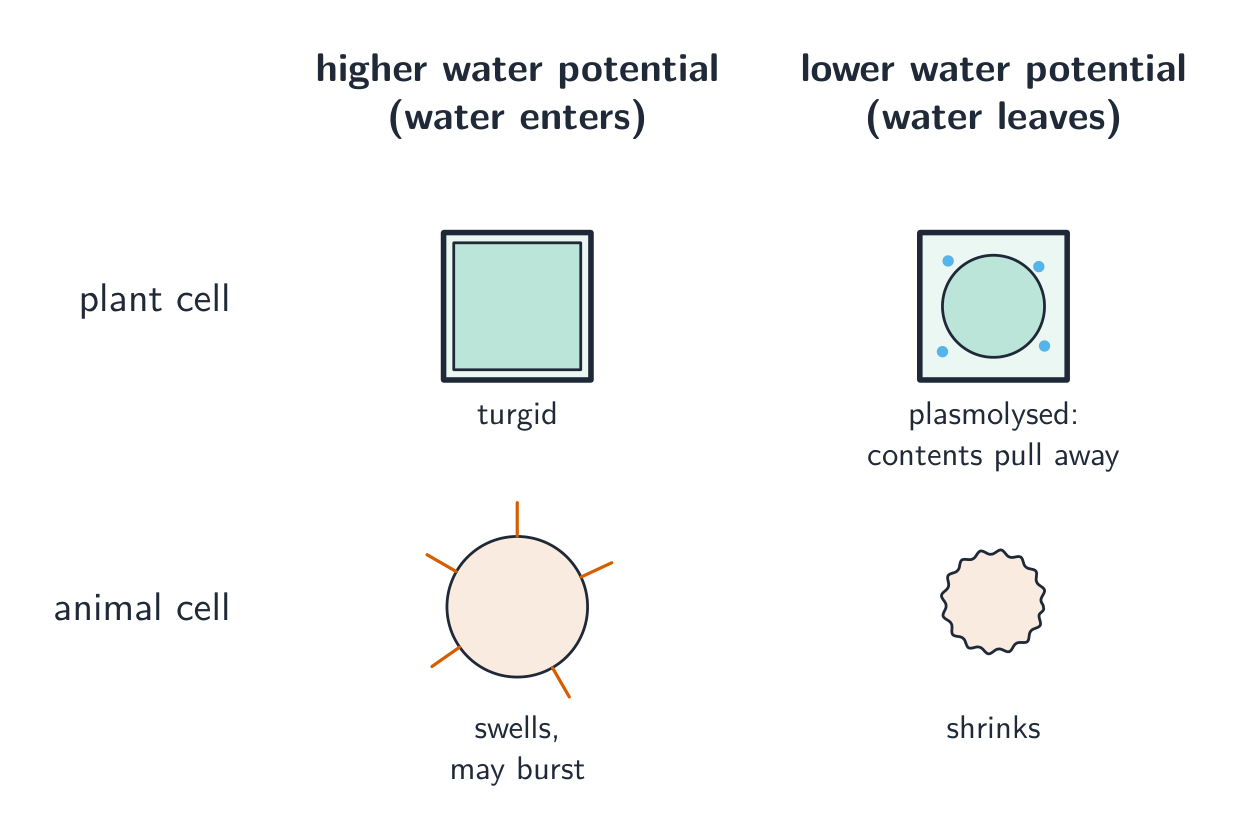
Osmosis 渗透 is the diffusion of water across a membrane. Tonicity 张力 compares solute concentrations: in a hypotonic 低渗 solution a cell gains water (may burst); in a hypertonic 高渗 one it loses water (shrinks); in an isotonic 等渗 one there is no net change. Water potential 水势 predicts the direction of water movement (water moves to lower water potential), and is the sum of a pressure term and a solute term: $\Psi=\Psi_p+\Psi_s$, where the solute potential $\Psi_s=-iCRT$. Osmoregulation 渗透调节 is how organisms control this balance.

Worked example. For a $0.1\,\text{M}$ sucrose solution ($i=1$) in an open beaker (so pressure potential $\Psi_p=0$) at $25\,°\text{C}$ ($T=298\,\text{K}$, $R=0.0831\ \text{L}\cdot\text{bar/mol}\cdot\text{K}$): $\Psi_s=-iCRT=-(1)(0.1)(0.0831)(298)\approx-2.48\ \text{bar}$, so $\Psi\approx-2.48\ \text{bar}$. A plant cell whose interior is $\Psi=-1.0\ \text{bar}$ sits in this solution: since the solution is more negative, water moves out of the cell into the solution, and the cell loses turgor.

ไทย
เซลล์หัวหอมแดงในสารละลายไฮเปอร์โทนิค: เยื่อหุ้มเซลล์ดึงออกจากผนังเซลล์ (พลัสโมไลซิส)

การแพร่ของน้ำ (Osmosis) คือการแพร่ของน้ำข้ามเยื่อหุ้มเซลล์ ความดันออสโมติก (Tonicity) เปรียบเทียบความเข้มข้นของสารละลาย: ใน สารละลายไฮโปโทนิค เซลล์จะรับน้ำเพิ่ม (อาจแตก); ใน ไฮเปอร์โทนิค จะสูญเสีย nước (เหี่ยว); และใน ไอโซโทนิค ไม่มีการเปลี่ยนแปลงสุทธิ ศักยภาพน้ำ (Water potential) คาดการณ์ทิศทางของการเคลื่อนที่ของน้ำ (น้ำเคลื่อนที่ไปยังจุดที่มีศักยภาพน้ำต่ำกว่า) และเป็นผลรวมของเทอมแรงดันและเทอมสารละลาย: $\Psi=\Psi_p+\Psi_s$, โดยที่ศักย์สารละลาย $\Psi_s=-iCRT$. การควบคุมสมดุลน้ำ (Osmoregulation) คือกระบวนการที่สิ่งมีชีวิตรักษาสมดุลนี้

 cách tế bào thực vật và động vật phản ứng với các dung dịch có thế nước khác nhau
การตอบสนองของเซลล์พืชและสัตว์ต่อสารละลายที่มีศักย์น้ำแตกต่างกัน

ตัวอย่างวิธีทำ. สำหรับสารละลายน้ำตาลซูโครส $0.1\,\text{M}$ ($i=1$) ในถ้วยทดลองเปิด (ดังนั้นศักย์แรงดัน $\Psi_p=0$) ที่อุณหภูมิ $25\,°\text{C}$ ($T=298\,\text{K}$, $R=0.0831\ \text{L}\cdot\text{bar/mol}\cdot\text{K}$): $\Psi_s=-iCRT=-(1)(0.1)(0.0831)(298)\approx-2.48\ \text{bar}$, ดังนั้น $\Psi\approx-2.48\ \text{bar}$. เซลล์พืชที่มีค่าภายใน $\Psi=-1.0\ \text{bar}$ วางอยู่ในสารละลายนี้: เนื่องจากสารละลายมีค่า ลบมากกว่า น้ำจึงเคลื่อนที่ ออก จากเซลล์เข้าสู่สารละลาย ทำให้เซลล์สูญเสียความตึง

Explore · ⁨สำรวจ⁩

Watch water move by osmosis · ⁨观察水通过渗透作用移动⁩

Water moves across the membrane from high water potential to low, toward the more concentrated (hypertonic) side. Set the concentrations and watch which way the cell swells or shrinks. · ⁨水穿过膜从高水势流向低处,朝向更浓(高渗)的一侧。设置浓度并观察细胞膨胀还是收缩的方向。⁩

Vocabulary · ⁨คำศัพท์⁩ Train · ⁨ฝึกฝน⁩
English ไทย
Osmosis/ɒzˈməʊsɪs/ ออสโมซิส
Tonicity/təˈnɪsɪti/ ความเข้มข้นของสารละลาย (Tonicity)
hypotonic/ˌhaɪpəʊˈtɒnɪk/ ไฮโปโทนิก
hypertonic/ˌhaɪpəˈtɒnɪk/ ไฮเพอร์โทนิก
isotonic/ˌaɪsəˈtɒnɪk/ ไอโซโทนิก (isotonic)
Water potential/ˈwɔːtə pəˈtenʃl/ ศักย์น้ำ
Osmoregulation/ˌɒzmɔːɡjʊˈleɪʃn/ การควบคุมสมดุลน้ำ (Osmoregulation)
2.8

Mechanisms of Membrane Transport · ⁨กลไกการขนส่งผ่านเยื่อหุ้มเซลล์⁩

Syllabus · ⁨หลักสูตร⁩
English

Big Idea 2 — Energetics (ENE): Biological systems use energy and molecular building blocks to grow, reproduce, and maintain dynamic homeostasis.

Learning Objective 2.8.A: Describe the processes that allow ions and other molecules to move across membranes.

  • 2.8.A.1 Metabolic energy (such as that from ATP) is required for active transport of molecules across the membrane and to establish and maintain electrochemical gradients.
    • i. Membrane proteins are necessary for active transport.
    • ii. The $\mathrm{Na^+}/\mathrm{K^+}$ pump and ATPase contribute to the maintenance of the membrane potential.
ไทย

แนวคิดหลัก 2 — พลังงาน (ENE): ระบบชีวภาพใช้พลังงานและหน่วยสร้างโมเลกุลเพื่อเติบโต สืบพันธุ์ และรักษาสมดุลพลวัตภายใน

จุดประสงค์การเรียนรู้ 2.8.A: อธิบายกระบวนการที่ทำให้ไอออนและโมเลกุลอื่นๆ เคลื่อนที่ผ่านเยื่อหุ้มเซลล์ได้

  • 2.8.A.1 พลังงานเมตาบอลิซึม (เช่น จาก ATP) จำเป็นสำหรับการขนส่งแบบใช้พลังงานผ่านเยื่อหุ้มเซลล์และการสร้างและรักษา gradien อิเล็กโทรเคมี
    • i. โปรตีนเยื่อหุ้มเซลล์จำเป็นสำหรับการขนส่งแบบใช้พลังงาน
    • ii. ปั๊ม $\mathrm{Na^+}/\mathrm{K^+}$ และ ATPase มีส่วนร่วมในการรักษากระแสไฟฟ้าของเยื่อหุ้มเซลล์

Source: College Board AP Course and Exam Description · ⁨แหล่งที่มา: คำอธิบายหลักสูตรและข้อสอบ College Board AP⁩

English

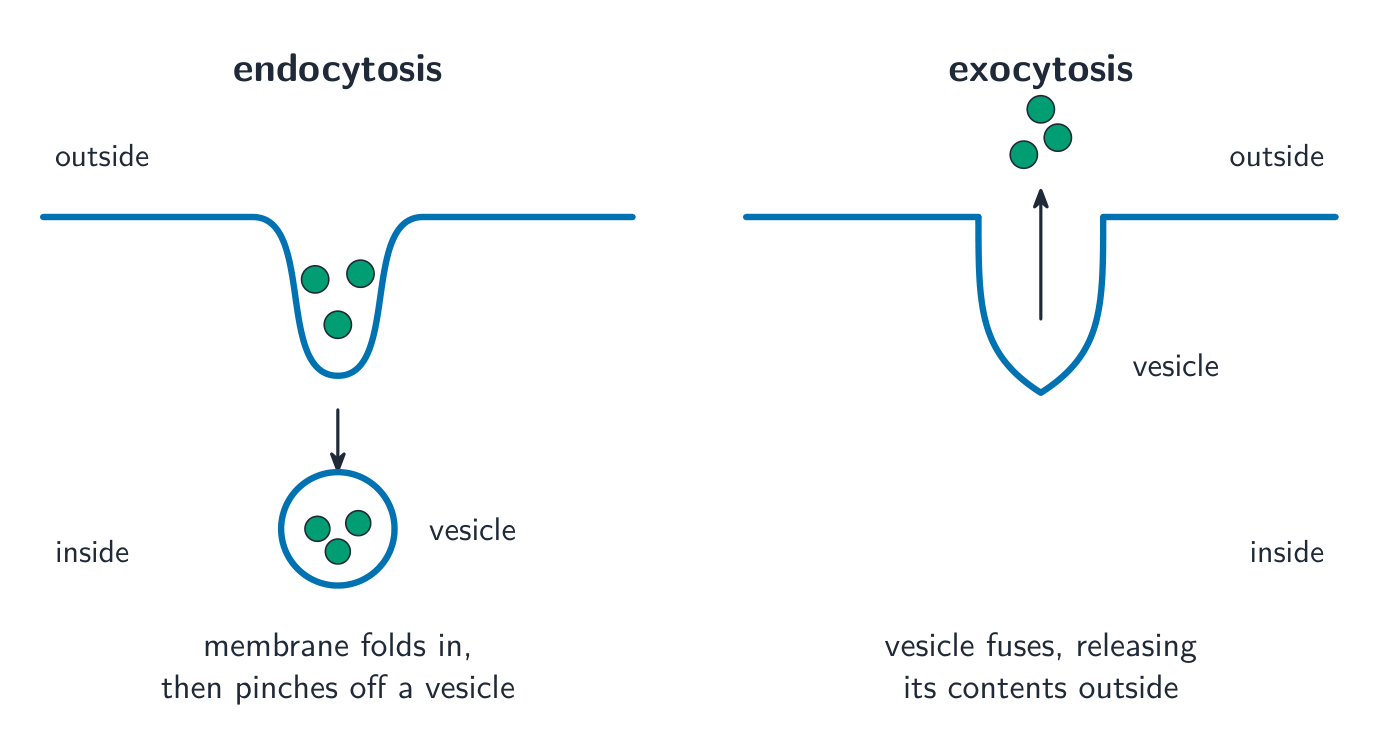
Large materials move in bulk by vesicles: endocytosis 内吞 brings material in (the membrane engulfs it), and exocytosis 外排 sends material out (a vesicle fuses with the membrane). Both require energy and let cells import and secrete large molecules.

ไทย

วัสดุขนาดใหญ่เคลื่อนที่ในรูปแบบกลุ่มใหญ่โดย เวสิเคิล: เอนโดไซโทซิส (endocytosis) นำวัสดุนำเข้า (in) (เยื่อหุ้มเซลล์ห่อหุ้มไว้), และ เอกโซไซโทซิส (exocytosis) ส่งวัสดุนอก (out) (เวสิเคิล 융กับเยื่อหุ้มเซลล์) ทั้งสองกระบวนการต้องใช้พลังงานและช่วยให้เซลล์นำเข้าและหลั่งโมเลกุลขนาดใหญ่ได้

เอนโดไซโทซิสนำวัสดุนำเข้า; เอกโซไซโทซิสปล่อยวัสดุนอก
Vocabulary · ⁨คำศัพท์⁩ Train · ⁨ฝึกฝน⁩
English ไทย
endocytosis/ˌendəʊsɪˈtəʊsɪs/ การกลืนเซลล์
exocytosis/eɡˌzɒsɪˈtəʊsɪs/ การหลั่งออกนอกเซลล์
2.9

Compartmentalization Inside the Cell · ⁨การจัดแบ่งพื้นที่ภายในเซลล์⁩

Syllabus · ⁨หลักสูตร⁩
English

Big Idea 2 — Energetics (ENE): Biological systems use energy and molecular building blocks to grow, reproduce, and maintain dynamic homeostasis.

Learning Objective 2.9.A: Describe the membrane-bound structures of the eukaryotic cell.

  • 2.9.A.1 Membranes and membrane-bound organelles in eukaryotic cells compartmentalize intracellular metabolic processes and specific enzymatic reactions.

Learning Objective 2.9.B: Explain how internal membranes and membrane-bound organelles contribute to compartmentalization of eukaryotic cell functions.

  • 2.9.B.1 Internal membranes facilitate cellular processes by minimizing competing interactions and by increasing the surface area where reactions can occur.
ไทย

แนวคิดหลัก 2 — พลังงาน (ENE): ระบบชีวภาพใช้พลังงานและหน่วยสร้างโมเลกุลเพื่อเติบโต สืบพันธุ์ และรักษาสมดุลพลวัตภายใน

จุดประสงค์การเรียนรู้ 2.9.A: อธิบายโครงสร้างที่มีเยื่อหุ้มของเซลล์ยูคาริโอต

  • 2.9.A.1 เยื่อหุ้มและออร์แกเนลล์ที่มีเยื่อหุ้มในเซลล์ยูคาริโอตทำหน้าที่แบ่งห้องเพื่อแยกกระบวนการเมตาบอลิซึมภายในเซลล์และปฏิกิริยาเอนไซม์เฉพาะอย่างออกจากกัน

จุดประสงค์การเรียนรู้ 2.9.B: อธิบายว่าเยื่อหุ้มภายในและออร์แกเนลล์ที่มีเยื่อหุ้มมีผลต่อการแบ่งห้องของฟังก์ชันเซลล์ยูคาริโอตอย่างไร

  • 2.9.B.1 เยื่อหุ้มภายในช่วยให้เกิดกระบวนการทางเซลล์โดยลดการแทรกแซงที่แข่งขันกันและเพิ่มพื้นที่ผิวที่เกิดปฏิกิริยาได้

Source: College Board AP Course and Exam Description · ⁨แหล่งที่มา: คำอธิบายหลักสูตรและข้อสอบ College Board AP⁩

English

Membranes create separate compartments 区室 so incompatible reactions can run at once and conditions (pH, ion levels) can be tuned locally. This organization boosts efficiency – the internal membranes also add surface area for reactions.

ไทย

เยื่อหุ้มเซลล์สร้าง พื้นที่แยก (compartments) ที่แตกต่างกัน เพื่อให้ปฏิกิริยาที่ไม่เข้ากันสามารถเกิดขึ้นพร้อมกันได้ และปรับสภาพแวดล้อม (เช่น ค่า pH, ระดับไอออน) ได้เฉพาะจุด การจัดระเบียบนี้เพิ่มประสิทธิภาพ – เยื่อหุ้มภายในยังเพิ่มพื้นที่ผิวสำหรับปฏิกิริยาอีกด้วย

Vocabulary · ⁨คำศัพท์⁩ Train · ⁨ฝึกฝน⁩
English ไทย
compartments/kəmˈpɑːtmənts/ ช่องแยก
2.10

The Origins of Cell Compartmentalization · ⁨ต้นกำเนิดของการจัดแบ่งพื้นที่ภายในเซลล์⁩

Syllabus · ⁨หลักสูตร⁩
English

Big Idea 1 — Evolution (EVO): The process of evolution drives the diversity and unity of life.

Learning Objective 2.10.A: Describe similarities and/or differences in compartmentalization between prokaryotic and eukaryotic cells.

  • 2.10.A.1 Membrane-bound organelles such as mitochondria and chloroplasts evolved from once free-living prokaryotic cells via endosymbiosis.
  • 2.10.A.2 Prokaryotes typically lack internal membrane-bound organelles but have internal regions with specialized structures and functions.
  • 2.10.A.3 Eukaryotic cells maintain internal membranes that partition the cell into specialized regions.
ไทย

แนวคิดหลัก 1 — วิวัฒนาการ (EVO): กระบวนการวิวัฒนาการขับเคลื่อนความหลากหลายและความสามัคคีของสิ่งมีชีวิต

วัตถุประสงค์การเรียนรู้ 2.10.A: อธิบายความคล้ายคลึงกันและ/หรือความแตกต่างของการแบ่งส่วนภายในระหว่างเซลล์โปรคาริโอตและเอูคาริโอต

  • 2.10.A.1 ออร์แกเนลล์ที่มีเยื่อหุ้ม เช่น ไมโทคอนเดรียและคลอโรพลาสต์ เกิดขึ้นจากเซลล์โปรคาริโอตที่เคยอิสระผ่านกระบวนการ endosymbiosis
  • 2.10.A.2 โปรคาริโอตโดยทั่วไปไม่มีออร์แกเนลล์ที่มีเยื่อหุ้มภายใน แต่มีพื้นที่ภายในที่มีโครงสร้างและหน้าที่เฉพาะ
  • 2.10.A.3 เซลล์เอูคาริโอตรักษาเยื่อหุ้มภายในที่แบ่งเซลล์ออกเป็นบริเวณที่มีหน้าที่เฉพาะ

Source: College Board AP Course and Exam Description · ⁨แหล่งที่มา: คำอธิบายหลักสูตรและข้อสอบ College Board AP⁩

English

The endosymbiotic theory 内共生学说 explains mitochondria and chloroplasts: they arose when a larger cell engulfed free-living prokaryotes that then lived inside it. The evidence – their own circular DNA, their own ribosomes, and double membranes – supports this shared evolutionary origin.

ไทย

ทฤษฎีเอนโดซิมบิโอซิส (endosymbiotic theory) อธิบายไมโทคอนเดรียและคลอโรพลาสต์: เกิดขึ้นเมื่อเซลล์ที่ใหญ่กว่ากลืนโปรคาริโอตอิสระเข้าไป แล้วโปรคาริโอตเหล่านั้นอาศัยอยู่ภายในเซลล์ หลักฐาน เช่น DNA วงกลมของตัวเอง ribosomes ของตนเอง และเยื่อหุ้มสองชั้น – สนับสนุนแหล่งกำเนิดทางวิวัฒนาการร่วมกันนี้

Vocabulary · ⁨คำศัพท์⁩ Train · ⁨ฝึกฝน⁩
English ไทย
organelles/ˌɔːɡəˈnelz/ ออร์แกเนลล์
endomembrane system/ˈendəʊmembreɪn ˈsɪstəm/ ระบบเยื่อหุ้มภายใน
nucleus/ˈnjuːklɪəs/ นิวเคลียส
endoplasmic reticulum/ˌendəʊˈplæzmɪk reˈtɪkjʊləm/ เอนโดพลาสมิกเรติคูลัม
Golgi/ˈɡɒlɡɪ/ กอลจิบอดี
lysosomes/ˈlaɪsəsəʊmz/ ไลโซโซม
Mitochondria/ˌmaɪtəˈkɒndrɪə/ ไมโทคอนเดรีย
chloroplasts/ˈklɔːrəʊplæsts/ คลอโรพลาสต์
Ribosomes/ˈrɪbəsəʊmz/ ไรโบโซม
ribosomal RNA/ˈrɪbəsɒml ˌɑː en ˈeɪ/ rRNA ribosomal RNA
messenger RNA/ˈmesɪndʒə ˌɑː en ˈeɪ/ messenger RNA
The Golgi complex/ðə ˈɡɒlɡɪ ˈkɒmpleks/ คอมเพล็กซ์โกลจี
glycosylation/ˌɡlaɪkəsɪˈleɪʃn/ การเติมหมู่คาร์โบไฮเดรต
hydrolytic enzymes/ˌhaɪdrəˈlɪtɪk ˈenzaɪmz/ เอนไซม์ไฮโดรไลติก
apoptosis/əpəpˈtəʊsɪs/ apoptosis
Vacuoles/ˈvækjuːəʊlz/ แวคิวโอล
surface-area-to-volume ratio/ˈsɜːfɪs ˈeərɪə tə ˈvɒljuːm ˈreɪʃɪəʊ/ อัตราส่วนพื้นที่ผิวต่อปริมาตร
phospholipid bilayer/ˈfɒsfəlɪpɪd ˈbɪleɪə/ phospholipid bilayer
fluid mosaic model/ˈfluːɪd məˈseɪɪk ˈmɒdl/ fluid mosaic model
endosymbiotic theory/ˌendəʊˌsɪmbaɪˈɒtɪk ˈθɪəri/ ทฤษฎีเอนโดซิมไบโอซิส
ribosomal RNA (rRNA)/ˈrɪbəsɒml ˌɑː en ˈeɪ/ rRNA ribosomal RNA
2.10

Exam tips · ⁨ข้อแนะนำสำหรับการสอบ⁩

English
  • Use the two AP-formula skills: surface-area-to-volume ratio (why cells stay small) and water potential $\Psi=\Psi_p+\Psi_s$ ($\Psi_s=-iCRT$).
  • Water moves toward the lower (more negative) water potential; predict swelling or shrinking from tonicity (hypo/hyper/isotonic).
  • Passive transport and osmosis need no energy (down the gradient); active transport needs ATP (against the gradient).
  • Distinguish diffusion, facilitated diffusion (a channel/carrier protein), and active transport.
  • Explain membrane selectivity from the phospholipid bilayer — small non-polar molecules cross, large/charged ones need help.
ไทย
  • ใช้ทักษะสูตร AP สองอย่าง: อัตราส่วนพื้นที่ผิวต่อปริมาตร (เหตุผลที่เซลล์มีขนาดเล็ก) และ ศักยภาพน้ำ $\Psi=\Psi_p+\Psi_s$ ($\Psi_s=-iCRT$).
  • น้ำเคลื่อนที่ menuju ศักยภาพน้ำที่ต่ำกว่า (หรือเป็นลบมากขึ้น); คาดการณ์การบวมหรือหดตัวจากความดันออสโมติก (ไฮโป/ไฮเปอร์/ไอโซโทนิค).
  • การขนส่งแบบพาสซีฟและการแพร่ของน้ำไม่ต้องใช้พลังงาน (เคลื่อนที่ตาม gradien); การขนส่งแบบแอคทีฟ ต้องใช้ ATP (เคลื่อนที่สวนทางกับ gradien).
  • แยกแยะการแพร่, การแพร่แบบช่วย (โปรตีนช่อง/ตัวพา), และการขนส่งแบบแอคทีฟ.
  • อธิบายความจำเพาะของเยื่อหุ้มเซลล์จาก ไบเลเยอร์ฟอสโฟลิปิด – โมเลกุลไม่มีขั้วขนาดเล็กทะลุผ่านได้ ส่วนโมเลกุลขนาดใหญ่หรือมีประจุต้องอาศัยความช่วยเหลือ

Interactive lessons on this topic · ⁨บทเรียนเชิงโต้ตอบสำหรับหัวข้อนี้⁩

Work through it step by step, with instant-check exercises. · ⁨ทำทีละขั้นตอน พร้อมแบบฝึกหัดตรวจสอบผลทันที⁩

Past Papers · ⁨ข้อสอบย้อนหลัง⁩

More topics in AP Biology · ⁨หัวข้อเพิ่มเติมใน AP Biology⁩

Log in or create account · ⁨เข้าสู่ระบบหรือสร้างบัญชี⁩

IGCSE, A-Level & AP