Tonicity and Osmoregulation
Introduced 9:47
Cell Structure and Function
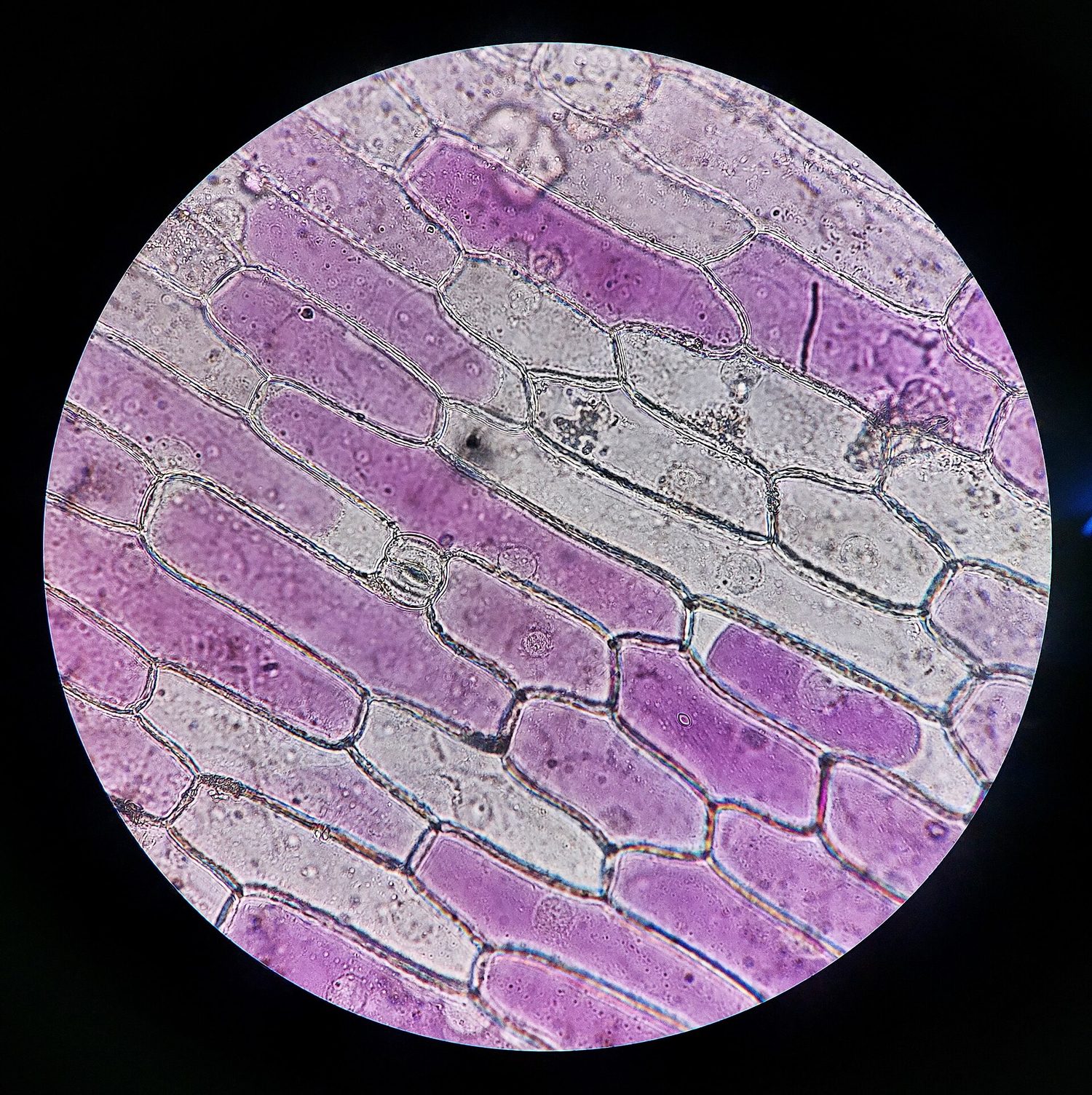
Look at a leaf under a microscope. You see rows of green boxes, and each box is packed with tiny green discs. Now look at a thin slice of onion. Neat brick…
English narration · English and 中文 subtitles you can switch
In this lesson
| English | Meaning |
|---|---|
| osmosis/ɒzˈməʊsɪs/ | The net movement of water molecules through a partially permeable membrane from higher to lower water potential. |
| hypertonic/ˌhaɪpəˈtɒnɪk/ | |
| hypotonic/ˌhaɪpəʊˈtɒnɪk/ | |
| isotonic/ˌaɪsəˈtɒnɪk/ | |
| osmoregulation/ˌɒzmɔːɡjʊˈleɪʃn/ | The control of water balance and dissolved solute concentrations in an organism. |
Why wilted lettuce gets crisp again
- Put limp lettuce in a bowl of cold water and in an hour it is crisp. Put a slice of potato in very salty water and it goes soft and bendy. No pump moves the water: it moves by itself, across the cell membrane.
- This movement of water is osmosis 渗透. To predict which way water will go, AP Biology uses tonicity and water potential.
Osmosis and tonicity
- Osmosis is the diffusion of water across a selectively permeable membrane. Water moves from the hypotonic 低渗 side (less solute) to the hypertonic 高渗 side (more solute). If both sides are isotonic 等渗, there is no net movement.
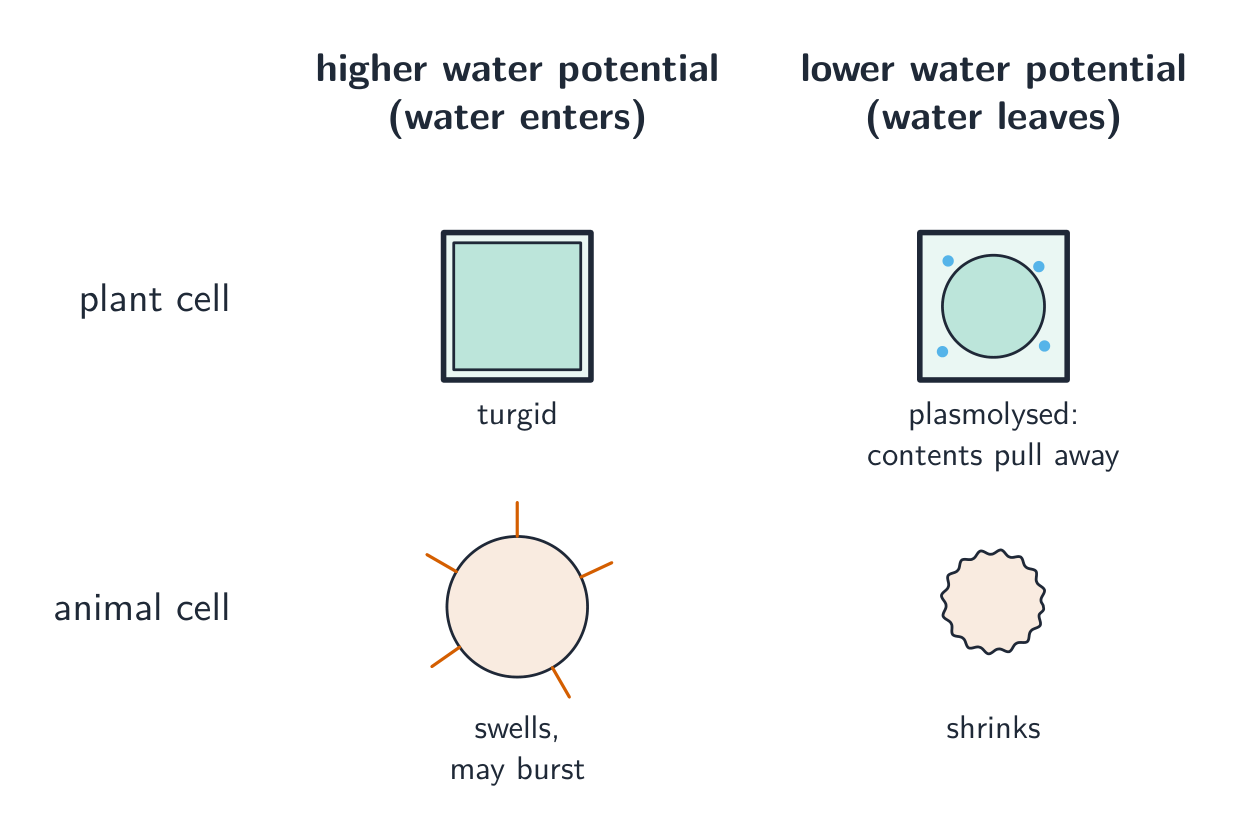
- Animal cells burst (lyse) in a hypotonic solution and shrivel in a hypertonic one. Plant cells become turgid in hypotonic solution, because the wall stops them bursting, and plasmolyze in hypertonic solution.
Osmosis and tonicity
Set the outside solute concentration and watch which way water moves — toward the more concentrated side.
Osmosis is the movement of…
Difficulty 1/5 · 100 coins + a small bonus on first completion today
Osmosis is the diffusion of water across a membrane, from a dilute to a more concentrated solution.
A cell placed in a hypertonic solution (more solute outside) will…
Difficulty 1/5 · 100 coins + a small bonus on first completion today
In a hypertonic solution water leaves the cell (toward the higher solute), so the cell shrinks.
In a hypotonic solution (less solute outside), a cell loses water and shrinks.
Difficulty 1/5 · 100 coins + a small bonus on first completion today
False. With less solute outside, water moves into the cell toward the higher solute concentration, so the cell swells and an animal cell may burst. Cells shrink in a hypertonic solution.
When the solute is equal inside and out, with no net water movement, the solution is ____.
Difficulty 1/5 · 100 coins + a small bonus on first completion today
In an isotonic solution the concentrations match, so there is no net osmosis.
What happens to this animal cell?
Difficulty 1/5 · 100 coins + a small bonus on first completion today
A hypertonic bath draws water out.
Water potential
- Water potential 水势 ($\Psi$, in bars) predicts the direction: water moves from high $\Psi$ to low $\Psi$. $\Psi = \Psi_P + \Psi_S$: pressure potential plus solute potential. In an open beaker, $\Psi_P = 0$.
- Solute potential is zero for pure water and negative when solute is added: $\Psi_S = -iCRT$, where $i$ = ionization constant (1 for sucrose, 2 for NaCl), $C$ = molar concentration, $R = 0.0831$ L·bar/(mol·K), $T$ = temperature in K.
Solute potential of 0.20 M sucrose at 22 °C (295 K):
More solute → more negative $\Psi$ → water moves toward it.
Select all true statements about tonicity.
Difficulty 2/5 · 140 coins + a small bonus on first completion today
Osmosis moves water, not salt. The other three are correct.
Calculate the solute potential of a 0.10 M NaCl solution ($i = 2$) at 27 °C (300 K), in bars. Use $R = 0.0831$ L·bar/(mol·K).
Difficulty 2/5 · 140 coins + a small bonus on first completion today
$\Psi_S = -iCRT = -(2)(0.10)(0.0831)(300) \approx -4.99$ bars.
A cell has a water potential of −6 bars. It is placed in a solution with a water potential of −2 bars. What happens?
Difficulty 1/5 · 100 coins + a small bonus on first completion today
Water moves from higher (less negative) to lower (more negative) water potential.
The potato core lab
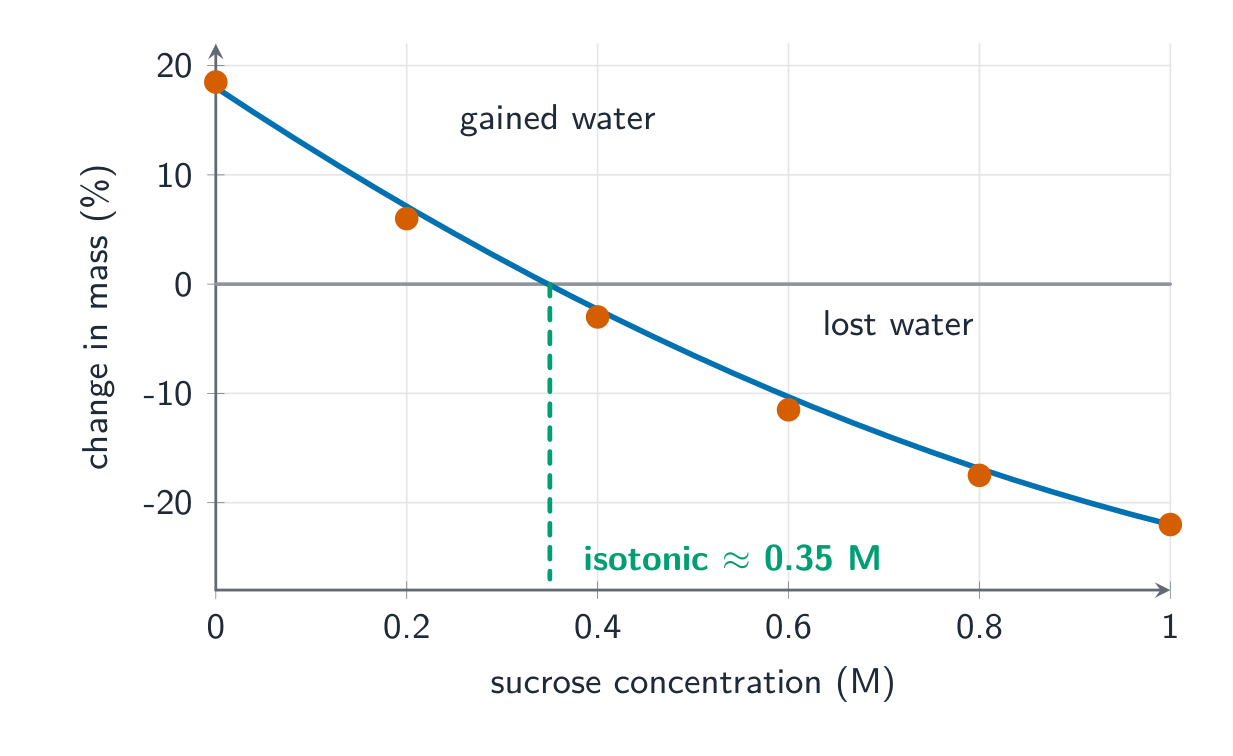
- Cores of the same potato are weighed, left in sucrose solutions of different concentrations, and weighed again. Cores gain mass where the solution is hypotonic and lose mass where it is hypertonic.
- Where the line crosses zero change, the solution is isotonic with the potato cells, so it has the same water potential as the cells.
In a potato core experiment, how do you find the sucrose concentration that is isotonic to the potato cells?
Difficulty 1/5 · 100 coins + a small bonus on first completion today
At the isotonic concentration there is no net osmosis, so the mass does not change.
Osmoregulation
- Organisms keep water and solutes in balance to stay alive and grow. A freshwater protist lives in hypotonic water, so water keeps entering; a contractile vacuole collects it and pumps it out, using ATP.
- In plants, the central vacuole fills with water and pushes against the cell wall. This turgor pressure ($\Psi_P > 0$) keeps stems and leaves firm. Without enough water, pressure drops and the plant wilts.
Why do freshwater protists need a contractile vacuole, but most marine protists do not?
Difficulty 1/5 · 100 coins + a small bonus on first completion today
Fresh water has less solute than the cytoplasm, so water enters by osmosis. Sea water is closer to isotonic.
Worked FRQ answer
Use the potato core graph above. The lab was at 22 °C (295 K).
(A) Identify the sucrose concentration that is isotonic to the potato cells, and justify. About 0.35 M: at that concentration the cores show no net change in mass, so there is no net osmosis.
(B) Calculate the water potential of the potato cells. At equilibrium, the cells have the same $\Psi$ as the 0.35 M solution in an open beaker ($\Psi_P = 0$):
(C) Predict what happens to a core placed in 0.20 M sucrose, and explain using water potential. It gains mass. The solution's $\Psi$ (−4.9 bars) is higher than the cells' (−8.6 bars), so water moves from the solution into the cells.
- Why it scores: (A) uses the zero-change point; (B) shows $\Psi_S = -iCRT$ with values and units; (C) states both water potentials and the direction high → low.
- Water moves, not solute. In osmosis the solute stays; water moves toward the side with more solute.
- Higher solute concentration = more negative (lower) water potential.
- Hypo-, hyper- and isotonic always compare two solutions. Say which one is hypertonic to which.
Osmosis moves water from hypotonic to hypertonic regions, which is from high to low water potential. $\Psi = \Psi_P + \Psi_S$, with $\Psi_S = -iCRT$. Adding solute lowers $\Psi$. Osmoregulation keeps cells in balance: contractile vacuoles pump out water in protists; the central vacuole gives plant cells turgor.
What went wrong? Only the site team sees this.