Structure of Water and Hydrogen Bonding · โครงสร้างของน้ำและการสร้างพันธะไฮโดรเจน
Syllabus · หลักสูตร
English
Big Idea 4 — Systems Interactions: Biological systems interact, and these systems and their interactions exhibit complex properties.
Learning Objective 1.1.A: Explain how the properties of water that result from its polarity and hydrogen bonding affect its biological function.
1.1.A.1 Living systems depend on the properties of water to sustain life.
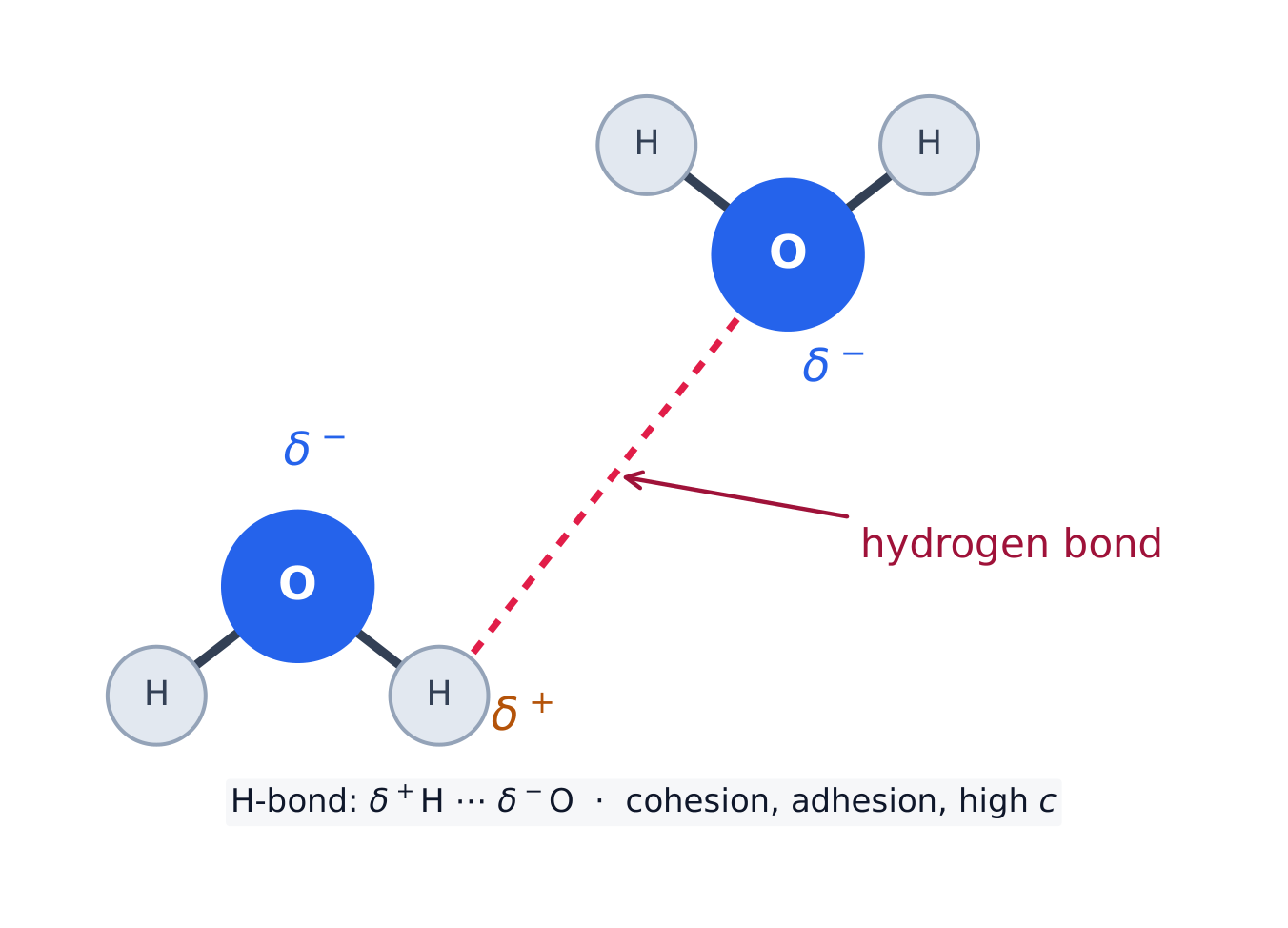
1.1.A.1.i Water has polarity, because of the formation of polar covalent bonds between hydrogen and oxygen within water molecules. This polarity contributes to hydrogen bonding between and within biological molecules.
1.1.A.1.ii Water has a high specific heat capacity, which allows for the maintenance of homeostatic body temperature within living organisms.
1.1.A.1.iii Water has a high heat of vaporization, which allows for the evaporative cooling of the surrounding environment. In living organisms, this property allows for body temperature to be maintained.
1.1.A.2 The hydrogen bonds between adjacent polar water molecules result in cohesion, adhesion, and surface tension.
1.1.A.1.iii น้ำมีความร้อนแฝงของการระเหยสูง ซึ่งช่วยให้เกิดการappers周围环境。 Within Living Organisms, this property allows for body temperature to be maintained.
Source: College Board AP Course and Exam Description · แหล่งที่มา: คำอธิบายหลักสูตรและข้อสอบ College Board AP
English
Water is polar 极性: its oxygen pulls electrons more strongly than its hydrogens, giving a slightly negative O and slightly positive H. This lets water molecules form hydrogen bonds 氢键 with each other, which explains water's life-supporting properties:
Cohesion 内聚力 and adhesion 附着力 (surface tension, capillary action, water rising in plants),
high specific heat 比热容 (resists temperature change, stabilizing organisms),
high heat of vaporization (evaporative cooling),
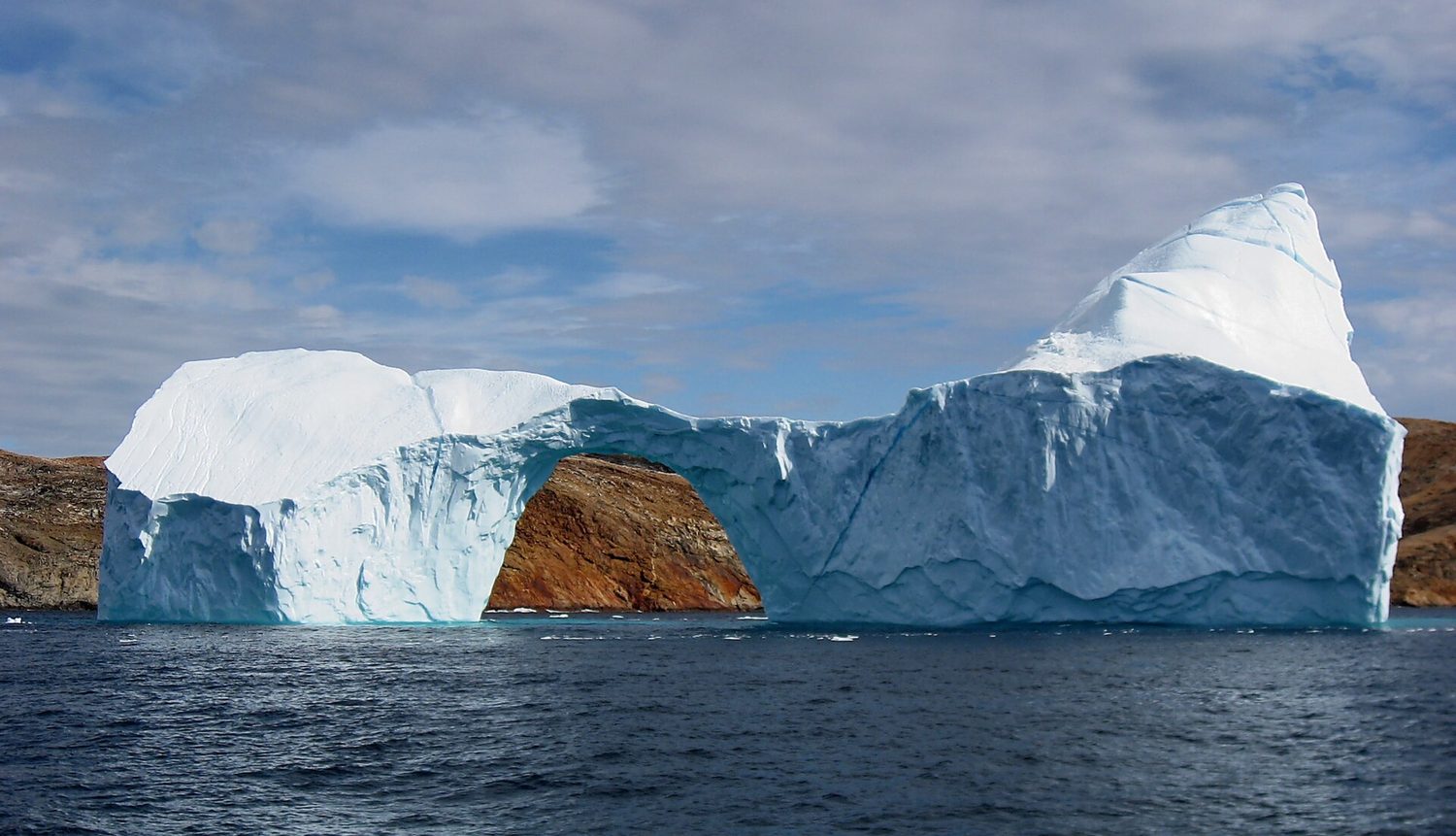
ice floating (less dense solid), and being a great solvent for polar and ionic substances.
Explore how a covalent bond shares electrons · สำรวจว่าพันธะโคเวเลนต์แบ่งปันอิเล็กตรอนอย่างไร
Step through two atoms overlapping to share a pair of electrons so each reaches a full shell. In $\text{H}_2$ the two atoms pull equally, so the bond is non-polar — the contrast that makes water's unequal sharing (and its $\delta^+/\delta^-$ dipole) so important. · ก้าวผ่านสองอะตอมที่ซ้อนทับกันเพื่อ แบ่งปันคู่ของอิเล็กตรอน เพื่อให้แต่ละอะตอมมีชั้นอิเล็กตรอนเต็ม ใน $\text{H}_2$ อะตอมทั้งสองดึง เท่ากัน ดังนั้นพันธะจึงไม่มีขั้ว — ความแตกต่างที่ทำให้การแบ่งปัน ไม่เท่ากัน ของน้ำ (และ $\delta^+/\delta^-$ dipole ของมัน) สำคัญมาก
Big Idea 2 — Energetics: Biological systems use energy and molecular building blocks to grow, reproduce, and maintain dynamic homeostasis.
Learning Objective 1.2.A: Describe the composition of macromolecules required by living organisms.
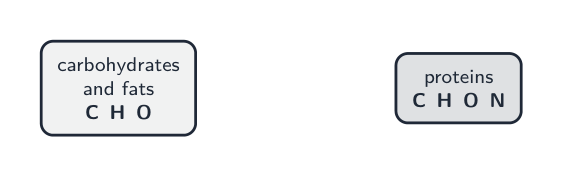
1.2.A.1 Atoms and molecules from the environment are necessary to build new molecules. Carbon, hydrogen, and oxygen are the most prevalent elements used to build biological molecules such as carbohydrates, proteins, lipids, and nucleic acids. Additionally:
1.2.A.1.i Sulfur is used in the building of proteins.
1.2.A.1.ii Phosphorus is used in the building of phospholipids (a type of lipid) and nucleic acids.
1.2.A.1.iii Nitrogen is used in the building of nucleic acids.
Source: College Board AP Course and Exam Description · แหล่งที่มา: คำอธิบายหลักสูตรและข้อสอบ College Board AP
English
Living matter is built mostly from a few elements – carbon, hydrogen, oxygen, nitrogen, phosphorus, and sulfur. Carbon 碳 is central because it forms four stable covalent bonds, building long chains, branches, and rings – the skeletons of all biological molecules.
Introduction to Macromolecules · บทนำเรื่องโมเลกุลขนาดใหญ่
Syllabus · หลักสูตร
English
Big Idea 4 — Systems Interactions: Biological systems interact, and these systems and their interactions exhibit complex properties.
Learning Objective 1.3.A: Describe the chemical reactions that build and break biological macromolecules.
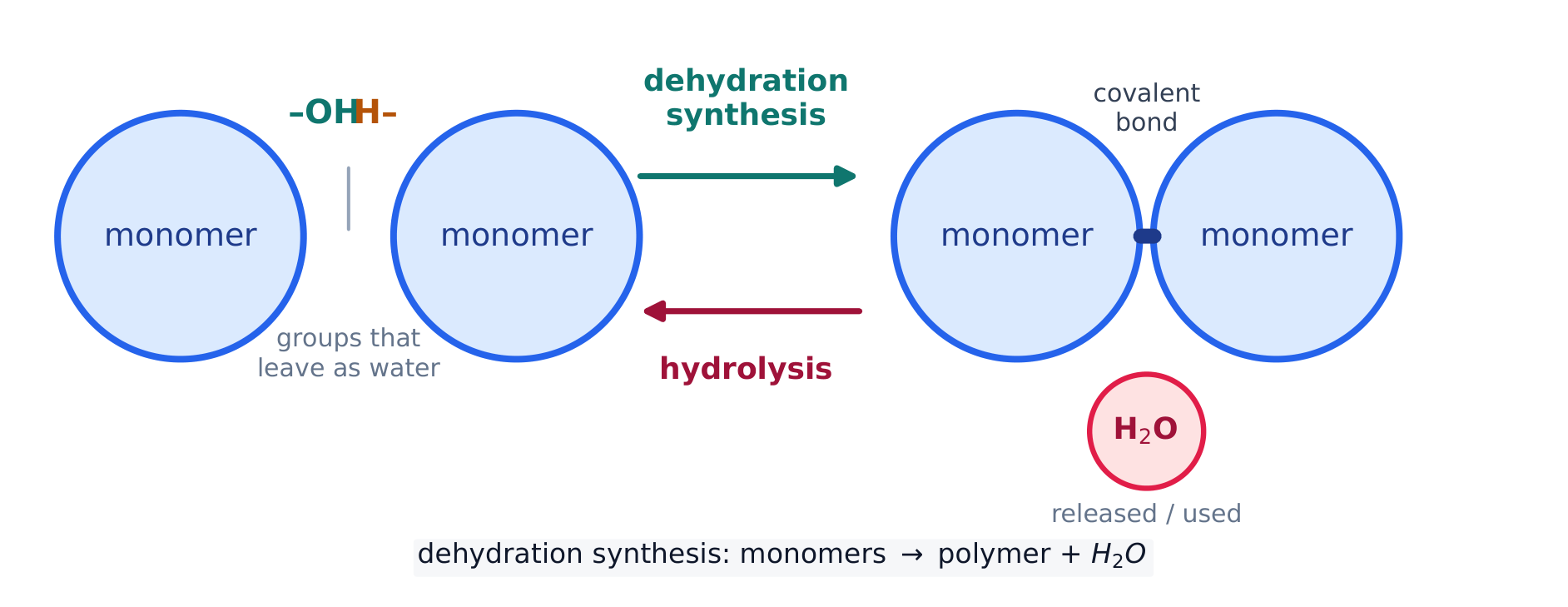
1.3.A.1 Hydrolysis is a chemical reaction involving the cleaving of covalent bonds. This type of reaction breaks down molecules into smaller molecules. When water is added to the bond between monomers in a polymer, the bond is broken. The hydrogen ion from a water molecule is added to one monomer and the hydroxyl group of the water molecule is added to the other monomer, completing the reaction.
1.3.A.2 Dehydration synthesis occurs when two smaller molecules are joined together through covalent bonding. A hydrogen ion is removed from one monomer and a hydroxyl group is removed from the other. This causes the loss of the equivalent of a water molecule from the reactants and the connection of the two remaining monomers. The connection of many monomers is known as polymerization.
Source: College Board AP Course and Exam Description · แหล่งที่มา: คำอธิบายหลักสูตรและข้อสอบ College Board AP
English
Large biological molecules – macromolecules 大分子 – are polymers 聚合物 built from repeating monomers 单体. Cells join monomers by dehydration synthesis 脱水缩合 (removing water to form a bond) and break polymers by hydrolysis 水解 (adding water). Four classes: carbohydrates, lipids, nucleic acids, and proteins.
ไทย
โมเลกุลชีวภาพขนาดใหญ่ – โมเลกุลใหญ่ (macromolecules) – เป็น โพลีเมอร์ ที่สร้างจาก โมโนเมอร์ ซ้ำๆ เซลล์เชื่อมโมโนเมอร์เข้าด้วยกันโดย สังเคราะห์ด้วยการกำจัดน้ำ (dehydration synthesis) (Removing water to form a bond) และสลายโพลีเมอร์โดย ไฮโดรไลซิส (hydrolysis) (adding water). สี่ประเภท: คาร์โบไฮเดรต, ไขมัน, กรดนิวเคลئิก และโปรตีน
Explore the four classes of macromolecule by their monomer · สำรวจ四类大分子及其单体
Sort each clue into the right macromolecule class by matching the monomer that builds it — sugars, nucleotides or amino acids — and notice that lipids are the odd one out that are not true polymers. · 根据构建每种分子的单体(糖、核苷酸或氨基酸)将线索归类到正确的大分子类别,并注意脂质是例外,它们不是真正的聚合物。
Big Idea 4 — Systems Interactions: Biological systems interact, and these systems and their interactions exhibit complex properties.
Learning Objective 1.4.A: Describe the structure and function of carbohydrates.
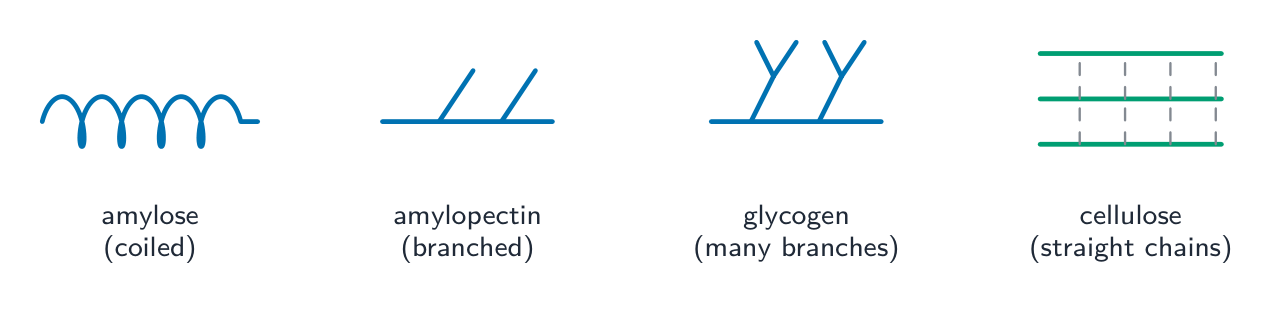
1.4.A.1 Monosaccharides (simple sugars) are the monomers for polysaccharides (complex carbohydrates). These monomers are connected by covalent bonds to form polymers such as complex carbohydrates, which may be linear or branched.
Illustrative examples for 1.4.A.1:
Cellulose
Starch
Glycogen
Exclusion statement: The molecular structure of specific carbohydrate polymers is beyond the scope of the AP Exam.
ข้อความยกเว้น: โครงสร้างโมเลกุลของโพลีเมอร์คาร์โบไฮเดรตเฉพาะเจาะจงอยู่นอกขอบเขตของการสอบ AP
Source: College Board AP Course and Exam Description · แหล่งที่มา: คำอธิบายหลักสูตรและข้อสอบ College Board AP
English
Carbohydrates 碳水化合物 are made of sugar monomers (monosaccharides 单糖 like glucose). They store energy (starch, glycogen) and provide structure (cellulose 纤维素 in plant walls). Their many hydroxyl groups make them polar and water-soluble.
Big Idea 4 — Systems Interactions: Biological systems interact, and these systems and their interactions exhibit complex properties.
Learning Objective 1.5.A: Describe the structure and function of lipids.
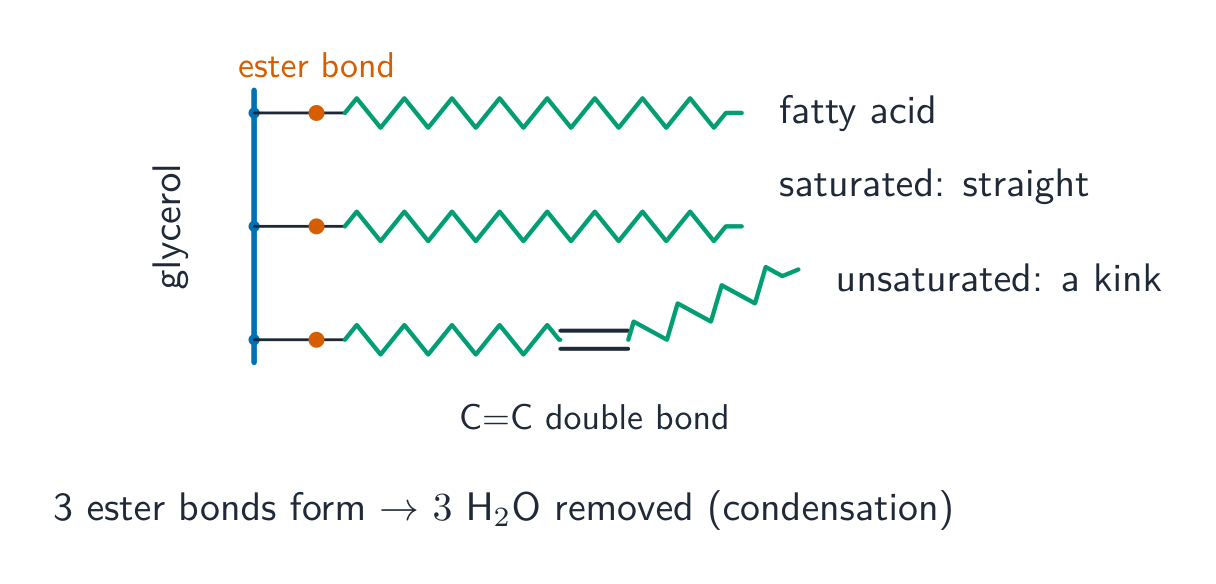
1.5.A.1 Lipids are typically nonpolar, hydrophobic molecules whose structure and function are derived from the way their subcomponents are assembled. Fatty acids can be described as either saturated or unsaturated.
1.5.A.1.i Saturated fatty acids contain only single bonds between carbon atoms.
1.5.A.1.ii Unsaturated fatty acids contain at least one double bond between carbon atoms, which causes the carbon chain to kink.
1.5.A.1.iii The more double bonds in a fatty acid tail, the more unsaturated the lipid becomes.
1.5.A.1.iv The more unsaturated a lipid is, the more liquid it is at room temperature.
1.5.A.2 Lipids provide a variety of functions for living organisms. Some examples of lipids are fats, steroids including cholesterol, and phospholipids.
1.5.A.2.i Fats provide energy storage and support cell function. In some cases, they can also provide insulation to help keep mammals warm.
1.5.A.2.ii Steroids are hormones that support physiological functions including growth and development, energy metabolism, and homeostasis.
1.5.A.2.iii Cholesterol provides essential structural stability to animal cell membranes.
1.5.A.2.iv Phospholipids group together to form the lipid bilayers found in plasma and cell membranes.
Exclusion statement: The molecular structure of specific lipids is beyond the scope of the AP Exam.
ข้อความยกเว้น: โครงสร้างโมเลกุลของลิปิดเฉพาะเจาะจงอยู่นอกขอบเขตของการสอบ AP
Source: College Board AP Course and Exam Description · แหล่งที่มา: คำอธิบายหลักสูตรและข้อสอบ College Board AP
English
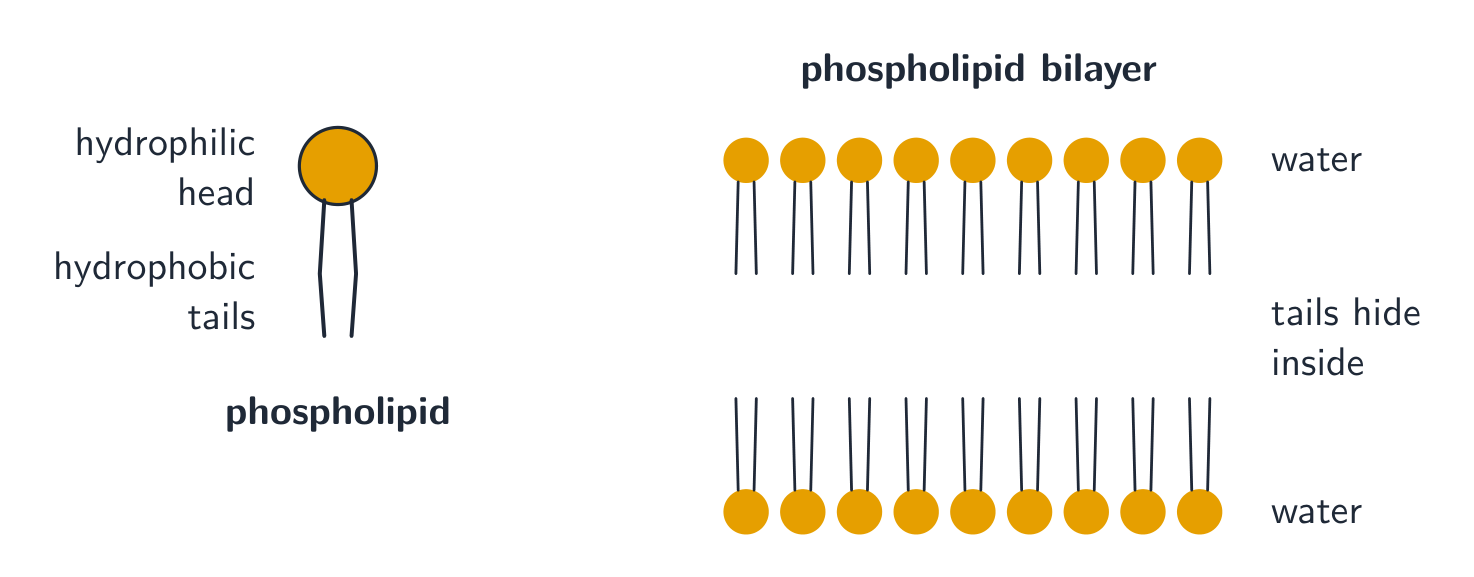
Lipids 脂质 are nonpolar and do not mix with water (hydrophobic 疏水). They include fats (long-term energy storage), phospholipids 磷脂 (which build membranes), and steroids. A phospholipid has a polar "head" and nonpolar "tails," the key to the cell membrane.
Big Idea 3 — Information Storage and Transmission: Living systems store, retrieve, transmit, and respond to information essential to life processes.
Learning Objective 1.6.A: Describe the structure and function of DNA and RNA.
1.6.A.1 In nucleic acids (DNA and RNA), biological information is encoded in sequences of nucleotide monomers. Each nucleotide has the following structural components: a five-carbon sugar (deoxyribose or ribose), a phosphate, and a nitrogenous base (adenine, thymine, guanine, cytosine, or uracil).
1.6.A.2 Nucleic acids have a linear sequence of nucleotides that have ends, defined by the 3' (three prime) hydroxyl and 5' (five prime) phosphates of the sugar in the nucleotide. During nucleic acid synthesis, nucleotides are added to the 3' end of the growing strand, resulting in the formation of covalent bonds between nucleotides.
Exclusion statement: The molecular structure of specific nucleotides is beyond the scope of the AP Exam.
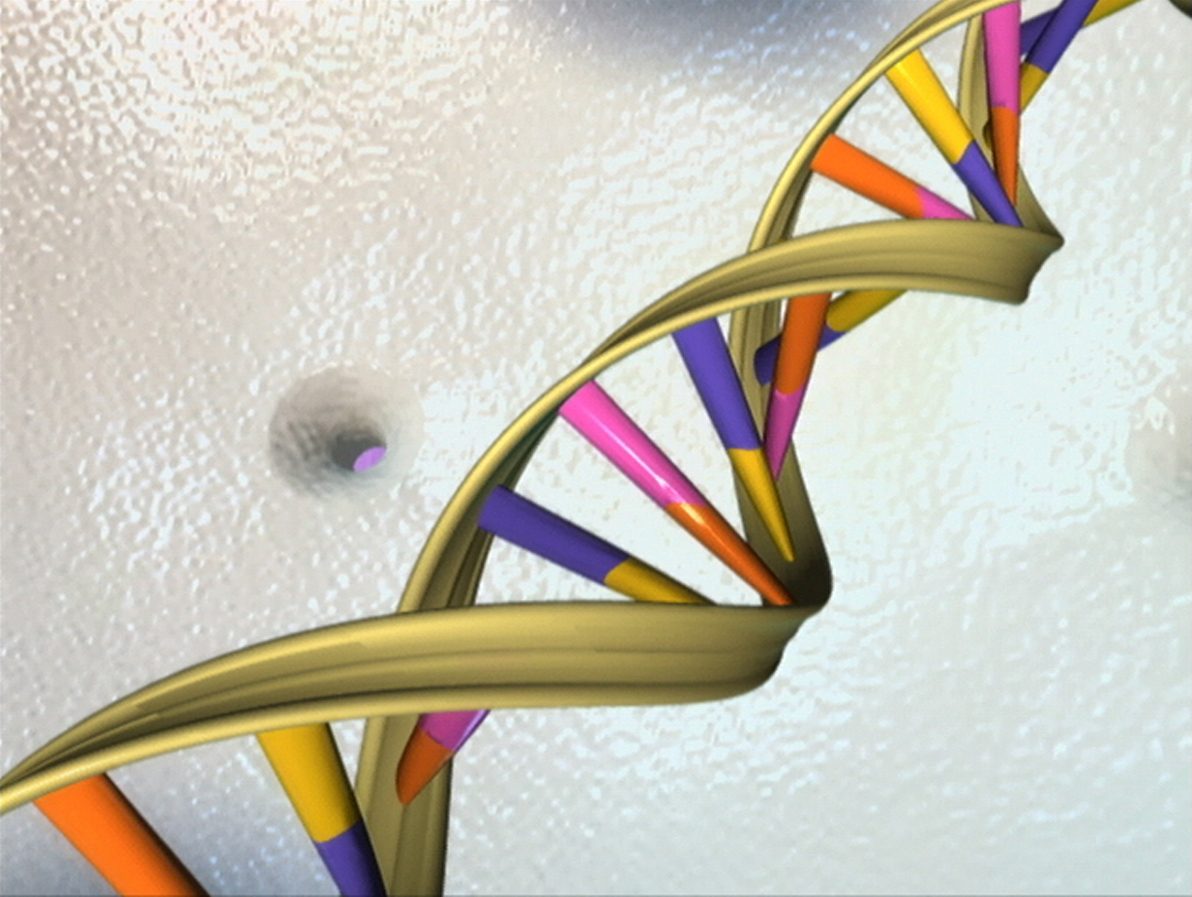
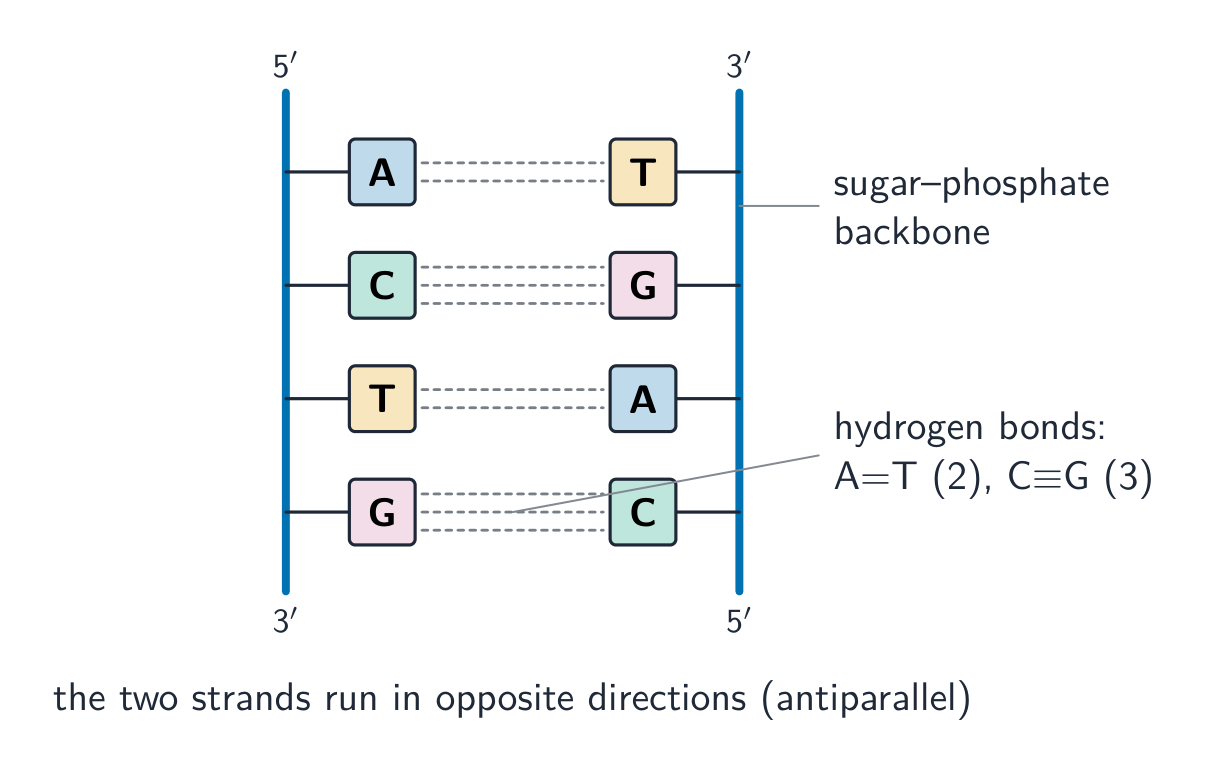
1.6.A.3 DNA is structured as an antiparallel double helix, with two strands of nucleotides running in opposite 5' to 3' orientation. In DNA, adenine nucleotides pair with thymine nucleotides via hydrogen bonds (A-T), and cytosine nucleotides pair with guanine nucleotides via hydrogen bonds (C-G). In RNA, adenine pairs with uracil (A-U).
1.6.A.4 Structural differences between DNA and RNA include:
1.6.A.4.i DNA contains the sugar deoxyribose, and RNA contains the sugar ribose.
1.6.A.4.ii DNA contains the nitrogenous base thymine, and RNA contains the nitrogenous base uracil.
1.6.A.4.iii DNA is typically double stranded, while RNA is typically single stranded.
ข้อความยกเว้น: โครงสร้างโมเลกุลของนิวคลีโอไทด์เฉพาะเจาะจงอยู่นอกขอบเขตของการสอบ AP
1.6.A.3 DNA มีโครงสร้างเป็นเกลียวคู่แบบสวนทางกัน โดยมีสายนิวคลีโอไทด์สองสายเรียงตัวในทิศทางตรงข้ามกันจาก 5' ไป 3' ใน DNA นิวคลีโอไทด์อะดีนีนจับคู่กับนิวคลีโอไทด์ไทมินผ่านพันธะไฮโดรเจน (A-T) และนิวคลีโอไทด์ไซโตซีนจับคู่กับนิวคลีโอไทด์กวนีนผ่านพันธะไฮโดรเจน (C-G) ใน RNA อะดีนีนจะจับคู่กับยูราซิล (A-U)
1.6.A.4 ความแตกต่างด้านโครงสร้างระหว่าง DNA และ RNA ได้แก่:
1.6.A.4.i DNA มีน้ำตาลดีออกซีไรบอส ส่วน RNA มีน้ำตาลไรโบส
1.6.A.4.ii DNA มีเบสไนโตรเจนไทมิน ส่วน RNA มีเบสไนโตรเจนยูราซิล
1.6.A.4.iii โดยทั่วไป DNA เป็นสายคู่ ในขณะที่ RNA เป็นสายเดี่ยว
Source: College Board AP Course and Exam Description · แหล่งที่มา: คำอธิบายหลักสูตรและข้อสอบ College Board AP
English
Nucleic acids 核酸 (DNA and RNA) store and carry genetic information. Their monomers are nucleotides 核苷酸, each a sugar, a phosphate, and a nitrogen base. The base sequence encodes instructions; DNA is double-stranded, RNA single-stranded.
การจับคู่เบสเสริมกันยึดสายคู่แบบสวนทางของ DNA ไว้ด้วยกัน
Explore · สำรวจ
Explore complementary base pairing · 探索互补碱基配对
Step along a DNA template and watch each base pair to its partner by complementary base pairing ($A$ with $T$, $G$ with $C$) — the rule that lets either strand act as a template to rebuild the other. · 沿着DNA模板移动,观察每个碱基如何通过互补碱基配对与其配对伙伴结合($A$与$T$,$G$与$C$)——这一规则使得任一条链都能作为模板重建另一条链。
1.7
Proteins · โปรตีน
Syllabus · หลักสูตร
English
Big Idea 3 — Information Storage and Transmission: Living systems store, retrieve, transmit, and respond to information essential to life processes.
Learning Objective 1.7.A: Describe the structure and function of proteins.
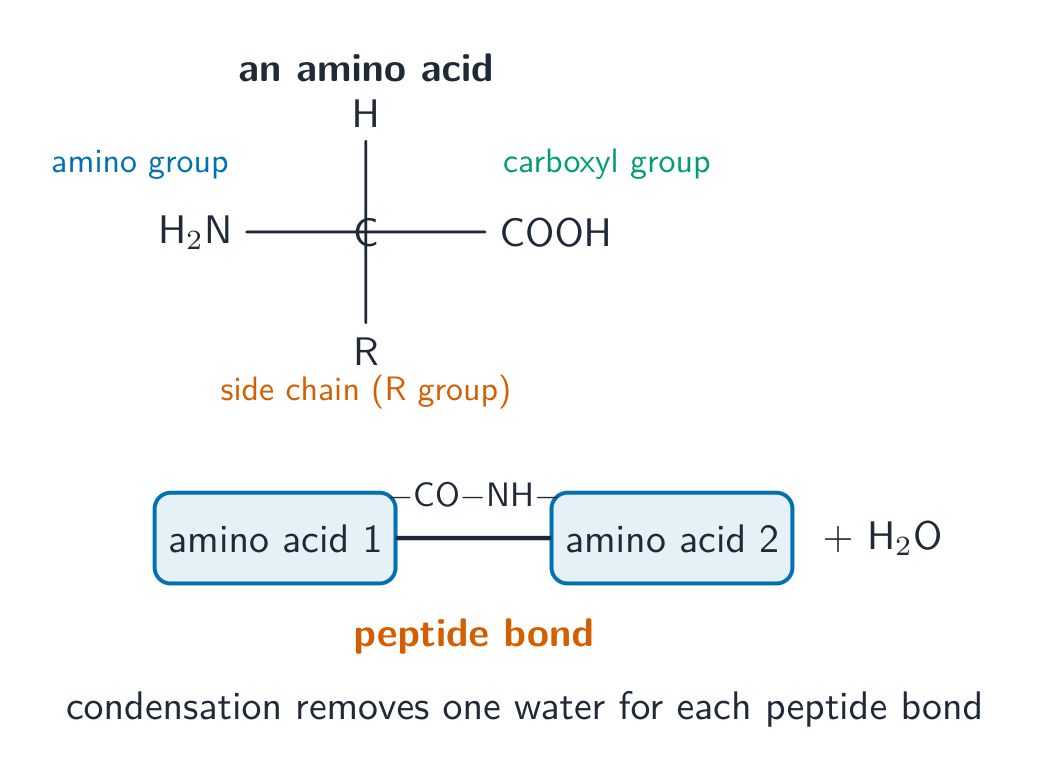
1.7.A.1 Proteins comprise linear chains of amino acids connected by the formation of covalent (peptide) bonds that form between a carboxyl group ($-\text{COOH}$) of one amino acid and an amine group ($-\text{NH}_2$) of the next amino acid, resulting in a growing peptide chain.
1.7.A.2 Amino acids are composed of a central carbon atom with a hydrogen atom, a carboxyl group, an amine group, and a variable R group covalently bound to it. The R group of an amino acid can be categorized by three possible chemical properties: hydrophobic/nonpolar, hydrophilic/polar, or ionic. The interactions of these R groups determine the structure and function of that region of the protein.
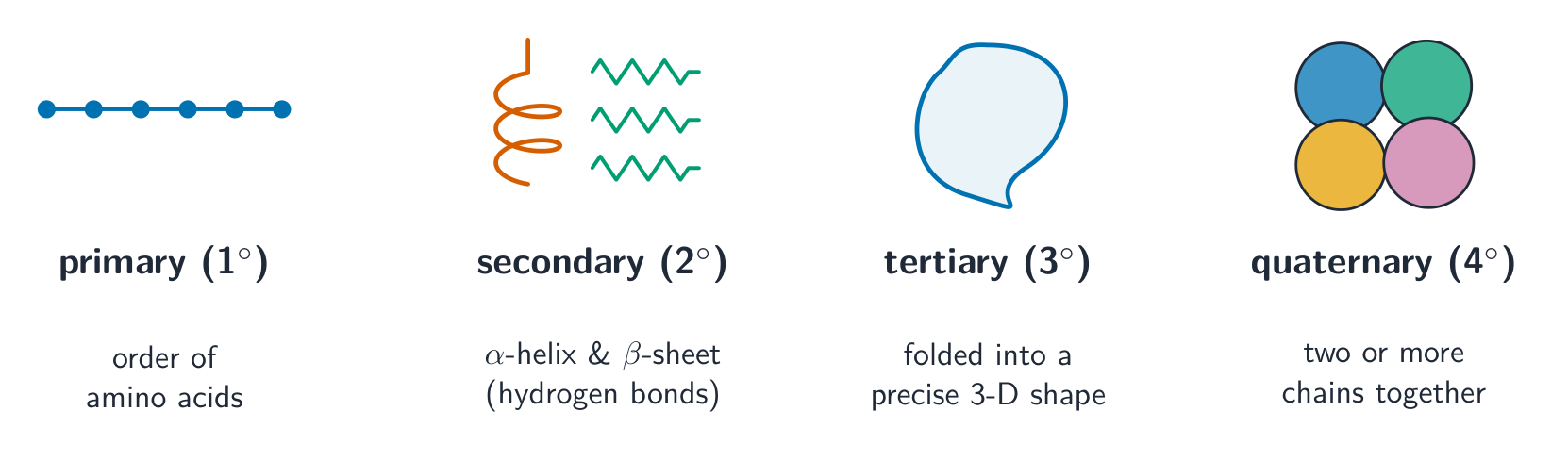
1.7.A.3 The specific sequence of amino acids in proteins determines the primary structure of a polypeptide as well as the overall shape of the protein.
Exclusion statement: The molecular structure of amino acids is beyond the scope of the AP Exam.
1.7.A.4 Secondary structures of proteins are made through the local folding that forms from interactions between atoms of the polypeptide backbone of the amino acid chain. Hydrogen bonding forms shapes such as alpha-helices and beta-pleated sheets.
1.7.A.5 The three-dimensional shape of the tertiary structure of a protein results from the formation of hydrogen bonds, hydrophobic interactions, ionic interactions, or disulfide bridges.
1.7.A.6 The quaternary structure arises from interactions between multiple polypeptides. All four levels of a protein structure determine the function of a protein.
Source: College Board AP Course and Exam Description · แหล่งที่มา: คำอธิบายหลักสูตรและข้อสอบ College Board AP
English
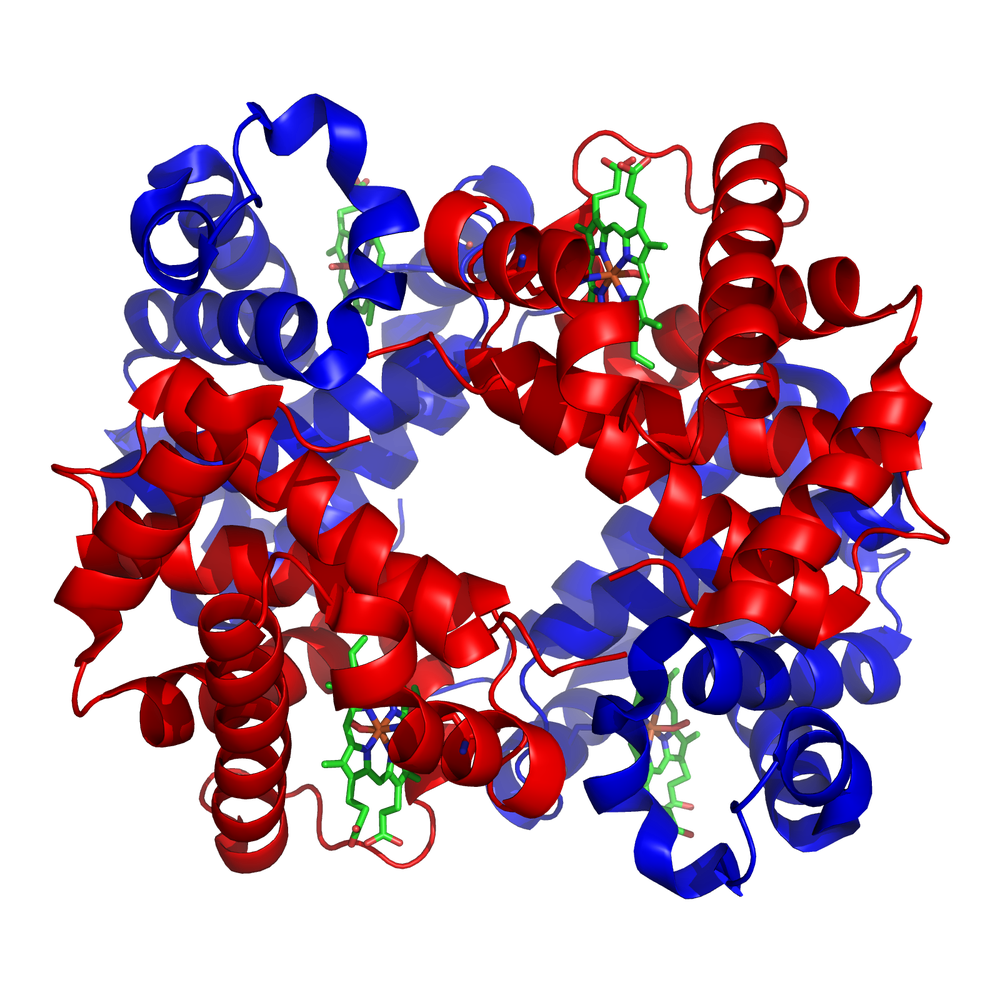
Proteins 蛋白质 are polymers of amino acids 氨基酸 joined by peptide bonds 肽键. Their sequence folds into a specific 3-D shape at four levels (primary, secondary, tertiary, quaternary), and shape determines function – as enzymes, transporters, receptors, and structural parts. Changing the environment (heat, pH) can denature 变性 a protein, unfolding it and stopping its function.
Worked example. Building a polymer from 10 monomers by dehydration synthesis forms 9 bonds and releases 9 water molecules — one per bond, so $N$ monomers release $N-1$ waters. Hydrolysis reverses this exactly: adding those 9 waters breaks the polymer back into 10 monomers. This is why biosynthesis (dehydration) and digestion (hydrolysis) are chemical opposites.
Organelles and the Endomembrane System · ออร์แกเนลล์และระบบเอนโดเมมเบรน
Syllabus · หลักสูตร
English
Big Idea 4 — Systems Interactions (SYI): Biological systems interact, and these systems and their interactions exhibit complex properties.
Learning Objective 2.1.A: Explain how the structure and function of subcellular components and organelles contribute to the function of cells.
2.1.A.1 Ribosomes are comprised of ribosomal RNA (rRNA) and protein. These non-membrane, subcellular structures are found in cells in all forms of life and reflect the common ancestry in all known life. Ribosomes synthesize proteins according to messenger RNA (mRNA) sequences.
2.1.A.2 The endomembrane system consists of a group of membrane-bound organelles and subcellular components (endoplasmic reticulum (ER), Golgi complex, lysosomes, vacuoles and transport vesicles, the nuclear envelope, and the plasma membrane) that work together to modify, package, and transport polysaccharides, lipids, and proteins intercellularly.
2.1.A.3 Endoplasmic reticulum provides mechanical support by helping cells maintain shape and plays a role in intracellular transport.
i. Rough ER is associated with membrane-bound ribosomes, allows for the compartmentalization of cells, and helps carry out protein synthesis.
ii. Smooth ER functions include the detoxification of cells and lipid synthesis.
Exclusion statement: Knowledge of the specific functions of smooth ER in specialized cells is beyond the scope of the AP Exam.
2.1.A.4 The Golgi complex is a membrane-bound structure that consists of a series of flattened membrane sacs. Functions of the Golgi include:
i. Correctly folding and chemically modifying newly synthesized cellular products
ii. Packaging proteins for trafficking
Exclusion statement: Knowledge of the role of Golgi in the synthesis of specific phospholipids and packaging of specific enzymes for lysosomes, peroxisomes, and secretory vesicles is beyond the scope of the AP Exam.
Illustrative examples for 2.1.A.4:
Glycosylation and other chemical modifications of proteins that take place within the Golgi and determine protein function or targeting
2.1.A.5 Mitochondria have a double membrane that provides compartments for different metabolic reactions involved in aerobic cellular respiration. The outer membrane is smooth, while the inner membrane is highly convoluted, forming folds that enable ATP to be synthesized more efficiently.
2.1.A.6 Lysosomes are membrane-enclosed sacs that contain hydrolytic enzymes that digest material. Lysosomes also play a role in programmed cell death (apoptosis).
2.1.A.7 Vacuoles are membrane-bound sacs that play many different roles.
i. In plant cells, a specialized large vacuole maintains turgor pressure through nutrient and water storage.
ii. In animal cells, vacuoles are smaller in size, are more plentiful than in plant cells, and store cellular materials.
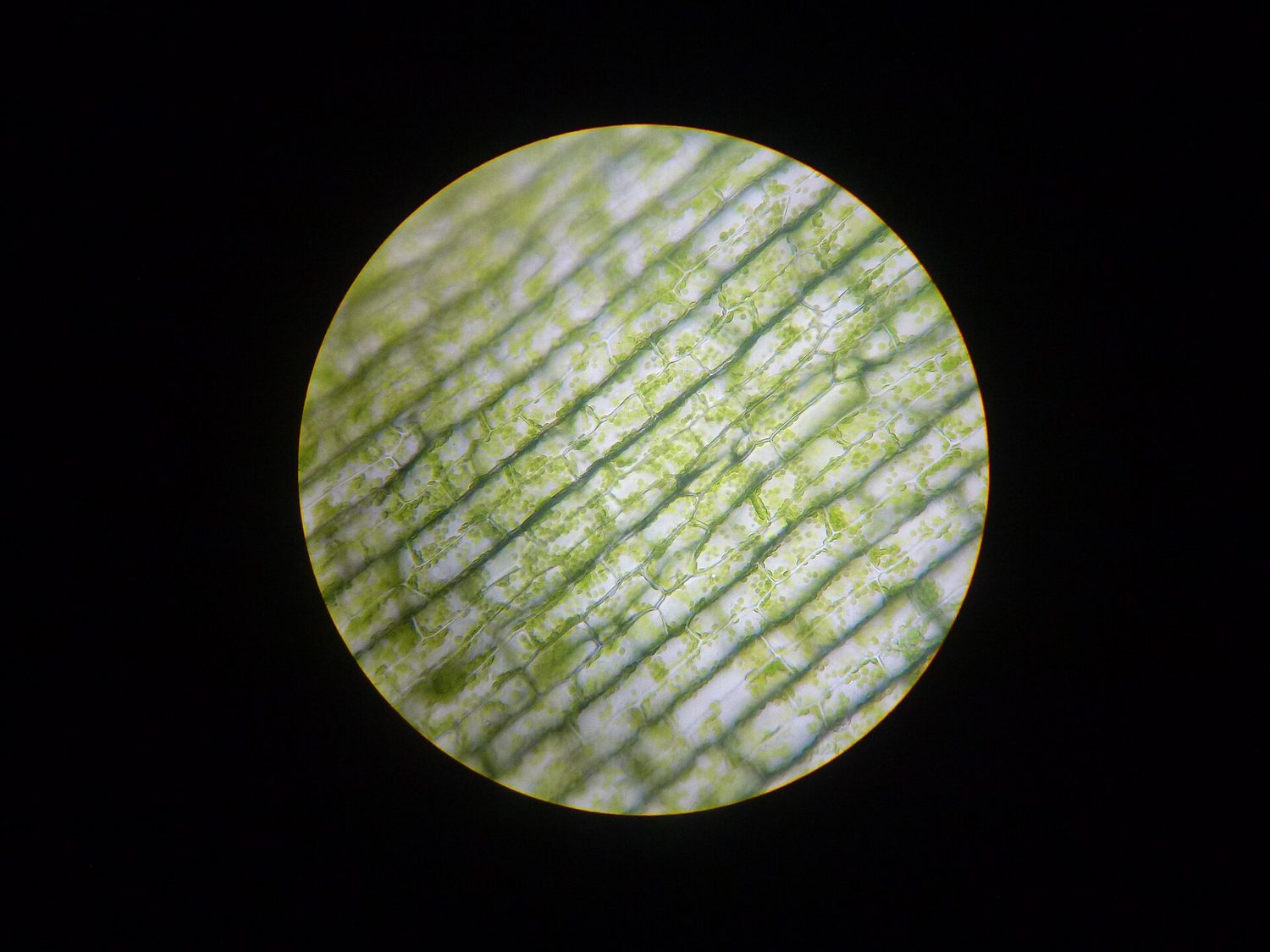
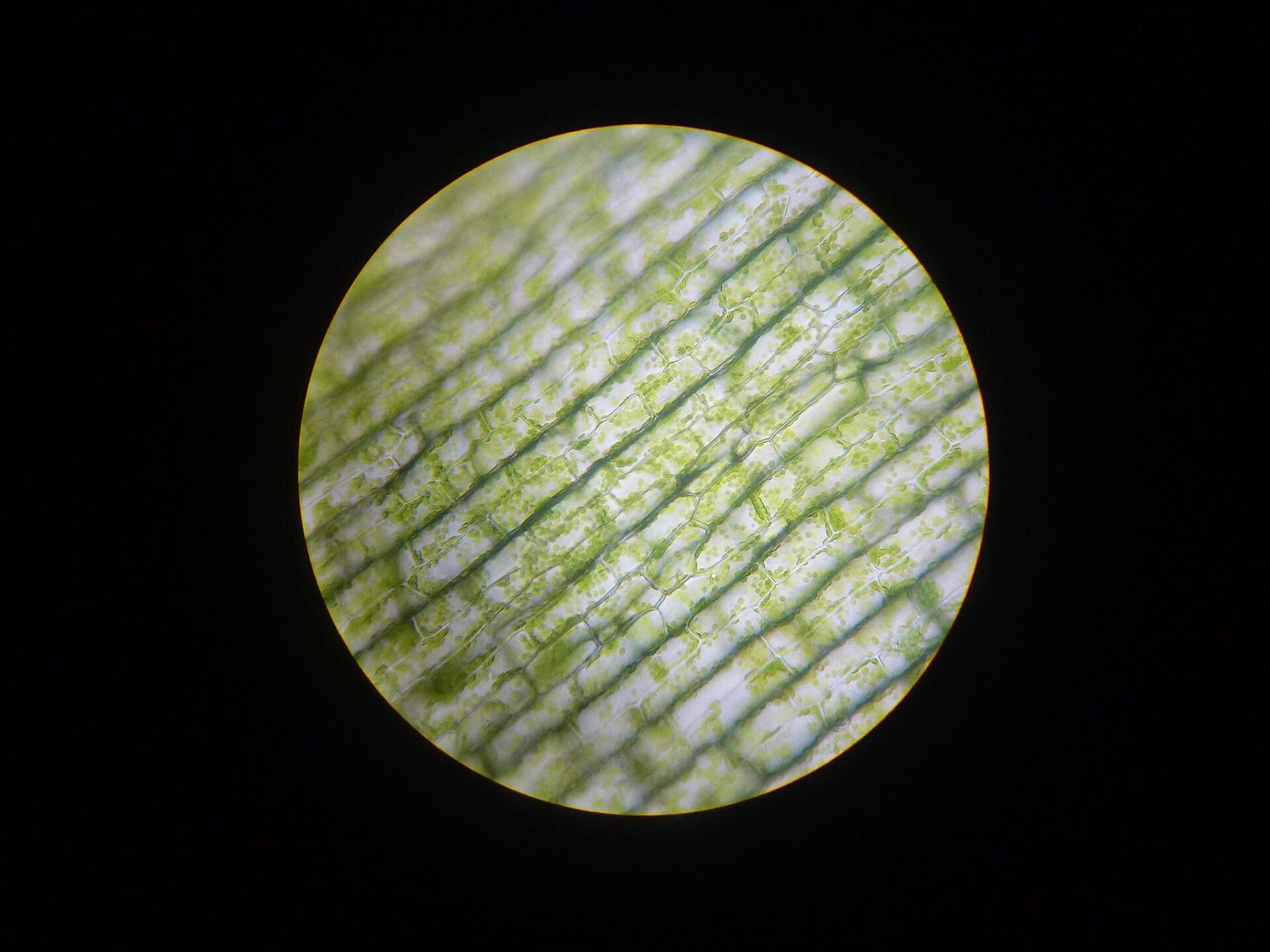
2.1.A.8 Chloroplasts are specialized organelles that are found in plants and photosynthetic algae. Chloroplasts contain a double membrane and serve as the location for photosynthesis.
Source: College Board AP Course and Exam Description · แหล่งที่มา: คำอธิบายหลักสูตรและข้อสอบ College Board AP
English
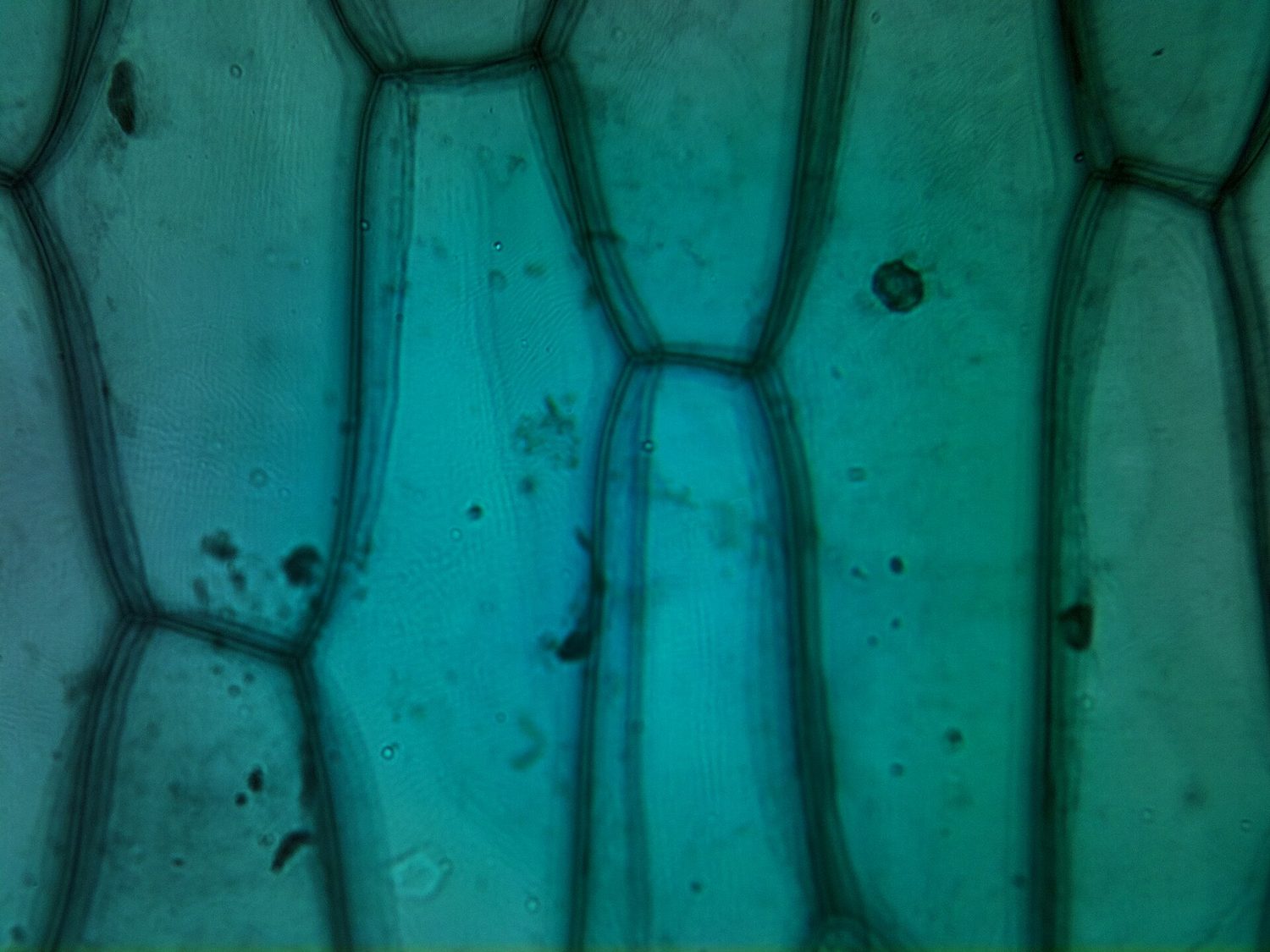
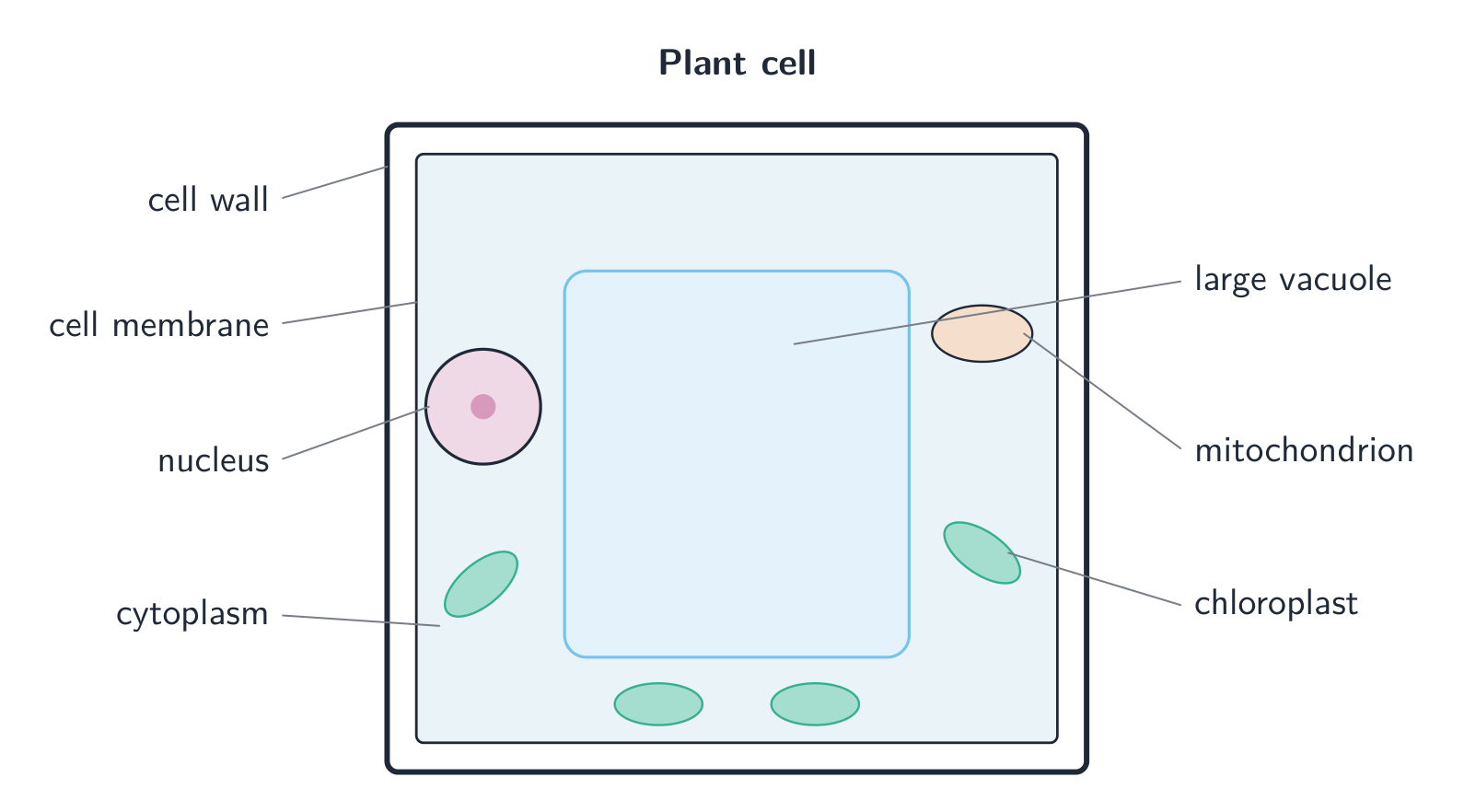
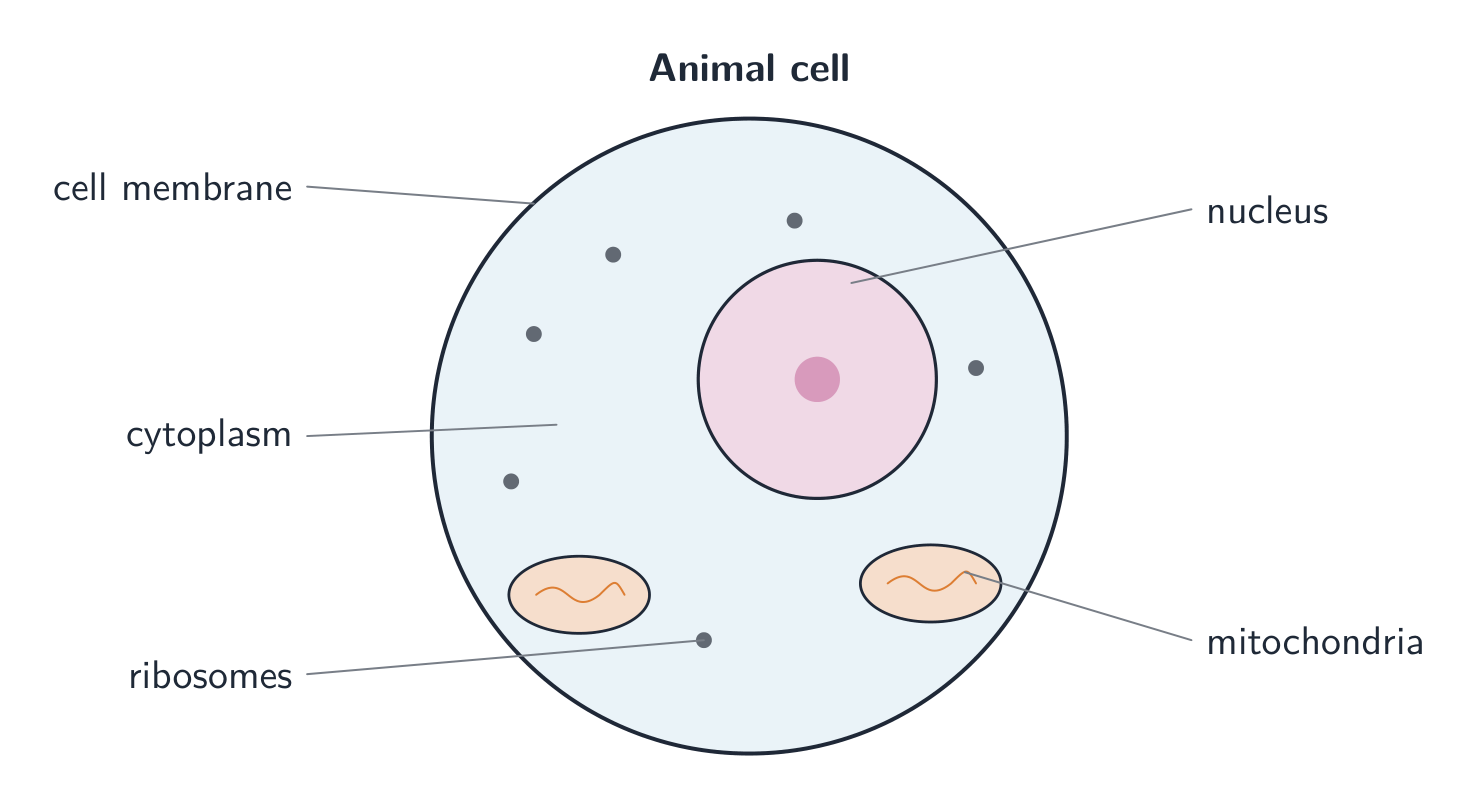
A eukaryotic cell divides its work among organelles 细胞器. The endomembrane system 内膜系统 is a connected set that makes, modifies, and ships molecules: the nucleus 细胞核 (holds DNA), rough and smooth endoplasmic reticulum 内质网 (protein and lipid synthesis), the Golgi 高尔基体 (modifies and packages), lysosomes 溶酶体 (digestion), and vesicles that carry material between them. Mitochondria 线粒体 (respiration) and chloroplasts 叶绿体 (photosynthesis) have their own membranes.
What each organelle actually does
The exam asks you to name a structure and say what it does, so learn them as pairs.
Ribosomes 核糖体 are made of ribosomal RNA 核糖体核糖核酸 (rRNA) and protein. They have no membrane, and they are found in every form of life — bacteria, archaea and eukaryotes alike. That shared presence is evidence of common ancestry: a structure this central was already present in the last common ancestor of all living things. A ribosome reads messenger RNA 信使核糖核酸 (mRNA) and builds the protein it codes for. Free ribosomes make proteins for use inside the cell; ribosomes bound to the rough endoplasmic reticulum make proteins for export or for the membrane.
The Golgi complex 高尔基复合体 is a series of flattened, membrane-bound sacs. A protein arriving from the endoplasmic reticulum is passed through them, and three things happen to it:
it is folded correctly and chemically modified — most often by glycosylation 糖基化, the attachment of short sugar chains;
it is sorted and targeted, so the modified sugar or phosphate tag decides which compartment the protein is sent to;
it is packaged into a vesicle for transport.
So the Golgi is not storage: it is the cell's finishing and dispatch department, and its modifications determine what a protein does and where it ends up.
Lysosomes are membrane-enclosed sacs of hydrolytic enzymes 水解酶 that digest material — worn-out organelles, engulfed bacteria, and food particles taken in by the cell. Their enzymes work best at a low pH, which the lysosome maintains inside itself; keeping them enclosed protects the rest of the cell. Lysosomes also take part in apoptosis 细胞凋亡, programmed cell death, in which a cell is dismantled deliberately, for example to sculpt fingers from a webbed embryonic hand.
Vacuoles 液泡 are membrane-bound sacs with many different roles: storing water, ions, nutrients or waste, and in a plant cell the large central vacuole also presses outwards on the cell wall to keep the cell firm.
Mitochondria and chloroplasts each have a double membrane and their own circular DNA and ribosomes — the evidence behind endosymbiotic theory below.
ไมโทคอนเดรีย และ คลอโรพลาสต์ แต่ละชนิดมี เยื่อหุ้มสองชั้น และมี DNA แบบวงกลมและไรโบโซมของตัวเอง — ซึ่งเป็นหลักฐานของทฤษฎีเอนโดซิมไบโอซิสด้านล่าง
2.2
Why Cells Stay Small · ทำไมเซลล์ต้องเล็ก
Syllabus · หลักสูตร
English
Big Idea 2 — Energetics (ENE): Biological systems use energy and molecular building blocks to grow, reproduce, and maintain dynamic homeostasis.
Learning Objective 2.2.A: Explain the effect of surface area-to-volume ratios on the exchange of materials between cells or organisms and the environment.
2.2.A.1 Surface area-to-volume ratios affect the ability of a biological system to obtain necessary nutrients, eliminate waste products, acquire or dissipate thermal energy, and otherwise exchange chemicals and energy with the environment.
Relevant equations:
Volume of a Sphere: $V = \dfrac{4}{3}\pi r^3$
Volume of a Cube: $V = s^3$
Volume of a Rectangular Solid: $V = lwh$
Volume of a Cylinder: $V = \pi r^2 h$
Surface Area of a Sphere: $SA = 4\pi r^2$
Surface Area of a Cube: $SA = 6s^2$
Surface Area of a Rectangular Solid: $SA = 2lh + 2lw + 2wh$
Surface Area of a Cylinder: $SA = 2\pi rh + 2\pi r^2$
$r$ = radius
$l$ = length
$h$ = height
$w$ = width
$s$ = length of one side of a cube
Illustrative examples for 2.2.A.1:
SA/V Ratios and Exchanges
Root hairs
Guard cells
Gut epithelial cells
Cilia
Stomata
2.2.A.2 The surface area of the plasma membrane must be large enough to adequately exchange materials.
i. The surface area-to-volume ratio can restrict cell size and shape. Smaller cells typically have a higher surface area-to-volume ratio as well as a more efficient exchange of materials with the environment than do larger cells.
ii. As cells increase in volume, the surface area-to-volume ratio decreases and the demand for internal resources increases.
iii. More complex cellular structures (e.g., membrane folds) are necessary to adequately exchange materials with the environment.
iv. As organisms increase in size, their surface area-to-volume ratio decreases, affecting properties like rate of heat exchange with the environment. Smaller amounts of mass exchange proportionally more heat with the ambient environment than do larger masses. As mass increases, both the surface area-to-volume ratio and the rate of heat exchange decrease.
v. There is a relationship between metabolic rate per unit body mass and the size of multicellular organisms; typically, the smaller the organism, the higher the metabolic rate per unit body mass.
i. อัตราส่วนพื้นที่ผิวต่อปริมาตรสามารถจำกัดขนาดและรูปร่างของเซลล์ได้ เซลล์ขนาดเล็กมักมีอัตราส่วนพื้นที่ผิวต่อปริมาตรที่สูงกว่า และมีการแลกเปลี่ยนสารกับสิ่งแวดล้อมที่มีประสิทธิภาพมากกว่าเซลล์ขนาดใหญ่
ii. เมื่อเซลล์มีปริมาตรเพิ่มขึ้น อัตราส่วนพื้นที่ผิวต่อปริมาตรจะลดลงและความต้องการทรัพยากรภายในเซลล์จะเพิ่มขึ้น
iii. โครงสร้างเซลล์ที่ซับซ้อนขึ้น (เช่น การพับของเยื่อหุ้ม) จำเป็นสำหรับการแลกเปลี่ยนวัสดุกับสิ่งแวดล้อมได้อย่างเพียงพอ
iv. เมื่อสิ่งมีชีวิตมีขนาดเพิ่มขึ้น อัตราส่วนพื้นที่ผิวต่อปริมาตรจะลดลง ส่งผลต่อคุณสมบัติต่างๆ เช่น อัตราการแลกเปลี่ยนความร้อนกับสิ่งแวดล้อม ปริมาณมวลขนาดเล็กจะแลกเปลี่ยนความร้อนกับสิ่งแวดล้อมรอบข้างในสัดส่วนที่มากกว่าปริมาณมวลขนาดใหญ่ เมื่อมวลเพิ่มขึ้น ทั้งอัตราส่วนพื้นที่ผิวต่อปริมาตรและอัตราการแลกเปลี่ยนความร้อนจะลดลง
v. มีความสัมพันธ์ระหว่างอัตราการเผาผลาญต่อหน่วยมวลร่างกายกับขนาดของสิ่งมีชีวิตมัลติเซลล์ โดยทั่วไป สิ่งมีชีวิตที่มีขนาดเล็กกว่าจะมีอัตราการเผาผลาญต่อหน่วยมวลร่างกายที่สูงกว่า
Source: College Board AP Course and Exam Description · แหล่งที่มา: คำอธิบายหลักสูตรและข้อสอบ College Board AP
English
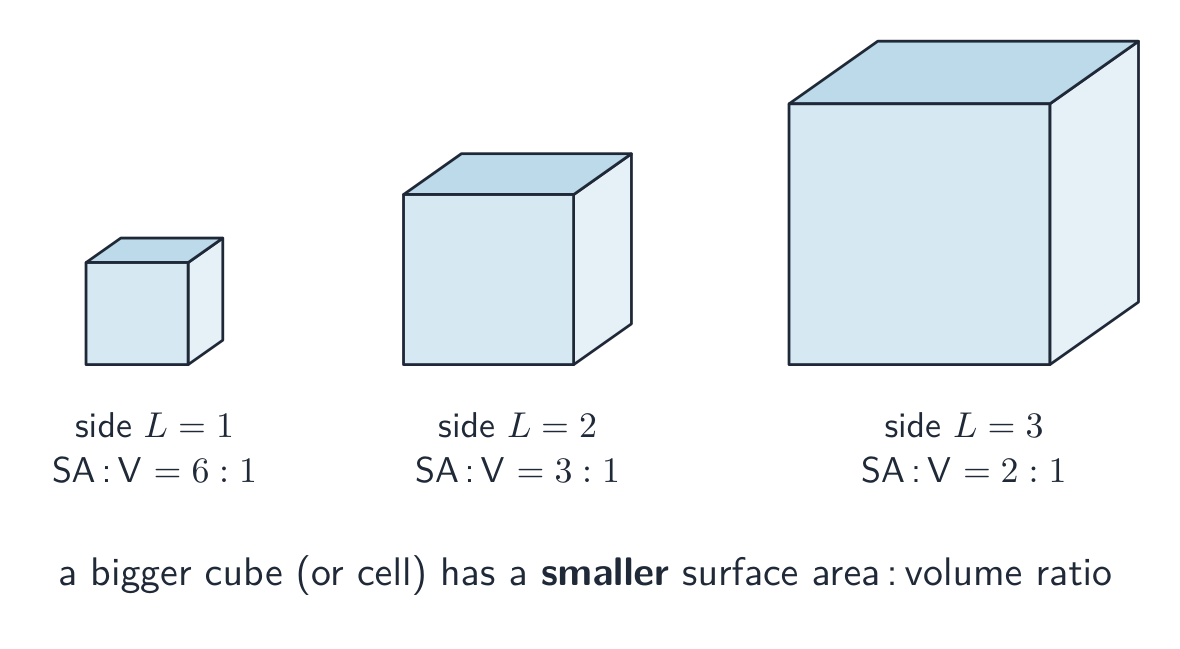
Cells stay small because of the surface-area-to-volume ratio 表面积与体积比. As a cell grows, its volume rises faster than its surface area, so its membrane cannot exchange materials fast enough for the interior. Staying small (or being flat or folded) keeps enough surface to serve the volume.
Worked example. A cube-shaped cell $2\ \mu\text{m}$ on a side has surface area $6\times2^2=24\ \mu\text{m}^2$ and volume $2^3=8\ \mu\text{m}^3$, so its surface-area-to-volume ratio is $\tfrac{24}{8}=3$. Double the side to $4\ \mu\text{m}$: surface area $=6\times4^2=96$, volume $=4^3=64$, ratio $=\tfrac{96}{64}=1.5$. Doubling the size halved the ratio – the larger cell has far less membrane per unit of interior, which is why cells stay small.
See surface area vs volume as a cube grows · 观察立方体生长时的表面积与体积比
As a cell grows, volume rises faster than surface area, so the surface-area-to-volume ratio falls. A small cell keeps enough membrane to exchange materials fast enough. · 随着细胞生长,体积的增长速度快于表面积,因此表面积与体积之比下降。小细胞保持足够的膜以快速交换物质。
2.3
The Fluid Mosaic Model of the Membrane · โมเดลโมเสกเหลวของเยื่อหุ้มเซลล์
Syllabus · หลักสูตร
English
Big Idea 2 — Energetics (ENE): Biological systems use energy and molecular building blocks to grow, reproduce, and maintain dynamic homeostasis.
Learning Objective 2.3.A: Describe the roles of each of the components of the cell membrane in maintaining the internal environment of the cell.
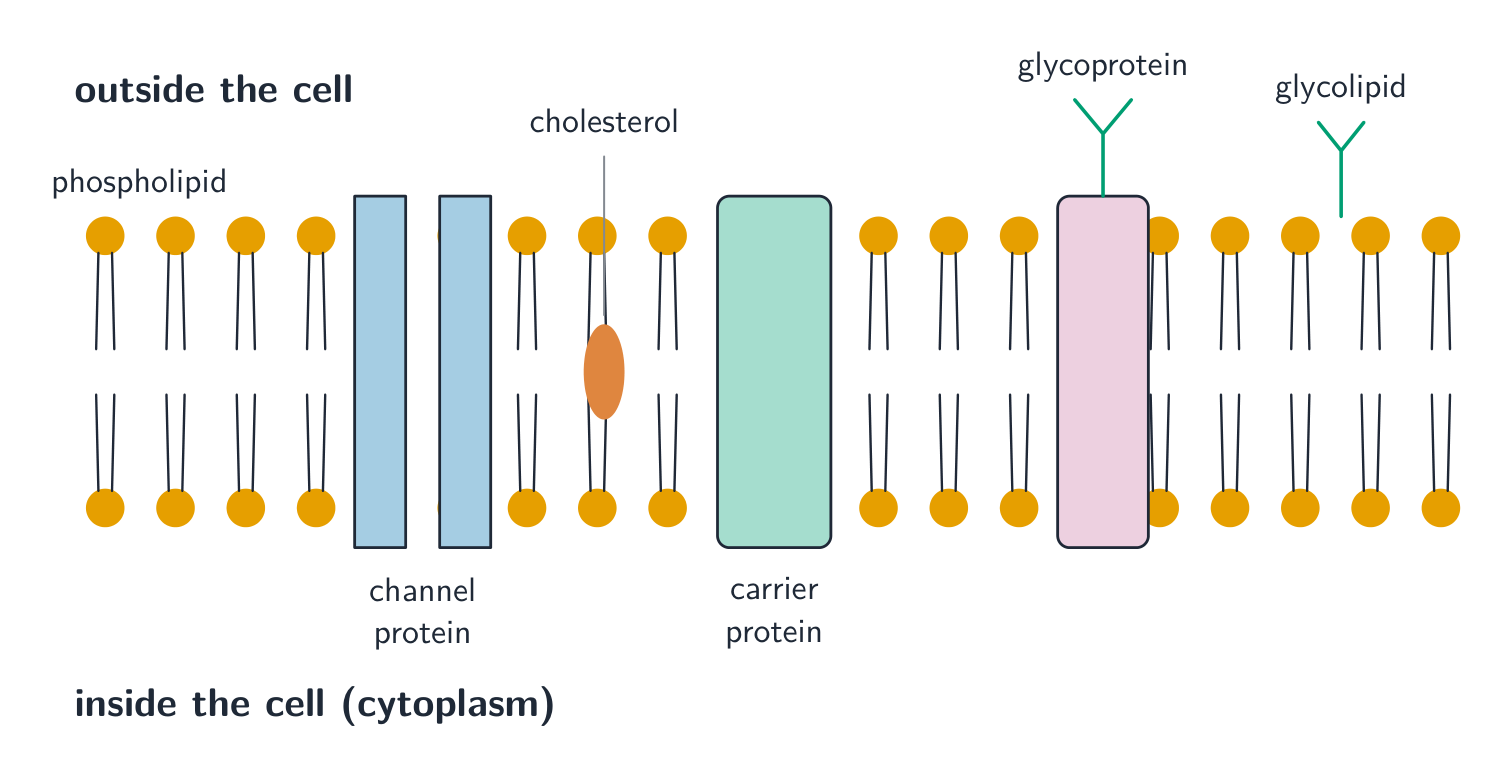
2.3.A.1 Phospholipids have both hydrophilic and hydrophobic regions. The polar hydrophilic phosphate regions of the phospholipids are oriented toward the aqueous external or internal environment, while the nonpolar hydrophobic fatty acid regions face each other within the interior of the membrane.
2.3.A.2 Embedded proteins can be hydrophilic (with charged and polar side groups), hydrophobic (with nonpolar side groups), or both.
i. Hydrophilic regions of the proteins are either inside the interior of the protein or exposed to the cytosol (cytoplasm).
ii. Hydrophobic regions of proteins make up the protein surface that interacts with the fatty acids in the interior membrane.
Learning Objective 2.3.B: Describe the fluid mosaic model of cell membranes.
2.3.B.1 Plasma membranes consist of a structural framework of phospholipid molecules embedded with proteins, steroids (such as cholesterol in vertebrate animals), glycoproteins, and glycolipids. All of these can move around the surface of the cell within the membrane, as illustrated by the fluid mosaic model.
Source: College Board AP Course and Exam Description · แหล่งที่มา: คำอธิบายหลักสูตรและข้อสอบ College Board AP
English
The cell membrane is a phospholipid bilayer 磷脂双分子层 – polar heads facing the water, nonpolar tails inside – studded with proteins. The fluid mosaic model 流动镶嵌模型 pictures it as a fluid sheet in which lipids and proteins drift. Cholesterol and the degree of unsaturation tune its fluidity.
What Can Cross the Membrane · สิ่งที่สามารถผ่านเยื่อหุ้มได้
Syllabus · หลักสูตร
English
Big Idea 2 — Energetics (ENE): Biological systems use energy and molecular building blocks to grow, reproduce, and maintain dynamic homeostasis.
Learning Objective 2.4.A: Explain how the structure of biological membranes influences selective permeability.
2.4.A.1 Plasma membranes separate the internal environment of the cell from the external environment. Selective permeability is the result of the plasma membrane having a hydrophobic interior.
2.4.A.2 Small nonpolar molecules, including $\mathrm{N_2}$, $\mathrm{O_2}$, and $\mathrm{CO_2}$, freely pass across the membrane. Hydrophilic substances, such as large polar molecules and ions, move across the membrane through embedded channels and transport proteins.
2.4.A.3 The nonpolar hydrocarbon tails of phospholipids prevent the movement of ions and polar molecules across the membrane. Small polar, uncharged molecules, like $\mathrm{H_2O}$ or $\mathrm{NH_3}$ (ammonia), pass through the membrane in small amounts.
Learning Objective 2.4.B: Describe the role of the cell wall in maintaining cell structure and function.
2.4.B.1 Cell walls of Bacteria, Archaea, Fungi, and plants provide a structural boundary as well as a permeability barrier for some substances to the internal or external cellular environments and protection from osmotic lysis.
2.4.B.1 ผนังเซลล์ของแบคทีเรีย, อาร์คีอา, เชื้อรา และพืช ทำหน้าที่เป็นขอบเขตเชิงโครงสร้างและเป็นตัวกั้นการผ่านของบางสารเข้าสู่หรือออกจากสภาพแวดล้อมภายในหรือภายนอกเซลล์ รวมถึงปกป้องจากการแตก due to osmotic lysis
Source: College Board AP Course and Exam Description · แหล่งที่มา: คำอธิบายหลักสูตรและข้อสอบ College Board AP
English
The membrane is selectively permeable 选择透过性. Small nonpolar molecules ($\text{O}_2$, $\text{CO}_2$) and water cross easily; large or charged/polar particles (ions, glucose) cannot pass the nonpolar core without help. This selectivity lets the cell control its internal environment.
Passive and Active Transport · การลำเลียงแบบพาสซีฟและแอคทีฟ
Syllabus · หลักสูตร
English
Big Idea 2 — Energetics (ENE): Biological systems use energy and molecular building blocks to grow, reproduce, and maintain dynamic homeostasis.
Learning Objective 2.5.A: Describe the mechanisms that organisms use to maintain solute and water balance.
2.5.A.1 The selective permeability of membranes allows for the formation of concentration gradients of solutes across the membrane.
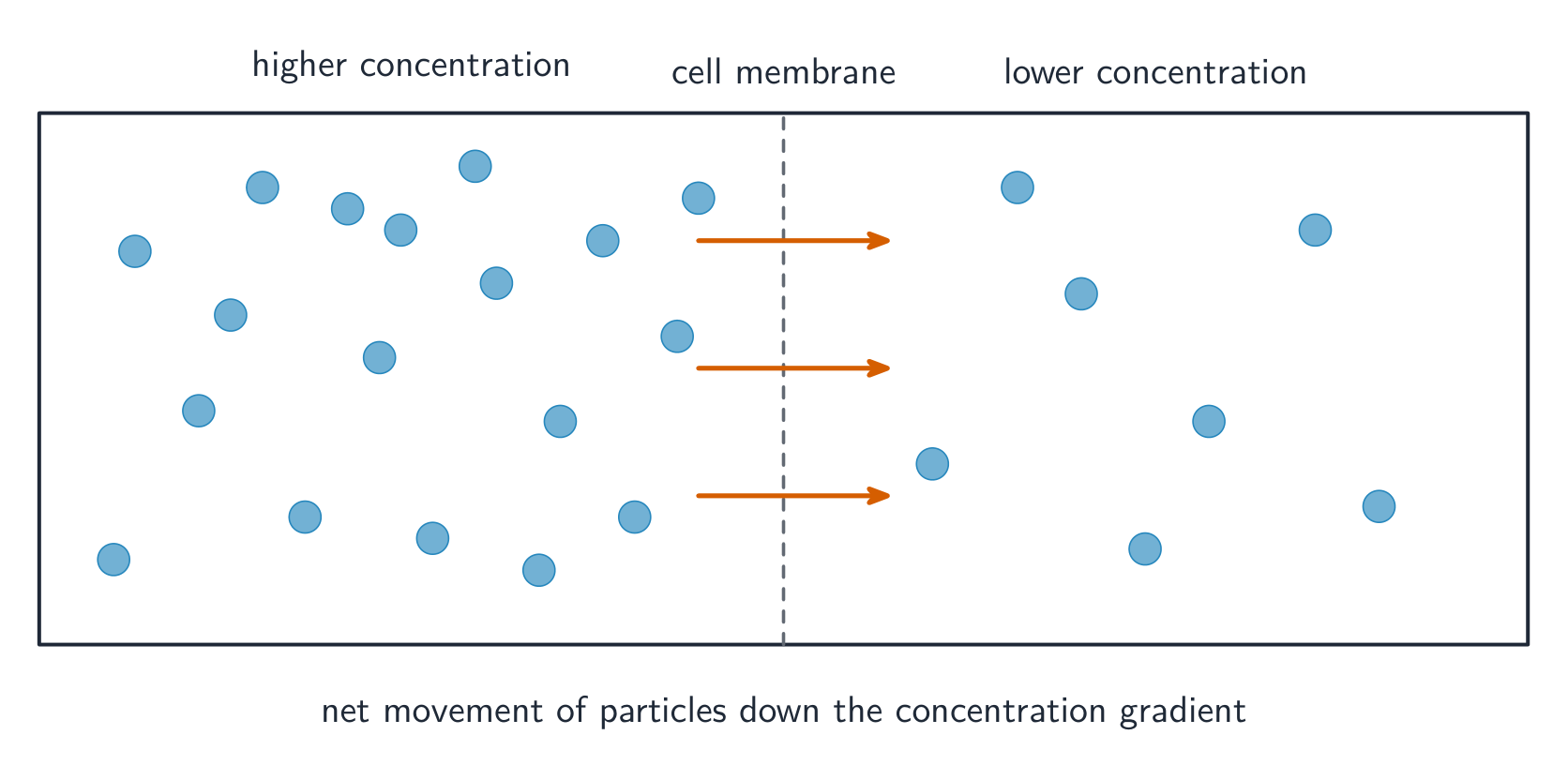
2.5.A.2 Passive transport is the net movement of molecules from regions of high concentration to regions of low concentration without the direct input of metabolic energy.
2.5.A.3 Active transport requires the direct input of energy to move molecules. In some cases, active transport is utilized to move molecules from regions of low concentration to regions of high concentration.
Learning Objective 2.5.B: Describe the mechanisms that organisms use to transport large molecules across the plasma membrane.
2.5.B.1 The processes of endocytosis and exocytosis require energy to move large substances or large amounts of substances into and out of cells.
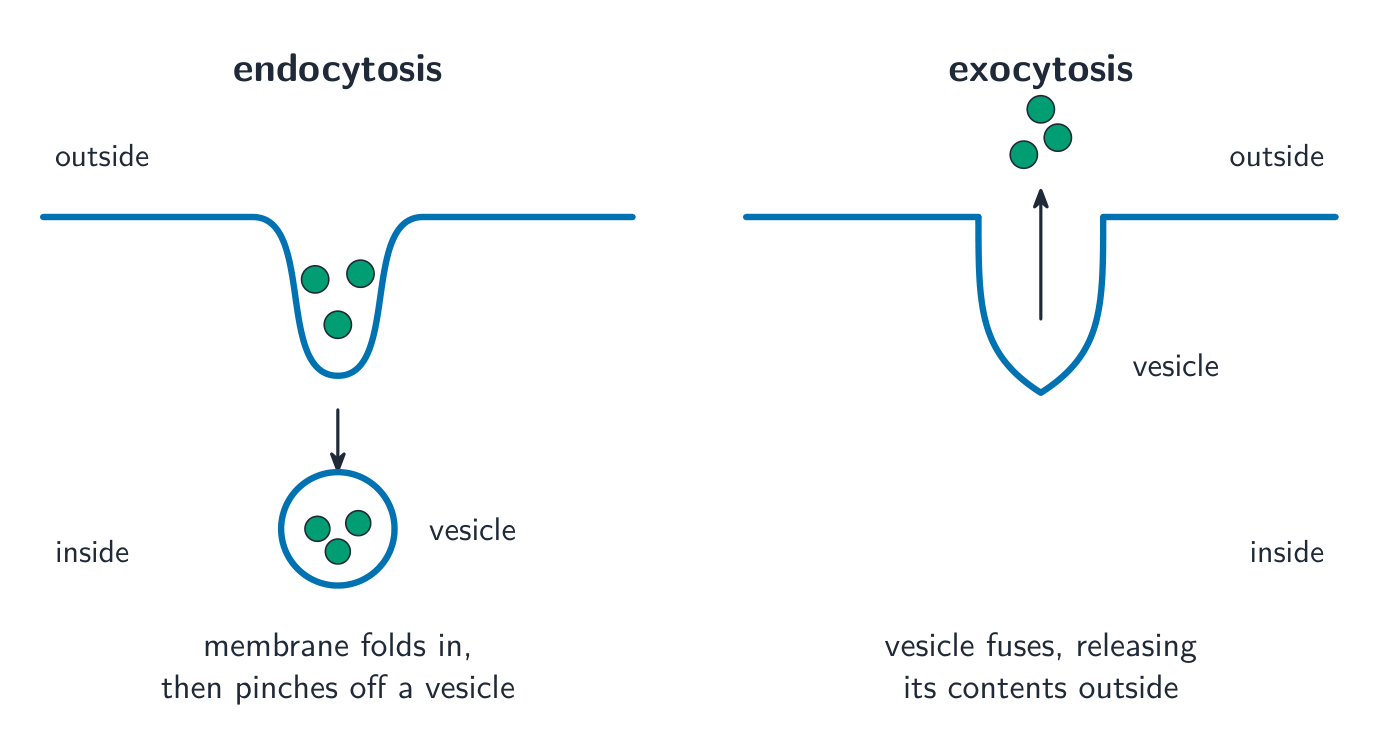
i. In endocytosis, the cell takes in large molecules and particulate matter by folding the plasma membrane in on itself and forming new (small) vesicles that engulf material from the external environment.
ii. In exocytosis, internal vesicles release material from cells by fusing with the plasma membrane and secreting large molecules from the cell.
i. ในเอนโดไซโทซิส เซลล์จะดูดซับโมเลกุลขนาดใหญ่และอนุภาคโดยการพับเยื่อหุ้มเซลล์เข้าไปในตัวเองและสร้างเวสิเคิลใหม่ (ขนาดเล็ก) ที่ห่อหุ้มวัสดุนั้นจากสภาพแวดล้อมภายนอก
ii. ในเอกซোไซโทซิส เวสิเคิลภายในจะปล่อยสารออกจากเซลล์โดยการหลอมรวมกับเยื่อหุ้มเซลล์และหลั่งโมเลกุลขนาดใหญ่ออกจากเซลล์
Source: College Board AP Course and Exam Description · แหล่งที่มา: คำอธิบายหลักสูตรและข้อสอบ College Board AP
English
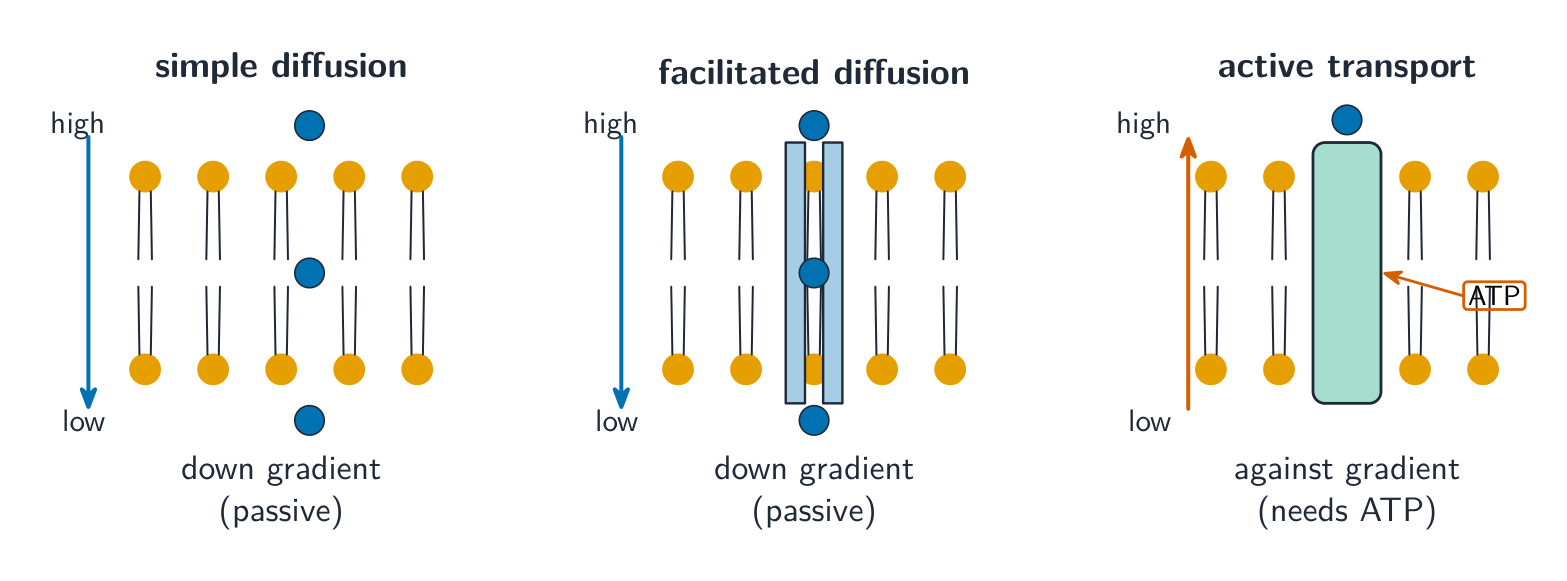
Passive transport 被动运输 moves substances down their concentration gradient (high → low) with no energy – diffusion 扩散.
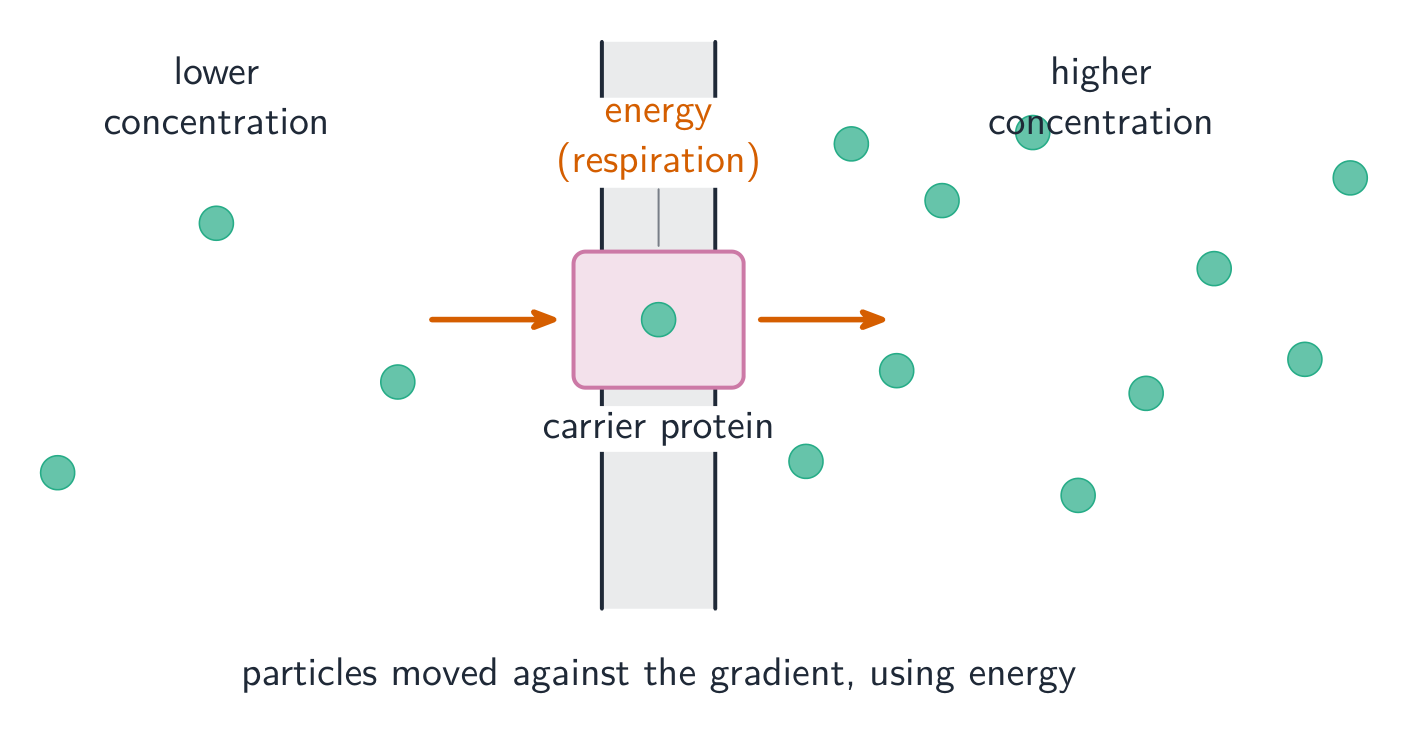
Active transport 主动运输 moves substances against the gradient (low → high), requiring energy (ATP), via protein pumps like the sodium–potassium pump.
การลำเลียงแบบแอคทีฟเคลื่อนย้ายอนุภาคสวนกับความแตกต่างของความเข้มข้น โดยใช้ ATP และโปรตีนพาหนะ
Explore · สำรวจ
Pump a solute against its gradient · 逆浓度梯度泵送溶质
Passive transport moves solutes down their gradient for free; active transport uses ATP to pump them the other way, from low to high concentration. · 被动运输顺着浓度梯度自由移动溶质;主动运输利用ATP将它们从低浓度向高浓度反向泵送。
Big Idea 2 — Energetics (ENE): Biological systems use energy and molecular building blocks to grow, reproduce, and maintain dynamic homeostasis.
Learning Objective 2.6.A: Explain how the structure of a molecule affects its ability to pass through the plasma membrane.
2.6.A.1 Facilitated diffusion requires transport or channel proteins to enable the movement of charged ions across the membrane.
i. Membranes may become polarized by the movement of ions across the membrane.
ii. Charged ions, including $\mathrm{Na^+}$ (sodium) and $\mathrm{K^+}$ (potassium), require channel proteins to move through the membrane.
2.6.A.2 Facilitated diffusion enables the movement of large polar molecules through membranes with no energy input. In this type of diffusion, substances move down the concentration gradient.
2.6.A.3 Aquaporins transport large quantities of water across membranes.
Source: College Board AP Course and Exam Description · แหล่งที่มา: คำอธิบายหลักสูตรและข้อสอบ College Board AP
English
Facilitated diffusion 易化扩散 is passive transport through a membrane protein – a channel or carrier 载体 – for particles that cannot cross the lipid alone. It still goes down the gradient and needs no energy, but its rate can saturate when all the proteins are busy.
Tonicity, Water Potential, and Osmoregulation · ความดันออสโมติก, ศักยภาพน้ำ และการควบคุมสมดุลน้ำ
Syllabus · หลักสูตร
English
Big Idea 2 — Energetics (ENE): Biological systems use energy and molecular building blocks to grow, reproduce, and maintain dynamic homeostasis.
Learning Objective 2.7.A: Explain how concentration gradients affect the movement of molecules across membranes.
2.7.A.1 External environments can be hypotonic, hypertonic, or isotonic to internal environments of cells. Movement of water can also be described as moving from hypotonic to hypertonic regions. Water moves by osmosis from regions of high water potential to regions of low water potential.
Learning Objective 2.7.B: Explain how osmoregulatory mechanisms contribute to the health and survival of organisms.
2.7.B.1 Growth and homeostasis are maintained by the constant movement of molecules across membranes.
2.7.B.2 Osmoregulation maintains water balance and allows organisms to control their internal solute composition and water potential. Water moves from regions of low osmolarity or solute concentration to regions of high osmolarity or solute concentration.
Equation (Solute Potential of a Solution):$\psi_s = -iCRT$
Source: College Board AP Course and Exam Description · แหล่งที่มา: คำอธิบายหลักสูตรและข้อสอบ College Board AP
English
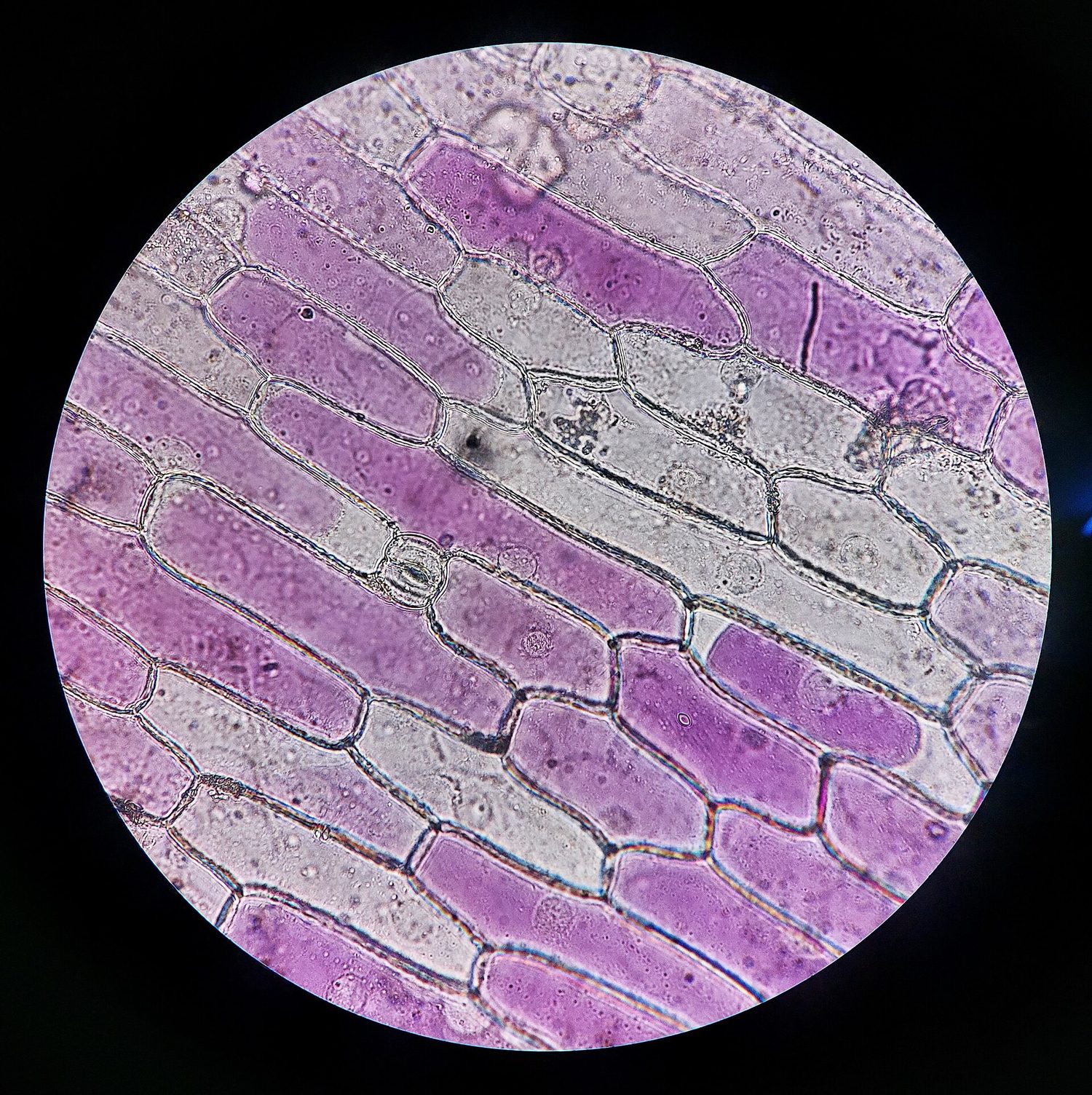
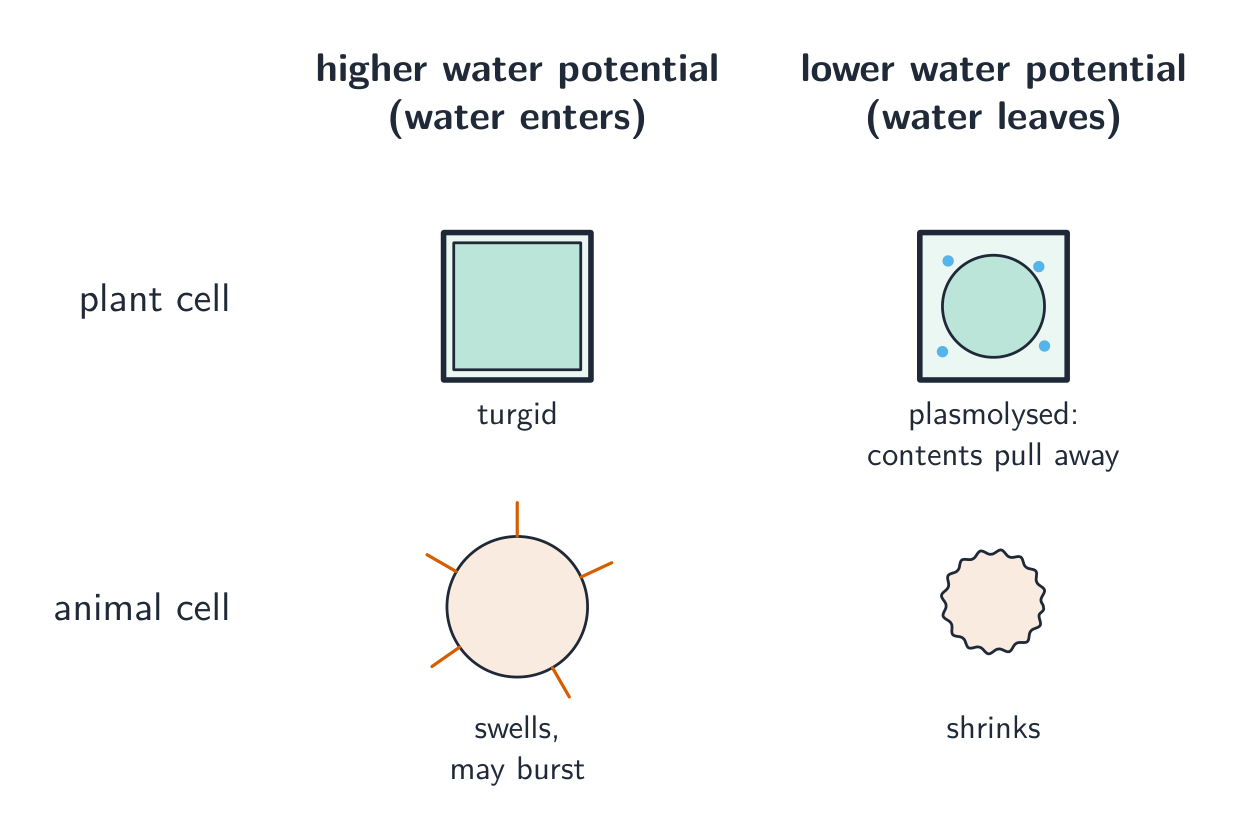
Osmosis 渗透 is the diffusion of water across a membrane. Tonicity 张力 compares solute concentrations: in a hypotonic 低渗 solution a cell gains water (may burst); in a hypertonic 高渗 one it loses water (shrinks); in an isotonic 等渗 one there is no net change. Water potential 水势 predicts the direction of water movement (water moves to lower water potential), and is the sum of a pressure term and a solute term: $\Psi=\Psi_p+\Psi_s$, where the solute potential $\Psi_s=-iCRT$. Osmoregulation 渗透调节 is how organisms control this balance.
Worked example. For a $0.1\,\text{M}$ sucrose solution ($i=1$) in an open beaker (so pressure potential $\Psi_p=0$) at $25\,°\text{C}$ ($T=298\,\text{K}$, $R=0.0831\ \text{L}\cdot\text{bar/mol}\cdot\text{K}$): $\Psi_s=-iCRT=-(1)(0.1)(0.0831)(298)\approx-2.48\ \text{bar}$, so $\Psi\approx-2.48\ \text{bar}$. A plant cell whose interior is $\Psi=-1.0\ \text{bar}$ sits in this solution: since the solution is more negative, water moves out of the cell into the solution, and the cell loses turgor.
Water moves across the membrane from high water potential to low, toward the more concentrated (hypertonic) side. Set the concentrations and watch which way the cell swells or shrinks. · 水穿过膜从高水势流向低处,朝向更浓(高渗)的一侧。设置浓度并观察细胞膨胀还是收缩的方向。
Mechanisms of Membrane Transport · กลไกการขนส่งผ่านเยื่อหุ้มเซลล์
Syllabus · หลักสูตร
English
Big Idea 2 — Energetics (ENE): Biological systems use energy and molecular building blocks to grow, reproduce, and maintain dynamic homeostasis.
Learning Objective 2.8.A: Describe the processes that allow ions and other molecules to move across membranes.
2.8.A.1 Metabolic energy (such as that from ATP) is required for active transport of molecules across the membrane and to establish and maintain electrochemical gradients.
i. Membrane proteins are necessary for active transport.
ii. The $\mathrm{Na^+}/\mathrm{K^+}$ pump and ATPase contribute to the maintenance of the membrane potential.
i. โปรตีนเยื่อหุ้มเซลล์จำเป็นสำหรับการขนส่งแบบใช้พลังงาน
ii. ปั๊ม $\mathrm{Na^+}/\mathrm{K^+}$ และ ATPase มีส่วนร่วมในการรักษากระแสไฟฟ้าของเยื่อหุ้มเซลล์
Source: College Board AP Course and Exam Description · แหล่งที่มา: คำอธิบายหลักสูตรและข้อสอบ College Board AP
English
Large materials move in bulk by vesicles: endocytosis 内吞 brings material in (the membrane engulfs it), and exocytosis 外排 sends material out (a vesicle fuses with the membrane). Both require energy and let cells import and secrete large molecules.
Compartmentalization Inside the Cell · การจัดแบ่งพื้นที่ภายในเซลล์
Syllabus · หลักสูตร
English
Big Idea 2 — Energetics (ENE): Biological systems use energy and molecular building blocks to grow, reproduce, and maintain dynamic homeostasis.
Learning Objective 2.9.A: Describe the membrane-bound structures of the eukaryotic cell.
2.9.A.1 Membranes and membrane-bound organelles in eukaryotic cells compartmentalize intracellular metabolic processes and specific enzymatic reactions.
Learning Objective 2.9.B: Explain how internal membranes and membrane-bound organelles contribute to compartmentalization of eukaryotic cell functions.
2.9.B.1 Internal membranes facilitate cellular processes by minimizing competing interactions and by increasing the surface area where reactions can occur.
Source: College Board AP Course and Exam Description · แหล่งที่มา: คำอธิบายหลักสูตรและข้อสอบ College Board AP
English
Membranes create separate compartments 区室 so incompatible reactions can run at once and conditions (pH, ion levels) can be tuned locally. This organization boosts efficiency – the internal membranes also add surface area for reactions.
Source: College Board AP Course and Exam Description · แหล่งที่มา: คำอธิบายหลักสูตรและข้อสอบ College Board AP
English
The endosymbiotic theory 内共生学说 explains mitochondria and chloroplasts: they arose when a larger cell engulfed free-living prokaryotes that then lived inside it. The evidence – their own circular DNA, their own ribosomes, and double membranes – supports this shared evolutionary origin.
Enzymes as Biological Catalysts · เอนไซม์ในฐานะตัวเร่งปฏิกิริยาชีวภาพ
Syllabus · หลักสูตร
English
Big Idea 2 — Energetics: Biological systems use energy and molecular building blocks to grow, reproduce, and maintain dynamic homeostasis.
Learning Objective 3.1.A: Explain how enzymes affect the rate of biological reactions.
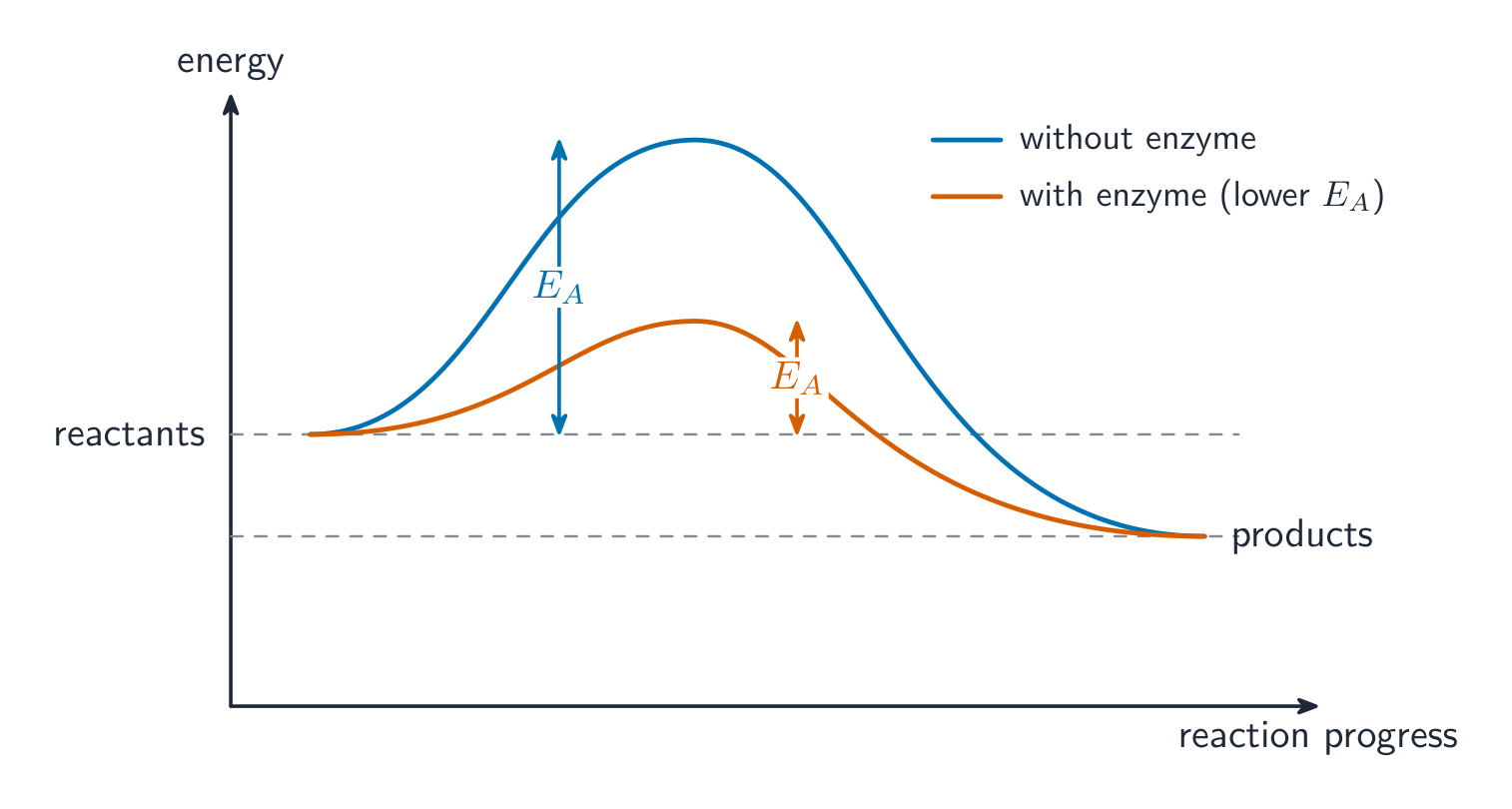
3.1.A.1 The structure and function of enzymes contribute to the regulation of biological processes. Enzymes are proteins that are biological catalysts that facilitate chemical reactions in cells by lowering the activation energy.
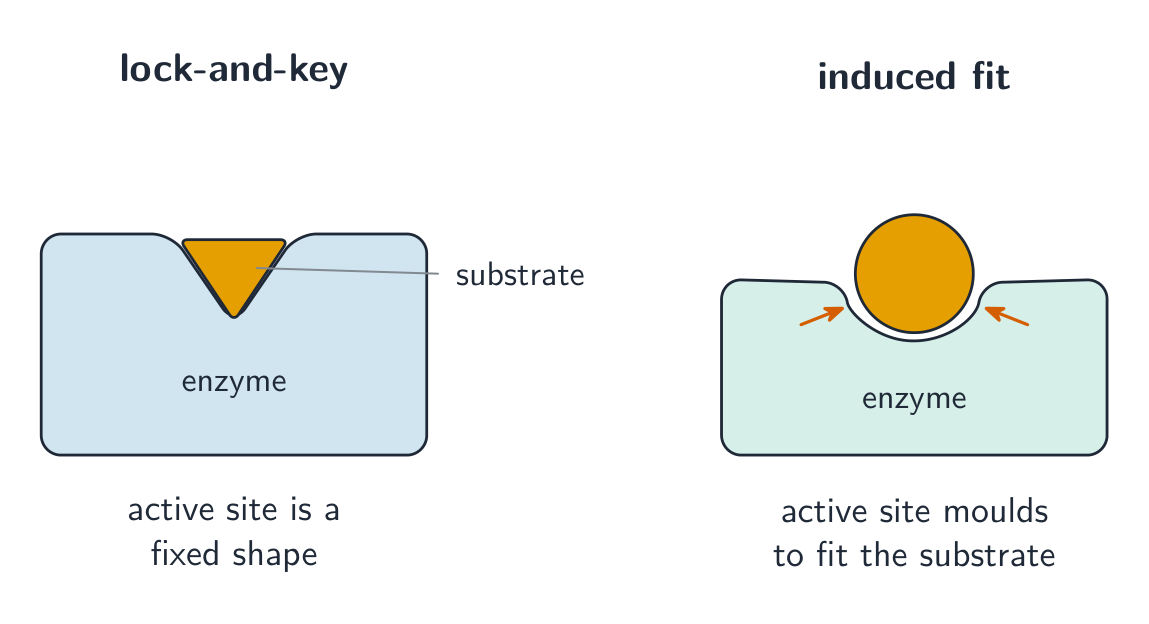
3.1.A.2 For an enzyme-mediated chemical reaction to occur, the shape and charge of the substrate must be compatible with the active site of the enzyme. This is illustrated by the enzyme-substrate complex model.
Source: College Board AP Course and Exam Description · แหล่งที่มา: คำอธิบายหลักสูตรและข้อสอบ College Board AP
English
An enzyme 酶 is a protein catalyst 催化剂 that speeds a reaction by lowering its activation energy 活化能, without being used up. Each enzyme has an active site 活性位点 that binds a specific substrate 底物 (the "lock and key" or induced fit), so enzymes are highly specific. They do not change whether a reaction is favorable – only how fast it goes.
เอนไซม์ (enzyme) เป็นโปรตีน ตัวเร่งปฏิกิริยา (catalyst) ที่เร่งปฏิกิริยาโดยการลด พลังงานกระตุ้น (activation energy) โดยไม่ถูกบริโภค Each enzyme มี ตำแหน่ง نشง (active site) ที่จับกับ สารตั้งต้น (substrate) เฉพาะ (แบบ "ลูกกุญแจ-รูล็อก" หรือ induced fit) ทำให้เอนไซม์มีความจำเพาะสูง They does not change whether a reaction is favorable – only how fast it goes.
Raise substrate and watch the rate saturate · 提高底物浓度并观察反应速率达到饱和
An enzyme speeds a reaction by lowering activation energy. As substrate rises the rate climbs, then levels off once every active site is busy (saturation). · 酶通过降低活化能加速反应。随着底物增加,速率上升,直到所有活性位点都被占用(饱和)后趋于平稳。
Environmental Impacts on Enzyme Function · ผลกระทบของสิ่งแวดล้อมต่อการทำงานของเอนไซม์
Syllabus · หลักสูตร
English
Big Idea 2 — Energetics: Biological systems use energy and molecular building blocks to grow, reproduce, and maintain dynamic homeostasis.
Learning Objective 3.2.A: Explain how changes to the structure of an enzyme may affect its function.
3.2.A.1 Change to the molecular structure of a component in an enzymatic system may result in a change to its function or efficiency.
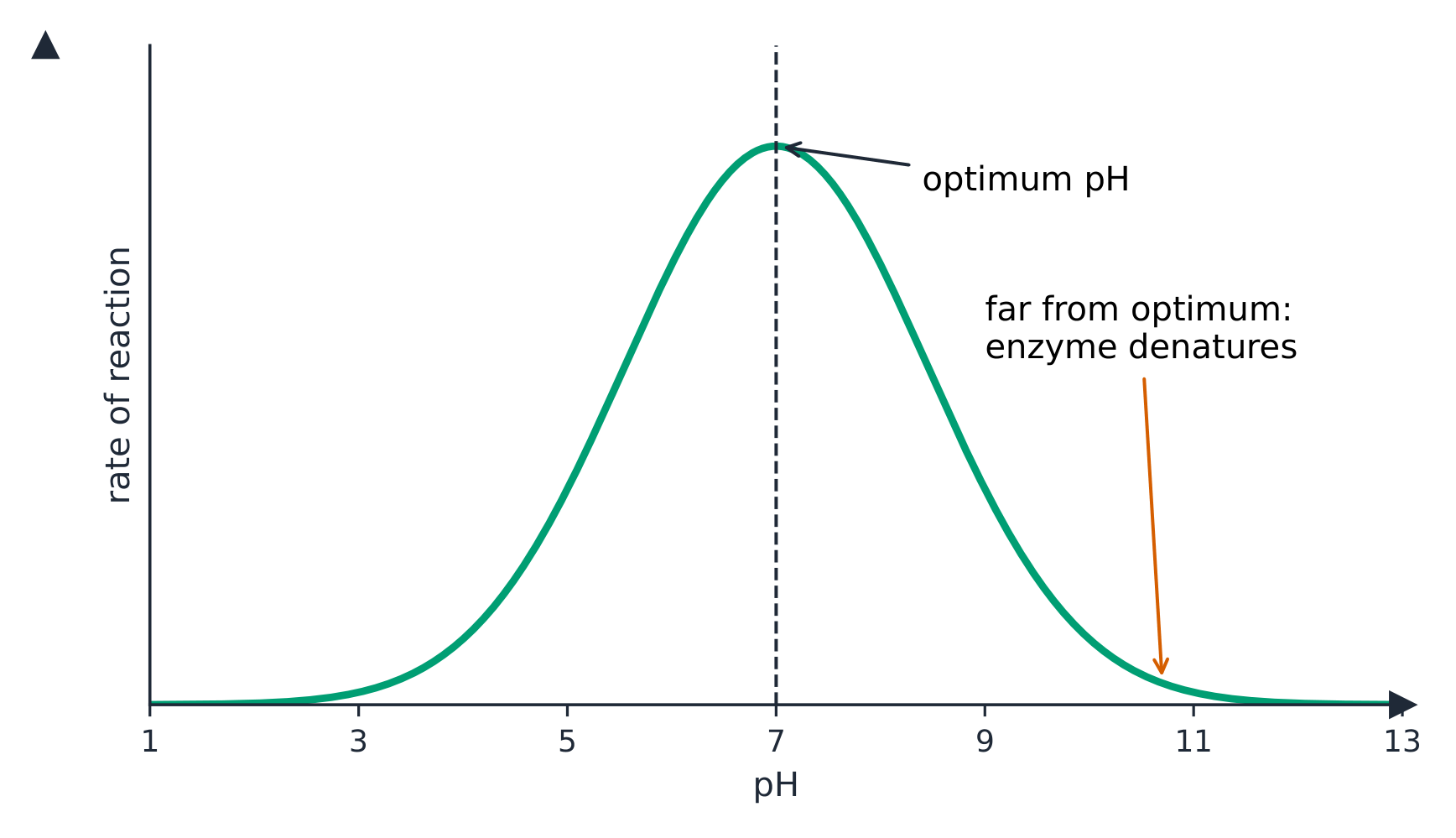
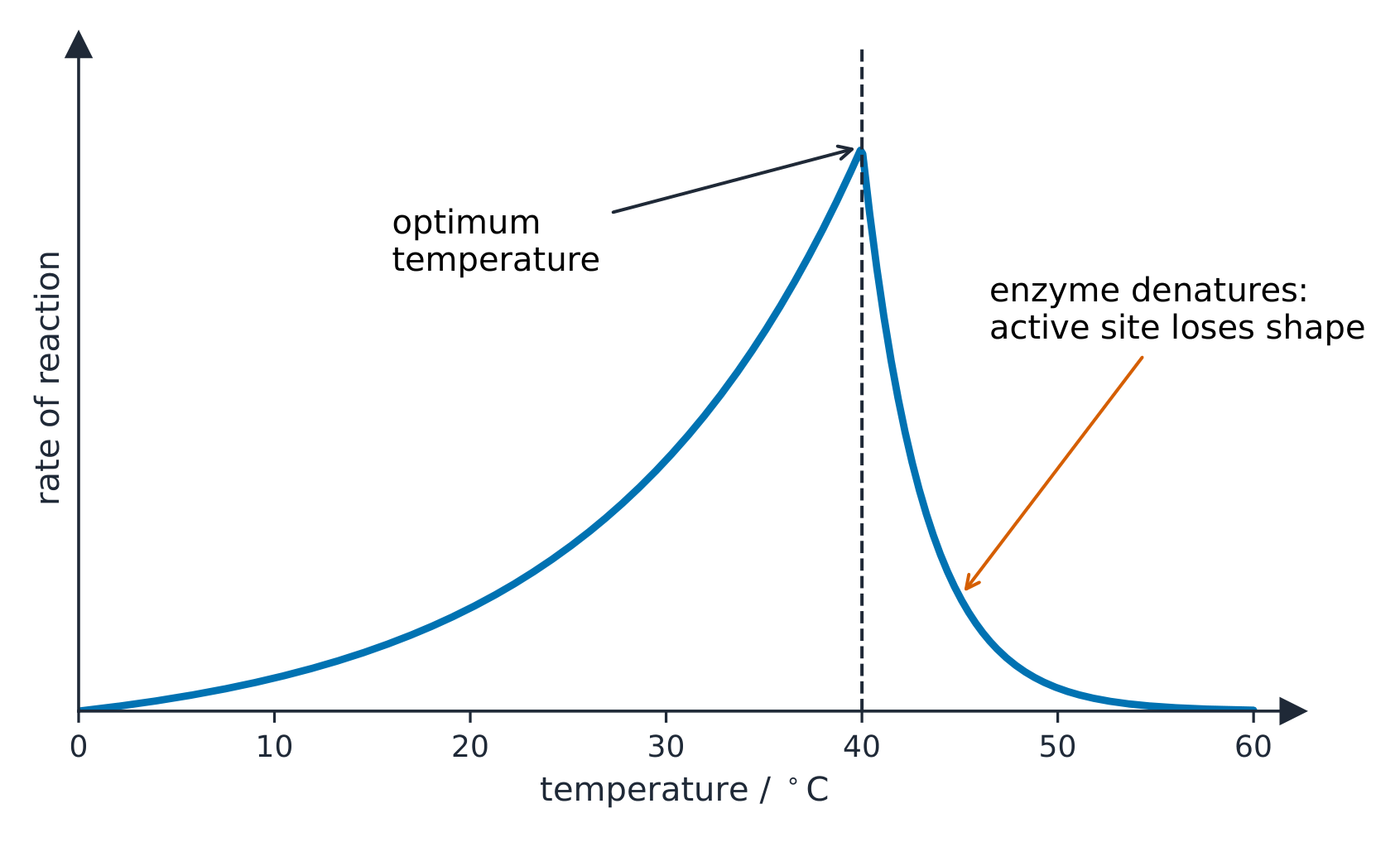
i. Denaturation of proteins, such as enzymes, occurs when the protein structure is disrupted by a change in temperature, pH, or chemical environment, eliminating the ability to catalyze reactions.
ii. Environmental temperatures and pH outside the optimal range for a given enzyme will cause changes to its structure (by disrupting the hydrogen bonds), altering the efficiency with which it catalyzes reactions.
3.2.A.2 In some cases, enzyme denaturation is reversible, allowing the enzyme to regain activity.
Learning Objective 3.2.B: Explain how the cellular environment affects enzyme activity.
3.2.B.1 The relative concentrations of substrates and products determine how efficiently an enzymatic reaction proceeds.
Source: College Board AP Course and Exam Description · แหล่งที่มา: คำอธิบายหลักสูตรและข้อสอบ College Board AP
English
Enzyme activity depends on conditions. Each enzyme has an optimal temperature and pH; beyond it, the protein denatures 变性 (loses shape) and stops working. Substrate concentration raises the rate until the enzyme saturates. Inhibitors 抑制剂 slow enzymes – competitive ones block the active site, noncompetitive ones bind elsewhere and change the shape.
Change temperature and watch enzyme activity · 改变温度并观察酶活性
Each enzyme has an optimum temperature and pH. Too cold is slow; too hot denatures the enzyme so its active site loses shape and activity crashes. · 每种酶都有最适温度和pH值。太冷则反应慢;太热会变性酶,使其活性位点失去形状,活性急剧下降。
Cellular Energy and ATP · พลังงานระดับเซลล์และ ATP
Syllabus · หลักสูตร
English
Big Idea 2 — Energetics: Biological systems use energy and molecular building blocks to grow, reproduce, and maintain dynamic homeostasis.
Learning Objective 3.3.A: Describe the role of energy in living organisms.
3.3.A.1 All living systems require an input of energy.
3.3.A.2 Life requires a highly ordered system and does not violate the first and second laws of thermodynamics.
i. Energy input must exceed energy loss to maintain order and to power cellular processes.
ii. Cellular processes that release energy may be coupled with cellular processes that require energy.
iii. Significant loss of order or energy flow results in death.
Exclusion statement: Students will need to understand the concept of energy, but the equation for Gibbs free energy is beyond the scope of the AP Exam.
3.3.A.3 Energy-related pathways in biological systems are sequential to allow for a more controlled transfer of energy. A product of a reaction in a metabolic pathway is typically the reactant for the subsequent step in the pathway.
Learning Objective 3.3.B: Explain how shared, conserved, and fundamental processes and features support the concept of common ancestry for all organisms.
3.3.B.1 Core metabolic pathways (e.g., glycolysis, oxidative phosphorylation) are conserved across all currently recognized domains (Archaea, Bacteria, and Eukarya).
Source: College Board AP Course and Exam Description · แหล่งที่มา: คำอธิบายหลักสูตรและข้อสอบ College Board AP
English
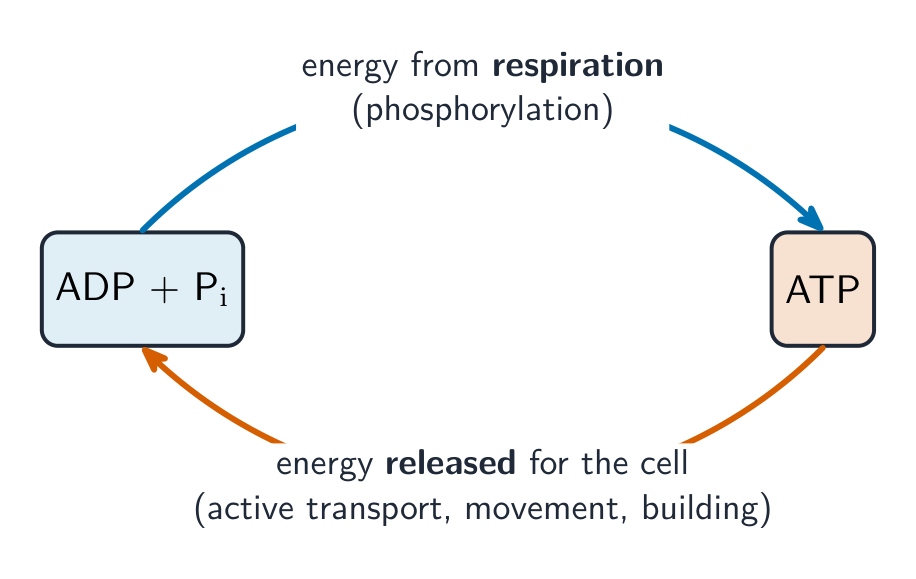
ATP (adenosine triphosphate) is the cell's energy currency. Energy is stored in its phosphate bonds; breaking off a phosphate (ATP → ADP) releases energy to power cellular work, and reattaching one stores energy. Cells constantly recycle ATP, coupling energy-releasing reactions to energy-requiring ones.
Life and the laws of thermodynamics
A living cell is highly ordered, and that order is often mistaken for a violation of physics. It is not.
The first law 热力学第一定律 says energy is conserved: it changes form but is never created or destroyed. A cell does not make energy — it transforms the chemical energy of glucose, or the light energy of the Sun, into the chemical energy of ATP.
The second law 热力学第二定律 says that in any energy transfer, some energy is lost as heat and the entropy 熵 of the universe increases. A cell builds order inside itself, but only by releasing more disorder to its surroundings, mostly as heat.
So life requires a constant input of free energy 自由能 from outside. This is why an organism cut off from its energy source dies: maintaining order is not free, and the moment the input stops, the ordered system runs down.
ไทย
ATP (อะดีโนซีนไตรฟอสเฟต) เป็นสกุลเงินพลังงานของเซลล์ พลังงานเก็บอยู่ในพันธะฟอสเฟต การตัดฟอสเฟตออก (ATP → ADP) ปล่อย พลังงานมาขับเคลื่อนงานระดับเซลล์ และการเชื่อมกลับเก็บพลังงาน เซลล์หมุนเวียน ATP อย่างต่อเนื่อง โดยจับคู่ปฏิกิริยาที่ปล่อยพลังงานเข้ากับปฏิกิริยาที่ต้องการพลังงาน
constant input of free energy/ˈkɒnstənt ˈɪnpʊt ɒv friː ˈenədʒi/
constant input of free energy
Photosynthesis/ˌfəʊtəʊˈsɪnθəsɪs/
Photosynthesis
Calvin cycle/ˈkælvɪn ˈsaɪkl/
Calvin cycle
prokaryotes/ˈprɒkərɪəʊts/
prokaryotes
cyanobacteria/ˌsaɪəˌnɒbəkˈtɪərɪə/
cyanobacteria
oxygenated atmosphere/ˈɒksɪdʒeneɪtɪd ˈætməsfɪə/
oxygenated atmosphere
banded iron formations/ˈbændɪd ˈaɪən fɔːˈmeɪʃnz/
banded iron formations
Cellular respiration/ˈseljʊlə ˌrespɪˈreɪʃn/
Cellular respiration
Glycolysis/ɡlaɪˈkɒləsɪs/
Glycolysis
Krebs cycle/krebz ˈsaɪkl/
Krebs cycle
electron transport chain/ɪˈlektrɒn ˈtrænspɔːt tʃeɪn/
electron transport chain
fermentation/fɜːmənˈteɪʃn/
fermentation
3.4
Photosynthesis · การสังเคราะห์ด้วยแสง
Syllabus · หลักสูตร
English
Big Idea 2 — Energetics: Biological systems use energy and molecular building blocks to grow, reproduce, and maintain dynamic homeostasis.
Learning Objective 3.4.A: Describe the photosynthetic processes and structural features of the chloroplast that allow organisms to capture and store energy.
3.4.A.1 Photosynthesis is the series of reactions that use carbon dioxide $(\mathrm{CO_2})$, water $(\mathrm{H_2O})$, and light energy to make carbohydrates and oxygen $(\mathrm{O_2})$.
i. Photosynthetic organisms capture energy from the sun and produce sugars that can be used in biological processes or stored.
ii. Photosynthesis first evolved in prokaryotic organisms.
iii. Scientific evidence supports the claim that prokaryotic (cyanobacterial) photosynthesis was responsible for the production of an oxygenated atmosphere.
iv. Prokaryotic photosynthetic pathways were the foundation of eukaryotic photosynthesis.
Exclusion statement: Memorization of the steps in the Calvin cycle, the structure of the molecules, and the names of the enzymes involved, with the exception of ATP synthase, is beyond the scope of the AP Exam.
3.4.A.2 Stroma and thylakoids are found within the chloroplast.
i. The stroma is the fluid within the inner chloroplast membrane and outside the thylakoid. The carbon fixation (Calvin cycle) reactions of photosynthesis occur in the stroma.
ii. The thylakoid membranes contain chlorophyll pigments organized into two photosystems, as well as electron transport proteins.
iii. Thylakoids are organized in stacks called grana. The light reactions of photosynthesis occur in the grana.
3.4.A.3 The light reactions of photosynthesis in eukaryotes involve a series of coordinated reaction pathways that capture energy present in light to yield ATP and NADPH, which power the production of organic molecules in the Calvin cycle. This provides energy for metabolic processes.
Learning Objective 3.4.B: Explain how cells capture energy from light and transfer it to biological molecules for storage and use.
3.4.B.1 Electron transport chain (ETC) reactions occur in chloroplasts, in mitochondria, and across prokaryotic plasma membranes. In photosynthesis, electrons that pass through the thylakoid membrane are picked up and ultimately transferred to $\mathrm{NADP^+}$ reducing it to NADPH in photosystem I.
Exclusion statement: The full names of the specific electron carriers in the electron transport chain are beyond the scope of the AP Exam.
Exclusion statement: Specific steps, names of enzymes, and intermediates of the pathways for these processes are beyond the scope of this course and the AP Exam.
3.4.B.2 During photosynthesis, chlorophylls absorb energy from light, boosting electrons to a higher energy level in photosystems I and II. Water then splits, supplying electrons to replace those lost from photosystem II.
3.4.B.3 Photosystems I and II are embedded in the thylakoid membranes of chloroplasts and are connected by the transfer of electrons through an ETC.
3.4.B.4 When electrons are transferred between molecules in a series of oxidation/reduction reactions as they pass through the ETC, an electrochemical gradient of protons (hydrogen ions) is established across the thylakoid membrane. The membrane separates a region of low proton concentration outside the thylakoid membrane from a region of high proton concentration inside the thylakoid membrane.
3.4.B.5 The formation of the proton gradient is linked to the synthesis of ATP from ADP and inorganic phosphate via ATP synthase. The flow of protons back through membrane-bound ATP synthase by chemiosmosis drives the formation of ATP from ADP and inorganic phosphate; this is known as photophosphorylation.
3.4.B.6 The energy captured in the light reactions and transferred to ATP and NADPH powers the production of carbohydrates from carbon dioxide in the Calvin cycle. This occurs in the stroma of the chloroplast.
3.4.B.2 ระหว่างการสังเคราะห์แสง คลอโรฟิลล์ดูดซับพลังงานจากแสง กระตุ้นอิเล็กตรอนขึ้นไปสู่ระดับพลังงานที่สูงขึ้นในระบบแสง I และ II จากนั้นน้ำจะแตกตัว ให้ إلكترونมาทดแทนอิเล็กตรอนที่สูญเสียจากระบบแสง II
3.4.B.3 ระบบแสง I และ IIฝังอยู่ในเยื่อหุ้มไทลาคอยด์ของคลอโรพลาสต์และเชื่อมต่อกันโดยการถ่ายโอนอิเล็กตรอนผ่าน ETC
3.4.B.5 การเกิดเกรดิเอนต์ของโปรตอนเชื่อมโยงกับการสังเคราะห์ ATP จาก ADP และฟอสเฟตอนออร์แกนิกผ่าน ATP synthase การไหลย้อนกลับของโปรตอนผ่าน ATP synthase ที่ติดเยื่อหุ้มโดย chemiosmosis ขับเคลื่อนการสร้าง ATP จาก ADP และฟอสเฟตอนออร์แกนิก กระบวนการนี้เรียกว่า photophosphorylation
3.4.B.6 พลังงานที่ถูกจับในปฏิกิริยาที่ใช้แสงและถ่ายโอนไปยัง ATP และ NADPH ใช้ขับเคลื่อนการผลิตคาร์โบไฮเดรตจากคาร์บอนไดออกไซด์ในวัฏจักรคาลวิน สิ่งนี้เกิดขึ้นในสตรอมาของคลอโรพลาสต์
Source: College Board AP Course and Exam Description · แหล่งที่มา: คำอธิบายหลักสูตรและข้อสอบ College Board AP
English
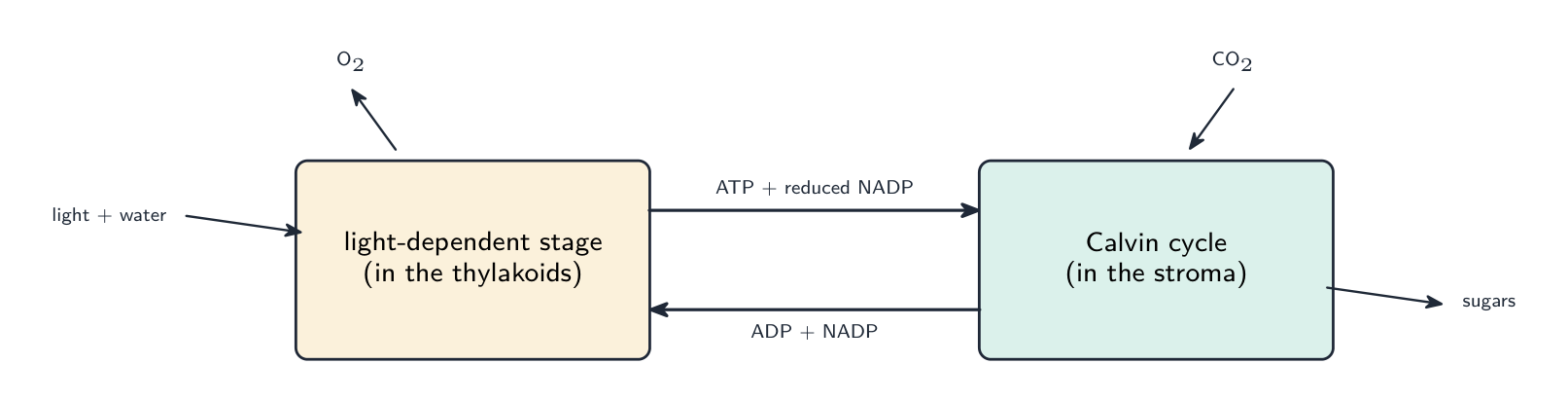
Photosynthesis 光合作用 captures light energy to build sugar from $\text{CO}_2$ and water, releasing $\text{O}_2$. It has two stages:
The light reactions (in the thylakoid membranes) use light to make ATP and NADPH and split water, releasing oxygen.
The Calvin cycle 卡尔文循环 (in the stroma) uses that ATP and NADPH to fix $\text{CO}_2$ into sugar.
So light energy becomes chemical energy stored in glucose.
Where the oxygen in the air came from
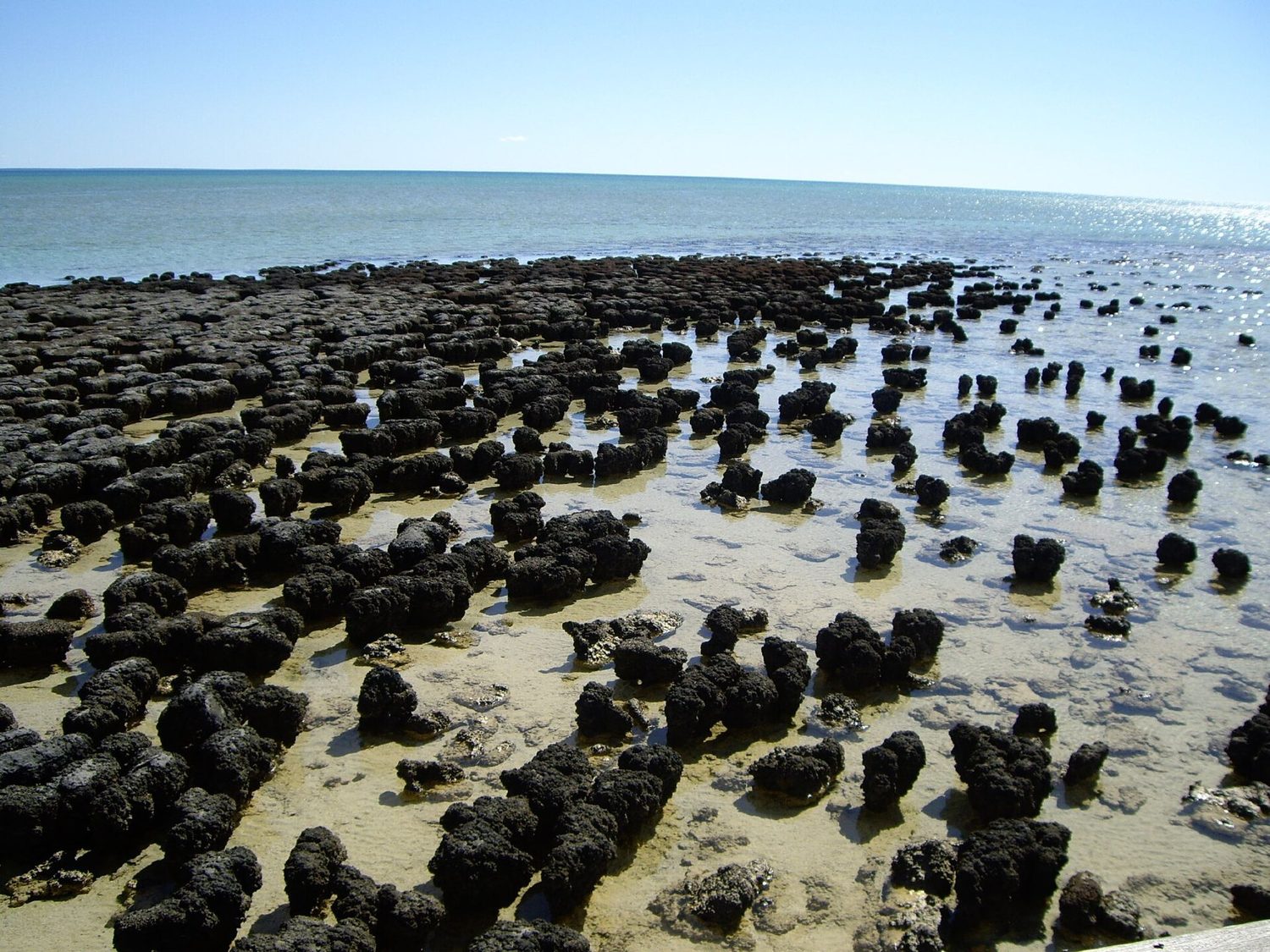
Photosynthesis did not only feed the first organisms; it changed the planet. Scientific evidence supports the claim that photosynthesis by prokaryotes 原核生物 — specifically cyanobacteria 蓝细菌 — produced the oxygen that built Earth's oxygenated atmosphere 含氧大气.
The evidence is physical: banded iron formations 条带状铁建造 in rocks about 2.4 billion years old record iron dissolved in the ocean being oxidised and precipitating out, which needs free oxygen. Before that event, called the Great Oxidation Event, the atmosphere held almost none.
Two consequences matter for the rest of the course. Free oxygen made aerobic respiration possible, which releases far more ATP per glucose than anaerobic pathways do. And it was lethal to much of the anaerobic life already present, so it counts as one of the largest extinction events in Earth's history — an early example of organisms changing their own environment.
Big Idea 2 — Energetics: Biological systems use energy and molecular building blocks to grow, reproduce, and maintain dynamic homeostasis.
Learning Objective 3.5.A: Describe the processes and structural features of mitochondria that allow organisms to use energy stored in biological macromolecules.
3.5.A.1 Cellular respiration uses energy from biological macromolecules to synthesize ATP. Respiration and fermentation are characteristic of all forms of life.
3.5.A.2 Aerobic cellular respiration in eukaryotes involves a series of coordinated enzyme-catalyzed reactions that capture energy from biological macromolecules.
3.5.A.3 The ETC transfers electrons in a series of oxidation-reduction reactions that establish an electrochemical gradient across membranes.
i. In cellular respiration, electrons delivered by NADH and $\mathrm{FADH_2}$ are passed to a series of electron acceptors as they move toward the terminal electron acceptor, oxygen. Aerobic prokaryotes use oxygen as a terminal electron acceptor, while anaerobic prokaryotes use other molecules.
ii. The transfer of electrons, through the ETC, is accompanied by the formation of a proton gradient across the inner mitochondrial membrane, with the membrane(s) separating a region of high proton concentration outside the membrane from a region of low proton concentration inside the membrane. The folding of the inner membrane increases the surface area, which allows for more ATP to be synthesized. In prokaryotes, the passage of electrons is accompanied by the movement of protons across the plasma membrane.
iii. The flow of protons back through membrane-bound ATP synthase by chemiosmosis drives the formation of ATP from ADP and inorganic phosphate. This is known as oxidative phosphorylation in aerobic cellular respiration.
iv. In aerobic cellular respiration, decoupling oxidative phosphorylation from electron transport generates heat. This heat can be used by endothermic organisms to regulate body temperature.
Exclusion statement: The full names of the specific electron carriers in the electron transport chain are beyond the scope of the AP Exam.
Exclusion statement: Specific steps, names of enzymes, and intermediates of the pathways for these processes are beyond the scope of this course and the AP Exam.
Learning Objective 3.5.B: Explain how cells obtain energy from biological macromolecules in order to power cellular functions.
3.5.B.1 Glycolysis is a biochemical pathway that releases the energy in glucose molecules to form ATP (from ADP and inorganic phosphate), NADH (from $\mathrm{NAD^+}$), and pyruvate.
3.5.B.2 Pyruvate is transported from the cytosol to the mitochondrion where oxidation occurs. This process releases electrons during the Krebs (citric acid) cycle, reducing $\mathrm{NAD^+}$ to NADH and FAD to $\mathrm{FADH_2}$, and releasing $\mathrm{CO_2}$.
3.5.B.3 The Krebs cycle takes place in the mitochondrial matrix. During the Krebs cycle, carbon dioxide is released from organic intermediates, ATP is synthesized from ADP and inorganic phosphate, and electrons are transferred by the coenzymes $\mathrm{NAD^+}$ and FAD.
3.5.B.4 Electrons extracted in glycolysis and Krebs cycle reactions are transferred by NADH and $\mathrm{FADH_2}$ to the ETC in the inner mitochondrial membrane.
3.5.B.5 When electrons are transferred between molecules in a sequence of reactions as they pass through the ETC, an electrochemical gradient of protons (hydrogen ions) across the inner mitochondrial membrane is established. The pH inside the mitochondrial matrix is higher than in the intermembrane space.
3.5.B.6 Fermentation allows glycolysis to proceed in the absence of oxygen and produces organic molecules such as alcohol and lactic acid.
Exclusion statement: Memorization of the steps in glycolysis and the Krebs cycle, and of the structures of the molecules and the names of the enzymes involved, is beyond the scope of this course and the AP Exam.
i. ในการหายใจระดับเซลล์ อิเล็กตรอนที่ส่งโดย NADH และ $\mathrm{FADH_2}$ ถูกส่งต่อไปยังชุดตัวรับอิเล็กตรอนขณะเคลื่อนที่ไปสู่ตัวรับอิเล็กตรอนสุดท้ายคือออกซิเจน โปรคาริโอตแบบใช้ออกซิเจนใช้ออกซิเจนเป็นตัวรับอิเล็กตรอนสุดท้าย ในขณะที่โปรคาริโอตแบบไม่ใช้ออกซิเจนใช้โมเลกุลอื่น
ii. การถ่ายโอนอิเล็กตรอนผ่าน ETC伴随着การสร้างเกรดิเอนต์ของโปรตอนผ่านเยื่อหุ้มชั้นในของไมโทคอนเดรีย โดยเยื่อหุ้มนั้นแบ่งพื้นที่ที่มีความเข้มข้นของโปรตอนสูงภายนอกเยื่อหุ้มออกจากพื้นที่ที่มีความเข้มข้นของโปรตอนต่ำภายในเยื่อหุ้ม การพับของเยื่อหุ้มชั้นในเพิ่มพื้นที่ผิว ซึ่งทำให้สามารถสังเคราะห์ ATP ได้มากขึ้น ในโปรคาริโอต การผ่านของอิเล็กตรอน.userIdด้วยการเคลื่อนที่ของโปรตอนข้ามเยื่อหุ้มเซลล์
iii. การไหลย้อนกลับของโปรตอนผ่าน ATP synthase ที่ติดเยื่อหุ้มโดย chemiosmosis ขับเคลื่อนการสร้าง ATP จาก ADP และฟอสเฟตอนออร์แกนิก กระบวนการนี้เรียกว่า oxidative phosphorylation ในการหายใจระดับเซลล์แบบใช้ออกซิเจน
iv. ในการหายใจระดับเซลล์แบบใช้ออกซิเจน การแยกออกซิเดทีฟโฟสโฟริลเลชั่นออกจากสายการขนส่งอิเล็กตรอนจะสร้างความร้อน ความร้อนนี้สามารถUsedโดยสัตว์เลือดอุ่นเพื่อปรับอุณหภูมิร่างกาย
ข้อความยกเว้น: ชื่อเต็มของตัวนำอิเล็กตรอนเฉพาะในสายการขนส่งอิเล็กตรอน超出了 AP Exam范围。
Source: College Board AP Course and Exam Description · แหล่งที่มา: คำอธิบายหลักสูตรและข้อสอบ College Board AP
English
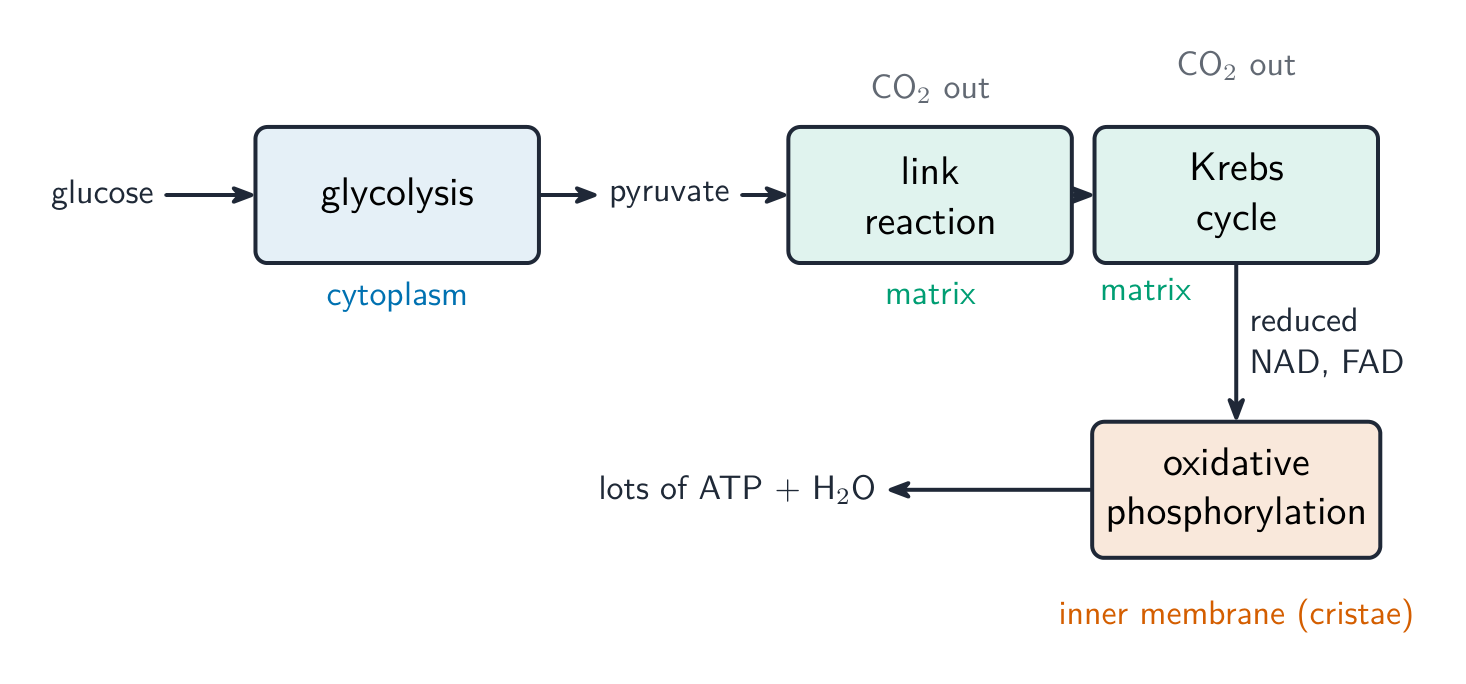
Cellular respiration 细胞呼吸 releases the energy in glucose to make ATP, mostly using oxygen. Its stages:
Glycolysis 糖酵解 (in the cytoplasm) splits glucose, making a little ATP.
The Krebs cycle 克雷布斯循环 (mitochondrial matrix) releases $\text{CO}_2$ and loads electron carriers.
The electron transport chain 电子传递链 (inner membrane) uses those electrons to pump protons and make most of the ATP, with oxygen as the final electron acceptor.
Without oxygen, cells use fermentation 发酵 to keep glycolysis running, making far less ATP. Photosynthesis and respiration are complementary – the products of one are the reactants of the other.
Worked example. Aerobic respiration of one glucose nets about 2 ATP from glycolysis, 2 ATP from the Krebs cycle, and about 28 ATP from oxidative phosphorylation, for $\approx$32 ATP total. With no oxygen only glycolysis runs, so fermentation nets just 2 ATP per glucose — roughly 16 times less energy, which is why aerobic pathways dominate in oxygen-rich cells.
ไทย
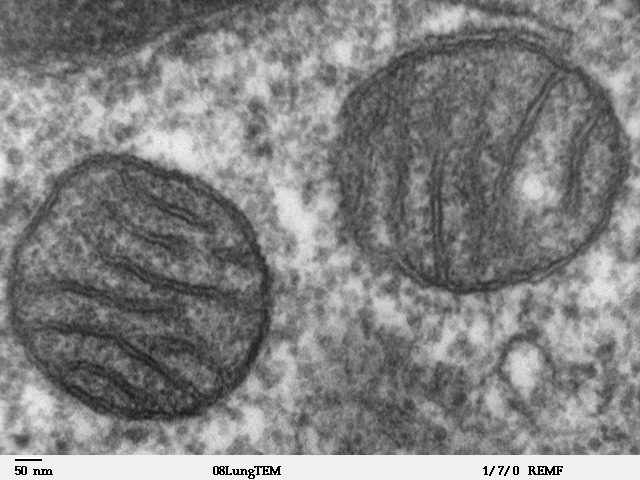
TEM ของไมโทคอนเดรีย: เยื่อหุ้มภายในพับ (cristae) เพิ่มพื้นที่ผิวสำหรับการหายใจ
การหายใจระดับเซลล์ ปลดปล่อยพลังงานจากกลูโคสเพื่อสร้าง ATP ส่วนใหญ่ใช้ออกซิเจน ขั้นตอนของมัน:
Source: College Board AP Course and Exam Description · แหล่งที่มา: คำอธิบายหลักสูตรและข้อสอบ College Board AP
English
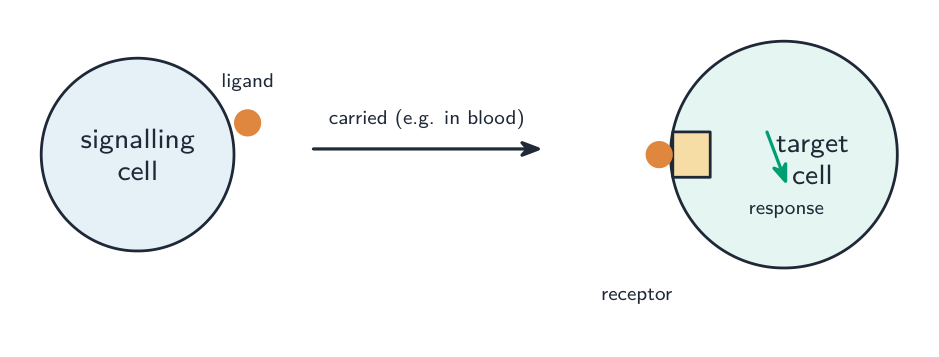
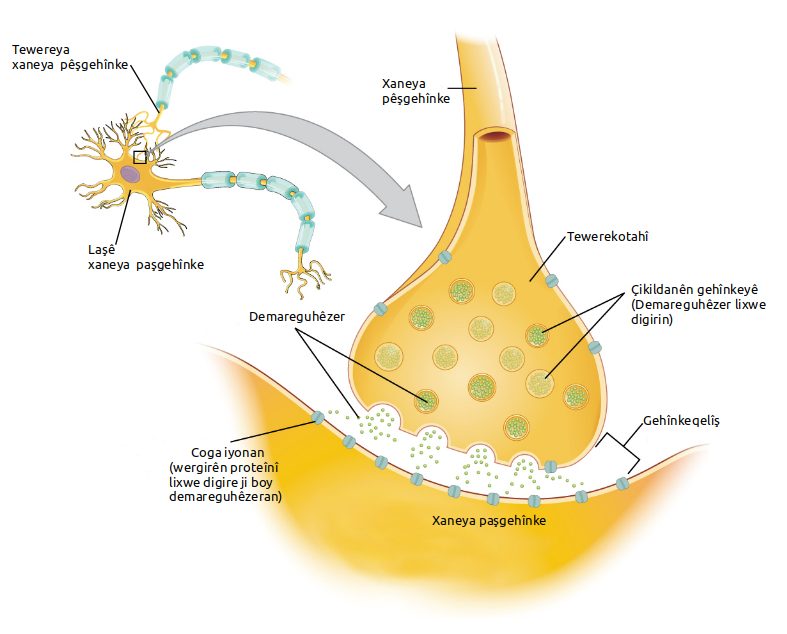
Cells coordinate by sending and receiving chemical signals 信号. A signaling cell releases a ligand 配体 that binds a receptor 受体 on a target cell. Signals travel over different ranges: direct contact (cell junctions), local signaling (nearby cells, like neurotransmitters), and long-distance signaling (hormones 激素 through the blood).
Introduction to Signal Transduction · บทนำสู่การส่งผ่านสัญญาณ
Syllabus · หลักสูตร
English
Big Idea 3 — Information Storage and Transmission: Living systems store, retrieve, transmit, and respond to information essential to life processes.
Learning Objective 4.2.A: Describe the components of a signal transduction pathway.
4.2.A.1 Signal transduction pathways link signal receptions with cellular responses.
4.2.A.2 Many signal transduction pathways include protein modifications and involve phosphorylation cascades.
Learning Objective 4.2.B: Describe the role of components of a signal transduction pathway in producing a cellular response.
4.2.B.1 Signaling begins with the recognition of a chemical messenger—a ligand—by a receptor protein in a target cell.
i. The ligand-binding domain of a receptor recognizes a specific chemical messenger, which can be a peptide (protein) or a small molecule.
ii. G protein-coupled receptors are an example of a receptor protein in eukaryotes.
iii. Receptors may be located on the surface of a target cell or in the cytoplasm or nucleus of the target cell.
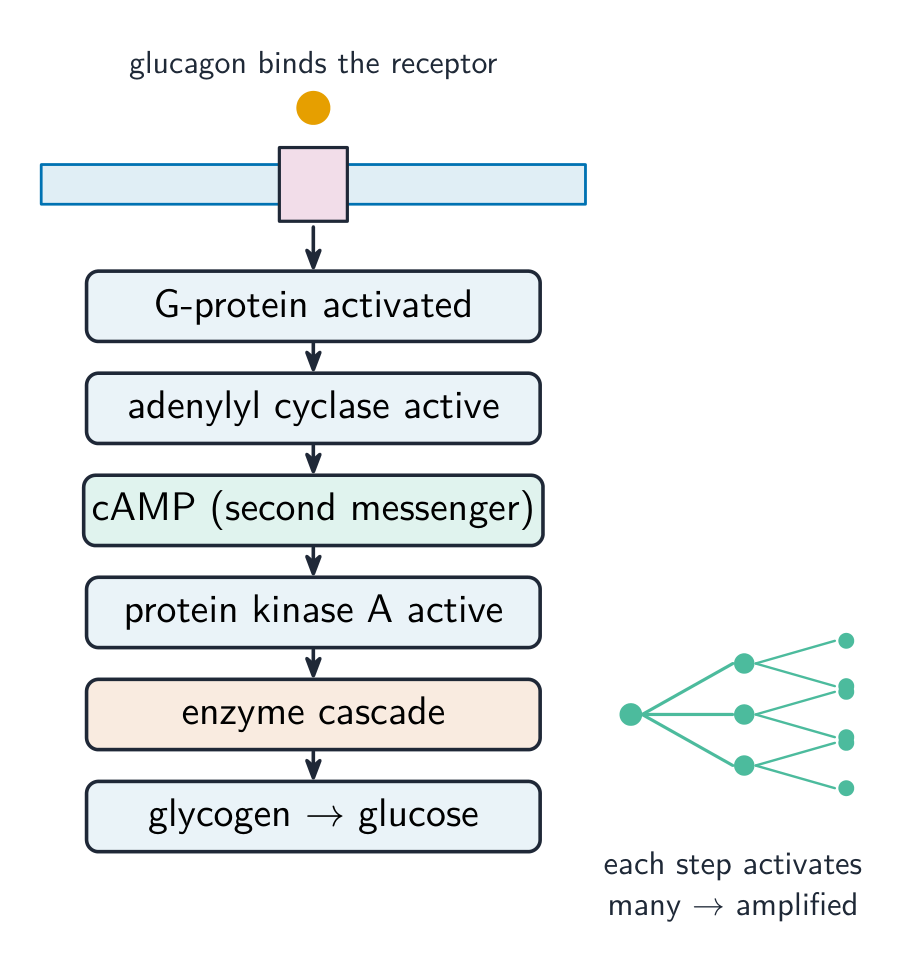
4.2.B.2 Signaling cascades relay signals from receptors to cell targets, often amplifying the incoming signals, resulting in the appropriate responses by the cell. Responses could include cell growth, secretion of molecules, or gene expression.
i. After the ligand binds, the intracellular domain of a receptor protein changes shape, initiating transduction of the signal.
ii. Enzymes and second messengers such as cyclic AMP (cAMP) relay and amplify the intracellular signal.
iii. Hormones are an example of a signaling messenger that can travel long distances in the bloodstream.
iv. The binding of ligands to ligand-gated channels can cause the channel to open or close.
i. หลังจาก ligand จับแล้ว domestic domain ของโปรตีนรีเซปเตอร์จะเปลี่ยนรูปร่าง เริ่มการส่งต่อสัญญาณ
ii. เอนไซม์และ second messengers เช่น cyclic AMP (cAMP) ส่งต่อและขยายสัญญาณภายในเซลล์
iii. Hormones เป็นตัวอย่างของสารสื่อสัญญาณที่สามารถเดินทางไกลในกระแสเลือด
iv. การจับของ ligands กับargo-gated channels สามารถทำให้ channel เปิดหรือปิด
Source: College Board AP Course and Exam Description · แหล่งที่มา: คำอธิบายหลักสูตรและข้อสอบ College Board AP
English
Signal transduction 信号转导 converts an outside signal into a cellular response in three stages: reception (ligand binds receptor), transduction (a relay of molecules inside the cell), and response (a change in the cell's activity, such as switching on a gene). Receptors are specific, so a cell only responds to signals it can receive.
Signal Transduction Pathways · เส้นทางส่งผ่านสัญญาณ
Syllabus · หลักสูตร
English
Big Idea 3 — Information Storage and Transmission: Living systems store, retrieve, transmit, and respond to information essential to life processes.
Learning Objective 4.3.A: Describe the different types of cellular responses elicited by a signal transduction pathway.
4.3.A.1 Signal transduction may result in changes in gene expressions and cell function, which may alter phenotype or result in programmed cell death (apoptosis).
Illustrative examples for 4.3.A.1:
Use of chemical messengers by microbes to communicate with other nearby cells and to regulate specific pathways in response to population density (quorum sensing)
Epinephrine stimulation of glycogen breakdown in mammals
Learning Objective 4.3.B: Explain how a change in the structure of any signaling molecule affects the activity of the signaling pathway.
4.3.B.1 Changes in signal transduction pathways can alter cellular responses. Mutations in any domain of the receptor protein or in any component of the signaling pathway may affect the downstream components by altering the subsequent transduction of the signal.
Illustrative examples for 4.3.B.1:
Cytokines regulate gene expression to allow for cell replication and division.
Mating pheromones in yeast trigger mating gene expression.
Ethylene levels cause changes in the production of different enzymes allowing fruits to ripen.
HOX genes regulate animal body plans during embryonic development.
4.3.B.2 Chemicals that interact with any component of the signaling pathway may activate or inhibit the pathway.
Source: College Board AP Course and Exam Description · แหล่งที่มา: คำอธิบายหลักสูตรและข้อสอบ College Board AP
English
In the transduction stage, the signal passes through a pathway – often a cascade of proteins that activate one another, frequently amplifying the signal so a few ligands trigger a large response. Second messengers (like cyclic AMP or calcium ions) spread the signal quickly through the cell. A change in one step can alter the whole outcome.
Big Idea 2 — Energetics: Biological systems use energy and molecular building blocks to grow, reproduce, and maintain dynamic homeostasis.
Learning Objective 4.4.A: Explain how positive and negative feedback helps maintain homeostasis.
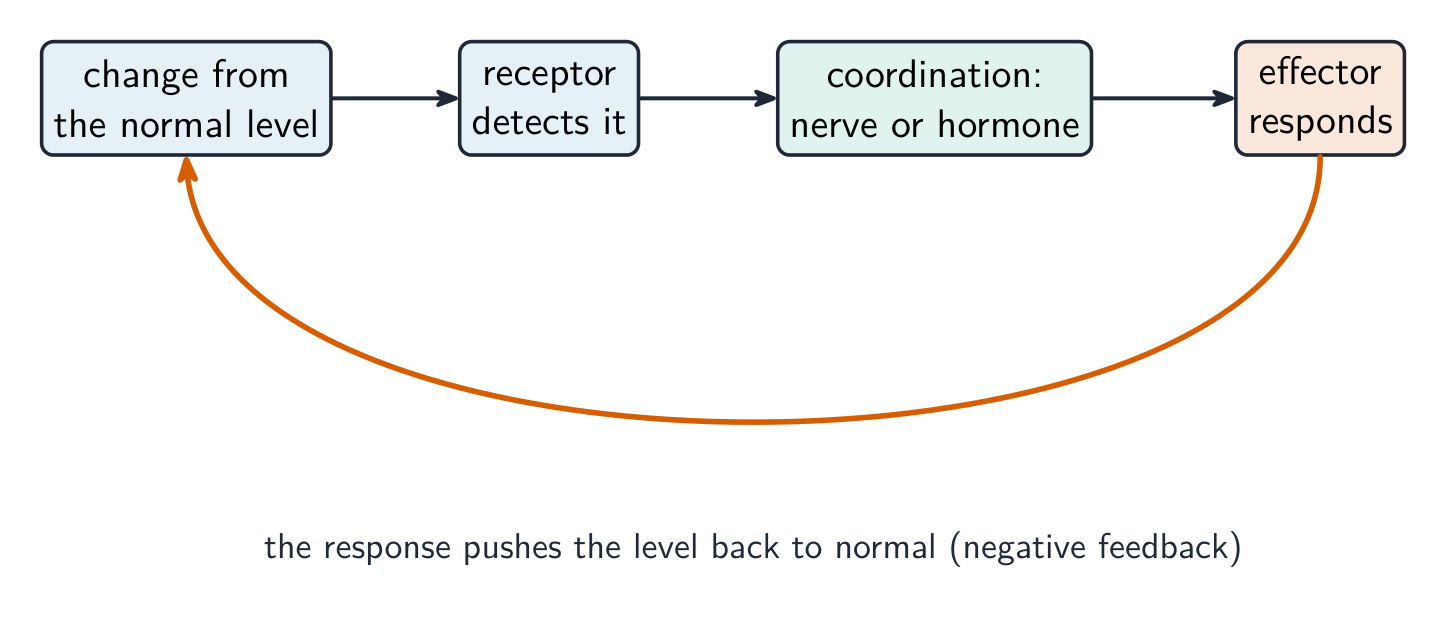
4.4.A.1 Organisms use feedback mechanisms to maintain their internal environments in response to internal and external changes.
i. Negative feedback mechanisms maintain homeostasis by reducing the initial stimulus to regulate physiological processes. If a system is perturbed or disrupted, negative feedback mechanisms return the system back to its target set point. These processes operate at the molecular, cellular, and organismal levels.
Illustrative examples for 4.4.A.1.i:
Blood sugar regulation by insulin/glucagon
ii. Positive feedback mechanisms amplify responses and processes in biological organisms. The variable initiating the response is moved further away from the initial set point. Amplification occurs when the stimulus is further intensified, which, in turn, initiates an additional response that produces system change.
i. กลไกการตอบกลับแบบลบรักษาสมดุลภายในโดยลดการกระตุ้นเริ่มต้นเพื่อควบคุมกระบวนการทางสรีรวิทยา หากระบบถูกรบกวน กลไกการตอบกลับแบบลบจะนำระบบกลับสู่จุดตั้งต้นเดิม กระบวนการเหล่านี้ทำงานในระดับโมเลกุล เซลล์ และระดับสิ่งมีชีวิต
ตัวอย่างประกอบสำหรับ 4.4.A.1.i:
การควบคุมระดับน้ำตาลในเลือดโดยอินซูลิน/กลูคาگون
ii. กลไกการตอบกลับแบบบวกขยายผลตอบสนองและกระบวนการในสิ่งมีชีวิต ตัวแปรที่เริ่มการตอบสนองจะถูกย้ายออกไปจากจุดตั้งต้นเดิม การขยายผลเกิดขึ้นเมื่อมีการเพิ่มแรงกระตุ้นมากขึ้น ซึ่งจะนำไปสู่การเกิดตอบสนองเพิ่มเติมที่ทำให้เกิดการเปลี่ยนแปลงของระบบ
ตัวอย่างประกอบสำหรับ 4.4.A.1.ii:
การหลั่งน้ำนมในสัตว์เลี้ยงลูกด้วยนม
การเริ่มคลอดบุตร
การสุกของผลไม้
Source: College Board AP Course and Exam Description · แหล่งที่มา: คำอธิบายหลักสูตรและข้อสอบ College Board AP
English
Feedback 反馈 keeps systems balanced:
Negative feedback 负反馈 counteracts a change to restore a set point (like a thermostat) – it maintains homeostasis 稳态.
Positive feedback 正反馈 amplifies a change to push a process to completion (like childbirth contractions or blood clotting).
Negative feedback senses a change and reverses it, holding a variable (like blood glucose) near a set point. Push it away and watch the system correct. · 负反馈感知变化并将其逆转,使变量(如血糖)保持在设定点附近。将其推离设定点并观察系统如何纠正。
Big Idea 3 — Information Storage and Transmission: Living systems store, retrieve, transmit, and respond to information essential to life processes.
Learning Objective 4.5.A: Describe the events that occur in the cell cycle.
4.5.A.1 The cell cycle is a highly regulated series of events that controls the growth and reproduction of eukaryotic cells.
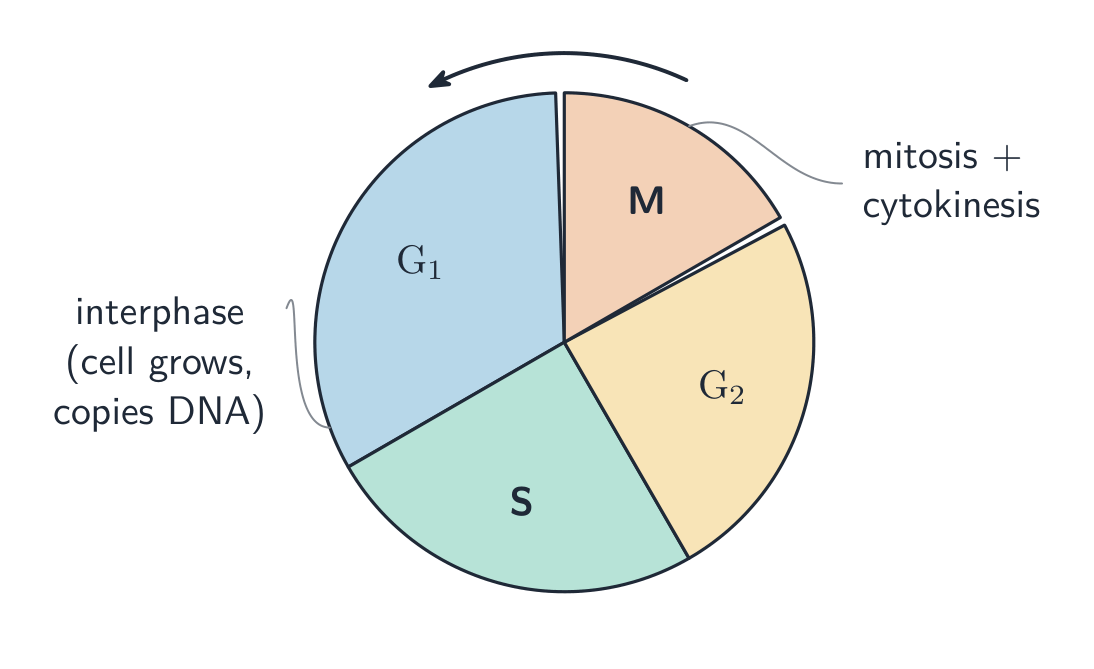
i. The cell cycle consists of sequential stages of interphase (G1, S, G2), mitosis, and cytokinesis.
ii. G1 phase: The cell is metabolically active, duplicating organelles and cytosolic components.
iii. S phase: DNA is in the form of chromatin and replicates to form two sister chromatids connected at a centromere.
iv. G2 phase: Protein synthesis occurs, ATP is produced in large quantities, and centrosomes replicate.
v. A cell can enter a stage (G0) in which it no longer divides, but it can reenter the cell cycle in response to appropriate cues.
vi. Nondividing cells may exit the cell cycle or be held at a particular stage in the cell cycle.
Learning Objective 4.5.B: Explain how mitosis results in the transmission of chromosomes from one generation of cells to the next.
4.5.B.1 Mitosis is a process that ensures the transfer of a complete genome from a parent cell to two genetically identical daughter cells in eukaryotes.
i. Mitosis plays a role in growth, tissue repair, and asexual reproduction.
ii. Mitosis occurs in sequential steps (prophase, metaphase, anaphase, telophase) and alternates with interphase in the cell cycle.
iii. Prophase: Sister chromatids condense, mitotic spindle begins to form, and centrosomes move to opposite poles of the cell.
iv. Metaphase: Spindle fibers align chromosomes along the equator of the cell.
v. Anaphase: Paired sister chromatids separate as spindle fibers pull chromatids toward poles.
vi. Telophase: Mitotic spindle breaks down, a new nuclear envelope develops, and then the cytoplasm divides.
vii. Cytokinesis: A cleavage furrow forms in animal cells or a cell plate forms in plant cells, resulting in two new daughter cells.
iv. Metaphase: Spindle fibers จัดเรียงโครโมโซสตามแนว赤道板 (equator) ของเซลล์
v. Anaphase:姐妹染色单体 (sister chromatids) คู่แยกออกจากกัน เมื่อ spindle fibers ดึง姐妹染色单体 ไปยังขั้วเซลล์
vi. Telophase: Mitotic spindle แตกสลาย เยื่อหุ้มนิวเคลียสใหม่พัฒนาขึ้น จากนั้นไซโทพลาซึมจะแบ่งออก
vii. Cytokinesis: Cleavage furrow ก่อตัวขึ้นในเซลล์สัตว์ หรือ cell plate ก่อตัวขึ้นในเซลล์พืช ส่งผลให้เกิดเซลล์ลูกใหม่สองเซลล์
Source: College Board AP Course and Exam Description · แหล่งที่มา: คำอธิบายหลักสูตรและข้อสอบ College Board AP
English
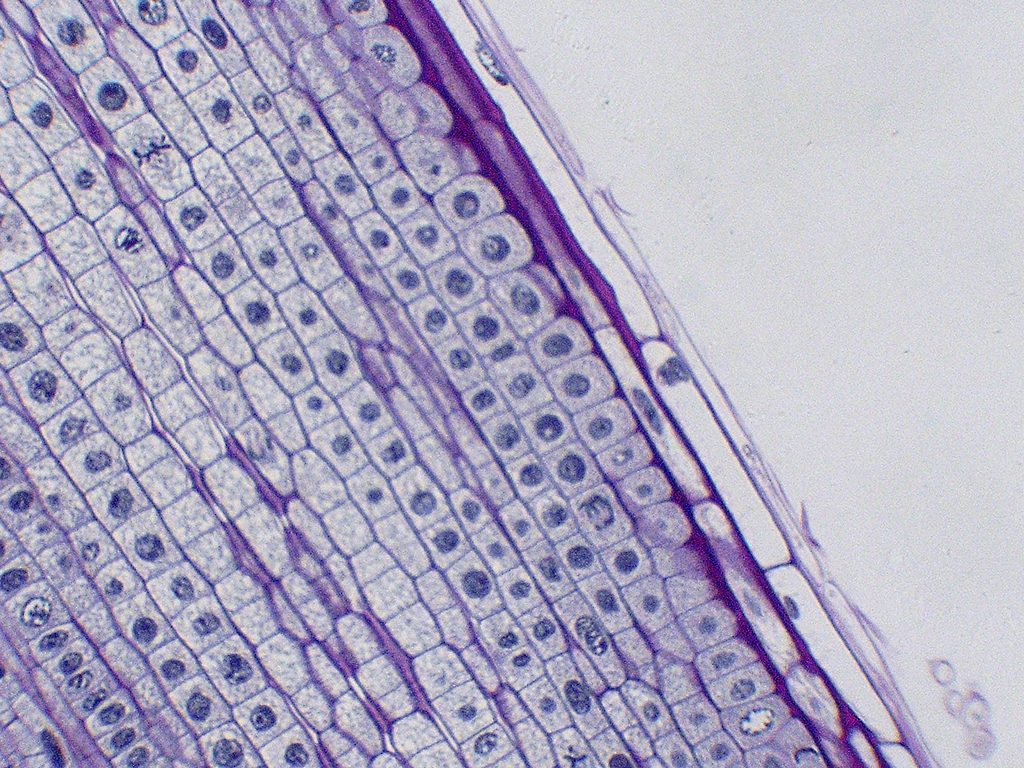
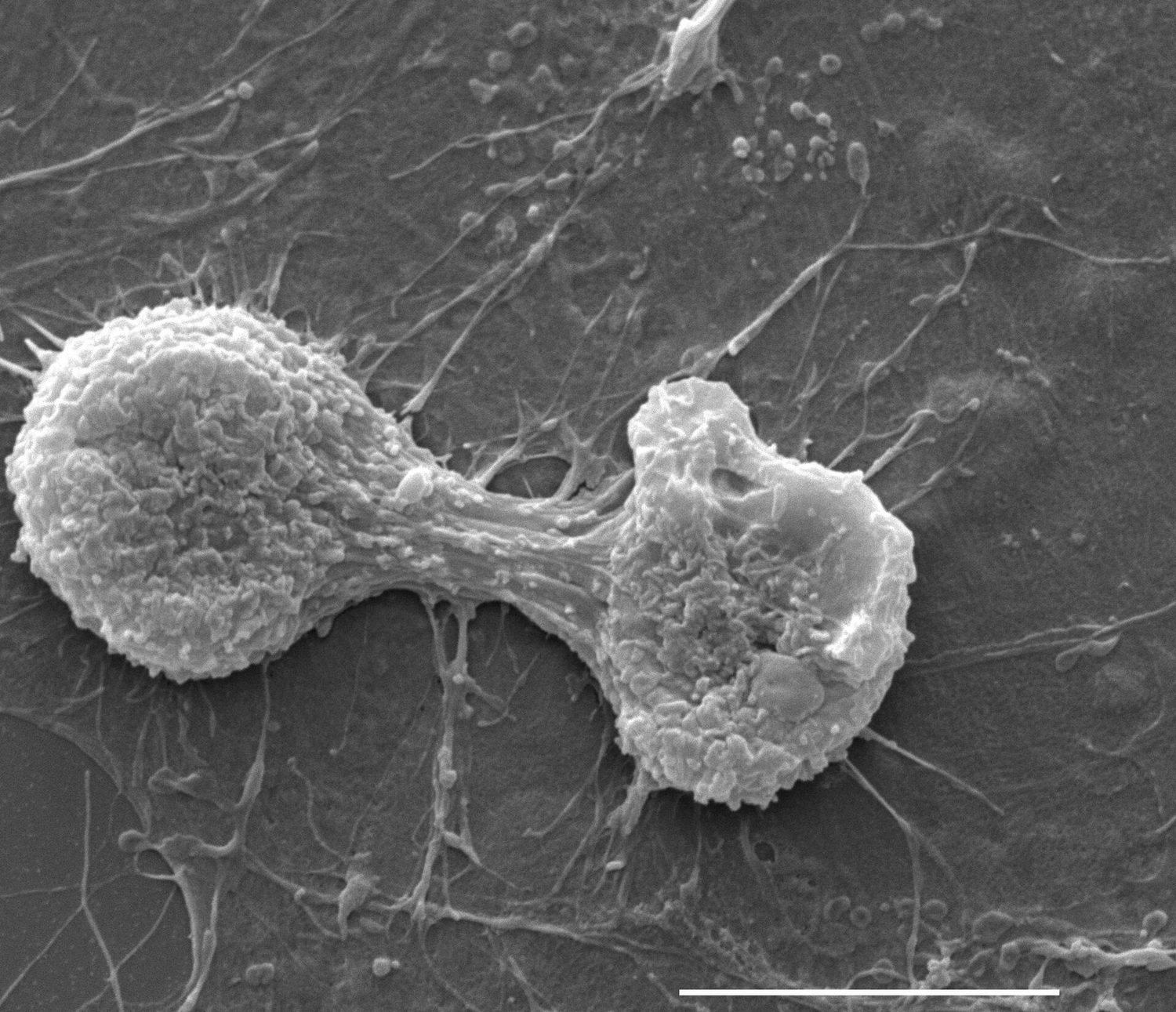
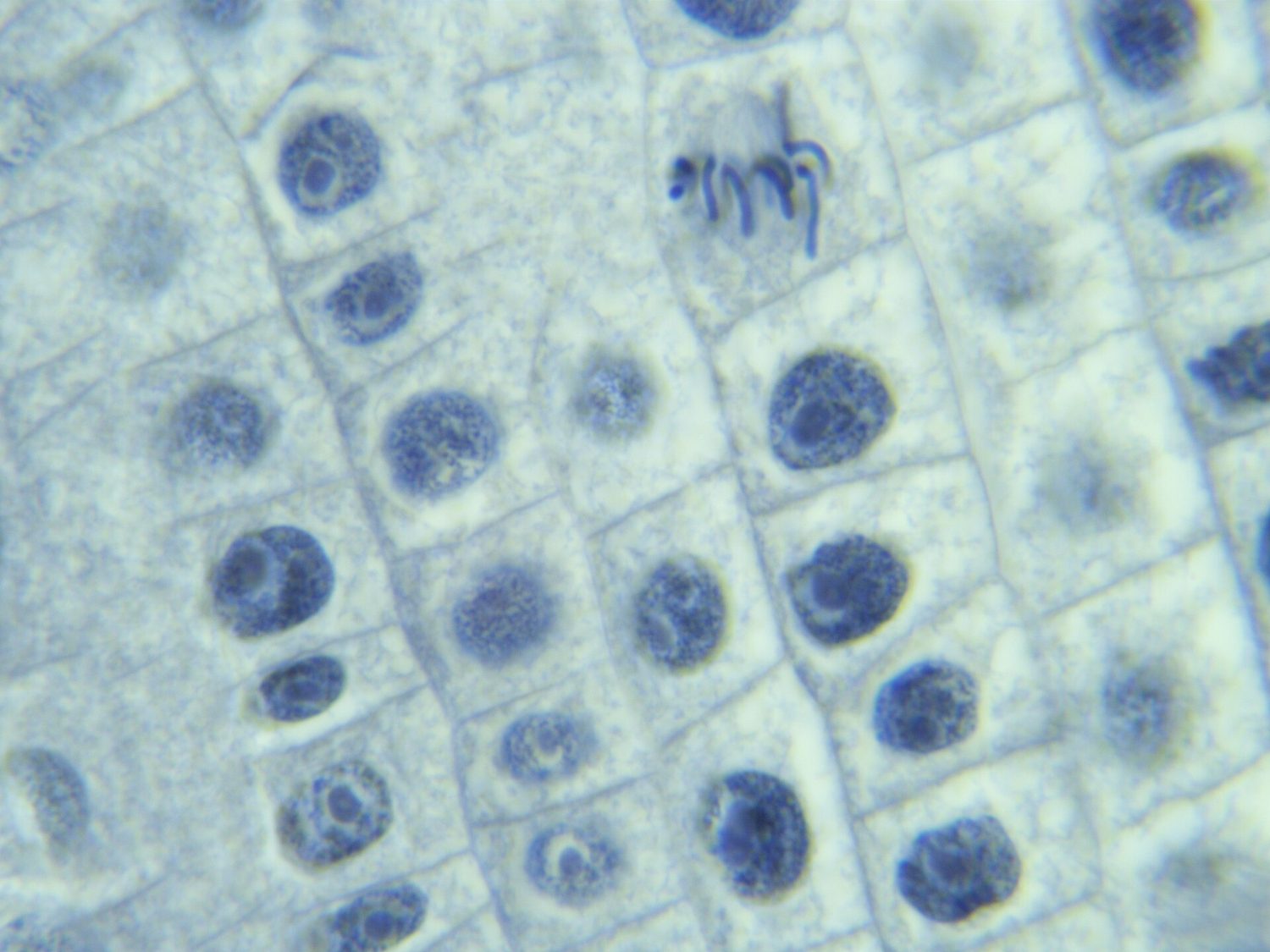
The cell cycle 细胞周期 is the life of a cell from one division to the next: interphase 间期 (G1 growth, S DNA replication, G2 preparation) followed by mitosis 有丝分裂 (M) and cytokinesis, which produce two identical daughter cells. Interphase takes most of the time; DNA is copied only in S phase.
The cell cycle copies the DNA (S phase) then splits it evenly in mitosis, producing two identical cells. Step through the stages. · 细胞周期复制DNA(S期),然后在有丝分裂中平均分配,产生两个相同的细胞。逐步浏览各个阶段。
Source: College Board AP Course and Exam Description · แหล่งที่มา: คำอธิบายหลักสูตรและข้อสอบ College Board AP
English
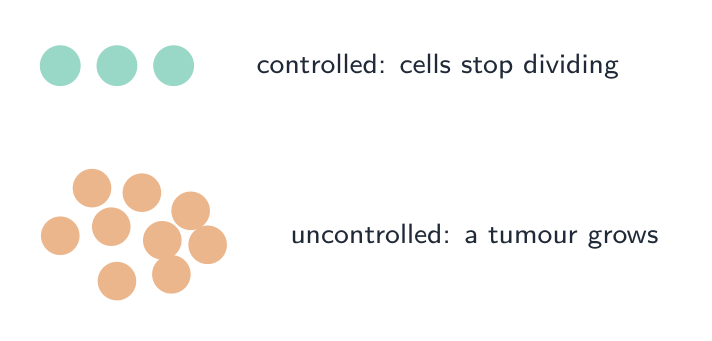
The cycle is controlled at checkpoints 检查点 that verify conditions before proceeding (Is the DNA intact? Are chromosomes attached?). Internal signals (cyclins and their kinases) and external signals drive the cycle forward. When this control fails – for example, a mutation that ignores a checkpoint – cells divide uncontrollably, which underlies cancer 癌症.
Worked example. Signal amplification in a cascade: one hormone activates one receptor, which switches on about 100 relay proteins, and each of those makes about 1,000 second-messenger molecules — so a single signal produces roughly $100 \times 1000 = 10^{5}$ product molecules. This is why a hormone concentration as low as $10^{-9}\,\text{M}$ can trigger a large cellular response.
In signal transduction name the three stages: reception → transduction → response.
Negative feedback reverses a change to keep conditions steady (homeostasis); positive feedback amplifies a change to completion (childbirth, clotting).
Order the cell cycle: interphase (grow, copy DNA in S phase) then mitosis → two identical daughter cells.
The DNA is copied once, in S phase, so each daughter gets a full copy.
Big Idea 3 — Information Storage and Transmission
Living systems store, retrieve, transmit, and respond to information essential to life processes.
5.1.A
Explain how meiosis results in the transmission of chromosomes from one generation to the next.
5.1.A.1 Meiosis is a process that ensures the formation of haploid gamete cells, sometimes referred to as daughter cells, in sexually reproducing diploid organisms.
5.1.A.2 Meiosis I involves the following steps:
i. Prophase I: Homologous chromosomes pair up and condense, synapsis occurs and then chiasmata may form, meiotic spindle begins to form, centrosomes move to opposite poles of the cell, and the nuclear envelope breaks down.
ii. Metaphase I: Meiotic spindle fibers align homologous pairs of chromosomes along the equator of the cell at the metaphase plate.
iii. Anaphase I: Homologous chromosomes separate, while sister chromatids remain attached, as meiotic spindle fibers pull chromosomes toward poles.
iv. Telophase I: Meiotic spindle breaks down, a new nuclear envelope develops, a cleavage furrow (animal cell) or cell plate (plant cell) forms, and cytokinesis occurs. Two haploid daughter cells are formed (at the end of meiosis I).
5.1.A.3 Meiosis II involves the following steps:
i. Prophase II: Meiotic spindle forms; sister chromatids connected at the centromere attach to meiotic spindle.
ii. Metaphase II: Chromosomes align along the metaphase plate; the kinetochore of each chromatid is attached to a microtubule extending from the poles.
iii. Anaphase II: Proteins at the centromeres break down, and sister chromatids are pulled apart and toward opposite poles in the cell.
iv. Telophase II: Meiotic spindle breaks down, a new nuclear envelope develops, a cleavage furrow (animal cell) or a cell plate (plant cell) forms, chromatids begin to decondense, and cytokinesis occurs. Four haploid daughter cells are formed, each with an unduplicated chromatid.
5.1.B
Describe similarities and differences between the phases and outcomes of mitosis and meiosis.
5.1.B.1 Mitosis and meiosis are similar in the use of a spindle apparatus to move chromosomes but differ in the number of cells produced and the genetic content of the daughter cells.
Source: College Board AP Course and Exam Description · แหล่งที่มา: คำอธิบายหลักสูตรและข้อสอบ College Board AP
English
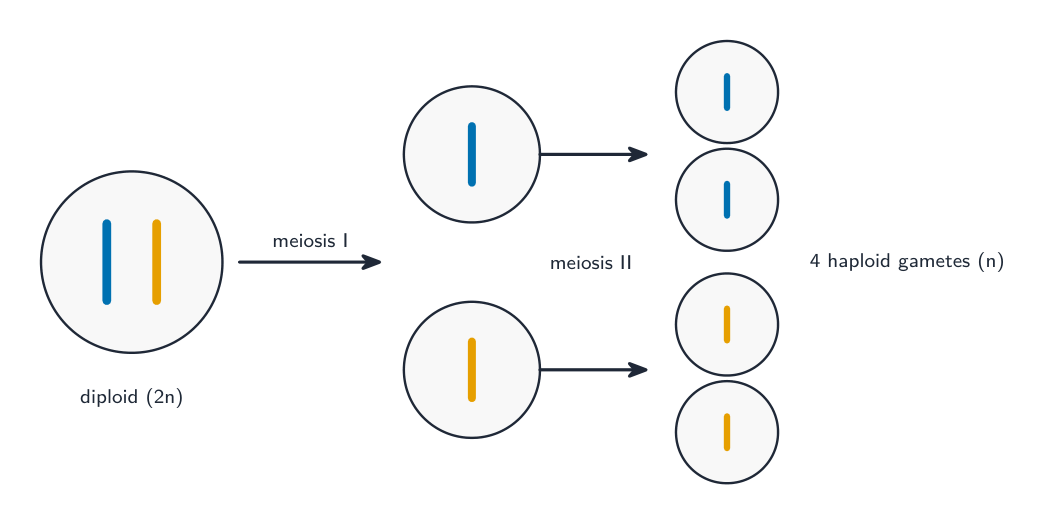
Meiosis 减数分裂 makes gametes 配子 (eggs and sperm) with half the chromosome number, so fertilization restores the full set. One diploid cell divides twice to give four haploid cells. Meiosis I separates homologous chromosomes 同源染色体 (reducing the number); meiosis II separates sister chromatids (like mitosis).
ไทย
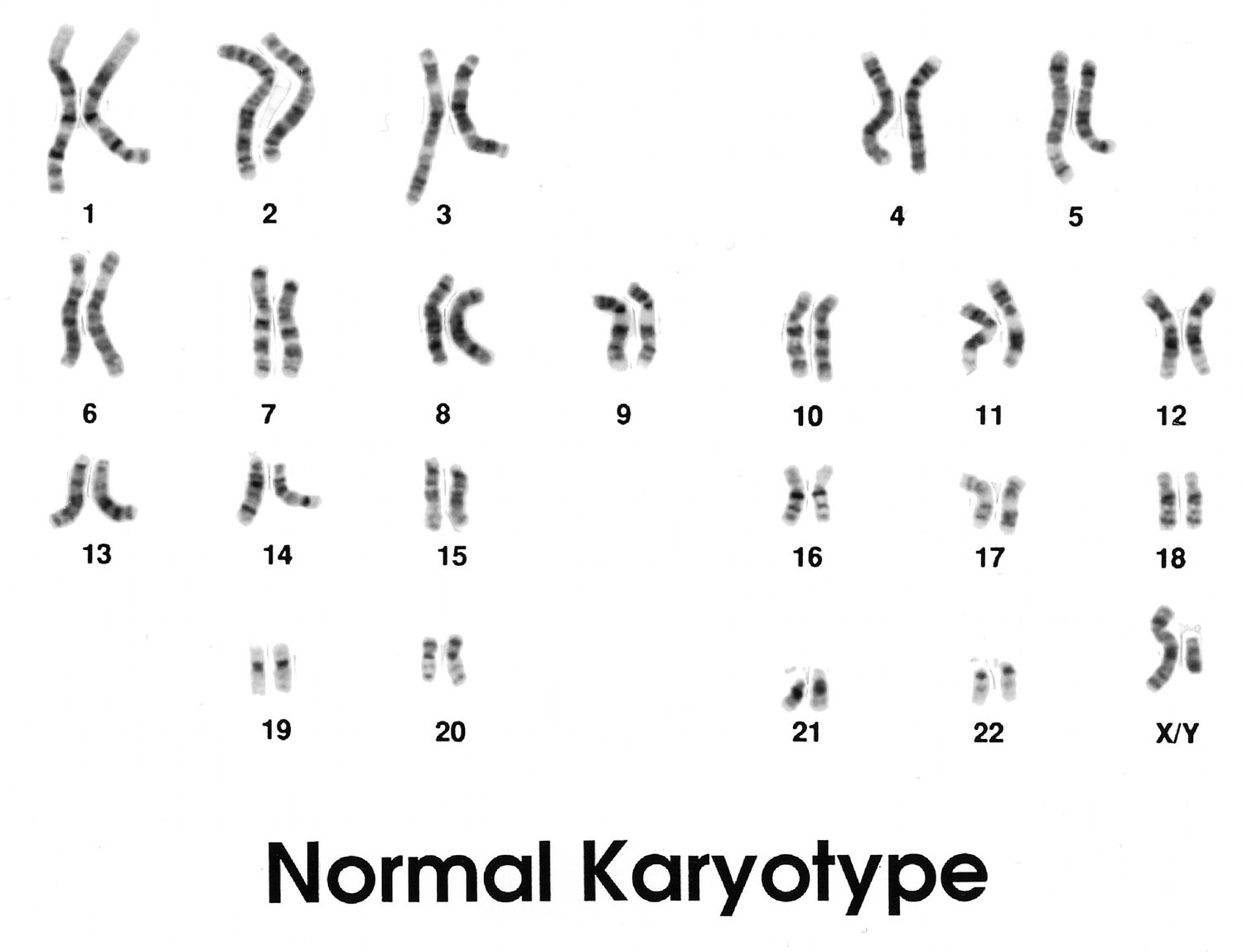
Karyotype ของมนุษย์: 22 คู่ของ autosome plus sex chromosomes
Meiosis halves the chromosome number and shuffles genes, making four genetically varied gametes. Step through to see the divisions. · 减数分裂减半染色体数量并重新组合基因,产生四个遗传上多样的配子。逐步浏览以查看分裂过程。
Meiosis and Genetic Diversity · Meiosis และความหลากหลายทางพันธุกรรม
Syllabus · หลักสูตร
English
Enduring Understanding (BIG IDEA 3 — Information Storage and Transmission): Living systems store, retrieve, transmit, and respond to information essential to life processes.
Learning Objective 5.2.A: Explain how the process of meiosis generates genetic diversity.
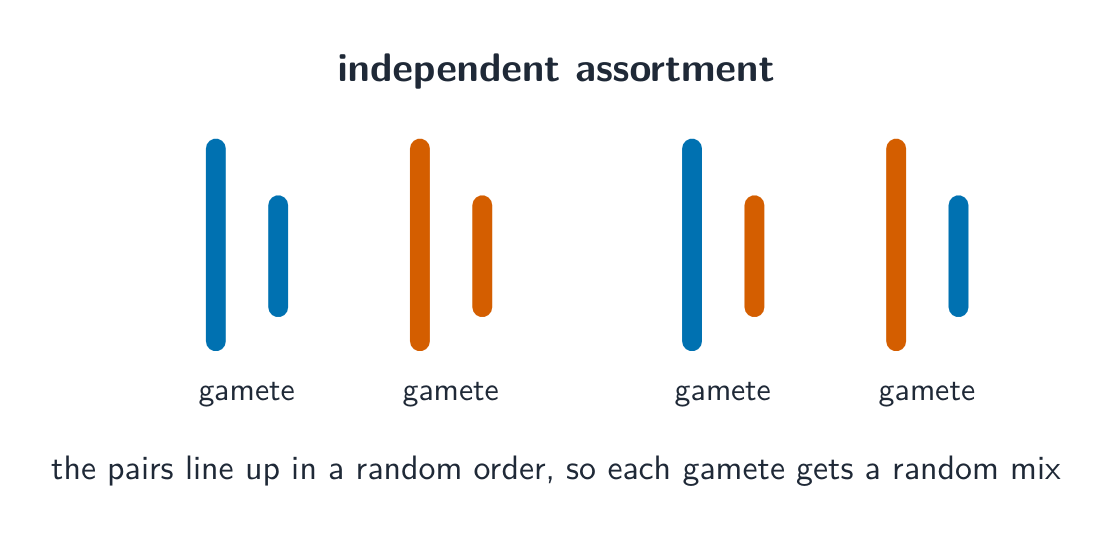
5.2.A.1 Correct separation of the homologous chromosomes in meiosis I and sister chromatids in meiosis II ensures that each gamete receives a haploid (1n) set of chromosomes that comprises an assortment of both maternal and paternal chromosomes. When incorrect separation occurs (nondisjunction), gametes are no longer haploid.
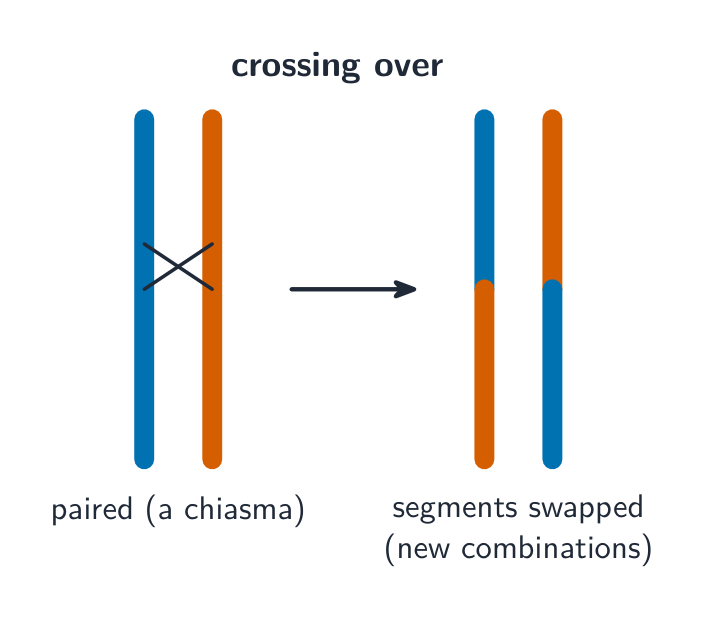
5.2.A.2 During prophase I of meiosis, non-sister chromatids exchange genetic material via a process called crossing over (recombination), which increases genetic diversity among the resultant gametes.
5.2.A.3 Sexual reproduction in eukaryotes increases genetic variation, including crossing over, random assortment of chromosomes during meiosis, and subsequent fertilization of gametes.
Exclusion statement: Knowledge of the details of sexual reproduction cycles in various plants and animals is beyond the scope of the AP Exam.
ไทย
ความเข้าใจที่ยั่งยืน (BIG IDEA 3 — การจัดเก็บและการถ่ายทอดข้อมูล): ระบบชีวภาพจัดเก็บ รื้อค้น ถ่ายทอด และตอบสนองต่อข้อมูลที่จำเป็นต่อกระบวนการดำรงชีวิต
Enduring Understanding (BIG IDEA 1 — Evolution): The process of evolution drives the diversity and unity of life.
Enduring Understanding (BIG IDEA 3 — Information Storage and Transmission): Living systems store, retrieve, transmit, and respond to information essential to life processes.
Learning Objective 5.3.A: Explain the inheritance of genes and traits as described by Mendel's laws.
5.3.A.1 Mendel's laws of segregation and independent assortment can be applied to genes that are on different chromosomes.
5.3.A.2 In most cases, fertilization involves the fusion of two haploid gametes, restoring the diploid number of chromosomes and increasing genetic variation in populations by creating new combinations of alleles in the zygote.
i. Rules of probability can be applied to analyze the passing of single-gene traits from parent to offspring.
ii. Monohybrid, dihybrid, and test crosses can be used to determine whether alleles are dominant or recessive.
iii. An organism's genotype is the set of alleles inherited for one or more genes by an individual organism. An organism's genotype can be homozygous or heterozygous for each gene.
iv. An organism's phenotype is the observable expression of the inherited traits.
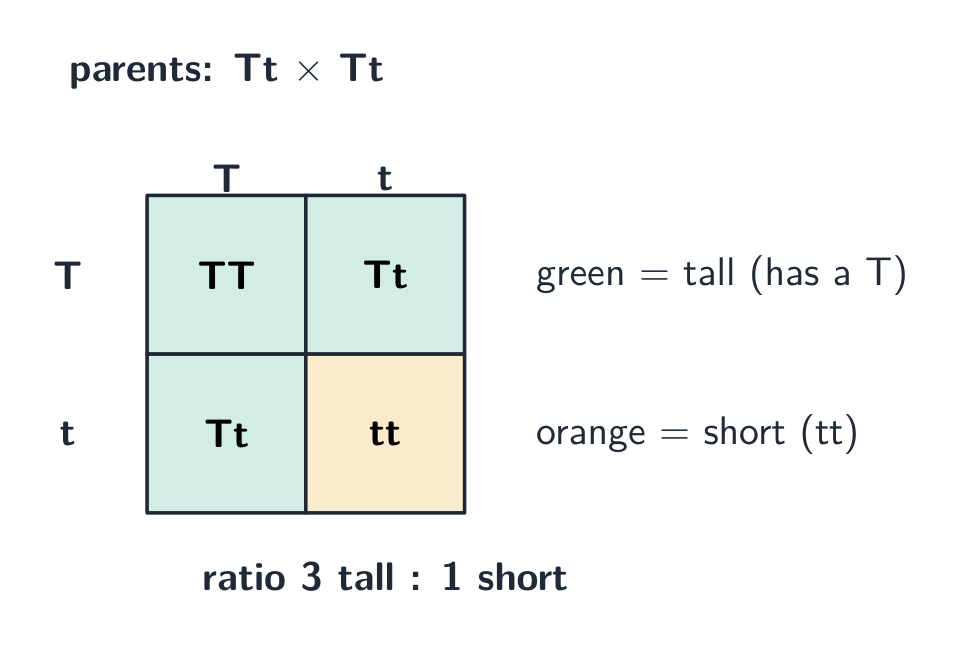
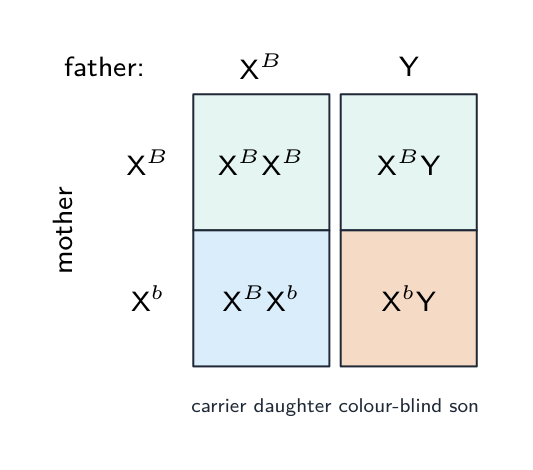
v. Patterns of inheritance (autosomal, genetically linked, sex-linked) and whether an allele is dominant or recessive can often be predicted from data, including pedigrees. Punnett squares can be used to predict the genotypes and phenotypes of parents and offspring.
Equation (Laws of Probability): If $A$ and $B$ are mutually exclusive, then: $P(A \text{ or } B) = P(A) + P(B)$
Equation (Laws of Probability): If $A$ and $B$ are independent, then: $P(A \text{ and } B) = P(A) \times P(B)$
ไทย
ความเข้าใจที่ยั่งยืน (BIG IDEA 1 — วิวัฒนาการ): กระบวนการวิวัฒนาการขับเคลื่อนความหลากหลายและความสามัคคีของชีวิต
ความเข้าใจที่ยั่งยืน (BIG IDEA 3 — การจัดเก็บและการถ่ายทอดข้อมูล): ระบบชีวภาพจัดเก็บ รื้อค้น ถ่ายทอด และตอบสนองต่อข้อมูลที่จำเป็นต่อกระบวนการดำรงชีวิต
i. กฎของความน่าจะเป็นสามารถนำไปใช้วิเคราะห์การถ่ายทอดลักษณะจากยีนเดี่ยวจากผู้ปกครองไปยังลูกหลานได้
ii. การข้ามสายพันธุ์ monohybrid, dihybrid และการทดสอบ (test cross) สามารถใช้เพื่อบอกได้ว่าอัลลีลนั้นเป็นดอமிแนนต์หรือรีเซสซีฟ
iii. จีโนไทป์ของสิ่งมีชีวิตคือชุดของอัลลีลที่ถูกถ่ายทอดมาสำหรับยีนหนึ่งหรือมากกว่าโดยสิ่งมีชีวิตหนึ่งๆ จีโนไทป์ของสิ่งมีชีวิตอาจเป็นโฮโมไซกัสหรือเฮเทอโรไซกัสสำหรับแต่ละยีน
iv. Phenotype ของสิ่งมีชีวิตคือการแสดงออกที่สังเกตได้จากลักษณะที่ถูกถ่ายทอดมา
สมการ (กฎของความน่าจะเป็น): หาก $A$ และ $B$ เป็น mutually exclusive แล้ว: $P(A \text{ or } B) = P(A) + P(B)$
สมการ (กฎของความน่าจะเป็น): หาก $A$ และ $B$ เป็น independent แล้ว: $P(A \text{ and } B) = P(A) \times P(B)$
Source: College Board AP Course and Exam Description · แหล่งที่มา: คำอธิบายหลักสูตรและข้อสอบ College Board AP
English
A gene's alternative versions are alleles 等位基因. An organism's genotype 基因型 (its alleles) produces its phenotype 表型 (its traits). Mendel's rules: a dominant 显性 allele masks a recessive 隐性 one; the two alleles segregate into different gametes (law of segregation); genes for different traits assort independently. A Punnett square 庞纳特方格 predicts offspring ratios (a heterozygous cross gives 3:1). Homozygous 纯合 means two identical alleles; heterozygous 杂合 means two different.
Worked example. For a dihybrid cross of two independent genes, $AaBb\times AaBb$, use the multiplication rule instead of a $16$-box square. Each gene alone gives $\tfrac34$ dominant, so the chance an offspring shows both dominant traits is $\tfrac34\times\tfrac34=\tfrac{9}{16}$, and the chance of the fully recessive $aabb$ is $\tfrac14\times\tfrac14=\tfrac{1}{16}$. Multiplying two independent $3{:}1$ ratios is what produces the classic $9{:}3{:}3{:}1$ pattern.
A Punnett square combines each parent's alleles to predict the offspring ratios. Set the parent genotypes and read off the expected proportions. · 庞尼特方格结合每个亲本的等位基因以预测后代比例。设置亲本基因型并读取预期比例。
Enduring Understanding (BIG IDEA 3 — Information Storage and Transmission): Living systems store, retrieve, transmit, and respond to information essential to life processes.
Learning Objective 5.4.A: Explain deviations from Mendel's model of the inheritance of traits.
5.4.A.1 Patterns of inheritance of many traits do not follow the ratios predicted by Mendel's laws and can be identified by quantitative analysis, when the observed phenotypic ratios statistically differ from the predicted ratios.
i. Genes located on the same chromosome are referred to as being genetically linked. The probability that these linked genes segregate together during meiosis can be used to calculate the map distance (or map units) between them on a chromosome. This calculation is called gene or genetic mapping.
ii. Codominance occurs when the phenotype from both alleles is expressed such that the heterozygote would have a different phenotype than either homozygote.
iii. Incomplete dominance occurs when neither allele of a gene can mask the other, so the phenotype of the heterozygote is a blended version of the dominant and recessive phenotypes.
5.4.A.2 Some traits, known as sex-linked traits (X- or Y-linked), are determined by genes on sex chromosomes. The pattern of inheritance of sex-linked traits can often be predicted from data, including pedigrees, indicating the genotypes and phenotypes of both parents and offspring.
Illustrative examples for EK 5.4.A.2:
Sex-linked traits (X- or Y-linked) reside on sex chromosomes.
Sex-linked traits (X- or Y-linked) are inherited at higher rates in XY individuals than they are in XX individuals.
In certain species, the chromosomal basis of sex determination is not based on X and Y chromosomes (e.g., ZW in birds, haplodiploidy in bees).
5.4.A.3 Pleiotropy is a phenomenon in which the expression of a single gene results in multiple traits or effects; these traits therefore do not segregate independently.
5.4.A.4 Some traits result from non-nuclear inheritance.
i. Chloroplasts and mitochondria are randomly assorted to gametes and daughter cells; thus, traits determined by chloroplast and mitochondrial DNA do not follow simple Mendelian rules.
ii. In animals, mitochondria are usually transmitted by the egg and not by sperm; thus, traits determined by the mitochondrial DNA are typically maternally inherited.
iii. In plants, mitochondria and chloroplasts are transmitted in the ovule and not in the pollen; as such, mitochondria-determined and chloroplast-determined traits are typically maternally inherited.
ไทย
ความเข้าใจที่ยั่งยืน (BIG IDEA 3 — การจัดเก็บและการถ่ายทอดข้อมูล): ระบบชีวภาพจัดเก็บ รื้อค้น ถ่ายทอด และตอบสนองต่อข้อมูลที่จำเป็นต่อกระบวนการดำรงชีวิต
i. คลอโรพลาสต์และไมโทคอนเดรียถูกจัดสรรแบบสุ่มไปยังแกมีตและเซลล์ลูก; ดังนั้นลักษณะที่กำหนดโดย DNA ของคลอโรพlasต์และไมโทคอนเดรียจึงไม่เป็นไปตามกฎเมนเดลแบบง่าย
ii. ในสัตว์ ไมโทคอนเดรียจะถูกส่งต่อโดยไข่ส่วนใหญ่และไม่ถูกส่งต่อโดยสเปิร์ม ดังนั้นลักษณะที่กำหนดโดยดีเอ็นเอในไมโทคอนเดรียจึงมักถูกสืบทอดทางฝ่ายแม่
iii. ในพืช ไมโทคอนเดรียและคลอโรพลาสต์จะถูกส่งต่อไปยังผลไม่แต่ไม่ถูกส่งต่อไปยังเกสร เมื่อเป็นเช่นนี้ ลักษณะที่กำหนดโดยไมโทคอนเดรียและคลอโรพลาสต์จึงมักถูกสืบทอดทางฝ่ายแม่
Source: College Board AP Course and Exam Description · แหล่งที่มา: คำอธิบายหลักสูตรและข้อสอบ College Board AP
English
Many traits do not follow simple dominance:
Incomplete dominance 不完全显性: heterozygotes are a blend (red × white → pink).
Codominance 共显性: both alleles show fully (AB blood type).
Multiple alleles, polygenic 多基因 traits (many genes, like height), pleiotropy (one gene, many effects), and sex-linked 伴性 genes (on the X chromosome) all give more complex ratios.
Worked example (chi-square test). To check whether real data fit a predicted ratio, use $\chi^2=\sum\dfrac{(o-e)^2}{e}$. A monohybrid cross predicts $3{:}1$, so of $80$ offspring you expect $60$ dominant and $20$ recessive, but you observe $55$ and $25$. Then $\chi^2=\dfrac{(55-60)^2}{60}+\dfrac{(25-20)^2}{20}=\dfrac{25}{60}+\dfrac{25}{20}=0.42+1.25=1.67$. With $1$ degree of freedom the critical value at $p=0.05$ is $3.84$; since $1.67<3.84$, we fail to reject the null hypothesis – the deviation is within chance.
ไทย
หลายลักษณะไม่ได้遵循 simple dominance:
Sex linkage ให้ผลลัพธ์ต่างสำหรับลูกชายและลูกสาว
Incomplete dominance: heterozygotes เป็นผสม (red × white → pink)
Codominance: alleles ทั้งสองแสดงออกเต็มที่ (AB blood type)
Multiple alleles, polygenic traits (many genes, เช่น ส่วนสูง), pleiotropy (one gene, many effects), และ sex-linked genes (on the X chromosome) ทั้งหมดให้ ratios ที่ซับซ้อนมากขึ้น
Environmental Effects on Phenotype · ผลกระทบของสิ่งแวดล้อมต่อฟีโนไทป์
Syllabus · หลักสูตร
English
Enduring Understanding (BIG IDEA 4 — Systems Interactions): Biological systems interact, and these systems and their interactions exhibit complex properties.
Learning Objective 5.5.A: Explain how the same genotype can result in multiple phenotypes under different environmental conditions.
5.5.A.1 Environmental conditions influence gene expression and can lead to phenotypic plasticity (e.g., the ability of individual genotypes to produce different phenotypes).
Illustrative examples for EK 5.5.A.1:
Height and weight in humans
Flower color based on soil pH
Seasonal fur color in arctic animals
Sex determination in reptiles
Effect of increased UV on melanin production in animals
Presence of the opposite mating type on pheromone production in yeast and other fungi
ไทย
ความเข้าใจที่ยั่งยืน (BIG IDEA 4 — การมีปฏิสัมพันธ์ของระบบ): ระบบชีวภาพมีการมีปฏิสัมพันธ์กัน และระบบเหล่านี้พร้อมทั้งการมีปฏิสัมพันธ์将它们展现出复杂的性质。
Source: College Board AP Course and Exam Description · แหล่งที่มา: คำอธิบายหลักสูตรและข้อสอบ College Board AP
English
Phenotype is not set by genes alone – the environment also matters. Temperature, nutrition, and other factors can change how genes are expressed (a Himalayan rabbit's dark fur where it is cold, a plant's height with more sunlight). So identical genotypes can give different phenotypes in different conditions.
Contrast mitosis (2 identical, full chromosome number) with meiosis (4 non-identical gametes, half the number).
Explain variation from crossing over, independent assortment, and random fertilisation.
Use the multiplication rule for dihybrid crosses (each gene's $3{:}1$ multiplied), and a chi-square test ($\chi^2=\sum\frac{(o-e)^2}{e}$) to judge observed vs expected ratios.
Keep genotype (the alleles) separate from phenotype (what you see) — $AA$ and $Aa$ can look the same.
Recognise non-Mendelian patterns: incomplete dominance, codominance, and sex linkage.
DNA and RNA Structure · โครงสร้างของ DNA และ RNA
Syllabus · หลักสูตร
English
Enduring Understanding (BIG IDEA 3 — Information Storage and Transmission): Living systems store, retrieve, transmit, and respond to information essential to life processes.
Learning Objective 6.1.A: Describe the structures involved in passing hereditary information from one generation to the next.
6.1.A.1 Genetic information is stored in and passed to subsequent generations through DNA molecules and, in some cases, RNA molecules.
6.1.A.1.i Prokaryotic organisms typically have circular chromosomes.
6.1.A.1.ii Eukaryotic organisms typically have multiple linear chromosomes that are comprised of DNA. These chromosomes are condensed using histones and associated proteins.
6.1.A.2 Prokaryotes and eukaryotes can contain plasmids, which are extra-chromosomal circular molecules of DNA.
Learning Objective 6.1.B: Describe the characteristics of DNA that allow it to be used as hereditary material.
6.1.B.1 Nucleic acids exhibit specific nucleotide base pairing that is conserved through evolution.
6.1.B.1.i Purines (guanine and adenine) have a double ring structure.
6.1.B.1.ii Pyrimidines (cytosine, thymine, and uracil) have a single ring structure.
6.1.B.1.iii Purines pair with pyrimidines: adenine with thymine (or uracil in RNA) and guanine with cytosine.
ไทย
ความเข้าใจที่ยั่งยืน (BIG IDEA 3 — การจัดเก็บและการถ่ายทอดข้อมูล): ระบบชีวภาพจัดเก็บ รื้อค้น ถ่ายทอด และตอบสนองต่อข้อมูลที่จำเป็นต่อกระบวนการดำรงชีวิต
Source: College Board AP Course and Exam Description · แหล่งที่มา: คำอธิบายหลักสูตรและข้อสอบ College Board AP
English
DNA carries genetic information as a double helix 双螺旋 of two strands. Its nucleotides 核苷酸 pair by rule – A with T, G with C (complementary base pairing 互补配对) – so one strand specifies the other. The strands run antiparallel 反平行. RNA is single-stranded, uses uracil (U) instead of thymine, and has ribose sugar.
How the DNA is packaged differs between the domains, and the CED asks for both.
Prokaryotic organisms typically have a single circular chromosome 环状染色体 in the cytoplasm, often with extra small circles called plasmids.
Eukaryotic organisms typically have multiple linear chromosomes 线性染色体, and each is condensed by wrapping around proteins called histones 组蛋白. That packing is what fits two metres of DNA into a nucleus a few micrometres across — and because a tightly wound region is hard for the transcription machinery to reach, the packing is itself a level of gene regulation.
ไทย
การม้วน DNA ที่ตกตะกอนจากสารสกัดเซลล์ — DNA เป็นโมเลกุลจริงที่มองเห็นได้
DNA ขนส่งข้อมูลทางพันธุกรรมในรูปแบบ double helix ของสองสาย Its nucleotides จับคู่ตามกฎ – A กับ T, G กับ C (complementary base pairing) – sehingga one strand specifies the other. สายทั้งสองวิ่ง antiparallel. RNA เป็น single-stranded, ใช้ uracil (U) แทน thymine และมี ribose sugar
DNA: สายคู่สองสายที่วางตัวตรงข้ามกัน (antiparallel) เชื่อมต่อกันด้วยคู่เบสที่เข้ากันได้ (complementary base pairs)
วิธีการแพ็ค DNA แตกต่างกันระหว่างโดเมน และ CED ต้องการทราบทั้งสอง
complementary base pairing/ˌkɒmplɪˈmentəri beɪs ˈpeərɪŋ/
complementary base pairing
antiparallel/ˌæntɪˈpærəlel/
antiparallel
single circular chromosome/ˈsɪŋɡl ˈsɜːkjʊlə ˈkrəʊməsəʊm/
โครโมโซมวงกลมเดี่ยว
multiple linear chromosomes/ˈmʌltɪpl ˈlɪnɪə ˈkrəʊməsəʊmz/
โครโมโซมเชิงเส้นหลายอัน
condensed by wrapping around proteins called histones/kənˈdenst baɪ ˈræpɪŋ əˈraʊnd ˈprəʊtiːnz kɔːld ˈhɪstəʊnz/
หนาแน่นโดยการพันรอบโปรตีนที่เรียกว่าฮิสโทน
Transcription/trænˈskrɪpʃn/
转录
6.2
DNA Replication · การจำลอง DNA
Syllabus · หลักสูตร
English
Enduring Understanding (BIG IDEA 3 — Information Storage and Transmission): Living systems store, retrieve, transmit, and respond to information essential to life processes.
Learning Objective 6.2.A: Describe the mechanisms by which genetic information is copied for transmission between generations.
6.2.A.1 DNA replication ensures continuity of hereditary information.
6.2.A.1.i DNA is synthesized in the 5' to 3' direction.
6.2.A.1.ii Replication is a semiconservative process, meaning one strand of DNA serves as the template for a new strand of complementary DNA.
6.2.A.1.iii Helicase unwinds the DNA strands.
6.2.A.1.iv Topoisomerase relaxes supercoiling in front of the replication fork.
6.2.A.1.v DNA polymerase requires RNA primers to initiate DNA synthesis.
6.2.A.1.vi DNA polymerase synthesizes new strands of DNA continuously on the leading strand and discontinuously on the lagging strand.
6.2.A.1.vii Ligase joins the fragments on the lagging strand.
Exclusion statement: The names of the steps and particular enzymes involved, excluding DNA polymerase, ligase, RNA polymerase, helicase, and topoisomerase, are beyond the scope of the AP Exam.
ไทย
ความเข้าใจที่ยั่งยืน (BIG IDEA 3 — การจัดเก็บและการถ่ายทอดข้อมูล): ระบบชีวภาพจัดเก็บ รื้อค้น ถ่ายทอด และตอบสนองต่อข้อมูลที่จำเป็นต่อกระบวนการดำรงชีวิต
6.2.A.1.v DNA โพลิเมอเรสต้องการพไรเมอร์ RNA เพื่อเริ่มต้นการสังเคราะห์ DNA
6.2.A.1.vi DNA โพลิเมอเรสสังเคราะห์สาย DNA ใหม่อย่างต่อเนื่องบนสายนำและไม่ต่อเนื่องบนสายตาม
6.2.A.1.vii Ligase เชื่อมต่อก้อนส่วนบนสายตาม
คำยกเว้น: ชื่อขั้นตอนและเอนไซม์เฉพาะที่เกี่ยวข้อง ซึ่งไม่รวม DNA โพลิเมอเรส Ligase RNA โพลิเมอเรส เฮลิเคส และ拓扑异构酶,超出了AP考试的范畴。
Source: College Board AP Course and Exam Description · แหล่งที่มา: คำอธิบายหลักสูตรและข้อสอบ College Board AP
English
Before a cell divides, DNA is copied semiconservatively 半保留复制: the helix unwinds and each old strand templates a new one, so each daughter helix has one old and one new strand. DNA polymerase 聚合酶 adds nucleotides following base-pairing rules, building the new strand and proofreading as it goes.
ไทย
ก่อนเซลล์แบ่งตัว DNA จะถูกคัดลอกแบบ semiconservatively: helixคลายออกและแต่ละสายเก่าจะเป็น template สำหรับสายใหม่, sehingga each daughter helix มีหนึ่งสายเก่าและหนึ่งสายใหม่. DNA polymerase เพิ่ม nucleotides ตามกฎการจับคู่ฐาน, สร้างสายใหม่และ proofread ระหว่างทาง
Semi-conservative DNA replication at a replication fork
Transcription and RNA Processing · Transcription และ RNA Processing
Syllabus · หลักสูตร
English
Enduring Understanding (BIG IDEA 3 — Information Storage and Transmission): Living systems store, retrieve, transmit, and respond to information essential to life processes.
Learning Objective 6.3.A: Describe the mechanisms by which genetic information flows from DNA to RNA to protein.
6.3.A.1 The sequence of the RNA bases, together with the structure of the RNA molecule, determines RNA function.
6.3.A.1.i Messenger RNA (mRNA) molecules carry information from DNA in the nucleus to the ribosome in the cytoplasm.
6.3.A.1.ii Distinct transfer RNA (tRNA) molecules bind specific amino acids and have anticodon sequences that base pair with the codons of mRNA. tRNA is recruited to the ribosome during translation to generate the primary peptide sequence based on the mRNA sequence.
6.3.A.1.iii Ribosomal RNA (rRNA) molecules are functional building blocks of ribosomes.
6.3.A.2 RNA polymerases use a single template strand of DNA to direct the inclusion of bases in the newly formed RNA molecule. This process is known as transcription.
6.3.A.3 The enzyme RNA polymerase synthesizes mRNA molecules in the 5' to 3' direction by reading the template DNA strand in the 3' to 5' direction.
6.3.A.4 In eukaryotic cells the mRNA transcript undergoes a series of enzyme-mediated modifications.
6.3.A.4.i The addition of a poly-A tail makes mRNA more stable.
6.3.A.4.ii The addition of a GTP cap helps with ribosomal recognition.
6.3.A.4.iii The excision of introns, along with the splicing and retention of exons, generates different versions of the resulting mature mRNA molecule. This process is known as alternative splicing.
ไทย
ความเข้าใจที่ยั่งยืน (BIG IDEA 3 — การจัดเก็บและการถ่ายทอดข้อมูล): ระบบชีวภาพจัดเก็บ รื้อค้น ถ่ายทอด และตอบสนองต่อข้อมูลที่จำเป็นต่อกระบวนการดำรงชีวิต
วัตถุประสงค์การเรียนรู้ 6.3.A: อธิบายกลไกที่ข้อมูลทางพันธุกรรมไหลจาก DNA ไปยัง RNA ไปยังโปรตีน
6.3.A.1 ลำดับของเบส RNA连同RNA分子的结构,决定了RNA的功能。
6.3.A.1.i โมเลกุล messenger RNA (mRNA) นำข้อมูลจาก DNA ในนิวเคลียสไปยังไรโบโซมในไซโทพลาซึม
6.3.A.1.ii โมเลกุล transfer RNA (tRNA) ที่แตกต่างกันจะจับกรดอะมิโนเฉพาะและมีลำดับแอนติโคดอนที่จับคู่กับโคดอนของ mRNA tRNA จะถูกเรียกเข้าไรโบโซมระหว่างการแปลเพื่อสร้างลำดับเปปไทด์แรกเริ่มตามลำดับ mRNA
6.3.A.4.ii การเพิ่มModified GTP cap helps with ribosomal recognition。
6.3.A.4.iii การตัด out introns, along with the splicing and retention of exons, generates different versions of the resulting mature mRNA molecule. This process is known as alternative splicing。
Source: College Board AP Course and Exam Description · แหล่งที่มา: คำอธิบายหลักสูตรและข้อสอบ College Board AP
English
Transcription 转录 copies a gene's DNA into messenger RNA 信使RNA (mRNA). RNA polymerase reads the template strand and builds a complementary RNA. In eukaryotes the mRNA is then processed: a cap and tail are added, and introns 内含子 (non-coding parts) are spliced out, leaving the exons 外显子.
The 5′ cap added during processing is a modified guanine nucleotide — a GTP cap — and its job is recognition: it helps the ribosome recognise and bind the mRNA, as well as protecting the transcript from degradation as it leaves the nucleus.
Transcribe DNA into messenger RNA · 转录DNA生成信使RNA
Transcription copies a DNA template into mRNA, pairing A→U, T→A, C→G, G→C. Step through to build the RNA strand base by base. · 转录将DNA模板复制为mRNA,遵循A→U,T→A,C→G,G→C配对。逐步浏览以逐个碱基构建RNA链。
Enduring Understanding (BIG IDEA 3 — Information Storage and Transmission): Living systems store, retrieve, transmit, and respond to information essential to life processes.
Learning Objective 6.4.A: Explain how the phenotype of an organism is determined by its genotype.
6.4.A.1 Translation of the mRNA to generate a polypeptide occurs on ribosomes that are present in the cytoplasm of both prokaryotic and eukaryotic cells, as well as the cytoplasmic surface of the rough ER of eukaryotic cells.
6.4.A.2 In prokaryotic organisms, translation of the mRNA molecule occurs while it is being transcribed.
6.4.A.3 Translation involves many sequential steps, including initiation, elongation, and termination. The salient features of translation include:
6.4.A.3.i Translation is initiated when the rRNA in the ribosome interacts with the mRNA at the start codon (AUG, coding for the amino acid methionine).
6.4.A.3.ii The sequence of nucleotides on the mRNA is read in triplets, called codons.
6.4.A.3.iii Each codon encodes a specific amino acid, which can be deduced by using a genetic code chart. Many amino acids are encoded by more than one codon.
6.4.A.3.iv Nearly all living organisms use the same genetic code, which is evidence for the common ancestry of all living organisms.
6.4.A.3.v tRNA brings the correct amino acid to the place specified by the codon on the mRNA.
6.4.A.3.vi The amino acid is transferred to the growing polypeptide chain.
6.4.A.3.vii The process continues along the mRNA until a stop codon is reached.
6.4.A.3.viii Translation terminates with the release of the newly synthesized protein.
Exclusion statement: The details and names of the enzymes and factors involved in each of these steps are beyond the scope of the AP Exam.
Exclusion statement: Memorization of the genetic code, with the exception of the start codon AUG, is beyond the scope of the AP Exam.
6.4.A.4 Genetic information in retroviruses is a special case and has an alternate flow of information: from RNA to DNA, made possible by reverse transcriptase, an enzyme that copies the viral RNA genome into DNA. This DNA integrates into the host genome and is transcribed and translated for the assembly of new viral progeny.
ไทย
ความเข้าใจที่ยั่งยืน (BIG IDEA 3 — การจัดเก็บและการถ่ายทอดข้อมูล): ระบบชีวภาพจัดเก็บ รื้อค้น ถ่ายทอด และตอบสนองต่อข้อมูลที่จำเป็นต่อกระบวนการดำรงชีวิต
ข้อจำกัด: รายละเอียดและชื่อของเอนไซม์และปัจจัยที่เกี่ยวข้องในแต่ละขั้นตอนเหล่านี้ไม่อยู่ในขอบเขตของข้อสอบ AP
ข้อจำกัด: การท่องจำรหัสพันธุกรรม ยกเว้นคอดอนเริ่มต้น AUG ไม่อยู่ในขอบเขตของข้อสอบ AP
6.4.A.4 ข้อมูลทางพันธุกรรมในไวรัสรีโทรมีความพิเศษและเป็นกรณีพิเศษของการไหลของข้อมูล: จาก RNA ไปยัง DNA ซึ่งเกิดจาก reverse transcriptase เอนไซม์ที่ทำหน้าที่คัดลอกจีโนมไวรัสเป็น DNA DNA นี้จะรวมเข้ากับจีโฮสต์และถูกถอดรหัสและแปลรหัสเพื่อประกอบตัวลูกไวรัสใหม่
Source: College Board AP Course and Exam Description · แหล่งที่มา: คำอธิบายหลักสูตรและข้อสอบ College Board AP
English
Translation 翻译 builds a protein from the mRNA at the ribosome 核糖体. The mRNA is read in three-base codons 密码子, each specifying one amino acid (the genetic code). Transfer RNA 转运RNA brings the matching amino acid, and the ribosome links them into a polypeptide until a stop codon ends it. This is the "central dogma": DNA → RNA → protein.
Regulation of Gene Expression · การควบคุมการแสดงออกของยีน
Syllabus · หลักสูตร
English
Enduring Understanding (BIG IDEA 3 — Information Storage and Transmission): Living systems store, retrieve, transmit, and respond to information essential to life processes.
Learning Objective 6.5.A: Describe the types of interactions that regulate gene expression.
6.5.A.1 Regulatory sequences are stretches of DNA that interact with regulatory proteins to control transcription. Some genes are constitutively expressed, and others are inducible.
6.5.A.2 Epigenetic changes can affect gene expression through reversible modifications of DNA or histones.
6.5.A.3 The phenotype of a cell or an organism is determined by the combination of genes that are expressed and the levels at which they are expressed.
6.5.A.3.i Observable cell differentiation results from the expression of genes for tissue-specific proteins.
6.5.A.3.ii Induction of transcription factors during development results in sequential gene expression.
6.5.A.3.iii The function and amount of gene products determine the phenotype of organisms.
Learning Objective 6.5.B: Explain how the location of regulatory sequences relates to their function.
6.5.B.1 Both prokaryotes and eukaryotes have groups of genes that are coordinately regulated.
6.5.B.1.i Prokaryotes regulate operons in an inducible or repressible system.
6.5.B.1.ii In eukaryotes, groups of genes may be influenced by the same transcription factors to coordinately regulate expression.
ไทย
ความเข้าใจที่ยั่งยืน (BIG IDEA 3 — การจัดเก็บและการถ่ายทอดข้อมูล): ระบบชีวภาพจัดเก็บ รื้อค้น ถ่ายทอด และตอบสนองต่อข้อมูลที่จำเป็นต่อกระบวนการดำรงชีวิต
Source: College Board AP Course and Exam Description · แหล่งที่มา: คำอธิบายหลักสูตรและข้อสอบ College Board AP
English
Cells control which genes are expressed and when. In prokaryotes, operons 操纵子 switch groups of genes on or off. In eukaryotes, regulation happens at many levels – which genes are transcribed (transcription factors, promoters, enhancers), RNA processing, and after translation. This lets a cell respond to its environment without changing its DNA.
Gene Expression and Cell Specialization · การแสดงออกของยีนและการจำเพาะของเซลล์
Syllabus · หลักสูตร
English
Enduring Understanding (BIG IDEA 3 — Information Storage and Transmission): Living systems store, retrieve, transmit, and respond to information essential to life processes.
Learning Objective 6.6.A: Explain how the binding of transcription factors to promoter regions affects gene expression and the phenotype of the organism.
6.6.A.1 RNA polymerase and transcription factors bind to promoter or enhancer DNA sequences to initiate transcription. These sequences can be upstream or downstream of the transcription start site.
6.6.A.2 Negative regulatory molecules inhibit gene expression by binding to DNA and blocking transcription.
Learning Objective 6.6.B: Explain the connection between the regulation of gene expression and phenotypic differences in cells and organisms.
6.6.B.1 Gene regulation results in differential gene expression and influences cell products and functions.
6.6.B.2 Certain small RNA molecules have roles in regulating gene expression.
ไทย
ความเข้าใจที่ยั่งยืน (BIG IDEA 3 — การจัดเก็บและการถ่ายทอดข้อมูล): ระบบชีวภาพจัดเก็บ รื้อค้น ถ่ายทอด และตอบสนองต่อข้อมูลที่จำเป็นต่อกระบวนการดำรงชีวิต
Source: College Board AP Course and Exam Description · แหล่งที่มา: คำอธิบายหลักสูตรและข้อสอบ College Board AP
English
Every cell in a body has the same DNA, yet cells differ because they express different genes – differential gene expression 差异表达. This is how one fertilized egg produces many specialized cell types (muscle, nerve, skin); signals during development turn specific genes on and off.
ไทย
ทุกเซลล์ในร่างกายมี DNA เหมือนกัน, แต่เซลล์แตกต่างกันเพราะพวกมันแสดงออก ยีนที่ต่างกัน – differential gene expression. นี่คือวิธีที่ไข่ที่受的 fertilization หนึ่งตัวผลิตเซลล์ประเภทที่เชี่ยวชาญได้มากมาย (กล้ามเนื้อ,ประสาท,ผิวหนัง); สัญญาณ during development เปิดและปิดยีนเฉพาะเจาะจง
A stem cell differentiates into specialised cell types
Enduring Understanding (BIG IDEA 3 — Information Storage and Transmission): Living systems store, retrieve, transmit, and respond to information essential to life processes.
Learning Objective 6.7.A: Describe the various types of mutation.
6.7.A.1 Alterations in a DNA sequence are mutations that can cause changes in the type or amount of the protein produced and the consequent phenotype. DNA mutations can be beneficial, detrimental, or neutral based on the effect or the lack of effect they have on the resulting nucleic acid or protein and the phenotypes that are conferred by the protein.
6.7.A.1.i Point mutations occur when one nucleotide has been substituted for a different nucleotide.
6.7.A.1.ii Frameshift mutations occur when one or more nucleotides are inserted or deleted, causing the reading frame to be shifted.
6.7.A.1.iii Nonsense mutations occur when there is a point mutation that causes a premature stop.
6.7.A.1.iv Silent mutations occur when the change in the nucleotide sequence has no effect on the amino acid sequence.
Illustrative examples for 6.7.A.1:
Mutations in the CFTR gene disrupt ion transport and result in cystic fibrosis.
Mutations in the MC1R gene give adaptive melanism in pocket mice.
Exclusion statement: Knowledge of specific mutations and their effects is beyond the scope of the AP Exam.
Learning Objective 6.7.B: Explain how changes in genotype may result in changes in phenotype.
6.7.B.1 Errors in DNA replication or DNA repair mechanisms as well as external factors, including radiation and reactive chemicals, can cause random mutations in the DNA.
6.7.B.1.i Whether a mutation is beneficial, detrimental, or neutral depends on the environmental context.
6.7.B.1.ii Mutations are a source of genetic variation.
6.7.B.2 Errors in mitosis or meiosis can result in changes in phenotype.
6.7.B.2.i Changes in chromosome number resulting from nondisjunction often result in new phenotypes caused by triploidy (aneuploidy).
6.7.B.2.ii Changes in chromosome number often result in disorders with developmental limitations.
6.7.B.2.iii Alterations in chromosome structure lead to genetic disorders.
Exclusion statement: Knowledge of specific disorders related to changes in chromosome number is beyond the scope of the AP Exam.
Learning Objective 6.7.C: Explain how alterations in DNA sequences contribute to variation that can be subject to natural selection.
6.7.C.1 Changes in genotype may affect phenotypes that are subject to natural selection. Genetic changes that enhance survival and reproduction can be selected for by environmental conditions.
6.7.C.1.i The horizontal acquisitions of genetic information in prokaryotes via transformation (uptake of DNA), transduction (viral transmission of genetic information), conjugation (cell-to-cell transfer of DNA), and transposition (movement of DNA segments within and between DNA molecules) increase genetic variation.
6.7.C.1.ii Related viruses can recombine genetic information if they infect the same host cell.
6.7.C.1.iii Reproductive processes that increase genetic variation are evolutionarily conserved and are shared by various organisms.
Illustrative examples for 6.7.C.1: Sickle cell anemia
ไทย
ความเข้าใจที่ยั่งยืน (BIG IDEA 3 — การจัดเก็บและการถ่ายทอดข้อมูล): ระบบชีวภาพจัดเก็บ รื้อค้น ถ่ายทอด และตอบสนองต่อข้อมูลที่จำเป็นต่อกระบวนการดำรงชีวิต
6.7.B.1 ข้อผิดพลาดในการจำลอง DNA หรือกลไกการซ่อมแซม DNA รวมถึงปัจจัยภายนอก เช่นรังสีและสารเคมีที่มีปฏิกิริยาสูง สามารถ causing random mutations in the DNA
6.7.B.1.i whether a mutation is beneficial, detrimental, or neutral depends on the environmental context.
Source: College Board AP Course and Exam Description · แหล่งที่มา: คำอธิบายหลักสูตรและข้อสอบ College Board AP
English
A mutation 突变 is a change in the DNA sequence. Point mutations change one base (silent, missense, or nonsense); insertions/deletions can cause a frameshift 移码 that garbles everything downstream. Mutations in gametes are heritable; they may be harmful, neutral, or beneficial – and beneficial ones supply the variation for natural selection.
Whole-chromosome errors change the phenotype too. Mutation is not only a change of base: errors in mitosis or meiosis can result in changes in phenotype. If chromosomes fail to separate — nondisjunction 不分离 — a gamete receives an extra copy or none, and the resulting zygote has an abnormal chromosome number (aneuploidy 非整倍性). Trisomy 21 is the familiar example. Because a whole chromosome carries hundreds of genes, the phenotypic effect is far broader than a point mutation's.
Enduring Understanding (BIG IDEA 3 — Information Storage and Transmission): Living systems store, retrieve, transmit, and respond to information essential to life processes.
Learning Objective 6.8.A: Explain the use of genetic engineering techniques in analyzing or manipulating DNA.
6.8.A.1 Genetic engineering techniques can be used to analyze and manipulate DNA and RNA.
6.8.A.1.i Gel electrophoresis is a process that separates DNA fragments by size and charge.
6.8.A.1.ii During polymerase chain reaction (PCR), DNA fragments are amplified by denaturing DNA, annealing primers to the original strand, and extending the new DNA molecule.
6.8.A.1.iii Bacterial transformation introduces foreign DNA into bacterial cells.
6.8.A.1.iv DNA sequencing technology determines the order of nucleotides in a DNA molecule. Typically, these techniques result in a DNA fingerprint that allows for the comparison of DNA sequences from various samples.
Illustrative examples for 6.8.A.1:
Amplified DNA fragments can be used to identify organisms and perform phylogenetic analysis.
Analysis of DNA can be used for forensic identification.
Genetically modified organisms include transgenic animals.
Gene cloning allows propagation of DNA fragments.
Exclusion statement: Knowledge of the details of each of these genetic engineering techniques is beyond the scope of the AP Exam.
ไทย
ความเข้าใจที่ยั่งยืน (BIG IDEA 3 — การจัดเก็บและการถ่ายทอดข้อมูล): ระบบชีวภาพจัดเก็บ รื้อค้น ถ่ายทอด และตอบสนองต่อข้อมูลที่จำเป็นต่อกระบวนการดำรงชีวิต
จุดประสงค์การเรียนรู้ 6.8.A: อธิบายการใช้เทคนิควิศวกรรมพันธุกรรมในการวิเคราะห์หรือดัดแปลง DNA
6.8.A.1 เทคนิควิศวกรรมพันธุกรรมสามารถใช้เพื่อวิเคราะห์และดัดแปลง DNA และ RNA ได้
6.8.A.1.i Gel electrophoresis เป็นกระบวนการแยก展開 DNA ตามขนาดและประจุ
6.8.A.1.ii ในระหว่างปฏิกิริยา chaîne โพลีเมอเรส (PCR) fragment DNA จะถูกเพิ่มจำนวนโดยการทำให้ DNA แยกสาย (denaturing), การจับพรีเมอร์เข้ากับสายเดิม (annealing primers), และการสร้างสาย DNA ใหม่ (extending)
6.8.A.1.iii การแปลงแบคทีเรีย (bacterial transformation) นำ DNA จากภายนอกเข้าสู่เซลล์แบคทีเรีย
6.8.A.1.iv เทคโนโลยีการหาลำดับเบส (DNA sequencing) กำหนดลำดับนิวคลีโอไทด์ในโมเลกุล DNA โดยทั่วไปเทคนิคเหล่านี้จะสร้างลายนิ้วมือ DNA ที่ช่วยให้เปรียบเทียบลำดับ DNA จากตัวอย่างต่างๆ ได้
ตัวอย่างประกอบสำหรับ 6.8.A.1:
fragment DNA ที่เพิ่มจำนวนแล้วสามารถใช้ระบุชนิดของสิ่งมีชีวิตและทำการวิเคราะห์ความสัมพันธ์ทางวิวัฒนาการ (phylogenetic analysis)
การวิเคราะห์ DNA สามารถใช้สำหรับการระบุตัวตนทางนิติวิทยาศาสตร์
การโคลนยีน (Gene cloning) ช่วยในการขยายผล fragment DNA
ข้อความยกเว้น: ความรู้รายละเอียดของแต่ละเทคนิควิศวกรรมพันธุกรรมเหล่านี้อยู่นอกขอบเขตของการสอบ AP
Source: College Board AP Course and Exam Description · แหล่งที่มา: คำอธิบายหลักสูตรและข้อสอบ College Board AP
English
Biotechnology 生物技术 tools manipulate genetic material: PCR 聚合酶链反应 copies DNA, gel electrophoresis 凝胶电泳 separates DNA fragments by size, restriction enzymes and cloning move genes between organisms, and CRISPR edits sequences. These techniques enable genetic testing, engineered organisms, and medical treatments.
Worked example. A template DNA strand 3'-TAC GGA TTC-5' is transcribed into mRNA 5'-AUG CCU AAG-3'. A ribosome reads three codons: AUG = Met (start), CCU = Pro, AAG = Lys — coding for Met–Pro–Lys. Changing the third base of a codon often gives the same amino acid, because the genetic code is degenerate, which softens the effect of many mutations.
Reading DNA identifies individuals. Because the number of repeats at certain non-coding loci varies from person to person, analysis of DNA can be used for forensic identification: amplify those regions by PCR, separate the fragments by gel electrophoresis, and compare the pattern of band positions with a reference sample. A match is a statement about probability rather than certainty, which is why several loci are tested rather than one.
ไทย
เครื่อง thermal cycler ทำร้อนและเย็นตัวอย่างซ้ำๆ เพื่อเพิ่มปริมาณ DNA (PCR)เจลอะกาโรสภายใต้แสง UV: ชิ้นส่วน DNA แยกตามขนาดเป็นแถบสว่าง
Introduction to Natural Selection · บทนำเรื่อง Selection โดยธรรมชาติ
Syllabus · หลักสูตร
English
Enduring Understanding (BIG IDEA 1 — Evolution): The process of evolution drives the diversity and unity of life.
Learning Objective 7.1.A: Describe the causes of natural selection.
7.1.A.1 Natural selection is a major mechanism of evolution.
7.1.A.2 According to Darwin's theory of natural selection, competition for limited resources results in differential survival. Individuals with more favorable phenotypes are more likely to survive and produce more offspring, thus passing on those favorable traits to subsequent generations.
Learning Objective 7.1.B: Explain how natural selection affects populations.
7.1.B.1 Evolutionary fitness is measured by reproductive success.
7.1.B.2 Biotic and abiotic environments can fluctuate, affecting the rate and direction of evolution. Different genetic variations can be selected in each generation.
ไทย
ความเข้าใจที่ยั่งยืน (BIG IDEA 1 — วิวัฒนาการ): กระบวนการวิวัฒนาการขับเคลื่อนความหลากหลายและความสามัคคีของชีวิต
Source: College Board AP Course and Exam Description · แหล่งที่มา: คำอธิบายหลักสูตรและข้อสอบ College Board AP
English
Evolution 进化 is a change in the heritable traits of a population over generations. Natural selection 自然选择 is its main driver: individuals vary, some variations are heritable, more offspring are produced than survive, and those with traits better suited to the environment survive and reproduce more. Over time, helpful traits become more common.
Enduring Understanding (BIG IDEA 1 — Evolution): The process of evolution drives the diversity and unity of life.
Learning Objective 7.2.A: Describe the importance of phenotypic variation in a population.
7.2.A.1 Natural selection acts on phenotypic variations in populations.
7.2.A.2 Environments change and apply selective pressures to populations.
Illustrative examples for 7.2.A.2: Flowering time in relation to global climate change
7.2.A.3 Some phenotypic variations can increase or decrease the fitness of an organism in particular environments.
Illustrative examples for 7.2.A.3: Sickle cell anemia; DDT resistance in insects
Learning Objective 7.2.B: Explain how variation in molecules within cells connects to the fitness of an organism.
7.2.B.1 Variation in the number and types of molecules within cells can provide populations a greater ability to survive and reproduce in different environments.
ไทย
ความเข้าใจที่ยั่งยืน (BIG IDEA 1 — วิวัฒนาการ): กระบวนการวิวัฒนาการขับเคลื่อนความหลากหลายและความสามัคคีของชีวิต
Source: College Board AP Course and Exam Description · แหล่งที่มา: คำอธิบายหลักสูตรและข้อสอบ College Board AP
English
Selection acts on variation 变异. Fitness 适合度 means reproductive success, not strength. Selection comes in modes: directional (favors one extreme), stabilizing (favors the average), and disruptive (favors both extremes). The environment does the "selecting," so a trait that helps in one setting may not in another. Well-suited traits are adaptations 适应.
Watch selection shift a population · 观察自然选择如何改变种群
Natural selection: individuals better suited to the environment survive and reproduce more, so helpful traits spread. Change the environment and watch the population adapt. · 自然选择:适应环境的个体生存和繁殖更多,使有益性状扩散。改变环境并观察种群如何适应。
Source: College Board AP Course and Exam Description · แหล่งที่มา: คำอธิบายหลักสูตรและข้อสอบ College Board AP
English
In artificial selection 人工选择, humans – not nature – choose which individuals breed, selecting for desired traits (crops, livestock, dogs). It works the same way as natural selection and, being fast and visible, is strong evidence that selection can reshape populations.
Enduring Understanding (BIG IDEA 1 — Evolution): The process of evolution drives the diversity and unity of life.
Learning Objective 7.4.A: Explain how random occurrences affect the genetic makeup of a population.
7.4.A.1 Evolution is also driven by random occurrences.
i. Mutation is a random process that adds new genetic variation to a population.
ii. Genetic drift is a change in allele frequencies attributable to a nonselective process occurring in small populations.
iii. The bottleneck effect is a type of genetic drift that occurs when a population size is reduced to a small number of individuals for at least one generation.
iv. The founder effect is a type of genetic drift that occurs when a population is separated from other members of the population. The frequency of genes and traits will shift based on the genes in this new founder population.
v. Migration can result in gene flow (the addition or removal of alleles from a population).
Learning Objective 7.4.B: Describe the role of random processes in the evolution of specific populations.
7.4.B.1 Random processes can lead to changes in allele frequencies in a population.
i. Mutations result in genetic variation, which provides phenotypes on which natural selection acts.
ii. Genetic drift can allow a small population to diverge from other populations of the same species.
iii. Gene flow between two populations prevents them from diverging into separate species.
Learning Objective 7.4.C: Describe the change in the genetic makeup of a population over time.
7.4.C.1 Changes in allele frequencies provide evidence for the occurrence of evolution in a population.
ไทย
ความเข้าใจที่ยั่งยืน (BIG IDEA 1 — วิวัฒนาการ): กระบวนการวิวัฒนาการขับเคลื่อนความหลากหลายและความสามัคคีของชีวิต
i. Mutation เป็นกระบวนการสุ่มที่เพิ่ม genetic variation ใหม่เข้าสู่ประชากร
ii. Genetic drift คือการเปลี่ยนแปลงใน allele frequencies ที่เกิดจากกระบวนการที่ไม่เลือกซึ่งเกิดขึ้นในประชากรขนาดเล็ก
iii. The bottleneck effect เป็นประเภทหนึ่งของ genetic drift ที่เกิดขึ้นเมื่อขนาดประชากรลดลงเหลือจำนวนน้อยเพียงไม่กี่ตัวอย่างน้อยหนึ่งรุ่น
iv. The founder effect เป็นประเภทหนึ่งของ genetic drift ที่เกิดขึ้นเมื่อประชากรถูกแยกออกจากสมาชิกของประชากรอื่นๆ ความถี่ของยีนและลักษณะ akan shift ตาม基因ใน-founder population ใหม่นี้
v. Migration สามารถนำไปสู่ gene flow (การเพิ่มหรือลบ alleles จากประชากร)
Source: College Board AP Course and Exam Description · แหล่งที่มา: คำอธิบายหลักสูตรและข้อสอบ College Board AP
English
Population genetics 群体遗传学 studies the pool of alleles in a population. Evolution is a change in allele frequencies 等位基因频率 over time. Besides natural selection, allele frequencies change through mutation (new alleles), gene flow 基因流 (migration), and genetic drift 遗传漂变 (random change, strongest in small populations – the bottleneck and founder effects).
Enduring Understanding (BIG IDEA 1 — Evolution): The process of evolution drives the diversity and unity of life.
Learning Objective 7.5.A: Describe the conditions under which allele and genotype frequencies will change in populations.
7.5.A.1 The Hardy–Weinberg Equilibrium is a model for describing and predicting allele frequencies in a non-evolving population. Conditions for a population or an allele to be in Hardy–Weinberg equilibrium are:
i. A large population size
ii. No migration
iii. No new mutations
iv. Random mating
v. No natural selection
These conditions are never met, but they provide a valuable null hypothesis.
7.5.A.2 Allele frequencies in a nonevolving population can be calculated from genotype frequencies.
Equation: Hardy–Weinberg Equation— $p^2 + 2pq + q^2 = 1$; $p + q = 1$, where: $p$ = frequency of allele 1 in the population; $q$ = frequency of allele 2 in the population
Illustrative examples for 7.5.A.2: Graphic analysis of allele frequencies in a population
ไทย
ความเข้าใจที่ยั่งยืน (BIG IDEA 1 — วิวัฒนาการ): กระบวนการวิวัฒนาการขับเคลื่อนความหลากหลายและความสามัคคีของชีวิต
วัตถุประสงค์การเรียนรู้ 7.5.A: อธิบายเงื่อนไขภายใต้ which allele และ genotype frequencies จะเปลี่ยนในประชากร
Source: College Board AP Course and Exam Description · แหล่งที่มา: คำอธิบายหลักสูตรและข้อสอบ College Board AP
English
The Hardy–Weinberg 哈迪-温伯格 model gives the allele and genotype frequencies expected when a population is not evolving. With allele frequencies $p$ and $q$ ($p+q=1$):
$$p^2 + 2pq + q^2 = 1,$$
where $p^2$ and $q^2$ are the homozygotes and $2pq$ the heterozygotes. It holds only under five conditions (no selection, no mutation, no migration, random mating, large population); when real data differ from the prediction, the population is evolving.
Worked example. In a population, $16\%$ of individuals show the recessive phenotype, so $q^2=0.16$ and $q=\sqrt{0.16}=0.4$. Then $p=1-q=0.6$. The predicted carrier frequency (heterozygotes) is $2pq=2(0.6)(0.4)=0.48$, i.e. $48\%$, and the homozygous dominants are $p^2=0.6^2=0.36$, i.e. $36\%$. As a check, $0.36+0.48+0.16=1$. This is the standard route: recessive phenotype $\to q^2\to q\to p\to$ everything else.
ไทย
Hardy–Weinberg- model ให้ allele และ genotype frequencies ที่คาดหวังเมื่อประชากร ไม่ได้_fname With allele frequencies $p$ and $q$ ($p+q=1$):
ฮาร์ดี-ไวน์เบิร์ก: ความถี่ของอัลลีล p และ q ให้ความถี่ของจีโนไทป์ p², 2pq, q²
Explore · สำรวจ
Allele frequencies across a cross · 杂交中的等位基因频率
Hardy-Weinberg predicts genotype frequencies ($p^2+2pq+q^2$) in a population that isn't evolving. A Punnett square shows the same allele combining at the population scale. · 哈迪-温伯格定律预测未进化种群的基因型频率($p^2+2pq+q^2$)。庞尼特方格在种群尺度上展示了相同的等位基因组合。
Enduring Understanding (BIG IDEA 1 — Evolution): The process of evolution drives the diversity and unity of life.
Learning Objective 7.6.A: Describe the types of data that provide evidence for evolution.
7.6.A.1 Evolution is supported by scientific evidence from many disciplines (geographical, geological, physical, biochemical, and mathematical data).
Learning Objective 7.6.B: Explain how morphological, biochemical, and geological data provide evidence that organisms have changed over time.
7.6.B.1 Molecular, morphological, and genetic evidence from extant and extinct organisms adds to our understanding of evolution.
i. Fossils can be dated by a variety of methods. These include 1) the age of the rocks where a fossil is found; 2) the rate of decay of isotopes including carbon-14; and 3) geographical data.
ii. Morphological homologies, including vestigial structures, provide evidence of common ancestry.
7.6.B.2 A comparison of DNA nucleotide sequences and protein amino acid sequences provides evidence for evolution and common ancestry.
ไทย
ความเข้าใจที่ยั่งยืน (BIG IDEA 1 — วิวัฒนาการ): กระบวนการวิวัฒนาการขับเคลื่อนความหลากหลายและความสามัคคีของชีวิต
ii. ความคล้ายคลึงกันทางสัณฐานวิทยา (homologies) รวมถึงอวัยวะลดทอน เป็นหลักฐานของบรรพบุรุษร่วมกัน
7.6.B.2 การเปรียบเทียบลำดับนิวคลีโอไทด์ของ DNA และลำดับกรดอะมิโนของโปรตีน ให้หลักฐานรองรับการวิวัฒนาการและบรรพบุรุษร่วมกัน
Source: College Board AP Course and Exam Description · แหล่งที่มา: คำอธิบายหลักสูตรและข้อสอบ College Board AP
English
Multiple independent lines support evolution: the fossil record 化石记录, homologous structures 同源结构 (shared anatomy from common ancestry), vestigial structures 痕迹器官, shared embryology, and molecular evidence – the near-universal genetic code and matching DNA/protein sequences.
Enduring Understanding (BIG IDEA 1 — Evolution): The process of evolution drives the diversity and unity of life.
Learning Objective 7.7.A: Describe structural and functional evidence on cellular and molecular levels that provides evidence for the common ancestry of all eukaryotes.
7.7.A.1 Structural and functional evidence indicates common ancestry of all eukaryotes. This evidence includes:
i. Membrane-bound organelles
ii. Linear chromosomes
iii. Genes that contain introns
ไทย
ความเข้าใจที่ยั่งยืน (BIG IDEA 1 — วิวัฒนาการ): กระบวนการวิวัฒนาการขับเคลื่อนความหลากหลายและความสามัคคีของชีวิต
Source: College Board AP Course and Exam Description · แหล่งที่มา: คำอธิบายหลักสูตรและข้อสอบ College Board AP
English
All life shares a common ancestor 共同祖先, shown by universal features: the same DNA/RNA machinery, the same genetic code, ribosomes, and core metabolic pathways in all organisms. The more features and sequences two species share, the more recently they diverged.
iii. การวิวัฒนาการของความต้านทานต่อยาปฏิชีวนะ สารกำจัดศัตรูพืช ยาฆ่าหญ้า หรือยาเคมีบำบัด
iv. เชื้อโรคที่วิวัฒนาการและก่อให้เกิดโรคอุบัติใหม่
Source: College Board AP Course and Exam Description · แหล่งที่มา: คำอธิบายหลักสูตรและข้อสอบ College Board AP
English
Evolution is ongoing and observable: antibiotic-resistant bacteria, pesticide-resistant insects, and rapid changes in fast-breeding species. Because environments keep changing, selection keeps acting – evolution has no endpoint.
Enduring Understanding (BIG IDEA 1 — Evolution): The process of evolution drives the diversity and unity of life.
Learning Objective 7.9.A: Describe the types of evidence that can be used to infer an evolutionary relationship.
7.9.A.1 Phylogenetic trees and cladograms show hypothetical evolutionary relationships among lineages that can be tested.
7.9.A.2 Phylogenetic trees show the amount of change over time calibrated by fossils or a molecular clock, whereas cladograms do not show time scale or the evolutionary difference between groups.
7.9.A.3 Traits that are either gained or lost during evolution can be used to construct phylogenetic trees and cladograms. The out-group represents the lineage that is least closely related to the remainder of the organisms in the phylogenetic tree or cladogram.
i. Shared derived characters can be present in more than one lineage and indicate common ancestry. These are informative for the construction of phylogenetic trees and cladograms.
ii. Molecular data typically provide more accurate and reliable evidence than morphological traits in the construction of phylogenetic trees or cladograms.
Learning Objective 7.9.B: Explain how phylogenetic trees and cladograms can be used to infer evolutionary relatedness.
7.9.B.1 Phylogenetic trees and cladograms can be used to illustrate speciation that has occurred. The nodes on a tree represent the most recent common ancestor of any two groups or lineages.
7.9.B.2 Phylogenetic trees and cladograms can be constructed from morphological similarities of living or fossil species and from DNA and protein sequence similarities.
7.9.B.3 Phylogenetic trees and cladograms represent hypotheses that are constantly being revised based on evidence.
ไทย
ความเข้าใจที่ยั่งยืน (BIG IDEA 1 — วิวัฒนาการ): กระบวนการวิวัฒนาการขับเคลื่อนความหลากหลายและความสามัคคีของชีวิต
Source: College Board AP Course and Exam Description · แหล่งที่มา: คำอธิบายหลักสูตรและข้อสอบ College Board AP
English
A phylogenetic tree 系统发育树 (cladogram) diagrams evolutionary relationships, with branch points marking common ancestors and shared derived traits grouping related species. Trees are hypotheses, revised as new (especially molecular) data arrive.
Enduring Understanding (BIG IDEA 1 — Evolution): The process of evolution drives the diversity and unity of life.
Learning Objective 7.10.A: Describe the conditions under which new species may arise.
7.10.A.1 Speciation occurs when two populations become reproductively isolated from each other.
7.10.A.2 The biological species concept provides a commonly used definition of a species for sexually reproducing organisms. It states that species can be defined as a group capable of interbreeding and exchanging genetic information to produce viable, fertile offspring.
Learning Objective 7.10.B: Describe the rate of evolution and speciation under different ecological conditions.
7.10.B.1 Punctuated equilibrium is when evolution occurs rapidly after a long period of stasis. Gradualism is when evolution occurs slowly over hundreds of thousands or millions of years.
7.10.B.2 Divergent evolution occurs when adaptation to new habitats results in phenotypic diversification. Speciation rates can be especially rapid during times of adaptive radiation as new habitats become available.
7.10.B.3 Convergent evolution occurs when similar selective pressures result in similar phenotypic adaptations in different populations or species.
Learning Objective 7.10.C: Explain the processes and mechanisms that drive speciation.
7.10.C.1 Sympatric speciation occurs in populations with geographic overlap. Allopatric speciation occurs in populations that are geographically isolated.
7.10.C.2 Various pre-zygotic and post-zygotic mechanisms can maintain reproductive isolation and prevent gene flow between populations.
Illustrative examples for 7.10.C: Hawaiian Drosophila; Caribbean Anolis; Apple maggot Rhagoletis
ไทย
ความเข้าใจที่ยั่งยืน (BIG IDEA 1 — วิวัฒนาการ): กระบวนการวิวัฒนาการขับเคลื่อนความหลากหลายและความสามัคคีของชีวิต
ตัวอย่างประกอบสำหรับ 7.10.C: Hawaiian Drosophila; Caribbean Anolis; Apple maggot Rhagoletis
Source: College Board AP Course and Exam Description · แหล่งที่มา: คำอธิบายหลักสูตรและข้อสอบ College Board AP
English
Speciation 物种形成 is the origin of new species, usually when populations become reproductively isolated 生殖隔离 and diverge. Allopatric speciation follows a geographic split; sympatric speciation happens without one. Once populations can no longer interbreed, they are separate species.
Variations in Populations · ความหลากหลายในประชากร
Syllabus · หลักสูตร
English
Enduring Understanding (BIG IDEA 4 — Systems Interactions): Biological systems interact, and these systems and their interactions exhibit complex properties.
Learning Objective 7.11.A: Explain how the genetic diversity of a species or population affects its ability to withstand environmental pressures.
7.11.A.1 The level of variation in a population affects population dynamics.
i. The ability of a population to respond to changes in the environment is influenced by genetic diversity. Species and populations with little genetic diversity are at risk of decline or extinction.
ii. Genetically diverse populations are more resilient to environmental perturbation because they are more likely to contain individuals that can withstand the environmental pressure.
iii. Alleles that are adaptive in one environmental condition may be deleterious in another because of different selective pressures.
Illustrative examples for 7.11.A.1: California condors; Black-footed ferrets; Prairie chickens; Potato blight; Corn rust; Genetic diversity and selective pressures; Antibiotic resistance in bacteria (not all individuals in a diverse population are susceptible to a disease outbreak)
ไทย
ความเข้าใจที่ยั่งยืน (BIG IDEA 4 — การมีปฏิสัมพันธ์ของระบบ): ระบบชีวภาพมีการมีปฏิสัมพันธ์กัน และระบบเหล่านี้พร้อมทั้งการมีปฏิสัมพันธ์将它们展现出复杂的性质。
i. ความสามารถในการตอบสนองต่อการเปลี่ยนแปลงของสิ่งแวดล้อมของประชากรขึ้นอยู่กับความหลากหลายทางพันธุกรรม สปีชีส์และประชากรที่มีความหลากหลายทางพันธุกรรมต่ำมีความเสี่ยงต่อการลดลงหรือสูญพันธุ์
ii. ประชากรที่มีความหลากหลายทางพันธุกรรมสูงจะทนทานต่อการรบกวนจากสิ่งแวดล้อมได้ดีกว่าเนื่องจากมีโอกาสสูงที่จะมีบุคคลที่ทนต่อแรงกดดันจากสิ่งแวดล้อมได้
iii. อัลลีลที่เป็นประโยชน์ในสภาวะแวดล้อมหนึ่งอาจเป็นอันตรายในอีกสภาวะหนึ่งเนื่องจากแรงกดดันในการคัดเลือกที่แตกต่างกัน
Source: College Board AP Course and Exam Description · แหล่งที่มา: คำอธิบายหลักสูตรและข้อสอบ College Board AP
English
Genetic diversity 多样性 helps a population survive change – if conditions shift, some variants may already be suited to them. Low diversity (as in an endangered species) leaves a population vulnerable. Variation arises from mutation and the reshuffling of meiosis and sexual reproduction.
Origins of Life on Earth · ต้นกำเนิดของชีวิตบนโลก
Syllabus · หลักสูตร
English
Enduring Understanding (BIG IDEA 4 — Systems Interactions): Biological systems interact, and these systems and their interactions exhibit complex properties.
Learning Objective 7.12.A: Describe the scientific evidence that supports models of the origin of life on Earth.
7.12.A.1 The origin of life on Earth is supported by scientific evidence.
i. Geological evidence reinforces models of the origin of life on Earth.
ii. Earth formed approximately 4.6 billion years ago (bya). The environment was too hostile for life until about 3.9 bya, and the earliest fossil evidence for life dates to 3.5 bya. Taken together, this evidence provides a plausible range of dates for the origin of life.
7.12.A.2 The RNA world hypothesis proposes that RNA could have been the earliest genetic material. There are three assumptions:
i. At some point in time, genetic continuity was assured by the replication of RNA.
ii. Base-pairing is necessary for replication.
iii. Genetically encoded proteins were not involved as catalysts.
ไทย
ความเข้าใจที่ยั่งยืน (BIG IDEA 4 — การมีปฏิสัมพันธ์ของระบบ): ระบบชีวภาพมีการมีปฏิสัมพันธ์กัน และระบบเหล่านี้พร้อมทั้งการมีปฏิสัมพันธ์将它们展现出复杂的性质。
i. หลักฐานทางธรณีวิทยาเสริมสร้างแบบจำลองการกำเนิดชีวิตบนโลก
ii. โลกก่อตัวขึ้นเมื่อประมาณ 4.6 พันล้านปีก่อน (bp) สภาพแวดล้อมยังรุนแรงเกินไปสำหรับชีวิตจนกระทั่งประมาณ 3.9 bp และหลักฐานฟอสซิล earliest สำหรับชีวิตมีอายุประมาณ 3.5 bp เมื่อรวมกันแล้ว หลักฐานเหล่านี้ให้ช่วงเวลาที่สมเหตุสมผลสำหรับการกำเนิดชีวิต
i. ในช่วงเวลาหนึ่ง ความต่อเนื่องทางพันธุกรรมได้รับการรับประกันโดยการISTRN复制RNA。
ii. การจับคู่เบสจำเป็นสำหรับการISTRN复制。
iii. โปรตีนที่ถูกเข้ารหัสทางพันธุกรรมไม่ได้ทำหน้าที่เป็นเอนไซม์ catalysis。
Source: College Board AP Course and Exam Description · แหล่งที่มา: คำอธิบายหลักสูตรและข้อสอบ College Board AP
English
Evidence suggests early Earth's conditions could form simple organic molecules (the Miller–Urey type experiments), which assembled into polymers, then self-replicating RNA (the "RNA world"), and eventually membrane-bound cells. The first cells were prokaryotes; eukaryotes arose later through endosymbiosis 内共生.
Responses to the Environment · การตอบสนองต่อสิ่งแวดล้อม
Syllabus · หลักสูตร
English
Big Idea 2 — Energetics: Biological systems use energy and molecular building blocks to grow, reproduce, and maintain dynamic homeostasis.
Learning Objective 8.1.A: Explain how the behavioral and physiological response of an organism is related to changes in internal or external environment.
8.1.A.1 Organisms respond to changes in their environment through behavioral and physiological mechanisms.
Exclusion statement: Knowledge of specific behavioral or physiological mechanisms is beyond the scope of the AP Exam.
Illustrative examples for 8.1.A.1:
Photoperiodism and phototropism in plants
Taxis and kinesis in animals
Nocturnal and diurnal activity
8.1.A.2 Organisms exchange information with one another in response to internal changes and external cues, which can change behavior.
Illustrative examples for 8.1.A.2:
Fight-or-flight response
Predator warnings
Plant responses to herbivory
Big Idea 3 — Information Storage and Transmission: Living systems store, retrieve, transmit, and respond to information essential to life processes.
Learning Objective 8.1.B: Explain how the behavioral responses of organisms affect their overall fitness and may contribute to the success of a population.
8.1.B.1 Organisms communicate through various mechanisms (visual, audible, tactile, electrical, and/or chemical signals).
i. Organisms have a variety of signaling behaviors that produce changes in the behavior of other organisms and can result in differential reproductive success.
ii. Animals use signals to indicate dominance, find food, establish territory, and ensure reproductive success.
Exclusion statement: Knowledge of specific mechanisms of communication is beyond the scope of the AP Exam.
Illustrative examples for 8.1.B.1:
Territorial marking in mammals
Coloration in flowering plants and animals
Bird songs
Pack behaviors in animals
Predatory warnings
8.1.B.2 Responses to information and communication of information are vital to natural selection and evolution.
i. Fitness favors innate and learned behaviors that increase survival and reproductive success.
ii. Cooperative behavior tends to increase the fitness of the individual and the survival of the population.
Exclusion statement: The details of the various communications and community behavioral systems are beyond the scope of the AP Exam.
i. สิ่งมีชีวิตมีพฤติกรรมการส่งสัญญาณหลากหลายชนิดที่ทำให้เกิดการเปลี่ยนแปลงในพฤติกรรมของสิ่งมีชีวิตอื่นและอาจนำไปสู่ความสำเร็จในการสืบพันธุ์ที่แตกต่างกัน
ii. สัตว์ใช้สัญญาณเพื่อแสดงความเหนือกว่า หาอาหาร确立ดินแดน และรับประกันความสำเร็จในการสืบพันธุ์
ข้อยกเว้น: ความรู้เกี่ยวกับกลไกการสื่อสารเฉพาะอยู่นอกขอบเขตของข้อสอบ AP
i. ความเหมาะสมทางชีวภาพ (Fitness) favorets พฤติกรรมตามสัญชาตญาณและพฤติกรรมที่เรียนรู้ซึ่งช่วยเพิ่มการรอดชีวิตและความสำเร็จในการสืบพันธุ์
ii. พฤติกรรมความร่วมมือมีแนวโน้มที่จะเพิ่มfitnessของบุคคลและเพิ่มการรอดชีวิตของประชากร
ข้อความยกเว้น: รายละเอียดของการสื่อสารต่างๆ และระบบพฤติกรรมชุมชนอยู่นอกขอบเขตของข้อสอบ AP
ตัวอย่างประกอบสำหรับ 8.1.B.2.i:
ปฏิสัมพันธ์ระหว่างพ่อแม่และลูก
พฤติกรรมการ COURTSHIP และการผสมพันธุ์
การหาอาหารของผึ้งและสัตว์อื่นๆ
ตัวอย่างประกอบสำหรับ 8.1.B.2.ii:
พฤติกรรมกลุ่มในสัตว์
พฤติกรรมฝูง ฟlocking และ Schooling ในสัตว์
สัญญาณเตือนภัยจากนักล่า
พฤติกรรมอาณานิคมและ Swarming ในแมลง
การเลือกเครือญาติ (Kin selection)
Source: College Board AP Course and Exam Description · แหล่งที่มา: คำอธิบายหลักสูตรและข้อสอบ College Board AP
English
Organisms sense and respond to their surroundings in ways that aid survival and reproduction. Behaviors may be innate (inherited, like reflexes and instincts) or learned. Responses such as migration, hibernation, and phototropism, and signals between organisms, are shaped by natural selection because they improve fitness.
The behaviours the CED lists by name
These are the illustrative behaviours an exam question builds its scenario from, so learn what each one is and what it buys the organism:
Behaviour
What it is
Why it aids fitness
taxis 趋性
movement directed towards or away from a stimulus
reaches food, light or moisture, or escapes a hazard
kinesis 动性
a change in the rate of random movement, with no direction
keeps the animal in favourable conditions by moving less there and more elsewhere
nocturnal and diurnal activity 夜行性与昼行性
being active at night, or by day
avoids predators or heat, and matches activity to when food is available
territorial marking 领域标记
scent, sound or visual marks that claim an area
secures food, nesting sites and mates without repeated fighting
coloration 体色
pigmentation in animals and flowering plants
warning, camouflage, mate attraction — and in flowers, attracting pollinators
foraging 觅食 by bees and others
searching for and collecting food
efficient foraging returns more energy than it costs, which is what selection acts on
⚠️ Taxis and kinesis are the pair most often confused. Taxis has a direction: the woodlouse walks towards the damp. Kinesis has only a rate: the woodlouse moves quickly and turns often in dry air and slows down in damp air, so it ends up in the damp without ever steering there.
Life-history strategy 生活史策略 is the pattern of when an organism grows, reproduces and dies, and it too is shaped by selection: a biennial plant stores resources in its first year and flowers in its second; reproductive diapause pauses development until conditions improve, so offspring arrive when they can survive. Both trade the timing of reproduction against the chance that it succeeds.
nocturnal and diurnal activity/nɒkˈtɜːnl ænd ˈdɪɜːnl ækˈtɪvɪti/
กิจกรรมกลางคืนและกลางวัน
territorial marking/ˌterɪˈtɔːrɪəl ˈmɑːkɪŋ/
การทำเครื่องหมายอาณาเขต
coloration/ˌkʌləˈreɪʃn/
สีสัน
foraging/ˈfɒrɪdʒɪŋ/
การหาอาหาร
Life-history strategy/laɪf ˈhɪstəri ˈstrætədʒi/
กลยุทธ์ชีวิต
ecosystems/ˈiːkəʊsɪstəmz/
ระบบนิเวศ (ecosystems)
producers/prəˈdjuːsəz/
ผู้ผลิต
consumers/kənˈsuːməz/
ผู้บริโภคหลัก
8.2
Energy Flow Through Ecosystems · การไหลของพลังงานผ่านระบบนิเวศ
Syllabus · หลักสูตร
English
Big Idea 2 — Energetics: Biological systems use energy and molecular building blocks to grow, reproduce, and maintain dynamic homeostasis.
Learning Objective 8.2.A: Describe the strategies organisms use to acquire and use energy.
8.2.A.1 Organisms use energy to organize, grow, reproduce, and maintain homeostasis.
i. Organisms use different strategies to regulate body temperature and metabolism. Endotherms use thermal energy generated by metabolism to maintain homeostatic body temperatures. Ectotherms lack efficient internal mechanisms for maintaining body temperature, although they may regulate their temperature behaviorally by moving into the sun or shade or by aggregating with other individuals.
ii. A net gain in energy results in energy storage, the growth of an organism, and increased reproductive output.
iii. A net loss of energy results in loss of mass, a decrease in reproductive output, and, eventually, the death of an organism.
8.2.A.2 Different organisms use various reproductive strategies in response to energy availability. Some organisms alternate between asexual and sexual reproduction in response to energy availability.
Learning Objective 8.2.B: Explain how energy flows and matter cycles through trophic levels.
8.2.B.1 Ecological levels of organization include populations, communities, ecosystems, and biomes.
8.2.B.2 Energy flows through ecosystems, while matter and nutrients cycle between the environment and organisms via biogeochemical cycles. The cycles are essential for life, and each cycle demonstrates the conservation of matter. The cycles are interdependent.
8.2.B.3 Biogeochemical cycles include abiotic and biotic reservoirs, as well as processes that cycle matter between reservoirs.
8.2.B.4 The hydrologic (water) cycle involves water movement and storage within the hydrosphere. Reservoirs include oceans, surface water, the atmosphere, and living organisms. Processes include evaporation, condensation, precipitation, and transpiration.
8.2.B.5 The carbon cycle involves recycling carbon atoms through Earth's biosphere into organisms as carbohydrates and back into the atmosphere as carbon dioxide $\left(\mathrm{CO_2}\right)$. At the highest levels of organization, the carbon cycle can be simplified into four parts: photosynthesis, cellular respiration, decomposition, and combustion.
8.2.B.6 The nitrogen cycle involves several steps, including nitrogen fixation, assimilation, ammonification, nitrification, and denitrification. These steps are performed by microorganisms in the soil. The largest reservoir of nitrogen is the atmosphere. In nitrogen fixation, nitrogen gas $\left(\mathrm{N_2}\right)$ is fixed into ammonia $\left(\mathrm{NH_3}\right)$, which ionizes to ammonium $\left(\mathrm{NH_4^+}\right)$ by acquiring hydrogen ions from the soil solution.
8.2.B.7 The phosphorus cycle involves weathering rocks releasing phosphate $\left(\mathrm{PO_4^{3-}}\right)$ into soil and groundwater. Producers take in phosphate, which is incorporated into biological molecules; consumers eat producers, transferring phosphate to animals. Phosphorus returns to the soil via decomposition of biomass, or excretion. Phosphate can also be incorporated back into the environment via decomposition of decaying organic matter.
Learning Objective 8.2.C: Explain how changes in energy availability affect populations, communities, and ecosystems.
8.2.C.1 Changes in energy availability can result in changes in population size.
8.2.C.2 Changes in energy availability can result in disruptions to an ecosystem.
i. A change in energy resources such as sunlight can affect the number and size of the trophic levels. Trophic levels include producers; primary, secondary, tertiary, and quaternary consumers; and decomposers.
ii. A change in the biomass or number of producers in a given geographic area can affect the number and size of other trophic levels.
Learning Objective 8.2.D: Explain how the activities of autotrophs and heterotrophs enable the flow of energy within an ecosystem.
8.2.D.1 Autotrophs capture energy from physical or chemical sources in the environment.
i. Photosynthetic organisms capture energy present in sunlight contributing to primary productivity.
ii. Chemosynthetic organisms capture energy from small inorganic molecules present in their environment, which can occur in the absence of oxygen.
8.2.D.2 Heterotrophs, which include carnivores, herbivores, omnivores, decomposers, and scavengers, metabolize carbohydrates, lipids, and proteins as sources of energy. Heterotrophs capture the energy present in carbon compounds by consuming organic matter derived from autotrophs incorporating matter into their tissues.
i. การเปลี่ยนแปลงในทรัพยากรพลังงานเช่นแสงอาทิตย์สามารถส่งผลต่อจำนวนและขนาดของระดับโภชนาการ ระดับโภชนาการประกอบด้วย ผู้ผลิต ผู้บริโภคระดับต้น ระดับที่สอง ระดับที่สาม และระดับที่ چهار และผู้ย่อยสลาย
ii. การเปลี่ยนแปลงใน Biomass หรือจำนวนของผู้ผลิตในพื้นที่ภูมิศาสตร์หนึ่งๆ สามารถส่งผลต่อจำนวนและขนาดของระดับโภชนาการอื่นๆ
Source: College Board AP Course and Exam Description · แหล่งที่มา: คำอธิบายหลักสูตรและข้อสอบ College Board AP
English
Energy enters most ecosystems 生态系统 as sunlight, is captured by producers 生产者 (photosynthesizers), and passes to consumers 消费者 along a food chain 食物链. Each level is a trophic level 营养级. Only about 10% of energy transfers up each level (the rest is lost as heat), so food chains are short and producers are the most abundant. Energy flows through and is lost, while matter (carbon, nitrogen) cycles.
Worked example. Suppose producers capture $10{,}000\ \text{kcal}$. Applying the $10\%$ rule, primary consumers receive about $1{,}000\ \text{kcal}$, secondary consumers $100\ \text{kcal}$, and tertiary consumers only $10\ \text{kcal}$. Losing $90\%$ as heat at every step is exactly why food chains rarely exceed four or five levels – there is too little energy left to support another.
Only about 10% of energy passes to the next trophic level; the rest is lost as heat. That's why food chains are short and top predators are few. · 只有约**10%**的能量传递到下一个营养级;其余部分以热量形式散失。这就是为什么食物链较短且顶级捕食者较少的原因。
Population Ecology · ภูมิศาสตร์ประชากร (Population Ecology)
Syllabus · หลักสูตร
English
Big Idea 3 — Information Storage and Transmission: Living systems store, retrieve, transmit, and respond to information essential to life processes.
Learning Objective 8.3.A: Describe factors that influence growth dynamics of populations.
8.3.A.1 Populations comprise individual organisms of the same species that interact with one another and with the environment in complex ways.
8.3.A.2 Many adaptations in organisms are related to obtaining and using energy and matter in a particular environment.
i. Population growth dynamics depend on birth rate, death rate, and population size.
Equation: Population Growth — $\dfrac{dN}{dt} = B - D$
where $dt$ = chage in time; $B$ = birth rate; $D$ = death rate; $N$ = population size; $dN$ = change in population size
ii. Reproduction without constraints results in the exponential growth of a population.
Equation: Exponential Growth — $\dfrac{dN}{dt} = r_{max} N$
where $dt$ = change in time; $N$ = population size; $dN$ = change in population size; $r_{max}$ = maximum per capita growth rate of population
Source: College Board AP Course and Exam Description · แหล่งที่มา: คำอธิบายหลักสูตรและข้อสอบ College Board AP
English
A population 种群 is the individuals of one species in an area. Its growth depends on birth, death, immigration, and emigration. Exponential growth 指数增长 ($J$-shaped) happens with unlimited resources; logistic growth 逻辑斯蒂增长 ($S$-shaped) levels off at the carrying capacity 环境容纳量$K$ – the maximum the environment can sustain – following $\dfrac{dN}{dt}=r_{\max}N\dfrac{K-N}{K}$.
Worked example. A population has $r_{\max}=0.5\ \text{yr}^{-1}$, carrying capacity $K=1000$, and current size $N=400$. Then $\dfrac{dN}{dt}=0.5\times400\times\dfrac{1000-400}{1000}=0.5\times400\times0.6=120$ individuals per year. The $\frac{K-N}{K}$ term is why growth is fastest near $N=K/2$ and slows toward zero as $N$ approaches $K$.
Grow a population to carrying capacity · 让种群增长至环境容纳量
A population grows fast when small, then slows as it nears its carrying capacity$K$ — logistic growth. Raise the growth rate and watch it level off. · 种群在较小时快速增长,随后接近其环境容纳量$K$时增速放缓——这是逻辑斯谛增长。提高增长率并观察其趋于平稳。
Effect of Density on Populations · ผลกระทบของความหนาแน่นต่อประชากร
Syllabus · หลักสูตร
English
Big Idea 4 — Systems Interactions: Biological systems interact, and these systems and their interactions exhibit complex properties.
Learning Objective 8.4.A: Explain how the density of a population affects and is determined by resource availability in the environment.
8.4.A.1 Carrying capacity is the sustainable abundance of a species that can be supported by the ecosystem's total available resources.
8.4.A.2 As limits to growth attributable to density-dependent and density-independent factors are imposed, a logistic growth model typically ensues.
Equation: Logistical Growth — $\dfrac{dN}{dt} = r_{max} N \left( \dfrac{K - N}{K} \right)$
where $dt$ = change in time; $N$ = population size; $dN$ = change in population size; $r_{max}$ = maximum per capita growth rate of population; $K$ = carrying capacity
Community Ecology · ภูมิศาสตร์ชุมชน (Community Ecology)
Syllabus · หลักสูตร
English
Big Idea 2 — Energetics: Biological systems use energy and molecular building blocks to grow, reproduce, and maintain dynamic homeostasis.
Learning Objective 8.5.A: Describe the structure of a community according to its species composition and diversity.
8.5.A.1 The structure of a community is measured and described in terms of species composition and species diversity.
Equation: Simpson's Diversity Index — $\text{Diversity Index} = 1 - \sum \left( \dfrac{n}{N} \right)^2$
where $n$ = total number of organisms of a particular species; $N$ = total number of organisms of all species
Learning Objective 8.5.B: Explain how interactions within and among populations influence community structure.
8.5.B.1 Communities are groups of interacting populations of different species that change over time based on the interactions between those populations.
8.5.B.2 Interactions among populations determine how they access energy and matter within a community.
8.5.B.3 Relationships among interacting populations can be characterized by positive and negative effects and can be modeled. Examples include predator/prey interactions, cooperation, trophic cascades, and niche partitioning.
8.5.B.4 Competition, predation, and symbioses, including parasitism, mutualism, and commensalism, can drive population dynamics.
Source: College Board AP Course and Exam Description · แหล่งที่มา: คำอธิบายหลักสูตรและข้อสอบ College Board AP
English
A community 群落 is all the interacting populations in an area. Key interactions: competition 竞争 (for shared resources), predation 捕食, symbiosis 共生 – mutualism (both benefit), commensalism (one benefits, other unaffected), and parasitism (one benefits, other harmed). These relationships shape which species coexist.
Big Idea 4 — Systems Interactions: Biological systems interact, and these systems and their interactions exhibit complex properties.
Learning Objective 8.6.A: Describe the relationship between ecosystem diversity and its resilience to changes in the environment.
8.6.A.1 Natural and artificial ecosystems with fewer component parts, and with little diversity among the parts, are often less resilient to changes in the environment.
8.6.A.2 Keystone species, producers, and essential abiotic and biotic factors contribute to maintaining the diversity of an ecosystem.
Learning Objective 8.6.B: Explain how the addition or removal of any component of an ecosystem will affect its overall short-term and long-term structure.
8.6.B.1 The effects of keystone species on the ecosystem are disproportionate relative to their abundance in the ecosystem. When they are removed from the ecosystem, it often collapses.
Source: College Board AP Course and Exam Description · แหล่งที่มา: คำอธิบายหลักสูตรและข้อสอบ College Board AP
English
Biodiversity 生物多样性 is the variety of life – genes, species, and ecosystems. Higher diversity generally makes a community more resilient 有韧性, better able to withstand and recover from disturbance. A keystone species 关键种 has an outsized effect, so losing it can collapse the community.
Disruptions in Ecosystems · ความรบกวนในระบบนิเวศ
Syllabus · หลักสูตร
English
Big Idea 1 — Evolution: The process of evolution drives the diversity and unity of life.
Learning Objective 8.7.A: Explain the interaction between the environment and random or preexisting variations in populations.
8.7.A.1 An adaptation is a genetic variation that is favored by selection and manifests as a trait that provides an advantage to an organism in a particular environment.
8.7.A.2 Heterozygote advantage is when the heterozygous genotype has a higher relative fitness than either the homozygous dominant or homozygous recessive genotype.
8.7.A.3 Mutations are not directed by specific environmental pressures.
Big Idea 4 — Systems Interactions: Biological systems interact, and these systems and their interactions exhibit complex properties.
Learning Objective 8.7.B: Explain how invasive species affect ecosystem dynamics.
8.7.B.1 The intentional or unintentional introduction of an invasive species can allow the species to exploit a new niche free of predators or competitors or to outcompete native species for resources.
Illustrative examples for 8.7.B.1:
Kudzu
Zebra mussels
Learning Objective 8.7.C: Describe human activities that lead to changes in ecosystem structure and dynamics.
8.7.C.1 Human impact accelerates changes at local and global levels. These activities can drive changes in ecosystems, such as the following, that cause extinctions to occur:
i. Biomagnification
ii. Eutrophication
Illustrative examples for 8.7.C.1:
Dutch elm disease
Potato blight
Learning Objective 8.7.D: Explain how geological and meteorological activity leads to changes in ecosystem structure and dynamics.
8.7.D.1 Geological and meteorological events affect habitat change and ecosystem distribution. Biogeographical studies illustrate these changes.
Source: College Board AP Course and Exam Description · แหล่งที่มา: คำอธิบายหลักสูตรและข้อสอบ College Board AP
English
Ecosystems change from natural and human causes – climate shifts, invasive species, habitat loss, and pollution. A disturbance can trigger ecological succession 生态演替 (the community rebuilds over time). Because species are interconnected, a change to one – especially a keystone or a trophic level – can ripple through the whole ecosystem.
Pick one and the site follows you — notes, papers, videos and practice all open on it. · เลือกหนึ่งตัว และเว็บจะติดตามคุณ — หมายเหตุ, ใบงาน, วิดีโอ และการฝึกฝนจะเปิดอยู่ที่นั้น
Type to search notes, lessons, code, vocabulary and past-paper questions across every subject. · พิมพ์เพื่อค้นหาบันทึก, บทเรียน, โค้ด, คำศัพท์ และคำถามข้อสอบเก่าในทุกวิชา