Skip to content · ⁨ข้ามไปยังเนื้อหา⁩

Waves · ⁨คลื่น⁩

A-Level Physics · ⁨Physics A-Level⁩ · Topic 7 · ⁨หัวข้อ 7⁩

Video lesson for this topic · ⁨บทเรียนวิดีโอสำหรับหัวข้อนี้⁩ Open the video page · ⁨เปิดหน้าวิดีโอ⁩
16:46

คลื่น

คุณยืนอยู่ที่มุมถนน แอมبولانس lao เข้าหาคุณ ด้วยเสียงไซเรนสูง — และทันทีที่มันผ่านไป เสียงไซเรนก็ลดลงทันที The…

English narration · English + 中文 subtitles burned in · ⁨การบรรยายภาษาอังกฤษ · คำบรรยายภาษาอังกฤษ + 中文 ลอยตัวบนภาพ⁩

7.1

Progressive waves · ⁨คลื่นเคลื่อนที่⁩

Syllabus · ⁨หลักสูตร⁩
English
  1. describe what is meant by wave motion as illustrated by vibration in ropes, springs and ripple tanks
  2. understand and use the terms displacement, amplitude, phase difference, period, frequency, wavelength and speed
  3. understand the use of the time-base and $y$-gain of a cathode-ray oscilloscope (CRO) to determine frequency and amplitude
  4. derive, using the definitions of speed, frequency and wavelength, the wave equation $v = f\lambda$
  5. recall and use $v = f\lambda$
  6. understand that energy is transferred by a progressive wave
  7. recall and use $\text{intensity} = \text{power}/\text{area}$ and $\text{intensity} \propto (\text{amplitude})^2$ for a progressive wave
ไทย
  1. อธิบายความหมายของ การเคลื่อนที่ของคลื่น ตามที่แสดงด้วยการสั่นในเชือก, สปริง และอ่างน้ำ
  2. เข้าใจและใช้คำศัพท์ การกระจัด, แอมพลิจูด, ผลต่างเฟส, คาบ, ความถี่, ความยาวคลื่น และ ความเร็ว
  3. เข้าใจการใช้ ฐานเวลา (time-base) และ กำลังขยาย $y$-gain ของ เครื่องออสซิลโลสโคปลำแสงแคโทด (CRO) เพื่อหาความถี่และความเข้มของสัญญาณ
  4. สรุปสมการ คลื่น $v = f\lambda$ โดยใช้นิยามของความเร็ว ความถี่ และความยาวคลื่น
  5. จำและใช้ $v = f\lambda$
  6. เข้าใจว่าพลังงานถูกถ่ายโอนโดย คลื่นเคลื่อนที่
  7. จำและใช้ $\text{intensity} = \text{power}/\text{area}$ และ $\text{intensity} \propto (\text{amplitude})^2$ สำหรับคลื่นเคลื่อนที่

Source: Cambridge International syllabus · ⁨แหล่งที่มา: หลักสูตร Cambridge International⁩

English

A wave 波 carries energy 能量 from one place to another without moving matter overall. The particles of the medium 介质 oscillate 振动 about fixed rest positions; only the disturbance (and its energy) propagates 传播. Examples: a transverse wave 横波 on a rope, a longitudinal wave 纵波 on a slinky spring, ripples on water, and sound in air. A wave that travels and carries energy is a progressive wave 行波.

Wave motion 波动 is a series of oscillations of the particles of a medium, each passing the disturbance on to the next: shake one end of a rope, push one end of a spring, or touch the surface of the water in a ripple tank 水波槽, and the oscillation travels away from where it started. For the one-mark definition, a progressive wave transfers energy from one place to another without transferring matter; the particles only oscillate about their rest positions.

Key terms

  • displacement 位移 $y$ — how far a particle has moved from its rest position at a moment. A vector 矢量.
  • amplitude 振幅 $A$ — the largest displacement from the rest position.
  • wavelength 波长 $\lambda$ — the shortest distance along the wave between two points that move in phase 同相 (for example, two next-door crests 波峰).
  • period 周期 $T$ — the time for one full oscillation of a particle.
  • frequency 频率 $f$ — the number of full oscillations per second; $f = 1/T$. Unit: hertz 赫兹, $\text{Hz}$.
  • speed 速率 $v$ — how fast a crest travels along the medium.
  • phase difference 相位差 — the fraction of a cycle by which one oscillation leads or lags another. Given in radians 弧度 (a full cycle is $2\pi$) or degrees (a full cycle is $360°$).

Two points one wavelength apart are in phase (phase difference 0 or $2\pi$). Two points half a wavelength apart are exactly out of phase (phase difference $\pi$).

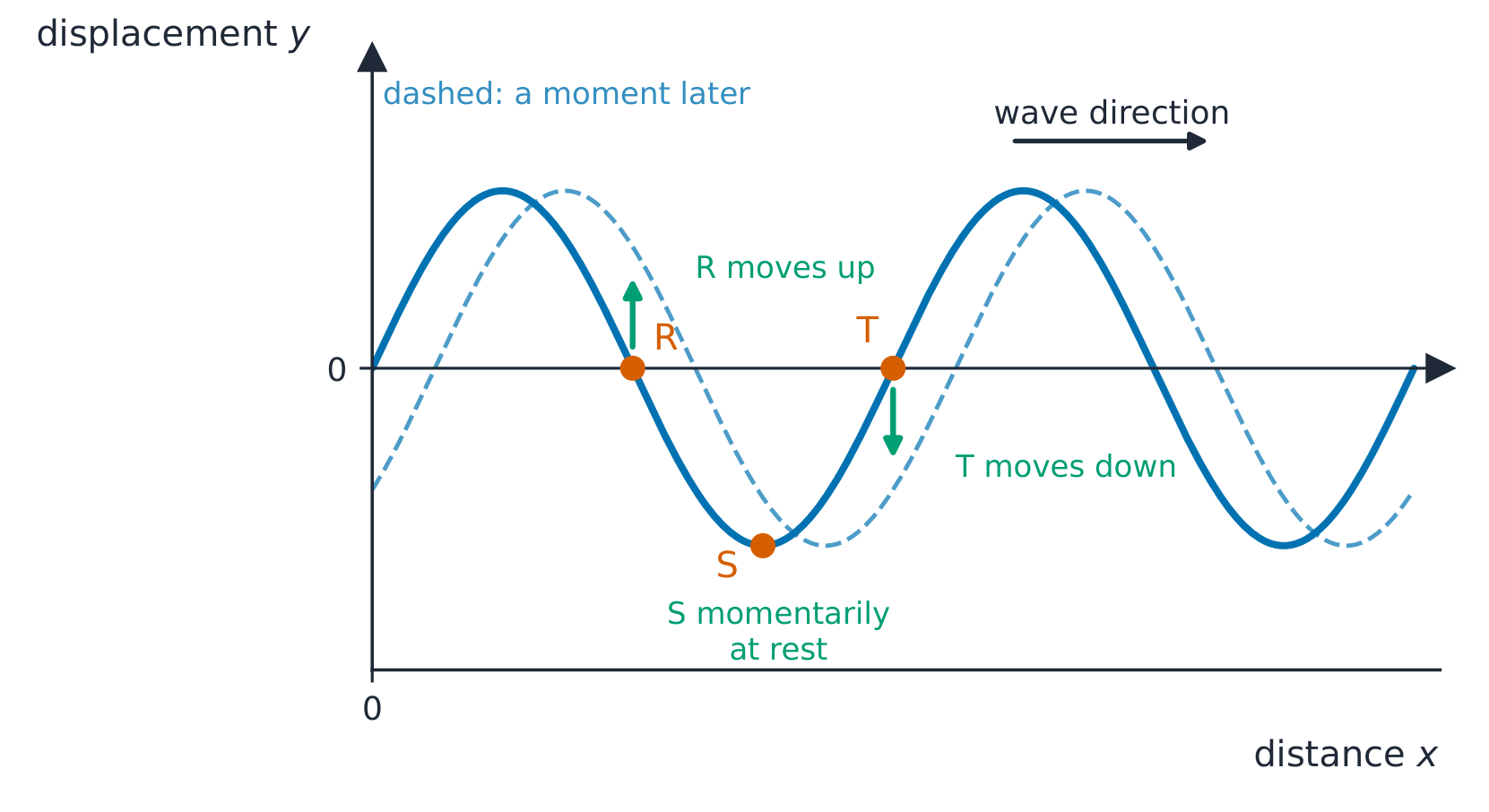
To find the phase difference between two points from a displacement–distance graph, divide their separation by the wavelength and multiply by $360°$ (or $2\pi$): two points $0.50\ \text{m}$ apart on a wave of wavelength $2.0\ \text{m}$ ($v = 600\ \text{m s}^{-1}$, $f = 300\ \text{Hz}$) differ in phase by $0.25 \times 360° = 90°$. Only the fraction of a cycle matters, so $450°$ is the same as $90°$. From two displacement–time graphs, read the time shift between the peaks as a fraction of the period. Which way is a point moving at the instant a graph shows? The whole profile moves along, so each point takes up the displacement that its neighbour on the side the wave comes from has now; a point at a crest or a trough is momentarily at rest.

Worked example. Points R and T on a string are $0.62\ \text{cm}$ apart and a quarter of a cycle out of phase. The wave speed is $0.27\ \text{m s}^{-1}$. Find the frequency.

A quarter of a cycle is a quarter of a wavelength, so $\lambda = 4 \times 0.62 = 2.5\ \text{cm}$ and $f = v / \lambda = 0.27 / 0.025 = 11\ \text{Hz}$.

The wave equation

In one period $T$, the wave moves forward by one wavelength $\lambda$. So speed $= \text{distance} / \text{time} = \lambda / T = \lambda f$:

$$v = f \lambda.$$

This comes straight from the definitions of speed, frequency and wavelength, and works for every progressive wave. For the two-mark derivation write both steps: in one period $T$ the wave travels one wavelength $\lambda$, so $v = \lambda / T$; and $f = 1/T$, so $v = f\lambda$. Because $v$ is fixed by the medium, a higher frequency means a shorter wavelength. A period question is the same equation the other way round: light of wavelength $460\ \text{nm}$ has $f = c / \lambda = 6.5 \times 10^{14}\ \text{Hz}$ and $T = 1/f = 1.5 \times 10^{-15}\ \text{s}$.

Reading a CRO trace

A cathode-ray oscilloscope 示波器 (CRO) draws a voltage signal — for sound, the output of a microphone — against time. Two controls matter:

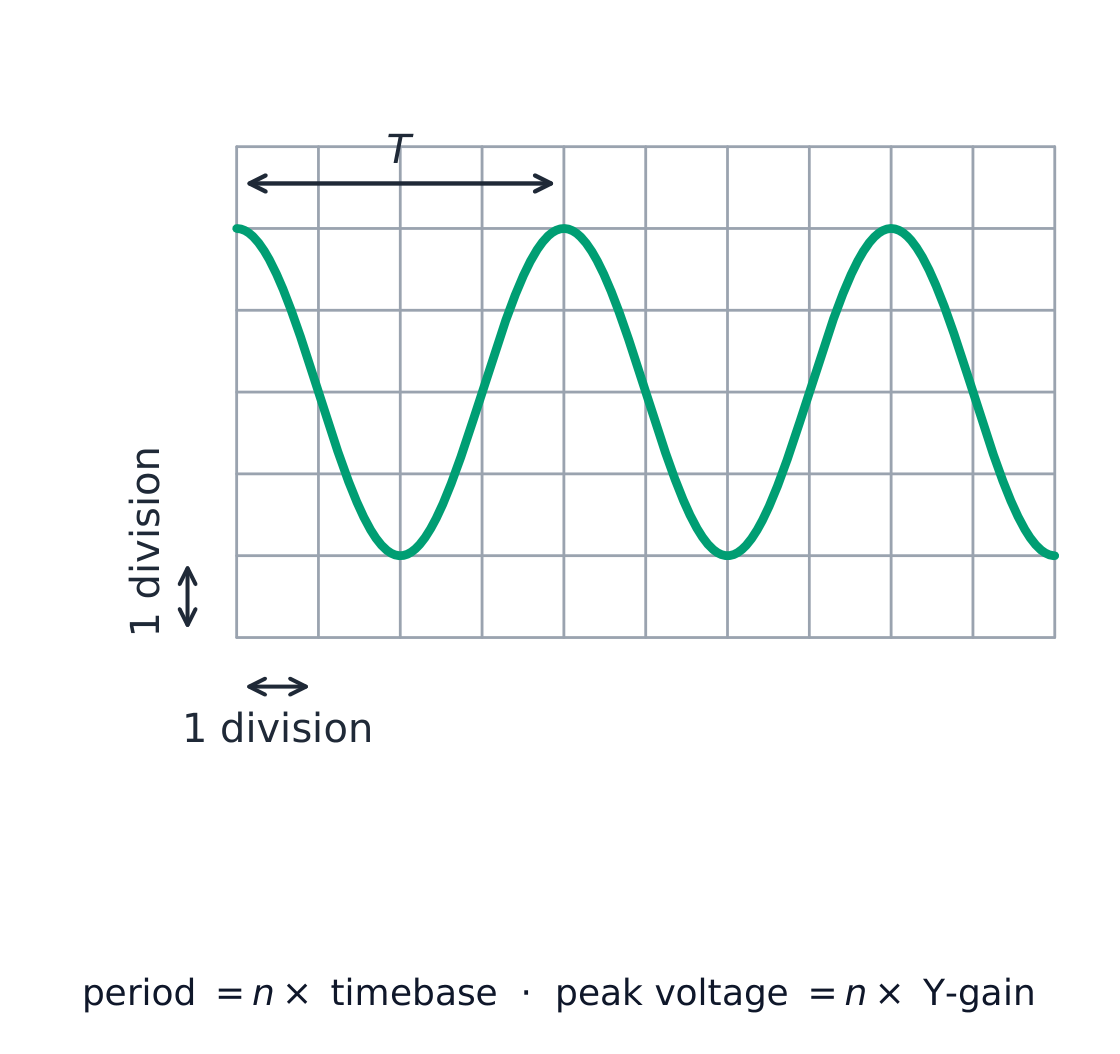
  • time-base 时基 (seconds per division across): turns horizontal distance on the screen into time. Read the period $T$ as the distance between two next-door peaks, then $f = 1/T$.
  • y-gain 垂直增益 (volts per division up): turns vertical distance into voltage. The amplitude in volts is the peak height from the centre line.

If the time-base is $5\ \text{ms}/\text{div}$ and one full cycle takes $4$ divisions, then $T = 4 \times 5\ \text{ms} = 20\ \text{ms}$ and $f = 50\ \text{Hz}$.

The time-base is the time represented by one division (or one centimetre) across the screen, in $\text{s}\ \text{div}^{-1}$. To set it for a given signal, work backwards: a $2000\ \text{Hz}$ sound has $T = 0.50\ \text{ms}$, so for one cycle to span $2.5\ \text{cm}$ the time-base must be $0.50 / 2.5 = 0.20\ \text{ms cm}^{-1}$. For the amplitude, multiply the peak height in divisions by the y-gain: $2.0$ divisions at $3.5\ \text{mV cm}^{-1}$ is $7.0\ \text{mV}$. When the intensity of the sound is reduced to a quarter at the same frequency, the trace keeps its period and its peaks halve in height, because $I \propto A^{2}$.

Intensity of a wave

A wave carries energy. The intensity 强度 at a point is the power 功率 passing through unit area at right angles to the direction of travel:

$$I = \frac{P}{A}.$$

Unit: $\text{W m}^{-2}$.

Intensity is proportional to the square of the amplitude:

$$I \propto A^{2}.$$

For a point source 点源 sending out energy equally in all directions, the wavefronts 波前 are spheres; the surface area at distance $r$ is $4\pi r^{2}$, so

$$I = \frac{P}{4\pi r^{2}}, \qquad I \propto \frac{1}{r^{2}}.$$

Doubling the distance cuts the intensity to a quarter, which means the amplitude is halved (since $I \propto A^{2}$).

Worked example. A lamp emits $60\ \text{W}$ of light equally in all directions. Find the intensity of the light $2.0\ \text{m}$ away.

$$I = \frac{P}{4\pi r^{2}} = \frac{60}{4\pi (2.0)^{2}} \approx 1.2\ \text{W m}^{-2}.$$

Worked example. Light of power $750\ \text{W}$ falls at right angles on a square solar panel of side $1.2\ \text{m}$. Find the intensity.

$I = P/A = 750 / 1.2^{2} = 520\ \text{W m}^{-2}$. A smaller panel in the same light receives the same intensity but less power, in proportion to its area. The other way round, a magnifying glass of radius $r$ collects a power $I \times \pi r^{2}$ and concentrates it on a small spot.

Two rules the multiple-choice questions turn on. Because $I \propto A^{2}$, the ratio of two intensities is the square of the ratio of the amplitudes: waves of amplitude $3.0\ \text{cm}$ and $2.0\ \text{cm}$ have intensities in the ratio $2.25$, and when an amplitude falls to a half the intensity falls to a quarter. For a point source, $I \propto 1/r^{2}$ means $A \propto 1/r$, so a sketch of $A/A_{0}$ against $d/x_{0}$ is a curve falling as $1/d$, not a straight line. The one-line statement the scheme wants: intensity is proportional to the amplitude squared.

ไทย
คลื่นวงกลมกระจายบนน้ำ
คลื่นวงกลมบนน้ำเป็นคลื่นเคลื่อนที่ที่พาพลังงานออกไปด้านนอก
คลื่นสองลูกที่มีความถี่เท่ากันเลื่อนไปจากกันด้วยผลต่างเฟส
คลื่นสองลูกที่มีความถี่เท่ากัน เลื่อนไปจากกันด้วยผลต่างเฟส

คลื่น พาพลังงาน จากที่หนึ่งไปยังอีกที่หนึ่งโดยไม่มีการเคลื่อนย้ายมวลโดยรวม.อนุภาคของ สื่อ สั่น รอบตำแหน่งสมดุลที่ตายตัว; เพียงแต่การรบกวน (และพลังงานของมัน) แพร่กระจาย. ตัวอย่าง: คลื่นขวาง บนเชือก, คลื่นยาว บนสปริง slinky, คลื่นวงกลมบนน้ำ, และเสียงในอากาศ. คลื่นที่เดินทางและพาพลังงานคือ คลื่นเคลื่อนที่

การเคลื่อนที่ของคลื่น คือ سلسلةการสั่นของอนุภาคของสื่อ โดยแต่ละอนุภาคส่งการรบกวนต่อไปยังอนุภาคถัดไป: สั่นปลาย一端ของเชือก, ดัน末端ของสปริง, หรือแตะผิวน้ำใน อ่างคลื่น, และการสั่นจะเคลื่อนที่ออกจากจุดเริ่มต้น. สำหรับนิยาม 1 คะแนน คลื่นเคลื่อนที่ถ่ายโอนพลังงานจากที่หนึ่งไปยังอีกที่หนึ่งโดยไม่ถ่ายโอนมวล; อนุภาคเพียงสั่นรอบตำแหน่งสมดุลเท่านั้น

คำศัพท์สำคัญ

  • การกระจัด $y$ — ระยะที่อนุภาคเคลื่อนที่ออกจากตำแหน่งสมดุล在某时刻. เป็น เวกเตอร์
  • แอมพลิจูด $A$ — การกระจัดสูงสุดจากตำแหน่งสมดุล
  • ความยาวคลื่น $\lambda$ — ระยะสั้นที่สุดตามทิศทางของคลื่นระหว่างสองจุดที่เคลื่อนที่ ในเฟสเดียวกัน (เช่น ยอดคลื่น สองจุดติดกัน)
  • คาบ $T$ — เวลาที่ใช้สำหรับการสั่นครบหนึ่งรอบของอนุภาคหนึ่งตัว
  • ความถี่ $f$ — จำนวนรอบการสั่นสมบูรณ์ต่อวินาที; $f = 1/T$. หน่วย: เฮิร์ตซ์, $\text{Hz}$.
  • ความเร็ว $v$ — ความเร็วที่ยอดคลื่นเคลื่อนที่ไปตามตัวกลาง
  • ผลต่างเฟส — ส่วนหนึ่งของรอบการสั่นที่การสั่นหนึ่งตัวนำหรือล่าช้ากว่าอีกตัวหนึ่ง แสดงเป็น เรเดียน (รอบเต็มคือ $2\pi$) หรือองศา (รอบเต็มคือ $360°$)

สองจุดห่างกันหนึ่งความยาวคลื่นจะอยู่ในเฟสเดียวกัน (ผลต่างเฟส 0 หรือ $2\pi$) สองจุดห่างกันครึ่งความยาวคลื่นจะอยู่ตรงข้ามเฟสกันโดยสมบูรณ์ (ผลต่างเฟส $\pi$)

ในการหาผลต่างเฟสระหว่างสองจุดจากกราฟการกระจัด–ระยะทาง ให้หาระยะห่างระหว่างจุดทั้งสองด้วยความยาวคลื่น แล้วคูณด้วย $360°$ (หรือ $2\pi$): สองจุด $0.50\ \text{m}$ ห่างกันบนคลื่นที่มีความยาวคลื่น $2.0\ \text{m}$ ($v = 600\ \text{m s}^{-1}$, $f = 300\ \text{Hz}$) จะมีผลต่างเฟสกัน $0.25 \times 360° = 90°$ เนื่องจากพิจารณาเพียงส่วนหนึ่งของรอบการสั่นเท่านั้น ดังนั้น $450°$ จึงเท่ากับ $90°$ จากกราฟการกระจัด–เวลา สามารถอ่านค่าความ SHIFT ของเวลาระหว่างยอดคลื่นออกเป็นสัดส่วนของคาบได้ ทิศทางที่จุดหนึ่งกำลังเคลื่อนที่ ณ วินาทีที่กราฟแสดงคืออะไร? รูปแบบคลื่นทั้งหมดเคลื่อนที่ไปข้างหน้า ดังนั้นแต่ละจุดจึงรับค่าการกระจัดจากเพื่อนบ้านด้านที่คลื่นเข้ามาถึงในขณะนั้น จุดที่อยู่ที่ยอดคลื่นหรือร่องคลื่นจะหยุดนิ่งชั่วคราว

รูปแบบคลื่นขวางเคลื่อนที่ไปทางขวา โดยตำแหน่งถัดไป不久的แสดงด้วยเส้นประ; จุด R เคลื่อนที่ขึ้น จุด S ที่ร่องคลื่นหยุดนิ่งชั่วคราว และจุด T เคลื่อนที่ลง ซึ่งแต่ละจุดมีลูกศรชี้ทิศทาง
ทิศทางการเคลื่อนที่ของแต่ละจุด: ไปสู่ค่าการกระจัดที่เพื่อนบ้านด้านที่คลื่นเข้ามาถึงมีอยู่ในขณะนั้น; ยอดคลื่นหรือร่องคลื่นจะหยุดนิ่งชั่วคราว

ตัวอย่างวิธีทำ. จุด R และ T บนเชือกห่างกัน $0.62\ \text{cm}$ และมีผลต่างเฟสกันหนึ่งในสี่รอบ ความเร็วของคลื่นคือ $0.27\ \text{m s}^{-1}$. จงหาความถี่

หนึ่งในสี่ของรอบการสั่นคือหนึ่งในสี่ของความยาวคลื่น ดังนั้น $\lambda = 4 \times 0.62 = 2.5\ \text{cm}$ และ $f = v / \lambda = 0.27 / 0.025 = 11\ \text{Hz}$

สมการคลื่น

ภายในหนึ่งคาบ $T$ คลื่นเคลื่อนที่ไปข้างหน้าได้หนึ่งความยาวคลื่น $\lambda$ ดังนั้นความเร็ว $= \text{distance} / \text{time} = \lambda / T = \lambda f$:

$$v = f \lambda$$

สมการนี้ได้มาโดยตรงจากนิยามของความเร็ว ความถี่ และความยาวคลื่น และใช้ได้กับทุกชนิดของคลื่นแบบแพร่กระจาย สำหรับข้อ derivation คะแนน 2 ต้องเขียนทั้งสองขั้นตอน: ในหนึ่งคาบ $T$ คลื่นเดินทางหนึ่งความยาวคลื่น $\lambda$ ดังนั้น $v = \lambda / T$; และ $f = 1/T$ ดังนั้น $v = f\lambda$ เนื่องจาก $v$ ถูกกำหนดโดยตัวกลาง ค่าความถี่ที่สูงขึ้นจะทำให้มีความยาวคลื่นสั้นลง ข้อสอบแบบคาบคือสมการเดียวกันแต่กลับด้าน: แสงที่มีความยาวคลื่น $460\ \text{nm}$ มี $f = c / \lambda = 6.5 \times 10^{14}\ \text{Hz}$ และ $T = 1/f = 1.5 \times 10^{-15}\ \text{s}$

การอ่านเทรสจากเครื่องวัดสัญญาณไฟฟ้า

ออสซิลโลสโคปrors์ (CRO) จะวาดกราฟสัญญาณแรงดันไฟฟ้า — เช่นสัญญาณเสียงจากไมโครโฟน — เทียบกับเวลา มีปุ่มควบคุมสำคัญ 2 ตัว:

  • ฐานเวลา (วินาทีต่อช่องแนวนอน): แปลงระยะทางแนวนอนบนจอให้เป็นเวลา อ่านคาบ $T$ เป็นระยะระหว่างยอดคลื่นสองจุดติดกัน แล้ว $f = 1/T$
  • y-gain (โวลต์ต่อช่องแนวตั้ง): แปลงระยะทางแนวตั้งให้เป็นแรงดันไฟฟ้า แอมพลิจูดในหน่วยโวลต์คือความสูงของยอดตั้งแต่เส้นกลาง

หากฐานเวลาคือ $5\ \text{ms}/\text{div}$ และหนึ่งรอบเต็มใช้ $4$ ช่อง แล้ว $T = 4 \times 5\ \text{ms} = 20\ \text{ms}$ และ $f = 50\ \text{Hz}$

ฐานเวลาคือเวลาที่แทนด้วยหนึ่งช่อง (หรือหนึ่งเซนติเมตร) ตามแนว横跨 across หน้าจอ ใน $\text{s}\ \text{div}^{-1}$. ในการตั้งค่าสำหรับสัญญาณที่กำหนด ให้คำนวณย้อนกลับ: เสียง $2000\ \text{Hz}$ มีคาบ $T = 0.50\ \text{ms}$ ดังนั้นเพื่อให้หนึ่งรอบครอบคลุม $2.5\ \text{cm}$ ฐานเวลาต้องเป็น $0.50 / 2.5 = 0.20\ \text{ms cm}^{-1}$. สำหรับแอมพลิจูด ให้คูณความสูงของยอดในจำนวนช่องกับ y-gain: $2.0$ ช่อง ที่ $3.5\ \text{mV cm}^{-1}$ คือ $7.0\ \text{mV}$. เมื่อความเข้มของเสียงลดลงเหลือหนึ่งในสี่ที่ความถี่เท่าเดิม เทรสจะมีคาบเท่าเดิมและยอดคลื่นลดความสูงลงครึ่งหนึ่ง เนื่องจาก $I \propto A^{2}$

หน้าจอออสซิลโลสโคปพร้อมตารางกริดและเทรสรูปไซน์; คาบ  แสดงด้วยระยะทางแนวนอนระหว่างยอดคลื่นสองจุดติดกัน ครอบคลุมสี่ช่อง พร้อมสเกลบาร์แสดงหนึ่งช่อง横跨 และหนึ่งช่องแนวตั้ง *การอ่านคาบ T จากเทรส CRO โดยใช้ตารางกริดและฐานเวลา

ออสซิลโลสโคปดิจิทัลสมัยใหม่ที่มีหน้าจอตารางแสดงสัญญาณแรงดันไฟฟ้าสีเหลืองเทียบกับเวลา, แถบปุ่มควบคุมและลูกบิด, และสายโพรเบสี่เส้นเสียบเข้าช่องอินพุต *ออสซิลโลสโคปจริง: ตารางกริดช่วยให้สามารถอ่านค่าคาบและแอมพลิจูดได้

ความเข้มของคลื่น

คลื่นพาพลังงาน ความเข้ม ที่จุดหนึ่งคือ กำลัง ที่ไหลผ่านพื้นที่หนึ่งหน่วยในมุมฉากกับทิศทางการเคลื่อนที่:

$$I = \frac{P}{A}$$

หน่วย: $\text{W m}^{-2}$

ความเข้มแปรผันตรงกับกำลังสองของแอมพลิจูด:

$$I \propto A^{2}$$

สำหรับ แหล่งกำเนิดจุด ที่ปล่อยพลังงานเท่าๆ กันทุกทิศทาง หน้าคลื่น จะเป็นทรงกลม; พื้นที่ผิวที่ระยะ $r$ คือ $4\pi r^{2}$ ดังนั้น

$$I = \frac{P}{4\pi r^{2}}, \qquad I \propto \frac{1}{r^{2}}$$

การเพิ่มระยะทางเป็นสองเท่าจะทำให้ความเข้มลดลงเหลือหนึ่งในสี่ ซึ่งหมายความว่าแอมพลิจูดลดลงครึ่งหนึ่ง (เนื่องจาก $I \propto A^{2}$)

ตัวอย่างวิธีทำ. โคมไฟแผ่แสง $60\ \text{W}$ เท่าๆ กันทุกทิศทาง จงหาความเข้มของแสงที่ระยะ $2.0\ \text{m}$

$$I = \frac{P}{4\pi r^{2}} = \frac{60}{4\pi (2.0)^{2}} \approx 1.2\ \text{W m}^{-2}.$$

ตัวอย่างวิธีทำ. แสงกำลัง $750\ \text{W}$ ตกกระทบแผงโซลาร์เซลล์สี่เหลี่ยมด้านขนานด้านยาว $1.2\ \text{m}$ ในมุมฉาก จงหาความเข้ม

$I = P/A = 750 / 1.2^{2} = 520\ \text{W m}^{-2}$ แผงขนาดเล็กกว่าในแสงเดียวกันจะได้รับความเข้มเท่าเดิมแต่ได้รับกำลังน้อยกว่า สัดส่วนกับพื้นที่ของมัน ในทางกลับกัน เลนส์ขยายที่มีรัศมี $r$ จะรวบรวมกำลัง $I \times \pi r^{2}$ และรวมมันไว้ที่จุดเล็กๆ

กฎหลัก 2 ข้อที่ข้อสอบแบบเลือกตอบขึ้นอยู่กับ เนื่องจาก $I \propto A^{2}$ อัตราส่วนของความเข้มคือ กำลังสอง ของอัตราส่วนของแอมพลิจูด: คลื่นที่มีแอมพลิจูด $3.0\ \text{cm}$ และ $2.0\ \text{cm}$ จะมีอัตราส่วนความเข้มเป็น $2.25$, และเมื่อแอมพลิจูดลดลงเหลือครึ่งหนึ่ง ความเข้มจะลดลงเหลือหนึ่งในสี่ สำหรับแหล่งกำเนิดจุด, $I \propto 1/r^{2}$ หมายความว่า $A \propto 1/r$, ดังนั้นกราฟของ $A/A_{0}$ เทียบกับ $d/x_{0}$ จะเป็นเส้นโค้งที่ลดลงตาม $1/d$, ไม่ใช่เส้นตรง ประโยคสั้นๆ ที่แผนภาพต้องการ: ความเข้มแปรผันตรงกับกำลังสองของแอมพลิจูด

Explore · ⁨สำรวจ⁩

Progressive waves · ⁨คลื่นเคลื่อนที่⁩

y = a sin(bx + c)

A wave: a is amplitude, b sets the wavelength, c the phase. · ⁨คลื่น: a คือแอมพลิจูด, b กำหนดความยาวคลื่น, c คือเฟส⁩

Vocabulary · ⁨คำศัพท์⁩ Train · ⁨ฝึกฝน⁩
English ไทย
progressive wave/prəˈɡresɪv weɪv/ คลื่นเคลื่อนที่
wave/weɪv/ คลื่น
energy/ˈenədʒi/ พลังงาน
frequency/ˈfriːkwənsi/ ความถี่
phase difference/feɪz ˈdɪfrəns/ ความต่างเฟส
medium/ˈmiːdɪəm/ ตัวกลาง
oscillate/ˈɒsɪleɪt/ การสั่นสะเทือน
propagate/ˈprɒpəɡeɪt/ แพร่กระจาย
y-gain/waɪ ɡeɪn/ การขยายสัญญาณแกน Y
7.2

Transverse and longitudinal waves · ⁨คลื่นขวางและคลื่นยาว⁩

Syllabus · ⁨หลักสูตร⁩
English
  1. compare transverse and longitudinal waves
  2. analyse and interpret graphical representations of transverse and longitudinal waves
ไทย
  1. เปรียบเทียบ คลื่นตามขวาง และ คลื่นตามยาว
  2. วิเคราะห์และตีความกราฟแสดงคลื่นตามขวางและคลื่นตามยาว

Source: Cambridge International syllabus · ⁨แหล่งที่มา: หลักสูตร Cambridge International⁩

English
Transverse vs longitudinal waves

Transverse waves

The particles oscillate perpendicular 垂直 to the direction the energy travels. A wave on a rope, all electromagnetic waves, and S-waves in the Earth are transverse.

Longitudinal waves

The particles oscillate parallel to the direction the energy travels. Sound in any medium, P-waves in the Earth, and the squashes on a slinky are longitudinal. The wave is made of compressions 压缩 (higher pressure, particles close together) and rarefactions 稀疏 (lower pressure, particles spread out).

Graphs of waves

A graph of particle displacement against position at one moment looks like a sine curve 正弦曲线 for both kinds of wave. The difference: for a transverse wave the displacement axis is the real sideways displacement; for a longitudinal wave it is the small back-and-forth displacement along the direction of travel (positive one way, negative the other).

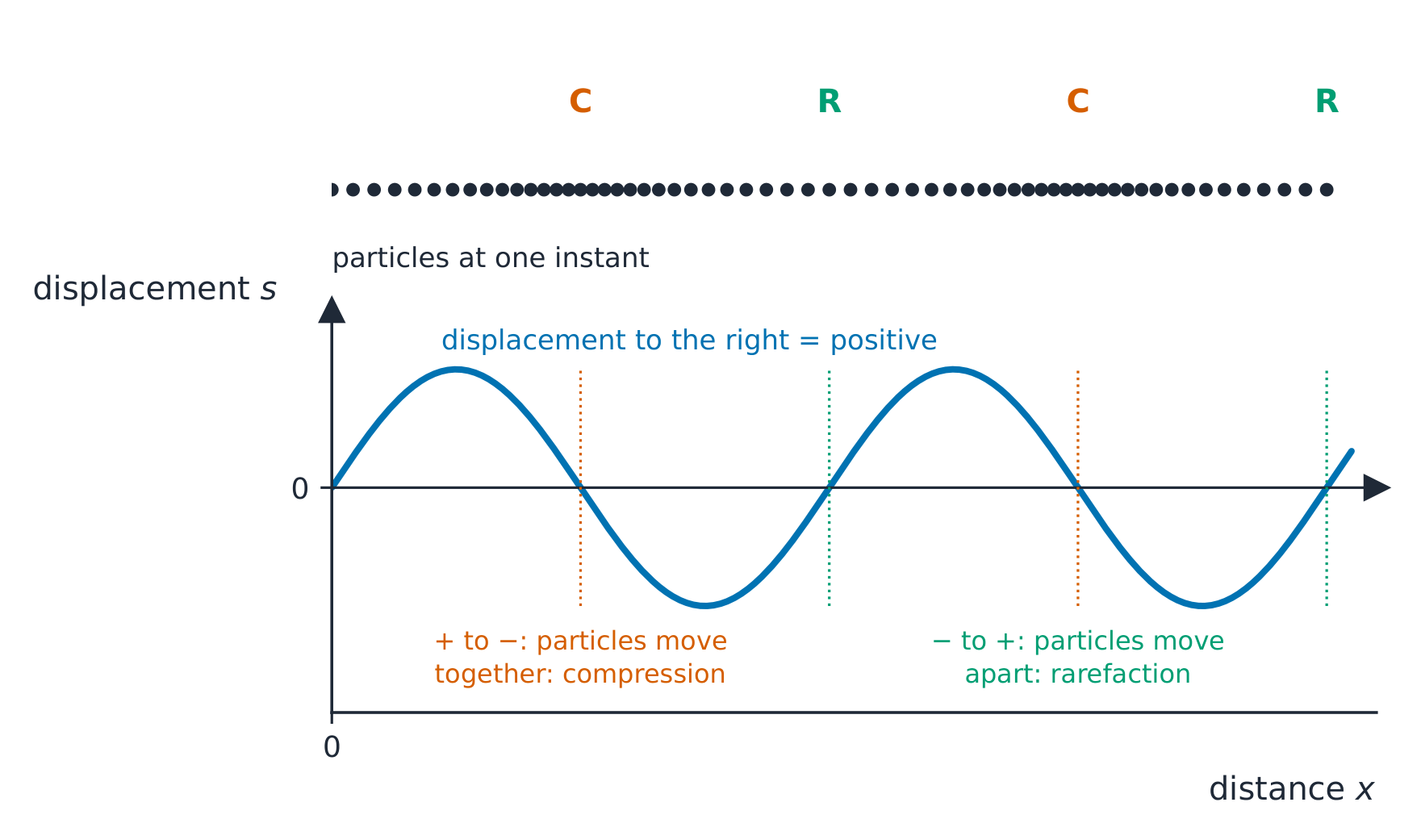
For a longitudinal wave take displacement to the right as positive. Where the graph crosses zero going from positive to negative, the particles on either side have moved towards that point, so it is a compression; where it crosses from negative to positive they have moved apart, a rarefaction. Two neighbouring compressions are one wavelength apart, and a compression and the next rarefaction are half a wavelength apart. The direction of motion of a particle follows the same rule as for a transverse wave: it moves towards the displacement of its neighbour on the side the wave comes from.

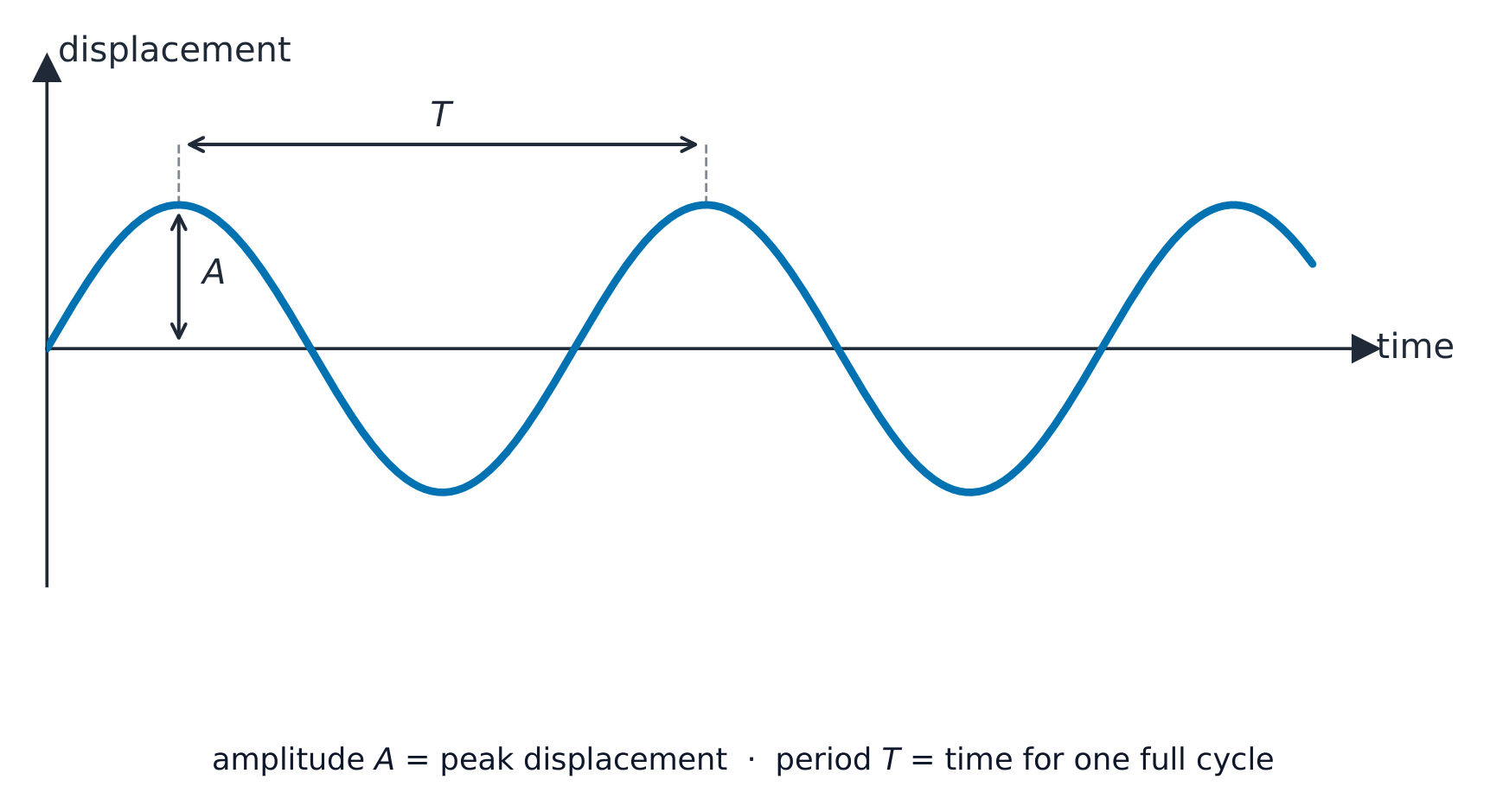
A graph of particle displacement against time at one point in space is also a sine curve for both kinds. Read the period $T$ from this graph.

The two-mark comparison, with reference to the direction of energy transfer: in a transverse wave the oscillations are perpendicular to the direction of energy transfer; in a longitudinal wave they are parallel to it. Both kinds transfer energy without transferring matter, both can be reflected, refracted and diffracted, and both can form stationary waves (topic 8). Only transverse waves can be polarised, and only electromagnetic waves, which are all transverse, can travel through a vacuum; sound needs a medium. Reading the two graphs together: the displacement–distance graph gives $\lambda$, the displacement–time graph gives $T$, and $v = \lambda / T$.

ไทย
คลื่นขวางเทียบกับคลื่นยาว

คลื่นขวาง

อนุภาคสั่น ตั้งฉาก กับทิศทางที่พลังงานเคลื่อนที่ คลื่นบนเชือก คลื่นแม่เหล็กไฟฟ้าทั้งหมด และคลื่น S ในโลกเป็นคลื่นขวาง

คลื่นขวางบนเชือกวาดเป็นเส้นไซน์: แต่ละส่วนของเชือกสั่นขึ้นลง (ลูกศรคู่แนวตั้ง) ในขณะที่พลังงานเคลื่อนที่ไปทางขวาตามเชือก
คลื่นขวางบนเชือก

คลื่นยาว

อนุภาคสั่น ขนาน กับทิศทางที่พลังงานเคลื่อนที่ เสียงในสื่อใดๆ คลื่น P ในโลก และการบีบอัดสปริงสล/ngky เป็นคลื่นยาว คลื่นประกอบด้วย การอัดตัว (ความดันสูง, อนุภาคอยู่ใกล้กัน) และ การขยายตัว (ความดันต่ำ, อนุภาคกระจายตัว)

คลื่นยาวบนสปริงสปริงกี้: ข Coil(publicions) และกระจายตัวเป็นบริเวณบาง (rarefactions); แต่ละขcoilสั่นไปมา (ลูกศรคู่แนวนอน) مواบขนกับทิศทางที่พลังงานเคลื่อนที่
คลื่นยาวบนสปริงสลิงกี้

กราฟของคลื่น

กราฟของ การกระจัดของอนุภาคเทียบกับตำแหน่ง ในช่วงเวลาหนึ่ง ดูคล้าย เส้นไซน์ สำหรับคลื่นทั้งสองชนิด ความแตกต่างคือ สำหรับคลื่นขวาง แกนการกระจัดคือการกระจัดด้านข้างจริง; สำหรับคลื่นยาวมันคือการกระจัดไปมาเล็กน้อยตามทิศทางการเดินทาง (บวกทางหนึ่ง ลบอีกทาง)

สำหรับคลื่นยาว ให้กำหนดให้การกระจัดไปทาง ขวา เป็นบวก เมื่อกราฟตัดแกนศูนย์จากบวกไปลบ อนุภาคทั้งสองข้างได้เคลื่อนที่ เข้าหา จุดนั้น จึงเป็นการอัดตัว; เมื่อตัดจากลบไปบวก อนุภาคได้เคลื่อนที่ออกจากกัน เป็นการขยายตัว การอัดตัวสองจุดติดกันห่างกันหนึ่งความยาวคลื่น และการอัดตัวและการขยายตัวถัดไปห่างกันครึ่งความยาวทิศทางการเคลื่อนที่ของอนุภาคปฏิบัติตามกฎเดียวกับคลื่นขวาง: มันเคลื่อนที่เข้าหาการกระจัดของเพื่อนบ้านด้านที่คลื่นมาจาก

คลื่นยาววาดซ้ำสองครั้ง:แถวจุดอนุภาคจับกลุ่มเป็นบริเวณหนา C และกระจายตัวเป็นบริเวณบาง R, ด้านบนคือกราฟการกระจัด-ระยะทางของอนุภาคเดียวกันโดยกำหนดการกระจัดไปทางขวาเป็นบวก; เส้นประแสดงว่าบริเวณหนาอยู่ที่ที่กราฟตัดแกนศูนย์จากบวกไปลบ และบริเวณบางอยู่ที่ที่กราฟตัดจากลบไปบวก
คลื่นยาวชนิดเดียวกันทั้งในรูปอนุภาคและกราฟ: การอัดตัวที่การกระจัดเปลี่ยนจากบวกไปลบ, การขยายตัวที่เปลี่ยนจากลบไปบวก
กราฟการกระจัดเทียบกับระยะทางวาดเป็นเส้นไซน์, แสดงแอมพลิจูด  จากแกนนิ่งไปยังยอดคลื่น และความยาวคลื่น  ระหว่างยอดคลื่นที่อยู่ติดกัน
กราฟการกระจัด–ระยะทางแสดงแอมพลิจูดและความยาวคลื่นของคลื่น

กราฟของ การกระจัดของอนุภาคเทียบกับเวลา ที่จุดใดจุดหนึ่งในอวกาศก็เป็นเส้นไซน์สำหรับคลื่นทั้งสองชนิด อ่านคาบ $T$ จากกราฟนี้

กราฟการกระจัดเทียบกับเวลาวาดเป็นรูปคลื่นไซน์ โดยมีการระบุค่าแอมพลิจูด  จากแกนสมดุลไปยังยอดคลื่น และระบุช่วงคาบ  ระหว่างยอดคลื่นที่อยู่ติดกัน
กราฟการกระจัด–เวลาแสดงแอมพลิจูดและคาบของคลื่น

การเปรียบเทียบคะแนนสองข้อ โดยอ้างอิงถึงทิศทางการถ่ายโอนพลังงาน: ในคลื่นขวางการสั่น ตั้งฉาก กับทิศทางการถ่ายโอนพลังงาน; ในคลื่นยาวมัน ขนาน กับมัน ทั้งสองชนิดถ่ายโอนพลังงานโดยไม่ถ่ายโอนมวล ทั้งสองสามารถสะท้อน หักเห และเลี้ยวเบนได้ และทั้งสองสามารถสร้างคลื่นนิ่งได้ (หัวข้อ 8) เฉพาะคลื่นขวางเท่านั้นที่สามารถโพลาไรซ์ได้, และเฉพาะคลื่นแม่เหล็กไฟฟ้าซึ่งทั้งหมดเป็นคลื่นขวางเท่านั้นที่สามารถเดินทางผ่านสุญญากาศได้; เสียงต้องการสื่อ การอ่านกราฟทั้งสองพร้อมกัน: กราฟการกระจัด–ระยะทางให้ $\lambda$, กราฟการกระจัด–เวลาให้ $T$, และ $v = \lambda / T$

Explore · ⁨สำรวจ⁩

Transverse waves · ⁨คลื่นขวาง⁩

y = a sin(bx + c)

Change the amplitude and wavelength of the wave. · ⁨เปลี่ยน แอมพลิจูด และ ความยาวคลื่น ของคลื่น⁩

Vocabulary · ⁨คำศัพท์⁩ Train · ⁨ฝึกฝน⁩
English ไทย
transverse wave/trænsˈvɜːs weɪv/ คลื่นขวาง
longitudinal wave/ˌlɒŋɡɪˈtjuːdɪnl weɪv/ คลื่นยาว
Wave motion/weɪv ˈməʊʃn/ การเคลื่อนที่ของคลื่น
ripple tank/ˈrɪpl tæŋk/ อ่างน้ำripple
displacement/dɪˈspleɪsmənt/ การกระจัด
vector/ˈvektə/ เวกเตอร์
amplitude/ˈæmplɪtjuːd/ แอมพลิจูด
wavelength/ˈweɪvleŋθ/ ความยาวคลื่น
in phase/ɪn feɪz/ อยู่ในเฟสเดียวกัน
crest/krest/ ยอดcrest
rarefaction/ˌreərɪˈfækʃn/ การกระจายตัว
stationary/ˈsteɪʃənəri/ นิ่ง
vacuum/ˈvækjuːm/ สุญญากาศ
7.3

Doppler effect (moving source, stationary observer) · ⁨ผลดอปเพลอร์ (แหล่งกำเนิดเคลื่อนที่, ผู้สังเกตหยุดนิ่ง)⁩

Syllabus · ⁨หลักสูตร⁩
English
  1. understand that when a source of sound waves moves relative to a stationary observer, the observed frequency is different from the source frequency (understanding of the Doppler effect for a stationary source and a moving observer is not required)
  2. use the expression $f_{\text{o}} = f_{\text{s}} v / (v \pm v_{\text{s}})$ for the observed frequency when a source of sound waves moves relative to a stationary observer
ไทย
  1. เข้าใจว่าเมื่อแหล่งกำเนิด คลื่นเสียง เคลื่อนที่สัมพัทธ์กับผู้สังเกตที่หยุดนิ่ง ความถี่ที่สังเกตได้ จะแตกต่างจาก ความถี่แหล่งกำเนิด (ไม่จำเป็นต้องเข้าใจผลดอปเพลอร์สำหรับแหล่งกำเนิดที่หยุดนิ่งและผู้สังเกตที่เคลื่อนที่)
  2. ใช้สูตร $f_{\text{o}} = f_{\text{s}} v / (v \pm v_{\text{s}})$ สำหรับความถี่ที่สังเกตได้เมื่อแหล่งกำเนิดคลื่นเสียงเคลื่อนที่สัมพัทธ์กับผู้สังเกตที่หยุดนิ่ง

Source: Cambridge International syllabus · ⁨แหล่งที่มา: หลักสูตร Cambridge International⁩

English

When the source 波源 of a sound moves relative to a stationary 静止 observer 观察者, the heard frequency is different from the source frequency. This is the Doppler effect 多普勒效应.

  • source moving towards the observer: the wavefronts in front are squashed, so the wavelength is shorter and the heard frequency is higher.
  • source moving away from the observer: the wavefronts behind are spread out, so the wavelength is longer and the heard frequency is lower.

The formula (source moving at speed $v_{\text{s}}$ along the line to the observer; wave speed $v$, source frequency $f_{\text{s}}$, heard frequency $f_{\text{o}}$):

$$f_{\text{o}} = \frac{v \cdot f_{\text{s}}}{v \pm v_{\text{s}}}.$$

Choose the sign to match the physics:

  • minus sign on the bottom when the source moves towards the observer ($f_{\text{o}} > f_{\text{s}}$),
  • plus sign when the source moves away ($f_{\text{o}} < f_{\text{s}}$).

You only need the case of a stationary observer.

Worked example. A car horn at $f_{\text{s}} = 800\ \text{Hz}$ moves at $30\ \text{m s}^{-1}$ towards a still listener. Speed of sound $v = 340\ \text{m s}^{-1}$:

$$f_{\text{o}} = \frac{340 \times 800}{340 - 30} = \frac{272\,000}{310} \approx 877\ \text{Hz}.$$

Moving away at the same speed, the listener hears $340 \times 800 / (340 + 30) = 735\ \text{Hz}$: the frequency is constant while the car approaches, drops as it passes, and is constant again, lower, as it recedes. A sketch of observed frequency against time for a source passing at constant speed is two level lines joined by a fall. Working backwards, a source of $1200\ \text{Hz}$ heard as $960\ \text{Hz}$ is moving away ($f_{\text{o}} < f_{\text{s}}$): $960 = 1200 \times 340 / (340 + v_{\text{s}})$ gives $v_{\text{s}} = 85\ \text{m s}^{-1}$. A buzzer swung in a horizontal circle at $25\ \text{m s}^{-1}$ while emitting $846\ \text{Hz}$ is heard between $846 \times 330 / 355 = 786\ \text{Hz}$ (moving directly away) and $846 \times 330 / 305 = 915\ \text{Hz}$ (moving directly towards), once each per revolution. If the period of a CRO trace of the sound rises continuously, the observed frequency is falling: the source is moving away with increasing speed. The Doppler effect happens for all waves, light included (topic 25); only the sound formula is examined here.

ไทย

เมื่อ แหล่งกำเนิด ของเสียงเคลื่อนที่สัมพัทธ์กับ ผู้สังเกต ที่ หยุดนิ่ง, ความถี่ที่ได้ยินจะต่างจากความถี่ของแหล่งกำเนิด นี่คือ ผลดอปเพลอร์

  • แหล่งกำเนิดเคลื่อนที่เข้าหาผู้สังเกต: หน้าคลื่นถูกบีบอัด ทำให้ความยาวคลื่นสั้นลงและความถี่ที่ได้ยิน สูงขึ้น
  • แหล่งกำเนิดเคลื่อนที่ออกจากผู้สังเกต: หน้าคลื่นด้านหลังถูกกระจายทำให้ความยาวคลื่นยาวขึ้นและความถี่ที่ได้ยิน ต่ำลง
หน้าคลื่นวงกลมจากแหล่งกำเนิดเคลื่อนที่ไปทางขวาด้วยความเร็ว  เข้าหาผู้สังเกตที่นิ่งอยู่; หน้าคลื่นด้านหน้าแหล่งกำเนิด (เข้าหาผู้สังเกต) จับกลุ่มใกล้กันมากกว่า และด้านหลัง (เข้าหาจุด P) กระจายห่างกันมากขึ้น
แหล่งกำเนิดเคลื่อนที่ยับยั้งหน้าคลื่นด้านหน้า使其ทำให้ความถี่ที่วัดได้สูงขึ้น

สูตร (แหล่งกำเนิดเคลื่อนที่ด้วยความเร็ว $v_{\text{s}}$ ตามเส้นตรงสู่ผู้สังเกต; ความเร็วคลื่น $v$, ความถี่แหล่งกำเนิด $f_{\text{s}}$, ความถี่ที่ได้ยิน $f_{\text{o}}$):

$$f_{\text{o}} = \frac{v \cdot f_{\text{s}}}{v \pm v_{\text{s}}}.$$

เลือกเครื่องหมายให้สอดคล้องกับหลักฟิสิกส์:

  • เครื่องหมายลบที่ส่วนล่างเมื่อแหล่งกำเนิดเคลื่อนที่ เข้าหา ผู้สังเกต ($f_{\text{o}} > f_{\text{s}}$),
  • เครื่องหมายบวกเมื่อแหล่งกำเนิดเคลื่อนที่ ออกจาก ($f_{\text{o}} < f_{\text{s}}$).

คุณจำเป็นต้องใช้กรณีของผู้สังเกตหยุดนิ่งเท่านั้น

ตัวอย่างวิธีทำ. แตรรถยนต์ที่ $f_{\text{s}} = 800\ \text{Hz}$ เคลื่อนที่เข้าหาผู้ฟังที่ยืนนิ่งด้วยความเร็ว $30\ \text{m s}^{-1}$. ความเร็วของเสียง $v = 340\ \text{m s}^{-1}$:

$$f_{\text{o}} = \frac{340 \times 800}{340 - 30} = \frac{272\,000}{310} \approx 877\ \text{Hz}.$$

เคลื่อนที่ออกด้วยความเร็วเท่าเดิม ผู้ฟังจะได้ยิน $340 \times 800 / (340 + 30) = 735\ \text{Hz}$: ความถี่คงที่ขณะรถเข้าใกล้ ลดลงเมื่อผ่าน และคงที่อีกครั้งแต่ต่ำกว่า ขณะรถถอยห่าง กราฟแสดงความถี่ที่สังเกตได้เทียบกับเวลา สำหรับแหล่งกำเนิดที่เคลื่อนที่ผ่านด้วยความเร็วคงที่ คือเส้นสองระดับเชื่อมกันด้วยการลดลง เมื่อทบทวนย้อนกลับ แหล่งกำเนิดที่emit $1200\ \text{Hz}$ ได้ยินเป็น $960\ \text{Hz}$ กำลังเคลื่อนที่ออก ($f_{\text{o}} < f_{\text{s}}$): $960 = 1200 \times 340 / (340 + v_{\text{s}})$ ให้ค่า $v_{\text{s}} = 85\ \text{m s}^{-1}$. บัซเซอร์ถูกแกว่งในวงกลมแนวนอนที่ $25\ \text{m s}^{-1}$ ขณะemit $846\ \text{Hz}$ จะได้ยินระหว่าง $846 \times 330 / 355 = 786\ \text{Hz}$ (เคลื่อนที่ตรงข้าม) และ $846 \times 330 / 305 = 915\ \text{Hz}$ (เคลื่อนที่เข้าหา), ครั้งละหนึ่งรอบ หากคาบของกราฟ CRO ของเสียงเพิ่มขึ้นอย่างต่อเนื่อง ความถี่ที่สังเกตได้กำลังลดลง: แหล่งกำเนิดกำลังเคลื่อนที่ออกด้วยความเร็วที่เพิ่มขึ้น. เอฟเฟกต์ดอปพลาร์เกิดขึ้นกับคลื่นทุกชนิด รวมถึงแสง (หัวข้อ 25); ในที่นี้พิจารณาเฉพาะสูตรเสียงเท่านั้น

Explore · ⁨สำรวจ⁩

Doppler effect · ⁨ปรากฏการณ์ดอปพลาร์⁩

Send the source moving and watch the wavefronts bunch up ahead (higher pitch) and stretch out behind — the siren effect, controlled by the source's speed. · ⁨ให้แหล่งกำเนิดเคลื่อนที่แล้วดูหน้าคลื่นรวมกันด้านหน้า (เสียงสูงขึ้น) และยืดออกด้านหลัง — ผลกระทบไซเรน ซึ่งควบคุมด้วยความเร็วแหล่งกำเนิด⁩

Vocabulary · ⁨คำศัพท์⁩ Train · ⁨ฝึกฝน⁩
English ไทย
Doppler effect/ˈdɒplə ɪˈfekt/ ปรากฏการณ์ดอปพลาร์
observer/ɒbˈzɜːvə/ ผู้สังเกต
electromagnetic spectrum/ɪˌlektrəʊməɡˈnetɪk ˈspektrəm/ สเปกตรัมคลื่นแม่เหล็กไฟฟ้า
microwaves/ˈmaɪkrəʊweɪvz/ ไมโครเวฟ
infrared/ˌɪnfrəˈred/ อินฟราเรด
ultraviolet/ˌʊltrəˈvaɪəlɪt/ อัลตราไวโอเลต
X-rays/eks reɪz/ รังสีเอกซ์
7.4

Electromagnetic spectrum · ⁨สเปกตรัมของคลื่นแม่เหล็กไฟฟ้า⁩

Syllabus · ⁨หลักสูตร⁩
English
  1. state that all electromagnetic waves are transverse waves that travel with the same speed $c$ in free space
  2. recall the approximate range of wavelengths in free space of the principal regions of the electromagnetic spectrum from radio waves to $\gamma$-rays
  3. recall that wavelengths in the range 400–700 nm in free space are visible to the human eye
ไทย
  1. ระบุ bahwa ทุก คลื่นแม่เหล็กไฟฟ้า เป็น คลื่นตามขวาง ที่เคลื่อนที่ด้วยความเร็วเดียวกัน $c$ ในสุญญากาศ
  2. จำช่วงประมาณของความยาวคลื่นในสุญญากาศของบริเวณหลักของ สเปกตรัมคลื่นแม่เหล็กไฟฟ้า จาก คลื่นวิทยุ ไปจนถึง $\gamma$-เรย์
  3. จำว่าความยาวคลื่นในช่วง 400–700 nm ในสุญญากาศเป็น แสงที่มองเห็นได้对于眼睛มนุษย์

Source: Cambridge International syllabus · ⁨แหล่งที่มา: หลักสูตร Cambridge International⁩

English

All electromagnetic waves 电磁波 (EM waves) are transverse and travel in a vacuum 真空 at the same speed:

$$c = 3.00 \times 10^{8}\ \text{m s}^{-1}.$$

The electromagnetic spectrum 电磁波谱 includes radio waves, microwaves 微波, infrared 红外线, visible light, ultraviolet 紫外线, X-rays X射线 and $\gamma$-rays γ射线.

Approximate wavelength ranges in free space (learn the orders of magnitude):

  • radio waves: $> 10^{-1}\ \text{m}$ (up to many km).
  • microwaves: $10^{-3}\ \text{m}$ to $10^{-1}\ \text{m}$.
  • infrared: $\sim 7 \times 10^{-7}\ \text{m}$ to $10^{-3}\ \text{m}$.
  • visible light: $400\ \text{nm}$ (violet) to $700\ \text{nm}$ (red), i.e. $4 \times 10^{-7}\ \text{m}$ to $7 \times 10^{-7}\ \text{m}$.
  • ultraviolet: $\sim 10^{-8}\ \text{m}$ to $4 \times 10^{-7}\ \text{m}$.
  • X-rays: $\sim 10^{-11}\ \text{m}$ to $10^{-8}\ \text{m}$.
  • $\gamma$-rays: $< 10^{-11}\ \text{m}$.

The boundaries between regions are not sharp. Use $c = f\lambda$ to change between wavelength and frequency. Only light with wavelengths $400$–$700\ \text{nm}$ can be seen.

To identify a region, convert to a wavelength with $\lambda = c / f$ and compare with the ranges: $2.1\ \text{cm}$ is a microwave; $138\ \text{pm} = 1.4 \times 10^{-10}\ \text{m}$ is an X-ray; $30\ \text{THz}$ gives $\lambda = 1.0 \times 10^{-5}\ \text{m}$, infrared; $3.0 \times 10^{16}\ \text{Hz}$ gives $1.0 \times 10^{-8}\ \text{m}$, ultraviolet. Visible light spans frequencies of about $4.3 \times 10^{14}$ to $7.5 \times 10^{14}\ \text{Hz}$, so a wave of $5.0 \times 10^{14}\ \text{Hz}$ can be seen and one of wavelength $5.0 \times 10^{-6}\ \text{m}$ (infrared) cannot. Red light has a longer wavelength and a lower frequency than green. A list "in order of increasing wavelength" runs $\gamma$-rays, X-rays, ultraviolet, visible, infrared, microwaves, radio waves. A pulse of light reflected from a wall $150\ \text{m}$ away returns after $2 \times 150 / (3.00 \times 10^{8}) = 1.0\ \mu\text{s}$.

ไทย

คลื่น แม่เหล็กไฟฟ้า (EM waves) ทั้งหมดเป็น คลื่นขวาง และเดินทางใน สุญญากาศ ด้วยความเร็วเดียวกัน:

$$c = 3.00 \times 10^{8}\ \text{m s}^{-1}.$$

สเปกตรัมของคลื่นแม่เหล็กไฟฟ้า ประกอบด้วยคลื่นวิทยุ, ไมโครเวฟ, อินฟราเรด, แสงที่มองเห็นได้, อัลตราไวโอเลต, รังสีเอกซ์ X และ $\gamma$-รังสี γ.

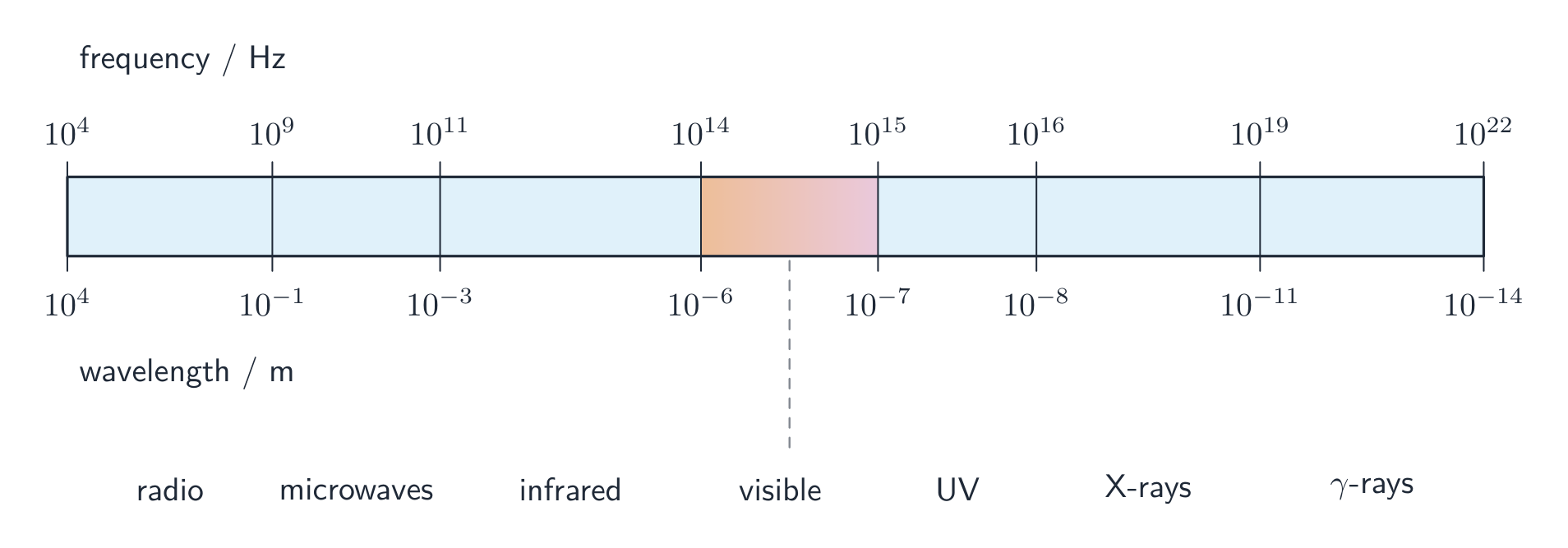
สเปกตรัมของคลื่นแม่เหล็กไฟฟ้าเป็นแถบแนวนอนตั้งแต่คลื่นวิทยุถึงรังสีแกมมา, มีสเกลความถี่หน่วย Hz ด้านบนและสเกลความยาวคลื่นหน่วย m ด้านล่าง; จากซ้ายไปขวาความยาวคลื่นลดลงและความถี่เพิ่มขึ้น
สเปกตรัมคลื่นแม่เหล็กไฟฟ้า

ช่วงความยาวคลื่นโดยประมาณในสุญญากาศ (จำลำดับขนาด):

  • คลื่นวิทยุ: $> 10^{-1}\ \text{m}$ (สูงสุดหลายกิโลเมตร).
  • ไมโครเวฟ: $10^{-3}\ \text{m}$ ถึง $10^{-1}\ \text{m}$.
  • อินฟราเรด: $\sim 7 \times 10^{-7}\ \text{m}$ ถึง $10^{-3}\ \text{m}$.
  • แสงที่มองเห็นได้: $400\ \text{nm}$ (ม่วง) ถึง $700\ \text{nm}$ (แดง), นั่นคือ $4 \times 10^{-7}\ \text{m}$ ถึง $7 \times 10^{-7}\ \text{m}$.
  • อัลตราไวโอเลต: $\sim 10^{-8}\ \text{m}$ ถึง $4 \times 10^{-7}\ \text{m}$.
  • รังสีเอกซ์: $\sim 10^{-11}\ \text{m}$ ถึง $10^{-8}\ \text{m}$.
  • $\gamma$-รังสี: $< 10^{-11}\ \text{m}$.

ขอบเขตระหว่างภูมิภาคไม่ชัดเจน ใช้ $c = f\lambda$ เพื่อแปลงระหว่างความยาวคลื่นและความถี่ มีเพียงแสงที่มีความยาวคลื่น $400$–$700\ \text{nm}$ เท่านั้นที่มองเห็นได้

เพื่อระบุภูมิภาค ให้แปลงเป็นความยาวคลื่นด้วย $\lambda = c / f$ แล้วเปรียบเทียบกับช่วง: $2.1\ \text{cm}$ เป็นไมโครเวฟ; $138\ \text{pm} = 1.4 \times 10^{-10}\ \text{m}$ เป็นรังสีเอกซ์; $30\ \text{THz}$ ให้ค่า $\lambda = 1.0 \times 10^{-5}\ \text{m}$, อินฟราเรด; $3.0 \times 10^{16}\ \text{Hz}$ ให้ค่า $1.0 \times 10^{-8}\ \text{m}$, อัลตราไวโอเลต. แสงที่มองเห็นได้ครอบคลุมความถี่ประมาณ $4.3 \times 10^{14}$ ถึง $7.5 \times 10^{14}\ \text{Hz}$, ดังนั้นคลื่นที่ $5.0 \times 10^{14}\ \text{Hz}$ สามารถมองเห็นได้ และคลื่นที่ความยาวคลื่น $5.0 \times 10^{-6}\ \text{m}$ (อินฟราเรด) ไม่สามารถมองเห็นได้ แสงสีแดงมีความยาวคลื่นยาวกว่าและความถี่ต่ำกว่าแสงสีเขียว รายการ "เรียงตามลำดับความยาวคลื่นเพิ่มขึ้น" คือ $\gamma$-รังสี, รังสีเอกซ์, อัลตราไวโอเลต, แสงที่มองเห็นได้, อินฟราเรด, ไมโครเวฟ, คลื่นวิทยุ. พัลส์ของแสงสะท้อนจากกำแพง $150\ \text{m}$ กลับมาถึงหลังจาก $2 \times 150 / (3.00 \times 10^{8}) = 1.0\ \mu\text{s}$

Explore · ⁨สำรวจ⁩

Slide across the spectrum · ⁨เลื่อนผ่านสเปกตรัม⁩

Radio waves, visible light and gamma rays are all the same wave — only the wavelength changes, and with it the frequency, photon energy and everyday use. · ⁨คลื่นวิทยุ แสงที่มองเห็นได้ และรังสีแกมมา ล้วนเป็นคลื่นชนิดเดียวกัน — เพียงความยาวคลื่นเปลี่ยนไป และตามด้วยการเปลี่ยนแปลงของความถี่ พลังงานโฟตอน และการใช้งานในชีวิตประจำวัน⁩

7.5

Polarisation · ⁨การโพลาไรเซชัน⁩

Syllabus · ⁨หลักสูตร⁩
English
  1. understand that polarisation is a phenomenon associated with transverse waves
  2. recall and use Malus’s law ($I = I_0 \cos^2\theta$) to calculate the intensity of a plane-polarised electromagnetic wave after transmission through a polarising filter or a series of polarising filters (calculation of the effect of a polarising filter on the intensity of an unpolarised wave is not required)
ไทย
  1. เข้าใจว่า การโพลาไรซ์ เป็นปรากฏการณ์ที่เกี่ยวข้องกับ คลื่นตามขวาง
  2. จำและใช้ กฎของมาลัส ($I = I_0 \cos^2\theta$) เพื่อคำนวณ ความเข้ม ของ คลื่นแม่เหล็กไฟฟ้าแบบโพลาไรซ์ระนาบ หลังผ่าน ตัวกรองโพลาไรซ์ หรือชุดตัวกรองโพลาไรซ์ (ไม่จำเป็นต้องคำนวณผลกระทบของตัวกรองโพลาไรซ์ต่อความเข้มของคลื่นที่ไม่โพลาไรซ์)

Source: Cambridge International syllabus · ⁨แหล่งที่มา: หลักสูตร Cambridge International⁩

English

Polarisation 偏振 means making a transverse wave oscillate in one plane only.

  • Only transverse waves can be polarised — the oscillation is perpendicular to the direction of travel, so different perpendicular planes are real choices.
  • Longitudinal waves (sound) cannot be polarised — the oscillation is along the direction of travel, so there is no other plane.

So polarisation is a test: if a wave can be polarised, it must be transverse.

Malus's law

Plane-polarised 平面偏振 light of intensity $I_{0}$ passes through a polarising filter 偏振片 whose transmission axis 透光轴 is at angle $\theta$ to the plane of polarisation. The transmitted intensity is given by Malus's law 马吕斯定律:

$$I = I_{0} \cos^{2}\theta.$$
  • $\theta = 0°$: filter lined up with the polarisation, $I = I_{0}$, all passes through.
  • $\theta = 90°$: filter at right angles, $I = 0$, all blocked.
  • $\theta = 60°$: $I = I_{0} \cos^{2} 60° = I_{0} \cdot 0.25 = I_{0}/4$.

Worked example. Plane-polarised light of intensity $12\ \text{W m}^{-2}$ meets a polarising filter whose axis is at $30°$ to the plane of polarisation. Find the transmitted intensity.

$$I = I_{0}\cos^{2}\theta = 12 \times \cos^{2} 30° = 12 \times 0.75 = 9.0\ \text{W m}^{-2}.$$

For two filters in a row, use Malus's law twice with the angle between each pair. Be careful with the angle each time — after the first filter the polarisation is along that filter's axis, and the second filter's angle is measured from there.

(You do not need to work out the effect of a polarising filter on an unpolarised wave.)

When a filter is rotated through $360°$ in front of plane-polarised light, the transmitted intensity varies as $\cos^{2}\theta$: it is a maximum when the transmission axis is parallel to the plane of polarisation ($0°$ and $180°$), zero when perpendicular ($90°$ and $270°$), and never negative. Because $I \propto A^{2}$, the transmitted amplitude is $A_{0}\cos\theta$: at $45°$ the intensity halves and the amplitude falls to $0.71$ of its value. For two filters, the first sets the plane of polarisation along its own axis, so the second filter's angle is measured from that: vertically polarised light through filters at $50°$ and then $80°$ to the vertical keeps $\cos^{2} 50° \times \cos^{2} 30° = 0.31$ of its intensity. The one-mark definitions: polarisation is the oscillation of a transverse wave in a single plane, which contains the direction of travel; sound cannot be polarised because its oscillations are along the direction of travel, so there is no plane to select.

ไทย

การโพลาไรเซชัน หมายถึงการทำให้คลื่นขวางสั่นในระนาบเดียวเท่านั้น

  • มีเพียง คลื่นขวาง เท่านั้นที่สามารถโพลาไรซ์ได้ — การสั่นตั้งฉากกับทิศทางการเดินทาง ดังนั้นระนาบตั้งฉากต่างๆ จึงเป็นทางเลือกที่เป็นจริง
  • คลื่นยาว (เสียง) ไม่สามารถโพลาไรซ์ได้ — การสั่นไปตามทิศทางการเดินทาง ดังนั้นไม่มีระนาบอื่น

ดังนั้น การโพลาไรเซชันจึงเป็นการทดสอบ: ถ้าคลื่นสามารถโพลาไรซ์ได้ มันต้องเป็นคลื่นขวาง

แผนภาพสองแบบตามทิศทางการพลังงานคลื่น: คลื่นที่ไม่มีการโพลาไรซ์ที่มีลูกศรคู่สีแดงชี้ไปในหลายระนาบ, และคลื่นที่มีการโพลาไรซ์ที่มีลูกศรคู่สีแดงเดียวในระนาบใดระนาบหนึ่ง
คลื่นที่ไม่มีการโพลาไรซ์สั่นในหลายระนาบ; คลื่นที่มีการโพลาไรซ์สั่นในระนาบเดียว

ไม้บรรทัดวัดมุมพลาสติกใสเรืองแสงเป็นแถบสีรุ้งบนพื้นหลังสีดำ *ไม้บรรทัดวัดมุมพลาสติกโปร่งแสงวางอยู่ระหว่างตัวกรองโพลาไรเซอร์ที่ไขว้กัน แสงเข้าถึงตาคุณเพราะพลาสติกที่เครียดหมุนระนาบการโพลาไรเซชัน — สีแสดงตำแหน่งที่พลาสติกบีบอัดมากที่สุด หากเป็นแสงธรรมดาจะดูโปร่งใสเท่านั้น

กฎของมาลัส

แสง โพลาไรซ์ระนาบ ที่มีความเข้ม $I_{0}$ ผ่าน ตัวกรองโพลาไรเซอร์ ที่มี แกนส่งผ่าน ทำมุม $\theta$ กับระนาบการโพลาไรเซชัน. ความเข้มที่ส่งผ่านกำหนดโดย กฎของมาลัส:

$$I = I_{0} \cos^{2}\theta.$$
  • $\theta = 0°$: ตัวกรองจัดแนวกับการโพลาไรเซชัน, $I = I_{0}$, ทุกอย่างส่งผ่าน
  • $\theta = 90°$: ตัวกรองตั้งฉาก, $I = 0$, ถูกปิดกั้นทั้งหมด
  • $\theta = 60°$: $I = I_{0} \cos^{2} 60° = I_{0} \cdot 0.25 = I_{0}/4$.

ตัวอย่างวิธีทำ. แสงโพลาไรซ์ระนาบที่ความเข้ม $12\ \text{W m}^{-2}$ gặpตัวกรองโพลาไรเซอร์whose axis at $30°$ to the plane of polarisation. Find the transmitted intensity.

$$I = I_{0}\cos^{2}\theta = 12 \times \cos^{2} 30° = 12 \times 0.75 = 9.0\ \text{W m}^{-2}.$$
แสงที่ไม่มีการโพลาไรซ์ผ่านโพลาริเซอร์กลายเป็นแสงโพลาไรซ์ระนาบ แล้วพบกับอะนาลายเซอร์: ใน (a) แกนส่งผ่านของอะนาลายเซอร์ไขว้กัน (ตั้งฉาก) ไม่มีแสงผ่าน; ใน (b) ขนานกัน และแสงโพลาไรซ์ส่งผ่าน
เกร็ดกรองตัดกัน (a) กั้นแสง; เกร็ดกรองขนานกัน (b) ให้แสงผ่าน

สำหรับตัวกรองสองตัวเรียงกัน ใช้กฎของมาลัสสองครั้งพร้อมมุมระหว่างแต่ละคู่ ระวังเรื่องมุมทุกครั้ง — หลังตัวกรองแรก การโพลาไรเซชันจะอยู่ในทิศทางของแกนตัวกรองนั้น และมุมของตัวกรองที่สองจะวัดจากจุดนั้น

(คุณไม่จำเป็นต้องคำนวณผลของตัวกรองโพลาไรเซอร์ต่อคลื่นที่ไม่มีการโพลาไรซ์)

เมื่อตัวกรองถูกหมุนผ่าน $360°$ หน้าแสงโพลาไรซ์ระนาบ ความเข้มที่ส่งผ่านจะแปรผันตาม $\cos^{2}\theta$: สูงสุดเมื่อแกนส่งขนานกับระนาบการโพลาไรซ์ ($0°$ และ $180°$), เป็นศูนย์เมื่อตั้งฉาก ($90°$ และ $270°$), และไม่เคยเป็นค่าลบ เนื่องจาก $I \propto A^{2}$, แอมพลิจูดที่ส่งผ่านคือ $A_{0}\cos\theta$: ที่ $45°$ ความเข้มลดลงครึ่งหนึ่งและแอมพลิจูดลดลงเหลือ $0.71$ ของค่าเดิม สำหรับตัวกรองสองตัว ตัวกรองแรกกำหนดระนาบการโพลาไรซ์ตามแกนของมันเอง ดังนั้นมุมของตัวกรองที่สองจึงวัดจากแกนนั่น: แสงโพลาไรซ์แนวตั้งผ่านตัวกรองที่ $50°$ แล้วตามด้วย $80°$ จากแนวตั้ง จะคงไว้ซึ่ง $\cos^{2} 50° \times \cos^{2} 30° = 0.31$ ของความเข้มเดิม นิยามแบบ 1 คะแนน: การโพลาไรซ์คือการสั่นของคลื่นขวางในระนาบเดียว ซึ่งรวมทิศทางของการเคลื่อนที่; เสียงไม่สามารถโพลาไรซ์ได้เพราะการสั่นของเสียงอยู่ในทิศทางเดียวกับการเคลื่อนที่ จึงไม่มีระนาบใดให้เลือก

Explore · ⁨สำรวจ⁩

Polarisation intensity lab · ⁨ห้องปฏิบัติการความเข้มโพลาไรเซชัน⁩

intensity changes with polariser angle · ⁨ความเข้มเปลี่ยนแปลงตามมุมของโพลาไรเซอร์⁩

Rotate a polariser and see why only transverse waves can be polarised. · ⁨หมุนแผ่นโพลาไรเซอร์เพื่อดูว่าทำไมเพียงคลื่นขวางเท่านั้นที่เกิดโพลาไรเซชันได้⁩

Vocabulary · ⁨คำศัพท์⁩ Train · ⁨ฝึกฝน⁩
English ไทย
intensity/ɪnˈtensɪti/ ความเข้ม
power/ˈpaʊə/ กำลัง
point source/pɔɪnt sɔːs/ แหล่งกำเนิดแบบจุด (point source)
source/sɔːs/ แหล่งผลิต
wavefront/ˈweɪvfrʌnt/ หน้าคลื่น
perpendicular/ˌpɜːpənˈdɪkjʊlə/ ตั้งฉาก
electromagnetic wave/ɪˌlektrəʊməɡˈnetɪk weɪv/ คลื่นแม่เหล็กไฟฟ้า
sine curve/saɪn kɜːv/ Executes sine curve
compression/kəmˈpreʃn/ การอัดตัว
polarisation/ˌpəʊləraɪˈzeɪʃn/ การทำให้มีขั้ว
polarising filter/ˈpəʊləraɪzɪŋ ˈfɪltə/ ฟิลเตอร์โพลาไรซ์
Malus's law/ˈmæləsɪz lɔː/ กฎของมาลัส
plane-polarised/pleɪn ˈpəʊləraɪzd/ โพลาไรซ์ระนาบ
transmission axis/trænˈsmɪʃn ˈæksɪs/ แกนส่งผ่าน
γ-rays/ˈɡæmə reɪz/ รังสีแกมมา
gamma-rays/ˈɡæmə reɪz/ รังสีแกมมา
7.5

Definitions the examiner accepts · ⁨คำนิยามที่ผู้สอบยอมรับ⁩

English

A definition question is marked against fixed wording. Learn these exactly, and give one answer only.

Term Definition
progressive wave a wave that transfers energy from one place to another without transferring matter
transverse wave a wave whose oscillations are perpendicular to the direction of energy transfer
longitudinal wave a wave whose oscillations are parallel to the direction of energy transfer
displacement the distance of a particle from its equilibrium (rest) position, in a stated direction
amplitude the maximum displacement of a particle from its equilibrium position
wavelength the minimum distance between two points on the wave that are in phase (for example, adjacent crests)
period the time for one complete oscillation of a particle (or for the wave to travel one wavelength)
frequency the number of oscillations per unit time (or the number of wavefronts passing a point per unit time)
phase difference the fraction of a cycle, as an angle, by which one oscillation leads or lags another
intensity the power per unit area, at right angles to the direction of travel
Doppler effect the change in the observed frequency of a wave when the source moves relative to the observer
polarisation the oscillations of a transverse wave are in one plane only, containing the direction of travel
time-base the time represented by one division across the screen of a CRO
ไทย

คำถามคำนิยามจะให้คะแนนตามข้อความที่กำหนดไว้你必须 exact. เรียนรู้ให้ถูกต้องและตอบเพียงคำตอบเดียวเท่านั้น

พจน์ นิยาม
คลื่นประนีประนอม คลื่นที่ถ่ายโอนพลังงานจากจุดหนึ่งไปยังอีกจุดหนึ่งโดยไม่มีการถ่ายโอนมวลสาร
คลื่นขวาง คลื่นที่มีการสั่นตั้งฉากกับทิศทางการถ่ายโอนพลังงาน
คลื่นยาว คลื่นที่มีการสั่นขนานกับทิศทางการถ่ายโอนพลังงาน
การกระจัด ระยะทางของอนุภาคจากตำแหน่งสมดุล (休憩) ของมัน ในทิศทางที่กำหนด
แอมพลิจูด การกระจัดสูงสุดของอนุภาคจากตำแหน่งสมดุล
ความยาวคลื่น ระยะห่างขั้นต่ำระหว่างสองจุดบนคลื่นที่มีเฟสเดียวกัน (เช่น ยอดคลื่นติดกัน)
Period เวลาสำหรับการสั่นครบรอบหนึ่งรอบของอนุภาค (หรือเพื่อให้คลื่นเคลื่อนที่ไปหนึ่งความยาวคลื่น)
ความถี่ จำนวนรอบการสั่นต่อหน่วยเวลา (หรือจำนวนหน้าคลื่นที่ผ่านจุดหนึ่งต่อหน่วยเวลา)
ความต่างเฟส ส่วนหนึ่งของรอบการสั่น ในรูปของมุม โดยที่การสั่นหนึ่ง超前หรือ滞后 อีกการสั่นหนึ่ง
ความเข้ม กำลังงานต่อหน่วยพื้นที่ ในแนวตั้งฉากกับทิศทางการเคลื่อนที่
ผลดอปเพลอร์ การเปลี่ยนแปลงของความถี่ที่สังเกตได้ของคลื่น เมื่อแหล่งกำเนิดเคลื่อนที่สัมเทียบกับผู้สังเกต
การโพลาไรซ์ การสั่นของคลื่นขวางมีเพียงในระนาบเดียว ซึ่งรวมทิศทางการเคลื่อนที่
Time-base เวลาที่แทนด้วยหนึ่งช่องบนหน้าจอของ CRO
Vocabulary · ⁨คำศัพท์⁩ Train · ⁨ฝึกฝน⁩
English ไทย
period/ˈpɪərɪəd/ รอบ
hertz/hɜːts/ เฮิร์ตซ์
speed/spiːd/ ความเร็ว
radian/ˈreɪdɪən/ เรเดียน
cathode-ray oscilloscope/ˈkæθəʊd reɪ ɒˈsɪləskəʊp/ ออสซิลโลสโคปรังสีแคโทด
time-base/taɪm beɪs/ ฐานเวลา
7.5

Exam tips · ⁨ข้อแนะนำสำหรับการสอบ⁩

English
  • Define terms precisely (displacement, amplitude, wavelength, period, frequency) and use $v = f\lambda$.
  • Distinguish transverse (vibration perpendicular to travel) from longitudinal (parallel); only transverse waves can be polarised.
  • For the Doppler effect, the observed frequency rises as the source approaches and falls as it recedes.
  • Learn the electromagnetic spectrum order; all its waves travel at $c$ in a vacuum.

Common mistakes

  • A phase difference bigger than one cycle, or degrees where radians were asked. Only the fraction of a cycle matters: $450°$ is $90°$, and $90°$ is $\pi/2$.
  • Reading the wavelength from a displacement–time graph. That graph gives the period; the wavelength comes from the displacement–distance graph.
  • Doubling the amplitude and "doubling" the intensity. Intensity goes as the amplitude squared: four times.
  • Choosing the Doppler sign by feel. Towards means minus on the bottom (frequency up); away means plus (frequency down). Check that the answer lies on the right side of $f_{\text{s}}$.
  • Using the first filter's angle for the second. After a filter the light is polarised along that filter's axis, and the next angle is measured from there.
  • Saying that sound can be polarised. Only transverse waves can.
ไทย
  • นิยามศัพท์ให้ชัดเจน (การกระจัด, แอมพลิจูด, ความยาวคลื่น, period, ความถี่) และใช้ $v = f\lambda$.
  • แยกแยะ คลื่นขวาง (สั่นตั้งฉากกับการเคลื่อนที่) ออกจาก คลื่นยาว (ขนาน); มีเพียงคลื่นขวางเท่านั้นที่จะสามารถ โพลาไรซ์ ได้
  • สำหรับ ผลดอปเพลอร์, ความถี่ที่สังเกตได้จะ เพิ่มขึ้น เมื่อแหล่งกำเนิดเข้าใกล้และลดลงเมื่อถอยห่าง
  • จำลำดับของ สเปกตรัมแม่เหล็กไฟฟ้า; คลื่นทั้งหมดเดินทางด้วยความเร็ว $c$ ในสุญญากาศ

ข้อผิดพลาดที่พบบ่อย

  • ความต่างเฟสมากกว่าหนึ่งรอบ หรือองศาที่ถามเป็นเรเดียน สิ่งที่สำคัญคือส่วนหนึ่งของรอบ: $450°$ คือ $90°$, และ $90°$ คือ $\pi/2$
  • การอ่านค่าความยาวคลื่นจากกราฟการกระจัด–เวลา กราฟนั้นให้ค่า period; ค่าความยาวคลื่นมาจากกราฟการกระจัด–ระยะทาง
  • การเพิ่มแอมพลิจูดเป็นสองเท่าและ "เพิ่ม" ความเข้มเป็นสองเท่า ความเข้มแปรผันตามกำลังสองของแอมพลิจูด: สี่เท่า
  • เลือกเครื่องหมายผลดอปเพลอร์ด้วยการรู้สึก Towards หมายความว่าลบด้านล่าง (ความถี่ขึ้น); Away หมายความว่าบวก (ความถี่ลง) ตรวจสอบให้แน่ใจว่าคำตอบอยู่ทางด้านขวาของ $f_{\text{s}}$
  • ใช้มุมของตัวกรองแรกสำหรับตัวกรองที่สอง หลังผ่านตัวกรองแล้วแสงจะถูกโพลาไรซ์ตามแกนของตัวกรองนั้น และมุมถัดไปจะวัดจากจุดนั้น
  • บอกว่าเสียงสามารถโพลาไรซ์ได้ มีเพียงคลื่นขวางเท่านั้นที่จะทำได้

Interactive lessons on this topic · ⁨บทเรียนเชิงโต้ตอบสำหรับหัวข้อนี้⁩

Work through it step by step, with instant-check exercises. · ⁨ทำทีละขั้นตอน พร้อมแบบฝึกหัดตรวจสอบผลทันที⁩

Past Papers · ⁨ข้อสอบย้อนหลัง⁩

More topics in A-Level Physics · ⁨Physics A-Level⁩ · ⁨หัวข้อเพิ่มเติมใน A-Level Physics · ⁨Physics A-Level⁩⁩

Log in or create account · ⁨เข้าสู่ระบบหรือสร้างบัญชี⁩

IGCSE, A-Level & AP