Transverse and longitudinal waves
Introduced| English | Meaning |
|---|---|
| transverse/trænsˈvɜːs/ | Describing a wave whose oscillations are perpendicular to the direction in which the disturbance travels. |
| longitudinal/ˌlɒŋɡɪˈtjuːdɪnl/ | Describing a wave in which particle oscillations are parallel to the direction of energy transfer. |
| perpendicular/ˌpɜːpənˈdɪkjʊlə/ | Meeting at a right angle of 90 degrees. |
| electromagnetic waves/ɪˌlektrəʊməɡˈnetɪk weɪvz/ | Waves of coupled electric and magnetic fields that transfer energy and can travel through a vacuum. |
| compressions/kəmˈpreʃnz/ | Squeezing an object or substance so that its size or volume decreases. |
| rarefactions/ˌreərɪˈfækʃnz/ | Regions of lower pressure or particle density in a longitudinal wave. |
| energy transfer/ˈenədʒi ˈtrænsfɜː/ | energy transfer |
| propagation/ˌprɒpəˈɡeɪʃn/ | The travel or spread of a wave or disturbance through space or a medium. |
Two ways to make a wave
- Shake a rope up and down — the wiggle runs along it.
- Push and pull a slinky end-on — a squash runs along it instead.
- Both carry energy, but the particles move in different directions.
Transverse 横波 waves
- The particles vibrate perpendicular 垂直 to the direction the energy travels.
- Examples: a wave on a rope, all electromagnetic waves 电磁波, ripples on water.
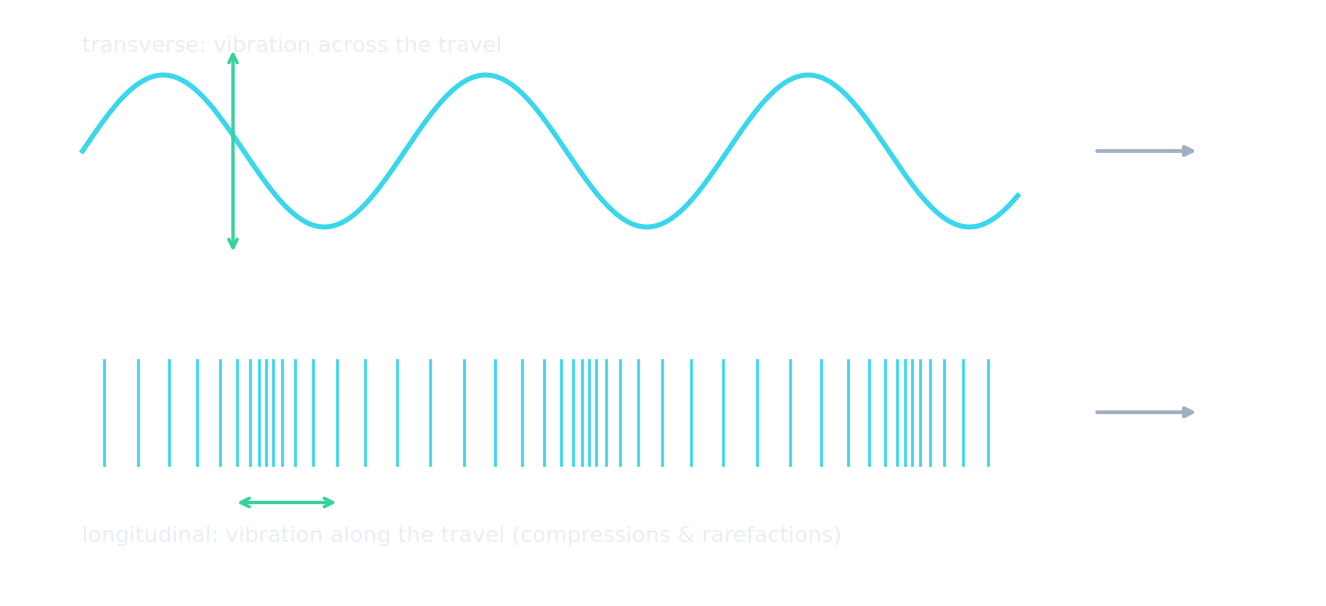

Transverse wave on a rope
Transverse waves
y = a sin(bx + c)
Change the amplitude and wavelength of the wave.
In a transverse wave, the particles vibrate:
Difficulty 1/5 · 100 coins + a small bonus on first completion today
Transverse = vibration at right angles to the energy flow (a rope wave, light, water ripples).
Longitudinal 纵波 waves
- The particles vibrate parallel to the direction of travel.
- Made of compressions 压缩 (squashed together) and rarefactions 稀疏 (spread out). Sound is longitudinal.

Longitudinal wave on a slinky spring
Sound travelling through air is a longitudinal wave.
Difficulty 1/5 · 100 coins + a small bonus on first completion today
Yes — the air particles vibrate back and forth along the travel direction, making compressions and rarefactions.
Select all the waves that are transverse.
Difficulty 2/5 · 140 coins + a small bonus on first completion today
Light, water ripples and a rope wave are transverse. Sound and an end-on slinky wave are longitudinal.
A longitudinal wave is made of compressions and ____.
Difficulty 1/5 · 100 coins + a small bonus on first completion today
Compressions are where particles bunch up; rarefactions are where they spread out.
Say it the way the examiner wants
- The mark is for two directions in one sentence: the direction the particles vibrate, and the direction of energy transfer 能量传递 (the direction of propagation 传播).
- Transverse: "the vibrations are perpendicular to the direction of energy transfer."
- Longitudinal: "the vibrations are parallel to the direction of energy transfer."
- "The particles move up and down" scores nothing on its own — up and down relative to what?
Match each term to the definition the examiner marks.
Difficulty 2/5 · 140 coins + a small bonus on first completion today
Every one of these is marked against a fixed wording. "Energy transfer", not "the wave's motion", is the phrase in the two wave-type definitions.
Reading a longitudinal wave's graph
- The graph plots displacement along the direction of travel: positive means the particle has moved forward, negative means back.
- Two particles exactly one wavelength apart have the same displacement and move the same way.
- A compression sits where the particle behind has moved forward and the one ahead has moved back — the graph crosses zero going downwards.
- Which way is a particle moving now? Look at the graph just behind it (the side the wave comes from): that displacement is where it is heading.
A longitudinal wave travels to the right. On its displacement–distance graph, particle P is at zero displacement on a part of the curve that rises from left to right. Which way is P moving now?
Difficulty 1/5 · 100 coins + a small bonus on first completion today
Look just behind P (to its left): the displacement there is negative, so P is heading to a negative displacement — moving backwards. A particle at zero displacement is never stationary; it is at its fastest.
Two graphs
- Displacement–distance (a snapshot of the whole wave) → read the wavelength.
- Displacement–time (one point over time) → read the period.
- Both look like sine curves, for either type of wave.
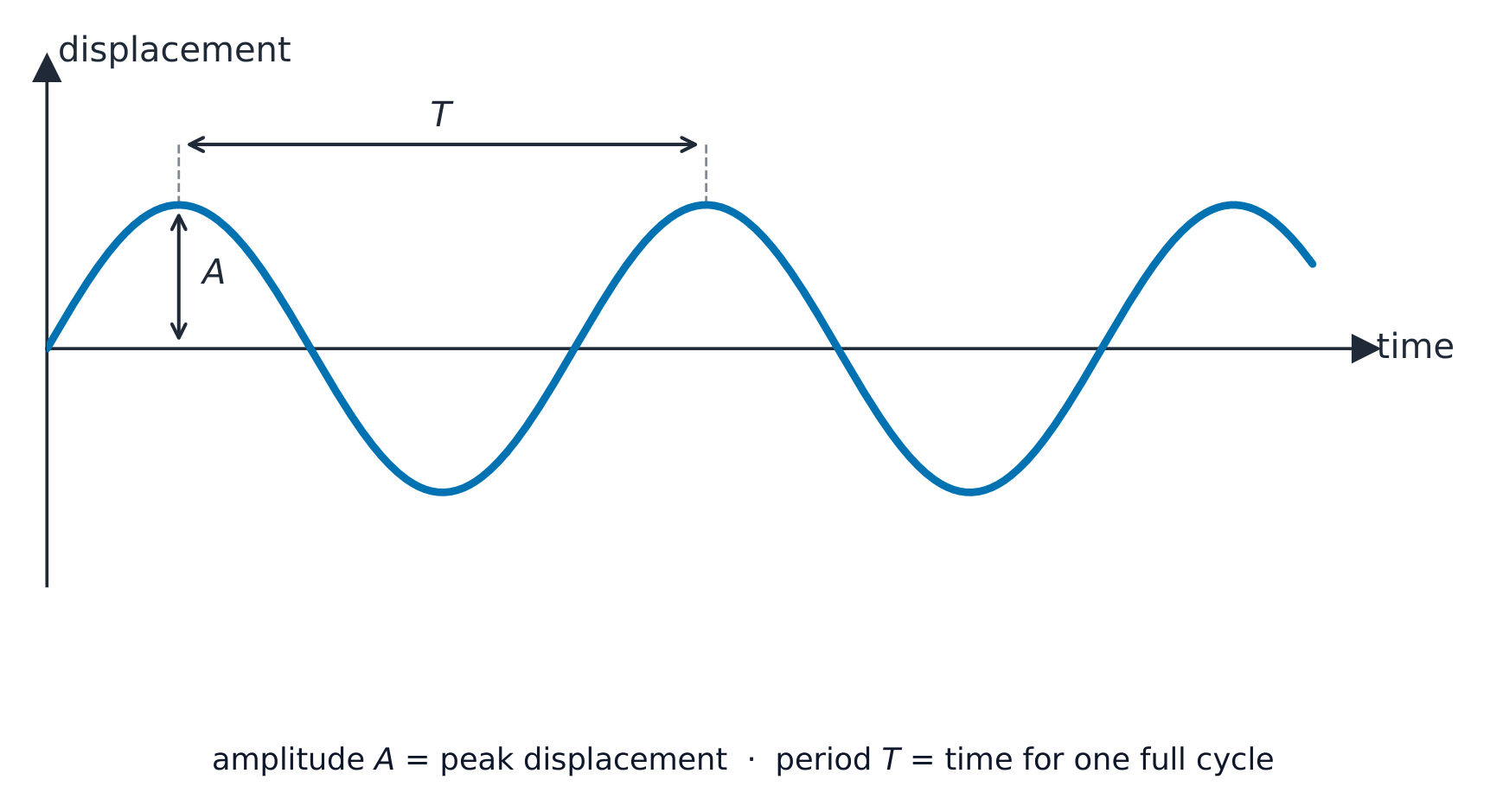
A displacement-time graph shows the wave's amplitude and period
Match each graph to what you read off it.
Difficulty 2/5 · 140 coins + a small bonus on first completion today
A snapshot against distance shows the wavelength; one point watched over time shows the period.
Which can be read from a displacement-distance graph? Select all that apply.
Difficulty 2/5 · 140 coins + a small bonus on first completion today
The period comes from a displacement-TIME graph. Reading a wavelength off the time graph is one of the commonest errors in this topic.
The amplitude of a wave is doubled. By what factor does its intensity increase?
Difficulty 2/5 · 140 coins + a small bonus on first completion today
Intensity goes as amplitude squared, so doubling the amplitude quadruples it. Intensity is also power per unit area at right angles to the travel direction.
Worked example: a sound wave on a graph
A displacement–distance graph of a sound wave (travelling to the right) shows particles X and Y $1.5$ wavelengths apart, separated by $0.24\ \text{m}$. The frequency is $2.0\ \text{kHz}$. Particle Z sits at zero displacement on a part of the graph that falls from left to right.
- Wavelength: $1.5\lambda = 0.24$, so $\lambda = 0.16\ \text{m}$.
- Speed: $v = f\lambda = 2000 \times 0.16 = 320\ \dfrac{\text{m}}{\text{s}}$.
- Z now: just behind Z (to its left) the displacement is positive, so Z is moving forward, in the direction of travel.
- Z a quarter of a period later: the whole pattern has moved on by $\dfrac{\lambda}{4}$, so Z takes the displacement that was $\dfrac{\lambda}{4}$ behind it — a crest, $+A$. Sketch the new graph as the old one shifted right by $\dfrac{\lambda}{4}$.
- Check: a particle at zero displacement is passing through its rest position, which is where it moves fastest — so it makes sense that it reaches maximum displacement a quarter period later.
On a displacement–distance graph, two particles that are exactly two wavelengths apart are separated by $0.68\ \text{m}$. The wave has frequency $1.0\ \text{kHz}$. What is its speed, in m/s?
Difficulty 2/5 · 140 coins + a small bonus on first completion today
$2\lambda = 0.68$, so $\lambda = 0.34\ \text{m}$ and $v = f\lambda = 1000 \times 0.34 = 340\ \dfrac{\text{m}}{\text{s}}$ — the speed of sound in air.
The displacement graph of a longitudinal wave looks exactly like a transverse wave, but the particles are not moving up and down. The vertical axis is displacement along the line of travel. Say "forward and back", and remember that the wave travels while the particles only oscillate about fixed positions.
You've got it
- transverse: vibration perpendicular to the energy transfer (rope, light, ripples)
- longitudinal: vibration parallel to the energy transfer — compressions & rarefactions (sound)
- on a longitudinal wave's graph, positive = forward; look just behind a particle to see where it is going
- displacement–distance shows $\lambda$; displacement–time shows $T$