Progressive waves
Introduced| English | Meaning |
|---|---|
| medium/ˈmiːdɪəm/ | The material or environment through which a wave or other physical influence is transmitted. |
| oscillate/ˈɒsɪleɪt/ | Move or vary repeatedly about an equilibrium position or value. |
| progressive wave/prəˈɡresɪv weɪv/ | A travelling disturbance that transfers energy from one place to another without net transport of the medium as a whole. |
| amplitude/ˈæmplɪtjuːd/ | The maximum displacement from an equilibrium position. |
| wavelength/ˈweɪvleŋθ/ | The distance between corresponding points on successive waves. |
| period/ˈpɪərɪəd/ | The time taken for one complete oscillation or cycle. |
| frequency/ˈfriːkwənsi/ | The number of complete cycles per unit time. |
| phase difference/feɪz ˈdɪfrəns/ | The difference in position within an oscillation cycle between two oscillations or points on waves. |
| in phase/ɪn feɪz/ | Describing oscillations that reach corresponding stages of their cycles at the same time. |
| out of phase/ˈaʊtəv feɪz/ | out of phase |
| time-base/taɪm beɪs/ | A circuit or setting that provides the controlled horizontal sweep used to represent time on an oscilloscope. |
| intensity/ɪnˈtensɪti/ | The power carried by a wave per unit area perpendicular to its direction of propagation. |
The stadium wave
- In a stadium "wave", people stand and sit — but nobody runs around the stadium.
- The wave travels; the people stay put.
- A wave carries energy from place to place without moving matter overall.
What a wave is
- The particles of the medium oscillate 振动 about fixed rest positions.
- Only the disturbance — and its energy — moves along. This is a progressive wave 行波.

A digital oscilloscope draws a voltage signal against time
Progressive waves
y = a sin(bx + c)
A wave: a is amplitude, b sets the wavelength, c the phase.
A progressive wave carries energy without moving matter along overall.
Difficulty 1/5 · 100 coins + a small bonus on first completion today
Yes — the particles only oscillate about fixed points; the disturbance and its energy are what travel.
The key words
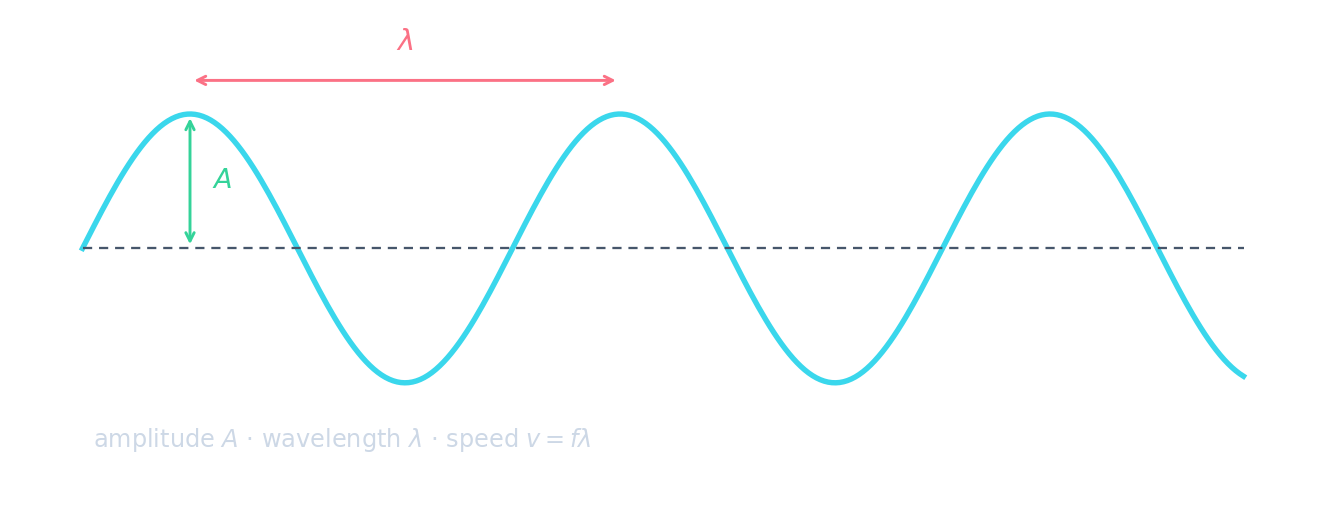
- amplitude 振幅 $A$ — biggest displacement from rest; wavelength 波长 $\lambda$ — distance between repeats.
- period 周期 $T$ — time for one cycle; frequency 频率 $f = \dfrac{1}{T}$ (in Hz).
A wave has a period of $0.020\ \text{s}$. What is its frequency?
Difficulty 2/5 · 140 coins + a small bonus on first completion today
$f = \dfrac{1}{T} = \dfrac{1}{0.020} = 50\ \text{Hz}$.
Two graphs that look the same
- A displacement–distance graph is a snapshot: the repeat distance is the wavelength.
- A displacement–time graph follows one point: the repeat time is the period.
- Same shape, different axis — read the axis label before you read anything off.

A displacement–distance graph shows the wave's amplitude and wavelength; swap the axis to time and the same shape shows the period
A graph of displacement against time for one point on a wave repeats every $4.0\ \text{ms}$. What does that $4.0\ \text{ms}$ tell you?
Difficulty 1/5 · 100 coins + a small bonus on first completion today
A time axis gives the period. $f = \dfrac{1}{T} = \dfrac{1}{4.0 \times 10^{-3}} = 250\ \text{Hz}$. The wavelength needs a distance axis.
Phase difference 相位差
- Points one wavelength apart move together — they are in phase 同相.
- Points half a wavelength apart are exactly out of phase 反相.
- In general, a separation $\Delta x$ gives a phase difference of $\dfrac{\Delta x}{\lambda} \times 360^\circ$ (or $\times 2\pi$ rad).

Ripples on water are progressive waves that carry energy outward
Two points exactly one wavelength apart on a wave are:
Difficulty 1/5 · 100 coins + a small bonus on first completion today
One whole wavelength is one full cycle ($2\pi$), so the two points move together — in phase.
Match each separation along a wave to the phase difference between the two points.
Difficulty 2/5 · 140 coins + a small bonus on first completion today
Phase difference $= \dfrac{\Delta x}{\lambda} \times 360^\circ$, so each fraction of a wavelength is the same fraction of a full cycle.
The wave equation
- Speed is distance over time. In one period $T$ the wave advances one wavelength $\lambda$, so $v = \dfrac{\lambda}{T}$.
- Since $f = \dfrac{1}{T}$, this is $v = f\lambda$ — and it works for every progressive wave.
A wave has frequency $50\ \text{Hz}$ and wavelength $4.0\ \text{m}$. What is its speed?
Difficulty 2/5 · 140 coins + a small bonus on first completion today
$v = f\lambda = 50 \times 4.0 = 200\ \dfrac{\text{m}}{\text{s}}$.
Worked example: reading an oscilloscope
A microphone feeds an oscilloscope. The time-base 时基 is set to $0.20\ \dfrac{\text{ms}}{\text{div}}$ and $2.5$ complete cycles fill $10$ divisions. The wavelength of the sound is measured as $0.27\ \text{m}$. Find the frequency and the speed of sound.
- Time across the screen: $10 \times 0.20 = 2.0\ \text{ms}$.
- Period: $T = \dfrac{2.0\ \text{ms}}{2.5} = 0.80\ \text{ms} = 8.0 \times 10^{-4}\ \text{s}$.
- Frequency: $f = \dfrac{1}{T} = 1250\ \text{Hz}$.
- Speed: $v = f\lambda = 1250 \times 0.27 = 340\ \dfrac{\text{m}}{\text{s}}$.
- Check: the speed of sound in air is about $340\ \dfrac{\text{m}}{\text{s}}$, so the reading is sensible. Forgetting to divide by the $2.5$ cycles gives $500\ \text{Hz}$ and a speed of $135\ \dfrac{\text{m}}{\text{s}}$ — impossible for sound.
An oscilloscope time-base is $0.50\ \dfrac{\text{ms}}{\text{div}}$ and 4 complete cycles fill 8 divisions. What is the frequency of the signal, in Hz?
Difficulty 2/5 · 140 coins + a small bonus on first completion today
Screen time $= 8 \times 0.50 = 4.0\ \text{ms}$; one cycle takes $\dfrac{4.0}{4} = 1.0\ \text{ms}$, so $f = \dfrac{1}{1.0 \times 10^{-3}} = 1000\ \text{Hz}$.
The frequency is fixed by the source. When a wave passes into a different medium 介质, $f$ stays the same while $v$ and $\lambda$ change together. And a displacement–time graph gives you the period, never the wavelength.
When a wave passes from air into water, its speed and wavelength change but its ____ stays the same.
Difficulty 1/5 · 100 coins + a small bonus on first completion today
The frequency is set by the source and cannot change at a boundary; $v = f\lambda$ then forces $\lambda$ to change with $v$.
Intensity 强度
- Intensity is the power per unit area: $I = \dfrac{P}{A}$ (in $\dfrac{\text{W}}{\text{m}^2}$).
- It grows with the square of the amplitude: $I \propto A^{2}$.
If the amplitude of a wave doubles, its intensity becomes:
Difficulty 1/5 · 100 coins + a small bonus on first completion today
$I \propto A^{2}$, so doubling $A$ multiplies the intensity by $2^{2} = 4$.
Spreading from a point
- A point source spreads energy over a sphere: $I = \dfrac{P}{4\pi r^{2}}$, so $I \propto \dfrac{1}{r^{2}}$.
- Double the distance → a quarter of the intensity.
A point source gives an intensity of $100\ \dfrac{\text{W}}{\text{m}^2}$ at distance $r$. What is the intensity at $2r$?
Difficulty 2/5 · 140 coins + a small bonus on first completion today
$I \propto \dfrac{1}{r^{2}}$, so at twice the distance the intensity is $\dfrac{100}{2^{2}} = 25\ \dfrac{\text{W}}{\text{m}^2}$.
Worked example: amplitude and distance
A small loudspeaker radiates $20\ \text{W}$ equally in all directions. Find the intensity $2.0\ \text{m}$ away, and say how the amplitude of the sound there compares with the amplitude at $4.0\ \text{m}$.
- Intensity at $2.0\ \text{m}$: $I = \dfrac{P}{4\pi r^{2}} = \dfrac{20}{4\pi \times 2.0^{2}} = 0.40\ \dfrac{\text{W}}{\text{m}^2}$.
- At $4.0\ \text{m}$ the distance has doubled, so the intensity is a quarter: $0.10\ \dfrac{\text{W}}{\text{m}^2}$.
- Amplitude: $I \propto A^{2}$, so a quarter of the intensity means half the amplitude.
- Check: intensity falls as $\dfrac{1}{r^{2}}$ but amplitude falls only as $\dfrac{1}{r}$ — the square root of the intensity ratio.
You've got it
- a wave carries energy, not matter; $f = \dfrac{1}{T}$; frequency is set by the source
- the wave equation: $v = f\lambda$ (one wavelength per period)
- phase difference $= \dfrac{\Delta x}{\lambda} \times 360^\circ$; intensity $I = \dfrac{P}{A}$, with $I \propto A^{2}$ and $I \propto \dfrac{1}{r^{2}}$ from a point source