Skip to content · ⁨ข้ามไปยังเนื้อหา⁩

Reaction kinetics · ⁨จลนศาสตร์ของปฏิกิริยา⁩

A-Level Chemistry · ⁨Chemistry A-Level⁩ · Topic 26 · ⁨หัวข้อ 26⁩

Video lesson for this topic · ⁨บทเรียนวิดีโอสำหรับหัวข้อนี้⁩ Open the video page · ⁨เปิดหน้าวิดีโอ⁩
8:01

จลนศาสตร์ปฏิกิริยา (A2)

นี่คือปฏิกิริยาจริง: ไฮโดรเจนเปอร์ออกไซด์ทำปฏิกิริยากับไอออนไอโอดีนในกรด ดูสมการที่ดุลแล้ว ใช้ไอออนไอโอดีนสองตัวและไอออนไฮโดรเจนสองตัว…

English narration · English + 中文 subtitles burned in · ⁨การบรรยายภาษาอังกฤษ · คำบรรยายภาษาอังกฤษ + 中文 ลอยตัวบนภาพ⁩

26.1

Rate equations and orders · ⁨สมการอัตราและอันดับปฏิกิริยา⁩

Syllabus · ⁨หลักสูตร⁩
English
  1. explain and use the terms rate equation, order of reaction, overall order of reaction, rate constant, half-life, rate-determining step and intermediate
  2. (a) understand and use rate equations of the form $\text{rate} = k [\text{A}]^m[\text{B}]^n$ (for which $m$ and $n$ are 0, 1 or 2) (b) deduce the order of a reaction from concentration–time graphs or from experimental data relating to the initial rates method and half-life method (c) interpret experimental data in graphical form, including concentration–time and rate–concentration graphs (d) calculate an initial rate using concentration data (e) construct a rate equation
  3. (a) show understanding that the half-life of a first-order reaction is independent of concentration (b) use the half-life of a first-order reaction in calculations
  4. calculate the numerical value of a rate constant, for example by: (a) using the initial rates and the rate equation (b) using the half-life, $t_{\frac{1}{2}}$, and the equation $k = 0.693/t_{\frac{1}{2}}$
  5. for a multi-step reaction: (a) suggest a reaction mechanism that is consistent with the rate equation and the equation for the overall reaction (b) predict the order that would result from a given reaction mechanism and rate-determining step (c) deduce a rate equation using a given reaction mechanism and rate-determining step for a given reaction (d) identify an intermediate or catalyst from a given reaction mechanism (e) identify the rate determining step from a rate equation and a given reaction mechanism
  6. describe qualitatively the effect of temperature change on the rate constant and hence the rate of a reaction
ไทย
  1. อธิบายและใช้ศัพท์ว่า สมการอัตรา, ลำดับปฏิกิริยา, ลำดับปฏิกิริยารวม, ค่าคงที่อัตรา, อายุครึ่งชีวิต, ขั้นตอนที่กำหนดอัตรา และ สารกลาง
  2. (ก) เข้าใจและใช้สมการอัตรารูปแบบ $\text{rate} = k [\text{A}]^m[\text{B}]^n$ (ซึ่ง $m$ และ $n$ เป็น 0, 1 หรือ 2) (ข) สรุปลำดับปฏิกิริยาจากกราฟความเข้มข้น–เวลาหรือจากข้อมูลการทดลองเกี่ยวกับวิธีอัตราเริ่มต้นและวิธีอายุครึ่งชีวิต (ค) ตีความข้อมูลการทดลองในรูปแบบกราฟ รวมถึงกราฟความเข้มข้น–เวลาและกราฟอัตรา–ความเข้มข้น (ง) คำนวณอัตราเริ่มต้นโดยใช้ข้อมูลความเข้มข้น (จ) สร้างสมการอัตรา
  3. (ก) แสดงให้เห็นว่าอายุครึ่งชีวิตของปฏิกิริยาลำดับที่หนึ่งไม่ขึ้นอยู่กับความเข้มข้น (ข) ใช้อายุครึ่งชีวิตของปฏิกิริยาลำดับที่หนึ่งในการคำนวณ
  4. คำนวณค่าตัวเลขของค่าคงที่อัตราการเกิดปฏิกิริยา โดยตัวอย่างเช่น: (ก) ใช้อัตราการเกิดปฏิกิริยารวมเริ่มต้นและสมการอัตรา (ข) ใช้ครึ่งอายุ $t_{\frac{1}{2}}$ และสมการ $k = 0.693/t_{\frac{1}{2}}$
  5. สำหรับปฏิกิริยาหลายขั้นตอน: (ก) เสนอกลไกการเกิดปฏิกิริยาที่สอดคล้องกับสมการอัตราและสมการรวม (ข) คาดการณ์ลำดับปฏิกิริยาที่จะเกิดขึ้นจากกลไกการเกิดปฏิกิริยากำหนดและขั้นตอนกำหนดอัตรา (ค) สรุปสมการอัตราโดยใช้กลไกการเกิดปฏิกิริยากำหนดและขั้นตอนกำหนดอัตราสำหรับปฏิกิริยากำหนด (ง) ระบุสารกลางหรือตัวเร่งปฏิกิริยาจากกลไกการเกิดปฏิกิริยากำหนด (จ) ระบุขั้นตอนกำหนดอัตราจากสมการอัตราและกลไกการเกิดปฏิกิริยากำหนด
  6. อธิบายโดยสังเขปถึงผลของการเปลี่ยนแปลงอุณหภูมิที่มีต่อค่าคงที่อัตราการเกิดปฏิกิริยาและดังนั้น อัตราของปฏิกิริยา

Source: Cambridge International syllabus · ⁨แหล่งที่มา: หลักสูตร Cambridge International⁩

English

A rate equation 速率方程 shows how the rate depends on the concentrations of the reactants:

$$\text{rate} = k\,[\text{A}]^m[\text{B}]^n$$
  • $m$ is the order of reaction 反应级数 with respect to A, and $n$ the order with respect to B. Each is $0$, $1$ or $2$.
  • the overall order of reaction 总反应级数 is $m + n$.
  • $k$ is the rate constant 速率常数. The rate equation can only be found by experiment, not from the balanced equation.

Finding the order

  • initial rates method: change one concentration at a time and see how the starting rate changes. If doubling $[\text{A}]$ doubles the rate, the order in A is 1; if it quadruples the rate, the order is 2; if the rate is unchanged, the order is 0.

Worked example. In experiments on $\text{A} + \text{B} \rightarrow$ products, doubling $[\text{A}]$ (with $[\text{B}]$ fixed) doubles the rate, and doubling $[\text{B}]$ (with $[\text{A}]$ fixed) quadruples the rate. Write the rate equation and give the overall order.

Doubling $[\text{A}]$ doubles the rate, so first order in A. Doubling $[\text{B}]$ quadruples ($2^2$) the rate, so second order in B. Hence

$$\text{rate} = k[\text{A}][\text{B}]^2, \qquad \text{overall order} = 1 + 2 = 3.$$
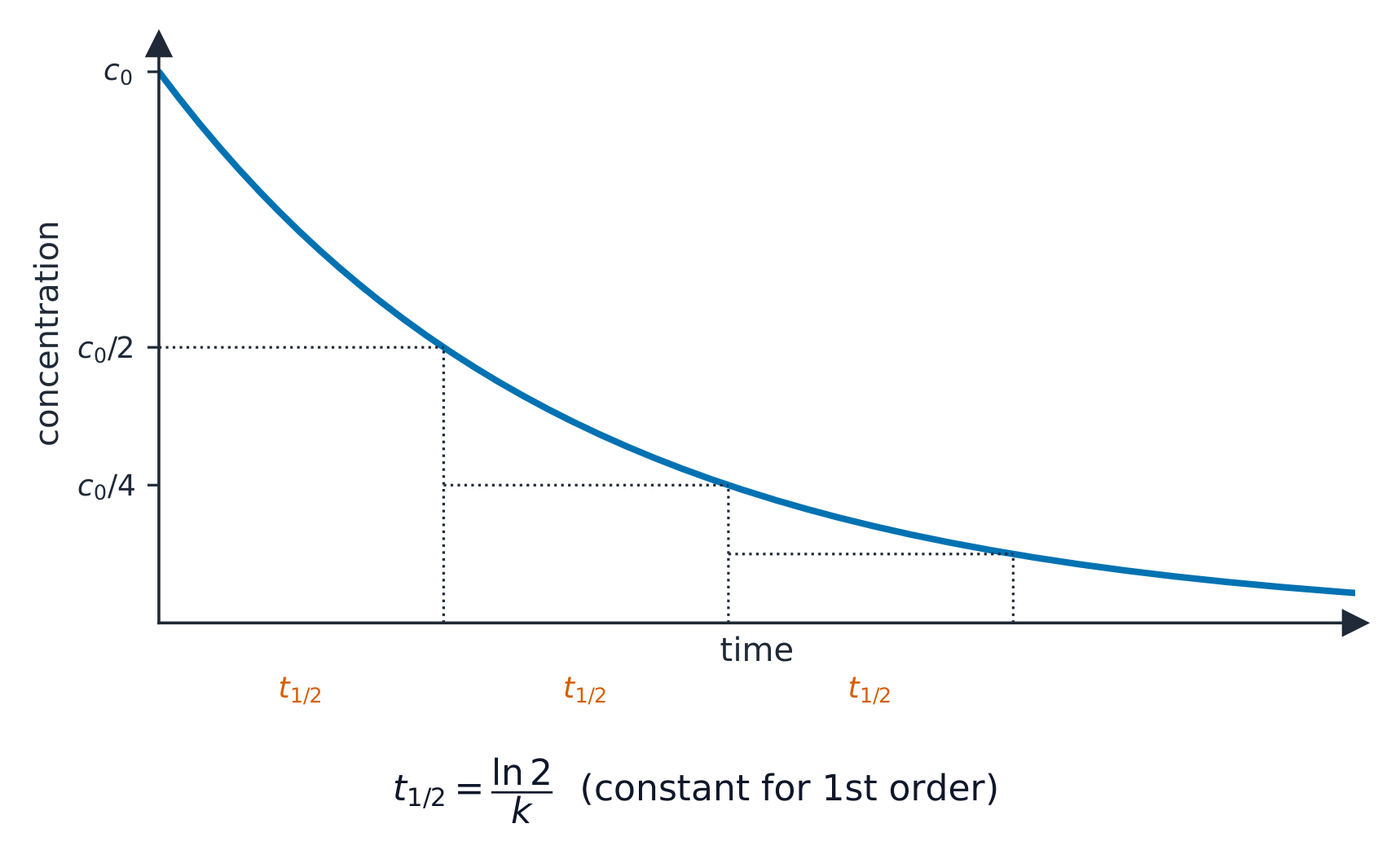
  • graphs: a concentration–time graph for a first-order reaction has a constant half-life 半衰期 (the time for the concentration to halve). A rate–concentration graph is a straight line through the origin for first order, and a curve for second order.

Half-life and the rate constant

For a first-order reaction the half-life is constant — it does not depend on the concentration. You can find the rate constant from it:

$$k = \frac{0.693}{t_{\frac{1}{2}}}$$

Worked example. A first-order reaction has a half-life of $120\ \text{s}$. Find its rate constant.

$$k = \frac{0.693}{t_{1/2}} = \frac{0.693}{120} = 5.8 \times 10^{-3}\ \text{s}^{-1}.$$

You can also find $k$ by putting initial-rate data into the rate equation.

ไทย

สมการอัตรา แสดงให้เห็นว่าอัตราขึ้นอยู่กับความเข้มข้นของสารตั้งต้นอย่างไร:

$$\text{rate} = k\,[\text{A}]^m[\text{B}]^n$$
  • $m$ คือ อันดับปฏิกิริยา เทียบกับ A, และ $n$ อันดับเทียบกับ B. แต่ละตัวคือ $0$, $1$ หรือ $2$
  • ลำดับปฏิกิริยารวม คือ $m + n$.
  • $k$ คือ ค่าคงที่อัตรา สมการอัตราสามารถหาได้จากการทดลองเท่านั้น ไม่สามารถหาได้จากสมการที่ดุลแล้ว
กระบอกฉีดยาแก๊ส
กระบอกฉีดยาแก๊สใช้วัดปริมาตรของแก๊สที่เกิดขึ้นตามเวลา ซึ่งให้ข้อมูลเกี่ยวกับอัตราการเกิดปฏิกิริยา

การหาอันดับปฏิกิริยา

  • วิธีอัตราเริ่มต้น: เปลี่ยนความเข้มข้นของสารตัวใดตัวหนึ่งเพียงอย่างเดียว แล้วดูว่าอัตราเริ่มต้นเปลี่ยนไปอย่างไร หากการเพิ่ม $[\text{A}]$ เป็นสองเท่าทำให้เป็นสองเท่า อันดับใน A คือ 1; หากทำให้เป็นสี่เท่า อันดับคือ 2; หากไม่มีการเปลี่ยนแปลง อันดับคือ 0

ตัวอย่างคำนวณ ในการทดลองเกี่ยวกับ $\text{A} + \text{B} \rightarrow$ ผลิตภัณฑ์ การเพิ่ม $[\text{A}]$ (โดยคง $[\text{B}]$ ไว้) ทำให้เป็นสองเท่า และการเพิ่ม $[\text{B}]$ (โดยคง $[\text{A}]$ ไว้) ทำให้เป็นสี่เท่า เขียนสมการอัตราและระบุอันดับรวม

เพิ่ม $[\text{A}]$ เป็นสองเท่าทำให้ความเร็วเป็นสองเท่า, ดังนั้นลำดับที่หนึ่งใน A. เพิ่ม $[\text{B}]$ เป็นสองเท่าทำให้ความเร็วเป็นสี่เท่า ($2^2$), ดังนั้นลำดับที่สองใน B. ดังนั้น

$$\text{rate} = k[\text{A}][\text{B}]^2, \qquad \text{overall order} = 1 + 2 = 3.$$
  • กราฟ: กราฟความเข้มข้น–เวลา สำหรับปฏิกิริยาลำดับที่หนึ่งมี ครึ่งชีวิตคงที่ (เวลาที่ทำให้ความเข้มข้นลดลงครึ่งหนึ่ง). กราฟความเร็ว–ความเข้มข้น เป็นเส้นตรงผ่านจุดกำเนิดสำหรับลำดับที่หนึ่ง, และโค้งสำหรับลำดับที่สอง.
สามเส้นกราฟความเร็ว–ความเข้มข้น: เส้นราบสำหรับลำดับที่ศูนย์, เส้นตรงผ่านจุดกำเนิดสำหรับลำดับที่หนึ่ง, และเส้นโค้งขึ้นสำหรับลำดับที่สอง
ความเร็ว–ความเข้มข้น: ลำดับที่ศูนย์เป็นเส้นราบ, ลำดับที่หนึ่งเป็นเส้นตรงผ่านจุดกำเนิด, ลำดับที่สองเป็นเส้นโค้งขึ้น

ครึ่งชีวิตและค่าคงที่อัตรา

สำหรับปฏิกิริยาลำดับที่หนึ่ง ครึ่งชีวิตเป็น คงที่ — ไม่ขึ้นอยู่กับความเข้มข้น. คุณสามารถหาค่าคงที่ความเร็วได้จากมัน:

$$k = \frac{0.693}{t_{\frac{1}{2}}}$$
เส้นโค้งการสลายตัวของความเข้มข้น–เวลา พร้อมเครื่องหมายช่วงครึ่งชีวิตสามช่วงที่เท่ากัน ความเข้มข้นลดลงเหลือครึ่งหนึ่งทุกครั้ง
ปฏิกิริยาลำดับที่หนึ่งมีครึ่งชีวิตคงที่: ความเข้มข้นลดลงครึ่งหนึ่งในเวลาเดียวกัน $t_{1/2}$ ซ้ำแล้วซ้ำเล่า ไม่ว่าค่าเริ่มต้นจะเป็นอย่างไร

ตัวอย่างฝึกหัด. ปฏิกิริยาลำดับที่หนึ่งมีครึ่งชีวิต $120\ \text{s}$. หาค่าคงที่ความเร็วของมัน.

$$k = \frac{0.693}{t_{1/2}} = \frac{0.693}{120} = 5.8 \times 10^{-3}\ \text{s}^{-1}.$$

คุณยังสามารถหา $k$ ได้โดยการแทนข้อมูลอัตราเริ่มต้นลงในสมการอัตรา

Explore · ⁨สำรวจ⁩

Rate equations & orders · ⁨สมการอัตราการเกิดปฏิกิริยา & ลำดับปฏิกิริยา⁩

[A] = [A]₀·bᵗ

A first-order reaction decays exponentially — equal half-lives. · ⁨ปฏิกิริยา อันดับหนึ่ง สลายตัวแบบเอ็กซ์โพเนนเชียล — มีครึ่งชีวิตเท่าเดิม⁩

Vocabulary · ⁨คำศัพท์⁩ Train · ⁨ฝึกฝน⁩
English ไทย
rate equation/reɪt ɪˈkweɪʒn/ สมการอัตรา
order of reaction/ˈɔːdə ɒv rɪˈækʃn/ ลำดับปฏิกิริยา
overall order of reaction/ˌəʊvəˈrɔːl ˈɔːdə ɒv rɪˈækʃn/ ลำดับปฏิกิริยารวม
rate constant/reɪt ˈkɒnstənt/ ค่าคงที่อัตรา
half-life/hɑːf laɪf/ ครึ่งอายุ (half-life)
26.1

Reaction mechanisms · ⁨กลไกปฏิกิริยา⁩

English

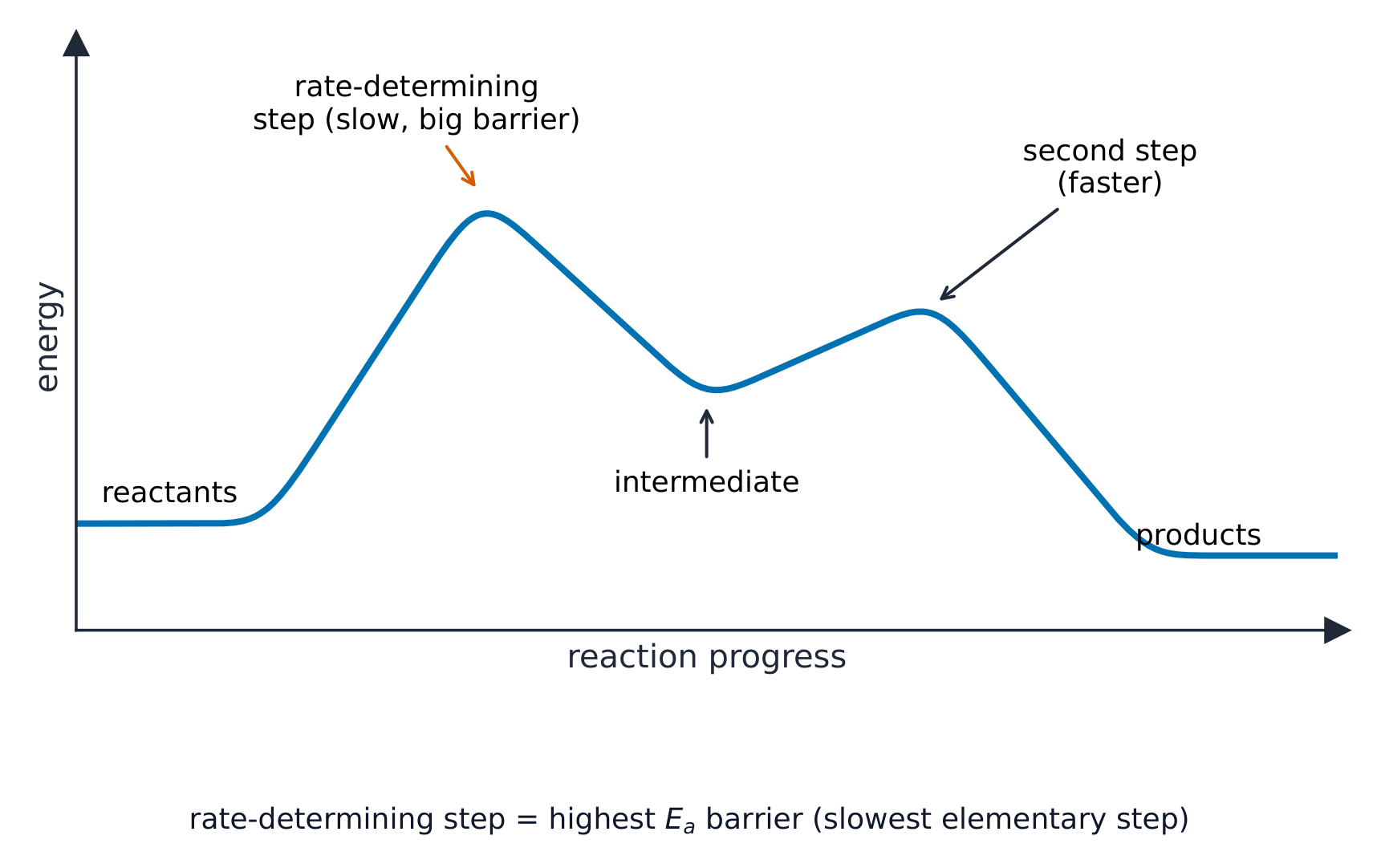
Most reactions happen in several steps. The slowest step is the rate-determining step 决速步骤, and it controls the overall rate. Only the species involved up to and including this step appear in the rate equation.

  • an intermediate 中间体 is a species made in one step and then used up in a later step. It is not in the overall equation.
  • you can suggest a mechanism that fits both the rate equation and the overall equation, predict the order from a given mechanism, or pick out the rate-determining step.

If you compare the initial rate 初始速率 of different mixtures, you can deduce the rate equation, and from that work out the mechanism.

Effect of temperature

Raising the temperature increases the rate constant $k$ (more molecules pass the activation energy), so the rate goes up.

ไทย

ปฏิกิริยาส่วนใหญ่เกิดขึ้นหลายขั้นตอน. ขั้นตอนช้าที่สุดคือ ขั้นตอนกำหนดความเร็ว, และควบคุมความเร็วรวม. เฉพาะสปีชีส์ที่เกี่ยวข้องจนถึงขั้นตอนนี้เท่านั้นปรากฏในสมการความเร็ว.

โปรไฟล์พลังงานปฏิกิริยากับยอดเขาสองลูก: รั้วกสูงแรกมีป้ายว่าเป็นขั้นตอนกำหนดอัตราที่ช้า, จุดต่ำระหว่างสองรั้วกคือสารกลาง, แล้วรั้วกที่สองเล็กกว่า *โปรไฟล์สองขั้นตอน: ขั้นตอนที่ช้ามีรั้วกที่ใหญ่กว่าและเป็นขั้นตอนกำหนดอัตรา; จุดต่ำระหว่างรั้วกทั้งสองคือสารกลาง

  • สารกลาง คือสปีชีส์ที่ถูกสร้างในขั้นตอนหนึ่งแล้วถูกใช้หมดในขั้นตอนถัดไป มันไม่ปรากฏในสมการรวม
  • คุณสามารถเสนอกลไกที่สอดคล้องกับทั้งสมการอัตราและสมการรวม, คาดการณ์อันดับจากกลไกที่กำหนด, หรือระบุขั้นตอนกำหนดอัตรา

หากคุณเปรียบเทียบ อัตราเริ่มต้น ของส่วนผสมต่างๆ สามารถสรุปสมการอัตราได้ และจากนั้นจึงหากลไก

ผลของอุณหภูมิ

การเพิ่มอุณหภูมิทำให้ค่าคงที่อัตรา $k$ เพิ่มขึ้น (โมเลกุลมีจำนวนมากขึ้นที่ผ่านพลังงานกระตุ้น), ดังนั้นอัตราจะเพิ่มขึ้น

Explore · ⁨สำรวจ⁩

Organic mechanism route · ⁨เส้นทางกลไกอินทรีย์⁩

Trace electron-pair movement from reagent to product. · ⁨ติดตามการเคลื่อนที่ของคู่อิเล็กตรอนจากสารตั้งต้นไปยังผลิตภัณฑ์⁩

Vocabulary · ⁨คำศัพท์⁩ Train · ⁨ฝึกฝน⁩
English ไทย
rate-determining step/reɪt dɪˈtɜːmɪnɪŋ step/ ขั้นกำหนดอัตรา
intermediate/ˌɪntəˈmiːdɪət/ สารกลาง (Intermediate)
initial rate/ɪˈnɪʃl reɪt/ อัตราเริ่มต้น
26.2

Catalysts · ⁨ตัวเร่งปฏิกิริยา⁩

Syllabus · ⁨หลักสูตร⁩
English
  1. explain that catalysts can be homogeneous or heterogeneous
  2. describe the mode of action of a heterogeneous catalyst to include adsorption of reactants, bond weakening and desorption of products, for example: (a) iron in the Haber process (b) palladium, platinum and rhodium in the catalytic removal of oxides of nitrogen from the exhaust gases of car engines
  3. describe the mode of action of a homogeneous catalyst by being used in one step and reformed in a later step, for example: (a) atmospheric oxides of nitrogen in the oxidation of atmospheric sulfur dioxide (b) $\text{Fe}^{2+}$ or $\text{Fe}^{3+}$ in the $\text{I}^- / \text{S}_2\text{O}_8^{2-}$ reaction
ไทย
  1. อธิบายว่าตัวเร่งปฏิกิริยาสามารถเป็น 是同相 หรือ 异相 ได้
  2. อธิบายวิธีการทำงานของ 异相催化剂 ซึ่งรวมถึงการ 吸附 ของสารตั้งต้น การลดแรงพันธะ และการ 脱附 ของผลิตภัณฑ์ ตัวอย่างเช่น: (ก) เหล็กในกระบวนการ Haber (ข) พาลลาเดียม แพลทินัม และโรเดียมในการกำจัดออกไซด์ของไนโตรเจนจากไอเสียเครื่องยนต์รถยนต์
  3. อธิบายวิธีการทำงานของตัวเร่งปฏิกิริยาแบบ是同相 โดยการมีส่วนร่วมในขั้นตอนหนึ่งและถูกสร้างใหม่ในขั้นตอนถัดไป ตัวอย่างเช่น: (ก) ออกไซด์ของไนโตรเจนในบรรยากาศในการออกซิเดชันของซัลเฟอร์ไดออกไซด์ในบรรยากาศ (ข) $\text{Fe}^{2+}$ หรือ $\text{Fe}^{3+}$ ในปฏิกิริยา $\text{I}^- / \text{S}_2\text{O}_8^{2-}$

Source: Cambridge International syllabus · ⁨แหล่งที่มา: หลักสูตร Cambridge International⁩

English

Catalysts 催化剂 can be homogeneous or heterogeneous.

Heterogeneous catalysts

A heterogeneous catalyst 多相催化剂 is in a different physical state from the reactants (usually a solid with gases). It works in three stages:

  1. adsorption 吸附: reactant molecules stick to the catalyst surface.
  2. the bonds in the reactants are weakened, so they react more easily.
  3. desorption 脱附: the product molecules leave the surface.

Examples are iron in the Haber process, and platinum, palladium and rhodium in a catalytic converter.

Homogeneous catalysts

A homogeneous catalyst 均相催化剂 is in the same physical state as the reactants. It is used up in one step and then reformed in a later step, so it comes back unchanged. Examples are oxides of nitrogen helping to oxidise atmospheric sulfur dioxide, and $\text{Fe}^{2+}$ or $\text{Fe}^{3+}$ speeding up the reaction between $\text{I}^-$ and $\text{S}_2\text{O}_8^{2-}$.

ไทย

ตัวเร่งปฏิกิริยา อาจเป็นแบบโฮโมจีนียสหรือเฮเทอโรจีนียส

ตัวเร่งปฏิกิริยาเฮเทอโรจีนียส

ตัวเร่งปฏิกิริยาเฮเทอโรจีนียส อยู่ในสถานะทางกายภาพต่างจากสารตั้งต้น (มักเป็นของแข็งร่วมกับแก๊ส) ทำงานในสามขั้นตอน:

  1. การดูดซับ: โมเลกุลของสารตั้งต้นเกาะติดกับพื้นผิวตัวเร่งปฏิกิริยา
  2. พันธเคมีในสารตั้งต้นอ่อนลง ทำให้ทำปฏิกิริยากันได้ง่ายขึ้น
  3. การคาย吸附: โมเลกุลของผลิตภัณฑ์ออกจากพื้นผิว

สามขั้นตอนบนพื้นผิวตัวเร่งปฏิกิริยา: อะตอมของสารตั้งต้นสองตัวดูดซับเข้าไป, เกิดปฏิกิริยากันด้วยพันธะที่อ่อนลง, จากนั้นผลิตภัณฑ์คาย吸附ออก *ตัวเร่งปฏิกิริยาเฮเทอโรจีนียสทำงานในสามขั้นตอน: สารตั้งต้นดูดซับ onto พื้นผิว, พันธที่อ่อนลงช่วยให้เกิดปฏิกิริยา, จากนั้นผลิตภัณฑ์คาย吸附ออก

ถาดใส่ชิ้นส่วนตัวเร่งปฏิกิริยาเซรามิกขนาดเล็กหลายชนิดในรูปแบบต่างๆ: กระบอกทึบ, แหวน, ก้านมีร่อง และแผ่นกลมเจาะรู *ตัวเร่งปฏิกิริยาเฮเทอโรจีนียสจริงถูกผลิตเป็นเม็ดรูปร่างเล็ก แหวน และแผ่นกลมเจาะรู เพื่อเพิ่มพื้นที่ผิวให้สารตั้งต้นเกาะติด

ตัวอย่างเช่น آهن ในกระบวนการ Haber, และแพลตินัม แพลลาเดียม และโรดีอัม ในตัวแปลง catalytic converter

ตัวเร่งปฏิกิริยาโฮโมจีนียส

ตัวเร่งปฏิกิริยาโฮโมจีนียส อยู่ในสถานะทางกายภาพเดียวกับสารตั้งต้น ถูกใช้ไปในขั้นตอนหนึ่งแล้วถูกสร้างใหม่ในขั้นตอนถัดไป ดังนั้นจึงกลับมาเหมือนเดิม ตัวอย่างเช่น ออกไซด์ของไนโตรเจนช่วยในการออกซิไดซ์ซัลเฟอร์ไดออกไซด์ในบรรยากาศ, และ $\text{Fe}^{2+}$ หรือ $\text{Fe}^{3+}$ เร่งปฏิกิริระหว่าง $\text{I}^-$ และ $\text{S}_2\text{O}_8^{2-}$

Explore · ⁨สำรวจ⁩

How a catalyst speeds a reaction · ⁨วิธีที่ตัวเร่งปฏิกิริยาเร่งปฏิกิริยา⁩

Turn the catalyst on and watch the rate jump — it gives more successful collisions per second by offering a lower-energy path. · ⁨เปิดตัวเร่งปฏิกิริยาแล้วดูอัตราการพุ่งสูงขึ้น — มันเพิ่มการชนที่มีประสิทธิภาพต่อวินาทีโดยให้เส้นทางที่มีพลังงานต่ำกว่า⁩

Vocabulary · ⁨คำศัพท์⁩ Train · ⁨ฝึกฝน⁩
English ไทย
catalyst/ˈkætəlɪst/ ตัวเร่งปฏิกิริยา
heterogeneous catalyst/ˌhetrəˈdʒiːnɪəs ˈkætəlɪst/ ตัวเร่งปฏิกิริยาแบบ heterogeneous
adsorption/ədˈsɔːpʃn/ การดูดกลืน
desorption/dɪˈsɔːpʃn/ การปลดปล่อย
homogeneous catalyst/həˈməʊdʒnɪəs ˈkætəlɪst/ ตัวเร่งปฏิกิริยาแบบ homogeneous
26.2

Exam tips · ⁨ข้อแนะนำสำหรับการสอบ⁩

English
  • Find orders from initial-rate data: doubling a concentration that doubles the rate is first order, quadruples it is second order, no change is zero order.
  • Write $\text{rate} = k[\text{A}]^m[\text{B}]^n$ and work out the units of $k$ from it.
  • The rate-determining step contains the species (and orders) in the rate equation — use this to test a mechanism.
  • A constant half-life means first order.
ไทย
  • หา ลำดับ จากข้อมูลความเร็วเริ่มต้น: การเพิ่มความเข้มข้นเป็นสองเท่าที่ทำให้ความเร็วเป็นสองเท่าคือลำดับที่หนึ่ง, สี่เท่าคือลำดับที่สอง, ไม่มีการเปลี่ยนแปลงคือลำดับที่ศูนย์.
  • เขียน $\text{rate} = k[\text{A}]^m[\text{B}]^n$ และหา หน่วยของ $k$ จากมัน
  • ขั้นตอนกำหนดอัตรา มีสปีชีส์ (และอันดับ) ตามที่ปรากฏในสมการอัตรา — ใช้สิ่งนี้เพื่อทดสอบกลไก
  • ครึ่งชีวิตคงที่ หมายความว่าปฏิกิริยาระดับหนึ่ง

Interactive lessons on this topic · ⁨บทเรียนเชิงโต้ตอบสำหรับหัวข้อนี้⁩

Work through it step by step, with instant-check exercises. · ⁨ทำทีละขั้นตอน พร้อมแบบฝึกหัดตรวจสอบผลทันที⁩

Past Papers · ⁨ข้อสอบย้อนหลัง⁩

More topics in A-Level Chemistry · ⁨Chemistry A-Level⁩ · ⁨หัวข้อเพิ่มเติมใน A-Level Chemistry · ⁨Chemistry A-Level⁩⁩

Log in or create account · ⁨เข้าสู่ระบบหรือสร้างบัญชี⁩

IGCSE, A-Level & AP