Rate equations and orders
Introduced| English | Meaning |
|---|---|
| rate equation/reɪt ɪˈkweɪʒn/ | An expression relating reaction rate to reactant concentrations raised to their experimentally determined orders. |
| order/ˈɔːdə/ | The power of each concentration. |
| overall order/ˌəʊvəˈrɔːl ˈɔːdə/ | The sum of the individual orders. |
| rate constant/reɪt ˈkɒnstənt/ | The proportionality constant in a reaction's rate equation at a specified temperature. |
| initial rate/ɪˈnɪʃl reɪt/ | The rate of a reaction or process measured at or very near its beginning. |
Putting numbers on rate
- A rate equation 速率方程 shows how the rate depends on the concentrations.
- The order 级数 is the power of each concentration.
- It can only be found by experiment, not from the balanced equation.
The power to which a reactant's concentration is raised in the rate equation is its ______.
Difficulty 1/5 · 100 coins + a small bonus on first completion today
The orders are found experimentally.
The rate equation
- $m$ and $n$ are the orders (each 0, 1 or 2); the overall order 总级数 is $m + n$.
- $k$ is the rate constant 速率常数.

A gas syringe measures the volume of gas made over time, giving the rate of reaction.
Rate equations & orders
[A] = [A]₀·bᵗ
A first-order reaction decays exponentially — equal half-lives.
The rate equation of a reaction:
Difficulty 1/5 · 100 coins + a small bonus on first completion today
Orders must be measured experimentally; they cannot be deduced from the stoichiometric equation.
The overall order of a reaction is:
Difficulty 1/5 · 100 coins + a small bonus on first completion today
Add the orders with respect to each reactant to get the overall order.
Match each kinetics term.
Difficulty 2/5 · 140 coins + a small bonus on first completion today
Each item links the term to its correct meaning.
Finding the order
- initial rates 初始速率: change one concentration at a time. Double $[\text{A}]$ → rate ×2 = first order; rate ×4 = second; rate unchanged = zero.
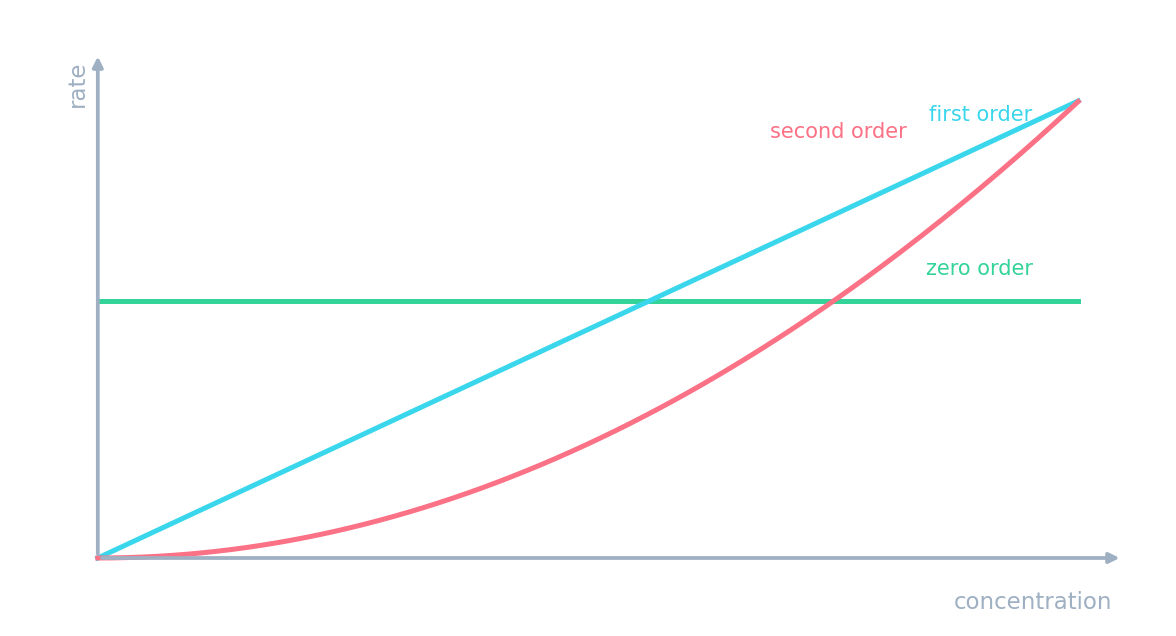
- graphs: a rate–concentration graph is flat (zero), a straight line through the origin (first), or an upward curve (second).
If doubling [A] doubles the rate, the order with respect to A is:
Difficulty 1/5 · 100 coins + a small bonus on first completion today
Rate ∝ [A]¹, so doubling [A] doubles the rate — first order.
A rate–concentration graph that is a straight line through the origin shows:
Difficulty 1/5 · 100 coins + a small bonus on first completion today
First order gives a straight line through the origin; zero order is flat; second order is a curve.
Orders come from experiment
- You cannot read reaction orders from the balanced equation — they are found by experiment.
- The overall order is the sum of the individual orders.

Rate against concentration for zero, first and second order
You've got it
- $\text{rate} = k[\text{A}]^m[\text{B}]^n$; overall order $= m + n$; found only by experiment
- initial rates: double a concentration — rate ×2 (1st), ×4 (2nd), unchanged (0)
- rate–concentration graph: flat (0), line through origin (1st), curve (2nd)