Half-life and the rate constant
Introduced| English | Meaning |
|---|---|
| half-life/hɑːf laɪf/ | The time for the number of undecayed nuclei in a radioactive sample to halve. |
| first-order/fɜːst ˈɔːdə/ | first-order |
| rate constant/reɪt ˈkɒnstənt/ | The proportionality constant in a reaction's rate equation at a specified temperature. |
The constant countdown
- The half-life 半衰期 is the time for a concentration to halve.
- For a first-order 一级 reaction it is constant — the same every time.
- That constant half-life both identifies first order and gives you the rate constant 速率常数.
A first-order reaction has a constant half-life.
Difficulty 1/5 · 100 coins + a small bonus on first completion today
The half-life is independent of concentration.
Constant half-life
- For a first-order reaction, the half-life does not depend on concentration.
- So the concentration halves in the same time, again and again — a quick way to spot first order.
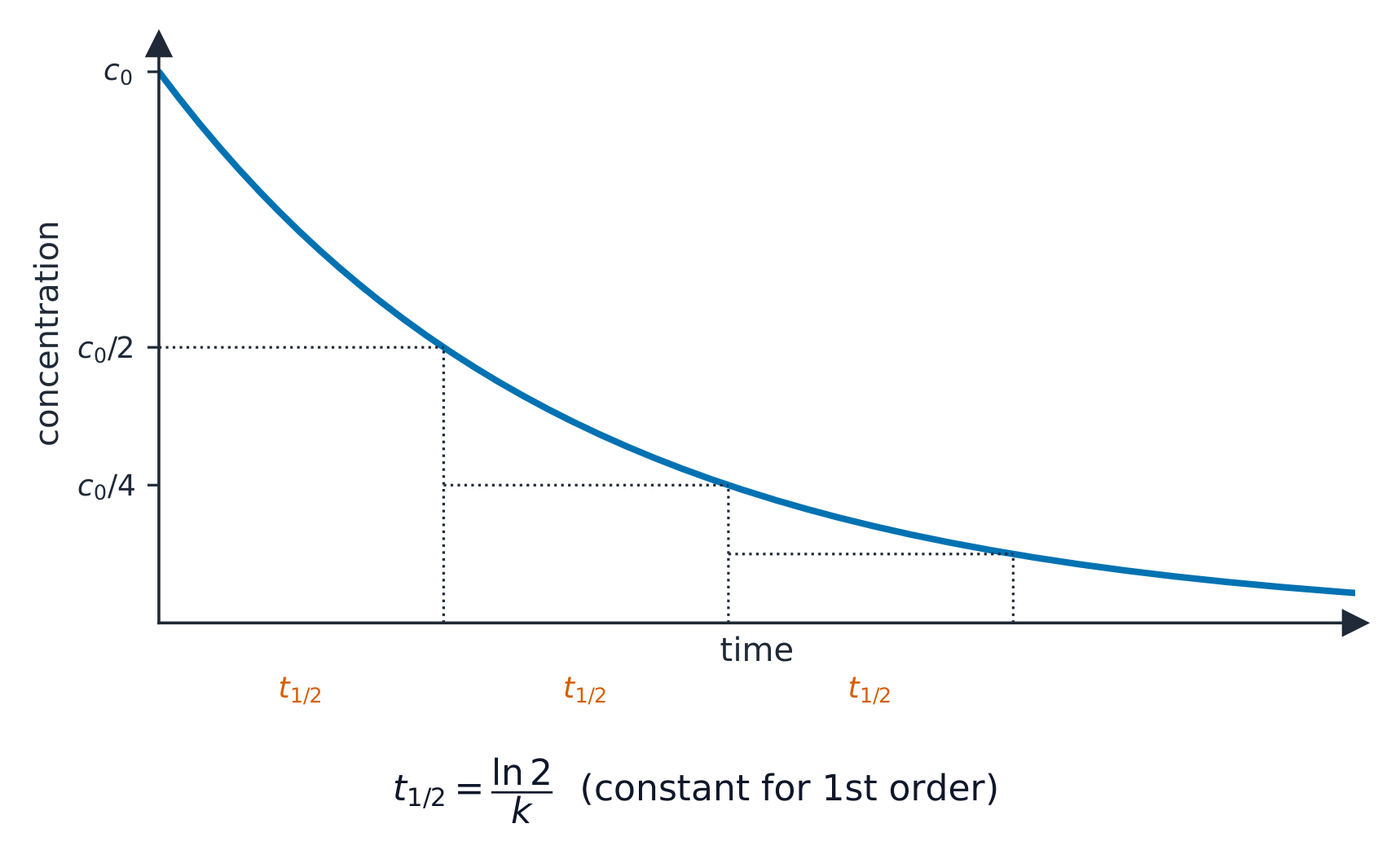
A first-order reaction has a constant half-life
Half-life & rate constant
[A] = [A]₀·bᵗ
Each half-life halves the concentration.
A reaction whose half-life stays the same as it proceeds is:
Difficulty 1/5 · 100 coins + a small bonus on first completion today
A constant half-life (independent of concentration) is the signature of a first-order reaction.
A constant half-life can be used to identify a first-order reaction.
Difficulty 1/5 · 100 coins + a small bonus on first completion today
Only first-order reactions have a half-life that is independent of the concentration.
Finding k
- You can also find $k$ by putting initial-rate data into the rate equation.
A first-order reaction has a half-life of 20 s.
- Rate constant: $k = 0.693 / 20 =$ 0.035 per second.
- After 60 s (that's 3 half-lives), the concentration has fallen to $(\tfrac{1}{2})^3 =$ one-eighth of the start.
For a first-order reaction, the rate constant is:
Difficulty 1/5 · 100 coins + a small bonus on first completion today
k = 0.693 / t½ for a first-order reaction.
A first-order reaction has a half-life of 100 s. What is k? (k = 0.693/t½)
Difficulty 2/5 · 140 coins + a small bonus on first completion today
k = 0.693 / 100 = 0.00693 (per second).
Reading it off a graph
- Plot concentration against time, then read the time for it to fall to half.
- Read it again from that point to a quarter — if the two half-lives are equal, the reaction is first order.
- Equal successive half-lives on the curve is the visual fingerprint of first order.
You've got it
- half-life = time for the concentration to halve
- a first-order reaction has a constant half-life (independent of concentration)
- $k = \dfrac{0.693}{t_{1/2}}$ — e.g. $t_{1/2} = 20\,\text{s}$ gives $k = 0.035$ per second
- check it on a graph: equal successive half-lives ⇒ first order