Reaction mechanisms
Introduced| English | Meaning |
|---|---|
| mechanism/ˈmekənɪzəm/ | mechanism |
| rate-determining step/reɪt dɪˈtɜːmɪnɪŋ step/ | The slowest step of a mechanism, which controls the overall rate. |
| intermediate/ˌɪntəˈmiːdɪət/ | A species formed in one step of a reaction mechanism and consumed in a later step. |
| activation energy/ˌæktɪˈveɪʃn ˈenədʒi/ | The minimum energy that reacting particles need for a successful reaction. |
The slowest step rules
- Most reactions happen in several steps.
- The slowest step controls the overall rate.
- The rate equation reveals the mechanism 机理.
Organic mechanism route
Trace electron-pair movement from reagent to product.
The slowest step of a reaction mechanism is the rate-______ step.
Difficulty 1/5 · 100 coins + a small bonus on first completion today
Only species up to and including it appear in the rate equation.
The rate-determining step 决速步骤
- The slowest step is the rate-determining step (RDS) — it controls the overall rate.
- Only the species involved up to and including the RDS appear in the rate equation.
- An intermediate 中间体 is made in one step and used up in a later one — it is not in the overall equation.
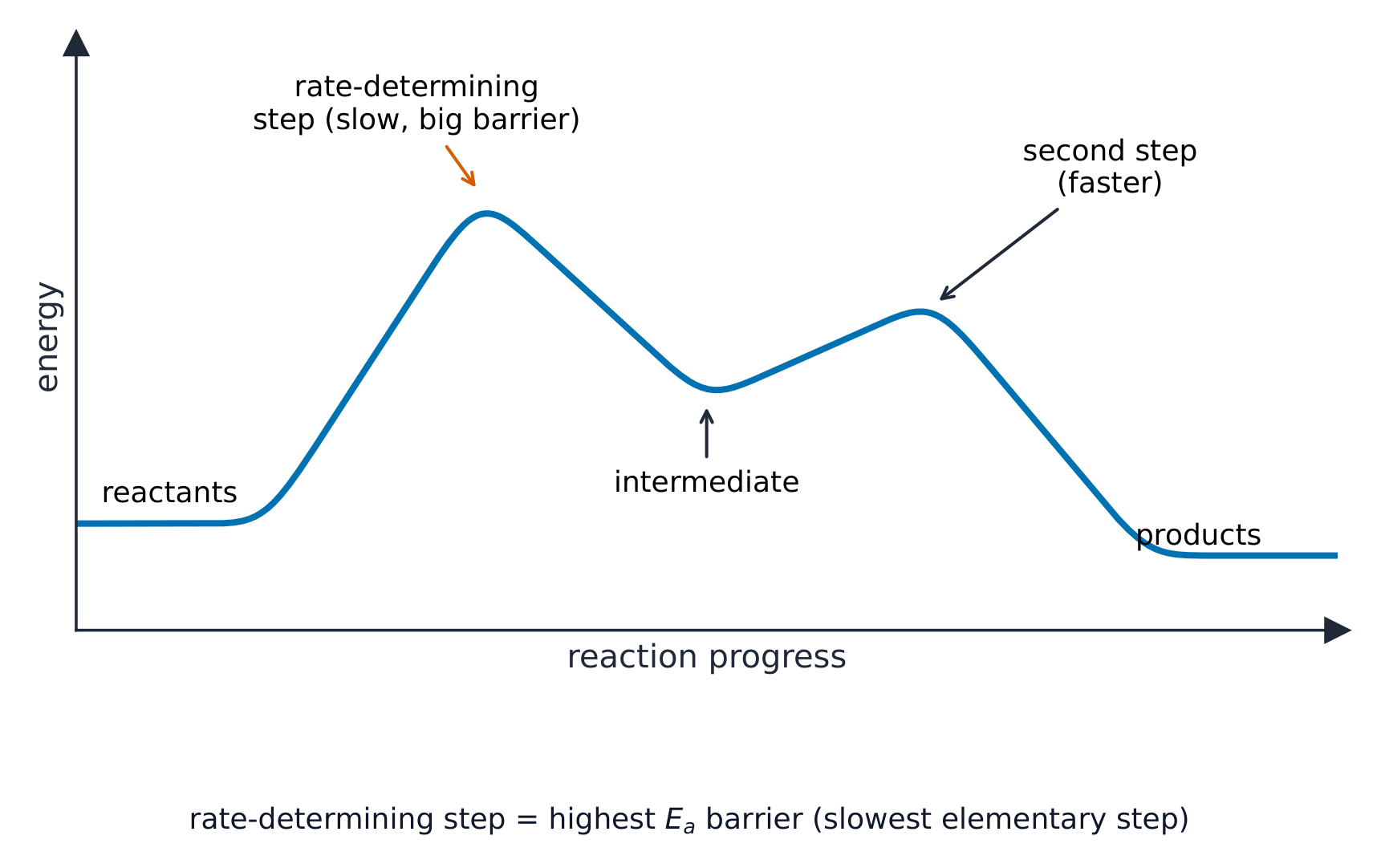
The rate-determining step is the slowest step in a multi-step reaction
The rate-determining step is:
Difficulty 1/5 · 100 coins + a small bonus on first completion today
The slowest step is the bottleneck, so it determines the overall rate.
Which species appear in the rate equation?
Difficulty 1/5 · 100 coins + a small bonus on first completion today
Species after the RDS do not affect the rate, so they are not in the rate equation.
An intermediate is a species that is:
Difficulty 1/5 · 100 coins + a small bonus on first completion today
Intermediates appear during the mechanism but cancel out of the overall equation.
Match each mechanism idea.
Difficulty 2/5 · 140 coins + a small bonus on first completion today
Each item links the term to its correct meaning.
Deducing the mechanism, and temperature
- Suggest a mechanism that fits both the rate equation and the overall equation.
- From initial-rate data you find the rate equation, and from that the mechanism.
- Raising the temperature increases the rate constant $k$ (more molecules pass the activation energy 活化能), so the rate rises.
Raising the temperature increases the rate because:
Difficulty 1/5 · 100 coins + a small bonus on first completion today
A higher temperature raises k, so the rate increases.
Linking mechanism to rate
- Only species in the rate-determining step (and earlier) appear in the rate equation.
- A proposed mechanism must agree with the experimental rate equation.
You've got it
- the rate-determining step is the slowest step; it controls the rate
- only species up to and including the RDS appear in the rate equation
- an intermediate is made then used up (not in the overall equation)
- higher temperature raises k and so the rate