Skip to content · ⁨ข้ามไปยังเนื้อหา⁩

Selection and evolution · ⁨การคัดเลือกและวิวัฒนาการ⁩

A-Level Biology · ⁨Biology A-Level⁩ · Topic 17 · ⁨หัวข้อ 17⁩

Video lesson for this topic · ⁨บทเรียนวิดีโอสำหรับหัวข้อนี้⁩ Open the video page · ⁨เปิดหน้าวิดีโอ⁩
8:23

Variation and Evolution

In the early eighteen hundreds, almost every peppered moth in England was pale and speckled, which hid it beautifully on lichen-covered bark. Then the…

English narration · English + 中文 subtitles burned in · ⁨การบรรยายภาษาอังกฤษ · คำบรรยายภาษาอังกฤษ + 中文 ลอยตัวบนภาพ⁩

17.1

Variation · ⁨ความหลากหลาย⁩

Syllabus · ⁨หลักสูตร⁩
English
  1. explain, with examples, that phenotypic variation is due to genetic factors or environmental factors or a combination of genetic and environmental factors
  2. explain what is meant by discontinuous variation and continuous variation
  3. explain the genetic basis of discontinuous variation and continuous variation
  4. use the t-test to compare the means of two different samples (the formula for the t-test will be provided, as shown in the Mathematical requirements)
ไทย
  1. อธิบายพร้อมตัวอย่างว่า phenotypic variation เกิดจาก ปัจจัยทางพันธุกรรม หรือ ปัจจัยสิ่งแวดล้อม หรือการผสมผสานของทั้งสองอย่าง
  2. อธิบายความหมายของ discontinuous variation และ continuous variation
  3. อธิบายพื้นฐานทางพันธุกรรมของ discontinuous variation และ continuous variation
  4. ใช้ t-test เพื่อเปรียบเทียบค่าเฉลี่ยของตัวอย่างสองกลุ่มที่แตกต่างกัน (สูตร t-test จะถูกให้มา ตามที่ปรากฏใน Mathematical requirements)
Source: Cambridge International syllabus · ⁨แหล่งที่มา: หลักสูตร Cambridge International⁩

English

Variation 变异 means the differences between individuals. It has three possible causes:

  • genetic factors only — set by the alleles 等位基因 you inherit (for example human blood group).
  • environmental factors 环境因素 only — set by your surroundings (for example a scar, or the language you speak).
  • a combination of both — most features, such as height and body mass, depend on genes and on diet and lifestyle.

There are two patterns of variation:

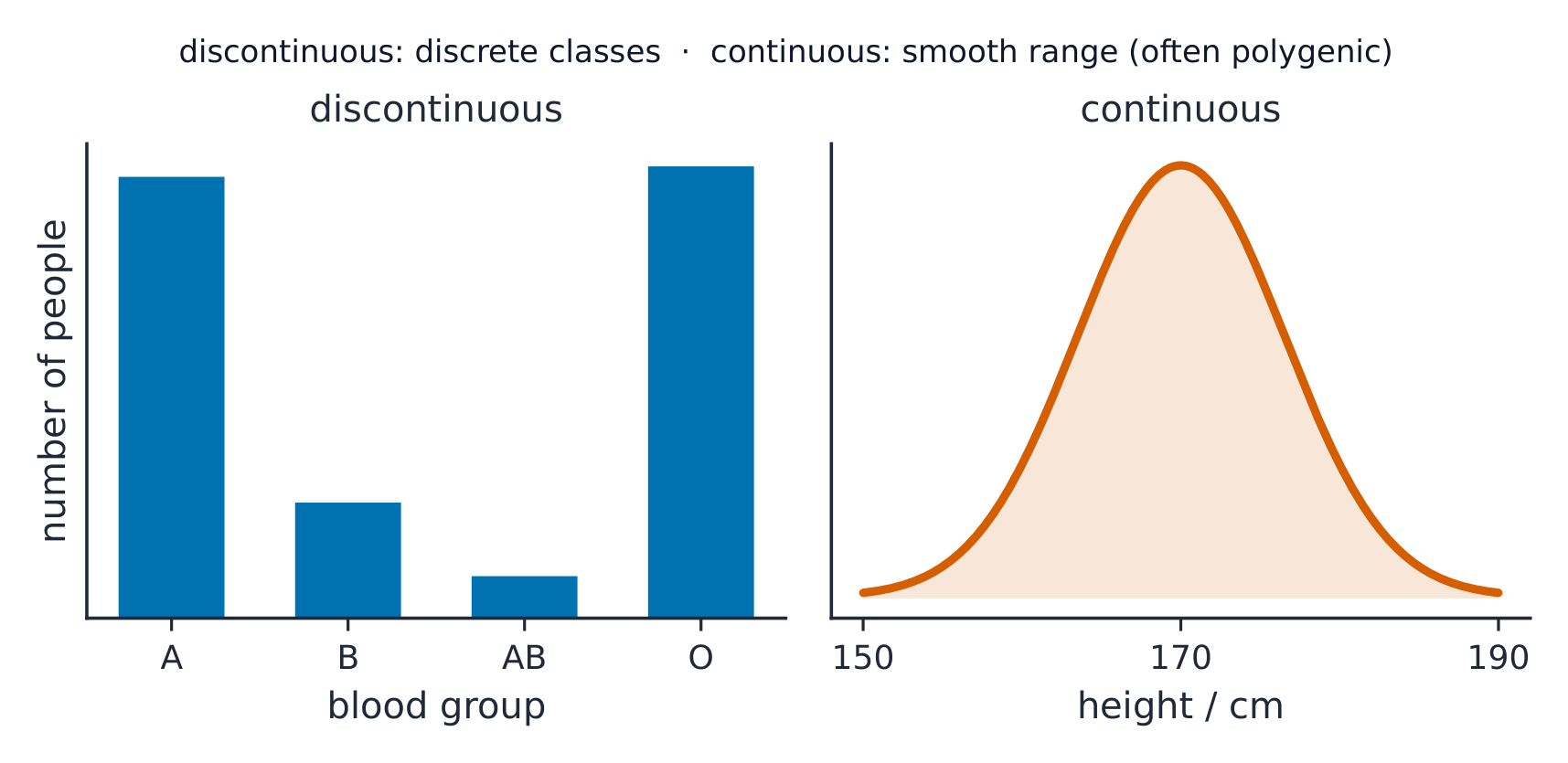
  • discontinuous variation 不连续变异 — clear, separate groups with nothing in between (for example blood group A, B, AB or O). It is usually controlled by one or a few genes 基因, with little effect from the environment.
  • continuous variation 连续变异 — a smooth range from one extreme to the other (for example height). It is controlled by many genes together, plus the environment.

To compare the means of two samples (for example the heights of plants in sun and in shade), you use the t-test, which tells you whether the difference is large enough to be real, or just due to chance.

ไทย

ความหลากหลาย หมายถึงความแตกต่างระหว่างบุคคล มีสาเหตุที่เป็นไปได้สามประการ:

  • ปัจจัย ทางพันธุกรรม เท่านั้น — กำหนดโดย อัลลีล ที่คุณได้รับ (เช่นหมู่เลือดมนุษย์)
  • ปัจจัย ทางสิ่งแวดล้อม เท่านั้น — กำหนดโดยสภาพแวดล้อมรอบตัว (เช่นแผลเป็น หรือภาษาที่คุณพูด)
  • การผสมผสาน ของทั้งสองอย่าง — ลักษณะส่วนใหญ่ เช่น ส่วนสูงและมวลกาย ขึ้นอยู่กับยีน และ อาหารและวิถีชีวิต
หอยทากสองตัวที่มีลวดลายและสีเปลือกต่างกัน
หอยทากสายพันธุ์ Cepaea nemoralis แสดงความหลากหลายอันน่าทึ่งในด้านสีและลวดลายเปลือก

มีความหลากหลายสองรูปแบบ:

  • ความหลากหลายที่ไม่ต่อเนื่อง — กลุ่มที่ชัดเจนและแยกออกจากกันโดยไม่มีความต่อเนื่องระหว่างกลาง (เช่นหมู่เลือด A, B, AB หรือ O) มักถูกควบคุมโดยยีนหนึ่งหรือไม่กี่ยีน และมีผลกระทบจากสิ่งแวดล้อมน้อย
  • ความต่อเนื่อง — ช่วงต่อเนื่องตั้งแต่ขั้วหนึ่งไปยังอีกขั้วหนึ่ง (เช่นส่วนสูง) ถูกควบคุมโดยหลายยีนรวมกัน plus สิ่งแวดล้อม
กราฟสองแบบ: แผนภูมิแท่งของหมู่เลือดที่มีแท่งแยก (ไม่ต่อเนื่อง) และกราฟระฆังเรียบของความสูง (ต่อเนื่อง)
ความไม่ต่อเนื่องแบ่งออกเป็นกลุ่มแยกต่างหาก; ความต่อเนื่องเป็นช่วงต่อเนื่อง

เพื่อเปรียบเทียบค่าเฉลี่ยของตัวอย่างสองชุด (เช่นความสูงของพืชในแสงแดดและในที่ร่ม) คุณใช้ t-test ซึ่งบอกให้คุณรู้ว่าความแตกต่างนั้นใหญ่พอที่จะเป็นจริง หรือเป็นเพียงความบังเอิญ

Explore · ⁨สำรวจ⁩

The t-distribution behind the t-test · ⁨การกระจาย t底下 behind the t-test⁩

The t-test compares two sample means against a critical value you look up in a t-table. This is that table made live: the value depends on the degrees of freedom (here $n_1+n_2-2$). Drag df and watch the critical value change — small samples have heavier tails, so they need a larger difference to count as real. · ⁨t-test เปรียบเทียบค่าเฉลี่ยของตัวอย่างสองกลุ่มเทียบกับ ค่าวิกฤต ที่คุณค้นพบในตาราง t นี่คือตารางนั้นที่ใช้งานจริง: ค่าขึ้นอยู่กับ องศาอิสระ (ที่นี่ $n_1+n_2-2$) ลาก df และดูค่าวิกฤตเปลี่ยนไป — ตัวอย่างขนาดเล็กมีหางหนากว่า所以需要ความแตกต่าง ที่ใหญ่ขึ้น เพื่อถือเป็นความแตกต่างจริง⁩

Explore · ⁨สำรวจ⁩

Variation type lab · ⁨ห้องปฏิบัติการความแปรปรวน⁩

Classify examples by the source and pattern of variation. · ⁨จำแนกตัวอย่างตามแหล่งที่มาและรูปแบบของความแปรปรวน⁩

Vocabulary · ⁨คำศัพท์⁩ Train · ⁨ฝึกฝน⁩
English ไทย
variation/ˌveərɪˈeɪʃn/ ความหลากหลาย (Variation)
allele/əˈliːl/ allele
environmental factor/enˌvaɪrənˈmentl ˈfæktə/ ปัจจัยสิ่งแวดล้อม
discontinuous variation/dɪskənˈtɪnjuːəs ˌveərɪˈeɪʃn/ ความแปรปรวนไม่ต่อเนื่อง
17.2

Natural selection · ⁨การคัดเลือกตามธรรมชาติ⁩

Syllabus · ⁨หลักสูตร⁩
English
  1. explain that natural selection occurs because populations have the capacity to produce many offspring that compete for resources; in the ‘struggle for existence’, individuals that are best adapted are most likely to survive to reproduce and pass on their alleles to the next generation
  2. explain how environmental factors can act as stabilising, disruptive and directional forces of natural selection
  3. explain how selection, the founder effect and genetic drift, including the bottleneck effect, may affect allele frequencies in populations
  4. outline how bacteria become resistant to antibiotics as an example of natural selection
  5. use the Hardy–Weinberg principle to calculate allele and genotype frequencies in populations and state the conditions when this principle can be applied (the two equations for the Hardy–Weinberg principle will be provided, as shown in the Mathematical requirements)
  6. describe the principles of selective breeding (artificial selection)
  7. outline the following examples of selective breeding: • the introduction of disease resistance to varieties of wheat and rice • inbreeding and hybridisation to produce vigorous, uniform varieties of maize • improving the milk yield of dairy cattle
ไทย
  1. อธิบายว่า natural selection เกิดขึ้นเนื่องจากประชากรมีความสามารถในการสร้างลูกหลานจำนวนมากที่แข่งขันกันเพื่อทรัพยากร; ใน ‘struggle for existence’ บุคคลที่ปรับตัวได้ดีที่สุดจะมีโอกาสอยู่รอดเพื่อสืบพันธุ์และถ่ายทอด allele ไปยังรุ่นถัดไปมากที่สุด
  2. อธิบายว่าปัจจัยสิ่งแวดล้อมสามารถทำหน้าที่เป็นแรงขับเคลื่อนของ natural selection แบบ stabilising, disruptive และ directional ได้อย่างไร
  3. อธิบายว่าการคัดเลือก, founder effect และ genetic drift รวมถึง bottleneck effect อาจส่งผลต่อ allele frequencies ในประชากรได้อย่างไร
  4. สรุปตัวอย่างการที่แบคทีเรียกลายเป็นดื้อยาปฏิชีวนะในฐานะตัวอย่างของการคัดเลือกตามธรรมชาติ
  5. ใช้ Hardy–Weinberg principle เพื่อคำนวณ allele และ genotype frequencies ในประชากรและระบุเงื่อนไขที่หลักการนี้สามารถใช้ได้ (สมการ Hardy–Weinberg ทั้งสอง sẽถูกให้มา ตามที่ปรากฏใน Mathematical requirements)
  6. อธิบายหลักการของ selective breeding (artificial selection)
  7. สรุปตัวอย่างของการ selective breeding ดังนี้: • การนำโรคต้านทานเข้าสู่สายพันธุ์ข้าวสาลีและข้าว • การ inbreeding และ hybridization เพื่อผลิตสายพันธุ์ข้าวโพดที่แข็งแรงและสม่ำเสมอ • การเพิ่มปริมาณน้ำนมของวัวนม

Source: Cambridge International syllabus · ⁨แหล่งที่มา: หลักสูตร Cambridge International⁩

English
Natural selection: the peppered moth

A population 种群 produces far more offspring 后代 than can survive, so the offspring must compete 竞争 for resources such as food and space. This is the "struggle for existence". The individuals that are best adapted 适应 are most likely to survive, reproduce 繁殖, and pass on their alleles to the next generation. Over many generations, the helpful alleles become more common in the population. This is natural selection 自然选择.

Environmental conditions can push selection in three ways:

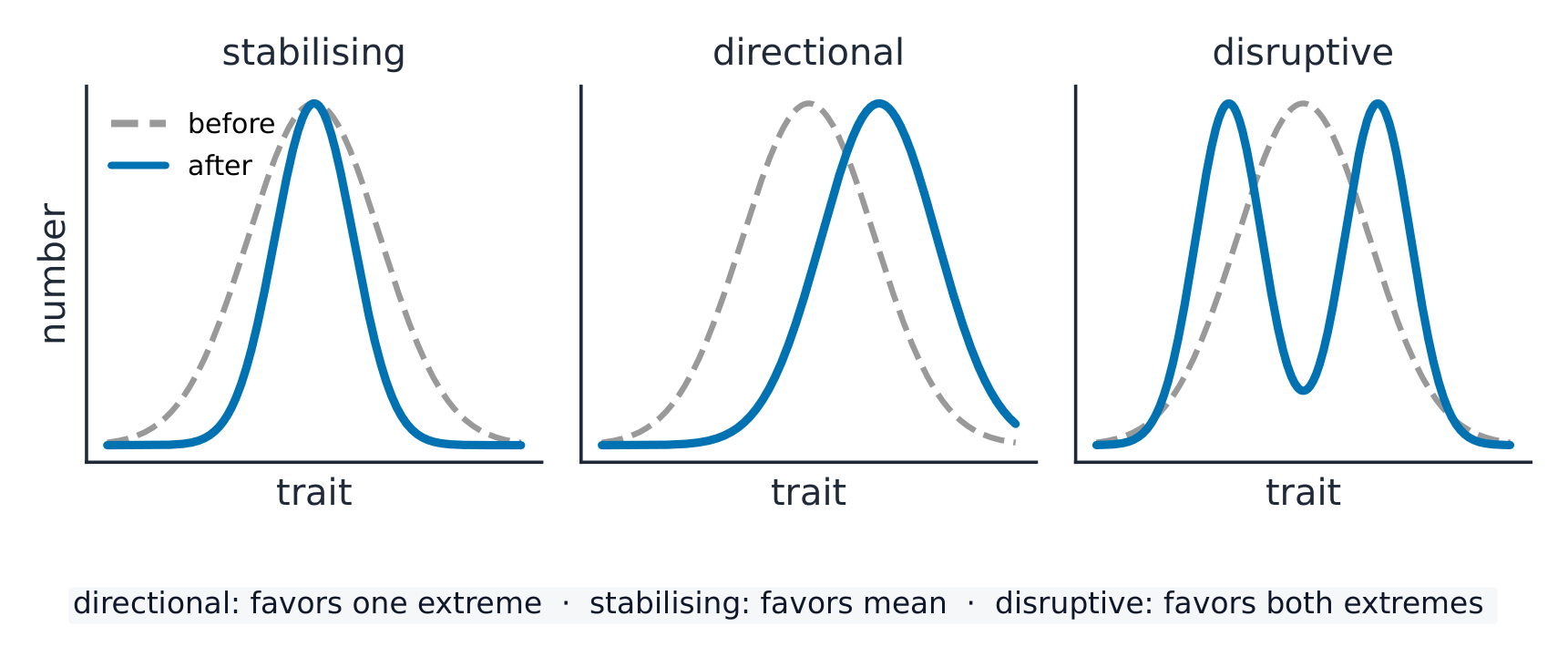
  • stabilising selection 稳定选择 favours the average and removes the extremes (the population stays the same).
  • directional selection 定向选择 favours one extreme, so the mean shifts that way.
  • disruptive selection 分裂选择 favours both extremes and removes the average.

Allele frequencies can also change in other ways:

  • the founder effect 奠基者效应 — a few individuals start a new population, so they carry only some of the alleles of the original group.
  • genetic drift 遗传漂变 — in a small population, allele frequencies change by chance from generation to generation.
  • the bottleneck effect 瓶颈效应 — a sudden fall in population size leaves few survivors, reducing the variety of alleles.

Antibiotic resistance as natural selection

A chance mutation 突变 makes a few bacteria resistant to an antibiotic 抗生素. When the antibiotic is used, the non-resistant bacteria die, but the resistant ones survive and reproduce. Over time the resistance 耐药性 spreads through the population. This is natural selection in action.

ไทย
การคัดเลือกตามธรรมชาติ: ผีเสื้อmoth

ประชากรหนึ่งจะสร้าง ลูกหลาน ได้มากกว่าจำนวนที่อาจรอดชีวิตได้ ดังนั้นลูกหลานจึงต้อง แข่งขัน เพื่อหาทรัพยากร เช่น อาหารและพื้นที่ นี่คือ "การต่อสู้เพื่อความอยู่รอด" บุคคลที่มีลักษณะ ปรับตัว ดีที่สุดจะมีโอกาสรอดชีวิต สืบพันธุ์ และส่งต่ออัลลีลไปยังรุ่นถัดไปมากที่สุด เมื่อผ่านไปหลายรุ่น อัลลีลที่เป็นประโยชน์จะพบได้บ่อยขึ้นในประชากร นี่คือ การคัดเลือกโดยธรรมชาติ

สองผีเสื้อกลางคืนบนลำต้นไม้: ผีเสื้อสีดำเกือบดำบนเปลือกไม้ที่ปกคลุมด้วยราสีอ่อนทางซ้าย และผีเสื้อสีอ่อนมีจุดด่างบนเปลือกไม้เข้มทางขวา
ผีเสื้อกลางคืน (peppered moth) แสดงให้เห็นถึงการคัดเลือกโดยธรรมชาติ: รูปแบบสีดำพรางตัวบนเปลือกไม้สีเข้มที่เปื้อนเขม่า ในขณะที่รูปแบบสีอ่อนมีจุดด่างพรางตัวบน รา สีอ่อน — นกจะกินตัวที่โดดเด่น

สภาพแวดล้อมสามารถขับเคลื่อนการคัดเลือกไปในสามทิศทาง:

  • การคัดเลือกแบบคงที่ (stabilising selection) favore ความเฉลี่ยและขจัดค่าสุดขั้ว (ประชากรยังคงเดิม).
  • การคัดเลือกแบบทิศทางเดียว (directional selection) favore ค่าสุดขั้วด้านใดด้านหนึ่ง ทำให้ค่าเฉลี่ยเลื่อนไปทางนั้น.
  • การคัดเลือกแบบเบี่ยงเบน (disruptive selection) favore ทั้งค่าสุดขั้วทั้งสองและขจัดค่าเฉลี่ย.
กราฟสามอันเปรียบเทียบการกระจายของลักษณะก่อนและหลังการคัดเลือก: แบบคงที่ทำให้แคบลง, แบบทิศทางเดียวเลื่อนไปด้านหนึ่ง, และแบบเบี่ยงเบนแบ่งออกเป็นสองยอด
แบบคงที่ทำให้ช่วงแคบลง, ทิศทางเดียวเลื่อนค่าเฉลี่ย, แบบเบี่ยงเบนแบ่งออกเป็นสองส่วน

ความถี่ของอัลลีลยังเปลี่ยนแปลงได้ด้วยวิธีอื่น ๆ:

  • ผลของผู้ก่อตั้ง (founder effect) — บุคคลไม่กี่ตัวเริ่มต้นประชากรใหม่ ทำให้พวกมันมียึดอัลลีลเพียงบางส่วนของกลุ่มเดิม.
  • การ漂变ทางพันธุกรรม (genetic drift) — ในประชากรขนาดเล็ก ความถี่ของอัลลีลเปลี่ยนแปลงโดยไม่ตั้งใจจากรุ่นสู่รุ่น.
  • ผลของคอขวด (bottleneck effect) — การลดลงอย่างฉับพลันของขนาดประชากรทำให้มีผู้รอดชีวิตน้อยลง ลดความหลากหลายของอัลลีล.
ประชากรขนาดใหญ่ที่มีสีสันมากมายผ่านภัยพิบัติที่มีเพียงไม่กี่ตัวรอด จึงทำให้ประชากรที่ฟื้นตัวมีเพียงสีเหลืออยู่สองสามสี
คอขวด: มีเพียงไม่กี่ตัวรอดจากภัยพิบัติ ทำให้ประชากรที่ฟื้นตัวมีความหลากหลายทางพันธุกรรมน้อยลง

ความเป็นต้านทานยาปฏิชีวนะในฐานะการคัดเลือกโดยธรรมชาติ

การกลายพันธุ์แบบสุ่มทำให้แบคทีเรียบางตัว ต้านทาน ยาปฏิชีวนะ เมื่อใช้ยาปฏิชีวนะ แบคทีเรียที่ไม่ต้านทานจะตาย แต่ตัวที่ต้านทานจะรอดและสืบพันธุ์ เมื่อเวลาผ่านไป ความเป็นต้านทาน จะแพร่กระจายในประชากร นี่คือตัวอย่างของการคัดเลือกโดยธรรมชาติที่ทำงานอยู่

Explore · ⁨สำรวจ⁩

Natural selection · ⁨การคัดเลือกโดยธรรมชาติ⁩

Step through Darwin's idea: variation + a selection pressure means the best-adapted survive and pass on their alleles. · ⁨ผ่านขั้นตอนแนวคิดของheardwin: ความแปรปรวน + แรงกดดันในการเลือก意味着สิ่งที่มี adaptations ดีที่สุดจะรอดและส่งต่ออัลลีลของตน⁩

Vocabulary · ⁨คำศัพท์⁩ Train · ⁨ฝึกฝน⁩
English ไทย
gene/dʒiːn/ gene
continuous variation/kənˈtɪnjuːəs ˌveərɪˈeɪʃn/ ความแปรปรวนต่อเนื่อง
population/ˌpɒpjʊˈleɪʃn/ ประชากร
offspring/ˈɒfsprɪŋ/ ลูกหลาน (offspring)
compete/kəmˈpiːt/ แข่งขัน
adapted/əˈdæptɪd/ ปรับตัว
reproduce/rɪprəˈdjuːs/ สืบพันธุ์
natural selection/ˈnætʃərəl sɪˈlekʃn/ การคัดเลือกโดยธรรมชาติ
stabilising selection/ˈsteɪbəlaɪzɪŋ sɪˈlekʃn/ การเลือกแบบคงที่ (Stabilising selection)
directional selection/daɪˈrekʃənl sɪˈlekʃn/ การเลือกแบบทิศทาง (Directional selection)
disruptive selection/dɪsˈrʌptɪv sɪˈlekʃn/ การเลือกแบบรบกวน (Disruptive selection)
founder effect/ˈfaʊndə ɪˈfekt/ ปรากฏการณ์ผู้ก่อตั้ง
genetic drift/dʒɪˈnetɪk drɪft/ การเบี่ยงเบนทางพันธุกรรม (Genetic drift)
bottleneck effect/ˈbɒtəlnek ɪˈfekt/ ผลขวดคอ
mutation/mjuːˈteɪʃn/ mutation
antibiotic/ˌæntɪbaɪˈɒtɪk/ ยาปฏิชีวนะ
resistance/rɪˈzɪstəns/ ความต้านทาน
Hardy–Weinberg principle/ˈhɑːdi ˈwaɪnbɜːɡ ˈprɪnsɪpl/ หลักการฮาร์ดี-ไวน์เบิร์ก
allele frequency/əˈliːl ˈfriːkwənsi/ ความถี่ของอัลลีล
genotype/ˈdʒenətaɪp/ genotype
Watch lesson · ⁨ดูบทเรียน⁩
17.2

The Hardy–Weinberg principle · ⁨หลักการฮาร์ดี-ไวน์เบิร์ก⁩

English

The Hardy–Weinberg principle 哈迪-温伯格原理 lets you calculate the allele frequencies 等位基因频率 and genotype 基因型 frequencies in a population. It only holds true when there is a large population, mating is random, and there is no mutation, no migration and no natural selection.

Call the frequency of the dominant allele $p$ and the frequency of the recessive allele $q$. There are only two alleles, so:

$$p + q = 1.$$

The genotype frequencies then add up to 1, where $p^2$ is homozygous dominant, $2pq$ is heterozygous (the carriers), and $q^2$ is homozygous recessive:

$$p^2 + 2pq + q^2 = 1.$$

Worked example. A recessive condition affects $1$ in every $100$ people. Find the frequency of carriers.

Only the homozygous recessive genotype ($q^2$) shows the condition, so $q^2 = \tfrac{1}{100} = 0.01$, giving $q = \sqrt{0.01} = 0.1$. Then $p = 1 - q = 0.9$. The carriers are the heterozygotes:

$$2pq = 2 \times 0.9 \times 0.1 = 0.18.$$

So about $18\%$ of the population are carriers — far more than the $1\%$ who show the condition.

ไทย

หลักการฮาร์ดี-ไวน์เบิร์ก ช่วยให้คุณคำนวณ ความถี่ของอัลลีล และ ความถี่ของจีโนไทป์ ในประชากร หลักการนี้ใช้ได้ก็ต่อเมื่อมีประชากรขนาดใหญ่ การผสมพันธุ์เป็นแบบสุ่ม และไม่มีการกลายพันธุ์ การอพยพ และการคัดเลือกโดยธรรมชาติ

ให้ความถี่ของอัลลีลเด่นคือ $p$ และความถี่ของอัลลีลด้อยคือ $q$ เนื่องจากมีเพียงสองอัลลีลเท่านั้น ดังนั้น:

$$p + q = 1.$$

ความถี่ของจีโนไทป์รวมกันได้ 1 โดยที่ $p^2$ คือโฮโมไซกัสเด่น, $2pq$ คือเฮเทอโรไซกัส (พาหะ), และ $q^2$ คือโฮโมไซกัสด้อย:

$$p^2 + 2pq + q^2 = 1.$$

ตัวอย่างฝึกฝน. โรคด้อยมีผลต่อ $1$ ในทุก $100$ คน จงหาความถี่ของพาหะ

เฉพาะจีโนไทป์โฮโมไซกัสด้อย ($q^2$) ที่แสดงโรค ดังนั้น $q^2 = \tfrac{1}{100} = 0.01$ ซึ่งได้ $q = \sqrt{0.01} = 0.1$ จากนั้น $p = 1 - q = 0.9$ พาหะคือเฮเทอโรไซกัส:

$$2pq = 2 \times 0.9 \times 0.1 = 0.18.$$

ดังนั้นประมาณ $18\%$ ของประชากรเป็นพาหะ — มากกว่ามากเมื่อเทียบกับ $1\%$ ที่แสดงโรค

ฮาร์ดี-ไวน์เบิร์ก: ความถี่ของอัลลีล p และ q ให้ความถี่ของจีโนไทป์ p², 2pq, q²
17.2

Selective breeding (artificial selection) · ⁨การเพาะพันธุ์เลือก (การคัดเลือกแบบ人造)⁩

English

In selective breeding 选择育种, also called artificial selection 人工选择, humans (not nature) choose which organisms breed, so that useful features are passed on. Examples:

  • breeding disease resistance 抗病性 into varieties of wheat and rice.
  • using inbreeding 近交 and hybridisation 杂交 (crossing different lines) to make vigorous, uniform maize.
  • breeding dairy cattle to improve their milk yield 产量.
ไทย

ในการ เพาะพันธุ์เลือก หรือที่เรียกว่า การคัดเลือกแบบ人造 มนุษย์ (ไม่ใช่ธรรมชาติ) เลือกสิ่งมีชีวิตที่จะผสมพันธุ์ เพื่อให้คุณลักษณะที่มีประโยชน์ถูกส่งต่อไป ตัวอย่างเช่น:

  • การเพาะพันธุ์ ความต้านทานโรค เข้าไปในสายพันธุ์ข้าวสาลีและข้าว
  • การใช้ การผสมพันธุ์สายพันธุ์เดียวกัน (inbreeding) และ การผสมข้ามสาย (hybridisation) เพื่อผลิตข้าวโพดที่มีความแข็งแรงและสม่ำเสมอ
  • การเพาะพันธุ์วัวน้ำนมเพื่อปรับปรุง Yield น้ำนม

บุคคลสามรุ่น: ทุกครั้งที่เลือกเพียงตัวที่มีคุณลักษณะที่ต้องการ (สีเขียว) เพื่อผสมพันธุ์ ทำให้สัดส่วนสีเขียวเพิ่มขึ้นจนกว่าสายพันธุ์ทั้งหมดจะมีคุณลักษณะนี้ *การเพาะพันธุ์เลือก: การเลือกเพียงตัวที่ดีที่สุดเพื่อผสมพันธุ์ในแต่ละรุ่นทำให้คุณลักษณะที่ต้องการพบได้บ่อยขึ้นเรื่อยๆ

Explore · ⁨สำรวจ⁩

Selective breeding · ⁨การเพาะพันธุ์แบบคัดเลือก⁩

Step through it. Humans take the role of the environment — choosing the breeders, generation after generation. · ⁨ทำทีละขั้นตอน มนุษย์ทำหน้าที่แทนสิ่งแวดล้อม — เลือกสัตว์ที่เพาะพันธุ์ รุ่นต่อรุ่น.⁩

Vocabulary · ⁨คำศัพท์⁩ Train · ⁨ฝึกฝน⁩
English ไทย
selective breeding/sɪˈlektɪv ˈbriːdɪŋ/ การคัดเลือกพันธุ์
artificial selection/ˌɑːtɪˈfɪʃl sɪˈlekʃn/ artificial selection
disease resistance/dɪˈziːz rɪˈzɪstəns/ ความต้านทานโรค
inbreeding/ˈɪnbriːdɪŋ/ การผสมพันธุ์ในครอบครัวเดียวกัน
hybridisation/ˌhaɪbrɪdaɪˈzeɪʃn/ การผสมข้าม
yield/jiːld/ yield
evolution/ɪvəˈluːʃn/ วิวัฒนาการ
species/ˈspiːsiːz/ ชนิด (species)
gene pool/dʒiːn puːl/ คลังยีน
sequence/ˈsiːkwəns/ ลำดับขั้นตอน (sequence)
17.3

Evolution · ⁨วิวัฒนาการ⁩

Syllabus · ⁨หลักสูตร⁩
English
  1. outline the theory of evolution as a process leading to the formation of new species from pre-existing species over time, as a result of changes to gene pools from generation to generation
  2. discuss how DNA sequence data can show evolutionary relationships between species
  3. explain how speciation may occur as a result of genetic isolation by: • geographical separation (allopatric speciation) • ecological and behavioural separation (sympatric speciation)
ไทย
  1. สรุปทฤษฎี วิวัฒนาการ ในฐานะกระบวนการนำไปสู่การสร้าง species ใหม่จาก species ที่มีอยู่เดิมเมื่อเวลาผ่านไป อันเป็นผลจากการเปลี่ยนแปลงของ gene pools จากรุ่นสู่รุ่น
  2. อภิปรายว่าข้อมูล DNA sequence สามารถแสดงถึงความสัมพันธ์ทางวิวัฒนาการระหว่าง species ได้อย่างไร
  3. อธิบายว่า speciation อาจเกิดขึ้นจากการ genetic isolation จาก: • การแยกทางภูมิศาสตร์ (allopatric speciation) • การแยกทางนิเวศวิทยาและพฤติกรรม (sympatric speciation)

Source: Cambridge International syllabus · ⁨แหล่งที่มา: หลักสูตร Cambridge International⁩

English

Evolution 进化 is the slow formation of new species 物种 from earlier ones, as the gene pool 基因库 (all the alleles in a population) changes from generation to generation.

DNA sequence 序列 data can show how closely related two species are: the more similar their DNA sequences, the more recently they shared a common ancestor.

Speciation 物种形成 happens when two populations become genetically separated, so they can no longer breed together. This genetic isolation 隔离 can come about in two ways:

  • allopatric speciation 异域物种形成 — the populations are kept apart by a geographical separation 地理隔离, such as a sea or a mountain range.
  • sympatric speciation 同域物种形成 — the populations live in the same area but are separated by differences in behaviour or way of life.
ไทย

วิวัฒนาการ คือการเกิด สปีชีส์ ใหม่อย่างช้าๆ จากสปีชีส์เก่า เมื่อ พูลยีน (อัลลีลทั้งหมดในประชากร) เปลี่ยนแปลงจากรุ่นสู่รุ่น

ข้อมูล ลำดับ DNA สามารถบ่งชี้ถึงความสัมพันธ์ระหว่างสองสปีชีส์: ยิ่งลำดับ DNA คล้ายกันมากเท่าไร สปีชีส์เหล่านั้นยิ่งมีบรรพบุรุษร่วมกันเมื่อไม่นานมานี้เท่านั้น

การเกิดสปีชีส์ใหม่ (Speciation) เกิดขึ้นเมื่อสองประชากรแยกออกจากกันทางพันธุกรรม จนไม่สามารถผสมพันธุ์ด้วยกันได้อีกต่อไป การ แยกตัวทางพันธุกรรม นี้สามารถเกิดขึ้นได้สองวิธี:

  • การเกิดสปีชีส์ใหม่แบบต่างถิ่น (allopatric speciation) — ประชากรถูกแยกออกจากกันโดย การแยกทางภูมิศาสตร์ เช่น ทะเลหรือภูเขา
  • การเกิดสปีชีส์ใหม่แบบร่วมถิ่น (sympatric speciation) — ประชากรอาศัยอยู่ในพื้นที่เดียวกันแต่ถูกแยกออกจากกันด้วยความแตกต่างในพฤติกรรมหรือวิถีชีวิต

เส้นทางสู่การเกิดสปีชีส์ใหม่สองแบบ: allopatric ที่ซึ่งอุปสรรคทางกายภาพแบ่งประชากร, และ sympatric ที่ซึ่งประชากรในพื้นที่เดียวกันแยกออกโดยพฤติกรรม *การเกิดสปีชีส์ใหม่แบบต่างถิ่นต้องการอุปสรรคทางกายภาพ; การเกิดสปีชีส์ใหม่แบบร่วมถิ่นเกิดขึ้นในพื้นที่เดียวกัน

Explore · ⁨สำรวจ⁩

Allopatric speciation · ⁨การเกิดชนิดใหม่แบบแยกกันอยู่ทางภูมิศาสตร์ (Allopatric speciation)⁩

Step through it. A barrier splits one population; the two halves diverge until they can no longer interbreed. · ⁨ไล่ตามขั้นตอน: barriers แยกประชากรหนึ่งออกเป็นสองส่วน ส่วนทั้งสองแยกตัวออกจากกันจนไม่สามารถผสมพันธุ์กันได้⁩

Vocabulary · ⁨คำศัพท์⁩ Train · ⁨ฝึกฝน⁩
English ไทย
speciation/ˌspiːʃɪˈeɪʃn/ การเกิดชนิดใหม่
isolation/ˌaɪsəˈleɪʃn/ การแยกตัว
allopatric speciation/ˌæləˈpætrɪk ˌspiːʃɪˈeɪʃn/ allopatric speciation
geographical separation/ˌdʒɪəˈɡræfɪkl ˌsepəˈreɪʃn/ การแยกทางภูมิศาสตร์
sympatric speciation/ˈsɪmpətrɪk ˌspiːʃɪˈeɪʃn/ sympatric speciation
Watch lesson · ⁨ดูบทเรียน⁩
17.3

Exam tips · ⁨ข้อแนะนำสำหรับการสอบ⁩

English
  • Explain natural selection as a sequence: variation → selection pressure → the better-adapted survive and reproduce → allele frequency changes.
  • Use the Hardy–Weinberg equations ($p+q=1$, $p^2+2pq+q^2=1$); $q^2$ is the recessive-phenotype frequency — a common calculation.
  • Distinguish stabilising, directional and disruptive selection with an example of each.
  • Distinguish allopatric vs sympatric speciation (geographic vs reproductive isolation).
ไทย
  • อธิบาย การคัดเลือกโดยธรรมชาติ เป็นลำดับขั้นตอน: ความแปรปรวน → แรงกดดันทางการคัดเลือก → ตัวที่ปรับตัวได้ดีกว่ารอดและสืบพันธุ์ → ความถี่อัลลีลเปลี่ยนไป
  • ใช้สมการ ฮาร์ดี-ไวน์เบิร์ก ($p+q=1$, $p^2+2pq+q^2=1$); $q^2$ คือความถี่ของฟีโนไทptype ด้อย — ซึ่งเป็นคำคำนวณที่พบบ่อย
  • แยกแยะการคัดเลือกแบบ คงที่, ทิศทางเดียว และเบี่ยงเบน พร้อมตัวอย่างของแต่ละประเภท
  • แยกแยะการเกิดสปีชีส์แบบ allopatric vs sympatric (การแยกตัวทางภูมิศาสตร์ vs การแยกตัวด้านการสืบพันธุ์)

Interactive lessons on this topic · ⁨บทเรียนเชิงโต้ตอบสำหรับหัวข้อนี้⁩

Work through it step by step, with instant-check exercises. · ⁨ทำทีละขั้นตอน พร้อมแบบฝึกหัดตรวจสอบผลทันที⁩

Past Papers · ⁨ข้อสอบย้อนหลัง⁩

More topics in A-Level Biology · ⁨Biology A-Level⁩ · ⁨หัวข้อเพิ่มเติมใน A-Level Biology · ⁨Biology A-Level⁩⁩

Log in or create account · ⁨เข้าสู่ระบบหรือสร้างบัญชี⁩

IGCSE, A-Level & AP