Natural selection
Introduced| English | Meaning |
|---|---|
| adapted/əˈdæptɪd/ | Having characteristics suited to survival and reproduction in a particular environment. |
| peppered moth/ˈpepəd mɒθ/ | peppered moth |
| stabilising/ˈsteɪbəlaɪzɪŋ/ | Favours the average, removes the extremes (population stays the same). |
| directional/daɪˈrekʃənl/ | Favours one extreme, so the mean shifts that way. |
| disruptive/dɪsˈrʌptɪv/ | Favours both extremes, removes the average. |
| antibiotic resistance/ˌæntɪbaɪˈɒtɪk rɪˈzɪstəns/ | antibiotic resistance |
Survival of the fittest
- A population makes far more offspring than can survive.
- So they compete — and the best adapted 适应 win.
- Over generations, the helpful alleles spread.
Natural selection acts on the variation that already exists in a population.
Difficulty 1/5 · 100 coins + a small bonus on first completion today
It cannot create variation; it selects from what is already there (mutation creates the new variation).
The process
- More offspring are born than can survive, so they compete for food and space — the "struggle for existence".
- The best-adapted individuals are most likely to survive, reproduce, and pass on their alleles.
- Over many generations, the helpful alleles become more common.
- The peppered moth 桦尺蛾 shows this: the form that is best camouflaged on the bark is eaten less, so it becomes more common.
Natural selection
Step through Darwin's idea: variation + a selection pressure means the best-adapted survive and pass on their alleles.
In natural selection, which individuals are most likely to pass on their alleles?
Difficulty 1/5 · 100 coins + a small bonus on first completion today
The best-adapted individuals survive, reproduce, and pass on their helpful alleles, which spread over generations.
The peppered moth shows natural selection because:
Difficulty 1/5 · 100 coins + a small bonus on first completion today
Birds eat the moth that stands out; the better-camouflaged form survives and increases in frequency.
Put natural selection in order.
Difficulty 3/5 · 200 coins + a small bonus on first completion today
Variation → pressure → differential survival → reproduction → the allele frequency changes.
Three types of selection
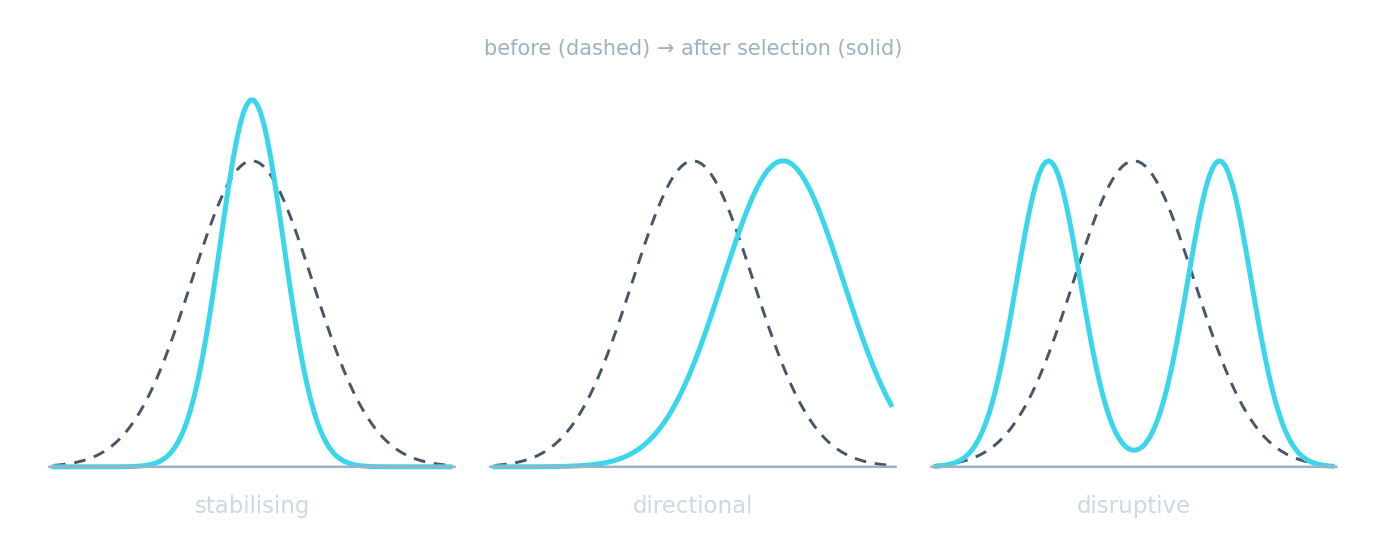
- stabilising 稳定选择 — favours the average, removes the extremes (population stays the same).
- directional 定向 — favours one extreme, so the mean shifts that way.
- disruptive 分裂 — favours both extremes, removes the average.
Directional selection:
Difficulty 1/5 · 100 coins + a small bonus on first completion today
Directional selection favours one extreme, shifting the population mean in that direction.
Match each type of selection to what it does to the distribution.
Difficulty 2/5 · 140 coins + a small bonus on first completion today
Directional shifts the mean, stabilising narrows it, disruptive splits it — all by selecting from existing variation.
Disruptive selection:
Difficulty 1/5 · 100 coins + a small bonus on first completion today
Disruptive selection favours both extremes, splitting the distribution into two peaks.
Selection we can watch
- Antibiotic resistance 抗生素抗性 is natural selection happening fast enough to observe.
Worked example. Antibiotics kill non-resistant bacteria; the few resistant ones survive and multiply. Within days a resistant population dominates — selection in real time.

The peppered moth: birds eat the form that stands out, so camouflage is selected for.
You've got it
- overproduction → competition → the best-adapted survive and reproduce → helpful alleles spread
- the peppered moth: better camouflage = eaten less = more common
- stabilising (favours average), directional (shifts mean), disruptive (favours both extremes)