Variation
Introduced| English | Meaning |
|---|---|
| variation/ˌveərɪˈeɪʃn/ | Differences in characteristics between individuals or values within a set. |
| continuous variation/kənˈtɪnjuːəs ˌveərɪˈeɪʃn/ | A smooth range from one extreme to the other (e.g. height). Controlled by many genes plus the environment. |
| discontinuous variation/dɪskənˈtɪnjuːəs ˌveərɪˈeɪʃn/ | Clear, separate groups with nothing in between (e.g. blood group A/B/AB/O). Controlled by one or a few genes. |
| t-test/tiː test/ | t-test |
No two alike
- Variation 变异 means the differences between individuals.
- It can come from your genes, your environment, or both.
- And it falls into two patterns.
Variation type lab
Classify examples by the source and pattern of variation.
Three causes
- genetic only — set by the alleles you inherit (e.g. blood group).
- environmental only — set by your surroundings (e.g. a scar, the language you speak).
- both — most features (e.g. height, body mass) depend on genes and diet/lifestyle.
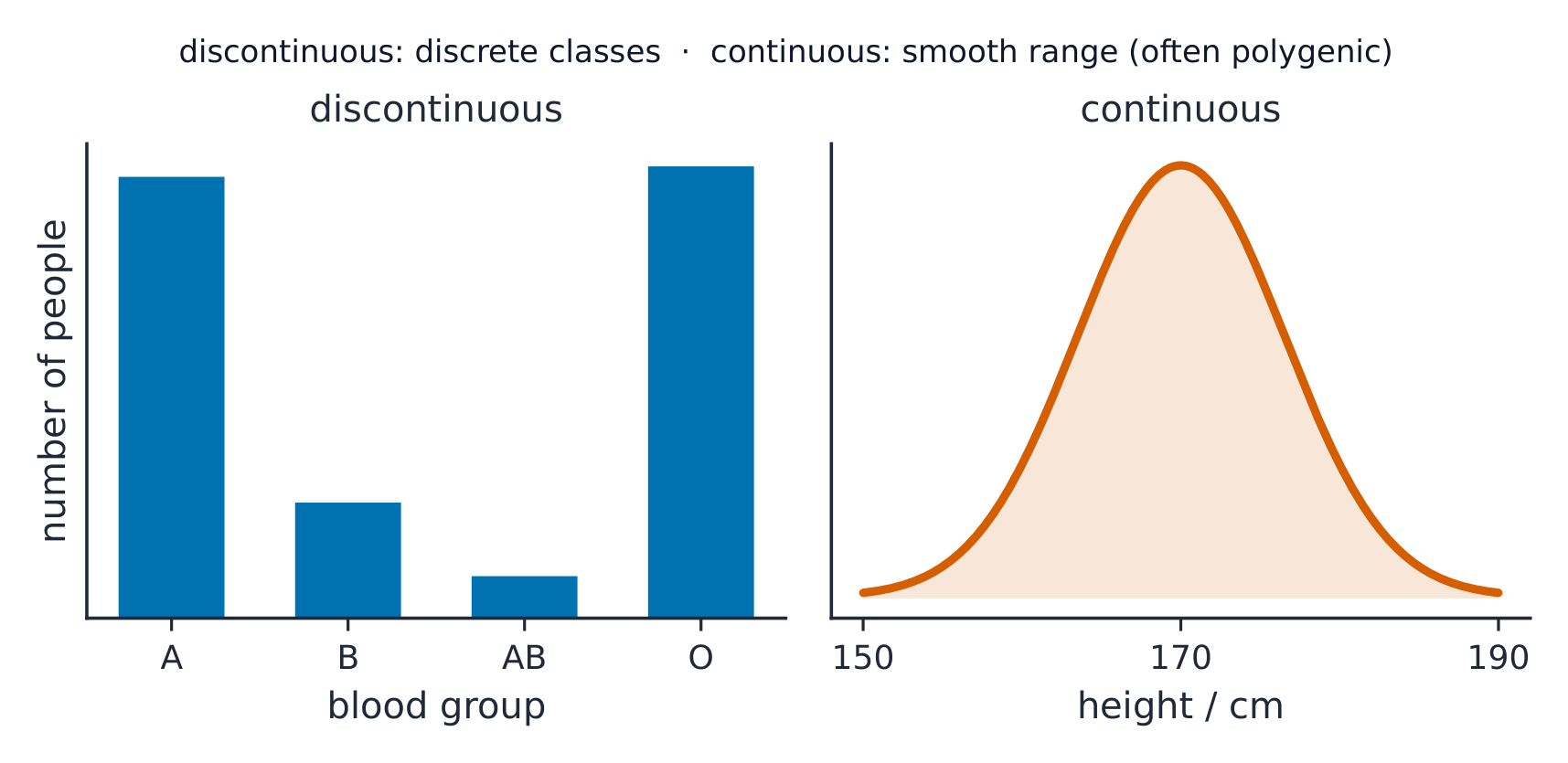
Discontinuous and continuous variation 连续变异
Most features, such as height, are caused by:
Difficulty 1/5 · 100 coins + a small bonus on first completion today
Height depends on the alleles inherited and on diet/lifestyle — a combination of genes and environment.
Two patterns
- discontinuous variation 不连续变异 — clear, separate groups with nothing in between (e.g. blood group A/B/AB/O). Controlled by one or a few genes.
- continuous variation — a smooth range from one extreme to the other (e.g. height). Controlled by many genes plus the environment.

Pale and dark peppered moths on a tree trunk
Continuous variation is:
Difficulty 1/5 · 100 coins + a small bonus on first completion today
Continuous variation (e.g. height) is a smooth range from many genes; discontinuous is separate groups from few genes.
Which is an example of discontinuous variation?
Difficulty 1/5 · 100 coins + a small bonus on first completion today
Blood group falls into clear separate categories — discontinuous variation.
Match each term to its description.
Difficulty 2/5 · 140 coins + a small bonus on first completion today
Continuous = smooth range (polygenic); discontinuous = distinct categories; most features mix genetic and environmental causes.
Continuous variation is controlled by many genes plus the environment, giving a smooth range of values.
Difficulty 1/5 · 100 coins + a small bonus on first completion today
Many small genetic effects plus the environment add up to a smooth spread (e.g. a bell curve of heights).
Variation that falls into clear, separate categories (like blood group) is ______ variation.
Difficulty 1/5 · 100 coins + a small bonus on first completion today
Discontinuous variation is controlled by one or a few genes, with little or no environmental effect.
The t-test t检验
- To compare the means of two samples (e.g. plant heights in sun vs shade), use the t-test.
- It tells you whether the difference is large enough to be real, or just due to chance.

Banded snails (Cepaea nemoralis) show striking variation in shell colour and banding.
The t-test is used to:
Difficulty 1/5 · 100 coins + a small bonus on first completion today
The t-test checks whether the difference between two sample means is real or just chance.
You've got it
- variation causes: genetic, environmental, or both
- discontinuous = separate groups (few genes); continuous = smooth range (many genes + environment)
- e.g. blood group = discontinuous; height = continuous
- the t-test compares two means — real difference or chance?