

English
- describe the relationship between the structure of chloroplasts, as shown in diagrams and electron micrographs, and their function
- explain that energy transferred as ATP and reduced NADP from the light-dependent stage is used during the light-independent stage (Calvin cycle) of photosynthesis to produce complex organic molecules
- state that within a chloroplast, the thylakoids (thylakoid membranes and thylakoid spaces), which occur in stacks called grana, are the site of the light-dependent stage and the stroma is the site of the light-independent stage
- describe the role of chloroplast pigments (chlorophyll a, chlorophyll b, carotene and xanthophyll) in light absorption in thylakoids
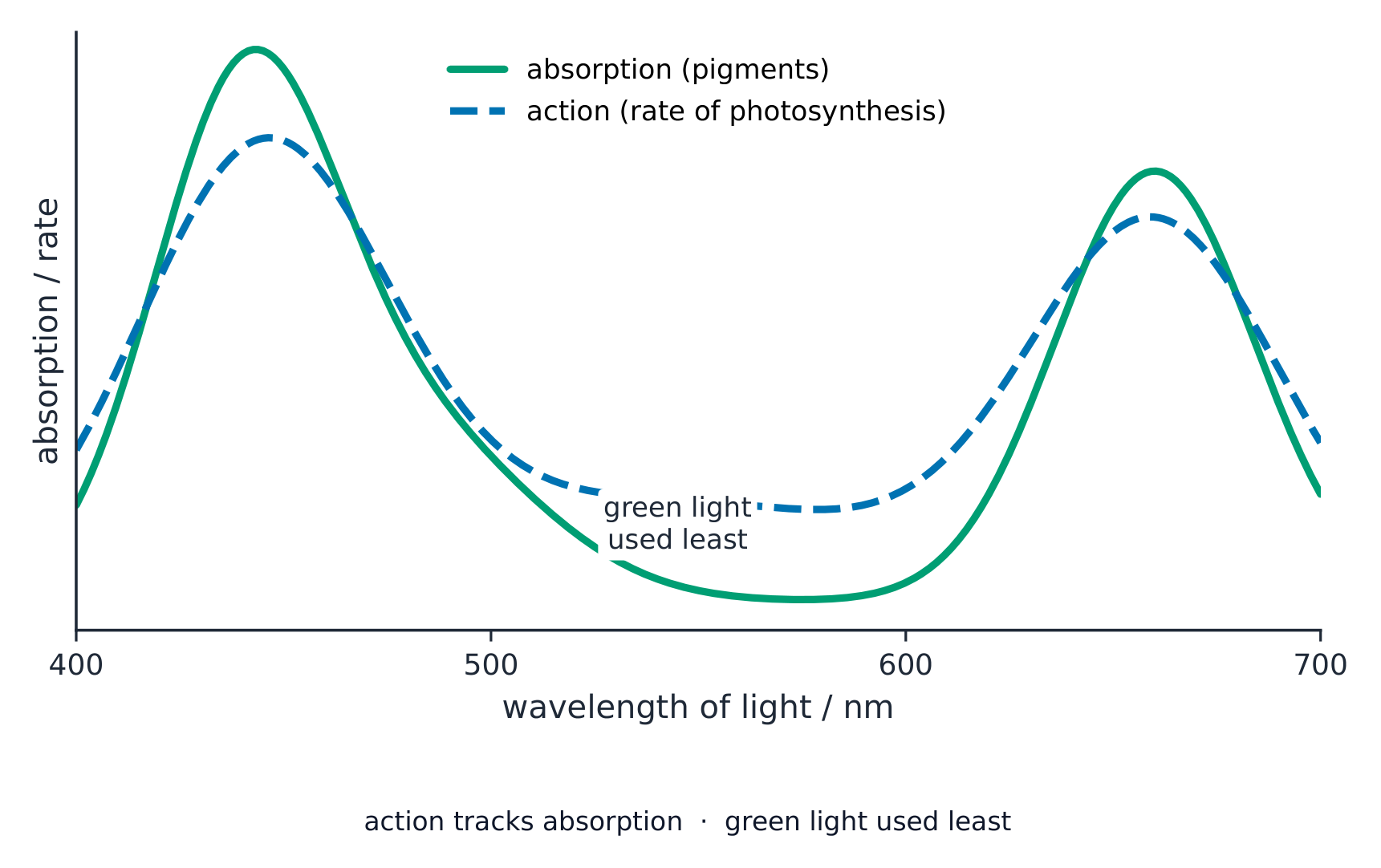
- interpret absorption spectra of chloroplast pigments and action spectra for photosynthesis
- describe and use chromatography to separate and identify chloroplast pigments (reference should be made to $R_f$ values in identification of chloroplast pigments)
- state that cyclic photophosphorylation and non-cyclic photophosphorylation occur during the light-dependent stage of photosynthesis
- explain that in cyclic photophosphorylation: • only photosystem I (PSI) is involved • photoactivation of chlorophyll occurs • ATP is synthesised
- explain that in non-cyclic photophosphorylation: • photosystem I (PSI) and photosystem II (PSII) are both involved • photoactivation of chlorophyll occurs • the oxygen-evolving complex catalyses the photolysis of water • ATP and reduced NADP are synthesised
- explain that during photophosphorylation: • energetic electrons release energy as they pass through the electron transport chain (details of carriers are not expected) • the released energy is used to transfer protons across the thylakoid membrane • protons return to the stroma from the thylakoid space by facilitated diffusion through ATP synthase, providing energy for ATP synthesis (details of ATP synthase are not expected)
- outline the three main stages of the Calvin cycle: • rubisco catalyses the fixation of carbon dioxide by combination with a molecule of ribulose bisphosphate (RuBP), a 5C compound, to yield two molecules of glycerate 3-phosphate (GP), a 3C compound • GP is reduced to triose phosphate (TP) in reactions involving reduced NADP and ATP • RuBP is regenerated from TP in reactions that use ATP
- state that Calvin cycle intermediates are used to produce other molecules, limited to GP to produce some amino acids and TP to produce carbohydrates, lipids and amino acids
ไทย
- อธิบายความสัมพันธ์ระหว่างโครงสร้างของ คลอโรพลาสต์ ตามที่แสดงในแผนภาพและภาพถ่ายจากกล้องจุลทรรศน์อิเล็กตรอนกับหน้าที่ของมัน
- อธิบายว่าพลังงานที่ถ่ายโอนมาในรูปแบบ ATP และ NADP ที่ลดแล้วจาก ขั้นตอนที่ใช้แสง จะถูกใช้ใน ขั้นตอนที่ไม่ต้องใช้แสง (วัฏจักรคาลวิน) ของการสังเคราะห์ด้วยแสงเพื่อสร้างโมเลกุลอินทรีย์ที่ซับซ้อน
- ระบุว่าภายในคลอโรพลาสต์ ไทลาคอยด์ (เยื่อหุ้มไทลาคอยด์และช่องไทลาคอยด์) ซึ่งจัดเรียงเป็นกองเรียกว่า กรานา เป็นสถานที่เกิดขั้นตอนที่ใช้แสง และ สโทรมา เป็นสถานที่เกิดขั้นตอนที่ไม่ต้องใช้แสง
- อธิบายบทบาทของ สีในคลอโรพลาสต์ (คลอโรฟิลล์ a, คลอโรฟิลล์ b, แคโรทีน และ แซนโทฟิลล์) ในการดูดซับแสงในไทลาคอยด์
- วิเคราะห์ สเปกตรัมการดูดกลืน ของสีในคลอโรพลาสต์และ สเปกตรัมการกระทำ ของการสังเคราะห์ด้วยแสง
- อธิบายและใช้เทคนิค โครมาโตกราฟี เพื่อแยกและระบุสีในคลอโรพลาสต์ (ควรอ้างอิงถึงค่า $R_f$ ในการระบุสีในคลอโรพลาสต์)
- ระบุว่ามีการเกิด การฟอสโฟริเลชันแบบวงจร และ การฟอสโฟริเลชันแบบไม่หมุนเวียน ในช่วงขั้นตอนที่ใช้แสงของการสังเคราะห์ด้วยแสง
- อธิบายว่าในการฟอสโฟริเลชันแบบวงจร: • มีเพียงphotosystem I (PSI) เท่านั้นที่เกี่ยวข้อง • เกิดการกระตุ้นด้วยแสงของคลอโรฟิลล์ • มีการสังเคราะห์ ATP
- อธิบายว่าในการฟอสโฟริเลชันแบบไม่หมุนเวียน: • photosystem I (PSI) และ photosystem II (PSII) ทั้งคู่เกี่ยวข้อง • เกิดการกระตุ้นด้วยแสงของคลอโรฟิลล์ • คอมเพล็กซ์ที่ปล่อยออกซิเจน ทำหน้าที่เร่งปฏิกิริยา การแตกตัวของน้ำด้วยแสง • มีการสังเคราะห์ ATP และ NADP ที่ลดแล้ว
- อธิบายว่าในการฟอสโฟริเลชันด้วยแสง: • อิเล็กตรอนที่มีพลังงานสูงจะปล่อยพลังงานขณะเคลื่อนที่ผ่านห่วงโซ่การส่งต่ออิเล็กตรอน (รายละเอียดของตัวพาไม่จำเป็นต้องรู้) • พลังงานที่ถูกปล่อยออกมาจะถูกใช้เพื่อเคลื่อนย้ายโปรตอนข้ามเยื่อหุ้มไทลาคอยด์ • โปรตอนจะกลับเข้าสู่สโทรมาจากช่องไทลาคอยด์โดยการแพร่แบบช่วยด้วยเอนไซม์ผ่าน ATP synthase ซึ่งให้พลังงานสำหรับการสังเคราะห์ ATP (รายละเอียดของ ATP synthase ไม่จำเป็นต้องรู้)
- สรุปสามขั้นตอนหลักของวัฏจักรคาลวิน: • รูบิสکو ทำหน้าที่เร่งปฏิกิริยากำหนดคาร์บอนไดออกไซด์โดยรวมกับโมเลกุลของ ไรบูโลสไบฟอสเฟต (RuBP) ซึ่งเป็นสารประกอบ 5C เพื่อให้เกิดสองโมเลกุลของ กลีเซอเรต 3-ฟอสเฟต (GP) ซึ่งเป็นสารประกอบ 3C • GP ถูกลดให้เป็นไตรโอสฟอสเฟต (TP) ในปฏิกิริยาที่เกี่ยวข้องกับ NADP ที่ลดแล้วและ ATP • RuBP ถูกสร้างใหม่จาก TP ในปฏิกิริยาที่ใช้ ATP
- ระบุว่าสารกลางของวัฏจักรคาลวินถูกนำไปสร้างโมเลกุลอื่นๆ โดยจำกัดอยู่ที่ GP ในการสร้างกรดอะมิโนบางชนิด และ TP ในการสร้างคาร์โบไฮเดรต.train Lipids และกรดอะมิโน
 *Thylakoids จัดเรียงเป็น grana (ขั้นตอนแรกเกิดขึ้นที่นี่); stroma รอบๆ เป็นสถานที่ของขั้นตอนที่สอง
 *Chloroplasts (ดิสก์สีเขียวเล็กๆ) ภายในเซลล์ของใบ Elodea (pottedweed) เห็นภายใต้กล้องจุลทรรศน์
 *แต่ละเม็ดสีเคลื่อนที่ไปตามระยะทางของตัวเอง; Rf คือระยะทางจุดหารด้วยระยะทางสารละลาย

