IGCSE Chemistry (0620) runs from states of matter and atomic structure through stoichiometry, electrochemistry, energetics, rates, acids and bases, the Periodic Table, metals, environmental chemistry and organic chemistry, ending with experimental techniques and analysis.
Stoichiometry decides grades. It appears in its own questions and again inside electrochemistry, energetics and rates, so time spent on moles pays back several times over.
The other reliable loss is equations: unbalanced, missing state symbols, or an ionic equation written out in full. Papers exist for six components, split between Core and Extended — confirm which you are sitting before you revise.
The three states of matter · Три агрегатных состояния вещества
Syllabus · Программа
English
Core
Supplement
1 State the distinguishing properties of solids, liquids and gases
2 Describe the structures of solids, liquids and gases in terms of particle separation, arrangement and motion
3 Describe changes of state in terms of melting, boiling, evaporating, freezing and condensing
5 Explain changes of state in terms of kinetic particle theory, including the interpretation of heating and cooling curves
4 Describe the effects of temperature and pressure on the volume of a gas
6 Explain, in terms of kinetic particle theory, the effects of temperature and pressure on the volume of a gas
Русский
Базовый
Дополнительно
1 Указать отличительные свойства твердых тел, жидкостей и газов
2 Описать структуры твердых тел, жидкостей и газов с точки зрения расстояния между частицами, расположения и движения
3 Описать переходы агрегатного состояния с точки зрения плавления, кипения, испарения, замерзания и конденсации
5 Объяснить переходы агрегатного состояния с точки зрения кинетической теории частиц, включая интерпретацию кривых нагрева и охлаждения
4 Описать влияние температуры и давления на объем газа
6 Объяснить с точки зрения кинетической теории частиц влияние температуры и давления на объем газа
Source: Cambridge International syllabus · Источник: Программа Cambridge International
English
Solid, liquid, gas: particle motion
Everything around you is made of tiny particles 粒子 — these can be atoms 原子, molecules 分子, or ions 离子. The kinetic particle theory 粒子动理论 says these particles are always moving. How close the particles are, how they are arranged, and how they move decides whether matter is a solid 固体, a liquid 液体, or a gas 气体.
Properties you can observe
You do not need a microscope to tell the three states apart. They behave in different ways:
A solid has a fixed shape and a fixed volume 体积. It does not flow and you cannot compress 压缩 it (squeeze it smaller).
A liquid has a fixed volume but no fixed shape. It flows and takes the shape of its container. It is almost impossible to compress.
A gas has no fixed shape and no fixed volume. It flows and spreads out to fill the whole container. A gas is easy to compress.
The table below sums up these properties. Density 密度 means how much mass 质量 is packed into a given volume.
Property
Solid
Liquid
Gas
Shape
fixed
takes the shape of the container
fills the whole container
Volume
fixed
fixed
fills the whole container
Can it be compressed?
no
almost none
yes, easily
Does it flow?
no
yes
yes
Density
high
high
low
The particle picture
The kinetic particle theory explains these properties by looking at three things: the separation 间距 of the particles (how far apart they are), their arrangement 排列 (the pattern), and their motion 运动 (how they move).
Solid
Liquid
Gas
Separation
touching, very close
close together
far apart
Arrangement
regular 规则 pattern
random, no pattern
random, no pattern
Motion
vibrate 振动 about fixed positions
move and slide past each other
move quickly in all directions
Strong forces of attraction 引力 hold the particles together. In a solid these forces are strong enough to hold every particle in place, so a solid keeps its shape. In a liquid the forces are weaker, so particles can move around. In a gas the particles move so fast that the forces hardly act at all, so the gas spreads out.
Русский
Твердое тело, жидкость, газ: движение частиц
Все вокруг вас состоит из крошечных частиц — это могут быть атомы, молекулы или ионы. Кинетическая теория частиц гласит, что эти частицы постоянно движутся. То, насколько близко расположены частицы, как они упорядочены и как двигаются, определяет, является ли вещество твердым, жидким или газообразным.
Свойства, которые можно наблюдать
Вам не нужен микроскоп, чтобы различить три состояния. Они ведут себя по-разному:
Твердое тело имеет постоянную форму и постоянный объем. Оно не течет, и его нельзя сжать (уменьшить размер).
Жидкость имеет постоянный объем, но не имеет постоянной формы. Она течет и принимает форму своего сосуда. Сжать ее почти невозможно.
Газ не имеет ни постоянной формы, ни постоянного объема. Он течет и распространяется, заполняя весь сосуд. Газ легко сжимается.
Нижеприведенная таблица обобщает эти свойства. Плотность означает, сколько массы упаковано в данном объеме.
Свойство
Твердое тело
Жидкость
Газ
Форма
постоянная
принимает форму сосуда
заполняет весь сосуд
Объем
постоянный
постоянный
заполняет весь сосуд
Можно ли сжать?
нет
практически нет
да, легко
Течет?
нет
да
да
Плотность
высокая
высокая
низкая
Частичная модель
Кинетическая теория частиц объясняет эти свойства через рассмотрение трех вещей: расстояния между частицами (насколько они удалены друг от друга), их упорядочения (паттерна) и их движения (как они двигаются).
Твердое тело
Жидкость
Газ
Расстояние
касаются, очень близко
рядом друг с другом
далеко друг от друга
Упорядочение
регулярный паттерн
случайное, без паттерна
случайное, без паттерна
Движение
колеблются около фиксированных положений
движутся и скользят мимо друг друга
быстро движутся во всех направлениях
Сильные силы притяжения удерживают частицы вместе. В твердом теле эти силы достаточно сильны, чтобы удерживать каждую частицу на месте, поэтому твердое тело сохраняет свою форму. В жидкости силы слабее, поэтому частицы могут перемещаться. В газе частицы движутся настолько быстро, что силы притяжения действуют едва ли вообще, поэтому газ расширяется.
Частицы плотно упакованы и упорядочены в твердом теле, близко и хаотично в жидкости, далеко друг от друга в газе
Explore · Исследовать
States of matter · Агрегатные состояния вещества
Heat the box and watch the particles break free: a vibrating solid melts to a flowing liquid, then spreads out as a gas. Same particles — just more energy. · Нагрейте коробку и наблюдайте, как частицы освобождаются: вибрирующее твердое тело плавится в текучую жидкость, затем распространяется как газ. Те же самые частицы — просто больше энергии.
When you heat or cool a substance, it can change from one state to another. You must know the name of each change.
Change
What happens
Name
solid → liquid
melting 熔化
melting
liquid → solid
freezing 凝固
freezing
liquid → gas (at the surface, below the boiling point)
evaporating 蒸发
evaporation
liquid → gas (all through the liquid)
boiling 沸腾
boiling
gas → liquid
condensing 凝结
condensation
A pure solid melts at one fixed temperature, the melting point 熔点. A pure liquid boils at one fixed temperature, the boiling point 沸点. The same substance freezes at its melting point and condenses at its boiling point.
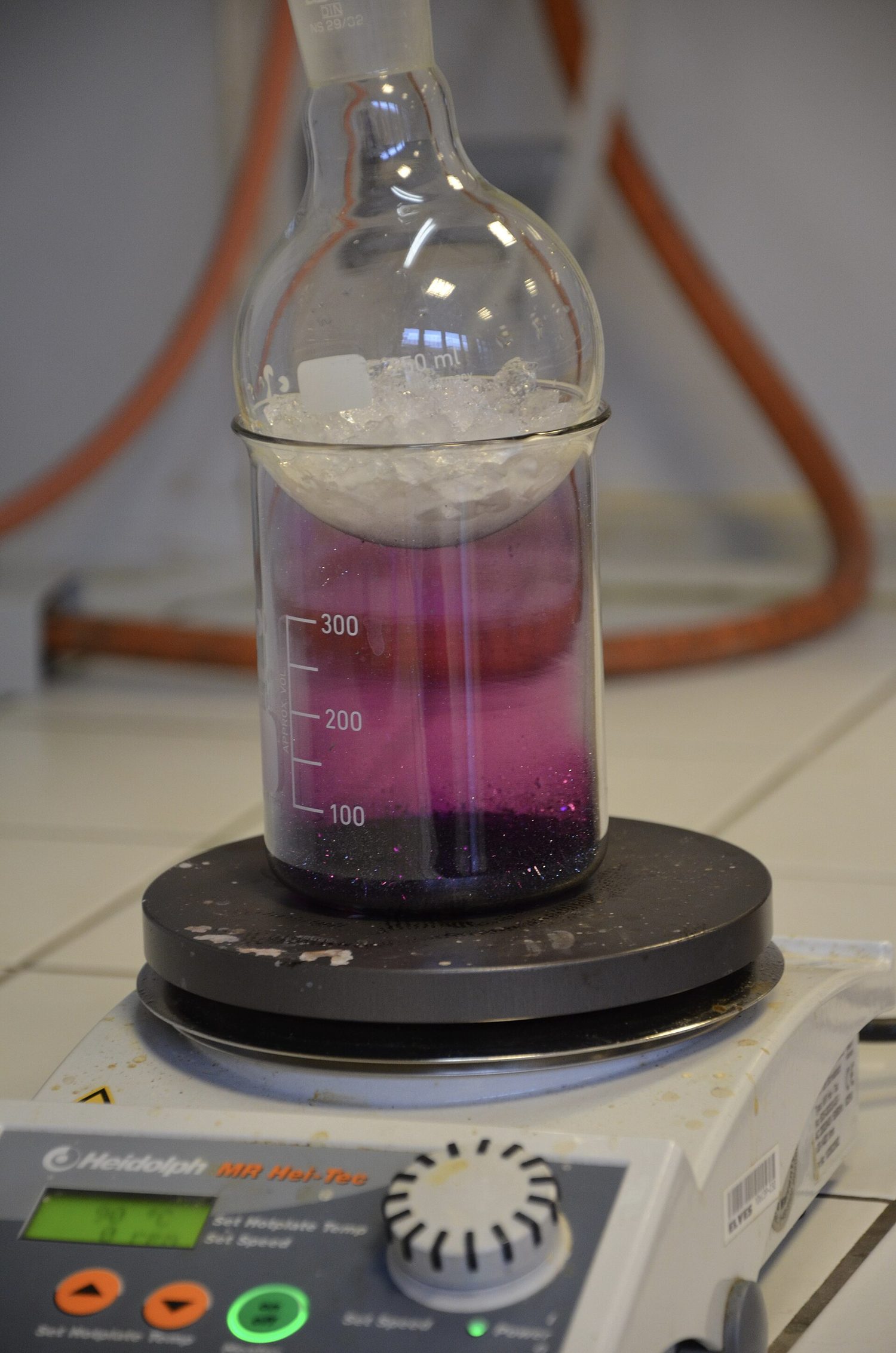
A few substances change straight from solid to gas without melting first. This is called sublimation 升华. In the photo below, warmed solid iodine in a beaker turns directly into a purple gas; the gas then cools on the round flask of ice above and turns back into a solid.
Explaining changes of state with the particle theory
Each change of state is really a change in the energy 能量 of the particles.
When you heat a solid, the particles gain energy and vibrate faster. At the melting point the particles have enough energy to break away from their fixed places and slide around — the solid melts.
When you heat a liquid, the particles move faster. At the boiling point they have enough energy to fully escape the forces of attraction and become a gas.
Cooling does the opposite. The particles lose energy, move more slowly, and the forces of attraction pull them back together.
During a change of state the energy goes into breaking the forces of attraction, not into making the particles move faster. This is why the temperature stays the same while a substance is melting or boiling.
Heating and cooling curves
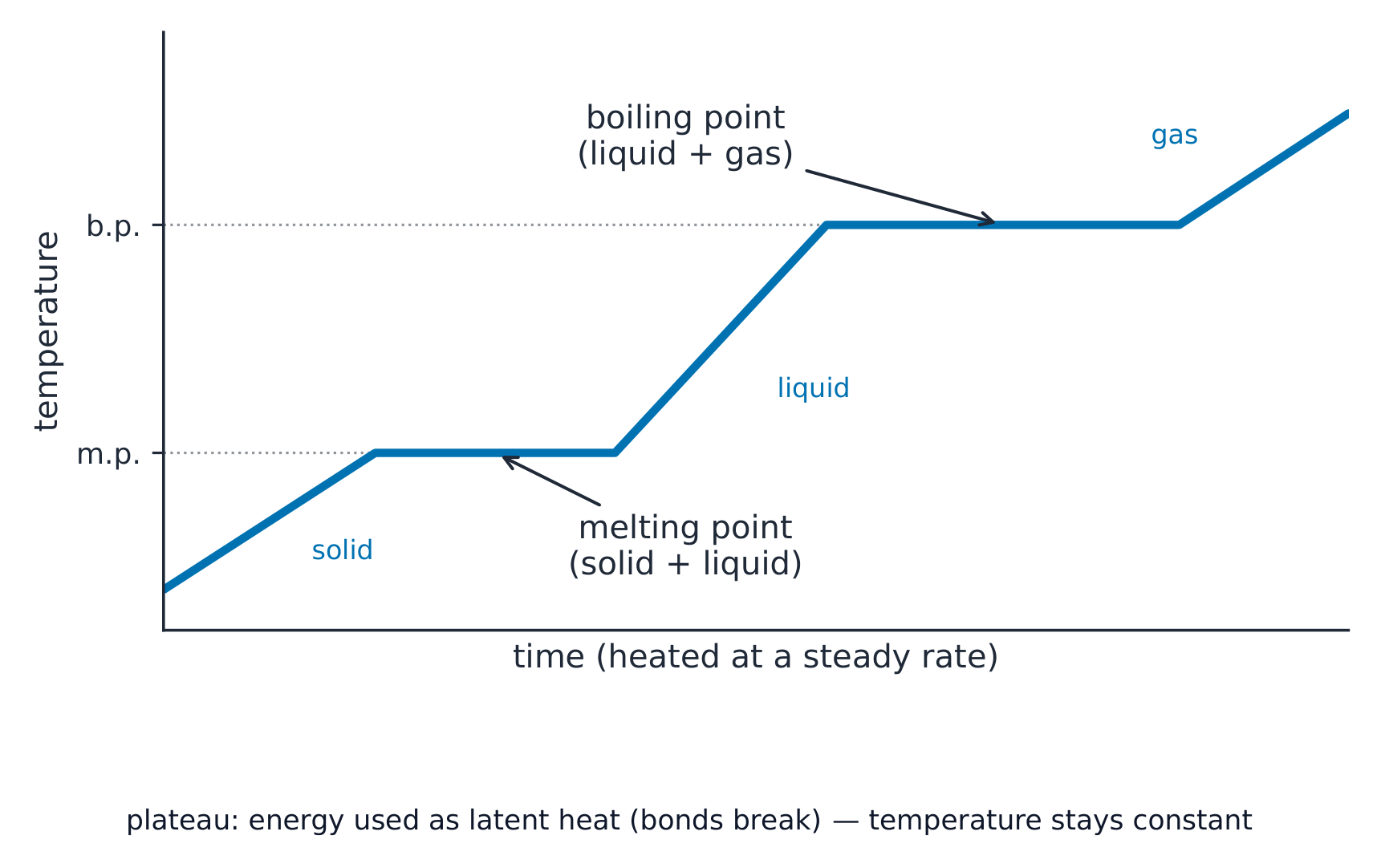
A heating curve 加热曲线 is a graph of temperature against time as you heat a substance steadily. A cooling curve 冷却曲线 is the same graph as the substance cools.
On a heating curve there are two flat (level) parts:
The first flat part is at the melting point. Here solid and liquid are both present. The heat energy breaks the forces holding the solid together, so the temperature does not rise.
The second flat part is at the boiling point. Here liquid and gas are both present, and the temperature again stays constant.
A cooling curve is the reverse. It has a flat part at the boiling point (the gas condenses) and a flat part at the melting point (the liquid freezes). As the particles slow down, thermal energy 热能 is released to the surroundings.
Русский
Таяние льда в воду: переход состояния при нагревании твердого тела.
При нагревании или охлаждении вещество может переходить из одного состояния в другое. Вы должны знать название каждого перехода.
Переход
Что происходит
Название
твердое → жидкость
плавление
плавление
жидкость → твердое
кристаллизация (отвердевание)
отвердевание
жидкость → газ (на поверхности, ниже температуры кипения)
испарение
испарение
жидкость → газ (по всему объему жидкости)
кипение
кипение
газ → жидкость
конденсация
конденсация
Чистое твердое тело плавится при одной постоянной температуре — точке плавления. Чистая жидкость кипит при одной постоянной температуре — точке кипения. То же самое вещество замерзает при своей точке плавления и конденсируется при своей точке кипения.
Нагревание: твердое → жидкость → газ; охлаждение обратимо для каждого перехода
Некоторые вещества переходят напрямую из твердого состояния в газообразное, минуя плавление. Это называется сублимацией. На фотографии ниже нагретый твердый йод в колбе превращается непосредственно в фиолетовый газ; затем газ охлаждается на круглой колбе со льдом сверху и снова превращается в твердое тело.
Нагретый твердый йод сразу превращается в фиолетовый газ (сублимация)Бытовой пример: сухой лед — это твердый углекислый газ, он тоже сублимирует — никогда не оставляет лужи
Объяснение переходов состояния с помощью кинетической теории
Каждый переход состояния на самом деле является изменением энергии частиц.
При нагревании твердого тела частицы получают энергию и колеблются быстрее. При точке плавления частицы имеют достаточно энергии, чтобы освободиться от своих фиксированных мест и начать скользить — твердое тело плавится.
При нагревании жидкости частицы движутся быстрее. При точке кипения они имеют достаточно энергии, чтобы полностью преодолеть силы притяжения и стать газом.
Охлаждение делает обратное. Частицы теряют энергию, движутся медленнее, и силы притяжения стягивают их обратно вместе.
Во время перехода состояния энергия расходуется на разрыв сил притяжения, а не на то, чтобы заставить частицы двигаться быстрее. Вот почему температура остается неизменной, пока вещество плавится или кипит.
Кривые нагревания и охлаждения
Кривая нагревания — это график зависимости температуры от времени при равномерном нагревании вещества. Кривая охлаждения — тот же график, но при охлаждении вещества.
На кривой нагревания есть две горизонтальные (плоские) участка:
Первая горизонтальная часть графика соответствует температуре плавления. Здесь одновременно присутствуют твердое и жидкое вещества. Тепловая энергия разрывает силы, удерживающие частицы в твердом состоянии, поэтому температура не повышается.
Вторая горизонтальная часть графика соответствует температуре кипения. Здесь одновременно присутствуют жидкость и газ, и температура снова остается постоянной.
График охлаждения является обратным процессом. Он имеет горизонтальный участок при температуре кипения (конденсация газа) и горизонтальный участок при температуре плавления (замерзание жидкости). По мере замедления движения частиц тепловая энергия выделяется в окружающую среду.
Температура остается постоянной при плавлении и кипении, пока разрушаются силы притяжения
Explore · Исследовать
Heating a substance through its states · Нагревание вещества через его состояния
Step up the temperature. Adding heat gives the particles more energy until they break free — and the temperature pauses at each change of state while the energy does that work. · Повышайте температуру. Добавление тепла дает частицам больше энергии, пока они не освобождаются — и температура останавливается на каждом переходе состояния, пока энергия выполняет эту работу.
Gases: temperature, pressure and volume · Газы: температура, давление и объем
English
A gas pushes on the walls of its container. This push, spread over the area of the wall, is the pressure 压强 of the gas. Pressure comes from the gas particles hitting the walls.
Effect of temperature
If you heat a fixed mass of gas while keeping the pressure the same, its volume increases.
Using the particle theory: heating gives the particles more kinetic energy 动能, so they move faster. They hit the walls harder and more often. To keep the pressure the same, the gas must take up more space, so the volume gets bigger.
If instead the volume is fixed (a sealed, rigid container), heating the gas makes the pressure rise, because the faster particles collide 碰撞 with the walls harder and more often.
Effect of pressure
If you increase the pressure on a fixed mass of gas while keeping the temperature the same, its volume decreases. Squeezing the gas into a smaller space means the particles hit the walls more often, which is what a higher pressure means.
Русский
Газ давит на стенки своего сосуда. Это давление, распределенное по площади стенки, называется давлением газа. Давление возникает из-за ударов частиц газа о стенки.
Влияние температуры
Если нагреть фиксированную массу газа, сохраняя давление неизменным, его объем увеличится.
Нагретый газ: быстрые частицы распространяются и занимают больше места
С точки зрения частицкой теории: нагревание сообщает частицам больше кинетической энергии, они начинают двигаться быстрее. Они ударяются о стенки сильнее и чаще. Чтобы сохранить давление неизменным, газ должен занять больше пространства, поэтому объем увеличивается.
Если же объем фиксирован (герметичный жесткий сосуд), нагревание газа приводит к росту давления, потому что более быстрые частицы ударяются о стенки сильнее и чаще.
Влияние давления
Если увеличить давление на фиксированную массу газа, сохраняя температуру неизменной, его объем уменьшится. Сжатие газа в меньшем пространстве означает, что частицы ударяются о стенки чаще, что и есть повышение давления.
Сжатие газа в меньший объем заставляет частицы чаще ударяться о стенки, поэтому давление растет
Explore · Исследовать
Gases, pressure & volume · Газы, давление и объем
p = k / V
Squeeze the volume and the pressure rises (Boyle's law). · Сжимайте объем, и давление возрастает (закон Бойля).
1 Describe and explain diffusion in terms of kinetic particle theory
2 Describe and explain the effect of relative molecular mass on the rate of diffusion of gases
Русский
Базовый
Дополнительно
1 Описать и объяснить диффузию с точки зрения кинетической теории частиц
2 Описать и объяснить влияние относительной молекулярной массы на скорость диффузии газов
Source: Cambridge International syllabus · Источник: Программа Cambridge International
English
Diffusion: random motion, one-way flow
Diffusion 扩散 is the spreading of particles from a region where they are crowded to a region where they are spread out — that is, from high concentration 浓度 to low concentration. It happens because particles are always moving in random directions.
Diffusion explains why you can smell food from across a room: the smell particles move and mix with the air until they reach your nose. Diffusion happens in gases and in liquids, but not in solids, because solid particles cannot move from place to place.
Rate of diffusion and molecular mass
Lighter gas particles move faster than heavier ones at the same temperature. So a gas with a smaller relative molecular mass 相对分子质量 (a smaller mass for each molecule) has a faster rate 速率 of diffusion.
A classic experiment shows this. Cotton wool soaked in ammonia 氨气 ($\text{NH}_3$) is put at one end of a long glass tube. Cotton wool soaked in hydrogen chloride 氯化氢 ($\text{HCl}$) is put at the other end. Both gases diffuse along the tube and meet to form a white ring of ammonium chloride 氯化铵 ($\text{NH}_4\text{Cl}$).
Ammonia has $M_r = 17$ and hydrogen chloride has $M_r = 36.5$. Ammonia is lighter, so it diffuses faster and travels further along the tube. The white ring forms nearer the hydrogen chloride end.
Worked example. Bromine ($M_r = 160$) and ammonia ($M_r = 17$) are released at the same moment from opposite ends of a long tube. Which travels further before they meet? Compare the relative molecular masses. Ammonia's $M_r$ is far smaller, so its molecules move faster at the same temperature and it diffuses more quickly. Ammonia therefore travels the greater distance, and the two gases meet nearer the bromine end. The rule is always "lighter means faster" - argue from $M_r$, never from how big the formula looks on paper.
Русский
Диффузия: случайное движение, односторонний поток
Диффузия — это распространение частиц из области, где они расположены густо, в область, где они расположены редко, то есть из зоны высокой концентрации в зону низкой концентрации. Она происходит потому, что частицы постоянно движутся в случайных направлениях.
Частицы диффундируют от высокой концентрации к низкой, пока не распределятся равномерно
Диффузия объясняет, почему можно почувствовать запах еды из другой комнаты: частицы запаха двигаются и смешиваются с воздухом, достигая ваших рецепторов. Диффузия происходит в газах и жидкостях, но не в твердых телах, так как частицы твердого тела не могут перемещаться от одного места к другому.
Скорость диффузии и молекулярная масса
Более легкие частицы газа движутся быстрее, чем тяжелые, при той же температуре. Поэтому газ с меньшей относительной молекулярной массой (меньшей массой каждой молекулы) имеет более высокую скорость диффузии.
Классический опыт это демонстрирует. Хлопок, смоченный в аммиаке ($\text{NH}_3$), помещают в один конец длинной стеклянной трубки. Хлопок, смоченный в хлороводороде ($\text{HCl}$), помещают в другой конец. Оба газа диффундируют вдоль трубки и встречаются, образуя белое кольцо хлорида аммония ($\text{NH}_4\text{Cl}$).
Аммиак имеет $M_r = 17$, а хлороводород — $M_r = 36.5$. Аммиак легче, поэтому он диффундирует быстрее и проходит большее расстояние по трубке. Белое кольцо образуется ближе к концу с хлороводородом.
Аммиак ($M_r=17$) легче, поэтому диффундирует быстрее и дальше; белое кольцо образуется ближе к концу с HCl
Разобранный пример. Бром ($M_r = 160$) и аммиак ($M_r = 17$) выпускают одновременно с противоположных концов длинной трубки. Какой газ пройдет большее расстояние до встречи? Сравните относительные молекулярные массы. Относительная молекулярная масса аммиака ($M_r$) значительно меньше, поэтому его молекулы движутся быстрее при той же температуре и диффундируют быстрее. Следовательно, аммиак проходит большее расстояние, и два газа встречаются ближе к концу с бромом. Правило всегда гласит: «легче = быстрее» — аргументируйте, опираясь на $M_r$, а не на размер формулы на бумаге.
Explore · Исследовать
Diffusion · Диффузия
Release the cloud and the particles spread on their own from the crowded corner until they fill the box evenly — diffusion, sped up by heat. · Выпустите облако, и частицы самостоятельно распространятся из плотного угла, пока равномерно не заполнят коробку — диффузия, ускоренная теплом.
Explore · Исследовать
Diffusion · Диффузия
Set the concentration on each side. Particles spread from high to low concentration until evenly mixed. · Установите концентрацию с каждой стороны. Частицы распространяются от высокой к низкой концентрации, пока не смешаются равномерно.
During melting and boiling the temperature stays constant (the flat parts of a heating curve), because the energy breaks the forces between particles instead of making them move faster.
Evaporation happens only at the surface and at any temperature; boiling happens throughout the liquid at one fixed temperature.
Explain gas behaviour with the particle theory: heating a gas at fixed volume raises the pressure because the particles hit the walls harder and more often — the particles themselves do not get bigger.
Diffusion is faster for lighter particles (smaller $M_r$) and cannot happen in solids. In the ammonia/hydrogen chloride tube the lighter ammonia travels further, so the white ring forms nearer the HCl end.
Русский
Во время плавления и кипения температура остается постоянной (горизонтальные участки графика нагревания), поскольку энергия расходуется на разрыв связей между частицами, а не на увеличение их скорости.
Испарение происходит только на поверхности и при любой температуре; кипение происходит во всем объеме жидкости при одной фиксированной температуре.
Объясните поведение газов с помощью частицкой теории: нагревание газа при постоянном объеме повышает давление, так как частицы ударяются о стенки сильнее и чаще — сами частицы при этом не увеличиваются.
Диффузия протекает быстрее для легких частиц (меньшая $M_r$) и не может происходить в твердых телах. В опыте с аммиаком и хлороводородом более легкий аммиак проходит большее расстояние, поэтому белое кольцо образуется ближе к концу с HCl.
2
Atoms, elements and compounds · Атомы, элементы и соединения
Elements, compounds and mixtures · Элементы, соединения и смеси
Syllabus · Программа
English
Core
Supplement
1 Describe the differences between elements, compounds and mixtures
Русский
Базовый
Дополнительно
1 Опишите различия между элементами, соединениями и смесями
Source: Cambridge International syllabus · Источник: Программа Cambridge International
English
All substances are made from about 100 simple building blocks. Knowing how they are joined lets you sort every substance into one of three groups.
An element 元素 is a substance made of only one type of atom 原子. You cannot break it into anything simpler by a chemical reaction. Examples: copper, oxygen, carbon.
A compound 化合物 is two or more elements chemically joined (bonded) together. The atoms are joined in a fixed ratio. Examples: water, carbon dioxide. A compound has different properties from the elements in it.
A mixture 混合物 is two or more substances that are just mixed, not chemically joined. The parts keep their own properties and can be separated by physical methods. Example: air.
The key difference: in a compound the elements are bonded and can only be separated by chemical reactions; in a mixture they are not bonded and are easy to separate.
Русский
Чистый элемент (ванадий): элементы являются простейшими веществами.
Все вещества состоят примерно из 100 простых строительных блоков. Знание того, как они соединены, позволяет классифицировать каждое вещество в одну из трех групп.
Элемент — это вещество, состоящее только из одного вида атомов. Его невозможно разложить на более простые вещества химическим путем. Примеры: медь, кислород, углерод.
Соединение — это два или более элемента, химически связанные (связанные) вместе. Атомы соединены в строгом фиксированном соотношении. Примеры: вода, углекислый газ. Свойства соединения отличаются от свойств входящих в него элементов.
Смесь — это две или более веществ, которые просто смешаны, но не связаны химически. Компоненты сохраняют свои собственные свойства и могут быть разделены физическими методами. Пример: воздух.
Ключевое различие: в соединении элементы связаны химически и могут быть разделены только химическими реакциями; в смеси они не связаны и легко разделяются.
Простое вещество имеет один вид атомов; соединение — разные атомы, связанные в фиксированном соотношении; смесь не связана химически
Explore · Исследовать
Elements, compounds and mixtures lab · Лабораторная работа по элементам, соединениям и смесям
Classify everyday particle examples by composition. · Классифицируйте повседневные примеры частиц по составу.
1 Describe the structure of the atom as a central nucleus containing neutrons and protons surrounded by electrons in shells
2 State the relative charges and relative masses of a proton, a neutron and an electron
3 Define proton number/atomic number as the number of protons in the nucleus of an atom
4 Define mass number/nucleon number as the total number of protons and neutrons in the nucleus of an atom
5 Determine the electronic configuration of elements and their ions with proton number 1 to 20, e.g. 2,8,3
6 State that: (a) Group VIII noble gases have a full outer electron shell (b) the number of outer shell electrons is equal to the group number in Groups I to VII (c) the number of occupied electron shells is equal to the period number
Русский
Базовый
Дополнительно
1 Опишите строение атома как центрального ядра, содержащего нейтроны и протоны, окруженного электронами в оболочках
2 Укажите относительные заряды и относительные массы протона, нейтрона и электрона
3 Определите протонное число/атомный номер как количество протонов в ядре атома
4 Определите массовое число/нуклонное число как общее количество протонов и нейтронов в ядре атома
5 Определяйте электронную конфигурацию элементов и их ионов с протонным числом от 1 до 20, например, 2,8,3
6 Укажите, что: (a) элементы группы VIII благородные газы имеют заполненную внешнюю электронную оболочку (b) количество внешних электронов равно номеру группы в группах I–VII (c) количество занятых электронных оболочек равно номеру периода
Source: Cambridge International syllabus · Источник: Программа Cambridge International
English
Inside the atom
Every atom has a small, dense centre called the nucleus 原子核. Around it, electrons 电子 move in shells 电子层 (energy levels). The nucleus contains two kinds of particle: protons 质子 and neutrons 中子.
Each particle has a relative mass and a relative charge 电荷. You must learn these values:
Particle
Relative mass
Relative charge
proton
1
$+1$
neutron
1
$0$
electron
$\frac{1}{1840}$ (almost 0)
$-1$
An atom has no overall charge because it has equal numbers of protons ($+1$ each) and electrons ($-1$ each).
Proton number and mass number
Two numbers describe an atom:
The proton number 质子数 (also called the atomic number 原子序数) is the number of protons in the nucleus. It tells you which element the atom is.
The mass number 质量数 (also called the nucleon number 核子数) is the total number of protons and neutrons in the nucleus.
So the number of neutrons $=$ mass number $-$ proton number.
Electronic configuration
The electrons fill the shells from the inside out. The first shell holds up to 2 electrons; the next shells hold up to 8 each (for the first 20 elements). The electronic configuration 电子排布 lists how many electrons are in each shell, starting from the inside.
For example, an atom with 13 electrons has the configuration $2,8,3$. Sodium (proton number 11) is $2,8,1$. Calcium (proton number 20) is $2,8,8,2$.
The configuration links to the Periodic Table 周期表:
A Group 族 number (Groups I to VII) equals the number of electrons in the outer shell. So $2,8,1$ is in Group I.
A Period 周期 number equals the number of shells that hold electrons. So $2,8,1$ has three shells, so it is in Period 3.
The noble gases 稀有气体 in Group VIII (or 0) have a full outer shell, which makes them very unreactive.
Русский
Внутри атома
У каждого атома есть маленькое плотное ядро, называемое ядром. Вокруг него электроны движутся по оболочкам (уровням энергии). Ядро содержит два вида частиц: протоны и нейтроны.
Атом имеет крошечное ядро из протонов и нейтронов, с электронами в оболочках вокруг него
Каждая частица имеет относительную массу и относительный заряд. Вы должны выучить эти значения:
Частица
Относительная масса
Относительный заряд
протон
1
$+1$
нейтрон
1
$0$
электрон
$\frac{1}{1840}$ (почти 0)
$-1$
Атом не имеет суммарного заряда, так как количество протонов (по $+1$ каждый) равно количеству электронов (по $-1$ каждый).
Протонное число и массовое число
Два числа описывают атом:
Протонное число (также называемое атомным номером) — это количество протонов в ядре. Оно указывает, к какому элементу принадлежит атом.
Массовое число (также называемое нуклонным числом) — это общее количество протонов и нейтронов в ядре.
Таким образом, число нейтронов $=$ массовое число $-$ зарядовое число.
Электронная конфигурация
Электроны заполняют оболочки изнутри наружу. Первая оболочка вмещает до 2 электронов; следующие оболочки вмещают до 8 электронов каждая (для первых 20 элементов). Электронная конфигурация показывает, сколько электронов находится в каждой оболочке, начиная с внутренней.
Например, атом с 13 электронами имеет конфигурацию $2,8,3$. Натрий (протонное число 11) имеет $2,8,1$. Кальций (протонное число 20) имеет $2,8,8,2$.
Конфигурация связана с Периодической таблицей:
Номер Группы (Группы I–VII) равен числу электронов во внешней оболочке. Следовательно, ⟨$2,8,1$⟩ относится к Группе I.
Номер Периода равен числу оболочек, содержащих электроны. Следовательно, ⟨$2,8,1$⟩ имеет три оболочки, поэтому он находится в Периоде 3.
Благородные газы в Группе VIII (или 0) имеют заполненную внешнюю оболочку, что делает их очень инертными.
Электронная конфигурация натрия 2,8,1 связана с Периодической таблицей: один внешний электрон означает Группу I, три оболочки означают Период 3
Explore · Исследовать
Electron shells · Электронные оболочки
Change the atomic number and watch the shells fill (2, 8, 8) — the electron arrangement of the first 20 elements. · Измените атомный номер и наблюдайте заполнение оболочек (2, 8, 8) — электронную конфигурацию первых 20 элементов.
1 Define isotopes as different atoms of the same element that have the same number of protons but different numbers of neutrons
3 State that isotopes of the same element have the same chemical properties because they have the same number of electrons and therefore the same electronic configuration
2 Interpret and use symbols for atoms, e.g. $^{12}_{6}\text{C}$, and ions, e.g. $^{35}_{17}\text{Cl}^-$
4 Calculate the relative atomic mass of an element from the relative masses and abundances of its isotopes
Русский
Базовый
Дополнительно
1 Определите изотопы как различные атомы одного элемента, имеющие одинаковое количество протонов, но разное количество нейтронов
3 Укажите, что изотопы одного элемента имеют одинаковые химические свойства, поскольку у них одинаковое количество электронов и, следовательно, одинаковая электронная конфигурация
2 Интерпретируйте и используйте символы для атомов, например, $^{12}_{6}\text{C}$, и ионов, например, $^{35}_{17}\text{Cl}^-$
4 Вычисляйте относительную атомную массу элемента по относительным массам и распространённости его изотопов
Source: Cambridge International syllabus · Источник: Программа Cambridge International
English
Isotopes 同位素 are atoms of the same element that have the same number of protons but different numbers of neutrons. Because the proton number is the same, they are the same element. Because the neutron number is different, they have different mass numbers.
You write an atom with its mass number on top and proton number below, like $^{12}_{6}\text{C}$. For an ion you add the charge, like $^{35}_{17}\text{Cl}^{-}$.
Isotopes of an element have the same chemical properties. This is because chemical reactions only involve electrons, and isotopes have the same number of electrons and the same electronic configuration. (The extra neutrons change only the mass.)
Calculating relative atomic mass
The relative atomic mass 相对原子质量 ($A_r$) of an element is the average mass of its atoms, taking into account how common each isotope is. The abundance 丰度 is the percentage of each isotope.
Worked example. Boron has two isotopes, $^{10}\text{B}$ and $^{11}\text{B}$, and its $A_r$ is 10.8. Find the percentage of each. Let the abundance of $^{11}\text{B}$ be $x$, so the abundance of $^{10}\text{B}$ is $(100 - x)$. Then
$$\frac{11x + 10(100 - x)}{100} = 10.8$$
so $11x + 1000 - 10x = 1080$, giving $x = 80$. Boron is 80%$^{11}\text{B}$ and 20%$^{10}\text{B}$. Check it against common sense: 10.8 lies closer to 11, so the heavier isotope must be the more common one. If your answer gives the majority to the isotope further from $A_r$, you have them the wrong way round.
Русский
Изотопы — это атомы одного и того же элемента, имеющие одинаковое количество протонов, но разное количество нейтронов. Поскольку протонное число одинаково, это один и тот же элемент. Поскольку количество нейтронов различается, у них разные массовые числа.
Атом записывают с массовым числом сверху и протонным числом снизу, например $^{12}_{6}\text{C}$. Для иона добавляют заряд, например $^{35}_{17}\text{Cl}^{-}$.
Изотопы одного элемента имеют одинаковые химические свойства. Это связано с тем, что химические реакции涉及到 только электроны, а изотопы имеют одинаковое количество электронов и одинаковую электронную конфигурацию. (Лишние нейтроны изменяют только массу.)
Расчет относительной атомной массы
Относительная атомная масса ($A_r$) элемента — это средняя масса его атомов с учетом распространенности каждого изотопа. Распространенность — это процентное содержание каждого изотопа.
Относительная атомная масса является взвешенным средним: хлор составляет 75 процентов Cl-35 и 25 процентов Cl-37, поэтому A_r равна 35.5
Разобранный пример. Бор имеет два изотопа, $^{10}\text{B}$ и $^{11}\text{B}$, и его $A_r$ равна 10,8. Найдите процентное содержание каждого. Пусть распространенность $^{11}\text{B}$ будет $x$, тогда распространенность $^{10}\text{B}$ составит $(100 - x)$. Тогда
$$\frac{11x + 10(100 - x)}{100} = 10.8$$
откуда $11x + 1000 - 10x = 1080$, получаем $x = 80$. Бор состоит на 80% из $^{11}\text{B}$ и на 20% из $^{10}\text{B}$. Проверьте это здравым смыслом: 10,8 ближе к 11, значит, более тяжелый изотоп должен быть более распространенным. Если ваш ответ дает большинство изотопу, удаленному от $A_r$, вы перепутали их местами.
Explore · Исследовать
Protons, neutrons & isotopes · Протоны, нейтроны и изотопы
Change the neutrons to make isotopes (same element, different mass number); change the electrons to make ions. · Изменяйте нейтроны, чтобы получить изотопы (тот же элемент, другое массовое число); изменяйте электроны, чтобы получить ионы.
Explore · Исследовать
Isotope lab · Лаборатория изотопов
Classify isotope facts by proton, neutron and mass number. · Классифицируйте факты об изотопах по числу протонов, нейтронов и массовому числу.
1 Describe the formation of positive ions, known as cations, and negative ions, known as anions
5 Describe the giant lattice structure of ionic compounds as a regular arrangement of alternating positive and negative ions
2 State that an ionic bond is a strong electrostatic attraction between oppositely charged ions
6 Describe the formation of ionic bonds between ions of metallic and non-metallic elements, including the use of dot-and-cross diagrams
3 Describe the formation of ionic bonds between elements from Group I and Group VII, including the use of dot-and-cross diagrams
7 Explain in terms of structure and bonding the properties of ionic compounds: (a) high melting points and boiling points (b) good electrical conductivity when aqueous or molten and poor when solid
4 Describe the properties of ionic compounds: (a) high melting points and boiling points (b) good electrical conductivity when aqueous or molten and poor when solid
Русский
Базовый
Дополнительно
1 Опишите образование положительных ионов, называемых катионами, и отрицательных ионов, называемых анионами
5 Опишите гигантскую решётчатую структуру ионных соединений как регулярное чередование положительных и отрицательных ионов
2 Укажите, что ионная связь — это сильное электростатическое притяжение между oppositely заряженными ионами
6 Опишите образование ионных связей между ионами металлических и неметаллических элементов, включая использование диаграмм «точка-крестик»
3 Опишите образование ионных связей между элементами групп I и VII, включая использование диаграмм «точка-крестик»
7 Объясните в терминах структуры и связывания свойства ионных соединений: (a) высокие температуры плавления и кипения (b) хорошая электрическая проводимость в водном растворе или расплаве и плохая в твердом состоянии
4 Опишите свойства ионных соединений: (a) высокие температуры плавления и кипения (b) хорошая электрическая проводимость в водном растворе или расплаве и плохая в твердом состоянии
Source: Cambridge International syllabus · Источник: Программа Cambridge International
English
Ionic bonding: electron transfer
An ion 离子 is an atom (or group of atoms) that has lost or gained electrons, so it has an electric charge.
A metal atom loses electrons to form a positive ion, called a cation 阳离子.
A non-metal atom gains electrons to form a negative ion, called an anion 阴离子.
Atoms do this to get a full outer shell, like a noble gas.
How an ionic bond forms
An ionic bond 离子键 is a strong electrostatic attraction 静电引力 between oppositely charged ions (a $+$ ion and a $-$ ion pull together).
Ionic bonds form between a metal 金属 and a non-metal 非金属. Take sodium chloride, $\text{NaCl}$. Sodium ($2,8,1$) gives its one outer electron to chlorine ($2,8,7$). Now sodium is $\text{Na}^{+}$ ($2,8$) and chlorine is $\text{Cl}^{-}$ ($2,8,8$). Both have full outer shells, and the opposite charges attract.
You can show this with a dot-and-cross diagram: draw each atom's outer-shell electrons as dots for one element and crosses for the other, then show the electron moving from the metal to the non-metal.
The structure and properties of ionic compounds
An ionic compound 离子化合物 is not made of separate molecules 分子. The ions pack together into a giant lattice 晶格 — a regular pattern of huge numbers of alternating 交替 positive and negative ions.
This structure explains the properties:
Property
Reason
high melting point 熔点 and boiling point 沸点
the strong electrostatic attraction between ions needs a lot of energy to break
poor electrical conductivity 导电性 when solid
the ions are fixed in place and cannot move
good conductor when molten 熔融 or aqueous 水溶液
the ions are now free to move and carry charge
Русский
*Ионная связь: перенос электронов
Ион — это атом (или группа атомов), который потерял или приобрел электроны, поэтому обладает электрическим зарядом.
Атом металла теряет электроны, образуя положительный ион, называемый катионом.
Атом неметалла приобретает электроны, образуя отрицательный ион, называемый анионом.
Атомы делают это для получения заполненной внешней оболочки, подобно благородным газам.
Как образуется ионная связь
Ионная связь — это сильное электростатическое притяжение между ионами с противоположными зарядами (ион $+$ и ион $-$ притягиваются друг к другу).
Ионные связи образуются между металлом и неметаллом. Возьмем хлорид натрия, $\text{NaCl}$. Натрий ($2,8,1$) отдает свой один внешний электрон хлору ($2,8,7$). Теперь натрий имеет заряд $\text{Na}^{+}$ ($2,8$), а хлор — заряд $\text{Cl}^{-}$ ($2,8,8$). У обоих заполнены внешние оболочки, и противоположные заряды притягиваются.
Это можно показать с помощью диаграммы «точка-крестик»: нарисуйте внешние электроны каждого атома точками для одного элемента и крестиками для другого, затем покажите переход электрона от металла к неметаллу.
Натрий отдает свой внешний электрон хлору; оба достигают заполненных внешних оболочек, и противоположные заряды притягиваются (синий электрон пришел от натрия)
Строение и свойства ионных соединений
Ионное соединение не состоит из отдельных молекул. Ионы упаковываются вместе, образуя гигантскую кристаллическую решетку — регулярный узор из огромного количества чередующихся положительных и отрицательных ионов.
Ионы упакованы в гигантскую решетку: регулярный, повторяющийся узор из чередующихся положительных и отрицательных ионовКристалл галита: кубическая форма хлорида натрия является отражением его внутренней ионной решетки, увеличенной до видимого размера
Эта структура объясняет следующие свойства:
Свойство
Причина
высокий температура плавления и кипения
сильное электростатическое притяжение между ионами требует много энергии для разрушения
плохая электропроводность в твердом состоянии
ионы зафиксированы в узлах решетки и не могут перемещаться
хорошая проводимость в расплаве или растворе
ионы теперь свободны для движения и переноса заряда
Explore · Исследовать
Forming an ionic bond (NaCl) · Образование ионной связи (NaCl)
Step through it. A metal hands its outer electron to a non-metal; the oppositely charged ions then attract and pack into a giant lattice. · Проходите по шагам. Металл отдает свой внешний электрон неметаллу; противоположно заряженные ионы затем притягиваются и упаковываются в гигантскую решетку.
Explore · Исследовать
Ionic bonding (electron transfer) · Ионная связь (передача электронов)
Step through it: the metal hands its outer electron(s) to the non-metal, both reach full shells, and the resulting + and − ions attract — an ionic bond. · Проходите по шагам: металл отдает свои внешние электроны неметаллу, оба достигают полных оболочек, resulting + и − ионы притягиваются — это ионная связь.
Simple molecules and covalent bonds · Простые молекулы и ковалентные связи
Syllabus · Программа
English
Core
Supplement
1 State that a covalent bond is formed when a pair of electrons is shared between two atoms leading to noble gas electronic configurations
2 Describe the formation of covalent bonds in simple molecules, including $\text{H}_2$, $\text{Cl}_2$, $\text{H}_2\text{O}$, $\text{CH}_4$, $\text{NH}_3$ and $\text{HCl}$. Use dot-and-cross diagrams to show the electronic configurations in these and similar molecules
4 Describe the formation of covalent bonds in simple molecules, including $\text{CH}_3\text{OH}$, $\text{C}_2\text{H}_4$, $\text{O}_2$, $\text{CO}_2$ and $\text{N}_2$. Use dot-and-cross diagrams to show the electronic configurations in these and similar molecules
3 Describe in terms of structure and bonding the properties of simple molecular compounds: (a) low melting points and boiling points (b) poor electrical conductivity
5 Explain in terms of structure and bonding the properties of simple molecular compounds: (a) low melting points and boiling points in terms of weak intermolecular forces (specific types of intermolecular forces are not required) (b) poor electrical conductivity
Русский
Базовый
Дополнительно
1 Укажите, что ковалентная связь образуется при совместном использовании пары электронов двумя атомами, приводя к электронным конфигурациям благородных газов
2 Опишите образование ковалентных связей в простых молекулах, включая $\text{H}_2$, $\text{Cl}_2$, $\text{H}_2\text{O}$, $\text{CH}_4$, $\text{NH}_3$ и $\text{HCl}$. Используйте диаграммы «точка-крестик» для демонстрации электронных конфигураций в этих и подобных молекулах
4 Опишите образование ковалентных связей в простых молекулах, включая $\text{CH}_3\text{OH}$, $\text{C}_2\text{H}_4$, $\text{O}_2$, $\text{CO}_2$ и $\text{N}_2$. Используйте диаграммы «точка-крестик» для демонстрации электронных конфигураций в этих и подобных молекулах
3 Опишите в терминах структуры и связывания свойства простых молекулярных соединений: (a) низкие температуры плавления и кипения (b) плохая электрическая проводимость
5 Объясните в терминах структуры и связывания свойства простых молекулярных соединений: (a) низкие температуры плавления и кипения в рамках слабых межмолекулярных сил (конкретные типы межмолекулярных сил не требуются) (b) плохая электрическая проводимость
Source: Cambridge International syllabus · Источник: Программа Cambridge International
English
Covalent bonding: a shared pair
A covalent bond 共价键 forms when two atoms share a pair of electrons. By sharing, each atom gets a full outer shell (a noble gas configuration). Covalent bonds form between non-metal atoms.
Some molecules to know:
$\text{H}_2$ — two hydrogen atoms share one pair of electrons (a single bond).
$\text{Cl}_2$, $\text{HCl}$ — one shared pair each.
$\text{H}_2\text{O}$ — oxygen shares one pair with each of two hydrogen atoms.
$\text{NH}_3$ — nitrogen shares a pair with each of three hydrogen atoms.
$\text{CH}_4$ — carbon shares a pair with each of four hydrogen atoms.
$\text{O}_2$ and $\text{CO}_2$ have double bonds (two shared pairs); $\text{N}_2$ has a triple bond (three shared pairs); $\text{C}_2\text{H}_4$ and $\text{CH}_3\text{OH}$ also use shared pairs.
In a dot-and-cross diagram for a molecule, you draw the outer electrons of each atom and show which pairs are shared in the overlap between the atoms.
Properties of simple molecular compounds
These substances are made of small, separate molecules.
They have low melting points and boiling points. The covalent bonds inside each molecule are strong, but the intermolecular forces 分子间作用力 (the forces between one molecule and the next) are weak, so little energy is needed to separate the molecules.
They are poor conductors of electricity, because the molecules have no overall charge and no free electrons or ions to carry charge.
Русский
Ковалентная связь: общая пара электроновМодель молекулы воды: атомы делят электроны в ковалентных связях.
Ковалентная связь образуется, когда два атома делят пару электронов. Благодаря делению каждый атом получает заполненную внешнюю оболочку (конфигурацию благородного газа). Ковалентные связи образуются между атомами неметаллов.
Некоторые молекулы, которые нужно знать:
$\text{H}_2$ — два атома водорода делят одну пару электронов (одинарная связь).
$\text{Cl}_2$, $\text{HCl}$ — по одной общей паре электронов.
$\text{H}_2\text{O}$ — кислород делит по одной паре с каждым из двух атомов водорода.
$\text{NH}_3$ — азот делит пару с каждым из трех атомов водорода.
$\text{CH}_4$ — углерод делит пару с каждым из четырех атомов водорода.
$\text{O}_2$ и $\text{CO}_2$ имеют двойные связи (две общие пары); $\text{N}_2$ имеет тройную связь (три общие пары); $\text{C}_2\text{H}_4$ и $\text{CH}_3\text{OH}$ также используют общие пары.
В диаграмме «точка-крестик» для молекулы вы рисуете внешние электроны каждого атома и показываете, какие пары являются общими в области перекрытия атомов.
В ковалентной связи атомы делят пары электронов, чтобы каждый достиг заполненной внешней оболочки
Свойства простых молекулярных соединений
Эти вещества состоят из маленьких, отдельных молекул.
Они имеют низкие температуры плавления и кипения. Ковалентные связи внутри каждой молекулы прочны, но межмолекулярные силы (силы между соседними молекулами) слабы, поэтому для разделения молекул требуется мало энергии.
Они являются плохими проводниками электричества, поскольку молекулы не имеют суммарного заряда и не содержат свободных электронов или ионов для переноса заряда.
Explore · Исследовать
Why a molecule has its shape · Почему молекула имеет свою форму
Shared electron pairs repel one another and spread out as far apart as they can. Four bonding pairs and no lone pairs gives a tetrahedral shape, like methane (CH4). · Общие электронные пары отталкиваются друг от друга и удаляются как можно дальше. Четыре связывающие пары и отсутствие неподеленных пар дают тетраэдрическую форму, как у метана (CH4).
Explore · Исследовать
Covalent bonding (sharing) · Ковалентная связь (общие пары)
Step through it: two non-metal atoms overlap and share a pair of electrons — counting for both — so each reaches a full outer shell. That shared pair is the covalent bond; O₂ shares two pairs (a double bond). · Разберем по шагам: два атома неметалла перекрываются и делят пару электронов — засчитываемую для обоих, — чтобы каждый достиг полной внешней оболочки. Эта общая пара является ковалентной связью; O₂ делит две пары (двойная связь).
1 Describe the giant covalent structures of graphite and diamond
3 Describe the giant covalent structure of silicon(IV) oxide, $\text{SiO}_2$
2 Relate the structures and bonding of graphite and diamond to their uses, limited to: (a) graphite as a lubricant and as an electrode (b) diamond in cutting tools
4 Describe the similarity in properties between diamond and silicon(IV) oxide, related to their structures
Русский
Базовый
Дополнительно
1 Опишите гигантские ковалентные структуры графита и алмаза
3 Опишите гигантскую ковалентную структуру диоксида кремния(IV), $\text{SiO}_2$
2 Связывайте структуру и связывание графита и алмаза с их применением, ограничиваясь: (a) графит как смазочное вещество и как электрод (b) алмаз в режущих инструментах
4 Опишите сходство свойств алмаза и диоксида кремния(IV), связанное с их структурой
Source: Cambridge International syllabus · Источник: Программа Cambridge International
English
Some covalent substances are not small molecules. Instead, millions of atoms are joined by covalent bonds into one giant covalent structure 巨型共价结构. The two you must know are both forms of carbon.
Diamond 金刚石: each carbon atom is bonded to four other carbon atoms. This makes a very strong, rigid 3-D network. Diamond is extremely hard, so it is used in cutting tools 切割工具.
Graphite 石墨: each carbon atom is bonded to only three others, forming flat layers 层. There are weak forces between the layers, so the layers can slide over each other — this makes graphite a good lubricant 润滑剂. The fourth outer electron of each carbon is free; these delocalised electrons 离域电子 can move, so graphite conducts electricity and is used as an electrode 电极.
Silicon(IV) oxide 二氧化硅 ($\text{SiO}_2$) has a giant covalent structure like diamond, so it is also very hard and has a very high melting point.
Русский
Некоторые ковалентные вещества не являются простыми молекулами. Вместо этого миллионы атомов соединены ковалентными связями в одну гигантскую ковалентную структуру. Две такие структуры, которые необходимо знать, являются формами углерода.
Алмаз: каждый атом углерода связан с четырьмя другими атомами углерода. Это образует очень прочную, жесткую 3-D сетку. Алмаз исключительно тверд, поэтому используется в режущих инструментах.
Графит: каждый атом углерода связан только с тремя другими, образуя плоские слои. Между слоями существуют слабые силы, поэтому слои могут скользить друг относительно друга — это делает графит хорошим смазочным материалом. Четвертый внешний электрон каждого атома углерода становится свободным; эти ** делокализованные электроны** могут перемещаться, поэтому графит проводит электричество и используется в качестве электрода.
Алмаз связывает каждый атом углерода с четырьмя другими (твердый); графит образует плоские слои со слабыми силами между ними (скользкий)Природный графит: именно слабые силы между слоями делают образец хрупким и позволяют ему оставлять след на бумаге
Оксид кремния(IV) ($\text{SiO}_2$) имеет гигантскую ковалентную структуру, подобную алмазу, поэтому он также очень тверд и имеет очень высокую температуру плавления.
Explore · Исследовать
Giant covalent lab · Лабораторная работа с гигантскими ковалентными структурами
Compare giant covalent structures by bonding and properties. · Сравните гигантские ковалентные структуры по типу связей и свойствам.
1 Describe metallic bonding as the electrostatic attraction between the positive ions in a giant metallic lattice and a ‘sea’ of delocalised electrons
2 Explain in terms of structure and bonding the properties of metals: (a) good electrical conductivity (b) malleability and ductility
Русский
Базовый
Дополнительно
1 Опишите металлическую связь как электростатическое притяжение между положительными ионами в гигантской металлической решетке и «морем» делокализованных электронов
2 Объясните в терминах структуры и связывания свойства металлов: (a) хорошая электрическая проводимость (b) пластичность и ковкость
Source: Cambridge International syllabus · Источник: Программа Cambridge International
English
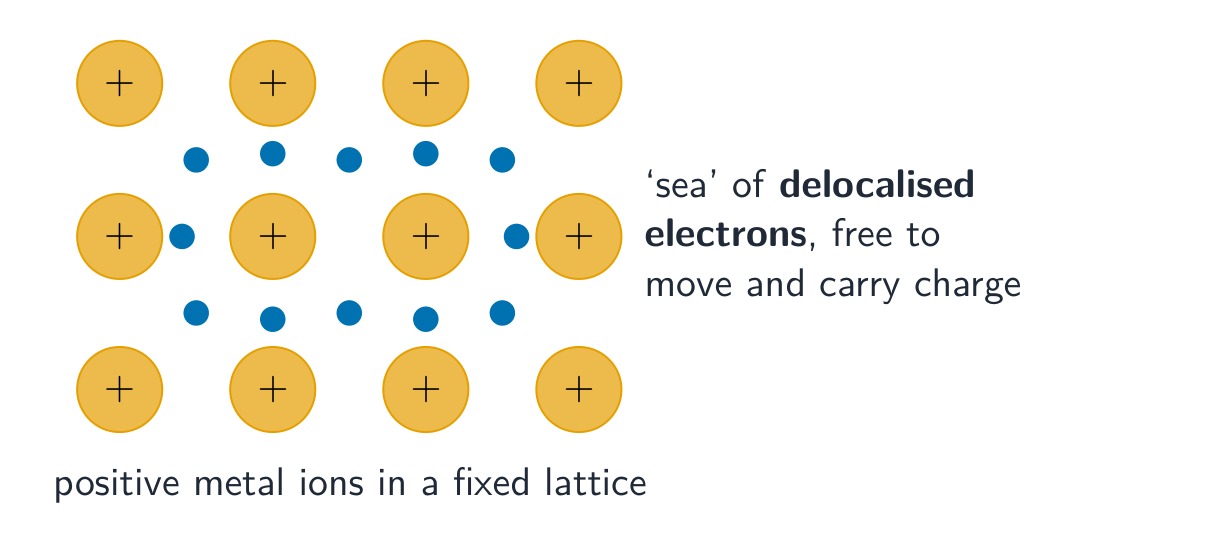
A metal is a giant structure of positive ions surrounded by a 'sea' of delocalised electrons that are free to move through the whole metal. Metallic bonding 金属键 is the strong electrostatic attraction between these positive ions and the sea of electrons.
This explains two key properties of metals:
Good electrical conductivity: the delocalised electrons are free to move and carry charge through the metal.
Malleability 展性 (can be hammered into sheets) and ductility 延性 (can be pulled into wires): the layers of positive ions can slide over each other without breaking the metallic bond, so the metal changes shape instead of shattering.
Русский
Металл представляет собой гигантскую структуру положительных ионов, окруженных «морем» делокализованных электронов, которые свободно перемещаются по всему металлу. Металлическая связь — это сильное электростатическое притяжение между этими положительными ионами и морем электронов.
Металл — это положительные ионы в «море» делокализованных электронов, которые свободны для движения и переноса заряда
Это объясняет два ключевых свойства металлов:
Хорошая электропроводность: делокализованные электроны свободны для движения и переноса заряда через металл.
Маллабильность (можно раскатать в листы) и ковкость (можно вытянуть в проволоку): слои положительных ионов могут скользить друг относительно друга, не разрушая металлическую связь, поэтому металл меняет форму, а не крошится.
Explore · Исследовать
Inside a metal — and why it behaves that way · Внутри металла — и почему он ведет себя именно так
Step through it. Positive ions sit in a shared sea of delocalised electrons — that one picture explains conduction and why metals bend instead of snapping. · Разберем по шагам. Положительные ионы находятся в общем море делокализованных электронов — именно эта картина объясняет проводимость и то, почему металлы гнутся, а не ломаются.
Number of neutrons = mass number − proton number. The proton number is what decides which element an atom is.
Isotopes have the same chemical properties because reactions involve only electrons, and isotopes share the same electron configuration; only the mass differs.
Match structure to properties: ionic = giant lattice (high melting point; conducts only when molten or aqueous); simple molecular = weak forces between molecules (low melting point; no conduction); giant covalent = very hard, very high melting point.
Graphite conducts and is slippery (one free electron per carbon; layers slide); diamond does neither (all four electrons bonded, so hard and non-conducting). Metals conduct and bend thanks to the sea of delocalised electrons.
For relative atomic mass, take the weighted average: $A_r = \dfrac{\sum(\text{isotope mass} \times \text{abundance})}{100}$.
Русский
Число нейтронов = массовое число − порядковый номер. Именно порядковый номер определяет, какой это элемент.
Изотопы имеют одинаковые химические свойства, так как реакции涉及到 только электроны, а изотопы имеют одинаковую электронную конфигурацию; отличается только масса.
Сопоставьте структуру со свойствами: ионная = гигантская решётка (высокая температура плавления; проводит ток только в расплаве или растворе); простая молекулярная = слабые силы между молекулами (низкая температура плавления; не проводит ток); гигантская ковалентная = очень твёрдая, очень высокая температура плавления.
Графит проводит ток и скользкий (один свободный электрон на углерод; слои скользят); алмаз не делает ни того, ни другого (все четыре электрона связаны, поэтому он твёрдый и не проводит ток). Металлы проводят ток и гнутся благодаря «морю» делокализованных электронов.
Для относительной атомной массы берите средневзвешенное значение: $A_r = \dfrac{\sum(\text{isotope mass} \times \text{abundance})}{100}$.
Stoichiometry 化学计量 is the study of the amounts of substances in a reaction — how much reacts and how much is made. This topic is mostly about counting atoms and doing calculations.
3.1
Chemical formulae
Syllabus · Программа
English
Core
Supplement
1 State the formulae of the elements and compounds named in the subject content
2 Define the molecular formula of a compound as the number and type of different atoms in one molecule
5 Define the empirical formula of a compound as the simplest whole number ratio of the different atoms or ions in a compound
3 Deduce the formula of a simple compound from the relative numbers of atoms present in a model or a diagrammatic representation
6 Deduce the formula of an ionic compound from the relative numbers of the ions present in a model or a diagrammatic representation or from the charges on the ions
4 Construct word equations and symbol equations to show how reactants form products, including state symbols
7 Construct symbol equations with state symbols, including ionic equations
8 Deduce the symbol equation with state symbols for a chemical reaction, given relevant information
Русский
Базовый
Дополнительно
1 Укажите формулы элементов и соединений, упомянутых в содержании программы
2 Определите молекулярную формулу соединения как количество и тип различных атомов в одной молекуле
5 Определите эмпирическую формулу соединения как простейшее целочисленное соотношение различных атомов или ионов в соединении
3 Вывести формулу простого соединения на основе относительного количества атомов, присутствующих в модели или схематическом изображении
6 Вывести формулу ионного соединения на основе относительного количества ионов, присутствующих в модели или схематическом изображении, или на основе зарядов ионов
4 Составлять словесные уравнения и символьные уравнения для демонстрации превращения реагентов в продукты, включая символы агрегатных состояний
7 Составлять символьные уравнения со символами агрегатных состояний, включая ионные уравнения
8 Выводить символьное уравнение со символами агрегатных состояний для химической реакции, используя соответствующую информацию
Source: Cambridge International syllabus · Источник: Программа Cambridge International
A formula 化学式 shows which atoms 原子 are in a substance, and how many of each. There are two kinds of formula you must know.
The molecular formula 分子式 is the actual number of each atom in one molecule 分子. For glucose it is $\text{C}_6\text{H}_{12}\text{O}_6$.
The empirical formula 实验式 is the simplest whole-number ratio 比例 of the atoms or ions 离子 in a compound 化合物. For glucose it is $\text{CH}_2\text{O}$.
Working out a formula
If you are given a model or diagram, just count the atoms of each element and write them as a formula.
For an ionic compound 离子化合物 you can work out the formula from the charges on the ions. The total positive charge must balance the total negative charge, because the compound has no overall charge. Some common ions:
For example, $\text{Na}^{+}$ and $\text{O}^{2-}$: you need two $\text{Na}^{+}$ to balance one $\text{O}^{2-}$, so the formula is $\text{Na}_2\text{O}$.
For an ionic compound, the ion charges cross over to give the formula (here $\text{Al}_2\text{O}_3$)
Explore · Исследовать
Formula writing route · Путь составления формул
Follow charges or valencies to a neutral chemical formula. · Следуйте зарядам или валентностям, чтобы получить нейтральную химическую формулу.
A balanced symbol equation has the same number of each atom on both sides
You add state symbols 状态符号 in brackets to show the physical state: $(s)$ solid, $(l)$ liquid, $(g)$ gas, and $(aq)$ for aqueous 水溶液 (dissolved in water).
An ionic equation 离子方程式 shows only the ions that actually change. Ions that are the same on both sides are spectator ions 旁观离子 and are left out. For example, when an acid reacts with an alkali:
Step the coefficients until every element has the same number of atoms on both sides. · Подбирать коэффициенты до тех пор, пока у каждого элемента не будет одинаковое число атомов с обеих сторон.
1 Describe relative atomic mass, $A_r$, as the average mass of the isotopes of an element compared to 1/12th of the mass of an atom of $^{12}\text{C}$
2 Define relative molecular mass, $M_r$, as the sum of the relative atomic masses. Relative formula mass, $M_r$, will be used for ionic compounds
3 Calculate reacting masses in simple proportions. Calculations will not involve the mole concept
Русский
Базовый
Дополнительно
1 Описывать относительную атомную массу, $A_r$, как среднюю массу изотопов элемента по сравнению с 1/12 частью массы атома $^{12}\text{C}$
2 Определять относительную молекулярную массу, $M_r$, как сумму относительных атомных масс. Для ионных соединений будет использоваться относительная формульная масса, $M_r$
3 Рассчитывать массы реагирующих веществ в простых пропорциях. Вычисления не будут включать понятие моля
Source: Cambridge International syllabus · Источник: Программа Cambridge International
A laboratory balance measures mass — the basis of mole calculations.
The relative atomic mass 相对原子质量 ($A_r$) of an element 元素 is the average mass 质量 of its atoms compared to $\tfrac{1}{12}$ of the mass of one $^{12}\text{C}$ atom.
The relative molecular mass 相对分子质量 ($M_r$) is the sum of the relative atomic masses of all the atoms in the molecule. For ionic compounds we use the relative formula mass 相对式量, found the same way from the formula.
You can sometimes find a reacting mass without the mole. If 24 g of magnesium makes 40 g of magnesium oxide, then 12 g of magnesium (half as much) makes 20 g of magnesium oxide.
Explore · Исследовать
Formula mass lab · Лабораторная работа: расчет формульной массы
mass = moles x Mr · масса = количество вещества × Mr
Change number of formula units and see total mass scale. · Изменить количество формульных единиц и увидеть масштаб общей массы.
2 State that the mole, mol, is the unit of amount of substance and that one mole contains $6.02 \times 10^{23}$ particles, e.g. atoms, ions, molecules; this number is the Avogadro constant
3 Use the relationship $\text{amount of substance (mol)} = \frac{\text{mass (g)}}{\text{molar mass (g/mol)}}$ to calculate: (a) amount of substance (b) mass (c) molar mass (d) relative atomic mass or relative molecular/formula mass (e) number of particles, using the value of the Avogadro constant
4 Use the molar gas volume, taken as $24\text{ dm}^3$ at room temperature and pressure, r.t.p., in calculations involving gases
1 State that concentration can be measured in $\text{g/dm}^3$ or $\text{mol/dm}^3$
5 Calculate stoichiometric reacting masses, limiting reactants, volumes of gases at r.t.p., volumes of solutions and concentrations of solutions expressed in $\text{g/dm}^3$ and $\text{mol/dm}^3$, including conversion between $\text{cm}^3$ and $\text{dm}^3$
6 Use experimental data from a titration to calculate the moles of solute, or the concentration or volume of a solution
7 Calculate empirical formulae and molecular formulae, given appropriate data
8 Calculate percentage yield, percentage composition by mass and percentage purity, given appropriate data
Русский
Базовый
Дополнительно
2 Утверждать, что моль, mol, является единицей количества вещества, и что один моль содержит $6.02 \times 10^{23}$ частиц, например атомов, ионов, молекул; это число является постоянной Авогадро
3 Использовать соотношение $\text{amount of substance (mol)} = \frac{\text{mass (g)}}{\text{molar mass (g/mol)}}$ для вычисления: (a) количества вещества (b) массы (c) молярной массы (d) относительной атомной массы или относительной молекулярной/формульной массы (e) числа частиц, используя значение постоянной Авогадро
4 Использовать молярный объём газа, принятый равным $24\text{ dm}^3$ при комнатной температуре и давлении (r.t.p.), в расчётах, связанных с газами
1 Утверждать, что концентрацию можно измерять в $\text{g/dm}^3$ или $\text{mol/dm}^3$
5 Рассчитывать стехиометрические массы реагирующих веществ, лимитирующий реагент, объемы газов при r.t.p., объемы растворов и концентрации растворов, выраженные в $\text{g/dm}^3$ и $\text{mol/dm}^3$, включая преобразование между $\text{cm}^3$ и $\text{dm}^3$
6 Использовать экспериментальные данные титрования для расчета молей растворенного вещества, либо концентрации или объема раствора
7 Рассчитывать эмпирические и молекулярные формулы на основе соответствующих данных
8 Рассчитывать процентный выход, процентный состав по массе и процентную чистоту на основе соответствующих данных
Source: Cambridge International syllabus · Источник: Программа Cambridge International
The mole 摩尔 (symbol mol) is the unit for the amount of substance 物质的量. One mole of any substance contains $6.02 \times 10^{23}$particles 粒子 (atoms, ions or molecules). This number is the Avogadro constant 阿伏伽德罗常数.
The molar mass 摩尔质量 is the mass of one mole, in grams per mole (g/mol). Its number is the same as the $A_r$ or $M_r$. The key relationship is:
$$\text{amount (mol)} = \frac{\text{mass (g)}}{\text{molar mass (g/mol)}}$$
Worked example. How many moles are in 36 g of water? Molar mass of water $= 18$ g/mol.
$$n = \frac{36}{18} = 2 \text{ mol}$$
To find the number of particles, multiply the moles by the Avogadro constant.
Volumes of gases
At room temperature and pressure (r.t.p.), one mole of any gas takes up the same volume 体积. This molar gas volume 摩尔气体体积 is $24 \text{ dm}^3$.
One mole of any gas fills 24 cubic decimetres at room temperature and pressure
$$\text{volume of gas (dm}^3) = \text{amount (mol)} \times 24$$
Worked example. What volume does $0.25$ mol of carbon dioxide occupy at r.t.p.?
A titration measures exactly how much acid reacts with a base.
Most calculations follow the same steps: change the known amount into moles, use the balanced equation to find the moles of what you want, then change back into mass, volume or concentration.
Worked example. What mass of magnesium oxide forms when 12 g of magnesium burns completely? $2\text{Mg} + \text{O}_2 \rightarrow 2\text{MgO}$. ($A_r$: Mg $= 24$, O $= 16$.)
Moles of Mg $= 12 / 24 = 0.5$ mol. The ratio Mg : MgO is $1 : 1$, so $0.5$ mol of MgO forms. Its molar mass is $24 + 16 = 40$ g/mol, so the mass is $0.5 \times 40 = 20$ g — the same answer as the simple-proportion method above.
Limiting reactant
When two reactants are mixed, often one runs out first. This is the limiting reactant 限量反应物. It decides how much product can form; any other reactant is in excess (left over).
B runs out first, so it is the limiting reactant and sets how much product forms; the spare A is left over in excess
Worked example. 8 g of hydrogen reacts with 8 g of oxygen: $2\text{H}_2 + \text{O}_2 \rightarrow 2\text{H}_2\text{O}$. Which is the limiting reactant, and what mass of water forms? ($A_r$: H $= 1$, O $= 16$.)
Moles of $\text{H}_2 = 8 / 2 = 4$ mol; moles of $\text{O}_2 = 8 / 32 = 0.25$ mol. The equation needs $2\text{H}_2$ for every one $\text{O}_2$, so $0.25$ mol of $\text{O}_2$ reacts with only $0.5$ mol of $\text{H}_2$. There is far more hydrogen than that, so oxygen is the limiting reactant and the hydrogen is in excess. The oxygen makes $2 \times 0.25 = 0.5$ mol of water, so the mass is $0.5 \times 18 = 9$ g. Always work in moles, not masses — the reactant with the smaller mass is not always the one that runs out.
Titration calculation
In a titration 滴定 you measure the volume of one solution that reacts with another. From the volume and concentration you find the moles of one solute 溶质, then use the equation ratio to find the moles, concentration or volume of the other.
Worked example.$25.0 \text{ cm}^3$ of sodium hydroxide solution is exactly neutralised by $20.0 \text{ cm}^3$ of $0.10 \text{ mol/dm}^3$ hydrochloric acid. $\text{NaOH} + \text{HCl} \rightarrow \text{NaCl} + \text{H}_2\text{O}$. Find the concentration of the sodium hydroxide.
Moles of HCl $= 0.10 \times \dfrac{20.0}{1000} = 0.0020$ mol. The ratio is $1 : 1$, so there are $0.0020$ mol of NaOH in $25.0 \text{ cm}^3$:
The titration calculation: known solution to moles, ratio, then the unknown concentration
Empirical and molecular formulae from data
To find an empirical formula from masses or percentages:
Divide each element's mass (or %) by its $A_r$.
Divide all the answers by the smallest one to get the simplest ratio.
To find the molecular formula, compare the empirical formula mass with the real $M_r$ and multiply up.
Worked example. A compound contains $40\%$ calcium, $12\%$ carbon and $48\%$ oxygen by mass. Find its empirical formula. ($A_r$: Ca $= 40$, C $= 12$, O $= 16$.)
Divide each percentage by its $A_r$: Ca $= 40/40 = 1$, C $= 12/12 = 1$, O $= 48/16 = 3$. The ratio is $1 : 1 : 3$, so the empirical formula is $\text{CaCO}_3$.
Percentages
Percentage yield 产率 compares how much product you actually got with the most you could get: $\dfrac{\text{actual}}{\text{theoretical}} \times 100$.
Percentage composition by mass 质量分数 of an element $= \dfrac{\text{mass of the element}}{M_r} \times 100$.
Percentage purity 纯度$= \dfrac{\text{mass of pure substance}}{\text{mass of impure sample}} \times 100$.
Worked example. Find the percentage by mass of nitrogen in ammonium nitrate, $\text{NH}_4\text{NO}_3$. ($A_r$: N $= 14$, H $= 1$, O $= 16$.)
$M_r = (2 \times 14) + (4 \times 1) + (3 \times 16) = 80$. The mass of nitrogen is $2 \times 14 = 28$, so
percentage composition by mass/pəˈsentɪdʒ ˌkɒmpəˈzɪʃn baɪ mæs/
процентный состав по массе
percentage purity/pəˈsentɪdʒ ˈpjʊərɪti/
процентная чистота
3.3
Exam tips
Always turn masses, gas volumes and concentrations into moles first, use the balanced equation's ratio, then convert back. Never compare masses directly across an equation.
Key formulas: $n = \dfrac{\text{mass}}{M_r}$, gas volume $= n \times 24\ \text{dm}^3$ at r.t.p., and concentration $= \dfrac{n}{\text{volume in dm}^3}$. Change cm³ to dm³ by dividing by 1000.
To balance a symbol equation you may only change the big numbers in front of a formula, never the small subscripts inside it.
The limiting reactant is the one that runs out (fewest moles once you allow for the ratio); it sets how much product forms. The other reactant is in excess.
Percentage yield = actual ÷ theoretical × 100; percentage purity = mass of pure substance ÷ mass of sample × 100. Both are always 100% or less.
1 Define electrolysis as the decomposition of an ionic compound, when molten or in aqueous solution, by the passage of an electric current
8 Describe the transfer of charge during electrolysis to include: (a) the movement of electrons in the external circuit (b) the loss or gain of electrons at the electrodes (c) the movement of ions in the electrolyte
2 Identify in simple electrolytic cells: (a) the anode as the positive electrode (b) the cathode as the negative electrode (c) the electrolyte as the molten or aqueous substance that undergoes electrolysis
3 Identify the products formed at the electrodes and describe the observations made during the electrolysis of: (a) molten lead(II) bromide (b) concentrated aqueous sodium chloride (c) dilute sulfuric acid using inert electrodes made of platinum or carbon/graphite
9 Identify the products formed at the electrodes and describe the observations made during the electrolysis of aqueous copper(II) sulfate using inert carbon/graphite electrodes and when using copper electrodes
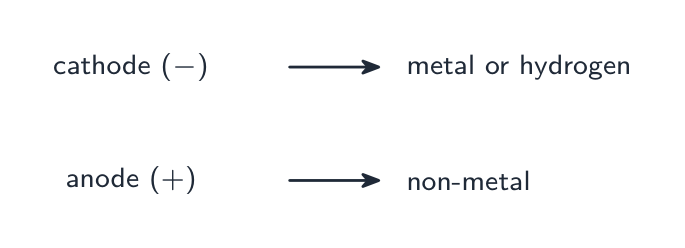
4 State that metals or hydrogen are formed at the cathode and that non-metals (other than hydrogen) are formed at the anode
5 Predict the identity of the products at each electrode for the electrolysis of a binary compound in the molten state
10 Predict the identity of the products at each electrode for the electrolysis of a halide compound in dilute or concentrated aqueous solution
11 Construct ionic half-equations for reactions at the anode (to show oxidation) and at the cathode (to show reduction)
6 State that metal objects are electroplated to improve their appearance and resistance to corrosion
7 Describe how metals are electroplated
Русский
Базовый
Дополнительно
1 Определять электролиз как разложение ионного соединения, находящегося в расплаве или водном растворе, под действием электрического тока
8 Описывать перенос заряда во время электролиза, включая: (a) движение электронов во внешней цепи (b) потерю или присоединение электронов на электродах (c) движение ионов в электролите
2 Определять в простых электролитических ячейках: (a) анод как положительный электрод (b) катод как отрицательный электрод (c) электролит как расплав или водный раствор, подвергающийся электролизу
3 Определять продукты, образующиеся на электродах, и описывать наблюдения, сделанные во время электролиза: (a) расплавленного бромидсвинца(II) (b) концентрированного водного раствора хлорида натрия (c) разбавленной серной кислоты с использованием инертных электродов из платины или углерода/графита
9 Определять продукты, образующиеся на электродах, и описывать наблюдения, сделанные во время электролиза водного раствора сульфата меди(II) с использованием инертных углеродных/графитовых электродов и при использовании медных электродов
4 Утверждать, что на катоде образуются металлы или водород, а на аноде — неметаллы (кроме водорода)
5 Предсказывать идентичность продуктов на каждом электроде при электролизе бинарного соединения в расплавленном состоянии
10 Предсказывать идентичность продуктов на каждом электроде при электролизе галогенидного соединения в разбавленном или концентрированном водном растворе
11 Составлять ионные полуреакции для реакций на аноде (для демонстрации окисления) и на катоде (для демонстрации восстановления)
6 Утверждать, что металлические изделия электропокрывают для улучшения их внешнего вида и устойчивости к коррозии
7 Описывать процесс электропокрытия металлов
Source: Cambridge International syllabus · Источник: Программа Cambridge International
English
Electrolysis: ions discharge at the electrodes
Electrolysis 电解 is the breaking down (decomposition 分解) of an ionic compound 离子化合物 — when it is molten 熔融 or in aqueous 水溶液 solution — by passing an electric current 电流 through it.
It only works when the substance is molten or dissolved, because then the ions 离子 are free to move and carry the charge. A solid ionic compound cannot be electrolysed because its ions are locked in place.
The electrolytic cell
The set-up is called an electrolytic cell 电解池. Two electrodes 电极 (solid conductors) dip into the electrolyte 电解质 — the molten or aqueous substance being broken down.
The anode 阳极 is the positive ($+$) electrode.
The cathode 阴极 is the negative ($-$) electrode.
The electrodes are often inert 惰性 (they do not react), such as platinum 铂 or carbon/graphite 石墨.
What is formed at each electrode
There is a simple rule:
Metals 金属 or hydrogen 氢气 are formed at the cathode.
Non-metals 非金属 (other than hydrogen) are formed at the anode.
For aqueous solutions, the product can depend on whether the solution is dilute 稀 or concentrated 浓. Here are the three Core examples:
Electrolyte
At the cathode ($-$)
At the anode ($+$)
molten lead(II) bromide, $\text{PbBr}_2$
lead 铅 (silvery liquid)
bromine 溴 (red-brown vapour)
concentrated aqueous sodium chloride
hydrogen (bubbles of gas)
chlorine 氯气 (pale green gas)
dilute sulfuric acid 硫酸
hydrogen (bubbles of gas)
oxygen 氧气 (bubbles of gas)
Worked example. Predict the products of electrolysing molten zinc chloride, $\text{ZnCl}_2$. Because it is molten, only zinc ions and chloride ions are present - there is no water to complicate things. Zinc is a metal, so it forms at the cathode: $\text{Zn}^{2+}$ ions gain electrons and silvery zinc appears. Chlorine is a non-metal, so it forms at the anode: pale green chlorine gas bubbles off. Always check the state first. A molten compound simply gives you its own two elements, while an aqueous one brings water into the competition - which is why concentrated sodium chloride solution gives hydrogen at the cathode rather than sodium.
How the charge moves
During electrolysis:
Electrons 电子 move through the wires (the external circuit 外电路) from the power supply.
At the cathode, positive ions gain electrons. Gaining electrons is reduction 还原.
At the anode, negative ions lose electrons. Losing electrons is oxidation 氧化.
Inside the electrolyte, the ions move: positive ions go to the cathode and negative ions go to the anode.
You can write a half-equation 半反应式 for each electrode. For molten lead(II) bromide:
The product at the anode depends on the electrode:
With inert carbon electrodes: copper 铜 forms at the cathode and oxygen forms at the anode. The blue colour of the solution slowly fades as copper is removed.
With copper electrodes: copper forms at the cathode, while the anode itself dissolves into the solution. The blue colour stays the same. This is used to purify copper.
Electroplating
Electroplating 电镀 means covering a metal object with a thin layer of another metal. This improves its appearance and its resistance to corrosion 腐蚀 (rusting and wearing away).
To electroplate an object:
the object to be coated is made the cathode;
the plating metal is made the anode;
the electrolyte is a solution containing ions of the plating metal.
Русский
Электролиз: ионы разряжаются на электродах
Электролиз — это разложение (разложение) ионного соединения — когда оно находится в расплавленном состоянии или в водном растворе — под действием пропускаемого через него электрического тока.
Ячейка электролиза расщепляет соединение с помощью электрического тока.
Это работает только тогда, когда вещество расплавлено или растворено, так как тогда ионы свободны для движения и переносят заряд. Твердое ионное соединение нельзя электролизовать, поскольку его ионы зафиксированы.
Электролиз воды: пузырьки газа выделяются у каждого электрода и собираются в пробирках сверху; водорода получается примерно в два раза больше, чем кислорода
Электролитическая ячейка
Эта установка называется электролитической ячейкой. Два электрода (твердые проводники) погружены в электролит — расплавленное или водное вещество, которое разлагается.
Анод — это положительный ($+$) электрод.
Катод — это отрицательный ($-$) электрод.
Электроды часто делают инертными (они не вступают в реакцию), например из платины или углерода/ графита.
Что образуется на каждом электроде
Существует простое правило:
Металлы и водород образуются на катоде; неметаллы — на аноде
На катоде образуются металлы или водород.
На аноде образуются неметаллы (кроме водорода).
Для водных растворов продукт может зависеть от того, является ли раствор разбавленным или концентрированным. Вот три основных примера для курса Core:
Электролит
На катоде ($-$)
На аноде ($+$)
расплав бромидов свинца(II), $\text{PbBr}_2$
свинец (серебристая жидкость)
бром (красно-коричневый пар)
концентрированный водный раствор хлорида натрия
водород (пузырьки газа)
хлор (бледно-зеленый газ)
разбавленная серная кислота
водород (пузырьки газа)
кислород (пузырьки газа)
Разобраннный пример. Предскажите продукты электролиза расплава хлорида цинка, $\text{ZnCl}_2$. Поскольку это расплав, присутствуют только ионы цинка и хлорид-ионы — нет воды, которая могла бы усложнить ситуацию. Цинк — металл, поэтому он образуется на катоде: $\text{Zn}^{2+}$ ионы принимают электроны, и появляется серебристый цинк. Хлор — неметалл, поэтому он образуется на аноде: пузырится бледно-зеленый хлорный газ. Всегда сначала проверяйте агрегатное состояние. Расплав соединения просто дает его два элемента, тогда как водный раствор вовлекает воду в конкуренцию — именно поэтому концентрированный раствор хлорида натрия дает водород на катоде, а не натрий.
Как перемещается заряд
Во время электролиза:
Электроны движутся по проводам (внешняя цепь) от источника питания.
На катоде положительные ионы принимают электроны. Прием электронов — это восстановление.
На аноде отрицательные ионы теряют электроны. Потеря электронов — это окисление.
Внутри электролита ионы движутся: положительные ионы идут к катоду, а отрицательные — к аноду.
Вы можете записать полуреакцию для каждого электрода. Для расплава бромидов свинца(II):
В расплаве бромидов свинца(II) $\text{Pb}^{2+}$ движется к катоду, а $\text{Br}^-$ — к аноду, где оба разряжаются
Электролиз сульфата меди(II)
Продукт на аноде зависит от типа электрода:
При использовании инертных углеродных электродов: на катоде образуется медь, а на аноде — кислород. Синий цвет раствора медленно исчезает по мере удаления меди.
При использовании медных электродов: медь образуется на катоде, а сам анод растворяется в растворе. Синий цвет остается прежним. Это используется для очистки (рафинирования) меди.
Электропокрытие (гальванопластика)
Электропокрытие означает нанесение тонкого слоя другого металла на металлический предмет. Это улучшает его внешний вид и устойчивость к коррозии (ржавлению и износу).
Чтобы нанести электропокрытие на объект:
покрываемый объект делают катодом;
покрывающий металл делают анодом;
электролитом служит раствор, содержащий ионы покрывающего металла.
Для гальванизации сделайте объект катодом, а металл покрытия — анодом, поместив их в раствор ионов этого металла
Explore · Исследовать
Inside an electrolysis cell · Внутри электролитической ячейки
Pick an electrolyte and watch ions move: positive ions to the cathode, negative ions to the anode. · Выберите электролит и наблюдайте движение ионов: положительные ионы к катоду, отрицательные ионы к аноду.
1 State that a hydrogen–oxygen fuel cell uses hydrogen and oxygen to produce electricity with water as the only chemical product
2 Describe the advantages and disadvantages of using hydrogen–oxygen fuel cells in comparison with gasoline/petrol engines in vehicles
Русский
Базовый
Дополнительно
1 Утверждать, что водородно-кислотный топливный элемент использует водород и кислород для производства электроэнергии, где единственным химическим продуктом является вода
2 Описывать преимущества и недостатки использования водородно-кислотных топливных элементов по сравнению с бензиновыми двигателями в транспортных средствах
Source: Cambridge International syllabus · Источник: Программа Cambridge International
English
A fuel cell 燃料电池 uses hydrogen and oxygen to make electricity directly. The only chemical product is water.
It is useful to compare a fuel cell with a normal petrol (gasoline) engine in a vehicle.
Hydrogen–oxygen fuel cell
Petrol engine
Main product
water only
carbon dioxide and pollutants 污染物
Effect on air
clean
adds to air pollution
Fuel storage
hydrogen is hard and dangerous to store (flammable, needs high pressure)
petrol is easy to store
Source
hydrogen may be made using fossil fuels
made from crude oil
Advantages of the fuel cell: the only product is water, so it does not pollute the air, and it changes chemical energy into electricity efficiently. Disadvantages: hydrogen is hard to store and transport safely, and producing the hydrogen can still use energy from fossil fuels.
Русский
Топливный элемент использует водород и кислород для непосредственного получения электроэнергии. Единственным химическим продуктом является вода.
Водородно-кислородный топливный элемент превращает химическую энергию напрямую в электричество, единственной побочной продукцией которой является вода
Полезно сравнить топливный элемент с обычным бензиновым двигателем в автомобиле.
Водородно-кислородный топливный элемент
Бензиновый двигатель
Основной продукт
только вода
углекислый газ и загрязнители
Влияние на воздух
чистый
увеличивает загрязнение воздуха
Хранение топлива
водород сложно и опасно хранить (легковоспламеняется, требует высокого давления)
бензин легко хранить
Источник
водород может быть получен с использованием ископаемого топлива
производится из сырой нефти
Преимущества топливного элемента: единственный продукт — вода, поэтому он не загрязняет воздух, и он эффективно преобразует химическую энергию в электрическую. Недостатки: водород сложно безопасно хранить и транспортировать, а производство самого водорода все еще может использовать энергию ископаемого топлива.
Explore · Исследовать
Inside a hydrogen–oxygen fuel cell · Внутри водородно-кислородного топливного элемента
Step through a fuel cell. Hydrogen and oxygen combine to make water, and the energy of that reaction is released as electricity — with no carbon dioxide. · Разберем работу топливного элемента. Водород и кислород соединяются, образуя воду, а энергия этой реакции выделяется в виде электричества — без углекислого газа.
At the cathode (negative) you get a metal or hydrogen; at the anode (positive) you get a non-metal. Positive ions move to the cathode, negative ions to the anode.
A molten compound just gives its two elements. An aqueous solution can give something different (concentrated sodium chloride gives hydrogen and chlorine, not sodium).
Reduction is gain of electrons (at the cathode); oxidation is loss of electrons (at the anode). Remember OIL RIG.
In a half-equation the atoms and the charges must balance, with the electrons on the correct side: $\text{Pb}^{2+} + 2e^- \rightarrow \text{Pb}$ (cathode).
To electroplate an object, make it the cathode, make the plating metal the anode, and use a solution containing ions of the plating metal.
Русский
На катоде (отрицательном) вы получаете металл или водород; на аноде (положительном) вы получаете неметалл. Положительные ионы движутся к катоду, отрицательные — к аноду.
Расплавленное соединение при электролизе даёт только два элемента. Водный раствор может дать что-то другое (концентрированный хлорид натрия даёт водород и хлор, а не натрий).
Восстановление — это приём электронов (на катоде); окисление — это отдача электронов (на аноде). Запомните OIL RIG.
В полууравнении атомы и заряды должны быть сбалансированы, при этом электроны находятся на правильной стороне: $\text{Pb}^{2+} + 2e^- \rightarrow \text{Pb}$ (катод).
Чтобы оцинковать (нанести покрытие) предмет, сделайте его катодом, металл покрытия — анодом, а в качестве электролита используйте раствор, содержащий ионы этого металла.
1 State that an exothermic reaction transfers thermal energy to the surroundings leading to an increase in the temperature of the surroundings
4 State that the transfer of thermal energy during a reaction is called the enthalpy change, $\Delta H$, of the reaction. $\Delta H$ is negative for exothermic reactions and positive for endothermic reactions
2 State that an endothermic reaction takes in thermal energy from the surroundings leading to a decrease in the temperature of the surroundings
5 Define activation energy, $E_a$, as the minimum energy that colliding particles must have to react
3 Interpret reaction pathway diagrams showing exothermic and endothermic reactions
6 Draw and label reaction pathway diagrams for exothermic and endothermic reactions using information provided, to include: (a) reactants (b) products (c) enthalpy change of the reaction, $\Delta H$ (d) activation energy, $E_a$
7 State that bond breaking is an endothermic process and bond making is an exothermic process and explain the enthalpy change of a reaction in terms of bond breaking and bond making
8 Calculate the enthalpy change of a reaction using bond energies
Русский
Базовый
Дополнительно
1 Утверждать, что экзотермическая реакция передает тепловую энергию окружающей среде, приводя к повышению температуры окружающей среды
4 Утверждать, что передача тепловой энергии во время реакции называется энтальпией реакции, $\Delta H$. $\Delta H$ является отрицательной для экзотермических реакций и положительной для эндотермических реакций
2 Утверждать, что эндотермическая реакция поглощает тепловую энергию из окружающей среды, приводя к понижению температуры окружающей среды
5 Определять энергию активации, $E_a$, как минимальную энергию, которой должны обладать сталкивающиеся частицы для того, чтобы вступить в реакцию
3 Интерпретировать диаграммы хода реакции, показывающие экзотермические и эндотермические реакции
6 Рисовать и подписывать диаграммы хода реакции для экзотермических и эндотермических реакций, используя предоставленную информацию, включая: (a) реагенты (b) продукты (c) энтальпию реакции, $\Delta H$ (d) энергию активации, $E_a$
7 Утверждать, что разрыв связей является эндотермическим процессом, а образование связей — экзотермическим процессом, и объяснять энтальпию реакции с точки зрения разрыва и образования связей
8 Рассчитывать энтальпию реакции, используя энергии связей
Source: Cambridge International syllabus · Источник: Программа Cambridge International
Reaction profile: exothermic energy changeBurning wood is exothermic, releasing heat to the surroundings.
In every chemical reaction, energy is transferred. The reaction is either exothermic or endothermic, depending on which way the energy moves.
An exothermic reaction 放热反应 gives out thermal energy 热能 to the surroundings 环境. So the temperature of the surroundings goes up.
An endothermic reaction 吸热反应 takes in thermal energy from the surroundings. So the temperature of the surroundings goes down.
Examples of exothermic reactions are combustion 燃烧 (burning a fuel) and neutralisation 中和 (an acid reacting with an alkali). An example of an endothermic reaction is the thermal decomposition 分解 of a compound (breaking it down using heat).
An exothermic reaction warms the surroundings; an endothermic reaction cools them
Exothermic drops to lower-energy products (releases heat); endothermic climbs to higher. · Экзотермическая реакция переходит в продукты с более низкой энергией (выделяет тепло); эндотермическая поднимается к более высоким.
Particles do not react every time they meet. The activation energy 活化能 ($E_a$) is the smallest amount of energy that colliding 碰撞particles 粒子 must have before they can react. It is like a hill the particles must get over before the reaction can happen.
Explore · Исследовать
Activation energy · Энергия активации
Ea = the energy barrier · Ea = энергетический барьер
Every reaction must climb the activation-energy barrier before products can form. · Каждая реакция должна преодолеть барьер энергии активации, прежде чем образуются продукты.
A reaction pathway diagram 反应进程图 shows how the energy changes as a reaction happens. Energy is on the vertical axis, and the progress of the reaction is on the horizontal axis.
The line starts at the energy level of the reactants 反应物.
It rises over a 'hill' — the height of this hill is the activation energy $E_a$.
It then falls or rises to the energy level of the products 生成物.
The gap between the reactant level and the product level is the enthalpy change $\Delta H$.
For an exothermic reaction, the products are lower than the reactants, so energy is given out and $\Delta H$ is negative.
For an endothermic reaction, the products are higher than the reactants, so energy is taken in and $\Delta H$ is positive.
Exothermic reactions end lower than they start ($\Delta H<0$); endothermic reactions end higher ($\Delta H>0$)
Explore · Исследовать
Reaction pathway diagrams · Диаграммы путей реакций
Drag ΔH and the activation energy. Exothermic releases energy; endothermic takes it in; the hump is the energy barrier. · Перетащите ΔH и энергию активации. Экзотермическая реакция выделяет энергию; эндотермическая поглощает её; горб — это энергетический барьер.
Breaking and making bonds transfers energy — the flame supplies it here.
A reaction involves breaking the bonds in the reactants and making new bonds in the products.
Bond breaking 断键 takes in energy, so it is an endothermic step.
Bond making 成键 gives out energy, so it is an exothermic step.
The bond energy 键能 is the energy needed to break one mole of a particular bond. You can use bond energies to find the enthalpy change:
$$\Delta H = (\text{energy to break all bonds}) - (\text{energy released making all bonds})$$
If more energy is given out making bonds than is taken in breaking bonds, the reaction is exothermic ($\Delta H$ negative). If less energy is given out, it is endothermic ($\Delta H$ positive).
Worked example
For the reaction $\text{H}_2 + \text{Cl}_2 \rightarrow 2\text{HCl}$, use these bond energies (in kJ/mol): H–H $= 436$, Cl–Cl $= 242$, H–Cl $= 431$.
Bonds broken: one H–H and one Cl–Cl $= 436 + 242 = 678$.
Bonds made: two H–Cl $= 2 \times 431 = 862$.
$$\Delta H = 678 - 862 = -184 \text{ kJ/mol}$$
The answer is negative, so this reaction is exothermic.
Breaking bonds takes energy in ($+678$); making bonds gives more out ($-862$); so $\Delta H = -184$ kJ/mol
Exothermic gives out heat, so the surroundings warm up and $\Delta H$ is negative; endothermic takes in heat, so the surroundings cool and $\Delta H$ is positive.
Bond breaking takes energy in (endothermic); bond making gives energy out (exothermic). Use $\Delta H = (\text{energy to break bonds}) - (\text{energy released making bonds})$.
If more energy is released making bonds than is used breaking them, the reaction is exothermic. Always check the sign of your final answer.
On a reaction pathway diagram, an exothermic reaction ends lower than it starts; an endothermic one ends higher. The height of the hill is the activation energy.
1 Identify physical and chemical changes, and describe the differences between them
Русский
Базовый
Дополнительно
1 Определять физические и химические изменения и описывать различия между ними
Source: Cambridge International syllabus · Источник: Программа Cambridge International
Iron rusting is a chemical change — it forms a new substance.
A physical change 物理变化 does not make a new substance. The substance only changes its state or shape, and the change can usually be reversed. Melting ice and dissolving sugar are physical changes.
A chemical change 化学变化 (a chemical reaction) makes one or more new substances and is usually hard to reverse. Signs of a chemical change include a colour change, a gas being given off, an energy change, or a precipitate 沉淀 (a solid) forming.
Physical change
Chemical change
no new substance made
new substance(s) made
easy to reverse
usually hard to reverse
e.g. melting, boiling, dissolving
e.g. burning, rusting
Explore · Исследовать
Physical change vs chemical change · Физическое изменение против химического изменения
Step through the difference. A physical change makes no new substance and is usually easy to reverse; a chemical change makes a new substance and is hard to undo. · Разберем разницу. Физическое изменение не создает нового вещества и обычно легко обратимо; химическое изменение создает новое вещество, и его трудно обратить.
5 Describe collision theory in terms of: (a) number of particles per unit volume (b) frequency of collisions between particles (c) kinetic energy of particles (d) activation energy, $E_a$
1 Describe the effect on the rate of reaction of: (a) changing the concentration of solutions (b) changing the pressure of gases (c) changing the surface area of solids (d) changing the temperature (e) adding or removing a catalyst, including enzymes
6 Describe and explain the effect on the rate of reaction of: (a) changing the concentration of solutions (b) changing the pressure of gases (c) changing the surface area of solids (d) changing the temperature (e) adding or removing a catalyst, including enzymes using collision theory
2 State that a catalyst increases the rate of a reaction and is unchanged at the end of a reaction
7 State that a catalyst decreases the activation energy, $E_a$, of a reaction
3 Describe practical methods for investigating the rate of a reaction including change in mass of a reactant or a product and the formation of a gas
8 Evaluate practical methods for investigating the rate of a reaction including change in mass of a reactant or a product and the formation of a gas
4 Interpret data, including graphs, from rate of reaction experiments
Русский
Базовый
Дополнительно
5 Опишите теорию столкновений в терминах: (a) числа частиц на единицу объема (b) частоты столкновений между частицами (c) кинетической энергии частиц (d) энергии активации, $E_a$
1 Опишите влияние на скорость химической реакции следующих факторов: (a) изменение концентрации растворов (b) изменение давления газов (c) изменение площади поверхности твердых веществ (d) изменение температуры (e) добавление или удаление катализатора, включая ферменты
6 Опишите и объясните с использованием теории столкновений влияние на скорость химической реакции следующих факторов: (a) изменение концентрации растворов (b) изменение давления газов (c) изменение площади поверхности твердых веществ (d) изменение температуры (e) добавление или удаление катализатора, включая ферменты
2 Укажите, что катализатор увеличивает скорость реакции и не изменяется по ее завершении
7 Укажите, что катализатор снижает энергию активации, $E_a$, реакции
3 Опишите практические методы исследования скорости реакции, включая изменение массы реагента или продукта и образование газа
8 Оцените практические методы исследования скорости реакции, включая изменение массы реагента или продукта и образование газа
4 Интерпретируйте данные, включая графики, из экспериментов по определению скорости реакции
Source: Cambridge International syllabus · Источник: Программа Cambridge International
Collision theory: energy and orientation
The rate of reaction 反应速率 tells you how fast the reactants 反应物 change into products 生成物.
Collision theory
Collision theory 碰撞理论 explains what controls the rate. For a reaction to happen, the particles 粒子 must collide 碰撞, and they must collide with enough energy. The least energy they need is the activation energy 活化能 ($E_a$). A faster rate happens when the particles have successful collisions more often.
What changes the rate
Change
Effect
Reason (collision theory)
increase concentration 浓度 of a solution
faster
more particles in the same volume, so collisions happen more often
increase pressure 压强 of gases
faster
particles are pushed closer, so collisions happen more often
increase surface area 表面积 of a solid
faster
more particles are exposed, so collisions happen more often
increase temperature
faster
particles gain kinetic energy 动能 and move faster, so collisions are more frequent and more of them have enough energy
add a catalyst 催化剂
faster
the catalyst lowers the activation energy, so more collisions are successful
More particles in the same volume collide more often, so the rate is fasterBreaking a solid into a powder exposes much more surface, so the rate is faster
Catalysts
A catalyst speeds up a reaction but is not used up — it is unchanged at the end. It works by lowering the activation energy. Enzymes 酶 are biological catalysts (catalysts that work in living things).
A catalyst gives a lower activation energy so more collisions succeed; $\Delta H$ is unchanged
Measuring the rate
You can follow a reaction over time in these ways:
Change in mass: stand the flask on a balance. If a gas escapes, the mass falls. Record the mass at regular times.
Volume of gas: collect the gas in a gas syringe 注射器 and read its volume at regular times.
Formation of a precipitate: in a reaction that turns cloudy, time how long it takes for a mark under the flask to disappear.
A gas syringe collects the gas given off; read its volume at regular times to follow the rate
On a graph of product against time, the line is steepest at the start (fastest rate), becomes less steep as reactants are used up, and goes flat when the reaction has finished.
The rate is fastest at the start (steepest) and the line levels off when the reaction finishes
Explore · Исследовать
Rate from a gas-volume graph · Определение скорости по графику объема газа
The gradient of the volume–time curve is the rate; it is steepest at the start and flattens as reactants run out. · Наклон кривой зависимости объема от времени равен скорости; он максимален в начале и уменьшается по мере расходования реагентов.
Explore · Исследовать
Rate of reaction · Скорость реакции
conc = c₀·bᵗ
Concentration falls over time — fast at first, then slower. · Концентрация уменьшается со временем — сначала быстро, затем медленнее.
Explore · Исследовать
Collision theory in action · Теория столкновений в действии
Watch the particles collide. Heat speeds them up so they collide more often and harder; more particles or a catalyst give more successful collisions — the rate climbs. · Следите за столкновениями частиц. Нагрев ускоряет их, они сталкиваются чаще и с большей силой; увеличение числа частиц или наличие катализатора приводят к большему числу успешных столкновений — скорость возрастает.
1 State that some chemical reactions are reversible as shown by the symbol $\rightleftharpoons$
3 State that a reversible reaction in a closed system is at equilibrium when: (a) the rate of the forward reaction is equal to the rate of the reverse reaction (b) the concentrations of reactants and products are no longer changing
2 Describe how changing the conditions can change the direction of a reversible reaction for: (a) the effect of heat on hydrated compounds (b) the addition of water to anhydrous compounds limited to copper(II) sulfate and cobalt(II) chloride
4 Predict and explain, for a reversible reaction, how the position of equilibrium is affected by: (a) changing temperature (b) changing pressure (c) changing concentration (d) using a catalyst using information provided
5 State the symbol equation for the production of ammonia in the Haber process, $\text{N}_2\text{(g)} + 3\text{H}_2\text{(g)} \rightleftharpoons 2\text{NH}_3\text{(g)}$
6 State the sources of the hydrogen (methane) and nitrogen (air) in the Haber process
7 State the typical conditions in the Haber process as $450\text{ }^{\circ}\text{C}$, $20\,000\text{ kPa}/200\text{ atm}$ and an iron catalyst
8 State the symbol equation for the conversion of sulfur dioxide to sulfur trioxide in the Contact process, $2\text{SO}_2\text{(g)} + \text{O}_2\text{(g)} \rightleftharpoons 2\text{SO}_3\text{(g)}$
9 State the sources of the sulfur dioxide (burning sulfur or roasting sulfide ores) and oxygen (air) in the Contact process
10 State the typical conditions for the conversion of sulfur dioxide to sulfur trioxide in the Contact process as $450\text{ }^{\circ}\text{C}$, $200\text{ kPa}/2\text{ atm}$ and a vanadium(V) oxide catalyst
11 Explain, in terms of rate of reaction and position of equilibrium, why the typical conditions stated are used in the Haber process and in the Contact process, including safety considerations and economics
Русский
Базовый
Дополнительно
1 Укажите, что некоторые химические реакции являются обратимыми, как показано символом $\rightleftharpoons$
3 Укажите, что обратимая реакция в замкнутой системе находится в состоянии равновесия, когда: (a) скорость прямой реакции равна скорости обратной реакции (b) концентрации реагентов и продуктов больше не изменяются
2 Опишите, как изменение условий может изменить направление обратимой реакции для: (a) влияния тепла на гидратированные соединения (b) добавления воды к безводным соединениям, ограничиваясь сульфатом меди(II) и хлоридом кобальта(II)
4 Предсказывайте и объясняйте, как положение равновесия влияет на обратимую реакцию при: (a) изменении температуры (b) изменении давления (c) изменении концентрации (d) использовании катализатора, используя предоставленную информацию
5 Запишите уравнение в символах для получения аммиака в процессе Габера, $\text{N}_2\text{(g)} + 3\text{H}_2\text{(g)} \rightleftharpoons 2\text{NH}_3\text{(g)}$
6 Укажите источники водорода (метан) и азота (воздух) в процессе Габера
7 Укажите типичные условия в процессе Габера как $450\text{ }^{\circ}\text{C}$, $20\,000\text{ kPa}/200\text{ atm}$ и железный катализатор
8 Запишите уравнение в символах для превращения диоксида серы в триоксид серы в контактном процессе, $2\text{SO}_2\text{(g)} + \text{O}_2\text{(g)} \rightleftharpoons 2\text{SO}_3\text{(g)}$
9 Укажите источники диоксида серы (горение серы или обжиг сульфидных руд) и кислорода (воздух) в контактном процессе
10 Укажите типичные условия для превращения диоксида серы в триоксид серы в контактном процессе как $450\text{ }^{\circ}\text{C}$, $200\text{ kPa}/2\text{ atm}$ и катализатор из оксида ванадия(V)
11 Объясните, используя понятия скорости реакции и положения равновесия, почему в процессах Габера и контактном процессе используются указанные типичные условия, включая соображения безопасности и экономическую целесообразность
Source: Cambridge International syllabus · Источник: Программа Cambridge International
Le Chatelier's principleDynamic equilibrium: the rates converge
Some reactions are reversible 可逆反应: the products can react to form the reactants again. We show this with the symbol $\rightleftharpoons$.
Heating blue copper sulfate drives off water; adding water turns it blue again
Changing the direction
A clear example uses hydrated 水合 and anhydrous 无水 compounds:
Blue hydrated copper(II) sulfate, when heated, loses its water to become white anhydrous copper(II) sulfate. Adding water turns it blue again.
Pink hydrated cobalt(II) chloride loses water when heated to become blue anhydrous cobalt(II) chloride. Adding water turns it pink again.
Adding water to the anhydrous solid (and seeing the colour return) is used as a test for water.
Equilibrium
In a closed system 密闭系统 (where nothing enters or leaves), a reversible reaction reaches equilibrium 平衡 when:
the rate of the forward reaction 正反应 equals the rate of the reverse reaction 逆反应, and
the concentrations of the reactants and products are no longer changing.
Changing the position of equilibrium
The position of equilibrium 平衡位置 tells you whether there are more reactants or more products. You can move it:
Temperature: heating moves the equilibrium in the direction that takes in heat (the endothermic 吸热反应 direction); cooling moves it in the direction that gives out heat (the exothermic 放热反应 direction).
Pressure (gases): more pressure moves the equilibrium to the side with fewer gas molecules.
Concentration: adding more of a substance moves the equilibrium to the other side, to use it up.
A catalyst does not move the position of equilibrium. It only helps the reaction reach equilibrium faster.
The sulfur dioxide comes from burning sulfur 硫 (or roasting sulfide ores); the oxygen 氧气 comes from the air.
Typical conditions: a temperature of $450\,{}^{\circ}\text{C}$, a pressure of about $2$ atm ($200$ kPa), and a vanadium(V) oxide 五氧化二钒 catalyst.
Why these conditions are chosen
The conditions are a compromise 折中:
A higher pressure would give more product, but very high pressure is dangerous and expensive, so a medium pressure is used.
A lower temperature would give more product (both forward reactions are exothermic), but the reaction would be too slow, so a fairly high temperature is used to keep a good rate.
The catalyst speeds up the reaction without changing the position of equilibrium, which lowers cost.
Explore · Исследовать
Shifting an equilibrium · Смещение равновесия
Change temperature, pressure or concentration and watch a reversible reaction shift to a new balance. · Измените температуру, давление или концентрацию и наблюдайте, как обратимая реакция сдвигается к новому равновесию.
1 Use a Roman numeral to indicate the oxidation number of an element in a compound
2 Define redox reactions as involving simultaneous oxidation and reduction
3 Define oxidation as gain of oxygen and reduction as loss of oxygen
6 Define oxidation in terms of: (a) loss of electrons (b) an increase in oxidation number
7 Define reduction in terms of: (a) gain of electrons (b) a decrease in oxidation number
4 Identify redox reactions as reactions involving gain and loss of oxygen
8 Identify redox reactions as reactions involving gain and loss of electrons
5 Identify oxidation and reduction in redox reactions
9 Identify redox reactions by changes in oxidation number using: (a) the oxidation number of elements in their uncombined state is zero (b) the oxidation number of a monatomic ion is the same as the charge on the ion (c) the sum of the oxidation numbers in a compound is zero (d) the sum of the oxidation numbers in an ion is equal to the charge on the ion
10 Identify redox reactions by the colour changes involved when using acidified aqueous potassium manganate(VII) or aqueous potassium iodide
11 Define an oxidising agent as a substance that oxidises another substance and is itself reduced
12 Define a reducing agent as a substance that reduces another substance and is itself oxidised
13 Identify oxidising agents and reducing agents in redox reactions
Русский
Базовый
Дополнительно
1 Используйте римскую цифру для обозначения степени окисления элемента в соединении
2 Определите окислительно-восстановительные реакции как реакции, включающие одновременное окисление и восстановление
3 Определите окисление как присоединение кислорода, а восстановление как его отщепление
6 Определите окисление в терминах: (a) потери электронов (b) повышения степени окисления
7 Определите восстановление в терминах: (a) приобретения электронов (b) снижения степени окисления
4 Определяйте окислительно-восстановительные реакции как реакции, включающие присоединение и отщепление кислорода
8 Определяйте окислительно-восстановительные реакции как реакции, включающие присоединение и отщепление электронов
5 Определяйте окисление и восстановление в окислительно-восстановительных реакциях
9 Определяйте окислительно-восстановительные реакции по изменениям степени окисления, используя: (a) степень окисления элементов в свободном состоянии равна нулю (b) степень окисления одноатомного иона совпадает с зарядом иона (c) сумма степеней окисления в соединении равна нулю (d) сумма степеней окисления в ионе равна заряду иона
10 Определяйте окислительно-восстановительные реакции по цветам изменений, наблюдаемым при использовании подкисленного водного раствора перманганата калия(VII) или водного раствора йодида калия
11 Определите окислитель как вещество, которое окисляет другое вещество и само восстанавливается
12 Определите восстановитель как вещество, которое восстанавливает другое вещество и само окисляется
13 Определяйте окислители и восстановители в окислительно-восстановительных реакциях
Source: Cambridge International syllabus · Источник: Программа Cambridge International
Oxidation 氧化 and reduction 还原 always happen at the same time, in what is called a redox reaction 氧化还原反应. ('Redox' is short for reduction–oxidation.)
There are three ways to describe oxidation and reduction:
Oxygen: oxidation is the gain of oxygen; reduction is the loss of oxygen.
Electrons 电子: oxidation is the loss of electrons; reduction is the gain of electrons.
Oxidation number 氧化数: in oxidation the oxidation number goes up; in reduction it goes down.
A useful memory aid is OIL RIG: Oxidation Is Loss, Reduction Is Gain — of electrons.
Electrons pass from the substance that is oxidised (loses them) to the one that is reduced (gains them) — the two always happen together
Oxidation number rules
The oxidation number is shown by a Roman numeral, as in iron(II) and iron(III). The rules are:
An element that is not combined has an oxidation number of $0$.
A single-atom ion has an oxidation number equal to its charge (so $\text{Na}^{+}$ is $+1$).
The oxidation numbers in a compound add up to $0$.
The oxidation numbers in an ion add up to the charge on the ion.
Worked example. Find the oxidation number of manganese in the manganate(VII) ion, $\text{MnO}_4^{-}$. Each oxygen is $-2$, and there are four of them, giving $4 \times (-2) = -8$. The oxidation numbers in an ion must add up to the charge on the ion, which here is $-1$. So if manganese is $x$, then $x + (-8) = -1$, giving $x = +7$ - exactly what the (VII) in the name tells you. Set the total to the ion's charge, not to zero: zero is only for a neutral compound.
Oxidising and reducing agents
An oxidising agent 氧化剂 oxidises another substance, and is itself reduced.
A reducing agent 还原剂 reduces another substance, and is itself oxidised.
Some redox reactions show clear colour changes:
Acidified potassium manganate(VII) 高锰酸钾 is purple. When it acts as an oxidising agent it is reduced, and the purple colour fades to colourless.
Potassium iodide 碘化钾 is colourless. When it is oxidised, red-brown iodine 碘 is formed.
Potassium manganate(VII) is deep purple; as it is reduced (or diluted) the purple fades to colourless
Explore · Исследовать
Oxidation and reduction happen together · Окисление и восстановление происходят одновременно
Step through a redox reaction. One substance loses electrons while another gains them — you can never have one without the other. · Разберем окислительно-восстановительную реакцию. Одно вещество теряет электроны, а другое приобретает их — невозможно иметь одно без другого.
Explain a faster rate with collision theory: successful collisions happen more often. Concentration, pressure and surface area all raise how often particles collide; a higher temperature does that and gives more particles enough energy.
A catalyst lowers the activation energy and speeds the reaction up, but is not used up and does not change $\Delta H$ or the position of equilibrium.
At equilibrium the forward and reverse rates are equal and the concentrations stop changing — it does not mean the amounts of reactant and product are equal.
Use Le Chatelier's principle: raising temperature favours the endothermic direction; raising pressure favours the side with fewer gas molecules; adding a substance shifts the equilibrium away from it.
Redox — OIL RIG: Oxidation Is Loss, Reduction Is Gain of electrons. They always happen together, and an oxidising agent is itself reduced.
7
Acids, bases and salts · Кислоты, основания и соли
1 Describe the characteristic properties of acids in terms of their reactions with: (a) metals (b) bases (c) carbonates
2 Describe acids in terms of their effect on: (a) litmus (b) thymolphthalein (c) methyl orange
3 State that bases are oxides or hydroxides of metals and that alkalis are soluble bases
4 Describe the characteristic properties of bases in terms of their reactions with: (a) acids (b) ammonium salts
5 Describe alkalis in terms of their effect on: (a) litmus (b) thymolphthalein (c) methyl orange
6 State that aqueous solutions of acids contain $\text{H}^+$ ions and aqueous solutions of alkalis contain $\text{OH}^-$ ions
9 Define acids as proton donors and bases as proton acceptors
10 Define a strong acid as an acid that is completely dissociated in aqueous solution and a weak acid as an acid that is partially dissociated in aqueous solution
11 State that hydrochloric acid is a strong acid, as shown by the symbol equation, $\text{HCl}(\text{aq}) \rightarrow \text{H}^+(\text{aq}) + \text{Cl}^-(\text{aq})$
12 State that ethanoic acid is a weak acid, as shown by the symbol equation, $\text{CH}_3\text{COOH}(\text{aq}) \rightleftharpoons \text{H}^+(\text{aq}) + \text{CH}_3\text{COO}^-(\text{aq})$
7 Describe how to compare hydrogen ion concentration, neutrality, relative acidity and relative alkalinity in terms of colour and pH using universal indicator paper
8 Describe the neutralisation reaction between an acid and an alkali to produce water, $\text{H}^+(\text{aq}) + \text{OH}^-(\text{aq}) \rightarrow \text{H}_2\text{O}(l)$
Русский
Базовый
Дополнительно
1 Опишите характерные свойства кислот в терминах их реакций с: (a) металлами (b) основаниями (c) карбонатами
2 Опишите кислоты в терминах их воздействия на: (a) лакмус (b) тимолфталеин (c) метиловый оранжевый
3 Укажите, что основания — это оксиды или гидроксиды металлов, а щелочи — растворимые основания
4 Опишите характерные свойства оснований в терминах их реакций с: (a) кислотами (b) солями аммония
5 Опишите щелочи в терминах их воздействия на: (a) лакмус (b) тимолфталеин (c) метиловый оранжевый
6 Укажите, что водные растворы кислот содержат ионы $\text{H}^+$, а водные растворы щелочей содержат ионы $\text{OH}^-$
9 Определите кислоты как доноры протонов, а основания как акцепторы протонов
10 Определите сильную кислоту как кислоту, которая полностью диссоциирует в водном растворе, а слабую кислоту как кислоту, которая частично диссоциирует в водном растворе
11 Укажите, что соляная кислота является сильной кислотой, как показано уравнением в символах, $\text{HCl}(\text{aq}) \rightarrow \text{H}^+(\text{aq}) + \text{Cl}^-(\text{aq})$
12 Укажите, что уксусная кислота является слабой кислотой, как показано в символьном уравнении $\text{CH}_3\text{COOH}(\text{aq}) \rightleftharpoons \text{H}^+(\text{aq}) + \text{CH}_3\text{COO}^-(\text{aq})$
7 Опишите, как сравнивать концентрацию ионов водорода, нейтральность, относительную кислотность и относительную щелочность по изменению цвета и значению pH с использованием универсального индикатора
8 Опишите реакцию нейтрализации между кислотой и щелочью с образованием воды $\text{H}^+(\text{aq}) + \text{OH}^-(\text{aq}) \rightarrow \text{H}_2\text{O}(l)$
Source: Cambridge International syllabus · Источник: Программа Cambridge International
An acid 酸 is a substance that forms hydrogen ions ($\text{H}^{+}$) when dissolved in water. Acids have three typical reactions:
Acids react with metals, bases and carbonates to give different products
with metals 金属: acid + metal → a salt 盐 + hydrogen 氢气
with bases: acid + base 碱 → a salt + water (this is neutralisation 中和)
with carbonates 碳酸盐: acid + carbonate → a salt + water + carbon dioxide 二氧化碳
Describing what you see
Naming the products is only half of what the exam wants. "State the observations" asks what you would see with your eyes, and it carries its own marks - so learn the words:
So for magnesium added to hydrochloric acid, a full answer is: effervescence, and the solid dissolves (and the tube gets warm). For copper(II) oxide added to warm sulfuric acid: the black solid dissolves and the solution turns blue.
Two rules save most of the lost marks. Never write "hydrogen is given off" as an observation - you cannot see hydrogen, you can only see the bubbles, so write effervescence. And do not write a name you cannot see: "a salt forms" is a conclusion, not an observation.
Indicators
An indicator 指示剂 is a dye that changes colour to show whether a solution is acidic or alkaline.
Indicator
In acid
In alkali
litmus 石蕊
red
blue
thymolphthalein 百里酚酞
colourless
blue
methyl orange 甲基橙
red
yellow
Aqueous solutions of acids contain hydrogen ions 离子 ($\text{H}^{+}$). Aqueous solutions of alkalis contain hydroxide ions ($\text{OH}^{-}$).
Litmus paper: blue litmus turns red in an acid, and red litmus turns blue in an alkali
Bases are oxides 氧化物 or hydroxides 氢氧化物 of metals. An alkali 可溶性碱 is a base that dissolves in water (a soluble base).
Bases have two typical reactions:
with acids: base + acid → a salt + water (neutralisation again)
with ammonium salts 铵盐: this releases ammonia gas.
pH strips: alkalis turn universal indicator purple or blue (pH > 7)
Explore · Исследовать
Watch the pH during neutralisation · Наблюдайте за значением pH во время нейтрализации
Adding alkali to acid raises the pH. Near the end point the pH leaps up sharply — that steep jump is where the acid has just been neutralised. · Добавление щелочи к кислоте повышает pH. Вблизи точки эквивалентности резкий скачок вверх — именно этот крутой подъем соответствует моменту полной нейтрализации кислоты.
Slide the pH or tap a substance — lemon, water, soap, bleach. The indicator goes red→green→purple, and each step down in pH is ten times more H⁺ ions. · Перетащите ползунок pH или выберите вещество — лимон, воду, мыло, отбеливатель. Индикатор меняет цвет с красного на зелёный, затем на фиолетовый, и каждый шаг вниз по шкале pH означает в десять раз больше ионов H⁺.
Explore · Исследовать
A titration curve · Титровальная кривая
Add alkali to acid and watch the pH rise. The steep jump is where the acid is just neutralised. · Добавьте щелочь к кислоте и наблюдайте рост pH. Резкий скачок происходит там, где кислота только что нейтрализована.
1 Classify oxides as acidic, including $\text{SO}_2$ and $\text{CO}_2$, or basic, including $\text{CuO}$ and $\text{CaO}$, related to metallic and non-metallic character
2 Describe amphoteric oxides as oxides that react with acids and with bases to produce a salt and water
3 Classify $\text{Al}_2\text{O}_3$ and $\text{ZnO}$ as amphoteric oxides
Русский
Базовый
Дополнительно
1 Классифицируйте оксиды на кислотные, включая $\text{SO}_2$ и $\text{CO}_2$, или основные, включая $\text{CuO}$ и $\text{CaO}$, в зависимости от металлического и неметаллического характера
2 Опишите амфотерные оксиды как оксиды, которые реагируют как с кислотами, так и со щелочами с образованием соли и воды
3 Классифицируйте $\text{Al}_2\text{O}_3$ и $\text{ZnO}$ как амфотерные оксиды
Source: Cambridge International syllabus · Источник: Программа Cambridge International
Oxides can be sorted by how they behave:
Acidic oxides are oxides of non-metals, such as $\text{SO}_2$ and $\text{CO}_2$.
Basic oxides are oxides of metals, such as $\text{CuO}$ and $\text{CaO}$.
Amphoteric 两性 oxides react with both acids and bases to make a salt and water. $\text{Al}_2\text{O}_3$ and $\text{ZnO}$ are amphoteric.
So metal oxides tend to be basic and non-metal oxides tend to be acidic.
Limestone is mostly calcium carbonate — a metal carbonate that acts as a base and neutralises acids
Explore · Исследовать
Oxide type lab · Лабораторная работа по типам оксидов
Classify oxides by how they behave with acids and bases. · Классифицируйте оксиды по их взаимодействию с кислотами и основаниями.
1 Describe the preparation, separation and purification of soluble salts by reaction of an acid with: (a) an alkali by titration (b) excess metal (c) excess insoluble base (d) excess insoluble carbonate
4 Describe the preparation of insoluble salts by precipitation
2 Describe the general solubility rules for salts: (a) sodium, potassium and ammonium salts are soluble (b) nitrates are soluble (c) chlorides are soluble, except lead and silver (d) sulfates are soluble, except barium, calcium and lead (e) carbonates are insoluble, except sodium, potassium and ammonium (f) hydroxides are insoluble, except sodium, potassium, ammonium and calcium (partially)
3 Define a hydrated substance as a substance that is chemically combined with water and an anhydrous substance as a substance containing no water
5 Define the term water of crystallisation as the water molecules present in hydrated crystals, including $\text{CuSO}_4\bullet5\text{H}_2\text{O}$ and $\text{CoCl}_2\bullet6\text{H}_2\text{O}$
Русский
Базовый
Дополнительно
1 Опишите приготовление, разделение и очистку растворимых солей путем реакции кислоты с: (a) щелочью методом титрования (b) избытком металла (c) избытком нерастворимого основания (d) избытком нерастворимого карбоната
4 Опишите приготовление нерастворимых солей методом осаждения
2 Опишите общие правила растворимости солей: (a) соли натрия, калия и аммония растворимы (b) нитраты растворимы (c) хлориды растворимы, кроме солей свинца и серебра (d) сульфаты растворимы, кроме солей бария, кальция и свинца (e) карбонаты нерастворимы, кроме солей натрия, калия и аммония (f) гидроксиды нерастворимы, кроме солей натрия, калия, аммония и кальция (частично)
3 Определите гидратированное вещество как вещество, химически связанное с водой, а безводное — как вещество, не содержащее воды
5 Определите термин кристаллизационная вода как молекулы воды, присутствующие в гидратированных кристаллах, включая $\text{CuSO}_4\bullet5\text{H}_2\text{O}$ и $\text{CoCl}_2\bullet6\text{H}_2\text{O}$
Source: Cambridge International syllabus · Источник: Программа Cambridge International
Whether a salt can be made by a certain method depends on whether it is soluble 可溶 (dissolves) or insoluble 不溶 (does not dissolve).
Solubility rules
Salt type
Rule
sodium, potassium, ammonium salts
all soluble
nitrates 硝酸盐
all soluble
chlorides 氯化物
soluble, except lead and silver
sulfates 硫酸盐
soluble, except barium, calcium and lead
carbonates
insoluble, except sodium, potassium and ammonium
hydroxides
insoluble, except sodium, potassium, ammonium and (partly) calcium
Making a soluble salt
You react an acid with one of these:
an alkali, using titration 滴定 (since both are solutions, you must measure the exact volumes);
an excess 过量 of a metal, an insoluble base, or an insoluble carbonate.
When you use an excess of a solid, you then filter 过滤 to remove the leftover solid. Finally you evaporate 蒸发 some water and let the solution crystallise 结晶 to get the salt.
Making a soluble salt from an insoluble solid: react with excess, filter off the excess, evaporate, then crystalliseLetting the solution crystallise slowly gives well-shaped crystals — here, the blue crystals of copper(II) sulfate
Worked example. Which method would you use to prepare (a) copper(II) sulfate and (b) barium sulfate? Check the solubility rules first. (a) Copper(II) sulfate is soluble (only barium, calcium and lead sulfates are not), so make it from an insoluble solid and an acid: add excess copper(II) oxide to warm dilute sulfuric acid, filter off the leftover solid, then evaporate some water and crystallise. (b) Barium sulfate is insoluble, so make it by precipitation: mix two solutions that each carry one of the needed ions, then filter, wash and dry the solid. The solubility of the salt you want is what decides the method - consult the rules before you choose.
Making an insoluble salt
An insoluble salt is made by precipitation 沉淀: mix two solutions that each contain one of the needed ions, and the insoluble salt forms as a solid. You then filter, wash and dry it.
Mixing two solutions that each carry one of the needed ions makes the insoluble salt appear as a solid precipitate, which you then filter off
Water in salts
A hydrated 水合 substance is chemically joined with water.
An anhydrous 无水 substance contains no water.
The water molecules inside hydrated crystals are called the water of crystallisation 结晶水. For example, $\text{CuSO}_4 \bullet 5\text{H}_2\text{O}$ has five water molecules for each formula unit.
Explore · Исследовать
Preparing a soluble salt · Приготовление растворимой соли
Step through the method. React an acid with excess insoluble base, filter off what's left over, then evaporate and crystallise to get pure salt crystals. · Пройдите через метод. Реагируйте кислоту с избытком нерастворимого основания, отфильтруйте остаток, затем упаривайте и кристаллизуйте для получения чистых кристаллов соли.
Learn the three acid reactions: acid + metal → salt + hydrogen; acid + base → salt + water (neutralisation); acid + carbonate → salt + water + carbon dioxide.
Strong and weak describe how much the acid splits into ions (dissociation), not how concentrated it is. A strong acid is fully dissociated; a weak acid only partly.
A lower pH means a higher hydrogen-ion concentration. pH 7 is neutral, below 7 is acidic, above 7 is alkaline.
Choose the salt method by solubility: a soluble salt is made from an acid + excess solid (then filter, evaporate, crystallise), or by titration with an alkali; an insoluble salt is made by precipitation (mix two solutions, then filter).
Learn the solubility rules — all sodium, potassium, ammonium and nitrate salts are soluble.
Arrangement of the elements · Расположение элементов
Syllabus · Программа
English
Core
Supplement
1 Describe the Periodic Table as an arrangement of elements in periods and groups and in order of increasing proton number/atomic number
2 Describe the change from metallic to non‑metallic character across a period
3 Describe the relationship between group number and the charge of the ions formed from elements in that group
4 Explain similarities in the chemical properties of elements in the same group of the Periodic Table in terms of their electronic configuration
5 Explain how the position of an element in the Periodic Table can be used to predict its properties
6 Identify trends in groups, given information about the elements
Русский
Базовый
Дополнительно
1 Опишите Периодическую таблицу как расположение элементов в периоды и группы, а также в порядке возрастания протонного числа/атомного номера
2 Опишите переход от металлических к неметаллическим свойствам в периоде
3 Опишите связь между номером группы и зарядом ионов, образуемых из элементов этой группы
4 Объясните сходство химических свойств элементов одной группы Периодической таблицы с точки зрения их электронной конфигурации
5 Объясните, как положение элемента в Периодической таблице можно использовать для прогнозирования его свойств
6 Определите закономерности в группах, имея информацию об элементах
Source: Cambridge International syllabus · Источник: Программа Cambridge International
English
The Periodic Table 周期表 arranges all the elements 元素 in order of increasing proton number 质子数 (the atomic number 原子序数). The horizontal rows are called periods 周期 and the vertical columns are called groups 族.
A few key patterns:
Across a period, the elements change from metals 金属 on the left to non-metals 非金属 on the right.
The group number tells you the charge of the ions 离子 that the elements form. Group I forms $+1$ ions, Group II forms $+2$ ions, and Group VII forms $-1$ ions.
Elements in the same group have similar chemical properties. This is because they have the same number of outer-shell electrons 电子 (the same outer electronic configuration 电子排布).
Because of these patterns, you can use an element's position to predict its properties.
Русский
Периодическая таблица расположает элементы в порядке возрастания атомного номера.
Периодическая таблица располагает все элементы в порядке возрастания протонного числа (атомного номера) Горизонтальные ряды называются периодами, а вертикальные столбцы — группами.
Несколько ключевых закономерностей:
Вдоль периода элементы меняются от металлов слева до неметаллов справа.
Номер группы указывает на заряд ионов, которые образуют элементы. Группа I образует $+1$-ионы, группа II образует $+2$-ионы, а группа VII образует $-1$-ионы.
Элементы одной группы имеют схожие химические свойства. Это происходит потому, что у них одинаковое число электронов во внешнем слое (одинаковая электронная конфигурация внешнего слоя).
Благодаря этим закономерностям можно использовать положение элемента для предсказания его свойств.
Группы — это столбцы, периоды — строки; металлы находятся слева от ступенчатой линии, неметаллы — справа
Explore · Исследовать
Spot a trend across a period · Замечать закономерности в периоде
Reading across a period, properties change in a regular, repeating pattern. Switch the trend to watch atomic radius, ionisation energy or melting point change element by element. · При движении по периоду свойства меняются в регулярном, повторяющемся порядке. Переключите закономерность, чтобы наблюдать изменение атомного радиуса, энергии ионизации или температуры плавления от элемента к элементу.
Group I — the alkali metals · Группа I — щелочные металлы
Syllabus · Программа
English
Core
Supplement
1 Describe the Group I alkali metals, lithium, sodium and potassium, as relatively soft metals with general trends down the group, limited to: (a) decreasing melting point (b) increasing density (c) increasing reactivity
2 Predict the properties of other elements in Group I, given information about the elements
Русский
Базовый
Дополнительно
1 Опишите щелочные металлы I группы: литий, натрий и калий, как относительно мягкие металлы с общими тенденциями по мере движения вниз по группе, ограниченные: (a) понижением температуры плавления (b) повышением плотности (c) повышением реакционной способности
2 Прогнозируйте свойства других элементов I группы, имея информацию о них
Source: Cambridge International syllabus · Источник: Программа Cambridge International
English
Group I elements are the alkali metals 碱金属: lithium 锂, sodium 钠 and potassium 钾. They are soft 柔软 metals (you can cut them with a knife).
Going down the group, there are clear trends 趋势:
Property
Trend going down the group
melting point 熔点
decreases
density 密度
increases
reactivity 活泼性
increases
You can use these trends to predict the properties of other Group I elements. For example, rubidium (below potassium) would be even more reactive and have an even lower melting point.
Reaction with water, and what you see
This is the reaction the exam asks about most. Every Group I metal reacts with water to give an alkali (the metal hydroxide) plus hydrogen - which is exactly why they are called the alkali metals:
"Describe what you see" is worth marks of its own, so learn the list for sodium on water:
it floats - the metal is less dense than water.
it melts into a ball - the reaction gives out heat, and the metal's melting point is low.
it moves about on the surface - the hydrogen jetting off pushes it around.
there is effervescence 泡腾 (fizzing) - the hydrogen gas escaping.
it gets smaller and disappears as it is used up.
the solution turns alkaline, so universal indicator goes purple (it is now $\text{NaOH}$).
The trend shows up in how violent this is: lithium fizzes steadily but does not melt; sodium melts into a ball and darts around; potassium is fast enough to ignite its own hydrogen, burning with a lilac flame. Two answers to avoid: "hydrogen is given off" is not an observation (you cannot see it - say effervescence), and the metal melts because the reaction is exothermic, not because "water is hot".
Русский
Элементы группы I — это щелочные металлы: литий, натрий и калий. Они являются мягкими металлами (их можно разрезать ножом).
Калий бурно реагирует с водой, выделяя водород, который горит лиловым пламенем — реакционная способность увеличивается вниз по группе IУ каждого атома I группы есть один электрон во внешней оболочке, именно поэтому они реагируют схожим образом
Двигаясь вниз по группе, наблюдаются четкие тенденции:
Свойство
Тенденция при движении вниз по группе
температура плавления
снижается
плотность
увеличивается
реакционная способность
увеличивается
Используя эти тенденции, можно предсказать свойства других элементов группы I. Например, рубидий (ниже калия) был бы еще более реакционноспособным и имел бы еще более низкую температуру плавления.
Реакция с водой и что видно
Это реакция, которую чаще всего спрашивают на экзаменах. Каждый металл группы I реагирует с водой, образуя щелочь (гидроксид металла) и водород — именно поэтому их называют щелочными металлами:
"Опишите то, что видите" оценивается отдельными баллами, поэтому выучите список для натрия на воде:
он плавает — плотность металла меньше плотности воды.
он плавится в шарик — реакция идет с выделением тепла, а температура плавления металла низкая.
он движется по поверхности — поток выходящего водорода толкает его в стороны.
наблюдается шипение (пузырение) — выход газа водорода.
он становится меньше и исчезает, так как расходуется.
раствор становится щелочным, поэтому универсальный индикатор окрашивается в фиолетовый цвет (сейчас там $\text{NaOH}$).
Тенденция проявляется в степени бурности реакции: литий шипит равномерно, но не плавится; натрий плавится в шарик и быстро перемещается; калий движется достаточно быстро, чтобы воспламенить свой собственный водород, горит лиловым пламенем. Два ответа, которых следует избегать: «выделяется водород» — это не наблюдение (его не видно — пишите шипение), а металл плавится, потому что реакция экзотермическая, а не потому что «вода горячая».
Explore · Исследовать
Group I trend lab · Лабораторная работа: закономерности I группы
Follow Group I metals down the group and watch reactivity increase. · Двигаясь вниз по элементам I группы, наблюдайте увеличение реакционной способности.
Group VII — the halogens · Группа VII — галогены
Syllabus · Программа
English
Core
Supplement
1 Describe the Group VII halogens, chlorine, bromine and iodine, as diatomic non-metals with general trends down the group, limited to: (a) increasing density (b) decreasing reactivity
2 State the appearance of the halogens at r.t.p. as: (a) chlorine, a pale yellow-green gas (b) bromine, a red-brown liquid (c) iodine, a grey-black solid
3 Describe and explain the displacement reactions of halogens with other halide ions
4 Predict the properties of other elements in Group VII, given information about the elements
Русский
Базовый
Дополнительно
1 Опишите галогены VII группы: хлор, бром и йод, как двухатомные неметаллы с общими тенденциями по мере движения вниз по группе, ограниченные: (a) повышением плотности (b) понижением реакционной способности
2 Укажите внешний вид галогенов при комнатной температуре и давлении: (a) хлор — бледно-желто-зеленый газ (b) бром — красновато-коричневая жидкость (c) йод — серо-черный твердый материал
3 Опишите и объясните реакции замещения галогенов с другими галогенид-ионами
4 Прогнозируйте свойства других элементов VII группы, имея информацию о них
Source: Cambridge International syllabus · Источник: Программа Cambridge International
English
Group VII elements are the halogens 卤素: chlorine 氯气, bromine 溴 and iodine 碘. They are diatomic 双原子 non-metals (each molecule is made of two atoms, such as $\text{Cl}_2$).
Their appearance at room temperature and pressure:
Halogen
Appearance
chlorine
a pale yellow-green gas
bromine
a red-brown liquid
iodine
a grey-black solid
Going down the group, the density increases but the reactivity decreases (the opposite trend to Group I).
Displacement reactions
A more reactive halogen pushes out (displaces) a less reactive halide 卤化物 ion from its solution. This is a displacement reaction 置换反应.
For example, chlorine is more reactive than bromine, so chlorine displaces bromine from potassium bromide:
Worked example. Aqueous chlorine is added to potassium iodide solution; then aqueous iodine is added to potassium bromide solution. What happens in each? Reactivity falls down Group VII: chlorine, then bromine, then iodine. (a) Chlorine is above iodine, so it is more reactive and displaces it: $\text{Cl}_2 + 2\text{KI} \rightarrow 2\text{KCl} + \text{I}_2$, and the solution turns red-brown as iodine is released. (b) Iodine is below bromine, so it is less reactive and cannot displace it - there is no reaction and no colour change. "No reaction" is a complete answer worth marks: check the order in the group before you write any equation.
Русский
Элементы группы VII — это галогены: хлор, бром и йод. Они являются двухатомными неметаллами (каждая молекула состоит из двух атомов, например, $\text{Cl}_2$).
Их внешний вид при комнатной температуре и давлении:
Галоген
Внешний вид
хлор
бледно-жёлто-зелёный газ
бром
красно-коричневая жидкость
йод
серо-чёрное твёрдое вещество
При движении вниз по группе плотность увеличивается, но реакционная способность уменьшается (противоположная тенденция для I группы).
Реакционная способность I группы возрастает вниз по группе, а VII группы — уменьшается; противоположные тенденции
Реакции замещения
Более активный галоген вытесняет (замещает) менее активный галогенид-ион из его раствора. Это реакция замещения.
Например, хлор более активен, чем бром, поэтому хлор вытесняет бром из бромида калия:
Хлор более активен, поэтому он вытесняет бром из раствора; высвобожденный бром окрашивает бесцветный раствор в оранжевый цвет
Разобранный пример. Раствор жидкого хлора добавляют к раствору иодида калия, затем раствор жидкого йода добавляют к раствору бромида калия. Что происходит в каждом случае? Реакционная способность падает вниз по VII группе: хлор, затем бром, затем йод. (a) Хлор находится выше йода, поэтому он более активен и вытесняет его: $\text{Cl}_2 + 2\text{KI} \rightarrow 2\text{KCl} + \text{I}_2$, и раствор краснеет, так как выделяется йод. (b) Йод находится ниже брома, поэтому он менее активен и не может его вытеснить — реакции нет, и изменения цвета не происходит. «Реакции нет» — это полный ответ за баллы: проверьте порядок в группе перед тем, как писать уравнение.
Explore · Исследовать
Group VII trend lab · Лабораторная работа: закономерности VII группы
Follow halogens down the group and watch reactivity decrease. · Двигаясь вниз по галогенам, наблюдайте уменьшение реакционной способности.
1 Describe the transition elements as metals that: (a) have high densities (b) have high melting points (c) form coloured compounds (d) often act as catalysts as elements and in compounds
2 Describe transition elements as having ions with variable oxidation numbers, including iron(II) and iron(III)
Русский
Базовый
Дополнительно
1 Опишите переходные элементы как металлы, которые: (a) имеют высокую плотность (b) имеют высокие температуры плавления (c) образуют окрашенные соединения (d) часто действуют как катализаторы как в виде простых веществ, так и в составе соединений
2 Опишите переходные элементы как имеющие ионы с переменными степенями окисления, включая железо(II) и железо(III)
Source: Cambridge International syllabus · Источник: Программа Cambridge International
English
The transition elements 过渡元素 are the block of metals in the middle of the Periodic Table. Compared with Group I metals, they:
have high densities;
have high melting points;
form coloured 有色compounds 化合物;
often act as catalysts, both as elements and in compounds.
They can also have variable 可变oxidation numbers 氧化数. For example, iron 铁 forms both iron(II) and iron(III) compounds.
Русский
Переходные элементы — это блок металлов в центре Периодической таблицы. По сравнению с металлами I группы они:
имеют высокую плотность;
имеют высокие температуры плавления;
образуют окрашенныесоединения;
часто действуют как катализаторы, как в виде элементов, так и в составе соединений.
Они также могут иметь переменныестепени окисления. Например, железо образует как соединения железа(II), так и железа(III).
Переходные металлы образуют окрашенные соединения: каждый из этих растворов содержит другой ион переходного металла
Explore · Исследовать
Transition element lab · Лабораторная работа: переходные элементы
Match transition-metal properties to real examples. · Соотнесите свойства переходных металлов с реальными примерами.
Group VIII — the noble gases · VIII группа — благородные газы
Syllabus · Программа
English
Core
Supplement
1 Describe the Group VIII noble gases as unreactive, monatomic gases and explain this in terms of electronic configuration
Русский
Базовый
Дополнительно
1 Опишите благородные газы VIII группы как неактивные одноатомные газы и объясните это с точки зрения электронной конфигурации
Source: Cambridge International syllabus · Источник: Программа Cambridge International
English
The Group VIII noble gases 稀有气体 are unreactive 不活泼, monatomic 单原子 gases (they exist as single atoms, not as molecules).
They are unreactive because they already have a full outer shell of electrons. This makes them stable, so they do not need to gain, lose or share electrons.
Русский
ВVIII благородные газы — инертные, атомные газы (они существуют в виде отдельных атомов, а не молекул).
Они инертны, потому что уже имеют заполненную внешнюю оболочку электронов. Это делает их стабильными, поэтому им не нужно присоединять, отдавать или делить электроны.
Пропускание электрического тока через каждый благородный газ заставляет его светиться характерным цветом — именно так работают неоновые вывески и другие светильники
Explore · Исследовать
Noble gas lab · Лабораторная работа: благородные газы
Classify noble gas uses by the property that makes them useful. · Классифицируйте применение благородных газов по свойству, делающему их полезными.
The Periodic Table is ordered by proton number. Elements in the same group (column) have the same number of outer electrons, so they react in similar ways; periods are the rows.
Group I (alkali metals) get more reactive going down; Group VII (halogens) get less reactive going down — opposite trends.
A more reactive halogen displaces a less reactive one from a solution of its salt — for example chlorine displaces bromine.
Noble gases are unreactive because they have a full outer shell. Transition elements are hard and dense, form coloured compounds, act as catalysts and have variable oxidation numbers.
Русский
Периодическая таблица упорядочена по протонному числу. Элементы одной группы (столбца) имеют одинаковое число внешних электронов, поэтому реагируют схожим образом; периоды — это строки.
I группа (щелочные металлы) становится более реакционноспособной при движении вниз; VII группа (галогены) становится менее реакционноспособной при движении вниз — противоположные тенденции.
Более активный галоген вытесняет менее активный из раствора его соли — например, хлор вытесняет бром.
Благородные газы инертны, так как у них заполнена внешняя оболочка. Переходные элементы твёрдые и плотные, образуют окрашенные соединения, действуют как катализаторы и имеют переменные степени окисления.
1 Compare the general physical properties of metals and non-metals, including: (a) thermal conductivity (b) electrical conductivity (c) malleability and ductility (d) melting points and boiling points
2 Describe the general chemical properties of metals, limited to their reactions with: (a) dilute acids (b) cold water and steam (c) oxygen
Русский
Базовый
Дополнительно
1 Сравните общие физические свойства металлов и неметаллов, включая: (a) теплопроводность (b) электропроводность (c) ковкость и пластичность (d) температуры плавления и кипения
2 Опишите общие химические свойства металлов, ограничиваясь их реакциями с: (a) разбавленными кислотами (b) холодной водой и паром (c) кислородом
Source: Cambridge International syllabus · Источник: Программа Cambridge International
English
Physical properties
Metals 金属 and non-metals 非金属 behave very differently:
Property
Metals
Non-metals
thermal conductivity 导热性 (conducting heat)
good
poor
electrical conductivity 导电性
good
poor (except graphite)
malleability 展性 and ductility 延性
malleable and ductile
brittle 易碎 (they snap)
melting point 熔点 and boiling point 沸点
usually high
usually low
Chemical properties
Metals react in three main ways:
with dilute acids 酸 → a salt 盐 + hydrogen 氢气
with cold water or steam 蒸汽 → a metal hydroxide (or oxide) + hydrogen
with oxygen 氧气 → a metal oxide 氧化物
Русский
Физические свойства
Металлы и неметаллы ведут себя совершенно по-разному:
Свойство
Металлы
Неметаллы
теплопроводность (проведение тепла)
хорошая
плохая
электропроводность
хорошая
плохая (кроме графита)
ковкость и пластичность
ковки и пластичные
хрупкие (ломается)
температура плавления и кипения
обычно высокая
обычно низкая
Химические свойства
Металлы реагируют тремя основными способами:
с разбавленными кислотами → соль + водород
с холодной водой или паром → гидроксид (или оксид) металла + водород
с кислородом → оксид металла
Родниковая медь: металлы блестящие, плотные, ковкие проводники тепла и электричества
Explore · Исследовать
Metallic bonding · Металлическая связь
Positive ions sit in a sea of delocalised electrons — that is why metals conduct and bend. Push the layers and the bond holds. · Положительные ионы расположены в море делокализованных электронов — именно поэтому металлы проводят ток и гнутся. Если сдвинуть слои, связь сохраняется.
Explore · Исследовать
Metal property lab · Лабораторная работа: свойства металлов
Link metal properties to the particle model. · Сопоставьте свойства металлов с частицевой моделью.
1 Describe the uses of metals in terms of their physical properties, including: (a) aluminium in the manufacture of aircraft because of its low density (b) aluminium in the manufacture of overhead electrical cables because of its low density and good electrical conductivity (c) aluminium in food containers because of its resistance to corrosion (d) copper in electrical wiring because of its good electrical conductivity and ductility
Русский
Базовый
Дополнительно
1 Опишите применение металлов с учетом их физических свойств, включая: (a) алюминий в производстве самолетов благодаря низкой плотности (b) алюминий в производстве воздушных электрических кабелей благодаря низкой плотности и хорошей электропроводности (c) алюминий в пищевой упаковке благодаря устойчивости к коррозии (d) медь в электрической проводке благодаря хорошей электропроводности и пластичности
Source: Cambridge International syllabus · Источник: Программа Cambridge International
English
A metal is chosen for a job because of its physical properties.
Aluminium 铝 is used to make aircraft because of its low density 密度 (it is light).
Aluminium is used for overhead electrical cables because of its low density and good electrical conductivity.
Aluminium is used for food containers because it resists corrosion 腐蚀.
Copper 铜 is used for electrical wiring because of its good electrical conductivity and its ductility (it can be drawn into wires).
Русский
Металл выбирается для конкретной задачи благодаря своим физическим свойствам.
Алюминий используется для производства самолётов из-за низкой плотности (он лёгкий).
Алюминий используется для воздушных линий электропередачи благодаря низкой плотности и хорошей электропроводности.
Алюминий используется для пищевых контейнеров, так как он устойчив к коррозии.
Медь используется для электрической проводки благодаря хорошей электропроводности и пластичности (из неё можно вытянуть провода).
Корпуса самолётов содержат много алюминия: он прочный, но имеет низкую плотность, поэтому самолёт остаётся лёгким
Explore · Исследовать
Metal use lab · Лабораторная работа: применение металлов
Choose the property that explains each metal use. · Выберите свойство, объясняющее применение каждого металла.
1 Describe an alloy as a mixture of a metal with other elements, including: (a) brass as a mixture of copper and zinc (b) stainless steel as a mixture of iron and other elements such as chromium, nickel and carbon
2 State that alloys can be harder and stronger than the pure metals and are more useful
5 Explain in terms of structure how alloys can be harder and stronger than the pure metals because the different sized atoms in alloys mean the layers can no longer slide over each other
3 Describe the uses of alloys in terms of their physical properties, including stainless steel in cutlery because of its hardness and resistance to rusting
4 Identify representations of alloys from diagrams of structure
Русский
Базовый
Дополнительно
1 Опишите сплав как смесь металла с другими элементами, включая: (a) латунь как смесь меди и цинка (b) нержавеющую сталь как смесь железа и других элементов, таких как хром, никель и углерод
2 Укажите, что сплавы могут быть тверже и прочнее чистых металлов и являются более полезными
5 Объясните с точки зрения структуры, почему сплавы могут быть тверже и прочнее чистых металлов: разные размеры атомов в сплавах не позволяют слоям скользить друг относительно друга
3 Опишите применение сплавов с учетом их физических свойств, включая нержавеющую сталь в столовых приборах благодаря твердости и устойчивости к ржавлению
4 Определяйте изображения сплавов по диаграммам структуры
Source: Cambridge International syllabus · Источник: Программа Cambridge International
English
An alloy 合金 is a mixture 混合物 of a metal with one or more other elements.
Brass 黄铜 is a mixture of copper and zinc 锌.
Stainless steel 不锈钢 is a mixture of iron 铁 with other elements such as chromium 铬, nickel 镍 and carbon 碳.
Alloys are usually harder and stronger than the pure metals, which makes them more useful. For example, stainless steel is used for cutlery because it is hard and does not rust.
Why alloys are harder. In a pure metal, the atoms 原子 are all the same size, so the layers 层 can slide over each other easily. In an alloy, the different-sized atoms stop the layers from sliding, so the alloy is harder and stronger.
Русский
Сплав — это смесь металла с одним или несколькими другими элементами.
Латунь — это смесь меди и цинка.
Нержавеющая сталь — это смесь железа с другими элементами, такими как хром, никель и углерод.
Сплавы обычно твёрже и прочнее чистых металлов, что делает их более полезными. Например, нержавеющая сталь используется для столовых приборов, потому что она твёрдая и не ржавеет.
Почему сплавы тверже. В чистом металле атомы имеют одинаковый размер, поэтому слои могут легко скользить друг по другу. В сплаве атомы разного размера препятствуют скольжению слоев, поэтому сплав является более твердым и прочным.
В сплаве атомы разного размера препятствуют скольжению слоев друг относительно друга, поэтому сплав тверже чистого металла
Explore · Исследовать
Alloy property lab · Лабораторная работа: свойства сплавов
See why mixing atoms changes metal properties. · Узнайте, почему смешивание атомов изменяет свойства металлов.
1 State the order of the reactivity series as: potassium, sodium, calcium, magnesium, aluminium, carbon, zinc, iron, hydrogen, copper, silver, gold
4 Describe the relative reactivities of metals in terms of their tendency to form positive ions, by displacement reactions, if any, with the aqueous ions of magnesium, zinc, iron, copper and silver
2 Describe the reactions, if any, of: (a) potassium, sodium and calcium with cold water (b) magnesium with steam (c) magnesium, zinc, iron, copper, silver and gold with dilute hydrochloric acid and explain these reactions in terms of the position of the metals in the reactivity series
5 Explain the apparent unreactivity of aluminium in terms of its oxide layer
3 Deduce an order of reactivity from a given set of experimental results
Русский
Базовый
Дополнительно
1 Называть ряд активности металлов в следующем порядке: калий, натрий, кальций, магний, алюминий, углерод, цинк, железо, водород, медь, серебро, золото
4 Описывать относительную активность металлов через их склонность к образованию положительных ионов, с помощью реакций замещения, если таковые возможны, с водными ионами магния, цинка, железа, меди и серебра
2 Описывать реакции (если они протекают) следующих веществ: (a) калия, натрия и кальция с холодной водой (b) магния со蒸汽ом (паром) (c) магния, цинка, железа, меди, серебра и золота с разбавленной соляной кислотой, и объяснять эти реакции с позиций положения металлов в ряду активности
(most reactive at the top, least reactive at the bottom)
The higher a metal is, the more easily it forms positive ions 离子. This explains its reactions:
potassium, sodium and calcium react with cold water.
magnesium reacts with steam (but only very slowly with cold water).
magnesium, zinc and iron react with dilute hydrochloric acid; copper, silver and gold do not.
Displacement reactions
A more reactive metal will displace a less reactive metal from a solution of its ions (a displacement reaction 置换反应). For example, zinc displaces copper from copper(II) sulfate solution, because zinc is more reactive than copper:
Be ready to say what you would see, because those are separate marks:
the blue colour of the solution fades - the blue $\text{Cu}^{2+}$ ions are being used up (zinc sulfate is colourless).
a pink-brown solid coats the zinc - that is the displaced copper.
the grey zinc dissolves and gets smaller.
the mixture warms up - displacement is exothermic.
Metal-and-acid reactions have their own list: effervescence 泡腾 (the hydrogen escaping) and the solid dissolves. With copper(II) oxide or carbonate and acid, add that the solution turns blue. Never write "hydrogen is given off" as an observation - you cannot see the gas, only the bubbles, so write effervescence.
Worked example. Zinc and aluminium are both found as oxides. Which can be extracted by heating with carbon, and why? Find each metal's place relative to carbon in the reactivity series. Zinc sits below carbon, so carbon is the more reactive of the two and can take the oxygen away from it: zinc oxide is reduced by heating with carbon. Aluminium sits above carbon, so carbon is not reactive enough to displace it, and aluminium must be extracted by electrolysis instead - which is why aluminium costs far more to extract. The line in the series that decides the method is carbon's, not the top of the list.
The special case of aluminium
Aluminium seems less reactive than its position suggests. This is because it is covered by a thin, strong oxide layer 氧化层 that stops other substances reaching the metal underneath.
Русский
Ряд активности перечисляет металлы в порядке их химической активности. Для сравнения в него включены углерод и водород:
Металлы выше углерода получают электролизом; те, что ниже углерода, можно получить нагреванием с углеродом
Чем выше металл в ряду, тем легче он образует положительные ионы. Это объясняет его реакции:
калий, натрий и кальций реагируют с холодной водой.
магний реагирует с водяным паром (но только очень медленно с холодной водой).
магний, цинк и железо реагируют с разбавленной соляной кислотой; медь, серебро и золото — нет.
Реакции замещения
Более активный металл вытеснит менее активный металл из раствора его ионов (реакция замещения). Например, цинк вытесняет медь из раствора сульфата меди(II), так как цинк более активен, чем медь:
Реакции металлов с кислотами имеют свой список признаков: вскипание (выход водорода) и растворение твердого вещества. С оксидом или карбонатом меди(II) и кислотой добавьте, что раствор становится синим. Никогда не пишите «выделяется водород» как наблюдение — газ невидим, видны только пузырьки, поэтому пишите вскипание.
Разобранный пример. Цинк и алюминий встречаются в природе в виде оксидов. Какой из них можно получить нагреванием с углеродом и почему? Определите место каждого металла относительно углерода в ряде активности. Цинк находится ниже углерода, значит углерод более активен и может забрать у него кислород: оксид цинка восстанавливается при нагревании с углеродом. Алюминий находится выше углерода, поэтому углерода недостаточно для вытеснения, и алюминий необходимо получать электролизом — именно поэтому получение алюминия обходится значительно дороже. Граница в ряде, определяющая метод, проходит по уровню углерода, а не по верху списка.
Особый случай алюминия
Алюминий кажется менее активным, чем предполагает его положение в ряде. Это связано с тем, что он покрыт тонким, прочным слоем оксида, который не пропускает другие вещества к металлу под ним.
Explore · Исследовать
Displacement and the reactivity series · Вытеснение и ряд активности металлов
Step through a displacement. A more reactive metal pushes a less reactive one out of its compound — which is exactly what the reactivity series predicts. · Разберитесь с процессом вытеснения. Более активный металл вытесняет менее активный из его соединения — именно так предсказывает ряд активности металлов.
1 State the conditions required for the rusting of iron and steel to form hydrated iron(III) oxide
2 State some common barrier methods, including painting, greasing and coating with plastic
4 Describe the use of zinc in galvanising as an example of a barrier method and sacrificial protection
3 Describe how barrier methods prevent rusting by excluding oxygen or water
5 Explain sacrificial protection in terms of the reactivity series and in terms of electron loss
Русский
Базовый
Дополнительно
1 Называть условия, необходимые для ржавления железа и стали с образованием гидратированного оксида железа(III)
2 Называть некоторые распространённые методы барьерной защиты, включая окрашивание, смазку и нанесение пластикового покрытия
4 Описывать использование цинка при цинковании как пример метода барьерной защиты и жертвенной защиты
3 Описывать, как методы барьерной защиты предотвращают ржавление, исключая доступ кислорода или воды
5 Объяснять жертвенную защиту через призму ряда активности и передачи электронов
Source: Cambridge International syllabus · Источник: Программа Cambridge International
English
Rusting 生锈 is the corrosion of iron and steel. Two things are needed for rusting: oxygen (from the air) and water. The rust 铁锈 formed is hydrated iron(III) oxide.
Stopping rust
Barrier methods 隔离法 keep oxygen and water away from the iron:
painting, greasing (covering with oil), and coating with plastic.
Galvanising 镀锌 means coating iron with a layer of zinc. This works in two ways:
it is a barrier (the zinc keeps out air and water);
it gives sacrificial protection 牺牲保护. Because zinc is more reactive than iron, the zinc loses electrons 电子 and corrodes instead of the iron — even if the surface is scratched.
Русский
Коррозия медленно разрушает unprotected металл.
Ржавление — это коррозия железа и стали. Для ржавления необходимы две вещи: кислород (из воздуха) и вода. Образующаяся ржавчина представляет собой гидратированный оксид железа(III).
Морская вода и воздух сильно заржавили эту железную цепь — ржавчина представляет собой гидратированный оксид железа(III)Для ржавления нужны и вода, и кислород — гвоздь ржавеет только в пробирке, где есть оба этих фактора
Защита от ржавчины
Барьерные методы изолируют железо от кислорода и воды:
окрашивание, смазывание (покрытие маслом) и покрытие пластиком.
Оцинковывание означает нанесение на железо слоя цинка. Это работает двумя способами:
это барьер (цинк не пропускает воздух и воду);
это жертвенная защита. Поскольку цинк более активен, чем железо, цинк отдает электроны и корродирует вместо железа — даже если поверхность поцарапана.
Более реакционноспособный цинк корродирует и отдает свои электроны железу, поэтому железо защищено даже там, где повреждено покрытие
Explore · Исследовать
Why iron rusts — and how to stop it · Почему ржавеет железо — и как предотвратить это
Step through rusting. Iron needs BOTH water and oxygen, and once it starts the rust flakes off to expose fresh metal — which is why we protect iron. · Разберитесь с процессом ржавления. Железу нужны ОБОЕ: вода и кислород, а一旦 rust flakes off to expose fresh metal — which is why we protect iron. Once rust starts, the flakes fall off, exposing fresh metal underneath, which accelerates the process.
1 Describe the ease in obtaining metals from their ores, related to the position of the metal in the reactivity series
2 Describe the extraction of iron from hematite in the blast furnace, limited to: (a) the burning of carbon (coke) to provide heat and produce carbon dioxide (b) the reduction of carbon dioxide to carbon monoxide (c) the reduction of iron(III) oxide by carbon monoxide (d) the thermal decomposition of calcium carbonate/limestone to produce calcium oxide (e) the formation of slag Symbol equations are not required
4 State the symbol equations for the extraction of iron from hematite (a) $\text{C} + \text{O}_2 \rightarrow \text{CO}_2$ (b) $\text{C} + \text{CO}_2 \rightarrow 2\text{CO}$ (c) $\text{Fe}_2\text{O}_3 + 3\text{CO} \rightarrow 2\text{Fe} + 3\text{CO}_2$ (d) $\text{CaCO}_3 \rightarrow \text{CaO} + \text{CO}_2$ (e) $\text{CaO} + \text{SiO}_2 \rightarrow \text{CaSiO}_3$
3 State that the main ore of aluminium is bauxite and that aluminium is extracted by electrolysis
5 Describe the extraction of aluminium from purified bauxite/aluminium oxide, including: (a) the role of cryolite (b) why the carbon anodes need to be regularly replaced (c) the reactions at the electrodes, including ionic half-equations Details of the purification of bauxite are not required
Русский
Базовый
Дополнительно
1 Описывать простоту получения металлов из их руд, зависящую от положения металла в ряду активности
2 Описывать получение железа из гематита в доменной печи, ограничиваясь следующими этапами: (a) горение углерода (кокса) для обеспечения тепла и образования углекислого газа (b) восстановление углекислого газа до оксида углерода (II) (c) восстановление оксида железа(III) оксидом углерода (II) (d) термическое разложение карбоната кальция/известняка для образования оксида кальция (e) образование шлака. Символьные уравнения не требуются
3 Указать, что основным сырьём для получения алюминия является боксит, а сам алюминий получают электролизом
5 Описать получение алюминия из очищенного боксита/оксида алюминия, включая: (a) роль криолита (b) причину регулярной замены угольных анодов (c) реакции на электродах, включая ионные полууравнения. Детали очистки боксита не требуются
Source: Cambridge International syllabus · Источник: Программа Cambridge International
English
How a metal is taken from its ore 矿石 depends on its place in the reactivity series. Metals below carbon can be extracted by heating with carbon (which removes the oxygen). Metals above carbon are too reactive for this and must be extracted by electrolysis 电解.
Iron from the blast furnace
Iron is extracted from its ore hematite 赤铁矿 (iron(III) oxide) in a blast furnace 高炉:
Carbon (coke) burns in hot air to give carbon dioxide and lots of heat.
This carbon dioxide 二氧化碳 reacts with more carbon to form carbon monoxide 一氧化碳.
The carbon monoxide reduces the iron(III) oxide to iron (this is reduction 还原).
Limestone 石灰石 (calcium carbonate) breaks down in the heat to form calcium oxide 氧化钙.
The calcium oxide reacts with sandy impurities to form slag 炉渣, which is removed.
Aluminium by electrolysis
Aluminium is extracted from its ore bauxite 铝土矿 (purified to aluminium oxide) by electrolysis:
The aluminium oxide is dissolved in molten cryolite 冰晶石 to lower its melting point and save energy.
At the cathode 阴极, aluminium ions gain electrons to form aluminium metal.
At the anode 阳极, oxygen is formed. This oxygen reacts with the hot carbon anodes and burns them away, so they must be replaced regularly.
Русский
Как получают металл из его руды, зависит от его места в ряде активности. Металлы ниже углерода можно получить нагреванием с углеродом (который удаляет кислород). Металлы выше углерода слишком активны для этого метода и должны получаться электролизом.
Металлы выше углерода требуют электролиза; те, что ниже, нагреваются с углеродом
Получение железа в доменной печи
Железо получают из руды гематита (оксида железа(III)) в доменной печи:
Углерод (кокс) горит в горячем воздухе, образуя углекислый газ и много тепла.
Этот углекислый газ реагирует с дополнительным углеродом, образуя угарный газ.
Угарный газ восстанавливает оксид железа(III) до железа (это восстановление).
Известняк (карбонат кальция) разлагается под действием тепла, образуя оксид кальция.
Оксид кальция реагирует с песчаными примесями, образуя шлам, который удаляется.
В доменной печи угарный газ восстанавливает железную руду, а известняк удаляет песчаные примеси в виде шлака
Получение алюминия электролизом
Алюминий получают из его руды бокситов (очищенных до оксида алюминия) электролизом:
Оксид алюминия растворяют в расплавленном криолите, чтобы понизить температуру плавления и сэкономить энергию.
На катодe ионы алюминия принимают электроны, образуя металл алюминий.
На аноде образуется кислород. Этот кислород реагирует с горячими углеродными анодами, выжигая их, поэтому аноды необходимо регулярно заменять.
Explore · Исследовать
Extracting iron in the blast furnace · Получение железа в доменной печи
Iron is below carbon in reactivity, so carbon can reduce its ore to the metal. · Железо находится ниже углерода по ряду активности, поэтому углерод может восстановить его руду до металла.
Learn the reactivity series (potassium → gold). A more reactive metal displaces a less reactive one from a solution of its ions.
Metals above carbon are extracted by electrolysis; those below carbon (like iron) can be extracted by heating with carbon.
Rusting needs both water and oxygen. Barrier methods (paint, oil) keep them out; galvanising also gives sacrificial protection, because the more reactive zinc corrodes instead of the iron.
Alloys are harder than pure metals because the different-sized atoms stop the layers of ions sliding over each other.
Русский
Выучите ряд активности металлов (от калия до золота). Более активный металл вытесняет менее активный из раствора его солей.
Металлы выше углерода получают электролизом; те, что ниже углерода (например, железо), можно получить нагреванием с углеродом.
Для ржавления нужны и вода, и кислород. Барьерные методы (краска, масло) не допускают их попадания; оцинкование также обеспечивает жертвенную защиту, так как более активный цинк корродирует вместо железа.
Сплавы тверже чистых металлов, потому что атомы разного размера мешают слоям ионов скользить друг относительно друга.
10
Chemistry of the environment · Химия окружающей среды
1 Describe chemical tests for the presence of water using anhydrous cobalt(II) chloride and anhydrous copper(II) sulfate
2 Describe how to test for the purity of water using melting point and boiling point
3 Explain that distilled water is used in practical chemistry rather than tap water because it contains fewer chemical impurities
4 State that water from natural sources may contain substances, including: (a) dissolved oxygen (b) metal compounds (c) plastics (d) sewage (e) harmful microbes (f) nitrates from fertilisers (g) phosphates from fertilisers and detergents
5 State that some of these substances are beneficial, including: (a) dissolved oxygen for aquatic life (b) some metal compounds provide essential minerals for life
6 State that some of these substances are potentially harmful, including: (a) some metal compounds are toxic (b) some plastics harm aquatic life (c) sewage contains harmful microbes which cause disease (d) nitrates and phosphates lead to deoxygenation of water and damage to aquatic life Details of the eutrophication process are not required
7 Describe the treatment of the domestic water supply in terms of: (a) sedimentation and filtration to remove solids (b) use of carbon to remove tastes and odours (c) chlorination to kill microbes
Русский
Базовый
Дополнительно
1 Описать химические тесты на наличие воды с использованием无水 cobalt(II) chloride и无水 copper(II) sulfate
2 Описать, как проверить чистоту воды, используя температуру плавления и кипения
3 Объяснить, что дистиллированная вода используется в практической химии вместо водопроводной, поскольку она содержит меньше химических примесей
4 Указать, что вода из природных источников может содержать вещества, в том числе: (a) растворенный кислород (b) соединения металлов (c) пластик (d) сточные воды (e) вредные микроорганизмы (f) нитраты из удобрений (g) фосфаты из удобрений и моющих средств
5 Указать, что некоторые из этих веществ полезны, в том числе: (a) растворенный кислород необходим для водной жизни (b) некоторые соединения металлов обеспечивают жизненно важные минералы
6 Указать, что некоторые из этих веществ потенциально опасны, в том числе: (a) некоторые соединения металлов токсичны (b) некоторые виды пластика вредят водной жизни (c) сточные воды содержат вредные микроорганизмы, вызывающие болезни (d) нитраты и фосфаты приводят к обеднению воды кислородом и повреждению водной жизни. Детали процесса эвтрофирования не требуются
7 Описать обработку водопроводной воды с точки зрения: (a) отстаивания и фильтрации для удаления твердых примесей (b) использования угля для устранения запахов и привкуса (c) хлорирования для уничтожения микроорганизмов
Source: Cambridge International syllabus · Источник: Программа Cambridge International
English
Testing for water
Two chemical tests show that water is present:
Anhydrous 无水 cobalt(II) chloride turns from blue to pink when water is added.
Anhydrous copper(II) sulfate turns from white to blue when water is added.
These tests only show that water is there. To show that water is pure, you test its melting point 熔点 and boiling point 沸点: pure water melts at exactly $0\,{}^{\circ}\text{C}$ and boils at exactly $100\,{}^{\circ}\text{C}$. Any dissolved substance changes these values.
This is why distilled water 蒸馏水 is used in chemistry instead of tap water — it has far fewer chemical impurities 杂质.
What is in natural water
Water from rivers, lakes and the sea is not pure. It may contain dissolved oxygen 氧气, metal compounds, plastics, sewage 污水, harmful microbes 微生物, and nitrates 硝酸盐 and phosphates 磷酸盐 (which come from fertilisers and detergents).
Some of these are helpful:
dissolved oxygen lets aquatic life 水生生物 (fish and plants) breathe;
some metal compounds give essential minerals 矿物质.
Others are harmful:
some metal compounds are toxic 有毒 (poisonous);
some plastics harm aquatic life;
sewage carries microbes that cause disease;
nitrates and phosphates cause deoxygenation 缺氧 (loss of oxygen) in the water, which harms aquatic life.
Treating drinking water
To make water safe to drink, the water supply is treated in steps:
sedimentation 沉降 and filtration 过滤 remove solid bits;
passing it through carbon 碳 removes bad tastes and smells;
Два химических теста показывают, что вода присутствует:
Безводный хлорид кобальта(II) меняет цвет с синего на розовый при добавлении воды.
Безводная медь(II) сульфат меняет цвет с белого на синий при добавлении воды.
Эти тесты показывают только наличие воды. Чтобы убедиться, что вода чистая, проверяют её температуру плавления и температуру кипения: чистая вода плавится при точно $0\,{}^{\circ}\text{C}$ и кипит при точно $100\,{}^{\circ}\text{C}$. Любая растворённая примесь изменяет эти значения.
Тесты на изменение цвета показывают наличие воды; фиксированные температуры плавления и кипения указывают на чистоту
Именно поэтому в химии используют дистиллированную воду вместо водопроводной — в ней значительно меньше химических примесей.
Что содержится в природной воде
Вода из рек, озер и морей не является чистой. Она может содержать растворенный кислород, соединения металлов, пластик, сточные воды, вредные микроорганизмы, а также нитраты и фосфаты (которые поступают из удобрений и моющих средств).
Некоторые из них полезны:
растворенный кислород позволяет водным организмам (рыбам и растениям) дышать;
некоторые соединения металлов содержат необходимые минералы.
Другие вредны:
некоторые соединения металлов токсичны (ядовиты);
пластик вредит водным организмам;
сточные воды переносят микроорганизмы, вызывающие болезни;
нитраты и фосфаты вызывают deoxygenation (обеднение водой кислорода), что вредит водным организмам.
Очистка питьевой воды
Чтобы сделать воду безопасной для питья, водопроводную воду обрабатывают поэтапно:
Отстаивание и фильтрация удаляют твердые частицы;
пропускание через уголь устраняет неприятные привкус и запах;
Air quality and climate · Качество воздуха и климат
Syllabus · Программа
English
Core
Supplement
1 State the composition of clean, dry air as approximately 78% nitrogen, $\text{N}_2$, 21% oxygen, $\text{O}_2$ and the remainder as a mixture of noble gases and carbon dioxide, $\text{CO}_2$
2 State the source of each of these air pollutants, limited to: (a) carbon dioxide from the complete combustion of carbon-containing fuels (b) carbon monoxide and particulates from the incomplete combustion of carbon-containing fuels (c) methane from the decomposition of vegetation and waste gases from digestion in animals (d) oxides of nitrogen from car engines (e) sulfur dioxide from the combustion of fossil fuels which contain sulfur compounds
3 State the adverse effect of these air pollutants, limited to: (a) carbon dioxide: higher levels of carbon dioxide leading to increased global warming, which leads to climate change (b) carbon monoxide: toxic gas (c) particulates: increased risk of respiratory problems and cancer (d) methane: higher levels of methane leading to increased global warming, which leads to climate change (e) oxides of nitrogen: acid rain, photochemical smog and respiratory problems (f) sulfur dioxide: acid rain
7 Describe how the greenhouse gases carbon dioxide and methane cause global warming, limited to: (a) the absorption, reflection and emission of thermal energy (b) reducing thermal energy loss to space
4 State and explain strategies to reduce the effects of these environmental issues, limited to: (a) climate change: planting trees, reduction in livestock farming, decreasing use of fossil fuels, increasing use of hydrogen and renewable energy, e.g. wind, solar (b) acid rain: use of catalytic converters in vehicles, reducing emissions of sulfur dioxide by using low-sulfur fuels and flue gas desulfurisation with calcium oxide
8 Explain how oxides of nitrogen form in car engines and describe their removal by catalytic converters, e.g. $2\text{CO} + 2\text{NO} \rightarrow 2\text{CO}_2 + \text{N}_2$
5 Describe photosynthesis as the reaction between carbon dioxide and water to produce glucose and oxygen in the presence of chlorophyll and using energy from light
6 State the word equation for photosynthesis, carbon dioxide + water $\rightarrow$ glucose + oxygen
9 State the symbol equation for photosynthesis, $6\text{CO}_2 + 6\text{H}_2\text{O} \rightarrow \text{C}_6\text{H}_{12}\text{O}_6 + 6\text{O}_2$
Русский
Базовый
Дополнительно
1 Указать состав чистого сухого воздуха: приблизительно 78% азота, $\text{N}_2$, 21% кислорода, $\text{O}_2$ и остальное — смесь благородных газов и углекислого газа, $\text{CO}_2$
2 Указать источники каждого из этих загрязнителей воздуха, ограничиваясь: (a) углекислый газ от полного сгорания углеродсодержащих топлив (b) оксид углерода и частицы от неполного сгорания углеродсодержащих топлив (c) метан от разложения растительности и газообразных продуктов пищеварения у животных (d) оксиды азота от автомобильных двигателей (e) диоксид серы от сжигания ископаемого топлива, содержащего сернистые соединения
3 Указать негативное воздействие этих загрязнителей воздуха, ограничиваясь: (a) углекислый газ: повышенные уровни CO₂ ведут к усилению парникового эффекта, что вызывает изменение климата (b) оксид углерода: токсичный газ (c) частицы: повышенный риск респираторных заболеваний и рака (d) метан: повышенные уровни метана ведут к усилению парникового эффекта, что вызывает изменение климата (e) оксиды азота: кислотные дожди, фотохимический смог и проблемы с дыханием (f) диоксид серы: кислотные дожди
7 Описать, как парниковые газы углекислый газ и метан вызывают потепление, ограничиваясь: (a) поглощением, отражением и испусканием тепловой энергии (b) уменьшением теплопотерь в космос
4. Назовите и объясните стратегии снижения влияния этих экологических проблем, ограничиваясь следующими: (a) изменение климата: посадка деревьев, сокращение животноводства, снижение использования ископаемого топлива, увеличение использования водорода и возобновляемых источников энергии, например, ветровой и солнечной (b) кислотные дожди: использование каталитических нейтрализаторов в автомобилях, снижение выбросов диоксида серы за счет применения низкосернистого топлива и десульфурации дымовых газов с помощью оксида кальция
8. Объясните, как образуются оксиды азота в автомобильных двигателях, и опишите их удаление с помощью каталитических нейтрализаторов, например, $2\text{CO} + 2\text{NO} \rightarrow 2\text{CO}_2 + \text{N}_2$
5. Опишите фотосинтез как реакцию между углекислым газом и водой с образованием глюкозы и кислорода в присутствии хлорофилла и при использовании энергии света
6. Запишите словесное уравнение для фотосинтеза: углекислый газ + вода $\rightarrow$ глюкоза + кислород
Source: Cambridge International syllabus · Источник: Программа Cambridge International
English
Clean, dry air is approximately:
78% nitrogen ($\text{N}_2$)
21% oxygen ($\text{O}_2$)
the rest is a mixture of noble gases 稀有气体 and carbon dioxide ($\text{CO}_2$).
Air pollutants and their sources
Pollutant
Main source
carbon dioxide ($\text{CO}_2$)
complete combustion 完全燃烧 of carbon-containing fuels
carbon monoxide 一氧化碳 and particulates 颗粒物
incomplete combustion 不完全燃烧 of carbon-containing fuels
methane 甲烷
rotting plants and waste gases from animal digestion
oxides of nitrogen 氮氧化物
car engines
sulfur dioxide
burning fossil fuels 化石燃料 that contain sulfur 硫
Effects of these pollutants
Carbon dioxide 二氧化碳 and methane are greenhouse gases 温室气体: more of them causes global warming 全球变暖, which leads to climate change 气候变化.
Carbon monoxide is a toxic gas.
Particulates increase the risk of respiratory 呼吸 (breathing) problems and cancer 癌症.
Oxides of nitrogen cause acid rain 酸雨, photochemical smog 光化学烟雾 and breathing problems.
Sulfur dioxide causes acid rain.
Worked example. A power station burns coal containing sulfur, and a lake downwind slowly turns acidic. Name the pollutant, explain the link, and give one way to stop it. Burning a fossil fuel that contains sulfur releases sulfur dioxide, which causes acid rain, so the rain falling on the lake is acidic. To stop it at the source, use flue gas desulfurisation, where calcium oxide removes the sulfur dioxide from the waste gases before they leave the chimney, or switch to a low-sulfur fuel. Match the fix to the pollutant: a catalytic converter treats a car's oxides of nitrogen and would do nothing about a coal-fired power station's sulfur dioxide.
Reducing these problems
To slow climate change: plant trees, farm fewer animals, burn fewer fossil fuels, and use more hydrogen and renewable energy 可再生能源 such as wind and solar power.
To reduce acid rain: fit catalytic converters 催化转化器 in cars, use low-sulfur fuels, and use flue gas desulfurisation 烟气脱硫 with calcium oxide 氧化钙 to remove sulfur dioxide from waste gases.
How greenhouse gases warm the Earth
Greenhouse gases such as carbon dioxide and methane let sunlight through, but they absorb the thermal energy 热能 given off by the warm Earth, and send some of it back down. This reduces the thermal energy lost to space, so the Earth gets warmer.
In a car engine, the high temperature makes nitrogen and oxygen from the air react to form oxides of nitrogen. A catalytic converter removes them, for example:
Photosynthesis 光合作用 is the opposite of combustion — it removes carbon dioxide from the air. Plants use light energy and chlorophyll 叶绿素 to turn carbon dioxide and water into glucose 葡萄糖 and oxygen:
Сжигание ископаемого топлива загрязняет воздух и меняет климат.
Чистый сухой воздух примерно состоит из:
78% азота ($\text{N}_2$)
21% кислорода ($\text{O}_2$)
остальное — смесь благородных газов и углекислого газа ($\text{CO}_2$).
Чистый сухой воздух составляет около 78% азота, 21% кислорода и 1% других газов (благородные газы и углекислый газ)
Загрязнители воздуха и их источники
Загрязнитель
Основной источник
углекислый газ ($\text{CO}_2$)
полное горение топлив, содержащих углерод
угарный газ и частицы
неполное горение топлив, содержащих углерод
метан
гниющие растения и выхлопные газы от пищеварения животных
оксиды азота
автомобильные двигатели
диоксид серы
сжигание ископаемого топлива, содержащего серу
Последствия этих загрязнителей
Углекислый газ и метан являются парниковыми газами: их увеличение вызывает глобальное потепление, которое приводит к изменению климата.
Угарный газ — токсичный газ.
Частицы повышают риск дыхательных (бронхолегочных) заболеваний и рака.
Оксиды азота вызывают кислотные дожди, фотохимический смог и проблемы с дыханием.
Диоксид серы вызывает кислотные дожди.
Разобранная задача. Электростанция сжигает уголь, содержащий серу, и озеро вниз по ветру постепенно закисляется. Назовите загрязнитель, объясните связь и приведите один способ предотвращения этого процесса. Сжигание ископаемого топлива, содержащего серу, выделяет диоксид серы, который вызывает кислотные дожди, поэтому осадки, выпадающие на озеро, имеют кислую реакцию. Чтобы предотвратить это на источнике, используйте очистку выхлопных газов от диоксида серы, при которой оксид кальция удаляет диоксид серы из отходов перед их выбросом в трубу, или перейдите на топливо с низким содержанием серы. Соотнесите метод устранения с загрязнителем: каталитический нейтрализатор обрабатывает оксиды азота автомобиля и не повлиял бы на диоксид серы угольной электростанции.
Снижение этих проблем
Для замедления изменения климата: высаживать деревья, сокращать поголовье скота, меньше сжигать ископаемое топливо и использовать больше водорода и возобновляемых источников энергии, таких как ветер и солнечная энергия.
Для снижения уровня кислотных дождей: устанавливать каталитические нейтрализаторы в автомобилях, использовать топливо с низким содержанием серы и применять очистку выхлопных газов от диоксида серы с использованием оксида кальция для удаления диоксида серы из отходов.
Внутри каталитического нейтрализатора находится сотовая структура, покрытая металлами-катализаторами; множество крошечных каналов обеспечивают огромную площадь поверхности
Как парниковые газы нагревают Землю
Парниковые газы, такие как углекислый газ и метан, пропускают солнечный свет, но поглощаюттепловую энергию, испускаемую теплой Землей, и возвращают часть её обратно. Это снижает теплопотери в космос, поэтому Земля нагревается.
Парниковые газы пропускают солнечный свет, но задерживают часть тепла, испускаемого Землей, поэтому она нагревается
В двигателе автомобиля высокая температура заставляет азот и кислород из воздуха реагировать с образованием оксидов азота. Каталитический нейтрализатор удаляет их, например:
Фотосинтез — это процесс, обратный горению; он удаляет углекислый газ из воздуха. Растения используют световую энергию и хлорофилл, чтобы превращать углекислый газ и воду в глюкозу и кислород:
Two tests show water is present (cobalt(II) chloride blue → pink; copper(II) sulfate white → blue), but only fixed melting and boiling points (0 °C and 100 °C) show it is pure.
Clean, dry air is about 78% nitrogen, 21% oxygen and 1% other gases (mostly noble gases and carbon dioxide).
Match each pollutant to its source and effect: carbon monoxide (incomplete combustion; toxic); sulfur dioxide and oxides of nitrogen (acid rain); carbon dioxide and methane (greenhouse gases → global warming).
Greenhouse gases let sunlight through but absorb the heat the warm Earth gives off and send some back down, so the Earth warms up.
Русский
Два теста показывают наличие воды (хлорид кобальта(II) синий → розовый; сульфат меди(II) белый → голубой), но только постоянные температуры плавления и кипения (0 °C и 100 °C) указывают на то, что вода чистая.
Чистый сухой воздух содержит примерно 78% азота, 21% кислорода и 1% других газов (преимущественно благородных газов и углекислого газа).
Соотнесите каждый загрязнитель с его источником и воздействием: угарный газ (неполное горение; токсичен); диоксид серы и оксиды азота (кислотные дожди); углекислый газ и метан (парниковые газы → глобальное потепление).
Парниковые газы пропускают солнечный свет, но поглощают тепло, испускаемое теплой Землей, и возвращают часть его обратно, поэтому Земля нагревается.
Organic chemistry is the chemistry of carbon compounds. Carbon is special because it can join to other carbon atoms to make long chains and rings.
11.1
Formulae and key words
Syllabus · Программа
English
Core
Supplement
1 Draw and interpret the displayed formula of a molecule to show all the atoms and all the bonds
2 Write and interpret general formulae of compounds in the same homologous series, limited to: (a) alkanes, $\text{C}_n\text{H}_{2n+2}$ (b) alkenes, $\text{C}_n\text{H}_{2n}$ (c) alcohols, $\text{C}_n\text{H}_{2n+1}\text{OH}$ (d) carboxylic acids, $\text{C}_n\text{H}_{2n+1}\text{COOH}$
3 Identify a functional group as an atom or group of atoms that determine the chemical properties of a homologous series
7 State that a structural formula is an unambiguous description of the way the atoms in a molecule are arranged, including $\text{CH}_2=\text{CH}_2$, $\text{CH}_3\text{CH}_2\text{OH}$, $\text{CH}_3\text{COOCH}_3$
8 Define structural isomers as compounds with the same molecular formula, but different structural formulae, including $\text{C}_4\text{H}_{10}$ as $\text{CH}_3\text{CH}_2\text{CH}_2\text{CH}_3$ and $\text{CH}_3\text{CH}(\text{CH}_3)\text{CH}_3$ and $\text{C}_4\text{H}_8$ as $\text{CH}_3\text{CH}_2\text{CH}=\text{CH}_2$ and $\text{CH}_3\text{CH}=\text{CHCH}_3$
4 State that a homologous series is a family of similar compounds with similar chemical properties due to the presence of the same functional group
9 Describe the general characteristics of a homologous series as: (a) having the same functional group (b) having the same general formula (c) differing from one member to the next by a –CH2– unit (d) displaying a trend in physical properties (e) sharing similar chemical properties
5 State that a saturated compound has molecules in which all carbon–carbon bonds are single bonds
6 State that an unsaturated compound has molecules in which one or more carbon–carbon bonds are not single bonds
Русский
Базовый
Дополнительно
1. Нарисуйте и интерпретируйте развернутую формулу молекулы, показывая все атомы и все связи
3. Определяйте функциональную группу как атом или группу атомов, определяющих химические свойства гомологического ряда
7. Укажите, что структурная формула — это однозначное описание способа расположения атомов в молекуле, включая $\text{CH}_2=\text{CH}_2$, $\text{CH}_3\text{CH}_2\text{OH}$, $\text{CH}_3\text{COOCH}_3$
8. Определите структурные изомеры как соединения с одинаковой молекулярной формулой, но разными структурными формулами, включая $\text{C}_4\text{H}_{10}$ как $\text{CH}_3\text{CH}_2\text{CH}_2\text{CH}_3$ и $\text{CH}_3\text{CH}(\text{CH}_3)\text{CH}_3$, а также $\text{C}_4\text{H}_8$ как $\text{CH}_3\text{CH}_2\text{CH}=\text{CH}_2$ и $\text{CH}_3\text{CH}=\text{CHCH}_3$
4. Укажите, что гомологический ряд — это семейство похожих соединений со схожими химическими свойствами из-за наличия одной и той же функциональной группы
9. Опишите общие характеристики гомологического ряда: (a) наличие одной и той же функциональной группы (b) наличие одной и той же общей формулы (c) отличие от одного члена к следующему на единицу –CH2– (d) проявление тенденции в физических свойствах (e) сходство химических свойств
5. Укажите, что насыщенное соединение имеет молекулы, в которых все углерод-углеродные связи являются одинарными
6. Укажите, что ненасыщенное соединение имеет молекулы, в которых одна или несколько углерод-углеродных связей не являются одинарными
Source: Cambridge International syllabus · Источник: Программа Cambridge International
There are several ways to write an organic molecule:
The molecular formula 分子式 shows how many of each atom there are, for example $\text{C}_2\text{H}_6$.
The displayed formula 结构式 shows every atom and every bond drawn out in full.
The structural formula 结构简式 shows how the atoms are arranged without drawing every bond, for example $\text{CH}_3\text{CH}_2\text{OH}$.
The general formula 通式 works for a whole family, for example $\text{C}_n\text{H}_{2n+2}$ for alkanes.
A homologous series 同系物 is a family of compounds with the same functional group 官能团 — the atom or group of atoms that gives the family its chemical properties. Members of a series have the same general formula, differ by a $\text{CH}_2$ unit each step, and have similar chemical properties with a gradual change in physical properties.
Series
Functional group
General formula
alkanes
C–C single bonds only
$\text{C}_n\text{H}_{2n+2}$
alkenes
C=C double bond
$\text{C}_n\text{H}_{2n}$
alcohols
–OH
$\text{C}_n\text{H}_{2n+1}\text{OH}$
carboxylic acids
–COOH
$\text{C}_n\text{H}_{2n+1}\text{COOH}$
The alkanes are a homologous series: each member has one more $\text{CH}_2$ unit (general formula $\text{C}_n\text{H}_{2n+2}$)
A saturated 饱和 compound has only single carbon–carbon bonds. An unsaturated 不饱和 compound has one or more carbon–carbon bonds that are not single (such as a C=C double bond).
A saturated compound has only single C–C bonds; an unsaturated one has a C=C double bond
Structural isomers 同分异构体 are compounds with the same molecular formula but different structural formulae. For example, $\text{C}_4\text{H}_{10}$ can be a straight chain or a branched chain.
Structural isomers: butane and 2-methylpropane share the formula $\text{C}_4\text{H}_{10}$ but have different structures
Explore · Исследовать
Functional group lab · Лаборатория функциональных групп
Classify organic molecules by the group that controls their reactions. · Классифицируйте органические молекулы по группе, определяющей их реакции.
1 Name and draw the displayed formulae of: (a) methane and ethane (b) ethene (c) ethanol (d) ethanoic acid (e) the products of the reactions stated in sections 11.4–11.7
3 Name and draw the structural and displayed formulae of unbranched: (a) alkanes (b) alkenes, including but-1-ene and but-2-ene (c) alcohols, including propan-1-ol, propan-2-ol, butan-1-ol and butan-2-ol (d) carboxylic acids containing up to four carbon atoms per molecule
2 State the type of compound present, given a chemical name ending in -ane, -ene, -ol, or -oic acid or from a molecular formula or displayed formula
4 Name and draw the displayed formulae of the unbranched esters which can be made from unbranched alcohols and carboxylic acids, each containing up to four carbon atoms
Русский
Базовый
Дополнительно
1. Называйте и рисуйте развернутые формулы: (a) метана и этана (b) этилена (в) этанола (г) уксусной кислоты (д) продуктов реакций, указанных в разделах 11.4–11.7
3. Называйте и рисуйте структурные и развернутые формулы неразветвленных: (a) алканов (b) алкенов, включая бутен-1 и бутен-2 (в) спиртов, включая пропан-1-ол, пропан-2-ол, бутан-1-ол и бутан-2-ол (г) карбоновых кислот, содержащих до четырех атомов углерода в молекуле
2. Определяйте тип соединения по химическому названию, оканчивающемуся на -ane, -ene, -ol или -oic acid, либо по молекулярной или развернутой формуле
4. Называйте и рисуйте развернутые формулы неразветвленных эфиров, которые можно получить из неразветвленных спиртов и карбоновых кислот, каждая из которых содержит до четырех атомов углерода
Source: Cambridge International syllabus · Источник: Программа Cambridge International
The end of the name tells you the family:
Ending
Family
Example
-ane
alkane
methane, ethane
-ene
alkene
ethene
-ol
alcohol
ethanol
-oic acid
carboxylic acid
ethanoic acid
The start of the name tells you the number of carbon atoms: meth- = 1, eth- = 2, prop- = 3, but- = 4. For longer alkenes and alcohols, a number shows where the functional group is, for example but-1-ene and but-2-ene, or propan-1-ol and propan-2-ol.
1 Name the fossil fuels: coal, natural gas and petroleum
2 Name methane as the main constituent of natural gas
3 State that hydrocarbons are compounds that contain hydrogen and carbon only
4 State that petroleum is a mixture of hydrocarbons
5 Describe the separation of petroleum into useful fractions by fractional distillation
6 Describe how the properties of fractions obtained from petroleum change from the bottom to the top of the fractionating column, limited to: (a) decreasing chain length (b) higher volatility (c) lower boiling points (d) lower viscosity
7 Name the uses of the fractions as: (a) refinery gas fraction for gas used in heating and cooking (b) gasoline/petrol fraction for fuel used in cars (c) naphtha fraction as a chemical feedstock (d) kerosene/paraffin fraction for jet fuel (e) diesel oil/gas oil fraction for fuel used in diesel engines (f) fuel oil fraction for fuel used in ships and home heating systems (g) lubricating oil fraction for lubricants, waxes and polishes (h) bitumen fraction for making roads
Русский
Базовый
Дополнительно
1. Называйте ископаемое топливо: уголь, природный газ и нефть
2. Называйте метан как основной компонент природного газа
3. Указывайте, что углеводороды — это соединения, содержащие только водород и углерод
4. Указывайте, что нефть является смесью углеводородов
5. Описывайте разделение нефти на полезные фракции методом фракционной перегонки
6. Описывайте, как изменяются свойства фракций, полученных из нефти, от нижней части к верхней части ректификационной колонны, ограничиваясь: (a) уменьшением длины цепи (b) повышением летучести (c) понижением температуры кипения (d) понижением вязкости
7. Называйте применение фракций как: (a) фракция нефтепереработочного газа для газа, используемого в отоплении и приготовлении пищи (b) бензиновая/бензиновая фракция для топлива, используемого в автомобилях (c) нафтальная фракция как сырье для химической промышленности (d) керосиновая/керосиновая фракция для авиационного топлива (e) дизельное/газовое масло для топлива, используемого в дизельных двигателях (f) мазутная фракция для топлива, используемого на кораблях и в системах домашнего отопления (g) смазочное масло для смазок, восков и полиролей (h) битумная фракция для производства дорог
Source: Cambridge International syllabus · Источник: Программа Cambridge International
Fractional distillation of crude oilAn oil refinery separates crude oil into useful fuels by fractional distillation.
The three fossil fuels 化石燃料 are coal 煤, natural gas 天然气 and petroleum 石油 (crude oil). Methane 甲烷 is the main part of natural gas.
A hydrocarbon 碳氢化合物 is a compound made of hydrogen and carbon only. Petroleum is a mixture of many different hydrocarbons.
Fractional distillation
Petroleum is separated into useful fractions 馏分 by fractional distillation 分馏. The mixture is heated, and the different hydrocarbons turn to gas and rise up a tall fractionating column 分馏塔. The column is hot at the bottom and cool at the top, so each fraction turns back to liquid at a different height.
Fractions separate by boiling point: small molecules leave the cool top, thick bitumen stays at the hot bottom
Going from the bottom to the top of the column, the fractions have:
shorter chain length 链长 (smaller molecules);
higher volatility 挥发性 (they turn to gas more easily);
1 State that the bonding in alkanes is single covalent and that alkanes are saturated hydrocarbons
2 Describe the properties of alkanes as being generally unreactive, except in terms of combustion and substitution by chlorine
3 State that in a substitution reaction one atom or group of atoms is replaced by another atom or group of atoms
4 Describe the substitution reaction of alkanes with chlorine as a photochemical reaction, with ultraviolet light providing the activation energy, $E_a$, and draw the structural or displayed formulae of the products, limited to monosubstitution
Русский
Базовый
Дополнительно
1. Указывайте, что связь в алканах является одинарной ковалентной, а алканы — насыщенными углеводородами
2. Описывайте свойства алканов какорядочно инертные, за исключением реакций горения и замещения хлором
3. Указывайте, что в реакции замещения один атом или группа атомов заменяется другим атомом или группой атомов
4. Описывайте реакцию замещения алканов хлором как фотохимическую реакцию, где ультрафиолетовое излучение обеспечивает энергию активации, $E_a$, и рисуйте структурные или развернутые формулы продуктов, ограничиваясь монозамещением
Source: Cambridge International syllabus · Источник: Программа Cambridge International
Alkanes 烷烃 have only single covalent bonds, so they are saturated hydrocarbons. They are generally unreactive. Their two important reactions are:
Combustion 燃烧: they burn in plenty of oxygen to give carbon dioxide and water.
Substitution with chlorine.
In a substitution reaction 取代反应, one atom (or group of atoms) is replaced by another. Alkanes react with chlorine only in ultraviolet light 紫外线 — this is a photochemical reaction 光化学反应, where the light provides the activation energy 活化能. For example:
Step through combustion. With plenty of oxygen an alkane burns cleanly; starve it of oxygen and you get toxic carbon monoxide and soot instead. · Процесс горения. При избытке кислорода алкан горит чисто; при недостатке кислорода образуется токсичный угарный газ и сажа.
1 State that the bonding in alkenes includes a double carbon–carbon covalent bond and that alkenes are unsaturated hydrocarbons
2 Describe the manufacture of alkenes and hydrogen by the cracking of larger alkane molecules using a high temperature and a catalyst
3 Describe the reasons for the cracking of larger alkane molecules
5 State that in an addition reaction only one product is formed
4 Describe the test to distinguish between saturated and unsaturated hydrocarbons by their reaction with aqueous bromine
6 Describe the properties of alkenes in terms of addition reactions with: (a) bromine or aqueous bromine (b) hydrogen in the presence of a nickel catalyst (c) steam in the presence of an acid catalyst and draw the structural or displayed formulae of the products
Русский
Базовый
Дополнительно
1. Указывайте, что связь в алкенах включает двойную ковалентную связь углерод-углерод, а алкены — ненасыщенные углеводороды
2. Описывайте получение алкенов и водорода путем крекинга более крупных молекул алканов с использованием высокой температуры и катализатора
3. Описывайте причины крекинга более крупных молекул алканов
5. Указывайте, что в реакции присоединения образуется только один продукт
4 Опишите тест для различения насыщенных и ненасыщенных углеводородов по их реакции с водным раствором брома
6 Опишите свойства алкенов в терминах реакций присоединения с: (a) бромом или водным раствором брома (b) водородом в присутствии никелевого катализатора (c) водяным паром в присутствии кислотного катализатора, и нарисуйте структурные или развёрнутые формулы продуктов
Source: Cambridge International syllabus · Источник: Программа Cambridge International
Alkenes 烯烃 have a carbon–carbon double bond (C=C), so they are unsaturated hydrocarbons.
Cracking
Large alkane molecules are not very useful. Cracking 裂化 breaks them into smaller, more useful molecules — smaller alkanes and alkenes — using a high temperature and a catalyst 催化剂. Cracking also makes hydrogen 氢气 and provides alkenes for making plastics.
Cracking breaks one large alkane into a smaller alkane plus an alkene (with a C=C), using heat and a catalyst
Worked example. Cracking one molecule of decane, $\text{C}_{10}\text{H}_{22}$, gives octane, $\text{C}_8\text{H}_{18}$, and one other product. Identify it, and say how you would tell the two products apart. Atoms are conserved, so subtract: carbon $10 - 8 = 2$, hydrogen $22 - 18 = 4$. The other product is $\text{C}_2\text{H}_4$, ethene - an alkene, because it fits $\text{C}_n\text{H}_{2n}$. To tell them apart, shake each with orange bromine water: ethene has a C=C, so it decolourises the bromine water, while octane is saturated and leaves it orange. Balance a cracking equation by counting atoms on each side; the alkene is whatever is left over.
Reactions of alkenes
The C=C double bond makes alkenes reactive. They take part in addition reactions 加成反应, where two molecules join to form a single product.
Test for unsaturation: shake the compound with bromine 溴 water (which is orange). An alkene turns the bromine water colourless; an alkane does not change it.
The bromine water test: an alkene decolourises the orange bromine water (its C=C reacts), while an alkane leaves it orange
With hydrogen and a nickel 镍 catalyst, an alkene becomes an alkane.
With steam 蒸汽 and an acid catalyst, an alkene becomes an alcohol.
Explore · Исследовать
Addition across the C=C double bond · Присоединение по двойной связи C=C
Step through an addition reaction. The C=C double bond is an alkene's reactive spot — molecules add right across it, which also gives the bromine-water test. · Процесс реакции присоединения. Двойная связь C=C — активный центр алкена — молекулы присоединяются прямо по ней, что также объясняет реакцию с бромной водой.
1 Describe the manufacture of ethanol by: (a) fermentation of aqueous glucose at 25–35 °C in the presence of yeast and in the absence of oxygen (b) catalytic addition of steam to ethene at 300 °C and 6000 kPa / 60 atm in the presence of an acid catalyst
4 Describe the advantages and disadvantages of the manufacture of ethanol by: (a) fermentation (b) catalytic addition of steam to ethene
2 Describe the combustion of ethanol
3 State the uses of ethanol as: (a) a solvent (b) a fuel
Русский
Базовый
Дополнительно
1 Опишите производство этанола путем: (a) брожения водного раствора глюкозы при температуре 25–35 °C в присутствии дрожжей и в отсутствие кислорода (b) каталитического присоединения водяного пара к этилену при 300 °C и давлении 6000 кПа / 60 атм в присутствии кислотного катализатора
4 Опишите преимущества и недостатки производства этанола путем: (a) брожения (b) каталитического присоединения водяного пара к этилену
2 Опишите горение этанола
3 Укажите области применения этанола как: (a) растворителя (b) топлива
Source: Cambridge International syllabus · Источник: Программа Cambridge International
Alcohols 醇 contain the –OH functional group. The most important one is ethanol 乙醇. There are two ways to make ethanol.
Two routes to ethanol: fermentation, and hydration of ethene
Method
Conditions
Notes
fermentation 发酵 of glucose
yeast, 25–35 °C, no oxygen
uses renewable sugar, but slow and gives impure ethanol
addition of steam to ethene 乙烯
300 °C, 60 atm, acid catalyst
fast and pure, but uses petroleum (non-renewable)
In fermentation, yeast 酵母 turns glucose 葡萄糖 into ethanol and carbon dioxide.
Ethanol burns well (combustion), so it is used as a fuel. It also dissolves many substances, so it is used as a solvent 溶剂.
Explore · Исследовать
Making ethanol by fermentation · Получение этанола путем брожения
Step through fermentation. Yeast turns sugar into ethanol with no air — the same alcohol can then be oxidised to vinegar. · Процесс брожения. Дрожжи превращают сахар в этанол без доступа воздуха — затем этот же спирт можно окислить до уксуса.
1 Describe the reaction of ethanoic acid with: (a) metals (b) bases (c) carbonates including names and formulae of the salts produced
2 Describe the formation of ethanoic acid by the oxidation of ethanol: (a) with acidified aqueous potassium manganate(VII) (b) by bacterial oxidation during vinegar production
3 Describe the reaction of a carboxylic acid with an alcohol using an acid catalyst to form an ester
Русский
Базовый
Дополнительно
1 Опишите реакцию уксусной кислоты с: (a) металлами (b) основаниями (c) карбонатами, включая названия и формулы образующихся солей
2 Опишите образование уксусной кислоты путем окисления этанола: (a) с подкисленным водным раствором перманганата калия(VII) (b) бактериальным окислением при производстве уксуса
3 Опишите реакцию карбоновой кислоты со спиртом в присутствии кислотного катализатора для образования сложного эфира
Source: Cambridge International syllabus · Источник: Программа Cambridge International
Carboxylic acids 羧酸 contain the –COOH functional group. Ethanoic acid 乙酸 is the one to know. Like other acids, it reacts with:
A carboxylic acid and an alcohol react to make an ester and water
metals 金属 → a salt + hydrogen;
bases 碱 → a salt 盐 + water;
carbonates 碳酸盐 → a salt + water + carbon dioxide.
The salts formed are called ethanoates.
Ethanoic acid can be made by the oxidation 氧化 of ethanol, either using acidified potassium manganate(VII) 高锰酸钾, or by bacteria during the making of vinegar 醋.
When a carboxylic acid reacts with an alcohol (using an acid catalyst), it forms an ester 酯. For example, ethanol + ethanoic acid → ethyl ethanoate + water. The ester's functional group is $-\text{COO}-$, and you name it from its two parents: the alcohol gives the first part with an -yl ending (ethyl), the acid gives the second part with an -oate ending (ethanoate). Its displayed formula is $\text{CH}_3\text{-COO-CH}_2\text{-CH}_3$.
Explore · Исследовать
A weak acid's pH · pH слабой кислоты
Carboxylic acids are weak acids — they only partly ionise, so they sit just below pH 7. Slide the scale to see where they fall. · Карбоновые кислоты являются слабыми кислотами — они лишь частично диссоциируют, поэтому их pH находится непосредственно ниже 7. Передвиньте шкалу, чтобы увидеть, где они располагаются.
1 Define polymers as large molecules built up from many smaller molecules called monomers
6 Identify the repeat units and/or linkages in addition polymers and in condensation polymers
2 Describe the formation of poly(ethene) as an example of addition polymerisation using ethene monomers
7 Deduce the structure or repeat unit of an addition polymer from a given alkene and vice versa
8 Deduce the structure or repeat unit of a condensation polymer from given monomers and vice versa, limited to: (a) polyamides from a dicarboxylic acid and a diamine (b) polyesters from a dicarboxylic acid and a diol
9 Describe the differences between addition and condensation polymerisation
10 Describe and draw the structure of: (a) nylon, a polyamide [image] (b) PET, a polyester [image] The full name for PET, polyethylene terephthalate, is not required
3 State that plastics are made from polymers
4 Describe how the properties of plastics have implications for their disposal
11 State that PET can be converted back into monomers and re-polymerised
5 Describe the environmental challenges caused by plastics, limited to: (a) disposal in landfill sites (b) accumulation in oceans (c) formation of toxic gases from burning
12 Describe proteins as natural polyamides and that they are formed from amino acid monomers with the general structure: [image] where R represents different types of side-chain
13 Describe and draw the structure of proteins as: [image]
Русский
Базовый
Дополнительно
1 Определите полимеры как крупные молекулы, состоящие из множества более мелких молекул, называемых мономерами
6 Определяйте повторяющиеся звенья и/или связи в полимерах присоединения и конденсации
2 Опишите образование полиэтилена как пример полимеризации присоединения с использованием мономеров этилена
7 Выводите структуру или повторяющееся звено полимера присоединения по заданному алкену и наоборот
8 Выводите структуру или повторяющееся звено полимера конденсации по заданным мономерам и наоборот, ограничиваясь следующими случаями: (a) полиамиды из дикарбоновой кислоты и диаминa (b) полиэфиры из дикарбоновой кислоты и диола
9 Опишите различия между полимеризацией присоединения и конденсации
10 Опишите и нарисуйте структуру: (a) нейлона, полиамида [image] (b) ПЭТ, полиэфира [image]. Полное название ПЭТ, полиэтилен терефталат, не требуется
3 Укажите, что пластик изготавливается из полимеров
4 Опишите, как свойства пластика влияют на его утилизацию
11 Укажите, что ПЭТ может быть преобразован обратно в мономеры и риполимеризован
5 Опишите экологические проблемы, вызванные пластиком, ограничиваясь следующими аспектами: (a) захоронение на свалках (b) накопление в океанах (c) образование токсичных газов при сжигании
12 Опишите белки как природные полиамиды, которые образуются из аминокислотных мономеров с общей структурой: [image], где R представляет различные типы боковых цепей
13 Опишите и нарисуйте структуру белков как: [image]
Source: Cambridge International syllabus · Источник: Программа Cambridge International
A polymer 聚合物 is a very large molecule built from many small molecules called monomers 单体.
Addition polymerisation
In addition polymerisation 加聚, many unsaturated monomers join together with no other product. For example, many ethene monomers join to make poly(ethene). The small part that repeats along the chain is the repeat unit 重复单元.
In addition polymerisation the C=C bonds open up and many ethene monomers join into a long poly(ethene) chain
Condensation polymerisation
In condensation polymerisation 缩聚, monomers join and a small molecule (usually water) is lost each time a bond forms. This makes two important types:
Polyamides 聚酰胺 are made from a dicarboxylic acid and a diamine. Nylon 尼龙 is a polyamide.
Polyesters 聚酯 are made from a dicarboxylic acid and a diol. PET is a polyester, and it can be broken back into its monomers and re-made.
The new bond joining the monomers is the linkage: an amide linkage 酰胺键 (written $-\text{CO-NH}-$) in a polyamide such as nylon, and an ester linkage 酯键 (written $-\text{CO-O}-$) in a polyester such as PET. A repeat unit is drawn in brackets, e.g. nylon as $-[\text{CO-}(\text{CH}_2)_4\text{-CO-NH-}(\text{CH}_2)_6\text{-NH}]-$; in an exam you may be asked to circle the linkage in a drawn repeat unit.
Plastics and the environment
Plastics 塑料 are made from polymers. Because many plastics do not break down, getting rid of them is a problem:
they build up in landfill 填埋 sites;
they collect in the oceans and harm sea life;
burning them can make toxic gases.
Most plastics are non-biodegradable, so waste plastic collects on beaches and in the oceans for hundreds of years
Proteins
Proteins 蛋白质 are natural polyamides. They are made from amino acid 氨基酸 monomers joined in long chains.
Explore · Исследовать
Making a polymer · Получение полимера
Small monomers join into a long chain — the basis of all plastics. · Малые молекулы мономеров соединяются в длинную цепь — основу всех пластиков.
Learn each homologous series by its functional group and general formula: alkanes $\text{C}_n\text{H}_{2n+2}$, alkenes $\text{C}_n\text{H}_{2n}$, alcohols $-\text{OH}$, carboxylic acids $-\text{COOH}$.
The bromine water test for unsaturation: an alkene (with its C=C) turns orange bromine water colourless; an alkane leaves it orange.
Cracking breaks large, less useful alkanes into smaller alkanes and alkenes, using heat and a catalyst.
Two routes to ethanol: fermentation of glucose (renewable but slow and impure) and adding steam to ethene (fast and pure, but from petroleum).
Addition polymerisation joins unsaturated monomers with no other product; condensation polymerisation joins monomers and loses a small molecule (usually water) each time.
12
Experimental techniques and chemical analysis · Экспериментальные методы и химический анализ
1 Name appropriate apparatus for the measurement of time, temperature, mass and volume, including: (a) stop-watches (b) thermometers (c) balances (d) burettes (e) volumetric pipettes (f) measuring cylinders (g) gas syringes
2 Suggest advantages and disadvantages of experimental methods and apparatus
3 Describe a: (a) solvent as a substance that dissolves a solute (b) solute as a substance that is dissolved in a solvent (c) solution as a mixture of one or more solutes dissolved in a solvent (d) saturated solution as a solution containing the maximum concentration of a solute dissolved in the solvent at a specified temperature (e) residue as a substance that remains after evaporation, distillation, filtration or any similar process (f) filtrate as a liquid or solution that has passed through a filter
Русский
Базовый
Дополнительно
1 Назовите соответствующее оборудование для измерения времени, температуры, массы и объема, включая: (a) секундомеры (b) термометры (c) весы (d) бюретки (e) объемные пипетки (f) мерные цилиндры (g) газометрические шприцы
2 Предложите преимущества и недостатки экспериментальных методов и оборудования
3 Опишите: (a) растворитель как вещество, растворяющее растворенное вещество; (b) растворенное вещество как вещество, которое растворяется в растворителе; (c) раствор как смесь одного или нескольких растворенных веществ, растворенных в растворителе; (d) насыщенный раствор как раствор, содержащий максимальную концентрацию растворенного вещества, растворенного в растворителе при указанной температуре; (e) осадок как вещество, остающееся после испарения, дистилляции, фильтрации или любого аналогичного процесса; (f) фильтрат как жидкость или раствор, прошедший через фильтр
Source: Cambridge International syllabus · Источник: Программа Cambridge International
Apparatus
You should know which piece of apparatus to use for each measurement:
Measurement
Apparatus
time
stop-watch 秒表
temperature
thermometer 温度计
mass
balance 天平
volume (accurate)
burette 滴定管 or volumetric pipette 移液管
volume (rough)
measuring cylinder 量筒
volume of a gas
gas syringe 注射器
Key words
These words are used throughout practical chemistry:
A solvent 溶剂 is a substance that dissolves a solute.
A solute 溶质 is the substance that dissolves in the solvent.
A solution 溶液 is a mixture of one or more solutes dissolved in a solvent.
A saturated solution 饱和溶液 holds the maximum amount of solute that will dissolve at a given temperature.
A residue 残渣 is the substance left behind after evaporation, distillation or filtration.
A filtrate 滤液 is the liquid that has passed through a filter.
2 Опишите, как определить точку эквивалентности титрования с помощью индикатора
Source: Cambridge International syllabus · Источник: Программа Cambridge International
Titration curve and equivalence point
A titration 滴定 finds the exact volume of one solution that reacts with another.
Use a volumetric pipette to measure a fixed volume of one solution into a flask.
Add a few drops of a suitable indicator 指示剂.
Add the other solution from a burette, slowly, until the colour just changes.
The end-point 终点 is the moment the indicator changes colour, which shows the reaction is exactly complete. You read the burette to find the volume added.
Solution is run from the burette into the flask until the indicator just changes colour (the end-point)A real titration: solution from the burette is added to the flask, where the indicator has turned orange
pH jumps at the equivalence point · pH скакает в точке эквивалентности
Track the pH as base is added — it leaps through neutral at the equivalence point. · Отслеживайте pH по мере добавления основания — он резко меняется в нейтральной области в точке эквивалентности.
1 Describe how paper chromatography is used to separate mixtures of soluble coloured substances, using a suitable solvent
3 Describe how paper chromatography is used to separate mixtures of soluble colourless substances, using a suitable solvent and a locating agent Knowledge of specific locating agents is not required
2 Interpret simple chromatograms to identify: (a) unknown substances by comparison with known substances (b) pure and impure substances
4 State and use the equation for $R_{\text{f}}$:
$$R_{\text{f}} = \frac{\text{distance travelled by substance}}{\text{distance travelled by solvent}}$$
Русский
Базовый
Дополнительно
1 Опишите, как бумажная хроматография используется для разделения смесей растворимых окрашенных веществ с помощью подходящего растворителя
3 Опишите, как бумажная хроматография используется для разделения смесей растворимых бесцветных веществ с помощью подходящего растворителя и обнаруживающего агента. Знание конкретных обнаруживающих агентов не требуется
2 Интерпретируйте простые хроматограммы для идентификации: (a) неизвестных веществ путем сравнения с известными веществами (b) чистых и загрязненных веществ
4 Уравняйте и используйте уравнение для $R_{\text{f}}$:
$$R_{\text{f}} = \frac{\text{distance travelled by substance}}{\text{distance travelled by solvent}}$$
Source: Cambridge International syllabus · Источник: Программа Cambridge International
Paper chromatography 纸色谱法 separates a mixture of soluble substances. You put a spot of the mixture near the bottom of the paper, then stand the paper in a solvent. As the solvent rises up the paper, the substances move different distances, so they separate.
As the solvent rises, the substances travel different distances and separate; $R_f$ is the spot distance ($a$) divided by the solvent distance ($b$)On real chromatograms, each substance in the mixture rises a different distance, leaving a separate coloured spot
For coloured substances you can see the spots directly.
For colourless substances you must spray a locating agent 显色剂 to make the spots show up.
The finished paper is a chromatogram 色谱图. You can use it to:
identify an unknown substance by comparing it with known substances;
tell if a substance is pure (a pure substance gives only one spot).
You can also calculate the $R_{\text{f}}$ value of a spot:
$$R_{\text{f}} = \frac{\text{distance moved by the substance}}{\text{distance moved by the solvent}}$$
Worked example. On a chromatogram the solvent front has risen 8.0 cm from the baseline, and a spot has moved 6.0 cm. Find its $R_{\text{f}}$ value.
$$R_{\text{f}} = \frac{6.0}{8.0} = 0.75$$
Both distances are measured from the baseline (the pencil line), and the spot's distance is taken to the centre of the spot. An $R_{\text{f}}$ has no unit, and it is always less than 1, because a spot can never travel further than the solvent carrying it - an answer above 1 means the two distances have been divided the wrong way round.
Explore · Исследовать
Chromatography route · Маршрут хроматографии
Watch a mixture separate as the solvent front moves. · Наблюдайте разделение смеси по мере движения фронта растворителя.
1 Describe and explain methods of separation and purification using: (a) a suitable solvent (b) filtration (c) crystallisation (d) simple distillation (e) fractional distillation
2 Suggest suitable separation and purification techniques, given information about the substances involved
3 Identify substances and assess their purity using melting point and boiling point information
Русский
Базовый
Дополнительно
1 Опишите и объясните методы разделения и очистки с использованием: (a) подходящего растворителя (b) фильтрации (c) кристаллизации (d) простой дистилляции (e) фракционной дистилляции
2 Предложите подходящие методы разделения и очистки, имея информацию о вовлеченных веществах
3 Идентифицируйте вещества и оцените их чистоту, используя данные о температурах плавления и кипения
Source: Cambridge International syllabus · Источник: Программа Cambridge International
You choose a method based on the mixture:
Method
Used to separate
dissolving in a suitable solvent, then filtration 过滤
an insoluble solid from a liquid
crystallisation 结晶
a soluble solid from its solution
simple distillation 蒸馏
a solvent (the liquid) from a solution
fractional distillation 分馏
two or more liquids with different boiling points
Filtration: the insoluble solid stays on the filter paper (residue) and the liquid passes through (filtrate)Simple distillation: the solvent boils off, the condenser cools it back to a liquid, and the pure distillate is collectedFractional distillation adds a fractionating column, so liquids with different boiling points separate cleanly
You can check the purity of a substance using its melting point 熔点 and boiling point 沸点: a pure substance melts and boils at sharp, fixed temperatures, while impurities lower the melting point and raise the boiling point.
Explore · Исследовать
Separation method lab · Лабораторный метод разделения
Choose the method that matches the mixture. · Выберите метод, соответствующий смеси.
1 Describe tests to identify the anions: (a) carbonate, $\text{CO}_3^{2-}$, by reaction with dilute acid and then testing for carbon dioxide gas (b) chloride, $\text{Cl}^-$, bromide, $\text{Br}^-$, and iodide, $\text{I}^-$, by acidifying with dilute nitric acid then adding aqueous silver nitrate (c) nitrate, $\text{NO}_3^-$, reduction with aluminium foil and aqueous sodium hydroxide and then testing for ammonia gas (d) sulfate, $\text{SO}_4^{2-}$, by acidifying with dilute nitric acid and then adding aqueous barium nitrate (e) sulfite, $\text{SO}_3^{2-}$, by reaction with acidified aqueous potassium manganate(VII)
2 Describe tests using aqueous sodium hydroxide and aqueous ammonia to identify the aqueous cations: (a) aluminium, $Al^{3+}$ (b) ammonium, $NH_4^+$ (c) calcium, $Ca^{2+}$ (d) chromium(III), $Cr^{3+}$ (e) copper(II), $Cu^{2+}$ (f) iron(II), $Fe^{2+}$ (g) iron(III), $Fe^{3+}$ (h) zinc, $Zn^{2+}$
3 Describe tests to identify the gases: (a) ammonia, $NH_3$, using damp red litmus paper (b) carbon dioxide, $CO_2$, using limewater (c) chlorine, $Cl_2$, using damp litmus paper (d) hydrogen, $H_2$, using a lighted splint (e) oxygen, $O_2$, using a glowing splint (f) sulfur dioxide, $SO_2$, using acidified aqueous potassium manganate(VII)
4 Describe the use of a flame test to identify the cations: (a) lithium, $Li^+$ (b) sodium, $Na^+$ (c) potassium, $K^+$ (d) calcium, $Ca^{2+}$ (e) barium, $Ba^{2+}$ (f) copper(II), $Cu^{2+}$
Русский
Базовый
Дополнительно
1 Опишите тесты для идентификации анионов: (a) карбонат, $\text{CO}_3^{2-}$, по реакции с разбавленной кислотой и последующей проверке на углекислый газ; (b) хлорид, $\text{Cl}^-$, бромид, $\text{Br}^-$, и йодид, $\text{I}^-$, по подкислению разбавленной азотной кислотой и последующему добавлению водного раствора нитрата серебра; (c) нитрат, $\text{NO}_3^-$, по восстановлению фольгой алюминия и водным раствором гидроксида натрия и последующей проверке на аммиак; (d) сульфат, $\text{SO}_4^{2-}$, по подкислению разбавленной азотной кислотой и последующему добавлению водного раствора нитрата бария; (e) сульфит, $\text{SO}_3^{2-}$, по реакции с подкисленным водным раствором перманганата калия(VII)
2 Опишите тесты с использованием водного гидроксида натрия и водного аммиака для идентификации водных катионов: (a) алюминий, $Al^{3+}$ (b) аммоний, $NH_4^+$ (c) кальций, $Ca^{2+}$ (d) хром(III), $Cr^{3+}$ (e) медь(II), $Cu^{2+}$ (f) железо(II), $Fe^{2+}$ (g) железо(III), $Fe^{3+}$ (h) цинк, $Zn^{2+}$
3 Опишите тесты для идентификации газов: (a) аммиак, $NH_3$, с использованием влажной красной бумажки лакмуса (b) углекислый газ, $CO_2$, с использованием известковой воды (c) хлор, $Cl_2$, с использованием влажной бумажки лакмуса (d) водород, $H_2$, с использованием зажжённой спички (e) кислород, $O_2$, с использованием тлеющей спички (f) сернистый газ, $SO_2$, с использованием подкисленной водной перманганата калия(VII)
4 Опишите использование пробирки на огне для идентификации катионов: (a) литий, $Li^+$ (b) натрий, $Na^+$ (c) калий, $K^+$ (d) кальций, $Ca^{2+}$ (e) барий, $Ba^{2+}$ (f) медь(II), $Cu^{2+}$
Source: Cambridge International syllabus · Источник: Программа Cambridge International
Tests for anions
An anion 阴离子 is a negative ion.
Anion
Test
Result
carbonate 碳酸盐 ($\text{CO}_3^{2-}$)
add dilute acid
fizzes; the gas turns limewater milky (carbon dioxide 二氧化碳)
chloride 氯化物 ($\text{Cl}^-$)
add dilute nitric acid 硝酸, then silver nitrate 硝酸银
white precipitate
bromide 溴化物 ($\text{Br}^-$)
add dilute nitric acid, then silver nitrate
cream precipitate
iodide 碘化物 ($\text{I}^-$)
add dilute nitric acid, then silver nitrate
yellow precipitate
nitrate 硝酸盐 ($\text{NO}_3^-$)
add aluminium 铝 foil and sodium hydroxide 氢氧化钠, warm
ammonia 氨气 gas given off
sulfate 硫酸盐 ($\text{SO}_4^{2-}$)
add dilute nitric acid, then barium nitrate 硝酸钡
white precipitate
sulfite 亚硫酸盐 ($\text{SO}_3^{2-}$)
add acidified potassium manganate(VII) 高锰酸钾
purple colour fades
Tests for cations
A cation 阳离子 is a positive ion. Add aqueous sodium hydroxide, or aqueous ammonia, and look at the precipitate 沉淀 formed.
Adding sodium hydroxide forms a coloured precipitate for some metal ions
Cation
With sodium hydroxide
With aqueous ammonia
aluminium ($\text{Al}^{3+}$)
white, dissolves in excess
white, stays
ammonium 铵 ($\text{NH}_4^+$)
ammonia gas when warmed
—
calcium 钙 ($\text{Ca}^{2+}$)
white, stays
no precipitate
chromium(III) 铬 ($\text{Cr}^{3+}$)
green, dissolves in excess
green, stays
copper(II) 铜 ($\text{Cu}^{2+}$)
light blue, stays
light blue, dissolves to deep blue
iron(II) 铁 ($\text{Fe}^{2+}$)
green, stays
green, stays
iron(III) ($\text{Fe}^{3+}$)
red-brown, stays
red-brown, stays
zinc 锌 ($\text{Zn}^{2+}$)
white, dissolves in excess
white, dissolves in excess
Tests for gases
Gas
Test
Result
ammonia ($\text{NH}_3$)
damp red litmus 石蕊 paper
turns blue
carbon dioxide ($\text{CO}_2$)
bubble through limewater 石灰水
turns milky
chlorine 氯气 ($\text{Cl}_2$)
damp litmus paper
bleached white
hydrogen 氢气 ($\text{H}_2$)
a lighted splint
burns with a squeaky pop
oxygen 氧气 ($\text{O}_2$)
a glowing splint
relights
sulfur dioxide ($\text{SO}_2$)
acidified potassium manganate(VII)
purple colour fades
Testing gases: hydrogen pops, oxygen relights a glowing splint
Flame tests
A flame test 焰色试验 identifies some metal cations by the colour they give to a flame:
A flame test: the metal ion gives the flame a colour
Cation
Flame colour
lithium 锂 ($\text{Li}^+$)
red
sodium 钠 ($\text{Na}^+$)
yellow
potassium 钾 ($\text{K}^+$)
lilac (purple)
calcium ($\text{Ca}^{2+}$)
orange-red
barium 钡 ($\text{Ba}^{2+}$)
light green
copper(II) ($\text{Cu}^{2+}$)
blue-green
Explore · Исследовать
Ion and gas test lab · Лаборатория тестирования ионов и газов
Match test observations to the ion or gas present. · Соотнесите наблюдения теста с присутствующим ионом или газом.
Pick apparatus by the measurement: a burette or pipette for accurate volumes, a measuring cylinder for a rough volume, a gas syringe for a gas volume, a balance for mass.
$R_f = \dfrac{\text{distance moved by the substance}}{\text{distance moved by the solvent}}$, so it is always less than 1. A pure substance gives a single spot.
Learn the anion tests: a carbonate fizzes and the gas turns limewater milky; halides with silver nitrate give a chloride white, bromide cream, iodide yellow precipitate; a sulfate gives a white precipitate with barium nitrate.
Learn the gas tests: hydrogen gives a squeaky pop, oxygen relights a glowing splint, carbon dioxide turns limewater milky, chlorine bleaches damp litmus, ammonia turns damp red litmus blue.
For cations, add sodium hydroxide and read the precipitate colour: copper(II) light blue, iron(II) green, iron(III) red-brown.
Pick one and the site follows you — notes, papers, videos and practice all open on it. · Выберите один, и сайт будет вести вас — конспекты, работы, видео и практика откроются там.
Type to search notes, lessons, code, vocabulary and past-paper questions across every subject. · Введите запрос для поиска заметок, уроков, кода, словаря и вопросов с реальных экзаменов по всем предметам.