Перейти к содержанию
Предметы

GRE · GRE Subject Test · GRE Mathematics

Тренировать всю лексику
  • 1

    C.1 · Одновариабельный анализ и его приложения

    1

    Область применения и требования

    Подготовка к GRE для бакалавров. Локальные цели в рамках пересмотренного диапазона ETS; это оригинальное обучение, а не официальный тест или предиктор баллов.

    Предварительные требования: Точная алгебра, тригонометрия в радианах, функции и неравенства.

    • Использовать пределы, непрерывность и дифференцируемость
    • Применять производные, интегралы и основную теорему
    • Распознавать суммы Римана и отличать их от бесконечных рядов

    непрерывность: Совпадение значения функции с ее пределом.

    сходимость: Приближение к конечному предельному значению.

    English Русский
    continuity/kɒntɪˈnjuːɪti/ непрерывность
    convergence/kənˈvɜːdʒəns/ сходимость
    1

    Выбрать и обосновать метод

    Предел описывает значения вблизи точки, не требуя определения функции в ней. Непрерывность добавляет требование существования значения функции и его совпадения с пределом. Алгебраическое сокращение верно только вне сокращенного нуля, но может раскрыть устранимый предел. Односторонние пределы должны совпадать для двустороннего предела. Для пределов частного проверьте знаменатель и гипотезы перед применением правила; 0/0 — неопределенная форма, а не ответ.

    Производная — это предел разностных отношений и подразумевает непрерывность; обратное неверно, как показывает |x| в нуле. Правила произведения, частного и сложной функции описывают различные структуры: производная f(g(x)) равна f′(g(x))g′(x), а не произведению несвязанных значений. Дифференцирование композиции во второй раз обычно дает два члена. Проверяйте области определения, ненулевые знаменатели и предположения о дифференцируемости перед использованием символьного выражения как производной.

    Основная теорема гласит, что производная ∫ от a до x от непрерывного подынтегрального выражения f(t) равна f(x). С переменной верхней границей h(x) умножьте на h′(x); с двумя переменными границами вычтите соответствующий вклад нижней границы. Определенный интеграл также возникает как предел сумм Римана. Перепишите сумму как (1/n)Σf(k/n) перед идентификацией интеграла на [0,1], вместо того чтобы рассматривать зависящие от n члены как константы.

    Например, Σ от k=1 до n от n/(n²+k²) равно (1/n)Σ1/(1+(k/n)²), стремясь к ∫₀¹1/(1+t²)dt=π/4. Этот предел использует непрерывность и ширину разбиения 1/n. Ряд по неограниченному числу членов — это другой предел: стремление членов к нулю само по себе не гарантирует сходимость. Для Σ1/k частичные суммы расходятся; сравните, оцените или примените корректный признак сходимости ряда вместо использования необходимого условия члена как достаточного.

    1

    Разбор решения

    Для F(x)=интеграл от 0 до x² от e^t dt фундаментальная теорема и правило сложной функции дают F′(x)=e^(x²)·2x. При x=1 значение F′(1)=2e. Верхний предел равен x², поэтому пропуск множителя 2x означает упущенную скорость изменения.

    Одномерный анализ и приложения: пример курса
    Оригинальная иллюстрация курса; его значения принадлежат проработанному примеру, а не последующей практике.
    1

    Условия и контрпримеры

    Математический анализ уровня A-level является полезным предварительным материалом, но не охватывает математический анализ и приложения, проверяемые на уровне вуза.

    1

    Направляющее применение

    Пусть $F(x)=\int_x^{x^2}(1+t^2)\,dt$. Найдите $F'(x)$ и $F'(2)$. Укажите, почему теорема применима.

    Разобранное решение

    Подынтегральная функция непрерывна на всей числовой прямой. К обоим границам применимы основная теорема математического анализа и правило дифференцирования сложной функции:

    $$F'(x)=(1+x^4)2x-(1+x^2).$$
    $$F'(2)=(1+2^4)\,2\cdot2-(1+2^2)=63.$$
    Независимо, первообразная равна $t+t^3/3$. Следовательно, $F=x^2+x^6/3-x-x^3/3$, имеющий ту же производную.

    1

    Независимое применение

    Найдите $\lim_{n\to\infty}\sum_{k=1}^n k/(n^2+k^2)$. Объясните, почему это предел суммы Римана. Затем определите, сходится ли $\sum_{k=1}^{\infty}1/k$.

    Проверка после выполнения

    Представьте каждый член в виде $\frac1n\frac{k/n}{1+(k/n)^2}$. Непрерывная функция $f(t)=t/(1+t^2)$ на $[0,1]$ и сетка $1/n$ дают

    $$L=\int_0^1\frac{t}{1+t^2}\,dt=\frac12\ln2.$$
    Гармонический ряд расходится: блок от $2^{j-1}+1$ до $2^j$ содержит не менее $2^{j-1}$ членов, каждый из которых не меньше $1/2^j$, поэтому каждый блок добавляет не менее $1/2$. Стремление членов к нулю является необходимым, но недостаточным условием. Подынтегральная функция конечной суммы здесь зависит от масштабированного индекса; это не гармонический ряд.

  • 2

    C.2 · Многомерный анализ и векторный анализ

    2

    Scope and prerequisites

    English

    Undergraduate GRE preparation. Local objectives within the reviewed ETS scope; this is original teaching, not an official test or score predictor.

    Prerequisites: Single-variable derivatives, dot products and iterated integration.

    • Compute partial derivatives, gradients and directional derivatives
    • Use multiple integrals and coordinate changes
    • Use derivative conditions to distinguish planes from curved surfaces

    gradient 梯度: Vector of partial derivatives.

    Jacobian 雅可比行列式: The local area or volume scaling in a coordinate change.

    English Русский
    gradient/ˈɡreɪdɪənt/ градиент
    Jacobian/dʒæˈkəʊbɪən/ якобиан
    2

    Choose and justify a method

    English

    A partial derivative changes one coordinate while fixing the others. For f=x²+3xy, f_x=2x+3y and f_y=3x. The gradient collects these derivatives; if f is differentiable, the directional derivative along a unit vector v is grad f·v. Normalise the direction before taking this dot product. A direction vector of length two would double the answer if used without normalisation.

    Differentiability means a valid linear approximation, not merely the existence of some partial derivatives at one point. Continuous first partials in a neighbourhood are a sufficient condition. For a composition f(x(t),y(t)), the chain rule gives f_x x′+f_y y′. Second derivatives can introduce both direct and mixed terms; a zero mixed partial alone places no restriction on the pure second partials.

    A multiple integral sums contributions over a specified region. Describe the region before choosing iterated limits; nonrectangular bounds may change when the order changes. In polar coordinates area is r dr dtheta, not just dr dtheta. A general coordinate change uses the absolute Jacobian determinant. Sign belongs to oriented vector quantities, while area and volume scaling use a nonnegative factor.

    If both first partials of a globally defined function on R² are constant, f_x=a and f_y=b, integrating successively gives f=ax+by+c, a plane. This cannot be inferred from parallel straight level sets alone: e^x has vertical parallel level lines but a curved graph. Nor do f_xy=f_yx=0 force a plane: x²+y² is a counterexample. Distinguish first-derivative constancy from absent mixed dependence and from the shape of selected level sets.

    2

    Worked reasoning

    English

    For f(x,y)=x²+3y², gradient f=(2x,6y). At (1,1) this is (2,6). In direction (3,4), the unit vector is (3/5,4/5), giving directional derivative 2·3/5+6·4/5=6.

    Multivariable calculus and vector analysis: course example
    Original course illustration; its values belong to the worked example, not the later practice.
    2

    Conditions and counterexamples

    English

    A non-unit direction vector gives a scaled directional rate, not the derivative per unit distance.

    2

    Guided application

    English

    For $f(x,y)=x^2+xy+2y^2$, find the directional derivative at $(1,-1)$ towards $(3,4)$. Evaluate $\iint_D(x^2+y^2)\,dA$ for the unit disk $D$.

    Worked solution

    The polynomial is differentiable. Normalise the direction: $u=(3/5,4/5)$. The gradient is $(2x+y,x+4y)$, hence $(1,-3)$ at the point.

    $$D_uf(1,-1)=\nabla f(1,-1)\cdot u=1\cdot3/5-3\cdot4/5=-9/5.$$
    Polar coordinates give $x^2+y^2=r^2$ and $dA=r\,dr\,d\theta$:
    $$I=\int_0^{2\pi}\int_0^1r^3\,dr\,d\theta=\pi/2.$$

    2

    Independent transfer

    English

    Define $g(x,y)=xy/\sqrt{x^2+y^2}$ away from the origin and $g(0,0)=0$. Both partial derivatives at the origin are zero. Is $g$ differentiable there? Is it continuous?

    Check after attempting

    Along each axis $g=0$, so both partials are zero. Continuity follows from $|xy|\le(x^2+y^2)/2$, which gives $|g(x,y)|\le\sqrt{x^2+y^2}/2\to0$. If differentiable, its linear derivative would be zero. Along $x=y=t\ne0$,

    $$\frac{|g(t,t)|}{\sqrt{t^2+t^2}}=\frac12.$$
    The required remainder ratio does not tend to zero. Thus continuity and existing partial derivatives do not establish differentiability.

  • 3

    A.1 · Линейная алгебра

    3

    Область применения и требования

    Подготовка к GRE для бакалавров. Локальные цели в рамках пересмотренного диапазона ETS; это оригинальное обучение, а не официальный тест или предиктор баллов.

    Предварительные требования: Линейные уравнения, умножение матриц, многочлены и комплексные корни.

    • Связывать ранг, дефект и решения линейных систем
    • Анализировать векторные пространства и линейные преобразования
    • Вычислять собственные значения, определители и условия диагонализируемости

    ранг: Размерность образа линейного отображения.

    собственное значение: Скаляр, удовлетворяющий условию Av=λv для ненулевого v.

    English Русский
    rank/ræŋk/ ранг
    eigenvalue/ˈaɪdʒənvæljuː/ собственное значение
    3

    Выбрать и обосновать метод

    Действительное векторное пространство замкнуто относительно заданного сложения и умножения на скаляр и удовлетворяет аксиомам векторного пространства. Базис — это независимый порождающий список: каждый вектор имеет единственное представление координат в этом списке. Для проверки независимости столбцов матрицы решите однородную систему Ac=0; только нулевой вектор коэффициентов означает независимость. Порождающее множество может содержать избыточные векторы, поэтому одного лишь порождающего свойства недостаточно для базиса.

    Приведение к ступенчатому виду выявляет опорные элементы и свободные переменные без изменения множества решений линейной системы. Ранг — это размерность образа столбцов, эквивалентно числу опорных элементов. Дефект (нуль- ранг) — это размерность ядра: для отображения из n-мерной области ранг плюс дефект равно n. В неоднородной системе строка с нулевыми коэффициентами при nonzero правой части означает несоответствие; свободные переменные дают бесконечно много решений только после установления совместности. Размерность кообласти не обязательно равна рангу.

    Квадратная матрица обратима тогда и только тогда, когда её определитель отличен от нуля, ядро тривиально, а ранг равен размеру матрицы. Эти утверждения не требуют, чтобы каждый элемент был ненулевым. Определители треугольных матриц равны произведению диагональных элементов, поэтому матрица, зависящая от комплексной переменной, может быть вырожденной в комплексных корнях, отсутствующих в вычислениях только по действительным числам. Обмен строк меняет знак определителя; прибавление кратной одной строки другой не изменяет его. Проверяйте вырожденность перед применением формулы обратной матрицы.

    Собственный вектор ненулевой и удовлетворяет Av=λv, поэтому собственные значения являются корнями det(A−λI). Диагонализируемость требует полного независимого базиса собственных векторов над выбранным полем. Различные собственные значения дают независимые собственные векторы, тогда как кратные собственные значения могут иметь слишком малое собственное подпространство. Действительная симметричная матрица обладает действительным ортонормированным базисом собственных векторов. Действительная матрица нечетной размерности имеет хотя бы одно действительное собственное значение, поскольку её действительный характеристический многочлен имеет нечетную степень; однако этого самого факта недостаточно для диагонализируемости или того, чтобы все собственные значения были действительными.

    3

    Разбор решения

    Матрица A=[[1,1],[0,1]] имеет характеристический многочлен (1−λ)². Собственные векторы удовлетворяют условию y=0, поэтому её собственное подпространство имеет размерность один. Для диагонализуемой матрицы размера 2×2 необходимо два линейно независимых собственных вектора; A не диагонализируема.

    Линейная алгебра: пример курса
    Оригинальная иллюстрация курса; его значения принадлежат проработанному примеру, а не последующей практике.
    3

    Условия и контрпримеры

    Алгебраическая кратность собственного значения не является автоматически равной размерности его собственного подпространства.

    3

    Направляющее применение

    Для $T:\mathbb R^3\to\mathbb R^2$ с $T(x,y,z)=(x+2y+z,2x+4y+2z)$ найдите базисы ядра и образа. Решите $T(v)=(3,6)$ и $T(v)=(3,7)$.

    Разобранное решение

    Вторая строка вдвое больше первой, поэтому ранг равен единице. Однородное уравнение дает $x=-2y-z$.

    $$\ker T=\operatorname{span}\{(-2,1,0),(-1,0,1)\}.$$
    Два представленных вектора независимы. Каждый образ равен $(s,2s)$, и $(1,2)$ встречается; это базис образа. Ранг плюс дефект равен $1+2=3$, размерности области определения. Для $(3,6)$ все решения равны $(3-2a-b,a,b)$, при $a,b\in\mathbb R$. Для $(3,7)$ решений нет, поскольку $7\ne2\cdot3$.

    3

    Независимое применение

    Пусть $A=\begin{pmatrix}2&1\\0&2\end{pmatrix}$. Найдите собственные значения, определитель и диагонализацию над полями $\mathbb R$ и $\mathbb C$. Вычислите $A^n$ для целых $n\ge1$ без повторного перемножения.

    Проверка после выполнения

    Характеристический многочлен равен $(2-\lambda)^2$ и $\det A=4$. Решение уравнения $(A-2I)v=0$ даёт $v_2=0$, поэтому собственное подпространство имеет размерность один над каждым из полей. Требуется два линейно независимых собственных вектора; матрица обратима, но не диагонализируема ни над одним из полей. Представьте выражение $A=2I+N$ в виде суммы, где $N^2=0$. Разложение бинома с перестановкой множителей содержит лишь два члена:

    $$A^n=2^nI+n2^{n-1}N=\begin{pmatrix}2^n&n2^{n-1}\\0&2^n\end{pmatrix}.$$
    Умножив это выражение на $A$, получаем формулу из $n+1$, что независимо подтверждает значение коэффициента.

  • 4

    A.2 · Абстрактная алгебра и теория чисел

    4

    Scope and prerequisites

    English

    Undergraduate GRE preparation. Local objectives within the reviewed ETS scope; this is original teaching, not an official test or score predictor.

    Prerequisites: Integer arithmetic, sets, functions and proof by counterexample.

    • Use groups, subgroups, homomorphisms and quotient structures
    • Distinguish rings, integral domains and fields
    • Apply divisibility, congruences and elementary number theory

    homomorphism 同态: A map preserving the relevant operation.

    field 域: A commutative ring where each nonzero element has an inverse.

    English Русский
    homomorphism/ˈhɒməmɔːfɪzəm/ гомоморфизм
    field/fiːld/ поле
    4

    Choose and justify a method

    English

    A group needs closure, associativity, identity and inverses. Commutativity is an additional condition.

    A homomorphism preserves the operation. Its kernel is a normal subgroup and identifies elements mapping to the identity.

    A field permits division by every nonzero element. Integers form a ring but not a field.

    Work with congruences modulo n. A residue a has a multiplicative inverse exactly when gcd(a,n)=1.

    4

    Worked reasoning

    English

    Modulo 8, 3 has inverse 3 because 3·3=9≡1. But 2 has no inverse because gcd(2,8)=2. Modulo a prime, every nonzero residue has an inverse; this gives a finite field.

    Abstract algebra and number theory: course example
    Original course illustration; its values belong to the worked example, not the later practice.
    4

    Conditions and counterexamples

    English

    Do not cancel a factor in a modular equation without checking that it is invertible.

    4

    Guided application

    English

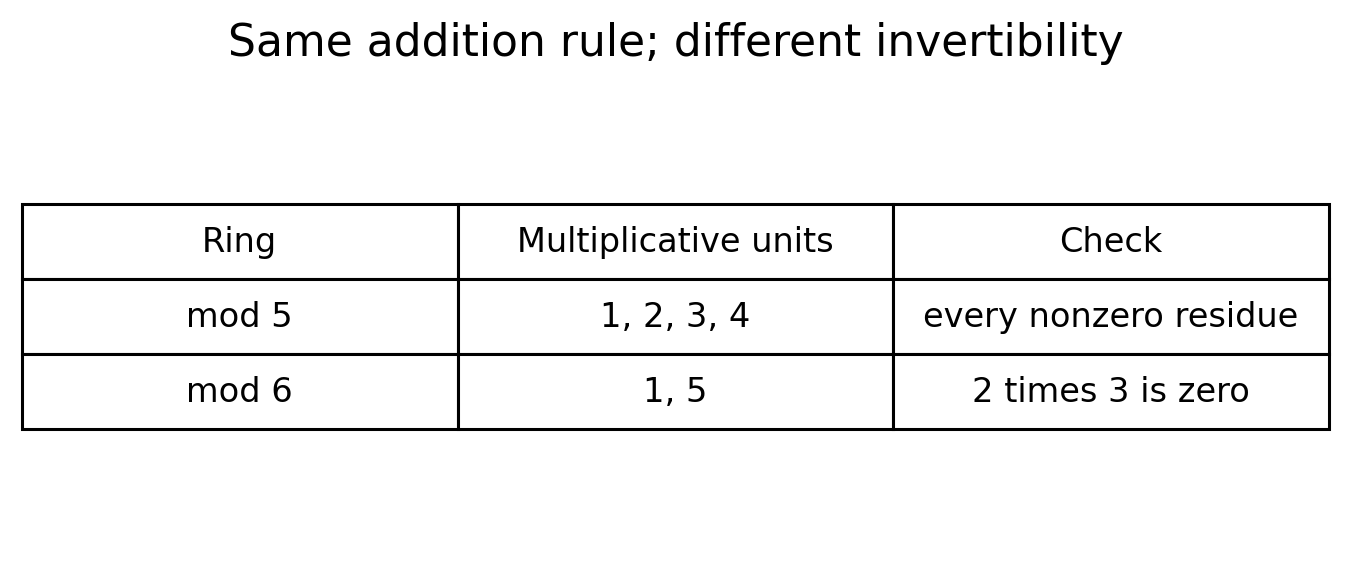
    Compare the additive groups and multiplicative structures of $\mathbb Z/5\mathbb Z$ and $\mathbb Z/6\mathbb Z$. List all multiplicative units in each. Explain why removing zero does not always leave a multiplicative group.

    Worked solution

    Both whole residue sets are additive groups: closure, associativity and identity come from integer addition, and $-a$ is an additive inverse. A multiplicative residue is a unit precisely when its greatest common divisor with the modulus is one. The units modulo five are $1,2,3,4$; modulo six they are $1,5$. Modulo six, $2\cdot3=0$ although both factors are nonzero. The nonzero set is not even closed under multiplication. Modulo five every nonzero residue has an inverse; this ring is a field. A ring, its additive group and its group of units are different structures.

    4

    Independent transfer

    English

    The reduction map $\phi:\mathbb Z\to\mathbb Z/6\mathbb Z$ is given by $\phi(n)=[n]$. Determine its kernel, image and quotient. Solve $2x\equiv2\pmod6$ completely and explain why cancelling 2 modulo 6 fails.

    Check after attempting

    The map preserves addition and multiplication. Its kernel is $6\mathbb Z$ and its image is all six residues. The quotient identifies integers with the same remainder, so $\mathbb Z/\ker\phi\cong\mathbb Z/6\mathbb Z$. The congruence means $6\mid2(x-1)$, equivalently $3\mid x-1$. Hence $x\equiv1\pmod3$, giving residues $1$ and $4$ modulo six. Both substitute correctly. Cancelling 2 while retaining modulus six would discard 4; 2 has no multiplicative inverse there.

  • 5

    T.1 · Real analysis and topology

    5

    Область применения и требования

    Подготовка к GRE для бакалавров. Локальные цели в рамках пересмотренного диапазона ETS; это оригинальное обучение, а не официальный тест или предиктор баллов.

    Предварительные требования: Квантифицированные высказывания, неравенства, последовательности и непрерывные функции.

    • Применить определения пределов последовательностей и функций
    • Различать компактность, связность и полноту
    • Использовать метрико-пространственные и элементарные топологические рассуждения

    компактный: Каждое открытое покрытие имеет конечное подпокрытие.

    супремум: Наименьшая верхняя грань множества.

    English Русский
    compact/kəmˈpækt/ компактный
    supremum/suːˈpreməm/ точная верхняя грань (супремум)
    5

    Выбрать и обосновать метод

    Утверждение эпсилон–дельта контролирует все достаточно близкие входные значения. Порядок кванторов имеет значение.

    В вещественном евклидовом пространстве замкнутые и ограниченные множества являются компактными. Не применяйте это эквивалентность ко всем метрическим пространствам.

    Непрерывные образы компактных множеств компактны, поэтому непрерывная функция на компактной области достигает своих экстремумов.

    Связность исключает разделение на непересекающиеся непустые открытые части. Непрерывность сохраняет связность; полнота — отдельное свойство.

    5

    Разбор решения

    f(x)=x на (0,1) непрерывна и ограничена, но никогда не принимает своего супремума 1. На [0,1] та же функция достигает максимума в точке 1. Отсутствующая граница объясняет, почему теорема о компактной области неприменима к первому случаю.

    Математический анализ и топология: пример курса
    Оригинальная иллюстрация курса; его значения принадлежат проработанному примеру, а не последующей практике.
    5

    Условия и контрпримеры

    Заключение теоремы нельзя использовать до того, как проверены её гипотезы.

    5

    Направляющее применение

    Докажите непрерывность $f(x)=x^2$ в точке 2, используя явный выбор эпсилон–дельта. Отдельно объясните, почему она достигает минимума на $[1,3]$.

    Разобранное решение

    Задано $\epsilon>0$, выберите $\delta=\min(1,\epsilon/5)$. Если $|x-2|<\delta$, то $1<x<3$, следовательно $|x+2|<5$.

    $$|x^2-4|=|x-2||x+2|<5\delta\le\epsilon.$$
    Выбор зависит от эпсилон, а не от последующего входа x. Интервал $[1,3]$ непуст и компактен в обычном вещественном метрическом пространстве. Непрерывность гарантирует достижение экстремумов. Здесь $x^2\ge1$, с равенством при 1, поэтому минимум составляет 1.

    5

    Независимое применение

    В метрическом пространстве $X=(0,1)$ с обычной метрикой является ли X ограниченным? Является ли оно замкнутым в самом себе? Является ли оно компактным или полным? Объясните, почему «замкнутое и ограниченное влечет компактность» здесь неприменимо.

    Проверка после выполнения

    X ограничено и замкнуто относительно самого себя, поскольку его дополнение в X пусто. Последовательность Коши $1/(n+2)$ не имеет предела в X, поэтому X не является полным и, следовательно, не компактным как метрическое пространство. Непосредственно, относительное открытое покрытие $\{(1/n,1):n\ge2\}$ покрывает X, но не имеет конечного подпокрытия. Теорема Гейне–Бореля требует замкнутости и ограниченности как подмножества евклидова пространства, а не просто замкнутости в произвольно выбранном пространстве. X не является замкнутым в $\mathbb R$. Никакая гипотеза теоремы не может изменять свое окружающее пространство посреди доказательства.

  • 6

    T.2 · Дискретная математика, теория вероятностей и численные методы

    6

    Область применения и требования

    Подготовка к GRE для бакалавров. Локальные цели в рамках пересмотренного диапазона ETS; это оригинальное обучение, а не официальный тест или предиктор баллов.

    Предварительные требования: Конечное счетание, элементарная вероятность, рекуррентные соотношения и производные.

    • Использовать подсчёт, рекуррентные соотношения, графовые рассуждения и логику
    • Вычислять вероятности и свойства распределений
    • Применять численное приближение и оценивать погрешность

    рекуррентное соотношение: правило, связывающее член последовательности с предыдущими.

    взаимоисключающие: события, которые не могут произойти одновременно.

    English Русский
    recurrence/rɪˈkʌrəns/ рекуррентное соотношение
    mutually exclusive/ˈmjuːtʃuːəli eksˈkluːsɪv/ взаимоисключающие
    6

    Выбрать и обосновать метод

    Сначала выберите модель подсчёта: упорядоченные выборки r различных объектов из n используют формулу n(n−1)⋯(n−r+1), а неупорядоченные подмножества — C(n,r). Полный простой граф на n вершинах имеет по одному ребру для каждой пары вершин, что даёт n(n−1)/2 рёбер; петли и кратные рёбра изменили бы модель. Для n прямых в общем положении на плоскости k-я прямая пересекает предыдущие k−1 прямых в различных точках и добавляет k областей. Общее число равно 1+n(n+1)/2; параллельные прямые или троекратное пересечение нарушают это количество.

    Используйте дополнения для подсчёта хотя бы одного появления и условите вероятность на фактическое оставшееся население после выборки без возвращения. Для r независимых одинаково распределённых исходов, выбранных из n равновозможных значений, вероятность того, что все они различны, составляет n(n−1)⋯(n−r+1)/n^r при r≤n. Её дополнение считает повторяющиеся исходы. Для биномиального числа при N независимых испытаниях и фиксированной вероятности успеха p математическое ожидание равно Np, а дисперсия — Np(1−p). Равенство вероятностей само по себе не устанавливает независимость.

    Рекуррентное соотношение описывает последующие значения через предыдущие и требует достаточного количества начальных данных для определения последовательности. Разделите индекс от значения: a_n=2a_(n−1) при a_0=3 даёт a_n=3·2^n. Графовые и алгоритмические рассуждения часто устанавливают рекуррентное соотношение, определяя, что новый вершина или шаг добавляют. Закрытая формула должна удовлетворять как рекуррентному соотношению, так и начальным условиям; подгонка нескольких наблюдаемых членов не доказывает её для каждого индекса.

    Численное приближение требует обоснования погрешности. Метод половинного деления сохраняет скобку со сменой знака для непрерывной функции и уменьшает её ширину вдвое на каждом шаге; корень может отсутствовать, если функция не является непрерывной. Итерация Ньютона: x_new=x−f(x)/f′(x), требует ненулевого производной в текущей точке; сходимость не гарантирована автоматически из любой начальной точки. Остаточная величина приближения и его ошибка по x — это разные вещи. Указывайте предположения метода и критерий остановки, а не treats лишние отображаемые десятичные разряды как точность.

    6

    Разбор решения

    Для f(x)=x²−2 и x₀=1, шаг Ньютона даёт 1−(1−2)/2=1.5. Следующее значение равно 1.5−0.25/3=1.4167. Эти значения приближённо вычисляют sqrt(2), однако f′(0)=0 делает ноль недопустимой начальной точкой.

    Дискретная математика, теория вероятностей и численные методы: пример курса
    Оригинальная иллюстрация курса; его значения принадлежат проработанному примеру, а не последующей практике.
    6

    Условия и контрпримеры

    События с положительными вероятностями не могут быть одновременно независимыми и несовместными.

    6

    Направляющее применение

    Четыре помеченных выбора независимы и равномерны из пяти символов, с возвращением. Найдите вероятность того, что хотя бы два выбора совпадают. Сравните количество упорядоченных и неупорядоченных выборок четырёх различных символов.

    Разобранное решение

    Существует $5^4$ равновероятных упорядоченных строк выбора. Количество строк без повторений равно $5\cdot4\cdot3\cdot2=120$.

    $$P(\text{repeat})=1-\frac{5\cdot4\cdot3\cdot2}{5^4}=\frac{101}{125}.$$
    Упорядоченные различные выборки составляют 120; неупорядоченные подмножества — $\binom54=5$. Каждое подмножество встречается в $4!=24$ порядках. Деление на $4!$ уместно только для неупорядоченного подсчёта, но не для знаменателя вероятности выбора.

    6

    Независимое применение

    Примените метод половинного деления к $f(x)=x^3-2$ на отрезке $[1,2]$. Укажите первые две сохраняемые скобки и оценку ошибки середины после десяти делений пополам. Смена знака сама по себе оправдывает применение метода половинного деления для $1/x$ на отрезке $[-1,1]$?

    Проверка после выполнения

    Многочлен непрерывен; $f(1)<0<f(2)$. Первая середина равна $1.5$ с положительным значением, сохраняется $[1,1.5]$. Следующая середина равна $1.25$ с отрицательным значением, сохраняется $[1.25,1.5]$. После десяти делений пополам ширина составляет $2^{-10}$, а середина этой сохраняемой скобки отличается от закреплённого корня не более чем на $2^{-11}=1/2048$. Оценка погрешности основана на скобке, а не только на малом остатке. Для $1/x$ ноль является сингулярностью, и корня нет. Непрерывность на скобке нарушена; противоположные знаки на концах не оправдывают метод.

  • 7

    T.3 · Комплексный анализ и вычеты

    7

    Scope and prerequisites

    English

    Undergraduate GRE preparation. Local objectives within the reviewed ETS scope; this is original teaching, not an official test or score predictor.

    Prerequisites: Complex arithmetic, partial derivatives, series and oriented contours.

    • Test complex differentiability
    • Use contour integrals and residues
    • Evaluate contour integrals with simple and higher-order pole residues

    analytic 解析的: Complex differentiable throughout a neighbourhood.

    residue 留数: Coefficient of (z−a)^−1 in a Laurent series.

    English Русский
    analytic/ˌænəˈlɪtɪk/ аналитический
    residue/ˈresɪdjuː/ вычет
    7

    Choose and justify a method

    English

    Write f(z)=u(x,y)+iv(x,y). Complex differentiability imposes u_x=v_y and u_y=−v_x; with continuous first partials locally, the Cauchy–Riemann equations establish analyticity there. They differ from real differentiability of a two-coordinate map. The conjugate function x−iy fails these equations on every open neighbourhood, although real partial derivatives exist. State the region being checked, not only a convenient point.

    An analytic function is complex differentiable throughout a neighbourhood and has a local convergent power series. A removable singularity can be filled analytically when the function is bounded near the missing point. A pole has a finite principal part in its Laurent series; an essential singularity has infinitely many negative-power terms. The residue is the coefficient of (z−a)⁻¹, not necessarily the leading or largest negative-power term.

    For an isolated pole of order m, write f(z)=g(z)/(z−a)^m with g analytic at a. The residue is g^(m−1)(a)/(m−1)!. A simple pole uses g(a); a double pole uses g′(a). This follows by expanding g into its Taylor series. Thus e^z/(z−a)² has residue e^a, while a constant numerator over a pure double pole has zero residue. The pole order alone does not determine the contour integral.

    For a positively oriented contour enclosing isolated singularities, the residue theorem gives ∮f(z)dz=2πi times the sum of enclosed residues, provided the function is analytic on the contour and elsewhere in the required interior. Reversing orientation changes the sign. Cauchy’s derivative formula is ∮g(z)/(z−a)^(m+1)dz=2πi g^(m)(a)/m! under its analytic-domain hypotheses. A singularity on the contour prevents direct application; a singularity outside contributes nothing to this contour.

    7

    Worked reasoning

    English

    For f(z)=conjugate(z), u=x and v=−y. Then u_x=1 but v_y=−1, so f is not complex differentiable. For 1/(z−2), a positively oriented circle |z−2|=1 encloses a simple pole of residue 1, hence the integral is 2πi.

    Complex analysis and residues: course example
    Original course illustration; its values belong to the worked example, not the later practice.
    7

    Conditions and counterexamples

    English

    Continuity or real differentiability alone does not imply complex analyticity.

    7

    Guided application

    English

    Use the Cauchy–Riemann equations to compare $z^2$ and $\overline z$. Find the residue of $e^z/z^2$ at zero and its integral around the counterclockwise unit circle.

    Worked solution

    For $z^2$, $u=x^2-y^2$ and $v=2xy$: $u_x=2x=v_y$ and $u_y=-2y=-v_x$. The partials are continuous everywhere, so the function is analytic everywhere. For $\overline z$, $u=x,v=-y$ and $u_x=1\ne-1=v_y$; it is nowhere complex differentiable. Since $e^z=1+z+z^2/2+\cdots$, the coefficient of $z^{-1}$ in $e^z/z^2$ is 1. Therefore the residue is 1 and the integral is $2\pi i$. The double pole does not force a zero residue.

    7

    Independent transfer

    English

    Integrate $1/[z(z-2)]$ around $|z|=1$, first counterclockwise and then clockwise. Can the same residue-theorem argument be used on $|z|=2$?

    Check after attempting

    Only zero is inside the unit circle. Its residue is $\lim_{z\to0}1/(z-2)=-1/2$. Thus the counterclockwise integral is $-\pi i$ and the clockwise integral is $\pi i$. The pole at 2 is outside and contributes nothing. The circle $|z|=2$ passes through a pole. The ordinary contour integral is not defined by this formula; the theorem requires analyticity on the contour. An indentation or principal-value prescription would be a different, explicitly specified problem.

  • 8

    C.3 · Дифференциальные уравнения и начальные условия

    8

    Scope and prerequisites

    English

    Undergraduate GRE preparation. Local objectives within the reviewed ETS scope; this is original teaching, not an official test or score predictor.

    Prerequisites: Differentiation, integration, exponentials and quadratic equations.

    • Solve separable first-order equations
    • Solve constant-coefficient second-order equations
    • Use initial conditions and uniqueness conditions

    initial condition 初始条件: A value of the solution or derivative specified at a starting point.

    characteristic root 特征根: A root of the polynomial governing exponential solutions.

    English Русский
    initial condition/ɪˈnɪʃl kənˈdɪʃn/ начальное условие
    characteristic root/ˌkærɪktəˈrɪstɪk ruːt/ характеристический корень
    8

    Choose and justify a method

    English

    For y′=ky, separation and integration give y=Ce^(kt); recover the zero solution if division by y was used. An initial value determines C.

    A linear second-order constant-coefficient equation uses a characteristic polynomial. Distinct roots yield exponentials; a repeated root requires (C1+C2t)e^(rt).

    Complex roots α±iβ give e^(αt)(C1 cos βt+C2 sin βt). The real motion includes both amplitude and phase information.

    Existence and uniqueness depend on hypotheses near the initial point. A singular coefficient or a failure of local Lipschitz behaviour can defeat the familiar uniqueness conclusion.

    8

    Worked reasoning

    English

    Solve y″+4y=0 with y(0)=3 and y′(0)=4. The characteristic roots are ±2i, so y=A cos2t+B sin2t. The first condition gives A=3; differentiating gives y′(0)=2B=4, so B=2.

    Differential equations and initial conditions: course example
    Original course illustration; its values belong to the worked example, not the later practice.
    8

    Conditions and counterexamples

    English

    A repeated characteristic root needs the factor t; two copies of the same exponential are not independent solutions.

    8

    Guided application

    English

    Solve $y''-4y'+4y=0$ with $y(0)=1$, $y'(0)=0$. Check both initial conditions and the equation.

    Worked solution

    The characteristic polynomial is $(r-2)^2$. Independent solutions are $e^{2t}$ and $te^{2t}$, hence $y=(C_1+C_2t)e^{2t}$. The initial value gives $C_1=1$; the derivative at zero gives $2C_1+C_2=0$, so $C_2=-2$.

    $$y(t)=(1-2t)e^{2t},\quad y'(t)=-4te^{2t},\quad y''(t)=(-4-8t)e^{2t}.$$
    Substitution gives $y''-4y'+4y=0$, and the two initial values hold. Two copies of $e^{2t}$ would not span the solution space.

    8

    Independent transfer

    English

    Show that the initial-value problem $y'=2\sqrt{|y|}$, $y(0)=0$ has more than one solution for $t\ge0$. Identify the missing standard uniqueness hypothesis.

    Check after attempting

    One solution is identically zero. For any $a\ge0$, set $y_a(t)=0$ for $0\le t\le a$ and $y_a(t)=(t-a)^2$ for $t>a$. The derivative is zero on the first interval and $2(t-a)$ on the second; both sides have derivative zero at a. Therefore $y_a$ is differentiable and satisfies the equation and initial value. The right side is continuous but is not locally Lipschitz in y at zero: $|2\sqrt h-0|/|h|=2/\sqrt h$ is unbounded. Existence does not imply uniqueness, and division by $\sqrt y$ would lose the waiting-time solutions.

  • 9

    A.3 · Группы, косетки и фактор-отображения

    9

    Scope and prerequisites

    English

    Undergraduate GRE preparation. Local objectives within the reviewed ETS scope; this is original teaching, not an official test or score predictor.

    Prerequisites: Group axioms, functions, integer divisibility and permutations.

    • Verify group structure and compute element orders and subgroup indices
    • Use kernels and images to identify quotient groups
    • Distinguish normal subgroups from arbitrary subgroups
    • Classify permutation conjugacy by cycle type

    coset 陪集: A translate of a subgroup that forms one part of the coset partition.

    normal subgroup 正规子群: A subgroup invariant under conjugation by every group element.

    English Русский
    coset/ˈkɒset/ класс вычетов
    normal subgroup/ˈnɔːml ˈsʌbɡruːp/ нормальная подгруппа
    9

    Choose and justify a method

    English

    Before computing an order, check closure, associativity, an identity and an inverse for every element under the stated operation. A subset can inherit associativity yet fail closure or omit the identity. In a finite group, the order of an element is the least positive power giving the identity. In the additive group Z/nZ, it is the least positive multiple giving zero; the order of residue a is n/gcd(a,n). Lagrange's theorem says subgroup orders divide the group order. The converse is not a general existence theorem, and the order of a group is not the order of each element.

    A left coset gH is a translate of a subgroup H. Cosets have equal size and partition the group, so the index is |G|/|H| in a finite group. In an additive group write g+H. Membership in the same coset means the difference lies in H. A coset usually is not itself a subgroup because it may omit the identity.

    A homomorphism preserves the operation. Its kernel consists of elements sent to the identity, and its image consists of values actually reached. Every kernel is normal. The first isomorphism theorem identifies G/ker(phi) with im(phi); do not replace the image with the whole codomain unless the map is onto.

    Quotient multiplication is well defined only when H is normal. All subgroups of an abelian group are normal. In a nonabelian group test gHg^−1=H; a subgroup of index two is normal. For permutations compose in the stated convention, here rightmost first. Disjoint cycle lengths give the permutation order by their least common multiple. Conjugation hσh⁻¹ relabels the elements in σ’s cycles, so it preserves cycle lengths; conversely permutations with the same cycle lengths can be related by a relabelling. Thus conjugacy classes in S_n correspond to partitions of n, including fixed-point cycles. In S4 the types are 1+1+1+1, 2+1+1, 2+2, 3+1 and 4: five classes, not one class for each possible element order. The types 2+1+1 and 2+2 both have order two but are not conjugate.

    9

    Worked reasoning

    English

    Define phi from Z/12Z to Z/3Z by reducing residues modulo 3. It is onto and preserves addition. Its kernel H is {0,3,6,9}, so |H|=4 and the index is 12/4=3. The other cosets are {1,4,7,10} and {2,5,8,11}. Thus (Z/12Z)/H is isomorphic to Z/3Z. The element 3 in the original group has order 12/gcd(3,12)=4, not 3.

    Groups, cosets and quotient maps: course example
    Original course illustration; its values belong to the worked example, not the later practice.
    9

    Conditions and counterexamples

    English

    A quotient has one element per coset, not one per element of its kernel. A homomorphism need not be onto its stated codomain.

    9

    Guided application

    English

    In the additive group $\mathbb Z/18\mathbb Z$, let $H=\langle6\rangle$. List H and its cosets. Determine the order of 6 and identify the quotient.

    Worked solution

    $H=\{0,6,12\}$ has size three. The six cosets are $r+H=\{r,r+6,r+12\}$ for $r=0,1,2,3,4,5$. They partition all 18 residues. The element 6 has order three, while the quotient has order six. Reduction modulo six is onto with kernel H, so $(\mathbb Z/18\mathbb Z)/H\cong\mathbb Z/6\mathbb Z$. Normality holds because the original group is abelian.

    9

    Independent transfer

    English

    In $S_3$, let $H=\{e,(12)\}$. Check whether $H$ is normal, and decide whether coset multiplication defines a quotient group. Separately find the order of $(123)(45)$ in $S_5$.

    Check after attempting

    Conjugation by $(123)$ sends $(12)$ to $(23)$, which is outside H. Thus H is not normal. Left cosets still partition $S_3$, but multiplication of those cosets is not well defined independently of representatives. The disjoint cycles in $(123)(45)$ have lengths three and two, so its order is $\operatorname{lcm}(3,2)=6$. Element order and subgroup index are different quantities.

  • 10

    A.4 · Кольца, идеалы и модули

    10

    Scope and prerequisites

    English

    Undergraduate GRE preparation. Local objectives within the reviewed ETS scope; this is original teaching, not an official test or score predictor.

    Prerequisites: Rings, fields, additive subgroups and homomorphisms.

    • Distinguish units, zero divisors and integral domains
    • Identify ideals and interpret quotient rings
    • Compare modules over rings with vector spaces over fields
    • Derive Boolean-ring properties without assuming commutativity

    ideal 理想: An additive subgroup of a ring absorbing multiplication by all ring elements.

    torsion 挠性: An element is annihilated by a nonzero scalar in the stated module.

    English Русский
    ideal/aɪˈdɪəl/ идеал
    torsion/ˈtɔːʃn/ торсион
    10

    Choose and justify a method

    English

    For the domain, ideal and quotient examples below, use a commutative ring with identity 1 distinct from 0. A source problem may specify a general ring instead; do not assume its multiplication commutes unless stated or proved. A unit has a multiplicative inverse. A nonzero zero divisor multiplies some nonzero element to zero. An integral domain has no such zero divisors; cancellation of a nonzero factor then works. A field is a domain in which every nonzero element is a unit. Z is a domain but not a field; Z/6Z is neither.

    An ideal I is an additive subgroup that absorbs multiplication by every ring element. This is stronger than being a subring. In Z, nZ is an ideal; quotient elements are integer residue classes modulo n. In a commutative ring, R/I is a field exactly when I is maximal, and it is a domain exactly when I is prime. The ideal must be proper in both statements.

    A module allows scalars from a ring instead of requiring a field. Every abelian group is a Z-module by repeated addition, but it need not have a vector-space basis. In Z/6Z as a Z-module, 6 times the nonzero residue 1 is zero; this is torsion. For a vector space over a field, a nonzero scalar is invertible and cannot annihilate a nonzero vector.

    A submodule is closed under addition and all permitted scalar actions. A linear map of modules preserves both. The kernel and image are submodules, and the quotient by the kernel is isomorphic to the image. Do not apply finite-dimensional rank-nullity to an arbitrary module without establishing an appropriate free-module setting; integer row operations and field row operations permit different divisions. In a general Boolean ring, every a satisfies a²=a. Do not assume commutativity to prove it: idempotence of a+a gives 4a=2a, hence 2a=0. Expanding (a+b)²=a+b gives ab+ba=0, and characteristic two makes −ba=ba; therefore ab=ba. Idempotence does not imply nilpotence: in F2, the nonzero element 1 satisfies 1^n=1 for every positive n.

    10

    Worked reasoning

    English

    In Z/6Z, 2·3=0, so 2 and 3 are zero divisors. The units are 1 and 5 because their gcd with 6 is 1. In Z, the ideal 5Z gives the field Z/5Z, while 6Z gives a quotient with zero divisors. As Z-modules, the map from Z to Z/6Z has kernel 6Z; the quotient identifies integers differing by a multiple of 6, rather than producing a real vector space.

    Rings, ideals and modules: course example
    Original course illustration; its values belong to the worked example, not the later practice.
    10

    Conditions and counterexamples

    English

    A set can be a submodule without being a vector space over the rationals. Scalar division is valid only when the scalar inverse belongs to the structure.

    10

    Guided application

    English

    In $\mathbb Z/12\mathbb Z$, list the units and nonzero zero divisors. Is the ideal $(4)$ prime or maximal?

    Worked solution

    Units are the residues coprime to 12: $1,5,7,11$. The remaining nonzero residues $2,3,4,6,8,9,10$ are zero divisors. For each such a, $a\cdot(12/\gcd(a,12))=0$ modulo 12, with the second factor nonzero. The ideal $(4)=\{0,4,8\}$ gives quotient isomorphic to $\mathbb Z/4\mathbb Z$. This is not a domain, since $2\cdot2=0$, and is not a field. Hence the ideal is neither prime nor maximal.

    10

    Independent transfer

    English

    As a $\mathbb Z$-module, can $\mathbb Z/6\mathbb Z$ be free? Compare the ideals $(2)$ and $(x)$ in $\mathbb Z$ and $\mathbb Q[x]$, respectively, using their quotients.

    Check after attempting

    A nonzero free $\mathbb Z$-module has no nonzero vector annihilated by a nonzero integer: examine each integer coordinate. But $6[1]=0$ in $\mathbb Z/6\mathbb Z$. It is not free; a field-style basis argument is invalid. $\mathbb Z/(2)\cong\mathbb F_2$ is a field, so $(2)$ is maximal and prime. Evaluation at zero maps $\mathbb Q[x]$ onto $\mathbb Q$ with kernel $(x)$; its quotient is a field too. Both arguments use proper ideals in commutative rings with identity.

  • 11

    A.5 · Многочлены и расширения полей

    11

    Scope and prerequisites

    English

    Undergraduate GRE preparation. Local objectives within the reviewed ETS scope; this is original teaching, not an official test or score predictor.

    Prerequisites: Polynomial division, fields and vector-space dimension.

    • Test polynomial irreducibility over the specified field
    • Construct small finite fields from irreducible polynomials
    • Use extension degrees and the tower law
    • Use cyclotomic roots and coefficient relations to compute sums and products

    irreducible polynomial 不可约多项式: A positive-degree polynomial with no factorisation into smaller positive degrees over the stated field.

    extension degree 扩张次数: The dimension of an extension field as a vector space over its base field.

    English Русский
    irreducible polynomial/ɪrɪˈdjuːsɪbl ˌpɒlɪˈnəʊmɪəl/ неприводимый многочлен
    extension degree/ekˈstenʃn dɪˈɡriː/ степень расширения
    11

    Choose and justify a method

    English

    A polynomial is irreducible over a field if it has positive degree and no factorisation into polynomials of smaller positive degrees there. A quadratic or cubic is irreducible exactly when it has no root in that field. This root test alone fails for degree four or higher; for instance (x²+1)(x²+2) has no real root but is reducible over R. Always name the base field.

    The quotient F[x]/(p) is a field when p is irreducible. Reduce powers using p(alpha)=0, where alpha is the residue class of x. If F has q elements and p has degree d, the quotient has q^d elements represented by polynomials of degree below d. Z/4Z has four elements but has zero divisors, so it is not the field with four elements.

    Over F2, p(x)=x²+x+1 has values 1 at both 0 and 1 and is irreducible. In its quotient alpha²=alpha+1 because subtraction equals addition in characteristic two. The four elements are 0,1,alpha,alpha+1. All three nonzero elements must be units; compute their products rather than treating alpha as an ordinary real number.

    For nested finite-degree fields K inside L inside M, the tower law gives [M:K]=[M:L][L:K]. The degree of an algebraic element is the degree of its minimal polynomial. A finite extension of degree two does not contain an element of degree three over the base field. Over Q, sqrt(2) has degree two; adjoining sqrt(3) as well produces a degree-four extension, since sqrt(3) is not in Q(sqrt(2)). Over C, primitive nth roots of unity have exact order n and are the roots of the cyclotomic polynomial Φ_n. For n=10, divide x⁵+1 by x+1 to exclude the order-two root −1: Φ_10=x⁴−x³+x²−x+1. Vieta’s formulas give sum 1 and product 1 of its four primitive roots. Do not sum all tenth roots, or assume every nontrivial tenth root is primitive; a root’s order must be checked. For a monic degree d polynomial, product of its roots is (−1)^d times the constant coefficient.

    11

    Worked reasoning

    English

    In F2[alpha] with alpha²+alpha+1=0, multiply alpha(alpha+1) = alpha² + alpha = (alpha+1) + alpha = 1. Thus alpha^−1=alpha+1. Also alpha³=1 and alpha is not 1, so its multiplicative order is 3. This produces a field of four elements. By contrast 2·2=0 in Z/4Z, proving that quotient is not a field.

    Polynomials and field extensions: course example
    Original course illustration; its values belong to the worked example, not the later practice.
    11

    Conditions and counterexamples

    English

    Polynomial reducibility changes with the coefficient field. The polynomial x²−2 is irreducible over Q but splits over R.

    11

    Guided application

    English

    Construct $\mathbb F_2[x]/(x^2+x+1)$. List its elements and find the inverse of the residue $\alpha=[x]$.

    Worked solution

    The quadratic takes value one at both elements of $\mathbb F_2$, so it has no root and is irreducible. Its quotient is a field. Division leaves a representative of degree below two: $0,1,\alpha,1+\alpha$. The relation is $\alpha^2=\alpha+1$ in characteristic two. Consequently $\alpha(\alpha+1)=\alpha^2+\alpha=1$, so $\alpha^{-1}=\alpha+1$. This is not $\mathbb Z/4\mathbb Z$, which has a nonzero zero divisor.

    11

    Independent transfer

    English

    Is $x^4+4$ irreducible over $\mathbb Q$? Does the absence of rational roots answer that question? Can a degree-two extension of $\mathbb Q$ contain a root of an irreducible cubic over $\mathbb Q$?

    Check after attempting

    Direct multiplication gives $x^4+4=(x^2-2x+2)(x^2+2x+2)$, so it is reducible over $\mathbb Q$ despite having no real, hence no rational, roots. The no-root test characterises irreducibility only for degree two or three over a field. If an irreducible cubic root $\beta$ belonged to a degree-two extension L, then $\mathbb Q\subset\mathbb Q(\beta)\subset L$ and the tower law would make 3 divide 2. This is impossible. The conclusion uses irreducibility, not merely a cubic equation.

  • 12

    A.6 · Конгруэнции, делимость и арифметические функции

    12

    Scope and prerequisites

    English

    Undergraduate GRE preparation. Local objectives within the reviewed ETS scope; this is original teaching, not an official test or score predictor.

    Prerequisites: Euclidean algorithm, prime factors and modular arithmetic.

    • Solve linear congruences using gcd conditions
    • Combine coprime congruences with the Chinese remainder theorem
    • Apply Euler's theorem only to invertible residues
    • Use prime-exponent divisibility to find least admissible integers

    congruence 同余: Equality of residues because the modulus divides their difference.

    totient 欧拉函数: The count of residues coprime to the positive integer modulus.

    English Русский
    congruence/ˈkɒŋɡruːəns/ конгруэнтность
    totient/ˈtəʊʃənt/ функция Эйлера
    12

    Choose and justify a method

    English

    The equation ax≡b modulo n has a solution exactly when d=gcd(a,n) divides b. If it does, divide a,b,n by d to obtain an equation with an invertible coefficient. It has one residue solution modulo n/d and d distinct solutions modulo n. Dividing the coefficient but leaving the original modulus generally loses solutions. Prime factorisation gives another divisibility tool: if n^k must be divisible by a product of prime powers p^a, each prime exponent in n must be at least ceil(a/k). These minimum exponents independently produce the least positive admissible n. For n⁴ divisible by 2⁷·3⁵, n must contain 2² and 3², so the least value is 36. This is a prime-exponent condition, not a congruence solved by modular division.

    The extended Euclidean algorithm expresses gcd(a,n) as ua+vn. When the gcd is 1, u is an inverse of a modulo n. Choose a representative in the required range after reduction. For 7 and 26, 1=15·7−4·26, so 15 is the inverse of 7 modulo 26; verify the product to catch a sign error.

    For coprime positive moduli m,n, the Chinese remainder theorem gives exactly one solution modulo mn for each pair of residue conditions. Substitute x=r+mk into the second congruence and solve for k. If the moduli are not coprime, their residue values must agree modulo gcd(m,n); when consistent, uniqueness is modulo the least common multiple, not the product.

    Euler's totient phi(n) counts residues coprime to n. For distinct prime divisors p, phi(n)=n times the product of (1−1/p). Euler's theorem gives a^phi(n)≡1 only when gcd(a,n)=1. The prime case is Fermat's little theorem. Reduce exponents only after checking this condition; a nonunit can become zero under repeated powers instead.

    12

    Worked reasoning

    English

    Solve 6x≡9 modulo 15. The gcd is 3 and divides 9. Divide all three quantities to get 2x≡3 modulo 5; the inverse of 2 is 3, so x≡9≡4 modulo 5. The original solutions modulo 15 are 4,9,14. For x≡2 modulo 4 and x≡3 modulo 7, write x=2+4k; then 4k≡1 modulo 7, giving k≡2. Hence x≡10 modulo 28.

    Congruences, divisibility and arithmetic functions: course example
    Original course illustration; its values belong to the worked example, not the later practice.
    12

    Conditions and counterexamples

    English

    The expression a^phi(n)≡1 is false for arbitrary a. For example 2 is not invertible modulo 8 and 2^4 is zero modulo 8.

    12

    Guided application

    English

    Solve $8x\equiv12\pmod{20}$ completely. Find an inverse of 7 modulo 20. Explain why Euler's theorem cannot be used to replace $2^8$ by 1 modulo 20.

    Worked solution

    The gcd is four and divides 12. Dividing all three numbers gives $2x\equiv3\pmod5$, so $x\equiv4\pmod5$. Modulo 20 the four answers are $4,9,14,19$; substitution gives remainder 12 each time. Since $7\cdot3=21$, the inverse of 7 is 3. Although $\phi(20)=8$, Euler's theorem requires a unit. The gcd of 2 and 20 is two, and $2^8=256\equiv16$, not 1.

    12

    Independent transfer

    English

    Solve $x\equiv2\pmod6$, $x\equiv5\pmod9$, or prove inconsistency. State the modulus for uniqueness. Find the least positive n such that $2^5\cdot3^7$ divides $n^3$.

    Check after attempting

    The residues agree modulo the gcd three. Put $x=2+6k$: then $6k\equiv3\pmod9$, hence $2k\equiv1\pmod3$ and $k\equiv2\pmod3$. Thus $x\equiv14\pmod{18}$. The modulus is the lcm, not 54. For the divisibility problem, write prime exponents in n. They must satisfy $3a\ge5$, $3b\ge7$, so $a\ge2$, $b\ge3$. The least n is $2^2\cdot3^3=108$; other prime factors can only increase it.

  • 13

    T.4 · Последовательности, ряды и равномерная сходимость

    13

    Область применения и требования

    Подготовка к GRE для бакалавров. Локальные цели в рамках пересмотренного диапазона ETS; это оригинальное обучение, а не официальный тест или предиктор баллов.

    Предварительные знания: пределы последовательностей, супремум, непрерывность и числовые ряды.

    • Использовать критерии Коши, монотонной сходимости и подпоследовательностей
    • Различать поточечную и равномерную сходимость функций
    • Проверять гипотезы перед изменением местами пределов и интегралов

    последовательность Коши: последовательность, чьи sufficiently поздние члены произвольно близки друг к другу.

    равномерная сходимость: сходимость с одним пороговым индексом погрешности, действующим в каждой точке области определения.

    English Русский
    Cauchy sequence/ˈkɔːtʃi ˈsiːkwəns/ последовательность Коши
    uniform convergence/ˈjuːnɪfɔːm kənˈvɜːdʒəns/ равномерная сходимость
    13

    Выбрать и обосновать метод

    Сходящаяся вещественная последовательность является последовательностью Коши, и каждая вещественная последовательность Коши сходится, поскольку R полна. В Q последовательность Коши может стремиться к иррациональному числу и не сходиться внутри Q. Ограниченная монотонная вещественная последовательность сходится. Ограниченная последовательность не обязательно сходится, но теорема Больцано–Вейерштрасса гарантирует наличие сходящейся подпоследовательности; (-1)^n имеет два различных предельных значения подпоследовательностей.

    Для числового ряда абсолютная сходимость влечет сходимость; условная сходимость не допускает произвольной перестановки членов без изменения суммы. Чередующийся гармонический ряд сходится, но его ряд из модулей расходится. В признаке Даламбера предел ниже 1 доказывает абсолютную сходимость, а выше 1 — расходимость; предел, равный 1, не дает ответа, как демонстрируют оба ряда 1/n и sum 1/n².

    Точечная сходимость выбирает индекс N отдельно для каждого x и допустимой погрешности. Равномерная сходимость выбирает один N, работающий для всех x в области определения. Для вещественнозначных функций проверьте супремум |f_n−f| на всей области определения. Непрерывный точечный предел сам по себе не доказывает равномерную сходимость. Граничные точки области определения и сужающиеся пики часто различают эти понятия.

    Равномерный предел непрерывных функций непрерывен. На замкнутом ограниченном интервале равномерная сходимость Римана-интегрируемых функций позволяет менять местами предел и интеграл. Обмен производными требует дополнительных условий; одной лишь равномерной сходимости функций недостаточно. Тест Вейерштрасса устанавливает равномерную абсолютную сходимость ряда функций, если каждый член ограничен M_n на всей области определения, а ряд sum M_n сходится.

    13

    Разбор решения

    На [0,1], f_n(x)=x^n стремится к 0 при x<1 и к 1 при x=1. Предел разрывен, поэтому сходимость не может быть равномерной; непосредственно, супремум ошибки равен 1, достигается снизу 1. На [0,a] при 0≤a<1, предел равен нулю, а супремум равен a^n, который стремится к нулю, следовательно, сходимость равномерная. Изменение области определения меняет вывод.

    Последовательности, ряды и равномерная сходимость: пример курса
    Оригинальная иллюстрация курса; его значения принадлежат проработанному примеру, а не последующей практике.
    13

    Условия и контрпримеры

    Проверка нескольких фиксированных значений x не доказывает ни существование верхней границы, ни равномерную сходимость. Точка, дающая наибольшую ошибку, может смещаться вместе с n.

    13

    Направляющее применение

    Определить точечную и равномерную сходимость $f_n(x)=x^n$ на $[0,1]$ и на $[0,a]$ для фиксированного $0<a<1$. Сравнить $\sum1/n^2$ с чередующимся гармоническим рядом на предмет абсолютной сходимости.

    Разобранное решение

    На $[0,1]$ предел равен нулю для $x<1$ и единице при 1. Этот предел разрывен, поэтому непрерывные $f_n$ не могут сходиться равномерно. Более того, супремум ошибки на $[0,1)$ равен единице. На $[0,a]$ супремум равен $a^n\to0$, поэтому сходимость равномерна к нулю. p-ряд с p=2 сходится абсолютно. Чередующийся гармонический ряд сходится по убывающим членам, стремящимся к нулю, но ряд из модулей расходится; его сходимость условна.

    13

    Независимое применение

    Пусть $g_n(x)=\sin(nx)/n$ на $\mathbb R$. Является ли сходимость равномерной? Могут ли их производные сходиться к производной от предела? Используйте конкретную точку для решения.

    Проверка после выполнения

    $\sup_{x\in\mathbb R}|g_n(x)|=1/n\to0$, поэтому функции сходятся равномерно к нулю. Но $g_n'(x)=\cos(nx)$, и при $x=0$ эти производные все равны 1. Производная от нуля (предела) равна 0. Таким образом, равномерная сходимость самих функций не оправдывает дифференцирование предела; необходимы дополнительные условия о сходимости производных.

  • 14

    T.5 · Открытые множества, компактность и связность

    14

    Scope and prerequisites

    English

    Undergraduate GRE preparation. Local objectives within the reviewed ETS scope; this is original teaching, not an official test or score predictor.

    Prerequisites: Sets, relative open sets, continuous functions and sequences.

    • Compute closure, interior and boundary in a stated space
    • Apply compactness and connectedness to continuous maps
    • Distinguish relative topology from the ambient Euclidean topology

    relative topology 相对拓扑: Open subsets inherited by intersecting a subspace with ambient open sets.

    connectedness 连通性: Absence of a separation into disjoint nonempty relatively open subsets.

    English Русский
    relative topology/ˈrelətɪv təˈpɒlədʒi/ относительная топология
    connectedness/kəˈnektɪdnəs/ связность
    14

    Choose and justify a method

    English

    In a metric space, an open set contains a small ball around each of its points. The interior consists of such points; the closure includes all limit points; the boundary is closure minus interior. Open and closed are not mutually exclusive labels; the empty set and the whole space are both. In R, the set [0,1) has interior (0,1), closure [0,1] and boundary {0,1}.

    In a subspace X, an open set has the form X intersected with an ambient open set. Thus [0,1) is open relative to [0,2], using intersection with (-1,1), although it is not open in R. A set may also be relatively closed without being closed in the ambient space. Always state which space defines neighbourhoods and which metric is used.

    Compactness means every open cover has a finite subcover. In Euclidean R^n, Heine–Borel makes this equivalent to closed and bounded. In a metric space, compactness is equivalent to sequential compactness; completeness and boundedness alone do not suffice in arbitrary metric spaces. A continuous image of a compact set is compact, giving attained maxima and minima for real continuous functions on a nonempty compact domain.

    Connected sets cannot be separated into two disjoint nonempty relatively open parts; connected subsets of R are precisely intervals. A continuous image of a connected set is connected, which yields the intermediate value theorem. Path connectedness implies connectedness, but not conversely in every space. A compact set need not be connected, and a connected set need not be compact; a finite two-point set and an open interval supply the contrasting cases.

    14

    Worked reasoning

    English

    Let X=[0,1] with its usual relative topology. The set U=[0,0.5) equals X intersected with (-1,0.5), so U is open in X. Its closure in X is [0,0.5], and its boundary in X is {0.5}; zero is an interior point relative to X. For a continuous f on X with f(0)<0<f(1), connectedness ensures a zero, while compactness separately ensures attained extrema.

    Open sets, compactness and connectedness: course example
    Original course illustration; its values belong to the worked example, not the later practice.
    14

    Conditions and counterexamples

    English

    Heine–Borel's closed-and-bounded test is a Euclidean-space theorem. Connectedness and compactness answer different questions.

    14

    Guided application

    English

    In $X=[0,2]$ with its relative topology, find the interior, closure and boundary of $A=[0,1)$. Is A open or closed in X?

    Worked solution

    $A=X\cap(-1,1)$ is open in X, so its relative interior is A. Its closure is $[0,1]$ and its boundary is $\{1\}$. Zero is interior relative to X because a sufficiently small ball in X has no negative part. A is not closed in X: the sequence $1-1/n$ for $n\ge2$ tends to the missing point 1. In the ambient real line, interior and boundary would instead be $(0,1)$ and $\{0,1\}$.

    14

    Independent transfer

    English

    Give a compact disconnected real set and a connected noncompact real set. Must a continuous real function on the latter attain an extreme value? Explain which property gives the intermediate value theorem.

    Check after attempting

    The finite set $\{0,2\}$ is compact but disconnected. The interval $(0,1)$ is connected but not compact. The continuous identity function on $(0,1)$ attains neither a maximum nor a minimum. Connectedness makes a continuous real image an interval and therefore supplies intermediate values. Compactness instead makes a nonempty continuous real image attain its extreme values. Neither property substitutes for the other.

  • 15

    C.4 · Ряды Тейлора и поведение степенных рядов на границах

    15

    Область применения и требования

    Подготовка к GRE для бакалавров. Локальные цели в рамках пересмотренного диапазона ETS; это оригинальное обучение, а не официальный тест или предиктор баллов.

    Предварительные требования: производные, геометрические ряды и признаки сходимости.

    • Строить полиномы Тейлора и оценивать погрешность приближения
    • Определять радиусы сходимости и проверять концы отдельно
    • Дифференцировать и интегрировать степенные ряды внутри интервала сходимости

    радиус сходимости: Расстояние от центра ряда, внутри которого степенной ряд сходится абсолютно.

    остаток: Разность между функцией и её конечным приближением.

    English Русский
    radius of convergence/ˈreɪdɪəs ɒv kənˈvɜːdʒəns/ радиус сходимости
    remainder/rɪˈmeɪndə/ остаток
    15

    Выбрать и обосновать метод

    Полином Тейлора степени m в точке a — это сумма f^(k)(a)(x−a)^k/k! для k от нуля до m. Факториал входит в каждый коэффициент. Если следующий производный ограничен по модулю величиной M на отрезке между a и x, остаток Лагранжа по модулю не превышает M|x−a|^(m+1)/(m+1)!. Гладкость сама по себе не гарантирует, что бесконечный ряд Тейлора совпадает с функцией повсюду.

    Степенной ряд sum c_n(x−a)^n сходится абсолютно внутри своего радиуса R и расходится вне его. Признаки Даламбера или Коши обычно определяют R, возможные значения — ноль и бесконечность. В точках x=a−R и x=a+R признак часто становится неразрешимым; подставьте каждый конец в исходный ряд. Поведение в двух концах может отличаться.

    Внутри открытого интервала сходимости почленное дифференцирование и интегрирование сохраняют радиус. Они могут изменить включение концов. Начните с геометрического ряда 1/(1−x)=sum x^n для |x|<1, затем проинтегрируйте от нуля до x, чтобы получить −ln(1−x)=sum x^n/n для n≥1. Проверьте константу интегрирования и область определения логарифма.

    Ряды также помогают найти устранимые формы неопределённости. Для вычисления (e^x−1−x)/x² вблизи нуля сохраните первое ненулевое слагаемое x²/2, вместо того чтобы использовать только e^x≈1+x. Асимптотическое усечение устанавливает предел; неравенство на конечном интервале требует отдельного доказательства знака или оценки остатка. Не подставляйте значения в ряд за пределами интервала сходимости.

    15

    Разбор решения

    Для sum x^n/n при n≥1 признак Даламбера дает радиус 1. При x=1 это расходящийся гармонический ряд; при x=−1 это знакочередующийся сходящийся ряд. Таким образом, интервал действительной сходимости равен [−1,1). Дифференцирование внутри дает sum x^(n−1)=1/(1−x), который не сходится ни на одном из концов. Радиус остался 1, но вопрос об included endpoints изменился.

    Разложения Тейлора и концы степенных рядов: учебный пример
    Оригинальная иллюстрация курса; его значения принадлежат проработанному примеру, а не последующей практике.
    15

    Условия и контрпримеры

    Радиус не является полным интервалом сходимости. Необходимо явно проверить концы интервала и факториальные коэффициенты.

    15

    Направляющее применение

    Найдите интервал сходимости $\sum_{n=1}^{\infty}x^n/n$ и его почленной производной. Приблизьте значение $e^{0.1}$ квадратичным полиномом Тейлора с обоснованной оценкой ошибки.

    Разобранное решение

    Признак Даламбера даёт радиус, равный единице. В точке 1 исходный гармонический ряд расходится; в точке -1 знакочередующийся ряд сходится. Таким образом, исходный интервал равен $[-1,1)$. Производная равна $\sum_{n=1}^{\infty}x^{n-1}=1/(1-x)$ только для $|x|<1$; её члены не стремятся к нулю ни на одном из концов. $P_2(0.1)=1+0.1+0.1^2/2=1.105$. На $[0,0.1]$ третья производная равна $e^x<2$. Оценка Лагранжа даёт $|R_2|\le2(0.1)^3/6=1/3000$. Эта оценка намеренно завышена и не претендует на точность ошибки.

    15

    Независимое применение

    Вычислить $\lim_{x\to0}(\cos x-1+x^2/2)/x^4$. Объяснить, почему замена косинуса только на $1-x^2/2$ не позволяет определить этот предел.

    Проверка после выполнения

    Теорема Тейлора в окрестности нуля дает $\cos x=1-x^2/2+x^4/24+O(x^6)$. Вычитание сокращает постоянный и квадратичный члены, оставляя $x^4/24+O(x^6)$. После деления предел равен $1/24$. Отсечение с остатком лишь $o(x^2)$ не дает контроля после деления на $x^4$; необходимо сохранить и оценить первый выживший член.

  • 16

    C.5 · Несобственные интегралы и геометрические приложения

    16

    Scope and prerequisites

    English

    Undergraduate GRE preparation. Local objectives within the reviewed ETS scope; this is original teaching, not an official test or score predictor.

    Prerequisites: Antiderivatives, limits, comparison and geometric integration.

    • Define improper integrals by limits at each singular boundary
    • Select area, volume and arc-length formulas from the geometry
    • Separate convergence of integrals from signed cancellation

    improper integral 反常积分: An integral defined by limits at infinite or singular boundaries.

    principal value 主值: A limit using prescribed symmetric cancellation that may exist when an ordinary improper integral diverges.

    English Русский
    improper integral/ɪmˈprɒpə ˈɪntɪɡrəl/ несобственный интеграл
    principal value/ˈprɪnsɪpl ˈvæljuː/ главное значение
    16

    Choose and justify a method

    English

    An infinite integration endpoint is replaced by a finite bound and a limit. At a singular point inside the interval, split the integral and require both one-sided integrals to converge separately. Symmetric cancellation can define a Cauchy principal value but does not prove convergence of the ordinary improper integral. For 1/x across zero, the two sides diverge even though symmetric cutoffs cancel.

    The integral of x^(−p) from 1 to infinity converges exactly when p>1. From zero to 1 it converges exactly when p<1. The same exponent behaves differently at the two boundaries. For positive integrands, comparison transfers convergence from a larger integrable function or divergence from a smaller nonintegrable one; keep the inequality direction correct. For an integral of a maximum or minimum, solve branch crossings and check which expression dominates each interval. For max(√(1−x²),x+1) on [−1,1], the interior crossing is zero; use the semicircle on [−1,0] and the line on [0,1]. The area is π/4+3/2, not the integral of either branch over the entire interval.

    For rotation around the x-axis, disks or washers integrate π(R²−r²) dx. Cylindrical shells use 2π times radius times height and integrate in the matching variable. Select the method by the geometry and verify nonnegative radii. Area between curves integrates upper minus lower, splitting where their order changes. A signed integral is not automatically geometric area.

    For a differentiable plane curve y=f(x), arc length is the integral of sqrt(1+(f′(x))²) dx. A surface formed by rotating a nonnegative f around the x-axis has area integral 2πf sqrt(1+(f′)²) dx. These are different quantities from volume. If an interval is unbounded, the geometric formula still needs a convergence test.

    16

    Worked reasoning

    English

    Rotate y=1/x for x≥1 around the x-axis. The disk volume is π times the integral of 1/x², so V=π. The lateral surface integrand is 2π(1/x)sqrt(1+1/x⁴), at least 2π/x; its improper integral diverges. Finite volume therefore does not imply finite surface area. This comparison avoids trying to find an unnecessary antiderivative.

    Improper integrals and geometric applications: course example
    Original course illustration; its values belong to the worked example, not the later practice.
    16

    Conditions and counterexamples

    English

    Never count a principal value as a convergent improper integral, or infer one geometric quantity's finiteness from another.

    16

    Guided application

    English

    For which real p does $\int_0^\infty x^{-p}\,dx$ converge? Compare the ordinary improper integral of $1/x$ on $[-1,1]$ with its symmetric principal value.

    Worked solution

    Split at 1. Near zero, convergence requires $p<1$; near infinity, it requires $p>1$. No real p meets both, and p=1 diverges logarithmically at both ends. Both one-sided parts must converge independently. For $1/x$ across zero, the negative and positive parts diverge separately, so the ordinary improper integral diverges. Symmetric cutoffs cancel to zero, yielding a principal value only. The zero is not the value of the ordinary integral.

    16

    Independent transfer

    English

    Rotate the region under $y=1/x$, $x\ge1$, around the x-axis. Prove its volume is finite and its lateral surface area is infinite.

    Check after attempting

    Disks give $V=\pi\lim_{b\to\infty}\int_1^b x^{-2}\,dx=\pi\lim(1-1/b)=\pi$. For surface area, $y'=-1/x^2$ and

    $$S=2\pi\int_1^\infty x^{-1}\sqrt{1+x^{-4}}\,dx.$$
    Its nonnegative integrand is at least $2\pi/x$, whose integral diverges. Comparison proves infinite lateral area. This includes neither an end cap nor a claim that finite volume implies finite area.

  • 17

    C.6 · Экстремумы функций нескольких переменных и задача с ограничениями

    17

    Область применения и требования

    Подготовка к GRE для бакалавров. Локальные цели в рамках пересмотренного диапазона ETS; это оригинальное обучение, а не официальный тест или предиктор баллов.

    Предварительные требования: Частные производные, квадратичные формы, компактность и ограничения.

    • Классифицировать критические точки двух переменных с помощью гессиана
    • Использовать множители Лагранжа с регулярным ограничением
    • Сравнивать экстремумы и достижимые значения при регулярных ограничениях

    Гессиан: Матрица вторых частных производных, используемая для изучения локальной кривизны.

    Множитель Лагранжа: Скаляр, связывающий градиенты целевой функции и регулярного ограничения в точке ограниченного экстремума.

    English Русский
    Hessian/ˈheʃn/ гессиан
    Lagrange multiplier/ˈlæɡreɪndʒ ˌmʌltɪˈplaɪə/ множитель Лагранжа
    17

    Выбрать и обосновать метод

    Для дифференцируемой функции на открытом множестве внутренний локальный экстремум имеет нулевой градиент. Это необходимое, но не достаточное условие. Для двух переменных в критической точке пусть D=f_xx f_yy−(f_xy)². Если D>0, то f_xx>0 даёт строгий локальный минимум, а f_xx<0 — строгий локальный максимум; D<0 указывает на седловую точку. Эти тесты требуют соответствующей регулярности вторых производных в окрестности точки.

    При D=0 тест по вторым производным не дает вывода, что не является доказательством наличия седловой точки. Функции x⁴+y⁴ и x⁴−y⁴ имеют одинаковый нулевой гессиан в начале координат, однако одна из них имеет строгий минимум, а другая меняет знак. Оценивайте вдоль контрастных направлений или используйте прямое неравенство. Для квадратичной формы положительная определенность дает более общее толкование гессиана.

    На гладком равенстве g(x,y)=c с ненулевым градиентом g решите систему ∇f=λ∇g вместе с g=c. Эти уравнения порождают кандидатов; они не классифицируют и не гарантируют глобальный экстремум. Если градиент ограничения обращается в ноль, условие регулярности нарушается, и уравнения множителей могут пропустить ограниченный экстремум. Рассматривайте такие точки отдельно. Для x²+y²=a и xy=b>0, (x−y)²=a−2b показывает необходимость a≥2b. Это также достаточно: возьмите s=√(a+2b), d=√(a−2b), x=(s+d)/2 и y=(s−d)/2. Эти действительные значения удовлетворяют xy=b и x²+y²=a. Условие минимума само по себе требует проверки достижимости для установления разрешимости.

    Непрерывная функция на компактном допустимом множестве достигает глобальных экстремумов. Чтобы найти их, сравните всех внутренних кандидатов и все граничные части, включая углы и концы отрезков. Для прямоугольника оптимизируйте ограничения на каждом ребре. Для круга круговая граница может использовать параметризацию или множители. Решение только незафиксированного градиента игнорирует возможных победителей на границе.

    17

    Разбор решения

    Минимизируйте x²+y² при условии x+y=6. Градиент ограничения равен (1,1), поэтому 2x=lambda и 2y=lambda. Отсюда x=y, и ограничение дает x=y=3, со значением 18. Выделение полного квадрата на прямой дает x²+(6−x)²=2(x−3)²+18, что доказывает наличие глобального минимума. На этой неограниченной прямой нет максимума, несмотря на существование кандидата из метода множителей Лагранжа.

    Экстремумы многомерных функций и ограниченная оптимизация: пример курса
    Оригинальная иллюстрация курса; его значения принадлежат проработанному примеру, а не последующей практике.
    17

    Условия и контрпримеры

    Решение с использованием множителя Лагранжа является лишь кандидатом, а не автоматически максимумом или минимумом. Проверьте регулярность и полное допустимое множество.

    17

    Направляющее применение

    Классифицируйте начало координат для $f(x,y)=x^2-y^2$ и для $g(x,y)=x^4+y^4$. Укажите, что позволяет заключить нулевой определитель гессиана.

    Разобранное решение

    Для f гессиан равен $\operatorname{diag}(2,-2)$ с определителем -4; начало координат — седловая точка. Вдоль осей значения имеют противоположные знаки. Для g гессиан в нуле равен нулю, поэтому тест по вторым производным не дает вывода. Тем не менее $x^4+y^4\ge0$, причем равенство достигается только в начале координат; это строгий глобальный минимум. Неоднозначный тест не является классификацией точки.

    17

    Независимое применение

    Найдите все экстремумы $f(x,y)=xy$ при условии $x^2+y^2=2$. Сравните с минимизацией $x^2+y^2$ на прямой $x+y=4$, включая наличие максимумов.

    Проверка после выполнения

    Окружность компактна, и её градиент ограничения $(2x,2y)$ нигде там не обращается в ноль. Множители дают $y=2\lambda x$, $x=2\lambda y$. Ни одна из координат не может быть равна нулю в стационарной точке; следовательно, $y=\pm x$. Четыре кандидата $(1,1),(-1,-1),(1,-1),(-1,1)$ дают глобальный максимум 1 и минимум -1. Оценка $2|xy|\le x^2+y^2=2$ проверяет полноту. На прямой $x^2+(4-x)^2=2(x-2)^2+8$, поэтому минимум равен 8 в точке $(2,2)$. Максимума нет, так как выражение неограничено. Одних кандидатов по множителям недостаточно для доказательства компактности.

  • 18

    C.7 · Замена переменных и теоремы о векторных интегралах

    18

    Область применения и требования

    Подготовка к GRE для бакалавров. Локальные цели в рамках пересмотренного диапазона ETS; это оригинальное обучение, а не официальный тест или предиктор баллов.

    Предварительные требования: Кратные интегралы, частные производные и ориентированные границы.

    • Преобразовывать двойные и тройные интегралы с их якобианами
    • Применять теоремы Грина, Стокса и о дивергенции с правильной ориентацией
    • Проверять особые точки области перед утверждением независимости пути

    дивергенция: Сумма координатных частных производных векторного поля, характеризующая локальный поток наружу.

    консервативное поле: Векторное поле, являющееся градиентом скалярного потенциала, с криволинейными интегралами, не зависящими от пути интегрирования.

    English Русский
    divergence/daɪˈvɜːdʒəns/ дивергенция
    conservative field/kənˈsɜːvətɪv fiːld/ потенциальное поле
    18

    Выбрать и обосновать метод

    Смена переменных масштабирует площадь или объём по модулю якобиана. Полярные координаты используют r dr dθ; цилиндрические — r dr dθ dz; сферические координаты (угол φ отсчитывается от положительной оси z) используют ρ² sin(φ) dρ dφ dθ. Укажите конвенции углов и преобразуйте как подынтегральную функцию, так и область. Отсутствующий якобиан превращает интеграл от постоянной плотности в неверную физическую величину.

    Теорема Грина связывает интеграл по положительно ориентированному контуру границы плоской области P dx+Q dy с двойным интегралом от Q_x−P_y по этой области. Обычные гипотезы требуют непрерывности первых производных на открытом множестве, содержащем область. «Отверстие» требует собственной внутренней границы с отрицательной ориентацией либо другого корректного подхода для отсутствующей части области. Теорема не может применяться при интегрировании через особую точку поля.

    Теорема Стокса связывает циркуляцию на границе поверхности с поверхностным интегралом от ротора F по нормализованному вектору нормали. Правило правой руки связывает направление границы с направлением нормали. Теорема о дивергенции связывает поток наружу через замкнутую поверхность с объёмным интегралом от дивергенции F. Циркуляция, поток, ротор и дивергенция — это различные понятия; для обычной теоремы о дивергенции требуется замкнутая поверхность.

    Градиентное поле имеет криволинейные интегралы, не зависящие от пути, определяемые разностью потенциалов на концах. Непрерывно дифференцируемое безвихревое поле на односвязном открытом множестве является консервативным. Отсутствие вихря только на множестве с «отверстием» недостаточно. Для F=(−y/(x²+y²), x/(x²+y²)) начало координат исключено; циркуляция по единичной окружности равна 2π, хотя ротор равен нулю везде, где определено поле.

    18

    Разбор решения

    Для F=(x,y,z) дивергенция равна 3. Следовательно, внешний поток через сферу радиуса 2 равен 3, умноженному на её объем, то есть 3·(4π·2³/3)=32π. Это избегает параметризации поверхности. Для плоского поля (−y,x) теорема Грина дает циркуляцию единичной окружности против часовой стрелки как интеграл от 1−(−1)=2 по диску, следовательно, 2π. Изменение ориентации меняет знак циркуляции.

    Изменение координат и теоремы векторных интегралов: пример из курса
    Оригинальная иллюстрация курса; его значения принадлежат проработанному примеру, а не последующей практике.
    18

    Условия и контрпримеры

    Нулевой ротор недостаточен, когда область имеет дыру. Внешний поток и циркуляция против часовой стрелки используют разные теоремы и правила ориентации.

    18

    Направляющее применение

    Вычислите $\iint_D(x^2+y^2)\,dA$ на $1\le x^2+y^2\le4$. Найдите поток наружу поля $F=(x,y,z)$ через единичную сферу.

    Разобранное решение

    Для кольца полярные пределы интегрирования — $1\le r\le2$, $0\le\theta\le2\pi$. С учётом якобиана,

    $$I=\int_0^{2\pi}\int_1^2r^3\,dr\,d\theta=15\pi/2.$$
    Поле F непрерывно дифференцируемо во всём шаре и его дивергенция равна трём. Теорема о дивергенции даёт поток наружу, равный $3(4\pi/3)=4\pi$. Обратная (внутренняя) ориентация изменила бы знак.

    18

    Независимое применение

    Рассмотрим поле $G=(-y/(x^2+y^2),x/(x^2+y^2))$ на выколотой плоскости. Его скалярный ротор там равен нулю. Вычислите его циркуляцию по единичной окружности против часовой стрелки. Объясните, почему теорема Грина не делает её равной нулю.

    Проверка после выполнения

    Параметризуйте $r(t)=(\cos t,\sin t)$ для параметра $0\le t\le2\pi$. Тогда $G(r(t))=(-\sin t,\cos t)=r'(t)$, следовательно $G\cdot r'=1$, и интеграл равен $2\pi$. Поле не определено в начале координат внутри диска. Теорема Грина требует необходимой гладкости в окрестности области, а не только на её границе. Нулевой ротор на выколотой области не устанавливает существование глобального потенциала; замкнутое, но не точное поле может иметь циркуляцию вокруг своего «отверстия».

  • 19

    T.6 · Функции, обратные ветви и композиция

    19

    Scope and prerequisites

    English

    Undergraduate GRE preparation. Local objectives within the reviewed ETS scope; this is original teaching, not an official test or score predictor.

    Prerequisites: Function domains, quadratic equations and composition.

    • Distinguish injectivity and surjectivity using the stated domain and codomain
    • Choose and verify an inverse branch by composing in both directions
    • Trace repeated function composition while preserving the domain

    bijection 双射: A function that is both injective and surjective between its specified sets.

    involution 对合: A function whose composition with itself is the identity on its domain.

    English Русский
    bijection/baɪˈdʒekʃn/ биекция
    involution/ɪnvəˈluːʃn/ инволюция
    19

    Choose and justify a method

    English

    A function assigns exactly one output to each allowed input. Injective means equal outputs force equal inputs; surjective means every element of the stated codomain is reached. The map x↦x² from R to [0,∞) is surjective but not injective. From [0,∞) to [0,∞) it is both, hence bijective. From [0,∞) to R it remains injective but fails surjectivity. Keep domain, image and codomain separate when testing each claim.

    An inverse function reverses a bijection. Solve y=f(x) for x, then use the original domain to choose a branch. For f(x)=(x−2)²−5 on x≥2, the inverse is 2+√(y+5) on y≥−5. The minus branch would return inputs outside the chosen domain. Check f⁻¹(f(x))=x for allowed x and f(f⁻¹(y))=y for allowed y; one unchecked composition can conceal a domain error.

    The inverse graph reflects the original graph across y=x; it does not take reciprocals of output values. A self-inverse function, or involution, satisfies f(f(x))=x wherever the composition is defined. Both −x on R and 1/x on R excluding zero are involutions. A strictly increasing involution on an interval must be the identity: if f(x)>x, increasingness gives f(f(x))>f(x)>x, and the analogous argument rules out f(x)<x.

    Iteration fⁿ means repeated composition, not the power (f(x))ⁿ. Calculate the first few compositions and check their domains before looking for a period. For f(x)=1/(1−x) on R excluding 0 and 1, f²(x)=(x−1)/x and f³(x)=x. The image stays in the same allowed domain. Therefore reduce an iteration count modulo three. A displayed formula equal to x after cancellation does not restore forbidden inputs.

    19

    Worked reasoning

    English

    For f(x)=(x−2)²−5 with x≥2, f(5)=4 and f⁻¹(4)=2+√9=5. The unrestricted quadratic would have two inputs, −1 and 5, giving output 4. For g(x)=1/(1−x), the orbit 3→−1/2→2/3→3 has period three, so g⁸(3)=2/3; the count concerns compositions, not eighth powers.

    Functions, inverse branches and composition: course example
    Original course illustration; its values belong to the worked example, not the later practice.
    19

    Conditions and counterexamples

    English

    Changing a codomain changes surjectivity. Reflection across y=x is an inverse graph; reciprocating y-values is a different operation. Do not cancel away excluded inputs.

    19

    Guided application

    English

    Restrict $f(x)=(x-1)^2+2$ to $x\ge1$. State its image and inverse, including domains. Verify both inverse compositions.

    Worked solution

    The image is $[2,\infty)$. Solving $y=(x-1)^2+2$ with $x\ge1$ selects $x=1+\sqrt{y-2}$. Thus $f^{-1}:[2,\infty)\to[1,\infty)$ has that formula. For allowed x, $1+\sqrt{(x-1)^2}=x$ because $x-1\ge0$. For allowed y, $(\sqrt{y-2})^2+2=y$. The negative square-root branch belongs to a different restriction, not a second inverse on this domain.

    19

    Independent transfer

    English

    Let $h(x)=1/(1-x)$. Determine the domain of $h\circ h\circ h$ and its formula. May the simplified expression be extended to the excluded points without changing the original composite?

    Check after attempting

    The first stage requires $x\ne1$. The second requires $h(x)\ne1$, which excludes x=0. For $x\ne0,1$, $h^2(x)=(x-1)/x$. This never equals one, so the third stage adds no exclusion. Then $h^3(x)=x$ on $\mathbb R\setminus\{0,1\}$. The identity formula is defined more widely, but adding 0 or 1 defines an extension, not the original composite. Each intermediate input must be permitted before cancellation.

  • 20

    T.7 · Образы множеств, отношения эквивалентности и логическое отрицание

    20

    Область применения и требования

    Подготовка к GRE для бакалавров. Локальные цели в рамках пересмотренного диапазона ETS; это оригинальное обучение, а не официальный тест или предиктор баллов.

    Предварительные требования: операции над множествами, кванторы, функции и элементарные доказательства.

    • Доказать тождества образов и различать включение и равенство
    • Проверить рефлексивность, симметричность и транзитивность на конкретных примерах
    • Отрицать импликации и высказывания с кванторами, не меняя их scope (область действия)

    прообраз: Множество всех входных значений, образы которых принадлежат заданному целевому множеству.

    отношение эквивалентности: Отношение, которое является рефлексивным, симметричным и транзитивным.

    20

    Выбрать и обосновать метод

    Для f:X→Y и A⊆X образ f(A) состоит из всех значений f(a), где a∈A. Точка принадлежит f(A∪B) тогда и только тогда, когда она происходит из A или B, следовательно f(A∪B)=f(A)∪f(B). Если A⊆B, то f(A)⊆f(B). Для пересечения автоматически верно лишь f(A∩B)⊆f(A)∩f(B): одно и то же значение может получаться из разных аргументов. Возьмите f(x)=x², A={−1}, B={1}; левый образ пуст, а правое пересечение равно {1}.

    Прообразы ведут себя иначе. Для C⊆Y через f⁻¹(C) здесь обозначается множество всех входных значений, отображаемых в C, даже если у f нет обратной функции. Принадлежность двум прообразам означает, что один и тот же вход отображается в оба целевых множества. Следовательно, прообразы сохраняют объединения, пересечения и дополнения относительно заявленной области определения и кодомена. Не переносите теоремы о прообразах на образы. Если f инъективна, то пересечения образов становятся равными, поскольку одинаковые значения вынуждают наличие общего аргумента.

    Отношение R на X рефлексивно, если xRx для каждого x, симметрично, если xRy влечет yRx, и транзитивно, если xRy и yRz влекут xRz. Все три свойства вместе образуют отношение эквивалентности; его классы разбивают X. На целых числах отношение xRy, при котором x и y имеют одинаковый остаток от деления на четыре, дает четыре класса. Отношение |x−y|≤1 рефлексивно и симметрично, но не транзитивно: 0R1 и 1R2, в то время как 0 не находится в отношении с 2. Проверки одной-двух диаграмм или свойств недостаточно.

    Импликация P⇒Q ложна тогда и только тогда, когда P истинно, а Q ложно. Следовательно, отрицание P⇒(Q∧R) есть P∧(¬Q∨¬R), а не ¬P⇒(¬Q∧¬R). Отрицание «для каждого x выполняется свойство A» дает «существует x, для которого A не выполняется»; отрицание «существует x» дает «для каждого x не выполняется». Контрпример опровергает универсальное утверждение, тогда как примеры не могут его доказать. При индивидуальном отрицании кванторы сохраняют порядок: ¬(∀x∃y S(x,y)) равносильно ∃x∀y ¬S(x,y).

    20

    Разбор решения

    Пусть f отображает как a, так и b в метку L. При A={a}, B={b} имеем f(A∩B)=∅, но f(A)∩f(B)={L}. Для отношения xRy, заданного условием x=y или x=−y на множестве R, рефлексивность и симметрия следуют непосредственно из определения, а два изменения знака все равно дают z=±x, что доказывает транзитивность. Классы включают {x,−x}, где {0} — одноэлементное множество (синглетон). Ложное утверждение «каждый сохраненный файл имеет хеш» означает, что существует хотя бы один сохраненный файл без хеша; это не означает, что у всех файлов нет хешей.

    Set images, equivalence relations and logical negation: course example
    Оригинальная иллюстрация курса; его значения принадлежат проработанному примеру, а не последующей практике.
    English Русский
    preimage/ˌpriːˈɪmɪdʒ/ прообраз
    equivalence relation/ɪˈkwɪvələns rɪˈleɪʃn/ отношение эквивалентности
    20

    Условия и контрпримеры

    f⁻¹(C) может означать прообраз множества без наличия обратной функции. Рефлексивное и симметричное отношение все еще может не быть транзитивным. Отрицайте все высказывание целиком перед упрощением его частей.

    20

    Направляющее применение

    Докажите $f(A\cap B)\subseteq f(A)\cap f(B)$. Приведите пример строгого включения. При каком дополнительном предположении о f равенство будет выполняться для любых A и B?

    Разобранное решение

    Если $y=f(x)$ для $x\in A\cap B$, то x принадлежит каждому множеству, поэтому y принадлежит каждому образу. Для демонстрации строгого неравенства отобразим различные a,b в один и тот же c и возьмём $A=\{a\}$, $B=\{b\}$. Левый образ пуст, а правое пересечение равно $\{c\}$. Если f инъективна и $y=f(a)=f(b)$ с $a\in A,b\in B$, то инъективность даёт a=b в пересечении, доказывая обратное включение. Обратное следует из примера с синглетом: равенство для всех пар влечёт инъективность.

    20

    Независимое применение

    На множествах целых чисел определим $aRb$, когда $a-b$ делится на 4. Докажите, что это отношение эквивалентности, и опишите каждый класс. Отрицание: «Для каждого целого n существует целое m, большее n, не обладающее свойством P».

    Проверка после выполнения

    Рефлексивность использует $a-a=0$; симметрия — отрицание кратного четырём; транзитивность — сумму двух таких кратных. Классы — четыре вычета по модулю четырёх; класс числа a равен $a+4\mathbb Z$. Отрицание гласит: существует целое n, такое что каждое целое m, большее n, не обладает свойством P. Эквивалентно $\exists n\,\forall m\,(m>n\Rightarrow\neg P(m))$. Это не утверждает, что P не выполняется ни для одного целого, и не означает, что m ≤ n для всех m.

  • 21

    T.8 · Условие устойчивости, байесовский вывод и ошибка выборки

    21

    Область применения и требования

    Подготовка к GRE для бакалавров. Локальные цели в рамках пересмотренного диапазона ETS; это оригинальное обучение, а не официальный тест или предиктор баллов.

    Предварительные требования: таблицы вероятностей, математическое ожидание, дисперсия и независимая выборка.

    • Различать условную, совместную и вероятности независимых событий
    • Вычислять апостериорные вероятности по полной таблице базовых частот
    • Использовать дисперсию и объём выборки для определения стандартной ошибки среднего

    апостериорная вероятность: Вероятность, обусловленная наблюдаемыми данными после учёта априорных долей.

    стандартная ошибка: Стандартное отклонение статистики при повторных выборках.

    English Русский
    posterior probability/pɒˈstɪərɪə ˌprɒbəˈbɪlɪti/ апостериорная вероятность
    standard error/ˈstændəd ˈerə/ стандартная ошибка
    21

    Выбрать и обосновать метод

    При P(B)>0, P(A|B)=P(A∩B)/P(B): ограничиваем совокупность множеством B перед вычислением доли A. Независимость означает P(A∩B)=P(A)P(B), или P(A|B)=P(A) при ненулевом знаменателе. Невзаимоисключающие события с положительными вероятностями не могут быть независимыми, так как их совместная вероятность равна нулю. Выборка без возвращения обычно изменяет последующие вероятности; фиксированный знаменатель для последовательных выборок описывал бы другой эксперимент.

    Строим совместные вероятности, умножая долю категории на соответствующую условную вероятность. Если D — состояние, а + — положительный результат, то P(D∩+)=P(D)P(+|D). Общая вероятность положительного результата равна P(D)P(+|D)+P(не D)P(+|не D), поскольку эти случаи несовместны и покрывают все положительные результаты. Формула Байеса делит первое совместное вероятностное значение на эту сумму. Чувствительность — P(+|D), специфичность — P(−|не D); ложноположительная частота равна единице минус специфичность.

    Для гипотетического теста с распространённостью 2%, чувствительностью 90% и специфичностью 95% для наглядности возьмём совокупность 10,000. Из 200 человек с состоянием 180 дают положительный результат. Из 9,800 без него 490 дают положительный результат. Следовательно, среди 180 из 670 положительных результатов состояние имеет 18/67, примерно 26.9%. Инвертирование условия дало бы 90%, отвечая на другой вопрос. Это математическая модель, а не рекомендация по клиническим решениям.

    Для независимых одинаково распределённых наблюдений с конечной дисперсией σ², среднее выборочное имеет математическое ожидание μ и дисперсию σ²/n; его стандартная ошибка равна σ/√n. Это разброс повторных средних, а не отдельных наблюдений. Увеличение n в четыре раза уменьшает стандартную ошибку вдвое, а не вчетверо. Данные нормального распределения дают точно нормальное среднее; иначе нужна аппроксимация центральной предельной теоремы при достаточных условиях и объёме выборки. Корреляция делает неверным простое вычисление дисперсии для независимых величин.

    21

    Разбор решения

    Пусть P(A)=0.4, P(B)=0.5 и P(A∩B)=0.3. Тогда P(A|B)=0.6, следовательно, A и B не являются независимыми, так как 0.3≠0.4·0.5. Если переменная имеет стандартное отклонение 12, то независимая выборка размера 36 имеет стандартную ошибку среднего 2. Увеличение размера выборки до 144 дает значение 1; при этом стандартное отклонение отдельных наблюдений остается равным 12.

    Условные вероятности, байесовский вывод и ошибка выборки: пример курса
    Оригинальная иллюстрация курса; его значения принадлежат проработанному примеру, а не последующей практике.
    21

    Условия и контрпримеры

    Не путайте P(+|D) с P(D|+). Включайте ложноположительные результаты в знаменатель апостериорной вероятности. Стандартное отклонение отдельных наблюдений и стандартная ошибка их среднего имеют разную зависимость от размера выборки.

    21

    Направляющее применение

    В заданной модели 10% устройств имеют дефект. Тест положителен для 80% дефектных и 5% исправных устройств. Найдите вероятность дефекта при положительном результате, используя 1000 ожидаемых устройств.

    Разобранное решение

    Ожидаемое количество дефектных — 100, исправных — 900. Положительные результаты составляют $100(0.8)=80$ и $900(0.05)=45$ соответственно. В группированной выборке содержится 125 положительных, следовательно,

    $$P(D\mid+)={80\over80+45}={16\over25}=0.64.$$
    Отрицательные результаты 20 и 855 проверяют обе итоговые строки. Чувствительность 0.8 равна $P(+\mid D)$, а не запрошенному обращённому условию. Это иллюстративные параметры модели, а не заявленные показатели измерений.

    21

    Независимое применение

    Независимые наблюдения имеют дисперсию 25. Найдите стандартную ошибку их среднего для n=100. Если же каждая различная пара имеет ковариацию 1, найдите дисперсию среднего. Уменьшится ли стандартная ошибка вдвое при увеличении n вчетверо во второй модели?

    Проверка после выполнения

    Независимость даёт $\operatorname{Var}(\overline X)=25/n$ и при 100 стандартная ошибка $5/10=0.5$. При ковариации равной единице,

    $$\operatorname{Var}(\overline X)=\frac{25n+n(n-1)}{n^2}=1+\frac{24}{n}.$$
    При 100 это 1.24. Стандартная ошибка стремится к единице при росте n, а не к нулю; четвёрное увеличение n не обязательно вдвое уменьшает её. Слагаемые с ковариацией можно отбросить только при обоснованной некоррелированности, где независимость является достаточным условием.

  • 22

    T.9 · Подобие, масштабирование и конические расстояния

    22

    Scope and prerequisites

    English

    Undergraduate GRE preparation. Local objectives within the reviewed ETS scope; this is original teaching, not an official test or score predictor.

    Prerequisites: Similar triangles, distance formula and quadratic equations.

    • Match triangle vertices by equal angles before forming a side ratio
    • Apply length, area and volume scale factors to geometric changes
    • Identify conic distance conditions and retain a signed hyperbola branch

    similarity 相似: Equality of corresponding angles and a common ratio of corresponding lengths.

    focus 焦点: A fixed point used in a conic distance definition.

    English Русский
    similarity/ˌsɪmɪˈlærɪti/ подобие
    focus/ˈfəʊkəs/ фокус
    22

    Choose and justify a method

    English

    Triangles are similar when their corresponding angles agree; their corresponding side ratios are then equal. Write the vertex correspondence explicitly. If triangle APQ has angle A equal to angle A of ABC and angle P equal to angle C, its ordered correspondence is A↔A, P↔C, Q↔B. Thus AP/AC=AQ/AB=PQ/CB. The side AP lies on AB but corresponds to AC; matching by where a side lies or by the letter P can give the wrong ratio.

    With a common length scale factor k>0, lengths multiply by k, areas by k² and volumes by k³. A 30% length increase means k=1.30, hence an area increase of 1.30²−1=0.69, or 69%; it is not 60%. For similar solids with a volume ratio of 27, the length ratio is 3 and the surface-area ratio 9. Percentage changes and absolute differences are different quantities; write the new-to-old ratio before converting it to a percent.

    A circle fixes distance to one point. An ellipse fixes the sum of distances to two foci. A hyperbola fixes the absolute difference of those distances; a parabola fixes equality of distance to a focus and to a directrix. These are definitions of point sets, not sketches to memorise. For foci (−c,0) and (c,0), an ellipse uses a sum 2a with a>c. A nondegenerate hyperbola uses an absolute difference 2a with 0<a<c; a signed difference distinguishes its two branches.

    For the hyperbola with horizontal transverse axis, c²=a²+b² and the equation is x²/a²−y²/b²=1. Let r_A be distance to (−c,0) and r_B distance to (c,0). The condition r_A−r_B=2a>0 selects the right branch x≥a; the negative condition selects the left. Squaring can lose this sign, so check the original distance condition after obtaining the equation. Difference zero gives the perpendicular bisector rather than a hyperbola; a difference exceeding the focal separation is impossible by the triangle inequality.

    22

    Worked reasoning

    English

    Let AB=10, AC=15 and BC=20. A point P on AB has AP=6, and Q on AC makes angle APQ equal to angle ACB. Then AP/AC=6/15=2/5, so PQ=8 and AQ=4. Separately, foci at (−5,0),(5,0) and distance-to-left minus distance-to-right equal to 6 give a=3, b²=25−9=16: x²/9−y²/16=1 with x≥3. The point (−3,0) satisfies the squared equation but fails the signed condition.

    Similarity, scaling and conic distance loci: course example
    Original course illustration; its values belong to the worked example, not the later practice.
    22

    Conditions and counterexamples

    English

    Match angles before sides. Area percentages use the square of the length factor. A squared distance equation may describe both branches even when the original problem asks for only one.

    22

    Guided application

    English

    Similar solids have surface-area ratio 9:25. Find their corresponding length and volume ratios. Explain why matching vertices matters before forming a triangle ratio.

    Worked solution

    Taking positive square roots gives length ratio 3:5. Cubing gives volume ratio 27:125. The area ratio is not itself a length scale. Corresponding vertices must match equal angles; otherwise ratios can compare unrelated sides. Similarity is an assumption here; area ratios alone do not prove that arbitrary solids are similar.

    22

    Independent transfer

    English

    For foci $A=(-5,0)$ and $B=(5,0)$, find the locus $|PA|-|PB|=6$. Derive its standard equation, choose its branch and check the vertex in the unsquared relation. What happens if the requested difference is 12?

    Check after attempting

    Write $r_A=\sqrt{(x+5)^2+y^2}$ and $r_B=\sqrt{(x-5)^2+y^2}$. The original condition is $r_A-r_B=6$. Since $r_A^2-r_B^2=20x$, multiplying the distance difference by their sum gives $r_A+r_B=10x/3$. Hence $r_B=5x/3-3$, which must be nonnegative. Squaring this equality gives $(x-5)^2+y^2=(5x/3-3)^2$. Expanding and collecting gives $16x^2/9-y^2=16$. Thus the half focal distance is c=5, half difference is a=3, and the hyperbola is $x^2/9-y^2/16=1$, using $b^2=c^2-a^2=16$. The original positive difference selects the right branch $x\ge3$. At $(3,0)$ the distances are 8 and 2, difference six; at $(-3,0)$ the difference is negative six. Squaring alone retains this invalid branch. A difference of 12 exceeds $|AB|=10$ and is impossible by the reverse triangle inequality.

  • 23

    C.8 · Тригонометрическая фаза и параметрические кривые

    23

    Scope and prerequisites

    English

    Undergraduate GRE preparation. Local objectives within the reviewed ETS scope; this is original teaching, not an official test or score predictor.

    Prerequisites: Radian trigonometry, derivatives and curve parametrisation.

    • Distinguish amplitude, angular frequency, phase angle and horizontal shift
    • Eliminate a parameter while retaining its domain and tracing direction
    • Use parametric derivatives without assuming a vertical tangent is stationary

    phase angle 相位角: The angle offset inside a periodic function argument, defined modulo a full period.

    parametric curve 参数曲线: A curve whose coordinates are specified as functions of a shared parameter.

    English Русский
    phase angle/feɪz ˈæŋɡl/ фазовый угол
    parametric curve/ˌpærəˈmetrɪk kɜːv/ параметрическая кривая
    23

    Choose and justify a method

    English

    For y=A cos(ωx−φ) with A>0 and ω>0, amplitude is A, period is 2π/ω, and horizontal shift is φ/ω. The phase angle φ is measured inside the cosine argument; it is not itself the horizontal shift unless ω=1. Start with peak-to-peak spacing for the period and midline-to-peak distance for amplitude. To find phase, substitute a known point and check the direction of motion there. Equivalent phases differ by 2π.

    For y=−2 cos(3x), rewrite the model with positive amplitude as 2 cos(3x−π). Its amplitude is 2, period 2π/3, and phase π; the equivalent right shift is π/3. Peaks occur where 3x−π is a multiple of 2π. A graph point at x=0 and y=0 alone cannot determine phase uniquely: slopes or another point distinguish the possible angles. Units and angle conventions matter; ordinary calculus trigonometric derivatives use radians.

    A parametric curve specifies x=x(t), y=y(t). Eliminating t describes a point set but can lose restrictions and direction. For x=cos³t, y=sin³t, real cube roots give |x|^(2/3)+|y|^(2/3)=1, an astroid with cusps on the axes. As t runs from 0 to 2π it starts at (1,0), passes (0,1) at π/2 and travels counterclockwise. Restricting t to [0,π/2] gives only the first-quadrant arc, not the entire implicit locus.

    When dx/dt≠0, dy/dx=(dy/dt)/(dx/dt). A horizontal tangent generally requires dy/dt=0 and dx/dt≠0; a vertical tangent generally reverses those conditions. If both vanish, inspect a limit or the local expansion rather than taking 0/0 as a slope. For x=t²,y=t³ at t=0, the quotient for t≠0 is 3t/2 and tends to zero: the cusp has a horizontal tangent. A zero parameter velocity is not by itself a local maximum or minimum of y as a function of x.

    23

    Worked reasoning

    English

    For y=−2 cos(3x), minima include x=0 and maxima include x=π/3. The phase representation 2 cos(3x−π) gives the same values. For x=2 cos t,y=sin t, elimination gives x²/4+y²=1; at t=π/4, dx/dt=−√2 and dy/dt=√2/2, hence slope −1/2. The full parameter interval [0,2π] traces the ellipse once counterclockwise.

    Trigonometric phase and parametric curves: course example
    Original course illustration; its values belong to the worked example, not the later practice.
    23

    Conditions and counterexamples

    English

    Phase angle and horizontal shift differ by the frequency factor. An implicit equation can add untraced parts of a curve. If both parameter derivatives vanish, use local reasoning instead of labelling every such point an extremum.

    23

    Guided application

    English

    For $y=-3\cos(2x)$, state amplitude, period, a positive-amplitude phase representation and the corresponding horizontal shift. Parameterise the ellipse $x^2/9+y^2/4=1$ counterclockwise.

    Worked solution

    Amplitude is three and period $2\pi/2=\pi$. Write $y=3\cos(2x-\pi)$, with phase $\pi$ and rightward shift $\pi/2$. Phase and shift are not the same. One parametrisation is $x=3\cos t,y=2\sin t$, $0\le t\le2\pi$, which begins at $(3,0)$ and initially moves upward. Eliminating t checks the ellipse equation.

    23

    Independent transfer

    English

    For $x=t^2,y=t^3$ on $-1\le t\le1$, determine the traced locus and tangent at t=0. Does vanishing parameter velocity prove there is no tangent? Does the implicit equation alone retain the whole parameter restriction?

    Check after attempting

    Elimination gives $y^2=x^3$, with $0\le x\le1$ and both signs of y. For t nonzero, $dy/dx=3t/2\to0$. The secant slope from the origin is $y/x=t\to0$ too, so the cusp has horizontal tangent. Both parameter derivatives vanish at zero, making the raw quotient $0/0$ inconclusive, not proving absence of a tangent. The unrestricted implicit equation also has points with x>1; the interval restriction must be carried separately.

  • 24

    T.10 · Векторная геометрия, проекции и ориентированная площадь

    24

    Область применения и требования

    Подготовка к GRE для бакалавров. Локальные цели в рамках пересмотренного диапазона ETS; это оригинальное обучение, а не официальный тест или предиктор баллов.

    Предварительные требования: Координатные векторы, скалярное/векторное произведение и нормы.

    • Используйте скалярное произведение для классификации углов и вычисления проекций
    • Вычисляйте площадь треугольника и ориентацию с помощью векторного произведения
    • Стройте или исключайте конфигурации знаков скалярного произведения в плоскости

    ортогональный: Имеющий нулевое скалярное произведение в вещественном пространстве со скалярным произведением.

    векторное произведение: Ориентированный перпендикулярный вектор в трех измерениях, величина которого равна площади параллелограмма, натянутого на эти векторы.

    English Русский
    orthogonal/ɔːˈθɒɡənl/ ортогональный
    cross product/krɒs ˈprɒdʌkt/ векторное произведение
    24

    Выбрать и обосновать метод

    Для ненулевых вещественных векторов u, v: u·v=|u||v| cos θ. Положительное, нулевое или отрицательное скалярное произведение соответствует острому, прямому или тупому меньшему углу. Скалярная проекция v вдоль u равна (v·u)/|u|; векторная проекция — ((v·u)/(u·u))u. Разница между этим вектором и его проекцией ортогональна u. Не путайте спроецированный вектор с его знаковым скалярным компонентом. Нулевой вектор ортогонален любому вектору, но не имеет определенного направления угла.

    Для трехмерных векторов u×v перпендикулярен обоим, а его длина равна |u||v| sin θ. Координатный расчет использует (u₂v₃−u₃v₂, u₃v₁−u₁v₃, u₁v₂−u₂v₁). Эта длина равна площади параллелограмма, поэтому треугольник, образованный двумя векторами ребер, имеет половину этой площади. Перестановка их порядка меняет знак векторного произведения, но сохраняет площадь. Строите оба вектора ребер из одной вершины; перестановка двух независимых векторов положения обычно измеряет неправильный треугольник.

    Плоскость, проходящая через точку p с ненулевым нормальным вектором n, имеет уравнение n·(x−p)=0. Расстояние от q до плоскости равно |n·(q−p)|/|n|; знаменатель нормализует масштаб уравнения. Смешанное произведение u·(v×w) дает объем со знаком для параллелепипеда; его модуль — геометрический объем. Равенство нулю смешанного произведения означает линейную зависимость трех реберных векторов, но не обязательно то, что каждая пара перпендикулярна или параллельна.

    Для четырех планарных векторов существует шесть попарных скалярных произведений. Конфигурация e₁, −e₁, e₂, −e₂ имеет два отрицательных и четыре нулевых произведения; e₁, e₁, e₂, e₂ имеет два положительных и четыре нулевых произведения. Четыре ненулевых вектора не могут иметь все попарные скалярные произведения отрицательными. Упорядочим их направления по окружности: каждый последовательный угловой разрыв должен превышать 90°, что вынудит сумму четырех разрывов превысить 360°. Нулевой вектор не может обеспечить строгую отрицательность, так как его скалярные произведения равны нулю.

    24

    Разбор решения

    При p=(0,0,0), q=(2,0,0), r=(0,3,0), рёбрами являются u=(2,0,0), v=(0,3,0). Их векторное произведение равно (0,0,6), давая площадь треугольника 3. Для w=(3,4) и u=(1,0), проекция вектора равна (3,0), а ортогональная составляющая равна (0,4). Плоскость 2x−y+2z=6 имеет длину нормали 3, поэтому расстояние от начала координат равно 6/3=2.

    Векторная геометрия, проекции и ориентированная площадь: пример из курса
    Оригинальная иллюстрация курса; его значения принадлежат проработанному примеру, а не последующей практике.
    24

    Условия и контрпримеры

    Модуль векторного произведения равен площади параллелограмма, поэтому для треугольника разделите его пополам. Сcalarное произведение, равное нулю, — это алгебраическое утверждение об ортогональности, даже для нулевого вектора. Расстояние от точки до плоскости вычисляется делением на длину нормального вектора.

    24

    Направляющее применение

    Спроецируйте $v=(2,3,6)$ на $u=(1,0,2)$. Найдите площадь треугольника с вершинами O, u и v. Проверьте, что остаток проекции ортогонален u.

    Разобранное решение

    $v\cdot u=14$ и $u\cdot u=5$, поэтому векторная проекция равна $(14/5)u=(14/5,0,28/5)$. Остаток равен $(-4/5,3,2/5)$, скалярное произведение которого с u равно нулю. Векторное произведение равно $u\times v=(-6,-2,3)$ с нормой семь. Площадь треугольника равна половине площади параллелограмма, или $7/2$. Оба реберных вектора исходят из O; пересечение произвольных векторов положения обычно не вычисляет требуемый треугольник.

    24

    Независимое применение

    Могут ли четыре ненулевых вектора в $\mathbb R^2$ иметь все шесть попарных скалярных произведений строго отрицательными? Приведите доказательство. Как изменение условия (разрешение нулевых произведений) влияет на возможность такой конфигурации?

    Проверка после выполнения

    Упорядочим их направления по окружности. Каждый последовательный разрыв должен превышать $\pi/2$: если бы разрыв был не более $\pi/2$, эта пара имела бы неотрицательное скалярное произведение. Сумма четырех таких разрывов была бы больше $2\pi$, что невозможно. Следовательно, не все шесть произведений могут быть строго отрицательными. При неотрицательных произведениях подходит конфигурация $e_1,e_2,-e_1,-e_2$: последовательные пары перпендикулярны, а противоположные имеют отрицательные произведения. Нулевой вектор не может удовлетворять условию строгой отрицательности.

  • 25

    C.9 · Интегрирующий множитель и неоднородные дифференциальные уравнения

    25

    Scope and prerequisites

    English

    Undergraduate GRE preparation. Local objectives within the reviewed ETS scope; this is original teaching, not an official test or score predictor.

    Prerequisites: First-order product rule, exponentials and characteristic equations.

    • Solve first-order linear equations using an integrating factor
    • Construct the homogeneous and particular parts of a constant-coefficient solution
    • Handle resonance and verify the result in the original equation

    integrating factor 积分因子: A multiplier that turns a first-order linear equation into a product derivative.

    particular solution 特解: One solution supplying the specified nonhomogeneous forcing.

    English Русский
    integrating factor/ˈɪntɪɡreɪtɪŋ ˈfæktə/ интегрирующий множитель
    particular solution/pəˈtɪkjʊlə səˈluːʃn/ частное решение
    25

    Choose and justify a method

    English

    A first-order linear equation has the form y′+p(x)y=q(x) on an interval where its coefficients are continuous. It need not be separable. Set μ(x)=exp(∫p(x)dx). Since μ′=pμ, multiplying gives (μy)′=μq, hence y=μ⁻¹(∫μq dx+C). Choose any convenient antiderivative for p; its integration constant only rescales μ and cancels from the solution. Apply initial data after integration, and keep any singular coefficient points outside the chosen interval.

    For y′+2xy=x with y(0)=1, μ=e^(x²). Then (e^(x²)y)′=x e^(x²), whose integral is e^(x²)/2+C. Thus y=1/2+C e^(−x²), and the initial condition gives C=1/2. Direct substitution checks y′+2xy=x. The integrating factor makes the left side a product derivative; it is not an extra factor that remains multiplying the original right side in the final answer.

    For ay″+by′+cy=r(x) with a nonzero, solve the characteristic equation aλ²+bλ+c=0 for the homogeneous part. Distinct real roots give two exponentials; a repeated root λ gives (C₁+C₂x)e^(λx); roots α±iβ give e^(αx)(C₁ cos βx+C₂ sin βx). The complete solution is y_h+y_p. A polynomial forcing suggests a polynomial particular trial; an exponential or sine/cosine forcing suggests the corresponding family, with enough coefficients to account for differentiation.

    If a particular trial duplicates a homogeneous solution, it cannot produce the forcing: multiply by x once for a simple root, twice for a repeated root. For y″−3y′+2y=e^x, the naive Ke^x is annihilated. Trying Kxe^x gives −Ke^x, so y_p=−xe^x. Initial conditions determine the homogeneous constants only after adding y_p. Substitute the final function into the original equation to check signs and forcing; an initial-value check alone cannot verify the differential equation.

    25

    Worked reasoning

    English

    For y″−3y′+2y=4, the characteristic roots are 1 and 2. A constant particular solution y_p=2 gives 2y_p=4, so y=C₁e^x+C₂e^(2x)+2. For y′+2xy=x and y(0)=1, the separate first-order solution is y=(1+e^(−x²))/2. These illustrate distinct methods; neither equation becomes homogeneous just because its left side is linear.

    Integrating factors and nonhomogeneous differential equations: course example
    Original course illustration; its values belong to the worked example, not the later practice.
    25

    Conditions and counterexamples

    English

    Keep the particular solution. A resonant trial needs an x factor. The integrating-factor derivation applies on a valid coefficient interval and should not divide by y or silently discard zero solutions.

    25

    Guided application

    English

    Solve $y'+2y=e^x$, $y(0)=1$, by an integrating factor. Check the answer directly.

    Worked solution

    The coefficients are continuous everywhere. The integrating factor is $\mu=e^{2x}$. Multiplication gives $(e^{2x}y)'=e^{3x}$. Integration gives $y=e^x/3+Ce^{-2x}$. The initial condition yields C=2/3, so $y=e^x/3+2e^{-2x}/3$. Differentiation gives $y'=e^x/3-4e^{-2x}/3$; adding 2y gives $e^x$, and y(0)=1.

    25

    Independent transfer

    English

    Solve $y''-2y'+y=e^x$ with $y(0)=0,y'(0)=0$. Explain why neither $Ke^x$ nor $Kxe^x$ is a sufficient particular trial.

    Check after attempting

    The homogeneous root is 1 with multiplicity two, so $y_h=(C_1+C_2x)e^x$. Both suggested trials already belong to that homogeneous space and are annihilated. Put $y=e^xv$; then $y''-2y'+y=e^xv''$. Therefore $v''=1$ and $v=x^2/2+C_2x+C_1$. The two initial conditions give $C_1=C_2=0$, hence $y=x^2e^x/2$. This substitution also checks the forcing without relying only on initial values.

  • 26

    T.11 · Слабые композиции, инварианты цикла и трассировка блок-схем

    26

    Scope and prerequisites

    English

    Undergraduate GRE preparation. Local objectives within the reviewed ETS scope; this is original teaching, not an official test or score predictor.

    Prerequisites: Binomial coefficients, complements and assignment tracing.

    • Count indistinguishable allocations with nonnegative or positive constraints
    • Trace a flowchart in statement order with correct reset behaviour
    • Use a loop invariant and a progress measure to justify an algorithm

    weak composition 弱组合分拆: An ordered allocation of a total into nonnegative integer parts.

    loop invariant 循环不变量: A property preserved before and after each iteration of a loop.

    English Русский
    weak composition/wiːk ˌkɒmpəˈzɪʃn/ слабая композиция
    loop invariant/luːp ɪnˈveərɪənt/ инвариант цикла
    26

    Choose and justify a method

    English

    The number of nonnegative integer solutions of x₁+⋯+x_k=n is C(n+k−1,k−1), for n≥0 and k≥1. Represent n identical stars separated into k named boxes by k−1 bars; adjacent bars and end bars allow zero entries. Boxes are distinguishable, objects are not. Counting distinct tokens would instead assign each token independently, giving k^n before other constraints. Decide the model from what the objects and recipients represent, not from a familiar-looking binomial coefficient.

    For positive allocations x_i≥1, put z_i=x_i−1; the remaining total is n−k, giving C(n−1,k−1) when n≥k. More general lower bounds x_i≥a_i are handled by subtracting each a_i. At least one zero is the complement of every entry positive: subtract C(n−1,k−1) from the nonnegative total. Overlapping cases such as exactly two empty boxes need a different count; subtracting each empty-box case independently double-counts their intersections.

    Trace a flowchart one executed statement at a time, recording variables in a table. Distinguish assignment from a mathematical equality test; the right side of an assignment uses the old value before replacement. Record which branch executes next and which variables reset. A new outer-loop candidate may reset an inner sum without resetting the candidate itself. For a process that adds 1,3,5,… to S from zero, after m additions S=m² and the next addend is 2m+1.

    A loop invariant is true before and after each iteration. The square-sum invariant holds initially at m=0 and is preserved because m²+(2m+1)=(m+1)². An invariant alone does not prove termination. To test whether an integer N≥0 is square by adding odd numbers until S≥N, S grows without bound; equivalently m increases and must reach a bound such as N. At exit, equality means square and overshoot means nonsquare. A printed value must be reached on an actual execution path; a plausible numerical pattern alone is not a trace.

    26

    Worked reasoning

    English

    Distribute 11 identical tokens among 4 named boxes. Nonnegative allocations number C(14,3)=364; all-positive allocations number C(10,3)=120. Therefore 244 allocations have at least one empty box. For the odd-sum test with N=10, S progresses 0,1,4,9,16; it overshoots and rejects 10. For N=9 it exits at S=9 after three additions. The next addends are 1,3,5,7,9; sum and next-addend columns must not be confused.

    Weak compositions, loop invariants and flowchart tracing: course example
    Original course illustration; its values belong to the worked example, not the later practice.
    26

    Conditions and counterexamples

    English

    Identical objects and distinct objects use different models. At least one empty box is not the same as exactly one. In a flowchart, preserve update order and reset only variables that the executed path actually resets.

    26

    Guided application

    English

    Count nonnegative solutions of $a+b+c=8$ with $a\ge2$. How many also have $b,c\ge1$? How many of the first set have at least one of b,c equal to zero?

    Worked solution

    Put $u=a-2$. Then $u+b+c=6$ has $\binom82=28$ nonnegative solutions. Requiring b,c positive and subtracting one from each gives total four in three nonnegative variables, counted by $\binom62=15$. The complement count is $28-15=13$. Directly b=0 gives seven, c=0 gives seven, and both zero is counted twice, giving $7+7-1=13$.

    26

    Independent transfer

    English

    Trace this algorithm for N=15 and N=16: initialise S=0, k=1; while S<N, execute S=S+k, then k=k+2; report whether S=N. State an invariant, and justify termination for integer $N\ge0$.

    Check after attempting

    After m iterations, $S=m^2$ and $k=2m+1$. The trace pairs (S,k) are $(0,1),(1,3),(4,5),(9,7),(16,9)$. Thus 15 is rejected by overshoot and 16 accepted. The invariant holds initially and is preserved since $m^2+(2m+1)=(m+1)^2$. The sum grows without bound, so it eventually reaches or exceeds N; for example m=N suffices when N is positive. For N=0 the loop is skipped and equality holds. An invariant alone would not establish termination.

  • 27

    C.10 · Неполное дифференцирование и обратный якобиан

    27

    Scope and prerequisites

    English

    Undergraduate GRE preparation. Local objectives within the reviewed ETS scope; this is original teaching, not an official test or score predictor.

    Prerequisites: Chain rule, matrix inversion and local inverse hypotheses.

    • Differentiate a coupled implicit system as a linear system
    • Use a nonzero Jacobian determinant to justify a local inverse
    • Distinguish inverse partial derivatives from scalar reciprocal rules

    Jacobian matrix 雅可比矩阵: The matrix of first partial derivatives of a vector-valued map.

    local inverse 局部逆映射: An inverse defined on neighbourhoods of a particular input and output point.

    English Русский
    Jacobian matrix/dʒæˈkəʊbɪən ˈmeɪtrɪks/ якобиан (якобианова матрица)
    local inverse/ˈləʊkl ɪnˈvɜːs/ локальное обратное отображение
    27

    Choose and justify a method

    English

    For a differentiable map F(u,v)=(x,y)=(f(u,v),g(u,v)), its Jacobian is J=[[f_u,f_v],[g_u,g_v]]. Small changes satisfy [dx,dy] (transpose)=J[du,dv] (transpose) to first order. To find u_x while holding y fixed, differentiate both defining equations with respect to x: f_u u_x+f_v v_x=1 and g_u u_x+g_v v_x=0. These are a coupled linear system, not two independent scalar inverse rules.

    If f and g are continuously differentiable near the point and det J=f_u g_v−f_v g_u is nonzero there, the inverse-function theorem supplies a differentiable local inverse. Its derivative is J⁻¹=(1/det J)[[g_v,−f_v],[−g_u,f_u]]. Thus u_x=g_v/det J, u_y=−f_v/det J, v_x=−g_u/det J and v_y=f_u/det J. Evaluate every derivative at the corresponding point. A local inverse need not extend to a global one.

    For implicit equations H(u,v,x,y)=0 and K(u,v,x,y)=0, differentiate while fixing the requested independent coordinate. Solve [[H_u,H_v],[K_u,K_v]][u_x,v_x] (transpose)=−[H_x,K_x] (transpose). The determinant in the unknown variables u,v must be nonzero to use the usual implicit-function theorem. Signs on the right come from moving known derivatives to the other side. If the determinant vanishes, this theorem is inconclusive; it does not by itself prove no inverse or no implicit solution exists.

    The scalar shortcut du/dx=1/(dx/du) holds for a one-variable inverse with nonzero derivative, but usually fails for a coupled system because v changes to keep y fixed. For x=u+v,y=u+2v, J=[[1,1],[1,2]] has determinant 1 and inverse [[2,−1],[−1,1]]. Therefore u_x=2 while 1/f_u=1. An inverse Jacobian transforms differential sensitivities; a change-of-variables integral instead uses the absolute determinant for area or volume scaling, not a selected inverse entry.

    27

    Worked reasoning

    English

    Take x=u²+v and y=u−v. At (u,v)=(1,0), the output is (1,1), and J=[[2,1],[1,−1]] has determinant −3. The inverse is [[1/3,1/3],[1/3,−2/3]], so u_x=1/3 and v_y=−2/3 there. Multiplying J by this inverse gives the identity. The reciprocal 1/f_u=1/2 is not u_x because changing u also requires changing v to keep y fixed.

    Implicit differentiation and the inverse Jacobian: course example
    Original course illustration; its values belong to the worked example, not the later practice.
    27

    Conditions and counterexamples

    English

    Differentiate both equations and state which output is held fixed. Nonzero determinant guarantees a local inverse under the regularity hypotheses; zero determinant is not a proof of impossibility. Use an inverse entry for sensitivities and an absolute determinant for integration.

    27

    Guided application

    English

    Let $x=u^2+v,y=u-v$. At $(u,v)=(1,0)$, find the inverse Jacobian and the four inverse partial derivatives. Check by multiplication.

    Worked solution

    The corresponding output is $(1,1)$. The Jacobian is $J=\begin{pmatrix}2&1\\1&-1\end{pmatrix}$ with determinant -3, nonzero. Continuous partials give a differentiable local inverse. Thus

    $$J^{-1}=\begin{pmatrix}1/3&1/3\\1/3&-2/3\end{pmatrix}.$$
    Read rows as (u_x,u_y) and (v_x,v_y), all at output (1,1). Multiplication gives the identity. In particular $u_x=1/3$, not $1/x_u=1/2$: v changes to keep y fixed.

    27

    Independent transfer

    English

    For $F(u,v)=(u^2-v^2,2uv)$, decide whether its derivative is invertible away from the origin and whether F is globally injective on the punctured plane. What does a zero determinant at the origin establish by itself?

    Check after attempting

    $\det DF=4(u^2+v^2)>0$ away from zero, so the inverse-function theorem supplies a local inverse at each such point. But $F(u,v)=F(-u,-v)$, so it is not globally injective on the punctured plane. A vanishing determinant at zero means this theorem cannot guarantee a differentiable local inverse there. It is not, by itself, a general proof that no local set-theoretic inverse can exist for any map; for example the scalar cube map is bijective despite derivative zero at zero.

  • 28

    A.7 · LU-разложение и ранг ядра составного отображения

    28

    Scope and prerequisites

    English

    Undergraduate GRE preparation. Local objectives within the reviewed ETS scope; this is original teaching, not an official test or score predictor.

    Prerequisites: Row operations, triangular systems and rank-nullity.

    • Solve a factored linear system by forward and backward substitution
    • Apply row permutations consistently when pivoting is required
    • Bound the kernel dimension of a composition using image-kernel intersections

    forward substitution 前代: Solving a lower triangular system from its first equation downward.

    nullity 零度: The dimension of the kernel of a linear map.

    English Русский
    forward substitution/ˈfɔːwəd ˌsʌbstɪˈtjuːʃn/ прямая подстановка
    nullity/ˈnʌlɪti/ нуль-ранг
    28

    Choose and justify a method

    English

    A factorisation A=LU expresses a square matrix as lower triangular L and upper triangular U. With unit diagonal L, forward substitution is especially simple. An invertible matrix need not admit this form without row exchanges: a zero leading pivot can require a permutation. For PA=LU, solve Ly=Pb, then Ux=y. The permutation acts on the right side as well as the coefficient matrix. Nonzero leading principal pivots justify the usual no-exchange elimination, not invertibility alone.

    In Ly=b, compute y from top to bottom, subtracting terms already known; divide by the current diagonal unless it is one. In Ux=y, compute x from bottom to top. For each equation substitute back into the original row as a check. Reusing LU for many right sides avoids repeating the elimination: dense factorisation takes cubic-order work in dimension, while each triangular solve takes quadratic-order work. Exact arithmetic can check small examples; numerical pivoting reduces some roundoff problems but cannot remove inherent ill-conditioning.

    For B:V→W and A:W→Z, ker B is contained in ker(A∘B), but the latter can be larger. Extra vectors are those mapped by B into ker A. Restrict B to ker(A∘B): its image is im B∩ker A and its kernel is ker B. Rank-nullity on this restricted map gives dim ker(A∘B)=dim ker B+dim(im B∩ker A). The intersection, not the whole kernel of A, determines the extra nullity.

    For endomorphisms of R⁶ with nullity A=2 and nullity B=3, rank B=3 and the intersection dimension can range from 0 to 2. Thus nullity of A∘B ranges from 3 to 5. Bounds depend on the common intermediate space: for subspaces of dimensions r and s in an m-dimensional space, their intersection has dimension between max(0,r+s−m) and min(r,s). Reversing the composition can change its nullity, even though AB and BA are both defined. Choose compatible spaces before applying these formulas.

    28

    Worked reasoning

    English

    Let L=[[1,0,0],[2,1,0],[−1,3,1]], U=[[2,1,−1],[0,3,2],[0,0,4]], and b=(−1,−1,12). Forward substitution gives y=(−1,1,8). Back substitution gives x₃=2, x₂=(1−4)/3=−1, and x₁=(−1−(−1)+2)/2=1. Therefore x=(1,−1,2). Multiplying Ux gives y and multiplying Ly gives b, independently checking the factor order.

    LU factorisation and nullity of composed maps: course example
    Original course illustration; its values belong to the worked example, not the later practice.
    28

    Conditions and counterexamples

    English

    Solve with L first and U second, and permute b if PA=LU. A composition’s nullity is not automatically the sum of the two nullities; only the image-kernel intersection adds to nullity B.

    28

    Guided application

    English

    Let $L=\begin{pmatrix}1&0\\2&1\end{pmatrix}$, $U=\begin{pmatrix}3&1\\0&2\end{pmatrix}$ and $b=(5,12)^T$. Solve LUx=b and verify in the multiplied matrix. For PA=LU, where does P act when solving Ax=b?

    Worked solution

    First solve Ly=b: $y_1=5$, $2y_1+y_2=12$, so $y_2=2$. Then Ux=y gives $x_2=1$ and $3x_1+1=5$, hence $x_1=4/3$. The product matrix is $A=\begin{pmatrix}3&1\\6&4\end{pmatrix}$; applying it to $(4/3,1)^T$ gives $(5,12)^T$. If PA=LU, multiply the original equation by P and solve Ly=Pb, followed by Ux=y. Omitting P on b solves a different system.

    28

    Independent transfer

    English

    Let A and B be endomorphisms of $\mathbb R^5$ with nullities two and three, respectively. Find all possible nullities of AB, and justify both the bound and attainability.

    Check after attempting

    Rank B is two. Restrict B to $\ker(AB)$ to get

    $$\dim\ker(AB)=\dim\ker B+\dim(\operatorname{im}B\cap\ker A).$$
    The two subspaces in the intersection both have dimension two in five dimensions, so intersection dimension may be zero, one or two. Thus nullity is 3, 4 or 5. To realise each, take $\ker A=\operatorname{span}(e_1,e_2)$ and image B respectively $\operatorname{span}(e_3,e_4)$, $\operatorname{span}(e_1,e_3)$ or $\operatorname{span}(e_1,e_2)$. Choose any rank-two B onto that image. These constructions prove attainability rather than only a loose interval bound.

  • 29

    C.11 · Интегрирование по частям, изменение порядка и симметрия

    29

    Scope and prerequisites

    English

    Undergraduate GRE preparation. Local objectives within the reviewed ETS scope; this is original teaching, not an official test or score predictor.

    Prerequisites: Product rule, improper limits and planar integration regions.

    • Derive integration-by-parts reductions with valid endpoint limits
    • Reverse a double integral by reconstructing its region
    • Use reflection symmetry while checking removable endpoint behaviour

    integration by parts 分部积分: An integration identity derived from the product rule with a boundary term.

    reflection symmetry 反射对称: A relation between integrand values at points mirrored across an interval midpoint.

    English Русский
    integration by parts/ˌɪntɪˈɡreɪʃn baɪ pɑːts/ интегрирование по частям
    reflection symmetry/rɪˈflekʃn ˈsɪmətri/ отражательная симметрия
    29

    Choose and justify a method

    English

    Integration by parts comes from the product rule: ∫u dv=uv−∫v du. For definite integrals include the boundary term at both ends. With I_n(x)=∫₁ˣ(ln t)^n dt, choose u=(ln t)^n and dv=dt. For n≥1 the lower boundary vanishes, giving I_n=x(ln x)^n−n I_(n−1). A plus sign would violate the differentiated identity. Keep the same lower limit in a recurrence; changing it changes the constants.

    For improper integrals first apply the identity on finite endpoints, then justify the limiting boundary and remaining integral. If ∫₋∞^∞e^(−x²)dx=√π, set u=x and dv=x e^(−x²)dx for ∫x²e^(−x²)dx. Since v=−e^(−x²)/2 and x e^(−x²)→0 at both infinities, the full second moment is √π/2. Evenness gives the positive-half-line moment √π/4. The vanished boundary is part of the argument, not an automatic property of every improper integral.

    To reverse ∫₀¹∫ₓ¹F(x,y)dy dx, describe the triangle 0≤x≤y≤1, then rewrite it as ∫₀¹integral from 0 to yF(x,y)dx dy. Both the outer interval and inner bounds change; swapping symbols alone changes the region. For F=e^(y²), integrating over x first gives ∫₀¹y e^(y²)dy=(e−1)/2. Continuity on this compact triangle makes order reversal valid; singular or conditionally convergent cases require stronger care.

    If an integrable function on [a,b] satisfies f(a+b−x)=−f(x), reflection makes its integral equal to its negative, hence zero. For sin(2mx)/sin x on [0,π] with positive integer m, reflection x↦π−x changes the numerator sign and preserves the denominator. The apparent endpoint singularities are removable: limits are 2m at zero and −2m at π. Check these limits before invoking symmetry; cancellation is not a substitute for integrability.

    29

    Worked reasoning

    English

    For I₂(x)=∫₁ˣ(ln t)²dt, the recurrence gives x(ln x)²−2I₁(x), with I₁(x)=x ln x−x+1. Therefore I₂=x[(ln x)²−2ln x+2]−2. The constant −2 ensures I₂(1)=0. Separately, reversing the triangular e^(y²) integral produces a factor y from the inner x-length; dropping that factor would restore the original difficulty and change the value.

    Integration by parts, order reversal and symmetry: course example
    Original course illustration; its values belong to the worked example, not the later practice.
    29

    Conditions and counterexamples

    English

    Improper integration by parts needs endpoint limits. Reconstruct the region before reversing order. An odd-looking reflected integrand must be integrable, including any removable endpoints.

    29

    Guided application

    English

    Evaluate $\int_0^1\int_x^1 e^{y^2}\,dy\,dx$ by reversing order. Describe the region before and after reversal. Derive a formula for $I_2(x)=\int_1^x(\ln t)^2\,dt$, $x>0$.

    Worked solution

    The region is $0\le x\le y\le1$. In the reversed order, y ranges from zero to one and x from zero to y. Continuity on the compact triangle permits order reversal, giving $\int_0^1 ye^{y^2}\,dy=(e-1)/2$. Integration by parts with $u=(\ln t)^2$, $dv=dt$ gives $I_2=x(\ln x)^2-2I_1$. Since $I_1=x\ln x-x+1$,

    $$I_2=x[(\ln x)^2-2\ln x+2]-2.$$
    Differentiation checks the integrand; substituting x=1 checks the constant.

    29

    Independent transfer

    English

    For positive integer m, evaluate $\int_0^{\pi}\sin(2mx)/\sin x\,dx$. Justify endpoint integrability before invoking symmetry.

    Check after attempting

    The endpoint limits are 2m at zero and -2m at pi, by the first-order sine limit. Both singularities are removable, so the continuously extended integrand is integrable. Reflection $x\mapsto\pi-x$ preserves the denominator and reverses the numerator. The integral equals its negative and therefore is zero. Symmetric cancellation would not establish convergence for a genuinely divergent endpoint; the removable limits are essential.

  • 30

    C.12 · Скорости изменения связанных величин и устранимые пределы дробей

    30

    Scope and prerequisites

    English

    Undergraduate GRE preparation. Local objectives within the reviewed ETS scope; this is original teaching, not an official test or score predictor.

    Prerequisites: Chain rule, circular cross-sections and limits.

    • Translate a geometric rate into a derivative of the relevant quantity
    • Derive and differentiate a spherical-cap volume formula
    • Separate continuous quotient extension from differentiable extension

    related rate 相关变化率: A rate obtained by differentiating the relationship between changing quantities.

    removable limit 可去极限: A finite nearby limit used to fill in a missing function value continuously.

    English Русский
    related rate/rɪˈleɪtɪd reɪt/ связанная скорость изменения
    removable limit/rɪˈmuːvəbl ˈlɪmɪt/ устранимый предел
    30

    Choose and justify a method

    English

    For a quantity V depending on a changing depth h(t), the chain rule gives dV/dt=V′(h) dh/dt. A draining tank has dh/dt<0, so signed dV/dt is negative; an outflow magnitude is its negative. Draw the geometry and name the instantaneous depth before substituting numbers. Do not treat the rate as a static volume divided by elapsed time unless the situation actually specifies a constant average rate.

    A spherical tank of radius R has cross-section radius squared R²−(R−h)²=2Rh−h² at depth h from the bottom. Integrating these circular areas gives the cap volume V(h)=π(Rh²−h³/3), for 0≤h≤2R. Its derivative π(2Rh−h²) is the current cross-sectional area. At R=3,h=1,dh/dt=−1/4, signed volume rate is −5π/4 and outflow magnitude 5π/4. The formula works for both shallow and deep caps within the stated range.

    If f and g are continuously differentiable near zero, f(0)=g(0)=0 and g′(0)≠0, then f(x)/g(x) tends to f′(0)/g′(0). This follows from f(x)=f′(0)x+o(x) and g(x)=g′(0)x+o(x); continuity of g′ keeps the quotient defined nearby except at zero. Filling in this limit gives a continuous extension. The argument does not require f′(0) nonzero, and it does not prove the extended quotient differentiable.

    For f(x)=x|x| and g(x)=x, both are continuously differentiable, f(0)=g(0)=0 and g′(0)=1. Their quotient for x≠0 is |x|, which extends continuously at zero but has unequal one-sided derivatives there. For (f²−f)/(2g−g³), factor to (f/g)(f−1)/(2−g²); its removable limit is −f′(0)/(2g′(0)). Additional factors approach −1 and 2. Distinguish the limit of the quotient from the derivative of its extension.

    30

    Worked reasoning

    English

    For a sphere with R=3 and depth h=1, cross-sectional area is π(6−1)=5π. A depth decrease of 1/4 per time unit therefore removes volume at magnitude 5π/4 per time unit. For f(x)=sin(2x),g(x)=3x, the quotient extends at zero with value 2/3. This limit says nothing about the size of a tank and should not be substituted as a derivative rate without identifying the dependent quantities.

    Related rates and removable quotient limits: course example
    Original course illustration; its values belong to the worked example, not the later practice.
    30

    Conditions and counterexamples

    English

    Use instantaneous cross-section area, not total tank surface area. Report a signed volume change or a positive outflow as requested. A finite removable quotient limit establishes continuity, not differentiability of the filled-in quotient.

    30

    Guided application

    English

    A spherical tank has radius 2 m and water depth h measured from its bottom. Derive V(h). At h=1 m and $dh/dt=-0.1\ \mathrm{m/min}$, find signed volume change and outflow magnitude.

    Worked solution

    At depth s, the cross-sectional radius obeys $r(s)^2=2Rs-s^2$. Integrating disks gives $V(h)=\pi(Rh^2-h^3/3)$ for $0\le h\le2R$.

    $$\frac{dV}{dt}=\pi(2Rh-h^2)\frac{dh}{dt}.$$
    $$\frac{dV}{dt}=\pi[2(2\ \mathrm m)(1\ \mathrm m)-(1\ \mathrm m)^2](-0.1\ \mathrm{m/min})=-0.3\pi\ \mathrm{m^3/min}.$$
    The outflow magnitude is $0.3\pi\ \mathrm{m^3/min}$. The sign describes loss of stored water, not negative physical outflow.

    30

    Independent transfer

    English

    Suppose f,g are continuously differentiable near zero, $f(0)=g(0)=0$, $f'(0)=4$, $g'(0)=2$. Find the removable limit of $(f^2-f)/(2g-g^3)$. Do these assumptions imply differentiability of the extended quotient? Give a counterexample to that general implication.

    Check after attempting

    Since g'(0) is nonzero, the denominator is nonzero near zero except at zero. Factor the expression as $(f/g)(f-1)/(2-g^2)$. Its limit is $(4/2)(-1)/2=-1$. First-order differentiability gives $f/g\to f'(0)/g'(0)$; it does not give second-order control. For a counterexample preserving these derivatives, take $f(x)=4x+x|x|$ and $g(x)=2x$. They are continuously differentiable. For nonzero x the quotient becomes $(2+|x|/2)(-1+4x+x|x|)/(2-4x^2)$. Its expansion is $-1+4x-|x|/4+O(x^2)$, giving different one-sided derivatives. Thus the extension is continuous but not differentiable.

  • 31

    T.12 · Метрическая полнота и замыкание через базис

    31

    Scope and prerequisites

    English

    Undergraduate GRE preparation. Local objectives within the reviewed ETS scope; this is original teaching, not an official test or score predictor.

    Prerequisites: Metric axioms, Cauchy sequences and topology from a basis.

    • Check a pullback metric using the properties of its defining map
    • Decide completeness through the image of an isometry
    • Determine closure using every basic neighbourhood instead of Euclidean intuition

    complete metric space 完备度量空间: A metric space in which every Cauchy sequence converges to a point of that space.

    neighbourhood basis 邻域基: Basic neighbourhoods sufficient to test local topological properties.

    English Русский
    complete metric space/kəmˈpliːt ˈmetrɪk speɪs/ полное метрическое пространство
    neighbourhood basis/ˈneɪbəhʊd ˈbeɪsɪs/ база окрестности
    31

    Choose and justify a method

    English

    For an injective map h:X→R, d(x,y)=|h(x)−h(y)| is a metric: symmetry and the triangle inequality come from R, and injectivity ensures d(x,y)=0 only when x=y. The map h is an isometry onto its image h(X). If h is not injective, this construction may be only a pseudometric. Bounded distances do not prove a space complete, and a familiar set of points can have very different Cauchy behaviour under different metrics.

    The pullback metric is complete exactly when the image h(X) is complete in the ordinary real distance. A closed subset of R is complete. For h(x)=arctan x on R, the image is (−π/2,π/2), which omits its endpoints. The sequence n is Cauchy in the pullback metric because arctan n→π/2, but no real x has arctan x=π/2, so the metric is incomplete. For h(x)=x³, the image is all R and the pullback metric is complete. Topological equivalence alone does not preserve completeness.

    In a topology with a basis, x lies in the closure of A when every basic open neighbourhood of x meets A. This is a membership test, not automatically a Euclidean endpoint operation. The basis must cover the space, and for a point in two basis sets there must be a smaller basis set containing it within their intersection. A point can lie in the closure of a singleton even when it is not the singleton’s own point; that possibility depends on the topology.

    On X={2,3,4,…}, take basic sets U_k={n in X: n divides k}, for k≥2. They cover X since x∈U_x; intersections are U_gcd(k,l) when the gcd is at least 2, or empty. A point x lies in closure of {n} exactly when every k divisible by x is also divisible by n: equivalently n divides x. More directly, the smallest basic neighbourhood U_x contains n precisely when n divides x, and every other neighbourhood containing x includes these divisors. Thus closure of {8} consists of positive multiples of 8, not the divisors of 8.

    31

    Worked reasoning

    English

    Under d(x,y)=|arctan x−arctan y|, the integer sequence goes toward a missing image endpoint rather than a point of R, so it is Cauchy without convergence in that space. In the divisor basis, 16 lies in closure of {8}, since any basic set containing 16 also contains 8. But 4 does not: U_4={2,4} is a neighbourhood of 4 missing 8. This explicitly separates multiples from divisors.

    Metric completeness and closure from a basis: course example
    Original course illustration; its values belong to the worked example, not the later practice.
    31

    Conditions and counterexamples

    English

    A Cauchy limit must belong to the same space. Completeness is a metric property, not just a topological one. For closure, test every neighbourhood of the candidate point, rather than every neighbourhood of the singleton value.

    31

    Guided application

    English

    On $\mathbb R$ compare $d_1(x,y)=|x^3-y^3|$ and $d_2(x,y)=|\arctan x-\arctan y|$. Prove they are metrics and decide completeness.

    Worked solution

    Both defining maps are injective, giving positive separation; absolute distance gives symmetry and the triangle inequality. Each map is an isometry onto its real image. The cube map has image all of $\mathbb R$, a complete space, so d1 is complete. The arctangent image is the open interval $(-\pi/2,\pi/2)$, which is incomplete. The sequence n is d2-Cauchy because arctan n tends to pi/2, but no real point has that image, so it has no d2-limit. Bounded metric values do not imply completeness.

    31

    Independent transfer

    English

    On $X=\{2,3,4,\ldots\}$ use the divisor basis $U_k=\{n\in X:n\mid k\}$. Find the closure of $\{6\}$ and the interior of $\{6\}$. Verify the basis conditions, including empty intersections.

    Check after attempting

    Every x belongs to Ux. An intersection is $U_{\gcd(k,l)}$ if the gcd is at least two, and is empty for gcd one. Thus a point in an intersection has a basic neighbourhood within it. The smallest basic neighbourhood of x is Ux, contained in every Uk that contains x. It meets {6} exactly when $6\mid x$. Therefore the closure is $\{6,12,18,\ldots\}$, the multiples of six. The point six is not interior to its singleton because U6 also contains two and three. No other point is in that singleton, so its interior is empty. This closure calculation uses all basic neighbourhoods, not Euclidean intuition.

Войти или создать аккаунт

IGCSE, A-Level & AP