English
Learning Objective 3.1.A: Explain the relationship between the chemical structures of molecules and the relative strength of their intermolecular forces when: i. The molecules are of the same chemical species. ii. The molecules are of two different chemical species.
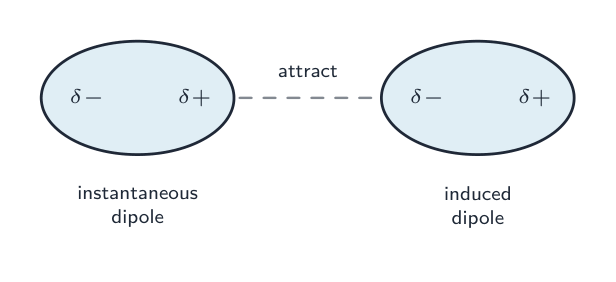
- 3.1.A.1 London dispersion forces are a result of the Coulombic interactions between temporary, fluctuating dipoles. London dispersion forces are often the strongest net intermolecular force between large molecules.
- i. Dispersion forces increase with increasing contact area between molecules and with increasing polarizability of the molecules.
- ii. The polarizability of a molecule increases with an increasing number of electrons in the molecule and the size of the electron cloud. It is enhanced by the presence of pi bonding.
- iii. The term "London dispersion forces" should not be used synonymously with the term "van der Waals forces."
- 3.1.A.2 The dipole moment of a polar molecule leads to additional interactions with other chemical species.
- i. Dipole-induced dipole interactions are present between a polar and nonpolar molecule. These forces are always attractive. The strength of these forces increases with the magnitude of the dipole of the polar molecule and with the polarizability of the nonpolar molecule.
- ii. Dipole-dipole interactions are present between polar molecules. The interaction strength depends on the magnitudes of the dipoles and their relative orientation. Interactions between polar molecules are typically greater than those between nonpolar molecules of comparable size because these interactions act in addition to London dispersion forces.
- iii. Ion-dipole forces of attraction are present between ions and polar molecules. These tend to be stronger than dipole-dipole forces.
- 3.1.A.3 The relative strength and orientation dependence of dipole-dipole and ion-dipole forces can be understood qualitatively by considering the sign of the partial charges responsible for the molecular dipole moment, and how these partial charges interact with an ion or with an adjacent dipole.
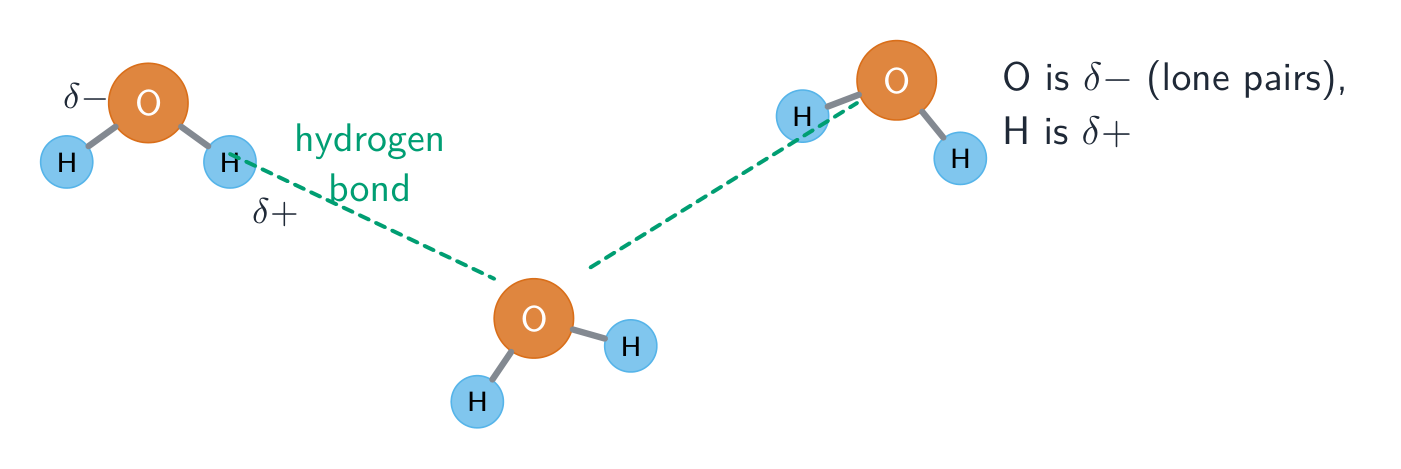
- 3.1.A.4 Hydrogen bonding is a strong type of intermolecular interaction that exists when hydrogen atoms covalently bonded to the highly electronegative atoms (N, O, and F) are attracted to the negative end of a dipole formed by the electronegative atom (N, O, and F) in a different molecule, or a different part of the same molecule.
- 3.1.A.5 In large biomolecules, noncovalent interactions may occur between different molecules or between different regions of the same large biomolecule.
Русский
Учебная цель 3.1.A: Объяснять взаимосвязь между химическими структурами молекул и относительной силой их межмолекулярных взаимодействий, когда: i. Молекулы принадлежат одному и тому же химическому виду. ii. Молекулы принадлежат двум разным химическим видам.
- 3.1.A.1 Силы Лондона являются результатом кулоновских взаимодействий между временными, флуктуирующими диполями. Силы Лондона часто являются наиболее сильной суммарной межмолекулярной силой между крупными молекулами.
- i. Силы дисперсии увеличиваются с ростом площади контакта между молекулами и с повышением поляризуемости молекул.
- ii. Поляризуемость молекулы увеличивается с ростом числа электронов в молекуле и размера электронного облака. Она усиливается наличием пи-связей.
- iii. Термин «силы Лондона» не следует использовать как синоним термина «силы Ван дер Ваальса».
- 3.1.A.2 Дипольный момент полярной молекулы приводит к дополнительным взаимодействиям с другими химическими видами.
- i. Взаимодействия диполь-индуцированный диполь присутствуют между полярной и неполярной молекулой. Эти силы всегда являются притягивающими. Сила этих взаимодействий увеличивается с ростом величины диполя полярной молекулы и поляризуемости неполярной молекулы.
- ii. Взаимодействия диполь-диполь присутствуют между полярными молекулами. Сила взаимодействия зависит от величин диполей и их относительной ориентации. Взаимодействия между полярными молекулами обычно больше, чем между неполярными молекулами сопоставимого размера, поскольку эти взаимодействия действуют дополнительно к силам Лондона.
- iii. Ион-дипольные силы притяжения присутствуют между ионами и полярными молекулами. Они, как правило, сильнее, чем диполь-дипольные силы.
- 3.1.A.3 Относительную силу и зависимость от ориентации диполь-дипольных и ион-дипольных взаимодействий можно понять качественно, рассматривая знак частичных зарядов, ответственных за молекулярный дипольный момент, а также то, как эти частичные заряды взаимодействуют с ионом или с соседним диполем.
- 3.1.A.4 Водородная связь — это сильный тип межмолекулярного взаимодействия, который возникает, когда атомы водорода, ковалентно связанные с сильно электроотрицательными атомами (N, O и F), притягиваются к отрицательному концу диполя, образованного электроотрицательным атомом (N, O и F) в другой молекуле или в другом участке той же молекулы.
- 3.1.A.5 В крупных биологических макромолекулах нековалентные взаимодействия могут возникать между различными молекулами или между различными участками одной и той же крупной биологической макромолекулы.