Skip to content · ⁨Перейти к содержанию⁩

Differentiation: Definition and Fundamental Properties · ⁨Дифференцирование: Определение и фундаментальные свойства⁩

AP Calculus AB · Topic 2 · ⁨Тема 2⁩

Video lesson for this topic · ⁨Видеоурок по этой теме⁩ Open the video page · ⁨Открыть страницу видео⁩
7:54

Определение производной

Представьте путь автомобиля как кривую. На всем интервале мы можем измерить его среднюю скорость — это наклон прямой, соединяющей две точки на кривой.…

English narration · English + 中文 subtitles burned in · ⁨Английское озвучивание · Английский + китайские субтитры (встроенные)⁩

2.1

Average and Instantaneous Rates of Change · ⁨Средняя и мгновенная скорости изменения⁩

Syllabus · ⁨Программа⁩
English

Enduring Understanding (CHA-2): Derivatives allow us to determine rates of change at an instant by applying limits to knowledge about rates of change over intervals.

Learning Objective CHA-2.A: Determine average rates of change using difference quotients.

  • CHA-2.A.1 The difference quotients $\dfrac{f(a+h)-f(a)}{h}$ and $\dfrac{f(x)-f(a)}{x-a}$ express the average rate of change of a function over an interval.

Learning Objective CHA-2.B: Represent the derivative of a function as the limit of a difference quotient.

  • CHA-2.B.1 The instantaneous rate of change of a function at $x=a$ can be expressed by $\lim\limits_{h\to 0}\dfrac{f(a+h)-f(a)}{h}$ or $\lim\limits_{x\to a}\dfrac{f(x)-f(a)}{x-a}$, provided the limit exists. These are equivalent forms of the definition of the derivative and are denoted $f'(a)$.
Русский

Принцип (CHA-2): Производные позволяют определять скорости изменения в конкретный момент времени, применяя пределы к знаниям о скоростях изменения на интервалах.

Цель обучения CHA-2.A: Определять средние скорости изменения с использованием разностных отношений.

  • CHA-2.A.1 Разностные отношения $\dfrac{f(a+h)-f(a)}{h}$ и $\dfrac{f(x)-f(a)}{x-a}$ выражают среднюю скорость изменения функции на интервале.

Цель обучения CHA-2.B: Представить производную функции как предел разностного отношения.

  • CHA-2.B.1 Мгновенная скорость изменения функции в точке $x=a$ может быть выражена через $\lim\limits_{h\to 0}\dfrac{f(a+h)-f(a)}{h}$ или $\lim\limits_{x\to a}\dfrac{f(x)-f(a)}{x-a}$, при условии существования предела. Это эквивалентные формы определения производной и обозначаются как $f'(a)$.
Source: College Board AP Course and Exam Description · ⁨Источник: Описание курса и экзамена College Board AP⁩

English
The derivative from first principles

Unit 1 built the limit. Unit 2 uses it to define the derivative 导数 – the exact rate of change at a point.

Over an interval, the average rate of change is a difference quotient 差商. Two equivalent forms appear:

$$\frac{f(a+h)-f(a)}{h} \qquad\text{and}\qquad \frac{f(x)-f(a)}{x-a}.$$
The first uses a step of size $h$ from $a$; the second uses two points $x$ and $a$. Both compute $\dfrac{\text{change in output}}{\text{change in input}}$ over the interval.

The instantaneous 瞬时 rate of change at $x=a$ is what the difference quotient approaches as the interval shrinks to zero. This limit is the derivative at $a$, written $f'(a)$:

$$f'(a) = \lim_{h\to 0}\frac{f(a+h)-f(a)}{h} = \lim_{x\to a}\frac{f(x)-f(a)}{x-a},$$
provided the limit exists.

Русский
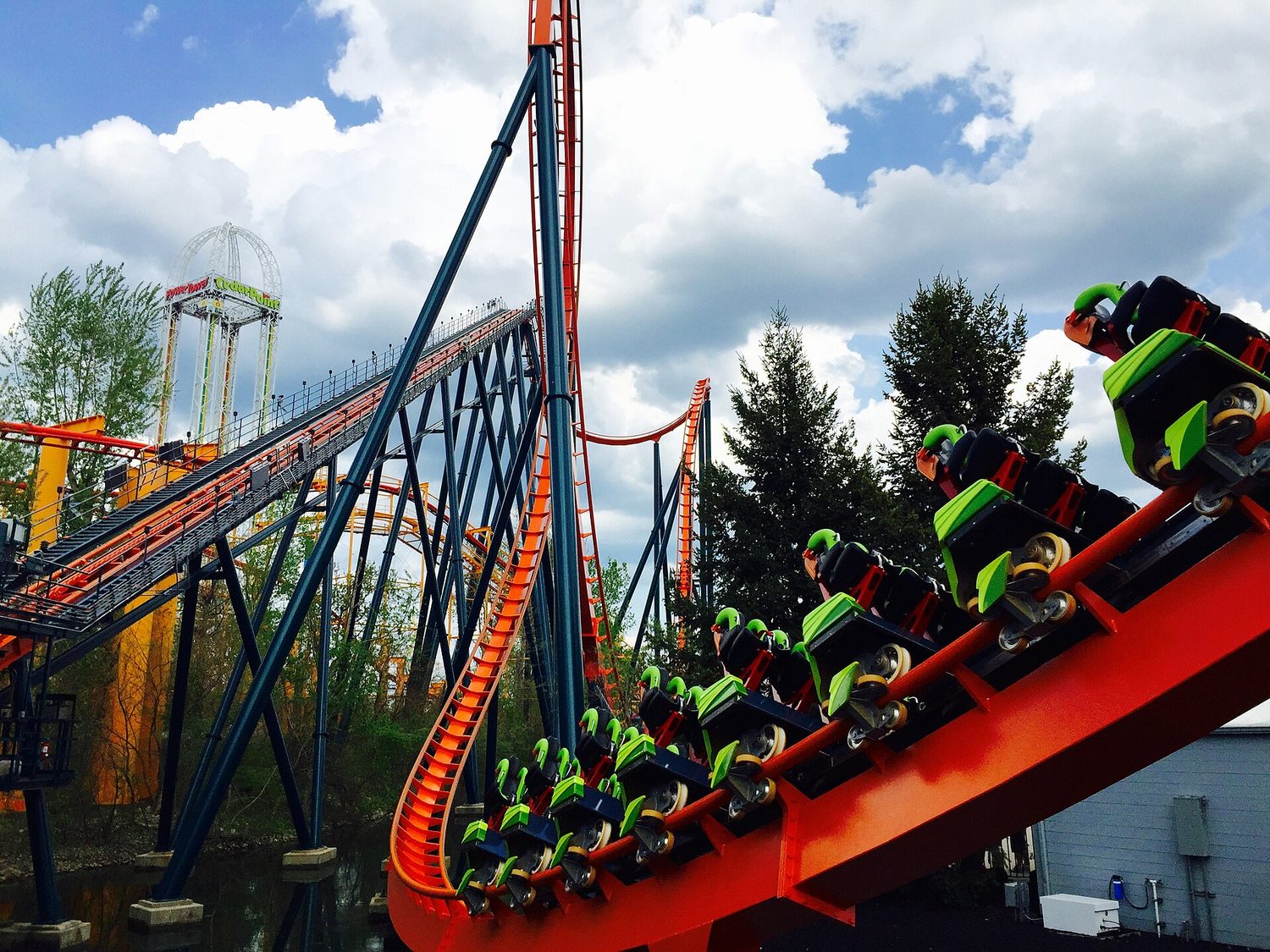
Американские горки на подъёмнике: производная измеряет мгновенную скорость изменения положения
Производная по определению

Единица 1 построила понятие предела. Единица 2 использует его для определения производной — точной скорости изменения в точке.

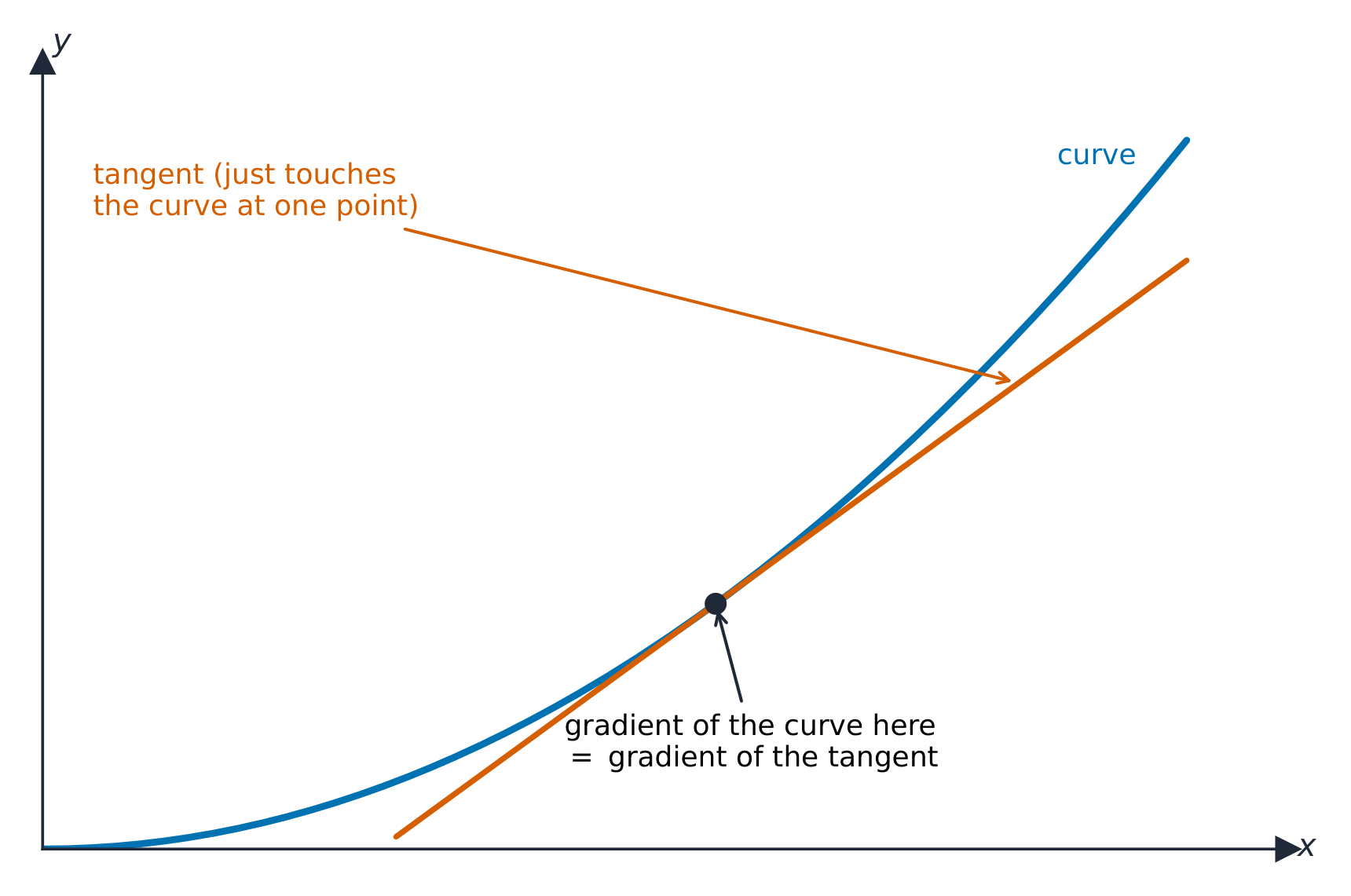
Мгновенная скорость изменения — это угловой коэффициент касательной в точке

На интервале средняя скорость изменения представляет собой разностное отношение. Приводятся две эквивалентные формы:

$$\frac{f(a+h)-f(a)}{h} \qquad\text{and}\qquad \frac{f(x)-f(a)}{x-a}.$$
Первое использует шаг размера $h$ от $a$; второе использует две точки $x$ и $a$. Оба вычисляют $\dfrac{\text{change in output}}{\text{change in input}}$ на интервале.

Мгновенная скорость изменения в точке $x=a$ — это то, к чему стремится разностное отношение при уменьшении интервала до нуля. Этот предел и есть производная в точке $a$, которая записывается как $f'(a)$:

$$f'(a) = \lim_{h\to 0}\frac{f(a+h)-f(a)}{h} = \lim_{x\to a}\frac{f(x)-f(a)}{x-a},$$
при условии существования этого предела.

Explore · ⁨Исследовать⁩

From average rate to instantaneous rate · ⁨От средней скорости к мгновенной⁩

y = ax³ + bx² + cx + d

Slide the point: the secant through two nearby points tips toward the tangent as they merge. The tangent's slope is the derivative — the instantaneous rate of change. · ⁨Перетащите точку: секущая, проходящая через две близкие точки, приближается к касательной при их слиянии. Наклон касательной равен производной — мгновенной скорости изменения.⁩

Vocabulary · ⁨Словарь⁩ Train · ⁨Тренировать⁩
English Русский
derivative/dɪˈrɪvətɪv/ производной
difference quotient/ˈdɪfrəns ˈkwəʊʃənt/ разностное отношение
instantaneous/ˌɪnstənˈteɪnɪəs/ мгновенная
first principles/fɜːst ˈprɪnsɪplz/ первоначальные принципы
notations/nəʊˈteɪʃnz/ обозначения
slope/sləʊp/ наклоне графика
tangent line/ˈtændʒənt laɪn/ касательная прямая
2.2

Defining the Derivative and Its Notation · ⁨Определение производной и её обозначения⁩

Syllabus · ⁨Программа⁩
Enduring UnderstandingLearning ObjectiveEssential Knowledge

CHA-2
Derivatives allow us to determine rates of change at an instant by applying limits to knowledge about rates of change over intervals.

CHA-2.B
Represent the derivative of a function as the limit of a difference quotient.

  • CHA-2.B.2 The derivative of $f$ is the function whose value at $x$ is $\lim\limits_{h\to 0}\dfrac{f(x+h)-f(x)}{h}$, provided this limit exists.
  • CHA-2.B.3 For $y=f(x)$, notations for the derivative include $\dfrac{dy}{dx}$, $f'(x)$, and $y'$.
  • CHA-2.B.4 The derivative can be represented graphically, numerically, analytically, and verbally.

CHA-2.C
Determine the equation of a line tangent to a curve at a given point.

  • CHA-2.C.1 The derivative of a function at a point is the slope of the line tangent to a graph of the function at that point.

Source: College Board AP Course and Exam Description · ⁨Источник: Описание курса и экзамена College Board AP⁩

English

Let the point $a$ vary and the derivative becomes a new function:

$$f'(x) = \lim_{h\to 0}\frac{f(x+h)-f(x)}{h}.$$
This is the definition of the derivative (sometimes called differentiating "by first principles" 用定义求导). Its value at each $x$ is the instantaneous rate of change there.

Common notations 记号 for the derivative of $y=f(x)$ are:

$$\frac{dy}{dx}, \qquad f'(x), \qquad y'.$$
The derivative can be represented graphically, numerically, analytically, and verbally – be ready to move between them.

Geometric meaning. The derivative at a point is the slope 斜率 of the tangent line 切线 to the graph there. So the tangent line at $x=a$ passes through $\big(a, f(a)\big)$ with slope $f'(a)$:

$$y - f(a) = f'(a)\,(x-a).$$
Writing this line is a routine exam task, so keep the point-slope form ready.

Русский

Пусть точка $a$ изменяется, тогда производная становится новой функцией:

$$f'(x) = \lim_{h\to 0}\frac{f(x+h)-f(x)}{h}.$$
Это определение производной (иногда называют дифференцированием «по определению»). Её значение в каждой точке $x$ является мгновенной скоростью изменения в этой точке.

Распространённые обозначения для производной функции $y=f(x)$:

$$\frac{dy}{dx}, \qquad f'(x), \qquad y'.$$
Производную можно представлять графически, численно, аналитически и вербально — будьте готовы переходить между этими формами.

Геометрический смысл. Производная в точке — это угловой коэффициент касательной к графику в этой точке. Таким образом, касательная в точке $x=a$ проходит через точку $\big(a, f(a)\big)$ с угловым коэффициентом $f'(a)$:

$$y - f(a) = f'(a)\,(x-a).$$
Запись уравнения этой прямой — стандартная задача на экзамене, поэтому держите формулу прямой с заданным угловым коэффициентом под рукой.

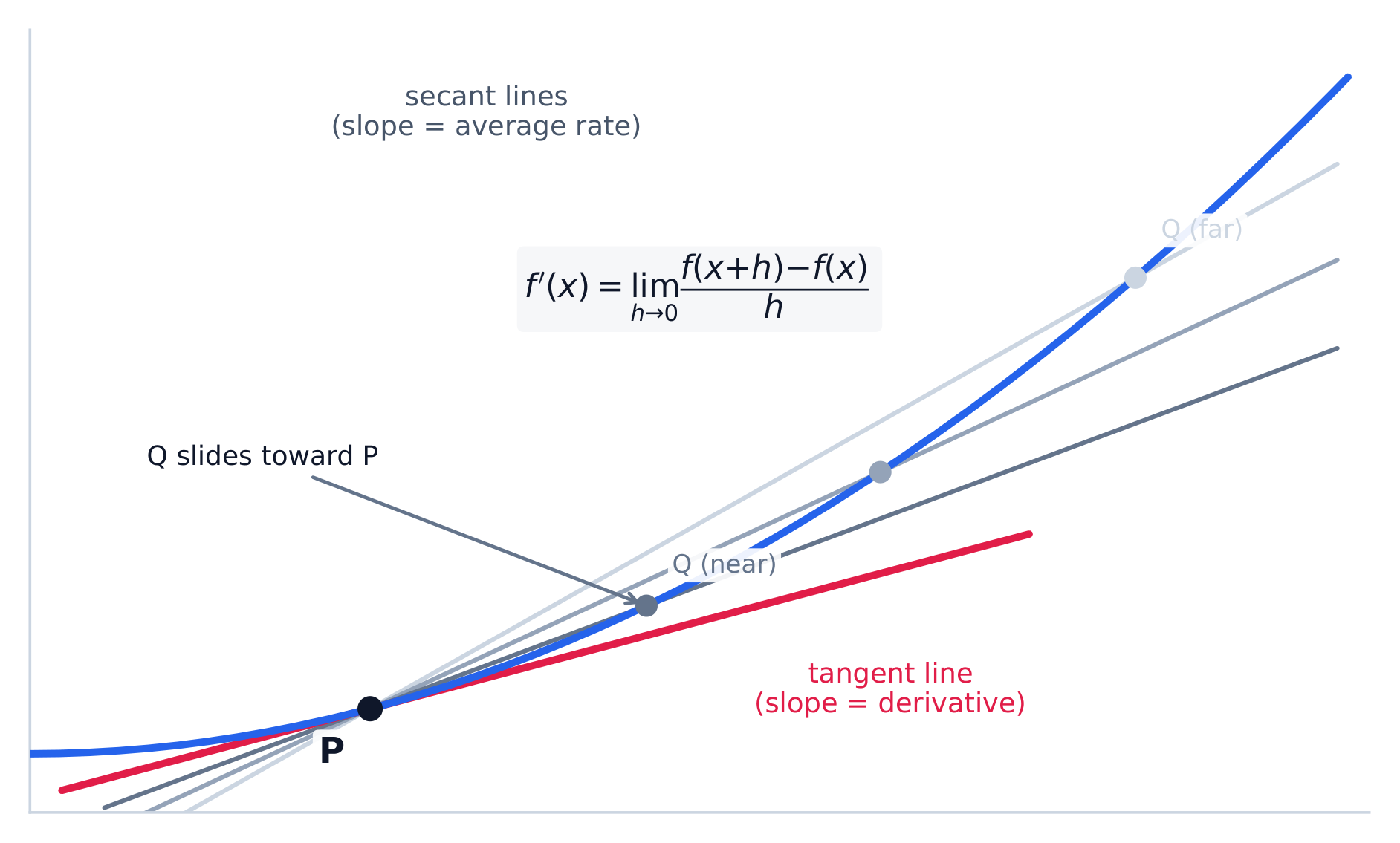
Угловые коэффициенты хорд стремятся к угловому коэффициенту касательной: производная — это предел средних скоростей
При приближении точки $Q$ к точке $P$ угловой коэффициент каждой хорды (средней скорости) стремится к угловому коэффициенту касательной — производной $f'(a)$.
2.3

Estimating a Derivative at a Point · ⁨Оценка производной в точке⁩

Syllabus · ⁨Программа⁩
English

Enduring Understanding (CHA-2): Derivatives allow us to determine rates of change at an instant by applying limits to knowledge about rates of change over intervals.

Learning Objective CHA-2.D: Estimate derivatives.

  • CHA-2.D.1 The derivative at a point can be estimated from information given in tables or graphs.
  • CHA-2.D.2 Technology can be used to calculate or estimate the value of a derivative of a function at a point.
Русский

Принцип (CHA-2): Производные позволяют определять скорости изменения в конкретный момент времени, применяя пределы к знаниям о скоростях изменения на интервалах.

Цель обучения CHA-2.D: Оценивать производные.

  • CHA-2.D.1 Производную в точке можно оценить на основе информации, представленной в таблицах или графиках.
  • CHA-2.D.2 Технологии могут использоваться для вычисления или оценки значения производной функции в точке.

Source: College Board AP Course and Exam Description · ⁨Источник: Описание курса и экзамена College Board AP⁩

English

You do not always have a formula. When a function is given by a table 表格 or a graph, estimate the derivative $f'(a)$ with a difference quotient over a small interval around $a$. A table with values on both sides of $a$ gives the best estimate:

$$f'(a) \approx \frac{f(b)-f(c)}{b-c},\qquad \text{where } c < a < b \text{ are the closest table inputs}.$$
Technology (a calculator) can also estimate a derivative at a point.

Exam skill (appears almost every year). Questions such as "Approximate $M'(7.5)$ using the average rate of change of $M$ over the interval $5 \le t \le 10$" ask for exactly this difference quotient. Show the setup:

$$M'(7.5) \approx \frac{M(10)-M(5)}{10-5}.$$
Full credit needs the numbers plugged in and the correct units 单位 (output units per input unit), since these come from real-world models.

Русский

Не всегда доступна формула функции. Когда функция задана таблицей или графиком, оцените производную $f'(a)$ с помощью разностного отношения на малом интервале вокруг точки $a$. Таблица со значениями по обе стороны от $a$ даёт наилучшую оценку:

$$f'(a) \approx \frac{f(b)-f(c)}{b-c},\qquad \text{where } c < a < b \text{ are the closest table inputs}.$$
Технологии (калькулятор) также могут оценить производную в точке.

Навык для экзамена (встречается почти каждый год). Вопросы типа «Оцените $M'(7.5)$, используя среднюю скорость изменения функции $M$ на интервале $5 \le t \le 10$» требуют именно этого разностного отношения. Покажите настройку:

$$M'(7.5) \approx \frac{M(10)-M(5)}{10-5}.$$
Полный балл требуется подставить числа и указать правильные единицы измерения (выходная единица на входную единицу), так как они берутся из реальных моделей.

Vocabulary · ⁨Словарь⁩ Train · ⁨Тренировать⁩
English Русский
table/ˈteɪbl/ таблица
units/ˈjuːnɪts/ единиц
differentiable/ˈdɪfərenʃɪəbl/ дифференцируема
continuous/kənˈtɪnjuːəs/ непрерывными
corner/ˈkɔːnə/ угол
vertical tangent/ˈvɜːtɪkl ˈtændʒənt/ вертикальная касательная
power rule/ˈpaʊə ruːl/ правило степени
Constant multiple/ˈkɒnstənt ˈmʌltɪpl/ постоянный множитель
polynomial/ˌpɒlɪˈnəʊmɪəl/ полиномом
2.4

When Does a Derivative Exist? · ⁨Когда существует производная?⁩

Syllabus · ⁨Программа⁩
English

Enduring Understanding (FUN-2): Recognizing that a function's derivative may also be a function allows us to develop knowledge about the related behaviors of both.

Learning Objective FUN-2.A: Explain the relationship between differentiability and continuity.

  • FUN-2.A.1 If a function is differentiable at a point, then it is continuous at that point. In particular, if a point is not in the domain of $f$, then it is not in the domain of $f'$.
  • FUN-2.A.2 A continuous function may fail to be differentiable at a point in its domain.
    • Illustrative examples for FUN-2.A.2:
      • The left hand and right hand limits of the difference quotient are not equal, as in $f(x)=|x|$ at $x=0$.
      • The tangent line is vertical and has no slope, as in $f(x)=\sqrt[3]{x}$ at $x=0$.
Русский

Принцип (FUN-2): Осознание того, что производная функции также является функцией, позволяет нам развивать знания о связанных свойствах обеих величин.

Цель обучения FUN-2.A: Объяснить связь между дифференцируемостью и непрерывностью.

  • FUN-2.A.1 Если функция дифференцируема в точке, то она непрерывна в этой точке. В частности, если точка не принадлежит области определения $f$, то она не принадлежит и области определения $f'$.
  • FUN-2.A.2 Непрерывная функция может не быть дифференцируемой в некоторой точке своей области определения.
    • Иллюстративные примеры для FUN-2.A.2:
      • Левосторонний и правосторонний пределы разностного отношения не равны, как в случае $f(x)=|x|$ в точке $x=0$.
      • Касательная вертикальна и не имеет наклона, как в случае $f(x)=\sqrt[3]{x}$ в точке $x=0$.

Source: College Board AP Course and Exam Description · ⁨Источник: Описание курса и экзамена College Board AP⁩

English

Differentiability is stronger than continuity. The key relationship:

If $f$ is differentiable 可导 at a point, then $f$ is continuous 连续 there.

So differentiability implies continuity. The reverse is false: a continuous function can fail to be differentiable. Two ways this happens:

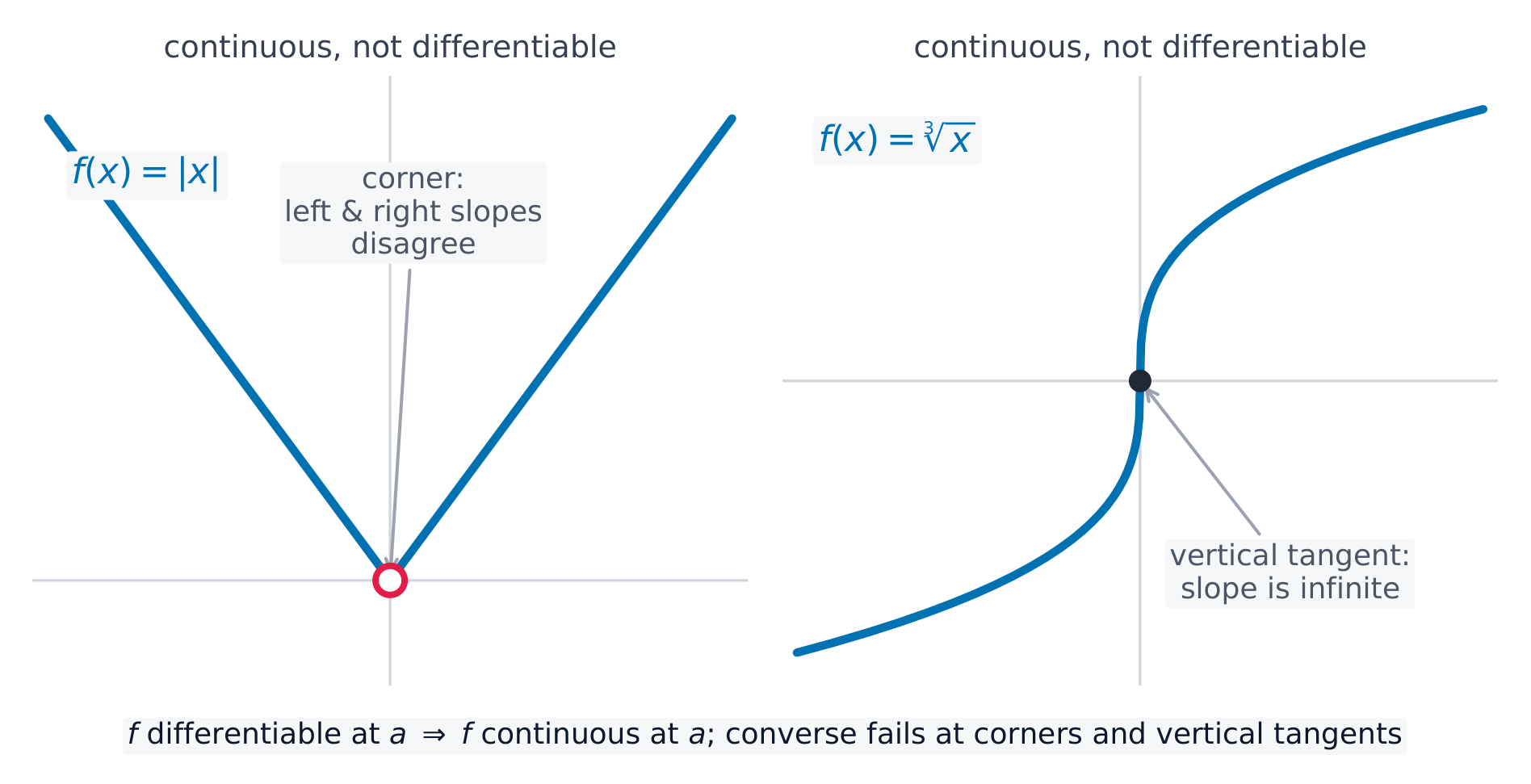
  • A corner 尖点: the left and right difference-quotient limits disagree, as with $f(x)=|x|$ at $x=0$.
  • A vertical tangent 垂直切线: the slope is infinite (no real number), as with $f(x)=\sqrt[3]{x}$ at $x=0$.

Also, a point outside the domain of $f$ cannot be in the domain of $f'$. Use the contrapositive on the exam: if $f$ is not continuous at $a$, then $f$ is not differentiable at $a$.

Русский

Дифференцируемость сильнее, чем непрерывность. Ключевая связь:

Если $f$ дифференцируема в точке, то $f$ непрерывна в этой точке.

Таким образом, дифференцируемость влечет непрерывность. Обратное неверно: непрерывная функция может не быть дифференцируемой. Два способа, когда это происходит:

  • Угол: пределы левосторонней и правосторонней разностных отношений расходятся, как у $f(x)=|x|$ в $x=0$.
  • Вертикальная касательная: наклон бесконечен (нет действительного числа), как у $f(x)=\sqrt[3]{x}$ в $x=0$.
Два способа, по которым непрерывная функция не является дифференцируемой: угол и вертикальная касательная

Кроме того, точка вне области определения $f$ не может находиться в области определения $f'$. Используйте contrapositive на экзамене: если $f$ не непрерывна в $a$, то $f$ не дифференцируема в $a$.

2.5

The Power Rule · ⁨Правило степени⁩

Syllabus · ⁨Программа⁩
English

Enduring Understanding (FUN-3): Recognizing opportunities to apply derivative rules can simplify differentiation.

Learning Objective FUN-3.A: Calculate derivatives of familiar functions.

  • FUN-3.A.1 Direct application of the definition of the derivative and specific rules can be used to calculate the derivative for functions of the form $f(x)=x^{r}$.
Русский

Принцип (FUN-3): Осознание возможностей применения правил дифференцирования может упростить процесс нахождения производных.

Цель обучения FUN-3.A: Вычислять производные известных функций.

  • FUN-3.A.1 Прямое применение определения производной и конкретных правил может быть использовано для вычисления производной функций вида $f(x)=x^{r}$.

Source: College Board AP Course and Exam Description · ⁨Источник: Описание курса и экзамена College Board AP⁩

English

From here we use rules instead of the limit definition each time. The power rule 幂法则 handles any power of $x$:

$$\frac{d}{dx}\,x^{r} = r\,x^{\,r-1}\qquad\text{for any real } r.$$
It works for whole-number powers, negative powers ($\tfrac{1}{x}=x^{-1}$), and roots ($\sqrt{x}=x^{1/2}$) – rewrite as a power first, then apply the rule.

Русский

Отныне мы используем правила вместо определения через предел каждый раз. Правило степени обрабатывает любую степень $x$:

$$\frac{d}{dx}\,x^{r} = r\,x^{\,r-1}\qquad\text{for any real } r.$$
Оно работает для целочисленных степеней, отрицательных степеней ($\tfrac{1}{x}=x^{-1}$) и корней ($\sqrt{x}=x^{1/2}$) — сначала перепишите как степень, затем примените правило.

Explore · ⁨Исследовать⁩

A power function and its steepening slope · ⁨Степенная функция и нарастающий наклон⁩

y = ax³ + bx² + cx + d

The power rule $\frac{d}{dx}x^n = nx^{n-1}$ drops the exponent as a factor. For $x^3$ the slope grows quickly as $x$ moves from 0 — the curve steepens. · ⁨Правило дифференцирования степени $\frac{d}{dx}x^n = nx^{n-1}$ выносит показатель степени как множитель. Для $x^3$ наклон быстро растет при движении $x$ от 0 — кривая становится круче.⁩

2.6

Constant, Sum, Difference, and Constant Multiple Rules · ⁨Правила константы, суммы, разности и константного множителя⁩

Syllabus · ⁨Программа⁩
English

Enduring Understanding (FUN-3): Recognizing opportunities to apply derivative rules can simplify differentiation.

Learning Objective FUN-3.A: Calculate derivatives of familiar functions.

  • FUN-3.A.2 Sums, differences, and constant multiples of functions can be differentiated using derivative rules.
  • FUN-3.A.3 The power rule combined with sum, difference, and constant multiple properties can be used to find the derivatives for polynomial functions.
Русский

Принцип (FUN-3): Осознание возможностей применения правил дифференцирования может упростить процесс нахождения производных.

Цель обучения FUN-3.A: Вычислять производные известных функций.

  • FUN-3.A.2 Суммы, разности и константные множители функций могут быть продифференцированы с использованием правил дифференцирования.
  • FUN-3.A.3 Правило степени в сочетании со свойствами суммы, разности и константного множителя может быть использовано для нахождения производных полиномиальных функций.

Source: College Board AP Course and Exam Description · ⁨Источник: Описание курса и экзамена College Board AP⁩

English

These rules let you differentiate term by term:

  • Constant: $\dfrac{d}{dx}\,k = 0$ (a constant does not change).
  • Constant multiple 常数倍: $\dfrac{d}{dx}\big[k\,f(x)\big] = k\,f'(x)$.
  • Sum / difference: $\dfrac{d}{dx}\big[f(x)\pm g(x)\big] = f'(x)\pm g'(x)$.

Combined with the power rule, they differentiate any polynomial 多项式 term by term. Example:

$$\frac{d}{dx}\big(4x^3 - 5x + 7\big) = 12x^2 - 5.$$

Русский

Эти правила позволяют дифференцировать почленно:

  • Константа: $\dfrac{d}{dx}\,k = 0$ (константа не меняется).
  • Константный множитель: $\dfrac{d}{dx}\big[k\,f(x)\big] = k\,f'(x)$.
  • Сумма / разность: $\dfrac{d}{dx}\big[f(x)\pm g(x)\big] = f'(x)\pm g'(x)$.

В сочетании с правилом степени они дифференцируют любой полином почленно. Пример:

$$\frac{d}{dx}\big(4x^3 - 5x + 7\big) = 12x^2 - 5.$$

2.7

Derivatives of sin x, cos x, e^x, and ln x · ⁨Производные sin x, cos x, e^x и ln x⁩

Syllabus · ⁨Программа⁩
English

Enduring Understanding (FUN-3): Recognizing opportunities to apply derivative rules can simplify differentiation.

Learning Objective FUN-3.A: Calculate derivatives of familiar functions.

  • FUN-3.A.4 Specific rules can be used to find the derivatives for sine, cosine, exponential, and logarithmic functions.

Enduring Understanding (LIM-3): Reasoning with definitions, theorems, and properties can be used to determine a limit.

Learning Objective LIM-3.A: Interpret a limit as a definition of a derivative.

  • LIM-3.A.1 In some cases, recognizing an expression for the definition of the derivative of a function whose derivative is known offers a strategy for determining a limit.
Русский

Принцип (FUN-3): Осознание возможностей применения правил дифференцирования может упростить процесс нахождения производных.

Цель обучения FUN-3.A: Вычислять производные известных функций.

  • FUN-3.A.4 Конкретные правила могут быть использованы для нахождения производных синуса, косинуса, показательных и логарифмических функций.

Долгосрочное понимание (LIM-3): Логическое рассуждение с использованием определений, теорем и свойств позволяет определить предел.

Цель обучения LIM-3.A: Интерпретировать предел как определение производной.

  • LIM-3.A.1 В некоторых случаях распознавание выражения, соответствующего определению производной функции, производная которой известна, предлагает стратегию для определения предела.

Source: College Board AP Course and Exam Description · ⁨Источник: Описание курса и экзамена College Board AP⁩

English

Learn these four building-block derivatives by heart:

$$\frac{d}{dx}\sin x = \cos x, \qquad \frac{d}{dx}\cos x = -\sin x,$$
$$\frac{d}{dx}e^{x} = e^{x}, \qquad \frac{d}{dx}\ln x = \frac{1}{x}\ \ (x>0).$$
Note the minus sign on the derivative of cosine, and that $e^{x}$ is its own derivative.

A limit that is really a derivative (LIM-3.A.1). Sometimes a limit is secretly the definition of a known derivative. If you recognize

$$\lim_{h\to 0}\frac{f(a+h)-f(a)}{h}$$
for a function $f$ whose derivative you know, just evaluate $f'(a)$. For example, $\displaystyle \lim_{h\to 0}\frac{\sin\!\big(\tfrac{\pi}{2}+h\big)-1}{h} = \left.\frac{d}{dx}\sin x\right|_{x=\pi/2} = \cos\tfrac{\pi}{2} = 0$.

Русский

Выучите эти четыре базовых производных наизусть:

$$\frac{d}{dx}\sin x = \cos x, \qquad \frac{d}{dx}\cos x = -\sin x,$$
$$\frac{d}{dx}e^{x} = e^{x}, \qquad \frac{d}{dx}\ln x = \frac{1}{x}\ \ (x>0).$$
Обратите внимание на знак минус при производной косинуса и на то, что $e^{x}$ является своей собственной производной.

Предел, который на самом деле является производной (LIM-3.A.1). Иногда предел тайно является определением известной производной. Если вы распознаете

$$\lim_{h\to 0}\frac{f(a+h)-f(a)}{h}$$
для функции $f$, производную которой вы знаете, просто вычислите $f'(a)$. Например, $\displaystyle \lim_{h\to 0}\frac{\sin\!\big(\tfrac{\pi}{2}+h\big)-1}{h} = \left.\frac{d}{dx}\sin x\right|_{x=\pi/2} = \cos\tfrac{\pi}{2} = 0$.

Explore · ⁨Исследовать⁩

The shape of sin x (whose slope is cos x) · ⁨Форма sin x (производная которой равна cos x)⁩

y = asin(bx + c) + d

The derivative of $\sin x$ is $\cos x$: the slope of the sine curve is largest where sine crosses zero and zero at its peaks. Watch the curve to feel where its slope is steep or flat. · ⁨Производная $\sin x$ равна $\cos x$: наклон кривой синуса максимален в точках пересечения с нулем и равен нулю в вершинах. Наблюдайте за кривой, чтобы ощутить, где её наклон крутой или пологий.⁩

2.8

The Product Rule · ⁨Правило произведения⁩

Syllabus · ⁨Программа⁩
English

Enduring Understanding (FUN-3): Recognizing opportunities to apply derivative rules can simplify differentiation.

Learning Objective FUN-3.B: Calculate derivatives of products and quotients of differentiable functions.

  • FUN-3.B.1 Derivatives of products of differentiable functions can be found using the product rule.
Русский

Принцип (FUN-3): Осознание возможностей применения правил дифференцирования может упростить процесс нахождения производных.

Цель обучения FUN-3.B: Вычислять производные произведений и отношений дифференцируемых функций.

  • FUN-3.B.1 Производные произведений дифференцируемых функций можно найти с использованием правила произведения.

Source: College Board AP Course and Exam Description · ⁨Источник: Описание курса и экзамена College Board AP⁩

English
The product rule as a growing rectangle

A product of two functions is not differentiated by multiplying the derivatives. Use the product rule 乘积法则:

$$\frac{d}{dx}\big[u\,v\big] = u'v + uv'.$$
"Derivative of the first times the second, plus the first times the derivative of the second." Example:
$$\frac{d}{dx}\big(x^2 e^{x}\big) = 2x\,e^{x} + x^2 e^{x}.$$
Exam questions often build a new function from given pieces, e.g. $k'(x) = \big(f(x)\big)^2 g(x)$, and ask you to combine rules while reading values from a table.

Русский
Правило произведения как растущий прямоугольник

Произведение двух функций не дифференцируется путем умножения их производных. Используйте правило произведения:

$$\frac{d}{dx}\big[u\,v\big] = u'v + uv'.$$
"Производная первого умножается на второе плюс первое умножается на производную второго." Пример:
$$\frac{d}{dx}\big(x^2 e^{x}\big) = 2x\,e^{x} + x^2 e^{x}.$$
Экзаменационные вопросы часто создают новую функцию из заданных частей, например $k'(x) = \big(f(x)\big)^2 g(x)$, и просят объединить правила, считывая значения из таблицы.

Vocabulary · ⁨Словарь⁩ Train · ⁨Тренировать⁩
English Русский
product rule/ˈprɒdʌkt ruːl/ правило произведения
2.9

The Quotient Rule · ⁨Правило частного⁩

Syllabus · ⁨Программа⁩
English

Enduring Understanding (FUN-3): Recognizing opportunities to apply derivative rules can simplify differentiation.

Learning Objective FUN-3.B: Calculate derivatives of products and quotients of differentiable functions.

  • FUN-3.B.2 Derivatives of quotients of differentiable functions can be found using the quotient rule.
Русский

Принцип (FUN-3): Осознание возможностей применения правил дифференцирования может упростить процесс нахождения производных.

Цель обучения FUN-3.B: Вычислять производные произведений и отношений дифференцируемых функций.

  • FUN-3.B.2 Производные частных дифференцируемых функций можно найти с использованием правила частного.

Source: College Board AP Course and Exam Description · ⁨Источник: Описание курса и экзамена College Board AP⁩

English

For a quotient, use the quotient rule 商法则:

$$\frac{d}{dx}\!\left[\frac{u}{v}\right] = \frac{u'v - uv'}{v^{2}}.$$
"Bottom times derivative of top, minus top times derivative of bottom, all over bottom squared." The order matters because of the minus sign, so write the numerator carefully. Example:
$$\frac{d}{dx}\!\left(\frac{x}{\cos x}\right) = \frac{1\cdot\cos x - x\cdot(-\sin x)}{\cos^2 x} = \frac{\cos x + x\sin x}{\cos^2 x}.$$

Русский

Для частного используйте правило частного:

$$\frac{d}{dx}\!\left[\frac{u}{v}\right] = \frac{u'v - uv'}{v^{2}}.$$
"Нижнее умножить на производную верхнего, минус верхнее умножить на производную нижнего, все делить на квадрат нижнего." Порядок важен из-за знака минус, поэтому пишите числитель внимательно. Пример:
$$\frac{d}{dx}\!\left(\frac{x}{\cos x}\right) = \frac{1\cdot\cos x - x\cdot(-\sin x)}{\cos^2 x} = \frac{\cos x + x\sin x}{\cos^2 x}.$$

2.10

Derivatives of tan x, cot x, sec x, and csc x · ⁨Производные tan x, cot x, sec x и csc x⁩

Syllabus · ⁨Программа⁩
English

Enduring Understanding (FUN-3): Recognizing opportunities to apply derivative rules can simplify differentiation.

Learning Objective FUN-3.B: Calculate derivatives of products and quotients of differentiable functions.

  • FUN-3.B.3 Rearranging tangent, cotangent, secant, and cosecant functions using identities allows differentiation using derivative rules.
Русский

Принцип (FUN-3): Осознание возможностей применения правил дифференцирования может упростить процесс нахождения производных.

Цель обучения FUN-3.B: Вычислять производные произведений и отношений дифференцируемых функций.

  • FUN-3.B.3 Преобразование тангенса, котангенса, секанса и косеканса с использованием тождеств позволяет дифференцировать их, применяя правила производных.

Source: College Board AP Course and Exam Description · ⁨Источник: Описание курса и экзамена College Board AP⁩

English
The quotient rule: differentiating a fraction

The remaining trigonometric derivatives are not memorized separately – you rewrite them with identities 恒等式 and apply the quotient (or product) rule. For instance, $\tan x = \dfrac{\sin x}{\cos x}$, so the quotient rule gives

$$\frac{d}{dx}\tan x = \frac{\cos x\cos x - \sin x(-\sin x)}{\cos^2 x} = \frac{1}{\cos^2 x} = \sec^2 x.$$
The same method (writing $\cot x=\tfrac{\cos x}{\sin x}$, $\sec x=\tfrac{1}{\cos x}$, $\csc x=\tfrac{1}{\sin x}$) gives $-\csc^2 x$, $\sec x\tan x$, and $-\csc x\cot x$.

Higher-order derivatives. Differentiating $f'$ again gives the second derivative 二阶导数 $f''(x)$ (or $\tfrac{d^2y}{dx^2}$) – the rate of change of the rate of change. An exam part like "Find $k''(3)$" just means differentiate twice, then substitute. You can also estimate a second derivative from a table by applying the average-rate-of-change method to the $f'$ values.

Worked example. Differentiate $f(x)=x^2\sin x$ with the product rule $(uv)'=u'v+uv'$: take $u=x^2$ ($u'=2x$) and $v=\sin x$ ($v'=\cos x$), giving $f'(x)=2x\sin x+x^2\cos x$. Always read the structure first — a product needs the product rule, not the power rule applied to each factor separately.

Русский
Правило частного: дифференцирование дроби

Остальные тригонометрические производные не нужно запоминать отдельно — вы переписываете их с помощью тождеств и применяете правило частного (или произведения). Например, $\tan x = \dfrac{\sin x}{\cos x}$, поэтому правило частного дает

$$\frac{d}{dx}\tan x = \frac{\cos x\cos x - \sin x(-\sin x)}{\cos^2 x} = \frac{1}{\cos^2 x} = \sec^2 x.$$
Тот же метод (переписывание $\cot x=\tfrac{\cos x}{\sin x}$, $\sec x=\tfrac{1}{\cos x}$, $\csc x=\tfrac{1}{\sin x}$) дает $-\csc^2 x$, $\sec x\tan x$ и $-\csc x\cot x$.

Производные высших порядков. Повторное дифференцирование $f'$ дает вторую производную $f''(x)$ (или $\tfrac{d^2y}{dx^2}$) — скорость изменения скорости изменения. Часть экзамена вроде «Найдите $k''(3)$» означает просто продифференцировать дважды, а затем подставить. Вы также можете оценить вторую производную по таблице, применив метод средней скорости изменения к значениям $f'$.

Разобранный пример. Продифференцируйте $f(x)=x^2\sin x$ с помощью правила произведения $(uv)'=u'v+uv'$: возьмите $u=x^2$ ($u'=2x$) и $v=\sin x$ ($v'=\cos x$), получив $f'(x)=2x\sin x+x^2\cos x$. Всегда сначала читайте структуру — произведение требует правила произведения, а не правила степени, примененного к каждому множителю отдельно.

Vocabulary · ⁨Словарь⁩ Train · ⁨Тренировать⁩
English Русский
quotient rule/ˈkwəʊʃənt ruːl/ правило частного
identities/aɪˈdentɪtiz/ тождества
second derivative/ˈsekənd dɪˈrɪvətɪv/ вторую производную
2.10

Exam tips · ⁨Советы для экзамена⁩

English
  • The derivative is the slope of the tangent — the limit of the secant slope $\tfrac{f(x+h)-f(x)}{h}$ as $h\to0$.
  • Memorise the rules: power, product, quotient, and the derivatives of $\sin$, $\cos$, $e^x$, and $\ln x$.
  • Differentiability implies continuity, but not the reverse (a corner or cusp is continuous yet not differentiable).
  • Distinguish average rate of change (secant slope over an interval) from instantaneous rate (the derivative at a point).
  • Give a tangent-line equation as $y-f(a)=f'(a)(x-a)$.
Русский
  • Производная — это наклон касательной — предел наклона секущей $\tfrac{f(x+h)-f(x)}{h}$ при $h\to0$.
  • Запомните правила: степени, произведения, частного, а также производные от $\sin$, $\cos$, $e^x$ и $\ln x$.
  • Дифференцируемость влечет непрерывность, но не наоборот (угол или острая вершина непрерывны, но не дифференцируемы).
  • Различайте среднюю скорость изменения (наклон секучей на интервале) и мгновенную скорость (производную в точке).
  • Уравнение касательной записывайте в виде $y-f(a)=f'(a)(x-a)$.

Interactive lessons on this topic · ⁨Интерактивные уроки по этой теме⁩

Work through it step by step, with instant-check exercises. · ⁨Пройдите его шаг за шагом с упражнениями мгновенной проверки.⁩

Past Papers · ⁨Архив экзаменационных работ⁩

More topics in AP Calculus AB · ⁨Больше тем в AP Calculus AB⁩

Log in or create account · ⁨Войти или создать аккаунт⁩

IGCSE, A-Level & AP