맑은 밤에 하늘을 올려다보면 몇 천 개의 별을 볼 수 있습니다. 하지만 그것은 거의 아무것도 아닙니다. 우리 태양은 은하수에 있는 1천억 개의 별 중 단 하나일 뿐입니다…
English narration · English + 中文 subtitles burned in · 영어 내레이션 · 영어 + 중국어 자막 burned-in
6.1
The Earth, the Sun and the Moon · 지구, 태양 그리고 달
Syllabus
English
6.1.1 The Earth
Core
Supplement
1 Know that the Earth is a planet that rotates on its axis, which is tilted, once in approximately 24 hours, and use this to explain observations of the apparent daily motion of the Sun and the periodic cycle of day and night
2 Know that the Earth orbits the Sun once in approximately 365 days and use this to explain the periodic nature of the seasons
4 Define average orbital speed from the equation $v = \frac{2\pi r}{T}$ where $r$ is the average radius of the orbit and $T$ is the orbital period; recall and use this equation
3 Know that it takes approximately one month for the Moon to orbit the Earth and use this to explain the periodic nature of the Moon’s cycle of phases
6.1.2 The Solar System
Core
Supplement
1 Describe the Solar System as containing: (a) one star, the Sun (b) the eight named planets and know their order from the Sun (c) minor planets that orbit the Sun, including dwarf planets such as Pluto and asteroids in the asteroid belt (d) moons, that orbit the planets (e) smaller Solar System bodies, including comets and natural satellites
7 Know that planets, minor planets and comets have elliptical orbits, and recall that the Sun is not at the centre of the elliptical orbit, except when the orbit is approximately circular
8 Analyse and interpret planetary data about orbital distance, orbital duration, density, surface temperature and uniform gravitational field strength at the planet’s surface
2 Know that, in comparison to each other, the four planets nearest the Sun are rocky and small and the four planets furthest from the Sun are gaseous and large, and explain this difference by referring to an accretion model for Solar System formation, to include: (a) the model’s dependence on gravity (b) the presence of many elements in interstellar clouds of gas and dust (c) the rotation of material in the cloud and the formation of an accretion disc
3 Know that the strength of the gravitational field (a) at the surface of a planet depends on the mass of the planet (b) around a planet decreases as the distance from the planet increases
4 Calculate the time it takes light to travel a significant distance such as between objects in the Solar System
5 Know that the Sun contains most of the mass of the Solar System and this explains why the planets orbit the Sun
6 Know that the force that keeps an object in orbit around the Sun is the gravitational attraction of the Sun
9 Know that the strength of the Sun’s gravitational field decreases and that the orbital speeds of the planets decrease as the distance from the Sun increases
10 Know that an object in an elliptical orbit travels faster when closer to the Sun and explain this using the conservation of energy
한국어
6.1.1 지구
핵심
보충
1 지구가 자전축에 대해 약 24시간에 한 번 회전하며, 이 자전축은 기울어져 있음을 알고, 이를 이용하여 태양의 겉보기 일일 운동과 낮과 밤의 주기적 주기를 설명할 수 있다.
2 지구가 태양을 약 365 일간 주기로 한 바퀴 돌며, 이로 인해 계절이 주기적으로 변한다는 점을 안다.
4 평균 궤도 속도를 공식 $v = \frac{2\pi r}{T}$에서 정의한다. 여기서 $r$은 궤도의 평균 반경이고 $T$은 궤도 주기이다. 이 공식을 기억하고 사용한다.
3 달이 지구를 약 1개월에 한 번 공전함을 알고, 이를 이용하여 달의 위상 변화가 주기적으로 일어나는 이유를 설명할 수 있다.
6.1.2 태양계
핵심
보충
1 태양계를 다음으로 서술할 수 있다: (a) 별인 태양이 하나 포함됨 (b) 명명된 8개의 행성을 포함하며, 이들이 태양으로부터의 거리에 따른 순서를 알 것 (c) 왜행성인 플루토와 소행성대에 있는 소행성 등을 포함한 소행성이 태양 주위를 도는 것 (d) 행성을 도는 위성 (e) 혜성과 인공 위성이 아닌 자연 위성을 포함한 작은 태양계 천체
7 행성, 소행성 및 혜성은 타원 궤도를 그리며, 타원 궤도의 중심에 태양이 위치하지 않는다는 점(궤도가 거의 원형인 경우를 제외함)을 기억할 수 있다.
8 궤도 거리, 궤도 기간, 밀도, 표면 온도, 행성 표면의 균일 중력장 세기 등 행성에 대한 데이터를 분석하고 해석할 수 있다.
2 태양에 가장 가까운 네 개의 행성이 암석질이며 작고, 태양으로부터 가장 먼 네 개의 행성이 기체 질이며 크다는 점을 비교하여 알 수 있으며, 이를 태양계 형성의 응집 모델에 근거하여 설명할 수 있다. 설명에는 다음을 포함한다: (a) 모델이 중력에 의존함 (b)星际雲(우주 분자 구름)에 많은 원소들이 존재함 (c) 구름 내 물질의 회전과 응집 원반의 형성
3 중력장 세기의 특성을 안다: (a) 행성 표면에서의 중력장 세기는 행성의 질량에 따라 달라짐 (b) 행성 주변에서의 중력장 세기는 행성으로부터의 거리가 멀어질수록 감소함
4 태양계 내 천체 사이와 같이 광속으로 이동해야 하는 큰 거리를 빛이 이동하는 데 걸리는 시간을 계산할 수 있다.
5 태양이 태양계의 질량의 대부분을 차지하므로 행성이 태양 주위를 도는 이유를 이해할 수 있다.
6 행성이 태양 주위를 도는 데 필요한 힘은 태양의 중력 인력임을 안다.
9 태양의 중력장 세기가 감소하고, 태양으로부터의 거리가 멀어질수록 행성의 공전 속도가 감소함을 안다.
10 타원 궤도를 도는 천체는 태양에 가까울 때 더 빠르게 이동하며, 이는 에너지 보존 법칙을 이용하여 설명할 수 있다.
Source: Cambridge International syllabus · 출처: Cambridge International syllabus
English
The Earth spins (rotates 自转) on its axis 轴 once in about $24$ hours. The axis is tilted 倾斜 (not straight up). This spin gives us day and night, and makes the Sun 太阳 appear to move across the sky each day.
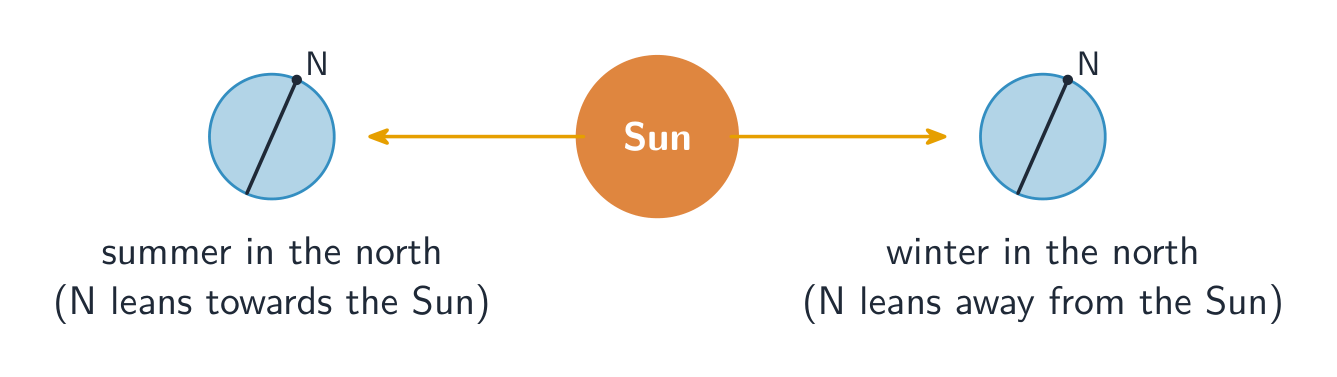
The Earth also moves around the Sun in an orbit 轨道, once in about $365$ days (one year). Because the axis is tilted, different parts of the Earth lean towards the Sun at different times of the year. This gives the seasons 季节: it is summer in the half of the Earth that leans towards the Sun.
The Moon 月球 orbits the Earth once in about one month. As it goes round, we see different amounts of its lit side, which gives the phases 月相 of the Moon (new moon, half moon, full moon).
So, from shortest to longest: one day (Earth's spin) < one month (Moon's orbit) < one year (Earth's orbit).
한국어
지구는 약 $24$시간마다 그 축(axis) 에 대해 한 번 회전(rotates)합니다. 축은 수직이 아닌 ** 기울어져(tilted)** 있습니다. 이 회전으로 인해 낮과 밤이 생기고, 매일 하늘을 가로지르는 태양의 움직임을 보게 됩니다.
지구는 또한 약 $365$일(1년)에 한 번 태양 주위를 궤도 orbit를 돌고 있습니다. 축이 기울어져 있어 연중不同时地球의 다른 부분들이 태양을 향해 기울어집니다. 이로 인해 계절 season이 형성되는데, 태양을 향해 기울어진 지구의 반구에서는 여름이 됩니다.
축은 일년 내내 동일한 각도로 기울어져 있으므로, 각 반구(hemisphere)는 궤도의 절반 동안 태양을 향해 기울어지고另一半则背离太阳
달은 Earth 주위를 약 1개월에 한 번 도는 궤道 orbit를 그리며, 그在这个过程中我们看到的被照亮部分各不相同,这产生了月球的相位 phases (新月 new moon, 초월 half moon,満月 full moon)。
달의 밝은 반쪽은 항상 태양을 향하고 있으므로, 달이 궤도를 돌면서 우리가 보는 밝은 부분의 양이 달라집니다: 우리와 태양 사이에는新月(new moon), 태양과 반대편에는満月(full moon), 그 사이에는 초월(half moons)
따라서 짧음에서 길음으로: 하루(지구의 자전) < 한 달(달의 공전) < 한 해(지구의 공전).
满月, 지구의 자연 위성
Explore · 탐색하기
Why the Moon changes shape · 달의 형태 변화 원인
The Sun always lights half the Moon; the phase is simply how much of that lit half faces us as the Moon orbits — it is not Earth's shadow. · 태양은 항상 달의 절반을 비추며, 위상(phase)은 달이 지구 주위를 도는 동안 그 빛나는 절반 중 우리가 보는 부분이 얼마나 되는지에 불과합니다. 지구의 그림자가 아닙니다.
For an object going round a circle, the distance for one full orbit is the circumference 周长$2\pi r$, where $r$ is the radius of the orbit. The orbital speed 轨道速率 is this distance divided by the period 周期$T$ (the time for one orbit):
$$v = \frac{2\pi r}{T}$$
The same equation works for planets, moons and satellites.
Worked example. A space station orbits the Earth at a radius of $r = 7000\ \text{km}$ and takes $T = 5800\ \text{s}$ for one orbit. Find its orbital speed.
First convert the radius to metres: $7000\ \text{km} = 7.0 \times 10^6\ \text{m}$. Then
The Solar System 太阳系 has one star, the Sun, at its centre. Around it move the eight planets 行星. In order from the Sun they are: Mercury, Venus, Earth, Mars, Jupiter, Saturn, Uranus and Neptune.
The four planets nearest the Sun are small and rocky 岩石.
The four planets furthest from the Sun are large and gaseous 气态 — they are made mostly of gas 气体, with no solid surface to stand on.
The two nearer giants, Jupiter and Saturn, are gas giants 气态巨行星. The two outer giants, Uranus and Neptune, are ice giants 冰巨行星: they hold much more ice, so they are not true gas giants.
The Solar System also contains:
minor planets, such as dwarf planets 矮行星 like Pluto, and asteroids 小行星 (most lie in the asteroid belt between Mars and Jupiter);
moons (natural satellites 卫星) that orbit the planets;
comets 彗星 and other small bodies.
Orbits and gravity
The Sun holds most of the mass of the Solar System. Its gravity 引力 (gravitational pull) reaches out and keeps the planets in their orbits. This force is the gravitational attraction of the Sun.
The gravitational field strength 重力场强度 tells you how strong gravity is:
at the surface of a planet it is bigger for a planet with more mass;
around a planet it gets weaker as you move further away.
In the same way, the Sun's gravity gets weaker further out, so the outer planets move more slowly (smaller orbital speed) than the inner ones.
Planetary data
Exam questions often give a table like this one and ask you to read a pattern from it.
Planet
Distance from Sun / million km
Orbital period
Density / g/cm³
Surface temperature / °C
Surface $g$ / N/kg
Mercury
58
88 days
5.4
170
3.7
Venus
108
225 days
5.2
460
8.9
Earth
150
365 days
5.5
15
9.8
Mars
228
687 days
3.9
−60
3.7
Jupiter
779
11.9 years
1.3
−110
23
Saturn
1430
29.5 years
0.7
−140
9.0
Uranus
2870
84 years
1.3
−195
8.7
Neptune
4500
165 years
1.6
−200
11
Patterns to notice: the further a planet is from the Sun, the longer its orbital period and the lower its surface temperature. The four inner planets are dense (rock and metal), while the four outer planets have low densities (gas and ice). The gravitational field strength at the surface depends on the planet's mass and size, not on its distance from the Sun.
Elliptical orbits
Most orbits are not perfect circles but ellipses 椭圆 (a stretched circle), and the Sun is not at the centre of the ellipse. A comet has a very stretched orbit. An object in an elliptical orbit moves faster when it is closer to the Sun. We explain this with the conservation of energy 能量守恒 — the total energy 能量 stays the same, so as the object's gravitational potential energy 重力势能 falls (coming closer), its kinetic energy 动能 rises (it speeds up).
Light travel time
Distances in space are huge, so we often work out how long light takes to cross them. Light travels at $3.0 \times 10^8\ \text{m/s}$. Using $\text{time} = \dfrac{\text{distance}}{\text{speed}}$, light from the Sun (about $1.5 \times 10^{11}\ \text{m}$ away) takes about $500\ \text{s}$, which is roughly $8$ minutes, to reach the Earth.
한국어
태양계 solar system은 중심에 별 하나인 태양이 있고, 그 주변을 8개의 행성 planets이 돌고 있습니다. 태양으로부터 가까운 순서대로: 수성 mercury, 금성 venus, 지球 earth, 화성 mars, 목성 jupiter, 토성 saturn, 천왕성 uranus, 해왕성 neptune.
태양에 가장 가까운 네 개의 행성은 작고 암석질 rocky입니다.
태양에서 가장 멀리 떨어진 네 개의 행성은 크고 기체状 gaseous입니다 — 대부분 기체로 이루어져 있으며, 발 수 있는 고체 표면이 없습니다.
더 안쪽에 있는 두 거대 행성인木星 Jupiter와土星 Saturn은 기체 행성 gas giants입니다. 바깥쪽에 있는 두 거대 행성인천왕성 Uranus와海王星 Neptune은 얼음 행성 ice giants입니다: 훨씬 많은 얼음을 포함하므로 진정한 기체 행성이 아닙니다.
순서대로 태양과 여덟 개의 행성: 네 개 작은 암석 행성, 그 다음 소행성대, 그 다음 네 개 큰 기체 행성 — 기체 행성인木星 Jupiter와土星 Saturn, 그리고 얼음 행성인天王星 Uranus와海王星 Neptune (비율scaled 아님)붉은 행성인 화성, 암석질 내행성 중 하나가장 큰 행성인 목성, swirling 기체 띠를 가지고 있음카시니 우주선이 촬영한 토성과 그 고리
태양은 태양계의 질량의 대부분을 차지합니다. 태양의 중력 gravity(중력 인력)가 뻗어나와 행성들을 궤도에 머물게 합니다. 이 힘은 태양의 중력 인력입니다.
중력장 강도 gravitational field strength는 중력의 세기를 알려줍니다:
행성 표면에서는 질량이 많은 행성일수록 더 큽니다;
행성 주변에서는 멀어질수록 약해집니다.
마찬가지로, 태양의 중력은 외쪽으로 갈수록 약해지므로, 외행성은 내행성보다 더 느리게 움직입니다(궤도 속도가 작습니다).
행성 데이터
시험 문제는 보통 이러한 표를 제시하고,从中에서 패턴을 읽어내도록 요구합니다.
행성
태양으로부터의 거리 / 백만 km
궤도 주기
밀도 / g/cm³
표면 온도 / °C
표면 $g$ / N/kg
수성
58
88일
5.4
170
3.7
금성
108
225일
5.2
460
8.9
지구
150
365일
5.5
15
9.8
화성
228
687일
3.9
−60
3.7
목성
779
11.9년
1.3
−110
23
토성
1430
29.5년
0.7
−140
9.0
천왕성
2870
84년
1.3
−195
8.7
해왕성
4500
165년
1.6
−200
11
주목할 점: 행성이 태양에서 멀어질수록 궤도 주기가 길어지고 표면 온도는 낮아집니다. 네 개의 내행성은 밀도가 높고(암석 및 금속), 네 개의 외행성은 밀도가 낮습니다(기체 및 얼음). 표면에서의 중력장 세기는 행성의 질량과 크기에 따라 결정되며, 태양과의 거리는 관련이 없습니다.
타원 궤도
대부분의 궤도는 완벽한 원이 아니라 타원(늘어진 원)이며, 태양은 타원의 중심에 있지 않습니다. 혜성은 매우 늘어진 궤도를 가집니다. 타원 궤道上에 있는 천체는 태양에 가까울 때 더 빠르게 움직입니다. 이를 에너지 보존 법칙으로 설명할 수 있습니다 — 총 에너지는 일정하므로, 천체의 중력 포텐셜 에너지가 감소(근접)하면 운동 에너지가 증가(속도 상승)합니다.
태양은 타원의 초점 중 하나에 위치하며, 행성은的近太阳时加速,远离时减速
빛의 이동 시간
우주의 거리는 방대하므로, 빛이 이를 건너는 데 걸리는 시간을 계산하는 경우가 많습니다. 빛은 $3.0 \times 10^8\ \text{m/s}$로 이동합니다. $\text{time} = \dfrac{\text{distance}}{\text{speed}}$를 사용하여 계산하면, 태양(약 $1.5 \times 10^{11}\ \text{m}$ 떨어진 곳)에서 나온 빛이 지구에 도달하는 데 약 $500\ \text{s}$가 소요되며, 이는 대략 $8$분 정도입니다.
Explore · 탐색하기
Watch the planets race · 행성 race watching
The closer a planet is to the Sun, the faster it orbits — Mercury in 88 days, Jupiter in 12 years — because the Sun's gravity is stronger close in. · 행성이太陽에 closer일수록 orbiting faster — 수성은 88일, 목성은 12년 — 태양의 중력이 near stronger because.
The planets formed from a giant cloud of gas and dust 尘埃 in space, which contained many chemical elements 元素. This is the accretion 吸积 model:
gravity pulled the cloud together;
the cloud was spinning, so it flattened into a spinning accretion disc 吸积盘;
most of the matter fell to the centre and became the Sun, while the planets grew from the leftover material in the disc.
Near the hot young Sun, only rock and metal could stay solid, so the inner planets are rocky. Far out, where it was cold, gases could also collect, so the outer planets grew large and gaseous.
한국어
행성은 우주 공간에 존재하는 가스와 먼지로 이루어진 거대한 구름에서 형성되었는데, 이 구름에는 다양한 화학적 원소가 포함되어 있었습니다. 이것이 증식 모델(accretion model) 입니다:
중력이 구름을 모았습니다;
구름이 회전하고 있었으므로, 회전하는 증식 원반(accretion disc) 형태로 평평해졌습니다;
대부분의 물질이 중심으로 떨어져 내려와 태양이 되었으며, 행성은 원반에 남은 잔여 물질로부터 성장했습니다.
뜨거운 어린 태양 근처에서는 암석과 금속만이 고체 상태로 남을 수 있었으므로 내행성은 암석으로 이루어졌습니다. 멀리서 차가운 곳에서는 기체 또한 응집할 수 있었으므로 외행성은 크기가 커지고 기체로 구성되었습니다.
젊은 별 HL Tauri 주변의 실제 증식 원반: 어두운 간극은 새로운 행성이 먼지를 모으고 있는 곳입니다 — 우리의 태양계 역시 이와 같은 방식으로 시작되었습니다
1 Know that the Sun is a star of medium size, consisting mostly of hydrogen and helium, and that it radiates most of its energy in the infrared, visible light and ultraviolet regions of the electromagnetic spectrum
2 Know that stars are powered by nuclear reactions that release energy and that in stable stars the nuclear reactions involve the fusion of hydrogen into helium
6.2.2 Stars
Core
Supplement
1 State that: (a) galaxies are each made up of many billions of stars (b) the Sun is a star in the galaxy known as the Milky Way (c) other stars that make up the Milky Way are much further away from the Earth than the Sun is from the Earth (d) astronomical distances can be measured in light-years, where one light-year is the distance travelled in (the vacuum of) space by light in one year
2 Know that one light-year is equal to $9.5 \times 10^{15}$ m
3 Describe the life cycle of a star: (a) a star is formed from interstellar clouds of gas and dust that contain hydrogen (b) a protostar is an interstellar cloud collapsing and increasing in temperature as a result of its internal gravitational attraction (c) a protostar becomes a stable star when the inward force of gravitational attraction is balanced by an outward force due to the high temperature in the centre of the star (d) all stars eventually run out of hydrogen as fuel for the nuclear reaction (e) most stars expand to form red giants and more massive stars expand to form red supergiants when most of the hydrogen in the centre of the star has been converted to helium (f) a red giant from a less massive star forms a planetary nebula with a white dwarf star at its centre (g) a red supergiant explodes as a supernova, forming a nebula containing hydrogen and new heavier elements, leaving behind a neutron star or a black hole at its centre (h) the nebula from a supernova may form new stars with orbiting planets
6.2.3 The Universe
Core
Supplement
1 Know that the Milky Way is one of many billions of galaxies making up the Universe and that the diameter of the Milky Way is approximately 100 000 light-years
2 Describe redshift as an increase in the observed wavelength of electromagnetic radiation emitted from receding stars and galaxies
3 Know that the light emitted from distant galaxies appears redshifted in comparison with light emitted on the Earth
4 Know that redshift in the light from distant galaxies is evidence that the Universe is expanding and supports the Big Bang Theory
5 Know that microwave radiation of a specific frequency is observed at all points in space around us and is known as cosmic microwave background radiation (CMBR)
6 Explain that the CMBR was produced shortly after the Universe was formed and that this radiation has been expanded into the microwave region of the electromagnetic spectrum as the Universe expanded
7 Know that the speed $v$ at which a galaxy is moving away from the Earth can be found from the change in wavelength of the galaxy’s starlight due to redshift
8 Know that the distance $d$ of a far galaxy can be determined using the brightness of a supernova in that galaxy
9 Define the Hubble constant$H_0$ as the ratio of the speed at which the galaxy is moving away from the Earth to its distance from the Earth; recall and use the equation
$$H_0 = \frac{v}{d}$$
10 Know that the current estimate for $H_0$ is $2.2 \times 10^{-18}$ per second
11 Know that the equation
$$\frac{d}{v} = \frac{1}{H_0}$$
represents an estimate for the age of the Universe and that this is evidence for the idea that all the matter in the Universe was present at a single point
한국어
6.2.1 태양은 별이다
핵심
보충
1 태양은 중간 크기의 별이며 주로 수소와 헬륨으로 구성되어 있고, 전자기 스펙트럼의 적외선, 가시광선 및 자외선 영역에서 대부분의 에너지를 방출함을 안다.
2 별은 에너지를 방출하는 핵반응에 의해 에너지를 공급받으며, 안정된 별에서는 수소가 헬륨으로 융합되는 핵반응이 일어난다는 것을 안다.
6.2.2 별
핵심
보충
1 다음을 서술할 수 있다: (a) 은하는 각각 수십억 개의 별로 이루어져 있음 (b) 태양은 은하수라는 은하에 속한 별임 (c) 은하수를 구성하는 다른 별들은 태양보다 지구로부터 훨씬 멀리 있음 (d) 천문학적 거리는 광년 단위로 측정되며, 1광년은 빛이 1년 동안 진공 상태인 우주를 이동한 거리임
2 1광년이 $9.5 \times 10^{15}$ m에 해당함을 안다.
3 별의 생애 주기를 서술할 수 있다: (a) 별은 수소를 포함하는星际雲(우주 분자 구름)에서 형성됨 (b) 원성우는 자체 중력 인력으로 인해 수축하며 온도가 상승하는星际雲(우주 분자 구름)임 (c) 원성우는 중력 인력의 안쪽 방향 힘과 별 중심부의 고온에 의한 바깥 방향 힘이 평형을 이루면서 안정된 별이 됨 (d) 모든 별은 결국 핵반응 연료인 수소를 소진함 (e) 대다수 별은 중심부의 수소가 대부분 헬륨으로 전환되면 붉은거성으로 팽창하며, 더 무거운 별은 붉은초거성으로 팽창함 (f) 질량이 작은 별의 붉은거성은 중심부에 백색왜성이 있는惑星状星雲(행성상성운)을 형성함 (g) 붉은초거성은 초신성 폭발을 일으켜 수소와 새로운 무거운 원소를 포함하는 성운을 만들고, 중심부에 중성자별 또는 블랙홀을 남김 (h) 초신성에서 생성된 성운은 새로운 별과 이를 도는 행성을 만들 수 있음
6.2.3 우주
핵심
보충
1 은하수는 우주를 구성하는 수십억 개의 은하 중 하나이며, 은하수의 직경은 약 100 000 광년임을 안다.
2 적색 이동이 후퇴하는 별과 은하에서 방출되는 전자기 복사의 관측 파장이 증가하는 현상임을 서술할 수 있다.
3 지구에서 방출된 빛과 비교하여遥远한 은하에서 방출된 빛이 적색 이동됨을 안다.
4 遥远한 은하에서 방출된 빛의 적색 이동은 우주가 팽중하고 있음을 나타내는 증거이며, 대폭발 이론을 지지함을 안다.
5 우리 주변의 모든 공간에서 특정 주파수의 마이크로파 복사가 관측되며, 이를 우주 마이크로파 배경 복사(CMBR) 라고 안다.
6 CMBR은 우주가 형성된 직후 생성되었으며, 우주가 팽중함에 따라 이 복사가 전자기 스트럼의 마이크로파 영역으로 확장되었음을 설명할 수 있다.
7 은하의 별빛이 적색편이(redshift)로 인해 파장이 변한 것을 이용하여, 그 은하가 지구로부터 멀어지는 속도 $v$을 알 수 있음을 안다.
8 먼 은하의 거리 $d$을 해당 은하 내 초신성의 밝기를 사용하여 측정할 수 있음을 안다.
9 허블 상수$H_0$을 은하가 지구로부터 멀어지는 속도와 지구로부터의 거리의 비로 정의한다. 공식
$$H_0 = \frac{v}{d}$$
을 기억하고 사용한다.
10 현재 $H_0$에 대한 추정치가 초당 $2.2 \times 10^{-18}$임을 알 것
11 수식
$$\frac{d}{v} = \frac{1}{H_0}$$
이 우주의 나이에 대한 추정치를 나타내며, 이는 우주의 모든 물질이 단일 지점에 존재hadwasa했었다는 개념의 증거임을 알 것
Source: Cambridge International syllabus · 출처: Cambridge International syllabus
English
The Sun is a star 恒星 of medium size, made mostly of hydrogen 氢 and helium 氦. It radiates most of its energy in the infrared, visible light and ultraviolet 紫外线 parts of the electromagnetic spectrum 电磁波谱.
A star is powered by nuclear reactions 核反应 in its core. In a stable star, the reaction is nuclear fusion 核聚变: hydrogen nuclei join to make helium, releasing huge amounts of energy.
한국어
태양은 중간 크기의 항성으로, 대부분 수소와 헬륨으로 구성되어 있습니다. 태양은 전자기파 스펙트럼의 적외선, 가시광선 및 자외선 영역에서 가장 많은 에너지를 방출합니다.
항성은 중심부에서의 핵 반응에 의해 에너지를 얻습니다. 안정된 항성에서는 핵융합 반응이 일어나며, 수소 핵들이 결합하여 헬륨을 만들고 엄청난 양의 에너지를 방출합니다.
Stars, galaxies and the Universe · 항성, 은하 및 우주의 세계
English
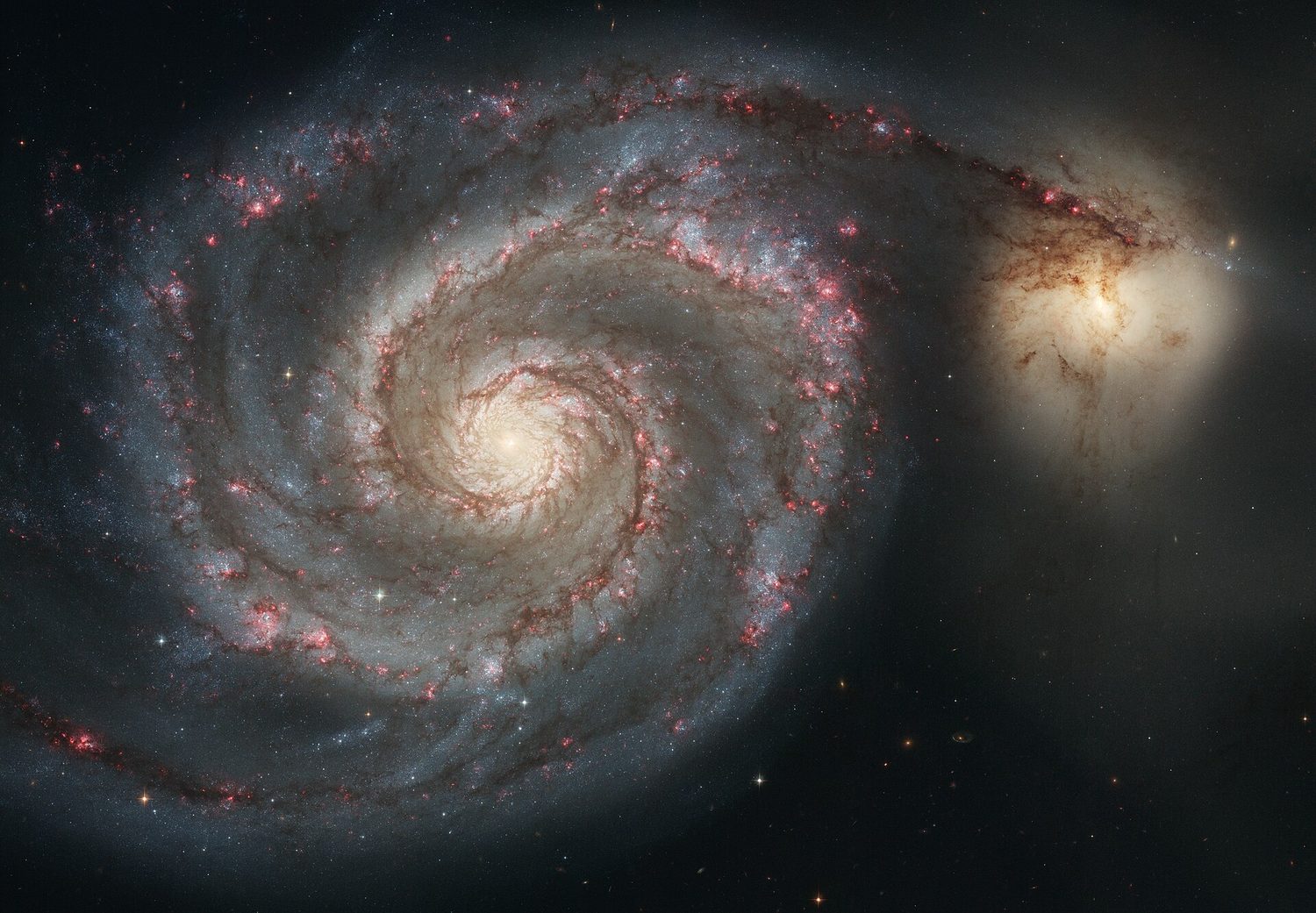
A galaxy 星系 is a group of many billions of stars held together by gravity. Our Sun is one star in the galaxy called the Milky Way 银河系. All the other stars in the Milky Way are very much further from the Earth than the Sun is.
Distances between stars are so big that we measure them in light-years 光年. One light-year is the distance light travels in one year (in the vacuum of space), which is about $9.5 \times 10^{15}\ \text{m}$.
The Milky Way is about $100\,000$ light-years across (its diameter 直径). It is just one of many billions of galaxies. All of these galaxies together make up the Universe 宇宙.
한국어
은하는 중력에 의해 묶여 있는 수십억 개의 항성 그룹입니다. 우리 태양은 은하(Milky Way) 라는 은하系统中的 한恒星입니다. 은하系统中的 다른 모든恒星들은 태양보다 지구로부터 훨씬 멀리 위치합니다.
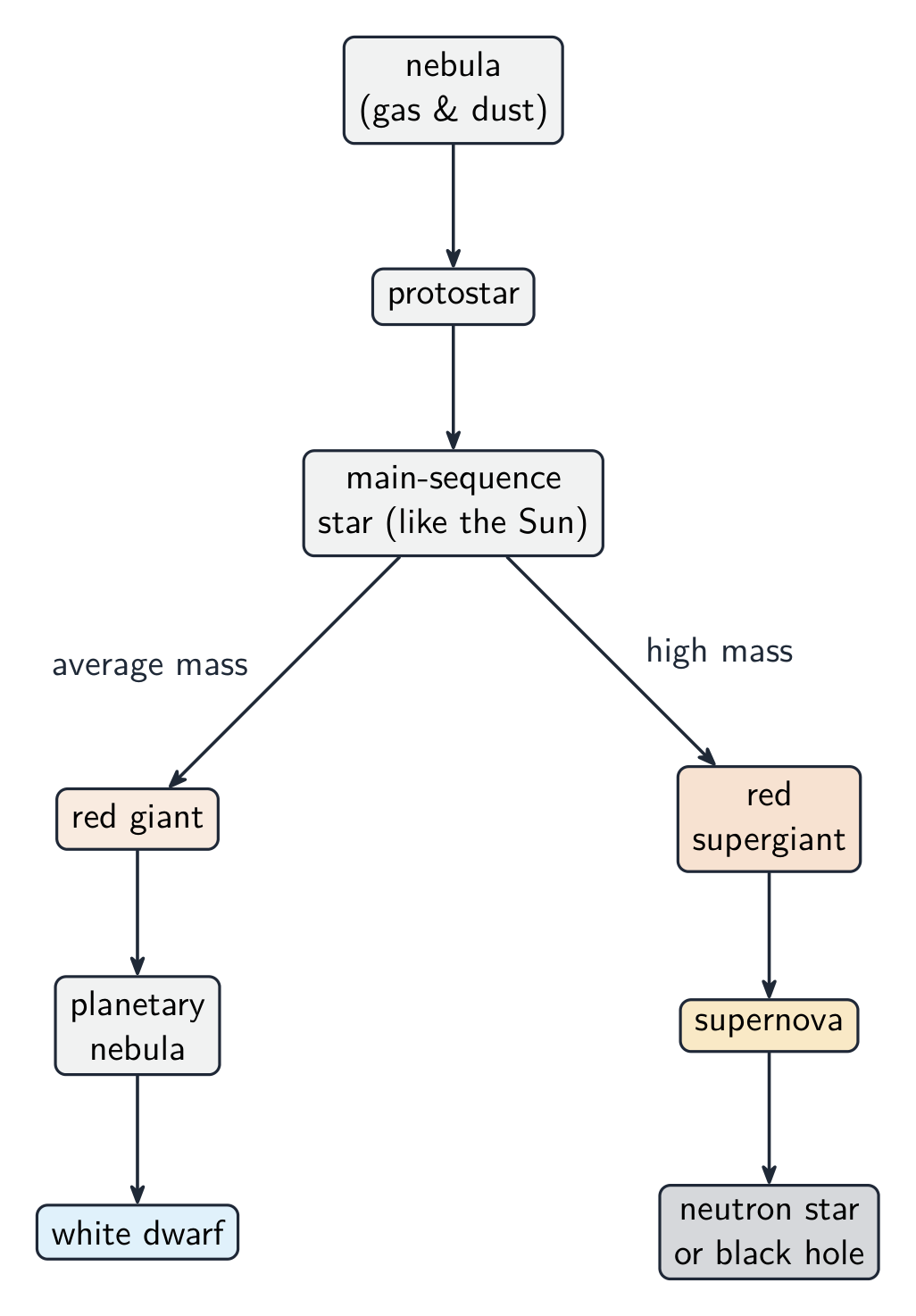
A star is born, lives and dies over a very long time:
A star forms from an interstellar cloud 星际云 of gas and dust that contains hydrogen.
Gravity pulls the cloud inwards, and it heats up. This collapsing, heating cloud is a protostar 原恒星.
The protostar becomes a stable 稳定 star when the inward pull of gravity is balanced by an outward push caused by the very high temperature in its centre.
In time, every star runs out of hydrogen fuel 燃料 for fusion.
What happens next depends on the mass of the star:
A medium star (like the Sun) swells into a red giant 红巨星. It then throws off its outer layers as a glowing cloud called a planetary nebula 星云, leaving a small, hot white dwarf 白矮星 at the centre.
A much heavier star swells into a red supergiant 红超巨星 and then explodes as a supernova 超新星. This blast spreads out a nebula containing hydrogen and new, heavier elements, and leaves behind a neutron star 中子星 or a black hole 黑洞.
The nebula from a supernova can later form new stars, with planets orbiting them — so our own Solar System came from earlier stars.
한국어
항성은 태어나고, 살며, 죽는 것이 매우 긴 시간이 걸립니다:
항성은 수소를 포함한 가스 및 먼지의 성간 구름(interstellar cloud) 에서 형성됩니다.
중력이 구름을 안쪽으로 당기고, 온도가 상승합니다. 이렇게 수축하며 열을 띠는 구름을 원성(protostar) 이라고 합니다.
원성은 중심부의 매우 높은 온도에 의한 바깥쪽 밀림힘이 안쪽으로 작용하는 중력과 균형을 이루면서 안정적인 항성이 됩니다.
시간이 지나면 모든 항성은 융합에 필요한 수소 연료를 소진하게 됩니다.
다음에 일어날 일은 항성의 질량에 따라 달라집니다:
중간 크기의 항성(태양 등)은 적색거성(red giant) 으로 부풀어오릅니다. 이후 외부 층을 행성상성운 nebula라는 발광 구름으로 뿜어내고, 중앙에 작고 뜨거운 백색왜성 white dwarf를 남깁니다.
훨씬 무거운 항성은 적색초거성(red supergiant) 으로 부풀어오른 후 초신성 supernova 로 폭발합니다. 이 폭발은 수소와 새로운 무거운 원소를 포함하는 성운을 퍼뜨리고, 중성자성 neutron star 또는 블랙홀 black hole 을 남깁니다.
모든 별은 성운에서 시작됩니다. 별이 어떻게 끝나는지는 그 질량에 따라 결정됩니다
초신성에서 나온 성운은 나중에 새로운 별을 형성하고, 그 주위를 행성이 공전할 수 있습니다—우리 태양계도 과거의 별들에서 유래했습니다.
Explore · 탐색하기
The life cycle of a star · 별의 생애 주기
Gravity pulls a gas cloud together; fusion lights the star; when its fuel runs low it swells and finally fades. · 중력이 기체 구름을 모아모으고, 핵융합이 별을 밝히며, 연료가 바닥나면 부풀어 오르다가 마침내 사라집니다.
Explore · 탐색하기
The life cycle of a Sun-like star · 태양과 유사한 별의 생애 주기
Step through how a star like our Sun is born, lives and dies. · 우리 태양과 같은 별이 태어나고, 살아가고, 죽는 과정을 단계별로 확인하세요.
When a star or galaxy moves away from us (it is receding 退行), the light we receive from it has a longer wavelength 波长 than normal — it is shifted towards the red end of the spectrum. This is redshift 红移.
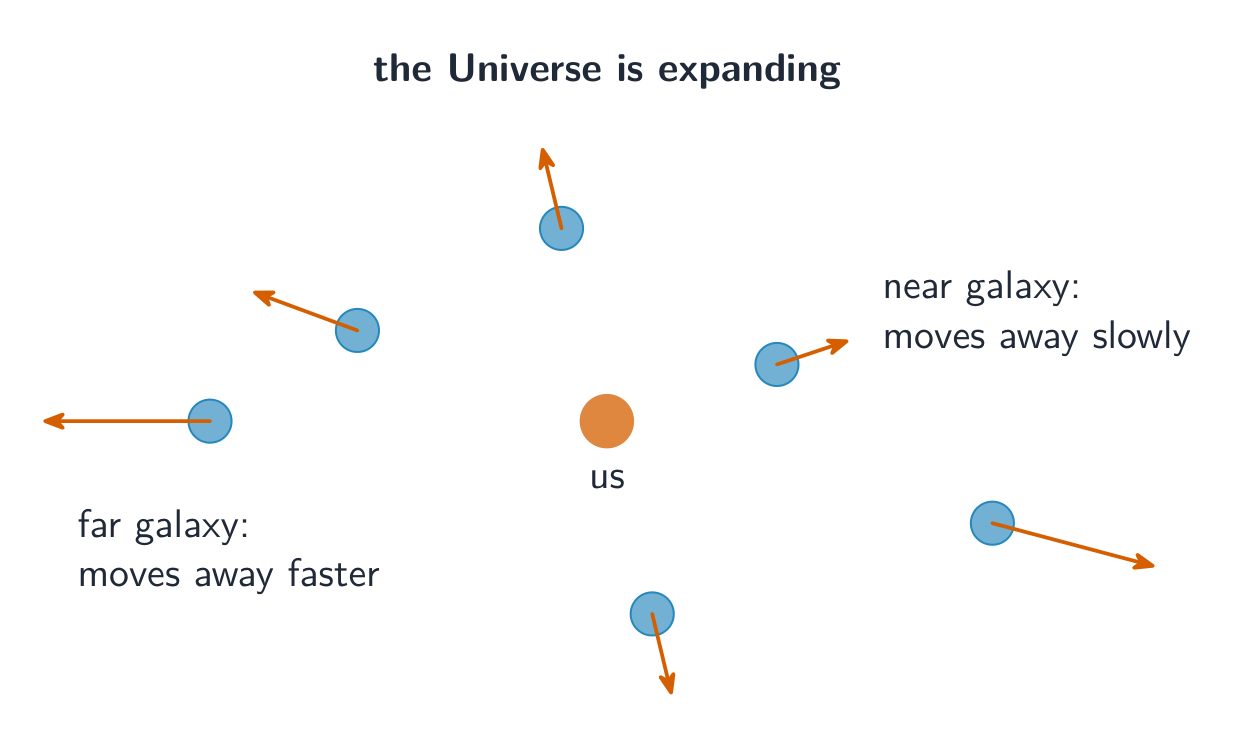
The light from distant galaxies is redshifted, and the further away a galaxy is, the bigger its redshift. This tells us that the galaxies are moving apart: the Universe is expanding 膨胀. Running this backwards, everything was once together at a single point — this is the evidence for the Big Bang 大爆炸 theory.
More evidence and the age of the Universe
Faint microwave 微波radiation 辐射 is found coming from every direction in space. This is the cosmic microwave background radiation 宇宙微波背景辐射 (CMBR). It was made as high-energy radiation soon after the Big Bang, and has been stretched out into the microwave part of the spectrum as the Universe expanded.
For a distant galaxy:
its speed $v$ of moving away can be found from the redshift of its starlight;
its distance $d$ can be found from the brightness of a supernova seen in it.
The Hubble constant 哈勃常数$H_0$ links these two:
$$H_0 = \frac{v}{d}$$
Its value today is about $2.2 \times 10^{-18}$ per second. Turning this around gives an estimate for the age of the Universe:
$$\frac{d}{v} = \frac{1}{H_0}$$
Worked example. The Hubble constant is about $H_0 = 2.2 \times 10^{-18}$ per second. Estimate the age of the Universe.
遠方 은하의 스펙트럼에 있는 어두운 선들이 적색 단으로 이동하는 것은 redshift입니다
遠方 은하에서 나오는 빛은 redshift되며, 은하가 더 멀리 있을수록 redshift의 크기는 커집니다. 이는 은하들이 서로 멀어지고 있음을 의미합니다: 우주는 expanding합니다. 이를 거꾸로 생각하면 모든 것이 한 점에 모여 있었습니다—이는 Big Bang 이론의 증거입니다.
모든 은하가 우리로부터 멀어지고 있으며, 더远处的 은하일수록 더 빠르게 멀어짐 — 우주는 팽창하고 있음
More evidence and the age of the Universe
우주 전방위에서 미미한 microwaveradiation이 관측됩니다. 이는 cosmic microwave background radiation (CMBR)입니다. Big Bang 직후 고에너지 복사로 생성되었으며, 우주가 팽창하면서 스펙트럼의 마이크로파 영역으로 길게 늘어났습니다.
마이크로파로 매핑된 전체 하늘: 이 미미한 빛은 어린 우주의 잔여 열로서 모든 방향에서 우리에게 도달하며, Big Bang에 대한 강력한 증거입니다
遠方 은하에 대해:
그 별빛의 redshift로부터 receding 속도를 구할 수 있습니다 $v$;
그 안에 보이는 supernova의 밝기로부터 거리 $d$를 구할 수 있습니다.
Hubble constant$H_0$는 이 두 가지를 연결합니다:
$$H_0 = \frac{v}{d}$$
오늘날의 값은 약每秒$2.2 \times 10^{-18}$입니다. 이를 역수 취하면 우주의 나이에 대한 추정이 가능합니다:
$$\frac{d}{v} = \frac{1}{H_0}$$
Worked example. Hubble constant는 약每秒$H_0 = 2.2 \times 10^{-18}$입니다. 우주의 나이를 추정해 보십시오.
우주 마이크로파 배경 복사(cosmic microwave background radiation)
Hubble constant/ˈhʌbl ˈkɒnstənt/
허블 상수
6.2
Exam tips · 시험 팁
English
In $v = \dfrac{2\pi r}{T}$, $r$ is the orbit radius and $T$ is the time for one full orbit in seconds — convert km to m and hours to seconds first.
Planets closer to the Sun feel stronger gravity, so they orbit faster and take less time. In an elliptical orbit a body speeds up as it nears the Sun (gravitational potential energy turns into kinetic energy).
A light-year is a distance, not a time — how far light travels in one year.
A star is stable when the inward pull of gravity is balanced by the outward push from the energy released by fusion in its core. What it becomes when its fuel runs out depends on its mass.
Redshift — light from distant galaxies shifted to longer (redder) wavelengths, with a bigger shift the further away — is the evidence that the Universe is expanding, which supports the Big Bang.
한국어
$v = \dfrac{2\pi r}{T}$에서, $r$는 궤도 반지름이고 $T$는 초 단위의 완전한 궤도一周 시간이다. km를 m로, 시간을 초로 변환해야 한다.
태양에 가까운 행성은 중력이 강하게 작용하므로 더 빠르게 공전하고 더 짧은 시간이 걸립니다. 타원 궤도에서는 천체가 태양에 가까워질수록 가속됩니다(중력 포텐셜 에너지가 운동 에너지로 전환됨).
light-year는 시간이 아닌 거리입니다—빛이 일 년 동안 이동하는 거리입니다.
별은 중심핵의 fusion에서 방출되는 에너지가 내리는 중력의 당김을 상쇄할 때 stable합니다. 연료가 고갈될 때 그것이 어떤 형태로 변하는지는 그 mass에 달려 있습니다.
Redshift—遠方 은하에서 나오는 빛이 더 긴(더 붉은) 파장으로 이동하며, 더 멀수록 이동 폭이 큼—은 우주가 expanding하고 있다는 증거이며, 이는 Big Bang을 지지합니다.