The expanding Universe
Introduced| English | Meaning |
|---|---|
| expanding/ekˈspændɪŋ/ | Becoming larger; the Universe is expanding, so distant galaxies recede. |
| redshift/ˈredʃɪft/ | A shift of observed spectral features towards longer wavelengths. |
| Big Bang/bɪɡ bæŋ/ | The model in which the universe evolved from an early hot, dense state and has expanded and cooled over time. |
| cosmic microwave background radiation/ˈkɒzmɪk ˈmaɪkrəʊweɪv ˈbækɡraʊnd ˌreɪdɪˈeɪʃn/ | The faint microwave glow left from the early hot Universe, evidence for the Big Bang. |
| Hubble constant/ˈhʌbl ˈkɒnstənt/ | The present-day expansion rate of the universe, relating a distant galaxy's recession speed to its distance in the Hubble-Lemaitre law. |
A growing Universe
- Look far enough and every galaxy is rushing away from us.
- The whole Universe is expanding 膨胀 — and that tells us how it began.
- The clue is hidden in the colour of starlight.
Redshift 红移
- When a galaxy moves away from us, the light we receive is stretched to a longer wavelength — shifted toward the red end of the spectrum. This is redshift.
- The further away a galaxy is, the bigger its redshift.
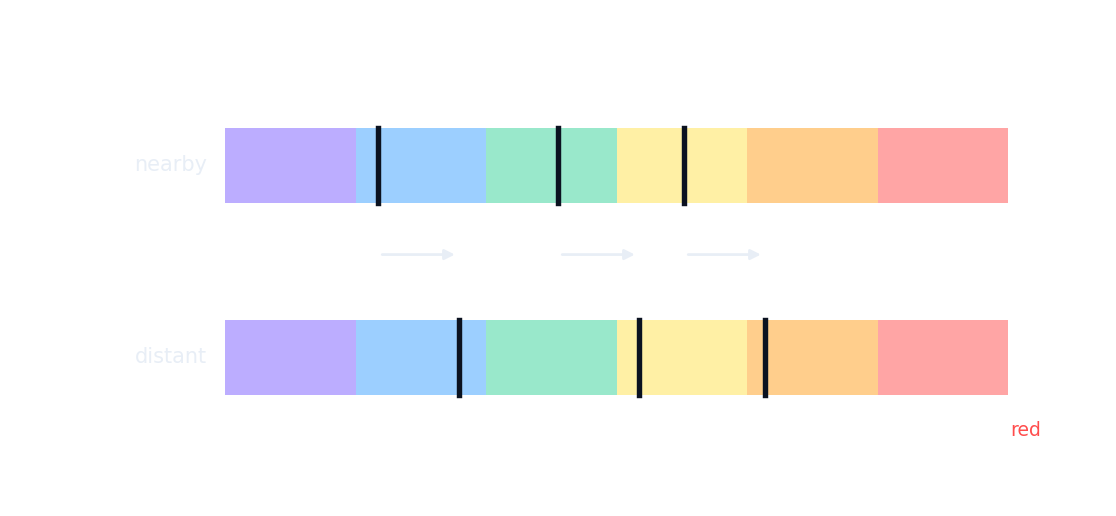

Redshift of a distant galaxy's spectrum
The expanding Universe
v = H₀·d
Galaxies recede faster the farther they are — speed is proportional to distance.
Light from a distant galaxy is redshifted. This means the galaxy is:
Difficulty 1/5 · 100 coins + a small bonus on first completion today
A receding source stretches the light to a longer wavelength — toward the red end of the spectrum.
How does a galaxy's redshift change with its distance?
Difficulty 1/5 · 100 coins + a small bonus on first completion today
More distant galaxies recede faster, so they show a bigger redshift — this is the basis of Hubble's law.
The expanding Universe and the Big Bang 大爆炸
- Distant galaxies are redshifted, and further ones more so — so the galaxies are moving apart: the Universe is expanding.
- Run that backwards and everything was once together at a single point.
- This is the evidence for the Big Bang theory.
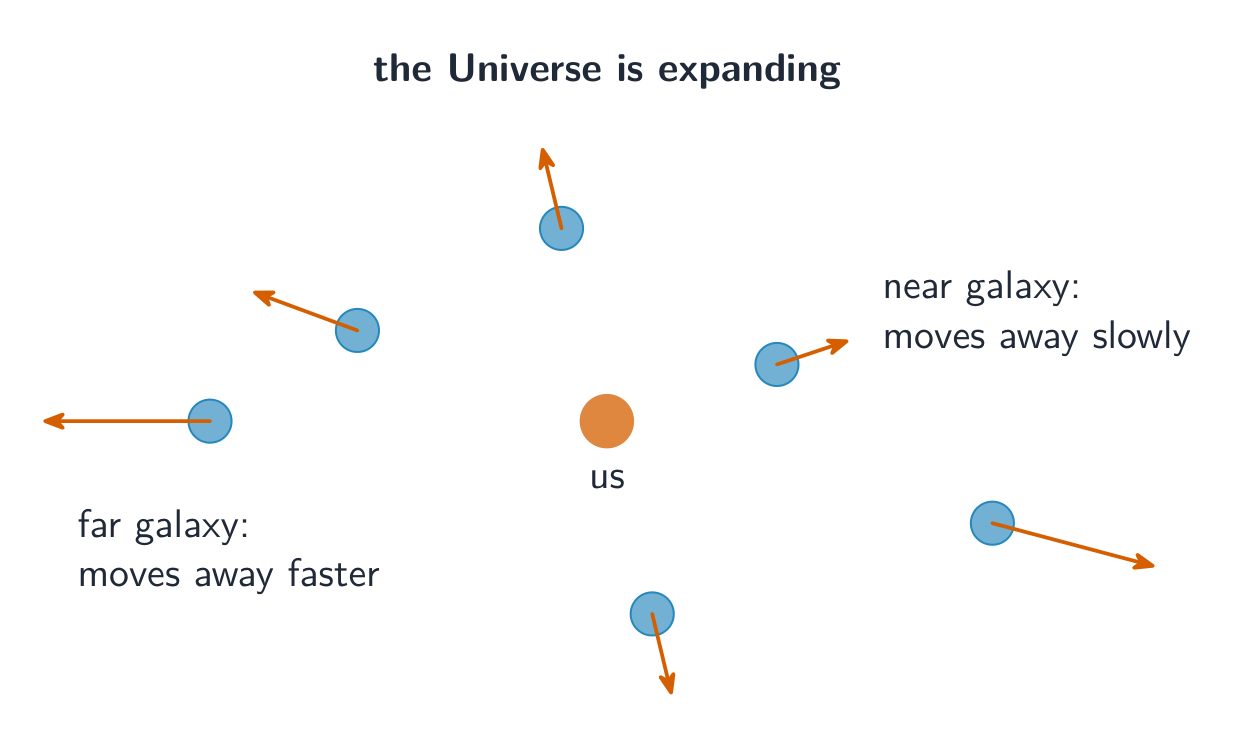
Every galaxy is moving away from us, and the farther ones move away faster — the Universe is expanding
The redshift of distant galaxies is evidence that:
Difficulty 1/5 · 100 coins + a small bonus on first completion today
Galaxies moving apart means the Universe is expanding; running it backwards points to a single starting point — the Big Bang.
More evidence, and the age of the Universe
- Faint microwave radiation comes from every direction in space — the cosmic microwave background radiation 宇宙微波背景辐射 (CMBR). It is early radiation stretched out as the Universe expanded.
- The Hubble constant 哈勃常数 links a galaxy's recession speed $v$ and distance $d$:
- Turning it around, $\dfrac{1}{H_0}$ estimates the age of the Universe — more support for the Big Bang.

The cosmic microwave background radiation (CMBR) is found coming from every direction in space.
Difficulty 1/5 · 100 coins + a small bonus on first completion today
The CMBR fills all of space, coming from every direction — it is early radiation stretched into microwaves as the Universe expanded.
The Hubble constant is about $H_0 = 2.0 \times 10^{-18}$ per second. Estimate the age of the Universe ($1/H_0$), in seconds.
Difficulty 2/5 · 140 coins + a small bonus on first completion today
Age $\approx \dfrac{1}{H_0} = \dfrac{1}{2.0 \times 10^{-18}} = 5.0 \times 10^{17}\ \text{s}$ (roughly 16 billion years).
The Hubble constant $H_0$ relates a galaxy's recession speed $v$ and distance $d$ by:
Difficulty 1/5 · 100 coins + a small bonus on first completion today
$H_0 = \dfrac{v}{d}$; its reciprocal $\dfrac{1}{H_0}$ estimates the age of the Universe.
You've got it
- redshift: light from a receding galaxy is stretched toward red; further = bigger redshift
- distant galaxies all recede → the Universe is expanding → evidence for the Big Bang
- the CMBR (microwaves from all directions) is more Big Bang evidence
- Hubble constant $H_0 = \dfrac{v}{d}$; age of the Universe $\approx \dfrac{1}{H_0}$