The Sun and the life cycle of stars
Introduced| English | Meaning |
|---|---|
| fusion/ˈfjuːʒn/ | fusion |
| Universe/ˈjuːnɪvɜːs/ | Everything that exists: all of space, time, matter and energy. |
| galaxy/ˈɡæləksi/ | galaxy |
| Milky Way/ˈmɪlki weɪ/ | The galaxy containing our Solar System, one of billions of galaxies. |
| light-years/laɪt jɪəz/ | light-years |
| nebula/ˈnebjʊlə/ | A cloud of gas and dust in space. |
| protostar/ˈprəʊtəʊstɑː/ | A collapsing, heating ball of gas not yet hot enough for sustained fusion. |
| red giant/red ˈdʒaɪənt/ | A large cool red-coloured star in a late stage, expanded after using most of its hydrogen. |
| white dwarf/waɪt dwɔːf/ | A dense, hot stellar remnant supported by electron degeneracy pressure, with no sustained core fusion. |
| supernova/ˌsuːpəˈnəʊvə/ | An extremely energetic stellar explosion, caused by the collapse of a massive star or runaway nuclear reactions in a white dwarf. |
| neutron star/ˈnjuːtrɒn stɑː/ | An extremely dense collapsed core left after a supernova, made mostly of neutrons. |
| black hole/blæk həʊl/ | A collapsed object whose gravity is so strong that not even light escapes. |
The lives of stars
- Stars are born, shine for billions of years, and then die.
- Our Sun is one ordinary star among billions.
- Let's meet the Sun, the galaxies, and how a star lives and dies.
The Sun as a star
- The Sun is a medium-sized star, made mostly of hydrogen and helium.
- It radiates energy as infrared, visible light and ultraviolet.
- It is powered by nuclear fusion 聚变 in its core: hydrogen nuclei join to make helium, releasing huge energy.

The Sun, our nearest star, seen in ultraviolet light
The life cycle of a star
Gravity pulls a gas cloud together; fusion lights the star; when its fuel runs low it swells and finally fades.
What powers the Sun?
Difficulty 1/5 · 100 coins + a small bonus on first completion today
In a stable star, hydrogen nuclei fuse into helium in the core, releasing huge amounts of energy.
Galaxies and the Universe 宇宙
- A galaxy 星系 is billions of stars held together by gravity. Our Sun is in the Milky Way 银河系.
- Distances between stars are measured in light-years 光年 — the distance light travels in one year ($\approx 9.5 \times 10^{15}\ \text{m}$).
- The Milky Way is about $100\,000$ light-years across, and is just one of billions of galaxies that make up the Universe.
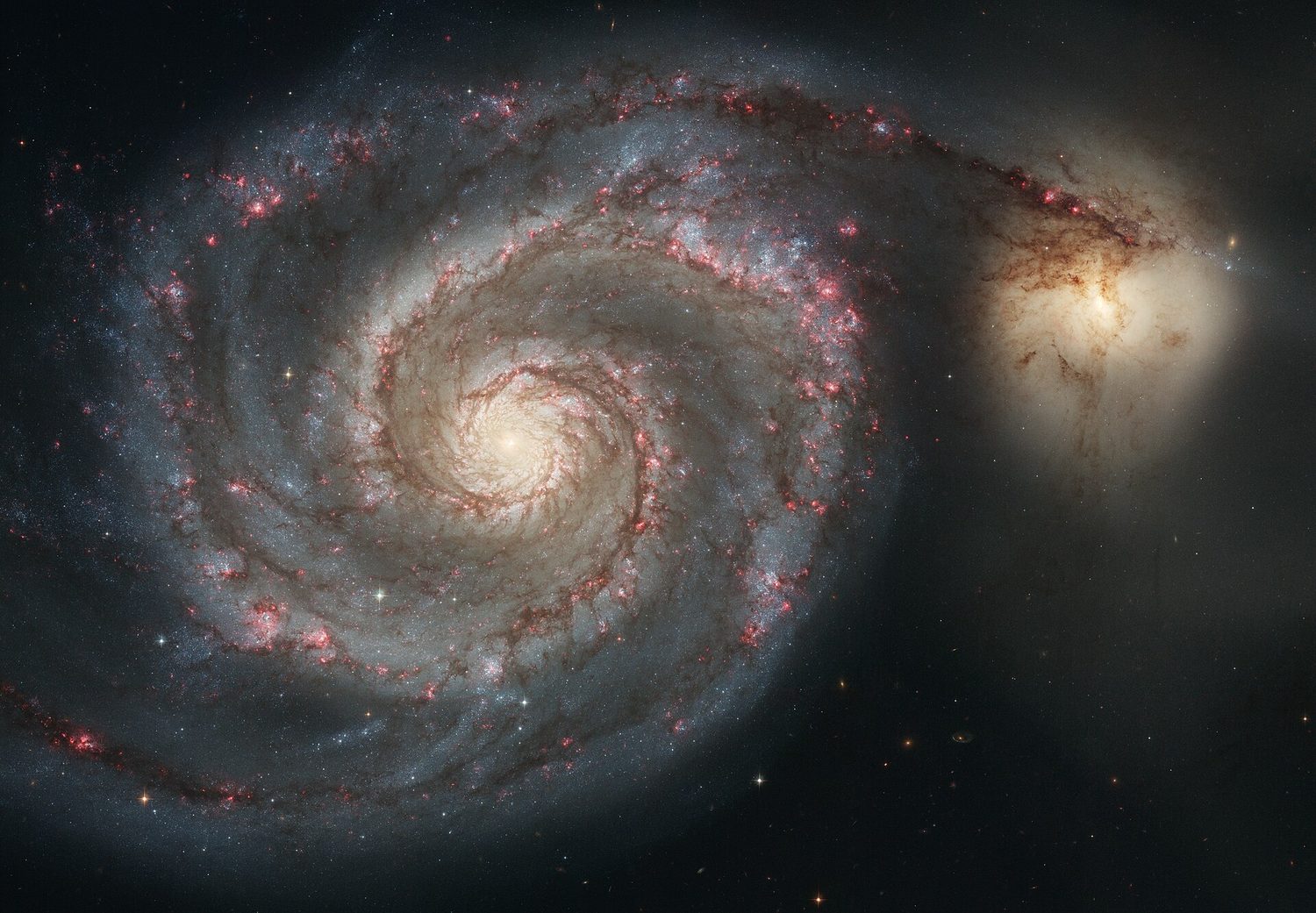
A spiral galaxy: billions of stars held together by gravity
A galaxy is:
Difficulty 1/5 · 100 coins + a small bonus on first completion today
A galaxy is a huge collection of billions of stars bound by gravity. The Sun is one star in the Milky Way galaxy.
A light-year is a unit of:
Difficulty 1/5 · 100 coins + a small bonus on first completion today
A light-year is the distance light travels in one year — a measure of distance, not time.
Match each stage to what it is.
Difficulty 2/5 · 140 coins + a small bonus on first completion today
Each item links the term to its correct meaning.
The life cycle of a star
- A star forms from a nebula 星云 (a cloud of gas and dust).
- Gravity pulls it together and it heats up — a protostar 原恒星.
- It becomes a stable star when gravity's inward pull is balanced by the outward push from its very hot core.
- When the hydrogen fuel runs low, what happens next depends on the star's mass:
- a medium star → red giant 红巨星 → throws off a planetary nebula → leaves a white dwarf 白矮星;
- a massive star → red supergiant → explodes as a supernova 超新星 → leaves a neutron star 中子星 or a black hole 黑洞.

The life cycle of a star: all stars start the same way, but their mass determines how they end. Medium stars become white dwarfs; massive stars explode as supernovae and leave neutron stars or black holes.
Why does a supernova matter? A supernova explosion creates and scatters heavy elements (iron, gold, uranium) into space. Every atom of gold on Earth was forged inside a star that exploded billions of years ago.
A black hole is not a hole. It is an incredibly dense remnant where gravity is so strong that not even light can escape. It's a collapsed core, not an empty space.
Put the life stages of a Sun-like star in order.
Difficulty 3/5 · 200 coins + a small bonus on first completion today
A star forms from a nebula → protostar → stable star → (fuel runs low) red giant → white dwarf.
In a stable star, the inward pull of gravity is balanced by:
Difficulty 1/5 · 100 coins + a small bonus on first completion today
The hot core pushes outward, balancing gravity's inward pull, so the star stays a stable size.
A much heavier star ends its life as a supernova, leaving behind:
Difficulty 1/5 · 100 coins + a small bonus on first completion today
A massive star becomes a red supergiant, explodes as a supernova, and leaves a neutron star or a black hole.
You've got it
- the Sun is a medium star (H + He), powered by fusion of hydrogen into helium
- a galaxy = billions of stars held by gravity; we are in the Milky Way
- distances in light-years ($\approx 9.5 \times 10^{15}\ \text{m}$); billions of galaxies make the Universe
- life cycle: nebula → protostar → stable star → (red giant → white dwarf) or (supergiant → supernova → neutron star/black hole)