The Solar System
Introduced| English | Meaning |
|---|---|
| Solar System/ˈsəʊlə ˈsɪstəm/ | The Sun together with the planets, dwarf planets and smaller bodies orbiting it. |
| planets/ˈplænɪts/ | planets |
| asteroids/ˈæstərɔɪdz/ | asteroids |
| comets/ˈkɒmɪts/ | comets |
| rocky/ˈrɒki/ | Describes the inner planets, which have solid surfaces, unlike the gas giants. |
| gas giants/ɡæs ˈdʒaɪənts/ | gas giants |
| satellites/ˈsætəlaɪts/ | An object that orbits a larger body under gravity, whether natural or artificial. |
| ellipses/ɪˈlɪpsɪz/ | ellipses |
| accretion/əˈkreʃn/ | The gradual gathering of matter by gravity into a larger body. |
The Sun's family
- At the centre of the Solar System 太阳系 is one star — the Sun.
- Around it move eight planets 行星, plus moons, asteroids 小行星 and comets 彗星.
- Gravity holds the whole family together.
The eight planets
- In order from the Sun: Mercury, Venus, Earth, Mars, Jupiter, Saturn, Uranus, Neptune.
- The four inner planets are small and rocky 岩石.
- The four outer planets are large and gaseous (no solid surface).
- Jupiter and Saturn are gas giants 气态巨行星; Uranus and Neptune are ice giants.

Jupiter, the largest planet, with its swirling bands of gas
Watch the planets race
The closer a planet is to the Sun, the faster it orbits — Mercury in 88 days, Jupiter in 12 years — because the Sun's gravity is stronger close in.
Put these planets in order, nearest the Sun first.
Difficulty 3/5 · 200 coins + a small bonus on first completion today
From the Sun: Mercury, Venus, Earth, Mars, Jupiter, Saturn, Uranus, Neptune — so of these, Mercury, Earth, Jupiter, Neptune.
How do the inner and outer planets differ?
Difficulty 1/5 · 100 coins + a small bonus on first completion today
The four inner planets are small and rocky; the four outer planets are large and gaseous (gas giants and ice giants).
Other objects
- Dwarf planets (like Pluto) and asteroids — most asteroids lie in a belt between Mars and Jupiter.
- Moons (natural satellites 卫星) that orbit the planets.
- Comets — small icy bodies on very stretched orbits.

A giant telescope fires a laser to study the night sky
Orbits and gravity
- The Sun's gravity reaches out and keeps the planets in orbit; it is weaker further out, so outer planets orbit more slowly.
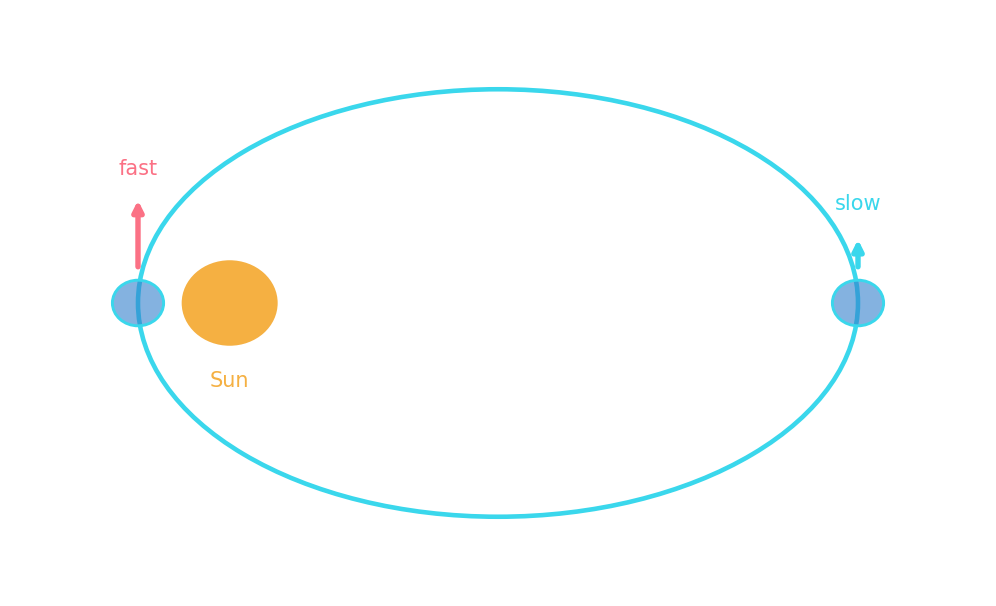
- Most orbits are ellipses 椭圆 (stretched circles), with the Sun at one focus (not the centre).
- A planet moves faster when closer to the Sun: as its gravitational PE falls, its kinetic energy rises (energy is conserved).
What keeps the planets in their orbits around the Sun?
Difficulty 1/5 · 100 coins + a small bonus on first completion today
The Sun holds most of the mass of the Solar System, and its gravity pulls the planets into orbit.
A planet on an elliptical orbit moves fastest when it is:
Difficulty 1/5 · 100 coins + a small bonus on first completion today
As the planet comes closer, its gravitational PE falls and its kinetic energy rises (energy is conserved), so it speeds up.
Light travel time and how it formed
- Space is huge, so we use light travel time: $\text{time} = \dfrac{\text{distance}}{\text{speed}}$, with light at $3.0 \times 10^8\ \text{m/s}$.
- Sunlight takes about 8 minutes to reach Earth.
- The Solar System formed by accretion 吸积: gravity pulled a spinning cloud of gas and dust into a disc; most fell to the centre to form the Sun, and the planets grew from the rest.
- Near the hot young Sun only rock and metal stayed solid → rocky inner planets; far out, gases collected too → giant outer planets.

The Solar System
The Sun is about $1.5 \times 10^{11}\ \text{m}$ away. How long does its light take to reach Earth, in seconds? (light speed $3.0 \times 10^8\ \text{m/s}$)
Difficulty 2/5 · 140 coins + a small bonus on first completion today
$\text{time} = \dfrac{d}{v} = \dfrac{1.5 \times 10^{11}}{3.0 \times 10^8} = 500\ \text{s}$ (about 8 minutes).
Why are the inner planets rocky?
Difficulty 1/5 · 100 coins + a small bonus on first completion today
Close to the hot Sun, gases could not condense — only rock and metal stayed solid, so the inner planets are rocky.
You've got it
- eight planets: four rocky inner, four gaseous outer (gas giants + ice giants)
- the Sun's gravity holds the planets; outer ones orbit slower
- orbits are ellipses with the Sun at a focus; planets move faster when closer
- light from the Sun takes ~8 min; the system formed by accretion of gas and dust