Skip to content · ⁨본문 바로가기⁩

Acids, bases and salts · ⁨산, 염기 및 염⁩

IGCSE Chemistry · ⁨IGCSE 화학⁩ · Topic 7 · ⁨주제 7⁩

Video lesson for this topic · ⁨이 주제용 영상 수업⁩ Open the video page · ⁨영상 페이지 열기⁩
13:06

산, 염기 & 염

레몬즙, 식초, 위장액 속의 산 — 산은 어디에나 존재합니다. 그들의 반대인 알칼리, 즉 비누나 오븐 클리너 등도 마찬가지입니다. 산과 염기를 섞으면…

English narration · English + 中文 subtitles burned in · ⁨영어 내레이션 · 영어 + 중국어 자막 burned-in⁩

7.1

Acids · ⁨산⁩

Syllabus
English
Core Supplement
1 Describe the characteristic properties of acids in terms of their reactions with: (a) metals (b) bases (c) carbonates
2 Describe acids in terms of their effect on: (a) litmus (b) thymolphthalein (c) methyl orange
3 State that bases are oxides or hydroxides of metals and that alkalis are soluble bases
4 Describe the characteristic properties of bases in terms of their reactions with: (a) acids (b) ammonium salts
5 Describe alkalis in terms of their effect on: (a) litmus (b) thymolphthalein (c) methyl orange
6 State that aqueous solutions of acids contain $\text{H}^+$ ions and aqueous solutions of alkalis contain $\text{OH}^-$ ions 9 Define acids as proton donors and bases as proton acceptors
10 Define a strong acid as an acid that is completely dissociated in aqueous solution and a weak acid as an acid that is partially dissociated in aqueous solution
11 State that hydrochloric acid is a strong acid, as shown by the symbol equation, $\text{HCl}(\text{aq}) \rightarrow \text{H}^+(\text{aq}) + \text{Cl}^-(\text{aq})$
12 State that ethanoic acid is a weak acid, as shown by the symbol equation, $\text{CH}_3\text{COOH}(\text{aq}) \rightleftharpoons \text{H}^+(\text{aq}) + \text{CH}_3\text{COO}^-(\text{aq})$
7 Describe how to compare hydrogen ion concentration, neutrality, relative acidity and relative alkalinity in terms of colour and pH using universal indicator paper
8 Describe the neutralisation reaction between an acid and an alkali to produce water, $\text{H}^+(\text{aq}) + \text{OH}^-(\text{aq}) \rightarrow \text{H}_2\text{O}(l)$
한국어
핵심 보충
1 산의 특징 성질을 다음과의 반응으로 서술하시오: (a) 금속 (b) 염기 (c) 탄산염
2 산을 다음에 미치는 효과로 서술하시오: (a) 리트머스 (b) 티몰플레타인 (c) 메틸 오렌지
3 염기는 금속의 산화물 또는 수산화물이며, 알칼리는 수용성 염기임을 서술하시오
4 염기의 특징 성질을 다음과의 반응으로 서술하시오: (a) 산 (b) 암모늄 염
5 알칼리를 다음에 미치는 효과로 서술하시오: (a) 리트머스 (b) 티몰플레타인 (c) 메틸 오렌지
6 산의 수용액은 $\text{H}^+$ 이온을 포함하며, 알칼리의 수용액은 $\text{OH}^-$ 이온을 포함함을 서술하시오 9 산을 양성자 공여체(proton donors), 염기를 양성자 수용체(proton acceptors)로 정의하시오
10 강산을 수용액에서 완전히 해리되는 산, 약산을 수용액에서 부분적으로 해리되는 산으로 정의하시오
11 염기가 강산임을 기호 방정식 $\text{HCl}(\text{aq}) \rightarrow \text{H}^+(\text{aq}) + \text{Cl}^-(\text{aq})$으로 보여주어 서술하시오
12 초산이 약산임을 기호 방정식 $\text{CH}_3\text{COOH}(\text{aq}) \rightleftharpoons \text{H}^+(\text{aq}) + \text{CH}_3\text{COO}^-(\text{aq})$으로 나타내라
7 보편지시지를 사용하여 수소 이온 농도, 중성, 상대적 산성 및 상대적 염기성을 색과 pH의 관점에서 비교하는 방법을 서술하라
8 산과 염기의 중화반응을 설명하여 물과 $\text{H}^+(\text{aq}) + \text{OH}^-(\text{aq}) \rightarrow \text{H}_2\text{O}(l)$이 생성됨을 서술하라

Source: Cambridge International syllabus · ⁨출처: Cambridge International syllabus⁩

English

An acid 酸 is a substance that forms hydrogen ions ($\text{H}^{+}$) when dissolved in water. Acids have three typical reactions:

  • with metals 金属: acid + metal → a salt 盐 + hydrogen 氢气
  • with bases: acid + base 碱 → a salt + water (this is neutralisation 中和)
  • with carbonates 碳酸盐: acid + carbonate → a salt + water + carbon dioxide 二氧化碳

Describing what you see

Naming the products is only half of what the exam wants. "State the observations" asks what you would see with your eyes, and it carries its own marks - so learn the words:

You see Say
bubbles of gas coming off effervescence 泡腾 (also accepted: fizzing, bubbling)
the solid getting smaller and vanishing the solid dissolves / disappears
the colour of the solution changing name the colour, e.g. turns blue (copper salts)
bubbling that stops no more effervescence - the acid is used up

So for magnesium added to hydrochloric acid, a full answer is: effervescence, and the solid dissolves (and the tube gets warm). For copper(II) oxide added to warm sulfuric acid: the black solid dissolves and the solution turns blue.

Two rules save most of the lost marks. Never write "hydrogen is given off" as an observation - you cannot see hydrogen, you can only see the bubbles, so write effervescence. And do not write a name you cannot see: "a salt forms" is a conclusion, not an observation.

Indicators

An indicator 指示剂 is a dye that changes colour to show whether a solution is acidic or alkaline.

Indicator In acid In alkali
litmus 石蕊 red blue
thymolphthalein 百里酚酞 colourless blue
methyl orange 甲基橙 red yellow

Aqueous solutions of acids contain hydrogen ions 离子 ($\text{H}^{+}$). Aqueous solutions of alkalis contain hydroxide ions ($\text{OH}^{-}$).

한국어

산은 물에 용해될 때 수소 이온($\text{H}^{+}$)을 형성하는 물질입니다. 산은 세 가지 전형적인 반응을 보입니다:

산이 금속, 염기, 탄산염과 반응하여 서로 다른 생성물을 만드는 모습
산은 금속, 염기, 탄산염과 반응하여 서로 다른 생성물을 만듭니다
  • 금속과: 산 + 금속 → 염 + 수소
  • 염기와: 산 + 염기 → 염 + 물 (이는 중화 반응입니다)
  • 탄산염과: 산 + 탄산염 → 염 + 물 + 이산화탄소

관찰 내용 서술하기

생성물 이름을 말하는 것만으로는 시험에서 필요한 점수의 절반에도 미치지 못합니다. "관찰 사항을 서술하시오"라는 질문은 눈으로 직접 보이는 현상을 묻는 것이며, 별도의 배점이 주어지므로 관련 단어를 외워두어야 합니다:

보이는 현상 표현 방식
기포가 뿜어짐 기포 발생/발포(effervescence) (또는 fizzing, bubbling 허용)
고형물이 작아지거나 사라짐 고형물이 용해되다 / 사라지다
용액의 색이 변함 색상을 명시, 예: 파란색으로 변함 (구리 염류)
거품이 멈춤 더 이상 기포 발생 없음 - 산이 소모됨

따라서 마그네을 염산에 넣었을 때 완전한 답안은: 기포 발생, 그리고 고형물이 용해됨 (및 튜브가 따뜻해짐)입니다. 구리(II) 산화물을 따뜻한 황산에 넣었을 때: 검은 고형물이 용해됨과 용액이 파란색으로 변함입니다.

대부분의.service를 잃는 것을 막아주는 두 가지 규칙이 있습니다. 관찰로 "수소가 방출된다"고 적지 마십시오 - 수소는 직접 볼 수 없으므로 기포만 보일 뿐입니다. 따라서 기포가 일어난다라고 적으십시오. 그리고 보이지 않는 물질을 이름으로 적지 마십시오: "염이 생성된다"는 결론이며 관찰이 아닙니다.

지시약

지시약은 용액이 산성인지 염기성인지 나타내도록 색이 변하는 염료입니다.

지시약 산성 중 염기성 중
리튬 빨강 파랑
티몰프탈레인 무색 파랑
메틸 오렌지 빨강 노랑

산의 수용액에는 수소 이온($\text{H}^{+}$)이 포함됩니다. 염기의 수용액에는 하이드록시기 이온($\text{OH}^{-}$)이 포함됩니다.

흰 배경 위에 놓인 파란색 리튬 종이 조각과 빨간색 리튬 종이 책자
리튬 종이: 산에서는 파란색 리튬 종이가 빨갛게 변하고, 염기에서는 빨간색 리튬 종이가 파란색으로 변합니다
Vocabulary · ⁨어휘⁩ Train · ⁨연습하기⁩
English 한국어
acid/ˈæsɪd/ 산성
metals/ˈmetlz/ 금속
litmus/ˈlɪtməs/ 리터스 용액
thymolphthalein/ˈθaɪməlfθæliːn/ 티몰프탈레인
methyl orange/ˈmiːθaɪl ˈɒrɪndʒ/ 메틸 오렌지
ions/ˈaɪɒnz/ 이온
effervescence/ˌefəˈvesəns/ 발포 현상(effervescence)
7.1

Bases and alkalis · ⁨염기와 알칼리⁩

English

Bases are oxides 氧化物 or hydroxides 氢氧化物 of metals. An alkali 可溶性碱 is a base that dissolves in water (a soluble base).

Bases have two typical reactions:

  • with acids: base + acid → a salt + water (neutralisation again)
  • with ammonium salts 铵盐: this releases ammonia gas.
한국어

염기는 금속의 산화물 또는 수산화물입니다. 알칼리는 물에 녹는 염기(수용성 염기)를 말합니다.

염기는 다음과 같은 두 가지 일반적인 반응을 합니다:

  • 산과의 반응: 염기 + 산 → 염 + 물 (중화 반응 다시)
  • 암모늄 염과의 반응: 이 경우 암모니아 가스가 방출됩니다.
pH 시험지: 알칼리는 범지시약을 보라색 또는 파란색으로 변화시킵니다 (pH > 7)
Explore · ⁨탐색하기⁩

Watch the pH during neutralisation

Adding alkali to acid raises the pH. Near the end point the pH leaps up sharply — that steep jump is where the acid has just been neutralised.

Vocabulary · ⁨어휘⁩ Train · ⁨연습하기⁩
English 한국어
base/beɪs/ 근본(베이스)
neutralisation/ˌnjuːtrəlaɪˈzeɪʃn/ 중화 반응
carbonates/ˈkɑːbəneɪts/ 탄산염
carbon dioxide/ˈkɑːbən daɪˈɒksaɪd/ 이산화탄소
indicator/ˈɪndɪkeɪtə/ 지시약
7.1

Strong and weak acids · ⁨강산과 약산⁩

English

An acid is a proton 质子 donor — it gives away $\text{H}^{+}$ ions (a hydrogen ion is just a proton). A base is a proton acceptor.

How strong an acid is depends on how much of it splits into ions in water:

  • A strong acid 强酸 is completely dissociated 电离 (fully split into ions) in water. Hydrochloric acid 盐酸 is strong:
$$\text{HCl}(aq) \rightarrow \text{H}^{+}(aq) + \text{Cl}^{-}(aq)$$
  • A weak acid 弱酸 is only partly dissociated. Ethanoic acid 乙酸 is weak, so the equation uses the reversible arrow:
$$\text{CH}_3\text{COOH}(aq) \rightleftharpoons \text{H}^{+}(aq) + \text{CH}_3\text{COO}^{-}(aq)$$

Note: 'strong' and 'weak' are about dissociation, not about being dilute or concentrated.

한국어

산은 양성자 공여체입니다 - 즉, $\text{H}^{+}$ 이온(수소 이온은 사실 양성자임)을放出합니다. 염기는 양성자 수용체입니다.

산의 세기는 물에서 이온으로 분해되는 정도에 따라 결정됩니다:

  • 강산은 물에서 완전히 해리되어(이온으로 완전히 분리되어) 존재합니다. 염산은 강산입니다:
$$\text{HCl}(aq) \rightarrow \text{H}^{+}(aq) + \text{Cl}^{-}(aq)$$
  • 약산은 부분적으로만 해리됩니다. 아세트산은 약산이므로 식에는 가역 화살표를 사용합니다:
$$\text{CH}_3\text{COOH}(aq) \rightleftharpoons \text{H}^{+}(aq) + \text{CH}_3\text{COO}^{-}(aq)$$

참고: '강'과 '약'은 희석되었는지 농축되었는지와 관련된 것이 아니라 해리와 관련된 것입니다.

두 개의 비커:一个是充满独立阴阳离子的强酸,另一个是大部分以完整分子形式存在、仅含少量离子的弱酸
강산은 이온으로 완전히 분리되고, 약산은 대부분 분자 형태로 남습니다(부분적으로만 해리됨)
Vocabulary · ⁨어휘⁩ Train · ⁨연습하기⁩
English 한국어
weak acid/wiːk ˈæsɪd/ 약산
ethanoic acid/ˌeθəˈnəʊɪk ˈæsɪd/ 아세트산
universal indicator/ˌjuːnɪˈvɜːsl ˈɪndɪkeɪtə/ 범지 지시약
acidic/əˈsɪdɪk/ 산성인
neutral/ˈnjuːtrəl/ 중성
alkaline/ˈælkəlaɪn/ 염기성임
amphoteric/ˌæmfəʊˈterɪk/ 양성성입니다
soluble/ˈsɒljuːbl/ 용해성
insoluble/ɪnˈsɒljuːbl/ 불용성
nitrates/ˈnaɪtreɪts/ 질산염
chlorides/ˈklɔːraɪdz/ 염화물
sulfates/ˈsʌlfeɪts/ 황산염
titration/taɪˈtreɪʃn/ 적정 분석
excess/ekˈses/ 과잉
filter/ˈfɪltə/ filter
evaporate/ɪˈvæpəreɪt/ 증발됨
crystallise/ˈkrɪstəlaɪz/ 결정화함
7.1

The pH scale · ⁨pH 척도⁩

English

The pH scale runs from 0 to 14 and tells you how acidic or alkaline a solution is. A higher hydrogen ion concentration means a lower pH.

You can find pH using universal indicator 通用指示剂, which turns different colours:

pH Type Colour of universal indicator
below 7 acidic 酸性 red / orange / yellow
exactly 7 neutral 中性 green
above 7 alkaline 碱性 blue / purple

When an acid and an alkali react, the $\text{H}^{+}$ and $\text{OH}^{-}$ ions join to make water:

$$\text{H}^{+}(aq) + \text{OH}^{-}(aq) \rightarrow \text{H}_2\text{O}(l)$$
한국어

pH 척도는 0부터 14까지이며 용액이 얼마나 산성인지 또는 염기성인지 알려줍니다. 수소 이온 농도가 높을수록 pH 값은 낮아집니다.

범지시약을 사용하여 pH를 찾을 수 있으며, 이는 서로 다른 색으로 변합니다:

pH 유형 범지시약 색상
7 이하 산성 빨강 / 주황 / 노랑
정확히 7 중성 초록
7 이상 염기성 파랑 / 보라
pH 0에서 14까지 범지시약처럼 채색된 pH 척도: 산성 쪽은 빨강, 중성은 초록, 염기성 쪽은 보라
범지시약은 강산에서는 빨강, 중성(pH 7)에서는 초록, 강염기에서는 보라로 변합니다

산과 알칼리가 반응할 때, $\text{H}^{+}$ 이온과 $\text{OH}^{-}$ 이온이 결합하여 물을 만듭니다:

$$\text{H}^{+}(aq) + \text{OH}^{-}(aq) \rightarrow \text{H}_2\text{O}(l)$$
Explore · ⁨탐색하기⁩

The pH scale

Slide the pH or tap a substance — lemon, water, soap, bleach. The indicator goes red→green→purple, and each step down in pH is ten times more H⁺ ions.

Explore · ⁨탐색하기⁩

A titration curve

Add alkali to acid and watch the pH rise. The steep jump is where the acid is just neutralised.

7.2

Oxides · ⁨산化物⁩

Syllabus
English
Core Supplement
1 Classify oxides as acidic, including $\text{SO}_2$ and $\text{CO}_2$, or basic, including $\text{CuO}$ and $\text{CaO}$, related to metallic and non-metallic character 2 Describe amphoteric oxides as oxides that react with acids and with bases to produce a salt and water
3 Classify $\text{Al}_2\text{O}_3$ and $\text{ZnO}$ as amphoteric oxides
한국어
핵심 보충
1 산성 산물, $\text{SO}_2$ 및 $\text{CO}_2$ 포함, 또는 염기성 산물, $\text{CuO}$ 및 $\text{CaO}$ 포함으로 분류한다. 이는 금속성 및 비금속성과 관련이 있다. 2 암프테릭 산물을 산과塩基 모두와 반응하여 염과 물을 생성하는 산물로 설명한다
3 $\text{Al}_2\text{O}_3$과 $\text{ZnO}$이 암프테릭 산화물임을 분류하라

Source: Cambridge International syllabus · ⁨출처: Cambridge International syllabus⁩

English

Oxides can be sorted by how they behave:

  • Acidic oxides are oxides of non-metals, such as $\text{SO}_2$ and $\text{CO}_2$.
  • Basic oxides are oxides of metals, such as $\text{CuO}$ and $\text{CaO}$.
  • Amphoteric 两性 oxides react with both acids and bases to make a salt and water. $\text{Al}_2\text{O}_3$ and $\text{ZnO}$ are amphoteric.

So metal oxides tend to be basic and non-metal oxides tend to be acidic.

한국어

산화물은 거동에 따라 분류할 수 있습니다:

  • 산성 산化物는 비금속의 산化物로, 예로 $\text{SO}_2$과 $\text{CO}_2$이 있습니다.
  • 염기성 산化物는 금속의 산化物로, 예로 $\text{CuO}$과 $\text{CaO}$이 있습니다.
  • 양성 산化物는 산과 염기 모두와 반응하여 염과 물을 만듭니다. $\text{Al}_2\text{O}_3$과 $\text{ZnO}$은 양성 산化物입니다.

따라서 금속 산化物는 일반적으로 염기성이며, 비금속 산化物는 일반적으로 산성입니다.

석회석은 대부분 탄산칼슘으로 구성되어 있으며 - 이는 염기 역할을 하여 산을 중화시키는 금속 탄산염입니다
Explore · ⁨탐색하기⁩

Oxide type lab

Classify oxides by how they behave with acids and bases.

Vocabulary · ⁨어휘⁩ Train · ⁨연습하기⁩
English 한국어
oxides/ˈɒksaɪdz/ 산化物(oxides)
hydroxides/haɪˈdrɒksaɪdz/ 수산화물
alkali/ˈælkəlaɪ/ 염기
ammonium salts/æˈməʊnɪəm sɒlts/ 암모늄 염
proton/ˈprəʊtɒn/ proton
strong acid/strɒŋ ˈæsɪd/ 강산
dissociated/dɪˈsəʊsɪeɪtɪd/ 해리된
hydrochloric acid/ˌhaɪdrəˈklɔːrɪk ˈæsɪd/ 염산
7.3

Preparing salts · ⁨염制备⁩

Syllabus
English
Core Supplement
1 Describe the preparation, separation and purification of soluble salts by reaction of an acid with: (a) an alkali by titration (b) excess metal (c) excess insoluble base (d) excess insoluble carbonate 4 Describe the preparation of insoluble salts by precipitation
2 Describe the general solubility rules for salts: (a) sodium, potassium and ammonium salts are soluble (b) nitrates are soluble (c) chlorides are soluble, except lead and silver (d) sulfates are soluble, except barium, calcium and lead (e) carbonates are insoluble, except sodium, potassium and ammonium (f) hydroxides are insoluble, except sodium, potassium, ammonium and calcium (partially)
3 Define a hydrated substance as a substance that is chemically combined with water and an anhydrous substance as a substance containing no water 5 Define the term water of crystallisation as the water molecules present in hydrated crystals, including $\text{CuSO}_4\bullet5\text{H}_2\text{O}$ and $\text{CoCl}_2\bullet6\text{H}_2\text{O}$
한국어
핵심 보충
1 산과의 반응으로 가용성 염의 제조, 분리 및 정제를 설명한다: (a) 적정法에 의한 알칼리, (b) 과잉 금속, (c) 과잉 불용성 염기, (d) 과잉 불용성 탄산염. 4 침전법으로 불용성 염의 제조를 설명한다
2 염의 일반적인 용해도 규칙을 서술하라: (a) 나트륨, 칼륨, 암모늄 염은 가용하다 (b) 질산염은 가용하다 (c) 염화물은 가용하나 납과 은은 예외이다 (d) 황산염은 가용하나 바륨, 칼슘, 납은 예외이다 (e) 탄산염은 불용이나 나트륨, 칼륨, 암모늄은 예외이다 (f) 수산화물은 불용이나 나트륨, 칼륨, 암모늄과 칼슘(부분적으로)은 예외이다
3 수화물(수결정체)을 화학적으로 물과 결합된 물질로, 무수물을 물을 포함하지 않는 물질로 정의한다. 5 결정수의 개념을 수화 결정체에 존재하는 물 분자로 정의하며, $\text{CuSO}_4\bullet5\text{H}_2\text{O}$ 및 $\text{CoCl}_2\bullet6\text{H}_2\text{O}$ 포함

Source: Cambridge International syllabus · ⁨출처: Cambridge International syllabus⁩

English

Whether a salt can be made by a certain method depends on whether it is soluble 可溶 (dissolves) or insoluble 不溶 (does not dissolve).

Solubility rules

Salt type Rule
sodium, potassium, ammonium salts all soluble
nitrates 硝酸盐 all soluble
chlorides 氯化物 soluble, except lead and silver
sulfates 硫酸盐 soluble, except barium, calcium and lead
carbonates insoluble, except sodium, potassium and ammonium
hydroxides insoluble, except sodium, potassium, ammonium and (partly) calcium

Making a soluble salt

You react an acid with one of these:

  • an alkali, using titration 滴定 (since both are solutions, you must measure the exact volumes);
  • an excess 过量 of a metal, an insoluble base, or an insoluble carbonate.

When you use an excess of a solid, you then filter 过滤 to remove the leftover solid. Finally you evaporate 蒸发 some water and let the solution crystallise 结晶 to get the salt.

Worked example. Which method would you use to prepare (a) copper(II) sulfate and (b) barium sulfate? Check the solubility rules first. (a) Copper(II) sulfate is soluble (only barium, calcium and lead sulfates are not), so make it from an insoluble solid and an acid: add excess copper(II) oxide to warm dilute sulfuric acid, filter off the leftover solid, then evaporate some water and crystallise. (b) Barium sulfate is insoluble, so make it by precipitation: mix two solutions that each carry one of the needed ions, then filter, wash and dry the solid. The solubility of the salt you want is what decides the method - consult the rules before you choose.

Making an insoluble salt

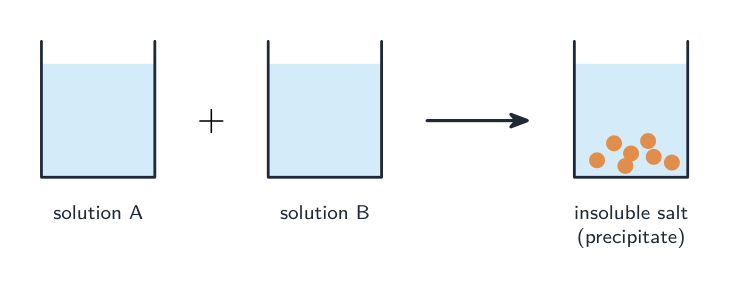
An insoluble salt is made by precipitation 沉淀: mix two solutions that each contain one of the needed ions, and the insoluble salt forms as a solid. You then filter, wash and dry it.

Water in salts

  • A hydrated 水合 substance is chemically joined with water.
  • An anhydrous 无水 substance contains no water.

The water molecules inside hydrated crystals are called the water of crystallisation 结晶水. For example, $\text{CuSO}_4 \bullet 5\text{H}_2\text{O}$ has five water molecules for each formula unit.

한국어

특정 방법으로 염을 만들 수 있는지는 그 염이 수용성(녹음)인지 불용성(녹지 않음)인지에 달려 있습니다.

용해도 규칙

염 종류 규칙
나트륨, 칼륨, 암모늄 염 모두 수용성
질산염 모두 수용성
염화물 수용성, 단 납과 은은 제외
황산염 수용성, 단 바륨, 칼슘과 납은 제외
탄산염 불용성, 단 나트륨, 칼륨과 암모늄은 제외
수산화물 불용성, 단 나트륨, 칼륨, 암모늄과 (부분적으로) 칼슘은 제외

수용성 염 제조법

다음 중 하나와 산을 반응시킵니다:

  • 알칼리, 적정법을 사용하여(둘 다 용액이므로 정확한 부피를 측정해야 함);
  • 과잉의 금속, 불용성 염기 또는 불용성 탄산염.

고체를 과잉 사용했을 때는 남은 고체를 제거하기 위해 여과한 후, 물의 일부를 증발시켜 용액을 결정화시켜 염을 얻습니다.

4단계 순서도: 산에 과잉 고체를 추가하고, 여과하며, 물의 일부 증발시키고, 결정화를 위해 남겨둠
불용성 고체로부터 수용성 염 제조: 과잉으로 반응시킨 후 여과하여 과잉분을 제거하고, 증발시키고, 결정화함
흰 배경 위에 놓인 밝은 파란색 기하학적 결정의 구리(II) 황산염
용액을 천천히 결정화시키면 잘 형성된 결정을 얻을 수 있습니다 - 여기에는 구리(II) 황산염의 파란색 결정이 있습니다

worked example. (a) 구리(II)황산염과 (b) 바륨황산염을 제조하려면 어떤 방법을 사용할 것인가? 먼저 용해도 규칙을 확인하라. (a) 구리(II)황산염은 용해됨 (바륨, 칼슘, 납 황산염 외에는 모두 용해됨)하므로, 불용성 고체와 산으로 제작한다: 따뜻한 희석 황산에 과잉의 구리(II) 산화물을 추가한 뒤, 남은 고체를 여과하고, 물을 일부 증발시켜 결정화시킨다. (b) 바륨황산염은 불용성이므로, 침전법으로 제작한다: 각 하나씩 필요한 이온을 포함하는 두 용액을 혼합한 후 여과, 세척, 건조한다. 원하는 염의 용해도가 방법을 결정하므로, 선택하기 전에 규칙을 참고하라.

불용성 염 제조

불용성 염은 침전법으로 제조된다: 각 하나씩 필요한 이온을 포함하는 두 용액을 혼합하면 불용성 염이 고체로 생성된다. 이후 여과, 세척, 건조한다.

두 투명 용액을 함께 붓고, 베커 안쪽 바닥에서 고체가 형성되는 모습
필요한 이온을 각 하나씩 포함하는 두 용액을 혼합하면 불용성 염이 고체 침전물로 나타나며, 이를 여과하여 분리함

염 내의结晶水

  • 수화물(hydrated) 물질은 화학적으로 물과 결합되어 있다.
  • 무수 물질은 물 분자를 포함하지 않습니다.

수화 결정 내부의 물 분자는 결정수라고 합니다. 예를 들어, $\text{CuSO}_4 \bullet 5\text{H}_2\text{O}$는 각 화학식 단위마다 물 분자 5개가 포함되어 있습니다.

Explore · ⁨탐색하기⁩

Preparing a soluble salt

Step through the method. React an acid with excess insoluble base, filter off what's left over, then evaporate and crystallise to get pure salt crystals.

Vocabulary · ⁨어휘⁩ Train · ⁨연습하기⁩
English 한국어
salt/sɒlt/ 염
hydrogen/ˈhaɪdrədʒn/ 수소
precipitation/prɪˌsɪpɪˈteɪʃn/ 침전
hydrated/haɪˈdreɪtɪd/ 수화염
anhydrous/ænˈhaɪdrəs/ 무수염
water of crystallisation/ˈwɔːtə ɒv ˌkrɪstəlaɪˈzeɪʃn/ 결정수
7.3

Exam tips · ⁨시험 팁⁩

English
  • Learn the three acid reactions: acid + metal → salt + hydrogen; acid + base → salt + water (neutralisation); acid + carbonate → salt + water + carbon dioxide.
  • Strong and weak describe how much the acid splits into ions (dissociation), not how concentrated it is. A strong acid is fully dissociated; a weak acid only partly.
  • A lower pH means a higher hydrogen-ion concentration. pH 7 is neutral, below 7 is acidic, above 7 is alkaline.
  • Choose the salt method by solubility: a soluble salt is made from an acid + excess solid (then filter, evaporate, crystallise), or by titration with an alkali; an insoluble salt is made by precipitation (mix two solutions, then filter).
  • Learn the solubility rules — all sodium, potassium, ammonium and nitrate salts are soluble.
한국어
  • 세 가지 산의 반응을 숙지하십시오: 산 + 금속 → 염 + 수소; 산 + 염기 → 염 + 물 (중화 반응); 산 + 탄산염 → 염 + 물 + 이산화탄소.
  • 강과 약은 산이 이온으로 분리되는 정도(해리)를 나타내는 것이지 농도를 의미하는 것이 아닙니다. 강산은 완전히 해리되며, 약산은 부분적으로만 해리됩니다.
  • 낮은 pH는 높은 수소 이온 농도를 의미합니다. pH 7는 중성, 7 미만은 산성, 7 이상은 염기성입니다.
  • 용해도에 따른 염 제조 방법을 선택하십시오: 가용성 염은 산 + 과잉 고체(여과, 증발, 결정화) 또는 알칼리와의 적정法을 통해 만들거나, 불가용성 염은 침전법(두 용액을 혼합한 후 여과)을 통해 만듭니다.
  • 용해도 규칙을 숙지하십시오 - 모든 나트륨, 칼륨, 암모늄 및 질산염 염은 가용성입니다.

Interactive lessons on this topic · ⁨이 주제에 대한 인터랙티브 수업⁩

Work through it step by step, with instant-check exercises. · ⁨즉시 체크 기능 exercises를 통해 단계별로 진행하세요.⁩

Past Papers · ⁨과거 시험지⁩

More topics in IGCSE Chemistry · ⁨IGCSE 화학⁩ · ⁨IGCSE Chemistry · ⁨IGCSE 화학⁩ 내 추가 주제⁩

Log in or create account · ⁨로그인 또는 계정 만들기⁩

IGCSE, A-Level & AP