English
| Core | Supplement |
|---|---|
| 1 Describe the differences between elements, compounds and mixtures |
한국어
| 핵심 | 보충 |
|---|---|
| 1 원소, 합성물 및 혼합물 간의 차이를 서술하시오 |
IGCSE Chemistry · IGCSE 화학 · Topic 2 · 주제 2
 16:46
16:46
원자 & 결합
이 두 가지를 보세요. 다이아몬드 — 구매 가능한 가장 단단한 물질. 그리고 연필 속의 부드럽고 회색인 연.它们是截然不同的样子。然而两者都是…
English narration · English + 中文 subtitles burned in · 영어 내레이션 · 영어 + 중국어 자막 burned-in

| Core | Supplement |
|---|---|
| 1 Describe the differences between elements, compounds and mixtures |
| 핵심 | 보충 |
|---|---|
| 1 원소, 합성물 및 혼합물 간의 차이를 서술하시오 |
Source: Cambridge International syllabus · 출처: Cambridge International syllabus
All substances are made from about 100 simple building blocks. Knowing how they are joined lets you sort every substance into one of three groups.
The key difference: in a compound the elements are bonded and can only be separated by chemical reactions; in a mixture they are not bonded and are easy to separate.
모든 물질은 약 100가지의 기본 구성 요소로 이루어져 있습니다. 이들이 어떻게 결합되어 있는지 알면 모든 물질을 세 가지 그룹 중 하나에 분류할 수 있습니다.
핵심 차이: 합성물에서는 원소들이 결합되어 있어 화학 반응으로만 분리할 수 있지만, 혼합물에서는 결합되어 있지 않아 쉽게 분리됩니다.

Classify everyday particle examples by composition. · 일상적인 입자 예들을 구성에 따라 분류하십시오.
| English | 한국어 |
|---|---|
| element/ˈelɪmənt/ | 원소 |
| compound/ˈkɒmpaʊnd/ | 화합물 |
| mixture/ˈmɪkstʃə/ | 혼합물 |
| nucleus/ˈnjuːklɪəs/ | 핵 |
| electrons/ɪˈlektrɒnz/ | 전자 |

| Core | Supplement |
|---|---|
| 1 Describe the structure of the atom as a central nucleus containing neutrons and protons surrounded by electrons in shells | |
| 2 State the relative charges and relative masses of a proton, a neutron and an electron | |
| 3 Define proton number/atomic number as the number of protons in the nucleus of an atom | |
| 4 Define mass number/nucleon number as the total number of protons and neutrons in the nucleus of an atom | |
| 5 Determine the electronic configuration of elements and their ions with proton number 1 to 20, e.g. 2,8,3 | |
| 6 State that: (a) Group VIII noble gases have a full outer electron shell (b) the number of outer shell electrons is equal to the group number in Groups I to VII (c) the number of occupied electron shells is equal to the period number |
| 핵심 | 보충 |
|---|---|
| 1 원자의 구조를 중심 핵이 중성자와 양성자를 포함하고 있으며 껍질 내 전자에 둘러싸여 있는 것으로 서술하시오 | |
| 2 양성자, 중성자, 전자의 상대 전하 및 상대 질량을 서술하시오 | |
| 3 원자 번호/핵전수를 원자 핵 내 양성자의 수로 정의하시오 | |
| 4 질량 번호/핵자 수를 원자 핵 내 양성자와 중성자의 총수로 정의하시오 | |
| 5 원자 번호 1부터 20까지인 원소 및 이온의 전자 배위를 결정하시오. 예: 2,8,3 | |
| 6 다음을 서술하시오: (a) VIII족 비활성 기체는 외부 전자 껍질이 완전함 (b) I~VII족에서 외부 껍질의 전자 수는 족 번호와 같음 (c) 전자 껍질이 채워진 껍질의 수는 주기 번호와 같음 |
Source: Cambridge International syllabus · 출처: Cambridge International syllabus
Every atom has a small, dense centre called the nucleus 原子核. Around it, electrons 电子 move in shells 电子层 (energy levels). The nucleus contains two kinds of particle: protons 质子 and neutrons 中子.
Each particle has a relative mass and a relative charge 电荷. You must learn these values:
| Particle | Relative mass | Relative charge |
|---|---|---|
| proton | 1 | $+1$ |
| neutron | 1 | $0$ |
| electron | $\frac{1}{1840}$ (almost 0) | $-1$ |
An atom has no overall charge because it has equal numbers of protons ($+1$ each) and electrons ($-1$ each).
Two numbers describe an atom:
So the number of neutrons $=$ mass number $-$ proton number.
The electrons fill the shells from the inside out. The first shell holds up to 2 electrons; the next shells hold up to 8 each (for the first 20 elements). The electronic configuration 电子排布 lists how many electrons are in each shell, starting from the inside.
For example, an atom with 13 electrons has the configuration $2,8,3$. Sodium (proton number 11) is $2,8,1$. Calcium (proton number 20) is $2,8,8,2$.
The configuration links to the Periodic Table 周期表:
모든 원자는 작고 밀도가 높은 중심부인 원자핵을 가지고 있습니다. 그 주변에서 전자가 껍질(에너지 준위)을 따라 움직입니다. 원자핵에는 두 가지 입자가 포함되어 있습니다: 양성자와 중성자.
각 입자에는 상대 질량과 상대 전하가 있습니다. 이 값들을 반드시 외워야 합니다:
| 입자 | 상대 질량 | 상대 전하 |
|---|---|---|
| 양성자 | 1 | $+1$ |
| 중성자 | 1 | $0$ |
| 전자 | $\frac{1}{1840}$ (거의 0) | $-1$ |
원자는 전체적으로 전하를 띠지 않습니다. 이는 양성자(각 $+1$)와 전자(각 $-1$)의 수가 같기 때문입니다.
두 숫자가 원자를 설명합니다:
따라서 중성자의 수 = $=$ 질량수 - $-$ 원자번호입니다.
전자는 안쪽에서 바깥쪽으로 껍질을 채웁니다. 첫 번째 껍질은 최대 2개의 전자까지, 나머지 껍질은 최대 8개의 전자까지 담을 수 있습니다(최초 20번 원소 기준). 전자 배분은 안쪽에서부터 시작하여 각 껍실에 들어간 전자의 수를 나열합니다.
예를 들어, 13개의 전자를 가진 원자는 전자 배분 $2,8,3$를 가집니다. 나트륨(양성자 번호 11)은 $2,8,1$입니다. 칼슘(양성자 번호 20)은 $2,8,8,2$입니다.
이 배분은 주기율표와 연결됩니다:

Change the atomic number and watch the shells fill (2, 8, 8) — the electron arrangement of the first 20 elements. · 원자 번호를 변경하고 껍질이 채워지는 과정(2, 8, 8)을 관찰하십시오 — 첫 20번 원소의 전자 배치입니다.
| English | 한국어 |
|---|---|
| atom/ˈætəm/ | 원자 |
| shells/ʃelz/ | 껍질의 수 |
| protons/ˈprəʊtɒnz/ | 양성자 |
| neutrons/ˈnjuːtrɒnz/ | 중성자 |
| charge/tʃɑːdʒ/ | 전기하전 |
| proton number/ˈprəʊtɒn ˈnʌmbə/ | 양자수 |
| atomic number/əˈtɒmɪk ˈnʌmbə/ | 원자 번호 |
| mass number/mæs ˈnʌmbə/ | 질량수 |
| nucleon number/ˈnjuːklɪən ˈnʌmbə/ | 핵자 수 |
| electronic configuration/ɪlekˈtrɒnɪk kənˌfɪɡjəˈreɪʃn/ | 전자 배치 |
| Periodic Table/ˌpɪərɪˈɒdɪk ˈteɪbl/ | 원소 주기율표 |
| Group/ɡruːp/ | 그룹 |
| Period/ˈpɪərɪəd/ | 기간 |
| noble gases/ˈnəʊbl ˈɡæsɪz/ | 비활성 기체 |
| isotopes/ˈaɪsətəʊps/ | 동위원소 |

| Core | Supplement |
|---|---|
| 1 Define isotopes as different atoms of the same element that have the same number of protons but different numbers of neutrons | 3 State that isotopes of the same element have the same chemical properties because they have the same number of electrons and therefore the same electronic configuration |
| 2 Interpret and use symbols for atoms, e.g. $^{12}_{6}\text{C}$, and ions, e.g. $^{35}_{17}\text{Cl}^-$ | 4 Calculate the relative atomic mass of an element from the relative masses and abundances of its isotopes |
| 핵심 | 보충 |
|---|---|
| 1 동위원소를 같은 원소의 다른 원자로 정의하시되, 동일한 양자수를 가지지만 서로 다른 중성자 수를 가짐 | 3 동위원소는 동일한 전자 수로 인해 동일한 전자 배위를 가지므로, 같은 원소의 동위원소는 동일한 화학 성질을 가짐을 서술하시오 |
| 2 원자, 예: $^{12}_{6}\text{C}$, 및 이온, 예: $^{35}_{17}\text{Cl}^-$의 기호를 해석하고 사용하시오 | 4 동위원소의 상대 질량 및 포도율로부터 원소의 상대 원자 질량을 계산하시오 |
Source: Cambridge International syllabus · 출처: Cambridge International syllabus
Isotopes 同位素 are atoms of the same element that have the same number of protons but different numbers of neutrons. Because the proton number is the same, they are the same element. Because the neutron number is different, they have different mass numbers.
You write an atom with its mass number on top and proton number below, like $^{12}_{6}\text{C}$. For an ion you add the charge, like $^{35}_{17}\text{Cl}^{-}$.
Isotopes of an element have the same chemical properties. This is because chemical reactions only involve electrons, and isotopes have the same number of electrons and the same electronic configuration. (The extra neutrons change only the mass.)
The relative atomic mass 相对原子质量 ($A_r$) of an element is the average mass of its atoms, taking into account how common each isotope is. The abundance 丰度 is the percentage of each isotope.
For example, chlorine is 75% $^{35}\text{Cl}$ and 25% $^{37}\text{Cl}$:
Worked example. Boron has two isotopes, $^{10}\text{B}$ and $^{11}\text{B}$, and its $A_r$ is 10.8. Find the percentage of each. Let the abundance of $^{11}\text{B}$ be $x$, so the abundance of $^{10}\text{B}$ is $(100 - x)$. Then
so $11x + 1000 - 10x = 1080$, giving $x = 80$. Boron is 80% $^{11}\text{B}$ and 20% $^{10}\text{B}$. Check it against common sense: 10.8 lies closer to 11, so the heavier isotope must be the more common one. If your answer gives the majority to the isotope further from $A_r$, you have them the wrong way round.
동위원소는 같은 원소의 원자로서 동일한数の 양성자를 가지지만 서로 다른 수의 중성자를 가집니다. 양성자 번호가 동일하므로 같은 원소입니다. 중성자 수를 다르므로 질량수가 다릅니다.
원자를 위쪽에 질량수, 아래쪽에 양성자 번호로 표기합니다. 예시: $^{12}_{6}\text{C}$. 이온의 경우 전하를 추가하여 표기합니다. 예시: $^{35}_{17}\text{Cl}^{-}$.
동위원소는 化學적 성질이 동일합니다. 화학 반응은 오직 전자만 관여하기 때문이며, 동위원소는 동일한 수의 전자와 동일한 전자 배분을가지고 있기 때문입니다. (추가된 중성자는 오직 질량만 변경합니다.)
한 원소의 상대 원자 질량($A_r$)은 각 동위원소의 존재비(abundance)를 고려한 원자의 평균 질량입니다. 존재비(abundance) 는 각 동위원소의 백분율입니다.
예를 들어, 염소는 75% $^{35}\text{Cl}$과 25% $^{37}\text{Cl}$입니다:
worked example. 보론(Boron)에는 두 동위원소 $^{10}\text{B}$과 $^{11}\text{B}$이 있으며, 그 $A_r$은 10.8입니다. 각 동위원소의 백분율을 구하십시오. $^{11}\text{B}$의 존재비를 $x$라고 가정하면, $^{10}\text{B}$의 존재비는 $(100 - x)$가 됩니다. 그러면
즉 $11x + 1000 - 10x = 1080$이 되어, 결과적으로 $x = 80$이 됩니다. 붕소는 80% **$^{11}\text{B}$**와 20% **$^{10}\text{B}$**로 구성되어 있습니다. 상식과 대조해 보십시오: 10.8이 11에 더 가깝습니다. 따라서 무거운 동위 원자가 더 흔한 것이어야 합니다. 만약 정답에서 $A_r$에서 더 먼 동위 원자가 우세하다고 한다면, 두 동위 원자의 위치를 반대로 계산하신 것입니다.
Change the neutrons to make isotopes (same element, different mass number); change the electrons to make ions. · 동위원소를 만들기 위해 중성자를 변경하십시오(같은 원소, 다른 질량 번호); 이온을 만들기 위해 전자를 변경하십시오.
Classify isotope facts by proton, neutron and mass number. · 양성자, 중성자 및 질량 번호에 따라 동위원소 사실을 분류하십시오.
| English | 한국어 |
|---|---|
| relative atomic mass/ˈrelətɪv əˈtɒmɪk mæs/ | 상대 원자 질량 |
| abundance/əˈbʌndəns/ | 존재율 |

| Core | Supplement |
|---|---|
| 1 Describe the formation of positive ions, known as cations, and negative ions, known as anions | 5 Describe the giant lattice structure of ionic compounds as a regular arrangement of alternating positive and negative ions |
| 2 State that an ionic bond is a strong electrostatic attraction between oppositely charged ions | 6 Describe the formation of ionic bonds between ions of metallic and non-metallic elements, including the use of dot-and-cross diagrams |
| 3 Describe the formation of ionic bonds between elements from Group I and Group VII, including the use of dot-and-cross diagrams | 7 Explain in terms of structure and bonding the properties of ionic compounds: (a) high melting points and boiling points (b) good electrical conductivity when aqueous or molten and poor when solid |
| 4 Describe the properties of ionic compounds: (a) high melting points and boiling points (b) good electrical conductivity when aqueous or molten and poor when solid |
| 핵심 | 보충 |
|---|---|
| 1 양이온(양이온) 및 음이온(음이온)의 형성을 서술하시오 | 5 이온 화합물의 거대 격자 구조가 교대로 배열된 양이온과 음이온의 규칙적 배치임을 서술하시오 |
| 2 이온 결합은 서로 반대 전하를 띤 이온 사이의 강한 정전기적 인력임을 서술하시오 | 6 금속 및 비금속 원소 간 이온 결합 형성을 점-표(Cross) 도식을 사용하여 서술하시오 |
| 3 I족 및 VII족 원소 간의 이온 결합 형성을 점-십자 도식을 사용하여 설명 | 7 이온성 화합물의 성질을 구조와 결합의 관점에서 설명: (a) 높은 녹점과 끓는점 (b) 수용액 또는 용융 상태에서는 전기 전도도가 우수하지만 고체 상태에서는 낮음 |
| 4 이온성 화합물의 성질을 설명: (a) 높은 녹점과 끓는점 (b) 수용액 또는 용융 상태에서는 전기 전도도가 우수하지만 고체 상태에서는 낮음 |
Source: Cambridge International syllabus · 출처: Cambridge International syllabus
An ion 离子 is an atom (or group of atoms) that has lost or gained electrons, so it has an electric charge.
Atoms do this to get a full outer shell, like a noble gas.
An ionic bond 离子键 is a strong electrostatic attraction 静电引力 between oppositely charged ions (a $+$ ion and a $-$ ion pull together).
Ionic bonds form between a metal 金属 and a non-metal 非金属. Take sodium chloride, $\text{NaCl}$. Sodium ($2,8,1$) gives its one outer electron to chlorine ($2,8,7$). Now sodium is $\text{Na}^{+}$ ($2,8$) and chlorine is $\text{Cl}^{-}$ ($2,8,8$). Both have full outer shells, and the opposite charges attract.
You can show this with a dot-and-cross diagram: draw each atom's outer-shell electrons as dots for one element and crosses for the other, then show the electron moving from the metal to the non-metal.
An ionic compound 离子化合物 is not made of separate molecules 分子. The ions pack together into a giant lattice 晶格 — a regular pattern of huge numbers of alternating 交替 positive and negative ions.
This structure explains the properties:
| Property | Reason |
|---|---|
| high melting point 熔点 and boiling point 沸点 | the strong electrostatic attraction between ions needs a lot of energy to break |
| poor electrical conductivity 导电性 when solid | the ions are fixed in place and cannot move |
| good conductor when molten 熔融 or aqueous 水溶液 | the ions are now free to move and carry charge |
이온은 전자를 잃거나 얻어 전기적 전하를 띤 원자(또는 원자 그룹)입니다.
원자들은 무활성 기체처럼 가장 바깥 껍질을 완전하게 만들기 위해这样做합니다.
이온 결합은 서로 반대 전하를 띤 이온 사이의 강력한 정전기적 인력입니다($+$ 이온과 $-$ 이온이 서로 끌어당킴).
이온 결합은 금속과 비금속 사이에 형성됩니다. 염화나트륨($\text{NaCl}$)을 예로 들어보겠습니다. 나트륨($2,8,1$)은 바깥 껍질의 전자 하나를 염소($2,8,7$)에게 양도합니다. 그러면 나트륨은 ⟨$\text{Na}^{+}$⟩($2,8$)가 되고 염소는 ⟨$\text{Cl}^{-}$⟩($2,8,8$)가 됩니다. 두 원자는 모두 안정된 바깥 껍질을 가지며, 서로 다른 전하가 인력을 발합니다.
이를 점-크로스 도표로 나타낼 수 있습니다: 한 원소의 바깥 껍질 전자는 점으로, 다른 원소는 크로스(×)로 그려서 금속에서 비금속으로 전자가 이동하는 과정을 보여줍니다.
이온 화합물은 개별적인 분자로 이루어진 것이 아닙니다. 이온들이 거대한 격자로 밀집되어 있는데, 이는 수많은 양이온과 음이온이 교차배열된 규칙적인 패턴입니다.


이러한 구조가 다음 성질을 설명합니다:
| 성질 | 이유 |
|---|---|
| 높은 용점 및 끓음점 | 이온 사이의 강력한 전기적 인력을 끊어내려면 많은 에너지가 필요함 |
| 고체일 때는 낮은 전기 전도성 | 이온들이 고정되어 있어 움직일 수 없음 |
| 용해되거나 액체 상태일 때는 좋은 전도체 | 이온들이 자유롭게 움직여 전하를 운반할 수 있음 |
Step through it. A metal hands its outer electron to a non-metal; the oppositely charged ions then attract and pack into a giant lattice. · 단계별로 확인하세요. 금속이 바깥 전자를 비금속에게 건네면, 반대로 충전된 이온들이 서로 끌어당겨 거대한 격자 구조를 형성합니다.
Step through it: the metal hands its outer electron(s) to the non-metal, both reach full shells, and the resulting + and − ions attract — an ionic bond. · 단계별로 확인하세요: 금속이 바깥 전자(들)를 비금속에게 건네면, 둘 다 바깥 껍질이 채워지고, resultant한 +와 - 이온들이 서로 끌어당겨 — 이온 결합이 형성됩니다.
| English | 한국어 |
|---|---|
| ion/ˈaɪɒn/ | 이온 |
| cation/ˈkætaɪən/ | 양이온 |
| anion/ˈænaɪən/ | 음이온 |
| ionic bond/aɪˈɒnɪk bɒnd/ | 이온 결합 |
| electrostatic attraction/ɪˌlektrəʊˈstætɪk əˈtrækʃn/ | 정전기적 인력 |
| lattice/ˈlætɪs/ | 격자 |
| alternating/ˈɔːltəneɪtɪŋ/ | 교류(AC) |
| melting point/ˈmeltɪŋ pɔɪnt/ | 융점 |
| boiling point/ˈbɔɪlɪŋ pɔɪnt/ | 비점 |
| electrical conductivity/ɪˈlektrɪkl kɒndəkˈtɪvɪti/ | 전기 전도도 |
| molten/ˈməʊltn/ | 융해 상태의 |
| aqueous/ˈeɪkwɪəs/ | 수용액 상태의 |

| Core | Supplement |
|---|---|
| 1 State that a covalent bond is formed when a pair of electrons is shared between two atoms leading to noble gas electronic configurations | |
| 2 Describe the formation of covalent bonds in simple molecules, including $\text{H}_2$, $\text{Cl}_2$, $\text{H}_2\text{O}$, $\text{CH}_4$, $\text{NH}_3$ and $\text{HCl}$. Use dot-and-cross diagrams to show the electronic configurations in these and similar molecules | 4 Describe the formation of covalent bonds in simple molecules, including $\text{CH}_3\text{OH}$, $\text{C}_2\text{H}_4$, $\text{O}_2$, $\text{CO}_2$ and $\text{N}_2$. Use dot-and-cross diagrams to show the electronic configurations in these and similar molecules |
| 3 Describe in terms of structure and bonding the properties of simple molecular compounds: (a) low melting points and boiling points (b) poor electrical conductivity | 5 Explain in terms of structure and bonding the properties of simple molecular compounds: (a) low melting points and boiling points in terms of weak intermolecular forces (specific types of intermolecular forces are not required) (b) poor electrical conductivity |
| 핵심 | 보충 |
|---|---|
| 1 두 원자 사이에서 전자 쌍이 공유되어 비활성 기체의 전자 배치를 이루는 경우 공유 결합이 형성됨을 서술 | |
| 2 단순 분자 내 공유 결합 형성을 설명하되, $\text{H}_2$, $\text{Cl}_2$, $\text{H}_2\text{O}$, $\text{CH}_4$, $\text{NH}_3$ 및 $\text{HCl}$을 포함한다. 점-교차도(dot-and-cross diagrams)를 사용하여これらの分子 및 유사 분자의 전자배치를 나타낸다. | 4 단순 분자 내 공유 결합 형성을 설명하되, $\text{CH}_3\text{OH}$, $\text{C}_2\text{H}_4$, $\text{O}_2$, $\text{CO}_2$ 및 $\text{N}_2$을 포함한다. 점-교차도를 사용하여这些分子 및 유사 분자의 전자배치를 나타낸다. |
| 3 단순 분자 화합물의 성질을 구조와 결합의 관점에서 설명: (a) 낮은 녹점과 끓는점 (b) 낮은 전기 전도성 | 5 단순 분자 화합물의 성질을 구조와 결합의 관점에서 설명: (a) 약한 분자 간 힘(분자 간 힘의 구체적인 유형은 불필요)에 의한 낮은 녹점과 끓는점 (b) 낮은 전기 전도성 |
Source: Cambridge International syllabus · 출처: Cambridge International syllabus
A covalent bond 共价键 forms when two atoms share a pair of electrons. By sharing, each atom gets a full outer shell (a noble gas configuration). Covalent bonds form between non-metal atoms.
Some molecules to know:
In a dot-and-cross diagram for a molecule, you draw the outer electrons of each atom and show which pairs are shared in the overlap between the atoms.
These substances are made of small, separate molecules.
공유 결합은 두 원자가 전자 쌍을 공유할 때 형성됩니다. 전자를 공유함으로써 각 원자는 바깥 껍질이 완전히 채워진 상태(비활성 기체 configuration)가 됩니다. 공유 결합은 비금속 원자들 사이에서 형성됩니다.
알아야 할 몇 가지 분자:
분자의 점-크로스 도표에서는 각 원자의 바깥 전자를 그리고 원자 사이의 겹침 영역에서 어떤 전자 쌍이 공유되는지를 보여줍니다.

이 물질들은 작고 개별적인 분자들로 구성되어 있습니다.
Shared electron pairs repel one another and spread out as far apart as they can. Four bonding pairs and no lone pairs gives a tetrahedral shape, like methane (CH4). · 공유 전자 쌍은 서로 반발하여 가능한 한 멀리 퍼져 나간다. 결합 쌍이 4개이고 비결합 전자가 없는 경우, 메탄(CH4)과 같은 사면체 형태가 된다.
Step through it: two non-metal atoms overlap and share a pair of electrons — counting for both — so each reaches a full outer shell. That shared pair is the covalent bond; O₂ shares two pairs (a double bond). · 단계별 설명: 두 비금속 원자가 겹쳐서 전자 쌍 하나를 공유하며, 이는 양쪽 모두에 계산되어 각 원자가 바깥 껍질을 채웁니다. 이 공유된 쌍이 공유 결합이며, O₂는 두 쌍(이중 결합)을 공유합니다.
| English | 한국어 |
|---|---|
| covalent bond/ˈkəʊvələnt bɒnd/ | 두 비금속 원자 사이의 공유된 전자쌍임. 공유된 쌍은 양쪽 모두의 것이므로 두 원자는 모두 완전한 외부 껍질을 갖게 됨. 두 쌍을 공유하면 이중 결합이 되어 |
| intermolecular forces/ˌɪntəməˈlekjʊlə ˈfɔːsɪz/ | 분자 간 힘 |
| giant covalent structure/ˈdʒaɪənt ˈkəʊvələnt ˈstrʌktʃə/ | 거대 공유 결합 구조 |

| Core | Supplement |
|---|---|
| 1 Describe the giant covalent structures of graphite and diamond | 3 Describe the giant covalent structure of silicon(IV) oxide, $\text{SiO}_2$ |
| 2 Relate the structures and bonding of graphite and diamond to their uses, limited to: (a) graphite as a lubricant and as an electrode (b) diamond in cutting tools | 4 Describe the similarity in properties between diamond and silicon(IV) oxide, related to their structures |
| 핵심 | 보충 |
|---|---|
| 1石墨(graphite)와 다이아몬드(diamond)의 거대 공유 결합 구조를 설명 | 3 실리카(IV)(silicon(IV) oxide)의 거대 공유 결합 구조를 $\text{SiO}_2$와 함께 설명 |
| 2石墨와 다이아몬드의 구조 및 결합을 활용하는 용도에 대해 서술: (a)石墨의 윤활제 및 전극としての 사용 (b)다이아몬드의 절단 도구로서의 사용 | 4 다이아몬드와 실리카(IV) 산화의 성질 유사성을 그 구조와 관련하여 설명 |
Source: Cambridge International syllabus · 출처: Cambridge International syllabus
Some covalent substances are not small molecules. Instead, millions of atoms are joined by covalent bonds into one giant covalent structure 巨型共价结构. The two you must know are both forms of carbon.
Diamond 金刚石: each carbon atom is bonded to four other carbon atoms. This makes a very strong, rigid 3-D network. Diamond is extremely hard, so it is used in cutting tools 切割工具.
Graphite 石墨: each carbon atom is bonded to only three others, forming flat layers 层. There are weak forces between the layers, so the layers can slide over each other — this makes graphite a good lubricant 润滑剂. The fourth outer electron of each carbon is free; these delocalised electrons 离域电子 can move, so graphite conducts electricity and is used as an electrode 电极.
Silicon(IV) oxide 二氧化硅 ($\text{SiO}_2$) has a giant covalent structure like diamond, so it is also very hard and has a very high melting point.
일부 공유 결합 물질은 작은 분자가 아닙니다. 대신数百万个原子通过共价键连接成一个거대한 공유 결합 구조입니다. 반드시 알아야 하는 두 가지 모두 탄소의 동소체입니다.
다이아몬드: 각 탄소 원자는 네 개의 다른 탄소 원자와 결합되어 있습니다. 이는 매우 강하고 단단한 3차원 네트워크를 만듭니다. 다이아몬드는 매우 딱딱하기 때문에 절단 도구에 사용됩니다.
그래파이트: 각 탄소 원자는 세 개의 다른 원자만 결합하여 평평한 층을 형성합니다. 층 사이에는 약한 힘이 있으므로 층들이 서로 미끄러질 수 있습니다—이것이 그래파이트가 좋은 윤활제가 되는 이유입니다. 각 탄소 원자의 네 번째 바깥 전자는 자유로운데, 이러한 탈국소화된 전자들이 이동할 수 있어 그래파이트는 전기를 전도하며 전극으로 사용됩니다.

실리콘(IV) 산化物($\text{SiO}_2$)은 다이아몬드와 유사한 거대한 공유 결합 구조를 가져 매우 딱딱하고 높은 융점을 가집니다.
Compare giant covalent structures by bonding and properties. · 결합 및 물성에 따라 거대 공유 결합 구조를 비교하세요.
| English | 한국어 |
|---|---|
| diamond/ˈdaɪəmənd/ | 다이아몬드 |
| cutting tools/ˈkʌtɪŋ tuːlz/ | 절삭 공구 |
| graphite/ˈɡræfaɪt/ | 흑연 |
| layers/ˈleɪəz/ | 레이어 |
| lubricant/ˈluːbrɪkənt/ | 윤활제 |
| delocalised electrons/dɪˈlɒkəlaɪzd ɪˈlektrɒnz/ | 비국소화 전자 |
| electrode/ɪˈlektrəʊd/ | 전극 |
| silicon(IV) oxide/ˈsɪlɪkən ˈɒksaɪd/ | 실리콘(IV) 산化物 |
| Core | Supplement |
|---|---|
| 1 Describe metallic bonding as the electrostatic attraction between the positive ions in a giant metallic lattice and a ‘sea’ of delocalised electrons | |
| 2 Explain in terms of structure and bonding the properties of metals: (a) good electrical conductivity (b) malleability and ductility |
| 핵심 | 보충 |
|---|---|
| 1 금속 결합을 거대한 금속 격자 내 양이온과 '자유 전전자' 사이의 정전기적 인력으로 설명 | |
| 2 금속의 성질을 구조와 결합의 관점에서 설명: (a) 우수한 전기 전도성 (b) 신도성 및 연성 |
Source: Cambridge International syllabus · 출처: Cambridge International syllabus
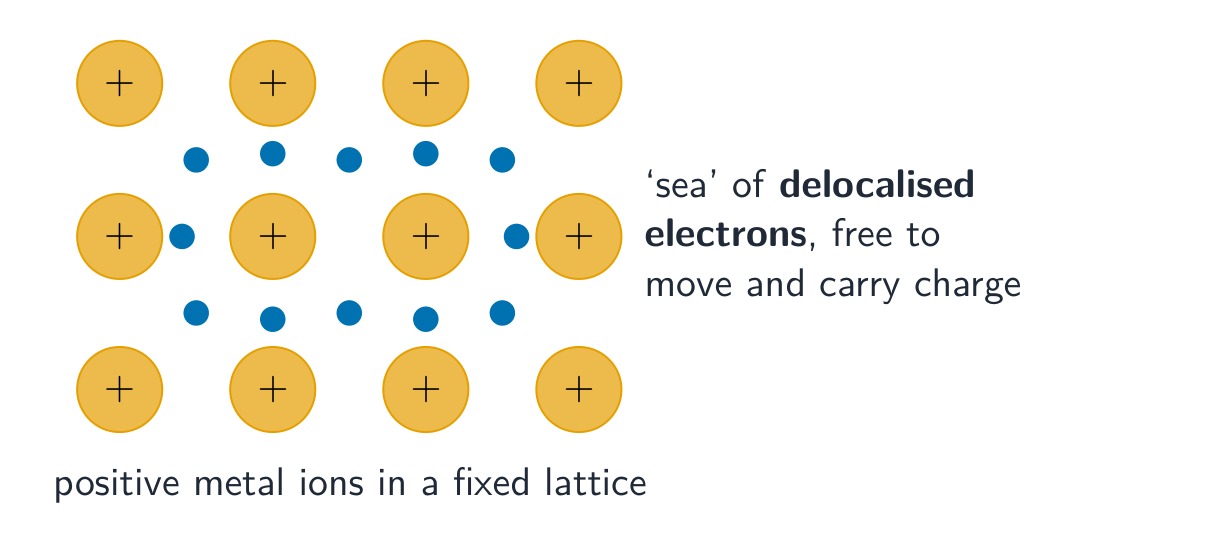
A metal is a giant structure of positive ions surrounded by a 'sea' of delocalised electrons that are free to move through the whole metal. Metallic bonding 金属键 is the strong electrostatic attraction between these positive ions and the sea of electrons.
This explains two key properties of metals:
금속은 탈국소화된 전자의 '바다'에 둘러싸인 양이온들의 거대한 구조입니다. 이 전자들은 금속 전체를 자유롭게 이동할 수 있습니다. 금속 결합은 이러한 양이온과 전자 바다 사이의 강력한 전기적 인력입니다.
이는 금속의 두 가지 주요 성질을 설명합니다:
Step through it. Positive ions sit in a shared sea of delocalised electrons — that one picture explains conduction and why metals bend instead of snapping. · 단계별 설명. 양이온이 비국소화된 전자의 바다 속에 자리 잡습니다 — 이 하나의 그림이 전도와 금속이 부러지는 대신 구부러지는 이유를 설명합니다.
| English | 한국어 |
|---|---|
| metal/ˈmetl/ | 금속 |
| non-metal/nɒn ˈmetl/ | 비금속 |
| ionic compound/aɪˈɒnɪk ˈkɒmpaʊnd/ | 이온 화합물 |
| molecules/ˈmɒlɪkjuːlz/ | 분자 |
| metallic bonding/məˈtælɪk ˈbɒndɪŋ/ | 금속 결합 |
| malleability/ˌmæləˈbɪlɪti/ | 신도성 |
| ductility/dʌkˈtɪlɪti/ | 인성(ductility) |
Work through it step by step, with instant-check exercises. · 즉시 체크 기능 exercises를 통해 단계별로 진행하세요.
Loading subjects… · 과목 로드 중…