Skip to content · ⁨본문 바로가기⁩

Poetry I · ⁨시 I⁩

AP English Literature and Composition · ⁨AP 영어 문학 및 작문⁩ · Topic 2 · ⁨주제 2⁩

Video lesson for this topic · ⁨이 주제용 영상 수업⁩ Open the video page · ⁨영상 페이지 열기⁩
6:10

유닛 2: 시 I

유닛 2는 과정의 첫 번째 시 유닛으로, 유닛 1의 도구套件에 두 가지 요소를 추가합니다: 분석 대상으로서의 구조와 기법적 언어를 처리하는 방법…

English narration · English + 中文 subtitles burned in · ⁨영어 내레이션 · 영어 + 중국어 자막 burned-in⁩

2.1

What Textual Details Reveal About a Character · ⁨텍스트 디테일이 캐릭터에 대해 드러내는 것⁩

Syllabus
English

Enduring Understanding (CHR-1): Characters in literature allow readers to study and explore a range of values, beliefs, assumptions, biases, and cultural norms represented by those characters.

Learning Objective 1.A: Identify and describe what specific textual details reveal about a character, that character’s perspective, and that character’s motives.

  • CHR-1.E Characters reveal their perspectives and biases through the words they use, the details they provide in the text, the organization of their thinking, the decisions they make, and the actions they take.
한국어

영구적 이해 (CHR-1): 문학 작품 속 캐릭터들은 독자가 그 캐릭터들이 대표하는 다양한 가치관, 신념, 전제, 편견 및 문화적 규범을 연구하고 탐구할 수 있게 합니다.

학습 목표 1.A: 특정 텍스트 디테일이 캐릭터, 해당 캐릭터의 시각, 그리고 해당 캐릭터의 동기에 대해 무엇을显露하는지 식별하고 묘사하십시오.

  • CHR-1.E 등장인물은 그들이 사용하는 단어, 텍스트에 제공하는 디테일, 사고의 조직화, 내리는 결정, 그리고 취한 행동을 통해 자신의 관점과 편견을 드러냅니다.
Source: College Board AP Course and Exam Description · ⁨출처: College Board AP Course and Exam Description⁩

English

Unit 2 is the course's first poetry unit, and it adds two things to Unit 1's toolkit: structure as an object of analysis, and figurative language 比喻性语言 handled precisely rather than by name-dropping.

One addition on character first: characters reveal their perspectives and biases through the words they use, the details they provide, and the details they omit.

That last item is the analytical opening. What a speaker does not mention, in a poem where everything is chosen, is evidence.

한국어

: Unit 2는 과정의 첫 시 단원이며, Unit 1의 도구함에 두 가지를 추가합니다: 분석의 대상으로서의 구조(structure), 그리고 이름만 나열하지 않고 정밀하게 다뤄지는 비유적 언어(figurative language).比喻性语言

인물 분석의 첫 번째 추가 요소: 인물은 그들이 사용하는 단어, 제공하는 디테일, 그리고 생략하는 디테일을 통해 자신의 관점과 편견을 드러냅니다.

마지막 항목이 바로 분석적 시작점입니다. 모든 것이 엄선된 시에서 화자가 언급하지 않는 것은 곧 증거입니다.

Vocabulary · ⁨어휘⁩ Train · ⁨연습하기⁩
English 한국어
figurative language/ˈfɪɡjərətɪv ˈlæŋɡwɪdʒ/ 은유적 언어
2.2

The Function of Structure in a Text · ⁨텍스트 내 구조의 기능⁩

Syllabus
English

Enduring Understanding (STR-1): The arrangement of the parts and sections of a text, the relationship of the parts to each other, and the sequence in which the text reveals information are all structural choices made by a writer that contribute to the reader’s interpretation of a text.

Learning Objective 3.C: Explain the function of structure in a text.

  • STR-1.D Line and stanza breaks contribute to the development and relationship of ideas in a poem.
  • STR-1.E The arrangement of lines and stanzas contributes to the development and relationship of ideas in a poem.
  • STR-1.F A text’s structure affects readers’ reactions and expectations by presenting the relationships among the ideas of the text via their relative positions and their placement within the text as a whole.
한국어

영구적 이해 (STR-1): 텍스트의 부분과 섹션의 배열, 부분들 간의 관계, 그리고 텍스트가 정보를 공개하는 순서는 모두 작가가 내린 구조적 선택이며, 이는 독자의 텍스트 해석에 기여합니다.

학습 목표 3.C: 텍스트 내 구조의 기능을 설명하십시오.

  • STR-1.D 줄바꿈과 연의 끝은 시에서의 아이디어의 발전 및 상호 관계에 기여합니다.
  • STR-1.E 줄과 연의 배열은 시에서의 아이디어의 발전 및 상호 관계에 기여합니다.
  • STR-1.F 텍스트의 구조는 아이디어 간의 상대적 위치와 전체 텍스트 내 배치方式来 Idea 간의 관계를 제시함으로써 독자의 반응과 기대에 영향을 미칩니다.

Source: College Board AP Course and Exam Description · ⁨출처: College Board AP Course and Exam Description⁩

English
  • Line and stanza breaks 行与诗节的断开 contribute to the development and relationship of ideas in a poem.
  • The arrangement of lines and stanzas contributes to that development.
  • A text's structure affects readers' reactions and expectations by presenting the relationships among ideas.

Structure in poetry is not decoration; it is punctuation for thought. Where a line breaks decides which words sit at the ends of lines, and the end of a line is the most emphatic position available. A sentence that runs past a line break asks the reader to hold something unresolved; one that stops at the break closes it.

한국어
  • 행과 시절의 끊김(line and stanza breaks) 은 시의 아이디어 전개와 상호 관계에 기여합니다.行与诗节的断开
  • 행과 시절의 배치(arrangement) 는 그러한 전개를 돕습니다.
  • 텍스트의 구조는 아이디어 간의 관계를 제시함으로써 독자의 반응과 기대에 영향을 미칩니다.

시에서의 구조는 장식이 아니라 사상의 마크(punctuation)입니다. 행이 끊어지는 지점이 어떤 단어가 줄 끝에 올지 결정하며, 줄 끝은 가장 강조되는 위치입니다. 행 끊김을 넘어 이어지는 문장은 독자에게 해결되지 않은 것을 유지하게 하고, 끊김에서 멈추는 문장은 그것을 마무리합니다.

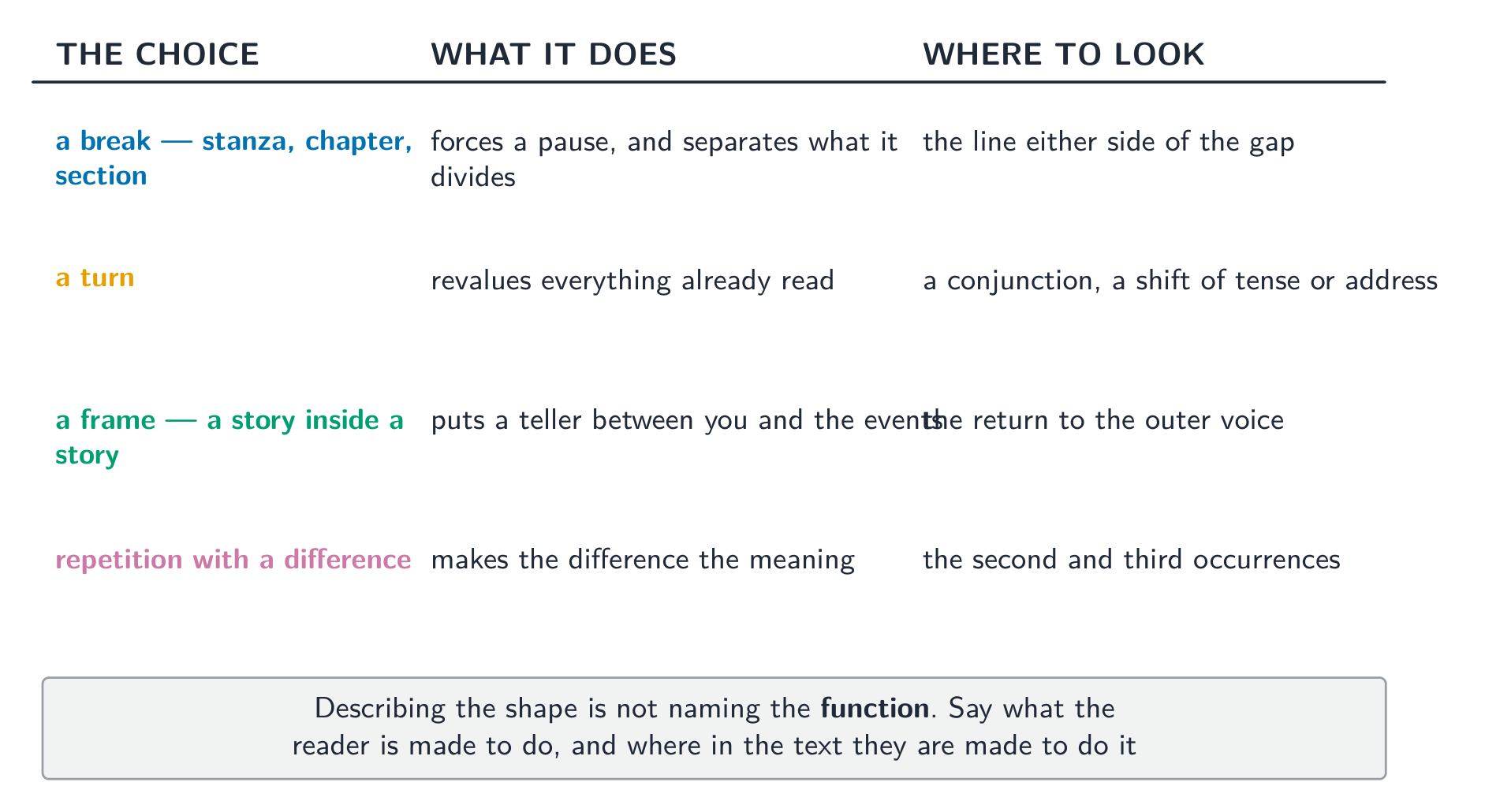
모양을 묘사하는 것이 기능을 이름 짓는 것이 아닙니다 - 독자가做什么来说明하십시오
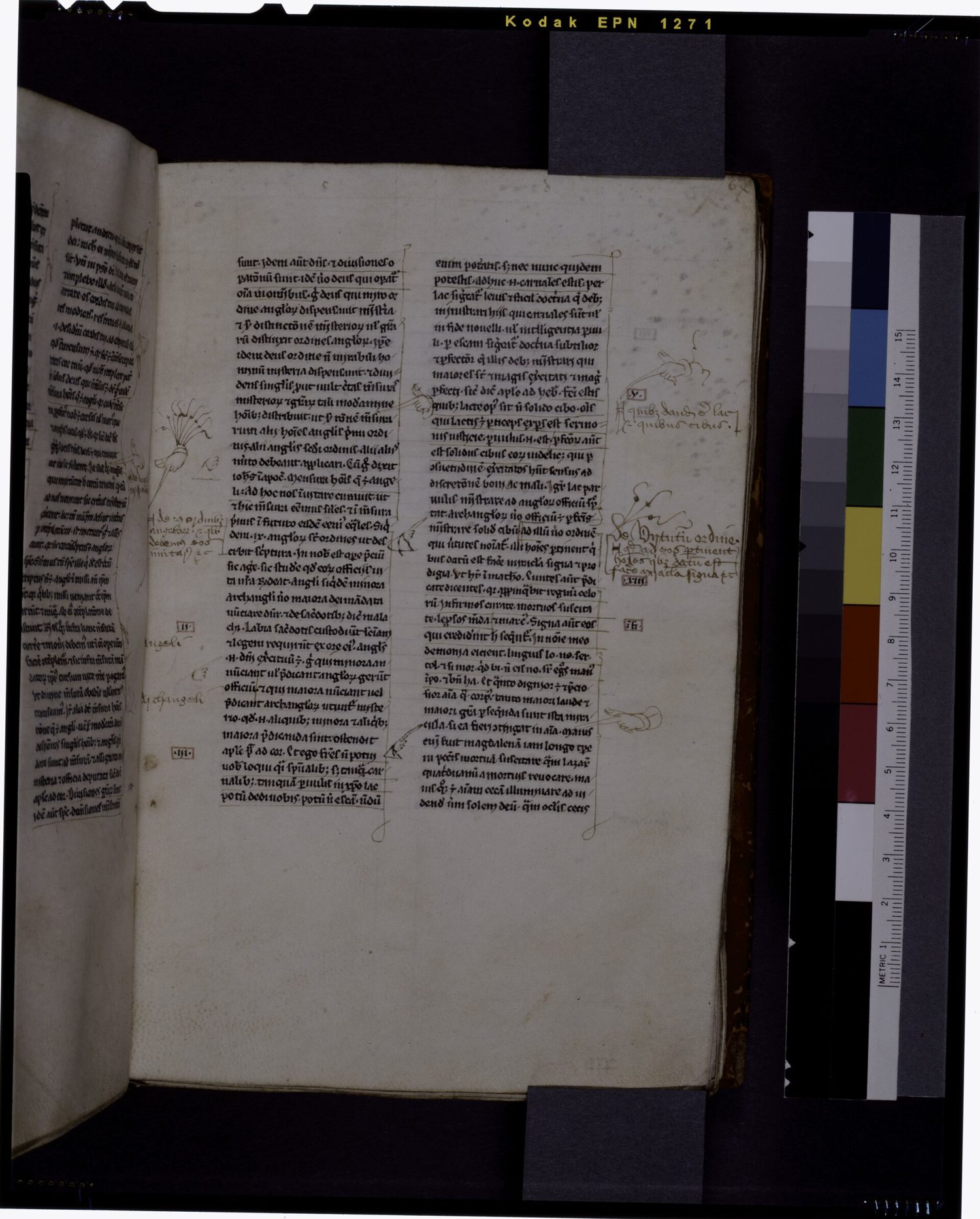
여백에 자체 주석을 담고 있는 페이지 - 수세기 앞선 근접 독본
Explore · ⁨탐색하기⁩

Match each structural choice to its function · ⁨각 구조적 선택을 그에 맞는 기능과 짝지우십시오⁩

Describing the shape is not naming the function. Say what the reader is made to do, and where. · ⁨모양을 설명하는 것은 기능을 명명하는 것이 아닙니다. 독자가 무엇을 하도록 유도받고 어디에서 하는지를 말하십시오.⁩

Vocabulary · ⁨어휘⁩ Train · ⁨연습하기⁩
English 한국어
Line and stanza breaks/laɪn ænd ˈstænzə breɪks/ 행과 구 절단
2.3

The Function of Contrasts Within a Text · ⁨텍스트 내 대조의 기능⁩

Syllabus
English

Enduring Understanding (STR-1): The arrangement of the parts and sections of a text, the relationship of the parts to each other, and the sequence in which the text reveals information are all structural choices made by a writer that contribute to the reader’s interpretation of a text.

Learning Objective 3.D: Explain the function of contrasts within a text.

  • STR-1.G Contrast can be introduced through focus; tone; point of view; character, narrator, or speaker perspective; dramatic situation or moment; settings or time; or imagery.
  • STR-1.H Contrasts are the result of shifts or juxtapositions or both.
  • STR-1.I Shifts may be signaled by a word, a structural convention, or punctuation.
  • STR-1.J Shifts may emphasize contrasts between particular segments of a text.
한국어

영구적 이해 (STR-1): 텍스트의 부분과 섹션의 배열, 부분들 간의 관계, 그리고 텍스트가 정보를 공개하는 순서는 모두 작가가 내린 구조적 선택이며, 이는 독자의 텍스트 해석에 기여합니다.

학습 목표 3.D: 텍스트 내 대비의 기능을 설명하십시오.

  • STR-1.G 대비는 초점; 톤; 시점; 등장인물, 서사자 또는 화자의 관점; 극적 상황이나 순간; 배경 또는 시간; 또는 이미지에 의해 도입될 수 있습니다.
  • STR-1.H 대비는 변화 또는 나란히 배치되거나 둘 다의 결과입니다.
  • STR-1.I 변화는 단어나 구조적 관습, 또는 부호에 의해 신호로 나타날 수 있습니다.
  • STR-1.J 변화는 텍스트의 특정 부분 간의 대비를 강조할 수 있습니다.

Source: College Board AP Course and Exam Description · ⁨출처: College Board AP Course and Exam Description⁩

English
  • Contrast 对照 can be introduced through focus, tone, point of view, character or speaker perspective, and dramatic situation.
  • Contrasts are the result of shifts or juxtapositions or both.
  • Shifts may be signalled by a word, a structural convention, or punctuation.
  • Shifts may emphasise contrasts between particular segments of a text.

This is the most reliable route into an unseen poem. Find the shift - a but, a stanza break, a change of tense or address - and the poem divides into a before and an after. What changed, and what the change costs or gains, is very often the poem's argument.

한국어
  • 대조(contrast) 对照는 초점, 톤, 서사의 관점, 인물 또는 화자의 시각, 극적 상황을 통해 도입될 수 있습니다.
  • 대조는 전환(shifts), juxtaposition, 또는 그 둘 다의 결과입니다.
  • 전환은 단어나 구조적 관습, 또는 부호에 의해 신호가 될 수 있습니다.
  • 전환(text의 특정 부분들 사이의 대조를 강조할 수 있습니다.

이것은 미지시(unseen poem)에 접근하는 가장 확실한 방법입니다. 전환을 찾으십시오: but, 시절의 끊김, 시제나 호칭의 변화 등. 그러면 시는 ‘전’과 ‘후’로 나뉩니다. 무엇이 바뀌었으며, 그 변화가 어떤 비용이나 이득을 가져왔는지가 바로 시의 논증일 가능성이 매우 높습니다.

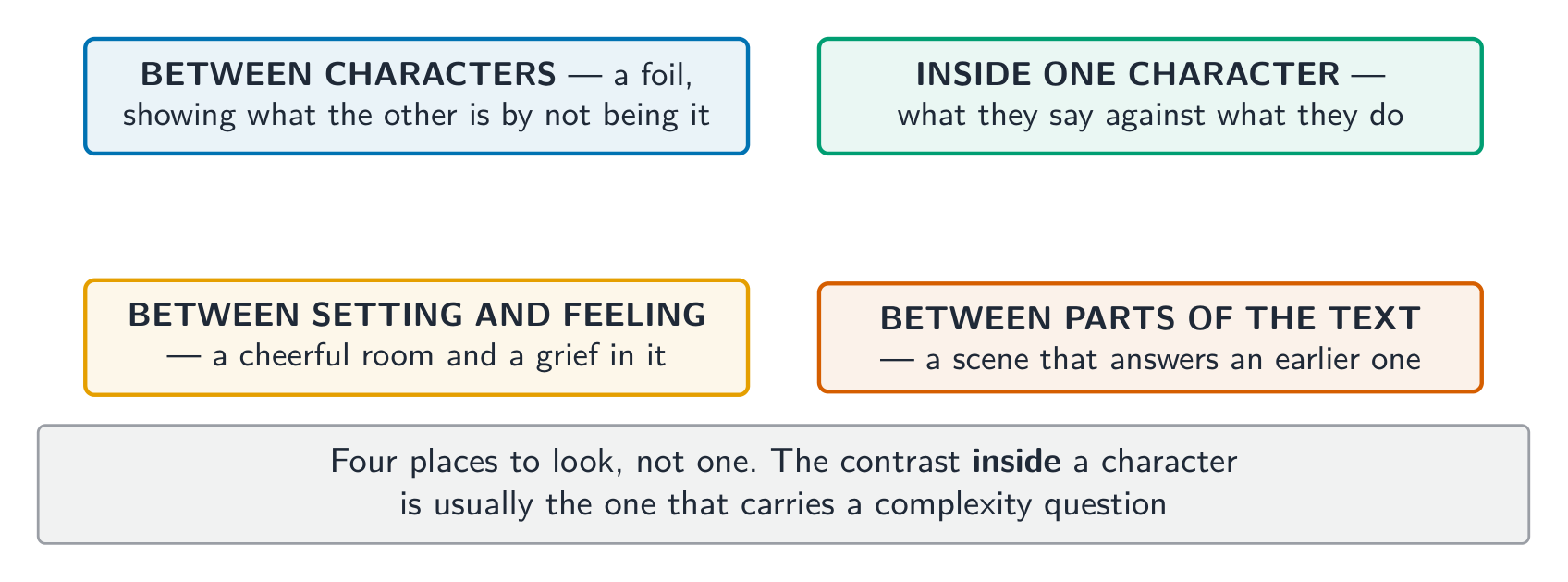
대조를 찾을 수 있는 네 가지 곳, 하나만으로는 부족합니다
Explore · ⁨탐색하기⁩

Find the contrast in four places, not one · ⁨하나가 아닌 네 곳에서 대비를 찾으십시오⁩

Students find the obvious pairing and stop — and the contrast inside a character usually carries the complexity question. · ⁨학생들은 obvious한 쌍을 찾아서 멈춥니다 — 그리고 등장인물 내부의 대비는 보통 복잡성 질문을 담고 있습니다.⁩

Vocabulary · ⁨어휘⁩ Train · ⁨연습하기⁩
English 한국어
Contrast/ˈkɒntræst/ 대비
2.4

The Function of Specific Words and Phrases · ⁨구체적인 단어와 구문의 기능⁩

Syllabus
English

Enduring Understanding (FIG-1): Comparisons, representations, and associations shift meaning from the literal to the figurative and invite readers to interpret a text.

Learning Objective 5.B: Explain the function of specific words and phrases in a text.

  • FIG-1.A An antecedent is a word, phrase, or clause that precedes its referent. Referents may include pronouns, nouns, phrases, or clauses.
  • FIG-1.B Referents are ambiguous if they can refer to more than one antecedent, which affects interpretation.
  • FIG-1.C Words or phrases may be repeated to emphasize ideas or associations.
  • FIG-1.D Alliteration is the repetition of the same letter sound at the beginning of adjacent or nearby words to emphasize those words and their associations or representations.
한국어

영구적 이해 (FIG-1): 비교, 표현, 그리고 연관성은 의미를 수학적·문어적 수준에서 비유적 수준으로 이동시켜 독자에게 텍스트를 해석하게 만듭니다.

학습 목표 5.B: 텍스트 내 특정 단어와 구문의 기능을 설명하십시오.

  • FIG-1.A 선행어(alternative)는 지시어(referring)보다 앞에 오는 단어, 구문 또는 절입니다. 지시어에는 대명사, 명사, 구문 또는 절이 포함될 수 있습니다.
  • FIG-1.B 지시어가 하나의 선행어보다 더 많은 선행어를 가리킬 수 있을 때 모호하며, 이는 해석에 영향을 미칩니다.
  • FIG-1.C 아이디어나 연관성을 강조하기 위해 단어나 구문을 반복할 수 있습니다.
  • FIG-1.D 모음법(alliteration)은 인접하거나 가까운 단어의 시작에 동일한 발음을 반복하여 해당 단어와它们的关联或表达을 강조하는 것입니다.

Source: College Board AP Course and Exam Description · ⁨출처: College Board AP Course and Exam Description⁩

English
  • An antecedent 先行词 is a word, phrase, or clause that precedes its referent.
  • Referents are ambiguous if they can refer to more than one antecedent, which affects interpretation 影响阐释.
  • Words or phrases may be repeated to emphasise ideas or associations.
  • Alliteration 头韵 is the repetition of the same initial sound in adjacent or nearby words, emphasising those words.

Ambiguous reference is worth special attention. In prose it is usually a fault; in poetry it is often a device, and a pronoun that could point two ways may be holding both meanings deliberately.

한국어
  • 선행어(antecedent) 先行词는 지시어(referent)보다先に 오는 단어, 구, 절입니다.
  • 지시어가 여러 선행어를 가리킬 수 있을 때 모호해지며, 이는 해석(interpretation) 影响阐释에 영향을 미칩니다.
  • 단어나 구문이 반복되어 아이디어나 연관성을 강조하기도 합니다.
  • 두음법(aliteration) 头韵은 인접하거나 가까운 단어에서 동일한 초기 음성을 반복하여 해당 단어를 강조하는 것입니다.

모호한 지시는特别注意-worthy합니다. 산문에서는 보통 결함이지만, 시에서는 종종 장치(device)이며, 두 방향으로 가리킬 수 있는 대명사는 고의적으로 두 의미를 모두 포함하고 있을 수 있습니다.

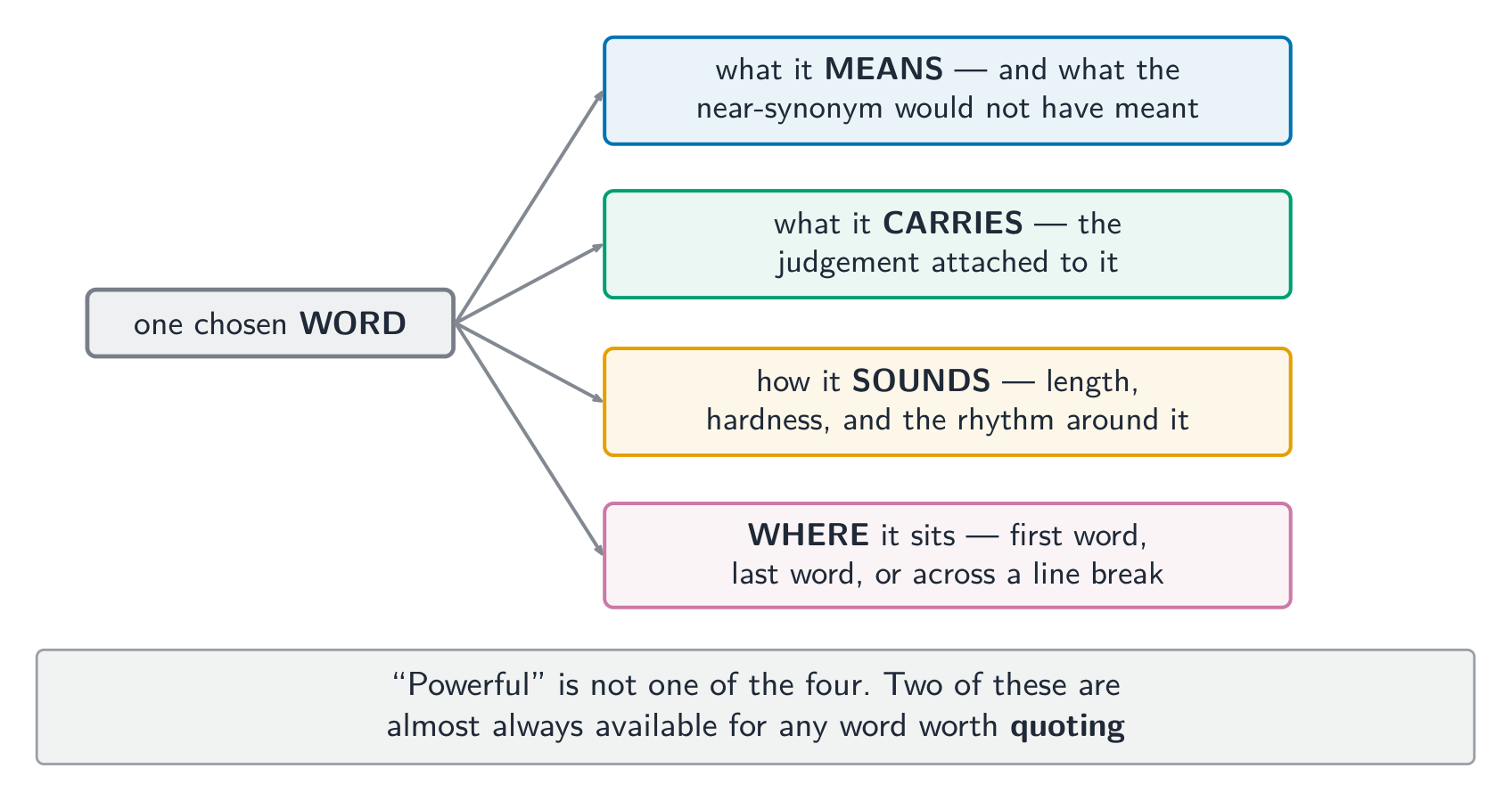
하나의 선택된 단어가 최대 네 가지 일을同时进行하고 있음을 설명하십시오 - '강력한(powerful)'은其中之一가 아닙니다
Vocabulary · ⁨어휘⁩ Train · ⁨연습하기⁩
English 한국어
antecedent/ˌæntɪˈsiːdənt/ 전위(antecedent)
affects interpretation/əˈfekts ɪnˌtɜːprɪˈteɪʃn/ 해석에 영향 미침
Alliteration/əˌlɪtəˈreɪʃn/ 두음법칙
2.5

The Function of a Simile · ⁨유비(simile)의 기능⁩

Syllabus
English

Enduring Understanding (FIG-1): Comparisons, representations, and associations shift meaning from the literal to the figurative and invite readers to interpret a text.

Learning Objective 6.A: Identify and explain the function of a simile.

  • FIG-1.E A simile uses the words “like” or “as” to liken two objects or concepts to each other.
  • FIG-1.F Similes liken two different things to transfer the traits or qualities of one to the other.
  • FIG-1.G In a simile, the thing being compared is the main subject; the thing to which it is being compared is the comparison subject.
한국어

영구적 이해 (FIG-1): 비교, 표현, 그리고 연관성은 의미를 수학적·문어적 수준에서 비유적 수준으로 이동시켜 독자에게 텍스트를 해석하게 만듭니다.

학습 목표 6.A: 비유의 기능을 식별하고 설명하십시오.

  • FIG-1.E 비유는 'like' 또는 'as'라는 단어를 사용하여 두 사물 또는 개념을 서로 유사하게 만듭니다.
  • FIG-1.F 비유는 두 가지 다른 것을 유사하게 만들어 하나의 특질이나 성질을 다른 것으로 이전시킵니다.
  • FIG-1.G 비유에서 비교 대상이 되는 것은 주요 주제이며, 그에 비교되는 것은 비교 주제입니다.

Source: College Board AP Course and Exam Description · ⁨출처: College Board AP Course and Exam Description⁩

English
  • A simile 明喻 uses "like" or "as" to liken two objects or concepts.
  • Similes liken two different things to transfer the traits or qualities of one to the other.
  • In a simile, the thing being compared is the main subject; the thing to which it is compared is the comparison subject.

Those two terms are the whole method. A scoring answer names the main subject, names the comparison subject, and then says which quality was transferred - because that quality is the claim the poem is making.

한국어
CED의 용어와 전달-direction이 단방향임을 설명하십시오
주요 대상(main subject)을 명시하고, 비교 대상(comparison subject)을 명시한 뒤, 어떤 품질이 이전되었는지를 말하십시오
  • 유비(simile) 明喻은 “like” 또는 “as” 를 사용하여 두 사물이나 개념을 비교합니다.
  • 유비는 서로 다른 두 것을 비교하여 하나의 속性或 qualities를 다른 쪽으로 transfer합니다.
  • 유비에서 비교 대상(main subject) 은 주요 대상이고, 비교 대상(comparison subject) 은 비교의 대상입니다.

그 두 용어는 전체 방법론입니다. 높은 점수 답안은 주요 대상을 명시하고, 비교 대상을 명시한 뒤, 어떤 품질이 transfer되었는지를 말합니다. 왜냐하면 그 품질이 시가 주장하는 content이기 때문입니다.

Vocabulary · ⁨어휘⁩ Train · ⁨연습하기⁩
English 한국어
simile/ˈsɪmɪlɪ/ 비유(Simile)
metaphor/ˈmetəfɔː/ 은유
2.6

The Function of a Metaphor · ⁨은유(metaphor)의 기능⁩

Syllabus
English

Enduring Understanding (FIG-1): Comparisons, representations, and associations shift meaning from the literal to the figurative and invite readers to interpret a text.

Learning Objective 6.B: Identify and explain the function of a metaphor.

  • FIG-1.H A metaphor implies similarities between two (usually unrelated) concepts or objects in order to reveal or emphasize one or more things about one of them, though the differences between the two may also be revealing.
  • FIG-1.I In a metaphor, as in a simile, the thing being compared is the main subject; the thing to which it is being compared is the comparison subject.
  • FIG-1.J Comparisons between objects or concepts draw on the experiences and associations readers already have with those objects and concepts.
  • FIG-1.K Interpretation of a metaphor may depend on the context of its use; that is, what is happening in a text may determine what is transferred in the comparison.
한국어

영구적 이해 (FIG-1): 비교, 표현, 그리고 연관성은 의미를 수학적·문어적 수준에서 비유적 수준으로 이동시켜 독자에게 텍스트를 해석하게 만듭니다.

학습 목표 6.B: 은유의 기능을 식별하고 설명하십시오.

  • FIG-1.H 은유는 일반적으로 무관한 두 개념이나 사물 사이의 유사성을 암시하여 그 중 하나에 대한 하나 이상의 사항을 드러내거나 강조하지만, 두 것 간의 차이도 유익하게 드러낼 수 있습니다.
  • FIG-1.I 은유에서도 비유와 마찬가지로 비교 대상이 되는 것은 주요 주제이며, 그에 비교되는 것은 비교 주제입니다.
  • FIG-1.J 사물 또는 개념 간의 비교는 독자들이 해당 사물과 개념에 대해 이미 가지고 있는 경험과 연관성을 활용합니다.
  • FIG-1.K 은유의 해석은 사용 맥락에 따라 달라질 수 있습니다. 즉, 텍스트에서发生了什么件事이 비교에서 어떤 것이 이전되는지를 결정할 수 있습니다.

Source: College Board AP Course and Exam Description · ⁨출처: College Board AP Course and Exam Description⁩

English
  • A metaphor 隐喻 implies similarities between two usually unrelated concepts to reveal or emphasise qualities of the main subject.
  • The same main-subject and comparison-subject structure applies.
  • Comparisons draw on the experiences and associations readers already have with the comparison subject - which is why a metaphor can fail with an audience that lacks those associations.
  • Interpretation of a metaphor may depend on the context of its use: what is happening in the text may determine which of the comparison subject's qualities is meant.

That last point protects you from the commonest error, which is importing every association a word has. If a poem calls grief a house, the relevant quality might be shelter, or confinement, or the fact that one must live inside it. The text decides which.

한국어
  • 은유(metaphor) 隐喻는 보통 무관한 두 개념 간의 유사성을 암시하여 주요 대상의 속성을 드러내거나 강조합니다.
  • 같은 주요 대상 및 비교 대상 구조가 적용됩니다.
  • 비교는 독사가 비교 대상에 대해 이미 가지고 있는 경험과 연상을 차용합니다. 따라서 이러한 연상이 없는 청중에게는 은유가 실패할 수 있습니다.
  • 은유의 해석은 사용 context에 의존할 수 있습니다: 텍스트에서发生了什么가 비교 대상의 어떤 속성이 의도된 것인지 결정할 수 있습니다.

마지막 점은 가장 흔한 오류, 즉 단어가 가지는 모든 연상 관계를 무조건적으로 가져오는 것을 방지합니다. 시가 슬픔을 한 집으로 표현한다면, 해당 속성은 안식처일 수도 있고 갇혀 있음일 수도 있으며, 그 안에 살아가야 한다는 사실일 수 있습니다. 텍스트가 어떤 것이 맞는지 결정합니다.

2.7

Developing a Paragraph with Claim and Evidence · ⁨주장과 증거를 포함한 단락 발전⁩

Syllabus
English

Enduring Understanding (LAN-1): Readers establish and communicate their interpretations of literature through arguments supported by textual evidence.

Learning Objective 7.A: Develop a paragraph that includes 1) a claim that requires defense with evidence from the text and 2) the evidence itself.

  • LAN-1.A In literary analysis, writers read a text closely to identify details that, in combination, enable them to make and defend a claim about an aspect of the text.
  • LAN-1.B A claim is a statement that requires defense with evidence from the text.
  • LAN-1.C In literary analysis, the initial components of a paragraph are the claim and textual evidence that defends the claim.
한국어

영구적 이해 (LAN-1): 독자들은 텍스트의 증거로 지지되는 논쟁을 통해 문학 작품을 해석하고 이를 전달합니다.

학습 목표 7.A: 1) 텍스트의 증거로 방어해야 하는 주장을 포함하고 2) 그 증거 자체를 포함하는 문단을 작성하십시오.

  • LAN-1.A 문학 분석에서 작가는 텍스트를 심독하여 디테일을 식별하는데, 이 디테일들이 결합되어 텍스트의 특정 부분에 대한 주장을 세우고 방어할 수 있게 합니다.
  • LAN-1.B 주장은 텍스트의 증거로 방어해야 하는 진술입니다.
  • LAN-1.C 문학 분석에서 문단의 초기 구성 요소는 주장과 그 주장을 방어하는 텍스트적 증거입니다.

Source: College Board AP Course and Exam Description · ⁨출처: College Board AP Course and Exam Description⁩

English

Same three components as Unit 1: a claim requiring textual defence, the textual evidence, and details identified in combination.

Worked example (a real AP exam task). A poetry-analysis prompt asks how the speaker's use of comparison conveys their attitude. A weak answer: "The poet uses a metaphor comparing memory to a house, which is effective." A scoring answer uses the CED's terms and the context rule: "The main subject is memory and the comparison subject a house, but the poem withholds warmth from the comparison: the house has 'rooms she no longer enters'. The quality transferred is therefore not shelter but confinement by a structure one built oneself - so the speaker's attitude to her own past is presented as inhabiting something she can neither leave nor fully occupy." Main subject, comparison subject, transferred quality, and the attitude it conveys.

한국어

유닛 1과 동일한 세 가지 구성 요소: 텍스트적 방어를 요구하는 주장, 텍스트적 증거, 그리고 결합하여 식별된 디테일입니다.

작은 예시 (실제 AP 시험 문제). 시 분석 프롬프트에서 화자가 비유를 사용하여 자신의 태도를 어떻게 전달하는지 묻습니다. 나쁜 답안: "시인은 기억을 한 집에 비유하는 은유를 사용했는데, 이는 효과적이다." 점수를 받은 답안은 CED의 용어와 맥락 규칙을 사용합니다: "주제사(메인 서브젝트)는 기억이고 비교 대상(컴퍼리슨 서브젝트)은 집이지만, 시는 이 비교에 따뜻함을 부여하지 않습니다: 집에는 '그녀가 더 이상 들어가지 않는 방'이 있습니다. 따라서 이전되는 속성은 안식처가 아니라 스스로 지은 구조물에 의해 갇혀 있다는 것입니다. - 즉, 화자의 자신에 대한 과거에 대한 태도는 그녀가 떠나거나 완전히 거주할 수 없는 무언가에 갇혀 있는 것으로 제시됩니다." 주제사, 비교 대상, 이전되는 속성, 그리고 그것이 전달하는 태도입니다.

2.7

Exam tips · ⁨시험 팁⁩

English
  • What a speaker omits is evidence. In a poem, everything present was chosen.
  • Find the shift first. A but, a stanza break, a change of tense - the poem divides there.
  • Line endings are the emphatic position. Say which words the poet put there.
  • An ambiguous referent in poetry is usually a device, not an error.
  • Always name main subject and comparison subject, then the quality transferred. That quality is the claim.
  • Context decides which quality a metaphor imports. Do not list every association the word has.
한국어
  • 화자가 생략한 것은 증거입니다. 시에서 존재하는 것은 모두 선택된 것입니다.
  • 먼저 전환점을 찾으십시오. but, 연의 변경, 시제의 변화 등 - 시는 거기에 두部分组成됩니다.
  • 행의 끝은 강조되는 위치입니다. 시인이 그곳에 배치한 단어를 말하십시오.
  • 시에서의 모호한 지칭对象은 보통 오류가 아닌 장치입니다.
  • 항상 주제사와 비교 대상을 명시한 후 이전되는 속성을 언급하십시오. 그 속성이 주장입니다.
  • 맥락이 은유가 가져오는 속성을 결정합니다. 단어가 가지는 모든 연상 목록을 나열하지 마십시오.

Interactive lessons on this topic · ⁨이 주제에 대한 인터랙티브 수업⁩

Work through it step by step, with instant-check exercises. · ⁨즉시 체크 기능 exercises를 통해 단계별로 진행하세요.⁩

Past Papers · ⁨과거 시험지⁩

More topics in AP English Literature and Composition · ⁨AP 영어 문학 및 작문⁩ · ⁨AP English Literature and Composition · ⁨AP 영어 문학 및 작문⁩ 내 추가 주제⁩

Log in or create account · ⁨로그인 또는 계정 만들기⁩

IGCSE, A-Level & AP