Skip to content · ⁨본문 바로가기⁩
Subjects · ⁨과목⁩

AP English Literature and Composition · ⁨AP 영어 문학 및 작문⁩

Tips · ⁨팁⁩

AP English Literature and Composition teaches close reading and literary argument across three text types, each visited three times: short fiction, poetry, and longer fiction or drama. The units spiral, so the same skills return at greater depth.

The course is organised by literary element: character, setting, structure, narration, figurative language, and literary argumentation. Each element has its own skills, and each asks the same underlying question - what does this choice *do* in the text?

"The function of" is the phrase to notice. The framework repeatedly asks for the function of a symbol, a contrast, a shift in narration. Identifying a device is the first step; explaining the work it performs is the answer.

Interpretation must be defensible, not merely personal. A reading earns credit when it is supported by details from the text and developed through reasoning, which is why literary argumentation runs alongside every element.

The notes below follow the nine units in the order the College Board sets them, so short fiction, poetry and longer works alternate exactly as the course does.

  • 1

    Short Fiction I · ⁨소설 I⁩

    Watch lesson · ⁨수업 보기⁩
    1.1

    What Textual Details Reveal About a Character

    Syllabus
    English

    Enduring Understanding (CHR-1): Characters in literature allow readers to study and explore a range of values, beliefs, assumptions, biases, and cultural norms represented by those characters.

    Learning Objective 1.A: Identify and describe what specific textual details reveal about a character, that character’s perspective, and that character’s motives.

    • CHR-1.A Description, dialogue, and behavior reveal characters to readers.
    • CHR-1.B Descriptions of characters may come from a speaker, narrator, other characters, or the characters themselves.
    • CHR-1.C Perspective is how narrators, characters, or speakers understand their circumstances, and is informed by background, personality traits, biases, and relationships.
    • CHR-1.D A character’s perspective is both shaped and revealed by relationships with other characters, the environment, the events of the plot, and the ideas expressed in the text.
    한국어

    영구적 이해 (CHR-1): 문학 작품 속 캐릭터들은 독자가 그 캐릭터들이 대표하는 다양한 가치관, 신념, 전제, 편견 및 문화적 규범을 연구하고 탐구할 수 있게 합니다.

    학습 목표 1.A: 특정 텍스트 디테일이 캐릭터, 해당 캐릭터의 시각, 그리고 해당 캐릭터의 동기에 대해 무엇을显露하는지 식별하고 묘사하십시오.

    • CHR-1.A 묘사, 대화, 그리고 행동은 캐릭터를 독자에게 드러냅니다.
    • CHR-1.B 캐릭터에 대한 묘사는 화자, 서술자, 다른 캐릭터, 혹은 캐릭터 자신으로부터 올 수 있습니다.
    • CHR-1.C 시각(perspective)은 서술자, 캐릭터, 또는 화자가 자신의 상황을 이해하는 방식이며, 배경, 성격 특징, 편견, 그리고 관계에 의해 형성됩니다.
    • CHR-1.D 캐릭터의 시각은 다른 캐릭터와의 관계, 환경, 플롯의 사건들, 그리고 텍스트에 표현된 아이디어들에 의해 형성되고 드러납니다.
    Source: College Board AP Course and Exam Description · ⁨출처: College Board AP Course and Exam Description⁩

    AP English Literature reads texts in three genres across nine units - short fiction, poetry, and longer fiction or drama, each visited three times at increasing difficulty. Unit 1 installs the tools for all of them.

    Character 人物 is revealed by three things, and the CED names them exactly:

    • Description, dialogue, and behaviour 描写、对话与行为 reveal characters to readers.
    • Descriptions may come from a speaker, narrator, other characters, or the characters themselves - so who is describing is part of the evidence.
    • Perspective 视角 is how narrators, characters, or speakers understand their circumstances, informed by background, experience, and values.
    • A character's perspective is both shaped and revealed by relationships with other characters, the environment, and events.

    That last point is the one that turns character notes into analysis. A character is not a list of adjectives; a character is a way of seeing, which becomes visible in what they notice, what they misread, and how they respond.

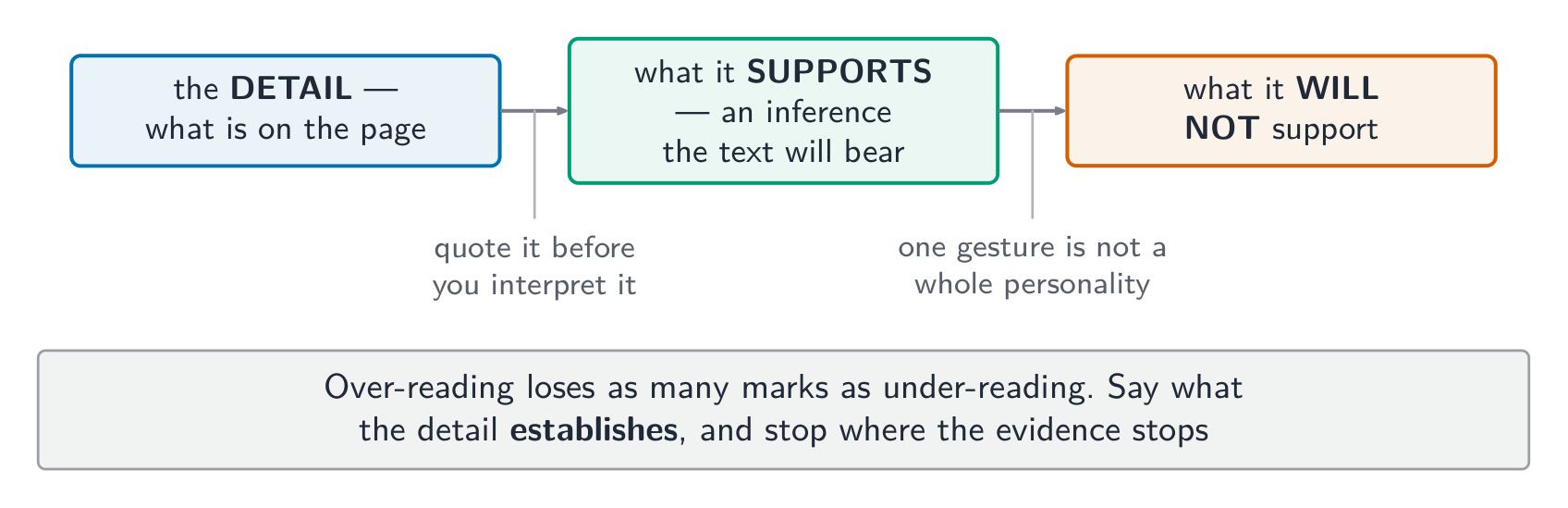
    Say what the detail establishes, and stop where the evidence stops
    Explore · ⁨탐색하기⁩

    Take a detail exactly as far as it goes · ⁨세부 사항을 그 한계까지 정확히 따르십시오⁩

    Over-reading loses as many marks as under-reading: say what the detail establishes, and stop where the evidence stops. · ⁨과잉 해석은 과소 해석만큼 점수를 잃게 합니다: 세부 사항이 입증하는 바를 말하고 증거가 끊기는 지점에서 멈추십시오.⁩

    Vocabulary · ⁨어휘⁩ Train · ⁨연습하기⁩
    English 한국어
    Character/ˈkærɪktə/ 인물
    Description, dialogue, and behaviour/dɪˈskrɪpʃn ˈdaɪəlɒɡ ænd bɪˈheɪvjə/ 설명, 대화와 행동
    Perspective/pəˈspektɪv/ 시점
    1.2

    Textual Details That Convey Setting

    Syllabus
    English

    Enduring Understanding (SET-1): Setting and the details associated with it not only depict a time and place, but also convey values associated with that setting.

    Learning Objective 2.A: Identify and describe specific textual details that convey or reveal a setting.

    • SET-1.A Setting includes the time and place during which the events of the text occur.
    한국어

    영구적 이해 (SET-1): 배경(setting)과 그에 관련된 디테일들은 단순히 시간과 장소를 묘사할 뿐만 아니라, 해당 배경과 연관된 가치관도 전달합니다.

    학습 목표 2.A: 배경을 전달하거나 드러내는 특정 텍스트 디테일을 식별하고 묘사하십시오.

    • SET-1.A 배경은 텍스트의 사건들이 일어나는 시간과 장소를 포함합니다.

    Source: College Board AP Course and Exam Description · ⁨출처: College Board AP Course and Exam Description⁩

    Setting 背景 includes the time and place during which the events of the text occur.

    The CED's definition is deliberately minimal, and that is the trap. Setting earns marks not when it is described but when it is shown doing something - constraining a character, explaining a value, or contrasting with an interior state. A paragraph that establishes where a story happens has not yet made a claim.

    Vocabulary · ⁨어휘⁩ Train · ⁨연습하기⁩
    English 한국어
    Setting/ˈsetɪŋ/ 배경(Setting)
    1.3

    How Plot Orders Events

    Syllabus
    English

    Enduring Understanding (STR-1): The arrangement of the parts and sections of a text, the relationship of the parts to each other, and the sequence in which the text reveals information are all structural choices made by a writer that contribute to the reader’s interpretation of a text.

    Learning Objective 3.A: Identify and describe how plot orders events in a narrative.

    • STR-1.A Plot is the sequence of events in a narrative; events throughout a narrative are connected, with each event building on the others, often with a cause-and-effect relationship.
    • STR-1.B The dramatic situation of a narrative includes the setting and action of the plot and how that narrative develops to place characters in conflict(s), and often involves the rising or falling fortunes of a main character or set of characters.
    한국어

    영구적 이해 (STR-1): 텍스트의 부분과 섹션의 배열, 부분들 간의 관계, 그리고 텍스트가 정보를 공개하는 순서는 모두 작가가 내린 구조적 선택이며, 이는 독자의 텍스트 해석에 기여합니다.

    학습 목표 3.A: 플롯이 서사(narrative)에서 사건들을 어떻게 배열하는지 식별하고 묘사하십시오.

    • STR-1.A 플롯은 서사에서 일어나는 사건의 순서입니다; 서사 전반에 걸친 사건들은 서로 연결되어 있으며, 각 사건은 다른 사건들을 기반으로 구축되며, 종종 인과관계(cause-and-effect relationship)를 가집니다.
    • STR-1.B 서사의 드라마틱한 상황(dramatic situation)에는 플롯의 배경과 행동이 포함되어 있으며, 이 서사가 어떻게 발전하여 캐릭터들을 갈등(conflict)에 놓이는지를 보여줍니다. 또한 주로 주인공 또는 일련의 캐릭터들의 번영이나 몰락(rising or falling fortunes)을 포함합니다.

    Source: College Board AP Course and Exam Description · ⁨출처: College Board AP Course and Exam Description⁩

    • Plot 情节 is the sequence of events in a narrative; events are connected, each building on those before it.
    • The dramatic situation 戏剧情境 includes the setting and action of the plot and how the narrative develops to place characters in conflict.

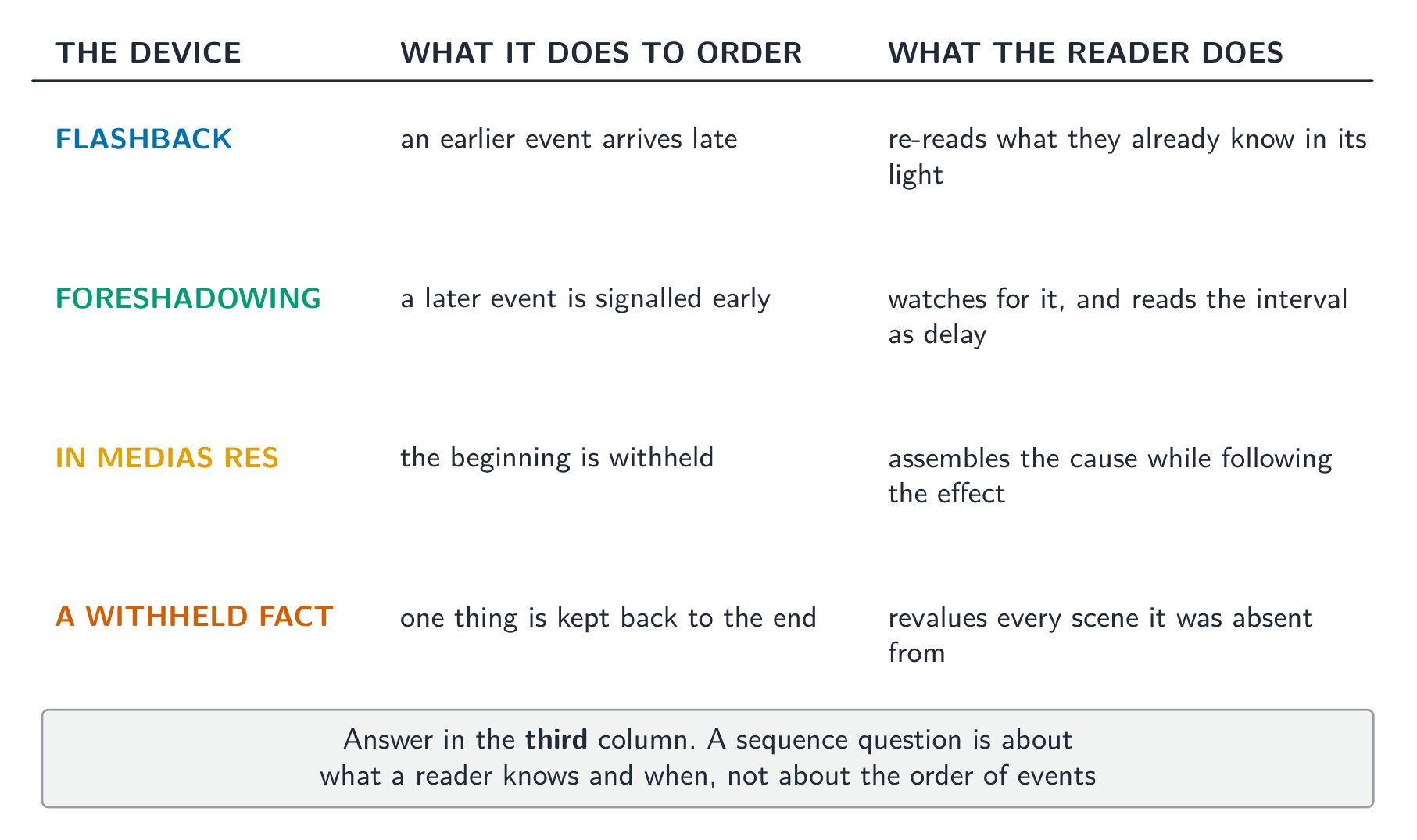
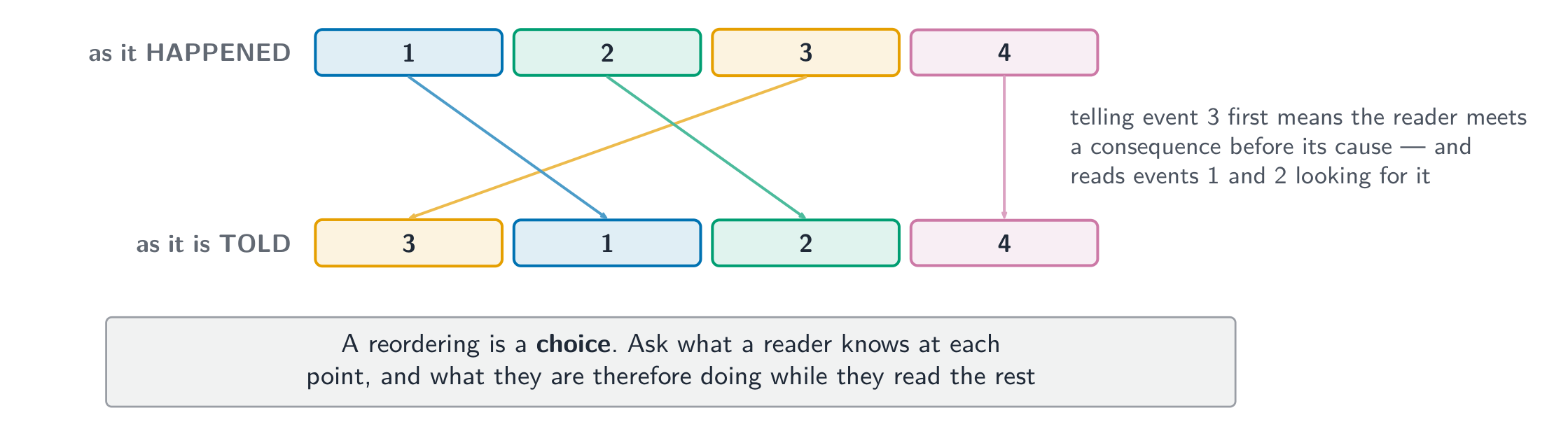
    The word sequence is doing work. Plot is not the events but their order - and an author who reveals something late that happened early has made a choice you can analyse.

    The order events happened against the order you were told them - the difference is a choice
    Vocabulary · ⁨어휘⁩ Train · ⁨연습하기⁩
    English 한국어
    Plot/plɒt/ 플롯 / 줄거리
    dramatic situation/drəˈmætɪk ˌsɪtʃuːˈeɪʃn/ 극적 상황
    1.4

    The Function of a Sequence of Events

    Syllabus
    English

    Enduring Understanding (STR-1): The arrangement of the parts and sections of a text, the relationship of the parts to each other, and the sequence in which the text reveals information are all structural choices made by a writer that contribute to the reader’s interpretation of a text.

    Learning Objective 3.B: Explain the function of a particular sequence of events in a plot.

    • STR-1.C Plot and the exposition that accompanies it focus readers’ attention on the parts of the narrative that matter most to its development, including characters, their relationships, and their roles in the narrative, as well as setting and the relationship between characters and setting.
    한국어

    영구적 이해 (STR-1): 텍스트의 부분과 섹션의 배열, 부분들 간의 관계, 그리고 텍스트가 정보를 공개하는 순서는 모두 작가가 내린 구조적 선택이며, 이는 독자의 텍스트 해석에 기여합니다.

    학습 목표 3.B: 플롯에서의 특정 사건의 순서가 가진 기능을 설명하십시오.

    • STR-1.C 플롯과 이에 수반되는 설전(exposition)은 독자의 주의를 서사 발전에 가장 중요한 부분에 집중시킵니다. 여기에는 캐릭터, 그들의 관계, 서사 내에서의 역할, 그리고 배경과 캐릭터 및 배경 간의 관계가 포함됩니다.

    Source: College Board AP Course and Exam Description · ⁨출처: College Board AP Course and Exam Description⁩

    Plot and the exposition that accompanies it focus readers' attention on the parts of the narrative that matter most to the text's meaning.

    That sentence is the whole method for prose analysis: proportion is evidence. What the text lingers over, and what it passes in a clause, is the author telling you where to look.

    1.5

    Identifying the Narrator or Speaker

    Syllabus
    English

    Enduring Understanding (NAR-1): A narrator’s or speaker’s perspective controls the details and emphases that affect how readers experience and interpret a text.

    Learning Objective 4.A: Identify and describe the narrator or speaker of a text.

    • NAR-1.A Narrators or speakers relate accounts to readers and establish a relationship between the text and the reader.
    • NAR-1.B Perspective refers to how narrators, characters, or speakers see their circumstances, while point of view refers to the position from which a narrator or speaker relates the events of a narrative.
    • NAR-1.C A speaker or narrator is not necessarily the author.
    한국어

    영구적 이해 (NAR-1): 서술자 또는 화자의 시각은 독자가 텍스트를 경험하고 해석하는 방식에 영향을 미치는 디테일과 강조점来控制합니다.

    학습 목표 4.A: 텍스트의 서술자 또는 화자를 식별하고 묘사하십시오.

    • NAR-1.A 서술자 또는 화자는 독자에게 서사를 전달하고 텍스트와 독자 간의 관계를 설정합니다.
    • NAR-1.B 'Perspective'는 서사자, 등장인물 또는 화자가 자신의 상황을 어떻게 바라보는지를 의미하며, 'point of view(시점)'는 서사자나 화자가 서사의 사건을 전달하는 관점의 위치를 의미합니다.
    • NAR-1.C 화자나 서사가 반드시 작품의 작가가 될 필요는 없습니다.

    Source: College Board AP Course and Exam Description · ⁨출처: College Board AP Course and Exam Description⁩

    What each point of view can and cannot give you - and that limit is the analysis
    Perspective is how they see; point of view is where they stand. The CED separates them, and so should you
    • Narrators or speakers relate accounts and establish a relationship between the text and the reader.
    • Perspective refers to how narrators, characters, or speakers see their circumstances; point of view 叙述视点 refers to the position from which they relate the account.
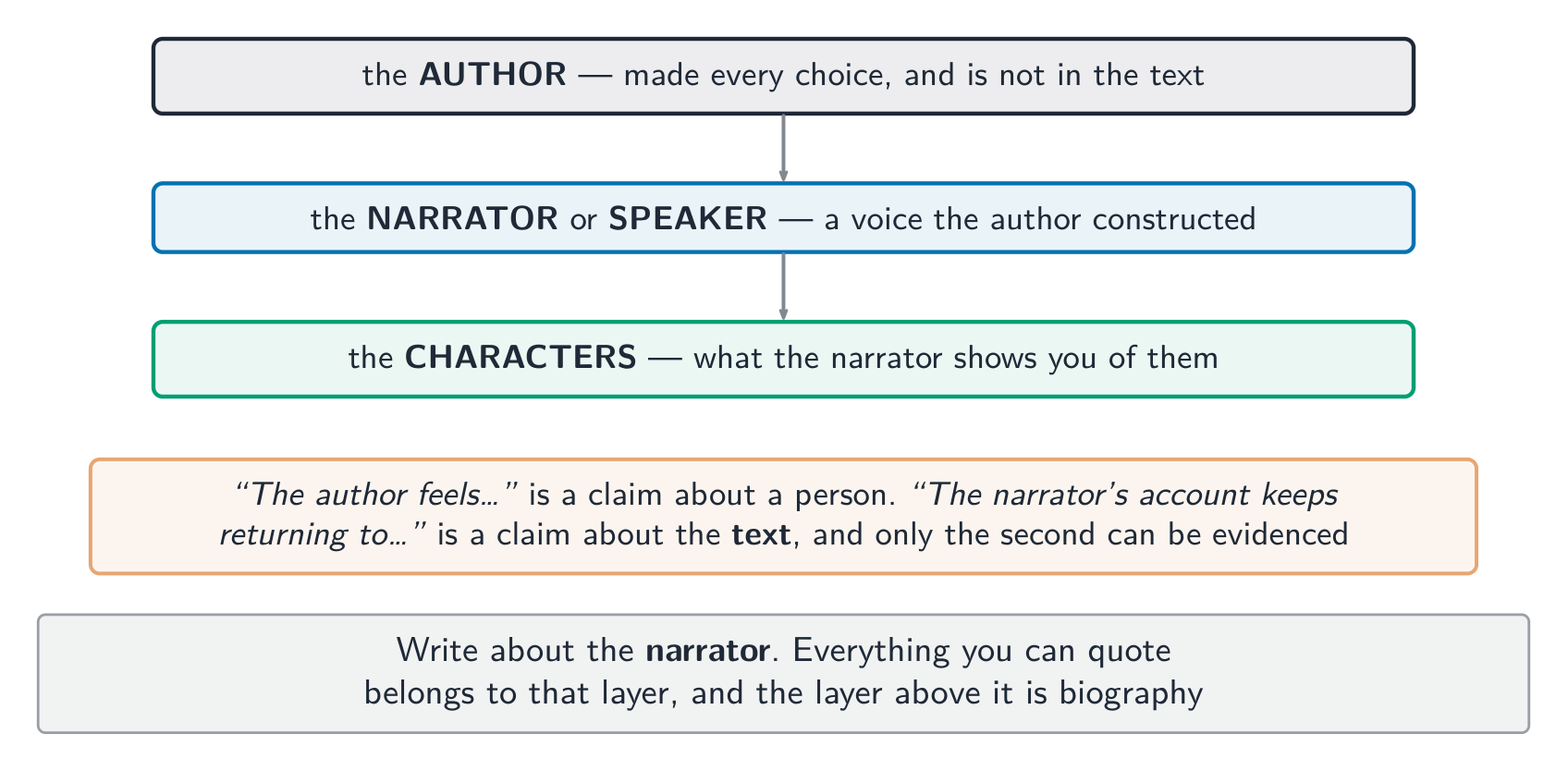
    • A speaker or narrator is not necessarily the author. Never write "the author feels" about a first-person narrator.
    Write about the narrator: everything you can quote belongs to that layer
    Explore · ⁨탐색하기⁩

    Sort each statement by the layer it belongs to · ⁨각 문장을它所属于的层级进行分类⁩

    Everything you can quote belongs to the narrator's layer. The layer above it is biography. · ⁨인용 가능한 모든 것은 서사자의 층위에 속합니다. 그 위층은 전술서입니다.⁩

    Vocabulary · ⁨어휘⁩ Train · ⁨연습하기⁩
    English 한국어
    point of view/pɔɪnt ɒv vjuː/ 시점
    1.6

    The Function of Point of View

    Syllabus
    Enduring UnderstandingLearning ObjectiveEssential Knowledge

    NAR-1
    A narrator’s or speaker’s perspective controls the details and emphases that affect how readers experience and interpret a text.

    4.B
    Identify and explain the function of point of view in a narrative.

    • NAR-1.D The point of view contributes to what narrators, characters, or speakers can and cannot provide in a text based on their level of involvement and intimacy with the details, events, or characters.
    • NAR-1.E Narrators may also be characters, and their role as characters may influence their perspective.
    • NAR-1.F First-person narrators are involved in the narrative; their relationship to the events of the plot and the other characters shapes their perspective.
    • NAR-1.G Third-person narrators are outside observers.
    • NAR-1.H Third-person narrators’ knowledge about events and characters may range from observational to all-knowing, which shapes their perspective.
    • NAR-1.I The outside perspective of third-person narrators may not be affected by the events of the narrative.

    Source: College Board AP Course and Exam Description · ⁨출처: College Board AP Course and Exam Description⁩

    • Point of view contributes to what narrators can and cannot provide in a text, based on their position.
    • Narrators may also be characters, and that role may influence their perspective.
    • First-person narrators are involved in the narrative; their relationship to events and to other characters shapes what they can tell you.
    • Third-person narrators are outside observers, and their knowledge may range from observational to all-knowing 全知.
    • The outside perspective of a third-person narrator may not be affected by the events of the narrative.

    The analytical payoff is the cannot. A first-person narrator cannot report what they did not witness or will not admit, and every gap is meaningful. A limited third-person narrator confines you to one consciousness, which is a choice about whose experience counts.

    Vocabulary · ⁨어휘⁩ Train · ⁨연습하기⁩
    English 한국어
    observational to all-knowing/ɒbzəˈveɪʃənl tʊ ɔːl ˈnəʊɪŋ/ 관찰에서 전지적
    1.7

    Developing a Paragraph with Claim and Evidence

    Syllabus
    English

    Enduring Understanding (LAN-1): Readers establish and communicate their interpretations of literature through arguments supported by textual evidence.

    Learning Objective 7.A: Develop a paragraph that includes 1) a claim that requires defense with evidence from the text and 2) the evidence itself.

    • LAN-1.A In literary analysis, writers read a text closely to identify details that, in combination, enable them to make and defend a claim about an aspect of the text.
    • LAN-1.B A claim is a statement that requires defense with evidence from the text.
    • LAN-1.C In literary analysis, the initial components of a paragraph are the claim and textual evidence that defends the claim.
    한국어

    영구적 이해 (LAN-1): 독자들은 텍스트의 증거로 지지되는 논쟁을 통해 문학 작품을 해석하고 이를 전달합니다.

    학습 목표 7.A: 1) 텍스트의 증거로 방어해야 하는 주장을 포함하고 2) 그 증거 자체를 포함하는 문단을 작성하십시오.

    • LAN-1.A 문학 분석에서 작가는 텍스트를 심독하여 디테일을 식별하는데, 이 디테일들이 결합되어 텍스트의 특정 부분에 대한 주장을 세우고 방어할 수 있게 합니다.
    • LAN-1.B 주장은 텍스트의 증거로 방어해야 하는 진술입니다.
    • LAN-1.C 문학 분석에서 문단의 초기 구성 요소는 주장과 그 주장을 방어하는 텍스트적 증거입니다.

    Source: College Board AP Course and Exam Description · ⁨출처: College Board AP Course and Exam Description⁩

    • In literary analysis, writers read a text closely to identify details that, in combination, enable them to make and defend a claim.
    • A claim is a statement that requires defence with evidence from the text.
    • The initial components of a paragraph are the claim and the textual evidence that defends it.

    Note in combination. A single detail rarely supports an interpretive claim; two or three details that point the same way do.

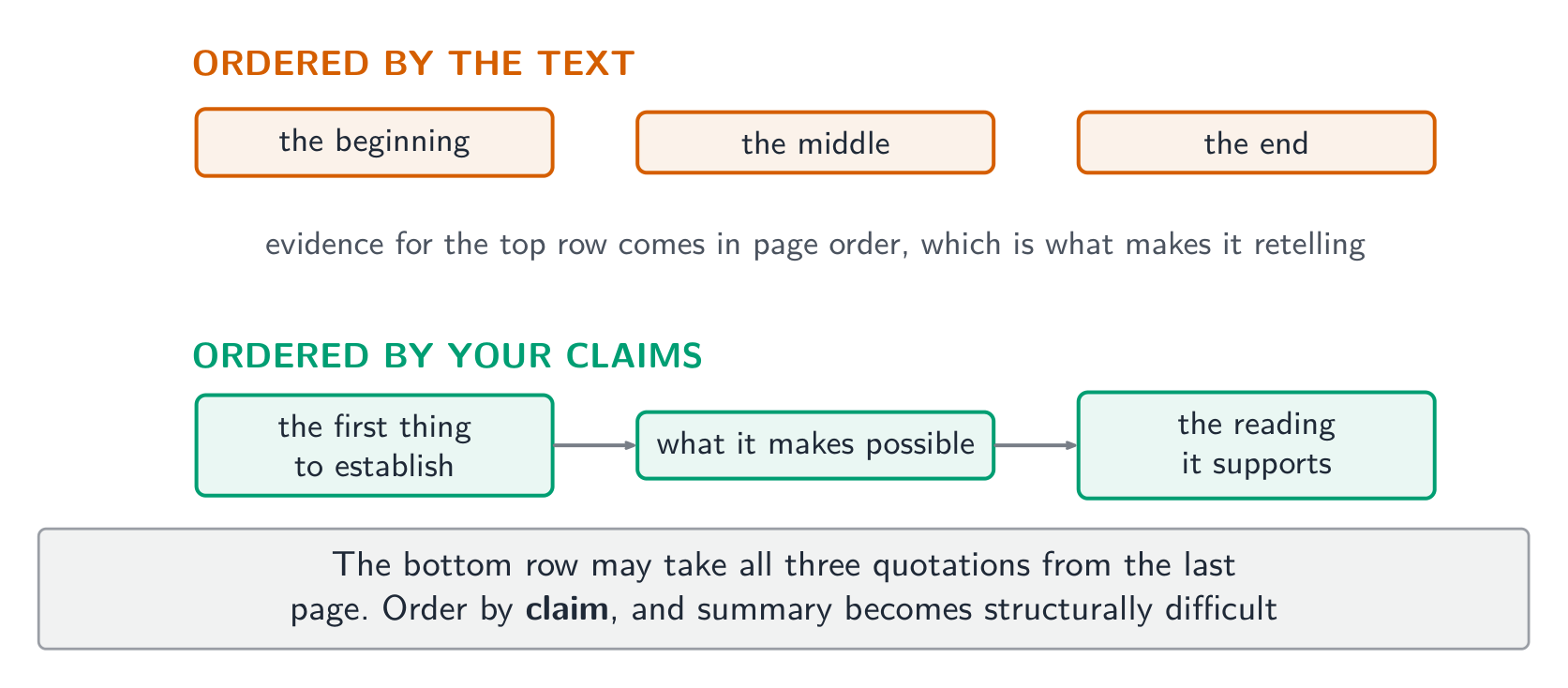
    Worked example (a real AP exam task). The AP Literature free-response section has three questions - poetry analysis, prose fiction analysis, and a literary argument on a work you choose - all marked on a six-point rubric: thesis 1, evidence and commentary 4, sophistication 1. For a prose fiction prompt asking how the author uses narrative techniques to reveal a character's attitude, a weak answer writes "the narrator is first-person, which makes it personal." A scoring answer uses the cannot: "Because the narrator is a participant recounting events years later, the account gives us his present judgement of his younger self and withholds what the other characters thought - so the reader receives his self-criticism as the only available evidence, and must decide whether the harshness of it is accuracy or performance." Point of view, its limit, and the effect on the reader.

    1.7

    Exam tips

    • Character is a way of seeing, not a list of adjectives. Analyse what they notice and misread.
    • Setting must do something. Describing where a story happens is not yet a claim.
    • Plot is the order of events. A late revelation of an early event is an authorial choice worth analysing.
    • Proportion is evidence. What the text lingers over is where the meaning is.
    • The narrator is not the author. Never write "the author feels" about a first-person narrator.
    • The analytical gold in point of view is what the narrator cannot provide.
  • 2

    Poetry I · ⁨시 I⁩

    Watch lesson · ⁨수업 보기⁩
    2.1

    What Textual Details Reveal About a Character · ⁨텍스트 디테일이 캐릭터에 대해 드러내는 것⁩

    Syllabus
    English

    Enduring Understanding (CHR-1): Characters in literature allow readers to study and explore a range of values, beliefs, assumptions, biases, and cultural norms represented by those characters.

    Learning Objective 1.A: Identify and describe what specific textual details reveal about a character, that character’s perspective, and that character’s motives.

    • CHR-1.E Characters reveal their perspectives and biases through the words they use, the details they provide in the text, the organization of their thinking, the decisions they make, and the actions they take.
    한국어

    영구적 이해 (CHR-1): 문학 작품 속 캐릭터들은 독자가 그 캐릭터들이 대표하는 다양한 가치관, 신념, 전제, 편견 및 문화적 규범을 연구하고 탐구할 수 있게 합니다.

    학습 목표 1.A: 특정 텍스트 디테일이 캐릭터, 해당 캐릭터의 시각, 그리고 해당 캐릭터의 동기에 대해 무엇을显露하는지 식별하고 묘사하십시오.

    • CHR-1.E 등장인물은 그들이 사용하는 단어, 텍스트에 제공하는 디테일, 사고의 조직화, 내리는 결정, 그리고 취한 행동을 통해 자신의 관점과 편견을 드러냅니다.

    Source: College Board AP Course and Exam Description · ⁨출처: College Board AP Course and Exam Description⁩

    English

    Unit 2 is the course's first poetry unit, and it adds two things to Unit 1's toolkit: structure as an object of analysis, and figurative language 比喻性语言 handled precisely rather than by name-dropping.

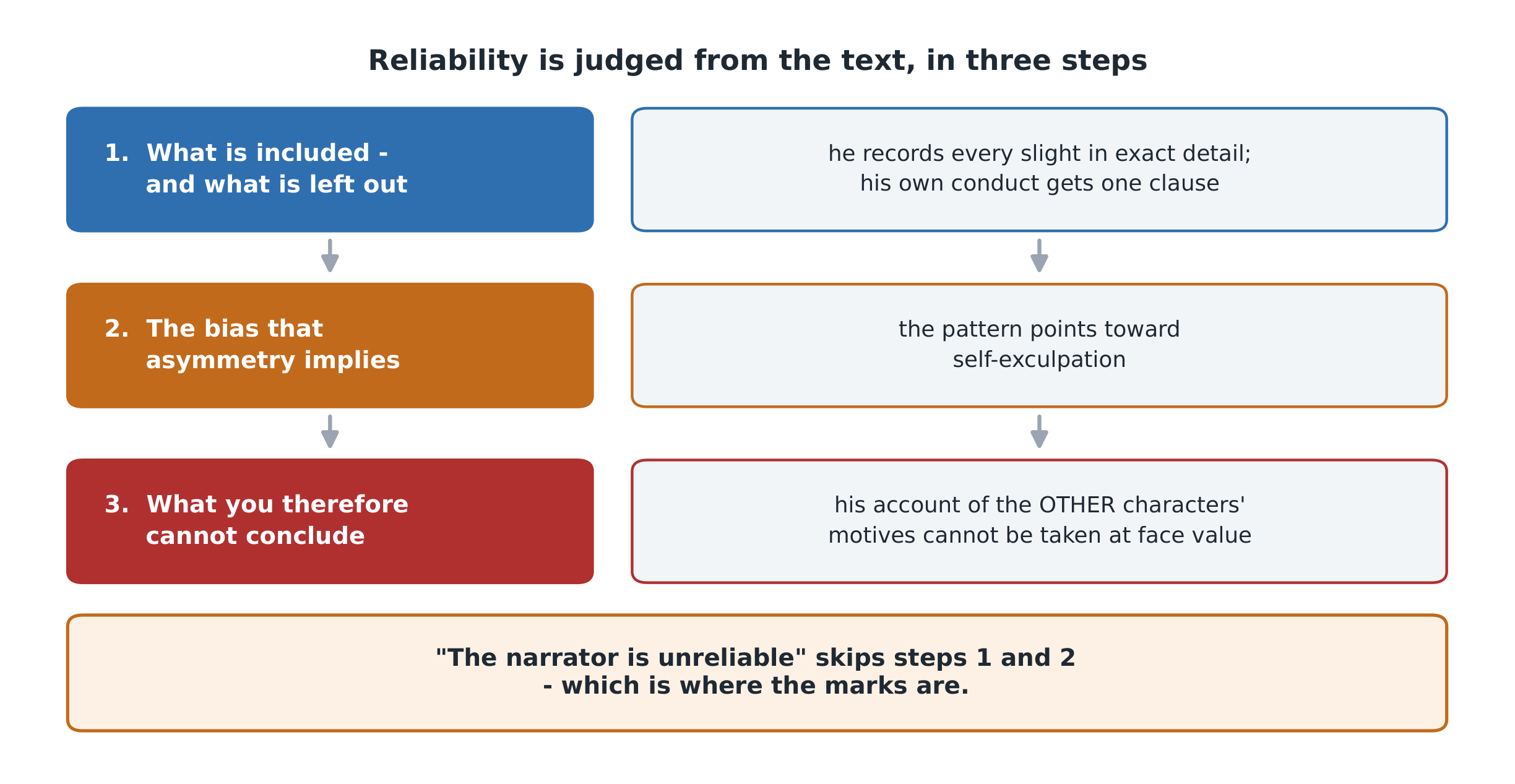
    One addition on character first: characters reveal their perspectives and biases through the words they use, the details they provide, and the details they omit.

    That last item is the analytical opening. What a speaker does not mention, in a poem where everything is chosen, is evidence.

    한국어

    : Unit 2는 과정의 첫 시 단원이며, Unit 1의 도구함에 두 가지를 추가합니다: 분석의 대상으로서의 구조(structure), 그리고 이름만 나열하지 않고 정밀하게 다뤄지는 비유적 언어(figurative language).比喻性语言

    인물 분석의 첫 번째 추가 요소: 인물은 그들이 사용하는 단어, 제공하는 디테일, 그리고 생략하는 디테일을 통해 자신의 관점과 편견을 드러냅니다.

    마지막 항목이 바로 분석적 시작점입니다. 모든 것이 엄선된 시에서 화자가 언급하지 않는 것은 곧 증거입니다.

    Vocabulary · ⁨어휘⁩ Train · ⁨연습하기⁩
    English 한국어
    figurative language/ˈfɪɡjərətɪv ˈlæŋɡwɪdʒ/ 은유적 언어
    2.2

    The Function of Structure in a Text · ⁨텍스트 내 구조의 기능⁩

    Syllabus
    English

    Enduring Understanding (STR-1): The arrangement of the parts and sections of a text, the relationship of the parts to each other, and the sequence in which the text reveals information are all structural choices made by a writer that contribute to the reader’s interpretation of a text.

    Learning Objective 3.C: Explain the function of structure in a text.

    • STR-1.D Line and stanza breaks contribute to the development and relationship of ideas in a poem.
    • STR-1.E The arrangement of lines and stanzas contributes to the development and relationship of ideas in a poem.
    • STR-1.F A text’s structure affects readers’ reactions and expectations by presenting the relationships among the ideas of the text via their relative positions and their placement within the text as a whole.
    한국어

    영구적 이해 (STR-1): 텍스트의 부분과 섹션의 배열, 부분들 간의 관계, 그리고 텍스트가 정보를 공개하는 순서는 모두 작가가 내린 구조적 선택이며, 이는 독자의 텍스트 해석에 기여합니다.

    학습 목표 3.C: 텍스트 내 구조의 기능을 설명하십시오.

    • STR-1.D 줄바꿈과 연의 끝은 시에서의 아이디어의 발전 및 상호 관계에 기여합니다.
    • STR-1.E 줄과 연의 배열은 시에서의 아이디어의 발전 및 상호 관계에 기여합니다.
    • STR-1.F 텍스트의 구조는 아이디어 간의 상대적 위치와 전체 텍스트 내 배치方式来 Idea 간의 관계를 제시함으로써 독자의 반응과 기대에 영향을 미칩니다.

    Source: College Board AP Course and Exam Description · ⁨출처: College Board AP Course and Exam Description⁩

    English
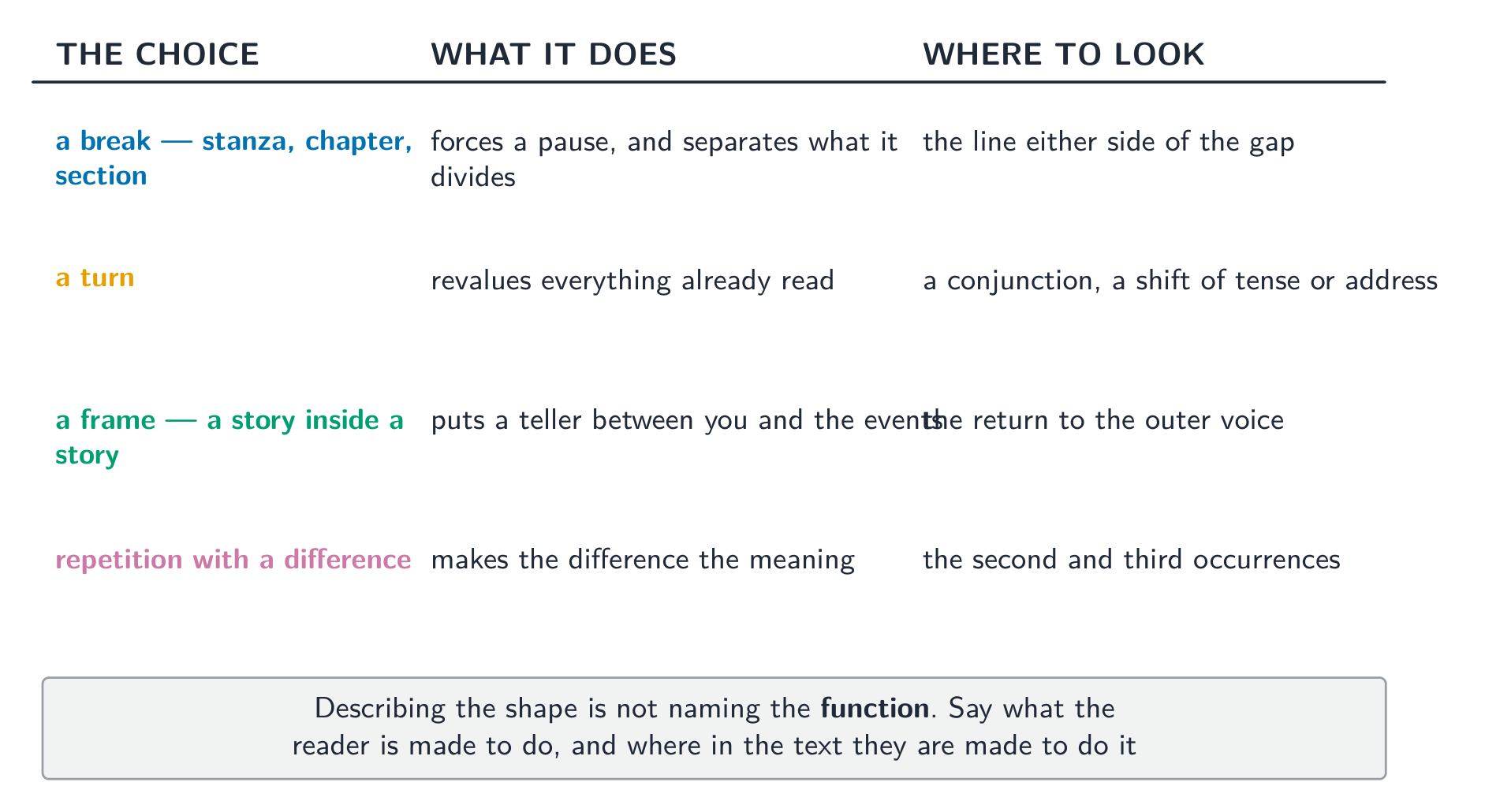
    • Line and stanza breaks 行与诗节的断开 contribute to the development and relationship of ideas in a poem.
    • The arrangement of lines and stanzas contributes to that development.
    • A text's structure affects readers' reactions and expectations by presenting the relationships among ideas.

    Structure in poetry is not decoration; it is punctuation for thought. Where a line breaks decides which words sit at the ends of lines, and the end of a line is the most emphatic position available. A sentence that runs past a line break asks the reader to hold something unresolved; one that stops at the break closes it.

    한국어
    • 행과 시절의 끊김(line and stanza breaks) 은 시의 아이디어 전개와 상호 관계에 기여합니다.行与诗节的断开
    • 행과 시절의 배치(arrangement) 는 그러한 전개를 돕습니다.
    • 텍스트의 구조는 아이디어 간의 관계를 제시함으로써 독자의 반응과 기대에 영향을 미칩니다.

    시에서의 구조는 장식이 아니라 사상의 마크(punctuation)입니다. 행이 끊어지는 지점이 어떤 단어가 줄 끝에 올지 결정하며, 줄 끝은 가장 강조되는 위치입니다. 행 끊김을 넘어 이어지는 문장은 독자에게 해결되지 않은 것을 유지하게 하고, 끊김에서 멈추는 문장은 그것을 마무리합니다.

    모양을 묘사하는 것이 기능을 이름 짓는 것이 아닙니다 - 독자가做什么来说明하십시오
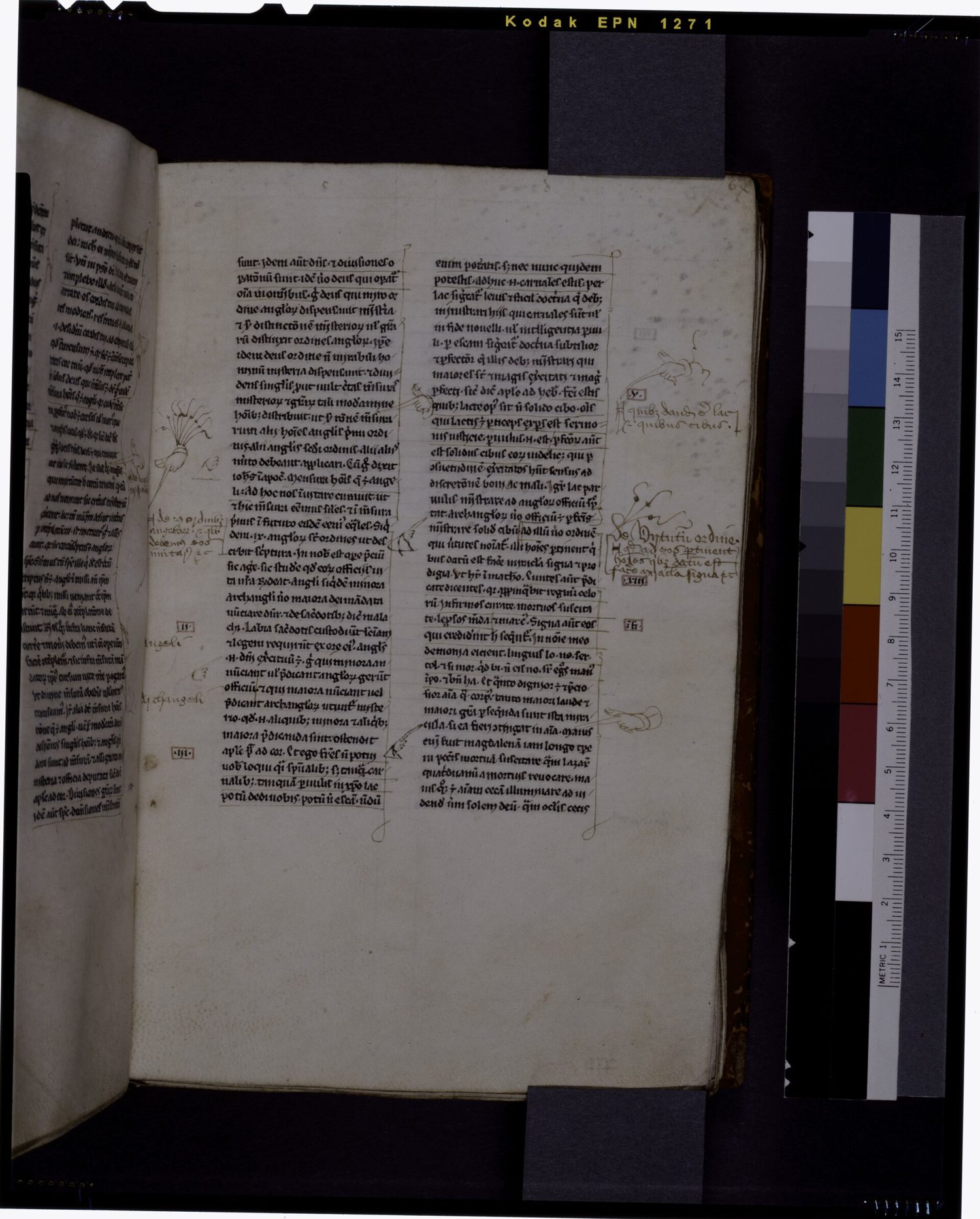
    여백에 자체 주석을 담고 있는 페이지 - 수세기 앞선 근접 독본
    Explore · ⁨탐색하기⁩

    Match each structural choice to its function · ⁨각 구조적 선택을 그에 맞는 기능과 짝지우십시오⁩

    Describing the shape is not naming the function. Say what the reader is made to do, and where. · ⁨모양을 설명하는 것은 기능을 명명하는 것이 아닙니다. 독자가 무엇을 하도록 유도받고 어디에서 하는지를 말하십시오.⁩

    Vocabulary · ⁨어휘⁩ Train · ⁨연습하기⁩
    English 한국어
    Line and stanza breaks/laɪn ænd ˈstænzə breɪks/ 행과 구 절단
    2.3

    The Function of Contrasts Within a Text · ⁨텍스트 내 대조의 기능⁩

    Syllabus
    English

    Enduring Understanding (STR-1): The arrangement of the parts and sections of a text, the relationship of the parts to each other, and the sequence in which the text reveals information are all structural choices made by a writer that contribute to the reader’s interpretation of a text.

    Learning Objective 3.D: Explain the function of contrasts within a text.

    • STR-1.G Contrast can be introduced through focus; tone; point of view; character, narrator, or speaker perspective; dramatic situation or moment; settings or time; or imagery.
    • STR-1.H Contrasts are the result of shifts or juxtapositions or both.
    • STR-1.I Shifts may be signaled by a word, a structural convention, or punctuation.
    • STR-1.J Shifts may emphasize contrasts between particular segments of a text.
    한국어

    영구적 이해 (STR-1): 텍스트의 부분과 섹션의 배열, 부분들 간의 관계, 그리고 텍스트가 정보를 공개하는 순서는 모두 작가가 내린 구조적 선택이며, 이는 독자의 텍스트 해석에 기여합니다.

    학습 목표 3.D: 텍스트 내 대비의 기능을 설명하십시오.

    • STR-1.G 대비는 초점; 톤; 시점; 등장인물, 서사자 또는 화자의 관점; 극적 상황이나 순간; 배경 또는 시간; 또는 이미지에 의해 도입될 수 있습니다.
    • STR-1.H 대비는 변화 또는 나란히 배치되거나 둘 다의 결과입니다.
    • STR-1.I 변화는 단어나 구조적 관습, 또는 부호에 의해 신호로 나타날 수 있습니다.
    • STR-1.J 변화는 텍스트의 특정 부분 간의 대비를 강조할 수 있습니다.

    Source: College Board AP Course and Exam Description · ⁨출처: College Board AP Course and Exam Description⁩

    English
    • Contrast 对照 can be introduced through focus, tone, point of view, character or speaker perspective, and dramatic situation.
    • Contrasts are the result of shifts or juxtapositions or both.
    • Shifts may be signalled by a word, a structural convention, or punctuation.
    • Shifts may emphasise contrasts between particular segments of a text.

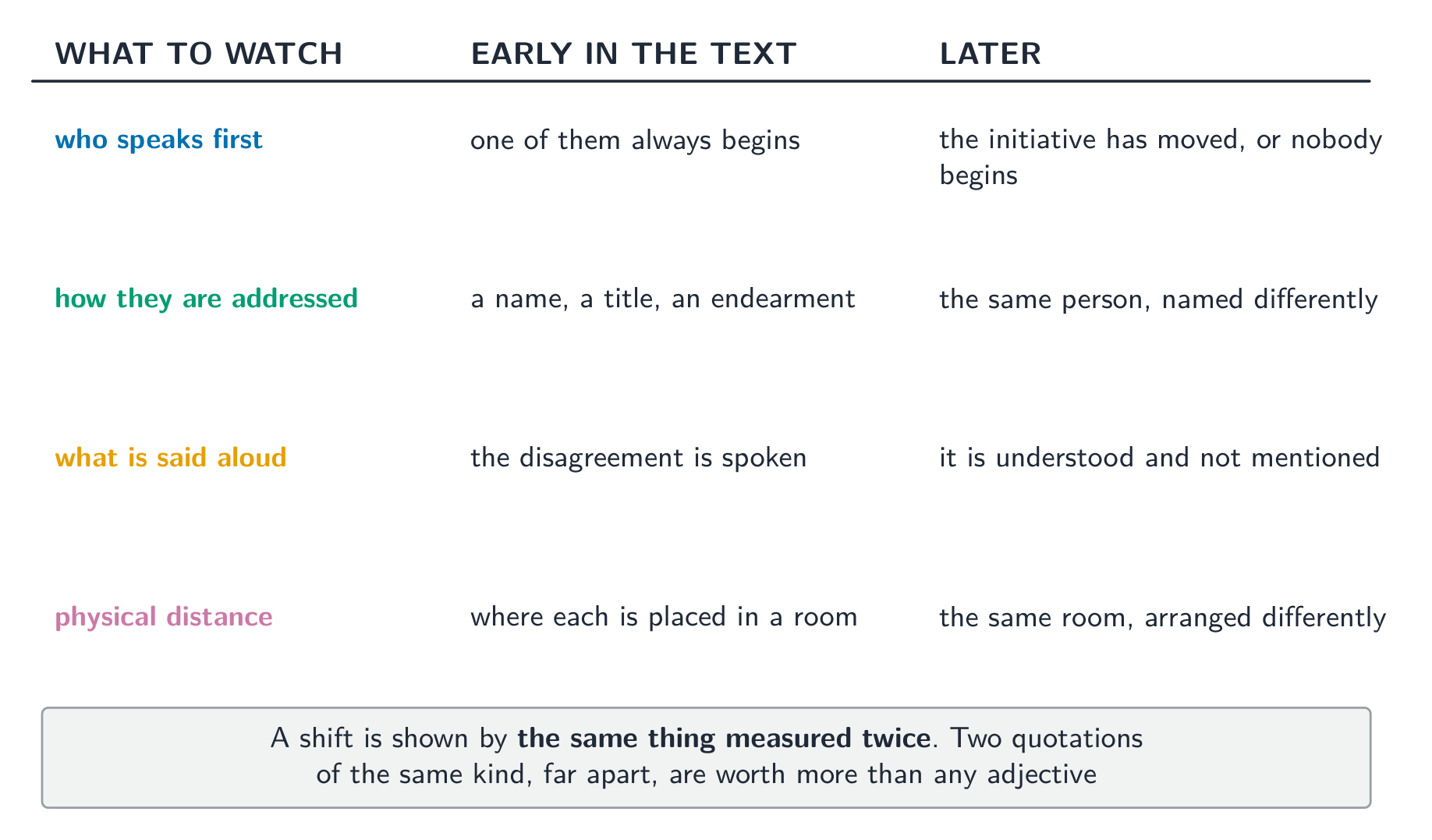
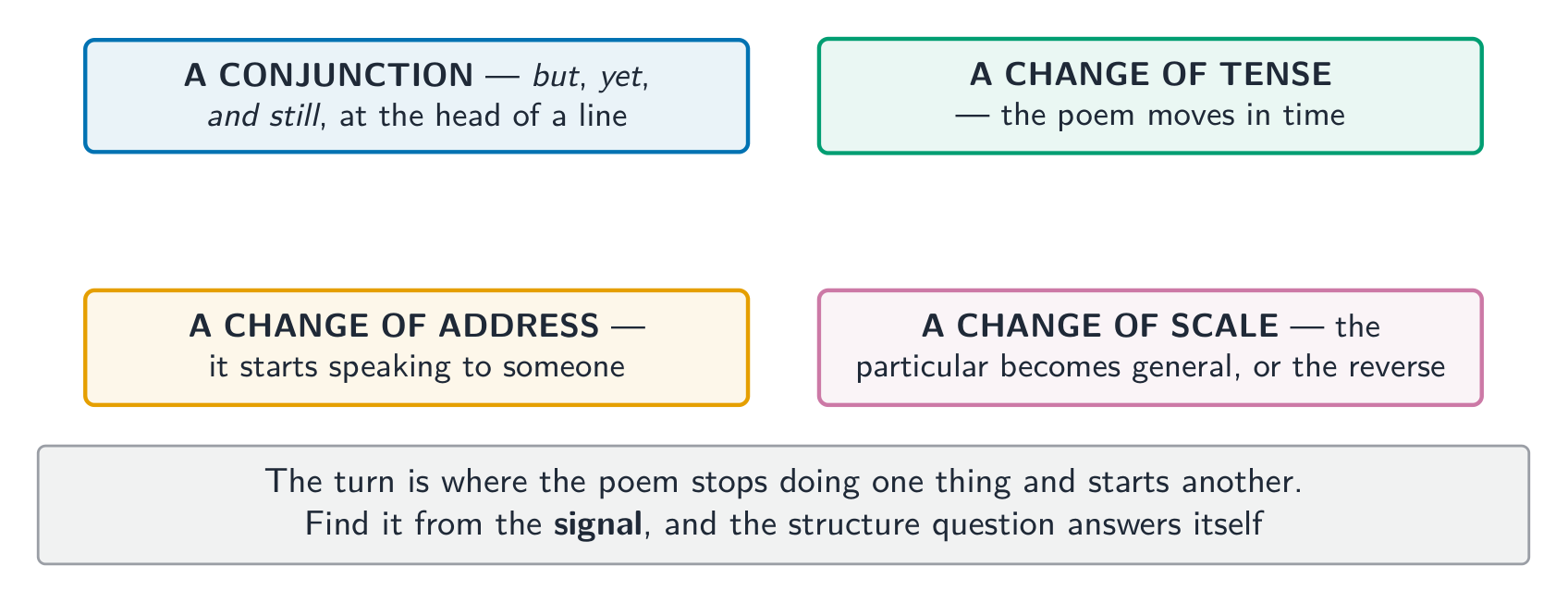
    This is the most reliable route into an unseen poem. Find the shift - a but, a stanza break, a change of tense or address - and the poem divides into a before and an after. What changed, and what the change costs or gains, is very often the poem's argument.

    한국어
    • 대조(contrast) 对照는 초점, 톤, 서사의 관점, 인물 또는 화자의 시각, 극적 상황을 통해 도입될 수 있습니다.
    • 대조는 전환(shifts), juxtaposition, 또는 그 둘 다의 결과입니다.
    • 전환은 단어나 구조적 관습, 또는 부호에 의해 신호가 될 수 있습니다.
    • 전환(text의 특정 부분들 사이의 대조를 강조할 수 있습니다.

    이것은 미지시(unseen poem)에 접근하는 가장 확실한 방법입니다. 전환을 찾으십시오: but, 시절의 끊김, 시제나 호칭의 변화 등. 그러면 시는 ‘전’과 ‘후’로 나뉩니다. 무엇이 바뀌었으며, 그 변화가 어떤 비용이나 이득을 가져왔는지가 바로 시의 논증일 가능성이 매우 높습니다.

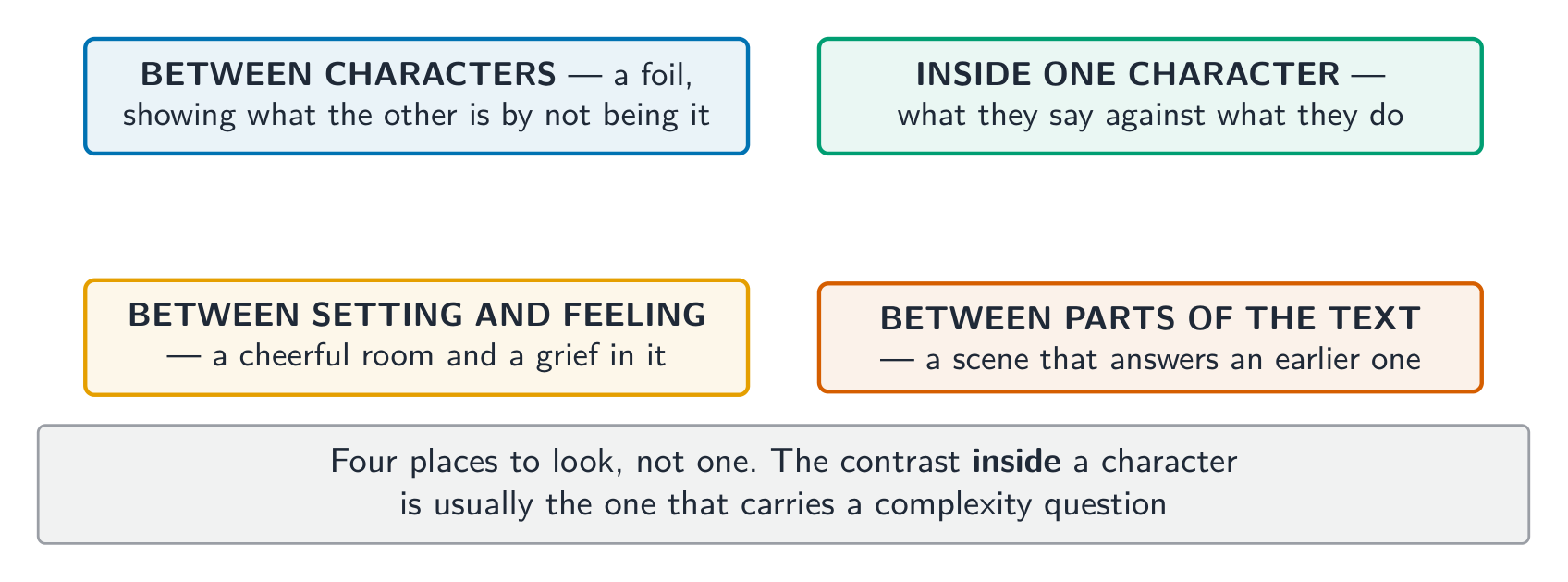
    대조를 찾을 수 있는 네 가지 곳, 하나만으로는 부족합니다
    Explore · ⁨탐색하기⁩

    Find the contrast in four places, not one · ⁨하나가 아닌 네 곳에서 대비를 찾으십시오⁩

    Students find the obvious pairing and stop — and the contrast inside a character usually carries the complexity question. · ⁨학생들은 obvious한 쌍을 찾아서 멈춥니다 — 그리고 등장인물 내부의 대비는 보통 복잡성 질문을 담고 있습니다.⁩

    Vocabulary · ⁨어휘⁩ Train · ⁨연습하기⁩
    English 한국어
    Contrast/ˈkɒntræst/ 대비
    2.4

    The Function of Specific Words and Phrases · ⁨구체적인 단어와 구문의 기능⁩

    Syllabus
    English

    Enduring Understanding (FIG-1): Comparisons, representations, and associations shift meaning from the literal to the figurative and invite readers to interpret a text.

    Learning Objective 5.B: Explain the function of specific words and phrases in a text.

    • FIG-1.A An antecedent is a word, phrase, or clause that precedes its referent. Referents may include pronouns, nouns, phrases, or clauses.
    • FIG-1.B Referents are ambiguous if they can refer to more than one antecedent, which affects interpretation.
    • FIG-1.C Words or phrases may be repeated to emphasize ideas or associations.
    • FIG-1.D Alliteration is the repetition of the same letter sound at the beginning of adjacent or nearby words to emphasize those words and their associations or representations.
    한국어

    영구적 이해 (FIG-1): 비교, 표현, 그리고 연관성은 의미를 수학적·문어적 수준에서 비유적 수준으로 이동시켜 독자에게 텍스트를 해석하게 만듭니다.

    학습 목표 5.B: 텍스트 내 특정 단어와 구문의 기능을 설명하십시오.

    • FIG-1.A 선행어(alternative)는 지시어(referring)보다 앞에 오는 단어, 구문 또는 절입니다. 지시어에는 대명사, 명사, 구문 또는 절이 포함될 수 있습니다.
    • FIG-1.B 지시어가 하나의 선행어보다 더 많은 선행어를 가리킬 수 있을 때 모호하며, 이는 해석에 영향을 미칩니다.
    • FIG-1.C 아이디어나 연관성을 강조하기 위해 단어나 구문을 반복할 수 있습니다.
    • FIG-1.D 모음법(alliteration)은 인접하거나 가까운 단어의 시작에 동일한 발음을 반복하여 해당 단어와它们的关联或表达을 강조하는 것입니다.

    Source: College Board AP Course and Exam Description · ⁨출처: College Board AP Course and Exam Description⁩

    English
    • An antecedent 先行词 is a word, phrase, or clause that precedes its referent.
    • Referents are ambiguous if they can refer to more than one antecedent, which affects interpretation 影响阐释.
    • Words or phrases may be repeated to emphasise ideas or associations.
    • Alliteration 头韵 is the repetition of the same initial sound in adjacent or nearby words, emphasising those words.

    Ambiguous reference is worth special attention. In prose it is usually a fault; in poetry it is often a device, and a pronoun that could point two ways may be holding both meanings deliberately.

    한국어
    • 선행어(antecedent) 先行词는 지시어(referent)보다先に 오는 단어, 구, 절입니다.
    • 지시어가 여러 선행어를 가리킬 수 있을 때 모호해지며, 이는 해석(interpretation) 影响阐释에 영향을 미칩니다.
    • 단어나 구문이 반복되어 아이디어나 연관성을 강조하기도 합니다.
    • 두음법(aliteration) 头韵은 인접하거나 가까운 단어에서 동일한 초기 음성을 반복하여 해당 단어를 강조하는 것입니다.

    모호한 지시는特别注意-worthy합니다. 산문에서는 보통 결함이지만, 시에서는 종종 장치(device)이며, 두 방향으로 가리킬 수 있는 대명사는 고의적으로 두 의미를 모두 포함하고 있을 수 있습니다.

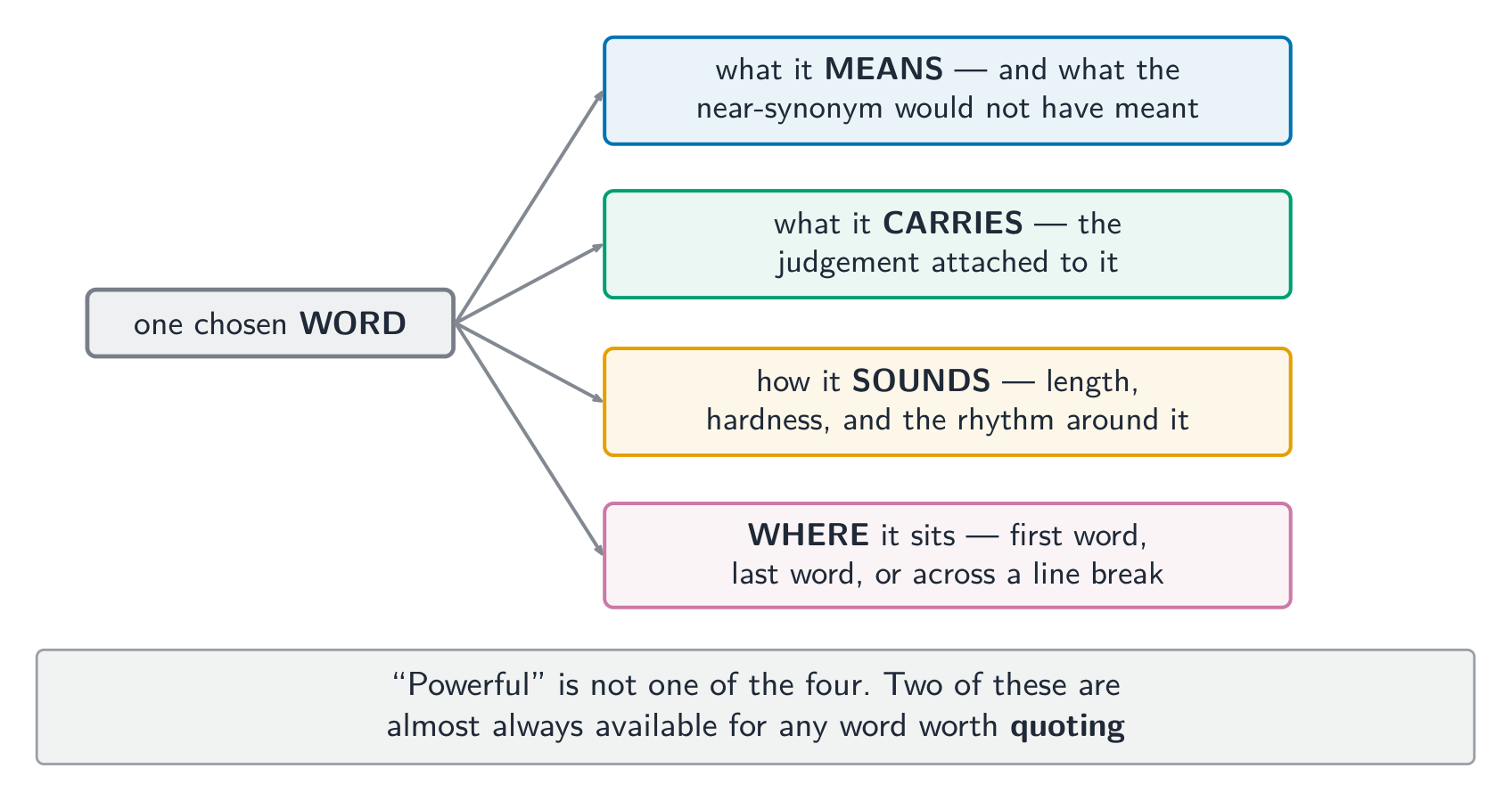
    하나의 선택된 단어가 최대 네 가지 일을同时进行하고 있음을 설명하십시오 - '강력한(powerful)'은其中之一가 아닙니다
    Vocabulary · ⁨어휘⁩ Train · ⁨연습하기⁩
    English 한국어
    antecedent/ˌæntɪˈsiːdənt/ 전위(antecedent)
    affects interpretation/əˈfekts ɪnˌtɜːprɪˈteɪʃn/ 해석에 영향 미침
    Alliteration/əˌlɪtəˈreɪʃn/ 두음법칙
    2.5

    The Function of a Simile · ⁨유비(simile)의 기능⁩

    Syllabus
    English

    Enduring Understanding (FIG-1): Comparisons, representations, and associations shift meaning from the literal to the figurative and invite readers to interpret a text.

    Learning Objective 6.A: Identify and explain the function of a simile.

    • FIG-1.E A simile uses the words “like” or “as” to liken two objects or concepts to each other.
    • FIG-1.F Similes liken two different things to transfer the traits or qualities of one to the other.
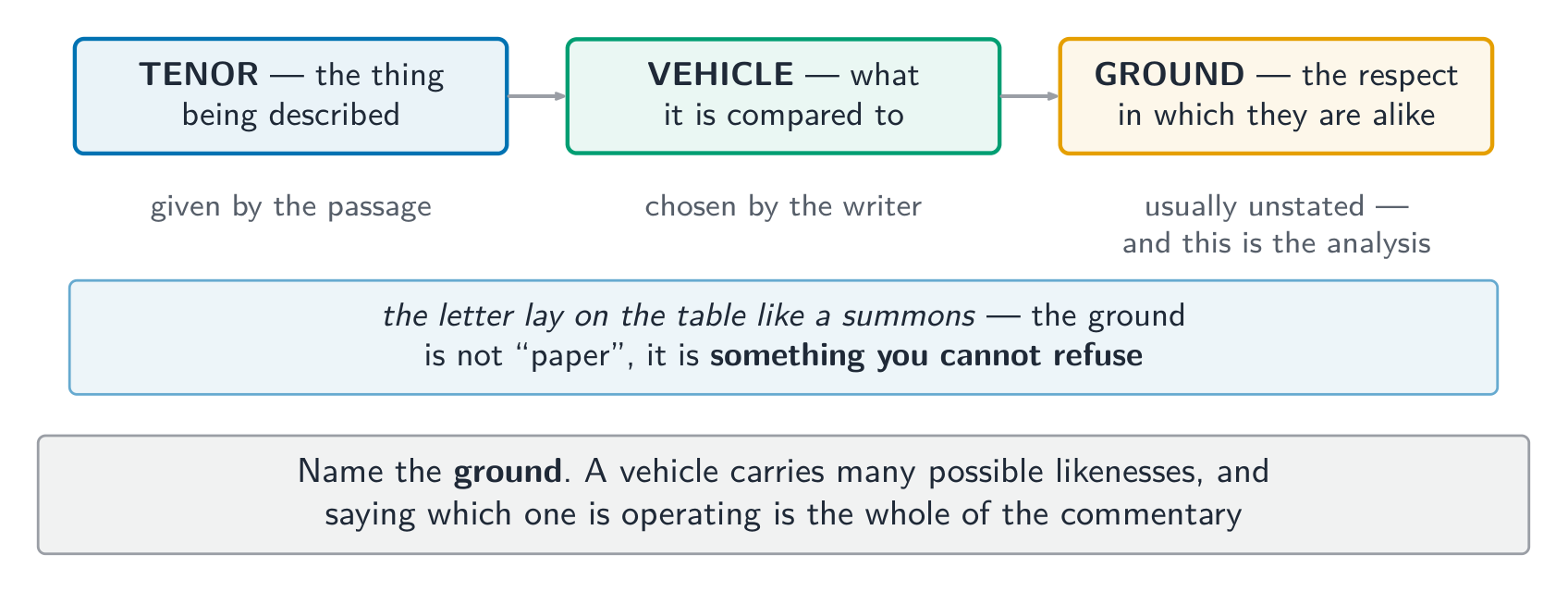
    • FIG-1.G In a simile, the thing being compared is the main subject; the thing to which it is being compared is the comparison subject.
    한국어

    영구적 이해 (FIG-1): 비교, 표현, 그리고 연관성은 의미를 수학적·문어적 수준에서 비유적 수준으로 이동시켜 독자에게 텍스트를 해석하게 만듭니다.

    학습 목표 6.A: 비유의 기능을 식별하고 설명하십시오.

    • FIG-1.E 비유는 'like' 또는 'as'라는 단어를 사용하여 두 사물 또는 개념을 서로 유사하게 만듭니다.
    • FIG-1.F 비유는 두 가지 다른 것을 유사하게 만들어 하나의 특질이나 성질을 다른 것으로 이전시킵니다.
    • FIG-1.G 비유에서 비교 대상이 되는 것은 주요 주제이며, 그에 비교되는 것은 비교 주제입니다.

    Source: College Board AP Course and Exam Description · ⁨출처: College Board AP Course and Exam Description⁩

    English
    • A simile 明喻 uses "like" or "as" to liken two objects or concepts.
    • Similes liken two different things to transfer the traits or qualities of one to the other.
    • In a simile, the thing being compared is the main subject; the thing to which it is compared is the comparison subject.

    Those two terms are the whole method. A scoring answer names the main subject, names the comparison subject, and then says which quality was transferred - because that quality is the claim the poem is making.

    한국어
    CED의 용어와 전달-direction이 단방향임을 설명하십시오
    주요 대상(main subject)을 명시하고, 비교 대상(comparison subject)을 명시한 뒤, 어떤 품질이 이전되었는지를 말하십시오
    • 유비(simile) 明喻은 “like” 또는 “as” 를 사용하여 두 사물이나 개념을 비교합니다.
    • 유비는 서로 다른 두 것을 비교하여 하나의 속性或 qualities를 다른 쪽으로 transfer합니다.
    • 유비에서 비교 대상(main subject) 은 주요 대상이고, 비교 대상(comparison subject) 은 비교의 대상입니다.

    그 두 용어는 전체 방법론입니다. 높은 점수 답안은 주요 대상을 명시하고, 비교 대상을 명시한 뒤, 어떤 품질이 transfer되었는지를 말합니다. 왜냐하면 그 품질이 시가 주장하는 content이기 때문입니다.

    Vocabulary · ⁨어휘⁩ Train · ⁨연습하기⁩
    English 한국어
    simile/ˈsɪmɪlɪ/ 비유(Simile)
    metaphor/ˈmetəfɔː/ 은유
    2.6

    The Function of a Metaphor · ⁨은유(metaphor)의 기능⁩

    Syllabus
    English

    Enduring Understanding (FIG-1): Comparisons, representations, and associations shift meaning from the literal to the figurative and invite readers to interpret a text.

    Learning Objective 6.B: Identify and explain the function of a metaphor.

    • FIG-1.H A metaphor implies similarities between two (usually unrelated) concepts or objects in order to reveal or emphasize one or more things about one of them, though the differences between the two may also be revealing.
    • FIG-1.I In a metaphor, as in a simile, the thing being compared is the main subject; the thing to which it is being compared is the comparison subject.
    • FIG-1.J Comparisons between objects or concepts draw on the experiences and associations readers already have with those objects and concepts.
    • FIG-1.K Interpretation of a metaphor may depend on the context of its use; that is, what is happening in a text may determine what is transferred in the comparison.
    한국어

    영구적 이해 (FIG-1): 비교, 표현, 그리고 연관성은 의미를 수학적·문어적 수준에서 비유적 수준으로 이동시켜 독자에게 텍스트를 해석하게 만듭니다.

    학습 목표 6.B: 은유의 기능을 식별하고 설명하십시오.

    • FIG-1.H 은유는 일반적으로 무관한 두 개념이나 사물 사이의 유사성을 암시하여 그 중 하나에 대한 하나 이상의 사항을 드러내거나 강조하지만, 두 것 간의 차이도 유익하게 드러낼 수 있습니다.
    • FIG-1.I 은유에서도 비유와 마찬가지로 비교 대상이 되는 것은 주요 주제이며, 그에 비교되는 것은 비교 주제입니다.
    • FIG-1.J 사물 또는 개념 간의 비교는 독자들이 해당 사물과 개념에 대해 이미 가지고 있는 경험과 연관성을 활용합니다.
    • FIG-1.K 은유의 해석은 사용 맥락에 따라 달라질 수 있습니다. 즉, 텍스트에서发生了什么件事이 비교에서 어떤 것이 이전되는지를 결정할 수 있습니다.

    Source: College Board AP Course and Exam Description · ⁨출처: College Board AP Course and Exam Description⁩

    English
    • A metaphor 隐喻 implies similarities between two usually unrelated concepts to reveal or emphasise qualities of the main subject.
    • The same main-subject and comparison-subject structure applies.
    • Comparisons draw on the experiences and associations readers already have with the comparison subject - which is why a metaphor can fail with an audience that lacks those associations.
    • Interpretation of a metaphor may depend on the context of its use: what is happening in the text may determine which of the comparison subject's qualities is meant.

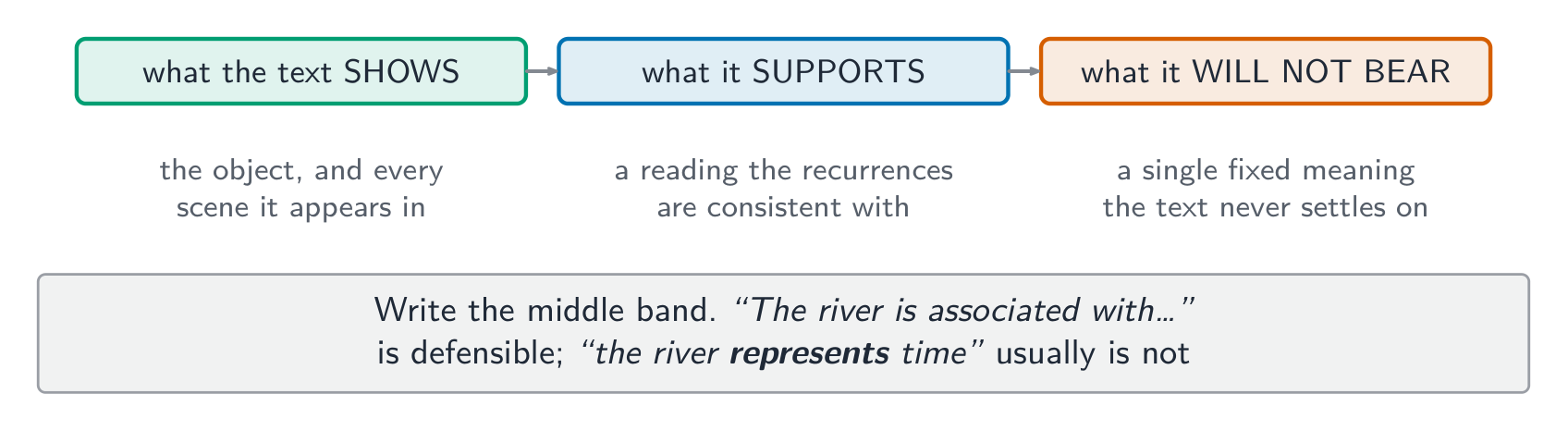
    That last point protects you from the commonest error, which is importing every association a word has. If a poem calls grief a house, the relevant quality might be shelter, or confinement, or the fact that one must live inside it. The text decides which.

    한국어
    • 은유(metaphor) 隐喻는 보통 무관한 두 개념 간의 유사성을 암시하여 주요 대상의 속성을 드러내거나 강조합니다.
    • 같은 주요 대상 및 비교 대상 구조가 적용됩니다.
    • 비교는 독사가 비교 대상에 대해 이미 가지고 있는 경험과 연상을 차용합니다. 따라서 이러한 연상이 없는 청중에게는 은유가 실패할 수 있습니다.
    • 은유의 해석은 사용 context에 의존할 수 있습니다: 텍스트에서发生了什么가 비교 대상의 어떤 속성이 의도된 것인지 결정할 수 있습니다.

    마지막 점은 가장 흔한 오류, 즉 단어가 가지는 모든 연상 관계를 무조건적으로 가져오는 것을 방지합니다. 시가 슬픔을 한 집으로 표현한다면, 해당 속성은 안식처일 수도 있고 갇혀 있음일 수도 있으며, 그 안에 살아가야 한다는 사실일 수 있습니다. 텍스트가 어떤 것이 맞는지 결정합니다.

    2.7

    Developing a Paragraph with Claim and Evidence · ⁨주장과 증거를 포함한 단락 발전⁩

    Syllabus
    English

    Enduring Understanding (LAN-1): Readers establish and communicate their interpretations of literature through arguments supported by textual evidence.

    Learning Objective 7.A: Develop a paragraph that includes 1) a claim that requires defense with evidence from the text and 2) the evidence itself.

    • LAN-1.A In literary analysis, writers read a text closely to identify details that, in combination, enable them to make and defend a claim about an aspect of the text.
    • LAN-1.B A claim is a statement that requires defense with evidence from the text.
    • LAN-1.C In literary analysis, the initial components of a paragraph are the claim and textual evidence that defends the claim.
    한국어

    영구적 이해 (LAN-1): 독자들은 텍스트의 증거로 지지되는 논쟁을 통해 문학 작품을 해석하고 이를 전달합니다.

    학습 목표 7.A: 1) 텍스트의 증거로 방어해야 하는 주장을 포함하고 2) 그 증거 자체를 포함하는 문단을 작성하십시오.

    • LAN-1.A 문학 분석에서 작가는 텍스트를 심독하여 디테일을 식별하는데, 이 디테일들이 결합되어 텍스트의 특정 부분에 대한 주장을 세우고 방어할 수 있게 합니다.
    • LAN-1.B 주장은 텍스트의 증거로 방어해야 하는 진술입니다.
    • LAN-1.C 문학 분석에서 문단의 초기 구성 요소는 주장과 그 주장을 방어하는 텍스트적 증거입니다.

    Source: College Board AP Course and Exam Description · ⁨출처: College Board AP Course and Exam Description⁩

    English

    Same three components as Unit 1: a claim requiring textual defence, the textual evidence, and details identified in combination.

    Worked example (a real AP exam task). A poetry-analysis prompt asks how the speaker's use of comparison conveys their attitude. A weak answer: "The poet uses a metaphor comparing memory to a house, which is effective." A scoring answer uses the CED's terms and the context rule: "The main subject is memory and the comparison subject a house, but the poem withholds warmth from the comparison: the house has 'rooms she no longer enters'. The quality transferred is therefore not shelter but confinement by a structure one built oneself - so the speaker's attitude to her own past is presented as inhabiting something she can neither leave nor fully occupy." Main subject, comparison subject, transferred quality, and the attitude it conveys.

    한국어

    유닛 1과 동일한 세 가지 구성 요소: 텍스트적 방어를 요구하는 주장, 텍스트적 증거, 그리고 결합하여 식별된 디테일입니다.

    작은 예시 (실제 AP 시험 문제). 시 분석 프롬프트에서 화자가 비유를 사용하여 자신의 태도를 어떻게 전달하는지 묻습니다. 나쁜 답안: "시인은 기억을 한 집에 비유하는 은유를 사용했는데, 이는 효과적이다." 점수를 받은 답안은 CED의 용어와 맥락 규칙을 사용합니다: "주제사(메인 서브젝트)는 기억이고 비교 대상(컴퍼리슨 서브젝트)은 집이지만, 시는 이 비교에 따뜻함을 부여하지 않습니다: 집에는 '그녀가 더 이상 들어가지 않는 방'이 있습니다. 따라서 이전되는 속성은 안식처가 아니라 스스로 지은 구조물에 의해 갇혀 있다는 것입니다. - 즉, 화자의 자신에 대한 과거에 대한 태도는 그녀가 떠나거나 완전히 거주할 수 없는 무언가에 갇혀 있는 것으로 제시됩니다." 주제사, 비교 대상, 이전되는 속성, 그리고 그것이 전달하는 태도입니다.

    2.7

    Exam tips · ⁨시험 팁⁩

    English
    • What a speaker omits is evidence. In a poem, everything present was chosen.
    • Find the shift first. A but, a stanza break, a change of tense - the poem divides there.
    • Line endings are the emphatic position. Say which words the poet put there.
    • An ambiguous referent in poetry is usually a device, not an error.
    • Always name main subject and comparison subject, then the quality transferred. That quality is the claim.
    • Context decides which quality a metaphor imports. Do not list every association the word has.
    한국어
    • 화자가 생략한 것은 증거입니다. 시에서 존재하는 것은 모두 선택된 것입니다.
    • 먼저 전환점을 찾으십시오. but, 연의 변경, 시제의 변화 등 - 시는 거기에 두部分组成됩니다.
    • 행의 끝은 강조되는 위치입니다. 시인이 그곳에 배치한 단어를 말하십시오.
    • 시에서의 모호한 지칭对象은 보통 오류가 아닌 장치입니다.
    • 항상 주제사와 비교 대상을 명시한 후 이전되는 속성을 언급하십시오. 그 속성이 주장입니다.
    • 맥락이 은유가 가져오는 속성을 결정합니다. 단어가 가지는 모든 연상 목록을 나열하지 마십시오.
  • 3

    Longer Fiction or Drama I · ⁨장편 소설 또는 극본 I⁩

    Watch lesson · ⁨수업 보기⁩
    3.1

    What Textual Details Reveal About a Character · ⁨텍스트 디테일이 캐릭터에 대해 드러내는 것⁩

    Syllabus
    English

    Enduring Understanding (CHR-1): Characters in literature allow readers to study and explore a range of values, beliefs, assumptions, biases, and cultural norms represented by those characters.

    Learning Objective 1.A: Identify and describe what specific textual details reveal about a character, that character’s perspective, and that character’s motives.

    • CHR-1.F The description of a character creates certain expectations for that character’s behaviors; how a character does or does not meet those expectations affects a reader’s interpretation of that character.
    • CHR-1.G Details associated with a character and/or used to describe a character contribute to a reader’s interpretation of that character.
    • CHR-1.H Readers’ understanding of a character’s perspective may depend on the perspective of the narrator or speaker.
    • CHR-1.I A character’s perspective may shift during the course of a narrative.
    • CHR-1.J When narrators, characters, or speakers compare another character to something or someone else, they reveal their perspective on the compared character and may also reveal something innate about the compared character.
    • CHR-1.K Readers can infer a character’s motives from that character’s actions or inactions.
    한국어

    영구적 이해 (CHR-1): 문학 작품 속 캐릭터들은 독자가 그 캐릭터들이 대표하는 다양한 가치관, 신념, 전제, 편견 및 문화적 규범을 연구하고 탐구할 수 있게 합니다.

    학습 목표 1.A: 특정 텍스트 디테일이 캐릭터, 해당 캐릭터의 시각, 그리고 해당 캐릭터의 동기에 대해 무엇을显露하는지 식별하고 묘사하십시오.

    • CHR-1.F 인물의 묘사는 해당 인물에 대한 일정한 기대감을 형성합니다. 이 기대감이 인물의 행동에 따라 충족되거나 충족되지 않는 방식은 독자가 그 인물을 해석하는 데 영향을 미칩니다.
    • CHR-1.G 인물과 관련된 디테일 또는 인물을 묘사하기 위해 사용된 디테일은 독자의 인물 해석에 기여합니다.
    • CHR-1.H 독자의 인물의 관점 이해는 서술자나 화자의 관점에 따라 달라질 수 있습니다.
    • CHR-1.I 인물의 관점은 서사 과정 중 변화할 수 있습니다.
    • CHR-1.J 서술자, 인물, 혹은 화자가 다른 인물을 어떤 사물이나 사람과 비교할 때, 그들은 비교 대상인 인물에 대한 자신의 관점을 드러내며 비교 대상 인물의 본질적인 특성에 대해 무언가를 밝히기도 합니다.
    • CHR-1.K 독자는 인물의 행동 또는 비행동으로부터 그 인물의 동기를 추론할 수 있습니다.

    Source: College Board AP Course and Exam Description · ⁨출처: College Board AP Course and Exam Description⁩

    English

    Unit 3 is the first longer-fiction-or-drama unit, and the length changes what is analysable: characters can now change, conflicts can intersect, and setting acquires a social and historical dimension.

    The CED's additions on character:

    • The description of a character creates expectations for that character's behaviour, and how a character meets or fails those expectations is meaningful.
    • Details associated with a character contribute to a reader's interpretation of them.
    • A reader's understanding of a character's perspective may depend on the perspective of the narrator.
    • A character's perspective may shift during the narrative.
    • When narrators or characters compare another character to something else, they reveal their own perspective as much as the compared character's.
    • Readers can infer motive from a character's actions or inactions.

    That last word - inactions - is the one worth keeping. What a character declines to do is evidence, and it is usually more revealing than what they do.

    한국어

    유닛 3은 첫 번째 긴 소설 또는 극본 유닛이며, 길이가 분석 가능한 범위를 바꿉니다: 캐릭터는 이제 변화할 수 있고, 갈등은 교차할 수 있으며, 배경은 사회적 및 역사적 차원을 얻습니다.

    CED의 캐릭터 관련 추가 정보:

    • 캐릭터에 대한 묘사는 해당 캐릭터의 행동에 대한 기대감을 형성하고, 캐릭터가 그 기대를 충족시키거나 실패하는 방식이 의미 있는 것입니다.
    • 캐릭터와 연관된 디테일은 독자가 그 캐릭터를 해석하는 데 기여합니다.
    • 독자의 캐릭터의 관점에 대한 이해는 서사자의 관점에 의존할 수 있습니다.
    • 캐릭터의 관점은 서사 과정에서 전환될 수 있습니다.
    • 서사자나 캐릭터가 다른 캐릭터를 다른 것과 비교할 때, 그들은 비교 대상 캐릭터뿐만 아니라 자신들의 관점도 드러냅니다.
    • 독자는 캐릭터의 행동이나 부동(행동하지 않음)에서 동기를 추론할 수 있습니다.

    마지막 단어 - 부동(inactions) - 을 유지할 가치가 있는 것입니다. 캐릭터가 하지 않은 선택은 증거이며, 그들이 한 것보다 훨씬 더 통찰을 제공합니다.

    3.2

    Characters Who Change or Remain Unchanged · ⁨변화하거나 변하지 않는 캐릭터⁩

    Syllabus
    English

    Enduring Understanding (CHR-1): Characters in literature allow readers to study and explore a range of values, beliefs, assumptions, biases, and cultural norms represented by those characters.

    Learning Objective 1.B: Explain the function of a character changing or remaining unchanged.

    • CHR-1.L A dynamic character who develops over the course of the narrative often makes choices that directly or indirectly affect the climax and/or the resolution of that narrative.
    • CHR-1.M Character changes can be visible and external, such as changes to health or wealth, or can be internal, psychological, or emotional changes; external changes can lead to internal changes, and vice versa.
    • CHR-1.N Some characters remain unchanged or are largely unaffected by the events of the narrative.
    한국어

    영구적 이해 (CHR-1): 문학 작품 속 캐릭터들은 독자가 그 캐릭터들이 대표하는 다양한 가치관, 신념, 전제, 편견 및 문화적 규범을 연구하고 탐구할 수 있게 합니다.

    학습 목표 1.B: 인물이 변화하거나 변하지 않는 기능에 대해 설명합니다.

    • CHR-1.L 서사의 전过程中에 걸쳐 성장하는 역동적 인물은 클라이맥스와/또는 결말에 직접적이거나 간접적으로 영향을 미치는 선택을 자주 합니다.
    • CHR-1.M 인물 변화는 건강이나 부와 같은 건강 상태나 재물 등의 가시적이고 외부적인 변화일 수 있으며, 심리적 또는 정서적 변화와 같은 내부적 변화일 수도 있습니다. 외부 변화는 내부 변화를 유발하고, 반대로 내부 변화가 외부 변화를 유도할 수 있습니다.
    • CHR-1.N 일부 인물은 변화하지 않거나 서사의 사건들에 의해 크게 영향을 받지 않습니다.

    Source: College Board AP Course and Exam Description · ⁨출처: College Board AP Course and Exam Description⁩

    English
    • A dynamic character 动态人物 develops over the narrative and often makes choices that directly or indirectly cause change.
    • Character change can be visible and external - health, wealth, circumstance - or internal, in belief, value, or understanding.
    • Some characters remain unchanged 静态人物 or are largely unaffected by events.

    The unchanged character is not a failure of characterisation; it is often the measure by which the change in others is visible.

    한국어
    • 동적 캐릭터 动态人物은 서사를 통해 발전하며, 종종 직접적이든 간접적이든 변화를 유발하는 선택을 합니다.
    • 캐릭터의 변화는 외적으로 보일 수 있습니다 - 건강, 재물, 상황 등 - 또는 내면적일 수 있습니다 - 신념, 가치, 혹은 이해도 등.
    • 일부 캐릭터는 변하지 않습니다 静态人物 또는 사건에 거의 영향을 받지 않습니다.

    변하지 않는 캐릭터는 캐릭터화 실패가 아닙니다. 이는 종종 다른 캐릭터의 변화를 가늠하는 기준이 됩니다.

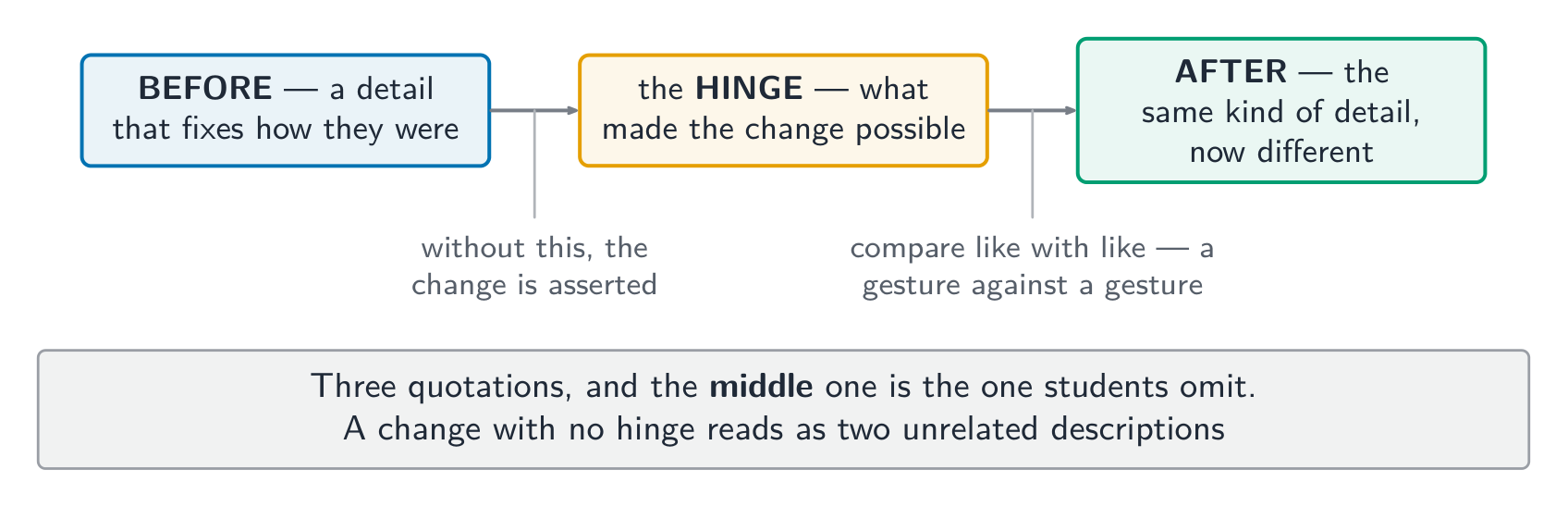
    세 개의 인용구, 중간 하나가 학생들이 생략하는 것
    Explore · ⁨탐색하기⁩

    Prove a change with three quotations · ⁨세 개의 인용문을 통해 변화를 증명하십시오⁩

    Before, hinge, after — and the hinge is the one students omit, which leaves the change asserted. · ⁨전, 경첩, 후 — 그리고 경첩은 학생들이 생략하는 부분인데, 이로 인해 변화가 단정적으로 제시됩니다.⁩

    3.3

    Textual Details That Convey Setting · ⁨배경을 전달하는 텍스트 디테일⁩

    Syllabus
    English

    Enduring Understanding (SET-1): Setting and the details associated with it not only depict a time and place, but also convey values associated with that setting.

    Learning Objective 2.A: Identify and describe specific textual details that convey or reveal a setting.

    • SET-1.B Setting includes the social, cultural, and historical situation during which the events of the text occur.
    한국어

    영구적 이해 (SET-1): 배경(setting)과 그에 관련된 디테일들은 단순히 시간과 장소를 묘사할 뿐만 아니라, 해당 배경과 연관된 가치관도 전달합니다.

    학습 목표 2.A: 배경을 전달하거나 드러내는 특정 텍스트 디테일을 식별하고 묘사하십시오.

    • SET-1.B 배경에는 텍스트의 사건이 일어나는 사회, 문화, 역사적 상황이 포함됩니다.

    Source: College Board AP Course and Exam Description · ⁨출처: College Board AP Course and Exam Description⁩

    English

    Setting now includes the social, cultural, and historical situation in which the events occur - not only time and place.

    This widens what setting can do. A social setting supplies the constraints a character must act within, and constraint is what turns a choice into a revealing one.

    한국어

    배경은 이제 사건의 발생 situation을 포함합니다 - 시간과 장소뿐만 아니라 사회적, 문화적, 역사적 상황까지.

    이는 배경이 할 수 있는 일을 넓힙니다. 사회적 배경은 캐릭터가 행동해야 하는 제약을 제공하며, 제약은 선택을 통찰 있게 만드는 것입니다.

    3.4

    Significant Events in a Plot · ⁨플롯에서의 중요한 사건⁩

    Syllabus
    English

    Enduring Understanding (STR-1): The arrangement of the parts and sections of a text, the relationship of the parts to each other, and the sequence in which the text reveals information are all structural choices made by a writer that contribute to the reader’s interpretation of a text.

    Learning Objective 3.E: Explain the function of a significant event or related set of significant events in a plot.

    • STR-1.K A story, or narrative, is delivered through a series of events that relate to a conflict.
    • STR-1.L Events include episodes, encounters, and scenes in a narrative that can introduce and develop a plot.
    • STR-1.M The significance of an event depends on its relationship to the narrative, the conflict, and the development of characters.
    한국어

    영구적 이해 (STR-1): 텍스트의 부분과 섹션의 배열, 부분들 간의 관계, 그리고 텍스트가 정보를 공개하는 순서는 모두 작가가 내린 구조적 선택이며, 이는 독자의 텍스트 해석에 기여합니다.

    학습 목표 3.E: 플롯에서 중요한 사건이나 관련된 일련의 중요한 사건의 기능에 대해 설명합니다.

    • STR-1.K 이야기 또는 서사는 갈등과 연관된 일련의 사건들을 통해 전달됩니다.
    • STR-1.L 사건에는 플롯을 도입하고 발전시키는 데 사용할 수 있는 에피소드, 충돌, 그리고 장면이 포함됩니다.
    • STR-1.M 사건의 중요성은 서사, 갈등, 그리고 인물 발달과의 관계에 달려 있습니다.

    Source: College Board AP Course and Exam Description · ⁨출처: College Board AP Course and Exam Description⁩

    English
    • A narrative is delivered through a series of events that relate to a conflict.
    • Events include episodes, encounters, and scenes that introduce and develop plot.
    • The significance of an event depends on its relationship to the narrative, the conflict, and character development.

    That third statement is the test for essay selection: an event matters to your argument only if you can say what it does to the conflict or to a character. Retelling a striking scene that does neither is plot summary, which earns nothing.

    한국어
    • 서사는 갈등과 관련된 일련의 사건을 통해 전달됩니다.
    • 사건에는 플롯을 도입하고 발전시키는 일화, 만남, 그리고 장면이 포함됩니다.
    • 사건의 중요성은 서사, 갈등, 그리고 캐릭터 개발과의 관계에 따라 결정됩니다.

    세 번째 문장은 에세이 선정을 위한 테스트입니다: 사건이 당신의 논증에 relevant할 수 있는 유일한 방법은 그것이 갈등이나 캐릭터에 어떤 영향을 미치는지 말할 수 있을 때입니다. neither conflicting nor character-related striking scene을 단순히 설명하는 것은 플롯 요약일 뿐이며, 점수를 주지 않습니다.

    Vocabulary · ⁨어휘⁩ Train · ⁨연습하기⁩
    English 한국어
    dynamic character/daɪˈnæmɪk ˈkærɪktə/ 동적 인물
    Some characters remain unchanged/sʌm ˈkærɪktəz rɪˈmeɪn ʌnˈtʃeɪndʒd/ 일부 인물은 변하지 않음
    Conflict/ˈkɒnflɪkt/ 갈등
    intersect/ˌɪntəˈsekt/ 교차하다
    3.5

    The Function of Conflict in a Text · ⁨텍스트에서 갈등의 기능⁩

    Syllabus
    English

    Enduring Understanding (STR-1): The arrangement of the parts and sections of a text, the relationship of the parts to each other, and the sequence in which the text reveals information are all structural choices made by a writer that contribute to the reader’s interpretation of a text.

    Learning Objective 3.F: Explain the function of conflict in a text.

    • STR-1.N Conflict is tension between competing values either within a character, known as internal or psychological conflict, or with outside forces that obstruct a character in some way, known as external conflict.
    • STR-1.O A text may contain multiple conflicts. Often two or more conflicts in a text intersect.
    • STR-1.P A primary conflict can be heightened by the presence of additional conflicts that intersect with it.
    • STR-1.Q Inconsistencies in a text may create contrasts that represent conflicts of values or perspectives.
    한국어

    영구적 이해 (STR-1): 텍스트의 부분과 섹션의 배열, 부분들 간의 관계, 그리고 텍스트가 정보를 공개하는 순서는 모두 작가가 내린 구조적 선택이며, 이는 독자의 텍스트 해석에 기여합니다.

    학습 목표 3.F: 텍스트 속 갈등의 기능에 대해 설명합니다.

    • STR-1.N 갈등은 인물의 내부에 존재하는 경쟁 가치 간의 긴장(내부적 또는 심리적 갈등)이거나, 인물을 어떤 방식으로든 방해하는 외부 세력과의 긴장(외부적 갈등)입니다.
    • STR-1.O 텍스트에는 여러 가지 갈등이 포함될 수 있습니다. 종종 텍스트 속 두 개 이상의 갈등이 교차합니다.
    • STR-1.P 주된 갈등은它与 교차하는 추가적인 갈등의 존재로 인해 더욱 고조될 수 있습니다.
    • STR-1.Q 텍스트 내의 일관성 없는 점은 가치 또는 관점의 갈등을 나타내는 대비를 만들 수 있습니다.

    Source: College Board AP Course and Exam Description · ⁨출처: College Board AP Course and Exam Description⁩

    English
    • Conflict 冲突 is tension between competing values, either within a character - internal or psychological conflict - or between a character and an external force.
    • A text may contain multiple conflicts, and often two or more intersect 交叉.
    • A primary conflict can be heightened by additional conflicts that intersect with it.
    • Inconsistencies in a text may create contrasts that represent conflicts of values or perspectives.

    Note the definition: conflict is between competing values, not merely between people. Two characters who want the same object are in a dispute; two characters who want incompatible goods are in a conflict, and only the second produces meaning.

    한국어
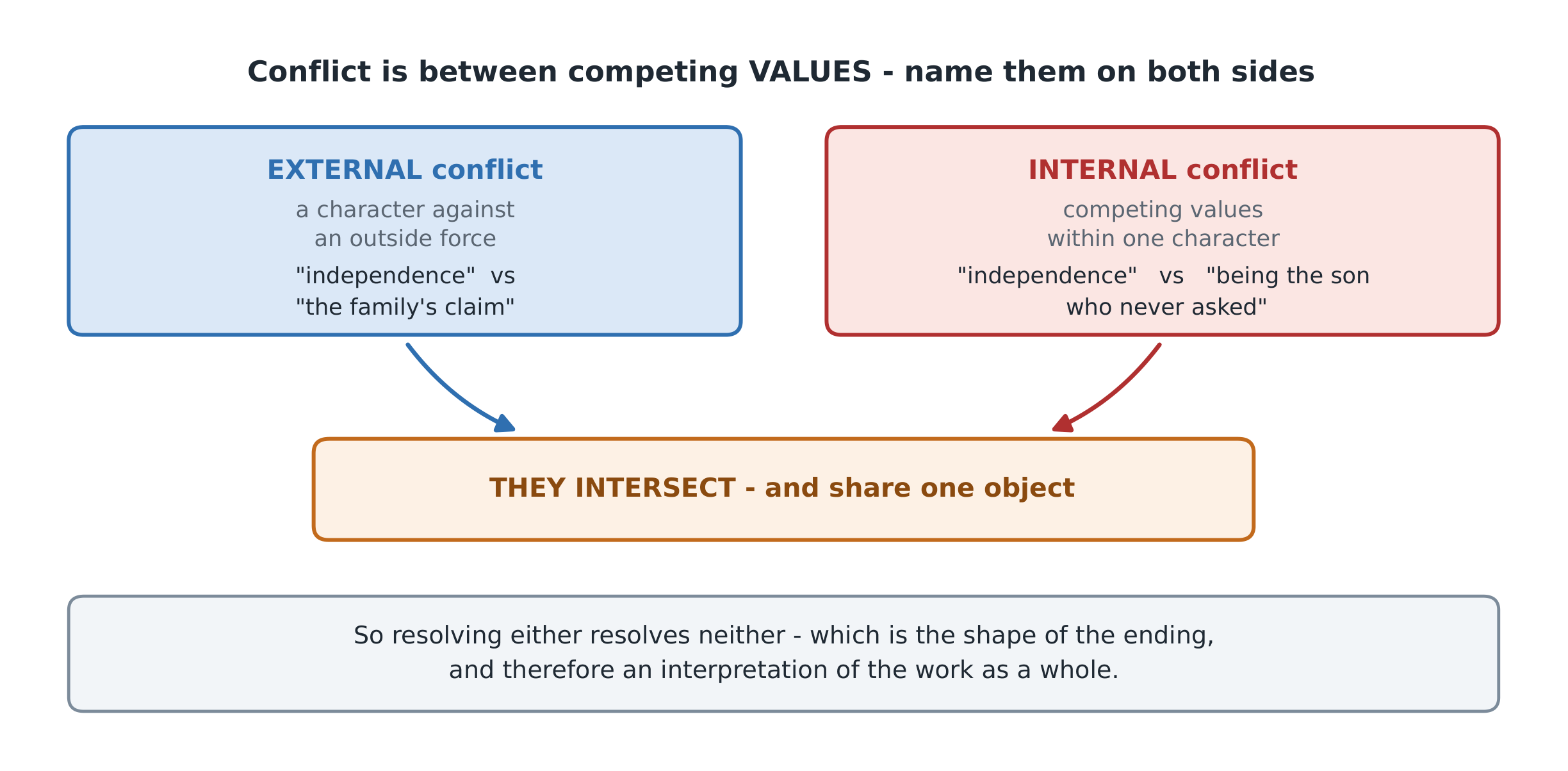
    갈등에는 두 가지 위치가 있으며它们是叠加的 - 이것이 긴 소설을 분석 가능하게 함
    교차하는 갈등에 의해 고조된 주요 갈등은 소설이나 극의 표준적인 형태입니다
    • 갈등 冲突은 경쟁하는 가치 사이의 긴장입니다. either 캐릭터 내부에서 - 내면적 또는 심리적 갈등 - or 캐릭터와 외부 힘 사이에서 발생합니다.
    • 텍스트에는 여러 갈등을 포함할 수 있으며, thường two or more 교차 交叉합니다.
    • 추가된 갈등이 주요 갈등과 교차하면 이를 고조시킬 수 있습니다.
    • 텍스트의 일관성 부족은 가치나 관점의 갈등을 나타내는 대비를 만들 수 있습니다.

    정의를 주의 깊게 보십시오: 갈등은 단순히 사람 사이가 아니라 경쟁하는 가치 사이에 있습니다. 같은 목적물을 원하는 두 캐릭터는 다툼(dispute)에 있습니다; 양립 불가능한 가치를 원하는 두 캐릭터는 갈등(conflict)에 있으며, 오직 두 번째 경우만이 의미를 생성합니다.

    3.6

    Developing a Paragraph with Claim and Evidence · ⁨주장과 증거를 포함한 단락 발전⁩

    Syllabus
    English

    Enduring Understanding (LAN-1): Readers establish and communicate their interpretations of literature through arguments supported by textual evidence.

    Learning Objective 7.A: Develop a paragraph that includes 1) a claim that requires defense with evidence from the text and 2) the evidence itself.

    • LAN-1.A In literary analysis, writers read a text closely to identify details that, in combination, enable them to make and defend a claim about an aspect of the text.
    • LAN-1.B A claim is a statement that requires defense with evidence from the text.
    • LAN-1.C In literary analysis, the initial components of a paragraph are the claim and textual evidence that defends the claim.
    한국어

    영구적 이해 (LAN-1): 독자들은 텍스트의 증거로 지지되는 논쟁을 통해 문학 작품을 해석하고 이를 전달합니다.

    학습 목표 7.A: 1) 텍스트의 증거로 방어해야 하는 주장을 포함하고 2) 그 증거 자체를 포함하는 문단을 작성하십시오.

    • LAN-1.A 문학 분석에서 작가는 텍스트를 심독하여 디테일을 식별하는데, 이 디테일들이 결합되어 텍스트의 특정 부분에 대한 주장을 세우고 방어할 수 있게 합니다.
    • LAN-1.B 주장은 텍스트의 증거로 방어해야 하는 진술입니다.
    • LAN-1.C 문학 분석에서 문단의 초기 구성 요소는 주장과 그 주장을 방어하는 텍스트적 증거입니다.

    Source: College Board AP Course and Exam Description · ⁨출처: College Board AP Course and Exam Description⁩

    English

    Unchanged from Units 1 and 2: a claim requiring textual defence, textual evidence, and details identified in combination.

    한국어

    유닛 1과 2에서 그대로 유지됨: 텍스트적 방어를 요구하는 주장, 텍스트적 증거, 그리고 결합하여 식별된 디테일입니다.

    3.7

    Developing a Literary Thesis Statement · ⁨문학적 논제문(thesis statement) development⁩

    Syllabus
    English

    Enduring Understanding (LAN-1): Readers establish and communicate their interpretations of literature through arguments supported by textual evidence.

    Learning Objective 7.B: Develop a thesis statement that conveys a defensible claim about an interpretation of literature and that may establish a line of reasoning.

    • LAN-1.D A thesis statement expresses an interpretation of a literary text and requires a defense through use of textual evidence and a line of reasoning, both of which are explained in an essay through commentary.
    • LAN-1.E A thesis statement may preview the development or line of reasoning of an interpretation. This is not to say that a thesis statement must list the points of an interpretation, literary elements to be analyzed, or specific evidence to be used in the argument.
    한국어

    영구적 이해 (LAN-1): 독자들은 텍스트의 증거로 지지되는 논쟁을 통해 문학 작품을 해석하고 이를 전달합니다.

    학습 목표 7.B: 문학 해석에 대한 타당한 주장을 전달하며 논증의 흐름(line of reasoning)을 설정할 수 있는 논제문을 개발합니다.

    • LAN-1.D 논제문은 문학 텍스트에 대한 해석을 표현하며, 텍스트적 증거와 논증의 흐름을 사용하여 이를 방어해야 합니다. 이는 논증 essay에서 Commentary를 통해 모두 설명됩니다.
    • LAN-1.E 논제문은 해석의 전개나 논증의 흐름을 미리 제시할 수 있습니다. 하지만 이것이 논제문이 반드시 해석의 점수, 분석할 문학 요소, 혹은 논증에 사용될 구체적인 증거를 나열해야 한다는 의미는 아닙니다.

    Source: College Board AP Course and Exam Description · ⁨출처: College Board AP Course and Exam Description⁩

    English
    • A thesis statement expresses an interpretation of a literary text and requires defence through textual evidence.
    • It may preview the development or line of reasoning of that interpretation - but is not required to list the reasons.

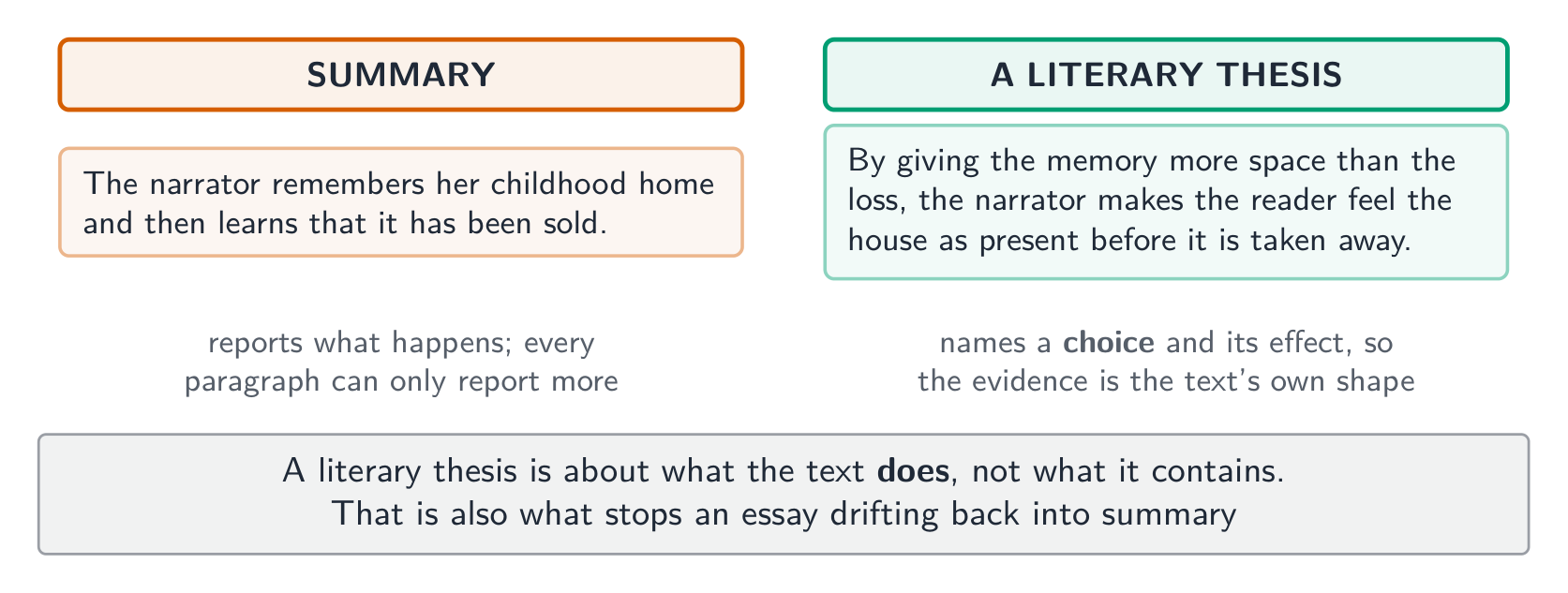
    The key word is interpretation. A thesis that states what happens in the text is not a thesis; it is a summary. A thesis must say what the text means or does, which is by definition arguable.

    한국어
    • 논제문은 문학 텍스트에 대한 해석을 표명하고 텍스트적 증거를 통해 방어를 요구합니다.
    • 그것은 해석의 전개나 추론의 흐름을 미리 예고할 수 있지만 - Reasons를 나열하는 것은 필수가 아닙니다.

    핵심 키워드는 해석입니다. 텍스트에서发生了什么를 서술하는 것은 논제(thesis)가 아니라 요약에 불과합니다. 논제는 텍스트가 의미하거나 기능함을 말해야 하며, 이는 본질적으로 논쟁의 여지가 있는 내용이어야 합니다.

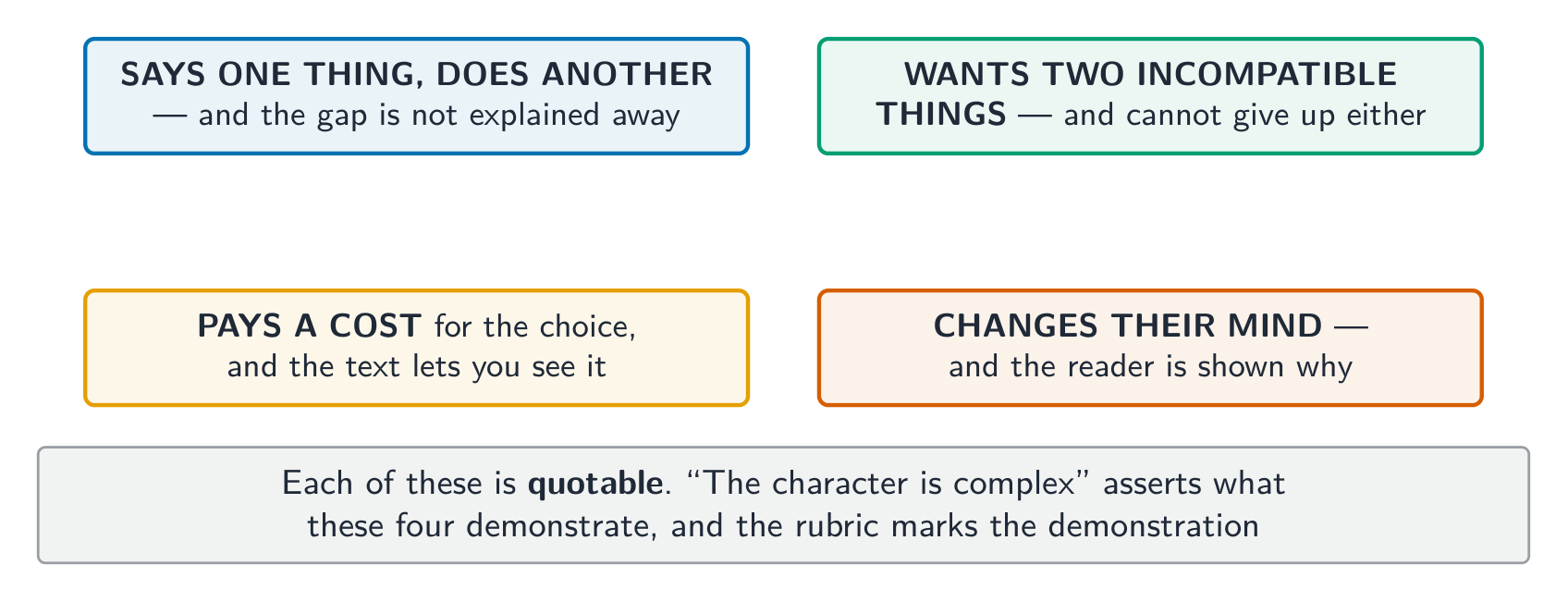
    문학적 논제는 텍스트가 포함하는 것이 아니라 그 기능을 다루어야 합니다
    Explore · ⁨탐색하기⁩

    Sort summary from a literary thesis · ⁨요약을 문학 비평과 구분하십시오⁩

    A literary thesis is about what the text does, not what it contains — which is also what stops an essay drifting into summary. · ⁨문학 비평은 텍스트가contains하는 것이 아니라 what the text does에 관한 것입니다 — 이는 또한 에세이가 요약으로 흐르는 것을 막는 요소이기도 합니다.⁩

    3.8

    Developing Commentary · ⁨비평적 분석 확장⁩

    Syllabus
    English

    Enduring Understanding (LAN-1): Readers establish and communicate their interpretations of literature through arguments supported by textual evidence.

    Learning Objective 7.C: Develop commentary that establishes and explains relationships among textual evidence, the line of reasoning, and the thesis.

    • LAN-1.F A line of reasoning is the logical sequence of claims that work together to defend the overarching thesis statement.
    • LAN-1.G A line of reasoning is communicated through commentary that explains the logical relationship between the overarching thesis statement and the claims/evidence within the body of an essay.
    한국어

    영구적 이해 (LAN-1): 독자들은 텍스트의 증거로 지지되는 논쟁을 통해 문학 작품을 해석하고 이를 전달합니다.

    학습 목표 7.C: 텍스트적 증거, 논증의 흐름, 그리고 논제문 사이의 관계를 설정하고 설명하는 Commentary를 개발합니다.

    • LAN-1.F 논증의 흐름은 포괄적인 논제문을 방어하기 위해 함께 작동하는 주장들의 논리적 순서입니다.
    • LAN-1.G 논증의 흐름은 포괄적인 논제문과 논증 essay 본문의 주장/证据 사이의 논리적 관계를 설명하는 Commentary를 통해 전달됩니다.

    Source: College Board AP Course and Exam Description · ⁨출처: College Board AP Course and Exam Description⁩

    English
    • A line of reasoning 推理线索 is the logical sequence of claims that together defend the overarching thesis.
    • It is communicated through commentary explaining the logical relationship between evidence and claim.
    한국어
    • **논증의 흐름(line of reasoning)**은 포괄적인 논제를 방어하기 위해 함께 작동하는 주장들의 논리적 일련성을 의미합니다.
    • 이는 증거와 주장 간의 논리적 관계를 설명하는 비평적 분석을 통해 전달됩니다.
    Vocabulary · ⁨어휘⁩ Train · ⁨연습하기⁩
    English 한국어
    line of reasoning/laɪn ɒv ˈriːzənɪŋ/ 추론의 흐름
    3.9

    Selecting Relevant and Sufficient Evidence · ⁨관련적이고 충분한 증거 선택⁩

    Syllabus
    English

    Enduring Understanding (LAN-1): Readers establish and communicate their interpretations of literature through arguments supported by textual evidence.

    Learning Objective 7.D: Select and use relevant and sufficient evidence to both develop and support a line of reasoning.

    • LAN-1.H Writers use evidence strategically and purposefully to illustrate, clarify, exemplify, associate, amplify, or qualify a point.
    • LAN-1.I Evidence is effective when the writer of the essay uses commentary to explain a logical relationship between the evidence and the claim.
    • LAN-1.J Evidence is sufficient when its quantity and quality provide apt support for the line of reasoning.
    • LAN-1.K Developing and supporting an interpretation of a text is a recursive process; an interpretation can emerge from analyzing evidence and then forming a line of reasoning, or the interpretation can emerge from forming a line of reasoning and then identifying relevant evidence to support that line of reasoning.
    한국어

    영구적 이해 (LAN-1): 독자들은 텍스트의 증거로 지지되는 논쟁을 통해 문학 작품을 해석하고 이를 전달합니다.

    학습 목표 7.D: 논증의 흐름을 개발하고 지지하기 위해 관련되고 충분한 증거를 선정하여 사용합니다.

    • LAN-1.H 작가는 특정 점을 설명, 명확히 하기, 예시 들기, 연결하기, 강조하기, 혹은 제한하기 위해 전략적이고 의도적으로 증거를 사용합니다.
    • LAN-1.I 논증 essay의 작가가 Commentary를 사용하여 증거와 주장 사이의 논리적 관계를 설명할 때, 증거는 효과적입니다.
    • LAN-1.J 증거의 양과 질이 논증의 흐름에 적절한 지지를 제공할 때, 증거는 충분합니다.
    • LAN-1.K 텍스트에 대한 해석을 개발하고 지지하는 것은 반복되는 과정입니다. 해석은 증거를 분석한 후 논증의 흐름을 형성함으로써 emerge될 수 있으며, 혹은 논증의 흐름을 형성한 후 이를 지지할 relevant evidence를 확인함으로써 emerge될 수 있습니다.

    Source: College Board AP Course and Exam Description · ⁨출처: College Board AP Course and Exam Description⁩

    English
    • Writers use evidence strategically - to illustrate, clarify, exemplify, associate, or amplify.
    • Evidence is effective when commentary explains its logical relationship to the claim.
    • Evidence is sufficient when its quantity and quality provide apt support.
    • Developing an interpretation is a recursive process: an interpretation can emerge, and change, as you read and write.

    That last point is permission worth taking. If your reading changes while you draft, revise the thesis to match it.

    한국어
    • 작가는 증거를 전략적으로 활용하여 설명하고, 명확히 하거나, 예시를 들거나, 연관시키거나, 심화시킵니다.
    • 비평적 분석이 증거와 주장 간의 논리적 관계를 설명할 때 증거는 효과적입니다.
    • 증거의 양과 질이 적절한 지지를 제공할 때 증거는 충분합니다.
    • 해석을 확장하는 과정은 순환적(recursive)입니다: 읽기와 쓰기를 하면서 해석이 도출되거나 변경될 수 있습니다.

    마지막 점은 반드시 활용해야 할 Permission입니다. 초안 작성 중 독해가 변화했다면, 그에 맞춰 논제를 수정하십시오.

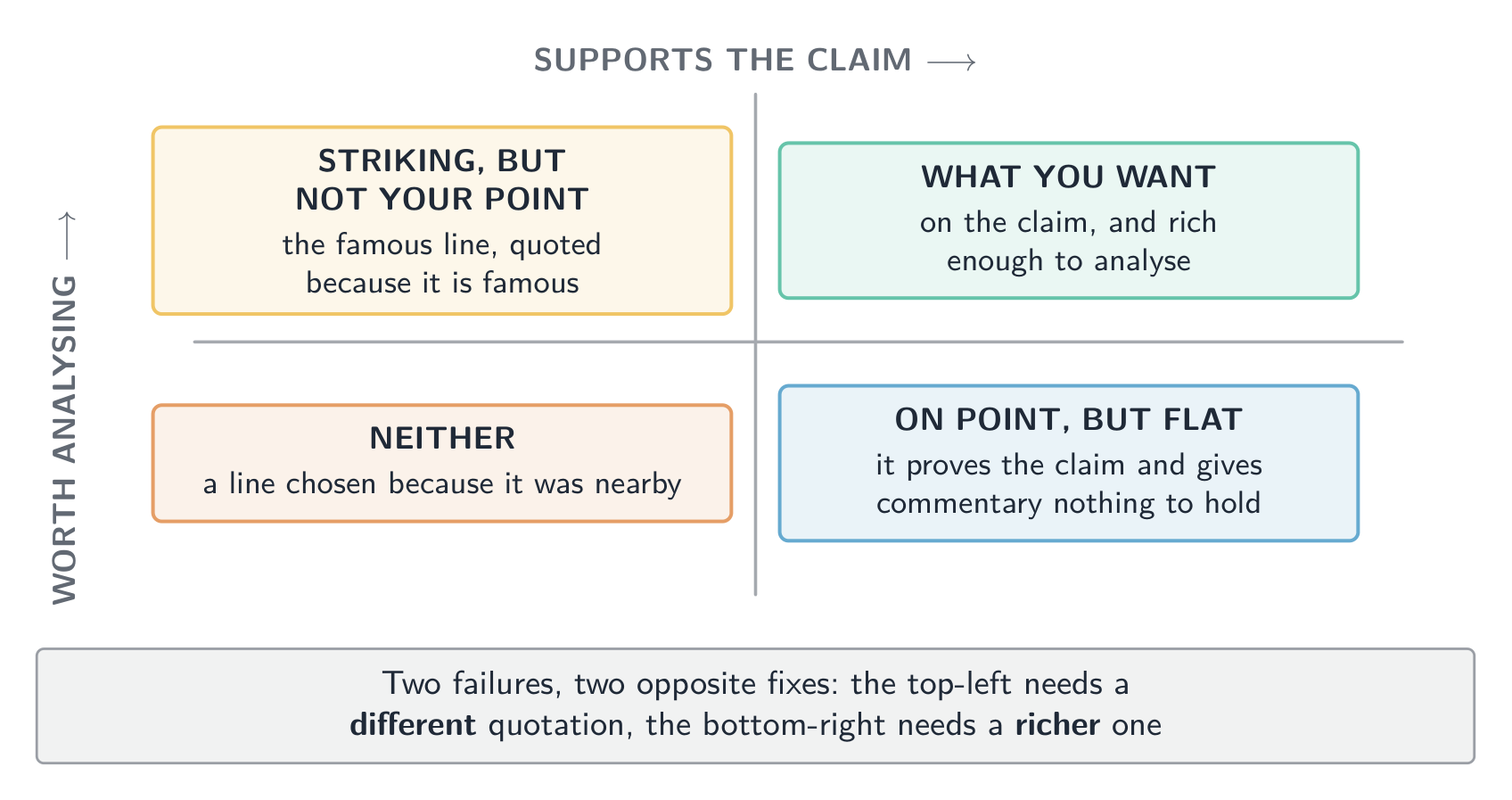
    두 가지 실패와 그에 대응한 두 가지 해결책: 다른 인용구, 또는 더 풍부한 인용구
    3.10

    Control Over the Elements of Composition · ⁨구성 요소에 대한 통제력⁩

    Syllabus
    English

    Enduring Understanding (LAN-1): Readers establish and communicate their interpretations of literature through arguments supported by textual evidence.

    Learning Objective 7.E: Demonstrate control over the elements of composition to communicate clearly.

    • LAN-1.L Grammar and mechanics that follow established conventions of language allow writers to clearly communicate their interpretation of a text.
    한국어

    영구적 이해 (LAN-1): 독자들은 텍스트의 증거로 지지되는 논쟁을 통해 문학 작품을 해석하고 이를 전달합니다.

    학습 목표 7.E: 명확한 의사소통을 위해 구성 요소에 대한 통제를 보여줍니다.

    • LAN-1.L 확립된 언어 관행을 따르는 문법 및 구문 법칙은 작가들이 텍스트에 대한 자신의 해석을 명확하게 전달할 수 있게 합니다.

    Source: College Board AP Course and Exam Description · ⁨출처: College Board AP Course and Exam Description⁩

    English

    Grammar and mechanics that follow established conventions allow writers to communicate clearly. On this exam, control of language is not a separate mark but a condition of the others: an unclear sentence cannot deliver commentary a reader can credit.

    Worked example (a real AP exam task). A Question 3 literary-argument prompt asks you to choose a work and analyse how a character's conflict contributes to an interpretation of the work as a whole. A weak answer narrates the plot around the conflict. A scoring answer identifies competing values and lets them intersect: "The protagonist's external conflict with his family over the inheritance is heightened by an internal one: he wants the independence the money would buy, and he wants to remain the son who never asked for it. Because the two conflicts share a single object, resolving either resolves neither - which is why the novel ends with a choice that satisfies no one, including him." Two conflicts, named as values, and an interpretation of the whole.

    한국어

    기존 관례를 따르는 문법 및 기법은 작가로 하여금 명확하게 소통할 수 있게 합니다. 이 시험에서 언어 통제는 별개의 채점 항목이 아니라 다른 항목들의 전제 조건입니다: 불명확한 문장은 독자가 신뢰할 수 있는 비평적 분석을 전달할 수 없습니다.

    작전 예제 (실제 AP 시험 과제). 3번 문항은 문학 논증형 prompt로, 작품 하나를 선택하여 등장인물의 갈등이 작품 전체에 대한 해석에 어떻게 기여하는지 분석하라는 것입니다. 약한 답안은 갈등 주변에 줄거리를 서술할 뿐입니다. 높은 점수를 받은 답안은 **경쟁하는 가치(competing values)**를 식별하고它们在相交: “주인공의 가족과의 유산 문제에 대한 외부 갈등은 내면의 갈등으로 증폭된다: 그는 돈으로 살 수 있는 독립을 원하며, 동시에 자신이 요청하지 않은 아들로 남기를 원한다. 두 갈등이 단일한 대상을 공유하므로,either를 해결하면 neither도 해결되지 않는다—따라서 소설은 그 자신 포함한 아무도 만족시키지 않는 선택으로 끝난다.” 두 가지 갈등, 가치로서의 명명, 그리고 작품 전체에 대한 해석.

    3.10

    Exam tips · ⁨시험 팁⁩

    English
    • Inactions reveal motive. What a character declines to do is often the strongest evidence available.
    • The unchanged character is the measure by which change in others becomes visible.
    • Setting now includes the social and historical situation - it supplies the constraint that makes choices meaningful.
    • Conflict is between competing values, not merely between people. Name the values.
    • An event matters only if you can say what it does to the conflict or to a character. Otherwise it is plot summary.
    • A thesis must state an interpretation, not what happens. Summary cannot be defended.
    한국어
    • 무행동(inactions)은 동기를 드러냅니다. 등장인물이 하지 않는 것은 종종 가장 강력한 증거가 됩니다.
    • 변하지 않는 인물은 타인의 변화를 가시적으로 만드는 기준이 됩니다.
    • 배경에는 이제 사회적·역사적 상황이 포함되며, 이는 선택이 의미를 갖게 하는 제약을 제공합니다.
    • 갈등은 단순히 사람 간의 것이 아니라 경쟁하는 가치 사이의 것입니다. 가치를 명시하십시오.
    • 사건이 중요한 것은 그것이 갈등이나 등장인물에 어떤 영향을 미치는지 말할 수 있을 때뿐입니다. 그렇지 않으면 줄거리 요약일 뿐입니다.
    • 논제는发生了什么가 아닌 해석을 명시해야 합니다. 요약은 방어할 수 없습니다.
  • 4

    Short Fiction II · ⁨소설 II⁩

    Watch lesson · ⁨수업 보기⁩
    4.1

    What Textual Details Reveal About a Character

    Syllabus
    English

    Enduring Understanding (CHR-1): Characters in literature allow readers to study and explore a range of values, beliefs, assumptions, biases, and cultural norms represented by those characters.

    Learning Objective 1.A: Identify and describe what specific textual details reveal about a character, that character’s perspective, and that character’s motives.

    • CHR-1.O The significance of characters is often revealed through their agency and through nuanced descriptions.
    • CHR-1.P Characters’ choices—in speech, action, and inaction— reveal what they value.
    한국어

    영구적 이해 (CHR-1): 문학 작품 속 캐릭터들은 독자가 그 캐릭터들이 대표하는 다양한 가치관, 신념, 전제, 편견 및 문화적 규범을 연구하고 탐구할 수 있게 합니다.

    학습 목표 1.A: 특정 텍스트 디테일이 캐릭터, 해당 캐릭터의 시각, 그리고 해당 캐릭터의 동기에 대해 무엇을显露하는지 식별하고 묘사하십시오.

    • CHR-1.O 인물의 중요성은 종종 그들의 주체성과 미묘한 묘사를 통해 드러난다.
    • CHR-1.P 인물의 선택—언어, 행동 및 비행동에서—그들이 무엇을 가치 있게 여기는지 보여준다.

    Source: College Board AP Course and Exam Description · ⁨출처: College Board AP Course and Exam Description⁩

    Unit 4 returns to short fiction with a much larger toolkit. Its two most valuable additions are narrative distance and the idea that choices reveal values.

    • The significance of characters is often revealed through their agency 能动性 and through nuanced descriptions.
    • Characters' choices - in speech, action, and inaction - reveal what they value.

    That second statement is the most practical sentence in the whole course for essay-writing. Whenever you need a claim about a character, look at a choice and ask what it must be true for that choice to have made sense to them.

    Vocabulary · ⁨어휘⁩ Train · ⁨연습하기⁩
    English 한국어
    agency/ˈeɪdʒənsi/ 주체성
    4.2

    The Function of Contrasting Characters

    Syllabus
    English

    Enduring Understanding (CHR-1): Characters in literature allow readers to study and explore a range of values, beliefs, assumptions, biases, and cultural norms represented by those characters.

    Learning Objective 1.C: Explain the function of contrasting characters.

    • CHR-1.Q The main character in a narrative is the protagonist; the antagonist in the narrative opposes the protagonist and may be another character, the internal conflicts of the protagonist, a collective (such as society), or nature.
    • CHR-1.R Protagonists and antagonists may represent contrasting values.
    한국어

    영구적 이해 (CHR-1): 문학 작품 속 캐릭터들은 독자가 그 캐릭터들이 대표하는 다양한 가치관, 신념, 전제, 편견 및 문화적 규범을 연구하고 탐구할 수 있게 합니다.

    학습 목표 1.C: 대비되는 인물의 기능을 설명한다.

    • CHR-1.Q 서사에서의 주인공(protagonist)은 주인공이며, 반주인공(antagonist)은 주인공에 대립하며, 다른 인물, 주인공의 내부 갈등, 집단(예: 사회) 또는 자연이 될 수 있다.
    • CHR-1.R 주인공과 반주인공은 대비되는 가치를 대표할 수 있다.

    Source: College Board AP Course and Exam Description · ⁨출처: College Board AP Course and Exam Description⁩

    • The main character is the protagonist 主人公; the antagonist 对立者 opposes them.
    • Protagonists and antagonists may represent contrasting values.

    The word may is doing careful work. An antagonist is not necessarily a villain; the strongest antagonists hold a value the reader can also recognise as good, which is why the conflict is a conflict rather than a rout.

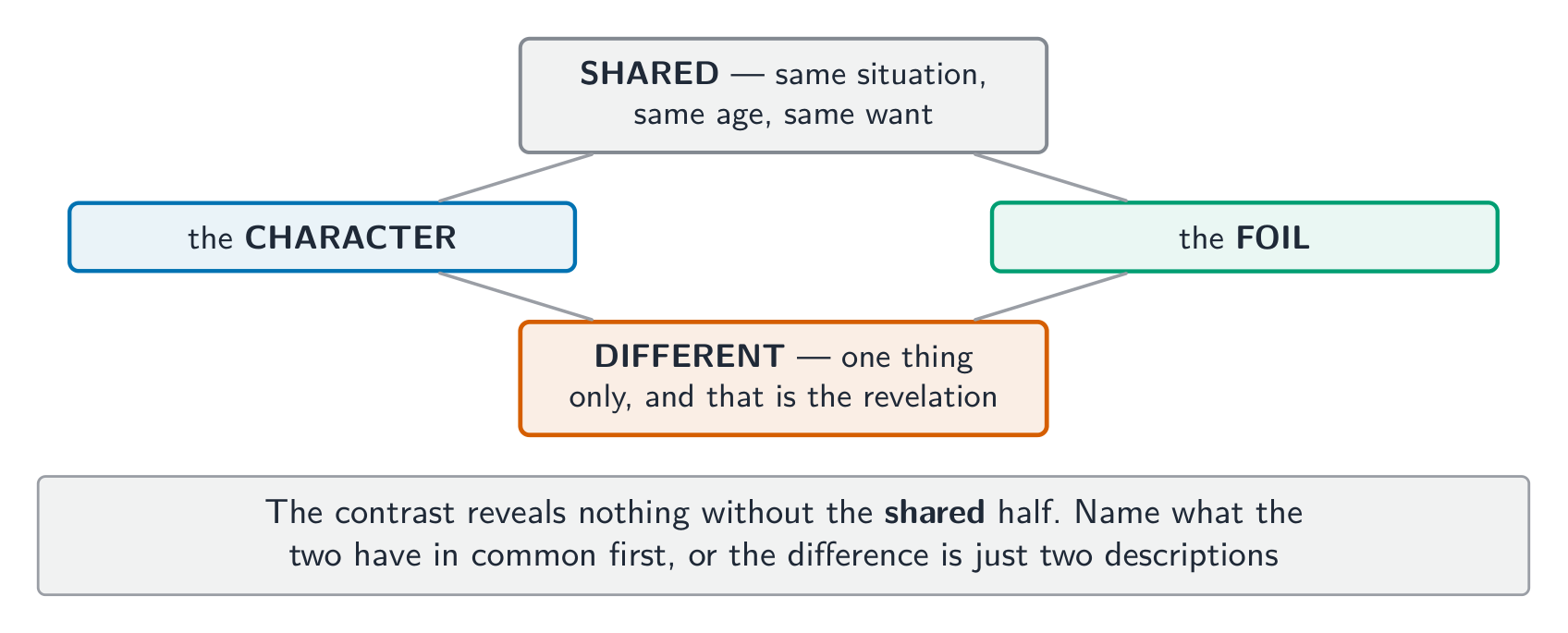
    A contrast reveals nothing without the shared half - name it first
    Vocabulary · ⁨어휘⁩ Train · ⁨연습하기⁩
    English 한국어
    protagonist/ˈprəʊtəɡənɪst/ 주인공
    antagonist/ænˈtæɡənɪst/ 악당
    4.3

    Nuances in Characters' Relationships

    Syllabus
    English

    Enduring Understanding (CHR-1): Characters in literature allow readers to study and explore a range of values, beliefs, assumptions, biases, and cultural norms represented by those characters.

    Learning Objective 1.D: Describe how textual details reveal nuances and complexities in characters’ relationships with one another.

    • CHR-1.S Conflict among characters often arises from tensions generated by their different value systems.
    한국어

    영구적 이해 (CHR-1): 문학 작품 속 캐릭터들은 독자가 그 캐릭터들이 대표하는 다양한 가치관, 신념, 전제, 편견 및 문화적 규범을 연구하고 탐구할 수 있게 합니다.

    학습 목표 1.D: 텍스트적 디테일이 인물 간의 관계에 있는 미묘함과 복잡성을 어떻게 드러내는지 설명한다.

    • CHR-1.S 인물 간의 갈등은 종종 서로 다른 가치 체계로 인해 발생하는 긴장감에서 arises한다.

    Source: College Board AP Course and Exam Description · ⁨출처: College Board AP Course and Exam Description⁩

    Conflict among characters often arises from tensions generated by their different value systems.

    This is Unit 3's definition applied to relationships. Two characters in a long-running disagreement usually disagree about something prior to the argument they are having.

    4.4

    The Function of Setting in a Narrative

    Syllabus
    English

    Enduring Understanding (SET-1): Setting and the details associated with it not only depict a time and place, but also convey values associated with that setting.

    Learning Objective 2.B: Explain the function of setting in a narrative.

    • SET-1.C A setting may help establish the mood and atmosphere of a narrative.
    한국어

    영구적 이해 (SET-1): 배경(setting)과 그에 관련된 디테일들은 단순히 시간과 장소를 묘사할 뿐만 아니라, 해당 배경과 연관된 가치관도 전달합니다.

    학습 목표 2.B: 서사에서의 배경(setting)의 기능을 설명한다.

    • SET-1.C 배경(setting)은 서사의 분위기(mood)와 atmosphere를 설정하는 데 도움이 될 수 있다.

    Source: College Board AP Course and Exam Description · ⁨출처: College Board AP Course and Exam Description⁩

    A setting may help establish the mood and atmosphere of a narrative.

    Mood is the reader's feeling; atmosphere is the quality the text creates around events. Both are produced by selection - which details of a place the text mentions, and which it does not.

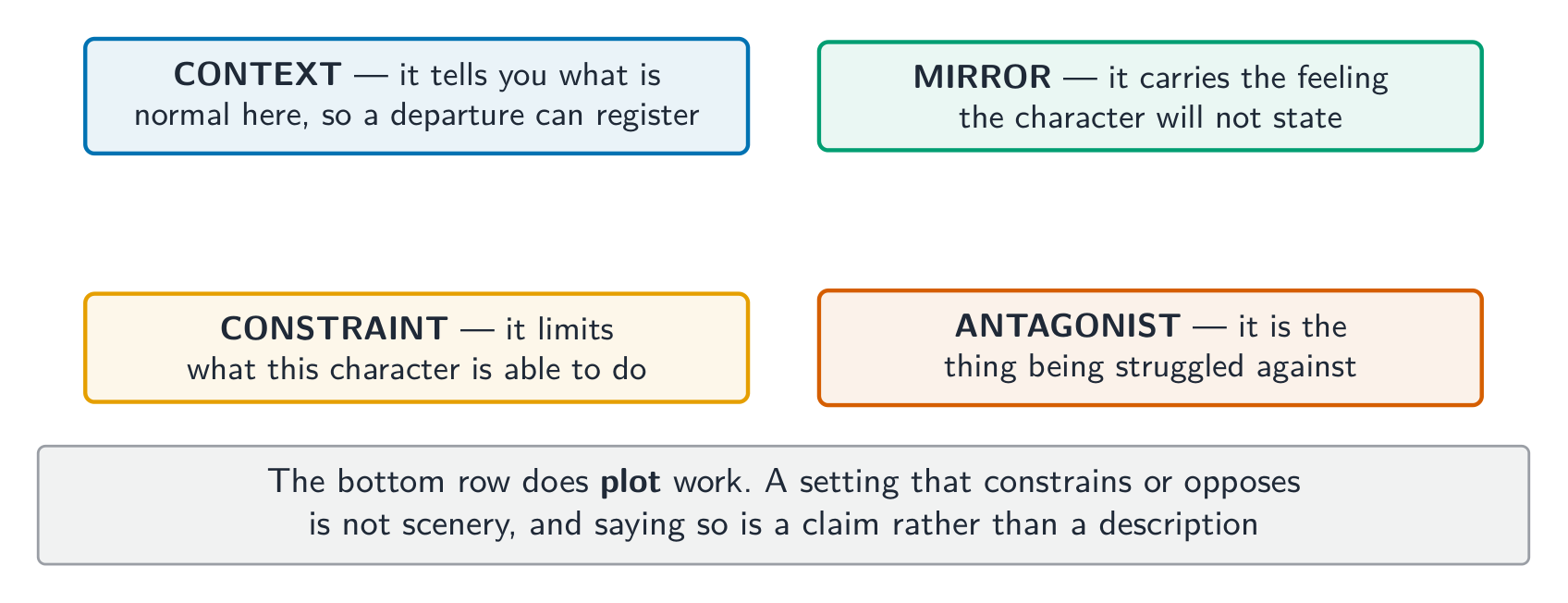
    Setting does four jobs, and the bottom row does plot work
    Explore · ⁨탐색하기⁩

    Sort each setting into the job it is doing

    The bottom two do plot work: a setting that constrains or opposes a character is not scenery.

    4.5

    The Relationship Between Character and Setting

    Syllabus
    English

    Enduring Understanding (SET-1): Setting and the details associated with it not only depict a time and place, but also convey values associated with that setting.

    Learning Objective 2.C: Describe the relationship between a character and a setting.

    • SET-1.D The environment a character inhabits provides information about that character.
    한국어

    영구적 이해 (SET-1): 배경(setting)과 그에 관련된 디테일들은 단순히 시간과 장소를 묘사할 뿐만 아니라, 해당 배경과 연관된 가치관도 전달합니다.

    학습 목표 2.C: 인물과 배경(setting) 사이의 관계를 설명한다.

    • SET-1.D 인물이 거주하는 환경은 해당 인물에 대한 정보를 제공한다.

    Source: College Board AP Course and Exam Description · ⁨출처: College Board AP Course and Exam Description⁩

    The environment a character inhabits provides information about that character.

    This is a second route into character that avoids the trap of psychologising. A room described through its neglect, its order, or its borrowed furniture tells you about the person who lives there, and it is textual evidence rather than speculation.

    4.6

    How Plot Orders Events

    Syllabus
    English

    Enduring Understanding (STR-1): The arrangement of the parts and sections of a text, the relationship of the parts to each other, and the sequence in which the text reveals information are all structural choices made by a writer that contribute to the reader’s interpretation of a text.

    Learning Objective 3.A: Identify and describe how plot orders events in a narrative.

    • STR-1.R Some patterns in dramatic situations are so common that they are considered archetypes, and these archetypes create certain expectations for how the dramatic situations will progress and be resolved. Note: For the exam, students are not expected to identify or label archetypes.
    한국어

    영구적 이해 (STR-1): 텍스트의 부분과 섹션의 배열, 부분들 간의 관계, 그리고 텍스트가 정보를 공개하는 순서는 모두 작가가 내린 구조적 선택이며, 이는 독자의 텍스트 해석에 기여합니다.

    학습 목표 3.A: 플롯이 서사(narrative)에서 사건들을 어떻게 배열하는지 식별하고 묘사하십시오.

    • STR-1.R 극적 상황의 몇몇 패턴은 매우 흔하여 원형(archetypes)으로 간주되며, 이러한 원형은 극적 상황의 진행 및 해결 방식을 특정 기대감을 생성한다. 참고: 시험에서 학생들은 원형을 식별하거나 명명할 필요는 없다.

    Source: College Board AP Course and Exam Description · ⁨출처: College Board AP Course and Exam Description⁩

    Some patterns in dramatic situations are so common that they are considered archetypes 原型, and these archetypes carry associations readers bring with them.

    Use archetypes carefully: recognising one is a starting point, and the interesting analysis is almost always where a text departs from the pattern it invoked.

    Vocabulary · ⁨어휘⁩ Train · ⁨연습하기⁩
    English 한국어
    archetypes/ˈɑːkɪtaɪps/ 아키타입
    4.7

    The Function of Contrasts Within a Text

    Syllabus
    English

    Enduring Understanding (STR-1): The arrangement of the parts and sections of a text, the relationship of the parts to each other, and the sequence in which the text reveals information are all structural choices made by a writer that contribute to the reader’s interpretation of a text.

    Learning Objective 3.D: Explain the function of contrasts within a text.

    • STR-1.S The differences highlighted by a contrast emphasize the particular traits, aspects, or characteristics important for comparison of the things being contrasted.
    • STR-1.T Contrasts often represent conflicts in values related to character, narrator, or speaker perspectives on ideas represented by a text.
    한국어

    영구적 이해 (STR-1): 텍스트의 부분과 섹션의 배열, 부분들 간의 관계, 그리고 텍스트가 정보를 공개하는 순서는 모두 작가가 내린 구조적 선택이며, 이는 독자의 텍스트 해석에 기여합니다.

    학습 목표 3.D: 텍스트 내 대비의 기능을 설명하십시오.

    • STR-1.S 대비에 의해 강조되는 차이는 대비되는 사물들의 비교에 중요한 특정特质, 측면 또는 특성을 강조한다.
    • STR-1.T 대비는 종종 인물, 서사자 또는 화자의 관점에 관련된 텍스트로 표현되는 아이디어에 대한 가치의 갈등을 나타낸다.

    Source: College Board AP Course and Exam Description · ⁨출처: College Board AP Course and Exam Description⁩

    • The differences highlighted by a contrast emphasise particular traits or characteristics in the things contrasted.
    • Contrasts often represent conflicts in values related to character, narrator, or speaker perspectives.
    4.8

    Identifying the Narrator or Speaker

    Syllabus
    English

    Enduring Understanding (NAR-1): A narrator’s or speaker’s perspective controls the details and emphases that affect how readers experience and interpret a text.

    Learning Objective 4.A: Identify and describe the narrator or speaker of a text.

    • NAR-1.J Narrators may function as characters in the narrative who directly address readers and either recall events or describe them as they occur.
    한국어

    영구적 이해 (NAR-1): 서술자 또는 화자의 시각은 독자가 텍스트를 경험하고 해석하는 방식에 영향을 미치는 디테일과 강조점来控制합니다.

    학습 목표 4.A: 텍스트의 서술자 또는 화자를 식별하고 묘사하십시오.

    • NAR-1.J 서사자는 서사 속 인물로서 독자에게 직접 말하고,event들을 회상하거나发生当时에 묘사할 수 있다.

    Source: College Board AP Course and Exam Description · ⁨출처: College Board AP Course and Exam Description⁩

    Narrators may function as characters who directly address readers, and who either recall events or relate them as they occur.

    That distinction - recalling versus relating as they occur - is the first axis of narrative distance below.

    4.9

    The Function of Point of View

    Syllabus
    English

    Enduring Understanding (NAR-1): A narrator’s or speaker’s perspective controls the details and emphases that affect how readers experience and interpret a text.

    Learning Objective 4.B: Identify and explain the function of point of view in a narrative.

    • NAR-1.K Narrative distance refers to the physical distance, chronological distance, relationships, or emotional investment of the narrator to the events or characters of the narrative.
    • NAR-1.L Stream of consciousness is a type of narration in which a character’s thoughts are related through a continuous dialogue or description.
    한국어

    영구적 이해 (NAR-1): 서술자 또는 화자의 시각은 독자가 텍스트를 경험하고 해석하는 방식에 영향을 미치는 디테일과 강조점来控制합니다.

    학습 목표 4.B: 서사 내 시점의 기능을 식별하고 설명하십시오.

    • NAR-1.K 서사 거리(narrative distance)는 서사자와의 물리적 거리, 시간적 거리, 관계 또는 서사사건이나 인물에 대한 정서적 몰입도를 의미한다.
    • NAR-1.L 의식의 흐름(stream of consciousness)은 인물의 생각이 지속적인 대화나 묘사를 통해 서술되는 서사 유형이다.

    Source: College Board AP Course and Exam Description · ⁨출처: College Board AP Course and Exam Description⁩

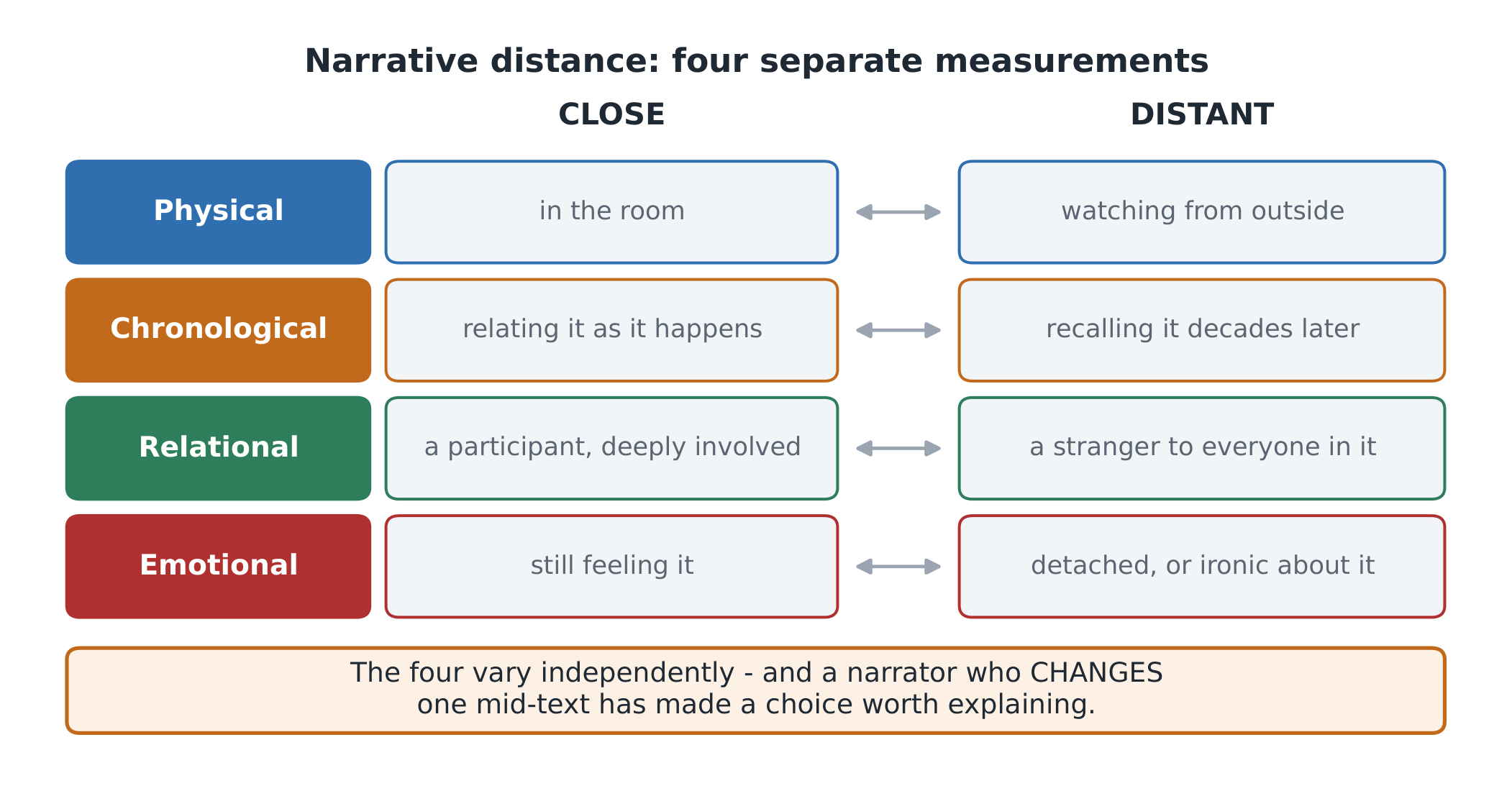
    Four distances between the narrator and the events - and each one is a choice
    A narrator's position is not one fact but four, and any of them can be the analysis
    • Narrative distance 叙述距离 refers to the physical distance, chronological distance, relationships, or emotional distance between the narrator and the events or characters.
    • Stream of consciousness 意识流 is narration in which a character's thoughts are related through a continuous flow, often with little conventional ordering.

    Narrative distance is the most powerful and least-used tool in this course. A narrator recounting their childhood forty years later is chronologically distant, and that distance supplies irony the child could not have had. Reduce the distance - a narrator relating events as they occur - and the irony vanishes, replaced by immediacy and unreliability.

    Vocabulary · ⁨어휘⁩ Train · ⁨연습하기⁩
    English 한국어
    Narrative distance/ˈnærətɪv ˈdɪstəns/ 서사 거리
    Stream of consciousness/striːm ɒv ˈkɒnʃəsnəs/ 의식의 흐름
    4.10

    Details, Diction, and Syntax Reveal Perspective

    Syllabus
    English

    Enduring Understanding (NAR-1): A narrator’s or speaker’s perspective controls the details and emphases that affect how readers experience and interpret a text.

    Learning Objective 4.C: Identify and describe details, diction, or syntax in a text that reveal a narrator’s or speaker’s perspective.

    • NAR-1.M The narrators’, characters’, or speakers’ backgrounds and perspectives shape the tone they convey about subjects or events in the text.
    • NAR-1.N Descriptive words, such as adjectives and adverbs, not only qualify or modify the things they describe but also convey a perspective toward those things.
    • NAR-1.O The attitude of narrators, characters, or speakers toward an idea, character, or situation emerges from their perspective and may be referred to as tone.
    한국어

    영구적 이해 (NAR-1): 서술자 또는 화자의 시각은 독자가 텍스트를 경험하고 해석하는 방식에 영향을 미치는 디테일과 강조점来控制합니다.

    학습 목표 4.C: 서사자나 화자의 관점을 드러내는 텍스트의 디테일, 어휘 또는 문장 구조를 식별하고 설명한다.

    • NAR-1.M 서사자, 인물 또는 화자의 배경과 관점은 텍스트 속 주제나 사건에 대해 전달되는 톤을 형성한다.
    • NAR-1.N 형용사와 부사와 같은 수식 단어는 묘사 대상의 성질을 제한하거나 수정할 뿐만 아니라, 그 대상에 대한 관점도 전달한다.
    • NAR-1.O 서사자, 인물 또는 화자가 아이디어, 인물 또는 상황에 대해 가지는 태도는 그들의 관점에서 도출되며, 이를 톤(tone)이라고 할 수 있다.

    Source: College Board AP Course and Exam Description · ⁨출처: College Board AP Course and Exam Description⁩

    • Narrators' and characters' backgrounds and perspectives shape the tone they convey.
    • Descriptive words not only qualify what they describe but convey a perspective toward it.
    • The attitude of a narrator or speaker toward an idea, character, or situation emerges from these choices.
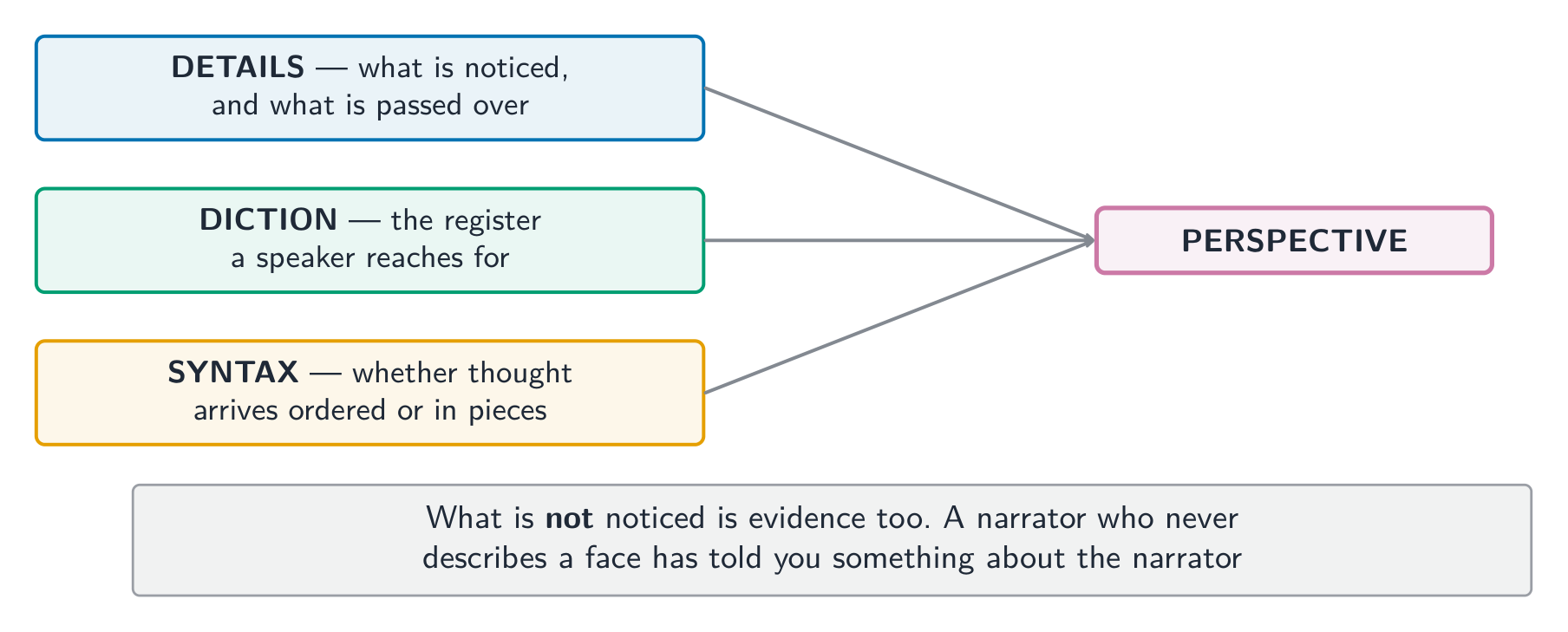
    Perspective is built from three observable things - and what is not noticed counts
    Explore · ⁨탐색하기⁩

    Build a perspective from three observables

    What is not noticed is evidence too: a narrator who never describes a face has told you something.

    4.11

    Developing a Literary Thesis Statement

    Syllabus
    English

    Enduring Understanding (LAN-1): Readers establish and communicate their interpretations of literature through arguments supported by textual evidence.

    Learning Objective 7.B: Develop a thesis statement that conveys a defensible claim about an interpretation of literature and that may establish a line of reasoning.

    • LAN-1.D A thesis statement expresses an interpretation of a literary text, and requires a defense, through use of textual evidence and a line of reasoning, both of which are explained in an essay through commentary.
    • LAN-1.E A thesis statement may preview the development or line of reasoning of an interpretation. This is not to say that a thesis statement must list the points of an interpretation, literary elements to be analyzed, or specific evidence to be used in the argument.
    한국어

    영구적 이해 (LAN-1): 독자들은 텍스트의 증거로 지지되는 논쟁을 통해 문학 작품을 해석하고 이를 전달합니다.

    학습 목표 7.B: 문학 해석에 대한 타당한 주장을 전달하며 논증의 흐름(line of reasoning)을 설정할 수 있는 논제문을 개발합니다.

    • LAN-1.D 논제 statement는 문학 텍스트에 대한 해석을 표현하며, 에세이에서 논평(commentary)을 통해 텍스트적 증거와 추론의 흐름을 사용하여 변명(defense)이 요구된다.
    • LAN-1.E 논제문은 해석의 전개나 논증의 흐름을 미리 제시할 수 있습니다. 하지만 이것이 논제문이 반드시 해석의 점수, 분석할 문학 요소, 혹은 논증에 사용될 구체적인 증거를 나열해야 한다는 의미는 아닙니다.

    Source: College Board AP Course and Exam Description · ⁨출처: College Board AP Course and Exam Description⁩

    Unchanged: a thesis expresses an interpretation and requires textual defence; it may preview the line of reasoning.

    4.12

    Developing Commentary

    Syllabus
    English

    Enduring Understanding (LAN-1): Readers establish and communicate their interpretations of literature through arguments supported by textual evidence.

    Learning Objective 7.C: Develop commentary that establishes and explains relationships among textual evidence, the line of reasoning, and the thesis.

    • LAN-1.F A line of reasoning is the logical sequence of claims that work together to defend the overarching thesis statement.
    • LAN-1.G A line of reasoning is communicated through commentary that explains the logical relationship between the overarching thesis statement and the claims/evidence within the body of an essay.
    • LAN-1.M The body paragraphs of a written argument develop the reasoning and justify claims using evidence and providing commentary that links the evidence to the overall thesis.
    • LAN-1.N Effective paragraphs are cohesive and often use topic sentences to state a claim and explain the reasoning that connects the various claims and evidence that make up the body of an essay.
    한국어

    영구적 이해 (LAN-1): 독자들은 텍스트의 증거로 지지되는 논쟁을 통해 문학 작품을 해석하고 이를 전달합니다.

    학습 목표 7.C: 텍스트적 증거, 논증의 흐름, 그리고 논제문 사이의 관계를 설정하고 설명하는 Commentary를 개발합니다.

    • LAN-1.F 논증의 흐름은 포괄적인 논제문을 방어하기 위해 함께 작동하는 주장들의 논리적 순서입니다.
    • LAN-1.G 논증의 흐름은 포괄적인 논제문과 논증 essay 본문의 주장/证据 사이의 논리적 관계를 설명하는 Commentary를 통해 전달됩니다.
    • LAN-1.M 논증 글의 본론 paragraph들은 근거와 논평을 제공하여 논리를 전개하고 주장을 정당화하며, 이 근거를 전체 논제 statement와 연결시킨다.
    • LAN-1.N 효과적인 paragraph들은 일관성이 있으며,Often 주제문(topic sentences)을 사용하여 주장을 명시하고 에세이 본론을 구성하는 다양한 주장과 근거를 연결하는 논리를 설명한다.

    Source: College Board AP Course and Exam Description · ⁨출처: College Board AP Course and Exam Description⁩

    • A line of reasoning is the logical sequence of claims defending the thesis, communicated through commentary.
    • Body paragraphs develop the reasoning and justify claims using evidence.
    • Effective paragraphs are cohesive and often use topic sentences 主题句 to state a claim and explain the reasoning.
    Vocabulary · ⁨어휘⁩ Train · ⁨연습하기⁩
    English 한국어
    topic sentences/ˈtɒpɪk ˈsentənsɪz/ 주제문
    4.13

    Selecting Relevant and Sufficient Evidence

    Syllabus
    English

    Enduring Understanding (LAN-1): Readers establish and communicate their interpretations of literature through arguments supported by textual evidence.

    Learning Objective 7.D: Select and use relevant and sufficient evidence to both develop and support a line of reasoning.

    • LAN-1.H Writers use evidence strategically and purposefully to illustrate, clarify, exemplify, associate, amplify, or qualify a point.
    • LAN-1.I Evidence is effective when the writer of the essay uses commentary to explain a logical relationship between the evidence and the claim.
    • LAN-1.J Evidence is sufficient when its quantity and quality provide apt support for the line of reasoning.
    • LAN-1.K Developing and supporting an interpretation of a text is a recursive process; an interpretation can emerge from analyzing evidence and then forming a line of reasoning, or the interpretation can emerge from forming a line of reasoning and then identifying relevant evidence to support that line of reasoning.
    한국어

    영구적 이해 (LAN-1): 독자들은 텍스트의 증거로 지지되는 논쟁을 통해 문학 작품을 해석하고 이를 전달합니다.

    학습 목표 7.D: 논증의 흐름을 개발하고 지지하기 위해 관련되고 충분한 증거를 선정하여 사용합니다.

    • LAN-1.H 작가는 특정 점을 설명, 명확히 하기, 예시 들기, 연결하기, 강조하기, 혹은 제한하기 위해 전략적이고 의도적으로 증거를 사용합니다.
    • LAN-1.I 논증 essay의 작가가 Commentary를 사용하여 증거와 주장 사이의 논리적 관계를 설명할 때, 증거는 효과적입니다.
    • LAN-1.J 증거의 양과 질이 논증의 흐름에 적절한 지지를 제공할 때, 증거는 충분합니다.
    • LAN-1.K 텍스트에 대한 해석을 개발하고 지지하는 것은 반복되는 과정입니다. 해석은 증거를 분석한 후 논증의 흐름을 형성함으로써 emerge될 수 있으며, 혹은 논증의 흐름을 형성한 후 이를 지지할 relevant evidence를 확인함으로써 emerge될 수 있습니다.

    Source: College Board AP Course and Exam Description · ⁨출처: College Board AP Course and Exam Description⁩

    Same four points as Unit 3: evidence used strategically; effective when commentary explains the relationship; sufficient in quantity and quality; and interpretation as a recursive process.

    4.14

    Control Over the Elements of Composition

    Syllabus
    English

    Enduring Understanding (LAN-1): Readers establish and communicate their interpretations of literature through arguments supported by textual evidence.

    Learning Objective 7.E: Demonstrate control over the elements of composition to communicate clearly.

    • LAN-1.O Coherence occurs at different levels in a piece of writing. In a sentence, the idea in one clause logically links to an idea in the next. In a paragraph, the idea in one sentence logically links to an idea in the next. In a text, the ideas in one paragraph logically link to the ideas in the next.
    • LAN-1.P Writers achieve coherence when the arrangement and organization of reasons, evidence, ideas, or details is logical. Writers may use transitions, repetition, synonyms, pronoun references, or parallel structure to indicate relationships between and among those reasons, evidence, ideas, or details.
    한국어

    영구적 이해 (LAN-1): 독자들은 텍스트의 증거로 지지되는 논쟁을 통해 문학 작품을 해석하고 이를 전달합니다.

    학습 목표 7.E: 명확한 의사소통을 위해 구성 요소에 대한 통제를 보여줍니다.

    • LAN-1.O 일관성(coherence)은 글쓰기에서 다른 수준에서 발생한다. 한 문장 내에서 하나의 절의 아이디어는 다음 절의 아이디어와 논리적으로 연결된다. 한 paragraph 내에서 하나의 문장의 아이디어는 다음 문장의 아이디어와 논리적으로 연결된다. 하나의 텍스트 내에서 하나의 paragraph의 아이디어는 다음 paragraph의 아이디어와 논리적으로 연결된다.
    • LAN-1.P 작가들은 이유, 증거, 아이디어 또는 디테일의 배치와 조직이 논리적일 때 일관성을 달성한다. 작가들은 이러한 이유, 증거, 아이디어 또는 디테일 간의 관계를 나타내기 위해 전환어(transitions), 반복, 동의어, 대명사 참조 또는 평행 구조를 사용할 수 있다.

    Source: College Board AP Course and Exam Description · ⁨출처: College Board AP Course and Exam Description⁩

    Coherence occurs at different levels - within a sentence, between sentences, across the essay - and writers achieve it when the arrangement of reasons, evidence, and details makes the line of reasoning followable.

    Worked example (a real AP exam task). A prose fiction prompt asks how the author's narrative choices convey the narrator's attitude to a remembered event. A weak answer: "The narrator is nostalgic and uses descriptive language." A scoring answer uses narrative distance: "The narrator relates a single afternoon from a distance of decades, and the distance is doing the work: he describes his own excitement in the third person - 'the boy ran' - before returning to 'I' for the disappointment. Choosing where to close the chronological gap lets him withhold sympathy from his younger self while claiming the loss as his own." Distance, its variation, and the attitude it produces.

    4.14

    Exam tips

    • Choices reveal values. Ask what must have been true for the choice to make sense to that character.
    • An antagonist is not a villain. The strongest hold a value the reader can also recognise as good.
    • The environment tells you about the character - and it is textual evidence, not speculation.
    • Archetypes are a starting point. The analysis is where the text departs from the pattern.
    • Narrative distance has four kinds - physical, chronological, relational, emotional. It is the most underused tool here.
    • A narrator who closes or opens the distance mid-text has made a choice. Say what it produces.
  • 5

    Poetry II · ⁨시 II⁩

    Watch lesson · ⁨수업 보기⁩
    5.1

    The Function of Structure in a Text · ⁨텍스트 내 구조의 기능⁩

    Syllabus
    English

    Enduring Understanding (STR-1): The arrangement of the parts and sections of a text, the relationship of the parts to each other, and the sequence in which the text reveals information are all structural choices made by a writer that contribute to the reader’s interpretation of a text.

    Learning Objective 3.C: Explain the function of structure in a text.

    • STR-1.U Closed forms of poetry include predictable patterns in the structure of lines, stanzas, meter, and rhyme, which develop relationships among ideas in the poem. Note: The AP Exam will not require students to label or identify specific rhyme schemes, metrical patterns, or forms of poetry.
    • STR-1.V Open forms of poetry may not follow expected or predictable patterns in the structure of their lines or stanzas, but they may still have structures that develop relationships between ideas in the poem.
    • STR-1.W Structures combine in texts to emphasize certain ideas and concepts.
    한국어

    영구적 이해 (STR-1): 텍스트의 부분과 섹션의 배열, 부분들 간의 관계, 그리고 텍스트가 정보를 공개하는 순서는 모두 작가가 내린 구조적 선택이며, 이는 독자의 텍스트 해석에 기여합니다.

    학습 목표 3.C: 텍스트 내 구조의 기능을 설명하십시오.

    • STR-1.U闭合诗(closed forms)은 행, 연, 운율(rhyme), 리듬(meter)의 구조에 예측 가능한 패턴을 포함하며, 이는 시 속 아이디어 간의 관계를 형성한다. 참고: AP 시험에서 학생들은 특정 운율 패턴, 미트릭 패턴(p metrical patterns) 또는 시의 형태를 명명하거나 식별할 필요는 없다.
    • STR-1.V 개방형(open forms) 시는 행이나 연의 구조에서 예상되거나 예측 가능한 패턴을 따르지 않을 수 있으나, 여전히 시 속 아이디어 간의 관계를 형성하는 구조를 가질 수 있다.
    • STR-1.W 텍스트에서 구조가 결합되어 특정 아이디어와 개념을 강조한다.

    Source: College Board AP Course and Exam Description · ⁨출처: College Board AP Course and Exam Description⁩

    English

    Unit 5 is the second poetry unit, and it does two things: it names the forms a poem can take, and it completes the figurative toolkit.

    • Closed forms 格律诗体 include predictable patterns in lines, stanzas, metre, and rhyme.
    • Open forms 自由诗体 may not follow expected or predictable patterns.
    • Structures combine in texts to emphasise certain ideas.

    The examinable question is never "which form is this?" but what the form does. In a closed form, the interesting moment is the departure - the line that runs long, the rhyme that fails to arrive. In an open form, the interesting moment is the imposition - the sudden regularity in a poem that has refused it.

    한국어

    유닛 5는 두 번째 시 유닛이며, 두 가지 일을 합니다: 시가 취할 수 있는 형식(form) 을 명명하고, 비유적 도구 모음을 완성합니다.

    • 격律诗体(closed forms) 는 행, 연, 리듬, 운율에서 예측 가능한 패턴을 포함합니다.
    • 자유诗体(open forms) 는 예상되거나 예측 가능한 패턴을 따르지 않을 수 있습니다.
    • 구조들은 텍스트 내에서 결합되어 특정 아이디어를 강조합니다.

    시험 문제에서 “이것은 어떤 형식인가?”라고 묻지는 않습니다. 형식이 무엇을 하는가를 묻습니다. 격律诗体에서는 흥미로운 순간은 이탈하는 지점 - 길게 뻗은 행,到達하지 못한 운입니다. 자유诗体에서는 흥미로운 순간은 강요되는 지점 - Predictable을 거부했던 시에 나타난 갑작스러운 규칙성입니다.

    Vocabulary · ⁨어휘⁩ Train · ⁨연습하기⁩
    English 한국어
    Closed forms/kləʊzd fɔːmz/ 폐쇄형 형식
    Open forms/ˈəʊpən fɔːmz/ 개방형 형식
    5.2

    Literal and Figurative Meaning · ⁨직설적 의미와 비유적 의미⁩

    Syllabus
    English

    Enduring Understanding (FIG-1): Comparisons, representations, and associations shift meaning from the literal to the figurative and invite readers to interpret a text.

    Learning Objective 5.A: Distinguish between the literal and figurative meanings of words and phrases.

    • FIG-1.L Words with multiple meanings or connotations add nuance or complexity that can contribute to interpretations of a text.
    한국어

    영구적 이해 (FIG-1): 비교, 표현, 그리고 연관성은 의미를 수학적·문어적 수준에서 비유적 수준으로 이동시켜 독자에게 텍스트를 해석하게 만듭니다.

    학습 목표 5.A: 단어 및 구의 직설적 의미와 비유적 의미를 구분한다.

    • FIG-1.L 다의어 또는 함의를 가진 단어는 텍스트 해석에 기여할 수 있는 미묘함이나 복잡성을 더한다.

    Source: College Board AP Course and Exam Description · ⁨출처: College Board AP Course and Exam Description⁩

    English

    Words with multiple meanings or connotations add nuance or complexity that can contribute to interpretation.

    In poetry, a word that could mean two things frequently means both. Resist choosing.

    한국어

    다의어 또는 함의를 가진 단어는 해석에 기여할 수 있는 미묘함이나 복잡성을 더합니다.

    시에서 두 가지 의미를 가질 수 있는 단어는 종종 두 의미를 모두 가집니다. 하나만 고르려 하지 마십시오.

    5.3

    The Function of Specific Words and Phrases · ⁨구체적인 단어와 구문의 기능⁩

    Syllabus
    English

    Enduring Understanding (FIG-1): Comparisons, representations, and associations shift meaning from the literal to the figurative and invite readers to interpret a text.

    Learning Objective 5.B: Explain the function of specific words and phrases in a text.

    • FIG-1.M Descriptive words, such as adjectives and adverbs, qualify or modify the things they describe and affect readers’ interaction with the text.
    • FIG-1.N Hyperbole exaggerates while understatement minimizes. Exaggerating or minimizing an aspect of an object focuses attention on that trait and conveys a perspective about the object.
    한국어

    영구적 이해 (FIG-1): 비교, 표현, 그리고 연관성은 의미를 수학적·문어적 수준에서 비유적 수준으로 이동시켜 독자에게 텍스트를 해석하게 만듭니다.

    학습 목표 5.B: 텍스트 내 특정 단어와 구문의 기능을 설명하십시오.

    • FIG-1.M 형용사와 부사 등의 서술어는 서술 대상을 제한하거나 수정하며, 독자의 텍스트와의 상호작용에 영향을 미친다.
    • FIG-1.N 과장은 과장하고 과소표현은 축소한다. 대상의 한 측면을 과장하거나 축소하면 해당 특성에 주의를 집중시키고 그 대상에 대한 관점을 전달한다.

    Source: College Board AP Course and Exam Description · ⁨출처: College Board AP Course and Exam Description⁩

    English
    • Descriptive words qualify or modify what they describe and affect how the reader perceives it.
    • Hyperbole 夸张 exaggerates while understatement 低调陈述 minimises. Exaggerating or minimising an aspect of a thing has an effect on how it is understood.

    Understatement is the more powerful of the pair and the more often missed by second-language readers. A poem that describes a catastrophe as inconvenient is not being calm; the gap between the event and the word is the poem's whole comment on it.

    한국어
    • 수식어는 서술 대상을修饰或限定하며, 독자가 그것을 인지하는 방식에도 영향을 미칩니다.
    • 과장(hyperbole) 은 과장하고 조언(minimization/understatement) 은 최소화합니다. 사건의某一面을 과장하거나 최소화하면 그것이 이해되는 방식에 영향을 미칩니다.

    조언은 쌍 중 더 강력한 도구이며, 언어 학습자들에게 가장 자주 놓치는 요소입니다. 재앙을 불편(inconvenient) 하다고 묘사하는 시는 차분함이 아닙니다. 사건과 단어 사이의 간격이 시 전체의 코멘트입니다.

    Vocabulary · ⁨어휘⁩ Train · ⁨연습하기⁩
    English 한국어
    Hyperbole/haɪˈpɜːbəli/ 과장법
    understatement/ˌʌndəˈsteɪtmənt/ 축소법
    contribute to sensory imagery/kənˈtrɪbjuːt tə ˈsensəri ˈɪmɪdʒri/ 감각적 이미지 제공
    extended metaphor/ekˈstendɪd ˈmetəfɔː/ 확장 은유(Extended metaphor)
    5.4

    The Function of an Image or Imagery · ⁨이미지 또는 이미지의 기능⁩

    Syllabus
    English

    Enduring Understanding (FIG-1): Comparisons, representations, and associations shift meaning from the literal to the figurative and invite readers to interpret a text.

    Learning Objective 5.D: Identify and explain the function of an image or imagery.

    • FIG-1.O Descriptive words, such as adjectives and adverbs, contribute to sensory imagery.
    • FIG-1.P An image can be literal or it can be a form of a comparison that represents something in a text through associations with the senses.
    • FIG-1.Q A collection of images, known as imagery, may emphasize ideas in parts of or throughout a text.
    한국어

    영구적 이해 (FIG-1): 비교, 표현, 그리고 연관성은 의미를 수학적·문어적 수준에서 비유적 수준으로 이동시켜 독자에게 텍스트를 해석하게 만듭니다.

    학습 목표 5.D: 이미지 또는 이미지의 기능을 식별하고 설명한다.

    • FIG-1.O 형용사와 부사 등의 서술어는 감각적 이미지를 구성한다.
    • FIG-1.P 이미지는 직설적이거나,感官과 관련된 연상을 통해 텍스트 내 대상을 표현하는 비교의 형태일 수 있다.
    • FIG-1.Q 이미지들의 집합인 이미지(image imagery)는 텍스트의 일부 또는 전체에서 아이디어를 강조할 수 있다.

    Source: College Board AP Course and Exam Description · ⁨출처: College Board AP Course and Exam Description⁩

    English
    • Descriptive words contribute to sensory imagery 感官意象.
    • An image can be literal, or a form of comparison representing something through another thing.
    • A collection of images - imagery - may emphasise ideas in parts of, or throughout, a text.

    The plural matters. A single image is a detail; a pattern of images running through a poem is a claim the poem is making without stating it.

    한국어
    시기법 II - 각 기법이 독자에게 미치는 영향별로 정리됨
    기법의 이름을 붙이는 것은何も 얻지 못합니다. 그것이 독자에게 무엇을 하는지 말하는 것이 분석입니다.
    • 수식어는 감각적 이미지(感官意象) 에 기여합니다.
    • 이미지(image) 는 직접적(literal) 일 수 있으며, 다른 것을 통해 무언가를 상징하는 비교의 형태일 수 있습니다.
    • 이미지의 모음집 - 이미지 -은 텍스트의 일부 또는 전체에서 사상을 강조할 수 있습니다.

    복수형이 중요합니다. 단일 이미지는 디테일이지만, 시를 관통하는 이미지의 패턴은 시가 명시하지 않고 주장하는 내용입니다.

    상징은 독자가 만드는 것이 아니라 텍스트에 의해 만들어집니다
    Explore · ⁨탐색하기⁩

    Image or symbol? Apply the test · ⁨이미지인가 상징인가? 테스트를 적용하십시오⁩

    A symbol is made by the text, not by the reader: the test is whether the text returns to it and gives it weight it does not need. · ⁨상징은 독자가 만드는 것이 아니라 텍스트가 만듭니다: 테스트는 텍스트가 그것으로 돌아가 필요 없이给它额外的重量吗?⁩

    5.5

    The Function of a Metaphor · ⁨은유(metaphor)의 기능⁩

    Syllabus
    English

    Enduring Understanding (FIG-1): Comparisons, representations, and associations shift meaning from the literal to the figurative and invite readers to interpret a text.

    Learning Objective 6.B: Identify and explain the function of a metaphor.

    • FIG-1.R Metaphorical comparisons do not focus solely on the objects being compared; they focus on the particular traits, qualities, or characteristics of the things being compared.
    • FIG-1.S Comparisons not only communicate literal meaning but may also convey figurative meaning or transmit a perspective.
    • FIG-1.T An extended metaphor is created when the comparison of a main subject and comparison subject persists through parts of or an entire text, and when the comparison is expanded through additional details, similes, and images.
    • FIG-1.U Interpretation of an extended metaphor may depend on the context of its use; that is, what is happening in a text may determine what is transferred in the comparison.
    한국어

    영구적 이해 (FIG-1): 비교, 표현, 그리고 연관성은 의미를 수학적·문어적 수준에서 비유적 수준으로 이동시켜 독자에게 텍스트를 해석하게 만듭니다.

    학습 목표 6.B: 은유의 기능을 식별하고 설명하십시오.

    • FIG-1.R 은유적 비교는 비교 대상 자체에만 초점을 맞추지 않고, 비교 대상의 특정 특성, 속성 또는 특징에 초점을 맞춘다.
    • FIG-1.S 비교는 직설적 의미를 전달할 뿐만 아니라 비유적 의미를 전하거나 관점을 전달하기도 한다.
    • FIG-1.T 주요 주제와 비교 대상의 비교가 텍스트의 일부 또는 전체에 걸쳐 지속되고, 추가적인 디테일, 유비, 이미지 등을 통해 비교가 확장될 때 확장된 은유가 생성된다.
    • FIG-1.U 확장된 은유의 해석은 사용 맥락에 따라 달라질 수 있습니다; 즉, 텍스트 내에서发生了什么什么是比什么可以决定比较中转移了什么。

    Source: College Board AP Course and Exam Description · ⁨출처: College Board AP Course and Exam Description⁩

    English
    • Metaphorical comparisons do not focus solely on the objects compared; they focus on the particular qualities the comparison brings out.
    • Comparisons communicate literal meaning and may also convey figurative meaning.
    • An extended metaphor 延伸隐喻 is created when the comparison of a main subject and comparison subject persists across a passage or a whole text.
    • Interpretation of an extended metaphor may depend on the context of its use.

    An extended metaphor is the most rewarding thing to find in an unseen poem, because it gives you structure and meaning at once: you can trace how the comparison develops, and a comparison that changes as it extends is the poem's argument in motion.

    한국어
    • 은유적 비교는 비교 대상인 사물 자체에만 초점을 맞추지 않습니다; 대신 비교가 드러내는 특정한 속성에 초점을 맞춥니다.
    • 비교는 문자적 의미를 전달하며, 동시에 비문적 의미를 내포할 수도 있습니다.
    • 주요 주제와 비교 주제의 비교가 구절이나 전체 텍스트에 걸쳐 지속될 때 연장된 은유가 생성됩니다.
    • 연장된 은유의 해석은 사용되는 맥락에 따라 달라질 수 있습니다.

    연장된 은유는 보지 못한 시에서 가장 가치 있는 발견입니다. 왜냐하면 구조와 의미를 동시에 제공하기 때문입니다: 비교가 어떻게 발전하는지를 추적할 수 있으며, 확장됨에 따라 변화하는 비교는 시의 논리가 작동하는 모습입니다.

    5.6

    The Function of Personification · ⁨인격화의 기능⁩

    Syllabus
    English

    Enduring Understanding (FIG-1): Comparisons, representations, and associations shift meaning from the literal to the figurative and invite readers to interpret a text.

    Learning Objective 6.C: Identify and explain the function of personification.

    • FIG-1.V Personification is a type of comparison that assigns a human trait or quality to a nonhuman object, entity, or idea, thus characterizing that object, entity, or idea.
    한국어

    영구적 이해 (FIG-1): 비교, 표현, 그리고 연관성은 의미를 수학적·문어적 수준에서 비유적 수준으로 이동시켜 독자에게 텍스트를 해석하게 만듭니다.

    학습 목표 6.C: 인격화의 기능을 식별하고 설명한다.

    • FIG-1.V 인격화는 비인간적 대상, 실체 또는 개념에 인간적 특성이나 속성을 부여하여 해당 대상, 실체 또는 개념을 성향시키는 비교의 일종이다.

    Source: College Board AP Course and Exam Description · ⁨출처: College Board AP Course and Exam Description⁩

    English

    Personification 拟人 is a type of comparison that assigns a human trait or quality to a nonhuman object, animal, or idea.

    Treat it as a comparison with the same parts as any other: the main subject is the nonhuman thing, the comparison subject is a person, and the transferred quality is the human trait. Then ask the useful question - what does granting this thing agency do? A wind that decides is not the same claim as a wind that blows.

    한국어

    인격화는 비인적 사물, 동물 또는 개념에 인간적인 특성이나 속성을 부여하는 비교의 한 유형입니다.

    이를 다른 어떤 비교와 동일한部分组成로 취급하십시오: 주요 주제는 비인적 사물이며, 비교 주제는 사람이며, 이전된 속성은 인간적 특성입니다. 그러면 유용한 질문을 던져보세요 - 이 행동을 부여하는 것이 무엇을 의미하나요? '결정'하는 바람과 '불어오는' 바람은 같은 주장을 하지 않습니다.

    '그것은 사물을 생생하게 만듭니다'는 정의입니다 - 세 번째 열은 해설입니다
    Vocabulary · ⁨어휘⁩ Train · ⁨연습하기⁩
    English 한국어
    Personification/pɜːˈsɒnɪfɪkeɪʃn/ 인격화
    Allusions/əˈluːʒnz/ 인용
    5.7

    The Function of an Allusion · ⁨전례의 기능⁩

    Syllabus
    English

    Enduring Understanding (FIG-1): Comparisons, representations, and associations shift meaning from the literal to the figurative and invite readers to interpret a text.

    Learning Objective 6.D: Identify and explain the function of an allusion.

    • FIG-1.W Allusions in a text can reference literary works including myths and sacred texts; other works of art including paintings and music; or people, places, or events outside the text.
    한국어

    영구적 이해 (FIG-1): 비교, 표현, 그리고 연관성은 의미를 수학적·문어적 수준에서 비유적 수준으로 이동시켜 독자에게 텍스트를 해석하게 만듭니다.

    학습 목표 6.D: 암시의 기능을 식별하고 설명한다.

    • FIG-1.W 텍스트 내의 암시는 신화 및 성서 등 문학 작품, 회화 및 음악 등 다른 예술 작품, 혹은 텍스트 외부의 사람, 장소 또는 사건을 가리킬 수 있다.

    Source: College Board AP Course and Exam Description · ⁨출처: College Board AP Course and Exam Description⁩

    English

    Allusions 典故 may reference literary works including myths and sacred texts, other works of art, and historical events.

    An allusion imports meaning the poem has not written. That is its efficiency and its risk: it works only for readers who recognise it. When you meet one you do not know, say what the poem does with it structurally - where it is placed, what it interrupts - rather than pretending to a recognition you lack.

    한국어

    전례는 신화 및 성서 등 문학 작품, 다른 예술 작품, 그리고 역사적 사건을 가리킬 수 있습니다.

    전례는 시가 직접 적지 않은 의미를 가져옵니다. 이것이 그 효율성이자 위험입니다: 이를 인지하는 독자에게만 통용됩니다. 알지 못하는 전례를 마주했을 때는, 자신이 인지하고 있다고 위장하기보다 그 구조적 역할 - 어디에 배치되었는지, 무엇을 단절시키는 것 -에 대해 말해야 합니다.

    전례는 상황과 판단을 가져오며, 또한 비용도 들게 됩니다
    Explore · ⁨탐색하기⁩

    Take an allusion past the source · ⁨출처를 넘어선 암시 사용⁩

    Naming the source is not the analysis. An allusion imports a situation and a judgement, and it costs something as well. · ⁨출처를 언급하는 것은 분석이 아닙니다. 암시는 특정 상황과 그에 대한 판단을 가져오며, 그 자체로 비용이 발생합니다.⁩

    5.8

    Developing a Literary Thesis Statement · ⁨문학적 논제문(thesis statement) development⁩

    Syllabus
    English

    Enduring Understanding (LAN-1): Readers establish and communicate their interpretations of literature through arguments supported by textual evidence.

    Learning Objective 7.B: Develop a thesis statement that conveys a defensible claim about an interpretation of literature and that may establish a line of reasoning.

    • LAN-1.D A thesis statement expresses an interpretation of a literary text, and requires a defense, through use of textual evidence and a line of reasoning, both of which are explained in an essay through commentary.
    • LAN-1.E A thesis statement may preview the development or line of reasoning of an interpretation. This is not to say that a thesis statement must list the points of an interpretation, literary elements to be analyzed, or specific evidence to be used in the argument.
    한국어

    영구적 이해 (LAN-1): 독자들은 텍스트의 증거로 지지되는 논쟁을 통해 문학 작품을 해석하고 이를 전달합니다.

    학습 목표 7.B: 문학 해석에 대한 타당한 주장을 전달하며 논증의 흐름(line of reasoning)을 설정할 수 있는 논제문을 개발합니다.

    • LAN-1.D 논제 statement는 문학 텍스트에 대한 해석을 표현하며, 에세이에서 논평(commentary)을 통해 텍스트적 증거와 추론의 흐름을 사용하여 변명(defense)이 요구된다.
    • LAN-1.E 논제문은 해석의 전개나 논증의 흐름을 미리 제시할 수 있습니다. 하지만 이것이 논제문이 반드시 해석의 점수, 분석할 문학 요소, 혹은 논증에 사용될 구체적인 증거를 나열해야 한다는 의미는 아닙니다.

    Source: College Board AP Course and Exam Description · ⁨출처: College Board AP Course and Exam Description⁩

    English

    Unchanged: an interpretation requiring textual defence, which may preview the line of reasoning.

    한국어

    변경되지 않음: 텍스트적 방어를 요하는 해석이며, 이는 추론의 흐름을 미리 제시할 수 있습니다.

    5.9

    Developing Commentary · ⁨비평적 분석 확장⁩

    Syllabus
    English

    Enduring Understanding (LAN-1): Readers establish and communicate their interpretations of literature through arguments supported by textual evidence.

    Learning Objective 7.C: Develop commentary that establishes and explains relationships among textual evidence, the line of reasoning, and the thesis.

    • LAN-1.F A line of reasoning is the logical sequence of claims that work together to defend the overarching thesis statement.
    • LAN-1.G A line of reasoning is communicated through commentary that explains the logical relationship between the overarching thesis statement and the claims/evidence within the body of an essay.
    한국어

    영구적 이해 (LAN-1): 독자들은 텍스트의 증거로 지지되는 논쟁을 통해 문학 작품을 해석하고 이를 전달합니다.

    학습 목표 7.C: 텍스트적 증거, 논증의 흐름, 그리고 논제문 사이의 관계를 설정하고 설명하는 Commentary를 개발합니다.

    • LAN-1.F 논증의 흐름은 포괄적인 논제문을 방어하기 위해 함께 작동하는 주장들의 논리적 순서입니다.
    • LAN-1.G 논증의 흐름은 포괄적인 논제문과 논증 essay 본문의 주장/证据 사이의 논리적 관계를 설명하는 Commentary를 통해 전달됩니다.

    Source: College Board AP Course and Exam Description · ⁨출처: College Board AP Course and Exam Description⁩

    English

    A line of reasoning is the logical sequence of claims defending the thesis, communicated through commentary explaining the relationship between evidence and claim.

    한국어

    추론의 흐름은 논증의 핵심 주장을 방어하는 주장들의 논리적 순서이며, 증거와 주장 간의 관계를 설명하는 해설을 통해 전달됩니다.

    5.10

    Selecting Relevant and Sufficient Evidence · ⁨관련적이고 충분한 증거 선택⁩

    Syllabus
    English

    Enduring Understanding (LAN-1): Readers establish and communicate their interpretations of literature through arguments supported by textual evidence.

    Learning Objective 7.D: Select and use relevant and sufficient evidence to both develop and support a line of reasoning.

    • LAN-1.H Writers use evidence strategically and purposefully to illustrate, clarify, exemplify, associate, amplify, or qualify a point.
    • LAN-1.I Evidence is effective when the writer of the essay uses commentary to explain a logical relationship between the evidence and the claim.
    • LAN-1.J Evidence is sufficient when its quantity and quality provide apt support for the line of reasoning.
    • LAN-1.K Developing and supporting an interpretation of a text is a recursive process; an interpretation can emerge from analyzing evidence and then forming a line of reasoning, or the interpretation can emerge from forming a line of reasoning and then identifying relevant evidence to support that line of reasoning.
    한국어

    영구적 이해 (LAN-1): 독자들은 텍스트의 증거로 지지되는 논쟁을 통해 문학 작품을 해석하고 이를 전달합니다.

    학습 목표 7.D: 논증의 흐름을 개발하고 지지하기 위해 관련되고 충분한 증거를 선정하여 사용합니다.

    • LAN-1.H 작가는 특정 점을 설명, 명확히 하기, 예시 들기, 연결하기, 강조하기, 혹은 제한하기 위해 전략적이고 의도적으로 증거를 사용합니다.
    • LAN-1.I 논증 essay의 작가가 Commentary를 사용하여 증거와 주장 사이의 논리적 관계를 설명할 때, 증거는 효과적입니다.
    • LAN-1.J 증거의 양과 질이 논증의 흐름에 적절한 지지를 제공할 때, 증거는 충분합니다.
    • LAN-1.K 텍스트에 대한 해석을 개발하고 지지하는 것은 반복되는 과정입니다. 해석은 증거를 분석한 후 논증의 흐름을 형성함으로써 emerge될 수 있으며, 혹은 논증의 흐름을 형성한 후 이를 지지할 relevant evidence를 확인함으로써 emerge될 수 있습니다.

    Source: College Board AP Course and Exam Description · ⁨출처: College Board AP Course and Exam Description⁩

    English

    Evidence used strategically, effective with commentary, sufficient in quantity and quality, and interpretation as a recursive process.

    한국어

    전략적으로 사용된 증거, 해설과 함께 효과적이며, 양과 질에서 충분하며, 해석은 반복적 과정입니다.

    5.11

    Control Over the Elements of Composition · ⁨구성 요소에 대한 통제력⁩

    Syllabus
    English

    Enduring Understanding (LAN-1): Readers establish and communicate their interpretations of literature through arguments supported by textual evidence.

    Learning Objective 7.E: Demonstrate control over the elements of composition to communicate clearly.

    • LAN-1.Q Transitional elements are words or other elements (phrases, clauses, sentences, or paragraphs) that assist in creating coherence between sentences and paragraphs by showing relationships between ideas.
    한국어

    영구적 이해 (LAN-1): 독자들은 텍스트의 증거로 지지되는 논쟁을 통해 문학 작품을 해석하고 이를 전달합니다.

    학습 목표 7.E: 명확한 의사소통을 위해 구성 요소에 대한 통제를 보여줍니다.

    • LAN-1.Q 연결 어휘는 단어 또는 구(구절, 절, 문장 또는 단락)로, 아이디어 간의 관계를 나타냄으로써 문장 및 단락 간에 일관성을 형성하는 데 도움을 준다.

    Source: College Board AP Course and Exam Description · ⁨출처: College Board AP Course and Exam Description⁩

    English

    Transitional elements - words, phrases, clauses, sentences, or paragraphs - assist in creating coherence.

    Worked example (a real AP exam task). A poetry-analysis prompt asks how the poet's use of figurative language conveys the speaker's attitude. A weak answer catalogues: "The poet uses personification, imagery, and a metaphor." A scoring answer traces one device developing: "The extended comparison of the tide to a creditor runs the length of the poem, but the terms change: in the first stanza it 'asks', by the third it 'takes what was always owed'. The comparison subject stays constant while the speaker's account of the relationship hardens - so the attitude the poem conveys is not fear of loss but the recognition that the loss was never hers to prevent." One device, traced, with the attitude it produces.

    한국어

    전치 요소 - 단어, 구, 절, 문장 또는 문단 -는 일관성을 구축하는 데 기여합니다.

    실제 AP 시험 과제를 다룬 worked example. 시 분석 프롬프트가 시인의 비문적 언어 사용이 화자의 태도를 어떻게 전달하는지 묻습니다. 약한 답변은 나열합니다: "시인은 인격화, 이미지, 은유를 사용합니다." 높은 점수 답안은 하나의 수단이 발전하는 과정을 추적합니다: "조류를 채권자로 비유한 연장된 비교는 시 전체에 걸쳐 이어지며, 조건이 바뀝니다: 첫 번째 연에서 '요청'하지만, 세 번째 연에서는 '항상 갚아야 할 것을 가져갑니다'. 비교 주체는 일정하지만 화자의 관계 서술은 경직됩니다 - 따라서 시가 전달하는 태도는 상실에 대한 공포가 아니라, 이 상실은 본래 그녀가 막을 수 없었던 것이었다는 인식입니다." 하나의 수단을 추적하여 그것이 만들어내는 태도를 보여줍니다.

    5.11

    Exam tips · ⁨시험 팁⁩

    English
    • Never ask "which form is this?" Ask what the form does - and look for the departure or the imposition.
    • A word with two meanings often means both. Do not choose prematurely.
    • Understatement is the more powerful half of the pair, and the more often missed. The gap is the comment.
    • A pattern of images is a claim the poem makes without stating it. A single image is only a detail.
    • An extended metaphor that changes as it extends is the poem's argument in motion. Trace it.
    • Cataloguing devices earns nothing. One device traced beats four devices named.
    한국어
    • "이것은 어떤 형식인가?"라고 절대 묻지 마십시오. 형식이 무엇을 하는지를 묻고, 이탈이나 강제를 찾아보십시오.
    • 두 가지 의미를 가진 단어는 종종 두 가지 모두를 의미합니다. 조급히 선택하지 마십시오.
    • 과소 표현은 쌍의 더 강력한 절반이며, 더 자주 놓치는 부분입니다. 간극이 바로 해설입니다.
    • 이미지의 패턴은 시가 명시하지 않고 주장하는 내용입니다. 단일 이미지는 오직 디테일일 뿐입니다.
    • 확장됨에 따라 변화하는 연장된 은유는 시의 논리가 작동하는 모습입니다. 이를 추적하십시오.
    • 수단을 나열하는 것은 아무런 점수를 얻지 못합니다. 하나의 수단을 추적하는 것은 네 가지 수단을 열거하는 것보다 습니다.
  • 6

    Longer Fiction or Drama II · ⁨장편 소설 또는 극본 II⁩

    Watch lesson · ⁨수업 보기⁩
    6.1

    What Textual Details Reveal About a Character · ⁨텍스트 디테일이 캐릭터에 대해 드러내는 것⁩

    Syllabus
    English

    Enduring Understanding (CHR-1): Characters in literature allow readers to study and explore a range of values, beliefs, assumptions, biases, and cultural norms represented by those characters.

    Learning Objective 1.A: Identify and describe what specific textual details reveal about a character, that character’s perspective, and that character’s motives.

    • CHR-1.T Different character, narrator, or speaker perspectives often reveal different information, develop different attitudes, and influence different interpretations of a text and the ideas in it.
    한국어

    영구적 이해 (CHR-1): 문학 작품 속 캐릭터들은 독자가 그 캐릭터들이 대표하는 다양한 가치관, 신념, 전제, 편견 및 문화적 규범을 연구하고 탐구할 수 있게 합니다.

    학습 목표 1.A: 특정 텍스트 디테일이 캐릭터, 해당 캐릭터의 시각, 그리고 해당 캐릭터의 동기에 대해 무엇을显露하는지 식별하고 묘사하십시오.

    • CHR-1.T 인물, 서사자 또는 화자의 시각이 서로 다를 경우, 서로 다른 정보를 드러내고, 서로 다른 태도를 형성하며, 텍스트 및 그에 포함된 아이디어에 대한 서로 다른 해석에 영향을 미친다.

    Source: College Board AP Course and Exam Description · ⁨출처: College Board AP Course and Exam Description⁩

    English

    Unit 6 is the second longer-fiction-or-drama unit and it adds the two most sophisticated tools in the course: narrator reliability and the symbol.

    Different character, narrator, or speaker perspectives often reveal different information and develop different interpretations of the same events.

    In a long work with several perspectives, the discrepancies between them are not a problem to reconcile. They are the text's method.

    한국어

    유닛 6은 두 번째 긴 서사-또는 극본 유닛이며, 과정에서 가장 정교한 두 도구를 추가합니다: 서사자 신뢰성과 상징.

    다른 캐릭터, 서사자 또는 화자의 관점은 종종 서로 다른 정보를 제시하며 동일한 사건에 대한 서로 다른 해석을 개발합니다.

    여러 관점을 가진 긴 작품에서它們之间的差异并不是需要调和的问题。它们正是文本的方法。

    6.2

    The Function of Contrasting Characters · ⁨대비되는 인물들의 기능⁩

    Syllabus
    English

    Enduring Understanding (CHR-1): Characters in literature allow readers to study and explore a range of values, beliefs, assumptions, biases, and cultural norms represented by those characters.

    Learning Objective 1.C: Explain the function of contrasting characters.

    • CHR-1.U Foil characters (foils) serve to illuminate, through contrast, the traits, attributes, or values of another character.
    한국어

    영구적 이해 (CHR-1): 문학 작품 속 캐릭터들은 독자가 그 캐릭터들이 대표하는 다양한 가치관, 신념, 전제, 편견 및 문화적 규범을 연구하고 탐구할 수 있게 합니다.

    학습 목표 1.C: 대비되는 인물의 기능을 설명한다.

    • CHR-1.U 대비 인물(foil)은 대비를 통해 다른 인물의 특성, 속성 또는 가치를 밝히는 역할을 한다.

    Source: College Board AP Course and Exam Description · ⁨출처: College Board AP Course and Exam Description⁩

    English

    Foil characters 陪衬人物 serve to illuminate, through contrast, the traits, attributes, or values of another character.

    A foil is not an antagonist. A foil may be an ally, a sibling, a friend - what makes them a foil is that they are similar enough for the difference to be visible. The useful question is always: what does this character have that the protagonist lacks, and what does the text do with that gap?

    한국어

    대립 인물은 대조를 통해 다른 캐릭터의 특질, 속성 또는 가치관을 밝히는 역할을 합니다.

    대립 인물은 적대자가 아닙니다. 대립 인물은 동우, 형제, 친구가 될 수 있습니다. 그들이 대립 인물이라는 것은 차이가 명확하게 보이는 정도로 유사하기 때문입니다. 항상 유용한 질문은 다음과 같습니다: 이 캐릭터는 주인공에게 없는 무엇을 가지고 있으며, 텍스트는 그 간극을 어떻게 활용합니까?

    6.3

    Choices, Actions, and Speech Reveal Complexity · ⁨선택, 행동 및 발언은 복잡함을 드러냅니다⁩

    Syllabus
    English

    Enduring Understanding (CHR-1): Characters in literature allow readers to study and explore a range of values, beliefs, assumptions, biases, and cultural norms represented by those characters.

    Learning Objective 1.E: Explain how a character’s own choices, actions, and speech reveal complexities in that character, and explain the function of those complexities.

    • CHR-1.V Inconsistencies between the private thoughts of characters and their actual behavior reveal tensions and complexities between private and professed values.
    • CHR-1.W A character’s competing, conflicting, or inconsistent choices or actions contribute to complexity in a text.
    한국어

    영구적 이해 (CHR-1): 문학 작품 속 캐릭터들은 독자가 그 캐릭터들이 대표하는 다양한 가치관, 신념, 전제, 편견 및 문화적 규범을 연구하고 탐구할 수 있게 합니다.

    학습 목표 1.E: 인물의 자신의 선택, 행동 및 언어가 그 인물에게 어떤 복잡성을 드러내는지 설명하고, 이러한 복잡성의 기능을 설명한다.

    • CHR-1.V 인물의 사적 사고와 실제 행동 사이의 모순은 사적 가치와 표방된 가치 사이의 긴장감과 복잡성을 드러낸다.
    • CHR-1.W 인물의 상충되거나 대립되거나 일관성이 없는 선택이나 행동은 텍스트의 복잡성에 기여한다.

    Source: College Board AP Course and Exam Description · ⁨출처: College Board AP Course and Exam Description⁩

    English
    • Inconsistencies between the private thoughts of characters and their actual behaviour reveal tensions.
    • A character's competing, conflicting, or inconsistent choices contribute to complexity.

    This is where AP Literature parts company with simpler reading. Inconsistency is not a flaw in a character; it is the evidence that the character has an interior. A character who always acts on what they think is a position, not a person.

    한국어
    • 캐릭터의 개인적 생각과 실제 행동 사이의 불일치는 긴장감을 드러냅니다.
    • 캐릭터의 서로 경쟁하거나 충돌하거나 일관성이 없는 선택은 복잡성에 기여합니다.

    이곳에서 AP 문학은 단순한 독해를 벗어나는 지점입니다. 불일정은 캐릭터의 결함이 아닙니다; 그것은 캐릭터가 내면을 가지고 있음을 증명하는 증거입니다. 항상 자신의 생각대로 행동하는 것은 위치일 뿐, 사람이 아닙니다.

    인용 가능한 네 가지 패턴 - 평가 기준은 주장을 표명하는 것이 아니라 demonstrative를 평가합니다
    Explore · ⁨탐색하기⁩

    Find the quotable sign of complexity · ⁨복잡성을 보여주는 인용 가능한 단서를 찾으십시오.⁩

    The rubric marks the demonstration, not the assertion — and each of these is something you can quote. · ⁨지시문은 주장이 아니라 증명을 점수 매기는 것입니다—그리고 이 둘은 모두 인용할 수 있는 내용입니다.⁩

    6.4

    How Plot Orders Events · ⁨플롯이 사건을 배치하는 방법⁩

    Syllabus
    English

    Enduring Understanding (STR-1): The arrangement of the parts and sections of a text, the relationship of the parts to each other, and the sequence in which the text reveals information are all structural choices made by a writer that contribute to the reader’s interpretation of a text.

    Learning Objective 3.A: Identify and describe how plot orders events in a narrative.

    • STR-1.X Some narrative structures interrupt the chronology of a plot; such structures include flashback, foreshadowing, in medias res, and stream of consciousness.
    한국어

    영구적 이해 (STR-1): 텍스트의 부분과 섹션의 배열, 부분들 간의 관계, 그리고 텍스트가 정보를 공개하는 순서는 모두 작가가 내린 구조적 선택이며, 이는 독자의 텍스트 해석에 기여합니다.

    학습 목표 3.A: 플롯이 서사(narrative)에서 사건들을 어떻게 배열하는지 식별하고 묘사하십시오.

    • STR-1.X 일부 서사 구조는 줄거리의 연대기를 차단합니다. 이러한 구조에는 플래시백, 예고, 인메디레스(in medias res), 의식의 흐름(stream of consciousness) 등이 포함됩니다.

    Source: College Board AP Course and Exam Description · ⁨출처: College Board AP Course and Exam Description⁩

    English

    Some narrative structures interrupt the chronology of a plot: flashback 倒叙, foreshadowing 伏笔, and in medias res 从中间开始.

    한국어

    일부 서사 구조는 플롯의 시간순 서사를 단절시킵니다: flashback(회상), foreshadowing(예고), 그리고 in medias res(중간부터 시작).

    Vocabulary · ⁨어휘⁩ Train · ⁨연습하기⁩
    English 한국어
    Foil characters/fɔɪl ˈkærɪktəz/ 배경 인물
    flashback/ˈflæʃbæk/ 플래시백
    foreshadowing/fɔːˈʃædəʊɪŋ/ 서사적 암시
    in medias res/ɪn ˈmiːdiːəz rez/ 인 메디아스 레스
    6.5

    The Function of a Sequence of Events · ⁨사건의 연속성이果たす 역할⁩

    Syllabus
    English

    Enduring Understanding (STR-1): The arrangement of the parts and sections of a text, the relationship of the parts to each other, and the sequence in which the text reveals information are all structural choices made by a writer that contribute to the reader’s interpretation of a text.

    Learning Objective 3.B: Explain the function of a particular sequence of events in a plot.

    • STR-1.Y Narrative structures that interrupt the chronology of a plot, such as flashback, foreshadowing, in medias res, and stream of consciousness, can directly affect readers’ experiences with a text by creating anticipation or suspense or building tension.
    한국어

    영구적 이해 (STR-1): 텍스트의 부분과 섹션의 배열, 부분들 간의 관계, 그리고 텍스트가 정보를 공개하는 순서는 모두 작가가 내린 구조적 선택이며, 이는 독자의 텍스트 해석에 기여합니다.

    학습 목표 3.B: 플롯에서의 특정 사건의 순서가 가진 기능을 설명하십시오.

    • STR-1.Y 플래시백, 예고, 인메디레스, 의식의 흐름과 같이 줄거리의 연대기를 차단하는 서사 구조는 독자가 텍스트를 경험하는 방식을 직접적으로 변화시켜 기대감이나 긴장감을 조성하거나 긴장을 고조시킬 수 있다.

    Source: College Board AP Course and Exam Description · ⁨출처: College Board AP Course and Exam Description⁩

    English

    Those interrupting structures affect the reader's experience of the narrative - what is known when, and therefore what is felt when.

    The analytical move is always to ask what the reader knows at that moment. Foreshadowing gives the reader knowledge the characters lack, which converts suspense into dread. A flashback withholds until a later point, so the earlier scenes are read twice - once in ignorance and once in retrospect.

    한국어

    이러한 단절 구조는 서사에 대한 독자의 경험에 영향을 미치며, 이는 특정 시점에 어떤 것이 알려지고 결과적으로 어떤 감정이 느껴지는지를 결정합니다.

    분석적 접근은 항상 그 순간 독자가 무엇을 알고 있는지 묻는 것입니다. 전조(foreshadowing)는 등장인물이 알지 못하는 지식을 독자에게 제공하여 긴장감을 공포로 전환시킵니다. 회상(flashback)은 후속 지점을 때까지 정보를 유지하므로, 이전 장면들은 두 번 읽히게 됩니다—하나는 무지状态下으로, 다른 하나는 회고적으로.

    세 번째 열의 답: 독자가 무엇을 알고, 언제 그 것을 아는가
    Explore · ⁨탐색하기⁩

    Match each device to what the reader then does · ⁨각 수단을 독자가 이후에 하는 일에 맞춰 매칭하십시오.⁩

    A sequence question is about what a reader knows and when, not about the order of events. · ⁨시퀀스 관련 질문은 사건의 순서가 아니라, 독자가 무엇을 알고 언제 아는지에 관한 것입니다.⁩

    6.6

    The Function of Contrasts Within a Text · ⁨텍스트 내 대조의 기능⁩

    Syllabus
    English

    Enduring Understanding (STR-1): The arrangement of the parts and sections of a text, the relationship of the parts to each other, and the sequence in which the text reveals information are all structural choices made by a writer that contribute to the reader’s interpretation of a text.

    Learning Objective 3.D: Explain the function of contrasts within a text.

    • STR-1.Z Contrasts often represent contradictions or inconsistencies that introduce nuance, ambiguity, or contradiction into a text. As a result, contrasts make texts more complex.
    한국어

    영구적 이해 (STR-1): 텍스트의 부분과 섹션의 배열, 부분들 간의 관계, 그리고 텍스트가 정보를 공개하는 순서는 모두 작가가 내린 구조적 선택이며, 이는 독자의 텍스트 해석에 기여합니다.

    학습 목표 3.D: 텍스트 내 대비의 기능을 설명하십시오.

    • STR-1.Z 대비는 종종 텍스트에 미묘함, 모호함 또는 모순을 도입하는 모순이나 일관성 없음을 상징합니다. 결과적으로 대비는 텍스트를 더 복잡하게 만듭니다.

    Source: College Board AP Course and Exam Description · ⁨출처: College Board AP Course and Exam Description⁩

    English

    Contrasts often represent contradictions or inconsistencies that introduce nuance, ambiguity, or contradictory interpretations.

    Note the last phrase. The CED explicitly permits a text to support more than one reading. An essay that acknowledges a competing interpretation and shows why its own is better is doing exactly what the sophistication point rewards.

    한국어

    대조법(contrasts)은Often 모순이나 일관성 없는 요소를 나타내며, 이는 미묘함, 모호함, 또는 상반된 해석을 도입하는 역할을 합니다.

    마지막 구를 참고하십시오. CED는 텍스트가 여러 가지 해석을 동시에 지지할 수 있음을 명시적으로 허용합니다. 경쟁적인 해석을 인정하고 자신의 해석이 왜 더 나은지를 보여주는 에세이는 exactly sophistication point(심화 점수)에서 요구하는 바를 수행하는 것입니다.

    6.7

    Details, Diction, and Syntax Reveal Perspective · ⁨디테일, 어휘, 문장 구조가 관점을 드러냅니다⁩

    Syllabus
    English

    Enduring Understanding (NAR-1): A narrator’s or speaker’s perspective controls the details and emphases that affect how readers experience and interpret a text.

    Learning Objective 4.C: Identify and describe details, diction, or syntax in a text that reveal a narrator’s or speaker’s perspective.

    • NAR-1.P The narrator’s or speaker’s tone toward events or characters in a text influences readers’ interpretation of the ideas associated with those things.
    • NAR-1.Q The syntactical arrangement of phrases and clauses in a sentence can emphasize details or ideas and convey a narrator’s or speaker’s tone.
    • NAR-1.R Information included and/or not included in a text conveys the perspective of characters, narrators, and/ or speakers.
    • NAR-1.S A narrator’s or speaker’s perspective may influence the details and amount of detail in a text and may reveal biases, motivations, or understandings.
    한국어

    영구적 이해 (NAR-1): 서술자 또는 화자의 시각은 독자가 텍스트를 경험하고 해석하는 방식에 영향을 미치는 디테일과 강조점来控制합니다.

    학습 목표 4.C: 서사자나 화자의 관점을 드러내는 텍스트의 디테일, 어휘 또는 문장 구조를 식별하고 설명한다.

    • NAR-1.P 서사자 또는 화자의 텍스트 내 사건이나 인물에 대한 태도는 독자가 해당事物 associated with those things의 아이디어를 해석하는 데 영향을 미칩니다.
    • NAR-1.Q 문장 내 구와 절의 구문적 배열은 디테일이나 아이디어를 강조하고 서사자 또는 화자의 태도를 전달할 수 있습니다.
    • NAR-1.R 텍스트에 포함되거나 배제된 정보는 등장인물, 서사자 및/또는 화자의 관점을 전달한다.
    • NAR-1.S 서사자 또는 화자의 관점은 텍스트의 디테일과 정보량에 영향을 미칠 수 있으며, 편향, 동기, 혹은 이해도를 드러낼 수 있다.

    Source: College Board AP Course and Exam Description · ⁨출처: College Board AP Course and Exam Description⁩

    English
    • A narrator's or speaker's tone toward events or characters influences readers' interpretations.
    • The syntactical arrangement of phrases and clauses can emphasise details or ideas.
    • Information included and not included conveys the perspective of characters and narrators.
    • A narrator's perspective may influence the details and the amount of detail in a text.
    한국어
    • 서사자나 화자의 사건이나 등장인물에 대한 태도는 독자들의 해석에 영향을 미칩니다.
    • 구와 절의 문법적 배열은 세부 사항이나 아이디어를 강조할 수 있습니다.
    • 포함된 정보와 배제된 정보는 등장인물과 서사자의 관점을 전달합니다.
    • 서사자의 관점은 텍스트의 세부 사항과 세부 사항의 양에 영향을 줄 수 있습니다.
    6.8

    How a Narrator's Reliability Affects a Narrative · ⁨서사자의 신뢰성이 서사에 미치는 영향⁩

    Syllabus
    English

    Enduring Understanding (NAR-1): A narrator’s or speaker’s perspective controls the details and emphases that affect how readers experience and interpret a text.

    Learning Objective 4.D: Explain how a narrator’s reliability affects a narrative.

    • NAR-1.T Readers can infer narrators’ biases by noting which details they choose to include in a narrative and which they choose to omit.
    • NAR-1.U Readers who detect bias in a narrator may find that narrator less reliable.
    • NAR-1.V The reliability of a narrator may influence a reader’s understanding of a character’s motives.
    한국어

    영구적 이해 (NAR-1): 서술자 또는 화자의 시각은 독자가 텍스트를 경험하고 해석하는 방식에 영향을 미치는 디테일과 강조점来控制합니다.

    학습 목표 4.D: 서사자의 신뢰성이 서사에 미치는 영향을 설명한다.

    • NAR-1.T 독자는 서사자가 서사에서 어떤 디테일을 선택적으로 포함하고哪些를 생략하는지를 통해 서사자의 편향을 추론할 수 있다.
    • NAR-1.U 서사자에게 편향을 발견한 독자는 해당 서사자를 더 적절하게 여기지 않게 될 수 있다.
    • NAR-1.V 서사자의 신뢰성은 독자가 등장인물의 동기를 이해하는 방식에 영향을 미칠 수 있다.

    Source: College Board AP Course and Exam Description · ⁨출처: College Board AP Course and Exam Description⁩

    English
    • Readers can infer narrators' biases by noting which details they choose to include and which they omit.
    • Readers who detect bias in a narrator may find that narrator less reliable.
    • The reliability of a narrator may influence a reader's understanding of a character's motives.

    The CED gives this as a chain, and reproducing the chain is what makes an answer analytical rather than impressionistic. You do not assert that a narrator is unreliable; you show the pattern of inclusion and omission, name the bias it implies, and then say what that bias prevents you from concluding.

    한국어
    신뢰성이 어떻게 판단되는지 - 그리고 그것은 느낌에서가 아니라 텍스트에서 판단됨
    편향(bias)은 포함되고 생략된 내용에서 유추됩니다. 탐지된 편향은 신뢰성을 낮춥니다. 신뢰성이 낮아지면 동기에 대해 도출할 수 있는 결론이 변합니다
    • 독자들은 서사자가 선택적으로 포함하거나 생략하는 세부 사항을 통해 서사자의 편향을 유추할 수 있습니다.
    • 서사자의 편향을 탐지한 독자는 해당 서사자를 덜 신뢰하게 될 수 있습니다.
    • 나레이터의 신뢰도는 독자가 등장인물의 동기를 이해하는 방식에 영향을 줄 수 있습니다.

    CED는 이를 연쇄(chain)로 제시하며, 이 연쇄를 재현하는 것이 답을 분석적으로 만들고 직관적으로 만드는 것입니다.あなたは 서사자가 신뢰할 수 없다고 단정하지 않습니다; 포함과 배제의 패턴을 보여주고, 그것이 시사하는 편향을 명시한 뒤, 그 편향이 당신이 도출할 수 없게 하는 것을 말해야 합니다.

    6.9

    The Function of a Symbol · ⁨상징의 기능⁩

    Syllabus
    English

    Enduring Understanding (FIG-1): Comparisons, representations, and associations shift meaning from the literal to the figurative and invite readers to interpret a text.

    Learning Objective 5.C: Identify and explain the function of a symbol.

    • FIG-1.AA When a character comes to represent, or stand for, an idea or concept, that character becomes symbolic; some symbolic characters have become so common they are archetypal. Note: The AP Exam will not require students to identify or label archetypes.
    • FIG-1.X When a material object comes to represent, or stand for, an idea or concept, it becomes a symbol.
    • FIG-1.Y A symbol is an object that represents a meaning, so it is said to be symbolic or representative of that meaning. A symbol can represent different things depending on the experiences of a reader or the context of its use in a text.
    • FIG-1.Z Certain symbols are so common and recurrent that many readers have associations with them prior to reading a text. Other symbols are more contextualized and only come to represent certain things through their use in a particular text.
    한국어

    영구적 이해 (FIG-1): 비교, 표현, 그리고 연관성은 의미를 수학적·문어적 수준에서 비유적 수준으로 이동시켜 독자에게 텍스트를 해석하게 만듭니다.

    학습 목표 5.C: 상징의 기능을 식별하고 설명한다.

    • FIG-1.AA 특정 인물이 아이디어나 개념을 대변하거나 대신represent하는 역할을 할 때 그 인물은 상징적(symbolic)이 됩니다. 이러한 상징적 인물은 매우 흔하여 원형(archetypal)으로 자리 잡기도 합니다. 참고: AP 고시에서는 학생들에게 원형을 식별하거나 명명하도록 요구하지 않습니다.
    • FIG-1.X 물질적 대상이 아이디어나 개념을 대변하거나 대신represent하는 역할을 할 때 그것은 상징(symbol)이 됩니다.
    • FIG-1.Y 상징은 의미를 나타내는 대상이므로, 그 의미를 상징적이거나 대안적(representative)이라고 표현합니다. 상징은 독자의 경험이나 텍스트 내에서의 사용 맥락에 따라 다양한 것을 나타낼 수 있습니다.
    • FIG-1.Z 일부 상징은 매우 흔하고 반복되어, 독자들이 텍스트를 읽기 전에 이미与之相关的 연상을 가집니다. 다른 상징들은 더 맥락적(contextualized)이며, 특정 텍스트에서의 사용을 통해만 특정 것을 나타내게 됩니다.

    Source: College Board AP Course and Exam Description · ⁨출처: College Board AP Course and Exam Description⁩

    English
    • When a material object comes to represent an idea or concept, it becomes a symbol 象征.
    • When a character comes to represent an idea, that character becomes symbolic.
    • A symbol is an object that represents a meaning, so it is said to be symbolic or representative of that meaning.
    • Certain symbols are so common and recurrent that readers bring associations to them before reading.

    The last point is a warning. A conventional symbol arrives with meanings attached, and the text may be using them, refusing them, or inverting them. Check what the text does before importing the convention.

    한국어
    • 물질적 사물이 아이디어나 개념을 대변하게 되면它就是 象征이 됩니다.
    • 등장인물이 아이디어를 대변하게 되면, 해당 인물은 象征的이 됩니다.
    • 象征은 의미를 대변하는 사물이므로, 그것은 그 의미를 象征的 또는 대표적이라고 말합니다.
    • 특정 상징은 매우 흔하고 반복되어 독자들이 읽기 전에 이미 그에 대한 연상을 가지고 있습니다.

    마지막 점은 경고입니다. 관습적 상징은 이미附着된 의미를 가지고 오며, 텍스트는 그것을 사용하거나 거부하거나 반전시킬 수 있습니다. 관습을 가져오기 전에 텍스트가 무엇을 하는지 확인하십시오.

    중간 범위를 작성하시오 - 'represents' 대신 'is associated with'가 타당한 경우
    Vocabulary · ⁨어휘⁩ Train · ⁨연습하기⁩
    English 한국어
    symbol/ˈsɪmbl/ 기호(Symbol)
    6.10 6.11 6.12

    Developing a Literary Thesis, Commentary, and Evidence · ⁨문학 논제, 비평 및 증거의 개발⁩

    Syllabus
    English

    Enduring Understanding (LAN-1): Readers establish and communicate their interpretations of literature through arguments supported by textual evidence.

    Learning Objective 7.B: Develop a thesis statement that conveys a defensible claim about an interpretation of literature and that may establish a line of reasoning.

    • LAN-1.D A thesis statement expresses an interpretation of a literary text, and requires a defense, through use of textual evidence and a line of reasoning, both of which are explained in an essay through commentary.
    • LAN-1.E A thesis statement may preview the development or line of reasoning of an interpretation. This is not to say that a thesis statement must list the points of an interpretation, literary elements to be analyzed, or specific evidence to be used in the argument.
    한국어

    영구적 이해 (LAN-1): 독자들은 텍스트의 증거로 지지되는 논쟁을 통해 문학 작품을 해석하고 이를 전달합니다.

    학습 목표 7.B: 문학 해석에 대한 타당한 주장을 전달하며 논증의 흐름(line of reasoning)을 설정할 수 있는 논제문을 개발합니다.

    • LAN-1.D 논제 statement는 문학 텍스트에 대한 해석을 표현하며, 에세이에서 논평(commentary)을 통해 텍스트적 증거와 추론의 흐름을 사용하여 변명(defense)이 요구된다.
    • LAN-1.E 논제문은 해석의 전개나 논증의 흐름을 미리 제시할 수 있습니다. 하지만 이것이 논제문이 반드시 해석의 점수, 분석할 문학 요소, 혹은 논증에 사용될 구체적인 증거를 나열해야 한다는 의미는 아닙니다.
    English

    Enduring Understanding (LAN-1): Readers establish and communicate their interpretations of literature through arguments supported by textual evidence.

    Learning Objective 7.C: Develop commentary that establishes and explains relationships among textual evidence, the line of reasoning, and the thesis.

    • LAN-1.F A line of reasoning is the logical sequence of claims that work together to defend the overarching thesis statement.
    • LAN-1.G A line of reasoning is communicated through commentary that explains the logical relationship between the overarching thesis statement and the claims/evidence within the body of an essay.
    한국어

    영구적 이해 (LAN-1): 독자들은 텍스트의 증거로 지지되는 논쟁을 통해 문학 작품을 해석하고 이를 전달합니다.

    학습 목표 7.C: 텍스트적 증거, 논증의 흐름, 그리고 논제문 사이의 관계를 설정하고 설명하는 Commentary를 개발합니다.

    • LAN-1.F 논증의 흐름은 포괄적인 논제문을 방어하기 위해 함께 작동하는 주장들의 논리적 순서입니다.
    • LAN-1.G 논증의 흐름은 포괄적인 논제문과 논증 essay 본문의 주장/证据 사이의 논리적 관계를 설명하는 Commentary를 통해 전달됩니다.
    English

    Enduring Understanding (LAN-1): Readers establish and communicate their interpretations of literature through arguments supported by textual evidence.

    Learning Objective 7.D: Select and use relevant and sufficient evidence to both develop and support a line of reasoning.

    • LAN-1.H Writers use evidence strategically and purposefully to illustrate, clarify, exemplify, associate, amplify, or qualify a point.
    • LAN-1.I Evidence is effective when the writer of the essay uses commentary to explain a logical relationship between the evidence and the claim.
    • LAN-1.J Evidence is sufficient when its quantity and quality provide apt support for the line of reasoning.
    • LAN-1.K Developing and supporting an interpretation of a text is a recursive process; an interpretation can emerge from analyzing evidence and then forming a line of reasoning, or the interpretation can emerge from forming a line of reasoning and then identifying relevant evidence to support that line of reasoning.
    한국어

    영구적 이해 (LAN-1): 독자들은 텍스트의 증거로 지지되는 논쟁을 통해 문학 작품을 해석하고 이를 전달합니다.

    학습 목표 7.D: 논증의 흐름을 개발하고 지지하기 위해 관련되고 충분한 증거를 선정하여 사용합니다.

    • LAN-1.H 작가는 특정 점을 설명, 명확히 하기, 예시 들기, 연결하기, 강조하기, 혹은 제한하기 위해 전략적이고 의도적으로 증거를 사용합니다.
    • LAN-1.I 논증 essay의 작가가 Commentary를 사용하여 증거와 주장 사이의 논리적 관계를 설명할 때, 증거는 효과적입니다.
    • LAN-1.J 증거의 양과 질이 논증의 흐름에 적절한 지지를 제공할 때, 증거는 충분합니다.
    • LAN-1.K 텍스트에 대한 해석을 개발하고 지지하는 것은 반복되는 과정입니다. 해석은 증거를 분석한 후 논증의 흐름을 형성함으로써 emerge될 수 있으며, 혹은 논증의 흐름을 형성한 후 이를 지지할 relevant evidence를 확인함으로써 emerge될 수 있습니다.

    Source: College Board AP Course and Exam Description · ⁨출처: College Board AP Course and Exam Description⁩

    English

    Unchanged from Units 3-5: an interpretation requiring textual defence; a line of reasoning of claims communicated through commentary; evidence used strategically, effective with commentary, sufficient in quantity and quality, developed recursively.

    한국어

    유닛 3-5와 동일: 텍스트 방어가 필요한 해석; 비평(commentary) 을 통해 전달되는 주장들의 논리 흐름; 전략적으로 사용되며, 비평과 함께 효과적이며, 양과 질 모두 충분하며, 재귀적으로 발전하는 증거.

    6.13

    Control Over the Elements of Composition · ⁨구성 요소에 대한 통제력⁩

    Syllabus
    English

    Enduring Understanding (LAN-1): Readers establish and communicate their interpretations of literature through arguments supported by textual evidence.

    Learning Objective 7.E: Demonstrate control over the elements of composition to communicate clearly.

    • LAN-1.R Writers convey their ideas in a sentence through strategic selection and placement of phrases and clauses. Writers may use coordination to illustrate a balance or equality between ideas or subordination to illustrate an imbalance or inequality.
    • LAN-1.S Writers use words that enhance the clear communication of an interpretation.
    • LAN-1.T Punctuation conveys relationships between and among parts of a sentence.
    한국어

    영구적 이해 (LAN-1): 독자들은 텍스트의 증거로 지지되는 논쟁을 통해 문학 작품을 해석하고 이를 전달합니다.

    학습 목표 7.E: 명확한 의사소통을 위해 구성 요소에 대한 통제를 보여줍니다.

    • LAN-1.R 작가는 구와 절의 전략적 선택 및 배치를 통해 문장에서 자신의 생각을 전달한다. 작가는 의도나 평등함을 보여주기 위해 병렬법(coordination)을 사용하고, 불균형이나 불평등을 보여주기 위해 종속법(subordination)을 사용할 수 있다.
    • LAN-1.S 작가는 해석의 명확한 전달을 강화하는 단어를 사용한다.
    • LAN-1.T 부호는 문장의 부분 간의 관계를 나타낸다.

    Source: College Board AP Course and Exam Description · ⁨출처: College Board AP Course and Exam Description⁩

    English
    • Writers convey ideas through the strategic selection and placement of phrases and clauses.
    • Writers use words that enhance the clear communication of an interpretation.
    • Punctuation conveys relationships between parts of a sentence.

    Worked example (a real AP exam task). A Question 3 literary-argument prompt asks how an unreliable narrator contributes to an interpretation of a work as a whole. A weak answer asserts: "The narrator is unreliable because he lies." A scoring answer runs the CED's chain: "The narrator records every slight he received in exact detail and summarises his own conduct in a clause - 'there was an argument, and I left'. The asymmetry of detail implies a bias toward self-exculpation, which means his account of the other characters' motives cannot be taken at face value. The novel therefore asks the reader to reconstruct a story the narrator is committed to not telling, and its subject is less the events than his need to arrange them." Inclusion and omission, the bias inferred, and what that bias prevents.

    한국어
    • 작가는 구와 절의 전략적 선택과 배치를 통해 아이디어를 전달합니다.
    • 작가는 해석의 명확한 전달을 강화하는 단어를 사용합니다.
    • 구두표점(punctuation)은 문장의 일부 간의 관계를 전달합니다.

    작업 예시 (실제 AP 시험 문제). Question 3 문학 논증 prompt는 신뢰할 수 없는 서사자가 작품 전체의 해석에 어떻게 기여하는지를 묻습니다. 약한 답안은 다음과 같이 단정합니다: “서사자는 거짓말하기 때문에 신뢰할 수 없다.” 점수를 받은 답안은 CED의 연쇄를 따릅니다: “서사자는 자신이 받은 모든 경멸적인 행위를 정확한 디테일로 기록하고 자신의 행동은 한 절로 요약한다 - ‘논쟁이 있었고 나는 나갔다’. 디테일의 비대칭성은 자기 해방(self-exculpation)으로의 편향을 시사하며, 이는 그가 다른 등장인물의 동기에 대한 설명을表面上 그대로 믿어서는 안 된다는 의미입니다. 따라서 이 소설은 독자에게 서사자가 말하지 않기로 결심한 이야기를 재구성할 것을 요구하며, 그 주제는 사건 자체보다 그를那些事件을 정리하려는 필요성에 더 가깝다.” 포함과 배제, 유추된 편향, 그리고 그 편향이 막는 것.

    6.13

    Exam tips · ⁨시험 팁⁩

    English
    • Discrepancies between perspectives are the method, not a problem to reconcile.
    • A foil is similar enough for the difference to show. Ask what they have that the protagonist lacks.
    • Inconsistency is evidence of an interior. A perfectly consistent character is a position, not a person.
    • For any structural interruption, ask what the reader knows at that moment. That is the effect.
    • Reliability is a chain: inclusion and omission, then bias, then what you cannot conclude. Show all three.
    • With a conventional symbol, check whether the text uses, refuses, or inverts the association before importing it.
    한국어
    • 관점 간의 불일치는 해결해야 할 문제가 아니라 방법입니다.
    • foil(대립 인물) 은 차이가 드러날 정도로 유사합니다. 주인공이 가진 것 중 protagonist이 부족的是什么 것을 물어보십시오.
    • 일관성 없는 점은 내면의 증거입니다. 완벽하게 일관된 인물은 입장이지 사람이 아닙니다.
    • 어떤 구조적 단절에 대해서도 그 순간 독자가 무엇을 알고 있는지 물어보십시오. 그것이 효과입니다.
    • 신뢰성은 연쇄입니다: 포함과 배제, سپس 편향, 그리고 당신이 도출할 수 없는 것. 이 세 가지를 모두 보여주십시오.
    • 관습적 상징을 사용할 때, 이를 가져오기 전에 텍스트가 그것을 사용하는지, 거절하는지, 반전시키는지를 확인하십시오.
  • 7

    Short Fiction III · ⁨소설 III⁩

    Watch lesson · ⁨수업 보기⁩
    7.1

    Characters Who Change or Remain Unchanged · ⁨변화하거나 변하지 않는 캐릭터⁩

    Syllabus
    English

    Enduring Understanding (CHR-1): Characters in literature allow readers to study and explore a range of values, beliefs, assumptions, biases, and cultural norms represented by those characters.

    Learning Objective 1.B: Explain the function of a character changing or remaining unchanged.

    • CHR-1.AA An epiphany may affect the plot by causing a character to act on his or her sudden realization.
    • CHR-1.X Often the change in a character emerges directly from a conflict of values represented in the narrative.
    • CHR-1.Y Changes in a character’s circumstances may lead to changes in that character.
    • CHR-1.Z While characters can change gradually over the course of a narrative, they can also change suddenly as the result of a moment of realization, known as an epiphany. An epiphany allows a character to see things in a new light and is often directly related to a central conflict of the narrative.
    한국어

    영구적 이해 (CHR-1): 문학 작품 속 캐릭터들은 독자가 그 캐릭터들이 대표하는 다양한 가치관, 신념, 전제, 편견 및 문화적 규범을 연구하고 탐구할 수 있게 합니다.

    학습 목표 1.B: 인물이 변화하거나 변하지 않는 기능에 대해 설명합니다.

    • CHR-1.AA 기경(epiphany)은 등장인물이 갑작스러운 깨달음에 따라 행동하게 함으로써 줄거리에 영향을 미칠 수 있습니다.
    • CHR-1.X 종종 등장인물의 변화는 서사 속에 반영된 가치관의 충돌에서 직접적으로 나타납니다.
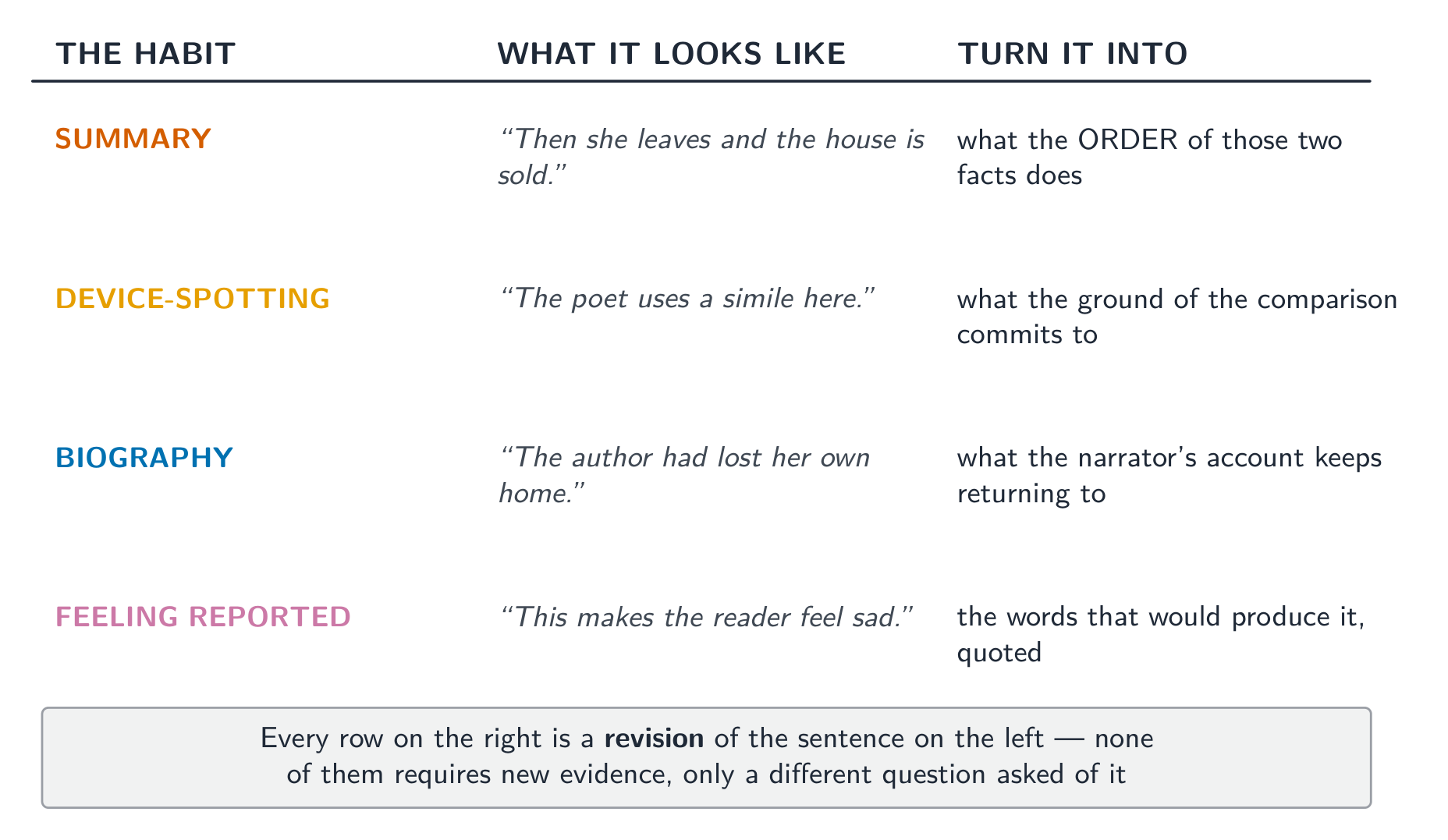
    • CHR-1.Y 등장인물의 상황 변화는 해당 인물 자체의 변화를 초래할 수 있습니다.
    • CHR-1.Z 등장인물은 서사 전반에 걸쳐 점진적으로 변화할 수도 있지만, 기경(epiphany)이라는 깨달음의 순간으로 인해 갑자기 변화할 수도 있습니다. 기경은 등장인물이 사물을 새로운 시각으로 바라보게 하며, 서사의 중심 갈등과 직접적으로 관련되는 경우가 많습니다.

    Source: College Board AP Course and Exam Description · ⁨출처: College Board AP Course and Exam Description⁩

    English

    Unit 7 is the last short-fiction unit, and it sharpens two things: how change happens in a character, and pacing as a deliberate manipulation of time.

    • Often the change in a character emerges directly from a conflict of values represented in the narrative.
    • Changes in a character's circumstances may lead to changes in that character.
    • Characters can change gradually, but they can also change suddenly 骤然.
    • An epiphany 顿悟 may affect the plot by causing a character to act on a sudden realisation.

    The two axes are independent, which is what makes them useful. A change caused by a conflict of values can arrive gradually or in an instant, and an epiphany is only examinable when the character acts on it - a realisation that changes nothing has not affected the plot.

    한국어

    유닛 7은 마지막 단편소설 유닛이며, 두 가지를 날카롭게 만듭니다: 등장인물 내에서 변화가 일어나는 방식, 그리고 시간의 의도적인 조작으로서의 _journal(节奏).

    • 종종 등장인물의 변화는 서사 내에 표현된 가치의 갈등에서 직접적으로 나타납니다.
    • 인물의 주변 상황 변화는 그 인물 자체의 변화로 이어질 수 있다.
    • 등장인물은 점진적으로 변할 수도 있지만, 급격하게 변할 수도 있습니다.
    • 顿悟(epiphany) 는 등장인물이 급격한 깨달음에 따라 행동하게 함으로써 플롯에 영향을 줄 수 있습니다.
    변화의 출처와 그 속력 - 서로 독립적인 두 질문
    근원이 없는 변화는 단정일 뿐이며, 플롯에서의 결과 없는 변화는 장식일 뿐이다

    두 축은 독립적이므로 유용합니다. 가치관의 충돌로 인한 변화는 서서히 일어나거나 순식간에 발생할 수 있으며, 각성(epiphany)은 캐릭터가 그에 행동할 때만 시험 대상이 됩니다. 아무것도 바꾸지 못한 깨달음은 줄거리에 영향을 미치지 못했습니다.

    Vocabulary · ⁨어휘⁩ Train · ⁨연습하기⁩
    English 한국어
    suddenly/ˈsʌdənli/ 갑자기
    epiphany/ɪˈpɪfənɪ/ 깨달음
    7.2

    Nuances in Characters' Relationships · ⁨인물 간 관계의 미묘함⁩

    Syllabus
    English

    Enduring Understanding (CHR-1): Characters in literature allow readers to study and explore a range of values, beliefs, assumptions, biases, and cultural norms represented by those characters.

    Learning Objective 1.D: Describe how textual details reveal nuances and complexities in characters’ relationships with one another.

    • CHR-1.AB A group or force can function as a character.
    • CHR-1.AC When readers consider a character, they should examine how that character interacts with other characters, groups, or forces and what those interactions may indicate about the character.
    • CHR-1.AD The relationship between a character and a group, including the inclusion or exclusion of that character, reveals the collective attitude of the group toward that character and possibly the character’s attitude toward the group.
    한국어

    영구적 이해 (CHR-1): 문학 작품 속 캐릭터들은 독자가 그 캐릭터들이 대표하는 다양한 가치관, 신념, 전제, 편견 및 문화적 규범을 연구하고 탐구할 수 있게 합니다.

    학습 목표 1.D: 텍스트적 디테일이 인물 간의 관계에 있는 미묘함과 복잡성을 어떻게 드러내는지 설명한다.

    • CHR-1.AB 집단이나 힘(group or force)이 한 인물의 역할을 수행할 수 있습니다.
    • CHR-1.AC 독자가 등장인물을 고려할 때는, 해당 인물이 다른 인물, 집단, 혹은 힘과 어떻게 상호작용하며, 그러한 상호작용이 해당 인물에 대해 무엇을 시사하는지 검토해야 합니다.
    • CHR-1.AD 등장인물과 집단 사이의 관계, 특히 해당 인물이 집단에 포함되거나 배제되는 여부는 집단의 해당 인물에 대한 Collective attitude와, 가능하면 해당 인물의 집단에 대한 태도를 드러냅니다.

    Source: College Board AP Course and Exam Description · ⁨출처: College Board AP Course and Exam Description⁩

    English
    • A group or force can function as a character.
    • Readers should examine how a character interacts with other characters.
    • The relationship between a character and a group - including their inclusion in or exclusion from it - is significant.

    The group-as-character idea is worth taking literally. A town, a family, an institution can hold values, exert pressure, and oppose a protagonist exactly as an individual antagonist would, and reading it that way often unlocks a story with no obvious opponent.

    한국어
    • 집단이나 힘은 하나의 인물로서 기능할 수 있습니다.
    • 독자는 인물이 다른 인물들과 어떻게 상호작용하는지를 examination해야 합니다.
    • 인물과 집단 간의 관계 - 집단에 포용되거나 배제되는 포함 -는 중요합니다.

    "집단이 인물이다"라는 아이디어는 문자 그대로 해석할 가치가 있습니다. 도시, 가족, 기관은 개인적 적대자와 마찬가지로 가치관을 가질 수 있고 압력을 가하며 주인공에 대립할 수 있으며, 이를 그렇게 읽으면 명확한 적수가 없는 이야기를 해방시킬 수 있습니다.

    같은 것이 두 번 측정되어 먼 거리에 나타나는 변화
    7.3

    The Function of Setting in a Narrative · ⁨서사에서 배경의 기능⁩

    Syllabus
    English

    Enduring Understanding (SET-1): Setting and the details associated with it not only depict a time and place, but also convey values associated with that setting.

    Learning Objective 2.B: Explain the function of setting in a narrative.

    • SET-1.E When a setting changes, it may suggest other movements, changes, or shifts in the narrative.
    • SET-1.F Settings may be contrasted in order to establish a conflict of values or ideas associated with those settings.
    한국어

    영구적 이해 (SET-1): 배경(setting)과 그에 관련된 디테일들은 단순히 시간과 장소를 묘사할 뿐만 아니라, 해당 배경과 연관된 가치관도 전달합니다.

    학습 목표 2.B: 서사에서의 배경(setting)의 기능을 설명한다.

    • SET-1.E 배경이 변화할 때, 이는 서사 내의 다른 이동, 변화, 혹은 전환을 암시할 수 있습니다.
    • SET-1.F 배경은 대비될 수 있어, 해당 배경과 연관된 가치관이나 아이디어의 갈등을 설정하기 위해 사용됩니다.

    Source: College Board AP Course and Exam Description · ⁨출처: College Board AP Course and Exam Description⁩

    English
    • When a setting changes, it may suggest other movements, changes, or shifts in the narrative.
    • Settings may be contrasted to establish a conflict of values or ideas associated with them.

    Two settings placed against each other are rarely just two places. They usually carry the competing value systems the plot is testing.

    한국어
    • 배경이 변경될 때, 서사 내의 다른 움직임, 변화 또는 전환을 시사할 수 있습니다.
    • 배경들은 대비되어与他们 associated된 가치관이나 아이디어의 갈등을 형성할 수 있습니다.

    서로 대치된 두 배경은 단순히 두 장소가 아닙니다. 그들은 주로 줄거리가 검증하려는 경쟁적인 가치 체계들을 담고 있습니다.

    7.4

    The Relationship Between Character and Setting · ⁨인물과 배경의 관계⁩

    Syllabus
    English

    Enduring Understanding (SET-1): Setting and the details associated with it not only depict a time and place, but also convey values associated with that setting.

    Learning Objective 2.C: Describe the relationship between a character and a setting.

    • SET-1.G The way characters interact with their surroundings provides insights about those characters and the setting(s) they inhabit.
    • SET-1.H The way characters behave in or describe their surroundings reveals an attitude about those surroundings and contributes to the development of those characters and readers’ interpretations of them.
    한국어

    영구적 이해 (SET-1): 배경(setting)과 그에 관련된 디테일들은 단순히 시간과 장소를 묘사할 뿐만 아니라, 해당 배경과 연관된 가치관도 전달합니다.

    학습 목표 2.C: 인물과 배경(setting) 사이의 관계를 설명한다.

    • SET-1.G 등장인물이 주변 환경과 상호작용하는 방식은 해당 인물들과 그들이 거주하는 배경에 대한 통찰을 제공합니다.
    • SET-1.H 등장인물이 주변 환경을 행하거나 묘사하는 방식은 해당 환경에 대한 태도를 드러내며, 인물들의 발전과 독자들의 해석에 기여합니다.

    Source: College Board AP Course and Exam Description · ⁨출처: College Board AP Course and Exam Description⁩

    English
    • The way characters interact with their surroundings provides insights about them.
    • The way characters behave in or describe their surroundings reveals an attitude toward those surroundings.
    한국어
    • 인물들이 주변 환경과 상호작용하는 방식은 그들에 대한 통찰을 제공합니다.
    • 인물들이 주변 환경을 묘사하거나 행동하는 방식은 그 환경에 대한 태도를 드러냅니다.
    7.5

    How Plot Orders Events · ⁨플롯이 사건을 배치하는 방법⁩

    Syllabus
    English

    Enduring Understanding (STR-1): The arrangement of the parts and sections of a text, the relationship of the parts to each other, and the sequence in which the text reveals information are all structural choices made by a writer that contribute to the reader’s interpretation of a text.

    Learning Objective 3.A: Identify and describe how plot orders events in a narrative.

    • STR-1.AA Pacing is the manipulation of time in a text. Several factors contribute to the pace of a narrative, including arrangement of details, frequency of events, narrative structures, syntax, the tempo or speed at which events occur, or shifts in tense and chronology in the narrative.
    한국어

    영구적 이해 (STR-1): 텍스트의 부분과 섹션의 배열, 부분들 간의 관계, 그리고 텍스트가 정보를 공개하는 순서는 모두 작가가 내린 구조적 선택이며, 이는 독자의 텍스트 해석에 기여합니다.

    학습 목표 3.A: 플롯이 서사(narrative)에서 사건들을 어떻게 배열하는지 식별하고 묘사하십시오.

    • STR-1.AA 템포(pacing)는 텍스트 내 시간의 조작입니다. 서사의 템포에는 디테일의 배치, 사건의 빈도, 서사 구조, 구문, 사건의 속도, 혹은 서사 내의 시제 및 연대기의 변화 등 여러 요인이 기여합니다.

    Source: College Board AP Course and Exam Description · ⁨출처: College Board AP Course and Exam Description⁩

    English

    Pacing 节奏 is the manipulation of time in a text, and several factors contribute to it - the length given to an event, the compression of long periods, the interruption of chronology.

    한국어

    리듬(pacing) 은 텍스트에서의 시간 조작이며, 몇 가지 요인이 이를 만듭니다: 특정 사건에 할당된 분량, 긴 기간의 압축, 시간 순서의 교란 등.

    Vocabulary · ⁨어휘⁩ Train · ⁨연습하기⁩
    English 한국어
    Pacing/ˈpeɪsɪŋ/ _journaling(pacing)
    7.6

    The Function of a Sequence of Events · ⁨사건의 연속성이果たす 역할⁩

    Syllabus
    English

    Enduring Understanding (STR-1): The arrangement of the parts and sections of a text, the relationship of the parts to each other, and the sequence in which the text reveals information are all structural choices made by a writer that contribute to the reader’s interpretation of a text.

    Learning Objective 3.B: Explain the function of a particular sequence of events in a plot.

    • STR-1.AB Narrative pacing may evoke an emotional reaction in readers by the order in which information is revealed; the relationships between the information, when it is provided, and other parts of the narrative; and the significance of the revealed information to other parts of the narrative.
    한국어

    영구적 이해 (STR-1): 텍스트의 부분과 섹션의 배열, 부분들 간의 관계, 그리고 텍스트가 정보를 공개하는 순서는 모두 작가가 내린 구조적 선택이며, 이는 독자의 텍스트 해석에 기여합니다.

    학습 목표 3.B: 플롯에서의 특정 사건의 순서가 가진 기능을 설명하십시오.

    • STR-1.AB 서사의 템포는 정보를 공개하는 순서, 정보 제공 시점과 서사 기타 부분 간의 관계, 그리고 공개된 정보가 서사 기타 부분에 의미하는 바 등을 통해 독자에게 감정적 반응을 유발할 수 있습니다.

    Source: College Board AP Course and Exam Description · ⁨출처: College Board AP Course and Exam Description⁩

    English

    Narrative pacing may evoke an emotional reaction in readers by the order in which information is revealed.

    Pacing is measurable and therefore very usable as evidence. Count the pages a text gives to an afternoon and to the following decade, and the disproportion is a claim about what mattered.

    한국어

    서사 리듬은 정보의 제시 순서에 따라 독자에게 감정적 반응을 유발할 수 있습니다.

    리듬은 측정 가능하므로 증거로 매우 유용합니다. 텍스트가 어느 오후에 할애한 페이지 수와 그 다음 십 년에 할애한 페이지 수를 세어보세요. 이 불균형은 무엇이 중요했는지에 대한 주장을 의미합니다.

    7.7

    How a Narrator's Reliability Affects a Narrative · ⁨서사자의 신뢰성이 서사에 미치는 영향⁩

    Syllabus
    English

    Enduring Understanding (NAR-1): A narrator’s or speaker’s perspective controls the details and emphases that affect how readers experience and interpret a text.

    Learning Objective 4.D: Explain how a narrator’s reliability affects a narrative.

    • NAR-1.W Some narrators or speakers may provide details and information that others do not or cannot provide. Multiple narrators or speakers may provide contradictory information in a text.
    한국어

    영구적 이해 (NAR-1): 서술자 또는 화자의 시각은 독자가 텍스트를 경험하고 해석하는 방식에 영향을 미치는 디테일과 강조점来控制합니다.

    학습 목표 4.D: 서사자의 신뢰성이 서사에 미치는 영향을 설명한다.

    • NAR-1.W 일부 서사자 또는 화자는 다른 사람이 제공하거나 제공할 수 없는 디테일과 정보를 제공할 수 있습니다. 복수의 서사자 또는 화자가 텍스트 내에서 상반된 정보를 제공할 수 있습니다.

    Source: College Board AP Course and Exam Description · ⁨출처: College Board AP Course and Exam Description⁩

    English

    Some narrators or speakers may provide details and information that others do not or cannot provide.

    Compare narrators where a text offers more than one. What one can say and another cannot is the clearest possible evidence of how the text is constructed.

    한국어

    일부 서사자나 화자는 다른 사람이나 할 수 없는 디테일과 정보를 제공하기도 합니다.

    텍스트에 여러 서사자가 있는 경우 서로 비교해 보십시오. 한 사람이 할 수 있고 다른 사람은 할 수 없는 것이 텍스트가 어떻게 구성되었는지 보여주는 가장 명확한 증거입니다.

    7.8

    The Function of a Symbol · ⁨상징의 기능⁩

    Syllabus
    English

    Enduring Understanding (FIG-1): Comparisons, representations, and associations shift meaning from the literal to the figurative and invite readers to interpret a text.

    Learning Objective 5.C: Identify and explain the function of a symbol.

    • FIG-1.AB A setting may become symbolic when it is, or comes to be, associated with abstractions such as emotions, ideologies, and beliefs.
    • FIG-1.AC Over time, some settings have developed certain associations such that they almost universally symbolize particular concepts.
    한국어

    영구적 이해 (FIG-1): 비교, 표현, 그리고 연관성은 의미를 수학적·문어적 수준에서 비유적 수준으로 이동시켜 독자에게 텍스트를 해석하게 만듭니다.

    학습 목표 5.C: 상징의 기능을 식별하고 설명한다.

    • FIG-1.AB 어떤 환경은 감정, 이데올로기, 신념과 같은 추상적 개념과 연관되거나 연관이 시작될 때 상징적인 성격을 띨 수 있다.
    • FIG-1.AC 시간이 지남에 따라 일부 환경은 특정 관념을 보편적으로 상징할 정도로 일정한 연상을 갖게 되었다.

    Source: College Board AP Course and Exam Description · ⁨출처: College Board AP Course and Exam Description⁩

    English
    • A setting may become symbolic when it is associated with abstractions - emotions, ideas, times of life.
    • Over time, some settings have developed associations so strong that they almost universally symbolise something.
    한국어
    • 배경이 추상적 개념(감정, 아이디어, 삶의 시기 등)과 연결될 때 상징으로 작용할 수 있습니다.
    • 세월이 흐르면서 일부 배경은 거의 보편적으로 무언가를 상징하는 매우 강력한 연상을 얻게 됩니다.
    처음 등장할 때는 아무것도 상징하지 않습니다 - 재등장 부분을 인용하십시오
    Explore · ⁨탐색하기⁩

    Watch repetition build a symbol · ⁨반복이 상징을 구축하는 것을 감시하십시오⁩

    Nothing is a symbol on its first appearance. Quote the recurrences and the claim is evidenced by the text's own structure. · ⁨처음 등장할 때 아무것도 상징이 아닙니다. 반복과 주장을 인용하면 텍스트 자체의 구조에 의해 증거가 입증됩니다.⁩

    Vocabulary · ⁨어휘⁩ Train · ⁨연습하기⁩
    English 한국어
    motif/məʊˈtiːf/ 모티프
    7.9

    The Function of an Image or Imagery · ⁨이미지 또는 이미지의 기능⁩

    Syllabus
    English

    Enduring Understanding (FIG-1): Comparisons, representations, and associations shift meaning from the literal to the figurative and invite readers to interpret a text.

    Learning Objective 5.D: Identify and explain the function of an image or imagery.

    • FIG-1.AD A motif is a unified pattern of recurring objects or images used to emphasize a significant idea in large parts of or throughout a text.
    한국어

    영구적 이해 (FIG-1): 비교, 표현, 그리고 연관성은 의미를 수학적·문어적 수준에서 비유적 수준으로 이동시켜 독자에게 텍스트를 해석하게 만듭니다.

    학습 목표 5.D: 이미지 또는 이미지의 기능을 식별하고 설명한다.

    • FIG-1.AD 모티프(text motif)는 텍스트의 상당 부분이나 전체를 통해 중요한 아이디어를 강조하기 위해 사용된 반복되는 사물이나 이미지의 통일된 패턴이다.

    Source: College Board AP Course and Exam Description · ⁨출처: College Board AP Course and Exam Description⁩

    English

    A motif 母题 is a unified pattern of recurring objects or images used to emphasise a significant idea.

    A motif differs from a symbol in that it need not stand for one thing. It accumulates: each recurrence adds to what the pattern means, which is why noting the first and last appearance is usually more productive than listing them all.

    한국어

    **모티프(母題)**는 중요한 아이디어를 강조하기 위해 사용되는 반복되는 물체나 이미지의 통일된 패턴을 의미합니다.

    모티프는 특정 하나를 대변할 필요 없다는 점에서 상징과 다릅니다. 모티프는 축적됩니다: 각 재등장은 그 패턴의 의미를 더하므로, 모두 나열하기보다 처음과 마지막 등장을 언급하는 것이 더 유익한 경우가 많습니다.

    7.10

    The Function of a Simile · ⁨유비(simile)의 기능⁩

    Syllabus
    English

    Enduring Understanding (FIG-1): Comparisons, representations, and associations shift meaning from the literal to the figurative and invite readers to interpret a text.

    Learning Objective 6.A: Identify and explain the function of a simile.

    • FIG-1.AE The function of a simile relies on the selection of the objects being compared as well as the traits of the objects.
    한국어

    영구적 이해 (FIG-1): 비교, 표현, 그리고 연관성은 의미를 수학적·문어적 수준에서 비유적 수준으로 이동시켜 독자에게 텍스트를 해석하게 만듭니다.

    학습 목표 6.A: 비유의 기능을 식별하고 설명하십시오.

    • FIG-1.AE 비유의 기능은 비교되는 대상의 선택과 대상의 특성에 기반합니다.

    Source: College Board AP Course and Exam Description · ⁨출처: College Board AP Course and Exam Description⁩

    English

    The function of a simile relies on the selection of the objects being compared as well as the traits transferred. Both halves are choices, and both can be analysed.

    한국어

    비유와 유사성의 기능은 비교 대상이 되는 물체의 선택 및 전이된 특성에 달려 있습니다. 두 부분 모두 선택의 결과이며, 둘 다 분석할 수 있습니다.

    기초를命名하십시오 - 운송 수단은 많은 가능한 유사성을 담고 있습니다
    Explore · ⁨탐색하기⁩

    Name the ground of the comparison · ⁨비유의 기반을 명시하십시오.⁩

    A vehicle carries many possible likenesses. Saying which one is operating is the whole of the commentary. · ⁨차량(Vehicle)은 다양한 비유적 유사성을 담고 있습니다. 어떤 것이 작동하고 있는지 지적하는 것이 전체적인 비평이 됩니다.⁩

    7.11

    The Function of Personification · ⁨인격화의 기능⁩

    Syllabus
    English

    Enduring Understanding (FIG-1): Comparisons, representations, and associations shift meaning from the literal to the figurative and invite readers to interpret a text.

    Learning Objective 6.C: Identify and explain the function of personification.

    • FIG-1.AF By assigning the qualities of a nonhuman object, entity, or idea to a person or character, the narrator, character, or speaker communicates an attitude about that person or character.
    한국어

    영구적 이해 (FIG-1): 비교, 표현, 그리고 연관성은 의미를 수학적·문어적 수준에서 비유적 수준으로 이동시켜 독자에게 텍스트를 해석하게 만듭니다.

    학습 목표 6.C: 인격화의 기능을 식별하고 설명한다.

    • FIG-1.AF 무생물 대상, 존재, 혹은 개념의 특성을 사람이나 등장인물에 부여함으로써, 서사자, 등장인물, 혹은 화자는 해당 사람이나 인물에 대한 태도를 전달합니다.

    Source: College Board AP Course and Exam Description · ⁨출처: College Board AP Course and Exam Description⁩

    English

    The CED adds the reverse move here: assigning the qualities of a nonhuman object, entity, or idea to a person or character - describing a person as mechanical, as weather, as an animal.

    This is worth watching for, because it usually indicates a judgement. A character described in the vocabulary of machinery has been characterised, and by someone.

    한국어

    CED는 여기서 반대의 동작을 추가합니다: 비인간적 물체, 실체 또는 아이디어의 속성을 사람이나 인물에게 부여하여 – 사람을 기계처럼, 날씨처럼, 동물처럼 묘사합니다.

    이를 주의 깊게 관찰할 가치가 있습니다. 왜냐하면 보통 이는 판단을 나타내기 때문입니다. 기계적 어휘로 묘사된 인물은 어떤 사람에 의해 성향화되었습니다.

    7.12 7.13 7.14

    Developing a Literary Thesis, Commentary, and Evidence · ⁨문학 논제, 비평 및 증거의 개발⁩

    Syllabus
    English

    Enduring Understanding (LAN-1): Readers establish and communicate their interpretations of literature through arguments supported by textual evidence.

    Learning Objective 7.B: Develop a thesis statement that conveys a defensible claim about an interpretation of literature and that may establish a line of reasoning.

    • LAN-1.D A thesis statement expresses an interpretation of a literary text, and requires a defense, through use of textual evidence and a line of reasoning, both of which are explained in an essay through commentary.
    • LAN-1.E A thesis statement may preview the development or line of reasoning of an interpretation. This is not to say that a thesis statement must list the points of an interpretation, literary elements to be analyzed, or specific evidence to be used in the argument.
    한국어

    영구적 이해 (LAN-1): 독자들은 텍스트의 증거로 지지되는 논쟁을 통해 문학 작품을 해석하고 이를 전달합니다.

    학습 목표 7.B: 문학 해석에 대한 타당한 주장을 전달하며 논증의 흐름(line of reasoning)을 설정할 수 있는 논제문을 개발합니다.

    • LAN-1.D 논제 statement는 문학 텍스트에 대한 해석을 표현하며, 에세이에서 논평(commentary)을 통해 텍스트적 증거와 추론의 흐름을 사용하여 변명(defense)이 요구된다.
    • LAN-1.E 논제문은 해석의 전개나 논증의 흐름을 미리 제시할 수 있습니다. 하지만 이것이 논제문이 반드시 해석의 점수, 분석할 문학 요소, 혹은 논증에 사용될 구체적인 증거를 나열해야 한다는 의미는 아닙니다.
    English

    Enduring Understanding (LAN-1): Readers establish and communicate their interpretations of literature through arguments supported by textual evidence.

    Learning Objective 7.C: Develop commentary that establishes and explains relationships among textual evidence, the line of reasoning, and the thesis.

    • LAN-1.F A line of reasoning is the logical sequence of claims that work together to defend the overarching thesis statement.
    • LAN-1.G A line of reasoning is communicated through commentary that explains the logical relationship between the overarching thesis statement and the claims/evidence within the body of an essay.
    • LAN-1.U More sophisticated literary arguments may explain the significance or relevance of an interpretation within a broader context, discuss alternative interpretations of a text, or use relevant analogies to help an audience better understand an interpretation.
    한국어

    영구적 이해 (LAN-1): 독자들은 텍스트의 증거로 지지되는 논쟁을 통해 문학 작품을 해석하고 이를 전달합니다.

    학습 목표 7.C: 텍스트적 증거, 논증의 흐름, 그리고 논제문 사이의 관계를 설정하고 설명하는 Commentary를 개발합니다.

    • LAN-1.F 논증의 흐름은 포괄적인 논제문을 방어하기 위해 함께 작동하는 주장들의 논리적 순서입니다.
    • LAN-1.G 논증의 흐름은 포괄적인 논제문과 논증 essay 본문의 주장/证据 사이의 논리적 관계를 설명하는 Commentary를 통해 전달됩니다.
    • LAN-1.U 더 정교한 문학적 논쟁은 해석의 중요성이나 관련성을 더 넓은 맥락에서 설명하거나, 텍스트에 대한 대체 해석을 논의하거나, 청중이 해석을 더 잘 이해할 수 있도록 적절한 유추(analogies)를 사용할 수 있습니다.
    English

    Enduring Understanding (LAN-1): Readers establish and communicate their interpretations of literature through arguments supported by textual evidence.

    Learning Objective 7.D: Select and use relevant and sufficient evidence to both develop and support a line of reasoning.

    • LAN-1.H Writers use evidence strategically and purposefully to illustrate, clarify, exemplify, associate, amplify, or qualify a point.
    • LAN-1.I Evidence is effective when the writer of the essay uses commentary to explain a logical relationship between the evidence and the claim.
    • LAN-1.J Evidence is sufficient when its quantity and quality provide apt support for the line of reasoning.
    • LAN-1.K Developing and supporting an interpretation of a text is a recursive process; an interpretation can emerge from analyzing evidence and then forming a line of reasoning, or the interpretation can emerge from forming a line of reasoning and then identifying relevant evidence to support that line of reasoning.
    • LAN-1.V Textual evidence may require revision to an interpretation and a line of reasoning if the evidence does not sufficiently support the initial interpretation and line of reasoning.
    한국어

    영구적 이해 (LAN-1): 독자들은 텍스트의 증거로 지지되는 논쟁을 통해 문학 작품을 해석하고 이를 전달합니다.

    학습 목표 7.D: 논증의 흐름을 개발하고 지지하기 위해 관련되고 충분한 증거를 선정하여 사용합니다.

    • LAN-1.H 작가는 특정 점을 설명, 명확히 하기, 예시 들기, 연결하기, 강조하기, 혹은 제한하기 위해 전략적이고 의도적으로 증거를 사용합니다.
    • LAN-1.I 논증 essay의 작가가 Commentary를 사용하여 증거와 주장 사이의 논리적 관계를 설명할 때, 증거는 효과적입니다.
    • LAN-1.J 증거의 양과 질이 논증의 흐름에 적절한 지지를 제공할 때, 증거는 충분합니다.
    • LAN-1.K 텍스트에 대한 해석을 개발하고 지지하는 것은 반복되는 과정입니다. 해석은 증거를 분석한 후 논증의 흐름을 형성함으로써 emerge될 수 있으며, 혹은 논증의 흐름을 형성한 후 이를 지지할 relevant evidence를 확인함으로써 emerge될 수 있습니다.
    • LAN-1.V 증거가 초기 해석과 추론의 흐름을 충분히 지지하지 않을 경우, 그 증거는 해석과 추론의 흐름을 수정해야 할 수 있습니다.

    Source: College Board AP Course and Exam Description · ⁨출처: College Board AP Course and Exam Description⁩

    English
    • Unchanged: a thesis expresses an interpretation requiring textual defence.
    • New: more sophisticated literary arguments may explain the significance or relevance of an interpretation - why this reading matters, not only that it is supportable. This is the sophistication point stated directly.
    • New: textual evidence may require revision to an interpretation if the evidence does not support it.

    Worked example (a real AP exam task). A prose fiction prompt asks how the author's use of pacing conveys the significance of an event. A weak answer: "The story slows down at the important part." A scoring answer measures and interprets: "The story gives four pages to a conversation lasting minutes and a single sentence to the three years that follow. The disproportion refuses the reader the consolation of aftermath: we are held in the moment of the decision and then denied any account of whether it was right, so the story's subject becomes the irreversibility of the choice rather than its consequences." Pacing measured, and its effect on what the reader is allowed to know.

    한국어
    • 변하지 않음: 논제는 텍스트적 방어가 필요한 해석을 표명합니다.
    • 새로운 것: 더 정교한 문학적 논쟁은 해석의 중요성이나 관련성을 설명할 수 있습니다. 단순히 지지가 가능하다는 점뿐만 아니라 이 독해가 중요한 이유를 설명합니다. 이것이 직접적으로 언급된 정교함의 지점입니다.
    • 새로운 것: ** Evidence가 해석을 지지하지 않는다면, 텍스트적 증거는 해석의 수정을 요구할 수 있습니다.**

    작문 예제 (실제 AP 시험 과제). 산문 소설 prompt에서 저자의 pacing 사용이 사건의 중요성을 어떻게 전달하는지 묻습니다. 약한 답변: "이 이야기는 중요한 부분에速度慢아집니다." 높은 점수 답안: "이야기는 몇 분 동안 이어지는 대화에 네 페이지를 할당하고,其后의 삼 년에 대해 한 문장만을 할당합니다. 이 비례는 독자에게 이후의 안도를 거부합니다: 우리는 결정의 순간에 갇혀 있으며, 그것이 옳았는지에 대한任何形式的 accounts도 부여받지 못하므로, 이야기의 주제는 결과보다는 선택의 불가역성이 됩니다." pacing이 측정되었으며, 독자가 알 수 있는 것에 미치는 영향이 설명되었습니다.

    7.12 7.13 7.14

    Exam tips · ⁨시험 팁⁩

    English
    • A change needs a source (a conflict of values, or changed circumstances) and a consequence in the plot.
    • An epiphany is examinable when the character acts on it. A realisation that changes nothing is decoration.
    • A group can function as a character. Try it on any story with no obvious antagonist.
    • Two contrasted settings usually carry the competing values the plot is testing.
    • Pacing is measurable. Count what gets space and what gets a clause; the disproportion is a claim.
    • For a motif, compare the first and last appearance rather than listing every one.
    한국어
    • 변화에는 plot에서의 원인(가치관의 충돌 또는 변경된 상황) 과 결과가 필요합니다.
    • 에피파니는 인물이 그에 행동할 때만 평가대상이 됩니다. 아무것도 바꾸지 않는 깨달음은 장식이 될 뿐입니다.
    • 집단이 인물로서 기능할 수 있습니다. 명확한 적대가 없는 어떤 이야기든 시도해 보십시오.
    • 두 대조적인 배경은 보통 plot이 검증하려는 상충되는 가치관을 담고 있습니다.
    • **pacing은 측정 가능합니다.**哪些内容获得空间,哪些内容获得一个从句来数一数;这种不平衡本身就是一种主张。
    • 모티프를 분석할 때는 모든 등장을 나열하기보다 처음과 마지막 등장을 비교하십시오.
  • 8

    Poetry III · ⁨시 III⁩

    Watch lesson · ⁨수업 보기⁩
    8.1

    The Function of Structure in a Text · ⁨텍스트 내 구조의 기능⁩

    Syllabus
    English

    Enduring Understanding (STR-1): The arrangement of the parts and sections of a text, the relationship of the parts to each other, and the sequence in which the text reveals information are all structural choices made by a writer that contribute to the reader’s interpretation of a text.

    Learning Objective 3.C: Explain the function of structure in a text.

    • STR-1.AC Ideas and images in a poem may extend beyond a single line or stanza.
    • STR-1.AD Punctuation is often crucial to the understanding of a text.
    • STR-1.AE When structural patterns are created in a text, any interruption in the pattern creates a point of emphasis.
    한국어

    영구적 이해 (STR-1): 텍스트의 부분과 섹션의 배열, 부분들 간의 관계, 그리고 텍스트가 정보를 공개하는 순서는 모두 작가가 내린 구조적 선택이며, 이는 독자의 텍스트 해석에 기여합니다.

    학습 목표 3.C: 텍스트 내 구조의 기능을 설명하십시오.

    • STR-1.AC 시에 등장하는 생각과 이미지는 단일 행이나 단락에 국한되지 않고 확장될 수 있다.
    • STR-1.AD 문장 부호는 텍스트 이해에 종종 결정적인 역할을 한다.
    • STR-1.AE 텍스트 내에서 구조적 패턴이 형성되면 그 패턴의 단절은 강조점(emphasis point)이 된다.

    Source: College Board AP Course and Exam Description · ⁨출처: College Board AP Course and Exam Description⁩

    English

    Unit 8 is the last poetry unit and it handles the hardest material in the course: the family of devices built on contradiction.

    • Ideas and images in a poem may extend beyond a single line or stanza.
    • Punctuation is often crucial to understanding a text.
    • When structural patterns are created, any interruption in the pattern creates a point of emphasis.

    That third statement is the most efficient reading tool in the course. Establish what the poem has been doing, then find the moment it stops doing it. That moment is where the poem points.

    Punctuation deserves the emphasis it gets. In a poem, a semicolon and a full stop are different claims about how tightly two statements are joined, and a poem without punctuation has made a decision about how you must read it.

    한국어

    단원 8는 마지막 시 단원으로, 과정 중 가장 어려운 소재인 반대(모순) 기반 장치의 일종에 대해 다룹니다.

    • 시에서 아이디어와 이미지는 단일 행이나 연을 넘어 확장될 수 있습니다.
    • 문장 부호는 텍스트를 이해하는 데 종종 핵심적입니다.
    • 구조적 패턴이 형성되면, 해당 패턴의 간섭은 강조점을 생성합니다.

    세 번째 진술은 이 과정의 가장 효율적인 독해 도구입니다. 시가 무엇을 하고 있는지 파악한 뒤, 그것이 멈추는 순간을 찾으십시오. 그 순간이 바로 시가 가리키는 지점입니다.

    구호에 appropriate한 강조가 필요합니다. 시에서 세미콜론과 마침표는 두 문장이 얼마나 밀접하게 연결되는지에 대한 서로 다른 주장을 하며, 구호 없는 시는 독자가 어떻게 읽어야 하는지에 대한 선택을 내린 것입니다.

    시 방향 전환을 나타내는 네 가지 신호
    8.2

    The Function of Contrasts Within a Text · ⁨텍스트 내 대조의 기능⁩

    Syllabus
    English

    Enduring Understanding (STR-1): The arrangement of the parts and sections of a text, the relationship of the parts to each other, and the sequence in which the text reveals information are all structural choices made by a writer that contribute to the reader’s interpretation of a text.

    Learning Objective 3.D: Explain the function of contrasts within a text.

    • STR-1.AF Juxtaposition may create or demonstrate an antithesis.
    • STR-1.AG Situational or verbal irony is created when events or statements in a text are inconsistent with either the expectations readers bring to a text or the expectations established by the text itself.
    • STR-1.AH Paradox occurs when seemingly contradictory elements are juxtaposed, but the contradiction—which may or may not be reconciled—can reveal a hidden or unexpected idea.
    한국어

    영구적 이해 (STR-1): 텍스트의 부분과 섹션의 배열, 부분들 간의 관계, 그리고 텍스트가 정보를 공개하는 순서는 모두 작가가 내린 구조적 선택이며, 이는 독자의 텍스트 해석에 기여합니다.

    학습 목표 3.D: 텍스트 내 대비의 기능을 설명하십시오.

    • STR-1.AF 나열(juxtaposition)은 반어법(alternative)을 만들거나 이를 증명할 수 있다.
    • STR-1.AG 상황적 반어법(situational irony)이나 어학적 반어법(verbal irony)은 텍스트 속 사건이나 서술이 독자가 가져오는 기대나 텍스트 자체에서 설정한 기대와 불일치할 때 발생한다.
    • STR-1.AH 역설(paradox)은 겉보기에 모순되는 요소들이 나열되지만, 그 모순(해결될 수도 있고 아닐 수도 있음)이 숨겨지거나 예상치 못한 아이디어를 드러낼 때 발생한다.

    Source: College Board AP Course and Exam Description · ⁨출처: College Board AP Course and Exam Description⁩

    English
    • Juxtaposition may create or demonstrate an antithesis.
    • Situational or verbal irony 情境反讽与言语反讽 is created when events or statements are inconsistent with what is expected.
    • Paradox 悖论 occurs when seemingly contradictory elements are juxtaposed, but the contradiction - which may be at odds with ordinary logic - reveals a deeper truth.

    The distinction matters and students routinely collapse it. An antithesis places two opposed things together, and both remain true in their own terms. An irony is a gap between the expected and the actual - and someone, the writer or the reader, is aware of the gap. A paradox looks like a contradiction and survives inspection: the contradiction is the point, not an error.

    한국어
    모순 위에 구축된 세 가지 장치 - 이들은 동일한 장치가 아닙니다
    반어법(antithesis)은 대립하는 개념을 나란히 배치합니다. 반어(irony)는 불일치입니다. 역설(paradox)은 모순되지만 여전히 참인 명제입니다
    • 배치(juxtaposition) 은 반어법을 생성하거나 보여줄 수 있습니다.
    • 상황적 또는 언어적 반어情境反讽与言语反讽는 사건이나 진술이 기대와 일치하지 않을 때 발생합니다.
    • 역설悖论은 ** apparent로 모순되는 요소들이 배치되지만, 그 모순(보통 논리와 충돌할 수 있음)이 더 깊은 진리를 드러낼 때** 발생합니다.

    이 구분이 중요하지만 학생들이 이를 혼동하기 쉽습니다. 반어법은 두 대립하는 요소를 함께 배치하여 각각 독립적으로 참인 상태를 유지합니다. 반어는 기대와 실제 사이의 간격이며, 작가나 독자가 그 간격을 인지하고 있습니다. 역설은 모순처럼 보이지만 검토를 견뎌내며, 모순 자체가 핵심이지 오류가 아닙니다.

    Vocabulary · ⁨어휘⁩ Train · ⁨연습하기⁩
    English 한국어
    Situational or verbal irony/ˌsɪtʃuːˈeɪʃənl ɔː ˈvɜːbl ˈaɪrəni/ 상황 또는 어휘적 아이러니
    Paradox/ˈpærədɒks/ 역설법
    8.3

    The Function of Specific Words and Phrases · ⁨구체적인 단어와 구문의 기능⁩

    Syllabus
    English

    Enduring Understanding (FIG-1): Comparisons, representations, and associations shift meaning from the literal to the figurative and invite readers to interpret a text.

    Learning Objective 5.B: Explain the function of specific words and phrases in a text.

    • FIG-1.AG Ambiguity allows for different readings and understandings of a text by different readers.
    한국어

    영구적 이해 (FIG-1): 비교, 표현, 그리고 연관성은 의미를 수학적·문어적 수준에서 비유적 수준으로 이동시켜 독자에게 텍스트를 해석하게 만듭니다.

    학습 목표 5.B: 텍스트 내 특정 단어와 구문의 기능을 설명하십시오.

    • FIG-1.AG 모호성(ambiguity)은 독자에 따라 텍스트를 다양한 방식으로 해석하고 이해할 수 있게 한다.

    Source: College Board AP Course and Exam Description · ⁨출처: College Board AP Course and Exam Description⁩

    English

    Ambiguity allows for different readings and understandings of a text by different readers.

    In this course, ambiguity is a resource. An essay that identifies a genuinely ambiguous element, explores both readings, and then argues for one is doing exactly what the sophistication point rewards - far more than an essay that pretends the text is simpler than it is.

    한국어

    모호성(ambiguity)은 다양한 독자가 텍스트에 대해 서로 다른 해석과 이해를 가능하게 합니다.

    이 과정에서 모호성은 자산입니다. genuinely 모호한 요소를 식별하고 두 해석을 모두 탐구한 뒤, 그중 하나를 지지하는 논증을 펼치는 에세이는 정교함 포인트(sophistication point)가 보상하는 바를 정확히 수행하며, 단순히 텍스트가 자신보다 단순하다고 위장하는 에세이보다 훨씬優位합니다.

    모호성을 주장하는 것은 두 해석을 모두 제시하겠다는 약속입니다
    Explore · ⁨탐색하기⁩

    Ambiguity or vagueness? · ⁨모호함일까요, 모호함일까요?⁩

    Claiming ambiguity commits you to showing both readings. Without the two quotations it reads as declining to decide. · ⁨모호함을 주장하면 두 가지 해석 모두를 보여줘야 합니다. 인용 구절 두 개가 없으면 이는 결론 내리기를 거부하는 것으로 읽힙니다.⁩

    8.4

    The Function of a Symbol · ⁨상징의 기능⁩

    Syllabus
    English

    Enduring Understanding (FIG-1): Comparisons, representations, and associations shift meaning from the literal to the figurative and invite readers to interpret a text.

    Learning Objective 5.C: Identify and explain the function of a symbol.

    • FIG-1.AH Symbols in a text and the way they are used may imply that a narrator, character, or speaker has a particular attitude or perspective.
    한국어

    영구적 이해 (FIG-1): 비교, 표현, 그리고 연관성은 의미를 수학적·문어적 수준에서 비유적 수준으로 이동시켜 독자에게 텍스트를 해석하게 만듭니다.

    학습 목표 5.C: 상징의 기능을 식별하고 설명한다.

    • FIG-1.AH 텍스트 속 기호와 그 사용 방식은 서사자, 인물, 또는 화자가 특정한 태도나 관점을 가지고 있음을 시사할 수 있다.

    Source: College Board AP Course and Exam Description · ⁨출처: College Board AP Course and Exam Description⁩

    English

    Symbols in a text, and the way they are used, may imply that a narrator, character, or speaker has a particular perspective.

    A symbol is not free-floating. Someone in the text is treating that object as meaningful, and asking who attaches this meaning is often more productive than asking what the meaning is.

    한국어

    텍스트 속의 상징과 그 사용 방식은 서사자, 인물, 또는 화자가 특정 관점을 가지고 있음을 시사할 수 있습니다.

    상징은 자유롭게 떠다니지 않습니다. 텍스트 속 누군가가 해당 대상을 의미 있게 여기고 있으며, 누가 이 의미를 부여했는지 묻는 것이 그 의미 자체가 무엇인지 묻는 것보다 종종 더 생산적입니다.

    8.5

    The Function of a Metaphor · ⁨은유(metaphor)의 기능⁩

    Syllabus
    English

    Enduring Understanding (FIG-1): Comparisons, representations, and associations shift meaning from the literal to the figurative and invite readers to interpret a text.

    Learning Objective 6.B: Identify and explain the function of a metaphor.

    • FIG-1.AI A conceit is a form of extended metaphor that often appears in poetry. Conceits develop complex comparisons that present images, concepts, and associations in surprising or paradoxical ways.
    • FIG-1.AJ Often, conceits are used to make complex comparisons between the natural world and an individual.
    • FIG-1.AK Multiple comparisons, representations, or associations may combine to affect one another in complex ways.
    한국어

    영구적 이해 (FIG-1): 비교, 표현, 그리고 연관성은 의미를 수학적·문어적 수준에서 비유적 수준으로 이동시켜 독자에게 텍스트를 해석하게 만듭니다.

    학습 목표 6.B: 은유의 기능을 식별하고 설명하십시오.

    • FIG-1.AI 컨시트(conceit)는 시에서 자주 나타나는 확장된 은유(extensive metaphor)의 한 형태이다. 컨시트는 이미지, 개념, 그리고 연상을 놀랍거나 역설적인 방식으로 제시하며 복잡한 비교를 발전시킨다.
    • FIG-1.AJ 흔히 컨시트는 자연계와 개인 간의 복잡한 비교를 하는 데 사용된다.
    • FIG-1.AK 다중 비교, 표현, 혹은 연상이 복합적인 방식으로 서로 영향을 미칠 수 있다.

    Source: College Board AP Course and Exam Description · ⁨출처: College Board AP Course and Exam Description⁩

    English
    • A conceit 奇喻 is a form of extended metaphor, common in poetry, developing complex comparisons.
    • Conceits are often used to make complex comparisons between the natural world and an individual.
    • Multiple comparisons, representations, or associations may combine to affect one another in complex ways.

    A conceit is an extended metaphor that has been pushed further than seems reasonable, and the strain is deliberate. When analysing one, follow how far the poet takes the comparison and where it starts to resist - the resistance is usually the poem's real subject.

    한국어
    • 신화(conceit) 奇喻은 시에서 흔하게 사용되는 확장 은유(extensive metaphor) 의 일종으로, 복잡한 비교를 발전시킵니다.
    • 신화는 주로 자연계와 개인 간의 복잡한 비교를 만들기 위해 사용됩니다.
    • 다중 비교, 표현, 또는 연관성이 복잡하게 얽혀 서로 영향을 미칠 수 있습니다.

    신화는 합리적이라고 보기 어려운 수준까지 확장된 은유이며, 그 긴장은 고의적입니다. 분석할 때는 시인이 비교를 어디까지 전개하고 언제 저항을 begin하는지 따라가십시오. 그 저항이 보통 시의 진정한 주제입니다.

    절단(wreak)은 평가 가능한 순간입니다 - 통제된 텍스트는 우연히 틀을 깨뜨리지 않습니다
    Explore · ⁨탐색하기⁩

    Follow an extended metaphor to its break · ⁨확장 비유법의 단절점까지 따라가기⁩

    An extended metaphor is a metaphor with obligations — and the place the writer breaks the frame is deliberate and analysable. · ⁨Extended metaphor(연장된 은유)은 의무를 따릅니다—작가가 틀을 깨뜨리는 곳은 의도적이고 분석 가능합니다.⁩

    Vocabulary · ⁨어휘⁩ Train · ⁨연습하기⁩
    English 한국어
    conceit/kənˈsiːt/ 장식적 비유
    8.6

    The Function of an Allusion · ⁨전례의 기능⁩

    Syllabus
    English

    Enduring Understanding (FIG-1): Comparisons, representations, and associations shift meaning from the literal to the figurative and invite readers to interpret a text.

    Learning Objective 6.D: Identify and explain the function of an allusion.

    • FIG-1.AL Because of shared knowledge about a reference, allusions create emotional or intellectual associations and understandings.
    한국어

    영구적 이해 (FIG-1): 비교, 표현, 그리고 연관성은 의미를 수학적·문어적 수준에서 비유적 수준으로 이동시켜 독자에게 텍스트를 해석하게 만듭니다.

    학습 목표 6.D: 암시의 기능을 식별하고 설명한다.

    • FIG-1.AL 공통된 지식에 기반하여 암시는 감정적이거나 지적인 연상과 이해를 생성한다.

    Source: College Board AP Course and Exam Description · ⁨출처: College Board AP Course and Exam Description⁩

    English

    Because of shared knowledge about a reference, allusions create emotional or intellectual associations in readers who recognise them.

    Note the condition: shared knowledge. An allusion is a bet on the reader's memory, and a poem that alludes heavily has chosen its audience.

    한국어

    공유된 지식에 대한 참고에 의해, 암시(allusions)는 그것을 인식한 독자에게 감정적이거나 지적 연상을 유발합니다.

    조건을 유의하십시오: 공유된 지식. 암시는 독자의 기억력에 걸리는 베팅이며, 강하게 암시를 사용하는 시는 자신의 청중을 선택했습니다.

    8.7 8.8 8.9

    Developing a Literary Thesis, Commentary, and Evidence · ⁨문학 논제, 비평 및 증거의 개발⁩

    Syllabus
    English

    Enduring Understanding (LAN-1): Readers establish and communicate their interpretations of literature through arguments supported by textual evidence.

    Learning Objective 7.B: Develop a thesis statement that conveys a defensible claim about an interpretation of literature and that may establish a line of reasoning.

    • LAN-1.D A thesis statement expresses an interpretation of a literary text, and requires a defense, through use of textual evidence and a line of reasoning, both of which are explained in an essay through commentary.
    • LAN-1.E A thesis statement may preview the development or line of reasoning of an interpretation. This is not to say that a thesis statement must list the points of an interpretation, literary elements to be analyzed, or specific evidence to be used in the argument.
    한국어

    영구적 이해 (LAN-1): 독자들은 텍스트의 증거로 지지되는 논쟁을 통해 문학 작품을 해석하고 이를 전달합니다.

    학습 목표 7.B: 문학 해석에 대한 타당한 주장을 전달하며 논증의 흐름(line of reasoning)을 설정할 수 있는 논제문을 개발합니다.

    • LAN-1.D 논제 statement는 문학 텍스트에 대한 해석을 표현하며, 에세이에서 논평(commentary)을 통해 텍스트적 증거와 추론의 흐름을 사용하여 변명(defense)이 요구된다.
    • LAN-1.E 논제문은 해석의 전개나 논증의 흐름을 미리 제시할 수 있습니다. 하지만 이것이 논제문이 반드시 해석의 점수, 분석할 문학 요소, 혹은 논증에 사용될 구체적인 증거를 나열해야 한다는 의미는 아닙니다.
    English

    Enduring Understanding (LAN-1): Readers establish and communicate their interpretations of literature through arguments supported by textual evidence.

    Learning Objective 7.C: Develop commentary that establishes and explains relationships among textual evidence, the line of reasoning, and the thesis.

    • LAN-1.F A line of reasoning is the logical sequence of claims that work together to defend the overarching thesis statement.
    • LAN-1.G A line of reasoning is communicated through commentary that explains the logical relationship between the overarching thesis statement and the claims/evidence within the body of an essay.
    • LAN-1.U More sophisticated literary arguments may explain the significance or relevance of an interpretation within a broader context, discuss alternative interpretations of a text, or use relevant analogies to help an audience better understand an interpretation.
    한국어

    영구적 이해 (LAN-1): 독자들은 텍스트의 증거로 지지되는 논쟁을 통해 문학 작품을 해석하고 이를 전달합니다.

    학습 목표 7.C: 텍스트적 증거, 논증의 흐름, 그리고 논제문 사이의 관계를 설정하고 설명하는 Commentary를 개발합니다.

    • LAN-1.F 논증의 흐름은 포괄적인 논제문을 방어하기 위해 함께 작동하는 주장들의 논리적 순서입니다.
    • LAN-1.G 논증의 흐름은 포괄적인 논제문과 논증 essay 본문의 주장/证据 사이의 논리적 관계를 설명하는 Commentary를 통해 전달됩니다.
    • LAN-1.U 더 정교한 문학적 논쟁은 해석의 중요성이나 관련성을 더 넓은 맥락에서 설명하거나, 텍스트에 대한 대체 해석을 논의하거나, 청중이 해석을 더 잘 이해할 수 있도록 적절한 유추(analogies)를 사용할 수 있습니다.
    English

    Enduring Understanding (LAN-1): Readers establish and communicate their interpretations of literature through arguments supported by textual evidence.

    Learning Objective 7.D: Select and use relevant and sufficient evidence to both develop and support a line of reasoning.

    • LAN-1.H Writers use evidence strategically and purposefully to illustrate, clarify, exemplify, associate, amplify, or qualify a point.
    • LAN-1.I Evidence is effective when the writer of the essay uses commentary to explain a logical relationship between the evidence and the claim.
    • LAN-1.J Evidence is sufficient when its quantity and quality provide apt support for the line of reasoning.
    • LAN-1.K Developing and supporting an interpretation of a text is a recursive process; an interpretation can emerge from analyzing evidence and then forming a line of reasoning, or the interpretation can emerge from forming a line of reasoning and then identifying relevant evidence to support that line of reasoning.
    한국어

    영구적 이해 (LAN-1): 독자들은 텍스트의 증거로 지지되는 논쟁을 통해 문학 작품을 해석하고 이를 전달합니다.

    학습 목표 7.D: 논증의 흐름을 개발하고 지지하기 위해 관련되고 충분한 증거를 선정하여 사용합니다.

    • LAN-1.H 작가는 특정 점을 설명, 명확히 하기, 예시 들기, 연결하기, 강조하기, 혹은 제한하기 위해 전략적이고 의도적으로 증거를 사용합니다.
    • LAN-1.I 논증 essay의 작가가 Commentary를 사용하여 증거와 주장 사이의 논리적 관계를 설명할 때, 증거는 효과적입니다.
    • LAN-1.J 증거의 양과 질이 논증의 흐름에 적절한 지지를 제공할 때, 증거는 충분합니다.
    • LAN-1.K 텍스트에 대한 해석을 개발하고 지지하는 것은 반복되는 과정입니다. 해석은 증거를 분석한 후 논증의 흐름을 형성함으로써 emerge될 수 있으며, 혹은 논증의 흐름을 형성한 후 이를 지지할 relevant evidence를 확인함으로써 emerge될 수 있습니다.

    Source: College Board AP Course and Exam Description · ⁨출처: College Board AP Course and Exam Description⁩

    English
    • A thesis expresses an interpretation requiring textual defence.
    • More sophisticated literary arguments explain the significance or relevance of an interpretation - the sophistication point, stated by the CED.
    • Evidence: strategic, effective with commentary, sufficient in quantity and quality, developed recursively.
    한국어
    • 주장(thesis)은 텍스트적 방어가 필요한 해석(interpretation)을 표현합니다.
    • 더 정교한 문학적 논증은 해석의 중요성이나 관련성을 설명합니다 - CED(Curriculum and Evaluation Department)가 명시한 정교함 포인트입니다.
    • 증거: 전략적, 해설과 함께 효과적이며, 양과 질에서 충분하며, 재귀적(recursively) 으로 발전됩니다.
    8.10

    Control Over the Elements of Composition · ⁨구성 요소에 대한 통제력⁩

    Syllabus
    English

    Enduring Understanding (LAN-1): Readers establish and communicate their interpretations of literature through arguments supported by textual evidence.

    Learning Objective 7.E: Demonstrate control over the elements of composition to communicate clearly.

    • LAN-1.W Writers must acknowledge words, ideas, images, texts, and other intellectual property of others through attribution, citation, or reference. Note: Students are not expected to use a specific attribution style (like MLA) within the timed essays on the AP Exam, but should follow such guidelines for any extended papers they develop in class through multiple revisions.
    한국어

    영구적 이해 (LAN-1): 독자들은 텍스트의 증거로 지지되는 논쟁을 통해 문학 작품을 해석하고 이를 전달합니다.

    학습 목표 7.E: 명확한 의사소통을 위해 구성 요소에 대한 통제를 보여줍니다.

    • LAN-1.W 글쓴이는 인용, 각주, 혹은 참고 문헌을 통해 타인의 단어, 아이디어, 이미지, 텍스트 및 기타 지적 재산을 인정해야 한다. 참고: AP 시험의 시간 제한 에세이에서는 MLА와 같은 구체적인 인용 양식을 사용할 필요는 없으나, 수업에서 여러 번 수정하여 완성하는 장기 과제에는 이러한 지침을 따르는 것이 바람직하다.

    Source: College Board AP Course and Exam Description · ⁨출처: College Board AP Course and Exam Description⁩

    English

    Writers must acknowledge the words, ideas, images, texts, and intellectual property of others through attribution and citation.

    Worked example (a real AP exam task). A poetry-analysis prompt asks how the poet's use of contrast conveys a complex attitude. A weak answer calls everything irony. A scoring answer separates the devices: "The poem places the harvest against the emptied village - an antithesis, in which both are simply true. But the speaker calls the year 'generous', and the surrounding stanzas have shown what the generosity cost; that mismatch is verbal irony. The final line is neither: 'the fuller the barn, the fewer to eat from it' is a paradox, and it is the only statement the poem does not undercut - the contradiction is exactly the truth the speaker has arrived at." Three devices, correctly distinguished, and an interpretation that needs all three.

    한국어

    작가는 인용 및 각주를 통해 타인의 글, 아이디어, 이미지, 텍스트 및 지적 재산을 인정해야 합니다.

    worked example (실제 AP 시험 과제). 시 분석 프롬프트가 시인의 대비手法(contrast) 사용이 복잡한 태도를 어떻게 전달하는지 묻습니다. 약한 답안은 모든 것을 반어로 부릅니다. 점수를 받은 답안은 장치들을 분리합니다: “시수 수확을 비워진 마을에 배치합니다 - 이는 반어법으로, 둘 다 단순히 참입니다. 하지만 화자는 해를 '관대(generous)'라고 부르며, 주변 시편들은 그 관대가 어떤 대가를 치렀음을 보여주었습니다; 그 불일치는 언어적 반어입니다. 마지막 행은 그렇지 않습니다: ‘창고가 가득 차면 먹을 사람이 적어진다’는 역설이며, 이것이 시가 무력화시키지 않는 유일한 진술입니다 - 모순恰恰就是 화자가 도달한 진리입니다.” 세 가지 장치를 올바르게 구분하고, 세 가지를 모두 필요로 하는 해석입니다.

    8.10

    Exam tips · ⁨시험 팁⁩

    English
    • Establish the pattern, then find the interruption. The interruption is where the poem points.
    • Punctuation is a claim about how tightly statements are joined. A poem without it has made a decision too.
    • Antithesis, irony, paradox are not synonyms. Learn the three definitions precisely; conflating them costs marks.
    • Ambiguity is a resource. Explore both readings, then argue for one. That is the sophistication point.
    • Ask who attaches the meaning to a symbol. It is usually more productive than asking what it means.
    • A conceit is a comparison pushed past comfort. Follow it to where it resists - that is the subject.
    한국어
    • 패턴을 확립한 후, 단절(wreak)을 찾으십시오. 단절이 시가 가리키는 지점입니다.
    • 구호는 문장이 얼마나 밀접하게 연결되는지에 대한 주장입니다. 구호가 없는 시도 또한 한 결정을 내렸습니다.
    • 반어법, 반어, 역설은 동의어가 아닙니다. 세 정의를 정확히 숙지하십시오. 혼동하면 감점 대상입니다.
    • 모호성은 자산입니다. 두 해석을 모두 탐구한 뒤, 그 중 하나를 지지하는 논증을 펴십시오. 그것이 정교함 포인트입니다.
    • 상징에 누가 의미를 부여했는지 물어보십시오. 그것이 symbolic meanings是什么问的是什么通常更有成效。
    • 신화는 편안함을 넘어선 비교입니다. 그 저항(wreak) 지점까지 따라가십시오 - 그것이 주제입니다.
  • 9

    Longer Fiction or Drama III · ⁨장편 소설 또는 극본 III⁩

    Watch lesson · ⁨수업 보기⁩
    9.1

    Characters Who Change or Remain Unchanged

    Syllabus
    English

    Enduring Understanding (CHR-1): Characters in literature allow readers to study and explore a range of values, beliefs, assumptions, biases, and cultural norms represented by those characters.

    Learning Objective 1.B: Explain the function of a character changing or remaining unchanged.

    • CHR-1.AE Minor characters often remain unchanged because the narrative doesn’t focus on them. They may only be part of the narrative to advance the plot or to interact with major characters.
    • CHR-1.AF Readers’ interpretations of a text are often affected by a character changing—or not—and the meaning conveyed by such changes or lack thereof.
    한국어

    영구적 이해 (CHR-1): 문학 작품 속 캐릭터들은 독자가 그 캐릭터들이 대표하는 다양한 가치관, 신념, 전제, 편견 및 문화적 규범을 연구하고 탐구할 수 있게 합니다.

    학습 목표 1.B: 인물이 변화하거나 변하지 않는 기능에 대해 설명합니다.

    • CHR-1.AE 소인물(major characters)은 서사가 그들에게 집중하지 않기 때문에 종종 변하지 않는다. 그들은 오직 줄거리를 진행시키거나 주요 인물들과 상호작용하기 위한 목적으로 서사에 포함되어 있을 뿐일 수 있다.
    • CHR-1.AF 독자의 텍스트 해석은 인물이 변하거나 변하지 않는 점, 그리고 그러한 변화(또는 부재)가 전달하는 의미에 의해 종종 영향을 받는다.

    Source: College Board AP Course and Exam Description · ⁨출처: College Board AP Course and Exam Description⁩

    Unit 9 is the final unit, and its subject is how texts end - and what an ending lets a reader conclude about the whole work.

    • Minor characters often remain unchanged because the narrative does not focus on them; they may serve other functions.
    • Readers' interpretations are often affected by a character changing - or not - and by the nature of that change.

    The second is the interpretive move the whole course has been building toward. Whether a character changes is not a fact to report; it is the ground on which a reading of the work stands.

    9.2

    Choices, Actions, and Speech Reveal Complexity

    Syllabus
    English

    Enduring Understanding (CHR-1): Characters in literature allow readers to study and explore a range of values, beliefs, assumptions, biases, and cultural norms represented by those characters.

    Learning Objective 1.E: Explain how a character’s own choices, actions, and speech reveal complexities in that character, and explain the function of those complexities.

    • CHR-1.AG A character’s responses to the resolution of the narrative—in their words or in their actions—reveal something about that character’s own values; these responses may be inconsistent with the previously established behaviors or perspectives of that character.
    • CHR-1.AH Inconsistencies and unexpected developments in a character affect readers’ interpretation of that character; other characters; events in the plot; conflicts; the perspective of the narrator, character, or speaker; and/or setting.
    한국어

    영구적 이해 (CHR-1): 문학 작품 속 캐릭터들은 독자가 그 캐릭터들이 대표하는 다양한 가치관, 신념, 전제, 편견 및 문화적 규범을 연구하고 탐구할 수 있게 합니다.

    학습 목표 1.E: 인물의 자신의 선택, 행동 및 언어가 그 인물에게 어떤 복잡성을 드러내는지 설명하고, 이러한 복잡성의 기능을 설명한다.

    • CHR-1.AG 인물이 서사의 해결(resolution)에 대한 반응(언어적 또는 행동적)은 해당 인물의 가치관에 대해 무언가를 드러내며, 이러한 반응은 이전에 확립된 해당 인물의 행동이나 관점과 불일치할 수 있다.
    • CHR-1.AH 인물의 불일치와 예상치 못한 전개는 독자의 해당 인물; 다른 인물들; 줄거리의 사건들; 갈등; 서사자, 인물, 혹은 화자의 관점; 그리고/또는 배경에 대한 해석에 영향을 미친다.

    Source: College Board AP Course and Exam Description · ⁨출처: College Board AP Course and Exam Description⁩

    • A character's responses to the resolution of the narrative - in words or in actions - are revealing.
    • Inconsistencies and unexpected developments in a character affect readers' interpretations.

    How a character behaves after the crisis is resolved is often the most compressed evidence in a text, and it is almost always overlooked, because by then the reader is finishing.

    9.3

    Significant Events in a Plot

    Syllabus
    English

    Enduring Understanding (STR-1): The arrangement of the parts and sections of a text, the relationship of the parts to each other, and the sequence in which the text reveals information are all structural choices made by a writer that contribute to the reader’s interpretation of a text.

    Learning Objective 3.E: Explain the function of a significant event or related set of significant events in a plot.

    • STR-1.AI Significant events often illustrate competing value systems that relate to a conflict present in the text.
    • STR-1.AJ Events in a plot collide and accumulate to create a sense of anticipation and suspense.
    한국어

    영구적 이해 (STR-1): 텍스트의 부분과 섹션의 배열, 부분들 간의 관계, 그리고 텍스트가 정보를 공개하는 순서는 모두 작가가 내린 구조적 선택이며, 이는 독자의 텍스트 해석에 기여합니다.

    학습 목표 3.E: 플롯에서 중요한 사건이나 관련된 일련의 중요한 사건의 기능에 대해 설명합니다.

    • STR-1.AI 중요한 사건들은 종종 텍스트 내에 존재하는 갈등과 관련된 상충되는 가치 체계(competing value systems)를 보여준다.
    • STR-1.AJ 줄거리 속 사건들이 충돌하고 축적되어 기대감과 긴장감을 조성한다.

    Source: College Board AP Course and Exam Description · ⁨출처: College Board AP Course and Exam Description⁩

    • Significant events often illustrate competing value systems related to a conflict in the text.
    • Events collide and accumulate to create anticipation and suspense.

    Note accumulate. Suspense is not produced by a single event but by a series that narrows what can still happen.

    9.4

    The Function of Conflict in a Text

    Syllabus
    English

    Enduring Understanding (STR-1): The arrangement of the parts and sections of a text, the relationship of the parts to each other, and the sequence in which the text reveals information are all structural choices made by a writer that contribute to the reader’s interpretation of a text.

    Learning Objective 3.F: Explain the function of conflict in a text.

    • STR-1.AK The resolution of the anticipation, suspense, or central conflicts of a plot may be referred to as the moment of catharsis or emotional release.
    • STR-1.AL Sometimes things not actually shown in a narrative, such as an unseen character or a preceding action, may be in conflict with or result in conflict for a character.
    • STR-1.AM Although most plots end in resolution of the central conflicts, some have unresolved endings, and the lack of resolution may contribute to interpretations of the text.
    한국어

    영구적 이해 (STR-1): 텍스트의 부분과 섹션의 배열, 부분들 간의 관계, 그리고 텍스트가 정보를 공개하는 순서는 모두 작가가 내린 구조적 선택이며, 이는 독자의 텍스트 해석에 기여합니다.

    학습 목표 3.F: 텍스트 속 갈등의 기능에 대해 설명합니다.

    • STR-1.AK 줄거리의 기대감, 긴장감, 혹은 중심 갈등의 해결은 카타르시스(catharsis)나 정서적 해방의 순간으로 불리기도 한다.
    • STR-1.AL 때로는 서사에 직접 나타나지 않은 것들, 예를 들어 보이지 않는 인물이나 이전의 행동이 인물의 갈등과 관련되거나 인물의 갈등을 유발하기도 한다.
    • STR-1.AM 대부분의 줄거리는 중심 갈등의 해결로 끝나지만, 일부는 해결되지 않은 결말을 가지며, 이러한 미해결 상태는 텍스트 해석에 기여할 수 있다.

    Source: College Board AP Course and Exam Description · ⁨출처: College Board AP Course and Exam Description⁩

    Three things to establish about any ending - and the third is the one most answers miss
    What was resolved, what was never shown, and whether the text resolves at all
    • The resolution of the anticipation, suspense, or central conflicts of a plot may be called the denouement 结局.
    • Sometimes things not actually shown in a narrative - an unseen character, a preceding action - affect the interpretation of what is shown.
    • Although most plots end in resolution, some have unresolved endings, and those affect interpretation too.

    The middle point is the least used and often the most powerful. What a text keeps offstage - a death that happened before the first page, a character who is discussed and never appears - shapes everything the reader is shown, and is textual evidence like any other.

    Three ways a conflict can end, and only one of them is resolution
    Explore · ⁨탐색하기⁩

    Sort each ending by how the conflict closes · ⁨갈등이 어떻게 종결되는지에 따라 각 결말을 분류하십시오.⁩

    Only one of the three is resolution. A text that refuses to resolve is making a claim about the kind of problem it showed you. · ⁨세 가지 중 하나만이 해결입니다. 해결을 거부하는 텍스트는 당신이 보여준 문제의 종류에 대해 주장을 하는 것입니다.⁩

    Vocabulary · ⁨어휘⁩ Train · ⁨연습하기⁩
    English 한국어
    denouement/deɪˈnuːmɒ/ 결말
    9.5

    Details, Diction, and Syntax Reveal Perspective

    Syllabus
    English

    Enduring Understanding (NAR-1): A narrator’s or speaker’s perspective controls the details and emphases that affect how readers experience and interpret a text.

    Learning Objective 4.C: Identify and describe details, diction, or syntax in a text that reveal a narrator’s or speaker’s perspective.

    • NAR-1.X Multiple, and even contrasting, perspectives can occur within a single text and contribute to the complexity of the text.
    • NAR-1.Y A narrator or speaker may change over the course of a text as a result of actions and interactions.
    • NAR-1.Z Changes and inconsistencies in a narrator’s or speaker’s perspective may contribute to irony or the complexity of the text.
    한국어

    영구적 이해 (NAR-1): 서술자 또는 화자의 시각은 독자가 텍스트를 경험하고 해석하는 방식에 영향을 미치는 디테일과 강조점来控制합니다.

    학습 목표 4.C: 서사자나 화자의 관점을 드러내는 텍스트의 디테일, 어휘 또는 문장 구조를 식별하고 설명한다.

    • NAR-1.X 여러 개, 심지어 상충되는 관점이 단일 텍스트 내에서 발생할 수 있으며, 이는 텍스트의 복잡성에 기여한다.
    • NAR-1.Y 서사자나 화자는 행동과 상호작용의 결과로 텍스트 전반에 걸쳐 변화할 수 있다.
    • NAR-1.Z 서사자나 화자의 관점에서 나타나는 변화와 불일치는 역설이나 텍스트의 복잡성에 기여할 수 있다.

    Source: College Board AP Course and Exam Description · ⁨출처: College Board AP Course and Exam Description⁩

    • Multiple, and even contrasting, perspectives can occur within a single text and contribute to its complexity.
    • A narrator or speaker may change over the course of a text as a result of actions and interactions.
    • Changes and inconsistencies in a narrator's or speaker's perspective may contribute to irony or to a reader's judgement of reliability.

    A narrator who changes is doubly analysable: as a character who developed, and as a lens that altered. When the lens changes, everything seen through it before is retrospectively re-lit.

    9.6

    Developing a Literary Thesis Statement

    Syllabus
    English

    Enduring Understanding (LAN-1): Readers establish and communicate their interpretations of literature through arguments supported by textual evidence.

    Learning Objective 7.B: Develop a thesis statement that conveys a defensible claim about an interpretation of literature and that may establish a line of reasoning.

    • LAN-1.D A thesis statement expresses an interpretation of a literary text, and requires a defense, through use of textual evidence and a line of reasoning, both of which are explained in an essay through commentary.
    • LAN-1.E A thesis statement may preview the development or line of reasoning of an interpretation. This is not to say that a thesis statement must list the points of an interpretation, literary elements to be analyzed, or specific evidence to be used in the argument.
    한국어

    영구적 이해 (LAN-1): 독자들은 텍스트의 증거로 지지되는 논쟁을 통해 문학 작품을 해석하고 이를 전달합니다.

    학습 목표 7.B: 문학 해석에 대한 타당한 주장을 전달하며 논증의 흐름(line of reasoning)을 설정할 수 있는 논제문을 개발합니다.

    • LAN-1.D 논제 statement는 문학 텍스트에 대한 해석을 표현하며, 에세이에서 논평(commentary)을 통해 텍스트적 증거와 추론의 흐름을 사용하여 변명(defense)이 요구된다.
    • LAN-1.E 논제문은 해석의 전개나 논증의 흐름을 미리 제시할 수 있습니다. 하지만 이것이 논제문이 반드시 해석의 점수, 분석할 문학 요소, 혹은 논증에 사용될 구체적인 증거를 나열해야 한다는 의미는 아닙니다.

    Source: College Board AP Course and Exam Description · ⁨출처: College Board AP Course and Exam Description⁩

    Unchanged: an interpretation requiring textual defence, which may preview the line of reasoning. At this stage, the thesis you are aiming for is one that could not be written before reading the whole work - a claim about how the parts add up.

    Order by claim, and summary becomes structurally difficult
    9.7

    Developing Commentary

    Syllabus
    English

    Enduring Understanding (LAN-1): Readers establish and communicate their interpretations of literature through arguments supported by textual evidence.

    Learning Objective 7.C: Develop commentary that establishes and explains relationships among textual evidence, the line of reasoning, and the thesis.

    • LAN-1.F A line of reasoning is the logical sequence of claims that work together to defend the overarching thesis statement.
    • LAN-1.G A line of reasoning is communicated through commentary that explains the logical relationship between the overarching thesis statement and the claims/evidence within the body of an essay.
    • LAN-1.U More sophisticated literary arguments may explain the significance or relevance of an interpretation within a broader context, discuss alternative interpretations of a text, or use relevant analogies to help an audience better understand an interpretation.
    한국어

    영구적 이해 (LAN-1): 독자들은 텍스트의 증거로 지지되는 논쟁을 통해 문학 작품을 해석하고 이를 전달합니다.

    학습 목표 7.C: 텍스트적 증거, 논증의 흐름, 그리고 논제문 사이의 관계를 설정하고 설명하는 Commentary를 개발합니다.

    • LAN-1.F 논증의 흐름은 포괄적인 논제문을 방어하기 위해 함께 작동하는 주장들의 논리적 순서입니다.
    • LAN-1.G 논증의 흐름은 포괄적인 논제문과 논증 essay 본문의 주장/证据 사이의 논리적 관계를 설명하는 Commentary를 통해 전달됩니다.
    • LAN-1.U 더 정교한 문학적 논쟁은 해석의 중요성이나 관련성을 더 넓은 맥락에서 설명하거나, 텍스트에 대한 대체 해석을 논의하거나, 청중이 해석을 더 잘 이해할 수 있도록 적절한 유추(analogies)를 사용할 수 있습니다.

    Source: College Board AP Course and Exam Description · ⁨출처: College Board AP Course and Exam Description⁩

    • A line of reasoning is the sequence of claims defending the thesis, communicated through commentary.
    • More sophisticated literary arguments explain the significance or relevance of an interpretation.

    For the Question 3 literary argument in particular, the phrase in the prompt is almost always "an interpretation of the work as a whole". That phrase is a requirement: your claim must be about the whole, and the passage or character you analyse must be shown to bear on it.

    Four habits, and the revision each one becomes - none needs new evidence
    Explore · ⁨탐색하기⁩

    Convert each losing habit into its revision · ⁨패배한 습관을 수정안으로 변환하십시오.⁩

    None of the four needs new evidence — only a different question asked of the evidence already there. · ⁨네 가지 모두 새로운 증거가 필요하지 않습니다—이미 있는 증거에 대한 질문을 다르게 던질 뿐입니다.⁩

    9.8

    Selecting Relevant and Sufficient Evidence

    Syllabus
    English

    Enduring Understanding (LAN-1): Readers establish and communicate their interpretations of literature through arguments supported by textual evidence.

    Learning Objective 7.D: Select and use relevant and sufficient evidence to both develop and support a line of reasoning.

    • LAN-1.H Writers use evidence strategically and purposefully to illustrate, clarify, exemplify, associate, amplify, or qualify a point.
    • LAN-1.I Evidence is effective when the writer of the essay uses commentary to explain a logical relationship between the evidence and the claim.
    • LAN-1.J Evidence is sufficient when its quantity and quality provide apt support for the line of reasoning.
    • LAN-1.K Developing and supporting an interpretation of a text is a recursive process; an interpretation can emerge from analyzing evidence and then forming a line of reasoning, or the interpretation can emerge from forming a line of reasoning and then identifying relevant evidence to support that line of reasoning.
    한국어

    영구적 이해 (LAN-1): 독자들은 텍스트의 증거로 지지되는 논쟁을 통해 문학 작품을 해석하고 이를 전달합니다.

    학습 목표 7.D: 논증의 흐름을 개발하고 지지하기 위해 관련되고 충분한 증거를 선정하여 사용합니다.

    • LAN-1.H 작가는 특정 점을 설명, 명확히 하기, 예시 들기, 연결하기, 강조하기, 혹은 제한하기 위해 전략적이고 의도적으로 증거를 사용합니다.
    • LAN-1.I 논증 essay의 작가가 Commentary를 사용하여 증거와 주장 사이의 논리적 관계를 설명할 때, 증거는 효과적입니다.
    • LAN-1.J 증거의 양과 질이 논증의 흐름에 적절한 지지를 제공할 때, 증거는 충분합니다.
    • LAN-1.K 텍스트에 대한 해석을 개발하고 지지하는 것은 반복되는 과정입니다. 해석은 증거를 분석한 후 논증의 흐름을 형성함으로써 emerge될 수 있으며, 혹은 논증의 흐름을 형성한 후 이를 지지할 relevant evidence를 확인함으로써 emerge될 수 있습니다.

    Source: College Board AP Course and Exam Description · ⁨출처: College Board AP Course and Exam Description⁩

    Evidence used strategically; effective with commentary; sufficient in quantity and quality; and interpretation developed recursively, revised when the evidence does not support it.

    Worked example (a real AP exam question). A Question 3 prompt asks you to select a work in which a character's response to the resolution contributes to an interpretation of the work as a whole. A weak answer describes the ending. A scoring answer uses the unresolved ending and the offstage: "The novel refuses a denouement: the trial's verdict is never given, and the brother whose death set the plot in motion never appears. What we are shown instead is the protagonist returning to work the following Monday. Because the text withholds both the verdict and the origin, that ordinary Monday becomes the only available measure of what has happened - and the interpretation the novel supports is that the loss was never going to be settled by an outcome, only absorbed." An unresolved ending, an offstage cause, and a claim about the whole.

    9.8

    Exam tips

    • Whether a character changes is the ground of a reading, not a fact to report.
    • How a character behaves after the crisis is compressed evidence, and almost always overlooked.
    • Suspense accumulates. It comes from a series that narrows what can still happen, not from one event.
    • What is never shown - an unseen character, a prior action - is textual evidence. Use it.
    • An unresolved ending is a choice with meaning, not a failure to finish.
    • Question 3 asks for "the work as a whole". That is a requirement, and it is where most answers fall short.

Log in or create account · ⁨로그인 또는 계정 만들기⁩

IGCSE, A-Level & AP