Skip to content · ⁨본문 바로가기⁩
Subjects · ⁨과목⁩

AP Chemistry · ⁨AP 화학⁩

Tips · ⁨팁⁩

AP Chemistry runs from atomic structure and periodicity through bonding and molecular geometry, intermolecular forces, stoichiometry and solutions, kinetics, thermodynamics, equilibrium, acids and bases, and electrochemistry. The through-line is particle-level explanation: nearly every question ends in "explain why", and the answer must talk about particles, forces and energy.

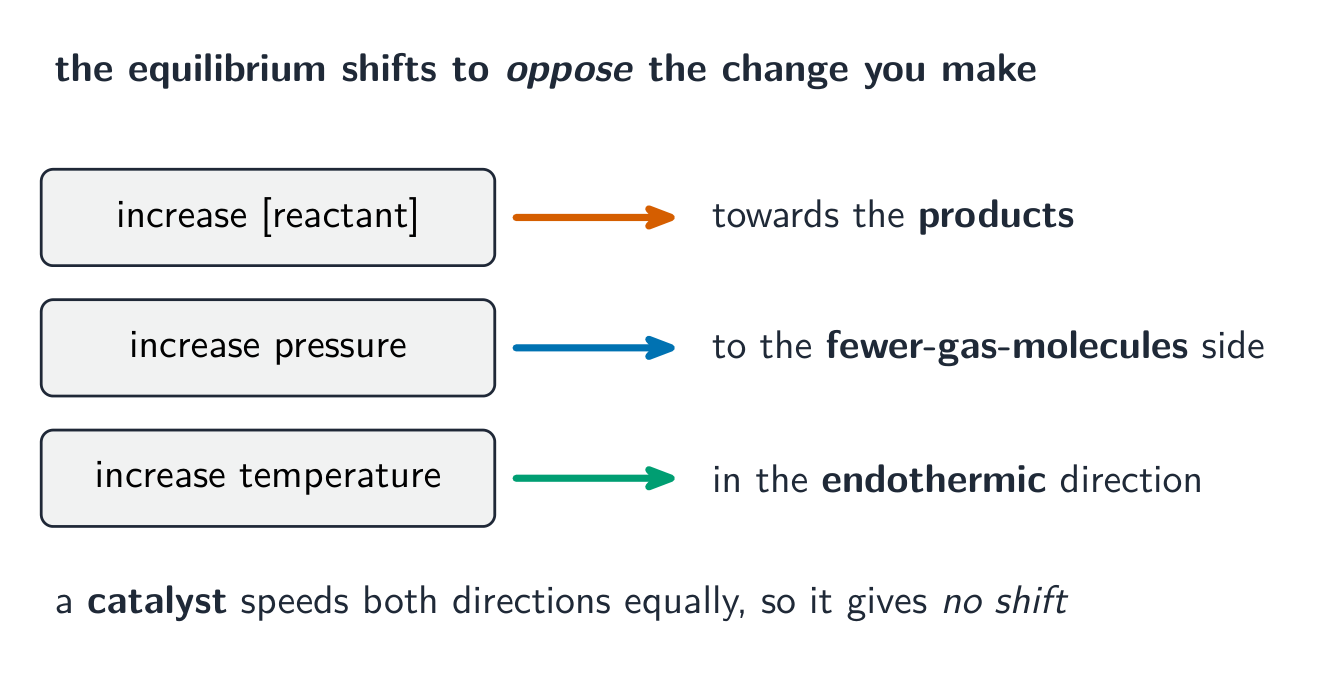
Two ideas carry the most marks. Intermolecular forces explain boiling points, solubility and chromatography. Le Châtelier's principle explains every shift in an equilibrium. Learn both properly and a large part of the paper opens up.

A calculation without units and significant figures is an incomplete answer.

The notes follow the nine CED units, each with worked examples and the relationships given on the exam's equation sheet. Past FRQs and scoring guidelines are in the library — chemistry's long questions pay for explaining behaviour at the particle level, so the model answers are written in that register.

  • 1

    Atomic Structure and Properties · ⁨원자 구조와 성질⁩

    Watch lesson · ⁨수업 보기⁩
    1.1

    Moles and Molar Mass · ⁨몰 및 몰 질량⁩

    Syllabus
    English

    Learning Objective 1.1.A: Calculate quantities of a substance or its relative number of particles using dimensional analysis and the mole concept.

    • 1.1.A.1 One cannot count particles directly while performing laboratory work. Thus, there must be a connection between the masses of substances reacting and the actual number of particles undergoing chemical changes.
    • 1.1.A.2 Avogadro's number ($N_{\mathrm{A}} = 6.022 \times 10^{23}\ \mathrm{mol}^{-1}$) provides the connection between the number of moles in a pure sample of a substance and the number of constituent particles (or formula units) of that substance.
    • 1.1.A.3 Expressing the mass of an individual atom or molecule in atomic mass units (amu) is useful because the average mass in amu of one particle (atom or molecule) or formula unit of a substance will always be numerically equal to the molar mass of that substance in grams. Thus, there is a quantitative connection between the mass of a substance and the number of particles that the substance contains.
      • Equation: $n = m/M$
    한국어

    학습 목표 1.1.A: 차원 분석 및 몰 개념을 사용하여 물질의 양이나 입자의 상대적 개수를 계산합니다.

    • 1.1.A.1 실험실 작업 중에는 입자를 직접 세는 것이 불가능하므로, 반응하는 물질의 질량과 화학 변화에 관여하는 실제 입자 수 사이에 연결 고리가 있어야 합니다.
    • 1.1.A.2 아보가드로 상수($N_{\mathrm{A}} = 6.022 \times 10^{23}\ \mathrm{mol}^{-1}$)는 순수 시료 내 몰 수와 해당 물질의 구성 입자(또는 식 단위) 수 사이의 연결 고리를 제공합니다.
    • 1.1.A.3 개별 원자나 분자의 질량을 원자 질량 단위(amu)로 표현하면 유용한데, 이는 한 입자(원자 또는 분자) 또는 식 단위의 amu 평균 질량이 해당 물질의 몰 질량(g)과 수치상 항상 같기 때문입니다. 따라서 물질의 질량과 그物质이 포함하는 입자 수 사이에는 정량적 연결고리가 존재합니다.
      • 식: $n = m/M$
    Source: College Board AP Course and Exam Description · ⁨출처: College Board AP Course and Exam Description⁩

    English

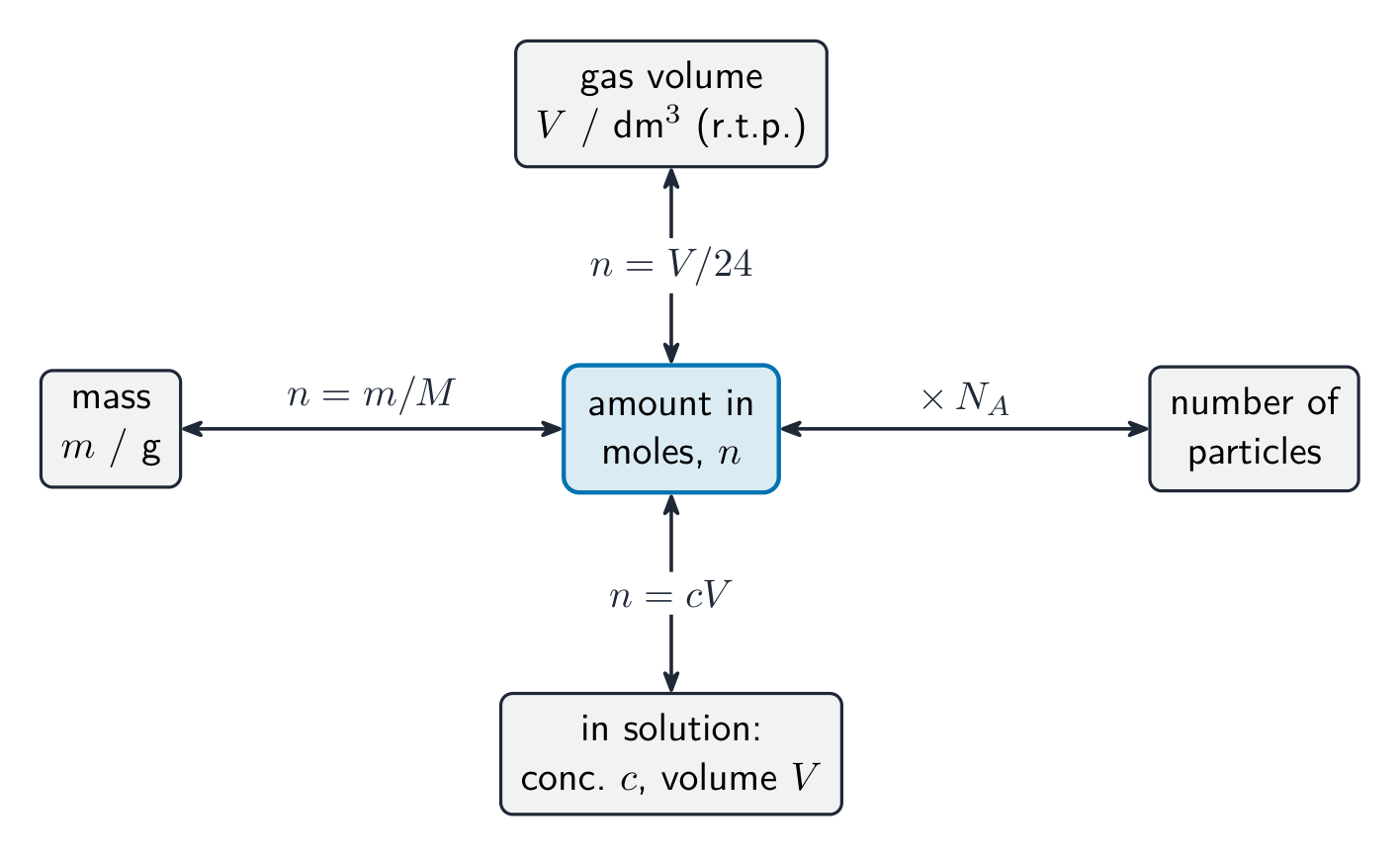
    Because atoms are far too small to count, chemists count in moles 摩尔. One mole is Avogadro's number 阿伏伽德罗常数 of particles, $N_A=6.022\times10^{23}$. The molar mass 摩尔质量 (grams per mole, read off the periodic table) converts between mass and moles:

    $$n=\frac{m}{M}.$$
    Moles are the bridge between the lab (grams you weigh) and the equation (particles that react).

    Worked example. How many moles, and how many molecules, are in $36.0\ \text{g}$ of water ($M=18.0\ \text{g/mol}$)?

    $$n=\frac{m}{M}=\frac{36.0}{18.0}=2.0\ \text{mol},\qquad N=n\,N_A=2.0\times6.022\times10^{23}=1.2\times10^{24}\ \text{molecules}.$$

    한국어

    원자는 크기가 너무 작아 세는 것이 불가능하므로, 화학자들은 몰(mole) 단위로 세는方法来 사용합니다. 한 몰은 아보가드로 수에 해당하는 입자 수인 $N_A=6.022\times10^{23}$입니다. 몰 질량(몰당 그램, 주기율표에서 읽음)은 질량과 몰 사이의 변환에 사용됩니다:

    $$n=\frac{m}{M}.$$
    몰은 실험실(저울로 측정하는 그램)과 식(반응하는 입자) 사이의 다리가 됩니다.

    몰은 중심축: 질량, 입자, 기체 부피, 농도 간 변환
    몰은 중심축: 질량, 입자, 기체 부피, 농도 간 변환

    해설 예제. 물(H₂O) $36.0\ \text{g}$에는 몰(mole)과 분자 수가 몇 개나 포함되어 있습니까?($M=18.0\ \text{g/mol}$)?

    $$n=\frac{m}{M}=\frac{36.0}{18.0}=2.0\ \text{mol},\qquad N=n\,N_A=2.0\times6.022\times10^{23}=1.2\times10^{24}\ \text{molecules}.$$

    Explore · ⁨탐색하기⁩

    Link mass, moles and molar mass · ⁨질량, 몰 및 몰 질량 연결하기⁩

    Molar mass $M$ is the bridge between the mass you weigh and the number of moles: $m = M \times n$. Because $M$ is fixed for a substance, mass is proportional to moles — double the moles, double the mass. · ⁨몰 질량 $M$은 측정한 질량과 몰 수 사이의 다리가 됩니다: $m = M \times n$. 물질에 대해 $M$는 고정되어 있으므로, 질량은 몰 수와 비례합니다. 몰 수가 두 배가 되면 질량도 두 배가 됩니다.⁩

    1.2

    Mass Spectra of Elements · ⁨원소의 질량 스펙트럼⁩

    Syllabus
    English

    Learning Objective 1.2.A: Explain the quantitative relationship between the mass spectrum of an element and the masses of the element's isotopes.

    • 1.2.A.1 The mass spectrum of a sample containing a single element can be used to determine the identity of the isotopes of that element and the relative abundance of each isotope in nature.
    • 1.2.A.2 The average atomic mass of an element can be estimated from the weighted average of the isotopic masses using the mass of each isotope and its relative abundance.
      • Exclusion Statement: Interpreting mass spectra of samples containing multiple elements or peaks arising from species other than singly charged monatomic ions will not be assessed on the AP Exam.
    한국어

    학습 목표 1.2.A: 원소의 질량 스펙트럼과 동위 원소들의 질량 간의 정량적 관계를 설명합니다.

    • 1.2.A.1 단일 원소를 포함하는 시료의 질량 스펙트럼을 통해 해당 원소의 동위 원소 종류를 식별하고 자연 내 각 동위 원소의 상대적 풍부도를 알 수 있습니다.
    • 1.2.A.2 동위 원소 질량과 상대적 풍부도를 사용하여 가중평균을 취함으로써 원소의 평균 원자 질량을 추정할 수 있습니다.
      • 제외 사항: AP 시험에서는 다중 원소를 포함하는 시료의 질량 스펙트럼 해석이나 단전하 단원자 이온 외의 종에서 기인하는 피크에 대한 평가는 진행되지 않습니다.

    Source: College Board AP Course and Exam Description · ⁨출처: College Board AP Course and Exam Description⁩

    English
    Mass spectrometry

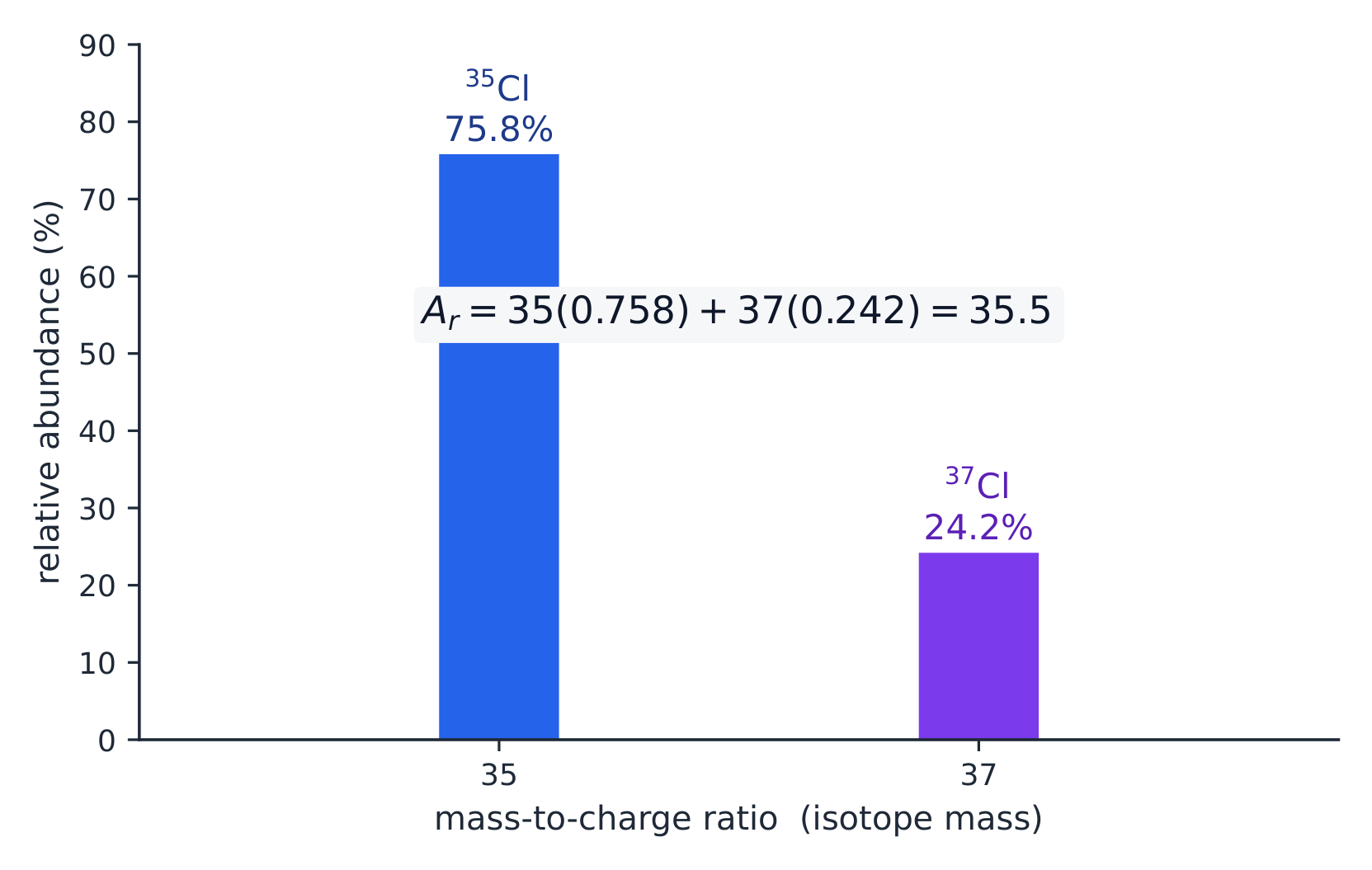
    A mass spectrometer 质谱仪 separates atoms by mass, giving a mass spectrum 质谱: peaks at each isotope 同位素 (same element, different neutron count) with heights showing their relative abundance 相对丰度. The element's average atomic mass is the abundance-weighted average of its isotope masses.

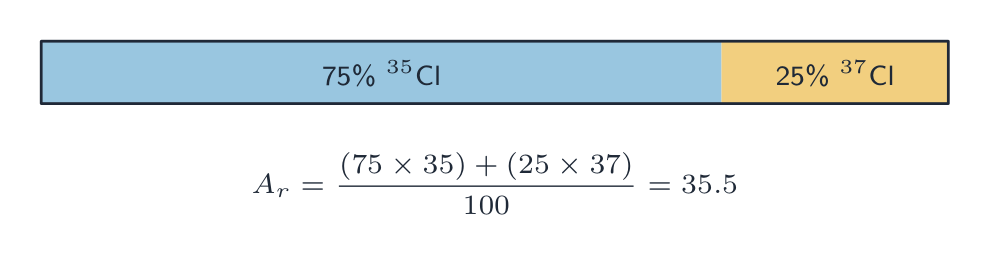
    Worked example. Chlorine is $75.8\%$ chlorine-35 and $24.2\%$ chlorine-37. Its average atomic mass is

    $$A_r=(35)(0.758)+(37)(0.242)=26.5+8.95=35.5.$$
    The average lies closer to $35$ because that isotope is more abundant – which is why the periodic-table value is $35.5$, not a whole number.

    한국어
    질량 분석법

    질량 분석기는 질량에 따라 원자를 분리하여 질량 스펙트럼을 생성합니다. 각 동위원소(같은 원소, 다른 중성자 수)마다 피크가 있으며, 높이는 상대적 존재비를 나타냅니다. 원소의 평균 원자 질량은 동위원소 질량의 존재비 가중 평균입니다.

    상대원자질량은 동위원소들의 존재비 가중 평균입니다
    상대원자질량은 동위원소들의 존재비 가중 평균입니다
    염소의 질량 스펙트럼: 서로 다른 존재비를 가진 두 동위원소
    염소의 질량 스펙트럼: 서로 다른 존재비를 가진 두 동위원소

    해설 예제. 염소는 $75.8\%$ chlorine-35와 $24.2\%$ chlorine-37로 이루어져 있습니다. 이의 평균 원자 질량은

    $$A_r=(35)(0.758)+(37)(0.242)=26.5+8.95=35.5.$$
    이 동위원소가 더 풍부하기 때문에 평균은 $35$에 더 가깝습니다 – 이것이 주기율표 값이 $35.5$이며 정수가 아닌 이유입니다.

    Explore · ⁨탐색하기⁩

    Explore isotopes — same element, different mass · ⁨동위원소 탐구 — 동일한 원소, 다른 질량⁩

    Keep the protons fixed but change the neutrons to build the two chlorine isotopes ($^{35}$Cl and $^{37}$Cl). Same element, different mass — exactly the peaks a mass spectrum shows. · ⁨양성자는 고정하고 중성자만 변경하여 두 개의 염소 동위원소($^{35}$Cl과 $^{37}$Cl)를 만드세요. 동일한 원소이지만 다른 질량 — 이것이 질량 스펙트럼에서 보이는 정확한 피크들입니다.⁩

    Vocabulary · ⁨어휘⁩ Train · ⁨연습하기⁩
    English 한국어
    moles/məʊlz/ 몰
    Avogadro's number/ˌævəˈɡædrəʊz ˈnʌmbə/ 아보가드로 상수
    molar mass/ˈməʊlə mæs/ 몰 질량
    mass spectrometer/mæs spekˈtrɒmɪtə/ 질량 분석계
    mass spectrum/mæs ˈspektrəm/ 질량 스트럼
    isotope/ˈaɪsətəʊp/ 동위 원소(isotope)
    relative abundance/ˈrelətɪv əˈbʌndəns/ 상대적 풍부도
    percent composition/pəˈsent ˌkɒmpəˈzɪʃn/ 성분 비(퍼센트 composition)
    1.3

    Elemental Composition of Pure Substances · ⁨순수 물질의 원소 구성⁩

    Syllabus
    English

    Learning Objective 1.3.A: Explain the quantitative relationship between the elemental composition by mass and the empirical formula of a pure substance.

    • 1.3.A.1 Some pure substances are composed of individual molecules, while others consist of atoms or ions held together in fixed proportions as described by a formula unit.
    • 1.3.A.2 According to the law of definite proportions, the ratio of the masses of the constituent elements in any pure sample of that compound is always the same.
    • 1.3.A.3 The chemical formula that lists the lowest whole number ratio of atoms of the elements in a compound is the empirical formula.
    한국어

    학습 목표 1.3.A: 순수 물질의 원소 구성 비율(질량 기준)과 실험식 사이의 정량적 관계를 설명합니다.

    • 1.3.A.1 일부 순수 물질은 개별 분자로 구성되어 있는 반면, 다른 물질들은 식 단위로 기술된 고정 비율로 결합된 원자나 이온으로 구성됩니다.
    • 1.3.A.2 고정 조성의 법칙에 따르면, 어떤 순수 시료의 구성 원소 간 질량 비는 항상 동일합니다.
    • 1.3.A.3 화합물 내 원소들의 원자 수 최소 정수 비를 나열한 화학식을 험식이라고 합니다.

    Source: College Board AP Course and Exam Description · ⁨출처: College Board AP Course and Exam Description⁩

    English

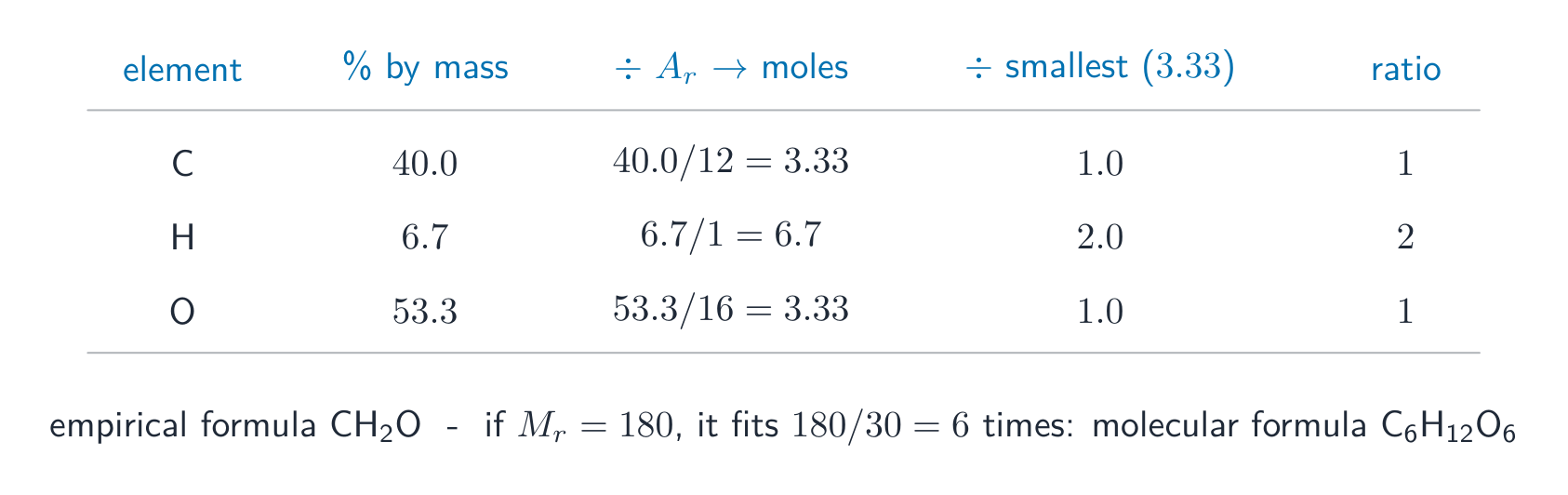
    The percent composition 百分组成 of a compound is each element's mass fraction. From it you find the empirical formula 实验式 (simplest whole-number ratio of atoms) by converting each element's mass to moles and dividing by the smallest. The molecular formula 分子式 is a whole-number multiple of the empirical formula, found from the molar mass.

    Worked example. A compound is $40.0\%$ C, $6.7\%$ H, and $53.3\%$ O by mass. Assuming $100\ \text{g}$, convert each mass to moles and divide by the smallest:

    $$\text{C}:\frac{40.0}{12}=3.33,\quad \text{H}:\frac{6.7}{1}=6.7,\quad \text{O}:\frac{53.3}{16}=3.33 \;\xrightarrow{\div 3.33}\; 1:2:1,$$
    so the empirical formula is $\text{CH}_2\text{O}$. If the molar mass were $180\ \text{g/mol}$ ($=6\times30$), the molecular formula would be $\text{C}_6\text{H}_{12}\text{O}_6$ – glucose.

    한국어

    화합물의 백분组成은 각 원소의 질량 분율입니다. 이를 통해 각 원소의 질량을 몰로 변환하고 가장 작은 값으로 나누어 ** empirical formula**(원자 simplest whole-number ratio)를 구할 수 있습니다. molecular formula는 empirical formula의 정수 배이며, 몰 질량으로부터 구할 수 있습니다.

    empirical formula 구하기: 질량 → 몰, 가장 작은 값으로 나누기, 비율 읽기
    empirical formula 구하기: 질량 → 몰, 가장 작은 값으로 나누기, 비율 읽기

    **해설 예제.**某化合物는 질량 기준 $40.0\%$ C, $6.7\%$ H, $53.3\%$ O를 포함합니다. 총 질량이 $100\ \text{g}$라고 가정하면, 각 질량을 몰로 변환하고 가장 작은 값으로 나눕니다:

    $$\text{C}:\frac{40.0}{12}=3.33,\quad \text{H}:\frac{6.7}{1}=6.7,\quad \text{O}:\frac{53.3}{16}=3.33 \;\xrightarrow{\div 3.33}\; 1:2:1,$$
    따라서 empirical formula는 $\text{CH}_2\text{O}$입니다. 만약 몰 질량이 $180\ \text{g/mol}$ ($=6\times30$)이라면, molecular formula는 $\text{C}_6\text{H}_{12}\text{O}_6$–포도당–이 될 것입니다.

    Vocabulary · ⁨어휘⁩ Train · ⁨연습하기⁩
    English 한국어
    empirical formula/emˈpɪrɪkl ˈfɔːmjʊlə/ 간소화 식
    molecular formula/məˈlekjʊlə ˈfɔːmjʊlə/ 분자 식
    mixture/ˈmɪkstʃə/ 혼합물
    nucleus/ˈnjuːklɪəs/ 핵
    electron configuration/ɪˈlektrɒn kənˌfɪɡjəˈreɪʃn/ 전자 구성
    valence electrons/ˈveɪləns ɪˈlektrɒnz/ 가전자
    Photoelectron spectroscopy/ˌfəʊtəʊɪˈlektrɒn spekˈtrɒskəpi/ 광전자 분광법
    Atomic radius/əˈtɒmɪk ˈreɪdɪəs/ 원자 반경
    Ionization energy/ˌaɪənaɪˈzeɪʃn ˈenədʒi/ 이온화 에너지
    1.4

    Composition of Mixtures · ⁨혼합물의 조성⁩

    Syllabus
    English

    Learning Objective 1.4.A: Explain the quantitative relationship between the elemental composition by mass and the composition of substances in a mixture.

    • 1.4.A.1 Pure substances contain atoms, molecules, or formula units of a single type. Mixtures contain atoms, molecules, or formula units of two or more types, whose relative proportions can vary.
    • 1.4.A.2 Elemental analysis can be used to determine the relative numbers of atoms in a substance and to determine its purity.
    한국어

    학습 목표 1.4.A: 순수 물질의 원소 구성 비율(질량 기준)과 혼합물 내 물질의 조성 간의 정량적 관계를 설명합니다.

    • 1.4.A.1 순수 물질은 단일 유형의 원자, 분자 또는 식 단위를 포함하며, 혼합물은 두 가지 이상의 유형의 원자, 분자 또는 식 단위를 포함하여 상대적 비율이 변할 수 있습니다.
    • 1.4.A.2 원소 분석을 사용하여 물질 내 원자의 상대적 수를 결정하고 순도를 확인할 수 있습니다.

    Source: College Board AP Course and Exam Description · ⁨출처: College Board AP Course and Exam Description⁩

    English

    Unlike a pure compound, a mixture 混合物 has variable composition – its parts keep their own identities. Describe a mixture by the mass or mole fraction of each component; these do not follow a fixed formula. Spectroscopy (like PES or absorption) can measure how much of each component is present.

    한국어

    순수 화합물과 달리 혼합물은 변할 수 있는 조성을 가지며, 구성 성분은 자신의 정체성을 유지합니다. 혼합물을 각 성분의 질량 분율 또는 몰 분율로 설명할 수但这些은 고정된 화학식을 따르지 않습니다. 분광학(PES 또는 흡수 등)을 통해 각 성분이 얼마나 있는지 측정할 수 있습니다.

    1.5

    Atomic Structure and Electron Configuration · ⁨원자 구조와 전자 배치⁩

    Syllabus
    English

    Learning Objective 1.5.A: Represent the ground-state electron configuration of an atom of an element or its ions using the Aufbau principle.

    • 1.5.A.1 The atom is composed of negatively charged electrons and a positively charged nucleus that is made of protons and neutrons.
    • 1.5.A.2 Coulomb's law is used to calculate the force between two charged particles.
      • Equation: $F_{coulombic} \propto \dfrac{q_1 q_2}{r^2}$
    • 1.5.A.3 In atoms and ions, the electrons can be thought of as being in "shells (energy levels)" and "subshells (sublevels)," as described by the ground-state electron configuration. Inner electrons are called core electrons, and outer electrons are called valence electrons. The electron configuration is explained by quantum mechanics, as delineated in the Aufbau principle and exemplified in the periodic table of the elements.
      • Exclusion Statement: The assignment of quantum numbers to electrons in subshells of an atom will not be assessed on the AP Exam.
    • 1.5.A.4 The relative energy required to remove an electron from different subshells of an atom or ion or from the same subshell in different atoms or ions (ionization energy) can be estimated through a qualitative application of Coulomb's law. This energy is related to the distance from the nucleus and the effective (shield) charge of the nucleus.
    한국어

    학습 목표 1.5.A: 오버바우 원리를 사용하여 원소 원자 또는 이온의 기저 상태 전자 배치를 나타냅니다.

    • 1.5.A.1 원자는 음전하를 띤 전자와 양성자와 중성자로 구성된 양전하를 띤 핵으로 구성되어 있습니다.
    • 1.5.A.2 쿨롱의 법칙은 두 전하 입자 사이의 힘을 계산하는 데 사용됩니다.
      • 식: $F_{coulombic} \propto \dfrac{q_1 q_2}{r^2}$
    • 1.5.A.3 원자와 이온 내에서 전자는 기저 상태 전자 배치가 설명하듯 '껍질(에너지 준위)'과 '아껍질(하준위)'에 있다고 생각할 수 있습니다. 안쪽 전자를 코어 전자, 바깥쪽 전자를 원자가 전자라고 부릅니다. 전자 배치는 오버바우 원리에 의해 규정되고 원주기율표에 의해 예시되는 양자역학으로 설명됩니다.
      • 제외 사항: 원자 내 아껍질의 전자에 양자수를 부여하는 것은 AP 시험에서 평가되지 않습니다.
    • 1.5.A.4 원자나 이온의 서로 다른 아껍질, 혹은 서로 다른 원자나 이온의 동일한 아껍질에서 전자를 제거하는 데 필요한 상대적 에너지(이온화 에너지)는 쿨롱의 법칙의 정성적 적용을 통해 추정할 수 있습니다. 이 에너지는 핵으로부터의 거리와 핵의 유효(차폐) 전하와 관련이 있습니다.

    Source: College Board AP Course and Exam Description · ⁨출처: College Board AP Course and Exam Description⁩

    English

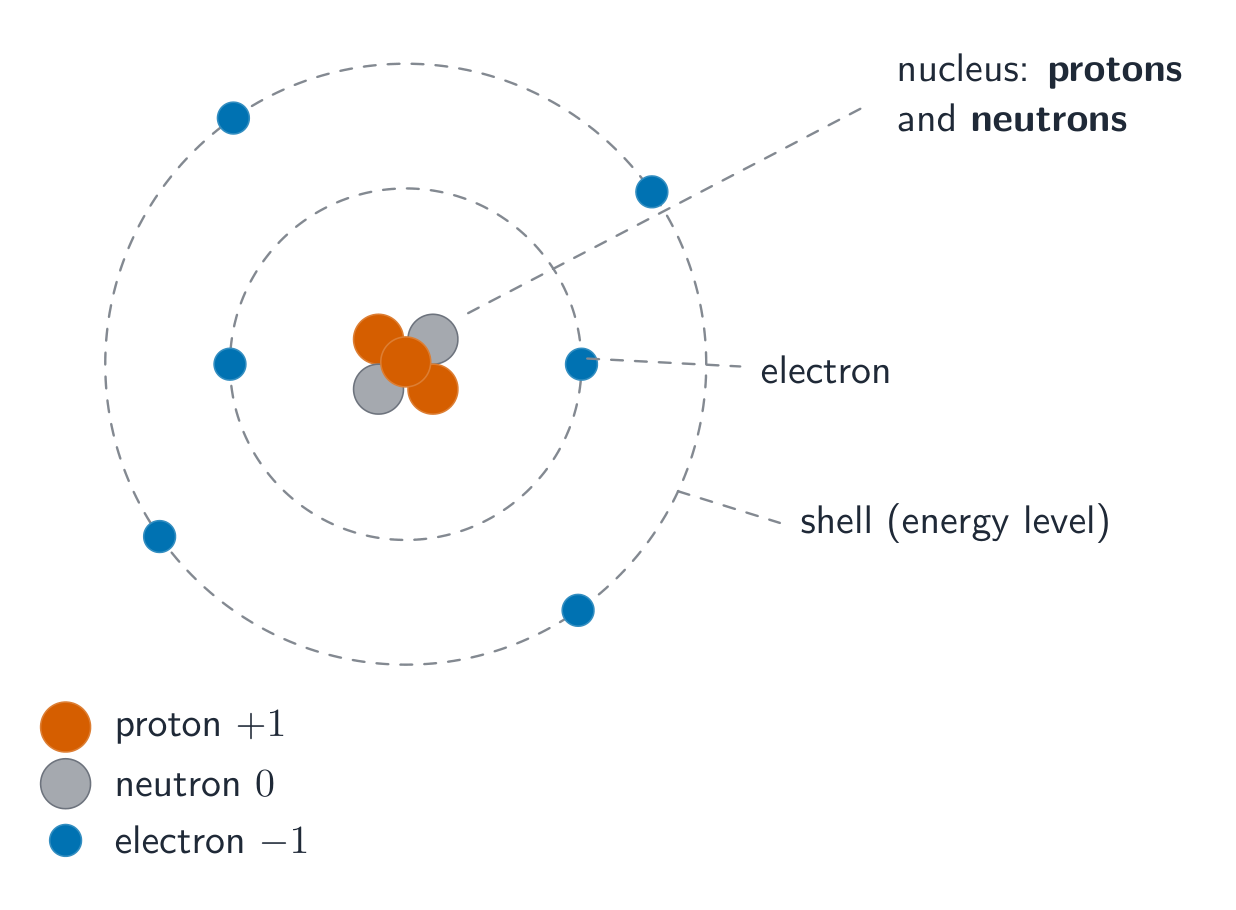
    An atom is a tiny nucleus 原子核 (protons and neutrons) surrounded by electrons in shells and subshells (s, p, d, f). The electron configuration 电子排布 lists how electrons fill these, lowest energy first (e.g. $1s^2\,2s^2\,2p^6$). The outermost, highest-energy electrons – the valence electrons 价电子 – control chemistry. Coulomb's law explains their energies: electrons closer to, and less shielded from, the nucleus are held more tightly.

    Worked example. Write the electron configuration of sulfur ($Z=16$). Fill subshells in order until $16$ electrons are placed: $1s^2\,2s^2\,2p^6\,3s^2\,3p^4$. The $3s$ and $3p$ electrons (six in total) are the valence electrons, so sulfur tends to gain two electrons to complete its octet.

    한국어

    원자는微小的 핵(양성자와 중성자)을 중심으로 전자가 껍질과 서브껍질(s, p, d, f)에 배치되어 있습니다. 전자 배치는 lowest energy부터 채우는 순서를 나열합니다(예: $1s^2\,2s^2\,2p^6$). 가장 바깥쪽, highest energy인 전자는 価电子로 화학적 성질을 결정합니다. 쿨롱의 법칙은 에너지를 설명합니다: 핵에 더 가까우거나 차폐가 덜 받은 전자는 더 강하게 묶여 있습니다.

    양자와 중자로 된 작은 핵과 껍질을 따라 돌고 있는 전자로 구성된 원자
    양자와 중자로 된 작은 핵과 껍질을 따라 돌고 있는 전자로 구성된 원자
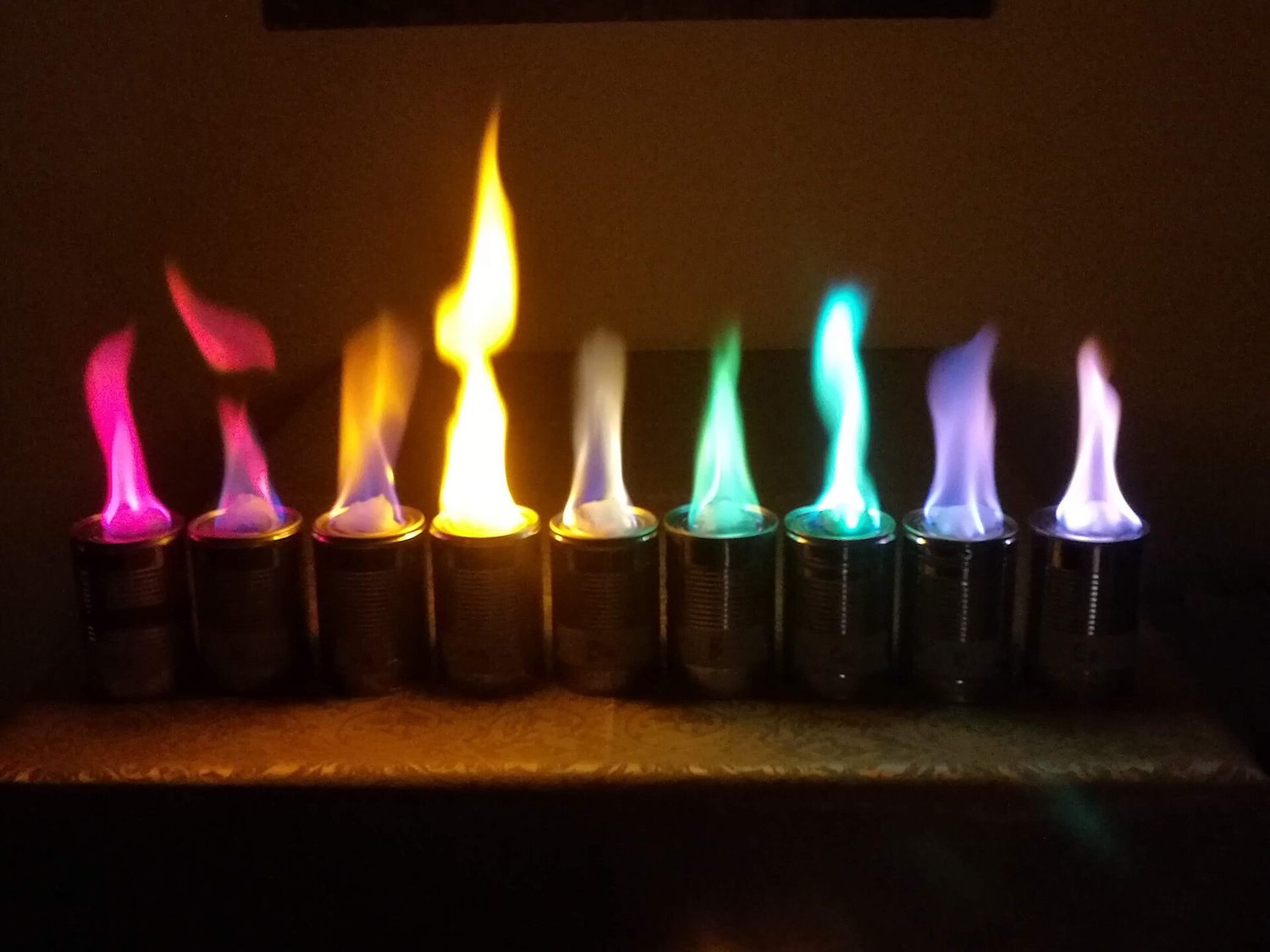
    아홉 개의 연소 용기가 줄지어 있으며, 각각 불꽃이 선명한 색(홍색, 주황색, 노란색, 녹색, 파란색, 보라색)으로 다릅니다
    불꽃 반응: 각 금속 이온은 열에 의해 전자가 자극받았다가 다시 떨어지며 특정 파장의 빛을 방출하므로 고유한 색을 띱니다

    해설 예제. 황(S, $Z=16$)의 전자 배치를 쓰십시오. 서브껍질을 순서대로 채워 $16$개의 전자가 배치될 때까지 진행합니다: $1s^2\,2s^2\,2p^6\,3s^2\,3p^4$. $3s$와 $3p$ 전자는 총 여섯 개로价电子이므로, 황은 옥테트를 완성하기 위해 전자 두 개를 얻는 경향이 있습니다.

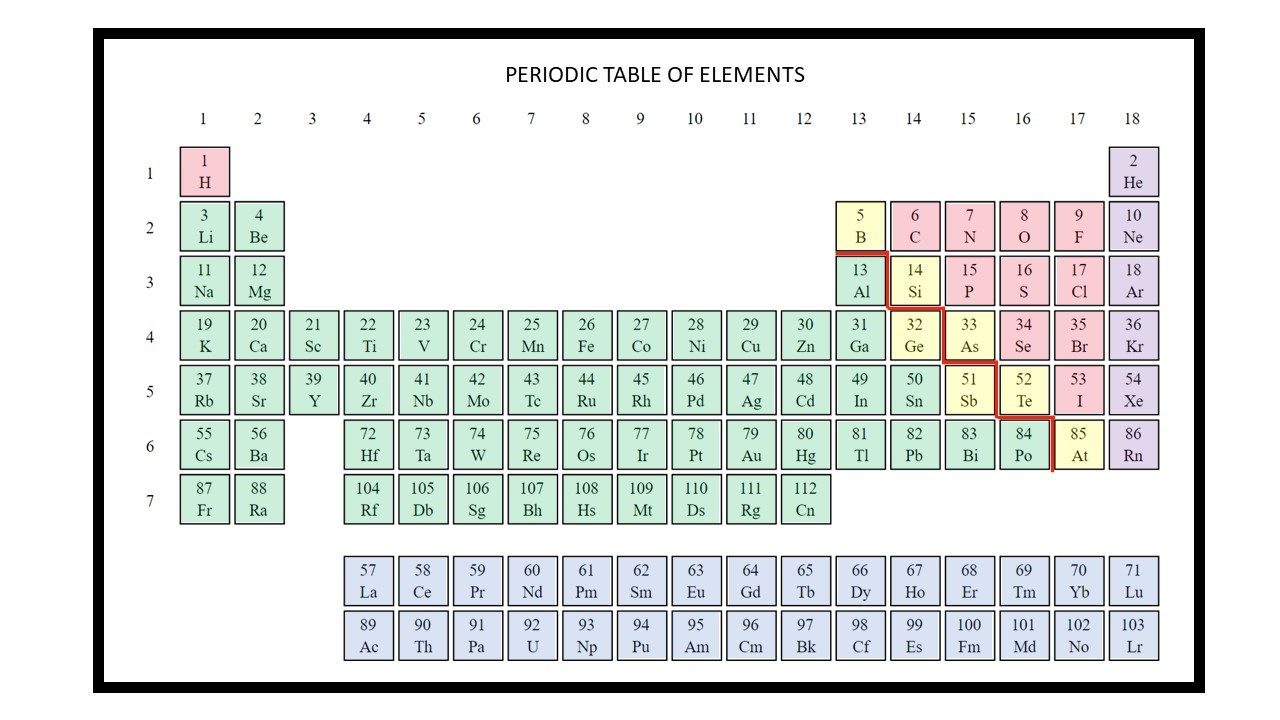
    주기율표는 원자 구조에 따라 요소를 배열합니다 – 전자 배치는 패턴을 설명합니다
    주기율표는 원자 구조에 따라 요소를 배열합니다 – 전자 배치는 패턴을 설명합니다
    Explore · ⁨탐색하기⁩

    Explore how electrons fill the shells · ⁨전자 껍질이 채워지는 방식 탐구하기⁩

    Change the atomic number $Z$ and watch the electrons fill the shells lowest-energy-first (the Aufbau principle 构造原理). The outermost electrons are the valence electrons that drive bonding. · ⁨원자 번호 $Z$를 변경하고 전자가 가장 낮은 에너지 껍질부터 채워지는 과정(오버바우 원리构造原理)을 확인하세요. 가장 바깥쪽의 전자는 価전자로, 결합을 주도하는 역할을 합니다.⁩

    1.6

    Photoelectron Spectroscopy · ⁨광전자 분광법⁩

    Syllabus
    English

    Learning Objective 1.6.A: Explain the relationship between the photoelectron spectrum of an atom or ion and: i. The ground-state electron configuration of the species. ii. The interactions between the electrons and the nucleus.

    • 1.6.A.1 The energies of the electrons in a given shell can be measured experimentally with photoelectron spectroscopy (PES). The position of each peak in the PES spectrum is related to the energy required to remove an electron from the corresponding subshell, and the relative height of each peak is (ideally) proportional to the number of electrons in that subshell.
    한국어

    학습 목표 1.6.A: 원자나 이온의 광전자 스펙트럼과 다음 사이의 관계를 설명합니다: i. 종의 기저 상태 전자 배치. ii. 전자와 핵 사이의 상호작용.

    • 1.6.A.1 주어진 껍질의 전자 에너지는 광전자 스펙트로스코피(PES)를 통해 실험적으로 측정할 수 있습니다. PES 스펙트럼의 각 피크 위치는 해당 아껍질에서 전자를 제거하는 데 필요한 에너지와 관련이 있으며, 각 피크의 상대적 높이는 해당 아껍질의 전자 수에 비례합니다(이상적인 경우).

    Source: College Board AP Course and Exam Description · ⁨출처: College Board AP Course and Exam Description⁩

    English

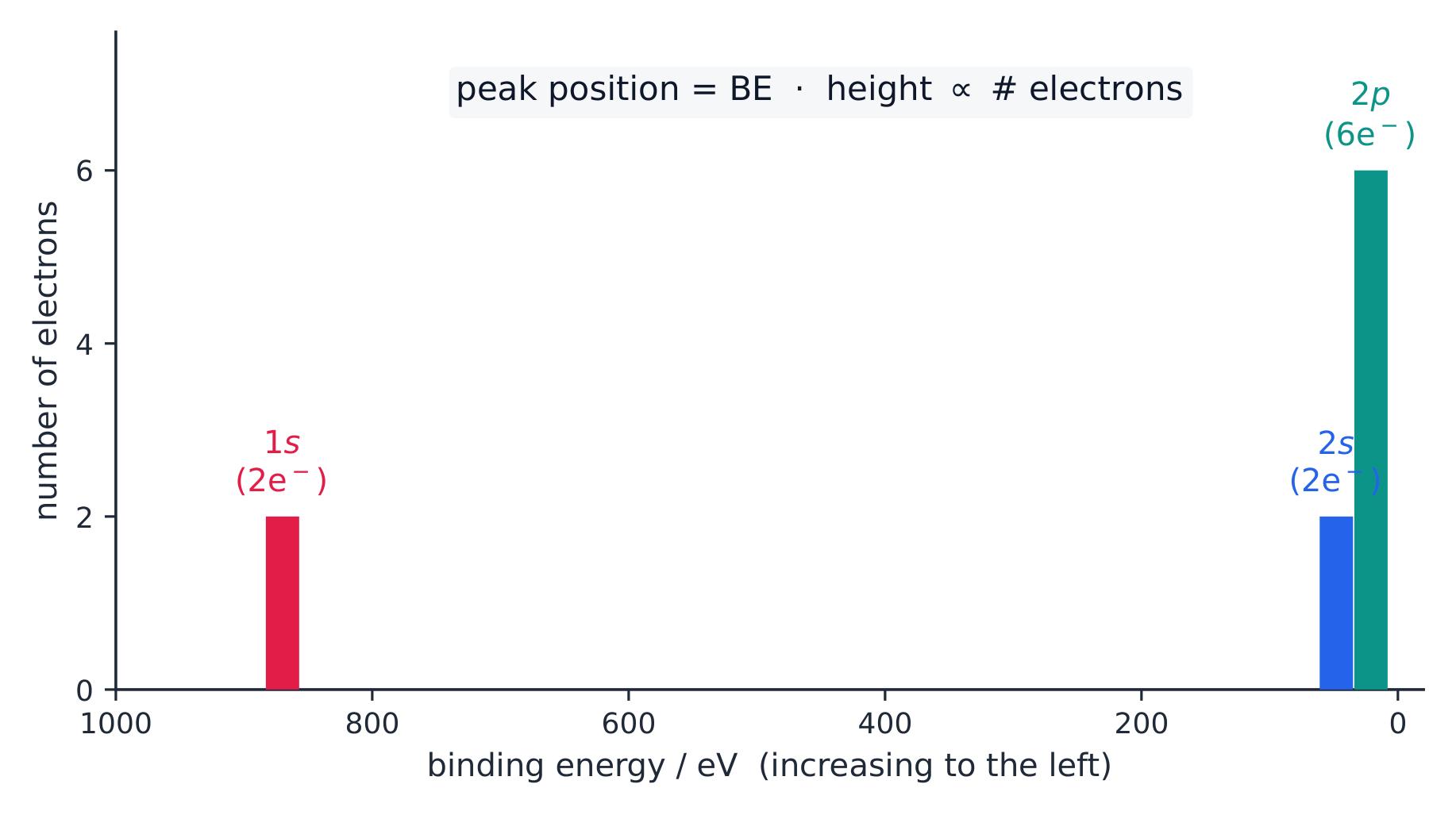
    Photoelectron spectroscopy 光电子能谱 (PES) measures the energy needed to remove electrons from each subshell. Each peak is a subshell: its position gives the binding energy (how tightly held) and its height gives the number of electrons in it. PES data let you read an element's electron configuration and confirm shell structure directly.

    한국어

    광전자 분광법(PES) 은 각 서브껍질에서 전자를 제거하는 데 필요한 에너지를 측정합니다. 각 피크는 서브껍질을 나타내며, 위치는 결합 에너지(묶임 강도)를, 높이는 내 전자의 수를 나타냅니다. PES 데이터를 통해 원자의 전자 배치와 껍질 구조를 직접 확인할 수 있습니다.

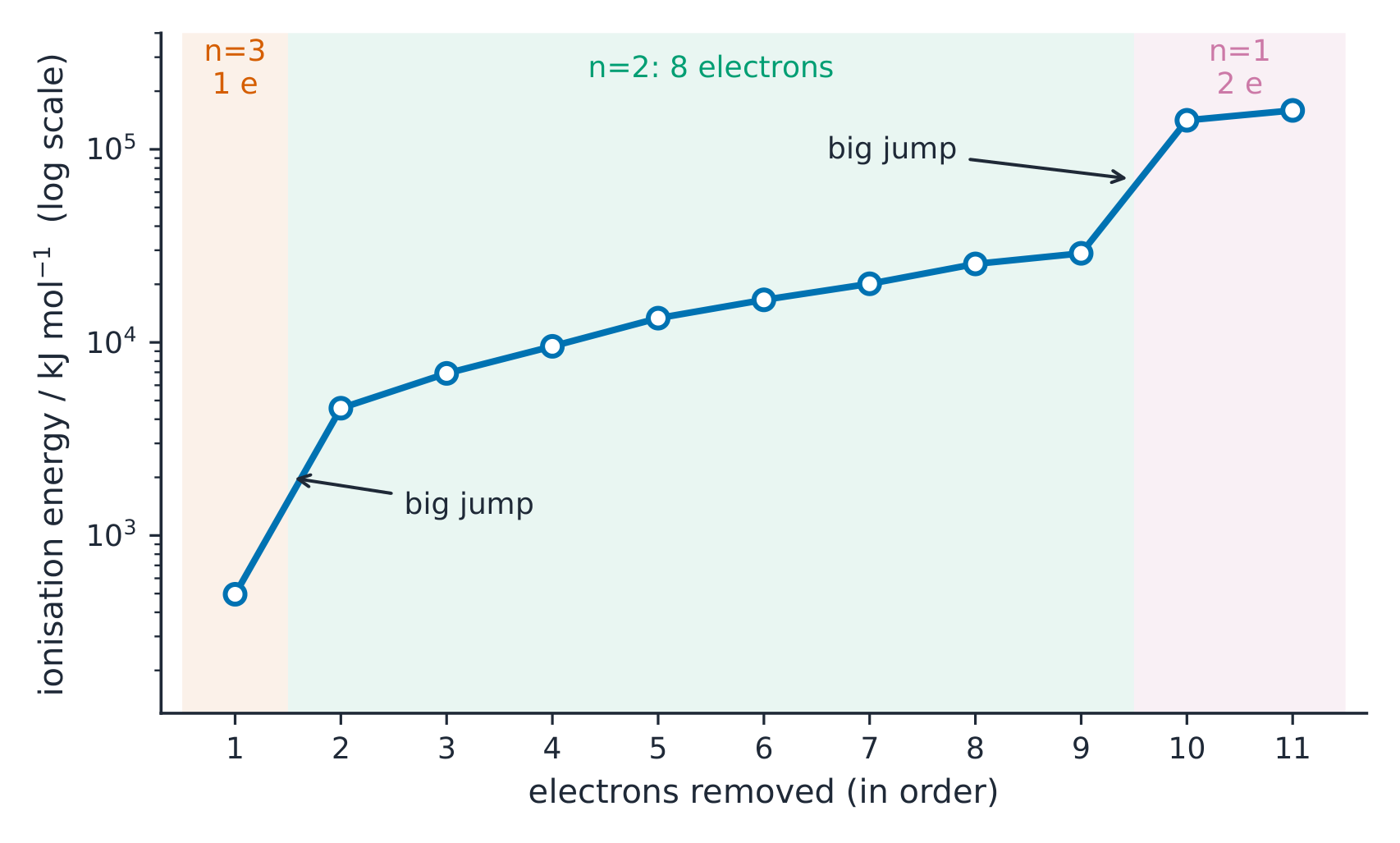
    연속 이화 에너지는 큰 점프를 통해 껍질 구조를 드러냅니다
    연속 이화 에너지는 큰 점프를 통해 질 구조를 드러냅니다
    네온의 광전자 스펙트럼: 서브껍질별 하나의 피크, 높이는 전자 수에 의함
    네온의 광전자 스펙트럼: 서브껍질별 하나의 피크, 높이는 전자 수에 의함
    1.7

    Periodic Trends · ⁨주기적 경향⁩

    Syllabus
    English

    Learning Objective 1.7.A: Explain the relationship between trends in atomic properties of elements and electronic structure and periodicity.

    • 1.7.A.1 The organization of the periodic table is based on patterns of recurring properties of the elements, which are explained by patterns of ground-state electron configurations and the presence of completely or partially filled shells (and subshells) of electrons in atoms.
      • Exclusion Statement: Writing the electron configuration of elements that are exceptions to the aufbau principle will not be assessed on the AP Exam.
    • 1.7.A.2 Trends in atomic properties within the periodic table (periodicity) can be predicted by the position of the element on the periodic table and qualitatively understood using Coulomb's law, the shell model, and the concepts of shielding and effective nuclear charge. These properties include:
      • i. Ionization energy
      • ii. Atomic and ionic radii
      • iii. Electron affinity
      • iv. Electronegativity.
    • 1.7.A.3 The periodicity (in 1.7.A.2) is useful to predict/estimate values of properties in the absence of data.
    한국어

    학습 목표 1.7.A: 원소들의 원자 성향의 성향과 전자 구조 및 주기율 사이의 관계를 설명합니다.

    • 1.7.A.1 주기율표의 배열은 원소들의 반복적 성향 패턴에 기반하며, 이는 원자 내 완전히 또는 부분적으로 채워진 껍질(및 아껍질) 전자의 존재와 기저 상태 전자 배치 패턴에 의해 설명됩니다.
      • 배제 사항: 오부바우 원리에 예외가 되는 원소의 전자 배정을 쓰는 것은 AP 시험 평가 대상이 아닙니다.
    • 1.7.A.2 주기율표 내 원자 성질의 경향(주기성)은 주기율표 상 해당 원소의 위치를 통해 예측할 수 있으며, 쿨롱의 법칙, 껍질 모델, 차폐 및 유효 핵전하의 개념을 사용하여 질적으로 이해할 수 있습니다. 이러한 성질에는 다음이 포함됩니다:
      • i. 이온화 에너지
      • ii. 원자 반지름 및 이온 반지름
      • iii. 전자 친화도
      • iv. 전기음성도.
    • 1.7.A.3 주기율(1.7.A.2 참조)은 데이터가 부재한 상황에서 성질의 값을 예측/추정하는 데 유용합니다.

    Source: College Board AP Course and Exam Description · ⁨출처: College Board AP Course and Exam Description⁩

    English

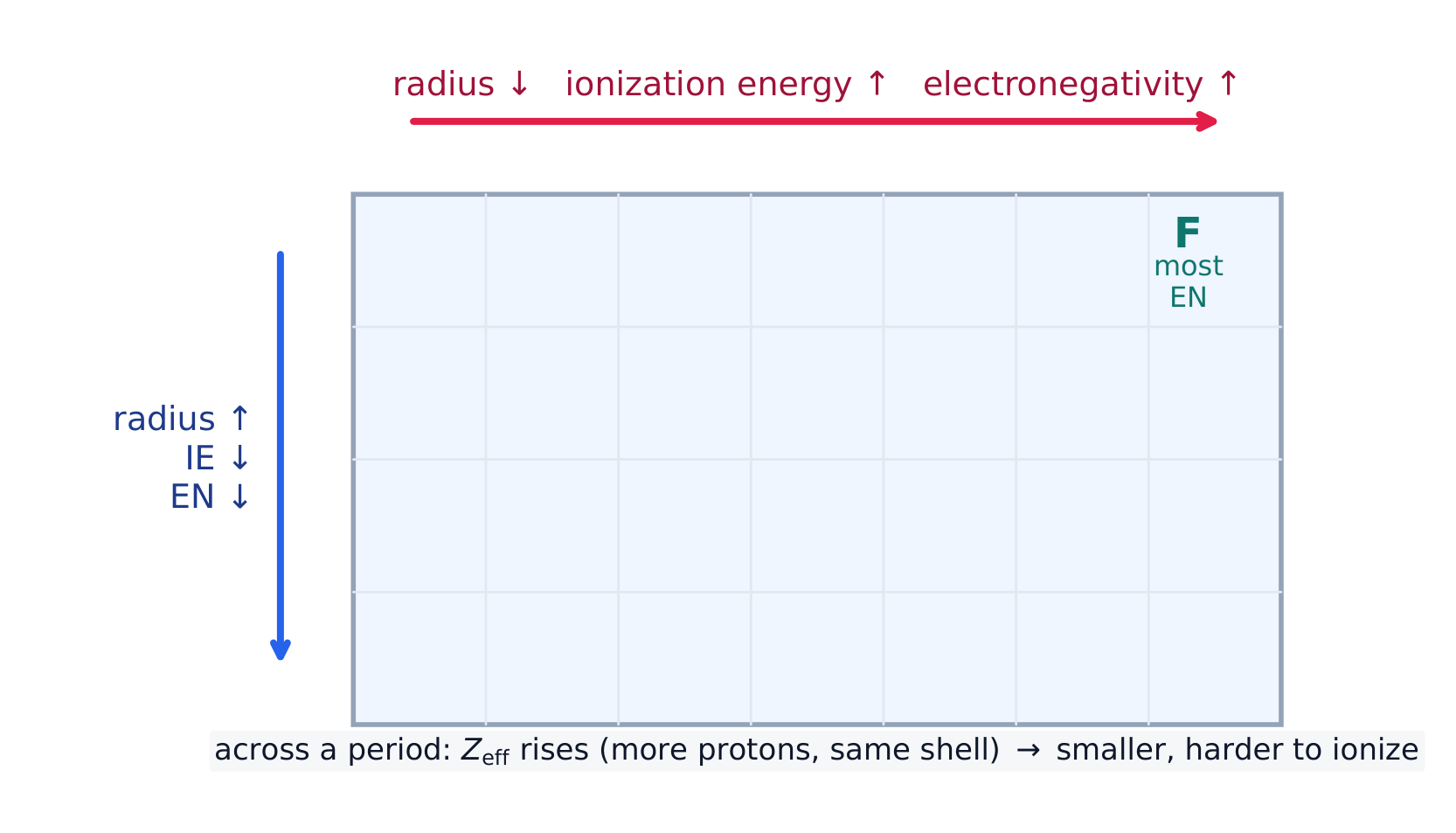
    Trends across the periodic table follow from nuclear charge and shielding:

    • Atomic radius 原子半径 decreases across a period (stronger pull) and increases down a group (more shells).
    • Ionization energy 电离能 (energy to remove an electron) increases across, decreases down – opposite to radius.
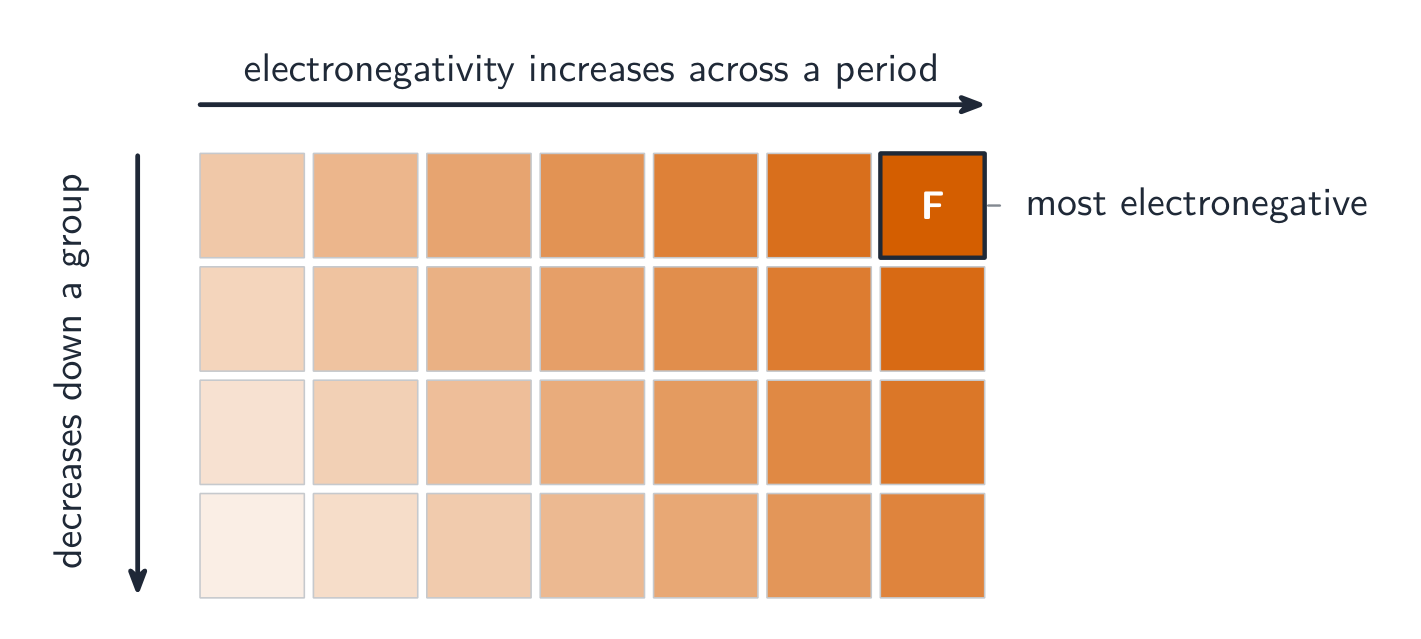
    • Electronegativity 电负性 (pull on shared electrons) increases across and up, toward fluorine.
    한국어

    주기율표를 가로지르는 경향은 핵전하와 차폐에서 비롯됩니다:

     electronegativity는 주기에 걸쳐 증가하고, 족에 따라 감소합니다
    electronegativity는 주기에 걸쳐 증가하고, 족에 따라 감소합니다
    • 원자 반경은 주기가 길어질수록(강한 인력) 감소하고, 족이 내려갈수록(전자 껍질 증가) 증가합니다.
    • 이온화 에너지(전자 하나를 제거하는 데 필요한 에너지)는 주기가 길어질수록 증가하고, 족이 내려갈수록 감소합니다 – 원자 반경의 경향과 반대입니다.
    • 전기음성도(공유 전자에 대한 인력)는 주기가 길어지고 위로 올라갈수록 증가하며, 플루오린 쪽으로 수렴합니다.
    주기적 경향: 원자 반경, 이온화 에너지, 전기음성도가 주기와 족에 따라 어떻게 변하는지
    주기적 경향: 원자 반경, 이온화 에너지, 전기음성도가 주기와 족에 따라 어떻게 변하는지
    Explore · ⁨탐색하기⁩

    Explore atomic radius across a period · ⁨주기별 원자 반경 변화 탐색하기⁩

    Step across Period 3 and watch the atomic radius shrink — each added proton raises the effective nuclear charge and pulls the same shell in tighter. · ⁨3주기에서 이동하며 원자 반경이 작아지는 것을 관찰하세요. 추가되는 양성자는 유효 핵전하를 높이고 동일한 껍질을 더 단단히 당겨 들이킵니다.⁩

    Vocabulary · ⁨어휘⁩ Train · ⁨연습하기⁩
    English 한국어
    Electronegativity/ɪˌlektrəʊŋɡəˈtɪvɪti/ 전기음성도
    cations/ˈkætaɪənz/ 양이온
    anions/ˈænaɪənz/ 음이온
    ionic compound/aɪˈɒnɪk ˈkɒmpaʊnd/ 이온 화합물
    1.8

    Valence Electrons and Ionic Compounds · ⁨원전자 및 이온성 화합물⁩

    Syllabus
    English

    Learning Objective 1.8.A: Explain the relationship between trends in the reactivity of elements and periodicity.

    • 1.8.A.1 The likelihood that two elements will form a chemical bond is determined by the interactions between the valence electrons and nuclei of elements.
    • 1.8.A.2 Elements in the same column of the periodic table tend to form analogous compounds.
    • 1.8.A.3 Typical charges of atoms in ionic compounds are governed by the number of valence electrons and predicted by their location on the periodic table.
    한국어

    학습목표 1.8.A: 원소들의 반응성 경향과 주기율 간의 관계를 설명하시오.

    • 1.8.A.1 두 원자가 화학 결합을 형성할 확률은 원소들의 원外层전자와 핵 사이의 상호작용에 의해 결정됩니다.
    • 1.8.A.2 주기율표의 같은 세로줄에 있는 원소들은 유사한 화합물을 형성하는 경향이 있습니다.
    • 1.8.A.3 이온 화합물에 있는 원자의 일반적인 전하수는 원外层전자의 개수에 따라 결정되며, 주기율표에서의 위치에 의해 예측될 수 있습니다.

    Source: College Board AP Course and Exam Description · ⁨출처: College Board AP Course and Exam Description⁩

    English

    Atoms gain, lose, or share valence electrons to reach stable configurations. Metals (low ionization energy) lose electrons to form cations 阳离子; nonmetals gain electrons to form anions 阴离子. Oppositely charged ions attract into an ionic compound 离子化合物, whose formula balances the charges to make the whole neutral. For example, aluminium ($3+$) and oxide ($2-$) combine as $\text{Al}_2\text{O}_3$ so the $+6$ and $-6$ cancel.

    한국어

    원자는 안정된 전자 배치를 위해 원전자를 얻거나 잃거나 공유합니다. 금속(낮은 이온화 에너지)은 전자를 잃어 **양이온(cation)**을 형성하고, 비금속은 전자를 얻어 **음이온(anion)**을 형성합니다. 서로 다른 전하를 띤 이온들은 이온성 화합물로 결합하여 전체가 중성이 되도록 전하를 균형 맞춥니다. 예를 들어, 알루미늄($3+$)과 산소 이온($2-$)은 $\text{Al}_2\text{O}_3$로 결합하여 $+6$과 $-6$이 상쇄됩니다.

    Explore · ⁨탐색하기⁩

    Watch an ionic bond form by electron transfer · ⁨전자 이동을 통해 이온 결합 형성过程을 보기⁩

    A metal gives up its valence electron(s) and a non-metal takes them, so both reach a full shell. The atoms become oppositely charged ions that attract — that electrostatic pull is the ionic bond. · ⁨금속이 价전자를 제시하고 비금속이 이를 받음으로써 양쪽 모두 완전한 껍질을 얻습니다. 원자들은 서로 다른 전하를 띤 이온이 되어 서로 끌려 오는데, 이 정전기적 인력이 바로 이온 결합입니다.⁩

    1.8

    Exam tips · ⁨시험 팁⁩

    English
    • Use the mole as the hub: convert grams↔moles with $n=m/M$ and moles↔particles with Avogadro's number.
    • Relative atomic mass is the abundance-weighted average of the isotopes — it lies closer to the more abundant one, not halfway.
    • For an empirical formula, turn each element's mass into moles and divide by the smallest; scale up to whole numbers.
    • Read periodic trends from nuclear charge and shielding: atomic radius decreases across a period, ionisation energy and electronegativity increase across (and up).
    • Fill electron configurations in energy order; the outer valence electrons control the chemistry.
    한국어
    • 몰(mole)을 중심축으로 사용하십시오: 그램↔몰은 $n=m/M$을 사용하여 변환하고, 몰↔입자는 아보가드로 수를 사용합니다.
    • 상대 원자 질량은 동위원소의 풍도 가중 평균입니다 – 풍도가 높은 쪽에 더 가깝게 위치하며, 정중앙이 아닙니다.
    • **간단식(empirical formula)**을 구하려면 각 원소의 질량을 몰로 바꾸고 가장 작은 값으로 나눈 뒤, 정수 비율로 확장합니다.
    • 핵전하와 차폐 효과에서 주기적 경향을 읽으십시오: 원자 반경은 주기가 길어질수록 감소하고, 이온화 에너지와 전기음성도는 주기가 길어지고 위로 올라갈수록 증가합니다.
    • 전자 배치 에너지를 순서대로 채우며, 외부 원전자가 화학 성질을 결정합니다.
  • 2

    Compound Structure and Properties · ⁨합성 구조와 성질⁩

    Watch lesson · ⁨수업 보기⁩
    2.1

    Types of Chemical Bonds · ⁨화학 결합의 종류⁩

    Syllabus
    English

    Learning Objective 2.1.A: Explain the relationship between the type of bonding and the properties of the elements participating in the bond.

    • 2.1.A.1 Electronegativity values for the representative elements increase going from left to right across a period and decrease going down a group. These trends can be understood qualitatively through the electronic structure of the atoms, the shell model, and Coulomb's law.
    • 2.1.A.2 Valence electrons shared between atoms of similar electronegativity constitute a nonpolar covalent bond. For example, bonds between carbon and hydrogen are effectively nonpolar even though carbon is slightly more electronegative than hydrogen.
    • 2.1.A.3 Valence electrons shared between atoms of unequal electronegativity constitute a polar covalent bond.
      • i. The atom with a higher electronegativity will develop a partial negative charge relative to the other atom in the bond.
      • ii. In single bonds, greater differences in electronegativity lead to greater bond dipoles.
      • iii. All polar bonds have some ionic character, and the difference between ionic and covalent bonding is not distinct but rather a continuum.
    • 2.1.A.4 The difference in electronegativity is not the only factor in determining if a bond should be designated as ionic or covalent. Generally, bonds between a metal and nonmetal are ionic, and bonds between two nonmetals are covalent. Examination of the properties of a compound is the best way to characterize the type of bonding.
    • 2.1.A.5 In a metallic solid, the valence electrons from the metal atoms are considered to be delocalized and not associated with any individual atom.
    한국어

    학습목표 2.1.A: 결합의 종류와 결합에 참여하는 원소들의 성질 간의 관계를 설명하시오.

    • 2.1.A.1 주족 원소의 전기음성도는 주기가 왼쪽에서 오른쪽으로 갈수록 증가하고, 족이 위에서 아래로 갈수록 감소합니다. 이러한 경향은 원자의 전자 구조, 껍질 모델, 그리고 쿨롱의 법칙을 통해 질적으로 이해할 수 있습니다.
    • 2.1.A.2 전기음성도가 유사한 원자 사이에서 공유되는 원外层전자는 비극성 공유결합을 구성합니다. 예를 들어, 탄소는 수소보다 약간 더 전기음성도가 높지만, 탄소와 수소 사이의 결합은 실질적으로 비극성입니다.
    • 2.1.A.3 전기음성도가 다른 원자 사이에서 공유되는 원外层전자는 극성 공유결합을 구성합니다.
      • i. 전기음성도가 높은 원자는 결합 내 다른 원자와 비교하여 부분적인 음전하를 띠게 됩니다.
      • ii. 단일 결합에서는 전기음성도의 차이가 클수록 큰 결합 쌍극자를 가집니다.
      • iii. 모든 극성 결합은 일부 이온적 특성을 가지며, 이온 결합과 공유 결합의 차이는 명확하게 구분되기보다는 연속체입니다.
    • 2.1.A.4 전기음성도의 차이만으로는 결합을 이온 결합 또는 공유 결합으로 분류할 수 있는 유일한 기준이 아닙니다. 일반적으로 금속과 비금속 사이의 결합은 이온 결합이고, 두 비금속 사이의 결합은 공유 결합입니다. 화합물의 성질을 분석하는 것이 결합의 종류를 규명하는 가장 좋은 방법입니다.
    • 2.1.A.5 금속 고체에서 금속 원자의 원外层전자는 국지화되지 않고 특정 원자에 종속되지 않는 delocalized(비국지화된) 것으로 간주됩니다.

    Source: College Board AP Course and Exam Description · ⁨출처: College Board AP Course and Exam Description⁩

    English

    A chemical bond 化学键 is an attraction that holds atoms together. Which type forms depends on the atoms' electronegativities:

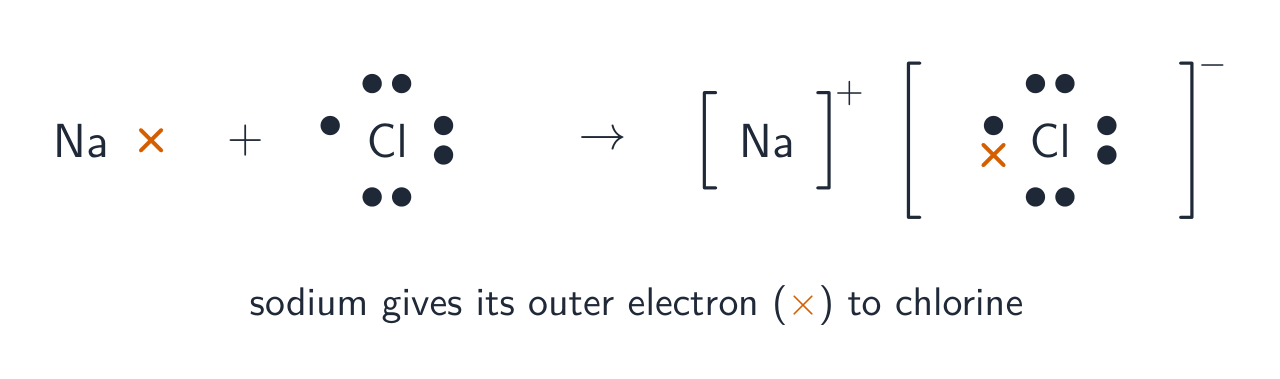
    • Ionic bond 离子键: electrons transfer from a metal to a nonmetal (large electronegativity difference).
    • Covalent bond 共价键: nonmetals share electrons (small difference). A big-but-not-huge difference gives a polar covalent 极性共价 bond.
    • Metallic bond 金属键: metal atoms share a "sea" of mobile electrons.
    한국어
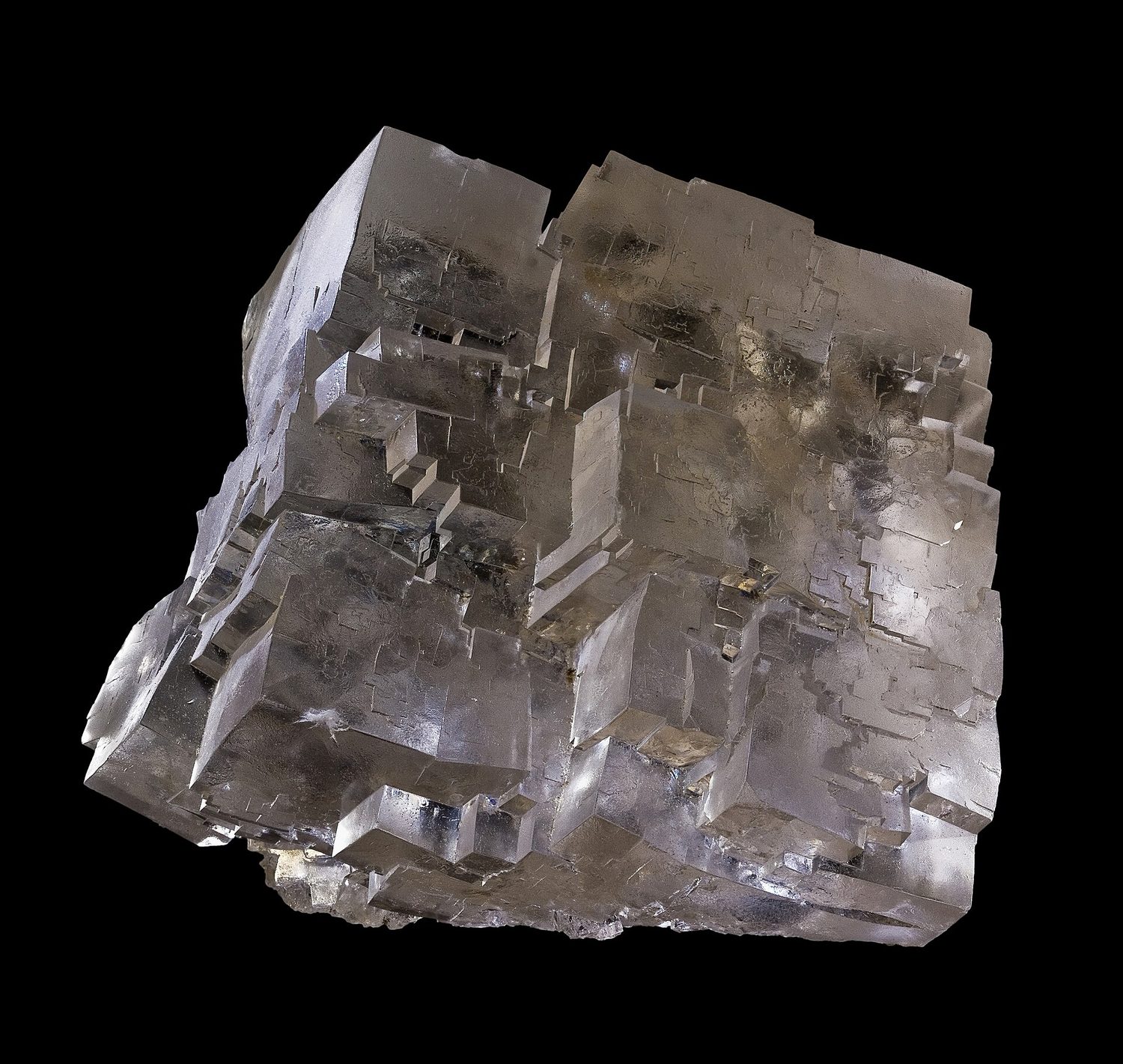
    염화나트륨 결정: 이온성 고체는 서로 다른 전하를 띤 이온들의 격자로 형성됩니다
    염화나트륨 결정: 이온성 고체는 서로 다른 전하를 띤 이온들의 격자로 형성됩니다

    화학 결합은 원자들을在一起的 붙여두는 인력입니다. 어떤 결합이 형성될지는 원자들의 전기음성도에 따라 결정됩니다:

    이온 결합: 금속이 외부 전자를 비금속에게 양도합니다
    이온 결합: 금속이 외부 전자를 비금속에게 양도합니다
    • 이온 결합: 금속에서 비금속으로 전자가 이동합니다 (큰 전기음성도 차이).
    • 공유 결합: 비금속들이 전자를 공유합니다 (작은 차이). 중간 정도의 큰 차이는 극성 공유 결합을 만듭니다.
    • 금속 결합: 금속 원자들이 이동 가능한 전자의 '바다'를 공유합니다.
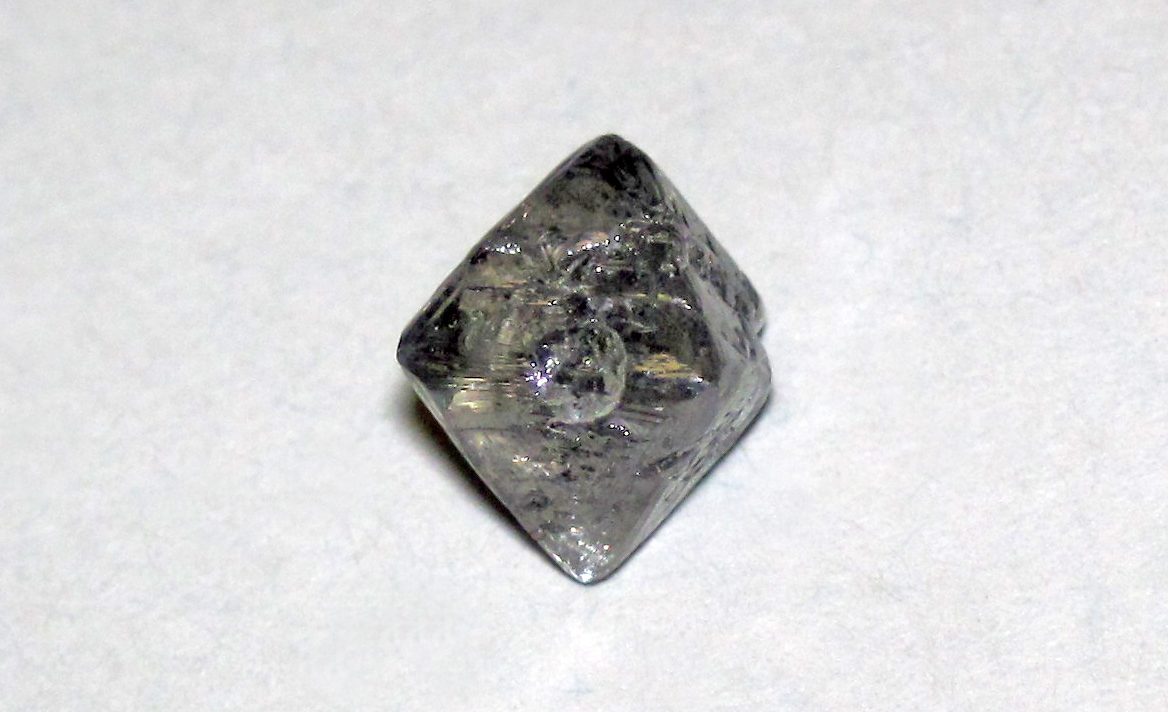
     다이아몬드 결정: 거대한 공유 결합 네트워크가 극도의 단단함과 높은 융점을 설명합니다
    다이아몬드 결정: 거대한 공유 결합 네트워크가 극도의 단단함과 높은 융점을 설명합니다
    Explore · ⁨탐색하기⁩

    Form an ionic bond by electron transfer · ⁨전자 이동을 통해 이온 결합 형성하기⁩

    An ionic bond forms when a metal gives electrons to a non-metal, making oppositely charged ions that attract; a covalent bond shares electrons instead. · ⁨이온 결합은 금속이 비금속에게 전자를 주어 서로 다른 전하를 띤 이온이 생성되고 끌어당길 때-formed됩니다. 반면, 공유 결합은 전자를 공유함으로써 형성됩니다.⁩

    2.2

    Intramolecular Force and Potential Energy · ⁨분자 간 힘과ポテンシャル 에너지⁩

    Syllabus
    English

    Learning Objective 2.2.A: Represent the relationship between potential energy and distance between atoms, based on factors that influence the interaction strength.

    • 2.2.A.1 A graph of potential energy versus the distance between atoms (internuclear distance) is a useful representation for describing the interactions between atoms. Such graphs illustrate both the equilibrium bond length (the separation between atoms at which the potential energy is lowest) and the bond energy (the energy required to separate the atoms).
    • 2.2.A.2 In a covalent bond, the bond length is influenced by both the size of the atom's core and the bond order (i.e., single, double, triple). Bonds with a higher order are shorter and have larger bond energies.
    • 2.2.A.3 Coulomb's law can be used to understand the strength of interactions between cations and anions.
      • i. Because the interaction strength is proportional to the charge on each ion, larger charges lead to stronger interactions.
      • ii. Because the interaction strength increases as the distance between the centers of the ions (nuclei) decreases, smaller ions lead to stronger interactions.
    한국어

    학습목표 2.2.A: 상호작용 강도에 영향을 미치는 요인을 기반으로 퍼텐셜 에너지와 원자 간 거리 간의 관계를 표현하시오.

    • 2.2.A.1 퍼텐셜 에너지와 원자 간 거리(핵-핵 거리)의 그래프는 원자 간 상호작용을 설명하기 위한 유용한 표현 방식입니다.此类 그래프는 평형 결합 길이(퍼텐셜 에너지가 가장 낮을 때의 원자 간 거리)와 결합 에너지(원자를 분리하는 데 필요한 에너지)를 모두 보여줍니다.
    • 2.2.A.2 공유결합에서 결합 길이는 원자 코어의 크기와 결합 서열(즉, 단일, 이중, 삼중 결합)에 의해 영향을 받습니다. 결합 서열이 높을수록 결합 길이는 짧아지고 결합 에너지는 커집니다.
    • 2.2.A.3 쿨롱의 법칙을 사용하여 양이온과 음이온 간의 상호작용 강도를 이해할 수 있습니다.
      • i. 상호작용 강도가 각 이온의 전하에 비례하므로, 더 큰 전하수는 더 강한 상호작용을 의미합니다.
      • ii. 상호작용 강도는 이온 중심(핵) 사이의 거리가 줄어들어 증가하므로, 더 작은 이온은 더 강한 상호작용을 유도합니다.

    Source: College Board AP Course and Exam Description · ⁨출처: College Board AP Course and Exam Description⁩

    English

    As two atoms approach, a potential energy 势能 curve captures the balance of attraction and repulsion. It dips to a minimum at the bond length 键长 (the stable separation) whose depth is the bond energy 键能. Shorter, stronger bonds sit in deeper, tighter wells; more shared pairs (double, triple bonds) give shorter, stronger bonds.

    한국어

    두 원자가 가까워지면 ポテン셜 에너지 곡선이 인력과 반발력의 균형을 보여줍니다. 결합 길이(안정된 거리)에서 최소값을 가지며, 그 깊이가 결합 에너지입니다. 짧고 강한 결합은 더 깊고 좁은ポテン셜 우물에 위치하며, 더 많은 공유 쌍(이중 결합, 삼중 결합)은 짧고 강한 결합을 만듭니다.

    2.3

    Structure of Ionic Solids · ⁨이온성 고체의 구조⁩

    Syllabus
    English

    Learning Objective 2.3.A: Represent an ionic solid with a particulate model that is consistent with Coulomb's law and the properties of the constituent ions.

    • 2.3.A.1 The cations and anions in an ionic crystal are arranged in a systematic, periodic 3-D array that maximizes the attractive forces among cations and anions while minimizing the repulsive forces.
      • Exclusion statement: Knowledge of specific crystal structures is not essential to an understanding of the learning objective and will not be assessed on the AP Exam.
    한국어

    학습목표 2.3.A: 쿨롱의 법칙과 구성 이온의 성질에 부합하는 입자 모델로 이온 고체를 표현하시오.

    • 2.3.A.1 이온 결정 내의 양이온과 음이온은 양이온과 음이온 사이의 인력을 극대화하고 반발력을 최소화하도록 체계적이고 주기적인 3차원 배열을 이룹니다.
      • 제외 사항: 구체적인 결정 구조에 대한 지식은 학습목표를 이해하는 데 필수적이지 않으며, AP 시험에서 출제되지 않습니다.

    Source: College Board AP Course and Exam Description · ⁨출처: College Board AP Course and Exam Description⁩

    English

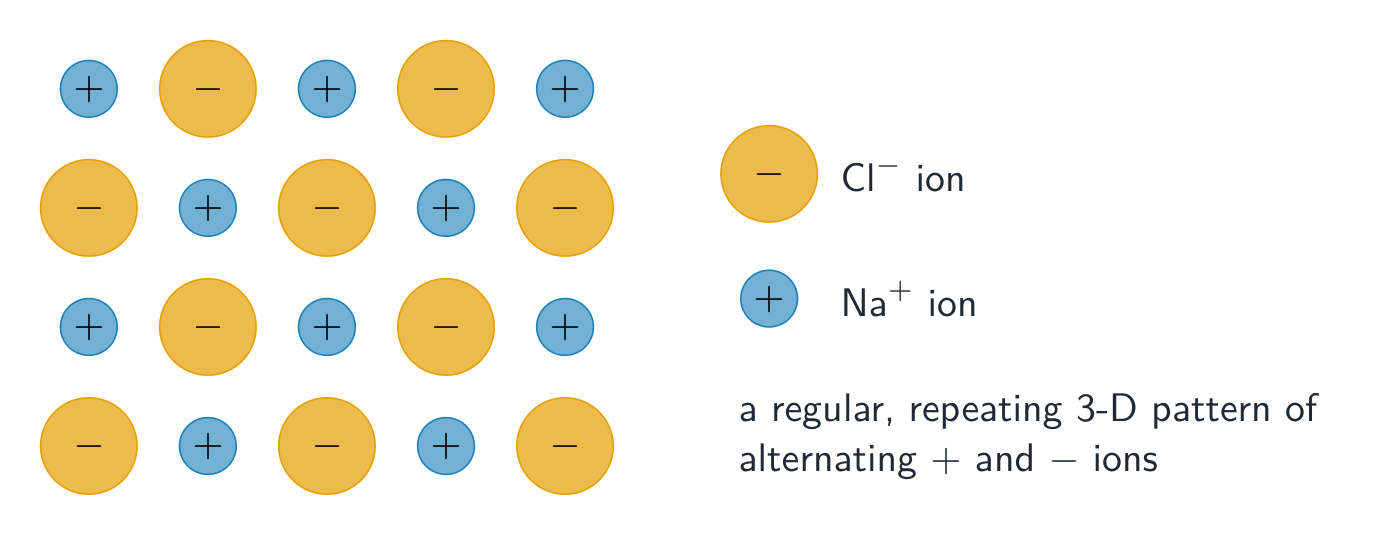
    An ionic solid 离子固体 is a repeating 3-D lattice 晶格 of alternating cations and anions, held by strong electrostatic attraction. This explains their high melting points, brittleness, and why they conduct only when molten or dissolved (ions freed to move). The lattice energy rises with larger ion charges and smaller ions, so MgO (both $2+/2-$) melts far higher than NaCl (both $1+/1-$).

    한국어

    이온성 고체는 교대하는 양이온과 음이온으로 이루어진 반복되는 3차원 **격자(lattice)**이며, 강력한 정전기적 인력으로 유지됩니다. 이것이 높은 융점, 취성, 그리고 용융되거나 용해되었을 때만 전기를 전도하는 이유(이온이 자유롭게 움직일 수 있음)를 설명합니다. 격자 에너지는 이온의 전하가 클수록, 이온 크기가 작을수록 커지므로 MgO(모두 $2+/2-$)는 NaCl(모두 $1+/1-$)보다 훨씬 높은 온도에서 융해됩니다.

    이온들이 교대하는 양이온과 음이온의 거대한 격자에packed됩니다
    이온들이 교대하는 양이온과 음이온의 거대한 격자에 packed됩니다
    Vocabulary · ⁨어휘⁩ Train · ⁨연습하기⁩
    English 한국어
    lattice/ˈlætɪs/ 격자
    2.4

    Structure of Metals and Alloys · ⁨금속 및 합금의 구조⁩

    Syllabus
    English

    Learning Objective 2.4.A: Represent a metallic solid and/or alloy using a model to show essential characteristics of the structure and interactions present in the substance.

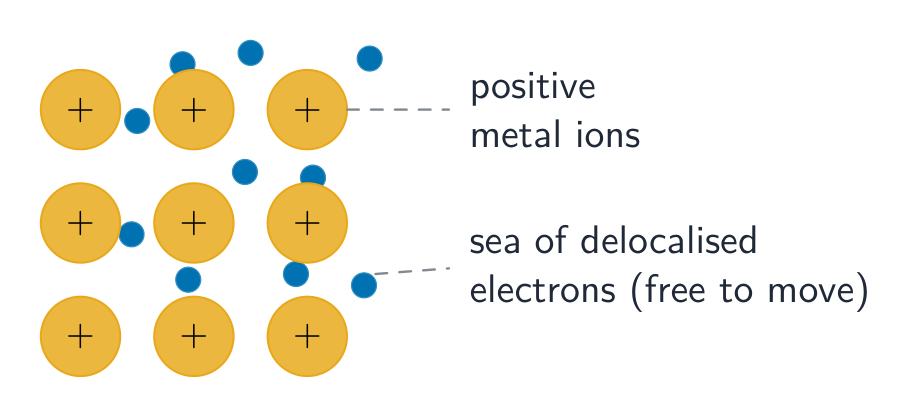
    • 2.4.A.1 Metallic bonding can be represented as an array of positive metal ions surrounded by delocalized valence electrons (i.e., a "sea of electrons").
    • 2.4.A.2 Interstitial alloys form between atoms of significantly different radii, where the smaller atoms fill the interstitial spaces between the larger atoms (e.g., with steel in which carbon occupies the interstices in iron).
    • 2.4.A.3 Substitutional alloys form between atoms of comparable radius, where one atom substitutes for the other in the lattice. (e.g., in certain brass alloys, other elements, usually zinc, substitute for copper.)
    한국어

    학습목표 2.4.A: 물질에 존재하는 구조 및 상호작용의 핵심 특징을 보여주는 모델을 사용하여 금속 고체 및/또는 합금을 표현하시오.

    • 2.4.A.1 금속 결합은 비국지화된 원外层전자로 둘러싸인 양의 금속 이온의 배열로 표현할 수 있습니다(즉, "전자 바다" 모델).
    • 2.4.A.2 입자간 합금은 원자 반지름이 크게 다른 원자 사이에 형성되는데, 작은 원자들이 큰 원자 사이의 공간(간격)을 채웁니다(예: 철의 간격을 탄소占据了하는 강철).
    • 2.4.A.3 치환형 합금은 반지름이 유사한 원자 사이에 형성되는데, 하나의 원자가 격자 내에서 다른 원자를 대체합니다.(예: 특정 황동 합금에서 구리를 대체하는 다른 원소,通常是锌).

    Source: College Board AP Course and Exam Description · ⁨출처: College Board AP Course and Exam Description⁩

    English

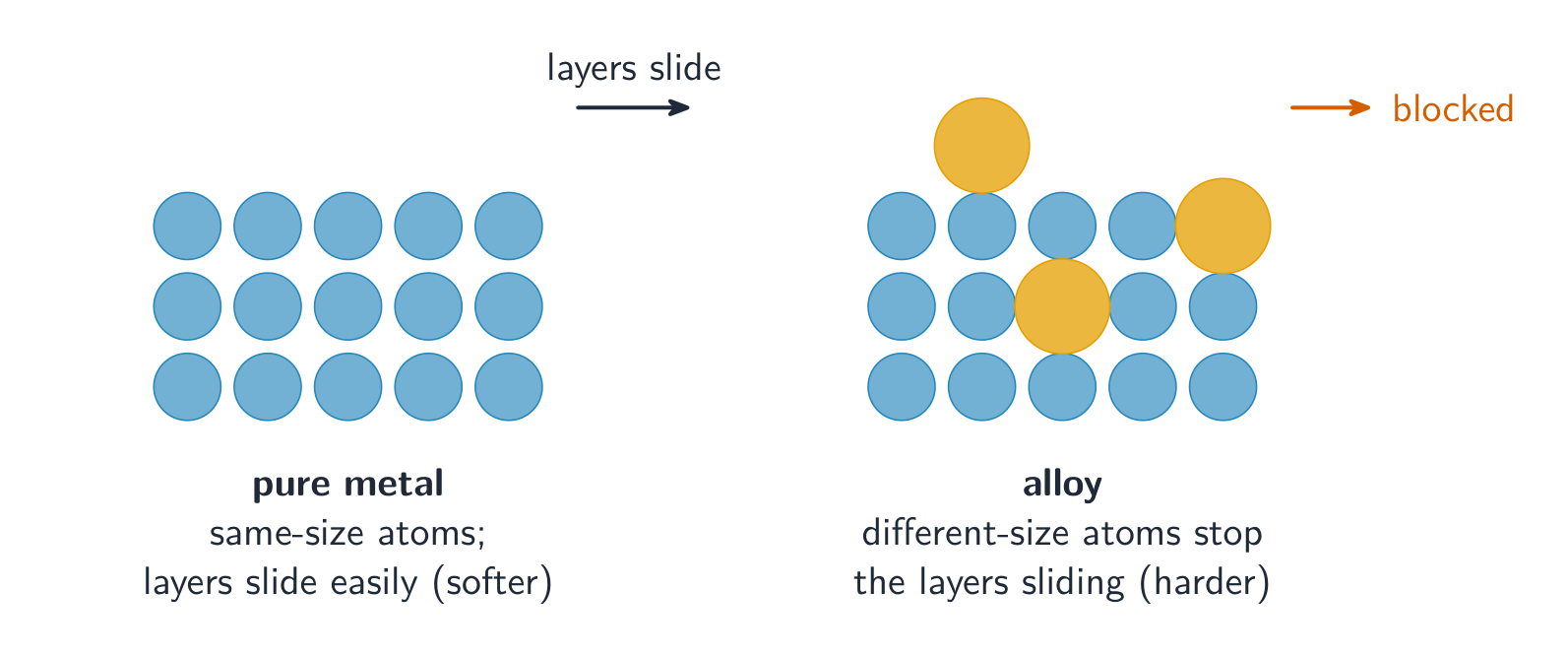
    In a metal, cations sit in a lattice bathed in delocalized 离域 electrons, which explains conductivity, malleability, and luster. An alloy 合金 mixes metals: a substitutional alloy swaps in similar-sized atoms; an interstitial alloy (like steel) fits small atoms into the gaps, making it harder.

    한국어

    금속에서 양이온들은 비국재화된(delocalized) 전자들 속에 있는 격자 위에 자리 잡고 있으며, 이는 전도성, 연성, 광택을 설명합니다. **합금(alloy)**은 금속을 섞은 것입니다: 치환형(substitutional) 합금은 유사한 크기의 원자가 교체되고, 침입형(interstitial) 합금(예: 강철)은 작은 원자가 빈 새에 끼어들어 단단하게 만듭니다.

    합금 내 서로 다른 크기의 원자가 층의 미끄러짐을 막아 단단하게 만듭니다
    합금 내 서로 다른 크기의 원자가 층의 미끄러짐을 막아 단단하게 만듭니다
    금속 결합: 비국소화된 전자 바다 속의 양이온들
    금속 결합: 비국지화 전자의 바다 속 양이온
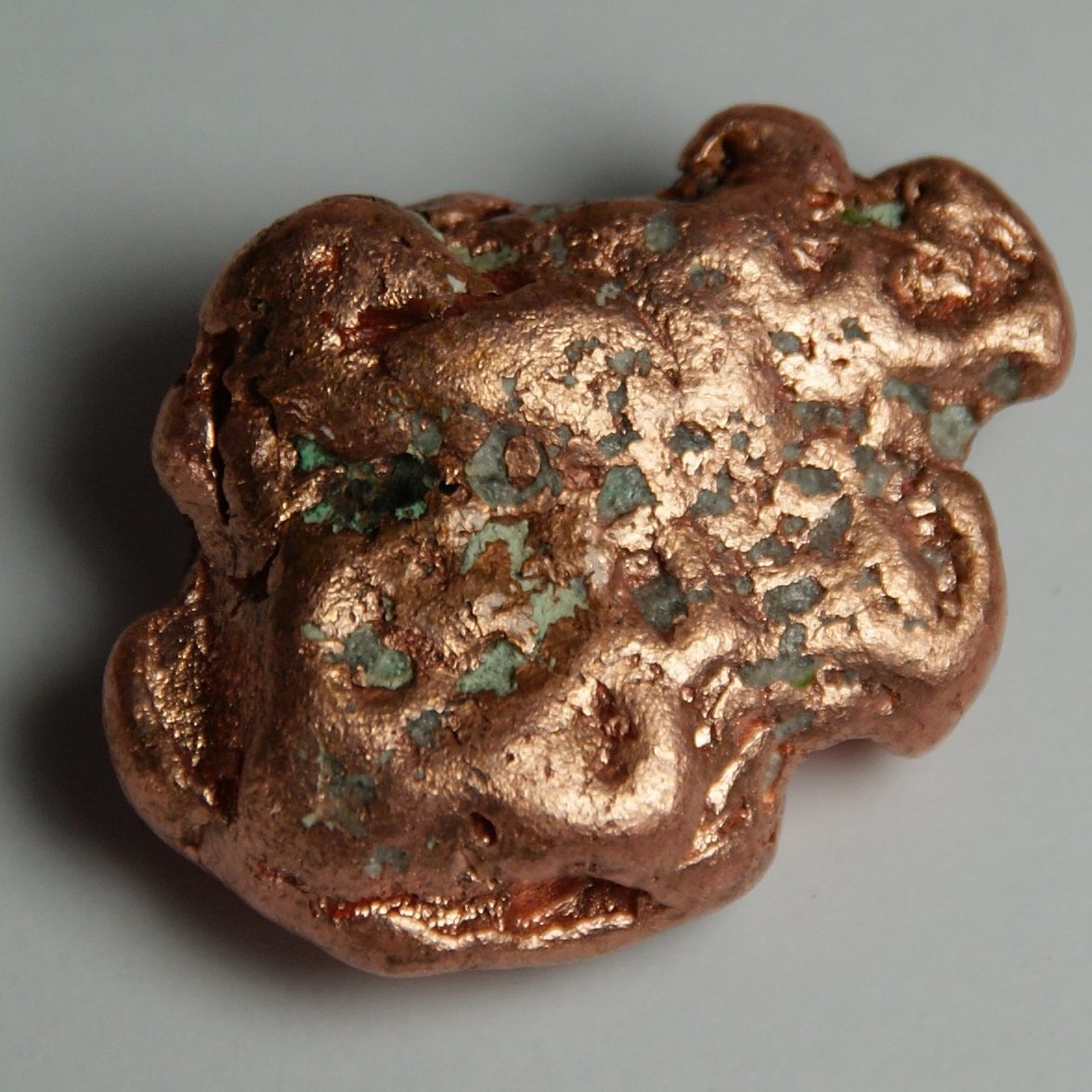
    천연 구리: 금속 결합은 비국재화된 전자를 가진 반짝이고 연성 있는 고체를 만듭니다
    천연 구리: 금속 결합은 비국재화된 전자를 가진 반짝이고 연성 있는 고체를 만듭니다
    Explore · ⁨탐색하기⁩

    Slide layers in a metallic lattice · ⁨금속 격자 내 층을 미끄러지게 하기⁩

    A metal is positive ions in a sea of delocalised electrons. The layers can slide without breaking the bond, so metals are malleable and conduct. · ⁨금속은 자유 전자 바다 속에 있는 양이온입니다. 층들이 결합을 끊지 않고 미끄러질 수 있어 금속은 연성(연성)과 전도성을 가집니다.⁩

    Vocabulary · ⁨어휘⁩ Train · ⁨연습하기⁩
    English 한국어
    chemical bond/ˈkemɪkl bɒnd/ 화학 결합
    Ionic bond/aɪˈɒnɪk bɒnd/ 이온 결합
    Covalent bond/ˈkəʊvələnt bɒnd/ 공유 결합
    polar covalent/ˈpəʊlə ˈkəʊvələnt/ 극성 공유 결합
    Metallic bond/məˈtælɪk bɒnd/ 금속 결합
    potential energy/pəˈtenʃl ˈenədʒi/ 위치 에너지
    bond length/bɒnd leŋθ/ 결합 길이
    bond energy/bɒnd ˈenədʒi/ 결합 에너지
    ionic solid/aɪˈɒnɪk ˈsɒlɪd/ 이온성 고체
    delocalized/dɪˈlɒkəlaɪzd/ 비국소화됨
    alloy/ˈælɔɪ/ 합금(alloy)
    Lewis diagram/ˈluːɪs ˈdaɪəɡræm/ 루이스 도식
    2.5

    Lewis Diagrams · ⁨루이스 도식(Lewis Diagrams)⁩

    Syllabus
    English

    Learning Objective 2.5.A: Represent a molecule with a Lewis diagram.

    • 2.5.A.1 Lewis diagrams can be constructed according to an established set of principles.
    한국어

    학습 목표 2.5.A: 루이스 도식을 사용하여 분자를 표현한다.

    • 2.5.A.1 루이스 도식은 확립된 원칙에 따라 구성할 수 있다.

    Source: College Board AP Course and Exam Description · ⁨출처: College Board AP Course and Exam Description⁩

    English

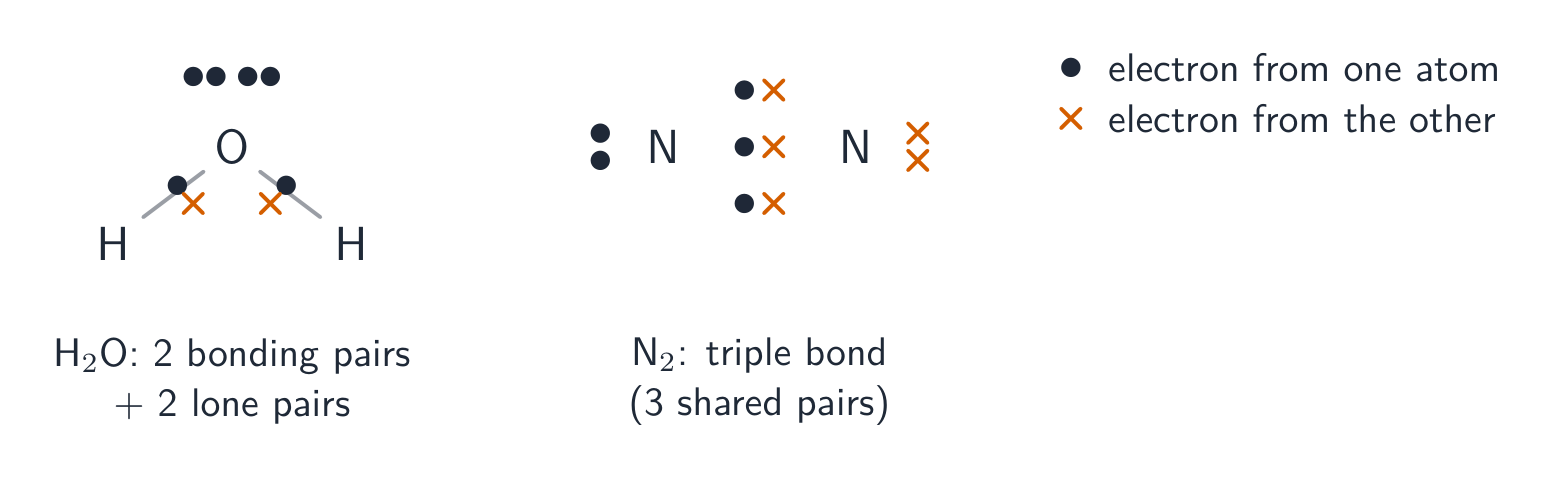
    A Lewis diagram 路易斯结构 shows valence electrons as bonding pairs and lone pairs 孤对电子, giving most atoms an octet 八隅体 (8 valence electrons; H wants 2). Steps: count total valence electrons, connect atoms with single bonds, complete octets on outer atoms, then form multiple bonds if the central atom is short.

    Worked example. Draw carbon dioxide, $\text{CO}_2$. Total valence electrons $=4+2(6)=16$. Put C in the centre; single bonds to each O use $4$ electrons and leave the outer O atoms short. Completing octets forces two double bonds, $\text{O}=\text{C}=\text{O}$: each O then has two lone pairs, C has none, and all $16$ electrons are placed with every atom at an octet.
    한국어

    루이스 도식은 결합 쌍과 **비결합 쌍(lone pairs)**로 원전자를 표시하여 대부분의 원자에게 **옥텟(octet, 원전자 8개; 수소(H)는 2개)**을 제공합니다. 단계: 총 원전자 세기, 원자同士를 단일 결합으로 연결, 외부 원자의 옥텟 완성, 중앙 원자가 부족할 경우 다중 결합 형성.

    점과 십자표 도식은 분자 내의 결합 쌍과 비결합 쌍을 보여줍니다
    점과 십자표 도식은 분자 내의 결합 쌍과 비결합 쌍을 보여줍니다

    ** solved example.** 이산화탄소 $\text{CO}_2$을 그리십시오. 총 원전자 $=4+2(6)=16$. C를 중앙에 두고 각 O에 단일 결합을 두면 $4$개의 전자를 사용하고 외부 O 원자는 불완전합니다. 옥텟을 완성하려면 두 개의 이중 결합이 필요하며, $\text{O}=\text{C}=\text{O}$: 각 O에는 비결합 쌍 두 개, C에는 없으며, 모든 $16$ 전자가 배치되어 모든 원자가 옥텟을 이룹니다.

    Vocabulary · ⁨어휘⁩ Train · ⁨연습하기⁩
    English 한국어
    lone pairs/ləʊn peəz/ 비결합쌍
    octet/ɒkˈtet/ 옥텟
    2.6

    Resonance and Formal Charge · ⁨공명 및 형식 전하⁩

    Syllabus
    English

    Learning Objective 2.6.A: Represent a molecule with a Lewis diagram that accounts for resonance between equivalent structures or that uses formal charge to select between nonequivalent structures.

    • 2.6.A.1 In cases where more than one equivalent Lewis structure can be constructed, resonance must be included as a refinement to the Lewis structure. In many such cases, this refinement is needed to provide qualitatively accurate predictions of molecular structure and properties.
    • 2.6.A.2 The octet rule and formal charge can be used as criteria for determining which of several possible valid Lewis diagrams provides the best model for predicting molecular structure and properties.
    • 2.6.A.3 As with any model, there are limitations to the use of the Lewis structure model, particularly in cases with an odd number of valence electrons.
    한국어

    학습 목표 2.6.A: 등가 구조 사이의 공명을 반영하거나 형식 전하를 사용하여 비등가 구조 중 하나를 선택하는 루이스 도식으로 분자를 표현한다.

    • 2.6.A.1 여러 개의 등가 루이스 구조를 구성할 수 있는 경우, 공명을 루이스 구조의 보정 요소로 포함해야 한다. 이러한 많은 경우에서 이 보정은 분자 구조와 성질을 정성적으로 정확히 예측하기 위해 필요하다.
    • 2.6.A.2 옥텟 규칙과 형식 전하는 가능한 여러 유효한 루이스 도식 중에서 분자 구조와 성질을 예측하는 데 가장 좋은 모델이 되는 것을 결정하는 기준으로 사용할 수 있다.
    • 2.6.A.3 모든 모델과 마찬가지로 루이스 구조 모델 사용에는 한계가 있으며, 특히 원자가 전자의 개수가 홀수인 경우에 그 한계가 뚜렷하다.

    Source: College Board AP Course and Exam Description · ⁨출처: College Board AP Course and Exam Description⁩

    English

    When two or more valid Lewis diagrams differ only in electron placement, the true structure is an average – resonance 共振. Formal charge 形式电荷 (valence electrons minus lone-pair electrons minus half the bonding electrons) picks the best structure: the one with formal charges closest to zero, and any negative charge on the most electronegative atom.

    Worked example. Assign formal charges in the nitrate ion, $\text{NO}_3^{-}$ (one double bond, two single bonds). For N (4 bonds, no lone pairs): $5-0-4=+1$. For the double-bonded O (2 lone pairs): $6-4-2=0$. For each single-bonded O (3 lone pairs): $6-6-1=-1$. The total is $+1+0+(-1)+(-1)=-1$, matching the ion's overall charge – a good check that the structure is drawn correctly. Because the three O atoms are equivalent by resonance, the real ion has three identical bonds.

    한국어

    두 개 이상의 유한 루이스 도식이 전자 배치만 다를 때, 실제 구조는 그 평균인 **공명(resonance)**입니다. 형식 전하(formal charge) (원전자 - 비결합쌍 전자 - 결합 전자의 절반)이 가장 좋은 구조를 선택합니다: 형식 전하가 0에 가장 가까운 것, 그리고 음전하가 가장 전기음성도가 높은 원자에 있는 구조입니다.

    풀이 예제. 질산 이온 $\text{NO}_3^{-}$ (이중 결합 1개, 단일 결합 2개)의 형전하를 결정하십시오. N(4개의 결합, 비공유전자쌍 없음): $5-0-4=+1$. 이중 결합된 O(비공유전자쌍 2개): $6-4-2=0$. 각 단일 결합된 O(비공유전자쌍 3개): $6-6-1=-1$. 총합은 $+1+0+(-1)+(-1)=-1$로, 이온의 전체 전하와 일치합니다—구조가 올바르게 그려졌음을 확인하는 좋은 체크 포인트입니다. 세 개의 O 원자가 공명에 의해 동등하므로, 실제 이온은 동일한 세 개의 결합을 가집니다.

    Vocabulary · ⁨어휘⁩ Train · ⁨연습하기⁩
    English 한국어
    resonance/ˈrezənəns/ 공명
    Formal charge/ˈfɔːml tʃɑːdʒ/ 형식 전하
    2.7

    VSEPR and Bond Hybridization · ⁨VSEPR 및 결합 혼성화⁩

    Syllabus
    English

    Learning Objective 2.7.A: Based on the relationship between Lewis diagrams, VSEPR theory, bond orders, and bond polarities:

    • i. Explain structural properties of molecules.

    • ii. Explain electron properties of molecules.

    • 2.7.A.1 VSEPR theory uses the Coulombic repulsion between electrons as a basis for predicting the arrangement of electron pairs around a central atom.

    • 2.7.A.2 Both Lewis diagrams and VSEPR theory must be used for predicting electronic and structural properties of many covalently bonded molecules and polyatomic ions, including the following:

      • i. Molecular geometry (linear, trigonal planar, tetrahedral, trigonal pyramidal, bent, trigonal bipyramidal, seesaw, T-shaped, octahedral, square pyramidal, square planar)
      • ii. Bond angles
      • iii. Relative bond energies based on bond order
      • iv. Relative bond lengths (multiple bonds, effects of atomic radius)
      • v. Presence of a dipole moment
      • vi. Hybridization of valence orbitals for atoms within a molecule or polyatomic ion
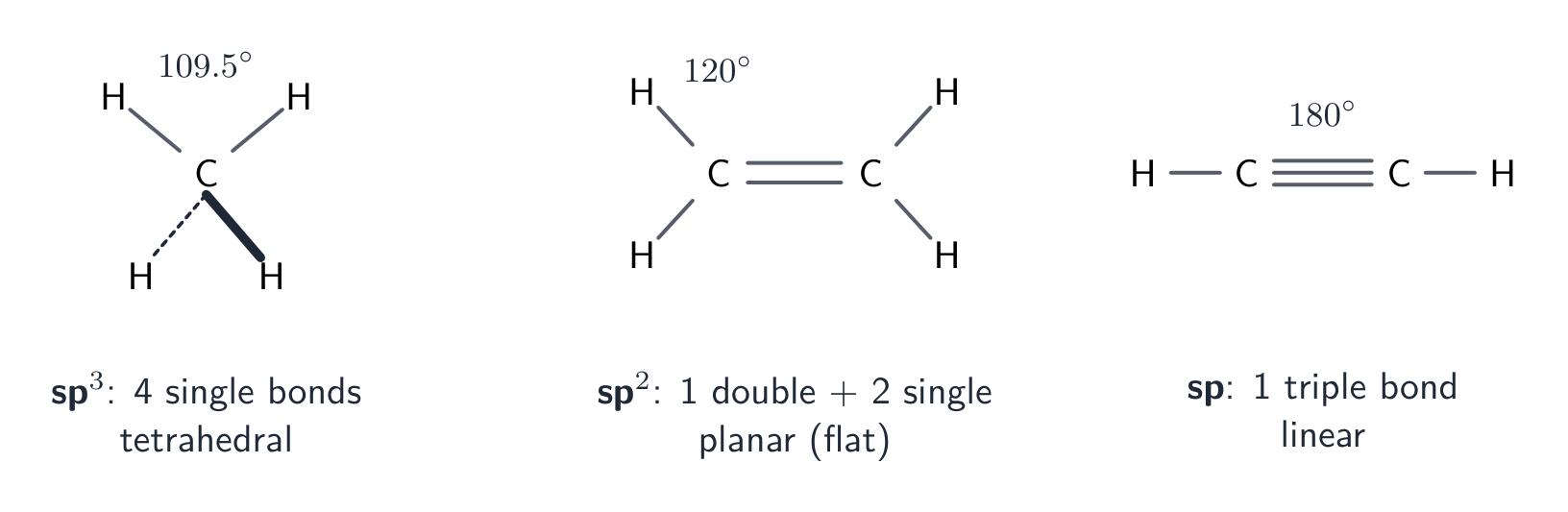
    • 2.7.A.3 The terms "hybridization" and "hybrid atomic orbital" are used to describe the arrangement of electrons around a central atom. When the central atom is $sp$ hybridized, its ideal bond angles are $180°$; for $sp^2$ hybridized atoms the bond angles are $120°$; and for $sp^3$ hybridized atoms the bond angles are $109.5°$.

      • Exclusion statement: An understanding of the derivation and depiction of hybrid orbitals will not be assessed on the AP Exam. The course includes the distinction between sigma and pi bonding, the use of VSEPR to explain the shapes of molecules, and the $sp$, $sp^2$, and $sp^3$ nomenclature.
      • Exclusion statement: Hybridization involving d orbitals will not be assessed on the AP Exam. When an atom has more than four pairs of electrons surrounding the central atom, students are only responsible for the shape of the resulting molecule.
    • 2.7.A.4 Bond formation is associated with overlap between atomic orbitals. In multiple bonds, such overlap leads to the formation of both sigma and pi bonds. The overlap is stronger in sigma than pi bonds, which is reflected in sigma bonds having greater bond energy than pi bonds. The presence of a pi bond also prevents the rotation of the bond and leads to geometric isomers.

      • Exclusion statement: Molecular orbital theory is recommended as a way to provide deeper insight into bonding. However, the AP Exam will neither explicitly assess molecular orbital diagrams, filling of molecular orbitals, nor the distinction between bonding, nonbonding, and antibonding orbitals.
    한국어

    학습 목표 2.7.A: 루이스 도식, VSEPR 이론, 결합 순서 및 결합 극성 간의 관계에 근거하여:

    • i. 분자의 구조적 특성을 설명한다.

    • ii. 분자의 전자적 특성을 설명한다.

    • 2.7.A.1 VSEPR 이론은 중심 원자 주위의 전자 쌍 배치를 예측하기 위한 기초로 전자 간의 쿨롱 반발력을 사용한다.

    • 2.7.A.2 다음을 포함한 많은 공유 결합 분자와 다원자 이온의 전자적 및 구조적 특성을 예측하려면 루이스 도식과 VSEPR 이론을 모두 사용해야 한다:

      • i. 분자 기하학(직선형, 삼각 평면형, 사면체형, 삼각 피라미드형, 은형, 삼각 이중피라미드형, 지그재그형, T자형, 팔면체형, 사각 피라미드형, 사각 평면형)
      • ii. 결합 각도
      • iii. 결합 순서에 기반한 상대 결합 에너지
      • iv. 상대 결합 길이(다중 결합, 원자 반지름의 영향)
      • v. 쌍극자 모멘트의 존재 여부
      • vi. 분자 또는 다원자 이온 내 원자의 원자가 궤도함수의 혼성화
    • 2.7.A.3 '혼성화' 및 '혼성 원자 궤도함수'라는 용어는 중심 원자 주위의 전자 배치를 설명하는 데 사용된다. 중심 원자가 $sp$ 혼성화될 때 이상적인 결합 각도는 $180°$이며, $sp^2$ 혼성화된 원자의 결합 각도는 $120°$이고, $sp^3$ 혼성화된 원자의 결합 각도는 $109.5°$이다.

      • 제외 사항: 혼성 궤도함수의 유도 과정과 표현에 대한 이해는 AP 시험에서 평가되지 않는다. 과정에서는 시그마 결합과 파이 결합의 구별, VSEPR을 이용한 분자 모양 설명, 그리고 $sp$, $sp^2$, $sp^3$ 명명법이 포함된다.
      • 제외 사항: d 궤도함수를参与的한 혼성화는 AP 시험에서 평가되지 않는다. 중심 원자를 둘러싼 전자 쌍이 네 쌍보다 많은 경우, 학생들은 생성된 분자의 형태만 담당해야 한다.
    • 2.7.A.4 결합 형성은 원자 궤도함수 간의 중첩과 관련이 있다. 다중 결합에서 이러한 중첩은 시그마 결합과 파이 결합의 형성으로 이어진다. 시그마 결합에서의 중첩은 파이 결합보다 강하므로, 시그마 결합이 파이 결합보다 높은 결합 에너지를 가지는 것이 반영된다. 파이 결합의 존재는 결합의 회전을 방지하고 기하 이성질체를 형성하게 한다.

      • 제외 사항: 분자 궤도함수 이론은 결합에 대한 더 깊은 통찰을 제공하기 위한 방법으로 권장된다. 그러나 AP 시험은 분자 궤도함수 도식, 분자 궤도함수의 채우기, 그리고 결합 궤도함수, 비결합 궤도함수, 반결합 궤도함수之间的의 구분을 명시적으로 평가하지 않는다.

    Source: College Board AP Course and Exam Description · ⁨출처: College Board AP Course and Exam Description⁩

    English
    VSEPR: molecular shapes

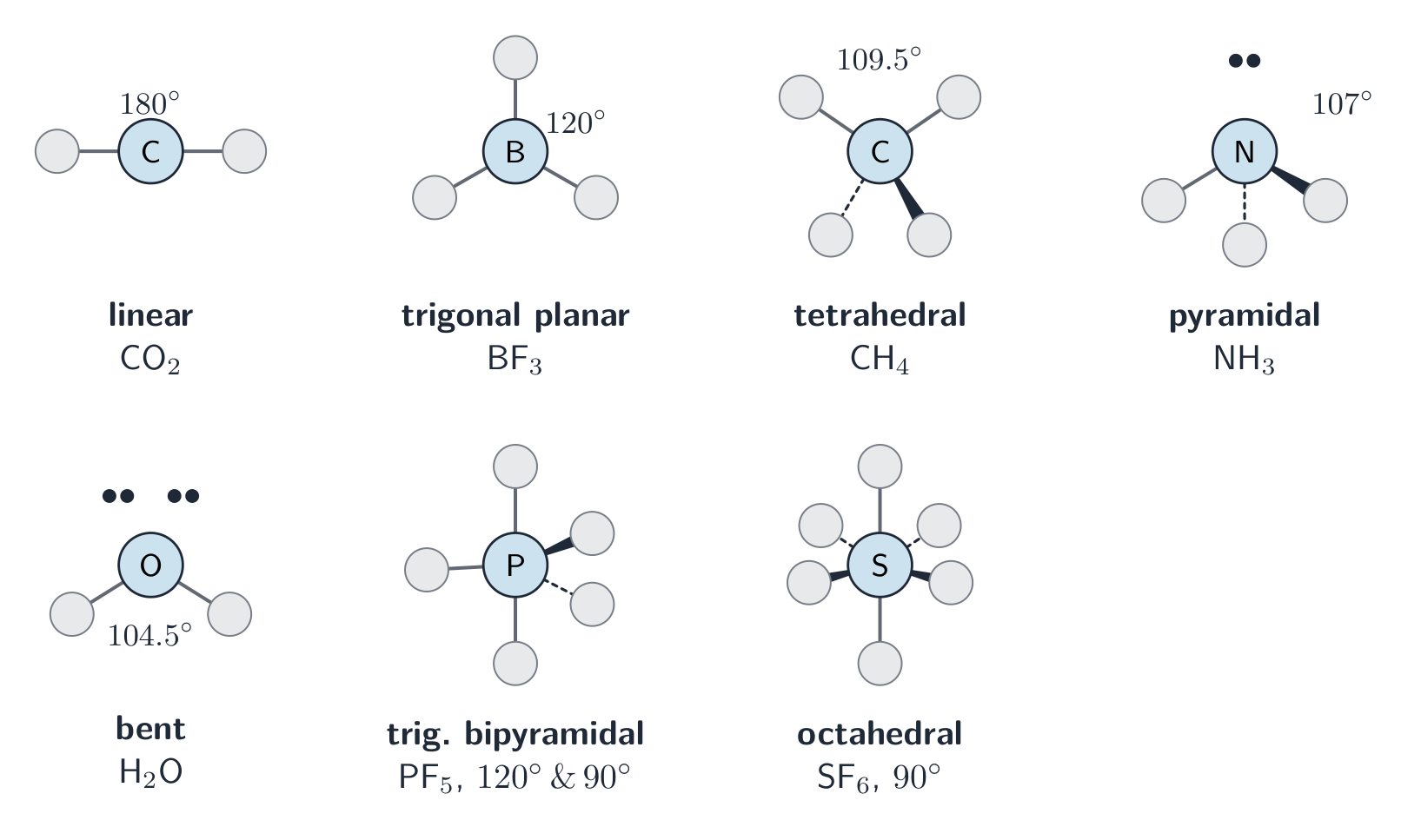
    VSEPR 价层电子对互斥 theory predicts shape: electron pairs (bonds and lone pairs) around a central atom spread out as far apart as possible. Counting electron domains gives the geometry (linear, trigonal planar, tetrahedral, …); lone pairs push bonds closer, bending the shape. Hybridization 杂化 ($sp$, $sp^2$, $sp^3$) describes the mixed orbitals matching that geometry. Molecular shape and bond polarity together decide whether the whole molecule is polar.

    Worked example. Predict the shape of ammonia, $\text{NH}_3$. Nitrogen has $3$ bonding pairs and $1$ lone pair – four electron domains, so the electron geometry is tetrahedral and the hybridization is $sp^3$. The lone pair is invisible in the shape but still pushes the bonds together, so the molecular shape is trigonal pyramidal with a bond angle of about $107^{\circ}$ (a little less than the ideal $109.5^{\circ}$). The three N–H dipoles do not cancel, so the molecule is polar.

    Bonds form when atomic orbitals overlap. Every single bond is one sigma bond σ键 – orbitals overlapping head-on along the line joining the two atoms. A multiple bond adds a pi bond π键, made by $p$ orbitals overlapping sideways above and below that line: a double bond is one sigma + one pi, a triple bond one sigma + two pi. Head-on overlap is more effective, so a sigma bond is stronger (higher bond energy) than a pi bond – which is why a double bond is stronger than a single bond but not twice as strong. A pi bond also locks the two atoms so they cannot rotate about the bond; a C=C double bond therefore has fixed cis and trans forms – geometric isomers 几何异构体 that a freely-rotating single bond could never show.

    Worked example. Count the bonds in ethene, $\text{H}_2\text{C}=\text{CH}_2$. The four C–H bonds are single bonds (one sigma each); the C=C is one sigma plus one pi. So ethene has 5 sigma and 1 pi bond, and that single pi bond is exactly what stops the two $\text{CH}_2$ ends from twisting relative to each other.

    한국어
    VSEPR: 분자 형태

    VSEPR 이론은 형태를 예측합니다: 중심 원자 주위의 전자 쌍(결합과 비공유전자쌍)은 서로尽可能 멀리 떨어지도록 배치됩니다. 전자 영역을 세어 기하학적 구조(직선형, 삼각평면형, 사면체형, …)를 결정하며, 비공유전자쌍은 결합을 더 가까이 밀어내어 형태를 구부러지게 만듭니다. 혼성화($sp$, $sp^2$, $sp^3$)는 해당 기하학적 구조에 맞는 혼합 궤도함을 설명합니다. 분자의 형태와 결합 극성이 함께 결정하여 전체 분자가 극성인지 여부를 판별합니다.

    혼성화와 형태: sp3 사면체형, sp2 평면형, sp 직선형
    혼성화와 형태: sp3 사면체형, sp2 평면형, sp 직선형
    일반적인 VSEPR 형태 및 결합각
    일반적인 VSEPR 형태 및 결합각

    풀이 예제. 암모니아 $\text{NH}_3$의 형태를 예측하십시오. 질소는 $3$ 결합쌍과 $1$ 비공유전자쌍을 가지고 있어 네 개의 전자 영역이 되므로, 전자 기하학은 사면체형이고 혼성화는 $sp^3$입니다. 비공유전자쌍은 형태에는 보이지 않지만 여전히 결합을 모아당기므로, 분자 형태는 약 $107^{\circ}$의 결합각을 가진 삼각뿔형이며 이는 이상적인 $109.5^{\circ}$보다 약간 작습니다. 세 N–H 쌍극자는 상쇄되지 않으므로 분자는 극성입니다.

    원자 궤도함이 중첩될 때 결합이 형성됩니다. 모든 단일 결합은 하나의 시그마 결합 σ이며, 두 원자를 잇는 선을 따라 궤도함이 정면으로 중첩됩니다. 다중 결합은 추가되는 파이 결합 π를 포함하는데, 이는 $p$ 궤도함들이 그 선 위아래로 나란히 중첩되어 만들어집니다: 이중 결합은 시그마 1개+파이 1개, 삼중 결합은 시그마 1개+파이 2개입니다. 정면 중첩이 더 효율적이므로 시그마 결합은 더 강합니다(높은 결합 에너지)—따라서 이중 결합이 단일 결합보다 강하지만 두 배만큼 강하지는 않습니다. 또한 파이 결합은 두 원자를 잠금하여 결합 축에 대한 회전을 불가능하게 합니다. C=C 이중 결합은 고정된 시스 및 트랜스 형태를 가지는데, 이는 자유롭게 회전할 수 있는 단일 결합에서는 절대 나타날 수 없는 기하 이성질체입니다.

    풀이 예제. 에텐 $\text{H}_2\text{C}=\text{CH}_2$의 결합을 세어보십시오. 네 개의 C–H 결합은 단일 결합(각각 시그마 1개)이며, C=C는 시그마 1개+파이 1개입니다. 따라서 에텐은 시그마 5개와 파이 1개의 결합을 가지며, 이 단일 파이 결합이 정확히 두 $\text{CH}_2$ 끝부분이 서로에 대해 비틀리는 것을 방지합니다.

    Explore · ⁨탐색하기⁩

    Predict molecular shape with VSEPR · ⁨VSEPR 이론으로 분자 형태 예측하기⁩

    VSEPR: electron pairs repel and spread as far apart as possible, setting the molecule's shape. Add bonding and lone pairs and watch the geometry change. · ⁨VSEPR: 전자쌍은 서로 밀어내며 최대한 멀리 퍼져 분자의 형태를 결정합니다. 결합 쌍과 비결합 전자를 추가하면 기하학 구조가 어떻게 변하는지 확인하세요.⁩

    Vocabulary · ⁨어휘⁩ Train · ⁨연습하기⁩
    English 한국어
    VSEPR/ˈvespə/ VSEPR
    Hybridization/ˌhaɪbrɪdaɪˈzeɪʃn/ 혼성 궤도함수
    sigma bond/ˈsɪɡmə bɒnd/ 시그마 결합
    pi bond/paɪ bɒnd/ π 결합
    geometric isomers/ˌdʒiːəʊˈmetrɪk ˈaɪsəməz/ 기하 이성질체
    2.7

    Exam tips · ⁨시험 팁⁩

    English
    • Decide the bond type from the atoms: ionic (metal + non-metal, electron transfer), covalent (non-metals, sharing), metallic (sea of delocalised electrons).
    • An ionic solid conducts only when molten or dissolved (ions free to move), never as a solid.
    • Draw Lewis structures to satisfy the octet (H wants 2), then use VSEPR — electron pairs spread as far apart as possible — to predict the shape.
    • Lone pairs take up space and push bonds closer, bending the shape (water is bent, ammonia pyramidal).
    • A molecule can have polar bonds yet be non-polar overall if its symmetry makes the dipoles cancel ($\text{CO}_2$).
    • A single bond is 1 sigma bond; a double bond is 1 sigma + 1 pi, a triple bond 1 sigma + 2 pi. Sigma is stronger than pi, and a pi bond blocks rotation, giving cis/trans geometric isomers.
    한국어
    • 원子的 종류에 따른 결합 유형 결정: 이온 결합(금속+비금속, 전자 이동), 공유 결합(비금속, 공유), 금속 결합(이동성 전자의 바다).
    • 이온 고체는 용융 상태나 용해될 때만 전기를 전도합니다(이온이 자유롭게 움직일 수 있음), 고체 상태로는 절대 전도하지 않습니다.
    • 루이스 구조를 그려 옥테트(H는 2)를 만족시키고, 이후 VSEPR—전자 쌍이 서로尽可能 멀리 배치됨—을 사용하여 형태를 예측합니다.
    • 비공유전자쌍은 공간을 차지하고 결합을 더 가까이 밀어내어 형태를 구부러지게 만듭니다(물은 굽은 형태, 암모니아는 뿔형).
    • 대칭성이 쌍극자를 상쇄시켜 분자 전체는 비극성이 될 수 있지만 극성 결합을 가질 수 있습니다($\text{CO}_2$).
    • 단일 결합은 1개 시그마 결합; 이중 결합은 시그마 1개+파이 1개, 삼중 결합은 시그마 1개+파이 2개입니다. 시그마가 파이를 강하게 우위하며, 파이 결합은 회전을 차단하여 시스/트랜스 기하 이성질체를 생성합니다.
  • 3

    Properties of Substances and Mixtures · ⁨물질과 혼합물의 성질⁩

    Watch lesson · ⁨수업 보기⁩
    3.1

    Intermolecular and Interparticle Forces

    Syllabus
    English

    Learning Objective 3.1.A: Explain the relationship between the chemical structures of molecules and the relative strength of their intermolecular forces when: i. The molecules are of the same chemical species. ii. The molecules are of two different chemical species.

    • 3.1.A.1 London dispersion forces are a result of the Coulombic interactions between temporary, fluctuating dipoles. London dispersion forces are often the strongest net intermolecular force between large molecules.
      • i. Dispersion forces increase with increasing contact area between molecules and with increasing polarizability of the molecules.
      • ii. The polarizability of a molecule increases with an increasing number of electrons in the molecule and the size of the electron cloud. It is enhanced by the presence of pi bonding.
      • iii. The term "London dispersion forces" should not be used synonymously with the term "van der Waals forces."
    • 3.1.A.2 The dipole moment of a polar molecule leads to additional interactions with other chemical species.
      • i. Dipole-induced dipole interactions are present between a polar and nonpolar molecule. These forces are always attractive. The strength of these forces increases with the magnitude of the dipole of the polar molecule and with the polarizability of the nonpolar molecule.
      • ii. Dipole-dipole interactions are present between polar molecules. The interaction strength depends on the magnitudes of the dipoles and their relative orientation. Interactions between polar molecules are typically greater than those between nonpolar molecules of comparable size because these interactions act in addition to London dispersion forces.
      • iii. Ion-dipole forces of attraction are present between ions and polar molecules. These tend to be stronger than dipole-dipole forces.
    • 3.1.A.3 The relative strength and orientation dependence of dipole-dipole and ion-dipole forces can be understood qualitatively by considering the sign of the partial charges responsible for the molecular dipole moment, and how these partial charges interact with an ion or with an adjacent dipole.
    • 3.1.A.4 Hydrogen bonding is a strong type of intermolecular interaction that exists when hydrogen atoms covalently bonded to the highly electronegative atoms (N, O, and F) are attracted to the negative end of a dipole formed by the electronegative atom (N, O, and F) in a different molecule, or a different part of the same molecule.
    • 3.1.A.5 In large biomolecules, noncovalent interactions may occur between different molecules or between different regions of the same large biomolecule.
    한국어

    학습 목표 3.1.A: 다음 조건에서 분자의 화학 구조와 분자 간 힘의 상대적 강도 간의 관계를 설명한다: i. 분자가 동일한 화학 종일 때. ii. 분자가 서로 다른 두 화학 종일 때.

    • 3.1.A.1 런던 분산력은 임시적이고 변동하는 쌍극자 사이의 쿨롱 상호작용의 결과이다. 런던 분산력은 큰 분자 사이에서 종종 가장 강력한 총괄적인 분자 간 힘이다.
      • i. 분산력은 분자 간의 접촉 면적이 증가함에 따라 커지며, 분자의 극화성이 증가함에 따라 커진다.
      • ii. 분자의 극화성은 분자 내 전자의 수와 전자 구름의 크기가 증가함에 따라 커진다. 파이 결합의 존재에 의해 증강된다.
      • iii. '런던 분산력'이라는 용어는 '반데르발스 힘'이라는 용어와 동의로 사용되어서는 안 된다.
    • 3.1.A.2 극성 분자의 쌍극자 모멘트는 다른 화학 종과의 추가 상호작용을 유발한다.
      • i. 극성과 비극성 분자 사이에는 쌍극자-유도 쌍극자 상호작용이 존재한다. 이 힘은 항상 인력이다. 이 힘의 세기는 극성 분자의 쌍극자 모멘트 크기 및 비극성 분자의 극화성에 따라 증가한다.
      • ii. 극성 분자 사이에는 쌍극자-쌍극자 상호작용이 존재한다. 상호작용의 세기는 쌍극자의 크기와 상대적인 방향성에 따라 달라진다. 극성 분자 간의 상호작용은 Comparable 크기의 비극성 분자 간의 상호작용보다 일반적으로 크며, 이는 이러한 상호작용이 런던 분산력에 추가로 작용하기 때문이다.
      • iii. 이온-쌍극자 인력 상호작용은 이온과 극성 분자 사이에 존재한다. 이들은 쌍극자-쌍극자 힘보다 일반적으로 강하다.
    • 3.1.A.3 dipole-dipole 및 ion-dipole 힘의 상대적 강도와 방향 의존성은 분자 쌍극자 모멘트를 유발하는 부분 전하의 부호를 고려하고, 이러한 부분 전하가 이온이나 인접한 쌍극자와 어떻게 상호작용하는지를 분석함으로써 질적으로 이해할 수 있다.
    • 3.1.A.4 수소 결합은 높은 전기음성도 원자(N, O, F)에 공유 결합된 수소 원자가 다른 분자의 전기음성도 원자(N, O, F) 또는 동일한 분자의 다른 부분에 의해 형성된 쌍극자의 음극侧로 끌리는 경우 존재하는 강한 분자간 상호작용이다.
    • 3.1.A.5 거대한 생물대분자에서 비공유 결합 상호작용은 서로 다른 분자 사이나 동일한 거대한 생물대분자의 서로 다른 영역 사이에서 발생할 수 있다.

    Source: College Board AP Course and Exam Description · ⁨출처: College Board AP Course and Exam Description⁩

    Intermolecular forces 分子间作用力 (IMFs) are attractions between molecules – much weaker than bonds, but they set melting/boiling points. From weakest to strongest:

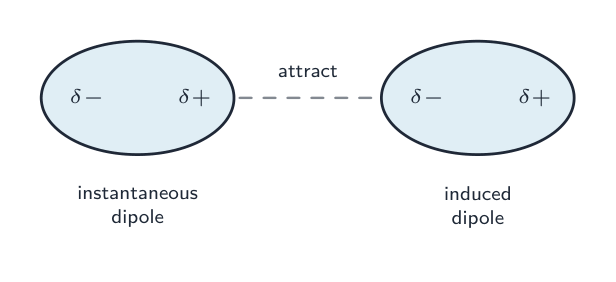
    London dispersion: an instantaneous dipole induces a dipole in a neighbour
    London dispersion: an instantaneous dipole induces a dipole in a neighbour
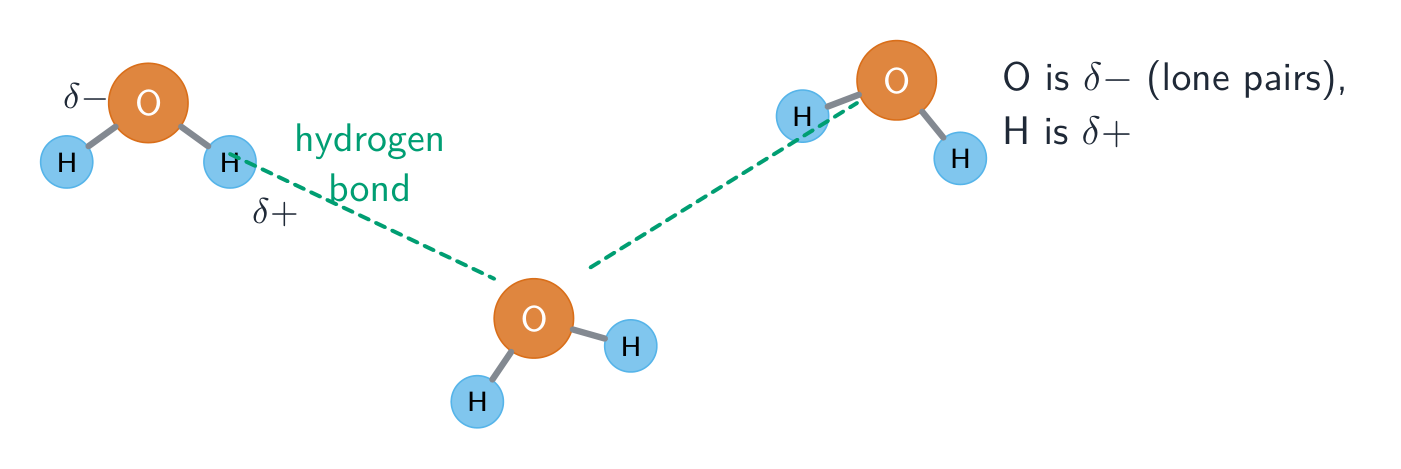
    Hydrogen bonding: an H on N/O/F is attracted to a lone pair on another molecule
    Hydrogen bonding: an H on N/O/F is attracted to a lone pair on another molecule
    • London dispersion forces 伦敦色散力: present in all molecules; they arise from Coulombic attraction between temporary, fluctuating dipoles, and are stronger for larger, more polarizable electron clouds - often the strongest net force between large molecules.
    • Dipole–dipole 偶极-偶极: between polar molecules. Their strength depends on the size of the dipoles and their relative orientation - a $\delta+$ end lining up with a neighbour's $\delta-$ end attracts, so these act in addition to dispersion and make polar molecules stickier than nonpolar ones of similar size.
    • Hydrogen bonding 氢键: a strong dipole force when H is bonded to N, O, or F.
    • Ion–dipole 离子-偶极: between an ion and a polar molecule (the ion pulls on the oppositely-charged end of the dipole). These are the strongest of the four here (stronger even than hydrogen bonds), and are exactly what lets water dissolve an ionic solid - each $\text{Na}^+$ is surrounded by the $\delta-$ oxygen ends of water molecules.

    The whole ladder is understood qualitatively by looking at the sign of the partial charges: a larger or better-aligned partial charge, or a full ionic charge, gives a stronger attraction. Stronger IMFs mean higher boiling points and lower vapor pressure. This is why water ($18\ \text{g/mol}$, hydrogen-bonded) boils at $100\,{}^{\circ}\text{C}$ while methane ($16\ \text{g/mol}$, dispersion only) boils at $-162\,{}^{\circ}\text{C}$.

    Vocabulary · ⁨어휘⁩ Train · ⁨연습하기⁩
    English 한국어
    Intermolecular forces/ˌɪntəməˈlekjʊlə ˈfɔːsɪz/ 분자 간 힘
    London dispersion forces/ˈlʌndn dɪˈspɜːʃn ˈfɔːsɪz/ 런던 산란 힘
    Dipole–dipole/ˈdaɪpəʊl ˈdaɪpəʊl/ dipole–dipole相互作用 (극성-극성相互作用)
    Ion–dipole/ˈaɪɒn ˈdaɪpəʊl/ 이온-극성相互作用 (이온-극性相互作用)
    Hydrogen bonding/ˈhaɪdrədʒn ˈbɒndɪŋ/ 수소 결합
    3.2

    Properties of Solids

    Syllabus
    English

    Learning Objective 3.2.A: Explain the relationship among the macroscopic properties of a substance, the particulate-level structure of the substance, and the interactions between these particles.

    • 3.2.A.1 Many properties of liquids and solids are determined by the strengths and types of intermolecular forces present. Because intermolecular interactions are overcome completely when a substance vaporizes, the vapor pressure and boiling point are directly related to the strength of those interactions. Melting points also tend to correlate with interaction strength, but because the interactions are only rearranged, in melting, the relations can be more subtle.
    • 3.2.A.2 Particulate-level representations, showing multiple interacting chemical species, are a useful means to communicate or understand how intermolecular interactions help to establish macroscopic properties.
    • 3.2.A.3 Due to strong interactions between ions, ionic solids tend to have low vapor pressures, high melting points, and high boiling points. They tend to be brittle due to the repulsion of like charges caused when one layer slides across another layer. They conduct electricity only when the ions are mobile, as when the ionic solid is melted (i.e., in a molten state) or dissolved in water or another solvent.
    • 3.2.A.4 In covalent network solids, the atoms are covalently bonded together into a three-dimensional network (e.g., diamond) or layers of two-dimensional networks (e.g., graphite). These are only formed from nonmetals and metalloids: elemental (e.g., diamond, graphite) or binary compounds (e.g., silicon dioxide and silicon carbide). Due to the strong covalent interactions, covalent solids have high melting points. Three-dimensional network solids are also rigid and hard, because the covalent bond angles are fixed. However, graphite is soft because adjacent layers can slide past each other relatively easily.
    • 3.2.A.5 Molecular solids are composed of distinct, individual units of covalently-bonded molecules attracted to each other through relatively weak intermolecular forces. Molecular solids generally have a low melting point because of the relatively weak intermolecular forces present between the molecules. They do not conduct electricity because their valence electrons are tightly held within the covalent bonds and the lone pairs of each constituent molecule. Molecular solids are sometimes composed of very large molecules or polymers.
    • 3.2.A.6 Metallic solids are good conductors of electricity and heat, due to the presence of free valence electrons. They also tend to be malleable and ductile, due to the ease with which the metal cores can rearrange their structure. In an interstitial alloy, interstitial atoms tend to make the lattice more rigid, decreasing malleability and ductility. Alloys typically retain a sea of mobile electrons and so remain conducting.
    • 3.2.A.7 In large biomolecules or polymers, noncovalent interactions may occur between different molecules or between different regions of the same large biomolecule. The functionality and properties of such molecules depend strongly on the shape of the molecule, which is largely dictated by noncovalent interactions.
    한국어

    학습 목표 3.2.A: 물질의anganscopic(거시적) 성질, 물질의 입자 수준 구조, 그리고 이들 입자 간의 상호작용 사이의 관계를 설명하시오.

    • 3.2.A.1 액체와 고체의 많은 성질은 존재하는 분자간 힘의 강도와 종류에 의해 결정된다. 분자간 상호작용이 물질이 기화될 때 완전히 극복되므로, 증기압과 끓는점은 이러한 상호작용의 강도와 직접적으로 관련된다. 녹는점 또한 상호작용 강도와 상관관계가 있는 경향이 있으나, 상호작용이 단순히 재배열되기 때문에 녹는 과정에서는 관계가 더 미묘할 수 있다.
    • 3.2.A.2 여러 상호작용 화학종을 보여주는 입자 수준 표현은 분자간 상호작용이 어떻게 거시적 성질을 형성하는지 전달하거나 이해하는 데 유용한 수단이다.
    • 3.2.A.3 이온 간의 강력한 상호작용으로 인해 이온성 고체는 낮은 증기압, 높은 녹는점, 높은 끓는점을 가지는 경향이 있다. 한 층이 다른 층 위를 미끄러질 때 동전하 간의 반발력이 발생하므로 이온성 고체는 깨지기 쉽다(brittle). 이온이 이동 가능한 상태일 때(즉, 이온성 고체가 용융된 상태 또는 물或其他 용매에 용해된 상태)에만 전기를 전도한다.
    • 3.2.A.4 공유 결합 네트워크 고체에서 원자들은 3차원 네트워크(예: 다이아몬드) 또는 2차원 네트워크의 층(예: 석영)으로 공유 결합되어 있다. 이들은 비금속 및 금속성 소元素(metalloids)만으로 형성되며, 원소(예: 다이아몬드, 석영) 또는 이원 화합물(예:二氧化硅 및碳化硅)이다. 강력한 공유 결합 상호작용으로 인해 공유 결합 고체는 높은 녹는점을 가진다. 3차원 네트워크 고체는 고정된 공유 결합 각도로 인해 단단하고 딱딱하다. 그러나 인접한 층들이 서로 쉽게 미끄러질 수 있으므로 석영은 부드럽다.
    • 3.2.A.5 분자 결정은 공유 결합으로 연결된 개별적인 분자 단위로 구성되며, 이러한 단위는 상대적으로 약한 분자간 힘에 의해 서로 끌어당겨져 있다. 분자 간 힘이 상대적으로 약하기 때문에 분자 결정은 일반적으로 낮은 융점을 가진다. 전자가 공유 결합 내부와 각 구성 분자의 비결합 전자 쌍에 강하게 묶여 있어 전기 전도성을 나타내지 않는다. 분자 결정은 때로는 매우 큰 분자나 고분자로 구성되어 있기도 한다.
    • 3.2.A.6 금속 결정은 자유 전자가 존재하여 전기 및 열의 좋은 전도체이다. 또한 금속핵들이 구조를 재배열하는 데易于하기 때문에 연성(유연함)과 신도(인장성)가 있는 경향이 있다. 입자 간 합금에서 입자 간 원자는 격자를 더 경직되게 만들어 연성과 신도를 감소시킨다. 합금은 일반적으로 이동 가능한 전자의 바다를 유지하므로 전도성을 유지한다.
    • 3.2.A.7 거대 생물 분자나 고분자에서는 다른 분자 사이 또는 동일한 거대 생물 분자의 다른 영역 사이에 비공유적 상호작용이 발생할 수 있다. 이러한 분자의 기능과 성질은 주로 비공유적 상호작용에 의해 결정되는 분자의 형태에 크게 의존한다.

    Source: College Board AP Course and Exam Description · ⁨출처: College Board AP Course and Exam Description⁩

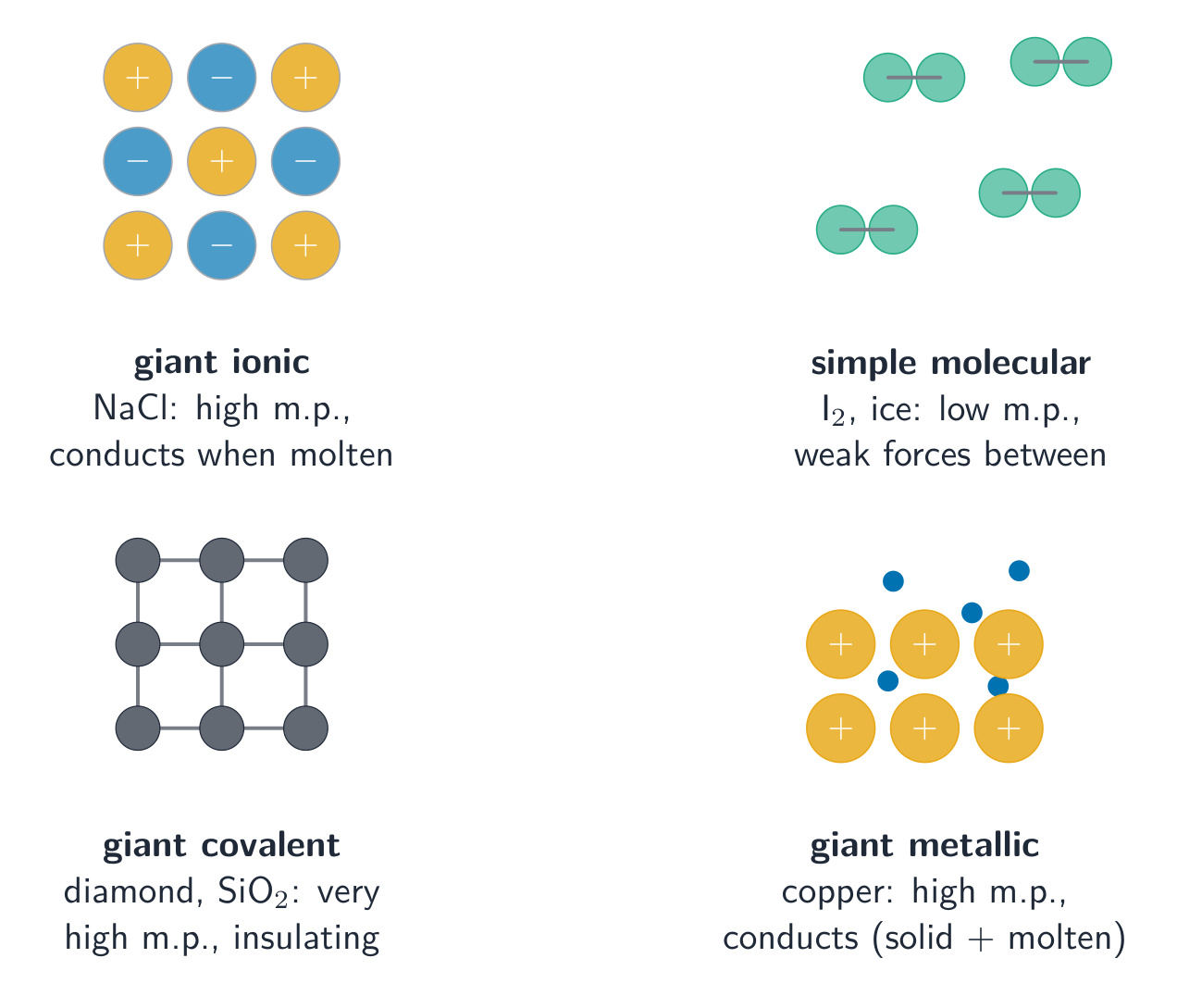
    A solid's properties reflect the particles and forces holding it: ionic, covalent-network (a 3D network like diamond, very hard and high-melting; graphite is a layered exception — high-melting but soft, because its 2D layers slide over one another), metallic, and molecular solids (held by weak IMFs, soft, low-melting). Matching a solid's properties to its structure is a common exam task.

    Metallic solids conduct electricity and heat and are malleable 可锻的 and ductile 可延展的, all because their free valence electrons 自由价电子 move easily and let the metal ions slide past one another without breaking the bonding. Solids are also either crystalline 晶体 (particles in a regular, repeating 3-D arrangement) or amorphous 非晶体 (no long-range order, like glass).

    The four solid structures: giant ionic, simple molecular, giant covalent, and metallic
    The four solid structures: giant ionic, simple molecular, giant covalent, and metallic
    Vocabulary · ⁨어휘⁩ Train · ⁨연습하기⁩
    English 한국어
    malleable/ˈmæləbl/ 유연한
    ductile/ˈdʌktaɪl/ 신도성(ductile)
    free valence electrons/friː ˈveɪləns ɪˈlektrɒnz/ 자유 전자기전자
    crystalline/ˈkrɪstəlaɪn/ 결정성
    amorphous/əˈmɔːfəs/ 무정형
    3.3

    Solids, Liquids, and Gases

    Syllabus
    English

    Learning Objective 3.3.A: Represent the differences between solid, liquid, and gas phases using a particulate-level model.

    • 3.3.A.1 Solids can be crystalline, where the particles are arranged in a regular three-dimensional structure, or they can be amorphous, where the particles do not have a regular, orderly arrangement. In both cases, the motion of the individual particles is limited, and the particles do not undergo overall translation with respect to each other. The structure of the solid is influenced by interparticle interactions and the ability of the particles to pack together.
    • 3.3.A.2 The constituent particles in liquids are in close contact with each other, and they are continually moving and colliding. The arrangement and movement of particles are influenced by the nature and strength of the forces (e.g., polarity, hydrogen bonding, and temperature) between the particles.
    • 3.3.A.3 The solid and liquid phases for a particular substance typically have similar molar volume because, in both phases, the constituent particles are in close contact at all times.
    • 3.3.A.4 In the gas phase, the particles are in constant motion. Their frequencies of collision and the average spacing between them are dependent on temperature, pressure, and volume. Because of this constant motion, and minimal effects of forces between particles, a gas has neither a definite volume nor a definite shape.
      • Exclusion Statement: Understanding/interpreting phase diagrams will not be assessed on the AP Exam.
    한국어

    학습 목표 3.3.A: 입자 수준 모델로 고체, 액체 및 기체 상태 간의 차이를 표현하시오.

    • 3.3.A.1 고체는 입자가 규칙적인 3차원 구조로 배열된 결정성일 수도 있으며, 입자가 규칙적이고 질서 있는 배치를 가지지 않은 비정질일 수도 있다. 두 경우 모두 개별 입자의 운동은 제한되어 있으며, 입자들은 서로에 대해 전체적인 평이운 이동을 하지 않는다. 고체의 구조는 입자 간 상호작용과 입자들이 함께 채워질 수 있는 능력에 영향을 받는다.
    • 3.3.A.2 액체의 구성 입자들은 서로 밀접하게 접촉해 있으며, 지속적으로运动和 충돌한다. 입자의 배치와 운동은 입자 사이의 힘(예: 극성, 수소 결합, 온도 등)의 성질과 세기에 영향을 받는다.
    • 3.3.A.3 특정 물질의 고체 및 액체 상태는 보통 유사한 몰 부피를 갖는데, 이는 두 상태 모두에서 구성 입자들이 항상 밀접하게 접촉하고 있기 때문이다.
    • 3.3.A.4 기체 상태에서는 입자가 끊임없이 운동한다. 충돌 빈도와 평균 간격은 온도, 압력, 부피에 의존한다. 이러한 지속적인 운동과 입자 간 힘의 영향이 미미하기 때문에 기체는 일정한 부피나 일정한 모양을 갖지 않는다.
      • 제외 사항: AP 시험에서 상도(상도표)의 이해/해석은 평가되지 않는다.

    Source: College Board AP Course and Exam Description · ⁨출처: College Board AP Course and Exam Description⁩

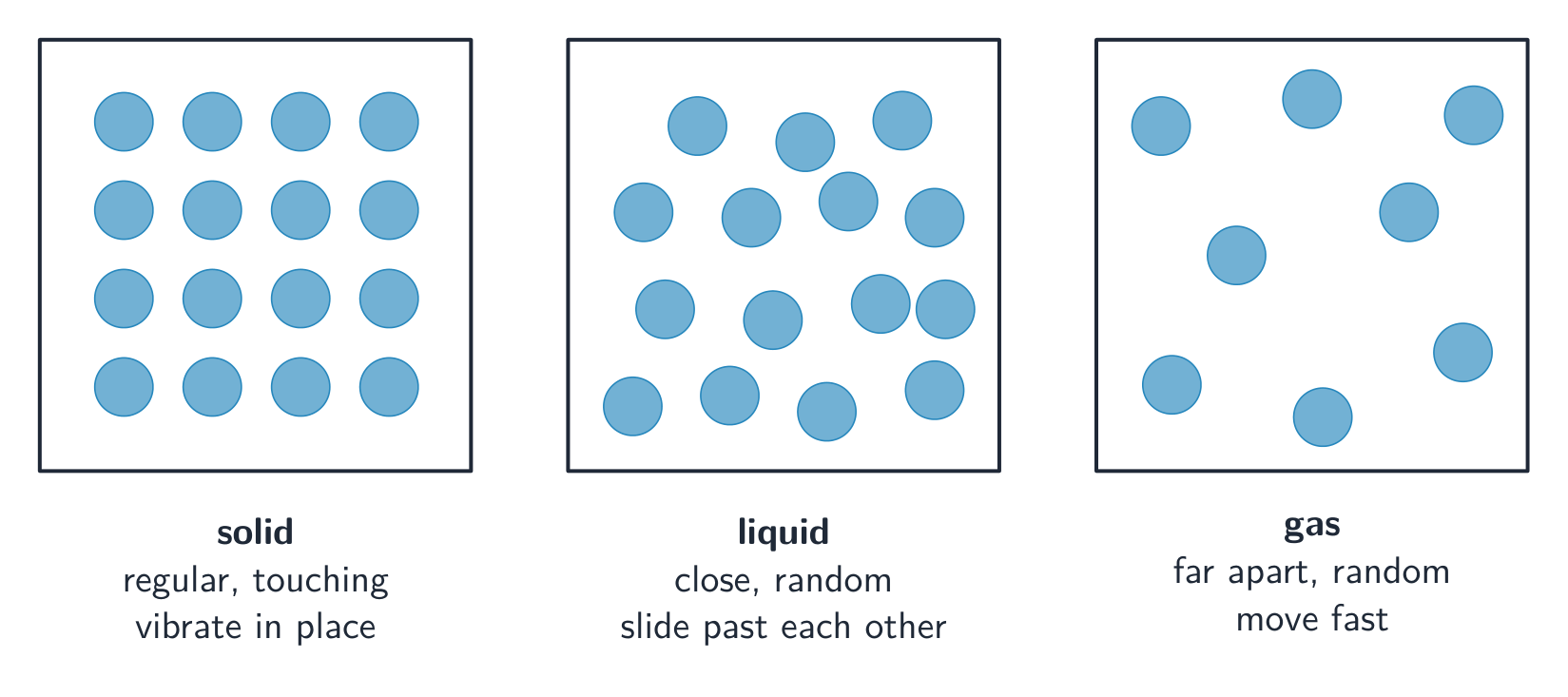
    The three states differ in how tightly particles are held. Rising temperature raises average kinetic energy; when it overcomes the attractions, the substance melts or boils. Gases are mostly empty space, so they are compressible and fill their container.

    Particles are packed in a solid, close but mobile in a liquid, and far apart in a gas
    Particles are packed in a solid, close but mobile in a liquid, and far apart in a gas
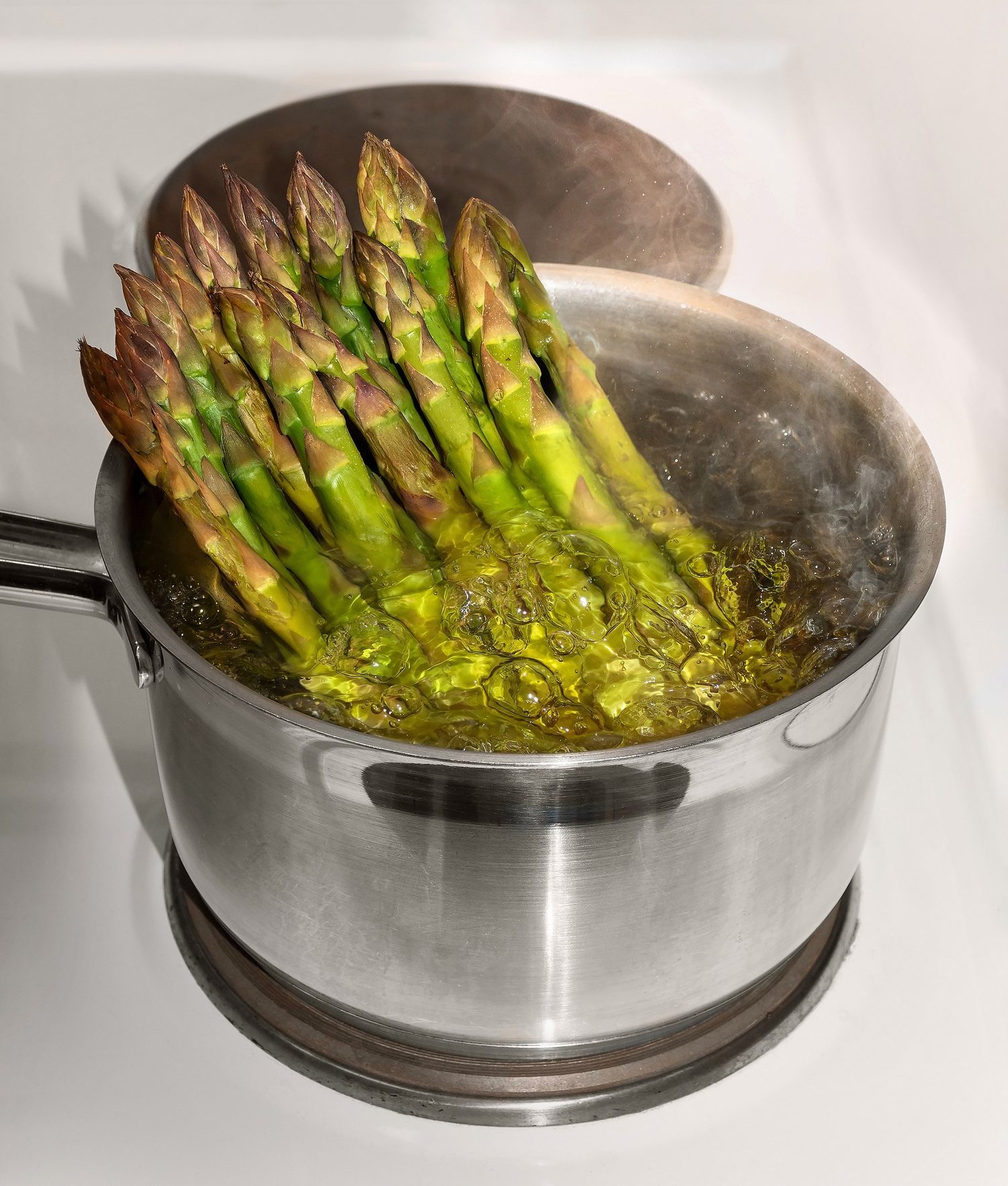
    Steam rising from boiling water: gases expand to fill space and obey the ideal gas law at high T and low P
    Steam rising from boiling water: gases expand to fill space and obey the ideal gas law at high T and low P
    Explore · ⁨탐색하기⁩

    Melt and boil by adding heat · ⁨열을 가하여 용융 및 끓이기⁩

    Temperature sets the average kinetic energy of the particles. Warm a solid and the particles break their fixed pattern (melt), then spread right out (boil). · ⁨온도는 입자의 평균 운동 에너지를 결정합니다. 고체를 데우면 입자가 고정된 배열을 깨고(용융), 곧바로 넓게 퍼져 나갑니다(끓음).⁩

    3.4

    The Ideal Gas Law

    Syllabus
    English

    Learning Objective 3.4.A: Explain the relationship between the macroscopic properties of a sample of gas or mixture of gases using the ideal gas law.

    • 3.4.A.1 The macroscopic properties of ideal gases are related through the ideal gas law:
      • EQN: $PV = nRT$.
    • 3.4.A.2 In a sample containing a mixture of ideal gases, the pressure exerted by each component (the partial pressure) is independent of the other components. Therefore, the partial pressure of a gas within the mixture is proportional to its mole fraction ($X$), and the total pressure of the sample is the sum of the partial pressures.
      • EQN: $P_{A} = P_{total} \times X_{A}$, where $X_{A} =$ moles A/total moles;
      • EQN: $P_{total} = P_{A} + P_{B} + P_{C} + \ldots$
    • 3.4.A.3 Graphical representations of the relationships between $P$, $V$, $T$, and $n$ are useful to describe gas behavior.
    한국어

    학습 목표 3.4.A: 이상 기체 법칙을 사용하여 기체 또는 기체 혼합물의 시료에 대한anganscopic(거시적) 특성의 관계를 설명하시오.

    • 3.4.A.1 이상 기체의anganscopic(거시적) 특성은 이상 기체 법칙을 통해 관련된다:
      • EQN: $PV = nRT$.
    • 3.4.A.2 이상 기체의 혼합물이 포함된 시료에서 각 성분(부분 압력)이 가하는 압력은 다른 성분들과 독립적이다. 따라서 혼합물 내 기체의 부분 압력은 몰 분율($X$)에 비례하며, 시료의 총압은 부분 압력의 합이다.
      • EQN: $P_{A} = P_{total} \times X_{A}$, 여기서 $X_{A} =$몰 A/전체 몰수;
      • EQN: $P_{total} = P_{A} + P_{B} + P_{C} + \ldots$
    • 3.4.A.3 $P$, $V$, $T$, 그리고 $n$ 간의 관계에 대한 그래프 표현은 기체의 거동을 묘사하는 데 유용하다.

    Source: College Board AP Course and Exam Description · ⁨출처: College Board AP Course and Exam Description⁩

    An ideal gas obeys

    $$PV=nRT,$$
    linking pressure, volume, moles, and absolute temperature. Use it to find any one quantity from the others, or (holding some constant) to predict how a gas responds to a change.

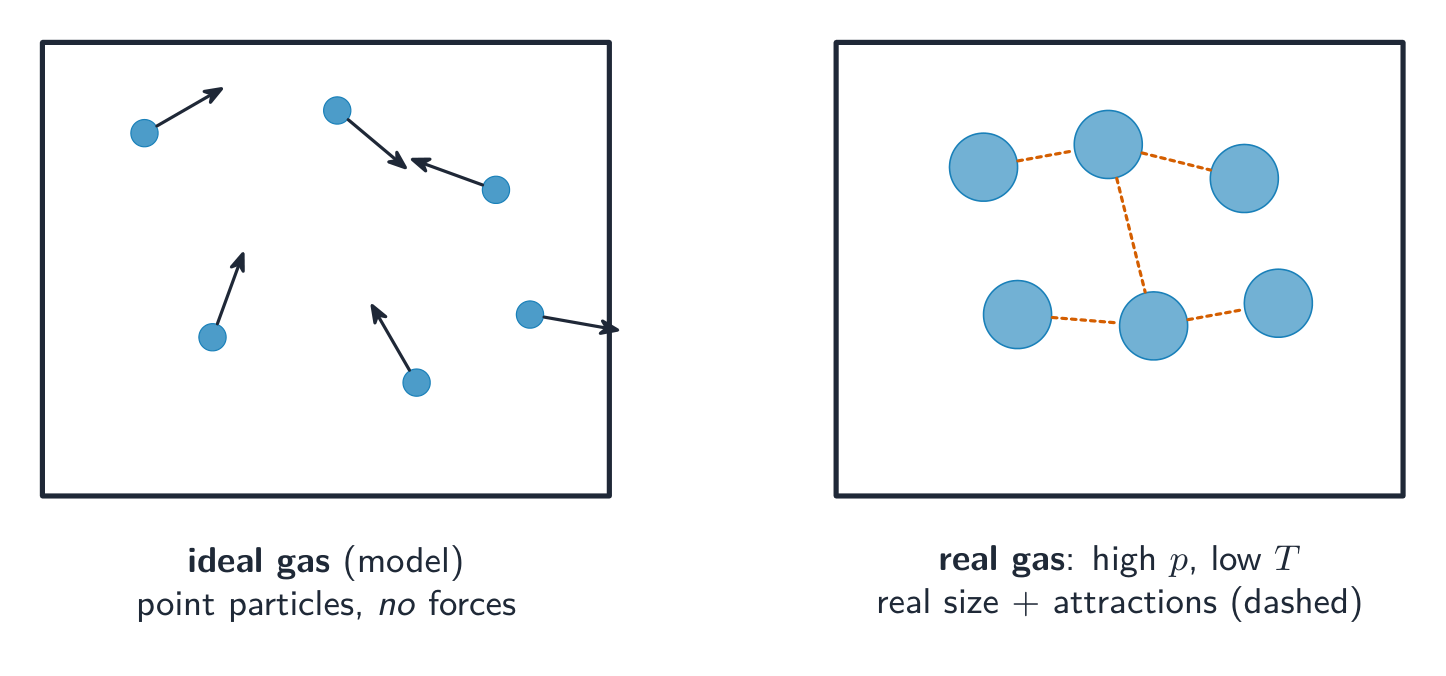
    An ideal gas is a model of point particles with no forces between them
    An ideal gas is a model of point particles with no forces between them

    Worked example. How many moles of gas fill a $2.0\ \text{L}$ container at $300\ \text{K}$ and $1.5\ \text{atm}$? Using $R=0.0821\ \text{L atm/(mol K)}$,

    $$n=\frac{PV}{RT}=\frac{1.5\times2.0}{0.0821\times300}=0.12\ \text{mol}.$$
    Always use kelvin for $T$ and match the units of $R$ to your pressure and volume.

    Explore · ⁨탐색하기⁩

    Compress a gas and watch the pressure · ⁨기체를 압축하여 압력 변화를 보기⁩

    $PV = nRT$. At fixed temperature, squeezing the gas into a smaller volume packs the molecules closer, so they hit the walls more often and the pressure rises. · ⁨$PV = nRT$. 일정한 온도에서 기체를 작은 부피로 압축하면 분자들이 서로 가까워져 벽에 더 자주 부딪히고 압력이 상승합니다.⁩

    3.5

    Kinetic Molecular Theory

    Syllabus
    English

    Learning Objective 3.5.A: Explain the relationship between the motion of particles and the macroscopic properties of gases with: i. The kinetic molecular theory (KMT). ii. A particulate model. iii. A graphical representation.

    • 3.5.A.1 The kinetic molecular theory (KMT) relates the macroscopic properties of gases to motions of the particles in the gas. The Maxwell-Boltzmann distribution describes the distribution of the kinetic energies of particles at a given temperature.
    • 3.5.A.2 All the particles in a sample of matter are in continuous, random motion. The average kinetic energy of a particle is related to its average velocity by the equation:
      • EQN: $KE = \frac{1}{2}\,mv^{2}$.
    • 3.5.A.3 The Kelvin temperature of a sample of matter is proportional to the average kinetic energy of the particles in the sample.
    • 3.5.A.4 The Maxwell-Boltzmann distribution provides a graphical representation of the energies/velocities of particles at a given temperature.
    한국어

    학습 목표 3.5.A: 입자의 운동과 기체의anganscopic(거시적) 특성 간의 관계를 다음과 같이 설명하시오: i. 운동 분자 이론(KMT). ii. 입자 수준 모델. iii. 그래프 표현.

    • 3.5.A.1 운동 분자 이론(KMT)은 기체의anganscopic(거시적) 특성을 기체 내 입자의 운동과 연관시킨다. 맥스웰-볼츠만 분포는 특정 온도에서의 입자의 운동 에너지 분포를 묘사한다.
    • 3.5.A.2 물질 시료 내 모든 입자는 지속적이고 무작위적인 운동을 한다. 입자의 평균 운동 에너지는 다음 식에 따라 평균 속도와 관련된다:
      • EQN: $KE = \frac{1}{2}\,mv^{2}$.
    • 3.5.A.3 물질 시료의 켈빈 온도는 시료 내 입자의 평균 운동 에너지에 비례한다.
    • 3.5.A.4 맥스웰-볼츠만 분포는 특정 온도에서의 입자의 에너지/속도에 대한 그래프 표현을 제공한다.

    Source: College Board AP Course and Exam Description · ⁨출처: College Board AP Course and Exam Description⁩

    Kinetic theory: gas pressure

    Kinetic molecular theory 分子运动论 explains gas behavior: particles are tiny, in constant random motion, with negligible volume and no attractions, and collisions are elastic. Temperature is proportional to average kinetic energy, so at a given temperature lighter molecules move faster (Graham's law of effusion).

    The Maxwell-Boltzmann distribution of molecular speeds shifts right when heated
    The Maxwell-Boltzmann distribution of molecular speeds shifts right when heated
    Explore · ⁨탐색하기⁩

    Heat a gas and watch the speed spread · ⁨기체를 가열하여 속도 분포 변화를 보기⁩

    Gas molecules have a range of speeds. Raising the temperature shifts the whole distribution to higher speeds and flattens it, so more molecules move fast. · ⁨기체 분자에는 속도의 범위가 있습니다. 온도를 높이면 전체 분포가 높은 속도로 이동하고 평평해져 더 많은 분자가 빠르게 움직입니다.⁩

    Vocabulary · ⁨어휘⁩ Train · ⁨연습하기⁩
    English 한국어
    Kinetic molecular theory/kɪˈnetɪk məˈlekjʊlə ˈθɪəri/ 운동론적 분자 이론
    3.6

    Deviation from the Ideal Gas Law

    Syllabus
    English

    Learning Objective 3.6.A: Explain the relationship among non-ideal behaviors of gases, interparticle forces, and/or volumes.

    • 3.6.A.1 The ideal gas law does not explain the actual behavior of real gases. Deviations from the ideal gas law may result from interparticle attractions among gas molecules, particularly at conditions that are close to those resulting in condensation. Deviations may also arise from particle volumes, particularly at extremely high pressures.
    한국어

    학습 목표 3.6.A: 기체의 비이상적 거동, 입자 간 힘 및/또는 부피 간의 관계를 설명하시오.

    • 3.6.A.1 이상 기체 법칙은 실제 기체의 실제 거동을 설명하지 못한다. 기체 분자 간의 입자 간 인력으로 인해 이상 기체 법칙으로부터의 편차가 발생할 수 있는데, 특히 응축 조건에 가까운 상태에서这种现象尤为显著。편차는 또한 입자 자체의 부피로 인해 발생할 수 있으며, 특히 극도로 높은 압력에서是这样。

    Source: College Board AP Course and Exam Description · ⁨출처: College Board AP Course and Exam Description⁩

    Real gases deviate from ideal behavior at high pressure and low temperature, where molecules are close enough that their real volume and their attractions matter. Attractions lower the pressure below ideal; molecular volume raises it.

    3.7

    Solutions and Mixtures

    Syllabus
    English

    Learning Objective 3.7.A: Calculate the number of solute particles, volume, or molarity of solutions.

    • 3.7.A.1 Solutions, also sometimes called homogeneous mixtures, can be solids, liquids, or gases. In a solution, the macroscopic properties do not vary throughout the sample. In a heterogeneous mixture, the macroscopic properties depend on location in the mixture.
    • 3.7.A.2 Solution composition can be expressed in a variety of ways; molarity is the most common method used in the laboratory.
      • EQN: $M = n_{solute}/L_{solution}$
    한국어

    학습 목표 3.7.A: 용질의 입자 수, 용액의 부피 또는 몰농도를 계산하시오.

    • 3.7.A.1 용액은 균일 혼합물(homogeneous mixture)으로도 불리며, 고체, 액체, 기체 중 하나일 수 있다. 용액에서는 시료 전반에 걸쳐anganscopic(거시적) 특성이 변하지 않는다. 이질적 혼합물(heterogeneous mixture)에서는anganscopic(거시적) 특성이 혼합물 내 위치에 따라 달라진다.
    • 3.7.A.2 용액의 조성은 다양한 방식으로 표현될 수 있으며, 실험실에서 가장 일반적으로 사용되는 방법은 몰농도이다.
      • EQN: $M = n_{solute}/L_{solution}$

    Source: College Board AP Course and Exam Description · ⁨출처: College Board AP Course and Exam Description⁩

    A solution 溶液 is a homogeneous mixture of a solute 溶质 dissolved in a solvent 溶剂. Concentration is usually molarity 摩尔浓度:

    $$M=\frac{\text{moles of solute}}{\text{liters of solution}}.$$
    Dilution conserves moles: $M_1V_1=M_2V_2$.

    Worked example. What volume of water must you add to $50\ \text{mL}$ of $6.0\ \text{M}$ HCl to make it $2.0\ \text{M}$? The moles of HCl are unchanged, so $M_1V_1=M_2V_2$ gives the final volume $V_2=\dfrac{M_1V_1}{M_2}=\dfrac{6.0\times50}{2.0}=150\ \text{mL}$. You therefore add $150-50=100\ \text{mL}$ of water.

    Vocabulary · ⁨어휘⁩ Train · ⁨연습하기⁩
    English 한국어
    solution/səˈluːʃn/ 용액
    solute/ˈsɒljuːt/ 용질
    solvent/ˈsɒlvənt/ 용매
    molarity/məʊˈlærɪti/ 몰 농도
    3.8

    Representations of Solutions

    Syllabus
    English

    Learning Objective 3.8.A: Using particulate models for mixtures: i. Represent interactions between components. ii. Represent concentrations of components.

    • 3.8.A.1 Particulate representations of solutions communicate the structure and properties of solutions, by illustration of the relative concentrations of the components in the solution and/or drawings that show interactions among the components.
      • Exclusion Statement: Colligative properties will not be assessed on the AP Exam.
      • Exclusion Statement: Calculations of molality, percent by mass, and percent by volume for solutions will not be assessed on the AP Exam.
    한국어

    학습목표 3.8.A: 혼합물에 대한 입자 모델 활용: i. 구성 요소 간의 상호작용을 표현한다. ii. 구성 요소의 농도를 표현한다.

    • 3.8.A.1 용액의 입자 표현은 용액 내 구성 요소의 상대적 농도를 그림으로 보여주거나 구성 요소 간 상호작용을 나타내는 도면을 통해 용액의 구조와 성질을 전달한다.
      • 제외 사항: AP 시험에서 합동성질(colligative properties)은 평가되지 않는다.
      • 제외 사항: 용액에 대한 몰분율, 질량 분율 및 부피 분율 계산은 AP 시험에서 평가되지 않는다.

    Source: College Board AP Course and Exam Description · ⁨출처: College Board AP Course and Exam Description⁩

    A particulate diagram shows the solute and solvent particles. For an ionic solute, show it fully dissociated into separate ions surrounded by solvent; count particles to reason about concentration and conductivity.

    3.9

    Separation of Solutions and Mixtures

    Syllabus
    English

    Learning Objective 3.9.A: Explain the results of a separation experiment based on intermolecular interactions.

    • 3.9.A.1 The components of a liquid solution cannot be separated by filtration. They can, however, be separated using processes that take advantage of differences in the intermolecular interactions of the components.
      • i. Chromatography (paper, thin-layer, and column) separates chemical species by taking advantage of the differential strength of intermolecular interactions between and among the components of the solution (the mobile phase) and with the surface components of the stationary phase. The resulting chromatogram can be used to infer the relative polarities of components in a mixture.
      • ii. Distillation separates chemical species by taking advantage of the differential strength of intermolecular interactions between and among the components and the effects these interactions have on the vapor pressures of the components in the mixture.
    한국어

    학습목표 3.9.A: 분자 간 상호작용에 기반하여 분리 실험 결과를 설명한다.

    • 3.9.A.1 액체 용액의 구성 요소는 여과로 분리할 수 없다. 그러나 구성 요소 간의 분자 간 상호작용 차이를 이용하는 공정을 통해 분리할 수 있다.
      • i. 크로마토그래피(종이, 얇은층, 컬럼)는 용액(유동상)의 구성 요소 간 및 정지상의 표면 구성 요소와의 분자 간 상호작용 강도의 차이를 이용하여 화학 종을 분리한다. 생성된 크로마토그램을 사용하여 혼합물 내 구성 요소의 상대적 극성을 유추할 수 있다.
      • ii. 증류는 구성 요소 간 및 구성 요소와 정지상 간의 분자 간 상호작용 강도의 차이와 이러한 상호작용이 혼합물 내 구성 요소의 증기압에 미치는 영향을 이용하여 화학 종을 분리한다.

    Source: College Board AP Course and Exam Description · ⁨출처: College Board AP Course and Exam Description⁩

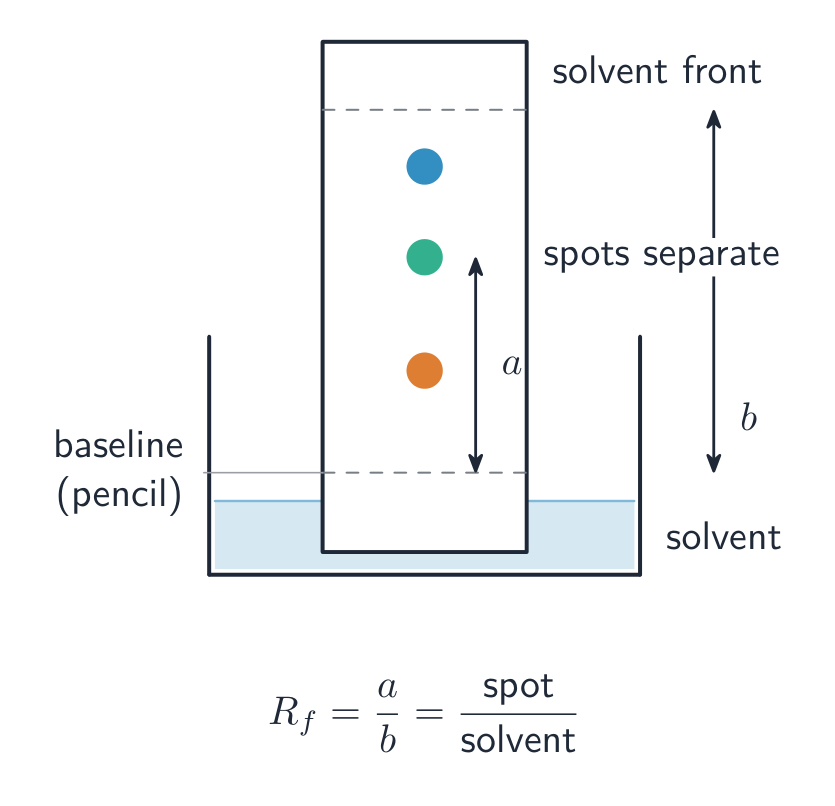
    Because a mixture's components keep their properties, physical methods separate them: filtration (by particle size), distillation (by boiling point), and chromatography 色谱法 (by how strongly each component sticks to a stationary phase versus moving with a solvent).

    Paper chromatography separates a mixture as the solvent rises up the paper
    Paper chromatography separates a mixture as the solvent rises up the paper
    Vocabulary · ⁨어휘⁩ Train · ⁨연습하기⁩
    English 한국어
    chromatography/krəʊməˈtɒɡrəfi/ 크로마토그래피
    3.10

    Solubility

    Syllabus
    English

    Learning Objective 3.10.A: Explain the relationship between the solubility of ionic and molecular compounds in aqueous and nonaqueous solvents, and the intermolecular interactions between particles.

    • 3.10.A.1 Substances with similar intermolecular interactions tend to be miscible or soluble in one another.
    한국어

    학습 목표 3.10.A: 수용성 및 비수용성 용매에서의 이온성 및 분자성 화합물의 용해도와 입자 간의 분자간 상호작용 사이의 관계를 설명하시오.

    • 3.10.A.1 유사한 분자간 상호작용을 가진 물질들은 서로Miscible하거나 용해되는 경향이 있다.

    Source: College Board AP Course and Exam Description · ⁨출처: College Board AP Course and Exam Description⁩

    Solubility 溶解度 is how much solute dissolves. "Like dissolves like": polar (and ionic) solutes dissolve in polar solvents; nonpolar in nonpolar. Dissolving happens when solute–solvent attractions are comparable to the attractions being broken.

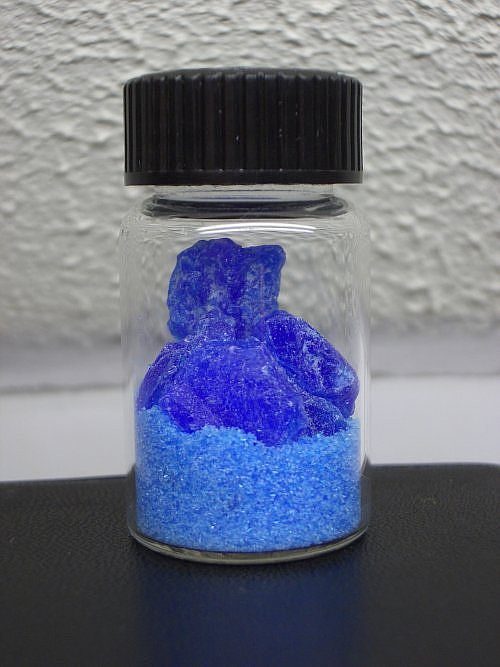
    A cluster of large, glassy, bright blue crystals of copper sulfate
    Blue copper(II) sulfate crystals grown from solution: a saturated solution left to evaporate deposits its dissolved solid back out as regular crystals
    Vocabulary · ⁨어휘⁩ Train · ⁨연습하기⁩
    English 한국어
    Solubility/ˌsɒljuːˈbɪlɪti/ 용해도
    3.11

    Spectroscopy and the Electromagnetic Spectrum

    Syllabus
    English

    Learning Objective 3.11.A: Explain the relationship between a region of the electromagnetic spectrum and the types of molecular or electronic transitions associated with that region.

    • 3.11.A.1 Differences in absorption or emission of photons in different spectral regions are related to the different types of molecular motion or electronic transition:
      • i. Microwave radiation is associated with transitions in molecular rotational levels.
      • ii. Infrared radiation is associated with transitions in molecular vibrational levels.
      • iii. Ultraviolet/visible radiation is associated with transitions in electronic energy levels.
    한국어

    학습 목표 3.11.A: 전자기 스펙트럼의 특정 영역과 해당 영역에 연관된 분자 또는 전자 전이 유형의 관계를 설명하시오.

    • 3.11.A.1 다양한 스펙트럼 영역에서의 광자 흡수 또는 방출의 차이는 분자 운동 또는 전자 전이의 종류에 따라 달라진다:
      • i. 마이크로파 복사는 분자 회전 에너지 준위의 전이와 관련된다.
      • ii. 적외선 복사는 분자 진동 에너지 준위의 전이와 관련된다.
      • iii. 자외선/가시광선 복사는 전자 에너지 준위의 전이와 관련된다.

    Source: College Board AP Course and Exam Description · ⁨출처: College Board AP Course and Exam Description⁩

    Spectroscopy 光谱学 studies how matter absorbs or emits light. Different regions of the electromagnetic spectrum probe different changes: microwaves (rotation), infrared (bond vibrations), ultraviolet–visible (electron transitions). The light absorbed reveals structure.

    Explore · ⁨탐색하기⁩

    Scan across the electromagnetic spectrum · ⁨전자파 스펙트럼 스캔하기⁩

    Light is a wave with a range of wavelengths. Shorter wavelength means higher frequency and more energy per photon, from radio waves up to gamma rays. · ⁨빛은 파장 범위를 가진 파동입니다. 짧은 파장은 높은 주파수와 광자당 더 큰 에너지를 의미하며, 라디오 파동부터 감마선까지 이어집니다.⁩

    Vocabulary · ⁨어휘⁩ Train · ⁨연습하기⁩
    English 한국어
    Spectroscopy/spekˈtrɒskəpi/ 분광학
    3.12

    Properties of Photons

    Syllabus
    English

    Learning Objective 3.12.A: Explain the properties of an absorbed or emitted photon in relationship to an electronic transition in an atom or molecule.

    • 3.12.A.1 When a photon is absorbed (or emitted) by an atom or molecule, the energy of the species is increased (or decreased) by an amount equal to the energy of the photon.

    • 3.12.A.2 The wavelength of the electromagnetic wave is related to its frequency and the speed of light by the equation:

      • EQN: $c = \lambda\nu$.

      The energy of a photon is related to the frequency of the electromagnetic wave through Planck's equation:

      • EQN: $E = h\nu$.
    한국어

    학습 목표 3.12.A: 원자나 분자의 전자 전이에 대한 흡수되거나 방출되는 광자의 성질을 설명하시오.

    • 3.12.A.1 광자가 원자나 분자에 흡수(또는 방출)되면, 해당 종의 에너지는 광자의 에너지 값만큼 증가(또는 감소)한다.
    • 3.12.A.2 전자기파의 파장은 주파수와 빛의 속도를 다음과 같은 식으로 연결한다:
      • EQN: $c = \lambda\nu$.

    광자의 에너지는 플랑크의 식을 통해 전자기파의 주파수와 연결된다:

    • EQN: $E = h\nu$.

    Source: College Board AP Course and Exam Description · ⁨출처: College Board AP Course and Exam Description⁩

    Light is carried by photons 光子, each with energy $E=h\nu=\dfrac{hc}{\lambda}$. Higher frequency (shorter wavelength) means higher energy. A molecule absorbs a photon only when its energy matches an allowed energy gap.

    Vocabulary · ⁨어휘⁩ Train · ⁨연습하기⁩
    English 한국어
    photons/ˈfəʊtɒnz/ 광자
    3.13

    The Beer-Lambert Law

    Syllabus
    English

    Learning Objective 3.13.A: Explain the amount of light absorbed by a solution of molecules or ions in relationship to the concentration, path length, and molar absorptivity.

    • 3.13.A.1 The Beer-Lambert law relates the absorption of light by a solution to three variables according to the equation:

      • EQN: $A = \varepsilon bc$.

      The molar absorptivity, $\varepsilon$, describes how intensely a chemical species absorbs light of a specific wavelength. The path length, $b$, and concentration, $c$, are proportional to the number of light-absorbing particles in the light path.

    • 3.13.A.2 In most experiments the path length and wavelength of light are held constant. In such cases, the absorbance is proportional only to the concentration of absorbing molecules or ions. The spectrophotometer is typically set to the wavelength of maximum absorbance (optimum wavelength) for the species being analyzed to ensure the maximum sensitivity of measurement.

    한국어

    학습 목표 3.13.A: 분자 또는 이온의 용액이 흡수하는 빛의 양이 농도,光路长度(경로 길이), 및 몰 흡광계수와의 관계를 설명하시오.

    • 3.13.A.1 베어-람베르트 법칙은 다음 식에 따라 용액의 빛 흡수를 세 가지 변수와 연결한다:

      • EQN: $A = \varepsilon bc$.

      몰 흡광계수 $\varepsilon$는 화학적 종이 특정 파장의 빛을 얼마나 강하게 흡수하는지를 나타낸다. 경로 길이 $b$와 농도 $c$는 빛의 경로 내에 있는 빛 흡수 입자의 수에 비례한다.

    • 3.13.A.2 대부분의 실험에서는 경로 길이와 빛의 파장이 일정하게 유지된다. 이러한 경우 흡광도는 흡수하는 분자 또는 이온의 농도에만 비례한다. 분광광도계는 측정의 최대 민감도를 보장하기 위해 일반적으로 분석 대상 종의 최대 흡광도(최적 파장)로 설정된다.

    Source: College Board AP Course and Exam Description · ⁨출처: College Board AP Course and Exam Description⁩

    The Beer–Lambert law 比尔-朗伯定律 relates how much light a solution absorbs to its concentration:

    $$A=\varepsilon\,b\,c,$$
    where $A$ is absorbance, $\varepsilon$ the molar absorptivity, $b$ the path length, and $c$ the concentration. Since $A$ is proportional to $c$, measuring absorbance is a fast way to find an unknown concentration.

    Worked example. A dye has molar absorptivity $\varepsilon=2000\ \text{L/(mol cm)}$; in a $1.0\ \text{cm}$ cell a sample reads absorbance $A=0.40$. Its concentration is $c=\dfrac{A}{\varepsilon b}=\dfrac{0.40}{2000\times1.0}=2.0\times10^{-4}\ \text{M}$. Because $A\propto c$, a solution twice as concentrated would read $A=0.80$ – the basis of a calibration curve.

    Explore · ⁨탐색하기⁩

    Link absorbance to concentration · ⁨흡광도와 농도 연결하기⁩

    The Beer-Lambert law says absorbance $A = \varepsilon b c$: absorbance is proportional to concentration, so a calibration line lets you read an unknown concentration. · ⁨Beer-Lambert 법칙은 흡광도 $A = \varepsilon b c$를 설명합니다: 흡광도는 농도에 비례하므로, 교정 곡선을 통해 미지 농도를 읽을 수 있습니다.⁩

    Vocabulary · ⁨어휘⁩ Train · ⁨연습하기⁩
    English 한국어
    Beer–Lambert law/bɪə ˈlæmbət lɔː/ Beer–Lambert 법칙
    3.13

    Exam tips

    • Intermolecular forces (dispersion < dipole–dipole < hydrogen bonding) set boiling points — they are much weaker than the bonds inside a molecule.
    • Boiling breaks the forces between molecules, not the covalent bonds within them.
    • Use $PV=nRT$ with temperature in kelvin and $R$ matched to your pressure/volume units.
    • For solutions use molarity $M=\text{mol}/\text{L}$; dilution conserves moles, so $M_1V_1=M_2V_2$.
    • "Like dissolves like" — polar/ionic solutes dissolve in polar solvents, non-polar in non-polar.
  • 4

    Chemical Reactions · ⁨화학 반응⁩

    Watch lesson · ⁨수업 보기⁩
    4.1

    Recognizing a Chemical Reaction

    Syllabus
    English

    Learning Objective 4.1.A: Identify evidence of chemical and physical changes in matter.

    • 4.1.A.1 A physical change occurs when a substance undergoes a change in properties but not a change in composition. Changes in the phase of a substance (solid, liquid, gas) or formation/separation of mixtures of substances are common physical changes.
    • 4.1.A.2 A chemical change occurs when substances are transformed into new substances, typically with different compositions. Production of heat or light, formation of a gas, formation of a precipitate, and/or color change provide possible evidence that a chemical change has occurred.
    한국어

    학습목표 4.1.A: 물질의 화학 변화 및 물리 변화 증거를 식별한다.

    • 4.1.A.1 물리 변화는 물질의 성질이 변하지만 조성은 변하지 않는 경우 발생한다. 물질의 상 변화(고체, 액체, 기체) 또는 물질 혼합물의 형성/분리는 일반적인 물리 변화이다.
    • 4.1.A.2 화학 변화는 물질이 새로운 물질로 전환되는 경우 발생하며,通常是 조성의 차이가 따른다. 열이나 빛의 방출, 기체의 형성, 침전물의 형성 및/또는 색상 변화는 화학 변화가 일어났음을 알 수 있는 가능한 증거이다.

    Source: College Board AP Course and Exam Description · ⁨출처: College Board AP Course and Exam Description⁩

    Magnesium burning: a chemical reaction rearranges atoms and releases energy as light and heat
    Magnesium burning: a chemical reaction rearranges atoms and releases energy as light and heat

    A chemical reaction 化学反应 rearranges atoms into new substances. Signs one has happened: a color change, a gas or precipitate 沉淀 forming, or a temperature change. Atoms are conserved, so an equation must be balanced – the same count of each element on both sides.

    Vocabulary · ⁨어휘⁩ Train · ⁨연습하기⁩
    English 한국어
    chemical reaction/ˈkemɪkl rɪˈækʃn/ 화학 반응
    precipitate/prɪˈsɪpɪteɪt/ 침전물
    4.2

    Net Ionic Equations

    Syllabus
    English

    Learning Objective 4.2.A: Represent changes in matter with a balanced chemical or net ionic equation: i. For physical changes. ii. For given information about the identity of the reactants and/or product. iii. For ions in a given chemical reaction.

    • 4.2.A.1 All physical and chemical processes can be represented symbolically by balanced equations.
    • 4.2.A.2 Chemical equations represent chemical changes. These changes are the result of a rearrangement of atoms into new combinations; thus, any representation of a chemical change must contain equal numbers of atoms of every element before and after the change occurred. Equations thus demonstrate that mass and charge are conserved in chemical reactions.
    • 4.2.A.3 Balanced molecular, complete ionic, and net ionic equations are differing symbolic forms used to represent a chemical reaction. The form used to represent the reaction depends on the context in which it is to be used.
    한국어

    학습목표 4.2.A: 균형 잡힌 화학식 또는 순 이온식을 사용하여 물질의 변화를 표현한다: i. 물리 변화에 대해. ii. 반응물 및/또는 생성물의 정체성에 대한 주어진 정보에 대해. iii. 주어진 화학 반응의 이온에 대해.

    • 4.2.A.1 모든 물리적 및 화학적 과정은 균형 잡힌 식으로 기호적으로 표현될 수 있다.
    • 4.2.A.2 화학식은 화학 변화를 나타낸다. 이러한 변화는 원자가 새로운 조합으로 재배열되는 결과이므로, 화학 변화의 어떤 표현도 변화 전후에 모든 원소의 원자 수가 동일해야 한다. 따라서 식들은 화학 반응에서 질량과 전하가 보존됨을 보여준다.
    • 4.2.A.3 균형 잡힌 분자식, 완전 이온식 및 순 이온식은 화학 반응을 표현하기 위해 사용되는 서로 다른 기호 형태이다. 사용될 문맥에 따라 적합한 형식을 선택한다.

    Source: College Board AP Course and Exam Description · ⁨출처: College Board AP Course and Exam Description⁩

    For reactions in water, ionic compounds split into ions. A net ionic equation 净离子方程式 shows only the species that actually change, leaving out the spectator ions 旁观离子 that appear unchanged on both sides. It captures the real chemistry (e.g. $\text{Ag}^+ + \text{Cl}^- \rightarrow \text{AgCl}(s)$).

    Mixing two solutions can form an insoluble precipitate
    Mixing two solutions can form an insoluble precipitate
    Vocabulary · ⁨어휘⁩ Train · ⁨연습하기⁩
    English 한국어
    net ionic equation/net aɪˈɒnɪk ɪˈkweɪʒn/ 순 이온方程式(net ionic equation)
    spectator ions/spekˈteɪtə ˈaɪɒnz/ 시작 이온(spectator ions)
    4.3

    Three Ways to Represent a Reaction

    Syllabus
    English

    Learning Objective 4.3.A: Represent a given chemical reaction or physical process with a consistent particulate model.

    • 4.3.A.1 Balanced chemical equations in their various forms can be translated into symbolic particulate representations.
    한국어

    학습목표 4.3.A: 주어진 화학 반응이나 물리적 과정을 일관된 입자 모델로 표현한다.

    • 4.3.A.1 다양한 형태로 된 균형 잡힌 화학식은 기호적 입자 표현으로 번역될 수 있다.

    Source: College Board AP Course and Exam Description · ⁨출처: College Board AP Course and Exam Description⁩

    The same reaction can be shown as a symbolic equation, a particulate drawing (atoms and molecules), and a macroscopic observation (what you see). Moving between these levels – connecting the equation to the particles to the beaker – is a core skill.

    A balanced equation has the same number of each atom on both sides
    A balanced equation has the same number of each atom on both sides
    4.4

    Physical Changes versus Chemical Changes

    Syllabus
    English

    Learning Objective 4.4.A: Explain the relationship between macroscopic characteristics and bond interactions for: i. Chemical processes. ii. Physical processes.

    • 4.4.A.1 Processes that involve the breaking and/or formation of chemical bonds are typically classified as chemical processes. Processes that involve only changes in intermolecular interactions, such as phase changes, are typically classified as physical processes.
    • 4.4.A.2 Sometimes physical processes involve the breaking of chemical bonds. For example, plausible arguments could be made for the dissolution of a salt in water, as either a physical or chemical process, involves breaking of ionic bonds, and the formation of ion-dipole interactions between ions and solvent.
    한국어

    학습목표 4.4.A: 거시적 특성과 결합 상호작용 사이의 관계를 다음에 대해 설명한다: i. 화학적 과정. ii. 물리적 과정.

    • 4.4.A.1 화학 결합의 파절 및/또는 형성이 동반되는 과정은 일반적으로 화학적 과정으로 분류된다. 상 변화와 같이 분자 간 상호작용의 변화만 동반하는 과정은 일반적으로 물리적 과정으로 분류된다.
    • 4.4.A.2 때때로 물리적 과정에는 화학 결합의 파절이 포함된다. 예를 들어, 염이 물에 용해되는 것은 물리적 과정인지 화학적 과정인지에 대한 타당한 논리가 제시될 수 있으며, 이는 이온 결합의 파절과 이온 및 용매 간의 이온-극성 분자 상호작용의 형성을 포함한다.

    Source: College Board AP Course and Exam Description · ⁨출처: College Board AP Course and Exam Description⁩

    A physical change 物理变化 alters form but not identity (melting, dissolving); a chemical change 化学变化 makes new substances by breaking and forming bonds. Dissolving salt is physical; the salt is unchanged and recoverable.

    Vocabulary · ⁨어휘⁩ Train · ⁨연습하기⁩
    English 한국어
    physical change/ˈfɪzɪkl tʃeɪndʒ/ 물리적 변화
    chemical change/ˈkemɪkl tʃeɪndʒ/ 화학적 변화
    4.5

    Stoichiometry

    Syllabus
    English

    Learning Objective 4.5.A: Explain changes in the amounts of reactants and products based on the balanced reaction equation for a chemical process.

    • 4.5.A.1 Because atoms must be conserved during a chemical process, it is possible to calculate product amounts by using known reactant amounts, or to calculate reactant amounts given known product amounts.
    • 4.5.A.2 Coefficients of balanced chemical equations contain information regarding the proportionality of the amounts of substances involved in the reaction. These values can be used in chemical calculations involving the mole concept.
    • 4.5.A.3 Stoichiometric calculations can be combined with the ideal gas law and calculations involving molarity to quantitatively study gases and solutions.
    한국어

    학습목표 4.5.A: 화학적 과정에 대한 균형 잡힌 반응 식을 바탕으로 반응물 및 생성물의 양 변화에 대해 설명한다.

    • 4.5.A.1 화학적 과정에서 원자는 보존되어야 하므로, 알려진 반응물의 양을 사용하여 생성물의 양을 계산하거나, 알려진 생성물의 양을 사용하여 반응물의 양을 계산할 수 있다.
    • 4.5.A.2 균형 잡힌 화학식의 계수는 반응에 관여하는 물질의 양之间的 비례 관계에 대한 정보를 포함한다. 이러한 값들은 몰 개념을 사용하는 화학 계산에 사용할 수 있다.
    • 4.5.A.3 화학양론 계산은 이상 기체 법칙 및 몰농도 관련 계산과 결합되어 기체와 용액을 정량적으로 연구하는 데 사용될 수 있다.

    Source: College Board AP Course and Exam Description · ⁨출처: College Board AP Course and Exam Description⁩

    Stoichiometry 化学计量 uses the balanced equation's mole ratios to relate amounts of reactants and products. The path is always grams → moles → (mole ratio) → moles → grams. The limiting reactant 限量反应物 runs out first and sets the maximum product (the theoretical yield 理论产量); the percent yield compares actual to theoretical.

    The limiting reactant runs out first and decides how much product forms
    The limiting reactant runs out first and decides how much product forms

    Worked example. How much water forms when $4.0\ \text{g}$ of hydrogen burns in excess oxygen? $2\text{H}_2+\text{O}_2\rightarrow2\text{H}_2\text{O}$. Convert to moles, cross the mole ratio ($2:2=1:1$ here), convert back:

    $$n(\text{H}_2)=\frac{4.0}{2.0}=2.0\ \text{mol}\;\Rightarrow\;n(\text{H}_2\text{O})=2.0\ \text{mol}\;\Rightarrow\;m=2.0\times18=36\ \text{g}.$$

    Worked example (limiting reactant). $10.0\ \text{g}$ of N$_2$ reacts with $5.0\ \text{g}$ of H$_2$ ($\text{N}_2+3\text{H}_2\rightarrow2\text{NH}_3$). Which runs out? Moles: $n(\text{N}_2)=10.0/28=0.36$, $n(\text{H}_2)=5.0/2=2.5$. The reaction needs $3$ H$_2$ per N$_2$; you have $2.5/0.36=7.0$, far more than $3$, so N$_2$ is limiting. It makes $2\times0.36=0.72\ \text{mol}$ of ammonia, with hydrogen left over.

    Explore · ⁨탐색하기⁩

    Scale reactants and products by the mole ratio

    A balanced equation fixes the mole ratio between species. Product amount is proportional to the limiting reactant, scaled by that ratio.

    Vocabulary · ⁨어휘⁩ Train · ⁨연습하기⁩
    English 한국어
    Stoichiometry/ˌstəʊɪkɪˈɒmətri/ 화학양론
    limiting reactant/ˈlɪmɪtɪŋ rɪˈæktənt/ 한계 시약(limiting reactant)
    theoretical yield/θɪəˈretɪkl jiːld/ 이론 적 생성량
    4.6

    Introduction to Titration

    Syllabus
    English

    Learning Objective 4.6.A: Identify the equivalence point in a titration based on the amounts of the titrant and analyte, assuming the titration reaction goes to completion.

    • 4.6.A.1 Titrations may be used to determine the amount of an analyte in solution. The titrant has a known concentration of a species that reacts specifically and quantitatively with the analyte. The equivalence point of the titration occurs when the analyte is totally consumed by the reacting species in the titrant. The equivalence point is often indicated by a change in a property (such as color) that occurs when the equivalence point is reached. This observable event is called the endpoint of the titration.
    한국어

    학습목표 4.6.A: 적정 반응이 완결된다고 가정할 때, 적정제 및 분석물의 양을 기반으로 적정의 등량점을 식별한다.

    • 4.6.A.1 적정법은 용액 속 분석물의 양을 결정하는 데 사용될 수 있다. 적정제는 분석물과 특이적이고 정량적으로 반응하는 물질이 알려진 농도를 가진다. 적정의 등가점은 분석물이 적정제에 있는 반응 물질에 의해 완전히 소모될 때 발생한다. 등가점은 종종 색과 같은 성질의 변화로 표시되며, 이는 등가점에 도달할 때 일어난다. 이러한 관측 가능한 현상을 적정의 종말점이라고 한다.

    Source: College Board AP Course and Exam Description · ⁨출처: College Board AP Course and Exam Description⁩

    An acid–base titration curve

    A titration 滴定 finds an unknown concentration by reacting it with a solution of known concentration until they reach the equivalence point 等当点 (stoichiometrically equal). From the known volume and concentration, use the mole ratio to find the unknown. An indicator or a pH curve signals the endpoint.

    Titration apparatus: a burette delivers a known solution into a conical flask
    Titration apparatus: a burette delivers a known solution into a conical flask

    Worked example. $25.0\ \text{mL}$ of hydrochloric acid is exactly neutralized by $30.0\ \text{mL}$ of $0.100\ \text{M}$ NaOH. Find the acid's concentration. The reaction is $1:1$, so the moles match:

    $$n(\text{NaOH})=0.0300\times0.100=3.00\times10^{-3}\ \text{mol}=n(\text{HCl}),\qquad [\text{HCl}]=\frac{3.00\times10^{-3}}{0.0250}=0.120\ \text{M}.$$

    A titration setup: reacting volumes from a burette find the concentration of an unknown solution
    A titration setup: reacting volumes from a burette find the concentration of an unknown solution
    Explore · ⁨탐색하기⁩

    Titrate an acid and find the equivalence point

    Adding base to acid raises the pH slowly, then sharply at the equivalence point where moles of acid and base are equal. The steep jump locates that volume.

    Vocabulary · ⁨어휘⁩ Train · ⁨연습하기⁩
    English 한국어
    titration/taɪˈtreɪʃn/ 적정 분석
    equivalence point/ɪˈkwɪvələns pɔɪnt/ 등가점
    4.7

    Types of Chemical Reactions

    Syllabus
    English

    Learning Objective 4.7.A: Identify a reaction as acid-base, oxidation-reduction, or precipitation.

    • 4.7.A.1 Acid-base reactions involve transfer of one or more protons ($\text{H}^+$ ions) between chemical species.
    • 4.7.A.2 Oxidation-reduction (redox) reactions involve transfer of one or more electrons between chemical species, as indicated by changes in oxidation numbers of the involved species. Combustion is an important subclass of oxidation-reduction reactions, in which a species reacts with oxygen gas. In the case of hydrocarbons, carbon dioxide and water are products of complete combustion.
    • 4.7.A.3 In a redox reaction, electrons are transferred from the species that is oxidized to the species that is reduced.
      • Exclusion statement: The meaning of the terms "reducing agent" and "oxidizing agent" will not be assessed on the AP Exam.
    • 4.7.A.4 Oxidation numbers may be assigned to each of the atoms in the reactants and products; this is often an effective way to identify the oxidized and reduced species in a redox reaction.
    • 4.7.A.5 Precipitation reactions frequently involve mixing ions in aqueous solution to produce an insoluble or sparingly soluble ionic compound. All sodium, potassium, ammonium, and nitrate salts are soluble in water.
      • Exclusion statement: Rote memorization of "solubility rules" other than those implied in 4.7.A.5 will not be assessed on the AP Exam.
    한국어

    학습 목표 4.7.A: 반응을 산-염기 반응, 산화-환원 반응 또는 침전 반응으로 식별한다.

    • 4.7.A.1 산-염기 반응은 화학적 종 사이에서 하나 이상의 양성자($\text{H}^+$ 이온)를 전달하는 과정입니다.
    • 4.7.A.2 산화-환원(레독스) 반응은 관련 입자의 산화수 변화를 통해 나타나는 것처럼 화학적 입자 사이에서 하나 이상의 전자를 이동시키는 것을 포함한다. 연소는 중요한 산화-환원 반응의 하위 분류로서, 한 입자가 산소 기체와 반응하는 경우이다. 탄화수소의 경우 완전 연산의 생성물은 이산화탄소와 물이다.
    • 4.7.A.3 레독스 반응에서 전자는 산화된 입자에서 환원된 입자로 이동한다.
      • 배제 사항: '환원제'와 '산화제'라는 용어의 의미는 AP 시험에서 평가되지 않는다.
    • 4.7.A.4 산화수는 반응물과 생성물의 각 원자에 부여될 수 있으며, 이는 레독스 반응에서 산화된 입자와 환원된 입자를 식별하는 데 효과적인 방법인 경우가 많다.
    • 4.7.A.5 침전 반응은 수용액에서 이온을 혼합하여 불용성 또는 저용해성 이온 화합물을 생성하는 것이 일반적이다. 모든 나트륨, 칼륨, 암모늄 및 질산염 염기는 물에 용해된다.
      • 배제 사항: 4.7.A.5에 함축되지 않는 '용해도 규칙'의 외우기 암기는 AP 시험에서 평가되지 않는다.

    Source: College Board AP Course and Exam Description · ⁨출처: College Board AP Course and Exam Description⁩

    Common patterns include synthesis (combining), decomposition (breaking apart), combustion (with oxygen, releasing energy), precipitation (forming an insoluble solid), acid–base (proton transfer), and redox (electron transfer). Recognizing the type helps predict the products.

    4.8

    Acid-Base Reactions

    Syllabus
    English

    Learning Objective 4.8.A: Identify species as Brønsted-Lowry acids, bases, and/or conjugate acid-base pairs, based on proton-transfer involving those species.

    • 4.8.A.1 By definition, a Brønsted-Lowry acid is a proton donor and a Brønsted-Lowry base is a proton acceptor.
    • 4.8.A.2 Only in aqueous solutions, water plays an important role in many acid-base reactions, as its molecular structure allows it to accept protons from and donate protons to dissolved species.
    • 4.8.A.3 When an acid or base ionizes in water, the conjugate acid-base pairs can be identified and their relative strengths compared.
      • Exclusion statement: Lewis acid-base concepts will not be assessed on the AP Exam. The emphasis in AP Chemistry is on reactions in aqueous solution.
    한국어

    학습 목표 4.8.A: 해당 입자를 통한 양성자 이동에 근거하여 브렌스테드-라우리 산, 염기 및/또는 공액 산-염기 쌍으로 입자를 식별한다.

    • 4.8.A.1 정의에 따르면 브렌스테드-라우리 산은 양성자 공여체이고 브렌스테드-라우리 염기는 양성자 수용체이다.
    • 4.8.A.2 오직 수용액에서만 물은 분자 구조가 용질 입자로부터 양성자를 수용하고 용질 입자에게 양성자를 공여할 수 있어 많은 산-염기 반응에서 중요한 역할을 한다.
    • 4.8.A.3 산이나 염기가 물에서 이온화되면 공액 산-염기 쌍을 식별하고 상대적인 강도를 비교할 수 있다.
      • 배제 사항: 루이스 산-염기 개념은 AP 시험에서 평가되지 않는다. AP 화학에서는 수용액에서의 반응에 중점을 둔다.

    Source: College Board AP Course and Exam Description · ⁨출처: College Board AP Course and Exam Description⁩

    An acid 酸 donates a proton ($\text{H}^+$); a base 碱 accepts one (Brønsted–Lowry). They react to form water and a salt: $\text{H}^+ + \text{OH}^- \rightarrow \text{H}_2\text{O}$. Strong acids and bases dissociate completely; weak ones only partly.

    Bronsted-Lowry: an acid donates a proton to a base, forming two conjugate pairs
    Bronsted-Lowry: an acid donates a proton to a base, forming two conjugate pairs
    Explore · ⁨탐색하기⁩

    Move along the pH scale

    pH measures how acidic or basic a solution is. Each step of 1 pH is a tenfold change in hydrogen-ion concentration; 7 is neutral, below is acidic, above is basic.

    Vocabulary · ⁨어휘⁩ Train · ⁨연습하기⁩
    English 한국어
    acid/ˈæsɪd/ 산성
    base/beɪs/ 근본(베이스)
    4.9

    Oxidation-Reduction (Redox) Reactions

    Syllabus
    English

    Learning Objective 4.9.A: Represent a balanced redox reaction equation using half-reactions.

    • 4.9.A.1 Balanced chemical equations for redox reactions can be constructed from half-reactions.
    한국어

    학습 목표 4.9.A: 반반응을 사용하여 균형 잡힌 레독스 반응식을 표현한다.

    • 4.9.A.1 레독스 반응의 균형 잡힌 화학식은 반반응으로부터 구성할 수 있다.

    Source: College Board AP Course and Exam Description · ⁨출처: College Board AP Course and Exam Description⁩

    In a redox 氧化还原 reaction, electrons transfer between species. Oxidation 氧化 is loss of electrons (oxidation number rises); reduction 还原 is gain (oxidation number falls). Track changes with oxidation numbers, and remember every oxidation is paired with a reduction – the electrons lost equal the electrons gained.

    Redox is electron transfer: the reducing agent is oxidised, the oxidising agent reduced
    Redox is electron transfer: the reducing agent is oxidised, the oxidising agent reduced

    Worked example. Find the oxidation number of manganese in permanganate, $\text{KMnO}_4$. Potassium is $+1$ and each oxygen is $-2$ (four of them, $-8$). The whole formula is neutral, so $(+1)+\text{Mn}+(-8)=0$, giving $\text{Mn}=+7$ – its maximum, which is why permanganate is a powerful oxidizing agent (it can only gain electrons).

    Explore · ⁨탐색하기⁩

    Watch electrons transfer in a redox reaction

    In a redox reaction one species is oxidised (loses electrons) and another is reduced (gains them). Follow the electrons move from the metal to the non-metal.

    Vocabulary · ⁨어휘⁩ Train · ⁨연습하기⁩
    English 한국어
    redox/rɪˈdɒks/ 산화 환원
    Oxidation/ˌɒksɪˈdeɪʃn/ 산화
    reduction/rɪˈdʌkʃn/ 환원
    4.9

    Exam tips

    • Balance every equation and work in moles — convert grams→moles, cross the mole ratio, then convert back.
    • Find the limiting reactant by comparing mole ratios; it sets the maximum product (theoretical yield).
    • In redox, remember OIL RIG: oxidation is loss of electrons, reduction is gain; every oxidation is paired with a reduction.
    • For titrations use the balanced ratio to link the known and unknown at the equivalence point.
    • A net ionic equation shows only the species that change; leave out spectator ions.
  • 5

    Kinetics · ⁨반응 속도론⁩

    Watch lesson · ⁨수업 보기⁩
    5.1

    How Fast a Reaction Goes

    Syllabus
    English

    Learning Objective 5.1.A: Explain the relationship between the rate of a chemical reaction and experimental parameters.

    • 5.1.A.1 The kinetics of a chemical reaction is defined as the rate at which an amount of reactants is converted to products per unit of time.
    • 5.1.A.2 The rates of change of reactant and product concentrations are determined by the stoichiometry in the balanced chemical equation.
    • 5.1.A.3 The rate of a reaction is influenced by reactant concentrations, temperature, surface area, catalysts, and other environmental factors.
    한국어

    학습 목표 5.1.A: 화학 반응 속도와 실험 매개변수 간의 관계를 설명한다.

    • 5.1.A.1 화학 반응의 동역학은 단위 시간당 반응물이 생성물로 전환되는 양의 속도로 정의된다.
    • 5.1.A.2 반응물과 생성물 농도의 변화율은 균형 잡힌 화학식의 계량학적 관계에 의해 결정된다.
    • 5.1.A.3 반응 속도는 반응물 농도, 온도, 표면적, 촉매 및 기타 환경 요인에 영향을 받는다.

    Source: College Board AP Course and Exam Description · ⁨출처: College Board AP Course and Exam Description⁩

    A catalytic converter: catalysts speed rates by lowering activation energy without being consumed
    A catalytic converter: catalysts speed rates by lowering activation energy without being consumed
    The Maxwell–Boltzmann distribution

    Kinetics 动力学 studies reaction rate 反应速率 – how fast reactants become products. Rate is the change in concentration per unit time, and it typically decreases as reactants are used up. Rate rises with higher concentration, higher temperature, greater surface area, and a catalyst.

    More particles in the same volume collide more often, so the rate rises
    More particles in the same volume collide more often, so the rate rises
    A gas syringe: measuring gas volume over time gives reaction rate from the slope
    A gas syringe: measuring gas volume over time gives reaction rate from the slope
    Explore · ⁨탐색하기⁩

    Change conditions and watch the rate · ⁨조건을 변경하여 반응 속도 변화 보기⁩

    Reaction rate rises with temperature, concentration, and a catalyst — each gives more frequent or more successful collisions. Change each and watch the reaction speed up. · ⁨반응 속도는 온도, 농도, 촉매 증가에 따라 빨라집니다. 각각 충돌 빈도나 성공률을 높여줍니다. 각 요인을 변경하면 반응 속도가 빨라지는 것을 확인하세요.⁩

    Vocabulary · ⁨어휘⁩ Train · ⁨연습하기⁩
    English 한국어
    Kinetics/kɪˈnetɪks/ 반응 속도론
    reaction rate/rɪˈækʃn reɪt/ 반응 속도
    5.2

    Writing the Rate Law

    Syllabus
    English

    Learning Objective 5.2.A: Represent experimental data with a consistent rate law expression.

    • 5.2.A.1 Experimental methods can be used to monitor the amounts of reactants and/or products of a reaction over time and to determine the rate of the reaction.
    • 5.2.A.2 The rate law expresses the rate of a reaction as proportional to the concentration of each reactant raised to a power.
    • 5.2.A.3 The power of each reactant in the rate law is the order of the reaction with respect to that reactant. The sum of the powers of the reactant concentrations in the rate law is the overall order of the reaction.
    • 5.2.A.4 The proportionality constant in the rate law is called the rate constant. The value of this constant is temperature dependent and the units reflect the overall reaction order.
    • 5.2.A.5 Comparing initial rates of a reaction is a method to determine the order with respect to each reactant.
    한국어

    **학습 목표 5.2.A:**的实验数据与一致的速率定律表达式表示。

    • 5.2.A.1 실험적 방법을 사용하여 반응 시간 경과에 따른 반응물 및/또는 생성물의 양을 모니터링하고 반응 속도를 결정할 수 있다.
    • 5.2.A.2 속도 법칙은 반응 속도가 각 반응물의 농도의 지수승에 비례함을 나타낸다.
    • 5.2.A.3 속도 법칙에서 각 반응물의 지수는 해당 반응물에 대한 반응 차수이다. 속도 법칙에서 반응물 농도의 지수 합은 전체 반응 차수이다.
    • 5.2.A.4 속도 법칙의 비례 상수를 속도 상수라고 한다. 이 상수의 값은 온도에 의존하며, 단위는 전체 반응 차수를 반영한다.
    • 5.2.A.5 초기 속도 비교는 각 반응물에 대한 차수를 결정하는 방법 중 하나이다.

    Source: College Board AP Course and Exam Description · ⁨출처: College Board AP Course and Exam Description⁩

    The rate law 速率方程 relates rate to reactant concentrations:

    $$\text{rate}=k[\text{A}]^m[\text{B}]^n,$$
    where $k$ is the rate constant 速率常数 and $m,n$ are the orders 级数. Orders are found experimentally (not from the balanced coefficients) by seeing how the rate changes when you change one concentration at a time.

    Rate against concentration for zero-, first-, and second-order reactions
    Rate against concentration for zero-, first-, and second-order reactions

    Worked example. In experiments, doubling $[\text{A}]$ makes the rate four times larger, while doubling $[\text{B}]$ leaves the rate unchanged. So the reaction is second order in A ($2^2=4$) and zero order in B, giving $\text{rate}=k[\text{A}]^2$. The overall order is $2+0=2$. Never read the orders off the balanced coefficients – only experiment gives them.

    Vocabulary · ⁨어휘⁩ Train · ⁨연습하기⁩
    English 한국어
    rate law/reɪt lɔː/ 속도 법칙(rate law)
    rate constant/reɪt ˈkɒnstənt/ 속도 상수
    orders/ˈɔːdəz/ 질서(orders)
    5.3

    Concentration Over Time

    Syllabus
    Learning ObjectiveEssential Knowledge

    5.3.A
    Identify the rate law expression of a chemical reaction using data that show how the concentrations of reaction species change over time.

    • 5.3.A.1 The order of a reaction can be inferred from a graph of concentration of reactant versus time.
    • 5.3.A.2 If a reaction is first order with respect to a reactant being monitored, a plot of the natural log (ln) of the reactant concentration as a function of time will be linear.
    • 5.3.A.3 If a reaction is second order with respect to a reactant being monitored, a plot of the reciprocal of the concentration of that reactant versus time will be linear.
    • 5.3.A.4 The slopes of the concentration versus time data for zeroth, first, and second order reactions can be used to determine the rate constant for the reaction.
      • Zeroth order:
      • Equation: $[\mathrm{A}]_t - [\mathrm{A}]_0 = -kt$
      • First order:
      • Equation: $\ln[\mathrm{A}]_t - \ln[\mathrm{A}]_0 = -kt$
      • Second order:
      • Equation: $1/[\mathrm{A}]_t - 1/[\mathrm{A}]_0 = kt$
    • 5.3.A.5 Half-life is a critical parameter for first order reactions because the half-life is constant and related to the rate constant for the reaction by the equation:
      • Equation: $t_{1/2} = 0.693/k.$
    • 5.3.A.6 Radioactive decay processes provide an important illustration of first order kinetics.

    Source: College Board AP Course and Exam Description · ⁨출처: College Board AP Course and Exam Description⁩

    The integrated rate laws describe how concentration falls with time and give straight-line tests:

    A first-order reaction has a constant half-life
    A first-order reaction has a constant half-life
    • Zero order: $[\text{A}]$ vs $t$ is linear.
    • First order: $\ln[\text{A}]$ vs $t$ is linear; constant half-life 半衰期.
    • Second order: $\dfrac{1}{[\text{A}]}$ vs $t$ is linear.

    Whichever plot is straight tells you the order and gives $k$ from its slope.

    Worked example. A first-order reaction has rate constant $k=0.030\ \text{s}^{-1}$. Its half-life is

    $$t_{1/2}=\frac{0.693}{k}=\frac{0.693}{0.030}=23\ \text{s},$$
    and, being first order, that half-life stays the same no matter how much reactant remains – so after $46\ \text{s}$ ($2$ half-lives) one quarter is left.

    Explore · ⁨탐색하기⁩

    Track concentration as a reaction runs · ⁨반응 진행 중 농도 추적하기⁩

    As reactants are used up the rate slows, so a concentration-time curve is steep at first and flattens out. Raising temperature or adding a catalyst steepens it. · ⁨반응물이 소모되면 속도가 느려지므로, 농도-시간 곡선은 처음에 가파르지만 곧 평탄해집니다. 온도를 높이거나 촉매를 추가하면 곡선이 다시 가파릅니다.⁩

    Vocabulary · ⁨어휘⁩ Train · ⁨연습하기⁩
    English 한국어
    half-life/hɑːf laɪf/ 반감기
    5.4

    The Steps a Reaction Really Takes

    Syllabus
    English

    Learning Objective 5.4.A: Represent an elementary reaction as a rate law expression using stoichiometry.

    • 5.4.A.1 The rate law of an elementary reaction can be inferred from the stoichiometry of the particles participating in a collision.
    • 5.4.A.2 Elementary reactions involving the simultaneous collision of three or more particles are rare.
    한국어

    학습 목표 5.4.A: 계량학적 비율을 사용하여 기본 반응을 속도 법칙 식으로 표현한다.

    • 5.4.A.1 기본 반응의 속도 법칙은 충돌에 참여하는 입자의 계량학적 비율로부터 추론할 수 있다.
    • 5.4.A.2 세 개 이상의 입자가 동시에 충돌하는 기본 반응은 드물다.

    Source: College Board AP Course and Exam Description · ⁨출처: College Board AP Course and Exam Description⁩

    A reaction mechanism 反应机理 is the sequence of elementary steps 基元反应 that actually occur. Their molecularity (how many particles collide in a step) sets that step's rate law directly. Species made in one step and used up in a later one are intermediates 中间体.

    Vocabulary · ⁨어휘⁩ Train · ⁨연습하기⁩
    English 한국어
    reaction mechanism/rɪˈækʃn ˈmekənɪzəm/ 반응 기전
    elementary steps/ˌelɪˈmentəri steps/ 기본 단계
    intermediates/ˌɪntəˈmiːdɪəts/ 중간 생성물
    5.5

    Why Collisions Do or Do Not React

    Syllabus
    English

    Learning Objective 5.5.A: Explain the relationship between the rate of an elementary reaction and the frequency, energy, and orientation of particle collisions.

    • 5.5.A.1 For an elementary reaction to successfully produce products, reactants must successfully collide to initiate bond-breaking and bond-making events.
    • 5.5.A.2 In most reactions, only a small fraction of the collisions leads to a reaction. Successful collisions have both sufficient energy to overcome the activation energy requirements and orientations that allow the bonds to rearrange in the required manner.
    • 5.5.A.3 The Maxwell-Boltzmann distribution curve describes the distribution of particle energies; this distribution can be used to gain a qualitative estimate of the fraction of collisions with sufficient energy to lead to a reaction, and also how that fraction depends on temperature.
    한국어

    학습 목표 5.5.A: 기본 반응의 속도와 입자 충돌의 빈도, 에너지, 방향 사이의 관계를 설명한다.

    • 5.5.A.1 기본 반응이 성공적으로 생성물을 산출하기 위해서는 반응물이 결합 파열 및 형성 사건을 유발하기 위해 성공적으로 충돌해야 한다.
    • 5.5.A.2 대부분의 반응에서 충돌의 소수만이 반응으로 이어진다. 성공적인 충돌은 활성화 에너지를 극복하기에 충분한 에너지를 가지고 있으며, 필요한 방식으로 결합이 재배열될 수 있는 방향성을 가져야 한다.
    • 5.5.A.3 맥스웰-볼츠만 분포 곡선은 입자 에너지의 분포를 나타내며, 이 분포를 사용하여 반응으로 이어질 만큼 충분한 에너지를 가진 충돌의 비율에 대한 정성적 추정과 그 비율이 온도에 따라 어떻게 달라지는지 파악할 수 있다.

    Source: College Board AP Course and Exam Description · ⁨출처: College Board AP Course and Exam Description⁩

    Collision theory

    Collision theory 碰撞理论: molecules must collide with enough energy (the activation energy 活化能, $E_a$) and the correct orientation to react. Higher temperature means more molecules exceed $E_a$, so the reaction speeds up sharply.

    A collision only reacts with the right orientation and enough energy
    A collision only reacts with the right orientation and enough energy
    Explore · ⁨탐색하기⁩

    Which molecules clear the activation energy · ⁨활성화 에너지를 넘은 분子是 무엇인가⁩

    Only collisions with energy above the activation energy react. Heating shifts the speed distribution right, so a much larger fraction of molecules can react. · ⁨활성화 에너지 이상의 에너지를 가진 충돌만 반응합니다. 가열하면 속도 분포가 오른쪽으로 이동하여, 훨씬 더 많은 분자가 반응할 수 있게 됩니다.⁩

    Vocabulary · ⁨어휘⁩ Train · ⁨연습하기⁩
    English 한국어
    Collision theory/kəˈlɪʒn ˈθɪəri/ 충돌 이론
    activation energy/ˌæktɪˈveɪʃn ˈenədʒi/ 활성화 에너지
    5.6

    Reading an Energy Profile

    Syllabus
    English

    Learning Objective 5.6.A: Represent the activation energy and overall energy change in an elementary reaction using a reaction energy profile.

    • 5.6.A.1 Elementary reactions typically involve the breaking of some bonds and the forming of new ones.
    • 5.6.A.2 The reaction coordinate is the axis along which the complex set of motions involved in rearranging reactants to form products can be plotted.
    • 5.6.A.3 The energy profile gives the energy along the reaction coordinate, which typically proceeds from reactants, through a transition state, to products. The energy difference between the reactants and the transition state is the activation energy for the forward reaction.
    • 5.6.A.4 The rate of an elementary reaction is temperature dependent because the proportion of particle collisions that are energetic enough to reach the transition state varies with temperature. The Arrhenius equation relates the temperature dependence of the rate of an elementary reaction to the activation energy needed by molecular collisions to reach the transition state.
      • Exclusion statement: Calculations involving the Arrhenius equation will not be assessed on the AP Exam.
    한국어

    학습 목표 5.6.A: 반응 에너지 프로파일을 사용하여 기본 반응에서의 활성화 에너지와 전체 에너지 변화를 표현한다.

    • 5.6.A.1 기본 반응은 일반적으로 일부 결합의 파열과 새로운 결합의 형성을 포함한다.
    • 5.6.A.2 반응 좌표는 반응물을 재배열하여 생성물을 형성하는 데 관여하는 복잡한 운동의 조합을 그래프로 그릴 수 있는 축이다.
    • 5.6.A.3 에너지 프로파일은 반응 좌표를 따라 에너지를 보여주는데, 이는 일반적으로 반응물에서 시작하여 전이 상태를 거쳐 생성물로 진행된다. 반응물과 전이 상태 사이의 에너지 차이가 정반응의 활성화 에너지이다.
    • 5.6.A.4 기본 반응의 속도는 온도에 의존하는데, 전이 상태에 도달할 만큼 충분한 에너지를 가진 입자 충돌의 비율이 온도에 따라 달라지기 때문이다. 아레니우스 방정식은 기본 반응 속도의 온도 의존성과 전이 상태에 도달하기 위해 분자 충돌이 필요로 하는 활성화 에너지를 연결한다.
      • 제외 사항: 아레니우스 방정식을 사용하는 계산 문제는 AP 시험에서 출제되지 않는다.

    Source: College Board AP Course and Exam Description · ⁨출처: College Board AP Course and Exam Description⁩

    Reaction energy profile

    An energy profile 能量图 plots energy along the reaction path. The peak is the transition state 过渡态; the climb from reactants to the peak is $E_a$; the difference between reactant and product energies is the enthalpy change $\Delta H$ (down for exothermic).

    Exothermic reactions end lower than the reactants; endothermic end higher
    Exothermic reactions end lower than the reactants; endothermic end higher
    Explore · ⁨탐색하기⁩

    Read activation energy off the profile · ⁨프로파일에서 활성화 에너지 읽기⁩

    An energy profile plots energy along the reaction. The hump is the activation energy; the drop from reactants to products is $\Delta H$. A catalyst lowers the hump. · ⁨에너지 프로파일은 반응에 따른 에너지를 그래프로 나타냅니다. 봉우리는 활성화 에너지이며, 반응물에서 생성물로 내려가는 차이는 $\Delta H$입니다. 촉매는 봉우리를 낮춥니다.⁩

    Vocabulary · ⁨어휘⁩ Train · ⁨연습하기⁩
    English 한국어
    energy profile/ˈenədʒi ˈprəʊfaɪl/ 에너지 프로파일
    transition state/trænˈsɪʃn steɪt/ 최대 속도 Vmax의 분율로
    5.7

    The Sequence of Steps

    Syllabus
    English

    Learning Objective 5.7.A: Identify the components of a reaction mechanism.

    • 5.7.A.1 A reaction mechanism consists of a series of elementary reactions, or steps, that occur in sequence. The components may include reactants, intermediates, products, and catalysts.
    • 5.7.A.2 The elementary steps when combined should align with the overall balanced equation of a chemical reaction.
    • 5.7.A.3 A reaction intermediate is produced by some elementary steps and consumed by others, such that it is present only while a reaction is occurring.
    • 5.7.A.4 Experimental detection of a reaction intermediate is a common way to build evidence in support of one reaction mechanism over an alternative mechanism.
      • Exclusion statement: Collection of data pertaining to detection of a reaction intermediate will not be assessed on the AP Exam.
    한국어

    학습 목표 5.7.A: 반응 메커니즘의 구성 요소를 식별한다.

    • 5.7.A.1 반응 메커니즘은 일련의 기본 반응 또는 단계가 순서대로 일어나는 것으로 구성된다. 구성 요소에는 반응물, 중간체, 생성물, 촉매 등이 포함될 수 있다.
    • 5.7.A.2 기본 단계들을 합친 것은 화학 반응의 전체 평형 방정식과 일치해야 한다.
    • 5.7.A.3 반응 중간체는 일부 기본 단계에서 생성되고 다른 단계에서 소모되므로 반응이 진행되는 동안에만 존재한다.
    • 5.7.A.4 반응 중간체의 실험적 탐지는 한 반응 메커니즘을 지지하는 증거를 구축하는 데 자주 사용되는 방법이며, 이를 통해 대체 메커니즘과 구분할 수 있다.
      • 제외 사항: 반응 중간체 탐지에 관련된 데이터 수집에 대한 내용은 AP 시험에서 출제되지 않는다.

    Source: College Board AP Course and Exam Description · ⁨출처: College Board AP Course and Exam Description⁩

    In a multi-step mechanism, the steps must add up to the overall balanced equation (intermediates cancel). Each step has its own energy hill; the tallest hill is the slowest step.

    The slow step with the higher barrier is rate-determining
    The slow step with the higher barrier is rate-determining
    5.8

    Finding the Rate Law From a Mechanism

    Syllabus
    English

    Learning Objective 5.8.A: Identify the rate law for a reaction from a mechanism in which the first step is rate limiting.

    • 5.8.A.1 For reaction mechanisms in which each elementary step is irreversible, or in which the first step is rate limiting, the rate law of the reaction is set by the molecularity of the slowest elementary step (i.e., the rate-limiting step).
      • Exclusion statement: Collection of data pertaining to detection of a reaction intermediate will not be assessed on the AP Exam.
    한국어

    학습 목표 5.8.A: 첫 번째 단계가 속도 결정 단계인 메커니즘으로부터 반응의 속도 법칙을 식별한다.

    • 5.8.A.1 모든 기본 단계가 비가역이거나 첫 단계가 속도 결정 단계인 반응 메커니즘에서, 반응 속도는 가장 느린 기본 단계(즉, 속도 결정 단계)의 분자성(molecularity)에 의해 결정된다.
      • 제외 사항: 반응 중간체 탐지에 관련된 데이터 수집에 대한 내용은 AP 시험에서 출제되지 않는다.

    Source: College Board AP Course and Exam Description · ⁨출처: College Board AP Course and Exam Description⁩

    The rate-determining step 决速步骤 is the slowest step; its molecularity gives the overall rate law. A valid mechanism must (1) add to the overall reaction and (2) predict the experimentally observed rate law.

    Worked example. Suppose the slow (rate-determining) step is the bimolecular collision $\text{NO}_2+\text{NO}_2\rightarrow\text{NO}_3+\text{NO}$. Its molecularity gives the rate law directly: $\text{rate}=k[\text{NO}_2]^2$. If experiment shows exactly this, the proposed mechanism is consistent; if experiment gave $\text{rate}=k[\text{NO}_2]$, the mechanism would be wrong.

    Vocabulary · ⁨어휘⁩ Train · ⁨연습하기⁩
    English 한국어
    rate-determining step/reɪt dɪˈtɜːmɪnɪŋ step/ 속도 결정 단계
    5.9

    When the First Step Is Fast

    Syllabus
    English

    Learning Objective 5.9.A: Identify the rate law for a reaction from a mechanism in which the first step is not rate limiting.

    • 5.9.A.1 If the first elementary reaction is not rate limiting, approximations (such as pre-equilibrium) must be made to determine a rate law expression.
    한국어

    학습 목표 5.9.A: 첫 단계가 속도 결정 단계가 아닌 메커니즘을 가진 반응에 대한 속도 법식을 식별한다.

    • 5.9.A.1 첫 기본 반응이 속도 결정 단계가 아닐 경우, 속도 법식 표현을 도출하기 위해 사전 평형과 같은 근사法을 적용해야 한다.

    Source: College Board AP Course and Exam Description · ⁨출처: College Board AP Course and Exam Description⁩

    If a fast step precedes the slow one, an intermediate appears in the slow step's rate law. Use the fast pre-equilibrium to rewrite that intermediate in terms of reactants, so the final rate law contains only measurable species.

    5.10

    Energy Profiles for Many Steps

    Syllabus
    English

    Learning Objective 5.10.A: Represent the activation energy and overall energy change in a multistep reaction with a reaction energy profile.

    • 5.10.A.1 Knowledge of the energetics of each elementary reaction in a mechanism allows for the construction of an energy profile for a multistep reaction.
    한국어

    학습 목표 5.10.A: 다단계 반응의 활성화 에너지와 전체 에너지 변화를 반응 에너지 프로파일로 표현한다.

    • 5.10.A.1 메커니즘 내 각 기본 반응의 열역학에 대한 지식을 통해 다단계 반응의 에너지 프로파일을 구성할 수 있다.

    Source: College Board AP Course and Exam Description · ⁨출처: College Board AP Course and Exam Description⁩

    A multi-step reaction's profile shows several peaks (one per step) with valleys (intermediates) between them. The highest peak is the rate-determining transition state – it controls the overall rate.

    5.11

    How Catalysts Speed Things Up

    Syllabus
    English

    Learning Objective 5.11.A: Explain the relationship between the effect of a catalyst on a reaction and changes in the reaction mechanism.

    • 5.11.A.1 In order for a catalyst to increase the rate of a reaction, the addition of the catalyst must increase the number of effective collisions and/or provide a reaction path with a lower activation energy relative to the original reaction coordinate.
    • 5.11.A.2 In a reaction mechanism containing a catalyst, the net concentration of the catalyst is constant. However, the catalyst will frequently be consumed in the rate-determining step of the reaction, only to be regenerated in a subsequent step in the mechanism.
    • 5.11.A.3 Some catalysts accelerate a reaction by binding to the reactant(s). The reactants are either oriented more favorably or react with lower activation energy. There is often a new reaction intermediate in which the catalyst is bound to the reactant(s). Many enzymes function in this manner.
    • 5.11.A.4 Some catalysts involve covalent bonding between the catalyst and the reactant(s). An example is acid-base catalysis, in which a reactant or intermediate either gains or loses a proton. This introduces a new reaction intermediate and new elementary reactions involving that intermediate.
    • 5.11.A.5 In surface catalysis, a reactant or intermediate binds to, or forms a covalent bond with, the surface. This introduces elementary reactions involving these new bound reaction intermediate(s).
    한국어

    학습 목표 5.11.A: 촉매가 반응에 미치는 효과와 반응 메커니즘의 변화 간의 관계를 설명한다.

    • 5.11.A.1 촉매가 반응 속도를 증가시키기 위해서는 촉매를 추가하여 유효 충돌의 수를 증가시키고/또는 기존 반응 좌표 대비 낮은 활성화 에너지를 갖는 반응 경로를 제공해야 한다.
    • 5.11.A.2 촉매를 포함하는 반응 메커니즘에서 촉매의 순 농도는 일정하다. 그러나 촉매는 종종 반응의 속도 결정 단계에서 소모된 후 메커니즘의 후속 단계에서 다시 재생되는 경우가 많다.
    • 5.11.A.3 일부 촉매는 반응물(들)에 결합하여 반응을 가속화한다. 반응물은 더 유리하게 배향되거나 낮은 활성화 에너지로 반응할 수 있다. 촉매가 반응물(들)에 결합된 새로운 반응 중간체가 있는 경우가 많다. 많은 효소가 이러한 방식으로 기능한다.
    • 5.11.A.4 일부 촉매는 촉매와 반응물(들) 사이의 공유 결합을 포함한다. 예로는 산-염기 촉매가 있으며, 여기서 반응물이나 중간체는 양성자를 얻거나 잃는다. 이는 새로운 반응 중간체와 해당 중간체를 포함하는 새로운 기본 반응을 도입한다.
    • 5.11.A.5 표면 촉매中的作用에서 반응물이나 중간체는 표면에 결합하거나 표면과 공유 결합을 형성한다. 이는 이러한 새로운 결합된 반응 중간체를 포함하는 기본 반응을 도입한다.

    Source: College Board AP Course and Exam Description · ⁨출처: College Board AP Course and Exam Description⁩

    A catalyst 催化剂 speeds a reaction by providing a new pathway with a lower activation energy, without being consumed. It does not change $\Delta H$ or the equilibrium position – only how fast equilibrium is reached. On an energy profile, a catalyst lowers the peak(s).

    A catalyst gives a route with lower activation energy; the enthalpy change is unchanged
    A catalyst gives a route with lower activation energy; the enthalpy change is unchanged
    Vocabulary · ⁨어휘⁩ Train · ⁨연습하기⁩
    English 한국어
    catalyst/ˈkætəlɪst/ 촉매
    5.11

    Exam tips

    • Rate rises with concentration, temperature, surface area, and a catalyst — explain each with collision theory (more, or more energetic, successful collisions).
    • Temperature works mainly by getting more particles above the activation energy, not just more collisions.
    • Reaction orders come from experiment, not the balanced coefficients — see how the rate changes when one concentration is varied.
    • On an energy profile the hill height is the activation energy and the reactant–product gap is $\Delta H$.
    • A catalyst lowers the activation energy (a new pathway) but leaves $\Delta H$ and the equilibrium position unchanged.
  • 6

    Thermochemistry · ⁨열화학⁩

    Watch lesson · ⁨수업 보기⁩
    6.1

    Endothermic and Exothermic Processes

    Syllabus
    English

    Learning Objective 6.1.A: Explain the relationship between experimental observations and energy changes associated with a chemical or physical transformation.

    • 6.1.A.1 Temperature changes in a system indicate energy changes.
    • 6.1.A.2 Energy changes in a system can be described as endothermic and exothermic processes such as the heating or cooling of a substance, phase changes, or chemical transformations.
    • 6.1.A.3 When a chemical reaction occurs, the energy of the system either decreases (exothermic reaction), increases (endothermic reaction), or remains the same. For exothermic reactions, the energy lost by the reacting species (system) is gained by the surroundings, as heat transfer from or work done by the system. Likewise, for endothermic reactions, the system gains energy from the surroundings by heat transfer to or work done on the system.
    • 6.1.A.4 The formation of a solution may be an exothermic or endothermic process, depending on the relative strengths of intermolecular/interparticle interactions before and after the dissolution process.
    한국어

    학습 목표 6.1.A: 화학적 또는 물리적 변환과 관련된 에너지 변화와 실험적 관측 사이의 관계를 설명한다.

    • 6.1.A.1 시스템 내 온도 변화는 에너지 변화를 나타낸다.
    • 6.1.A.2 물질의 가열이나 냉각, 상변화, 화학적 변환 등 흡열 및 방열 과정으로서 시스템 내 에너지 변화를 설명할 수 있다.
    • 6.1.A.3 화학 반응이 일어나면 시스템의 에너지는 감소(방열 반응), 증가(흡열 반응), 또는 일정하게 유지될 수 있다. 방열 반응의 경우, 반응 종(시스템)이 잃은 에너지는 열 전달 또는 시스템에 의한 일로 인해 주변 환경으로 이동하여 환경이 얻게 된다.同理, 흡열 반응의 경우, 시스템은 열 전달 또는 시스템에 가해진 일로 인해 주변 환경으로부터 에너지를 얻게 된다.
    • 6.1.A.4 용액 형성 과정은 용해 전후의 분자 간/입자 간 상호작용의 상대적 강도에 따라 방열 또는 흡열 과정이 될 수 있다.

    Source: College Board AP Course and Exam Description · ⁨출처: College Board AP Course and Exam Description⁩

    An instant cold pack: endothermic processes absorb heat from the surroundings
    An instant cold pack: endothermic processes absorb heat from the surroundings

    Thermochemistry 热化学 tracks energy in reactions. A process is exothermic 放热 if it releases energy to the surroundings (feels hot, $\Delta H<0$) and endothermic 吸热 if it absorbs energy (feels cold, $\Delta H>0$). Breaking bonds costs energy; forming bonds releases it – the net decides the sign.

    An exothermic reaction warms the surroundings; an endothermic one cools them
    An exothermic reaction warms the surroundings; an endothermic one cools them
    Explore · ⁨탐색하기⁩

    Compare endothermic and exothermic profiles · ⁨흡열 및 발열 프로파일 비교하기⁩

    An exothermic reaction releases energy (products lower than reactants, $\Delta H<0$); an endothermic one absorbs it. The hump is the activation energy. · ⁨발열 반응은 에너지를 방출합니다(생성물이 반응물보다 낮음, $\Delta H<0$); 흡열 반응은 에너지를 흡수합니다. 봉우리는 활성화 에너지입니다.⁩

    Vocabulary · ⁨어휘⁩ Train · ⁨연습하기⁩
    English 한국어
    Thermochemistry/ˈθɜːməkemɪstri/ 열화학
    exothermic/eɡzəˈðɜːmɪk/ 발열 반응(exothermic)
    endothermic/ˌendəʊˈθɜːmɪk/ 흡열 반응(endothermic)
    6.2

    Energy Diagrams

    Syllabus
    English

    Learning Objective 6.2.A: Represent a chemical or physical transformation with an energy diagram.

    • 6.2.A.1 A physical or chemical process can be described with an energy diagram that shows the endothermic or exothermic nature of that process.
    한국어

    학습 목표 6.2.A: 화학적 또는 물리적 변환을 에너지도로 표현한다.

    • 6.2.A.1 물리적 또는 화학적 과정은 해당 과정이 흡열인지 방열인지를 보여주는 에너지도로 설명할 수 있다.

    Source: College Board AP Course and Exam Description · ⁨출처: College Board AP Course and Exam Description⁩

    An energy diagram plots energy from reactants to products. Reactants above products means exothermic; below means endothermic. The vertical gap between them is the enthalpy change $\Delta H$.

    Energy diagrams: exothermic products sit below the reactants, endothermic above
    Energy diagrams: exothermic products sit below the reactants, endothermic above
    6.3

    Heat Transfer and Thermal Equilibrium

    Syllabus
    English

    Learning Objective 6.3.A: Explain the relationship between the transfer of thermal energy and molecular collisions.

    • 6.3.A.1 The particles in a warmer body have a greater average kinetic energy than those in a cooler body.
    • 6.3.A.2 Collisions between particles in thermal contact can result in the transfer of energy. This process is called "heat transfer," "heat exchange," or "transfer of energy as heat."
    • 6.3.A.3 Eventually, thermal equilibrium is reached as the particles continue to collide. At thermal equilibrium, the average kinetic energy of both bodies is the same, and hence, their temperatures are the same.
    한국어

    학습 목표 6.3.A: 열에너지의 이동과 분자 충돌 사이의 관계를 설명한다.

    • 6.3.A.1 따뜻한 물체 내부 입자의 평균 운동 에너지는 차가운 물체의 입자보다 크다.
    • 6.3.A.2 열접촉 상태인 입자 간의 충돌은 에너지 이동을 초래할 수 있다. 이 과정은 '열전달', '열교환', 또는 '열로서의 에너지 이동'이라고 한다.
    • 6.3.A.3 입자가 계속 충돌하면서 결국 열평형에 도달한다. 열평형 상태에서는 두 물체의 평균 운동 에너지가 동일하므로, 온도가 같아진다.

    Source: College Board AP Course and Exam Description · ⁨출처: College Board AP Course and Exam Description⁩

    Heat 热量 flows from hot to cold until objects reach thermal equilibrium 热平衡 (equal temperature). Energy is conserved: the heat lost by the hot object equals the heat gained by the cold one.

    Vocabulary · ⁨어휘⁩ Train · ⁨연습하기⁩
    English 한국어
    Heat/hiːt/ 열
    thermal equilibrium/ˈθɜːml ˌiːkwɪˈlɪbrɪəm/ 열평형
    6.4

    Heat Capacity and Calorimetry

    Syllabus
    Learning ObjectiveEssential Knowledge

    6.4.A
    Calculate the heat $q$ absorbed or released by a system undergoing heating/cooling based on the amount of the substance, the heat capacity, and the change in temperature.

    • 6.4.A.1 The heating of a cool body by a warmer body is an important form of energy transfer between two systems. The amount of heat transferred between two bodies may be quantified by the heat transfer equation:

      • Equation: $q = mc\Delta T$.

      Calorimetry experiments are used to measure the transfer of heat.

    • 6.4.A.2 The first law of thermodynamics states that energy is conserved in chemical and physical processes.

    • 6.4.A.3 The transfer of a given amount of thermal energy will not produce the same temperature change in equal masses of matter with differing specific heat capacities.

    • 6.4.A.4 Heating a system increases the energy of the system, while cooling a system decreases the energy of the system.

    • 6.4.A.5 The specific heat capacity of a substance and the molar heat capacity are both used in energy calculations.

    • 6.4.A.6 Chemical systems change their energy through three main processes: heating/cooling, phase transitions, and chemical reactions.

    • 6.4.A.7 In calorimetry experiments involving dissolution, temperature changes of the mixture within the calorimeter can be used to determine the direction of energy flow. If the temperature of the mixture increases, thermal energy is released by the dissolution process (exothermic). If the temperature of the mixture decreases, thermal energy is absorbed by the dissolution process (endothermic).

    Source: College Board AP Course and Exam Description · ⁨출처: College Board AP Course and Exam Description⁩

    The heat to change a substance's temperature is

    $$q=mc\,\Delta T,$$
    where $c$ is the specific heat 比热容 (energy per gram per degree). Calorimetry 量热法 measures a reaction's heat by tracking the temperature change of surrounding water: the heat the water gains equals the heat the reaction releases.

    Calorimetry: measure the temperature change of a known mass of solution
    Calorimetry: measure the temperature change of a known mass of solution

    Worked example. A reaction in a coffee-cup calorimeter warms $100\ \text{g}$ of water by $8.0\,{}^{\circ}\text{C}$ ($c=4.18\ \text{J/(g}\,{}^{\circ}\text{C)}$). The heat absorbed by the water is

    $$q=mc\,\Delta T=100\times4.18\times8.0=3.3\times10^{3}\ \text{J}.$$
    By energy conservation the reaction released this $3.3\ \text{kJ}$, so it is exothermic ($q_{\text{rxn}}=-3.3\ \text{kJ}$).

    Explore · ⁨탐색하기⁩

    Heat different materials · ⁨열은 서로 다른 물질을 differently하게 가열합니다⁩

    $Q=mc\Delta T$: a high specific heat (like water's) means a lot of energy for a small temperature rise. Compare materials for the same heat input. · ⁨$Q=mc\Delta T$: 높은 비열(물처럼)은 작은 온도 상승에 많은 에너지를 필요로 함을 의미합니다. 동일한 열中输入으로 재료를 비교하세요.⁩

    Vocabulary · ⁨어휘⁩ Train · ⁨연습하기⁩
    English 한국어
    specific heat/spəˈsɪfɪk hiːt/ 비열
    Calorimetry/ˌkælɔːˈrɪmətri/ 熱量計法 (Calorimetry)
    6.5

    Energy of Phase Changes

    Syllabus
    English

    Learning Objective 6.5.A: Explain changes in the heat $q$ absorbed or released by a system undergoing a phase transition based on the amount of the substance in moles and the molar enthalpy of the phase transition.

    • 6.5.A.1 Energy must be transferred to a system to cause a substance to melt (or boil). The energy of the system therefore increases as the system undergoes a solid-to-liquid (or liquid-to-gas) phase transition. Likewise, a system releases energy when it freezes (or condenses). The energy of the system decreases as the system undergoes a liquid-to-solid (or gas-to-liquid) phase transition. The temperature of a pure substance remains constant during a phase change.
    • 6.5.A.2 The energy absorbed during a phase change is equal to the energy released during a complementary phase change in the opposite direction. For example, the molar enthalpy of condensation of a substance is equal to the negative of its molar enthalpy of vaporization. Similarly, the molar enthalpy of fusion can be used to calculate the energy absorbed when melting a substance and the energy released when freezing a substance.
    한국어

    학습 목표 6.5.A: 몰 수와 상변화의 몰엔탈피를 기반으로 상변화를 거치는 시스템이 흡수하거나 방출하는 열 $q$의 변화를 설명한다.

    • 6.5.A.1 물질을 녹이기(또는 끓이기) 위해서는 시스템에 에너지를 전달해야 한다. 따라서 고체-액체(또는 액체-기체) 상변화가 일어나면서 시스템의 에너지는 증가한다.同理, 얼거나 응축할 때는 시스템이 에너지를 방출하며, 액체-고체(또는 기체-액체) 상변화가 일어나면서 시스템의 에너지는 감소한다. 순수 물질의 경우 상변화 동안 온도는 일정하게 유지된다.
    • 6.5.A.2 상변화过程中 흡수된 에너지는 반대 방향으로의 보충적인 상변화过程中 방출된 에너지와 같다. 예를 들어, 어떤 물질의 응축 몰엔탈피는 그 물질의 기화 몰엔탈피의 음수 값과 같다.同理, 융합 몰엔탈피를 사용하여 물질을 녹일 때 흡수되는 에너지와 얼릴 때 방출되는 에너지를 계산할 수 있다.

    Source: College Board AP Course and Exam Description · ⁨출처: College Board AP Course and Exam Description⁩

    During a phase change 相变 (melting, boiling) the temperature stays constant while heat goes into breaking intermolecular forces, not raising kinetic energy. The energy needed is $q=n\,\Delta H_{\text{fus}}$ (melting) or $q=n\,\Delta H_{\text{vap}}$ (boiling) – the flat steps on a heating curve.

    Steam from boiling water: phase changes absorb or release energy at constant temperature
    Steam from boiling water: phase changes absorb or release energy at constant temperature
    Explore · ⁨탐색하기⁩

    Heat through a phase change · ⁨상변화를 통한 열 전달⁩

    During a phase change the temperature holds flat while energy breaks bonds — the latent heat. Watch the plateaus at melting and boiling. · ⁨상변화 동안 온도는 일정하게 유지되며 에너지는 결합을 끊는 데 쓰입니다(잠열). 용융 및 끓는점에서의 평탄 구간을 확인하세요.⁩

    Vocabulary · ⁨어휘⁩ Train · ⁨연습하기⁩
    English 한국어
    phase change/feɪz tʃeɪndʒ/ 상 전이
    6.6

    Introduction to Enthalpy of Reaction

    Syllabus
    English

    Learning Objective 6.6.A: Calculate the heat $q$ absorbed or released by a system undergoing a chemical reaction in relationship to the amount of the reacting substance in moles and the molar enthalpy of reaction.

    • 6.6.A.1 The enthalpy change of a reaction gives the amount of heat energy released (for negative values) or absorbed (for positive values) by a chemical reaction at constant pressure.
    • 6.6.A.2 When the products of a reaction are at a different temperature than their surroundings, they exchange energy with the surroundings to reach thermal equilibrium. Thermal energy is transferred to the surroundings as the reactants convert to products in an exothermic reaction. Thermal energy is transferred from the surroundings as the reactants convert to products in an endothermic reaction.
    • 6.6.A.3 The chemical potential energy of the products of a reaction is different from that of the reactants because of the breaking and forming of bonds. The energy difference results in a change in the kinetic energy of the particles, which manifests as a temperature change.
      • Exclusion Statement: The technical distinctions between enthalpy and internal energy will not be assessed on the AP Exam. Most reactions studied at the AP level are carried out at constant pressure, where the enthalpy change of the process is equal to the heat (and by extension, the energy) of reaction.
    한국어

    학습 목표 6.6.A: 화학 반응이 일어나는 시스템이 흡수하거나 방출하는 열을 $q$, 반응 물질의 몰 수 및 반응의 몰 엔탈피와 관련시켜 계산한다.

    • 6.6.A.1 반응의 엔탈피 변화는 일정 압력에서 화학 반응이 방출(음수 값)하거나 흡수(양수 값)하는 열 에너지량을 나타낸다.
    • 6.6.A.2 반응 생성물이 주변 환경과 다른 온도를 가질 때, 열평형을 이루기 위해 주변 환경과 에너지를 교환한다. 발열 반응에서는 반응물이 생성물로 전환됨에 따라 열 에너지가 주변으로 전달된다. 흡열 반응에서는 반응물이 생성물로 전환됨에 따라 열 에너지가 주변으로부터 전달된다.
    • 6.6.A.3 결합의 단절과 형성에 의해 반응 생성물의 화학적 퍼텐셜 에너지는 반응물과 다르다. 이 에너지 차이는 입자의 운동 에너지 변화를 초래하며, 이는 온도 변화로 나타난다.
      • 제외 사항: 엔탈피와 내부 에너지 간의 기술적 구별은 AP 시험에서 평가되지 않는다. AP 수준에서 연구되는 대부분의 반응은 일정 압력 하에서 진행되며, 이 경우 과정의 엔탈피 변화는 반응의 열(즉, 에너지)과 같다.

    Source: College Board AP Course and Exam Description · ⁨출처: College Board AP Course and Exam Description⁩

    The enthalpy of reaction 反应焓 $\Delta H_{\text{rxn}}$ is the heat released or absorbed at constant pressure. Because enthalpy is a state function 状态函数, $\Delta H$ depends only on the initial and final states, not the path taken – the key that makes the next three methods work.

    Vocabulary · ⁨어휘⁩ Train · ⁨연습하기⁩
    English 한국어
    enthalpy of reaction/enˈθælpi ɒv rɪˈækʃn/ 반응 엔탈피(enthalpy of reaction)
    state function/steɪt ˈfʌŋkʃn/ 상태 함수(state function)
    6.7

    Bond Enthalpies

    Syllabus
    English

    Learning Objective 6.7.A: Calculate the enthalpy change of a reaction based on the average bond energies of bonds broken and formed in the reaction.

    • 6.7.A.1 During a chemical reaction, bonds are broken and/or formed, and these events change the potential energy of the system.
    • 6.7.A.2 The average energy required to break all of the bonds in the reactant molecules can be estimated by adding up the average bond energies of all the bonds in the reactant molecules. Likewise, the average energy released in forming the bonds in the product molecules can be estimated. If the energy released is greater than the energy required, the reaction is exothermic. If the energy required is greater than the energy released, the reaction is endothermic.
    한국어

    학습 목표 6.7.A: 반응에서 끊어지고 형성된 결합의 평균 결합 에너지를 기반으로 반응의 엔탈피 변화를 계산한다.

    • 6.7.A.1 화학 반응 중 결합이 끊어지거나 형성되며, 이러한 사건들은 시스템의 퍼텐셜 에너지를 변화시킨다.
    • 6.7.A.2 반응물 분자 내의 모든 결합을 끊는 데 필요한 평균 에너지는 반응물 분자 내의 모든 결합의 평균 결합 에너지를 합산하여 추정할 수 있다. 마찬가지로, 생성물 분자 내의 결합이 형성될 때 방출되는 평균 에너지도 추정할 수 있다. 방출된 에너지가 필요한 에너지보다 크면 반응은 발열이다. 필요한 에너지가 방출된 에너지보다 크면 반응은 흡열이다.

    Source: College Board AP Course and Exam Description · ⁨출처: College Board AP Course and Exam Description⁩

    One way to estimate $\Delta H$: sum the energy to break all reactant bonds, then subtract the energy released forming product bonds:

    $$\Delta H \approx \sum (\text{bonds broken}) - \sum (\text{bonds formed}).$$
    This is an approximation, since bond enthalpies are averages.

    Breaking bonds takes in energy; making bonds releases it
    Breaking bonds takes in energy; making bonds releases it

    Worked example. Estimate $\Delta H$ for $\text{H}_2+\text{Cl}_2\rightarrow2\text{HCl}$ using bond enthalpies H–H $=436$, Cl–Cl $=242$, H–Cl $=431\ \text{kJ/mol}$. Break both reactant bonds ($436+242=678$) and form two H–Cl bonds ($2\times431=862$):

    $$\Delta H\approx 678-862=-184\ \text{kJ},$$
    exothermic, because the strong H–Cl bonds formed release more than the reactant bonds cost.

    6.8

    Enthalpy of Formation

    Syllabus
    English

    Learning Objective 6.8.A: Calculate the enthalpy change for a chemical or physical process based on the standard enthalpies of formation.

    • 6.8.A.1 Tables of standard enthalpies of formation can be used to calculate the standard enthalpies of reactions.
      • Equation: $\Delta H^{\circ}_{reaction} = \Sigma \Delta H^{\circ}_{f\ products} - \Sigma \Delta H^{\circ}_{f\ reactants}$
    한국어

    학습 목표 6.8.A: 표준 생성 엔탈피를 기반으로 화학적 또는 물리적 과정의 엔탈피 변화를 계산한다.

    • 6.8.A.1 표준 생성 엔탈피 표를 사용하여 반응의 표준 엔탈피를 계산할 수 있다.
      • 식: $\Delta H^{\circ}_{reaction} = \Sigma \Delta H^{\circ}_{f\ products} - \Sigma \Delta H^{\circ}_{f\ reactants}$

    Source: College Board AP Course and Exam Description · ⁨출처: College Board AP Course and Exam Description⁩

    The standard enthalpy of formation 生成焓 $\Delta H_f^\circ$ is the enthalpy to make one mole of a compound from its elements (zero for an element in its standard state). Then

    $$\Delta H_{\text{rxn}}^\circ = \sum \Delta H_f^\circ(\text{products}) - \sum \Delta H_f^\circ(\text{reactants}).$$

    Formation makes a compound from its elements; combustion burns it in oxygen
    Formation makes a compound from its elements; combustion burns it in oxygen

    Worked example. Find $\Delta H_{\text{rxn}}^\circ$ for burning methane, $\text{CH}_4+2\text{O}_2\rightarrow\text{CO}_2+2\text{H}_2\text{O}$, given $\Delta H_f^\circ$: CH$_4=-75$, CO$_2=-394$, H$_2$O$=-286\ \text{kJ/mol}$ (O$_2=0$). Products minus reactants:

    $$\Delta H_{\text{rxn}}^\circ=[-394+2(-286)]-[-75+0]=-966+75=-891\ \text{kJ},$$
    a large release, as expected for a combustion.

    Vocabulary · ⁨어휘⁩ Train · ⁨연습하기⁩
    English 한국어
    standard enthalpy of formation/ˈstændəd enˈθælpi ɒv fɔːˈmeɪʃn/ 표준 형성 엔탈피
    6.9

    Hess's Law

    Syllabus
    Learning ObjectiveEssential Knowledge

    6.9.A
    Represent a chemical or physical process as a sequence of steps.

    • 6.9.A.1 Many processes can be broken down into a series of steps. Each step in the series has its own energy change.

    6.9.B
    Explain the relationship between the enthalpy of a chemical or physical process and the sum of the enthalpies of the individual steps.

    • 6.9.B.1 Because total energy is conserved (first law of thermodynamics), and each individual reaction in a sequence transfers thermal energy to or from the surroundings, the net thermal energy transferred in the sequence will be equal to the sum of the thermal energy transfers in each of the steps. These thermal energy transfers are the result of potential energy changes among the species in the reaction sequence; thus, at constant pressure, the enthalpy change of the overall process is equal to the sum of the enthalpy changes of the individual steps.
    • 6.9.B.2 The following are essential principles of Hess's law:
      • i. When a reaction is reversed, the enthalpy change stays constant in magnitude but becomes reversed in mathematical sign.
      • ii. When a reaction is multiplied by a factor $c$, the enthalpy change is multiplied by the same factor $c$.
      • iii. When two (or more) reactions are added to obtain an overall reaction, the individual enthalpy changes of each reaction are added to obtain the net enthalpy change of the overall reaction.
      • Exclusion Statement: The concept of state functions will not be assessed on the AP Exam.

    Source: College Board AP Course and Exam Description · ⁨출처: College Board AP Course and Exam Description⁩

    Hess's law: the route does not matter

    Hess's law 盖斯定律: if a reaction is the sum of several steps, its $\Delta H$ is the sum of the steps' $\Delta H$ values. Reverse a step and flip the sign; scale a step and scale its $\Delta H$. This lets you find a hard-to-measure $\Delta H$ by combining known reactions – a frequent exam calculation.

    Hess's law: the direct and indirect routes give the same total enthalpy change
    Hess's law: the direct and indirect routes give the same total enthalpy change
    Vocabulary · ⁨어휘⁩ Train · ⁨연습하기⁩
    English 한국어
    Hess's law/ˈhesɪz lɔː/ 헤스의 법칙
    6.9

    Exam tips

    • An exothermic reaction has $\Delta H<0$ (feels hot); endothermic has $\Delta H>0$ — always give $\Delta H$ a sign and units.
    • In calorimetry use $q=mc\,\Delta T$ with the mass of the water/solution; the reaction releases what the water gains.
    • Bond enthalpies: $\Delta H\approx\sum(\text{bonds broken})-\sum(\text{bonds made})$ — breaking is endothermic, making is exothermic (the classic sign trap).
    • Hess's law: the total $\Delta H$ is the sum of the steps' — reverse a step and flip the sign, scale a step and scale $\Delta H$.
    • During a phase change the temperature stays constant while energy goes into the forces between particles.
  • 7

    Equilibrium · ⁨평형⁩

    Watch lesson · ⁨수업 보기⁩
    7.1

    Introduction to Equilibrium

    Syllabus
    English

    Learning Objective 7.1.A: Explain the relationship between the occurrence of a reversible chemical or physical process, and the establishment of equilibrium, to experimental observations.

    • 7.1.A.1 Many observable processes are reversible. Examples include evaporation and condensation of water, absorption and desorption of a gas, or dissolution and precipitation of a salt. Some important reversible chemical processes include the transfer of protons in acid-base reactions and the transfer of electrons in redox reactions.
    • 7.1.A.2 When equilibrium is reached, no observable changes occur in the system. Reactants and products are simultaneously present, and the concentrations or partial pressures of all species remain constant.
    • 7.1.A.3 The equilibrium state is dynamic. The forward and reverse processes continue to occur at equal rates, resulting in no net observable change.
    • 7.1.A.4 Graphs of concentration, partial pressure, or rate of reaction versus time for simple chemical reactions can be used to understand the establishment of chemical equilibrium.
    한국어

    학습 목표 7.1.A: 가역적인 화학적 또는 물리적 과정이 발생하고 평형이 성립되는 것의 관계, 그리고 실험적 관측 결과를 설명한다.

    • 7.1.A.1 많은 관측 가능한 과정은 가역적이다. 예로는 물의 증발 및 응축, 기체의 흡착 및 탈착, 염류의 용해 및 침전이 있다. 중요한 가역 화학적 과정으로는 산-염기 반응에서의 양성자 이동 및 산화-환원 반응에서의 전자 이동이 포함된다.
    • 7.1.A.2 평형에 도달하면 시스템에서 관측 가능한 변화는 일어나지 않는다. 반응물과 생성물이 동시에 존재하며, 모든 종의 농도 또는 부분 압력은 일정하게 유지된다.
    • 7.1.A.3 평형 상태는 동적이다. 정반응과 역반응은 동일한 속도로 계속 일어나며, 이로 인해 순관측 가능한 변화는 없다.
    • 7.1.A.4 단순 화학 반응에 대한 농도, 부분 압력 또는 반응 속도 대 시간 그래프를 사용하여 화학 평형의 성립 과정을 이해할 수 있다.

    Source: College Board AP Course and Exam Description · ⁨출처: College Board AP Course and Exam Description⁩

    Cobalt chloride solutions: equilibrium systems shift when conditions change (Le Chatelier)
    Cobalt chloride solutions: equilibrium systems shift when conditions change (Le Chatelier)
    Dynamic equilibrium

    A reversible reaction 可逆反应 runs both ways. Chemical equilibrium 化学平衡 is reached when the forward and reverse rates become equal, so concentrations stop changing. Equilibrium is dynamic – both reactions continue, but at matching rates, so nothing appears to change.

    Dynamic equilibrium: the forward and reverse rates become equal
    Dynamic equilibrium: the forward and reverse rates become equal

    The rates graph above explains why concentrations settle; this next graph shows what the concentrations do – reactants fall and products rise until, once the rates match, both hold constant (they need not be equal).

    Reactant and product concentrations change, then hold constant once equilibrium is reached
    Reactant and product concentrations change, then hold constant once equilibrium is reached
    Vocabulary · ⁨어휘⁩ Train · ⁨연습하기⁩
    English 한국어
    reversible reaction/rɪˈvɜːsɪbl rɪˈækʃn/ 가역 반응
    Chemical equilibrium/ˈkemɪkl ˌiːkwɪˈlɪbrɪəm/ 화학 평형
    7.2

    Direction of Reversible Reactions

    Syllabus
    English

    Learning Objective 7.2.A: Explain the relationship between the direction in which a reversible reaction proceeds and the relative rates of the forward and reverse reactions.

    • 7.2.A.1 If the rate of the forward reaction is greater than the reverse reaction, then there is a net conversion of reactants to products. If the rate of the reverse reaction is greater than that of the forward reaction, then there is a net conversion of products to reactants. An equilibrium state is reached when these rates are equal.
    한국어

    학습 목표 7.2.A: 가역 반응이 진행되는 방향과 정반응 및 역반응 속도의 상대적 크기의 관계를 설명한다.

    • 7.2.A.1 정반응 속도가 역반응 속도보다 크면 반응물이 생성물로 순환전환된다. 역반응 속도가 정반응 속도보다 크면 생성물이 반응물로 순환전환된다. 이 두 속도가 같아질 때 평형 상태에 도달한다.

    Source: College Board AP Course and Exam Description · ⁨출처: College Board AP Course and Exam Description⁩

    At equilibrium the amounts of reactants and products are fixed but usually not equal. Whether the mixture favors products or reactants depends on the reaction; you compare the current state to the equilibrium condition to predict which way it shifts.

    7.3

    The Reaction Quotient and Equilibrium Constant

    Syllabus
    English

    Learning Objective 7.3.A: Represent the reaction quotient $Q_c$ or $Q_p$, for a reversible reaction, and the corresponding equilibrium expressions $K_c = Q_c$ or $K_p = Q_p$.

    • 7.3.A.1 The reaction quotient $Q_c$ describes the relative concentrations of reaction species at any time. For gas phase reactions, the reaction quotient may instead be written in terms of partial pressures as $Q_p$. The reaction quotient tends toward the equilibrium constant such that at equilibrium $K_c = Q_c$ and $K_p = Q_p$. As examples, for the reaction

      $$a\,\mathrm{A} + b\,\mathrm{B} \rightleftarrows c\,\mathrm{C} + d\,\mathrm{D}$$
      the law of mass action indicates that the equilibrium expression for $(K_c, Q_c)$ is

      • Equation: $K_c = \dfrac{[\mathrm{C}]^c [\mathrm{D}]^d}{[\mathrm{A}]^a [\mathrm{B}]^b}$

      and that for $(K_p, Q_p)$ is

      • Equation: $K_p = \dfrac{(P_\mathrm{C})^c (P_\mathrm{D})^d}{(P_\mathrm{A})^a (P_\mathrm{B})^b}$
      • Exclusion statement: Conversion between $K_c$ and $K_p$ will not be assessed on the AP Exam. Students should be aware of the conceptual differences and pay attention to whether $K_c$ or $K_p$ is used in an exam question.
      • Exclusion statement: Equilibrium calculations on systems where a dissolved species is in equilibrium with that species in the gas phase will not be assessed on the AP Exam.
    • 7.3.A.2 The reaction quotient does not include substances whose concentrations (or partial pressures) are independent of the amount, such as for solids and pure liquids.

    한국어

    학습 목표 7.3.A: 가역 반응에 대한 반응 계수 $Q_c$ 또는 $Q_p$와 그에 대응하는 평형 표현식 $K_c = Q_c$ 또는 $K_p = Q_p$을 나타내십시오.

    • 7.3.A.1 반응 계수 $Q_c$은 임의의 시점에서의 반응 종의 상대적 농도를 나타낸다. 기체 반응의 경우 반응 계수를 부분 압도로 표시한 $Q_p$으로 쓸 수도 있다. 반응 계수는 평형 상수로 향하게 되며, 평형에서는 $K_c = Q_c$이고 $K_p = Q_p$이다. 예시로 다음 반응에 대해

      $$a\,\mathrm{A} + b\,\mathrm{B} \rightleftarrows c\,\mathrm{C} + d\,\mathrm{D}$$
      질량 작용 법칙에 따라 $(K_c, Q_c)$에 대한 평형 표현식은 다음과 같다

      • 식: $K_c = \dfrac{[\mathrm{C}]^c [\mathrm{D}]^d}{[\mathrm{A}]^a [\mathrm{B}]^b}$

      그리고 $(K_p, Q_p)$에 대한 평형 표현식은 다음과 같다

      • 식: $K_p = \dfrac{(P_\mathrm{C})^c (P_\mathrm{D})^d}{(P_\mathrm{A})^a (P_\mathrm{B})^b}$
      • 제외 사항: AP 시험에서 $K_c$과 $K_p$ 간의 변환은 평가되지 않는다. 학생들은 개념적 차이를 인지하고 시험 문제에서 $K_c$과 $K_p$ 중哪一个가 사용되는지 주의해야 한다.
      • 제외 사항: 용해된 종이 기체상의 동종과 평형을 이루는 시스템에 대한 평형 계산은 AP 시험에서 평가되지 않는다.
    • 7.3.A.2 반응 계수에는 고체 및 순수 액체처럼 양에 무관한 농도(또는 부분 압도)를 가진 물질은 포함되지 않는다.

    Source: College Board AP Course and Exam Description · ⁨출처: College Board AP Course and Exam Description⁩

    The reaction quotient 反应商 $Q$ has the same form as the equilibrium expression but uses current concentrations:

    $$Q=\frac{[\text{products}]}{[\text{reactants}]}\ \text{(each raised to its coefficient)}.$$
    At equilibrium $Q$ equals the equilibrium constant 平衡常数 $K$. Comparing them predicts direction: $Q shifts forward (toward products); $Q>K$ shifts reverse; $Q=K$ means already at equilibrium.

    Vocabulary · ⁨어휘⁩ Train · ⁨연습하기⁩
    English 한국어
    reaction quotient/rɪˈækʃn ˈkwəʊʃənt/ 반응 계수(reaction quotient)
    equilibrium constant/ˌiːkwɪˈlɪbrɪəm ˈkɒnstənt/ 평형 상수
    7.4

    Calculating the Equilibrium Constant

    Syllabus
    English

    Learning Objective 7.4.A: Calculate $K_c$ or $K_p$ based on experimental observations of concentrations or pressures at equilibrium.

    • 7.4.A.1 Equilibrium constants can be determined from experimental measurements of the concentrations or partial pressures of the reactants and products at equilibrium.
    한국어

    학습 목표 7.4.A: 평형에서의 농도 또는 압도에 대한 실험적 관측을 바탕으로 $K_c$ 또는 $K_p$을 계산한다.

    • 7.4.A.1 평형 상수는 평형 상태에서의 반응물 및 생성물의 농도 또는 부분 압도를 측정한 실험 결과를 통해 결정할 수 있다.

    Source: College Board AP Course and Exam Description · ⁨출처: College Board AP Course and Exam Description⁩

    Write $K$ from the balanced equation (pure solids and liquids are left out). From equilibrium concentrations (or partial pressures for $K_p$), plug in and compute. $K_c$ uses molarities; $K_p$ uses pressures.

    Worked example. For $\text{N}_2\text{O}_4\rightleftharpoons2\text{NO}_2$, the equilibrium concentrations are $[\text{N}_2\text{O}_4]=0.20\ \text{M}$ and $[\text{NO}_2]=0.10\ \text{M}$. Then

    $$K_c=\frac{[\text{NO}_2]^2}{[\text{N}_2\text{O}_4]}=\frac{(0.10)^2}{0.20}=0.050.$$
    The NO$_2$ coefficient of $2$ becomes the power; N$_2$O$_4$ (coefficient $1$) is just to the first power.

    7.5

    Magnitude of the Equilibrium Constant

    Syllabus
    English

    Learning Objective 7.5.A: Explain the relationship between very large or very small values of $K$ and the relative concentrations of chemical species at equilibrium.

    • 7.5.A.1 Some equilibrium reactions have very large $K$ values and proceed essentially to completion. Others have very small $K$ values and barely proceed at all.
    한국어

    학습 목표 7.5.A: $K$의 매우 크거나 매우 작은 값과 평형에서의 화학 종의 상대적 농도 사이의 관계를 설명한다.

    • 7.5.A.1 일부 평형 반응은 매우 큰 $K$ 값을 가지며 거의 완전하게 진행됩니다. 다른 일부는 매우 작은 $K$ 값을 가지며 거의 진행되지 않습니다.

    Source: College Board AP Course and Exam Description · ⁨출처: College Board AP Course and Exam Description⁩

    • $K\gg 1$: products strongly favored (reaction nearly complete).
    • $K\ll 1$: reactants favored (little reaction).
    • $K\approx 1$: significant amounts of both.

    The size of $K$ tells you where the equilibrium "sits."

    7.6

    Properties of the Equilibrium Constant

    Syllabus
    English

    Learning Objective 7.6.A: Represent a multistep process with an overall equilibrium expression, using the constituent $K$ expressions for each individual reaction.

    • 7.6.A.1 When a reaction is reversed, $K$ is inverted.
    • 7.6.A.2 When the stoichiometric coefficients of a reaction are multiplied by a factor $c$, $K$ is raised to the power $c$.
    • 7.6.A.3 When reactions are added together, the $K$ of the resulting overall reaction is the product of the $K$'s for the reactions that were summed.
    • 7.6.A.4 Since the expressions for $K$ and $Q$ have identical mathematical forms, all valid algebraic manipulations of $K$ also apply to $Q$.
    한국어

    학습 목표 7.6.A: 각 개별 반응에 대한 구성 $K$ 표현식을 사용하여 다단계 과정의 전체 평형 표현식을 나타내십시오.

    • 7.6.A.1 반응을 역방향으로 할 때, $K$은 그 역수가 된다.
    • 7.6.A.2 반응의 계수 factor $c$을 곱하면, $K$은 지수 $c$가 되어 승해진다.
    • 7.6.A.3 반응을 더하면, 결과적으로 얻어지는 전체 반응의 $K$은 합쳐진 반응들의 $K$들의 곱이 된다.
    • 7.6.A.4 $K$과 $Q$의 표현식이 동일한 수학적 형태를 가지므로, $K$에 적용 가능한 모든 유효한 대수적 변형은 $Q$에도 적용된다.

    Source: College Board AP Course and Exam Description · ⁨출처: College Board AP Course and Exam Description⁩

    $K$ changes in predictable ways: reversing a reaction inverts $K$ ($1/K$); multiplying coefficients by $n$ raises $K$ to the $n$th power; adding reactions multiplies their $K$ values. Only temperature changes the value of $K$ itself.

    7.7

    Calculating Equilibrium Concentrations

    Syllabus
    English

    Learning Objective 7.7.A: Identify the concentrations or partial pressures of chemical species at equilibrium based on the initial conditions and the equilibrium constant.

    • 7.7.A.1 The concentrations or partial pressures of species at equilibrium can be predicted given the balanced reaction, initial concentrations, and the appropriate $K$.
    • 7.7.A.2 When $Q < K$, the reaction will proceed with a net consumption of reactants and generation of products. When $Q > K$, the reaction will proceed with a net consumption of products and generation of reactants. When $Q = K$, the system is at dynamic equilibrium; both forward and reverse reactions proceed at the same rate, and the proportion of reactants and products remains constant.
    한국어

    학습 목표 7.7.A: 초기 조건과 평형 상수를 바탕으로 평형 상태의 화학 종의 농도 또는 부분 압도를 식별한다.

    • 7.7.A.1 균형 잡힌 반응식, 초기 농도, 그리고 적절한 $K$이 주어졌을 때 평형 상태의 종의 농도 또는 부분 압도를 예측할 수 있다.
    • 7.7.A.2 $Q < K$인 경우, 반응은 반응물의 순소모와 생성물의 순생성으로 진행됩니다. $Q > K$인 경우, 반응은 생성물의 순소모와 반응물의 순생성으로 진행됩니다. $Q = K$인 경우, 시스템은 동적 평형 상태에 있으며 정반응과 역반응이 동일한 속도로 진행되어 반응물과 생성물의 비율이 일정하게 유지됩니다.

    Source: College Board AP Course and Exam Description · ⁨출처: College Board AP Course and Exam Description⁩

    Use an ICE table (Initial, Change, Equilibrium): fill in starting amounts, express the change with $x$ using the mole ratios, then substitute into the $K$ expression and solve for $x$. When $K$ is small, the approximation "$x$ is negligible" often simplifies the algebra.

    Worked example. For $\text{H}_2+\text{I}_2\rightleftharpoons2\text{HI}$ with $K_c=50$, start with $0.100\ \text{M}$ each of H$_2$ and I$_2$. The ICE table gives equilibrium $[\text{H}_2]=[\text{I}_2]=0.100-x$ and $[\text{HI}]=2x$. Substitute:

    $$K_c=\frac{(2x)^2}{(0.100-x)^2}=50\;\Rightarrow\;\frac{2x}{0.100-x}=\sqrt{50}=7.07\;\Rightarrow\;x=0.078,$$
    so $[\text{HI}]=2x=0.156\ \text{M}$. Taking the square root of both sides works here because the expression is a perfect square.

    7.8

    Representations of Equilibrium

    Syllabus
    English

    Learning Objective 7.8.A: Represent a system undergoing a reversible reaction with a particulate model.

    • 7.8.A.1 Particulate representations can be used to describe the relative numbers of reactant and product particles present prior to and at equilibrium, and the value of the equilibrium constant.
    한국어

    학습 목표 7.8.A: 가역 반응을 겪는 시스템을 입자 모델로 표현합니다.

    • 7.8.A.1 입자 표현을 통해 평형 전 및 평형 상태에서의 반응물 및 생성물 입자의 상대적 수와 평형 상수의 값을 설명할 수 있습니다.

    Source: College Board AP Course and Exam Description · ⁨출처: College Board AP Course and Exam Description⁩

    A particulate picture at equilibrium shows a fixed mix of reactant and product particles. Graphs of concentration vs time level off (never reaching zero) once equilibrium is reached – both curves flatten at the same moment.

    7.9

    Introduction to Le Chatelier's Principle

    Syllabus
    English

    Learning Objective 7.9.A: Identify the response of a system at equilibrium to an external stress, using Le Châtelier's principle.

    • 7.9.A.1 Le Châtelier's principle can be used to predict the response of a system to stresses such as addition or removal of a chemical species, change in temperature, change in volume/pressure of a gas-phase system, or dilution of a reaction system.
    • 7.9.A.2 Le Châtelier's principle can be used to predict the effect that a stress will have on experimentally measurable properties such as pH, temperature, and color of a solution.
    한국어

    학습 목표 7.9.A: 르 샤틀리에 원리를 사용하여 평형 상태의 시스템이 외부应力에 대해 어떻게 반응하는지 식별합니다.

    • 7.9.A.1 르 샤틀리에 원리는 화학 종의 추가 또는 제거, 온도 변화, 기체상 시스템의 부피/압력 변화, 반응 시스템의 희석과 같은 Stress에 대한 시스템의 반응을 예측하는 데 사용할 수 있습니다.
    • 7.9.A.2 르 샷リエ 원리는 pH, 온도, 용액의 색상과 같이 실험적으로 측정 가능한 특성에 Stress가 미치는 영향을 예측하는 데 사용할 수 있습니다.

    Source: College Board AP Course and Exam Description · ⁨출처: College Board AP Course and Exam Description⁩

    Le Chatelier's principle

    Le Chatelier's principle 勒沙特列原理: if you disturb a system at equilibrium, it shifts to partly counteract the change. Adding a reactant shifts forward; removing product shifts forward; increasing pressure (by reducing volume) shifts toward the side with fewer gas moles; raising temperature shifts in the endothermic direction.

    Le Chatelier's principle: the equilibrium shifts to oppose the change made
    Le Chatelier's principle: the equilibrium shifts to oppose the change made
    An ammonia plant: industrial equilibria like Haber's process are driven by pressure, temperature and catalysts
    An ammonia plant: industrial equilibria like Haber's process are driven by pressure, temperature and catalysts
    Explore · ⁨탐색하기⁩

    Disturb an equilibrium · ⁨평형 상태 교란하기⁩

    Le Chatelier's principle: an equilibrium shifts to oppose a change. Add reactant, change pressure or temperature and watch the position of equilibrium move. · ⁨르 샤틀리에 원리: 평형은 변화를 opposing하도록 이동합니다. 반응물을 추가하거나 압력/온도를 변경하면 평형 위치가 어떻게 움직이는지 확인하세요.⁩

    Vocabulary · ⁨어휘⁩ Train · ⁨연습하기⁩
    English 한국어
    Le Chatelier's principle/lə ˈtʃeɪtlɪəz ˈprɪnsɪpl/ 르 샤를리에의 원리
    7.10

    The Reaction Quotient and Le Chatelier's Principle

    Syllabus
    English

    Learning Objective 7.10.A: Explain the relationships between $Q$, $K$, and the direction in which a reversible reaction will proceed to reach equilibrium.

    • 7.10.A.1 A disturbance to a system at equilibrium causes $Q$ to differ from $K$, thereby taking the system out of equilibrium. The system responds by bringing $Q$ back into agreement with $K$, thereby establishing a new equilibrium state.
    • 7.10.A.2 Some stresses, such as changes in concentration, cause a change in $Q$ only. A change in temperature causes a change in $K$. In either case, the concentrations or partial pressures of species redistribute to bring $Q$ and $K$ back into equality.
    한국어

    학습 목표 7.10.A: $Q$, $K$, 그리고 가역 반응이 평형에 도달하기 위해 진행될 방향 사이의 관계를 설명한다.

    • 7.10.A.1 평형 상태인 시스템에 교란이 가해지면 $Q$이 $K$과 달라져 시스템을 평형에서 벗어나게 한다. 시스템은 $Q$이 $K$과 다시 일치하도록 대응함으로써 새로운 평형 상태를 성립시킨다.
    • 7.10.A.2 농도 변화와 같은 일부 스트레스는 $Q$만 변화시킨다. 온도 변화는 $K$에 영향을 미친다. 어느 경우에도 각 종의 농도나 부분 압력은 $Q$과 $K$이 다시 같아지도록 재분포된다.

    Source: College Board AP Course and Exam Description · ⁨출처: College Board AP Course and Exam Description⁩

    You can justify every Le Chatelier shift with $Q$ versus $K$: a disturbance changes $Q$, and the system reacts to bring $Q$ back to $K$. This quantitative view backs up the qualitative rule and is the fuller answer on the exam.

    Explore · ⁨탐색하기⁩

    Compare Q with K · ⁨Q와 K 비교하기⁩

    If the reaction quotient $Q the forward reaction is favoured; $Q>K$ favours the reverse. Perturb the system and watch it move back toward $Q=K$. · ⁨반응 계수 $Q인 경우 정방향 반응이 우세합니다; $Q>K$인 경우 역방향 반응이 우세합니다. 시스템을 perturbation하고它就趋向于回归到 $Q=K$하는 것을 확인하세요.⁩

    7.11 7.12

    Introduction to Solubility Equilibria

    Syllabus
    English

    Learning Objective 7.11.A: Calculate the solubility of a salt based on the value of $K_{sp}$ for the salt.

    • 7.11.A.1 The dissolution of a salt is a reversible process whose extent can be described by $K_{sp}$, the solubility-product constant.
    • 7.11.A.2 The solubility of a substance can be calculated from the $K_{sp}$ for the dissolution process. This relationship can also be used to predict the relative solubility of different substances.
    • 7.11.A.3 The solubility rules (see 4.7.A.5) can be quantitatively related to $K_{sp}$, in which $K_{sp}$ values $>1$ correspond to soluble salts.
    • 7.11.A.4 The molar solubility of one or more species in a saturated solution can be used to calculate the $K_{sp}$ of a substance.
    한국어

    학습 목표 7.11.A: 염에 대한 $K_{sp}$ 값을 바탕으로 염의 용해도를 계산한다.

    • 7.11.A.1 염의 용해는 용해적정상수인 $K_{sp}$로 그 정도를 설명할 수 있는 가역 과정이다.
    • 7.11.A.2 물질의 용해도는 용해 과정에 대한 $K_{sp}$로부터 계산할 수 있다. 이 관계는 또한 서로 다른 물질들의 상대적인 용해도를 예측하는 데 사용될 수 있다.
    • 7.11.A.3 용해도 규칙(4.7.A.5 참고)은 정량적으로 $K_{sp}$과 연결될 수 있으며, 이때 $K_{sp}$ 값이 $>1$인 것이 soluble salts(용해성 염)에 해당한다.
    • 7.11.A.4 포화 용액에서 하나의 또는 여러 종의 몰용해도를 사용하여 물질의 $K_{sp}$을 계산할 수 있다.
    English

    Learning Objective 7.12.A: Identify the solubility of a salt, and/or the value of $K_{sp}$ for the salt, based on the concentration of a common ion already present in solution.

    • 7.12.A.1 The solubility of a salt is reduced when it is dissolved into a solution that already contains one of the ions present in the salt. The impact of this "common-ion effect" on solubility can be understood qualitatively using Le Châtelier's principle or calculated from the $K_{sp}$ for the dissolution process.
    한국어

    학습 목표 7.12.A: 용액에 이미 존재하는 공통 이온의 농도에 근거하여 염의 용해도 및/또는 염에 대한 $K_{sp}$ 값을 식별한다.

    • 7.12.A.1 염을 해당 염에 포함된 이온 중 하나가 이미 들어간 용액에 녹일 때 용해도가 감소한다. 이 '공통-이온 효과'가 용해도에 미치는 영향은 르 샤틀리에 원리를 통해 질적으로 이해하거나 용해 과정에 대한 $K_{sp}$을 사용하여 계산할 수 있다.

    Source: College Board AP Course and Exam Description · ⁨출처: College Board AP Course and Exam Description⁩

    For a slightly soluble salt, the solubility product 溶度积 $K_{sp}$ is the equilibrium constant for its dissolving:

    $$\text{M}_a\text{X}_b(s)\rightleftharpoons a\,\text{M}^{b+}+b\,\text{X}^{a-},\qquad K_{sp}=[\text{M}^{b+}]^a[\text{X}^{a-}]^b.$$
    A smaller $K_{sp}$ means less soluble. The common-ion effect – adding an ion already in the salt – pushes the equilibrium back and lowers solubility.

    Worked example. Silver chloride has $K_{sp}=1.8\times10^{-10}$. If its molar solubility is $s$, then $[\text{Ag}^+]=[\text{Cl}^-]=s$, so $K_{sp}=s^2$ and

    $$s=\sqrt{1.8\times10^{-10}}=1.3\times10^{-5}\ \text{M}.$$
    Adding NaCl (a common ion) would raise $[\text{Cl}^-]$, forcing $s$ down – far less AgCl would dissolve.

    Vocabulary · ⁨어휘⁩ Train · ⁨연습하기⁩
    English 한국어
    solubility product/ˌsɒljuːˈbɪlɪti ˈprɒdʌkt/ 용해도 곱
    7.11 7.12

    Exam tips

    • At equilibrium the forward and reverse rates are equal, but the amounts are usually not.
    • Leave pure solids and liquids out of the $K$ expression; a large $K$ favours products, a small $K$ favours reactants.
    • Apply Le Chatelier: add reactant → shift forward; raise pressure → shift toward fewer gas moles; raise temperature → shift in the endothermic direction.
    • A catalyst does not shift the position of equilibrium — it only speeds the approach.
    • Use an ICE table for equilibrium concentrations, and the small-$x$ approximation when $K$ is small.
  • 8

    Acids and Bases · ⁨산과 염기⁩

    Watch lesson · ⁨수업 보기⁩
    8.1

    Introduction to Acids and Bases

    Syllabus
    Learning ObjectiveEssential Knowledge

    8.1.A
    Calculate the values of $\mathrm{pH}$ and $\mathrm{pOH}$, based on $K_w$ and the concentration of all species present in a neutral solution of water.

    • 8.1.A.1 The concentrations of hydronium ion and hydroxide ion are often reported as $\mathrm{pH}$ and $\mathrm{pOH}$, respectively.
      • Equation: $\mathrm{pH} = -\log[\mathrm{H_3O^+}]$
      • Equation: $\mathrm{pOH} = -\log[\mathrm{OH^-}]$
      • The terms "hydrogen ion" and "hydronium ion" and the symbols $\mathrm{H^+}(aq)$ and $\mathrm{H_3O^+}(aq)$ are often used interchangeably for the aqueous ion of hydrogen. Hydronium ion and $\mathrm{H_3O^+}(aq)$ are preferred, but $\mathrm{H^+}(aq)$ is also accepted on the AP Exam.
    • 8.1.A.2 Water autoionizes with an equilibrium constant $K_w$.
      • Equation: $K_w = [\mathrm{H_3O^+}][\mathrm{OH^-}] = 1.0 \times 10^{-14}$ at 25°C
    • 8.1.A.3 In pure water, $\mathrm{pH} = \mathrm{pOH}$ is called a neutral solution. At 25°C, $\mathrm{p}K_w = 14.0$ and thus $\mathrm{pH} = \mathrm{pOH} = 7.0$.
      • Equation: $\mathrm{p}K_w = 14 = \mathrm{pH} + \mathrm{pOH}$ at 25°C
    • 8.1.A.4 The value of $K_w$ is temperature dependent, so the pH of pure, neutral water will deviate from 7.0 at temperatures other than 25°C.

    Source: College Board AP Course and Exam Description · ⁨출처: College Board AP Course and Exam Description⁩

    Litmus paper: acid–base indicators change colour with H⁺ concentration (pH)
    Litmus paper: acid–base indicators change colour with H⁺ concentration (pH)

    By the Brønsted–Lowry definition, an acid 酸 is a proton ($\text{H}^+$) donor and a base 碱 is a proton acceptor. When an acid donates a proton it becomes its conjugate base 共轭碱; a base gaining a proton becomes its conjugate acid 共轭酸. Water is amphoteric – it can act as either.

    A strong acid is fully dissociated; a weak acid is only partly dissociated
    A strong acid is fully dissociated; a weak acid is only partly dissociated
    pH test strips: acid–base strength and concentration set the pH you measure
    pH test strips: acid–base strength and concentration set the pH you measure
    Vocabulary · ⁨어휘⁩ Train · ⁨연습하기⁩
    English 한국어
    acid/ˈæsɪd/ 산성
    base/beɪs/ 근본(베이스)
    conjugate base/ˈkɒndʒuːɡeɪt beɪs/ 공염기
    conjugate acid/ˈkɒndʒuːɡeɪt ˈæsɪd/ 상쇄 산
    8.1

    The Autoionization of Water

    Syllabus
    Learning ObjectiveEssential Knowledge

    8.1.A
    Calculate the values of $\mathrm{pH}$ and $\mathrm{pOH}$, based on $K_w$ and the concentration of all species present in a neutral solution of water.

    • 8.1.A.1 The concentrations of hydronium ion and hydroxide ion are often reported as $\mathrm{pH}$ and $\mathrm{pOH}$, respectively.
      • Equation: $\mathrm{pH} = -\log[\mathrm{H_3O^+}]$
      • Equation: $\mathrm{pOH} = -\log[\mathrm{OH^-}]$
      • The terms "hydrogen ion" and "hydronium ion" and the symbols $\mathrm{H^+}(aq)$ and $\mathrm{H_3O^+}(aq)$ are often used interchangeably for the aqueous ion of hydrogen. Hydronium ion and $\mathrm{H_3O^+}(aq)$ are preferred, but $\mathrm{H^+}(aq)$ is also accepted on the AP Exam.
    • 8.1.A.2 Water autoionizes with an equilibrium constant $K_w$.
      • Equation: $K_w = [\mathrm{H_3O^+}][\mathrm{OH^-}] = 1.0 \times 10^{-14}$ at 25°C
    • 8.1.A.3 In pure water, $\mathrm{pH} = \mathrm{pOH}$ is called a neutral solution. At 25°C, $\mathrm{p}K_w = 14.0$ and thus $\mathrm{pH} = \mathrm{pOH} = 7.0$.
      • Equation: $\mathrm{p}K_w = 14 = \mathrm{pH} + \mathrm{pOH}$ at 25°C
    • 8.1.A.4 The value of $K_w$ is temperature dependent, so the pH of pure, neutral water will deviate from 7.0 at temperatures other than 25°C.

    Source: College Board AP Course and Exam Description · ⁨출처: College Board AP Course and Exam Description⁩

    Even pure water conducts a tiny current, because water molecules react with each other in a reaction called autoionization 自偶电离:

    $$2\text{H}_2\text{O} \rightleftharpoons \text{H}_3\text{O}^+ + \text{OH}^-.$$
    One water molecule passes a proton to another, making a hydronium ion 水合氢离子 ($\text{H}_3\text{O}^+$, the ion we loosely write as $\text{H}^+$) and a hydroxide ion. This equilibrium has its own constant, the ion-product constant of water 水的离子积:
    $$K_w = [\text{H}_3\text{O}^+][\text{OH}^-] = 1.0\times10^{-14}$$
    at 25 °C. Defining $\text{pOH}=-\log[\text{OH}^-]$ and taking $-\log$ of the $K_w$ expression gives the rule the rest of this topic leans on:
    $$\text{pH} + \text{pOH} = \text{p}K_w = 14.0$$
    (again at 25 °C). Know one of pH or pOH and you get the other by subtracting from 14.

    In pure water the two ions form in equal numbers, so $[\text{H}_3\text{O}^+]=[\text{OH}^-]$ and $\text{pH}=\text{pOH}=7.0$. This is what neutral 中性 means. Acidic means $[\text{H}_3\text{O}^+]>[\text{OH}^-]$ (pH below 7); basic is the reverse.

    Worked example. A solution has $[\text{H}_3\text{O}^+]=2.0\times10^{-3}\ \text{M}$. Find $[\text{OH}^-]$. Because $K_w$ always holds in water,

    $$[\text{OH}^-]=\frac{K_w}{[\text{H}_3\text{O}^+]}=\frac{1.0\times10^{-14}}{2.0\times10^{-3}}=5.0\times10^{-12}\ \text{M}.$$
    The hydroxide concentration is far smaller than the hydronium, confirming the solution is acidic.

    $K_w$ is temperature dependent: autoionization is endothermic, so heating water shifts it forward and raises $K_w$. At 50 °C, $K_w>1.0\times10^{-14}$, so neutral water has $\text{pH}=\text{pOH}<7.0$. It is still neutral, because the ion concentrations are still equal – neutral means equal ions, not a pH of exactly 7.

    pH strips: water autoionizes so pure water is pH 7; acids and bases shift H+ and OH-
    pH strips: water autoionizes so pure water is pH 7; acids and bases shift H+ and OH-
    Vocabulary · ⁨어휘⁩ Train · ⁨연습하기⁩
    English 한국어
    autoionization/ˌɔːtəʊˌaɪənaɪˈzeɪʃn/ 자가 이온화
    hydronium ion/haɪˈdrəʊnɪəm ˈaɪɒn/ 수화물 이온
    ion-product constant of water/ˈaɪɒn ˈprɒdʌkt ˈkɒnstənt ɒv ˈwɔːtə/ 물의 이온곱 상수
    neutral/ˈnjuːtrəl/ 중성
    8.2

    pH and pOH of Strong Acids and Bases

    Syllabus
    Learning ObjectiveEssential Knowledge

    8.2.A
    Calculate $\mathrm{pH}$ and $\mathrm{pOH}$ based on concentrations of all species in a solution of a strong acid or a strong base.

    • 8.2.A.1 Molecules of a strong acid (e.g., $\mathrm{HCl}$, $\mathrm{HBr}$, $\mathrm{HI}$, $\mathrm{HClO_4}$, $\mathrm{H_2SO_4}$, and $\mathrm{HNO_3}$) will completely ionize in aqueous solution to produce hydronium ions and the conjugate base of the acid. As such, the concentration of $\mathrm{H_3O^+}$ in a strong acid solution is equal to the initial concentration of the strong acid, and thus the $\mathrm{pH}$ of the strong acid solution is easily calculated.
    • 8.2.A.2 When dissolved in solution, strong bases (e.g., group I and II hydroxides) completely dissociate to produce hydroxide ions. As such, the concentration of $\mathrm{OH^-}$ in a strong base solution is equal to the initial concentration of a group I hydroxide and double the initial concentration of a group II hydroxide, and thus the $\mathrm{pOH}$ (and $\mathrm{pH}$) of the strong base solution is easily calculated.

    Source: College Board AP Course and Exam Description · ⁨출처: College Board AP Course and Exam Description⁩

    The pH pH值 scale measures acidity: $\text{pH}=-\log[\text{H}^+]$, with $\text{pH}+\text{pOH}=14$ at 25 °C. A strong acid 强酸 or strong base 强碱 dissociates completely, so its ion concentration equals its concentration – read pH directly. Lower pH means more acidic.

    The pH scale: pH is the negative log of the hydrogen-ion concentration
    The pH scale: pH is the negative log of the hydrogen-ion concentration

    Worked example. Find the pH of $0.010\ \text{M}$ HCl. Because HCl is a strong acid it is fully dissociated, so $[\text{H}^+]=0.010\ \text{M}$ and

    $$\text{pH}=-\log(0.010)=2.0.$$
    For a strong base like $0.010\ \text{M}$ NaOH, $\text{pOH}=2.0$, so $\text{pH}=14-2.0=12.0$.

    Explore · ⁨탐색하기⁩

    Move along the pH scale

    pH measures hydrogen-ion concentration on a log scale: each unit is a tenfold change. Strong acids sit low, strong bases high, 7 is neutral.

    Vocabulary · ⁨어휘⁩ Train · ⁨연습하기⁩
    English 한국어
    pH/piː eɪtʃ/ pH
    strong acid/strɒŋ ˈæsɪd/ 강산
    strong base/strɒŋ beɪs/ 강염기
    8.3

    Weak Acid and Base Equilibria

    Syllabus
    English

    Learning Objective 8.3.A: Explain the relationship among $\mathrm{pH}$, $\mathrm{pOH}$, and concentrations of all species in a solution of a monoprotic weak acid or weak base.

    • 8.3.A.1 Weak acids react with water to produce hydronium ions. However, only a small percentage of molecules of a weak acid will ionize in this way. Thus, the concentration of $\mathrm{H_3O^+}$ is much less than the initial concentration of the molecular acid, and the vast majority of the acid molecules remain un-ionized.
    • 8.3.A.2 A solution of a weak acid involves equilibrium between an un-ionized acid and its conjugate base. The equilibrium constant for this reaction is $K_a$, often reported as $\mathrm{p}K_a$. The pH of a weak acid solution can be determined from the initial acid concentration and the $\mathrm{p}K_a$.
      • Equation: $K_a = \dfrac{[\mathrm{H_3O^+}][\mathrm{A^-}]}{[\mathrm{HA}]}$
      • Equation: $\mathrm{p}K_a = -\log K_a$
    • 8.3.A.3 Weak bases react with water to produce hydroxide ions in solution. However, ordinarily just a small percentage of the molecules of a weak base in solution will ionize in this way. Thus, the concentration of $\mathrm{OH^-}$ in the solution does not equal the initial concentration of the base, and the vast majority of the base molecules remain un-ionized.
    • 8.3.A.4 A solution of a weak base involves equilibrium between an un-ionized base and its conjugate acid. The equilibrium constant for this reaction is $K_b$, often reported as $\mathrm{p}K_b$. The $\mathrm{pH}$ of a weak base solution can be determined from the initial base concentration and the $\mathrm{p}K_b$.
      • Equation: $K_b = \dfrac{[\mathrm{OH^-}][\mathrm{HB^+}]}{[\mathrm{B}]}$
      • Equation: $\mathrm{p}K_b = -\log K_b$
    • 8.3.A.5 The percent ionization of a weak acid (or base) can be calculated from its $\mathrm{p}K_a$ ($\mathrm{p}K_b$) and the initial concentration of the acid (base). The percent ionization can also be calculated from the initial concentration of the acid (base) and the equilibrium concentration of any of the species in the equilibrium expression.
    • 8.3.A.6 For any conjugate acid-base pair, the acid ionization constant and base ionization constant are related by $K_w$:
      • Equation: $K_w = K_a \times K_b$
      • Equation: $\mathrm{p}K_w = \mathrm{p}K_a + \mathrm{p}K_b$
    한국어

    학습 목표 8.3.A: 단양성 약산 또는 약염기 용액 내 $\mathrm{pH}$, $\mathrm{pOH}$ 및 모든 종의 농도 간의 관계를 설명합니다.

    • 8.3.A.1 약산은 물과 반응하여 수소 이온을 생성합니다. 그러나 약산 분자의 소수만이 이 방식으로 이온화됩니다. 따라서 $\mathrm{H_3O^+}$의 농도는 분자 산의 초기 농도보다 훨씬 작고, 대부분의 산 분자는 이온화되지 않은 상태로 남습니다.
    • 8.3.A.2 약산 용액은 이온화되지 않은 산과 그 공액 염기 사이의 평형을 포함합니다. 이 반응의 평형 상수는 $K_a$이며, 일반적으로 $\mathrm{p}K_a$로 보고됩니다. 약산 용액의 pH는 초기 산 농도와 $\mathrm{p}K_a$로부터 결정할 수 있습니다.
      • 식: $K_a = \dfrac{[\mathrm{H_3O^+}][\mathrm{A^-}]}{[\mathrm{HA}]}$
      • 식: $\mathrm{p}K_a = -\log K_a$
    • 8.3.A.3 약염기는 물과 반응하여 용액 내에 수산화 이온을 생성합니다. 그러나 일반적으로 용액 내 약염기 분자의 소수만이 이 방식으로 이온화됩니다. 따라서 용액 내 $\mathrm{OH^-}$의 농도는 염기의 초기 농도와 같지 않으며, 대부분의 염기 분자는 이온화되지 않은 상태로 남습니다.
    • 8.3.A.4 약염기의 용액에는 비이온화된 염기와 그 공산에 대한 평형이 존재한다. 이 반응의 평형 상수는 $K_b$이며, 일반적으로 $\mathrm{p}K_b$로 보고된다. 약염기 용액의 $\mathrm{pH}$는 초기 염기 농도와 $\mathrm{p}K_b$로부터 구할 수 있다.
      • 식: $K_b = \dfrac{[\mathrm{OH^-}][\mathrm{HB^+}]}{[\mathrm{B}]}$
      • 식: $\mathrm{p}K_b = -\log K_b$
    • 8.3.A.5 약산(또는 염기)의 이온화율은 해당 $\mathrm{p}K_a$($\mathrm{p}K_b$)과 산(또는 염기)의 초기 농도로부터 계산할 수 있다. 또한, 이온화율은 산(또는 염기)의 초기 농도와 평형 식에 포함된 모든 종의 평형 농도로부터도 계산할 수 있다.
    • 8.3.A.6 모든 공산-염기 쌍에 대해, 산 이온화 상수와 염기 이온화 상수는 $K_w$에 의해 관련되어 있다:
      • 식: $K_w = K_a \times K_b$
      • 식: $\mathrm{p}K_w = \mathrm{p}K_a + \mathrm{p}K_b$

    Source: College Board AP Course and Exam Description · ⁨출처: College Board AP Course and Exam Description⁩

    A weak acid 弱酸 only partly dissociates, described by an equilibrium constant $K_a$ (larger $K_a$ = stronger weak acid); a weak base has $K_b$. For any conjugate acid–base pair the two are linked through water, $K_a\times K_b = K_w$, so $\text{p}K_a+\text{p}K_b=14$ – a stronger acid always has a weaker conjugate base. Because dissociation is small, find $[\text{H}^+]$ with an ICE table and the $K_a$ expression, often using the small-$x$ approximation.

    Worked example. Find the pH of $0.10\ \text{M}$ acetic acid, $K_a=1.8\times10^{-5}$. Let $x=[\text{H}^+]$ at equilibrium; the ICE table gives $K_a=\dfrac{x^2}{0.10-x}\approx\dfrac{x^2}{0.10}$ (small-$x$ approximation), so

    $$x=\sqrt{K_a\times0.10}=\sqrt{1.8\times10^{-6}}=1.3\times10^{-3}\ \text{M}\;\Rightarrow\;\text{pH}=-\log(1.3\times10^{-3})=2.9.$$
    The weak acid is far less acidic than a strong acid of the same concentration (which would be pH $1.0$).

    Vocabulary · ⁨어휘⁩ Train · ⁨연습하기⁩
    English 한국어
    weak acid/wiːk ˈæsɪd/ 약산
    8.4

    Acid-Base Reactions and Buffers

    Syllabus
    English

    Learning Objective 8.4.A: Explain the relationship among the concentrations of major species in a mixture of weak and strong acids and bases.

    • 8.4.A.1 When a strong acid and a strong base are mixed, they react quantitatively in a reaction represented by the equation: $\mathrm{H^+}(aq) + \mathrm{OH^-}(aq) \rightarrow \mathrm{H_2O}(l)$. The pH of the resulting solution may be determined from the concentration of excess reagent.
    • 8.4.A.2 When a weak acid and a strong base are mixed, they react quantitatively in a reaction represented by the equation: $\mathrm{HA}(aq) + \mathrm{OH^-}(aq) \rightleftarrows \mathrm{A^-}(aq)\ \mathrm{H_2O}(l)$. If the weak acid is in excess, then a buffer solution is formed, and the $\mathrm{pH}$ can be determined from the Henderson-Hasselbalch (H–H) equation (see 8.9.A.1). If the strong base is in excess, then the $\mathrm{pH}$ can be determined from the moles of excess hydroxide ion and the total volume of solution. If they are equimolar, then the (slightly basic) $\mathrm{pH}$ can be determined from the equilibrium represented by the equation: $\mathrm{A^-}(aq) + \mathrm{H_2O}(l) \rightleftarrows \mathrm{HA}(aq) + \mathrm{OH^-}(aq)$.
    • 8.4.A.3 When a weak base and a strong acid are mixed, they will react quantitatively in a reaction represented by the equation: $\mathrm{B}(aq) + \mathrm{H_3O^+}(aq) \rightleftarrows \mathrm{HB^+}(aq) + \mathrm{H_2O}(l)$. If the weak base is in excess, then a buffer solution is formed, and the $\mathrm{pH}$ can be determined from the H–H equation. If the strong acid is in excess, then the $\mathrm{pH}$ can be determined from the moles of excess hydronium ion and the total volume of solution. If they are equimolar, then the (slightly acidic) $\mathrm{pH}$ can be determined from the equilibrium represented by the equation: $\mathrm{HB^+}(aq) + \mathrm{H_2O}(l) \rightleftarrows \mathrm{B}(aq) + \mathrm{H_3O^+}(aq)$.
    • 8.4.A.4 When a weak acid and a weak base are mixed, they will react to an equilibrium state whose reaction may be represented by the equation: $\mathrm{HA}(aq) + \mathrm{B}(aq) \rightleftarrows \mathrm{A^-}(aq) + \mathrm{HB^+}(aq)$.
    한국어

    학습 목표 8.4.A: 약산과 강산, 약염기와 강염기가 혼합된 혼합물 내 주요 종(concentration of major species)의 농도 간 관계를 설명한다.

    • 8.4.A.1 강산과 강염기를 섞으면, 다음 방정식으로 표시되는 반응에 따라 정량적으로 반응한다: $\mathrm{H^+}(aq) + \mathrm{OH^-}(aq) \rightarrow \mathrm{H_2O}(l)$. 생성된 용액의 pH는 초과 시약(excess reagent)의 농도를 통해 결정할 수 있다.
    • 8.4.A.2 약산과 강염기를 섞으면, 다음 방정식으로 표시되는 반응에 따라 정량적으로 반응한다: $\mathrm{HA}(aq) + \mathrm{OH^-}(aq) \rightleftarrows \mathrm{A^-}(aq)\ \mathrm{H_2O}(l)$. 약산이 과잉인 경우 완충 용액이 형성되며, Henderson-Hasselbalch(H–H) 방정식(8.9.A.1 참조)을 통해 $\mathrm{pH}$를 결정할 수 있다. 강염기가 과잉인 경우, 초과 하이드록사이드 이온의 몰수 용액의 전체 부피로부터 $\mathrm{pH}$를 결정할 수 있다. 몰수가 동일한 경우, 다음 방정식으로 표시되는 평형을 통해 (약간 염기성인) $\mathrm{pH}$를 결정할 수 있다: $\mathrm{A^-}(aq) + \mathrm{H_2O}(l) \rightleftarrows \mathrm{HA}(aq) + \mathrm{OH^-}(aq)$.
    • 8.4.A.3 약염기와 강산을 섞으면, 다음 방정식으로 표시되는 반응에 따라 정량적으로 반응한다: $\mathrm{B}(aq) + \mathrm{H_3O^+}(aq) \rightleftarrows \mathrm{HB^+}(aq) + \mathrm{H_2O}(l)$. 약염기가 과잉인 경우 완충 용액이 형성되며, H–H 방정식을 통해 $\mathrm{pH}$를 결정할 수 있다. 강산이 과잉인 경우, 초과 하이드로늄 이온(hydronium ion)의 몰수 용액의 전체 부피로부터 $\mathrm{pH}$를 결정할 수 있다. 몰수가 동일한 경우, 다음 방정식으로 표시되는 평형을 통해 (약간 산성인) $\mathrm{pH}$를 결정할 수 있다: $\mathrm{HB^+}(aq) + \mathrm{H_2O}(l) \rightleftarrows \mathrm{B}(aq) + \mathrm{H_3O^+}(aq)$.
    • 8.4.A.4 약산과 약염기를 섞으면, 다음 방정식으로 표시되는 반응에 의해 평형 상태에 도달한다: $\mathrm{HA}(aq) + \mathrm{B}(aq) \rightleftarrows \mathrm{A^-}(aq) + \mathrm{HB^+}(aq)$.

    Source: College Board AP Course and Exam Description · ⁨출처: College Board AP Course and Exam Description⁩

    A buffer 缓冲溶液 resists pH change. It contains a weak acid and its conjugate base (or a weak base and its conjugate acid) in comparable amounts. Added acid is neutralized by the conjugate base, and added base by the weak acid, so pH barely moves.

    Vocabulary · ⁨어휘⁩ Train · ⁨연습하기⁩
    English 한국어
    buffer/ˈbʌfə/ 완충액(buffer)
    8.5

    Acid-Base Titrations

    Syllabus
    English

    Learning Objective 8.5.A: Explain results from the titration of a mono- or polyprotic acid or base solution, in relation to the properties of the solution and its components.

    • 8.5.A.1 An acid-base reaction can be carried out under controlled conditions in a titration. A titration curve, plotting $\mathrm{pH}$ against the volume of titrant added, is useful for summarizing results from a titration.
    • 8.5.A.2 At the equivalence point for titrations of monoprotic acids or bases, the number of moles of titrant added is equal to the number of moles of analyte originally present. This relationship can be used to obtain the concentration of the analyte. This is the case for titrations of strong acids/bases and weak acids/bases.
    • 8.5.A.3 For titrations of weak acids/bases, it is useful to consider the point halfway to the equivalence point, that is, the half-equivalence point. At this point, there are equal concentrations of each species in the conjugate acid-base pair, for example, for a weak acid $[\mathrm{HA}] = [\mathrm{A^-}]$. Because $\mathrm{pH} = \mathrm{p}K_a$ when the conjugate acid and base have equal concentrations, the $\mathrm{p}K_a$ can be determined from the $\mathrm{pH}$ at the half-equivalence point in a titration.
    • 8.5.A.4 At the equivalence point, pH is determined by the major species in solution. Strong acid and strong base titrations result in neutral pH at the equivalence point. However, in titrations of weak acids (weak bases), the conjugate base of the weak acid (conjugate acid of the weak base) is present at the equivalence point and can undergo proton-transfer reactions with the surrounding water, producing basic (acidic) solutions.
    • 8.5.A.5 For polyprotic acids, titration curves can be used to determine the number of acidic protons. In doing so, the major species present at any point along the curve can be identified, along with the $\mathrm{p}K_a$ associated with each proton in a weak polyprotic acid.
      • Exclusion statement: Computation of the concentration of each species present in the titration curve for polyprotic acids will not be assessed on the AP Exam. Such computations for titration of monoprotic acids are within the scope of the course (see 8.4.A.2 and 8.4.A.3), as is qualitative reasoning regarding what species are present in large versus small concentrations at any point in a titration of a polyprotic acid.
    한국어

    학습 목표 8.5.A: 단산/다산 또는 단염기/다염기 용액의 적정 결과를 해당 용액과 구성 성분의 특성과 관련하여 설명한다.

    • 8.5.A.1 산-염기 반응은 적정법(titration)에서 통제된 조건下进行될 수 있다. 가한 적정제(titrant)의 부피에 대해 $\mathrm{pH}$를 그래프로 나타낸 적정 곡선은 적정 결과를 요약하는 데 유용하다.
    • 8.5.A.2 단산 또는 단염기의 적정 등점(equivalence point)에서 가한 적정제의 몰수는 원래 분석물(analyte)의 몰수와 같다. 이 관계는 분석물의 농도를 구하는 데 사용될 수 있다. 이는 강산/강염기 및 약산/약염기의 적정 모두에 적용된다.
    • 8.5.A.3 약산/약염기의 적정에서 등가점의 중간 지점, 즉 반등가점을 고려하는 것이 유용하다. 이 지점에서는 공액 산-염기 쌍의 각 종(예: 약산 $[\mathrm{HA}] = [\mathrm{A^-}]$)이 동일한 농도로 존재한다. $\mathrm{pH} = \mathrm{p}K_a$ 공액 산과 염기가 동일한 농도일 때, $\mathrm{p}K_a$를 적정 시 반등가점에서의 $\mathrm{pH}$로부터 결정할 수 있다.
    • 8.5.A.4 등점에서 pH는 용액 내 주요 종에 의해 결정된다. 강산과 강염기의 적정은 등점에서 중성 pH를 나타낸다. 그러나 약산(약염기)의 적정에서는 등점에서 약산의 공염기(약염기의 공산)가 존재하며 주변 물분자와 양성자 이동 반응을 일으켜 염기성(산성) 용액을 생성할 수 있다.
    • 8.5.A.5 다산(polyprotic acid)의 경우, 적정 곡선을 사용하여 산성 양자(acidic protons)의 수를 결정할 수 있다. 이 과정에서 곡선상의 임의의 지점에 있는 주요 종을 식별하고, 약한 다산의 각 양자에 해당하는 $\mathrm{p}K_a$를 함께 확인한다.
      • 배제 문구: 다산의 적정 곡선에 존재하는 각 종의 농도를 계산하는 것은 AP 시험에서 평가되지 않는다. 단산의 적정에 대한 이러한 계산은 과정 범위 내에 있으며(8.4.A.2 및 8.4.A.3 참고), 다산의 적정 중 임의의 지점에 대량 또는 소량으로 존재하는 종에 대한 질적 추론 역시 과정 범위에 포함된다.

    Source: College Board AP Course and Exam Description · ⁨출처: College Board AP Course and Exam Description⁩

    An acid–base titration curve

    A titration curve 滴定曲线 plots pH as base (or acid) is added. Key points: the equivalence point 等当点 (moles of acid = moles of base – a steep jump), and the half-equivalence point, where $\text{pH}=\text{p}K_a$ (half the weak acid is converted, so a buffer is at its center).

    An acid-base indicator 酸碱指示剂 is itself a weak acid whose protonated and deprotonated forms have different colours, so its colour responds to pH. You pick an indicator whose colour change happens near the titration's equivalence-point pH, so the colour flips just as the reaction completes.

    A titration curve has a steep jump near the equivalence point
    A titration curve has a steep jump near the equivalence point
    Explore · ⁨탐색하기⁩

    Titrate to the equivalence point

    A titration curve rises gently, then sharply at the equivalence point where moles of acid and base match. The steep jump pinpoints that volume.

    Vocabulary · ⁨어휘⁩ Train · ⁨연습하기⁩
    English 한국어
    titration curve/taɪˈtreɪʃn kɜːv/ 적정 곡선(titration curve)
    equivalence point/ɪˈkwɪvələns pɔɪnt/ 등가점
    acid-base indicator/ˈæsɪd beɪs ˈɪndɪkeɪtə/ 산염기 지시약
    8.6

    Molecular Structure of Acids and Bases

    Syllabus
    Learning ObjectiveEssential Knowledge

    8.6.A
    Explain the relationship between the strength of an acid or base and the structure of the molecule or ion.

    • 8.6.A.1 The protons on a molecule that will participate in acid-base reactions, and the relative strength of these protons, can be inferred from the molecular structure.
      • i. Strong acids (such as $\mathrm{HCl}$, $\mathrm{HBr}$, $\mathrm{HI}$, $\mathrm{HClO_4}$, $\mathrm{H_2SO_4}$, and $\mathrm{HNO_3}$) have very weak conjugate bases that are stabilized by electronegativity, inductive effects, resonance, or some combination thereof.
      • ii. Carboxylic acids are one common class of weak acid.
      • iii. Strong bases (such as group I and II hydroxides) have very weak conjugate acids.
      • iv. Common weak bases include nitrogenous bases such as ammonia as well as carboxylate ions.
      • v. Electronegative elements tend to stabilize the conjugate base relative to the conjugate acid, and so increase acid strength.

    Source: College Board AP Course and Exam Description · ⁨출처: College Board AP Course and Exam Description⁩

    Strength has structural roots. An acid is stronger when its conjugate base is more stable – for example, more electronegative atoms or resonance spreading the negative charge stabilize it. For oxoacids, more oxygen atoms on the central atom means a stronger acid.

    8.7

    pH and pKa

    Syllabus
    Learning ObjectiveEssential Knowledge

    8.7.A
    Explain the relationship between the predominant form of a weak acid or base in solution at a given $\mathrm{pH}$ and the $\mathrm{p}K_a$ of the conjugate acid or the $\mathrm{p}K_b$ of the conjugate base.

    • 8.7.A.1 The protonation state of an acid or base (i.e., the relative concentrations of $\mathrm{HA}$ and $\mathrm{A^-}$) can be predicted by comparing the $\mathrm{pH}$ of a solution to the $\mathrm{p}K_a$ of the acid in that solution. When solution $\mathrm{pH} < \mathrm{acid}\ \mathrm{p}K_a$, the acid form has a higher concentration than the base form. When solution $\mathrm{pH} > \mathrm{acid}\ \mathrm{p}K_a$, the base form has a higher concentration than the acid form.
    • 8.7.A.2 Acid-base indicators are substances that exhibit different properties (such as color) in their protonated versus deprotonated state, making that property respond to the $\mathrm{pH}$ of a solution.
    • 8.7.A.3 To ensure accurate results in a titration experiment, acid-base indicators should be selected that have a $\mathrm{p}K_a$ close to the $\mathrm{pH}$ at the equivalence point.

    Source: College Board AP Course and Exam Description · ⁨출처: College Board AP Course and Exam Description⁩

    $\text{p}K_a=-\log K_a$: a smaller $\text{p}K_a$ means a stronger acid. Comparing pH to $\text{p}K_a$ tells you the dominant form: below $\text{p}K_a$ the acid form dominates; above it, the conjugate base form dominates.

    8.8

    Properties of Buffers

    Syllabus
    English

    Learning Objective 8.8.A: Explain the relationship between the ability of a buffer to stabilize $\mathrm{pH}$ and the reactions that occur when an acid or a base is added to a buffered solution.

    • 8.8.A.1 A buffer solution contains a large concentration of both members in a conjugate acid-base pair. The conjugate acid reacts with added base and the conjugate base reacts with added acid. These reactions are responsible for the ability of a buffer to stabilize $\mathrm{pH}$.
    한국어

    학습목표 8.8.A: 완충액이 $\mathrm{pH}$을 안정화시키는 능력과 산 또는 염기가 추가되었을 때 완충액 내에서 일어나는 반응 간의 관계를 설명하시오.

    • 8.8.A.1 완충용액은 공액산-염쌍을 이루는 두 성분이 모두 높은 농도로 포함되어 있다. 공액산은 추가된 염기와 반응하고, 공액염기는 추가된 산과 반응한다. 이러한 반응들이 완충액이 $\mathrm{pH}$을 안정화시키는 능력을 가지게 하는 원인이다.

    Source: College Board AP Course and Exam Description · ⁨출처: College Board AP Course and Exam Description⁩

    How a buffer resists pH change

    A buffer works best when the weak acid and conjugate base concentrations are similar (pH near $\text{p}K_a$). Choose a buffer whose $\text{p}K_a$ is close to the target pH. Diluting a buffer barely changes its pH, because the acid-to-base ratio stays the same.

    A buffer resists pH change by mopping up added acid or base
    A buffer resists pH change by mopping up added acid or base
    8.9

    The Henderson-Hasselbalch Equation

    Syllabus
    English

    Learning Objective 8.9.A: Identify the $\mathrm{pH}$ of a buffer solution based on the identity and concentrations of the conjugate acid-base pair used to create the buffer.

    • 8.9.A.1 The $\mathrm{pH}$ of the buffer is related to the $\mathrm{p}K_a$ of the acid and the concentration ratio of the conjugate acid-base pair. This relation is a consequence of the equilibrium expression associated with the dissociation of a weak acid, and is described by the Henderson-Hasselbalch equation. Adding small amounts of acid or base to a buffered solution does not significantly change the ratio of $[\mathrm{A^-}]/[\mathrm{HA}]$ and thus does not significantly change the solution $\mathrm{pH}$. The change in $\mathrm{pH}$ on addition of acid or base to a buffered solution is therefore much less than it would have been in the absence of the buffer.
      • Equation: $\mathrm{pH} = \mathrm{p}K_a + \log\dfrac{[\mathrm{A^-}]}{[\mathrm{HA}]}$
      • Exclusion statement: Computation of the change in pH resulting from the addition of an acid or a base to a buffer will not be assessed on the AP Exam.
      • Exclusion statement: Derivation of the Henderson-Hasselbalch equation will not be assessed on the AP Exam.
    한국어

    학습목표 8.9.A: 완충액을 생성하는 데 사용된 공액산-염쌍의 정체성과 농도를 바탕으로 완충용액의 $\mathrm{pH}$을 식별하시오.

    • 8.9.A.1 완충액의 $\mathrm{pH}$은 산의 $\mathrm{p}K_a$과 공액산-염쌍의 농도 비와 관련이 있다. 이 관계는 약산의 해리에 대한 평형 표현식의 결과이며 헨더슨-하塞尔발흐 방정식으로 설명된다. 완충용액에 소량의 산이나 염기를 추가하면 $[\mathrm{A^-}]/[\mathrm{HA}]$의 비가 크게 변하지 않아 용액의 $\mathrm{pH}$도 크게 변하지 않는다. 따라서 완충액이 없는 경우보다 완충용액에 산이나 염기를 추가했을 때의 변화량인 $\mathrm{pH}$은 훨씬 작다.
      • 식: $\mathrm{pH} = \mathrm{p}K_a + \log\dfrac{[\mathrm{A^-}]}{[\mathrm{HA}]}$
      • 제외 사항: 완충액에 산이나 염기를 추가함에 따른 pH 변화의 계산은 AP 시험에서 평가되지 않는다.
      • 제외 사항: 헨더슨-하塞尔발흐 방정식의 도출 과정은 AP 시험에서 평가되지 않는다.

    Source: College Board AP Course and Exam Description · ⁨출처: College Board AP Course and Exam Description⁩

    For a buffer, the pH follows from the acid-to-base ratio:

    $$\text{pH}=\text{p}K_a+\log\frac{[\text{A}^-]}{[\text{HA}]}.$$
    When the concentrations are equal, the log is zero and $\text{pH}=\text{p}K_a$. Use it to design a buffer or find its pH quickly.

    Worked example. A buffer holds $0.20\ \text{M}$ acetic acid ($\text{p}K_a=4.74$) and $0.30\ \text{M}$ acetate. Its pH is

    $$\text{pH}=4.74+\log\frac{0.30}{0.20}=4.74+\log(1.5)=4.74+0.18=4.92.$$
    A little more conjugate base than acid pushes the pH just above $\text{p}K_a$, as the equation predicts.

    8.10

    Buffer Capacity

    Syllabus
    English

    Learning Objective 8.10.A: Explain the relationship between the buffer capacity of a solution and the relative concentrations of the conjugate acid and conjugate base components of the solution.

    • 8.10.A.1 Increasing the concentration of the buffer components (while keeping the ratio of these concentrations constant) keeps the $\mathrm{pH}$ of the buffer the same but increases the capacity of the buffer to neutralize added acid or base.
    • 8.10.A.2 When a buffer has more conjugate acid than base, it has a greater buffer capacity for addition of added base than acid. When a buffer has more conjugate base than acid, it has a greater buffer capacity for addition of added acid than base.
    한국어

    학습 목표 8.10.A: 용액의 완충 용량과 용액 내 공액 산 및 공액 염기 성분의 상대적 농도 간의 관계를 설명합니다.

    • 8.10.A.1 완충 성분(즉, 이 농도 비율을 일정하게 유지하면서)의 농도를 증가시키면 완충의 $\mathrm{pH}$은 동일하게 유지되지만, 추가된 산이나 염기를 중화하는 완충 용량이 증가합니다.
    • 8.10.A.2 완충 용액에 공액 산이 염기보다 많으면 추가된 염기에 대한 완충 용량이 산보다 큽니다. 반대로 공액 염기가 산보다 많으면 추가된 산에 대한 완충 용량이 염기보다 큽니다.

    Source: College Board AP Course and Exam Description · ⁨출처: College Board AP Course and Exam Description⁩

    Buffer capacity 缓冲容量 is how much acid or base a buffer can absorb before its pH changes sharply. It is greatest when the components are concentrated and in roughly equal amounts. Once one component is used up, the buffer fails.

    Vocabulary · ⁨어휘⁩ Train · ⁨연습하기⁩
    English 한국어
    Buffer capacity/ˈbʌfə kəˈpæsɪti/ 버퍼 용량
    8.11

    pH and Solubility

    Syllabus
    English

    Learning Objective 8.11.A: Identify the qualitative effect of changes in pH on the solubility of a salt.

    • 8.11.A.1 The solubility of a salt is pH sensitive when one of the constituent ions is a weak acid, a weak base, or the hydroxide ion. These effects can be understood qualitatively using Le Châtelier's principle.
      • Exclusion statement: Computations of solubility as a function of pH will not be assessed on the AP Exam.
    한국어

    학습 목표 8.11.A: pH의 변화가 염의 용도에 미치는 정성적 영향을 식별합니다.

    • 8.11.A.1 염의 구성 이온 중 하나가 약산, 약염기 또는 수산화 이온인 경우 염의 용도는 pH에 민감합니다. 이러한 효과는 르 샤틀리에 원리를 사용하여 정성적으로 이해할 수 있습니다.
      • 제외 문항: pH에 따른 용도의 계산은 AP 시험에서 평가되지 않습니다.

    Source: College Board AP Course and Exam Description · ⁨출처: College Board AP Course and Exam Description⁩

    The solubility of a salt with a basic anion rises in acidic solution: the added $\text{H}^+$ reacts with the anion, removing it from the solubility equilibrium and pulling more solid to dissolve (Le Chatelier applied to $K_{sp}$). So pH can control whether an ionic solid dissolves.

    8.11

    Exam tips

    • Neutral means equal ions, not pH 7. In pure water $[\text{H}_3\text{O}^+]=[\text{OH}^-]$; since $K_w$ rises with temperature, neutral pH drifts below 7 above 25 °C. Use $K_w=[\text{H}_3\text{O}^+][\text{OH}^-]=1.0\times10^{-14}$ (25 °C) to convert between $[\text{OH}^-]$ and $[\text{H}_3\text{O}^+]$.
    • $\text{pH}=-\log[\text{H}^+]$ is logarithmic — each unit is a ten-fold change in $[\text{H}^+]$.
    • A strong acid/base dissociates completely (so $[\text{H}^+]$ = concentration); a weak one only partly, needing $K_a$.
    • A buffer contains a weak acid and its conjugate base together; it resists pH change by mopping up added acid or base.
    • On a titration curve the equivalence point is the steep jump; the half-equivalence point has $\text{pH}=\text{p}K_a$.
    • A smaller $\text{p}K_a$ means a stronger acid.
  • 9

    Thermodynamics and Electrochemistry · ⁨열역학과 전기화학⁩

    Watch lesson · ⁨수업 보기⁩
    9.1

    Introduction to Entropy · ⁨엔트로피 소개⁩

    Syllabus
    English

    Learning Objective 9.1.A: Identify the sign and relative magnitude of the entropy change associated with chemical or physical processes.

    • 9.1.A.1 Entropy increases when matter becomes more dispersed. For example, the phase change from solid to liquid or from liquid to gas results in a dispersal of matter as the individual particles become freer to move and generally occupy a larger volume. Similarly, for a gas, the entropy increases when there is an increase in volume (at constant temperature), and the gas molecules are able to move within a larger space. For reactions involving gas-phase reactants or products, the entropy generally increases when the total number of moles of gas-phase products is greater than the total number of moles of gas-phase reactants.
    • 9.1.A.2 Entropy increases when energy is dispersed. According to kinetic molecular theory (KMT), the distribution of kinetic energy among the particles of a gas broadens as the temperature increases. As a result, the entropy of the system increases with an increase in temperature.
    한국어

    학습목표 9.1.A: 화학적 또는 물리적 과정에 관련된 엔트로피 변화의 부호와 상대적 크기를 식별하시오.

    • 9.1.A.1 물질이 더 넓게 퍼질 때 엔트로피는 증가한다. 예를 들어 고체에서 액체로, 혹은 액체에서 기체로 상변화가 일어날 때 개별 입자의 이동이 자유로워지고 일반적으로 더 큰 부위를 차지하게 되면서 물질이 퍼지게 되어 엔트로피가 증가한다. 마찬가지로 기체의 경우, 온도가 일정할 때 부위가 증가하면 기체 분자가 더 넓은 공간에서 움직일 수 있어 엔트로피가 증가한다. 기체상 반응물이나 생성물이 관여하는 반응에서 기체상 생성물의 총 몰수가 기체상 반응물의 총 몰수보다 클 때 엔트로피는 일반적으로 증가한다.
    • 9.1.A.2 에너지가 퍼질 때 엔트로피는 증가한다. 운동론적 분자설(KMT)에 따르면, 온도가 상승함에 따라 기체 입자 간 운동에너지의 분포가 넓어진다. 그 결과 시스템의 엔트로피는 온도 증가에 따라 증가한다.

    Source: College Board AP Course and Exam Description · ⁨출처: College Board AP Course and Exam Description⁩

    English

    Entropy 熵 $S$ measures the dispersal of energy and matter – loosely, the number of ways to arrange a system. Entropy increases when a substance goes solid → liquid → gas, when a solid dissolves, when gas moles increase, or when temperature rises. More disorder means higher entropy.

    한국어
    가정용 배터리: 전기화학 셀이 화학적 자유 에너지를 전기적 일로 전환
    가정용 배터리: 전기화학 셀이 화학적 자유 에너지를 전기적 일로 전환

    엔트로피 $S$는 에너지와 물질의 확산 정도를 측정하며 — 대략적인 개념으로 시스템의 배치 방법을 수로 표현한다. 물질이 고체 → 액체 → 기체로 상태 변화하거나, 고체가 용해되거나, 기체 몰수가 증가하거나, 온도가 상승할 때 엔트로피는 증가한다. 무질서가 클수록 엔트로피가 높다.

    고체에서 액체로, 그리고 기체로 갈수록 엔트로피가 증가함
    고체에서 액체로, 그리고 기체로 갈수록 엔트로피가 증가함
    Vocabulary · ⁨어휘⁩ Train · ⁨연습하기⁩
    English 한국어
    Entropy/ˈentrəpi/ 엔트로피
    Gibbs free energy/ɡɪbz friː ˈenədʒi/ 길브스 자유 에너지
    thermodynamically favorable/ˌθɜːməʊdaɪˈnæmɪkli ˈfeɪvərəbl/ 열역학적으로 유리한
    galvanic (voltaic) cell/ɡælˈvænɪk sel/ 갈바닉 (볼타) 전지
    9.2

    Absolute Entropy and Entropy Change · ⁨절대 엔트로피와 엔트로피 변화⁩

    Syllabus
    English

    Learning Objective 9.2.A: Calculate the standard entropy change for a chemical or physical process based on the absolute entropies (standard molar entropies) of the species involved in the process.

    • 9.2.A.1 The entropy change for a process can be calculated from the absolute entropies of the species involved before and after the process occurs.
      • Equation: $\Delta S^{\circ}_{reaction} = \Sigma S^{\circ}_{products} - \Sigma S^{\circ}_{reactants}$
    한국어

    학습 목표 9.2.A: 과정에 관여하는 각 종의 절대 엔트로피(표준 몰 엔트로피)를 기반으로 화학적 또는 물리적 과정의 표준 엔트로피 변화를 계산한다.

    • 9.2.A.1 과정의 엔트로피 변화는 과정 발생 전후에 관여하는 각 종의 절대 엔트로피로부터 계산할 수 있다.
      • 식: $\Delta S^{\circ}_{reaction} = \Sigma S^{\circ}_{products} - \Sigma S^{\circ}_{reactants}$

    Source: College Board AP Course and Exam Description · ⁨출처: College Board AP Course and Exam Description⁩

    English

    Every substance has a positive absolute entropy $S^\circ$. For a reaction,

    $$\Delta S^\circ = \sum S^\circ(\text{products}) - \sum S^\circ(\text{reactants}).$$
    Predict its sign from the change in gas moles: making more gas raises entropy ($\Delta S>0$).

    한국어

    모든 물질은 양의 절대 엔트로피 $S^\circ$를 가진다. 반응에 대해,

    $$\Delta S^\circ = \sum S^\circ(\text{products}) - \sum S^\circ(\text{reactants}).$$
    기체 몰수의 변화를 통해 부호를 예측할 수 있다: 기체가 더 많이 생성되면 엔트로피가 증가함($\Delta S>0$).

    9.3

    Gibbs Free Energy and Thermodynamic Favorability · ⁨깁스 자유 에너지와 열역학적 선호도⁩

    Syllabus
    Learning ObjectiveEssential Knowledge

    9.3.A
    Explain whether a physical or chemical process is thermodynamically favored based on an evaluation of $\Delta G^{\circ}$.

    • 9.3.A.1 The Gibbs free energy change for a chemical process in which all the reactants and products are present in a standard state (as pure substances, as solutions of 1.0 M concentration, or as gases at a pressure of 1.0 atm (or 1.0 bar)) is given the symbol $\Delta G^{\circ}$.

    • 9.3.A.2 The standard Gibbs free energy change for a chemical or physical process is a measure of thermodynamic favorability. Historically, the term "spontaneous" has been used to describe processes for which $\Delta G^{\circ} < 0$. The phrase "thermodynamically favored" is preferred instead so that common misunderstandings (equating "spontaneous" with "suddenly" or "without cause") can be avoided. When $\Delta G^{\circ} < 0$ for the process, it is said to be thermodynamically favored.

    • 9.3.A.3 The standard Gibbs free energy change for a physical or chemical process may also be determined from the standard Gibbs free energy of formation of the reactants and products.

      • Equation: $\Delta G^{\circ}_{reaction} = \Sigma \Delta G^{\circ}_{f\ products} - \Sigma \Delta G^{\circ}_{f\ reactants}$
    • 9.3.A.4 In some cases, it is necessary to consider both enthalpy and entropy to determine if a process will be thermodynamically favored. The freezing of water and the dissolution of sodium nitrate are examples of such phenomena.

    • 9.3.A.5 Knowing the values of $\Delta H^{\circ}$ and $\Delta S^{\circ}$ for a process at a given temperature allows $\Delta G^{\circ}$ to be calculated directly.

      • Equation: $\Delta G^{\circ} = \Delta H^{\circ} - T\,\Delta S^{\circ}$
    • 9.3.A.6 In general, the temperature conditions for a process to be thermodynamically favored ($\Delta G^{\circ} < 0$) can be predicted from the signs of $\Delta H^{\circ}$ and $\Delta S^{\circ}$ as shown in the table below:

      $\Delta H^{\circ}$ $\Delta S^{\circ}$ Symbols $\Delta G^{\circ} < 0$, favored at:
      $< 0$ $> 0$ $<\ >$ all $T$
      $> 0$ $< 0$ $>\ <$ no $T$
      $> 0$ $> 0$ $>\ >$ high $T$
      $< 0$ $< 0$ $<\ <$ low $T$

      In cases where $\Delta H^{\circ} < 0$ and $\Delta S^{\circ} > 0$, no calculation of $\Delta G^{\circ}$ is necessary to determine that the process is thermodynamically favored ($\Delta G^{\circ} < 0$). In cases where $\Delta H^{\circ} > 0$ and $\Delta S^{\circ} < 0$, no calculation of $\Delta G^{\circ}$ is necessary to determine that the process is thermodynamically unfavored ($\Delta G^{\circ} > 0$).

    Source: College Board AP Course and Exam Description · ⁨출처: College Board AP Course and Exam Description⁩

    English

    Gibbs free energy 吉布斯自由能 combines enthalpy and entropy:

    $$\Delta G = \Delta H - T\Delta S.$$
    A process is thermodynamically favorable 热力学有利 when $\Delta G<0$. So exothermic ($\Delta H<0$) and entropy-increasing ($\Delta S>0$) reactions are always favorable; when the two oppose, temperature decides.

    Worked example. A reaction has $\Delta H=+40\ \text{kJ/mol}$ and $\Delta S=+120\ \text{J/(mol K)}$. It is endothermic (unfavorable enthalpy) but entropy-increasing, so it becomes favorable only when hot enough. Setting $\Delta G=\Delta H-T\Delta S<0$ and matching units ($\Delta S=0.120\ \text{kJ}$):

    $$T>\frac{\Delta H}{\Delta S}=\frac{40}{0.120}=333\ \text{K}\;(60\,{}^{\circ}\text{C}).$$

    한국어

    깁스 자유 에너지는 엔탈피와 엔트로피를 결합한다:

    $$\Delta G = \Delta H - T\Delta S.$$
    $\Delta G<0$일 때 과정은 열역학적으로 유리하다. 따라서 발열($\Delta H<0$)이고 엔트로피가 증가하는($\Delta S>0$) 반응은 항상 유리하며, 두 요인이 상쇄될 때는 온도가 결정 역할을 한다.

    엔탈피와 엔트로피 변화의 부호에 따른 반응의 유리 여부
    엔탈피와 엔트로피 변화의 부호에 따른 반응의 유리 여부

    **풀이 예제.**某反应具有$\Delta H=+40\ \text{kJ/mol}$和$\Delta S=+120\ \text{J/(mol K)}$。它是吸热的(不利焓变)但熵增,因此只有在足够热时才变得有利。设定$\Delta G=\Delta H-T\Delta S<0$并统一单位($\Delta S=0.120\ \text{kJ}$):

    $$T>\frac{\Delta H}{\Delta S}=\frac{40}{0.120}=333\ \text{K}\;(60\,{}^{\circ}\text{C}).$$

    9.4

    Thermodynamic and Kinetic Control · ⁨열역학적 제어와 운동학적 제어⁩

    Syllabus
    English

    Learning Objective 9.4.A: Explain, in terms of kinetics, why a thermodynamically favored reaction might not occur at a measurable rate.

    • 9.4.A.1 Many processes that are thermodynamically favored do not occur to any measurable extent, or they occur at extremely slow rates.
    • 9.4.A.2 Processes that are thermodynamically favored, but do not proceed at a measurable rate, are under "kinetic control." High activation energy is a common reason for a process to be under kinetic control. The fact that a process does not proceed at a noticeable rate does not mean that the chemical system is at equilibrium. If a process is known to be thermodynamically favored, and yet does not occur at a measurable rate, it is reasonable to conclude that the process is under kinetic control.
    한국어

    학습 목표 9.4.A: 운동학의 관점에서 왜 열역학적으로 선호되는 반응이 측정 가능한 속도로 일어나지 않을 수 있는지 설명한다.

    • 9.4.A.1 열역학적으로 선호되는 많은 과정이 측정 가능한 정도로 일어나지 않거나, 극히 느린 속도로 진행된다.
    • 9.4.A.2 열역학적으로 선호되지만 측정 가능한 속도로 진행되지 않는 과정은 "운동학적 제어" 하에 있다고 한다. 높은 활성화 에너지가 운동학적 제어를 받는 과정의 흔한 원인이다. 과정이 눈에 띄는 속도로 진행되지 않는다는 것이 화학 시스템이 평형 상태임을 의미하지는 않는다. 만약 과정이 열역학적으로 선호됨이 알려져 있음에도 불구하고 측정 가능한 속도로 일어나지 않는다면, 그 과정이 운동학적 제어 하에 있다고 결론 지을 수 있다.

    Source: College Board AP Course and Exam Description · ⁨출처: College Board AP Course and Exam Description⁩

    English

    $\Delta G<0$ says a reaction can happen, not that it will happen fast. A reaction can be thermodynamically favorable yet kinetically slow because of a high activation energy (diamond → graphite). Thermodynamics gives the direction; kinetics gives the speed.

    한국어

    $\Delta G<0$은 반응이 일어날 수 있음을 의미할 뿐, 빠르게 일어날 것을 보장하지 않는다. 반응은 열역학적으로는 유리할 수 있으나 높은 활성화 에너지로 인해 운동학적으로 느릴 수 있다(다이아몬드 → 그래파이트). 열역학은 방향을, 운동학은 속도를 제공한다.

    9.5

    Free Energy and Equilibrium · ⁨자유 에너지와 평형⁩

    Syllabus
    English

    Learning Objective 9.5.A: Explain whether a process is thermodynamically favored using the relationships between $K$, $\Delta G^{\circ}$, and $T$.

    • 9.5.A.1 The phrase "thermodynamically favored" ($\Delta G^{\circ} < 0$) means that the products are favored at equilibrium ($K > 1$) under standard conditions.
    • 9.5.A.2 The equilibrium constant is related to free energy by the equations
      • Equation: $K = e^{-\Delta G^{\circ}/RT}$
      • Equation: $\Delta G^{\circ} = -RT \ln K$
    • 9.5.A.3 Connections between $K$ and $\Delta G^{\circ}$ can be made qualitatively through estimation. When $\Delta G^{\circ}$ is near zero, the equilibrium constant will be close to 1. When $\Delta G^{\circ}$ is much larger or much smaller than $RT$, the value of $K$ deviates strongly from 1.
    • 9.5.A.4 Processes with $\Delta G^{\circ} < 0$ favor products (i.e., $K > 1$) and those with $\Delta G^{\circ} > 0$ favor reactants (i.e., $K < 1$).
    한국어

    학습 목표 9.5.A: $K$, $\Delta G^{\circ}$, 그리고 $T$ 사이의 관계에 기초하여 과정이 열역학적으로 선호되는지 설명한다.

    • 9.5.A.1 "열역학적으로 선호된다"($\Delta G^{\circ} < 0$)는 표준 조건에서 평형에서 생성물이 선호됨($K > 1$)을 의미한다.
    • 9.5.A.2 평형 상수는 다음과 같은 식을 통해 자유 에너지와 관련이 있다.
      • 식: $K = e^{-\Delta G^{\circ}/RT}$
      • 식: $\Delta G^{\circ} = -RT \ln K$
    • 9.5.A.3 $K$와 $\Delta G^{\circ}$ 간의 관계는 추측을 통해 정성적으로 연결할 수 있습니다. $\Delta G^{\circ}$가 0에 가까울 때 평형 상수는 1에 가까워집니다. $\Delta G^{\circ}$가 $RT$보다 훨씬 크거나 훨씬 작을 때, $K$의 값은 1에서 크게 벗어납니다.
    • 9.5.A.4 $\Delta G^{\circ} < 0$인 과정은 생성물(즉, $K > 1$)을 선호하고, $\Delta G^{\circ} > 0$인 과정은 반응물(즉, $K < 1$)을 선호한다.

    Source: College Board AP Course and Exam Description · ⁨출처: College Board AP Course and Exam Description⁩

    English

    Free energy links to the equilibrium constant:

    $$\Delta G^\circ = -RT\ln K.$$
    So $\Delta G^\circ<0$ gives $K>1$ (products favored), and $\Delta G^\circ>0$ gives $K<1$. At equilibrium $\Delta G=0$.

    한국어

    자유 에너지는 평형 상수와 연결된다:

    $$\Delta G^\circ = -RT\ln K.$$
    따라서 $\Delta G^\circ<0$은 $K>1$(생성물 우세)을, $\Delta G^\circ>0$은 $K<1$을给出。평형 상태에서는 $\Delta G=0$이다.

    배터리는 자발적인 산화환원 반응의 자유 에너지를 전기적 일로 전환
    배터리는 자발적인 산화환원 반응의 자유 에너지를 전기적 일로 전환
    9.6

    Free Energy of Dissolution · ⁨용해의 자유 에너지⁩

    Syllabus
    English

    Learning Objective 9.6.A: Explain the relationship between the solubility of a salt and changes in the enthalpy and entropy that occur in the dissolution process.

    • 9.6.A.1 The free energy change ($\Delta G^{\circ}$) for dissolution of a substance reflects a number of factors: the breaking of the intermolecular interactions that hold the solid together, the reorganization of the solvent around the dissolved species, and the interaction of the dissolved species with the solvent. It is possible to estimate the sign and relative magnitude of the enthalpic and entropic contributions to each of these factors. However, making predictions for the total change in free energy of dissolution can be challenging due to the cancellations among the free energies associated with the three factors cited.
    한국어

    학습 목표 9.6.A: 염기의 용해도와 용해 과정에서 발생하는 엔탈피 및 엔트로피 변화 사이의 관계를 설명한다.

    • 9.6.A.1 용해에 따른 자유 에너지 변화($\Delta G^{\circ}$)는 여러 요인을 반영합니다: 고체를 유지하는 분자 간 상호작용의 단절, 용매 내 용해된 종 주위의 재배치, 그리고 용해된 종과 용매 간의 상호작용 등입니다. 각 요인에 대한 엔탈피 및 엔트로피 기여분의 부호와 상대적 크기를 추정할 수 있습니다. 그러나 인용된 세 가지 요인에 해당하는 자유 에너지들 사이의 상쇄 현상으로 인해 용해 전체의 자유 에너지 변화를 예측하는 것은 어려울 수 있습니다.

    Source: College Board AP Course and Exam Description · ⁨출처: College Board AP Course and Exam Description⁩

    English

    Whether a salt dissolves depends on the free-energy change of dissolving. Dissolving often increases entropy (ordered solid → dispersed ions) but may cost enthalpy; the sign of $\Delta G$ (and thus $K_{sp}$) follows from $\Delta H - T\Delta S$.

    한국어

    염이 용해되는지는 용해의 자유 에너지 변화에 달려 있다. 용해는 보통 엔트로피를 증가시키지만(정렬된 고체 → 분산된 이온) 엔탈피 비용이 들 수 있습니다; $\Delta G$(즉 $K_{sp}$)의 부호는 $\Delta H - T\Delta S$으로부터 도출됩니다.

    9.7

    Coupled Reactions · ⁨결합 반응⁩

    Syllabus
    English

    Learning Objective 9.7.A: Explain the relationship between external sources of energy or coupled reactions and their ability to drive thermodynamically unfavorable processes.

    • 9.7.A.1 An external source of energy can be used to make a thermodynamically unfavorable process occur. Examples include:
      • 9.7.A.1.i Electrical energy to drive an electrolytic cell or charge a battery.
      • 9.7.A.1.ii Light to drive the overall conversion of carbon dioxide to glucose in photosynthesis.
    • 9.7.A.2 A desired product can be formed by coupling a thermodynamically unfavorable reaction that produces that product to a favorable reaction (e.g., the conversion of $ATP$ to $ADP$ in biological systems). In the coupled system, the individual reactions share one or more common intermediates. The sum of the individual reactions produces an overall reaction that achieves the desired outcome and has $\Delta G^{\circ} < 0$.
    한국어

    학습 목표 9.7.A: 외부 에너지원 또는 결합 반응이 열역학적으로 불리한 과정을 구동하는 능력과의 관계를 설명하시오.

    • 9.7.A.1 외부 에너지원을 사용하여 열역학적으로 불리한 과정을 일으킬 수 있습니다. 예시는 다음과 같습니다:
      • 9.7.A.1.i 전지나 배터리 충전, 또는 전해 셀 구동을 위한 전기 에너지.
      • 9.7.A.1.ii 광합성에서 이산화탄소를 포도당으로 전환하는 전체 과정에 사용되는 빛.
    • 9.7.A.2 원하는 생성물을 얻기 위해 해당 생성물을 만드는 열역학적으로 불리한 반응을 유리한 반응에 결합시킬 수 있습니다(예: 생물계에서의 $ATP$를 $ADP$로 변환). 결합된 시스템에서 개별 반응들은 하나 이상의 공통 중간생성물을 공유합니다. 개별 반응들의 합은 원하는 결과를 달성하며 $\Delta G^{\circ} < 0$를 갖는 전체 반응을 만듭니다.

    Source: College Board AP Course and Exam Description · ⁨출처: College Board AP Course and Exam Description⁩

    English

    An unfavorable reaction ($\Delta G>0$) can be driven by coupling it to a favorable one ($\Delta G<0$) that shares a common intermediate, as long as the sum has $\Delta G<0$. This is how cells use ATP to power otherwise unfavorable processes.

    한국어

    불리한 반응($\Delta G>0$)은 공통 매개체를 공유하는 유리한 반응($\Delta G<0$)과 결합되어 추진될 수 있으며, 합계가 $\Delta G<0$인 한 이렇다. 이것이 세포가 ATP를 사용하여 본래 불리한 과정을 작동시키는 방법이다.

    9.8

    Galvanic and Electrolytic Cells · ⁨갈바닉 셀과 전해 셀⁩

    Syllabus
    English

    Learning Objective 9.8.A: Explain the relationship between the physical components of an electrochemical cell and the overall operational principles of the cell.

    • 9.8.A.1 Each component of an electrochemical cell (electrodes, solutions in the half-cells, salt bridge, voltage/current measuring device) plays a specific role in the overall functioning of the cell. The operational characteristics of the cell (galvanic vs. electrolytic, direction of electron flow, reactions occurring in each half-cell, change in electrode mass, evolution of a gas at an electrode, ion flow through the salt bridge) can be described at both the macroscopic and particulate levels.
    • 9.8.A.2 Galvanic, sometimes called voltaic, cells involve a thermodynamically favored reaction, whereas electrolytic cells involve a thermodynamically unfavored reaction. Visual representations of galvanic and electrolytic cells are tools of analysis to identify where half-reactions occur and in what direction current flows.
    • 9.8.A.3 For all electrochemical cells, oxidation occurs at the anode and reduction occurs at the cathode.
      • Exclusion statement: Labeling an electrode as positive or negative will not be assessed on the AP Exam.
    한국어

    학습 목표 9.8.A: 전기화학 셀의 물리적 구성 요소와 셀의 전체 작동 원리 간의 관계를 설명하시오.

    • 9.8.A.1 전기화학 셀의 각 구성 요소(전극, 반셀 내 용액, 염桥, 전압/전류 측정 장치)는 셀의 전체 기능에 특정 역할을 수행합니다. 셀의 작동 특성(갈바닉 vs. 전해, 전자 흐름 방향, 각 반셀에서 일어나는 반응, 전극 질량 변화, 전극에서의 기체 발생, 염桥를 통한 이온 이동)은 거시적 수준과 입자 수준 모두에서 기술될 수 있습니다.
    • 9.8.A.2 갈바닉 셀, 때로는 볼타 셀이라고도 함,은 열역학적으로 유리한 반응을 포함하는 반면, 전해 셀은 열역학적으로 불리한 반응을 포함합니다. 갈바닉 셀과 전해 셀의 시각적 표현은 반반응이 발생하는 위치와 전류가 흐르는 방향을 파악하기 위한 분석 도구입니다.
    • 9.8.A.3 모든 전기화학 셀에서 산화는 양극(anode)에서, 환원은 음극(cathode)에서 발생합니다.
      • 제외 사항: AP 시험에서는 전극을 양극 또는 음극으로 표시하는 것은 평가 대상이 아닙니다.

    Source: College Board AP Course and Exam Description · ⁨출처: College Board AP Course and Exam Description⁩

    English
    The galvanic cell

    Redox reactions can move electrons through a wire:

    • A galvanic (voltaic) cell 原电池 uses a favorable reaction ($\Delta G<0$) to produce electricity – a battery.
    • An electrolytic cell 电解池 uses electricity to force an unfavorable reaction ($\Delta G>0$).

    In both, oxidation happens at the anode 阳极 and reduction at the cathode 阴极.

    한국어
    갈바닉 셀

    산화환원 반응은 전자를 회로를 통해 이동시킬 수 있다:

    염桥与伏特计的 galvanic cell
    염桥与伏特计的 galvanic cell
    • 갈바니(볼타) 전지는 유리한 반응($\Delta G<0$)을 사용하여 전기 에너지를 생성합니다 – 즉, 배터리입니다.
    • 전해 전지는 전기를 사용하여 불리한 반응($\Delta G>0$)을 강제로 일으킵니다.

    두 경우 모두 산화는 **양극(anode)**에서, 환원은 **음극(cathode)**에서 발생합니다.

    상용 배터리: 갈바니 전지는 화학적 자유 에너지를 전기적 일로 변환
    상용 배터리: 갈바니 전지는 화학적 자유 에너지를 전기적 일로 변환
    Explore · ⁨탐색하기⁩

    Transfer electrons in a cell · ⁨셀 내에서 전자 이동⁩

    In a galvanic cell a spontaneous redox reaction drives electrons through a wire, doing electrical work; oxidation at one electrode, reduction at the other. · ⁨갈바니 셀에서는 자발적인 산화환원 반응이 전선을 통해 전자를 흐르게 하여 전기적 일을 수행하며, 한 극에서는 산화가, 다른 극에서는 환원이 일어납니다.⁩

    Vocabulary · ⁨어휘⁩ Train · ⁨연습하기⁩
    English 한국어
    anode/ˈænəʊd/ 양극(anode)
    cathode/ˈkæθəʊd/ 음극(cathode)
    cell potential/sel pəˈtenʃl/ 전지 전위
    Nernst equation/nɜːnst ɪˈkweɪʒn/ 넨스트 식
    9.9

    Cell Potential and Free Energy · ⁨전지 전위와 자유 에너지⁩

    Syllabus
    English

    Learning Objective 9.9.A: Explain whether an electrochemical cell is thermodynamically favored, based on its standard cell potential and the constituent half-reactions within the cell.

    • 9.9.A.1 Electrochemistry encompasses the study of redox reactions that occur within electrochemical cells. The reactions are either thermodynamically favored (resulting in a positive voltage) or thermodynamically unfavored (resulting in a negative voltage and requiring an externally applied potential for the reaction to proceed).
    • 9.9.A.2 The standard cell potential of electrochemical cells can be calculated by identifying the oxidation and reduction half-reactions and their respective standard reduction potentials.
    • 9.9.A.3 $\Delta G^{\circ}$ (standard Gibbs free energy change) is proportional to the negative of the cell potential for the redox reaction from which it is constructed. Thus, a cell with a positive $E^{\circ}$ involves a thermodynamically favored reaction, and a cell with a negative $E^{\circ}$ involves a thermodynamically unfavored reaction.
      • Equation: $\Delta G^{\circ} = -nFE^{\circ}$
    한국어

    학습 목표 9.9.A: 표준 셀 전위와 셀 내 구성 반반응을 기반으로 전기화학 셀이 열역학적으로 유리한지 여부를 설명하시오.

    • 9.9.A.1 전기화학은 전기화학 셀 내에서 일어나는 산화-환원 반응에 관한 연구입니다. 이 반응들은 열역학적으로 유리하여(양전압 발생) либо 열역학적으로 불리하여(음전압 발생 및 반응 진행을 위한 외부 가전위 필요) 두 가지 경우로 나뉩니다.
    • 9.9.A.2 전기화학 셀의 표준 셀 전위는 산화와 환원 반반응 및 각각의 표준 환원 전위를 식별하여 계산할 수 있습니다.
    • 9.9.A.3 $\Delta G^{\circ}$(표준 기브스 자유 에너지 변화)는 이를 구성하는 산화-환원 반응의 셀 전위의 음수 값에 비례합니다. 따라서 양의 $E^{\circ}$를 가진 셀은 열역학적으로 유리한 반응을 포함하고, 음의 $E^{\circ}$를 가진 셀은 열역학적으로 불리한 반응을 포함합니다.
      • 식: $\Delta G^{\circ} = -nFE^{\circ}$

    Source: College Board AP Course and Exam Description · ⁨출처: College Board AP Course and Exam Description⁩

    English

    The cell potential 电池电势 $E^\circ_{\text{cell}}$ measures the driving force in volts, found from standard reduction potentials ($E^\circ_{\text{cathode}}-E^\circ_{\text{anode}}$). It links to free energy by

    $$\Delta G^\circ = -nFE^\circ_{\text{cell}},$$
    where $n$ is moles of electrons and $F$ the Faraday constant. A positive $E^\circ_{\text{cell}}$ means a favorable (galvanic) reaction.

    Worked example. A cell pairs a copper cathode ($\text{Cu}^{2+}+2e^-\rightarrow\text{Cu}$, $E^\circ=+0.34\ \text{V}$) with a zinc anode ($\text{Zn}^{2+}+2e^-\rightarrow\text{Zn}$, $E^\circ=-0.76\ \text{V}$). The cell potential is

    $$E^\circ_{\text{cell}}=E^\circ_{\text{cathode}}-E^\circ_{\text{anode}}=0.34-(-0.76)=1.10\ \text{V}.$$
    It is positive, so the reaction is spontaneous and the cell (a Daniell cell) acts as a battery.

    한국어

    전지 전위 $E^\circ_{\text{cell}}$는 볼트 단위의 구동력을 측정하며, 표준 환원 전위($E^\circ_{\text{cathode}}-E^\circ_{\text{anode}}$)로부터 구할 수 있습니다. 이는 다음 식을 통해 자유 에너지와 연결됩니다.

    $$\Delta G^\circ = -nFE^\circ_{\text{cell}},$$
    여기서 $n$는 전자의 몰수이고, $F$는 패러데이 상수입니다. 양수인 $E^\circ_{\text{cell}}$는 유리한(갈바니) 반응을 의미합니다.

    표준 전극 전위의 전기화학 시리즈
    표준 전극 전위의 전기화학 시리즈

    worked example. 전지는 구리 음극($\text{Cu}^{2+}+2e^-\rightarrow\text{Cu}$, $E^\circ=+0.34\ \text{V}$)과 아연 양극($\text{Zn}^{2+}+2e^-\rightarrow\text{Zn}$, $E^\circ=-0.76\ \text{V}$)을 조합합니다. 이 전지의 전위는 다음과 같습니다.

    $$E^\circ_{\text{cell}}=E^\circ_{\text{cathode}}-E^\circ_{\text{anode}}=0.34-(-0.76)=1.10\ \text{V}.$$
    이 값은 양수이므로 반응은 자발적이며, 이 전지(다니엘 전지)는 배터리 역할을 합니다.

    9.10

    Cell Potential Under Nonstandard Conditions · ⁨비표준 조건에서의 전지 전위⁩

    Syllabus
    English

    Learning Objective 9.10.A: Explain the relationship between deviations from standard cell conditions and changes in the cell potential.

    • 9.10.A.1 In a real system under nonstandard conditions, the cell potential will vary depending on the concentrations of the active species. The cell potential is a driving force toward equilibrium; the farther the reaction is from equilibrium, the greater the magnitude of the cell potential.

    • 9.10.A.2 Equilibrium arguments such as Le Châtelier's principle do not apply to electrochemical systems, because the systems are not in equilibrium.

    • 9.10.A.3 The standard cell potential $E^{\circ}$ corresponds to the standard conditions of $Q = 1$. As the system approaches equilibrium, the magnitude (i.e., absolute value) of the cell potential decreases, reaching zero at equilibrium (when $Q = K$). Deviations from standard conditions that take the cell further from equilibrium than $Q = 1$ will increase the magnitude of the cell potential relative to $E^{\circ}$. Deviations from standard conditions that take the cell closer to equilibrium than $Q = 1$ will decrease the magnitude of the cell potential relative to $E^{\circ}$. In concentration cells, the direction of spontaneous electron flow can be determined by considering the direction needed to reach equilibrium.

    • 9.10.A.4 Algorithmic calculations using the Nernst equation are insufficient to demonstrate an understanding of electrochemical cells under nonstandard conditions. However, students should qualitatively understand the effects of concentration on cell potential and use conceptual reasoning, including the qualitative use of the Nernst equation:

      • Equation: $E = E^{\circ} - (RT/nF) \ln Q$

      to solve problems.

    한국어

    학습목표 9.10.A: 표준 전지 조건과의 편차가 전지 전위의 변화와 어떤 관계가 있는지 설명하시오.

    • 9.10.A.1 비표준 조건 하의 실제 시스템에서 전지 전위는 활성 종의 농도에 따라 달라진다. 전지 전위는 평형으로 가는 구동력으로서, 반응이 평형으로부터 얼마나 떨어져 있는지에 따라 전지 전위의 크기(절대값)가 커진다.
    • 9.10.A.2 르 샤틀리에의 법칙과 같은 평형 논리는 전기화학 시스템에는 적용되지 않는데, 이는该系统이 평형 상태가 아니기 때문이다.
    • 9.10.A.3 표준 전지 전위 $E^{\circ}$은 $Q = 1$에 대한 표준 조건에 대응한다. 시스템이 평형에 가까워짐에 따라 전지 전위의 크기(즉, 절대값)는 감소하여 평형에서 0이 된다($Q = K$일 때). $Q = 1$보다 평형으로부터 더 멀리 떨어뜨리는 표준 조건からの 편차는 $E^{\circ}$에 비해 전지 전위의 크기를 증가시킨다. $Q = 1$보다 평형에 더 가까이 가져가는 표준 조건からの 편차는 $E^{\circ}$에 비해 전지 전위의 크기를 감소시킨다. 농도 전지에서는 평형에 도달하기 위해 필요한 방향을 고려하여 자발적인 전자 흐름의 방향을 결정할 수 있다.
    • 9.10.A.4 네른스트 방정식을 이용한 알고리즘적 계산만으로는 비표준 조건 하의 전기화학 전지에 대한 이해를 입증하기에 충분하지 않다. 그러나 학생들은 농도가 전지 전위에 미치는 영향을 정성적으로 이해하고, 네른스트 방정식의 정성적 사용을 포함한 개념적 추론을 사용하여:
      • 식: $E = E^{\circ} - (RT/nF) \ln Q$

    문제를 해결해야 한다.

    Source: College Board AP Course and Exam Description · ⁨출처: College Board AP Course and Exam Description⁩

    English

    Away from standard conditions, the potential shifts with concentration – the Nernst equation 能斯特方程 (qualitatively): as reactants are consumed, $Q$ rises and $E_{\text{cell}}$ falls, reaching zero at equilibrium (a dead battery). Changing a concentration shifts $E_{\text{cell}}$ the way Le Chatelier predicts.

    한국어

    표준 조건에서 벗어난 상태에서는 농도에 따라 전위가 변화하는데, 이를 넌스트 방정식(질적으로 설명)으로 나타냅니다. 반응물이 소모됨에 따라 $Q$가 증가하고 $E_{\text{cell}}$이 감소하여 평형 상태에서는 0이 됩니다(배터리 방전). 농도를 변경하면 르 샤틀리에 원리가 예측하는 방향으로 $E_{\text{cell}}$이 이동합니다.

    9.11

    Electrolysis and Faraday's Law · ⁨전해 및 패러데이의 법칙⁩

    Syllabus
    English

    Learning Objective 9.11.A: Calculate the amount of charge flow based on changes in the amounts of reactants and products in an electrochemical cell.

    • 9.11.A.1 Faraday's laws can be used to determine the stoichiometry of the redox reaction occurring in an electrochemical cell with respect to the following:
      • 9.11.A.1.i Number of electrons transferred
      • 9.11.A.1.ii Mass of material deposited on or removed from an electrode (as in electroplating)
      • 9.11.A.1.iii Current
      • 9.11.A.1.iv Time elapsed
      • 9.11.A.1.v Charge of ionic species
      • Equation: $I = q/t$
    한국어

    학습 목표 9.11.A: 전기화학 셀에서 반응물과 생성물의 양의 변화에 기반하여 전하 흐름량을 계산한다.

    • 9.11.A.1 패러데이의 법칙을 사용하여 다음 사항과 관련하여 전기화학 셀에서 일어나는 산화환원 반응의 화학양론적 관계를 결정할 수 있다:
      • 9.11.A.1.i 이동한 전자 수
      • 9.11.A.1.ii 전극에 도금되거나 제거된 물질의 질량(도금 과정 등)
      • 9.11.A.1.iii 전류
      • 9.11.A.1.iv 경과 시간
      • 9.11.A.1.v 이온 종의 전하량
      • 식: $I = q/t$

    Source: College Board AP Course and Exam Description · ⁨출처: College Board AP Course and Exam Description⁩

    English
    Electrolysis

    In electrolysis 电解, the charge passed determines how much substance is deposited or produced – Faraday's law 法拉第定律. Convert current × time to charge, charge to moles of electrons ($F=96{,}485$ C/mol), then use the half-reaction's electron ratio to get moles (and mass) of product.

    Worked example. A current of $2.0\ \text{A}$ flows for $30\ \text{minutes}$ through copper(II) sulfate ($\text{Cu}^{2+}+2e^-\rightarrow\text{Cu}$). How much copper is deposited? The charge is $Q=It=2.0\times1800=3600\ \text{C}$, giving $3600/96485=0.0373\ \text{mol}$ of electrons. Since each Cu needs $2$ electrons, $0.0187\ \text{mol}$ of Cu forms, a mass of $0.0187\times63.5=1.2\ \text{g}$.

    한국어
    전해

    전해에서 흐른 전하량은 침착되거나 생성되는 물질의 양을 결정합니다 – 이것이 패러데이의 법칙입니다. 전류 × 시간을 전하량으로 변환한 후, 전하량을 전자의 몰수로($F=96{,}485$ C/mol) 변환하고, 반반응의 전자 비율을 사용하여 생성물의 몰수(및 질량)를 구합니다.

    전해: 이온이 전극으로 이동하여 방전됨
    전해: 이온이 전극으로 이동하여 방전됨

    연습 문제. $2.0\ \text{A}$의 전류가 $30\ \text{minutes}$ 동안 구리(II)황산염($\text{Cu}^{2+}+2e^-\rightarrow\text{Cu}$)을 통과할 때, 구리는 얼마나 도금되는가? 총 전하량은 $Q=It=2.0\times1800=3600\ \text{C}$이며, 이는 $3600/96485=0.0373\ \text{mol}$개의 전자에 해당한다. Cu 원자 하나당 $2$개의 전자가 필요하므로, $0.0187\ \text{mol}$mol의 Cu가 생성되어 질량은 $0.0187\times63.5=1.2\ \text{g}$이다.

    Explore · ⁨탐색하기⁩

    Electrolyse a molten salt · ⁨용융 염료 전기분해하기⁩

    Electrolysis uses current to force a non-spontaneous reaction: positive ions gain electrons at the cathode, negative ions lose them at the anode. Charge sets the amount deposited. · ⁨전해는 전류를 사용하여 비자발적 반응을 강요합니다: 양이온은 음극에서 전자를 얻고, 음이온은 양극에서 이를 잃습니다. 전하량은 침전되는 양을 결정합니다.⁩

    Vocabulary · ⁨어휘⁩ Train · ⁨연습하기⁩
    English 한국어
    electrolytic cell/ɪˌlektrəˈlɪtɪk sel/ 전해 셀(electrolytic cell)
    electrolysis/ɪlekˈtrɒləsɪs/ 전해
    Faraday's law/ˈfærədeɪz lɔː/ 패러데이의 법칙
    9.11

    Exam tips · ⁨시험 팁⁩

    English
    • A process is thermodynamically favourable when $\Delta G<0$; combine enthalpy and entropy with $\Delta G=\Delta H-T\Delta S$ (match units — kJ vs J).
    • Entropy increases solid→liquid→gas and when more gas moles are produced.
    • Favourable does not mean fast — a high activation energy can make a $\Delta G<0$ reaction extremely slow (kinetic control).
    • In electrochemistry a positive $E^\circ_{\text{cell}}=E^\circ_{\text{cathode}}-E^\circ_{\text{anode}}$ means a spontaneous (galvanic) cell; oxidation is at the anode, reduction at the cathode.
    • In electrolysis the charge passed ($Q=It$) fixes the amount deposited (Faraday's law).
    한국어
    • 과정이 열역학적으로 유리하기 위해서는 $\Delta G<0$이어야 합니다; 엔탈피와 엔트로피를 $\Delta G=\Delta H-T\Delta S$(단위 확인 — kJ vs J)에 결합하십시오.
    • 엔트로피는 고체→액체→기체로 상태가 변하거나 더 많은 기체 몰수가 생성될 때 증가합니다.
    • 유리함(favourable)은 빠름을 의미하지 않습니다. 높은 활성화 에너지는 유리한($\Delta G<0$) 반응을 극도로 느리게 만들 수 있으며, 이는 **운동학적 제어(kinetic control)**에 해당합니다.
    • 전기화학에서 양수인 $E^\circ_{\text{cell}}=E^\circ_{\text{cathode}}-E^\circ_{\text{anode}}$는 자발적인(갈바니) 전지를 의미하며, 산화는 **양극(anode)**에서, 환원은 **음극(cathode)**에서 발생합니다.
    • 전해에서 흐른 전하량($Q=It$)은 침착되는 물질의 양을 결정합니다(패러데이의 법칙).

Log in or create account · ⁨로그인 또는 계정 만들기⁩

IGCSE, A-Level & AP