English
| Enduring Understanding | Learning Objective | Essential Knowledge |
|---|---|---|
CHA-1 | CHA-1.A |
|
한국어
| Enduring Understanding | Learning Objective | Essential Knowledge |
|---|---|---|
CHA-1 | CHA-1.A |
|
AP Calculus BC contains all of AB and adds parametric, polar and vector-valued functions, advanced integration techniques, improper integrals, logistic growth, and — the largest addition — infinite sequences and series, including Taylor and Maclaurin series with error bounds.
Series is where BC is won or lost. The convergence tests must be chosen, not tried in turn: given a series, you should know within seconds which test the form points to, and be able to name the test and verify its conditions.
BC also reports an AB subscore, so the AB material stays fully examinable and must not be left behind.
The notes cover the AB and BC material in CED order, giving series the space it needs. Released past papers are in the library. Since the AB subscore comes from the same paper, the AB units stay in the notes at full depth rather than being summarised away.
| Enduring Understanding | Learning Objective | Essential Knowledge |
|---|---|---|
CHA-1 | CHA-1.A |
|
| Enduring Understanding | Learning Objective | Essential Knowledge |
|---|---|---|
CHA-1 | CHA-1.A |
|
Source: College Board AP Course and Exam Description · 출처: College Board AP Course and Exam Description
Calculus is the mathematics of change 变化 and of accumulation 累积. It answers two big questions: how fast is something changing right now, and how much has piled up so far? Unit 1 builds the one tool both questions rest on – the limit 极限.
Start with a puzzle. A car's speedometer reads $60$ km/h. What does that mean at a single instant 瞬间? Speed is distance over time. But at one instant no time passes and no distance is covered, so the fraction looks like $\tfrac{0}{0}$ – undefined.
The clever move is not to plug in zero (undefined), but to watch what the average rate approaches as the interval gets smaller and smaller. That approaching value is a limit. So calculus lets us describe change at an instant – as a limit of average rates over ever-shorter intervals. This one idea powers the derivative 导数 (Unit 2) and, run in reverse, the integral 积分 (Unit 6). Everything else in this unit defines limits carefully and computes them reliably.
y = bx² + d
Slide the point along the curve. The tangent line shows the exact rate of change $\frac{dy}{dx}$ there — the value the average rates approach as the interval shrinks to a single instant. The slope changes with position, so change does have a value at each instant.
| English | 한국어 |
|---|---|
| change/tʃeɪndʒ/ | 변화 |
| accumulation/əˌkjuːmjʊˈleɪʃn/ | 적분함수(Accumulation function) |
| limit/ˈlɪmɪt/ | 한계 |
| at a single instant/ætə ˈsɪŋɡl ˈɪnstənt/ | 단순 순간에 |
| average rate of change/ˈævrɪdʒ reɪt ɒv tʃeɪndʒ/ | 평균 변화율 |
| interval/ˈɪntəvl/ | 구간 |
| instantaneous rate of change/ˌɪnstənˈteɪnɪəs reɪt ɒv tʃeɪndʒ/ | 순간 변화율 |
| approaches/əˈprəʊtʃɪz/ | 근사법 |
| derivative/dɪˈrɪvətɪv/ | 미분Unless derivative. |
| integral/ˈɪntɪɡrəl/ | 적분Unless integral. |
| hole/həʊl/ | 구멍 |

| Enduring Understanding | Learning Objective | Essential Knowledge |
|---|---|---|
LIM-1 | LIM-1.A |
|
LIM-1.B |
|
Source: College Board AP Course and Exam Description · 출처: College Board AP Course and Exam Description
Given a function $f$, the limit of $f(x)$ as $x$ approaches $c$ is a real number $R$ if $f(x)$ can be made arbitrarily 任意地 close to $R$ by taking $x$ sufficiently 足够 close to $c$ – but not equal to $c$. We write
The last words are the heart of a limit: it describes the behavior 行为 of $f$ near $c$, not the value at $c$. The function may be undefined at $c$, or defined but equal to something else – the limit does not care.
A limit can be shown in three ways: graphically 用图象, numerically 用数值 (a table), and analytically 用解析式 (algebra). Learning to move between these representations is a core skill.
(Note: the epsilon-delta definition of a limit is not tested on the AP Exam, so this handout does not use it.)
| English | 한국어 |
|---|---|
| arbitrarily/ˌɑːbɪˈtrerɪli/ | 임의로 |
| sufficiently/səˈfɪʃəntli/ | 충분히 |
| behavior/bɪˈheɪvjə/ | 동태/성격(behavior) |
| graphically/ˈɡræfɪkli/ | 그래프적으로 |
| numerically/njuːˈmerɪkli/ | 숫자적으로 |
| analytically/ˌænəˈlɪtɪkli/ | 분석적으로 |
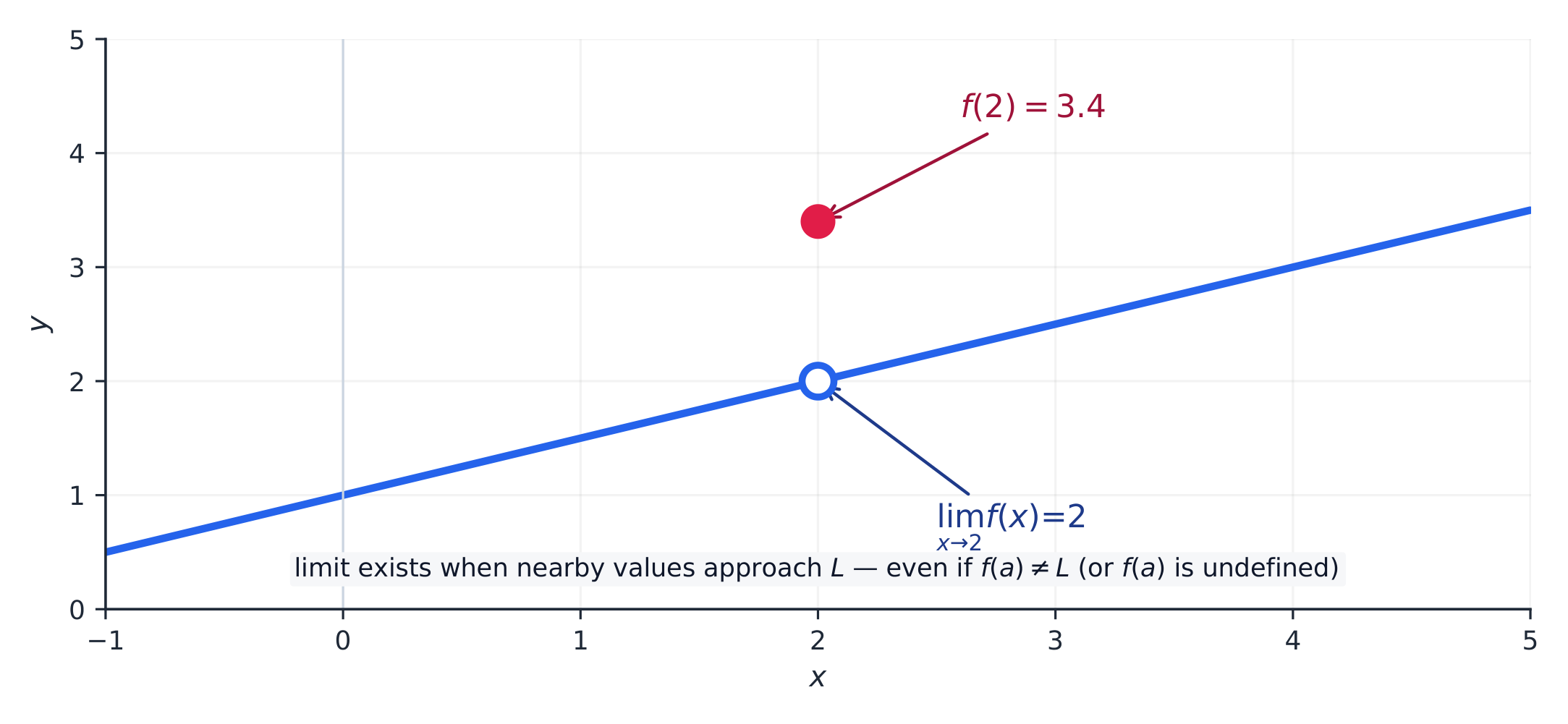
Enduring Understanding (LIM-1): Reasoning with definitions, theorems, and properties can be used to justify claims about limits.
Learning Objective LIM-1.C: Estimate limits of functions.
지속적 이해(LIM-1): 정의, 정리, 성질을 이용한 추론을 통해 극한에 대한 주장을 정당화할 수 있습니다.
학습 목표 LIM-1.C: 함수의 극한을 추정합니다.
Source: College Board AP Course and Exam Description · 출처: College Board AP Course and Exam Description
A graph is often the fastest way to read a limit. To find $\displaystyle \lim_{x \to c} f(x)$, run your finger along the curve toward $x = c$ from each side and ask: what height is the curve heading for?
Crucially, ignore the point itself. Graphs mark the difference between the limit and the value:
So a curve may approach $R = 3$ from both sides (limit is $3$) while a filled dot sits at height $5$ (value $f(c) = 5$). The limit is $3$; the two need not match.
A limit does not exist (often written DNE) when the two sides disagree (a jump 跳跃), when the function is unbounded 无界 (grows without limit), or when it oscillates 振荡 forever near $c$. For example:
Watch the scale 比例 of a graph: a zoomed-out picture can hide important behavior near a point, so confirm with algebra when you can.
y = ax² + bx + c
The limit as $x\to c$ is the height the curve heads toward from both sides — it is about where the function is going, not its value at $c$. Follow the curve toward an $x$ and read the $y$ it approaches.
| English | 한국어 |
|---|---|
| left-hand limit/left hænd ˈlɪmɪt/ | 좌측 한계 |
| right-hand limit/raɪt hænd ˈlɪmɪt/ | 우측 한계 |
| one-sided limits/wʌn ˈsaɪdɪd ˈlɪmɪts/ | 일변한 극한 |
| open circle/ˈəʊpən ˈsɜːkl/ | 빈 원 |
| closed circle/kləʊzd ˈsɜːkl/ | 닫힌 원 |
| jump/dʒʌmp/ | 점프 |
| unbounded/ʌnˈbaʊndɪd/ | 무한대 |
| oscillates/ˈɒsɪleɪts/ | 진동한다 |
| scale/skeɪl/ | 스케일(scale) |
Enduring Understanding (LIM-1): Reasoning with definitions, theorems, and properties can be used to justify claims about limits.
Learning Objective LIM-1.C: Estimate limits of functions.
지속적 이해(LIM-1): 정의, 정리, 성질을 이용한 추론을 통해 극한에 대한 주장을 정당화할 수 있습니다.
학습 목표 LIM-1.C: 함수의 극한을 추정합니다.
Source: College Board AP Course and Exam Description · 출처: College Board AP Course and Exam Description
When you have data or a formula but no picture, a table 表格 of values estimates a limit numerically. Choose inputs that creep toward $c$ from both sides and watch the outputs.
For example, to estimate $\displaystyle \lim_{x \to 2} \frac{x^2 - 4}{x - 2}$ (which is $\tfrac{0}{0}$ at $x=2$):
| $x$ | $1.9$ | $1.99$ | $1.999$ | $\to 2 \leftarrow$ | $2.001$ | $2.01$ | $2.1$ |
|---|---|---|---|---|---|---|---|
| $f(x)$ | $3.9$ | $3.99$ | $3.999$ | ? | $4.001$ | $4.01$ | $4.1$ |
Both sides march toward $4$, so we estimate the limit is $4$. A table only suggests a value – it is a numerical estimate, not a proof.
| English | 한국어 |
|---|---|
| table/ˈteɪbl/ | 표 |
Enduring Understanding (LIM-1): Reasoning with definitions, theorems, and properties can be used to justify claims about limits.
Learning Objective LIM-1.D: Determine the limits of functions using limit theorems.
지속적 이해(LIM-1): 정의, 정리, 성질을 이용한 추론을 통해 극한에 대한 주장을 정당화할 수 있습니다.
학습 목표 LIM-1.D: 극한 정리를 사용하여 함수의 극한을 결정합니다.
Source: College Board AP Course and Exam Description · 출처: College Board AP Course and Exam Description
Most limits are found analytically using limit theorems 极限定理. If $\lim_{x\to c} f(x)$ and $\lim_{x\to c} g(x)$ both exist, the limit of a combination is the same combination of the limits:
The practical rule: for a function built from polynomials, roots, and the like, first try direct substitution 直接代入 – put $x = c$ in. If you get a real number, that is the limit. One-sided limits obey the same theorems, read from one direction only.
| English | 한국어 |
|---|---|
| limit theorems/ˈlɪmɪt ˈθɪərəmz/ | 극한 정리 |
| Composite/ˈkɒmpəzɪt/ | 합성체 |
| direct substitution/daɪˈrekt ˌsʌbstɪˈtjuːʃn/ | 직접 치환 |
Enduring Understanding (LIM-1): Reasoning with definitions, theorems, and properties can be used to justify claims about limits.
Learning Objective LIM-1.E: Determine the limits of functions using equivalent expressions for the function or the squeeze theorem.
지속적 이해(LIM-1): 정의, 정리, 성질을 이용한 추론을 통해 극한에 대한 주장을 정당화할 수 있습니다.
학습 목표 LIM-1.E: 함수의 등가 표현이나挟定理(Squeeze Theorem)을 사용하여 함수의 극한을 결정합니다.
Source: College Board AP Course and Exam Description · 출처: College Board AP Course and Exam Description
Direct substitution sometimes gives the indeterminate form 未定式 $\tfrac{0}{0}$. This does not mean the limit fails – it means you must rewrite the function into an equivalent form 等价形式 that removes the trouble, then substitute. Three standard moves:
The cancelled factor is why the original graph had a hole: the two functions agree everywhere except at $x=c$, so they share the same limit there.
| English | 한국어 |
|---|---|
| indeterminate form/ˌɪndɪˈtɜːmɪnət fɔːm/ | 부정정 형식 |
| equivalent form/ɪˈkwɪvələnt fɔːm/ | 등가 형태 |
| Factor and cancel/ˈfæktə ænd ˈkænsl/ | 인수분해 및 약분 |
| rational function/ˈræʃənl ˈfʌŋkʃn/ | 유계 함수 |
| conjugate/ˈkɒndʒuːɡeɪt/ | 상쇄 산/염기 |
| radical/ˈrædɪkl/ | 급진적 |
This topic is intended to focus on the skill of selecting an appropriate procedure for determining limits. Students should be given opportunities to practice when and how to apply all learning objectives relating to determining limits.
이 주제는 적절한 극한 결정 절차를 선택하는 기술에 집중하도록 설계되었습니다. 학생들은 극한 결정과 관련된 모든 학습 목표를 언제와 어떻게 적용할지 연습할 기회를 제공받아야 합니다.
Source: College Board AP Course and Exam Description · 출처: College Board AP Course and Exam Description
This is a skill topic, not new content: choose the right tool for the limit in front of you.
| English | 한국어 |
|---|---|
| dominant/ˈdɒmɪnənt/ | 주요(dominant) |

Enduring Understanding (LIM-1): Reasoning with definitions, theorems, and properties can be used to justify claims about limits.
Learning Objective LIM-1.E: Determine the limits of functions using equivalent expressions for the function or the squeeze theorem.
지속적 이해(LIM-1): 정의, 정리, 성질을 이용한 추론을 통해 극한에 대한 주장을 정당화할 수 있습니다.
학습 목표 LIM-1.E: 함수의 등가 표현이나挟定理(Squeeze Theorem)을 사용하여 함수의 극한을 결정합니다.
Source: College Board AP Course and Exam Description · 출처: College Board AP Course and Exam Description
The squeeze theorem 夹逼定理 (also called the sandwich theorem) finds a limit by trapping the function between two others. If $g(x) \le f(x) \le h(x)$ near $c$, and
The two famous results proved this way, both used throughout calculus, are:
| English | 한국어 |
|---|---|
| squeeze theorem/skwiːz ˈθɪərəm/ | sandwich 정리 |
This topic is intended to focus on connecting representations. Students should be given opportunities to practice when and how to apply all learning objectives relating to limits and translating mathematical information from a single representation or across multiple representations.
이 주제는 표현 방식 간의 연결에 집중하도록 설계되었습니다. 학생들은 극한과 관련된 모든 학습 목표를 언제와 어떻게 적용하고, 단일 표현 또는 여러 표현 간에 있는 수학 정보를 변환하는 법을 연습할 기회를 제공받아야 합니다.
Source: College Board AP Course and Exam Description · 출처: College Board AP Course and Exam Description
Another skill topic: the same limit lives in a graph, a table, and an algebraic form, and you should be able to translate between them. A graph shows the shape and any holes or jumps; a table gives numerical evidence; algebra gives an exact value and a reason. Strong answers use one representation to confirm another.
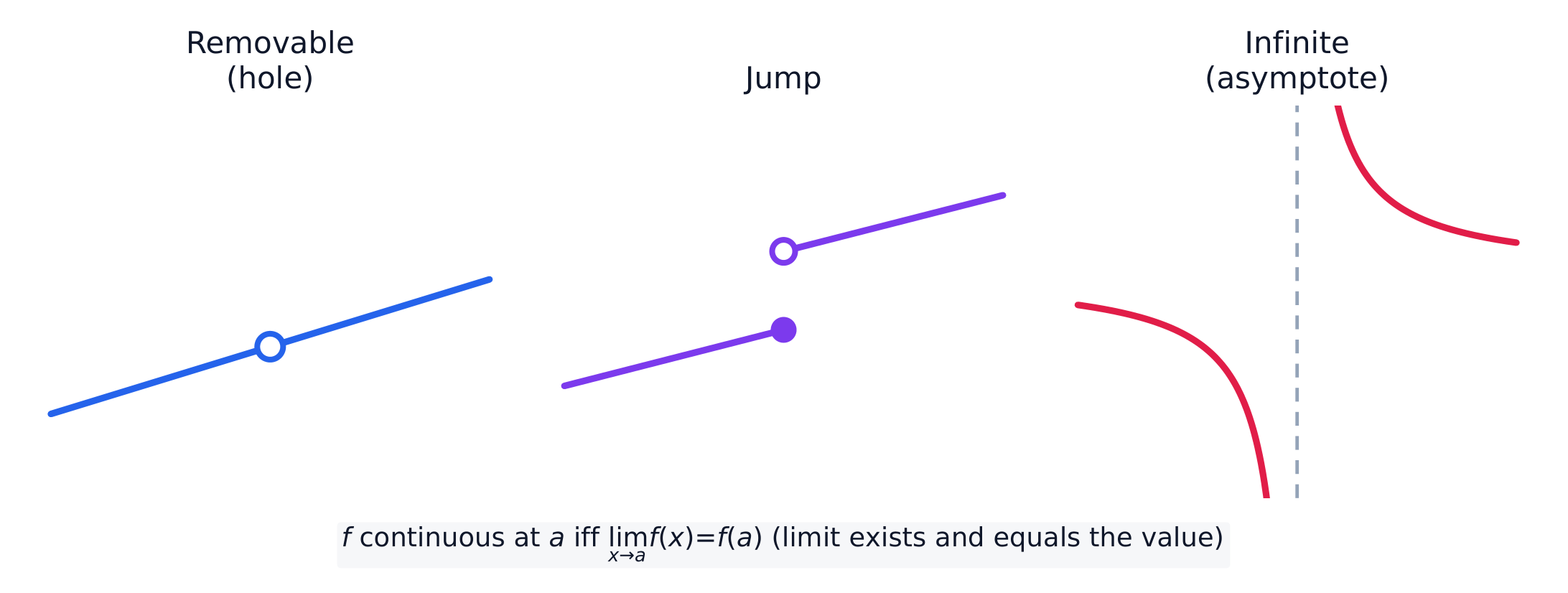
Enduring Understanding (LIM-2): Reasoning with definitions, theorems, and properties can be used to justify claims about continuity.
Learning Objective LIM-2.A: Justify conclusions about continuity at a point using the definition.
지속적 이해 (LIM-2): 정의, 정리, 성질을 활용한 추론을 통해 연속에 대한 주장을 정당화할 수 있다.
학습 목표 LIM-2.A: 정의에 근거하여 특정 점에서의 연속성에 대한 결론을 정당화한다.
Source: College Board AP Course and Exam Description · 출처: College Board AP Course and Exam Description
A function is discontinuous 间断 at $c$ when its graph "breaks" there. There are three types:
| English | 한국어 |
|---|---|
| discontinuous/dɪskənˈtɪnjuːəs/ | 불연속적 |
| Removable discontinuity/rɪˈmuːvəbl dɪskɒntɪˈnjuːɪti/ | 제거 가능한 불연속점 |
| Jump discontinuity/dʒʌmp dɪskɒntɪˈnjuːɪti/ | 약점 불연속점 |
| Infinite discontinuity/ˈɪnfɪnət dɪskɒntɪˈnjuːɪti/ | 무한 불연속점 |
| vertical asymptote/ˈvɜːtɪkl ˈæsɪmptəʊt/ | 수직 점근선 |
Enduring Understanding (LIM-2): Reasoning with definitions, theorems, and properties can be used to justify claims about continuity.
Learning Objective LIM-2.A: Justify conclusions about continuity at a point using the definition.
지속적 이해 (LIM-2): 정의, 정리, 성질을 활용한 추론을 통해 연속에 대한 주장을 정당화할 수 있다.
학습 목표 LIM-2.A: 정의에 근거하여 특정 점에서의 연속성에 대한 결론을 정당화한다.
Source: College Board AP Course and Exam Description · 출처: College Board AP Course and Exam Description
Continuity is defined by a three-part test. A function $f$ is continuous 连续 at $x=c$ exactly when all three hold:
In words: the point is there, the limit is there, and the two agree. If any one fails, $f$ is discontinuous at $c$. This test is the backbone of nearly every continuity question, so learn it as a checklist.
| English | 한국어 |
|---|---|
| continuous/kənˈtɪnjuːəs/ | 연속적 |
Enduring Understanding (LIM-2): Reasoning with definitions, theorems, and properties can be used to justify claims about continuity.
Learning Objective LIM-2.B: Determine intervals over which a function is continuous.
지속적 이해 (LIM-2): 정의, 정리, 성질을 활용한 추론을 통해 연속에 대한 주장을 정당화할 수 있다.
학습 목표 LIM-2.B: 함수가 연속인 구間을 결정한다.
Source: College Board AP Course and Exam Description · 출처: College Board AP Course and Exam Description
A function is continuous on an interval 在区间上连续 if it is continuous at every point of that interval. You rarely check point by point, because whole families are continuous on their domains:
Polynomial, rational, power, exponential 指数, logarithmic 对数, and trigonometric 三角 functions are continuous at every point of their domains.
So a rational function is continuous everywhere except where its denominator is zero; $\ln x$ is continuous for $x>0$; and so on. Knowing this lets you declare continuity quickly and correctly.
| English | 한국어 |
|---|---|
| continuous on an interval/kənˈtɪnjuːəs ɒn ən ˈɪntəvl/ | 구간에 대해 연속함 |
| exponential/ˌekspəˈnenʃl/ | 지수Unless exponential function. |
| logarithmic/ˌlɒɡəˈrɪθmɪk/ | 로그함수 |
| trigonometric/ˌtrɪɡənəʊˈmetrɪk/ | 삼각함수 |
Enduring Understanding (LIM-2): Reasoning with definitions, theorems, and properties can be used to justify claims about continuity.
Learning Objective LIM-2.C: Determine values of $x$ or solve for parameters that make discontinuous functions continuous, if possible.
지속적 이해 (LIM-2): 정의, 정리, 성질을 활용한 추론을 통해 연속에 대한 주장을 정당화할 수 있다.
학습 목표 LIM-2.C: $x$의 값을 결정하거나, 불연속인 함수를 연속으로 만들 수 있는 매개변수를 구한다(가능할 경우).
Source: College Board AP Course and Exam Description · 출처: College Board AP Course and Exam Description
If the limit exists at a hole, the discontinuity is removable: redefine the function at that one point to equal the limit, and the graph is repaired. Formally, set the missing value to $\displaystyle \lim_{x\to c} f(x)$.
For a piecewise-defined function 分段函数, continuity at a boundary $x=c$ needs the two pieces to meet: the left piece's value, the right piece's value, and $f(c)$ must all be equal. This is a common exam setup – you solve for a parameter 参数 (an unknown constant) that makes the pieces match:
| English | 한국어 |
|---|---|
| piecewise-defined function/ˈpiːswaɪz dɪˈfaɪnd ˈfʌŋkʃn/ | 부분 정의 함수 |
| parameter/pəˈræmɪtə/ | 파라미터 |
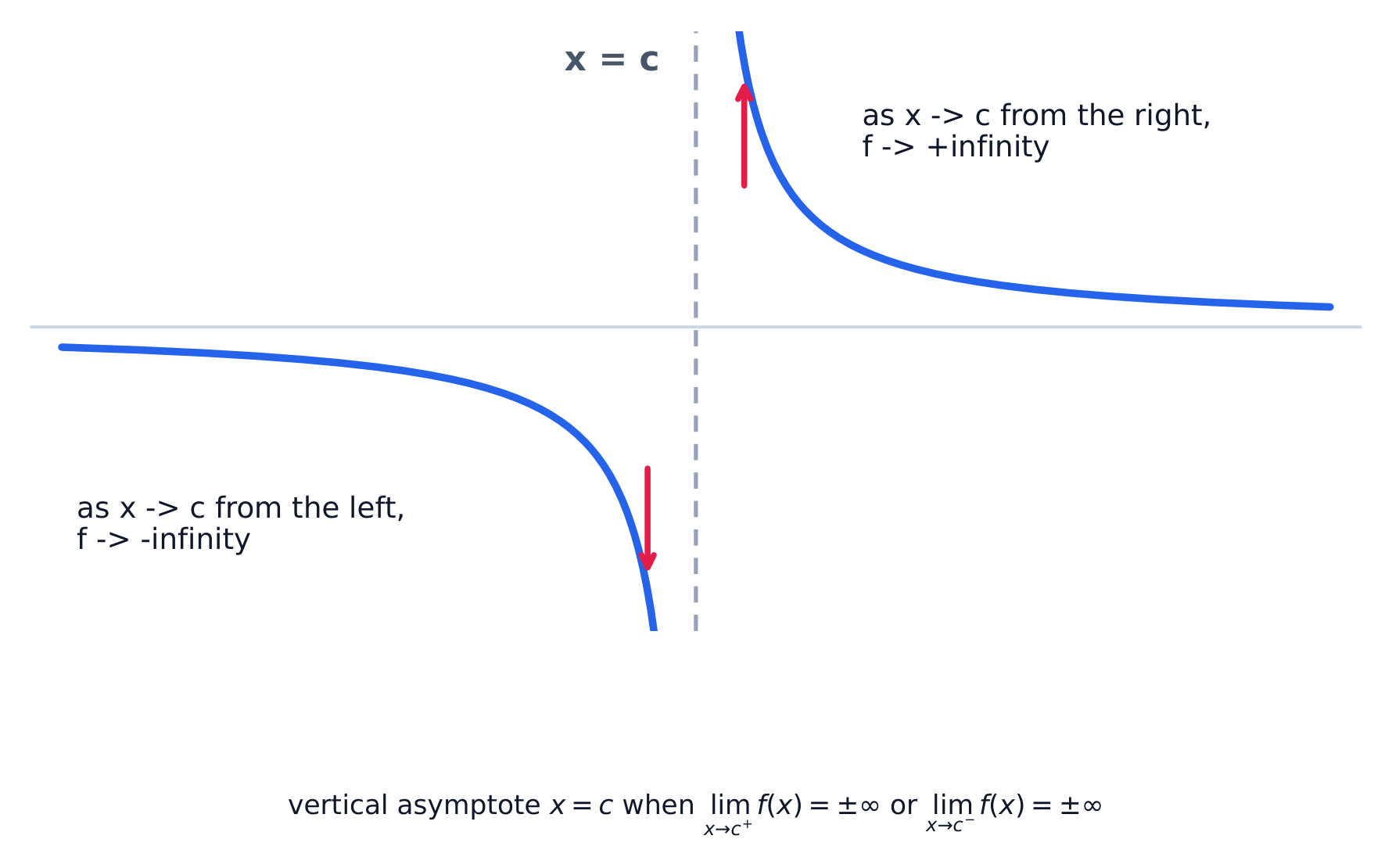
Enduring Understanding (LIM-2): Reasoning with definitions, theorems, and properties can be used to justify claims about continuity.
Learning Objective LIM-2.D: Interpret the behavior of functions using limits involving infinity.
지속적 이해 (LIM-2): 정의, 정리, 성질을 활용한 추론을 통해 연속에 대한 주장을 정당화할 수 있다.
학습 목표 LIM-2.D: 무한을 포함한 극한을 사용하여 함수의 거동을 해석한다.
Source: College Board AP Course and Exam Description · 출처: College Board AP Course and Exam Description
The idea of a limit extends to infinite limits 无穷极限. When a function grows without bound near $x=c$, we write $\lim_{x\to c} f(x) = \pm\infty$. This describes a vertical asymptote at $x=c$: the graph hugs the vertical line $x=c$ and shoots off toward $\pm\infty$.
This happens where a non-zero number is divided by something approaching $0$, such as at a zero of a denominator that does not cancel. Always check each side separately – the two sides can shoot opposite ways (one to $+\infty$, one to $-\infty$).
y = a/(x − b) + c
As $x \to 0$ the curve $y=\frac{1}{x}$ shoots to $+\infty$ from the right and $-\infty$ from the left — the line $x=0$ is a vertical asymptote the graph hugs but never touches.
| English | 한국어 |
|---|---|
| infinite limits/ˈɪnfɪnət ˈlɪmɪts/ | 무한 극한 |
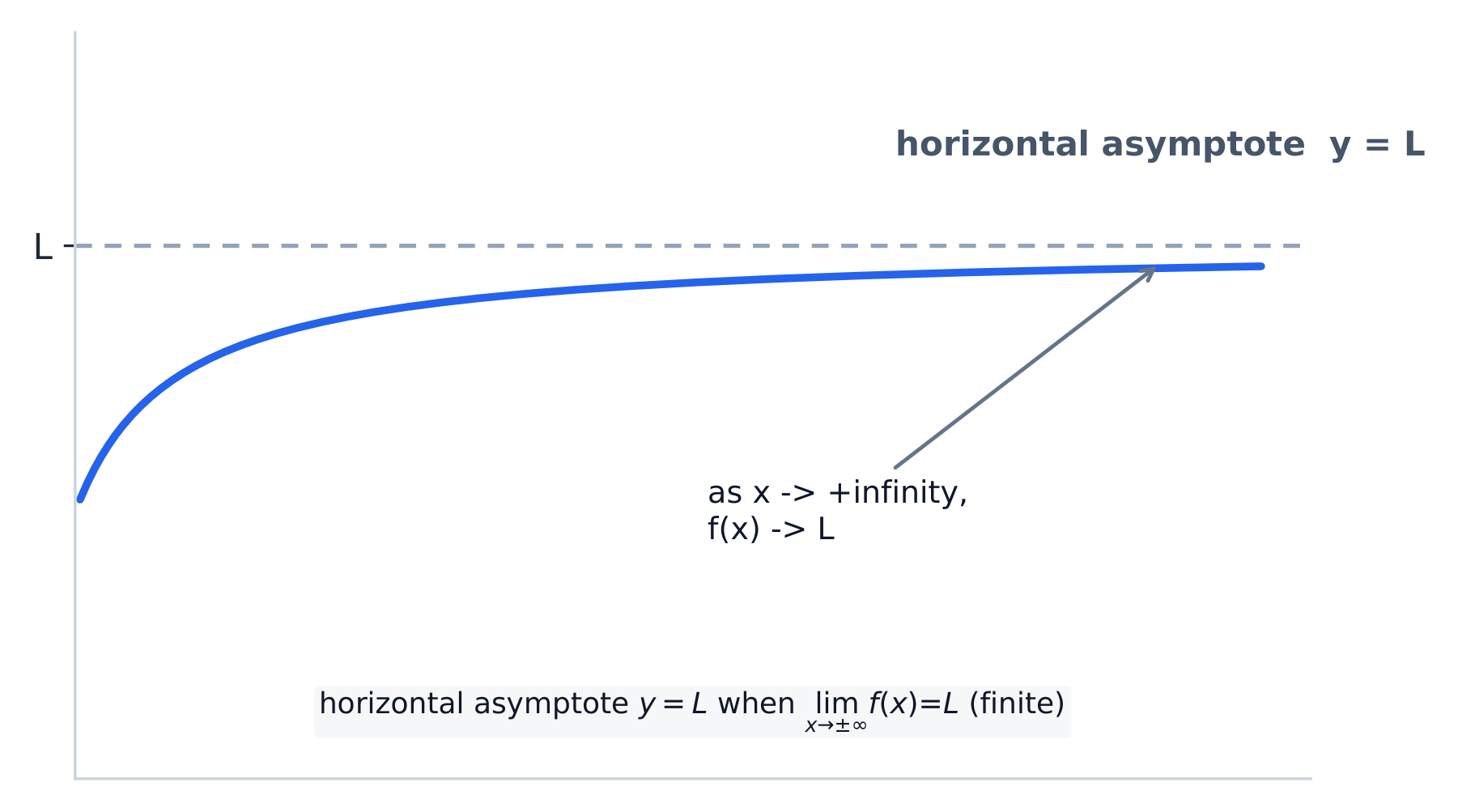
Enduring Understanding (LIM-2): Reasoning with definitions, theorems, and properties can be used to justify claims about continuity.
Learning Objective LIM-2.D: Interpret the behavior of functions using limits involving infinity.
지속적 이해 (LIM-2): 정의, 정리, 성질을 활용한 추론을 통해 연속에 대한 주장을 정당화할 수 있다.
학습 목표 LIM-2.D: 무한을 포함한 극한을 사용하여 함수의 거동을 해석한다.
Source: College Board AP Course and Exam Description · 출처: College Board AP Course and Exam Description
We can also let the input grow: limits at infinity 无穷远处的极限 describe the end behavior 末端行为 of a function as $x\to\pm\infty$. If the outputs settle toward a finite value $L$, then $y=L$ is a horizontal asymptote 水平渐近线.
For a rational function, compare the degrees 次数 of the top and bottom:
More generally, we compare the relative magnitudes 相对大小 (relative growth rates) of functions: far out, an exponential beats any polynomial, and a polynomial beats any logarithm. On the exam, "as $t\to\infty$, which quantity is larger/where does the rate settle?" is answered with a limit at infinity.
y = a/(x − b) + c
Far out to the left and right the curve levels off toward $y=\mathbf{c}$ — that is $\lim_{x\to\pm\infty}f(x)$, the horizontal asymptote. Change $\mathbf{c}$ to move the level it settles at.
| English | 한국어 |
|---|---|
| limits at infinity/ˈlɪmɪts æt ɪnˈfɪnɪti/ | 무한에서의 한계 |
| end behavior/end bɪˈheɪvjə/ | 말단挙動 |
| horizontal asymptote/ˌhɒrɪˈzɒntl ˈæsɪmptəʊt/ | 수평 점근선 |
| degrees/dɪˈɡriːz/ | 도 |
| ratio of the leading coefficients/ˈreɪʃɪəʊ ɒvðə ˈliːdɪŋ ˌkəʊɪˈfɪʃənts/ | 최고차 계수의 비율 |
| relative magnitudes/ˈrelətɪv ˈmæɡnɪtjuːdz/ | 상대 크기 |
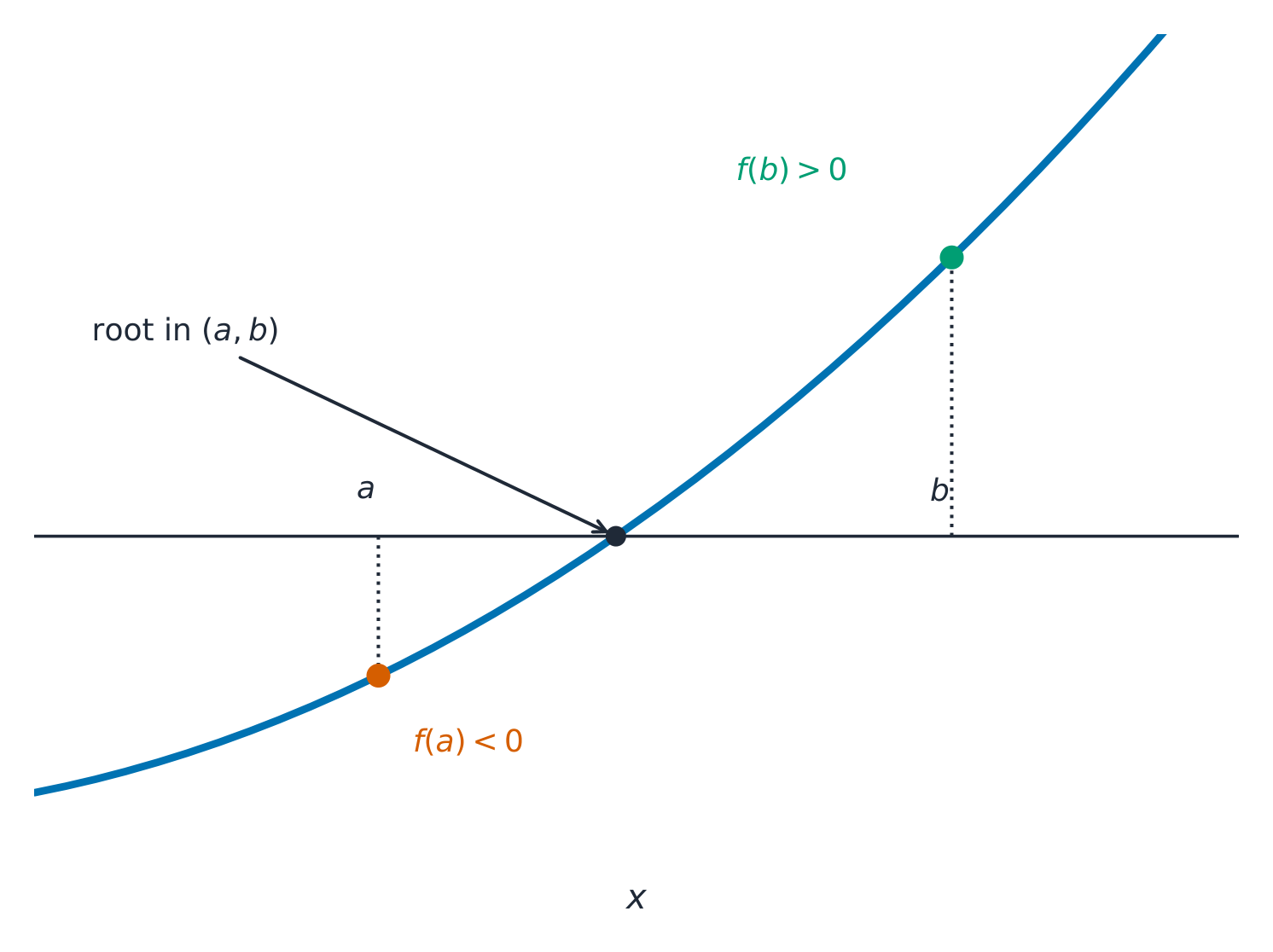
Enduring Understanding (FUN-1): Existence theorems allow us to draw conclusions about a function's behavior on an interval without precisely locating that behavior.
Learning Objective FUN-1.A: Explain the behavior of a function on an interval using the Intermediate Value Theorem.
지속적 이해(FUN-1): 존재 정리는 특정 구간에서 함수의 행동을 정확히 locating하지 않고도 결론을 내릴 수 있게 해줍니다.
학습 목표 FUN-1.A: 중간값 정리를 사용하여 한 구간에서 함수의 행동을 설명합니다.
Source: College Board AP Course and Exam Description · 출처: College Board AP Course and Exam Description
The Intermediate Value Theorem 介值定理 is an existence theorem 存在性定理 – it guarantees a value exists without telling you where:
If $f$ is continuous on the closed interval $[a,b]$, and $d$ is any number between $f(a)$ and $f(b)$, then there is at least one number $c$ in $(a,b)$ with $f(c)=d$.
An unbroken curve cannot skip a height between its endpoints – it must pass through every one.
Exam skill – how to justify with the IVT. These questions appear almost every year (for example, "Must there be a value $c$ with $R(c)=155$?" or "Is there a time when $r'(t)=-6$?"). A full-credit justification has three moves:
Skipping the continuity statement, or not showing $d$ is between the endpoints, loses the point – the theorem requires both conditions.
Worked example. Evaluate $\lim_{x\to\infty}\dfrac{3x^2-5}{2x^2+x}$. Divide top and bottom by the highest power, $x^2$: $\dfrac{3-5/x^2}{2+1/x}\to\dfrac{3-0}{2+0}=\dfrac{3}{2}$. Because the limit is a finite number, the line $y=\tfrac{3}{2}$ is a horizontal asymptote of the graph.
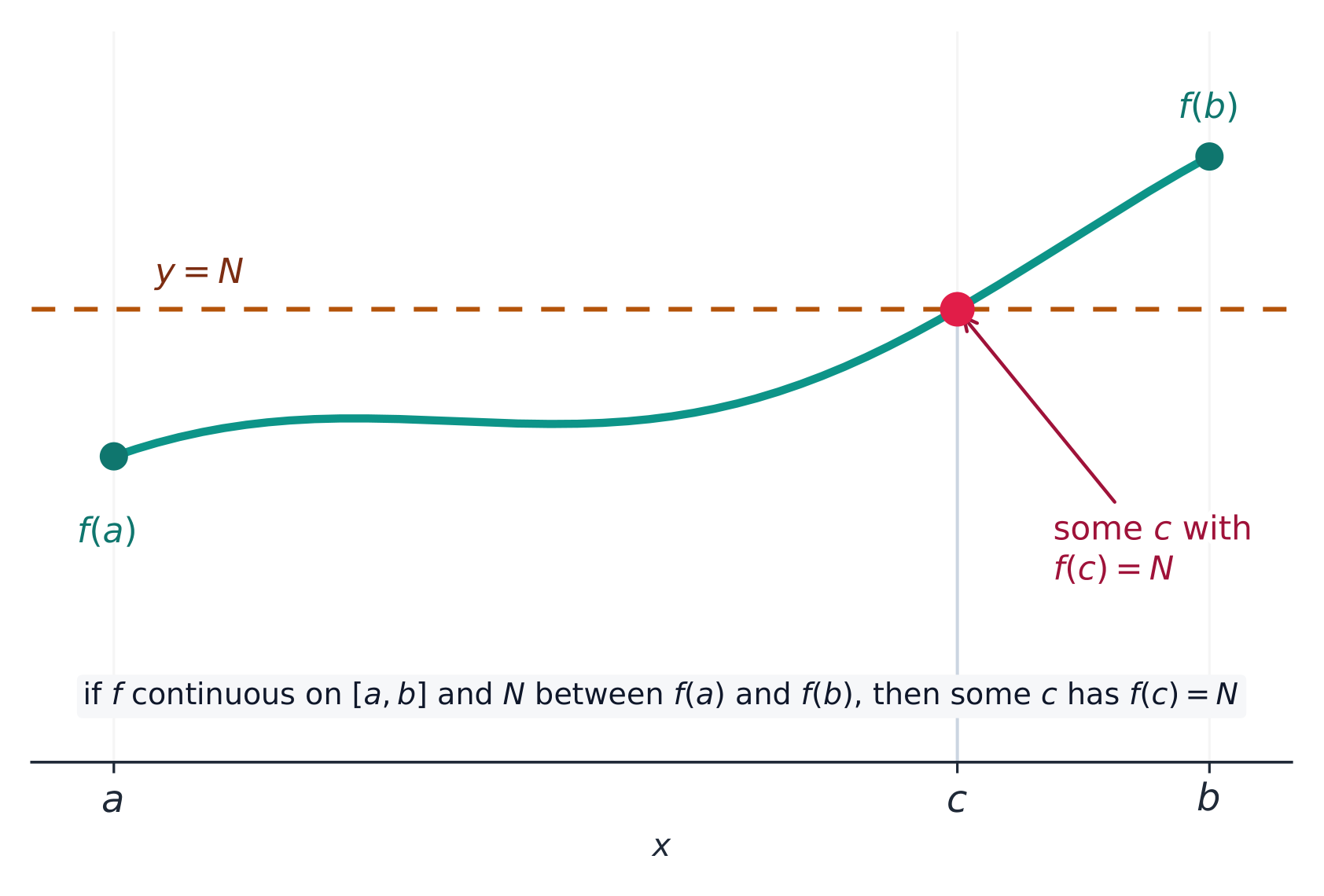
y = ax³ + bx² + cx + d
The Intermediate Value Theorem: a function continuous on $[a,b]$ takes every $y$ between $f(a)$ and $f(b)$ at some point inside. An unbroken curve cannot leap over a height — it must pass through it.
| English | 한국어 |
|---|---|
| Intermediate Value Theorem/ˌɪntəˈmiːdɪət ˈvæljuː ˈθɪərəm/ | 중간값 정리 |
| existence theorem/eɡˈzɪstəns ˈθɪərəm/ | 존재 정리 |

Enduring Understanding (CHA-2): Derivatives allow us to determine rates of change at an instant by applying limits to knowledge about rates of change over intervals.
Learning Objective CHA-2.A: Determine average rates of change using difference quotients.
Learning Objective CHA-2.B: Represent the derivative of a function as the limit of a difference quotient.
지속적 이해 (CHA-2): 미분은 구간 내의 변화율에 대한 지식을 극한에 적용함으로써 순간의 변화율을 결정할 수 있게 해줍니다.
학습 목표 CHA-2.A: 차분商(difference quotients)을 사용하여 평균 변화율을 결정합니다.
학습 목표 CHA-2.B: 함수의 미분을 차분商의 극한으로 표현합니다.
Source: College Board AP Course and Exam Description · 출처: College Board AP Course and Exam Description
Unit 1 built the limit. Unit 2 uses it to define the derivative 导数 – the exact rate of change at a point.
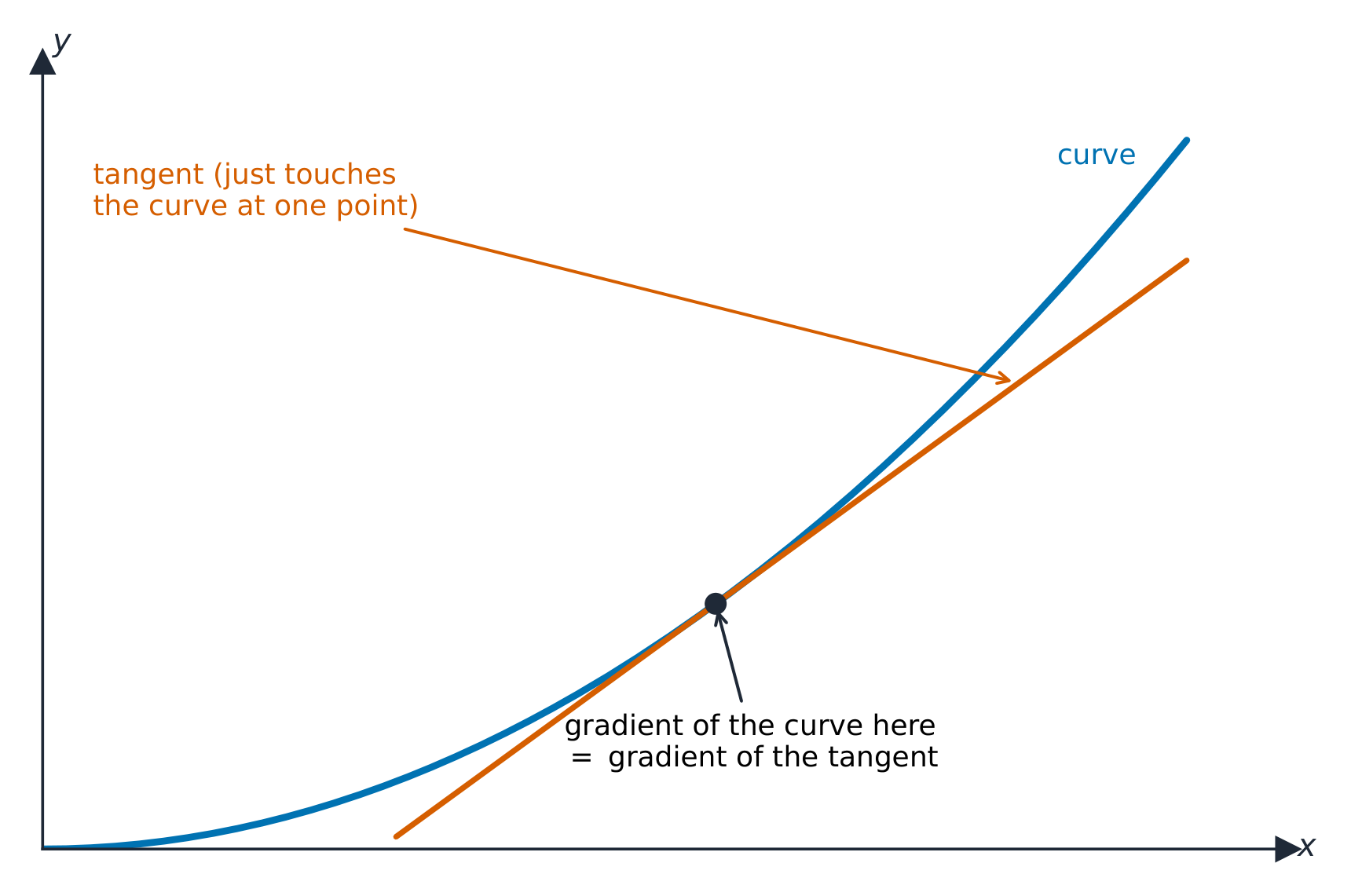
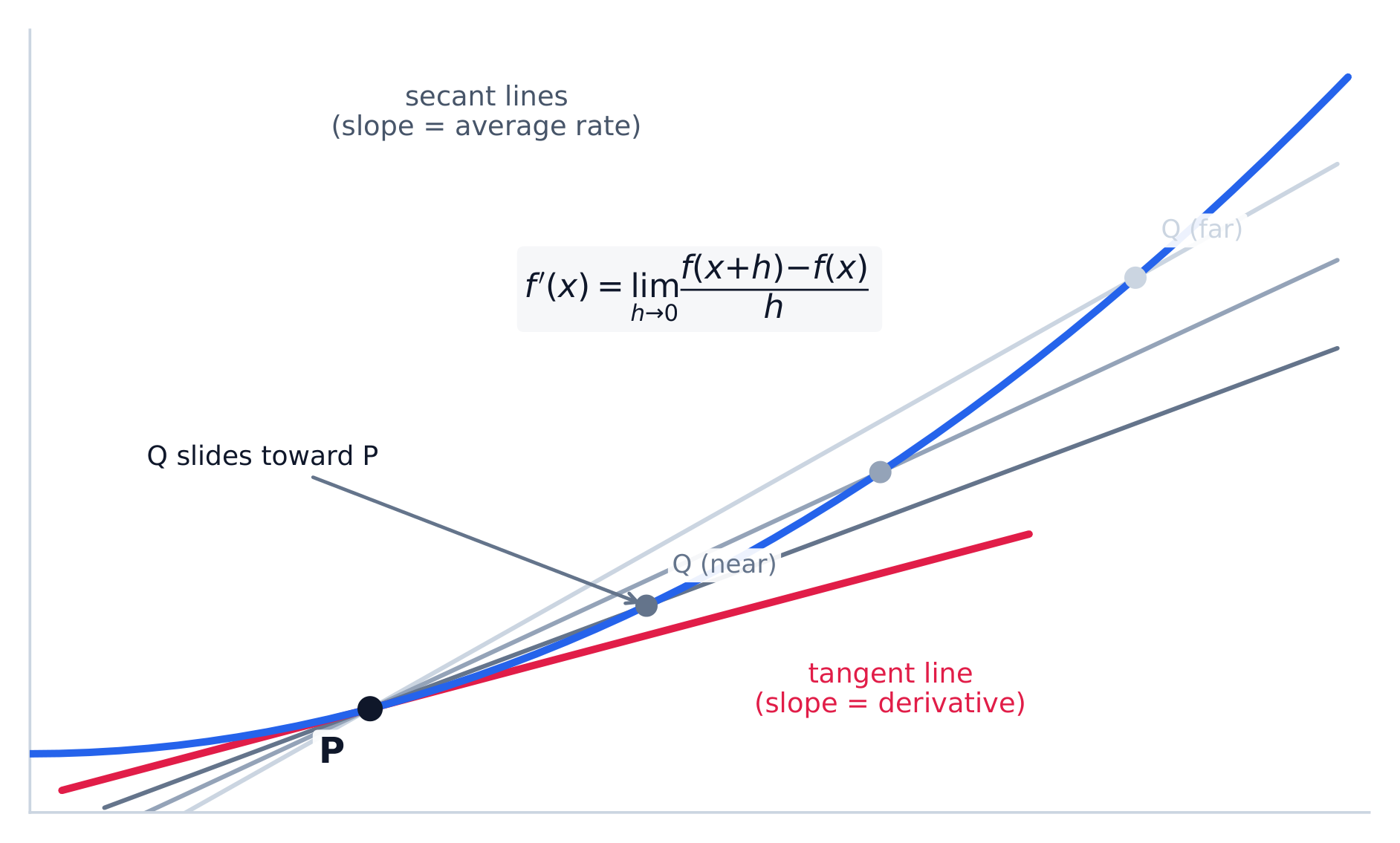
Over an interval, the average rate of change is a difference quotient 差商. Two equivalent forms appear:
The instantaneous 瞬时 rate of change at $x=a$ is what the difference quotient approaches as the interval shrinks to zero. This limit is the derivative at $a$, written $f'(a)$:
y = ax³ + bx² + cx + d
Slide the point: the secant through two nearby points tips toward the tangent as they merge. The tangent's slope is the derivative — the instantaneous rate of change.
| English | 한국어 |
|---|---|
| derivative/dɪˈrɪvətɪv/ | 미분Unless derivative. |
| difference quotient/ˈdɪfrəns ˈkwəʊʃənt/ | 차분 비 |
| instantaneous/ˌɪnstənˈteɪnɪəs/ | 순간 |
| first principles/fɜːst ˈprɪnsɪplz/ | 기본 원리 |
Enduring Understanding (CHA-2): Derivatives allow us to determine rates of change at an instant by applying limits to knowledge about rates of change over intervals.
Learning Objective CHA-2.B: Represent the derivative of a function as the limit of a difference quotient.
Learning Objective CHA-2.C: Determine the equation of a line tangent to a curve at a given point.
지속적 이해 (CHA-2): 미분은 구간 내의 변화율에 대한 지식을 극한에 적용함으로써 순간의 변화율을 결정할 수 있게 해줍니다.
학습 목표 CHA-2.B: 함수의 미분을 차분商의 극한으로 표현합니다.
학습 목표 CHA-2.C: 주어진 점에서 곡선에 접선인 직선의 방정식을 결정합니다.
Source: College Board AP Course and Exam Description · 출처: College Board AP Course and Exam Description
Let the point $a$ vary and the derivative becomes a new function:
Common notations 记号 for the derivative of $y=f(x)$ are:
Geometric meaning. The derivative at a point is the slope 斜率 of the tangent line 切线 to the graph there. So the tangent line at $x=a$ passes through $\big(a, f(a)\big)$ with slope $f'(a)$:
| English | 한국어 |
|---|---|
| notations/nəʊˈteɪʃnz/ | 표기법 |
| slope/sləʊp/ | 기울기 |
| tangent line/ˈtændʒənt laɪn/ | 접선 |
Enduring Understanding (CHA-2): Derivatives allow us to determine rates of change at an instant by applying limits to knowledge about rates of change over intervals.
Learning Objective CHA-2.D: Estimate derivatives.
지속적 이해 (CHA-2): 미분은 구간 내의 변화율에 대한 지식을 극한에 적용함으로써 순간의 변화율을 결정할 수 있게 해줍니다.
학습 목표 CHA-2.D: 도함수를 추정합니다.
Source: College Board AP Course and Exam Description · 출처: College Board AP Course and Exam Description
You do not always have a formula. When a function is given by a table 表格 or a graph, estimate the derivative $f'(a)$ with a difference quotient over a small interval around $a$. A table with values on both sides of $a$ gives the best estimate:
Exam skill (appears almost every year). Questions such as "Approximate $M'(7.5)$ using the average rate of change of $M$ over the interval $5 \le t \le 10$" ask for exactly this difference quotient. Show the setup:
| English | 한국어 |
|---|---|
| table/ˈteɪbl/ | 표 |
| units/ˈjuːnɪts/ | 단위 |
Enduring Understanding (FUN-2): Recognizing that a function's derivative may also be a function allows us to develop knowledge about the related behaviors of both.
Learning Objective FUN-2.A: Explain the relationship between differentiability and continuity.
지속적 이해 (FUN-2): 함수의 미분도 하나의 함수일 수 있음을 인식하면 두 함수의 관련된 행동에 대한 지식을 개발할 수 있습니다.
학습 목표 FUN-2.A: 가미분 가능성과 연속성 사이의 관계를 설명합니다.
Source: College Board AP Course and Exam Description · 출처: College Board AP Course and Exam Description
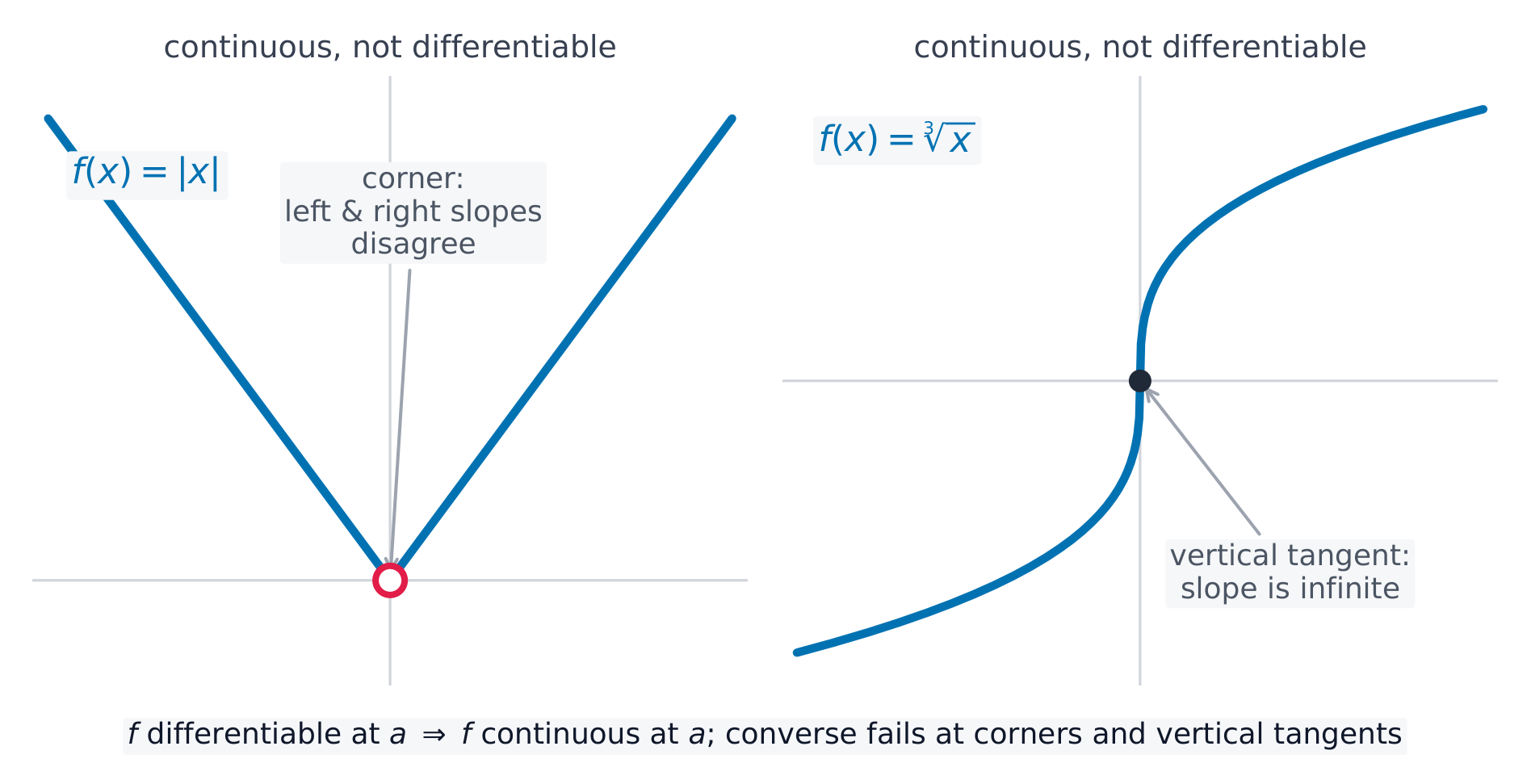
Differentiability is stronger than continuity. The key relationship:
If $f$ is differentiable 可导 at a point, then $f$ is continuous 连续 there.
So differentiability implies continuity. The reverse is false: a continuous function can fail to be differentiable. Two ways this happens:
Also, a point outside the domain of $f$ cannot be in the domain of $f'$. Use the contrapositive on the exam: if $f$ is not continuous at $a$, then $f$ is not differentiable at $a$.
| English | 한국어 |
|---|---|
| differentiable/ˈdɪfərenʃɪəbl/ | 미분 가능해야 함 |
| continuous/kənˈtɪnjuːəs/ | 연속적 |
| corner/ˈkɔːnə/ | 모서리 |
| vertical tangent/ˈvɜːtɪkl ˈtændʒənt/ | 수직 접선 |
Enduring Understanding (FUN-3): Recognizing opportunities to apply derivative rules can simplify differentiation.
Learning Objective FUN-3.A: Calculate derivatives of familiar functions.
지속적 이해 (FUN-3): 미분 규칙을 적용할 수 있는 상황을 파악하면 미분 과정이 단순화됩니다.
학습 목표 FUN-3.A: 친숙한 함수의 도함수를 계산합니다.
Source: College Board AP Course and Exam Description · 출처: College Board AP Course and Exam Description
From here we use rules instead of the limit definition each time. The power rule 幂法则 handles any power of $x$:
y = ax³ + bx² + cx + d
The power rule $\frac{d}{dx}x^n = nx^{n-1}$ drops the exponent as a factor. For $x^3$ the slope grows quickly as $x$ leaves 0 — the curve steepens.
| English | 한국어 |
|---|---|
| power rule/ˈpaʊə ruːl/ | 거듭제곱 법칙 |
Enduring Understanding (FUN-3): Recognizing opportunities to apply derivative rules can simplify differentiation.
Learning Objective FUN-3.A: Calculate derivatives of familiar functions.
지속적 이해 (FUN-3): 미분 규칙을 적용할 수 있는 상황을 파악하면 미분 과정이 단순화됩니다.
학습 목표 FUN-3.A: 친숙한 함수의 도함수를 계산합니다.
Source: College Board AP Course and Exam Description · 출처: College Board AP Course and Exam Description
These rules let you differentiate term by term:
Combined with the power rule, they differentiate any polynomial 多项式 term by term. Example:
| English | 한국어 |
|---|---|
| Constant multiple/ˈkɒnstənt ˈmʌltɪpl/ | 상수 곱 |
| polynomial/ˌpɒlɪˈnəʊmɪəl/ | 다항함수 |
Enduring Understanding (FUN-3): Recognizing opportunities to apply derivative rules can simplify differentiation.
Learning Objective FUN-3.A: Calculate derivatives of familiar functions.
Enduring Understanding (LIM-3): Reasoning with definitions, theorems, and properties can be used to determine a limit.
Learning Objective LIM-3.A: Interpret a limit as a definition of a derivative.
지속적 이해 (FUN-3): 미분 규칙을 적용할 수 있는 상황을 파악하면 미분 과정이 단순화됩니다.
학습 목표 FUN-3.A: 친숙한 함수의 도함수를 계산합니다.
지속적 이해 (LIM-3): 정의, 정리, 성질을 이용한 추론으로 극한을 결정할 수 있다.
학습 목표 LIM-3.A: 미분의 정의로서 극함을 해석한다.
Source: College Board AP Course and Exam Description · 출처: College Board AP Course and Exam Description
Learn these four building-block derivatives by heart:
A limit that is really a derivative (LIM-3.A.1). Sometimes a limit is secretly the definition of a known derivative. If you recognize
y = asin(bx + c) + d
The derivative of $\sin x$ is $\cos x$: the slope of the sine curve is largest where sine crosses zero and zero at its peaks. Watch the curve to feel where its slope is steep or flat.
Enduring Understanding (FUN-3): Recognizing opportunities to apply derivative rules can simplify differentiation.
Learning Objective FUN-3.B: Calculate derivatives of products and quotients of differentiable functions.
지속적 이해 (FUN-3): 미분 규칙을 적용할 수 있는 상황을 파악하면 미분 과정이 단순화됩니다.
학습 목표 FUN-3.B: 가미분 가능한 함수의 곱과 상의 도함수를 계산합니다.
Source: College Board AP Course and Exam Description · 출처: College Board AP Course and Exam Description
A product of two functions is not differentiated by multiplying the derivatives. Use the product rule 乘积法则:
| English | 한국어 |
|---|---|
| product rule/ˈprɒdʌkt ruːl/ | 곱의 법칙 |
Enduring Understanding (FUN-3): Recognizing opportunities to apply derivative rules can simplify differentiation.
Learning Objective FUN-3.B: Calculate derivatives of products and quotients of differentiable functions.
지속적 이해 (FUN-3): 미분 규칙을 적용할 수 있는 상황을 파악하면 미분 과정이 단순화됩니다.
학습 목표 FUN-3.B: 가미분 가능한 함수의 곱과 상의 도함수를 계산합니다.
Source: College Board AP Course and Exam Description · 출처: College Board AP Course and Exam Description
For a quotient, use the quotient rule 商法则:
| English | 한국어 |
|---|---|
| quotient rule/ˈkwəʊʃənt ruːl/ | 비율의 법칙 |
Enduring Understanding (FUN-3): Recognizing opportunities to apply derivative rules can simplify differentiation.
Learning Objective FUN-3.B: Calculate derivatives of products and quotients of differentiable functions.
지속적 이해 (FUN-3): 미분 규칙을 적용할 수 있는 상황을 파악하면 미분 과정이 단순화됩니다.
학습 목표 FUN-3.B: 가미분 가능한 함수의 곱과 상의 도함수를 계산합니다.
Source: College Board AP Course and Exam Description · 출처: College Board AP Course and Exam Description
The remaining trigonometric derivatives are not memorized separately – you rewrite them with identities 恒等式 and apply the quotient (or product) rule. For instance, $\tan x = \dfrac{\sin x}{\cos x}$, so the quotient rule gives
Higher-order derivatives. Differentiating $f'$ again gives the second derivative 二阶导数 $f''(x)$ (or $\tfrac{d^2y}{dx^2}$) – the rate of change of the rate of change. An exam part like "Find $k''(3)$" just means differentiate twice, then substitute. You can also estimate a second derivative from a table by applying the average-rate-of-change method to the $f'$ values.
Worked example. Differentiate $g(x)=\dfrac{\sin x}{x}$ with the quotient rule $\left(\tfrac{u}{v}\right)'=\dfrac{u'v-uv'}{v^2}$: take $u=\sin x$, $v=x$, giving $g'(x)=\dfrac{x\cos x-\sin x}{x^2}$. Keep the order $u'v-uv'$ in the numerator — swapping the terms flips the sign and loses the mark.
| English | 한국어 |
|---|---|
| identities/aɪˈdentɪtiz/ | 항등식 |
| second derivative/ˈsekənd dɪˈrɪvətɪv/ | 이계 도함수Unless second derivative. |

Enduring Understanding (FUN-3): Recognizing opportunities to apply derivative rules can simplify differentiation.
Learning Objective FUN-3.C: Calculate derivatives of compositions of differentiable functions.
지속적 이해 (FUN-3): 미분 규칙을 적용할 수 있는 상황을 파악하면 미분 과정이 단순화됩니다.
학습 목표 FUN-3.C: 가미분 가능한 함수의 합성函数的 미분값을 계산한다.
Source: College Board AP Course and Exam Description · 출처: College Board AP Course and Exam Description
Unit 2 differentiated single functions. Unit 3 differentiates functions built inside other functions. The chain rule 链式法则 differentiates a composite function 复合函数 $f\big(g(x)\big)$:
In Leibniz notation, with $y=f(u)$ and $u=g(x)$, the rule reads $\dfrac{dy}{dx}=\dfrac{dy}{du}\cdot\dfrac{du}{dx}$ – the intermediate $du$ appears to "cancel." Exam questions often give a table for $f$, $g$, $f'$, $g'$ and ask for $h'(a)$ where $h(x)=f\big(g(x)\big)$; evaluate $f'\big(g(a)\big)\cdot g'(a)$ by reading values.
Worked example. Differentiate $h(x)=(2x^2+1)^5$. The outer function is "(something)$^5$" and the inner is $2x^2+1$:
| English | 한국어 |
|---|---|
| chain rule/tʃeɪn ruːl/ | 연쇄 법칙 |
| composite function/ˈkɒmpəzɪt ˈfʌŋkʃn/ | 합성 함수 |
Enduring Understanding (FUN-3): Recognizing opportunities to apply derivative rules can simplify differentiation.
Learning Objective FUN-3.D: Calculate derivatives of implicitly defined functions.
지속적 이해 (FUN-3): 미분 규칙을 적용할 수 있는 상황을 파악하면 미분 과정이 단순화됩니다.
학습 목표 FUN-3.D: 암시적으로 정의된 함수의 미분값을 계산한다.
Source: College Board AP Course and Exam Description · 출처: College Board AP Course and Exam Description
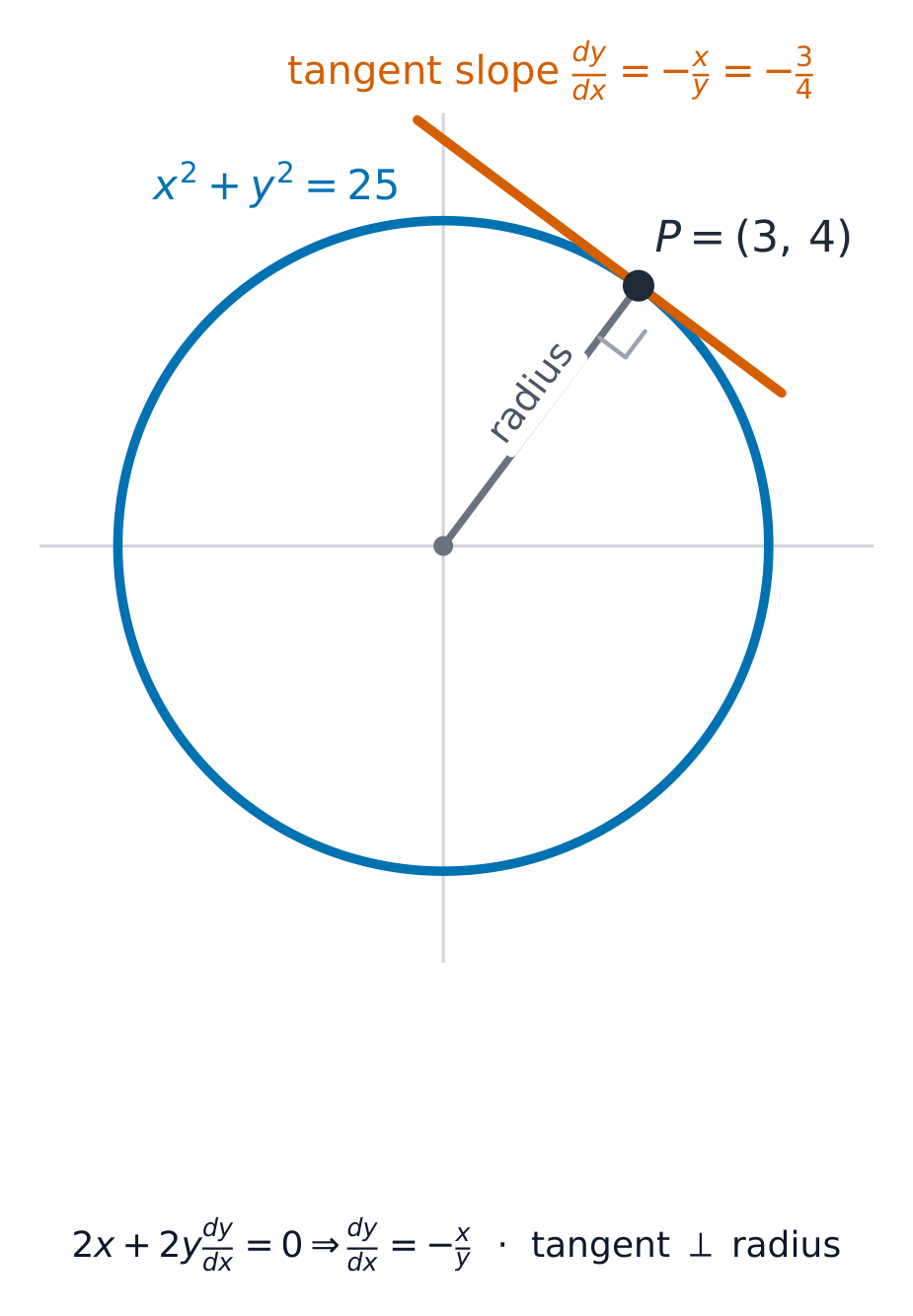
Some curves are defined implicitly – by an equation in $x$ and $y$ that is not solved for $y$, such as $x^2+y^2=25$. Implicit differentiation 隐函数求导 finds $\dfrac{dy}{dx}$ without solving for $y$ first. It is just the chain rule, treating $y$ as a function of $x$.
The method: differentiate both sides with respect to $x$; every time you differentiate a $y$-term, multiply by $\dfrac{dy}{dx}$ (the chain rule); then solve algebraically for $\dfrac{dy}{dx}$. For $x^2+y^2=25$:
Worked example. Find the tangent to $x^2+y^2=25$ at $(3,4)$. Here $\dfrac{dy}{dx}=-\dfrac{3}{4}$, so the tangent line is $y-4=-\tfrac{3}{4}(x-3)$ – perpendicular to the radius, as geometry predicts.
Exam skill – "Show that $\dfrac{dy}{dx}=\ldots$". This exact prompt appears most years (e.g. "Show that $\dfrac{dy}{dx}=\dfrac{2y}{y^2-2x}$"). Because the target is given, you must show every algebra step cleanly: differentiate both sides, use the product/chain rules on mixed $xy$ terms, collect all $\dfrac{dy}{dx}$ terms on one side, factor, and divide. A correct final line that skips the algebra earns little. Follow-up parts then ask for a tangent line, or where the tangent is horizontal ($\tfrac{dy}{dx}=0$, so the numerator is $0$) or vertical (the denominator is $0$).
| English | 한국어 |
|---|---|
| Implicit differentiation/ɪmˈplɪsɪt ˌdɪfəˌrenʃɪˈeɪʃn/ | 은밀 미분법 |
Enduring Understanding (FUN-3): Recognizing opportunities to apply derivative rules can simplify differentiation.
Learning Objective FUN-3.E: Calculate derivatives of inverse and inverse trigonometric functions.
지속적 이해 (FUN-3): 미분 규칙을 적용할 수 있는 상황을 파악하면 미분 과정이 단순화됩니다.
학습 목표 FUN-3.E: 역함수와 역삼각함수의 미분값을 계산한다.
Source: College Board AP Course and Exam Description · 출처: College Board AP Course and Exam Description
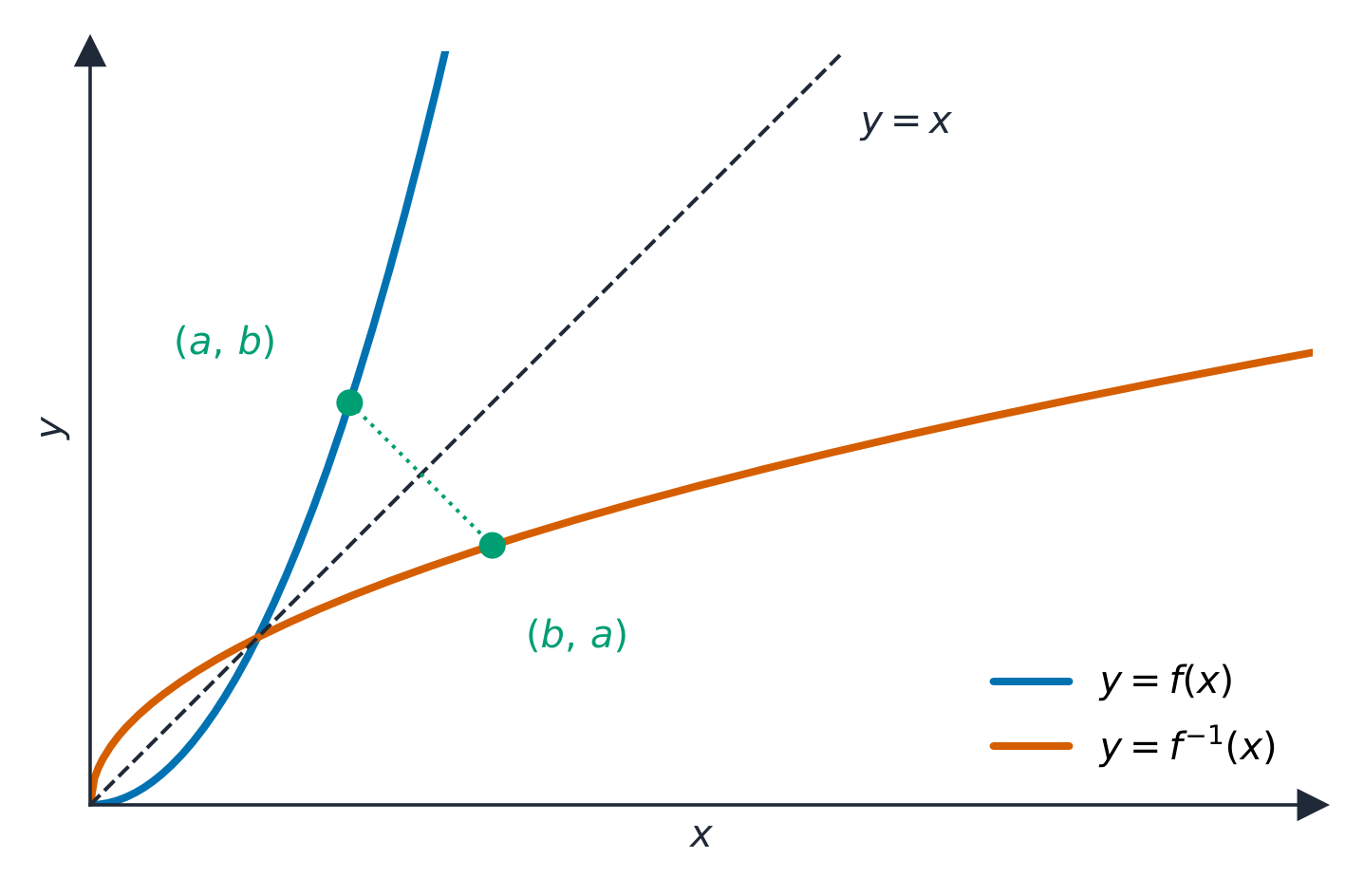
If $g$ is the inverse function 反函数 of $f$ (so $f(g(x))=x$), the chain rule links their derivatives:
Worked example. If $f(2)=5$ and $f'(2)=3$, and $g$ is the inverse of $f$, then $(5,2)$ lies on $g$ and $g'(5)=\dfrac{1}{f'(2)}=\dfrac{1}{3}$.
y = a·e^(bx) + c
Inverse functions mirror across $y=x$ and their slopes are reciprocals. Where one is steep, its inverse is shallow. · 역함수는 $y=x$를 기준으로 대칭이며 기울기는 서로 역수입니다. 한쪽이 가파르면 역함수는 완만합니다.
| English | 한국어 |
|---|---|
| inverse function/ɪnˈvɜːs ˈfʌŋkʃn/ | 역함수 |
| reciprocal/rɪˈsɪprəkl/ | 역수 |
Enduring Understanding (FUN-3): Recognizing opportunities to apply derivative rules can simplify differentiation.
Learning Objective FUN-3.E: Calculate derivatives of inverse and inverse trigonometric functions.
지속적 이해 (FUN-3): 미분 규칙을 적용할 수 있는 상황을 파악하면 미분 과정이 단순화됩니다.
학습 목표 FUN-3.E: 역함수와 역삼각함수의 미분값을 계산한다.
Source: College Board AP Course and Exam Description · 출처: College Board AP Course and Exam Description
The same idea gives the derivatives of the inverse trigonometric functions 反三角函数. The three you should know:
| English | 한국어 |
|---|---|
| inverse trigonometric functions/ɪnˈvɜːs ˌtrɪɡənəʊˈmetrɪk ˈfʌŋkʃnz/ | 역삼각함수 |
This topic is intended to focus on the skill of selecting an appropriate procedure for calculating derivatives. Students should be given opportunities to practice when and how to apply all learning objectives relating to calculating derivatives.
이 주제는 적절한 미분 계산 절차를 선택하는 기술에 집중하도록 설계되었다. 학생들은 미분값 계산과 관련된 모든 학습 목표를 언제 및 어떻게 적용할지 연습할 기회가 주어져야 한다.
Source: College Board AP Course and Exam Description · 출처: College Board AP Course and Exam Description
A skill topic: real derivatives mix several rules, so read the structure of the expression first, from the outside in.
Name the outermost operation, apply its rule, and recurse inward. Neatness prevents the sign and bookkeeping errors that cost marks.
Enduring Understanding (FUN-3): Recognizing opportunities to apply derivative rules can simplify differentiation.
Learning Objective FUN-3.F: Determine higher order derivatives of a function.
지속적 이해 (FUN-3): 미분 규칙을 적용할 수 있는 상황을 파악하면 미분 과정이 단순화됩니다.
학습 목표 FUN-3.F: 함수의 고계 미분값을 결정한다.
Source: College Board AP Course and Exam Description · 출처: College Board AP Course and Exam Description
Differentiating $f'$ produces the second derivative 二阶导数 $f''$; repeating gives higher-order derivatives. The notations:
y = ax³ + bx² + cx + d
Differentiating again gives $f''$, the rate the slope changes. Where the slope is increasing the curve bends upward. · 다시 미분하면 $f''$를 얻는데, 이는 기울기가 변하는 속도입니다. 기울기가 증가하는 곳에서는 곡선이 위로 볼록하게 굽습니다.
| English | 한국어 |
|---|---|
| second derivative/ˈsekənd dɪˈrɪvətɪv/ | 이계 도함수Unless second derivative. |
| concavity/kənˈkævɪti/ | 볼록성 |
Enduring Understanding (CHA-3): Derivatives allow us to solve real-world problems involving rates of change.
Learning Objective CHA-3.A: Interpret the meaning of a derivative in context.
지속적 이해 (CHA-3): 미분은 변화율과 관련된 실제 문제를 해결하게 해준다.
학습 목표 CHA-3.A: 맥락에서 미분의 의미를 해석한다.
Source: College Board AP Course and Exam Description · 출처: College Board AP Course and Exam Description
Once you can compute derivatives, you use them to describe the real world. The derivative $f'(x)$ is the instantaneous rate of change of $f$ with respect to its input. Reading and reporting this rate correctly is a graded skill.
Units matter. The unit of $f'(x)$ is the unit of $f$ divided by the unit of $x$. If $C(t)$ is a number of acres and $t$ is in weeks, then $C'(t)$ is in acres per week. On the exam, "Using correct units, interpret the meaning of $g'(140)$" wants a full sentence: the value, the quantity, the rate word "per", and the moment. For example: "$g'(140)=2.3$ means that at $x=140$, the quantity is increasing at about $2.3$ units per unit of $x$."
Enduring Understanding (CHA-3): Derivatives allow us to solve real-world problems involving rates of change.
Learning Objective CHA-3.B: Calculate rates of change in applied contexts.
지속적 이해 (CHA-3): 미분은 변화율과 관련된 실제 문제를 해결하게 해준다.
학습 목표 CHA-3.B: 적용 맥락에서 변화율을 계산한다.
Source: College Board AP Course and Exam Description · 출처: College Board AP Course and Exam Description
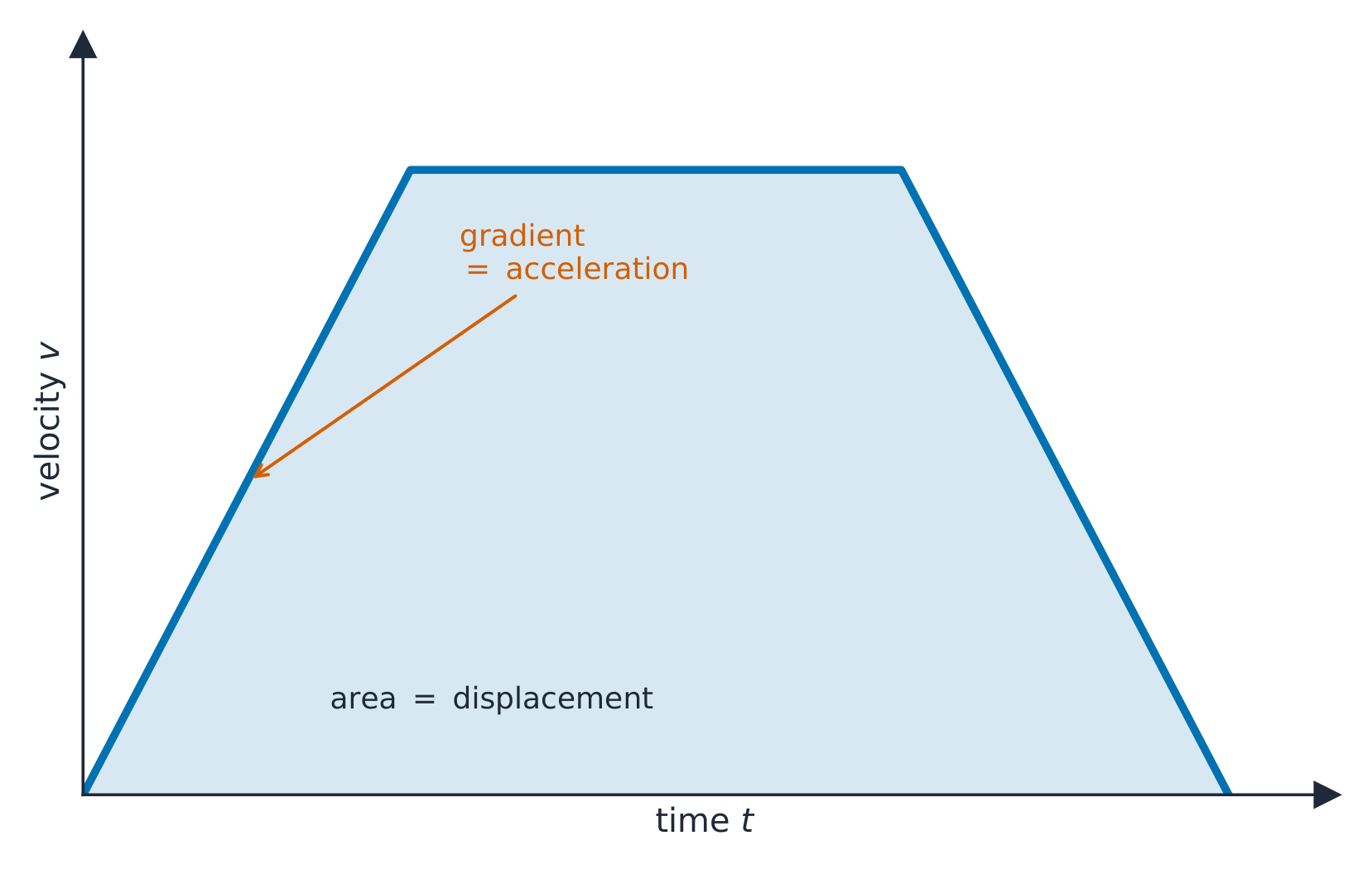
For a particle moving on a line, three functions of time are linked by differentiation:
Key readings (frequent exam parts):
Distinguish carefully between velocity (has direction) and speed (does not) – the exam tests this exact difference.
Worked example. A particle moves with $s(t)=t^3-6t^2+9t$. Then $v(t)=3(t-1)(t-3)$, so it is at rest at $t=1$ and $t=3$ and changes direction at each. At $t=2$, $v=-3<0$ and $a(2)=6(2)-12=0$; just after, $a>0$ while $v<0$, so the particle is slowing down there.
y = ax³ + bx² + cx + d
For straight-line motion, velocity is the derivative (slope) of position and acceleration the derivative of velocity. Slide the point to read the instantaneous velocity. · 직선 운동에서 속도는 위치의 도함수(기울기)이고, 가속도는 속도의 도함수입니다. 점을 밀어서 순간 속도를 확인하세요.
| English | 한국어 |
|---|---|
| position/pəˈzɪʃn/ | 위치 |
| velocity/vəˈlɒsɪti/ | 속도 |
| acceleration/əkˌseləˈreɪʃn/ | 가속도 |
| at rest/æt rest/ | 정지 상태임 |
| Speed/spiːd/ | 속도 |
Enduring Understanding (CHA-3): Derivatives allow us to solve real-world problems involving rates of change.
Learning Objective CHA-3.C: Interpret rates of change in applied contexts.
지속적 이해 (CHA-3): 미분은 변화율과 관련된 실제 문제를 해결하게 해준다.
학습 목표 CHA-3.C: 적용 맥락에서 변화율을 해석한다.
Source: College Board AP Course and Exam Description · 출처: College Board AP Course and Exam Description
The same derivative idea models any changing quantity: a draining tank, a spreading population, a cooling cup. Whenever a problem says "the rate at which...", it is describing a derivative. Read the units to know which quantity's rate you have, then interpret in context.

Enduring Understanding (CHA-3): Derivatives allow us to solve real-world problems involving rates of change.
Learning Objective CHA-3.D: Calculate related rates in applied contexts.
지속적 이해 (CHA-3): 미분은 변화율과 관련된 실제 문제를 해결하게 해준다.
학습 목표 CHA-3.D: 적용 맥락에서 종속 변수의 변화율을 계산한다.
Source: College Board AP Course and Exam Description · 출처: College Board AP Course and Exam Description
In a related rates 相关变化率 problem, several quantities change together over time, and you know some rates but want another. The engine is the chain rule: differentiate a relationship with respect to time $t$. Every variable becomes a function of $t$, so each derivative picks up a "$\,/\,dt$" factor. Product and quotient rules may also be needed.
| English | 한국어 |
|---|---|
| related rates/rɪˈleɪtɪd reɪts/ | 연관 변수율 |
Enduring Understanding (CHA-3): Derivatives allow us to solve real-world problems involving rates of change.
Learning Objective CHA-3.E: Interpret related rates in applied contexts.
지속적 이해 (CHA-3): 미분은 변화율과 관련된 실제 문제를 해결하게 해준다.
학습 목표 CHA-3.E: 적용 맥락에서 종속 변수의 변화율을 해석한다.
Source: College Board AP Course and Exam Description · 출처: College Board AP Course and Exam Description
A reliable procedure – and a full-credit template on the exam:
Substituting numbers too early is the classic error: differentiate the general relationship first, then plug in.
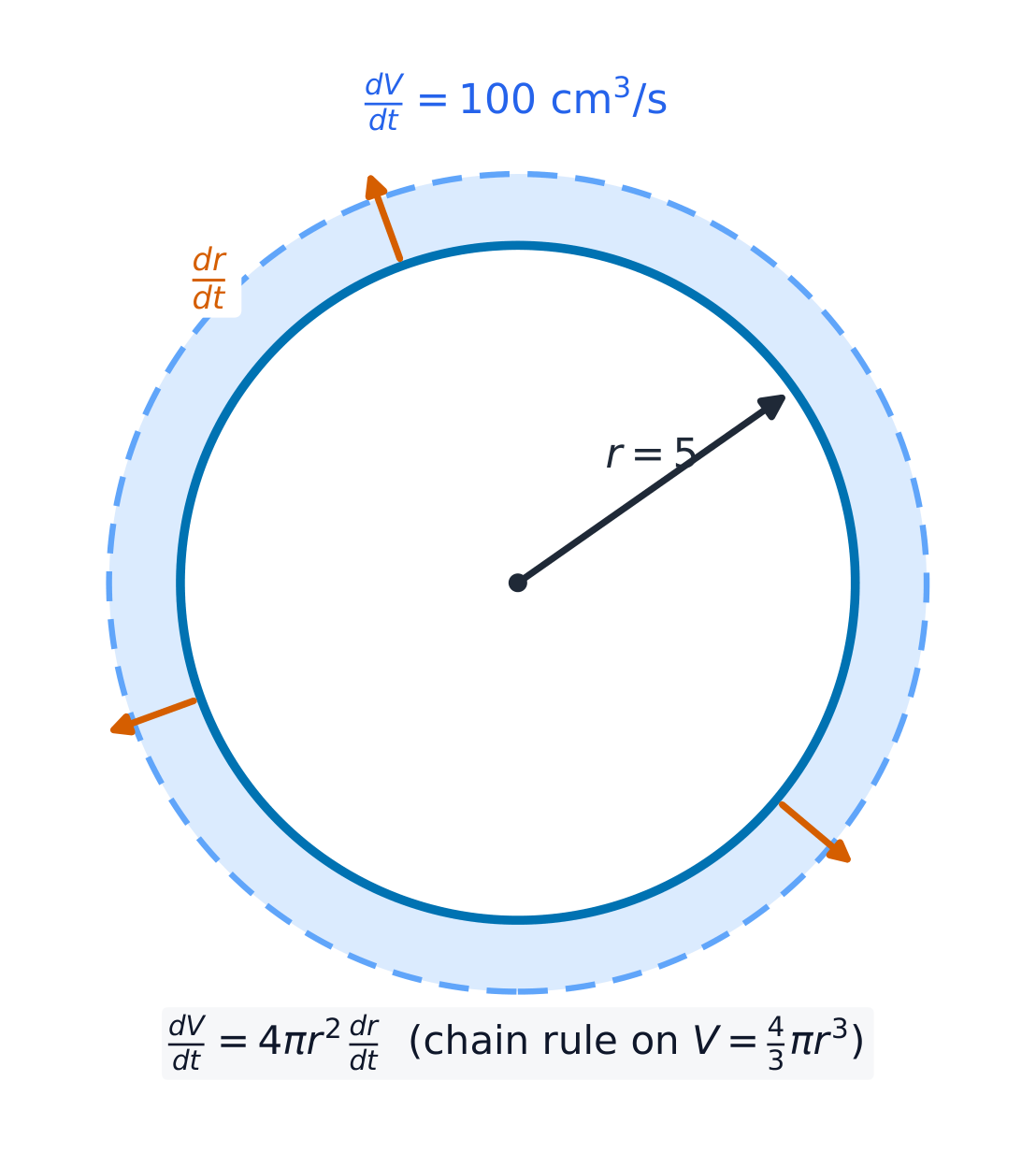
Worked example. A spherical balloon's volume grows at $\dfrac{dV}{dt}=100\ \text{cm}^3/\text{s}$. From $V=\tfrac43\pi r^3$, differentiate first: $\dfrac{dV}{dt}=4\pi r^2\dfrac{dr}{dt}$. At $r=5$, $100=4\pi(25)\dfrac{dr}{dt}$, so $\dfrac{dr}{dt}=\dfrac{1}{\pi}\approx0.32\ \text{cm/s}$.
Enduring Understanding (CHA-3): Derivatives allow us to solve real-world problems involving rates of change.
Learning Objective CHA-3.F: Approximate a value on a curve using the equation of a tangent line.
지속적 이해 (CHA-3): 미분은 변화율과 관련된 실제 문제를 해결하게 해준다.
학습 목표 CHA-3.F: 접선의 방정식을 사용하여 곡선 위의 값을 근사한다.
Source: College Board AP Course and Exam Description · 출처: College Board AP Course and Exam Description
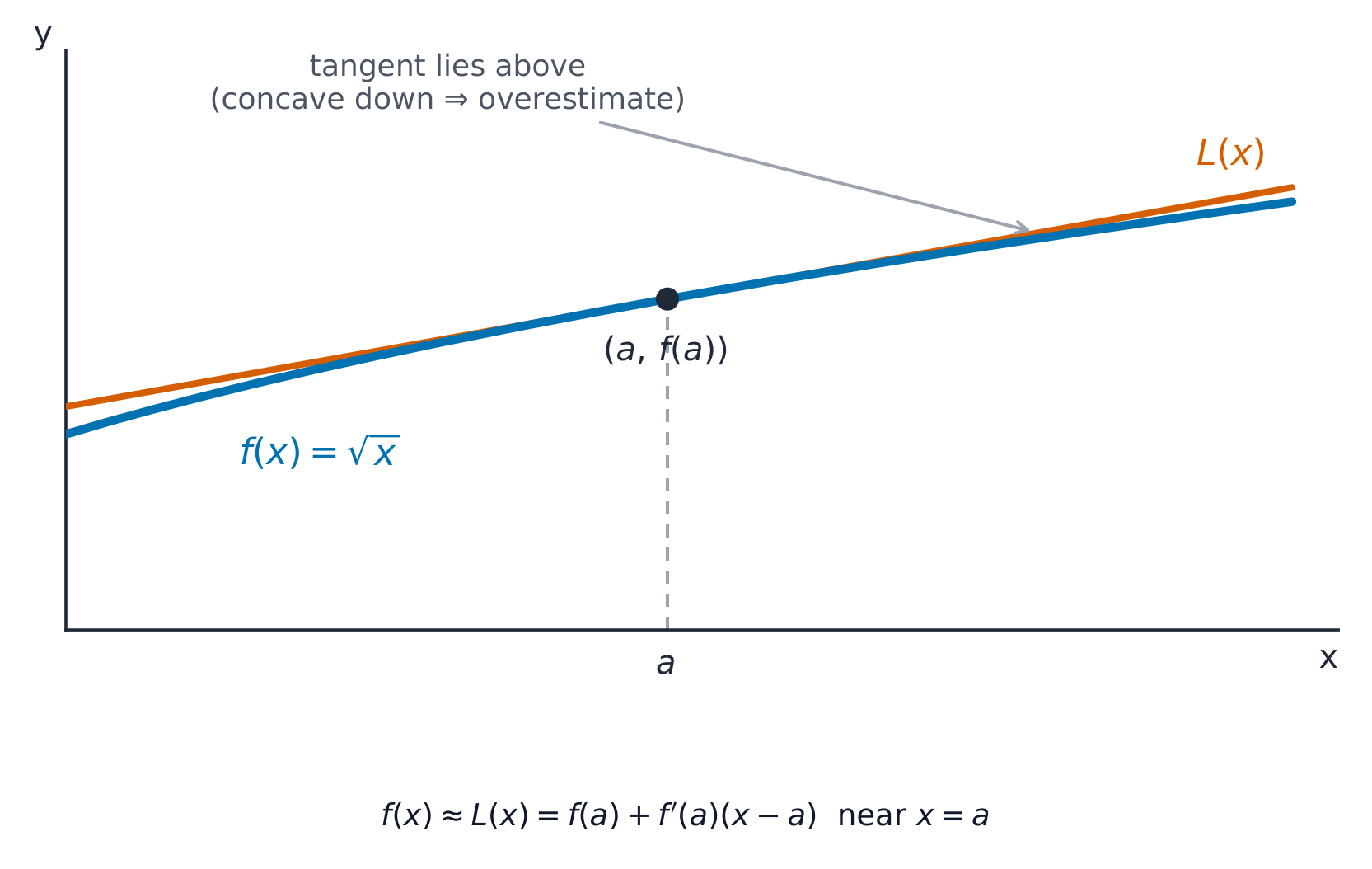
Near a point of tangency, a smooth curve looks like its tangent line – this is local linearity 局部线性. So the tangent line gives a linear approximation 线性近似 (linearization) of the function near that point:
Over- or underestimate? The answer follows from concavity 凹凸性. If the graph is concave up near $a$ (it curves above its tangent), the tangent-line value is an underestimate 低估. If it is concave down, the tangent line lies above the curve, giving an overestimate 高估. Exam parts test this reasoning, so justify with the sign of $f''$.
y = ax³ + bx² + cx + d
Local linearity: near a point a smooth curve looks like its tangent line, so the tangent gives a good linear approximation of nearby values. · 국소 선형성: 점 근처에서 매끄러운 곡선은 접선과 비슷해 보이므로, 접선은 주변 값들의 좋은 선형 근사를 제공합니다.
| English | 한국어 |
|---|---|
| local linearity/ˈləʊkl lɪˈnɪərɪti/ | 국소 선형성 |
| linear approximation/ˈlɪnɪə əˌprɒksɪˈmeɪʃn/ | 선형 근사 |
| concavity/kənˈkævɪti/ | 볼록성 |
| underestimate/ˌʌndəˈrestɪmət/ | 과소평가(underestimate) |
| overestimate/ˌəʊvəˈrestɪmət/ | 과대평가(overestimate) |
| Enduring Understanding | Learning Objective | Essential Knowledge |
|---|---|---|
LIM-4 | LIM-4.A |
|
Source: College Board AP Course and Exam Description · 출처: College Board AP Course and Exam Description
When direct substitution in a quotient of limits gives the indeterminate form 未定式 $\dfrac{0}{0}$ or $\dfrac{\infty}{\infty}$, you may use L'Hospital's Rule 洛必达法则:
Worked example. $\displaystyle\lim_{x\to0}\frac{\sin x}{x}$ gives $\tfrac00$, so differentiate top and bottom: $\displaystyle\lim_{x\to0}\frac{\cos x}{1}=1$. And $\displaystyle\lim_{x\to0}\frac{e^{2x}-1}{x}$ is also $\tfrac00$; it becomes $\displaystyle\lim_{x\to0}\frac{2e^{2x}}{1}=2$.
| English | 한국어 |
|---|---|
| indeterminate form/ˌɪndɪˈtɜːmɪnət fɔːm/ | 부정정 형식 |
| L'Hospital's Rule/ˈelhɒspɪtlz ruːl/ | L'Hospital 법칙 |
Enduring Understanding (FUN-1): Existence theorems allow us to draw conclusions about a function's behavior on an interval without precisely locating that behavior.
Learning Objective FUN-1.B: Justify conclusions about functions by applying the Mean Value Theorem over an interval.
지속적 이해(FUN-1): 존재 정리는 특정 구간에서 함수의 행동을 정확히 locating하지 않고도 결론을 내릴 수 있게 해줍니다.
학습 목표 FUN-1.B: 평균값 정리를 구간에서 적용하여 함수에 대한 결론을 정당화합니다.
Source: College Board AP Course and Exam Description · 출처: College Board AP Course and Exam Description
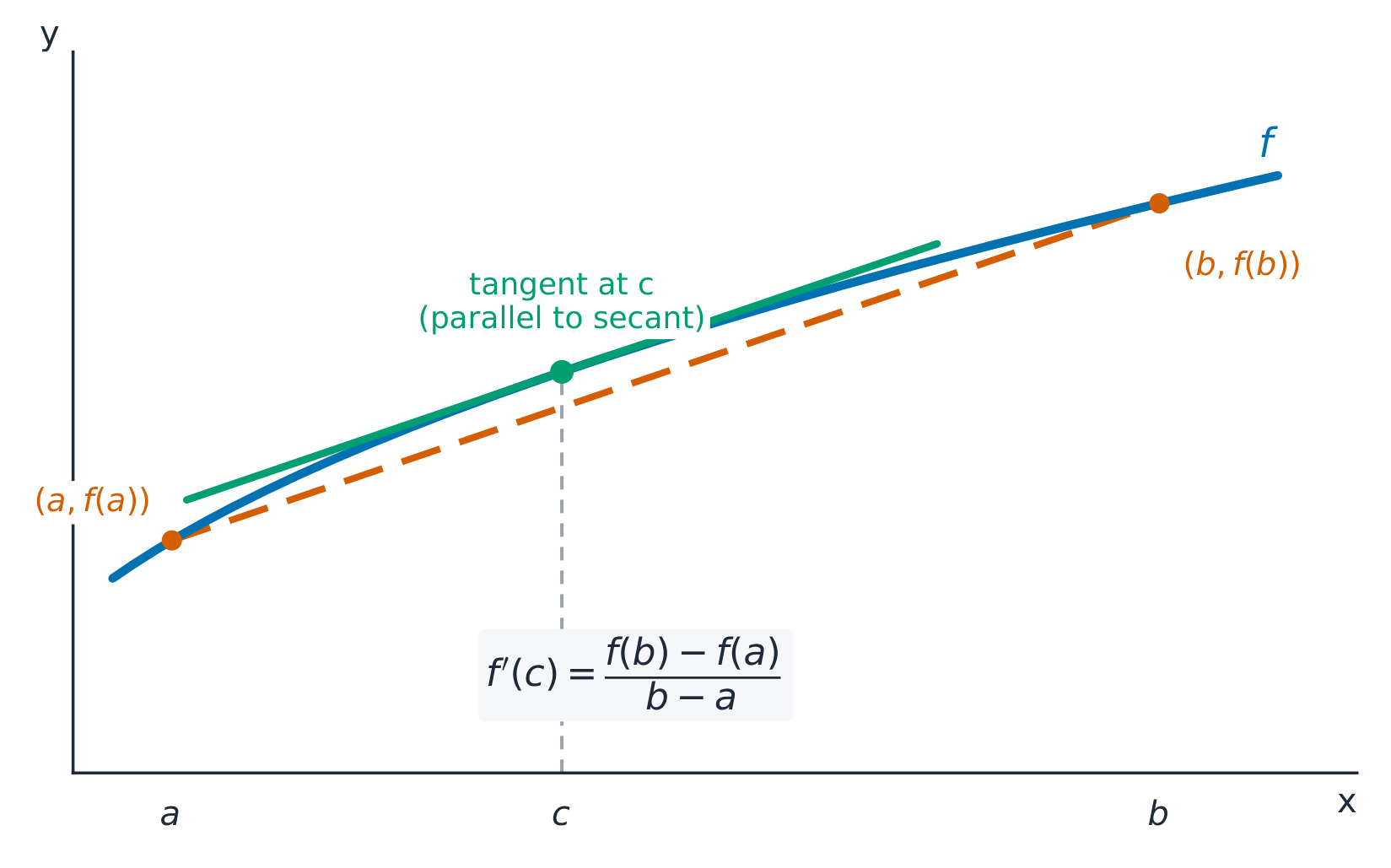
The Mean Value Theorem 中值定理 (MVT) links the average rate of change to an instantaneous one:
If $f$ is continuous on $[a,b]$ and differentiable on $(a,b)$, then there is at least one point $c$ in $(a,b)$ where
$$f'(c) = \frac{f(b)-f(a)}{b-a}.$$
In words: somewhere inside the interval, the instantaneous rate equals the average rate. Geometrically, some tangent line is parallel to the line joining the endpoints.
Exam skill. Like the IVT, the MVT is an existence theorem, and questions ask you to justify. Full credit needs: (1) state $f$ is continuous on $[a,b]$ and differentiable on $(a,b)$; (2) compute the average rate $\frac{f(b)-f(a)}{b-a}$; (3) conclude "by the MVT there is a $c$ in $(a,b)$ with $f'(c)$ equal to that value." Both hypotheses must be named.
Worked example. For $f(x)=x^2$ on $[1,3]$ the average rate is $\dfrac{9-1}{2}=4$; setting $f'(c)=2c=4$ gives $c=2$, which lies in $(1,3)$ – the guaranteed point.
y = ax³ + bx² + cx + d
The Mean Value Theorem guarantees a point where the tangent is parallel to the secant across an interval — the instantaneous rate equals the average rate somewhere inside.
| English | 한국어 |
|---|---|
| Mean Value Theorem/miːn ˈvæljuː ˈθɪərəm/ | 평균값 정리 |

Enduring Understanding (FUN-1): Existence theorems allow us to draw conclusions about a function's behavior on an interval without precisely locating that behavior.
Learning Objective FUN-1.C: Justify conclusions about functions by applying the Extreme Value Theorem.
지속적 이해(FUN-1): 존재 정리는 특정 구간에서 함수의 행동을 정확히 locating하지 않고도 결론을 내릴 수 있게 해줍니다.
학습 목표 FUN-1.C: 극대값 정리를 적용하여 함수에 대한 결론을 정당화합니다.
Source: College Board AP Course and Exam Description · 출처: College Board AP Course and Exam Description
The Extreme Value Theorem 极值定理 (EVT) guarantees extremes exist: a function continuous on a closed interval $[a,b]$ attains both an absolute maximum and an absolute minimum on it.
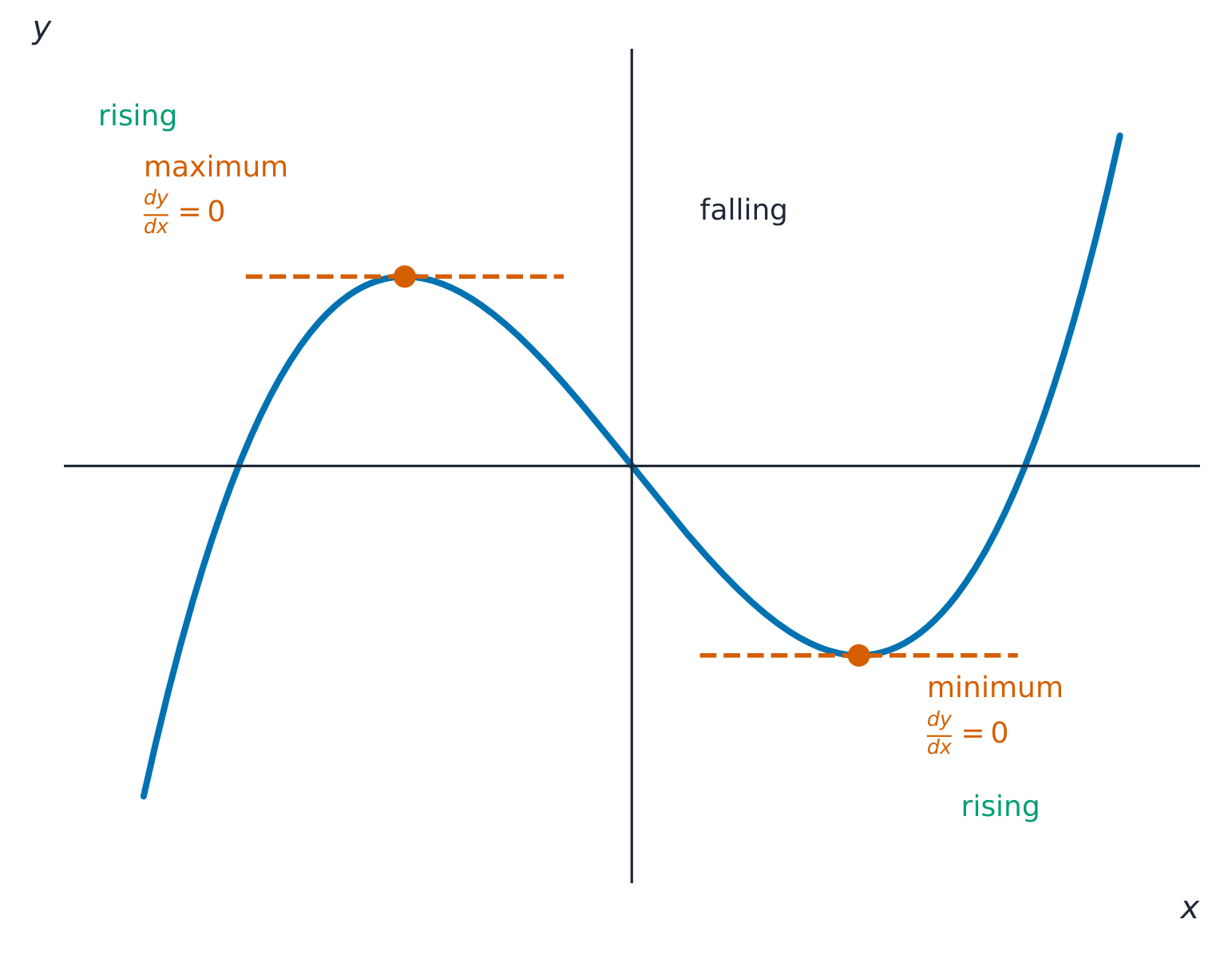
A critical point 临界点 is an interior point where $f'(x)=0$ or $f'(x)$ does not exist. All local (relative) extrema 局部极值 occur at critical points – but not every critical point is an extremum. So critical points are the candidates; you must test each.
| English | 한국어 |
|---|---|
| Extreme Value Theorem/ekˈstriːm ˈvæljuː ˈθɪərəm/ | 극한값 정리 |
| critical point/ˈkrɪtɪkl pɔɪnt/ | 임계점 |
| local (relative) extrema/ˈləʊkl ekˈstremə/ | 국소(상대) 극값 |
Enduring Understanding (FUN-4): A function's derivative can be used to understand some behaviors of the function.
Learning Objective FUN-4.A: Justify conclusions about the behavior of a function based on the behavior of its derivatives.
지속적 이해 (FUN-4): 함수의 도함수를 통해 함수의 일부 거동을 이해할 수 있습니다.
학습 목표 FUN-4.A: 도함수의 거동에 기반하여 함수의 거동에 대한 결론을 정당화합니다.
Source: College Board AP Course and Exam Description · 출처: College Board AP Course and Exam Description
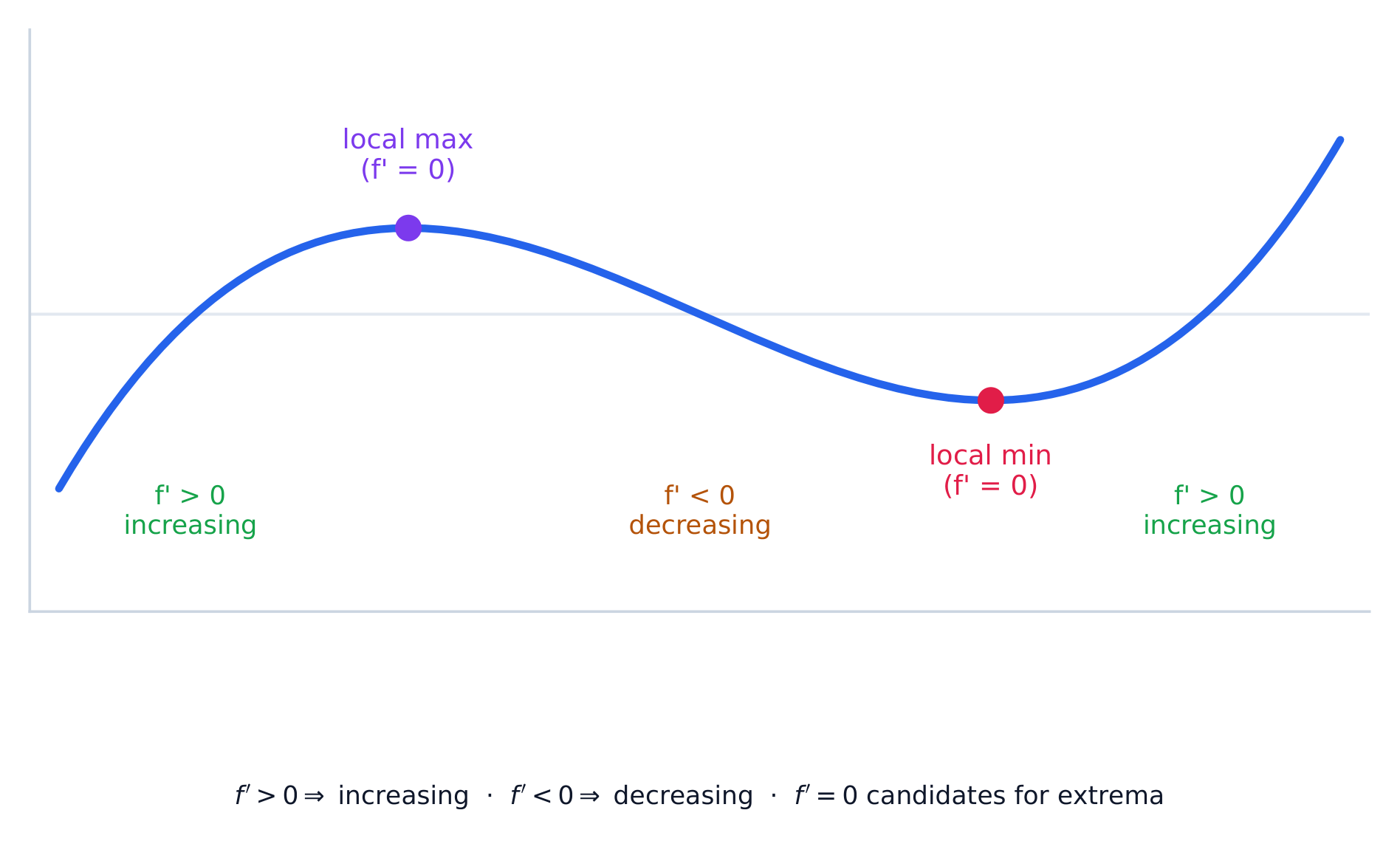
The first derivative tells you where $f$ rises or falls:
On the exam, "find the intervals where $f$ is increasing" means: find the critical points, then test the sign of $f'$ between them, and justify with the sign of $f'$ (a stated reason, not just an interval).
| English | 한국어 |
|---|---|
| increasing/ɪnˈkriːsɪŋ/ | 증가함 |
| decreasing/ˈdiːkriːsɪŋ/ | 감소함 |
Enduring Understanding (FUN-4): A function's derivative can be used to understand some behaviors of the function.
Learning Objective FUN-4.A: Justify conclusions about the behavior of a function based on the behavior of its derivatives.
지속적 이해 (FUN-4): 함수의 도함수를 통해 함수의 일부 거동을 이해할 수 있습니다.
학습 목표 FUN-4.A: 도함수의 거동에 기반하여 함수의 거동에 대한 결론을 정당화합니다.
Source: College Board AP Course and Exam Description · 출처: College Board AP Course and Exam Description
To classify a critical point $x=c$ as a local max, local min, or neither, check how $f'$ changes sign there:
Always state the sign change as your justification.
Worked example. For $f(x)=x^3-3x^2$, $f'(x)=3x(x-2)$ is zero at $x=0,2$. Signs give $+,-,+$, so $x=0$ is a local maximum ($f=0$) and $x=2$ a local minimum ($f=-4$).
| English | 한국어 |
|---|---|
| local maximum/ˈləʊkl ˈmæksɪməm/ | 국소 최대점 |
| local minimum/ˈləʊkl ˈmɪnɪməm/ | 국소 최소점 |
Enduring Understanding (FUN-4): A function's derivative can be used to understand some behaviors of the function.
Learning Objective FUN-4.A: Justify conclusions about the behavior of a function based on the behavior of its derivatives.
지속적 이해 (FUN-4): 함수의 도함수를 통해 함수의 일부 거동을 이해할 수 있습니다.
학습 목표 FUN-4.A: 도함수의 거동에 기반하여 함수의 거동에 대한 결론을 정당화합니다.
Source: College Board AP Course and Exam Description · 출처: College Board AP Course and Exam Description
On a closed interval, absolute (global) extrema occur only at critical points or endpoints. The candidates test:
Show the table of values – the comparison is the argument.
Enduring Understanding (FUN-4): A function's derivative can be used to understand some behaviors of the function.
Learning Objective FUN-4.A: Justify conclusions about the behavior of a function based on the behavior of its derivatives.
지속적 이해 (FUN-4): 함수의 도함수를 통해 함수의 일부 거동을 이해할 수 있습니다.
학습 목표 FUN-4.A: 도함수의 거동에 기반하여 함수의 거동에 대한 결론을 정당화합니다.
Source: College Board AP Course and Exam Description · 출처: College Board AP Course and Exam Description
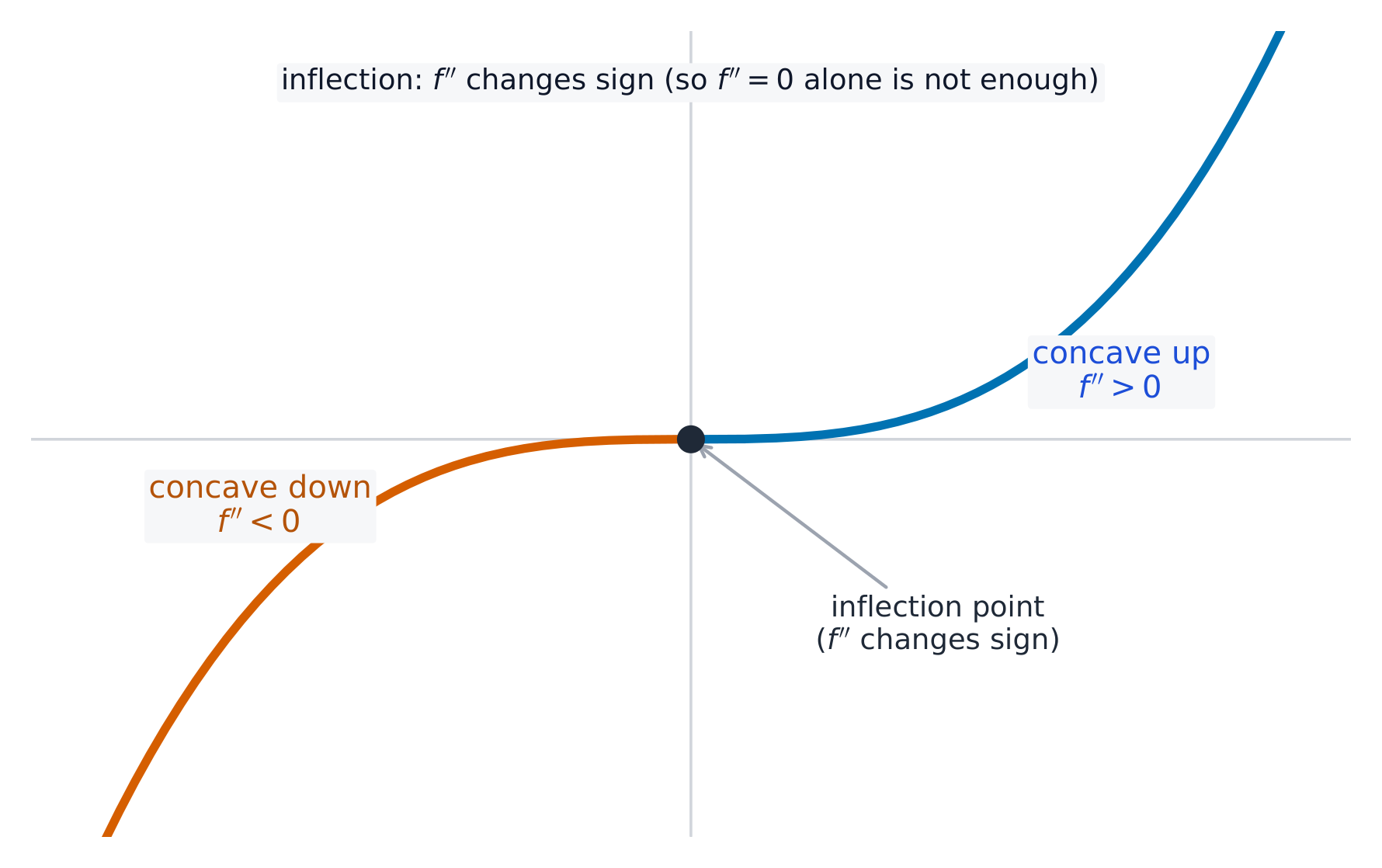
The second derivative describes bending:
A point of inflection 拐点 is where concavity changes, i.e. where $f''$ changes sign (not merely where $f''=0$). Report its $x$-coordinate and justify with the sign change of $f''$.
y = ax³ + bx² + cx + d
Concavity is the sign of the second derivative: concave up where the curve holds water, concave down where it spills. A point of inflection is where it switches.
| English | 한국어 |
|---|---|
| concave up/kɒnˈkeɪv ʌp/ | 오목 위(upward concave) |
| concave down/kɒnˈkeɪv daʊn/ | 오목 아래 |
| point of inflection/pɔɪnt ɒv ɪnˈflekʃn/ | 변곡점 |
Enduring Understanding (FUN-4): A function's derivative can be used to understand some behaviors of the function.
Learning Objective FUN-4.A: Justify conclusions about the behavior of a function based on the behavior of its derivatives.
지속적 이해 (FUN-4): 함수의 도함수를 통해 함수의 일부 거동을 이해할 수 있습니다.
학습 목표 FUN-4.A: 도함수의 거동에 기반하여 함수의 거동에 대한 결론을 정당화합니다.
Source: College Board AP Course and Exam Description · 출처: College Board AP Course and Exam Description
An alternative way to classify a critical point $c$ where $f'(c)=0$:
Special case: if a continuous function has only one critical point on an interval and it is a local extremum, that point is also the absolute extremum there.
Enduring Understanding (FUN-4): A function's derivative can be used to understand some behaviors of the function.
Learning Objective FUN-4.A: Justify conclusions about the behavior of a function based on the behavior of its derivatives.
지속적 이해 (FUN-4): 함수의 도함수를 통해 함수의 일부 거동을 이해할 수 있습니다.
학습 목표 FUN-4.A: 도함수의 거동에 기반하여 함수의 거동에 대한 결론을 정당화합니다.
Source: College Board AP Course and Exam Description · 출처: College Board AP Course and Exam Description
Key features of $f$, $f'$, and $f''$ mirror each other. To sketch or read graphs:
| Enduring Understanding | Learning Objective | Essential Knowledge |
|---|---|---|
FUN-4 | FUN-4.A |
|
Source: College Board AP Course and Exam Description · 출처: College Board AP Course and Exam Description
This is the skill of reading one graph to describe another. A very common exam setup gives the graph of $f'$ and asks about $f$: where is $f$ increasing (where $f'>0$), where are $f$'s extrema (where $f'$ crosses zero, with a sign change), where is $f$ concave up (where $f'$ is increasing). Answer questions about $f$ using the height and slope of the $f'$ graph.
y = ax³ + bx² + cx + d
Where $f'>0$ the function rises; where $f''>0$ it bends upward. Slide the tangent to connect the shape of $f$ to the signs of its first and second derivatives.
Enduring Understanding (FUN-4): A function's derivative can be used to understand some behaviors of the function.
Learning Objective FUN-4.B: Calculate minimum and maximum values in applied contexts or analysis of functions.
지속적 이해 (FUN-4): 함수의 도함수를 통해 함수의 일부 거동을 이해할 수 있습니다.
학습 목표 FUN-4.B: 응용 맥락이나 함수 분석에서 최소값 및 최대값을 계산합니다.
Source: College Board AP Course and Exam Description · 출처: College Board AP Course and Exam Description
Optimization 最优化 uses the derivative to find the largest or smallest value of a quantity on an interval. It is the candidates/derivative-test machinery applied to a real goal.
| English | 한국어 |
|---|---|
| Optimization/ˌɒptɪmaɪˈzeɪʃn/ | 최적화 |
Enduring Understanding (FUN-4): A function's derivative can be used to understand some behaviors of the function.
Learning Objective FUN-4.C: Interpret minimum and maximum values calculated in applied contexts.
지속적 이해 (FUN-4): 함수의 도함수를 통해 함수의 일부 거동을 이해할 수 있습니다.
학습 목표 FUN-4.C: 응용 맥락에서 계산된 최소값 및 최대값을 해석합니다.
Source: College Board AP Course and Exam Description · 출처: College Board AP Course and Exam Description
A dependable procedure:
Worked example. With $100\ \text{m}$ of fence for a rectangular pen against a wall (only three sides fenced), let the ends be $x$ and the far side $y=100-2x$. The area $A(x)=x(100-2x)=100x-2x^2$ has $A'(x)=100-4x=0$ at $x=25$; since $A''=-4<0$ this is the maximum, giving $y=50$ and $A=1250\ \text{m}^2$.
| Enduring Understanding | Learning Objective | Essential Knowledge |
|---|---|---|
FUN-4 | FUN-4.D |
|
FUN-4.E |
|
Source: College Board AP Course and Exam Description · 출처: College Board AP Course and Exam Description
All of this extends to implicitly defined relations. A critical point of an implicit relation is where $\dfrac{dy}{dx}=0$ (horizontal tangent) or is undefined (vertical tangent). Because $\dfrac{dy}{dx}$ is usually a relation in $x$ and $y$, and the second derivative involves $x$, $y$, and $\dfrac{dy}{dx}$, substitute your first-derivative expression back in when finding $\dfrac{d^2y}{dx^2}$, then reason about concavity from its sign.
Enduring Understanding (CHA-4): Definite integrals allow us to solve problems involving the accumulation of change over an interval.
Learning Objective CHA-4.A: Interpret the meaning of areas associated with the graph of a rate of change in context.
지속적 이해 (CHA-4): 정적분은 구간 내에서의 변화량 축적 문제를 해결할 수 있게 해준다.
학습 목표 CHA-4.A: 변화율 그래프와 관련된 면적의 의미를 맥락 속에서 해석한다.
Source: College Board AP Course and Exam Description · 출처: College Board AP Course and Exam Description
Where a derivative measures a rate, an integral 积分 measures an accumulation 累积 – a total built up from a rate. If a rate of change acts over an interval, the area between its graph and the axis gives the net accumulated change. This "area = total change" idea is the foundation of integral calculus.
도함수가 **변화율(rate)**을 측정한다면, 적분은 **누적량(accumulation)**을 측정합니다 – 즉, 변화율로부터 쌓여 나간 총량입니다. 어떤 구간 동안 변화율이 작용할 때, 그래프와 축 사이의 면적은 순 누적 변화를 나타냅니다. "면적 = 총 변화"라는 개념은 적분학의 기초입니다.
| English | 한국어 |
|---|---|
| accumulation/əˌkjuːmjʊˈleɪʃn/ | 적분함수(Accumulation function) |

Enduring Understanding (LIM-5): Definite integrals can be approximated using geometric and numerical methods.
Learning Objective LIM-5.A: Approximate a definite integral using geometric and numerical methods.
지속적 이해 (LIM-5): 정적분은 기하학적 및 수치적 방법을 사용하여 근사할 수 있다.
학습 목표 LIM-5.A: 기하학적 및 수치적 방법을 사용하여 정적분을 근사한다.
Source: College Board AP Course and Exam Description · 출처: College Board AP Course and Exam Description
A Riemann sum 黎曼和 estimates the area under a curve by adding the areas of thin rectangles. Split $[a,b]$ into subintervals and use the function's height at the left endpoint, right endpoint, or midpoint of each. A trapezoidal sum 梯形法 uses trapezoids instead, averaging the two endpoint heights – usually more accurate. With more, thinner rectangles the estimate improves.
Exam skill: be able to compute left, right, midpoint, and trapezoidal estimates from a table or graph, and state whether each over- or under-estimates based on whether the function is increasing/decreasing or concave up/down.
**緻密 합(Riemann sum)**은 가늘고 긴 사각형들의 면적을 더하여 곡선 아래 면적을 추정합니다. $[a,b]$을 하구간으로 나누어 각 구간의 좌측 끝점, 우측 끝점, 또는 중간점에서의 함수 높이를 사용하십시오. **사다리꼴 합(trapezoidal sum)**은 사다리꼴을 사용하여 두 끝점의 높이의 평균을 취하므로 일반적으로 더 정확합니다. 사각형이 많고 가늘어질수록 추정치가 개선됩니다.
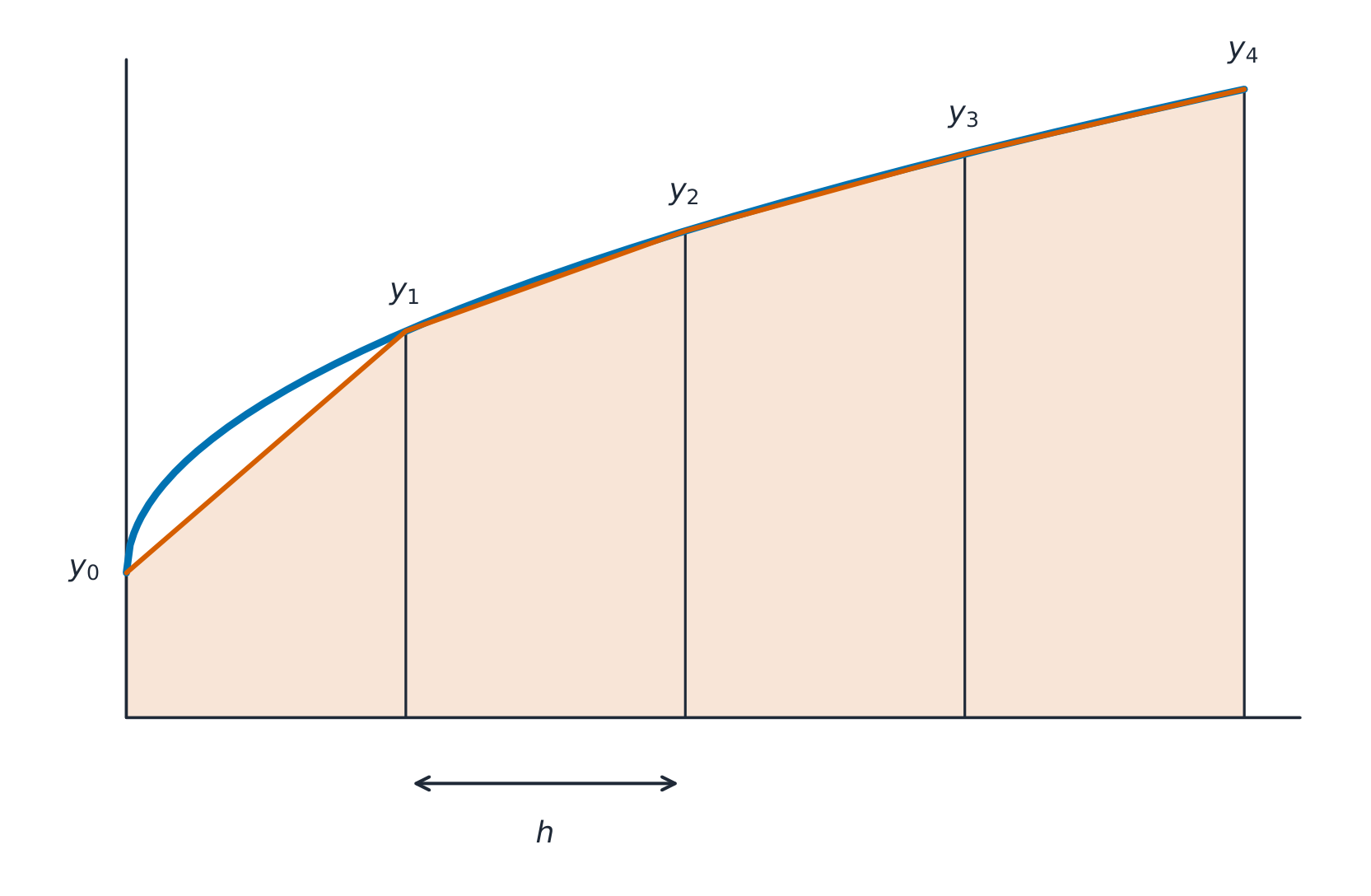
시험 기술: 표나 그래프에서 좌측, 우측, 중간점, 사다리꼴 추정치를 계산할 수 있어야 하며, 함수가 증가/감소하거나 위쪽/아래쪽 오목인지에 따라 각 추정치가 과대 또는 과소 추정임을 명시할 수 있어야 합니다.
y = ax³ + bx² + cx + d
A Riemann sum approximates the area under a curve with rectangles. Add more, thinner rectangles and the estimate converges to the exact definite integral. · 리만 합은 사각형을 사용하여 곡선 아랫면적을 근사합니다. 더 많고 얇은 사각형을 추가하면 추정치가 정확한 정적분으로 수렴합니다.
| English | 한국어 |
|---|---|
| Riemann sum/ˈriːmən sʌm/ | 리만 합 |
| trapezoidal sum/ˈtræpɪzɔɪdl sʌm/ | 사다리꼴 합 |
Enduring Understanding (LIM-5): Definite integrals can be approximated using geometric and numerical methods.
Learning Objective LIM-5.B: Interpret the limiting case of the Riemann sum as a definite integral.
Learning Objective LIM-5.C: Represent the limiting case of the Riemann sum as a definite integral.
지속적 이해 (LIM-5): 정적분은 기하학적 및 수치적 방법을 사용하여 근사할 수 있다.
학습 목표 LIM-5.B: 리만 합의 극한을 정적분으로 해석한다.
학습 목표 LIM-5.C: 리만 합의 극한을 정적분으로 표현한다.
Source: College Board AP Course and Exam Description · 출처: College Board AP Course and Exam Description
Writing a Riemann sum with summation notation $\sum_{k=1}^{n} f(x_k)\,\Delta x$ and letting the number of rectangles grow without bound gives the exact area – the definite integral 定积分:
합산 기호(summation notation) $\sum_{k=1}^{n} f(x_k)\,\Delta x$을 사용하여 緻密 합을 쓰고 사각형의 개수가 무한대로 커지도록 하면 정확한 면적, 즉 **정적분(definite integral)**을 얻을 수 있습니다:
| English | 한국어 |
|---|---|
| integral/ˈɪntɪɡrəl/ | 적분Unless integral. |
| definite integral/ˈdefɪnət ˈɪntɪɡrəl/ | 정적분 |
Enduring Understanding (FUN-5): The Fundamental Theorem of Calculus connects differentiation and integration.
Learning Objective FUN-5.A: Represent accumulation functions using definite integrals.
지속적 이해 (FUN-5): 미적분학의 기본 정리는 미분과 적분을 연결시킨다.
학습 목표 FUN-5.A: 정적분을 사용하여 적분 함수를 표현한다.
Source: College Board AP Course and Exam Description · 출처: College Board AP Course and Exam Description
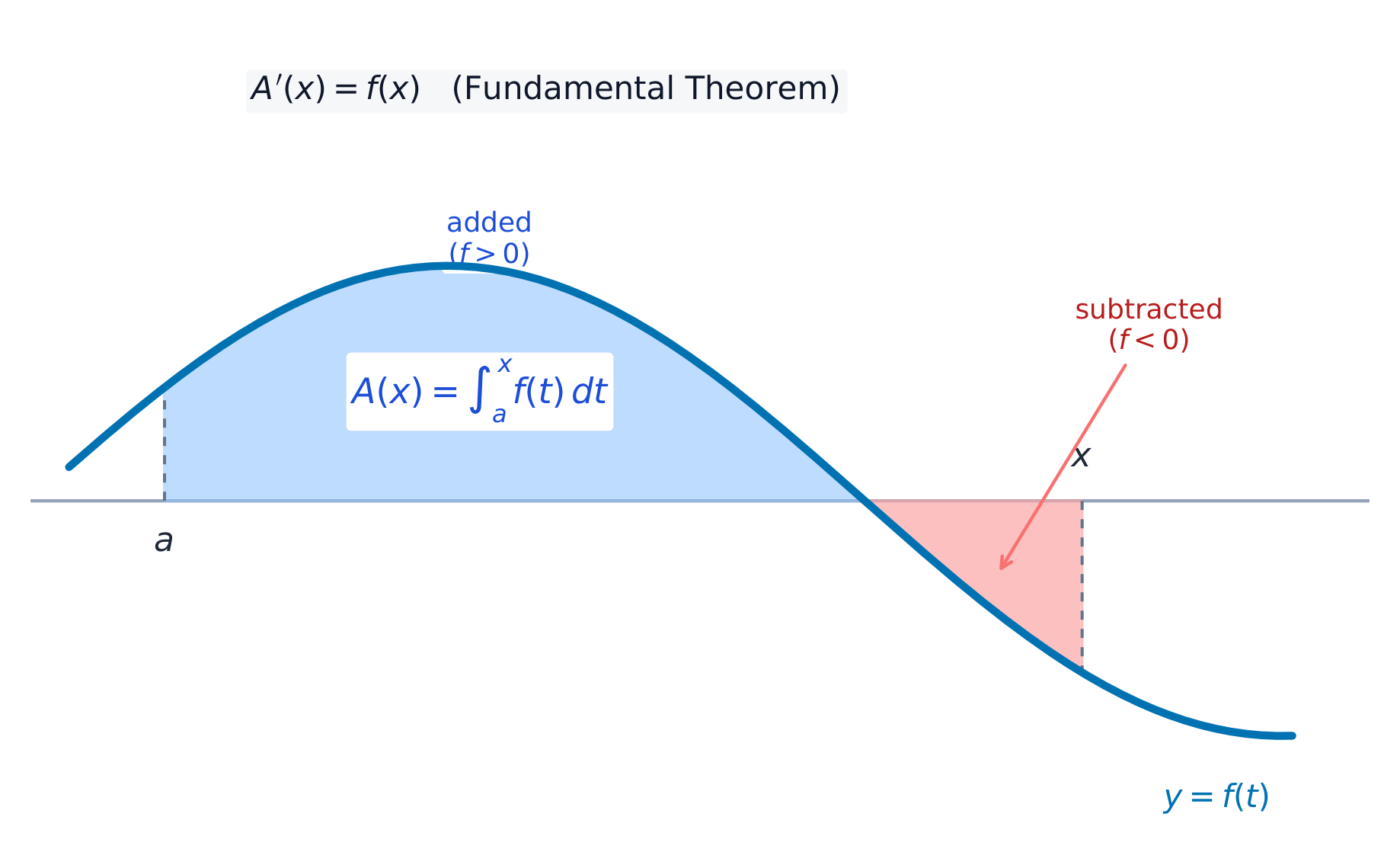
An accumulation function 累积函数 $g(x)=\int_a^x f(t)\,dt$ gives the accumulated area from $a$ up to $x$. The Fundamental Theorem of Calculus (FTC) 微积分基本定理 says its derivative is the integrand:
누적 함수(accumulation function) $g(x)=\int_a^x f(t)\,dt$은 $a$부터 $x$까지의 누적 면적을 줍니다. 미적분학의 기본 정리(Fundamental Theorem of Calculus, FTC) 에 따르면 이 함수의 도함수는 피적분함수(integrand)입니다:
y = ax³ + bx² + cx + d
An accumulation function $\int_a^x f(t)\,dt$ builds up signed area as $x$ moves. The Fundamental Theorem says its derivative is just $f(x)$. · 적분 함수 $\int_a^x f(t)\,dt$는 $x$이 이동함에 따라 부호 있는 면적이 쌓입니다. 기본 정리에 따르면 이 함수의 도함수는 단순히 $f(x)$입니다.
| English | 한국어 |
|---|---|
| accumulation function/əˌkjuːmjʊˈleɪʃn ˈfʌŋkʃn/ | 적분 함수 |
| Fundamental Theorem of Calculus (FTC)/ˌfʌndəˈmentl ˈθɪərəm ɒv ˈkælkjʊləs/ | 미적분학 기본 정리 (FTC) |
| antiderivative/ˌæntɪdɪˈrɪvətɪv/ | 원함수(alternative integral) |
| indefinite integral/ɪnˈdefɪnət ˈɪntɪɡrəl/ | 부정적분 |
| u-substitution/juː ˌsʌbstɪˈtjuːʃn/ | u-대치法 |
| Integration by parts/ˌɪntɪˈɡreɪʃn baɪ pɑːts/ | 부분 적분 |
| Partial fractions/ˈpɑːʃl ˈfrækʃnz/ | 부분 분수 |
| Enduring Understanding | Learning Objective | Essential Knowledge |
|---|---|---|
FUN-5 | FUN-5.A |
|
Source: College Board AP Course and Exam Description · 출처: College Board AP Course and Exam Description
Because $g'(x)=f(x)$, the graph of $f$ tells you everything about $g$: $g$ increases where $f>0$, decreases where $f<0$, has extrema where $f$ crosses zero, and is concave up where $f$ is increasing. Reading these connections off a graph of $f$ is a classic free-response task.
$g'(x)=f(x)$이기 때문에, $f$의 그래프는 $g$에 대해 모든 것을 알려줍니다: $g$은 $f>0$인 곳에서 증가하고, $f<0$인 곳에서 감소하며, $f$이 0을 지나는 곳에서 극값을 가지며, $f$이 증가하는 곳에서 위쪽 오목입니다. $f$의 그래프에서 이러한 연결 관계를 읽는 것은 전형적인 서술형 문제입니다.
Enduring Understanding (FUN-6): Recognizing opportunities to apply knowledge of geometry and mathematical rules can simplify integration.
Learning Objective FUN-6.A: Calculate a definite integral using areas and properties of definite integrals.
지속적 이해 (FUN-6): 기하학적 지식과 수학적 규칙을 적용할 기회를 파악하면 적분이 단순화될 수 있다.
학습 목표 FUN-6.A: 면적과 정적분의 성질을 사용하여 정적분을 계산한다.
Source: College Board AP Course and Exam Description · 출처: College Board AP Course and Exam Description
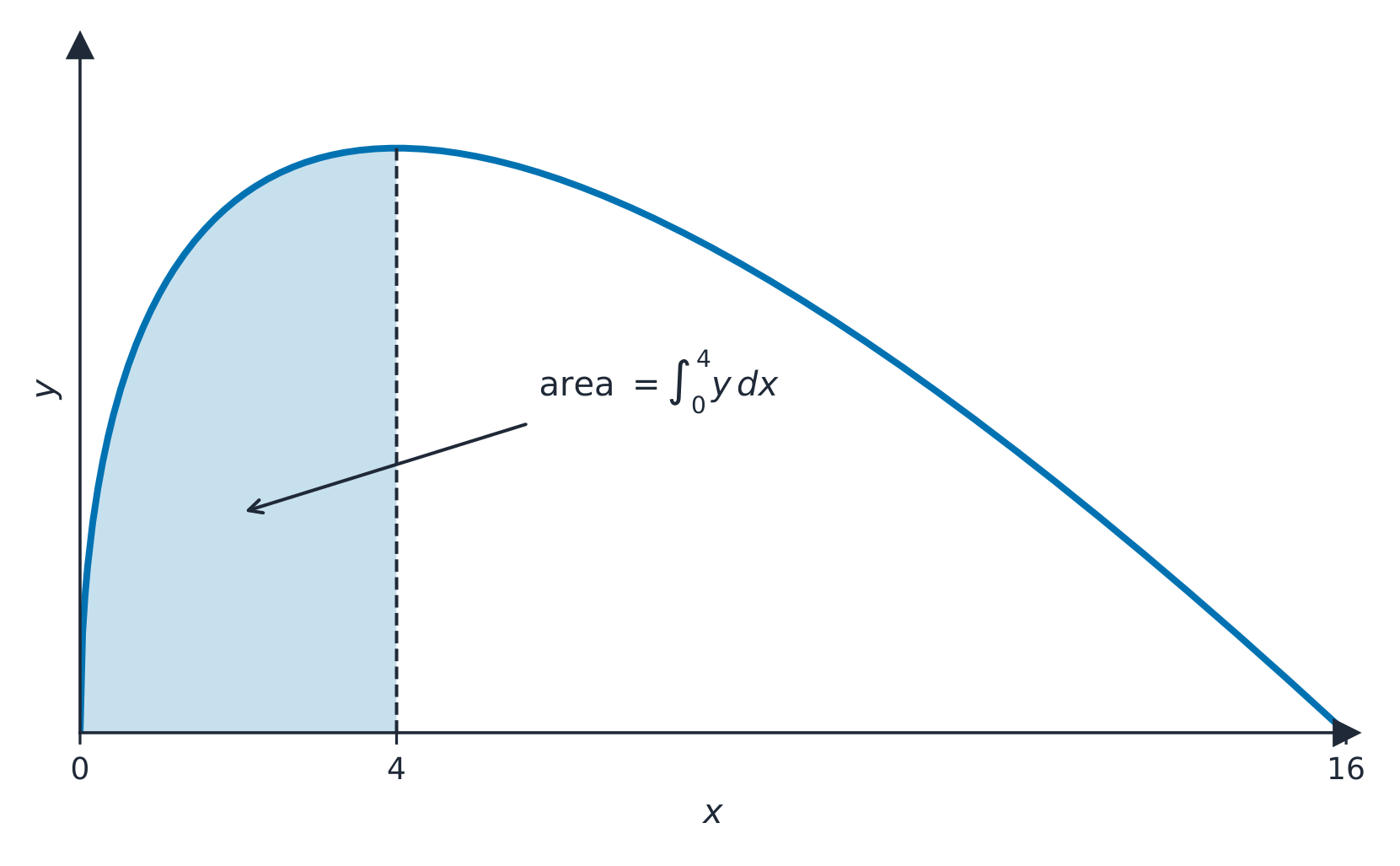
Definite integrals obey useful rules: reversing the limits negates the value ($\int_b^a=-\int_a^b$), an integral over a zero-width interval is $0$, they add over adjacent intervals ($\int_a^c=\int_a^b+\int_b^c$), and constants factor out. Use these to combine or split given integral values.
정적분은 유용한 규칙을 따릅니다: 적분 한계를 뒤집으면 값의 부호가 반대가 됩니다($\int_b^a=-\int_a^b$), 너비가 0인 구간의 적분은 $0$이며, 인접한 구간에서 적분이 합쳐집니다($\int_a^c=\int_a^b+\int_b^c$), 상수는 outside로 빼낼 수 있습니다. 이를 사용하여 주어진 적분 값을 결합하거나 분리하십시오.
| Enduring Understanding | Learning Objective | Essential Knowledge |
|---|---|---|
FUN-6 | FUN-6.B |
|
Source: College Board AP Course and Exam Description · 출처: College Board AP Course and Exam Description
The evaluation form of the FTC computes a definite integral from an antiderivative 原函数 $F$ (where $F'=f$):
Worked example. $\displaystyle\int_1^3 (2x+1)\,dx$: an antiderivative is $F(x)=x^2+x$, so the value is $F(3)-F(1)=12-2=10$.
FTC의 평가(evaluation) 형태는 원시함수(alternative primitive) $F$(여기서 $F'=f$)을 사용하여 정적분을 계산합니다:
해설 예제. $\displaystyle\int_1^3 (2x+1)\,dx$: 원시함수는 $F(x)=x^2+x$이므로, 값은 $F(3)-F(1)=12-2=10$입니다.
| Enduring Understanding | Learning Objective | Essential Knowledge |
|---|---|---|
FUN-6 | FUN-6.C |
|
Source: College Board AP Course and Exam Description · 출처: College Board AP Course and Exam Description
An indefinite integral 不定积分 $\int f(x)\,dx=F(x)+C$ is the family of all antiderivatives (hence the constant of integration $C$). Reverse each derivative rule: the power rule becomes $\int x^n\,dx=\dfrac{x^{n+1}}{n+1}+C$ (for $n\neq-1$), with $\int \frac1x\,dx=\ln|x|+C$, and the antiderivatives of $e^x$, $\sin x$, $\cos x$, and $\sec^2 x$ come straight from their derivatives.
부정적분 $\int f(x)\,dx=F(x)+C$은 모든 원함수들의 집합(즉, 적분 상수 $C$)입니다. 미분 법칙을 역으로 적용하면: 지수 법칙이 $\int x^n\,dx=\dfrac{x^{n+1}}{n+1}+C$($n\neq-1$에 대해)로 변하며, $\int \frac1x\,dx=\ln|x|+C$를 더하고, $e^x$, $\sin x$, $\cos x$, $\sec^2 x$의 원함수는 각각의 미분 결과에서 바로 얻을 수 있습니다.
Enduring Understanding (FUN-6): Recognizing opportunities to apply knowledge of geometry and mathematical rules can simplify integration.
Learning Objective FUN-6.D: For integrands requiring substitution or rearrangements into equivalent forms: (a) Determine indefinite integrals. (b) Evaluate definite integrals.
지속적 이해 (FUN-6): 기하학적 지식과 수학적 규칙을 적용할 기회를 파악하면 적분이 단순화될 수 있다.
학습 목표 FUN-6.D: 치환이나 동치 형태로 변형이 필요한 피적분식에 대해: (a) 부정적분을 구한다. (b) 정적분을 계산한다.
Source: College Board AP Course and Exam Description · 출처: College Board AP Course and Exam Description
u-substitution 换元积分 reverses the chain rule: choose $u=g(x)$ so that $g'(x)$ also appears, turning $\int f(g(x))g'(x)\,dx$ into $\int f(u)\,du$. Remember to convert $dx$ to $du$ and, for a definite integral, either change the limits to $u$-values or convert back to $x$ at the end.
u-대입법은 연쇄 법칙의 역연산입니다: $u=g(x)$을 선택하여 $g'(x)$도 포함되어게 하여 $\int f(g(x))g'(x)\,dx$을 $\int f(u)\,du$로 변환합니다. $dx$를 $du$로 변환하는 것을 잊지 말고, 정적분의 경우 적분 한계를 $u$ 값으로 바꾸거나 최종적으로 다시 $x$로 환원해야 합니다.
Enduring Understanding (FUN-6): Recognizing opportunities to apply knowledge of geometry and mathematical rules can simplify integration.
Learning Objective FUN-6.D: For integrands requiring substitution or rearrangements into equivalent forms: (a) Determine indefinite integrals. (b) Evaluate definite integrals.
지속적 이해 (FUN-6): 기하학적 지식과 수학적 규칙을 적용할 기회를 파악하면 적분이 단순화될 수 있다.
학습 목표 FUN-6.D: 치환이나 동치 형태로 변형이 필요한 피적분식에 대해: (a) 부정적분을 구한다. (b) 정적분을 계산한다.
Source: College Board AP Course and Exam Description · 출처: College Board AP Course and Exam Description
When a rational integrand is "top-heavy" (numerator degree $\ge$ denominator degree), long division rewrites it as a polynomial plus a proper fraction you can integrate. Completing the square in a denominator turns it into a form like $u^2+a^2$, leading to an arctangent antiderivative $\frac1a\arctan\frac{u}{a}+C$.
유계 함수가 "분자가 분모보다 차수가 높은"(numerator degree $\ge$ denominator degree) 경우, 나눗셈을 통해 다항식과 적분 가능한 진분수로 재표기할 수 있습니다. 분모에서의 제곱완성은 이를 $u^2+a^2$와 같은 형태로 만들어 아크탄젠트 원함수 $\frac1a\arctan\frac{u}{a}+C$를 유도합니다.
Enduring Understanding (FUN-6): Recognizing opportunities to apply knowledge of geometry and mathematical rules can simplify integration.
Learning Objective FUN-6.E: For integrands requiring integration by parts: (a) Determine indefinite integrals. BC ONLY (b) Evaluate definite integrals. BC ONLY
지속적 이해 (FUN-6): 기하학적 지식과 수학적 규칙을 적용할 기회를 파악하면 적분이 단순화될 수 있다.
학습 목표 FUN-6.E: 부분적분法이 필요한 피적분식에 대해: (a) 부정적분을 구한다. BC 전공자만 (b) 정적분을 계산한다. BC 전공자만
Source: College Board AP Course and Exam Description · 출처: College Board AP Course and Exam Description
Integration by parts 分部积分 reverses the product rule:
Worked example. For $\int x e^x\,dx$, choose $u=x$ ($du=dx$) and $dv=e^x\,dx$ ($v=e^x$):
부분적분은 곱의 미분 법칙의 역연산입니다:
작업 예시. $\int x e^x\,dx$에 대해 $u=x$($du=dx$)과 $dv=e^x\,dx$($v=e^x$)을 선택합니다:
Enduring Understanding (FUN-6): Recognizing opportunities to apply knowledge of geometry and mathematical rules can simplify integration.
Learning Objective FUN-6.F: For integrands requiring integration by linear partial fractions: (a) Determine indefinite integrals. BC ONLY (b) Evaluate definite integrals. BC ONLY
지속적 이해 (FUN-6): 기하학적 지식과 수학적 규칙을 적용할 기회를 파악하면 적분이 단순화될 수 있다.
학습 목표 FUN-6.F: 선형 분수 분해法이 필요한 피적분식에 대해: (a) 부정적분을 구한다. BC 전공자만 (b) 정적분을 계산한다. BC 전공자만
Source: College Board AP Course and Exam Description · 출처: College Board AP Course and Exam Description
Partial fractions 部分分式 split a rational function with a factorable denominator into a sum of simpler fractions:
편분수는 인수분해 가능한 분모를 가진 유계 함수를 더 간단한 분수의 합으로 쪼개어 표현합니다:
Enduring Understanding (LIM-6): The use of limits allows us to show that the areas of unbounded regions may be finite.
Learning Objective LIM-6.A: Evaluate an improper integral or determine that the integral diverges. BC ONLY
지속적 이해(LIM-6): 극한의 사용은 무한 영역의 면적이 유한함을 보여줄 수 있음을 입증한다.
학습 목표 LIM-6.A: 부정적분을 계산하거나 적분이 발산함을 판별한다. BC 전공자만
Source: College Board AP Course and Exam Description · 출처: College Board AP Course and Exam Description
An improper integral 反常积分 has an infinite limit of integration or an infinite discontinuity in the integrand. Evaluate it as a limit: $\int_a^\infty f\,dx=\lim_{b\to\infty}\int_a^b f\,dx$. If the limit is a finite number the integral converges 收敛; otherwise it diverges 发散.
Worked example. $\displaystyle\int_1^\infty \frac{1}{x^2}\,dx=\lim_{b\to\infty}\left[-\frac1x\right]_1^b=\lim_{b\to\infty}\left(1-\frac1b\right)=1$, so it converges to $1$. By contrast $\int_1^\infty \frac1x\,dx$ gives $\lim_{b\to\infty}\ln b=\infty$ and diverges – the same integrand-shape can go either way.
부등적분은 적분의 무한한 한계나 피적분 함수의 무한한 불연속점을 가집니다. 이를 한계로 평가합니다: $\int_a^\infty f\,dx=\lim_{b\to\infty}\int_a^b f\,dx$. 만약 이 한계가 유한한 수이면 적분은 수렴하며, 그렇지 않으면 발산합니다.
해설 예시. $\displaystyle\int_1^\infty \frac{1}{x^2}\,dx=\lim_{b\to\infty}\left[-\frac1x\right]_1^b=\lim_{b\to\infty}\left(1-\frac1b\right)=1$이므로, 이는 $1$으로 수렴합니다. 반면 $\int_1^\infty \frac1x\,dx$는 $\lim_{b\to\infty}\ln b=\infty$을给出하여 발산합니다 – 동일한 피적분 함수 형태임에도 불구하고 수렴과 발산 중 하나일 수 있습니다.
| English | 한국어 |
|---|---|
| improper integral/ɪmˈprɒpə ˈɪntɪɡrəl/ | 부정적분 |
| converges/kənˈvɜːdʒɪz/ | 수렴함 |
| diverges/daɪˈvɜːdʒɪz/ | 발산함 |
This topic is intended to focus on the skill of selecting an appropriate procedure for antidifferentiation. Students should be given opportunities to practice when and how to apply all learning objectives relating to antidifferentiation.
이 주제는 원함수 구法에 적합한 절차를 선택하는 능력에 초점을 맞춘 것이다. 학생들에게 원함수 구法 관련 모든 학습 목표를 언제, 어떻게 적용해야 하는지 연습할 기회가 제공되어야 한다.
Source: College Board AP Course and Exam Description · 출처: College Board AP Course and Exam Description
The BC exam expects you to recognize which method fits: basic rules, substitution (a chain-rule pattern), by parts (a product), partial fractions (a factorable rational), or long division/completing the square. Being able to look at an integral and pick the right tool quickly is itself a tested skill.
BC 시험에서는 어떤 방법이 적합한지 식별하는 능력을 요구합니다: 기본 규칙, 대입법(연쇄 법칙 패턴), 부분적분(곱의 형태), 편분수(인수분해 가능한 유계 함수), 혹은 나눗셈/제곱완성 등입니다. 적분식을 보고 빠르게 적절한 도구를 선택할 수 있는 것 자체가 시험에 출제되는 기술입니다.
Enduring Understanding (FUN-7): Solving differential equations allows us to determine functions and develop models.
Learning Objective FUN-7.A: Interpret verbal statements of problems as differential equations involving a derivative expression.
지속적 이해(FUN-7): 미분 방정식을 풀면 함수를 결정하고 모델을 개발할 수 있다.
학습 목표 FUN-7.A: 도함수 식을 포함하는 미분 방정식으로 문제의 서술을 해석한다.
Source: College Board AP Course and Exam Description · 출처: College Board AP Course and Exam Description
A differential equation 微分方程 relates a function to its derivatives. Many real situations are described by a rate: "the population grows at a rate proportional to its size" becomes $\dfrac{dP}{dt}=kP$. Setting up the equation from a verbal description – identifying what changes and what it is proportional to – is the first skill.
미분방정식은 함수와 그 미분값 사이의 관계를 나타냅니다. 많은 실제 현상은 변화율로 설명되는데, "인구가 크기에 비례하는 속도로 증가한다"는 문장은 $\dfrac{dP}{dt}=kP$로 표현됩니다. 구술 설명에서 방정식을 세우기 위해 어떤 것이 변하고 그것이 무엇에 비례하는지를 식별하는 것이 첫 번째 기술입니다.
Enduring Understanding (FUN-7): Solving differential equations allows us to determine functions and develop models.
Learning Objective FUN-7.B: Verify solutions to differential equations.
지속적 이해(FUN-7): 미분 방정식을 풀면 함수를 결정하고 모델을 개발할 수 있다.
학습 목표 FUN-7.B: 미분 방정식의 해를 검증한다.
Source: College Board AP Course and Exam Description · 출처: College Board AP Course and Exam Description
A solution is a function that satisfies the equation. To verify a proposed solution, differentiate it and substitute into the equation, checking that both sides agree. A general solution contains a constant $C$; a particular solution fixes $C$ from a condition.
해는 방정식을 만족시키는 함수입니다. 제안된 해를 검증하려면 미분하여 방정식에 대입하고 양변이 일치함을 확인합니다. 일반해에는 상수 $C$이 포함되어 있으며, 특이해는 조건으로부터 $C$을 결정합니다.
| Enduring Understanding | Learning Objective | Essential Knowledge |
|---|---|---|
FUN-7 | FUN-7.C |
|
Source: College Board AP Course and Exam Description · 출처: College Board AP Course and Exam Description
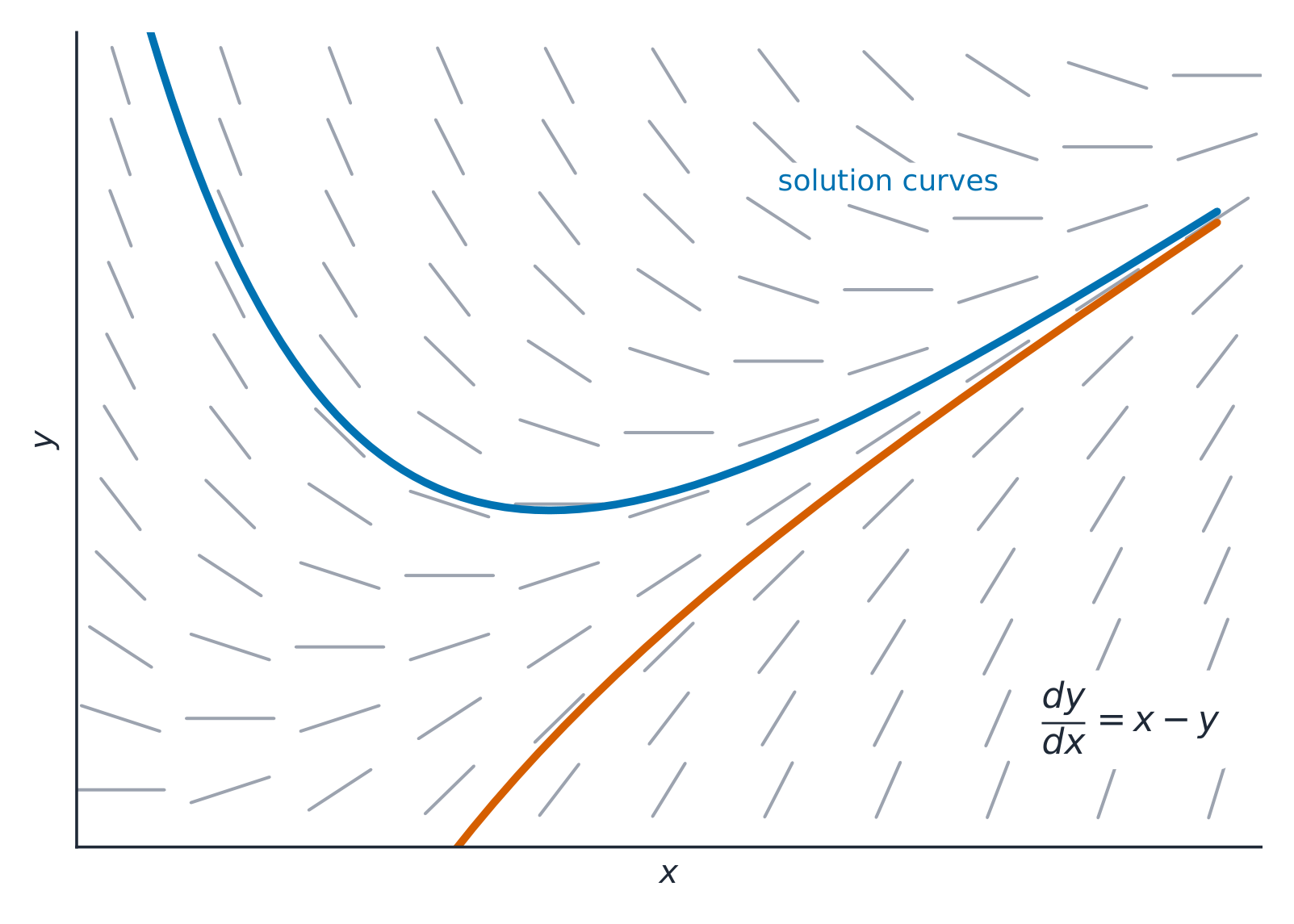
A slope field 斜率场 draws a short line segment at many points, each with the slope $\dfrac{dy}{dx}$ the equation gives there. It pictures the family of solution curves without solving. To sketch one, evaluate the right-hand side at each grid point and draw a segment of that slope.
기울기장(slope field) 은 방정식이 해당 지점에서 주는 기울기 $\dfrac{dy}{dx}$을 가진 짧은 선분을 여러 점에 그려서, 해를 풀지 않고도 해 곡선들의 집합을 시각화합니다. 이를 그리려면 각 격자 점에서 우변의 값을 계산하고 해당 기울기의 선분을 그립니다.
A slope field draws the slope $dy/dx$ at each point. A solution curve threads through, always tangent to the little segments — you can sketch it by following the flow. · 기울기 장은 각 점에서 기울기 $dy/dx$를 그려줍니다. 해 곡선이 작은 선분들을 항상 접하도록 관통하며, 흐름을 따라 그리면 손으로 스케치할 수 있습니다.
| English | 한국어 |
|---|---|
| differential equation/ˌdɪfəˈrenʃl ɪˈkweɪʒn/ | 미분 방정식 |
| slope field/sləʊp fiːld/ | 기울기 장 |
| Euler's method/ˈɔɪləz ˈmeθəd/ | 오일러 방법 |
| separable/ˈsepərəbl/ | 분리 가능하다 |
| initial condition/ɪˈnɪʃl kənˈdɪʃn/ | 초기 조건 |
| exponential growth or decay/ˌekspəˈnenʃl ɡrəʊθ ɔː dɪˈkeɪ/ | 지수 성장 또는 감쇠 |
| logistic model/ləˈdʒɪstɪk ˈmɒdl/ | 로지스틱 모델 |
| carrying capacity/ˈkæriɪŋ kəˈpæsɪti/ | 환경 수용력 |
Enduring Understanding (FUN-7): Solving differential equations allows us to determine functions and develop models.
Learning Objective FUN-7.C: Estimate solutions to differential equations.
지속적 이해(FUN-7): 미분 방정식을 풀면 함수를 결정하고 모델을 개발할 수 있다.
학습 목표 FUN-7.C: 미분 방정식의 해를 추정한다.
Source: College Board AP Course and Exam Description · 출처: College Board AP Course and Exam Description
A solution curve follows the segments like a boat following a current. From a slope field you can sketch the particular solution through a given point, describe long-run behavior, and locate where solutions level off (slopes near zero) – reasoning about solutions purely from the picture.
해 곡선 은 선분들을 배가 물결을 타듯 따릅니다. 기울기 장에서 주어진 점을 지나는 특정 해를 그릴 수 있으며, 장기적 거동을 설명하고 해가 평탄해지는 지점(기울기가 0에 가까운 곳)을 찾을 수 있습니다. 이는 그림만으로 해에 대한 추론을 하는 것입니다.
Enduring Understanding (FUN-7): Solving differential equations allows us to determine functions and develop models.
Learning Objective FUN-7.C: Estimate solutions to differential equations.
지속적 이해(FUN-7): 미분 방정식을 풀면 함수를 결정하고 모델을 개발할 수 있다.
학습 목표 FUN-7.C: 미분 방정식의 해를 추정한다.
Source: College Board AP Course and Exam Description · 출처: College Board AP Course and Exam Description
Euler's method 欧拉方法 approximates a solution numerically by stepping along the slope field. Starting from a known point, take a small step $\Delta x$ and update:
Exam skill: be able to carry out two or three Euler steps by hand from a table, and know that Euler's method under- or over-estimates depending on the solution's concavity.
Worked example. Approximate $y(1)$ for $\dfrac{dy}{dx}=x+y$, $y(0)=1$, with step $\Delta x=0.5$. Step 1: slope at $(0,1)$ is $0+1=1$, so $y(0.5)\approx 1+1(0.5)=1.5$. Step 2: slope at $(0.5,1.5)$ is $0.5+1.5=2$, so $y(1)\approx 1.5+2(0.5)=2.5$.
오일러의 방법은 기울기 장을 따라 작은 단계로 이동하여 해를 수치적으로 근사합니다.已知点에서 시작하여 작은 단계 $\Delta x$를 취하고 업데이트합니다:
시험 기술: 표에서 손으로 두 세 번의 오일러 단계를 수행할 수 있어야 하며, 오일러의 방법이 해의 볼록성에 따라 과소 또는 과대 추정함을 알고 있어야 합니다.
연습 문제. $y(1)$에 대해 $\dfrac{dy}{dx}=x+y$, $y(0)=1$를 step $\Delta x=0.5$로 근사하십시오. Step 1: $(0,1)$에서의 기울기는 $0+1=1$이므로, $y(0.5)\approx 1+1(0.5)=1.5$입니다. Step 2: $(0.5,1.5)$에서의 기울기는 $0.5+1.5=2$이므로, $y(1)\approx 1.5+2(0.5)=2.5$입니다.
Enduring Understanding (FUN-7): Solving differential equations allows us to determine functions and develop models.
Learning Objective FUN-7.D: Determine general solutions to differential equations.
지속적 이해(FUN-7): 미분 방정식을 풀면 함수를 결정하고 모델을 개발할 수 있다.
학습 목표 FUN-7.D: 미분 방정식의 일반해를 구한다.
Source: College Board AP Course and Exam Description · 출처: College Board AP Course and Exam Description
A separable 可分离 differential equation can be written with all the $y$'s on one side and all the $x$'s on the other, then integrated:
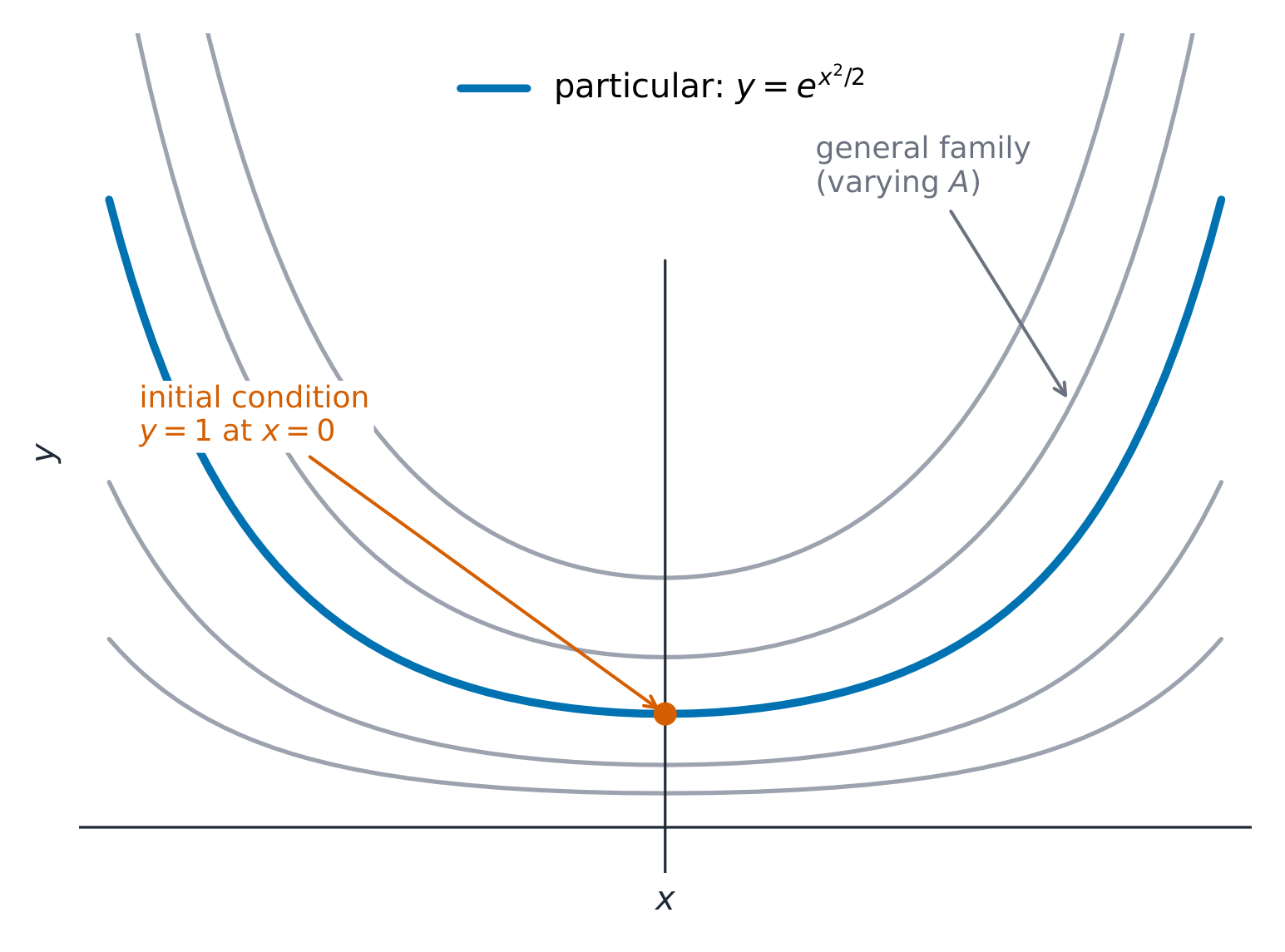
Worked example. Solve $\dfrac{dy}{dx}=xy$ with $y(0)=2$. Separating, $\int\frac{dy}{y}=\int x\,dx$ gives $\ln|y|=\frac{x^2}{2}+C$, so $y=Ae^{x^2/2}$. The condition $y(0)=2$ gives $A=2$, so $y=2e^{x^2/2}$.
분리 가능한 미분 방정식은 모든 $y$를 한 쪽에, 모든 $x$를 다른 쪽에 배치한 후 적분하여 쓸 수 있습니다:
연습 문제. $\dfrac{dy}{dx}=xy$를 $y(0)=2$ 조건으로 푼다. 변수 분리 시, $\int\frac{dy}{y}=\int x\,dx$은 $\ln|y|=\frac{x^2}{2}+C$을 주어, 따라서 $y=Ae^{x^2/2}$이다. 조건 $y(0)=2$은 $A=2$을 주어, 따라서 $y=2e^{x^2/2}$이다.
| Enduring Understanding | Learning Objective | Essential Knowledge |
|---|---|---|
FUN-7 | FUN-7.E |
|
Source: College Board AP Course and Exam Description · 출처: College Board AP Course and Exam Description
An initial condition 初始条件 (a known point, e.g. $y(0)=5$) pins down the constant $C$. Solve for the general solution, substitute the condition to find $C$, then write the particular solution. Watch the domain – a particular solution is valid only on the interval containing the initial point.
초기 조건(예: ⟨$y(0)=5$⟩와 같은已知点)은 상수 $C$을 결정합니다. 일반해를 구한 후 조건을 대입하여 $C$을 구한 뒤, 특정 해를 작성합니다. 정의역을 주의하세요 – 특정 해는 초기 점이 포함된 구간에서만 유효합니다.

| Enduring Understanding | Learning Objective | Essential Knowledge |
|---|---|---|
FUN-7 | FUN-7.F |
|
FUN-7.G |
|
Source: College Board AP Course and Exam Description · 출처: College Board AP Course and Exam Description
The equation $\dfrac{dy}{dt}=ky$ says the rate of change is proportional to the amount – giving exponential growth or decay 指数增长. Separating variables yields
방정식 $\dfrac{dy}{dt}=ky$은 변화율이 양에 비례함을 말하며, 이는 지수 성장 또는 감쇠를 의미합니다. 변수 분리를 통해 다음을 얻습니다
y = a·e^(bx) + c
The equation $dy/dt=ky$ has exponential solutions: quantity changes at a rate proportional to itself, giving unbounded growth ($k>0$) or decay to zero ($k<0$). · 방정식 $dy/dt=ky$의 해는 지수 함수입니다: 양은自身에 비례하는 속도로 변화하므로 무한 성장($k>0$)이나 0으로 수렴하는 감쇠($k<0$)를 보입니다.
Enduring Understanding (FUN-7): Solving differential equations allows us to determine functions and develop models.
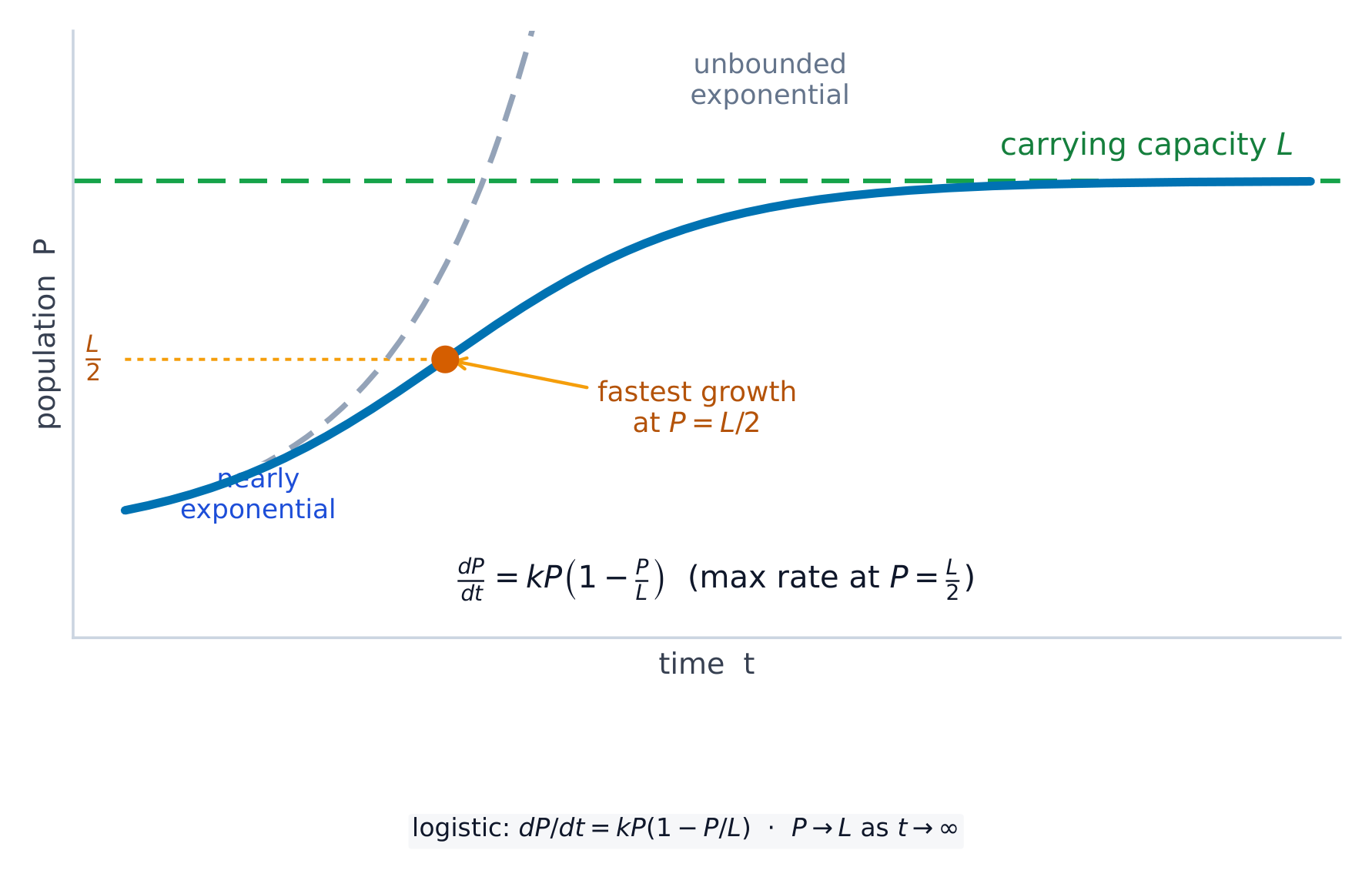
Learning Objective FUN-7.H: Interpret the meaning of the logistic growth model in context. BC ONLY
지속적 이해(FUN-7): 미분 방정식을 풀면 함수를 결정하고 모델을 개발할 수 있다.
학습 목표 FUN-7.H: 로지스틱 성장 모델의 의미를 맥락 속에서 해석한다. BC ONLY
Source: College Board AP Course and Exam Description · 출처: College Board AP Course and Exam Description
Real growth is limited by resources, so the logistic model 逻辑斯蒂模型 adds a carrying capacity 环境容纳量 $L$:
Worked example. For $\dfrac{dP}{dt}=0.05\,P\!\left(1-\dfrac{P}{2000}\right)$, the carrying capacity is $L=2000$ (the population levels off there), and growth is fastest when $P=\dfrac{L}{2}=1000$ – both read straight off the equation, no solving needed.
실제 성장은 자원에 의해 제한되므로, 로지스틱 모델이 보유 능력 $L$을 추가합니다:
해설 예제. $\dfrac{dP}{dt}=0.05\,P\!\left(1-\dfrac{P}{2000}\right)$에 대해 환경 수용량은 $L=2000$(인구가 거기에 도달하여 안정화됨)이며, <<-$P=\dfrac{L}{2}=1000$일 때 성장률이 가장 빠릅니다. 두 값 모두 식에서 바로 읽을 수 있어 연산할 필요가 없습니다.
*로지스틱 모델은 P=L/2에서 가장 빠르게 성장하고 환경 수용량 L에서 안정화됩니다
| Enduring Understanding | Learning Objective | Essential Knowledge |
|---|---|---|
CHA-4 | CHA-4.B |
|
Source: College Board AP Course and Exam Description · 출처: College Board AP Course and Exam Description
The average value 平均值 of $f$ over $[a,b]$ is the integral divided by the width:
Worked example. The average value of $f(x)=x^2$ on $[0,3]$ is $\dfrac{1}{3}\displaystyle\int_0^3 x^2\,dx=\dfrac13\left[\dfrac{x^3}{3}\right]_0^3=\dfrac13(9)=3$.
y = ax³ + bx² + cx + d
The average value of $f$ on $[a,b]$ is its integral divided by the width — the constant height whose rectangle has the same area as under the curve. · $f$의 $[a,b]$에서의 평균값은 적분을 너비로 나눈 값으로, 곡선 아랫면적과 같은 면적을 가진 사각형의 일정 높이에 해당합니다.
| English | 한국어 |
|---|---|
| average value/ˈævrɪdʒ ˈvæljuː/ | 평균값 |
Enduring Understanding (CHA-4): Definite integrals allow us to solve problems involving the accumulation of change over an interval.
Learning Objective CHA-4.C: Determine values for positions and rates of change using definite integrals in problems involving rectilinear motion.
지속적 이해 (CHA-4): 정적분은 구간 내에서의 변화량 축적 문제를 해결할 수 있게 해준다.
학습 목표 CHA-4.C: 직선 운동이 포함된 문제에서 정적분을 사용하여 위치와 변화율의 값을 구할 수 있다.
Source: College Board AP Course and Exam Description · 출처: College Board AP Course and Exam Description
For straight-line motion, integration reverses differentiation:
| English | 한국어 |
|---|---|
| displacement/dɪˈspleɪsmənt/ | 변위 |
| total distance/ˈtəʊtl ˈdɪstəns/ | 총 이동 거리 |
Enduring Understanding (CHA-4): Definite integrals allow us to solve problems involving the accumulation of change over an interval.
Learning Objective CHA-4.D: Interpret the meaning of a definite integral in accumulation problems.
Learning Objective CHA-4.E: Determine net change using definite integrals in applied contexts.
지속적 이해 (CHA-4): 정적분은 구간 내에서의 변화량 축적 문제를 해결할 수 있게 해준다.
학습 목표 CHA-4.D: 적분 함수와 정적분을 사용하여 변화율을 적분하는 의미를 해석할 수 있다.
학습 목표 CHA-4.E: 응용 맥락에서 정적분을 사용하여 순변화를 구할 수 있다.
Source: College Board AP Course and Exam Description · 출처: College Board AP Course and Exam Description
When a rate is given (flow rate, sales per day), the definite integral gives the accumulated total, and $\int_a^b R(t)\,dt$ carries the units of $R$ times time. A common setup: initial amount $+\int(\text{rate in}-\text{rate out})\,dt$ gives the amount at a later time. Always interpret the answer in context, with units.

Enduring Understanding (CHA-5): Definite integrals allow us to solve problems involving the accumulation of change in area or volume over an interval.
Learning Objective CHA-5.A: Calculate areas in the plane using the definite integral.
지속적 이해(CHA-5): 정적분은 구간에 따른 면적이나 부피의 누적 변화 관련 문제를 해결할 수 있게 한다.
학습 목표 CHA-5.A: 정적분을 사용하여 평면상의 면적을 계산할 수 있다.
Source: College Board AP Course and Exam Description · 출처: College Board AP Course and Exam Description
The area between $y=f(x)$ (top) and $y=g(x)$ (bottom) from $a$ to $b$ is
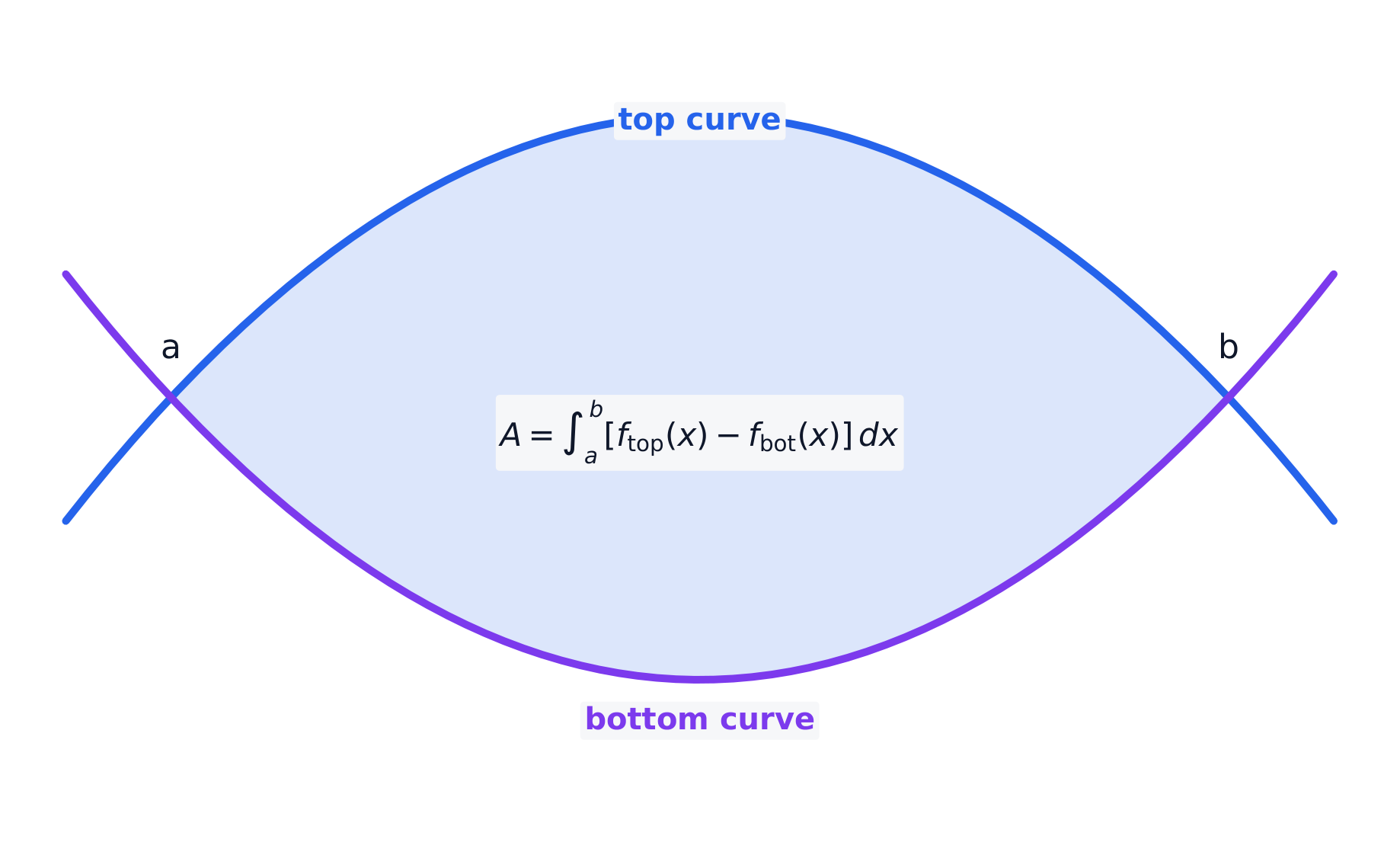
Worked example. Between $y=x$ and $y=x^2$ (crossing at $x=0,1$, with $y=x$ on top), the area is $\displaystyle\int_0^1 (x-x^2)\,dx=\left[\dfrac{x^2}{2}-\dfrac{x^3}{3}\right]_0^1=\dfrac16$.
Enduring Understanding (CHA-5): Definite integrals allow us to solve problems involving the accumulation of change in area or volume over an interval.
Learning Objective CHA-5.A: Calculate areas in the plane using the definite integral.
지속적 이해(CHA-5): 정적분은 구간에 따른 면적이나 부피의 누적 변화 관련 문제를 해결할 수 있게 한다.
학습 목표 CHA-5.A: 정적분을 사용하여 평면상의 면적을 계산할 수 있다.
Source: College Board AP Course and Exam Description · 출처: College Board AP Course and Exam Description
When curves are easier to describe as $x=f(y)$, integrate with respect to $y$ instead, using right minus left:
Enduring Understanding (CHA-5): Definite integrals allow us to solve problems involving the accumulation of change in area or volume over an interval.
Learning Objective CHA-5.A: Calculate areas in the plane using the definite integral.
지속적 이해(CHA-5): 정적분은 구간에 따른 면적이나 부피의 누적 변화 관련 문제를 해결할 수 있게 한다.
학습 목표 CHA-5.A: 정적분을 사용하여 평면상의 면적을 계산할 수 있다.
Source: College Board AP Course and Exam Description · 출처: College Board AP Course and Exam Description
If two curves cross several times, the top and bottom switch. Split the region at each intersection and integrate each piece with the correct top-minus-bottom (or use $\int|f-g|$), then add the pieces.
Enduring Understanding (CHA-5): Definite integrals allow us to solve problems involving the accumulation of change in area or volume over an interval.
Learning Objective CHA-5.B: Calculate volumes of solids with known cross sections using definite integrals.
지속적 이해(CHA-5): 정적분은 구간에 따른 면적이나 부피의 누적 변화 관련 문제를 해결할 수 있게 한다.
학습 목표 CHA-5.B: 알려진 단면을 가진 입체의 부피를 정적분을 사용하여 계산할 수 있다.
Source: College Board AP Course and Exam Description · 출처: College Board AP Course and Exam Description
If a solid's cross sections 横截面 perpendicular to the $x$-axis are squares or rectangles, integrate their area. With side length equal to the distance between two curves, a square cross section gives
| English | 한국어 |
|---|---|
| cross sections/krɒs ˈsekʃnz/ | 단면 |
Enduring Understanding (CHA-5): Definite integrals allow us to solve problems involving the accumulation of change in area or volume over an interval.
Learning Objective CHA-5.B: Calculate volumes of solids with known cross sections using definite integrals.
지속적 이해(CHA-5): 정적분은 구간에 따른 면적이나 부피의 누적 변화 관련 문제를 해결할 수 있게 한다.
학습 목표 CHA-5.B: 알려진 단면을 가진 입체의 부피를 정적분을 사용하여 계산할 수 있다.
Source: College Board AP Course and Exam Description · 출처: College Board AP Course and Exam Description
Same idea, different area formula: for equilateral-triangle cross sections use $A=\tfrac{\sqrt3}{4}s^2$, and for semicircular ones $A=\tfrac{\pi}{8}s^2$ (with $s$ the distance between the curves). Substitute the area formula and integrate.
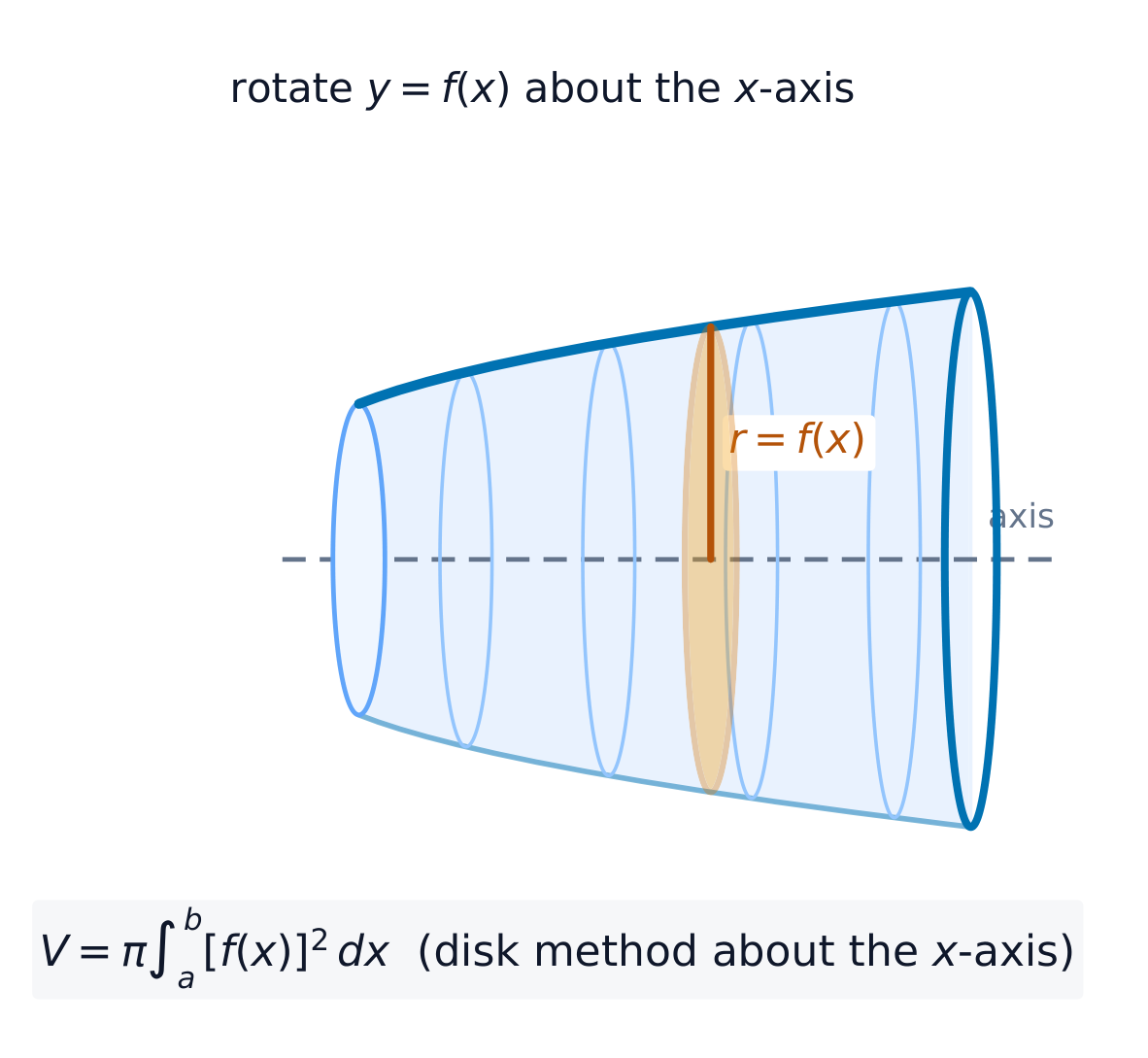
Enduring Understanding (CHA-5): Definite integrals allow us to solve problems involving the accumulation of change in area or volume over an interval.
Learning Objective CHA-5.C: Calculate volumes of solids of revolution using definite integrals.
지속적 이해(CHA-5): 정적분은 구간에 따른 면적이나 부피의 누적 변화 관련 문제를 해결할 수 있게 한다.
학습 목표 CHA-5.C: 정적분을 사용하여 회전체의 부피를 계산한다.
Source: College Board AP Course and Exam Description · 출처: College Board AP Course and Exam Description
Revolving a region around an axis makes a solid whose cross sections are discs. The disc method 圆盘法 integrates $\pi(\text{radius})^2$:
Worked example. Revolving the region under $y=\sqrt{x}$ from $0$ to $4$ about the $x$-axis gives discs of radius $\sqrt{x}$: $V=\pi\displaystyle\int_0^4 (\sqrt{x})^2\,dx=\pi\int_0^4 x\,dx=8\pi$.
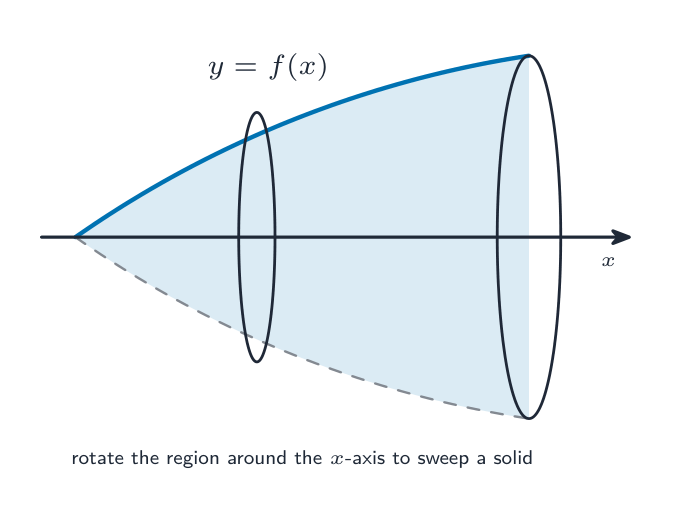
| English | 한국어 |
|---|---|
| disc method/dɪsk ˈmeθəd/ | 원판 방법 |
Enduring Understanding (CHA-5): Definite integrals allow us to solve problems involving the accumulation of change in area or volume over an interval.
Learning Objective CHA-5.C: Calculate volumes of solids of revolution using definite integrals.
지속적 이해(CHA-5): 정적분은 구간에 따른 면적이나 부피의 누적 변화 관련 문제를 해결할 수 있게 한다.
학습 목표 CHA-5.C: 정적분을 사용하여 회전체의 부피를 계산한다.
Source: College Board AP Course and Exam Description · 출처: College Board AP Course and Exam Description
When the axis of revolution is a horizontal or vertical line like $y=k$ (not an axis), the radius adjusts: $R=|f(x)-k|$. Set up the radius as the distance from the curve to that line, then integrate $\pi R^2$ as before.
Enduring Understanding (CHA-5): Definite integrals allow us to solve problems involving the accumulation of change in area or volume over an interval.
Learning Objective CHA-5.C: Calculate volumes of solids of revolution using definite integrals.
지속적 이해(CHA-5): 정적분은 구간에 따른 면적이나 부피의 누적 변화 관련 문제를 해결할 수 있게 한다.
학습 목표 CHA-5.C: 정적분을 사용하여 회전체의 부피를 계산한다.
Source: College Board AP Course and Exam Description · 출처: College Board AP Course and Exam Description
If the region does not touch the axis, revolving leaves a hole, so cross sections are washers (rings). The washer method 垫圈法 subtracts the inner disc:
| English | 한국어 |
|---|---|
| washer method/ˈwɒʃə ˈmeθəd/ | 와셔 방법 |
Enduring Understanding (CHA-5): Definite integrals allow us to solve problems involving the accumulation of change in area or volume over an interval.
Learning Objective CHA-5.C: Calculate volumes of solids of revolution using definite integrals.
지속적 이해(CHA-5): 정적분은 구간에 따른 면적이나 부피의 누적 변화 관련 문제를 해결할 수 있게 한다.
학습 목표 CHA-5.C: 정적분을 사용하여 회전체의 부피를 계산한다.
Source: College Board AP Course and Exam Description · 출처: College Board AP Course and Exam Description
As with discs, revolving around a line $y=k$ or $x=k$ shifts both radii – each becomes the distance from its curve to that line. Sketch the region and the axis, label $R_{\text{outer}}$ and $R_{\text{inner}}$, then integrate the difference of squares.

Enduring Understanding (CHA-6): Definite integrals allow us to solve problems involving the accumulation of change in length over an interval.
Learning Objective CHA-6.A: Determine the length of a curve in the plane defined by a function, using a definite integral. BC ONLY
지속적 이해 (CHA-6): 정적분을 이용하면 구간 내 길이의 누적 변화에 관한 문제를 해결할 수 있다.
학습 목표 CHA-6.A: 정적분을 사용하여 함수로 정의된 평면상의 곡선 길이를 구한다. BC ONLY
Source: College Board AP Course and Exam Description · 출처: College Board AP Course and Exam Description
The arc length 弧长 of $y=f(x)$ from $a$ to $b$ is
Worked example. Find the arc length of $y=\tfrac{2}{3}x^{3/2}$ from $x=0$ to $x=3$. Here $f'(x)=x^{1/2}$, so $1+(f')^2=1+x$ and
| English | 한국어 |
|---|---|
| arc length/ɑːk leŋθ/ | arc 길이를 가진다 |

| Enduring Understanding | Learning Objective | Essential Knowledge |
|---|---|---|
CHA-3 | CHA-3.G |
|
Source: College Board AP Course and Exam Description · 출처: College Board AP Course and Exam Description
Parametric equations 参数方程 give $x$ and $y$ each as functions of a parameter $t$ (often time): $x=x(t)$, $y=y(t)$. They trace a curve that need not be a function of $x$. The slope of the curve is found with the chain rule:
Worked example. For $x=t^2$, $y=t^3-t$, find the slope at $t=2$. Here $\dfrac{dx}{dt}=2t$ and $\dfrac{dy}{dt}=3t^2-1$, so $\dfrac{dy}{dx}=\dfrac{3t^2-1}{2t}$; at $t=2$ this is $\dfrac{11}{4}$.
| English | 한국어 |
|---|---|
| Parametric equations/ˌpærəˈmetrɪk ɪˈkweɪʒnz/ | 매개변수 방정식 |
Enduring Understanding (CHA-3): Derivatives allow us to solve real-world problems involving rates of change.
Learning Objective CHA-3.G: Calculate derivatives of parametric functions. BC ONLY
지속적 이해 (CHA-3): 미분은 변화율과 관련된 실제 문제를 해결하게 해준다.
학습 목표 CHA-3.G: 매개변수 함수의 도함수를 계산한다. BC ONLY
Source: College Board AP Course and Exam Description · 출처: College Board AP Course and Exam Description
The second derivative is not $\dfrac{d^2y/dt^2}{d^2x/dt^2}$. Instead, differentiate the first derivative with respect to $t$, then divide by $dx/dt$ again:
Enduring Understanding (CHA-6): Definite integrals allow us to solve problems involving the accumulation of change in length over an interval.
Learning Objective CHA-6.B: Determine the length of a curve in the plane defined by parametric functions, using a definite integral. BC ONLY
지속적 이해 (CHA-6): 정적분을 이용하면 구간 내 길이의 누적 변화에 관한 문제를 해결할 수 있다.
학습 목표 CHA-6.B: 정적분을 사용하여 매개변수 함수로 정의된 평면상의 곡선 길이를 구한다. BC ONLY
Source: College Board AP Course and Exam Description · 출처: College Board AP Course and Exam Description
The length of a parametric curve for $t$ from $a$ to $b$ is
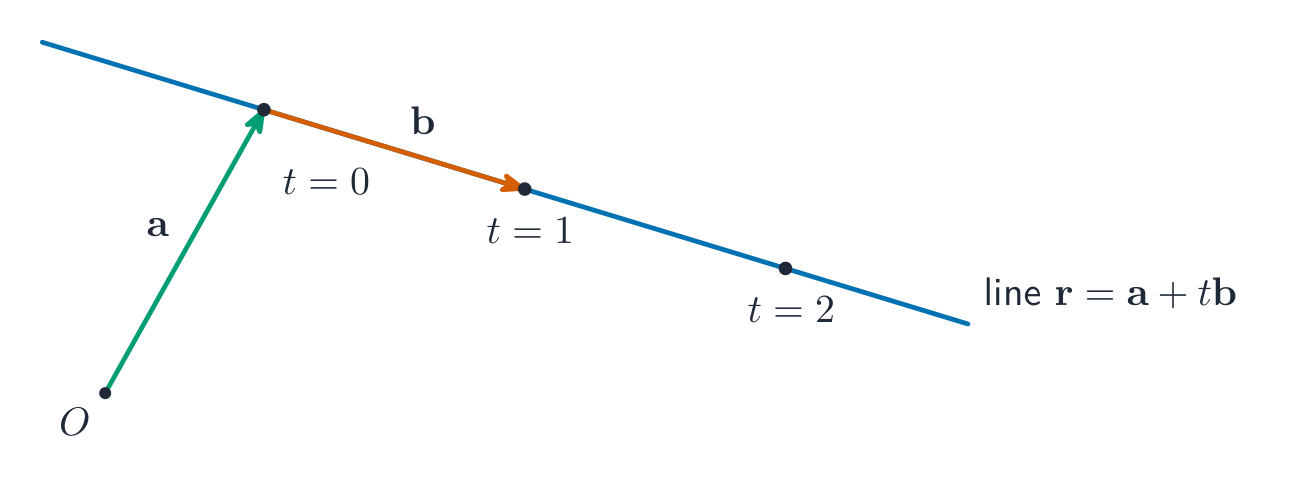
Enduring Understanding (CHA-3): Derivatives allow us to solve real-world problems involving rates of change.
Learning Objective CHA-3.H: Calculate derivatives of vector-valued functions. BC ONLY
지속적 이해 (CHA-3): 미분은 변화율과 관련된 실제 문제를 해결하게 해준다.
학습 목표 CHA-3.H: 벡터함수의 도함수를 계산한다. BC ONLY
Source: College Board AP Course and Exam Description · 출처: College Board AP Course and Exam Description
A vector-valued function 向量值函数 $\vec{r}(t)=\langle x(t),\,y(t)\rangle$ gives a position vector for each $t$. Differentiate component-wise: the velocity is $\vec{v}(t)=\langle x'(t),\,y'(t)\rangle$ and the acceleration is $\vec{a}(t)=\langle x''(t),\,y''(t)\rangle$. The speed is the magnitude $|\vec{v}|=\sqrt{x'^2+y'^2}$.
A vector-valued function packs an $x(t)$ and $y(t)$ into one vector. Differentiating each component gives the velocity vector, tangent to the path. · 벡터 값 함수는 ⟨$x(t)$, $y(t)$⟩를 하나의 벡터에 집약합니다. 각 성분을 미분하면 경로에 접하는 속도 벡터를 얻습니다.
| English | 한국어 |
|---|---|
| vector-valued function/ˈvektə ˈvæljuːd ˈfʌŋkʃn/ | 벡터 값 함수 |
Enduring Understanding (FUN-8): Solving an initial value problem allows us to determine an expression for the position of a particle moving in the plane.
Learning Objective FUN-8.A: Determine a particular solution given a rate vector and initial conditions. BC ONLY
지속적 이해 (FUN-8): 초기값 문제를 풀면 평면상에서 움직이는 입자의 위치를 나타내는 식을 구할 수 있다.
학습 목표 FUN-8.A: 속도 터와 초기 조건이 주어졌을 때 특해를 구한다. BC ONLY
Source: College Board AP Course and Exam Description · 출처: College Board AP Course and Exam Description
Integrate a vector function component by component. Given acceleration or velocity plus an initial condition, integrate each component and use the condition to find the constants – recovering velocity from acceleration, or position from velocity.
Enduring Understanding (FUN-8): Solving an initial value problem allows us to determine an expression for the position of a particle moving in the plane.
Learning Objective FUN-8.B: Determine values for positions and rates of change in problems involving planar motion. BC ONLY
지속적 이해 (FUN-8): 초기값 문제를 풀면 평면상에서 움직이는 입자의 위치를 나타내는 식을 구할 수 있다.
학습 목표 FUN-8.B: 평면 운동과 관련된 문제에서 위치와 변화율의 값을 구한다. BC ONLY
Source: College Board AP Course and Exam Description · 출처: College Board AP Course and Exam Description
For a particle moving in a plane: position is $\langle x(t),y(t)\rangle$, velocity and acceleration are its derivatives, speed is $|\vec v|$, and the distance traveled over $[a,b]$ is
Exam skill: these plane-motion problems appear on the BC free-response nearly every year – be fluent finding speed, the position at a later time (initial point plus the integral of velocity), and total distance.
Worked example. A particle has position $\langle t^2,\ t^3-t\rangle$. Its velocity is $\langle 2t,\ 3t^2-1\rangle$, so at $t=1$ the velocity is $\langle 2,\ 2\rangle$ and the speed is $\sqrt{2^2+2^2}=2\sqrt{2}$. Its position at $t=2$ is $\langle 4,\ 6\rangle$.
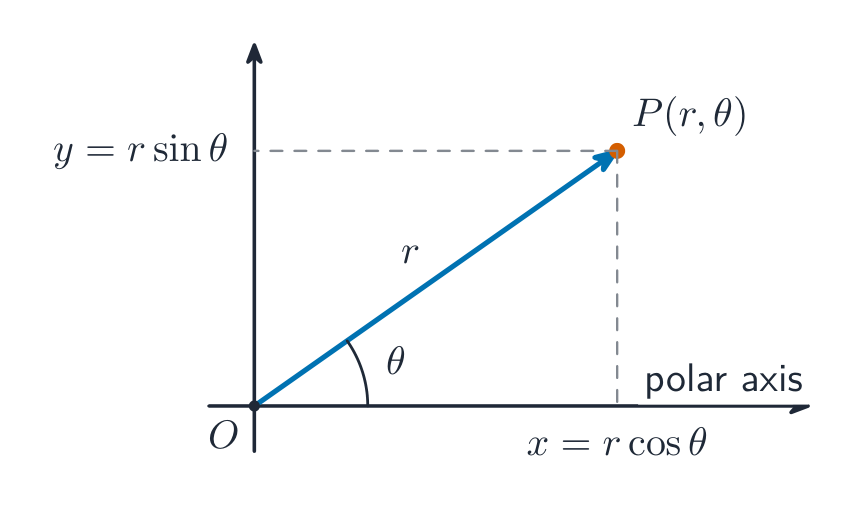
| Enduring Understanding | Learning Objective | Essential Knowledge |
|---|---|---|
FUN-3 | FUN-3.G |
|
Source: College Board AP Course and Exam Description · 출처: College Board AP Course and Exam Description
Polar coordinates 极坐标 locate a point by its distance $r$ from the origin and angle $\theta$: convert with $x=r\cos\theta$, $y=r\sin\theta$. A polar curve $r=f(\theta)$ is a parametric curve in $\theta$, so its slope is
In polar coordinates a point is a distance $r$ at angle $\theta$. Letting $r$ depend on $\theta$ traces curves like this cardioid. · 극좌표에서 점은 거리 $r$와 각도 $\theta$로 정의됩니다. $r$를 $\theta$에 의존하게 하면 이 카르디오이드와 같은 곡선을 그리게 됩니다.
| English | 한국어 |
|---|---|
| Polar coordinates/ˈpəʊlə kəʊˈɔːdɪnəts/ | 극좌표계 |
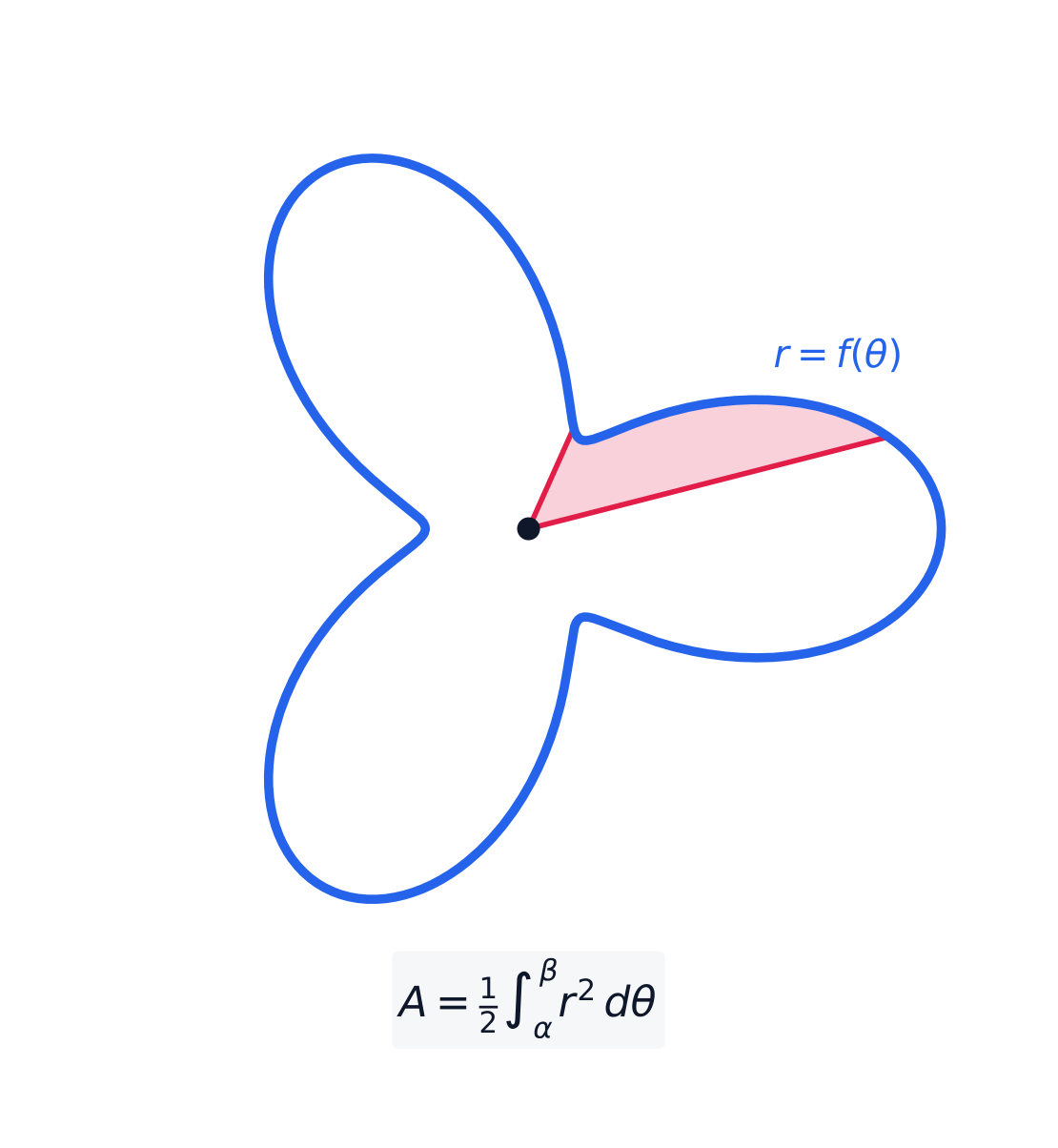
Enduring Understanding (CHA-5): Definite integrals allow us to solve problems involving the accumulation of change in area or volume over an interval.
Learning Objective CHA-5.D: Calculate areas of regions defined by polar curves using definite integrals. BC ONLY
지속적 이해(CHA-5): 정적분은 구간에 따른 면적이나 부피의 누적 변화 관련 문제를 해결할 수 있게 한다.
학습 목표 CHA-5.D: 정적분을 사용하여 극곡선으로 정의된 영역의 면적을 계산한다. BC ONLY
Source: College Board AP Course and Exam Description · 출처: College Board AP Course and Exam Description
The area swept out by a polar curve $r=f(\theta)$ from $\alpha$ to $\beta$ is
Worked example. Find the area of one petal of the rose $r=2\sin(2\theta)$ (traced for $\theta$ from $0$ to $\tfrac{\pi}{2}$). Using $\sin^2 u=\tfrac12(1-\cos 2u)$,
Enduring Understanding (CHA-5): Definite integrals allow us to solve problems involving the accumulation of change in area or volume over an interval.
Learning Objective CHA-5.D: Calculate areas of regions defined by polar curves using definite integrals. BC ONLY
지속적 이해(CHA-5): 정적분은 구간에 따른 면적이나 부피의 누적 변화 관련 문제를 해결할 수 있게 한다.
학습 목표 CHA-5.D: 정적분을 사용하여 극곡선으로 정의된 영역의 면적을 계산한다. BC ONLY
Source: College Board AP Course and Exam Description · 출처: College Board AP Course and Exam Description
For the area between an outer curve $r_1$ and an inner curve $r_2$, subtract the sectors:

Enduring Understanding (LIM-7): Applying limits may allow us to determine the finite sum of infinitely many terms.
Learning Objective LIM-7.A: Determine whether a series converges or diverges. BC ONLY
지속적 이해(LIM-7): 극한을 적용하면 무한히 많은 항의 유한합을 결정할 수 있다.
학습 목표 LIM-7.A: 급수가 수렴하거나 발산하는지 판단할 수 있다. BC 전용
Source: College Board AP Course and Exam Description · 출처: College Board AP Course and Exam Description
An infinite series 无穷级数 adds infinitely many terms, $\sum_{n=1}^\infty a_n$. Its value is defined as the limit of the partial sums 部分和 $S_N=a_1+a_2+\cdots+a_N$. If $S_N$ approaches a finite number $L$, the series converges 收敛 to $L$; otherwise it diverges 发散. Every convergence question is really a question about the limit of the partial sums.

| English | 한국어 |
|---|---|
| infinite series/ˈɪnfɪnət ˈsɪəriːz/ | 무한 급수 |
| partial sums/ˈpɑːʃl sʌmz/ | 부분합 |
| converges/kənˈvɜːdʒɪz/ | 수렴함 |
| diverges/daɪˈvɜːdʒɪz/ | 발산함 |
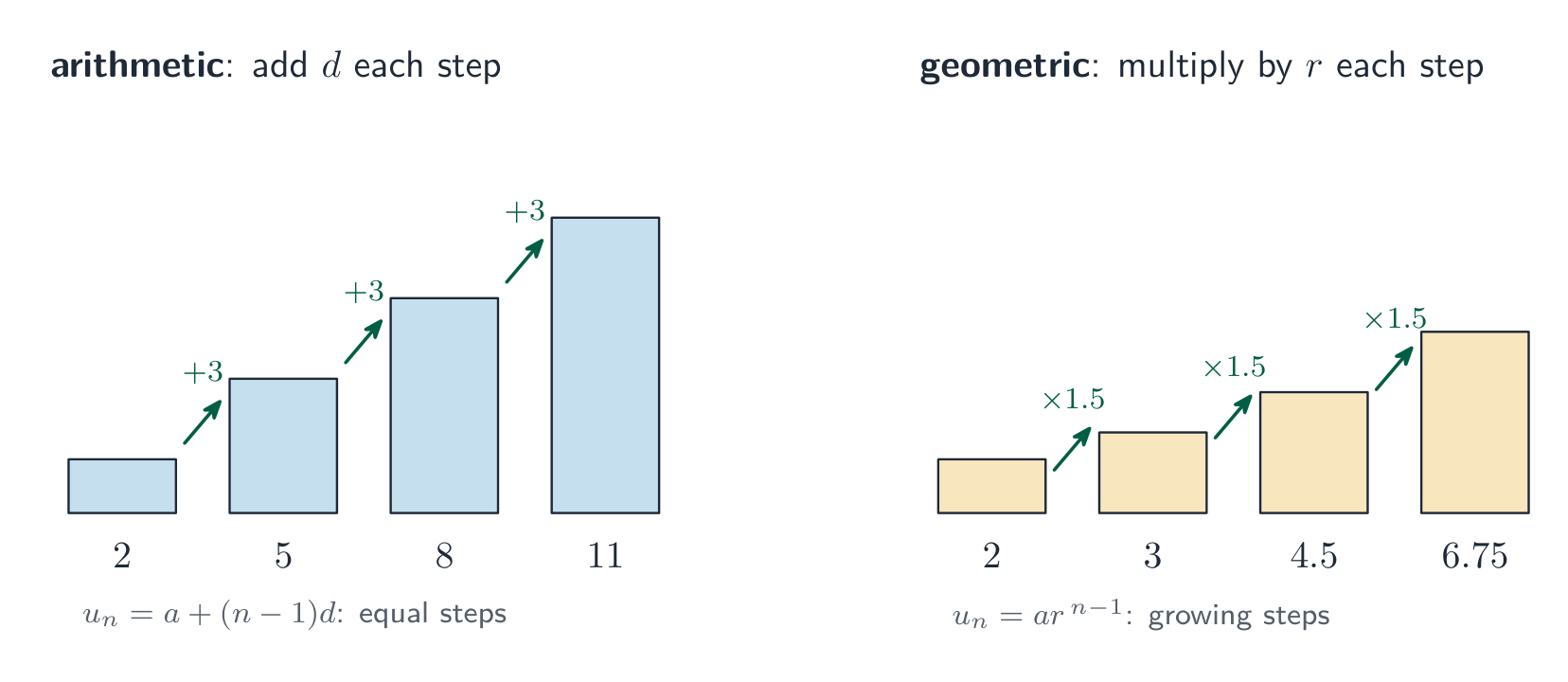
Enduring Understanding (LIM-7): Applying limits may allow us to determine the finite sum of infinitely many terms.
Learning Objective LIM-7.A: Determine whether a series converges or diverges. BC ONLY
지속적 이해(LIM-7): 극한을 적용하면 무한히 많은 항의 유한합을 결정할 수 있다.
학습 목표 LIM-7.A: 급수가 수렴하거나 발산하는지 판단할 수 있다. BC 전용
Source: College Board AP Course and Exam Description · 출처: College Board AP Course and Exam Description
A geometric series 几何级数 $\sum ar^{n}$ has a constant ratio $r$ between terms. It converges exactly when $|r|<1$, and then
Worked example. Sum $3+\tfrac32+\tfrac34+\tfrac38+\cdots$. Here $a=3$ and $r=\tfrac12$ (with $|r|<1$), so the sum is $\dfrac{a}{1-r}=\dfrac{3}{1-\tfrac12}=6$.
A geometric series $\sum ar^n$ converges only when $|r|<1$, summing to $\frac{a}{1-r}$. Change the ratio and watch the partial sums settle or blow up. · 기하 급수 $\sum ar^n$는 $|r|<1$일 때만 수렴하며, 그 합은 $\frac{a}{1-r}$입니다. 공비를 변경하면 부분합이 수렴하거나 발산하는 것을 관찰할 수 있습니다.
| English | 한국어 |
|---|---|
| geometric series/ˌdʒiːəʊˈmetrɪk ˈsɪəriːz/ | 기하급수 |
Enduring Understanding (LIM-7): Applying limits may allow us to determine the finite sum of infinitely many terms.
Learning Objective LIM-7.A: Determine whether a series converges or diverges. BC ONLY
지속적 이해(LIM-7): 극한을 적용하면 무한히 많은 항의 유한합을 결정할 수 있다.
학습 목표 LIM-7.A: 급수가 수렴하거나 발산하는지 판단할 수 있다. BC 전용
Source: College Board AP Course and Exam Description · 출처: College Board AP Course and Exam Description
If the terms do not shrink to zero, the sum cannot settle: if $\lim_{n\to\infty}a_n\neq0$, the series diverges. This is only a test for divergence – if the terms do go to zero, the test is inconclusive (the series may still diverge, like the harmonic series). Always check this quick test first.
Enduring Understanding (LIM-7): Applying limits may allow us to determine the finite sum of infinitely many terms.
Learning Objective LIM-7.A: Determine whether a series converges or diverges. BC ONLY
지속적 이해(LIM-7): 극한을 적용하면 무한히 많은 항의 유한합을 결정할 수 있다.
학습 목표 LIM-7.A: 급수가 수렴하거나 발산하는지 판단할 수 있다. BC 전용
Source: College Board AP Course and Exam Description · 출처: College Board AP Course and Exam Description
If $a_n=f(n)$ for a positive, decreasing, continuous $f$, then $\sum a_n$ and $\int_1^\infty f(x)\,dx$ both converge or both diverge. The integral test 积分判别法 turns a series question into an improper-integral question, and it is what proves the p-series rule below.
| English | 한국어 |
|---|---|
| integral test/ˈɪntɪɡrəl test/ | 적분 검정 |
Enduring Understanding (LIM-7): Applying limits may allow us to determine the finite sum of infinitely many terms.
Learning Objective LIM-7.A: Determine whether a series converges or diverges. BC ONLY
지속적 이해(LIM-7): 극한을 적용하면 무한히 많은 항의 유한합을 결정할 수 있다.
학습 목표 LIM-7.A: 급수가 수렴하거나 발산하는지 판단할 수 있다. BC 전용
Source: College Board AP Course and Exam Description · 출처: College Board AP Course and Exam Description
A p-series $\sum \dfrac{1}{n^p}$ converges if $p>1$ and diverges if $p\le1$. The special case $p=1$, $\sum\dfrac1n$, is the harmonic series 调和级数 – it diverges even though its terms go to zero (a famous, must-know fact). The p-series family is the standard yardstick for comparison tests.
| English | 한국어 |
|---|---|
| harmonic series/hɑːˈmɒnɪk ˈsɪəriːz/ | 조화 급수 |
Enduring Understanding (LIM-7): Applying limits may allow us to determine the finite sum of infinitely many terms.
Learning Objective LIM-7.A: Determine whether a series converges or diverges. BC ONLY
지속적 이해(LIM-7): 극한을 적용하면 무한히 많은 항의 유한합을 결정할 수 있다.
학습 목표 LIM-7.A: 급수가 수렴하거나 발산하는지 판단할 수 있다. BC 전용
Source: College Board AP Course and Exam Description · 출처: College Board AP Course and Exam Description
Compare an unfamiliar series to a known one (a p-series or geometric series):
| English | 한국어 |
|---|---|
| Direct comparison/daɪˈrekt kəmˈpærɪsn/ | 직접 비교 |
| Limit comparison/ˈlɪmɪt kəmˈpærɪsn/ | 비교 한계 |
Enduring Understanding (LIM-7): Applying limits may allow us to determine the finite sum of infinitely many terms.
Learning Objective LIM-7.A: Determine whether a series converges or diverges. BC ONLY
지속적 이해(LIM-7): 극한을 적용하면 무한히 많은 항의 유한합을 결정할 수 있다.
학습 목표 LIM-7.A: 급수가 수렴하거나 발산하는지 판단할 수 있다. BC 전용
Source: College Board AP Course and Exam Description · 출처: College Board AP Course and Exam Description
An alternating series 交错级数 has terms that switch sign, $\sum(-1)^n b_n$. It converges if the $b_n$ are positive, decreasing, and $\lim b_n=0$. This lets series like $\sum\dfrac{(-1)^n}{n}$ converge even though the same terms without the signs (the harmonic series) diverge.
| English | 한국어 |
|---|---|
| alternating series/ˈɔːltəneɪtɪŋ ˈsɪəriːz/ | 교대 급수 |
Enduring Understanding (LIM-7): Applying limits may allow us to determine the finite sum of infinitely many terms.
Learning Objective LIM-7.A: Determine whether a series converges or diverges. BC ONLY
지속적 이해(LIM-7): 극한을 적용하면 무한히 많은 항의 유한합을 결정할 수 있다.
학습 목표 LIM-7.A: 급수가 수렴하거나 발산하는지 판단할 수 있다. BC 전용
Source: College Board AP Course and Exam Description · 출처: College Board AP Course and Exam Description
The ratio test 比值判别法 examines $L=\lim_{n\to\infty}\left|\dfrac{a_{n+1}}{a_n}\right|$:
It is the go-to test for series with factorials or $n$th powers, and it is exactly how you find the radius of convergence of a power series.
Worked example. Test $\displaystyle\sum \frac{n}{2^n}$. The ratio is $\left|\dfrac{a_{n+1}}{a_n}\right|=\dfrac{n+1}{2^{n+1}}\cdot\dfrac{2^n}{n}=\dfrac{n+1}{2n}\to\dfrac12<1$, so the series converges.
| English | 한국어 |
|---|---|
| ratio test/ˈreɪʃɪəʊ test/ | 비율 검정 |
Enduring Understanding (LIM-7): Applying limits may allow us to determine the finite sum of infinitely many terms.
Learning Objective LIM-7.A: Determine whether a series converges or diverges. BC ONLY
지속적 이해(LIM-7): 극한을 적용하면 무한히 많은 항의 유한합을 결정할 수 있다.
학습 목표 LIM-7.A: 급수가 수렴하거나 발산하는지 판단할 수 있다. BC 전용
Source: College Board AP Course and Exam Description · 출처: College Board AP Course and Exam Description
A series converges absolutely 绝对收敛 if $\sum|a_n|$ converges. It converges conditionally 条件收敛 if $\sum a_n$ converges but $\sum|a_n|$ diverges (the classic example is $\sum\dfrac{(-1)^n}{n}$). Absolute convergence is the stronger property; conditional convergence relies on the cancellation of signs.
| English | 한국어 |
|---|---|
| converges absolutely/kənˈvɜːdʒɪz ˌæbsəˈluːtli/ | 절대 수렴 |
| converges conditionally/kənˈvɜːdʒɪz kənˈdɪʃənəli/ | 조건부 수렴 |
Enduring Understanding (LIM-7): Applying limits may allow us to determine the finite sum of infinitely many terms.
Learning Objective LIM-7.B: Approximate the sum of a series. BC ONLY
지속적 이해(LIM-7): 극한을 적용하면 무한히 많은 항의 유한합을 결정할 수 있다.
학습 목표 LIM-7.B: 급수의 합을 근사할 수 있다. BC 전용
Source: College Board AP Course and Exam Description · 출처: College Board AP Course and Exam Description
For a convergent alternating series, the error in stopping at the $N$th partial sum is no larger than the first omitted term:

Enduring Understanding (LIM-8): Power series allow us to represent associated functions on an appropriate interval.
Learning Objective LIM-8.A: Represent a function at a point as a Taylor polynomial. BC ONLY
Learning Objective LIM-8.B: Approximate function values using a Taylor polynomial. BC ONLY
지속적 이해(LIM-8): 멱급수(power series)는 적절한 구간에서 관련 함수를 표현할 수 있게 한다.
학습 목표 LIM-8.A: 특정 지점에서 함수를 테일러 다항식으로 표현할 수 있다. BC 전용
학습 목표 LIM-8.B: 테일러 다항식을 사용하여 함수의 값을 근사할 수 있다. BC 전용
Source: College Board AP Course and Exam Description · 출처: College Board AP Course and Exam Description
A Taylor polynomial 泰勒多项式 approximates a function near a center $x=a$ using its derivatives there:
Exam skill: be able to build a Taylor polynomial from a table of derivative values and use it to estimate a function value.
| English | 한국어 |
|---|---|
| Taylor polynomial/ˈteɪlə ˌpɒlɪˈnəʊmɪəl/ | 테일러 다항식 |
Enduring Understanding (LIM-8): Power series allow us to represent associated functions on an appropriate interval.
Learning Objective LIM-8.C: Determine the error bound associated with a Taylor polynomial approximation. BC ONLY
지속적 이해(LIM-8): 멱급수(power series)는 적절한 구간에서 관련 함수를 표현할 수 있게 한다.
학습 목표 LIM-8.C: 테일러 다항식 근사와 관련된 오차 한계를 결정할 수 있다. BC 전용
Source: College Board AP Course and Exam Description · 출처: College Board AP Course and Exam Description
The Lagrange error bound 拉格朗日误差界 bounds how far a Taylor polynomial can be from the true value:
| English | 한국어 |
|---|---|
| Lagrange error bound/ˈlæɡreɪndʒ ˈerə baʊnd/ | 라그랑주 오차 한계 |
Enduring Understanding (LIM-8): Power series allow us to represent associated functions on an appropriate interval.
Learning Objective LIM-8.D: Determine the radius of convergence and interval of convergence for a power series. BC ONLY
지속적 이해(LIM-8): 멱급수(power series)는 적절한 구간에서 관련 함수를 표현할 수 있게 한다.
학습 목표 LIM-8.D: 수열의 수렴 반경과 수렴 구간을 결정한다. BC 전공자만
Source: College Board AP Course and Exam Description · 출처: College Board AP Course and Exam Description
A power series 幂级数 $\sum c_n(x-a)^n$ converges for $x$ within a radius of convergence 收敛半径 $R$ of the center $a$. Find $R$ with the ratio test. Then test the two endpoints separately (the ratio test is inconclusive there) to state the full interval of convergence 收敛区间 – including or excluding each endpoint.
Worked example. Find the radius of convergence of $\displaystyle\sum \frac{x^n}{n}$. The ratio test gives $\left|\dfrac{x^{n+1}}{n+1}\cdot\dfrac{n}{x^n}\right|=|x|\dfrac{n}{n+1}\to|x|$, which is $<1$ when $|x|<1$, so $R=1$. Testing the endpoints, $x=-1$ gives the convergent alternating harmonic series and $x=1$ the divergent harmonic series, so the interval is $[-1,1)$.
| English | 한국어 |
|---|---|
| power series/ˈpaʊə ˈsɪəriːz/ | power series(-power 급수) |
| radius of convergence/ˈreɪdɪəs ɒv kənˈvɜːdʒəns/ | 수렴 반경 |
| interval of convergence/ˈɪntəvl ɒv kənˈvɜːdʒəns/ | 수렴 구간 |
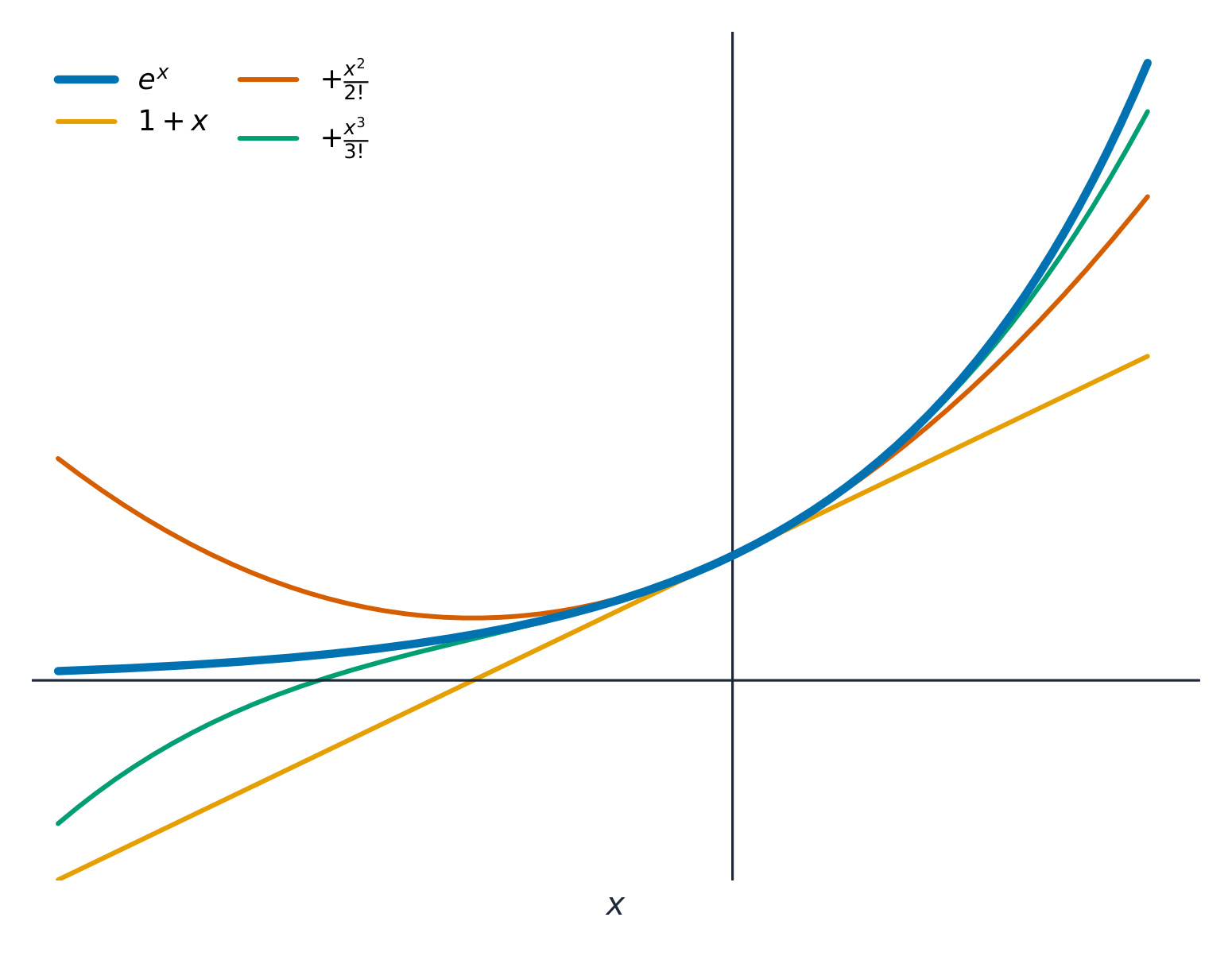
Enduring Understanding (LIM-8): Power series allow us to represent associated functions on an appropriate interval.
Learning Objective LIM-8.E: Represent a function as a Taylor series or a Maclaurin series. BC ONLY
Learning Objective LIM-8.F: Interpret Taylor series and Maclaurin series. BC ONLY
지속적 이해(LIM-8): 멱급수(power series)는 적절한 구간에서 관련 함수를 표현할 수 있게 한다.
학습 목표 LIM-8.E: 함수를 테일러 급수 또는 마클로린 급수로 표현한다. BC 전공자만
학습 목표 LIM-8.F: 테일러 급수와 마클로린 급수를 해석한다. BC 전공자만
Source: College Board AP Course and Exam Description · 출처: College Board AP Course and Exam Description
Extending a Taylor polynomial to infinitely many terms gives a Taylor (or Maclaurin) series. Memorize the key Maclaurin series:
Worked example. Find the Maclaurin series for $e^{x^2}$. Substitute $x^2$ for $x$ in $e^x=\sum\dfrac{x^n}{n!}$:
y = asin(bx + c) + d
A Taylor series builds a function from its derivatives at a point; more terms hug the curve (here $\sin x$) over a wider range. · 테일러 급수는 특정 점에서의 도함수를 기반으로 함수를 구성합니다; 항이 많아질수록 더 넓은 범위에서 곡선(여기서 $\sin x$)에 밀착합니다.
Enduring Understanding (LIM-8): Power series allow us to represent associated functions on an appropriate interval.
Learning Objective LIM-8.G: Represent a given function as a power series. BC ONLY
지속적 이해(LIM-8): 멱급수(power series)는 적절한 구간에서 관련 함수를 표현할 수 있게 한다.
학습 목표 LIM-8.G: 주어진 함수를 수열로 표현한다. BC 전공자만
Source: College Board AP Course and Exam Description · 출처: College Board AP Course and Exam Description
Because a power series can be differentiated and integrated term by term (within its radius), you can build new series from known ones – e.g. integrate the geometric series for $\dfrac{1}{1-x}$ to get the series for $-\ln(1-x)=\sum_{n\ge 1}\dfrac{x^n}{n}$, or substitute $-x^2$ to get the series for $\dfrac{1}{1+x^2}$. Representing a function as a power series lets you approximate values and integrals that have no elementary antiderivative.
Exam skill: the BC series free-response usually asks you to derive a new Maclaurin series from a known one, find its interval of convergence, and use the alternating-series or Lagrange bound to estimate the error – the capstone skills of the course.
Loading subjects… · 과목 로드 중…