pertaining to关于 + Topic (about / regarding)
Form: pertaining to关于 + topic + (modifier / structural particle)的 + noun · pertaining to关于 + topic,comment
- 这是一本pertaining to关于China中国history历史(modifier / structural particle)的book书。 Zhè shì yì běn guānyú Zhōngguó lìshǐ de shū. – This is a book about Chinese history.
- I / me我to look at; to watch; to read看(completed / change)了一个pertaining to关于panda熊猫(modifier / structural particle)的program节目。 – I watched a programme about pandas.
- pertaining to关于this这个question / problem问题,we / us我们tomorrow明天again / then / (再…也) however再to discuss讨论。 – We'll discuss this question again tomorrow.
- pertaining to关于exam; to take an exam考试(modifier / structural particle)的time时间,teacher老师still / also / even还not / haven't没to speak说。 – The teacher hasn't said anything yet about the exam time.
How it works. pertaining to关于 guānyú means "about, regarding". Before a noun it takes (modifier / structural particle)的. At the start of a sentence, it introduces the topic before the subject.
| pertaining to关于 | to / towards / correct对 |
|---|---|
| the topic of a talk, book or text | the target of a feeling or attitude |
| pertaining to关于environment环境(modifier / structural particle)的article文章 | he / him他to / towards / correct对China中国culture文化很感兴趣 |
Watch out
- wrong: pertaining to关于China中国book书 → pertaining to关于China中国(modifier / structural particle)的book书.
- wrong: I / me我pertaining to关于这件matter事not不to know知道 → pertaining to关于这件matter事,I / me我not不to know知道.

until直到 … ,… only then / not until才 … (all the way until)
Form: until直到 + time / event,subject + only then / not until才 + verb · verb + to / arrive / (result: get)到 + time
- I / me我all along / straight一直to wait until等到十二点,she / her她only then / not until才给我发news; message消息。 Wǒ yìzhí děngdào shí'èr diǎn, tā cái gěi wǒ fā xiāoxi. – I waited right up until twelve before she messaged me.
- until直到yesterday昨天,I / me我only then / not until才to know知道这件matter事。 Zhídào zuótiān, wǒ cái zhīdào zhè jiàn shì. – It wasn't until yesterday that I found out.
- until直到to graduate毕业,he / him他only then / not until才to understand / clear明白teacher老师if (coming after a…的话。 – It wasn't until he graduated that he understood what the teacher meant.
- rain雨all along / straight一直down / next; to fall (rain), get off下to / arrive / (result: get)到evening晚上。 – The rain kept falling until the evening.
How it works. until直到 zhídào means "right up until". It stresses how long it took before something finally happened, so the result clause takes only then / not until才 (late). to / arrive / (result: get)到 after a verb simply gives the end point: we / us我们to play玩to / arrive / (result: get)到十点.
Watch out
- The delayed result takes only then / not until才, not then / just就: wrong: until直到十点he / him他then / just就to come来(completed / change)了 → until直到十点he / him他only then / not until才to come来.

towards向 + Direction / Person + Verb (towards)
Form: towards向 + direction + verb · towards向 + person + verb
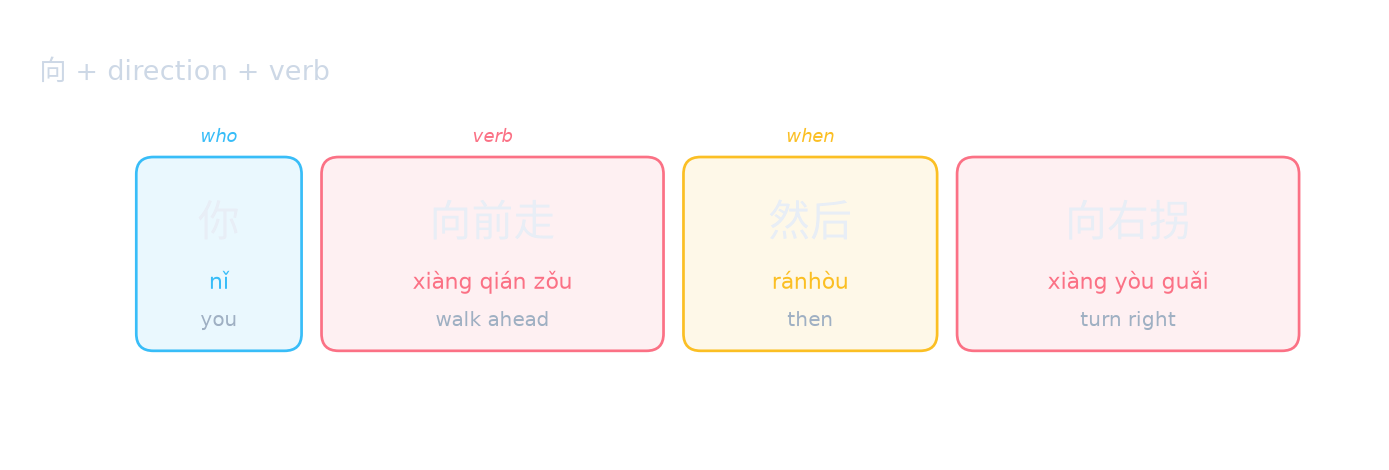
- you你向前走,then / after然后towards向(bound form) right右to turn (a corner etc)拐。 Nǐ xiàng qián zǒu, ránhòu xiàng yòu guǎi. – Walk forward, then turn right.
- I / me我towards向he / him他to borrow借(completed / change)了one / a一本书。 Wǒ xiàng tā jièle yì běn shū. – I borrowed a book from him.
- we / us我们should应该towards向she / her她to study; to learn学习。 – We should learn from her.
- I / me我want / think / miss想towards向she / her她to apologize道歉。 – I want to apologise to her.
How it works. towards向 xiàng means "towards". It goes before the verb. With a direction it gives the way to move (向前走, towards向left左to turn (a corner etc)拐, 向东开); with a person it marks who the action is aimed at (towards向teacher老师to say hello to问好, towards向he / him他to borrow借, towards向she / her她to apologize道歉).
| towards往 | towards向 |
|---|---|
| towards (movement) | towards (movement) and to / from a person |
| 往前走 = 向前走 | towards向he / him他to apologize道歉 (wrong: towards往he / him他to apologize道歉) |
Watch out
- wrong: to turn (a corner etc)拐towards向(bound form) right右 → towards向(bound form) right右to turn (a corner etc)拐.
Practice without the models
Cover the teaching sections before you answer. The answers follow.
pertaining to关于 + Topic (about / regarding)
1. Complete: “I want to buy a book about cooking.” I / me我want / think / miss想to buy买一本…………to prepare a meal做饭(modifier / structural particle)的book书。
2. “She is very interested in music.” Which word fits? she / her她____music音乐很感兴趣。
- A. towards向
- B. to / towards / correct对
- C. with / and跟
- D. pertaining to关于
3. Build: “I watched a programme about pandas.”
Put in order: pertaining to关于panda熊猫(modifier / structural particle)的 / 一个 / program节目。 / I / me我to look at; to watch; to read看(completed / change)了
4. True or false? pertaining to关于China中国book书 is a correct phrase for “a book about China”. If false, correct it.
5. In the library you find a book that explains Chinese history for beginners. Use pertaining to关于 + Topic. Write your answer in Chinese, then say it aloud.
until直到 … ,… only then / not until才 … (all the way until)
6. Complete: “It wasn't until yesterday that I knew.” until直到yesterday昨天,I / me我…………to know知道。
7. Which sentence is correct?
- A. until直到十一点,he / him他only then / not until才to sleep睡觉。
- B. he / him他only then / not until才until直到十一点to sleep睡觉。
- C. until直到十一点,he / him他then / just就to sleep睡觉(completed / change)了。
- D. until直到十一点,he / him他only then / not until才to sleep睡觉(completed / change)了。
8. Build: “The rain kept falling until the evening.”
Put in order: all along / straight一直 / evening晚上。 / down / next; to fall (rain), get off下to / arrive / (result: get)到 / rain雨
9. True or false? we / us我们to play玩to / arrive / (result: get)到十点 means “We played until ten.” If false, correct it.
10. You stayed up for your sister's flight to land; she only messaged you at midnight. Use until直到 … ,… only then / not until才 …. Write your answer in Chinese, then say it aloud.
towards向 + Direction / Person + Verb (towards)
11. Complete: “Turn left at the crossroads.” to / arrive / (result: get)到(completed / change)了crossing路口…………左拐。
12. Which says “I want to apologise to her.”?
- A. I / me我want / think / miss想she / her她towards向to apologize道歉。
- B. I / me我want / think / miss想to apologize道歉towards向she / her她。
- C. I / me我want / think / miss想towards向she / her她to apologize道歉。
- D. I / me我want / think / miss想towards往she / her她to apologize道歉。
13. Build: “I borrowed a book from him.”
Put in order: to borrow借(completed / change)了 / I / me我 / one / a一本书。 / towards向he / him他
14. True or false? 往前走 and 向前走 both mean “walk forward”. If false, correct it.
15. You are lost in an old town, and a shopkeeper points down the street. Use towards向 + Direction / Person + Verb. Write your answer in Chinese, then say it aloud.
Answers and explanations
pertaining to关于 + Topic (about / regarding)
1. pertaining to关于
pertaining to关于 + topic + (modifier / structural particle)的 + noun.
2. B. to / towards / correct对
to / towards / correct对…to be interested感兴趣 marks the target of interest.
3. I / me我to look at; to watch; to read看(completed / change)了一个pertaining to关于panda熊猫(modifier / structural particle)的program节目。
pertaining to关于 + topic + (modifier / structural particle)的 + noun.
4. False.
The pertaining to关于 phrase needs (modifier / structural particle)的 before the noun: pertaining to关于China中国(modifier / structural particle)的book书.
5. Model answer: 这是一本pertaining to关于China中国history历史(modifier / structural particle)的book书。
Check your answer:
- A pertaining to关于 phrase describing a noun needs (modifier / structural particle)的: pertaining to关于China中国(modifier / structural particle)的book书, not pertaining to关于China中国book书.
- As a topic, pertaining to关于… comes first, before the subject: pertaining to关于这件matter事,I / me我not不to know知道, not I / me我pertaining to关于这件matter事not不to know知道.
until直到 … ,… only then / not until才 … (all the way until)
6. only then / not until才
until直到 … only then / not until才 ….
7. A. until直到十一点,he / him他only then / not until才to sleep睡觉。
until直到十一点,he / him他only then / not until才to sleep睡觉 is right: until直到 … only then / not until才 means "not until", and this simple only then / not until才 pattern takes no final (completed / change)了. then / just就 would mean "as early as", which contradicts until直到.
8. rain雨all along / straight一直down / next; to fall (rain), get off下to / arrive / (result: get)到evening晚上。
all along / straight一直 + Verb + to / arrive / (result: get)到 + time.
9. True.
Verb + to / arrive / (result: get)到 + time gives the end point.
10. Model answer: I / me我all along / straight一直to wait until等到十二点,she / her她only then / not until才给我发news; message消息。
Check your answer:
- The result clause takes only then / not until才 (it was late): until直到十点he / him他only then / not until才to come来, not until直到十点he / him他then / just就to come来(completed / change)了.
- This short result model uses only then / not until才to know知道. Do not infer from it that (completed / change)了 is impossible in all other only then / not until才 constructions.
towards向 + Direction / Person + Verb (towards)
11. towards向
towards向/towards往 + direction + verb.
12. C. I / me我want / think / miss想towards向she / her她to apologize道歉。
With people, only towards向 works, before the verb.
13. I / me我towards向he / him他to borrow借(completed / change)了one / a一本书。
towards向 + person + to borrow借.
14. True.
In directions towards往 and towards向 are interchangeable.
15. Model answer: you你向前走,then / after然后towards向(bound form) right右to turn (a corner etc)拐。
Check your answer:
- Put towards向 + direction before the verb: towards向(bound form) right右to turn (a corner etc)拐, not to turn (a corner etc)拐towards向(bound form) right右 in everyday directions.
- "Borrow from someone" is towards向 + person + to borrow借, not 借向 + person.