Verb + (ongoing -ing)着 (ongoing state)
Form: verb + (ongoing -ing)着 (state) · verb₁ + (ongoing -ing)着 + verb₂ · not / haven't没 + verb + (ongoing -ing)着
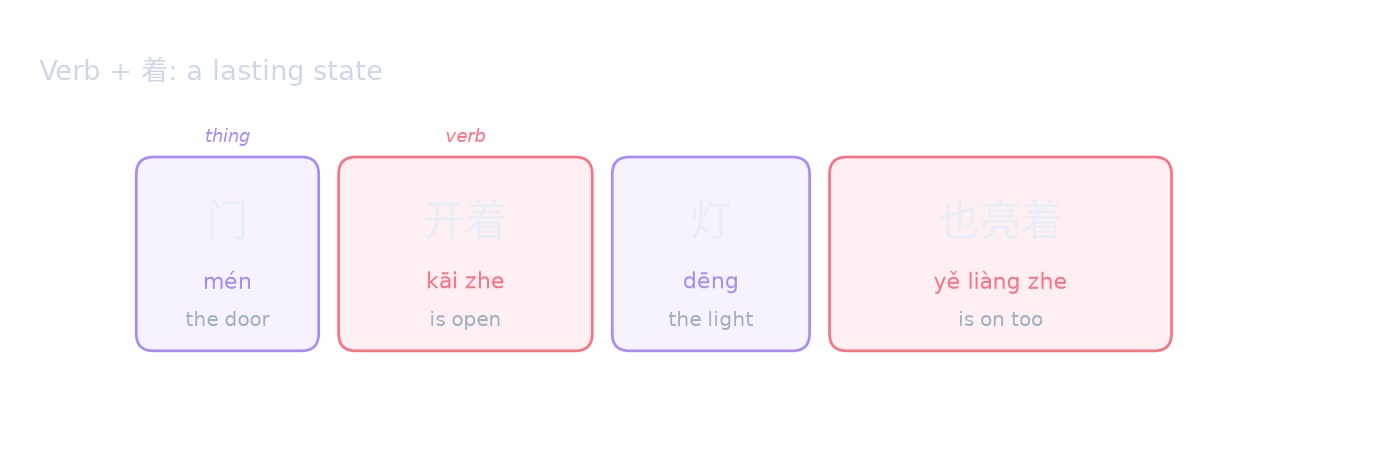
- 门开(ongoing -ing)着,lamp灯also也bright亮(ongoing -ing)着。 Mén kāizhe, dēng yě liàngzhe. – The door is open, and the lights are on.
- he / him他attire穿着一件白衬衫。 Tā chuānzhe yí jiàn bái chènshān. – He's wearing a white shirt.
- he / him他to laugh笑(ongoing -ing)着to speak说:"it doesn't matter没关系。" – He said with a smile, "It doesn't matter."
- we / us我们to sit / to take (a bus …)坐(ongoing -ing)着to chat聊天。 – We sat and chatted.
How it works. (ongoing -ing)着 zhe after a verb describes a state that lasts: open, on, wearing, sitting. As verb₁ + (ongoing -ing)着 + verb₂, the first state continues while the second action happens.
| at / in在 + verb | verb + (ongoing -ing)着 |
|---|---|
| in the middle of the action | the state that results |
| he / him他at / in在to open a door (lit. and…开门 (he is opening the door) | 门开(ongoing -ing)着 (the door is open) |
| he / him他at / in在穿衣服 (he is getting dressed) | he / him他attire穿着白衬衫 (he is wearing a white shirt) |
Watch out
- The negative uses not / haven't没: wrong: 门不开(ongoing -ing)着 → door门not / haven't没to open; to drive开(ongoing -ing)着.
Sentence-final (completed / change)了 (change of state)
Form: sentence + (completed / change)了 (a new situation) · not不 + verb + (completed / change)了 (no longer)
- to rain下雨(completed / change)了! Xià yǔ le! – It's raining (now)!
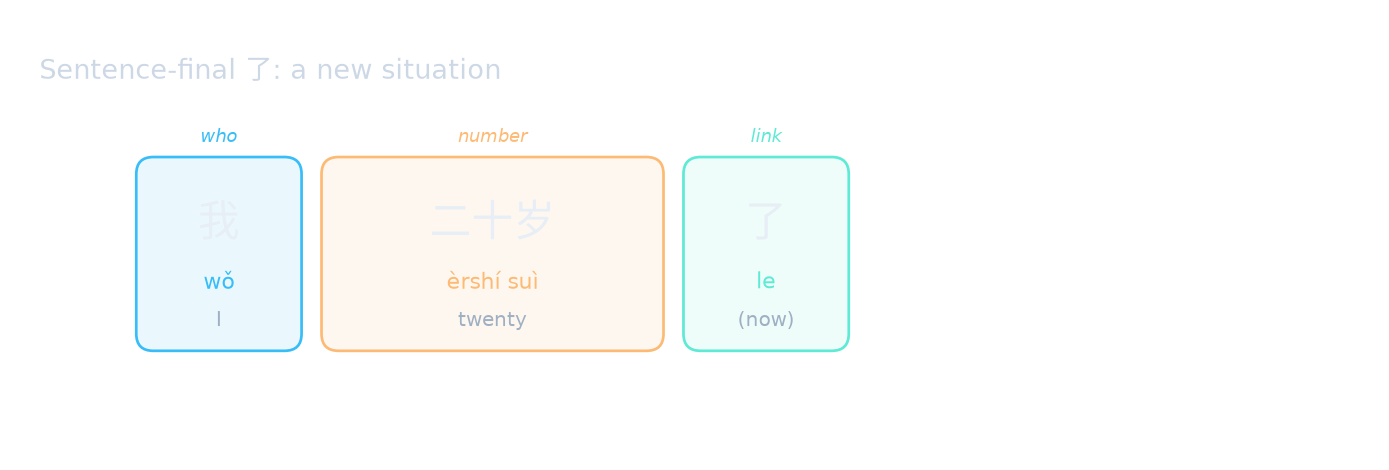
- I / me我二十岁(completed / change)了。 Wǒ èrshí suì le. – I'm twenty now.
- I / me我not不喝咖啡(completed / change)了。 Wǒ bù hē kāfēi le. – I've stopped drinking coffee.
- we / us我们快到(completed / change)了。 – We're almost there.
How it works. (completed / change)了 at the end of a sentence announces that the situation has changed: it's cold (weather)天冷(completed / change)了 (it's turned cold), he / him他not不to come来(completed / change)了 (he's not coming any more), green light (traffic signal)绿灯(completed / change)了 (it's green now). It is not a past tense.
| Verb + (completed / change)了 | Sentence + (completed / change)了 |
|---|---|
| a completed action | a change of situation |
| I / me我to eat吃(completed / change)了一个apple苹果。 | I / me我not不hungry饿(completed / change)了。 |
| I ate an apple. | I'm not hungry any more. |
Some sentences have both.
Watch out
- A past habit with no change takes no (completed / change)了: wrong: I / me我before以前often常常to go去(completed / change)了 → I / me我before以前often常常to go去.
- I / me我not不to smoke抽烟(completed / change)了 means "I've quit smoking", not "I didn't smoke".
Questions with (and …? / softener)呢 (and you? / where?)
Form: noun + (and …? / softener)呢? · question word … (and …? / softener)呢? · at / in在 + verb … (and …? / softener)呢。
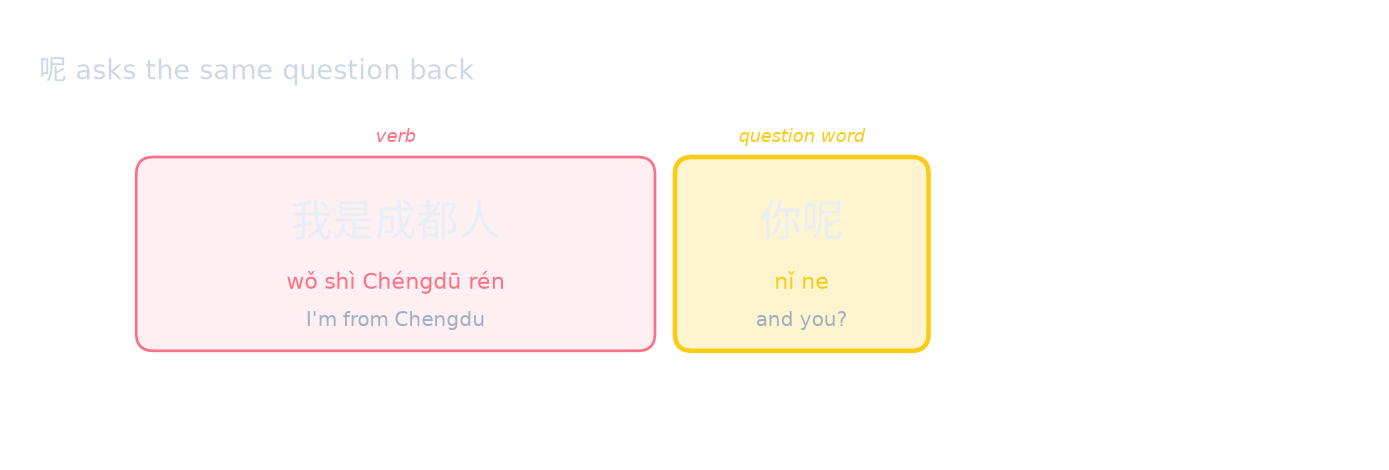
- I / me我to be / is是Chengdu subprovincial city…成都person人,you你(and …? / softener)呢? Wǒ shì Chéngdū rén, nǐ ne? – I'm from Chengdu. And you?
- I / me我(modifier / structural particle)的key钥匙(and …? / softener)呢? Wǒ de yàoshi ne? – Where are my keys?
- you你at / in在what are you doing?干什么(and …? / softener)呢? – What are you up to?
- he / him他at / in在to sleep睡觉(and …? / softener)呢。 Tā zài shuìjiào ne. – He's asleep right now.
How it works. (and …? / softener)呢 ne has three common jobs.
| Use | Example | Meaning |
|---|---|---|
| asks the same question back | I / me我degree / adjective linker很good好,you你(and …? / softener)呢? | And you? |
| alone, with no context | I / me我(modifier / structural particle)的mobile phone手机(and …? / softener)呢? | Where's my phone? |
| softens a question-word question | you你to go去where哪儿(and …? / softener)呢? | Where are you off to? |
| marks something still going on | outside外面下着雨(and …? / softener)呢。 | It's raining out. |
Watch out
- A yes-no question takes (yes/no ?)吗, not (and …? / softener)呢: wrong: you你to be / is是teacher老师(and …? / softener)呢? → you你to be / is是teacher老师(yes/no ?)吗?
- (yes/no ?)吗 changes a question word's meaning: you你to go去where哪儿(yes/no ?)吗? asks "Are you going anywhere?"
(modifier / structural particle)的 / (degree marker)得 / (adverb -ly)地 (the three “de”)
Form: (modifier / structural particle)的 + noun · (adverb -ly)地 + verb · verb + (degree marker)得 + comment
- I / me我to like喜欢to eat吃mum; mother妈妈to do; to make做(modifier / structural particle)的dish (of food); vegetable菜。 Wǒ xǐhuan chī māma zuò de cài. – I love the food Mum makes.
- I / me我(modifier / structural particle)的friend朋友slowly慢慢(adverb -ly)地to walk / to leave走to come over过来。 Wǒ de péngyou mànmàn de zǒu guòlai. – My friend walks slowly over.
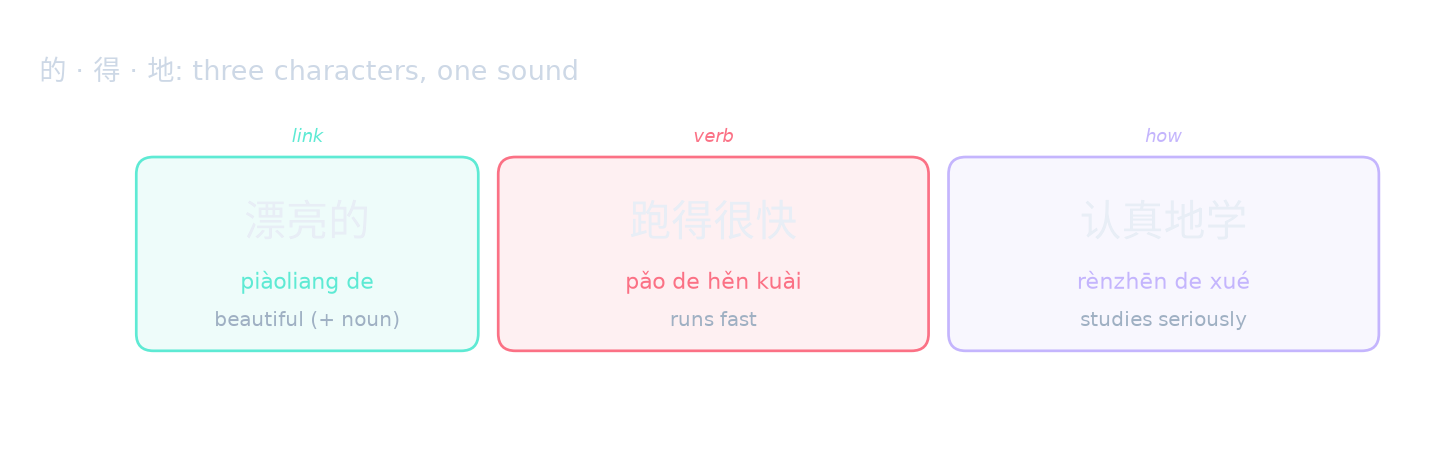
- he / him他to run跑(degree marker)得很快。 Tā pǎo de hěn kuài. – He runs fast.
- he / him他happy; glad高兴地说,he / him他考得degree / adjective linker很good好。 – He said happily that he had done well in the exam.
How it works. All three are read de. Choose by what is next to them.
| Character | Look at | Example |
|---|---|---|
| (modifier / structural particle)的 | a noun follows (or is left out) | pretty漂亮(modifier / structural particle)的clothes衣服, yesterday昨天to buy买(modifier / structural particle)的thing; stuff东西 |
| (adverb -ly)地 | a verb follows | conscientious认真(adverb -ly)地to work; job工作, slowly慢慢(adverb -ly)地to walk / to leave走 |
| (degree marker)得 | a verb comes before; a comment on the result follows | to write写(degree marker)得degree / adjective linker很good好, tired累(degree marker)得not want to不想(of sth) to move动 |
The quick test. In to run跑(degree marker)得很快, the verb to run跑 comes before the particle, so it must be (degree marker)得.
Watch out
- wrong: to run跑(modifier / structural particle)的很快 → to run跑(degree marker)得很快; wrong: conscientious认真(modifier / structural particle)的to study; to learn学习 → conscientious认真(adverb -ly)地to study; to learn学习.
Practice without the models
Cover the teaching sections before you answer. The answers follow.
Verb + (ongoing -ing)着 (ongoing state)
1. “The window is open.” window窗户to open; to drive开…………。
2. “The TV isn't on.”
- A. television电视not / haven't没to open; to drive开(ongoing -ing)着。
- B. television电视not不to open; to drive开(ongoing -ing)着。
- C. television电视(ongoing -ing)着not / haven't没to open; to drive开。
- D. television电视开不着。
3. Match each phrase to the picture description.
-
(1) 戴着hat帽子
-
(2) to take拿(ongoing -ing)着one / a一本书
-
(3) to stand站(ongoing -ing)着
-
(4) attire穿着白衬衫
-
A. holding a book
-
B. wearing a white shirt
-
C. standing
-
D. wearing a hat
4. Build: “He said with a smile …”
Put in order: to laugh笑(ongoing -ing)着 / to speak说…… / he / him他
5. Which sentence means “She is putting on her coat (right now)”?
- A. she / her她to wear穿overcoat大衣(ongoing -ing)着。
- B. she / her她attire穿着overcoat大衣。
- C. she / her她at / in在to wear穿overcoat大衣。
- D. she / her她not / haven't没attire穿着overcoat大衣。
6. True or false? 灯不亮(ongoing -ing)着 is the correct way to say “The light isn't on.” If false, correct it.
7. Look around the room you are in, or at a photo. Describe two people or things in Chinese with Verb + (ongoing -ing)着 (attire穿着, 戴着, to take拿(ongoing -ing)着, to sit / to take (a bus …)坐(ongoing -ing)着, 开着). Then compare with the model. Write your answer in Chinese, then say it aloud.
Sentence-final (completed / change)了 (change of state)
8. The light turns green: “It's green now, let's go.” green light (traffic signal)绿灯…………,to walk / to leave走(suggestion)吧。
9. Match each sentence to its meaning.
-
(1) he / him他to be / is是doctor医生。
-
(2) he / him他to be / is是doctor医生(completed / change)了。
-
(3) I / me我not不to drink tea喝茶。
-
(4) I / me我not不to drink tea喝茶(completed / change)了。
-
A. I don't drink tea.
-
B. I've stopped drinking tea.
-
C. He's a doctor.
-
D. He's become a doctor.
10. What does I / me我not不to smoke抽烟(completed / change)了 mean?
- A. I've quit smoking.
- B. I don't want to smoke.
- C. I'm smoking now.
- D. I didn't smoke.
11. Build: “We're almost there.”
Put in order: to / arrive / (result: get)到 / fast; soon快 / we / us我们 / (completed / change)了。
12. Your friend asks you你to have a meal吃饭(completed / change)了(yes/no ?)吗? You haven't eaten yet. What do you say?
- A. I / me我not / haven't没to eat吃(completed / change)了。
- B. I / me我still / also / even还not / haven't没to eat吃。
- C. I / me我不吃(completed / change)了。
- D. I / me我to eat吃(completed / change)了not / haven't没。
13. Which sentence says you are still learning Chinese after three years?
- A. I / me我三年to learn学Chinese language汉语。
- B. 我学(completed / change)了三年Chinese language汉语(completed / change)了。
- C. 我学三年(completed / change)了Chinese language汉语。
- D. 我学(completed / change)了三年Chinese language汉语。
14. True or false? I / me我before以前often常常to go去(completed / change)了 is correct for a past habit. If false, correct it.
15. You were about to go out, but you look out of the window and see rain. Use Sentence-final (completed / change)了. Write your answer in Chinese, then say it aloud.
Questions with (and …? / softener)呢 (and you? / where?)
16. Complete: “I like tea. What about you?” I / me我to like喜欢to drink tea喝茶,you你…………?
17. Which question is correct?
- A. you你(yes/no ?)吗to be / is是student学生?
- B. you你to be / is是student学生(and …? / softener)呢?
- C. you你to be / is是student学生(yes/no ?)吗(and …? / softener)呢?
- D. you你to be / is是student学生(yes/no ?)吗?
18. True or false? Said while searching your bag, I / me我(modifier / structural particle)的mobile phone手机(and …? / softener)呢? means “Where's my phone?” If false, correct it.
19. Build: “He's sleeping right now.”
Put in order: (and …? / softener)呢。 / at / in在 / he / him他 / to sleep睡觉
20. A new classmate tells you she comes from Chengdu, then waits for you to say where you are from. Use Questions with (and …? / softener)呢. Write your answer in Chinese, then say it aloud.
(modifier / structural particle)的 / (degree marker)得 / (adverb -ly)地 (the three “de”)
21. Match each phrase to its particle.
-
(1) pretty漂亮__clothes衣服
-
(2) conscientious认真__to work; job工作
-
(3) to write写__degree / adjective linker很good好
-
A. (degree marker)得
-
B. (adverb -ly)地
-
C. (modifier / structural particle)的
22. True or false? In mum; mother妈妈to do; to make做(modifier / structural particle)的dish (of food); vegetable菜, (modifier / structural particle)的 is correct because dish (of food); vegetable菜 is a noun. If false, correct it.
23. Fill the gaps: I / me我__friend朋友slowly慢慢__to walk / to leave走to come over过来。
- A. (adverb -ly)地 … (degree marker)得
- B. (degree marker)得 … (modifier / structural particle)的
- C. (modifier / structural particle)的 … (adverb -ly)地
- D. (modifier / structural particle)的 … (degree marker)得
24. Complete: “She sings very well.” she / her她to sing唱…………degree / adjective linker很good好。
25. Which says “He writes characters well”?
- A. he / him他to write写(degree marker)得Chinese character字degree / adjective linker很good好。
- B. he / him他degree / adjective linker很good好(adverb -ly)地to write characters写字(degree marker)得。
- C. he / him他to write characters写字to write写(degree marker)得degree / adjective linker很good好。
- D. he / him他to write characters写字(degree marker)得degree / adjective linker很good好。
26. Build: “My brother doesn't swim fast.”
Put in order: to swim / to travel游 / I / me我younger brother弟弟 / (degree marker)得 / unhappy不快。
27. Fix the message: he / him他conscientious认真__做作业,to do; to make做__很快。
- A. (adverb -ly)地 … (modifier / structural particle)的
- B. (modifier / structural particle)的 … (modifier / structural particle)的
- C. (adverb -ly)地 … (degree marker)得
- D. (degree marker)得 … (adverb -ly)地
28. A friend texts you about a classmate who runs fast, but writes the wrong "de" and the sentence looks odd. Use (modifier / structural particle)的 / (degree marker)得 / (adverb -ly)地. Write your answer in Chinese, then say it aloud.
Answers and explanations
Verb + (ongoing -ing)着 (ongoing state)
1. (ongoing -ing)着
Verb + (ongoing -ing)着 = a lasting state.
2. A. television电视not / haven't没to open; to drive开(ongoing -ing)着。
Negate (ongoing -ing)着 with not / haven't没.
3. (1) D: 戴着hat帽子 = wearing a hat; (2) A: to take拿(ongoing -ing)着one / a一本书 = holding a book; (3) C: to stand站(ongoing -ing)着 = standing; (4) B: attire穿着白衬衫 = wearing a white shirt
to put on or wear戴 is for glasses and hats; to wear穿 for clothes; to take拿 for holding.
4. he / him他to laugh笑(ongoing -ing)着to speak说……
V1 (ongoing -ing)着 + V2 = do V2 in the manner of V1.
5. C. she / her她at / in在to wear穿overcoat大衣。
An action in progress → at / in在 + verb. she / her她attire穿着overcoat大衣 = she is wearing a coat (the state).
6. False.
(ongoing -ing)着 takes not / haven't没: lamp灯not / haven't没bright亮(ongoing -ing)着。
7. Model answer: I / me我younger sister妹妹to sit / to take (a bus …)坐(ongoing -ing)着看电视,she / her她in hand手里to take拿(ongoing -ing)着一个apple苹果。window窗户开着。
Check your answer:
- Each sentence describes a state that lasts, not a single quick action.
- I used to put on or wear戴 for glasses or hats and to wear穿 for clothes.
- Any negative uses not / haven't没, not not不.
- I tried one V1 (ongoing -ing)着 + V2 sentence, such as to sit / to take (a bus …)坐(ongoing -ing)着to read看书.
Sentence-final (completed / change)了 (change of state)
8. (completed / change)了
Final (completed / change)了 announces the change.
9. (1) C: he / him他to be / is是doctor医生。 = He's a doctor.; (2) D: he / him他to be / is是doctor医生(completed / change)了。 = He's become a doctor.; (3) A: I / me我not不to drink tea喝茶。 = I don't drink tea.; (4) B: I / me我not不to drink tea喝茶(completed / change)了。 = I've stopped drinking tea.
(completed / change)了 at the end adds "this is new".
10. A. I've quit smoking.
not不…(completed / change)了 = no longer.
11. we / us我们快到(completed / change)了。
fast; soon快 + verb + (completed / change)了 = about to.
12. B. I / me我still / also / even还not / haven't没to eat吃。
Not yet = still / also / even还not / haven't没 + verb, with no (completed / change)了. I / me我不吃(completed / change)了 would mean "I won't eat any more".
13. B. 我学(completed / change)了三年Chinese language汉语(completed / change)了。
Verb (completed / change)了 + duration + final (completed / change)了 = so far, and still going.
14. False.
A past habit with no change takes no (completed / change)了: I / me我before以前often常常to go去。
15. Model answer: to rain下雨(completed / change)了!
Check your answer:
- My final (completed / change)了 marks something new or changed, not just "the past".
- With still / also / even还not / haven't没 I used no (completed / change)了: still / also / even还not / haven't没to eat吃, not not / haven't没to eat吃(completed / change)了.
Questions with (and …? / softener)呢 (and you? / where?)
16. (and …? / softener)呢
X + (and …? / softener)呢 repeats the question about X.
17. D. you你to be / is是student学生(yes/no ?)吗?
Yes-no questions take (yes/no ?)吗; (and …? / softener)呢 does not make a yes-no question.
18. True.
With no earlier question, Noun + (and …? / softener)呢 asks where something is.
19. he / him他at / in在to sleep睡觉(and …? / softener)呢。
at / in在 + verb + (and …? / softener)呢 marks an action in progress.
20. Model answer: I / me我to be / is是Chengdu subprovincial city…成都person人,you你(and …? / softener)呢?
Check your answer:
- Do not put (and …? / softener)呢 on a yes-no question: you你to be / is是teacher老师(yes/no ?)吗?, not you你to be / is是teacher老师(and …? / softener)呢?
- To ask “where?”, use you你to go去where哪儿? or you你to go去where哪儿(and …? / softener)呢?. With (yes/no ?)吗 the question word changes meaning: you你to go去where哪儿(yes/no ?)吗? asks “Are you going anywhere?”
(modifier / structural particle)的 / (degree marker)得 / (adverb -ly)地 (the three “de”)
21. (1) C: pretty漂亮__clothes衣服 = (modifier / structural particle)的; (2) B: conscientious认真__to work; job工作 = (adverb -ly)地; (3) A: to write写__degree / adjective linker很good好 = (degree marker)得
Before a noun → (modifier / structural particle)的; before a verb → (adverb -ly)地; after a verb → (degree marker)得.
22. True.
mum; mother妈妈to do; to make做 describes the noun dish (of food); vegetable菜, so (modifier / structural particle)的.
23. C. (modifier / structural particle)的 … (adverb -ly)地
I / me我(modifier / structural particle)的friend朋友 (before a noun) and slowly慢慢(adverb -ly)地to walk / to leave走 (before a verb).
24. (degree marker)得
After a verb, (degree marker)得 introduces how well.
25. C. he / him他to write characters写字to write写(degree marker)得degree / adjective linker很good好。
With an object, say the verb twice: to write characters写字 + to write写(degree marker)得degree / adjective linker很good好. (he / him他Chinese character字to write写(degree marker)得degree / adjective linker很good好 is also right.)
26. I / me我younger brother弟弟游得unhappy不快。
not不 goes after (degree marker)得: 游得unhappy不快.
27. C. (adverb -ly)地 … (degree marker)得
conscientious认真(adverb -ly)地 + verb to do; to make做; then after the verb to do; to make做 comes (degree marker)得 + how fast.
28. Model answer: he / him他to run跑(degree marker)得很快。
Check your answer:
- After a verb and before degree / adjective linker很 I wrote (degree marker)得: to run跑(degree marker)得很快, not to run跑(modifier / structural particle)的很快.
- If my verb had an object, I said the verb twice: to speak说Chinese language汉语to speak说(degree marker)得degree / adjective linker很good好.