Approximating with sequential numbers
Form: two neighbouring numbers + measure word · more than ten十几 / 几十 · number + many; much多 · number + about; left and right左右
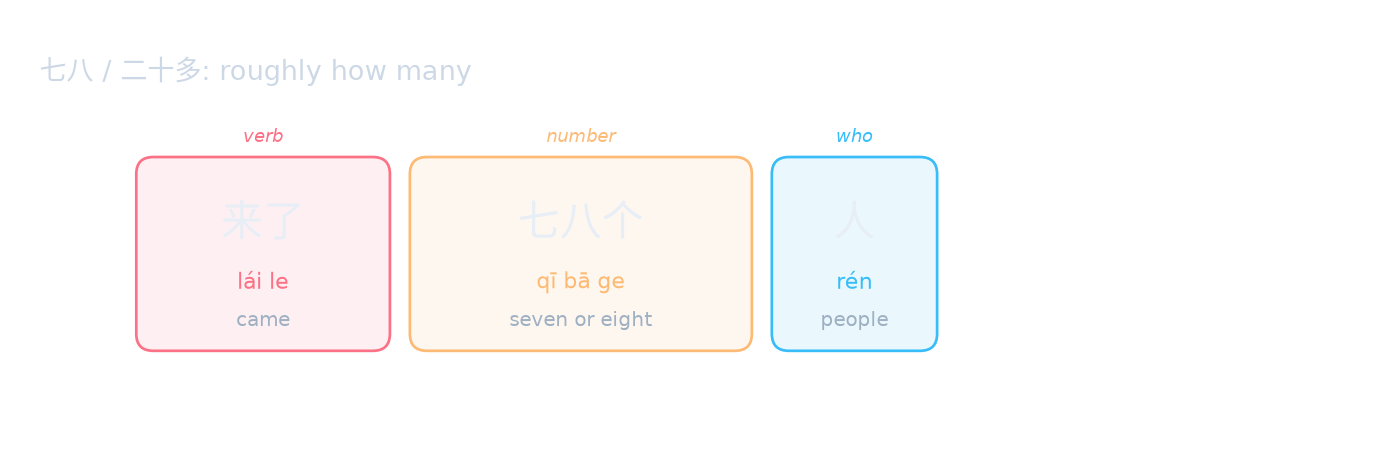
- to come来(completed / change)了七八个person人。 Láile qī-bā ge rén. – Seven or eight people came.
- 班里to have / there is有十几个student学生。 Bān li yǒu shíjǐ ge xuésheng. – There are a dozen or so students in the class.
- he / him他三十岁about; left and right左右。 – He's around thirty.
- I / me我to wait; and so on等(completed / change)了三个many; much多hour小时。 – I waited over three hours.
How it works. Chinese has several ways to give a rough number.
| Pattern | Meaning | Example |
|---|---|---|
| two neighbouring numbers, smaller first | about | 三四个, 五六天 |
| more than ten十几 | eleven to nineteen | 十几个 |
| 几十 | dozens | 几十个 |
| round ten + many; much多 + measure word | -odd, over | 二十多个person人, 一百多块 |
| number under ten + measure word + many; much多 | a bit over | 三个many; much多hour小时 |
| number + about; left and right左右 | around | 三十岁about; left and right左右 |
| almost / about the same差不多 + number | nearly | almost / about the same差不多五十个person人 |
Watch out
- The measure word comes after both numbers: wrong: 三个四个person人 → 三四个person人.
- wrong: 二十个many; much多 → 二十多个.
Big numbers: ten thousand万 / 100 million亿
Form: ten thousand万 (10,000) · 100 million亿 (100,000,000)
- Chongqing city (Chungking)…重庆to have / there is有三千多万person人。 Chóngqìng yǒu sānqiān duō wàn rén. – Chongqing has over thirty million people.
- China中国to have / there is有fourteen十四亿人。 Zhōngguó yǒu shísì yì rén. – China has 1.4 billion people.
- 这辆car车两万五千yuan (spoken); piece块。 – This car costs 25,000 yuan.
How it works. English groups big numbers in threes (thousand, million); Chinese groups them in fours, with ten thousand万 and 100 million亿.
| Number | Chinese | Think of it as |
|---|---|---|
| 10,000 | 一万 | 1 | 0000 |
| 100,000 | hundred thousand十万 | 10 | 0000 |
| 1,000,000 | 一百万 | 100 | 0000 |
| 10,000,000 | 一千万 | 1000 | 0000 |
| 100,000,000 | 一亿 | 1 | 0000 | 0000 |
| 1,000,000,000 | one billion十亿 | 10 | 0000 | 0000 |
Converting. Mark off four digits from the right for ten thousand万, eight for 100 million亿: 2,000,000 → 200|0000 → 两百万.
Watch out
- wrong: one / a一百千 → hundred thousand十万 (there is no "hundred thousand" unit).
- wrong: 一万万 → 一百万 for a million.

Times to the minute (o'clock; a little点 … minute / point / to divide分)
Form: (part of day +) number + o'clock; a little点 + number + minute / point / to divide分 + verb
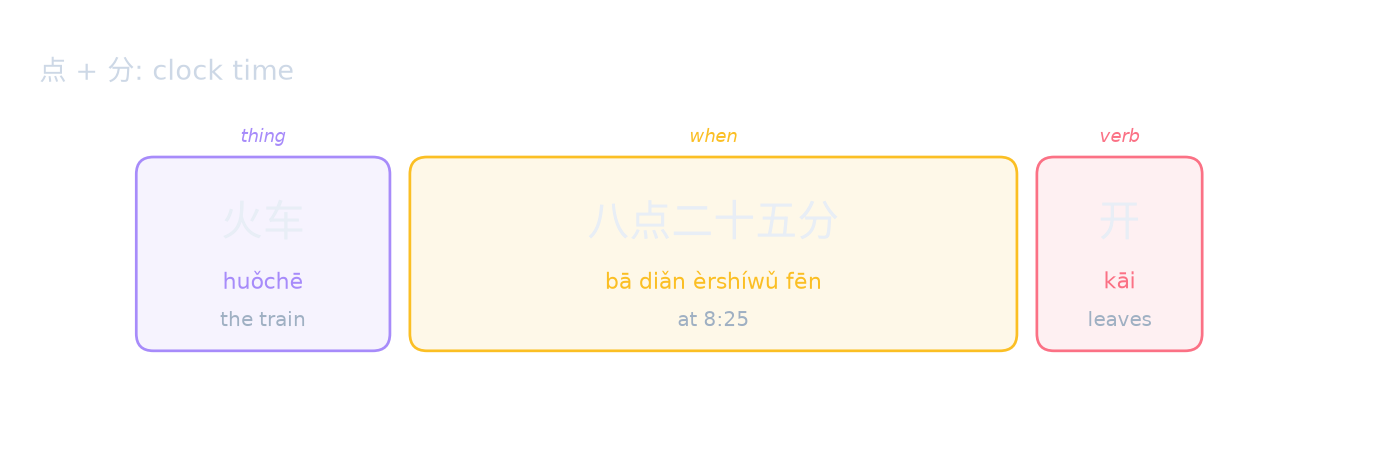
- train火车八点二十五to separate分开。 Huǒchē bā diǎn èrshíwǔ fēn kāi. – The train leaves at 8.25.
- I / me我early morning早上六点一刻to get up起床。 Wǒ zǎoshang liù diǎn yí kè qǐchuáng. – I get up at a quarter past six.
- afternoon下午两点半见。 – See you at 2.30 p.m.
How it works. The larger unit always comes first: part of the day, then the hour, then the minutes. After ten minutes, minute / point / to divide分 is often dropped in speech (八点二十五).
| Time | Chinese |
|---|---|
| 8.05 | 八点零五(minute / point / to divide分) |
| 7.30 | 七点half半 |
| 9.15 | 九点一刻 |
| 9.45 | 九点三刻 |
| 9.55 | poor差五分十点 (five to ten) |
| 8.50 | poor差very十分九点 |
Watch out
- For 1–9 minutes, add zero零: wrong: 八点五分 → 八点零五分.
- The time goes before the verb: wrong: I / me我to get up起床七点 → I / me我七点to get up起床.
- 2.00 is 两点, never wrong: 二点.
Telling the hour (Number + o'clock; a little点)
Form: (part of day +) number + o'clock; a little点 + verb · what time?几点?
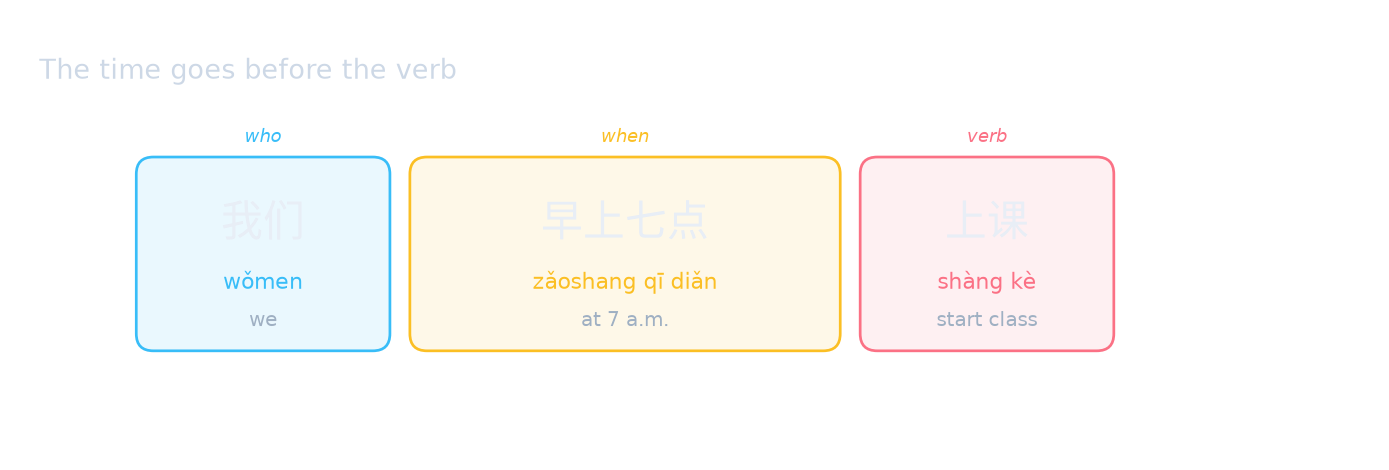
- we / us我们early morning早上七点to go to class上课。 Wǒmen zǎoshang qī diǎn shàngkè. – We start class at seven in the morning.
- now现在what time?几点? Xiànzài jǐ diǎn? – What time is it?
- you你what time?几点to finish work下班?——I / me我六点to finish work下班。 – What time do you finish work? – At six.
- I / me我evening晚上九点to sleep睡觉。 – I go to bed at nine in the evening.
How it works. Number + o'clock; a little点 diǎn = o'clock. Ask with what time?几点. The part of the day comes first (early morning早上, noon中午, afternoon下午, evening晚上), then the hour, then the verb.
| o'clock; a little点 | hour小时 |
|---|---|
| a point on the clock | a length of time |
| 三点 (3 o'clock) | 三个hour小时 (three hours) |
I / me我三点to start开始,学了三个hour小时: I started at three and studied for three hours.
Watch out
- 2 o'clock is wrong: 二点 → 两点.
- wrong: I / me我to finish work下班六点 → I / me我六点to finish work下班.
Practice without the models
Cover the teaching sections before you answer. The answers follow.
Approximating with sequential numbers
1. Complete: “There are a dozen or so students in the class.” 班里to have / there is有…………(measure word)个student学生。
2. Which says “five or six days”?
- A. 五个六天
- B. six六五天
- C. 五天六天
- D. 五六天
3. Match each phrase to its meaning.
-
(1) 二十多个
-
(2) 几十个
-
(3) 三十岁about; left and right左右
-
(4) 七八个
-
A. seven or eight
-
B. twenty-odd
-
C. around thirty years old
-
D. dozens
4. Build: “Seven or eight people came.”
Put in order: person人。 / to come来(completed / change)了 / (measure word)个 / 七八
5. Your teacher asks how many people came to the club meeting. You did not count exactly. Write your answer in Chinese, then say it aloud.
Big numbers: ten thousand万 / 100 million亿
6. Write 50,000 in Chinese: …………
7. How do you say 100,000?
- A. 一万
- B. 一百万
- C. hundred thousand十万
- D. one / a一百千
8. Match the numbers.
-
(1) 一万
-
(2) 一百万
-
(3) 一亿
-
(4) one billion十亿
-
A. 1,000,000,000
-
B. 1,000,000
-
C. 10,000
-
D. 100,000,000
9. True or false? 一千万 means ten million. If false, correct it.
10. You read that the city of Chongqing has about thirty million people and wonder how to say it. Use Big numbers: ten thousand万 / 100 million亿. Write your answer in Chinese, then say it aloud.
Times to the minute (o'clock; a little点 … minute / point / to divide分)
11. Write 10:30 with half半: 十点…………
12. What time is poor差very十分九点?
- A. 10:09
- B. 8:50
- C. 9:10
- D. 9:50
13. Build: “I get up at a quarter past six.”
Put in order: early morning早上 / 六点一刻 / I / me我 / to get up起床。
14. True or false? 8:05 is said 八点五分 with no zero零. If false, correct it.
15. You are buying a train ticket and the clerk tells you the departure time. Write your answer in Chinese, then say it aloud.
Telling the hour (Number + o'clock; a little点)
16. Ask: “What time is it now?” now现在…………o'clock; a little点?
17. How do you say “2 o'clock in the afternoon”?
- A. afternoon下午两点
- B. afternoon下午二点
- C. afternoon下午两个hour小时
- D. 两点afternoon下午
18. Build: “I go to bed at nine in the evening.”
Put in order: 九点 / evening晚上 / I / me我 / to sleep睡觉。
19. True or false? 三点 and 三个hour小时 mean the same. If false, correct it.
20. Your new school timetable starts much earlier than you are used to. Write your answer in Chinese, then say it aloud.
Answers and explanations
Approximating with sequential numbers
1. more than ten十几
more than ten十几 = between eleven and nineteen.
2. D. 五六天
Two neighbouring numbers, smaller first, then the measure word or noun.
3. (1) B: 二十多个 = twenty-odd; (2) D: 几十个 = dozens; (3) C: 三十岁about; left and right左右 = around thirty years old; (4) A: 七八个 = seven or eight
many; much多, how many / a few几, about; left and right左右 and neighbouring numbers all give approximate amounts.
4. to come来(completed / change)了七八个person人。
Neighbouring numbers + measure word + noun.
5. Model answer: to come来(completed / change)了七八个person人。
Check your answer:
- The measure word comes after both numbers: 三四个person人, not 三个四个person人.
- With many; much多 and round tens, many; much多 goes before the measure word: 二十多个, not 二十个many; much多 (for amounts under ten, many; much多 follows the measure word: 三个many; much多hour小时).
Big numbers: ten thousand万 / 100 million亿
6. 五万
50,000 = 5 × 10,000 = 五万.
7. C. hundred thousand十万
100,000 = 10 × 10,000 = hundred thousand十万.
8. (1) C: 一万 = 10,000; (2) B: 一百万 = 1,000,000; (3) D: 一亿 = 100,000,000; (4) A: one billion十亿 = 1,000,000,000
Chinese groups large numbers in fours.
9. True.
1,000 × 10,000 = 10,000,000.
10. Model answer: Chongqing city (Chungking)…重庆to have / there is有三千多万person人。
Check your answer:
- 100,000 is hundred thousand十万, not one / a一百千: Chinese has no "hundred thousand" unit, so regroup by fours.
- A million is 一百万, not 一万万; 一万万 is an old word for 一亿.
Times to the minute (o'clock; a little点 … minute / point / to divide分)
11. half半
half半 after o'clock; a little点 = half past.
12. B. 8:50
poor差very十分九点 = ten minutes to nine.
13. I / me我early morning早上六点一刻to get up起床。
Subject + part of the day + time + verb.
14. False.
For 1–9 minutes add zero零: 八点零五分.
15. Model answer: train火车八点二十五to separate分开。
Check your answer:
- Put the clock time before the verb: I / me我七点to get up起床, not I / me我to get up起床七点.
- Say 两点 for 2:00, not 二点.
Telling the hour (Number + o'clock; a little点)
16. how many / a few几
what time?几点 asks the hour.
17. A. afternoon下午两点
Part of the day first, and 2:00 is 两点.
18. I / me我evening晚上九点to sleep睡觉。
Subject + part of the day + time + verb.
19. False.
三点 is 3 o'clock; 三个hour小时 is three hours.
20. Model answer: we / us我们early morning早上七点to go to class上课。
Check your answer:
- The time goes before the verb: I / me我六点to finish work下班, not I / me我to finish work下班六点.
- Use 两点 for 2 o'clock, not 二点.