Time / Verb + before以前 (before …)
Form: time / action + before以前 + main verb
- to sleep睡觉before以前although (you'd think) / don't look别看mobile phone手机。 Shuìjiào yǐqián bié kàn shǒujī. – Don't look at your phone before bed.
- Friday星期五before以前要交school assignment作业。 Xīngqīwǔ yǐqián yào jiāo zuòyè. – The homework must be handed in before Friday.
- to have a meal吃饭before以前want / will / need要to wash one's hands洗手。 – Wash your hands before you eat.
- 三天before以前 / 三天front / before前 – three days ago
How it works. Unlike English "before", before以前 yǐqián comes after the time or action it refers to: 八点before以前, to go to class上课before以前. The whole phrase goes before the main verb: you你八点before以前to come来(suggestion)吧.
In short fixed phrases, front / before前 alone does the same job: 饭前, 睡前, 三天front / before前.
Watch out
- wrong: before以前to go to class上课 → to go to class上课before以前. before以前 at the front means "in the past" (next section).
- wrong: I / me我to return home回家十点before以前 → I / me我十点before以前to return home回家.

before以前,… (in the past, …)
Form: before以前 (+ subject) …,now现在 … · subject + before以前 + verb
- before以前here这儿not have / haven't没有road路,now现在to have / there is有很多car车(completed / change)了。 Yǐqián zhèr méiyǒu lù, xiànzài yǒu hěn duō chē le. – There used to be no road here; now there are lots of cars.
- I / me我before以前to live (somewhere)住at / in在Shanghai municipality…上海。 Wǒ yǐqián zhù zài Shànghǎi. – I used to live in Shanghai.
- he / him他before以前not不to like喜欢to eat吃spicy辣(modifier / structural particle)的,now现在degree / adjective linker很to like喜欢。 – He didn't use to like spicy food; now he loves it.
How it works. On its own at the start, or after the subject, before以前 means "in the past, used to". It describes a past habit or state, often in contrast with now现在. A past habit usually needs no (completed / change)了.
Which before以前? Look at what comes before it.
| before以前 alone | after a time or action |
|---|---|
| "in the past" | "before" |
| before以前I / me我not不喝咖啡。 | 喝咖啡before以前,I / me我first先to eat吃breakfast早饭。 |
past过去 is a slightly more formal "in the past". originally / so it turns out原来 means "originally", stressing that things later changed: he / him他originally / so it turns out原来to be / is是teacher老师,later; afterwards后来to work as当(completed / change)了author作家.

just now刚才 (a moment ago)
Form: just now刚才 + subject + … · subject + just now刚才 + …
- just now刚才someone有人to / for / give给you你to make a telephone call打电话(completed / change)了。 Gāngcái yǒu rén gěi nǐ dǎ diànhuà le. – Someone called you a moment ago.
- you你just now刚才to go去where哪儿(completed / change)了? Nǐ gāngcái qù nǎr le? – Where did you go just now?
- just now刚才at / in在to rain下雨,now现在to stop停(completed / change)了。 – It was raining a moment ago; now it's stopped.
- just now刚才I / me我not / haven't没to hear听见。 – I didn't hear just now.
How it works. just now刚才 gāngcái is a time word for "a moment ago", in the same situation. Like yesterday昨天 or today今天, it goes before or after the subject. It works with actions, states (just now刚才degree / adjective linker很quiet安静) and negatives (just now刚才I / me我not / haven't没to hear听见).
| just now刚才 | just now刚 | recently最近 |
|---|---|---|
| minutes ago | "just", before the verb | recently, over days |
| he / him他just now刚才to walk / to leave走(completed / change)了 | he / him他just now刚to walk / to leave走 | I / me我recently最近to move house搬家(completed / change)了 |
Watch out
- just now刚 cannot start a sentence: wrong: just now刚he / him他to come来(completed / change)了 → just now刚才他来(completed / change)了.
- For "I moved house recently", use recently最近, not just now刚才.

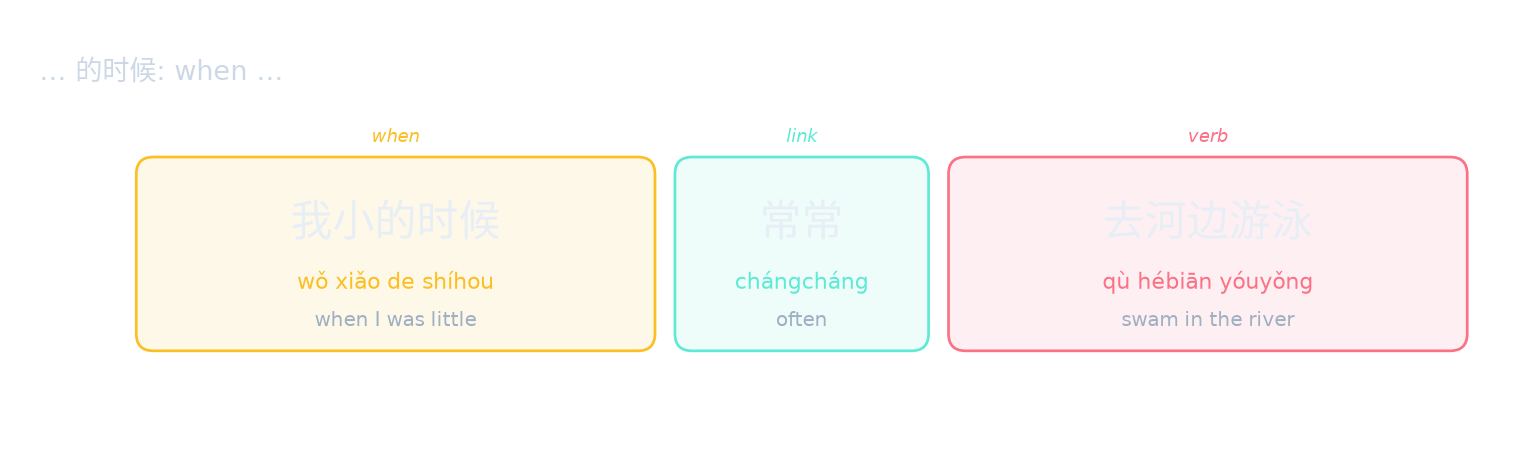
Time / Verb + time / when时 (when …)
Form: clause + (modifier / structural particle)的time; when时候 (spoken) / time / when时 (written),main clause
- I / me我small小(modifier / structural particle)的time; when时候often常常to go去river bank河边to swim游泳。 Wǒ xiǎo de shíhou chángcháng qù hébiān yóuyǒng. – When I was little, I often went swimming by the river.
- I / me我to / arrive / (result: get)到home / family / (measure: shops)家(modifier / structural particle)的time; when时候,he / him他already已经to sleep睡(completed / change)了。 Wǒ dào jiā de shíhou, tā yǐjīng shuì le. – When I got home, he was already asleep.
- you你to have time (to do sth)有空(modifier / structural particle)的time; when时候to / for / give给I / me我to make a telephone call打电话。 – Call me when you have time.
- 上课时,请关mobile phone手机。 – Please turn off your phone in class.
How it works. Like before以前 and after / from now on以后, "when" comes after what it refers to. Use (modifier / structural particle)的time; when时候 in conversation. time / when时 is shorter and suits signs, writing and fixed phrases: to eat a meal用餐time / when时No smoking请勿吸烟 (no smoking while dining).
Watch out
- wrong: time; when时候to rain下雨 → to rain下雨(modifier / structural particle)的time; when时候.
- what什么time; when时候 asks "when?"; it does not make a "when" clause: wrong: I / me我what什么time; when时候to get home到家,he / him他already已经to sleep睡(completed / change)了 → I / me我to / arrive / (result: get)到home / family / (measure: shops)家(modifier / structural particle)的time; when时候…….
after / from now on以后 (after / in the future)
Form: time / action + after / from now on以后 + main clause · after / from now on以后 (from now on) + clause
- 大学毕业after / from now on以后,I / me我want / think / miss想to go去abroad国外to work; job工作。 Dàxué bìyè yǐhòu, wǒ xiǎng qù guówài gōngzuò. – After I graduate, I want to work abroad.
- you你to / arrive / (result: get)到(completed / change)了after / from now on以后to / for / give给I / me我to make a telephone call打电话。 Nǐ dàole yǐhòu gěi wǒ dǎ diànhuà. – Call me after you arrive.
- after / from now on以后I / me我not不to arrive late迟到(completed / change)了。 – From now on, I won't be late.
- after / from now on以后我会早点儿to sleep睡。 – From now on I'll go to bed earlier.
How it works. After an event, after / from now on以后 yǐhòu means "after": to finish class下课after / from now on以后, 吃了饭after / from now on以后, 三天after / from now on以后. Alone at the start, it means "in the future, from now on". after / back后 is the short form in fixed phrases: 饭后, to graduate毕业after / back后.
| after / from now on以后 | later; afterwards后来 | then / after然后 |
|---|---|---|
| after X; from now on | later, in a past story | next step, past or future |
| to graduate毕业after / from now on以后 | later; afterwards后来他开(completed / change)了one (family / company)一家company公司 | first先to wash one's hands洗手,then / after然后to have a meal吃饭 |
Watch out
- wrong: after / from now on以后to have a meal吃饭 means "eat in the future". "After eating" is to have a meal吃饭after / from now on以后.

… ,later; afterwards后来 … (afterwards / later — past)
Form: past event,later; afterwards后来 + what happened next
- he / him他to go去(completed / change)了Shenzhen subprovincial city…深圳,later; afterwards后来at / in在there那儿to open; to drive开(completed / change)了one (family / company)一家company公司。 Tā qùle Shēnzhèn, hòulái zài nàr kāile yì jiā gōngsī. – He went to Shenzhen and later started a company there.
- to start开始I / me我not不to like喜欢he / him他,later; afterwards后来we / us我们to become / into成(completed / change)了friend朋友。 – At first I didn't like him, but later we became friends.
- he / him他in one's childhood小时候很瘦,later; afterwards后来长胖(completed / change)了。 – He was thin as a child, but later he put on weight.
- later; afterwards后来(and …? / softener)呢? / later; afterwards后来how about怎么样(completed / change)了? – And then? / How did it turn out?
How it works. later; afterwards后来 hòulái jumps forward in a past story, often over a gap of time. It starts the second clause, after a comma. later; afterwards后来(and …? / softener)呢? keeps a story going.
| later; afterwards后来 | then / after然后 |
|---|---|
| past stories only | past or future |
| a jump forward in time | the next step, close behind |
| later; afterwards后来长胖(completed / change)了 | we / us我们first先to have a meal吃饭,then / after然后to go去to buy买thing; stuff东西 |
Watch out
- For a plan, use after / from now on以后 or then / after然后: wrong: we / us我们later; afterwards后来talk later / besides再说 → we / us我们after / from now on以后talk later / besides再说.
- later; afterwards后来 is never added after an event: wrong: to graduate毕业later; afterwards后来 → to graduate毕业after / from now on以后.

Practice without the models
Cover the teaching sections before you answer. The answers follow.
Time / Verb + before以前 (before …)
1. Complete: “Please come back before ten.” please; to invite请十点…………to return回来。
2. Build: “The homework must be handed in before Friday.”
Put in order: before以前 / Friday星期五 / school assignment作业。 / 要交
3. Match each sentence to its meaning.
-
(1) to finish class下课after / from now on以后,I / me我to go去to play ball打球。
-
(2) before以前I / me我won't / can't不会to swim游泳。
-
(3) after / from now on以后I / me我want / think / miss想to go去China中国to work; job工作。
-
(4) to have a meal吃饭before以前want / will / need要to wash one's hands洗手。
-
A. In the future I want to work in China.
-
B. I couldn't swim in the past.
-
C. After class, I go and play ball.
-
D. Wash your hands before eating.
4. Which says “Turn off the light before you leave.”?
- A. to walk / to leave走before以前关灯。
- B. to walk / to leave走关灯before以前。
- C. before以前to walk / to leave走关灯。
- D. 关灯to walk / to leave走before以前。
5. True or false? 三天front / before前 and 三天before以前 both mean “three days ago”. If false, correct it.
6. Your doctor gives you advice about a good night's sleep. Use Time / Verb + before以前. Write your answer in Chinese, then say it aloud.
before以前,… (in the past, …)
7. Complete: “I used to be very shy.” I / me我…………degree / adjective linker很shy害羞。
8. Match each sentence to its meaning.
-
(1) before以前I / me我not不喝咖啡。
-
(2) 喝咖啡before以前,I / me我first先to eat吃breakfast早饭。
-
A. Before drinking coffee I eat breakfast.
-
B. I didn't use to drink coffee.
9. Build: “He didn't use to like spicy food.”
Put in order: not不to like喜欢 / to eat吃spicy辣(modifier / structural particle)的。 / he / him他 / before以前
10. True or false? originally / so it turns out原来 stresses that the situation later changed. If false, correct it.
11. True or false? In the model, I / me我before以前degree / adjective linker很to be afraid怕to speak说Chinese language汉语 means the writer is still afraid of speaking Chinese. If false, correct it.
12. Your grandmother looks at old photos of her village with dirt roads and no cars. Use before以前,…. Write your answer in Chinese, then say it aloud.
just now刚才 (a moment ago)
13. Complete: “It was raining just now; now it has stopped.” …………at / in在to rain下雨,now现在to stop停(completed / change)了。
14. Which sentence is correct?
- A. just now刚才he / him他degree / adjective linker很busy忙。
- B. he / him他degree / adjective linker很刚忙。
- C. he / him他busy忙just now刚才degree / adjective linker很。
- D. just now刚he / him他degree / adjective linker很busy忙。
15. Build: “Where did you go just now?”
Put in order: to go去where哪儿 / (completed / change)了? / just now刚才 / you你
16. True or false? just now刚才 is a good choice for “I moved house recently.” If false, correct it.
17. Build: “I had only just left home when it started to rain.”
Put in order: then / just就to rain下雨 / (completed / change)了。 / day天 / 我刚to go out出门,
18. “He only started working here two weeks ago.” Which is correct?
- A. he / him他just now刚to come来here这儿to work; job工作两个week星期。
- B. he / him他just now刚才at / in在here这儿to work; job工作两个week星期。
- C. he / him他just now刚才两个week星期to come来here这儿to work; job工作。
- D. he / him他两个week星期just now刚才to come来here这儿to work; job工作。
19. You come back from the shower and see your roommate pointing at your phone. Use just now刚才. Write your answer in Chinese, then say it aloud.
Time / Verb + time / when时 (when …)
20. Complete: “When I got home, he was already asleep.” I / me我to / arrive / (result: get)到home / family / (measure: shops)家…………,he / him他already已经to sleep睡(completed / change)了。
21. Which says “Call me when you have time.”?
- A. you你what什么time; when时候to have time (to do sth)有空to / for / give给I / me我to make a telephone call打电话。
- B. you你to have time (to do sth)有空(modifier / structural particle)的time; when时候to / for / give给I / me我to make a telephone call打电话。
- C. you你to / for / give给I / me我to make a telephone call打电话to have time (to do sth)有空(modifier / structural particle)的time; when时候。
- D. time; when时候you你to have time (to do sth)有空to / for / give给I / me我to make a telephone call打电话。
22. Build: “In class, please turn off your phone.”
Put in order: 请关 / mobile phone手机。 / , / 上课时
23. True or false? time / when时 is more common than (modifier / structural particle)的time; when时候 in everyday conversation. If false, correct it.
24. In the story, what does that那time; when时候 refer to?
- A. The time when the writer was a child.
- B. The time when they moved to the city.
- C. The time of the exam.
- D. Right now.
25. You are telling a friend a story from your childhood about learning to swim. Use Time / Verb + time / when时. Write your answer in Chinese, then say it aloud.
after / from now on以后 (after / in the future)
26. Complete: “Call me after you arrive.” you你to / arrive / (result: get)到(completed / change)了…………to / for / give给I / me我to make a telephone call打电话。
27. What does after / from now on以后我会早点儿to sleep睡 mean?
- A. I used to go to bed early.
- B. I went to bed early afterwards.
- C. From now on I'll go to bed earlier.
- D. I went to bed after eating.
28. Build: “After I graduate from university, I want to work abroad.”
Put in order: 大学毕业 / to go去abroad国外to work; job工作。 / ,I / me我want / think / miss想 / after / from now on以后
29. True or false? after / from now on以后to have a meal吃饭 means “after eating”. If false, correct it.
30. Pick the word for each gap.
-
(1) first先坐地铁,____to exchange换bus公共汽车。
-
(2) he / him他last year去年to go去(completed / change)了abroad国外,____we / us我们then / just就(not) any more再也not / haven't没见过面。
-
(3) 吃完饭____,we / us我们to go去to go for a walk散步(suggestion)吧。
-
A. later; afterwards后来
-
B. after / from now on以后
-
C. then / after然后
31. A friend in her final year asks what you plan to do once you finish university. Use after / from now on以后. Write your answer in Chinese, then say it aloud.
… ,later; afterwards后来 … (afterwards / later – past)
32. Complete the story: “At first I didn't like him, but later we became friends.” to start开始I / me我not不to like喜欢he / him他,…………we / us我们to become / into成(completed / change)了friend朋友。
33. Which fits a plan? “Let's eat first, then go shopping.”
- A. we / us我们later; afterwards后来to have a meal吃饭,first先to go去to buy买thing; stuff东西。
- B. we / us我们first先to have a meal吃饭,then / after然后to go去to buy买thing; stuff东西。
- C. we / us我们first先to have a meal吃饭,later; afterwards后来to go去to buy买thing; stuff东西。
- D. we / us我们to have a meal吃饭later; afterwards后来,to go去to buy买thing; stuff东西。
34. Ask to continue a story: “And how did it turn out?”
Put in order: how about怎么样 / later; afterwards后来 / (completed / change)了?
35. True or false? he / him他in one's childhood小时候很瘦,later; afterwards后来长胖(completed / change)了 describes a change with a gap of time. If false, correct it.
36. Put the story in order.
Put in order: first先with / and跟teacher老师to learn学,then / after然后oneself自己to practice练习。 / before以前I / me我won't / can't不会to swim游泳。 / finally; last最后I / me我finally终于to learn学会(completed / change)了! / later; afterwards后来I / me我to participate参加(completed / change)了一个to swim游泳class班。
37. You are telling a friend about a classmate who moved to Shenzhen two years ago. Use … ,later; afterwards后来 …. Write your answer in Chinese, then say it aloud.
Answers and explanations
Time / Verb + before以前 (before …)
1. before以前
Time + before以前 = before that time.
2. Friday星期五before以前要交school assignment作业。
Time + before以前 + verb phrase.
3. (1) C: to finish class下课after / from now on以后,I / me我to go去to play ball打球。 = After class, I go and play ball.; (2) B: before以前I / me我won't / can't不会to swim游泳。 = I couldn't swim in the past.; (3) A: after / from now on以后I / me我want / think / miss想to go去China中国to work; job工作。 = In the future I want to work in China.; (4) D: to have a meal吃饭before以前want / will / need要to wash one's hands洗手。 = Wash your hands before eating.
After an action, before以前 / after / from now on以后 = before / after it; on their own, they mean in the past / in the future.
4. A. to walk / to leave走before以前关灯。
Action + before以前, then the main verb.
5. True.
front / before前 is a shorter form of before以前 after a time.
6. Model answer: to sleep睡觉before以前although (you'd think) / don't look别看mobile phone手机。
Check your answer:
- Put before以前 after what it refers to: to go to class上课before以前, not before以前to go to class上课 (which means "in the past, I attended class").
- The before以前 phrase goes before the main verb, not at the end: I / me我十点before以前to return home回家, not I / me我to return home回家十点before以前.
before以前,… (in the past, …)
7. before以前
Subject + before以前 + description = used to be.
8. (1) B: before以前I / me我not不喝咖啡。 = I didn't use to drink coffee.; (2) A: 喝咖啡before以前,I / me我first先to eat吃breakfast早饭。 = Before drinking coffee I eat breakfast.
Alone, before以前 means “in the past”; after an action it means “before”.
9. he / him他before以前not不to like喜欢to eat吃spicy辣(modifier / structural particle)的。
Subject + before以前 + verb phrase.
10. True.
originally / so it turns out原来 = originally (and then it changed).
11. False.
before以前 = in the past; the next sentence with now现在 shows that things have changed.
12. Model answer: before以前here这儿not have / haven't没有road路,now现在to have / there is有很多car车(completed / change)了。
Check your answer:
- Alone at the front or after the subject, before以前 = "in the past": before以前I / me我won't / can't不会to prepare a meal做饭.
- After a time or action, it = "before": to go to class上课before以前 – "before class". Check what comes before it.
just now刚才 (a moment ago)
13. just now刚才
just now刚才 is a time word that can start the sentence.
14. A. just now刚才he / him他degree / adjective linker很busy忙。
just now刚才 can describe a state a moment ago; just now刚 is not used for a past state like degree / adjective linker很busy忙.
15. you你just now刚才to go去where哪儿(completed / change)了?
Subject + just now刚才 + verb phrase.
16. False.
just now刚才 is only a moment ago; recently is recently最近 (or just now刚to move house搬家).
17. 我刚to go out出门,day天then / just就to rain下雨(completed / change)了。
just now刚 A,(subject) then / just就 B: B happens right after A.
18. A. he / him他just now刚to come来here这儿to work; job工作两个week星期。
just now刚 + verb + time span = only that long since; just now刚才 means minutes ago.
19. Model answer: just now刚才someone有人to / for / give给you你to make a telephone call打电话(completed / change)了。
Check your answer:
- Use just now刚才 for a moment ago in the same situation; for "recently" over days, use recently最近 or just now刚.
- just now刚才 can go first in the sentence; just now刚 cannot: just now刚才他来(completed / change)了 ✓, just now刚he / him他to come来(completed / change)了 ✗.
Time / Verb + time / when时 (when …)
20. (modifier / structural particle)的time; when时候
Clause + (modifier / structural particle)的time; when时候 = when.
21. B. you你to have time (to do sth)有空(modifier / structural particle)的time; when时候to / for / give给I / me我to make a telephone call打电话。
The (modifier / structural particle)的time; when时候 clause comes first; what什么time; when时候 asks “when?”.
22. 上课时,请关mobile phone手机。
Clause + time / when时, then the request.
23. False.
(modifier / structural particle)的time; when时候 is the usual spoken form; time / when时 is more written.
24. A. The time when the writer was a child.
that那time; when时候 points back to the time just mentioned: in one's childhood小时候.
25. Model answer: I / me我small小(modifier / structural particle)的time; when时候often常常to go去river bank河边to swim游泳。
Check your answer:
- time / when时 / (modifier / structural particle)的time; when时候 goes after the clause: to rain下雨(modifier / structural particle)的time; when时候, not time; when时候to rain下雨.
- In a "when" clause, do not use what什么time; when时候 (that asks "when?"): I / me我to / arrive / (result: get)到home / family / (measure: shops)家(modifier / structural particle)的time; when时候, not I / me我what什么time; when时候to get home到家.
after / from now on以后 (after / in the future)
26. after / from now on以后
Event + after / from now on以后 = after that event.
27. C. From now on I'll go to bed earlier.
after / from now on以后 alone at the start refers to the future.
28. 大学毕业after / from now on以后,I / me我want / think / miss想to go去abroad国外to work; job工作。
Event + after / from now on以后, then the main clause.
29. False.
After eating is to have a meal吃饭after / from now on以后; after / from now on以后to have a meal吃饭 means “eat in the future”.
30. (1) C: first先坐地铁,____to exchange换bus公共汽车。 = then / after然后; (2) A: he / him他last year去年to go去(completed / change)了abroad国外,we / us我们then / just就(not) any more再也not / haven't没见过面。 = later; afterwards后来; (3) B: 吃完饭,we / us我们to go去to go for a walk散步(suggestion)吧。 = after / from now on以后
then / after然后 = the next step; later; afterwards后来 = later, in a past story; X after / from now on以后 = after X.
31. Model answer: 大学毕业after / from now on以后,I / me我want / think / miss想to go去abroad国外to work; job工作。
Check your answer:
- Put after / from now on以后 after the event: to have a meal吃饭after / from now on以后, not after / from now on以后to have a meal吃饭 (which would mean "eat in the future").
- For the next step in a past story, prefer later; afterwards后来 or then / after然后, not a bare after / from now on以后: I / me我first先to go去(completed / change)了bank银行,then / after然后to go去(completed / change)了supermarket超市.
… ,later; afterwards后来 … (afterwards / later – past)
32. later; afterwards后来
later; afterwards后来 introduces what happened later in a past story.
33. B. we / us我们first先to have a meal吃饭,then / after然后to go去to buy买thing; stuff东西。
later; afterwards后来 is only for past stories; a plan uses then / after然后.
34. later; afterwards后来how about怎么样(completed / change)了?
later; afterwards后来how about怎么样(completed / change)了?
35. True.
later; afterwards后来 jumps forward in a past story.
36. before以前I / me我won't / can't不会to swim游泳。later; afterwards后来I / me我to participate参加(completed / change)了一个to swim游泳class班。first先with / and跟teacher老师to learn学,then / after然后oneself自己to practice练习。finally; last最后I / me我finally终于to learn学会(completed / change)了!
before以前 → later; afterwards后来 → first先 … then / after然后 → finally终于: how it was, what changed, the steps, the result.
37. Model answer: he / him他to go去(completed / change)了Shenzhen subprovincial city…深圳,later; afterwards后来at / in在there那儿to open; to drive开(completed / change)了one (family / company)一家company公司。
Check your answer:
- later; afterwards后来 is only for the past. For "later" in a plan, use after / from now on以后 or then / after然后: we / us我们after / from now on以后talk later / besides再说.
- It stands alone as a time word; it is not added after an event: to graduate毕业after / from now on以后, not to graduate毕业later; afterwards后来.