so much这么 / like that那么 + Adjective (so …)
Form: so much这么 / like that那么 + adjective
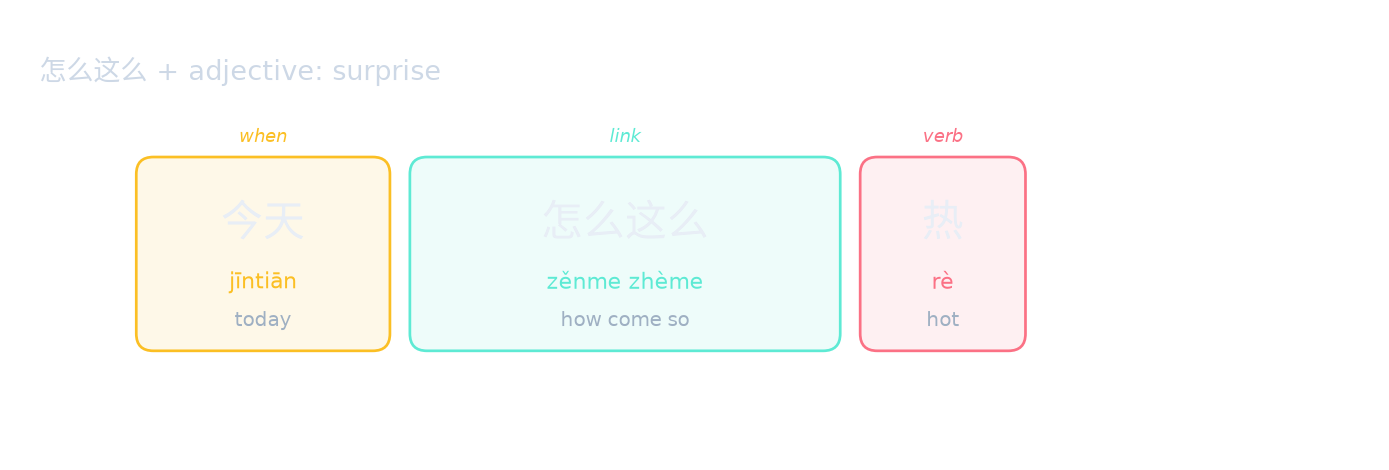
- today今天how / why怎么so much这么hot热! Jīntiān zěnme zhème rè! – How come it's so hot today!
- 这双鞋so much这么cheap便宜! Zhè shuāng xié zhème piányi! – These shoes are so cheap!
- there那儿(modifier / structural particle)的winter冬天like that那么cold冷,you你how / why怎么to put up with受得了? – The winters there are so cold; how do you stand it?
- I / me我not have / haven't没有he / him他like that那么tall; high高。 Wǒ méiyǒu tā nàme gāo. – I'm not as tall as him.
How it works. Both mean "so …" and stand directly before the adjective, in the place of degree / adjective linker很.
| so much这么 zhème | like that那么 nàme |
|---|---|
| here and now, what you can see or feel | over there, earlier, or already mentioned |
| you你(modifier / structural particle)的suitcase箱子how / why怎么so much这么heavy / important重? | there那儿(modifier / structural particle)的mountain山like that那么pretty漂亮 |
They often come with how / why怎么 (surprise: how / why怎么so much这么expensive贵) and with not have / haven't没有 comparisons (I / me我not have / haven't没有he / him他like that那么tall; high高).
Watch out
- One degree word only: wrong: so much这么degree / adjective linker很hot热 → so much这么hot热.
- Before the adjective: wrong: far远like that那么 → like that那么far远.
A with / and跟 / and / with和 B the same一样 (the same as)
Form: A + with / and跟 / and / with和 + B + (not不)the same一样 (+ adjective)
- older brother哥哥with / and跟younger brother弟弟the same一样tall; high高。 Gēge gēn dìdi yíyàng gāo. – The older brother is as tall as the younger one.
- today今天with / and跟yesterday昨天the same一样cold冷。 Jīntiān gēn zuótiān yíyàng lěng. – Today is as cold as yesterday.
- I / me我(modifier / structural particle)的way of thinking想法with / and跟you你(modifier / structural particle)的not不the same一样。 – My idea is different from yours.
- we / us我们to buy买(completed / change)了the same一样(modifier / structural particle)的clothes衣服。 – We bought the same clothes.
How it works. A with / and跟 B the same一样 says A and B are the same. Add an adjective to say in what way: the same一样tall; high高, the same一样busy忙, the same一样expensive贵. with / and跟 and and / with和 both work; with / and跟 is more common in speech. Before a noun, the same一样(modifier / structural particle)的 means "the same": the same一样(modifier / structural particle)的clothes衣服.
Negatives and questions. not不 goes before the same一样: with / and跟he / him他not不the same一样 (different from him). Ask with (yes/no ?)吗 or the same一样not不the same一样: Beijing北京(modifier / structural particle)的winter冬天with / and跟Shanghai municipality…上海(modifier / structural particle)的the same一样cold冷(yes/no ?)吗?
| A with / and跟 B the same一样 + adjective | A than / compared to比 B + adjective |
|---|---|
| equal | one is more |
| older brother哥哥with / and跟younger brother弟弟the same一样tall; high高 | older brother哥哥than / compared to比younger brother弟弟tall; high高 |
Watch out
- wrong: not不with / and跟he / him他the same一样 → with / and跟he / him他not不the same一样.
- wrong: the same一样degree / adjective linker很tall; high高 → the same一样tall; high高.

again又 … again又 … (both … and …)
Form: subject + again又 + A + again又 + B
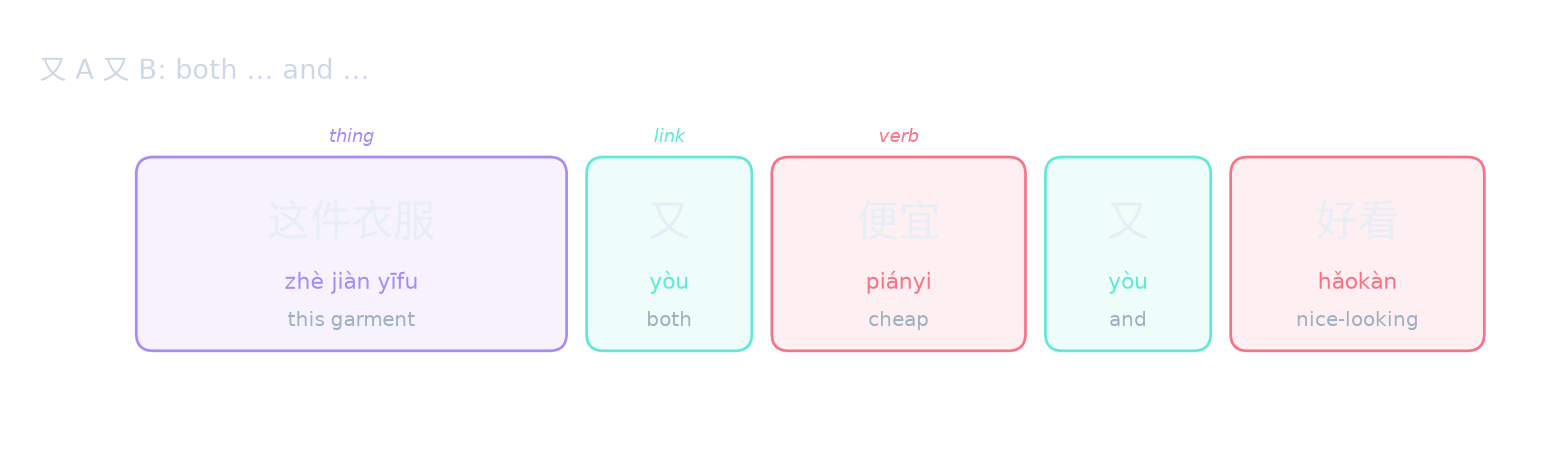
- 这件clothes衣服again又cheap便宜again又good-looking好看。 Zhè jiàn yīfu yòu piányi yòu hǎokàn. – This jacket is both cheap and good-looking.
- she / her她(modifier / structural particle)的room房间again又big大again又clean干净。 Tā de fángjiān yòu dà yòu gānjìng. – Her room is big and clean.
- child孩子(plural)们again又to sing唱again又to jump跳。 Háizimen yòu chàng yòu tiào. – The children sang and danced.
- I / me我again又tired累again又hungry饿。 – I'm tired and hungry.
How it works. again又……again又…… says two qualities or actions are true at the same time. Each again又 goes straight before its own adjective or verb. The two point the same way: both good (又快又好) or both bad (again又tired累again又hungry饿).
Compare. degree / adjective linker很cheap便宜,also也degree / adjective linker很good-looking好看 lists two facts one after the other; again又cheap便宜again又good-looking好看 presents them together as one picture.
Watch out
- and / with和 cannot join two adjectives after the subject: wrong: cheap便宜and / with和good-looking好看 → again又cheap便宜again又good-looking好看.
- No degree / adjective linker很 inside the pattern: wrong: again又degree / adjective linker很tall; high高again又很大 → 又高又大.
- again又cheap便宜again又bad-looking; ugly难看 sounds odd unless you are joking: the qualities clash.
Subject + fairly / to compare比较 + Adjective (fairly, rather)
Form: subject + fairly / to compare比较 + adjective · fairly / to compare比较 + verb + object (compare)
- to work; job工作比较忙,but不过colleague同事all / both都degree / adjective linker很good好。 Gōngzuò bǐjiào máng, búguò tóngshì dōu hěn hǎo. – Work is fairly busy, but my colleagues are nice.
- fairly / to compare比较far远,we / us我们to take a taxi (in town)打车(suggestion)吧。 Bǐjiào yuǎn, wǒmen dǎ chē ba. – It's rather far; let's take a taxi.
- I / me我fairly / to compare比较to like喜欢to drink tea喝茶。 – I prefer tea.
- we / us我们fairly / to compare比较(used after a verb) give it…一下this这两个mobile phone手机。 – Let's compare these two phones.
How it works. Before an adjective, fairly / to compare比较 bǐjiào means "fairly, rather". It takes the place of degree / adjective linker很 and gives a moderate, polite answer; nothing else is being compared. Before to like喜欢 it means "prefer".
With an object, fairly / to compare比较 is the verb "to compare". Tell the two apart by position.
Watch out
- fairly / to compare比较 never goes inside an A than / compared to比 B comparison: wrong: he / him他than / compared to比I / me我fairly / to compare比较tall; high高 → he / him他than / compared to比I / me我tall; high高.
- Do not stack degree words: wrong: degree / adjective linker很比较忙 → 比较忙.

many; much多 + Adjective + (exclamation)啊! (how …!)
Form: many; much多 + adjective + (exclamation)啊!
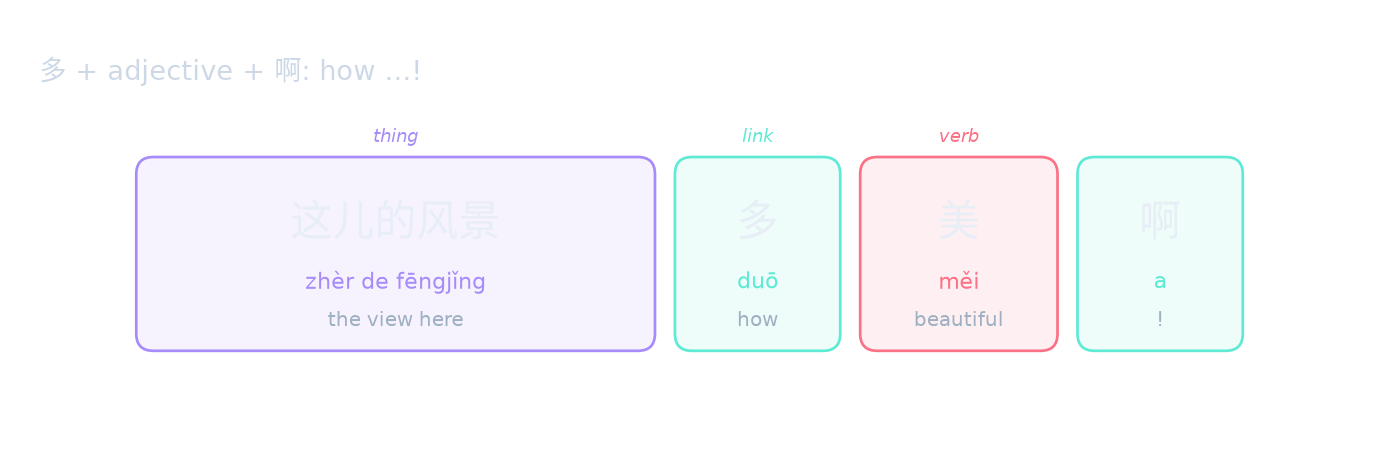
- here这儿(modifier / structural particle)的scenery风景many; much多beautiful美(exclamation)啊! Zhèr de fēngjǐng duō měi a! – How beautiful the view is here!
- you你(modifier / structural particle)的Chinese language中文to speak说(degree marker)得many; much多good好(exclamation)啊! Nǐ de Zhōngwén shuō de duō hǎo a! – How well you speak Chinese!
- today今天多热(exclamation)啊! – How hot it is today!
How it works. many; much多……(exclamation)啊! is an exclamation, "How … !". many; much多 goes before a bare adjective and (exclamation)啊 closes the sentence. It sounds warm and admiring.
| many; much多 + adjective + (exclamation)啊! | too太 + adjective + (completed / change)了! | many; much多 + adjective? |
|---|---|---|
| admiring exclamation | strong reaction, often "too" | a question about amount |
| many; much多beautiful美(exclamation)啊! | 太贵(completed / change)了! | 多远? How far? |
Watch out
- No degree / adjective linker很 inside: wrong: many; much多很漂亮(exclamation)啊 → many; much多pretty漂亮(exclamation)啊.
- Keep (exclamation)啊 and "!". Without them, this这个park公园how old?多大? asks "How big is the park?"
Adjective + (modifier / structural particle)的 + Noun (describing a noun)
Form: adjective + (modifier / structural particle)的 + noun · adjective + (modifier / structural particle)的 (the … one)
- I / me我(modifier / structural particle)的to be / is是that那个red (color)红色(modifier / structural particle)的大包。 Wǒ de shì nàge hóngsè de dà bāo. – Mine is that big red bag.
- he / him他to be / is是I / me我degree / adjective linker很good好(modifier / structural particle)的friend朋友。 Tā shì wǒ hěn hǎo de péngyou. – He is a very good friend of mine.
- 这是一本degree / adjective linker很interesting有意思(modifier / structural particle)的book书。 – This is a very interesting book.
- big大(modifier / structural particle)的or / still还是small小(modifier / structural particle)的?——我要red红(modifier / structural particle)的。 – The big one or the small one? – I want the red one.
How it works. In Chinese the description always comes before the noun, and (modifier / structural particle)的 links them.
| Needs (modifier / structural particle)的 | Usually no (modifier / structural particle)的 |
|---|---|
| degree / adjective linker很 + adjective: degree / adjective linker很good好(modifier / structural particle)的friend朋友 | common one-syllable pairs: good person好人, 新车 |
| two syllables: clean干净(modifier / structural particle)的room房间 | major city大城市, black tea红茶 |
When the noun is clear, adjective + (modifier / structural particle)的 stands alone: 我要new新(modifier / structural particle)的,don't不要old (of things)旧(modifier / structural particle)的.
Watch out
- Keep (modifier / structural particle)的 after degree / adjective linker很 + adjective: wrong: degree / adjective linker很good好friend朋友 → degree / adjective linker很good好(modifier / structural particle)的friend朋友.
- wrong: clothes衣服pretty漂亮(modifier / structural particle)的 → pretty漂亮(modifier / structural particle)的clothes衣服 (the description goes first).

Practice without the models
Cover the teaching sections before you answer. The answers follow.
so much这么 / like that那么 + Adjective (so …)
1. You are holding a heavy suitcase: you你(modifier / structural particle)的suitcase箱子how / why怎么…………heavy / important重?
2. A friend describes her hometown far away. Which fits best? “The mountains there are so beautiful.”
- A. there那儿(modifier / structural particle)的mountain山so much这么很漂亮。
- B. there那儿(modifier / structural particle)的mountain山degree / adjective linker很like that那么pretty漂亮。
- C. there那儿(modifier / structural particle)的mountain山pretty漂亮like that那么。
- D. there那儿(modifier / structural particle)的mountain山like that那么pretty漂亮。
3. Build: “I am not as tall as him.”
Put in order: I / me我 / he / him他 / not have / haven't没有 / like that那么 / tall; high高。
4. True or false? so much这么degree / adjective linker很hot热 is correct because so much这么 and degree / adjective linker很 both mean “very”. If false, correct it.
5. You step outside in July and it is much hotter than you expected. Use so much这么 / like that那么 + Adjective. Write your answer in Chinese, then say it aloud.
A with / and跟 / and / with和 B the same一样 (the same as)
6. Complete: “This bag costs the same as that one.” this这个bag / to wrap包with / and跟that那个bag / to wrap包…………expensive贵。
7. Which says “My answer is different from yours.”?
- A. I / me我(modifier / structural particle)的answer答案with / and跟you你(modifier / structural particle)的not / haven't没the same一样。
- B. I / me我(modifier / structural particle)的answer答案not不with / and跟you你(modifier / structural particle)的the same一样。
- C. I / me我(modifier / structural particle)的answer答案with / and跟you你(modifier / structural particle)的the same一样not不。
- D. I / me我(modifier / structural particle)的answer答案with / and跟you你(modifier / structural particle)的not不the same一样。
8. Build: “Today is as cold as yesterday.”
Put in order: the same一样 / today今天 / cold冷。 / with / and跟yesterday昨天
9. True or false? older brother哥哥with / and跟younger brother弟弟the same一样tall; high高 means the older brother is taller. If false, correct it.
10. Two classmates are exactly the same height, and a new teacher keeps mixing them up. Use A with / and跟 / and / with和 B the same一样. Write your answer in Chinese, then say it aloud.
again又 … again又 … (both … and …)
11. Complete: “The noodles here are both tasty and cheap.” here这儿(modifier / structural particle)的noodles面条…………tasty好吃…………cheap便宜。 (write the word that fills both blanks)
12. Which sentence is natural?
- A. he / him他again又tall; high高again又handsome帅。
- B. he / him他高和帅。
- C. he / him他again又degree / adjective linker很tall; high高again又很帅。
- D. he / him他again又高帅。
13. Build: “Her room is both big and clean.”
Put in order: again又big大 / again又clean干净 / she / her她(modifier / structural particle)的room房间 / 。
14. True or false? 这件clothes衣服cheap便宜and / with和good-looking好看 is a correct way to say “This item of clothing is cheap and good-looking.” If false, correct it.
15. You found a jacket that looks great and costs very little, and you want to say both at once. Use again又 … again又 …. Write your answer in Chinese, then say it aloud.
Subject + fairly / to compare比较 + Adjective (fairly, rather)
16. A moderate answer: “Today is fairly cold.” today今天…………cold冷。
17. Which sentence says “He is taller than me.”?
- A. he / him他than / compared to比I / me我tall; high高。
- B. he / him他than / compared to比I / me我fairly / to compare比较tall; high高。
- C. he / him他degree / adjective linker很than / compared to比I / me我tall; high高。
- D. he / him他fairly / to compare比较I / me我tall; high高。
18. Match each sentence to its meaning.
-
(1) 这家restaurant饭馆fairly / to compare比较expensive贵。
-
(2) we / us我们fairly / to compare比较(used after a verb) give it…一下price价格。
-
(3) I / me我fairly / to compare比较to like喜欢summer夏天。
-
A. Let's compare the prices.
-
B. I prefer summer.
-
C. This restaurant is rather expensive.
19. Build: “It is rather far; let's take a taxi.”
Put in order: to take a taxi (in town)打车(suggestion)吧。 / fairly / to compare比较far远 / , / we / us我们
20. A friend asks how your new job is. It is fine, but you would not call it amazing. Use Subject + fairly / to compare比较 + Adjective. Write your answer in Chinese, then say it aloud.
many; much多 + Adjective + (exclamation)啊! (how …!)
21. Exclaim: “How nice the weather is!” weather天气…………good好(exclamation)啊!
22. Which one asks a question instead of exclaiming?
- A. this这个park公园how old?多大?
- B. this这个park公园many; much多pretty漂亮(exclamation)啊!
- C. this这个park公园how old?多大(exclamation)啊!
- D. here这儿many; much多quiet安静(exclamation)啊!
23. Build: “How well you speak Chinese!”
Put in order: you你(modifier / structural particle)的Chinese language中文 / to speak说(degree marker)得 / (exclamation)啊! / 多好
24. True or false? many; much多很漂亮(exclamation)啊! is correct. If false, correct it.
25. You reach the top of a mountain and the whole city lies below you. Use many; much多 + Adjective + (exclamation)啊!. Write your answer in Chinese, then say it aloud.
Adjective + (modifier / structural particle)的 + Noun (describing a noun)
26. Complete: “He is a very good friend.” he / him他to be / is是I / me我degree / adjective linker很good好…………friend朋友。
27. Which phrase is correct?
- A. clothes衣服pretty漂亮(modifier / structural particle)的
- B. pretty漂亮degree / adjective linker很(modifier / structural particle)的clothes衣服
- C. 很漂亮(modifier / structural particle)的clothes衣服
- D. degree / adjective linker很漂亮衣服
28. True or false? In a shop, 我要red红(modifier / structural particle)的 can mean “I want the red one.” If false, correct it.
29. Build: “This is a very interesting book.”
Put in order: degree / adjective linker很interesting有意思(modifier / structural particle)的 / book书。 / 一本 / 这是
30. At the station a lost-property officer asks which bag is yours. You need more than "a bag". Use Adjective + (modifier / structural particle)的 + Noun. Write your answer in Chinese, then say it aloud.
Answers and explanations
so much这么 / like that那么 + Adjective (so …)
1. so much这么
The suitcase is right here, so so much这么 + heavy / important重 = “so heavy”.
2. D. there那儿(modifier / structural particle)的mountain山like that那么pretty漂亮。
like that那么 + Adj, with no extra degree / adjective linker很; like that那么 suits a distant place.
3. I / me我not have / haven't没有he / him他like that那么tall; high高。
A + not have / haven't没有 + B + like that那么 + Adj.
4. False.
so much这么 already supplies the degree, so degree / adjective linker很 is left out: so much这么hot热.
5. Model answer: today今天how / why怎么so much这么hot热!
Check your answer:
- Do not add degree / adjective linker很 as well: so much这么hot热, not so much这么degree / adjective linker很hot热, since so much这么 already gives the degree.
- Place so much这么 or like that那么 before the adjective, not after it: like that那么far远, not far远like that那么.
A with / and跟 / and / with和 B the same一样 (the same as)
6. the same一样
A with / and跟 B the same一样 + Adj. the same一样expensive贵 = “equally expensive”.
7. D. I / me我(modifier / structural particle)的answer答案with / and跟you你(modifier / structural particle)的not不the same一样。
not不 is placed right before the same一样.
8. today今天with / and跟yesterday昨天the same一样cold冷。
A + with / and跟 B + the same一样 + Adj.
9. False.
the same一样tall; high高 means the same height. “Taller” needs than / compared to比: older brother哥哥than / compared to比younger brother弟弟tall; high高.
10. Model answer: older brother哥哥with / and跟younger brother弟弟the same一样tall; high高。
Check your answer:
- not不 goes before the same一样: with / and跟he / him他not不the same一样, not not不with / and跟he / him他the same一样 for "different from him".
- No degree / adjective linker很 before the adjective after the same一样: the same一样tall; high高, not the same一样degree / adjective linker很tall; high高.
again又 … again又 … (both … and …)
11. again又
again又tasty好吃again又cheap便宜 – again又 before each quality.
12. A. he / him他again又tall; high高again又handsome帅。
again又 + Adj + again又 + Adj with no degree / adjective linker很. and / with和 does not join two adjectives in the predicate.
13. she / her她(modifier / structural particle)的room房间again又big大again又clean干净。
Subject + again又 A + again又 B.
14. False.
and / with和 joins nouns, not two adjectives used as the predicate. Use again又cheap便宜again又good-looking好看.
15. Model answer: 这件clothes衣服again又cheap便宜again又good-looking好看。
Check your answer:
- Use two qualities with the same direction: again又cheap便宜again又good-looking好看 is natural; again又cheap便宜again又bad-looking; ugly难看 sounds odd unless you are joking.
- No degree / adjective linker很 inside the pattern: 又高又大, not again又degree / adjective linker很tall; high高again又很大.
Subject + fairly / to compare比较 + Adjective (fairly, rather)
16. fairly / to compare比较
fairly / to compare比较 + Adj = fairly cold.
17. A. he / him他than / compared to比I / me我tall; high高。
A than / compared to比 B + Adj. The adverb fairly / to compare比较 does not go inside a than / compared to比 comparison.
18. (1) C: 这家restaurant饭馆fairly / to compare比较expensive贵。 = This restaurant is rather expensive.; (2) A: we / us我们fairly / to compare比较(used after a verb) give it…一下price价格。 = Let's compare the prices.; (3) B: I / me我fairly / to compare比较to like喜欢summer夏天。 = I prefer summer.
Before an adjective or a liking verb, fairly / to compare比较 means “rather”; with an object such as price价格 it is the verb “compare”.
19. fairly / to compare比较far远,we / us我们to take a taxi (in town)打车(suggestion)吧。
fairly / to compare比较 + Adj, then the suggestion.
20. Model answer: to work; job工作比较忙,but不过colleague同事all / both都degree / adjective linker很good好。
Check your answer:
- In a than / compared to比 comparison, fairly / to compare比较 cannot appear before the adjective: he / him他than / compared to比I / me我tall; high高, not he / him他than / compared to比I / me我fairly / to compare比较tall; high高.
- Do not stack it with degree / adjective linker很: 比较忙, not degree / adjective linker很比较忙 or fairly / to compare比较degree / adjective linker很busy忙.
many; much多 + Adjective + (exclamation)啊! (how …!)
21. many; much多
many; much多 + Adj + (exclamation)啊 = “How … !”
22. A. this这个park公园how old?多大?
Without (exclamation)啊 and the exclamation mark, how old?多大? asks “How big is it?”
23. you你(modifier / structural particle)的Chinese language中文to speak说(degree marker)得many; much多good好(exclamation)啊!
Verb + (degree marker)得 + many; much多 + Adj + (exclamation)啊.
24. False.
many; much多 already gives the degree, so the adjective stays bare: many; much多pretty漂亮(exclamation)啊!
25. Model answer: here这儿(modifier / structural particle)的scenery风景many; much多beautiful美(exclamation)啊!
Check your answer:
- No degree / adjective linker很 inside: many; much多beautiful美(exclamation)啊, not many; much多degree / adjective linker很beautiful美(exclamation)啊; many; much多 already carries the degree.
- Keep (exclamation)啊 and the exclamation mark. Without them, many; much多 + Adj often becomes a question: 多远? – "How far is it?"
Adjective + (modifier / structural particle)的 + Noun (describing a noun)
26. (modifier / structural particle)的
degree / adjective linker很 + Adj needs (modifier / structural particle)的 before the noun.
27. C. 很漂亮(modifier / structural particle)的clothes衣服
Description + (modifier / structural particle)的 + noun, and degree / adjective linker很 + Adj keeps (modifier / structural particle)的.
28. True.
When the noun is clear from context, Adj + (modifier / structural particle)的 stands for “the … one”.
29. 这是一本degree / adjective linker很interesting有意思(modifier / structural particle)的book书。
Number + measure word + description + (modifier / structural particle)的 + noun.
30. Model answer: I / me我(modifier / structural particle)的to be / is是that那个red (color)红色(modifier / structural particle)的大包。
Check your answer:
- Keep (modifier / structural particle)的 after degree / adjective linker很 + Adj: degree / adjective linker很good好(modifier / structural particle)的friend朋友, not degree / adjective linker很good好friend朋友.
- The description goes before the noun, never after: pretty漂亮(modifier / structural particle)的clothes衣服, not clothes衣服pretty漂亮(modifier / structural particle)的 (that is a separate sentence pattern).