besides除了 … all / both都 / still / also / even还 (except / besides)
Form: besides除了 A (apart from以外),B all / both都 … (except) · besides除了 A,subject + still / also / even还 / also也 … (besides)
- besides除了I / me我,everyone大家all / both都to go去(completed / change)了。 Chúle wǒ, dàjiā dōu qù le. – Everyone went except me.
- besides除了Sunday星期天,I / me我every day每天all / both都to go to work上班。 – I work every day except Sunday.
- besides除了Chinese language中文,he / him他still / also / even还can / will会to speak说Japanese language日语。 Chúle Zhōngwén, tā hái huì shuō Rìyǔ. – Besides Chinese, he can also speak Japanese.
- weekend周末besides除了to read看书,I / me我still / also / even还to like喜欢to run; to jog跑步。 – At weekends, besides reading, I also like running.
How it works. The word in the second clause decides the meaning.
| besides除了 A,……all / both都 | besides除了 A,……still / also / even还 / also也 |
|---|---|
| A is left out | A is included, more is added |
| besides除了I / me我,everyone大家all / both都to go去(completed / change)了 (I didn't go) | besides除了I / me我,small小Li (surname) / plum李also也to go去(completed / change)了 (we both went) |
apart from以外 after A is optional. besides除了 can also take an action: besides除了to read看书. he / him他besides除了to eat吃exactly就是to sleep睡 means "All he does is eat and sleep".
Watch out
- all / both都, still / also / even还 and also也 go after the subject: wrong: all / both都everyone大家to go去(completed / change)了 → everyone大家all / both都to go去(completed / change)了.

if如果 … if (coming after a…的话 (if …)
Form: if如果 / if要是 + condition + (if (coming after a…的话),(then / just就) + result
- if如果tomorrow明天to rain下雨if (coming after a…的话,we / us我们then / just就to be at home在家to look at; to watch; to read看film; movie电影。 Rúguǒ míngtiān xià yǔ dehuà, wǒmen jiù zài jiā kàn diànyǐng. – If it rains tomorrow, we'll stay home and watch a film.
- you你to have / there is有question / problem问题if (coming after a…的话,can / may可以to ask问I / me我。 Nǐ yǒu wèntí dehuà, kěyǐ wèn wǒ. – If you have any questions, you can ask me.
- if要是you你not want to不想to go去if (coming after a…的话,then / just就别去了。 – If you don't want to go, don't.
How it works. if (coming after a…的话 dehuà closes the "if" clause. Either if如果 or if (coming after a…的话 can be dropped in speech: if如果to rain下雨, to rain下雨if (coming after a…的话 and if如果to rain下雨if (coming after a…的话 all mean "if it rains". if要是 yàoshi is a spoken "if" and works the same way.
The condition comes first, unlike English, where "if" can come second.
Watch out
- wrong: to come来to look for; to give change找I / me我if如果you你to have / there is有time时间 → if如果you你to have / there is有time时间,to come来to look for; to give change找I / me我.
- if (coming after a…的话 goes at the end of the condition, not after the result.

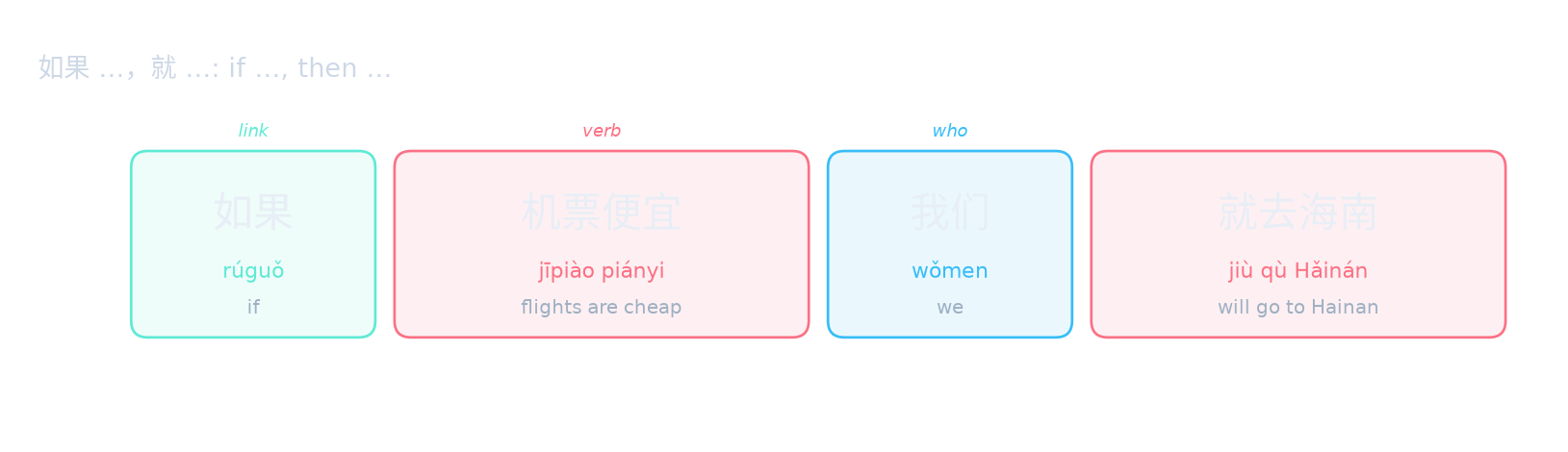
if如果 … ,then / just就 … (if …, then …)
Form: if如果 A,(subject +) then / just就 + B
- if如果air ticket机票cheap便宜,we / us我们then / just就to go去Hainan Province, in the…海南。 Rúguǒ jīpiào piányi, wǒmen jiù qù Hǎinán. – If the plane tickets are cheap, we'll go to Hainan.
- if如果you你not不hurry up / a bit faster快点儿,then / just就can / will会to arrive late迟到。 – If you don't hurry, you'll be late.
- if如果you你not不comfortable舒服,then / just就to go去to look at; to watch; to read看doctor医生(suggestion)吧。 – If you're not well, go and see a doctor.
How it works. then / just就 links the result to the condition: "if A, then B". It goes after the subject of the result clause: if如果you你to come来,I / me我then / just就to / for / give给you你to prepare a meal做饭. The pattern is used for plans, warnings and advice.
| if如果 | because因为 |
|---|---|
| a possibility | a fact that already holds |
| if如果to rain下雨,I / me我then / just就not不to go去。 | because因为to rain下雨,so / therefore所以I / me我not / haven't没to go去。 |
Watch out
- wrong: then / just就I / me我to go去 → I / me我then / just就to go去.
- wrong: if如果to rain下雨,so / therefore所以I / me我not不to go去 → if如果to rain下雨,I / me我then / just就not不to go去.
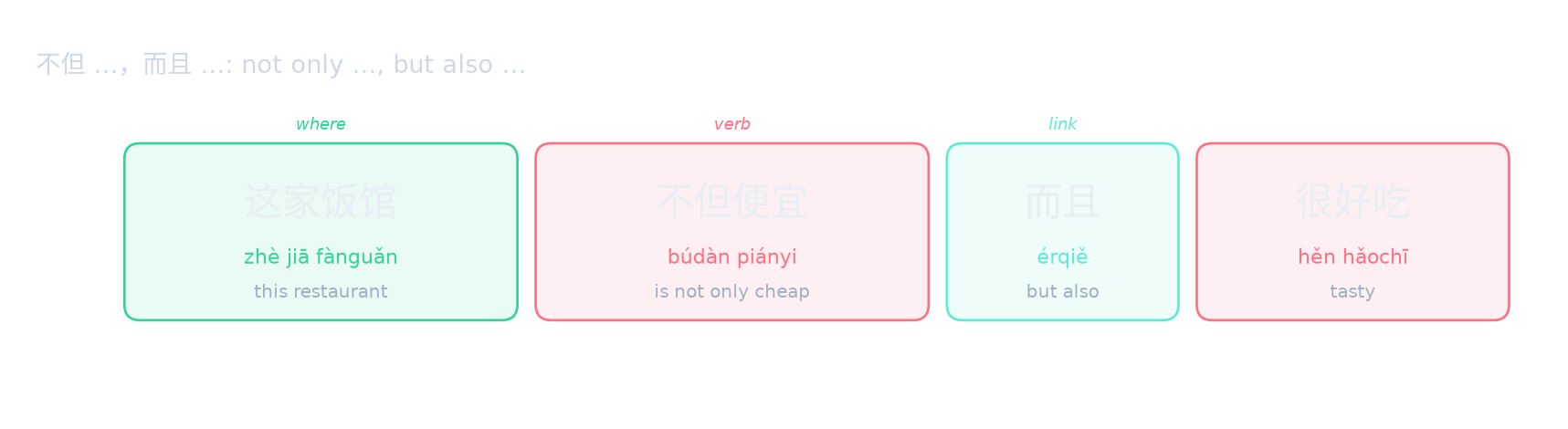
not only不但 … ,moreover而且 … (not only … but also)
Form: subject + not only不但 A,moreover而且 (still / also / even还 / also也) B · not only不但 subject₁ A,moreover而且 subject₂ also也 B
- 这家restaurant饭馆not only不但cheap便宜,moreover而且degree / adjective linker很tasty好吃。 Zhè jiā fànguǎn búdàn piányi, érqiě hěn hǎochī. – This restaurant isn't only cheap, it's delicious too.
- he / him他not only不但can / will会to speak说Chinese language中文,moreover而且can / will会to speak说French (language)法语。 – He speaks not only Chinese but also French.
- not only不但I / me我to like喜欢,moreover而且I / me我friend朋友also也to like喜欢。 – Not only do I like it, my friend does too.
How it works. not only不但……moreover而且…… adds a further, often stronger, point. still / also / even还 or also也 can follow moreover而且. moreover而且 can also stand alone to add a point: weather天气degree / adjective linker很cold冷,moreover而且to snow下雪(completed / change)了. not just不仅 is a more written word for not only不但.
Where does not only不但 go?
| One subject | Two subjects |
|---|---|
| after the subject | before the first subject |
| he / him他not only不但intelligent聪明,moreover而且degree / adjective linker很to work hard / effort努力 | not only不但I / me我to like喜欢,moreover而且he / him他also也to like喜欢 |
Watch out
- With one subject: wrong: not only不但he / him他intelligent聪明 → he / him他not only不但intelligent聪明.
Practice without the models
Cover the teaching sections before you answer. The answers follow.
besides除了 … all / both都 / still / also / even还 (except / besides)
1. Complete: “Besides tea, I also drink coffee.” besides除了tea茶,I / me我…………喝咖啡。
2. In besides除了小王,we / us我们all / both都to like喜欢to eat吃spicy辣(modifier / structural particle)的, does Xiao Wang like spicy food?
- A. Yes, and so do the others.
- B. Yes, he likes it most.
- C. The sentence does not say.
- D. No, he is the exception.
3. Build: “I work every day except Sunday.”
Put in order: besides除了Sunday星期天 / I / me我every day每天 / all / both都to go to work上班。 / ,
4. True or false? besides除了Chinese language中文,he / him他still / also / even还can / will会to speak说Japanese language日语 means he speaks both Chinese and Japanese. If false, correct it.
5. Your whole class went to the concert, but you were ill at home. Use besides除了 … all / both都 / still / also / even还. Write your answer in Chinese, then say it aloud.
if如果 … if (coming after a…的话 (if …)
6. Complete: “If you have time, come to my place.” you你to have / there is有time时间…………,to come来我家(suggestion)吧。
7. Which sentence has natural Chinese word order?
- A. we / us我们to go去park公园,if如果tomorrow明天weather天气good好if (coming after a…的话。
- B. if如果tomorrow明天weather天气good好if (coming after a…的话,we / us我们to go去park公园。
- C. if (coming after a…的话tomorrow明天weather天气good好,we / us我们to go去park公园。
- D. we / us我们if如果to go去park公园if (coming after a…的话,tomorrow明天weather天气good好。
8. Build: “If you have any questions, you can ask me.”
Put in order: if (coming after a…的话 / to ask问I / me我。 / you你to have / there is有question / problem问题 / ,can / may可以
9. True or false? if要是 is a spoken word for “if”. If false, correct it.
10. You are planning a trip to the Great Wall but the forecast is uncertain. Use if如果 … if (coming after a…的话. Write your answer in Chinese, then say it aloud.
if如果 … ,then / just就 … (if …, then …)
11. Complete: “If you come, I'll cook for you.” if如果you你to come来,I / me我…………to / for / give给you你to prepare a meal做饭。
12. Which sentence is correct?
- A. to rain下雨if如果,I / me我then / just就not不to go去。
- B. if如果to rain下雨,then / just就I / me我not不to go去。
- C. if如果to rain下雨,I / me我then / just就not不to go去。
- D. if如果to rain下雨,so / therefore所以I / me我not不to go去。
13. Build: “If you're not well, go and see a doctor.”
Put in order: , / to look at; to watch; to read看doctor医生(suggestion)吧。 / if如果you你not不comfortable舒服 / then / just就to go去
14. True or false? because因为to rain下雨 describes a possibility; if如果to rain下雨 describes a fact. If false, correct it.
15. You and a friend are checking flights for the holiday. Use if如果 … ,then / just就 …. Write your answer in Chinese, then say it aloud.
not only不但 … ,moreover而且 … (not only … but also)
16. Complete: “He not only speaks Chinese, but also speaks French.” he / him他not only不但can / will会to speak说Chinese language中文,…………can / will会to speak说French (language)法语。
17. Which sentence is correct?
- A. he / him他not only不但degree / adjective linker很tall; high高,很帅moreover而且。
- B. he / him他degree / adjective linker很tall; high高not only不但,moreover而且很帅。
- C. not only不但he / him他degree / adjective linker很tall; high高,moreover而且很帅。
- D. he / him他not only不但degree / adjective linker很tall; high高,moreover而且很帅。
18. Build: “Not only do I like it, my friend does too.”
Put in order: , / moreover而且I / me我friend朋友 / also也to like喜欢。 / not only不但I / me我to like喜欢
19. True or false? moreover而且 can be used on its own to add a point. If false, correct it.
20. You are recommending a new restaurant to a friend who is hard to please. Use not only不但 … ,moreover而且 …. Write your answer in Chinese, then say it aloud.
Answers and explanations
besides除了 … all / both都 / still / also / even还 (except / besides)
1. still / also / even还
besides除了…still / also / even还… adds to A.
2. D. No, he is the exception.
besides除了…all / both都… leaves Xiao Wang out of the group.
3. besides除了Sunday星期天,I / me我every day每天all / both都to go to work上班。
besides除了 A,subject + all / both都 + verb.
4. True.
still / also / even还 adds to what besides除了 introduced.
5. Model answer: besides除了I / me我,everyone大家all / both都to go去(completed / change)了。
Check your answer:
- besides除了I / me我,everyone大家all / both都to go去(completed / change)了 = I did not go. besides除了I / me我,small小Li (surname) / plum李also也to go去(completed / change)了 = Xiao Li went as well as me.
- Put all / both都 / still / also / even还 / also也 after the subject of the second clause: everyone大家all / both都to go去(completed / change)了, not all / both都everyone大家to go去(completed / change)了.
if如果 … if (coming after a…的话 (if …)
6. if (coming after a…的话
if (coming after a…的话 closes the condition.
7. B. if如果tomorrow明天weather天气good好if (coming after a…的话,we / us我们to go去park公园。
The condition comes first.
8. you你to have / there is有question / problem问题if (coming after a…的话,can / may可以to ask问I / me我。
Condition + if (coming after a…的话, then the result.
9. True.
if要是…(if (coming after a…的话) works like if如果.
10. Model answer: if如果tomorrow明天to rain下雨if (coming after a…的话,we / us我们then / just就to be at home在家to look at; to watch; to read看film; movie电影。
Check your answer:
- Put the if如果 clause before the result: if如果you你to have / there is有time时间,to come来to look for; to give change找I / me我, not to come来to look for; to give change找I / me我if如果you你to have / there is有time时间 (English order).
- if (coming after a…的话 goes at the end of the condition, not after the result.
if如果 … ,then / just就 … (if …, then …)
11. then / just就
if如果…,subject + then / just就….
12. C. if如果to rain下雨,I / me我then / just就not不to go去。
if如果 pairs with then / just就, placed after the subject.
13. if如果you你not不comfortable舒服,then / just就to go去to look at; to watch; to read看doctor医生(suggestion)吧。
if如果 + condition, then / just就 + advice.
14. False.
It is the other way round: because因为 = a fact, if如果 = a possibility.
15. Model answer: if如果air ticket机票cheap便宜,we / us我们then / just就to go去Hainan Province, in the…海南。
Check your answer:
- Subject first, then then / just就: I / me我then / just就to go去, not then / just就I / me我to go去.
- Do not use so / therefore所以 for "then" after if如果: if如果to rain下雨,I / me我then / just就not不to go去, not if如果to rain下雨,so / therefore所以I / me我not不to go去.
not only不但 … ,moreover而且 … (not only … but also)
16. moreover而且
not only不但 A,moreover而且 B.
17. D. he / him他not only不但degree / adjective linker很tall; high高,moreover而且很帅。
With one subject, not only不但 follows the subject.
18. not only不但I / me我to like喜欢,moreover而且I / me我friend朋友also也to like喜欢。
Two subjects: not only不但 before the first.
19. True.
weather天气degree / adjective linker很cold冷,moreover而且to snow下雪(completed / change)了.
20. Model answer: 这家restaurant饭馆not only不但cheap便宜,moreover而且degree / adjective linker很tasty好吃。
Check your answer:
- One subject: he / him他not only不但intelligent聪明, not not only不但he / him他intelligent聪明.
- Two subjects: not only不但I / me我to like喜欢,moreover而且he / him他also也to like喜欢 – not only不但 goes before the first subject.