difficult / hard难 + Verb (unpleasant to …)
Form: difficult / hard难 + sense verb (unpleasant) · difficult / hard难 + other verb (hard to)
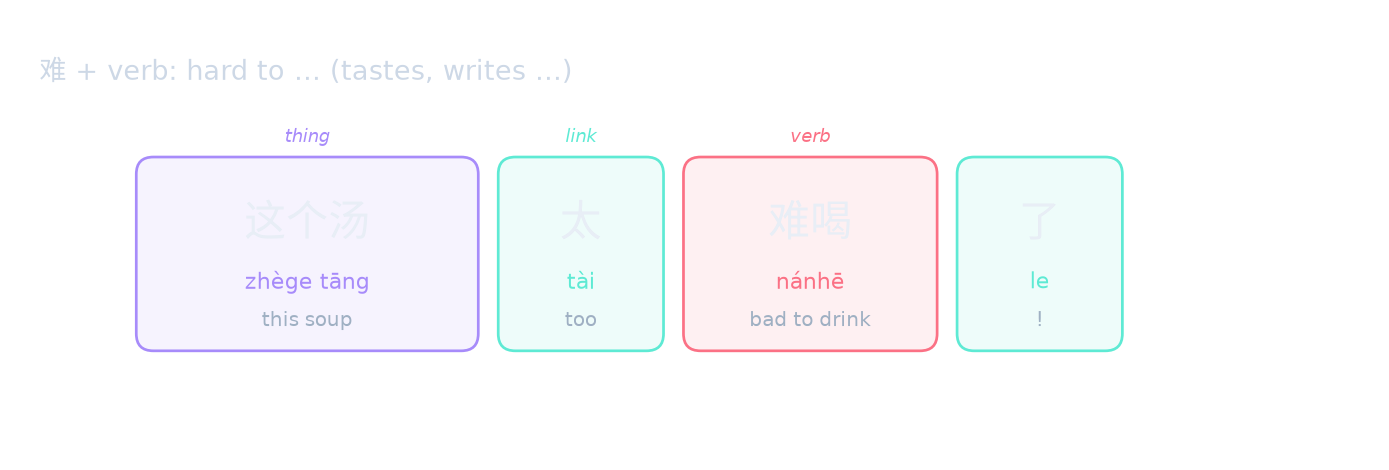
- this这个汤太难to drink喝(completed / change)了! Zhège tāng tài nánhē le! – This soup tastes awful!
- this这个color颜色degree / adjective linker很bad-looking; ugly难看。 Zhège yánsè hěn nánkàn. – This colour is ugly.
- this这个Chinese character字degree / adjective linker很difficult / hard难to write写。 – This character is hard to write.
- he / him他(modifier / structural particle)的question / problem问题很难to answer回答。 – His question is hard to answer.
How it works. With a sense verb, difficult / hard难 means "unpleasant to the senses". These words work like adjectives (degree / adjective linker很bad-looking; ugly难看, too太unpleasant to hear难听(completed / change)了), and each has an opposite with good好.
| difficult / hard难 word | Meaning | Opposite |
|---|---|---|
| unpalatable难吃 / difficult / hard难to drink喝 | tastes bad (food / drink) | tasty好吃 / tasty (drinks)好喝 |
| bad-looking; ugly难看 | ugly | good-looking好看 |
| unpleasant to hear难听 | sounds unpleasant | pleasant to hear好听 |
| unpleasant smell难闻 | smells bad | 好闻 |
With most other verbs, difficult / hard难 means "difficult to": 难写, difficult / hard难to answer回答. to feel unwell难受 is a feeling: unwell or upset.
not不tasty好吃 is milder ("not tasty") than unpalatable难吃 ("awful").
Watch out
- unpalatable难吃 means it tastes bad, not that it is hard to eat; bad-looking; ugly难看 means ugly, not hard to see.
Verb + (completed / change)了 + Duration (did for a length of time)
Form: verb + (completed / change)了 + length of time (+ object) · verb + object + verb + (completed / change)了 + length of time
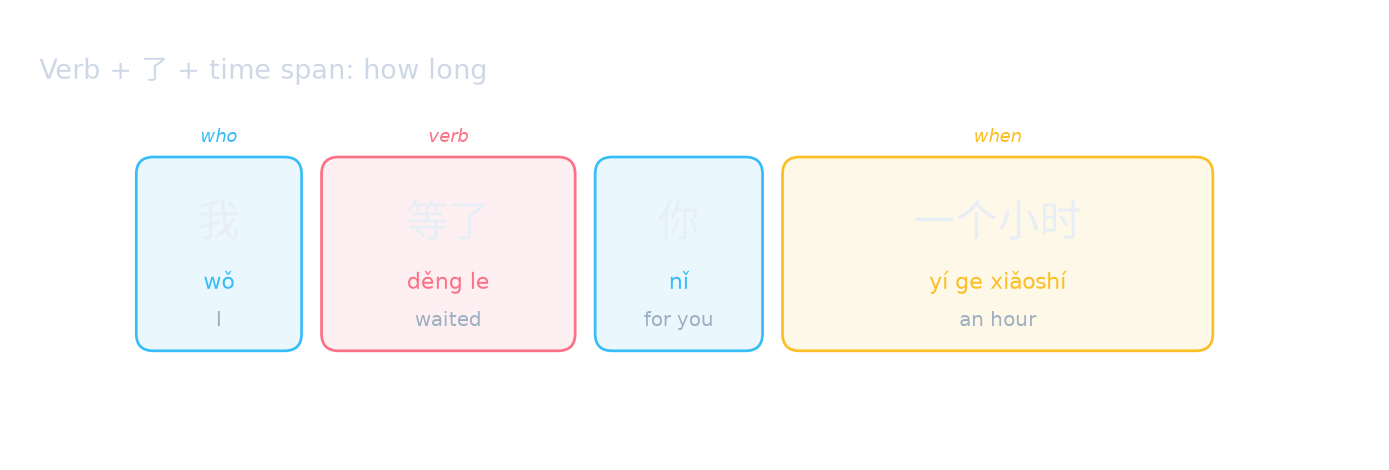
- I / me我to wait; and so on等(completed / change)了you你一个hour小时! Wǒ děngle nǐ yí ge xiǎoshí! – I waited for you for an hour!
- I / me我yesterday昨天to sleep睡(completed / change)了十个hour小时。 – I slept for ten hours yesterday.
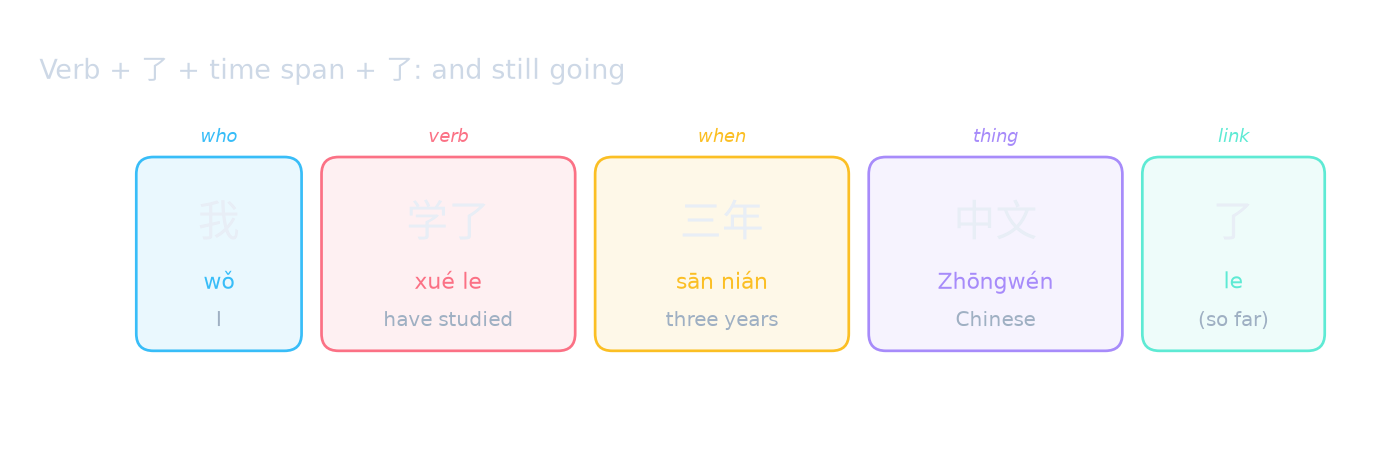
- 他学(completed / change)了三年Chinese language中文。 / 他学middle / in中literature文学(completed / change)了三年。 Tā xuéle sān nián Zhōngwén. – He studied Chinese for three years.
How it works. How long an action lasted comes after the verb, as in English. Verb + (completed / change)了 + duration with no final (completed / change)了 reports a period that is over: I / me我at / in在Beijing北京to live (somewhere)住(completed / change)了两年 (I lived there for two years, then left).
Where does the object go?
| Object | Pattern | Example |
|---|---|---|
| a noun | duration before it, or repeat the verb | 学了三年Chinese language中文 / 学中literature文学(completed / change)了三年 |
| a person (you你, he / him他) | before the duration | to wait; and so on等(completed / change)了you你一个hour小时 |
Watch out
- wrong: I / me我两年学了 → 我学(completed / change)了两年.
- wrong: 我学(completed / change)了Chinese language中文两年 → 我学(completed / change)了两年Chinese language中文.
- In the negative, the time moves to the front: 三天没吃肉(completed / change)了.
Verb + (completed / change)了 + Duration + (completed / change)了 (have been …-ing)
Form: (already已经) + verb + (completed / change)了 + length of time (+ object) + (completed / change)了
- I / me我to wait; and so on等(completed / change)了you你两个hour小时(completed / change)了! Wǒ děngle nǐ liǎng ge xiǎoshí le! – I've been waiting for you for two hours!
- he / him他at / in在here这儿to work; job工作(completed / change)了十年(completed / change)了。 Tā zài zhèr gōngzuòle shí nián le. – He has worked here for ten years (and still does).
- I / me我already已经to wait; and so on等(completed / change)了一个hour小时(completed / change)了。 – I've already been waiting an hour.
- you你学中literature文学(completed / change)了多长时间(completed / change)了? – How long have you been learning Chinese?
How it works. The final (completed / change)了 says the period lasts up to now and may go on.
| One (completed / change)了: finished | Two (completed / change)了: still going |
|---|---|
| I / me我at / in在here这儿to live (somewhere)住(completed / change)了五年。 | I / me我at / in在here这儿to live (somewhere)住(completed / change)了五年(completed / change)了。 |
| I lived here for five years. | I've lived here for five years. |
already已经 in front stresses how long it has been; it does not change the meaning.
Watch out
- The duration still follows the verb: wrong: 三年to learn学(completed / change)了(completed / change)了 → 学了三年(completed / change)了.
not / haven't没means办法 + Verb (no way to / can't)
Form: subject + not / haven't没means办法 + verb · not / haven't没means办法。(reply)
- shop商店all / both都to close (the door)关门(completed / change)了,I / me我not / haven't没means办法to buy买cake蛋糕。 Shāngdiàn dōu guān mén le, wǒ méi bànfǎ mǎi dàngāo. – The shops are all shut; there's no way I can buy a cake.
- I'm sorry对不起,I / me我not / haven't没means办法to help帮you你。 – Sorry, there's no way I can help you.
- A: to rain下雨(completed / change)了,competition比赛to cancel取消(completed / change)了。 B: not / haven't没means办法。 – "It's raining, the match is off." "Nothing we can do."
- I / me我a little一点儿means办法all / both都not have / haven't没有。 – I'm completely out of ideas.
How it works. not / haven't没means办法 méi bànfǎ + verb means the situation stops you: "there's no way to …". On its own, it is a reply: "Oh well, nothing can be done."
| not / haven't没means办法 | won't / can't不会 | cannot不能 |
|---|---|---|
| the situation blocks you | you lack the skill | general "can't", not allowed |
| I / me我not / haven't没means办法to contact; connection联系he / him他 | I / me我won't / can't不会to swim游泳 | here这里cannot不能to smoke抽烟 |
Watch out
- Keep not / haven't没: wrong: not不means办法 → not / haven't没means办法.

Verb reduplication (do a bit / give it a try)
Form: VV · Vone / a一V · ABAB · V(completed / change)了V (done)
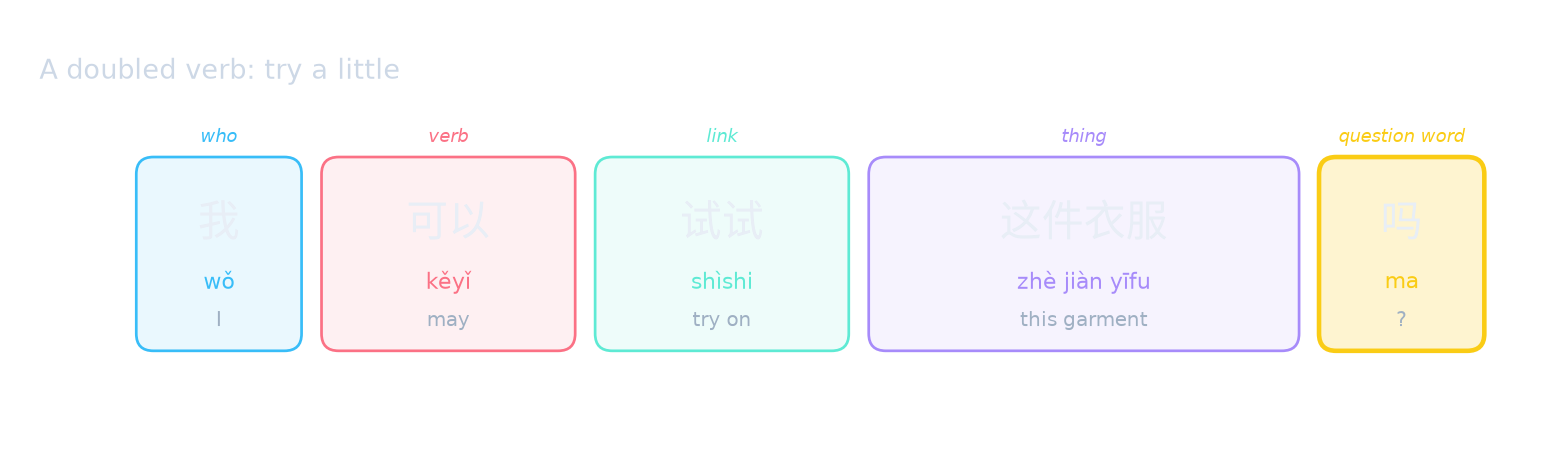
- I / me我can / may可以试试这件clothes衣服(yes/no ?)吗? Wǒ kěyǐ shìshi zhè jiàn yīfu ma? – Could I try this jacket on?
- to let / make让I / me我to take a look at看看。 Ràng wǒ kànkan. – Let me have a look.
- we / us我们to discuss讨论to discuss讨论this这个question / problem问题(suggestion)吧。 – Let's talk this over a bit.
- he / him他to look at; to watch; to read看(completed / change)了to look at; to watch; to read看watch (timepiece)表,then / just就to walk / to leave走(completed / change)了。 – He glanced at his watch and left.
How it works. A doubled verb means "do it a little, give it a try". It sounds softer and friendlier: you你尝尝 is gentler than you你to taste尝. The second syllable is said lightly.
| Verb | Doubled | Done |
|---|---|---|
| one syllable: to look at; to watch; to read看 | to take a look at看看 / to have a look看一看 | to look at; to watch; to read看(completed / change)了to look at; to watch; to read看 |
| two syllables: to rest休息 | to rest休息to rest休息 | to rest休息(completed / change)了(used after a verb) give it…一下 |
Watch out
- Verbs double as ABAB, adjectives as AABB: wrong: to rest休to rest休息breath息 → to rest休息to rest休息.
- Doubling already means "a bit": wrong: to take a look at看看a moment一会儿 → to take a look at看看 or to look at; to watch; to read看a moment一会儿.
degree / adjective linker很 + Verb (feeling verbs with degree / adjective linker很)
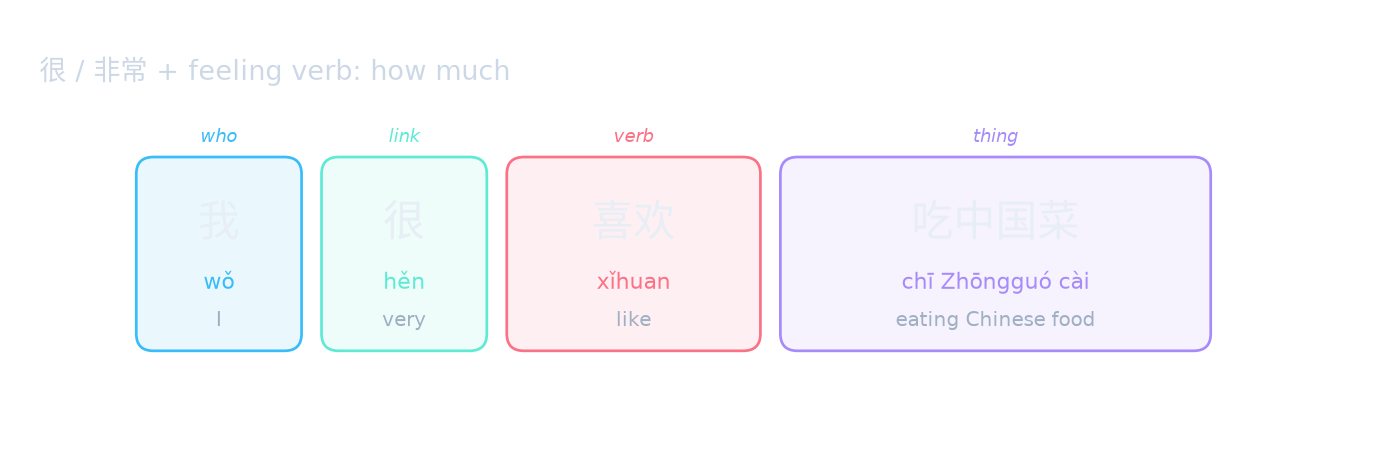
Form: subject + degree / adjective linker很 / very非常 + feeling verb (+ object)
- I / me我degree / adjective linker很to like喜欢to eat吃China中国dish (of food); vegetable菜。 Wǒ hěn xǐhuan chī Zhōngguó cài. – I really like Chinese food.
- I / me我degree / adjective linker很homesick想家。 Wǒ hěn xiǎng jiā. – I miss home a lot.
- I / me我very非常anxious担心he / him他。 – I'm extremely worried about him.
- we / us我们all / both都degree / adjective linker很to hope希望you你can / be able to能to come来。 – We all very much hope you can come.
How it works. Verbs of feeling and wanting take degree words, just like adjectives: degree / adjective linker很to like喜欢, 很想, degree / adjective linker很anxious担心, degree / adjective linker很to hope希望, degree / adjective linker很to love爱. The degree word goes right before the verb.
- 很想 + verb: really want to: I / me我degree / adjective linker很want / think / miss想to go去to take a look at看看.
- 很会 + verb: be good at: he / him他很会to prepare a meal做饭.
Watch out
- Ordinary action verbs do not take degree / adjective linker很: wrong: degree / adjective linker很to eat吃, wrong: degree / adjective linker很to run跑. Say to eat吃(degree marker)得很多, to run跑(degree marker)得很快.
- wrong: to like喜欢degree / adjective linker很this这本书 → degree / adjective linker很to like喜欢this这本书.
Practice without the models
Cover the teaching sections before you answer. The answers follow.
difficult / hard难 + Verb (unpleasant to …)
1. Complete: “This colour is ugly.” this这个color颜色degree / adjective linker很…………。
2. Match each word to its meaning.
-
(1) unpalatable难吃
-
(2) unpleasant to hear难听
-
(3) 难写
-
(4) to feel unwell难受
-
A. sounds unpleasant
-
B. hard to write
-
C. feel unwell
-
D. tastes bad
3. Build: “His question is hard to answer.”
Put in order: degree / adjective linker很 / to answer回答。 / he / him他(modifier / structural particle)的question / problem问题 / difficult / hard难
4. “His home is easy to find.” 他家degree / adjective linker很…………to look for; to give change找。
5. Your friend's mum asks how her soup is. It is too salty for you. What is the kindest answer?
- A. I / me我not不to drink喝difficult / hard难to drink喝(modifier / structural particle)的soup汤。
- B. degree / adjective linker很tasty (drinks)好喝,exactly就是slightly有点儿salty咸。
- C. this这个汤太难to drink喝(completed / change)了!
- D. this这个汤难to drink喝extremely极了。
6. Which is the mildest way to say the food is not good?
- A. not不tasty好吃。
- B. too太unpalatable难吃(completed / change)了。
- C. unpalatable难吃extremely极了。
- D. degree / adjective linker很unpalatable难吃。
7. You try the canteen's new soup. It is salty and cold. Use difficult / hard难 + Verb. Write your answer in Chinese, then say it aloud.
Verb + (completed / change)了 + Duration (did for a length of time)
8. Complete: “I slept for ten hours yesterday.” I / me我yesterday昨天to sleep睡…………十个hour小时。
9. “I studied for two hours at seven o'clock.” Which is correct?
- A. I / me我七点两个hour小时to study; to learn学习(completed / change)了。
- B. I / me我to study; to learn学习(completed / change)了七点两个hour小时。
- C. I / me我七点to study; to learn学习(completed / change)了两个hour小时。
- D. I / me我两个hour小时七点to study; to learn学习(completed / change)了。
10. Build: “I waited for you for an hour.”
Put in order: I / me我 / to wait; and so on等(completed / change)了 / 一个hour小时。 / you你
11. Which says “She studied piano for five years.”?
- A. 她学piano钢琴五年(completed / change)了to learn学。
- B. 她学(completed / change)了piano钢琴五年。
- C. she / her她五年学了piano钢琴。
- D. 她学(completed / change)了五年piano钢琴。
12. True or false? I / me我at / in在Beijing北京to live (somewhere)住(completed / change)了两年 can describe a stay that has ended. If false, correct it.
13. Your friend was very late for lunch, and now she asks how long you waited. Use Verb + (completed / change)了 + Duration. Write your answer in Chinese, then say it aloud.
Verb + (completed / change)了 + Duration + (completed / change)了 (have been …-ing)
14. You still live here: “I've lived here for five years.” I / me我at / in在here这儿to live (somewhere)住(completed / change)了五年…………。
15. Build: “I've already been waiting for an hour.”
Put in order: to wait; and so on等(completed / change)了 / 一个hour小时(completed / change)了。 / already已经 / I / me我
16. “I haven't played basketball for a month.” Which is correct?
- A. I / me我not / haven't没to play basketball打篮球一个月(completed / change)了。
- B. I / me我not / haven't没to hit / play / make (a call)打(completed / change)了一个月basketball篮球。
- C. I / me我一个月not / haven't没to play basketball打篮球(completed / change)了。
- D. I / me我to hit / play / make (a call)打(completed / change)了一个月basketball篮球(completed / change)了。
17. Build: “It is two years since my sister graduated.”
Put in order: (completed / change)了。 / 两年 / I / me我older sister姐姐 / to graduate毕业
18. Which sentence means the person still works at the bank?
- A. he / him他三年at / in在bank银行to work; job工作。
- B. he / him他at / in在bank银行to work; job工作(completed / change)了三年(completed / change)了。
- C. he / him他at / in在bank银行三年to work; job工作(completed / change)了。
- D. he / him他at / in在bank银行to work; job工作(completed / change)了三年。
19. True or false? 我学(completed / change)了三年Chinese language中文 and 我学(completed / change)了三年Chinese language中文(completed / change)了 mean exactly the same. If false, correct it.
20. Your friend phones to ask where you are. You are still in the café where you have been since two o'clock. Use Verb + (completed / change)了 + Duration + (completed / change)了. Write your answer in Chinese, then say it aloud.
not / haven't没means办法 + Verb (no way to / can't)
21. Complete: “The phone has no signal; I can't call you.” mobile phone手机not have / haven't没有signal信号,I / me我…………to / for / give给you你to make a telephone call打电话。
22. Build: “Sorry, there's no way I can help you.”
Put in order: ,I / me我 / not / haven't没means办法 / I'm sorry对不起 / to help帮you你。
23. True or false? not / haven't没means办法 can be a complete reply meaning “nothing can be done”. If false, correct it.
24. Your friend lost the key to the classroom. You want to help. What do you say?
- A. not / haven't没means办法,you你回家吧。
- B. 别着急,we / us我们together一起want / think / miss想means办法。
- C. you你not / haven't没means办法want / think / miss想。
- D. I / me我won't / can't不会means办法。
25. Which says “I can't swim (I never learned).”?
- A. I / me我to swim游泳not / haven't没means办法。
- B. I / me我not不means办法to swim游泳。
- C. I / me我not / haven't没means办法to swim游泳。
- D. I / me我won't / can't不会to swim游泳。
26. Your friend asks you to buy a cake on the way home, but every bakery has closed for the holiday. Use not / haven't没means办法 + Verb. Write your answer in Chinese, then say it aloud.
Verb reduplication (do a bit / give it a try)
27. Double the verb to look at; to watch; to read看 to say “Let me have a look.” to let / make让I / me我…………。
28. True or false? you你尝尝 sounds softer than you你to taste尝. If false, correct it.
29. “Let's go for a little swim.” Which is correct?
- A. we / us我们to go去游一to swim游泳swimming泳(suggestion)吧。
- B. we / us我们去游to swim游泳(suggestion)吧。
- C. we / us我们to go去to swim游泳swimming泳(suggestion)吧。
- D. we / us我们to go去to swim游泳to swim游泳(suggestion)吧。
30. Which is the correct doubled form of to rest休息?
- A. to rest休息breath息
- B. to rest休to rest休息breath息
- C. to rest休息to rest休息
- D. to rest休to rest休息
31. Build: “He glanced at his watch and left.”
Put in order: ,then / just就 / to look at; to watch; to read看(completed / change)了to look at; to watch; to read看watch (timepiece)表 / he / him他 / to walk / to leave走(completed / change)了。
32. You see a jacket you like in a shop and want to try it before deciding. Write your answer in Chinese, then say it aloud.
degree / adjective linker很 + Verb (feeling verbs with degree / adjective linker很)
33. Complete: “I miss my mum very much.” I / me我…………want / think / miss想I / me我mum; mother妈妈。
34. Build: “We all very much hope you can come.”
Put in order: degree / adjective linker很to hope希望 / you你 / can / be able to能to come来。 / we / us我们all / both都
35. Your host asks if you like spicy food. You don't, but you want to be polite. What do you say?
- A. I / me我a little一点儿also也not不to like喜欢。
- B. I / me我degree / adjective linker很不吃spicy辣(modifier / structural particle)的。
- C. I / me我not不too太to like喜欢to eat吃spicy辣(modifier / structural particle)的。
- D. I / me我most最to like喜欢to eat吃spicy辣(modifier / structural particle)的。
36. Which sentence is correct?
- A. he / him他degree / adjective linker很to like喜欢cooked rice米饭。
- B. he / him他degree / adjective linker很to eat吃cooked rice米饭。
- C. he / him他cooked rice米饭degree / adjective linker很to like喜欢to eat吃degree / adjective linker很。
- D. he / him他to like喜欢degree / adjective linker很cooked rice米饭。
37. True or false? he / him他很会to prepare a meal做饭 means “He is very good at cooking.” If false, correct it.
38. A new friend asks whether you like Chinese food. You really do. Use degree / adjective linker很 + Verb. Write your answer in Chinese, then say it aloud.
Answers and explanations
difficult / hard难 + Verb (unpleasant to …)
1. bad-looking; ugly难看
bad-looking; ugly难看 = unpleasant to look at, ugly.
2. (1) D: unpalatable难吃 = tastes bad; (2) A: unpleasant to hear难听 = sounds unpleasant; (3) B: 难写 = hard to write; (4) C: to feel unwell难受 = feel unwell
With sense verbs difficult / hard难 means unpleasant; with other verbs it means hard to do; to feel unwell难受 is a feeling.
3. he / him他(modifier / structural particle)的question / problem问题很难to answer回答。
Topic + degree / adjective linker很 + difficult / hard难 + verb.
4. good好
With a verb that is not a sense, good好 + verb = easy to …: 好找.
5. B. degree / adjective linker很tasty (drinks)好喝,exactly就是slightly有点儿salty咸。
Start with the good side and soften the problem with slightly有点儿.
6. A. not不tasty好吃。
not不tasty好吃 is milder than unpalatable难吃.
7. Model answer: this这个汤太难to drink喝(completed / change)了!
Check your answer:
- unpalatable难吃 means it tastes bad, not that it is hard to eat; bad-looking; ugly难看 means ugly, not hard to see.
- to feel unwell难受 is a feeling: "feel unwell, upset": I / me我headache头疼,degree / adjective linker很to feel unwell难受.
Verb + (completed / change)了 + Duration (did for a length of time)
8. (completed / change)了
Verb + (completed / change)了 + duration.
9. C. I / me我七点to study; to learn学习(completed / change)了两个hour小时。
The point in time (七点) goes before the verb; the length of time (两个hour小时) after it.
10. I / me我to wait; and so on等(completed / change)了you你一个hour小时。
A pronoun object comes before the duration.
11. D. 她学(completed / change)了五年piano钢琴。
The duration goes between (completed / change)了 and the noun object.
12. True.
With no final (completed / change)了, the period is reported as complete.
13. Model answer: I / me我to wait; and so on等(completed / change)了you你一个hour小时!
Check your answer:
- Duration after the verb: 我学(completed / change)了两年, not I / me我两年学了.
- With a noun object, do not put the duration last: 我学(completed / change)了两年Chinese language中文 or 我学middle / in中literature文学(completed / change)了两年, not 我学(completed / change)了Chinese language中文两年.
Verb + (completed / change)了 + Duration + (completed / change)了 (have been …-ing)
14. (completed / change)了
The final (completed / change)了 shows it continues up to now.
15. I / me我already已经to wait; and so on等(completed / change)了一个hour小时(completed / change)了。
already已经 + verb + (completed / change)了 + duration + (completed / change)了.
16. C. I / me我一个月not / haven't没to play basketball打篮球(completed / change)了。
For time without doing something, the time goes before not / haven't没: 一个月not / haven't没to play basketball打篮球(completed / change)了. to hit / play / make (a call)打(completed / change)了一个月basketball篮球(completed / change)了 means you have been playing for a month.
17. I / me我older sister姐姐to graduate毕业两年(completed / change)了。
With a one-off verb like to graduate毕业, the time goes after the verb: to graduate毕业两年(completed / change)了.
18. B. he / him他at / in在bank银行to work; job工作(completed / change)了三年(completed / change)了。
Two (completed / change)了 = still going.
19. False.
The first is a finished period; the second continues up to now.
20. Model answer: I / me我to wait; and so on等(completed / change)了you你两个hour小时(completed / change)了!
Check your answer:
- Two (completed / change)了 = still going: to live (somewhere)住(completed / change)了两年(completed / change)了 (I still live here). One (completed / change)了 = finished: to live (somewhere)住(completed / change)了两年 (I moved away).
- The duration still goes after the verb: 学了三年(completed / change)了, not 三年to learn学(completed / change)了(completed / change)了.
not / haven't没means办法 + Verb (no way to / can't)
21. not / haven't没means办法
The situation blocks the call, so not / haven't没means办法 + verb.
22. I'm sorry对不起,I / me我not / haven't没means办法to help帮you你。
Subject + not / haven't没means办法 + verb phrase.
23. True.
It is a common short reply when a situation cannot be changed.
24. B. 别着急,we / us我们together一起want / think / miss想means办法。
want / think / miss想means办法 = think of a way; it offers help.
25. D. I / me我won't / can't不会to swim游泳。
A skill you have not learned takes won't / can't不会.
26. Model answer: shop商店all / both都to close (the door)关门(completed / change)了,I / me我not / haven't没means办法to buy买cake蛋糕。
Check your answer:
- not / haven't没means办法 means the situation blocks you; for a skill you lack, use won't / can't不会: I / me我won't / can't不会to swim游泳.
- Keep not / haven't没 (not not不): not / haven't没means办法, not not不means办法.
Verb reduplication (do a bit / give it a try)
27. to take a look at看看
VV or Vone / a一V makes it a light “have a look”.
28. True.
Doubling makes an invitation light and friendly.
29. B. we / us我们去游to swim游泳(suggestion)吧。
to swim游泳 is verb + object, so only the verb doubles: to swim / to travel游to swim游泳 (AAB).
30. C. to rest休息to rest休息
Two-syllable verbs repeat as ABAB.
31. he / him他to look at; to watch; to read看(completed / change)了to look at; to watch; to read看watch (timepiece)表,then / just就to walk / to leave走(completed / change)了。
V(completed / change)了V for a brief completed action.
32. Model answer: I / me我can / may可以试试这件clothes衣服(yes/no ?)吗?
Check your answer:
- Two-syllable verbs repeat as ABAB (to rest休息to rest休息), not AABB (to rest休to rest休息breath息); AABB is for adjectives (干干净净).
- Doubling adds "a bit", so do not add a duration as well: to take a look at看看, or to look at; to watch; to read看a moment一会儿, not to take a look at看看a moment一会儿.
degree / adjective linker很 + Verb (feeling verbs with degree / adjective linker很)
33. degree / adjective linker很
Feeling verbs such as want / think / miss想 take degree / adjective linker很.
34. we / us我们all / both都degree / adjective linker很to hope希望you你can / be able to能to come来。
all / both都 + degree / adjective linker很 + feeling verb + clause.
35. C. I / me我not不too太to like喜欢to eat吃spicy辣(modifier / structural particle)的。
不太to like喜欢 is a soft, polite no.
36. A. he / him他degree / adjective linker很to like喜欢cooked rice米饭。
degree / adjective linker很 + feeling verb is correct; an action verb such as to eat吃 does not take degree / adjective linker很.
37. True.
很会 + verb = be good at doing it.
38. Model answer: I / me我degree / adjective linker很to like喜欢to eat吃China中国dish (of food); vegetable菜。
Check your answer:
- Ordinary action verbs do not take degree / adjective linker很: degree / adjective linker很to eat吃, degree / adjective linker很to run跑, degree / adjective linker很to go去 are wrong. Say to eat吃(degree marker)得很多, to run跑(degree marker)得很快.
- Put degree / adjective linker很 before the verb, not the object: degree / adjective linker很to like喜欢this这本书, not to like喜欢degree / adjective linker很this这本书.