HSK 6 adverbs are precise and often formal. Some say how things have always been (always (as a habit)向来, always (up to now)一向), some judge an outcome (as expected; sure enough果然, of all times / insist on偏偏, it seems似乎), some cover everything (all; every凡是……all / both都, all; without exception一律), and some question whether something is needed (why bother何必, nothing but无非). Watch the register: degree / adjective linker很to be / is是 and fully足足 belong to written Chinese, while to pour倒 and when the moment comes到时候 are everyday speech.
Adverbs
HSK 6 · Topic 1
 7:59
HSK 6 Grammar 1: Adverbs of Judgment and Scope
In speech, 倒 after 得 turns the adjective sour. Someone calls a job easy, and you know it isn't: 你说得倒容易,真正上台演示的人是我。 Easy for you to say; I'm the one presenting.…
English explanations + Mandarin examples · captions follow the spoken text
1.1
At a glance
Always and consistently
- 1. always (as a habit)向来 – always / all along: he / him他always (as a habit)向来degree / adjective linker很punctual准时,today今天not / haven't没to come来,definitely; to be sure肯定to be occupied with sth有事。
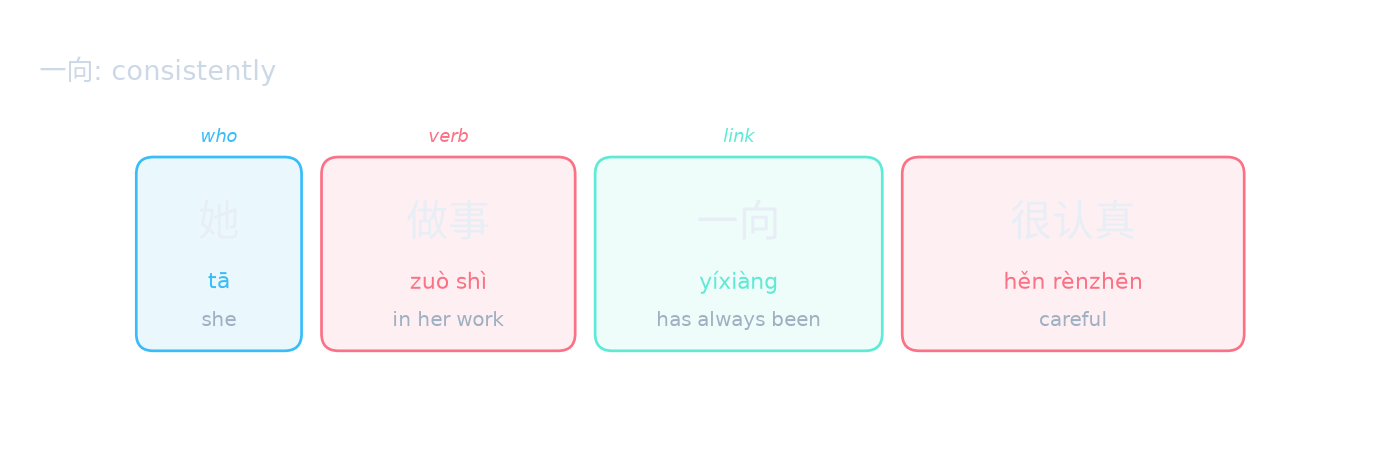
- 2. always (up to now)一向 – all along / consistently: she / her她to work做事always (up to now)一向degree / adjective linker很conscientious认真。
- 3. again and again一再 + Verb – again and again: mum; mother妈妈again and again一再to remind提醒he / him他,he / him他or / still还是to forget忘(completed / change)了。
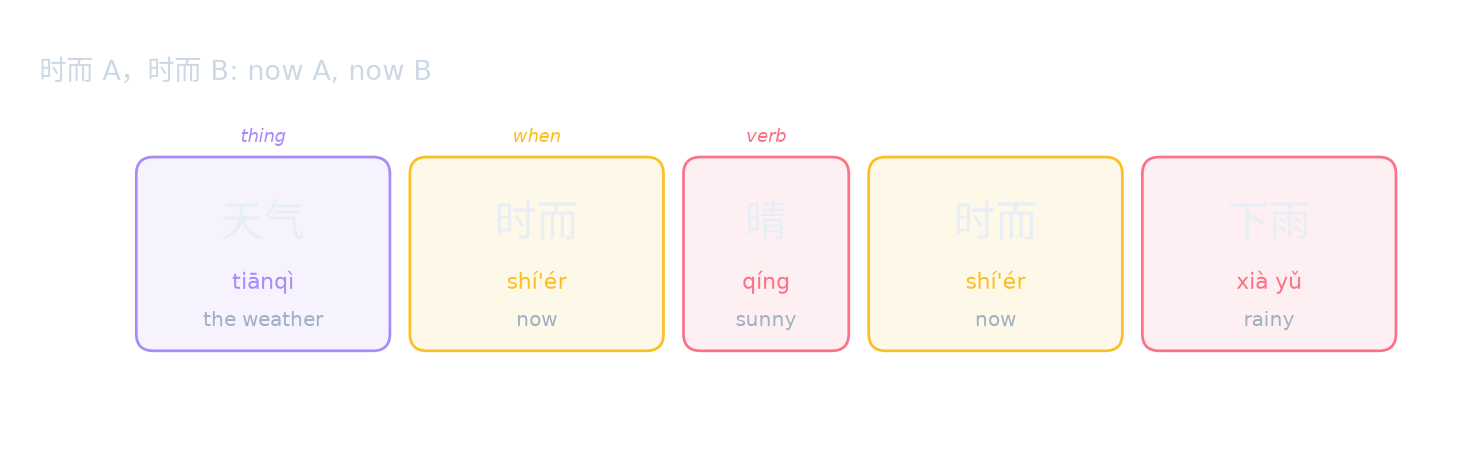
- 4. sometimes时而 A,sometimes时而 B – now A, now B: on the mountain山上(modifier / structural particle)的weather天气sometimes时而sunny晴,sometimes时而to rain下雨。
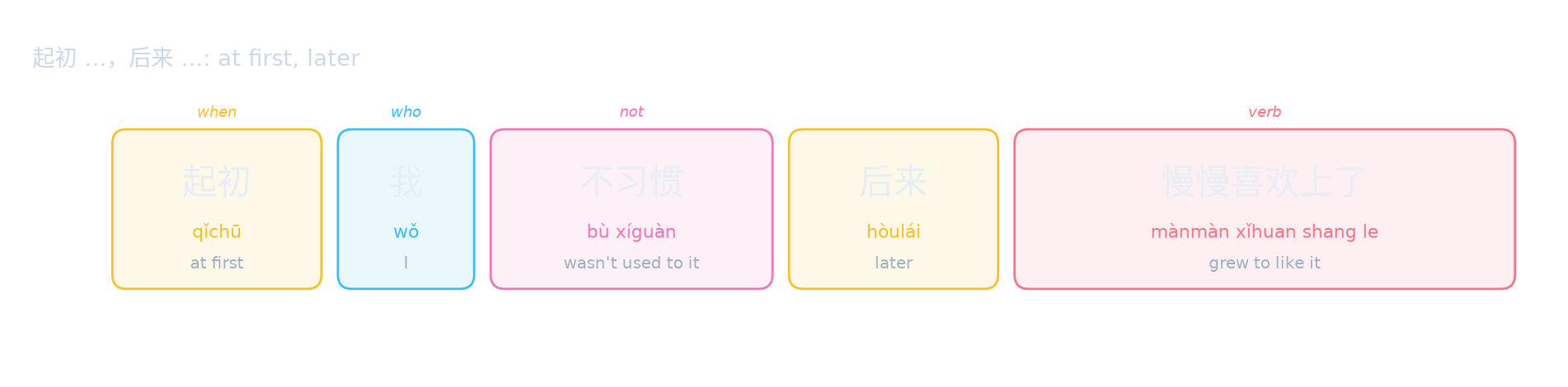
- 5. originally起初 vs at first; originally当初 – at first / back then: originally起初I / me我not不too太habit / be used to习惯,later; afterwards后来slowly慢慢to like喜欢up / on / last; to get on, attend上(completed / change)了here这里。
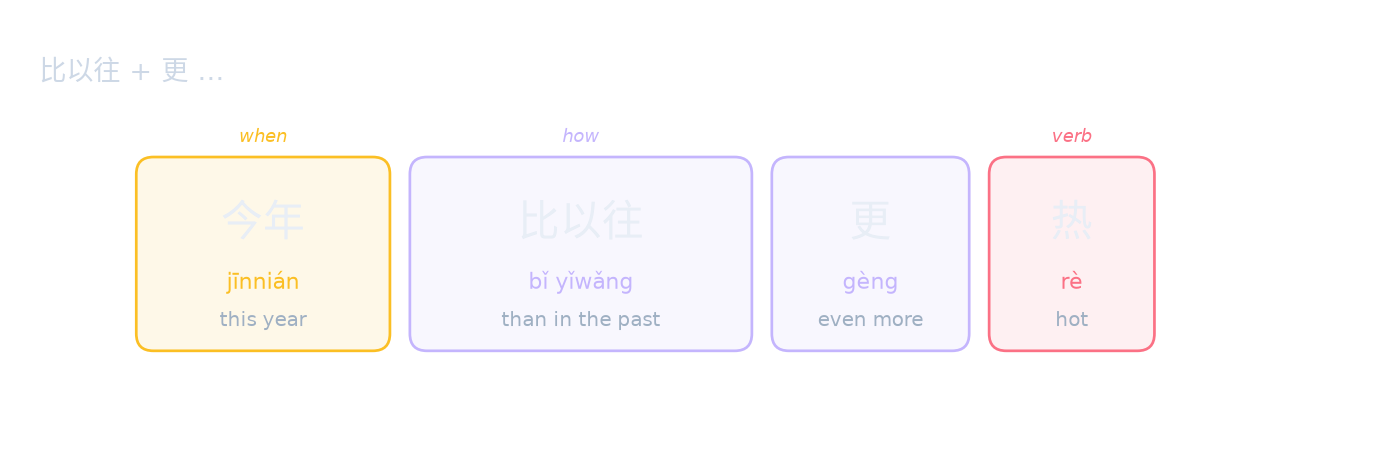
- 6. in the past以往 vs usually (in the past)往常 and before以前 – in the past, as usual: 今年夏天than / compared to比in the past以往更热。
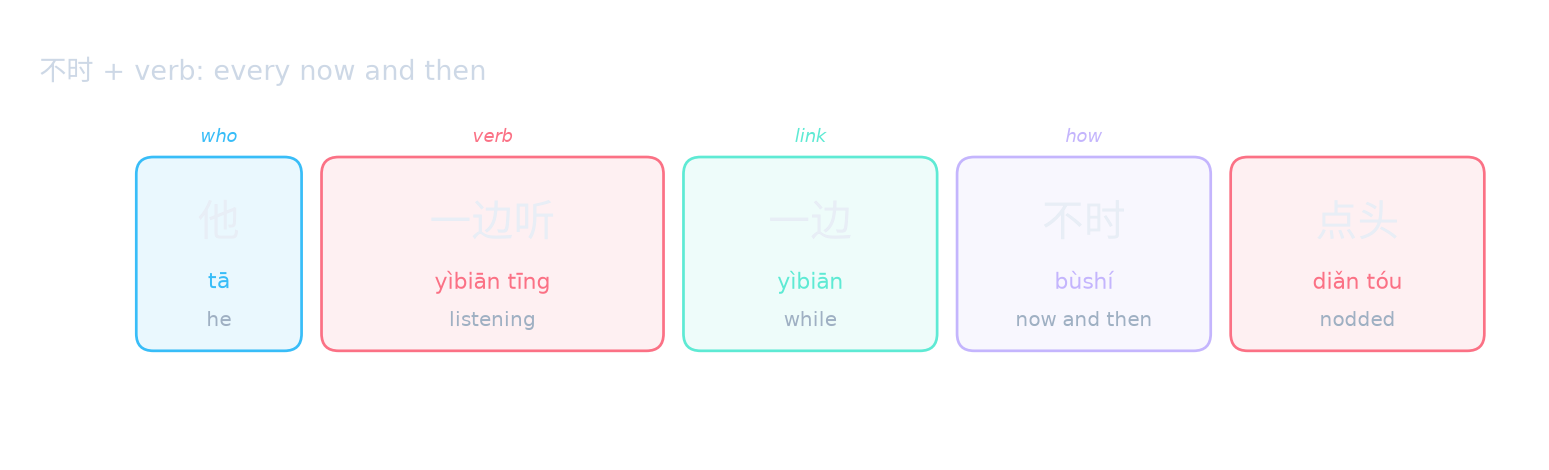
- 7. from time to time不时 vs sometimes时而 and often经常 – every now and then: he / him他one side一边to listen to听,one side一边from time to time不时(adverb -ly)地to nod点头。
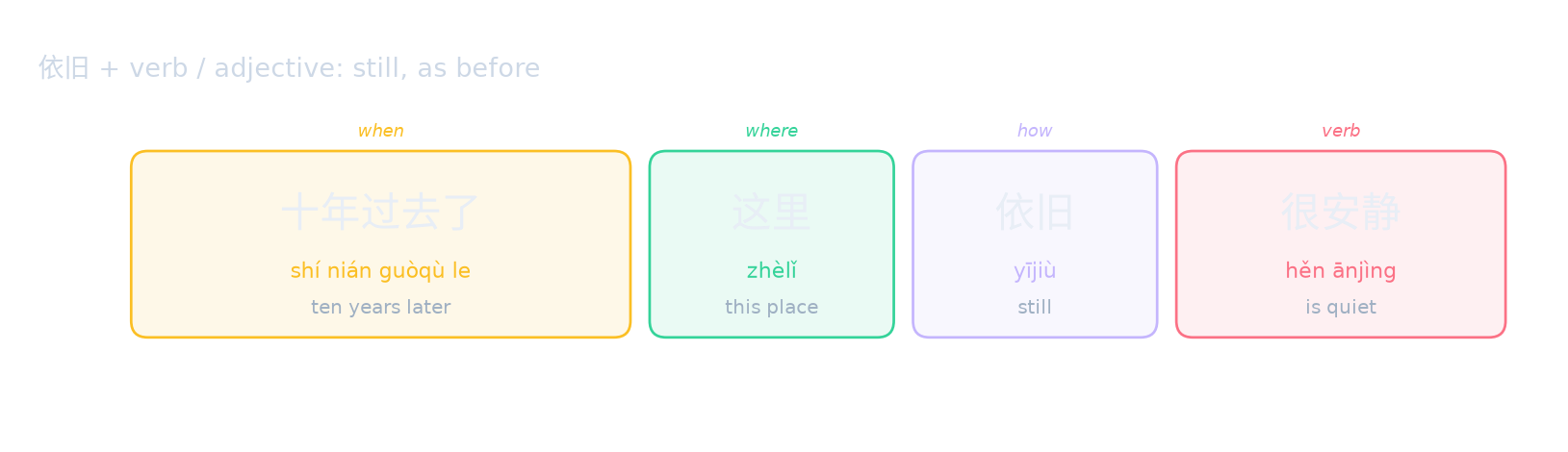
- 8. as before依旧 vs still依然 and still仍然 – still, as before: 十年past过去(completed / change)了,here这里as before依旧degree / adjective linker很quiet安静。
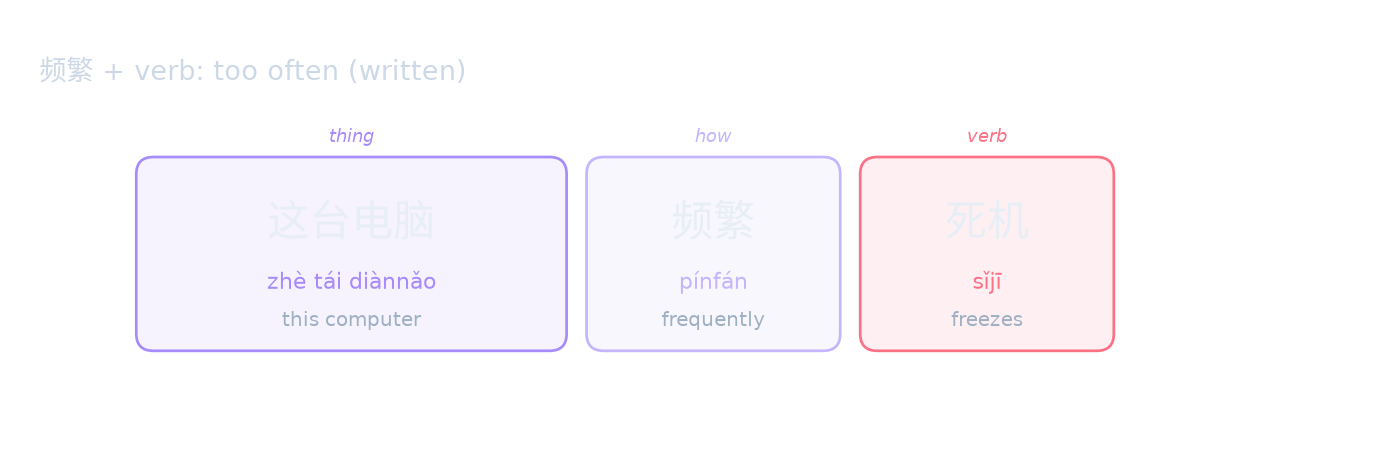
- 9. frequently频繁 vs often经常 and always老是 – very frequent: 这台computer电脑recently最近frequently频繁to crash (of a computer)死机。
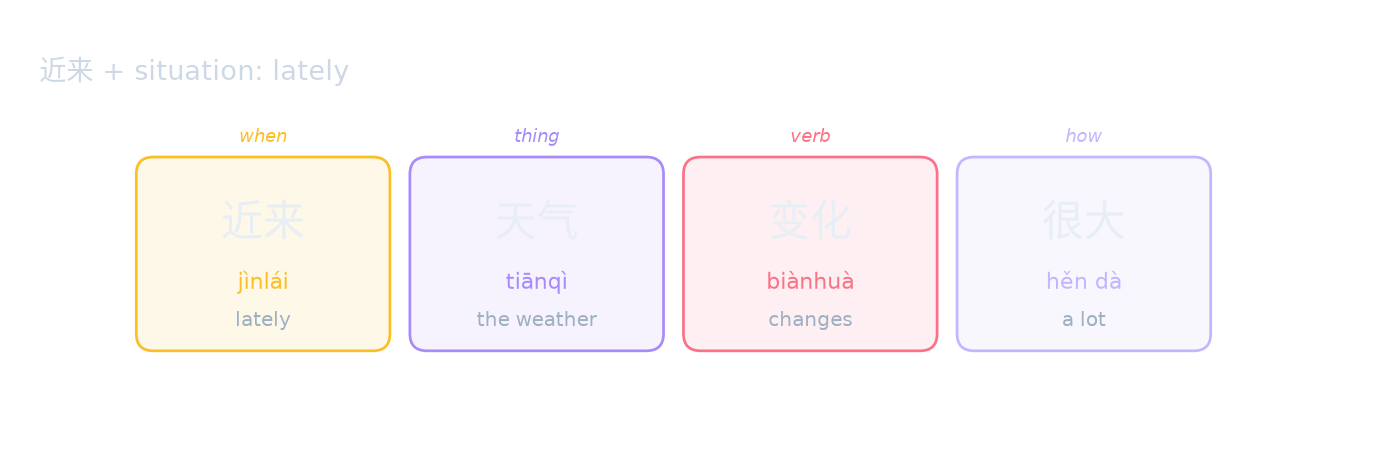
- 10. recently近来 vs recently最近 – lately: recently近来weather天气变化很大,everyone大家want / will / need要to take note of注意body; health身体。
- 11. just as in the past一如既往 vs as before依旧 and all the same; as before照样 – as always: we / us我们can / will会just as in the past一如既往(adverb -ly)地to support支持you你。
- 12. day by day日益 vs more and more越来越 and gradually逐渐 – increasingly: 城市交通day by day日益crowded拥挤。
- 13. so far迄今 vs up to (a date)截至 and to close截止 – so far, as of: so far迄今为止,已有五万person人to sign up报名。
- 14. throughout history历来 vs always (up to now)一向 and always (so far); never (with 不 / 没)从来 – has always: 这所school学校throughout history历来to value; to take seriously重视sports体育。
- 15. at most顶多 vs up to the maximum至多, most最many; much多 and at least至少 – at most: 这件clothes衣服at most顶多value值一百块。
- 16. far more than何止 vs more than / not just不止 – far more than: to come来(modifier / structural particle)的person人far more than何止一千!
- 17. a little bit略微 vs a little bit稍微 and slightly有点儿 – slightly: today今天than / compared to比yesterday昨天a little bit略微warm暖和some一些。
Expected, unexpected and uncertain
- 18. as expected; sure enough果然 – sure enough / as expected: weather forecast天气预报to speak说afternoon下午有雨,as expected; sure enough果然to rain下雨(completed / change)了。
- 19. of all times / insist on偏偏 – of all things / just had to: we / us我们with great difficulty好不容易to set / fix定(completed / change)了picnic野餐(modifier / structural particle)的day日子,of all times / insist on偏偏that day那天to rain下雨。
- 20. it seems似乎 – it seems / as if: he / him他it seems似乎to have / there is有what什么a load on one's mind心事。
- 21. unexpectedly不料 – unexpectedly – written: 我本want / think / miss想早点儿to return home回家,unexpectedly不料on the road路上to block up (a road, pipe…堵(completed / change)了两个hour小时。
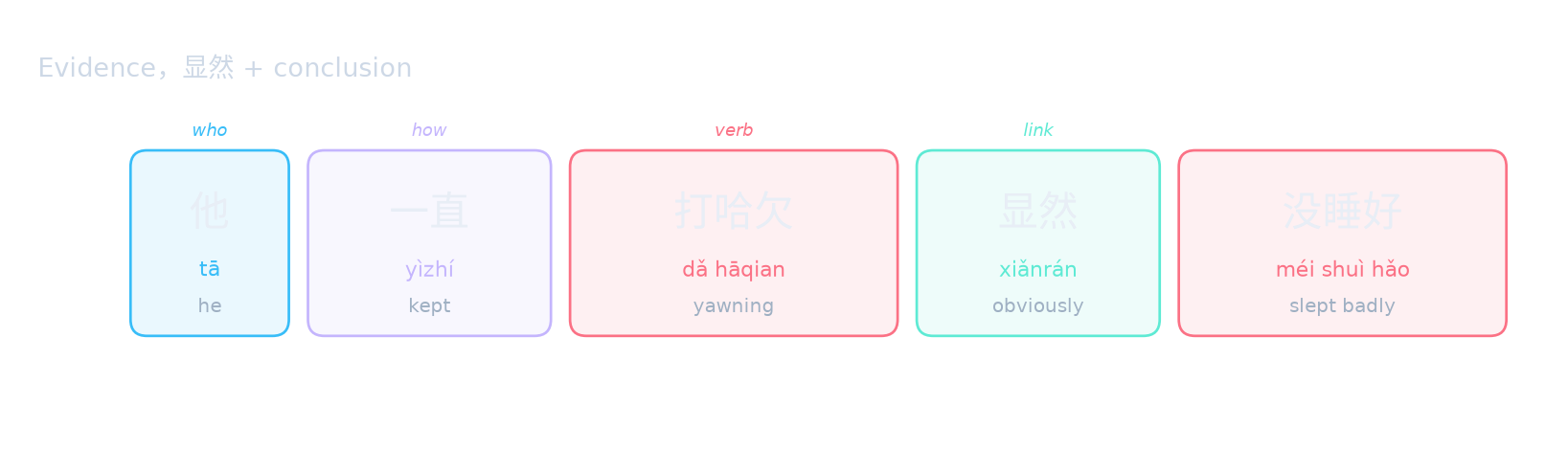
- 22. obviously显然 vs obvious明显 – obviously vs obvious: he / him他all along / straight一直打哈欠,obviously显然yesterday evening昨晚没睡good好。
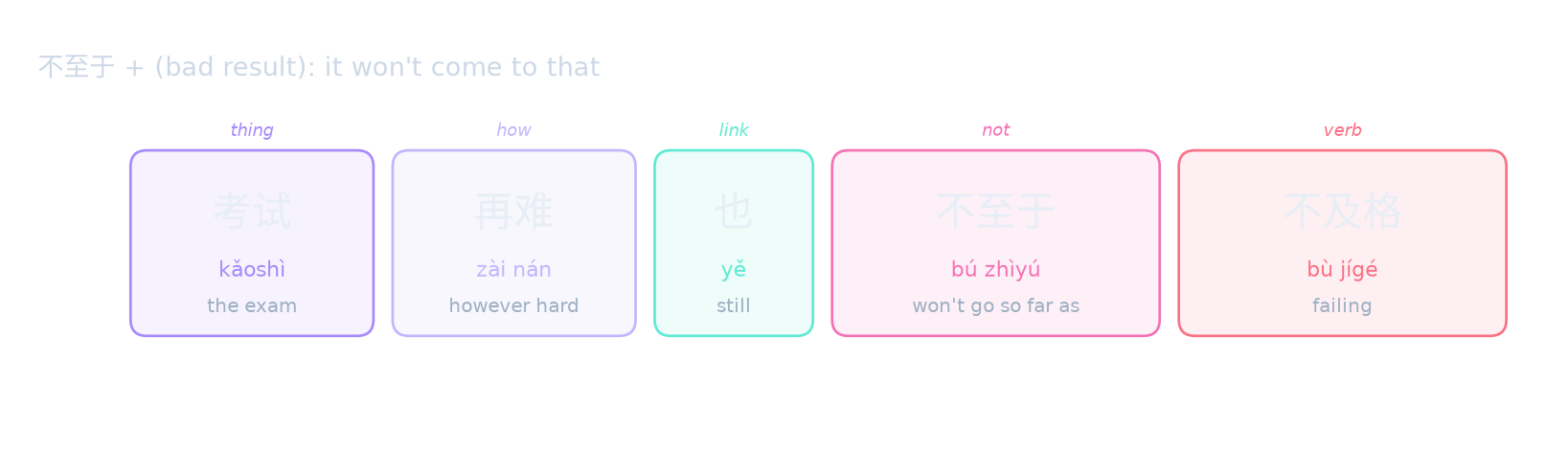
- 23. unlikely to go so far as to不至于 – it won't come to that: you你to review复习(degree marker)得so much这么conscientious认真,unlikely to go so far as to不至于to fail不及格(suggestion)吧。
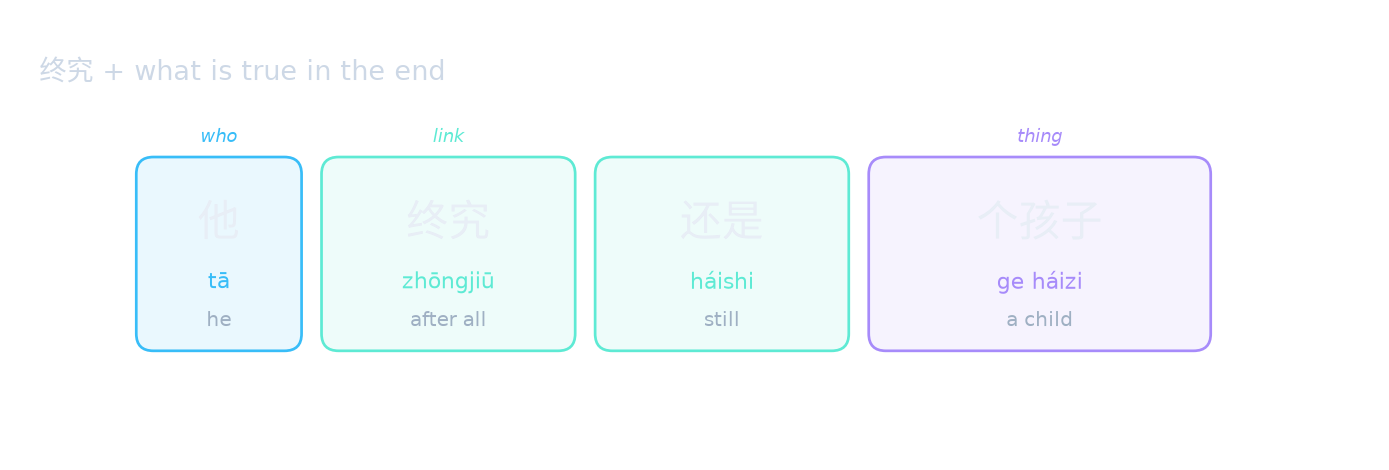
- 24. in the end终究 vs finally终于 and after all毕竟 – in the end / finally / after all: forget it; never mind算了,he / him他in the end终究or / still还是(measure word)个child孩子。
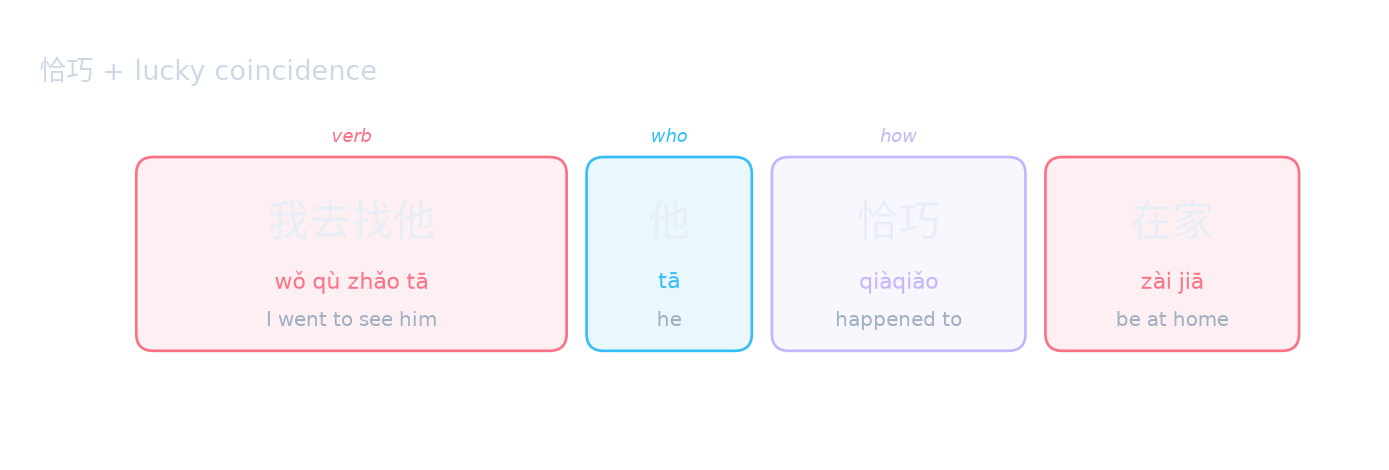
- 25. by chance恰巧 vs as it turns out恰好 – as it happened / exactly right: I / me我to go去to look for; to give change找he / him他,he / him他by chance恰巧to be at home在家。
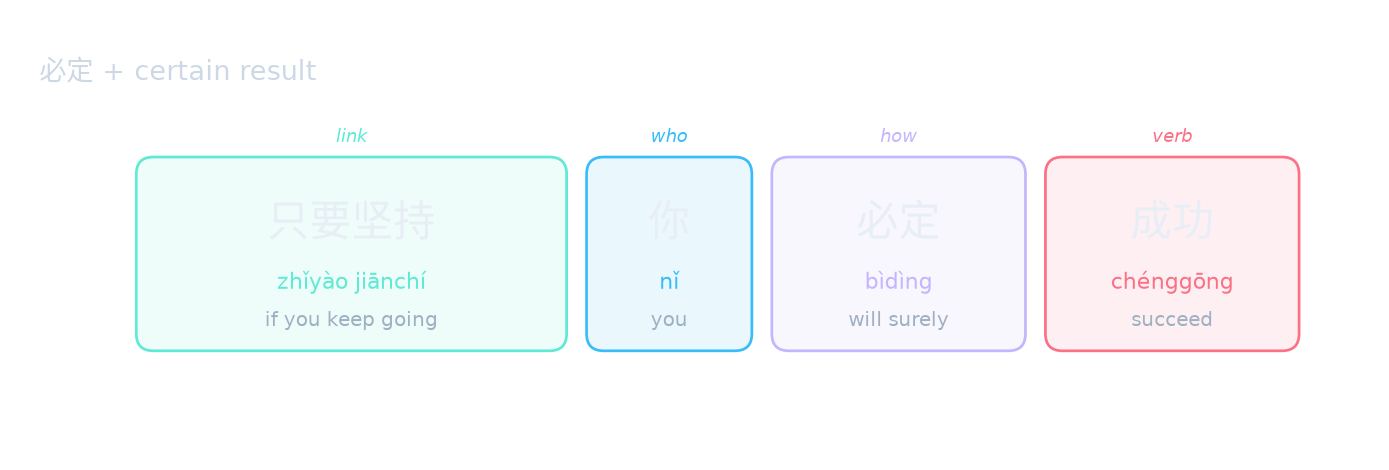
- 26. surely; must必定 vs definitely / certain一定 – surely / must: as long as只要to press on坚持下去,you你必定会to succeed; success成功。
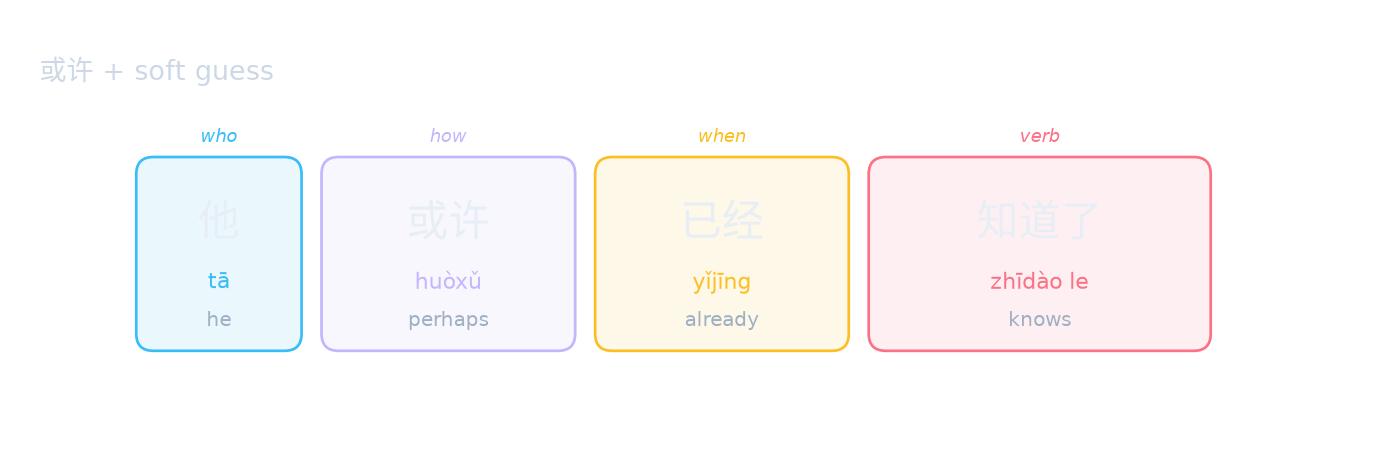
- 27. perhaps或许 vs maybe也许 and I'm afraid (that); probably恐怕 – perhaps: he / him他perhaps或许already已经to know知道(completed / change)了。
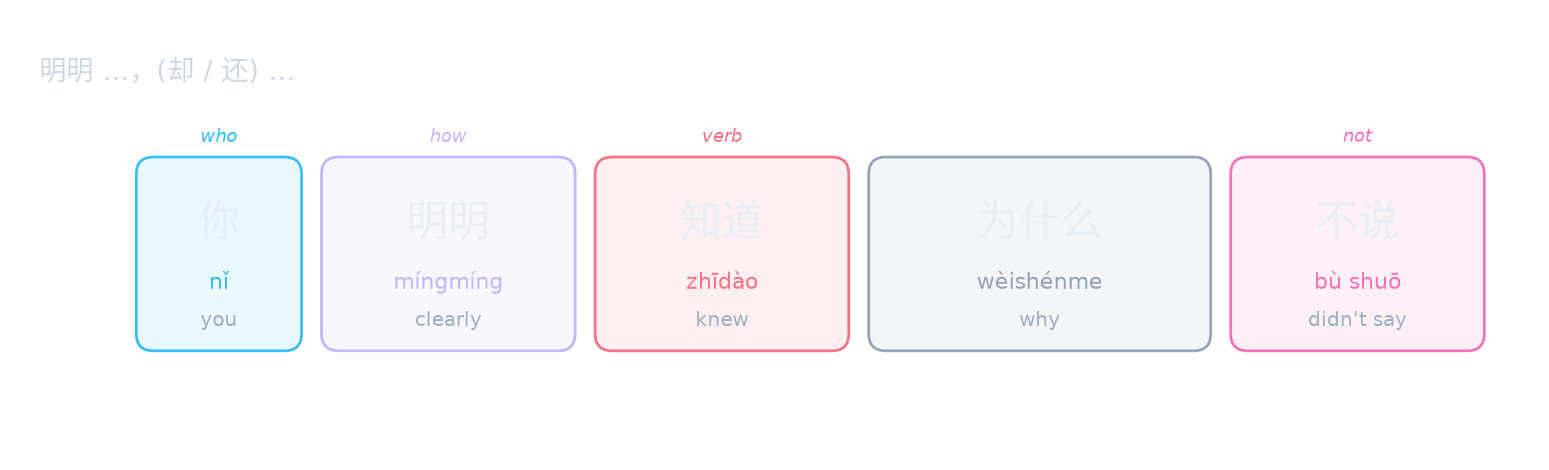
- 28. clearly; obviously明明 – clearly …, yet …: you你clearly; obviously明明to know知道,why?为什么not不to tell告诉I / me我?
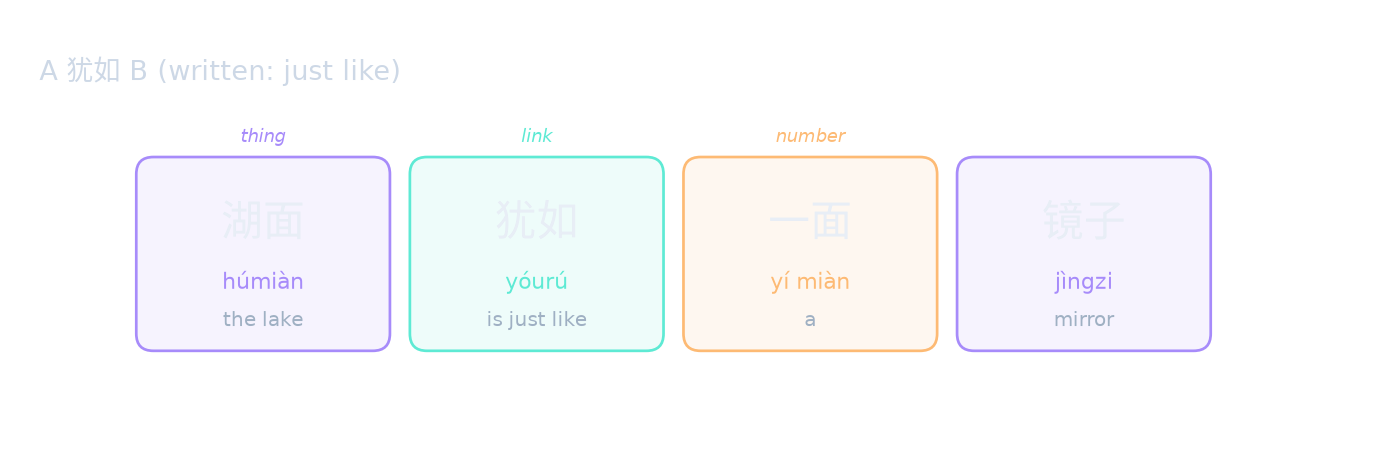
- 29. just like犹如 vs to seem; as if好像 and to resemble像……the same一样 – just like: 湖面just like犹如一面镜子。
All, without exception
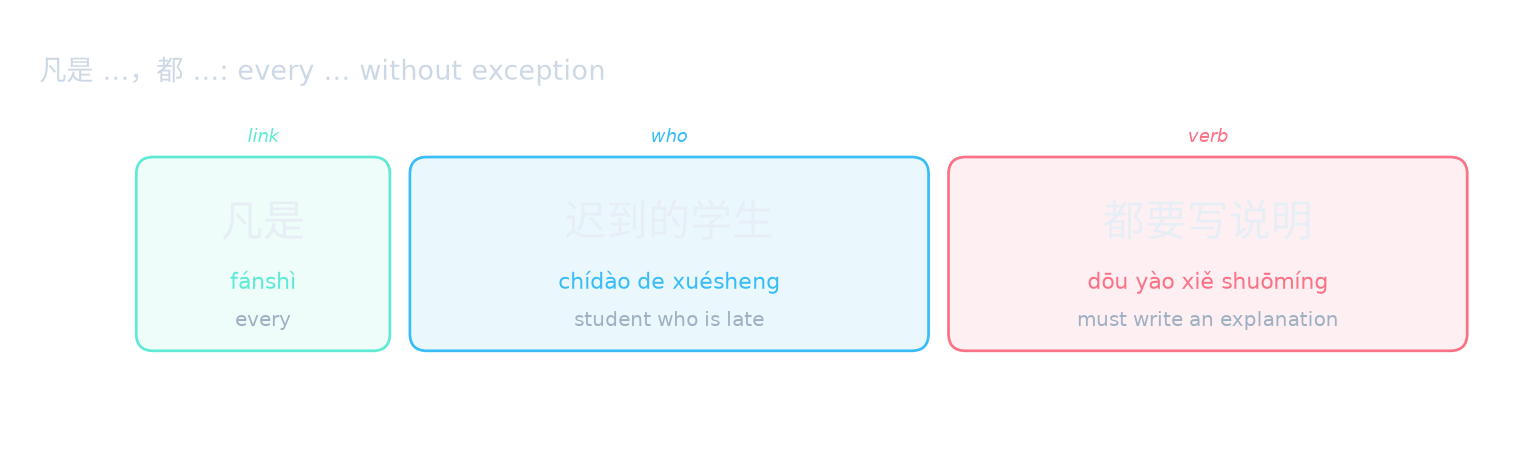
- 30. all; every凡是 … all / both都 – all / any without exception: all; every凡是to arrive late迟到(modifier / structural particle)的student学生,all / both都want / will / need要to write写to explain / to show说明。
- 31. all; without exception一律 – uniformly / without exception: ticket (for theater, cinema…门票all; without exception一律二十元。
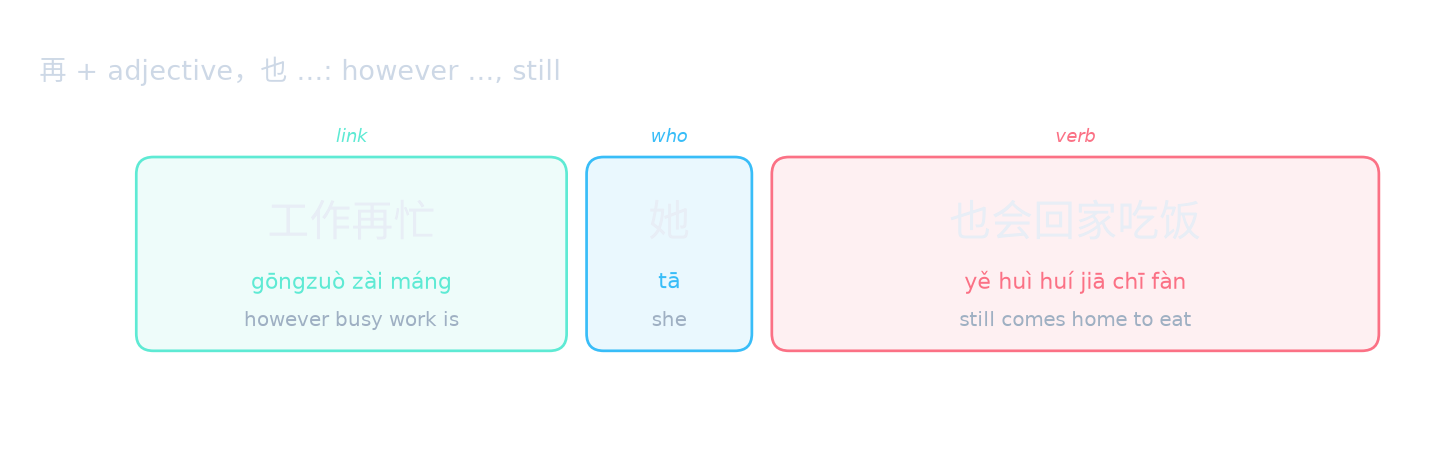
- 32. again / then / (再…也) however再 + Adj + also也 – however …, still …: to work; job工作again / then / (再…也) however再busy忙,she / her她also也can / will会to return home回家to have a meal吃饭。
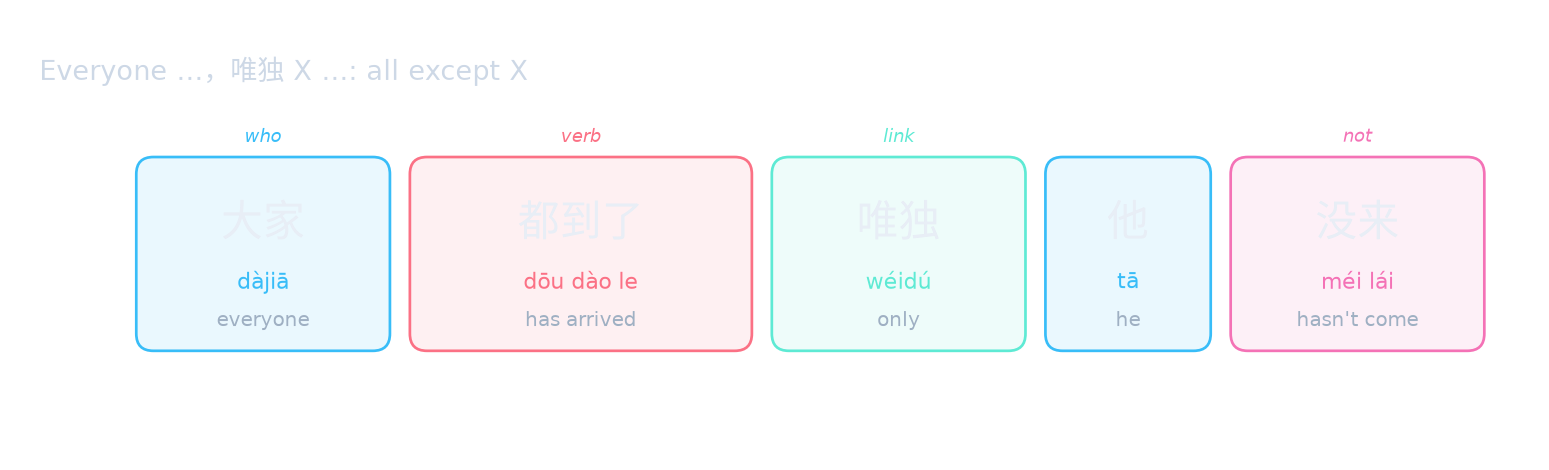
- 33. only (except)唯独 – only X – the exception: everyone大家all / both都to / arrive / (result: get)到(completed / change)了,only (except)唯独he / him他not / haven't没to come来。
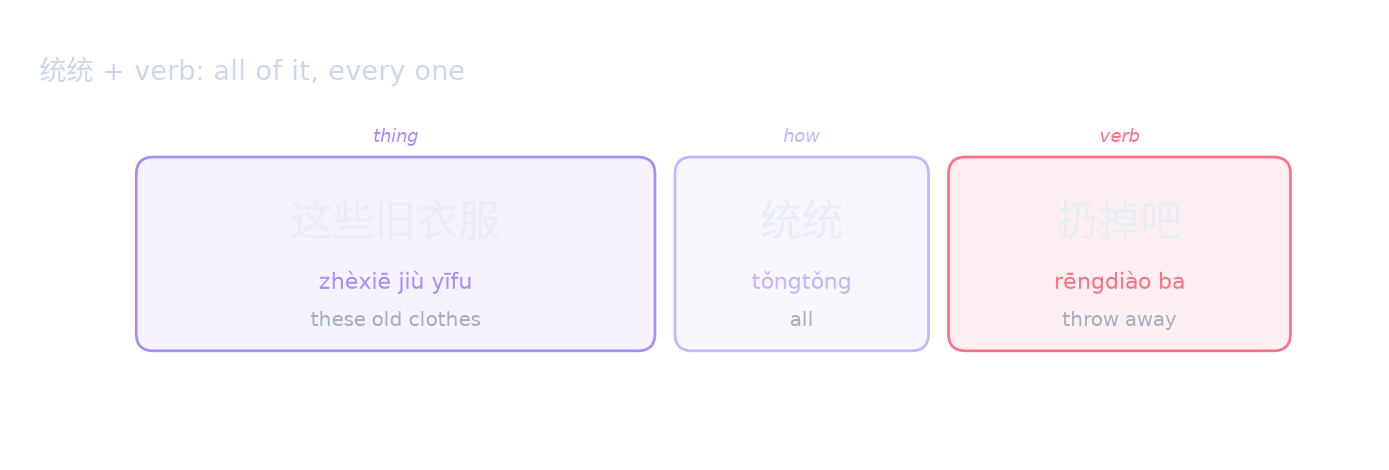
- 34. all; entirely统统 – all, every single one: these这些旧衣服all; entirely统统to throw away扔掉(suggestion)吧!
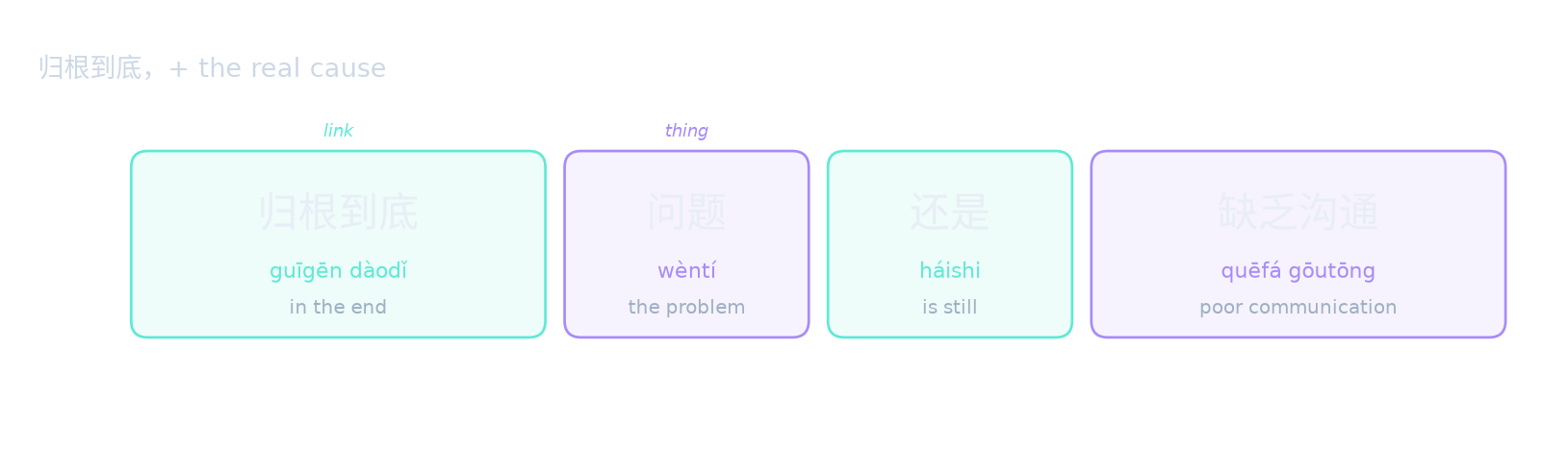
- 35. after all归根到底 – in the final analysis: after all归根到底,question / problem问题or / still还是to lack缺乏to communicate沟通。
Degree and amount
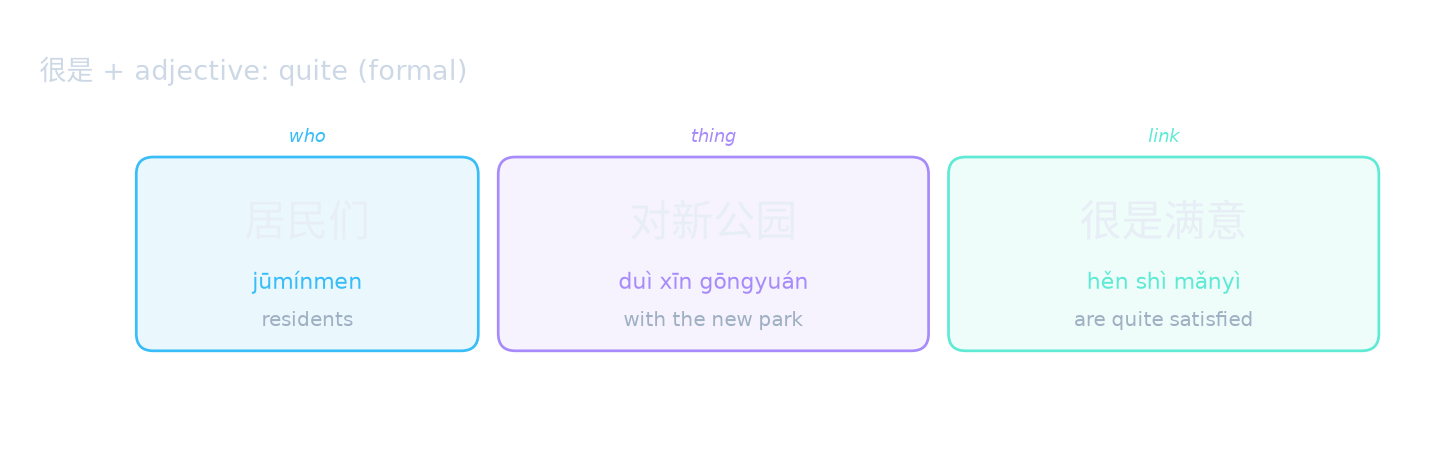
- 36. degree / adjective linker很to be / is是 + Adj – a formal “very”: resident居民(plural)们to / towards / correct对new新park公园degree / adjective linker很to be / is是satisfied满意。
- 37. fully足足 + Amount – a full / as much as: we / us我们fully足足to line up / row排(completed / change)了三个hour小时(modifier / structural particle)的team / queue队。
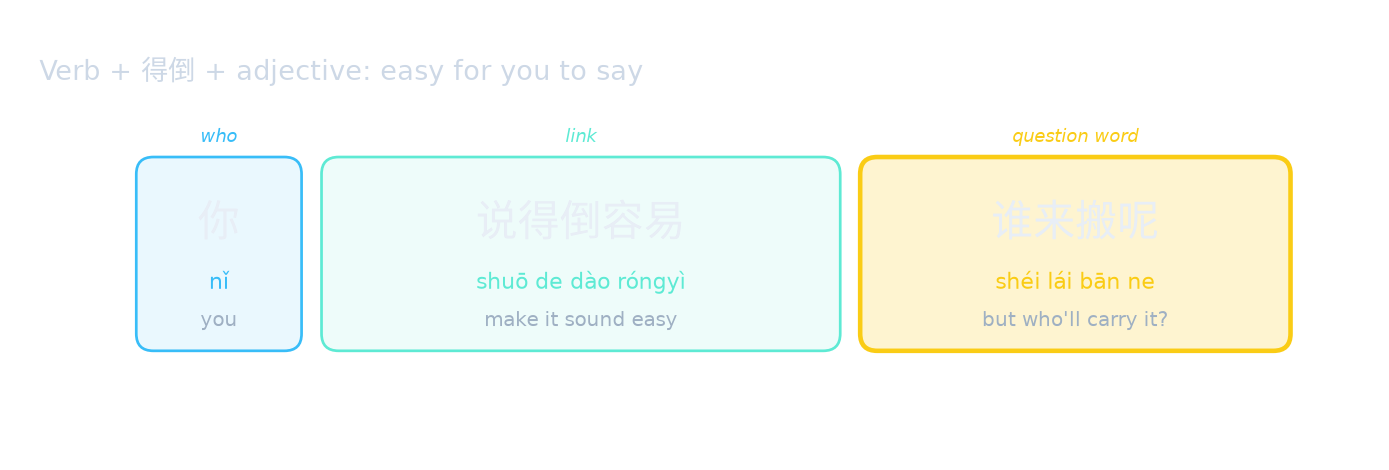
- 38. Verb + (degree marker)得 + to pour倒 + Adj – a pointed note: you你to speak说(degree marker)得to pour倒easy容易,who谁to come来to move搬(and …? / softener)呢?
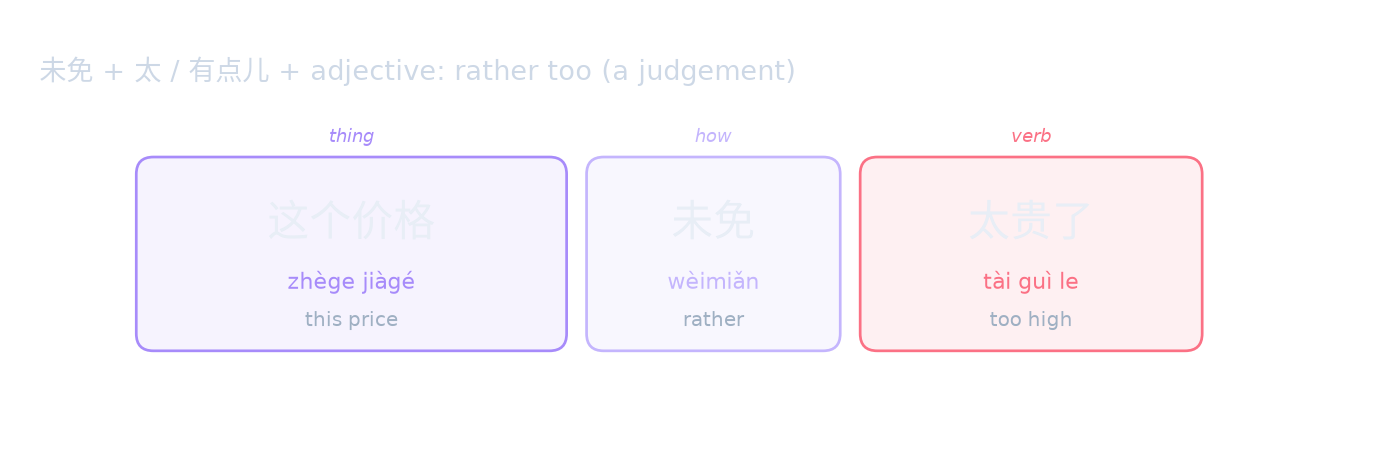
- 39. rather; a bit too未免 – rather too – a soft criticism: 一碗面要九十八yuan (spoken); piece块,this这碗面rather; a bit too未免太贵(completed / change)了。
- 40. hard to (predict, imagine…难以 – hard to – formal: this这真让人难以相信。
- 41. more than / not just不止 – more than / not only: I / me我to remind提醒(experienced)过he / him他many times不止一次。
- 42. almost将近 – nearly, just under: 这座bridge桥already已经to have / there is有almost将近一百年(completed / change)了。
- 43. at least / basic起码 – at the very least: other people / household人家to help帮(completed / change)了you你一整天,you你at least / basic起码should应该说声to thank谢谢。
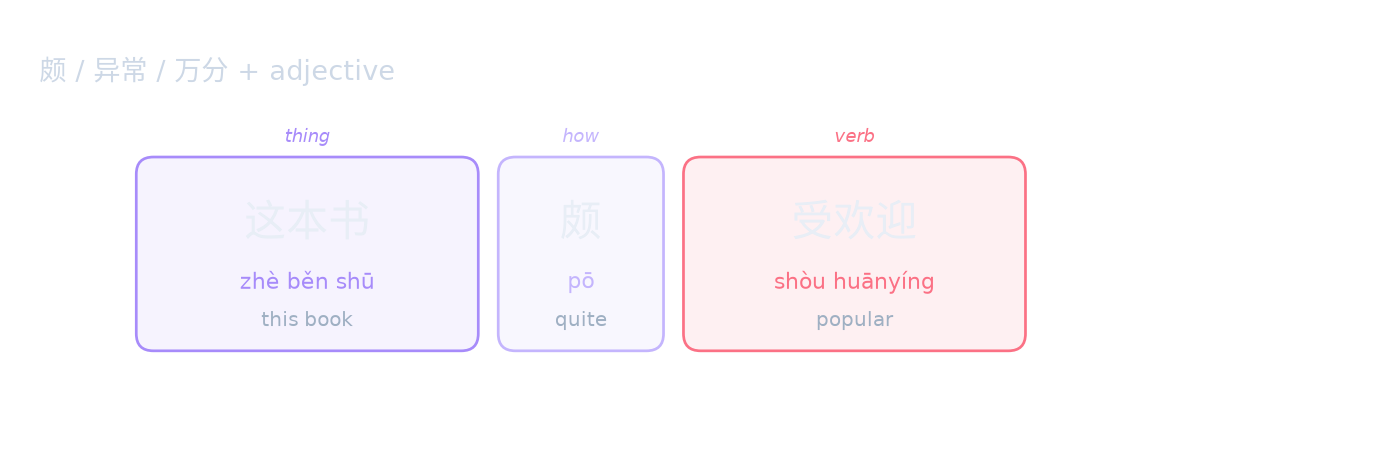
- 44. rather颇, unusual; extremely异常 and extremely万分 – formal "quite / very": this这本书颇受欢迎。
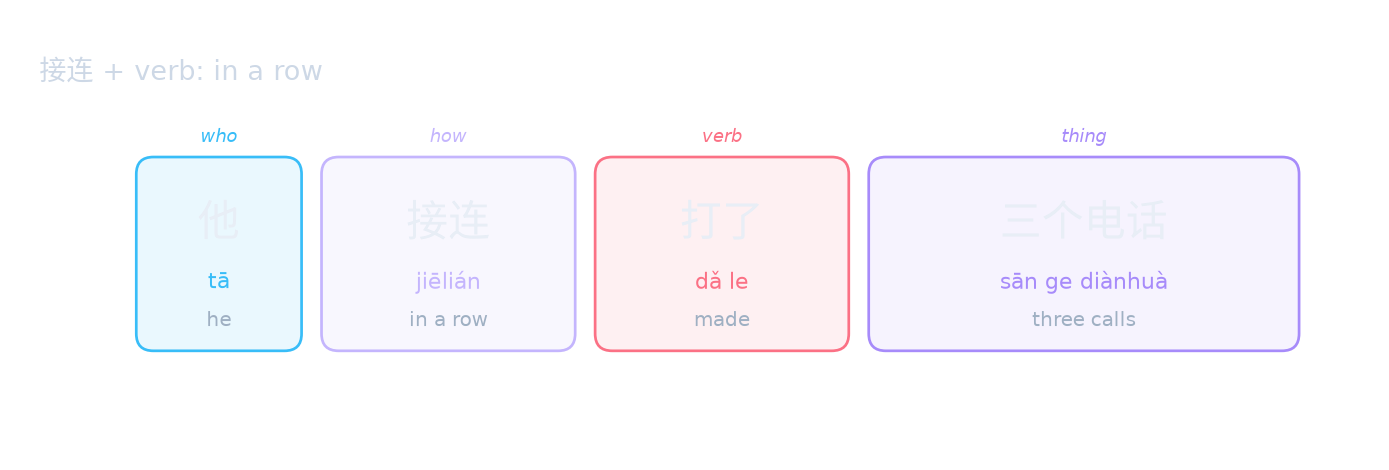
- 45. in a row; one after another接连 vs continuous连续 – in a row: he / him他in a row; one after another接连to hit / play / make (a call)打(completed / change)了三个telephone电话。
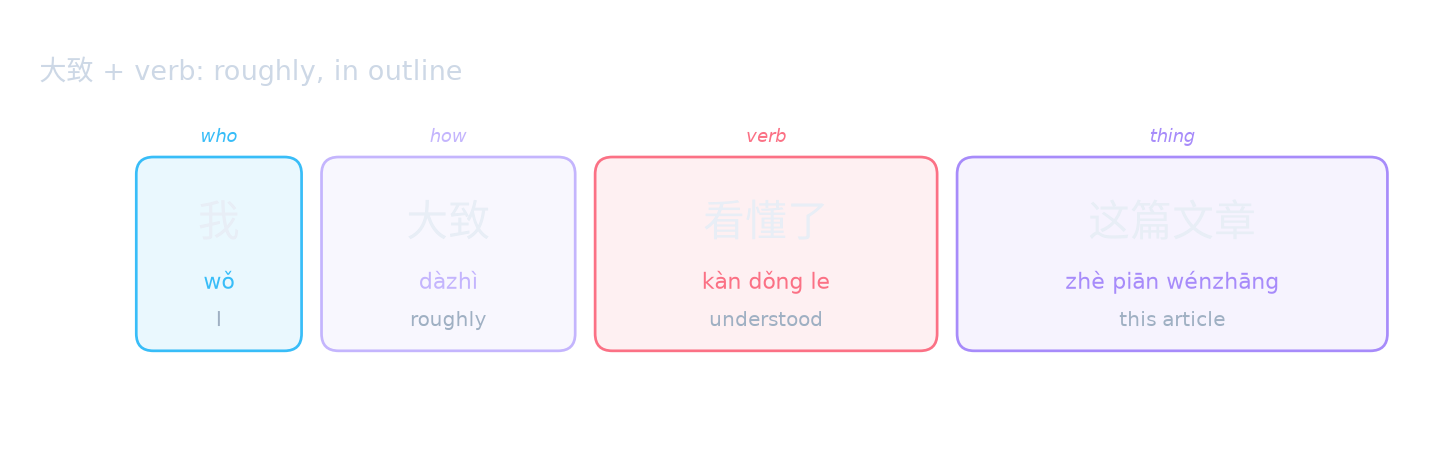
- 46. roughly; more or less大致 vs probably大概 – roughly, in outline: I / me我roughly; more or less大致to look at; to watch; to read看to understand懂(completed / change)了this这篇文章。
Questioning and looking ahead
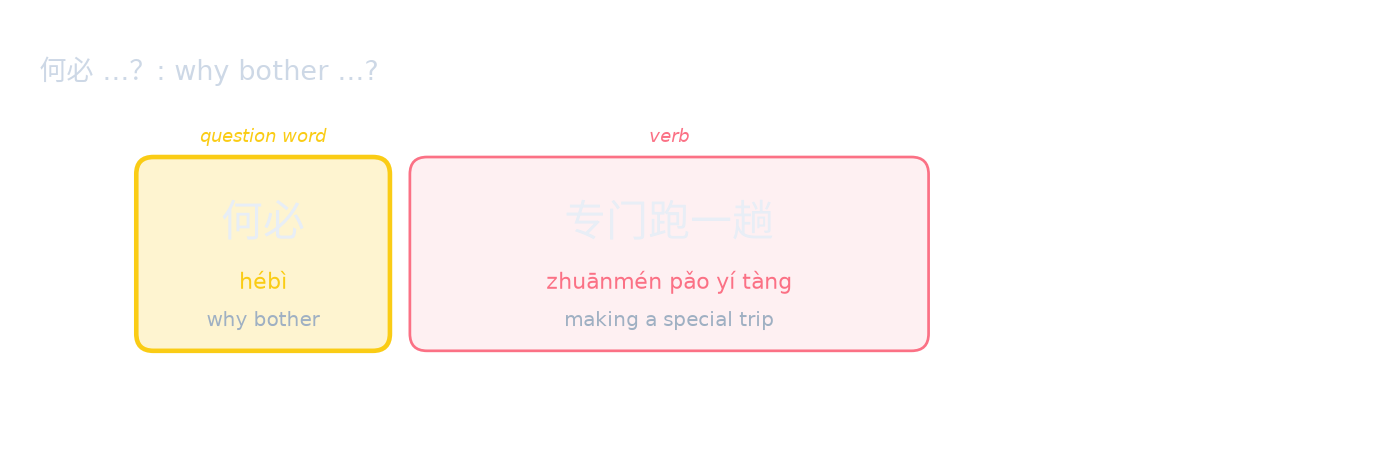
- 47. why bother何必 – why bother / no need: why bother何必specially专门to run跑一趟?
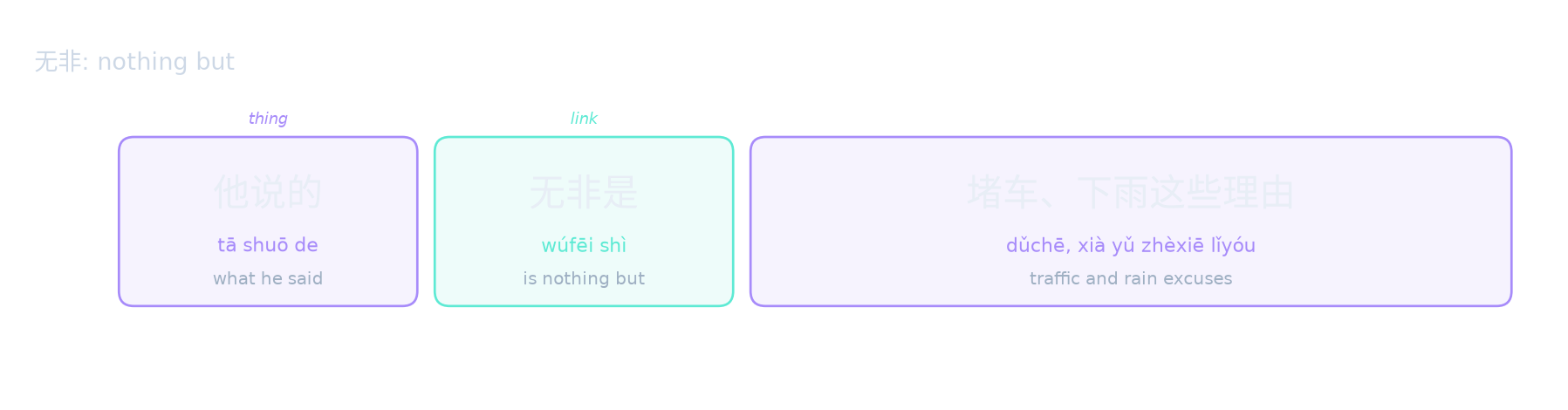
- 48. nothing but无非 – nothing but / merely: he / him他to speak说(modifier / structural particle)的nothing but无非to be / is是traffic jam堵车、to rain下雨these这些reason理由。
- 49. when the moment comes到时候 – when the time comes: when the moment comes到时候talk later / besides再说(suggestion)吧。
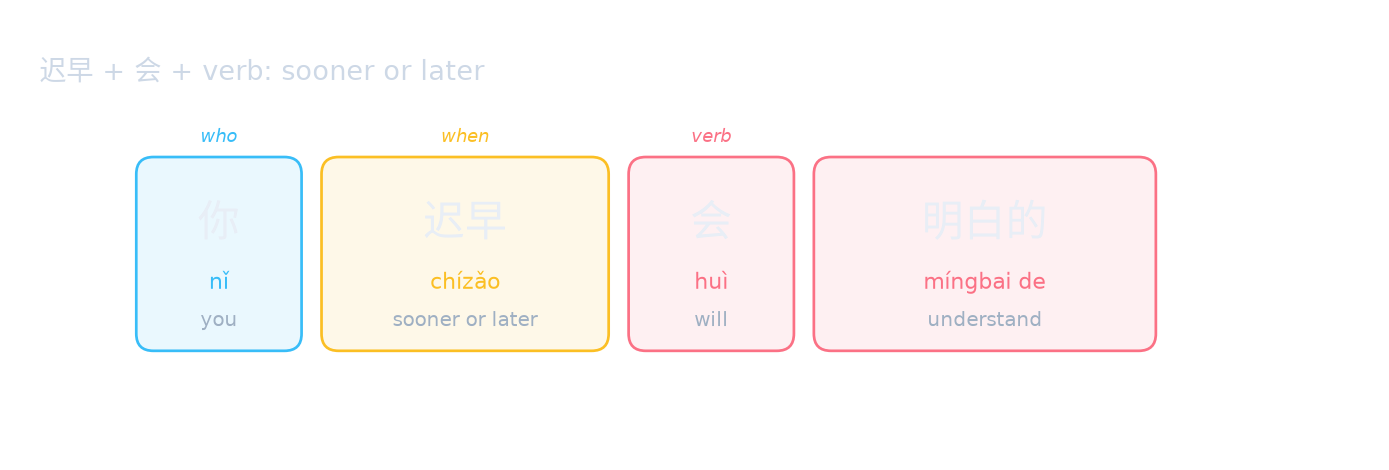
- 50. sooner or later迟早 / morning and evening早晚 – sooner or later: you你迟早会to understand / clear明白(modifier / structural particle)的。
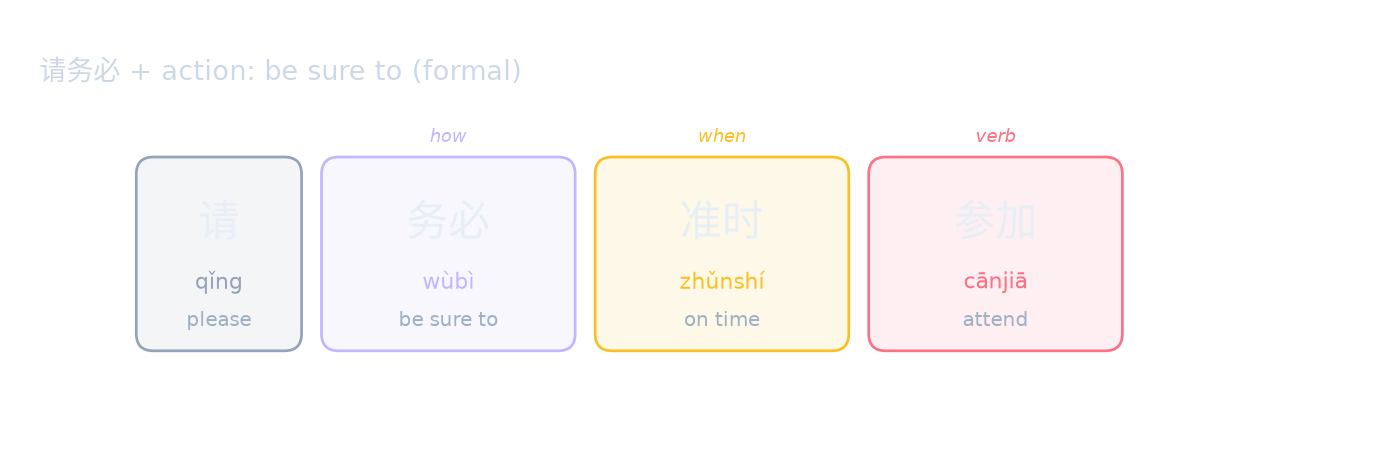
- 51. must; be sure to务必 – be sure to – formal request: please; to invite请must; be sure to务必punctual准时to participate参加。
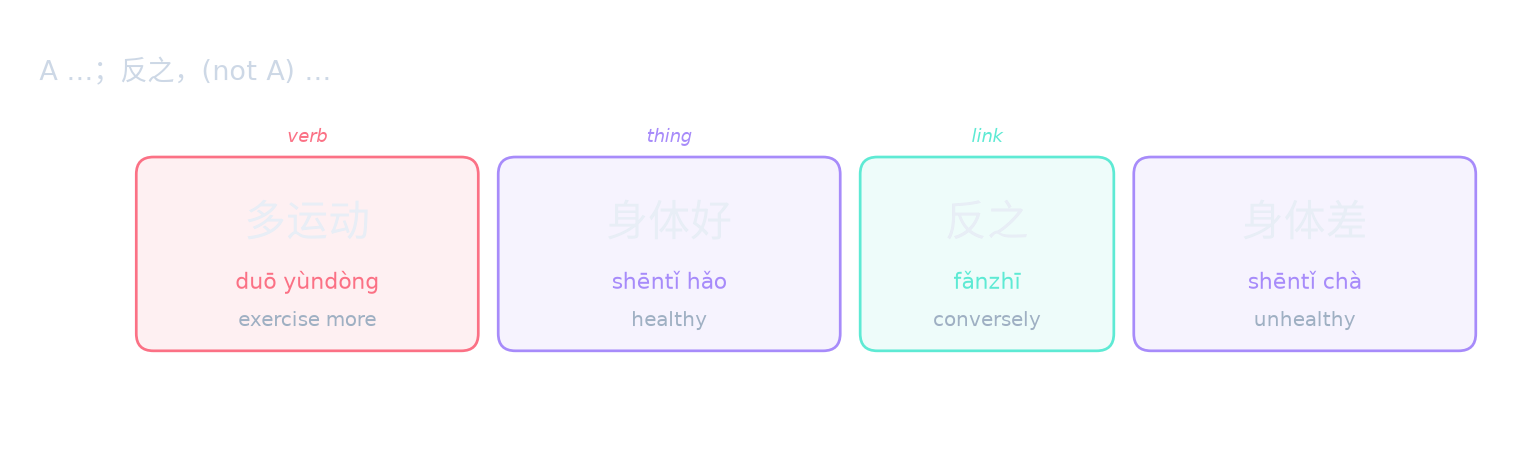
- 52. conversely反之 vs opposite; on the contrary相反 and otherwise否则 – conversely: often经常sports / to exercise运动(modifier / structural particle)的person人body; health身体good好;conversely反之,not不sports / to exercise运动(modifier / structural particle)的person人easy容易to fall ill生病。
Reactions, habits and decisions
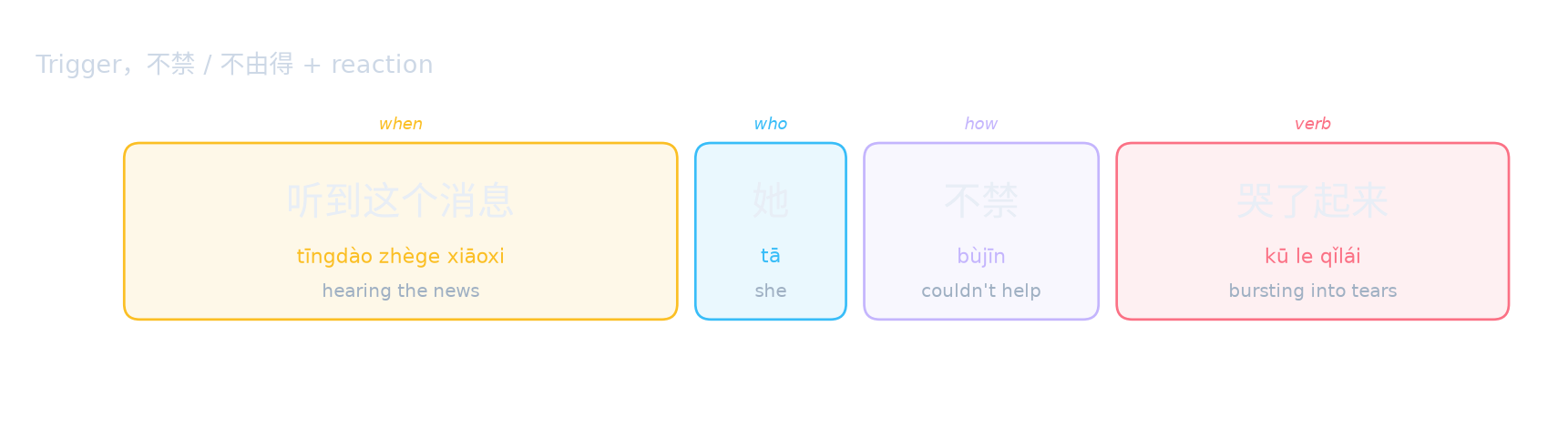
- 53. can't help不禁 / cannot but不由得 – can't help – a reaction: to hear听到mum; mother妈妈(modifier / structural particle)的voice声音,she / her她can't help不禁to cry哭(completed / change)了get up / (start, become)起来。
- 54. (typically followed by 就)…动不动then / just就 – at the slightest thing: he / him他(typically followed by 就)…动不动then / just就to get angry生气。
- 55. might as well; simply索性 – might as well / simply: 雨越down / next; to fall (rain), get off下(越…越) the more / to cross越big大,we / us我们might as well; simply索性not不to walk / to leave走(completed / change)了,再点一壶tea茶(suggestion)吧。
- 56. at once; suddenly顿时 – at once – a sudden change: teacher老师one / a一to come in进来,classroom教室inside; in里at once; suddenly顿时quiet安静(completed / change)了。
- 57. immediately after随即 – immediately after that: 他接(completed / change)了一个telephone电话,immediately after随即to depart离开(completed / change)了meeting place会场。
- 58. in order依次 vs to take turns轮流 and in succession; bit by bit陆续 – in turn: please; to invite请everyone大家in order依次to get on or into (a bus…上车。
- 59. at worst大不了 – at worst; no big deal: 别怕,to take an exam / to test考no good不好at worst大不了next year明年再考。
- 60. specially (for this trip)专程 vs specially专门 and on the way; while you're at it顺便 – specially: he / him他specially (for this trip)专程来看I / me我。
- 61. at any cost; not hesitate to不惜 vs to be reluctant to (part with)舍不得 – whatever it costs: in order to为了to save (a life)救child孩子,he / him他at any cost; not hesitate to不惜to plunge into跳进ice-cold冰冷(modifier / structural particle)的河里。
- 62. in silence默默 vs quietly悄悄 – silently: she / her她二十年to come来默默地to help帮助(completed / change)了很多person人。
- 63. without permission擅自 vs privately; secretly私自 and as you like; casual随便 – without permission: not; must (非…不可)非staff member工作人员请勿without permission擅自to enter进入。
- 64. at the earliest possible time及早 vs as early as possible尽早 and in time; timely及时 – as early as possible: to be ill有病want / will / need要at the earliest possible time及早medical treatment治疗。
- 65. at the scene当场 vs at that time当时 – on the spot / at that time: police警察at the scene当场to grab hold of抓住(completed / change)了thief小偷。
- 66. as one wishes随意 vs as you like; casual随便 – as you please: please; to invite请everyone大家as one wishes随意to look around参观。
- 67. the slightest丝毫 vs hardly毫不 and a little一点儿also也not不 – not in the least: he / him他the slightest丝毫not have / haven't没有to give up放弃(modifier / structural particle)的meaning意思。
- 68. not at all; without any毫无 vs hardly毫不 and not have / haven't没有 – not any at all: this way / so这样to do; to make做毫无意义。
1.2
1. 向来 (always / all along)
Form: subject + always (as a habit)向来 + predicate
- he / him他always (as a habit)向来degree / adjective linker很punctual准时,today今天not / haven't没to come来,definitely; to be sure肯定to be occupied with sth有事。 Tā xiànglái hěn zhǔnshí. – He's always punctual; if he hasn't come today, something must be up.
- 这家shop店always (as a habit)向来by means of以service / to serve服务good好well-known for sth出名。 – This shop has always been known for its good service.
- I / me我always (as a habit)向来not不to be convinced相信this kind of这种advertisement广告。 – I've never believed adverts like this.
How it works. always (as a habit)向来 xiànglái "always, all along" describes a long-standing habit or character, from the past to now. It works with positive and negative predicates, and sounds formal; always (up to now)一向 is a close synonym.
| always (as a habit)向来 / always (up to now)一向 | all along / straight一直 | always (so far); never (with 不 / 没)从来 |
|---|---|---|
| long-term character | continuously over a stretch: today今天all along / straight一直to rain下雨 | mostly with not不 / not / haven't没: never从来不to arrive late迟到 |
Watch out
- One recent stretch takes all along / straight一直: wrong: 今天上午always (as a habit)向来to rain下雨 → 今天上午all along / straight一直to rain下雨.

Vocabulary
Train
| 汉字 | Pinyin | English |
|---|---|---|
| 向来 | xiàng lái | always (as a habit) |
| 一向 | yī xiàng | always (up to now) |
1.3
2. 一向 (all along / consistently)
Form: subject + always (up to now)一向 + predicate
- she / her她to work做事always (up to now)一向degree / adjective linker很conscientious认真。 Tā zuò shì yíxiàng hěn rènzhēn. – She has always been conscientious in her work.
- 这家company公司always (up to now)一向to value; to take seriously重视quality质量。 – This company has always valued quality.
- he / him他always (up to now)一向不爱to speak; to talk说话。 – He's never been much of a talker.
How it works. always (up to now)一向 yíxiàng "consistently, all along" describes a habit or character that has held from the past to now. It is a close synonym of always (as a habit)向来, which is a little more formal.
| always (up to now)一向 | all along / straight一直 |
|---|---|
| long-term character | continuously (a stretch): he / him他all along / straight一直at / in在to wait; and so on等 |
Watch out
- Not "towards": that is towards向 on its own (向前走).
1.4
3. 一再 + Verb (again and again)
Form: subject + again and again一再 + verb
- mum; mother妈妈again and again一再to remind提醒he / him他,he / him他or / still还是to forget忘(completed / change)了。 Māma yízài tíxǐng tā. – Mum reminded him again and again, but he still forgot.
- meeting会议again and again一再to postpone推迟。 – The meeting was postponed again and again.
- he / him他一再表示to thank感谢。 – He thanked us repeatedly.
How it works. again and again一再 yízài "repeatedly, time and again" usually reports an action repeated in the past, often with insistence (一再强调, again and again一再to require / requirement要求). It sounds formal; in chat, say good好several times几次.
| again and again一再 | over and over again再三 | repeatedly屡次 |
|---|---|---|
| repeated (often past, insistent) | again and again (thinking, asking): over and over again再三to think over考虑 | on many occasions (written): repeatedly屡次to win an award获奖 |
Watch out
- For advice about the future, over and over again再三 often fits better: please; to invite请you你over and over again再三to think over考虑.
- again and again一再 gives no exact count.

Vocabulary
Train
| 汉字 | Pinyin | English |
|---|---|---|
| 一再 | yī zài | again and again |
| 屡次 | lǚ cì | repeatedly |
1.5
4. 时而 A,时而 B (now A, now B)
Form: sometimes时而 A,sometimes时而 B · sometimes时而 + verb (sometimes, written)
- on the mountain山上(modifier / structural particle)的weather天气sometimes时而sunny晴,sometimes时而to rain下雨。 Shān shang de tiānqì shí'ér qíng, shí'ér xià yǔ. – The weather on the mountain was sunny one moment and rainy the next.
- he / him他sometimes时而to take a look at看看窗外,sometimes时而to take a look at看看wristwatch手表。 – He kept glancing out of the window, then at his watch.
- music音乐sometimes时而soft轻柔,sometimes时而fierce; intense激烈。 – The music was gentle one moment and intense the next.
How it works. sometimes时而 A,sometimes时而 B shows two different states taking turns again and again. It is written and literary; in speech, say a moment一会儿 A,a moment一会儿 B. A single sometimes时而 means "sometimes".
| sometimes时而 … sometimes时而 … | a moment一会儿 … a moment一会儿 … | to start开始 … later; afterwards后来 … |
|---|---|---|
| now … now … (written) | now … now … (spoken) | at first … later (a one-time change) |
Watch out
- The two states must be different.
Vocabulary
Train
| 汉字 | Pinyin | English |
|---|---|---|
| 时而 | shí ér | occasionally |
1.6
5. 起初 vs 当初 (at first / back then)
Form: originally起初 …,later; afterwards后来 / now现在 … · at first; originally当初 (looking back at a decision)
- originally起初I / me我not不too太habit / be used to习惯,later; afterwards后来slowly慢慢to like喜欢up / on / last; to get on, attend上(completed / change)了here这里。 Qǐchū wǒ bú tài xíguàn, hòulái mànmàn xǐhuan shang le zhèlǐ. – At first I wasn't used to it, but later I grew to like it here.
- at first; originally当初I / me我then / just就should应该to listen to听you你(modifier / structural particle)的。 – I should have listened to you back then.
- you你at first; originally当初why?为什么to choose选this这个major (subject); professional专业? – Why did you choose this major in the first place?
How it works. originally起初 marks the first stage of a process that later changed (written; in speech one / a一to start开始). at first; originally当初 looks back at an earlier time, often the moment something was decided or began, often to compare with now or to regret it.
| originally起初很难,later; afterwards后来easy容易(completed / change)了 | at first; originally当初then / just就should应该to listen to听you你(modifier / structural particle)的 | 早知今日,何必当初 |
|---|---|---|
| hard at first, easier later | should have listened back then | if I'd known, I wouldn't have |
Watch out
- originally起初 needs a later change (later; afterwards后来 / now现在); at first; originally当初 looks back at one moment.
Vocabulary
Train
| 汉字 | Pinyin | English |
|---|---|---|
| 起初 | qǐ chū | originally |
| 当初 | dāng chū | at first; originally |
1.7
6. 以往 vs 往常 and 以前 (in the past, as usual)
Form: than / compared to比in the past以往more更 … · and / with与in the past以往different不同 · (and / with和)usually (in the past)往常(the same一样)
- 今年夏天than / compared to比in the past以往更热。 Jīnnián xiàtiān bǐ yǐwǎng gèng rè. – This summer is hotter than in past years.
- he / him他usually (in the past)往常七点to get up起床,today今天but; yet却to sleep睡to / arrive / (result: get)到(completed / change)了九点。 – He usually gets up at seven, but today he slept until nine.
- and / with和usually (in the past)往常the same一样,she / her她第一个to / arrive / (result: get)到(completed / change)了office办公室。 – As usual, she was the first to arrive at the office.
How it works. in the past以往 = earlier times in general; usually (in the past)往常 = the usual routine. Both are a little written. For "before + event", use before以前.
| than / compared to比in the past以往更热 | and / with和usually (in the past)往常the same一样 | to sleep睡觉before以前 |
|---|---|---|
| hotter than in past years | as usual | before bed |
Watch out
- wrong: to sleep睡觉in the past以往 → to sleep睡觉before以前.
Vocabulary
Train
| 汉字 | Pinyin | English |
|---|---|---|
| 以往 | yǐ wǎng | in the past |
| 往常 | wǎng cháng | usually (in the past) |
1.8
7. 不时 vs 时而 and 经常 (every now and then)
Form: from time to time不时((adverb -ly)地) + verb
- he / him他one side一边to listen to听,one side一边from time to time不时(adverb -ly)地to nod点头。 Tā yìbiān tīng, yìbiān bùshí de diǎn tóu. – As he listened, he nodded every now and then.
- 窗外from time to time不时(of a sound) to come through传来car汽车(modifier / structural particle)的voice声音。 – Every now and then the sound of cars came from outside the window.
- weather天气sometimes时而sunny晴,sometimes时而rain雨。 – The weather was sometimes sunny, sometimes rainy.
How it works. from time to time不时 describes something that comes back now and then, at irregular moments; it is common in written descriptions. sometimes时而……sometimes时而…… switches between two states. For "often", use often经常.
| from time to time不时to nod点头 | sometimes时而sunny晴sometimes时而rain雨 | often经常to go去 |
|---|---|---|
| nod now and then | sometimes sunny, sometimes rainy | often go |
Watch out
- For "often", use often经常; from time to time不时 is "now and then".
Vocabulary
Train
| 汉字 | Pinyin | English |
|---|---|---|
| 不时 | bù shí | from time to time |
1.9
8. 依旧 vs 依然 and 仍然 (still, as before)
Form: (time or change,) as before依旧 + verb / adjective · noun + as before依旧
- 十年past过去(completed / change)了,here这里as before依旧degree / adjective linker很quiet安静。 Shí nián guòqù le, zhèlǐ yījiù hěn ānjìng. – Ten years have passed, and it's still as quiet here as ever.
- scenery风景as before依旧,person人but; yet却to change变(completed / change)了。 – The scenery is the same as ever, but the people have changed.
- he / him他or / still还是like that那么optimistic乐观。 – He's still just as optimistic. (spoken)
How it works. as before依旧 = still, as before, after time or a change; it is written. It can end a clause (scenery风景as before依旧). still依然 and still仍然 are close. In speech, or / still还是 / still / also / even还.
| as before依旧degree / adjective linker很quiet安静 | scenery风景as before依旧 | or / still还是that way那样 |
|---|---|---|
| still quiet | scenery unchanged | still the same (spoken) |
Watch out
- as before依旧 links back to an earlier time, often stated first.
Vocabulary
Train
| 汉字 | Pinyin | English |
|---|---|---|
| 依旧 | yī jiù | as before |
1.10
9. 频繁 vs 经常 and 老是 (very frequent)
Form: frequently频繁 + verb · ……degree / adjective linker很frequently频繁
- 这台computer电脑recently最近frequently频繁to crash (of a computer)死机。 Zhè tái diànnǎo zuìjìn pínfán sǐjī. – This computer has been freezing very often lately.
- frequently频繁to exchange换to work; job工作to / towards / correct对after / from now on以后to look for; to give change找to work; job工作unfavorable不利。 – Changing jobs too often is bad for finding work later.
- I / me我(modifier / structural particle)的computer电脑always老是to crash (of a computer)死机! – My computer keeps freezing! (spoken)
How it works. frequently频繁 = very frequent, often more than normal; it is written and can end a sentence. often经常 = often (neutral). always老是 = keeps (spoken complaint).
| frequently频繁to crash (of a computer)死机 | often经常 | always老是 |
|---|---|---|
| freezes very often | often | keeps (doing) |
Watch out
- In speech, always老是 or often经常 sound more natural.
Vocabulary
Train
| 汉字 | Pinyin | English |
|---|---|---|
| 频繁 | pín fán | frequently |
1.11
10. 近来 vs 最近 (lately)
Form: recently近来 + situation (written)
- recently近来weather天气变化很大,everyone大家want / will / need要to take note of注意body; health身体。 Jìnlái tiānqì biànhuà hěn dà, dàjiā yào zhùyì shēntǐ. – The weather has changed a lot lately; everyone should take care of their health.
- you你recently近来body; health身体how about怎么样? – How have you been lately? (in a letter)
- I / me我recently最近want / will / need要to go去Shanghai municipality…上海。 – I'm going to Shanghai soon.
How it works. recently近来 = lately, usually a situation over the recent period (letters, reports). recently最近 is everyday and can mean recently or soon; use it for single events too.
| recently近来degree / adjective linker很busy忙 | recently最近want / will / need要to go去 | these这些day天 |
|---|---|---|
| busy lately | going soon | these days |
Watch out
- wrong: I / me我recently近来want / will / need要to go去Shanghai municipality…上海 → I / me我recently最近want / will / need要to go去Shanghai municipality…上海.
Vocabulary
Train
| 汉字 | Pinyin | English |
|---|---|---|
| 近来 | jìn lái | recently |
1.12
11. 一如既往 vs 依旧 and 照样 (as always)
Form: just as in the past一如既往((adverb -ly)地) + verb
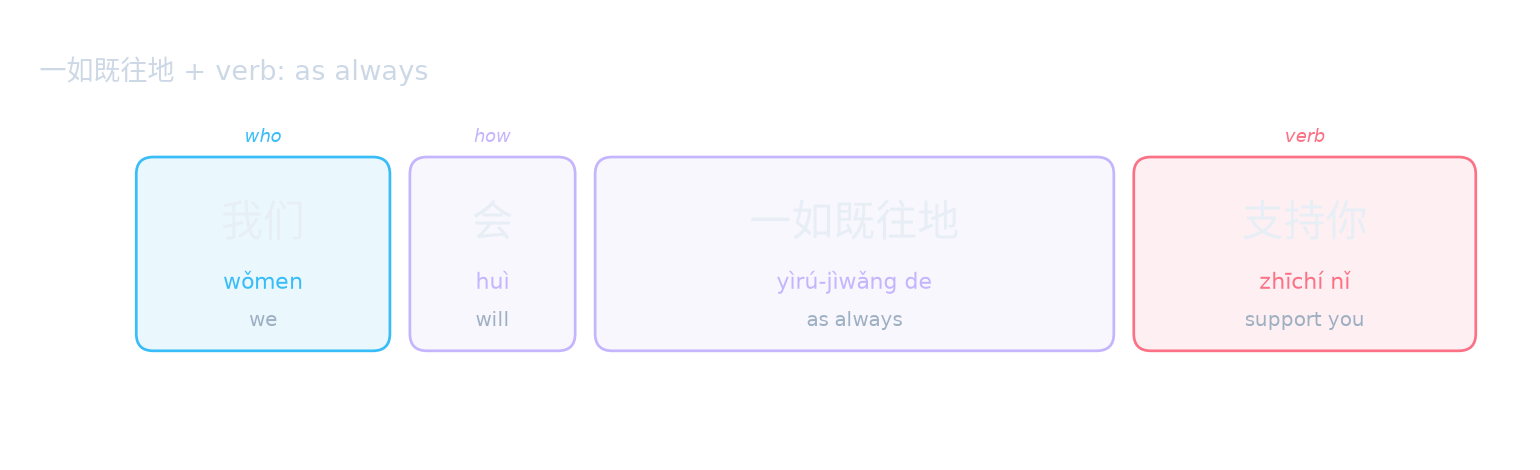
- we / us我们can / will会just as in the past一如既往(adverb -ly)地to support支持you你。 Wǒmen huì yìrú-jìwǎng de zhīchí nǐ. – We will support you, as we always have.
- to hope希望everyone大家just as in the past一如既往(adverb -ly)地to be concerned about关心we / us我们。 – We hope you will keep caring about us as before.
- to rain下雨he / him他also也all the same; as before照样to run; to jog跑步。 – He goes running even when it rains. (spoken)
How it works. just as in the past一如既往 is a formal set phrase: an action continues just as before (promises, thanks, praise). In speech: or / still还是to resemble像before以前the same一样. as before依旧 = still; all the same; as before照样 = regardless.
| just as in the past一如既往(adverb -ly)地to support支持 | or / still还是to resemble像before以前the same一样 | all the same; as before照样to run; to jog跑步 |
|---|---|---|
| support as always | just like before (spoken) | run regardless |
Watch out
- Keep the four characters together.
Vocabulary
Train
| 汉字 | Pinyin | English |
|---|---|---|
| 一如既往 | yī rú jì wǎng | just as in the past |
| 照样 | zhào yàng | all the same; as before |
1.13
12. 日益 vs 越来越 and 逐渐 (increasingly)
Form: day by day日益 + two-character adjective / verb (written)
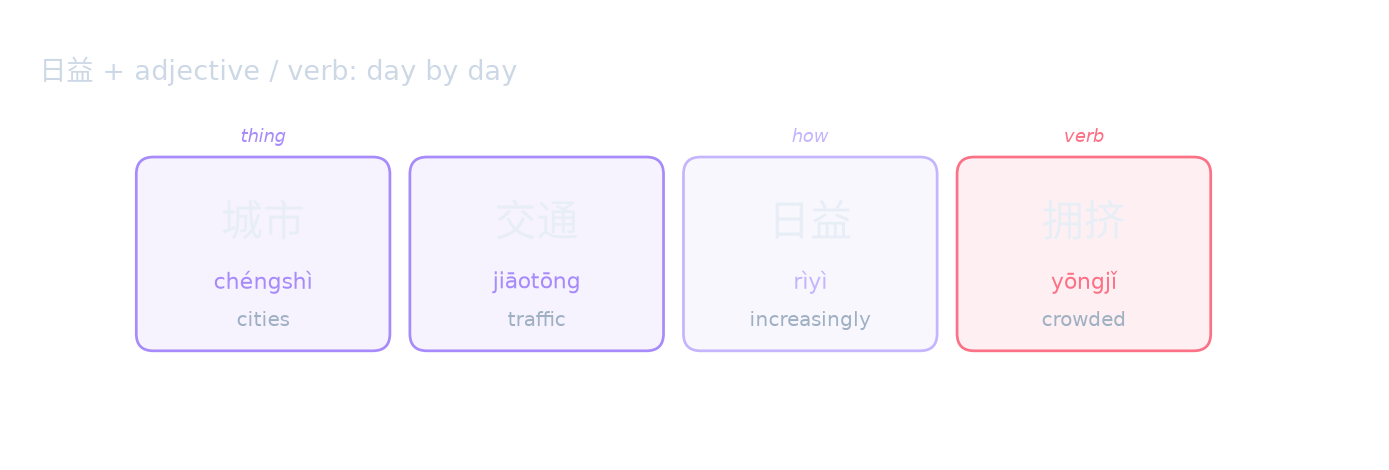
- 城市交通day by day日益crowded拥挤。 Chéngshì jiāotōng rìyì yōngjǐ. – City traffic is getting more and more crowded.
- along with; as随着economy经济(modifier / structural particle)的to develop; development发展,environment环境question / problem问题日益严重。 – As the economy develops, environmental problems are becoming more and more serious.
- on the road路上(modifier / structural particle)的car车more and more越来越many; much多。 – There are more and more cars on the road. (spoken)
How it works. day by day日益 = increasingly, day by day; written, before two-character words. more and more越来越 is the everyday form and works with one-character adjectives. gradually逐渐 = gradually.
| 日益严重 | more and more越来越many; much多 | gradually逐渐to become warm变暖 |
|---|---|---|
| more and more serious | more and more | gradually warmer |
Watch out
- wrong: day by day日益many; much多 → more and more越来越many; much多.
Vocabulary
Train
| 汉字 | Pinyin | English |
|---|---|---|
| 日益 | rì yì | day by day |
1.14
13. 迄今 vs 截至 and 截止 (so far, as of)
Form: so far迄今(until为止),… · up to (a date)截至 + date,… · … to close截止
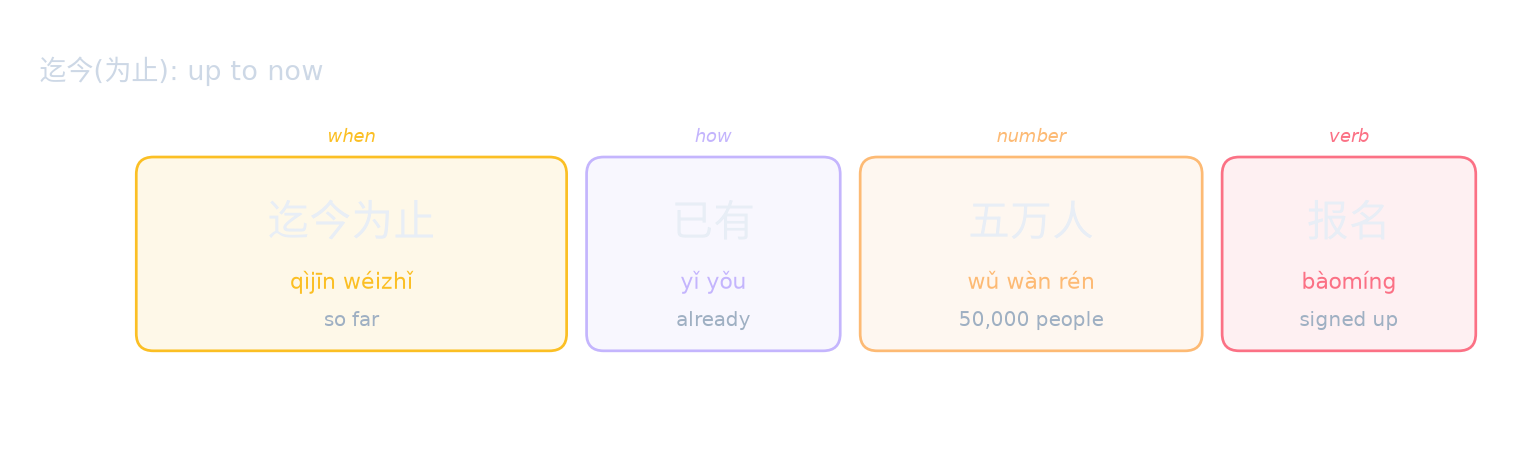
- so far迄今为止,已有五万person人to sign up报名。 Qìjīn wéizhǐ, yǐ yǒu wǔ wàn rén bàomíng. – So far, 50,000 people have signed up.
- up to (a date)截至十月底,to sign up报名number of people人数already已to exceed超过五万。 – As of the end of October, more than 50,000 people had signed up.
- to sign up报名tomorrow明天to close截止。 – Sign-ups close tomorrow.
How it works. so far迄今(until为止) = up to now (no date needed). up to (a date)截至 + date = as of that date. to close截止 = to close (a deadline). so far至今 = up to now / still. Speech: to / arrive / (result: get)到now现在until为止.
| so far迄今为止 | up to (a date)截至yesterday昨天 | tomorrow明天to close截止 |
|---|---|---|
| so far | as of yesterday | closes tomorrow |
Watch out
- up to (a date)截至 (up to a date) ≠ to close截止 (deadline).
Vocabulary
Train
| 汉字 | Pinyin | English |
|---|---|---|
| 截至 | jié zhì | up to (a date) |
| 迄今为止 | qì jīn wéi zhǐ | so far |
1.15
14. 历来 vs 一向 and 从来 (has always)
Form: throughout history历来 + verb · throughout history历来 (all / both都)to be / is是 + noun (written)
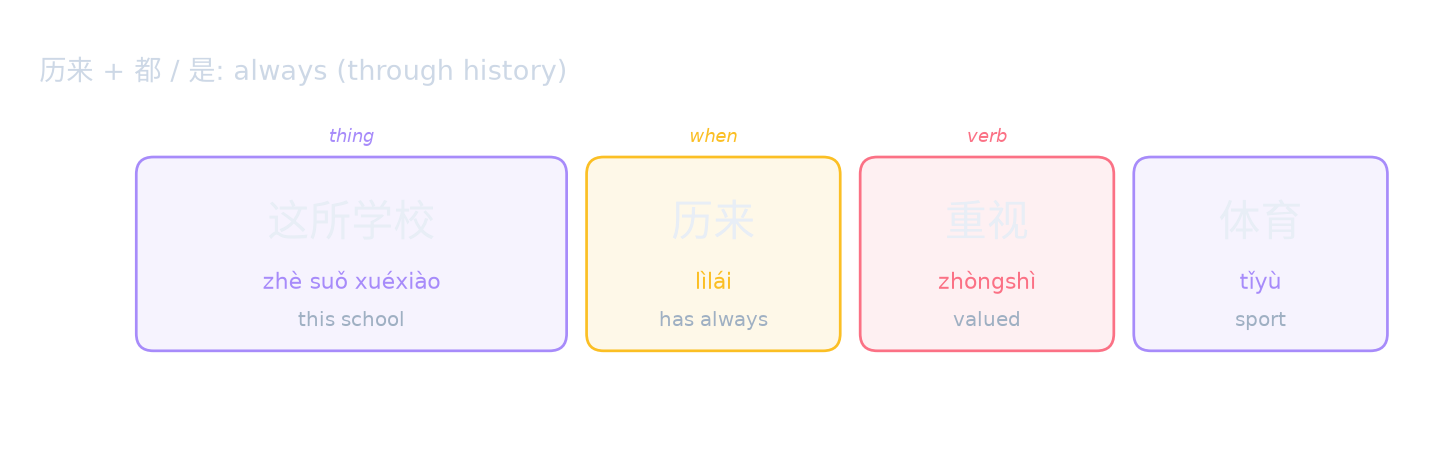
- 这所school学校throughout history历来to value; to take seriously重视sports体育。 Zhè suǒ xuéxiào lìlái zhòngshì tǐyù. – This school has always valued sport.
- China中国person人throughout history历来to value; to take seriously重视education; to educate教育。 – Chinese people have always valued education.
- he / him他always (up to now)一向degree / adjective linker很punctual准时。 – He has always been punctual.
How it works. throughout history历来 = always, throughout history, for long traditions of places and groups. always (up to now)一向 = a person's habit or style. always (so far); never (with 不 / 没)从来 + not不 / not / haven't没 = never.
| throughout history历来to value; to take seriously重视 | always (up to now)一向punctual准时 | always (so far); never (with 不 / 没)从来not / haven't没去过 |
|---|---|---|
| has always valued | always punctual | never been |
Watch out
- For one person's habit, always (up to now)一向 is more natural.
Vocabulary
Train
| 汉字 | Pinyin | English |
|---|---|---|
| 历来 | lì lái | throughout history |
1.16
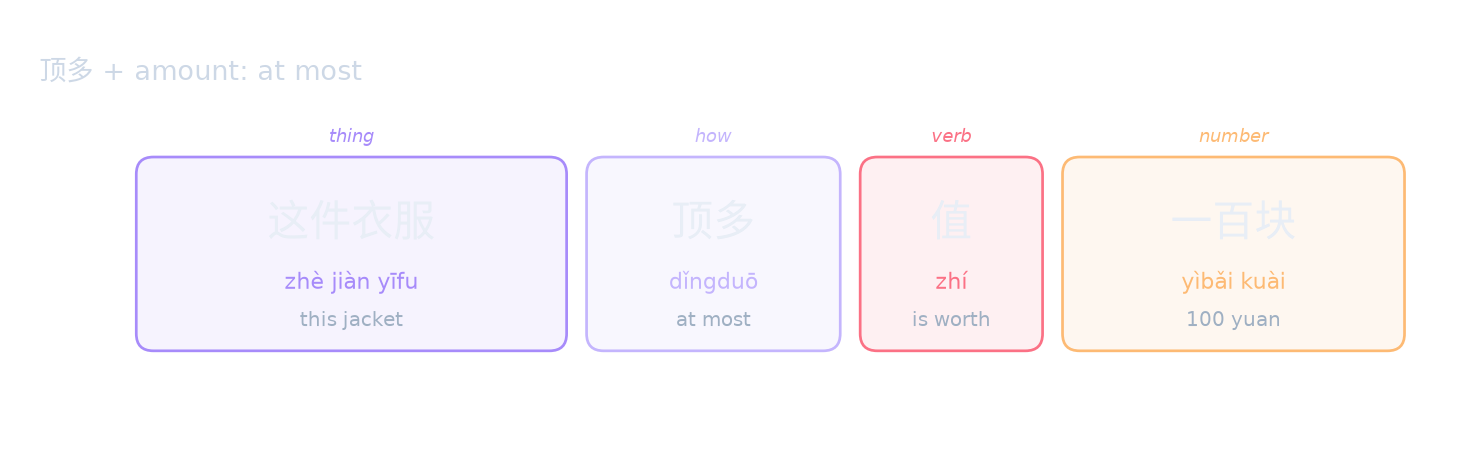
15. 顶多 vs 至多, 最多 and 至少 (at most)
Form: at most顶多 + amount / verb · up to the maximum至多 (written)
- 这件clothes衣服at most顶多value值一百块。 Zhè jiàn yīfu dǐngduō zhí yìbǎi kuài. – This jacket is worth a hundred yuan at most.
- he / him他at most顶多to be / is是to forget忘(completed / change)了,不是故意(modifier / structural particle)的。 – At worst he forgot; he didn't do it on purpose.
- at least至少want / will / need要to wait; and so on等一个hour小时。 – We'll have to wait at least an hour.
How it works. at most顶多 = at most, at worst (spoken; makes it sound small). most最many; much多 is neutral; up to the maximum至多 is written. at least至少 = at least.
| at most顶多一百块 | up to the maximum至多one / a一hour小时 | at least至少one / a一hour小时 |
|---|---|---|
| 100 yuan at most | an hour at most | at least an hour |
Watch out
- Don't confuse up to the maximum至多 (at most) with at least至少 (at least).
1.17
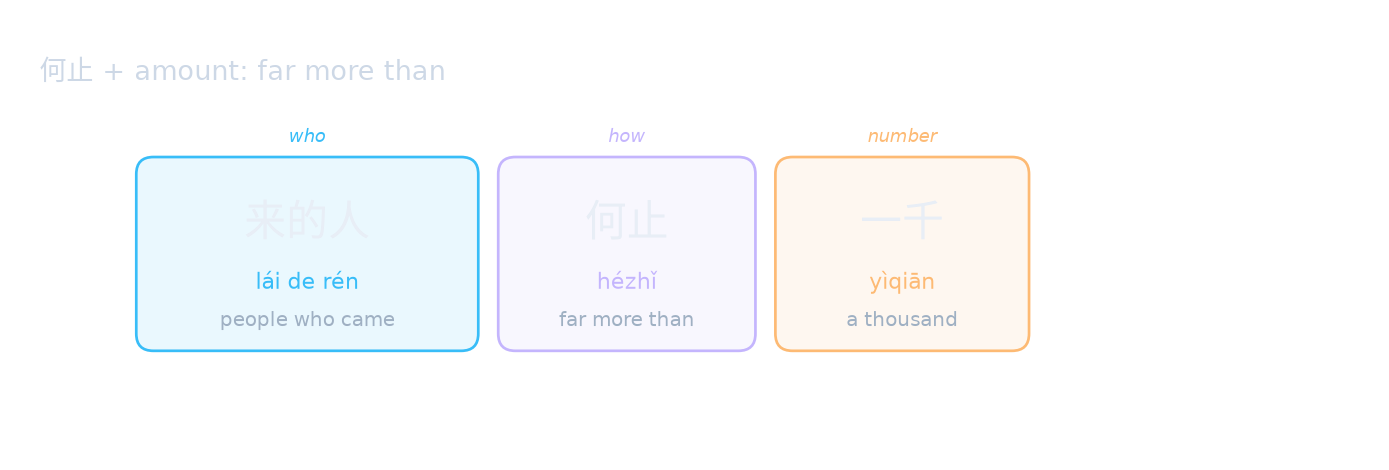
16. 何止 vs 不止 (far more than)
Form: far more than何止 + amount / person
- to come来(modifier / structural particle)的person人far more than何止一千! Lái de rén hézhǐ yìqiān! – Far more than a thousand people came!
- this这本书I / me我far more than何止to look at; to watch; to read看(completed / change)了one time (all the way…一遍,at least至少to look at; to watch; to read看(completed / change)了五遍。 – I didn't read this book just once – at least five times.
- to come来(modifier / structural particle)的person人more than / not just不止一千。 – More than a thousand people came.
How it works. far more than何止 = far more than, not just; it rejects a number or description that is too small. more than / not just不止 is the neutral "more than". at least至少 = at least.
| far more than何止一千 | more than / not just不止一千 | at least至少五遍 |
|---|---|---|
| far more than 1,000 | more than 1,000 | at least five times |
Watch out
- far more than何止 rejects something too small; plain "more than" is more than / not just不止.
Vocabulary
Train
| 汉字 | Pinyin | English |
|---|---|---|
| 不止 | bù zhǐ | more than; not only |
1.18
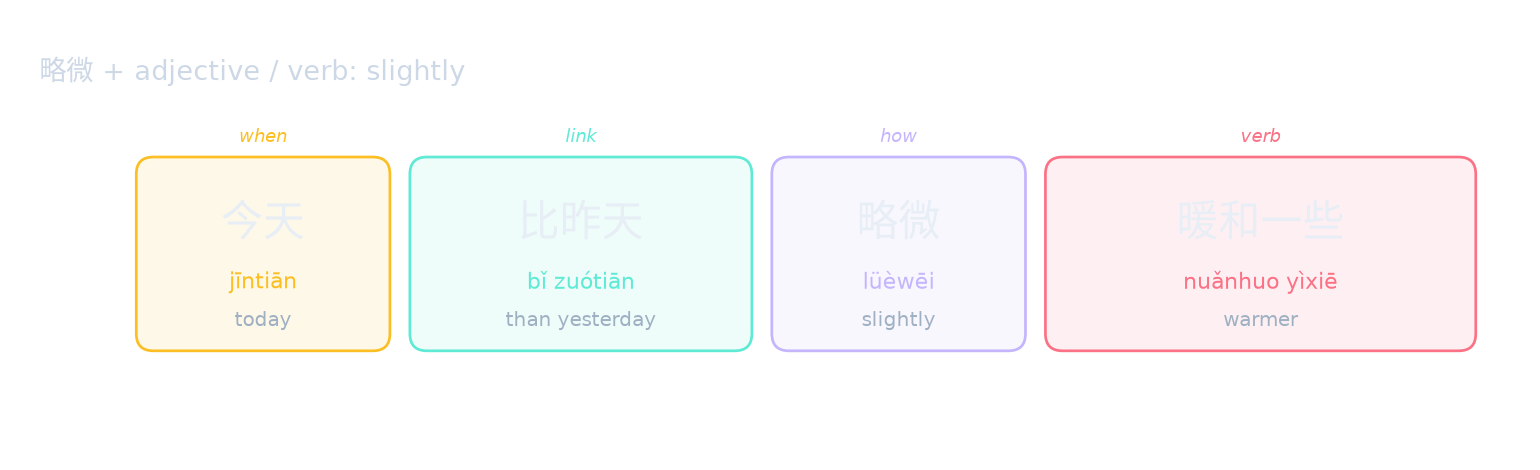
17. 略微 vs 稍微 and 有点儿 (slightly)
Form: a little bit略微 + adjective / verb (+ some一些 / a little一点儿)
- today今天than / compared to比yesterday昨天a little bit略微warm暖和some一些。 Jīntiān bǐ zuótiān lüèwēi nuǎnhuo yìxiē. – Today is slightly warmer than yesterday.
- price价格a little bit略微to decline下降(completed / change)了some一些。 – Prices fell slightly.
- please; to invite请a little bit稍微to wait; and so on等(used after a verb) give it…一下。 – Please wait a moment.
How it works. a little bit略微 = slightly (written), often with some一些 / a little一点儿 after it. a little bit稍微 is the everyday form. slightly有点儿 + adjective often complains.
| a little bit略微warm暖和some一些 | a little bit稍微to wait; and so on等(used after a verb) give it…一下 | slightly有点儿expensive贵 |
|---|---|---|
| slightly warmer | wait a moment | a bit too expensive |
Watch out
- For complaints, slightly有点儿 fits; for neutral comparisons, a little bit略微 / a little bit稍微.
Vocabulary
Train
| 汉字 | Pinyin | English |
|---|---|---|
| 略微 | lüè wēi | a little bit |
1.19
18. 果然 (sure enough / as expected)
Form: (expectation …),(subject) + as expected; sure enough果然 + result
- weather forecast天气预报to speak说afternoon下午有雨,as expected; sure enough果然to rain下雨(completed / change)了。 Guǒrán xià yǔ le. – The forecast said rain this afternoon, and sure enough, it rained.
- I / me我then / just就to know知道他会to arrive late迟到,he / him他as expected; sure enough果然to arrive late迟到(completed / change)了。 – I knew he'd be late, and sure enough he was.
- everyone大家all / both都to speak说这家(modifier / structural particle)的dish (of food); vegetable菜tasty好吃,as expected; sure enough果然lit. name is not in vain…名不虚传。 – Everyone said the food here was good, and it really lives up to its name.
How it works. as expected; sure enough果然 guǒrán "sure enough, as expected" confirms a prediction, warning or reputation that came first. It goes after the subject or at the start of the clause (as expected; sure enough果然,他来(completed / change)了).
| as expected; sure enough果然 | unexpectedly竟然 / unexpectedly居然 |
|---|---|
| as expected | unexpectedly |
| he / him他as expected; sure enough果然to pass a university…考上(completed / change)了 | he / him他unexpectedly竟然没考上 |
Watch out
- as expected; sure enough果然 needs an earlier expectation in the context; with none, it sounds odd.

1.20
19. 偏偏 (of all things / just had to)
Form: (wish / plan …),(subject) + of all times / insist on偏偏 + unwelcome event · subject + of all times / insist on偏偏 + (want / will / need要 / not不) + verb
- we / us我们with great difficulty好不容易to set / fix定(completed / change)了picnic野餐(modifier / structural particle)的day日子,of all times / insist on偏偏that day那天to rain下雨。 Piānpiān nà tiān xià yǔ. – We finally fixed a picnic date, and of all days it rained.
- I / me我urgent / anxious急(ongoing -ing)着to go out出门,key钥匙of all times / insist on偏偏to look for; to give change找not reach / less than不到(completed / change)了。 – I was in a hurry, and of course I couldn't find my keys.
- everyone大家all / both都to advise; to urge劝he / him他,he / him他of all times / insist on偏偏not不to listen to听。 – Everyone tried to persuade him, but he just wouldn't listen.
- of all times / insist on偏偏to be / is是he / him他。 – It had to be him, of all people.
How it works. of all times / insist on偏偏 piānpiān marks a clash with what was wanted. Either events go wrong at the worst moment (bad luck), or a person deliberately does the opposite of advice (stubbornness: to let / make让he / him他don't别to go去,he / him他of all times / insist on偏偏want / will / need要to go去).
| unexpectedly竟然 | of all times / insist on偏偏 |
|---|---|
| surprisingly (any surprise) | against a wish or advice, frustrating |
Watch out
- With no wish or advice to go against, leave of all times / insist on偏偏 out.

Vocabulary
Train
| 汉字 | Pinyin | English |
|---|---|---|
| 偏偏 | piān piān | just; of all things |
1.21
20. 似乎 (it seems / as if)
Form: (subject) + it seems似乎 + guess · it seems似乎……the same一样 (as if)
- he / him他it seems似乎to have / there is有what什么a load on one's mind心事。 Tā sìhū yǒu shénme xīnshì. – He seems to have something on his mind.
- question / problem问题it seems似乎than / compared to比we / us我们want / think / miss想(modifier / structural particle)的more更complicated复杂。 – The problem seems more complicated than we thought.
- he / him他it seems似乎what什么all / both都to know知道the same一样。 – He acts as if he knows everything.
How it works. it seems似乎 sìhū gives a tentative impression: a more formal to seem; as if好像 for writing and careful speech.
| it seems似乎 / to seem; as if好像 | it seems (from this)看来 |
|---|---|
| it seems (impression) | so it seems (conclusion from evidence) |
| he / him他it seems似乎not不太高兴 | he / him他not / haven't没to come来,it seems (from this)看来to be / is是illness / ill病(completed / change)了 |
Watch out
- It is soft, so don't combine it with certainty words: wrong: he / him他it seems似乎definitely; to be sure肯定illness / ill病(completed / change)了 → he / him他it seems似乎illness / ill病(completed / change)了.

1.22
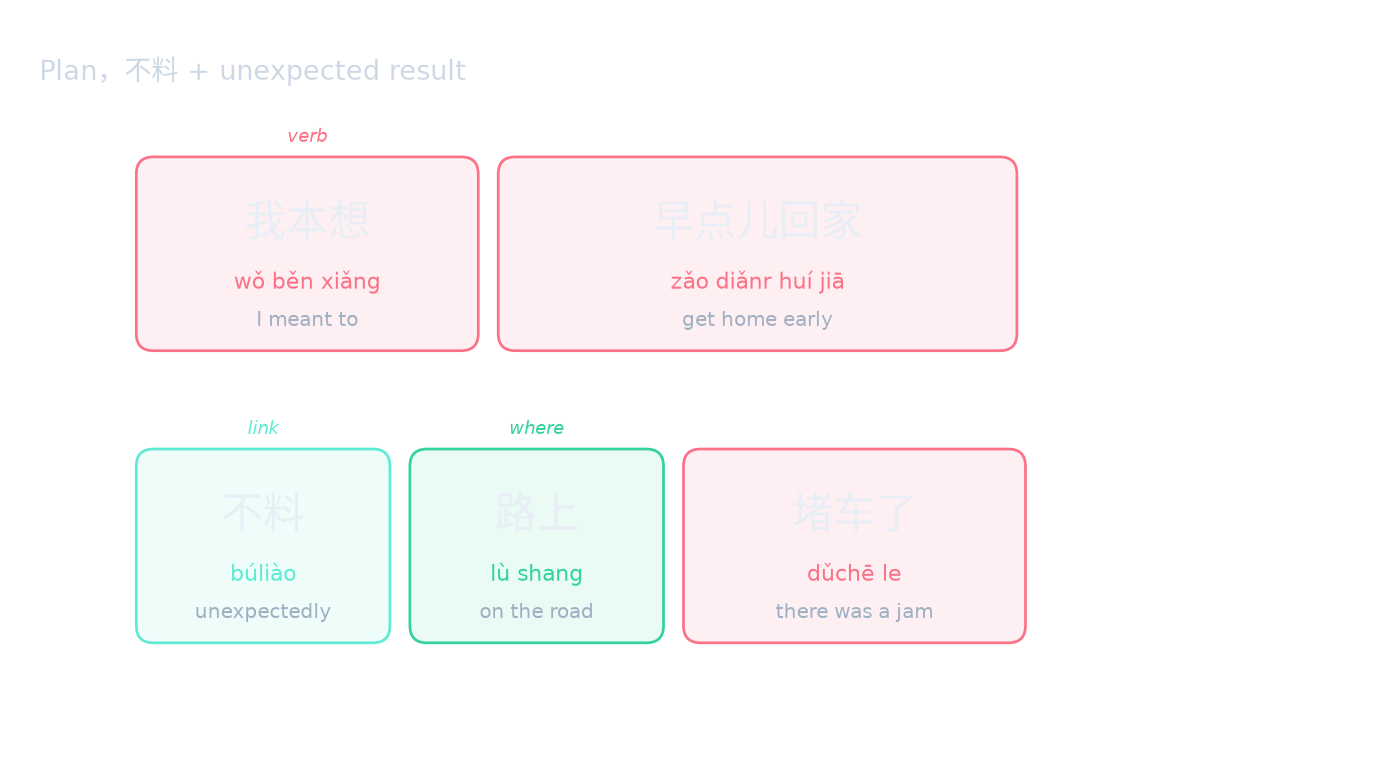
21. 不料 (unexpectedly – written)
Form: plan / expectation,unexpectedly不料 + what happened
- 我本want / think / miss想早点儿to return home回家,unexpectedly不料on the road路上to block up (a road, pipe…堵(completed / change)了两个hour小时。 Wǒ běn xiǎng zǎo diǎnr huí jiā, búliào lù shang dǔle liǎng ge xiǎoshí. – I meant to get home early, but unexpectedly I was stuck in traffic for two hours.
- he / him他to think以为考得not bad / pretty good不错,unexpectedly不料achievement成绩很差。 – He thought he had done well, but his result turned out to be poor.
- he / him他just now刚to go out出门,unexpectedly不料down / next; to fall (rain), get off下to rise / (start to)起(completed / change)了heavy rain大雨。 – He had just stepped out when, to his surprise, it began to pour.
How it works. unexpectedly不料 tells how a plan or expectation was upset. It starts the second clause, before the subject, and is common in written stories. In speech, say didn't expect没想到 or who would have thought谁知.
| unexpectedly不料he / him他not / haven't没to come来 | he / him他unexpectedly竟然not / haven't没to come来 | didn't expect没想到he / him他not / haven't没to come来 |
|---|---|---|
| unexpectedly, he didn't come (narrating) | he actually didn't come (surprise) | I didn't expect he wouldn't come (spoken) |
Watch out
- wrong: he / him他unexpectedly不料not / haven't没to come来 → unexpectedly不料he / him他not / haven't没to come来 / he / him他unexpectedly竟然not / haven't没to come来.
- unexpectedly不料 needs an expectation before it.
Vocabulary
Train
| 汉字 | Pinyin | English |
|---|---|---|
| 不料 | bù liào | unexpectedly |
1.23
22. 显然 vs 明显 (obviously vs obvious)
Form: evidence,obviously显然 + conclusion · obviously显然,+ sentence · obviously显然to be / is是 …
- he / him他all along / straight一直打哈欠,obviously显然yesterday evening昨晚没睡good好。 Tā yìzhí dǎ hāqian, xiǎnrán zuówǎn méi shuì hǎo. – He keeps yawning; he obviously didn't sleep well last night.
- obviously显然,this这个plan计划won't work行不通。 – Clearly, this plan won't work.
- this这obviously显然to be / is是一个misunderstanding; to misunderstand误会。 – This is clearly a misunderstanding.
How it works. obviously显然 gives an obvious conclusion from what you see. It goes before the verb or starts the sentence. To describe a noun or a visible change, use the adjective obvious明显.
| he / him他obviously显然not不happy; glad高兴 | obvious明显(modifier / structural particle)的change / to change变化 | he / him他obvious明显thin瘦(completed / change)了 |
|---|---|---|
| he's obviously unhappy (a conclusion) | an obvious change | he has visibly lost weight |
Watch out
- wrong: obviously显然(modifier / structural particle)的change / to change变化 → obvious明显(modifier / structural particle)的change / to change变化.
1.24
23. 不至于 (it won't come to that)
Form: unlikely to go so far as to不至于 + bad result ((suggestion)吧) · unlikely to go so far as to不至于even连 … all / both都 … · as for至于(yes/no ?)吗?
- you你to review复习(degree marker)得so much这么conscientious认真,unlikely to go so far as to不至于to fail不及格(suggestion)吧。 Nǐ fùxí de zhème rènzhēn, bú zhìyú bù jígé ba. – You've revised so carefully – you surely won't fail.
- exam; to take an exam考试再难,also也unlikely to go so far as to不至于to fail不及格。 – However hard the exam is, you won't go so far as to fail.
- he / him他unlikely to go so far as to不至于even连这点儿money钱all / both都not have / haven't没有(suggestion)吧? – Surely he isn't so broke that he doesn't even have this little money?
How it works. unlikely to go so far as to不至于 reassures: something may be difficult, but it won't reach that bad extreme. It is used about results nobody wants. as for至于(yes/no ?)吗? asks "Is it really that serious?"
| unlikely to go so far as to不至于to fail; failure失败 | not不definitely / certain一定to succeed; success成功 | so much that以至于to fall asleep睡着(completed / change)了 |
|---|---|---|
| won't go so far as to fail | won't necessarily succeed | so much that he fell asleep |
Watch out
- Only for bad results: wrong: unlikely to go so far as to不至于to succeed; success成功.
- so much that以至于 is different: "so much that".
1.25
24. 终究 vs 终于 and 毕竟 (in the end / finally / after all)
Form: in the end终究 + fact / outcome · in the end终究or / still还是 + result
- forget it; never mind算了,he / him他in the end终究or / still还是(measure word)个child孩子。 Suàn le, tā zhōngjiū háishi ge háizi. – Forget it – he's only a child, after all.
- lie谎言终究会(passive: by)被to notice发现。 – Lies will be found out in the end.
- he / him他to hesitate犹豫(completed / change)了degree / adjective linker很for a long time久,in the end终究or / still还是to walk / to leave走(completed / change)了。 – He hesitated for a long time, but in the end he left.
How it works. in the end终究 states what stays true or what happens in the end, no matter what. It is a little formal and often sounds resigned. For a hoped-for success after waiting, use finally终于; for a reason to keep in mind, after all毕竟 is the everyday word.
| in the end终究or / still还是to walk / to leave走(completed / change)了 | finally终于to buy买to / arrive / (result: get)到ticket票(completed / change)了 | he / him他after all毕竟only then / not until才七岁 |
|---|---|---|
| left in the end, after all that | finally got a ticket | he's only seven, after all |
Watch out
- An excited "at last!" is finally终于, not in the end终究.
Vocabulary
Train
| 汉字 | Pinyin | English |
|---|---|---|
| 终究 | zhōng jiū | in the end |
| 算了 | suàn le | forget it; never mind |
1.26
25. 恰巧 vs 恰好 (as it happened / exactly right)
Form: by chance恰巧 + verb (coincidence) · as it turns out恰好 (exactly right; also "as it happened")
- I / me我to go去to look for; to give change找he / him他,he / him他by chance恰巧to be at home在家。 Wǒ qù zhǎo tā, tā qiàqiǎo zài jiā. – I went to see him, and as it happened he was at home.
- by chance恰巧that day那天I / me我also也at / in在Beijing北京,we / us我们then / just就to see / meet见(completed / change)了one side / (见一面) meet once一面。 – As it happened, I was in Beijing that day too, so we met up.
- 这双鞋size大小as it turns out恰好。 – These shoes are exactly the right size.
How it works. by chance恰巧 tells a coincidence: two things met by chance at the right moment. as it turns out恰好 means "exactly right" (size, time, amount) and can also mean "as it happened". Both are written; in speech say just right; just in time正好 / just刚好.
| he / him他by chance恰巧to be at home在家 | size大小as it turns out恰好 | just right; just in time正好十点 |
|---|---|---|
| he happened to be home | exactly the right size | exactly ten o'clock (spoken) |
Watch out
- wrong: size大小by chance恰巧 → size大小as it turns out恰好.
Vocabulary
Train
| 汉字 | Pinyin | English |
|---|---|---|
| 恰巧 | qià qiǎo | by chance |
1.27
26. 必定 vs 一定 (surely / must)
Form: (condition),surely; must必定 (can / will会) + result
- as long as只要to press on坚持下去,you你必定会to succeed; success成功。 Zhǐyào jiānchí xiàqu, nǐ bìdìng huì chénggōng. – As long as you keep going, you will surely succeed.
- 这件matter事surely; must必定to have / there is有reason; cause原因。 – There must be a reason for this.
- not不保护环境,必定会to receive (praise, help …)受到nature; natural自然(modifier / structural particle)的penalty惩罚。 – If we don't protect the environment, nature will surely punish us.
How it works. surely; must必定 gives a confident judgement: something is bound to be true or to happen. It is formal. For requests (definitely / certain一定want / will / need要to come来) and "not necessarily" (not不definitely / certain一定), use definitely / certain一定; in everyday speech, definitely; to be sure肯定.
| 必定会to succeed; success成功 | you你definitely / certain一定want / will / need要to come来! | not不definitely / certain一定 |
|---|---|---|
| will surely succeed | you must come! | not necessarily |
Watch out
- wrong: you你surely; must必定want / will / need要to come来 → you你definitely / certain一定want / will / need要to come来. wrong: not不surely; must必定 → not不definitely / certain一定.
Vocabulary
Train
| 汉字 | Pinyin | English |
|---|---|---|
| 必定 | bì dìng | surely; must |
| 惩罚 | chéng fá | penalty |
1.28
27. 或许 vs 也许 and 恐怕 (perhaps)
Form: perhaps或许 + verb · perhaps或许 at the start
- he / him他perhaps或许already已经to know知道(completed / change)了。 Tā huòxǔ yǐjīng zhīdào le. – Perhaps he already knows.
- 换个method方法perhaps或许can / will会更好。 – Trying another way might work better.
- I'm afraid (that); probably恐怕want / will / need要to rain下雨(completed / change)了。 – I'm afraid it's going to rain.
How it works. perhaps或许 makes a soft guess or polite suggestion; it means the same as maybe也许 but sounds a little more written. I'm afraid (that); probably恐怕 guesses something you don't want.
| perhaps或许you你说得对 | maybe也许(suggestion)吧 | I'm afraid (that); probably恐怕there's not enough time来不及(completed / change)了 |
|---|---|---|
| perhaps you're right | maybe (everyday) | I'm afraid it's too late |
Watch out
- Not for certain facts: wrong: sun太阳perhaps或许from从east东边to rise升起.
Vocabulary
Train
| 汉字 | Pinyin | English |
|---|---|---|
| 或许 | huò xǔ | perhaps |
1.29
28. 明明 (clearly …, yet …)
Form: subject + clearly; obviously明明 + fact,(but; yet却 / still / also / even还 / why?为什么) + the opposite
- you你clearly; obviously明明to know知道,why?为什么not不to tell告诉I / me我? Nǐ míngmíng zhīdào, wèishénme bú gàosu wǒ? – You clearly knew – why didn't you tell me?
- he / him他clearly; obviously明明won't / can't不会,still / also / even还to speak说oneself自己can / will会。 – He obviously can't do it, but he still says he can.
- I / me我clearly; obviously明明(把: marks the object)把key钥匙放在桌上(completed / change)了,how / why怎么not see / missing不见(completed / change)了? – I definitely put the keys on the table – how come they're gone?
How it works. clearly; obviously明明 states a plain fact, and the next part goes against it: a complaint or surprise. For a neutral "obviously", use obviously显然 or degree / adjective linker很obvious明显.
| clearly; obviously明明to know知道,but; yet却not不to speak说 | obviously显然to fail; failure失败(completed / change)了 | clear; clearly分明 |
|---|---|---|
| clearly knew, yet said nothing | obviously failed | clearly (written) |
Watch out
- clearly; obviously明明 needs a contrast after it.
Vocabulary
Train
| 汉字 | Pinyin | English |
|---|---|---|
| 明明 | míng míng | clearly; obviously |
| 分明 | fēn míng | clear; clearly |
1.30
29. 犹如 vs 好像 and 像……一样 (just like)
Form: A just like犹如 B (written) · A to resemble像 B the same一样 (spoken)
- 湖面just like犹如一面镜子。 Húmiàn yóurú yí miàn jìngzi. – The surface of the lake was just like a mirror.
- time时间just like犹如running water流水,gone forever一去不复返。 – Time is like flowing water: once gone, it never comes back.
- he / him他to seem; as if好像to fall ill生病(completed / change)了。 – He seems to be ill.
How it works. just like犹如 makes a written comparison in descriptions and essays; as if仿佛 (as if) is also written. In speech say to resemble像……the same一样. to seem; as if好像 can also mean "it seems" (a guess); just like犹如 is not used that way.
| just like犹如一面镜子 | to resemble像mirror镜子the same一样 | to seem; as if好像to fall ill生病(completed / change)了 |
|---|---|---|
| just like a mirror (written) | like a mirror (spoken) | seems ill |
Watch out
- For a guess, use to seem; as if好像, not just like犹如.
Vocabulary
Train
| 汉字 | Pinyin | English |
|---|---|---|
| 犹如 | yóu rú | just like |
1.31
30. 凡是 … 都 (all / any without exception)
Form: all; every凡是 + category (…(modifier / structural particle)的 + noun),all / both都 + …
- all; every凡是to arrive late迟到(modifier / structural particle)的student学生,all / both都want / will / need要to write写to explain / to show说明。 Fánshì chídào de xuésheng, dōu yào xiě shuōmíng. – Any student who is late must write an explanation.
- all; every凡是he / him他to agree; to promise答应(modifier / structural particle)的matter事,all / both都can / will会to accomplish做到。 – Whatever he promises, he does.
- all; every凡是to have / there is有question / problem问题(modifier / structural particle)的,请举手。 – Anyone with a question, please raise your hand.
How it works. all; every凡是 fánshì "every, any … without exception" sets up a whole category, usually with a (modifier / structural particle)的 phrase, and all / both都 in the main clause applies the rule to all of it. It suits rules and strong generalisations.
| all所有(modifier / structural particle)的student学生all / both都…… | 每个student学生all / both都…… | all; every凡是……(modifier / structural particle)的student学生,all / both都…… |
|---|---|---|
| all the students | each student | any student who …, no exceptions |
Watch out
- all / both都 is required: wrong: all; every凡是student学生want / will / need要to participate参加 → all; every凡是student学生all / both都want / will / need要to participate参加.
- (请举手 is a request, so all / both都 can be left out there.)
1.32
31. 一律 (uniformly / without exception)
Form: group / items + all; without exception一律 + verb / predicate
- ticket (for theater, cinema…门票all; without exception一律二十元。 Ménpiào yílǜ èrshí yuán. – All tickets are twenty yuan.
- student学生all; without exception一律to wear穿school uniform校服。 – All students must wear school uniform.
- to expire过期(modifier / structural particle)的ticket票all; without exception一律not valid无效。 – Expired tickets are invalid, no exceptions.
How it works. all; without exception一律 yílǜ applies one rule to every case in the same way. It is formal and typical of signs, notices and policies (all; without exception一律free免费, all; without exception一律not不to go back; to return (goods)退).
| all / both都 | all; without exception一律 |
|---|---|
| all (a neutral description) | all, by rule, no exceptions |
| student学生all / both都to come来(completed / change)了 | (of a restaurant) to…外卖all; without exception一律to put / let go放doorway门口 |
Watch out
- The group comes first: wrong: all; without exception一律student学生to wear穿school uniform校服 → student学生all; without exception一律to wear穿school uniform校服.
- Use all; without exception一律 for rules, not plain descriptions.

Vocabulary
Train
| 汉字 | Pinyin | English |
|---|---|---|
| 一律 | yī lǜ | all; without exception |
1.33
32. 再 + Adj + 也 (however …, still …)
Form: (topic) + again / then / (再…也) however再 + adjective / verb,(subject) + also也 + unchanged result
- to work; job工作again / then / (再…也) however再busy忙,she / her她also也can / will会to return home回家to have a meal吃饭。 Gōngzuò zài máng, tā yě huì huí jiā chī fàn. – However busy work gets, she still comes home for dinner.
- 再贵I / me我also也want / will / need要to buy买。 – I'm buying it, however expensive it is.
- you你again / then / (再…也) however再to explain / explanation解释also也useless没用,he / him他won't / can't不会to be convinced相信(modifier / structural particle)的。 – However much you explain, it's no use; he won't believe it.
How it works. Here again / then / (再…也) however再 means "however much, even more", not "again". Whatever the degree, the result after also也 stays the same. It is very common in speech; no matter (what / how)无论 / no matter; regardless不管 + many; much多 says the same thing more explicitly.
| again / then / (再…也) however再busy忙also也can / will会to come来 | no matter (what / how)无论多忙,she / her她all / both都can / will会to come来 |
|---|---|
| short, spoken | explicit, any register |
Watch out
- also也 is required: wrong: again / then / (再…也) however再busy忙to come来 → again / then / (再…也) however再busy忙also也to come来.
1.34
33. 唯独 (only X – the exception)
Form: group (all / both都) …,only (except)唯独 + person / verb …
- everyone大家all / both都to / arrive / (result: get)到(completed / change)了,only (except)唯独he / him他not / haven't没to come来。 Dàjiā dōu dào le, wéidú tā méi lái. – Everyone has arrived; only he hasn't come.
- I / me我what什么dish (of food); vegetable菜all / both都to eat吃,only (except)唯独不吃coriander香菜。 – I eat everything except coriander.
- he / him他what什么all / both都fearless不怕,only (except)唯独to be afraid怕to give or get an injection打针。 – He's afraid of nothing – except injections.
How it works. only (except)唯独 singles out the one exception: first say what is true for the group, then only (except)唯独 + the one that differs. It is a little formal. For a plain "only" with no contrast, use only (if) / only have只有 / only只.
| only (except)唯独he / him他not / haven't没to come来 | only (if) / only have只有he / him他to know知道 | besides除了he / him他apart from以外,everyone大家all / both都to / arrive / (result: get)到(completed / change)了 |
|---|---|---|
| only he didn't come | only he knows | everyone except him has arrived |
Watch out
- With no group to contrast, say only (if) / only have只有, not only (except)唯独.
Vocabulary
Train
| 汉字 | Pinyin | English |
|---|---|---|
| 唯独 | wéi dú | only (except) |
1.35
34. 统统 (all, every single one)
Form: (group / (把: marks the object)把 + things) all; entirely统统 + verb
- these这些旧衣服all; entirely统统to throw away扔掉(suggestion)吧! Zhèxiē jiù yīfu tǒngtǒng rēngdiào ba! – Throw all these old clothes away!
- (把: marks the object)把table桌子up / on / last; to get on, attend上(modifier / structural particle)的thing; stuff东西all; entirely统统to take away拿走! – Take everything off the table!
- I / me我to speak说if (coming after a…的话he / him他all; entirely统统to forget忘(completed / change)了。 – He forgot every word I said.
How it works. all; entirely统统 means "all, every single one". Like all / both都 it goes before the verb, but it is stronger and spoken, common in orders and (把: marks the object)把 sentences. Before a noun, say all所有 / all; whole全部; in formal writing, all; whole全部 / all / both都.
| all; entirely统统to throw away扔掉 | 所有人 | already已all; whole全部to submit (a report etc)提交 |
|---|---|---|
| throw it all away | everyone | all submitted (formal) |
Watch out
- wrong: all; entirely统统person人 → 所有人.
Vocabulary
Train
| 汉字 | Pinyin | English |
|---|---|---|
| 统统 | tǒng tǒng | all; entirely |
1.36
35. 归根到底 (in the final analysis)
Form: details …。after all归根到底 (or / still还是 / to be / is是) + basic cause
- after all归根到底,question / problem问题or / still还是to lack缺乏to communicate沟通。 Guīgēn dàodǐ, wèntí háishi quēfá gōutōng. – In the end, the real problem is poor communication.
- after all归根到底,to study; to learn学习still / also / even还(degree marker)得to rely on / lean on靠oneself自己。 – In the end, learning depends on yourself.
- in the final analysis说到底,or / still还是money钱(modifier / structural particle)的question / problem问题。 – When it comes down to it, it's about money.
How it works. after all归根到底 (also in the final analysis归根结底) names the one basic cause or truth after you have listed details. It is written; in the final analysis说到底 is the spoken version. in a word总之 just sums up; for time, use finally; last最后.
| after all归根到底 | in the final analysis说到底 | in a word总之 |
|---|---|---|
| at root (written) | when it comes down to it | in short |
Watch out
- Not for time: wrong: after all归根到底他来(completed / change)了 → he / him他finally; last最后or / still还是to come来(completed / change)了.
Vocabulary
Train
| 汉字 | Pinyin | English |
|---|---|---|
| 归根到底 | guī gēn dào dǐ | after all |
1.37
36. 很是 + Adj (a formal “very”)
Form: subject + degree / adjective linker很to be / is是 + two-syllable adjective / feeling verb
- resident居民(plural)们to / towards / correct对new新park公园degree / adjective linker很to be / is是satisfied满意。 Jūmínmen duì xīn gōngyuán hěn shì mǎnyì. – Residents are very satisfied with the new park.
- old man or woman老人一个人住,child孩子(plural)们degree / adjective linker很to be / is是anxious担心。 – The old man lives alone, and his children are very worried.
- to hear听到this这个news; message消息,everyone大家degree / adjective linker很to be / is是happy; glad高兴。 – Everyone was very pleased by the news.
How it works. degree / adjective linker很to be / is是 is a literary "very": one unit before a two-syllable adjective or feeling verb. It gives a measured, slightly old-fashioned tone suited to narratives and reports.
| degree / adjective linker很to be / is是satisfied满意 | he / him他to be / is是degree / adjective linker很busy忙 |
|---|---|
| very (degree, written) | to be / is是 for emphasis: he really is busy |
Watch out
- Prefer two-syllable words: wrong: degree / adjective linker很to be / is是good好 → degree / adjective linker很to be / is是satisfied满意 / degree / adjective linker很good好.
- In conversation, use degree / adjective linker很 or very非常.
1.38
37. 足足 + Amount (a full / as much as)
Form: fully足足 + verb + number + measure word · fully足足 + amount
- we / us我们fully足足to line up / row排(completed / change)了三个hour小时(modifier / structural particle)的team / queue队。 Wǒmen zúzú páile sān gè xiǎoshí de duì. – We queued for a full three hours.
- he / him他fully足足than / compared to比I / me我tall; high高(completed / change)了一个头。 – He's a whole head taller than me.
- this这顿饭fully足足flower花(completed / change)了五百块。 – That meal cost a full 500 yuan.
How it works. fully足足 zúzú stresses that an amount of time, weight, money or distance is large: at least that much, more than expected. It needs a number.
| fully足足 | whole整整 | only then / not until才 / only只 |
|---|---|---|
| a full (large!) | exactly, a whole (complete) | only (small) |
| fully足足三个hour小时 | whole整整一天 | only then / not until才五分钟 |
Watch out
- wrong: fully足足degree / adjective linker很for a long time久: give the amount (fully足足to wait; and so on等(completed / change)了两个hour小时).

1.39
38. Verb + 得 + 倒 + Adj (a pointed note)
Form: verb + (degree marker)得 + to pour倒 + adjective
- you你to speak说(degree marker)得to pour倒easy容易,who谁to come来to move搬(and …? / softener)呢? Nǐ shuō de dào róngyì, shéi lái bān ne? – That's easy for you to say. Who's going to do the lifting?
- he / him他want / think / miss想(degree marker)得to pour倒beautiful美,to think以为not不to review复习also也can / be able to能to take an exam / to test考full marks满分。 – Dream on: he thinks he'll get full marks without revising.
- this这child孩子画得to pour倒not bad / pretty good不错。 – This child actually draws rather well.
How it works. to pour倒 dào after (degree marker)得 marks a contrast with what you'd expect. Most often it is ironic: the words or idea sound fine, but reality is different (to speak说(degree marker)得to pour倒relaxed; easy轻松, to speak说(degree marker)得倒好to listen to听, want / think / miss想(degree marker)得to pour倒beautiful美). It can also be sincere, meaning better than expected (画得to pour倒not bad / pretty good不错). Context and tone decide which.
| you你to speak说(degree marker)得degree / adjective linker很easy容易 | you你to speak说(degree marker)得to pour倒easy容易 |
|---|---|
| describes how you said it | implies "but it isn't really" |
Watch out
- Order: verb + (degree marker)得 + to pour倒 (wrong: to speak说to pour倒(degree marker)得easy容易).
- The ironic use is a jab; avoid it with people you should be polite to.
1.40
39. 未免 (rather too – a soft criticism)
Form: subject + rather; a bit too未免 + too太 / slightly有点儿 / too much过于 + adjective
- 一碗面要九十八yuan (spoken); piece块,this这碗面rather; a bit too未免太贵(completed / change)了。 Zhè wǎn miàn wèimiǎn tài guì le. – 98 yuan for a bowl of noodles – that's rather too expensive.
- you你this way / so这样to speak说rather; a bit too未免slightly有点儿not不fair公平。 – Saying that is a bit unfair, don't you think?
- talent and learning才学(completed / change)了一个月then / just就want / think / miss想to work as当to translate / translator翻译,未免太to worry / impatient着急(completed / change)了。 – Wanting to be an interpreter after one month of study is rather too hasty.
How it works. rather; a bit too未免 gives a soft, polite criticism: the speaker thinks something goes too far. A degree word (too太, slightly有点儿, too much过于) usually follows it.
| 未免太tall; high高(completed / change)了 | hard to avoid难免nervous紧张 | 太贵(completed / change)了 |
|---|---|---|
| rather too high (a judgement) | bound to be nervous (a natural result) | too expensive (blunt) |
Watch out
- rather; a bit too未免 ≠ hard to avoid难免: wrong: he / him他(modifier / structural particle)的to require / requirement要求hard to avoid难免太高(completed / change)了 → he / him他(modifier / structural particle)的to require / requirement要求未免太tall; high高(completed / change)了.
- In speech, keep the degree word: 未免太it is a pity可惜(completed / change)了.
Vocabulary
Train
| 汉字 | Pinyin | English |
|---|---|---|
| 未免 | wèi miǎn | rather; a bit too |
| 过于 | guò yú | too much |
| 难免 | nán miǎn | hard to avoid |
1.41
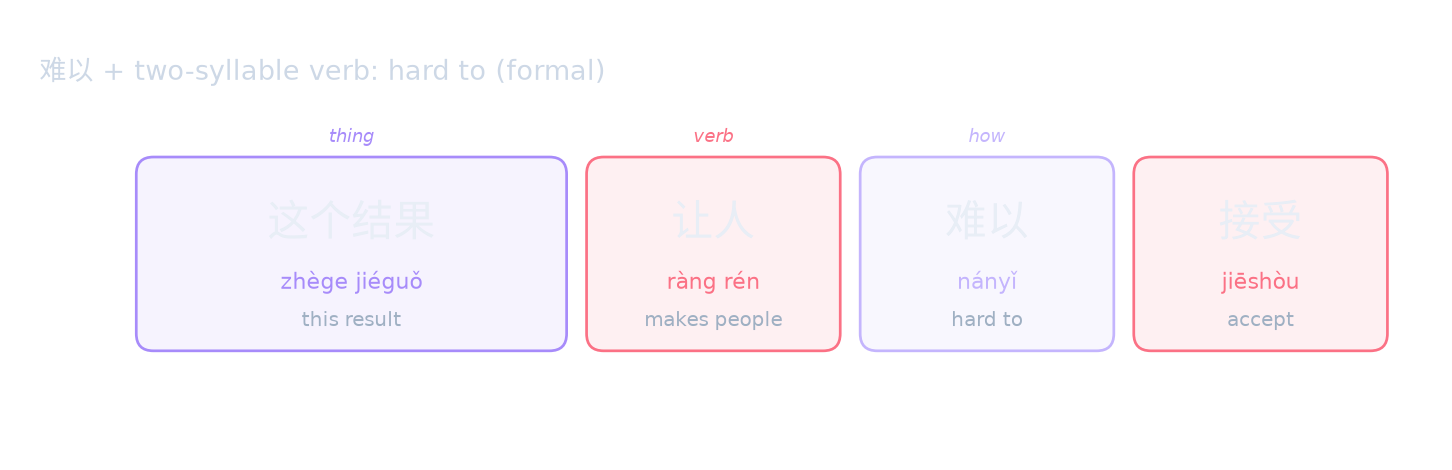
40. 难以 (hard to – formal)
Form: hard to (predict, imagine…难以 + two-syllable verb (to be convinced相信, to accept接受, to understand理解, to forget忘记, to describe形容)
- this这真让人难以相信。 Zhè zhēn ràng rén nányǐ xiāngxìn. – That is really hard to believe.
- this这个result; as a result结果to let / make让person人hard to (predict, imagine…难以to accept接受。 – This result is hard to accept.
- that day那天(modifier / structural particle)的scenery风景beautiful美(degree marker)得难以形容。 – The scenery that day was beautiful beyond words.
How it works. hard to (predict, imagine…难以 is the formal way to say "hard to". It takes a two-syllable verb. In everyday speech, or with a one-syllable verb, use 很难 + verb.
| hard to (predict, imagine…难以to understand理解 | 很难说 | degree / adjective linker很unpalatable难吃 |
|---|---|---|
| hard to understand (formal) | hard to say (speech) | tastes bad (not "hard to eat") |
Watch out
- wrong: hard to (predict, imagine…难以to understand懂 → hard to (predict, imagine…难以to understand理解 / degree / adjective linker很difficult to understand难懂.
- degree / adjective linker很unpalatable难吃 / degree / adjective linker很bad-looking; ugly难看 = tastes bad / looks ugly.
1.42
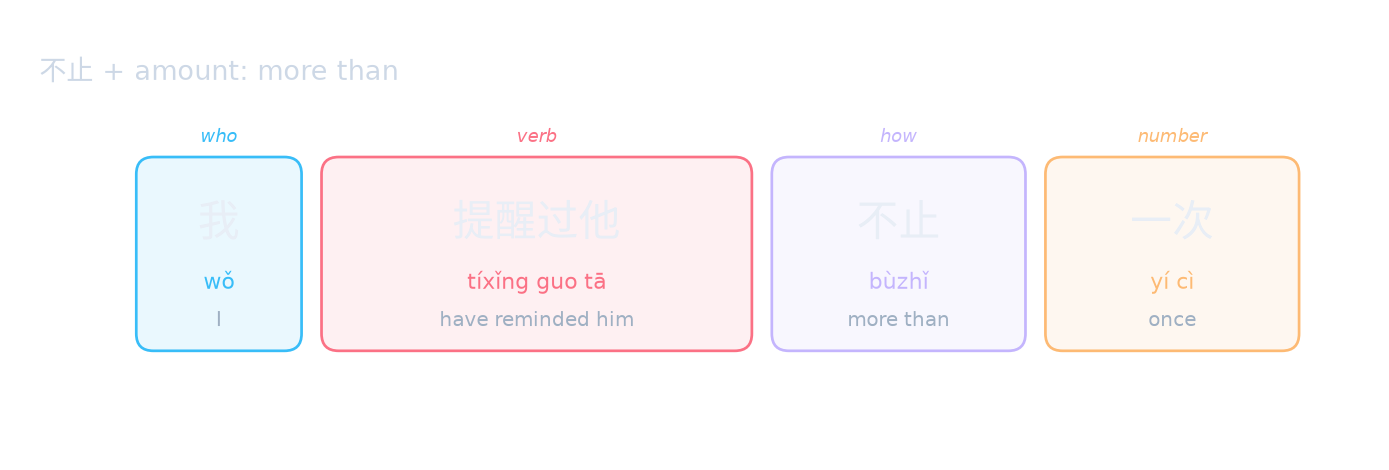
41. 不止 (more than / not only)
Form: more than / not just不止 + amount · more than / not just不止 + person / group
- I / me我to remind提醒(experienced)过he / him他many times不止一次。 Wǒ tíxǐng guo tā bùzhǐ yí cì. – I reminded him more than once.
- he / him他seemingly看起来more than / not just不止六十岁。 – He looks older than sixty.
- more than / not just不止he / him他一个person人so much这么want / think / miss想。 – He's not the only one who thinks so.
How it works. Before an amount, more than / not just不止 means "more than". Before a person or group, it means "not only". The opposite of more than / not just不止 + amount is not reach / less than不到 (less than).
| more than / not just不止一百person人 | not reach / less than不到一百person人 | to exceed超过一百person人 |
|---|---|---|
| more than a hundred people | fewer than a hundred | over a hundred (exact, neutral) |
Watch out
- more than / not just不止 (more than) is not not reach / less than不到 (less than).
1.43
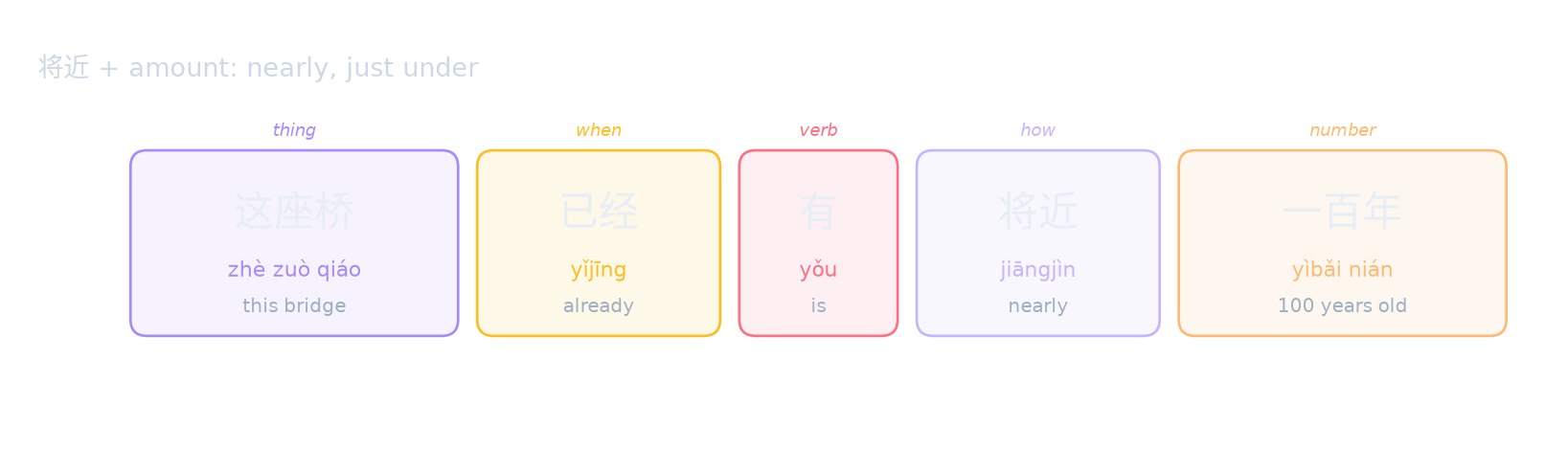
42. 将近 (nearly, just under)
Form: almost将近 + amount (time, age, number, part)
- 这座bridge桥already已经to have / there is有almost将近一百年(completed / change)了。 Zhè zuò qiáo yǐjīng yǒu jiāngjìn yìbǎi nián le. – This bridge is nearly a hundred years old.
- almost将近half一半(modifier / structural particle)的student学生to choose选(completed / change)了这门lesson课。 – Nearly half the students chose this course.
- almost将近十二点(completed / change)了,快睡吧。 – It's nearly twelve – go to sleep.
How it works. almost将近 means "nearly": the real amount is a little below the number. It is a little formal. For a little more, use many; much多 / more than / not just不止; for "about" either way, almost / about the same差不多 / about; left and right左右; for "almost" with any verb, almost几乎.
| almost将近一百年 | 一百多年 | I / me我almost几乎to forget忘(completed / change)了 |
|---|---|---|
| nearly 100 years | over 100 years | I almost forgot |
Watch out
- almost将近 is always just under the number.
Vocabulary
Train
| 汉字 | Pinyin | English |
|---|---|---|
| 将近 | jiāng jìn | almost |
| 左右 | zuǒ yòu | about; left and right |
1.44
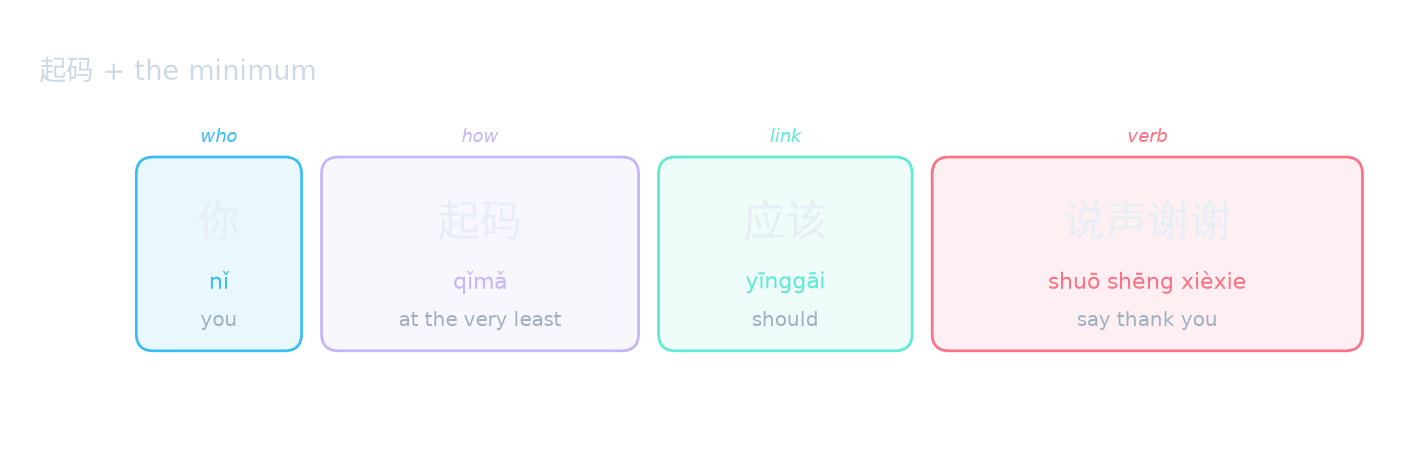
43. 起码 (at the very least)
Form: at least / basic起码 + verb / amount · at least / basic起码(modifier / structural particle)的 + noun · 最起码
- other people / household人家to help帮(completed / change)了you你一整天,you你at least / basic起码should应该说声to thank谢谢。 Rénjia bāng le nǐ yì zhěng tiān, nǐ qǐmǎ yīnggāi shuō shēng xièxie. – They helped you all day – the very least you should do is say thank you.
- from从here这儿to walk / to leave走past过去at least / basic起码want / will / need要half of sth半个hour小时。 – Walking there takes at least half an hour.
- 这是to conduct oneself做人at least / basic起码(modifier / structural particle)的polite; manners礼貌。 – That's the most basic courtesy a person should have.
How it works. at least / basic起码 sets the lowest acceptable amount or action; it is spoken and sounds a little stronger than at least至少 (最起码 is stronger still). Unlike at least至少, it can describe a noun: at least / basic起码(modifier / structural particle)的 + noun = the most basic ….
| at least / basic起码want / will / need要half of sth半个hour小时 | at least / basic起码(modifier / structural particle)的to require / requirement要求 | at least至少一个hour小时 |
|---|---|---|
| takes at least half an hour | the minimum requirement | at least an hour |
Watch out
- wrong: at least至少(modifier / structural particle)的to require / requirement要求 → at least / basic起码(modifier / structural particle)的to require / requirement要求.
Vocabulary
Train
| 汉字 | Pinyin | English |
|---|---|---|
| 起码 | qǐ mǎ | at least |
| 人家 | rén jiā | household |
1.45
44. 颇, 异常 and 万分 (formal "quite / very")
Form: rather颇 (for / (wéi) to be为) + adjective / verb · unusual; extremely异常 + adjective · extremely万分 + feeling
- this这本书颇受欢迎。 Zhè běn shū pō shòu huānyíng. – This book is quite popular.
- 今年夏天unusual; extremely异常blistering hot炎热。 – This summer is unusually hot.
- we / us我们extremely万分to thank感谢。 – We are extremely grateful.
How it works. Three written degree words. rather颇 = quite, rather; unusual; extremely异常 = unusually (alone: abnormal); extremely万分 = extremely, mostly with feelings. In speech say quite挺 / degree / adjective linker很 / very非常.
| rather颇to have / there is有sense; reasoning道理 | unusual; extremely异常blistering hot炎热 | extremely万分to worry / impatient着急 |
|---|---|---|
| quite reasonable | unusually hot | extremely anxious |
Watch out
- extremely万分 mostly goes with feelings: wrong: extremely万分tall; high高.
Vocabulary
Train
| 汉字 | Pinyin | English |
|---|---|---|
| 颇 | pō | rather |
| 异常 | yì cháng | unusual; extremely |
| 万分 | wàn fēn | extremely |
| 炎热 | yán rè | blistering hot |
1.46
45. 接连 vs 连续 (in a row)
Form: in a row; one after another接连 + verb (+ number) · continuous连续 + time / verb
- he / him他in a row; one after another接连to hit / play / make (a call)打(completed / change)了三个telephone电话。 Tā jiēlián dǎ le sān ge diànhuà. – He made three calls in a row.
- recently最近in a row; one after another接连out / to happen出(completed / change)了几件strange thing怪事。 – Several strange things have happened one after another lately.
- we / us我们team / queue队continuous连续三年(degree marker)得(completed / change)了champion冠军。 – Our team has won the championship three years in a row.
How it works. in a row; one after another接连 describes separate events that happen one right after another, often to you. continuous连续 = without a break (one activity over time, records). in succession; bit by bit陆续 = one after another over a period of time.
| in a row; one after another接连to hit / play / make (a call)打(completed / change)了三个telephone电话 | continuous连续to work; job工作十个hour小时 | visitor客人in succession; bit by bit陆续to / arrive / (result: get)到(completed / change)了 |
|---|---|---|
| three calls in a row | work ten hours straight | guests arrived over time |
Watch out
- wrong: I / me我to plan打算in a row; one after another接连to learn学三个hour小时 → I / me我to plan打算continuous连续to learn学三个hour小时.
Vocabulary
Train
| 汉字 | Pinyin | English |
|---|---|---|
| 接连 | jiē lián | in a row; one after another |
1.47
46. 大致 vs 大概 (roughly, in outline)
Form: roughly; more or less大致 + to understand了解 / identical相同 / to divide sth into (parts)分为 … · roughly; more or less大致(modifier / structural particle)的 + noun
- I / me我roughly; more or less大致to look at; to watch; to read看to understand懂(completed / change)了this这篇文章。 Wǒ dàzhì kàn dǒng le zhè piān wénzhāng. – I roughly understood this article.
- 两个plan方案大致相同,merely只是price价格not不the same一样。 – The two plans are roughly the same; only the price is different.
- he / him他probably大概not不to come来(completed / change)了。 – He's probably not coming.
How it works. roughly; more or less大致 gives the main outline, not every detail. probably大概 is roughly (numbers) or probably (guesses). basically基本上 = for the most part.
| roughly; more or less大致to understand了解 | probably大概not不to come来(completed / change)了 | basically基本上to write写to finish完(completed / change)了 |
|---|---|---|
| know roughly | probably not coming | mostly finished |
Watch out
- wrong: he / him他roughly; more or less大致not不to come来(completed / change)了 → he / him他probably大概not不to come来(completed / change)了.
Vocabulary
Train
| 汉字 | Pinyin | English |
|---|---|---|
| 大致 | dà zhì | roughly; more or less |
1.48
47. 何必 (why bother / no need)
Form: (subject) + (again又) + why bother何必 + verb + ((and …? / softener)呢)?
- why bother何必specially专门to run跑一趟?next time下次to meet见面again / then / (再…也) however再to / for / give给I / me我就行了。 Hébì zhuānmén pǎo yí tàng? – Why make a special trip? Just give it back next time.
- you你why bother何必so much这么polite客气? – There's no need to be so polite.
- since既然he / him他not不to like喜欢,you你again又why bother何必reluctantly; barely勉强he / him他? – Since he doesn't like it, why force him?
How it works. why bother何必 hébì "why bother" is a rhetorical question: the answer, "there's no need", is built in. It gently advises against something unnecessary, and (and …? / softener)呢 often ends it (why bother何必(and …? / softener)呢?).
| why bother何必anxious担心(and …? / softener)呢? | you你need not不必anxious担心 |
|---|---|
| rhetorical, softer, persuasive | plain statement: no need |
Watch out
- Don't answer why bother何必 with a reason; it isn't really asking why.
Vocabulary
Train
| 汉字 | Pinyin | English |
|---|---|---|
| 勉强 | miǎn qiǎng | reluctantly; barely |
1.49
48. 无非 (nothing but / merely)
Form: (what …) + nothing but无非 (to be / is是 / want / think / miss想) + ordinary content
- he / him他to speak说(modifier / structural particle)的nothing but无非to be / is是traffic jam堵车、to rain下雨these这些reason理由。 Tā shuō de wúfēi shì dǔchē, xià yǔ zhèxiē lǐyóu. – His reasons are nothing but the usual: traffic, rain.
- everyone大家to discuss讨论(modifier / structural particle)的nothing but无非to be / is是两个question / problem问题:time时间and / with和money钱。 – The discussion came down to two things: time and money.
- he / him他so much这么to do; to make做,nothing but无非to be / is是want / think / miss想to cause引起to take note of注意。 – He's only doing it to get attention.
How it works. nothing but无非 wúfēi "nothing but, simply" sums something up as no more than the ordinary items named. It is often dismissive. Typical forms are nothing but无非to be / is是 and nothing but无非want / think / miss想 / want / will / need要.
| merely只是 / but不过 | nothing but无非 |
|---|---|
| only, just (neutral) | nothing more than (summing up, dismissive) |
Watch out
- What follows should be ordinary or limited; nothing but无非 doesn't introduce surprising news.
Vocabulary
Train
| 汉字 | Pinyin | English |
|---|---|---|
| 无非 | wú fēi | nothing but |
1.50
49. 到时候 (when the time comes)
Form: (future event …),when the moment comes到时候 + (subject) + action
- when the moment comes到时候talk later / besides再说(suggestion)吧。 Dào shíhou zài shuō ba. – Let's deal with it when the time comes.
- you你now现在not不to review复习,when the moment comes到时候then / just就there's not enough time来不及(completed / change)了。 – If you don't revise now, it'll be too late when the time comes.
- next week下周to hold a meeting开会,when the moment comes到时候everyone大家all / both都want / will / need要to make a speech发言。 – There's a meeting next week; everyone will have to speak then.
How it works. when the moment comes到时候 "when the time comes, then" points to a future moment that is already known (the trip, the exam, the meeting). It usually starts its clause.
| when the moment comes到时候 | at that time当时 / that那time; when时候 |
|---|---|
| then (future) | at that time (past) |
| when the moment comes到时候you你then / just就to know知道(completed / change)了 | at that time当时I / me我still / also / even还很小 |
Watch out
- The moment must be clear from context; for the past use at that time当时.

1.51
50. 迟早 / 早晚 (sooner or later)
Form: subject + sooner or later迟早 / morning and evening早晚 + can / will会 / want / will / need要 + verb (+ (modifier / structural particle)的)
- you你迟早会to understand / clear明白(modifier / structural particle)的。 Nǐ chízǎo huì míngbai de. – You'll understand sooner or later.
- you你every day天天to stay up late or all night熬夜,body; health身体迟早会out / to happen出question / problem问题。 – You stay up late every night; sooner or later your health will suffer.
- 别着急,question / problem问题sooner or later迟早can / be able to能to solve解决。 – Don't worry, the problem will be solved sooner or later.
How it works. sooner or later迟早 says something is certain to happen, though the time is unknown. can / will会 usually follows. morning and evening早晚 means the same and is more spoken.
| he / him他迟早会to come来(modifier / structural particle)的 | he / him他morning and evening早晚can / will会to regret后悔(modifier / structural particle)的 | morning and evening早晚each各to eat吃once / one time一次medicine药 |
|---|---|---|
| he'll come sooner or later | he'll regret it sooner or later (spoken) | morning and evening |
Watch out
- Future only: wrong: he / him他sooner or later迟早to come来(completed / change)了 → he / him他迟早会to come来(modifier / structural particle)的.
1.52
51. 务必 (be sure to – formal request)
Form: (please; to invite请) must; be sure to务必 + action · must; be sure to务必don't不要 + action
- please; to invite请must; be sure to务必punctual准时to participate参加。 Qǐng wùbì zhǔnshí cānjiā. – Please be sure to attend on time.
- out / to happen出in front of the door门前must; be sure to务必to close关good好门窗。 – Be sure to close the doors and windows before you leave.
- please; to invite请everyone大家must; be sure to务必at / in在Friday周五before之前to hand in; to make (friends)交report; to report报告。 – Everyone, please make sure you hand in your reports before Friday.
How it works. must; be sure to务必 makes a firm but polite request: this must not be forgotten. It is formal and common in notices, emails and instructions.
| must; be sure to务必 | to have to必须 | definitely / certain一定want / will / need要 |
|---|---|---|
| be sure to (formal request) | must (a rule) | be sure to (spoken) |
Watch out
- "Be sure not to" = must; be sure to务必don't不要, not wrong: not不must; be sure to务必.
- For a rule, use to have to必须.
Vocabulary
Train
| 汉字 | Pinyin | English |
|---|---|---|
| 务必 | wù bì | must; be sure to |
1.53
52. 反之 vs 相反 and 否则 (conversely)
Form: condition A → result;conversely反之,→ opposite result
- often经常sports / to exercise运动(modifier / structural particle)的person人body; health身体good好;conversely反之,not不sports / to exercise运动(modifier / structural particle)的person人easy容易to fall ill生病。 Jīngcháng yùndòng de rén shēntǐ hǎo; fǎnzhī, bú yùndòng de rén róngyì shēngbìng. – People who exercise often are healthy; conversely, people who don't get ill easily.
- 价格低,to buy买(modifier / structural particle)的person人then / just就many; much多;conversely反之,to buy买(modifier / structural particle)的person人then / just就few; little少。 – When prices are low, many people buy; when they aren't, few do.
- he / him他没生气,opposite; on the contrary相反,he / him他degree / adjective linker很happy; glad高兴。 – He wasn't angry – on the contrary, he was very happy.
How it works. conversely反之 states what happens in the opposite case, in formal writing. opposite; on the contrary相反 = on the contrary (the reality is the opposite). otherwise否则 / otherwise要不然 = otherwise (a warning).
| conversely反之 | opposite; on the contrary相反 | otherwise否则 / otherwise要不然 |
|---|---|---|
| conversely | on the contrary | otherwise |
Watch out
- conversely反之 is written; in speech, say the opposite case in full (not不sports / to exercise运动then / just就……).
Vocabulary
Train
| 汉字 | Pinyin | English |
|---|---|---|
| 反之 | fǎn zhī | conversely |
| 要不然 | yào bù rán | otherwise |
1.54
53. 不禁 / 不由得 (can't help – a reaction)
Form: trigger,subject + can't help不禁 / cannot but不由得 + reaction
- to hear听到mum; mother妈妈(modifier / structural particle)的voice声音,she / her她can't help不禁to cry哭(completed / change)了get up / (start, become)起来。 Tīngdào māma de shēngyīn, tā bùjīn kūle qǐlái. – Hearing her mother's voice, she couldn't help bursting into tears.
- to see看到这张老照片,I / me我can't help不禁to recall想起(completed / change)了in one's childhood小时候。 – Seeing this old photo, I couldn't help remembering my childhood.
- he / him他to speak说(degree marker)得like that那么conscientious认真,cannot but不由得you你not不letter信。 – He said it so seriously that you couldn't help believing him.
How it works. can't help不禁 and cannot but不由得 describe a feeling or reaction someone could not hold back. The trigger comes first. They are written style; can't help (doing)忍不住 is the spoken word and also works for the future.
| she / her她can't help不禁to laugh笑(completed / change)了 | 我怕我会can't help (doing)忍不住to laugh笑 |
|---|---|
| she couldn't help laughing (what happened) | I'm afraid I'll laugh (future: can't help (doing)忍不住) |
Watch out
- Not for plans or orders: wrong: tomorrow明天I / me我can't help不禁to go去.
- After the subject: wrong: can't help不禁she / her她to laugh笑(completed / change)了 → she / her她can't help不禁to laugh笑(completed / change)了.
Vocabulary
Train
| 汉字 | Pinyin | English |
|---|---|---|
| 不禁 | bù jīn | can't help |
| 不由得 | bù yóu de | cannot but |
1.55
54. 动不动就 (at the slightest thing)
Form: subject + (typically followed by 就)…动不动 + then / just就 + verb
- he / him他(typically followed by 就)…动不动then / just就to get angry生气。 Tā dòngbudòng jiù shēngqì. – He gets angry at the slightest thing.
- this这child孩子(typically followed by 就)…动不动then / just就to cry哭。 – This child cries at the slightest thing.
- now现在(modifier / structural particle)的young people年轻人(typically followed by 就)…动不动then / just就to exchange换to work; job工作。 – Young people these days change jobs at the drop of a hat.
How it works. (typically followed by 就)…动不动then / just就 complains that something happens too easily and too often. then / just就 always follows (typically followed by 就)…动不动.
| he / him他(typically followed by 就)…动不动then / just就to arrive late迟到 | he / him他always总是to arrive late迟到 | he / him他often经常to help帮助other people别人 |
|---|---|---|
| late at the slightest excuse (annoyed) | always late | often helps others (a good habit) |
Watch out
- wrong: he / him他(typically followed by 就)…动不动to arrive late迟到 → he / him他(typically followed by 就)…动不动then / just就to arrive late迟到.
- Not for good habits: use often经常.
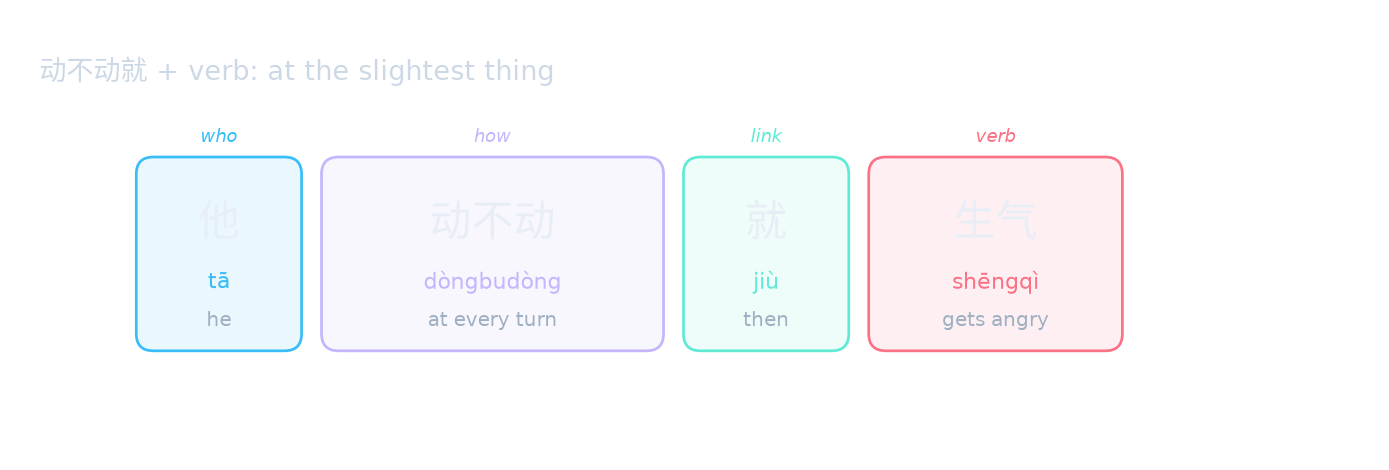
1.56
55. 索性 (might as well / simply)
Form: reason,subject + might as well; simply索性 + action
- 雨越down / next; to fall (rain), get off下(越…越) the more / to cross越big大,we / us我们might as well; simply索性not不to walk / to leave走(completed / change)了。 Yǔ yuè xià yuè dà, wǒmen suǒxìng bù zǒu le. – The rain kept getting heavier, so we just stayed.
- since既然already已经to arrive late迟到(completed / change)了,I / me我might as well; simply索性不去(completed / change)了。 – Since I'm already late, I might as well not go at all.
- 这台computer电脑always老是bad坏,might as well; simply索性买台new新(modifier / structural particle)的(suggestion)吧。 – This computer keeps breaking – let's just buy a new one.
How it works. might as well; simply索性 marks a clear-cut decision after a frustrating situation, often going all the way instead of a half-measure. simply / decisive干脆 means the same and is more spoken.
| might as well; simply索性不去(completed / change)了 | simply / decisive干脆to take a taxi (in town)打车(suggestion)吧 | he / him他degree / adjective linker很simply / decisive干脆 |
|---|---|---|
| might as well not go (written) | let's just take a taxi (spoken) | he's straightforward (only simply / decisive干脆) |
Watch out
- might as well; simply索性 goes before an action, not an adjective: wrong: I / me我might as well; simply索性很累.
- The reason comes first.
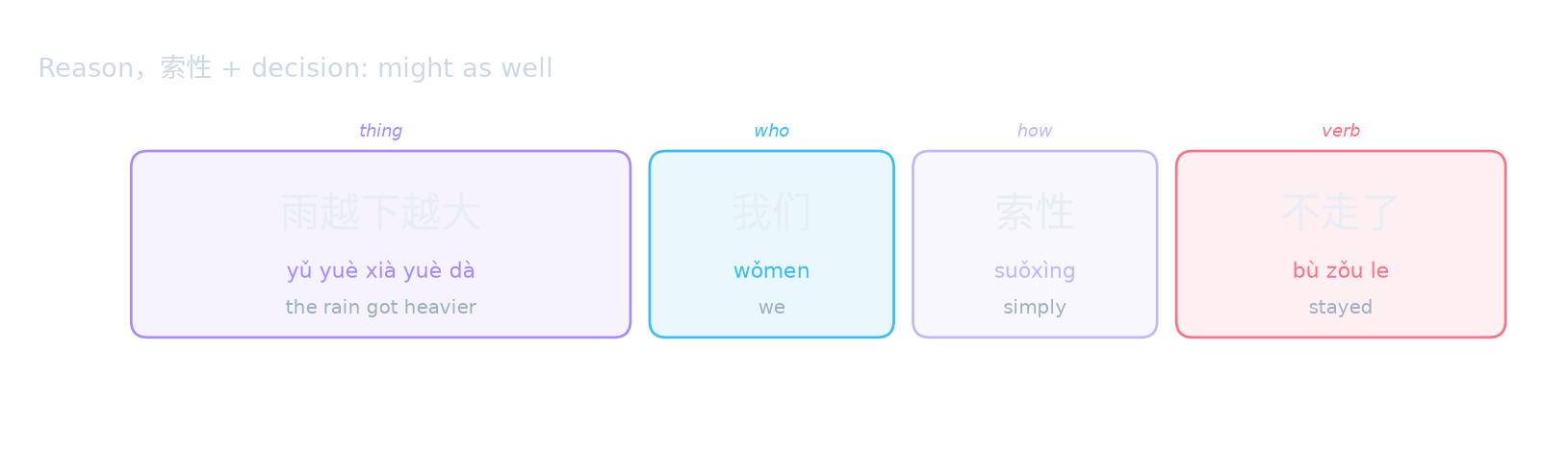
Vocabulary
Train
| 汉字 | Pinyin | English |
|---|---|---|
| 索性 | suǒ xìng | might as well; simply |
1.57
56. 顿时 (at once – a sudden change)
Form: event,(subject) at once; suddenly顿时 + change of state or feeling
- teacher老师one / a一to come in进来,classroom教室inside; in里at once; suddenly顿时quiet安静(completed / change)了。 Lǎoshī yí jìnlai, jiàoshì li dùnshí ānjìng le. – The moment the teacher came in, the classroom went quiet.
- to listen to听(completed / change)了这句words / speech话,he / him他at once; suddenly顿时to understand / clear明白(completed / change)了。 – When he heard this, he understood at once.
- to hear听到this这个好消息,everyone大家at once; suddenly顿时happy; glad高兴(degree marker)得to jump跳(completed / change)了get up / (start, become)起来。 – Hearing the good news, everyone jumped for joy at once.
How it works. at once; suddenly顿时 tells how a scene or feeling changed immediately after an event. It is written and describes what happened, so it never gives an order or a plan (use at once立刻). For a surprise with no cause before it, use suddenly忽然.
| at once; suddenly顿时quiet安静(completed / change)了 | you你at once立刻to come over过来! | telephone电话suddenly忽然to ring; loud响(completed / change)了 |
|---|---|---|
| went quiet at once | come here right now! | the phone suddenly rang |
Watch out
- wrong: you你at once; suddenly顿时to come over过来 → you你at once立刻to come over过来.
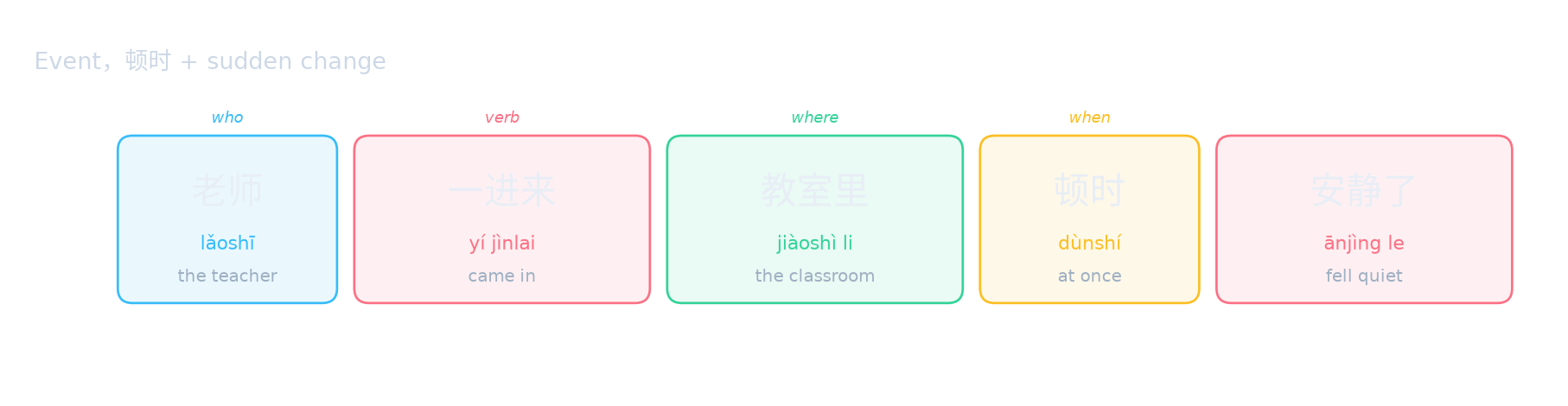
Vocabulary
Train
| 汉字 | Pinyin | English |
|---|---|---|
| 顿时 | dùn shí | at once; suddenly |
1.58
57. 随即 (immediately after that)
Form: action 1 (after / back后 / (completed / change)了),immediately after随即 + action 2
- 他接(completed / change)了一个telephone电话,immediately after随即to depart离开(completed / change)了meeting place会场。 Tā jiē le yí ge diànhuà, suíjí líkāi le huìchǎng. – He took a phone call and left the meeting right after.
- competition比赛to end结束after / back后,reporter记者immediately after随即to interview采访(completed / change)了champion冠军。 – After the match, reporters interviewed the winner straight away.
- news; message消息to announce公布after / back后,online网上immediately after随即to appear出现(completed / change)了很多to comment on评论。 – As soon as the news came out, lots of comments appeared online.
How it works. immediately after随即 joins two actions in a written story or report: the second follows the first at once. It can't give an order (use immediately立即). soon after随后 means "afterwards, a little later".
| immediately after随即to depart离开(completed / change)了 | please; to invite请immediately立即to depart离开 | we / us我们随后就到 |
|---|---|---|
| left right after | please leave immediately | we'll be there shortly |
Watch out
- wrong: please; to invite请immediately after随即to depart离开 → please; to invite请immediately立即to depart离开.
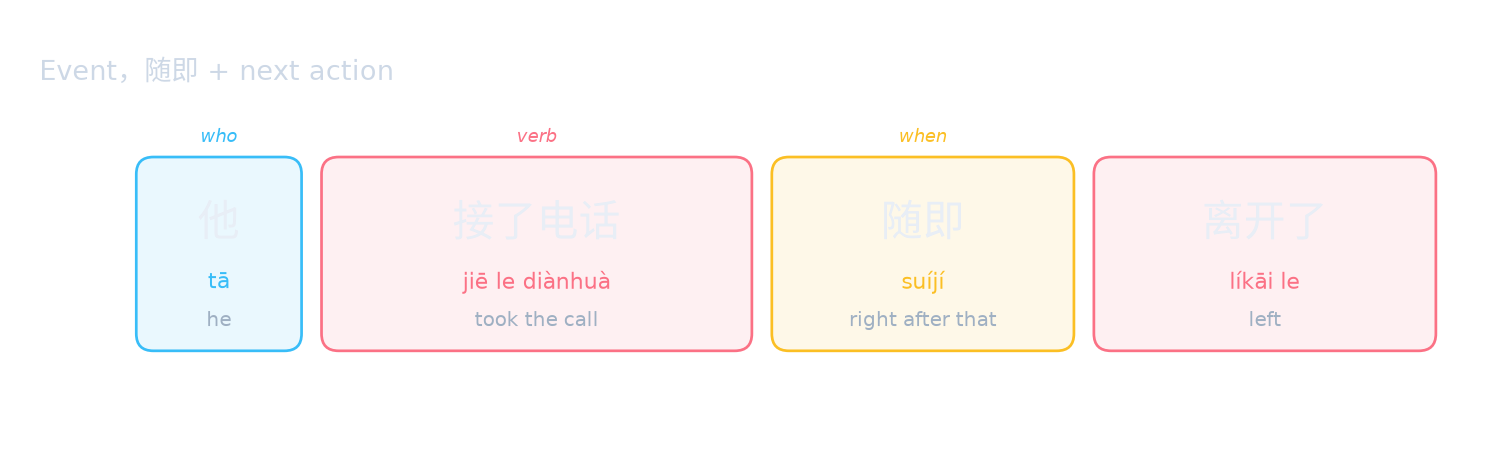
Vocabulary
Train
| 汉字 | Pinyin | English |
|---|---|---|
| 随即 | suí jí | immediately after |
| 评论 | píng lùn | to comment on |
1.59
58. 依次 vs 轮流 and 陆续 (in turn)
Form: in order依次 + verb · A、B、C in order依次to be / is是 …
- please; to invite请everyone大家in order依次to get on or into (a bus…上车。 Qǐng dàjiā yīcì shàng chē. – Please get on the bus one by one, in order.
- he / him他in order依次to introduce介绍(completed / change)了三个plan方案。 – He presented the three plans one by one.
- to get; to win (a prize)获得前三名(modifier / structural particle)的in order依次to be / is是小王、small小Li (surname) / plum李and / with和小张。 – First, second and third went to Xiao Wang, Xiao Li and Xiao Zhang.
How it works. in order依次 means "in turn, in a fixed order"; it is formal (notices, reports). to take turns轮流 = take turns (each person in turn); in succession; bit by bit陆续 = one after another at different times. In speech: 一个一个(adverb -ly)地 / according to / to press按order; sequence顺序.
| in order依次to get on or into (a bus…上车 | to take turns轮流to prepare a meal做饭 | in succession; bit by bit陆续to / arrive / (result: get)到(completed / change)了 |
|---|---|---|
| board in turn | take turns cooking | arrived one after another |
Watch out
- in order依次 (yīcì, in turn) ≠ once / one time一次 (yí cì, once).
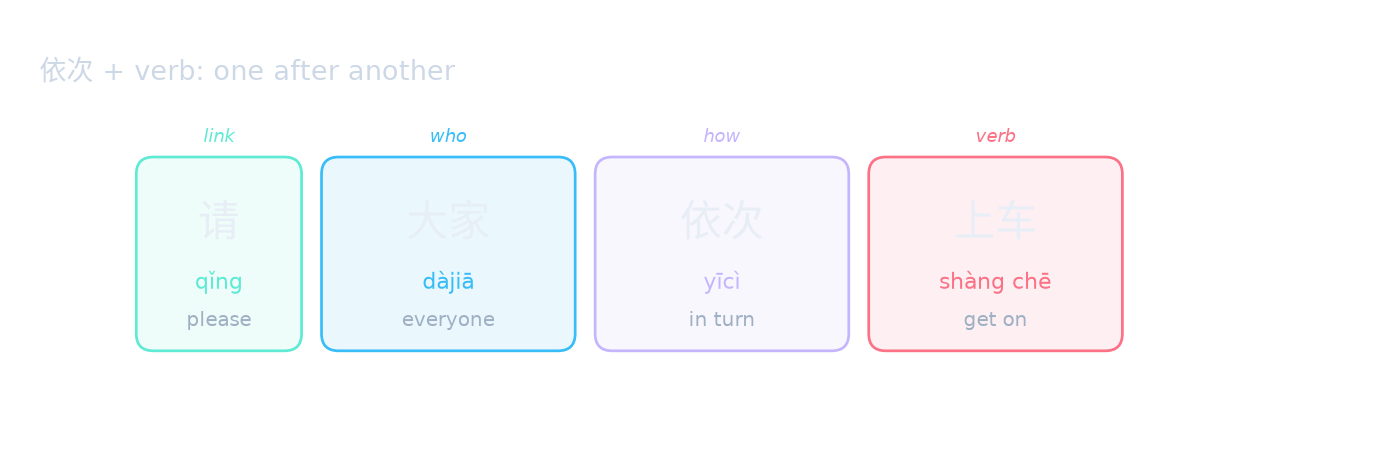
Vocabulary
Train
| 汉字 | Pinyin | English |
|---|---|---|
| 依次 | yī cì | in order |
1.60
59. 大不了 (at worst; no big deal)
Form: (if …,) at worst大不了 + worst case · nothing没什么at worst大不了(modifier / structural particle)的
- to take an exam / to test考no good不好at worst大不了next year明年再考。 Kǎo bù hǎo dàbuliǎo míngnián zài kǎo. – If it goes badly, at worst you can take it again next year.
- not / haven't没to catch / keep up with赶上car车also也it doesn't matter没关系,at worst大不了to take a taxi (in town)打车to go去。 – It doesn't matter if we miss the bus – at worst we'll take a taxi.
- 这有what什么at worst大不了(modifier / structural particle)的? – What's the big deal?
How it works. at worst大不了 names the worst result and makes it sound acceptable, to calm someone. As an adjective it means "a big deal", mostly in nothing没什么at worst大不了(modifier / structural particle)的. It is casual speech. most最many; much多 = at most (a limit).
| at worst大不了再考 | nothing没什么at worst大不了(modifier / structural particle)的 | most最many; much多十分钟 |
|---|---|---|
| at worst, take it again | no big deal | ten minutes at most |
Watch out
- For a number limit, use most最many; much多, not at worst大不了.
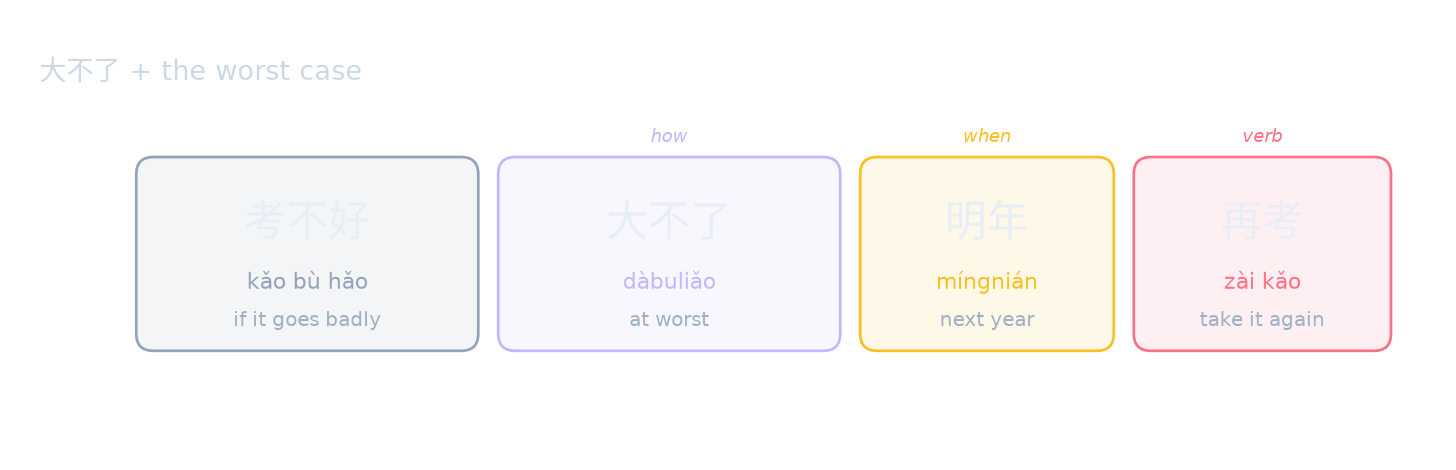
Vocabulary
Train
| 汉字 | Pinyin | English |
|---|---|---|
| 大不了 | dà bù liǎo | at worst |
1.61
60. 专程 vs 专门 and 顺便 (specially)
Form: specially (for this trip)专程 + to come来 / to go去 / to / arrive / (result: get)到 + purpose · on the way; while you're at it顺便 + extra action
- he / him他specially (for this trip)专程来看I / me我。 Tā zhuānchéng lái kàn wǒ. – He came specially to see me.
- we / us我们专程去Hangzhou subprovincial city…杭州to look at; to watch; to read看Xihu or West lake (place…西湖。 – We went to Hangzhou specially to see West Lake.
- I / me我to go去supermarket超市,on the way; while you're at it顺便to help帮you你买点儿fruit水果。 – I'm going to the supermarket – I'll get you some fruit while I'm there.
How it works. specially (for this trip)专程 says a trip was made for this purpose; it shows the effort made. specially专门 = specially, for any action. on the way; while you're at it顺便 = an extra job because you're going anyway.
| specially (for this trip)专程来看I / me我 | specially专门to do; to make做(completed / change)了cake蛋糕 | on the way; while you're at it顺便to buy买fruit水果 |
|---|---|---|
| came specially to see me | made a cake specially | buy fruit on the way |
Watch out
- wrong: specially (for this trip)专程to do; to make做cake蛋糕 → specially专门to do; to make做cake蛋糕.
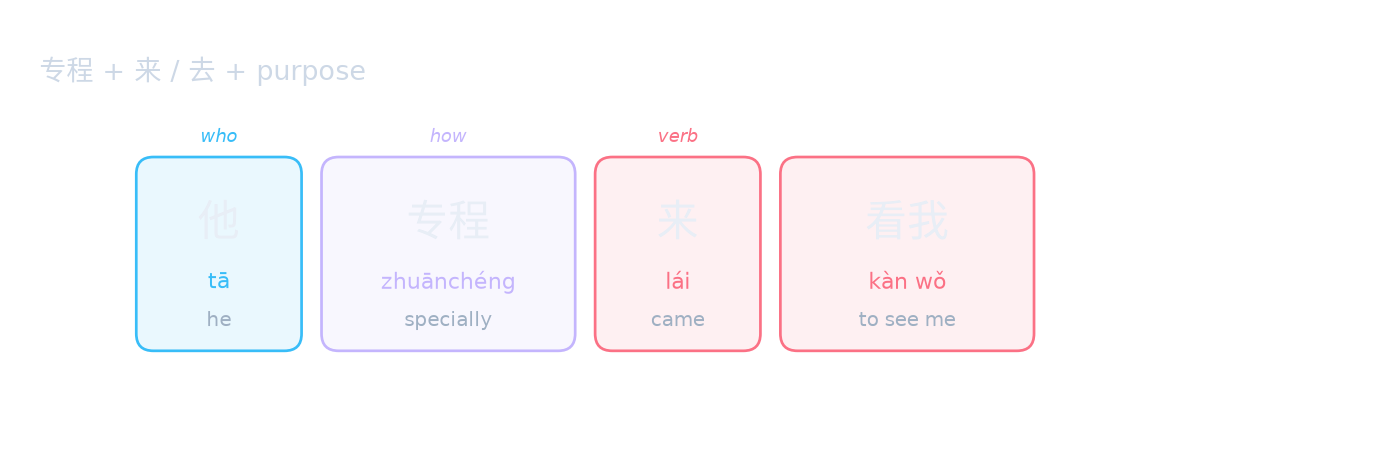
Vocabulary
Train
| 汉字 | Pinyin | English |
|---|---|---|
| 专程 | zhuān chéng | specially (for this trip) |
1.62
61. 不惜 vs 舍不得 (whatever it costs)
Form: (in order to为了 + goal,) at any cost; not hesitate to不惜 + cost · 不惜一切price代价
- in order to为了to save (a life)救child孩子,he / him他at any cost; not hesitate to不惜to plunge into跳进ice-cold冰冷(modifier / structural particle)的河里。 Wèile jiù háizi, tā bùxī tiào jìn bīnglěng de hé li. – To save the child, he didn't hesitate to jump into the icy river.
- we / us我们can / will会不惜一切price代价to complete完成task任务。 – We will finish the task at any cost.
- he / him他to be reluctant to (part with)舍不得to spend money花钱。 – He can't bear to spend money.
How it works. at any cost; not hesitate to不惜 says someone accepts a real price (money, time, danger) to reach a goal; with bad behaviour it criticises (at any cost; not hesitate to不惜to lie说谎). to be reluctant to (part with)舍不得 is the opposite feeling: can't bear to give something up.
| at any cost; not hesitate to不惜flower花很多money钱 | 不惜一切price代价 | to be reluctant to (part with)舍不得to throw扔 |
|---|---|---|
| spend a lot, whatever it takes | at any cost | can't bear to throw away |
Watch out
- The cost after at any cost; not hesitate to不惜 must be real.
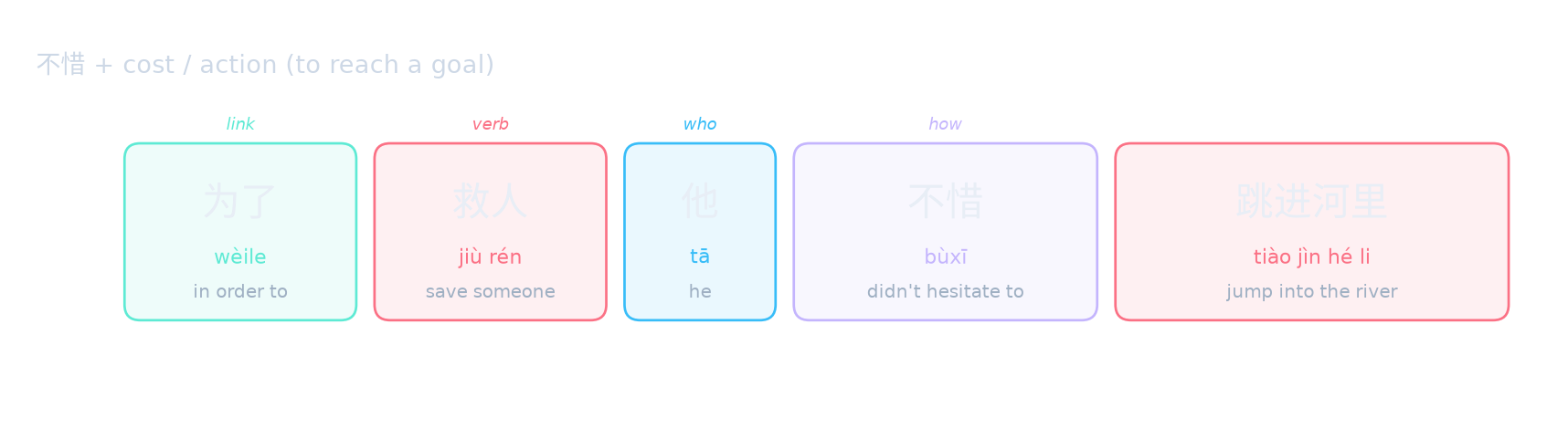
Vocabulary
Train
| 汉字 | Pinyin | English |
|---|---|---|
| 不惜 | bù xī | at any cost; not hesitate to |
| 代价 | dài jià | price |
1.63
62. 默默 vs 悄悄 (silently)
Form: in silence默默((adverb -ly)地) + verb · obscure and unknown (idiom)默默无闻
- she / her她二十年to come来默默地to help帮助(completed / change)了很多person人。 Tā èrshí nián lái mòmò de bāngzhù le hěn duō rén. – For twenty years she has quietly helped many people.
- he / him他默默地看着窗外,what什么also也not / haven't没to speak说。 – He stared silently out of the window and said nothing.
- he / him他悄悄地to enter走进classroom教室。 – He slipped quietly into the classroom.
How it works. in silence默默 = silently, without words or asking for thanks: praise for quiet effort, or feelings kept inside. quietly悄悄 = so others don't notice. obscure and unknown (idiom)默默无闻 = unsung.
| 默默地to help帮助 | 悄悄地to enter走进to come来 | obscure and unknown (idiom)默默无闻 |
|---|---|---|
| help without a word | come in unnoticed | unsung |
Watch out
- To avoid being noticed, use quietly悄悄.
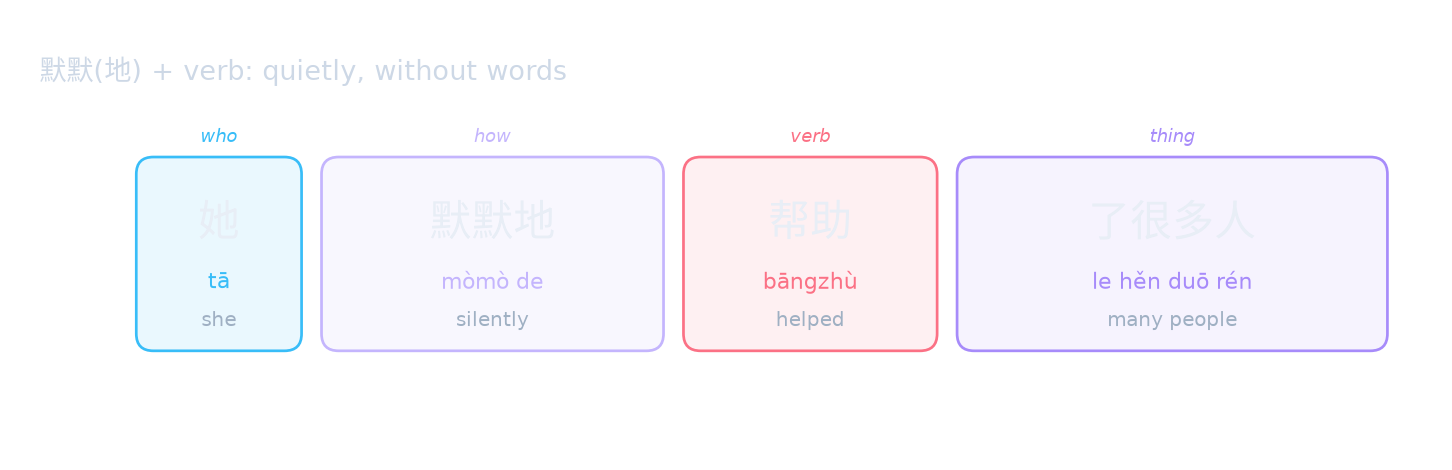
Vocabulary
Train
| 汉字 | Pinyin | English |
|---|---|---|
| 默默 | mò mò | in silence |
1.64
63. 擅自 vs 私自 and 随便 (without permission)
Form: (请勿 / must not不得 / to prohibit禁止 +) without permission擅自 + verb
- not; must (非…不可)非staff member工作人员请勿without permission擅自to enter进入。 Fēi gōngzuò rényuán qǐng wù shànzì jìnrù. – Non-staff: do not enter without permission.
- he / him他not have / haven't没有to ask for leave请假,without permission擅自to depart离开(completed / change)了company公司。 – He didn't ask for leave; he left the office without permission.
- as you like; casual随便to sit / to take (a bus …)坐(suggestion)吧! – Sit wherever you like!
How it works. without permission擅自 criticises doing something without the permission you needed; it is common in signs and rules. privately; secretly私自 = privately, without asking (often secretly). as you like; casual随便 = as you like (friendly).
| 请勿without permission擅自to enter进入 | privately; secretly私自to take away拿走 | as you like; casual随便to sit / to take (a bus …)坐 |
|---|---|---|
| no entry without permission | take secretly | sit anywhere |
Watch out
- wrong: without permission擅自to sit / to take (a bus …)坐(suggestion)吧 → as you like; casual随便to sit / to take (a bus …)坐(suggestion)吧.
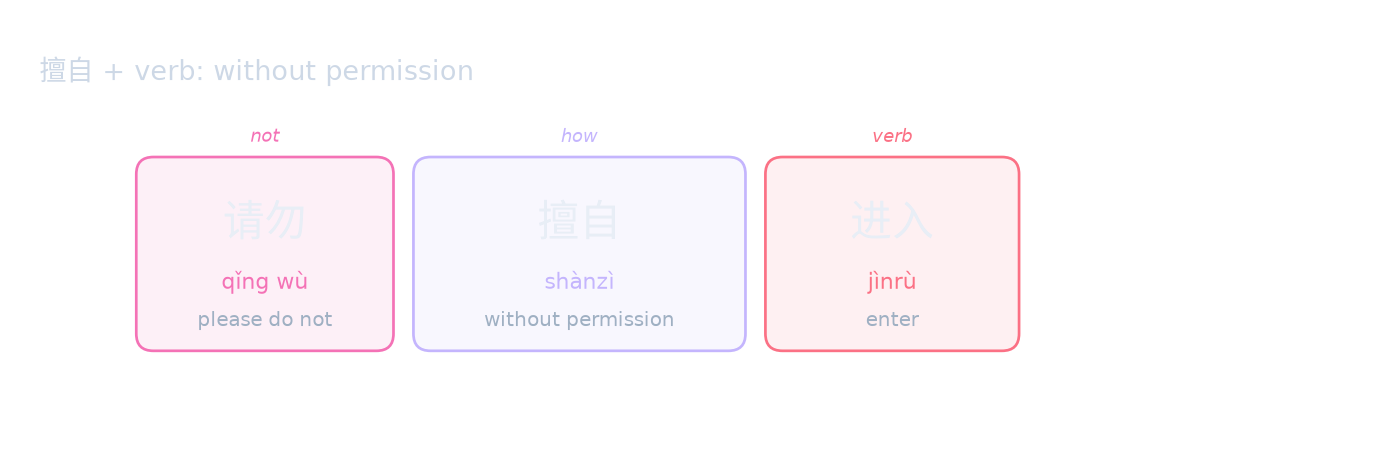
Vocabulary
Train
| 汉字 | Pinyin | English |
|---|---|---|
| 擅自 | shàn zì | without permission |
| 私自 | sī zì | privately; secretly |
1.65
64. 及早 vs 尽早 and 及时 (as early as possible)
Form: at the earliest possible time及早 + medical treatment治疗 / to notice发现 / to solve解决 · please; to invite请as early as possible尽早 + verb
- to be ill有病want / will / need要at the earliest possible time及早medical treatment治疗。 Yǒu bìng yào jízǎo zhìliáo. – If you're ill, get treatment as early as possible.
- please; to invite请as early as possible尽早to reply回复。 – Please reply as soon as possible.
- fortunately幸亏ambulance救护车to have enough time来得及time / when时。 – Luckily the ambulance came in time.
How it works. at the earliest possible time及早 = early, before it's too late (advice, warnings). as early as possible尽早 = as soon as possible (polite requests). in time; timely及时 = in time, at the right moment.
| at the earliest possible time及早medical treatment治疗 | as early as possible尽早to reply回复 | to have enough time来得及time / when时 |
|---|---|---|
| treat early | reply ASAP | came in time |
Watch out
- wrong: to have enough time来得及early早 → to have enough time来得及time / when时.
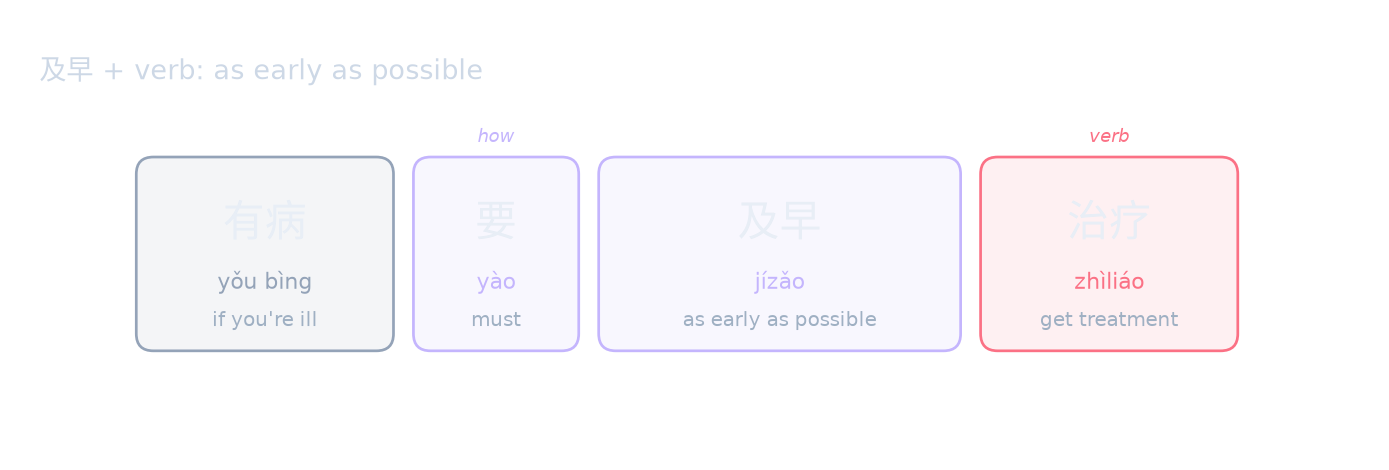
Vocabulary
Train
| 汉字 | Pinyin | English |
|---|---|---|
| 及早 | jí zǎo | at the earliest possible time |
1.66
65. 当场 vs 当时 (on the spot / at that time)
Form: at the scene当场 + verb
- police警察at the scene当场to grab hold of抓住(completed / change)了thief小偷。 Jǐngchá dāngchǎng zhuā zhù le xiǎotōu. – The police caught the thief on the spot.
- evaluation committee评委at the scene当场to declare; to announce宣布(completed / change)了比赛结果。 – The judges announced the result on the spot.
- at that time当时I / me我still / also / even还at / in在up / on / last; to get on, attend上university大学。 – At that time I was still at university.
How it works. at the scene当场 joins place and time: right there, at once, as part of an event (common in reports). at that time当时 = at that (past) time. right away马上 = right away.
| at the scene当场to grab hold of抓住 | at that time当时 | right away马上 |
|---|---|---|
| caught on the spot | at that time | right away |
Watch out
- wrong: at the scene当场I / me我still / also / even还at / in在up / on / last; to get on, attend上university大学 → at that time当时I / me我still / also / even还at / in在up / on / last; to get on, attend上university大学.
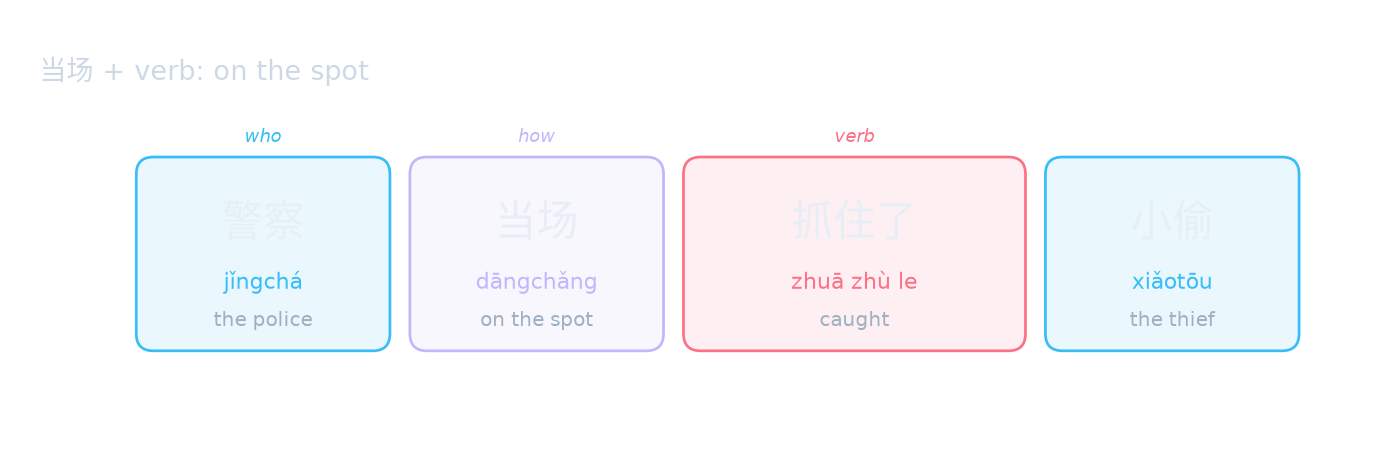
Vocabulary
Train
| 汉字 | Pinyin | English |
|---|---|---|
| 当场 | dāng chǎng | at the scene |
1.67
66. 随意 vs 随便 (as you please)
Form: please; to invite请as one wishes随意 (+ verb) · don't不要 / 请勿as one wishes随意 + verb
- please; to invite请everyone大家as one wishes随意to look around参观。 Qǐng dàjiā suíyì cānguān. – Please feel free to look around.
- 请勿as one wishes随意to touch触摸exhibit展品。 – Please don't touch the exhibits without permission.
- to eat吃what什么都行,as you like; casual随便。 – Anything is fine, I don't mind. (spoken)
How it works. as one wishes随意 is a polite, slightly formal "as you please" for hosts and notices; with don't不要 / 请勿 it warns against careless actions. as you like; casual随便 is the everyday word (whatever, anything, careless). freedom自由 = free.
| please; to invite请as one wishes随意 | 请勿as one wishes随意to touch触摸 | as you like; casual随便 |
|---|---|---|
| help yourselves | don't touch | whatever, anything |
Watch out
- as you like; casual随便 can sound too casual in a formal invitation.
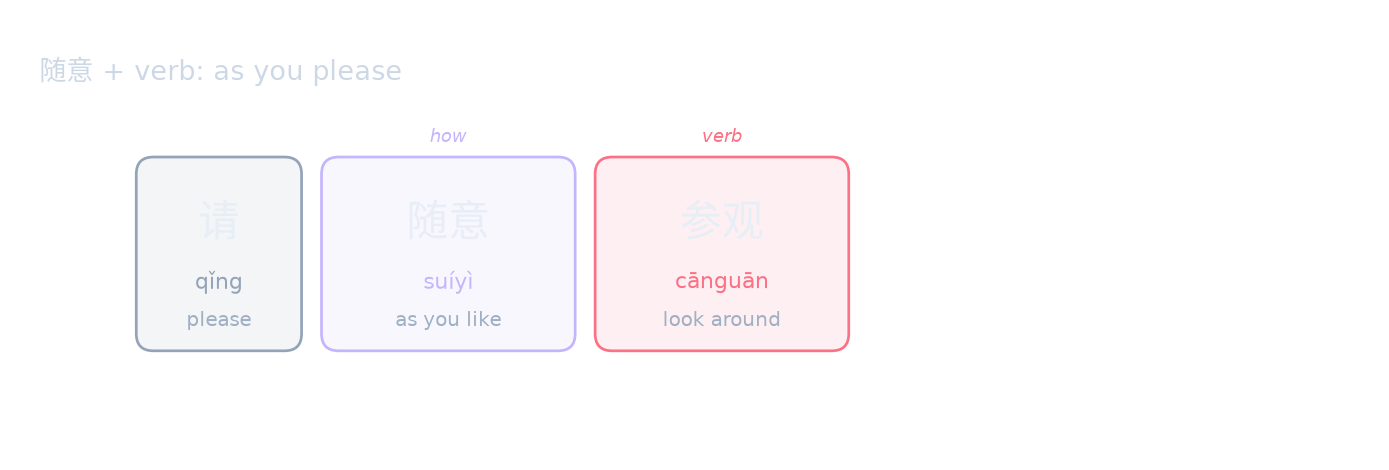
Vocabulary
Train
| 汉字 | Pinyin | English |
|---|---|---|
| 随意 | suí yì | as one wishes |
1.68
67. 丝毫 vs 毫不 and 一点儿也不 (not in the least)
Form: the slightest丝毫 + not不 / not / haven't没(to have / there is有) · not have / haven't没有the slightest丝毫 + noun · hardly毫不 + two-character word
- he / him他the slightest丝毫not have / haven't没有to give up放弃(modifier / structural particle)的meaning意思。 Tā sīháo méiyǒu fàngqì de yìsi. – He showed no sign at all of giving up.
- she / her她without the slightest…毫不犹豫(adverb -ly)地to agree; to promise答应(completed / change)了。 – She agreed without the slightest hesitation.
- I / me我a little一点儿also也not不tired累。 – I'm not tired at all. (spoken)
How it works. the slightest丝毫 = the slightest bit, used with a negative. hardly毫不 already contains not不 and goes before two-character words (to hesitate犹豫, to care about在乎). In speech: a little一点儿also也not不.
| the slightest丝毫not have / haven't没有 | without the slightest…毫不犹豫 | a little一点儿also也not不 |
|---|---|---|
| not in the least | without hesitation | not at all (spoken) |
Watch out
- wrong: hardly毫不not不to hesitate犹豫 → without the slightest…毫不犹豫.
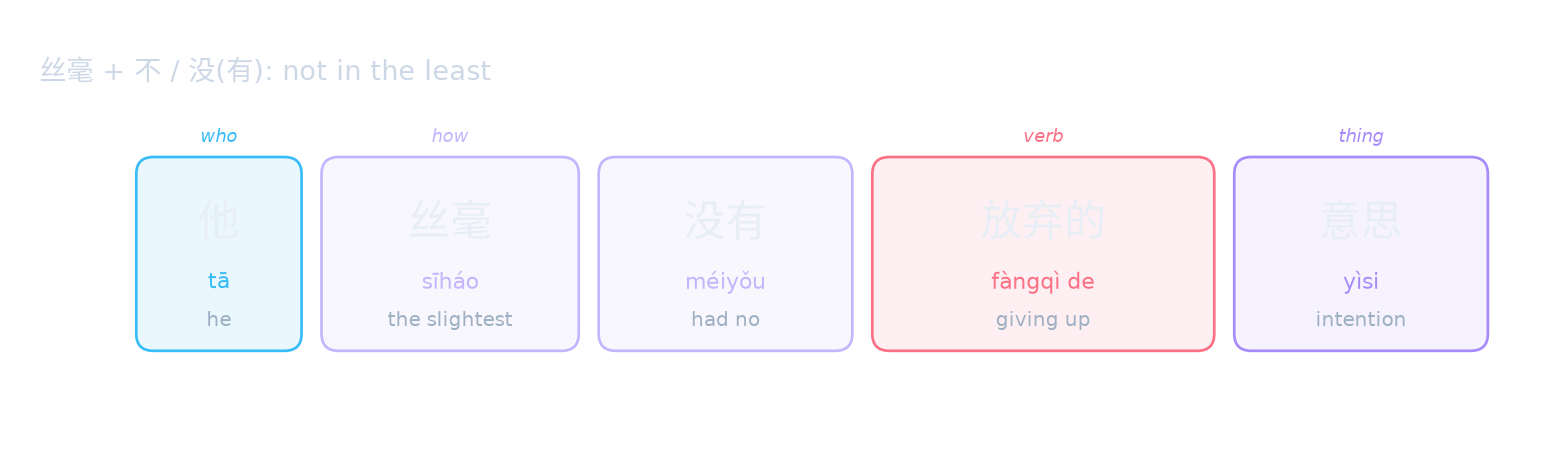
Vocabulary
Train
| 汉字 | Pinyin | English |
|---|---|---|
| 在乎 | zài hu | to care about |
1.69
68. 毫无 vs 毫不 and 没有 (not any at all)
Form: not at all; without any毫无 + noun (formal)
- this way / so这样to do; to make做毫无意义。 Zhèyàng zuò háowú yìyì. – Doing this is completely pointless.
- certainty毫无疑问,这是had better; best最好(modifier / structural particle)的to select选择。 – Without any doubt, this is the best choice.
- she / her她without the slightest…毫不犹豫(adverb -ly)地to agree; to promise答应(completed / change)了。 – She agreed without hesitation.
How it works. not at all; without any毫无 = not have any … at all, before nouns (meaning; significance意义, means办法, to prepare; to plan to准备, doubt; question疑问). hardly毫不 goes before verbs and adjectives. Speech: a little一点儿……also也not have / haven't没有.
| 毫无意义 | certainty毫无疑问 | without the slightest…毫不犹豫 |
|---|---|---|
| pointless | without doubt | without hesitation |
Watch out
- not at all; without any毫无 + noun; hardly毫不 + verb or adjective.
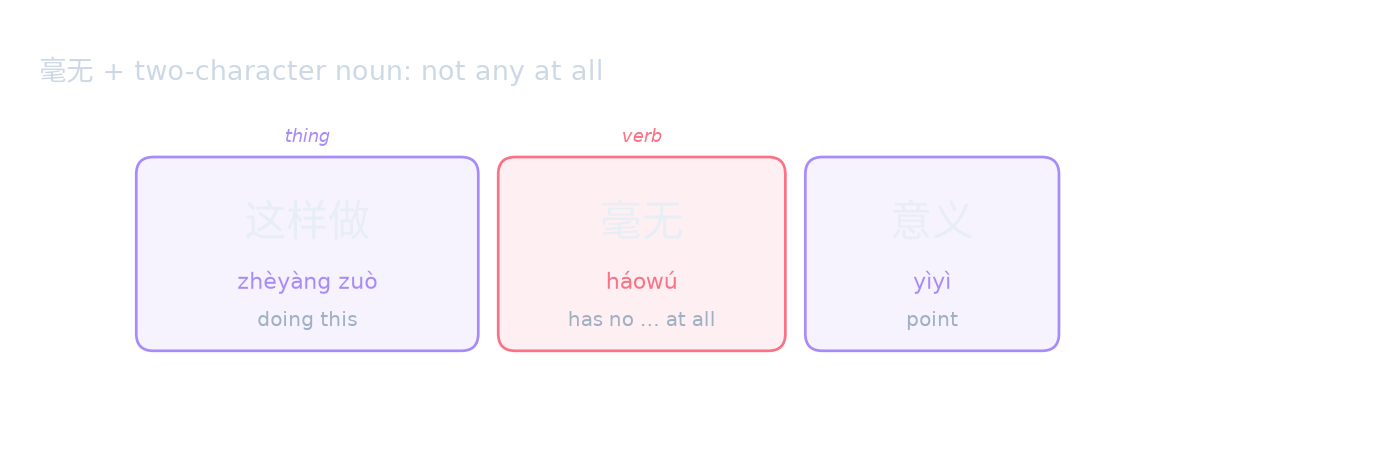
Vocabulary
Train
| 汉字 | Pinyin | English |
|---|---|---|
| 毫无 | háo wú | not at all; without any |
1.70
Practice
Cover the teaching pages before you answer. The answers are at the end.
1. always (as a habit)向来 (always / all along)
1. Complete: “He has always been very frugal.” he / him他…………degree / adjective linker很to save (resources)节约。
2. “It's been raining all day.” Which fits?
- A. today今天always (as a habit)向来不下雨。
- B. today今天always (so far); never (with 不 / 没)从来to rain下雨。
- C. today今天always (as a habit)向来to rain下雨。
- D. today今天all along / straight一直to rain下雨。
3. Build: “I've never believed adverts like this.”
Put in order: this kind of这种advertisement广告。 / always (as a habit)向来 / not不to be convinced相信 / I / me我
4. True or false? always (as a habit)向来 can be used with both positive and negative predicates. If false, correct it.
5. Your colleague has never been late in ten years. Use always (as a habit)向来. Write your answer in Chinese, then say it aloud.
2. always (up to now)一向 (all along / consistently)
6. Complete: “He has always been very punctual.” he / him他…………degree / adjective linker很punctual准时。
7. “He has been waiting the whole time.” Which fits?
- A. he / him他always (up to now)一向at / in在to wait; and so on等。
- B. he / him他always (up to now)一向to wait; and so on等(completed / change)了。
- C. he / him他always (as a habit)向来at / in在to wait; and so on等(ongoing -ing)着。
- D. he / him他all along / straight一直at / in在to wait; and so on等。
8. Build: “This company has always valued quality.”
Put in order: quality质量。 / always (up to now)一向 / 这家company公司 / to value; to take seriously重视
9. True or false? always (up to now)一向 and always (as a habit)向来 are close synonyms. If false, correct it.
10. Your colleague has always double-checked every document, ever since she joined. Use always (up to now)一向. Write your answer in Chinese, then say it aloud.
3. again and again一再 + Verb (again and again)
11. Complete: “The doctor repeatedly told him to rest.” doctor医生…………to remind (again and again)叮嘱he / him他many; much多to rest休息。
12. Which sounds most natural in casual chat? “I told him several times.”
- A. I / me我with / and跟he / him他to speak说(completed / change)了good好several times几次。
- B. I / me我over and over again再三he / him他to tell告诉。
- C. I / me我repeatedly屡次to tell告诉he / him他。
- D. I / me我again and again一再to tell告诉he / him他。
13. Build: “The meeting was postponed again and again.”
Put in order: again and again一再 / to postpone推迟。 / meeting会议
14. True or false? again and again一再 often carries a sense of insistence. If false, correct it.
15. Your brother kept forgetting his keys even though everyone reminded him. Use again and again一再 + Verb. Write your answer in Chinese, then say it aloud.
4. sometimes时而 A,sometimes时而 B (now A, now B)
16. Complete: “The weather was sunny one moment and rainy the next.” weather天气sometimes时而sunny晴,…………to rain下雨。
17. Build: “The music was gentle one moment and intense the next.”
Put in order: fierce; intense激烈。 / sometimes时而 / sometimes时而soft轻柔, / music音乐
18. Which sentence is correct?
- A. child孩子to cry哭sometimes时而,to laugh笑sometimes时而。
- B. child孩子sometimes时而to cry哭,sometimes时而to cry哭。
- C. child孩子sometimes时而to cry哭,sometimes时而to laugh笑。
19. In everyday speech, which is most natural for "now sunny, now rainy"?
- A. weather天气sometimes时而sunny晴,sometimes时而to rain下雨。
- B. weather天气a moment一会儿sunny晴,a moment一会儿to rain下雨。
20. True or false? A single sometimes时而 can mean "sometimes" in writing. If false, correct it.
21. Write two sentences for a story describing a nervous person waiting for exam results. Use sometimes时而 … sometimes时而 … once. Use sometimes时而 A,sometimes时而 B. Write your answer in Chinese, then say it aloud.
5. originally起初 vs at first; originally当初 (at first / back then)
22. Complete: “At first I wasn't used to it, but later I grew to like it here.” …………I / me我not不too太habit / be used to习惯,later; afterwards后来slowly慢慢to like喜欢up / on / last; to get on, attend上(completed / change)了here这里。
23. Complete: “I should have listened to you back then.” …………I / me我then / just就should应该to listen to听you你(modifier / structural particle)的。
24. “Why did you choose this major in the first place?” you你____why?为什么to choose选this这个major (subject); professional专业?
- A. at first; originally当初
- B. originally起初
25. Build: “It was hard at first, then it got easier.”
Put in order: then / just就 / easy容易(completed / change)了。 / later; afterwards后来 / originally起初很难,
26. True or false? 早知今日,何必当初 expresses regret about an earlier choice. If false, correct it.
27. Talk about a hobby or subject you chose. Say how you felt at first (originally起初) and how you see your decision now (at first; originally当初). Use originally起初 or at first; originally当初. Write your answer in Chinese, then say it aloud.
6. in the past以往 vs usually (in the past)往常 and before以前 (in the past, as usual)
28. Complete: “This summer is hotter than in past years.” 今年夏天than / compared to比…………更热。
29. “As usual, she was the first to arrive at the office.” Which is right?
- A. and / with和usually (in the past)往常the same一样,she / her她第一个to / arrive / (result: get)到(completed / change)了office办公室。
- B. and / with和in the past以往different不同,she / her她第一个to / arrive / (result: get)到(completed / change)了office办公室。
30. “Brush your teeth before bed.” Which is right?
- A. to sleep睡觉in the past以往want / will / need要to brush one's teeth刷牙。
- B. to sleep睡觉before以前want / will / need要to brush one's teeth刷牙。
31. Build: “He usually gets up at seven, but today he slept until nine.”
Put in order: today今天 / to sleep睡to / arrive / (result: get)到(completed / change)了九点。 / but; yet却 / he / him他usually (in the past)往常七点to get up起床,
32. True or false? and / with与in the past以往different不同 means "unlike in the past". If false, correct it.
33. Describe this year's school sports day or festival: one way it was like the usual (and / with和usually (in the past)往常the same一样) and one way it was different (and / with与in the past以往different不同). Use in the past以往 or usually (in the past)往常 and before以前. Write your answer in Chinese, then say it aloud.
7. from time to time不时 vs sometimes时而 and often经常 (every now and then)
34. Complete: “As he listened, he nodded every now and then.” he / him他one side一边to listen to听,one side一边…………(adverb -ly)地to nod点头。
35. “He goes to the library almost every day.” Which fits best?
- A. he / him他almost几乎every day每天all / both都to go去library图书馆,often经常at / in在there那儿to study; to learn学习。
- B. he / him他almost几乎every day每天all / both都to go去library图书馆,from time to time不时at / in在there那儿to study; to learn学习。
36. “The weather was sometimes sunny, sometimes rainy.” Which fits best?
- A. weather天气from time to time不时sunny晴,from time to time不时rain雨。
- B. weather天气sometimes时而sunny晴,sometimes时而rain雨。
37. Build: “Every now and then the sound of cars came from outside the window.”
Put in order: car汽车(modifier / structural particle)的voice声音。 / from time to time不时 / 窗外 / (of a sound) to come through传来
38. True or false? from time to time不时 often goes with one side一边……one side一边……. If false, correct it.
39. Describe a person waiting for someone at a station in two sentences. Use from time to time不时 twice (looking, checking the time). Use from time to time不时 or sometimes时而 and often经常. Write your answer in Chinese, then say it aloud.
8. as before依旧 vs still依然 and still仍然 (still, as before)
40. Complete: “Ten years have passed, and it's still as quiet here as ever.” 十年past过去(completed / change)了,here这里…………degree / adjective linker很quiet安静。
41. Which sentence uses as before依旧 at the end of a clause, meaning "unchanged"?
- A. as before依旧scenery风景,person人but; yet却to change变(completed / change)了。
- B. scenery风景as before依旧,person人but; yet却to change变(completed / change)了。
42. Chatting with a friend – which sounds most natural?
- A. he / him他or / still还是like that那么optimistic乐观。
- B. he / him他as before依旧like that那么optimistic乐观。
43. Build: “Although he went through many difficulties, he is still optimistic.”
Put in order: degree / adjective linker很optimistic乐观。 / although虽然experience (what you went through); to go through经历(completed / change)了很多difficulty; difficult困难, / he / him他 / as before依旧
44. True or false? as before依旧, still依然 and still仍然 all mean "still" and are more written than or / still还是. If false, correct it.
45. Write two sentences about going back to a place from your childhood: one thing that is as before依旧, one thing that has changed. Use as before依旧 or still依然 and still仍然. Write your answer in Chinese, then say it aloud.
9. frequently频繁 vs often经常 and always老是 (very frequent)
46. Complete (an email to a repair shop): “This computer has been freezing very often lately.” 这台computer电脑recently最近…………to crash (of a computer)死机。
47. Complaining to a friend – which sounds most natural?
- A. I / me我(modifier / structural particle)的computer电脑always老是to crash (of a computer)死机,烦死(completed / change)了!
- B. I / me我(modifier / structural particle)的computer电脑frequently频繁to crash (of a computer)死机,烦死(completed / change)了!
48. Build: “Changing jobs too often is bad for finding work later.”
Put in order: to / towards / correct对after / from now on以后 / frequently频繁to exchange换to work; job工作 / unfavorable不利。 / to look for; to give change找to work; job工作
49. he / him他to go on a business trip出差very非常frequently频繁。What does it mean?
- A. He travels for work very often.
- B. He never travels for work.
50. True or false? frequently频繁 can end a sentence (degree / adjective linker很frequently频繁), while often经常 usually goes before the verb. If false, correct it.
51. Write a short formal complaint (two sentences) about a product or service that often goes wrong. Use frequently频繁. Use frequently频繁 or often经常 and always老是. Write your answer in Chinese, then say it aloud.
10. recently近来 vs recently最近 (lately)
52. Complete (a report): “The weather has changed a lot lately.” …………weather天气变化很大。
53. “I'm going to Shanghai soon.” Which is right?
- A. I / me我recently近来want / will / need要to go去Shanghai municipality…上海。
- B. I / me我recently最近want / will / need要to go去Shanghai municipality…上海。
54. “I recently bought a new computer.” (one event) Which fits best?
- A. recently近来I / me我to buy买(completed / change)了一台new新computer电脑。
- B. recently最近I / me我to buy买(completed / change)了一台new新computer电脑。
55. Build (a letter): “How have you been lately?”
Put in order: you你 / how about怎么样? / body; health身体 / recently近来
56. True or false? recently近来 is common in letters, emails and reports. If false, correct it.
57. Start an email to a former teacher: ask how they have been (recently近来), say what you have been doing lately, and mention one plan for the near future (recently最近). Use recently近来 or recently最近. Write your answer in Chinese, then say it aloud.
11. just as in the past一如既往 vs as before依旧 and all the same; as before照样 (as always)
58. Complete: “We will support you, as we always have.” we / us我们can / will会…………(adverb -ly)地to support支持you你。
59. Chatting with a friend – which is most natural?
- A. he / him他just as in the past一如既往地早to / arrive / (result: get)到。
- B. he / him他or / still还是to resemble像before以前the same一样早到。
60. “He goes running even when it rains.” Which fits best?
- A. to rain下雨he / him他also也all the same; as before照样to run; to jog跑步。
- B. to rain下雨he / him他also也just as in the past一如既往to run; to jog跑步。
61. Build: “We hope you will keep caring about us as before.”
Put in order: to hope希望everyone大家 / we / us我们。 / to be concerned about关心 / just as in the past一如既往(adverb -ly)地
62. True or false? just as in the past一如既往 is a four-character set phrase and should not be split. If false, correct it.
63. Write the last two sentences of a thank-you speech for your school club: thank people for their support and use just as in the past一如既往 for the future. Use just as in the past一如既往 or as before依旧 and all the same; as before照样. Write your answer in Chinese, then say it aloud.
12. day by day日益 vs more and more越来越 and gradually逐渐 (increasingly)
64. Complete (an essay): “City traffic is getting more and more crowded.” 城市交通…………crowded拥挤。
65. “There are more and more cars on the road.” (spoken) Which is right?
- A. on the road路上(modifier / structural particle)的car车more and more越来越many; much多。
- B. on the road路上(modifier / structural particle)的car车day by day日益many; much多。
66. Which is the best essay opening?
- A. along with; as随着economy经济(modifier / structural particle)的to develop; development发展,environment环境question / problem问题日益严重。
- B. along with; as随着economy经济(modifier / structural particle)的to develop; development发展,environment环境question / problem问题day by day日益bad坏。
67. Build: “People are paying more and more attention to their health.”
Put in order: day by day日益 / to increase增加。 / to / towards / correct对health健康(modifier / structural particle)的to pay attention to关注 / people人们
68. True or false? gradually逐渐 stresses that a change happens step by step. If false, correct it.
69. Write the first two sentences of an essay about a change in your town or school. Use along with; as随着 … and day by day日益 + a two-character word. Use day by day日益 or more and more越来越 and gradually逐渐. Write your answer in Chinese, then say it aloud.
13. so far迄今 vs up to (a date)截至 and to close截止 (so far, as of)
70. Complete (a report): “So far, 50,000 people have signed up.” …………until为止,已有五万person人to sign up报名。
71. “As of the end of October, …” Which is right?
- A. up to (a date)截至十月底,……
- B. so far迄今十月底,……
72. “Sign-ups close tomorrow.” Which is right?
- A. to sign up报名tomorrow明天to close截止。
- B. to sign up报名tomorrow明天up to (a date)截至。
73. Build: “This is the biggest race so far.”
Put in order: once / one time一次competition比赛。 / 最大(modifier / structural particle)的 / so far迄今为止 / 这是
74. True or false? so far至今 can also mean "still", as in so far至今unforgettable难忘 (still unforgettable). If false, correct it.
75. Write a two-sentence news item about a school event: give the numbers as of a date (up to (a date)截至), and one record so far (so far迄今为止). Use so far迄今 or up to (a date)截至 and to close截止. Write your answer in Chinese, then say it aloud.
14. throughout history历来 vs always (up to now)一向 and always (so far); never (with 不 / 没)从来 (has always)
76. Complete: “This school has always valued sport.” 这所school学校…………to value; to take seriously重视sports体育。
77. “He has always been punctual.” (one person) Which fits best?
- A. he / him他always (up to now)一向degree / adjective linker很punctual准时。
- B. he / him他throughout history历来degree / adjective linker很punctual准时。
78. “I've never been there.” Which is right?
- A. I / me我throughout history历来not / haven't没去过。
- B. I / me我always (so far); never (with 不 / 没)从来not / haven't没去过。
79. Build: “This has always been an important transport hub.”
Put in order: here这里 / all / both都to be / is是 / important重要(modifier / structural particle)的traffic; transport交通center中心。 / throughout history历来
80. True or false? throughout history历来 is usually used for long traditions of places, groups or countries. If false, correct it.
81. Introduce your school or hometown to visitors in two sentences: one tradition (throughout history历来), and one thing about a person you know (always (up to now)一向). Use throughout history历来 or always (up to now)一向 and always (so far); never (with 不 / 没)从来. Write your answer in Chinese, then say it aloud.
15. at most顶多 vs up to the maximum至多, most最many; much多 and at least至少 (at most)
82. Complete: “This jacket is worth a hundred yuan at most.” 这件clothes衣服…………value值一百块。
83. “We'll have to wait at least an hour.” Which is right?
- A. at most顶多want / will / need要to wait; and so on等一个hour小时。
- B. at least至少want / will / need要to wait; and so on等一个hour小时。
84. he / him他at most顶多to be / is是to forget忘(completed / change)了,不是故意(modifier / structural particle)的。What does it mean?
- A. He forgot many times on purpose.
- B. At worst he forgot; it wasn't on purpose.
85. Build: “Don't worry – we'll be five minutes late at most.”
Put in order: to arrive late迟到 / 五分钟。 / don't别anxious担心, / at most顶多
86. True or false? up to the maximum至多 means the same as at most顶多 but is written. If false, correct it.
87. A friend is worried about a small mistake at work. Calm them down with at most顶多 twice. Use at most顶多 or up to the maximum至多, most最many; much多 and at least至少. Write your answer in Chinese, then say it aloud.
16. far more than何止 vs more than / not just不止 (far more than)
88. Complete: “Far more than a thousand people came!” to come来(modifier / structural particle)的person人…………一千!
89. to like喜欢这部film; movie电影(modifier / structural particle)的far more than何止I / me我一个person人。What does it mean?
- A. Only I like this film.
- B. I'm far from the only one who likes this film.
90. “I read it at least five times.” Which is right?
- A. I / me我far more than何止to look at; to watch; to read看(completed / change)了五遍。
- B. I / me我at least至少to look at; to watch; to read看(completed / change)了五遍。
91. Build: “I didn't read it just once – at least five times.”
Put in order: far more than何止to look at; to watch; to read看(completed / change)了one time (all the way…一遍, / at least至少 / to look at; to watch; to read看(completed / change)了五遍。 / this这本书I / me我
92. True or false? In everyday speech, more than / not just不止 is more common than far more than何止. If false, correct it.
93. Someone says your school has "about twenty clubs". Correct them politely with far more than何止 and give the real picture with at least至少. Use far more than何止 or more than / not just不止. Write your answer in Chinese, then say it aloud.
17. a little bit略微 vs a little bit稍微 and slightly有点儿 (slightly)
94. Complete (a weather report): “Today is slightly warmer than yesterday.” today今天than / compared to比yesterday昨天…………warm暖和some一些。
95. You think a shirt is a bit too expensive. Which complains?
- A. 这件shirt衬衫slightly有点儿expensive贵。
- B. 这件shirt衬衫a little bit略微expensive贵some一些。
96. A shop assistant, politely – “Please wait a moment.” Which is most natural?
- A. please; to invite请a little bit稍微to wait; and so on等(used after a verb) give it…一下。
- B. please; to invite请a little bit略微to wait; and so on等(used after a verb) give it…一下。
97. Build: “Prices fell slightly.”
Put in order: to decline下降(completed / change)了 / a little bit略微 / price价格 / some一些。
98. True or false? a little bit略微 and a little bit稍微 mean the same, but a little bit略微 is more written. If false, correct it.
99. Compare two phones in a short written review (two sentences). Use a little bit略微 once and a little bit稍微 once. Use a little bit略微 or a little bit稍微 and slightly有点儿. Write your answer in Chinese, then say it aloud.
18. as expected; sure enough果然 (sure enough / as expected)
100. Complete: “He said he'd come, and sure enough he did.” he / him他to speak说can / will会to come来,…………to come来(completed / change)了。
101. “Everyone expected him to win, but surprisingly he lost.” Which word fits? everyone大家all / both都to think以为他会to win赢,he / him他____to lose a game输(completed / change)了。
- A. of course当然
- B. unexpectedly竟然
- C. as expected; sure enough果然
- D. suddenly突然
102. Build: “I knew he'd be late, and sure enough he was.”
Put in order: to arrive late迟到(completed / change)了。 / , / I / me我then / just就to know知道他会to arrive late迟到 / he / him他as expected; sure enough果然
103. True or false? as expected; sure enough果然 needs an earlier prediction or expectation. If false, correct it.
104. The weather app warned of afternoon storms. At three o'clock, thunder rolls in. Use as expected; sure enough果然. Write your answer in Chinese, then say it aloud.
19. of all times / insist on偏偏 (of all things / just had to)
105. Complete: “Everyone told him not to, but he insisted on going.” everyone大家to let / make让he / him他don't别to go去,he / him他…………want / will / need要to go去。
106. Which sentence fits of all times / insist on偏偏 best?
- A. weather天气degree / adjective linker很good好,of all times / insist on偏偏we / us我们to go去to climb a mountain爬山(completed / change)了。
- B. of all times / insist on偏偏today今天Monday星期一。
- C. we / us我们plan计划to go去coast海边,of all times / insist on偏偏that day那天to rain下雨(completed / change)了。
- D. he / him他of all times / insist on偏偏to be / is是一个student学生。
107. Build: “Everyone persuaded him, but he just wouldn't listen.”
Put in order: , / he / him他of all times / insist on偏偏 / everyone大家all / both都to advise; to urge劝he / him他 / not不to listen to听。
108. True or false? of all times / insist on偏偏 is used for any kind of surprise. If false, correct it.
109. You planned the class picnic for weeks. It has been sunny all month – until today. Use of all times / insist on偏偏. Write your answer in Chinese, then say it aloud.
20. it seems似乎 (it seems / as if)
110. Complete (formal): “The plan seems to have problems.” this这个plan计划…………to have / there is有question / problem问题。
111. Which is unnatural?
- A. he / him他to seem; as if好像illness / ill病(completed / change)了。
- B. he / him他it seems似乎definitely; to be sure肯定illness / ill病(completed / change)了。
- C. it seems (from this)看来他病(completed / change)了。
- D. he / him他it seems似乎illness / ill病(completed / change)了。
112. Build: “The problem seems more complicated than we thought.”
Put in order: question / problem问题it seems似乎 / complicated复杂。 / than / compared to比we / us我们want / think / miss想(modifier / structural particle)的 / more更
113. True or false? to seem; as if好像 is more common than it seems似乎 in conversation. If false, correct it.
114. Your usually cheerful colleague is quiet in the meeting and avoids eye contact. Use it seems似乎. Write your answer in Chinese, then say it aloud.
21. unexpectedly不料 (unexpectedly – written)
115. Complete: “I meant to get home early, but unexpectedly there was a traffic jam.” 我本want / think / miss想早点儿to return home回家,…………on the road路上traffic jam堵车(completed / change)了。
116. Which sentence is correct?
- A. I / me我to wait; and so on等(completed / change)了he / him他一个hour小时,he / him他unexpectedly不料not / haven't没to come来。
- B. I / me我to wait; and so on等(completed / change)了he / him他一个hour小时,unexpectedly不料he / him他not / haven't没to come来。
- C. unexpectedly不料,I / me我to wait; and so on等(completed / change)了he / him他一个hour小时。
117. Build: “He had just stepped out when it began to pour.”
Put in order: heavy rain大雨。 / down / next; to fall (rain), get off下to rise / (start to)起(completed / change)了 / he / him他just now刚to go out出门, / unexpectedly不料
118. “He actually didn't come!” (surprise, after the subject) he / him他____not / haven't没to come来!
- A. unexpectedly竟然
- B. unexpectedly不料
119. True or false? didn't expect没想到 is a spoken way to say unexpectedly不料. If false, correct it.
120. Write two sentences for a story: a character's plan for the weekend, then what unexpectedly happened (unexpectedly不料). Write your answer in Chinese, then say it aloud.
22. obviously显然 vs obvious明显 (obviously vs obvious)
121. Complete: “He keeps yawning; he obviously didn't sleep well.” he / him他all along / straight一直打哈欠,…………没睡good好。
122. “an obvious change” – which is right?
- A. obviously显然(modifier / structural particle)的change / to change变化
- B. obvious明显(modifier / structural particle)的change / to change变化
123. Build: “This is clearly a misunderstanding.”
Put in order: obviously显然 / 一个misunderstanding; to misunderstand误会。 / this这 / to be / is是
124. “There is an obvious difference between the two photos.” this这两张photograph照片to have / there is有____(modifier / structural particle)的different不同。
- A. obviously显然
- B. obvious明显
125. True or false? degree / adjective linker很obviously显然 can start a sentence that gives a conclusion. If false, correct it.
126. Your classmate got full marks after weeks of study. Write two sentences: one conclusion with obviously显然, and one description with obvious明显. Use obviously显然 or obvious明显. Write your answer in Chinese, then say it aloud.
23. unlikely to go so far as to不至于 (it won't come to that)
127. Complete: “However hard the exam is, you won't go so far as to fail.” exam; to take an exam考试再难,also也…………to fail不及格。
128. Build: “Surely he isn't so broke that he doesn't even have this little money?”
Put in order: all / both都not have / haven't没有(suggestion)吧? / he / him他 / unlikely to go so far as to不至于 / even连这点儿money钱
129. Which sentence is natural?
- A. he / him他so much这么to work hard / effort努力,unlikely to go so far as to不至于to succeed; success成功(suggestion)吧。
- B. he / him他so much这么to work hard / effort努力,unlikely to go so far as to不至于to fail; failure失败(suggestion)吧。
130. “He was so tired that he fell asleep in class.” Which word fits? 他太累(completed / change)了,____to go to class上课to fall asleep睡着(completed / change)了。
- A. unlikely to go so far as to不至于
- B. so much that以至于
131. True or false? as for至于(yes/no ?)吗? asks "Is it really that serious?" If false, correct it.
132. A friend lost their phone and says, "My life is over!" Calm them down with two sentences using unlikely to go so far as to不至于. Write your answer in Chinese, then say it aloud.
24. in the end终究 vs finally终于 and after all毕竟 (in the end / finally / after all)
133. Complete: “Lies will be found out in the end.” lie谎言…………can / will会(passive: by)被to notice发现。
134. “I finally got a ticket!” (you are happy) I / me我____to buy买to / arrive / (result: get)到ticket票(completed / change)了!
- A. in the end终究
- B. finally终于
135. Build: “He hesitated for a long time, but in the end he left.”
Put in order: or / still还是 / in the end终究 / he / him他to hesitate犹豫(completed / change)了degree / adjective linker很for a long time久, / to walk / to leave走(completed / change)了。
136. “Don't blame him – he's only seven, after all.” Which word is the everyday choice? 别怪he / him他,he / him他____only then / not until才七岁。
- A. finally终于
- B. after all毕竟
137. True or false? in the end终究 is the usual word for an excited "at last!". If false, correct it.
138. Write two sentences: a hard decision someone made in the end (in the end终究or / still还是), and something you finally managed after waiting (finally终于). Use in the end终究 or finally终于 and after all毕竟. Write your answer in Chinese, then say it aloud.
25. by chance恰巧 vs as it turns out恰好 (as it happened / exactly right)
139. Complete: “I went to see him, and as it happened he was at home.” I / me我to go去to look for; to give change找he / him他,he / him他…………to be at home在家。
140. “These shoes are exactly the right size.” 这双鞋size大小____。
- A. by chance恰巧
- B. as it turns out恰好
141. Build: “As it happened, I was in Beijing that day too.”
Put in order: that day那天 / by chance恰巧 / I / me我also也 / at / in在Beijing北京。
142. Which is the everyday spoken word for "just right"?
- A. by chance恰巧
- B. just right; just in time正好
143. True or false? as it turns out恰好 can mean "exactly" with a time, as in as it turns out恰好十点. If false, correct it.
144. Tell about a lucky coincidence in two sentences: use by chance恰巧 for the coincidence and as it turns out恰好 for something that fitted exactly. Use by chance恰巧 or as it turns out恰好. Write your answer in Chinese, then say it aloud.
26. surely; must必定 vs definitely / certain一定 (surely / must)
145. Complete: “As long as you keep going, you will surely succeed.” as long as只要to press on坚持下去,you你…………can / will会to succeed; success成功。
146. “You must come!” (a warm request) Which is right?
- A. you你surely; must必定want / will / need要to come来!
- B. you你definitely / certain一定want / will / need要to come来!
147. “not necessarily” – which is right?
- A. not不surely; must必定
- B. not不definitely / certain一定
148. Build: “There must be a reason for this.”
Put in order: surely; must必定 / to have / there is有 / reason; cause原因。 / 这件matter事
149. True or false? surely; must必定 is more formal than definitely; to be sure肯定. If false, correct it.
150. Write two sentences for a short essay about reading: one prediction with surely; must必定, and one piece of advice with definitely / certain一定want / will / need要. Use surely; must必定 or definitely / certain一定. Write your answer in Chinese, then say it aloud.
27. perhaps或许 vs maybe也许 and I'm afraid (that); probably恐怕 (perhaps)
151. Complete: “Perhaps he already knows.” he / him他…………already已经to know知道(completed / change)了。
152. “I'm afraid we'll miss the train.” ____we / us我们can't keep up with赶不上train火车(completed / change)了。
- A. perhaps或许
- B. I'm afraid (that); probably恐怕
153. Build: “This book might help you.”
Put in order: to have / there is有to help帮助。 / this这本书 / to / towards / correct对you你 / perhaps或许
154. True or false? perhaps或许 means the same as maybe也许 but sounds a little more written. If false, correct it.
155. A friend is stressed before an exam. Give two gentle suggestions with perhaps或许, and one worry with I'm afraid (that); probably恐怕. Use perhaps或许 or maybe也许 and I'm afraid (that); probably恐怕. Write your answer in Chinese, then say it aloud.
28. clearly; obviously明明 (clearly …, yet …)
156. Complete: “You clearly knew – why didn't you tell me?” you你…………to know知道,why?为什么not不to tell告诉I / me我?
157. A neutral report says the plan obviously failed. Which fits best?
- A. obviously显然,this这个plan计划to fail; failure失败(completed / change)了。
- B. clearly; obviously明明,this这个plan计划to fail; failure失败(completed / change)了。
158. Build: “He obviously can't do it, but he still says he can.”
Put in order: clearly; obviously明明won't / can't不会, / still / also / even还to speak说 / oneself自己can / will会。 / he / him他
159. I / me我clearly; obviously明明(把: marks the object)把key钥匙放在桌上(completed / change)了,how / why怎么not see / missing不见(completed / change)了?How does the speaker feel?
- A. Puzzled and annoyed
- B. Happy and relaxed
160. True or false? clearly; obviously明明 usually goes after the subject, but it can also start the sentence for emphasis. If false, correct it.
161. Write two short complaints with clearly; obviously明明: one about a friend, one about something you lost or forgot. Write your answer in Chinese, then say it aloud.
29. just like犹如 vs to seem; as if好像 and to resemble像……the same一样 (just like)
162. Complete (a travel essay): “The lake was just like a mirror.” 湖面…………一面镜子。
163. “He seems to be ill.” Which is right?
- A. he / him他just like犹如to fall ill生病(completed / change)了。
- B. he / him他to seem; as if好像to fall ill生病(completed / change)了。
164. Chatting with a friend about the view – which sounds natural?
- A. 湖面just like犹如一面镜子!
- B. 湖面to resemble像mirror镜子the same一样!
165. Build: “Time is like flowing water: once gone, it never comes back.”
Put in order: running water流水, / time时间 / gone forever一去不复返。 / just like犹如
166. True or false? as if仿佛 is also a written word, meaning "as if". If false, correct it.
167. Write two sentences describing a place you love, for a short essay. Use just like犹如 once and as if仿佛 once. Use just like犹如 or to seem; as if好像 and to resemble像……the same一样. Write your answer in Chinese, then say it aloud.
30. all; every凡是 … all / both都 (all / any without exception)
168. Complete: “Everyone who has been there says it's good.” all; every凡是去过there那里(modifier / structural particle)的person人,…………to come to an agreement说好。
169. Which sentence is complete?
- A. student学生all; every凡是all / both都want / will / need要to participate参加。
- B. all; every凡是student学生all / both都want / will / need要to participate参加。
- C. all / both都all; every凡是student学生want / will / need要to participate参加。
- D. all; every凡是student学生want / will / need要to participate参加。
170. Build: “Whatever he promises, he does.”
Put in order: all / both都can / will会 / to accomplish做到。 / all; every凡是he / him他to agree; to promise答应(modifier / structural particle)的matter事 / ,
171. True or false? all; every凡是 stresses “without exception”. If false, correct it.
172. The school rules are read out on the first day. Use all; every凡是 … all / both都. Write your answer in Chinese, then say it aloud.
31. all; without exception一律 (uniformly / without exception)
173. Complete (notice): “All goods are 20% off.” 本店goods商品…………八折。
174. “All my classmates came to the party.” Which fits best?
- A. classmate同学(plural)们all; without exception一律to come来(completed / change)了。
- B. all; without exception一律classmate同学(plural)们to come来(completed / change)了。
- C. classmate同学(plural)们all / both都to come来(completed / change)了。
- D. classmate同学(plural)们to come来(completed / change)了all; without exception一律。
175. Build: “All students must wear school uniform.”
Put in order: school uniform校服。 / to wear穿 / student学生 / all; without exception一律
176. True or false? all; without exception一律 is common on signs and in rules. If false, correct it.
177. At the museum entrance, a sign explains the ticket policy. Use all; without exception一律. Write your answer in Chinese, then say it aloud.
32. again / then / (再…也) however再 + Adj + also也 (however …, still …)
178. Complete: “However tired I am, I'll finish it.” 再累,I / me我…………want / will / need要to do; to make做to finish完。
179. What does 再贵I / me我also也want / will / need要to buy买 mean?
- A. If it's more expensive, I won't buy it.
- B. However expensive it is, I'll buy it.
- C. I'll buy it again.
- D. It's expensive again, so I'll buy it.
180. Build: “However much you explain, it's no use.”
Put in order: also也 / useless没用。 / you你again / then / (再…也) however再to explain / explanation解释
181. True or false? no matter (what / how)无论多忙…all / both都… expresses the same idea as again / then / (再…也) however再busy忙…also也…. If false, correct it.
182. Your mother works long hours but never misses family dinner on Sundays. Use again / then / (再…也) however再 + Adj + also也. Write your answer in Chinese, then say it aloud.
33. only (except)唯独 (only X – the exception)
183. Complete: “Everyone has arrived; only he hasn't come.” everyone大家all / both都to / arrive / (result: get)到(completed / change)了,…………he / him他not / haven't没to come来。
184. Build: “He's afraid of nothing – except injections.”
Put in order: to give or get an injection打针。 / only (except)唯独 / to be afraid怕 / he / him他what什么all / both都fearless不怕,
185. “Everyone has arrived except him.” Which sentence says this?
- A. besides除了he / him他apart from以外,everyone大家all / both都to / arrive / (result: get)到(completed / change)了。
- B. besides除了he / him他apart from以外,everyone大家all / both都not / haven't没to / arrive / (result: get)到。
186. “Only he knows the answer.” (no group is mentioned) Which is the most natural?
- A. only (if) / only have只有he / him他to know知道answer答案。
- B. only (except)唯独he / him他to know知道answer答案。
187. True or false? I / me我what什么dish (of food); vegetable菜all / both都to eat吃,only (except)唯独不吃coriander香菜 means "I eat everything except coriander." If false, correct it.
188. Describe your family's tastes in two sentences: something everyone likes, and the one person who is different (only (except)唯独). Write your answer in Chinese, then say it aloud.
34. all; entirely统统 (all, every single one)
189. Complete: “Throw all these old clothes away!” these这些旧衣服…………to throw away扔掉(suggestion)吧!
190. “Everyone came.” Which is right?
- A. 所有人all / both都to come来(completed / change)了。
- B. all; entirely统统person人all / both都to come来(completed / change)了。
191. Build: “Take everything off the table!”
Put in order: (把: marks the object)把table桌子up / on / last; to get on, attend上(modifier / structural particle)的thing; stuff东西 / ! / to take away拿走 / all; entirely统统
192. Which fits a formal notice best? material材料already已____to submit (a report etc)提交。
- A. all; whole全部
- B. all; entirely统统
193. True or false? all; entirely统统 is stronger and more spoken than all / both都. If false, correct it.
194. You are tidying your room before the new term. Give two orders to yourself or a sibling with all; entirely统统. Write your answer in Chinese, then say it aloud.
35. after all归根到底 (in the final analysis)
195. Complete: “In the end, learning depends on yourself.” …………,to study; to learn学习still / also / even还(degree marker)得to rely on / lean on靠oneself自己。
196. “In the end, he came after all.” Which is right?
- A. after all归根到底,he / him他or / still还是to come来(completed / change)了。
- B. he / him他finally; last最后or / still还是to come来(completed / change)了。
197. Which word sums up without naming a deeper cause?
- A. after all归根到底
- B. in a word总之
198. Build: “At root, we planned badly.”
Put in order: after all归根到底, / we / us我们 / plan计划(degree marker)得no good不好。 / to be / is是
199. True or false? in the final analysis说到底 is the lighter, spoken version. If false, correct it.
200. Why do many students find it hard to sleep early? Give two surface reasons, then the root cause with after all归根到底. Write your answer in Chinese, then say it aloud.
36. degree / adjective linker很to be / is是 + Adj (a formal “very”)
201. Complete (formal): “The audience was very moved.” spectators观众…………moved (emotionally); to move感动。
202. Which is the least natural?
- A. he / him他degree / adjective linker很to be / is是satisfied满意。
- B. everyone大家degree / adjective linker很to be / is是anxious担心。
- C. she / her她degree / adjective linker很to be / is是happy; glad高兴。
- D. weather天气degree / adjective linker很to be / is是good好。
203. Build: “His children are very worried.”
Put in order: degree / adjective linker很to be / is是 / anxious担心。 / child孩子(plural)们
204. True or false? degree / adjective linker很to be / is是 sounds more formal than degree / adjective linker很. If false, correct it.
205. A news report describes how residents feel about the new park. Use degree / adjective linker很to be / is是 + Adj. Write your answer in Chinese, then say it aloud.
37. fully足足 + Amount (a full / as much as)
206. Complete: “We waited a full two hours.” we / us我们…………to wait; and so on等(completed / change)了两个hour小时。
207. “It only took five minutes.” Which fits?
- A. fully足足only then / not until才五分钟。
- B. 五分钟fully足足。
- C. fully足足五分钟。
- D. only then / not until才五分钟。
208. Build: “This meal cost a whole 500 yuan.”
Put in order: fully足足 / this这顿饭 / flower花(completed / change)了五百块。
209. True or false? whole整整一天 stresses a whole, complete day. If false, correct it.
210. The queue for the new museum exhibition was much longer than you expected. Use fully足足 + Amount. Write your answer in Chinese, then say it aloud.
38. Verb + (degree marker)得 + to pour倒 + Adj (a pointed note)
211. Retort: “That's easy for you to say!” you你to speak说(degree marker)得…………easy容易!
212. Which order is correct?
- A. you你(degree marker)得to speak说to pour倒relaxed; easy轻松。
- B. you你to speak说(degree marker)得to pour倒relaxed; easy轻松。
- C. you你to pour倒to speak说(degree marker)得relaxed; easy轻松(degree marker)得。
- D. you你to speak说to pour倒(degree marker)得relaxed; easy轻松。
213. True or false? this这child孩子画得to pour倒not bad / pretty good不错 can be sincere praise. If false, correct it.
214. Build: “Dream on – he thinks he can pass without revising.”
Put in order: he / him他want / think / miss想(degree marker)得 / 倒美 / also也can / be able to能to pass; through; by means of通过。 / ,to think以为not不to review复习
215. Your flatmate says moving all the furniture will be easy, but he has no plans to help. Use Verb + (degree marker)得 + to pour倒 + Adj. Write your answer in Chinese, then say it aloud.
39. rather; a bit too未免 (rather too – a soft criticism)
216. Complete: “That price is rather too high.” this这个price价格…………太高(completed / change)了。
217. Build: “Saying that is a bit unfair.”
Put in order: slightly有点儿 / rather; a bit too未免 / not不fair公平。 / you你this way / so这样to speak说
218. “His demands are rather too high.” Which is right?
- A. he / him他(modifier / structural particle)的to require / requirement要求hard to avoid难免太高(completed / change)了。
- B. he / him他(modifier / structural particle)的to require / requirement要求未免太tall; high高(completed / change)了。
- C. he / him他(modifier / structural particle)的to require / requirement要求rather; a bit too未免tall; high高。
219. “You're bound to be nervous the first time.” Which word fits? the first time第一次to go on stage / take office上台____nervous紧张。
- A. rather; a bit too未免
- B. hard to avoid难免
220. True or false? this这个price价格未免太tall; high高(completed / change)了 sounds softer than this这个price价格太高(completed / change)了. If false, correct it.
221. A friend wants to quit a new job after two days because it is "too hard". Give a polite criticism with rather; a bit too未免, then a suggestion. Write your answer in Chinese, then say it aloud.
40. hard to (predict, imagine…难以 (hard to – formal)
222. Complete: “This result is hard to accept.” this这个result; as a result结果to let / make让person人…………to accept接受。
223. Which phrase is correct?
- A. hard to (predict, imagine…难以to speak说
- B. hard to (predict, imagine…难以to understand懂
- C. hard to (predict, imagine…难以to understand理解
224. What does this这个dish (of food); vegetable菜degree / adjective linker很unpalatable难吃 mean?
- A. This dish is hard to eat.
- B. This dish tastes bad.
225. Build: “The scenery was beautiful beyond words.”
Put in order: beautiful美(degree marker)得 / hard to (predict, imagine…难以 / scenery风景 / to describe形容。
226. True or false? this这个question / problem问题hard to (predict, imagine…难以to answer回答 is more formal than this这个question / problem问题很难to answer回答. If false, correct it.
227. Write two sentences about a memorable trip for an essay, using hard to (predict, imagine…难以 with two different verbs (e.g. to forget忘记, to describe形容). Write your answer in Chinese, then say it aloud.
41. more than / not just不止 (more than / not only)
228. Complete: “I reminded him more than once.” I / me我to remind提醒(experienced)过he / him他…………once / one time一次。
229. “Fewer than a hundred people came.” to come来(completed / change)了____一百person人。
- A. not reach / less than不到
- B. more than / not just不止
230. Build: “He's not the only one who thinks so.”
Put in order: so much这么 / more than / not just不止 / he / him他一个person人 / want / think / miss想。
231. “He can not only speak English but also French.” Which word joins the clauses? he / him他____can / will会to speak说English (language)英语,还会to speak说French (language)法语。
- A. not reach / less than不到
- B. not just不仅
232. True or false? he / him他seemingly看起来more than / not just不止六十岁 means "He looks older than sixty." If false, correct it.
233. A friend says a film is only popular with teenagers. Disagree in two sentences with more than / not just不止. Write your answer in Chinese, then say it aloud.
42. almost将近 (nearly, just under)
234. Complete: “This bridge is nearly a hundred years old.” 这座bridge桥already已经to have / there is有…………一百年(completed / change)了。
235. The bridge is 104 years old. Which is right?
- A. 这座bridge桥to have / there is有almost将近一百年(completed / change)了。
- B. 这座bridge桥to have / there is有一百多年(completed / change)了。
236. “I almost forgot.” Which is right?
- A. I / me我almost几乎to forget忘(completed / change)了。
- B. I / me我almost将近to forget忘(completed / change)了。
237. Build: “He didn't marry until he was nearly forty.”
Put in order: only then / not until才 / to marry结婚。 / almost将近四十岁 / he / him他
238. True or false? almost将近half一半(modifier / structural particle)的student学生 means "nearly half the students". If false, correct it.
239. Describe your school or town with two facts using almost将近 (an age, a number of people, or a time). Write your answer in Chinese, then say it aloud.
43. at least / basic起码 (at the very least)
240. Complete: “Walking there takes at least half an hour.” from从here这儿to walk / to leave走past过去…………want / will / need要half of sth半个hour小时。
241. “the minimum requirement” – which is right?
- A. at least / basic起码(modifier / structural particle)的to require / requirement要求
- B. at least至少(modifier / structural particle)的to require / requirement要求
242. Build: “That's the most basic courtesy a person should have.”
Put in order: to conduct oneself做人at least / basic起码(modifier / structural particle)的 / to be / is是 / this这 / polite; manners礼貌。
243. True or false? 最起码 is stronger than at least / basic起码. If false, correct it.
244. Which word is mainly spoken?
- A. at least / basic起码
- B. almost将近
245. Your classmate wants to pass HSK 6 after one month of study. Give realistic advice with at least / basic起码 (time needed) and at least / basic起码(modifier / structural particle)的 + noun. Write your answer in Chinese, then say it aloud.
44. rather颇, unusual; extremely异常 and extremely万分 (formal "quite / very")
246. Complete (written): “This book is quite popular.” this这本书…………popular受欢迎。
247. “We are extremely grateful for your help.” to / towards / correct对you (polite)您(modifier / structural particle)的to help帮助,we / us我们____to thank感谢。
- A. rather颇
- B. extremely万分
248. Which fits a news report about the weather?
- A. 今年夏天extremely万分blistering hot炎热。
- B. 今年夏天unusual; extremely异常blistering hot炎热。
249. True or false? 情况异常 means "something is abnormal". If false, correct it.
250. Build: “What he said is quite reasonable.”
Put in order: to have / there is有 / sense; reasoning道理。 / rather颇 / he / him他if (coming after a…的话
251. Write a short formal thank-you note to a host family (two sentences). Use extremely万分 once and rather颇 or unusual; extremely异常 once. Use rather颇, unusual; extremely异常 and extremely万分. Write your answer in Chinese, then say it aloud.
45. in a row; one after another接连 vs continuous连续 (in a row)
252. Complete: “He made three calls in a row.” he / him他…………to hit / play / make (a call)打(completed / change)了三个telephone电话。
253. “I plan to study for three hours without a break.” Which is right?
- A. I / me我to plan打算continuous连续to learn学三个hour小时。
- B. I / me我to plan打算in a row; one after another接连to learn学三个hour小时。
254. “The guests arrived one after another over the evening.” Which fits best?
- A. visitor客人(plural)们in succession; bit by bit陆续to / arrive / (result: get)到(completed / change)了。
- B. visitor客人(plural)们in a row; one after another接连to / arrive / (result: get)到(completed / change)了。
255. Build: “Our team has won the championship three years in a row.”
Put in order: 三年 / continuous连续 / we / us我们team / queue队 / (degree marker)得(completed / change)了champion冠军。
256. True or false? in a row; one after another接连 often describes events that happen to you, like in a row; one after another接连out / to happen出(completed / change)了几件strange thing怪事. If false, correct it.
257. Describe a bad day in two or three sentences: use in a row; one after another接连 for things that went wrong one after another, and continuous连续 for something that went on without a break. Use in a row; one after another接连 or continuous连续. Write your answer in Chinese, then say it aloud.
46. roughly; more or less大致 vs probably大概 (roughly, in outline)
258. Complete: “The two plans are roughly the same.” 两个plan方案…………identical相同。
259. “He's probably not coming.” Which is right?
- A. he / him他probably大概not不to come来(completed / change)了。
- B. he / him他roughly; more or less大致not不to come来(completed / change)了。
260. Build: “First give us a rough outline of the plan.”
Put in order: to speak说(used after a verb) give it…一下 / roughly; more or less大致(modifier / structural particle)的 / plan计划。 / you你first先
261. I / me我roughly; more or less大致to look at; to watch; to read看to understand懂(completed / change)了this这篇文章。What does the speaker mean?
- A. I understood every word.
- B. I understood the main points.
262. True or false? basically基本上 means "basically, for the most part". If false, correct it.
263. Describe a film or book you know in two sentences: first the rough story with roughly; more or less大致, then a guess about a sequel with probably大概. Use roughly; more or less大致 or probably大概. Write your answer in Chinese, then say it aloud.
47. why bother何必 (why bother / no need)
264. Complete: “Why get angry over such a small thing?” …………for / (wéi) to be为这点儿trifle小事to get angry生气(and …? / softener)呢?
265. What does why bother何必(and …? / softener)呢? mean?
- A. There's no need for that.
- B. Where is it?
- C. What do you need?
- D. Why did you do it?
266. Build: “Since he doesn't like it, why force him?”
Put in order: since既然he / him他not不to like喜欢 / reluctantly; barely勉强he / him他? / , / you你again又why bother何必
267. True or false? you你need not不必anxious担心 states plainly what you你why bother何必anxious担心(and …? / softener)呢 suggests. If false, correct it.
268. Your friend is about to take a taxi across town to return a cheap pen you lent him. Use why bother何必. Write your answer in Chinese, then say it aloud.
48. nothing but无非 (nothing but / merely)
269. Complete: “He merely wants to earn more money.” he / him他…………to be / is是want / think / miss想many; much多to earn赚a little点儿money钱。
270. What tone does nothing but无非 often add?
- A. Dismissive summarising
- B. Politeness
- C. Surprise
- D. Admiration
271. Build: “He's doing it merely to attract attention.”
Put in order: to cause引起to take note of注意。 / he / him他so much这么to do; to make做 / nothing but无非to be / is是want / think / miss想 / ,
272. True or false? merely只是 is more neutral than nothing but无非. If false, correct it.
273. Your manager has heard your colleague's reasons for being late many times before. Use nothing but无非. Write your answer in Chinese, then say it aloud.
49. when the moment comes到时候 (when the time comes)
274. Complete: “Let's deal with it when the time comes.” …………talk later / besides再说(suggestion)吧。
275. “At that time I was still very young.” Which fits? ____I / me我still / also / even还很小。
- A. in the future将来
- B. when the moment comes到时候
- C. at that time当时
- D. after / from now on以后
276. Build: “If you don't revise now, it'll be too late then.”
Put in order: , / you你now现在not不to review复习 / then / just就there's not enough time来不及(completed / change)了。 / when the moment comes到时候
277. True or false? when the moment comes到时候 refers to the future. If false, correct it.
278. Your friend asks what you'll do if the flight is cancelled next month. Use when the moment comes到时候. Write your answer in Chinese, then say it aloud.
50. sooner or later迟早 / morning and evening早晚 (sooner or later)
279. Complete: “You'll understand sooner or later.” you你…………can / will会to understand / clear明白(modifier / structural particle)的。
280. Build: “Sooner or later your health will suffer.”
Put in order: can / will会 / sooner or later迟早 / out / to happen出question / problem问题。 / body; health身体
281. Which sentence is correct?
- A. he / him他sooner or later迟早to come来(completed / change)了。
- B. he / him他迟早会to come来(modifier / structural particle)的。
- C. sooner or later迟早他来(completed / change)了can / will会。
282. What does morning and evening早晚each各to eat吃once / one time一次medicine药 mean?
- A. Take the medicine once in the morning and once in the evening.
- B. Take the medicine sooner or later.
283. True or false? sooner or later迟早 means the event is certain but the time is unknown. If false, correct it.
284. A friend has been lying to their parents about their grades. Warn them with sooner or later迟早, then comfort them with morning and evening早晚. Use sooner or later迟早 / morning and evening早晚. Write your answer in Chinese, then say it aloud.
51. must; be sure to务必 (be sure to – formal request)
285. Complete: “Please be sure to attend on time.” please; to invite请…………punctual准时to participate参加。
286. Build: “Everyone, please make sure you hand in your reports before Friday.”
Put in order: must; be sure to务必 / please; to invite请everyone大家 / to hand in; to make (friends)交report; to report报告。 / at / in在Friday周五before之前
287. “Please be sure not to be late.” Which is right?
- A. please; to invite请not不must; be sure to务必to arrive late迟到。
- B. please; to invite请must; be sure to务必don't不要to arrive late迟到。
- C. please; to invite请must; be sure to务必to arrive late迟到not不。
288. A school rule: “Students must wear uniform.” Which word fits best? student学生____to wear穿school uniform校服。
- A. must; be sure to务必
- B. to have to必须
289. True or false? must; be sure to务必 sounds more formal than definitely / certain一定want / will / need要. If false, correct it.
290. Write a short email to classmates about a trip: two important reminders with must; be sure to务必 (one positive, one with must; be sure to务必don't不要). Write your answer in Chinese, then say it aloud.
52. conversely反之 vs opposite; on the contrary相反 and otherwise否则 (conversely)
291. Complete (an essay): often经常sports / to exercise运动(modifier / structural particle)的person人body; health身体good好;…………,not不sports / to exercise运动(modifier / structural particle)的person人easy容易to fall ill生病。
292. “He wasn't angry – on the contrary, he was very happy.” Which fits best?
- A. he / him他没生气,conversely反之,he / him他degree / adjective linker很happy; glad高兴。
- B. he / him他没生气,opposite; on the contrary相反,he / him他degree / adjective linker很happy; glad高兴。
293. “Hurry up, otherwise you'll be late.” (speech) Which fits?
- A. hurry up / a bit faster快点儿,otherwise要不然can / will会to arrive late迟到。
- B. hurry up / a bit faster快点儿,conversely反之can / will会to arrive late迟到。
294. Build: “When prices are low, many people buy; when they aren't, few do.”
Put in order: 价格低,to buy买(modifier / structural particle)的person人then / just就many; much多; / then / just就few; little少。 / to buy买(modifier / structural particle)的person人 / conversely反之,
295. True or false? After conversely反之 you don't need to repeat the opposite condition. If false, correct it.
296. Write two sentences for an essay about sleep or reading: state a condition and its result, then the opposite case with conversely反之. Use conversely反之 or opposite; on the contrary相反 and otherwise否则. Write your answer in Chinese, then say it aloud.
53. can't help不禁 / cannot but不由得 (can't help – a reaction)
297. Complete: “Hearing the news, she couldn't help bursting into tears.” to hear听到this这个news; message消息,she / her她…………to cry哭(completed / change)了get up / (start, become)起来。
298. Build: “Seeing this old photo, I couldn't help remembering my childhood.”
Put in order: I / me我 / can't help不禁 / to see看到这张老照片, / to recall想起(completed / change)了in one's childhood小时候。
299. Which sentence is correct?
- A. tomorrow明天I / me我can't help不禁to go去to look at; to watch; to read看he / him他。
- B. to see看到he / him他(modifier / structural particle)的appearance样子,I / me我can't help不禁to laugh笑(completed / change)了。
- C. can't help不禁I / me我to laugh笑(completed / change)了。
300. “I'm afraid I won't be able to keep from laughing (at the meeting tomorrow).” Which is more natural in speech?
- A. 我怕我会can't help不禁to laugh笑。
- B. 我怕我会can't help (doing)忍不住to laugh笑。
301. True or false? cannot but不由得you你not不letter信 means "you can't help believing it". If false, correct it.
302. Write two sentences for a story: something your character saw or heard, and the reaction they couldn't hold back. Use can't help不禁 once and cannot but不由得 once. Use can't help不禁 / cannot but不由得. Write your answer in Chinese, then say it aloud.
54. (typically followed by 就)…动不动then / just就 (at the slightest thing)
303. Complete: “This child cries at the slightest thing.” this这child孩子(typically followed by 就)…动不动…………to cry哭。
304. Build: “Young people change jobs at the drop of a hat.”
Put in order: to exchange换to work; job工作。 / (typically followed by 就)…动不动 / young people年轻人 / then / just就
305. You want to PRAISE him for helping people. Which sentence fits?
- A. he / him他often经常to help帮助other people别人。
- B. he / him他(typically followed by 就)…动不动then / just就to help帮助other people别人。
- C. he / him他(typically followed by 就)…动不动to help帮助other people别人。
306. True or false? (typically followed by 就)…动不动then / just就 shows the speaker doesn't like the habit. If false, correct it.
307. Which sentence is correct?
- A. he / him他(typically followed by 就)…动不动then / just就to arrive late迟到。
- B. (typically followed by 就)…动不动he / him他to arrive late迟到then / just就。
- C. he / him他(typically followed by 就)…动不动to arrive late迟到。
308. Complain to a friend about a roommate with two bad habits. Use (typically followed by 就)…动不动then / just就 twice. Write your answer in Chinese, then say it aloud.
55. might as well; simply索性 (might as well / simply)
309. Complete: “Since I'm already late, I might as well not go.” since既然already已经to arrive late迟到(completed / change)了,I / me我…………不去(completed / change)了。
310. Build: “I couldn't sleep, so I simply got up and read.”
Put in order: I / me我 / 睡不着, / might as well; simply索性 / get up / (start, become)起来to read看书。
311. Which sentence is correct?
- A. might as well; simply索性,because因为computer电脑bad坏(completed / change)了。
- B. I / me我today今天might as well; simply索性很累。
- C. 这台computer电脑always老是bad坏,might as well; simply索性买台new新(modifier / structural particle)的(suggestion)吧。
312. “He is very straightforward.” Which word fits? he / him他this这个person人degree / adjective linker很____。
- A. might as well; simply索性
- B. simply / decisive干脆
313. True or false? simply / decisive干脆 and might as well; simply索性 can both mean "might as well, simply". If false, correct it.
314. Your bus is forty minutes late and your home is only two kilometres away. Say what you decide to do, using might as well; simply索性. Write your answer in Chinese, then say it aloud.
56. at once; suddenly顿时 (at once – a sudden change)
315. Complete: “The moment the teacher came in, the classroom went quiet.” teacher老师one / a一to come in进来,classroom教室inside; in里…………quiet安静(completed / change)了。
316. “Come here right now!” Which is right?
- A. you你at once立刻to come over过来!
- B. you你at once; suddenly顿时to come over过来!
317. Build: “When he heard this, he understood at once.”
Put in order: at once; suddenly顿时 / to listen to听(completed / change)了这句words / speech话, / to understand / clear明白(completed / change)了。 / he / him他
318. “Suddenly the phone rang” (nothing caused it). Which word fits best? telephone电话____to ring; loud响(completed / change)了。
- A. at once; suddenly顿时
- B. suddenly忽然
319. True or false? at once; suddenly顿时 usually goes with a change of state or feeling. If false, correct it.
320. Write two sentences for a story: the lights went out at a party, and then came back on. Use at once; suddenly顿时 after each event. Write your answer in Chinese, then say it aloud.
57. immediately after随即 (immediately after that)
321. Complete: “He took a phone call and left the meeting right after.” 他接(completed / change)了一个telephone电话,…………to depart离开(completed / change)了meeting place会场。
322. “Please leave immediately.” (a notice) Which is right?
- A. please; to invite请immediately after随即to depart离开。
- B. please; to invite请immediately立即to depart离开。
323. “We'll be there shortly.” we / us我们____then / just就to / arrive / (result: get)到。
- A. soon after随后
- B. immediately after随即
324. Build: “As soon as the news came out, lots of comments appeared online.”
Put in order: news; message消息to announce公布after / back后, / immediately after随即 / to appear出现(completed / change)了很多to comment on评论。 / online网上
325. True or false? immediately after随即 is mainly used in written stories and reports. If false, correct it.
326. Write a two-sentence news-style report about a school event. Use immediately after随即 once to show what happened straight after. Write your answer in Chinese, then say it aloud.
58. in order依次 vs to take turns轮流 and in succession; bit by bit陆续 (in turn)
327. Complete (a notice): “Please get on the bus in order.” please; to invite请everyone大家…………to get on or into (a bus…上车。
328. “We take turns cooking.” we / us我们____to prepare a meal做饭。
- A. in order依次
- B. to take turns轮流
329. “The guests arrived one after another, at different times and in no set order.” visitor客人____to / arrive / (result: get)到(completed / change)了。
- A. in order依次
- B. in succession; bit by bit陆续
330. True or false? in order依次 is read yīcì and means "once". If false, correct it.
331. Build: “He presented the three plans one by one.”
Put in order: to introduce介绍(completed / change)了 / he / him他 / in order依次 / 三个plan方案。
332. Write the instructions for a school fire drill (two sentences) with in order依次, and one sentence with in succession; bit by bit陆续 about what happened. Use in order依次 or to take turns轮流 and in succession; bit by bit陆续. Write your answer in Chinese, then say it aloud.
59. at worst大不了 (at worst; no big deal)
333. Complete: “If it goes badly, at worst you can take it again next year.” to take an exam / to test考no good不好…………next year明年再考。
334. Your friend broke a cheap cup and is upset. What do you say?
- A. 这有what什么at worst大不了(modifier / structural particle)的?again / then / (再…也) however再to buy买一个就行了。
- B. 这有what什么at least至少(modifier / structural particle)的?again / then / (再…也) however再to buy买一个就行了。
335. “We'll wait ten minutes at most.” Which is right?
- A. we / us我们at most最多to wait; and so on等十分钟。
- B. we / us我们at worst大不了to wait; and so on等十分钟。
336. Build: “If we miss the bus, at worst we'll take a taxi.”
Put in order: not / haven't没to catch / keep up with赶上car车 / also也it doesn't matter没关系, / to take a taxi (in town)打车to go去。 / at worst大不了
337. True or false? at worst大不了 is casual speech; a formal letter would use even if即使……,also也…… If false, correct it.
338. A friend is worried about two things: a job interview and the rain on a trip. Calm them down with at worst大不了 and nothing没什么at worst大不了(modifier / structural particle)的. Write your answer in Chinese, then say it aloud.
60. specially (for this trip)专程 vs specially专门 and on the way; while you're at it顺便 (specially)
339. Complete: “He came specially to see me.” he / him他…………来看I / me我。
340. “He made a cake specially for me.” Which is right?
- A. he / him他specially专门for / (wéi) to be为I / me我to do; to make做(completed / change)了一个cake蛋糕。
- B. he / him他specially (for this trip)专程for / (wéi) to be为I / me我to do; to make做(completed / change)了一个cake蛋糕。
341. “I'm going to the supermarket – I'll get you some fruit while I'm there.” Which fits?
- A. I / me我to go去supermarket超市,specially (for this trip)专程to help帮you你买点儿fruit水果。
- B. I / me我to go去supermarket超市,on the way; while you're at it顺便to help帮you你买点儿fruit水果。
342. Build: “We went to Hangzhou specially to see West Lake.”
Put in order: we / us我们 / to go去Hangzhou subprovincial city…杭州 / to look at; to watch; to read看Xihu or West lake (place…西湖。 / specially (for this trip)专程
343. True or false? to thank谢谢you你专程来to receive接I / me我 thanks someone for making a trip just for you. If false, correct it.
344. Write a short thank-you message to someone who came to your school play: use specially (for this trip)专程, and add one thing you will do on the way; while you're at it顺便 next time you visit them. Use specially (for this trip)专程 or specially专门 and on the way; while you're at it顺便. Write your answer in Chinese, then say it aloud.
61. at any cost; not hesitate to不惜 vs to be reluctant to (part with)舍不得 (whatever it costs)
345. Complete: “To save the child, he didn't hesitate to jump into the icy river.” in order to为了to save (a life)救child孩子,he / him他…………to plunge into跳进ice-cold冰冷(modifier / structural particle)的河里。
346. “He can't bear to spend money.” Which is right?
- A. he / him他at any cost; not hesitate to不惜to spend money花钱。
- B. he / him他to be reluctant to (part with)舍不得to spend money花钱。
347. Which sentence uses at any cost; not hesitate to不惜 well?
- A. in order to为了to learn well学好Chinese language中文,she / her她at any cost; not hesitate to不惜flower花(completed / change)了三年time时间at / in在China中国life; to live生活。
- B. in order to为了not不to arrive late迟到,she / her她at any cost; not hesitate to不惜to look at; to watch; to read看(completed / change)了(used after a verb) give it…一下wristwatch手表。
348. Build: “We will finish the task at any cost.”
Put in order: 不惜一切price代价 / we / us我们can / will会 / to complete完成 / task任务。
349. True or false? in order to为了to win赢,he / him他at any cost; not hesitate to不惜to lie说谎 criticises the person. If false, correct it.
350. Write two sentences: one praising someone who gave up a lot for a goal (at any cost; not hesitate to不惜), one about someone who can't bear to give something up (to be reluctant to (part with)舍不得). Use at any cost; not hesitate to不惜 or to be reluctant to (part with)舍不得. Write your answer in Chinese, then say it aloud.
62. in silence默默 vs quietly悄悄 (silently)
351. Complete: “For twenty years she has quietly helped many people, never asking for thanks.” she / her她二十年to come来…………(adverb -ly)地to help帮助(completed / change)了很多person人。
352. A late student doesn't want the teacher to notice. Which fits best?
- A. he / him他悄悄地to enter走进classroom教室。
- B. he / him他默默地to enter走进classroom教室。
353. obscure and unknown (idiom)默默无闻(modifier / structural particle)的hero英雄 means …
- A. famous heroes
- B. unsung heroes
354. Build: “He stared silently out of the window and said nothing.”
Put in order: also也not / haven't没to speak说。 / he / him他默默地 / what什么 / 看着窗外,
355. True or false? in silence默默 often praises people who work hard without asking for thanks. If false, correct it.
356. Write two or three sentences about someone at your school who works hard without being noticed (a cleaner, a guard, a cook). Use in silence默默. Use in silence默默 or quietly悄悄. Write your answer in Chinese, then say it aloud.
63. without permission擅自 vs privately; secretly私自 and as you like; casual随便 (without permission)
357. Complete (a sign): “Do not enter without permission.” 请勿…………to enter进入。
358. A host says to guests: “Sit wherever you like!” Which is right?
- A. as you like; casual随便to sit / to take (a bus …)坐(suggestion)吧!
- B. without permission擅自to sit / to take (a bus …)坐(suggestion)吧!
359. Which is a typical rule?
- A. must not不得擅自改变plan计划。
- B. must not不得without permission擅自happy; glad高兴。
360. Build: “He left the office without permission.”
Put in order: company公司。 / he / him他 / to depart离开(completed / change)了 / without permission擅自
361. True or false? privately; secretly私自 means doing something privately, without asking, often secretly. If false, correct it.
362. Write three rules for your school library or lab, using 请勿 / must not不得 / to prohibit禁止 with without permission擅自. Use without permission擅自 or privately; secretly私自 and as you like; casual随便. Write your answer in Chinese, then say it aloud.
64. at the earliest possible time及早 vs as early as possible尽早 and in time; timely及时 (as early as possible)
363. Complete (a health leaflet): “If you're ill, get treatment as early as possible.” to be ill有病want / will / need要…………medical treatment治疗。
364. “Luckily the ambulance came in time.” Which is right?
- A. fortunately幸亏ambulance救护车to have enough time来得及early早。
- B. fortunately幸亏ambulance救护车to have enough time来得及time / when时。
365. Which is a typical polite request at the end of an email?
- A. please; to invite请in time; timely及时early早to reply回复。
- B. please; to invite请as early as possible尽早to reply回复。
366. Build: “When you find a problem, solve it before it gets worse.”
Put in order: want / will / need要 / to notice发现question / problem问题 / at the earliest possible time及早 / to solve解决。
367. True or false? at the earliest possible time及早 stresses acting early; in time; timely及时 stresses acting at the right time. If false, correct it.
368. Write two pieces of advice for students before exams. Use at the earliest possible time及早 once and as early as possible尽早 once. Use at the earliest possible time及早 or as early as possible尽早 and in time; timely及时. Write your answer in Chinese, then say it aloud.
65. at the scene当场 vs at that time当时 (on the spot / at that time)
369. Complete: “The police caught the thief on the spot.” police警察…………to grab hold of抓住(completed / change)了thief小偷。
370. “At that time I was still at university.” Which is right?
- A. at the scene当场I / me我still / also / even还at / in在up / on / last; to get on, attend上university大学。
- B. at that time当时I / me我still / also / even还at / in在up / on / last; to get on, attend上university大学。
371. evaluation committee评委at the scene当场to declare; to announce宣布(completed / change)了比赛结果。When were the results announced?
- A. A week later, by email
- B. Right there, at the competition
372. Build: “He agreed right there and then.”
Put in order: at the scene当场 / then / just就 / to agree; to promise答应(completed / change)了。 / he / him他
373. True or false? right away马上 is the everyday word for "right away". If false, correct it.
374. Write a two-sentence news item about a talent show: use at the scene当场 for something that happened there, and at that time当时 for how people felt at that time. Use at the scene当场 or at that time当时. Write your answer in Chinese, then say it aloud.
66. as one wishes随意 vs as you like; casual随便 (as you please)
375. Complete (a host to guests): “Please feel free to look around.” please; to invite请everyone大家…………to look around参观。
376. Which is a typical museum sign?
- A. 请勿as one wishes随意to touch触摸exhibit展品。
- B. please; to invite请as one wishes随意to touch触摸exhibit展品。
377. A friend asks what you want to eat. You don't mind. Which is most natural?
- A. to eat吃what什么都行,as you like; casual随便。
- B. to eat吃what什么都行,as one wishes随意。
378. Build: “Don't throw rubbish around carelessly.”
Put in order: as one wishes随意 / to lose (an object)丢 / don't不要 / trash垃圾。
379. True or false? freedom自由activity; to exercise活动 means free time, for example on a school trip. If false, correct it.
380. You are hosting a class party. Write two sentences: invite guests to help themselves (as one wishes随意), and give one polite rule (请勿as one wishes随意 …). Use as one wishes随意 or as you like; casual随便. Write your answer in Chinese, then say it aloud.
67. the slightest丝毫 vs hardly毫不 and a little一点儿also也not不 (not in the least)
381. Complete: “He showed no sign at all of giving up.” he / him他…………not have / haven't没有to give up放弃(modifier / structural particle)的meaning意思。
382. Which is correct?
- A. she / her她without the slightest…毫不犹豫(adverb -ly)地to agree; to promise答应(completed / change)了。
- B. she / her她hardly毫不not不to hesitate犹豫(adverb -ly)地to agree; to promise答应(completed / change)了。
- C. she / her她the slightest丝毫to hesitate犹豫(adverb -ly)地to agree; to promise答应(completed / change)了。
383. Chatting with a friend – “I'm not tired at all.” Which is most natural?
- A. I / me我hardly毫不tired累。
- B. I / me我a little一点儿also也not不tired累。
384. Build: “After ten years, the town has not changed at all.”
Put in order: small town小镇 / not have / haven't没有 / the slightest丝毫change / to change变化。 / 十年past过去(completed / change)了,
385. True or false? 毫不在乎 means "not caring at all". If false, correct it.
386. Write two sentences about someone who faced a difficulty bravely. Use hardly毫不 + a two-character word, and the slightest丝毫not have / haven't没有 or the slightest丝毫not不. Use the slightest丝毫 or hardly毫不 and a little一点儿also也not不. Write your answer in Chinese, then say it aloud.
68. not at all; without any毫无 vs hardly毫不 and not have / haven't没有 (not any at all)
387. Complete: “Doing this is completely pointless.” this way / so这样to do; to make做…………meaning; significance意义。
388. “He doesnt care at all what others think.” Which is correct?
- A. he / him他毫不在乎other people别人(modifier / structural particle)的view; way of seeing看法。
- B. he / him他not at all; without any毫无to care about在乎other people别人(modifier / structural particle)的view; way of seeing看法。
389. Which opening means "Without any doubt, …"?
- A. hardly毫不doubt; question疑问,……
- B. certainty毫无疑问,……
390. Build: “Facing the sudden change, he was completely helpless.”
Put in order: means办法。 / he / him他 / to face面对suddenly突然(modifier / structural particle)的change / to change变化, / not at all; without any毫无
391. True or false? a little一点儿meaning意思also也not have / haven't没有 is the spoken way to say "no point at all". If false, correct it.
392. Give a two-sentence opinion against a school rule. Use not at all; without any毫无 + noun once and hardly毫不 + verb once. Use not at all; without any毫无 or hardly毫不 and not have / haven't没有. Write your answer in Chinese, then say it aloud.
1.71
Mixed practice
These questions mix the patterns and use new situations.
393. Choose as expected; sure enough果然 or of all times / insist on偏偏: weather forecast天气预报to speak说to rain下雨,…………to rain下雨(completed / change)了。 / we / us我们want / think / miss想to go去park公园,day天…………down / next; to fall (rain), get off下to rise / (start to)起雨来。
394. Choose always (as a habit)向来 or once; for a time一度: he / him他…………degree / adjective linker很punctual守时。 / he / him他…………want / think / miss想to give up放弃,later; afterwards后来to keep at; to insist坚持come down / (write down, stop)下来(completed / change)了。
395. Say "Why bother taking a taxi? It's only five minutes on foot."
396. Say "Everyone who signed up must arrive on time."
397. Find and fix the problem. A classmate translates as expected; sure enough果然 as "unexpectedly" and it seems似乎 as "certainly". Correct both.
398. Use it yourself. Say your friend predicted rain and sure enough it rained, and that on the one day you planned a picnic it had to rain.
1.72
Answers and explanations
Mark your work, then correct each mistake in your own words.
1. always (as a habit)向来 (always / all along)
1. always (as a habit)向来
always (as a habit)向来 = always (long-standing).
2. D. today今天all along / straight一直to rain下雨。
One stretch of time takes all along / straight一直.
3. I / me我always (as a habit)向来not不to be convinced相信this kind of这种advertisement广告。
Subject + always (as a habit)向来 + not不 + verb.
4. True.
True. always (as a habit)向来 (“always, all along”) describes a long-standing habit and works with positive and negative predicates: he / him他always (as a habit)向来degree / adjective linker很punctual准时 / he / him他always (as a habit)向来not不to drink (alcohol)喝酒.
5. Model answer: he / him他always (as a habit)向来degree / adjective linker很punctual准时,today今天not / haven't没to come来,definitely; to be sure肯定to be occupied with sth有事。
Check your answer:
- always (as a habit)向来 describes long-standing patterns, not one recent stretch: for "all morning", use all along / straight一直.
- It sounds formal; in speech always (up to now)一向 or always (so far); never (with 不 / 没)从来 (with negatives) are common.
2. always (up to now)一向 (all along / consistently)
6. always (up to now)一向
always (up to now)一向 = consistently.
7. D. he / him他all along / straight一直at / in在to wait; and so on等。
A single stretch takes all along / straight一直.
8. 这家company公司always (up to now)一向to value; to take seriously重视quality质量。
Subject + always (up to now)一向 + verb.
9. True.
always (as a habit)向来 is a little more formal.
10. Model answer: she / her她to work做事always (up to now)一向degree / adjective linker很conscientious认真。
Check your answer:
- always (up to now)一向 describes long-term character; for one continuous stretch use all along / straight一直: he / him他all along / straight一直at / in在to wait; and so on等 – "He's been waiting the whole time."
- It is not "towards": that is towards向 alone (向前走).
3. again and again一再 + Verb (again and again)
11. again and again一再
again and again一再 + verb = repeatedly.
12. A. I / me我with / and跟he / him他to speak说(completed / change)了good好several times几次。
good好several times几次 is the casual choice.
13. meeting会议again and again一再to postpone推迟。
Subject + again and again一再 + verb.
14. True.
True. again and again一再 means “again and again” and usually carries insistence or emphasis: he / him他一再强调safe安全 “He stressed safety repeatedly.” It often goes with verbs like to emphasize强调, to require / requirement要求, to express / indicate表示.
15. Model answer: mum; mother妈妈again and again一再to remind提醒he / him他,he / him他or / still还是to forget忘(completed / change)了。
Check your answer:
- again and again一再 mostly reports actions already repeated; for advice about the future, over and over again再三 often fits better: please; to invite请you你over and over again再三to think over考虑 – "Please think it over carefully."
- It sounds formal; in chat, good好several times几次 is more natural: I / me我with / and跟he / him他to speak说(completed / change)了good好several times几次 – "I've told him several times."
4. sometimes时而 A,sometimes时而 B (now A, now B)
16. sometimes时而
Repeat sometimes时而 before the second state.
17. music音乐sometimes时而soft轻柔,sometimes时而fierce; intense激烈。
sometimes时而 A,sometimes时而 B.
18. C. child孩子sometimes时而to cry哭,sometimes时而to laugh笑。
sometimes时而 … sometimes时而 … needs two different states, with sometimes时而 before each.
19. B. weather天气a moment一会儿sunny晴,a moment一会儿to rain下雨。
a moment一会儿 … a moment一会儿 … is the spoken form; sometimes时而 is written.
20. True.
he / him他sometimes时而also也can / will会to recall想起hometown家乡 = now and then he thinks of his hometown.
21. Model answer: to wait; and so on等achievement成绩(modifier / structural particle)的time; when时候,she / her她sometimes时而to stand站get up / (start, become)起来走来走去,sometimes时而to sit down坐下来看mobile phone手机。she / her她(modifier / structural particle)的mood心情also也sometimes时而nervous紧张,sometimes时而excited兴奋。
Check your answer:
- Each sometimes时而 pair joins two different states.
- The sentences sound like written description.
- I read it aloud before comparing with the model.
Your answer need not copy the model.
5. originally起初 vs at first; originally当初 (at first / back then)
22. originally起初
The first stage of a change – originally起初.
23. at first; originally当初
Looking back at a past decision – at first; originally当初.
24. A. at first; originally当初
The moment of a decision, looked back on – at first; originally当初.
25. originally起初很难,later; afterwards后来then / just就easy容易(completed / change)了。
originally起初 … later; afterwards后来 … shows the change.
26. True.
If I'd known it would end like this, I wouldn't have done it.
27. Model answer: originally起初I / me我to feel / think觉得to learn学piano钢琴degree / adjective linker很boring; bored无聊,later; afterwards后来越弹(越…越) the more / to cross越to like喜欢。now现在I / me我degree / adjective linker很to thank感谢at first; originally当初mum; mother妈妈to let / make让I / me我to keep at; to insist坚持come down / (write down, stop)下来。
Check your answer:
- originally起初 starts a change, with later; afterwards后来 or now现在 after it.
- at first; originally当初 looks back at the moment of a decision.
- I said it aloud before comparing with the model.
Your answer need not copy the model. A partner or teacher must hear the spoken response to comment on pronunciation.
6. in the past以往 vs usually (in the past)往常 and before以前 (in the past, as usual)
28. in the past以往
Past years in general – in the past以往.
29. A. and / with和usually (in the past)往常the same一样,she / her她第一个to / arrive / (result: get)到(completed / change)了office办公室。
As usual – and / with和usually (in the past)往常the same一样.
30. B. to sleep睡觉before以前want / will / need要to brush one's teeth刷牙。
Event + before以前.
31. he / him他usually (in the past)往常七点to get up起床,today今天but; yet却to sleep睡to / arrive / (result: get)到(completed / change)了九点。
usually (in the past)往常 (the routine) vs today今天 (today).
32. True.
and / with与in the past以往different不同,this year今年(modifier / structural particle)的competition比赛at / in在online网上to hold (an event)举行.
33. Model answer: and / with和usually (in the past)往常the same一样,sports competition运动会at / in在October十月to hold (an event)举行。and / with与in the past以往different不同(modifier / structural particle)的to be / is是,this year今年每个class班all / both都want / will / need要to prepare; to plan to准备一个to begin开场play表演,everyone大家than / compared to比in the past以往more更positive; active积极(completed / change)了。
Check your answer:
- usually (in the past)往常 compares with the normal routine.
- in the past以往 compares with past years.
- I said it aloud before comparing with the model.
Your answer need not copy the model. A partner or teacher must hear the spoken response to comment on pronunciation.
7. from time to time不时 vs sometimes时而 and often经常 (every now and then)
34. from time to time不时
Every now and then, during one situation – from time to time不时.
35. A. he / him他almost几乎every day每天all / both都to go去library图书馆,often经常at / in在there那儿to study; to learn学习。
Almost every day is often – often经常. from time to time不时 is "now and then".
36. B. weather天气sometimes时而sunny晴,sometimes时而rain雨。
Switching between two states – sometimes时而……sometimes时而…….
37. 窗外from time to time不时(of a sound) to come through传来car汽车(modifier / structural particle)的voice声音。
Place + from time to time不时 + (of a sound) to come through传来 + sound.
38. True.
one side一边to prepare a meal做饭,one side一边from time to time不时to take a look at看看mobile phone手机.
39. Model answer: he / him他to stand站at / in在exit; to export出口beside; next to旁边,from time to time不时to raise one's head抬头to take a look at看看大屏幕。to wait; and so on等(completed / change)了half of sth半个hour小时,he / him他still / also / even还from time to time不时to take a look at看看wristwatch手表,seemingly看起来slightly有点儿to worry / impatient着急。
Check your answer:
- from time to time不时 describes small actions that come back.
- The scene is one situation.
- I read it aloud before comparing with the model.
Your answer need not copy the model.
8. as before依旧 vs still依然 and still仍然 (still, as before)
40. as before依旧
Still, as before – as before依旧.
41. B. scenery风景as before依旧,person人but; yet却to change变(completed / change)了。
Noun + as before依旧 = the noun is unchanged.
42. A. he / him他or / still还是like that那么optimistic乐观。
In speech, or / still还是; as before依旧 is written.
43. although虽然experience (what you went through); to go through经历(completed / change)了很多difficulty; difficult困难,he / him他as before依旧degree / adjective linker很optimistic乐观。
A change first, then as before依旧.
44. True.
In speech, or / still还是 / still / also / even还.
45. Model answer: elementary school小学doorway门口(modifier / structural particle)的that那measure word for trees棵Tashu township in Kaohsiung…大树as before依旧like that那么tall; high高。but可是beside; next to旁边(modifier / structural particle)的小商店already已经not see / missing不见(completed / change)了,to change into变成(completed / change)了one (family / company)一家café咖啡馆。
Check your answer:
- as before依旧 shows something stayed the same after time passed.
- The change is clear in the other sentence.
- I read them aloud before comparing with the model.
Your answer need not copy the model.
9. frequently频繁 vs often经常 and always老是 (very frequent)
46. frequently频繁
Very often in a short time (written) – frequently频繁.
47. A. I / me我(modifier / structural particle)的computer电脑always老是to crash (of a computer)死机,烦死(completed / change)了!
In speech, always老是 (a complaint); frequently频繁 is written.
48. frequently频繁to exchange换to work; job工作to / towards / correct对after / from now on以后to look for; to give change找to work; job工作unfavorable不利。
frequently频繁 + verb as the topic.
49. A. He travels for work very often.
frequently频繁 = very frequent.
50. True.
to exchange; to communicate交流degree / adjective linker很frequently频繁 / often经常to exchange; to communicate交流.
51. Model answer: I / me我last month上个月to buy买(modifier / structural particle)的headphones耳机recently最近frequently频繁断开连接,influence影响(completed / change)了normal正常to use使用。to hope希望expensive贵company公司can / be able to能as quickly as possible尽快to help帮I / me我to deal with处理。
Check your answer:
- frequently频繁 describes a problem that happens too often.
- The style is formal.
- I read it aloud before comparing with the model.
Your answer need not copy the model.
10. recently近来 vs recently最近 (lately)
52. recently近来
A lasting recent situation (written) – recently近来.
53. B. I / me我recently最近want / will / need要to go去Shanghai municipality…上海。
recently最近 can point to the near future; recently近来 only looks back.
54. B. recently最近I / me我to buy买(completed / change)了一台new新computer电脑。
One everyday event – recently最近 is more natural.
55. you你recently近来body; health身体how about怎么样?
recently近来 + situation.
56. True.
It is a written word.
57. Model answer: 王老师,hello (polite)您好!you (polite)您recently近来body; health身体good好(yes/no ?)吗?I / me我recently近来at / in在to prepare; to plan to准备HSK六级exam; to take an exam考试,every day每天all / both都degree / adjective linker很busy忙。recently最近I / me我to plan打算to return / (times)回school学校to take a look at看看you (polite)您。
Check your answer:
- recently近来 describes a lasting situation.
- recently最近 points to the near future.
- I read it aloud before comparing with the model.
Your answer need not copy the model.
11. just as in the past一如既往 vs as before依旧 and all the same; as before照样 (as always)
58. just as in the past一如既往
As always – just as in the past一如既往.
59. B. he / him他or / still还是to resemble像before以前the same一样早到。
In speech, or / still还是to resemble像before以前the same一样; just as in the past一如既往 is formal.
60. A. to rain下雨he / him他also也all the same; as before照样to run; to jog跑步。
Regardless – all the same; as before照样 (spoken).
61. to hope希望everyone大家just as in the past一如既往(adverb -ly)地to be concerned about关心we / us我们。
just as in the past一如既往(adverb -ly)地 + verb.
62. True.
Keep just as in the past一如既往 together.
63. Model answer: to thank感谢teacher老师and / with和classmate同学(plural)们this这一年to come来to / towards / correct对we / us我们association社团(modifier / structural particle)的to support支持。new新(modifier / structural particle)的一年inside; in里,we / us我们can / will会just as in the past一如既往(adverb -ly)地to work hard / effort努力,also也to hope希望everyone大家just as in the past一如既往(adverb -ly)地to be concerned about关心we / us我们。
Check your answer:
- just as in the past一如既往 is kept together and followed by (adverb -ly)地 + verb.
- The tone fits a speech.
- I read it aloud before comparing with the model.
Your answer need not copy the model.
12. day by day日益 vs more and more越来越 and gradually逐渐 (increasingly)
64. day by day日益
Increasingly (written) – day by day日益.
65. A. on the road路上(modifier / structural particle)的car车more and more越来越many; much多。
many; much多 is one character, and it's speech – more and more越来越.
66. A. along with; as随着economy经济(modifier / structural particle)的to develop; development发展,environment环境question / problem问题日益严重。
day by day日益 + a two-character word (serious严重).
67. people人们to / towards / correct对health健康(modifier / structural particle)的to pay attention to关注day by day日益to increase增加。
day by day日益 + verb.
68. True.
weather天气gradually逐渐to become warm变暖(completed / change)了 – gradually.
69. Model answer: along with; as随着mobile phone手机(modifier / structural particle)的to popularise; to spread widely普及,student学生to use使用mobile phone手机(modifier / structural particle)的time时间day by day日益to increase增加。this这to / for / give给to study; to learn学习to bring带来(completed / change)了many不少question / problem问题。
Check your answer:
- day by day日益 goes before a two-character word.
- The style fits an essay.
- I read it aloud before comparing with the model.
Your answer need not copy the model.
13. so far迄今 vs up to (a date)截至 and to close截止 (so far, as of)
70. so far迄今
Up to now – so far迄今为止.
71. A. up to (a date)截至十月底,……
Up to a stated date – up to (a date)截至 (so far迄今 already means "up to now").
72. A. to sign up报名tomorrow明天to close截止。
To close, a deadline – to close截止.
73. 这是so far迄今为止最大(modifier / structural particle)的once / one time一次competition比赛。
so far迄今为止 + superlative.
74. True.
so far至今 = up to now / still.
75. Model answer: up to (a date)截至11month月15day (of the month)日,已有三百名student学生to sign up报名to participate参加this year今年(modifier / structural particle)的读书节。这是我校so far迄今为止to participate参加person人数最多(modifier / structural particle)的once / one time一次activity; to exercise活动。
Check your answer:
- up to (a date)截至 comes with a date.
- so far迄今为止 needs no date.
- I read it aloud before comparing with the model.
Your answer need not copy the model.
14. throughout history历来 vs always (up to now)一向 and always (so far); never (with 不 / 没)从来 (has always)
76. throughout history历来
A long tradition – throughout history历来.
77. A. he / him他always (up to now)一向degree / adjective linker很punctual准时。
A person's habit – always (up to now)一向.
78. B. I / me我always (so far); never (with 不 / 没)从来not / haven't没去过。
Never – always (so far); never (with 不 / 没)从来not / haven't没.
79. here这里throughout history历来all / both都to be / is是important重要(modifier / structural particle)的traffic; transport交通center中心。
throughout history历来 + all / both都to be / is是.
80. True.
China中国person人throughout history历来to value; to take seriously重视education; to educate教育.
81. Model answer: I / me我(modifier / structural particle)的hometown家乡throughout history历来by means of以tea茶叶well-known for sth出名,every year每年spring (season)春天all / both都to have / there is有很多traveler游客to come来to buy买tea茶。I / me我father's father爷爷always (up to now)一向to like喜欢early morning早上喝一杯green tea绿茶。
Check your answer:
- throughout history历来 describes a long tradition.
- always (up to now)一向 describes one person's habit.
- I said it aloud before comparing with the model.
Your answer need not copy the model. A partner or teacher must hear the spoken response to comment on pronunciation.
15. at most顶多 vs up to the maximum至多, most最many; much多 and at least至少 (at most)
82. at most顶多
At most – at most顶多.
83. B. at least至少want / will / need要to wait; and so on等一个hour小时。
At least – at least至少.
84. B. At worst he forgot; it wasn't on purpose.
at most顶多 + verb = at worst (it's not so bad).
85. don't别anxious担心,at most顶多to arrive late迟到五分钟。
at most顶多 + verb + amount.
86. True.
meeting会议up to the maximum至多一个hour小时.
87. Model answer: 别着急,this这个mistake; wrong错误not不big大,boss老板at most顶多to speak说you你(say) a few words两句。to change改get up / (start, become)起来also也很快,at most顶多half of sth半个hour小时then / just就good好(completed / change)了。
Check your answer:
- at most顶多 makes the problem sound small.
- It comes before an amount or a verb.
- I said it aloud before comparing with the model.
Your answer need not copy the model. A partner or teacher must hear the spoken response to comment on pronunciation.
16. far more than何止 vs more than / not just不止 (far more than)
88. far more than何止
Far more than – far more than何止.
89. B. I'm far from the only one who likes this film.
far more than何止I / me我一个person人 = not just me.
90. B. I / me我at least至少to look at; to watch; to read看(completed / change)了五遍。
A lower limit – at least至少.
91. this这本书I / me我far more than何止to look at; to watch; to read看(completed / change)了one time (all the way…一遍,at least至少to look at; to watch; to read看(completed / change)了五遍。
far more than何止 corrects the small number; at least至少 gives the real one.
92. True.
to come来(modifier / structural particle)的person人more than / not just不止一千.
93. Model answer: we / us我们school学校(modifier / structural particle)的association社团far more than何止二十个,at least至少to have / there is有四十个,from从robot机器人to / arrive / (result: get)到calligraphy书法all / both都to have / there is有。
Check your answer:
- far more than何止 corrects a number that is too small.
- at least至少 gives the real number.
- I said it aloud before comparing with the model.
Your answer need not copy the model. A partner or teacher must hear the spoken response to comment on pronunciation.
17. a little bit略微 vs a little bit稍微 and slightly有点儿 (slightly)
94. a little bit略微
Slightly (written) – a little bit略微.
95. A. 这件shirt衬衫slightly有点儿expensive贵。
slightly有点儿 + adjective often complains.
96. A. please; to invite请a little bit稍微to wait; and so on等(used after a verb) give it…一下。
Everyday – a little bit稍微 (or somewhat稍to wait; and so on等).
97. price价格a little bit略微to decline下降(completed / change)了some一些。
a little bit略微 + verb + some一些.
98. True.
Both mean slightly.
99. Model answer: and / with和up / on / last; to get on, attend上generation一代to compare相比,新款手机(modifier / structural particle)的screen (TV, computer or…屏幕a little bit略微big大some一些,battery电池also也more更durable耐用。but不过price价格a little bit稍微tall; high高(completed / change)了a little一点儿。
Check your answer:
- a little bit略微 / a little bit稍微 go before an adjective or verb, often with some一些 or a little一点儿.
- The comparison is neutral, not a complaint.
- I read it aloud before comparing with the model.
Your answer need not copy the model.
18. as expected; sure enough果然 (sure enough / as expected)
100. as expected; sure enough果然
as expected; sure enough果然 confirms an expectation.
101. B. unexpectedly竟然
Against expectation = unexpectedly竟然.
102. I / me我then / just就to know知道他会to arrive late迟到,he / him他as expected; sure enough果然to arrive late迟到(completed / change)了。
Prediction, then as expected; sure enough果然 + result.
103. True.
It confirms what was expected.
104. Model answer: weather forecast天气预报to speak说afternoon下午有雨,as expected; sure enough果然to rain下雨(completed / change)了。
Check your answer:
- as expected; sure enough果然 only makes sense after a prediction, warning or reputation; without one, it sounds odd.
- For a surprise (against expectation), use unexpectedly竟然 / unexpectedly居然, the opposite of as expected; sure enough果然.
19. of all times / insist on偏偏 (of all things / just had to)
105. of all times / insist on偏偏
of all times / insist on偏偏 = stubbornly does the opposite.
106. C. we / us我们plan计划to go去coast海边,of all times / insist on偏偏that day那天to rain下雨(completed / change)了。
of all times / insist on偏偏 needs an event against a wish.
107. everyone大家all / both都to advise; to urge劝he / him他,he / him他of all times / insist on偏偏not不to listen to听。
Subject + of all times / insist on偏偏 + negative.
108. False.
It stresses going against a wish; unexpectedly竟然 covers any surprise.
109. Model answer: we / us我们with great difficulty好不容易to set / fix定(completed / change)了picnic野餐(modifier / structural particle)的day日子,of all times / insist on偏偏that day那天to rain下雨。
Check your answer:
- of all times / insist on偏偏 only works when the event goes against a wish or advice; for a neutral fact, leave it out.
- As an adverb it follows the subject: he / him他of all times / insist on偏偏not不to listen to听 ("He just refuses to listen"). Before to be / is是 + noun it means "of all people / things": of all times / insist on偏偏to be / is是he / him他.
20. it seems似乎 (it seems / as if)
110. it seems似乎
it seems似乎 gives a tentative impression.
111. B. he / him他it seems似乎definitely; to be sure肯定illness / ill病(completed / change)了。
Tentative it seems似乎 does not combine with definitely; to be sure肯定.
112. question / problem问题it seems似乎than / compared to比we / us我们want / think / miss想(modifier / structural particle)的more更complicated复杂。
Subject + it seems似乎 + comparison.
113. True.
True. Both mean “seem”, but it seems似乎 is more formal and written. In everyday speech to seem; as if好像 is far more common: he / him他to seem; as if好像not不太高兴.
114. Model answer: he / him他it seems似乎to have / there is有what什么a load on one's mind心事。
Check your answer:
- it seems似乎 is soft, so definitely / certain一定 / definitely; to be sure肯定 with it sounds contradictory: he / him他it seems似乎illness / ill病(completed / change)了, not he / him他it seems似乎definitely; to be sure肯定illness / ill病(completed / change)了.
- It sounds formal; in conversation to seem; as if好像 is more common.
21. unexpectedly不料 (unexpectedly – written)
115. unexpectedly不料
Plan first, then unexpectedly不料 + what happened instead.
116. B. I / me我to wait; and so on等(completed / change)了he / him他一个hour小时,unexpectedly不料he / him他not / haven't没to come来。
unexpectedly不料 starts its clause, before the subject, after the expectation.
117. he / him他just now刚to go out出门,unexpectedly不料down / next; to fall (rain), get off下to rise / (start to)起(completed / change)了heavy rain大雨。
unexpectedly不料 opens the clause with the surprise.
118. A. unexpectedly竟然
unexpectedly竟然 goes after the subject and shows surprise.
119. True.
didn't expect没想到 and who would have thought谁知 work like unexpectedly不料 in speech.
120. Model answer: 小李to plan打算weekend周末to go去coast海边to play玩儿,unexpectedly不料Saturday星期六one / a一already at an earlier time早就down / next; to fall (rain), get off下to rise / (start to)起(completed / change)了heavy rain大雨。he / him他to have no choice but to只好to be at home在家to look at; to watch; to read看(completed / change)了一天book书。
Check your answer:
- The first clause gives a plan or expectation.
- unexpectedly不料 starts the next clause, before the subject.
- I read it aloud before comparing with the model.
Your answer need not copy the model.
22. obviously显然 vs obvious明显 (obviously vs obvious)
121. obviously显然
Evidence first, then obviously显然 + the conclusion.
122. B. obvious明显(modifier / structural particle)的change / to change变化
Before a noun, use the adjective obvious明显.
123. this这obviously显然to be / is是一个misunderstanding; to misunderstand误会。
obviously显然to be / is是 = is clearly.
124. B. obvious明显
obvious明显(modifier / structural particle)的different不同 = an obvious difference (adjective before a noun).
125. True.
degree / adjective linker很obviously显然,… = quite obviously, ….
126. Model answer: he / him他this这a few几个week星期every day每天all / both都to learn (sth)学到degree / adjective linker很late / evening晚,obviously显然down / next; to fall (rain), get off下(completed / change)了很大kung fu; effort; time功夫。he / him他(modifier / structural particle)的colloquial speech口语also也to have / there is有(completed / change)了obvious明显(modifier / structural particle)的progress进步。
Check your answer:
- obviously显然 gives a conclusion from evidence.
- obvious明显 describes something visible, before a noun or verb.
- I read it aloud before comparing with the model.
Your answer need not copy the model.
23. unlikely to go so far as to不至于 (it won't come to that)
127. unlikely to go so far as to不至于
unlikely to go so far as to不至于 + a bad result = it won't come to that.
128. he / him他unlikely to go so far as to不至于even连这点儿money钱all / both都not have / haven't没有(suggestion)吧?
unlikely to go so far as to不至于even连 … all / both都 … rejects an extreme idea.
129. B. he / him他so much这么to work hard / effort努力,unlikely to go so far as to不至于to fail; failure失败(suggestion)吧。
unlikely to go so far as to不至于 is used about results nobody wants (to fail; failure失败).
130. B. so much that以至于
so much that以至于 = so much that.
131. True.
It is a spoken reply to an over-reaction.
132. Model answer: 别着急,to lose (an object)丢(completed / change)了一个mobile phone手机,unlikely to go so far as to不至于so much这么serious严重(suggestion)吧。you你(modifier / structural particle)的photograph照片all / both都at / in在online网上,unlikely to go so far as to不至于all全to lose (an object)丢(completed / change)了。
Check your answer:
- Each unlikely to go so far as to不至于 comes before a bad result.
- My tone is reassuring.
- I said it aloud before comparing with the model.
Your answer need not copy the model. A partner or teacher must hear the spoken response to comment on pronunciation.
24. in the end终究 vs finally终于 and after all毕竟 (in the end / finally / after all)
133. in the end终究
What happens in the end, no matter what – in the end终究.
134. B. finally终于
A hoped-for result after waiting – finally终于.
135. he / him他to hesitate犹豫(completed / change)了degree / adjective linker很for a long time久,in the end终究or / still还是to walk / to leave走(completed / change)了。
in the end终究or / still还是 + the result.
136. B. after all毕竟
after all毕竟 gives a reason to keep in mind (in the end终究 also works but is more formal).
137. False.
That is finally终于.
138. Model answer: he / him他want / think / miss想(completed / change)了degree / adjective linker很for a long time久,in the end终究or / still还是to decide / decision决定to go abroad出国(completed / change)了。to wait; and so on等(completed / change)了half a year半年,I / me我finally终于to receive收到(completed / change)了to admit (students)录取to notify / notice通知。
Check your answer:
- in the end终究or / still还是 gives an outcome after hesitation.
- finally终于 gives a hoped-for result.
- I read it aloud before comparing with the model.
Your answer need not copy the model.
25. by chance恰巧 vs as it turns out恰好 (as it happened / exactly right)
139. by chance恰巧
A lucky coincidence – by chance恰巧 (or as it turns out恰好 / just right; just in time正好).
140. B. as it turns out恰好
A fit – as it turns out恰好. by chance恰巧 is only for coincidence.
141. by chance恰巧that day那天I / me我also也at / in在Beijing北京。
by chance恰巧 can start the sentence.
142. B. just right; just in time正好
just right; just in time正好 / just刚好 are everyday; by chance恰巧 / as it turns out恰好 are written.
143. True.
as it turns out恰好十点 = exactly ten o'clock.
144. Model answer: I / me我(modifier / structural particle)的车坏at / in在on the road路上,by chance恰巧一位friend朋友to drive a car开车to pass / process经过。he / him他(modifier / structural particle)的车里as it turns out恰好also / there is still还有一个seat座位,then / just就(把: marks the object)把I / me我送回(completed / change)了home / family / (measure: shops)家。
Check your answer:
- by chance恰巧 tells a coincidence; as it turns out恰好 tells an exact fit.
- Both come before the verb or at the start.
- I said it aloud before comparing with the model.
Your answer need not copy the model. A partner or teacher must hear the spoken response to comment on pronunciation.
26. surely; must必定 vs definitely / certain一定 (surely / must)
145. surely; must必定
A confident judgement – surely; must必定.
146. B. you你definitely / certain一定want / will / need要to come来!
Requests take definitely / certain一定; surely; must必定 is a judgement.
147. B. not不definitely / certain一定
surely; must必定 can't take not不 before it.
148. 这件matter事surely; must必定to have / there is有reason; cause原因。
surely; must必定 + verb.
149. True.
definitely; to be sure肯定 is everyday; surely; must必定 is written.
150. Model answer: every day每天to read (aloud); to study读a little一点儿book书,time时间long长(completed / change)了,必定会to have / there is有很大(modifier / structural particle)的to harvest; gains收获。so / therefore所以everyone大家definitely / certain一定want / will / need要to form (a habit)养成to read a book读书(modifier / structural particle)的habit / be used to习惯。
Check your answer:
- surely; must必定 gives a confident judgement.
- definitely / certain一定want / will / need要 gives the advice.
- I read it aloud before comparing with the model.
Your answer need not copy the model.
27. perhaps或许 vs maybe也许 and I'm afraid (that); probably恐怕 (perhaps)
151. perhaps或许
A soft guess – perhaps或许.
152. B. I'm afraid (that); probably恐怕
A guess about something bad – I'm afraid (that); probably恐怕.
153. this这本书perhaps或许to / towards / correct对you你to have / there is有to help帮助。
perhaps或许 before the verb phrase.
154. True.
Both mean "perhaps".
155. Model answer: you你perhaps或许can / may可以first先to rest休息(used after a verb) give it…一下。换个复习方法perhaps或许can / will会more更effective有效。but不过you你all along / straight一直not不to sleep睡觉,I'm afraid (that); probably恐怕exam; to take an exam考试(modifier / structural particle)的time; when时候can / will会not have / haven't没有spirit / energetic精神。
Check your answer:
- perhaps或许 softens each suggestion.
- I'm afraid (that); probably恐怕 gives the worry.
- I said it aloud before comparing with the model.
Your answer need not copy the model. A partner or teacher must hear the spoken response to comment on pronunciation.
28. clearly; obviously明明 (clearly …, yet …)
156. clearly; obviously明明
A plain fact, then a complaint – clearly; obviously明明.
157. A. obviously显然,this这个plan计划to fail; failure失败(completed / change)了。
A neutral conclusion – obviously显然. clearly; obviously明明 needs a contrast after it.
158. he / him他clearly; obviously明明won't / can't不会,still / also / even还to speak说oneself自己can / will会。
clearly; obviously明明 + fact, still / also / even还 + the opposite.
159. A. Puzzled and annoyed
clearly; obviously明明 + how / why怎么 shows surprise that things don't match.
160. True.
you你clearly; obviously明明to know知道 / clearly; obviously明明to be / is是you你to speak说(modifier / structural particle)的.
161. Model answer: you你clearly; obviously明明to come to an agreement说好七点to / arrive / (result: get)到,how / why怎么九点only then / not until才to come来?I / me我clearly; obviously明明to remember记得school assignment作业to put into放进schoolbag书包(completed / change)了,how / why怎么to look for; to give change找not reach / less than不到(completed / change)了?
Check your answer:
- Each clearly; obviously明明 is followed by a contrast (but; yet却 / still / also / even还 / how / why怎么 / why?为什么).
- clearly; obviously明明 is after the subject.
- I said them aloud before comparing with the model.
Your answer need not copy the model. A partner or teacher must hear the spoken response to comment on pronunciation.
29. just like犹如 vs to seem; as if好像 and to resemble像……the same一样 (just like)
162. just like犹如
A written comparison – just like犹如.
163. B. he / him他to seem; as if好像to fall ill生病(completed / change)了。
A guess – to seem; as if好像.
164. B. 湖面to resemble像mirror镜子the same一样!
In speech, to resemble像……the same一样; just like犹如 is written.
165. time时间just like犹如running water流水,gone forever一去不复返。
A just like犹如 B.
166. True.
just like犹如 and as if仿佛 are both written.
167. Model answer: autumn秋天(modifier / structural particle)的park公园just like犹如一幅oil painting油画,everywhere到处to be / is是red (color)红色and / with和yellow (color)黄色(modifier / structural particle)的leaf叶子。to walk / to leave走at / in在small小on the road路上,I / me我as if仿佛to return to回到(completed / change)了in one's childhood小时候。
Check your answer:
- just like犹如 makes a clear comparison.
- The style fits an essay.
- I read them aloud before comparing with the model.
Your answer need not copy the model.
30. all; every凡是 … all / both都 (all / any without exception)
168. all / both都
all; every凡是…all / both都….
169. B. all; every凡是student学生all / both都want / will / need要to participate参加。
all; every凡是 introduces a whole category and needs all / both都 before the verb: all; every凡是student学生all / both都want / will / need要to participate参加 “All students, without exception, must attend.” Without all / both都 the sentence is incomplete, and all; every凡是 must come first.
170. all; every凡是he / him他to agree; to promise答应(modifier / structural particle)的matter事,all / both都can / will会to accomplish做到。
all; every凡是…(modifier / structural particle)的matter事,all / both都….
171. True.
True. all; every凡是 means “every … without exception” and is stronger than all所有. It is usually followed by all / both都 in the main clause.
172. Model answer: all; every凡是to arrive late迟到(modifier / structural particle)的student学生,all / both都want / will / need要to write写to explain / to show说明。
Check your answer:
- Do not drop all / both都: all; every凡是student学生all / both都want / will / need要to participate参加, not all; every凡是student学生want / will / need要to participate参加.
- all; every凡是 introduces a category, usually with (modifier / structural particle)的: all; every凡是…(modifier / structural particle)的person人 / all; every凡是…(modifier / structural particle)的matter事.
31. all; without exception一律 (uniformly / without exception)
173. all; without exception一律
all; without exception一律 applies a rule uniformly.
174. C. classmate同学(plural)们all / both都to come来(completed / change)了。
A description takes all / both都; all; without exception一律 states a rule.
175. student学生all; without exception一律to wear穿school uniform校服。
Group + all; without exception一律 + verb.
176. True.
It is formal and rule-like.
177. Model answer: ticket (for theater, cinema…门票all; without exception一律二十元。
Check your answer:
- all; without exception一律 states a rule or uniform treatment; for "all" in a description, use all / both都: student学生all / both都to come来(completed / change)了 – "All the students have arrived."
- It goes before the verb, after the group: student学生all; without exception一律…, not all; without exception一律student学生….
32. again / then / (再…也) however再 + Adj + also也 (however …, still …)
178. also也
again / then / (再…也) however再 + Adj,also也….
179. B. However expensive it is, I'll buy it.
again / then / (再…也) however再 + adjective + also也 means “no matter how …”: 再贵I / me我also也want / will / need要to buy买 “However expensive it is, I'll still buy it.” Here again / then / (再…也) however再 does not mean “again”.
180. you你again / then / (再…也) however再to explain / explanation解释also也useless没用。
again / then / (再…也) however再 + verb,also也 + result.
181. True.
again / then / (再…也) however再…also也… is the shorter form.
182. Model answer: to work; job工作again / then / (再…也) however再busy忙,she / her她also也can / will会to return home回家to have a meal吃饭。
Check your answer:
- Do not drop also也: again / then / (再…也) however再busy忙also也to come来, not again / then / (再…也) however再busy忙to come来.
- again / then / (再…也) however再 + Adj here is a condition, not "again": again / then / (再…也) however再cold冷 = however cold.
33. only (except)唯独 (only X – the exception)
183. only (except)唯独
The one exception in the group – only (except)唯独.
184. he / him他what什么all / both都fearless不怕,only (except)唯独to be afraid怕to give or get an injection打针。
The group statement first, then only (except)唯独 + the exception.
185. A. besides除了he / him他apart from以外,everyone大家all / both都to / arrive / (result: get)到(completed / change)了。
besides除了 X apart from以外,all / both都 … = everyone except X.
186. A. only (if) / only have只有he / him他to know知道answer答案。
For a plain "only", only (if) / only have只有.
187. True.
only (except)唯独 names the one exception.
188. Model answer: we / us我们home / family / (measure: shops)家(modifier / structural particle)的person人all / both都to like喜欢to eat吃spicy辣(modifier / structural particle)的,only (except)唯独I / me我younger sister妹妹a little一点儿spicy辣all / both都cannot不能to eat吃。weekend周末everyone大家all / both都want / think / miss想to go去to climb a mountain爬山,only (except)唯独father爸爸want / think / miss想to be at home在家to rest休息。
Check your answer:
- Each sentence first says what is true for the group.
- only (except)唯独 names the one exception.
- I said it aloud before comparing with the model.
Your answer need not copy the model. A partner or teacher must hear the spoken response to comment on pronunciation.
34. all; entirely统统 (all, every single one)
189. all; entirely统统
All, every one (strong, spoken) – all; entirely统统.
190. A. 所有人all / both都to come来(completed / change)了。
all; entirely统统 can't go before a noun; use all所有.
191. (把: marks the object)把table桌子up / on / last; to get on, attend上(modifier / structural particle)的thing; stuff东西all; entirely统统to take away拿走!
(把: marks the object)把 + things + all; entirely统统 + verb.
192. A. all; whole全部
In formal writing, all; whole全部.
193. True.
It stresses every single one.
194. Model answer: (把: marks the object)把these这些second-hand book旧书all; entirely统统to send送给library图书馆!don't不要(modifier / structural particle)的toy玩具also也all; entirely统统to receive收get up / (start, become)起来。
Check your answer:
- all; entirely统统 comes before the verb.
- The sentences sound like strong spoken orders.
- I said it aloud before comparing with the model.
Your answer need not copy the model. A partner or teacher must hear the spoken response to comment on pronunciation.
35. after all归根到底 (in the final analysis)
195. after all归根到底
The basic truth after everything – after all归根到底.
196. B. he / him他finally; last最后or / still还是to come来(completed / change)了。
For time, use finally; last最后; after all归根到底 names a cause.
197. B. in a word总之
in a word总之 = in short.
198. after all归根到底,to be / is是we / us我们plan计划(degree marker)得no good不好。
after all归根到底 starts the last sentence.
199. True.
in the final analysis说到底 = when it comes down to it.
200. Model answer: someone有人to speak说school assignment作业too太many; much多,someone有人to speak说evening晚上太安静instead (contrary to expectation)反而睡不着。after all归根到底,or / still还是because因为everyone大家睡前all along / straight一直at / in在to look at; to watch; to read看mobile phone手机。
Check your answer:
- The details come first; after all归根到底 starts the last sentence.
- It names one basic cause.
- I said it aloud before comparing with the model.
Your answer need not copy the model. A partner or teacher must hear the spoken response to comment on pronunciation.
36. degree / adjective linker很to be / is是 + Adj (a formal “very”)
201. degree / adjective linker很to be / is是
degree / adjective linker很to be / is是 + two-syllable feeling word.
202. D. weather天气degree / adjective linker很to be / is是good好。
degree / adjective linker很to be / is是 prefers two-syllable predicates.
203. child孩子(plural)们degree / adjective linker很to be / is是anxious担心。
Subject + degree / adjective linker很to be / is是 + feeling.
204. True.
It suits writing and narration.
205. Model answer: resident居民(plural)们to / towards / correct对new新park公园degree / adjective linker很to be / is是satisfied满意。
Check your answer:
- degree / adjective linker很to be / is是 prefers two-syllable predicates: degree / adjective linker很to be / is是satisfied满意, not degree / adjective linker很to be / is是good好.
- In conversation, plain degree / adjective linker很 or very非常 sounds more natural.
37. fully足足 + Amount (a full / as much as)
206. fully足足
fully足足 stresses a large amount.
207. D. only then / not until才五分钟。
only then / not until才 marks an amount as small (“only five minutes”). fully足足 does the opposite: it stresses that an amount is large (fully足足to wait; and so on等(completed / change)了两个hour小时), so it cannot combine with only then / not until才 here.
208. this这顿饭fully足足flower花(completed / change)了五百块。
fully足足 + verb + amount.
209. True.
True. whole整整 stresses a full, complete amount (whole整整一天 “a whole day”, whole整整十年 “ten full years”), often with the feeling that it is a lot.
210. Model answer: we / us我们fully足足to line up / row排(completed / change)了三个hour小时(modifier / structural particle)的team / queue队。
Check your answer:
- fully足足 stresses a large amount; for "only" a small amount use only then / not until才 / only只: only then / not until才五分钟.
- It needs a number: fully足足三天, not just fully足足degree / adjective linker很for a long time久.
38. Verb + (degree marker)得 + to pour倒 + Adj (a pointed note)
211. to pour倒
V (degree marker)得to pour倒 + Adj = pointed contrast.
212. B. you你to speak说(degree marker)得to pour倒relaxed; easy轻松。
The pattern is verb + (degree marker)得 + to pour倒 + adjective: you你to speak说(degree marker)得to pour倒relaxed; easy轻松 (“You make it sound easy”, implying it is not). to pour倒 sits inside the complement, after (degree marker)得 and before the adjective, and (degree marker)得 appears only once.
213. True.
to pour倒 can mark that something is better than expected.
214. he / him他want / think / miss想(degree marker)得to pour倒beautiful美,to think以为not不to review复习also也can / be able to能to pass; through; by means of通过。
want / think / miss想(degree marker)得to pour倒beautiful美 = dream on.
215. Model answer: you你to speak说(degree marker)得to pour倒easy容易,who谁to come来to move搬(and …? / softener)呢?
Check your answer:
- Order: verb + (degree marker)得 + to pour倒 + adjective: to speak说(degree marker)得to pour倒easy容易, not to speak说to pour倒(degree marker)得easy容易.
- Not every to pour倒 sentence is sarcastic; tone and context decide whether it is a jab or a pleasant surprise.
39. rather; a bit too未免 (rather too – a soft criticism)
216. rather; a bit too未免
rather; a bit too未免 + too太 … (completed / change)了 gives a soft criticism.
217. you你this way / so这样to speak说rather; a bit too未免slightly有点儿not不fair公平。
rather; a bit too未免 + slightly有点儿 + adjective.
218. B. he / him他(modifier / structural particle)的to require / requirement要求未免太tall; high高(completed / change)了。
A critical judgement takes rather; a bit too未免, and a degree word (too太) follows it.
219. B. hard to avoid难免
A natural, expected result takes hard to avoid难免.
220. True.
rather; a bit too未免 makes the criticism more polite, like "isn't that a bit…?".
221. Model answer: only then / not until才to work; job工作(completed / change)了两天will就要to resign辞职,未免太to worry / impatient着急(completed / change)了。you你再试一个月(suggestion)吧。
Check your answer:
- rather; a bit too未免 is followed by too太 / slightly有点儿 + adjective.
- It judges the action, politely.
- I said it aloud before comparing with the model.
Your answer need not copy the model. A partner or teacher must hear the spoken response to comment on pronunciation.
40. hard to (predict, imagine…难以 (hard to – formal)
222. hard to (predict, imagine…难以
hard to (predict, imagine…难以 + a two-syllable verb.
223. C. hard to (predict, imagine…难以to understand理解
hard to (predict, imagine…难以 takes a two-syllable verb such as to understand理解.
224. B. This dish tastes bad.
degree / adjective linker很unpalatable难吃 = tastes bad. difficult / hard难 + to eat吃 / to look at; to watch; to read看 / to listen to听 describe an unpleasant taste, look or sound.
225. scenery风景beautiful美(degree marker)得难以形容。
Adjective + (degree marker)得 + hard to (predict, imagine…难以 + verb.
226. True.
Same meaning; hard to (predict, imagine…难以 is written style.
227. Model answer: 那次to go去Tibet西藏(modifier / structural particle)的to travel旅行to let / make让I / me我hard to (predict, imagine…难以to forget忘记。to stand站at / in在hilltop山顶up / on / last; to get on, attend上,before one's eyes眼前(modifier / structural particle)的scenery风景beautiful美(degree marker)得难以形容。
Check your answer:
- Each hard to (predict, imagine…难以 is followed by a two-syllable verb.
- The sentences sound formal and fit an essay.
- I read it aloud before comparing with the model.
Your answer need not copy the model.
41. more than / not just不止 (more than / not only)
228. more than / not just不止
more than / not just不止 + amount = more than.
229. A. not reach / less than不到
not reach / less than不到 = less than; more than / not just不止 = more than.
230. more than / not just不止he / him他一个person人so much这么want / think / miss想。
more than / not just不止 + person = not only.
231. B. not just不仅
not just不仅 … still / also / even还 … joins two clauses.
232. True.
more than / not just不止 + age = more than that age.
233. Model answer: more than / not just不止young people年轻人to like喜欢这部film; movie电影,I / me我dad and mom爸妈also也to look at; to watch; to read看(completed / change)了more than / not just不止one time (all the way…一遍。
Check your answer:
- One more than / not just不止 goes before a person or group, one before an amount.
- My sentences disagree politely.
- I said it aloud before comparing with the model.
Your answer need not copy the model. A partner or teacher must hear the spoken response to comment on pronunciation.
42. almost将近 (nearly, just under)
234. almost将近
almost将近 + amount = nearly.
235. B. 这座bridge桥to have / there is有一百多年(completed / change)了。
almost将近 means just under; for a little more, use many; much多.
236. A. I / me我almost几乎to forget忘(completed / change)了。
almost将近 goes with amounts; almost几乎 works with verbs too.
237. he / him他almost将近四十岁only then / not until才to marry结婚。
almost将近 + age, then only then / not until才 = not until.
238. True.
almost将近 + amount.
239. Model answer: we / us我们school学校already已经to have / there is有almost将近八十年(modifier / structural particle)的history历史(completed / change)了。全校almost将近三千名student学生,every day每天early morning早上almost将近七点then / just就someone有人to come来up / on / last; to get on, attend上to study outside of class…自习。
Check your answer:
- Each almost将近 comes before an amount and means "just under".
- I didn't add about; left and right左右.
- I said it aloud before comparing with the model.
Your answer need not copy the model. A partner or teacher must hear the spoken response to comment on pronunciation.
43. at least / basic起码 (at the very least)
240. at least / basic起码
The minimum amount – at least / basic起码.
241. A. at least / basic起码(modifier / structural particle)的to require / requirement要求
Only at least / basic起码 can describe a noun with (modifier / structural particle)的.
242. 这是to conduct oneself做人at least / basic起码(modifier / structural particle)的polite; manners礼貌。
at least / basic起码(modifier / structural particle)的 + noun = the most basic ….
243. True.
最起码 = at the very, very least.
244. A. at least / basic起码
at least / basic起码 is spoken; almost将近 is a little formal.
245. Model answer: want / think / miss想to pass; through; by means of通过六级,at least / basic起码want / will / need要conscientious认真to prepare; to plan to准备half a year半年。every day每天back背二十个new word (in textbook)生词to be / is是at least / basic起码(modifier / structural particle)的to require / requirement要求。
Check your answer:
- One at least / basic起码 sets a minimum amount; one at least / basic起码(modifier / structural particle)的 describes a noun.
- My advice is realistic and polite.
- I said it aloud before comparing with the model.
Your answer need not copy the model. A partner or teacher must hear the spoken response to comment on pronunciation.
44. rather颇, unusual; extremely异常 and extremely万分 (formal "quite / very")
246. rather颇
Written "quite" – rather颇.
247. B. extremely万分
Extremely, with a feeling – extremely万分.
248. B. 今年夏天unusual; extremely异常blistering hot炎热。
extremely万分 is for feelings; weather takes unusual; extremely异常.
249. True.
As an adjective, unusual; extremely异常 = abnormal.
250. he / him他if (coming after a…的话rather颇to have / there is有sense; reasoning道理。
rather颇 + to have / there is有sense; reasoning道理.
251. Model answer: 这次at / in在expensive贵家住(completed / change)了一个月,everyone大家to / towards / correct对I / me我unusual; extremely异常cordial热情。to / towards / correct对you (plural)你们(modifier / structural particle)的to take care of照顾,I / me我extremely万分to thank感谢。
Check your answer:
- extremely万分 goes with a feeling; rather颇 / unusual; extremely异常 with an adjective.
- The tone is formal and polite.
- I read it aloud before comparing with the model.
Your answer need not copy the model.
45. in a row; one after another接连 vs continuous连续 (in a row)
252. in a row; one after another接连
Events one right after another – in a row; one after another接连 (continuous连续 also works).
253. A. I / me我to plan打算continuous连续to learn学三个hour小时。
One activity going on for three hours – continuous连续.
254. A. visitor客人(plural)们in succession; bit by bit陆续to / arrive / (result: get)到(completed / change)了。
Over a period of time – in succession; bit by bit陆续.
255. we / us我们team / queue队continuous连续三年(degree marker)得(completed / change)了champion冠军。
continuous连续 + time + verb.
256. True.
Several strange things happened one after another.
257. Model answer: yesterday昨天really真unlucky倒霉:early morning早上in a row; one after another接连to miss (train, opportunity…错过(completed / change)了两辆public transport vehicle公交车,to / arrive / (result: get)到(completed / change)了school学校again又to notice发现to forget忘(completed / change)了to bring带school assignment作业。evening晚上I / me我continuous连续to write写(completed / change)了四个hour小时,only then / not until才(把: marks the object)把school assignment作业补完。
Check your answer:
- in a row; one after another接连 describes separate events.
- continuous连续 describes something without a break.
- I said it aloud before comparing with the model.
Your answer need not copy the model. A partner or teacher must hear the spoken response to comment on pronunciation.
46. roughly; more or less大致 vs probably大概 (roughly, in outline)
258. roughly; more or less大致
The main outline – roughly; more or less大致.
259. A. he / him他probably大概not不to come来(completed / change)了。
A guess – probably大概.
260. you你first先to speak说(used after a verb) give it…一下roughly; more or less大致(modifier / structural particle)的plan计划。
roughly; more or less大致(modifier / structural particle)的 + noun.
261. B. I understood the main points.
roughly; more or less大致 = in outline.
262. True.
school assignment作业basically基本上to write写to finish完(completed / change)了 – homework is mostly done.
263. Model answer: 这部film; movie电影roughly; more or less大致to speak讲(modifier / structural particle)的to be / is是一个小男孩to look for寻找father父亲(modifier / structural particle)的narrative故事。to hear (sth said)听说next year明年want / will / need要to pat; to take (a photo)拍第二部,probably大概or / still还是同一个director; to direct导演。
Check your answer:
- roughly; more or less大致 gives the outline.
- probably大概 makes a guess.
- I said it aloud before comparing with the model.
Your answer need not copy the model. A partner or teacher must hear the spoken response to comment on pronunciation.
47. why bother何必 (why bother / no need)
264. why bother何必
why bother何必 = why bother (rhetorical).
265. A. There's no need for that.
It is rhetorical advice, not a request for a reason.
266. since既然he / him他not不to like喜欢,you你again又why bother何必reluctantly; barely勉强he / him他?
Reason, then why bother何必 + verb.
267. True.
need not不必 is the plain statement.
268. Model answer: why bother何必specially专门to run跑一趟?next time下次to meet见面again / then / (再…也) however再to / for / give给I / me我就行了。
Check your answer:
- why bother何必 does not ask for a reason; it means "you don't need to". The answer is built in.
- (and …? / softener)呢 often ends the question: why bother何必(and …? / softener)呢? – "Why bother?"
48. nothing but无非 (nothing but / merely)
269. nothing but无非
nothing but无非to be / is是 = nothing but.
270. A. Dismissive summarising
It reduces something to the ordinary.
271. he / him他so much这么to do; to make做,nothing but无非to be / is是want / think / miss想to cause引起to take note of注意。
Action,nothing but无非to be / is是want / think / miss想 + purpose.
272. True.
nothing but无非 often sounds dismissive.
273. Model answer: he / him他to speak说(modifier / structural particle)的nothing but无非to be / is是traffic jam堵车、to rain下雨these这些reason理由。
Check your answer:
- What follows nothing but无非 should be ordinary or limited; it is not for surprising facts.
- It often comes with to be / is是 or want / think / miss想 / want / will / need要: nothing but无非to be / is是…, nothing but无非want / think / miss想….
49. when the moment comes到时候 (when the time comes)
274. when the moment comes到时候
when the moment comes到时候talk later / besides再说 = deal with it then.
275. C. at that time当时
at that time当时 refers to a particular moment in the past (“at that time”). when the moment comes到时候 looks forward to a future moment (“when the time comes”), and after / from now on以后 / in the future将来 also point to the future.
276. you你now现在not不to review复习,when the moment comes到时候then / just就there's not enough time来不及(completed / change)了。
Condition, then when the moment comes到时候 + consequence.
277. True.
It points to a future moment already known.
278. Model answer: when the moment comes到时候talk later / besides再说(suggestion)吧。
Check your answer:
- when the moment comes到时候 points to a future moment; for a past "at that time", use that那time; when时候 / at that time当时.
- The moment must be clear from context; when the moment comes到时候 alone with no plan sounds vague.
50. sooner or later迟早 / morning and evening早晚 (sooner or later)
279. sooner or later迟早
sooner or later迟早 + can / will会 + verb.
280. body; health身体迟早会out / to happen出question / problem问题。
Subject + sooner or later迟早 + can / will会 + verb.
281. B. he / him他迟早会to come来(modifier / structural particle)的。
sooner or later迟早 points to the future, with can / will会.
282. A. Take the medicine once in the morning and once in the evening.
morning and evening早晚 can also mean "morning and evening".
283. True.
That is exactly what "sooner or later" means.
284. Model answer: you你(modifier / structural particle)的achievement成绩迟早会(passive: by)被father and mother父母to know知道(modifier / structural particle)的,or / still还是早点儿to tell告诉they他们(suggestion)吧。别怕,they他们morning and evening早晚can / will会to understand理解you你(modifier / structural particle)的。
Check your answer:
- sooner or later迟早 / morning and evening早晚 come after the subject, before can / will会.
- Both sentences point to the future.
- I said it aloud before comparing with the model.
Your answer need not copy the model. A partner or teacher must hear the spoken response to comment on pronunciation.
51. must; be sure to务必 (be sure to – formal request)
285. must; be sure to务必
(please; to invite请) must; be sure to务必 + action = a firm, polite request.
286. please; to invite请everyone大家must; be sure to务必at / in在Friday周五before之前to hand in; to make (friends)交report; to report报告。
must; be sure to务必 + time + action.
287. B. please; to invite请must; be sure to务必don't不要to arrive late迟到。
For "be sure not to", say must; be sure to务必don't不要.
288. B. to have to必须
A standing rule usually takes to have to必须. must; be sure to务必 urges people, often with please; to invite请, and also appears in notices.
289. True.
must; be sure to务必 suits notices and formal requests; definitely / certain一定want / will / need要 is spoken.
290. Model answer: tomorrow明天early morning早上七点to set off出发,please; to invite请everyone大家must; be sure to务必punctual准时to / arrive / (result: get)到school学校doorway门口。please; to invite请must; be sure to务必don't不要带太多luggage行李。
Check your answer:
- must; be sure to务必 comes before the action.
- I used must; be sure to务必don't不要 for "be sure not to".
- I read it aloud before comparing with the model.
Your answer need not copy the model.
52. conversely反之 vs opposite; on the contrary相反 and otherwise否则 (conversely)
291. conversely反之
The opposite case, in writing – conversely反之.
292. B. he / him他没生气,opposite; on the contrary相反,he / him他degree / adjective linker很happy; glad高兴。
The reality is the opposite of an idea – opposite; on the contrary相反.
293. A. hurry up / a bit faster快点儿,otherwise要不然can / will会to arrive late迟到。
A warning in speech – otherwise要不然 (or otherwise否则).
294. 价格低,to buy买(modifier / structural particle)的person人then / just就many; much多;conversely反之,to buy买(modifier / structural particle)的person人then / just就few; little少。
Condition → result;conversely反之 → the opposite result.
295. True.
conversely反之 already means "in the opposite case".
296. Model answer: sleep睡眠sufficient充足(modifier / structural particle)的学生上课spirit / energetic精神good好,to study; to learn学习efficiency效率also也tall; high高;conversely反之,often经常to stay up late or all night熬夜(modifier / structural particle)的学生上课easy容易(coll.) to get sleepy犯困,achievement成绩also也can / will会to receive (praise, help …)受到influence影响。
Check your answer:
- The first part has a condition and a result.
- conversely反之 introduces the opposite case.
- The style is formal.
Your answer need not copy the model.
53. can't help不禁 / cannot but不由得 (can't help – a reaction)
297. can't help不禁
Trigger first, then can't help不禁 + the reaction.
298. to see看到这张老照片,I / me我can't help不禁to recall想起(completed / change)了in one's childhood小时候。
Subject + can't help不禁 + reaction.
299. B. to see看到he / him他(modifier / structural particle)的appearance样子,I / me我can't help不禁to laugh笑(completed / change)了。
can't help不禁 describes a reaction that just happened, after the subject.
300. B. 我怕我会can't help (doing)忍不住to laugh笑。
For the future, use can't help (doing)忍不住. can't help不禁 describes the moment it happened.
301. True.
cannot but不由得 can mean "leaves you no choice but".
302. Model answer: to enter走进native place老家(modifier / structural particle)的courtyard院子,he / him他can't help不禁to recall想起(completed / change)了grandma奶奶。to see看到墙上(modifier / structural particle)的photograph照片,he / him他cannot but不由得流下(completed / change)了tears眼泪。
Check your answer:
- Each sentence gives the trigger first, then the reaction.
- can't help不禁 / cannot but不由得 come after the subject.
- I read it aloud before comparing with the model.
Your answer need not copy the model.
54. (typically followed by 就)…动不动then / just就 (at the slightest thing)
303. then / just就
(typically followed by 就)…动不动 is always followed by then / just就.
304. young people年轻人(typically followed by 就)…动不动then / just就to exchange换to work; job工作。
Subject + (typically followed by 就)…动不动 + then / just就 + verb.
305. A. he / him他often经常to help帮助other people别人。
(typically followed by 就)…动不动then / just就 criticises; for praise, use often经常.
306. True.
It complains that something happens too easily and too often.
307. A. he / him他(typically followed by 就)…动不动then / just就to arrive late迟到。
Keep then / just就 between (typically followed by 就)…动不动 and the verb.
308. Model answer: I / me我(modifier / structural particle)的roommate室友(typically followed by 就)…动不动then / just就to borrow借I / me我(modifier / structural particle)的thing; stuff东西,moreover而且(typically followed by 就)…动不动then / just就midnight半夜to make a telephone call打电话。
Check your answer:
- Each (typically followed by 就)…动不动 is followed by then / just就 + verb.
- Both habits are things you don't like.
- I said it aloud before comparing with the model.
Your answer need not copy the model. A partner or teacher must hear the spoken response to comment on pronunciation.
55. might as well; simply索性 (might as well / simply)
309. might as well; simply索性
Reason first, then might as well; simply索性 + the decision.
310. 睡不着,I / me我might as well; simply索性get up / (start, become)起来to read看书。
Reason, then subject + might as well; simply索性 + action.
311. C. 这台computer电脑always老是bad坏,might as well; simply索性买台new新(modifier / structural particle)的(suggestion)吧。
might as well; simply索性 introduces a decision (买台new新(modifier / structural particle)的) after a reason.
312. B. simply / decisive干脆
Only simply / decisive干脆 can be an adjective.
313. True.
simply / decisive干脆 is more spoken; might as well; simply索性 a little more written.
314. Model answer: bus公共汽车四十分钟still / also / even还not / haven't没to come来,I / me我might as well; simply索性to walk / to leave走to return home回家(completed / change)了。
Check your answer:
- The reason comes first.
- might as well; simply索性 is followed by an action you decide to take.
- I said it aloud before comparing with the model.
Your answer need not copy the model. A partner or teacher must hear the spoken response to comment on pronunciation.
56. at once; suddenly顿时 (at once – a sudden change)
315. at once; suddenly顿时
An event, then at once; suddenly顿时 + the change.
316. A. you你at once立刻to come over过来!
at once; suddenly顿时 can't give an order; use at once立刻.
317. to listen to听(completed / change)了这句words / speech话,he / him他at once; suddenly顿时to understand / clear明白(completed / change)了。
Event first, then subject + at once; suddenly顿时 + change.
318. B. suddenly忽然
With no event before it, suddenly忽然.
319. True.
at once; suddenly顿时quiet安静(completed / change)了, at once; suddenly顿时nervous紧张get up / (start, become)起来, at once; suddenly顿时to feel感到relaxed; easy轻松.
320. Model answer: suddenly突然to have a power failure停电(completed / change)了,屋子里at once; suddenly顿时一片pitch-black漆黑。(experienced)过(completed / change)了a moment一会儿,lamp灯again又bright亮(completed / change)了,everyone大家at once; suddenly顿时to cheer for欢呼get up / (start, become)起来。
Check your answer:
- Each at once; suddenly顿时 follows an event and gives a change.
- The sentences tell what happened, not a plan.
- I read them aloud before comparing with the model.
Your answer need not copy the model.
57. immediately after随即 (immediately after that)
321. immediately after随即
The second action follows at once – immediately after随即.
322. B. please; to invite请immediately立即to depart离开。
immediately after随即 can't give an order; use immediately立即.
323. A. soon after随后
A little later – soon after随后.
324. news; message消息to announce公布after / back后,online网上immediately after随即to appear出现(completed / change)了很多to comment on评论。
First action, then immediately after随即 + what followed.
325. True.
In speech, people say right away马上 / at once立刻.
326. Model answer: president校长to declare; to announce宣布sports competition运动会to start开始,competition比赛immediately after随即to start开始。第一场competition比赛to end结束after / back后,student学生(plural)们for / (wéi) to be为victorious获胜(modifier / structural particle)的class (group of students)班级to cheer for欢呼get up / (start, become)起来。
Check your answer:
- Each immediately after随即 follows a first action.
- The sentences read like a report, not an order.
- I read them aloud before comparing with the model.
Your answer need not copy the model.
58. in order依次 vs to take turns轮流 and in succession; bit by bit陆续 (in turn)
327. in order依次
In turn, in a fixed order – in order依次.
328. B. to take turns轮流
Taking turns again and again – to take turns轮流.
329. B. in succession; bit by bit陆续
Arriving at different times, no fixed order – in succession; bit by bit陆续.
330. False.
It is read yīcì but means "in turn"; "once" is once / one time一次 (yí cì).
331. he / him他in order依次to introduce介绍(completed / change)了三个plan方案。
in order依次 before the verb.
332. Model answer: to hear听到ring铃声after / back后,please; to invite请各班according to / to press按order; sequence顺序in order依次to leave (a room etc)走出classroom教室。to / arrive / (result: get)到(completed / change)了playground操场,please; to invite请in order依次to stand站good好。五分钟after / back后,各班in succession; bit by bit陆续to / arrive / (result: get)到(completed / change)了playground操场。
Check your answer:
- in order依次 gives a fixed order; in succession; bit by bit陆续 shows arriving bit by bit.
- The instructions sound like a formal notice.
- I read it aloud before comparing with the model.
Your answer need not copy the model.
59. at worst大不了 (at worst; no big deal)
333. at worst大不了
The worst case, made to sound fine – at worst大不了.
334. A. 这有what什么at worst大不了(modifier / structural particle)的?again / then / (再…也) however再to buy买一个就行了。
to have / there is有what什么at worst大不了(modifier / structural particle)的 = what's the big deal?
335. A. we / us我们at most最多to wait; and so on等十分钟。
A limit on a number – most最many; much多.
336. not / haven't没to catch / keep up with赶上car车also也it doesn't matter没关系,at worst大不了to take a taxi (in town)打车to go去。
Problem, then at worst大不了 + fallback.
337. True.
at worst大不了 is relaxed and spoken.
338. Model answer: interview面试not不to succeed; success成功also也nothing没什么at worst大不了(modifier / structural particle)的,at worst大不了again / then / (再…也) however再to look for; to give change找else别的to work; job工作。if要是to rain下雨,we (including you)咱们at worst大不了at / in在hotel酒店inside; in里to play mahjong or cards打牌。
Check your answer:
- at worst大不了 names a fallback that is really acceptable.
- The tone is relaxed and kind.
- I said it aloud before comparing with the model.
Your answer need not copy the model. A partner or teacher must hear the spoken response to comment on pronunciation.
60. specially (for this trip)专程 vs specially专门 and on the way; while you're at it顺便 (specially)
339. specially (for this trip)专程
A trip made for one purpose – specially (for this trip)专程.
340. A. he / him他specially专门for / (wéi) to be为I / me我to do; to make做(completed / change)了一个cake蛋糕。
Not a trip, so specially专门.
341. B. I / me我to go去supermarket超市,on the way; while you're at it顺便to help帮you你买点儿fruit水果。
An extra job on the way – on the way; while you're at it顺便.
342. we / us我们专程去Hangzhou subprovincial city…杭州to look at; to watch; to read看Xihu or West lake (place…西湖。
specially (for this trip)专程 + travel verb + purpose.
343. True.
specially (for this trip)专程 shows their effort.
344. Model answer: to thank谢谢you你specially (for this trip)专程from从Shanghai municipality…上海to rush over赶来to look at; to watch; to read看we / us我们(modifier / structural particle)的performance; to perform演出!next month下个月I / me我to go去Shanghai municipality…上海to go on a business trip出差,顺便去to take a look at看看you你。
Check your answer:
- specially (for this trip)专程 is before a travel verb.
- on the way; while you're at it顺便 is an extra job on the way.
- I read it aloud before comparing with the model.
Your answer need not copy the model.
61. at any cost; not hesitate to不惜 vs to be reluctant to (part with)舍不得 (whatever it costs)
345. at any cost; not hesitate to不惜
Accepting a high cost – at any cost; not hesitate to不惜.
346. B. he / him他to be reluctant to (part with)舍不得to spend money花钱。
Can't bear to give it up – to be reluctant to (part with)舍不得. at any cost; not hesitate to不惜to spend money花钱 means the opposite.
347. A. in order to为了to learn well学好Chinese language中文,she / her她at any cost; not hesitate to不惜flower花(completed / change)了三年time时间at / in在China中国life; to live生活。
Three years is a real price; looking at a watch is not.
348. we / us我们can / will会不惜一切price代价to complete完成task任务。
不惜一切price代价 + verb.
349. True.
The cost (lying) is bad behaviour.
350. Model answer: in order to为了to take care of照顾to fall ill生病(modifier / structural particle)的mother母亲,she / her她at any cost; not hesitate to不惜to give up放弃(completed / change)了abroad国外(modifier / structural particle)的to work; job工作。I / me我(modifier / structural particle)的father's father爷爷degree / adjective linker很to save (resources)节约,旧衣服always总是to be reluctant to (part with)舍不得to throw扔。
Check your answer:
- at any cost; not hesitate to不惜 is followed by a real cost.
- to be reluctant to (part with)舍不得 shows the opposite feeling.
- I read them aloud before comparing with the model.
Your answer need not copy the model.
62. in silence默默 vs quietly悄悄 (silently)
351. in silence默默
Quiet, unseen effort – in silence默默.
352. A. he / him他悄悄地to enter走进classroom教室。
So as not to be noticed – quietly悄悄.
353. B. unsung heroes
obscure and unknown (idiom)默默无闻 = unknown, without fame.
354. he / him他默默地看着窗外,what什么also也not / haven't没to speak说。
默默地 + verb.
355. True.
默默地to help帮助很多person人.
356. Model answer: we / us我们school学校(modifier / structural particle)的to ensure public security保安every day每天degree / adjective linker很already at an earlier time早就to / arrive / (result: get)到(completed / change)了,默默地to check检查each每一扇门。he / him他never从来不to speak说oneself自己to have / there is有many; much多hard; tiring辛苦,but; yet却to remember记得每个student学生(modifier / structural particle)的name名字。
Check your answer:
- in silence默默 shows quiet effort.
- The sentences describe what the person does.
- I read them aloud before comparing with the model.
Your answer need not copy the model.
63. without permission擅自 vs privately; secretly私自 and as you like; casual随便 (without permission)
357. without permission擅自
Without permission – without permission擅自.
358. A. as you like; casual随便to sit / to take (a bus …)坐(suggestion)吧!
Friendly "as you like" – as you like; casual随便.
359. A. must not不得擅自改变plan计划。
without permission擅自 + an action that needs permission.
360. he / him他without permission擅自to depart离开(completed / change)了company公司。
without permission擅自 + verb.
361. True.
privately; secretly私自to take away拿走(completed / change)了information; materials资料.
362. Model answer: 请勿without permission擅自(把: marks the object)把book书to bring带out / to happen出library图书馆。must not不得without permission擅自to use使用laboratory实验室(modifier / structural particle)的computer电脑。to prohibit禁止without permission擅自to alter改动seat座位。
Check your answer:
- Each rule uses without permission擅自 before an action that needs permission.
- The style fits a notice.
- I read them aloud before comparing with the model.
Your answer need not copy the model.
64. at the earliest possible time及早 vs as early as possible尽早 and in time; timely及时 (as early as possible)
363. at the earliest possible time及早
Before it gets worse – at the earliest possible time及早.
364. B. fortunately幸亏ambulance救护车to have enough time来得及time / when时。
The timing was right – in time; timely及时.
365. B. please; to invite请as early as possible尽早to reply回复。
please; to invite请as early as possible尽早to reply回复 = please reply as soon as possible.
366. to notice发现question / problem问题want / will / need要at the earliest possible time及早to solve解决。
at the earliest possible time及早 + verb.
367. True.
at the earliest possible time及早medical treatment治疗 vs to have enough time来得及time / when时 / in time; timely及时to solve解决.
368. Model answer: to have / there is有not不to understand懂(modifier / structural particle)的area地方want / will / need要at the earliest possible time及早to ask问teacher老师,don't别to wait until等到exam; to take an exam考试the day before (an event)前一天。复习计划had better; best最好as early as possible尽早做好,this way / so这样time时间only then / not until才adequate够用。
Check your answer:
- at the earliest possible time及早 warns about leaving it too late.
- as early as possible尽早 asks for something to be done soon.
- I read them aloud before comparing with the model.
Your answer need not copy the model.
65. at the scene当场 vs at that time当时 (on the spot / at that time)
369. at the scene当场
Right there and then – at the scene当场.
370. B. at that time当时I / me我still / also / even还at / in在up / on / last; to get on, attend上university大学。
A past moment, no place – at that time当时.
371. B. Right there, at the competition
at the scene当场 = on the spot.
372. he / him他at the scene当场then / just就to agree; to promise答应(completed / change)了。
at the scene当场 + (then / just就) + verb.
373. True.
I / me我right away马上to come来.
374. Model answer: 一个十岁(modifier / structural particle)的小女孩at / in在competition比赛to get hit by a bullet中弹(completed / change)了一首钢琴曲,evaluation committee评委at the scene当场to / for / give给(completed / change)了she / her她full marks满分。at that time当时off the stage台下(modifier / structural particle)的spectators观众all / both都to stand站get up / (start, become)起来for / (wéi) to be为she / her她to applaud鼓掌。
Check your answer:
- at the scene当场 joins place and time.
- at that time当时 refers to that past moment.
- I read it aloud before comparing with the model.
Your answer need not copy the model.
66. as one wishes随意 vs as you like; casual随便 (as you please)
375. as one wishes随意
A polite invitation – as one wishes随意.
376. A. 请勿as one wishes随意to touch触摸exhibit展品。
请勿as one wishes随意 = please don't … (without permission).
377. A. to eat吃what什么都行,as you like; casual随便。
Everyday "anything is fine" – as you like; casual随便.
378. don't不要as one wishes随意to lose (an object)丢trash垃圾。
don't不要as one wishes随意 + verb.
379. True.
freedom自由 = free.
380. Model answer: to welcome欢迎everyone大家!fruit水果and / with和drink饮料all / both都at / in在table桌子up / on / last; to get on, attend上,please; to invite请as one wishes随意。besides; other另外,study (room)书房inside; in里(modifier / structural particle)的computer电脑to be / is是I / me我father爸爸to work; job工作to use / with用(modifier / structural particle)的,请勿as one wishes随意to use使用。
Check your answer:
- as one wishes随意 is used politely in the invitation.
- 请勿as one wishes随意 gives a polite rule.
- I said it aloud before comparing with the model.
Your answer need not copy the model. A partner or teacher must hear the spoken response to comment on pronunciation.
67. the slightest丝毫 vs hardly毫不 and a little一点儿also也not不 (not in the least)
381. the slightest丝毫
Not in the slightest – the slightest丝毫.
382. A. she / her她without the slightest…毫不犹豫(adverb -ly)地to agree; to promise答应(completed / change)了。
hardly毫不 already contains not不; the slightest丝毫 needs its own not不.
383. B. I / me我a little一点儿also也not不tired累。
In speech, a little一点儿also也not不; hardly毫不 is written and goes with two-character words.
384. 十年past过去(completed / change)了,small town小镇not have / haven't没有the slightest丝毫change / to change变化。
not have / haven't没有the slightest丝毫 + noun.
385. True.
hardly毫不 + to care about在乎.
386. Model answer: competition比赛middle / in中she / her她受了伤,but但是she / her她without the slightest…毫不犹豫(adverb -ly)地to continue继续to move forwards往前to run跑,the slightest丝毫not have / haven't没有to give up放弃(modifier / structural particle)的meaning意思。
Check your answer:
- hardly毫不 goes with a two-character word, without another not不.
- the slightest丝毫 comes with not不 / not have / haven't没有.
- I read it aloud before comparing with the model.
Your answer need not copy the model.
68. not at all; without any毫无 vs hardly毫不 and not have / haven't没有 (not any at all)
387. not at all; without any毫无
No … at all (written) – not at all; without any毫无.
388. A. he / him他毫不在乎other people别人(modifier / structural particle)的view; way of seeing看法。
Before a verb (to care about在乎) – hardly毫不.
389. B. certainty毫无疑问,……
certainty毫无疑问 is a set phrase.
390. to face面对suddenly突然(modifier / structural particle)的change / to change变化,he / him他毫无办法。
not at all; without any毫无 + noun.
391. True.
a little一点儿……also也not have / haven't没有.
392. Model answer: I / me我to think / believe认为every day每天to copy抄fifty五十times (from start to finish)遍new word (in textbook)生词毫无意义。很多classmate同学to copy抄to finish完after / from now on以后毫不在乎word词(modifier / structural particle)的meaning意思,next day第二天then / just就to forget忘(completed / change)了。
Check your answer:
- not at all; without any毫无 goes before a noun; hardly毫不 before a verb or adjective.
- The opinion is clear.
- I read it aloud before comparing with the model.
Your answer need not copy the model.
Mixed practice
393. as expected; sure enough果然to rain下雨(completed / change)了 (as expected)。day天of all times / insist on偏偏down / next; to fall (rain), get off下to rise / (start to)起雨来 (against what we wanted).
394. he / him他always (as a habit)向来degree / adjective linker很punctual守时 (always has been)。he / him他once; for a time一度want / think / miss想to give up放弃 (at one point in the past).
395. why bother何必to take a taxi (in town)打车(and …? / softener)呢?to walk走路only then / not until才五分钟。why bother何必 asks a question that means "there is no need".
396. all; every凡是报了名(modifier / structural particle)的person人,all / both都want / will / need要punctual准时to / arrive / (result: get)到。all; every凡是 … all / both都 covers every case.
397. as expected; sure enough果然 means "sure enough, as expected". it seems似乎 means "it seems": the speaker is not certain.
398. Model answer. friend朋友说会to rain下雨,as expected; sure enough果然to rain下雨(completed / change)了。we / us我们of all times / insist on偏偏to choose选(completed / change)了today今天to go去picnic野餐。
Review later. Tomorrow, make one sentence each with always (as a habit)向来, why bother何必 and all; every凡是……all / both都.
Interactive lessons on this topic
Work through it step by step, with instant-check exercises.
- Verb + 得 + 倒 + Adj (a pointed note)
- 很是 + Adj (a formal “very”)
- 足足 + Amount (a full / as much as)
- 一再 + Verb (again and again)
- 凡是 … 都 (all / any without exception)
- 向来 (always / all along)
- 果然 (sure enough / as expected)
- 似乎 (it seems / as if)
- 偏偏 (of all things / just had to)
- 再 + Adj + 也 (however …, still …)
- 一律 (uniformly / without exception)
- 无非 (nothing but / merely)
- 一向 (all along / consistently)
- 到时候 (when the time comes)
- 何必 (why bother / no need)
- 未免 (rather too — a soft criticism)
- 不禁 / 不由得 (can't help — a reaction)
- 难以 (hard to — formal)
- 动不动就 (at the slightest thing)
- 索性 (might as well / simply)
- 不料 (unexpectedly — written)
- 务必 (be sure to — formal request)
- 迟早 / 早晚 (sooner or later)
- 不至于 (it won't come to that)
- 显然 vs 明显 (obviously vs obvious)
- 时而 A,时而 B (now A, now B)
- 顿时 (at once — a sudden change)
- 起初 vs 当初 (at first / back then)
- 不止 (more than / not only)
- 唯独 (only X — the exception)
- 终究 vs 终于 and 毕竟 (in the end / finally / after all)
- 将近 (nearly, just under)
- 起码 (at the very least)
- 恰巧 vs 恰好 (as it happened / exactly right)
- 统统 (all, every single one)
- 随即 (immediately after that)
- 必定 vs 一定 (surely / must)
- 或许 vs 也许 and 恐怕 (perhaps)
- 颇, 异常 and 万分 (formal "quite / very")
- 归根到底 (in the final analysis)
- 依次 vs 轮流 and 陆续 (in turn)
- 明明 (clearly …, yet …)
- 大不了 (at worst; no big deal)
- 反之 vs 相反 and 否则 (conversely)
- 接连 vs 连续 (in a row)
- 专程 vs 专门 and 顺便 (specially)
- 不惜 vs 舍不得 (whatever it costs)
- 大致 vs 大概 (roughly, in outline)
- 默默 vs 悄悄 (silently)
- 擅自 vs 私自 and 随便 (without permission)
- 以往 vs 往常 and 以前 (in the past, as usual)
- 犹如 vs 好像 and 像……一样 (just like)
- 不时 vs 时而 and 经常 (every now and then)
- 及早 vs 尽早 and 及时 (as early as possible)
- 依旧 vs 依然 and 仍然 (still, as before)
- 当场 vs 当时 (on the spot / at that time)
- 频繁 vs 经常 and 老是 (very frequent)
- 近来 vs 最近 (lately)
- 随意 vs 随便 (as you please)
- 一如既往 vs 依旧 and 照样 (as always)
- 日益 vs 越来越 and 逐渐 (increasingly)
- 丝毫 vs 毫不 and 一点儿也不 (not in the least)
- 迄今 vs 截至 and 截止 (so far, as of)
- 历来 vs 一向 and 从来 (has always)
- 毫无 vs 毫不 and 没有 (not any at all)
- 顶多 vs 至多, 最多 and 至少 (at most)
- 何止 vs 不止 (far more than)
- 略微 vs 稍微 and 有点儿 (slightly)