Your learning plan · Continue · Review →
归根到底 (in the final analysis)
IntroducedYour saved position stays in this browser. Resuming does not complete the lesson or answer its questions.
What's really wrong?
- A class project failed, and everyone blames something different: time, computers, the teacher.
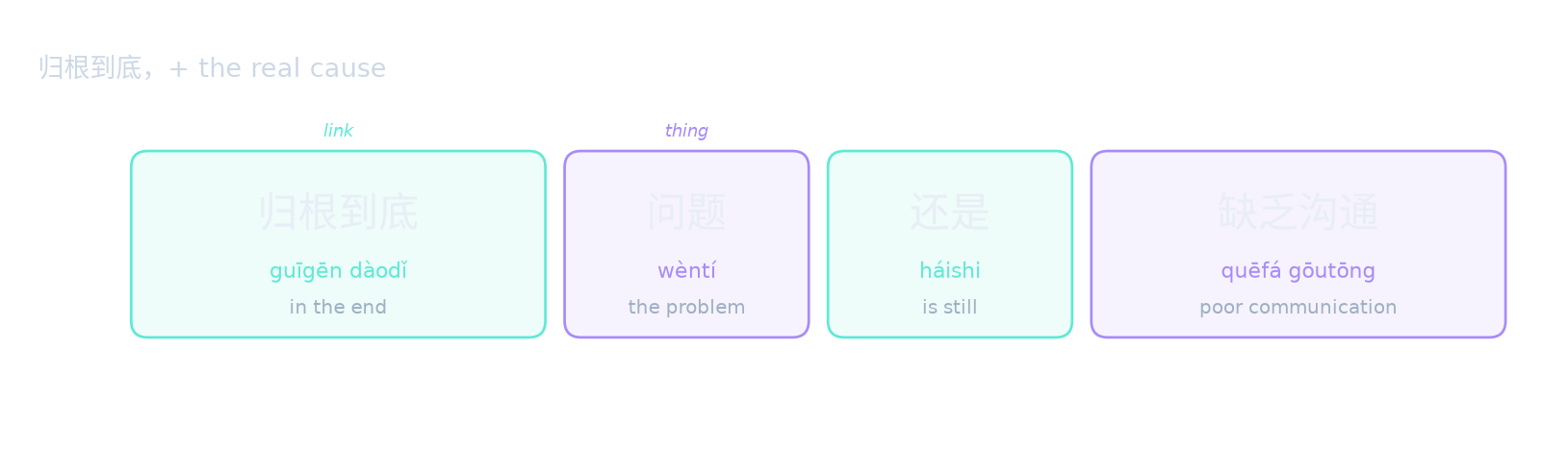
- in the end归根到底,the problem问题is still还是lack of缺乏communication沟通。 — "In the end, the real problem is poor communication."
- Goal: name the basic cause after many details with in the end归根到底, and use in the final analysis说到底 in speech.
in the end归根到底,+ the real point
- in the end归根到底 (guīgēn dàodǐ) = "in the final analysis, at root". It comes at the start of the last sentence, after you have listed details, and names the one basic cause or truth. Also written in the final analysis归根结底.
- in the end归根到底,to study; to learn学习still / also / even还(degree marker)得to lean against or on靠oneself自己。 — "In the end, learning depends on yourself."
in the end归根到底,the problem问题is still还是lack of缺乏communication沟通。
Complete: “In the end, learning depends on yourself.” ____,学习还得靠自己。
Difficulty 1/5 · 100 coins + a small bonus on first completion today
The basic truth after everything — 归根到底.
Details first, then the root
- Build up: someone有人to speak说time时间not enough不够,someone有人to speak说computer电脑太慢。in the end归根到底,to be / is是we / us我们plan计划(degree marker)得no good不好。 — "Some said there wasn't enough time, some said the computers were slow. At root, we planned badly."
- Often with is still还是 or to be / is是: in the end归根到底is still还是 … — "it still comes down to …".
Build: “At root, we planned badly.”
Difficulty 3/5 · 200 coins + a small bonus on first completion today
归根到底 starts the last sentence.
Not for time
- in the end归根到底 is about causes and truths, not time: for "in the end, he came" use finally; last最后 / finally终于: ✓ he / him他finally; last最后is still还是to come来(completed / change)了。
- In speech, in the final analysis说到底 is lighter: in the final analysis说到底,is still还是money钱(modifier / structural particle)的the problem问题。 — "When it comes down to it, it's about money."
“In the end, he came after all.” Which is right?
Difficulty 1/5 · 100 coins + a small bonus on first completion today
For time, use 最后; 归根到底 names a cause.
说到底 is the lighter, spoken version.
Difficulty 1/5 · 100 coins + a small bonus on first completion today
说到底 = when it comes down to it.
in the end归根到底, in the final analysis说到底 and in a word总之
- in the end归根到底 / in the final analysis归根结底 = at root (written). in the final analysis说到底 = when it comes down to it (spoken).
- in a word总之 = in short (sums up everything, without naming a deeper cause).
Which word sums up without naming a deeper cause?
Difficulty 1/5 · 100 coins + a small bonus on first completion today
总之 = in short.
Recap
- Details …。in the end归根到底 (is still还是 / to be / is是) + the basic cause = in the final analysis.
- Spoken: in the final analysis说到底; summing up: in a word总之; time: finally; last最后.
Read the full reference: HSK 6 grammar — Adverbs.
Why do many students find it hard to sleep early? Give two surface reasons, then the root cause with 归根到底.
Your answer need not copy the model. A partner or teacher must hear the spoken response to comment on pronunciation.