Verb phrases that change what a verb means. many; much多/few; little少 + verb gives advice (多喝水); to be worth值得 says something is worth doing; to do harm to害(degree marker)得 blames someone for a bad result; by; from由 names who does a job; and Verb + to / arrive / (result: get)到 says how long an action lasts. Separable verbs such as to meet见面 and to sleep睡觉 split around other words: 见过once / one time一次flour面.
Verb phrases
HSK 4 · Topic 14
 4:47
HSK 4 Grammar 14: Verb Phrases
Eleven patterns, three big traps. Join actions with 并, advise with 少 or 多, assign with 由, blame with 害得 : and mind the two nevers and the separable words. The…
English explanations + Mandarin examples · captions follow the spoken text
14.1
At a glance
- 1. few; little少 + Verb – do less: you你should应该few; little少to eat吃sweet甜(modifier / structural particle)的,many; much多sports / to exercise运动。
- 2. many; much多 + Verb – do more: everyone大家want / will / need要多喝水,many; much多to rest休息。
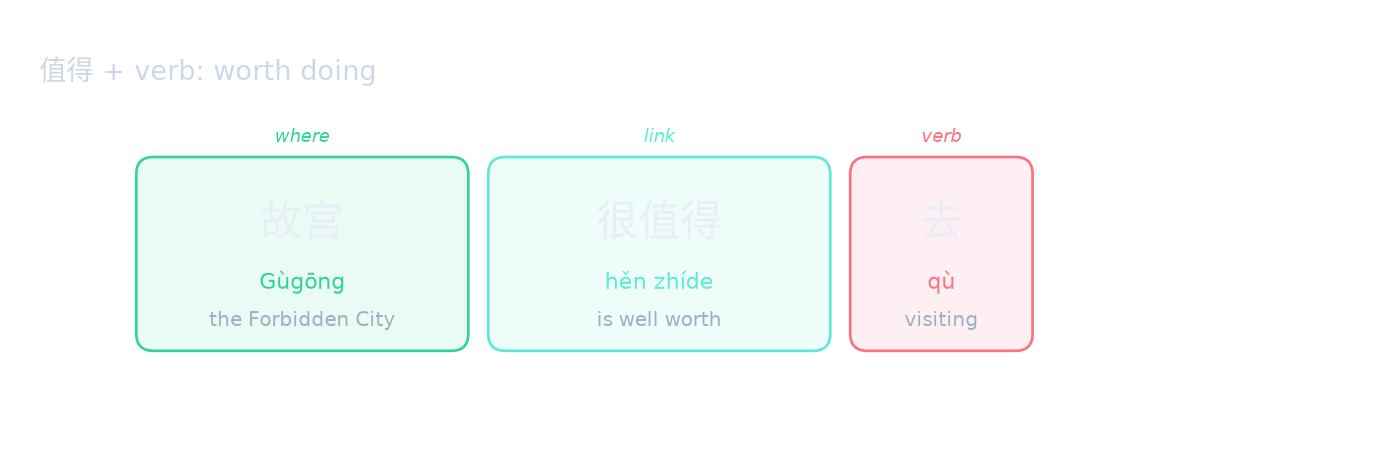
- 3. to be worth值得 + Verb – worth doing: former imperial palace故宫degree / adjective linker很to be worth值得to go去。
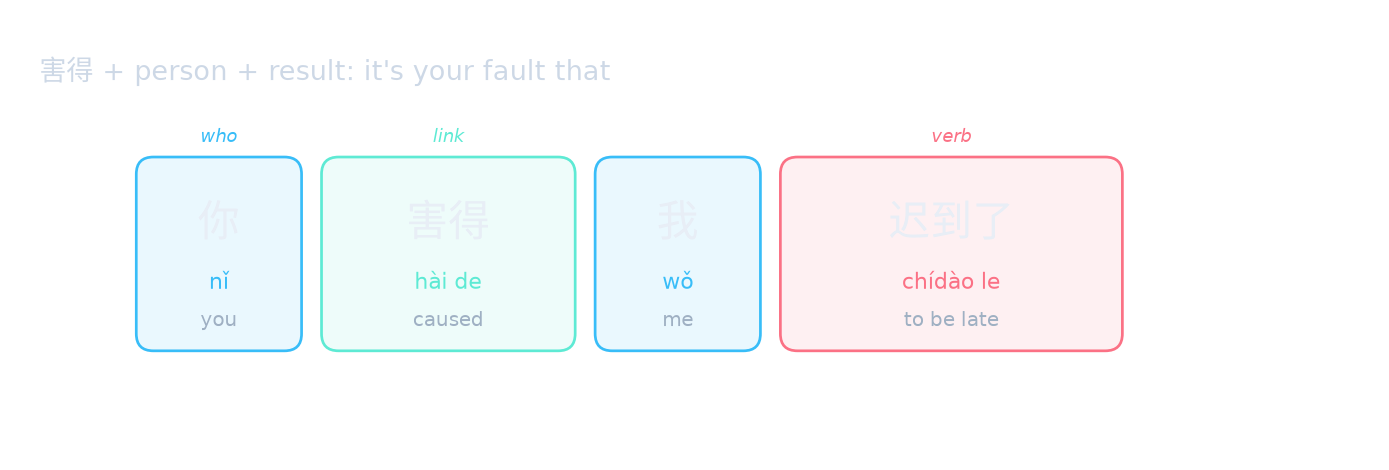
- 4. to do harm to害(degree marker)得 – cause sb to suffer: 你害(degree marker)得I / me我to arrive late迟到(completed / change)了!
- 5. by; from由 + Person + Verb – done by: 这次activity; to exercise活动由小王to be in charge of负责。
- 6. and并 / moreover并且 – combining verbs: and: meeting会议to discuss讨论and并to pass; through; by means of通过(completed / change)了new新(modifier / structural particle)的plan计划。
- 7. always (so far); never (with 不 / 没)从来 + not不 / not / haven't没 – never: I / me我always (so far); never (with 不 / 没)从来not / haven't没去过Xinjiang新疆。
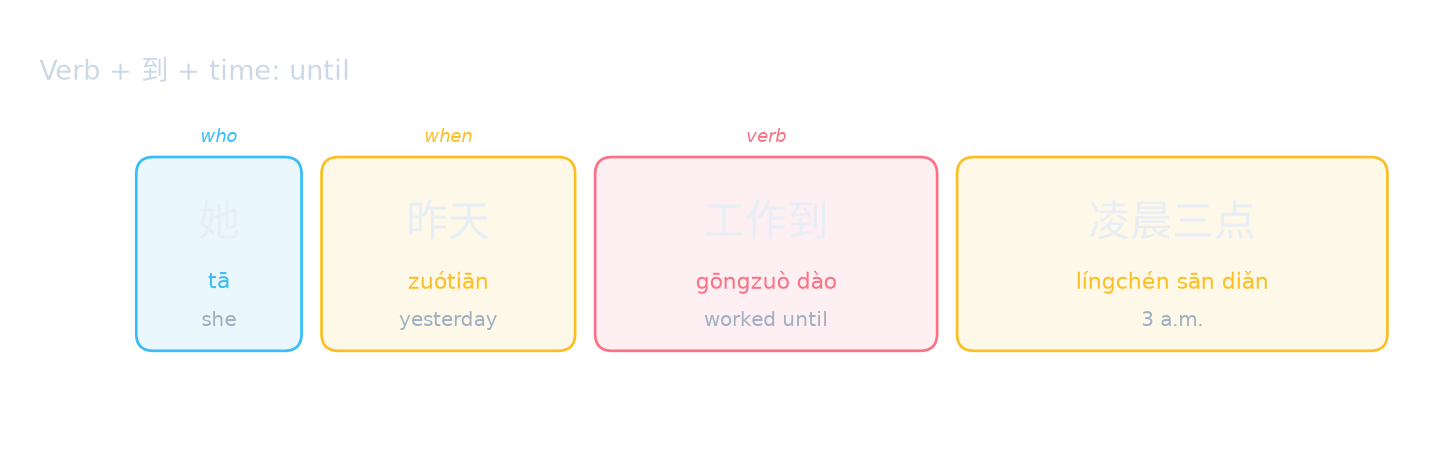
- 8. Verb + to / arrive / (result: get)到 + Time / Event – until: she / her她yesterday昨天to work; job工作to / arrive / (result: get)到very early in the morning凌晨三点。
- 9. V (ongoing -ing)着 V (ongoing -ing)着 then / just就 … (completed / change)了 – while …-ing, suddenly: he / him他看着看着then / just就to fall asleep睡着(completed / change)了。
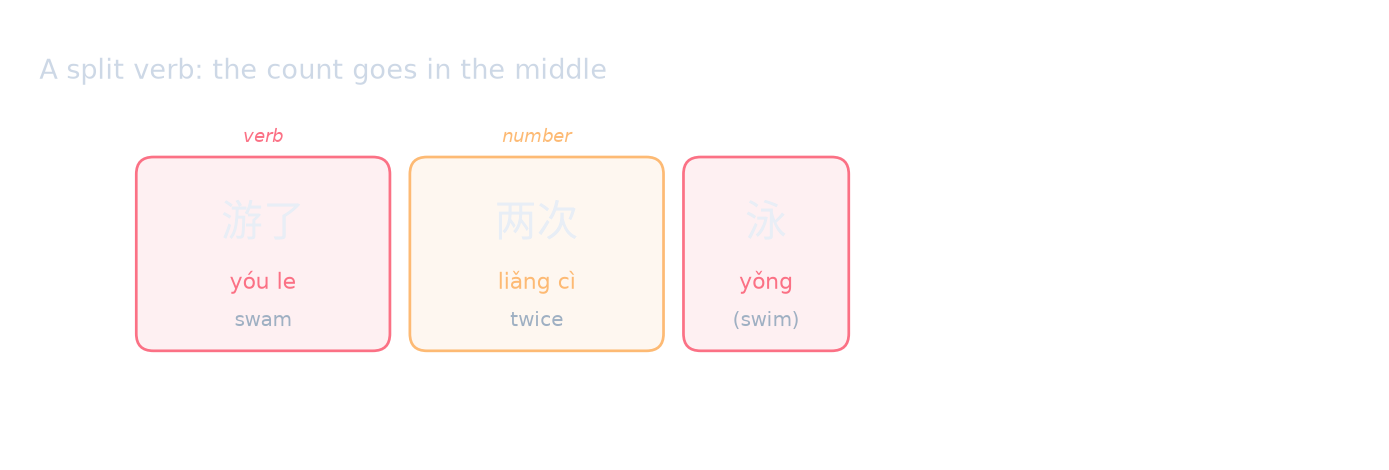
- 10. Separable verbs – clutch (in car gearbox)离合word词: 我理(completed / change)了once / one time一次to send out发,to swim / to travel游(completed / change)了twice两次swimming泳。
14.2
1. 少 + Verb (do less)
Form: few; little少 + verb (+ amount)
- you你should应该few; little少to eat吃sweet甜(modifier / structural particle)的,many; much多sports / to exercise运动。 Nǐ yīnggāi shǎo chī tián de, duō yùndòng. – You should eat less sugar and exercise more.
- 少玩mobile phone手机。 – Play less on your phone.
- to add less (of a spice etc)少放a little一点儿salt盐。 – Put in a little less salt.
- you你少说两句(suggestion)吧! – Stop talking!
How it works. few; little少 shǎo goes directly before the verb, like an adverb: do less of it. An amount comes after the verb: few; little少to eat吃a little一点儿, few; little少to drink喝两杯. you你少说两句 is a firm "stop talking".
| 少吃肉 | 不吃meat肉 | 吃少(completed / change)了 |
|---|---|---|
| eat less meat | eat no meat | ate too little |
Watch out
- "Eat less" is few; little少to eat吃, not wrong: 吃少.

Vocabulary
Train
| 汉字 | Pinyin | English |
|---|---|---|
| 盐 | yán | salt |
14.3
2. 多 + Verb (do more)
Form: (want / will / need要) many; much多 + verb (+ amount)
- everyone大家want / will / need要多喝水,many; much多to rest休息。 Dàjiā yào duō hē shuǐ, duō xiūxi. – Everyone should drink more water and rest more.
- many; much多to practice练习colloquial speech口语。 – Practise speaking more.
- many; much多to wear穿一件clothes衣服,outside外面degree / adjective linker很cold冷。 – Put on an extra layer; it's cold outside.
- I / me我many; much多to buy买(completed / change)了两个。 – I bought two extra.
How it works. many; much多 duō goes directly before the verb: do more of it. It is common in advice, often after want / will / need要. An extra amount goes after the verb: 多住several days几天 (stay a few more days).
| many; much多 + verb | 很多 + noun |
|---|---|
| do more (advice) | a lot of |
| many; much多to read看书 | to look at; to watch; to read看(completed / change)了很多book书 |
Watch out
- "Practise more" is many; much多to practice练习, not wrong: to practice练习many; much多.

14.4
3. 值得 + Verb (worth doing)
Form: A + (degree / adjective linker很) to be worth值得 + verb · (not不)to be worth值得
- former imperial palace故宫degree / adjective linker很to be worth值得to go去。 Gùgōng hěn zhíde qù. – The Forbidden City is well worth a visit.
- 这部film; movie电影to be worth值得to look at; to watch; to read看。 – This film is worth seeing.
- this这个question / problem问题to be worth值得we / us我们to discuss讨论。 – This question deserves our discussion.
- for / (wéi) to be为这点儿trifle小事to get angry生气,not不to be worth值得。 – It's not worth getting angry over something so small.
How it works. to be worth值得 zhíde + verb means "worth doing". What is worth it comes first. degree / adjective linker很 or very非常 can go before it; the negative is not不to be worth值得. to be worth值得一去 is a fixed phrase: "worth a trip".
| value值 + amount | to be worth值得 + verb |
|---|---|
| worth (money) | worth doing |
| 这块wristwatch手表value值一万块 | to be worth值得to study; to learn学习 |
Watch out
- wrong: to be worth值得this这本书to look at; to watch; to read看 → this这本书to be worth值得to look at; to watch; to read看.
- wrong: not / haven't没to be worth值得 → not不to be worth值得.
Vocabulary
Train
| 汉字 | Pinyin | English |
|---|---|---|
| 值得 | zhí de | to be worth |
| 讨论 | tǎo lùn | to discuss |
14.5
4. 害得 (cause sb to suffer)
Form: cause + to do harm to害(degree marker)得 + person + bad result
- 你害(degree marker)得I / me我to arrive late迟到(completed / change)了! Nǐ hài de wǒ chídào le! – You made me late!
- traffic jam堵车to do harm to害(degree marker)得we / us我们to arrive late迟到(completed / change)了。 – The traffic jam made us late.
- 这场heavy rain大雨to do harm to害(degree marker)得we / us我们at / in在airport机场to wait; and so on等(completed / change)了五个hour小时。 – This rainstorm made us wait five hours at the airport.
- you你not不to return / (times)回news; message消息,to cause or lead to sth bad害得I / me我degree / adjective linker很anxious担心。 – You didn't reply, and it made me worried.
How it works. to do harm to害(degree marker)得 hài de blames someone or something for a bad result. The person who suffers follows to do harm to害(degree marker)得, then the result. The cause can be a person or a thing.
| to let / make让 / to make使 | to do harm to害(degree marker)得 |
|---|---|
| neutral, any result | blame, bad results only |
| this这个news; message消息to let / make让I / me我degree / adjective linker很to feel sad难过 | 你害(degree marker)得I / me我degree / adjective linker很to feel sad难过 |
Watch out
- Not for good outcomes: he / him他if (coming after a…的话to let / make让I / me我degree / adjective linker很happy; glad高兴.
- wrong: to do harm to害(degree marker)得to arrive late迟到I / me我 → to cause or lead to sth bad害得I / me我to arrive late迟到.
Vocabulary
Train
| 汉字 | Pinyin | English |
|---|---|---|
| 堵车 | dǔ chē | traffic jam |
| 等 | děng | to wait; and so on |
| 消息 | xiāo xi | news; message |
14.6
5. 由 + Person + Verb (done by)
Form: task + by; from由 + person + verb · A + by; from由 + parts + to make up; to form组成
- 这次activity; to exercise活动由小王to be in charge of负责。 Zhè cì huódòng yóu Xiǎo Wáng fùzé. – Xiao Wang is in charge of this event.
- 这件main content事由我来to deal with处理。 – This matter will be handled by me.
- meeting会议by; from由president校长to host; to chair主持。 – The meeting is chaired by the head teacher.
- this这个team / queue队by; from由十个person人to make up; to form组成。 – The team is made up of ten people.
How it works. by; from由 yóu + person names who is responsible for a task. The task comes first as the topic, and the sentence usually needs no (completed / change)了 or result word. by; from由……to make up; to form组成 means "be made up of". In writing, by; from由 can also mean "from": by; from由Beijing北京to set off出发.
| by; from由 | (passive: by)被 |
|---|---|
| who is responsible | something done to the subject, often bad |
| evening meal晚饭by; from由I / me我to do; to make做 | he / him他(passive: by)被teacher老师to criticize批评(completed / change)了 |
Watch out
- due to由于 is a different word: "due to, because of".

Vocabulary
Train
| 汉字 | Pinyin | English |
|---|---|---|
| 由 | yóu | by; from |
| 组成 | zǔ chéng | to make up; to form |
| 活动 | huó dòng | activity; to exercise |
| 负责 | fù zé | to be in charge of |
| 出发 | chū fā | to set off |
| 批评 | pī píng | to criticize |
| 由于 | yóu yú | due to |
14.7
6. 并 / 并且 (combining verbs: and)
Form: subject + verb phrase₁ + and并 / moreover并且 + verb phrase₂ (written)
- meeting会议to discuss讨论and并to pass; through; by means of通过(completed / change)了new新(modifier / structural particle)的plan计划。 Huìyì tǎolùn bìng tōngguòle xīn de jìhuà. – The meeting discussed and approved the new plan.
- please; to invite请reading; to read阅读to notify / notice通知,and并to sign (one's name with a…签名。 – Please read the notice and sign it.
- please; to invite请to fill in a form填写this这张表,and并to give交给stage前台。 – Please fill in this form and hand it to reception.
- company公司to investigate; survey调查(completed / change)了this这个question / problem问题,moreover并且to find找到(completed / change)了reason; cause原因。 – The company investigated the problem and found the cause.
How it works. and并 / moreover并且 join two actions done by the same subject, often one after the other: "and (also)". It is written style, common in minutes, reports and formal notices.
| and并 + verb | and并 + not不 / not / haven't没 |
|---|---|
| "and" | "actually not" |
| to discuss讨论and并to pass; through; by means of通过 | he / him他并不知道 |
Watch out
- They join verb phrases, not nouns: wrong: teacher老师and并student学生 → teacher老师and / with和student学生.

Vocabulary
Train
| 汉字 | Pinyin | English |
|---|---|---|
| 并且 | bìng qiě | and also |
| 通过 | tōng guò | to pass; through; by means of |
| 计划 | jì huà | plan |
| 阅读 | yuè dú | reading; to read |
| 通知 | tōng zhī | to notify |
| 调查 | diào chá | to investigate; survey |
| 原因 | yuán yīn | reason; cause |
14.8
7. 从来 + 不 / 没 (never)
Form: always (so far); never (with 不 / 没)从来not / haven't没(to have / there is有) + verb + (experienced)过 (never once) · never从来不 + verb (never, as a habit)
- I / me我always (so far); never (with 不 / 没)从来not / haven't没去过Xinjiang新疆。 Wǒ cónglái méi qùguo Xīnjiāng. – I've never been to Xinjiang.
- I / me我always (so far); never (with 不 / 没)从来没听说过this这个area地方。 – I've never heard of this place.
- he / him他always (so far); never (with 不 / 没)从来not / haven't没to arrive late迟到(experienced)过。 – He has never once been late.
- he / him他never从来不喝咖啡。 – He never drinks coffee.
How it works. always (so far); never (with 不 / 没)从来 stresses the whole of the past. For experience: always (so far); never (with 不 / 没)从来not / haven't没 + verb + (experienced)过. For a habit or rule: never从来不 + verb.
| still / also / even还not / haven't没去过 | always (so far); never (with 不 / 没)从来not / haven't没去过 | all along / straight一直not / haven't没 |
|---|---|---|
| not yet (but might) | never once | not all this time (a specific wait) |
| I / me我still / also / even还not / haven't没去过Xi'an, sub-provincial city…西安 | I / me我always (so far); never (with 不 / 没)从来not / haven't没去过Xinjiang新疆 | he / him他all along / straight一直not / haven't没to return / (times)回I / me我news; message消息 |
Watch out
- Do not mix the two: wrong: he / him他never从来不去过 → he / him他always (so far); never (with 不 / 没)从来not / haven't没去过.

Vocabulary
Train
| 汉字 | Pinyin | English |
|---|---|---|
| 从来 | cóng lái | always (so far); never (with 不 / 没) |
| 过 | guò | to pass; to spend (time) |
14.9
8. Verb + 到 + Time / Event (until)
Form: verb + to / arrive / (result: get)到 + time / event · verb + object + verb + to / arrive / (result: get)到 + time
- she / her她yesterday昨天to work; job工作to / arrive / (result: get)到very early in the morning凌晨三点。 Tā zuótiān gōngzuò dào língchén sān diǎn. – She worked until three in the morning yesterday.
- I / me我to sleep睡to / arrive / (result: get)到十点。 – I slept until ten.
- we / us我们to wait until等到雨停(completed / change)了only then / not until才to set off出发。 – We waited until the rain stopped before setting off.
- he / him他to read看书to see看到midnight半夜。 – He read until midnight.
How it works. to / arrive / (result: get)到 + end point goes right after the verb: do something until then. The end can be a time or an event (all along / straight一直to work; job工作to / arrive / (result: get)到to retire退休). With an object, repeat the verb (to read看书to see看到degree / adjective linker很late / evening晚) or put the object first (book书to see看到degree / adjective linker很late / evening晚).
| Verb + to / arrive / (result: get)到 | until直到……only then / not until才…… |
|---|---|
| a neutral end point | something happened only that late |
| to play玩to / arrive / (result: get)到十点 | until直到十点he / him他only then / not until才to return home回家 |
Watch out
- to / arrive / (result: get)到十点to sleep睡 means "go to bed at ten". "Sleep until ten" is to sleep睡to / arrive / (result: get)到十点.
14.10
9. V 着 V 着 就 … 了 (while …-ing, suddenly)
Form: subject + verb (ongoing -ing)着 verb (ongoing -ing)着,then / just就 + new event + (completed / change)了
- he / him他看着看着then / just就to fall asleep睡着(completed / change)了。 Tā kànzhe kànzhe jiù shuìzháo le. – He was watching, and then he fell asleep.
- we / us我们to walk / to leave走(ongoing -ing)着to walk / to leave走(ongoing -ing)着then / just就to get lost迷路(completed / change)了。 – We were walking along, and before we knew it we were lost.
- child孩子to play玩(ongoing -ing)着to play玩(ongoing -ing)着then / just就笑了起来。 – While playing, the child started laughing.
- he / him他to walk / to leave走(ongoing -ing)着to walk / to leave走(ongoing -ing)着then / just就to / arrive / (result: get)到(completed / change)了。 – He walked on, and soon he was there.
How it works. The repeated verb + (ongoing -ing)着 shows an action going on for a while; then something new slips in without any plan. It tells a past story, so the second part ends with (completed / change)了. Use a one-syllable verb.
| one side一边……one side一边…… | V (ongoing -ing)着 V (ongoing -ing)着then / just就…… |
|---|---|
| two planned actions at once | a new event slips in |
| one side一边to eat吃one side一边to look at; to watch; to read看 | to eat吃(ongoing -ing)着to eat吃(ongoing -ing)着then / just就to fall asleep睡着(completed / change)了 |
Watch out
- wrong: to take a look at看看(ongoing -ing)着(ongoing -ing)着 → 看着看着.

14.11
10. Separable verbs (离合词)
Form: verb + ((completed / change)了 / (experienced)过 / amount / (modifier / structural particle)的) + object part · with / and跟 / to / for / give给 + person + separable verb
- 我理(completed / change)了once / one time一次to send out发,to swim / to travel游(completed / change)了twice两次swimming泳。 Wǒ lǐle yí cì fà, yóule liǎng cì yǒng. – I had my hair cut once and went swimming twice.
- we / us我们见过面。 Wǒmen jiànguo miàn. – We have met before.
- I / me我want / think / miss想with / and跟you你to meet见面。 – I'd like to meet you.
- you你can / be able to能to help帮I / me我一个busy忙(yes/no ?)吗? – Could you do me a favour?
How it works. Some words are really verb + object in one word (clutch (in car gearbox)离合word词): to swim游泳 (swim + swimming), to meet见面 (see + face), to sleep睡觉, to help帮忙, to marry结婚, to get angry生气, to go to class上课, to graduate毕业, to bathe洗澡, to sing唱歌, to dance跳舞. Words like (completed / change)了, (experienced)过, amounts and (modifier / structural particle)的 go between the two parts: 见了面, to sleep睡(completed / change)了八个hour小时to feel觉, to sing唱(completed / change)了一首歌, knot结(experienced)过twice两次to marry婚, 生他(modifier / structural particle)的air / angry气 (be angry with him).
Because they already contain an object, they cannot take a second one. Bring the person in with with / and跟 or to / for / give给.
| Wrong | Right |
|---|---|
| wrong: to meet见面he / him他 | with / and跟he / him他to meet见面 |
| wrong: to help帮忙I / me我 | to help帮I / me我一个busy忙 / to / for / give给I / me我to help帮忙 |
| wrong: to sleep睡觉(completed / change)了八个hour小时 | to sleep睡(completed / change)了八个hour小时to feel觉 / to sleep睡觉to sleep睡(completed / change)了八个hour小时 |
Vocabulary
Train
| 汉字 | Pinyin | English |
|---|---|---|
| 发 | fā | to send out |
| 毕业 | bì yè | to graduate |
14.12
Practice
Cover the teaching pages before you answer. The answers are at the end.
1. few; little少 + Verb (do less)
1. Advise: “Play less on your phone.” …………to play玩mobile phone手机。
2. What does I / me我to eat吃few; little少(completed / change)了 mean?
- A. I should eat less.
- B. I ate less than before on purpose.
- C. I ate too little.
- D. I don't eat.
3. Build: “Put in a little less salt.”
Put in order: a little一点儿 / salt盐。 / to put / let go放 / few; little少
4. True or false? 少吃肉 means “don't eat meat at all”. If false, correct it.
5. Your doctor looks at your test results and gives you some advice. Use few; little少 + Verb. Write your answer in Chinese, then say it aloud.
2. many; much多 + Verb (do more)
6. Advise: “Practise speaking more.” …………to practice练习colloquial speech口语。
7. Which says “Stay a few more days”?
- A. to live (somewhere)住several days几天many; much多。
- B. 很多to live (somewhere)住several days几天。
- C. to live (somewhere)住many; much多several days几天。
- D. 多住several days几天。
8. Build: “Put on an extra layer.”
Put in order: 一件 / clothes衣服。 / many; much多 / to wear穿
9. True or false? In to look at; to watch; to read看(completed / change)了很多book书, 很多 describes the books. If false, correct it.
10. Your PE teacher gives the class some advice before the fitness test. Use many; much多 + Verb. Write your answer in Chinese, then say it aloud.
3. to be worth值得 + Verb (worth doing)
11. Complete: “This film is worth seeing.” 这部film; movie电影…………to look at; to watch; to read看。
12. Which sentence is correct?
- A. this这个area地方to go去to be worth值得。
- B. to be worth值得this这个area地方to go去。
- C. this这个area地方to be worth值得to go去。
- D. this这个area地方not / haven't没to be worth值得to go去。
13. Build: “It's not worth getting angry.”
Put in order: to get angry生气 / not不 / to be worth值得。 / ,
14. True or false? 这块wristwatch手表value值一万块 uses value值 for a money value. If false, correct it.
15. A friend asks whether the Forbidden City is worth the long queue. Use to be worth值得 + Verb. Write your answer in Chinese, then say it aloud.
4. to do harm to害(degree marker)得 (cause sb to suffer)
16. Blame: “You made me miss the film!” you你…………I / me我not / haven't没to look at; to watch; to read看up / on / last; to get on, attend上film; movie电影!
17. Which sentence is natural?
- A. traffic jam堵车to do harm to害(degree marker)得we / us我们to arrive late迟到(completed / change)了。
- B. teacher老师(modifier / structural particle)的to praise表扬to cause or lead to sth bad害得I / me我degree / adjective linker很happy; glad高兴。
- C. 他害(degree marker)得I / me我to take an exam / to test考(completed / change)了第一名。
- D. good好weather天气to do harm to害(degree marker)得we / us我们to go去to climb a mountain爬山。
18. Build: “You didn't reply, and it made me worried.”
Put in order: degree / adjective linker很anxious担心。 / , / you你not不to return / (times)回news; message消息 / to cause or lead to sth bad害得I / me我
19. True or false? to do harm to害(degree marker)得 adds blame that to let / make让 does not. If false, correct it.
20. Your brother hid your alarm clock as a joke, and you missed your train. Use to do harm to害(degree marker)得. Write your answer in Chinese, then say it aloud.
5. by; from由 + Person + Verb (done by)
21. Complete: “This matter will be handled by me.” 这件matter事…………我来to deal with处理。
22. Which says “He was criticised by the teacher”?
- A. he / him他(passive: by)被teacher老师to criticize批评(completed / change)了。
- B. he / him他by; from由teacher老师to criticize批评(completed / change)了。
- C. he / him他by; from由to criticize批评teacher老师。
- D. teacher老师by; from由he / him他to criticize批评。
23. Build: “The team is made up of ten people.”
Put in order: to make up; to form组成。 / by; from由十个person人 / this这个team / queue队
24. True or false? by; from由Beijing北京to set off出发 means “set off from Beijing”. If false, correct it.
25. Your teacher divides the work for the class trip. Use by; from由 + Person + Verb. Write your answer in Chinese, then say it aloud.
6. and并 / moreover并且 (combining verbs: and)
26. Complete (written): “Please read the notice and sign it.” please; to invite请reading; to read阅读to notify / notice通知,…………to sign (one's name with a…签名。
27. Which sentence is correct?
- A. I / me我and并to buy买(completed / change)了apple苹果and并banana香蕉。
- B. I / me我to buy买(completed / change)了apple苹果and并banana香蕉。
- C. I / me我to buy买(completed / change)了and并apple苹果and / with和banana香蕉。
- D. I / me我to buy买(completed / change)了apple苹果and / with和banana香蕉。
28. Build: “The meeting discussed and approved the plan.”
Put in order: and并to pass; through; by means of通过(completed / change)了 / to discuss讨论 / meeting会议 / plan计划。
29. True or false? In he / him他并不知道, and并 means “and”. If false, correct it.
30. You are writing the minutes of a school meeting. Use and并 / moreover并且. Write your answer in Chinese, then say it aloud.
7. always (so far); never (with 不 / 没)从来 + not不 / not / haven't没 (never)
31. Complete: “I've never heard of this place.” I / me我always (so far); never (with 不 / 没)从来not / haven't没to hear (sth said)听说…………this这个area地方。
32. You plan to visit Xi'an next month but haven't been yet. Which fits?
- A. I / me我all along / straight一直to go去Xi'an, sub-provincial city…西安。
- B. I / me我still / also / even还not / haven't没去过Xi'an, sub-provincial city…西安。
- C. I / me我last month上个月去过Xi'an, sub-provincial city…西安。
- D. I / me我never从来不to go去Xi'an, sub-provincial city…西安。
33. Build: “I've never been to Xinjiang.”
Put in order: Xinjiang新疆。 / always (so far); never (with 不 / 没)从来not / haven't没 / I / me我 / 去过
34. True or false? he / him他never从来不去过 is correct. If false, correct it.
35. Friends are planning a trip to Xinjiang and ask whether you know the region. Use always (so far); never (with 不 / 没)从来 + not不 / not / haven't没. Write your answer in Chinese, then say it aloud.
8. Verb + to / arrive / (result: get)到 + Time / Event (until)
36. Complete: “I slept until ten.” I / me我to sleep睡…………十点。
37. Which says “He read until midnight”?
- A. he / him他to see看到book书midnight半夜。
- B. he / him他midnight半夜to / arrive / (result: get)到to read看书。
- C. he / him他to read看书to see看到midnight半夜。
- D. he / him他to / arrive / (result: get)到midnight半夜to read看书。
38. Build: “He kept working until he retired.”
Put in order: to retire退休。 / all along / straight一直 / to work; job工作to / arrive / (result: get)到 / he / him他
39. True or false? to / arrive / (result: get)到十点to sleep睡 means “sleep until ten”. If false, correct it.
40. Your roommate had a deadline and you could see her light under the door. Use Verb + to / arrive / (result: get)到 + Time / Event. Write your answer in Chinese, then say it aloud.
9. V (ongoing -ing)着 V (ongoing -ing)着 then / just就 … (completed / change)了 (while …-ing, suddenly)
41. Complete: “While reading, she fell asleep.” she / her她看着看着…………to fall asleep睡着(completed / change)了。
42. Which form is correct?
- A. he / him他to walk / to leave走(ongoing -ing)着to walk / to leave走(ongoing -ing)着then / just就to / arrive / (result: get)到(completed / change)了。
- B. he / him他(ongoing -ing)着to walk / to leave走(ongoing -ing)着to walk / to leave走then / just就to / arrive / (result: get)到(completed / change)了。
- C. he / him他走走(ongoing -ing)着(ongoing -ing)着then / just就to / arrive / (result: get)到(completed / change)了。
- D. he / him他to walk / to leave走(ongoing -ing)着then / just就to walk / to leave走(ongoing -ing)着to / arrive / (result: get)到(completed / change)了。
43. Build: “We were walking, and before we knew it we were lost.”
Put in order: we / us我们 / then / just就 / to get lost迷路(completed / change)了。 / to walk / to leave走(ongoing -ing)着to walk / to leave走(ongoing -ing)着
44. True or false? V(ongoing -ing)着V(ongoing -ing)着then / just就… describes two planned actions done together. If false, correct it.
45. Your dad was watching a film after dinner. When you came back, he was snoring. Use V (ongoing -ing)着 V (ongoing -ing)着 then / just就 … (completed / change)了. Write your answer in Chinese, then say it aloud.
10. Separable verbs (clutch (in car gearbox)离合word词)
46. Complete: “We have met before.” we / us我们to see / meet见…………flour面。
47. Which sentence is correct?
- A. I / me我want / think / miss想to meet见面you你。
- B. I / me我want / think / miss想with / and跟you你to meet见面。
- C. I / me我to infer想见你面。
- D. I / me我want / think / miss想to meet见面with / and跟you你。
48. Build: “Could you do me a favour?”
Put in order: you你can / be able to能 / 一个 / to help帮I / me我 / busy忙(yes/no ?)吗?
49. True or false? he / him他knot结(experienced)过twice两次to marry婚 puts the amount inside to marry结婚. If false, correct it.
50. You tell a friend you went swimming twice this week and had a haircut too. Write your answer in Chinese, then say it aloud.
14.13
Mixed practice
These questions mix the patterns and use new situations.
51. Which sentence is correct?
- A. I / me我yesterday昨天to meet见面(completed / change)了he / him他。
- B. I / me我yesterday昨天with / and跟he / him他to meet见面(completed / change)了。
- C. I / me我yesterday昨天to see / meet见他面(completed / change)了(yes/no ?)吗。
52. Give advice with many; much多 or few; little少: drink more water / eat less sugar.
53. Say "This film is worth watching."
54. Say "We talked until twelve o'clock."
55. Find and fix the problem. A classmate writes I / me我yesterday昨天to meet见面(completed / change)了I / me我(modifier / structural particle)的teacher老师. Correct it.
56. Use it yourself. Say that this activity is worth trying, and that while you were writing, the computer suddenly switched off.
14.14
Answers and explanations
Mark your work, then correct each mistake in your own words.
1. few; little少 + Verb (do less)
1. few; little少
few; little少 + verb = do less.
2. C. I ate too little.
Verb + few; little少(completed / change)了 = did too little; advice is few; little少 + verb.
3. to add less (of a spice etc)少放a little一点儿salt盐。
few; little少 + verb + amount + object.
4. False.
few; little少to eat吃 = eat less; 不吃 = not at all.
5. Model answer: you你should应该few; little少to eat吃sweet甜(modifier / structural particle)的,many; much多sports / to exercise运动。
Check your answer:
- "Eat less" is few; little少to eat吃, not 吃少: 吃少(completed / change)了 means "ate too little".
- An amount comes after the verb: few; little少to eat吃a little一点儿, few; little少to drink喝两杯.
2. many; much多 + Verb (do more)
6. many; much多
many; much多 + verb = do more.
7. D. 多住several days几天。
many; much多 goes before the verb, then the amount: 多住several days几天 “stay a few more days”. Putting many; much多 after the verb (to live (somewhere)住many; much多several days几天) is a common error from English word order.
8. many; much多to wear穿一件clothes衣服。
many; much多 + verb + amount + noun.
9. True.
很多 + noun = many / a lot of.
10. Model answer: everyone大家want / will / need要多喝水,many; much多to rest休息。
Check your answer:
- "Practise more" is many; much多to practice练习, not to practice练习many; much多: to practice练习many; much多(completed / change)了 suggests "practised a lot".
- The extra amount goes after the verb: 多住several days几天 – "stay a few more days".
3. to be worth值得 + Verb (worth doing)
11. to be worth值得
A + to be worth值得 + verb.
12. C. this这个area地方to be worth值得to go去。
this这个area地方to be worth值得to go去 is right: the thing comes first, then to be worth值得 + verb. The negative is not不to be worth值得, not not / haven't没to be worth值得, and the verb cannot come before to be worth值得.
13. to get angry生气,not不to be worth值得。
Action, then not不to be worth值得.
14. True.
value值 + amount = worth in money.
15. Model answer: former imperial palace故宫degree / adjective linker很to be worth值得to go去。
Check your answer:
- Put what is worth it first: this这本书to be worth值得to look at; to watch; to read看, not to be worth值得this这本书to look at; to watch; to read看.
- The negative is not不to be worth值得, not not / haven't没to be worth值得.
4. to do harm to害(degree marker)得 (cause sb to suffer)
16. to do harm to害(degree marker)得
to do harm to害(degree marker)得 + person + bad result.
17. A. traffic jam堵车to do harm to害(degree marker)得we / us我们to arrive late迟到(completed / change)了。
to do harm to害(degree marker)得 is for unwelcome results.
18. you你not不to return / (times)回news; message消息,to cause or lead to sth bad害得I / me我degree / adjective linker很anxious担心。
Cause, to do harm to害(degree marker)得 + person + result.
19. True.
to let / make让 is neutral; to do harm to害(degree marker)得 blames the cause.
20. Model answer: 你害(degree marker)得I / me我to arrive late迟到(completed / change)了!
Check your answer:
- Do not use to do harm to害(degree marker)得 for good outcomes; for neutral or good causes use to let / make让 / to make使: he / him他if (coming after a…的话to let / make让I / me我degree / adjective linker很happy; glad高兴 – "What he said made me very happy."
- Keep the person after to do harm to害(degree marker)得: to cause or lead to sth bad害得I / me我to arrive late迟到, not to do harm to害(degree marker)得to arrive late迟到I / me我.
5. by; from由 + Person + Verb (done by)
21. by; from由
Task + by; from由 + person + verb.
22. A. he / him他(passive: by)被teacher老师to criticize批评(completed / change)了。
Something done to someone (often unwelcome) takes (passive: by)被.
23. this这个team / queue队by; from由十个person人to make up; to form组成。
by; from由…to make up; to form组成 = be made up of.
24. True.
In writing, by; from由 can mean “from”.
25. Model answer: 这次activity; to exercise活动由小王to be in charge of负责。
Check your answer:
- by; from由 names who is responsible; (passive: by)被 reports something done to the subject, often unwelcome: he / him他(passive: by)被to criticize批评(completed / change)了 – "He was criticized."
- by; from由 sentences usually need no (completed / change)了 or result complement: by; from由he / him他to be in charge of负责.
6. and并 / moreover并且 (combining verbs: and)
26. and并
and并 joins two actions by the same subject.
27. D. I / me我to buy买(completed / change)了apple苹果and / with和banana香蕉。
I / me我to buy买(completed / change)了apple苹果and / with和banana香蕉 is right: and / with和 joins nouns. and并 joins verbs or clauses ("and also"), so it cannot join apple苹果 and banana香蕉.
28. meeting会议to discuss讨论and并to pass; through; by means of通过(completed / change)了plan计划。
VP1 + and并 + VP2.
29. False.
False. Before a negative, and并 strengthens it and corrects an assumption: he / him他并不知道 “He actually doesn't know (as you might think).” It does not mean “and” here.
30. Model answer: meeting会议to discuss讨论and并to pass; through; by means of通过(completed / change)了new新(modifier / structural particle)的plan计划。
Check your answer:
- and并 / moreover并且 join verb phrases; to join nouns use and / with和: teacher老师and / with和student学生, not teacher老师and并student学生.
- Usually one subject does both actions: he / him他to study; to learn学习good好,moreover并且degree / adjective linker很cordial热情.
7. always (so far); never (with 不 / 没)从来 + not不 / not / haven't没 (never)
31. (experienced)过
always (so far); never (with 不 / 没)从来not / haven't没 + verb + (experienced)过.
32. B. I / me我still / also / even还not / haven't没去过Xi'an, sub-provincial city…西安。
Not yet (but planned) = still / also / even还not / haven't没.
33. I / me我always (so far); never (with 不 / 没)从来not / haven't没去过Xinjiang新疆。
always (so far); never (with 不 / 没)从来not / haven't没 + verb + (experienced)过 + place.
34. False.
Experience takes always (so far); never (with 不 / 没)从来not / haven't没…(experienced)过; habit takes never从来不.
35. Model answer: I / me我always (so far); never (with 不 / 没)从来not / haven't没去过Xinjiang新疆。
Check your answer:
- Experience: always (so far); never (with 不 / 没)从来not / haven't没 + V + (experienced)过; habit: never从来不 + V. Do not mix: never从来不去过 is wrong.
- Use (experienced)过 for the experiential model here. Other predicates can form complete always (so far); never (with 不 / 没)从来not / haven't没 statements without (experienced)过; there is no universal requirement.
8. Verb + to / arrive / (result: get)到 + Time / Event (until)
36. to / arrive / (result: get)到
Verb + to / arrive / (result: get)到 + end point.
37. C. he / him他to read看书to see看到midnight半夜。
With an object, repeat the verb: to read看书to see看到midnight半夜.
38. he / him他all along / straight一直to work; job工作to / arrive / (result: get)到to retire退休。
all along / straight一直 + verb + to / arrive / (result: get)到 + event.
39. False.
That means “go to bed at ten”; “sleep until ten” is to sleep睡to / arrive / (result: get)到十点.
40. Model answer: she / her她yesterday昨天to work; job工作to / arrive / (result: get)到very early in the morning凌晨三点。
Check your answer:
- Say to sleep睡to / arrive / (result: get)到十点, not to / arrive / (result: get)到十点to sleep睡 (that means "go to bed at ten").
- With an object, repeat the verb or put the object first: to read看书to see看到degree / adjective linker很late / evening晚 ("I read until late") / book书to see看到degree / adjective linker很late / evening晚.
9. V (ongoing -ing)着 V (ongoing -ing)着 then / just就 … (completed / change)了 (while …-ing, suddenly)
41. then / just就
V(ongoing -ing)着V(ongoing -ing)着then / just就 + new event + (completed / change)了.
42. A. he / him他to walk / to leave走(ongoing -ing)着to walk / to leave走(ongoing -ing)着then / just就to / arrive / (result: get)到(completed / change)了。
Verb + (ongoing -ing)着 + verb + (ongoing -ing)着 + then / just就 shows that while doing one thing, something else happened: he / him他to walk / to leave走(ongoing -ing)着to walk / to leave走(ongoing -ing)着then / just就to / arrive / (result: get)到(completed / change)了 “He kept walking and before he knew it he had arrived.”
43. we / us我们to walk / to leave走(ongoing -ing)着to walk / to leave走(ongoing -ing)着then / just就to get lost迷路(completed / change)了。
Subject + V(ongoing -ing)着V(ongoing -ing)着 + then / just就 + result + (completed / change)了.
44. False.
That is one side一边…one side一边…; V(ongoing -ing)着V(ongoing -ing)着then / just就 has an unplanned new event.
45. Model answer: he / him他看着看着then / just就to fall asleep睡着(completed / change)了。
Check your answer:
- Use a one-syllable verb, repeated with (ongoing -ing)着 each time: 看着看着, not to take a look at看看(ongoing -ing)着(ongoing -ing)着.
- It usually tells what happened (a story), so the second part often ends with (completed / change)了.
10. Separable verbs (clutch (in car gearbox)离合word词)
46. (experienced)过
(experienced)过 goes inside the verb-object word: 见过面.
47. B. I / me我want / think / miss想with / and跟you你to meet见面。
to meet见面 cannot take another object; use with / and跟 + person.
48. you你can / be able to能to help帮I / me我一个busy忙(yes/no ?)吗?
to help帮 + person + 一个 + busy忙.
49. True.
Separable verbs take (experienced)过 and amounts in the middle.
50. Model answer: 我理(completed / change)了once / one time一次to send out发,to swim / to travel游(completed / change)了twice两次swimming泳。
Check your answer:
- Do not add an object after them: with / and跟he / him他to meet见面, not to meet见面he / him他; to / for / give给I / me我to help帮忙, not to help帮忙I / me我.
- Put duration and (completed / change)了 inside: to sleep睡(completed / change)了八个hour小时to feel觉 or to sleep睡觉to sleep睡(completed / change)了八个hour小时, not to sleep睡觉(completed / change)了八个hour小时.
Mixed practice
51. B. to meet见面 is a separable verb and cannot take an object; say with / and跟 + person + to meet见面.
52. 多喝水,few; little少吃糖。many; much多/few; little少 goes before the verb.
53. 这部film; movie电影值得一看 (or to be worth值得to look at; to watch; to read看)。
54. we / us我们聊到(completed / change)了十二点。Verb + to / arrive / (result: get)到 + time gives the end point.
55. to meet见面 is a separable verb and cannot take an object. Say I / me我yesterday昨天with / and跟teacher老师to meet见面(completed / change)了, or I / me我yesterday昨天to see / meet见(completed / change)了teacher老师.
56. Model answer. this这个activity; to exercise活动to be worth值得to have a try试一试。I / me我to write写(ongoing -ing)着to write写(ongoing -ing)着,computer电脑suddenly突然to turn off (a machine or…关机(completed / change)了。
Review later. Tomorrow, use to meet见面 and to sleep睡觉 with a time or a number inside them: 见过once / one time一次flour面, to sleep睡(completed / change)了八个hour小时to feel觉.
Interactive lessons on this topic
Work through it step by step, with instant-check exercises.