Two ways to make a description stronger. all全 + noun covers the whole of something (the whole class全班, whole family全家, whole nation全国), and adjective + to die死(completed / change)了 is an everyday, exaggerated "extremely": 累死(completed / change)了, 热死(completed / change)了. Both are common in speech; to die死(completed / change)了 is informal, so keep it out of essays.
Adjectives
HSK 4 · Topic 1
 3:48
HSK 4 Grammar 01: Adjectives
Two patterns carry a lot of HSK 4. 全 before a noun sweeps up the whole thing at once, and an adjective plus 死了 cranks a feeling to its limit. Both are tested…
English explanations + Mandarin examples · captions follow the spoken text
1.1
At a glance
- 1. all全 + Noun – the whole / all of: the whole class全班all / both都at / in在photograph照片inside; in里。
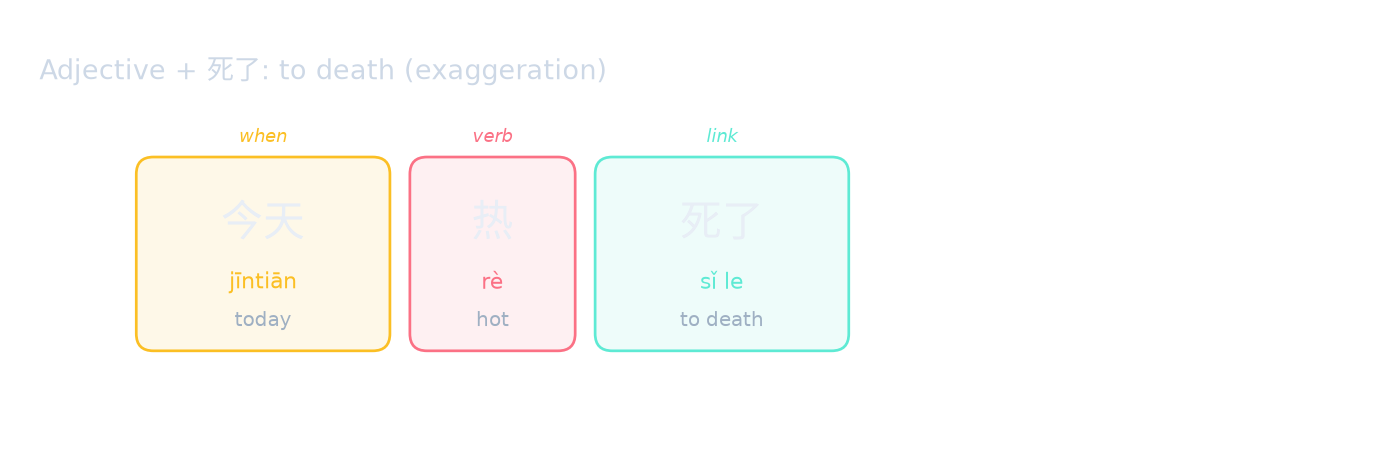
- 2. Adj + to die死(completed / change)了 – extremely …: today今天热死(completed / change)了!
1.2
1. 全 + Noun (the whole / all of)
Form: all全 + group noun + all / both都 + verb
- the whole class全班all / both都at / in在photograph照片inside; in里。 Quán bān dōu zài zhàopiàn li. – The whole class is in the photo.
- whole family全家all / both都to come来(completed / change)了。 Quán jiā dōu lái le. – The whole family came.
- the whole class全班all / both都to pass; through; by means of通过(completed / change)了exam; to take an exam考试。 – The whole class passed the exam.
- 这家company公司the whole year全年all / both都to be infectious招人。 – This company hires all year round.
How it works. all全 quán + noun gathers one bounded group, "the whole …": whole family全家, the whole class全班, 全校, whole nation全国, the whole year全年, whole city全市. all / both都 before the verb usually follows to stress that every member is included; it is common, but not compulsory. On signs: everyone present全场half price半价 (the whole store at half price), whole city全市有雨 (rain across the whole city).
| all全 + noun | each每 / all所有 + noun |
|---|---|
| the whole of one group | every one, separately; all of them |
| whole family全家all / both都to come来(completed / change)了 (our family) | 每个family家庭all / both都to love爱to take a picture拍照 (every family) |
| the whole year全年all / both都at / in在to work; job工作 (the whole year through) | every year每年all / both都to come来 (comes every year) |
Watch out
- whole family全家all / both都to like喜欢this这个restaurant / dining room餐厅 is about this family. "All families" is all所有family家庭.

Vocabulary
Train
| 汉字 | Pinyin | English |
|---|---|---|
| 通过 | tōng guò | to pass; through; by means of |
| 所有 | suǒ yǒu | all |
1.3
2. Adj + 死了 (extremely …)
Form: adjective / feeling verb + to die死(completed / change)了 (casual)
- today今天热死(completed / change)了! Jīntiān rè sǐ le! – It's boiling today!
- this这个school assignment作业难死(completed / change)了。 Zhège zuòyè nán sǐ le. – This homework is impossibly hard.
- to hear听到this这个news; message消息,I / me我happy; glad高兴to die死(completed / change)了! – I was over the moon when I heard!
- want / think / miss想to die死you你(completed / change)了! – I miss you like crazy!
How it works. to die死(completed / change)了 sǐ le after an adjective exaggerates a feeling to the extreme: 累死(completed / change)了, to starve to death饿死(completed / change)了, busy忙to die死(completed / change)了. It ends the clause, and the adjective stands alone. It is casual speech, mostly for complaints, sometimes for strong joy.
| extremely极了 | to die死(completed / change)了 | (degree marker)得extremely; terrible要命 | very非常 / very十分 |
|---|---|---|---|
| enthusiastic, fits praise | casual, mostly complaints | casual | neutral, fits writing |
| 好极了 | 累死(completed / change)了 | tired累(degree marker)得extremely; terrible要命 | this这个area; region地区(modifier / structural particle)的winter冬天very非常cold冷 |
Watch out
- No degree / adjective linker很 in front: wrong: degree / adjective linker很cold冷to die死(completed / change)了 → 冷死(completed / change)了.
- Not in essays or formal emails: write very非常tired累 instead.
Vocabulary
Train
| 汉字 | Pinyin | English |
|---|---|---|
| 死 | sǐ | to die |
| 消息 | xiāo xi | news; message |
| 十分 | shí fēn | very |
1.4
Practice
Cover the teaching pages before you answer. The answers are at the end.
1. all全 + Noun (the whole / all of)
1. The whole family came. ………… home / family / (measure: shops)家all / both都to come来(completed / change)了。
2. the whole class全班all / both都to pass; through; by means of通过(completed / change)了exam; to take an exam考试 means…
- A. the class didn't pass
- B. the whole class passed
- C. only the class leader passed
- D. some students passed
3. Which word usually follows a all全 phrase before the verb?
- A. also也
- B. then / just就
- C. only then / not until才
- D. all / both都
4. True or false? everyone present全场half price半价 on a shop sign means everything in the shop is half price. If false, correct it.
5. Say in Chinese: "It will rain across the whole city tomorrow."
6. The whole school took part in the sports day.
Put in order: 全校 / to participate参加(completed / change)了 / all / both都 / sports competition运动会。
2. Adj + to die死(completed / change)了 (extremely …)
7. Complain to a friend: “I'm exhausted!” 我累…………!
8. Which sentence suits a formal report?
- A. this这个area; region地区(modifier / structural particle)的winter冬天冷死。
- B. this这个area; region地区(modifier / structural particle)的winter冬天degree / adjective linker很cold冷to die死(completed / change)了。
- C. this这个area; region地区(modifier / structural particle)的winter冬天冷死(completed / change)了。
- D. this这个area; region地区(modifier / structural particle)的winter冬天very非常cold冷。
9. Build: “This homework is impossibly hard.”
Put in order: to die死(completed / change)了。 / difficult / hard难 / this这个school assignment作业
10. True or false? want / think / miss想to die死you你(completed / change)了 means “I miss you terribly.” If false, correct it.
11. You come into the classroom after cycling across town in 38 degrees. Use Adj + to die死(completed / change)了. Write your answer in Chinese, then say it aloud.
1.5
Mixed practice
These questions mix the patterns and use new situations.
12. Which sentence is correct?
- A. today今天degree / adjective linker很hot热to die死(completed / change)了。
- B. today今天热死(completed / change)了。
- C. today今天to die死(completed / change)了hot热。
13. Say "The whole family went to the beach."
14. Find and fix the problem. A visitor complains about the heat: weather天气degree / adjective linker很hot热to die死(completed / change)了. Correct the sentence and say when you would use it.
15. Use it yourself. Say that the whole class has arrived, and that you are extremely tired.
1.6
Answers and explanations
Mark your work, then correct each mistake in your own words.
1. all全 + Noun (the whole / all of)
1. all全
all全 + group noun.
2. B. the whole class passed
all全 + group + all / both都: everyone in it.
3. D. all / both都
all全……all / both都 stresses that no one is left out.
4. True.
everyone present全场 = the whole venue.
5. tomorrow明天whole city全市有雨。
all全 + market市.
6. 全校all / both都to participate参加(completed / change)了sports competition运动会。
all全 + group + all / both都 + verb.
2. Adj + to die死(completed / change)了 (extremely …)
7. to die死(completed / change)了
Adj + to die死(completed / change)了 exaggerates the feeling.
8. D. this这个area; region地区(modifier / structural particle)的winter冬天very非常cold冷。
to die死(completed / change)了 is casual; a report uses very非常 or very十分.
9. this这个school assignment作业难死(completed / change)了。
Subject + Adj + to die死(completed / change)了.
10. True.
With want / think / miss想 (miss), to die死 exaggerates the longing.
11. Model answer: today今天热死(completed / change)了!
Check your answer:
- Use it with friends and family; in an essay or a formal email, write very非常tired累 or very十分hungry饿 instead.
- No degree / adjective linker很 or very非常 in front, and nothing between the adjective and to die死(completed / change)了: 累死(completed / change)了, not degree / adjective linker很累死(completed / change)了.
Mixed practice
12. B. to die死(completed / change)了 follows the adjective directly and already means "extremely", so it does not take degree / adjective linker很.
13. whole family全家all / both都to go去coast海边(completed / change)了。all全 + noun covers everyone, and all / both都 usually follows.
14. Say weather天气热死(completed / change)了. to die死(completed / change)了 already means "extremely", so drop degree / adjective linker很. It is casual and exaggerated: fine with friends, not in an essay.
15. Model answer. the whole class全班all / both都to / arrive / (result: get)到(completed / change)了。I / me我累死(completed / change)了。
Review later. Tomorrow, use all全 with two new nouns and make one complaint with to die死(completed / change)了.
Interactive lessons on this topic
Work through it step by step, with instant-check exercises.