HSK 4 adverbs mostly show the speaker's attitude: surprise (unexpectedly竟然, originally / so it turns out原来), pressure (to have no choice but to只好, to have to (be forced)不得不), advice (had better; best最好, be sure to; ten million千万), doubt (I'm afraid (that); probably恐怕, it seems (from this)看来) or how close something came (almost差点, almost / about the same差不多). They go before the verb or adjective. The groups below put adverbs with similar jobs side by side, so learn the differences inside each group.
Adverbs
HSK 4 · Topic 2
 4:49
HSK 4 Grammar 02: Adverbs
Five jobs in one lesson. HSK 4 adverbs measure, judge, intensify, press a question, and advise : the exam tests position and pairing, not vocabulary. Whether 都…
English explanations + Mandarin examples · captions follow the spoken text
2.1
At a glance
Surprise and strong feeling
- 1. originally / so it turns out原来 – so it turns out / all along: originally / so it turns out原来he / him他牙疼,no wonder难怪not不to have a meal吃饭。
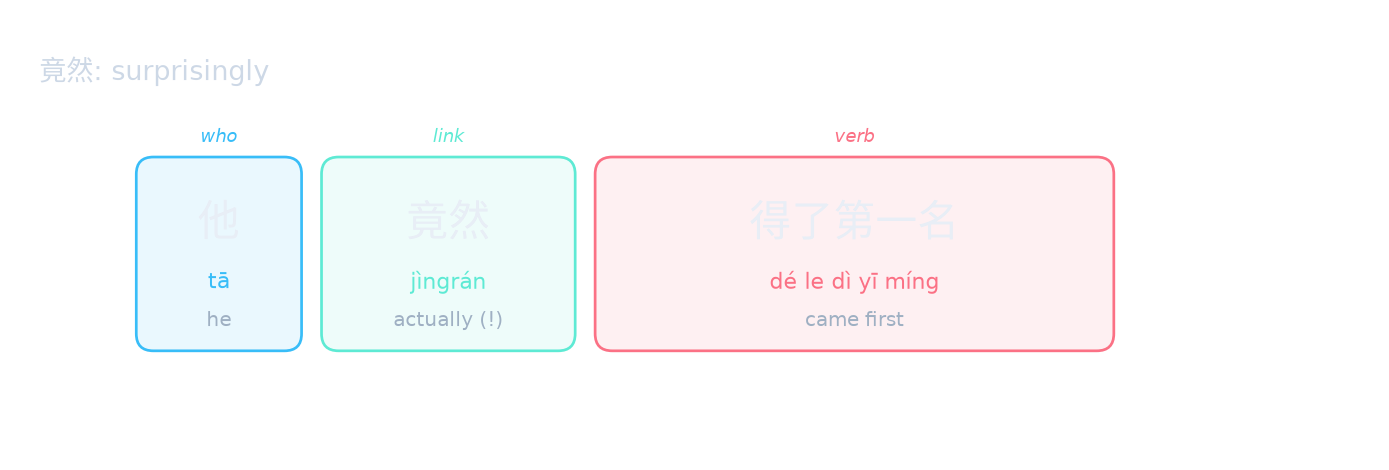
- 2. unexpectedly竟然 – actually / unexpectedly: he / him他unexpectedly竟然(degree marker)得(completed / change)了第一名!
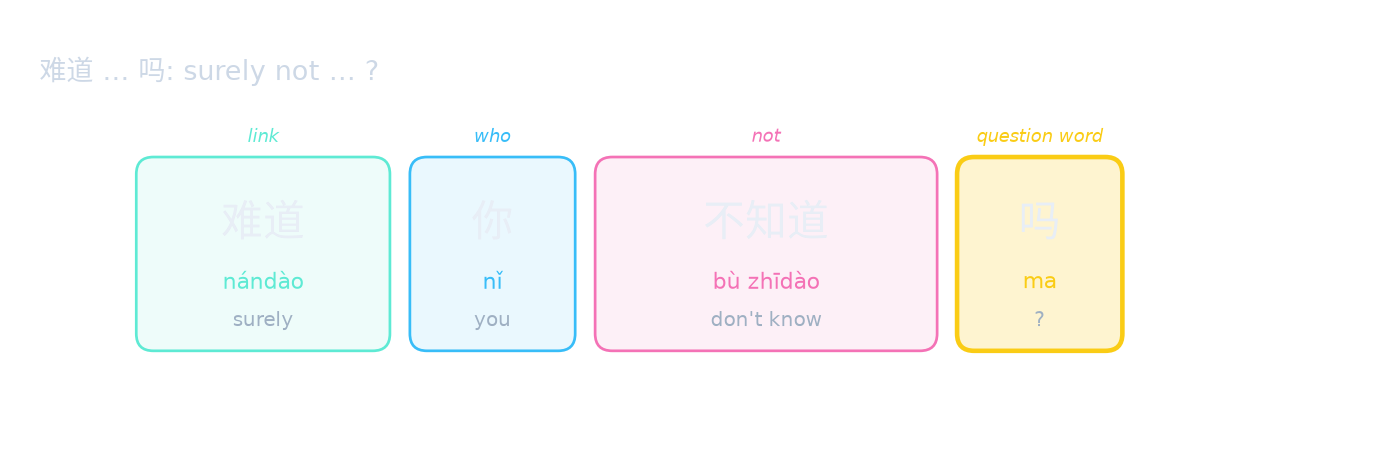
- 3. don't tell me难道 – rhetorical: don't tell me …?: don't tell me难道you你not不to know知道(yes/no ?)吗?
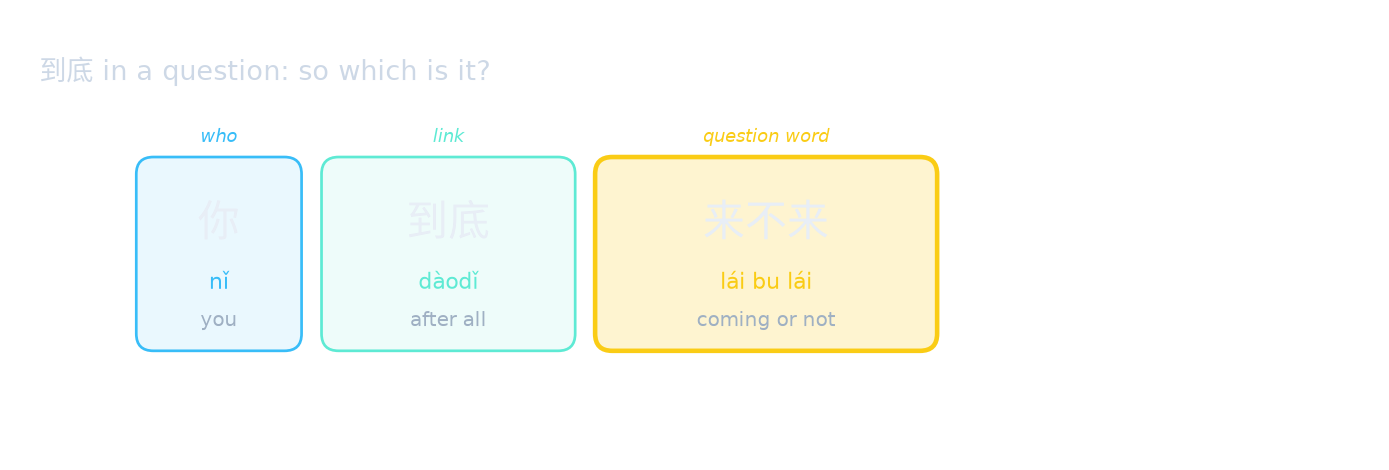
- 4. on earth / in the end到底 – on earth / after all: you你on earth / in the end到底to come来not不to come来?
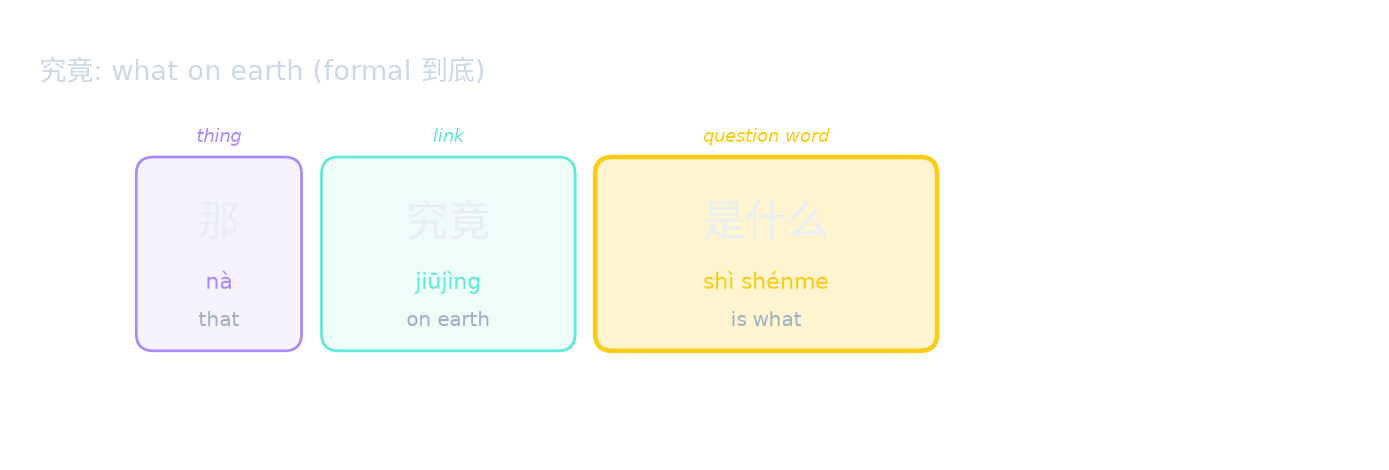
- 5. exactly; on earth (formal)究竟 – exactly / on earth: that那exactly; on earth (formal)究竟to be / is是what什么?
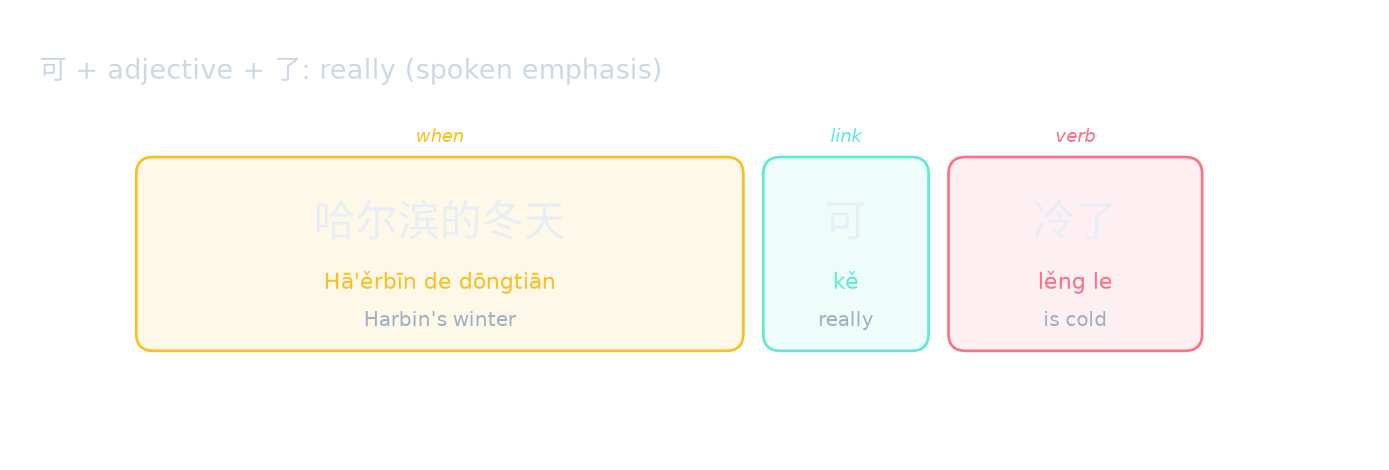
- 6. (prefix) can可 + Adj – emphatic: Harbin, subprovincial city…哈尔滨(modifier / structural particle)的winter冬天可冷(completed / change)了!
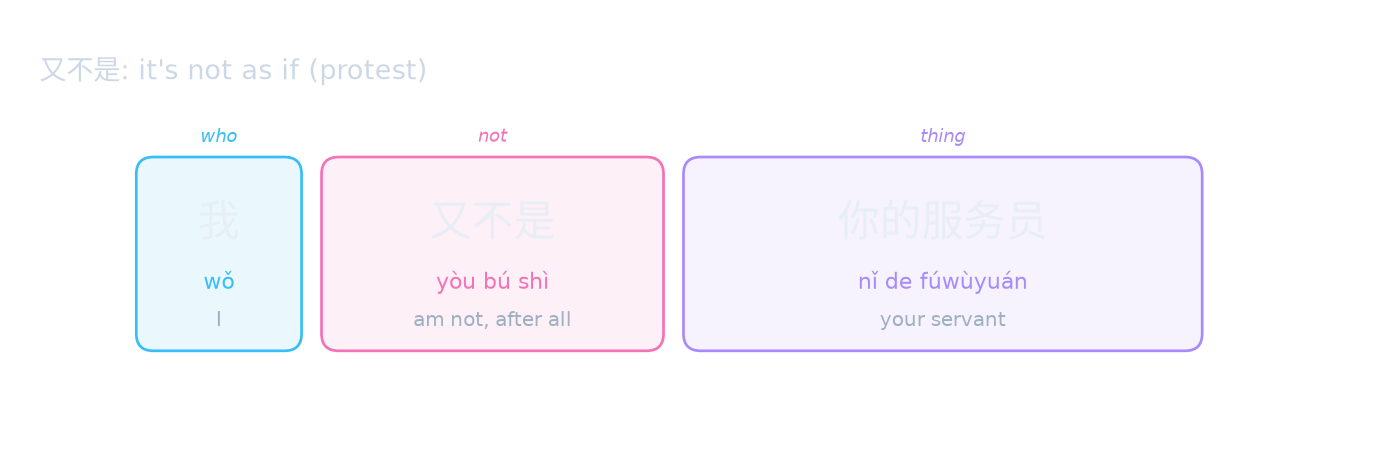
- 7. again又 + not不 / not / haven't没 – emphatic negation: I / me我again又is not / no不是you你(modifier / structural particle)的waiter服务员!
How much – almost, enough, even, especially, slightly
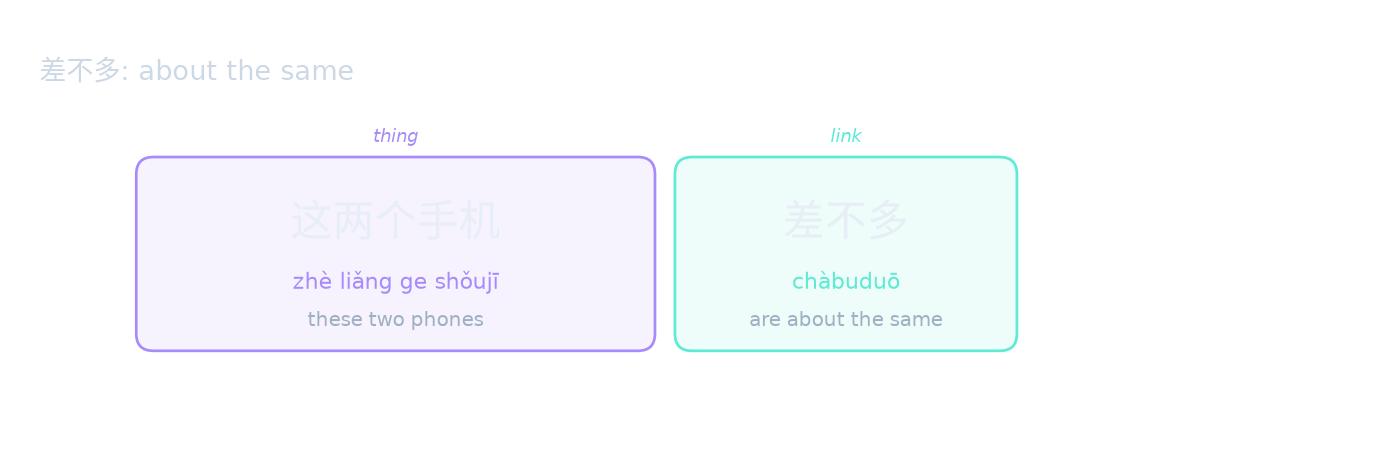
- 8. almost / about the same差不多 – almost / about the same: this这两个mobile phone手机almost / about the same差不多。
- 9. almost差点 – almost / nearly: I / me我almost差点儿to fall down摔倒。
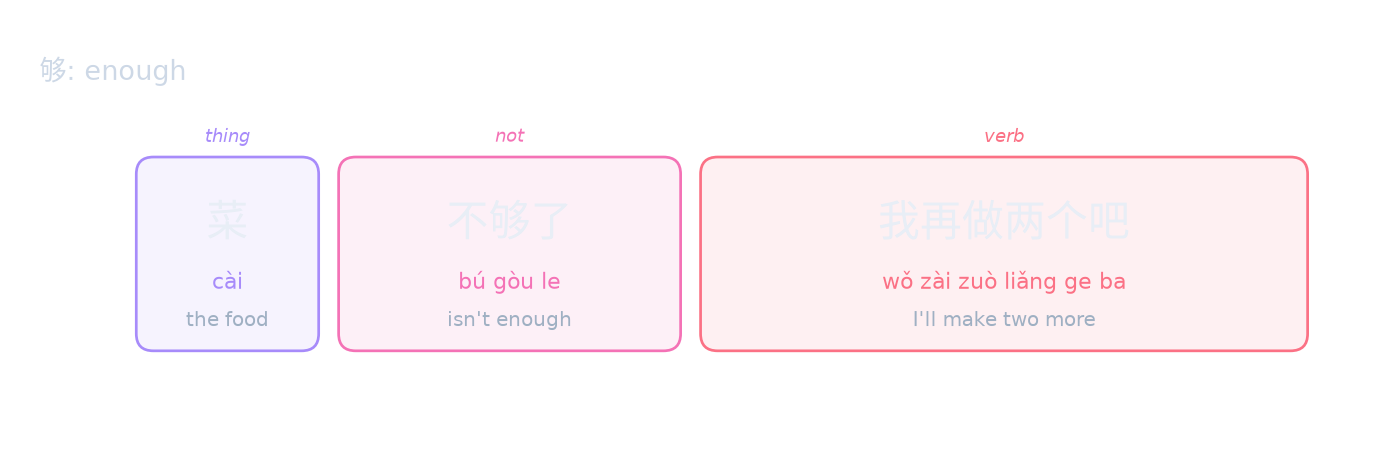
- 10. enough够 – enough / sufficient: dish (of food); vegetable菜not enough不够(completed / change)了,I / me我again / then / (再…也) however再to do; to make做两个(suggestion)吧。
- 11. even (so far as to)甚至 – even / to the point that: she / her她太忙(completed / change)了,even (so far as to)甚至not / haven't没time时间to have a meal吃饭。
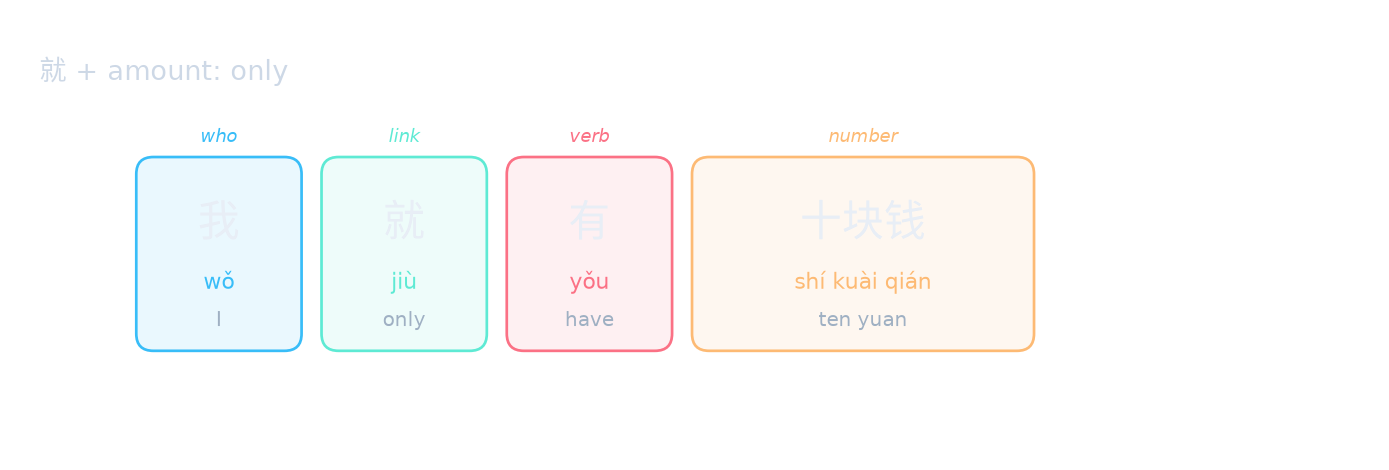
- 12. then / just就 – only / just – small quantity: I / me我then / just就to have / there is有十块钱。
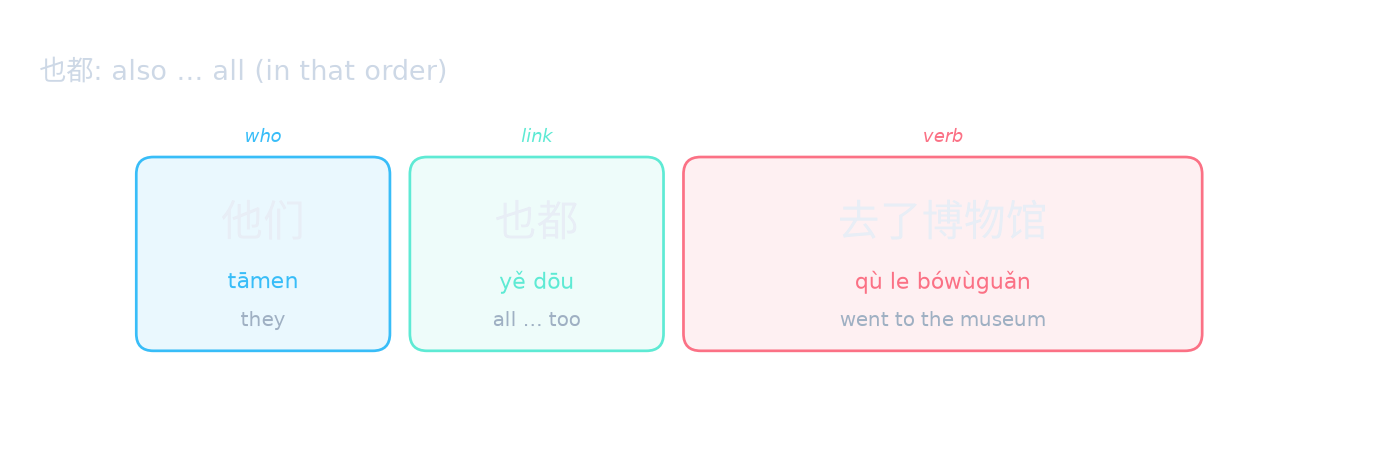
- 13. also也all / both都 – also all of them: they他们also也all / both都to go去(completed / change)了museum博物馆。
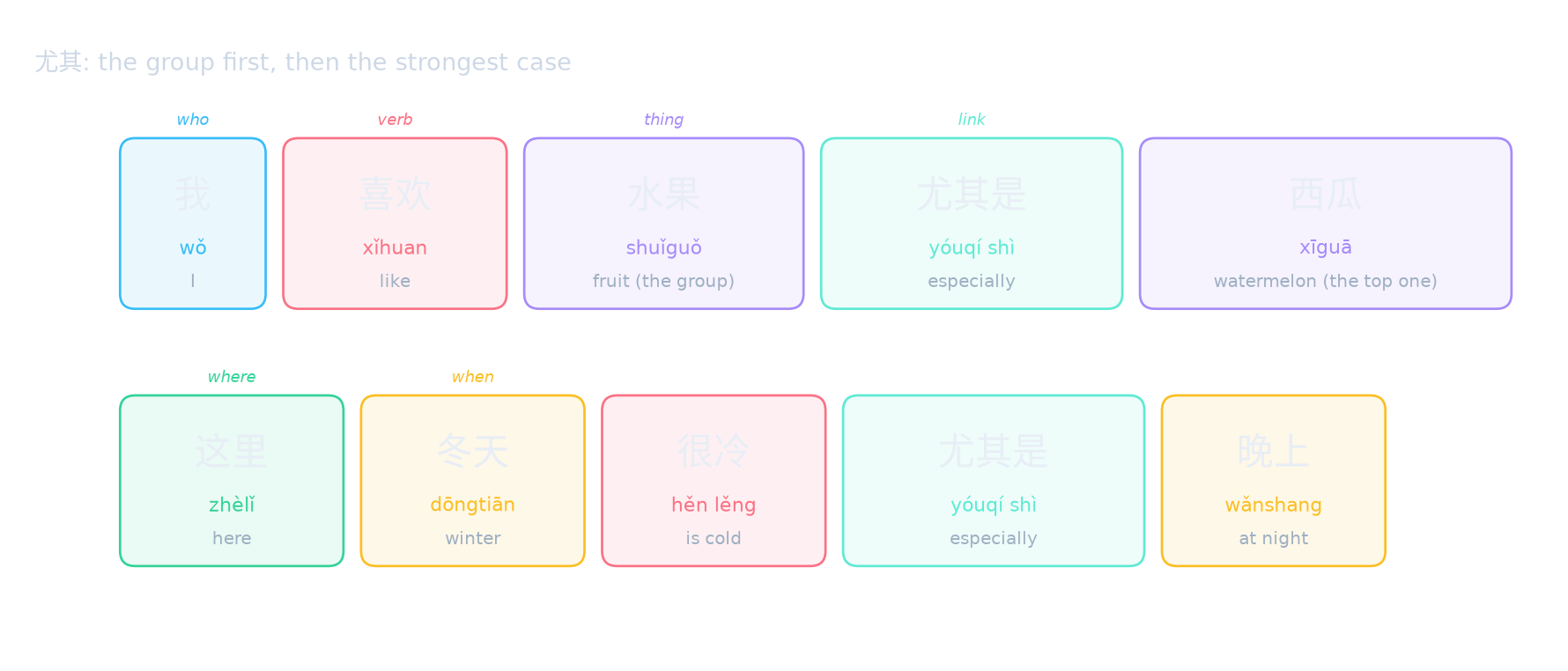
- 14. especially尤其 – especially: I / me我to like喜欢fruit水果,especially尤其to be / is是watermelon西瓜。
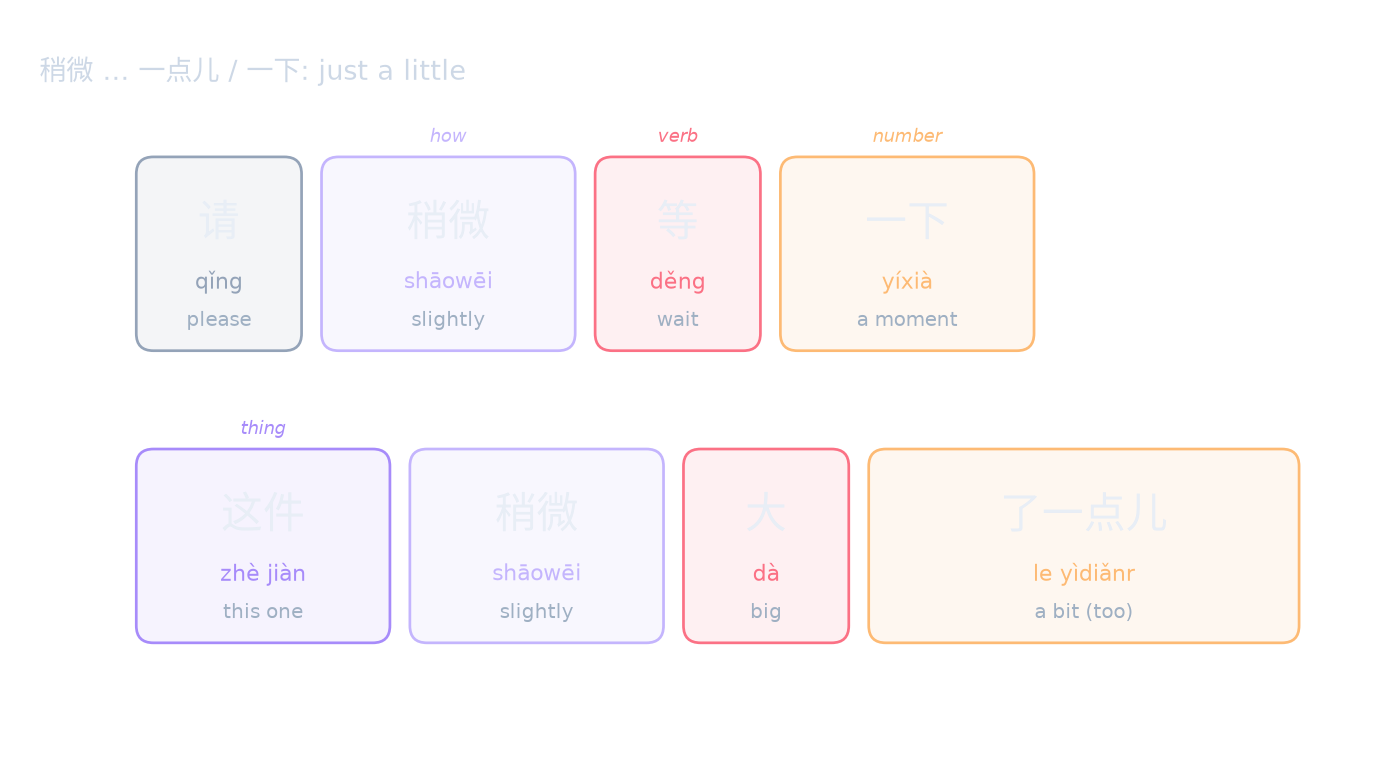
- 15. a little bit稍微 – slightly / a little: 这件a little bit稍微big大(completed / change)了a little一点儿,to have / there is有small小a little一点儿(modifier / structural particle)的(yes/no ?)吗?
- 16. almost几乎 – almost / hardly: almost几乎每个person人all / both都to know知道这件matter事。
- 17. occasionally偶尔 – once in a while: I / me我occasionally偶尔to go去cinema电影院。
- 18. at least至少 and most最many; much多 – at least / at most: to do; to make做this这个dish (of food); vegetable菜at least至少want / will / need要一个hour小时。
Advice and having no choice
- 19. or / still还是 + Verb – had better: we / us我们or / still还是坐地铁(suggestion)吧。
- 20. had better; best最好 – had best / it's best to: you你had better; best最好多喝水,早点儿to sleep睡觉。
- 21. be sure to; ten million千万 – be sure to / whatever you do: you你be sure to; ten million千万别忘了to bring带passport护照!
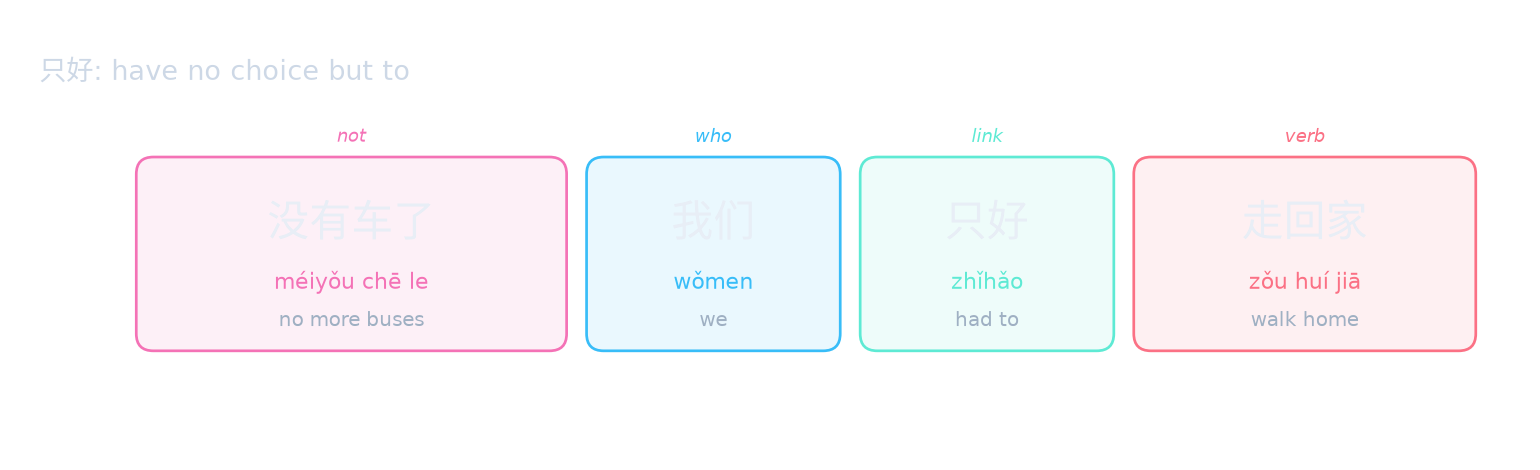
- 22. to have no choice but to只好 – have no choice but to: not have / haven't没有car车(completed / change)了,we / us我们to have no choice but to只好to walk / to leave走to return home回家。
- 23. to have to (be forced)不得不 – have no choice but to: he / him他to have a high temperature发烧(completed / change)了,to have to (be forced)不得不to ask for leave请假。
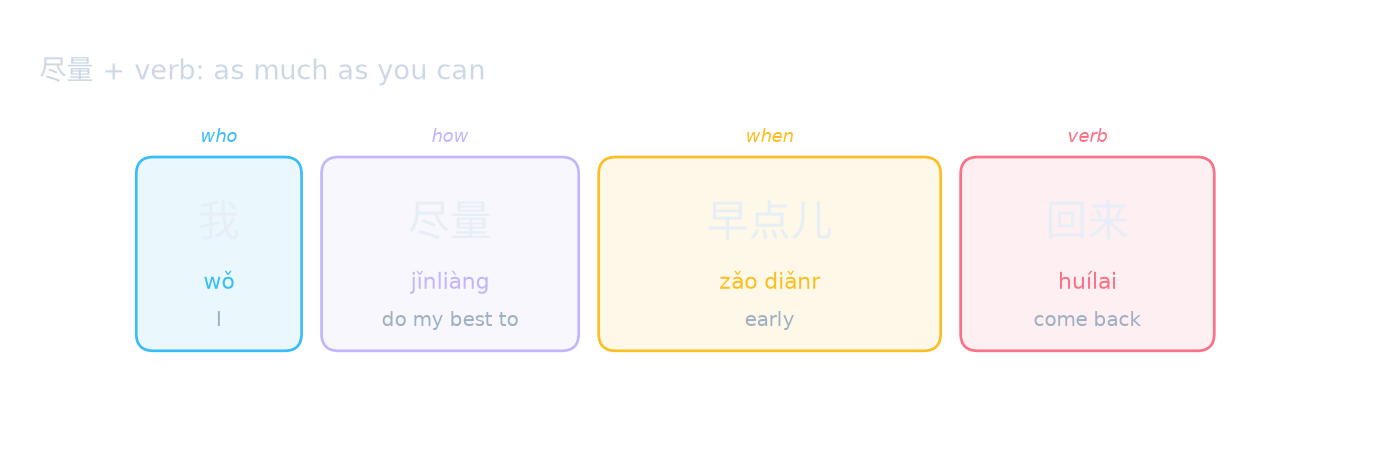
- 24. as much as possible尽量 – as much as possible: I / me我as much as possible尽量早点儿to return回来。
Time, plans and results
- 25. just now刚 + Verb – just did: 我刚down / next; to fall (rain), get off下airplane飞机,a moment一会儿to / for / give给you你to make a telephone call打电话。
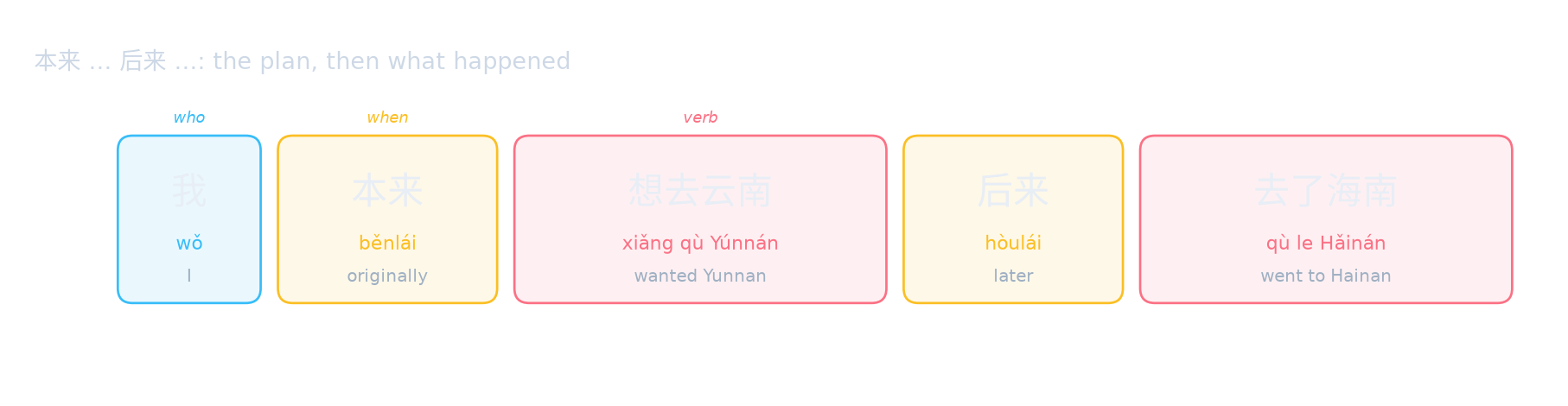
- 26. originally本来 – originally / at first: I / me我originally本来want / think / miss想to go去Yunnan province in…云南,later; afterwards后来to go去(completed / change)了Hainan Province, in the…海南。
- 27. first先 … ,again / then / (再…也) however再 … – first …, then …: you你first先to fill or stuff填this这张表,again / then / (再…也) however再to go去personnel office人事部,then / after然后to lead / to collect领computer电脑。
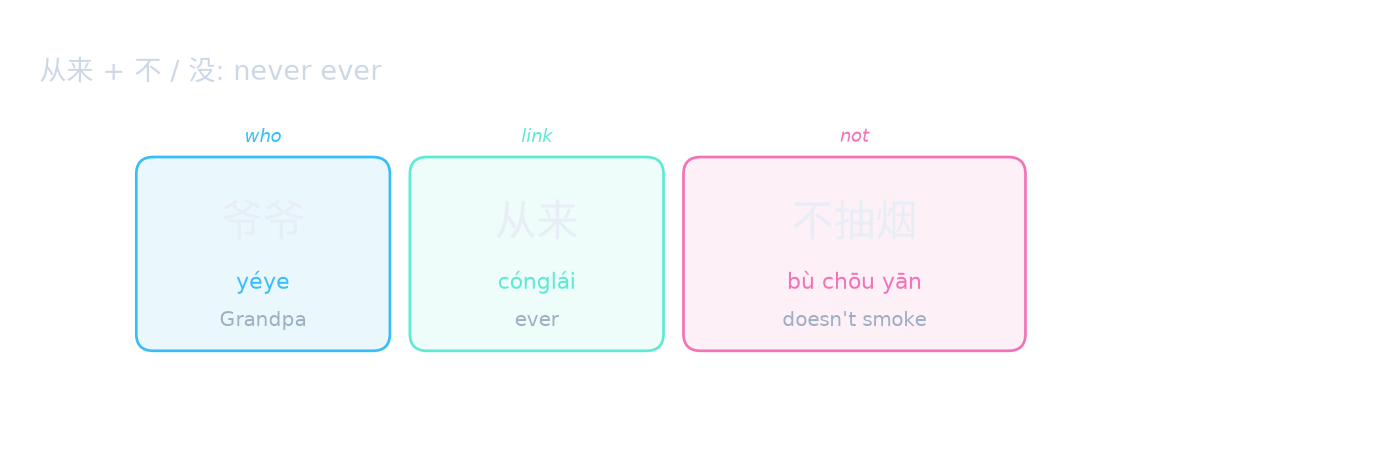
- 28. always (so far); never (with 不 / 没)从来 + not不 / not / haven't没 – never: father's father爷爷never从来不to smoke抽烟。
- 29. just right; just in time正好 – just right / exactly: you你to emerge (from a…来得just right; just in time正好,I / me我正想to / for / give给you你to make a telephone call打电话。
- 30. result; as a result结果 – as a result / in the end: we / us我们to prepare; to plan to准备(completed / change)了一上午,result; as a result结果to rain下雨(completed / change)了。
- 31. on the way; while you're at it顺便 – while you're at it: you你to go去supermarket超市(modifier / structural particle)的time; when时候,on the way; while you're at it顺便to help帮I / me我to buy买一瓶milk牛奶(suggestion)吧。
- 32. suddenly忽然 vs suddenly突然 – suddenly: we / us我们in the middle of正在to have a meal吃饭,lamp灯suddenly忽然to extinguish or put out灭(completed / change)了。
- 33. again重新 vs again / then / (再…也) however再 – start over / once more: this这篇文章我要again重新to write写。
Seeming and guessing
- 34. it seems (from this)看来 – it seems / in one's view: it seems (from this)看来want / will / need要to rain下雨(completed / change)了,we / us我们to return回去(suggestion)吧。
- 35. I'm afraid (that); probably恐怕 – I'm afraid / probably: I'm afraid (that); probably恐怕there's not enough time来不及(completed / change)了。
- 36. probably大概 and maybe也许 – probably / maybe: he / him他probably大概already已经to get home到家(completed / change)了。
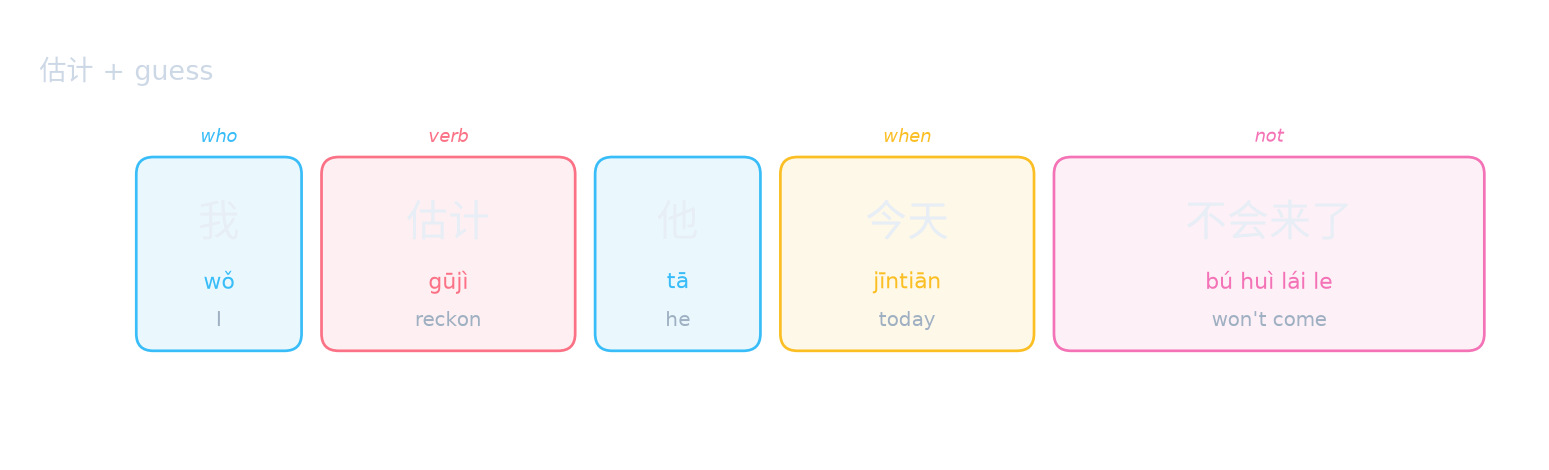
- 37. to estimate; probably估计 – I reckon, to estimate: I / me我to estimate; probably估计he / him他today今天won't / can't不会to come来(completed / change)了。
2.2
1. 原来 (so it turns out / all along)
Form: originally / so it turns out原来 + discovery (,no wonder难怪 …) · originally / so it turns out原来(modifier / structural particle)的 + noun · subject + originally / so it turns out原来 + past state
- originally / so it turns out原来he / him他牙疼,no wonder难怪not不to have a meal吃饭。 Yuánlái tā yá téng, nánguài bù chī fàn. – So he has toothache; no wonder he isn't eating.
- I / me我to think以为he / him他to be / is是teacher老师,originally / so it turns out原来he / him他to be / is是student学生。 – I thought he was a teacher, but it turns out he's a student.
- originally / so it turns out原来to be / is是you你! – Oh, it's you!
- he / him他originally / so it turns out原来to live (somewhere)住at / in在Beijing北京,later; afterwards后来to move搬to / arrive / (result: get)到(completed / change)了Shanghai municipality…上海。 – He originally lived in Beijing; later he moved to Shanghai.
How it works. originally / so it turns out原来 yuánlái has two meanings.
| At the start of a clause | Before a noun, or with a past state |
|---|---|
| a discovery: "so it turns out" | "original(ly)", before a change |
| originally / so it turns out原来to snow下雪(completed / change)了,no wonder难怪so much这么cold冷 | originally / so it turns out原来(modifier / structural particle)的plan计划to be / is是Monday星期一to set off出发 |
As a discovery it often pairs with no wonder难怪 (no wonder) and follows I / me我to think以为 (I thought). originally / so it turns out原来to be / is是this way / so这样! means "So that's how it is!"

Vocabulary
Train
| 汉字 | Pinyin | English |
|---|---|---|
| 原来 | yuán lái | originally; so it turns out |
| 后来 | hòu lái | later; afterwards |
| 计划 | jì huà | plan |
| 出发 | chū fā | to set off |
2.3
2. 竟然 (actually / unexpectedly)
Form: subject + unexpectedly竟然 / unexpectedly居然 + verb
- he / him他unexpectedly竟然(degree marker)得(completed / change)了第一名! Tā jìngrán déle dì yī míng! – He actually won first place!
- so much这么simple简单(modifier / structural particle)的question (in a test)题,I / me我unexpectedly竟然to make an error做错(completed / change)了。 – I actually got such an easy question wrong.
- she / her她unexpectedly竟然not / haven't没to come来! – She actually didn't come!
- 六岁(modifier / structural particle)的child孩子unexpectedly竟然can / will会to speak说三种language语言。 – A six-year-old who can speak three languages!
How it works. unexpectedly竟然 jìngrán marks a surprise: the event goes against what the speaker expected, good or bad. It sits after the subject, before the verb. unexpectedly居然 means the same and is common in speech.
| unexpectedly竟然 / unexpectedly居然 | as expected; sure enough果然 |
|---|---|
| against expectation | just as expected |
| he / him他unexpectedly竟然not / haven't没to come来 | weather forecast天气预报to speak说to rain下雨,as expected; sure enough果然to rain下雨(completed / change)了 |
Watch out
- Only for surprises; a plain fact needs no unexpectedly竟然.
- wrong: unexpectedly竟然他来(completed / change)了 → he / him他unexpectedly竟然to come来(completed / change)了.
Vocabulary
Train
| 汉字 | Pinyin | English |
|---|---|---|
| 竟然 | jìng rán | unexpectedly |
| 语言 | yǔ yán | language |
| 果然 | guǒ rán | as expected; sure enough |
2.4
3. 难道 (rhetorical: don't tell me …?)
Form: don't tell me难道 + statement + (yes/no ?)吗? · subject + don't tell me难道 + … + (yes/no ?)吗?
- don't tell me难道you你not不to know知道(yes/no ?)吗? Nándào nǐ bù zhīdào ma? – Don't tell me you don't know?
- don't tell me难道he / him他really真的to forget忘(completed / change)了(yes/no ?)吗? – Can he really have forgotten?
- don't tell me难道you你not不hungry饿(yes/no ?)吗? – Surely you're hungry?
- so much这么important重要(modifier / structural particle)的matter事,don't tell me难道you你not不should应该先问I / me我(yes/no ?)吗? – Shouldn't you have asked me first about something so important?
How it works. don't tell me难道 nándào makes a rhetorical question: the speaker already believes the answer is the opposite of what the words say. A negative don't tell me难道 question means "surely yes": don't tell me难道you你not不tired累(yes/no ?)吗? = "You must be tired." It shows surprise or reproach. don't tell me难道 goes at the start or after the subject.
| you你to know知道(yes/no ?)吗? | don't tell me难道you你not不to know知道(yes/no ?)吗? |
|---|---|
| a real question | "You must know!" (surprise, annoyance) |
Watch out
- don't tell me难道 never asks for information you don't have.
Vocabulary
Train
| 汉字 | Pinyin | English |
|---|---|---|
| 难道 | nán dào | don't tell me |
2.5
4. 到底 (on earth / after all)
Form: subject + on earth / in the end到底 + question word / A-not-A · on earth / in the end到底 in statements (after all)
- you你on earth / in the end到底to come来not不to come来? Nǐ dàodǐ lái bu lái? – Are you coming or not?
- this这on earth / in the end到底to be / is是what's the matter?怎么回事? Zhè dàodǐ shì zěnme huí shì? – What on earth is going on?
- he / him他on earth / in the end到底to be / is是(measure word)个child孩子,别太to get angry生气。 – He is just a child, after all; don't be too angry.
- we / us我们to wait; and so on等(completed / change)了degree / adjective linker很for a long time久,he / him他on earth / in the end到底or / still还是to come来(completed / change)了。 – We waited a long time, and in the end he did come.
How it works. In a question, on earth / in the end到底 dàodǐ adds impatience or insistence: "on earth, exactly". It goes after the subject, before the question part, and needs a question word or an A-not-A form. In a statement it means "after all" or "in the end".
Watch out
- No (yes/no ?)吗 with on earth / in the end到底: wrong: you你on earth / in the end到底to go去(yes/no ?)吗? → you你on earth / in the end到底去不去?
Vocabulary
Train
| 汉字 | Pinyin | English |
|---|---|---|
| 到底 | dào dǐ | on earth (in questions); after all |
| 等 | děng | to wait; and so on |
2.6
5. 究竟 (exactly / on earth)
Form: topic + exactly; on earth (formal)究竟 + question word / A-not-A
- that那exactly; on earth (formal)究竟to be / is是what什么? Nà jiūjìng shì shénme? – What exactly was it?
- accident事故(modifier / structural particle)的reason; cause原因exactly; on earth (formal)究竟to be / is是what什么? Shìgù de yuányīn jiūjìng shì shénme? – What exactly caused the accident?
- we / us我们exactly; on earth (formal)究竟should应该how / why怎么to do; to make做? – What exactly should we do?
How it works. exactly; on earth (formal)究竟 jiūjìng works like on earth / in the end到底 in questions, but sounds more serious and suits reports and discussions. It goes after the topic and before the question part, and needs a question word or A-not-A.
| on earth / in the end到底 | exactly; on earth (formal)究竟 |
|---|---|
| spoken, often impatient | more formal, calmer |
| also in statements: he / him他on earth / in the end到底or / still还是to come来(completed / change)了 | rarely in statements |
Watch out
- No (yes/no ?)吗: wrong: you你exactly; on earth (formal)究竟to agree同意(yes/no ?)吗? → you你exactly; on earth (formal)究竟to agree同意not不to agree同意?
Vocabulary
Train
| 汉字 | Pinyin | English |
|---|---|---|
| 究竟 | jiū jìng | exactly; on earth (formal) |
| 原因 | yuán yīn | reason; cause |
2.7
6. 可 + Adj (emphatic)
Form: (prefix) can可 + adjective + (completed / change)了 / (and …? / softener)呢 · (prefix) can可 + don't别 / want / will / need要 + verb
- Harbin, subprovincial city…哈尔滨(modifier / structural particle)的winter冬天可冷(completed / change)了! Hā'ěrbīn de dōngtiān kě lěng le! – Harbin winters are really cold!
- this这个film; movie电影(prefix) can可interesting有意思(completed / change)了。 – This film is really interesting.
- you你(prefix) can可别忘了! Nǐ kě bié wàng le! – Don't you forget!
- you你(prefix) can可want / will / need要to be careful小心! – Do be careful!
How it works. (prefix) can可 kě before an adjective adds spoken emphasis: "really, so". It often tells someone something they may not know or believe, and it needs (completed / change)了 or (and …? / softener)呢 at the end. Before don't别 or want / will / need要, it makes a warning or reminder more urgent.
At the start of a clause, (prefix) can可 is short for but可是 "but": I / me我want / think / miss想to go去,(prefix) can可not / haven't没time时间.
Watch out
- wrong: 可冷 alone → 可冷(completed / change)了.
- In writing, use very非常 or very十分 instead.
Vocabulary
Train
| 汉字 | Pinyin | English |
|---|---|---|
| 可是 | kě shì | but |
| 十分 | shí fēn | very |
2.8
7. 又 + 不 / 没 (emphatic negation)
Form: subject + again又 + not不 / not / haven't没 + verb (protest)
- I / me我again又is not / no不是you你(modifier / structural particle)的waiter服务员! Wǒ yòu bú shì nǐ de fúwùyuán! – I'm not your waiter, you know!
- you你别怪he / him他,he / him他again又not / haven't没to do; to make做wrong; mistake错。 Nǐ bié guài tā, tā yòu méi zuòcuò. – Don't blame him; it's not as if he did anything wrong.
- to be afraid怕what什么?he / him他again又won't / can't不会to eat吃(completed / change)了you你。 – What are you afraid of? He's not going to eat you.
- I / me我again又is not / no不是not want to不想to go去。 – It's not that I don't want to go.
How it works. Here again又 does not mean "again". Before not不 or not / haven't没 it strengthens the denial to reject what someone assumes: "it's not as if …". It is spoken and often impatient or defensive, and usually explains a reaction (别怪he / him他, to be afraid怕what什么).
| again又not不 / again又not / haven't没 | and并not不 / and并not / haven't没 |
|---|---|
| personal, emotional, spoken | calm, more written |
| I / me我again又is not / no不是child小孩子! | this这个question / problem问题and并不难。 |
Watch out
- In a neutral statement, plain not不 / not / haven't没 is enough: he / him他not / haven't没to do; to make做wrong; mistake错.
2.9
8. 差不多 (almost / about the same)
Form: A with / and跟 / and / with和 B almost / about the same差不多 (+ adjective) · almost / about the same差不多 + number / time / all / both都
- this这两个mobile phone手机almost / about the same差不多。 Zhè liǎng ge shǒujī chàbuduō. – These two phones are about the same.
- I / me我with / and跟I / me我older brother哥哥almost / about the same差不多tall; high高。 Wǒ gēn wǒ gēge chàbuduō gāo. – I'm about as tall as my brother.
- almost / about the same差不多十点(completed / change)了。 – It's almost ten.
- classmate同学(plural)们almost / about the same差不多all / both都to come来(completed / change)了。 – Almost all the classmates have come.
How it works. almost / about the same差不多 chàbuduō has two jobs, told apart by position.
| After the things compared | Before a number, time or all / both都 |
|---|---|
| "about the same, similar" | "almost, about" |
| price价格almost / about the same差不多 | almost / about the same差不多五十个person人 |
After a verb + (degree marker)得 it can mean "nearly done": school assignment作业写得almost / about the same差不多(completed / change)了. almost / about the same差不多就行了 means "that's good enough".
| almost / about the same差不多 | almost差点儿 |
|---|---|
| about, almost (an amount) | nearly happened, but didn't |
| almost / about the same差不多十点(completed / change)了 | I / me我almost差点儿to arrive late迟到 |
Vocabulary
Train
| 汉字 | Pinyin | English |
|---|---|---|
| 差不多 | chà bu duō | almost; about the same |
| 价格 | jià gé | price |
2.10
9. 差点 (almost / nearly)
Form: subject + almost差点儿 (+ not / haven't没) + verb (+ (completed / change)了)
- I / me我almost差点儿to fall down摔倒。 Wǒ chàdiǎnr shuāidǎo. – I nearly fell.
- I / me我almost差点儿to forget忘(completed / change)了you你(modifier / structural particle)的birthday生日! Wǒ chàdiǎnr wàngle nǐ de shēngrì! – I nearly forgot your birthday!
- I / me我almost差点儿not / haven't没to catch / keep up with赶上train火车。 – I nearly missed the train (but caught it).
- he / him他almost差点儿没考上university大学。 – He nearly failed to get into university (but got in).
How it works. almost差点儿 chàdiǎnr + verb: something almost happened, but did not. It goes after the subject, before the verb. The tricky part is adding not / haven't没.
| Result | almost差点儿 + verb | almost差点儿not / haven't没 + verb |
|---|---|---|
| unwanted (fall, crash) | nearly happened | the same: nearly happened |
| wanted (pass, catch) | nearly happened, but didn't: almost差点儿to pass a university…考上 = just failed | it did happen, only just: almost差点儿没考上 = only just passed |
Watch out
- almost差点儿 (nearly happened) is not almost / about the same差不多 (about, in amount): almost / about the same差不多十点(completed / change)了.

2.11
10. 够 (enough / sufficient)
Form: noun + (not不)enough够 · enough够 + verb (enough to) · enough够 + adjective
- dish (of food); vegetable菜not enough不够(completed / change)了,I / me我again / then / (再…也) however再to do; to make做两个(suggestion)吧。 Cài bú gòu le, wǒ zài zuò liǎng ge ba. – There isn't enough food; I'll make two more dishes.
- money钱够不够? Qián gòu bu gòu? – Is there enough money?
- money钱够买一张ticket票。 – The money is enough to buy one ticket.
- these这些water水not enough不够to drink喝。 – This water isn't enough to drink.
How it works. enough够 gòu "enough" follows the thing that is enough: 钱够(completed / change)了, time时间not enough不够, we / us我们人够(completed / change)了. To say what it is enough for, put the verb after enough够: 够吃, adequate够用, 够买一张ticket票. enough够 + adjective means "… enough": this这个room房间enough够big大. enough足够 is more formal: we / us我们to have / there is有enough足够(modifier / structural particle)的time时间.
Watch out
- 够吃 (enough to eat) is not 吃够 (have had your fill of something).
Vocabulary
Train
| 汉字 | Pinyin | English |
|---|---|---|
| 够 | gòu | enough |
2.12
11. 甚至 (even / to the point that)
Form: …,even (so far as to)甚至 + strongest point · even (so far as to)甚至 + even连 … all / both都 / also也
- she / her她busy忙(degree marker)得even (so far as to)甚至not / haven't没time时间to have a meal吃饭。 Tā máng de shènzhì méi shíjiān chī fàn. – She's so busy she doesn't even have time to eat.
- this这首歌adult大人to like喜欢,child孩子to like喜欢,even (so far as to)甚至old man or woman老人also也to like喜欢。 – Adults like this song, children like it, even old people like it.
- he / him他even (so far as to)甚至even连oneself自己(modifier / structural particle)的name名字all / both都写错(completed / change)了。 – He even wrote his own name wrong.
- he / him他not不to speak; to talk说话,even (so far as to)甚至不看I / me我。 – He won't speak; he won't even look at me.
How it works. even (so far as to)甚至 shènzhì "even" introduces the most extreme or surprising point. It goes before the part it highlights, usually last in a list. It is more formal than even连……all / both都 alone, and the two often appear together. Unlike even连……all / both都, it can also join whole clauses to raise the stakes.
Watch out
- The even (so far as to)甚至 item must be the strongest one: in summer夏天hot热,spring (season)春天also也hot热,even (so far as to)甚至winter冬天also也not不cold冷, it comes before the most surprising part.

Vocabulary
Train
| 汉字 | Pinyin | English |
|---|---|---|
| 甚至 | shèn zhì | even (so far as to) |
| 连 | lián | even |
2.13
12. 就 (only / just – small quantity)
Form: then / just就 + amount / person (only)
- I / me我then / just就to have / there is有十块钱。 Wǒ jiù yǒu shí kuài qián. – I've only got ten yuan.
- then / just就两个人来(completed / change)了。 Jiù liǎng ge rén lái le. – Only two people came.
- I / me我then / just就去过once / one time一次。 – I've only been once.
- then / just就so much这么many; much多(completed / change)了? – Is that all?
How it works. Before an amount or a person, then / just就 means "only, just". It is casual and matter-of-fact, and is stressed in speech. Between a time and a verb, then / just就 has its other meaning, "as early as": he / him他六点then / just就to get up起床(completed / change)了.
| only只 | then / just就 | only then / not until才 |
|---|---|---|
| neutral "only" | casual "only" | "only", with surprise |
| I / me我only (if) / only have只有十块钱 | I / me我then / just就to have / there is有十块钱 | he / him他only then / not until才十岁! |
2.14
13. 也都 (also all of them)
Form: subject + also也 + all / both都 + verb / not不 / not / haven't没
- they他们also也all / both都to go去(completed / change)了museum博物馆。 Tāmen yě dōu qùle bówùguǎn. – They all went to the museum too.
- I / me我(modifier / structural particle)的friend朋友to like喜欢this这首歌,I / me我(modifier / structural particle)的father and mother父母also也all / both都to like喜欢。 – My friends like this song, and my parents both like it too.
- they他们also也all / both都not不to know知道。 – None of them knows either.
How it works. also也 adds this group to another; all / both都 says every member of the group is included. Together they come after the subject, in a fixed order: also也 first, then all / both都.
| we / us我们all / both都to go去 | we / us我们also也to go去 | we / us我们also也all / both都to go去 |
|---|---|---|
| all of us are going | we are going too | we are all going too |
Watch out
- wrong: all / both都also也 → also也all / both都.
2.15
14. 尤其 (especially)
Form: general fact,especially尤其to be / is是 + noun · subject + especially尤其 + verb / adjective
- I / me我to like喜欢fruit水果,especially尤其to be / is是watermelon西瓜。 Wǒ xǐhuan shuǐguǒ, yóuqí shì xīguā. – I like fruit, especially watermelon.
- he / him他to like喜欢sports / to exercise运动,especially尤其to be / is是踢足球。 – He likes sport, especially football.
- here这里winter冬天degree / adjective linker很cold冷,evening晚上especially尤其cold冷。 – Winters here are cold, and the nights are especially cold.
How it works. First say something about a whole group; then especially尤其 picks out the one case that fits it most. especially尤其to be / is是 comes before a noun; especially尤其 alone goes before a verb or adjective, after the subject.
| especially / special特别good好 | I / me我especially / special特别to like喜欢autumn秋天 | I / me我especially尤其to like喜欢autumn秋天 |
|---|---|---|
| really good (very) | I especially like autumn | I especially like autumn |
Watch out
- wrong: especially尤其to be / is是dumpling饺子,I / me我to like喜欢China中国dish (of food); vegetable菜 → I / me我to like喜欢China中国dish (of food); vegetable菜,especially尤其to be / is是dumpling饺子 (the group comes first).
- For plain "very" with no group, use degree / adjective linker很 or especially / special特别, not especially尤其.
Vocabulary
Train
| 汉字 | Pinyin | English |
|---|---|---|
| 尤其 | yóu qí | especially |
| 饺子 | jiǎo zi | dumpling |
2.16
15. 稍微 (slightly / a little)
Form: a little bit稍微 + adjective + a little一点儿 / some一些 · a little bit稍微 + verb + (used after a verb) give it…一下 / a little一点儿
- today今天than / compared to比yesterday昨天a little bit稍微warm暖和a little一点儿。 Jīntiān bǐ zuótiān shāowēi nuǎnhuo yìdiǎnr. – Today is a little warmer than yesterday.
- please; to invite请a little bit稍微to wait; and so on等(used after a verb) give it…一下。 – Please wait a moment.
- you你can / be able to能a little bit稍微说慢a little一点儿(yes/no ?)吗? – Could you speak a little more slowly?
How it works. a little bit稍微 makes a difference or an action small. It goes before the adjective or verb, and a small amount (a little一点儿, some一些, (used after a verb) give it…一下) goes after it. With a verb, it makes a request sound polite.
| slightly有点儿expensive贵 | a little bit稍微expensive贵a little一点儿 | a little bit稍微to wait; and so on等(used after a verb) give it…一下 |
|---|---|---|
| a bit (too) expensive – a complaint | a little more expensive – a comparison | wait a moment – a polite request |
Watch out
- wrong: a little bit稍微expensive贵 → a little bit稍微expensive贵a little一点儿.
- wrong: to wait; and so on等a little bit稍微(used after a verb) give it…一下 → a little bit稍微to wait; and so on等(used after a verb) give it…一下.
- a little bit稍微slightly有点儿 + adjective is also fine: a little bit稍微slightly有点儿expensive贵 is a very soft complaint.
Vocabulary
Train
| 汉字 | Pinyin | English |
|---|---|---|
| 稍微 | shāo wēi | a little bit |
| 暖和 | nuǎn huo | warm |
2.17
16. 几乎 (almost / hardly)
Form: almost几乎 + all / both都 / each每 / all所有 … · almost几乎 + not不 / not / haven't没 + verb
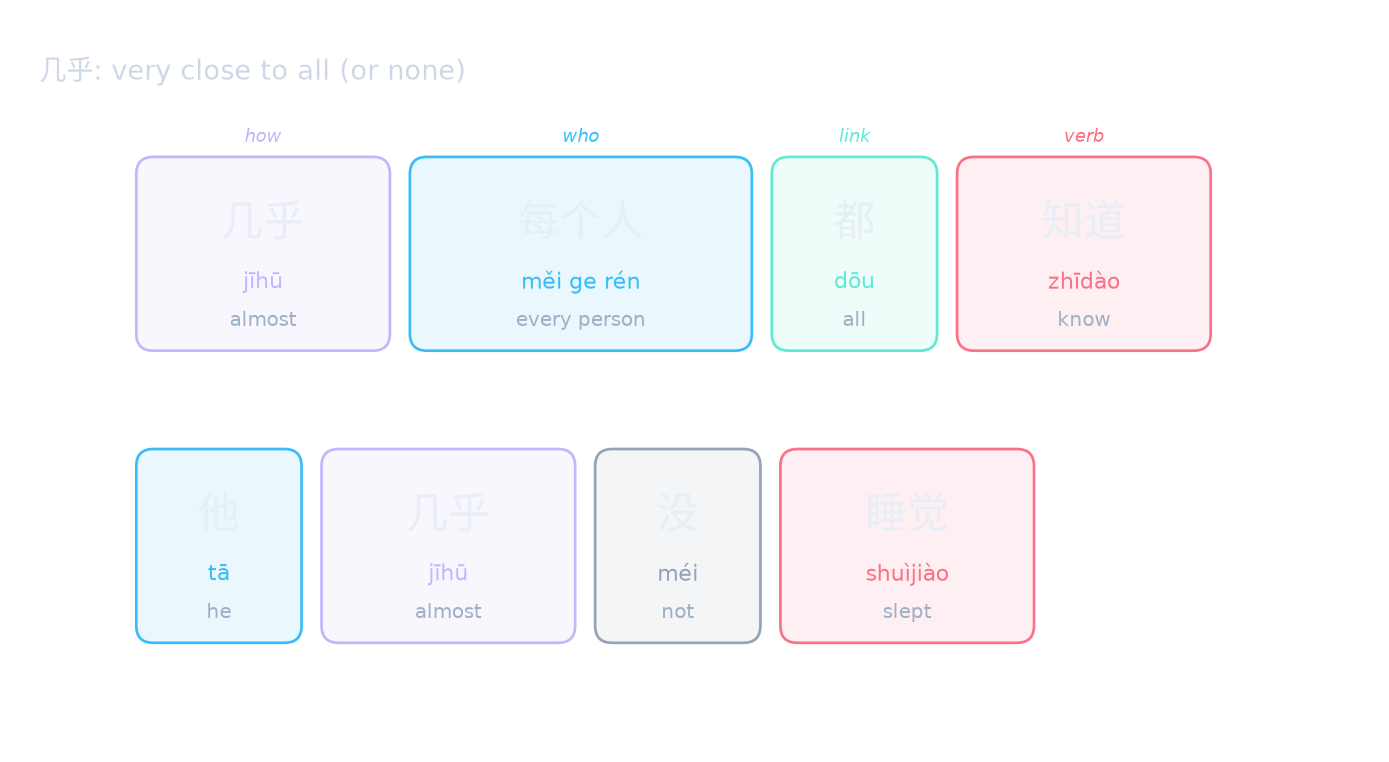
- almost几乎每个person人all / both都to know知道这件matter事。 Jīhū měi ge rén dōu zhīdào zhè jiàn shì. – Almost everyone knows about it.
- he / him他almost几乎every day每天all / both都to run; to jog跑步。 – He runs almost every day.
- he / him他yesterday昨天almost几乎not / haven't没to sleep睡觉。 – He hardly slept last night.
How it works. almost几乎 says something is very close to the whole amount. With all / both都, each每 or all所有 it means "almost all"; with not不 or not / haven't没 it means "hardly, almost never". It goes after the subject, before the verb.
| almost几乎every day每天 | almost差点儿to arrive late迟到 | almost / about the same差不多 |
|---|---|---|
| almost every day (how much) | nearly late (a close call) | about the same; can stand alone |
Watch out
- For a close call, almost差点儿 is the most common word (almost几乎to fall down摔倒 "nearly fell" is also possible).
- wrong: this这两个almost几乎 → this这两个almost / about the same差不多 (almost几乎 cannot stand alone).
Vocabulary
Train
| 汉字 | Pinyin | English |
|---|---|---|
| 所有 | suǒ yǒu | all |
2.18
17. 偶尔 (once in a while)
Form: subject + occasionally偶尔 + verb
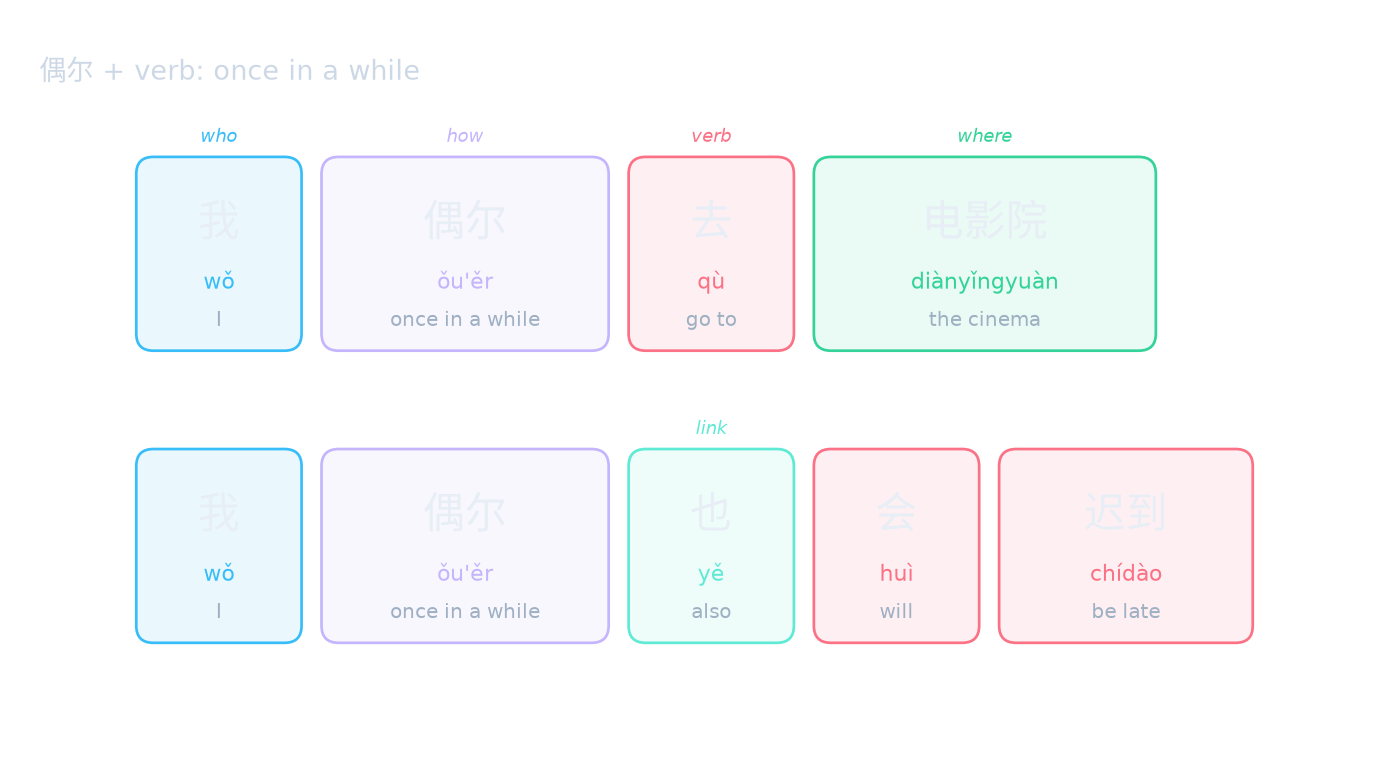
- I / me我occasionally偶尔to go去cinema电影院。 Wǒ ǒu'ěr qù diànyǐngyuàn. – I go to the cinema once in a while.
- he / him他not不often常to drink (alcohol)喝酒,occasionally偶尔to drink喝a little一点儿。 – He doesn't drink often, just a little now and then.
- weekend周末I / me我occasionally偶尔to go去to climb a mountain爬山。 – At weekends I go hiking now and then.
How it works. occasionally偶尔 says something happens, but rarely. Like the other "how often" words, it comes after the subject and before the verb.
| always总是 | often经常 | sometimes有时候 | occasionally偶尔 | never从来不 |
|---|---|---|---|---|
| always | often | sometimes | once in a while | never |
Watch out
- wrong: I / me我to play basketball打篮球occasionally偶尔 → I / me我occasionally偶尔to play basketball打篮球.
- One single time is once / one time一次, not occasionally偶尔: last year去年I / me我去过once / one time一次Shanghai municipality…上海.
Vocabulary
Train
| 汉字 | Pinyin | English |
|---|---|---|
| 偶尔 | ǒu ěr | occasionally |
2.19
18. 至少 and 最多 (at least / at most)
Form: at least至少 / most最many; much多 + verb or number · at least至少 + sentence
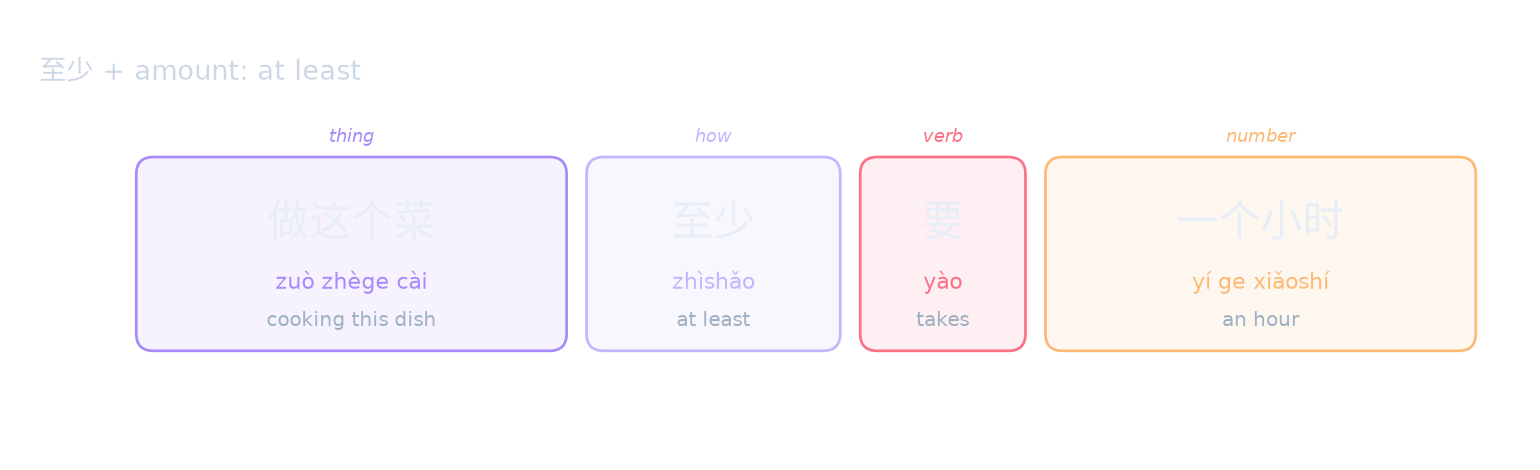
- to do; to make做this这个dish (of food); vegetable菜at least至少want / will / need要一个hour小时。 Zuò zhège cài zhìshǎo yào yí ge xiǎoshí. – This dish takes at least an hour to cook.
- I / me我most最many; much多to wait; and so on等you你十分钟。 – I'll wait ten minutes for you, at most.
- although虽然to lose a game输(completed / change)了,but但at least至少we / us我们to work hard / effort努力(completed / change)了。 – We lost, but at least we tried our best.
How it works. at least至少 sets a lower limit and most最many; much多 an upper limit; both go before the verb or number. at least至少 + a sentence gives the smallest thing that should happen, or the one good point.
| at least至少一个hour小时 | most最many; much多十分钟 | 一百person人above / the above以上 |
|---|---|---|
| at least an hour | ten minutes at most | over a hundred people |
Watch out
- wrong: at least至少一百person人above / the above以上 → at least至少一百person人.
Vocabulary
Train
| 汉字 | Pinyin | English |
|---|---|---|
| 至少 | zhì shǎo | at least |
| 输 | shū | to lose a game |
2.20
19. 还是 + Verb (had better)
Form: (subject +) or / still还是 + verb (+ (suggestion)吧) · or / still还是 + not不 + verb + (completed / change)了
- we / us我们or / still还是坐地铁(suggestion)吧。 Wǒmen háishi zuò dìtiě ba. – We'd better take the subway.
- to rain下雨(completed / change)了,we / us我们or / still还是to be at home在家(suggestion)吧。 – It's raining; we'd better stay home.
- want / think / miss想(completed / change)了want / think / miss想,I / me我or / still还是不去(completed / change)了。 Xiǎngle xiǎng, wǒ háishi bú qù le. – I thought it over, and I'm not going after all.
How it works. Before a verb in a statement, or / still还是 háishi means "had better": a decision reached after weighing the options. (suggestion)吧 makes it a gentle suggestion. or / still还是not不……(completed / change)了 reverses a plan.
| or / still还是 + verb | A or / still还是 B? | had better; best最好 + verb |
|---|---|---|
| had better, after weighing options | "or" in a question | direct advice |
| we / us我们or / still还是to take a taxi (in town)打车(suggestion)吧 | you你to go去or / still还是I / me我to go去? | you你had better; best最好早点儿to go去 |

Vocabulary
Train
| 汉字 | Pinyin | English |
|---|---|---|
| 最好 | zuì hǎo | had better; best |
2.21
20. 最好 (had best / it's best to)
Form: subject + had better; best最好 + verb · had better; best最好don't别 / had better; best最好don't不要 + verb
- you你had better; best最好多喝水,早点儿to sleep睡觉。 Nǐ zuìhǎo duō hē shuǐ, zǎodiǎnr shuìjiào. – You'd best drink plenty of water and go to bed early.
- had better; best最好in advance / move earlier提前to book tickets订票,otherwise; or else不然买不到。 – It's best to book in advance, or you won't get a ticket.
- you你tonight今晚had better; best最好don't别to drive a car开车。 – You'd better not drive tonight.
How it works. had better; best最好 zuìhǎo + verb gives friendly but clear advice: "it's best to, you'd better". It goes after the subject. had better; best最好(modifier / structural particle)的 + noun is a different use: "the best" (he / him他to be / is是I / me我had better; best最好(modifier / structural particle)的friend朋友).
| should应该 | had better; best最好 |
|---|---|
| what is right or expected | the wisest option |
| you你should应该to apologize道歉 | you你had better; best最好first先to apologize道歉 |
Watch out
- "Better not" is wrong: not不had better; best最好to go去 → had better; best最好别去.

Vocabulary
Train
| 汉字 | Pinyin | English |
|---|---|---|
| 提前 | tí qián | in advance; to bring forward |
| 道歉 | dào qiàn | to apologize |
2.22
21. 千万 (be sure to / whatever you do)
Form: (subject +) be sure to; ten million千万 + don't别 / don't不要 / want / will / need要 + verb
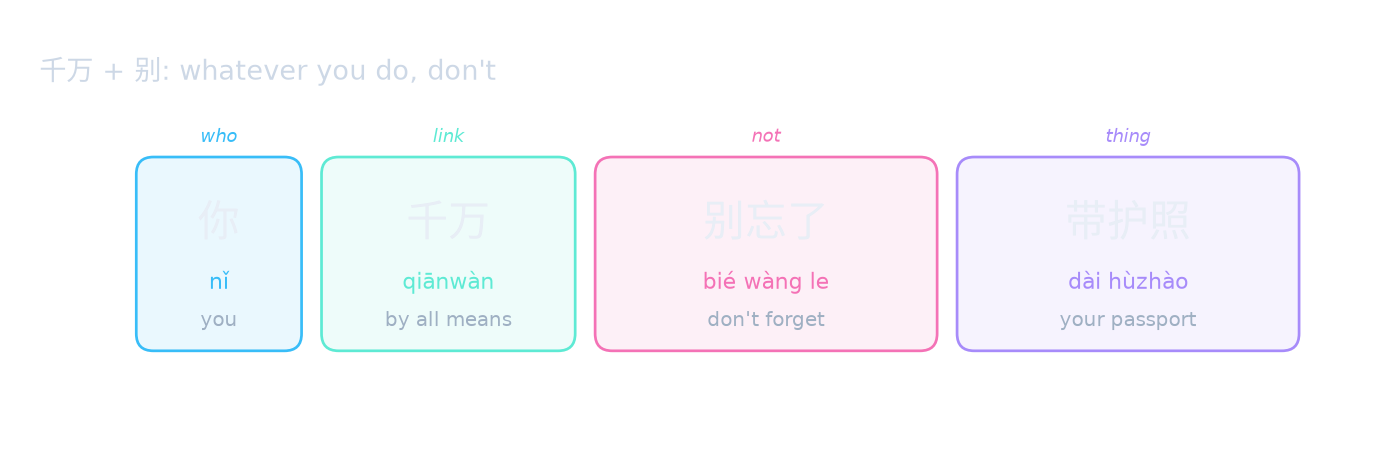
- you你be sure to; ten million千万别忘了to bring带passport护照! Nǐ qiānwàn bié wàngle dài hùzhào! – Whatever you do, don't forget your passport!
- 这件matter事be sure to; ten million千万don't不要to tell告诉other people别人。 – Whatever you do, don't tell anyone about this.
- you你be sure to; ten million千万want / will / need要to take note of注意body; health身体。 – Do take care of yourself.
How it works. be sure to; ten million千万 qiānwàn makes advice or a warning urgent: "whatever you do, (don't) …". It goes before don't别 / don't不要 / want / will / need要, after the subject. It is mostly used to warn against something going wrong.
| definitely / certain一定want / will / need要 | 千万别 / be sure to; ten million千万want / will / need要 |
|---|---|
| must, definitely | urgent warning or reminder |
| you你definitely / certain一定want / will / need要to come来 | you你千万别to arrive late迟到 |
Watch out
- Only in advice or requests, never to describe facts: wrong: he / him他be sure to; ten million千万not / haven't没to come来.
Vocabulary
Train
| 汉字 | Pinyin | English |
|---|---|---|
| 千万 | qiān wàn | be sure to; ten million |
2.23
22. 只好 (have no choice but to)
Form: obstacle,subject + to have no choice but to只好 + verb
- not have / haven't没有car车(completed / change)了,we / us我们to have no choice but to只好to walk / to leave走to return home回家。 Méiyǒu chē le, wǒmen zhǐhǎo zǒu huí jiā. – There's no transport left, so we have no choice but to walk home.
- elevator电梯bad坏(completed / change)了,we / us我们to have no choice but to只好to walk / to leave走stair楼梯。 – The lift is broken, so we have to take the stairs.
- shop商店to close (the door)关门(completed / change)了,I / me我to have no choice but to只好tomorrow明天again / then / (再…也) however再to come来。 – The shop was closed, so I'll have to come back tomorrow.
How it works. to have no choice but to只好 zhǐhǎo means "have no choice but to": after an obstacle, this action is the only option left. Give the reason first; to have no choice but to只好 goes after the subject of the result. It sounds resigned: "Oh well, I'll just have to …".
| to have no choice but to只好 | to have to (be forced)不得不 |
|---|---|
| resigned, second-best choice | stronger, forced by duty or pressure |
| he / him他won't / can't不会to prepare a meal做饭,only只tasty好吃instant noodles方便面 | 他病(completed / change)了,I / me我to have to (be forced)不得不to substitute for替he / him他to go to class上课 |
Watch out
- to have no choice but to只好 with no reason sounds incomplete. Say what blocked you first.
- wrong: to have no choice but to只好I / me我to walk走路 → I / me我to have no choice but to只好to walk走路.
Vocabulary
Train
| 汉字 | Pinyin | English |
|---|---|---|
| 只好 | zhǐ hǎo | to have no choice but to |
| 不得不 | bù dé bù | to have to (be forced) |
2.24
23. 不得不 (have no choice but to)
Form: subject + to have to (be forced)不得不 + verb
- he / him他to have a high temperature发烧(completed / change)了,to have to (be forced)不得不to ask for leave请假。 Tā fāshāo le, bùdébù qǐngjià. – He has a fever, so he has no choice but to take time off.
- because因为not / haven't没money钱,he / him他to have to (be forced)不得不to sell off卖掉(completed / change)了car车。 – Because he had no money, he had to sell his car.
- airplane飞机(of trains etc) late晚点(completed / change)了,we / us我们to have to (be forced)不得不at / in在airport机场to live (somewhere)住one / a一late / evening晚。 – The flight was delayed, so we had to spend a night at the airport.
- I / me我to have to (be forced)不得不to walk / to leave走(completed / change)了。 – I have to leave now.
How it works. to have to (be forced)不得不 bùdébù is a double negative, "cannot not": the situation forces the action. It goes after the subject.
| to have no choice but to只好 | to have to (be forced)不得不 | to have to必须 |
|---|---|---|
| resigned, casual | forced by the situation | a requirement |
| 没车(completed / change)了,to have no choice but to只好to walk / to leave走to return回去 | we / us我们to have to (be forced)不得不to change改plan计划 | you你to have to必须to bring带passport护照 |
Watch out
- to have to (be forced)不得不 means "must", never "mustn't". "Mustn't" is cannot不能 or not不can / may可以: here这里cannot不能to pull up (stop one's…停车.

Vocabulary
Train
| 汉字 | Pinyin | English |
|---|---|---|
| 请假 | qǐng jià | to ask for leave |
2.25
24. 尽量 (as much as possible)
Form: subject + as much as possible尽量 + verb · as much as possible尽量not不 / as much as possible尽量don't别 + verb
- I / me我as much as possible尽量早点儿to return回来。 Wǒ jǐnliàng zǎo diǎnr huílai. – I'll try my best to come back early.
- please; to invite请as much as possible尽量to speak说Chinese language汉语。 – Please speak Chinese as much as possible.
- evening晚上as much as possible尽量别玩mobile phone手机。 – Try not to use your phone at night.
How it works. as much as possible尽量 means "as much as possible" and goes before the verb. It is about trying, so it suits promises, plans and advice.
| as much as possible尽量many; much多to eat吃vegetables蔬菜 | as much as possible尽量don't别to stay up late or all night熬夜 | I / me我already已经to do one's best尽力(completed / change)了 |
|---|---|---|
| eat as many vegetables as you can | try not to stay up late | I've done my best (to do one's best尽力) |
Watch out
- "I've done my best" is usually I / me我already已经to do one's best尽力(completed / change)了.
- as much as possible尽量 comes before the verb.
2.26
25. 刚 + Verb (just did)
Form: subject + just now刚 + verb (+ duration) · just now刚……,then / just就……
- 我刚down / next; to fall (rain), get off下airplane飞机,a moment一会儿to / for / give给you你to make a telephone call打电话。 Wǒ gāng xià fēijī, yíhuìr gěi nǐ dǎ diànhuà. – I've just got off the plane; I'll call you in a bit.
- he / him他just now刚to walk / to leave走。 Tā gāng zǒu. – He has just left.
- he / him他just now刚to come来Beijing北京两个month月。 – He's only been in Beijing for two months.
- 我刚to / arrive / (result: get)到home / family / (measure: shops)家,then / just就to rain下雨(completed / change)了。 – I'd only just got home when it started to rain.
How it works. just now刚 gāng + verb means something happened a short time ago. It sits right before the verb, and the sentence usually needs no (completed / change)了. "Recent" is the speaker's view: two months is just now刚 for a newcomer. just now刚……then / just就…… says the second event followed immediately.
Watch out
- just now刚 never starts the sentence: wrong: just now刚I / me我to / arrive / (result: get)到 → 我刚to / arrive / (result: get)到 (just now刚才 can start one).

2.27
26. 本来 (originally / at first)
Form: subject + originally本来 + plan / situation,later; afterwards后来 / but可是 + change · originally本来then / just就 (naturally)
- I / me我originally本来want / think / miss想to go去Yunnan province in…云南,later; afterwards后来to go去(completed / change)了Hainan Province, in the…海南。 Wǒ běnlái xiǎng qù Yúnnán, hòulái qùle Hǎinán. – I originally wanted to go to Yunnan, but in the end I went to Hainan.
- I / me我originally本来not want to不想to come来,but可是friend朋友definitely / certain一定want / will / need要I / me我to come来。 – I didn't really want to come, but my friend insisted.
- I / me我originally本来to plan打算Monday星期一to walk / to leave走。 – I originally planned to leave on Monday.
- student学生originally本来then / just就should应该to study; to learn学习。 – Students are, of course, supposed to study.
How it works. originally本来 běnlái gives the original plan or situation before something changed. It goes after the subject or at the start, often followed by later; afterwards后来, but可是 or but但是. originally本来then / just就 has no change of plan: it says something was always, obviously true.
| originally本来 | originally / so it turns out原来 |
|---|---|
| originally | originally; also a discovery |
| originally本来(modifier / structural particle)的plan计划 | originally / so it turns out原来to be / is是you你! |
Watch out
- Only originally / so it turns out原来 announces a discovery: wrong: originally本来to be / is是you你! → originally / so it turns out原来to be / is是you你!
Vocabulary
Train
| 汉字 | Pinyin | English |
|---|---|---|
| 本来 | běn lái | originally |
2.28
27. 先 … ,再 … (first …, then …)
Form: first先 A,again / then / (再…也) however再 B (,then / after然后 C,finally; last最后 D) · to wait; and so on等 … again / then / (再…也) however再 … · first先 … talk later / besides再说
- you你first先to fill or stuff填this这张表,again / then / (再…也) however再to go去personnel office人事部,then / after然后to lead / to collect领computer电脑。 Nǐ xiān tián zhè zhāng biǎo, zài qù rénshìbù, ránhòu lǐng diànnǎo. – First fill in this form, then go to HR, and after that collect your computer.
- to wait; and so on等rain雨to stop停(completed / change)了again / then / (再…也) however再to walk / to leave走。 Děng yǔ tíngle zài zǒu. – Wait until the rain stops before you leave.
- first先to have a meal吃饭,else别的matter事after / from now on以后talk later / besides再说。 – Let's eat first; we can talk about the rest later.
How it works. first先……again / then / (再…也) however再…… orders steps still to come: plans, instructions and suggestions. Add then / after然后 and finally; last最后 for longer sequences. Both first先 and again / then / (再…也) however再 come after the subject, before their own verbs: I / me我first先to walk / to leave走,you你again / then / (再…也) however再to walk / to leave走.
- to wait; and so on等……again / then / (再…也) however再…… "wait until … then": again / then / (再…也) however再 means "only then".
- ……talk later / besides再说 puts a matter off until later.
Watch out
- Not for the past. Yesterday's steps take first先……then / after然后…… with (completed / change)了: I / me我first先to go去(completed / change)了bank银行,then / after然后to go去(completed / change)了supermarket超市.

Vocabulary
Train
| 汉字 | Pinyin | English |
|---|---|---|
| 最后 | zuì hòu | finally; last |
2.29
28. 从来 + 不 / 没 (never)
Form: subject + never从来不 + verb (habit) · subject + always (so far); never (with 不 / 没)从来not / haven't没(to have / there is有) + verb + (experienced)过 (experience)
- father's father爷爷never从来不to smoke抽烟。 Yéye cónglái bù chōuyān. – Grandpa has never smoked.
- she / her她never从来不to eat吃meat肉。 Tā cónglái bù chī ròu. – She never eats meat.
- I / me我always (so far); never (with 不 / 没)从来not / haven't没去过Tibet西藏。 Wǒ cónglái méi qùguo Xīzàng. – I've never been to Tibet.
- he / him他never从来不to worry / impatient着急。 – He's never in a hurry.
How it works. always (so far); never (with 不 / 没)从来 cónglái goes after the subject and strengthens a negative to "never (ever)".
| never从来不 + verb | always (so far); never (with 不 / 没)从来not / haven't没 + verb + (experienced)过 |
|---|---|
| a habit, rule or choice | an experience that has never happened |
| he / him他never从来不to drink (alcohol)喝酒 | I / me我always (so far); never (with 不 / 没)从来没吃过durian fruit榴莲 |
(experienced)过 highlights experience in this model; it is not required after every always (so far); never (with 不 / 没)从来not / haven't没.
Watch out
- always (so far); never (with 不 / 没)从来 is not the usual word for "always". In a positive sentence, always (so far); never (with 不 / 没)从来all / both都 stresses "without exception" (he / him他always (so far); never (with 不 / 没)从来all / both都to be / is是this way / so这样); a plain "always" is all along / straight一直 or always总是.
Vocabulary
Train
| 汉字 | Pinyin | English |
|---|---|---|
| 从来 | cóng lái | always (so far); never (with 不 / 没) |
| 过 | guò | to pass; to spend (time) |
| 抽烟 | chōu yān | to smoke |
2.30
29. 正好 (just right / exactly)
Form: just right; just in time正好 (just right) · verb + (degree marker)得 + just right; just in time正好 · just right; just in time正好 + verb (happen to) · just right; just in time正好 + number (exactly)
- you你to emerge (from a…来得just right; just in time正好,I / me我正想to / for / give给you你to make a telephone call打电话。 Nǐ lái de zhènghǎo, wǒ zhèng xiǎng gěi nǐ dǎ diànhuà. – You've come at just the right moment; I was about to call you.
- size大小just right; just in time正好。 – The size is just right.
- I / me我just right; just in time正好also也want / will / need要to go去supermarket超市,together一起to walk / to leave走(suggestion)吧。 – I happen to be going to the supermarket too; let's go together.
- altogether一共just right; just in time正好五十块。 – That's exactly fifty yuan altogether.
How it works. just right; just in time正好 zhènghǎo means "just right" or "exactly". Before a verb it points to a lucky coincidence: "happen to". At the start of a sentence it stresses the lucky timing: just right; just in time正好,he / him他also也at / in在there那儿. just刚好 means almost the same.
| just right; just in time正好 | in the middle of正在 | about; left and right左右 / almost / about the same差不多 |
|---|---|---|
| just right, exactly, happen to | in the middle of doing | about |
| just right; just in time正好一百块 | I / me我in the middle of正在to have a meal吃饭 | 一百块about; left and right左右 |
Watch out
- "I'm eating" is I / me我in the middle of正在to have a meal吃饭, not wrong: I / me我just right; just in time正好to have a meal吃饭.

Vocabulary
Train
| 汉字 | Pinyin | English |
|---|---|---|
| 正好 | zhèng hǎo | just right; just in time |
2.31
30. 结果 (as a result / in the end)
Form: what happened before,result; as a result结果 + what finally happened
- we / us我们to prepare; to plan to准备(completed / change)了一上午,result; as a result结果to rain下雨(completed / change)了。 Wǒmen zhǔnbèile yí shàngwǔ, jiéguǒ xià yǔ le. – We spent the whole morning preparing, and in the end it rained.
- he / him他to sleep睡(degree marker)得degree / adjective linker很late / evening晚,result; as a result结果today今天to arrive late迟到(completed / change)了。 – He went to bed late, and as a result he was late today.
- 我试(completed / change)了(used after a verb) give it…一下,result; as a result结果really真的to succeed; success成功(completed / change)了。 – I gave it a try, and it actually worked.
- exam; to take an exam考试(modifier / structural particle)的result; as a result结果come out / (result: see, think up)出来(completed / change)了。 – The exam results are out.
How it works. result; as a result结果 jiéguǒ introduces what actually happened in the end, often a surprise or a disappointment, sometimes good news. It starts the second clause. As a noun it means "result, outcome": competition比赛(modifier / structural particle)的result; as a result结果to be / is是two二than / compared to比one / a一; result; as a result结果how about怎么样?
Watch out
- result; as a result结果 reports a real outcome, not a plan: wrong: if如果to rain下雨,result; as a result结果we / us我们不去 → if如果to rain下雨,we / us我们then / just就not不to go去.
- In most speech it starts the clause: ……,result; as a result结果he / him他to arrive late迟到(completed / change)了.

Vocabulary
Train
| 汉字 | Pinyin | English |
|---|---|---|
| 结果 | jié guǒ | result; as a result |
| 成功 | chéng gōng | to succeed; success |
2.32
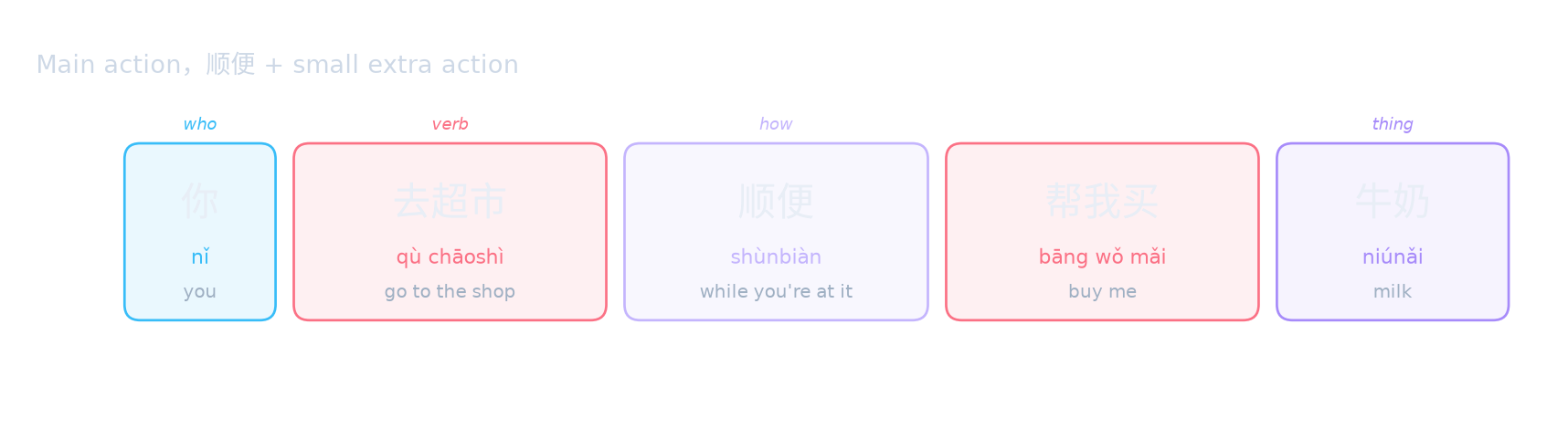
31. 顺便 (while you're at it)
Form: main action,on the way; while you're at it顺便 + small extra action · on the way; while you're at it顺便to ask问(used after a verb) give it…一下,…
- you你to go去supermarket超市(modifier / structural particle)的time; when时候,on the way; while you're at it顺便to help帮I / me我to buy买一瓶milk牛奶(suggestion)吧。 Nǐ qù chāoshì de shíhou, shùnbiàn bāng wǒ mǎi yì píng niúnǎi ba. – When you go to the supermarket, could you pick up a bottle of milk for me while you're there?
- I / me我to finish work下班to return home回家,顺便去(completed / change)了一趟bank银行。 – On my way home from work, I stopped at the bank.
- on the way; while you're at it顺便to ask问(used after a verb) give it…一下,you你tomorrow明天to have time (to do sth)有空(yes/no ?)吗? – By the way, are you free tomorrow?
How it works. on the way; while you're at it顺便 adds a small extra job to something you are doing anyway. It goes before the extra action. on the way; while you're at it顺便to ask问(used after a verb) give it…一下 means "by the way".
| on the way; while you're at it顺便 | besides; other另外 |
|---|---|
| while you're at it (tied to a main action) | also, in addition (a separate point) |
Watch out
- There must be a main action for on the way; while you're at it顺便 to attach to.
- wrong: to help帮I / me我to buy买on the way; while you're at it顺便 → on the way; while you're at it顺便to help帮I / me我to buy买.
Vocabulary
Train
| 汉字 | Pinyin | English |
|---|---|---|
| 顺便 | shùn biàn | on the way; while you're at it |
| 另外 | lìng wài | besides; other |
2.33
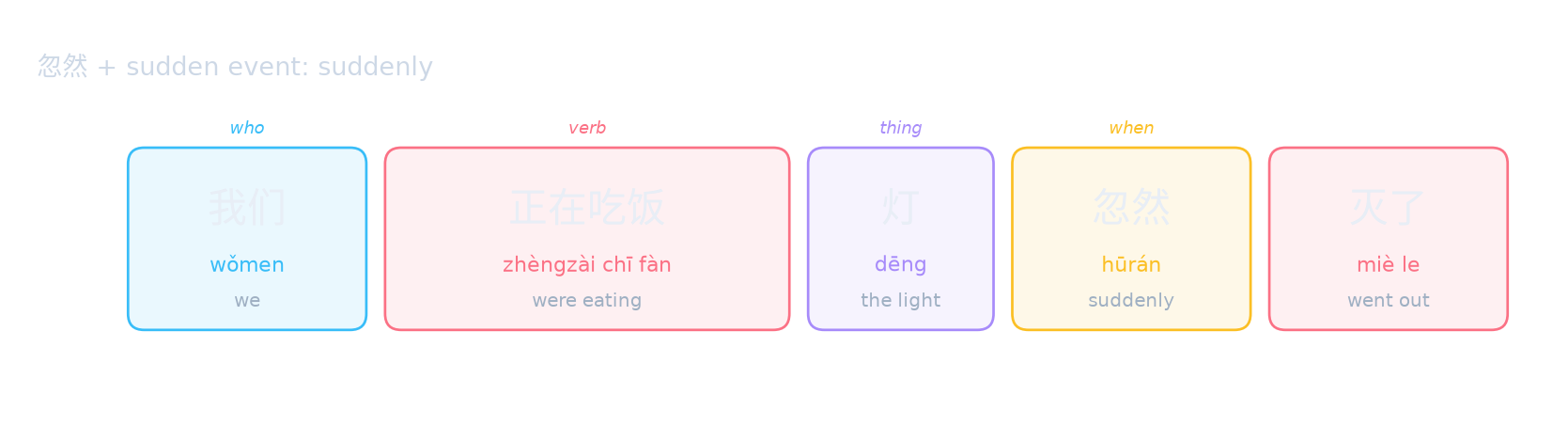
32. 忽然 vs 突然 (suddenly)
Form: suddenly忽然 / suddenly突然 + verb · suddenly突然 (adjective): too太suddenly突然(completed / change)了, suddenly突然(modifier / structural particle)的change / to change变化
- we / us我们in the middle of正在to have a meal吃饭,lamp灯suddenly忽然to extinguish or put out灭(completed / change)了。 Wǒmen zhèngzài chī fàn, dēng hūrán miè le. – We were having dinner when suddenly the lights went out.
- suddenly忽然,outside外面down / next; to fall (rain), get off下to rise / (start to)起(completed / change)了heavy rain大雨。 – Suddenly it started pouring outside.
- this这个news; message消息too太suddenly突然(completed / change)了。 – This news is so sudden.
How it works. As adverbs, suddenly忽然 and suddenly突然 both mean "suddenly" and usually swap. Only suddenly突然 is also an adjective, so only suddenly突然 takes degree / adjective linker很 / too太; before a noun with (modifier / structural particle)的, the usual word is suddenly突然.
| lamp灯suddenly忽然to extinguish or put out灭(completed / change)了 | too太suddenly突然(completed / change)了 | suddenly突然(modifier / structural particle)的change / to change变化 |
|---|---|---|
| the light suddenly went out | so sudden | a sudden change |
Watch out
- wrong: too太suddenly忽然(completed / change)了 → too太suddenly突然(completed / change)了.
Vocabulary
Train
| 汉字 | Pinyin | English |
|---|---|---|
| 忽然 | hū rán | suddenly |
| 消息 | xiāo xi | news; message |
2.34
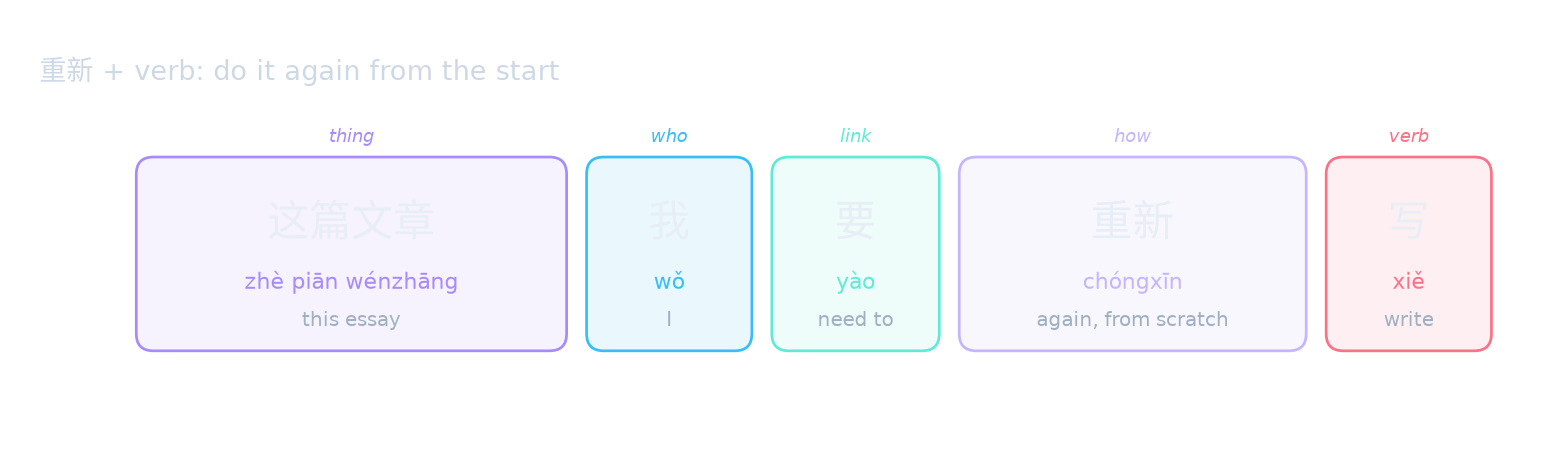
33. 重新 vs 再 (start over / once more)
Form: again重新 + verb (start over) · again / then / (再…也) however再 + verb (once more)
- this这篇文章我要again重新to write写。 Zhè piān wénzhāng wǒ yào chóngxīn xiě. – I need to rewrite this essay from the start.
- please; to invite请talk later / besides再说one time (all the way…一遍。 – Please say it once more.
- please; to invite请again重新again / then / (再…也) however再to do; to make做one time (all the way…一遍。 – Please do it all over again.
How it works. again重新 means you start over, often because the first try was wrong or needs a new way. again / then / (再…也) however再 means once more, for something not yet done. again又 is for a repeat that already happened.
| again重新to start开始 | tomorrow明天again / then / (再…也) however再to come来 | he / him他again又to arrive late迟到(completed / change)了 |
|---|---|---|
| start again | come again tomorrow | he was late again |
Watch out
- wrong: tomorrow明天again重新to come来 → tomorrow明天again / then / (再…也) however再to come来. wrong: he / him他again重新to arrive late迟到(completed / change)了 → he / him他again又to arrive late迟到(completed / change)了.
Vocabulary
Train
| 汉字 | Pinyin | English |
|---|---|---|
| 重新 | chóng xīn | again |
2.35
34. 看来 (it seems / in one's view)
Form: evidence,it seems (from this)看来 + conclusion · at / in在 + person + it seems (from this)看来,opinion
- it seems (from this)看来want / will / need要to rain下雨(completed / change)了,we / us我们to return回去(suggestion)吧。 Kànlái yào xià yǔ le, wǒmen huíqu ba. – It looks like it's going to rain; let's head back.
- he / him他to / arrive / (result: get)到now现在still / also / even还not / haven't没to return / (times)回news; message消息,it seems (from this)看来to be / is是degree / adjective linker很busy忙。 – He still hasn't replied; he must be busy.
- in my opinion在我看来,this这个means办法not so good不太好。 Zài wǒ kànlái, zhège bànfǎ bú tài hǎo. – In my view, this approach isn't very good.
How it works. it seems (from this)看来 kànlái draws a conclusion from what you have noticed: "it seems, it looks as if". The evidence often comes first; it seems (from this)看来 then starts the conclusion. at / in在……it seems (from this)看来 gives someone's opinion instead.
| it seems (from this)看来 | seemingly看起来 |
|---|---|
| a conclusion from evidence | how something looks |
| it seems (from this)看来here这儿(modifier / structural particle)的dish (of food); vegetable菜not不too太tasty好吃 | she / her她seemingly看起来degree / adjective linker很young年轻 |
Watch out
- it seems (from this)看来 goes before the conclusion: wrong: 他病(completed / change)了it seems (from this)看来 → it seems (from this)看来他病(completed / change)了.

2.36
35. 恐怕 (I'm afraid / probably)
Form: I'm afraid (that); probably恐怕 + unwelcome guess · subject + I'm afraid (that); probably恐怕 + guess
- I'm afraid (that); probably恐怕there's not enough time来不及(completed / change)了。 Kǒngpà láibují le. – I'm afraid we won't make it.
- I'm afraid (that); probably恐怕ticket票already已经to be sold out卖完(completed / change)了。 – I'm afraid the tickets are sold out.
- 这件matter事I'm afraid (that); probably恐怕slightly有点儿difficult / hard难。 – I'm afraid this may be a bit difficult.
- tomorrow明天I'm afraid (that); probably恐怕want / will / need要to rain下雨。 – It'll probably rain tomorrow, I'm afraid.
How it works. I'm afraid (that); probably恐怕 kǒngpà introduces a cautious guess, usually about unwelcome news, and softens it. It can start the sentence or follow the subject.
| maybe / possible可能 | I'm afraid (that); probably恐怕 | to be afraid怕 |
|---|---|---|
| neutral maybe | probably, with regret | be scared of |
| he / him他maybe / possible可能to be at home在家 | he / him他I'm afraid (that); probably恐怕to come来(as a resultative verb…不了(completed / change)了 | younger sister妹妹怕黑 |
Watch out
- "Scared of dogs" is 我怕dog狗, not wrong: I / me我I'm afraid (that); probably恐怕dog狗.

Vocabulary
Train
| 汉字 | Pinyin | English |
|---|---|---|
| 恐怕 | kǒng pà | I'm afraid (that); probably |
| 来不及 | lái bu jí | there's not enough time |
2.37
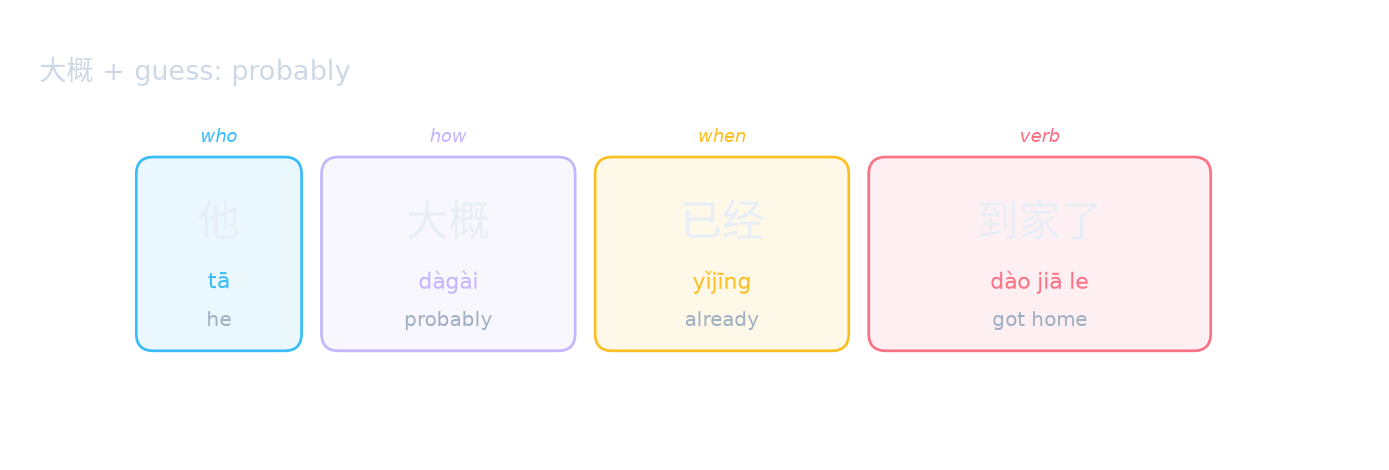
36. 大概 and 也许 (probably / maybe)
Form: probably大概 / maybe也许 + verb · probably大概 + number
- he / him他probably大概already已经to get home到家(completed / change)了。 Tā dàgài yǐjīng dào jiā le. – He's probably home by now.
- maybe也许he / him他to forget忘(completed / change)了。 – Maybe he forgot.
- probably大概to have / there is有三十个person人。 – There were about thirty people.
How it works. probably大概 = probably (fairly sure); before a number it means "roughly". maybe也许 = maybe (less sure). Neither takes degree / adjective linker很 or not不: for that, use maybe / possible可能 (degree / adjective linker很maybe / possible可能, not不maybe / possible可能).
| probably大概to get home到家(completed / change)了 | maybe也许to forget忘(completed / change)了 | probably大概三十个person人 | degree / adjective linker很maybe / possible可能 |
|---|---|---|---|
| probably home | maybe forgot | about thirty people | very likely |
Watch out
- wrong: degree / adjective linker很probably大概 → degree / adjective linker很maybe / possible可能. In writing and exams, wrong: probably大概三十个person人about; left and right左右 → probably大概三十个person人.
Vocabulary
Train
| 汉字 | Pinyin | English |
|---|---|---|
| 大概 | dà gài | probably; roughly |
| 也许 | yě xǔ | perhaps |
2.38
37. 估计 (I reckon, to estimate)
Form: I / me我to estimate; probably估计 + guess · subject + to estimate; probably估计 + verb · to estimate; probably估计 + number
- I / me我to estimate; probably估计he / him他today今天won't / can't不会to come来(completed / change)了。 Wǒ gūjì tā jīntiān bú huì lái le. – I reckon he's not coming today.
- he / him他to estimate; probably估计already已经to sleep睡(completed / change)了。 – He's probably asleep already.
- I / me我to estimate; probably估计to have / there is有两百多person人。 – I reckon there are over two hundred people.
How it works. to estimate; probably估计 makes a guess based on facts, or gives a rough number. probably大概 = probably; maybe也许 = maybe (less sure); it seems (from this)看来 = it seems (from what you see or know now).
| I / me我to estimate; probably估计他会来 | to estimate; probably估计want / will / need要一个hour小时 | it seems (from this)看来want / will / need要to rain下雨(completed / change)了 |
|---|---|---|
| I reckon he'll come | probably takes an hour | looks like rain |
Watch out
- To state a fact you are sure of, leave to estimate; probably估计 out: he / him他definitely / certain一定can / will会to come来.
Vocabulary
Train
| 汉字 | Pinyin | English |
|---|---|---|
| 估计 | gū jì | to estimate; probably |
2.39
Practice
Cover the teaching pages before you answer. The answers are at the end.
1. originally / so it turns out原来 (so it turns out / all along)
1. You hear a knock and open the door: “Oh, it's you!” …………to be / is是you你!
2. In originally / so it turns out原来(modifier / structural particle)的plan计划to be / is是Monday星期一to set off出发, what does originally / so it turns out原来 mean?
- A. original
- B. so it turns out
- C. no wonder
- D. suddenly
3. Build: “So it snowed – no wonder it's so cold.”
Put in order: originally / so it turns out原来to snow下雪(completed / change)了 / no wonder难怪 / , / so much这么cold冷。
4. True or false? I / me我to think以为he / him他to be / is是teacher老师,originally / so it turns out原来he / him他to be / is是student学生 means he turned out to be a student. If false, correct it.
5. Your colleague hasn't touched his lunch all week. Today you find out he has a toothache. Use originally / so it turns out原来. Write your answer in Chinese, then say it aloud.
2. unexpectedly竟然 (actually / unexpectedly)
6. Complete: “She actually didn't come!” she / her她…………not / haven't没to come来!
7. The forecast said it would snow, and it did. Which word fits? weather forecast天气预报to speak说to snow下雪,____to snow下雪(completed / change)了。
- A. suddenly突然
- B. unexpectedly居然
- C. as expected; sure enough果然
- D. unexpectedly竟然
8. Build: “I actually got such an easy question wrong.”
Put in order: to make an error做错(completed / change)了。 / ,I / me我 / so much这么simple简单(modifier / structural particle)的question (in a test)题 / unexpectedly竟然
9. True or false? unexpectedly竟然 can introduce a good surprise as well as a bad one. If false, correct it.
10. Your quiet classmate, who never speaks in class, won the speech contest. Use unexpectedly竟然. Write your answer in Chinese, then say it aloud.
3. don't tell me难道 (rhetorical: don't tell me …?)
11. Challenge: “Don't tell me you've never heard of him?” …………you你没听说过he / him他(yes/no ?)吗?
12. What does don't tell me难道you你not不hungry饿(yes/no ?)吗? suggest?
- A. The speaker is hungry.
- B. The speaker thinks you must be hungry.
- C. The speaker thinks you are not hungry.
- D. The speaker is asking for information.
13. Build: “Can he really have forgotten?”
Put in order: to forget忘(completed / change)了 / really真的 / (yes/no ?)吗? / don't tell me难道he / him他
14. True or false? don't tell me难道 is used to ask for information you don't have. If false, correct it.
15. Your friend asks whether today's class is cancelled. The whole school knows it isn't. Use don't tell me难道. Write your answer in Chinese, then say it aloud.
4. on earth / in the end到底 (on earth / after all)
16. Complete: “What on earth happened?” …………to happen发生(completed / change)了what什么?
17. Which question is correct?
- A. on earth / in the end到底you你to like喜欢she / her她(yes/no ?)吗?
- B. you你on earth / in the end到底to like喜欢not不to like喜欢she / her她?
- C. you你to like喜欢she / her她on earth / in the end到底(yes/no ?)吗?
- D. you你to like喜欢she / her她on earth / in the end到底(yes/no ?)吗?
18. Build: “What on earth is going on?”
Put in order: (old) to report to one's…回事? / on earth / in the end到底 / to be / is是how / why怎么 / this这
19. True or false? In he / him他on earth / in the end到底to be / is是(measure word)个child孩子, on earth / in the end到底 means “after all”. If false, correct it.
20. Your friend has changed his answer three times about tonight's dinner. Use on earth / in the end到底. Write your answer in Chinese, then say it aloud.
5. exactly; on earth (formal)究竟 (exactly / on earth)
21. Complete a formal question: “What exactly is the reason?” reason; cause原因…………to be / is是what什么?
22. Which question is correct?
- A. 他来exactly; on earth (formal)究竟(yes/no ?)吗?
- B. he / him他exactly; on earth (formal)究竟to come来not不to come来?
- C. 他来exactly; on earth (formal)究竟(yes/no ?)吗?
- D. exactly; on earth (formal)究竟他来(yes/no ?)吗?
23. Build: “What exactly should we do?”
Put in order: how / why怎么to do; to make做? / should应该 / we / us我们 / exactly; on earth (formal)究竟
24. True or false? exactly; on earth (formal)究竟 sounds more formal than on earth / in the end到底. If false, correct it.
25. A news report on a mysterious light in the sky ends with one question. Use exactly; on earth (formal)究竟. Write your answer in Chinese, then say it aloud.
6. (prefix) can可 + Adj (emphatic)
26. Complete: “That restaurant is really expensive!” that那home / family / (measure: shops)家restaurant饭馆…………expensive贵(completed / change)了!
27. What does you你(prefix) can可don't别to arrive late迟到! mean?
- A. You can't be late.
- B. Whatever you do, don't be late!
- C. You may be late.
- D. You were late again.
28. Build: “This film is really interesting.”
Put in order: this这个film; movie电影 / (completed / change)了。 / (prefix) can可 / interesting有意思
29. True or false? In I / me我want / think / miss想to go去,(prefix) can可not / haven't没time时间, (prefix) can可 means “but”. If false, correct it.
30. A friend from the south asks whether Harbin in winter is really as cold as people say. Use (prefix) can可 + Adj. Write your answer in Chinese, then say it aloud.
7. again又 + not不 / not / haven't没 (emphatic negation)
31. What does again又 add in I / me我again又is not / no不是child小孩子!?
- A. emphasis rejecting an assumption
- B. a time in the past
- C. again
- D. both … and
32. Complete: “Don't blame her – it's not like she was late.” 别怪she / her她,she / her她…………not / haven't没to arrive late迟到。
33. Build: “He's not going to eat you.”
Put in order: again又 / to eat吃(completed / change)了you你。 / won't / can't不会 / he / him他
34. True or false? and并not不 is calmer and more written than again又not不. If false, correct it.
35. Your roommate asks you, again, to wash his dishes. Use again又 + not不 / not / haven't没. Write your answer in Chinese, then say it aloud.
8. almost / about the same差不多 (almost / about the same)
36. Build: “I'm about as tall as my older brother.”
Put in order: I / me我older brother哥哥 / almost / about the same差不多 / I / me我with / and跟 / tall; high高。
37. Complete: “It's almost twelve o'clock.” …………十二点(completed / change)了。
38. Match each sentence to its meaning.
-
(1) this这两件clothes衣服almost / about the same差不多。
-
(2) almost / about the same差不多八点(completed / change)了。
-
(3) school assignment作业写得almost / about the same差不多(completed / change)了。
-
(4) almost / about the same差不多就行了。
-
A. The two items are about the same.
-
B. It's almost eight.
-
C. That's good enough.
-
D. The homework is nearly done.
39. Which says “I almost missed the train (but I caught it)”?
- A. I / me我with / and跟train火车almost / about the same差不多。
- B. I / me我to catch / keep up with赶上train火车almost / about the same差不多。
- C. I / me我almost / about the same差不多to catch / keep up with赶上train火车(completed / change)了。
- D. I / me我almost差点儿not / haven't没to catch / keep up with赶上train火车。
40. True or false? I / me我almost / about the same差不多to arrive late迟到 is the normal way to say “I was nearly late”. If false, correct it.
41. You compare two phones in a shop. Say in Chinese that they are about the same, and that you waited almost half an hour for the shop assistant. Write both sentences. Use almost / about the same差不多. Write your answer in Chinese, then say it aloud.
9. almost差点 (almost / nearly)
42. Complete: “I nearly forgot your birthday!” I / me我…………to forget忘(completed / change)了you你(modifier / structural particle)的birthday生日!
43. What does he / him他almost差点儿没考上university大学 mean?
- A. He didn't try.
- B. He nearly passed but failed.
- C. He nearly failed but got in.
- D. He passed easily.
44. True or false? I / me我almost差点儿to fall down摔倒 and I / me我almost差点儿not / haven't没to fall down摔倒 mean the same. If false, correct it.
45. Build: “I nearly missed the train.”
Put in order: I / me我 / almost差点儿 / train火车。 / not / haven't没to catch / keep up with赶上
46. You slipped on the ice outside your building but grabbed the railing just in time. Use almost差点. Write your answer in Chinese, then say it aloud.
10. enough够 (enough / sufficient)
47. Complete: “Is there enough money?” money钱…………not enough不够?
48. Which says “This water isn't enough to drink”?
- A. these这些water水not enough不够to drink喝。
- B. these这些water水not不喝够。
- C. these这些水喝not enough不够。
- D. these这些水够not不to drink喝。
49. Build: “The money is enough to buy one ticket.”
Put in order: money钱 / to buy买一张ticket票。 / enough够
50. True or false? enough足够 is more formal than enough够. If false, correct it.
51. You invited eight friends, but only cooked for four. Use enough够. Write your answer in Chinese, then say it aloud.
11. even (so far as to)甚至 (even / to the point that)
52. Complete: “He works so hard he even works at weekends.” he / him他to work; job工作degree / adjective linker很to work hard / effort努力,…………weekend周末also也to work; job工作。
53. Where does even (so far as to)甚至 fit best? A this这个area地方 B summer夏天hot热,C spring (season)春天also也hot热,D winter冬天also也not不cold冷。
- A. A
- B. D
- C. B
- D. C
54. Build: “He even wrote his own name wrong.”
Put in order: 写错(completed / change)了。 / all / both都 / even连oneself自己(modifier / structural particle)的name名字 / he / him他even (so far as to)甚至
55. True or false? even (so far as to)甚至 can join two clauses, as in he / him他not不to speak; to talk说话,even (so far as to)甚至不看I / me我. If false, correct it.
56. Your sister has started a new job and works from morning till night. Use even (so far as to)甚至. Write your answer in Chinese, then say it aloud.
12. then / just就 (only / just – small quantity)
57. Complete: “Only two people came.” …………两个人来(completed / change)了。
58. In he / him他六点then / just就to get up起床(completed / change)了, what does then / just就 mean?
- A. also
- B. only
- C. as early as
- D. not until
59. Build: “I've only been once.”
Put in order: once / one time一次。 / I / me我 / 去过 / then / just就
60. True or false? he / him他only then / not until才十岁 sounds more surprised than he / him他then / just就十岁. If false, correct it.
61. Your friend asks to borrow money for lunch, but your wallet is almost empty. Use then / just就. Write your answer in Chinese, then say it aloud.
13. also也all / both都 (also all of them)
62. Complete: “We are all teachers too.” we / us我们…………all / both都to be / is是teacher老师。
63. Which sentence is correct?
- A. they他们to like喜欢also也all / both都to sing唱歌。
- B. they他们also也all / both都to like喜欢to sing唱歌。
- C. also也they他们all / both都to like喜欢to sing唱歌。
- D. they他们all / both都also也to like喜欢to sing唱歌。
64. Build: “They don't know either (none of them).”
Put in order: not不 / also也all / both都 / to know知道。 / they他们
65. True or false? all / both都also也 and also也all / both都 are both correct. If false, correct it.
66. Your class went to the museum; you find out the class next door all went as well. Use also也all / both都. Write your answer in Chinese, then say it aloud.
14. especially尤其 (especially)
67. Complete: “He likes sport, especially football.” he / him他to like喜欢sports / to exercise运动,…………to be / is是踢足球。
68. Build: “I especially like autumn.”
Put in order: to like喜欢 / autumn秋天。 / especially尤其 / I / me我
69. Which sentence is correct?
- A. I / me我to like喜欢China中国dish (of food); vegetable菜,especially尤其to be / is是dumpling饺子。
- B. especially尤其to be / is是dumpling饺子,I / me我to like喜欢China中国dish (of food); vegetable菜。
- C. I / me我to like喜欢especially尤其to be / is是China中国dish (of food); vegetable菜dumpling饺子。
70. True or false? especially / special特别 can mean "very" as well as "especially", but especially尤其 only means "especially". If false, correct it.
71. Choose the best word: “This film is really good.” 这部film; movie电影____good-looking好看。
- A. especially尤其
- B. especially尤其to be / is是
- C. especially / special特别
72. A new classmate asks what you like to eat and do. Answer with two sentences, each using especially尤其 – one with especially尤其to be / is是 + noun, one with especially尤其 + verb. Write your answer in Chinese, then say it aloud.
15. a little bit稍微 (slightly / a little)
73. Complete: “Today is a little warmer than yesterday.” today今天than / compared to比yesterday昨天a little bit稍微warm暖和…………。
74. Build: “Please wait a moment.”
Put in order: to wait; and so on等 / (used after a verb) give it…一下。 / please; to invite请 / a little bit稍微
75. Which sentence is correct?
- A. this这个expensive贵a little bit稍微a little一点儿。
- B. this这个expensive贵a little bit稍微a little一点儿。
- C. this这个a little bit稍微expensive贵a little一点儿。
76. You are complaining: “This dish is a bit too salty.” Which fits best?
- A. this这个dish (of food); vegetable菜a little bit稍微salty咸a little一点儿。
- B. this这个dish (of food); vegetable菜slightly有点儿salty咸。
77. True or false? you你can / be able to能a little bit稍微说慢a little一点儿(yes/no ?)吗? is a polite request. If false, correct it.
78. In a shop: the shoes you tried are a little too small and a bit expensive. Ask for a slightly bigger pair, and ask the assistant to wait a moment. Use a little bit稍微. Write your answer in Chinese, then say it aloud.
16. almost几乎 (almost / hardly)
79. Complete: “He runs almost every day.” he / him他…………every day每天all / both都to run; to jog跑步。
80. Build: “He hardly slept last night.”
Put in order: almost几乎 / yesterday昨天 / to sleep睡觉。 / not / haven't没 / he / him他
81. You caught the train with two seconds to spare. Which says “I nearly missed the train”?
- A. I / me我almost / about the same差不多to catch / keep up with赶上train火车。
- B. I / me我almost差点儿not / haven't没to catch / keep up with赶上train火车。
- C. I / me我almost几乎every day每天坐火车。
82. True or false? this这两件clothes衣服almost几乎。 is a correct way to say “These two pieces of clothing are about the same.” If false, correct it.
83. What does I / me我almost几乎not不喝咖啡 mean?
- A. I hardly ever drink coffee.
- B. I drink a lot of coffee.
- C. I almost drank coffee.
84. Describe your habits to a new friend: one thing you do almost every day, and one thing you almost never do. Use almost几乎. Write your answer in Chinese, then say it aloud.
17. occasionally偶尔 (once in a while)
85. Complete: “I go to the cinema once in a while.” I / me我…………to go去cinema电影院。
86. Put the words from MOST often to LEAST often.
Put in order: never从来不 / sometimes有时候 / often经常 / always总是 / occasionally偶尔
87. Which sentence is correct?
- A. occasionally偶尔I / me我to play basketball打篮球occasionally偶尔。
- B. I / me我occasionally偶尔to play basketball打篮球。
- C. I / me我to play basketball打篮球occasionally偶尔。
88. “I went to Shanghai once last year.” Which is right?
- A. last year去年I / me我去过once / one time一次Shanghai municipality…上海。
- B. last year去年I / me我occasionally偶尔去过Shanghai municipality…上海。
89. True or false? occasionally偶尔 means something happens more often than sometimes有时候. If false, correct it.
90. Talk about your weekends: one thing you often do, one thing you do once in a while, and one thing you never do. Use occasionally偶尔. Write your answer in Chinese, then say it aloud.
18. at least至少 and most最many; much多 (at least / at most)
91. Complete: “This dish takes at least an hour to cook.” to do; to make做this这个dish (of food); vegetable菜…………want / will / need要一个hour小时。
92. “I'll wait ten minutes for you, at most.” I / me我____to wait; and so on等you你十分钟。
- A. at least至少
- B. most最many; much多
93. Build: “We lost, but at least we tried our best.”
Put in order: we / us我们to work hard / effort努力(completed / change)了。 / but但 / although虽然to lose a game输(completed / change)了, / at least至少
94. Which sentence is correct?
- A. to come来(completed / change)了一百person人at least至少。
- B. to come来(completed / change)了at least至少一百person人above / the above以上。
- C. to come来(completed / change)了at least至少一百person人。
95. True or false? at least最少 can also mean "at least". If false, correct it.
96. A friend asks about preparing for the HSK 4 exam. Give advice with at least至少 (how much to study) and most最many; much多 (how long to rest). Use at least至少 and most最many; much多. Write your answer in Chinese, then say it aloud.
19. or / still还是 + Verb (had better)
97. Suggest: “It's raining; we'd better stay home.” to rain下雨(completed / change)了,we / us我们…………to be at home在家(suggestion)吧。
98. In which sentence does or / still还是 mean “had better”?
- A. we / us我们or / still还是to take a taxi (in town)打车(suggestion)吧。
- B. you你to go去or / still还是不去?
- C. he / him他to be / is是teacher老师or / still还是student学生?
- D. you你to drink tea喝茶or / still还是coffee咖啡?
99. Build: “I thought it over, and I'm not going after all.”
Put in order: I / me我or / still还是 / 不去(completed / change)了。 / want / think / miss想(completed / change)了want / think / miss想 / ,
100. True or false? or / still还是 here suggests the speaker considered other options. If false, correct it.
101. You are about to drive to the airport, but the radio says the motorway is blocked. Use or / still还是 + Verb. Write your answer in Chinese, then say it aloud.
20. had better; best最好 (had best / it's best to)
102. Advise: “You'd best bring a coat.” you你…………to bring带一件coat外套。
103. Which says “You'd better not drive tonight”?
- A. you你not不had better; best最好tonight今晚to drive a car开车。
- B. you你tonight今晚had better; best最好don't别to drive a car开车。
- C. you你tonight今晚don't别had better; best最好to drive a car开车。
- D. you你tonight今晚to drive a car开车had better; best最好don't别。
104. Build: “It's best to book in advance.”
Put in order: to book tickets订票。 / in advance / move earlier提前 / had better; best最好
105. True or false? In he / him他to be / is是I / me我had better; best最好(modifier / structural particle)的friend朋友, had better; best最好 means “had better”. If false, correct it.
106. You have a bad cold and ask the doctor what to do. Use had better; best最好. Write your answer in Chinese, then say it aloud.
21. be sure to; ten million千万 (be sure to / whatever you do)
107. Warn: “Whatever you do, don't be late!” you你…………don't别to arrive late迟到!
108. Which sentence is correct?
- A. he / him他yesterday昨天be sure to; ten million千万not / haven't没to come来。
- B. be sure to; ten million千万你别to go去。
- C. 你别be sure to; ten million千万to go去。
- D. you你be sure to; ten million千万want / will / need要to take note of注意body; health身体。
109. Build: “Whatever you do, don't tell anyone about this.”
Put in order: to tell告诉other people别人。 / 这件matter事 / don't不要 / be sure to; ten million千万
110. True or false? be sure to; ten million千万 is mainly used to warn against something going wrong. If false, correct it.
111. Your friend is flying abroad tomorrow, and you remember how forgetful she is. Use be sure to; ten million千万. Write your answer in Chinese, then say it aloud.
22. to have no choice but to只好 (have no choice but to)
112. Complete: “The lift is broken, so we have to take the stairs.” elevator电梯bad坏(completed / change)了,we / us我们…………to walk / to leave走stair楼梯。
113. Which sentence is natural?
- A. I / me我tomorrow明天again / then / (再…也) however再to come来to have no choice but to只好。
- B. shop商店to close (the door)关门(completed / change)了,to have no choice but to只好I / me我again / then / (再…也) however再to come来tomorrow明天。
- C. to have no choice but to只好I / me我tomorrow明天again / then / (再…也) however再to come来。
- D. shop商店to close (the door)关门(completed / change)了,I / me我to have no choice but to只好tomorrow明天again / then / (再…也) however再to come来。
114. Build: “He can't cook, so he has to eat instant noodles.”
Put in order: , / to have no choice but to只好 / he / him他won't / can't不会to prepare a meal做饭 / to eat吃instant noodles方便面。
115. True or false? to have to (be forced)不得不 sounds stronger than to have no choice but to只好. If false, correct it.
116. You leave a party at midnight and the last bus left ten minutes ago. Taxis are all taken. Use to have no choice but to只好. Write your answer in Chinese, then say it aloud.
23. to have to (be forced)不得不 (have no choice but to)
117. Complete: “The shop closed, so we had to find another one.” shop商店to close (the door)关门(completed / change)了,we / us我们…………to go去to look for; to give change找else别的shop店。
118. What does I / me我to have to (be forced)不得不to walk / to leave走(completed / change)了 mean?
- A. I can't leave.
- B. I have to leave now.
- C. I don't want to leave.
- D. I mustn't leave.
119. Build: “Because he had no money, he had to sell his car.”
Put in order: to sell off卖掉(completed / change)了car车。 / to have to (be forced)不得不 / ,he / him他 / because因为not / haven't没money钱
120. True or false? to have to (be forced)不得不 can mean “must not”. If false, correct it.
121. Your friend has a high fever on the morning of an important exam. Say in Chinese what he has to do, then write it. Use to have to (be forced)不得不. Write your answer in Chinese, then say it aloud.
24. as much as possible尽量 (as much as possible)
122. Complete: “Please speak Chinese as much as possible.” please; to invite请…………to speak说Chinese language汉语。
123. Build: “Try not to use your phone at night.”
Put in order: as much as possible尽量 / don't别 / evening晚上 / to play玩mobile phone手机。
124. “I've done my best.” Which is right?
- A. I / me我to do one's best尽力already已经(completed / change)了。
- B. I / me我already已经to do one's best尽力(completed / change)了。
- C. I / me我already已经力尽(completed / change)了capacity量。
125. Which sentence is correct?
- A. I / me我as much as possible尽量早点儿to come来。
- B. I / me我早点儿as much as possible尽量to come来。
- C. as much as possible尽量I / me我早点儿to come来。
126. True or false? I / me我as much as possible尽量not不喝咖啡 means "I try not to drink coffee". If false, correct it.
127. Your doctor gives you health advice. Write what the doctor says: two things to do as much as possible and one thing to avoid, using as much as possible尽量. Write your answer in Chinese, then say it aloud.
25. just now刚 + Verb (just did)
128. Complete: “I've just finished eating.” I / me我…………吃完饭。
129. Which sentence is correct?
- A. he / him他just now刚to walk / to leave走(completed / change)了(completed / change)了。
- B. just now刚he / him他to walk / to leave走。
- C. he / him他just now刚to walk / to leave走。
- D. he / him他to walk / to leave走just now刚。
130. Build: “I'd only just got home when it started to rain.”
Put in order: ,then / just就 / 我刚 / to get home到家 / to rain下雨(completed / change)了。
131. True or false? he / him他just now刚to come来Beijing北京两个month月 means he has only been in Beijing for two months. If false, correct it.
132. Your mum calls as you walk out of the arrivals hall. Use just now刚 + Verb. Write your answer in Chinese, then say it aloud.
26. originally本来 (originally / at first)
133. Complete: “I originally planned to leave on Monday.” I / me我…………to plan打算Monday星期一to walk / to leave走。
134. You open the door and find your old friend. Which fits? “____to be / is是you你!”
- A. originally本来
- B. originally / so it turns out原来
- C. later; afterwards后来
- D. always (so far); never (with 不 / 没)从来
135. Build: “I didn't really want to come, but my friend insisted.”
Put in order: not want to不想to come来 / I / me我originally本来 / ,but可是 / friend朋友definitely / certain一定want / will / need要I / me我to come来。
136. True or false? In student学生originally本来then / just就should应该to study; to learn学习, originally本来then / just就 means “of course, naturally”. If false, correct it.
137. You were going to spend the holiday in Yunnan, but then your cousin invited you to Hainan. Use originally本来. Write your answer in Chinese, then say it aloud.
27. first先 … ,again / then / (再…也) however再 … (first …, then …)
138. Complete: “Let's have a look first, then decide.” we / us我们first先to take a look at看看,…………to decide / decision决定。
139. Which says “Wait until the rain stops before you leave”?
- A. again / then / (再…也) however再to wait; and so on等rain雨to stop停(completed / change)了to walk / to leave走。
- B. to wait; and so on等rain雨to stop停(completed / change)了again又to walk / to leave走。
- C. 雨停(completed / change)了to wait; and so on等again / then / (再…也) however再to walk / to leave走。
- D. to wait; and so on等rain雨to stop停(completed / change)了again / then / (再…也) however再to walk / to leave走。
140. Build: “Let's eat first; we can talk about the rest later.”
Put in order: after / from now on以后talk later / besides再说。 / else别的matter事 / first先to have a meal吃饭 / ,
141. True or false? first先…again / then / (再…也) however再… is the usual way to describe what you did yesterday. If false, correct it.
142. You are explaining to a new colleague how to set up their work account. Use first先 … ,again / then / (再…也) however再 …. Write your answer in Chinese, then say it aloud.
28. always (so far); never (with 不 / 没)从来 + not不 / not / haven't没 (never)
143. Complete: “I've never eaten durian.” I / me我always (so far); never (with 不 / 没)从来not / haven't没to eat吃…………durian fruit榴莲。
144. Which says “She never eats meat” (a personal rule)?
- A. she / her她always (so far); never (with 不 / 没)从来没吃肉(completed / change)了。
- B. she / her她always (so far); never (with 不 / 没)从来没吃过meat肉。
- C. she / her她never从来不to eat吃meat肉。
- D. she / her她not不always (so far); never (with 不 / 没)从来to eat吃meat肉。
145. Build: “He never drinks alcohol.”
Put in order: not不to drink喝 / he / him他 / always (so far); never (with 不 / 没)从来 / wine (esp. rice wine)酒。
146. True or false? always (so far); never (with 不 / 没)从来 is the usual word for “always” in positive sentences. If false, correct it.
147. Your grandfather is eighty and proud of one thing about his health. Use always (so far); never (with 不 / 没)从来 + not不 / not / haven't没. Write your answer in Chinese, then say it aloud.
29. just right; just in time正好 (just right / exactly)
148. Build: “You've come at just the right moment.”
Put in order: just right; just in time正好。 / to emerge (from a…来得 / you你
149. Complete: “I happen to have an umbrella; let's share it.” I / me我…………to bring带(completed / change)了umbrella伞,together一起to use / with用(suggestion)吧。
150. What does altogether一共just right; just in time正好五十块 mean?
- A. nearly fifty yuan
- B. about fifty yuan altogether
- C. exactly fifty yuan altogether
- D. more than fifty yuan
151. Your friend phones and asks what you are doing. You are eating. Which reply is right?
- A. I / me我to have a meal吃饭just right; just in time正好。
- B. I / me我in the middle of正在to have a meal吃饭。
- C. I / me我just right; just in time正好to have a meal吃饭。
152. True or false? In size大小just right; just in time正好 you can use just刚好 instead of just right; just in time正好. If false, correct it.
153. Your friend knocks on your door just as you were going to call her. Then make a second sentence with just right; just in time正好 + a number (a price or a time). Write your answer in Chinese, then say it aloud.
30. result; as a result结果 (as a result / in the end)
154. Complete: “I didn't bring an umbrella, and in the end I got soaked.” I / me我没带umbrella伞,…………(passive: by)被雨淋moist湿(completed / change)了。
155. In competition比赛(modifier / structural particle)的result; as a result结果to be / is是two二than / compared to比one / a一, what is result; as a result结果?
- A. a noun meaning “result”
- B. an adverb meaning “finally”
- C. a verb meaning “finish”
- D. a conjunction meaning “so”
156. Build: “He went to bed late, and as a result he was late today.”
Put in order: he / him他to sleep睡(degree marker)得degree / adjective linker很late / evening晚 / result; as a result结果 / today今天to arrive late迟到(completed / change)了。 / ,
157. True or false? result; as a result结果 is used for a result that has actually happened. If false, correct it.
158. You prepared sandwiches all morning for a picnic. At noon it started to pour. Use result; as a result结果. Write your answer in Chinese, then say it aloud.
31. on the way; while you're at it顺便 (while you're at it)
159. Complete: “When you go to the supermarket, buy me some milk while you're there.” you你to go去supermarket超市(modifier / structural particle)的time; when时候,…………to help帮I / me我to buy买一瓶milk牛奶(suggestion)吧。
160. Build: “By the way, are you free tomorrow?”
Put in order: you你 / tomorrow明天 / on the way; while you're at it顺便to ask问(used after a verb) give it…一下, / to have time (to do sth)有空(yes/no ?)吗?
161. Which sentence is correct?
- A. on the way; while you're at it顺便,I / me我to go去post office邮局。
- B. I / me我to go去post office邮局,on the way; while you're at it顺便to buy买(completed / change)了几张(postage) stamp邮票。
- C. I / me我to go去post office邮局,to buy买(completed / change)了几张(postage) stamp邮票on the way; while you're at it顺便。
162. “Also, there's one more thing I want to say.” (a separate point) Which word fits? ____,I / me我still / also / even还want / think / miss想to speak说一件matter事。
- A. besides; other另外
- B. on the way; while you're at it顺便
163. True or false? on the way; while you're at it顺便 adds a small job that takes little extra effort. If false, correct it.
164. Your friend is going to the library. Ask them to do two small things for you while they're there, using on the way; while you're at it顺便. Write your answer in Chinese, then say it aloud.
32. suddenly忽然 vs suddenly突然 (suddenly)
165. Complete: “We were having dinner when suddenly the lights went out.” we / us我们in the middle of正在to have a meal吃饭,lamp灯…………to extinguish or put out灭(completed / change)了。
166. “This news is so sudden.” Which is right?
- A. this这个news; message消息too太suddenly忽然(completed / change)了。
- B. this这个news; message消息too太suddenly突然(completed / change)了。
167. “a sudden change” – which is the usual way to say it?
- A. suddenly突然(modifier / structural particle)的change / to change变化
- B. suddenly忽然(modifier / structural particle)的change / to change变化
168. Build: “Suddenly it started pouring outside.”
Put in order: heavy rain大雨。 / outside外面 / suddenly忽然, / down / next; to fall (rain), get off下to rise / (start to)起(completed / change)了
169. True or false? right away马上 means "suddenly". If false, correct it.
170. Tell a short story in two sentences: you were walking home when something unexpected happened. Use suddenly忽然 once and suddenly突然 as an adjective once. Use suddenly忽然 or suddenly突然. Write your answer in Chinese, then say it aloud.
33. again重新 vs again / then / (再…也) however再 (start over / once more)
171. Complete: “Lets start over from the beginning.” we / us我们…………to start开始(suggestion)吧。
172. “Come again tomorrow.” Which is natural?
- A. tomorrow明天again重新to come来(suggestion)吧。
- B. tomorrow明天again / then / (再…也) however再to come来(suggestion)吧。
173. “He was late again (yesterday).” he / him他yesterday昨天____to arrive late迟到(completed / change)了。
- A. again重新
- B. again / then / (再…也) however再
- C. again又
174. Build: “Please do it all over again.”
Put in order: please; to invite请 / again重新 / one time (all the way…一遍。 / again / then / (再…也) however再to do; to make做
175. True or false? again重新to write写 means you write it again from the start. If false, correct it.
176. Your computer crashed and you lost your homework. Tell a friend what you have to do, using again重新 once and again / then / (再…也) however再 once. Use again重新 or again / then / (再…也) however再. Write your answer in Chinese, then say it aloud.
34. it seems (from this)看来 (it seems / in one's view)
177. The restaurant is empty at seven: “It looks like the food here isn't very good.” …………here这儿(modifier / structural particle)的dish (of food); vegetable菜not不too太tasty好吃。
178. Which says “She looks very young”?
- A. she / her她seemingly看起来degree / adjective linker很young年轻。
- B. at / in在she / her她it seems (from this)看来degree / adjective linker很young年轻。
- C. it seems (from this)看来she / her她degree / adjective linker很young年轻。
- D. she / her她degree / adjective linker很young年轻it seems (from this)看来。
179. Build: “In my view, this approach isn't very good.”
Put in order: this这个means办法 / in my opinion在我看来 / , / not so good不太好。
180. True or false? it seems (from this)看来 usually comes after the conclusion it introduces. If false, correct it.
181. The sky turns grey and the wind picks up while you are hiking. Use it seems (from this)看来. Write your answer in Chinese, then say it aloud.
35. I'm afraid (that); probably恐怕 (I'm afraid / probably)
182. Soften the news: “I'm afraid the tickets are sold out.” …………ticket票already已经to be sold out卖完(completed / change)了。
183. Which says “My little sister is scared of the dark”?
- A. I'm afraid (that); probably恐怕younger sister妹妹black黑。
- B. younger sister妹妹I'm afraid (that); probably恐怕black黑(completed / change)了。
- C. younger sister妹妹怕黑。
- D. younger sister妹妹I'm afraid (that); probably恐怕black黑。
184. Build: “It'll probably rain tomorrow, I'm afraid.”
Put in order: to rain下雨。 / tomorrow明天want / will / need要 / I'm afraid (that); probably恐怕
185. True or false? I'm afraid (that); probably恐怕 usually goes with welcome news. If false, correct it.
186. You are stuck in traffic and the train leaves in ten minutes. Use I'm afraid (that); probably恐怕. Write your answer in Chinese, then say it aloud.
36. probably大概 and maybe也许 (probably / maybe)
187. Complete: “There were about thirty people.” …………to have / there is有三十个person人。
188. Build: “He's probably home by now.”
Put in order: probably大概 / he / him他 / already已经 / to get home到家(completed / change)了。
189. “It's very likely to rain tomorrow.” Which is right?
- A. tomorrow明天degree / adjective linker很probably大概to rain下雨。
- B. tomorrow明天degree / adjective linker很maybe也许to rain下雨。
- C. tomorrow明天degree / adjective linker很maybe / possible可能to rain下雨。
190. Which sentence is correct?
- A. probably大概三十个person人。
- B. 三十个person人probably大概。
191. True or false? maybe也许 sounds less sure than probably大概. If false, correct it.
192. Your teacher is late for class. Make two guesses: one with probably大概 and one with maybe也许. Then say roughly how long you have waited with probably大概. Use probably大概 and maybe也许. Write your answer in Chinese, then say it aloud.
37. to estimate; probably估计 (I reckon, to estimate)
193. Complete: “I reckon he's not coming today.” I / me我…………he / him他today今天won't / can't不会to come来(completed / change)了。
194. “I reckon there are over two hundred people.” Which is right?
- A. I / me我it seems (from this)看来to have / there is有两百多person人。
- B. I / me我to estimate; probably估计to have / there is有两百多person人。
195. You are completely sure he will come. Which do you say?
- A. I / me我to estimate; probably估计他会来。
- B. he / him他definitely / certain一定can / will会to come来。
196. Build: “He's probably asleep already.”
Put in order: to estimate; probably估计 / already已经 / he / him他 / to sleep睡(completed / change)了。
197. True or false? it seems (from this)看来 is used for a guess from something you can see right now. If false, correct it.
198. You are organising a class party. Use to estimate; probably估计 twice: once to guess how many people will come, once to guess how long it will take to prepare. Write your answer in Chinese, then say it aloud.
2.40
Mixed practice
These questions mix the patterns and use new situations.
199. Choose unexpectedly竟然 or originally / so it turns out原来: 他学(completed / change)了一年Chinese language中文,…………can / be able to能to look at; to watch; to read看Chinese language中文newspaper报纸(completed / change)了! (you are surprised) / …………you你can / will会to speak说Chinese language中文! (you suddenly understand)
200. Choose almost差点 or almost / about the same差不多: I / me我…………to arrive late迟到(completed / change)了。 (it nearly happened) / we / us我们two (people)俩…………tall; high高。 (about the same)
201. Choose to have no choice but to只好 or had better; best最好: outside外面down / next; to fall (rain), get off下heavy rain大雨,we / us我们…………to be at home在家to look at; to watch; to read看film; movie电影。 / you你…………早点儿to sleep睡觉。
202. Which sentence means "Whatever you do, don't be late"?
- A. you你千万别to arrive late迟到。
- B. you你I'm afraid (that); probably恐怕don't别to arrive late迟到。
- C. you你on earth / in the end到底don't别to arrive late迟到。
203. Choose originally本来 or always (so far); never (with 不 / 没)从来: I / me我…………want / think / miss想to go去,later; afterwards后来not / haven't没time时间(completed / change)了。 / he / him他…………not不喝咖啡。
204. Find and fix the problem. You planned to walk, but it rained, so you took the bus. A classmate writes I / me我to have no choice but to只好want / think / miss想to walk走路to go去,but可是to rain下雨(completed / change)了. Correct the sentence.
205. Use it yourself. Say you nearly missed the train, and that it turned out your friend had already bought you a ticket.
2.41
Answers and explanations
Mark your work, then correct each mistake in your own words.
1. originally / so it turns out原来 (so it turns out / all along)
1. originally / so it turns out原来
originally / so it turns out原来 announces a discovery.
2. A. original
originally / so it turns out原来 + (modifier / structural particle)的 + noun = the original plan.
3. originally / so it turns out原来to snow下雪(completed / change)了,no wonder难怪so much这么cold冷。
originally / so it turns out原来 + discovery, no wonder难怪 + what it explains.
4. True.
to think以为 marks the mistaken belief; originally / so it turns out原来 the truth.
5. Model answer: originally / so it turns out原来he / him他牙疼,no wonder难怪not不to have a meal吃饭。
Check your answer:
- At the start of a clause, originally / so it turns out原来 reveals a discovery: originally / so it turns out原来to be / is是this way / so这样! – "So that's how it is!"
- Before a noun (with (modifier / structural particle)的) or describing the past, it means "original(ly)": originally / so it turns out原来(modifier / structural particle)的plan计划 – "the original plan".
2. unexpectedly竟然 (actually / unexpectedly)
6. unexpectedly竟然
unexpectedly竟然 marks a surprise.
7. C. as expected; sure enough果然
as expected; sure enough果然 means “just as expected”: the forecast said snow, and it did snow. unexpectedly竟然 and unexpectedly居然 mark surprise, and suddenly突然 means “suddenly”.
8. so much这么simple简单(modifier / structural particle)的question (in a test)题,I / me我unexpectedly竟然to make an error做错(completed / change)了。
Subject + unexpectedly竟然 + verb.
9. True.
It marks any outcome that goes against expectation.
10. Model answer: he / him他unexpectedly竟然(degree marker)得(completed / change)了第一名!
Check your answer:
- Use unexpectedly竟然 only when the outcome is unexpected; for a plain fact, leave it out.
- It is an adverb: he / him他unexpectedly竟然to come来(completed / change)了, not unexpectedly竟然他来(completed / change)了 in most speech.
3. don't tell me难道 (rhetorical: don't tell me …?)
11. don't tell me难道
don't tell me难道…(yes/no ?)吗 makes a rhetorical question.
12. B. The speaker thinks you must be hungry.
A negative don't tell me难道 question implies the positive.
13. don't tell me难道he / him他really真的to forget忘(completed / change)了(yes/no ?)吗?
don't tell me难道 + statement + (yes/no ?)吗?
14. False.
It challenges; the speaker already believes the answer.
15. Model answer: don't tell me难道you你not不to know知道(yes/no ?)吗?
Check your answer:
- don't tell me难道 usually doesn't ask for information: the speaker expects the answer, or is surprised. Use it to challenge or show surprise.
- don't tell me难道 sits at the start or after the subject: you你don't tell me难道not不to know知道(yes/no ?)吗? ("Don't tell me you don't know?") is also correct.
4. on earth / in the end到底 (on earth / after all)
16. on earth / in the end到底
on earth / in the end到底 + question word.
17. B. you你on earth / in the end到底to like喜欢not不to like喜欢she / her她?
on earth / in the end到底 takes an A-not-A or a question word, never (yes/no ?)吗.
18. this这on earth / in the end到底to be / is是what's the matter?怎么回事?
Subject + on earth / in the end到底 + question.
19. True.
In statements, on earth / in the end到底to be / is是 = after all.
20. Model answer: you你on earth / in the end到底to come来not不to come来?
Check your answer:
- on earth / in the end到底 goes with a question word or A-not-A: you你on earth / in the end到底去不去? ("Are you going or not, after all?"); you你on earth / in the end到底to go去(yes/no ?)吗? sounds odd.
- Put on earth / in the end到底 before the question part, after the subject: you你on earth / in the end到底at / in在where哪儿? – "Where on earth are you?"
5. exactly; on earth (formal)究竟 (exactly / on earth)
21. exactly; on earth (formal)究竟
exactly; on earth (formal)究竟 + question word.
22. B. he / him他exactly; on earth (formal)究竟to come来not不to come来?
exactly; on earth (formal)究竟 needs A-not-A or a question word.
23. we / us我们exactly; on earth (formal)究竟should应该how / why怎么to do; to make做?
Subject + exactly; on earth (formal)究竟 + question.
24. True.
It suits reports and serious discussion.
25. Model answer: that那exactly; on earth (formal)究竟to be / is是what什么?
Check your answer:
- Use a question word or A-not-A: you你exactly; on earth (formal)究竟to agree同意not不to agree同意? ("Do you agree or not, after all?"); you你exactly; on earth (formal)究竟to agree同意(yes/no ?)吗? sounds odd.
- Put exactly; on earth (formal)究竟 after the topic and before the question part: reason; cause原因exactly; on earth (formal)究竟to be / is是what什么? – "What exactly is the reason?"
6. (prefix) can可 + Adj (emphatic)
26. (prefix) can可
(prefix) can可 + Adj + (completed / change)了 for spoken emphasis.
27. B. Whatever you do, don't be late!
(prefix) can可 before don't别 adds urgency: you你(prefix) can可don't别to arrive late迟到! “Whatever you do, don't be late!” It is a strong warning, not a statement about what is possible.
28. this这个film; movie电影(prefix) can可interesting有意思(completed / change)了。
(prefix) can可 + Adj + (completed / change)了.
29. True.
At the start of a clause, (prefix) can可 can be short for but可是.
30. Model answer: Harbin, subprovincial city…哈尔滨(modifier / structural particle)的winter冬天可冷(completed / change)了!
Check your answer:
- Use (prefix) can可…(completed / change)了 in conversation; in writing choose very非常 or very十分.
- (prefix) can可 + Adj usually needs (completed / change)了 or (and …? / softener)呢 at the end: 可冷(completed / change)了, not just 可冷.
7. again又 + not不 / not / haven't没 (emphatic negation)
31. A. emphasis rejecting an assumption
again又 + not不 pushes back: “I'm not a child, you know!”
32. again又
again又 + not / haven't没 for an emphatic denial.
33. he / him他again又won't / can't不会to eat吃(completed / change)了you你。
Subject + again又 + won't / can't不会 + verb.
34. True.
again又not不 is emotional speech; and并not不 states a correction calmly.
35. Model answer: I / me我again又is not / no不是you你(modifier / structural particle)的waiter服务员!
Check your answer:
- In again又not不 / again又not / haven't没, again又 is not "again"; it adds force to the denial.
- Keep it in speech; in neutral statements, plain not不 / not / haven't没 is enough: he / him他not / haven't没to do; to make做wrong; mistake错.
8. almost / about the same差不多 (almost / about the same)
36. I / me我with / and跟I / me我older brother哥哥almost / about the same差不多tall; high高。
A with / and跟 B almost / about the same差不多 + adjective.
37. almost / about the same差不多
almost / about the same差不多 + time = almost.
38. (1) A: this这两件clothes衣服almost / about the same差不多。 = The two items are about the same.; (2) B: almost / about the same差不多八点(completed / change)了。 = It's almost eight.; (3) D: school assignment作业写得almost / about the same差不多(completed / change)了。 = The homework is nearly done.; (4) C: almost / about the same差不多就行了。 = That's good enough.
Where almost / about the same差不多 stands decides its meaning.
39. D. I / me我almost差点儿not / haven't没to catch / keep up with赶上train火车。
Something that nearly happened takes almost差点儿.
40. False.
Use almost差点儿:I / me我almost差点儿to arrive late迟到。almost / about the same差不多 is for amounts and similarity.
41. Model answer: this这两个mobile phone手机almost / about the same差不多。I / me我almost / about the same差不多to wait; and so on等(completed / change)了half of sth半个hour小时。
Check your answer:
- I used A with / and跟 B almost / about the same差不多 or "these two … almost / about the same差不多" for the comparison.
- I put almost / about the same差不多 straight before the amount of time.
- I did not use almost / about the same差不多 for something that nearly happened.
- I said both sentences aloud before comparing with the model.
Your answer need not copy the model. A partner or teacher must hear the spoken response to comment on pronunciation.
9. almost差点 (almost / nearly)
42. almost差点儿
almost差点儿 + verb = it almost happened.
43. C. He nearly failed but got in.
Getting in is wanted, so almost差点儿not / haven't没 = nearly failed (but succeeded).
44. True.
Falling is unwanted, so both mean “I nearly fell (but didn't)”.
45. I / me我almost差点儿not / haven't没to catch / keep up with赶上train火车。
almost差点儿not / haven't没 + wanted result = nearly failed to.
46. Model answer: I / me我almost差点儿to fall down摔倒。
Check your answer:
- Wanted result: almost差点儿to pass a university…考上 = almost got in (but didn't); almost差点儿没考上 = nearly didn't get in (but did).
- Unwanted result: almost差点儿to crash (into another car)撞车 and almost差点儿not / haven't没to crash (into another car)撞车 both = nearly crashed (but didn't).
10. enough够 (enough / sufficient)
47. enough够
够不够 asks whether it is enough.
48. A. these这些water水not enough不够to drink喝。
not enough不够 + verb = not enough to.
49. money钱够买一张ticket票。
Noun + enough够 + verb phrase.
50. True.
enough足够((modifier / structural particle)的) = sufficient, often in writing.
51. Model answer: dish (of food); vegetable菜not enough不够(completed / change)了,I / me我again / then / (再…也) however再to do; to make做两个(suggestion)吧。
Check your answer:
- enough够 normally follows the thing that is enough: 钱够(completed / change)了, time时间not enough不够.
- "Enough to do" puts the verb after enough够: 够吃, adequate够用, not 吃够 (that means "have had one's fill").
11. even (so far as to)甚至 (even / to the point that)
52. even (so far as to)甚至
even (so far as to)甚至 introduces the extreme point.
53. B. D
even (so far as to)甚至 goes before the last, strongest item: even (so far as to)甚至winter冬天also也not不cold冷.
54. he / him他even (so far as to)甚至even连oneself自己(modifier / structural particle)的name名字all / both都写错(completed / change)了。
even (so far as to)甚至 + even连…all / both都 + verb.
55. True.
It raises the second clause to a stronger point.
56. Model answer: she / her她太忙(completed / change)了,even (so far as to)甚至not / haven't没time时间to have a meal吃饭。
Check your answer:
- Put the even (so far as to)甚至 item last, as the strongest point; even (so far as to)甚至 does not introduce an ordinary item.
- even (so far as to)甚至 is more formal than even连…all / both都 alone; the two often appear together.
12. then / just就 (only / just – small quantity)
57. then / just就
then / just就 + number = only.
58. C. as early as
Time + then / just就 + verb = as early as; this is not the “only” then / just就.
59. I / me我then / just就去过once / one time一次。
Subject + then / just就 + verb + (experienced)过 + once / one time一次.
60. True.
only then / not until才 + number adds surprise that it is so little.
61. Model answer: I / me我then / just就to have / there is有十块钱。
Check your answer:
- Before a number or a person, then / just就 means "only". Between a time/condition and a verb it means "then / as early as": 六点then / just就to get up起床(completed / change)了 – "I got up as early as six o'clock."
- Stress helps in speech: then / just就 is said with emphasis when it means "only".
13. also也all / both都 (also all of them)
62. also也
also也 comes before all / both都.
63. B. they他们also也all / both都to like喜欢to sing唱歌。
they他们also也all / both都to like喜欢to sing唱歌 is right: when also也 and all / both都 are both used, also也 comes first, and both go after the subject and before the verb.
64. they他们also也all / both都not不to know知道。
also也all / both都 + not不 + verb.
65. False.
False. When both appear, the order is also也all / both都: they他们also也all / both都to come来(completed / change)了 “They all came too.” all / both都also也 is not used.
66. Model answer: they他们also也all / both都to go去(completed / change)了museum博物馆。
Check your answer:
- Say also也all / both都, never all / both都also也: we / us我们also也all / both都to go去, not we / us我们all / both都also也to go去.
- Both adverbs come after the subject and before the verb or not不 / not / haven't没.
14. especially尤其 (especially)
67. especially尤其
General fact first, then especially尤其to be / is是 + the strongest case.
68. I / me我especially尤其to like喜欢autumn秋天。
Subject + especially尤其 + verb.
69. A. I / me我to like喜欢China中国dish (of food); vegetable菜,especially尤其to be / is是dumpling饺子。
The group (China中国dish (of food); vegetable菜) comes first; especially尤其to be / is是 picks out the top one.
70. True.
especially / special特别good好 = really good. especially尤其 always singles out one case from a group.
71. C. especially / special特别
There is no group here, so especially / special特别 (very) fits.
72. Model answer: I / me我to like喜欢吃水果,especially尤其to be / is是watermelon西瓜。I / me我to like喜欢sports / to exercise运动,especially尤其to like喜欢to play basketball打篮球。
Check your answer:
- In each sentence the general part comes first.
- I used especially尤其to be / is是 + noun once and especially尤其 + verb once.
- I said them aloud before comparing with the model.
Your answer need not copy the model. A partner or teacher must hear the spoken response to comment on pronunciation.
15. a little bit稍微 (slightly / a little)
73. a little一点儿
a little bit稍微 + adjective needs a small amount after it.
74. please; to invite请a little bit稍微to wait; and so on等(used after a verb) give it…一下。
a little bit稍微 + verb + (used after a verb) give it…一下.
75. C. this这个a little bit稍微expensive贵a little一点儿。
a little bit稍微 goes before the adjective, a little一点儿 after it.
76. B. this这个dish (of food); vegetable菜slightly有点儿salty咸。
slightly有点儿 + adjective is the usual way to complain. a little bit稍微…a little一点儿 compares or asks for a small change.
77. True.
a little bit稍微 + verb + a little一点儿 / (used after a verb) give it…一下 softens a request.
78. Model answer: this这pair双slightly有点儿small小,to have / there is有a little bit稍微big大a little一点儿(modifier / structural particle)的(yes/no ?)吗?please; to invite请a little bit稍微to wait; and so on等(used after a verb) give it…一下,I / me我again / then / (再…也) however再试试。
Check your answer:
- I used a little bit稍微 + adjective + a little一点儿 and a little bit稍微 + verb + (used after a verb) give it…一下.
- a little bit稍微 comes before the adjective or verb, a little一点儿 / (used after a verb) give it…一下 after.
- I said it aloud before comparing with the model.
Your answer need not copy the model. A partner or teacher must hear the spoken response to comment on pronunciation.
16. almost几乎 (almost / hardly)
79. almost几乎
almost几乎 + every day每天 + all / both都 = almost every day.
80. he / him他yesterday昨天almost几乎not / haven't没to sleep睡觉。
almost几乎 comes before not / haven't没 + verb.
81. B. I / me我almost差点儿not / haven't没to catch / keep up with赶上train火车。
A close call that did not happen takes almost差点儿.
82. False.
almost几乎 cannot stand alone. Say this这两件clothes衣服almost / about the same差不多.
83. A. I hardly ever drink coffee.
almost几乎 + not不 = hardly, almost never.
84. Model answer: I / me我almost几乎every day每天all / both都to read看书,but可是I / me我almost几乎not不看电视。
Check your answer:
- I used almost几乎 + every day每天 + all / both都 once and almost几乎 + not不 once.
- almost几乎 comes after the subject, before the verb or not不.
- I said it aloud before comparing with the model.
Your answer need not copy the model. A partner or teacher must hear the spoken response to comment on pronunciation.
17. occasionally偶尔 (once in a while)
85. occasionally偶尔
Subject + occasionally偶尔 + verb.
86. always总是often经常sometimes有时候occasionally偶尔never从来不
occasionally偶尔 is rarer than sometimes有时候 but still happens, unlike never从来不.
87. B. I / me我occasionally偶尔to play basketball打篮球。
occasionally偶尔 goes after the subject, before the verb.
88. A. last year去年I / me我去过once / one time一次Shanghai municipality…上海。
One single time is once / one time一次. occasionally偶尔 describes a habit that happens now and then.
89. False.
It is the other way round. occasionally偶尔 is rarer than sometimes有时候.
90. Model answer: weekend周末I / me我often经常to sleep in睡懒觉,occasionally偶尔to go去to climb a mountain爬山,never从来不to go去bar酒吧。
Check your answer:
- I used often经常, occasionally偶尔 and never从来不, each before the verb.
- The three activities fit their frequency words.
- I said it aloud before comparing with the model.
Your answer need not copy the model. A partner or teacher must hear the spoken response to comment on pronunciation.
18. at least至少 and most最many; much多 (at least / at most)
91. at least至少
at least至少 + amount = at least.
92. B. most最many; much多
most最many; much多 = at most.
93. although虽然to lose a game输(completed / change)了,but但at least至少we / us我们to work hard / effort努力(completed / change)了。
at least至少 + sentence = the one good point.
94. C. to come来(completed / change)了at least至少一百person人。
at least至少 goes before the number, without above / the above以上.
95. True.
at least最少also也want / will / need要一个hour小时 = it takes at least an hour.
96. Model answer: you你every day每天at least至少要学一个hour小时。weekend周末most最many; much多to rest休息一天。
Check your answer:
- at least至少 and most最many; much多 come before the verb or number.
- I didn't add above / the above以上 or about; left and right左右.
- I said it aloud before comparing with the model.
Your answer need not copy the model. A partner or teacher must hear the spoken response to comment on pronunciation.
19. or / still还是 + Verb (had better)
97. or / still还是
or / still还是 + verb + (suggestion)吧 = had better.
98. A. we / us我们or / still还是to take a taxi (in town)打车(suggestion)吧。
The others are choice questions where or / still还是 = or.
99. want / think / miss想(completed / change)了want / think / miss想,I / me我or / still还是不去(completed / change)了。
Reflection, then subject + or / still还是 + decision.
100. True.
It marks a choice reached after weighing alternatives.
101. Model answer: we / us我们or / still还是坐地铁(suggestion)吧。
Check your answer:
- In a question, or / still还是 = "or": you你to go去or / still还是I / me我to go去? ("Are you going or am I going?") Here it is a statement or suggestion, so no question mark.
- or / still还是 + not不…(completed / change)了 reverses a plan: I / me我or / still还是不去(completed / change)了 – "I'm not going after all."
20. had better; best最好 (had best / it's best to)
102. had better; best最好
had better; best最好 + verb = had best.
103. B. you你tonight今晚had better; best最好don't别to drive a car开车。
Time + had better; best最好don't别 + verb; not不had better; best最好 is wrong.
104. had better; best最好in advance / move earlier提前to book tickets订票。
had better; best最好 + verb phrase.
105. False.
False. Before (modifier / structural particle)的 + noun, had better; best最好 is “best”: I / me我had better; best最好(modifier / structural particle)的friend朋友 “my best friend”. Only before a verb does had better; best最好 mean “had better”: you你had better; best最好早点儿to walk / to leave走.
106. Model answer: you你had better; best最好多喝水,早点儿to sleep睡觉。
Check your answer:
- "You'd better not" = had better; best最好don't别 / had better; best最好don't不要: had better; best最好别去, not not不had better; best最好to go去.
- had better; best最好 + Verb gives advice; had better; best最好(modifier / structural particle)的 + noun means "the best": had better; best最好(modifier / structural particle)的friend朋友 – "The best friend."
21. be sure to; ten million千万 (be sure to / whatever you do)
107. be sure to; ten million千万
be sure to; ten million千万 + don't别 = a strong warning.
108. D. you你be sure to; ten million千万want / will / need要to take note of注意body; health身体。
be sure to; ten million千万 belongs in advice; it goes after the subject, before want / will / need要 / don't别.
109. 这件matter事be sure to; ten million千万don't不要to tell告诉other people别人。
Topic + be sure to; ten million千万don't不要 + verb.
110. True.
It is an urgent warning or reminder.
111. Model answer: you你be sure to; ten million千万别忘了to bring带passport护照!
Check your answer:
- Use be sure to; ten million千万 in advice or requests to someone, not to describe facts: he / him他be sure to; ten million千万not / haven't没to come来 is wrong.
- be sure to; ten million千万 goes after the subject, before don't别 / don't不要 / want / will / need要 or the verb: you你be sure to; ten million千万别忘了, on the road路上be sure to; ten million千万注意安全.
22. to have no choice but to只好 (have no choice but to)
112. to have no choice but to只好
Obstacle, then subject + to have no choice but to只好 + verb.
113. D. shop商店to close (the door)关门(completed / change)了,I / me我to have no choice but to只好tomorrow明天again / then / (再…也) however再to come来。
Reason first, then subject + to have no choice but to只好 + verb.
114. he / him他won't / can't不会to prepare a meal做饭,only只tasty好吃instant noodles方便面。
Reason + to have no choice but to只好 + verb phrase.
115. True.
to have to (be forced)不得不 stresses being forced; to have no choice but to只好 sounds resigned.
116. Model answer: not have / haven't没有car车(completed / change)了,we / us我们to have no choice but to只好to walk / to leave走to return home回家。
Check your answer:
- The obstacle usually comes before to have no choice but to只好: elevator电梯bad坏(completed / change)了,we / us我们to have no choice but to只好to walk / to leave走stair楼梯.
- Place to have no choice but to只好 after the subject: I / me我to have no choice but to只好to walk走路, not to have no choice but to只好I / me我to walk走路 in most speech.
23. to have to (be forced)不得不 (have no choice but to)
117. to have to (be forced)不得不
Forced by the situation: to have to (be forced)不得不 (or to have no choice but to只好).
118. B. I have to leave now.
to have to (be forced)不得不 = must, forced by the situation.
119. because因为not / haven't没money钱,he / him他to have to (be forced)不得不to sell off卖掉(completed / change)了car车。
Reason, then subject + to have to (be forced)不得不 + verb.
120. False.
It means “have no choice but to”; “must not” is cannot不能.
121. Model answer: he / him他to have a high temperature发烧(completed / change)了,to have to (be forced)不得不to ask for leave请假。
Check your answer:
- I gave the reason first, then subject + to have to (be forced)不得不 + verb.
- My sentence means "has to", not "must not".
- I tried a second sentence with a different reason (rain, no money, a closed shop).
- I said both sentences aloud before comparing with the model.
24. as much as possible尽量 (as much as possible)
122. as much as possible尽量
as much as possible尽量 + verb = as much as possible.
123. evening晚上as much as possible尽量别玩mobile phone手机。
as much as possible尽量 + don't别 + verb = try not to.
124. B. I / me我already已经to do one's best尽力(completed / change)了。
The usual way to say "I've done my best" is I / me我already已经to do one's best尽力(completed / change)了.
125. A. I / me我as much as possible尽量早点儿to come来。
as much as possible尽量 goes after the subject, before the verb phrase.
126. True.
as much as possible尽量not不 + verb = try not to.
127. Model answer: you你want / will / need要as much as possible尽量早点儿to sleep睡觉,as much as possible尽量多喝水,as much as possible尽量don't别to eat吃too太sweet甜(modifier / structural particle)的thing; stuff东西。
Check your answer:
- Each as much as possible尽量 comes before the verb.
- I used as much as possible尽量don't别 / as much as possible尽量not不 once.
- I said it aloud before comparing with the model.
Your answer need not copy the model. A partner or teacher must hear the spoken response to comment on pronunciation.
25. just now刚 + Verb (just did)
128. just now刚
just now刚 + verb = have just done.
129. C. he / him他just now刚to walk / to leave走。
he / him他just now刚to walk / to leave走 is right: just now刚 is an adverb, so it goes after the subject and before the verb. It cannot start the sentence or follow the verb, and (completed / change)了 is not doubled.
130. 我刚to / arrive / (result: get)到home / family / (measure: shops)家,then / just就to rain下雨(completed / change)了。
just now刚 + event 1, then / just就 + event 2.
131. True.
just now刚 + verb + duration = only recently.
132. Model answer: 我刚down / next; to fall (rain), get off下airplane飞机,a moment一会儿to / for / give给you你to make a telephone call打电话。
Check your answer:
- just now刚 goes right before the verb, after the subject: 我刚to / arrive / (result: get)到, not just now刚I / me我to / arrive / (result: get)到. (just now刚才 can start a sentence.)
- A just now刚 sentence usually needs no (completed / change)了: he / him他just now刚to walk / to leave走 already says it has happened.
26. originally本来 (originally / at first)
133. originally本来
originally本来 = originally (before a change).
134. B. originally / so it turns out原来
A discovery takes originally / so it turns out原来; originally本来 cannot announce one.
135. I / me我originally本来not want to不想to come来,but可是friend朋友definitely / certain一定want / will / need要I / me我to come来。
originally本来 + original wish, but可是 + change.
136. True.
originally本来then / just就 states something that was always true.
137. Model answer: I / me我originally本来want / think / miss想to go去Yunnan province in…云南,later; afterwards后来to go去(completed / change)了Hainan Province, in the…海南。
Check your answer:
- originally本来then / just就 = "should have been obvious, naturally": student学生originally本来then / just就should应该to study; to learn学习 – "Students are, of course, supposed to study."
- This originally本来 has no change of plan; it means the thing was always true.
27. first先 … ,again / then / (再…也) however再 … (first …, then …)
138. again / then / (再…也) however再
first先 A,again / then / (再…也) however再 B for future steps.
139. D. to wait; and so on等rain雨to stop停(completed / change)了again / then / (再…也) however再to walk / to leave走。
to wait; and so on等 + condition + again / then / (再…也) however再 + action.
140. first先to have a meal吃饭,else别的matter事after / from now on以后talk later / besides再说。
first先 + step, after / from now on以后talk later / besides再说 postpones the rest.
141. False.
Past sequences use first先…then / after然后… with (completed / change)了.
142. Model answer: you你first先to fill or stuff填this这张表,again / then / (再…也) however再to go去personnel office人事部,then / after然后to lead / to collect领computer电脑。
Check your answer:
- For a past sequence, use first先…then / after然后… with (completed / change)了: I / me我first先to go去(completed / change)了bank银行,then / after然后to go去(completed / change)了supermarket超市 – "I first went to the bank, then went to the supermarket."
- first先 and again / then / (再…也) however再 are adverbs: each comes after the subject, before its verb: I / me我first先to walk / to leave走,you你again / then / (再…也) however再to walk / to leave走 – "I will leave first, and then you can leave."
28. always (so far); never (with 不 / 没)从来 + not不 / not / haven't没 (never)
143. (experienced)过
always (so far); never (with 不 / 没)从来not / haven't没 + verb + (experienced)过 for an experience.
144. C. she / her她never从来不to eat吃meat肉。
A habit or rule takes never从来不.
145. he / him他never从来不to drink (alcohol)喝酒。
Subject + always (so far); never (with 不 / 没)从来 + not不 + verb.
146. False.
Use all along / straight一直 or always总是 for “always”; always (so far); never (with 不 / 没)从来 mostly appears with not不 / not / haven't没.
147. Model answer: father's father爷爷never从来不to smoke抽烟。
Check your answer:
- Habit or choice → never从来不; past experience → always (so far); never (with 不 / 没)从来not / haven't没 + V + (experienced)过.
- Use (experienced)过 to highlight experience in this model. It is not required after every always (so far); never (with 不 / 没)从来not / haven't没; the predicate and intended meaning determine the complete phrase.
29. just right; just in time正好 (just right / exactly)
148. you你to emerge (from a…来得just right; just in time正好。
Verb + (degree marker)得 + just right; just in time正好 = it was done or timed just right.
149. just right; just in time正好
just right; just in time正好 + verb = happen to (a lucky fit).
150. C. exactly fifty yuan altogether
Before a number, just right; just in time正好 = exactly. "About fifty" is 五十块about; left and right左右.
151. B. I / me我in the middle of正在to have a meal吃饭。
in the middle of正在 = in the middle of doing. just right; just in time正好 never means that.
152. True.
just刚好 and just right; just in time正好 mean the same in all three uses.
153. Model answer: you你to emerge (from a…来得just right; just in time正好,I / me我正想to / for / give给you你to make a telephone call打电话。这件clothes衣服just right; just in time正好一百块。
Check your answer:
- My first sentence fits the situation (the timing was just right).
- I put just right; just in time正好 after to emerge (from a…来得, or before the verb for "happen to".
- My second sentence puts just right; just in time正好 straight before the number and does not add about; left and right左右.
- I said both sentences aloud before comparing with the model.
Your answer need not copy the model. A partner or teacher must hear the spoken response to comment on pronunciation.
30. result; as a result结果 (as a result / in the end)
154. result; as a result结果
result; as a result结果 introduces what actually happened.
155. A. a noun meaning “result”
After (modifier / structural particle)的, result; as a result结果 is a noun, “result”: competition比赛(modifier / structural particle)的result; as a result结果to be / is是two二than / compared to比one / a一 “The result of the match was 2–1.” At the start of a clause, result; as a result结果 can also mean “as a result, in the end”.
156. he / him他to sleep睡(degree marker)得degree / adjective linker很late / evening晚,result; as a result结果today今天to arrive late迟到(completed / change)了。
Cause, then result; as a result结果 + outcome.
157. True.
It reports the real outcome, often a surprise.
158. Model answer: we / us我们to prepare; to plan to准备(completed / change)了一上午,result; as a result结果to rain下雨(completed / change)了。
Check your answer:
- result; as a result结果 reports what actually happened, so it does not fit plans: if如果to rain下雨,we / us我们then / just就not不to go去, not if如果to rain下雨,result; as a result结果we / us我们不去.
- It usually starts the result clause: …,result; as a result结果he / him他to arrive late迟到(completed / change)了.
31. on the way; while you're at it顺便 (while you're at it)
159. on the way; while you're at it顺便
Main action, then on the way; while you're at it顺便 + the small extra job.
160. on the way; while you're at it顺便to ask问(used after a verb) give it…一下,you你tomorrow明天to have time (to do sth)有空(yes/no ?)吗?
on the way; while you're at it顺便to ask问(used after a verb) give it…一下 = by the way.
161. B. I / me我to go去post office邮局,on the way; while you're at it顺便to buy买(completed / change)了几张(postage) stamp邮票。
on the way; while you're at it顺便 goes before the extra action, after the main one.
162. A. besides; other另外
A separate extra point takes besides; other另外. on the way; while you're at it顺便 links an extra job to a main action.
163. True.
The main action happens anyway; on the way; while you're at it顺便 adds something on the way.
164. Model answer: you你to go去library图书馆(modifier / structural particle)的time; when时候,on the way; while you're at it顺便to help帮I / me我still / also / even还this这本书(suggestion)吧,again / then / (再…也) however再on the way; while you're at it顺便to take a look at看看(before a noun) Do (you…有没有new新(modifier / structural particle)的magazine杂志。
Check your answer:
- The main action (going to the library) comes first.
- on the way; while you're at it顺便 comes before each extra job.
- I said it aloud before comparing with the model.
Your answer need not copy the model. A partner or teacher must hear the spoken response to comment on pronunciation.
32. suddenly忽然 vs suddenly突然 (suddenly)
165. suddenly忽然
Both suddenly忽然 and suddenly突然 work as adverbs.
166. B. this这个news; message消息too太suddenly突然(completed / change)了。
Only suddenly突然 is also an adjective that can take too太 / degree / adjective linker很.
167. A. suddenly突然(modifier / structural particle)的change / to change变化
Before a noun, suddenly突然(modifier / structural particle)的 is the usual choice.
168. suddenly忽然,outside外面down / next; to fall (rain), get off下to rise / (start to)起(completed / change)了heavy rain大雨。
suddenly忽然 can start the sentence.
169. False.
right away马上 = right away, very soon. Suddenly is suddenly忽然 / suddenly突然.
170. Model answer: I / me我in the middle of正在to walk走路to return home回家,day天suddenly忽然down / next; to fall (rain), get off下to rise / (start to)起(completed / change)了heavy rain大雨。雨来(degree marker)得too太suddenly突然(completed / change)了,I / me我a little一点儿to prepare; to plan to准备all / both都not have / haven't没有。
Check your answer:
- suddenly忽然 comes before the verb or starts the sentence.
- suddenly突然 is used once as an adjective (too太suddenly突然(completed / change)了 / suddenly突然(modifier / structural particle)的 …).
- I said it aloud before comparing with the model.
Your answer need not copy the model. A partner or teacher must hear the spoken response to comment on pronunciation.
33. again重新 vs again / then / (再…也) however再 (start over / once more)
171. again重新
again重新 = start over.
172. B. tomorrow明天again / then / (再…也) however再to come来(suggestion)吧。
A simple next visit is again / then / (再…也) however再.
173. C. again又
It already happened again – again又.
174. please; to invite请again重新again / then / (再…也) however再to do; to make做one time (all the way…一遍。
again重新 (from the start) + again / then / (再…也) however再 (again) + verb.
175. True.
again重新 = start over, often in a new way.
176. Model answer: I / me我(modifier / structural particle)的computer电脑bad坏(completed / change)了,school assignment作业all / both都not / haven't没(completed / change)了,I / me我(degree marker)得again重新to write写。I / me我to write写to finish完after / from now on以后again / then / (再…也) however再to / for / give给you你to make a telephone call打电话(suggestion)吧。
Check your answer:
- again重新 means starting over.
- again / then / (再…也) however再 means "then / once more" for a later action.
- I said it aloud before comparing with the model.
Your answer need not copy the model. A partner or teacher must hear the spoken response to comment on pronunciation.
34. it seems (from this)看来 (it seems / in one's view)
177. it seems (from this)看来
An empty restaurant is evidence; it seems (from this)看来 draws the conclusion.
178. A. she / her她seemingly看起来degree / adjective linker很young年轻。
Appearance takes seemingly看起来; it seems (from this)看来 draws a conclusion.
179. in my opinion在我看来,this这个means办法not so good不太好。
at / in在 + person + it seems (from this)看来 introduces an opinion.
180. False.
it seems (from this)看来 comes before the conclusion.
181. Model answer: it seems (from this)看来want / will / need要to rain下雨(completed / change)了,we / us我们to return回去(suggestion)吧。
Check your answer:
- it seems (from this)看来 reasons from evidence; for how something looks, use seemingly看起来: he / him他seemingly看起来很累 – "He looks tired."
- Put it seems (from this)看来 before the conclusion, not after it: it seems (from this)看来他病(completed / change)了, not 他病(completed / change)了it seems (from this)看来.
35. I'm afraid (that); probably恐怕 (I'm afraid / probably)
182. I'm afraid (that); probably恐怕
I'm afraid (that); probably恐怕 introduces an unwelcome guess.
183. C. younger sister妹妹怕黑。
Being scared of something is to be afraid怕; I'm afraid (that); probably恐怕 is a cautious guess.
184. I'm afraid (that); probably恐怕tomorrow明天want / will / need要to rain下雨。
I'm afraid (that); probably恐怕 can start the sentence, before the prediction.
185. False.
It usually softens unwelcome news; maybe / possible可能 is neutral.
186. Model answer: I'm afraid (that); probably恐怕there's not enough time来不及(completed / change)了。
Check your answer:
- I'm afraid (that); probably恐怕 is a cautious prediction, not "be scared of": "I'm scared of dogs" is 我怕dog狗, not I / me我I'm afraid (that); probably恐怕dog狗.
- It usually goes with unwelcome news; for a neutral guess, maybe / possible可能 is better: he / him他maybe / possible可能to be at home在家 – "He may be at home."
36. probably大概 and maybe也许 (probably / maybe)
187. probably大概
Before a number, probably大概 = roughly.
188. he / him他probably大概already已经to get home到家(completed / change)了。
probably大概 goes before the verb (and before already已经).
189. C. tomorrow明天degree / adjective linker很maybe / possible可能to rain下雨。
Only maybe / possible可能 can take degree / adjective linker很.
190. A. probably大概三十个person人。
probably大概 goes before the number.
191. True.
probably大概 = probably; maybe也许 = maybe.
192. Model answer: teacher老师probably大概traffic jam堵车(completed / change)了。maybe也许she / her她to forget忘(completed / change)了today今天有课。we / us我们probably大概to wait; and so on等(completed / change)了十分钟(completed / change)了。
Check your answer:
- probably大概 and maybe也许 go before the verb.
- I used probably大概 once before a number.
- I said it aloud before comparing with the model.
Your answer need not copy the model. A partner or teacher must hear the spoken response to comment on pronunciation.
37. to estimate; probably估计 (I reckon, to estimate)
193. to estimate; probably估计
A guess from facts – to estimate; probably估计.
194. B. I / me我to estimate; probably估计to have / there is有两百多person人。
For a rough number, use to estimate; probably估计.
195. B. he / him他definitely / certain一定can / will会to come来。
to estimate; probably估计 is a guess; for certainty, definitely / certain一定.
196. he / him他to estimate; probably估计already已经to sleep睡(completed / change)了。
to estimate; probably估计 can go before the verb.
197. True.
it seems (from this)看来want / will / need要to rain下雨(completed / change)了 – the sky tells you.
198. Model answer: I / me我to estimate; probably估计can / will会to have / there is有三十个person人about; left and right左右to come来to participate参加。to prepare; to plan to准备to eat吃(modifier / structural particle)的and / with和to drink喝(modifier / structural particle)的,to estimate; probably估计want / will / need要两个hour小时。
Check your answer:
- One to estimate; probably估计 gives a number, one gives a time.
- I didn't add definitely / certain一定 to my guesses.
- I said it aloud before comparing with the model.
Your answer need not copy the model. A partner or teacher must hear the spoken response to comment on pronunciation.
Mixed practice
199. 他学(completed / change)了一年Chinese language中文,unexpectedly竟然can / be able to能to look at; to watch; to read看Chinese language中文newspaper报纸(completed / change)了!originally / so it turns out原来you你can / will会to speak说Chinese language中文!unexpectedly竟然 shows surprise at something unexpected; originally / so it turns out原来 shows you have just found out the truth.
200. I / me我almost差点to arrive late迟到(completed / change)了。we / us我们two (people)俩almost / about the same差不多tall; high高。almost差点 is a near miss; almost / about the same差不多 means about the same or almost all.
201. outside外面down / next; to fall (rain), get off下heavy rain大雨,we / us我们to have no choice but to只好to be at home在家to look at; to watch; to read看film; movie电影 (no other choice)。you你had better; best最好早点儿to sleep睡觉 (advice).
202. A. be sure to; ten million千万 + don't别/don't不要 gives a strong warning.
203. I / me我originally本来want / think / miss想to go去,later; afterwards后来not / haven't没time时间(completed / change)了 (the first plan)。he / him他never从来不喝咖啡 (never).
204. The first plan needs originally本来, and the forced choice needs to have no choice but to只好: I / me我originally本来want / think / miss想to walk走路to go去,but可是to rain下雨(completed / change)了,to have no choice but to只好to sit / to take (a bus …)坐bus公共汽车。
205. Model answer. I / me我almost差点not / haven't没to catch / keep up with赶上train火车。originally / so it turns out原来friend朋友already已经to / for / give给I / me我to ingratiate oneself买好ticket票(completed / change)了。almost差点 is a near miss; originally / so it turns out原来 shows what you found out.
Review later. Tomorrow, choose one adverb from each group and make a new sentence with it.
Interactive lessons on this topic
Work through it step by step, with instant-check exercises.
- 差不多 (almost / about the same)
- 看来 (it seems / in one's view)
- 正好 (just right / exactly)
- 只好 (have no choice but to)
- 又 + 不 / 没 (emphatic negation)
- 可 + Adj (emphatic)
- 原来 (so it turns out / all along)
- 差点 (almost / nearly)
- 从来 + 不 / 没 (never)
- 结果 (as a result / in the end)
- 够 (enough / sufficient)
- 甚至 (even / to the point that)
- 还是 + Verb (had better)
- 最好 (had best / it's best to)
- 不得不 (have no choice but to)
- 到底 (on earth / after all)
- 究竟 (exactly / on earth)
- 刚 + Verb (just did)
- 本来 (originally / at first)
- 就 (only / just — small quantity)
- 千万 (be sure to / whatever you do)
- 恐怕 (I'm afraid / probably)
- 竟然 (actually / unexpectedly)
- 难道 (rhetorical: don't tell me …?)
- 先 … ,再 … (first …, then …)
- 也都 (also all of them)
- 尤其 (especially)
- 稍微 (slightly / a little)
- 几乎 (almost / hardly)
- 偶尔 (once in a while)
- 尽量 (as much as possible)
- 顺便 (while you're at it)
- 大概 and 也许 (probably / maybe)
- 忽然 vs 突然 (suddenly)
- 至少 and 最多 (at least / at most)
- 重新 vs 再 (start over / once more)
- 估计 (I reckon, to estimate)
- 一 + MW + 一 + MW (one by one)