HSK 4 conjunctions link whole sentences. Three of them contrast (but但是/but可是, but不过, and / but而), four add more information (also / there is still还有, besides; other另外, moreover并且, talk later / besides再说), one shows what happened next (and so于是), and to use / with用/to pass; through; by means of通过……to come来…… says how something is done. Choose by the job: contrast, adding, or result.
Conjunctions
HSK 4 · Topic 5
 6:19
HSK 4 Grammar 05: Conjunctions
Conjunctions join two ideas, and HSK 4 tests whether the join matches the relationship. This topic covers the but family, the and-so chain, the another-thing…
English explanations + Mandarin examples · captions follow the spoken text
5.1
At a glance
But
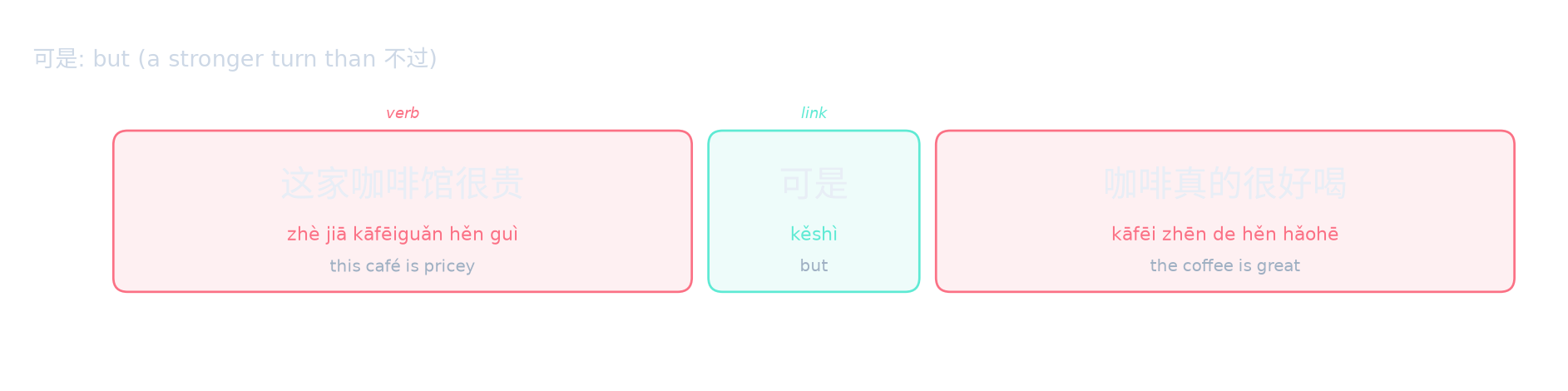
- 1. but可是 / but但是 – two words for “but”: 这家café咖啡馆degree / adjective linker很expensive贵,but可是coffee咖啡really真的degree / adjective linker很tasty (drinks)好喝。
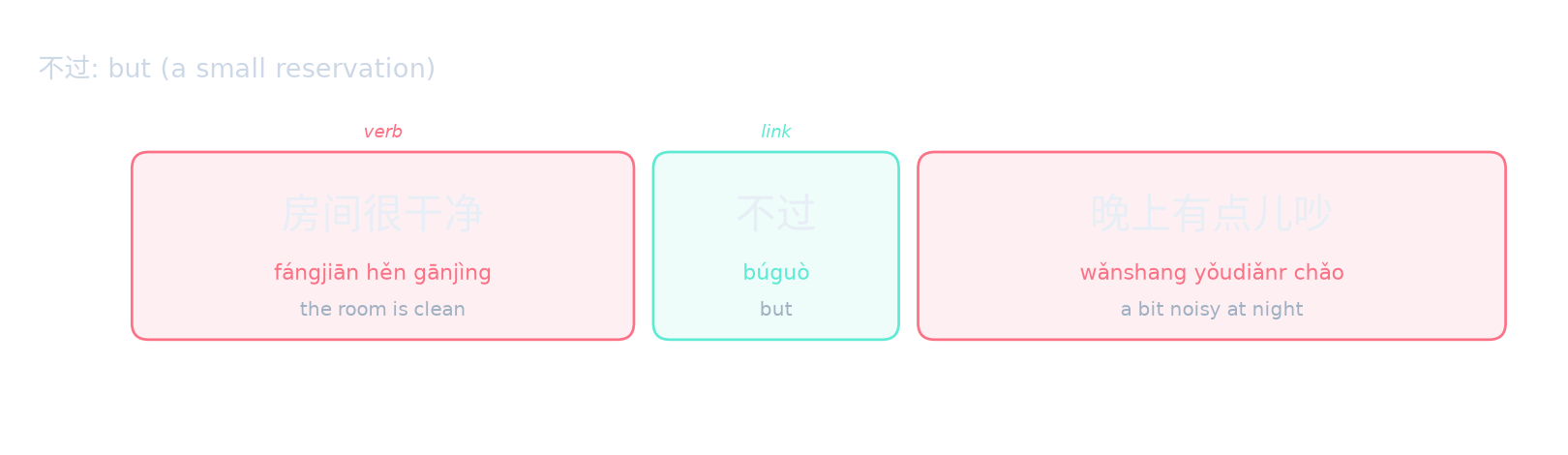
- 2. but不过 – a softer “but”: room房间degree / adjective linker很clean干净,but不过evening晚上slightly有点儿noisy; to quarrel吵。
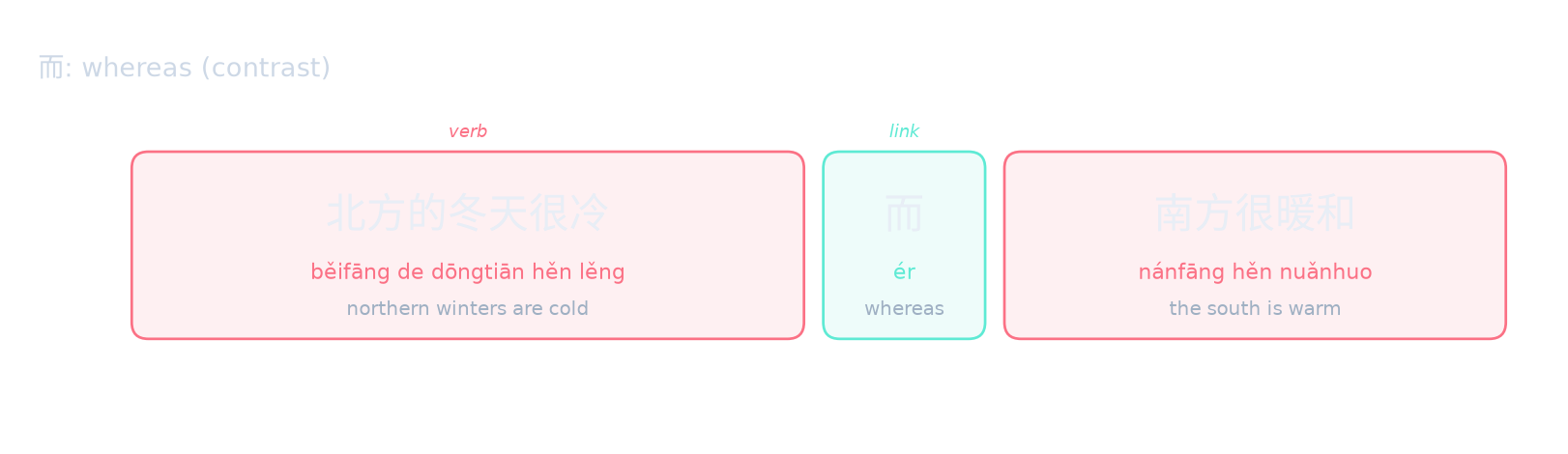
- 3. and / but而 – whereas / and yet: north北方(modifier / structural particle)的winter冬天degree / adjective linker很cold冷,and / but而south南方degree / adjective linker很warm暖和。
Adding more
- 4. also / there is still还有 – also / and / what's more: to bring带passport护照、purse钱包,also / there is still还有mobile phone手机battery charger充电器。
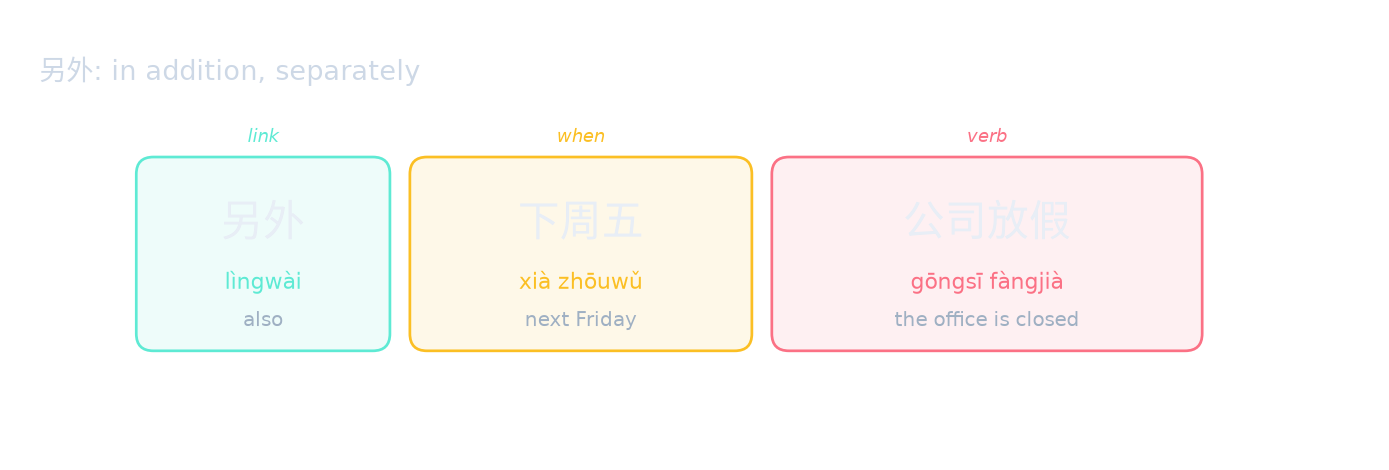
- 5. besides; other另外 – besides / in addition: besides; other另外,down / next; to fall (rain), get off下Friday周五company公司to have a holiday or…放假。
- 6. moreover并且 – moreover / and also: 这家hotel酒店degree / adjective linker很clean干净,moreover并且price价格also也not不expensive贵。
- 7. talk later / besides再说 – besides / what's more: 我太累(completed / change)了,talk later / besides再说also也not / haven't没money钱(completed / change)了。
- 8. first of all首先 … next; secondly其次 … finally; last最后 – first, second, finally: first of all首先want / will / need要many; much多to listen to听,next; secondly其次want / will / need要many; much多to speak说,finally; last最后want / will / need要to keep at; to insist坚持。
- 9. for example例如 vs for example比如 – for example: I / me我to like喜欢sports / to exercise运动,for example例如to swim游泳and / with和to run; to jog跑步。
And so, and by means of
- 10. and so于是 – thereupon / and so: 雨停(completed / change)了,and so于是child孩子(plural)们to run跑出去玩(completed / change)了。
- 11. to use / with用 / to pass; through; by means of通过 … to come来 … – by means of …: 我用手机软件来记new word (in textbook)生词。
5.2
1. 可是 / 但是 (two words for “but”)
Form: (although虽然) A,but可是 / but但是 + B
- 这家café咖啡馆degree / adjective linker很expensive贵,but可是coffee咖啡really真的degree / adjective linker很tasty (drinks)好喝。 Zhè jiā kāfēiguǎn hěn guì, kěshì kāfēi zhēn de hěn hǎohē. – This café is expensive, but the coffee is really good.
- I / me我want / think / miss想to go去,but可是mum; mother妈妈不让。 Wǒ xiǎng qù, kěshì māma bú ràng. – I want to go, but Mum won't let me.
- although虽然to rain下雨,but但是competition比赛照常进行。 – Although it was raining, the match went ahead.
How it works. Both start the second clause, before the subject, and both pair with although虽然. but; yet却 after the subject can strengthen the contrast: he / him他degree / adjective linker很intelligent聪明,but但是but; yet却not不to work hard / effort努力.
| but不过 | but可是 | but但是 |
|---|---|---|
| a small reservation | clear contrast, spoken, often with feeling | clear contrast, neutral, fits writing |
Watch out
- One "but" per contrast: wrong: although虽然……but可是but但是…….
- wrong: I / me我but但是not / haven't没to go去 → but但是I / me我not / haven't没to go去.
Vocabulary
Train
| 汉字 | Pinyin | English |
|---|---|---|
| 可是 | kě shì | but |
| 却 | què | but; yet |
| 不过 | bù guò | but; however (mild) |
5.3
2. 不过 (a softer “but”)
Form: A,but不过 B (but, though) · but不过 + amount / noun (only)
- room房间degree / adjective linker很clean干净,but不过evening晚上slightly有点儿noisy; to quarrel吵。 Fángjiān hěn gānjìng, búguò wǎnshang yǒudiǎnr chǎo. – The room was clean, though it was a bit noisy at night.
- you你can / may可以to use / with用I / me我(modifier / structural particle)的computer电脑,but不过don't别to download下载game游戏。 – You can use my computer, but don't download games.
- he / him他but不过to be / is是(measure word)个child孩子。 – He's only a child.
How it works. but不过 búguò adds a contrast or a small reservation, more gently than but但是. The first clause is usually positive; but不过 adds the limit. It starts its clause, before the subject. Before a noun or amount, but不过 means "only, merely": this这but不过to be / is是(measure word)个small小question / problem问题.
| but不过 | but但是 / but可是 |
|---|---|
| a small reservation | a clear contrast |
Watch out
- wrong: I / me我but不过today今天not / haven't没time时间 → but不过I / me我today今天not / haven't没time时间.
Vocabulary
Train
| 汉字 | Pinyin | English |
|---|---|---|
| 吵 | chǎo | noisy; to quarrel |
5.4
3. 而 (whereas / and yet)
Form: A,and / but而 B (whereas) · adjective + and / but而 + adjective (written "and")
- north北方(modifier / structural particle)的winter冬天degree / adjective linker很cold冷,and / but而south南方degree / adjective linker很warm暖和。 Běifāng de dōngtiān hěn lěng, ér nánfāng hěn nuǎnhuo. – Winters in the north are cold, whereas the south is warm.
- 他学law法律,and / but而I / me我to study medicine学医。 – He studies law, while I study medicine.
- he / him他degree / adjective linker很rich有钱,and / but而life; to live生活but; yet却degree / adjective linker很simple简单。 – He's very rich, yet he lives very simply.
- this这个method方法simple简单and / but而effective有效。 – This method is simple and effective.
How it works. and / but而 ér sets two comparable facts side by side (two places, two people, two qualities). It is written and formal; it suits a newspaper article comparing two cities. With but; yet却 it contrasts a fact with an expectation. Between two adjectives, it means "and".
| but但是 | and / but而 |
|---|---|
| the second part goes against the first | often just sets two facts side by side |
| spoken and written | written, formal |
Watch out
- In chat, say but但是, but可是 or but; yet却 instead.
Vocabulary
Train
| 汉字 | Pinyin | English |
|---|---|---|
| 而 | ér | and; whereas |
| 暖和 | nuǎn huo | warm |
| 法律 | fǎ lǜ | law |
| 生活 | shēng huó | life; to live |
| 方法 | fāng fǎ | method |
5.5
4. 还有 (also / and / what's more)
Form: A、B,also / there is still还有 C · also / there is still还有,+ new point
- to bring带passport护照、purse钱包,also / there is still还有mobile phone手机battery charger充电器。 Dài hùzhào, qiánbāo, hái yǒu shǒujī chōngdiànqì. – Bring your passport and wallet, and also your phone charger.
- I / me我to buy买(completed / change)了bread面包、milk牛奶,also / there is still还有egg鸡蛋。 – I bought bread and milk, and eggs too.
- also / there is still还有,you你别忘了to / for / give给mum; mother妈妈to make a telephone call打电话。 – Also, don't forget to call Mum.
How it works. also / there is still还有 hái yǒu adds one more item to a list, or one more point after a pause, often after a comma. and / with和 joins two nouns inside one phrase (bread面包and / with和milk牛奶); also / there is still还有 adds an afterthought.
Followed by an amount, still / also / even还 + to have / there is有 means "still have": I / me我also / there is still还有两个apple苹果. Check what follows: an amount (still have), or a new item or point (and also).

5.6
5. 另外 (besides / in addition)
Form: besides; other另外,+ new point · subject + besides; other另外 + verb · besides; other另外((modifier / structural particle)的) + number + noun
- besides; other另外,down / next; to fall (rain), get off下Friday周五company公司to have a holiday or…放假。 Lìngwài, xià zhōuwǔ gōngsī fàngjià. – Also, the company is closed next Friday.
- besides; other另外,请带identity card身份证。 – In addition, please bring your ID.
- I / me我besides; other另外to / for / give给you你to prepare; to plan to准备(completed / change)了一份。 – I've prepared an extra one for you.
- besides; other另外一个person人 / besides; other另外两个question / problem问题 – the other person / the other two questions
How it works. besides; other另外 lìngwài has three uses.
| Position | Meaning | Example |
|---|---|---|
| start of the sentence, with a comma | in addition (a separate point) | besides; other另外,…… |
| after the subject, before a verb | separately, on the side | he / him他besides; other另外还学Japanese language日语 |
| before a number or (modifier / structural particle)的 + noun | the other, another | besides; other另外一个person人 |
It is common in emails, meetings and instructions.
Watch out
- besides; other另外 adds something different. To add more of the same, use still / also / even还 or also也.
Vocabulary
Train
| 汉字 | Pinyin | English |
|---|---|---|
| 另外 | lìng wài | besides; other |
5.7
6. 并且 (moreover / and also)
Form: clause,moreover并且 (+ also也 / still / also / even还) + clause
- 这家hotel酒店degree / adjective linker很clean干净,moreover并且price价格also也not不expensive贵。 Zhè jiā jiǔdiàn hěn gānjìng, bìngqiě jiàgé yě bú guì. – This hotel is clean, and moreover the price isn't high.
- he / him他on time按时to complete完成(completed / change)了task任务,moreover并且to do; to make做(degree marker)得degree / adjective linker很good好。 – He finished the task on time, and did it very well too.
- room房间很大,moreover并且degree / adjective linker很bright亮。 – The room is big, and bright as well.
How it works. moreover并且 bìngqiě adds a further point in the same direction, "and moreover". It starts the second clause; also也 or still / also / even还 often follow. It is close to moreover而且 but more written, and suits lists of actions or facts.
| moreover而且 | moreover并且 |
|---|---|
| very common in speech | written |
| pairs with not only不但: not only不但cheap便宜,moreover而且tasty好吃 | lists of actions or facts |
Watch out
- Both points go the same way. For a contrast, use but但是.
- moreover并且 does not join nouns: wrong: apple苹果moreover并且banana香蕉 → apple苹果and / with和banana香蕉.

Vocabulary
Train
| 汉字 | Pinyin | English |
|---|---|---|
| 并且 | bìng qiě | and also |
| 价格 | jià gé | price |
| 按时 | àn shí | on time |
| 任务 | rèn wu | task |
| 亮 | liàng | bright |
| 不但 | bù dàn | not only |
5.8
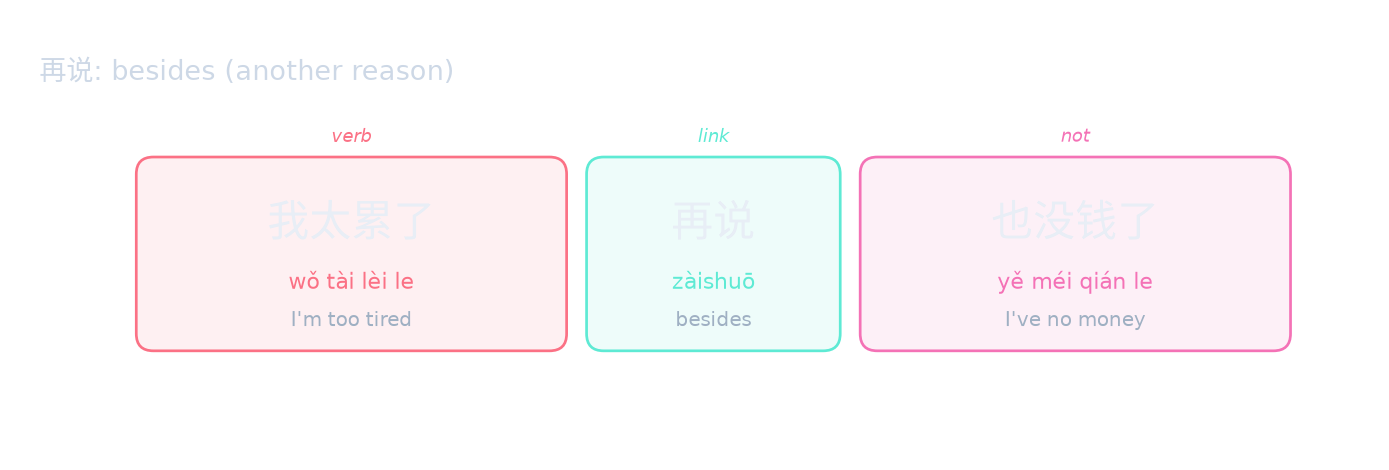
7. 再说 (besides / what's more)
Form: reason 1,talk later / besides再说 + reason 2 · … after / from now on以后talk later / besides再说 (deal with it later)
- 我太累(completed / change)了,talk later / besides再说also也not / haven't没money钱(completed / change)了。 Wǒ tài lèi le, zàishuō yě méi qián le. – I'm too tired, and besides, I'm out of money.
- 太晚(completed / change)了,talk later / besides再说shop商店also也to close (the door)关门(completed / change)了。 – It's too late, and besides, the shop is closed.
- 别买(completed / change)了,太贵(completed / change)了,talk later / besides再说you你already已经to have / there is有一个(completed / change)了。 – Don't buy it; it's too expensive, and besides, you already have one.
- 这件matter事after / from now on以后talk later / besides再说(suggestion)吧。 – Let's talk about it later.
How it works. talk later / besides再说 zàishuō starts a second clause to add a further reason, in conversation: "besides, what's more". The added reason often has also也 or still / also / even还. It is spoken; in writing use moreover而且 or besides此外.
At the end of a sentence, talk later / besides再说 means "we'll deal with it later": this这个question / problem问题tomorrow明天talk later / besides再说.
Watch out
- talk later / besides再说 adds reasons, not steps. "Then" in a sequence is then / after然后.
5.9
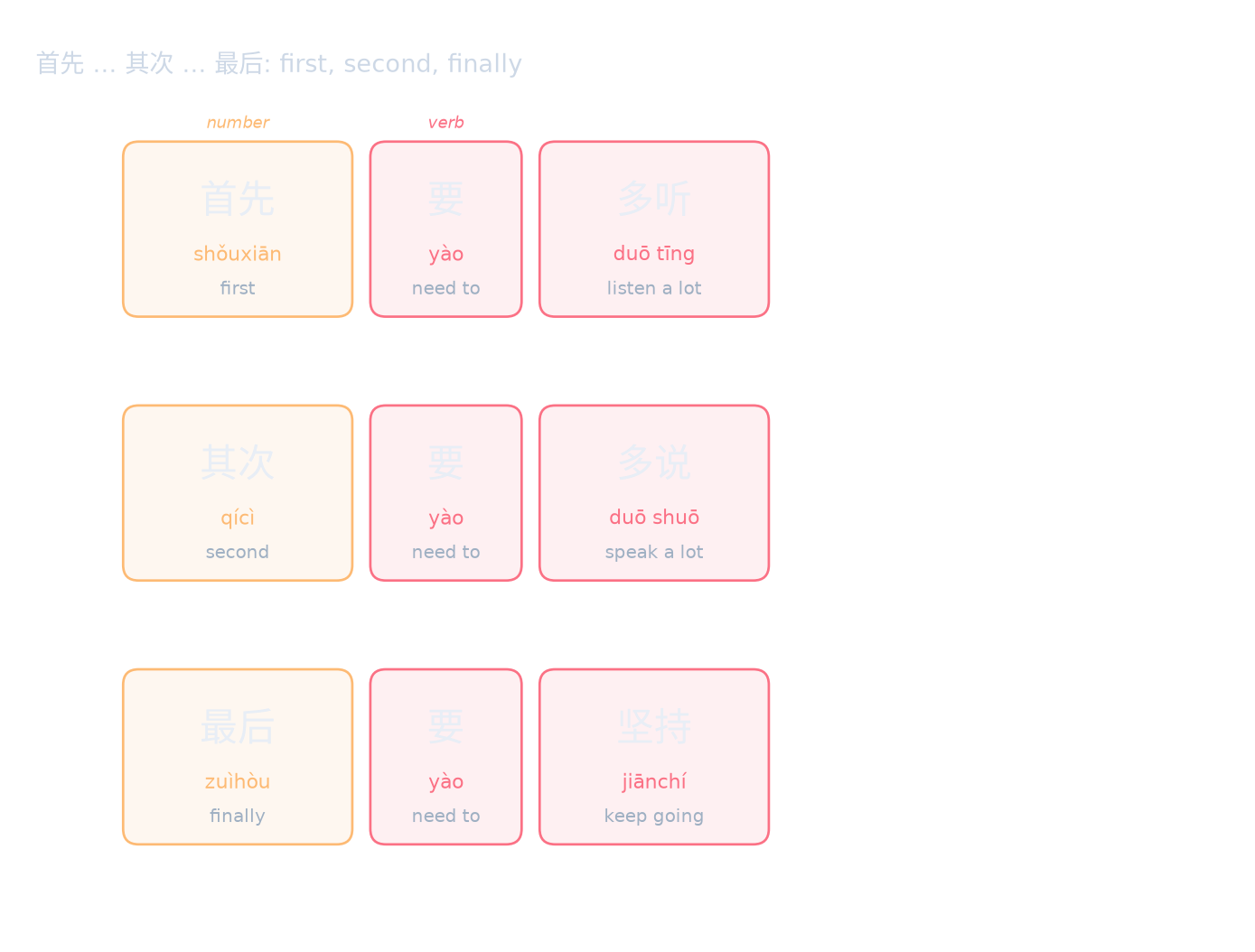
8. 首先 … 其次 … 最后 (first, second, finally)
Form: first of all首先 …,next; secondly其次 …,finally; last最后 …
- first of all首先want / will / need要many; much多to listen to听,next; secondly其次want / will / need要many; much多to speak说,finally; last最后want / will / need要to keep at; to insist坚持。 Shǒuxiān yào duō tīng, qícì yào duō shuō, zuìhòu yào jiānchí. – First, listen a lot; second, speak a lot; finally, keep going.
- first of all首先to wash one's hands洗手,then / after然后切菜,then; next接着to stir-fry炒菜,finally; last最后to put / let go放condiment调料。 – First wash your hands, then cut the vegetables, next fry them, and finally add the seasoning.
- first of all首先,我要to thank感谢everyone大家。 – First of all, I'd like to thank everyone.
How it works. first of all首先, next; secondly其次 and finally; last最后 put points or steps in order. Each starts its own point. Add then / after然后 or then; next接着 for more steps.
| first of all首先 … next; secondly其次 … finally; last最后 | then / after然后 | to start开始 … later; afterwards后来 |
|---|---|---|
| first, second, finally (a list) | then (in a story) | at first … later |
Watch out
- wrong: I / me我to eat吃(completed / change)了breakfast早饭,next; secondly其次to go去to go to school上学 → I / me我to eat吃(completed / change)了breakfast早饭,then / after然后to go去to go to school上学.
- wrong: I / me我first of all首先not不habit / be used to习惯,later; afterwards后来… → I / me我to start开始not不habit / be used to习惯,later; afterwards后来….
Vocabulary
Train
| 汉字 | Pinyin | English |
|---|---|---|
| 首先 | shǒu xiān | first of all |
| 其次 | qí cì | next; secondly |
| 最后 | zuì hòu | finally; last |
| 坚持 | jiān chí | to keep at; to insist |
| 感谢 | gǎn xiè | to thank |
| 后来 | hòu lái | later; afterwards |
5.10
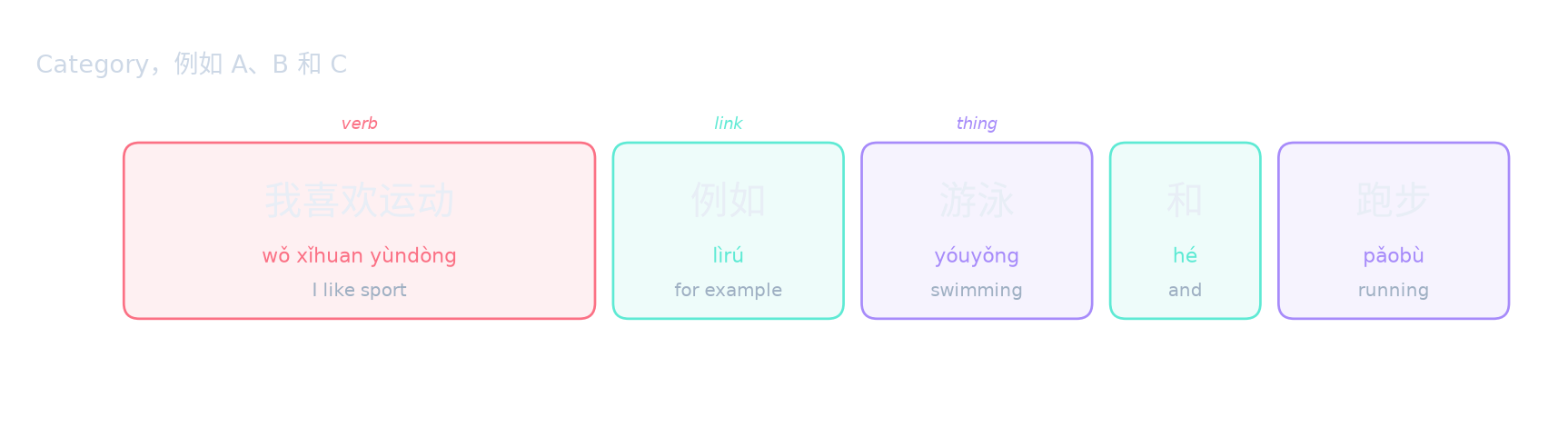
9. 例如 vs 比如 (for example)
Form: general word,for example例如 / for example比如 + A、B (to wait; and so on等)
- I / me我to like喜欢sports / to exercise运动,for example例如to swim游泳and / with和to run; to jog跑步。 Wǒ xǐhuan yùndòng, lìrú yóuyǒng hé pǎobù. – I like sport, for example swimming and running.
- 很多fruit水果to / towards / correct对body; health身体good好,for example例如apple苹果、banana香蕉。 – Lots of fruit is good for you, for example apples and bananas.
- you你can / may可以to do; to make做a little点儿sports / to exercise运动,for example比如打打球。 – You could do some exercise, like playing a bit of ball.
How it works. Say the general group first, then for example例如 (a little formal) or for example比如 / for example比如说 (spoken) and the examples, separated by 、. End an incomplete list with to wait; and so on等. to resemble像 + noun + this way / so这样(modifier / structural particle)的 = like ….
| for example例如apple苹果、banana香蕉to wait; and so on等 | for example比如说 | to resemble像Beijing北京this way / so这样(modifier / structural particle)的city城市 |
|---|---|---|
| for example apples, bananas … | for example (speech) | cities like Beijing |
Watch out
- wrong: for example例如apple苹果,I / me我to like喜欢fruit水果 → I / me我to like喜欢fruit水果,for example例如apple苹果.
Vocabulary
Train
| 汉字 | Pinyin | English |
|---|---|---|
| 例如 | lì rú | for example |
| 等 | děng | to wait; and so on |
| 对 | duì | right; to (someone); towards |
5.11
10. 于是 (thereupon / and so)
Form: past event,and so于是 + what someone did next
- 雨停(completed / change)了,and so于是child孩子(plural)们to run跑出去玩(completed / change)了。 Yǔ tíng le, yúshì háizimen pǎo chūqu wán le. – The rain stopped, so the children ran out to play.
- he / him他hungry饿(completed / change)了,and so于是to go去to buy买(completed / change)了bread面包。 – He was hungry, so he went to buy some bread.
- he / him他to hear (sth said)听说那家店degree / adjective linker很famous有名,and so于是to decide / decision决定to go去试试。 – He heard the shop was famous, so he decided to try it.
How it works. and so于是 yúshì moves a story forward: the second event happens because of, and straight after, the first. It starts the second clause, before any new subject. It is for past narration: event, then reaction.
| so / therefore所以 | and so于是 |
|---|---|
| a logical result, any time | the next action in a past story |
| because因为to rain下雨,so / therefore所以competition比赛to cancel取消(completed / change)了 | to rain下雨(completed / change)了,and so于是we / us我们to return home回家(completed / change)了 |
Watch out
- Not for plans, rules or advice: wrong: if如果to rain下雨,and so于是we / us我们不去 → if如果to rain下雨,we / us我们then / just就not不to go去.

Vocabulary
Train
| 汉字 | Pinyin | English |
|---|---|---|
| 于是 | yú shì | so; then |
5.12
11. 用 / 通过 … 来 … (by means of …)
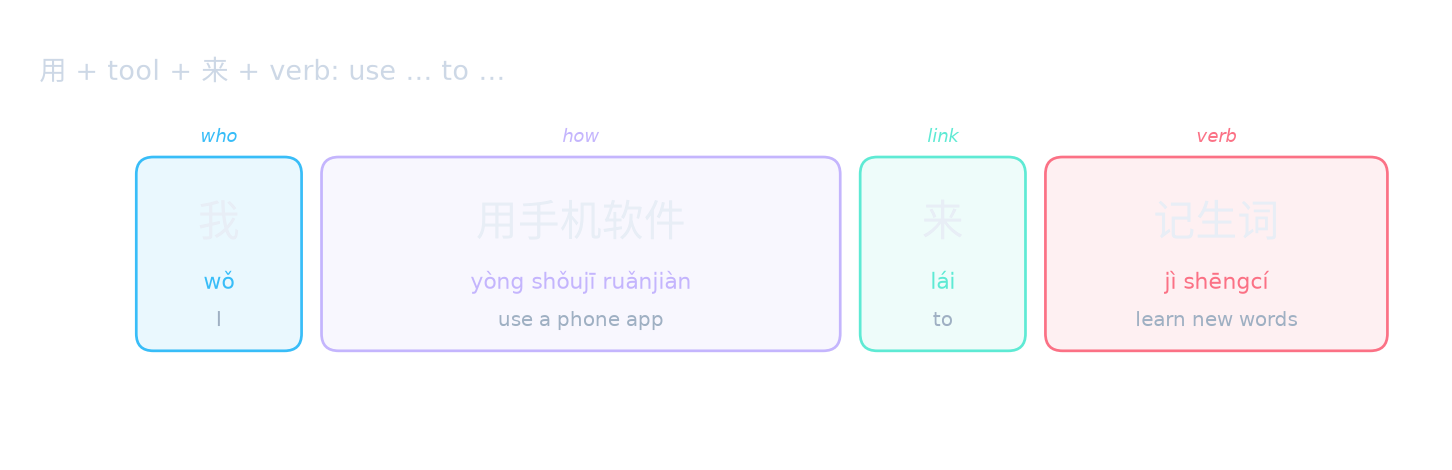
Form: to use / with用 + tool + (to come来) + verb · to pass; through; by means of通过 + method + (to come来) + verb
- 我用手机软件来记new word (in textbook)生词。 Wǒ yòng shǒujī ruǎnjiàn lái jì shēngcí. – I use a phone app to memorise new words.
- 我用dictionary词典来查new word (in textbook)生词。 – I use a dictionary to look up new words.
- he / him他to pass; through; by means of通过sports / to exercise运动to come来to lose weight减肥。 Tā tōngguò yùndòng lái jiǎnféi. – He loses weight through exercise.
- he / him他to pass; through; by means of通过friend朋友to introduce介绍to find找到(completed / change)了to work; job工作。 – He found the job through a friend's introduction.
How it works. The means comes first, then the action. to come来 here does not mean "come": it links the means to the purpose, and can be left out (我用mobile phone手机to record记new word (in textbook)生词).
| to use / with用 | to pass; through; by means of通过 |
|---|---|
| a concrete tool or language | a method, process or channel |
| to use / with用chopsticks筷子to have a meal吃饭, to use / with用Chinese language中文to write写 | to pass; through; by means of通过network网络to study; to learn学习, to pass; through; by means of通过friend朋友to introduce介绍 |
Watch out
- In this pattern the tool goes first: wrong: to have a meal吃饭to use / with用chopsticks筷子 → to use / with用chopsticks筷子to have a meal吃饭.
Vocabulary
Train
| 汉字 | Pinyin | English |
|---|---|---|
| 通过 | tōng guò | to pass; through; by means of |
| 词典 | cí diǎn | dictionary |
| 减肥 | jiǎn féi | to lose weight |
| 中文 | zhōng wén | Chinese language |
5.13
Practice
Cover the teaching pages before you answer. The answers are at the end.
1. but可是 / but但是 (two words for “but”)
1. Complete (written): “Although it was raining, the match went ahead.” although虽然to rain下雨,…………competition比赛照常进行。
2. Which sentence has correct word order?
- A. I / me我want / think / miss想to go去,not / haven't没time时间but但是。
- B. I / me我but但是not / haven't没to go去。
- C. I / me我want / think / miss想to go去,but但是not / haven't没time时间。
- D. but但是I / me我want / think / miss想to go去,not / haven't没time时间。
3. Build: “I want to go, but Mum won't let me.”
Put in order: , / mum; mother妈妈不让。 / but可是 / I / me我want / think / miss想to go去
4. True or false? but; yet却 can follow the subject to strengthen a contrast. If false, correct it.
5. You tell a friend the new café is expensive, but the coffee really is excellent. Use but可是 / but但是. Write your answer in Chinese, then say it aloud.
2. but不过 (a softer “but”)
6. Complete: “The film was good, though a bit long.” film; movie电影not bad / pretty good不错,…………slightly有点儿long长。
7. In this这but不过to be / is是(measure word)个small小question / problem问题, what does but不过 mean?
- A. but
- B. however much
- C. not even
- D. only, merely
8. Build: “You can use my computer, but don't download games.”
Put in order: you你can / may可以to use / with用I / me我(modifier / structural particle)的computer电脑 / don't别to download下载game游戏。 / but不过 / ,
9. True or false? but不过 sounds softer than but但是. If false, correct it.
10. A friend asks about the hotel you stayed in. It was clean and friendly, but noisy at night. Use but不过. Write your answer in Chinese, then say it aloud.
3. and / but而 (whereas / and yet)
11. Complete (written): “He likes coffee, whereas she likes tea.” he / him他to like喜欢coffee咖啡,…………she / her她to like喜欢tea茶。
12. Which context suits and / but而 best?
- A. Ordering food in a restaurant
- B. Greeting a neighbour
- C. A newspaper article comparing two cities
- D. A text message to a friend
13. Build: “This method is simple and effective.”
Put in order: and / but而 / simple简单 / effective有效。 / this这个method方法
14. True or false? and / but而 can simply set two facts side by side without a strong “but”. If false, correct it.
15. You are comparing the weather in two parts of China for a school project. Use and / but而. Write your answer in Chinese, then say it aloud.
4. also / there is still还有 (also / and / what's more)
16. Add a point: “Also, tomorrow's meeting is at nine.” …………,tomorrow明天(modifier / structural particle)的can / will会九点to start开始。
17. In I / me我also / there is still还有两个apple苹果, what does also / there is still还有 mean?
- A. and also
- B. however
- C. still have
- D. besides
18. Build: “I bought bread and milk, and also eggs.”
Put in order: also / there is still还有 / I / me我to buy买(completed / change)了bread面包、milk牛奶 / egg鸡蛋。 / ,
19. True or false? also / there is still还有 often adds an afterthought after a comma. If false, correct it.
20. You are listing what to pack for a trip and suddenly remember an item. Use also / there is still还有. Write your answer in Chinese, then say it aloud.
5. besides; other另外 (besides / in addition)
21. Add a separate point: “In addition, please bring your ID.” …………,请带identity card身份证。
22. What does besides; other另外一个person人 mean?
- A. besides a person
- B. the other person
- C. every person
- D. one more time
23. Build: “He's also studying Japanese on the side.”
Put in order: besides; other另外 / he / him他 / Japanese language日语。 / 还学
24. True or false? besides; other另外 is used to add a different, separate point. If false, correct it.
25. Your manager finishes the main point of a meeting and then adds a separate item. Use besides; other另外. Write your answer in Chinese, then say it aloud.
6. moreover并且 (moreover / and also)
26. Complete (written): “The room is big, and moreover it is bright.” room房间很大,…………degree / adjective linker很bright亮。
27. Which sentence is natural?
- A. he / him他degree / adjective linker很intelligent聪明,moreover并且degree / adjective linker很to work hard / effort努力。
- B. he / him他moreover并且intelligent聪明degree / adjective linker很to work hard / effort努力。
- C. he / him他degree / adjective linker很intelligent聪明,moreover并且not不intelligent聪明。
- D. he / him他degree / adjective linker很intelligent聪明,moreover并且degree / adjective linker很lazy懒。
28. Build: “He finished on time, and did it very well too.”
Put in order: , / moreover并且 / he / him他on time按时to complete完成(completed / change)了task任务 / to do; to make做(degree marker)得degree / adjective linker很good好。
29. True or false? not only不但 pairs naturally with moreover而且. If false, correct it.
30. In your review of a hotel, you want to add a second, separate strength. Use moreover并且. Write your answer in Chinese, then say it aloud.
7. talk later / besides再说 (besides / what's more)
31. Complete: “It's too late, and besides, the shop is closed.” 太晚(completed / change)了,…………shop商店also也to close (the door)关门(completed / change)了。
32. What does this这个question / problem问题tomorrow明天talk later / besides再说 mean?
- A. Say this question again tomorrow.
- B. Besides this question, tomorrow…
- C. This question was said yesterday.
- D. Let's deal with this question tomorrow.
33. Build: “Don't buy it – it's too expensive, and besides you already have one.”
Put in order: 别买(completed / change)了 / ,talk later / besides再说 / ,太贵(completed / change)了 / you你already已经to have / there is有一个(completed / change)了。
34. True or false? talk later / besides再说 is the usual linker for “then” in a sequence of steps. If false, correct it.
35. A friend wants to go out tonight, but you are tired and have no money left. Use talk later / besides再说. Write your answer in Chinese, then say it aloud.
8. first of all首先 … next; secondly其次 … finally; last最后 (first, second, finally)
36. Put the words in the order they are used in a list.
Put in order: finally; last最后 / next; secondly其次 / first of all首先
37. Complete: “First, listen a lot; second, speak a lot.” first of all首先want / will / need要many; much多to listen to听,…………want / will / need要many; much多to speak说。
38. “I ate breakfast, then went to school.” (a story) Which word fits? I / me我to eat吃(completed / change)了breakfast早饭,____to go去to go to school上学。
- A. next; secondly其次
- B. then / after然后
39. “At first I wasn't used to it; later I got used to it.” Which is right?
- A. I / me我first of all首先not不habit / be used to习惯,later; afterwards后来habit / be used to习惯(completed / change)了。
- B. I / me我to start开始not不habit / be used to习惯,later; afterwards后来habit / be used to习惯(completed / change)了。
40. True or false? first of all首先,我要to thank感谢everyone大家 means "First of all, I'd like to thank everyone." If false, correct it.
41. A friend asks how to make a good first impression at a job interview. Give three tips with first of all首先, next; secondly其次 and finally; last最后. Use first of all首先 … next; secondly其次 … finally; last最后. Write your answer in Chinese, then say it aloud.
9. for example例如 vs for example比如 (for example)
42. Complete: “I like sport, for example swimming and running.” I / me我to like喜欢sports / to exercise运动,…………to swim游泳and / with和to run; to jog跑步。
43. The group hasn't been named yet. Which order is right?
- A. for example例如apple苹果,I / me我to like喜欢fruit水果。
- B. I / me我to like喜欢fruit水果,for example例如apple苹果。
44. Chatting with a friend – which sounds most natural?
- A. you你can / may可以to do; to make做a little点儿sports / to exercise运动,for example例如打打球to wait; and so on等。
- B. you你can / may可以to do; to make做a little点儿sports / to exercise运动,for example比如打打球。
45. Build: “Lots of fruit is good for you, for example apples and bananas.”
Put in order: 很多fruit水果to / towards / correct对body; health身体good好, / apple苹果、 / banana香蕉。 / for example例如
46. True or false? to resemble像 + noun + this way / so这样(modifier / structural particle)的 can mean "like …", as in to resemble像Beijing北京this way / so这样(modifier / structural particle)的major city大城市. If false, correct it.
47. Answer in two sentences: What do you do to relax? Give examples with for example比如 (speech) and then write the same idea with for example例如 … to wait; and so on等. Use for example例如 or for example比如. Write your answer in Chinese, then say it aloud.
10. and so于是 (thereupon / and so)
48. Complete: “He was hungry, so he went to buy some bread.” he / him他hungry饿(completed / change)了,…………to go去to buy买(completed / change)了bread面包。
49. Which sentence uses and so于是 correctly?
- A. to get dark天黑(completed / change)了,and so于是we / us我们to return home回家(completed / change)了。
- B. you你should应该to rest休息,and so于是you你can / will会good好。
- C. if如果tomorrow明天to rain下雨,and so于是we / us我们不去。
- D. and so于是because因为to rain下雨,competition比赛to cancel取消(completed / change)了。
50. Build: “He heard the shop was famous, so he decided to try it.”
Put in order: he / him他to hear (sth said)听说那家店degree / adjective linker很famous有名 / , / to decide / decision决定to go去试试。 / and so于是
51. True or false? and so于是 is suitable for general rules about the future. If false, correct it.
52. You are reading a short story aloud: the rain stopped, and the children rushed outside. Use and so于是. Write your answer in Chinese, then say it aloud.
11. to use / with用 / to pass; through; by means of通过 … to come来 … (by means of …)
53. Complete: “I use a dictionary to look up new words.” I / me我…………dictionary词典来查new word (in textbook)生词。
54. Which fits a method? “He found the job through a friend's introduction.” he / him他____friend朋友to introduce介绍to find找到(completed / change)了to work; job工作。
- A. with / and跟
- B. to pass; through; by means of通过
- C. to use / with用
- D. to / towards / correct对
55. Build: “He loses weight through exercise.”
Put in order: to lose weight减肥。 / to pass; through; by means of通过sports / to exercise运动 / he / him他 / to come来
56. True or false? In to use / with用mobile phone手机来记new word (in textbook)生词, to come来 means “come”. If false, correct it.
57. A classmate asks how you remember so many characters. Use to use / with用 / to pass; through; by means of通过 … to come来 …. Write your answer in Chinese, then say it aloud.
5.14
Mixed practice
These questions mix the patterns and use new situations.
58. Choose and so于是 or but不过: I / me我not / haven't没to catch / keep up with赶上bus公共汽车,…………to decide / decision决定to walk走路to go去。 / this这个room房间很大,…………slightly有点儿expensive贵。
59. Choose talk later / besides再说 or and / but而: today今天太晚(completed / change)了,…………outside外面at / in在to rain下雨,tomorrow明天again / then / (再…也) however再to go去(suggestion)吧。 / older brother哥哥to like喜欢sports / to exercise运动,…………younger brother弟弟to like喜欢to read看书。
60. Say "He learns words by watching films."
61. Find and fix the problem. A classmate writes room房间很小,and so于是degree / adjective linker很quiet安静 for "The room is small but quiet." Which word is wrong, and why?
62. Use it yourself. Say you missed the bus, so you decided to walk; add that the road was a bit far.
5.15
Answers and explanations
Mark your work, then correct each mistake in your own words.
1. but可是 / but但是 (two words for “but”)
1. but但是
although虽然 pairs with but但是 / but可是.
2. C. I / me我want / think / miss想to go去,but但是not / haven't没time时间。
but但是 starts the contrasting clause.
3. I / me我want / think / miss想to go去,but可是mum; mother妈妈不让。
Clause 1, but可是 + clause 2.
4. True.
True. but; yet却 is an adverb after the subject that sharpens a contrast, often with but但是 or but可是: I / me我degree / adjective linker很tired累,but但是he / him他but; yet却degree / adjective linker很spirit / energetic精神.
5. Model answer: 这家café咖啡馆degree / adjective linker很expensive贵,but可是coffee咖啡really真的degree / adjective linker很tasty (drinks)好喝。
Check your answer:
- Do not double them: although虽然…but但是…, not although虽然…but可是but但是….
- Put but但是 / but可是 at the start of the clause, before the subject: but但是I / me我not / haven't没to go去, not I / me我but但是not / haven't没to go去.
2. but不过 (a softer “but”)
6. but不过
but不过 adds a soft reservation.
7. D. only, merely
Before a noun phrase, but不过 = only.
8. you你can / may可以to use / with用I / me我(modifier / structural particle)的computer电脑,but不过don't别to download下载game游戏。
Permission, then but不过 + limit.
9. True.
but不过 often adds a minor reservation.
10. Model answer: room房间degree / adjective linker很clean干净,but不过evening晚上slightly有点儿noisy; to quarrel吵。
Check your answer:
- but不过 starts its clause, before the subject: but不过I / me我today今天not / haven't没time时间, not I / me我but不过today今天not / haven't没time时间.
- Keep the reservation small: for a strong contrast, but但是 sounds more natural.
3. and / but而 (whereas / and yet)
11. and / but而
and / but而 contrasts two comparable facts.
12. C. A newspaper article comparing two cities
and / but而 is written, formal style.
13. this这个method方法simple简单and / but而effective有效。
Adj + and / but而 + Adj.
14. True.
True. and / but而 can simply set two facts side by side (“while, whereas”): 他学law法律,and / but而I / me我to study medicine学医 “He studies law, while I study medicine.”
15. Model answer: north北方(modifier / structural particle)的winter冬天degree / adjective linker很cold冷,and / but而south南方degree / adjective linker很warm暖和。
Check your answer:
- and / but而 is written style; in chat say but但是, but可是 or just but; yet却.
- Both clauses should be comparable (two places, two people, two qualities) for the "whereas" meaning.
4. also / there is still还有 (also / and / what's more)
16. also / there is still还有
also / there is still还有 at the start adds a new point.
17. C. still have
still / also / even还 + to have / there is有 + amount = still have.
18. I / me我to buy买(completed / change)了bread面包、milk牛奶,also / there is still还有egg鸡蛋。
List, then also / there is still还有 + one more item.
19. True.
It adds one more item or point.
20. Model answer: to bring带passport护照、purse钱包,also / there is still还有mobile phone手机battery charger充电器。
Check your answer:
- As a linker, also / there is still还有 = "and also": also / there is still还有一件matter事 ("There is one more thing"). As a verb phrase, still / also / even还 + to have / there is有 = "still have": I / me我also / there is still还有十块钱 – "I still have ten yuan."
- Ask: is it about what is left (still have) or about adding one more thing (and also: also / there is still还有一件matter事)?
5. besides; other另外 (besides / in addition)
21. besides; other另外
besides; other另外 introduces a new, separate point.
22. B. the other person
besides; other另外 + number + MW + noun = the other / another.
23. he / him他besides; other另外还学Japanese language日语。
Subject + besides; other另外 + verb phrase.
24. True.
For more of the same, use still / also / even还 or also也.
25. Model answer: besides; other另外,down / next; to fall (rain), get off下Friday周五company公司to have a holiday or…放假。
Check your answer:
- besides; other另外 adds a separate point or item (besides; other另外两个question / problem问题 = two other questions); inside one clause, still / also / even还 / also也 add more of the same.
- At the start of a sentence, put a comma after besides; other另外.
6. moreover并且 (moreover / and also)
26. moreover并且
moreover并且 adds a point in the same direction.
27. A. he / him他degree / adjective linker很intelligent聪明,moreover并且degree / adjective linker很to work hard / effort努力。
moreover并且 adds a point in the same direction; a contrast takes but但是.
28. he / him他on time按时to complete完成(completed / change)了task任务,moreover并且to do; to make做(degree marker)得degree / adjective linker很good好。
Clause, moreover并且 + further point.
29. True.
not only不但…moreover而且… is the standard pair.
30. Model answer: 这家hotel酒店degree / adjective linker很clean干净,moreover并且price价格also也not不expensive贵。
Check your answer:
- moreover并且 adds a point in the same direction; for a contrast use but但是.
- moreover并且 does not join two nouns: apple苹果and / with和banana香蕉, not apple苹果moreover并且banana香蕉.
7. talk later / besides再说 (besides / what's more)
31. talk later / besides再说
talk later / besides再说 adds a further reason.
32. D. Let's deal with this question tomorrow.
talk later / besides再说 at the end postpones a matter.
33. 别买(completed / change)了,太贵(completed / change)了,talk later / besides再说you你already已经to have / there is有一个(completed / change)了。
Reason 1, talk later / besides再说 + reason 2.
34. False.
Sequences use then / after然后; talk later / besides再说 adds reasons.
35. Model answer: 我太累(completed / change)了,talk later / besides再说also也not / haven't没money钱(completed / change)了。
Check your answer:
- talk later / besides再说 adds a reason or argument; for "then" in a sequence, use then / after然后.
- It is spoken; in writing use moreover而且 or besides此外.
8. first of all首先 … next; secondly其次 … finally; last最后 (first, second, finally)
36. first of all首先next; secondly其次finally; last最后
first of all首先 (first), next; secondly其次 (second), finally; last最后 (finally).
37. next; secondly其次
next; secondly其次 = second, the next point.
38. B. then / after然后
For "then" in a story, use then / after然后. next; secondly其次 ranks points.
39. B. I / me我to start开始not不habit / be used to习惯,later; afterwards后来habit / be used to习惯(completed / change)了。
“At first … later” is to start开始 … later; afterwards后来. first of all首先 starts a list.
40. True.
first of all首先 can introduce the first and most important point.
41. Model answer: first of all首先want / will / need要punctual准时to / arrive / (result: get)到,next; secondly其次want / will / need要to wear穿(degree marker)得formal正式a little一点儿,finally; last最后to answer回答question / problem问题(modifier / structural particle)的time; when时候want / will / need要to have / there is有confident自信。
Check your answer:
- The three points start with first of all首先, next; secondly其次 and finally; last最后.
- Each point is a short, clear piece of advice.
- I said it aloud before comparing with the model.
Your answer need not copy the model. A partner or teacher must hear the spoken response to comment on pronunciation.
9. for example例如 vs for example比如 (for example)
42. for example例如
For example – for example例如 (or for example比如 in speech).
43. B. I / me我to like喜欢fruit水果,for example例如apple苹果。
The general word comes first, then for example例如 + the example.
44. B. you你can / may可以to do; to make做a little点儿sports / to exercise运动,for example比如打打球。
In speech, for example比如; for example例如 … to wait; and so on等 sounds written.
45. 很多fruit水果to / towards / correct对body; health身体good好,for example例如apple苹果、banana香蕉。
General word, then for example例如 + examples joined with 、.
46. True.
to resemble像 is used before a noun.
47. Model answer: I / me我to like喜欢to do; to make做some一些relaxed; easy轻松(modifier / structural particle)的matter事,for example比如to listen to听music音乐、to look at; to watch; to read看film; movie电影。(to write写:I / me我to relax放松(modifier / structural particle)的method方法很多,for example例如to listen to听music音乐、to look at; to watch; to read看film; movie电影、to go for a walk散步to wait; and so on等。)
Check your answer:
- The general idea comes before for example比如 / for example例如.
- Examples are separated with 、 and the written list ends with to wait; and so on等.
- I said it aloud before comparing with the model.
Your answer need not copy the model. A partner or teacher must hear the spoken response to comment on pronunciation.
10. and so于是 (thereupon / and so)
48. and so于是
and so于是 tells what he did next.
49. A. to get dark天黑(completed / change)了,and so于是we / us我们to return home回家(completed / change)了。
and so于是 narrates the next past action.
50. he / him他to hear (sth said)听说那家店degree / adjective linker很famous有名,and so于是to decide / decision决定to go去试试。
Event, then and so于是 + decision.
51. False.
It narrates what happened next in the past.
52. Model answer: 雨停(completed / change)了,and so于是child孩子(plural)们to run跑出去玩(completed / change)了。
Check your answer:
- and so于是 tells what someone did next; it is not for plans, rules or advice: if如果to rain下雨,we / us我们then / just就not不to go去, not and so于是we / us我们不去.
- It starts the second clause, usually before the subject if there is a new one: and so于是we / us我们to return home回家(completed / change)了 – "So we went home."
11. to use / with用 / to pass; through; by means of通过 … to come来 … (by means of …)
53. to use / with用
to use / with用 + tool + to come来 + action.
54. B. to pass; through; by means of通过
A method or channel takes to pass; through; by means of通过.
55. he / him他to pass; through; by means of通过sports / to exercise运动to come来to lose weight减肥。
to pass; through; by means of通过 + method + to come来 + purpose.
56. False.
to come来 links the means to the purpose here.
57. Model answer: 我用手机软件来记new word (in textbook)生词。
Check your answer:
- Order: to use / with用 + tool + (to come来) + action: to use / with用chopsticks筷子to have a meal吃饭, not to have a meal吃饭to use / with用chopsticks筷子 in this pattern.
- to come来 here is not "come"; it links the means to the purpose.
Mixed practice
58. I / me我not / haven't没to catch / keep up with赶上bus公共汽车,and so于是to decide / decision决定to walk走路to go去 (what happened next)。this这个room房间很大,but不过slightly有点儿expensive贵 (a soft contrast).
59. today今天太晚(completed / change)了,talk later / besides再说outside外面at / in在to rain下雨,tomorrow明天again / then / (再…也) however再to go去(suggestion)吧。older brother哥哥to like喜欢sports / to exercise运动,and / but而younger brother弟弟to like喜欢to read看书。talk later / besides再说 adds another reason; and / but而 contrasts two people or things.
60. he / him他to pass; through; by means of通过to look at; to watch; to read看film; movie电影to come来to study; to learn学习new word (in textbook)生词。to pass; through; by means of通过 + method + to come来 + action says how something is done.
61. and so于是 means "and so" (what happened next). A contrast needs but不过 or but但是: room房间很小,but不过degree / adjective linker很quiet安静.
62. Model answer. I / me我not / haven't没to catch / keep up with赶上bus公共汽车,and so于是to decide / decision决定to walk走路to go去。but不过,road路slightly有点儿far远。
Review later. Tomorrow, write three sentences: one with and so于是, one with but不过, one with talk later / besides再说.
Interactive lessons on this topic
Work through it step by step, with instant-check exercises.