7.1 Shifting Power After 1900
| Thematic Focus | Learning Objective | Historical Developments |
|---|---|---|
GOV | Unit 7.A |
|
AP World History: Modern · Topic 7
 8:34
8:34
Unit 7: Global Conflict
The organising question of this unit is not what happened in the wars. Campaigns and battles earn almost nothing on this exam. The question is why the…
English narration · English + 中文 subtitles burned in
| Thematic Focus | Learning Objective | Historical Developments |
|---|---|---|
GOV | Unit 7.A |
|
Source: College Board AP Course and Exam Description
Unit 7 covers global conflict from 1900, and its organising question is not "what happened in the wars" but why the political order that existed in 1900 collapsed, and what replaced it.
At the start of the century the West dominated the global political order. Over the following decades both land-based and maritime empires gave way to new states, and the CED names the mechanism as a combination of internal and external factors 内外因素.
The examinable habit here is pairing. An answer that gives only internal weakness, or only external pressure, has given half the explanation.
| English |
|---|
| internal and external factors/ɪnˈtɜːnl ænd ekˈstɜːnl ˈfæktəz/ |
| Mexican Revolution/ˈmeksɪkən ˌrevəˈluːʃn/ |
| Thematic Focus | Learning Objective | Historical Developments |
|---|---|---|
GOV | Unit 7.B |
|
Source: College Board AP Course and Exam Description
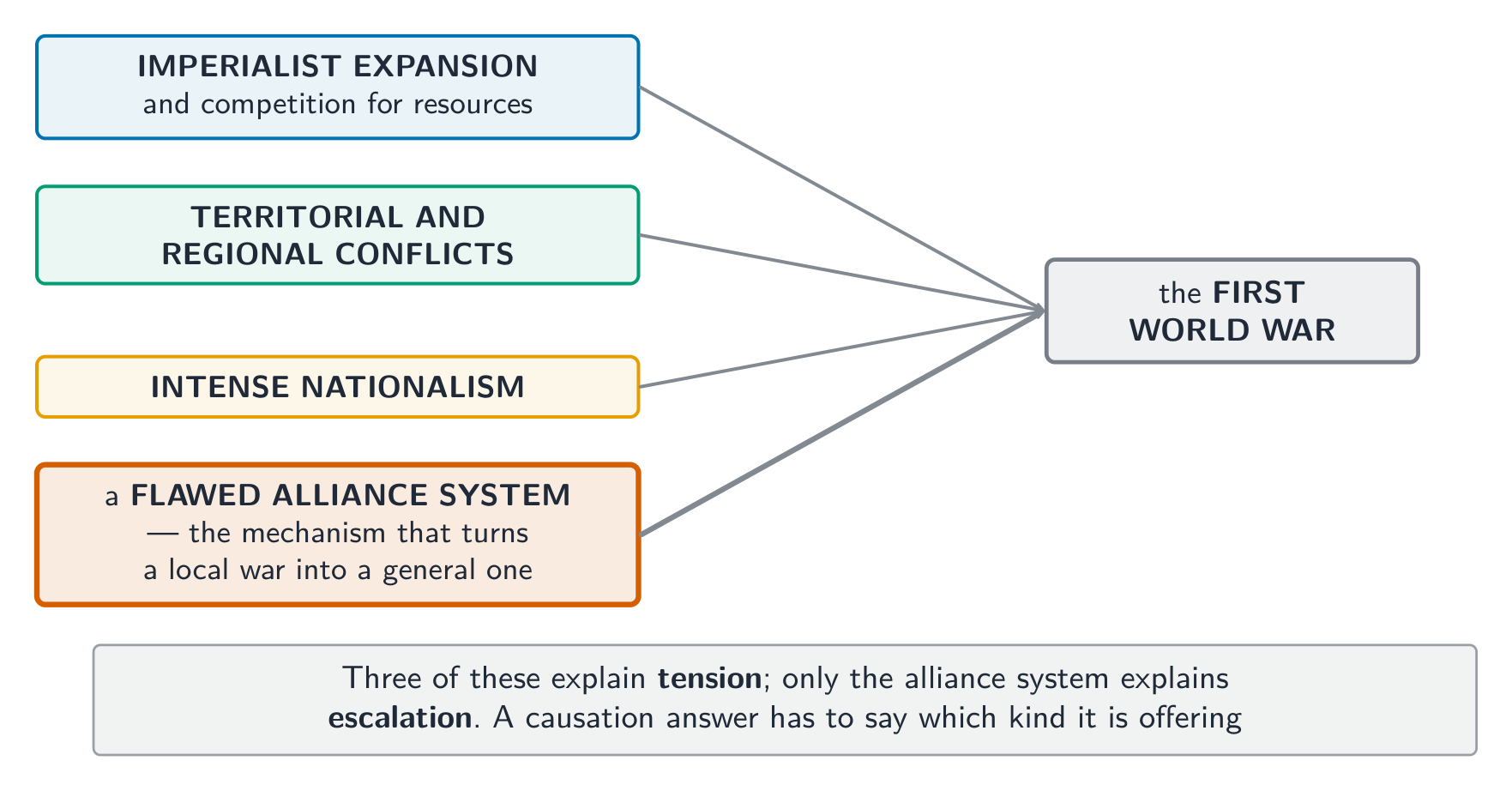
The CED compresses the causes into one statement, and every element of it is worth marks:
Notice the shape of the claim: the first three supply the tension, and the alliance system supplies the escalation 升级. That distinction - between what made conflict likely and what made it global - is the single most useful thing to hold from this topic.
Three conditions explain tension; only the alliance system explains how a local conflict became a general one.
| English |
|---|
| Imperialist expansion/ɪmˈpɪərɪəlɪst ekˈspænʃn/ |
| competition for resources/ˌkɒmpəˈtɪʃn fɔː rɪˈzɔːsɪz/ |
| Territorial and regional conflicts/ˌterɪˈtɔːrɪəl ænd ˈriːdʒənl ˈkɒnflɪkts/ |
| flawed alliance system/flɔːd əˈlaɪəns ˈsɪstəm/ |
| Intense nationalism/ɪnˈtens ˈnæʃənəlɪzəm/ |
| escalation/ˌeskəˈleɪʃn/ |
| Thematic Focus | Learning Objective | Historical Developments |
|---|---|---|
TEC | Unit 7.C |
|
Source: College Board AP Course and Exam Description
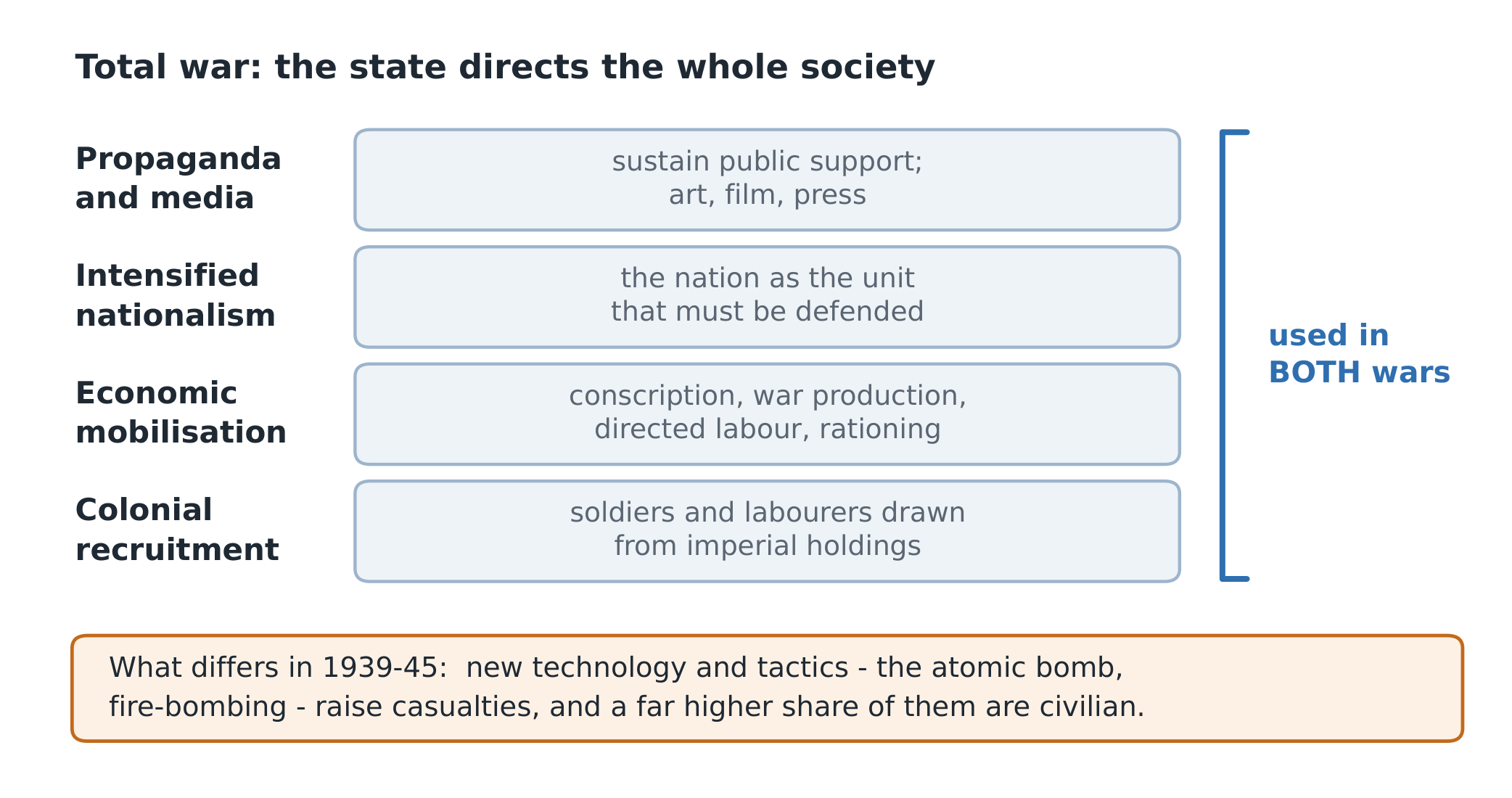
World War I was the first total war 总体战. The CED lists the methods governments used, and they are not only military:
Alongside this, new military technology led to increased levels of wartime casualties. The technological point and the mobilisation point are separate marks, so give both.
| English |
|---|
| first total war/fɜːst ˈtəʊtl wɔː/ |
| Political propaganda/pəˈlɪtɪkl ˌprɒpəˈɡændə/ |
| Intensified forms of nationalism/ɪnˈtensɪfaɪd fɔːmz ɒv ˈnæʃənəlɪzəm/ |
| economies and populations/ɪˈkɒnəmiz ænd ˌpɒpjʊˈleɪʃnz/ |
| colonial subjects/kəˈləʊnɪəl ˈsʌbdʒekts/ |
| Thematic Focus | Learning Objective | Historical Developments |
|---|---|---|
ECN | Unit 7.D |
|
Illustrative examples:
Source: College Board AP Course and Exam Description
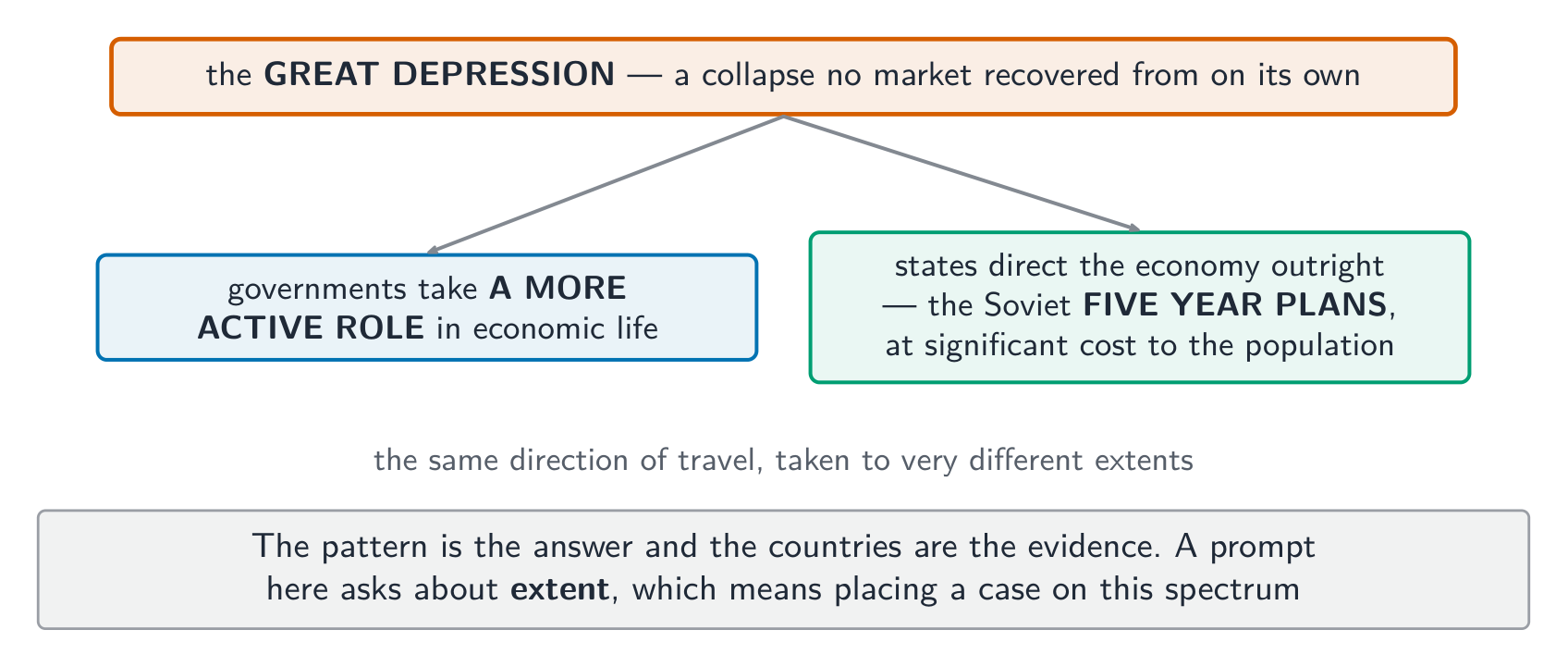
Following World War I and the onset of the Great Depression 大萧条, governments began to take a more active role in economic life. That is the general claim; the CED then supplies contrasting cases of how far that role went.
In the Soviet Union 苏联, the government controlled the national economy through the Five Year Plans 五年计划, implementing repressive policies at significant cost to the population 人口代价 while achieving rapid industrialisation.
The general pattern that makes this comparable across cases: economic crisis increased the state's claim on the economy everywhere, but the extent 程度 differed enormously - from regulation and public works at one end to full state control at the other. Questions about the interwar economy almost always reward that spectrum.
| English |
|---|
| Great Depression/ɡreɪt dɪˈpreʃn/ |
| Soviet Union/ˈsəʊvɪət ˈjuːnɪən/ |
| Five Year Plans/faɪv jɪə plænz/ |
| cost to the population/kɒst tə ðə ˌpɒpjʊˈleɪʃn/ |
| extent/ekˈstent/ |
| Thematic Focus | Learning Objective | Historical Developments |
|---|---|---|
GOV | Unit 7.E |
|
Illustrative examples:
Source: College Board AP Course and Exam Description
Between the two world wars, Western and Japanese imperial states predominantly maintained control over colonial holdings, and in some cases gained new territory. The hopes for self-determination 民族自决 raised by the peace settlement were largely not met for colonised peoples.
This is the bridge topic: the tensions the settlement left unresolved feed directly into both the causes of the next war and the anti-imperial movements of Unit 8. Naming that link is what makes a continuity answer strong.
| English |
|---|
| self-determination/self dɪˌtɜːmɪˈneɪʃn/ |
| Thematic Focus | Learning Objective | Historical Developments |
|---|---|---|
GOV | Unit 7.F |
|
Source: College Board AP Course and Exam Description
The CED again gives a compound cause, and each element is examinable:
Compare this with the World War I list and a real pattern appears: economic pressure and nationalism are common to both, while the specific additions in 1939 are the failed settlement and the new ideological regimes. A comparison question wants exactly that structure - shared causes named, then the differences.
| English |
|---|
| unsustainable peace settlement/ʌnsəˈsteɪnəbl piːs ˈsetəlmənt/ |
| global economic crisis/ˈɡləʊbl ˌiːkəˈnɒmɪk ˈkraɪsɪs/ |
| Continued imperialist practices/kənˈtɪnjuːd ɪmˈpɪərɪəlɪst ˈpræktɪsɪz/ |
| Thematic Focus | Learning Objective | Historical Developments |
|---|---|---|
GOV | Unit 7.G |
|
Illustrative examples:
Source: College Board AP Course and Exam Description
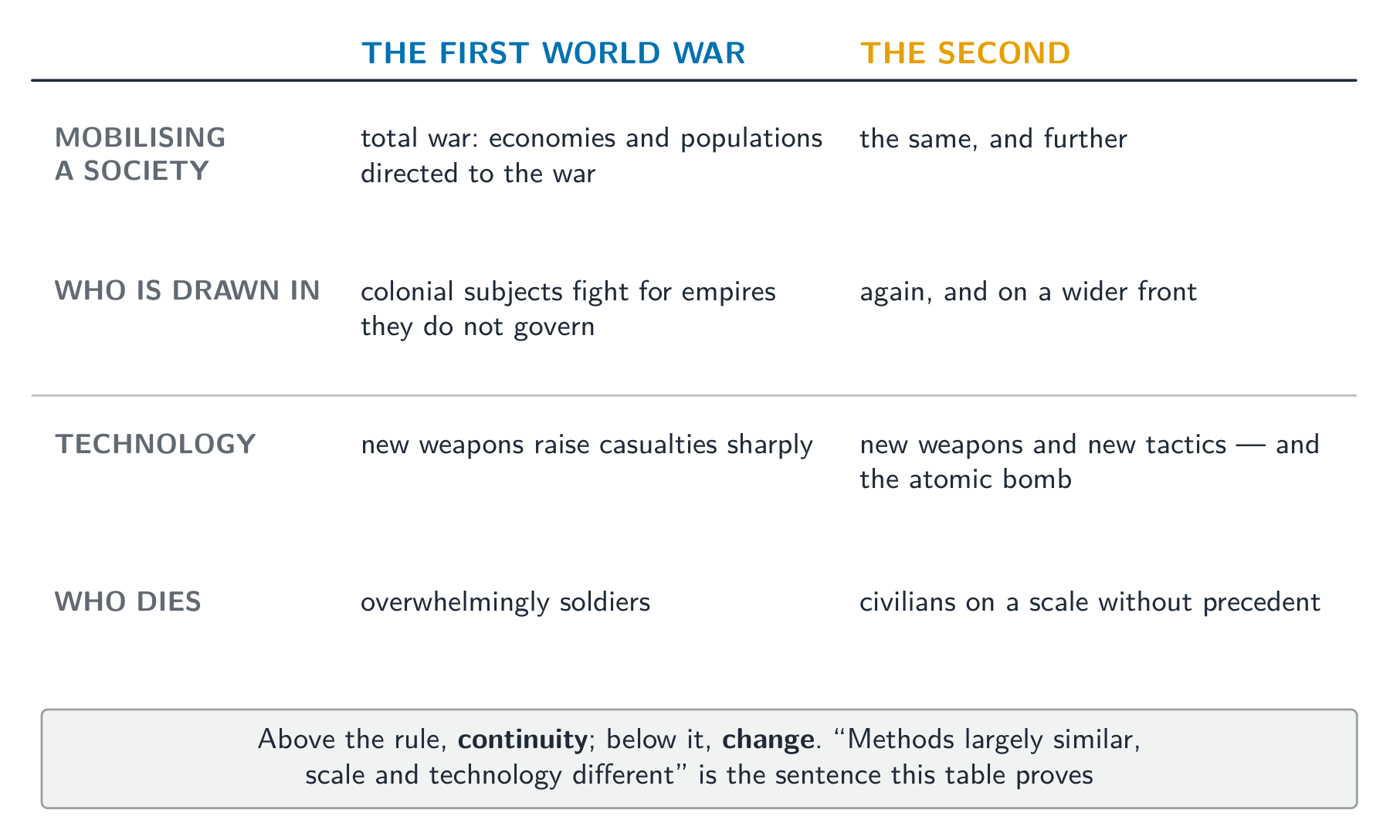
World War II was also a total war, and governments used the same broad categories of method: propaganda, art and media, intensified nationalism, and the mobilisation of economies and populations including colonial subjects.
What changed was the technology and its scale. New military technology and new tactics - including the atomic bomb 原子弹, fire-bombing, and the waging of total war - led to increased levels of casualties, including a far higher proportion of civilian 平民 deaths than in the previous conflict.
The examinable comparison is therefore: methods largely similar, scale and technology different. An answer that says only "both were total wars" has not compared them; an answer that says only "the second was more destructive" has not explained why.
The CED's own verdict: methods largely similar, scale and technology different. That is a continuity-and-change judgement.
| English |
|---|
| atomic bomb/əˈtɒmɪk bɒm/ |
| civilian/sɪˈvɪlɪən/ |
| Thematic Focus | Learning Objective | Historical Developments |
|---|---|---|
SIO | Unit 7.H |
|
Illustrative examples:
Source: College Board AP Course and Exam Description
This topic asks for causes and consequences of mass atrocities in the period from 1900 to the present. The CED's framing is that the rise of extremist groups in power 极端主义团体 led to the attempted destruction of specific populations, and it names the Holocaust 犹太人大屠杀 - the Nazi killing of Jewish people - as the principal case, alongside other twentieth-century genocides and mass killings.
Handled as history, the examinable content is the pattern: an extremist regime takes state power, defines a population as outside the political community, and uses the machinery of the modern state - bureaucracy, transport, communication - to carry out destruction on a scale earlier regimes could not achieve. That last point connects this topic to the technology theme running through the whole unit.
| English |
|---|
| extremist groups in power/ekˈstriːmɪst ɡruːps ɪn ˈpaʊə/ |
| Holocaust/ˈhɒləkɔːst/ |
| Learning Objective | Review: Unit 7 Key Concepts |
|---|---|
Unit 7.I |
|
Source: College Board AP Course and Exam Description
The unit's reasoning skill is causation, and specifically the relative significance 相对重要性 of causes. That word "relative" is the whole task: you are not listing causes, you are ranking them and defending the ranking.
Worked example (a real AP exam question). AP World short-answer questions in this unit ask, for example, to "Explain one similarity between the ways governments conducted World War I and World War II." A full-mark answer names the similarity and supports it with specifics from both: "Both wars were total wars in which governments mobilised entire economies and populations. In both, states used propaganda and media to sustain public support, directed industrial production toward war material, and recruited soldiers and labourers from their colonies." Notice the requirement: a similarity claim must be evidenced on both sides. Evidence from one war only cannot demonstrate a similarity.
| English |
|---|
| relative significance/ˈrelətɪv sɪɡˈnɪfɪkəns/ |
Work through it step by step, with instant-check exercises.
Loading subjects…