Skip to content
Subjects

AP World History: Modern

Tips

AP World History: Modern covers roughly 1200 CE to the present in nine units - the global tapestry of societies around 1200, networks of exchange, land-based empires, transoceanic connections, revolutions, the consequences of industrialisation, global conflict, the Cold War and decolonisation, and globalisation.

The scale is global, and so is the thinking. Questions rarely ask about one country alone. They ask you to compare regions, trace a network across continents, or explain why a similar pressure produced different outcomes in different places.

Themes carry across the whole course: governance, economic systems, cultural developments, social interactions and organisation, technology and innovation, and humans and the environment. Each topic names the theme it belongs to, which is the fastest way to see how distant units connect.

Learn processes, not just events. Trade networks, state formation, industrialisation and migration are processes with causes, mechanisms and effects - and that structure is what written answers are built on.

The notes below follow the College Board framework unit by unit, with the key concepts and the illustrative examples the framework itself offers.

  • 1

    The Global Tapestry

    1.1

    Reading the World in 1200

    Syllabus

    1.1 Developments in East Asia from c. 1200 to c. 1450

    Thematic FocusLearning ObjectiveHistorical Developments

    CDI
    Cultural Developments and Interactions — The development of ideas, beliefs, and religions illustrates how groups in society view themselves, and the interactions of societies and their beliefs often have political, social, and cultural implications.

    Unit 1.A
    Explain the systems of government employed by Chinese dynasties and how they developed over time.

    • KC-3.2.I.A Empires and states in Afro-Eurasia and the Americas demonstrated continuity, innovation, and diversity in the 13th century. This included the Song Dynasty of China, which utilized traditional methods of Confucianism and an imperial bureaucracy to maintain and justify its rule.

    Unit 1.B
    Explain the effects of Chinese cultural traditions on East Asia over time. THEMATIC FOCUS Economics Systems ECN As societies develop, they affect and are affected by the ways that they produce, exchange, and consume goods and services. LEARNING OBJECTIVE

    • KC-3.1.III.D.i Chinese cultural traditions continued, and they influenced neighboring regions.
    • KC-3.1.III.D.ii Buddhism and its core beliefs continued to shape societies in Asia and included a variety of branches, schools, and practices. HISTORICAL DEVELOPMENTS

    Unit 1.C
    Explain the effects of innovation on the Chinese economy over time.

    • KC-3.3.III.A.i The economy of Song China became increasingly commercialized while continuing to depend on free peasant and artisanal labor.
    • KC-3.1.I.D The economy of Song China flourished as a result of increased productive capacity, expanding trade networks, and innovations in agriculture and manufacturing.

    Illustrative examples:

    • Cultural traditions:
      • Filial piety in East Asia
      • Influence of Neo-Confucianism and Buddhism in East Asia
      • Confucian traditions of both respect for and expected deference from women
      • Chinese literary and scholarly traditions and their spread to Heian Japan and Korea
    • Branches of Buddhism:
      • Theravada
      • Mahayana
      • Tibetan
    • Technological innovations:
      • Champa rice
      • Transportation innovations, like the Grand Canal expansion
      • Steel and iron production
      • Textiles and porcelains for export

    Source: College Board AP Course and Exam Description

    Unit 1 surveys the major regions of the world around 1200 to 1450, just before the great connecting networks of Unit 2. Its purpose is comparison: by the end you should be able to say how any two of these societies were governed, what held them together, and how they made their living.

    Three questions apply everywhere, and answering them for each region is the whole unit:

    • How is the state organised? Who rules, through what officials, and paid for how?
    • What belief system shapes society? Religion supplies law, education, and legitimacy in every region here.
    • What is the economic base? Agriculture almost everywhere, but with very different labour systems and levels of trade.
    1.1

    East Asia

    Syllabus

    1.1 Developments in East Asia from c. 1200 to c. 1450

    Thematic FocusLearning ObjectiveHistorical Developments

    CDI
    Cultural Developments and Interactions — The development of ideas, beliefs, and religions illustrates how groups in society view themselves, and the interactions of societies and their beliefs often have political, social, and cultural implications.

    Unit 1.A
    Explain the systems of government employed by Chinese dynasties and how they developed over time.

    • KC-3.2.I.A Empires and states in Afro-Eurasia and the Americas demonstrated continuity, innovation, and diversity in the 13th century. This included the Song Dynasty of China, which utilized traditional methods of Confucianism and an imperial bureaucracy to maintain and justify its rule.

    Unit 1.B
    Explain the effects of Chinese cultural traditions on East Asia over time. THEMATIC FOCUS Economics Systems ECN As societies develop, they affect and are affected by the ways that they produce, exchange, and consume goods and services. LEARNING OBJECTIVE

    • KC-3.1.III.D.i Chinese cultural traditions continued, and they influenced neighboring regions.
    • KC-3.1.III.D.ii Buddhism and its core beliefs continued to shape societies in Asia and included a variety of branches, schools, and practices. HISTORICAL DEVELOPMENTS

    Unit 1.C
    Explain the effects of innovation on the Chinese economy over time.

    • KC-3.3.III.A.i The economy of Song China became increasingly commercialized while continuing to depend on free peasant and artisanal labor.
    • KC-3.1.I.D The economy of Song China flourished as a result of increased productive capacity, expanding trade networks, and innovations in agriculture and manufacturing.

    Illustrative examples:

    • Cultural traditions:
      • Filial piety in East Asia
      • Influence of Neo-Confucianism and Buddhism in East Asia
      • Confucian traditions of both respect for and expected deference from women
      • Chinese literary and scholarly traditions and their spread to Heian Japan and Korea
    • Branches of Buddhism:
      • Theravada
      • Mahayana
      • Tibetan
    • Technological innovations:
      • Champa rice
      • Transportation innovations, like the Grand Canal expansion
      • Steel and iron production
      • Textiles and porcelains for export

    Source: College Board AP Course and Exam Description

    Song China 宋朝中国 is the unit's benchmark state. Its economy became increasingly commercialized 商业化 while remaining largely agrarian 农业为主, supported by rising productive capacity - Champa rice 占城稻, iron and steel production, and transport improvements such as the expanded Grand Canal 大运河.

    Government ran through a bureaucracy 官僚体系 staffed by the civil service examination 科举制度, which recruited officials on merit and gave the state unusual administrative depth.

    Chinese cultural traditions continued and influenced neighbouring regions - Korea, Japan, and Vietnam adopted writing, bureaucratic models, and belief systems. Neo-Confucianism 新儒学 shaped society, including filial piety 孝道 and the expectation of women's deference. Buddhism 佛教 continued to shape Asian societies and spread further, in forms including Theravada 上座部佛教, Mahayana 大乘佛教, and Tibetan 藏传佛教 Buddhism.

    Vocabulary Train
    English Chinese Pinyin
    Song China 宋朝中国 sòng cháo zhōng guó
    commercialized 商业化 shāng yè huà
    agrarian 农业为主 nóng yè wéi zhǔ
    Champa rice 占城稻 zhàn chéng dào
    Grand Canal 大运河 dà yùn hé
    bureaucracy 官僚体系 guān liáo tǐ xì
    civil service examination 科举制度 kē jǔ zhì dù
    Neo-Confucianism 新儒学 xīn rú xué
    filial piety 孝道 xiào dào
    Buddhism 佛教 fó jiào
    Theravada 上座部佛教 shàng zuò bù fó jiào
    Mahayana 大乘佛教 dà chéng fó jiào
    Tibetan 藏传佛教 cáng chuán fó jiào
    1.2

    Dar al-Islam

    Syllabus

    1.2 Developments in Dar al-Islam from c. 1200 to c. 1450

    Thematic FocusLearning ObjectiveHistorical Developments

    CDI
    Cultural Developments and Interactions — The development of ideas, beliefs, and religions illustrates how groups in society view themselves, and the interactions of societies and their beliefs often have political, social, and cultural implications.

    Unit 1.D
    Explain how systems of belief and their practices affected society in the period from c. 1200 to c. 1450. THEMATIC FOCUS Governance GOV A variety of internal and external factors contribute to state formation, expansion, and decline. Governments maintain order through a variety of administrative institutions, policies, and procedures, and governments obtain, retain, and exercise power in different ways and for different purposes. LEARNING OBJECTIVE

    • KC-3.1.III.D.iii Islam, Judaism, Christianity, and the core beliefs and practices of these religions continued to shape societies in Africa and Asia. HISTORICAL DEVELOPMENTS

    Unit 1.E
    Explain the causes and effects of the rise of Islamic states over time.

    • KC-3.2.I As the Abbasid Caliphate fragmented, new Islamic political entities emerged, most of which were dominated by Turkic peoples. These states demonstrated continuity, innovation, and diversity.
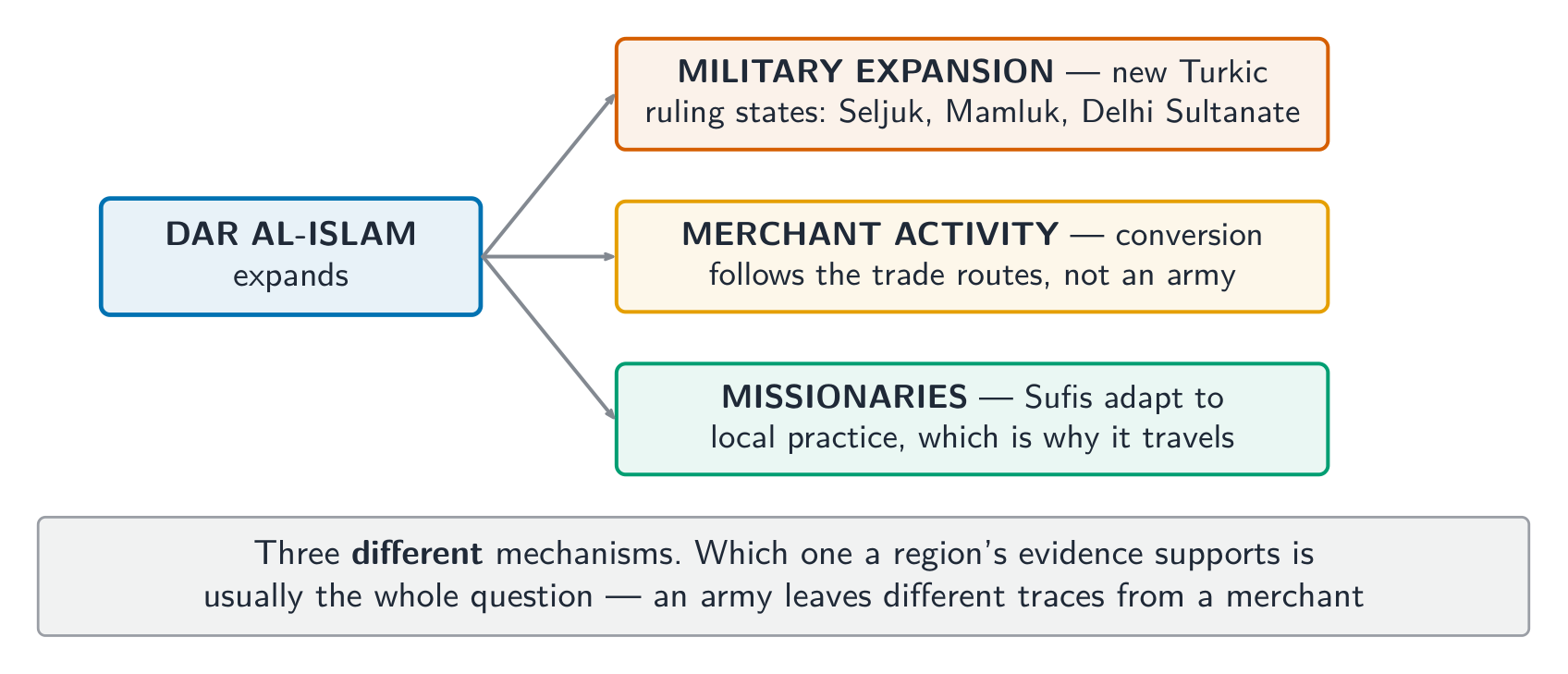
    • KC-3.1.III.A Muslim rule continued to expand to many parts of Afro-Eurasia due to military expansion, and Islam subsequently expanded through the activities of merchants, missionaries, and Sufis. HISTORICAL DEVELOPMENTS

    Unit 1.F
    Explain the effects of intellectual innovation in Dar al-Islam.

    • KC-3.2.II.A.i Muslim states and empires encouraged significant intellectual innovations and transfers.

    Illustrative examples:

    • New Islamic political entities:
      • Seljuk Empire
      • Mamluk sultanate of Egypt
      • Delhi sultanates (CONT’D) Innovations:
      • Advances in mathematics (Nasir al-Din al-Tusi)
      • Advances in literature ('A'ishah al-Ba'uniyyah)
      • Advances in medicine Transfers:
      • Preservation and commentaries on Greek moral and natural philosophy
      • House of Wisdom in Abbasid Bagdad
      • Scholarly and cultural transfers in Muslim and Christian Spain

    Source: College Board AP Course and Exam Description

    As the Abbasid Caliphate 阿拔斯哈里发国 fragmented, new Islamic political entities emerged, most of them Turkic 突厥人 in origin - among them the Seljuk Empire 塞尔柱帝国, the Mamluk sultanate of Egypt 埃及马穆鲁克苏丹国, and the Delhi Sultanate 德里苏丹国.

    Muslim rule continued to expand across Afro-Eurasia through military expansion, merchant activity 商人活动, and the work of missionaries 传教士, especially Sufis 苏非派, whose adaptable practice helped Islam spread.

    Muslim states encouraged significant intellectual innovations and transfers 智识创新与传播: advances in mathematics, medicine, and astronomy, and the preservation and extension of Greek learning that later moved into Europe.

    Vocabulary Train
    English Chinese Pinyin
    Abbasid Caliphate 阿拔斯哈里发国 ā bá sī hā lǐ fā guó
    Turkic 突厥人 tū jué rén
    Seljuk Empire 塞尔柱帝国 sāi ěr zhù dì guó
    Mamluk sultanate of Egypt 埃及马穆鲁克苏丹国 āi jí mǎ mù lǔ kè sū dān guó
    Delhi Sultanate 德里苏丹国 dé lǐ sū dān guó
    merchant activity 商人活动 shāng rén huó dòng
    missionaries 传教士 chuán jiào shì
    Sufis 苏非派 sū fēi pài
    intellectual innovations and transfers 智识创新与传播 zhì shí chuàng xīn yǔ chuán bō
    1.3

    South and Southeast Asia

    Syllabus

    1.3 Developments in South and Southeast Asia from c. 1200 to c. 1450

    Thematic FocusLearning ObjectiveHistorical Developments

    CDI
    Cultural Developments and Interactions — The development of ideas, beliefs, and religions illustrates how groups in society view themselves, and the interactions of societies and their beliefs often have political, social, and cultural implications.

    Unit 1.G
    Explain how the various belief systems and practices of South and Southeast Asia affected society over time. THEMATIC FOCUS Governance GOV A variety of internal and external factors contribute to state formation, expansion, and decline. Governments maintain order through a variety of administrative institutions, policies, and procedures, and governments obtain, retain, and exercise power in different ways and for different purposes. LEARNING OBJECTIVE

    • KC-3.1.III.D.iv Hinduism, Islam, and Buddhism, and their core beliefs and practices, continued to shape societies in South and Southeast Asia. HISTORICAL DEVELOPMENTS

    Unit 1.H
    Explain how and why various states of South and Southeast Asia developed and maintained power over time.

    • KC-3.2.I.B.i State formation and development demonstrated continuity, innovation, and diversity, including the new Hindu and Buddhist states that emerged in South and Southeast Asia.

    Illustrative examples:

    • Beliefs and practices:
      • Bhakti movement
      • Sufism
      • Buddhist monasticism
    • Hindu/Buddhist states:
      • Vijayanagara Empire
      • Srivijaya Empire
      • Rajput kingdoms
      • Khmer Empire
      • Majapahit
      • Sukhothai kingdom
      • Sinhala dynasties

    Source: College Board AP Course and Exam Description

    Hinduism 印度教, Islam, and Buddhism continued to shape the region, and their meeting produced new devotional forms - the bhakti movement 巴克提运动 in Hinduism and Sufism in Islam, both emphasising direct personal devotion.

    State formation showed the unit's theme of continuity and diversity: the Delhi Sultanate ruled much of the north, Vijayanagara 维查耶纳伽尔 arose in the south, and in Southeast Asia the sea-based Majapahit 满者伯夷 and the land-based Khmer Empire 高棉帝国 organised power in different ways.

    Vocabulary Train
    English Chinese Pinyin
    Hinduism 印度教 yìn dù jiào
    bhakti movement 巴克提运动 bā kè tí yùn dòng
    Vijayanagara 维查耶纳伽尔 wéi chá yé nà gā ěr
    Majapahit 满者伯夷 mǎn zhě bó yí
    Khmer Empire 高棉帝国 gāo mián dì guó
    1.4 1.5

    The Americas and Africa

    Syllabus

    1.4 State Building in the Americas

    Thematic FocusLearning ObjectiveHistorical Developments

    GOV
    Governance — A variety of internal and external factors contribute to state formation, expansion, and decline. Governments maintain order through a variety of administrative institutions, policies, and procedures, and governments obtain, retain, and exercise power in different ways and for different purposes.

    Unit 1.I
    Explain how and why states in the Americas developed and changed over time.

    • KC-3.2.I.D.i In the Americas, as in Afro-Eurasia, state systems demonstrated continuity, innovation, and diversity, and expanded in scope and reach.

    Illustrative examples:

    • State systems in the Americas:
      • Maya city-states
      • Mexica
      • Inca
      • Chaco
      • Mesa Verde
      • Cahokia

    1.5 State Building in Africa

    Thematic FocusLearning ObjectiveHistorical Developments

    GOV
    Governance — A variety of internal and external factors contribute to state formation, expansion, and decline. Governments maintain order through a variety of administrative institutions, policies, and procedures, and governments obtain, retain, and exercise power in different ways and for different purposes.

    Unit 1.J
    Explain how and why states in Africa developed and changed over time.

    • KC-3.2.I.D.ii In Africa, as in Eurasia and the Americas, state systems demonstrated continuity, innovation, and diversity and expanded in scope and reach.

    Illustrative examples:

    • State systems in Africa:
      • Great Zimbabwe
      • Ethiopia
      • Hausa kingdoms

    Source: College Board AP Course and Exam Description

    The same three questions asked of six regions - the comparison the unit is built to support
    One framework, six regions: state, belief system, and economic base are what comparison questions actually ask about

    In the Americas, state systems showed continuity, innovation, and diversity: the Maya 玛雅 city-states, the Mexica 墨西加人 (Aztec) with tribute-based expansion, and the Inca 印加 with a centralised administration, labour obligation, and road system.

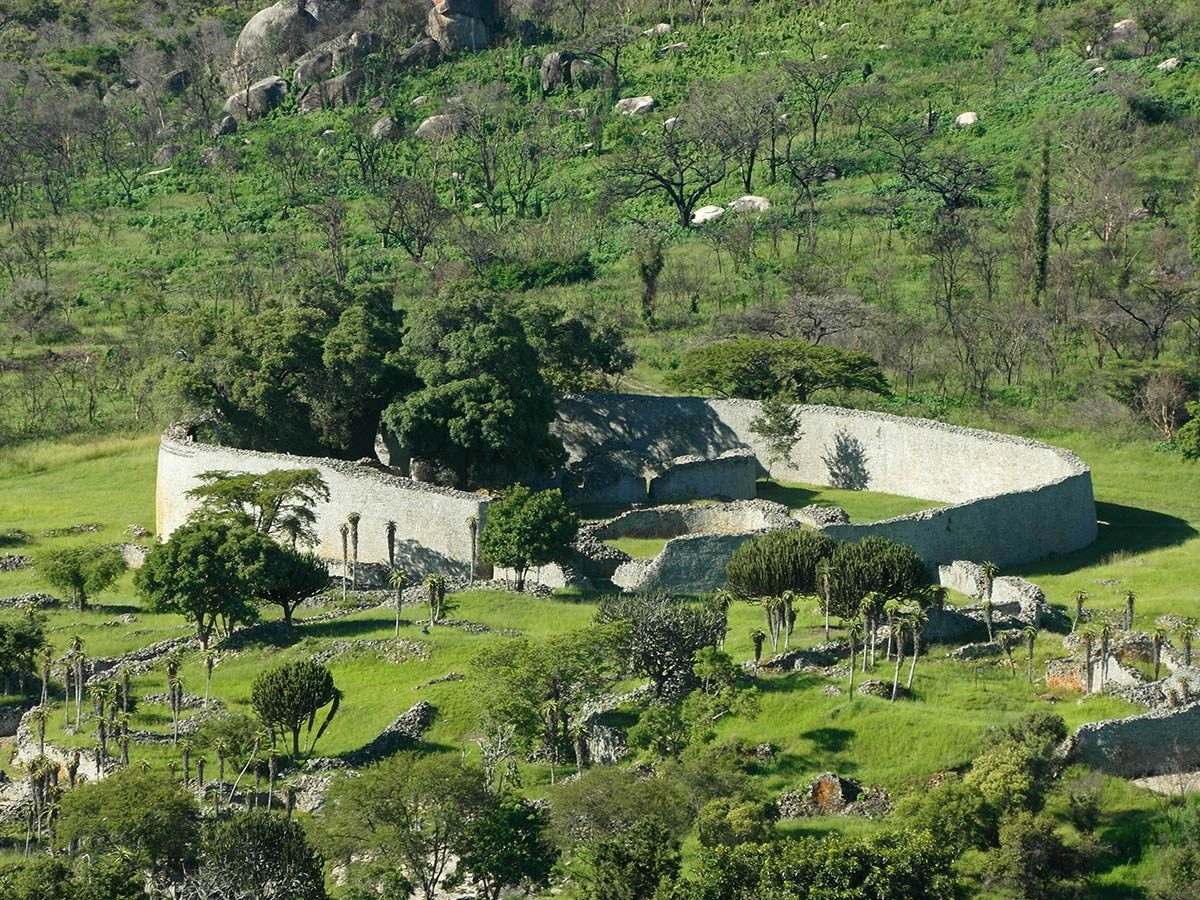
    In Africa, state systems likewise varied: Great Zimbabwe 大津巴布韦 grew on gold and cattle, Ethiopia 埃塞俄比亚 was a long-established Christian kingdom, and the Hausa Kingdoms 豪萨城邦 sat on trans-Saharan trade routes.

    Vocabulary Train
    English Chinese Pinyin
    Maya 玛雅 mǎ yǎ
    Mexica 墨西加人 mò xī jiā rén
    Inca 印加 yìn jiā
    Great Zimbabwe 大津巴布韦 dà jīn bā bù wéi
    Ethiopia 埃塞俄比亚 āi sāi é bǐ yà
    Hausa Kingdoms 豪萨城邦 háo sà chéng bāng
    1.6

    Europe

    Syllabus

    1.6 Developments in Europe from c. 1200 to c. 1450

    Thematic FocusLearning ObjectiveHistorical Developments

    SIO
    Social Interactions and Organization — The process by which societies group their members and the norms that govern the interactions between these groups and between individuals influence political, economic, and cultural institutions and organization.

    Unit 1.K
    Explain how the beliefs and practices of the predominant religions in Europe affected European society. THEMATIC FOCUS Governance GOV A variety of internal and external factors contribute to state formation, expansion, and decline. Governments maintain order through a variety of administrative institutions, policies, and procedures, and governments obtain, retain, and exercise power in different ways and for different purposes. LEARNING OBJECTIVE

    • KC-3.1.III.D.v Christianity, Judaism, Islam, and the core beliefs and practices of these religions continued to shape societies in Europe. HISTORICAL DEVELOPMENTS

    Unit 1.L
    Explain the causes and consequences of political decentralization in Europe from c. 1200 to c. 1450.

    • KC-3.2.I.B.ii Europe was politically fragmented and characterized by decentralized monarchies, feudalism, and the manorial system.

    Unit 1.M
    Explain the effects of agriculture on social organization in Europe from c. 1200 to c. 1450.

    • KC-3.3.III.C Europe was largely an agricultural society dependent on free and coerced labor, including serfdom.

    Source: College Board AP Course and Exam Description

    Europe was politically fragmented 政治上分裂, characterised by decentralised monarchies and by feudalism 封建制度 - a system of land held in exchange for service. Monarchs slowly consolidated power, but nothing here approached the administrative reach of Song China.

    Christianity 基督教, Judaism 犹太教, and Islam all shaped European society, with the Church supplying law, learning, and legitimacy.

    Europe was largely agricultural, dependent on free and coerced labour 自由与强制劳动, including serfdom 农奴制.

    Vocabulary Train
    English Chinese Pinyin
    politically fragmented 政治上分裂 zhèng zhì shàng fēn liè
    feudalism 封建制度 fēng jiàn zhì dù
    Christianity 基督教 jī dū jiào
    Judaism 犹太教 yóu tài jiào
    free and coerced labour 自由与强制劳动 zì yóu yǔ qiáng zhì láo dòng
    serfdom 农奴制 nóng nú zhì
    1.7

    Comparison in the Period

    Syllabus

    1.7 Comparison in the Period from c. 1200 to c. 1450

    Learning ObjectiveReview: Unit 1 Key Concepts

    Unit 1.N
    Explain the similarities and differences in the processes of state formation from c. 1200 to c. 1450.

    • KC-3.2 State formation and development demonstrated continuity, innovation, and diversity in various regions.
      • KC-3.2.I As the Abbasid Caliphate fragmented, new Islamic political entities emerged, most of which were dominated by Turkic peoples. These states demonstrated continuity, innovation, and diversity.
      • KC-3.2.I.A Empires and states in Afro-Eurasia and the Americas demonstrated continuity, innovation, and diversity in the 13th century. This included the Song Dynasty of China, which utilized traditional methods of Confucianism and an imperial bureaucracy to maintain and justify its rule.
      • KC-3.2.I.B.i State formation and development demonstrated continuity, innovation, and diversity, including the new Hindu and Buddhist states that emerged in South and Southeast Asia.
      • KC-3.2.I.D.i In the Americas, as in Afro-Eurasia, state systems demonstrated continuity, innovation, and diversity, and expanded in scope and reach.
      • KC-3.2.I.D.ii In Africa, as in Eurasia and the Americas, state systems demonstrated continuity, innovation, and diversity, and expanded in scope and reach.

    Source: College Board AP Course and Exam Description

    The unit's reasoning skill is comparison 比较. The productive comparisons are structural rather than evaluative:

    • Centralised administration (Song China, Inca) against fragmented or decentralised rule (Europe, post-Abbasid Islamic states).
    • Recruitment by examination against recruitment by birth.
    • States funded by tribute (Mexica) against states funded by taxation (Song China).

    Worked example (a real AP exam question). AP World short-answer questions regularly ask students to "Identify one similarity" or "Explain one difference" between two regions in a period. A full-mark answer for this unit names the feature and applies it to both: "Both Song China and the Inca Empire used a centralised bureaucracy to govern a large territory, but Song China recruited officials through a competitive examination system while the Inca staffed administration through hereditary elites and a labour obligation." Notice the shape: a comparison must be one feature, two societies. Describing each society in turn and leaving the reader to infer the comparison does not earn the point.

    Vocabulary Train
    English Chinese Pinyin
    comparison 比较 bǐ jiào
    1.7

    Exam tips

    • Learn each region through the same three questions - state, belief system, economy - so any comparison question already has a structure.
    • Song China is the benchmark: examination-based bureaucracy, commercialised agriculture, and cultural influence on neighbours.
    • For Dar al-Islam, remember the pattern is fragmentation into new states plus continued expansion by trade and Sufi missionaries.
    • Give a named state for the Americas and Africa. Mexica tribute, Inca labour obligation, Mali and Great Zimbabwe gold are the reliable examples.
    • Europe's distinguishing features are fragmentation, feudalism, and coerced agricultural labour.
    • Write comparisons as one feature across two societies, never as two separate descriptions.
  • 2

    Networks of Exchange

    2.1

    What Made the Networks Grow

    Syllabus

    2.1 The Silk Roads

    Thematic FocusLearning ObjectiveHistorical Developments

    ECN
    Economics Systems — As societies develop, they affect and are affected by the ways that they produce, exchange, and consume goods and services.

    Unit 2.A
    Explain the causes and effects of growth of networks of exchange after 1200.

    • KC-3.1.I.A.i Improved commercial practices led to an increased volume of trade and expanded the geographical range of existing trade routes— including the Silk Roads—promoting the growth of powerful new trading cities.
    • KC-3.1.I.C.i The growth of interregional trade in luxury goods was encouraged by innovations in previously existing transportation and commercial technologies, including the caravanserai, forms of credit, and the development of money economies.
    • KC-3.3.I.B Demand for luxury goods increased in Afro-Eurasia. Chinese, Persian, and Indian artisans and merchants expanded their production of textiles and porcelains for export; manufacture of iron and steel expanded in China.

    Illustrative examples:

    • Trading cities:
      • Kashgar
      • Samarkand
    • New forms of credit and money economies:
      • Bills of exchange
      • Banking houses
      • Use of paper money

    Source: College Board AP Course and Exam Description

    Unit 2 covers the three great exchange networks of 1200 to 1450 - the Silk Roads, the Indian Ocean, and the trans-Saharan routes - and asks the same question of each: what made trade grow, and what did that growth change?

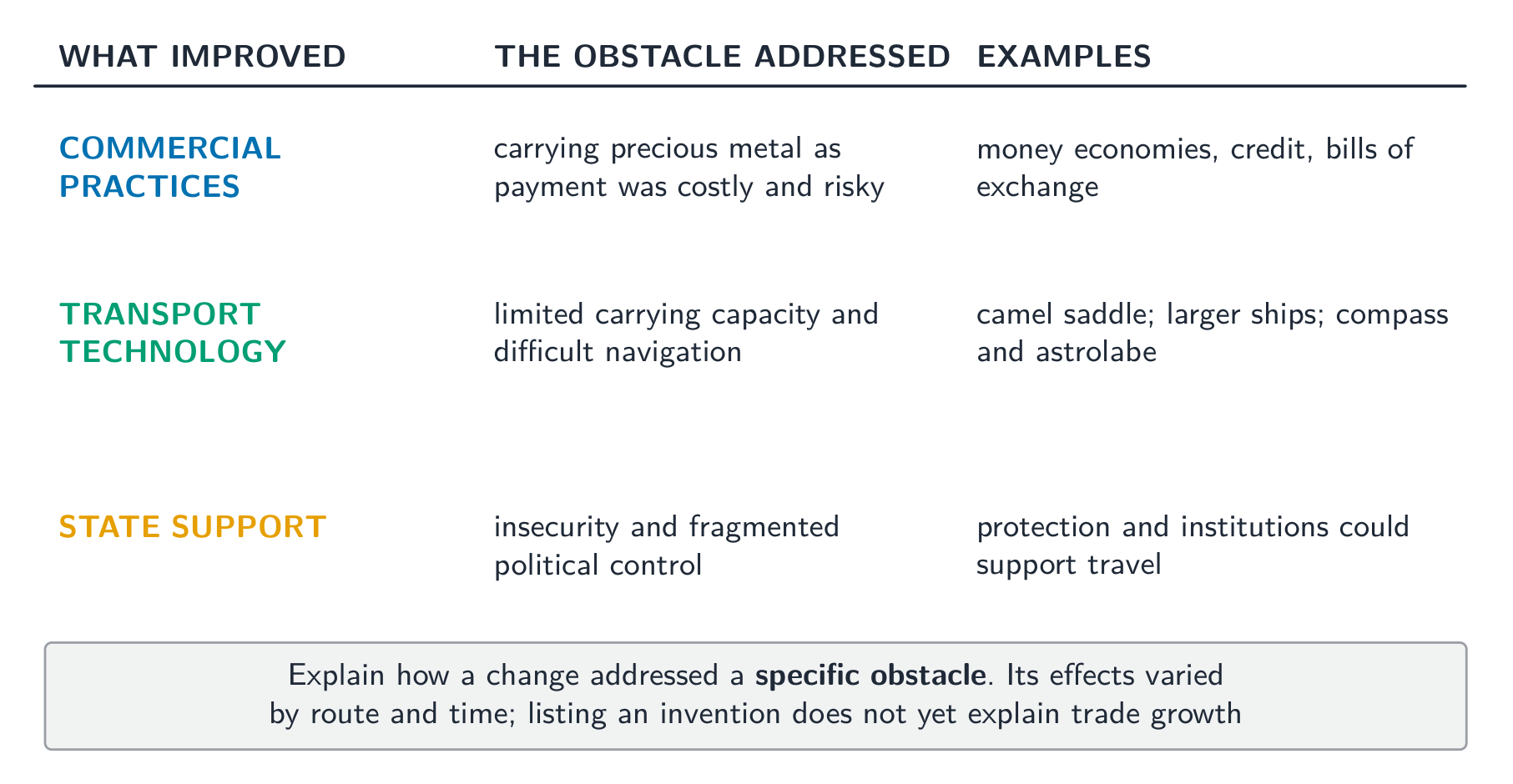
    Growth had three common causes, and naming them is worth more than listing goods:

    • Improved commercial practices 商业惯例的改进 - money economies 货币经济, credit 信贷, and forms of partnership that spread risk.
    • Improved transportation technologies 交通技术的改进 - better ships, saddles, and navigation.
    • State support 国家支持 - empires that secured routes and taxed the trade benefited from protecting it.

    Demand mattered too: luxury goods 奢侈品 from Chinese, Persian, and Indian artisans found expanding markets across Afro-Eurasia, and producers increased output to meet that demand.

    Vocabulary Train
    English Chinese Pinyin
    Improved commercial practices 商业惯例的改进 shāng yè guàn lì de gǎi jìn
    money economies 货币经济 huò bì jīng jì
    credit 信贷 xìn dài
    Improved transportation technologies 交通技术的改进 jiāo tōng jì shù de gǎi jìn
    State support 国家支持 guó jiā zhī chí
    luxury goods 奢侈品 shē chǐ pǐn
    2.1

    The Silk Roads

    Syllabus

    2.1 The Silk Roads

    Thematic FocusLearning ObjectiveHistorical Developments

    ECN
    Economics Systems — As societies develop, they affect and are affected by the ways that they produce, exchange, and consume goods and services.

    Unit 2.A
    Explain the causes and effects of growth of networks of exchange after 1200.

    • KC-3.1.I.A.i Improved commercial practices led to an increased volume of trade and expanded the geographical range of existing trade routes— including the Silk Roads—promoting the growth of powerful new trading cities.
    • KC-3.1.I.C.i The growth of interregional trade in luxury goods was encouraged by innovations in previously existing transportation and commercial technologies, including the caravanserai, forms of credit, and the development of money economies.
    • KC-3.3.I.B Demand for luxury goods increased in Afro-Eurasia. Chinese, Persian, and Indian artisans and merchants expanded their production of textiles and porcelains for export; manufacture of iron and steel expanded in China.

    Illustrative examples:

    • Trading cities:
      • Kashgar
      • Samarkand
    • New forms of credit and money economies:
      • Bills of exchange
      • Banking houses
      • Use of paper money

    Source: College Board AP Course and Exam Description

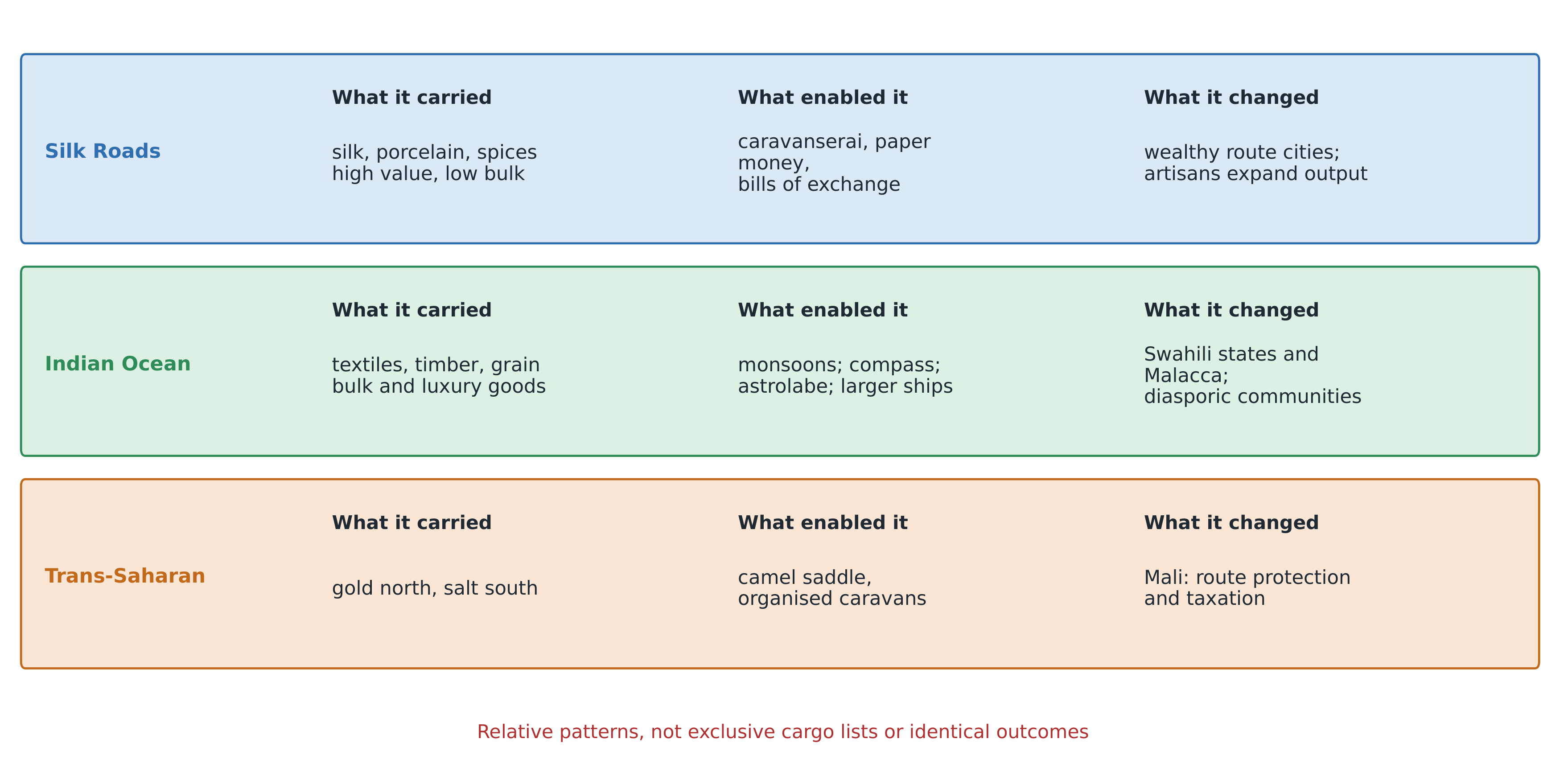
    The Silk Roads 丝绸之路 carried high-value, low-bulk goods overland across Eurasia: silk, porcelain, spices, and precious metals.

    Its enabling innovations were commercial as much as technical - caravanserai 商队旅馆 along the routes, the use of paper money 纸币 and bills of exchange 汇票 in China, and forms of credit that let merchants trade without carrying bullion.

    The consequence for producers: Chinese artisans expanded output, and cities along the routes grew wealthy on the traffic passing through.

    Vocabulary Train
    English Chinese Pinyin
    Silk Roads 丝绸之路 sī chóu zhī lù
    caravanserai 商队旅馆 shāng duì lǚ guǎn
    paper money 纸币 zhǐ bì
    bills of exchange 汇票 huì piào
    2.2

    The Mongol Empire

    Syllabus

    2.2 The Mongol Empire and the Making of the Modern World

    Thematic FocusLearning ObjectiveHistorical Developments

    CDI
    Cultural Developments and Interactions — The development of ideas, beliefs, and religions illustrates how groups in society view themselves, and the interactions of societies and their beliefs often have political, social, and cultural implications.

    Unit 2.B
    Explain the process of state building and decline in Eurasia over time. THEMATIC FOCUS Economics Systems ECN As societies develop, they affect and are affected by the ways that they produce, exchange, and consume goods and services. LEARNING OBJECTIVE

    • KC-3.2.I.B.iii Empires collapsed in different regions of the world and in some areas were replaced by new imperial states, including the Mongol khanates. HISTORICAL DEVELOPMENTS

    Unit 2.C
    Explain how the expansion of empires influenced trade and communication over time.

    • KC-3.1.I.E.i The expansion of empires—including the Mongols—facilitated Afro-Eurasian trade and communication as new people were drawn into their conquerors’ economies and trade networks.

    Unit 2.D
    Explain the significance of the Mongol Empire in larger patterns of continuity and change.

    • KC-3.2.II.A.ii Interregional contacts and conflicts between states and empires, including the Mongols, encouraged significant technological and cultural transfers.

    Illustrative examples:

    • Technological and cultural transfers:
      • Transfer of Greco– Islamic medical knowledge to western Europe
      • Transfer of numbering systems to Europe
      • Adoption of Uyghur script

    Source: College Board AP Course and Exam Description

    Empires collapsed and were reconstituted in this period, and the largest transformation came from the Mongol Empire 蒙古帝国.

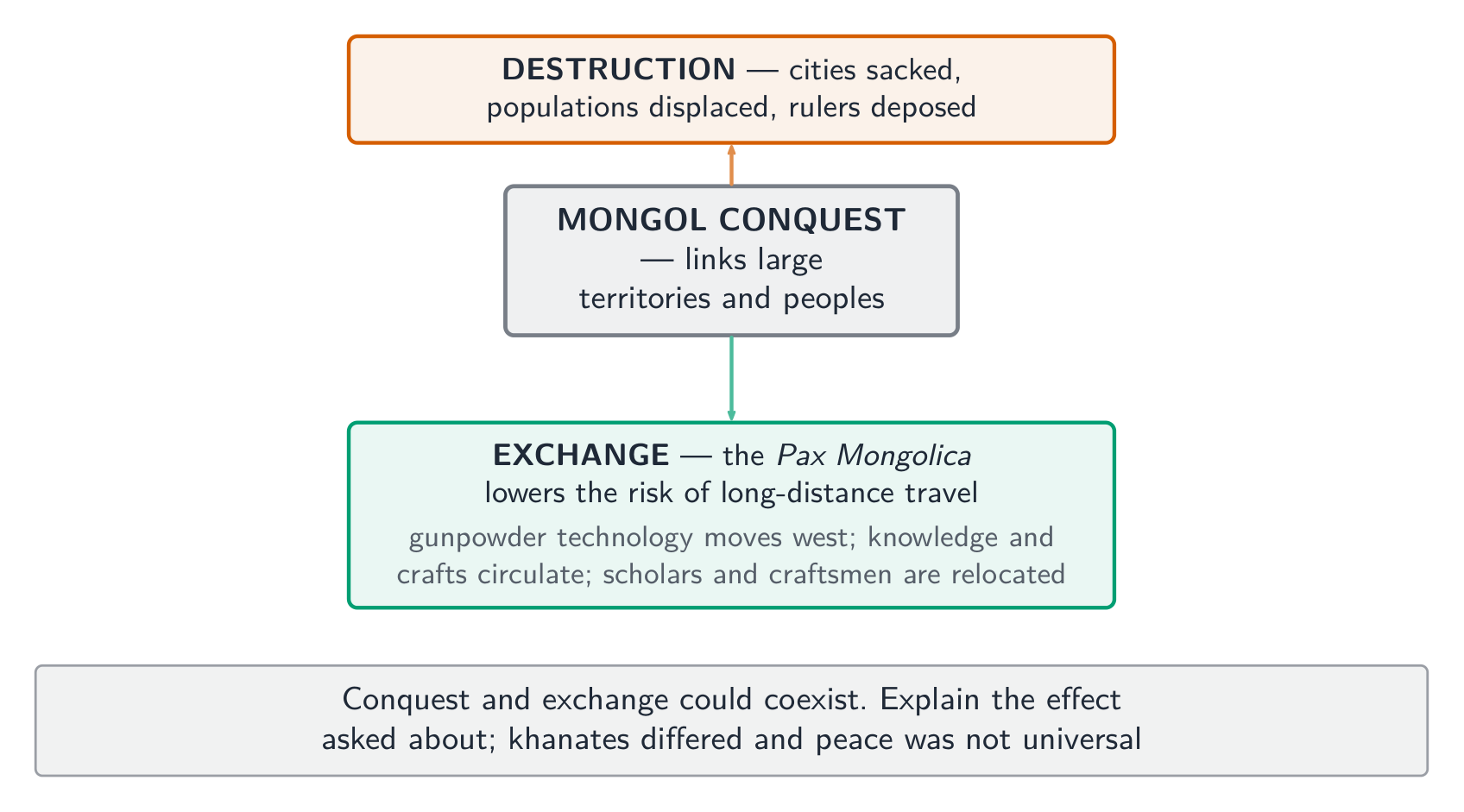
    Mongol expansion facilitated Afro-Eurasian trade and communication by bringing much of the network under a single authority, which lowered the risk of long-distance travel - a period often called the Pax Mongolica 蒙古和平.

    Interregional contacts and conflicts also encouraged technological and cultural transfers 技术与文化传播: gunpowder technology moved west, Chinese administrative and medical knowledge circulated, and scholars and craftsmen were relocated across the empire.

    The Mongols illustrate the unit's central irony: conquest and destruction produced the conditions for exchange.

    Vocabulary Train
    English Chinese Pinyin
    Mongol Empire 蒙古帝国 méng gǔ dì guó
    Pax Mongolica 蒙古和平 méng gǔ hé píng
    encouraged technological and cultural transfers 技术与文化传播 jì shù yǔ wén huà chuán bō
    2.3

    The Indian Ocean

    Syllabus

    2.3 Exchange in the Indian Ocean

    Thematic FocusLearning ObjectiveHistorical Developments

    CDI
    Cultural Developments and Interactions — The development of ideas, beliefs, and religions illustrates how groups in society view themselves, and the interactions of societies and their beliefs often have political, social, and cultural implications.

    Unit 2.E
    Explain the causes of the growth of networks of exchange after 1200.

    • KC-3.1.I.A.ii Improved transportation technologies and commercial practices led to an increased volume of trade and expanded the geographical range of existing trade routes, including the Indian Ocean, promoting the growth of powerful new trading cities.
    • KC-3.1.I.C.ii The growth of interregional trade in luxury goods was encouraged by significant innovations in previously existing transportation and commercial technologies, including the use of the compass, the astrolabe, and larger ship designs.
    • KC-3.1.I.A.iii The Indian Ocean trading network fostered the growth of states.

    Unit 2.F
    Explain the effects of the growth of networks of exchange after 1200. THEMATIC FOCUS Humans and the Environments ENV The environment shapes human societies, and as populations grow and change, these populations in turn shape their environments. LEARNING OBJECTIVE

    • KC-3.1.III.B In key places along important trade routes, merchants set up diasporic communities where they introduced their own cultural traditions into the indigenous cultures and, in turn, indigenous cultures influenced merchant cultures.
    • KC-3.2.II.A.iii Interregional contacts and conflicts between states and empires encouraged significant technological and cultural transfers, including during Chinese maritime activity led by Ming Admiral Zheng He. HISTORICAL DEVELOPMENTS

    Unit 2.G
    Explain the role of environmental factors in the development of networks of exchange in the period from c. 1200 to c. 1450.

    • KC-3.1.II.A.i The expansion and intensification of long-distance trade routes often depended on environmental knowledge, including advanced knowledge of the monsoon winds.

    Illustrative examples:

    • Growth of states:
      • City-states of the Swahili Coast
      • Gujarat
      • Sultanate of Malacca
    • (CONT’D) Diasporic communities:
      • Arab and Persian communities in East Africa
      • Chinese merchant communities in Southeast Asia
      • Malay communities in the Indian Ocean basin

    Source: College Board AP Course and Exam Description

    The three networks compared by what they carried, what enabled them, and what they changed
    Three networks, one framework: goods, enabling technology, and consequences are what comparison questions ask for

    The Indian Ocean network moved bulkier goods than the Silk Roads - textiles, timber, grain, and spices - because ships carry more than camels.

    Its enabling technologies were maritime: knowledge of the monsoon winds 季风, the lateen sail 三角帆, the dhow 单桅帆船, and navigational tools including the compass 罗盘 and astrolabe 星盘.

    Its consequences are the most examinable in the unit:

    • The network fostered the growth of states 促进国家成长, such as the Swahili city-states on the East African coast and Srivijaya and Majapahit in Southeast Asia.
    • Merchants established diasporic communities 侨居社群 in key ports, introducing their own culture while adopting local ways.
    • Long-distance trade depended on and expanded coerced labour and on the movement of people as well as goods.
    Vocabulary Train
    English Chinese Pinyin
    monsoon winds 季风 jì fēng
    lateen sail 三角帆 sān jiǎo fān
    dhow 单桅帆船 dān wéi fān chuán
    compass 罗盘 luó pán
    astrolabe 星盘 xīng pán
    fostered the growth of states 促进国家成长 cù jìn guó jiā chéng zhǎng
    diasporic communities 侨居社群 qiáo jū shè qún
    2.4

    Trans-Saharan Trade

    Syllabus

    2.4 Trans-Saharan Trade Routes

    Thematic FocusLearning ObjectiveHistorical Differences

    GOV
    Governance — A variety of internal and external factors contribute to state formation, expansion, and decline. Governments maintain order through a variety of administrative institutions, policies, and procedures, and governments obtain, retain, and exercise power in different ways and for different purposes.

    Unit 2.H
    Explain the causes and effects of the growth of trans-Saharan trade.

    • KC-3.1.II.A.ii The growth of interregional trade was encouraged by innovations in existing transportation technologies.
    • KC-3.1.I.A.iv Improved transportation technologies and commercial practices led to an increased volume of trade and expanded the geographical range of existing trade routes, including the trans-Saharan trade network.

    Unit 2.I
    Explain how the expansion of empires influenced trade and communication over time.

    • KC-3.1.I.E.ii The expansion of empires—including Mali in West Africa–facilitated Afro-Eurasian trade and communication as new people were drawn into the economies and trade networks.

    Illustrative examples:

    • Technologies encouraging interregional trade:
      • Camel saddle
      • Caravans

    Source: College Board AP Course and Exam Description

    The trans-Saharan routes crossed the desert on innovations in existing technology - above all the camel saddle 骆驼鞍 and organised caravans 商队.

    Gold from West Africa moved north and salt moved south. The expansion of empires, including Mali 马里帝国, facilitated Afro-Eurasian trade by securing the routes and taxing them - and Mali's wealth and its ruler's famous pilgrimage advertised the region across the Islamic world.

    Vocabulary Train
    English Chinese Pinyin
    camel saddle 骆驼鞍 luò tuó ān
    caravans 商队 shāng duì
    salt yán
    Mali 马里帝国 mǎ lǐ dì guó
    2.5 2.6

    Cultural and Environmental Consequences

    Syllabus

    2.5 Cultural Consequences of Connectivity

    Thematic FocusLearning ObjectiveHistorical Developments

    CDI
    Cultural Developments and Interactions — The development of ideas, beliefs, and religions illustrates how groups in society view themselves, and the interactions of societies and their beliefs often have political, social, and cultural implications.

    Unit 2.J
    Explain the intellectual and cultural effects of the various networks of exchange in Afro-Eurasia from c. 1200 to c. 1450.

    • KC-3.1.III.D Increased cross-cultural interactions resulted in the diffusion of literary, artistic, and cultural traditions, as well as scientific and technological innovations.
    • KC-3.3.II The fate of cities varied greatly, with periods of significant decline and periods of increased urbanization, buoyed by rising productivity and expanding trade networks.
    • KC-3.1.III.C As exchange networks intensified, an increasing number of travelers within Afro-Eurasia wrote about their travels.

    Illustrative examples:

    • Diffusion of cultural traditions:
      • The influence of Buddhism in East Asia
      • The spread of Hinduism and Buddhism into Southeast Asia
      • The spread of Islam in sub-Saharan Africa and Asia
    • Diffusion of scientific or technological innovations:
      • Gunpowder from China
      • Paper from China
    • Travelers:
      • Ibn Battuta
      • Margery Kempe
      • Marco Polo

    2.6 Environmental Consequences of Connectivity

    Thematic FocusLearning ObjectiveHistorical Developments

    ENV
    Humans and the Environments — The environment shapes human societies, and as populations grow and change, these populations in turn shape their environments.

    Unit 2.K
    Explain the environmental effects of the various networks of exchange in Afro-Eurasia from c. 1200 to c. 1450.

    • KC-3.1.IV There was continued diffusion of crops and pathogens, with epidemic diseases, including the bubonic plague, along trade routes.

    Illustrative examples:

    • Diffusion of crops:
      • Bananas in Africa
      • New rice varieties in East Asia
      • Spread of citrus in the Mediterranean

    Source: College Board AP Course and Exam Description

    Increased cross-cultural interaction produced diffusion 传播 of literary, artistic, scientific, and religious traditions - the spread of Islam along trade routes, Buddhist and Neo-Confucian influence in East Asia, and the movement of scientific and mathematical knowledge.

    An increasing number of travellers 旅行者 moved within and between regions, and their accounts are the period's key evidence.

    The fate of cities varied: some declined as routes shifted or invasions came, while others grew into major commercial centres.

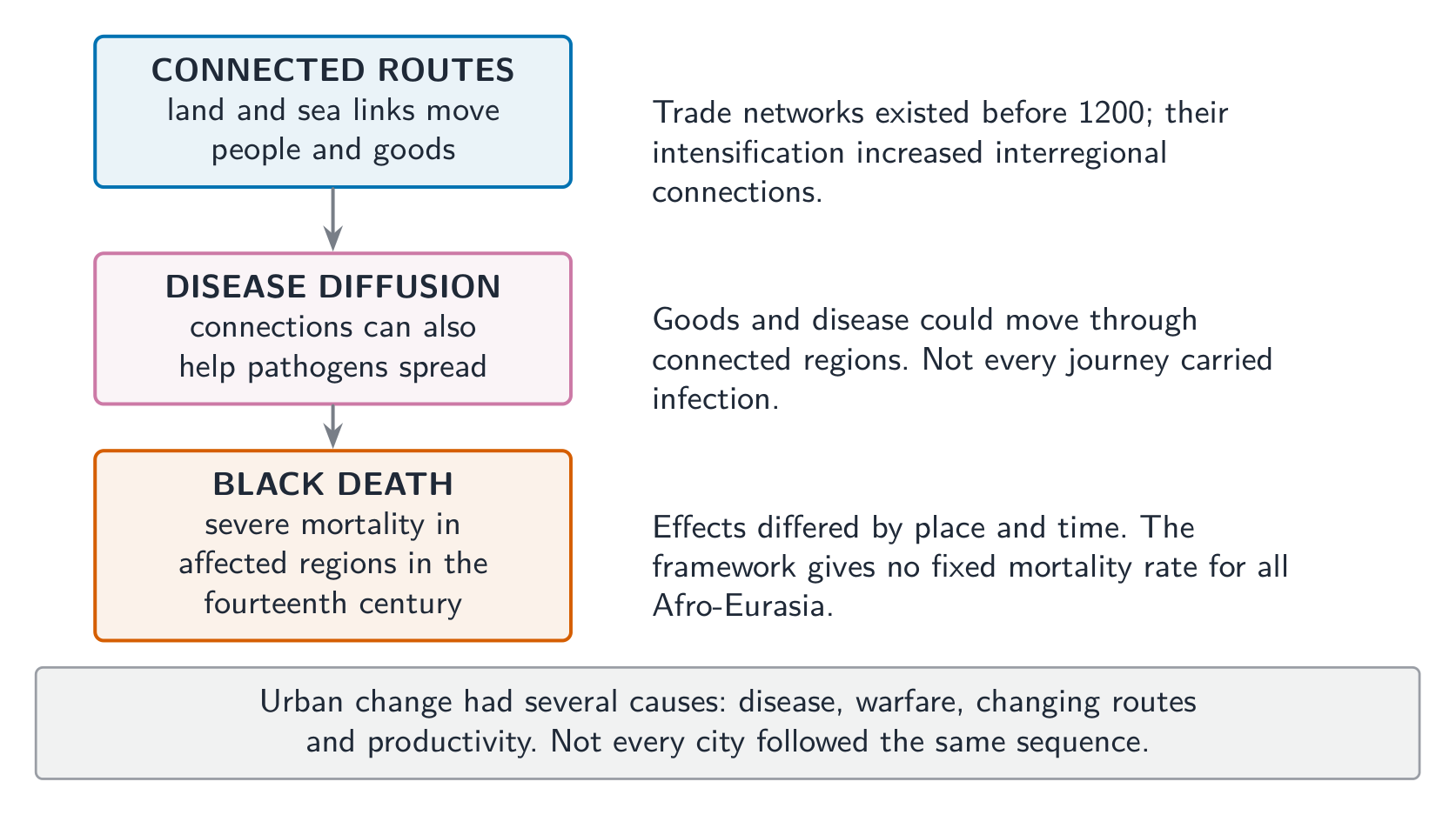
    The environmental consequences were as large as the cultural ones. There was continued diffusion of crops and pathogens 作物与病原体的传播, and epidemic disease travelled with trade - most catastrophically the Black Death 黑死病, which moved along the same routes that carried goods and killed a large share of the population of Afro-Eurasia.

    Vocabulary Train
    English Chinese Pinyin
    diffusion 传播 chuán bō
    travellers 旅行者 lǚ xíng zhě
    diffusion of crops and pathogens 作物与病原体的传播 zuò wù yǔ bìng yuán tǐ de chuán bō
    Black Death 黑死病 hēi sǐ bìng
    2.7

    Comparison of Economic Exchange

    Syllabus

    2.7 Comparison of Economic Exchange

    Learning ObjectiveReview: Unit 2 Key Concepts

    Unit 2.L
    Explain the similarities and differences among the various networks of exchange in the period from c. 1200 to c. 1450.

    • KC-3.1 A deepening and widening of networks of human interaction within and across regions contributed to cultural, technological, and biological diffusion within and between various societies.
      • KC-3.1.I.A.i Improved commercial practices led to an increased volume of trade and expanded the geographical range of existing trade routes—including the Silk Roads—promoting the growth of powerful new trading cities.
      • KC-3.1.I.C.i The growth of interregional trade in luxury goods was encouraged by innovations in previously existing transportation and commercial technologies, including the caravanserai, forms of credit, and the development of money economies.
    • KC-3.3 Changes in trade networks resulted from and stimulated increasing productive capacity, with important implications for social and gender structures and environmental processes.
      • KC-3.3.I.B Demand for luxury goods increased in Afro-Eurasia. Chinese, Persian, and Indian artisans and merchants expanded their production of textiles and porcelains for export; manufacture of iron and steel expanded in China.

    Source: College Board AP Course and Exam Description

    The unit's reasoning skill is comparison. Compare the networks on what they carried, what made them possible, and what they changed - not on which was "most important".

    Worked example (a real AP exam question). AP World short-answer questions frequently ask students to "Explain one similarity" or "Explain one difference" between two trade networks in this period. A full-mark answer names the feature and applies it to both, then explains: "Both the Silk Roads and the Indian Ocean network expanded because of improved commercial practices, but the Indian Ocean carried heavier, lower-value goods such as timber and grain because ships could transport far greater bulk than overland caravans." Notice the shape: the because clause is what turns a difference into an explanation, and without it the answer only describes.

    2.7

    Exam tips

    • Explain growth with the three causes - commercial practices, transport technology, state support - rather than listing trade goods.
    • Match cargo to carrier: overland routes move high-value, low-bulk goods; maritime routes move bulk.
    • Learn the enabling technologies by network: caravanserai and credit; monsoons, lateen sail and dhow; the camel saddle.
    • The Mongols' examinable role is facilitating exchange, not conquest for its own sake.
    • The Black Death is the environmental consequence to name, and it travelled on the trade network itself.
    • On difference questions, always add the because. A stated difference without a cause is only half an answer.
  • 3

    Land-Based Empires

    3.1

    How the Land Empires Expanded

    Syllabus

    3.1 Empires Expand

    Thematic FocusLearning ObjectiveHistorical Developments

    GOV
    Governance — A variety of internal and external factors contribute to state formation, expansion, and decline. Governments maintain order through a variety of administrative institutions, policies, and procedures, and governments obtain, retain, and exercise power in different ways and for different purposes.

    Unit 3.A
    Explain how and why various land-based empires developed and expanded from 1450 to 1750.

    • KC-4.3.II Imperial expansion relied on the increased use of gunpowder, cannons, and armed trade to establish large empires in both hemispheres.
    • KC-4.3.II.B Land empires included the Manchu in Central and East Asia; the Mughal in South and Central Asia; the Ottoman in Southern Europe, the Middle East, and North Africa; and the Safavids in the Middle East.
    • KC-4.3.III.i Political and religious disputes led to rivalries and conflict between states.

    Illustrative examples:

    • State rivalries:
      • Safavid–Mughal conflict
      • Songhai Empire’s conflict with Morocco

    Source: College Board AP Course and Exam Description

    Unit 3 covers the great land-based empires 陆基帝国 of roughly 1450 to 1750. Four questions organise it: how they expanded, how they governed, how they paid for themselves, and how they used religion.

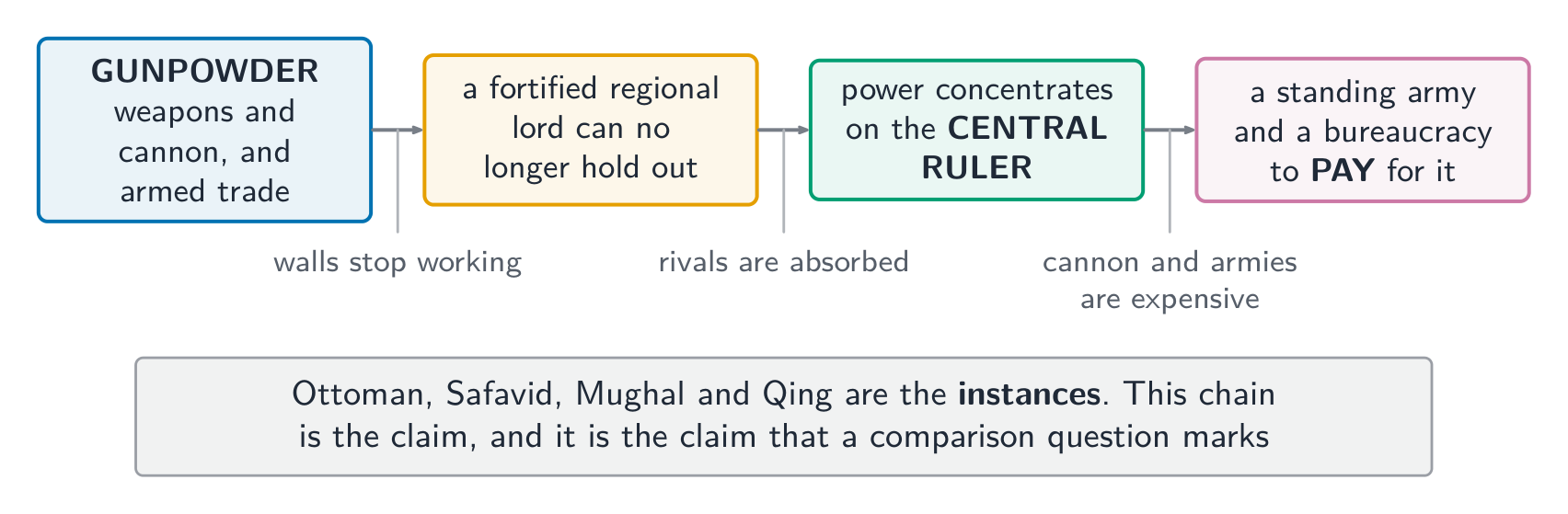
    Expansion relied on the increased use of gunpowder, cannons, and armed trade 火药火炮与武装贸易 - which is why these are often called the gunpowder empires 火药帝国. Access to gunpowder weapons let a central ruler overpower regional rivals and fortified nobles, so military technology and political centralisation grew together.

    The empires to know:

    • The Manchu (Qing) 满清 in Central and East Asia.
    • The Mughal 莫卧儿 in South Asia.
    • The Ottoman 奥斯曼 in the eastern Mediterranean and beyond.
    • The Safavid 萨法维 in Persia.
    Vocabulary Train
    English Chinese Pinyin
    land-based empires 陆基帝国 lù jī dì guó
    increased use of gunpowder, cannons, and armed trade 火药、火炮与武装贸易 huǒ yào 、 huǒ pào yǔ wǔ zhuāng mào yì
    gunpowder empires 火药帝国 huǒ yào dì guó
    Manchu (Qing) 满清 mǎn qīng
    Mughal 莫卧儿 mò wò ér
    Ottoman 奥斯曼 ào sī màn
    Safavid 萨法维 sà fǎ wéi
    3.2

    Administration

    Syllabus

    3.2 Empires: Administration

    Thematic FocusLearning ObjectiveHistorical Developments

    GOV
    Governance — A variety of internal and external factors contribute to state formation, expansion, and decline. Governments maintain order through a variety of administrative institutions, policies, and procedures, and governments obtain, retain, and exercise power in different ways and for different purposes.

    Unit 3.B
    Explain how rulers used a variety of methods to legitimize and consolidate their power in land-based empires from 1450 to 1750.

    • KC-4.3.I.C Recruitment and use of bureaucratic elites, as well as the development of military professionals, became more common among rulers who wanted to maintain centralized control over their populations and resources.
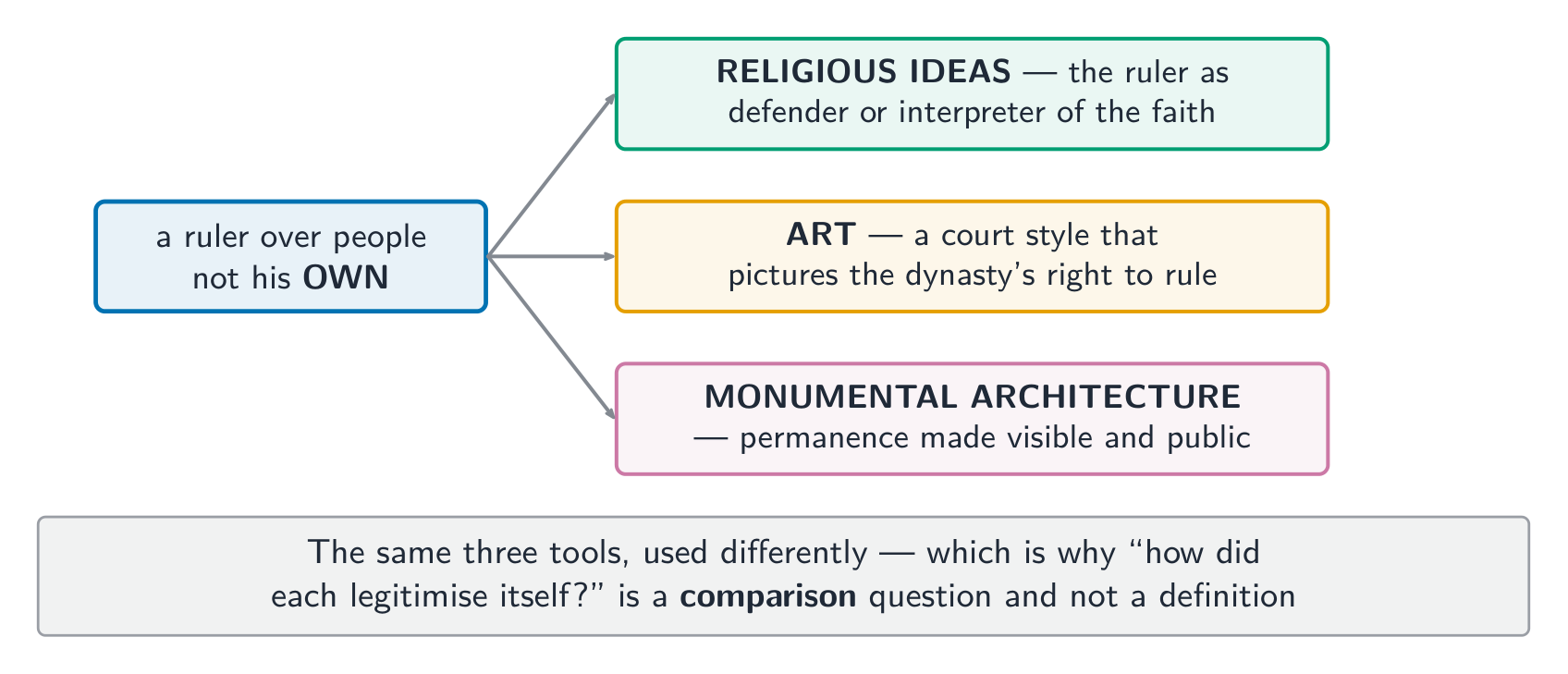
    • KC-4.3.I.A Rulers continued to use religious ideas, art, and monumental architecture to legitimize their rule.
    • KC-4.3.I.D Rulers used tribute collection, tax farming, and innovative tax-collection systems to generate revenue in order to forward state power and expansion.

    Illustrative examples:

    • Bureaucratic elites or military professionals:
      • Ottoman devshirme
      • Salaried samurai
    • Religious ideas:
      • Mexica practice of human sacrifice
      • European notions of divine right
      • Songhai promotion of Islam
    • Art and monumental architecture:
      • Qing imperial portraits
      • Incan sun temple of Cuzco
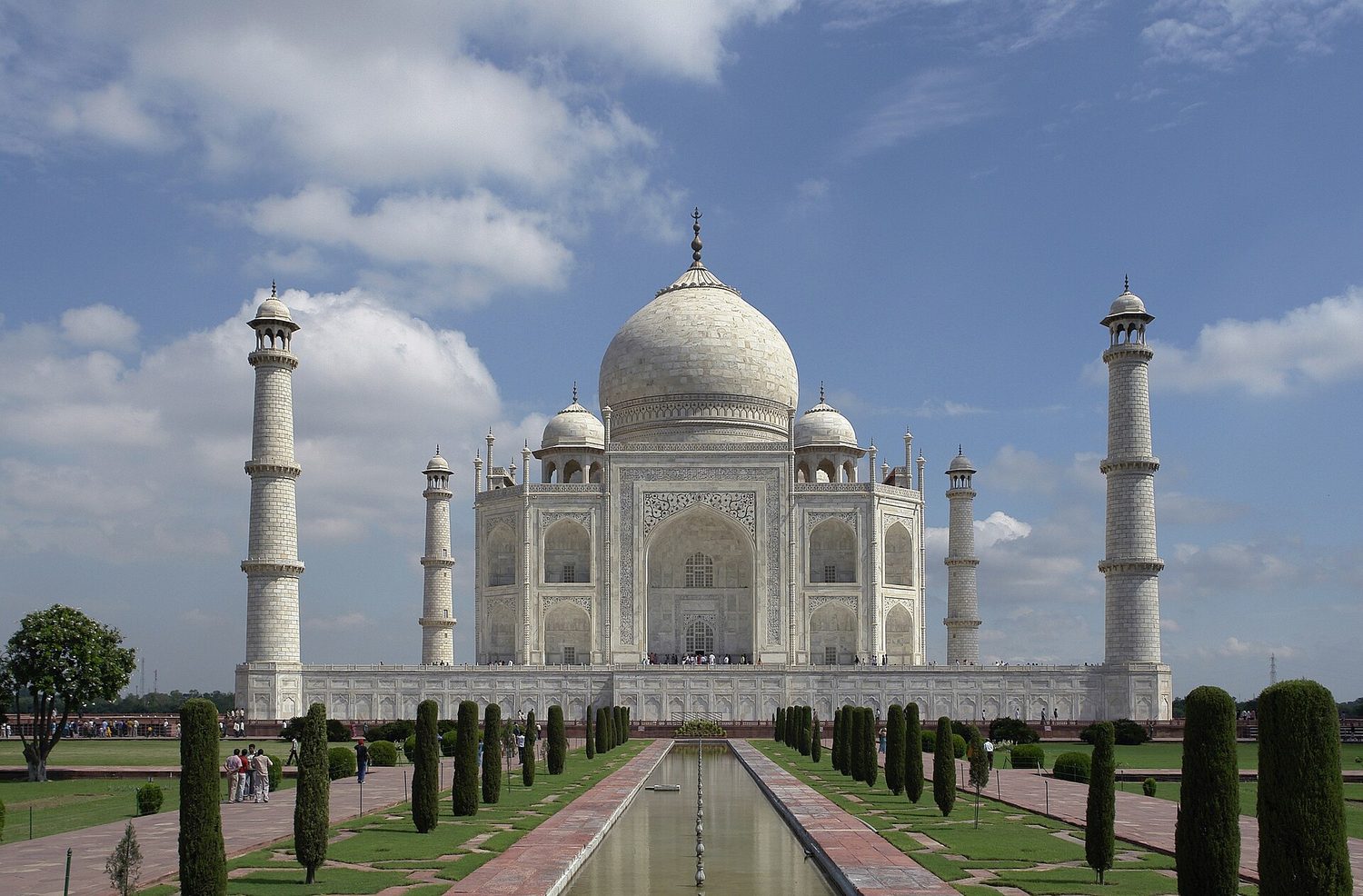
      • Mughal mausolea and mosques
      • European palaces, such as Versailles
    • Tax-collection systems:
      • Mughal zamindar tax collection
      • Ottoman tax farming
      • Mexica tribute lists
      • Ming practice of collecting taxes in hard currency

    Source: College Board AP Course and Exam Description

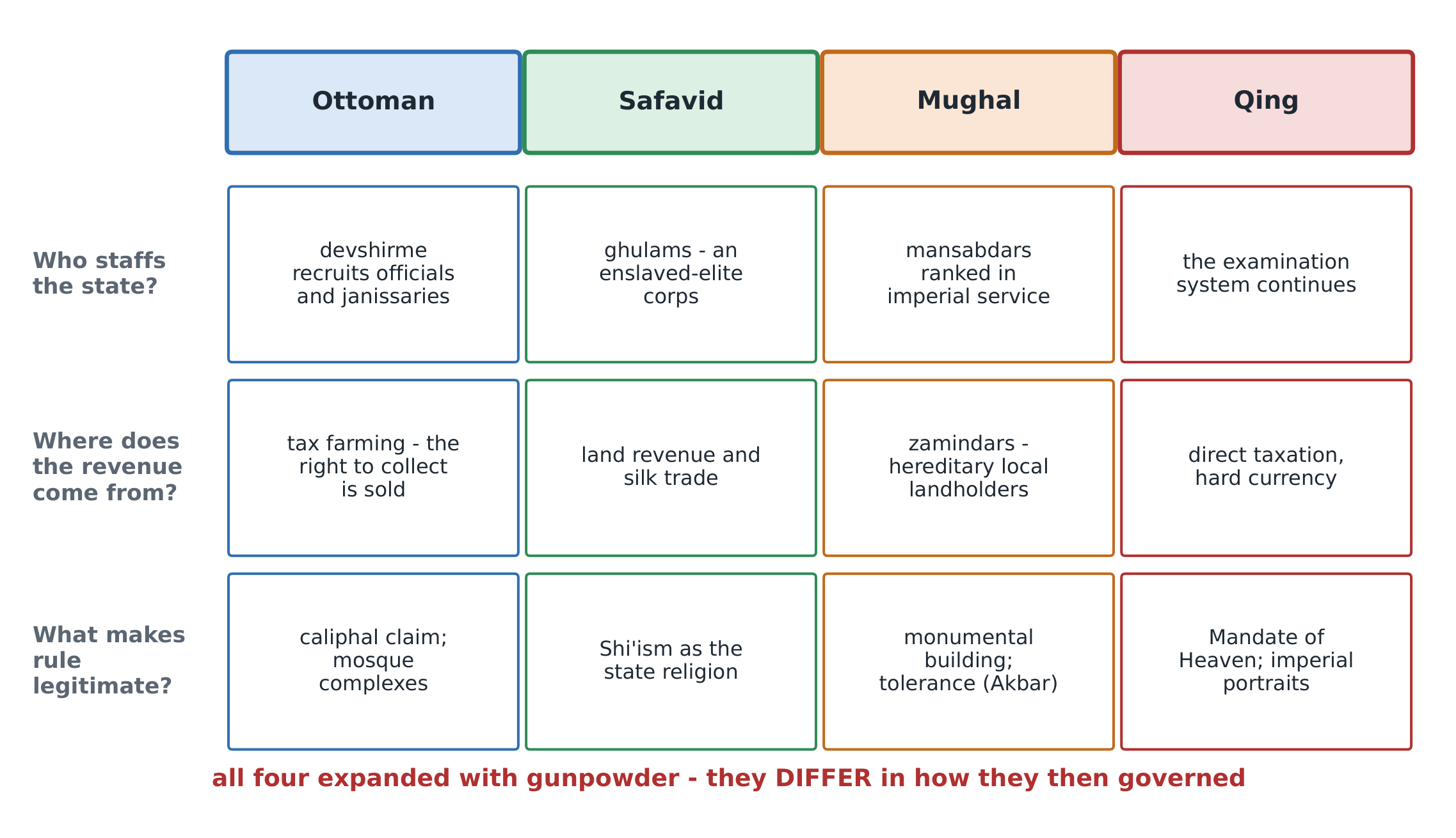
    Four empires, one set of tools: how each recruited officials, raised revenue and claimed legitimacy
    The same three problems - staff, revenue, legitimacy - solved differently by each empire

    Rulers faced the same problem: how to control territory far from the capital. The CED names the tools they used.

    Recruitment of bureaucratic elites 官僚精英的选任 and the development of military professionals 职业军人 gave rulers officials who owed their position to the state rather than to birth. The clearest case is the Ottoman devshirme 德夫希尔梅 system, which recruited and trained administrators and soldiers, including the janissaries 耶尼切里; the Manchu continued China's examination system; the Safavids used ghulams 古拉姆.

    Revenue came through tribute collection 纳贡, tax farming 包税制, and innovative tax-collection systems. The Mughal zamindar 柴明达尔 system and Ottoman tax farming are the standard examples, and the Ming practice of collecting taxes in hard currency 硬通货 is another.

    Vocabulary Train
    English Chinese Pinyin
    Recruitment of bureaucratic elites 官僚精英的选任 guān liáo jīng yīng de xuǎn rèn
    military professionals 职业军人 zhí yè jūn rén
    devshirme 德夫希尔梅 dé fū xī ěr méi
    janissaries 耶尼切里 yé ní qiè lǐ
    ghulams 古拉姆 gǔ lā mǔ
    tribute collection 纳贡 nà gòng
    tax farming 包税制 bāo shuì zhì
    zamindar 柴明达尔 chái míng dá ěr
    hard currency 硬通货 yìng tōng huò
    3.3

    Legitimacy and Belief

    Syllabus

    3.3 Empires: Belief Systems

    Thematic FocusLearning ObjectiveHistorical Developments

    CDI
    Cultural Developments and Interactions — The development of ideas, beliefs, and religions illustrates how groups in society view themselves, and the interactions of societies and their beliefs often have political, social, and cultural implications.

    Unit 3.C
    Explain continuity and change within the various belief systems during the period from 1450 to 1750.

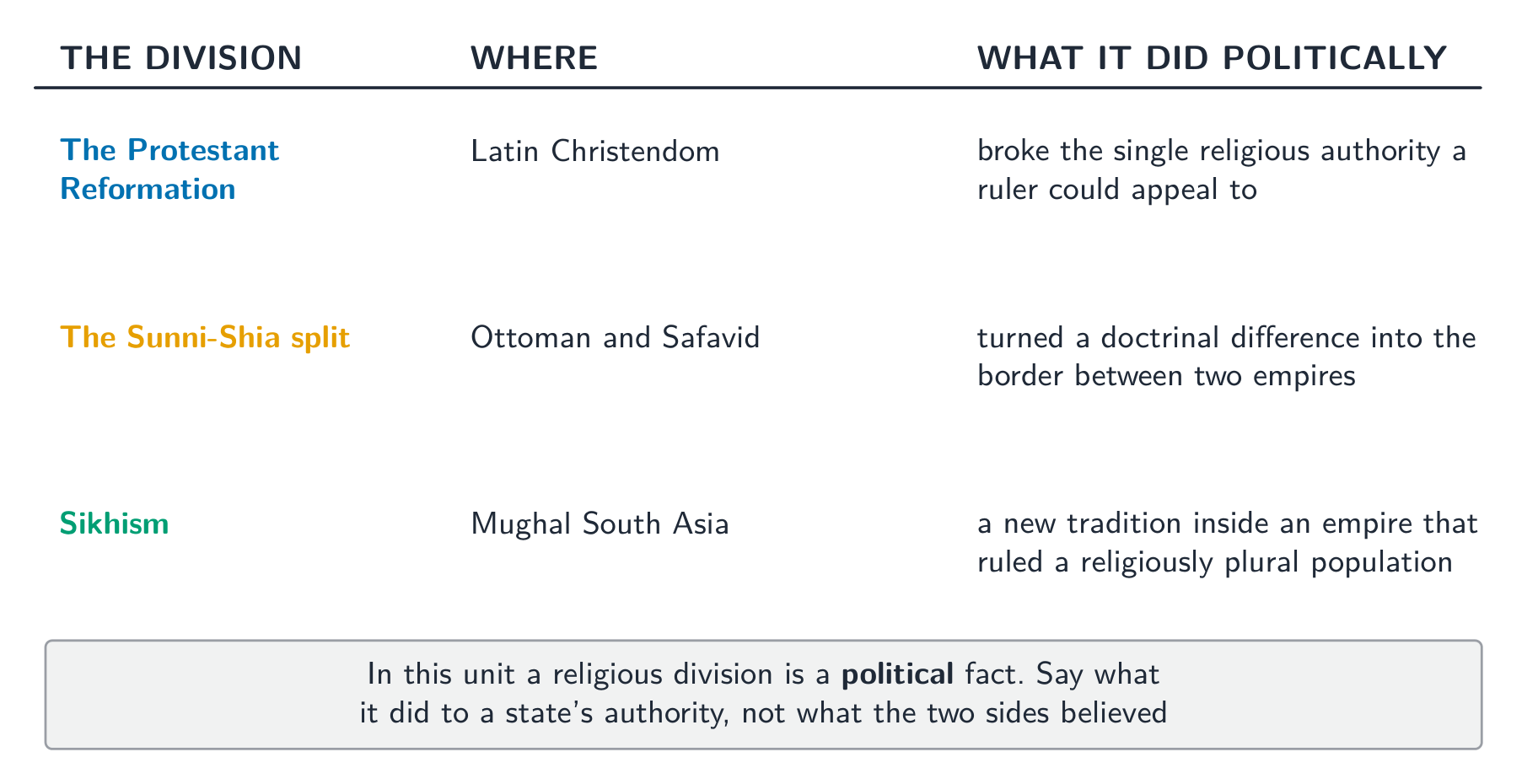
    • KC-4.1.VI.i The Protestant Reformation marked a break with existing Christian traditions and both the Protestant and Catholic reformations contributed to the growth of Christianity.
    • KC-4.1.VI.ii Political rivalries between the Ottoman and Safavid empires intensified the split within Islam between Sunni and Shi’a.
    • KC-4.1.VI.iii Sikhism developed in South Asia in a context of interactions between Hinduism and Islam.

    Source: College Board AP Course and Exam Description

    Rulers continued to use religious ideas, art, and monumental architecture 宗教观念艺术与纪念性建筑 to legitimise their rule - Mughal mosques and mausolea, Ottoman mosque complexes, Qing imperial portraits, and European palaces such as Versailles all do the same work.

    Religious change also produced conflict:

    • The Protestant Reformation 新教改革 marked a break with existing Christian traditions and led to sustained religious and political conflict in Europe.
    • Political rivalry between the Ottoman and Safavid empires intensified the Sunni-Shia split 逊尼派与什叶派分裂, showing how state rivalry can deepen a religious division.
    • Sikhism 锡克教 developed in South Asia in a context of interaction between Hinduism and Islam.

    Political and religious disputes together produced rivalries and conflict between states 国家之间的对抗与冲突 across Eurasia.

    Vocabulary Train
    English Chinese Pinyin
    religious ideas, art, and monumental architecture 宗教观念、艺术与纪念性建筑 zōng jiào guān niàn 、 yì shù yǔ jì niàn xìng jiàn zhù
    Protestant Reformation 新教改革 xīn jiào gǎi gé
    Sunni-Shia split 逊尼派与什叶派分裂 xùn ní pài yǔ shén yè pài fēn liè
    Sikhism 锡克教 xī kè jiào
    rivalries and conflict between states 国家之间的对抗与冲突 guó jiā zhī jiān de duì kàng yǔ chōng tū
    3.4

    Comparison in Land-Based Empires

    Syllabus

    3.4 Comparison in Land-Based Empires

    Learning ObjectiveReview: Unit 3 Key Concepts

    Unit 3.D
    Compare the methods by which various empires increased their influence from 1450 to 1750.

    • KC-4.1 The interconnection of the Eastern and Western Hemispheres made possible by transoceanic voyaging, transformed trade and had a significant social impact on the world.
      • KC-4.1.VI In some cases, the increase and intensification of interactions between newly connected hemispheres expanded the reach and furthered development of existing religions, and contributed to religious conflicts and the development of syncretic belief systems and practices.
    • KC-4.3 Empires achieved increased scope and influence around the world, shaping and being shaped by the diverse populations they incorporated.
      • KC-4.3.II Imperial expansion relied on the increased use of gunpowder, cannons, and armed trade to establish large empires in both hemispheres.
      • KC-4.3.II.B Land empires included the Manchu in Central and East Asia; Mughal in South and Central Asia; Ottoman in Southern Europe, the Middle East, and North Africa; and the Safavids in the Middle East.
      • KC-4.3.III.i Political and religious disputes led to rivalries and conflict between states.

    Source: College Board AP Course and Exam Description

    The unit's reasoning skill is comparison, and the productive comparisons are about method, not size:

    • Recruiting officials by examination (Qing) against by enslaved-elite systems (Ottoman devshirme, Safavid ghulams).
    • Tax farming (Ottoman) against land-revenue intermediaries (Mughal zamindars) against direct taxation (Ming hard currency).
    • Legitimacy through religious identity (Safavid Shi'ism as state religion) against through tolerance of diversity (Mughal policy under Akbar).

    Worked example (a real AP exam question). AP World short-answer questions in this unit typically ask students to "Explain one similarity" or "Explain one difference in how land-based empires maintained power." A full-mark answer names the method for both and explains the effect: "Both the Ottoman and Mughal empires used intermediaries to collect revenue rather than salaried tax officials, but the Ottomans used tax farming, which sold the right to collect for a fixed payment, while the Mughals relied on zamindars, hereditary landholders whose local standing gave them a permanent interest in the countryside." Notice the shape: the comparison is one function (raising revenue), performed two ways, with the consequence stated.

    3.4

    Exam tips

    • Say why gunpowder mattered: it let central rulers overpower regional rivals, so military change and centralisation go together.
    • Learn the four empires by their administrative method, not their territory - devshirme, examinations, zamindars, ghulams.
    • Tax farming sells the right to collect; a zamindar is a hereditary landholder. Questions turn on that difference.
    • Monumental architecture is evidence of legitimation, not decoration. Say what it was doing.
    • The Ottoman-Safavid rivalry is the example of political conflict deepening a religious divide.
    • Comparisons should be one function performed two ways, with the consequence stated.
  • 4

    Transoceanic Interconnections

    4.1 4.2

    Why Europeans Sailed

    Syllabus

    4.1 Technological Innovations from1450 to 1750

    Thematic FocusLearning ObjectiveHistorical Developments

    TEC
    Technology and Innovation — Human adaptation and innovation have resulted in increased efficiency, comfort, and security, and technological advances have shaped human development and interactions with both intended and unintended consequences.

    Unit 4.A
    Explain how cross-cultural interactions resulted in the diffusion of technology and facilitated changes in patterns of trade and travel from 1450 to 1750.

    • KC-4.1.II Knowledge, scientific learning, and technology from the Classical, Islamic, and Asian worlds spread, facilitating European technological developments and innovation.
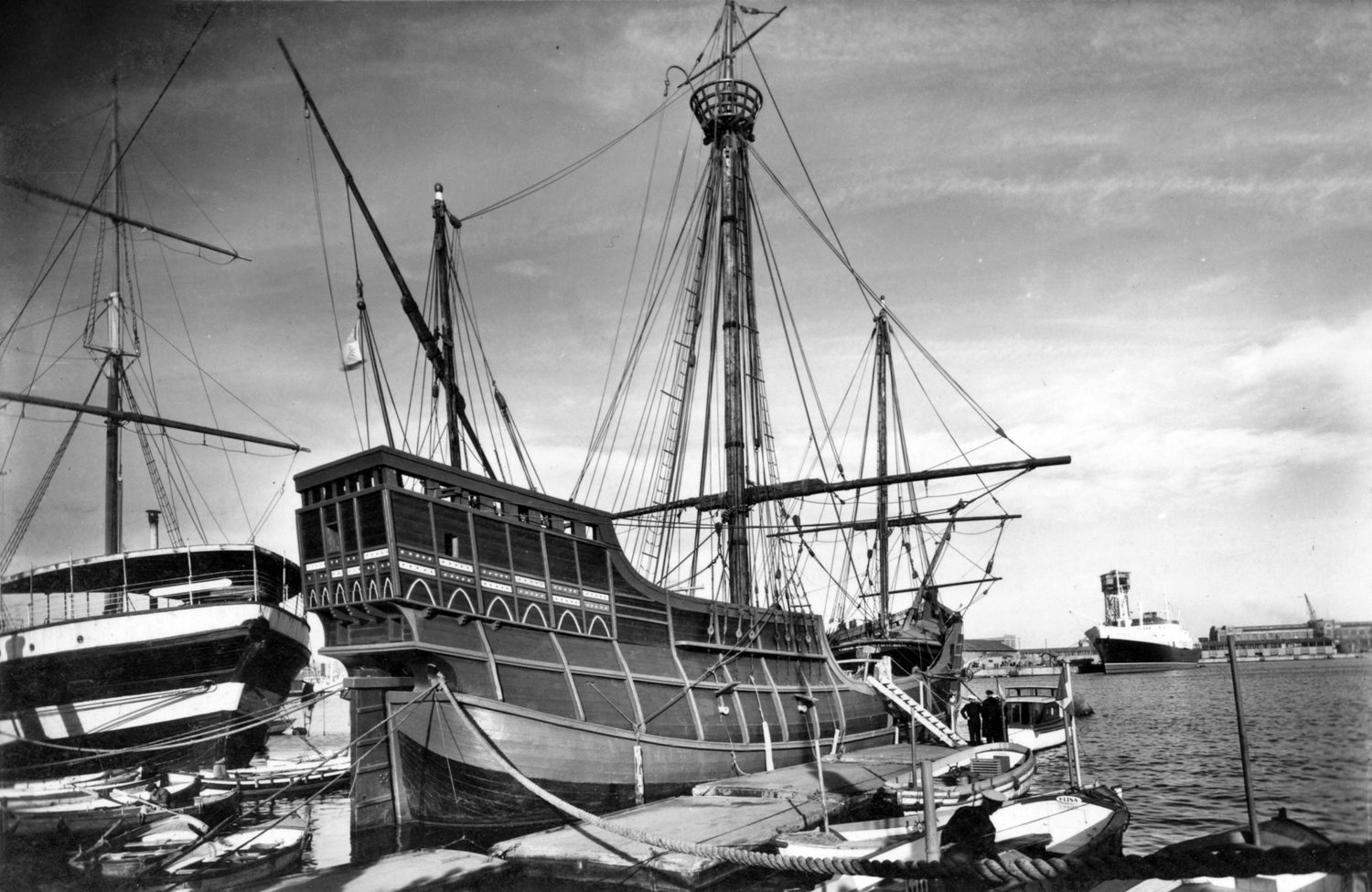
    • KC-4.1.II.A The developments included the production of new tools, innovations in ship designs, and an improved understanding of regional wind and currents patterns—all of which made transoceanic travel and trade possible.

    Illustrative examples:

    • Innovations in ship design:
      • Caravel
      • Carrack
      • Fluyt
    • European technological developments influenced by cross-cultural interactions with the Classical, Islamic, and Asian worlds:
      • Lateen sail
      • Compass
      • Astronomical charts

    4.2 Exploration: Causes and Events from 1450 to 1750

    Thematic FocusLearning ObjectiveHistorical Developments

    GOV
    Governance — A variety of internal and external factors contribute to state formation, expansion, and decline. Governments maintain order through a variety of administrative institutions, policies, and procedures, and governments obtain, retain, and exercise power in different ways and for different purposes.

    Unit 4.B
    Describe the role of states in the expansion of maritime exploration from 1450 to 1750. THEMATIC FOCUS Economics Systems ECN As societies develop, they affect and are affected by the ways that they produce, exchange, and consume goods and services. LEARNING OBJECTIVE

    • KC-4.1.III New state-supported transoceanic maritime exploration occurred in this period. HISTORICAL DEVELOPMENTS

    Unit 4.C
    Explain the economic causes and effects of maritime exploration by the various European states.

    • KC-4.1.III.A Portuguese development of maritime technology and navigational skills led to increased travel to and trade with Africa and Asia and resulted in the construction of a global trading-post empire.
    • KC-4.1.III.B Spanish sponsorship of the voyages of Columbus and subsequent voyages across the Atlantic and Pacific dramatically increased European interest in transoceanic travel and trade.
    • KC-4.1.III.C Northern Atlantic crossings were undertaken under English, French, and Dutch sponsorship, often with the goal of finding alternative sailing routes to Asia.

    Source: College Board AP Course and Exam Description

    Unit 4 covers 1450 to 1750 - the period in which the Eastern and Western Hemispheres are permanently joined, and the consequences of that joining.

    The voyages rested on borrowed knowledge. Learning and technology from the Classical, Islamic, and Asian worlds was gathered and applied in Europe: new tools, innovations in ship design 船舶设计, and better understanding of navigation 航海 - the caravel 卡拉维尔帆船, the astrolabe, the magnetic compass, and knowledge of wind patterns.

    State-supported maritime exploration 国家支持的海上探索 then followed:

    • Portuguese development of maritime technology and navigational skill led to the sea route around Africa to the Indian Ocean.
    • Spanish sponsorship of Columbus and subsequent voyages opened the Atlantic to the Americas.
    • English, French, and Dutch crossings of the northern Atlantic followed.

    Motives combined the search for wealth, competition between states, and religious mission.

    Vocabulary Train
    English Chinese Pinyin
    ship design 船舶设计 chuán bó shè jì
    navigation 航海 háng hǎi
    caravel 卡拉维尔帆船 kǎ lā wéi ěr fān chuán
    State-supported maritime exploration 国家支持的海上探索 guó jiā zhī chí de hǎi shàng tàn suǒ
    4.3

    The Columbian Exchange

    Syllabus

    4.3 Columbian Exchange

    Thematic FocusLearning ObjectiveHistorical Developments

    ENV
    Humans and the Environments — The environment shapes human societies, and as populations grow and change, these populations in turn shape their environments.

    Unit 4.D
    Explain the causes of the Columbian Exchange and its effects on the Eastern and Western Hemispheres.

    • KC-4.1.V The new connections between the Eastern and Western Hemispheres resulted in the exchange of new plants, animals, and diseases, known as the Columbian Exchange.
    • KC-4.1.V.A European colonization of the Americas led to the unintentional transfer of disease vectors, including mosquitoes and rats, and the spread of diseases that were endemic in the Eastern Hemisphere, including smallpox, measles, and malaria. Some of these diseases substantially reduced the indigenous populations, with catastrophic effects in many areas.
    • KC-4.1.V.B American foods became staple crops in various parts of Europe, Asia, and Africa. Cash crops were grown primarily on plantations with coerced labor and were exported mostly to Europe and the Middle East.
    • KC-4.1.V.C Afro-Eurasian fruit trees, grains, sugar, and domesticated animals were brought by Europeans to the Americas, while other foods were brought by African enslaved persons.
    • KC-4.1.V.D Populations in Afro-Eurasia benefitted nutritionally from the increased diversity of American food crops.

    Illustrative examples:

    • Domesticated animals:
      • Horses
      • Pigs
      • Cattle
    • Foods brought by African enslaved persons:
      • Okra
      • Rice

    Source: College Board AP Course and Exam Description

    The Columbian Exchange in both directions, with the demographic consequence that drove the Atlantic slave trade
    The exchange ran both ways, but the consequences were not symmetrical

    New connections between the hemispheres produced the Columbian Exchange 哥伦布大交换, and the CED spells out four consequences.

    • European colonisation led to the unintentional transfer of disease 疾病的非蓄意传播 to the Americas, causing catastrophic population loss.
    • American foods 美洲作物 - maize, potatoes, cassava - became staple crops in parts of Europe, Asia, and Africa.
    • Afro-Eurasian fruit trees, grains, sugar, and domesticated animals 驯化动物 were brought to the Americas, reshaping its landscapes and economies.
    • Populations in Afro-Eurasia benefited nutritionally 营养状况改善 from a more diverse diet, contributing to population growth.

    The asymmetry is the examinable point: the same exchange raised population in Afro-Eurasia and destroyed it in the Americas.

    Vocabulary Train
    English Chinese Pinyin
    Columbian Exchange 哥伦布大交换 gē lún bù dà jiāo huàn
    unintentional transfer of disease 疾病的非蓄意传播 jí bìng de fēi xù yì chuán bō
    American foods 美洲作物 měi zhōu zuò wù
    domesticated animals 驯化动物 xùn huà dòng wù
    benefited nutritionally 营养状况改善 yíng yǎng zhuàng kuàng gǎi shàn
    4.4

    Maritime Empires Established

    Syllabus

    4.4 Maritime Empires Established

    Thematic FocusLearning ObjectiveHistorical Developments

    ECN
    Economics Systems — As societies develop, they affect and are affected by the ways that they produce, exchange, and consume goods and services.

    Unit 4.E
    Explain the process of state building and expansion among various empires and states in the period from 1450 to 1750.

    • KC-4.3.II.A.i Europeans established new trading posts in Africa and Asia, which proved profitable for the rulers and merchants involved in new global trade networks. Some Asian states sought to limit the disruptive economic and cultural effects of European-dominated long-distance trade by adopting restrictive or isolationist trade policies.
    • KC-4.3.II.C Driven largely by political, religious, and economic rivalries, European states established new maritime empires, including the Portuguese, Spanish, Dutch, French, and British.
    • KC-4.3.II.A.ii The expansion of maritime trading networks fostered the growth of states in Africa, including the Asante and the Kingdom of the Kongo, whose participation in trading networks led to an increase in their influence.

    Unit 4.F
    Explain the continuities and changes in economic systems and labor systems from 1450 to 1750. THEMATIC FOCUS Social Interactions and Organization SIO The process by which societies group their members and the norms that govern the interactions between these groups and between individuals influence political, economic, and cultural institutions and organization. LEARNING OBJECTIVE

    • KC-4.3.II.A.iii Despite some disruption and restructuring due to the arrival of Portuguese, Spanish, and Dutch merchants, existing trade networks in the Indian Ocean continued to flourish and included intra-Asian trade and Asian merchants.
    • KC-4.2.II.D Newly developed colonial economies in the Americas largely depended on agriculture, utilized existing labor systems, including the Incan mit’a, and introduced new labor systems including chattel slavery, indentured servitude, and encomienda and hacienda systems. HISTORICAL DEVELOPMENTS

    Unit 4.G
    Explain changes and continuities in systems of slavery in the period from 1450 to 1750.

    • KC-4.2.II.B Enslavement in Africa continued in its traditional forms, including incorporation of enslaved persons into households and the export of enslaved persons to the Mediterranean and the Indian Ocean regions.
    • KC-4.2.II.C The growth of the plantation economy increased the demand for enslaved labor in the Americas, leading to significant demographic, social, and cultural changes.

    Illustrative examples:

    • Asian states that adopted restrictive or isolationist trade policies:
      • Ming China
      • Tokugawa Japan
    • (CONT’D) Indian Ocean Asian merchants:
      • Swahili Arabs
      • Omanis
      • Gujaratis
      • Javanese

    Source: College Board AP Course and Exam Description

    Europeans established trading posts 商站 in Africa and Asia, which proved profitable, and pursued colonisation in the Americas driven by political, religious, and economic rivalries 对抗.

    Where existing states were strong, Europeans traded rather than conquered: despite disruption caused by Portuguese arrival, existing trade networks in the Indian Ocean continued 印度洋既有贸易网络得以延续, and Asian states largely dictated the terms.

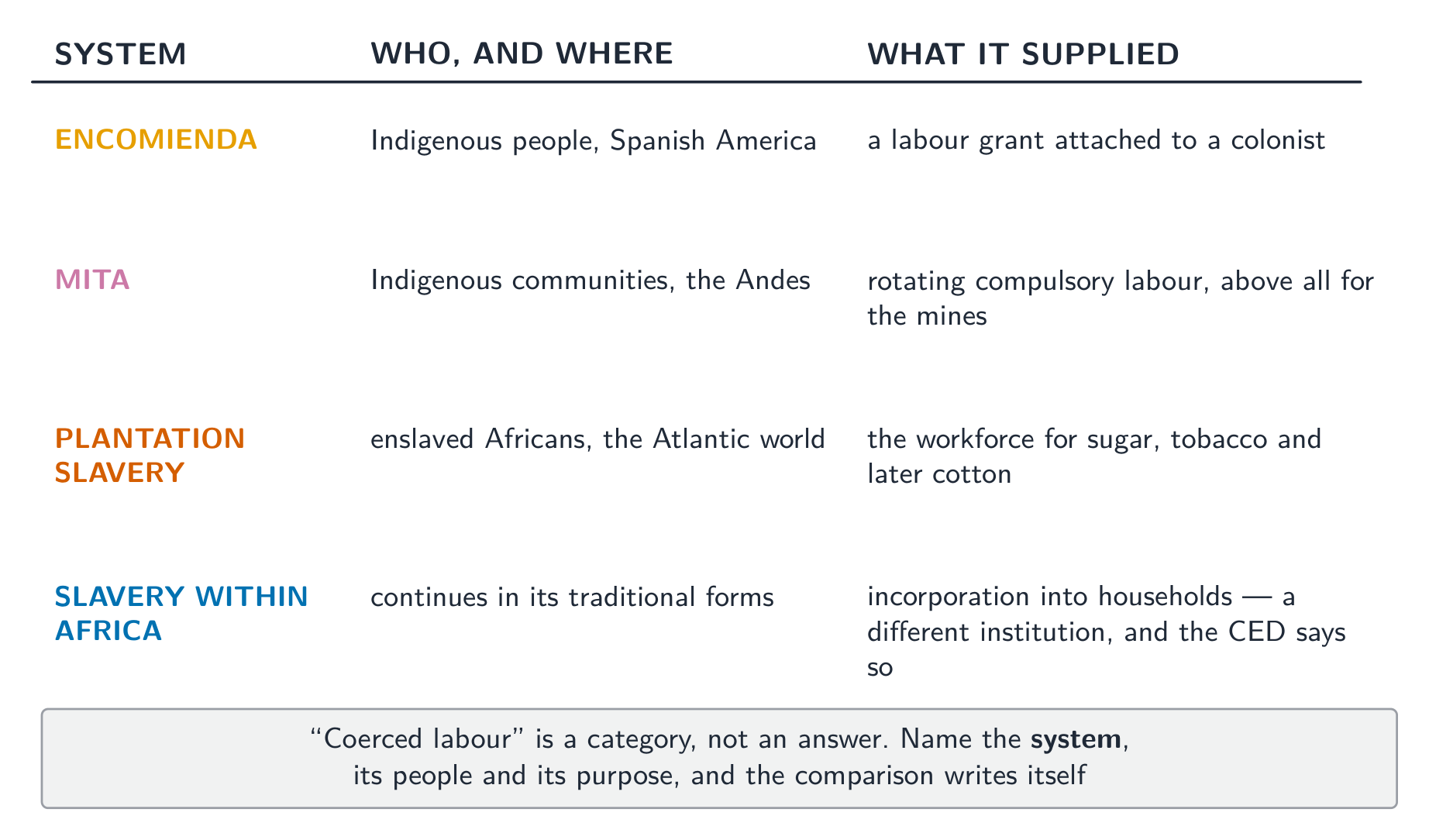
    In the Americas the pattern was different. Colonial economies depended on agriculture and on coerced labour 强制劳动:

    • Enslavement in Africa continued in its traditional forms, including incorporation into households.
    • The growth of the plantation economy 种植园经济 increased demand for enslaved labour, and the Atlantic slave trade expanded enormously to supply it.
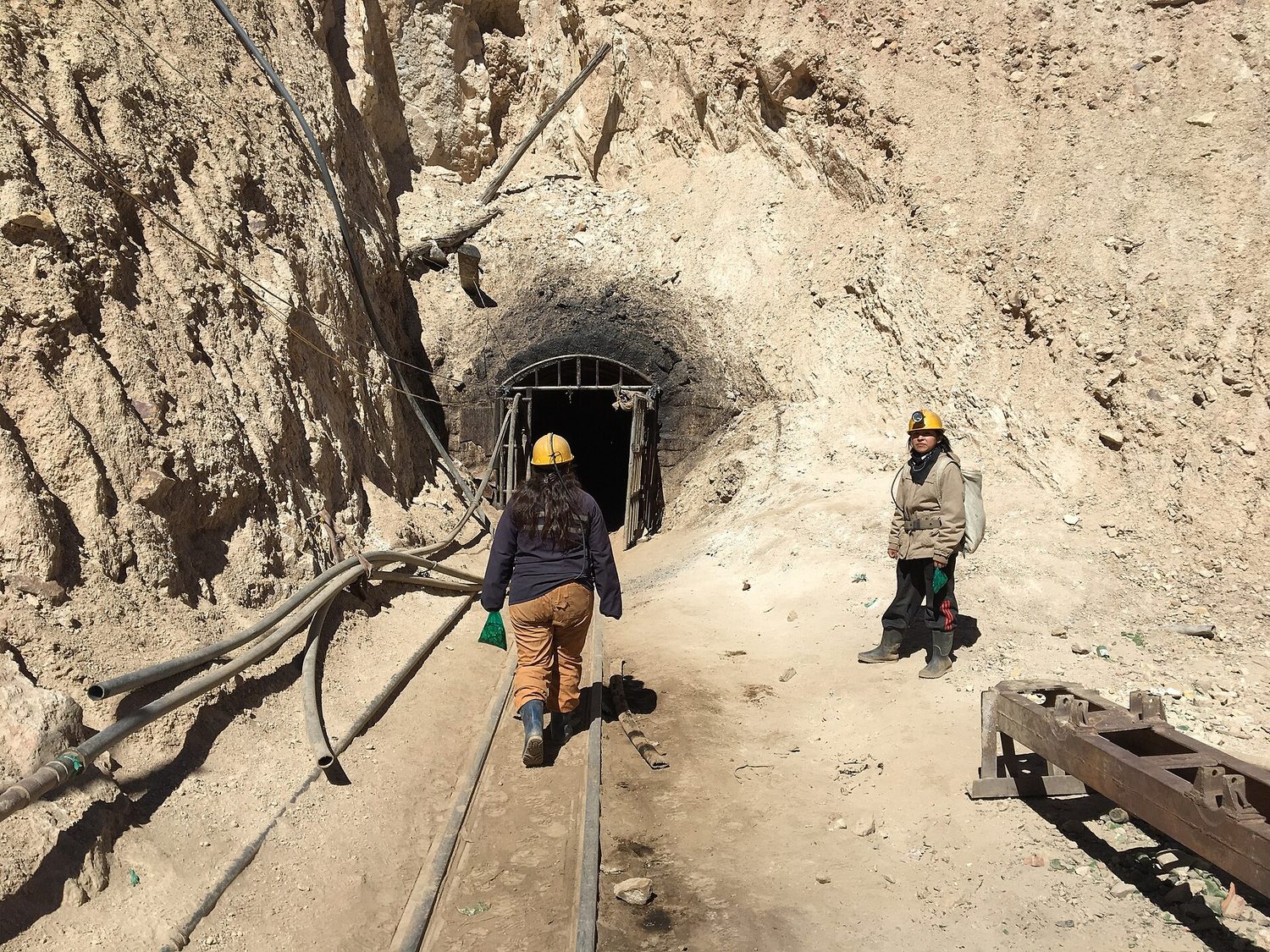
    • Systems such as the encomienda and mita 米塔制 compelled Indigenous labour.
    Vocabulary Train
    English Chinese Pinyin
    trading posts 商站 shāng zhàn
    rivalries 对抗 duì kàng
    existing trade networks in the Indian Ocean continued 印度洋既有贸易网络得以延续 yìn dù yáng jì yǒu mào yì wǎng luò dé yǐ yán xù
    coerced labour 强制劳动 qiáng zhì láo dòng
    plantation economy 种植园经济 zhòng zhí yuán jīng jì
    mita 米塔制 mǐ tǎ zhì
    4.5 4.7

    Maritime Empires Maintained

    Syllabus

    4.5 Maritime Empires Maintained and Developed

    Thematic FocusLearning ObjectiveHistorical Developments

    CDI
    Cultural Developments and Interactions — The development of ideas, beliefs, and religions illustrates how groups in society view themselves, and the interactions of societies and their beliefs often have political, social, and cultural implications.

    Unit 4.H
    Explain how rulers employed economic strategies to consolidate and maintain power throughout the period from 1450 to 1750.

    • KC-4.1.IV.C Mercantilist policies and practices were used by European rulers to expand and control their economies and claim overseas territories. Joint-stock companies, influenced by these mercantilist principles, were used by rulers and merchants to finance exploration and were used by rulers to compete against one another in global trade.
    • KC-4.3.III.ii Economic disputes led to rivalries and conflict between states.

    Unit 4.I
    Explain the continuities and changes in networks of exchange from 1450 to 1750. THEMATIC FOCUS Social Interactions and Organization SIO The process by which societies group their members and the norms that govern the interactions between these groups and between individuals influence political, economic, and cultural institutions and organization. LEARNING OBJECTIVE

    • KC-4.1.IV.D.i The Atlantic trading system involved the movement of goods, wealth, and labor, including enslaved persons.
    • KC-4.1.IV The new global circulation of goods was facilitated by chartered European monopoly companies and the global flow of silver, especially from Spanish colonies in the Americas, which was used to purchase Asian goods for the Atlantic markets and satisfy Chinese demand for silver. Regional markets continued to flourish in Afro-Eurasia by using established commercial practices and new transoceanic and regional shipping services developed by European merchants.
    • KC-4.2.II.A Peasant and artisan labor continued and intensified in many regions as the demand for food and consumer goods increased. HISTORICAL DEVELOPMENTS

    Unit 4.J
    Explain how political, economic, and cultural factors affected society from 1450 to 1750.

    • KC-4.2.III.C Some notable gender and family restructuring occurred, including demographic changes in Africa that resulted from the trade of enslaved persons.
    • KC-4.1.IV.D.ii The Atlantic trading system involved the movement of labor—including enslaved persons and the mixing of African, American, and European cultures and peoples, with all parties contributing to this cultural synthesis.

    Unit 4.K
    Explain the similarities and differences in how various belief systems affected societies from 1450 to 1750.

    • KC-4.1.VI In some cases, the increase and intensification of interactions between newly connected hemispheres expanded the reach and furthered development of existing religions, and contributed to religious conflicts and the development of syncretic belief systems and practices.

    Illustrative examples:

    • Competition over trade routes:
      • Muslim–European rivalry in the Indian Ocean
      • Moroccan conflict with the Songhai Empire
    • (CONT’D) Increased peasant and artisan labor:
      • Western Europe— wool and linen
      • India—cotton
      • China—silk

    4.7 Changing Social Hierarchies from1450 to 1750

    Thematic FocusLearning ObjectiveHistorical Developments

    SIO
    Social Interactions and Organization — The process by which societies group their members and the norms that govern the interactions between these groups and between individuals influence political, economic, and cultural institutions and organization.

    Unit 4.M
    Explain how social categories, roles, and practices have been maintained or have changed over time.

    • KC-4.3.I.B Many states, such as the Mughal and Ottoman empires, adopted practices to accommodate the ethnic and religious diversity of their subjects or to utilize the economic, political, and military contributions of different ethnic or religious groups. In other cases, states suppressed diversity or limited certain groups’ roles in society, politics, or the economy.
    • KC-4.2.III.A Imperial conquests and widening global economic opportunities contributed to the formation of new political and economic elites, including in China with the transition to the Qing Dynasty and in the Americas with the rise of the Casta system.
    • KC-4.2.III.B The power of existing political and economic elites fluctuated as the elites confronted new challenges to their ability to affect the policies of the increasingly powerful monarchs and leaders.

    Illustrative examples:

    • Differential treatment of groups in society, politics, and the economy:
      • Expulsion of Jews from Spain and Portugal; the acceptance of Jews in the Ottoman Empire
      • Restrictive policies against Han Chinese in Qing China
      • Varying status of different classes of women within the Ottoman Empire
    • Existing elites:
      • Ottoman timars
      • Russian boyars
      • European nobility

    Source: College Board AP Course and Exam Description

    Mercantilist 重商主义 policies were used by European rulers to expand and control their economies: colonies existed to supply raw materials and buy finished goods, and trade was directed through the mother country.

    The Atlantic trading system 大西洋贸易体系 moved goods, wealth, and people between Europe, Africa, and the Americas - the pattern usually taught as triangular trade, though real routes were more complex.

    Economic disputes led to rivalries and conflict between states, and commercial competition became a standing cause of European war.

    Colonial societies developed new social hierarchies 社会等级, defined by ancestry and by place of birth - the Spanish casta system being the most formally codified.

    Vocabulary Train
    English Chinese Pinyin
    Mercantilist 重商主义 zhòng shāng zhǔ yì
    Atlantic trading system 大西洋贸易体系 dà xī yáng mào yì tǐ xì
    social hierarchies 社会等级 shè huì děng jí
    4.6

    Internal and External Challenges

    Syllabus

    4.6 Internal and External Challenges to State Power from 1450 to 1750

    Thematic FocusLearning ObjectiveHistorical Developments

    GOV
    Governance — A variety of internal and external factors contribute to state formation, expansion, and decline. Governments maintain order through a variety of administrative institutions, policies, and procedures, and governments obtain, retain, and exercise power in different ways and for different purposes.

    Unit 4.L
    Explain the effects of the development of state power from 1450 to 1750.

    • KC-4.3.III.iii State expansion and centralization led to resistance from an array of social, political, and economic groups on a local level.
    • KC-5.3.III.C Enslaved persons challenged existing authorities in the Americas through organized resistance.

    Illustrative examples:

    • Local resistance:
      • Pueblo Revolts
      • Fronde
      • Cossack revolts
      • Maratha conflict with Mughals
      • Ana Nzinga’s resistance (as ruler of Ndongo and Matamba)
      • Metacom’s War (King Philip’s War)
    • Resistance of enslaved persons:
      • The establishment of Maroon societies in the Caribbean and Brazil
      • Resistance of enslaved persons in North America

    Source: College Board AP Course and Exam Description

    Rulers everywhere faced resistance. Enslaved people resisted through rebellion 起义 and maroon communities 逃奴社群; Indigenous peoples resisted colonial demands; peasants and religious groups challenged state power across Eurasia.

    Vocabulary Train
    English Chinese Pinyin
    rebellion 起义 qǐ yì
    maroon communities 逃奴社群 táo nú shè qún
    4.8

    Continuity and Change from 1450 to 1750

    Syllabus

    4.8 Continuity and Change from 1450 to 1750

    Learning ObjectiveReview: Unit 4 Key Concepts

    Unit 4.N
    Explain how economic developments from 1450 to 1750 affected social structures over time.

    • KC-4.1 The interconnection of the Eastern and Western Hemispheres, made possible by transoceanic voyaging, transformed trade and had a significant social impact on the world.
      • KC-4.1.II Knowledge, scientific learning, and technology from the Classical, Islamic, and Asian worlds spread, facilitating European technological developments and innovation.
      • KC-4.1.II.A The developments included the production of new tools, innovations in ship designs, and an improved understanding of regional wind and currents patterns—all of which made transoceanic travel and trade possible.
    • KC-4.2 Although the world’s productive systems continued to be heavily centered on agriculture, major changes occurred in agricultural labor, the systems and locations of manufacturing, gender and social structures, and environmental processes.
      • KC-4.2.II The demand for labor intensified as a result of the growing global demand for raw materials and finished products. Traditional peasant agriculture increased and changed in nature, plantations expanded, and the Atlantic slave trade developed and intensified.
    • KC-4.3 Empires achieved increased scope and influence around the world, shaping and being shaped by the diverse populations they incorporated.
      • KC-4.3.III.ii Economic disputes led to rivalries and conflict between states.

    Source: College Board AP Course and Exam Description

    The unit's reasoning skill is continuity and change. The strongest answers hold both: connection between hemispheres was genuinely new, while the dominance of agriculture, coerced labour, and land empires continued.

    Worked example (a real AP exam question). AP World short-answer questions in this unit ask, for example, to "Explain one effect of the Columbian Exchange on the Americas" and "…on Afro-Eurasia." A full-mark pair states the effect and the mechanism for each: "In the Americas, transferred diseases such as smallpox caused a demographic collapse, which created the labour shortage that European colonisers met by expanding the Atlantic slave trade. In Afro-Eurasia, American crops such as the potato and maize improved nutrition and contributed to population growth." Notice the shape: effect questions want the consequence traced, and the two halves must not be the same answer twice.

    4.8

    Exam tips

    • Explain the voyages with borrowed technology plus state support, not with individual explorers.
    • Keep the Columbian Exchange two-directional and asymmetrical: population fell in the Americas and rose in Afro-Eurasia.
    • Where Asian states were strong, Europeans traded; where disease had shattered societies, they conquered. That contrast answers many questions.
    • Mercantilism is the policy, the Atlantic system is the flow, and coerced labour is what made the plantation economy work.
    • Always include resistance - rebellion, maroon communities, Indigenous refusal - since it is examinable and often omitted.
    • On effect questions, trace the consequence. A named change with no mechanism is only half the mark.
  • 5

    Revolutions

    5.1

    The Enlightenment

    Syllabus

    5.1 The Enlightenment

    Thematic FocusLearning ObjectiveHistorical Developments

    SIO
    Social Interactions and Organization — The process by which societies group their members and the norms that govern the interactions between these groups and between individuals influence political, economic, and cultural institutions and organization.

    Unit 5.A
    Explain the intellectual and ideological context in which revolutions swept the Atlantic world from 1750 to 1900.

    • KC-5.3.I.A Enlightenment philosophies applied new ways of understanding and empiricist approaches to both the natural world and human relationships; they also reexamined the role that religion played in public life and emphasized the importance of reason. Philosophers developed new political ideas about the individual, natural rights, and the social contract.
    • KC-5.3.I The rise and diffusion of Enlightenment thought that questioned established traditions in all areas of life often preceded revolutions and rebellions against existing governments.
    • KC-5.3.II.i Nationalism also became a major force shaping the historical development of states and empires.

    Unit 5.B
    Explain how the Enlightenment affected societies over time.

    • KC-5.3.I.C Enlightenment ideas and religious ideals influenced various reform movements. These reform movements contributed to the expansion of rights, as seen in expanded suffrage, the abolition of slavery, and the end of serfdom.
    • KC-5.3.IV.B Demands for women’s suffrage and an emergent feminism challenged political and gender hierarchies.

    Illustrative examples:

    • Demands:
      • Mary Wollstonecraft’s A Vindication of the Rights of Woman
      • Olympe de Gouges’s Declaration of the Rights of Woman and of the Female Citizen
      • Seneca Falls Conference (1848) organized by Elizabeth Cady Stanton and Lucretia Mott

    Source: College Board AP Course and Exam Description

    Unit 5 covers 1750 to 1900, and it has two engines running at once: an intellectual revolution that changed how people justified political authority, and an industrial revolution that changed how societies produced and lived. Most questions ask you to connect them.

    Enlightenment 启蒙运动 philosophies applied new ways of understanding and empirical approaches 实证方法 to both the natural world and human relationships. From that came ideas that questioned established traditions:

    • Individualism 个人主义, natural rights 天赋权利, and the social contract 社会契约.
    • Calls for religious tolerance 宗教宽容 and limits on established authority.

    Those ideas influenced reform movements 改革运动: the expansion of suffrage, the abolition of slavery, and demands for women's suffrage 妇女选举权诉求 alongside an emergent feminism 女权主义 that challenged political and gender hierarchies.

    Vocabulary Train
    English Chinese Pinyin
    Enlightenment 启蒙运动 qǐ méng yùn dòng
    empirical approaches 实证方法 shí zhèng fāng fǎ
    Individualism 个人主义 gè rén zhǔ yì
    natural rights 天赋权利 tiān fù quán lì
    social contract 社会契约 shè huì qì yuē
    religious tolerance 宗教宽容 zōng jiào kuān róng
    reform movements 改革运动 gǎi gé yùn dòng
    demands for women's suffrage 妇女选举权诉求 fù nǚ xuǎn jǔ quán sù qiú
    feminism 女权主义 nǚ quán zhǔ yì
    5.2

    Nationalism and Revolution

    Syllabus

    5.2 Nationalism and Revolutions in the Period from 1750 to 1900

    Thematic FocusLearning ObjectiveHistorical Developments

    GOV
    Governance — A variety of internal and external factors contribute to state formation, expansion, and decline. Governments maintain order through a variety of administrative institutions, policies, and procedures, and governments obtain, retain, and exercise power in different ways and for different purposes.

    Unit 5.C
    Explain causes and effects of the various revolutions in the period from 1750 to 1900.

    • KC-5.3.II.ii People around the world developed a new sense of commonality based on language, religion, social customs, and territory. This was sometimes harnessed by governments to foster a sense of unity.
    • KC-5.3 The 18th century marked the beginning of an intense period of revolution and rebellion against existing governments, leading to the establishment of new nation-states around the world.
    • KC-5.3.IV.A.i Discontent with monarchist and imperial rule encouraged the development of systems of government and various ideologies, including democracy and 19th-century liberalism.
    • KC-5.3.III.B Colonial subjects in the Americas led a series of rebellions inspired by democratic ideals. The American Revolution, and its successful establishment of a republic, the United States of America, was a model and inspiration for a number of the revolutions that followed. The American Revolution, the Haitian Revolution, and the Latin American independence movements facilitated the emergence of independent states in the Americas.
    • KC-5.3.I.B The ideas of Enlightenment philosophers, as reflected in revolutionary documents— including the American Declaration of Independence during the American Revolution, the French “Declaration of the Rights of Man and of the Citizen” during the French Revolution, and Bolívar’s “Letter from Jamaica” on the eve of the Latin American revolutions— influenced resistance to existing political authority, often in pursuit of independence and democratic ideals.
    • KC-5.3.II.iii Newly imagined national communities often linked this new national identity with borders of the state, and in some cases, nationalists challenged boundaries or sought unification of fragmented regions.

    Illustrative examples:

    • Call for national unification or liberation:
      • Propaganda Movement in the Philippines
      • Maori nationalism and the New Zealand wars in New Zealand
      • Puerto Rico—writings of Lola Rodríguez de Tió
      • German and Italian unifications
      • Balkan nationalisms
      • Ottomanism

    Source: College Board AP Course and Exam Description

    Nationalism 民族主义 became a major force shaping historical developments. People developed a new sense of commonality 共同体意识 based on language, religion, social customs, and territory, and these newly imagined national communities were often linked to state-building.

    Discontent with monarchist and imperial rule encouraged revolution 革命. Enlightenment ideas, as reflected in revolutionary documents, justified those movements, and colonial subjects in the Americas led a series of rebellions inspired by them - the examinable set being the American, French, Haitian, and Latin American revolutions.

    The pattern to hold: an idea (rights, consent, nation) plus a grievance (taxation, exclusion, slavery, colonial rule) produces a movement. Answers that give only the idea, or only the grievance, explain nothing.

    Vocabulary Train
    English Chinese Pinyin
    Nationalism 民族主义 mín zú zhǔ yì
    commonality 共同体意识 gòng tóng tǐ yì shí
    revolution 革命 gé mìng
    5.3

    The Industrial Revolution Begins

    Syllabus

    5.3 Industrial Revolution Begins

    Thematic FocusLearning ObjectiveHistorical Developments

    ENV
    Humans and the Environments — The environment shapes human societies, and as populations grow and change, these populations in turn shape their environments.

    Unit 5.D
    Explain how environmental factors contributed to industrialization from 1750 to 1900.

    • KC-5.1.I.A A variety of factors contributed to the growth of industrial production and eventually resulted in the Industrial Revolution, including: Bullet Proximity to waterways; access to rivers and canals Bullet Geographical distribution of coal, iron, and timber Bullet Urbanization Bullet Improved agricultural productivity Bullet Legal protection of private property Bullet Access to foreign resources Bullet Accumulation of capital
    • KC-5.1.I.C The development of the factory system concentrated production in a single location and led to an increasing degree of specialization of labor.

    Source: College Board AP Course and Exam Description

    Why Britain first: the factors the CED names, and what each one supplied
    Industrialisation needed several conditions at once - which is why the question is always "why here, and why then"

    A variety of factors contributed to the growth of industrial production: access to coal 煤炭 and iron, navigable rivers and canals, agricultural productivity 农业生产率 that freed labour, capital 资本 and legal protection for it, urbanisation, and access to raw materials and markets through overseas empire.

    The factory system 工厂制度 concentrated production in a single location under supervision, replacing dispersed household production. That change - as much organisational as technical - is what made the scale of output possible.

    Vocabulary Train
    English Chinese Pinyin
    coal 煤炭 méi tàn
    iron tiě
    agricultural productivity 农业生产率 nóng yè shēng chǎn lǜ
    capital 资本 zī běn
    factory system 工厂制度 gōng chǎng zhì dù
    5.4 5.5

    Industrialisation Spreads

    Syllabus

    5.4 Industrialization Spreads in the Period from 1750 to 1900

    Thematic FocusLearning ObjectiveHistorical Developments

    TEC
    Technology and Innovation — Human adaptation and innovation have resulted in increased efficiency, comfort, and security, and technological advances have shaped human development and interactions with both intended and unintended consequences.

    Unit 5.E
    Explain how different modes and locations of production have developed and changed over time.

    • KC-5.1.II.B The rapid development of steam-powered industrial production in European countries and the U.S. contributed to the increase in these regions’ share of global manufacturing during the first Industrial Revolution. While Middle Eastern and Asian countries continued to produce manufactured goods, these regions’ share in global manufacturing declined.
    • KC-5.1.I.D As new methods of industrial production became more common in parts of northwestern Europe, they spread to other parts of Europe and the United States, Russia, and Japan.

    Illustrative examples:

    • Decline of Middle Eastern and Asian share in global manufacturing:
      • Shipbuilding in India and Southeast Asia
      • Iron works in India
      • Textile production in India and Egypt

    5.5 Technology of the Industrial Age

    Thematic FocusLearning ObjectiveHistorical Developments

    TEC
    Technology and Innovation — Human adaptation and innovation have resulted in increased efficiency, comfort, and security, and technological advances have shaped human development and interactions with both intended and unintended consequences.

    Unit 5.F
    Explain how technology shaped economic production over time.

    • KC-5.1.I.B The development of machines, including steam engines and the internal combustion engine, made it possible to take advantage of both existing and vast newly discovered resources of energy stored in fossil fuels, specifically coal and oil. The fossil fuels revolution greatly increased the energy available to human societies.
    • KC-5.1.I.E The “second industrial revolution” led to new methods in the production of steel, chemicals, electricity, and precision machinery during the second half of the 19th century.
    • KC-5.1.IV Railroads, steamships, and the telegraph made exploration, development, and communication possible in interior regions globally, which led to increased trade and migration.

    Source: College Board AP Course and Exam Description

    The rapid development of steam-powered 蒸汽动力 industrial production in Europe spread to other regions, and as new methods became common, states that industrialised gained enormous advantages in wealth and military power over those that did not.

    Technology compounded the change: the steam engine 蒸汽机 and later the internal combustion engine 内燃机; the second industrial revolution 第二次工业革命 in steel, chemicals, and electricity; and railroads 铁路, steamships 蒸汽船, and the telegraph 电报, which made exploration, colonisation, and administration at a distance possible.

    Vocabulary Train
    English Chinese Pinyin
    steam-powered 蒸汽动力 zhēng qì dòng lì
    steam engine 蒸汽机 zhēng qì jī
    internal combustion engine 内燃机 nèi rán jī
    second industrial revolution 第二次工业革命 dì èr cì gōng yè gé mìng
    railroads 铁路 tiě lù
    steamships 蒸汽船 zhēng qì chuán
    telegraph 电报 diàn bào
    5.6 5.7 5.8

    Government, Economy, and Reaction

    Syllabus

    5.6 Industrialization: Government’s Role from 1750 to 1900

    Thematic FocusLearning ObjectiveHistorical Developments

    GOV
    Governance — A variety of internal and external factors contribute to state formation, expansion, and decline. Governments maintain order through a variety of administrative institutions, policies, and procedures, and governments obtain, retain, and exercise power in different ways and for different purposes.

    Unit 5.G
    Explain the causes and effects of economic strategies of different states and empires.

    • KC-5.1.V.C As the influence of the Industrial Revolution grew, a small number of states and governments promoted their own state-sponsored visions of industrialization.
    • KC-5.2.II.A The expansion of U.S. and European influence in Asia led to internal reform in Japan that supported industrialization and led to the growing regional power of Japan in the Meiji Era.

    Illustrative examples:

    • State-sponsored visions of industrialization:
      • Muhammad Ali’s development of a cotton textile industry in Egypt

    5.7 Economic Developments and Innovations in the Industrial Age

    Thematic FocusLearning ObjectiveHistorical Developments

    ECN
    Economics Systems — As societies develop, they affect and are affected by the ways that they produce, exchange, and consume goods and services.

    Unit 5.H
    Explain the development of economic systems, ideologies, and institutions and how they contributed to change in the period from 1750 to 1900.

    • KC-5.1.III.A Western European countries began abandoning mercantilism and adopting free trade policies, partly in response to the growing acceptance of Adam Smith’s theories of laissez-faire capitalism and free markets.
    • KC-5.1.III.B The global nature of trade and production contributed to the proliferation of large-scale transnational businesses that relied on new practices in banking and finance.
    • KC-5.1 The development of industrial capitalism led to increased standards of living for some, and to continued improvement in manufacturing methods that increased the availability, affordability, and variety of consumer goods.

    Illustrative examples:

    • Transnational businesses:
      • Hong Kong and Shanghai Banking Corporation (HSBC)
      • Unilever based in England and the Netherlands and operating in British West Africa and the Belgian Congo
    • Financial instruments:
      • Stock markets
      • Limited-liability corporations

    5.8 Reactions to the Industrial Economy from 1750 to 1900

    Thematic FocusLearning ObjectiveHistorical Developments

    SIO
    Social Interactions and Organization — The process by which societies group their members and the norms that govern the interactions between these groups and between individuals influence political, economic, and cultural institutions and organization.

    Unit 5.I
    Explain the causes and effects of calls for changes in industrial societies from 1750 to 1900.

    • KC-5.1.V.D In response to the social and economic changes brought about by industrial capitalism, some governments, organizations, and individuals promoted various types of political, social, educational, and urban reforms.
    • KC-5.1.V.A In industrialized states, many workers organized themselves, often in labor unions, to improve working conditions, limit hours, and gain higher wages. Workers’ movements and political parties emerged in different areas, promoting alternative visions of society.
    • KC-5.3.IV.A.ii Discontent with established power structures encouraged the development of various ideologies, including those espoused by Karl Marx, and the ideas of socialism and communism.
    • KC-5.1.V.B In response to the expansion of industrializing states, some governments in Asia and Africa, including the Ottoman Empire and Qing China, sought to reform and modernize their economies and militaries. Reform efforts were often resisted by some members of government or established elite groups.

    Source: College Board AP Course and Exam Description

    As industrial influence grew, a small number of states sponsored industrialisation 国家推动工业化 directly - the standard examples being Meiji Japan, Russia under state-led programmes, and Egypt under Muhammad Ali.

    Western European countries began abandoning mercantilism and adopting free trade 自由贸易 policies, and the global nature of trade and production contributed to the proliferation of transnational businesses 跨国企业 and new financial instruments.

    Reaction came from several directions:

    • Workers organised, often in labour unions 工会, and pressed for shorter hours, safety, and wages.
    • Alternative visions of society emerged - socialism 社会主义, communism 共产主义, and anarchism 无政府主义 - as critiques of industrial capitalism.
    • Some governments passed reform legislation 改革立法 on working conditions, child labour, and public health.
    • The expansion of industrialising states led to internal reform movements 内部改革运动 elsewhere in Asia, as states tried to respond to new pressure.
    Vocabulary Train
    English Chinese Pinyin
    states sponsored industrialisation 国家推动工业化 guó jiā tuī dòng gōng yè huà
    free trade 自由贸易 zì yóu mào yì
    transnational businesses 跨国企业 kuà guó qǐ yè
    labour unions 工会 gōng huì
    socialism 社会主义 shè huì zhǔ yì
    communism 共产主义 gòng chǎn zhǔ yì
    anarchism 无政府主义 wú zhèng fǔ zhǔ yì
    reform legislation 改革立法 gǎi gé lì fǎ
    internal reform movements 内部改革运动 nèi bù gǎi gé yùn dòng
    5.9

    Society in the Industrial Age

    Syllabus

    5.9 Society and the Industrial Age

    Thematic FocusLearning ObjectiveHistorical Developments

    SIO
    Social Interactions and Organization — The process by which societies group their members and the norms that govern the interactions between these groups and between individuals influence political, economic, and cultural institutions and organization.

    Unit 5.J
    Explain how industrialization caused change in existing social hierarchies and standards of living.

    • KC-5.1.VI.A New social classes, including the middle class and the industrial working class, developed.
    • KC-5.1.VI.B While women and often children in working class families typically held wage-earning jobs to supplement their families’ income, middle-class women who did not have the same economic demands to satisfy were increasingly limited to roles in the household or roles focused on child development.
    • KC-5.1.VI.C The rapid urbanization that accompanied global capitalism at times led to a variety of challenges, including pollution, poverty, increased crime, public health crises, housing shortages, and insufficient infrastructure to accommodate urban growth.

    Source: College Board AP Course and Exam Description

    New social classes 社会阶级 formed, including a middle class 中产阶级 and an industrial working class 工业工人阶级, each with its own culture and politics.

    Other changes are examinable: rapid urbanisation 城市化 with overcrowding and disease; changes in family structure 家庭结构 and in women's work as production left the home; and rising standards of living 生活水平 over the long run, unevenly distributed and reached only after decades of hardship.

    Vocabulary Train
    English Chinese Pinyin
    social classes 社会阶级 shè huì jiē jí
    middle class 中产阶级 zhōng chǎn jiē jí
    industrial working class 工业工人阶级 gōng yè gōng rén jiē jí
    urbanisation 城市化 chéng shì huà
    family structure 家庭结构 jiā tíng jié gòu
    standards of living 生活水平 shēng huó shuǐ píng
    5.10

    Continuity and Change in the Industrial Age

    Syllabus

    5.10 Continuity and Change in the Industrial Age

    Learning ObjectiveReview: Unit 5 Key Concepts

    Unit 5.K
    Explain the extent to which industrialization brought change from 1750 to 1900.

    • KC-5.1 The development of industrial capitalism led to increased standards of living for some, and to continued improvement in manufacturing methods that increased the availability, affordability, and variety of consumer goods.
      • KC-5.1.IV Railroads, steamships, and the telegraph made exploration, development, and communication possible in interior regions globally, which led to increased trade and migration.
    • KC-5.3 The 18th century marked the beginning of an intense period of revolution and rebellion against existing governments, leading to the establishment of new nation-states around the world.
      • KC-5.3.I.A Enlightenment philosophies applied new ways of understanding and empiricist approaches to both the natural world and human relationships; they also reexamined the role that religion played in public life and emphasized the importance of reason. Philosophers developed new political ideas about the individual, natural rights, and the social contract.
      • KC-5.3.I The rise and diffusion of Enlightenment thought that questioned established traditions in all areas of life often preceded revolutions and rebellions against existing governments.
      • KC-5.3.II.i Nationalism also became a major force shaping the historical development of states and empires

    Source: College Board AP Course and Exam Description

    The unit's reasoning skill is continuity and change. Production and class structure changed fundamentally, while imperial competition, coerced labour in colonised regions, and inequality persisted in new forms.

    Worked example (a real AP exam question). AP World short-answer questions here ask, for example, to "Explain one way in which industrialisation changed social structures" between 1750 and 1900. A full-mark answer names the change and traces it: "Industrialisation created a large industrial working class, because the factory system concentrated production in single locations and drew rural labourers into cities to work for wages, replacing household production and the rural social order that depended on it." Notice the shape: explain requires the mechanism - factory system, urban migration, wage labour - not just the statement that new classes appeared.

    5.10

    Exam tips

    • Answer "why Britain first" with several factors at once - coal, capital, agriculture, empire - not one cause.
    • The factory system is an organisational change; say what it replaced.
    • For revolutions, pair an idea with a grievance. Either alone explains nothing.
    • State-sponsored industrialisation (Meiji Japan, Russia, Egypt) is the contrast to the British pattern.
    • Give the reactions as a set: unions, socialism and communism, and reform legislation.
    • Living standards rose eventually and unevenly. Saying so is what makes an answer an evaluation.
  • 6

    Consequences of Industrialization

    6.1

    Justifying Empire

    Syllabus

    6.1 Rationales for Imperialism from1750 to 1900

    Thematic FocusLearning ObjectiveHistorical Developments

    CDI
    Cultural Developments and Interactions — The development of ideas, beliefs, and religions illustrates how groups in society view themselves, and the interactions of societies and their beliefs often have political, social, and cultural implications.

    Unit 6.A
    Explain how ideologies contributed to the development of imperialism from 1750 to 1900.

    • KC-5.2.III A range of cultural, religious, and racial ideologies were used to justify imperialism, including Social Darwinism, nationalism, the concept of the civilizing mission, and the desire to religiously convert indigenous populations.

    Source: College Board AP Course and Exam Description

    Unit 6 covers the consequences of industrialisation, 1750 to 1900: why industrial states expanded, how people resisted, how the world economy reorganised, and who moved.

    A range of cultural, religious, and racial ideologies 文化宗教与种族意识形态 were used to justify imperialism. The examinable ones are the civilising mission 文明教化使命, missionary activity, Social Darwinism 社会达尔文主义 applied to nations and peoples, and nationalism - the claim that colonies proved a state's greatness.

    These are justifications, not causes. Naming them as ideology, and separating them from the economic and strategic motives in the next sections, is what a strong answer does.

    Vocabulary Train
    English Chinese Pinyin
    cultural, religious, and racial ideologies 文化、宗教与种族意识形态 wén huà 、 zōng jiào yǔ zhǒng zú yì shí xíng tài
    civilising mission 文明教化使命 wén míng jiào huà shǐ mìng
    Social Darwinism 社会达尔文主义 shè huì dá ěr wén zhǔ yì
    6.2

    State Expansion

    Syllabus

    6.2 State Expansion from 1750 to 1900

    Thematic FocusLearning ObjectiveHistorical Developments

    GOV
    Governance — A variety of internal and external factors contribute to state formation, expansion, and decline. Governments maintain order through a variety of administrative institutions, policies, and procedures, and governments obtain, retain, and exercise power in different ways and for different purposes.

    Unit 6.B
    Compare processes by which state power shifted in various parts of the world from 1750 to 1900.

    • KC-5.2.I.A Some states with existing colonies strengthened their control over those colonies and in some cases assumed direct control over colonies previously held by non-state entities.
    • KC-5.2.I.B European states as well as the United States and Japan acquired territories throughout Asia and the Pacific, while Spanish and Portuguese influence declined.
    • KC-5.2.I.C Many European states used both warfare and diplomacy to expand their empires in Africa.
    • KC-5.2.I.D Europeans established settler colonies in some parts of their empires.
    • KC-5.2.II.B The United States, Russia, and Japan expanded their land holdings by conquering and settling neighboring territories.

    Illustrative examples:

    • Non-state to state colonial control:
      • Shift from the private ownership of the Congo by King Leopold II to the Belgium government
      • Shift from the Dutch East India Company to Dutch government control in Indonesia and Southeast Asia
    • European states that expanded empires in Africa:
      • Britain in West Africa
      • Belgium in the Congo
      • French in West Africa
    • Settler colonies established in empires:
      • New Zealand

    Source: College Board AP Course and Exam Description

    Expansion took several forms, and the CED distinguishes them:

    • Some states strengthened control over existing colonies, converting trading relationships into direct rule.
    • European states, the United States, and Japan acquired new territory, showing that imperialism was not only European.
    • Many European states used both warfare and diplomacy 战争与外交 to expand - conquest, but also treaties, protectorates, and partition agreements made in Europe.
    • Europeans established settler colonies 定居殖民地 in some places, which displaced Indigenous populations far more thoroughly than administrative rule.
    • The United States, Russia, and Japan expanded by taking contiguous land rather than overseas territory.
    Vocabulary Train
    English Chinese Pinyin
    warfare and diplomacy 战争与外交 zhàn zhēng yǔ wài jiāo
    settler colonies 定居殖民地 dìng jū zhí mín dì
    6.3

    Resistance

    Syllabus

    6.3 Indigenous Responses to State Expansion from 1750 to 1900

    Thematic FocusLearning ObjectiveHistorical Developments

    GOV
    Governance — A variety of internal and external factors contribute to state formation, expansion, and decline. Governments maintain order through a variety of administrative institutions, policies, and procedures, and governments obtain, retain, and exercise power in different ways and for different purposes.

    Unit 6.C
    Explain how and why internal and external factors have influenced the process of state building from 1750 to 1900.

    • KC-5.3.III.D Increasing questions about political authority and growing nationalism contributed to anticolonial movements.
    • KC-5.2.II.C Anti-imperial resistance took various forms, including direct resistance within empires and the creation of new states on the peripheries.
    • KC-5.3.III.E Increasing discontent with imperial rule led to rebellions, some of which were influenced by religious ideas.

    Illustrative examples:

    • Direct resistance:
      • Túpac Amaru II’s rebellion in Peru
      • Samory Touré’s military battles in West Africa
      • Yaa Asantewaa War in West Africa
      • 1857 rebellion in India
    • New states:
      • Establishment of independent states in the Balkans
      • Sokoto Caliphate in modern-day Nigeria
      • Cherokee Nation
      • Zulu Kingdom
    • Rebellions:
      • Ghost Dance in the U.S.
      • Xhosa Cattle-Killing Movement in Southern Africa
      • Mahdist wars in Sudan

    Source: College Board AP Course and Exam Description

    Anti-imperial resistance 抵抗 took various forms, and listing only armed revolt loses marks:

    • Direct resistance 直接抵抗 - armed rebellion against colonial authority.
    • Creation of new states 建立新国家 by leaders organising against imperial power.
    • Religious and cultural movements 宗教与文化运动 that reasserted local identity against colonial rule.

    Increasing questions about political authority and growing nationalism in colonised regions led to rebellions, some of which were sustained enough to change imperial policy. The important point: resistance is continuous throughout the period, not a late reaction.

    Vocabulary Train
    English Chinese Pinyin
    resistance 抵抗 dǐ kàng
    Direct resistance 直接抵抗 zhí jiē dǐ kàng
    Creation of new states 建立新国家 jiàn lì xīn guó jiā
    Religious and cultural movements 宗教与文化运动 zōng jiào yǔ wén huà yùn dòng
    6.4 6.5

    The Global Economy

    Syllabus

    6.4 Global Economic Development from1750 to 1900

    Thematic FocusLearning ObjectiveHistorical Developments

    ENV
    Humans and the Environments — The environment shapes human societies, and as populations grow and change, these populations in turn shape their environments.

    Unit 6.D
    Explain how various environmental factors contributed to the development of the global economy from 1750 to 1900.

    • KC-5.1.II.A The need for raw materials for factories and increased food supplies for the growing population in urban centers led to the growth of export economies around the world that specialized in commercial extraction of natural resources and the production of food and industrial crops. The profits from these raw materials were used to purchase finished goods.

    Illustrative examples:

    • Resource export economies:
      • Cotton production in Egypt
      • Rubber extraction in the Amazon and the Congo basin
      • The palm oil trade in West Africa
      • The guano industries in Peru and Chile
      • Meat from Argentina and Uruguay
      • Diamonds from Africa

    6.5 Economic Imperialism from 1750 to 1900

    Thematic FocusLearning ObjectiveHistorical Developments

    ECN
    Economics Systems — As societies develop, they affect and are affected by the ways that they produce, exchange, and consume goods and services.

    Unit 6.E
    Explain how various economic factors contributed to the development of the global economy from 1750 to 1900.

    • KC-5.2.I.E Industrialized states and businesses within those states practiced economic imperialism primarily in Asia and Latin America.
    • KC-5.1.II.C Trade in some commodities was organized in a way that gave merchants and companies based in Europe and the U.S. a distinct economic advantage.

    Illustrative examples:

    • Industrialized states practicing economic imperialism:
      • Britain and France expanding their influence in China through the Opium Wars
      • The construction of the Port of Buenos Aires with the support of British firms
    • Commodities that contributed to European and American economic advantage:
      • Opium produced in the Middle East or South Asia and exported to China
      • Cotton grown in South Asia and Egypt and exported to Great Britain and other European countries
      • Palm oil produced in sub-Saharan Africa and exported to European countries
      • Copper extracted in Chile

    Source: College Board AP Course and Exam Description

    Industrial states needed raw materials and markets; the colonies were reorganised to supply them
    Economic imperialism did not always require political control - which is why the two must be distinguished

    The need for raw materials 原材料 for factories and increased food supplies 粮食供应 for growing urban populations reorganised production across the world. Colonies and dependent regions were pushed toward cash crops 经济作物 and extractive industries 采掘业, often at the cost of food production for local use.

    Economic imperialism 经济帝国主义 is the examinable distinction. Industrialised states and their businesses exercised control through investment, loans, and trade dominance 投资贷款与贸易支配 without necessarily taking political control - so a region could be economically dominated while remaining formally independent.

    Trade in some commodities was organised so that merchants and firms in industrialised states held disproportionate power 不成比例的权力 over producers, setting prices and terms.

    Vocabulary Train
    English Chinese Pinyin
    raw materials 原材料 yuán cái liào
    food supplies 粮食供应 liáng shí gōng yìng
    cash crops 经济作物 jīng jì zuò wù
    extractive industries 采掘业 cǎi jué yè
    Economic imperialism 经济帝国主义 jīng jì dì guó zhǔ yì
    investment, loans, and trade dominance 投资、贷款与贸易支配 tóu zī 、 dài kuǎn yǔ mào yì zhī pèi
    disproportionate power 不成比例的权力 bù chéng bǐ lì de quán lì
    6.6

    Migration

    Syllabus

    6.6 Causes of Migration in an Interconnected World

    Thematic FocusLearning ObjectiveHistorical Developments

    ECN
    Economics Systems — As societies develop, they affect and are affected by the ways that they produce, exchange, and consume goods and services.

    Unit 6.F
    Explain how various environmental factors contributed to the development of varied patterns of migration from 1750 to 1900.

    • KC-5.4.I Migration in many cases was influenced by changes in demographics in both industrialized and unindustrialized societies that presented challenges to existing patterns of living.
    • KC-5.4.I.B Because of the nature of new modes of transportation, both internal and external migrants increasingly relocated to cities. This pattern contributed to the significant global urbanization of the 19th century. The new methods of transportation also allowed for many migrants to return, periodically or permanently, to their home societies.

    Unit 6.G
    Explain how various economic factors contributed to the development of varied patterns of migration from 1750 to 1900.

    • KC-5.4.II.A Many individuals chose freely to relocate, often in search of work.
    • KC-5.4.II.B The new global capitalist economy continued to rely on coerced and semicoerced labor migration, including enslavement Chinese and Indian indentured servitude, and convict labor.

    Illustrative examples:

    • Return of migrants:
      • Japanese agricultural workers in the Pacific
      • Lebanese merchants in the Americas
      • Italian industrial workers in Argentina
    • (CONT’D) Migrants:
      • Irish to the United States
      • British engineers and geologists to South Asia and Africa

    Source: College Board AP Course and Exam Description

    Migration in this period was shaped by demographic change in both sending and receiving societies, and by new modes of transportation 交通方式 - steamships and railways - which made long-distance and often temporary or seasonal 临时或季节性 movement possible for the first time.

    Two kinds must be distinguished:

    • Many people chose freely to relocate, usually in search of work.
    • The global capitalist economy continued to rely on coerced and semi-coerced labour 强制与半强制劳动, including indentured servitude 契约劳工 and convict labour, after the legal end of the slave trade.
    Vocabulary Train
    English Chinese Pinyin
    modes of transportation 交通方式 jiāo tōng fāng shì
    temporary or seasonal 临时或季节性 lín shí huò jì jié xìng
    coerced and semi-coerced labour 强制与半强制劳动 qiáng zhì yǔ bàn qiáng zhì láo dòng
    indentured servitude 契约劳工 qì yuē láo gōng
    6.7

    Effects of Migration

    Syllabus

    6.7 Effects of Migration

    Thematic FocusLearning ObjectiveHistorical Developments

    SIO
    Social Interactions and Organization — The process by which societies group their members and the norms that govern the interactions between these groups and between individuals influence political, economic, and cultural institutions and organization.

    Unit 6.H
    Explain how and why new patterns of migration affected society from 1750 to 1900.

    • KC-5.4.III.A Migrants tended to be male, leaving women to take on new roles in the home society that had been formerly occupied by men.
    • KC-5.4.III.B Migrants often created ethnic enclaves in different parts of the world that helped transplant their culture into new environments.
    • KC-5.4.III.C Receiving societies did not always embrace immigrants, as seen in the various degrees of ethnic and racial prejudice and the ways states attempted to regulate the increased flow of people across their borders.

    Illustrative examples:

    • Migrant ethnic enclaves:
      • Chinese in Southeast Asia, the Caribbean, South America, and North America
      • Indians in East and Southern Africa, the Caribbean, and Southeast Asia
      • Irish in North America
      • Italians in North and South America
    • Regulation of immigrants:
      • Chinese Exclusion Act
      • White Australia policy

    Source: College Board AP Course and Exam Description

    Three effects are named directly in the CED:

    • Migrants tended to be male, leaving women to take on new roles 女性承担新角色 in the home societies they left.
    • Migrants created ethnic enclaves 族裔聚居区 in destination societies, transplanting and adapting their cultures.
    • Receiving societies did not always embrace immigrants, and the examinable evidence is legal exclusion - most clearly the restriction of Chinese and other Asian migration in several countries.
    Vocabulary Train
    English Chinese Pinyin
    women to take on new roles 女性承担新角色 nǚ xìng chéng dān xīn jué sè
    ethnic enclaves 族裔聚居区 zú yì jù jū qū
    6.8

    Causation in the Imperial Age

    Syllabus

    6.8 Causation in the Imperial Age

    Learning ObjectiveReview: Unit 6 Key Concepts

    Unit 6.I
    Explain the relative significance of the effects of imperialism from 1750 to 1900.

    • KC-5.1 The development of industrial capitalism led to increased standards of living for some, and to continued improvement in manufacturing methods that increased the availability, affordability, and variety of consumer goods.
    • KC-5.2 As states industrialized, they also expanded existing overseas empires and established new colonies and transoceanic relationships.
    • KC-5.3 The 18th century marked the beginning of an intense period of revolution and rebellion against existing governments, leading to the establishment of new nation-states around the world.
    • KC-5.4 As a result of the emergence of transoceanic empires and a global capitalist economy, migration patterns changed dramatically, and the numbers of migrants increased significantly.

    Source: College Board AP Course and Exam Description

    The unit's reasoning skill is causation. The strongest chain: industrial production created demand for raw materials and markets, which drove expansion; expansion required justification, which ideology supplied; and both produced resistance and mass migration.

    Worked example (a real AP exam question). AP World short-answer questions here ask, for example, to "Explain one way in which industrialisation contributed to imperialism" between 1750 and 1900. A full-mark answer traces the mechanism: "Industrial factories required raw materials such as cotton and rubber that could not be produced in Europe, so industrial states took political or economic control of regions that could supply them, reorganising those economies around export crops." Notice the shape: the mark is for the link, not for asserting that industrialisation and imperialism are connected.

    6.8

    Exam tips

    • Separate justifications (civilising mission, Social Darwinism) from causes (raw materials, markets, strategy). Questions often ask for one and reward not confusing it with the other.
    • Economic imperialism works without political control; that distinction answers many questions on its own.
    • Give three kinds of resistance - direct, new states, religious and cultural movements.
    • Migration questions want the split between free and coerced or semi-coerced movement.
    • For effects, use the CED's own three: male migration changing home societies, ethnic enclaves, and exclusion laws.
    • Causation answers must trace a mechanism. Asserting a connection is not explaining one.
  • 7

    Global Conflict

    7.1

    Shifting Power After 1900

    Syllabus

    7.1 Shifting Power After 1900

    Thematic FocusLearning ObjectiveHistorical Developments

    GOV
    Governance — A variety of internal and external factors contribute to state formation, expansion, and decline. Governments maintain order through a variety of administrative institutions, policies, and procedures, and governments obtain, retain, and exercise power in different ways and for different purposes.

    Unit 7.A
    Explain how internal and external factors contributed to change in various states after 1900.

    • KC-6.2.I The West dominated the global political order at the beginning of the 20th century, but both land-based and maritime empires gave way to new states by the century’s end.
    • KC-6.2.I.A The older, land-based Ottoman, Russian, and Qing empires collapsed due to a combination of internal and external factors. These changes in Russia eventually led to communist revolution.
    • KC-6.2.II.D States around the world challenged the existing political and social order, including the Mexican Revolution that arose as a result of political crisis.

    Source: College Board AP Course and Exam Description

    Unit 7 covers global conflict from 1900, and its organising question is not "what happened in the wars" but why the political order that existed in 1900 collapsed, and what replaced it.

    At the start of the century the West dominated the global political order. Over the following decades both land-based and maritime empires gave way to new states, and the CED names the mechanism as a combination of internal and external factors 内外因素.

    • The older land-based Ottoman, Russian, and Qing empires collapsed under that combination - internal strain and pressure from outside at the same time.
    • States around the world challenged the existing political and social order, and the CED's named case is the Mexican Revolution 墨西哥革命, which arose from political and economic inequality.

    The examinable habit here is pairing. An answer that gives only internal weakness, or only external pressure, has given half the explanation.

    Vocabulary Train
    English Chinese Pinyin
    internal and external factors 内外因素 nèi wài yīn sù
    Mexican Revolution 墨西哥革命 mò xī gē gé mìng
    7.2

    Causes of World War I

    Syllabus

    7.2 Causes of World War I

    Thematic FocusLearning ObjectiveHistorical Developments

    GOV
    Governance — A variety of internal and external factors contribute to state formation, expansion, and decline. Governments maintain order through a variety of administrative institutions, policies, and procedures, and governments obtain, retain, and exercise power in different ways and for different purposes.

    Unit 7.B
    Explain the causes and consequences of World War I.

    • KC-6.2.IV.B.i The causes of World War I included imperialist expansion and competition for resources. In addition, territorial and regional conflicts combined with a flawed alliance system and intense nationalism to escalate the tensions into global conflict.

    Source: College Board AP Course and Exam Description

    The CED compresses the causes into one statement, and every element of it is worth marks:

    • Imperialist expansion 帝国主义扩张 and competition for resources 资源竞争.
    • Territorial and regional conflicts 领土与地区冲突.
    • A flawed alliance system 结盟体系 that turned a local conflict into a general one.
    • Intense nationalism 极端民族主义.

    Notice the shape of the claim: the first three supply the tension, and the alliance system supplies the escalation 升级. That distinction - between what made conflict likely and what made it global - is the single most useful thing to hold from this topic.

    Vocabulary Train
    English Chinese Pinyin
    Imperialist expansion 帝国主义扩张 dì guó zhǔ yì kuò zhāng
    competition for resources 资源竞争 zī yuán jìng zhēng
    Territorial and regional conflicts 领土与地区冲突 lǐng tǔ yǔ dì qū chōng tū
    flawed alliance system 结盟体系 jié méng tǐ xì
    Intense nationalism 极端民族主义 jí duān mín zú zhǔ yì
    escalation 升级 shēng jí
    7.3

    Conducting World War I

    Syllabus

    7.3 Conducting World War I

    Thematic FocusLearning ObjectiveHistorical Developments

    TEC
    Technology and Innovation — Human adaptation and innovation have resulted in increased efficiency, comfort, and security, and technological advances have shaped human development and interactions with both intended and unintended consequences.

    Unit 7.C
    Explain how governments used a variety of methods to conduct war.

    • KC-6.2.IV.A.i World War I was the first total war. Governments used a variety of strategies, including political propaganda, art, media, and intensified forms of nationalism, to mobilize populations (both in the home countries and the colonies) for the purpose of waging war.
    • KC-6.1.III.C.i New military technology led to increased levels of wartime casualties.

    Source: College Board AP Course and Exam Description

    Total war: what a government must control once war stops being a matter for armies alone
    The same four instruments appear in both wars, which is why the comparison question is answerable

    World War I was the first total war 总体战. The CED lists the methods governments used, and they are not only military:

    • Political propaganda 政治宣传, art, and media to sustain public support.
    • Intensified forms of nationalism 强化的民族主义.
    • Mobilisation of economies and populations 经济与人口动员 - conscription, war production, and the direction of labour.
    • Recruitment and use of colonial subjects 殖民地臣民 as soldiers and labourers.

    Alongside this, new military technology led to increased levels of wartime casualties 伤亡. The technological point and the mobilisation point are separate marks, so give both.

    Vocabulary Train
    English Chinese Pinyin
    first total war 总体战 zǒng tǐ zhàn
    Political propaganda 政治宣传 zhèng zhì xuān chuán
    Intensified forms of nationalism 强化的民族主义 qiáng huà de mín zú zhǔ yì
    economies and populations 经济与人口动员 jīng jì yǔ rén kǒu dòng yuán
    colonial subjects 殖民地臣民 zhí mín dì chén mín
    new military technology led to increased levels of wartime casualties 伤亡 shāng wáng
    7.4

    Economy in the Interwar Period

    Syllabus

    7.4 Economy in the Interwar Period

    Thematic FocusLearning ObjectiveHistorical Developments

    ECN
    Economics Systems — As societies develop, they affect and are affected by the ways that they produce, exchange, and consume goods and services.

    Unit 7.D
    Explain how different governments responded to economic crisis after 1900.

    • KC-6.3.I.B Following World War I and the onset of the Great Depression, governments began to take a more active role in economic life.
    • KC-6.3.I.A.i In the Soviet Union, the government controlled the national economy through the Five Year Plans, often implementing repressive policies, with negative repercussions for the population.

    Illustrative examples:

    • Government intervention in the economy:
      • The New Deal
      • The fascist corporatist economy
      • Governments with strong popular support in Brazil and Mexico

    Source: College Board AP Course and Exam Description

    Following World War I and the onset of the Great Depression 大萧条, governments began to take a more active role in economic life 更积极的经济角色. That is the general claim; the CED then supplies contrasting cases of how far that role went.

    In the Soviet Union 苏联, the government controlled the national economy through the Five Year Plans 五年计划, implementing repressive policies at significant cost to the population 人口代价 while achieving rapid industrialisation.

    The general pattern that makes this comparable across cases: economic crisis increased the state's claim on the economy everywhere, but the extent 程度 differed enormously - from regulation and public works at one end to full state control at the other. Questions about the interwar economy almost always reward that spectrum.

    Vocabulary Train
    English Chinese Pinyin
    Great Depression 大萧条 dà xiāo tiáo
    a more active role in economic life 更积极的经济角色 gèng jī jí de jīng jì jué sè
    Soviet Union 苏联 sū lián
    Five Year Plans 五年计划 wǔ nián jì huà
    cost to the population 人口代价 rén kǒu dài jià
    extent 程度 chéng dù
    7.5

    Unresolved Tensions After World War I

    Syllabus

    7.5 Unresolved Tensions After World War I

    Thematic FocusLearning ObjectiveHistorical Developments

    GOV
    Governance — A variety of internal and external factors contribute to state formation, expansion, and decline. Governments maintain order through a variety of administrative institutions, policies, and procedures, and governments obtain, retain, and exercise power in different ways and for different purposes.

    Unit 7.E
    Explain the continuities and changes in territorial holdings from 1900 to the present.

    • KC-6.2.I.B Between the two world wars, Western and Japanese imperial states predominantly maintained control over colonial holdings; in some cases, they gained additional territories through conquest or treaty settlement and in other cases faced anti-imperial resistance.

    Illustrative examples:

    • Territorial gains:
      • Transfer of former German colonies to Great Britain and France under the system of League of Nations mandates
      • Manchukuo/Greater East Asia Co-Prosperity Sphere
    • Anti-imperial resistance:
      • Indian National Congress
      • West African resistance (strikes/congresses) to French rule

    Source: College Board AP Course and Exam Description

    Between the two world wars, Western and Japanese imperial states predominantly maintained control over colonial holdings, and in some cases gained new territory. The hopes for self-determination 民族自决 raised by the peace settlement were largely not met for colonised peoples.

    This is the bridge topic: the tensions the settlement left unresolved feed directly into both the causes of the next war and the anti-imperial movements of Unit 8. Naming that link is what makes a continuity answer strong.

    Vocabulary Train
    English Chinese Pinyin
    self-determination 民族自决 mín zú zì jué
    7.6

    Causes of World War II

    Syllabus

    7.6 Causes of World War II

    Thematic FocusLearning ObjectiveHistorical Developments

    GOV
    Governance — A variety of internal and external factors contribute to state formation, expansion, and decline. Governments maintain order through a variety of administrative institutions, policies, and procedures, and governments obtain, retain, and exercise power in different ways and for different purposes.

    Unit 7.F
    Explain the causes and consequences of World War II.

    • KC-6.2.IV.B.ii The causes of World War II included the unsustainable peace settlement after World War I, the global economic crisis engendered by the Great Depression, continued imperialist aspirations, and especially the rise to power of fascist and totalitarian regimes that resulted in the aggressive militarism of Nazi Germany under Adolf Hitler.

    Source: College Board AP Course and Exam Description

    The CED again gives a compound cause, and each element is examinable:

    • The unsustainable peace settlement 和约 after World War I.
    • The global economic crisis 全球经济危机 produced by the Great Depression.
    • Continued imperialist practices 帝国主义行径.
    • The rise of fascism and extreme nationalism 法西斯主义与极端民族主义.

    Compare this with the World War I list and a real pattern appears: economic pressure and nationalism are common to both, while the specific additions in 1939 are the failed settlement and the new ideological regimes. A comparison question wants exactly that structure - shared causes named, then the differences.

    Vocabulary Train
    English Chinese Pinyin
    unsustainable peace settlement 和约 hé yuē
    global economic crisis 全球经济危机 quán qiú jīng jì wēi jī
    Continued imperialist practices 帝国主义行径 dì guó zhǔ yì xíng jìng
    rise of fascism and extreme nationalism 法西斯主义与极端民族主义 fǎ xī sī zhǔ yì yǔ jí duān mín zú zhǔ yì
    7.7

    Conducting World War II

    Syllabus

    7.7 Conducting World War II

    Thematic FocusLearning ObjectiveHistorical Developments

    GOV
    Governance — A variety of internal and external factors contribute to state formation, expansion, and decline. Governments maintain order through a variety of administrative institutions, policies, and procedures, and governments obtain, retain, and exercise power in different ways and for different purposes.

    Unit 7.G
    Explain similarities and differences in how governments used a variety of methods to conduct war.

    • KC-6.2.IV.A.ii World War II was a total war. Governments used a variety of strategies, including political propaganda, art, media, and intensified forms of nationalism, to mobilize populations (both in the home countries and the colonies or former colonies) for the purpose of waging war. Governments used ideologies, including fascism and communism to mobilize all of their state’s resources for war and, in the case of totalitarian states, to repress basic freedoms and dominate many aspects of daily life during the course of the conflicts and beyond.
    • KC-6.1.III.C.ii New military technology and new tactics, including the atomic bomb, fire-bombing, and the waging of “total war” led to increased levels of wartime casualties.

    Illustrative examples:

    • Western democracies mobilizing for war:
      • Great Britain under Winston Churchill
      • United States under Franklin Roosevelt
    • Totalitarian states mobilizing for war:
      • Germany under Adolf Hitler
      • USSR under Joseph Stalin

    Source: College Board AP Course and Exam Description

    World War II was also a total war, and governments used the same broad categories of method: propaganda, art and media, intensified nationalism, and the mobilisation of economies and populations including colonial subjects.

    What changed was the technology and its scale. New military technology and new tactics - including the atomic bomb 原子弹, fire-bombing, and the waging of total war - led to increased levels of casualties, including a far higher proportion of civilian 平民 deaths than in the previous conflict.

    The examinable comparison is therefore: methods largely similar, scale and technology different. An answer that says only "both were total wars" has not compared them; an answer that says only "the second was more destructive" has not explained why.

    Vocabulary Train
    English Chinese Pinyin
    atomic bomb 原子弹 yuán zǐ dàn
    civilian 平民 píng mín
    7.8

    Mass Atrocities After 1900

    Syllabus

    7.8 Mass Atrocities After 1900

    Thematic FocusLearning ObjectiveHistorical Developments

    SIO
    Social Interactions and Organization — The process by which societies group their members and the norms that govern the interactions between these groups and between individuals influence political, economic, and cultural institutions and organization.

    Unit 7.H
    Explain the various causes and consequences of mass atrocities in the period from 1900 to the present.

    • KC-6.2.III.C The rise of extremist groups in power led to the attempted destruction of specific populations, notably the Nazi killing of the Jews in the Holocaust during World War II, and to other atrocities, acts of genocide, or ethnic violence.

    Illustrative examples:

    • Genocide, ethnic violence, or attempted destruction of specific populations:
      • Armenians in the Ottoman Empire during and after World War I
      • Cambodia during the late 1970s
      • Tutsi in Rwanda in the 1990s
      • Ukraine in the Soviet Union in the 1920s and 1930s

    Source: College Board AP Course and Exam Description

    This topic asks for causes and consequences of mass atrocities 大规模暴行 in the period from 1900 to the present. The CED's framing is that the rise of extremist groups in power 极端主义团体 led to the attempted destruction of specific populations, and it names the Holocaust 犹太人大屠杀 - the Nazi killing of Jewish people - as the principal case, alongside other twentieth-century genocides and mass killings.

    Handled as history, the examinable content is the pattern: an extremist regime takes state power, defines a population as outside the political community, and uses the machinery of the modern state - bureaucracy, transport, communication - to carry out destruction on a scale earlier regimes could not achieve. That last point connects this topic to the technology theme running through the whole unit.

    Vocabulary Train
    English Chinese Pinyin
    causes and consequences of mass atrocities 大规模暴行 dà guī mó bào xíng
    extremist groups in power 极端主义团体 jí duān zhǔ yì tuán tǐ
    Holocaust 犹太人大屠杀 yóu tài rén dà tú shā
    7.9

    Causation in Global Conflict

    Syllabus

    7.9 Causation in Global Conflict

    Learning ObjectiveReview: Unit 7 Key Concepts

    Unit 7.I
    Explain the relative significance of the causes of global conflict in the period 1900 to the present.

    • KC-6.1 Rapid advances in science and technology altered the understanding of the universe and the natural world and led to advances in communication, transportation, industry, agriculture, and medicine.
    • KC-6.2 Peoples and states around the world challenged the existing political and social order in varying ways, leading to unprecedented worldwide conflicts.
      • KC-6.2.I The West dominated the global political order at the beginning of the 20th century, but both land-based and maritime empires gave way to new states by the century’s end.
      • KC-6.2.I.A The older, land-based Ottoman, Russian, and Qing empires collapsed due to a combination of internal and external factors. These changes in Russia eventually led to communist revolution.
      • KC-6.2.II.D States around the world challenged the existing political and social order, including the Mexican Revolution that arose as a result of political crisis.

    Source: College Board AP Course and Exam Description

    The unit's reasoning skill is causation, and specifically the relative significance 相对重要性 of causes. That word "relative" is the whole task: you are not listing causes, you are ranking them and defending the ranking.

    Worked example (a real AP exam question). AP World short-answer questions in this unit ask, for example, to "Explain one similarity between the ways governments conducted World War I and World War II." A full-mark answer names the similarity and supports it with specifics from both: "Both wars were total wars in which governments mobilised entire economies and populations. In both, states used propaganda and media to sustain public support, directed industrial production toward war material, and recruited soldiers and labourers from their colonies." Notice the requirement: a similarity claim must be evidenced on both sides. Evidence from one war only cannot demonstrate a similarity.

    Vocabulary Train
    English Chinese Pinyin
    relative significance 相对重要性 xiāng duì zhòng yào xìng
    7.9

    Exam tips

    • For the collapse of the Ottoman, Russian, and Qing empires, always pair internal strain with external pressure. One alone is half an answer.
    • Separate what made World War I likely (imperial competition, nationalism, regional conflict) from what made it global (the alliance system).
    • Total war has a checklist: propaganda, nationalism, economic mobilisation, colonial recruitment. Use it for both wars and the comparison writes itself.
    • The interwar economy is a spectrum of state involvement, not a single policy. Say how far a state went, not just that it intervened.
    • Comparison questions need evidence on both sides. A detail about only one case cannot support a similarity or a difference.
    • "Relative significance" means rank and justify. A list of causes with no argument about which mattered most does not answer the question asked.
  • 8

    Cold War and Decolonization

    8.1

    Setting the Stage for the Cold War

    Syllabus

    8.1 Setting the Stage for the Cold War and Decolonization

    Thematic FocusLearning ObjectiveHistorical Developments

    GOV
    Governance — A variety of internal and external factors contribute to state formation, expansion, and decline. Governments maintain order through a variety of administrative institutions, policies, and procedures, and governments obtain, retain, and exercise power in different ways and for different purposes.

    Unit 8.A
    Explain the historical context of the Cold War after 1945.

    • KC-6.2.II Hopes for greater self-government were largely unfulfilled following World War I; however, in the years following World War II, increasing anti-imperialist sentiment contributed to the dissolution of empires and the restructuring of states.
    • KC-6.2.IV.C.i Technological and economic gains experienced during World War II by the victorious nations shifted the global balance of power.

    Source: College Board AP Course and Exam Description

    Unit 8 covers the period after 1945, and two processes run through it at once: a global ideological rivalry and the end of empire. Most of the unit's questions turn on how those two interacted.

    Hopes for greater self-government were largely unfulfilled after World War I. In the years following World War II, increasing anti-imperialist sentiment 反帝情绪 built momentum in colonised regions, and this time it produced independence rather than promises.

    At the same time, the technological and economic gains 技术与经济收益 made during World War II by the victorious nations shifted the global balance of power 全球权力平衡. This is the historical context the CED asks for: the war did not just destroy, it redistributed capability.

    Vocabulary Train
    English Chinese Pinyin
    increasing anti-imperialist sentiment 反帝情绪 fǎn dì qíng xù
    technological and economic gains 技术与经济收益 jì shù yǔ jīng jì shōu yì
    shifted the global balance of power 全球权力平衡 quán qiú quán lì píng héng
    8.2

    The Cold War

    Syllabus

    8.2 The Cold War

    Thematic FocusLearning ObjectiveHistorical Developments

    CDI
    Cultural Developments and Interactions — The development of ideas, beliefs, and religions illustrates how groups in society view themselves, and the interactions of societies and their beliefs often have political, social, and cultural implications.

    Unit 8.B
    Explain the causes and effects of the ideological struggle of the Cold War.

    • KC-6.2.IV.C.ii The global balance of economic and political power shifted during and after World War II and rapidly evolved into the Cold War. The democracy of the United States and the authoritarian communist Soviet Union emerged as superpowers, which led to ideological conflict and a power struggle between capitalism and communism across the globe.
    • KC-6.2.V.B Groups and individuals, including the Non-Aligned Movement, opposed and promoted alternatives to the existing economic, political, and social orders.

    Illustrative examples:

    • Non-Aligned Movement:
      • Sukarno in Indonesia
      • Kwame Nkrumah in Ghana

    Source: College Board AP Course and Exam Description

    The shifted balance rapidly evolved into the Cold War 冷战 - a rivalry between the democracies led by the United States and the communist states led by the Soviet Union, conducted as an ideological struggle 意识形态斗争 rather than direct war between the two principals.

    The CED insists that this was not a world of only two options. Groups and individuals - including the Non-Aligned Movement 不结盟运动 - opposed and promoted alternatives to the existing economic, political, and social order. Leaving the non-aligned states out of an answer describes a two-sided world that did not exist.

    Vocabulary Train
    English Chinese Pinyin
    rapidly evolved into the Cold War 冷战 lěng zhàn
    ideological struggle 意识形态斗争 yì shí xíng tài dòu zhēng
    Non-Aligned Movement 不结盟运动 bù jié méng yùn dòng
    8.3

    Effects of the Cold War

    Syllabus

    8.3 Effects of the Cold War

    Thematic FocusLearning ObjectiveHistorical Developments

    GOV
    Governance — A variety of internal and external factors contribute to state formation, expansion, and decline. Governments maintain order through a variety of administrative institutions, policies, and procedures, and governments obtain, retain, and exercise power in different ways and for different purposes.

    Unit 8.C
    Compare the ways in which the United States and the Soviet Union sought to maintain influence over the course of the Cold War.

    • KC-6.2.IV.D The Cold War produced new military alliances, including NATO and the Warsaw Pact, and led to nuclear proliferation and proxy wars between and within postcolonial states in Latin America, Africa, and Asia.

    Illustrative examples:

    • Proxy wars:
      • Korean War
      • Angolan Civil War
      • Sandinista-Contras conflict in Nicaragua

    Source: College Board AP Course and Exam Description

    The rivalry produced concrete institutions and conflicts:

    • New military alliances 军事同盟 - NATO 北约 and the Warsaw Pact 华沙条约组织.
    • Nuclear proliferation 核扩散 - the spread of nuclear weapons to more states.
    • Proxy wars 代理人战争 between and within states, in which the two blocs supported opposing sides in conflicts elsewhere rather than fighting each other directly.

    The comparison this topic sets up is how each superpower maintained influence over other states - through alliances, aid, military support, and intervention. Both used all four, which is why the comparison question is answerable in both directions.

    Vocabulary Train
    English Chinese Pinyin
    New military alliances 军事同盟 jūn shì tóng méng
    NATO 北约 běi yuē
    Warsaw Pact 华沙条约组织 huá shā tiáo yuē zǔ zhī
    Nuclear proliferation 核扩散 hé kuò sàn
    Proxy wars 代理人战争 dài lǐ rén zhàn zhēng
    8.4

    Spread of Communism After 1900

    Syllabus

    8.4 Spread of Communism After 1900

    Thematic FocusLearning ObjectiveHistorical Developments

    ECN
    Economics Systems — As societies develop, they affect and are affected by the ways that they produce, exchange, and consume goods and services.

    Unit 8.D
    Explain the causes and consequences of China’s adoption of communism. THEMATIC FOCUS Social Interactions and Organization SIO The process by which societies group their members and the norms that govern the interactions between these groups and between individuals influence political, economic, and cultural institutions and organization. LEARNING OBJECTIVE

    • KC-6.2.I.i As a result of internal tension and Japanese aggression, Chinese communists seized power. These changes in China eventually led to communist revolution.
    • KC-6.3.I.A.ii In communist China, the government controlled the national economy through the Great Leap Forward, often implementing repressive policies, with negative repercussions for the population. HISTORICAL DEVELOPMENTS

    Unit 8.E
    Explain the causes and effects of movements to redistribute economic resources.

    • KC-6.2.II.D.i Movements to redistribute land and resources developed within states in Africa, Asia, and Latin America, sometimes advocating communism or socialism.

    Illustrative examples:

    • Land and resource redistribution:
      • Communist Revolution for Vietnamese independence
      • Mengistu Haile Mariam in Ethiopia
      • Land reform in Kerala and other states within India
      • White Revolution in Iran

    Source: College Board AP Course and Exam Description

    Two examinable threads run here. First, China: as a result of internal tension 内部矛盾 and Japanese aggression 日本侵略, Chinese communists seized power, and the CED notes this eventually contributed to communist revolutions elsewhere.
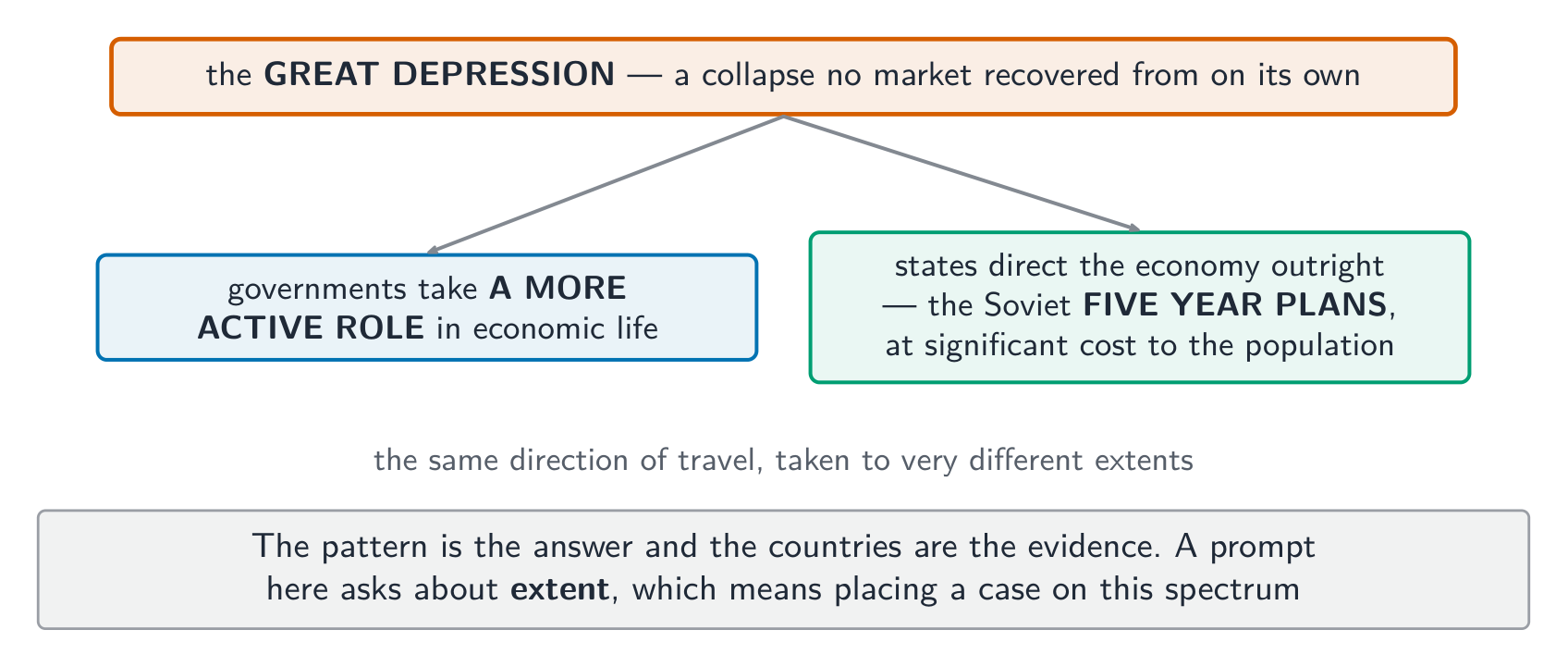
    Second, state control of the economy. As in the Soviet Five Year Plans of Unit 7, the Chinese government controlled the national economy through the Great Leap Forward 大跃进, implementing repressive policies with significant costs to the population. The CED presents these as a matched pair, which is exactly how a comparison question will ask for them.

    Beyond these, movements to redistribute land and resources 土地与资源再分配 developed within states in Africa, Asia, and Latin America, some advocating communism or socialism and some not. That distinction matters: land reform is not the same claim as revolution, and the CED separates them.

    Vocabulary Train
    English Chinese Pinyin
    internal tension 内部矛盾 nèi bù máo dùn
    Japanese aggression 日本侵略 rì běn qīn lüè
    Great Leap Forward 大跃进 dà yuè jìn
    movements to redistribute land and resources 土地与资源再分配 tǔ dì yǔ zī yuán zài fēn pèi
    8.5

    Decolonization After 1900

    Syllabus

    8.5 Decolonization After 1900

    Thematic FocusLearning ObjectiveHistorical Developments

    GOV
    Governance — A variety of internal and external factors contribute to state formation, expansion, and decline. Governments maintain order through a variety of administrative institutions, policies, and procedures, and governments obtain, retain, and exercise power in different ways and for different purposes.

    Unit 8.F
    Compare the processes by which various peoples pursued independence after 1900.

    • KC-6.2.II.A Nationalist leaders and parties in Asia and Africa sought varying degrees of autonomy within or independence from imperial rule.
    • KC-6.2.I.C After the end of World War II, some colonies negotiated their independence, while others achieved independence through armed struggle.
    • KC-6.2.II.B Regional, religious, and ethnic movements challenged colonial rule and inherited imperial boundaries. Some of these movements advocated for autonomy.

    Illustrative examples:

    • Nationalist leaders and parties:
      • Indian National Congress
      • Ho Chi Minh in French Indochina (Vietnam)
      • Kwame Nkrumah in British Gold Coast (Ghana)
      • Gamal Abdel Nasser in Egypt
    • Negotiated independence:
      • India from the British Empire
      • The Gold Coast from the British Empire
      • French West Africa
    • Independence through armed struggle:
      • Algeria from the French empire
      • Angola from the Portuguese empire
      • Vietnam from the French empire
    • Regional, religious, and ethnic movements:
      • Muslim League in British India
      • Québécois separatist movement in Canada
      • Biafra secessionist movement in Nigeria

    Source: College Board AP Course and Exam Description

    The CED's own division: how a colony reached independence shaped what the new state inherited
    Both routes end in a new state - but they do not end in the same new state

    Nationalist leaders and parties 民族主义领袖与政党 in Asia and Africa sought varying degrees of autonomy within, or independence from, imperial rule. The examinable set of examples includes the Indian National Congress, Ho Chi Minh in French Indochina, Kwame Nkrumah in the Gold Coast, and Gamal Abdel Nasser in Egypt.

    After World War II, some colonies negotiated their independence 通过谈判独立 while others achieved it through armed struggle 通过武装斗争. India and the Gold Coast are the standard negotiated cases; Angola, Vietnam, and Algeria the standard armed ones.

    A third strand is easily missed: regional, religious, and ethnic movements challenged both colonial rule and the inherited imperial boundaries 沿袭的帝国边界 those empires left behind. Those boundaries are the reason so many post-independence conflicts were about borders rather than about the departing power.

    Vocabulary Train
    English Chinese Pinyin
    Nationalist leaders and parties 民族主义领袖与政党 mín zú zhǔ yì lǐng xiù yǔ zhèng dǎng
    some colonies negotiated their independence 通过谈判独立 tōng guò tán pàn dú lì
    others achieved it through armed struggle 通过武装斗争 tōng guò wǔ zhuāng dòu zhēng
    inherited imperial boundaries 沿袭的帝国边界 yán xí de dì guó biān jiè
    8.6

    Newly Independent States

    Syllabus

    8.6 Newly Independent States

    Thematic FocusLearning ObjectiveHistorical Developments

    ECN
    Economics Systems — As societies develop, they affect and are affected by the ways that they produce, exchange, and consume goods and services.

    Unit 8.G
    Explain how political changes in the period from c. 1900 to the present led to territorial, demographic, and nationalist developments.

    • KC-6.2.III.A.i The redrawing of political boundaries after the withdrawal of former colonial authorities led to the creation of new states.
    • KC-6.2.III.A.ii The redrawing of political boundaries in some cases led to conflict as well as population displacement and/or resettlements, including those related to the Partition of India and the creation of the state of Israel.

    Unit 8.H
    Explain the economic changes and continuities resulting from the process of decolonization.

    • KC-6.3.I.C In newly independent states after World War II, governments often took on a strong role in guiding economic life to promote development.
    • KC-6.2.III.B The migration of former colonial subjects to imperial metropoles (the former colonizing country), usually in the major cities, maintained cultural and economic ties between the colony and the metropole even after the dissolution of empires.

    Illustrative examples:

    • States created by redrawing of political boundaries:
      • Israel
      • Cambodia
      • Pakistan
    • (CONT’D) Governments guiding economic life:
      • Gamal Abdel Nasser’s promotion of economic development in Egypt
      • Indira Gandhi's economic policies in India
      • Julius Nyerere’s modernization in Tanzania
      • Sirimavo Bandaranaike’s economic policies in Sri Lanka
    • Migrations:
      • South Asians to Britain
      • Algerians to France
      • Filipinos to the United States

    Source: College Board AP Course and Exam Description

    The redrawing of political boundaries after colonial withdrawal led to the creation of new states, and in some cases to conflict, population displacement, and resettlement 人口流离与重新安置. The partition of British India is the standard case of all three at once.

    Economically, governments in newly independent states often took a strong role in guiding economic life to promote development 主导经济以推动发展 - a continuity with the interwar pattern of Unit 7, arrived at from a completely different direction.

    There was also a reverse flow of people: the migration of former colonial subjects to imperial metropoles 宗主国 - usually to major cities - which maintained cultural and economic ties between the former colony and the former colonial power long after independence.

    Vocabulary Train
    English Chinese Pinyin
    conflict, population displacement, and resettlement 人口流离与重新安置 rén kǒu liú lí yǔ chóng xīn ān zhì
    often took a strong role in guiding economic life to promote development 主导经济以推动发展 zhǔ dǎo jīng jì yǐ tuī dòng fā zhǎn
    migration of former colonial subjects to imperial metropoles 宗主国 zōng zhǔ guó
    8.7

    Global Resistance to Established Power Structures

    Syllabus

    8.7 Global Resistance to Established Power Structures After 1900

    Thematic FocusLearning ObjectiveHistorical Developments

    CDI
    Cultural Developments and Interactions — The development of ideas, beliefs, and religions illustrates how groups in society view themselves, and the interactions of societies and their beliefs often have political, social, and cultural implications.

    Unit 8.I
    Explain various reactions to existing power structures in the period after 1900.

    • KC-6.2.V Although conflict dominated much of the 20th century, many individuals and groups— including states—opposed this trend. Some individuals and groups, however, intensified the conflicts.
    • KC-6.2.V.A Groups and individuals challenged the many wars of the century, and some, such as Mohandas Gandhi, Martin Luther King Jr., and Nelson Mandela, promoted the practice of nonviolence as a way to bring about political change.
    • KC-6.2.V.C Militaries and militarized states often responded to the proliferation of conflicts in ways that further intensified conflict.
    • KC-6.2.V.D Some movements used violence against civilians in an effort to achieve political aims.

    Illustrative examples:

    • Responses that intensified conflict:
      • Chile under Augusto Pinochet
      • Spain under Francisco Franco
      • Uganda under Idi Amin
      • The buildup of the military–industrial complex and weapons trading
    • Movements that used violence:
      • Shining Path
      • Al-Qaeda

    Source: College Board AP Course and Exam Description

    Although conflict dominated much of the twentieth century, many individuals and groups - including states - opposed that trend. The CED names three distinct patterns, and they should not be blurred:

    • Groups and individuals challenged the wars of the century, and some - Mohandas Gandhi 甘地, Martin Luther King Jr. 马丁·路德·, and Nelson Mandela 曼德拉 - promoted non-violence 非暴力 as a method of change.
    • Militaries and militarised states often responded to the proliferation of conflicts in ways that further intensified them.
    • Some movements used violence against civilians in an effort to achieve political aims.

    Both the third and second points are examinable content, not asides. A question on "reactions to existing power structures" expects the full range, not only the non-violent one.

    Vocabulary Train
    English Chinese Pinyin
    Mohandas Gandhi 甘地 gān dì
    Martin Luther King Jr. 马丁·路德·金 mǎ dīng · lù dé · jīn
    Nelson Mandela 曼德拉 màn dé lā
    promoted non-violence 非暴力 fēi bào lì
    8.8

    End of the Cold War

    Syllabus

    8.8 End of the Cold War

    Thematic FocusLearning ObjectiveHistorical Developments

    GOV
    Governance — A variety of internal and external factors contribute to state formation, expansion, and decline. Governments maintain order through a variety of administrative institutions, policies, and procedures, and governments obtain, retain, and exercise power in different ways and for different purposes.

    Unit 8.J
    Explain the causes of the end of the Cold War.

    • KC-6.2.IV.E Advances in U.S. military and technological development, the Soviet Union’s costly and ultimately failed invasion of Afghanistan, and public discontent and economic weakness in communist countries led to the end of the Cold War and the collapse of the Soviet Union.

    Source: College Board AP Course and Exam Description

    The CED gives a compound cause here too: advances in United States military and technological development, the Soviet Union's costly and ultimately failed invasion of Afghanistan 阿富汗战争, public discontent 公众不满, and economic problems 经济困难 within the Soviet system.

    Notice that three of the four are internal to the Soviet Union. An answer that explains the end of the Cold War purely as external pressure has missed the CED's own weighting.

    Vocabulary Train
    English Chinese Pinyin
    costly and ultimately failed invasion of Afghanistan 阿富汗战争 ā fù hàn zhàn zhēng
    public discontent 公众不满 gōng zhòng bù mǎn
    economic problems 经济困难 jīng jì kùn nán
    8.9

    Causation in the Age of the Cold War

    Syllabus

    8.9 Causation in the Age of the Cold War and Decolonization

    Learning ObjectiveReview: Unit 8 Key Concepts

    Unit 8.K
    Explain the extent to which the effects of the Cold War were similar in the Eastern and Western Hemispheres.

    • KC-6.2 Peoples and states around the world challenged the existing political and social order in varying ways, leading to unprecedented worldwide conflicts.
      • KC-6.2.II Hopes for greater self-government were largely unfulfilled following the World War I; however, in the years following the World War II, increasing anti-imperialist sentiment contributed to the dissolution of empires and the restructuring of states.
      • KC-6.2.IV.C The Cold War conflict extended beyond its basic ideological origins to have profound effects on economic, political, social, and cultural aspects of global events.
    • KC-6.3 The role of the state in the domestic economy varied, and new institutions of global association emerged and continued to develop throughout the century.
      • KC-6.3.I States responded in a variety of ways to the economic challenges of the 20th century.

    Source: College Board AP Course and Exam Description

    The unit's reasoning task is to explain the extent to which the effects of the Cold War were similar in the Eastern and Western Hemispheres. "Extent" is a comparison word: it asks for similarity and difference, with a judgement about which dominates.

    Worked example (a real AP exam question). AP World short-answer questions here ask, for example, to "Explain one difference between the processes of decolonisation in two different regions after 1945." A full-mark answer names both cases and the difference between them: "In the Gold Coast, independence was achieved largely through negotiation, as nationalist parties won elections and Britain transferred power without a war. In Algeria, independence came through a prolonged armed struggle against France, which left the new state with a military-led government and a devastated economy." Notice what earns the mark: the difference is stated in terms that apply to both cases, and each side carries its own evidence.

    8.9

    Exam tips

    • The Cold War was not two-sided. The Non-Aligned Movement is examinable content, and including it lifts an answer immediately.
    • Give the effects as the CED does: alliances, nuclear proliferation, proxy wars. Three named effects beat one described at length.
    • Negotiated versus armed independence is the highest-value comparison in the unit, because it explains what the new state inherited.
    • Inherited imperial boundaries explain post-independence conflict better than any other single factor. Use the phrase.
    • For resistance, give all three CED patterns - non-violence, militarised response, and violence against civilians.
    • The end of the Cold War was mostly internal to the Soviet system. Weight the causes that way and say why.
  • 9

    Globalization

    9.1

    Advances in Technology and Exchange

    Syllabus

    9.1 Advances in Technology and Exchange After 1900

    Thematic FocusLearning ObjectiveHistorical Developments

    TEC
    Technology and Innovation — Human adaptation and innovation have resulted in increased efficiency, comfort, and security, and technological advances have shaped human development and interactions with both intended and unintended consequences.

    Unit 9.A
    Explain how the development of new technologies changed the world from 1900 to present.

    • KC-6.1.I.A New modes of communication—including radio communication, cellular communication, and the internet—as well as transportation, including air travel and shipping containers, reduced the problem of geographic distance.
    • KC-6.1.I.D Energy technologies, including the use of petroleum and nuclear power, raised productivity and increased the production of material goods.
    • KC-6.1.III.B More effective forms of birth control gave women greater control over fertility, transformed reproductive practices, and contributed to declining rates of fertility in much of the world.
    • KC-6.1.I.B The Green Revolution and commercial agriculture increased productivity and sustained the earth’s growing population as it spread chemically and genetically modified forms of agriculture.
    • KC-6.1.I.C Medical innovations, including vaccines and antibiotics, increased the ability of humans to survive and live longer lives.

    Source: College Board AP Course and Exam Description

    Unit 9 covers 1900 to the present, and its central move is evaluative rather than narrative: almost every development it names produced both a benefit and a cost, and questions reward answers that hold both.

    The CED names the advances directly:

    • New modes of communication 通信方式 - radio, cellular technology, and the internet.
    • Energy technologies 能源技术, including the use of petroleum 石油 and nuclear power 核能.
    • Medical innovations 医学创新, including vaccines 疫苗 and antibiotics 抗生素, which increased lifespans 寿命.
    • The Green Revolution 绿色革命 and commercial agriculture, which increased the global food supply 粮食供应.
    • More effective forms of birth control 节育, which gave women greater control over fertility 生育, transformed reproductive practices, and contributed to declining fertility rates in industrialised states.

    Note the last one carefully. It is a technological change with a demographic and a social consequence, which makes it unusually useful evidence in questions about the changing role of women.

    Vocabulary Train
    English Chinese Pinyin
    New modes of communication 通信方式 tōng xìn fāng shì
    Energy technologies 能源技术 néng yuán jì shù
    petroleum 石油 shí yóu
    nuclear power 核能 hé néng
    Medical innovations 医学创新 yī xué chuàng xīn
    vaccines 疫苗 yì miáo
    antibiotics 抗生素 kàng shēng sù
    increased lifespans 寿命 shòu mìng
    Green Revolution 绿色革命 lǜ sè gé mìng
    increased the global food supply 粮食供应 liáng shí gōng yìng
    birth control 节育 jié yù
    fertility 生育 shēng yù
    9.2

    Technological Advances and Limitations: Disease

    Syllabus

    9.2 Technological Advances and Limitations After 1900: Disease

    Thematic FocusLearning ObjectiveHistorical Developments

    ENV
    Humans and the Environments — The environment shapes human societies, and as populations grow and change, these populations in turn shape their environments.

    Unit 9.B
    Explain how environmental factors affected human populations over time.

    • KC-6.1.III Diseases, as well as medical and scientific developments, had significant effects on populations around the world.
    • KC-6.1.III.A Diseases associated with poverty persisted while other diseases emerged as new epidemics and threats to human populations, in some cases leading to social disruption. These outbreaks spurred technological and medical advances. Some diseases occurred at higher incidence merely because of increased longevity.

    Illustrative examples:

    • Diseases associated with poverty: § Malaria § Tuberculosis § Cholera Emergent epidemic diseases: § 1918 influenza pandemic § Ebola § HIV/AIDS Diseases associated with increased longevity: § Heart disease § Alzheimer’s disease

    Source: College Board AP Course and Exam Description

    Every advance in this unit carries a cost, and the exam rewards naming both
    This is why Unit 9 questions ask you to evaluate rather than to describe

    Diseases, as well as medical and scientific developments, had significant effects on populations across the century. The CED splits the effect in two:

    • Diseases associated with poverty persisted 与贫困相关的疾病, while other diseases emerged as epidemics and pandemics 流行病与大流行病.
    • Diseases associated with longer lifespans - conditions such as heart disease and neurological illnesses of old age - became more prominent precisely because medical advances extended life.

    That second point is the unit's logic in miniature: the success of one intervention produced the conditions for a different problem. It is not a contradiction, and saying so is what makes an answer analytical.

    Vocabulary Train
    English Chinese Pinyin
    Diseases associated with poverty persisted 与贫困相关的疾病 yǔ pín kùn xiāng guān de jí bìng
    emerged as epidemics and pandemics 流行病与大流行病 liú xíng bìng yǔ dà liú xíng bìng
    9.3

    Debates About the Environment

    Syllabus

    9.3 Technological Advances: Debates About the Environment After 1900

    Thematic FocusLearning ObjectiveHistorical Developments

    ENV
    Humans and the Environments — The environment shapes human societies, and as populations grow and change, these populations in turn shape their environments.

    Unit 9.C
    Explain the causes and effects of environmental changes in the period from 1900 to present.

    • KC-6.1.II.A As human activity contributed to deforestation, desertification, a decline in air quality, and increased consumption of the world’s supply of fresh water, humans competed over these and other resources more intensely than ever before.
    • KC-6.1.II.B The release of greenhouse gases and pollutants into the atmosphere contributed to debates about the nature and causes of climate change.

    Source: College Board AP Course and Exam Description

    Human activity contributed to deforestation 森林砍伐, desertification 荒漠化, a decline in air quality 空气质量下降, and increased consumption of the world's supply of fresh water 淡水.

    The release of greenhouse gases 温室气体 and pollutants into the atmosphere provoked debates about climate change 气候变化. The CED's word is debates - the examinable content is that the science and its policy implications became a subject of international argument, not a settled instruction.

    Vocabulary Train
    English Chinese Pinyin
    deforestation 森林砍伐 sēn lín kǎn fá
    desertification 荒漠化 huāng mò huà
    decline in air quality 空气质量下降 kōng qì zhì liàng xià jiàng
    fresh water 淡水 dàn shuǐ
    greenhouse gases 温室气体 wēn shì qì tǐ
    debates about climate change 气候变化 qì hòu biàn huà
    9.4

    Economics in the Global Age

    Syllabus

    9.4 Economics in the Global Age

    Thematic FocusLearning ObjectiveHistorical Developments

    ECN
    Economics Systems — As societies develop, they affect and are affected by the ways that they produce, exchange, and consume goods and services.

    Unit 9.D
    Explain the continuities and changes in the global economy from 1900 to present.

    • KC-6.3.I.D In a trend accelerated by the end of the Cold War, many governments encouraged free-market economic policies and promoted economic liberalization in the late 20th century.
    • KC-6.3.I.E In the late 20th century, revolutions in information and communications technology led to the growth of knowledge economies in some regions, while industrial production and manufacturing were increasingly situated in Asia and Latin America.
    • KC-6.3.II.B Changing economic institutions, multinational corporations, and regional trade agreements reflected the spread of principles and practices associated with free-market economics throughout the world.

    Illustrative examples:

    • Governments’ increased encouragement of free-market policies: § The United States under Ronald Reagan § Britain under Margaret Thatcher § China under Deng Xiaoping § Chile under Augusto Pinochet Knowledge economies: § Finland § Japan § U.S. Asian production and manufacturing economies: § Vietnam
      • Bangladesh
    • Latin American production and manufacturing economies:
      • Mexico
      • Honduras
    • Economic institutions and regional trade agreements:
      • World Trade Organization (WTO)
      • North American Free Trade Agreement (NAFTA)
      • Association of Southeast Asian Nations (ASEAN)
    • Multinational corporations:
      • Nestlé
      • Nissan
      • Mahindra and Mahindra

    Source: College Board AP Course and Exam Description

    Three developments define the period's economic history, and all three accelerated after 1990:

    • Many governments encouraged free-market economic policies 自由市场政策, a trend accelerated by the end of the Cold War.
    • Revolutions in information and communications technology led to the growth of knowledge economies 知识经济 in some regions, while other regions remained centred on agriculture or manufacturing.
    • Changing economic institutions, multinational corporations 跨国公司, and regional trade agreements 区域贸易协定 reshaped how production and trade were organised across borders.

    The continuity worth naming: this is the same story as Unit 6's economic imperialism, in new institutional form. Firms in wealthy states again hold disproportionate influence over the terms on which producers elsewhere participate.

    Vocabulary Train
    English Chinese Pinyin
    free-market economic policies 自由市场政策 zì yóu shì chǎng zhèng cè
    knowledge economies 知识经济 zhī shí jīng jì
    Changing economic institutions, multinational corporations 跨国公司 kuà guó gōng sī
    and regional trade agreements 区域贸易协定 qū yù mào yì xié dìng
    9.5

    Calls for Reform and Responses

    Syllabus

    9.5 Calls for Reform and Responses After 1900

    Thematic FocusLearning ObjectiveHistorical Developments

    SIO
    Social Interactions and Organization — The process by which societies group their members and the norms that govern the interactions between these groups and between individuals influence political, economic, and cultural institutions and organization.

    Unit 9.E
    Explain how social categories, roles, and practices have been maintained and challenged over time.

    • KC-6.3.III.i Rights-based discourses challenged old assumptions about race, class, gender, and religion.
    • KC-6.3.III.ii In much of the world, access to education as well as participation in new political and professional roles became more inclusive in terms of race, class, gender, and religion.
    • KC-6.3.II.C Movements throughout the world protested the inequality of the environmental and economic consequences of global integration.

    Illustrative examples:

    • Challenges to assumptions about race, class, gender, and religion:
      • The U.N. Universal Declaration of Human Rights, especially as it sought to protect the rights of children, women, and refugees
      • Global feminism movements
      • Negritude movement
      • Liberation theology in Latin America
    • Increased access to education and political and professional roles:
      • The right to vote and/ or to hold public office granted to women in the United States (1920), Brazil (1932), Turkey (1934), Japan (1945), India (1947), and Morocco (1963)
      • The rising rate of female literacy and the increasing numbers of women in higher education, in most parts of the world
      • The U.S. Civil Rights Act of 1965
      • The end of apartheid
      • Caste reservation in India
    • Environmental movements:
      • Greenpeace
      • Professor Wangari Maathai’s Green Belt Movement in Kenya
    • Economic movements:
      • World Fair Trade Organization

    Source: College Board AP Course and Exam Description

    Rights-based discourses 权利话语 challenged old assumptions about race, class, gender, and religion. In much of the world, access to education 受教育机会 and participation in new political and professional roles became more inclusive - an uneven process, but a real one.

    At the same time, movements throughout the world protested the inequality of the environmental and economic consequences of global integration 全球一体化. Both halves are examinable: greater inclusion, and organised objection to how the benefits were distributed.

    Vocabulary Train
    English Chinese Pinyin
    Rights-based discourses 权利话语 quán lì huà yǔ
    access to education 受教育机会 shòu jiào yù jī huì
    global integration 全球一体化 quán qiú yī tǐ huà
    9.6

    Globalized Culture

    Syllabus

    9.6 Globalized Culture After 1900

    Thematic FocusLearning ObjectiveHistorical Developments

    CDI
    Cultural Developments and Interactions — The development of ideas, beliefs, and religions illustrates how groups in society view themselves, and the interactions of societies and their beliefs often have political, social, and cultural implications.

    Unit 9.F
    Explain how and why globalization changed culture over time.

    • KC-6.3.IV.i Political and social changes of the 20th century led to changes in the arts and in the second half of the century, popular and consumer culture became more global.
    • KC-6.3.IV.ii Arts, entertainment, and popular culture increasingly reflected the influence of a globalized society.
    • KC-6.3.IV.iii Consumer culture became globalized and transcended national borders.

    Illustrative examples:

    • Global culture:
      • Music: Reggae
      • Movies: Bollywood
      • Social media: Facebook, Twitter
      • Television: BBC
      • Sports: World Cup soccer, the Olympics
    • Global consumerism:
      • Online commerce: Alibaba, eBay
      • Global brands: Toyota, Coca-Cola

    Source: College Board AP Course and Exam Description

    The CED makes three separate claims about culture, and they are not the same claim:

    • Political and social changes of the twentieth century led to changes in the arts 艺术 and other forms of cultural expression.
    • Arts, entertainment, and popular culture increasingly reflected global influence 全球影响 - forms borrowed, adapted, and recombined across regions.
    • Consumer culture 消费文化 became globalised and transcended national borders.

    The third is the strongest for essays because it is the most measurable: the same products, brands, and consumption patterns appearing across very different societies.

    Vocabulary Train
    English Chinese Pinyin
    led to changes in the arts 艺术 yì shù
    increasingly reflected global influence 全球影响 quán qiú yǐng xiǎng
    Consumer culture 消费文化 xiāo fèi wén huà
    9.7

    Resistance to Globalization

    Syllabus

    9.7 Resistance to Globalization After 1900

    Thematic FocusLearning ObjectiveHistorical Developments

    CDI
    Cultural Developments and Interactions — The development of ideas, beliefs, and religions illustrates how groups in society view themselves, and the interactions of societies and their beliefs often have political, social, and cultural implications.

    Unit 9.G
    Explain the various responses to increasing globalization from 1900 to present.

    • KC-6.3.IV.iv Responses to rising cultural and economic globalization took a variety of forms.

    Illustrative examples:

    • Responses to economic globalization:
      • Anti-IMF and anti-World Bank activism
      • Advent of locally developed social media (Weibo in China)

    Source: College Board AP Course and Exam Description

    Responses to rising cultural and economic globalisation took a variety of forms 多种形式. The CED deliberately leaves the category broad, and a good answer fills it with distinct kinds rather than repeating one:

    • Movements defending local or national cultural identity 本土文化认同 against homogenising influence.
    • Organised opposition to trade agreements and international financial institutions on economic grounds.
    • Religious and traditionalist movements 宗教与传统主义运动 rejecting the social changes that accompanied integration.
    Vocabulary Train
    English Chinese Pinyin
    Responses to rising cultural and economic globalisation took a variety of forms 多种形式 duō zhǒng xíng shì
    local or national cultural identity 本土文化认同 běn tǔ wén huà rèn tóng
    Religious and traditionalist movements 宗教与传统主义运动 zōng jiào yǔ chuán tǒng zhǔ yì yùn dòng
    9.8

    Institutions in a Globalized World

    Syllabus

    9.8 Institutions Developing in a Globalized World

    Thematic FocusLearning ObjectiveHistorical Developments

    GOV
    Governance — A variety of internal and external factors contribute to state formation, expansion, and decline. Governments maintain order through a variety of administrative institutions, policies, and procedures, and governments obtain, retain, and exercise power in different ways and for different purposes.

    Unit 9.H
    Explain how and why globalization changed international interactions among states.

    • KC-6.3.II.A New international organizations, including the United Nations, formed with the stated goal of maintaining world peace and facilitating international cooperation.

    Source: College Board AP Course and Exam Description

    New international organisations 国际组织, including the United Nations 联合国, emerged to manage problems no single state could handle alone - security, health, refugees, trade, and the environment.

    This closes the arc of the course: Unit 7 opened with the collapse of an order and unprecedented conflict; Unit 9 ends with the institutions built in response, and with the argument - still unresolved - about how much authority they should hold.

    Vocabulary Train
    English Chinese Pinyin
    New international organisations 国际组织 guó jì zǔ zhī
    United Nations 联合国 lián hé guó
    9.9

    Continuity and Change in a Globalized World

    Syllabus

    9.9 Continuity and Change in a Globalized World

    Learning ObjectiveReview: Unit 9 Key Concepts

    Unit 9.I
    Explain the extent to which science and technology brought change in the period from 1900 to the present.

    • KC-6.1 Rapid advances in science and technology altered the understanding of the universe and the natural world and led to advances in communication, transportation, industry, agriculture, and medicine.
      • KC-6.1.I.A New modes of communication— including radio communication, cellular communication, and the internet—as well as transportation, including air travel and shipping containers, reduced the problem of geographic distance.
      • KC-6.1.I.D Energy technologies, including the use of petroleum and nuclear power, raised productivity and increased the production of material goods.
      • KC-6.1.III.B More effective forms of birth control gave women greater control over fertility, transformed reproductive practices, and contributed to declining rates of fertility in much of the world.
      • KC-6.1.I.B The Green Revolution and commercial agriculture increased productivity and sustained the earth’s growing population as it spread chemically and genetically modified forms of agriculture.
      • KC-6.1.I.C Medical innovations, including vaccines and antibiotics, increased the ability of humans to survive and live longer lives.
    • KC-6.3.I States responded in a variety of ways to the economic challenges of the 20th century.
    • KC-6.3.III.i Rights-based discourses challenged old assumptions about race, class, gender, and religion.
    • KC-6.3.III.ii In much of the world, access to education as well as participation in new political and professional roles became more inclusive in terms of race, class, gender, and religion.
    • KC-6.3.IV.i Political and social changes of the 20th century led to changes in the arts and in the second half of the century, popular and consumer culture became more global.
    • KC-6.3.IV.ii Arts, entertainment, and popular culture increasingly reflected the influence of a globalized society.
    • KC-6.3.IV.iii Consumer culture became globalized and transcended national borders.

    Source: College Board AP Course and Exam Description

    The unit's reasoning skill is continuity and change, applied across the whole modern period.

    Worked example (a real AP exam question). AP World short-answer questions here ask, for example, to "Explain one way in which technological developments after 1900 affected the world's population." A full-mark answer names the development and traces its effect: "Medical innovations such as vaccines and antibiotics reduced deaths from infectious disease, which increased average lifespans and contributed to rapid population growth, particularly in regions where these treatments were introduced faster than birth rates fell." Notice the mechanism: a reason the population changed, not the statement that it did.

    9.9

    Exam tips

    • Unit 9 questions are evaluative. For almost every advance, name the benefit and the cost. That single habit lifts most answers here.
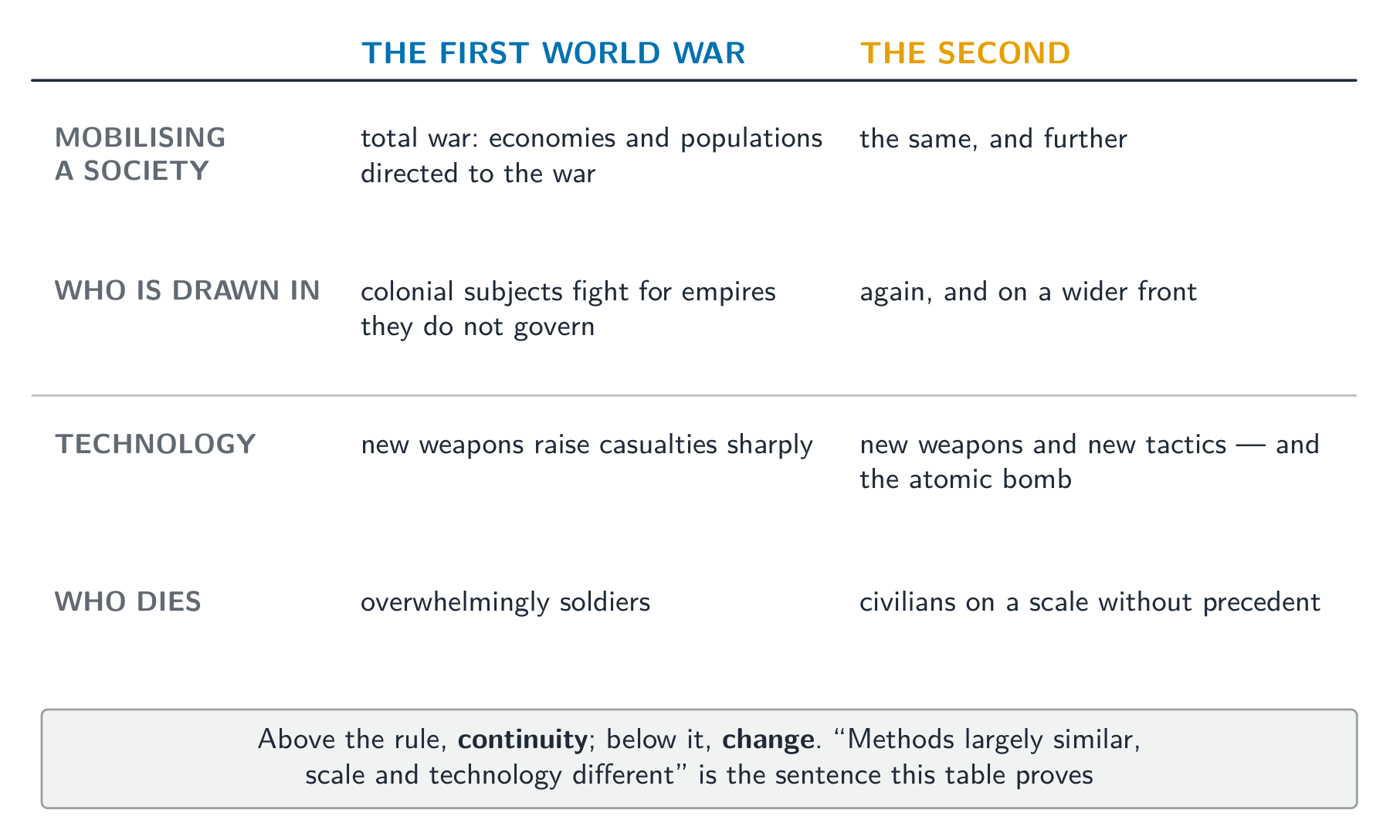
    • Birth control is technological, demographic, and social evidence at once - unusually flexible in questions about women's changing roles.
    • The rise of diseases of longer life is caused by medical success. Say that explicitly; it demonstrates causal reasoning.
    • On climate, the CED's word is debates. Write about the argument, not a verdict.
    • Connect the global economy back to Unit 6: the same asymmetry, new institutions. Cross-period links score well on essays.
    • For resistance to globalisation, give distinct kinds - cultural, economic, religious - not one kind three times.

Log in or create account

IGCSE, A-Level & AP