Skip to content

Land-Based Empires

AP World History: Modern · Topic 3

Train
3.1

How the Land Empires Expanded

Syllabus

3.1 Empires Expand

Thematic FocusLearning ObjectiveHistorical Developments

GOV
Governance — A variety of internal and external factors contribute to state formation, expansion, and decline. Governments maintain order through a variety of administrative institutions, policies, and procedures, and governments obtain, retain, and exercise power in different ways and for different purposes.

Unit 3.A
Explain how and why various land-based empires developed and expanded from 1450 to 1750.

  • KC-4.3.II Imperial expansion relied on the increased use of gunpowder, cannons, and armed trade to establish large empires in both hemispheres.
  • KC-4.3.II.B Land empires included the Manchu in Central and East Asia; the Mughal in South and Central Asia; the Ottoman in Southern Europe, the Middle East, and North Africa; and the Safavids in the Middle East.
  • KC-4.3.III.i Political and religious disputes led to rivalries and conflict between states.

Illustrative examples:

  • State rivalries:
    • Safavid–Mughal conflict
    • Songhai Empire’s conflict with Morocco

Source: College Board AP Course and Exam Description

Unit 3 covers the great land-based empires 陆基帝国 of roughly 1450 to 1750. Four questions organise it: how they expanded, how they governed, how they paid for themselves, and how they used religion.

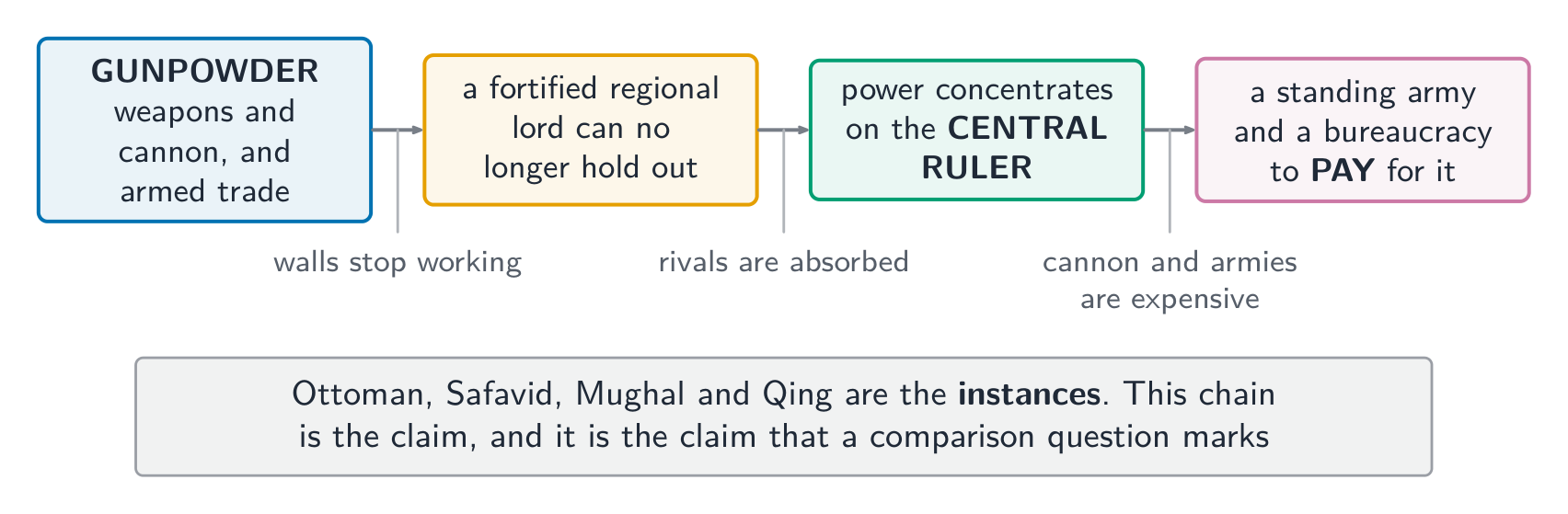
Expansion relied on the increased use of gunpowder, cannons, and armed trade 火药火炮与武装贸易 - which is why these are often called the gunpowder empires 火药帝国. Access to gunpowder weapons let a central ruler overpower regional rivals and fortified nobles, so military technology and political centralisation grew together.

The empires to know:

  • The Manchu (Qing) 满清 in Central and East Asia.
  • The Mughal 莫卧儿 in South Asia.
  • The Ottoman 奥斯曼 in the eastern Mediterranean and beyond.
  • The Safavid 萨法维 in Persia.
Vocabulary Train
English Chinese Pinyin
land-based empires 陆基帝国 lù jī dì guó
increased use of gunpowder, cannons, and armed trade 火药、火炮与武装贸易 huǒ yào 、 huǒ pào yǔ wǔ zhuāng mào yì
gunpowder empires 火药帝国 huǒ yào dì guó
Manchu (Qing) 满清 mǎn qīng
Mughal 莫卧儿 mò wò ér
Ottoman 奥斯曼 ào sī màn
Safavid 萨法维 sà fǎ wéi
3.2

Administration

Syllabus

3.2 Empires: Administration

Thematic FocusLearning ObjectiveHistorical Developments

GOV
Governance — A variety of internal and external factors contribute to state formation, expansion, and decline. Governments maintain order through a variety of administrative institutions, policies, and procedures, and governments obtain, retain, and exercise power in different ways and for different purposes.

Unit 3.B
Explain how rulers used a variety of methods to legitimize and consolidate their power in land-based empires from 1450 to 1750.

  • KC-4.3.I.C Recruitment and use of bureaucratic elites, as well as the development of military professionals, became more common among rulers who wanted to maintain centralized control over their populations and resources.
  • KC-4.3.I.A Rulers continued to use religious ideas, art, and monumental architecture to legitimize their rule.
  • KC-4.3.I.D Rulers used tribute collection, tax farming, and innovative tax-collection systems to generate revenue in order to forward state power and expansion.

Illustrative examples:

  • Bureaucratic elites or military professionals:
    • Ottoman devshirme
    • Salaried samurai
  • Religious ideas:
    • Mexica practice of human sacrifice
    • European notions of divine right
    • Songhai promotion of Islam
  • Art and monumental architecture:
    • Qing imperial portraits
    • Incan sun temple of Cuzco
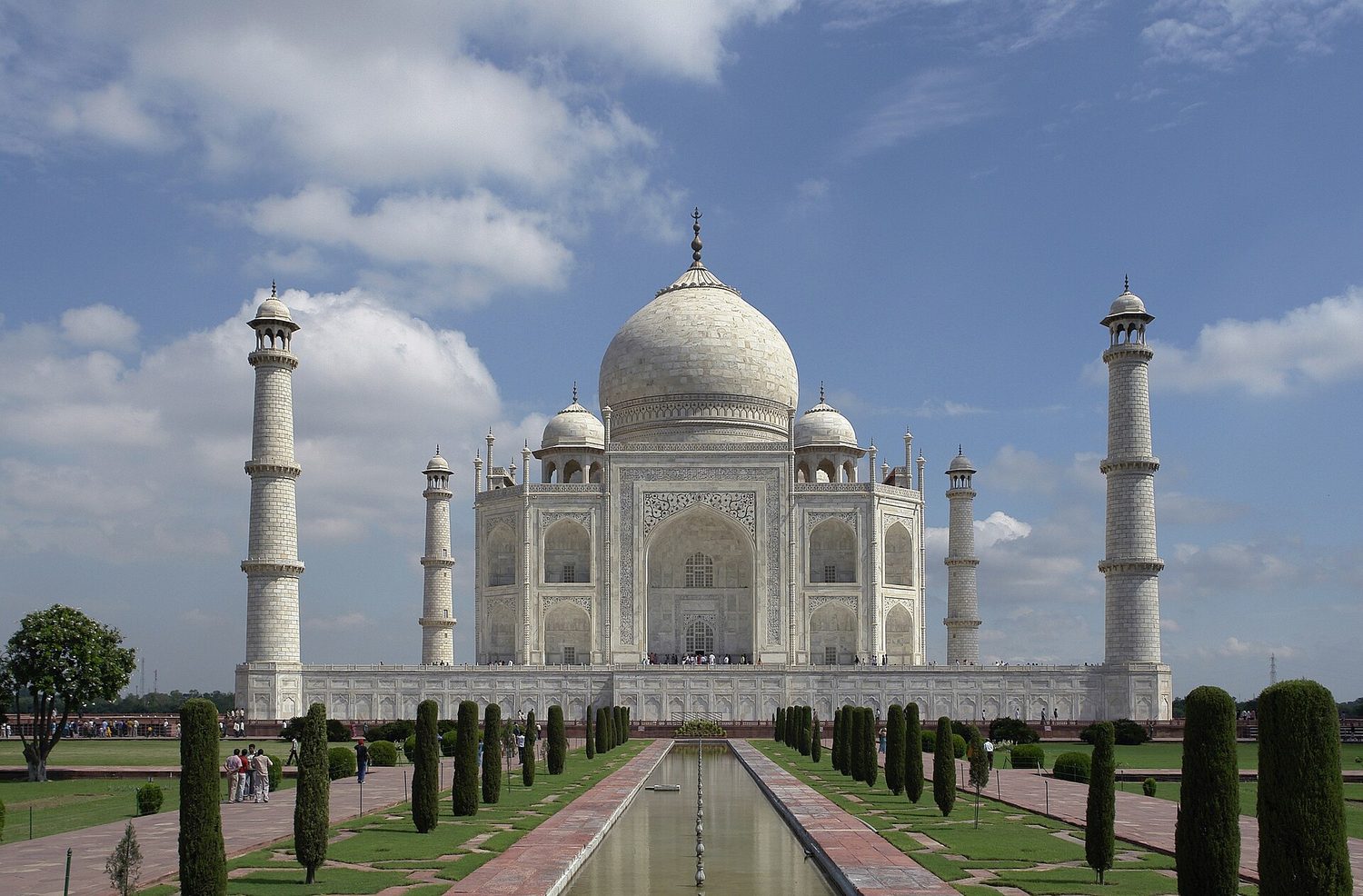
    • Mughal mausolea and mosques
    • European palaces, such as Versailles
  • Tax-collection systems:
    • Mughal zamindar tax collection
    • Ottoman tax farming
    • Mexica tribute lists
    • Ming practice of collecting taxes in hard currency

Source: College Board AP Course and Exam Description

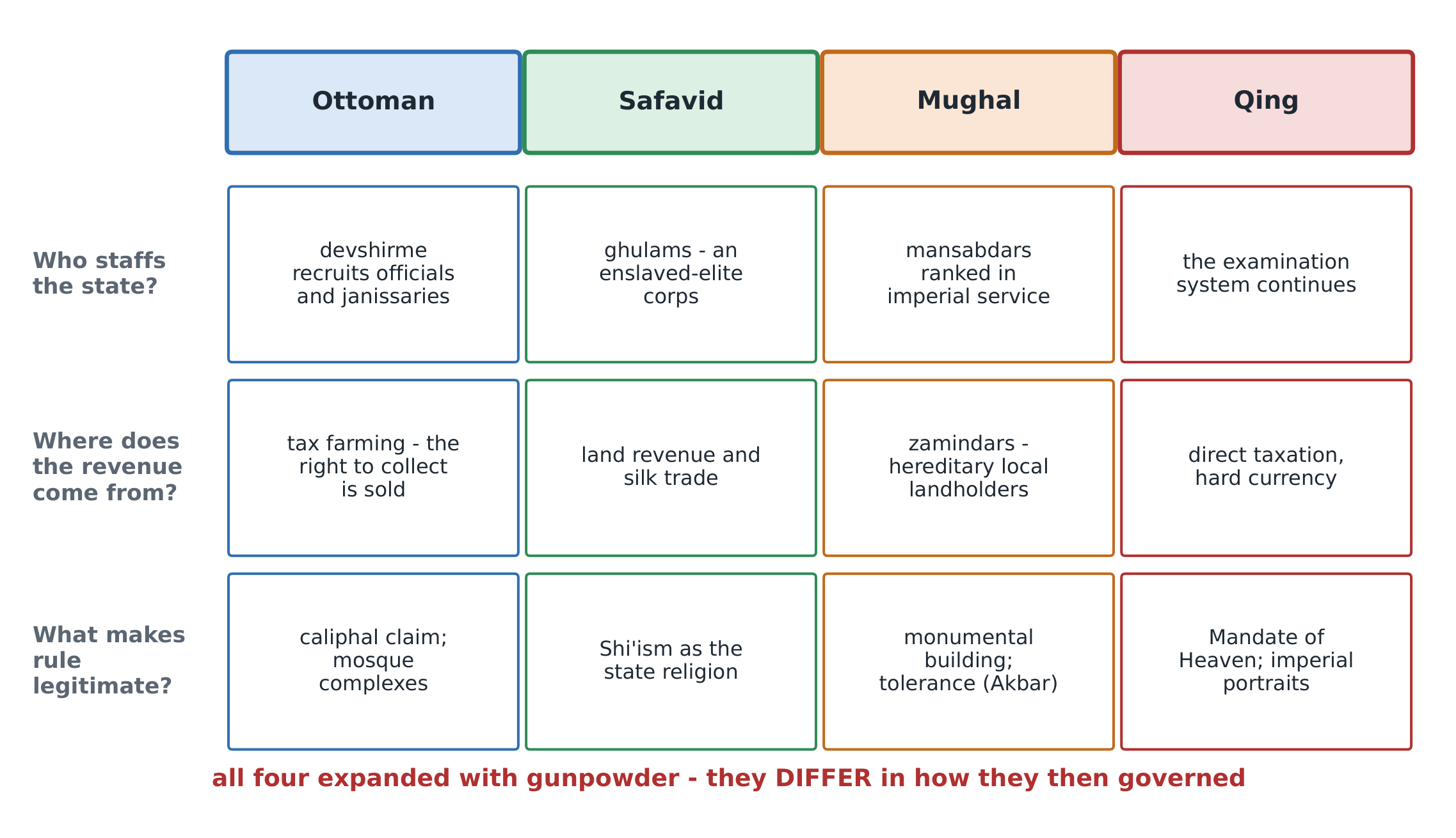
Four empires, one set of tools: how each recruited officials, raised revenue and claimed legitimacy
The same three problems - staff, revenue, legitimacy - solved differently by each empire

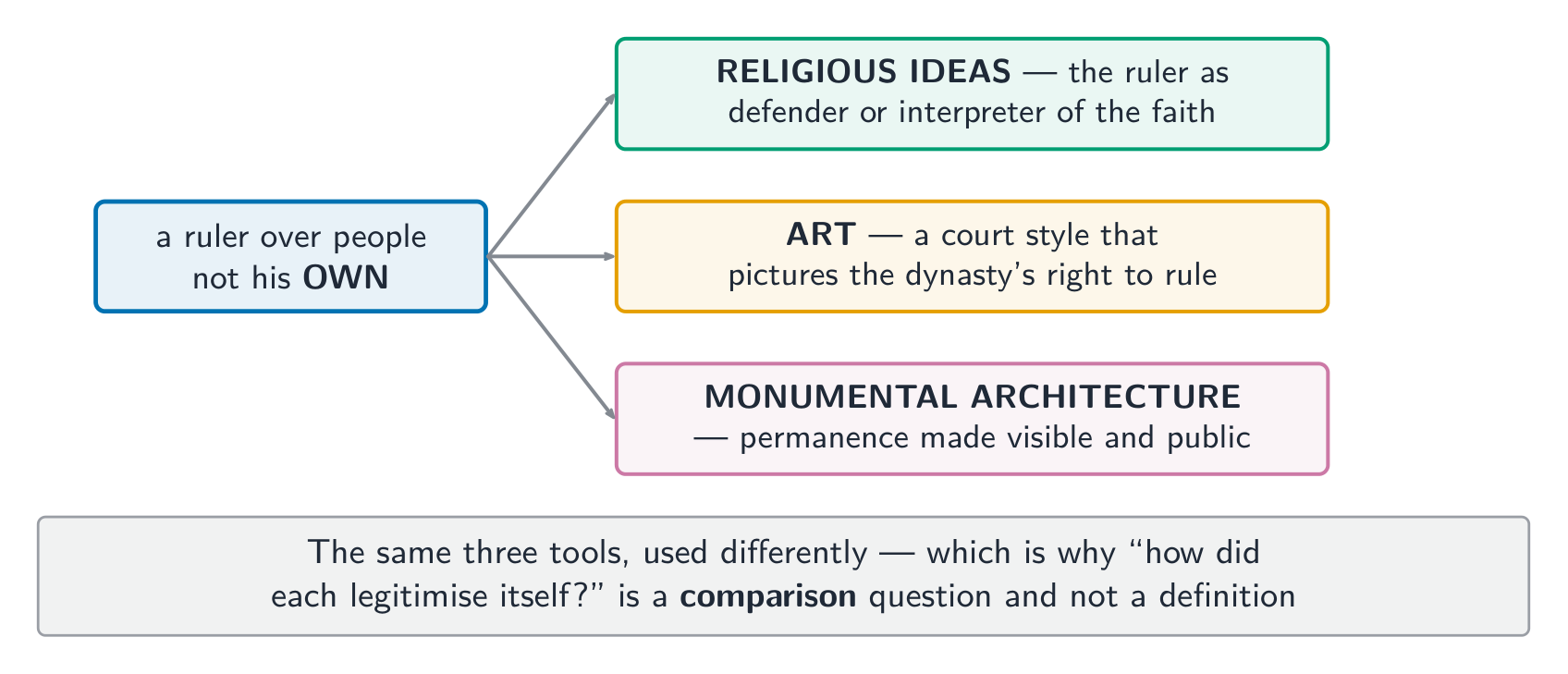
Rulers faced the same problem: how to control territory far from the capital. The CED names the tools they used.

Recruitment of bureaucratic elites 官僚精英的选任 and the development of military professionals 职业军人 gave rulers officials who owed their position to the state rather than to birth. The clearest case is the Ottoman devshirme 德夫希尔梅 system, which recruited and trained administrators and soldiers, including the janissaries 耶尼切里; the Manchu continued China's examination system; the Safavids used ghulams 古拉姆.

Revenue came through tribute collection 纳贡, tax farming 包税制, and innovative tax-collection systems. The Mughal zamindar 柴明达尔 system and Ottoman tax farming are the standard examples, and the Ming practice of collecting taxes in hard currency 硬通货 is another.

Vocabulary Train
English Chinese Pinyin
Recruitment of bureaucratic elites 官僚精英的选任 guān liáo jīng yīng de xuǎn rèn
military professionals 职业军人 zhí yè jūn rén
devshirme 德夫希尔梅 dé fū xī ěr méi
janissaries 耶尼切里 yé ní qiè lǐ
ghulams 古拉姆 gǔ lā mǔ
tribute collection 纳贡 nà gòng
tax farming 包税制 bāo shuì zhì
zamindar 柴明达尔 chái míng dá ěr
hard currency 硬通货 yìng tōng huò
3.3

Legitimacy and Belief

Syllabus

3.3 Empires: Belief Systems

Thematic FocusLearning ObjectiveHistorical Developments

CDI
Cultural Developments and Interactions — The development of ideas, beliefs, and religions illustrates how groups in society view themselves, and the interactions of societies and their beliefs often have political, social, and cultural implications.

Unit 3.C
Explain continuity and change within the various belief systems during the period from 1450 to 1750.

  • KC-4.1.VI.i The Protestant Reformation marked a break with existing Christian traditions and both the Protestant and Catholic reformations contributed to the growth of Christianity.
  • KC-4.1.VI.ii Political rivalries between the Ottoman and Safavid empires intensified the split within Islam between Sunni and Shi’a.
  • KC-4.1.VI.iii Sikhism developed in South Asia in a context of interactions between Hinduism and Islam.

Source: College Board AP Course and Exam Description

Rulers continued to use religious ideas, art, and monumental architecture 宗教观念艺术与纪念性建筑 to legitimise their rule - Mughal mosques and mausolea, Ottoman mosque complexes, Qing imperial portraits, and European palaces such as Versailles all do the same work.

Religious change also produced conflict:

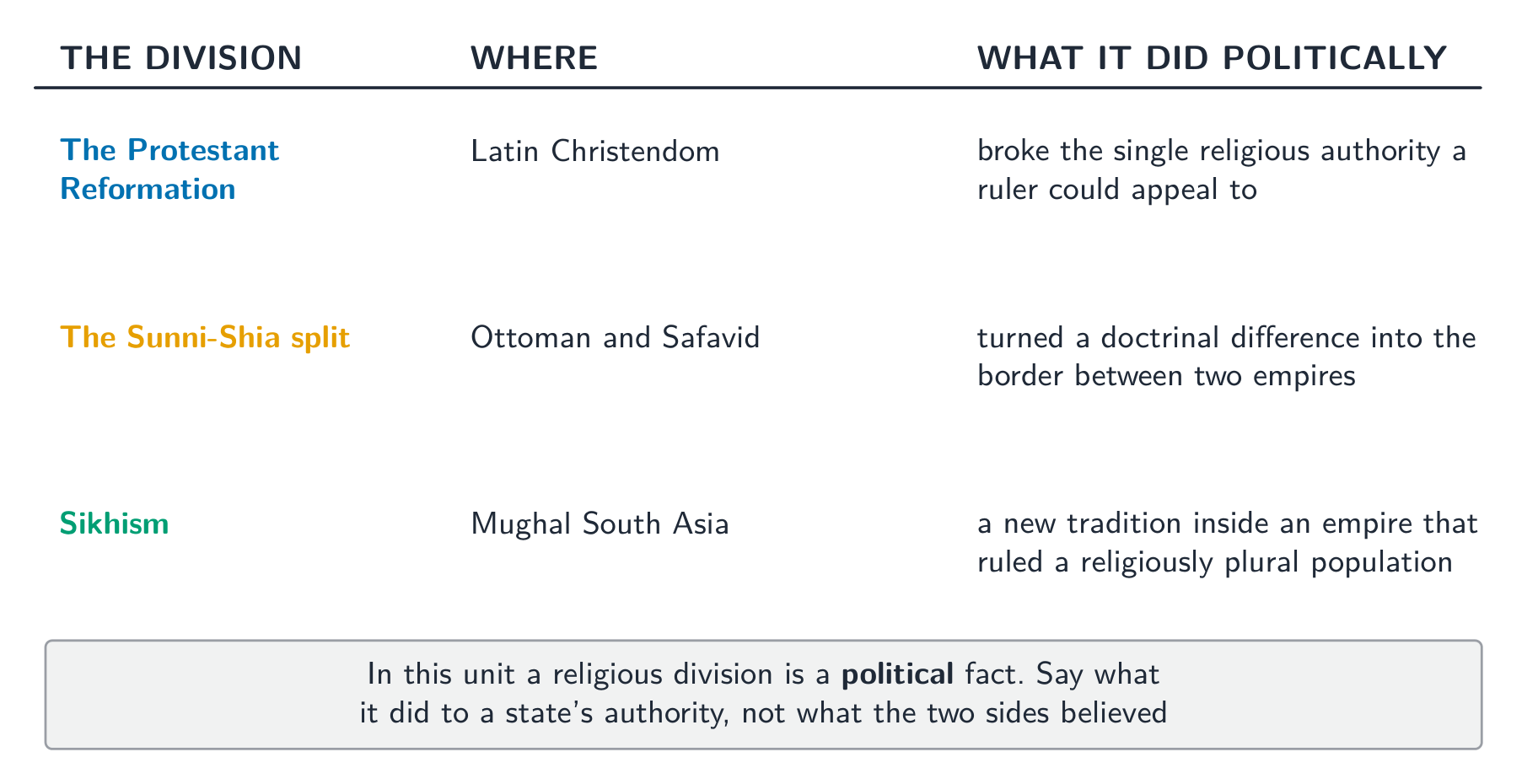
  • The Protestant Reformation 新教改革 marked a break with existing Christian traditions and led to sustained religious and political conflict in Europe.
  • Political rivalry between the Ottoman and Safavid empires intensified the Sunni-Shia split 逊尼派与什叶派分裂, showing how state rivalry can deepen a religious division.
  • Sikhism 锡克教 developed in South Asia in a context of interaction between Hinduism and Islam.

Political and religious disputes together produced rivalries and conflict between states 国家之间的对抗与冲突 across Eurasia.

Vocabulary Train
English Chinese Pinyin
religious ideas, art, and monumental architecture 宗教观念、艺术与纪念性建筑 zōng jiào guān niàn 、 yì shù yǔ jì niàn xìng jiàn zhù
Protestant Reformation 新教改革 xīn jiào gǎi gé
Sunni-Shia split 逊尼派与什叶派分裂 xùn ní pài yǔ shén yè pài fēn liè
Sikhism 锡克教 xī kè jiào
rivalries and conflict between states 国家之间的对抗与冲突 guó jiā zhī jiān de duì kàng yǔ chōng tū
3.4

Comparison in Land-Based Empires

Syllabus

3.4 Comparison in Land-Based Empires

Learning ObjectiveReview: Unit 3 Key Concepts

Unit 3.D
Compare the methods by which various empires increased their influence from 1450 to 1750.

  • KC-4.1 The interconnection of the Eastern and Western Hemispheres made possible by transoceanic voyaging, transformed trade and had a significant social impact on the world.
    • KC-4.1.VI In some cases, the increase and intensification of interactions between newly connected hemispheres expanded the reach and furthered development of existing religions, and contributed to religious conflicts and the development of syncretic belief systems and practices.
  • KC-4.3 Empires achieved increased scope and influence around the world, shaping and being shaped by the diverse populations they incorporated.
    • KC-4.3.II Imperial expansion relied on the increased use of gunpowder, cannons, and armed trade to establish large empires in both hemispheres.
    • KC-4.3.II.B Land empires included the Manchu in Central and East Asia; Mughal in South and Central Asia; Ottoman in Southern Europe, the Middle East, and North Africa; and the Safavids in the Middle East.
    • KC-4.3.III.i Political and religious disputes led to rivalries and conflict between states.

Source: College Board AP Course and Exam Description

The unit's reasoning skill is comparison, and the productive comparisons are about method, not size:

  • Recruiting officials by examination (Qing) against by enslaved-elite systems (Ottoman devshirme, Safavid ghulams).
  • Tax farming (Ottoman) against land-revenue intermediaries (Mughal zamindars) against direct taxation (Ming hard currency).
  • Legitimacy through religious identity (Safavid Shi'ism as state religion) against through tolerance of diversity (Mughal policy under Akbar).

Worked example (a real AP exam question). AP World short-answer questions in this unit typically ask students to "Explain one similarity" or "Explain one difference in how land-based empires maintained power." A full-mark answer names the method for both and explains the effect: "Both the Ottoman and Mughal empires used intermediaries to collect revenue rather than salaried tax officials, but the Ottomans used tax farming, which sold the right to collect for a fixed payment, while the Mughals relied on zamindars, hereditary landholders whose local standing gave them a permanent interest in the countryside." Notice the shape: the comparison is one function (raising revenue), performed two ways, with the consequence stated.

3.4

Exam tips

  • Say why gunpowder mattered: it let central rulers overpower regional rivals, so military change and centralisation go together.
  • Learn the four empires by their administrative method, not their territory - devshirme, examinations, zamindars, ghulams.
  • Tax farming sells the right to collect; a zamindar is a hereditary landholder. Questions turn on that difference.
  • Monumental architecture is evidence of legitimation, not decoration. Say what it was doing.
  • The Ottoman-Safavid rivalry is the example of political conflict deepening a religious divide.
  • Comparisons should be one function performed two ways, with the consequence stated.

Interactive lessons on this topic

Work through it step by step, with instant-check exercises.

More topics in AP World History: Modern

Log in or create account

IGCSE, A-Level & AP