2.1 The Silk Roads
| Thematic Focus | Learning Objective | Historical Developments |
|---|---|---|
ECN | Unit 2.A |
|
Illustrative examples:
- Trading cities:
- Kashgar
- Samarkand
- New forms of credit and money economies:
- Bills of exchange
- Banking houses
- Use of paper money
AP World History: Modern · Topic 2
 6:50
6:50
Unit 2: Networks of Exchange
Silk, porcelain, spices, gold, salt. Students spend hours learning who traded what, and then a question asks why trade grew and the list is no help at all.…
English narration · English + 中文 subtitles burned in
| Thematic Focus | Learning Objective | Historical Developments |
|---|---|---|
ECN | Unit 2.A |
|
Illustrative examples:
Source: College Board AP Course and Exam Description
Unit 2 covers the three great exchange networks of 1200 to 1450 - the Silk Roads, the Indian Ocean, and the trans-Saharan routes - and asks the same question of each: what made trade grow, and what did that growth change?
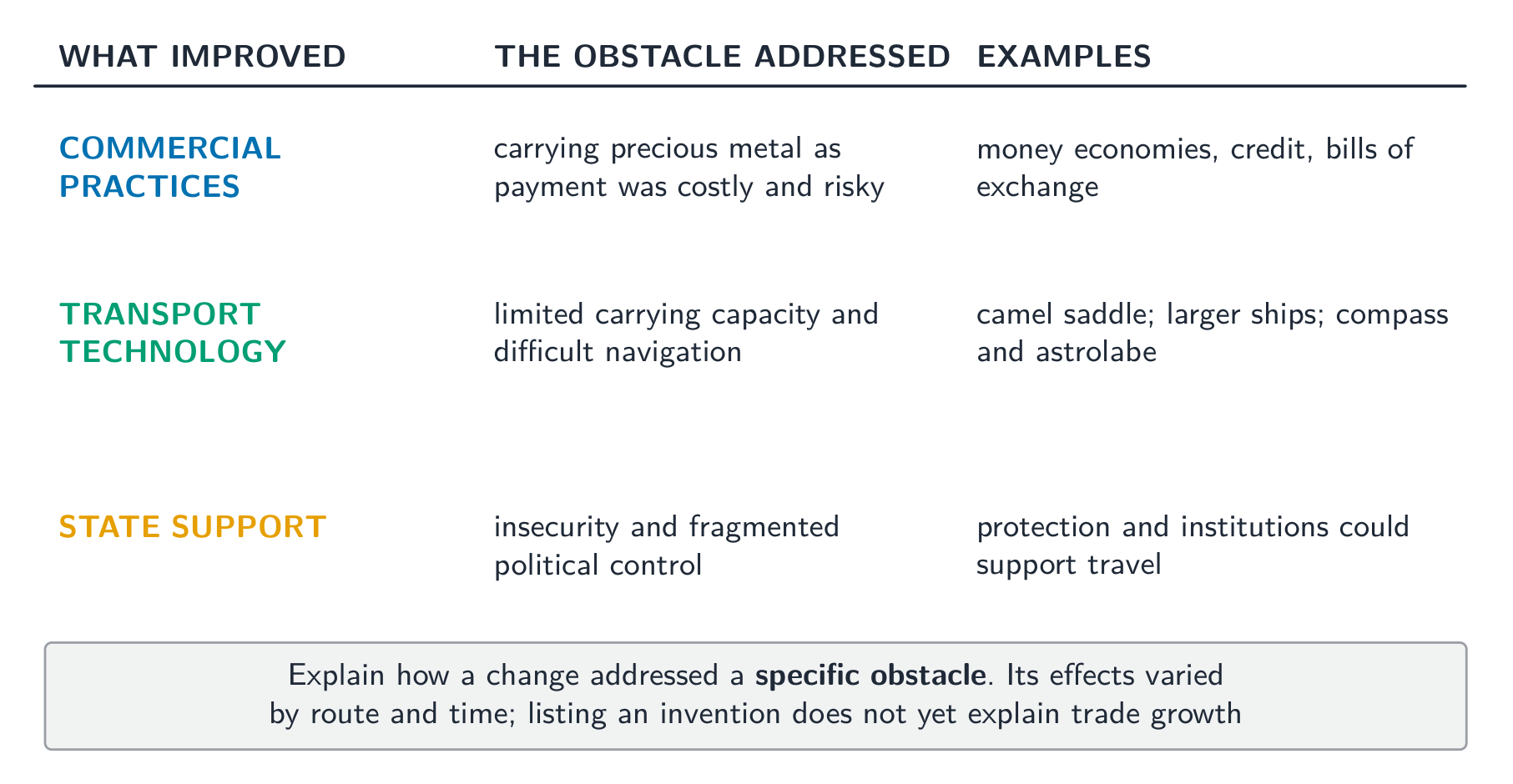
Three useful explanations link a change to a trading obstacle; their relative importance varied by route and time:
Demand mattered too: luxury goods 奢侈品 from Chinese, Persian, and Indian artisans found expanding markets across Afro-Eurasia, and producers increased output to meet that demand.
Connect each enabler to a plausible mechanism; distinguish technology from commercial practice.
| English |
|---|
| money economies/ˈmʌni ɪˈkɒnəmiz/ |
| credit/ˈkredɪt/ |
| Improved transportation technologies/ɪmˈpruːvd trænspɔːˈteɪʃn tekˈnɒlədʒiz/ |
| State support/steɪt səˈpɔːt/ |
| luxury goods/ˈlʌkʃəri ɡʊdz/ |
| Improved commercial practices/ɪmˈpruːvd kəˈmɜːʃl ˈpræktɪsɪz/ |
| Thematic Focus | Learning Objective | Historical Developments |
|---|---|---|
ECN | Unit 2.A |
|
Illustrative examples:
Source: College Board AP Course and Exam Description
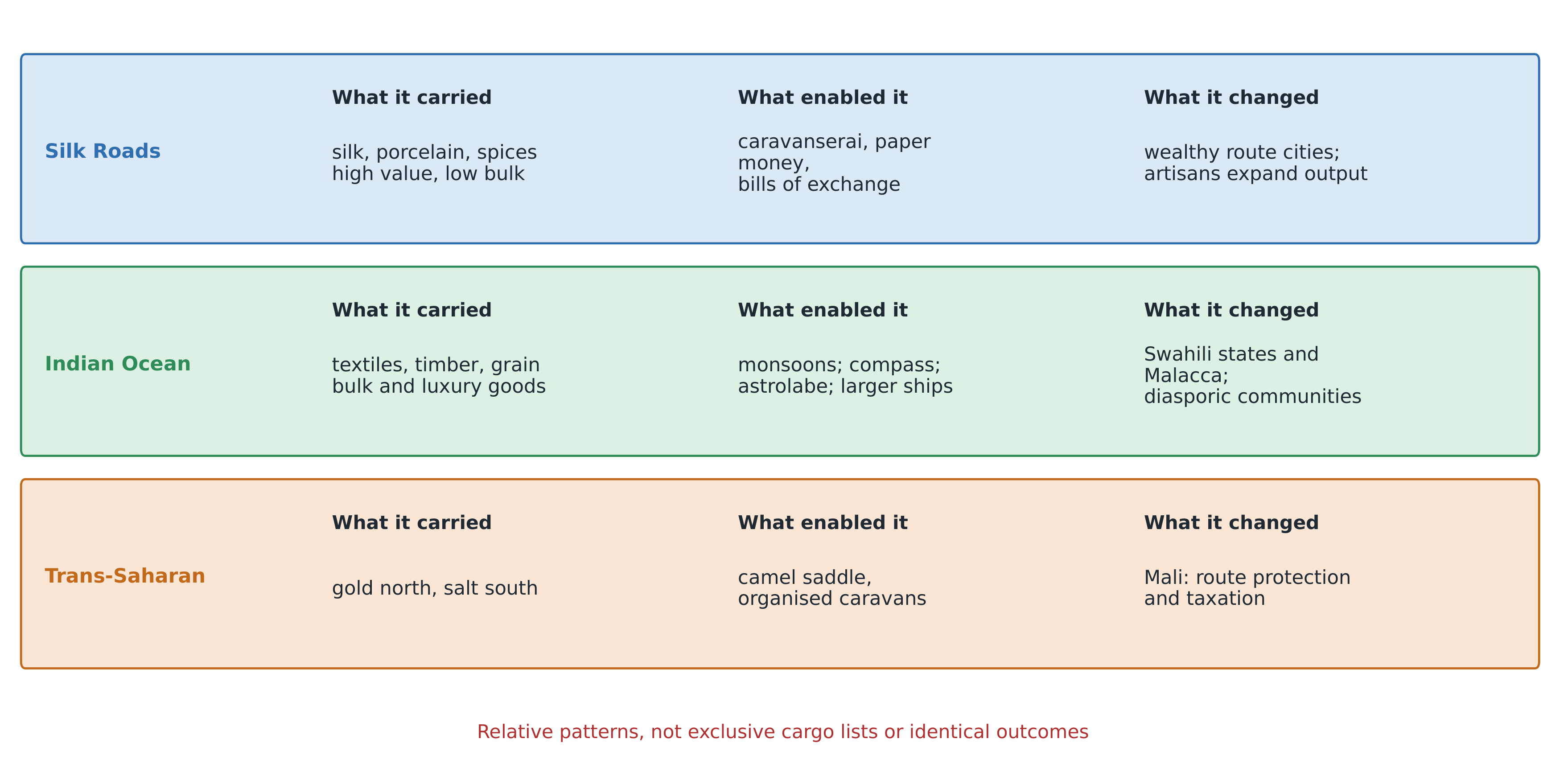
The Silk Roads 丝绸之路 carried high-value, low-bulk goods overland across Eurasia: silk, porcelain, spices, and precious metals.
Its enabling innovations were commercial as much as technical - caravanserai 商队旅馆 along the routes, the use of paper money 纸币 and bills of exchange 汇票 in China, and forms of credit that let merchants trade without carrying bullion.
Demand for exports encouraged Chinese, Persian and Indian producers to expand textiles and porcelain production; iron and steel manufacture also expanded in China. Trading cities such as Kashgar 喀什 and Samarkand 撒马尔罕 gained from the flow of merchants and goods. These routes existed before 1200: the change was expansion and intensification, not their invention. A caravanserai supplied lodging and a place for exchange; credit reduced the need to transport all payment as precious metal.
| English |
|---|
| Silk Roads/sɪlk rəʊdz/ |
| caravanserai/ˈkærəvænsəraɪ/ |
| paper money/ˈpeɪpə ˈmʌni/ |
| bills of exchange/bɪlz ɒv eksˈtʃeɪndʒ/ |
| Kashgar/ˈkæʃɡə/ |
| Samarkand/ˈsæmɑːkænd/ |
| Thematic Focus | Learning Objective | Historical Developments |
|---|---|---|
CDI | Unit 2.B |
|
Unit 2.C |
| |
Unit 2.D |
|
Illustrative examples:
Source: College Board AP Course and Exam Description
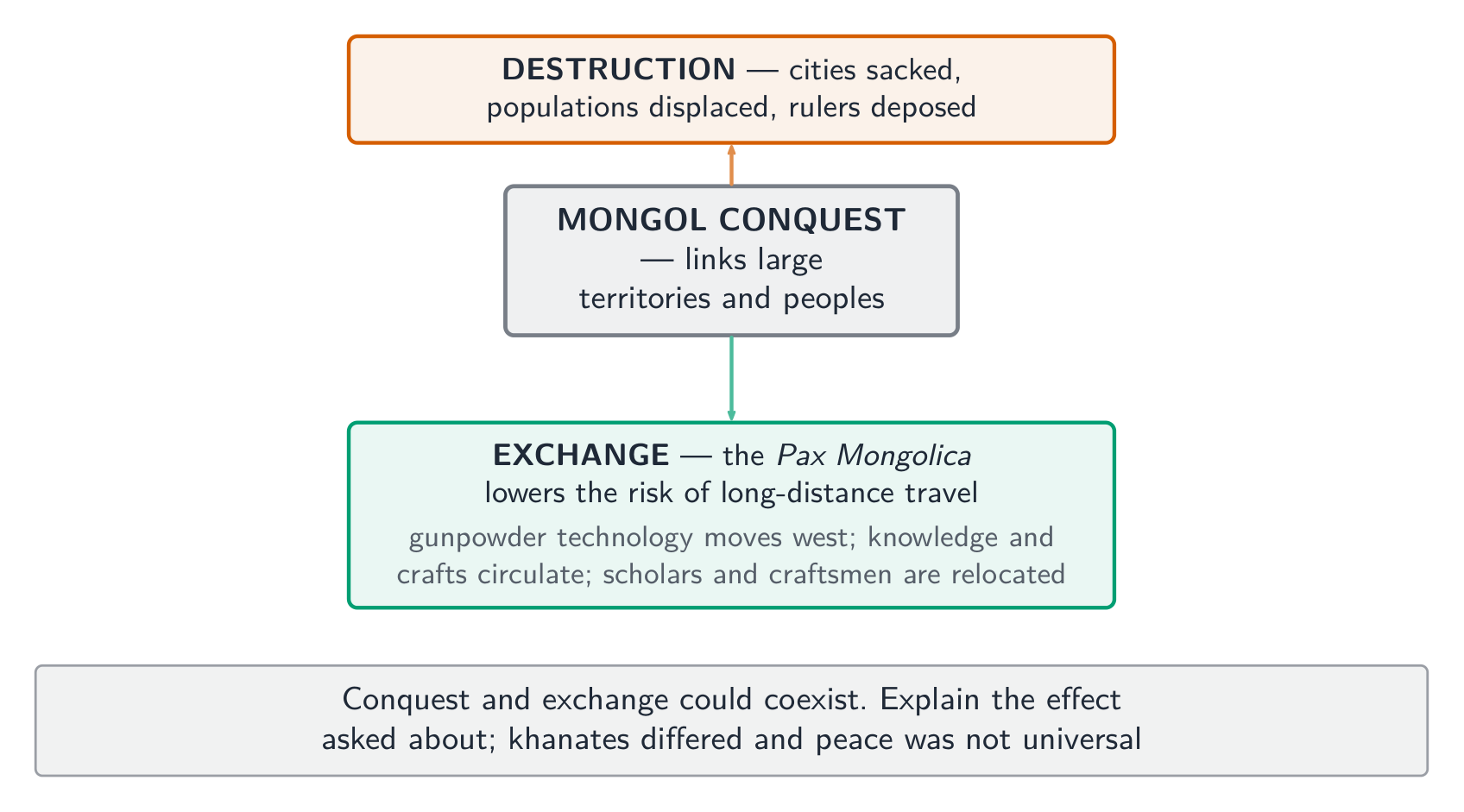
The Mongol Empire 蒙古帝国 expanded through organised military force, including effective cavalry tactics, as rival states weakened or fragmented. Conquest displaced populations and overthrew rulers. Successor khanates 汗国, including Yuan China and the Ilkhanate in Iran, developed distinct political and cultural settings; the whole network did not remain one uniformly peaceful state throughout 1200–1450.
Mongol expansion facilitated Afro-Eurasian trade and communication by linking large territories, incorporating new peoples and supporting travel and communications. A relay system helped official messages move; protection and trade-friendly practices could reduce travel risks. The term Pax Mongolica 蒙古和平 describes this period of facilitated connections, not universal peace.
Interregional contacts and conflicts also encouraged technological and cultural transfers: gunpowder technology moved west, knowledge and crafts circulated, and scholars and craftsmen were relocated across the empire. The adoption of Uyghur script and the circulation of Greco–Islamic medical knowledge illustrate transfers; local traditions also influenced Mongol rulers. Some rulers adopted their subjects’ religions or tolerated varied practices to support legitimacy.
Political violence and increased connections could coexist. Explain the particular effect a prompt asks about; destruction and exchange do not automatically cancel each other, and not every response needs both.
| English |
|---|
| Mongol Empire/ˈmɒŋɡɒl ˈempaɪə/ |
| Pax Mongolica/pæks mɒnˈɡɒlɪkə/ |
| khanates/ˈkɑːneɪts/ |
| Thematic Focus | Learning Objective | Historical Developments |
|---|---|---|
CDI | Unit 2.E |
|
Unit 2.F |
| |
Unit 2.G |
|
Illustrative examples:
Source: College Board AP Course and Exam Description
The Indian Ocean network moved bulkier goods than the Silk Roads - textiles, timber, grain, and spices - because ships could carry larger cargoes at lower transport cost per unit. This is a relative tendency, not a rule that maritime trade carried only cheap bulk goods: luxury goods also travelled by sea.
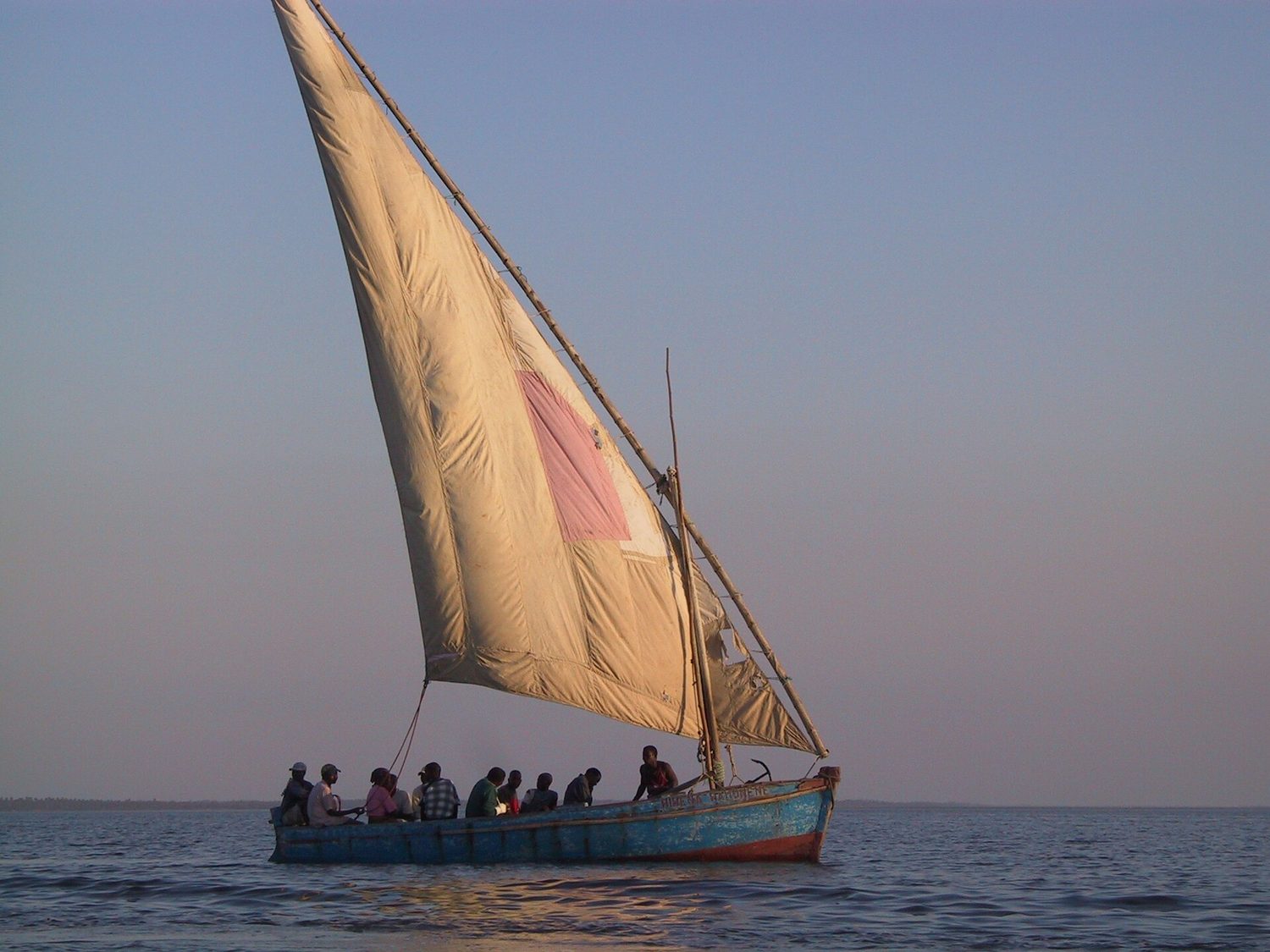
Seasonally changing monsoon winds 季风 helped merchants plan outward and return voyages. Environmental knowledge worked with larger ship designs, the lateen sail 三角帆, vessels such as the dhow 单桅帆船, and navigational tools including the compass 罗盘 and astrolabe 星盘. The compass helped indicate direction and the astrolabe supported celestial observations. These tools improved navigation; they did not make winds irrelevant or every voyage safe.
Important effects included:
Ming voyages led by Zheng He 郑和 illustrate state-sponsored maritime connections in the early fifteenth century. They encouraged diplomatic and cultural contacts across existing Indian Ocean networks, rather than creating those networks from nothing.
| English |
|---|
| monsoon winds/mɒnˈsuːn wɪndz/ |
| lateen sail/ˈlætiːn seɪl/ |
| dhow/ˈdiːhaʊ/ |
| compass/ˈkʌmpəs/ |
| astrolabe/ˈæstrəleɪb/ |
| diasporic communities/ˌdaɪəˈspɒrɪk kəˈmjuːnɪtiz/ |
| Zheng He/ʒeŋ hiː/ |
| Thematic Focus | Learning Objective | Historical Differences |
|---|---|---|
GOV | Unit 2.H |
|
Unit 2.I |
|
Illustrative examples:
Source: College Board AP Course and Exam Description
The trans-Saharan routes crossed the desert on innovations in existing technology - above all the camel saddle 骆驼鞍 and organised caravans 商队.
Gold from West Africa moved north and salt 盐 moved south. The expansion of empires, including Mali 马里帝国, facilitated Afro-Eurasian trade by securing the routes and taxing them - and Mansa Musa 曼萨·穆萨’s pilgrimage demonstrated Mali’s wealth and connections to the Islamic world. Desert transport and state activity interacted; a camel saddle alone does not explain the entire growth of a trading empire.
| English |
|---|
| camel saddle/ˈkæml ˈsædl/ |
| caravans/ˈkærəvænz/ |
| salt/sɒlt/ |
| Mali/ˈmɑːli/ |
| Mansa Musa/ˈmænsə ˈmjuːsə/ |
| Thematic Focus | Learning Objective | Historical Developments |
|---|---|---|
CDI | Unit 2.J |
|
Illustrative examples:
| Thematic Focus | Learning Objective | Historical Developments |
|---|---|---|
ENV | Unit 2.K |
|
Illustrative examples:
Source: College Board AP Course and Exam Description
Increased cross-cultural interaction produced diffusion 传播 of literary, artistic, scientific, and religious traditions - the spread of Islam along trade routes, Buddhist influence in East Asia and Hindu and Buddhist influence in Southeast Asia, and the movement of scientific and mathematical knowledge.
Travellers 旅行者 such as Ibn Battuta 伊本·白图泰, Marco Polo 马可·波罗 and Margery Kempe wrote accounts as connections intensified. Such accounts are evidence to interpret: ask about the writer’s purpose, audience, viewpoint and access to information. A traveller’s description does not automatically represent every person or place.
The fate of cities varied: some declined as routes shifted or invasions came, while others grew into major commercial centres.
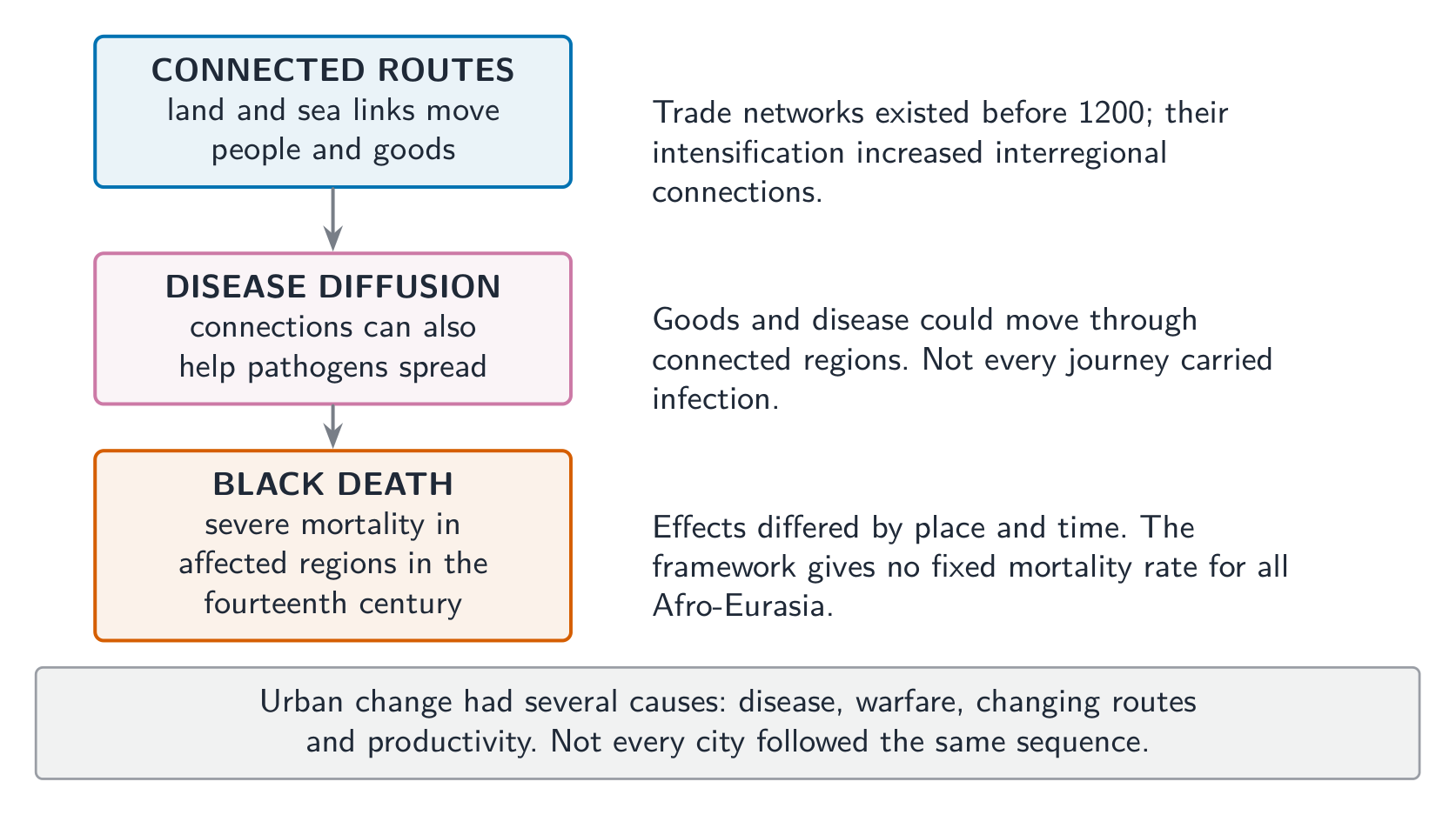
The environmental consequences were as large as the cultural ones. Continued diffusion of crops and pathogens linked environmental change to exchange. Examples include bananas in Africa, new rice varieties in East Asia and citrus around the Mediterranean. Crops could support agricultural production and population growth where local conditions allowed. Epidemic disease also moved through connections: the Black Death 黑死病 spread across connected regions in the fourteenth century and caused severe mortality. Effects varied; neither an absence of all prior immunity nor a fixed death rate for all Afro-Eurasia follows from the syllabus. City decline could reflect epidemic disease, warfare or changing routes; urban growth could reflect productivity and trade. Do not turn these separate processes into an inevitable four-step sequence.
Link connected land and sea routes to disease diffusion without assuming identical local outcomes.
| English |
|---|
| diffusion/dɪˈfjuːʒn/ |
| travellers/ˈtræveləz/ |
| Black Death/blæk deθ/ |
| Ibn Battuta/ˈɪbən ˈbætjuːtə/ |
| Marco Polo/ˈmɑːkəʊ ˈpəʊləʊ/ |
| Learning Objective | Review: Unit 2 Key Concepts |
|---|---|
Unit 2.L |
|
Source: College Board AP Course and Exam Description
Compare the networks on a common feature and support the relationship with specific evidence. A prompt may require similarities, differences, causes, effects or an argument about extent. A causal explanation is not required merely because a question asks for a comparison; follow its command and rubric.
Original worked comparison. Explain one difference in typical cargo between the Silk Roads and Indian Ocean networks during 1200–1450.
Worked check. Both carried luxuries, but long-distance overland transport favoured high-value, low-bulk goods such as silk, while ships also made bulk cargoes such as timber and grain more feasible. Their larger carrying capacity lowered transport cost per unit. This states a shared basis, evidence from both networks and a mechanism; it is not a guaranteed full-score response to every exam prompt.
All tasks below are original; attempt before reading the checks. They practise demands found in the cited syllabus and released questions.
1. Explain an enabler. A caravanserai provides lodging and a place to exchange goods along an overland route. Explain how this could encourage trade, then distinguish it from the effect of a bill of exchange.
Check. Lodging and exchange facilities support merchants on a long journey. A bill of exchange is a commercial arrangement that can reduce the need to carry precious metal as payment. Both can encourage trade, but their mechanisms differ.
2. Environment and technology. A merchant plans an Indian Ocean outward journey and return around seasonal wind changes. Explain the role of environmental knowledge and why a compass is a different kind of enabler.
Check. Knowledge of monsoons helps time journeys to seasonal sailing conditions. A compass helps indicate direction; it does not control the wind. Knowledge and technology can work together without being interchangeable.
3. State building and exchange. Explain one way Mongol expansion supported communication and one reason cultural practices could spread through the khanates.
Check. Linked territories and relay stations helped official messages travel over long distances. Contact among peoples, movement of specialists and rulers’ adoption or toleration of local traditions could encourage cultural transfers. Explain the chosen relationship rather than assuming political conquest created universal peace.
4. Evaluate an argument. Assess: “Between 1200 and 1450, growing exchange brought only benefits.” Use one cultural or economic example and one environmental example, then qualify the judgement.
Check. Expanded trade supported cities and circulation of cultural and technical knowledge. It also helped epidemic disease move, with severe human losses. Benefits and harms varied by people, place and time, so a one-sided universal claim is not defensible. These are building blocks for an argument, not a complete essay or a universal scoring formula.
5. Interpret a source. Original fictional source description: a merchant writes to potential partners praising a port’s profitable markets. Identify a plausible purpose and explain one limit of using the account to represent life in the whole city.
Check. The writer may aim to attract business partners, making profitable commerce especially relevant to the audience. The account reveals a merchant’s perspective, but praise of markets alone does not establish the experiences of every resident. This is an invented source exercise, not an attributed medieval quotation.
Select evidence that answers the particular prompt in its period. Identify a development when asked to identify; explain how or why when asked to explain; support an argument with relevant evidence when asked to evaluate. “Because” can express reasoning, but the word itself earns no automatic credit. A particular question does not require every cause or consequence in this handout. Preserve distinctions: commodity versus enabler, environment versus technology, continuity versus expansion, and relative tendency versus absolute rule.
Local AP World History CED Unit 2, topics 2.1–2.7, PDF pages 61–70 (printed 54–63), supplies the scope and required historical developments. The official course page and fall-2026 clarification confirm that course content is unchanged while exam presentation changes for May 2027. Older question formats are used here for historical demand, not as the current paper template.
Local 2024 set 2 SAQ 3 and official guidelines (QP PDF page 4; scheme pages 6–7) were read for Mongol state-building, communication and cultural-transfer demands. Local 2025 set 2 SAQ 3A and scheme (QP PDF page 5; scheme page 6) were read for the diffusion of gunpowder before 1500; later-period parts B/C are outside this unit’s time scope. Original practice is not a quotation of these questions. The Metropolitan Museum’s Mongol history and collections essay supports the distinction between destruction, connected khanates and cultural transfer. No invented mark guarantee, traveller quotation or numerical mortality claim is used.
Work through it step by step, with instant-check exercises.
Loading subjects…