Unit 1 asks you to hold six regions of the world in your head at once, and students try to do it by memorising six separate stories. That is why the unit feels…
English narration · English + 中文 subtitles burned in
1.1
Reading the World in 1200
Syllabus
1.1 Developments in East Asia from c. 1200 to c. 1450
Thematic Focus
Learning Objective
Historical Developments
CDI Cultural Developments and Interactions — The development of ideas, beliefs, and religions illustrates how groups in society view themselves, and the interactions of societies and their beliefs often have political, social, and cultural implications.
Unit 1.A
Explain the systems of government employed by Chinese dynasties and how they developed over time.
KC-3.2.I.A Empires and states in Afro-Eurasia and the Americas demonstrated continuity, innovation, and diversity in the 13th century. This included the Song Dynasty of China, which utilized traditional methods of Confucianism and an imperial bureaucracy to maintain and justify its rule.
Unit 1.B
Explain the effects of Chinese cultural traditions on East Asia over time. THEMATIC FOCUS Economics Systems ECN As societies develop, they affect and are affected by the ways that they produce, exchange, and consume goods and services. LEARNING OBJECTIVE
KC-3.1.III.D.i Chinese cultural traditions continued, and they influenced neighboring regions.
KC-3.1.III.D.ii Buddhism and its core beliefs continued to shape societies in Asia and included a variety of branches, schools, and practices. HISTORICAL DEVELOPMENTS
Unit 1.C
Explain the effects of innovation on the Chinese economy over time.
KC-3.3.III.A.i The economy of Song China became increasingly commercialized while continuing to depend on free peasant and artisanal labor.
KC-3.1.I.D The economy of Song China flourished as a result of increased productive capacity, expanding trade networks, and innovations in agriculture and manufacturing.
Illustrative examples:
Cultural traditions:
Filial piety in East Asia
Influence of Neo-Confucianism and Buddhism in East Asia
Confucian traditions of both respect for and expected deference from women
Chinese literary and scholarly traditions and their spread to Heian Japan and Korea
Branches of Buddhism:
Theravada
Mahayana
Tibetan
Technological innovations:
Champa rice
Transportation innovations, like the Grand Canal expansion
Steel and iron production
Textiles and porcelains for export
Source: College Board AP Course and Exam Description
Unit 1 surveys the major regions of the world around 1200 to 1450, just before the great connecting networks of Unit 2. Its purpose is comparison: by the end you should be able to say how any two of these societies were governed, what held them together, and how they made their living.
Three questions apply everywhere, and answering them for each region is the whole unit:
How is the state organised? Who rules, through what officials, and paid for how?
What belief system shapes society? Religion supplies law, education, and legitimacy in every region here.
What is the economic base? Agriculture almost everywhere, but with very different labour systems and levels of trade.
1.1
East Asia
Syllabus
1.1 Developments in East Asia from c. 1200 to c. 1450
Thematic Focus
Learning Objective
Historical Developments
CDI Cultural Developments and Interactions — The development of ideas, beliefs, and religions illustrates how groups in society view themselves, and the interactions of societies and their beliefs often have political, social, and cultural implications.
Unit 1.A
Explain the systems of government employed by Chinese dynasties and how they developed over time.
KC-3.2.I.A Empires and states in Afro-Eurasia and the Americas demonstrated continuity, innovation, and diversity in the 13th century. This included the Song Dynasty of China, which utilized traditional methods of Confucianism and an imperial bureaucracy to maintain and justify its rule.
Unit 1.B
Explain the effects of Chinese cultural traditions on East Asia over time. THEMATIC FOCUS Economics Systems ECN As societies develop, they affect and are affected by the ways that they produce, exchange, and consume goods and services. LEARNING OBJECTIVE
KC-3.1.III.D.i Chinese cultural traditions continued, and they influenced neighboring regions.
KC-3.1.III.D.ii Buddhism and its core beliefs continued to shape societies in Asia and included a variety of branches, schools, and practices. HISTORICAL DEVELOPMENTS
Unit 1.C
Explain the effects of innovation on the Chinese economy over time.
KC-3.3.III.A.i The economy of Song China became increasingly commercialized while continuing to depend on free peasant and artisanal labor.
KC-3.1.I.D The economy of Song China flourished as a result of increased productive capacity, expanding trade networks, and innovations in agriculture and manufacturing.
Illustrative examples:
Cultural traditions:
Filial piety in East Asia
Influence of Neo-Confucianism and Buddhism in East Asia
Confucian traditions of both respect for and expected deference from women
Chinese literary and scholarly traditions and their spread to Heian Japan and Korea
Branches of Buddhism:
Theravada
Mahayana
Tibetan
Technological innovations:
Champa rice
Transportation innovations, like the Grand Canal expansion
Steel and iron production
Textiles and porcelains for export
Source: College Board AP Course and Exam Description
Song China 宋朝中国 is the unit's benchmark state. Its economy became increasingly commercialized 商业化 while remaining largely agrarian 农业为主, supported by rising productive capacity - Champa rice 占城稻, iron and steel production, and transport improvements such as the expanded Grand Canal 大运河.
Government ran through a bureaucracy 官僚体系 staffed by the civil service examination 科举制度, which recruited officials on merit and gave the state unusual administrative depth.
Chinese cultural traditions continued and influenced neighbouring regions - Korea, Japan, and Vietnam adopted writing, bureaucratic models, and belief systems. Neo-Confucianism 新儒学 shaped society, including filial piety 孝道 and the expectation of women's deference. Buddhism 佛教 continued to shape Asian societies and spread further, in forms including Theravada 上座部佛教, Mahayana 大乘佛教, and Tibetan 藏传佛教 Buddhism.
What Song China made, and why it matters later. The commercialised economy did not only feed itself: it produced textiles 纺织品, porcelains 瓷器 and iron for export, in workshops organised for volume rather than for a household's own use. Paper money and credit instruments circulated to pay for it. This is the supply side of the Indian Ocean trade you meet in the next unit — the demand for Chinese porcelain and silk is what put ships on those routes, so treat Song manufacturing as a cause of the trading world, not a detail about China.
Confucian expectations cut both ways for women.Neo-Confucianism held that women were owed respect within the family and were morally central to it, while also expecting deference 顺从 to father, husband and son. Both halves are in the CED, and a question asking about continuity and change in women's status wants the tension between them rather than one side alone; the spread of foot binding 缠足 among elite families in this period is the usual evidence for the restrictive half.
Explore
Build the Song engine
Champa rice, the canal and the examination are one chain: agricultural gains pay for a bureaucracy that merit staffs.
civil service examination/ˈsɪvl ˈsɜːvɪs eɡˌzæmɪˈneɪʃn/
Neo-Confucianism/ˈniːəʊ kənˈfjuːʃɪənɪzəm/
filial piety/ˈfɪlɪəl ˈpaɪəti/
Buddhism/ˈbʊdɪzəm/
Theravada/ðəræˈvɑːdə/
Mahayana/ˌmæheɪˈɑːnə/
Tibetan/tɪˈbetn/
textiles/ˈtekstaɪlz/
porcelains/ˈpɔːsɪlɪnz/
deference/ˈdefrəns/
foot binding/fʊt ˈbaɪndɪŋ/
1.2
Dar al-Islam
Syllabus
1.2 Developments in Dar al-Islam from c. 1200 to c. 1450
Thematic Focus
Learning Objective
Historical Developments
CDI Cultural Developments and Interactions — The development of ideas, beliefs, and religions illustrates how groups in society view themselves, and the interactions of societies and their beliefs often have political, social, and cultural implications.
Unit 1.D
Explain how systems of belief and their practices affected society in the period from c. 1200 to c. 1450. THEMATIC FOCUS Governance GOV A variety of internal and external factors contribute to state formation, expansion, and decline. Governments maintain order through a variety of administrative institutions, policies, and procedures, and governments obtain, retain, and exercise power in different ways and for different purposes. LEARNING OBJECTIVE
KC-3.1.III.D.iii Islam, Judaism, Christianity, and the core beliefs and practices of these religions continued to shape societies in Africa and Asia. HISTORICAL DEVELOPMENTS
Unit 1.E
Explain the causes and effects of the rise of Islamic states over time.
KC-3.2.I As the Abbasid Caliphate fragmented, new Islamic political entities emerged, most of which were dominated by Turkic peoples. These states demonstrated continuity, innovation, and diversity.
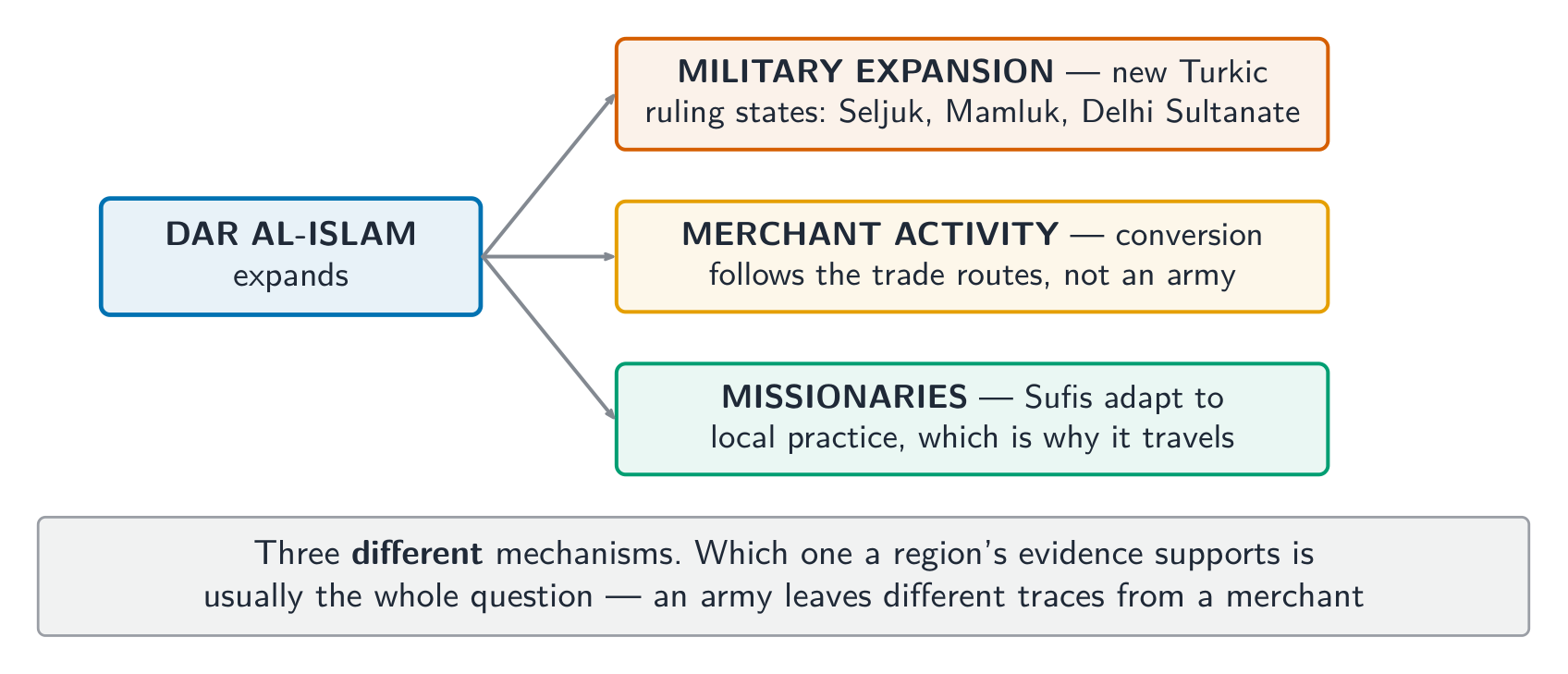
KC-3.1.III.A Muslim rule continued to expand to many parts of Afro-Eurasia due to military expansion, and Islam subsequently expanded through the activities of merchants, missionaries, and Sufis. HISTORICAL DEVELOPMENTS
Unit 1.F
Explain the effects of intellectual innovation in Dar al-Islam.
KC-3.2.II.A.i Muslim states and empires encouraged significant intellectual innovations and transfers.
Illustrative examples:
New Islamic political entities:
Seljuk Empire
Mamluk sultanate of Egypt
Delhi sultanates (CONT’D) Innovations:
Advances in mathematics (Nasir al-Din al-Tusi)
Advances in literature ('A'ishah al-Ba'uniyyah)
Advances in medicine Transfers:
Preservation and commentaries on Greek moral and natural philosophy
House of Wisdom in Abbasid Bagdad
Scholarly and cultural transfers in Muslim and Christian Spain
Source: College Board AP Course and Exam Description
As the Abbasid Caliphate 阿拔斯哈里发国 fragmented, new Islamic political entities emerged, most of them Turkic 突厥人 in origin - among them the Seljuk Empire 塞尔柱帝国, the Mamluk sultanate of Egypt 埃及马穆鲁克苏丹国, and the Delhi Sultanate 德里苏丹国.
Muslim rule continued to expand across Afro-Eurasia through military expansion, merchant activity 商人活动, and the work of missionaries 传教士, especially Sufis 苏非派, whose adaptable practice helped Islam spread.
Muslim states encouraged significant intellectual innovations and transfers 智识创新与传播: advances in mathematics, medicine, and astronomy, gathered in the House of Wisdom 智慧宫 in Abbasid Baghdad, and the preservation and extension of Greek learning that later moved into Europe.
Explore
Match each expansion to its mechanism
Military expansion, merchant activity and Sufi missionaries leave different evidence — which one a region supports is usually the question.
Mamluk sultanate of Egypt/ˈmæmlʌk ˈsʌltəneɪt ɒv ˈiːdʒɪpt/
Delhi Sultanate/ˈdeli ˈsʌltəneɪt/
merchant activity/ˈmɜːtʃənt ækˈtɪvɪti/
missionaries/ˈmɪʃənəriz/
Sufis/ˈsjuːfiz/
intellectual innovations and transfers/ˌɪntəˈlektʃuːəl ˌɪnəˈveɪʃnz ænd ˈtrænsfɜːz/
House of Wisdom/haʊs ɒv ˈwɪzdəm/
1.3
South and Southeast Asia
Syllabus
1.3 Developments in South and Southeast Asia from c. 1200 to c. 1450
Thematic Focus
Learning Objective
Historical Developments
CDI Cultural Developments and Interactions — The development of ideas, beliefs, and religions illustrates how groups in society view themselves, and the interactions of societies and their beliefs often have political, social, and cultural implications.
Unit 1.G
Explain how the various belief systems and practices of South and Southeast Asia affected society over time. THEMATIC FOCUS Governance GOV A variety of internal and external factors contribute to state formation, expansion, and decline. Governments maintain order through a variety of administrative institutions, policies, and procedures, and governments obtain, retain, and exercise power in different ways and for different purposes. LEARNING OBJECTIVE
KC-3.1.III.D.iv Hinduism, Islam, and Buddhism, and their core beliefs and practices, continued to shape societies in South and Southeast Asia. HISTORICAL DEVELOPMENTS
Unit 1.H
Explain how and why various states of South and Southeast Asia developed and maintained power over time.
KC-3.2.I.B.i State formation and development demonstrated continuity, innovation, and diversity, including the new Hindu and Buddhist states that emerged in South and Southeast Asia.
Illustrative examples:
Beliefs and practices:
Bhakti movement
Sufism
Buddhist monasticism
Hindu/Buddhist states:
Vijayanagara Empire
Srivijaya Empire
Rajput kingdoms
Khmer Empire
Majapahit
Sukhothai kingdom
Sinhala dynasties
Source: College Board AP Course and Exam Description
Hinduism 印度教, Islam, and Buddhism continued to shape the region, and their meeting produced new devotional forms - the bhakti movement 巴克提运动 in Hinduism and Sufism in Islam, both emphasising direct personal devotion.
State formation showed the unit's theme of continuity and diversity: the Delhi Sultanate ruled much of the north, Vijayanagara 维查耶纳伽尔 arose in the south, and in Southeast Asia the sea-based Majapahit 满者伯夷 and the land-based Khmer Empire 高棉帝国 organised power in different ways.
GOV Governance — A variety of internal and external factors contribute to state formation, expansion, and decline. Governments maintain order through a variety of administrative institutions, policies, and procedures, and governments obtain, retain, and exercise power in different ways and for different purposes.
Unit 1.I
Explain how and why states in the Americas developed and changed over time.
KC-3.2.I.D.i In the Americas, as in Afro-Eurasia, state systems demonstrated continuity, innovation, and diversity, and expanded in scope and reach.
Illustrative examples:
State systems in the Americas:
Maya city-states
Mexica
Inca
Chaco
Mesa Verde
Cahokia
1.5 State Building in Africa
Thematic Focus
Learning Objective
Historical Developments
GOV Governance — A variety of internal and external factors contribute to state formation, expansion, and decline. Governments maintain order through a variety of administrative institutions, policies, and procedures, and governments obtain, retain, and exercise power in different ways and for different purposes.
Unit 1.J
Explain how and why states in Africa developed and changed over time.
KC-3.2.I.D.ii In Africa, as in Eurasia and the Americas, state systems demonstrated continuity, innovation, and diversity and expanded in scope and reach.
Illustrative examples:
State systems in Africa:
Great Zimbabwe
Ethiopia
Hausa kingdoms
Source: College Board AP Course and Exam Description
One framework, six regions: state, belief system, and economic base are what comparison questions actually ask about
In the Americas, state systems showed continuity, innovation, and diversity: the Maya 玛雅 city-states, the Mexica 墨西加人 (Aztec) with tribute-based expansion, and the Inca 印加 with a centralised administration, labour obligation, and road system.
In Africa, state systems likewise varied: Great Zimbabwe 大津巴布韦 grew on gold and cattle, Ethiopia 埃塞俄比亚 was a long-established Christian kingdom, and the Hausa Kingdoms 豪萨城邦 sat on trans-Saharan trade routes.
1.6 Developments in Europe from c. 1200 to c. 1450
Thematic Focus
Learning Objective
Historical Developments
SIO Social Interactions and Organization — The process by which societies group their members and the norms that govern the interactions between these groups and between individuals influence political, economic, and cultural institutions and organization.
Unit 1.K
Explain how the beliefs and practices of the predominant religions in Europe affected European society. THEMATIC FOCUS Governance GOV A variety of internal and external factors contribute to state formation, expansion, and decline. Governments maintain order through a variety of administrative institutions, policies, and procedures, and governments obtain, retain, and exercise power in different ways and for different purposes. LEARNING OBJECTIVE
KC-3.1.III.D.v Christianity, Judaism, Islam, and the core beliefs and practices of these religions continued to shape societies in Europe. HISTORICAL DEVELOPMENTS
Unit 1.L
Explain the causes and consequences of political decentralization in Europe from c. 1200 to c. 1450.
KC-3.2.I.B.ii Europe was politically fragmented and characterized by decentralized monarchies, feudalism, and the manorial system.
Unit 1.M
Explain the effects of agriculture on social organization in Europe from c. 1200 to c. 1450.
KC-3.3.III.C Europe was largely an agricultural society dependent on free and coerced labor, including serfdom.
Source: College Board AP Course and Exam Description
Europe was politically fragmented 政治上分裂, characterised by decentralised monarchies and by feudalism 封建制度 - a system of land held in exchange for service. Monarchs slowly consolidated power, but nothing here approached the administrative reach of Song China.
Christianity 基督教, Judaism 犹太教, and Islam all shaped European society, with the Church supplying law, learning, and legitimacy.
Europe was largely agricultural, dependent on free and coerced labour 自由与强制劳动, including serfdom 农奴制.
free and coerced labour/friː ænd ˌkəʊˈɜːst ˈleɪbə/
serfdom/ˈsɜːfdəm/
1.7
Comparison in the Period
Syllabus
1.7 Comparison in the Period from c. 1200 to c. 1450
Learning Objective
Review: Unit 1 Key Concepts
Unit 1.N
Explain the similarities and differences in the processes of state formation from c. 1200 to c. 1450.
KC-3.2 State formation and development demonstrated continuity, innovation, and diversity in various regions.
KC-3.2.I As the Abbasid Caliphate fragmented, new Islamic political entities emerged, most of which were dominated by Turkic peoples. These states demonstrated continuity, innovation, and diversity.
KC-3.2.I.A Empires and states in Afro-Eurasia and the Americas demonstrated continuity, innovation, and diversity in the 13th century. This included the Song Dynasty of China, which utilized traditional methods of Confucianism and an imperial bureaucracy to maintain and justify its rule.
KC-3.2.I.B.i State formation and development demonstrated continuity, innovation, and diversity, including the new Hindu and Buddhist states that emerged in South and Southeast Asia.
KC-3.2.I.D.i In the Americas, as in Afro-Eurasia, state systems demonstrated continuity, innovation, and diversity, and expanded in scope and reach.
KC-3.2.I.D.ii In Africa, as in Eurasia and the Americas, state systems demonstrated continuity, innovation, and diversity, and expanded in scope and reach.
Source: College Board AP Course and Exam Description
The unit's reasoning skill is comparison 比较. The productive comparisons are structural rather than evaluative:
Centralised administration (Song China, Inca) against fragmented or decentralised rule (Europe, post-Abbasid Islamic states).
Recruitment by examination against recruitment by birth.
States funded by tribute (Mexica) against states funded by taxation (Song China).
Worked example (a real AP exam question). AP World short-answer questions regularly ask students to "Identify one similarity" or "Explain one difference" between two regions in a period. A full-mark answer for this unit names the feature and applies it to both: "Both Song China and the Inca Empire used a centralised bureaucracy to govern a large territory, but Song China recruited officials through a competitive examination system while the Inca staffed administration through hereditary elites and a labour obligation." Notice the shape: a comparison must be one feature, two societies. Describing each society in turn and leaving the reader to infer the comparison does not earn the point.