6.1 Rationales for Imperialism from1750 to 1900
| Thematic Focus | Learning Objective | Historical Developments |
|---|---|---|
CDI | Unit 6.A |
|
AP World History: Modern · Topic 6
 6:14
6:14
Unit 6: Consequences of Industrialization
This is the unit on the consequences of industrialisation, 1750 to 1900. One distinction decides most of the marks in this unit, and it is easy to state and…
English narration · English + 中文 subtitles burned in
| Thematic Focus | Learning Objective | Historical Developments |
|---|---|---|
CDI | Unit 6.A |
|
Source: College Board AP Course and Exam Description
Unit 6 covers the consequences of industrialisation, 1750 to 1900: why industrial states expanded, how people resisted, how the world economy reorganised, and who moved.
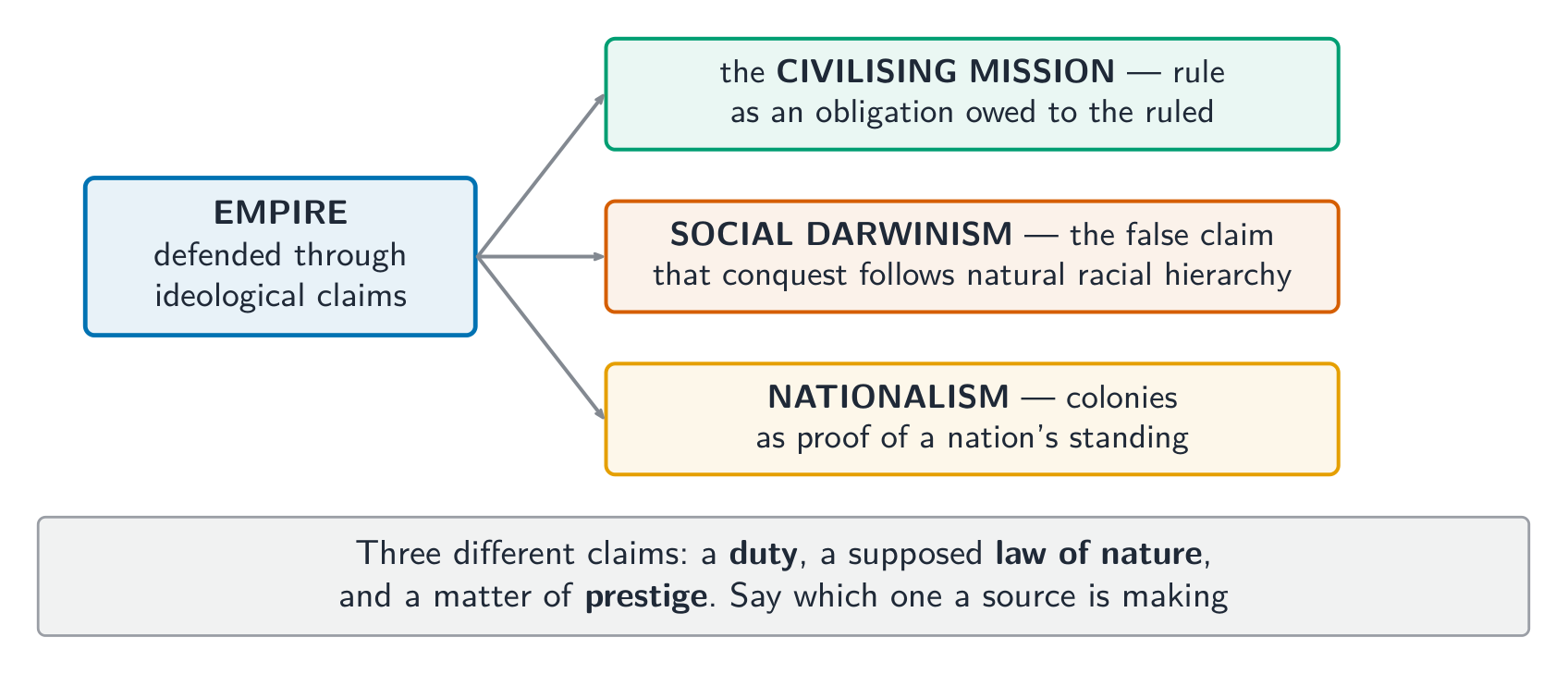
A range of cultural, religious, and racial ideologies were used to justify imperialism. The examinable ones are the civilising mission 文明教化使命, missionary activity, Social Darwinism 社会达尔文主义 applied to nations and peoples, and nationalism - the claim that colonies proved a state's greatness.
These are justifications: arguments used to defend empire. Ideologies could also motivate expansion. Distinguish the type of explanation without assuming that belief, profit and strategy operated separately.
Identify ideological claims about duty, a supposed natural hierarchy or national prestige; do not endorse their assumptions.
| English |
|---|
| civilising mission/ˈsɪvəlaɪzɪŋ ˈmɪʃn/ |
| Social Darwinism/ˈsəʊʃl ˈdɑːwɪnɪzəm/ |
| Thematic Focus | Learning Objective | Historical Developments |
|---|---|---|
GOV | Unit 6.B |
|
Illustrative examples:
Source: College Board AP Course and Exam Description
Expansion took several forms, and the CED distinguishes them:
| English |
|---|
| warfare and diplomacy/ˈwɔːfeə ænd dɪˈpləʊməsi/ |
| settler colonies/ˈsetlə ˈkɒləniz/ |
| Thematic Focus | Learning Objective | Historical Developments |
|---|---|---|
GOV | Unit 6.C |
|
Illustrative examples:
Source: College Board AP Course and Exam Description
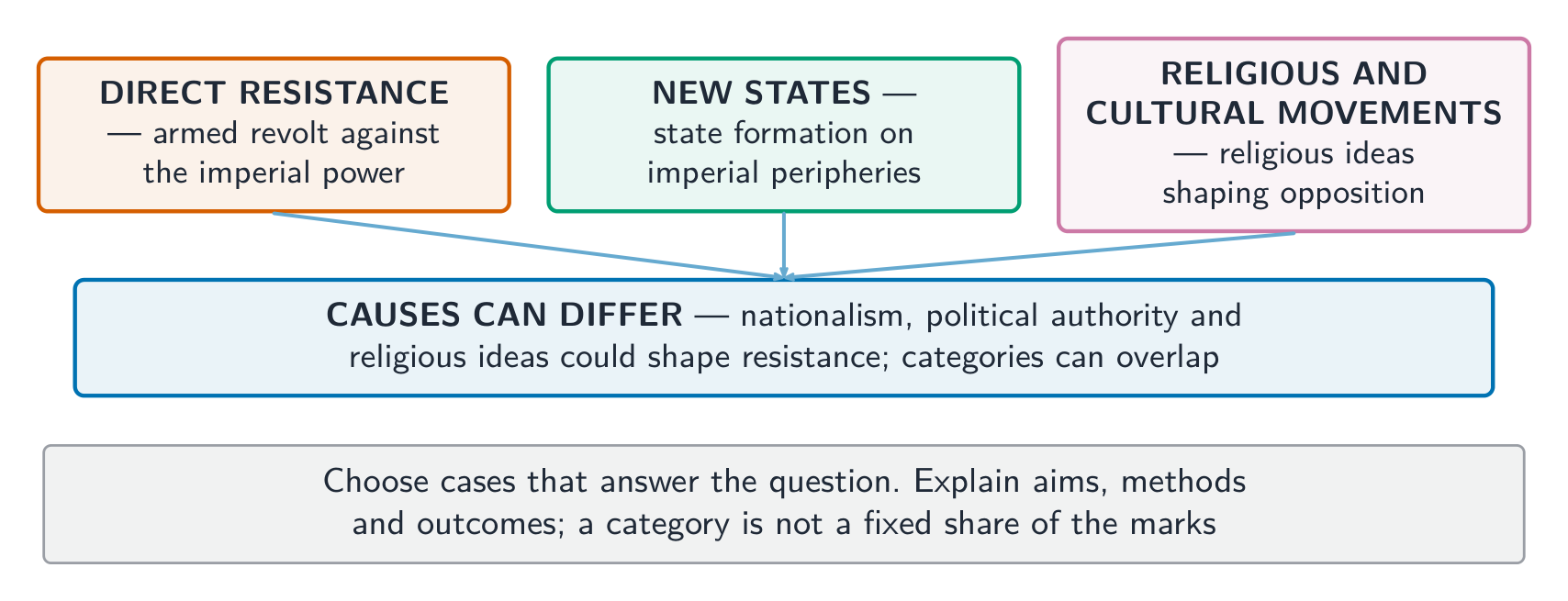
Anti-imperial resistance 抵抗 took various forms, and the examples must fit the question:
Increasing questions about political authority and growing nationalism in colonised regions led to rebellions, some of which were sustained enough to change imperial policy. Resistance occurred at different points throughout the period. Its causes, aims and outcomes varied; not every movement was nationalist or successful.
An essay needs a case, not a category. These are the ones the CED lists, sorted by the form of resistance they illustrate:
| Case | Where | Form it illustrates |
|---|---|---|
| Samory Touré's 萨莫里·杜尔 military campaigns | West Africa | direct armed resistance, sustained for years against the French |
| Yaa Asantewaa War 雅阿·阿散蒂瓦战争 | Asante, West Africa | direct resistance led by a woman, in defence of a sacred symbol of sovereignty |
| Sokoto Caliphate 索科托哈里发国 | modern-day Nigeria | the creation of a NEW state, founded in a religious reform movement |
The Congo shows how the argument about empire changed. The territory was first held as the private property of King Leopold II of Belgium rather than as a colony of Belgium at all; the atrocities of the rubber regime became an international scandal, and in 1908 ownership was transferred to the Belgian government. This illustrates a change from personal to state control under pressure from criticism. The transfer did not end colonial rule; it does not by itself prove that exploitation ended.
| English |
|---|
| resistance/rɪˈzɪstəns/ |
| Direct resistance/daɪˈrekt rɪˈzɪstəns/ |
| Creation of new states/kriːˈeɪʃn ɒv njuː steɪts/ |
| Religious and cultural movements/rɪˈlɪdʒəs ænd ˈkʌltʃərəl ˈmuːvmənts/ |
| Samory Touré's/ˈsæməri tʊəˈreɪz/ |
| Yaa Asantewaa War/jɑː əˈsæntjuːɑː wɔː/ |
| Sokoto Caliphate/səˈkəʊtəʊ ˈkælɪfeɪt/ |
| Thematic Focus | Learning Objective | Historical Developments |
|---|---|---|
ENV | Unit 6.D |
|
Illustrative examples:
| Thematic Focus | Learning Objective | Historical Developments |
|---|---|---|
ECN | Unit 6.E |
|
Illustrative examples:
Source: College Board AP Course and Exam Description
The need for raw materials 原材料 for factories and increased food supplies 粮食供应 for growing urban populations reorganised production across the world. Colonies and dependent regions were pushed toward cash crops 经济作物 and extractive industries 采掘业, often at the cost of food production for local use.
The commodities are worth knowing by name and origin, because a question usually supplies one and expects you to place it: cotton from Egypt and India, rubber from the Congo and the Amazon, palm oil from West Africa, sugar from the Caribbean, guano from Peru, and meat from Argentina and Uruguay — the last made possible by refrigerated shipping, which turned distant grassland into a supplier for European cities.
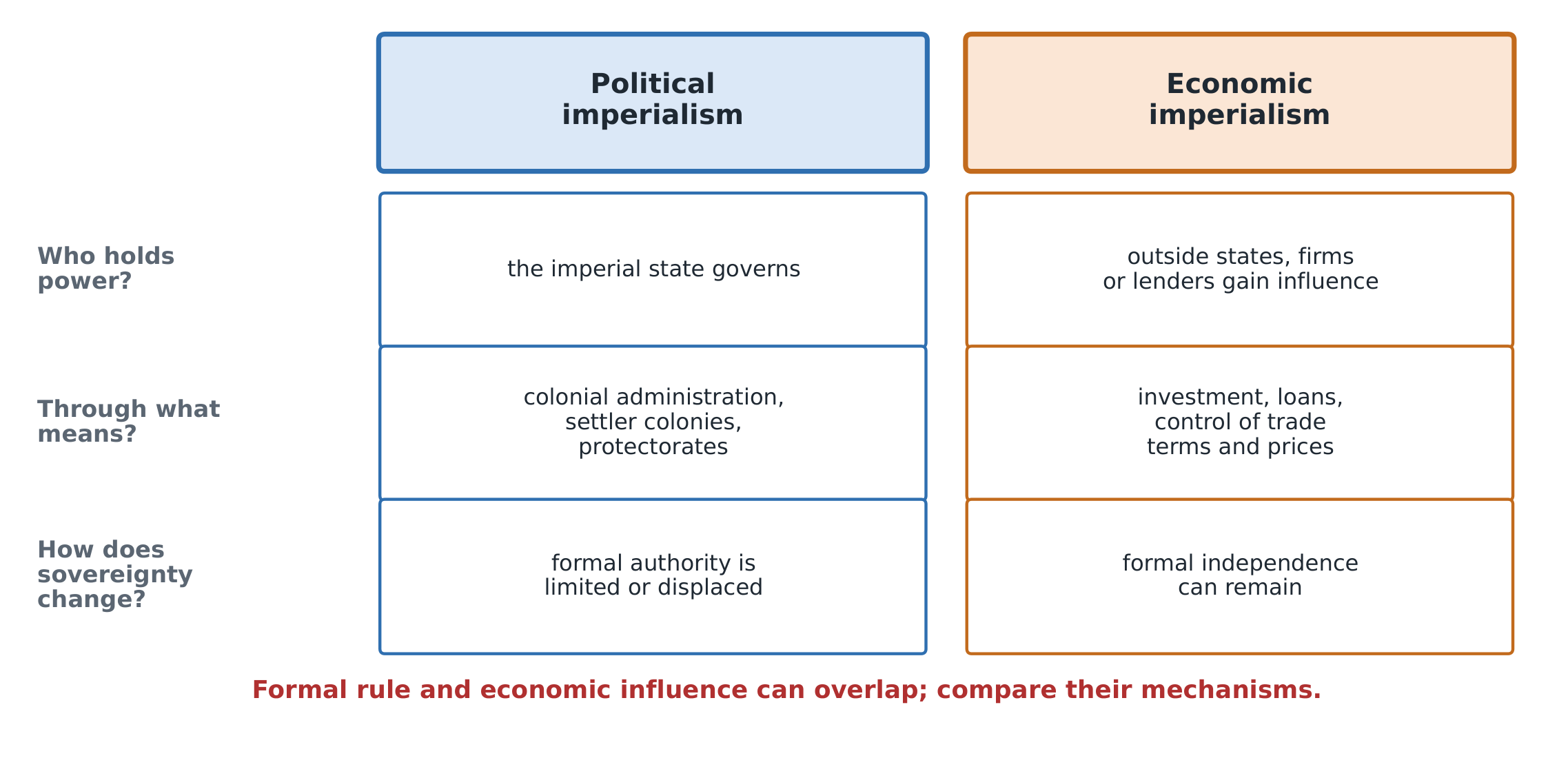
Economic imperialism 经济帝国主义 is the examinable distinction. Industrialised states and their businesses exercised control through investment, loans, and trade dominance without necessarily taking political control - so a region could be economically dominated while remaining formally independent.
Trade in some commodities was organised so that merchants and firms in industrialised states held disproportionate power 不成比例的权力 over producers, setting prices and terms.
| English |
|---|
| raw materials/rɔː məˈtɪərɪəlz/ |
| food supplies/fuːd səˈplaɪz/ |
| cash crops/kæʃ krɒps/ |
| extractive industries/ekˈstræktɪv ˈɪndʌstriz/ |
| Economic imperialism/ˌiːkəˈnɒmɪk ɪmˈpɪərɪəlɪzəm/ |
| disproportionate power/ˌdɪsprəˈpɔːʃənət ˈpaʊə/ |
| Thematic Focus | Learning Objective | Historical Developments |
|---|---|---|
ECN | Unit 6.F |
|
Unit 6.G |
|
Illustrative examples:
Source: College Board AP Course and Exam Description
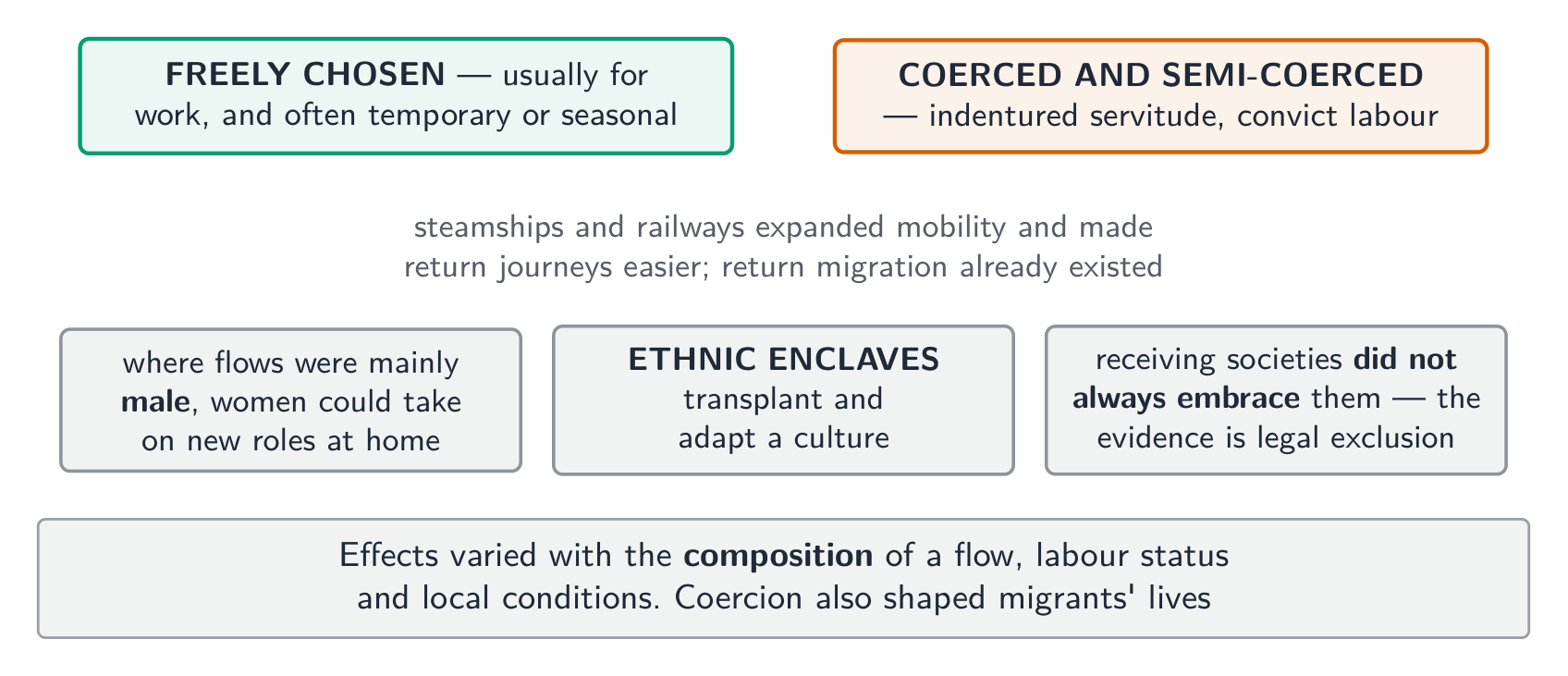
Migration in this period was shaped by demographic change in both sending and receiving societies, and by new modes of transportation 交通方式 - steamships and railways - which increased the scale and ease of long-distance movement and made temporary or seasonal 临时或季节性 return more practical. Return migration already existed. Internal and external migration to cities also contributed to urbanisation.
Two kinds must be distinguished:
| English |
|---|
| modes of transportation/məʊdz ɒv trænspɔːˈteɪʃn/ |
| temporary or seasonal/ˈtemprəri ɔː ˈsiːzənl/ |
| coerced and semi-coerced labour/ˌkəʊˈɜːst ænd ˈsemi ˌkəʊˈɜːst ˈleɪbə/ |
| indentured servitude/ˌɪnˈdentʃəd ˈsɜːvɪtjuːd/ |
| Thematic Focus | Learning Objective | Historical Developments |
|---|---|---|
SIO | Unit 6.H |
|
Illustrative examples:
Source: College Board AP Course and Exam Description
Three effects are named directly in the CED:
Distinguish migration conditions and possible effects without assuming identical outcomes.
| English |
|---|
| ethnic enclaves/ˈeθnɪk ˈeŋkleɪvz/ |
| Learning Objective | Review: Unit 6 Key Concepts |
|---|---|
Unit 6.I |
|
Source: College Board AP Course and Exam Description
The unit develops comparison, explanation and argument. Topic 6.8 asks for the relative significance of the effects of imperialism, so a chain explaining its causes alone is insufficient.
Original practice, not a quoted past-paper question: Explain one way industrialisation contributed to imperialism, 1750–1900.
Worked response: Industrial factories increased demand for raw materials such as Egyptian cotton. States and firms sought influence over supply regions, and export production grew to serve industrial markets. This connects industrial demand with economic influence and production. It does not imply that cotton could not be grown anywhere in Europe, or that every export economy became a formal colony.
The following case cards use the CED's named examples. They are original teaching summaries, not historical quotations or authentic exam extracts.
Card A — armed resistance: Samory Touré's military campaigns against the French in West Africa show direct resistance. Explain the opposition to imperial expansion; the category alone does not establish success or a shared nationalist ideology.
Card B — state formation: The Sokoto Caliphate, in modern-day Nigeria, illustrates new state formation associated with religious reform. Do not describe every new state as a successful war of independence from an already established European colony.
Card C — religious resistance: The Ghost Dance in the United States illustrates religious responses within the wider context of Indigenous resistance. Religious motivation and direct resistance can overlap; the three headings are not exclusive boxes.
Attempt 1: Compare Cards A and B. State one similarity in their relation to political power and one difference in their form of action.
Worked check: Both concern challenges to existing political authority. Touré's campaigns illustrate military resistance to French expansion; Sokoto illustrates the creation of a new political state linked to religious reform. The comparison does not prove that their origins, enemies or results were identical.
Attempt 2: Compare direct colonial rule with economic imperialism. Use the Congo transfer and the CED's example of British firms supporting the Port of Buenos Aires.
Worked check: In the Congo example, control passed from Leopold II to the Belgian state, changing the authority formally ruling the territory. British firms' support for the Port of Buenos Aires illustrates economic influence through investment without making Argentina a British colony. Economic imperialism could involve military pressure too, as the CED's Opium Wars example shows; informal influence is not automatically peaceful or free of coercion.
Attempt 3: Explain how an export economy links an environment to an industrial market. Choose Egyptian cotton, Congo/Amazon rubber, West African palm oil or meat from Argentina/Uruguay.
Worked check: Egyptian cotton supplied raw material for industrial textiles. Suitable production conditions and industrial demand supported export specialisation; export earnings could purchase manufactured goods. Evidence of export trade alone does not prove the same distribution of profits or the same degree of foreign control in every region.
Attempt 4: Explain two different effects of migration. Use one effect in a home society and one in a destination society.
Worked check: Where migration was mainly male, women could take on work and responsibilities previously held by men in home societies. In destination societies, Chinese migrant enclaves in Southeast Asia could maintain and adapt cultural practices. The Chinese Exclusion Act illustrates a different response: state restriction. These patterns were not inevitable for every migrant group; labour status, family composition and local conditions also mattered.
Argument practice: Evaluate whether economic reorganisation was the most significant effect of imperialism, 1750–1900. Compare it with political and social effects.
Possible argument: Export specialisation was a major effect because it linked production to distant industrial markets and could give foreign firms an advantage. However, changes in political control and resistance were also substantial, as the Congo transfer and Touré's campaigns illustrate. Migration changed responsibilities and communities across home and destination societies. The judgement depends on the region, group and timescale examined; evidence from one case cannot rank effects everywhere.
College Board, AP World History: Modern Course and Exam Description, Unit 6, topics 6.1–6.8 (syllabi/ap/ap_world_history_CED.pdf, PDF pages 123–131). The examples above are teacher-authored practice grounded in that framework. No official marks or scoring outcomes are claimed.
Work through it step by step, with instant-check exercises.
Loading subjects…