9.1 Advances in Technology and Exchange After 1900
| Thematic Focus | Learning Objective | Historical Developments |
|---|---|---|
TEC | Unit 9.A |
|
AP World History: Modern · Topic 9
 7:39
7:39
Unit 9: Globalization
Unit 9's central move is evaluative rather than narrative. Almost every development it names produced a benefit and a cost, and the questions reward answers…
English narration · English + 中文 subtitles burned in
| Thematic Focus | Learning Objective | Historical Developments |
|---|---|---|
TEC | Unit 9.A |
|
Source: College Board AP Course and Exam Description
Unit 9 covers 1900 to the present. A message, a container of goods and a cultural product can cross long distances more easily than before, but access and influence remain unequal. Explain what changed, how it changed and how far the evidence supports the claim. Follow the task: explanation, comparison and evaluation require different answers. A benefit-and-cost list is useful only when it answers the question.
The syllabus identifies several mechanisms:
Worked explanation: distance and exchange. Shipping containers made goods easier to transfer between different stages of transport, supporting longer supply chains. Radio, cellular communication and the internet helped people exchange information over distance. These changes reduced obstacles to coordinating production and trade; they did not eliminate borders, transport costs or unequal access.
Practice. Choose communication or transportation. Name a specific syllabus example, explain its mechanism and state one limit. Attempt this before comparing with the worked explanation.
| English |
|---|
| New modes of communication/njuː məʊdz ɒv kəˌmjuːnɪˈkeɪʃn/ |
| shipping containers/ˈʃɪpɪŋ kənˈteɪnəz/ |
| Energy technologies/ˈenədʒi tekˈnɒlədʒiz/ |
| petroleum/pəˈtrəʊliːəm/ |
| nuclear power/ˈnjuːklɪə ˈpaʊə/ |
| Medical innovations/ˈmedɪkl ˌɪnəˈveɪʃnz/ |
| vaccines/vækˈsiːnz/ |
| antibiotics/ˌæntɪbaɪˈɒtɪks/ |
| increased lifespans/ɪnˈkriːst ˈlaɪfspænz/ |
| Green Revolution/ɡriːn ˌrevəˈluːʃn/ |
| birth control/bɜːθ kənˈtrəʊl/ |
| fertility/fɜːˈtɪlɪti/ |
| Thematic Focus | Learning Objective | Historical Developments |
|---|---|---|
ENV | Unit 9.B |
|
Illustrative examples:
Source: College Board AP Course and Exam Description
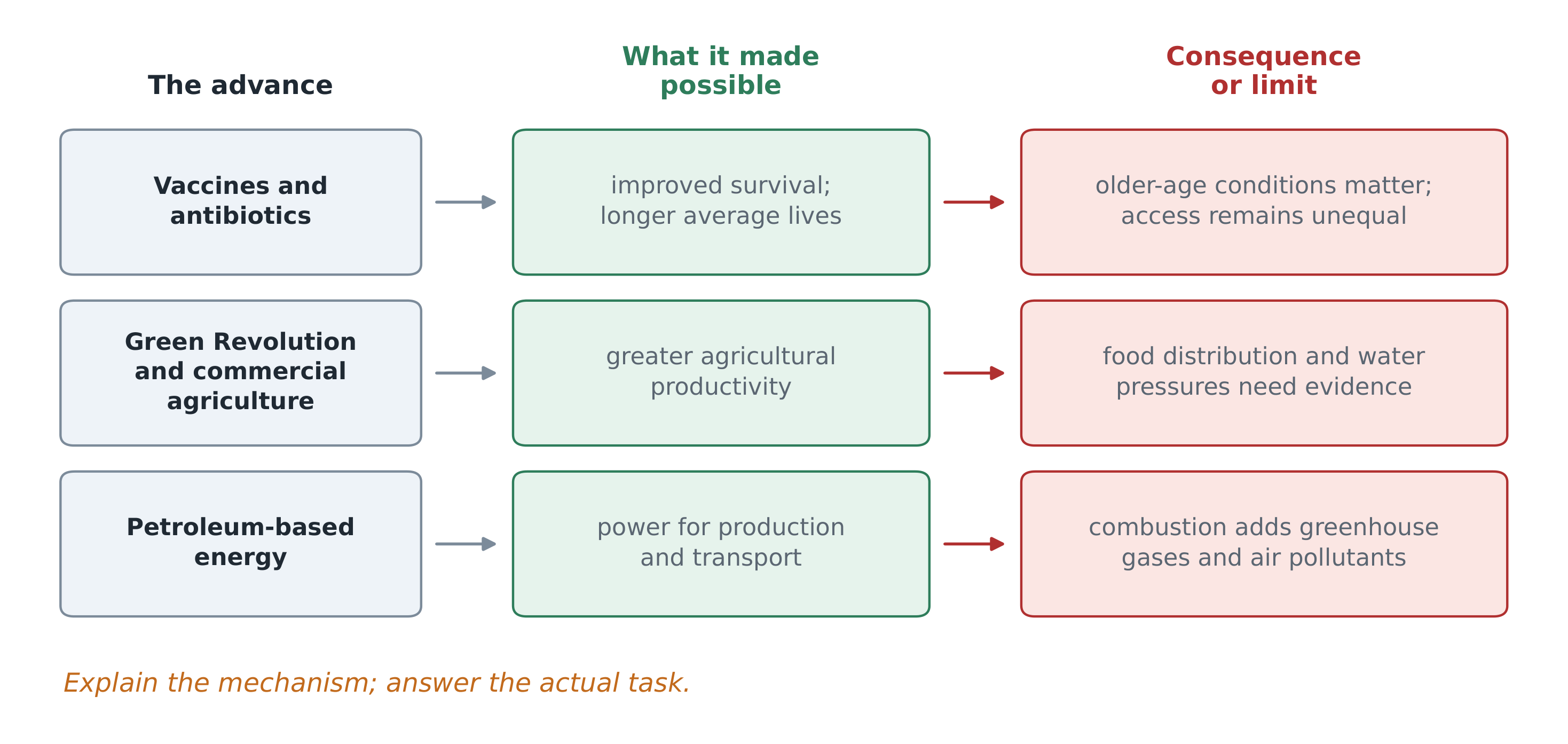
Disease and scientific developments affected populations in different ways. The syllabus distinguishes persistent diseases associated with poverty, emerging epidemics and diseases more common at older ages.
Worked causal chain. Medical innovations helped reduce some infectious-disease deaths. More people survived, contributing to longer average lives. Where death rates fell before birth rates, population could grow more rapidly. Birth rates, migration and access to treatment also matter; the chain is not a prediction that every country changed at the same rate.
Practice. Explain why a population can experience longer average lives while still facing disease. Use one persistent or emerging disease example and distinguish it from conditions associated with older ages.
| Thematic Focus | Learning Objective | Historical Developments |
|---|---|---|
ENV | Unit 9.C |
|
Source: College Board AP Course and Exam Description
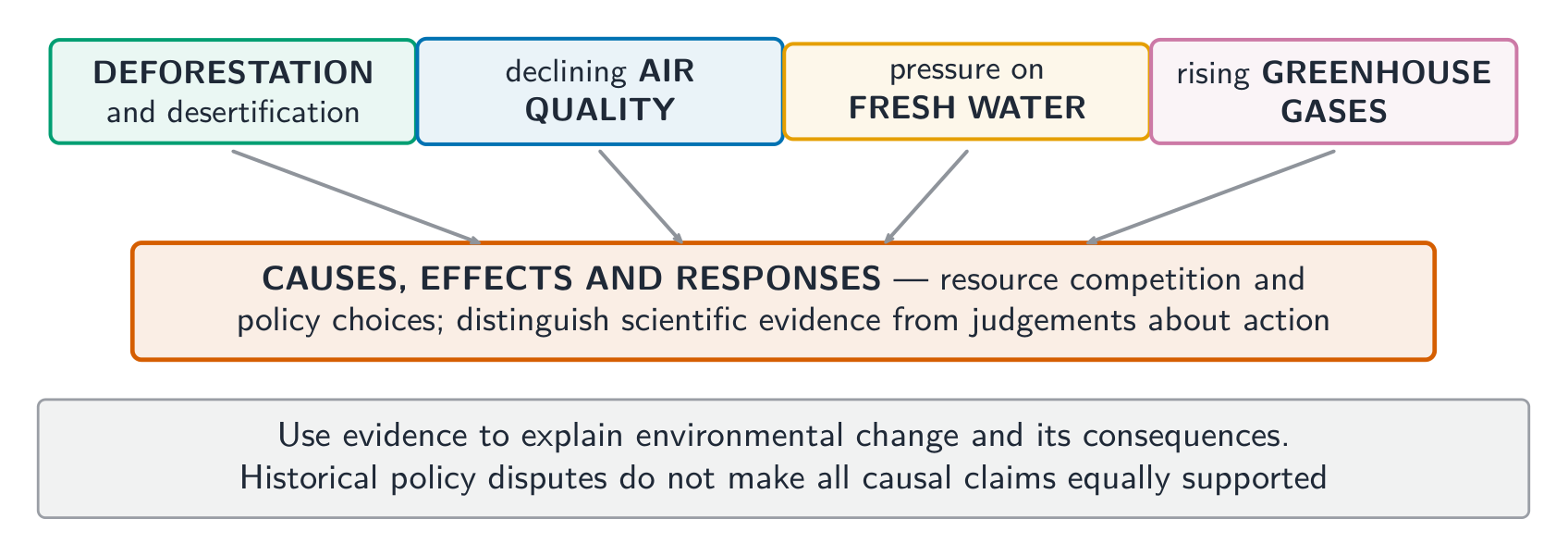
Human activities contributed to deforestation 森林砍伐, desertification 荒漠化, a decline in air quality 空气质量下降 and greater consumption of fresh water 淡水. These pressures intensified competition over resources. Explain the activity, the environmental change and its consequences rather than treating the terms as interchangeable.
Worked distinction. Clearing woodland removes forest cover. Heavy demand for irrigation can place pressure on a fresh-water supply. Burning petroleum releases greenhouse gases 温室气体 and can contribute to air pollution. These are related environmental issues, but removing trees, using water and emitting gases are different mechanisms.
The syllabus includes historical debates about climate change 气候变化. Analyse who made claims, what evidence they used, and how responses were disputed. That historical wording does not make all scientific claims equally supported: the IPCC's 2023 assessment attributes global warming to human activities, principally greenhouse-gas emissions. Policy disagreements include how quickly to reduce emissions and how to share costs. Distinguish evidence about causes from arguments about a response. IPCC, Summary for Policymakers, A.1.
Practice. Compare “burning petroleum adds greenhouse gases” with “richer states should pay a larger share of the response.” Explain which is a causal claim and which is a policy judgement. They require different kinds of support.
Distinguish environmental evidence from judgements about responsibility; answer the actual historical task.
| English |
|---|
| deforestation/diːˌfɒrɪˈsteɪʃn/ |
| desertification/dɪˌzɜːtɪfɪˈkeɪʃn/ |
| decline in air quality/dɪˈklaɪn ɪn eə ˈkwɒlɪti/ |
| fresh water/freʃ ˈwɔːtə/ |
| greenhouse gases/ˈɡriːnhaʊs ˈɡæsɪz/ |
| debates about climate change/dɪˈbeɪts əˈbaʊt ˈklaɪmət tʃeɪndʒ/ |
| Thematic Focus | Learning Objective | Historical Developments |
|---|---|---|
ECN | Unit 9.D |
|
Illustrative examples:
Source: College Board AP Course and Exam Description
The late twentieth century saw several connected changes. They did not all begin in 1990 or progress uniformly.
Worked comparison with Unit 6. Both periods involved international production and unequal economic influence. A late-twentieth-century multinational supply chain, however, is not automatically the same political arrangement as nineteenth-century colonial rule. Compare the particular power relationship, institutions and legal control. Continuity in unequal influence can coexist with change in political sovereignty and coordination technology.
Practice. Explain one economic change using a named example, then qualify a claim that all regions became knowledge economies.
| English |
|---|
| free-market economic policies/friː ˈmɑːkɪt ˌiːkəˈnɒmɪk ˈpɒlɪsiz/ |
| knowledge economies/ˈnɒlɪdʒ ɪˈkɒnəmiz/ |
| and regional trade agreements/ænd ˈriːdʒənl treɪd əˈɡriːmənts/ |
| multinational corporations/ˌmʌltɪˈnæʃənl ˌkɔːpəˈreɪʃnz/ |
| Thematic Focus | Learning Objective | Historical Developments |
|---|---|---|
SIO | Unit 9.E |
|
Illustrative examples:
Source: College Board AP Course and Exam Description
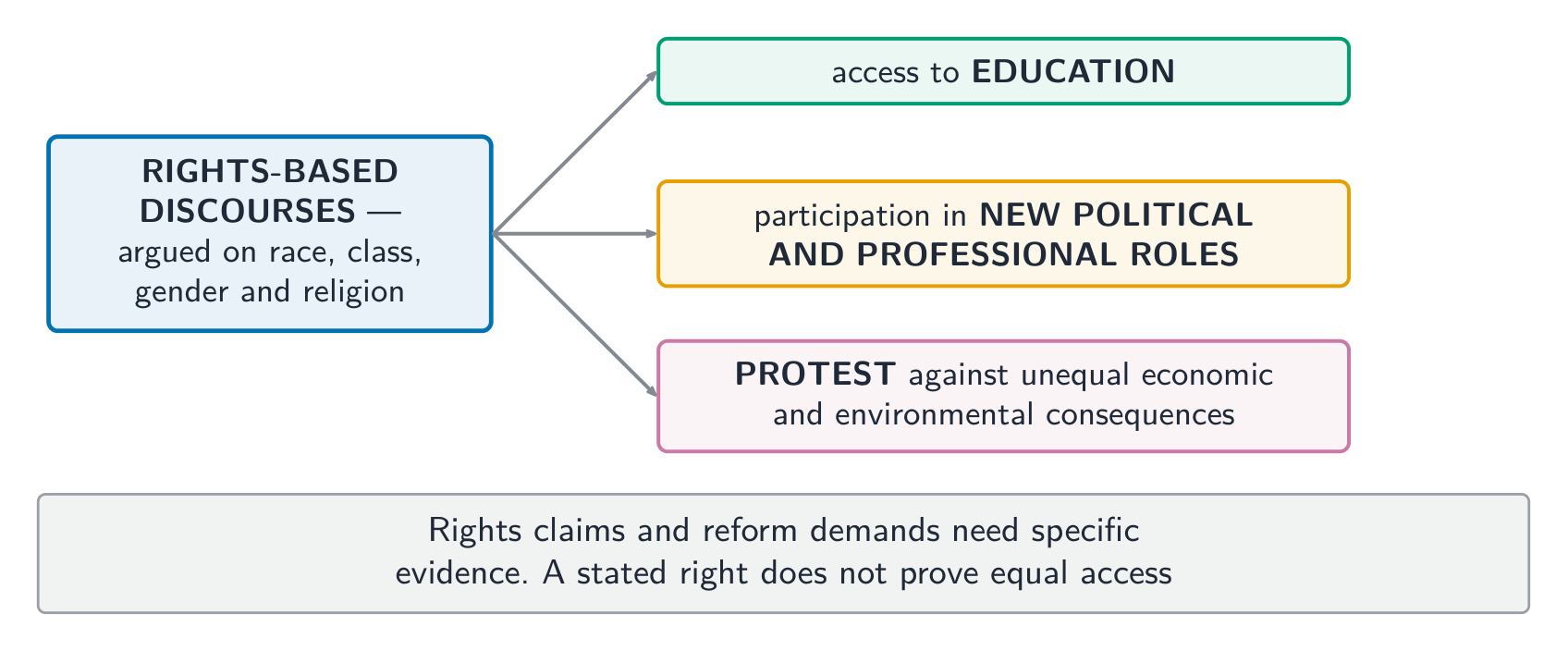
Rights-based discourses 权利话语 challenged assumptions about race, class, gender and religion. Access to education 受教育机会 and participation in political and professional roles became more inclusive in much of the world, unevenly. Other movements protested unequal environmental and economic consequences of global integration 全球一体化.
Primary-source example. Article 26 of the 1948 Universal Declaration of Human Rights states: “Everyone has the right to education.” Its universal language presents education as a right, rather than a privilege limited to one social group. The statement is evidence of a declared principle. It is not evidence that every person already had a school place or equal educational outcomes. To assess implementation, examine additional evidence about access and barriers. United Nations, UDHR, Article 26.
The syllabus also names global feminism, the end of apartheid, the Green Belt Movement in Kenya and fair-trade organisations. Select an example appropriate to the claim: political inclusion, environmental action and fairer trade are connected concerns but not identical demands.
Practice. What can Article 26 establish about rights language? What additional evidence would be needed to establish expanded access to education? Attempt both parts before using the model distinction above.
| English |
|---|
| Rights-based discourses/raɪts beɪst ˈdɪskɔːsɪz/ |
| access to education/ˈækses tʊ ˌedʒuːˈkeɪʃn/ |
| global integration/ˈɡləʊbl ˌɪntɪˈɡreɪʃn/ |
| Thematic Focus | Learning Objective | Historical Developments |
|---|---|---|
CDI | Unit 9.F |
|
Illustrative examples:
Source: College Board AP Course and Exam Description
Three developments need separate explanations: political and social changes affected the arts; cultural forms circulated and were adapted across regions; and consumer culture 消费文化 increasingly crossed national borders. Arts and entertainment increasingly reflected global influence 全球影响, but circulation does not prove that all audiences interpreted a work identically.
Worked evidence choices. The syllabus names reggae and Bollywood as cultural examples, World Cup soccer and the Olympics as global sports, and Toyota and Coca-Cola as global brands. A claim about cultural circulation could use the spread of music or film; a claim about consumer goods could use a brand across markets. Neither example alone proves the disappearance of local languages, tastes or cultural production.
Practice. Choose evidence for “consumer culture crossed borders” and for “culture was adapted across regions.” Explain why those claims are related but not interchangeable. Identify what additional evidence the adaptation claim requires beyond a brand's presence.
| English |
|---|
| increasingly reflected global influence/ɪnˈkriːsɪŋli rɪˈflektɪd ˈɡləʊbl ˈɪnfluːəns/ |
| Consumer culture/kənˈsuːmə ˈkʌltʃə/ |
| Thematic Focus | Learning Objective | Historical Developments |
|---|---|---|
CDI | Unit 9.G |
|
Illustrative examples:
Source: College Board AP Course and Exam Description
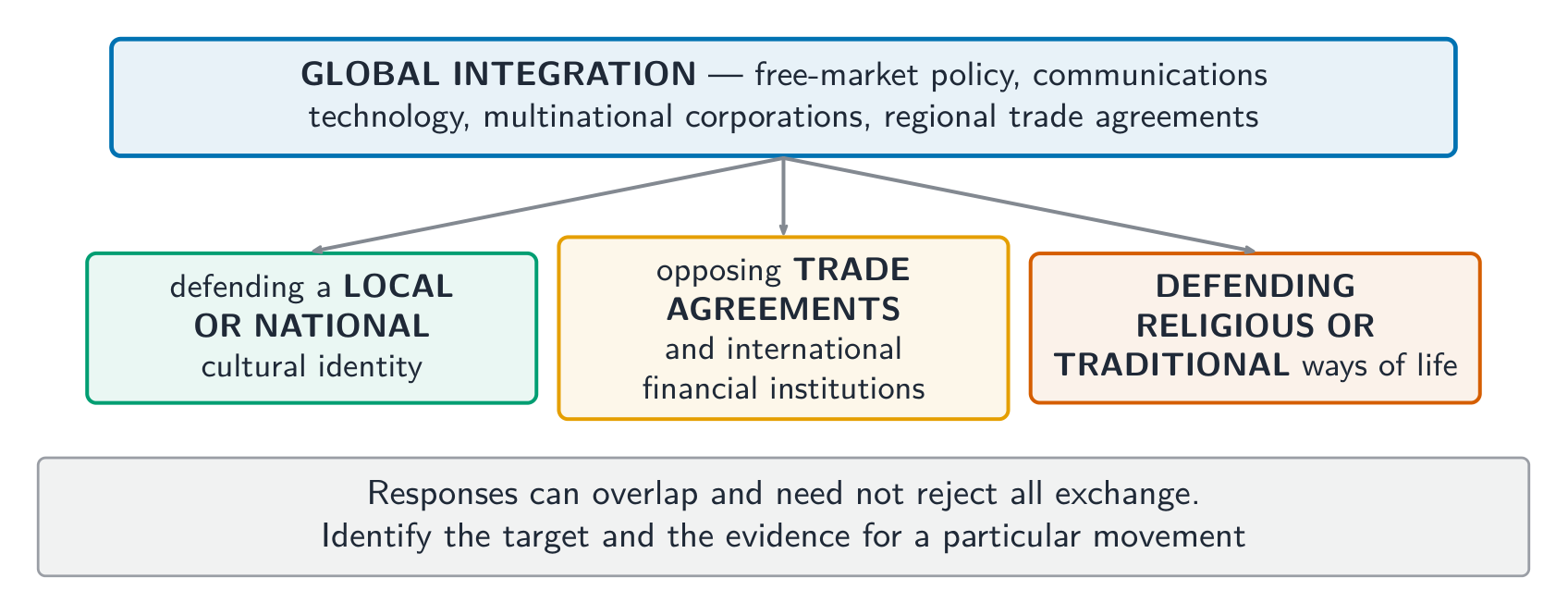
Responses to globalisation varied. Movements could defend local or national cultural identity, oppose trade agreements or international financial institutions, or defend a religious or traditional way of life. Religious and traditionalist movements 宗教与传统主义运动 did not all have the same programme. Categories can overlap and are not exhaustive.
The syllabus's examples include anti-IMF and anti-World Bank activism and locally developed social media such as Weibo in China. These illustrate different responses: opposing an institution is not the same as creating a local platform within a connected world. A local platform's existence alone does not establish its users' political motives or rejection of every form of exchange.
Practice. Compare opposition to an international financial institution with developing a local media platform. State the target or change in each case, then explain why neither should automatically be labelled opposition to all international contact.
Identify what a response targets without assuming opposition to every international connection.
| English |
|---|
| Religious and traditionalist movements/rɪˈlɪdʒəs ænd trəˈdɪʃənəlɪst ˈmuːvmənts/ |
| Thematic Focus | Learning Objective | Historical Developments |
|---|---|---|
GOV | Unit 9.H |
|
Source: College Board AP Course and Exam Description
New international organisations 国际组织, including the United Nations 联合国, formed with stated goals of maintaining peace and facilitating cooperation. The UN Charter's Article 1 identifies peace and security, friendly relations and cooperation on international problems among its purposes. Shared problems help explain why states created institutions to coordinate responses. United Nations Charter, Article 1.
Worked source judgement. The Charter is strong evidence for the UN's stated aims. To establish whether it succeeded in preventing a particular conflict, examine the events and the institution's actions and limits. A founding purpose is not an outcome. Do not assume every international institution has the same role or was created in response to exactly the same failure.
Practice. Explain one reason for international cooperation and identify one source that would test an institution's effectiveness beyond its founding statement.
| English |
|---|
| New international organisations/njuː ˌɪntəˈnæʃənl ˌɔːɡənaɪˈzeɪʃnz/ |
| United Nations/juːˈnaɪtɪd ˈneɪʃnz/ |
| Learning Objective | Review: Unit 9 Key Concepts |
|---|---|
Unit 9.I |
|
Source: College Board AP Course and Exam Description
Use an argument about extent, supported with specific evidence. Identify the baseline, the change and a meaningful continuity; a cross-period reference helps only when the relationship is explained.
Original practice question, not an authentic AP item. Explain one way technological developments after 1900 affected human populations.
Worked response. “Medical innovations such as vaccines and antibiotics helped reduce deaths from infectious diseases. By improving survival, they contributed to longer average lives and could accelerate population growth where birth rates remained high.” This supplies a development and a mechanism. It claims neither universal access nor a guaranteed mark.
Extended practice. Assess the extent to which technology reduced the importance of geographic distance after 1900. Use communication and transportation evidence and one limit.
Possible argument. Radio, cellular communication and the internet reduced the barriers to sending information, while air travel and shipping containers supported movement over long distances. Yet access, borders and resource inequalities continued to shape participation. Technology changed how distance could be managed without making location irrelevant. To develop an essay, support these claims with specific historical examples and explain their relationships.
Scope and illustrative examples: the project's AP World History: Modern Course and Exam Description, effective Fall 2026, Unit 9 (PDF pages 167–176), and its topic extracts 9.1–9.9. The IPCC and United Nations sources are linked beside the claims they support. Worked responses and practice questions are original teaching material.
Work through it step by step, with instant-check exercises.
Loading subjects…