Skip to content · ⁨コンテンツへスキップ⁩

Writing: purpose, audience and accuracy · ⁨作文:目的、対象および正確さ⁩

IGCSE English · ⁨IGCSE 英語⁩ · Topic 2 · ⁨トピック 2⁩

View Slides · ⁨查看幻灯片⁩ Train · ⁨練習する⁩
Video lesson for this topic · ⁨このトピックのビデオレッスン⁩ Open the video page · ⁨動画ページを開く⁩
7:50

ライティング:目的、対象読者、正確性

2人の生徒が同じことを望んでいます:土曜日に学校ホールを使う許可です。どちらも校長に手紙を書きます。1人目はこう言います:<slow>「こんにちは、私たちは…使ってもいいですか?」

English narration · English + 中文 subtitles burned in · ⁨英語ナレーション・英語+中文字幕 burning-in⁩

2.1

Purpose, audience and register · ⁨目的、読者、および文体⁩

Syllabus · ⁨シラバス⁩
English
  1. identify the purpose of a piece of writing: to inform, to argue or to discuss
  2. think about the audience and how formal or informal the language should be
  3. choose a register and style that suit the purpose and the reader
日本語
  1. 文章の目的を特定する:情報提供、説得、議論
  2. 読者を考慮し、言語がどの程度形式的であるべきかを考える
  3. 目的と読者に適したレジスターとスタイルを選ぶ

Source: Cambridge International syllabus · ⁨出典: Cambridge International シラバス⁩

English

Before you write, ask two questions: why am I writing, and who will read it?

Know your purpose

  • Every writing task has a purpose 目的: to inform 告知, to argue 论证, or to discuss 讨论.
  • The purpose decides what you write and how you write it.
  • The task tells you the purpose. Read it carefully and underline it.

Know your audience

  • The audience 读者 is the person who will read your writing — a friend, a teacher, or an event organiser.
  • Write in a way that suits them. You write to a friend in a different way from a teacher.

Choose the right register

  • Register 语域 means how formal 正式 or informal 非正式 your language is.
  • Use informal language for a friend: short forms (I'm, don't) and friendly words.
  • Use formal language for a teacher or a report: full forms (I am, do not) and polite words. No slang 俚语.
日本語

書く前に、次の2つの質問を自問してください:なぜ書くのか、そして誰が読むのか。

目的を理解する

  • すべての作文タスクには目的がある:情報を伝える、議論する、または議論・検討する。
  • 目的が、何を書くべきか、以及如何書くかを決定する。
  • タスクが目的を教えてくれる。注意深く読み、それを下線で示しなさい。

読者を理解する

  • 読者とは、あなたの作文を読む人である:友人、教師、あるいはイベント主催者など。
  • 彼らに合う書き方をしなさい。友人に書く場合と、教師に書く場合は違う。

適切な文体を選ぶ

  • 文体とは、自分の言語がどれほどフォーマル(正式)か、インフォーマル(非公式)かを指す。
  • 友人に対しては、インフォーマルの言葉を使う:省略形(I'm, don't)や親しい言葉。
  • 教師やレポートに対しては、フォーマルの言葉を使う:完全な形(I am, do not)や丁寧な言葉。スラングは使わない。
フロー図:「なぜ書くのか」「誰が読むのか」という問いは目的と読者へ導き、それらが組み合わさることで、友人への非正式なトーンか、先生や報告書へのフォーマルなトーンかを決定する
目的と読者が一体となって、あなたの書き物のフォーマルさを決定します
デスクで書く様子:紙の上にアイデアを整理する前に、まず目的と読者を決定する
Vocabulary · ⁨語彙⁩ Train · ⁨練習する⁩
English 日本語
purpose/ˈpɜːpəs/ 目的(purpose)
inform/ɪnˈfɔːm/ 情報提供
argue/ˈɑːɡjuː/ 主張する
discuss/dɪˈskʌs/ 議論する
audience/ˈɔːdɪəns/ 読者(audience)
register/ˈredʒɪstə/ レジスタ
formal/ˈfɔːml/ 公式
informal/ɪnˈfɔːml/ 非公式
slang/slæŋ/ スラング
2.2

Organising your ideas · ⁨アイデアの構成⁩

Syllabus · ⁨シラバス⁩
English
  1. plan what to include and the order in which to present it
  2. organise writing into clear paragraphs with a logical structure
  3. link ideas using devices for addition (in addition, moreover), contrast (however, although) and cause/effect (therefore, as a result)
日本語
  1. 何を含めるか、また何をどの順序で提示するかを計画する
  2. 論理的な構造を持つ明確な段落に文章を整理する
  3. 接続表現を用いて考えをつなぐ(追加:in addition, moreover、対比:however, although、因果:therefore, as a resultなど)

Source: Cambridge International syllabus · ⁨出典: Cambridge International シラバス⁩

English

Good writing is not just correct. It is also easy to follow.

Plan before you write

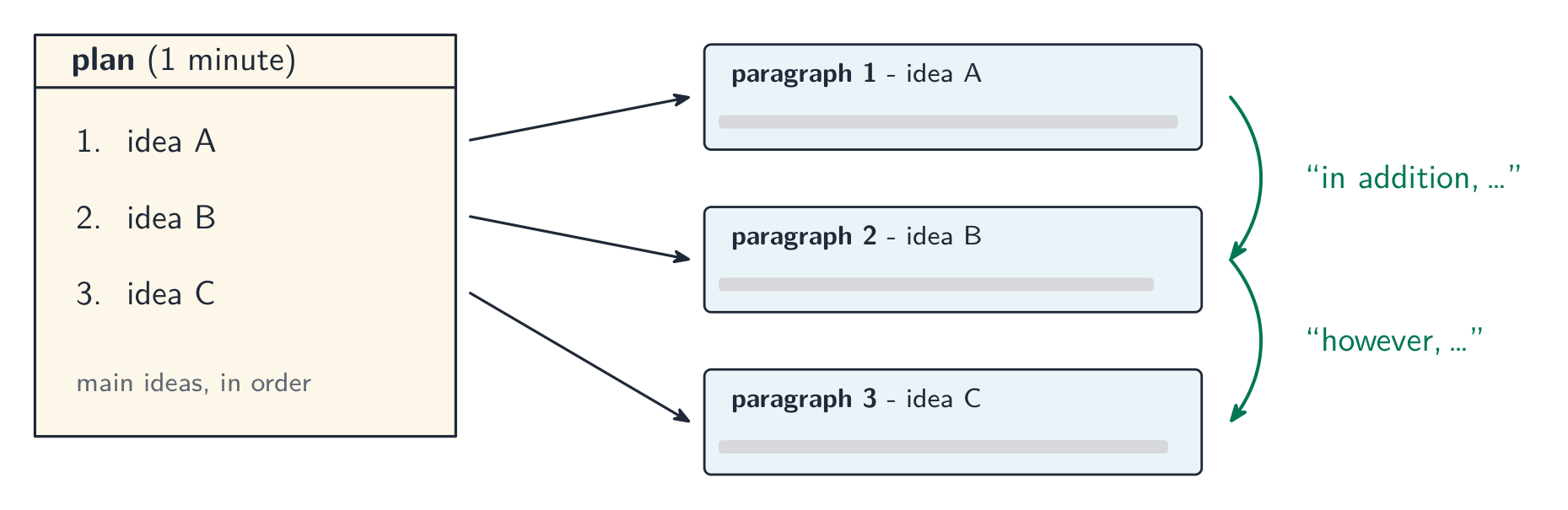
  • Spend one minute on a plan 计划. Write down your main ideas and put them in order.
  • A plan stops you from forgetting a point or repeating yourself.

Use paragraphs

  • Put each main idea in its own paragraph 段落.
  • Start a new paragraph for a new idea. This makes your writing clear.

Link your ideas

  • Use linking words 衔接词 to join your ideas smoothly.
  • For adding: in addition, also, as well as. For contrast: however, but, although. For results: so, therefore, as a result.
日本語

良い文章とは、単に誤りがないことだけでなく、読み手が理解しやすいことも含みます。

書く前に計画を立てる

  • 計画に1分間費やす。主要なアイデアを書き出し、順序を整える。
  • 計画があれば、要点を見落としたり、同じことを繰り返し書いたりすることを防げる。
3つの番号付きアイデアを含む1分間の計画が、in additionやhoweverといった接続詞を使って結ばれ、それぞれ1つのアイデアを持つ3段落に変化する
一分間の構成案があなたの段落になります:各段落に一つのアイデア、接続詞でつなぐ

段落を使う

  • 各主要なアイデアを独自の段落に入れる。
  • 新しいアイデアに対しては新しい段落を始め、これにより作文が明確になる。

アイデアをつなぐ

  • 接続詞を用いて、アイデアをスムーズに結びつけなさい。
  • 追加の場合:in addition, also, as well as。対比の場合:however, but, although。結果の場合:so, therefore, as a result。
Vocabulary · ⁨語彙⁩ Train · ⁨練習する⁩
English 日本語
plan/plæn/ 計画
paragraph/ˈpærəɡræf/ 段落
linking words/ˈlɪŋkɪŋ wɜːdz/ 接続詞
Watch lesson · ⁨レッスンを視聴⁩
2.3

Accuracy: grammar, vocabulary and checking · ⁨正確性:文法、語彙、およびチェック⁩

Syllabus · ⁨シラバス⁩
English
  1. use a range of grammatical structures: different verb forms and tenses, conditionals and varied sentence types
  2. use a range of vocabulary, including set phrases, collocations and synonyms to avoid repetition
  3. check your writing for accuracy in grammar, spelling and punctuation
日本語
  1. 多様な文法構造を使用する:異なる動詞形と時制、条件節、多様な文型
  2. 多様な語彙を使用し、決まったフレーズ、固い組み合わせ、同義語を用いて反復を避ける
  3. 文章の文法、綴り、句読点の正確性を確認する

Source: Cambridge International syllabus · ⁨出典: Cambridge International シラバス⁩

English

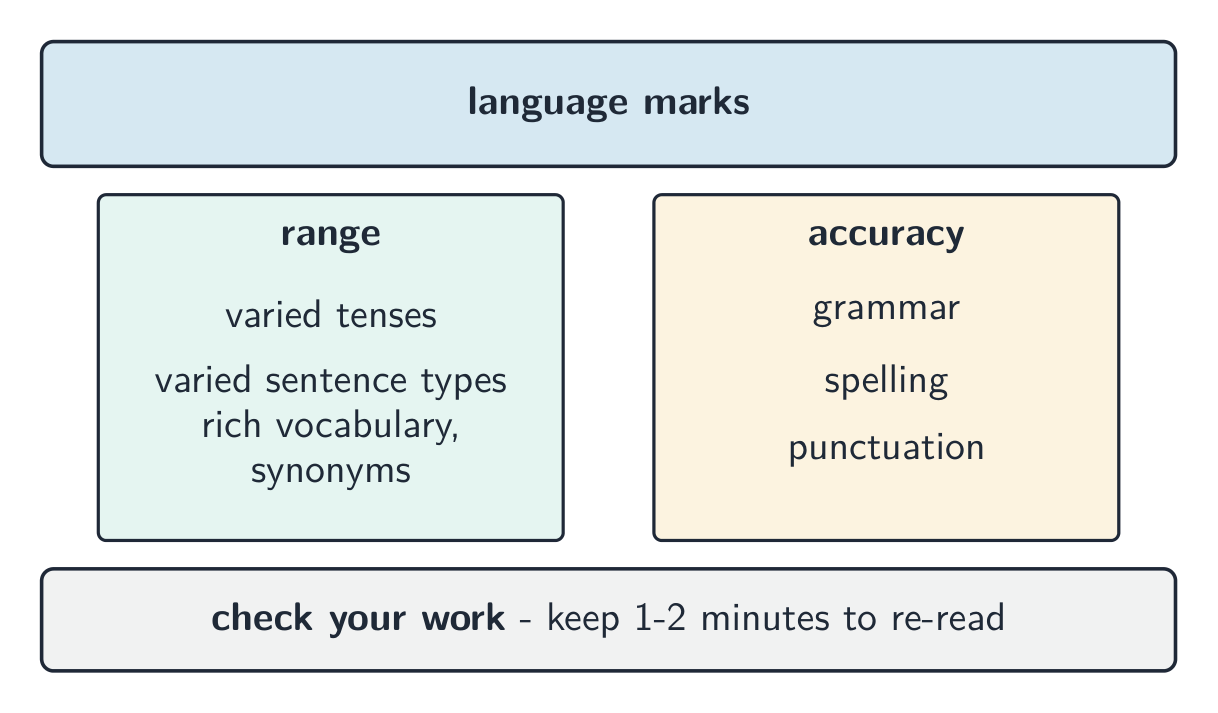
Language marks come from range 多样性 and accuracy 准确性.

Show a range

  • Use different tenses 时态 and sentence types. Do not write every sentence the same way.
  • Use a range of vocabulary 词汇. Choose a better word than the easy one, and use synonyms 同义词 to avoid repeating yourself.

Be accurate

  • Check your grammar 语法, spelling 拼写 and punctuation 标点.
  • Common errors are subject–verb agreement, verb tenses, and missing capital letters.

Check your work

  • Leave one or two minutes to read your work again.
  • Look for small mistakes you can fix quickly. Checking can save several marks.
日本語

言語の得点は、語彙の多様性(range) と 正確さ(accuracy) の両方から生まれます。

多様性と正確性という2つの柱が、「言語の得点」と名付けられた屋根を支え、その土台には「作業をチェック」と書かれている
言語得点は二つの柱に基づいています:バリエーションと正確性

多様性を示す

  • 異なる時制や文型を使用しなさい。すべての文を同じ形式で書かないこと。
  • 幅広い語彙を使おう。簡単な言葉よりも良い言葉を選び、同義語を用いて重複を防ぎなさい。

正確性を保つ

  • 文法、綴り、および記号を確認しなさい。
  • よくあるミスは、主語と動詞の一致、動詞の時制、大文字の欠落である。

作業をチェックする

  • 作文を再度読むために1〜2分残しなさい。
  • すぐに修正できる小さなミスを找めよう。チェックすることで複数の得点を救えるかもしれない。
Vocabulary · ⁨語彙⁩ Train · ⁨練習する⁩
English 日本語
range/reɪndʒ/ 値域
accuracy/ˈækjʊrəsi/ 精度
tenses/ˈtensɪz/ 時制
vocabulary/vəʊˈkæbjʊləri/ 語彙
synonyms/ˈsɪnənɪmz/ 同義語
grammar/ˈɡræmə/ grammar
spelling/ˈspelɪŋ/ 綴り
punctuation/ˌpʌŋktʃuːˈeɪʃn/ 記号
2.3

Exam tips · ⁨試験対策⁩

English
  • Before you write, say your job in one line: "an informal email to a friend, to invite him to a picnic".
  • Cover every content point in the task. Examiners tick each point; a missing one costs marks at once.
  • Learn what 120 to 160 words of your handwriting looks like, so you never count in the exam.
  • Save the last five minutes to check your usual errors: verb -s, past forms, a / an / the.
  • A short correct sentence beats a long broken one every time.
日本語
  • 書く前に、自分の任務を1行で言う:「友人へのインフォーマルなメール、彼をピクニックに招待するため」。
  • タスクのすべての内容項目を網羅しなさい。採点者は各項目にチェックを入れる;1つ漏れると即座に失点する。
  • 自身の筆跡で120〜160文字がどのくらいか覚えておき、試験中に数えることがないようになれ。
  • 最後の5分は、自分がよく犯すミスのチェックに充てなさい:動詞の-s、過去形、a/an/the。
  • 常に、長い破損した文よりも短い正しい文の方が優れている。

Interactive lessons on this topic · ⁨このトピックのインタラクティブ授業⁩

Work through it step by step, with instant-check exercises. · ⁨一歩ずつ進め、即時チェック付きの問題で学習します。⁩

Past Papers · ⁨過去問⁩

More topics in IGCSE English · ⁨IGCSE 英語⁩ · ⁨IGCSE English · ⁨IGCSE 英語⁩ の他のトピック⁩

Log in or create account · ⁨ログインまたはアカウント作成⁩

IGCSE, A-Level & AP